Antonello da Messina: Sicilian Master

Antonello da Messina (~1430-1479) was born in Messina, Sicily. While studying in Naples, he became aware of a technique of painting using oil-based pigments that had originated in the Netherlands with Jan van Eyck (~1390-1441) and his followers. Antonello soon became a master of this new method. He was an expert portraitist able to capture his sitters’ distinct identities and depths of feeling. The illustration shows a painting from 1473, that was once thought to be a self-portrait, but there is no real evidence for this. Although many of Antonello’s works have been lost, three absolute masterpieces have survived: Saint Jerome in his Study, The Virgin Annunciate, both dated to around 1474, and Saint Sebastien from about 1478. 

Learning How to Paint with Oils

In his Lives of the Most Excellent Painters, Sculptors, and Architects (1568), Giorgio Vasari considered Antonello da Messina as pivotal in the transition between tempera and oil painting in Italy. The use of linseed oil in painting began in northern Europe, most particularly in Flanders. First used for painting wood carvings, by around 1400 oil-based pigments were being used for panel paintings. Jan van Eyck is often considered the pioneer of this new technique (Ferrari, 2013). Oil-paints dried more slowly than tempera and were more easily mixed. These advantages led to more exact representations of color and texture. The oil medium allowed for “pictorial second thoughts, enabling the picture to be modified as work on it progressed” (Pope-Hennessy, 1966, p 60). Furthermore, the surface of oil paintings is glossy rather than matte: oil paintings appear to glow with internal light.

Antonello first became aware of some of these new paintings when he was apprenticed to Niccolo Colantonio in Naples in the mid to later 1440s. Alfonso the Magnanimous (1396-1458), king of Aragon, Sicily and Naples, possessed the beautiful Lomellini Triptych by Jan van Eyck that is now long lost (Borchert, 2019). This was described by Bartholomeo Facio in 1456:

His is a remarkable picture in the most private apartments of King Alfonso, in which there is a Virgin Mary notably for its grace and modesty, with an Angel Gabriel, of exceptional beauty and with hair surpassing reality, announcing that the Son of God will be born of her; and a John the Baptist that declares the wonderful sanctity and austerity of his life, and Jerome like a living being in a library done with rare art (quoted by Borchert, 2019, p 36).

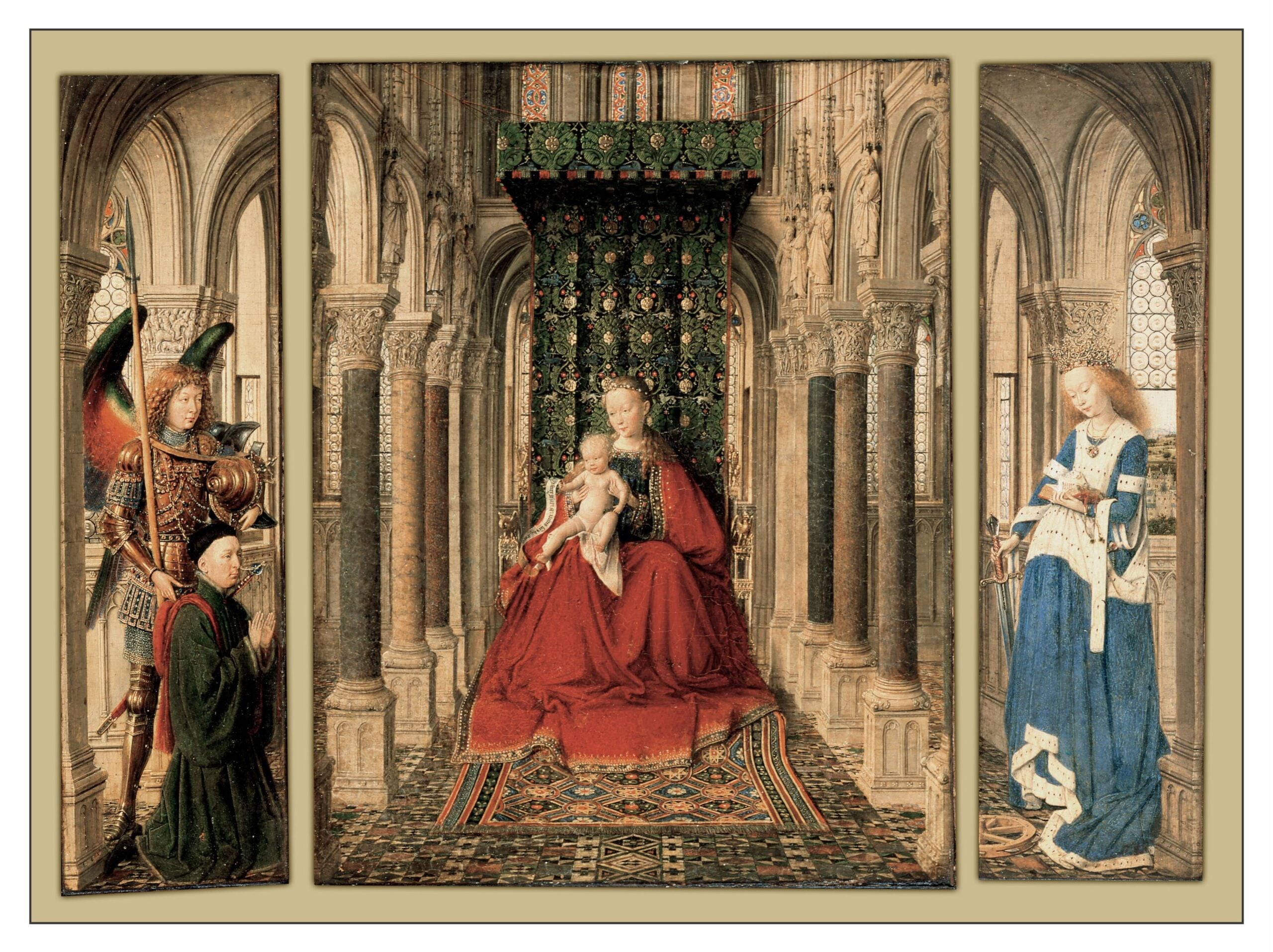
The lost triptych was likely a small devotional painting like van Eyck’s 1437 Dresden Triptych (below). Only 33 cm high, this triptych could be folded up and carried by a travelling merchant for use as a portable altar during daily prayer. The Lomellini triptych was probably of similar size but with an annunciation at the center and Saints Jerome and John in the wings.

Antonello was clearly impressed by this and other Flemish paintings in Alfonso’s collection. Vasari claimed that he therefore travelled to Flanders to study with Jan van Eyck:

Having arrived in Bruges, he became very intimate with the said Johann, making him presents of many drawings in the Italian manner and other things, insomuch that the latter, moved by this and by the respect shown by Antonello, and being now old, was content that he should see his method of coloring in oil; wherefore Antonello did not depart from that place until he had gained a thorough knowledge of that way of coloring, which he desired so greatly to know. And no long time after, Johann having died, Antonello returned from Flanders in order to revisit his native country and to communicate to all Italy a secret so useful, beautiful, and advantageous.  

Unfortunately, this would have been impossible. Jan van Eyck died in 1441, when Antonello was only 11 years old. However, nothing is known about Antonello in the 1450s. He might therefore have travelled to Bruges during this time and studied with some of van Eyck’s followers (Wright, 1980). As well as learning about oil-painting from the Flemish artists, Antonello may have taught them, in exchange, some of the new Italian insights into perspective (Edgerton, 1975).

Another possibility is that Antonello interacted with Petrus Christus (1410-1476), one of van Eyck’s most prominent disciples, in Italy rather than Flanders. There is some evidence that the two painters may have been present at the same time in Milan at the court of Francesco Sforza (Ainsworth & Martens, 1994, p 61).

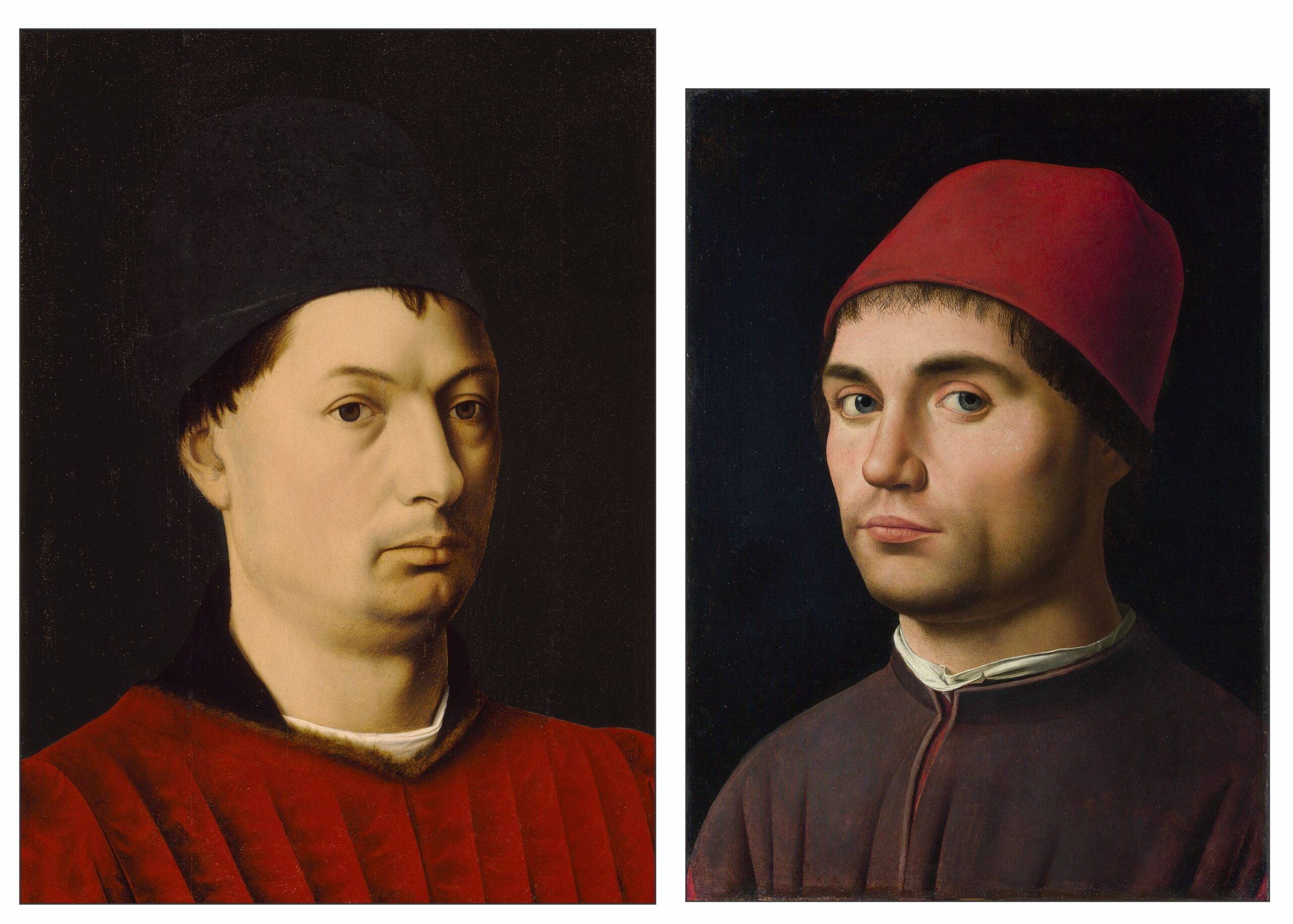
Antonello returned home to Sicily in 1460, and worked there for several years but nothing is really known about his whereabouts in the late 1460s. Perhaps he travelled at that time to Bruges and interacted there with Petrus and other painters, such as Hans Memling (1430-1494). There are striking similarities between Petrus’ Portrait of a Man (1465?) on the left side of the following illustration and Antonello’s later portrait from 1473.

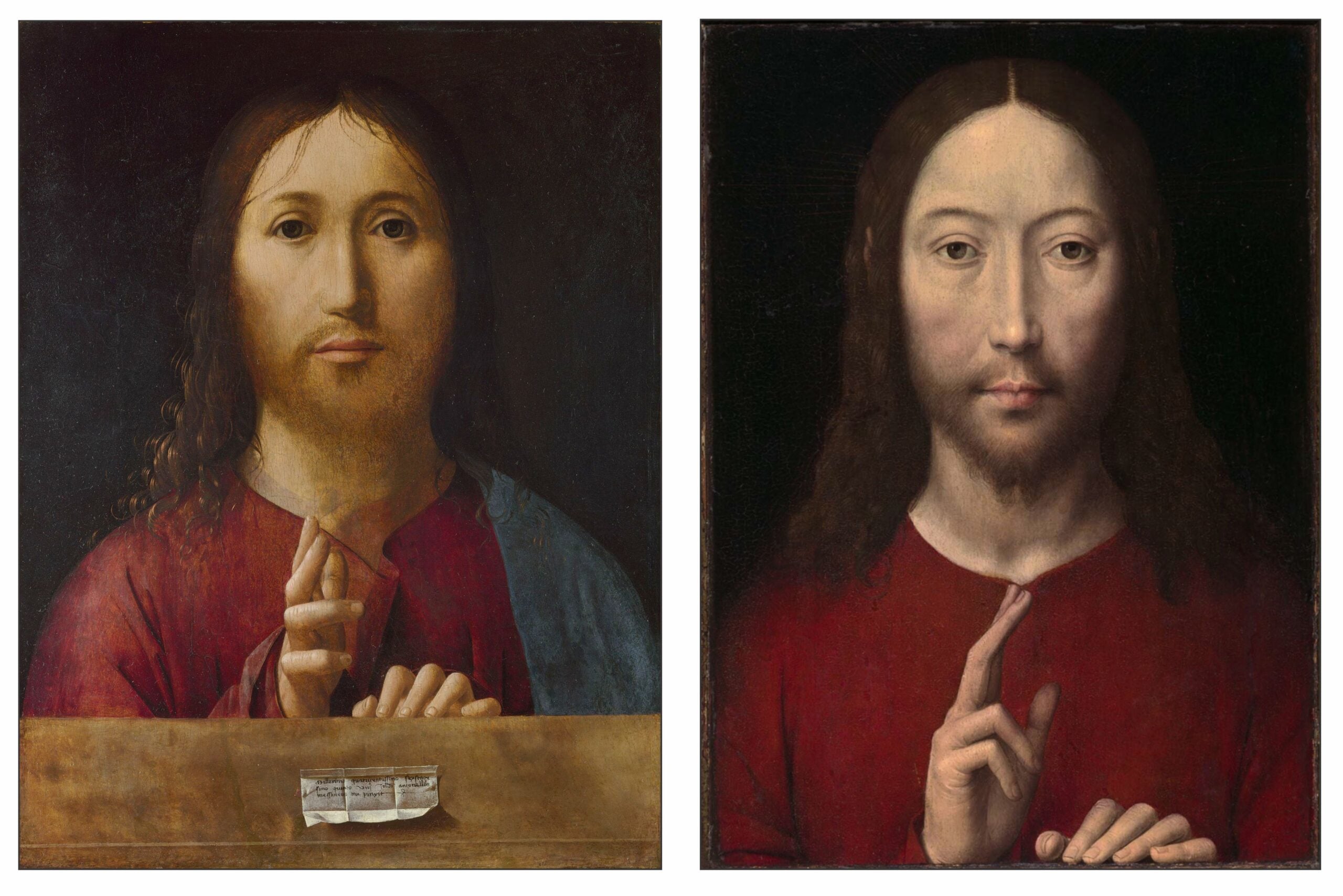
The following illustration shows Antonello’s Salvator Mundi from 1465 on the left and a similar painting by Hans Memling from 1475. It appears too close a likeness not to have been the result of personal interaction between the artists. 

Compared to the paintings of the Flemish painters, Antonello’s are more natural, more distinctive and more emotional. They express themselves. We sense a real person rather than an image.

Antonello stayed in Venice for a brief period beginning in late 1475. While there, he interacted with Venetian artists such as Giovanni Bellini (1430-1516) and Andrea Mantegna (1431-1506). An apocryphal story tells how Bellini posed as a nobleman and had his portrait painted by Antonio so that he could observe the technique of oil painting (Cardona & Villa, 2019, p 29).

An important development that occurred in Venice in the late 15th Century was oil-painting on canvas rather than wood. Sail-canvas was in ready supply in this maritime city. Canvas did not crack or warp like wood, and its light weight allowed for much larger paintings. Though Antonello did not paint on canvas, Bellini painted some of his late paintings on canvas, and oil on canvas became the usual technique for the next generation of Venetian painters such as Giorgione (1470-1510), and Titian (1488-1576).

In 1476, Antonello was offered a position on the Sforza court in Milan, but he declined and returned to Messina. He died there in 1479, having provided a dowry for his daughter and placed his son Jacobello in charge of his studio. Jacobello’s only surviving painting is signed Jacobus Antonelli, filius non humani pictoris (son of a painter who was more than human) (Cardona & Villa, 2019, p 39).

Over the years, many of Antonello’s works vanished. Some were destroyed in the earthquakes to Messina was prone. Others were lost in the bombing of World War II. Many of his paintings were small and easily lost. Only about 40 paintings remain.

Renaissance Portraits

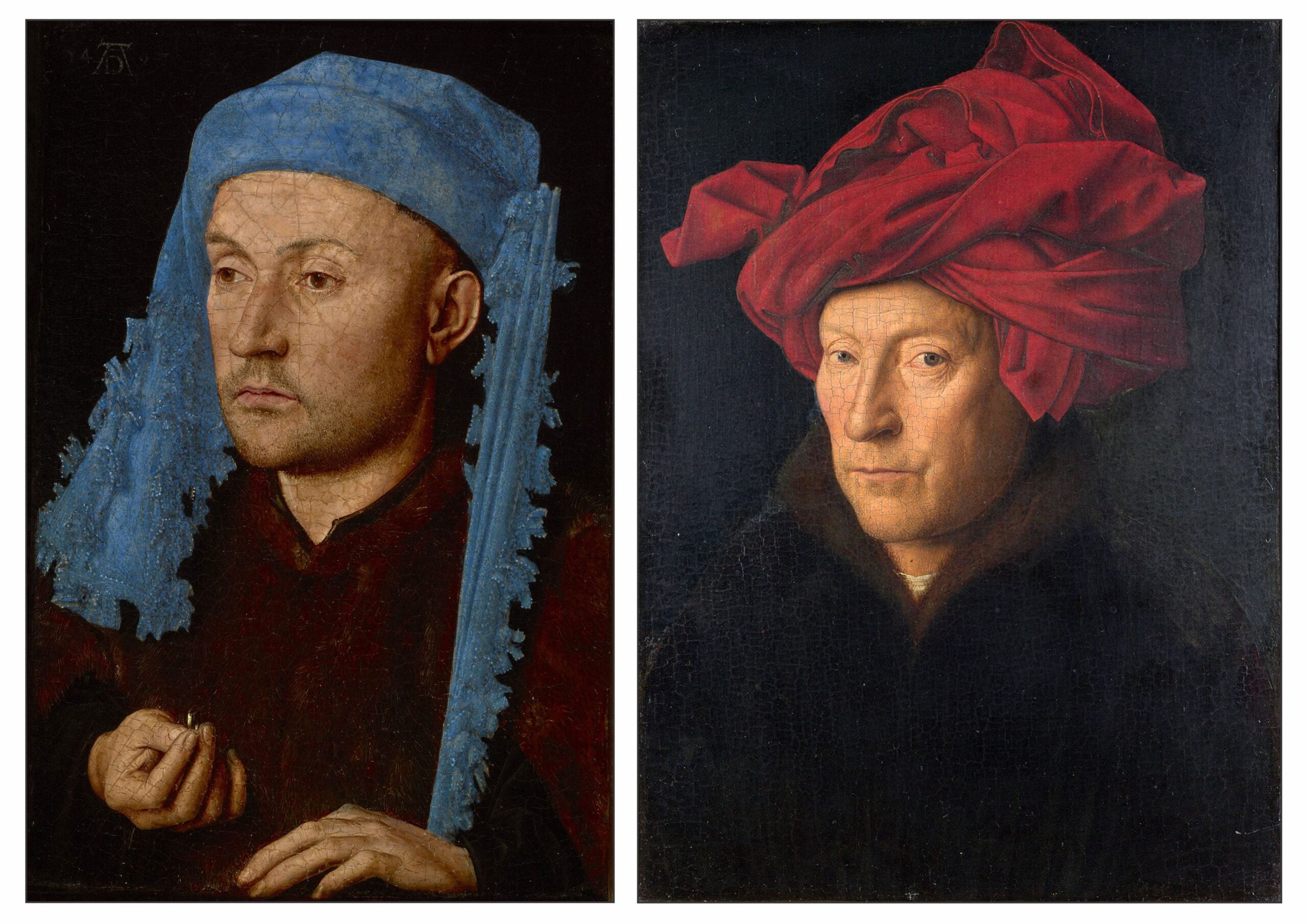
During the later Middle Ages, the rich and the powerful wished to gain some hold on immortality by having their portraits painted. Initially this was done by giving an altarpiece to a church and having themselves included in the painting as the donors. Over time, painters began to provide portraits independently of the church. Jan van Eyck was again one of the most prominent of the early portraitists. The following illustration shows two of his portraits, both from around 1433. The sitter on the left is holding a ring. This could indicate that the sitter is a goldsmith, that he has just become engaged to be married, or that he has assumed a position of authority requiring the use of a signet ring. On the left the sitter is wearing is a striking blue chaperon, and on the right a marvelous red turban. The latter may be a self portrait.

Antonello learned from the Flemish painters, and became the “first Italian painter for whom the independent portrait was an art form in its own right” (Pope-Hennessy, 1966, p 60). He became particularly adept at presenting the individuality of the eyes. In this he was a believer in Saint Jerome:

Speculum mentis est facies, et taciti oculi cordis fatentur arcana.
The face is the mirror of the mind and, without speaking, confesses the secrets of the heart.

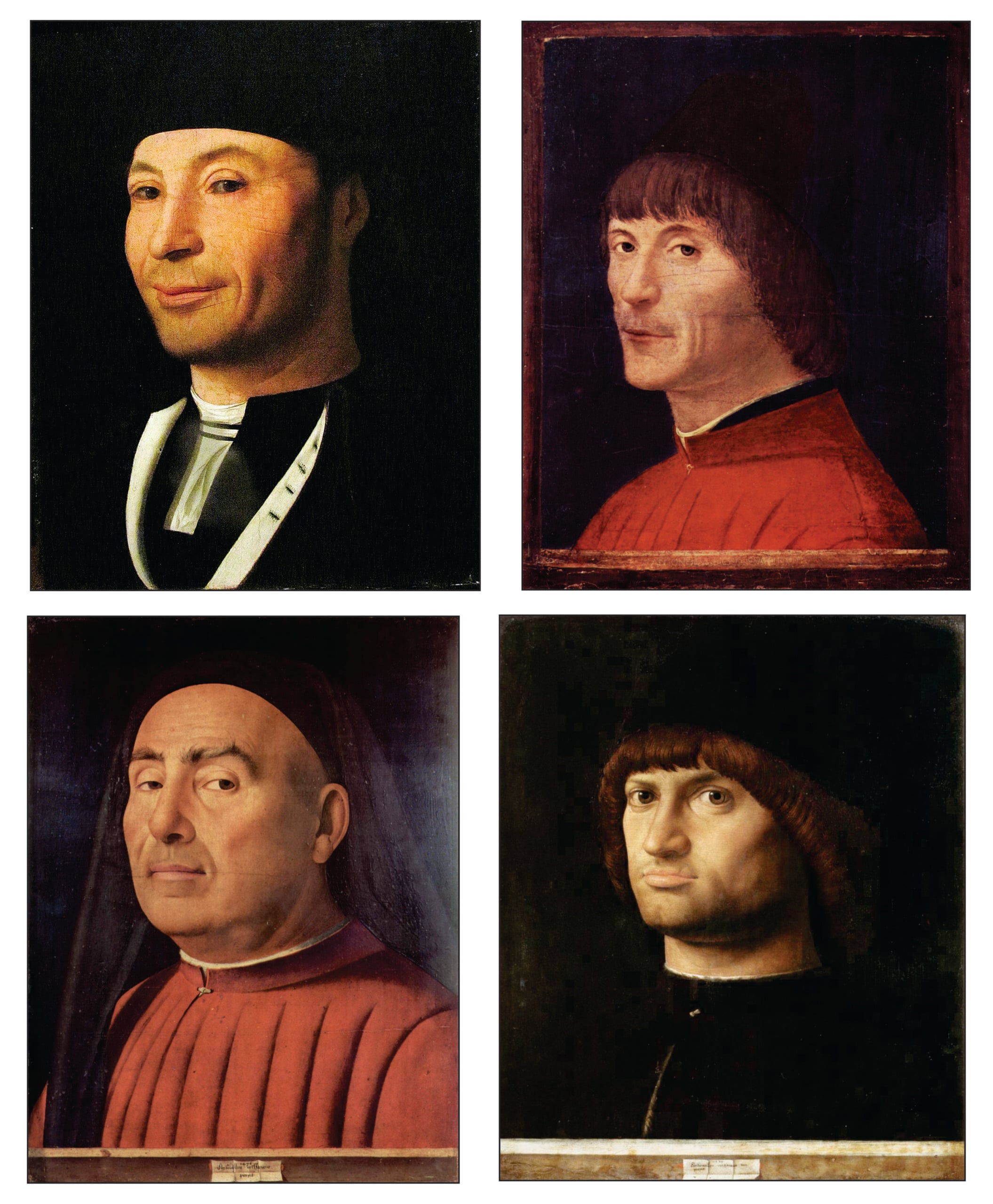
The following illustration shows four of his portraits. The upper left is from the late 1460s and the others from the early 1470s. One of Antonello’s characteristic effects was to add is signature in a cartellino on a ledge at the bottom of the image (the two lower portraits). This trompe l’oeil representation of a folded piece of paper perhaps guarantees the veracity of the portrait: if the artist can represent a scrap of paper that well, then he must have captured the likeness exactly. The typical message on the cartellino read “Antonello messianeus me pinxit” together with a date (Renzo Villa in Cardona & Villa, 2019, pp 81-107)

We consider ourselves able to read both character and emotion in the human face. For example, in the preceding portraits we might find mockery/amusement, diffidence/cunning, disdain/skepticism, and truculence/stubbornness. Indeed, the last portrait is often known as Il Condottiero, the name for an Italian mercenary leader.

The following is an evaluation of the portrait at the lower left by Nicola Gardini, an Italian novelist (in Cardona & Villa, 2019, p 289):

The face is the theatre. And it is doubly so. On the one hand, it provides a stage where events or a story, no matter how slight, can unfold: the eyebrows arch, the eyelids are lowered, a rebellious tuft of eyebrow hairs stands up, a wart is displayed in the centre of his forehead, which creases into furrows that extend down to the side. There is no fixity: that face reveals an ex-pression, a current frame of mind or psychological circumstance. On the other hand, the mask, the moral core of the expression, the underlying truth behind events elevating the circumstance to a natural truth. This is where the man reveals himself, both as he is and as he appears with all his distinctive features: the smugness, the miserly smile (Antonello has managed to make his eyebrows smile far more than his mouth), a sense of condescension and satisfaction, his robustness, that air of good health, cleanliness, prosperity … Clearly pleased with himself and full of self-worth, this man certainly knows a thing or two. And he keeps as far away as he can from death.

However, we should be careful. Though we can recognize the most striking of human emotions, we often miss subtle changes. And we are more often wrong than right about the underlying character.

The portrait in the upper left is particularly appealing. Though it has been considered the portrait of a sailor or a pirate, it is almost certainly a portrait of a Sicilian aristocrat, willing to have his representation immortalized by the talented artist. He is not dressed in a modern maritime uniform but wearing a Sicilian woolen cape or cappuloro (Cardona & Villa, 2019, p 32). The Sicilian novelist Leonardo Sciasia notes that we recognize the face but really do not know the person behind it:

Who does the unknown man resemble? A mafioso from the countryside or one from the best neighborhoods, the member of parliament who sits on the right, or on the left, the peasant or the lawyer? He looks like the writer of these notes (it’s been said), and he certainly looks like Antonello. And just try to pin down the social status and the individual human nature of this personage. Impossible. Is he a noble or a plebeian? A notary or a farmer? A gentleman or a lout? A painter, a poet, an assassin? “He resembles.” There you have it. (translated and quoted by Ingrid Rowland, 2024, pp 21-22)

Antonello’s portraits are easily approachable. They all make clear eye contact:

Antonello is also a sensitive to the humanity of the viewer, who is given consistent points of entry into the work. These entry points are established not only with eye contact, but with the parapet, which gives a clear boundary between observer and observed, and the cartellino, which looks as if one has just unfolded it. (House, 2025, p 41)

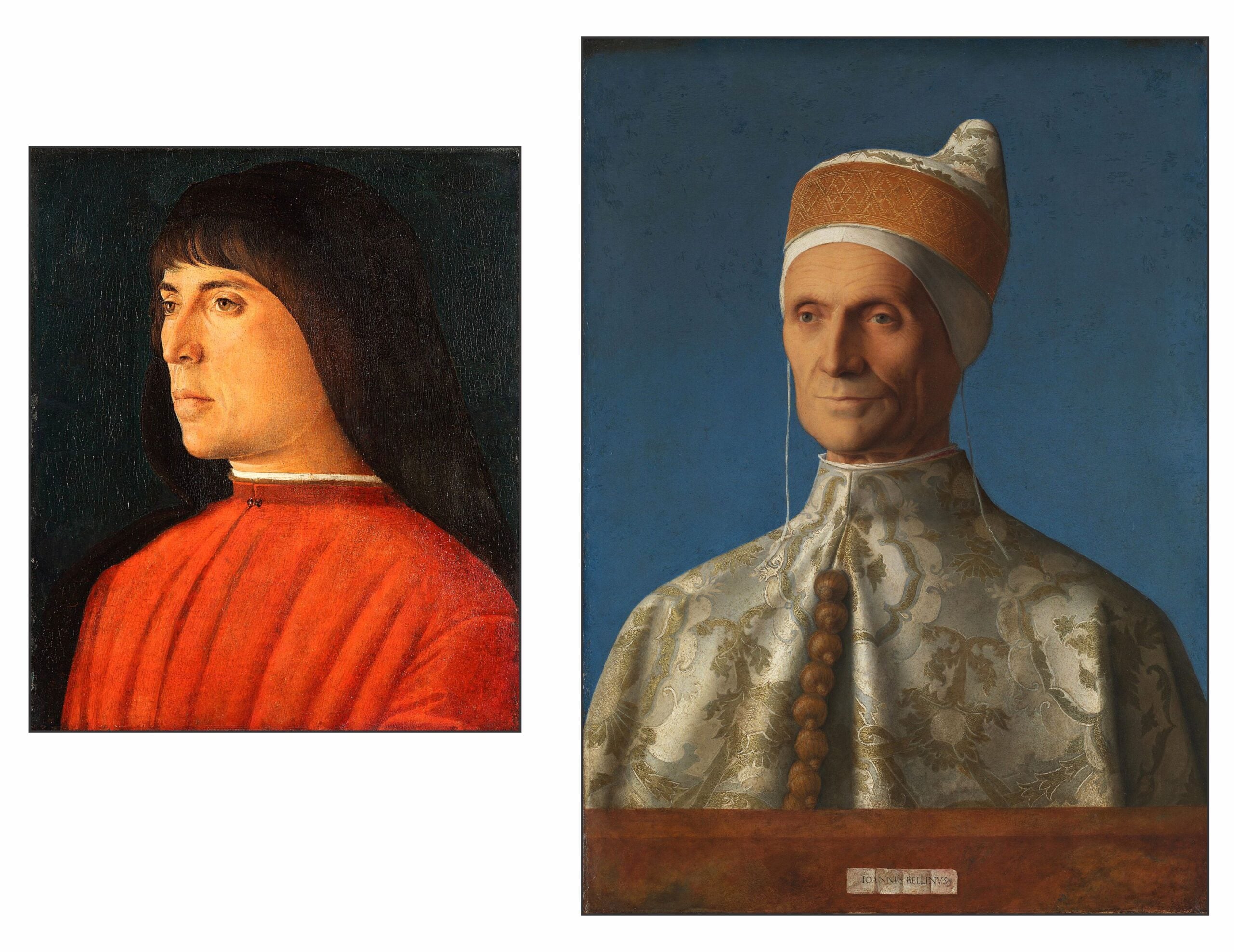
When Antonello was in Venice in 1475-6, he was able to show the Venetian painters the techniques of oil-based portraits. The following are two portraits by Giovanni Bellini.  The Portrait of a Young Man on the left dates to around the time of Antonello’s visit. It is clearly similar to Antonello’s paintings. The Portrait of Doge Leonardo Loredan is from 1501. Antonello’s technique has been supplemented by the amazing color sense that characterizes Venetian painting. Interestingly, Bellini has added to his masterpiece a painted cartellino in the style of Antonello:


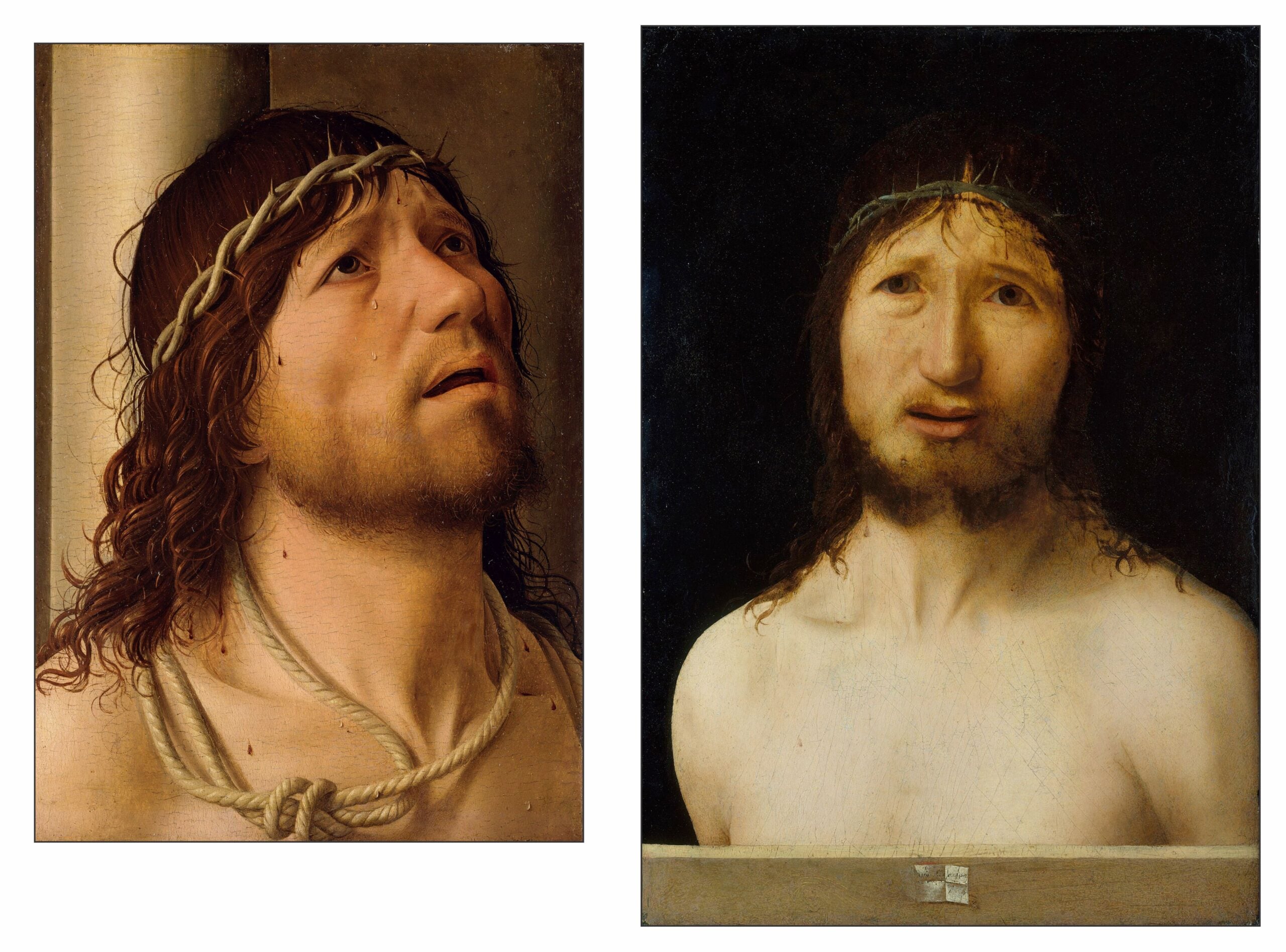
Ecco Homo

Antonello used the abilities he had developed in portraiture to create representations of the face of Christ that are utterly convincing in their humanity and depth of feeling. One of his favorite themes was that of Ecco Homo (Behold the man) as described in the Gospel of John:

Then Pilate therefore took Jesus, and scourged him.

And the soldiers platted a crown of thorns, and put it on his head, and they put on him a purple robe,

And said, Hail, King of the Jews! and they smote him with their hands.

Pilate therefore went forth again, and saith unto them, Behold, I bring him forth to you, that ye may know that I find no fault in him.

Then came Jesus forth, wearing the crown of thorns, and the purple robe. And Pilate saith unto them, Behold the man! (John 19 1-5)

The following illustration shows two of Antonello’s paintings of Ecco Homo, the left from 1476 and the right from 1470.


Saint Sebastian

Saint Sebastian was a 3rd Century Roman Christian martyred during the Diocletian Persecutions. Initially, he was shot with arrows, but this miraculously did not kill him, and he was nursed back to health by Saint Irene. Later, he was clubbed to death and thrown into the Cloaca Maxima – Rome’s main sewer.  During the Middle Ages, Saint Sebastian was invoked as a defender against the plague. If he could survive being shot with arrows, surely he could help those who were afflicted by the disease. Depictions of Saint Sebastian allowed painters to portray the nude male body. Antonello’s depiction is probably the most sensuous of the early representations of the saint. In recent years, the saint has become a gay icon and the patron of the Lesbian-Gay-Bisexual-Transgender-Queer communities.

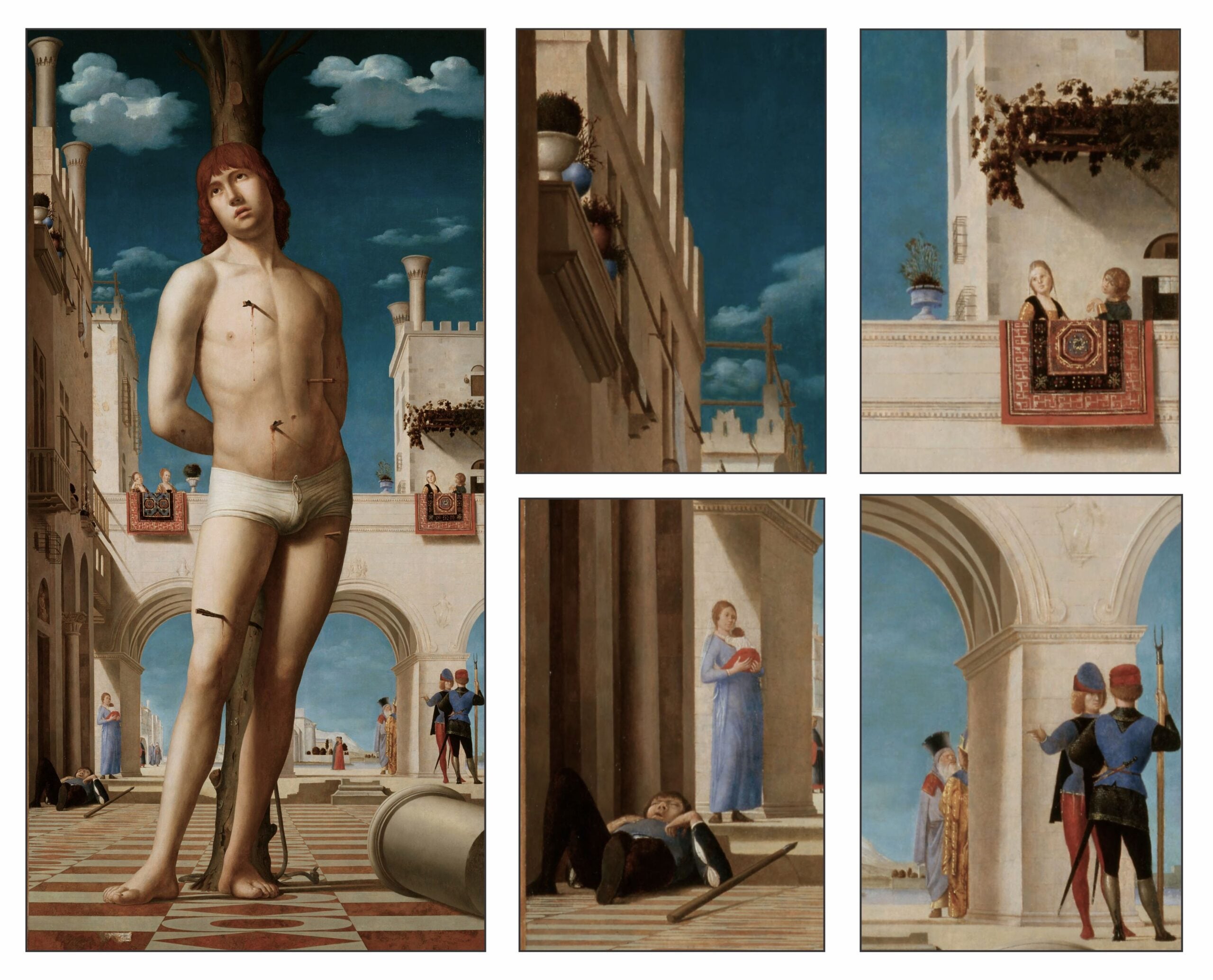
Antonello’s Saint Sebastian was painted in the mid 1470s for the altar of the Church of San Guliano in Venice at the height of one of the plague epidemics to which Venice was so susceptible (Humphrey, 1993, pp 195-229). The altarpiece also contained a representation of Saint Christopher, probably painted by Antonello’s son, and a carved sculpture of Saint Rocco, another saint who offered protection from the plague. The latter was also the patron of the Scuola di San Rocco which was established in 1478. The altarpiece did not last long: the statue and the painting of Saint Christopher have been lost, and Antonello’s painting is now in Dresden.

Antonello’s painting owed much to an earlier altar triptych of Saint Sebastian (1470). However, Antonello’s saint is much more convincing than Bellini’s flatly outlined figure.

The Saint stands in a serenely ordered space that recalls the paintings of Piero della Francesca, who wrote a treatise De prospectiva pingendi (On the Perspective of Painting) in the mid 1470s. Perhaps Antonello visited him in Urbino during his travels (Campbell, 2021). House (2025, p 131) quotes Roberto Longhi as claiming that Antonello assimilated Piero’s teachings and brought them to Venice.

On the left a guard sleeps in a marvel of foreshortening. Elsewhere the people of the city converse, and go about their appointed ways. Though the saint is being martyred, everything is as it should be according to divine perspective.


Saint Jerome

Jerome (342-420) CE) was a Christian saint who in his youth spent a prolonged period of ascetic penance in the deserts of Syria. Legend has it that during this time he removed a thorn from the paw of a lion, and that the lion then became his lifelong companion. After his sojourn in the desert, he came to Rome where he translated the Bible into Latin, and made extensive commentaries on scripture. His version of the Bible – the Vulgate (from versio vulgata, the commonly used version) – remains the official Latin version of the Bible in the Catholic Church. Jerome became the patron saint of translators, librarians, and students.

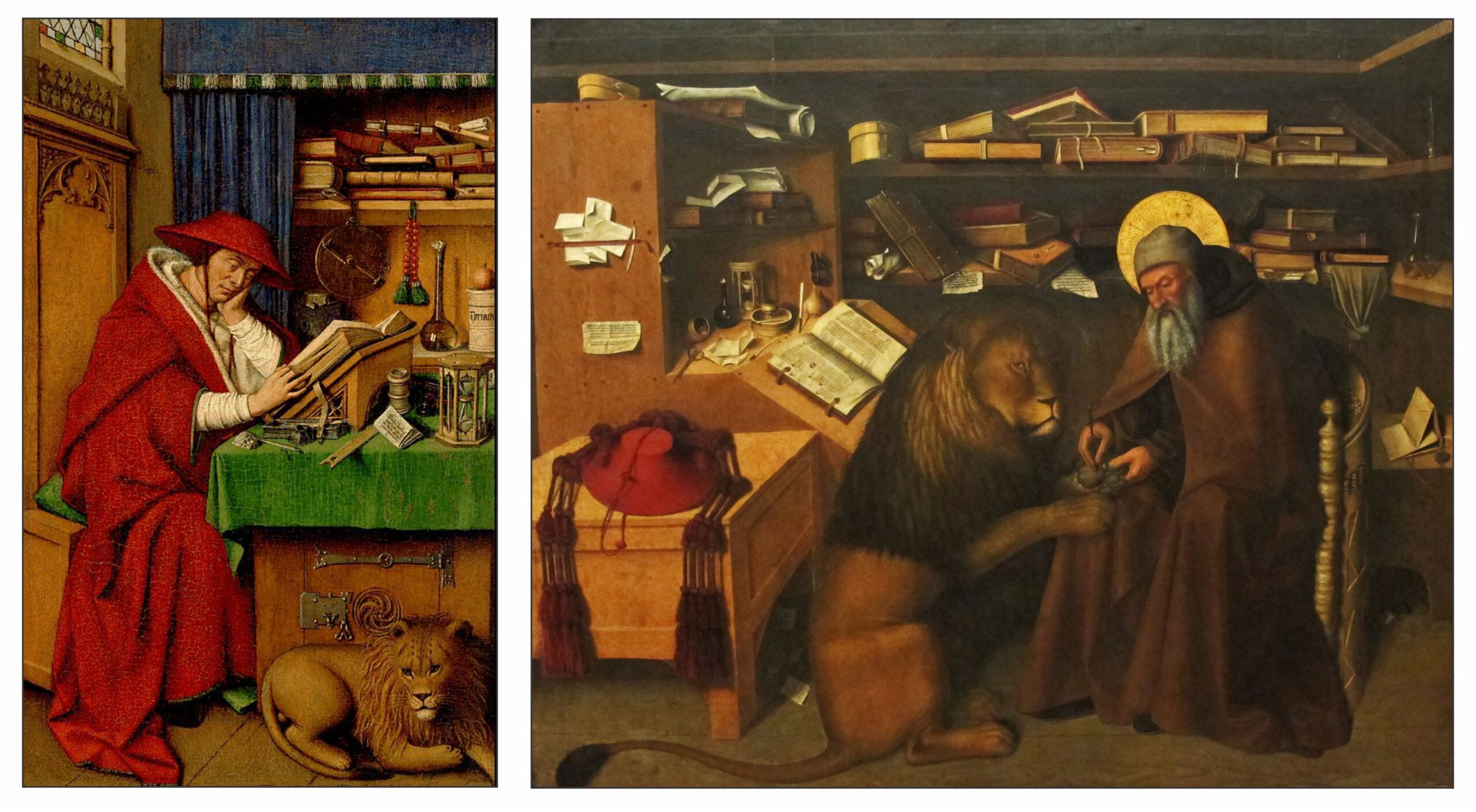
Jerome became a popular subject in the paintings of the early Renaissance.  The following illustration shows on the left a painting of Saint Jerome by Jan van Eyck that was likely finished by Petrus Christus in 1442, and on the right a 1444 painting by Niccolo Colantonio, with whom Antonello was apprenticed in Naples.   

The late Middle Ages ushered in the “Humanities” as a field of study. Initially, this concerned the language, history and philosophy of the Greek, Roman and Hebrew civilizations. The goal of these studies was to facilitate a deeper interpretation of Biblical texts. Study of the humanities (humanitas) was thus considered a handmaiden to the study of divinity (divinitas). Saint Jerome with his immense knowledge of the ancient languages came to personify this new field of study. Over the years the Humanities expanded to include study of all texts. The Humanities then became was distinguished from both Theology – the study of sacred rather than secular scriptures –and the Sciences – the study of observed data.    

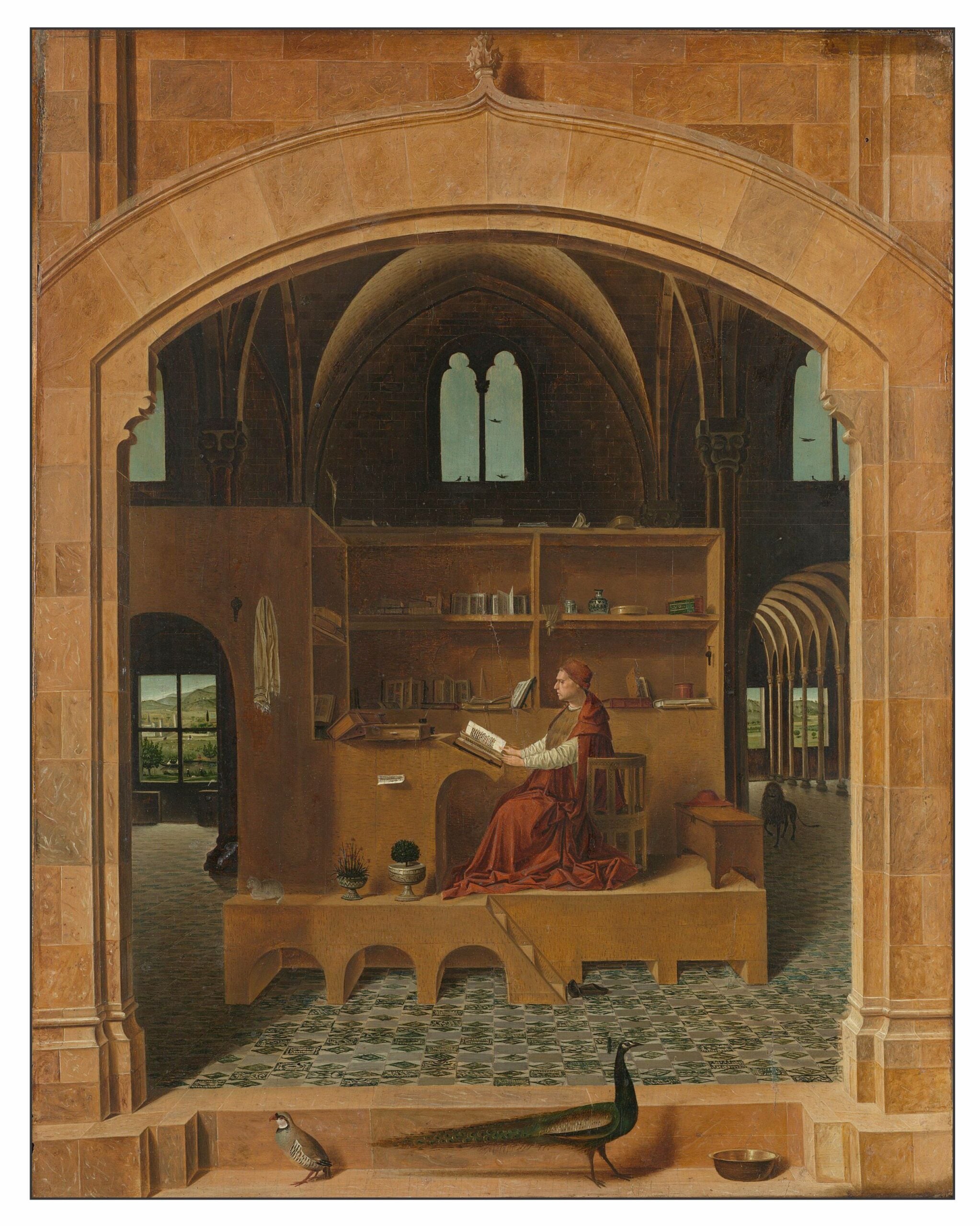
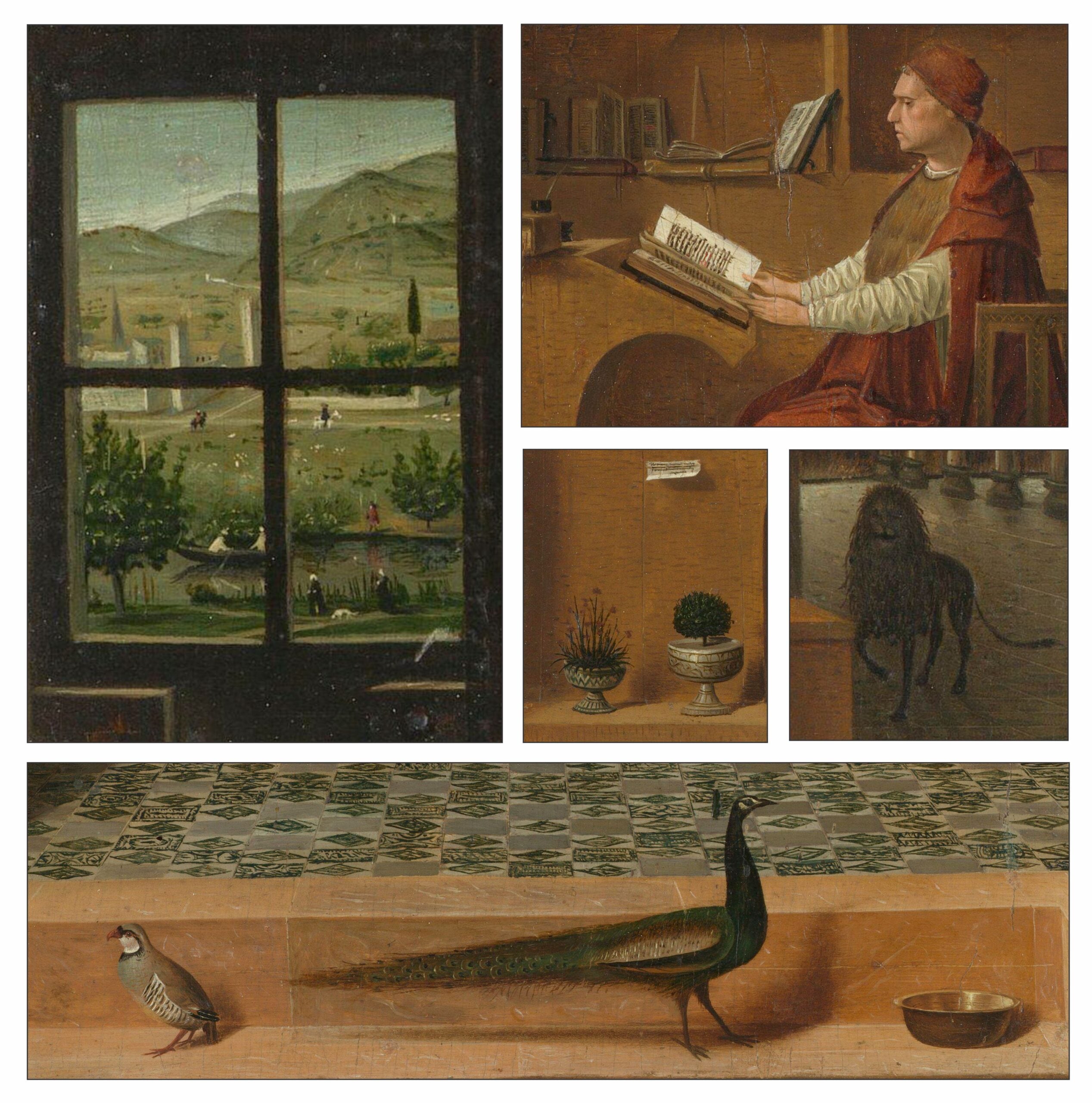
Antonello painted his Saint Jerome in his Study in 1474. The painting is not large (46 by 36 cm) but it is intricately detailed (Jolly, 1983):

The painting shows Jerome reading in his study, as revealed through a monastery doorway. In the foreground the partridge, peacock, and water-bowl symbolize worldliness, immortality and ascetic purity. His lion can be seen in the shadows to the right of the study. A peaceful countryside rests beyond the monastic windows:

The following illustration shows some of the details in the painting. The landscape seen through the window on the left contains people walking with a dog, rowing a boat, and riding a horse – all going about their normal lives independently of the saint in his isolated study.

The Italian writer Elizabetta Rasy (In Cardona & Villa, 2019, p 78) comments on the figure of the saint

Unlike Jan van Eyck’s Saint Jerome blissfully reading with his cheek resting on his hand, Antonello’s saint is not particularly relaxed nor is he sitting properly. In fact, he seems to be almost on the edge of his seat. stretching his arms out towards the book rest like someone carrying out an action or making an effort. Reading may not always be an effort, but it is certainly an action. It is this very tension that gives rise to the power of a figure who does not appear conventionally devotional or indeed anything like the kind old monk depicted by Colantonio, Antonello’s master.

She further comments on the painting’s tension between reality and imagination (in Cardona & Frederico Villa, 2019, p79):

Yet the entire space of the work suggests something else. Let’s take look at the lion. Instead of holding his paw out for the saint to remove the famous thorn or sitting crouched at his feet, he is roaming aimlessly in the corridor, nothing like a lion, not even the lion in the legend, but more like those animals appearing in dreams, in places and in ways they shouldn’t, like incongruous presences. That lion standing in the shade, a forest but of an elegant marble corridor, is an apparition that shifts the entire scene into the realm of dreams. Over on the other side is a paper label attached to the wooden wall of Jerome’s cell, in plain sight. Is it the artist’s signature? A message for the observer? No, it is impossible to read those words, they are just a series of illegible scribbles that do not belong to any human alphabet. Have you ever tried to read something in your dreams? It’s impossible. Those forever unknowable words are written in the language of the most secret nocturnal images. This is the time-less stance of Antonello’s Saint Jerome in the study: every element in this setting, saint included, is here, now, near, tangible and shamelessly real. Yet every element in the entire conspicuously asymmetrical space of the picture is mysterious and represents a distant Beyond that enchants us and draws us out.


Virgin Annunciate

During the Middle Ages in Europe the veneration of the Virgin Mary underwent an extraordinary growth. This was partly related to the writings of Bernard de Clairvaux, who experienced visions of the Virgin, and who founded the Cistercian Order, and partly the need for solace during the terrible years of the Black Death. If the plague had been sent by a God of Justice and Judgment, the people could not really appeal to him for relief. So they asked the Virgin Mary to intercede, the divine feminine being far more compassionate than the male. Many of the great cathedrals were named after Notre Dame or Santa Maria. The virgin appeared to her followers, and, at the sites of these visions, shrines were established to attract pilgrims. Walsingham in Norfolk, England is one of the earliest Marian shrines

Artists celebrated the many different aspects of Mary’s life from the Annunciation to the Assumption (Verdon, 2005). One of the most popular subjects was the Annunciation as described in the Gospel of Luke (1:26-31):

….the angel Gabriel was sent from God unto a city of Galilee, named Nazareth,

To a virgin espoused to a man whose name was Joseph, of the house of David; and the virgin’s name was Mary.

And the angel came in unto her, and said, Hail, thou that art highly favoured, the Lord is with thee: blessed art thou among women.

And when she saw him, she was troubled at his saying, and cast in her mind what manner of salutation this should be.

And the angel said unto her, Fear not, Mary: for thou hast found favour with God.

And, behold, thou shalt conceive in thy womb, and bring forth a son, and shalt call his name Jesus.

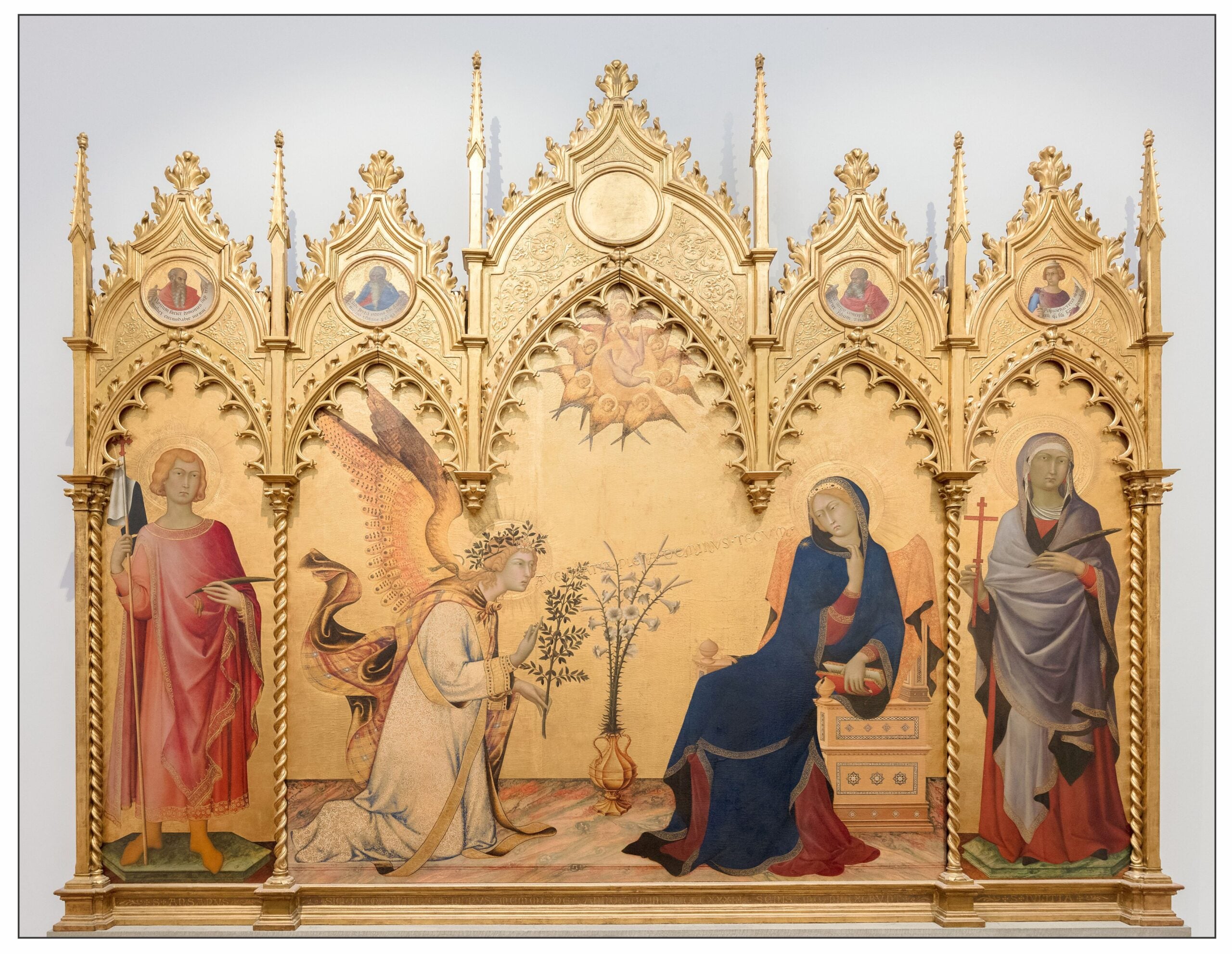
The paintings typically showed Gabriel interrupting Mary as she read from the scriptures The angel is usually on the left and in profile; the virgin on the right and turned toward the viewer. The following illustration shows the 1333 Annunciation Altarpiece of Simoni Martin and Lippo Lemmi now in the Uffizi Gallery in Florence. The words of the angel float across the gold background through the olive branch of divine peace and the lily of virgin purity:

Ave [Maria] gratia plena dominus tecum
Hail [Mary] full of grace, the lord is with you.

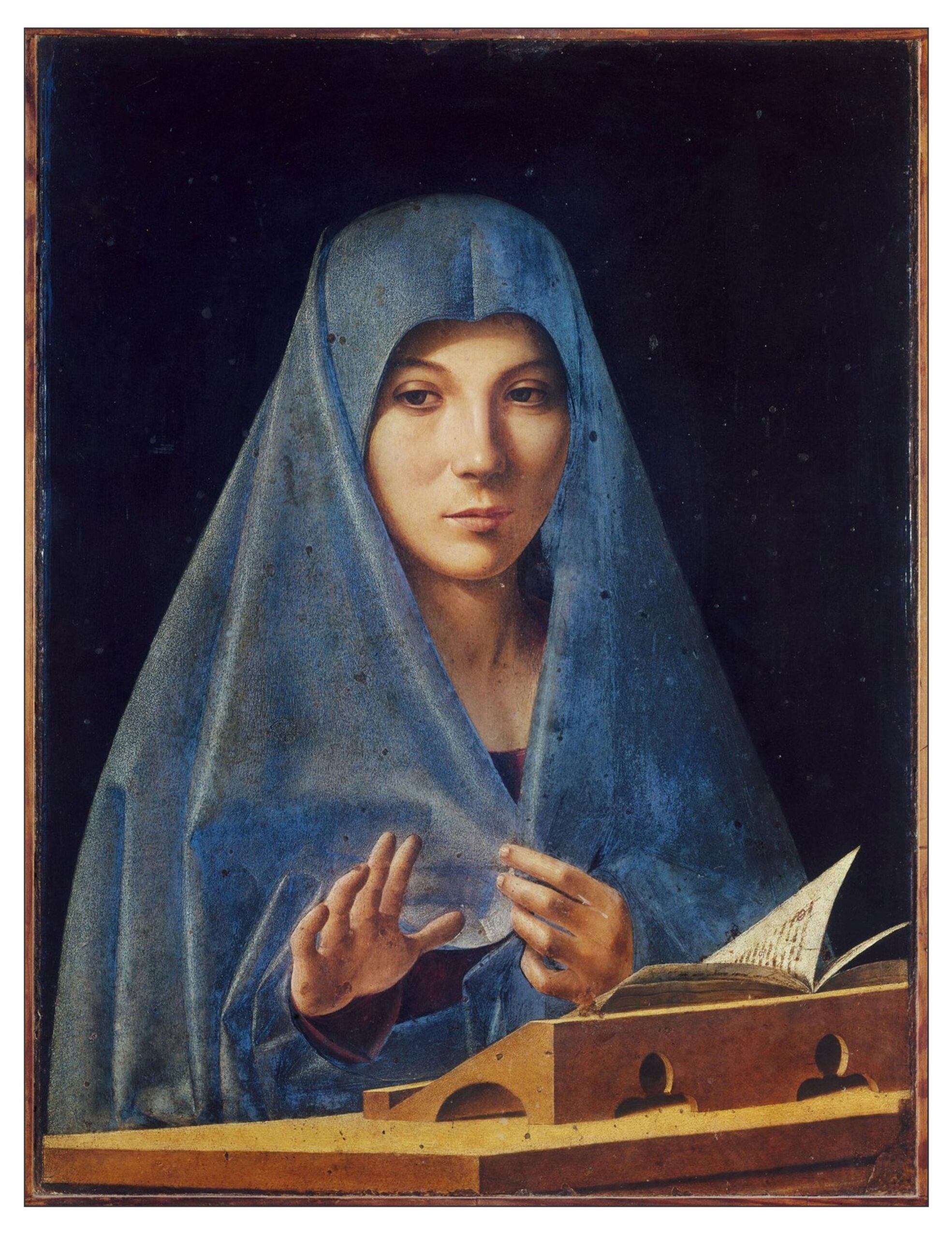
Sometimes the annunciation was painted on two panels and that representing Mary was called the Vergine Annunziata (Virgin Annunciate). Antonello da Messina was the first painter to represent the Virgin Annunciate alone.


His 1476 painting shows the virgin in a simple blue shawl. The background is dark rather than gold. Mary looks down and to the left at a kneeling Gabriel who is not represented, and perhaps not clearly visible in the real world. Her expression is as enigmatic at that of Leonardo’s Mona Lisa (1506). Mary’s right hand is lifted partly in surprise, partly in reluctance. Her right hand gathers her shawl close.

The painting represents the miraculous moment of the incarnation, of the divine becoming human. The following are comments by Klaus Krüger (2015):

The image presents the Virgin in a tranquil, clearly structured composition. The strict symmetry and frontality are reminiscent of an icon. Only the implied movement of the right hand, which reaches forward into the pictorial space, and the direction of the Virgin’s gaze, which almost imperceptibly follows the turning of her body, subtly indicate that a scenic incident, namely the Annunciation, is taking place. Antonello radically reduces the event of the Annunciation by depicting only the very moment in which the Virgin receives the Word of God, and with it the divine fruit of her womb. The actual descent of the divine Logos remains imperceptible to the eyes. It can only be inferred from Mary’s reaction and from the reflection of the light that shines on her from above, and which appears to radiate all the more intensely against the dark background. The actual subject of the image is thus the paradoxical manifestation of the invisible in the visible, of light amidst darkness, of the Word in the flesh, in sum: of the divine in the temporal.


Humanism

As the Middle Ages developed into the Renaissance, the study of the Humanities, which initially were concerned with the languages in which the scriptures were written, broadened to include philosophy, ethics and history. Scholars became more familiar with the ancient texts, and took to heart the statemen of Protagoras (490-420 BCE) that “Man is the measure of all things.” They found that they could order their lives through the exercise of human reason as well as or instead of through faith in divine instruction. The Humanities thus gave birth to the philosophy of Humanism (Davies, 2001, pp 125-135).

Renaissance Humanism was facilitated by several developments. Beginning in the mid 15th Century, the printing press gave people ready access to books and ideas. No longer were thoughts locked up in the libraries of the church. The new sciences provided ways to look at the world in relation to human beings rather than as divinely determined. And painting became more realistic, the spaces more three-dimensional, and the faces more human.

Antonello da Messina infused his paintings with this new humanism. His portraits show real people who run the gamut of human emotions. His depictions of Christ show a man of sorrow rather than a suffering God. His saints live out their lives in a world that is seen from a human rather than a divine perspective. His Virgin Mary is a wonderfully realized young woman rather than a pious saint. 

References

Ainsworth, M. W., & Martens, M. P. J. (1994). Petrus Christus: Renaissance master of Bruges. Metropolitan Museum of Art.

Barbera, G., Christiansen, K., & Bayer, A. (2005). Antonello da Messina: Sicily’s Renaissance master. Metropolitan Museum of Art.

Borchert, T.-H. (2019). The impact of Jan van Eyck’s lost Lomellini-Triptych and his Genoese patrons. Colnaghi Studies, 4, 30-61.

Campbell, C. (2021). Unknowables. Antonello da Messina. London Review of Books, 43 (19) October 7.

Cardona, C., & Villa, G. C. F. (2019). Antonello da Messina. Skira Editore.

Davies, T. (2001). Humanism. Routledge.

Edgerton, S. Y. (1975). The Renaissance rediscovery of linear perspective. Basic Books.

Ferrari, S. (2013). Van Eyck. Prestel.

House, A. S. (2025). Antonello da Messina and the history of art. Routledge

Humfrey, P. (1993). The altarpiece in Renaissance Venice. Yale University Press.

Jolly, P. H. (1983). Antonello da Messina’s Saint Jerome in His Study: an iconographic analysis. Art Bulletin, 65(2), 238-253.

Krüger, K. (2015). Mute mysteries of the divine logos: on the pictorial poetics of incarnation. In Melion, W. S., & Wandel, L. P. (Eds.). Image and Incarnation: the early modern doctrine of the pictorial image. (pp 76–108). Brill.

Pope-Hennessy, J. (1966). The Portrait in the Renaissance. Phaidon.

Robb, D. M. (1936). The iconography of the Annunciation in the Fourteenth and Fifteenth Centuries. The Art Bulletin, 18(4), 480–526.

Rowland, I. D. (2024). The lies of the artists: essays on Italian art, 1450-1750. MIT Press.

Vasari, G. (1568). The Lives of the Most Excellent Painters, Sculptors, and Architects. Antonello da Messina. Translation on website of Adriene De Angelis.

Verdon, T. & Rossi F. (2005). Mary in Western art. Pope John Paul II Cultural Center

von Rohr Scaff, S. (2002). The Virgin Annunciate in Italian Art of the Late Middle Ages and Renaissance. College Literature, 29(3), 109–123.

Wright, J. (1980). Antonello da Messina: the origins of his style and technique. Art History, 3, 41-60.


Shambhala: Mountain Sanctuary

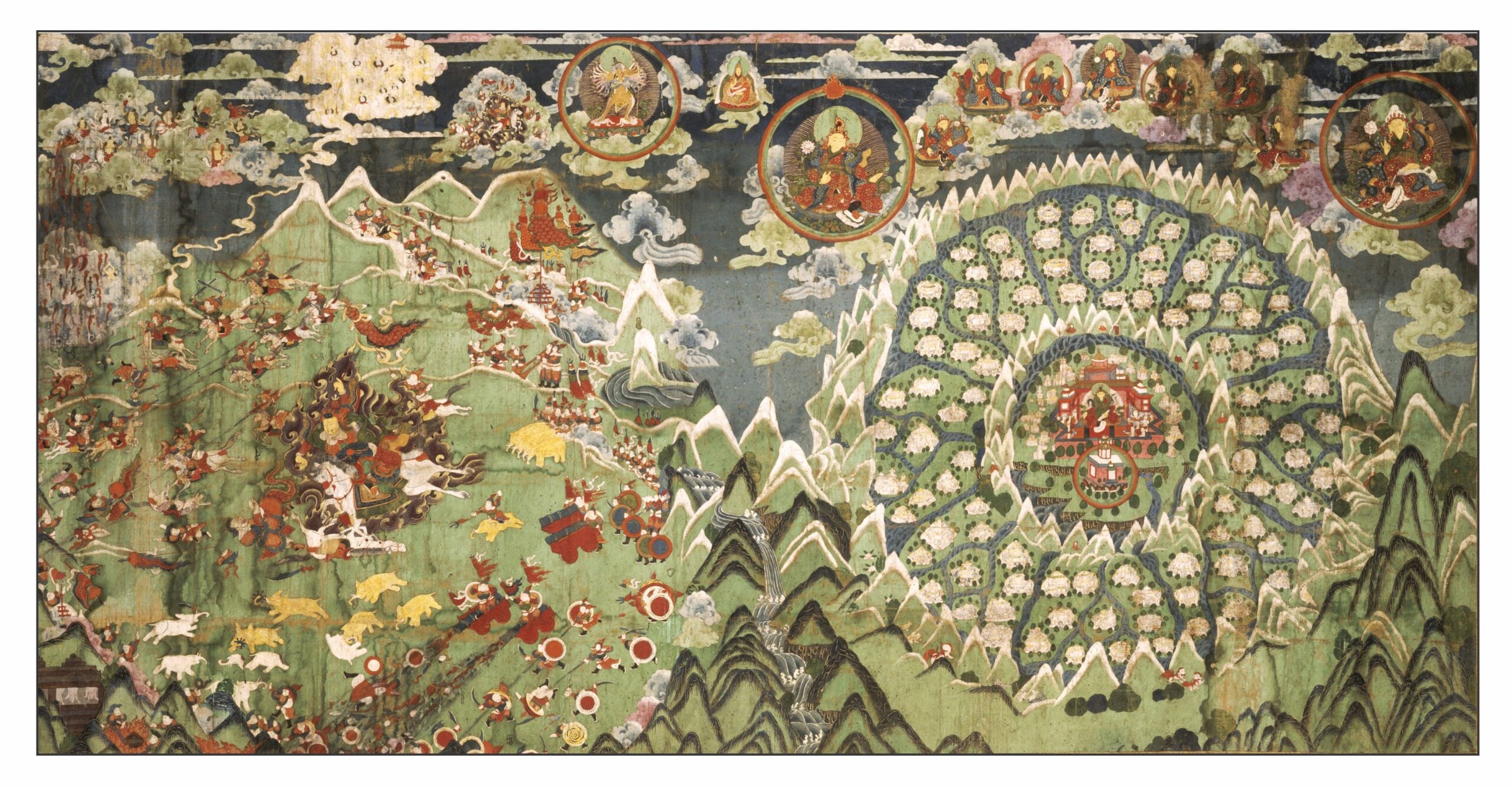
Shambhala is a mythical kingdom described in the teachings of Tibetan Buddhism as a place of sanctuary. Paintings show the kingdom isolated from the rest of the world by a ring of mountains. At the center of the kingdom is the capital Kalapa, itself surrounded by another ring of mountains. The palace of the king has roofs of solid gold and is adorned with pearls and other jewels. Outside the capital, rivers divide the kingdom into eight regions arranged like the petals of a lotus flower. Each of these regions contains 12 principalities, so that 96 princes pay allegiance to the king of Shambhala. The illustration shows a Tibetan painting of Shambhala from the 19th Century in the Musée Guimet. Many travellers have tried unsuccessfully to find Shambhala. It remains a spiritual rather than physical place.     


The Geological Upheaval

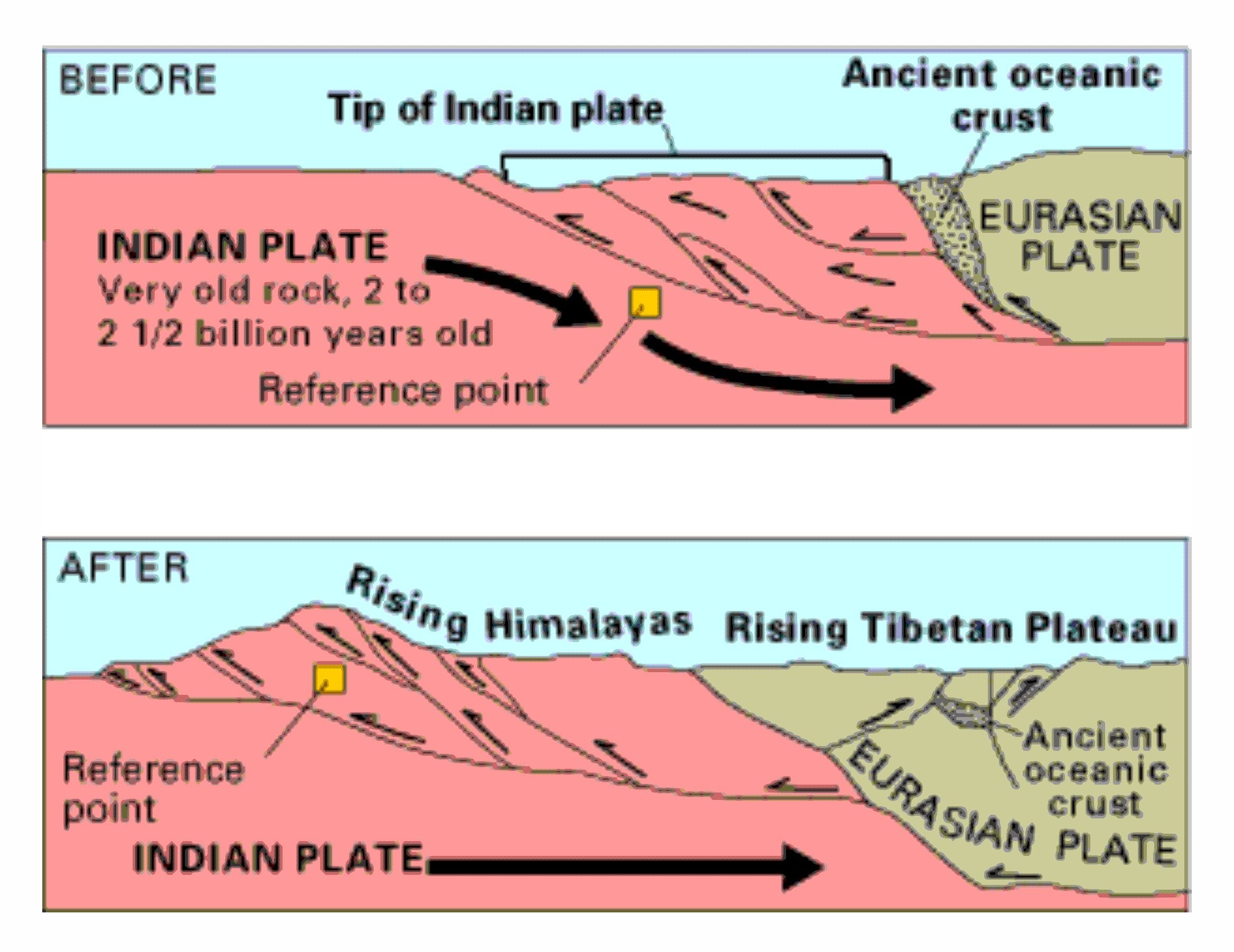
About 40 million years ago the northward-moving Indian tectonic plate collided with the Eurasian plate. The edge of the Indian plate was buckled and forced upward to form the Himalaya mountains. As the Indian plate moved under the Eurasian plate its surface rose to form Tibetan plateau.

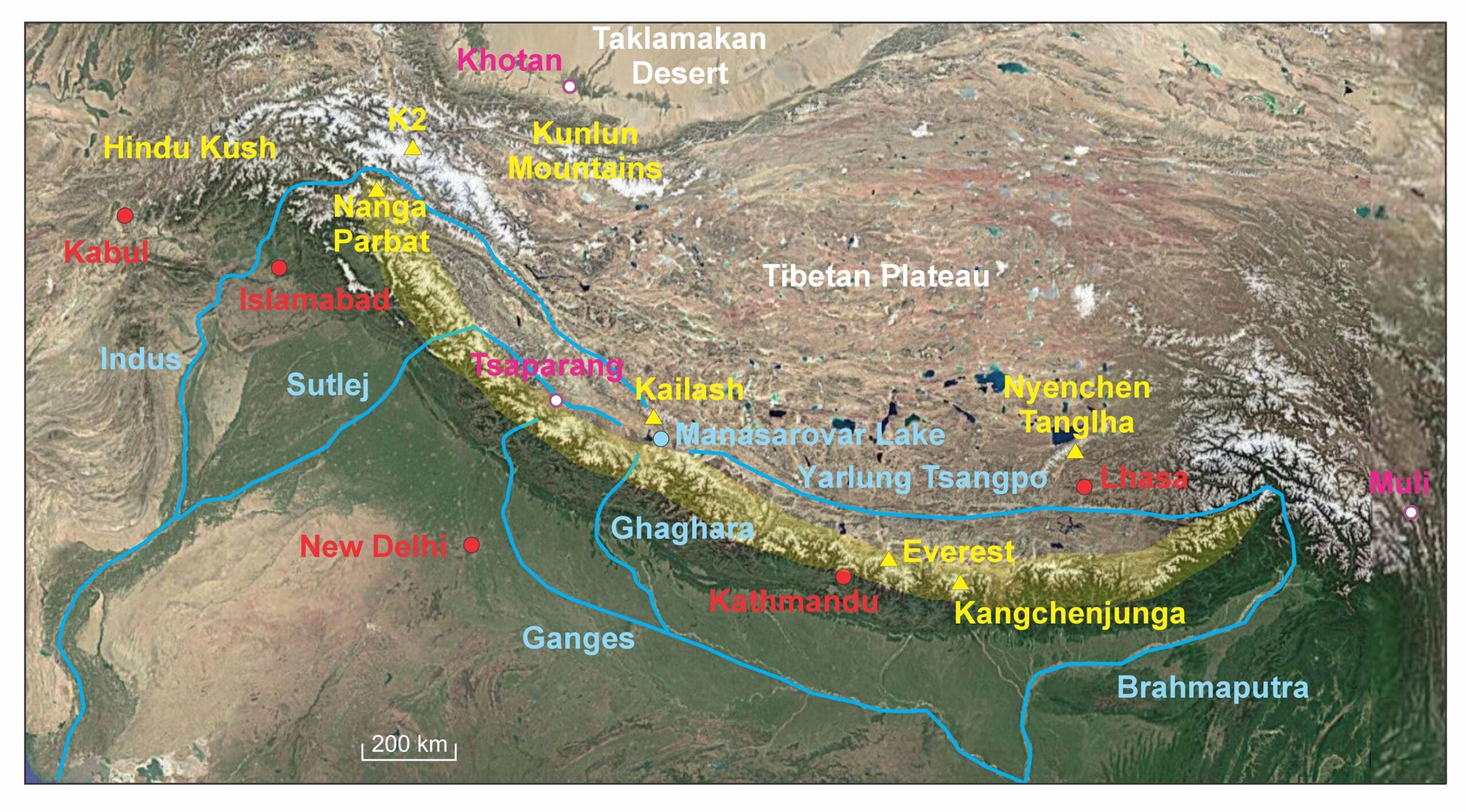
The Himalayas, stretching in a crescent from the Indus River in the west to the Brahmaputra River in the east (shaded light yellow in the following map) are the highest mountains in the world. They contain Mount Everest and nine other peaks greater than 8000 meters above sea level. The only other mountains with such height are the Karakorams with K2 as their highest peak. The Tibetan Plateau, a vast elevated region north of the Himalayas has an average height of about 4500 meters above sea level, and is often known as the “roof of the world.”

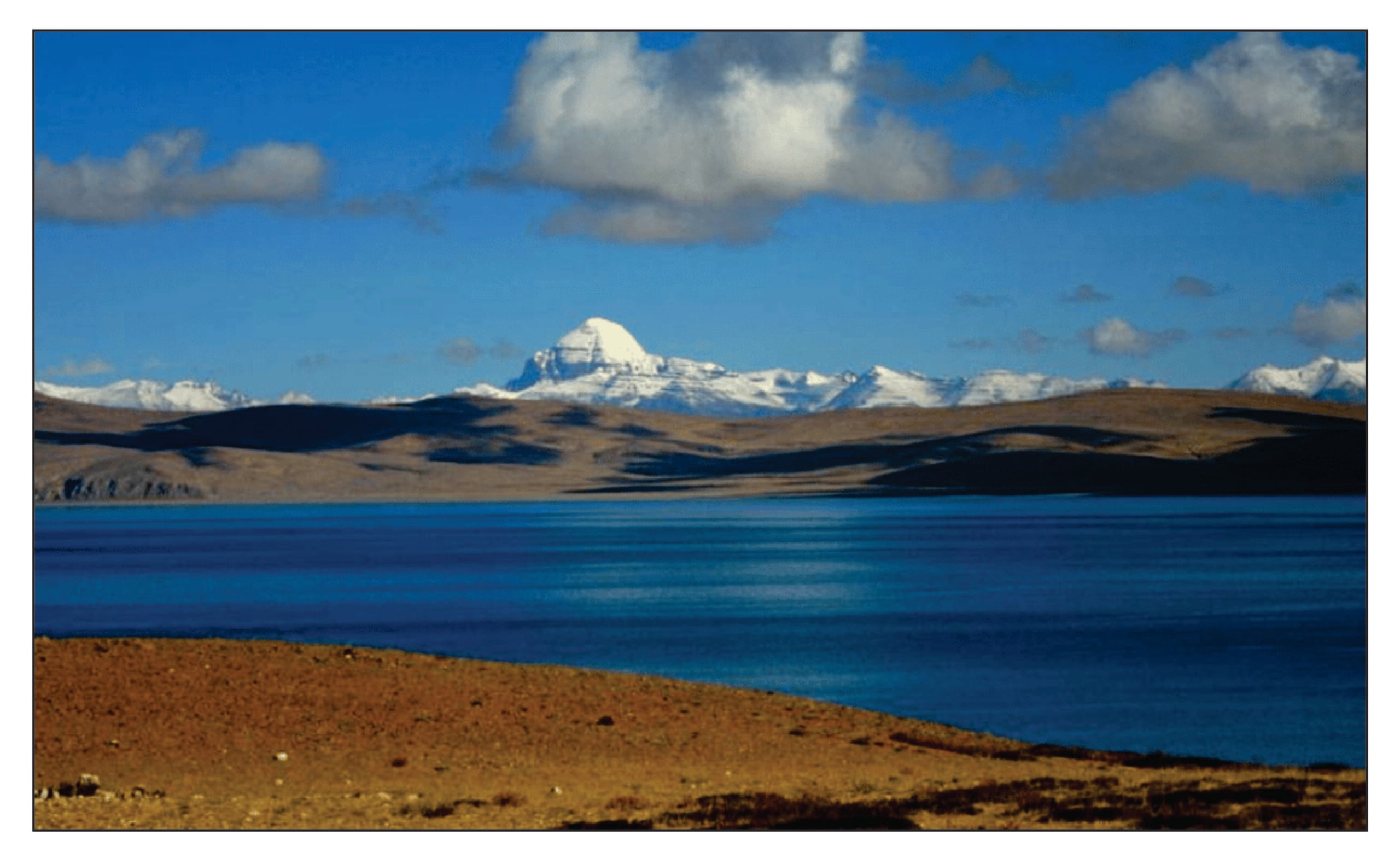
Lake Manasarovar in the southwest part of the plateau is the world’s highest freshwater lake. Its name – “lake of consciousness” – comes from the Hindu myth that it was created out of the mind of Brahma. Just north of the lake is the isolated Mount Kailash (“crystal”), which may be the Mount Meru (“wonderful”) of Hindu mythology. Meru is described as the central axis of the world, and the abode of Shiva and his consort Parvati.    

Glaciers in the Himalayas are the source of many of Asia’s largest rivers. The region near Lake Manasarovar and Mount Kailash provides sources for the Indus, Sutlej, Ghaghara (which is a tributary of the Ganges) and the Yarlung Tsangpo (which becomes the Brahmaputra) Rivers. The Yellow, Yangtze, Mekong, Salween and Irrawaddy Rivers drain from the eastern edge of the Tibetan Plateau (not shown on the map).

Colliding Religions

The main ancient religions of the Indian peninsula are Hinduism, Jainism and Buddhism. Hinduism began in the valley of the Indus River around 3000 BCE and became codified in the Vedas written between 1500 and 500 BCE. The main tenet of Hinduism is the concept of dharma, a principle that both drives the universe and ordains what is right and wrong. Individuals experience a continual process of life, death and rebirth, known as samsara. Karma ensures that all actions have their just and necessary outcome, although this might not happen within one lifetime but in a later reincarnation. There is no single divinity but a multitude of forces that each play their part in the unfolding of the universe. The universe goes through long cycles of creation, preservation, decline and destruction.

Jainism developed from 800 to 500 BCE as an offshoot of Hinduism. It denied the gods – atheism – rejected violence of any kind – ahimsa – and declined worldly pleasures – ascetism. This was (and is) a religion for the few rather than for the masses.

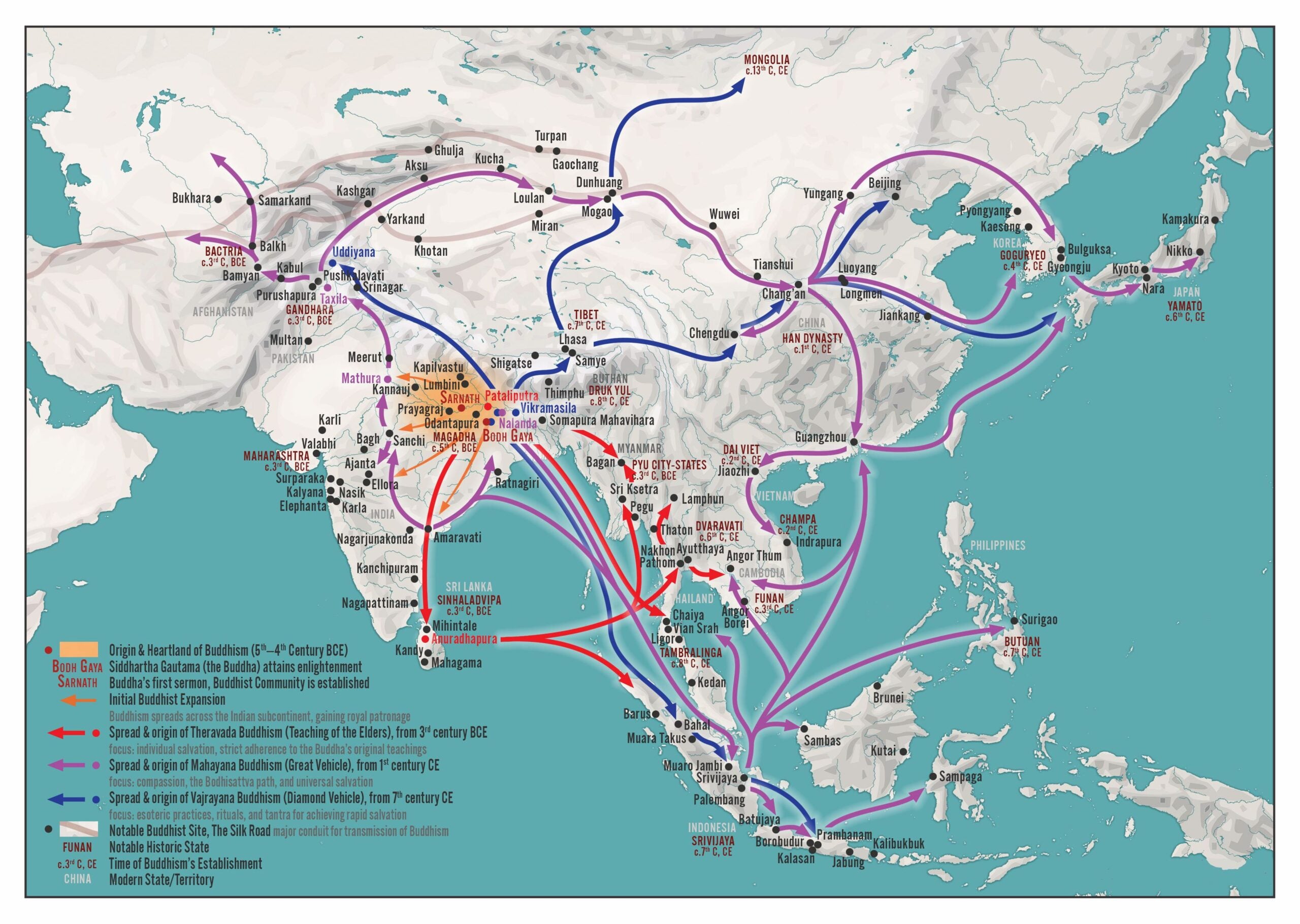
Buddhism was founded by Siddhartha Gautama who lived in northeast India around 500 BCE. He renounced his royal upbringing, and through meditation and ascetism attained release from samsara and union with the cosmos in a state of anatta (non-self). He then taught his disciples the basic principles whereby they could do the same. Suffering is caused by desire for worldly things; one can escape from suffering by rejecting desire and following the “eightfold path.” Many were attracted to this new religion and by the time of the Emperor Ashoka (3rd Century BCE), it had spread throughout the Indian peninsula, crossed the sea to Sri Lanka and travelled east to what is now Afghanistan. Travelling along the Silk Road, Buddhism reached China by the 1st Century CE, from where it later expanded into Korea and Japan. Buddhists from both India and Sri Lanka spread their religion to southeast Asia by the 3rd Century CE and thence to Indonesia and the Philippines. The following map is from the World History website

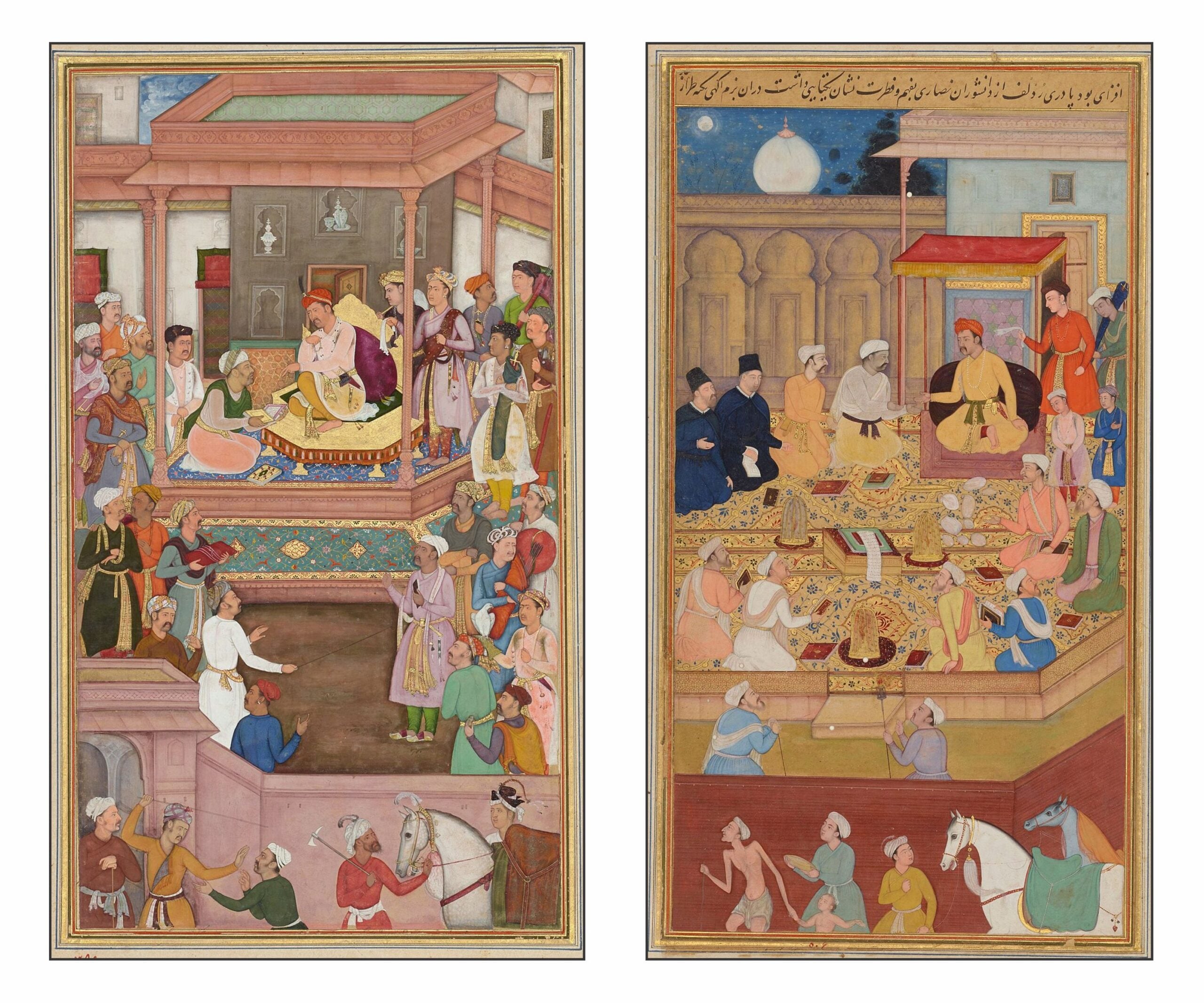
Islam was founded in 622 CE in Arabia and soon began to expand rapidly. The first incursions into the region of the Indus valley occurred in the 8th Century. Multiple invasions followed.  By the 16th Century, the northern part of India was under the rule of the Mughal Empire. The court of Akbar the Great (1542-1605 CE) attracted scholars and artists. The following paintings show on the left Akbar receiving the Akbarnama (a history of his reign), and on the right Akbar discussing religion with Hindu scholars and two Portuguese missionaries. Both paintings were part of the Akbarnama (1605).

Notable in the above illustration is the absence of any Buddhists. By the time of Akbar Buddhism had essentially vanished from India. The Muslim invaders had destroyed Buddhist monasteries and slaughtered the monks. The holy sites in northern India – Sarnath and Bodh Gaya – had fallen into ruins. Most Buddhist temples had become places of Hindu worship. Remnants of Buddhist culture survived in the south, and many monks retreated to mountain sanctuaries in the far northern India and Tibet. Many scholars have tried to explain why Hinduism survived the Muslim onslaught but not Buddhism (e.g., Hazra, 1995; Sarao, 2012). Probably the most important difference was that Hinduism was a religion for the masses and Buddhism a religion for monks. Hinduism provided festivals and celebrations whereas Buddhism offered only suffering and ascetism. Another reason was that Hinduism was pluralistic in its belief. Hinduism worshipped many different gods in many different ways, whereas Buddhism tended toward rigid doctrines. Perhaps laxness in the monastic orders also contributed to their downfall: why should the people support the debauchery of monks.


The Wheel of Time

Buddhism initially reached Tibet in the 7th Century CE. With the Muslim invasions of India from the 8th to the 15th Centuries many more Buddhists fled to safety in the northern mountains. They assimilated some of the religious traditions indigenous to Tibet and many of the ideas of Hinduism. The resultant doctrines became the basis of the Vajrayana (“diamond vehicle”) branch of Buddhism, different from the Mahayana (“great vehicle) branch of Buddhism which spread into China and the Theravada (“doctrine of the elders”) branch which spread to Sri Lanka and southeast Asia.

The Tibetan Buddhist teachings were recorded in the Kalachakra (“Wheel of Time”) Tantra (“weaving/teaching”), which likely originated in the 10th or 11th Century CE. Its contents are only known through later commentaries such as the Paramadibuddha (“Supreme First Buddha”) and the Vimalaprabha (“radiance of purity”). According to the former, the Kalachakra teachings were first given by the Gautama Buddha to Suchandra the king of Shambhala who had come to seek instruction from the enlightened one. (Newman, 1985).

Shambhala is described as a country north of the Himalayas:

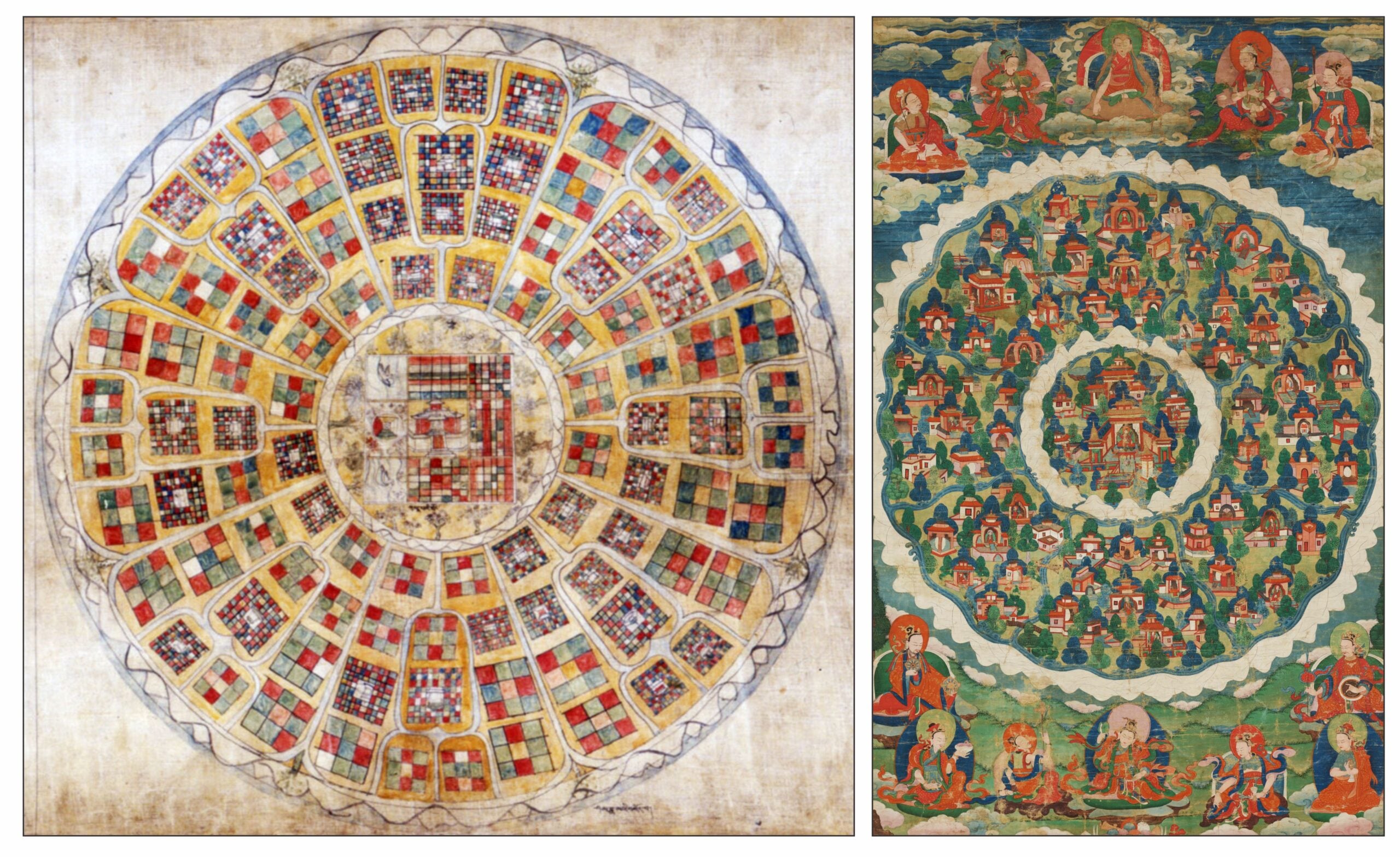
Shambhala is shaped like a giant lotus having eight petals. The outer perimeter of the entire lotus is formed by a circle of great snow mountains, as is the perimeter of the pericarp that makes up the central third of the country. The interstices of the lotus petals are formed by rivers and snow mountains, and the entire land is covered with beautiful lakes, ponds, meadows, forests, and groves.

The central pericarp of Shambhala is elevated a bit above the surrounding lotus petals, and on it stands the capital of Shambhala, Kalapa. Kalapa is twelve leagues in breadth, and its palaces are made of gold, silver, turquoise, coral, pearl, emerald, moon-crystal, and other precious stones. Kalapa blazes with such a luster that the full moon is a mere pale disc overhead. The light given off by the mirrors on the outside of the palaces is so bright that night cannot be distinguished from day. The thrones inside the palaces are made from the finest beaten gold, and from the gold of the Jambu River. In front of the thrones are crystal looking-glasses that allow one to see far into the distance. On the ceilings are special circular crystal skylights that allow one to observe the palaces, gods, and parks of the sun, moon, and stars, as well as the rotating celestial spheres, and even the zodiac, all as though they were right in front of one. Surrounding the thrones in the palaces are lattice-work screens made of sandalwood that exude fragrances that scent the air for miles. The couches and cushions are all made of the finest, most precious fabrics. (Newman, 1985, pp 54-55).

The following illustration shows two representations of Shambhala. That on the left is from a 16th Century scroll in the Rubin Museum and that on the right is a 19th-Century painting. Both owe their form to the Tibetan mandalas used to demonstrate the workings of the cosmos.

Shambala was actually first mentioned in Hindu scriptures as the place where Kalki, the next avatar of Vishnu will be born. These scriptures prophecy that when the people of the world degenerate into greed, malice and immorality, Kalki will lead an army of the righteous to defeat the barbarians and establish “a new golden age of righteousness, prosperity and social order” (Newman, 1995). Buddhists also had proposed that a new Buddha, named Maitreya (“compassionate”) would be born in the future to restore peace to a troubled world. Tibetan Buddhism fused the ideas of Kalki and Maitreya to provide a prophecy that couldcomfort the people in the days when the Muslim invasions were destroying their way of life. (Newman, 1995; Belka, 2006):

The Wheel of Time Tantra borrowed the Hindu myth of Kalki and adapted it to current religious and political conditions. The Buddhist refashioning of the prophetic myth says the Buddha taught the Wheel of Time Tantra to Sucandra, the bodhisattva emperor of the vast Central Asian empire of Sambhala. The eighth Successor to the throne of Sambhala, Yasas, unified all of the brahman families of Sambhala within a single Buddhist Adamantine Vehicle clan. For this he was given title Kalkin, which in the Buddhist myth means “chieftain.” To this day the Kalkins of Sambhala reign in their Central Asian paradise on earth, preserving the Wheel of Time teachings from the forces of barbarism without. At the end of the current age of degeneration, when the barbarian Muslims have overrun the earth outside of Sambhala, the last Kalkin, Cakrin, will assemble a great army headed by the kings of Sambhala and the Hindu gods. Kalkin Cakrin and his army—elephants, chariots, cavalry, and infantry—will come out from Sambhala to eradicate the forces of Islam. After the great Armageddon, when the barbarian horde has been obliterated, Cakrin will return to Sambhala to initiate a new age of perfection, Buddhism will flourish, people will live long, happy lives, and righteousness will reign supreme. (Newman, 1995).

At the beginning of Cakrin’s reign a wheel of iron will fall from the sky (Bernbaum, 1980, p 238). He is therefore also known as Rudra Cakrin (“wrathful one with the wheel”). The following 19th Century Tibetan painting now in the Musée Guimet shows Cakrin leading the forces of Shambhala out to overcome the barbarians:


European Explorations of Central Asia

In 1603 the Portuguese Jesuit missionary Bento de Goes travelled north from the court of Akbar the Great to Kabul and then traversed the Hindu Kush mountains with a caravan travelling on the legendary Silk Road, finally reaching China in 1605, the first European to travel the route since Marco Polo (Wessels, 1924; MacGregor, 1970).

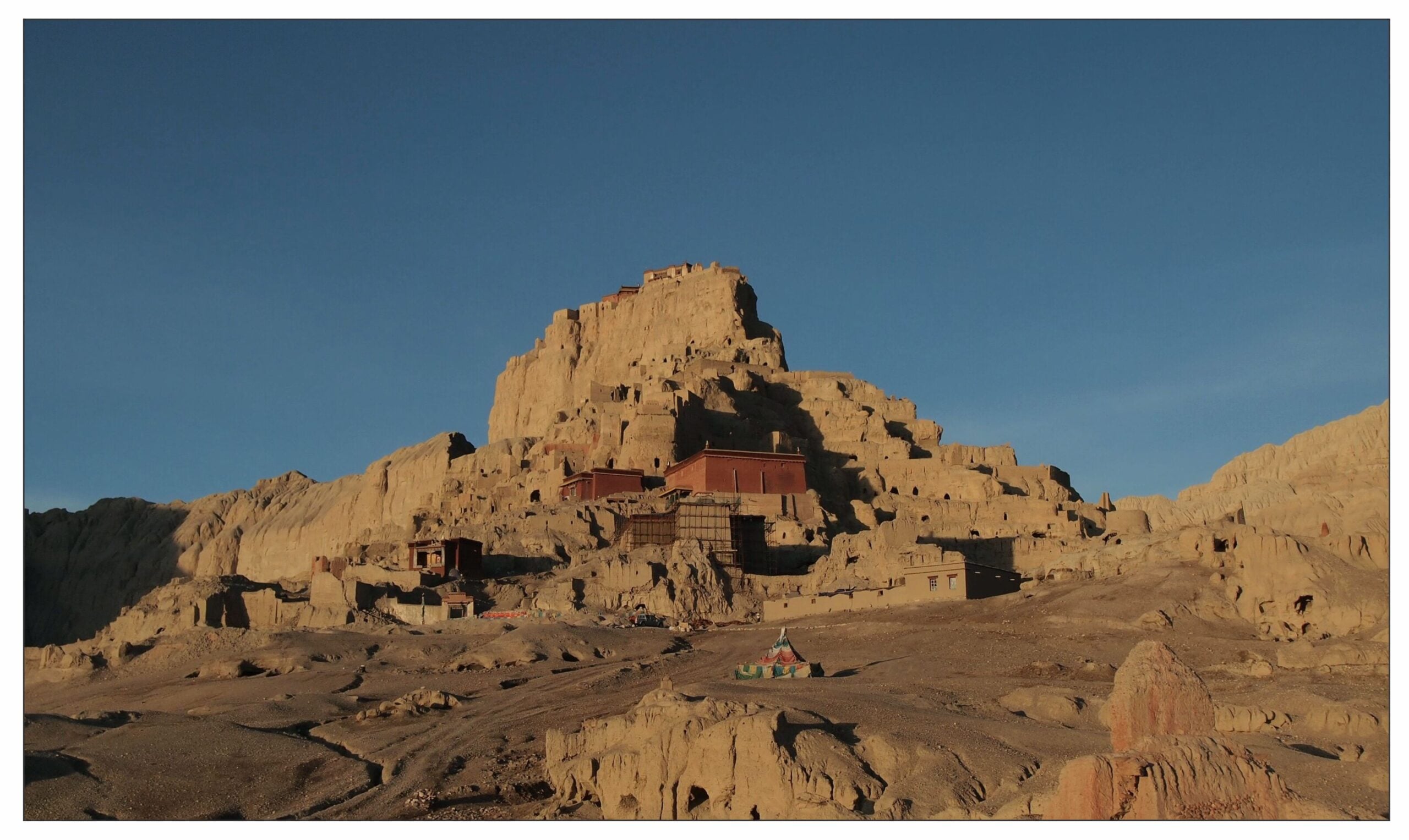
The first Europeans to travel north through the Himalayas to Tibet were the Jesuit missionaries Antonio de Andrade and Manuel Marques (Pereira, 1921; Wessels, 1924; MacGregor, 1970). In 1624 they travelled north from Delhi, following the Ganges River towards its source in the Himalayas. The passed through the Mana Pass, one of the highest mountain-passes in the world (5632 meters), and finally reached Tsaparang, the capital of the Buddhist Kingdom of Guge in southwestern Tibet. The kingdom had been founded in the 10th Century. The capital was built on prominent pyramid-shaped rock near the origins of the Sutlej River. De Andrade described the surrounding land as fertile with multiple irrigation channels. The king of Guge allowed the Jesuits to build a small Christian chapel there. However, in 1630 the kingdom of Ladakh just to the west of Guge invaded and laid the country to waste. Today, Tsaparang remains as a striking ruin in a bleak and deserted land. Wood (2005) has suggested that this ancient Buddhist mountain refuge led to the Tibetan myth of Shambhala and the modern idea of Shangri La.

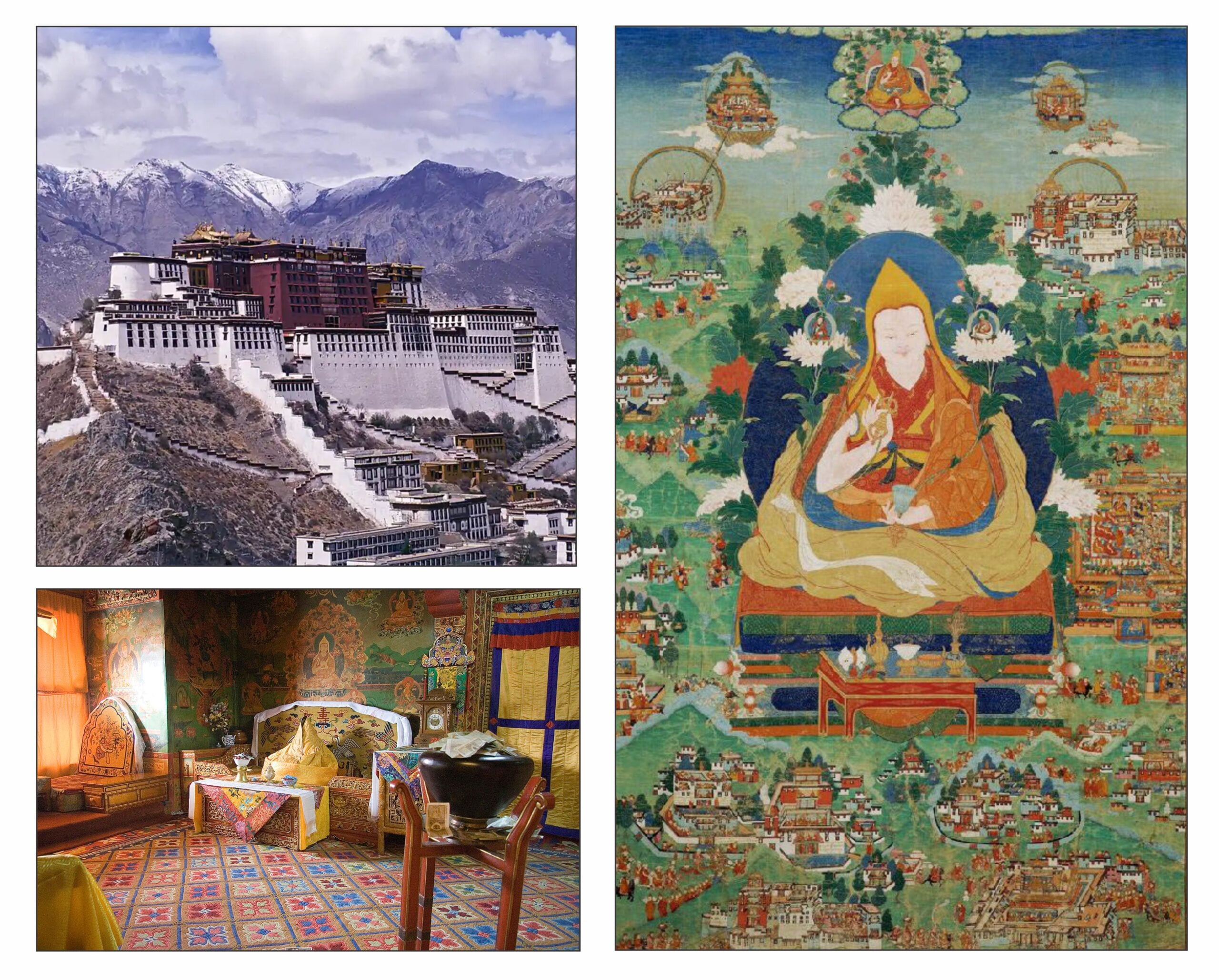
In 1661 the Austrian Jesuit Johann Grueber and his companion the Belgian Albert d’Orville travelled from northwest China into Tibet, crossing the Tangla Mountain range to visit Lhasa. They were the first Europeans to meet with the Dalai Lama (“ocean master”), Ngawang Lobsang Gyatso, the fifth in his lineage. At the time of their visit he was supervising the construction of Potala Palace, the official residence of the Dalai Lamas from 1649 until 1959. Grueber and d’Orville then travelled south, traversed the Himalayas to arrive in Kathmandu. After exchanging gifts with the King of Nepal, they descended into India. 

The following illustration shows on the left the Potala palace, and a photograph of the Dalai Lama’s quarters by Luca Galuzzi. The Dalai Lama, who has not been there since 1959, is represented by his robes. On the right is an 18th Century portrait of the Dalai Lama surrounded by episodes from his life running counterclockwise from his incarnation at the upper left. Each Dalai lama is considered a manifestation of the great bodhisattva Avalokitsevara (“god who looks down”) The construction of the Potala monastery is depicted in the lower left. The Dalai Lama holds in his right hand a sceptre (vajra, thunderbolt/diamond) and in his left a bell (ghanta), the two essential symbols of Tibetan Buddhism. In a lotus flower over his right shoulder is a representation of Padmasambhava (born from the lotus), the legendary founder of Tibetan Buddhism). In another flower over his left shoulder is Thangtong Gyalpo, a great Buddhist leader, who in the 15th Century had built iron suspension bridges to facilitate travel in Tibet.

In 1712 an Italian Jesuit Ippolito Desideri came to stay in Tibet (MacGregor, 1970). He travelled north through Kashmir crossing the western Himalayas through the Fotu La pass and then making the arduous journey across the Tibetan Plateau to Lhasa. He spent many years in Tibet, studying the language and customs of the Tibetans. He was the first European to engage with the ideas of Buddhism. He debated with Buddhist scholars in their own language, becoming sufficiently adept that he could present his ideas in poetic form (Lopez et al, 2017). He tried without success to disprove their concept of reincarnation (samsara, wandering) and their desire for meditative release (nirvana, extinguishment/sunyata, emptiness).

It is fascinating to read his work (Lopez et al, 2017; Desideri, 2005). He understood the Buddhist concepts of samsara and nirvana, but he found them illogical because they did not fit with his Christian beliefs: since death must lead to either salvation or damnation, how could it possibly lead to reincarnation. He described the ultimate state of mind – nirvana – that the Buddha (“Legislator”) proposed as an escape from suffering. However, this had no attraction for him since it did not provide any greater knowledge of the God who created the universe:

In the fifth stage of supreme attainment the soul, having passed through the different stages, and being delivered from successive transmigration and purged of all those deeds which are the origin and cause of the troubles of existence, and having discarded the passions which are the cause of such deeds, and thus having destroyed their root, finally approaches this, the last stage. Thus their infernal Legislator, under the pretence of searching for the root, extirpates from the hearts of his followers the real and primary root of all things—the knowledge of God. (Desideri, 2005, p 248)

Desideri failed to consider why a Buddhist should aspire to know a Creator God since they believed the universe had existed forever.

Ippolito Desideri was the first European to visit Lake Manasarovar and Mount Kailash. The center of a world which has existed forever without need for any Creator:

Many explorers followed these early Jesuits into Tibet. Much more was learned about the land and the people. Intrigued by the idea of Shambhala the Russian artist and theosophist Nicholas Roerich (1874-1947) travelled through Central Asia and Tibet from 1925 to 1929 (Andreev, 2014; Roerich, 1930). A later expedition in 1934-5 sought Shambhala further north in Mongolia and northern China (Boyd, 2012). The theosophists claimed to have discovered the secrets of the “Masters,” an esoteric group of spiritual adepts centered in Tibet. However, there were no masters and their ideas were simply distortions of ancient Buddhist and Hindu religious thought.   

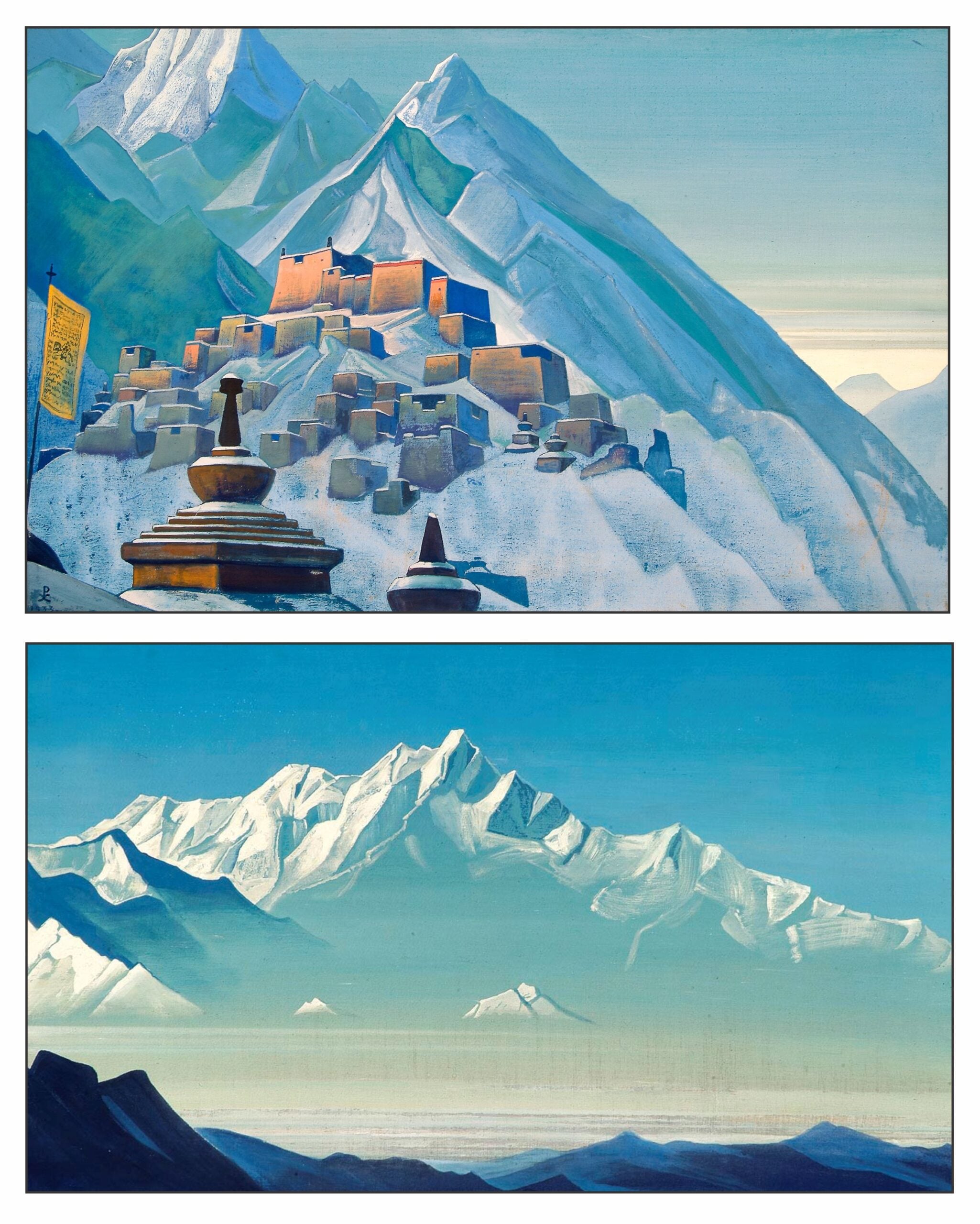
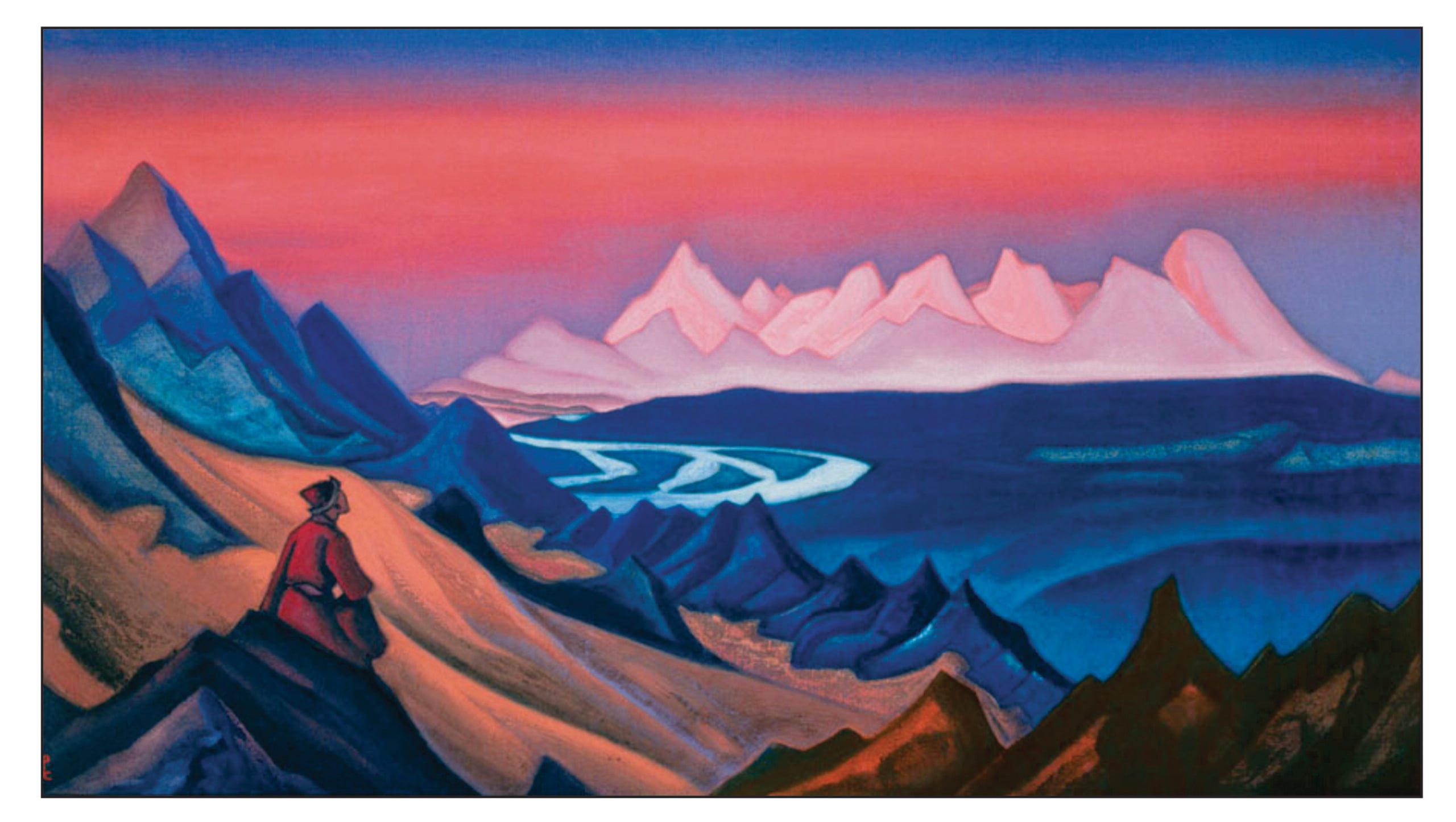
Nevertheless, Roerich was a talented artist who left us with many striking paintings of the Himalayas and Tibet. The following illustrations show paintings of Tibet (1933), The Mount of Five Treasures (1933) also known as Kangchenjunga, and The Song of Shambhala (1943). The third painting shows Shambhala in the distance: a circle of mountains lit by alpenglow.  


Lost Horizon

In 1933 James Hilton, fascinated by recent accounts of travels in Tibet, wrote the novel Lost Horizon. This tells the story of the British diplomat Hugh Conway, who in 1931 supervises the evacuation of some European citizens from Baskul (likely Kabul, Afghanistan) on a plane that is bound for Peshawar (then part of the British Raj, now located in Pakistan to the west of Islamabad). However, the plane is hijacked and flies over the Himalaya mountains – Conway recognizes the Nanga Parbat and K2 mountains – to crash-land among what appear to be the Kun Lun mountains. The pilot dies in the crash, but the passengers survive and are taken by a monk to a valley named Shangri La. The following is the description of their arrival 

To Conway, seeing it first, it might have been a vision fluttering out of that solitary rhythm in which lack of oxygen had encompassed all his faculties. It was, indeed, a strange and almost incredible sight. A group of coloured pavilions clung to the mountainside with none of the grim deliberation of a Rhineland castle, but rather with thc.chance delicacy of flower-petals impaled upon a crag. It was superb and exquisite. An austere emotion carried the eye upward from milk-blue roofs to the grey rock bastion above, tremendous as the Wetterhorn above Grindelwald. Beyond that, in a dazzling pyramid, soared the snow-slopes of Karakal. It might well be, Conway thought, the most terrifying mountain-scape in the world, and he imagined the immense stress of snow and glacier against which the rock function-ed as a gigantic retaining wall. Some day, per-haps, the whole mountain would split, and a half of Karakal’s icy splendour come toppling into the valley. He wondered if the slightness of the risk combined with its fearfulness might even be found agreeably stimulating.

Hardly less an enticement was the downward prospect, for the mountain wall continued to drop, nearly perpendicularly, into a cleft that could only have been the result of some cataclysm in the far past. The floor of the valley, hazily distant. welcomed the eye with greenness; sheltered from winds, and surveyed rather than dominated by the lamasery, it looked to Conway a delightfully favoured place, though if it were inhabited its community must be completely isolated by the lofty and sheerly unscalable ranges on the farther side (pp 74-75).

The following is from Orson Welles’ 1939 adaptation of the book for the Campbell Playhouse. The text has been abridged but the sense of wonder remains.  

Conway discovers that the people of Shangri La grow old only very slowly. After spending some time exploring the monastery and the surrounding valley, Conway is given an audience with the High Lama, who is apparently a Catholic monk from Luxembourg who arrived in Shangri La in the 18th Century and is now about 250 years old. The lama is dying and wishes to place in Conway’s hands “the heritage and destiny of Shangri La:”

>My friend it is not an arduous task that I bequeath, for our order knows only silken bonds. To be gentle and patient, to care for the riches of the mind, to preside in wisdom and secrecy while the storm rages without.  (p 223)

The lama describes the present state of world affairs and the coming storm that will be worse than the Dark Ages in Europe:

For those Dark Ages were not really so very dark—they were full of flickering lanterns, and even if the light had gone out of Europe altogether, there were other rays, literally from China to Peru, at which it could have been rekindled. But the Dark Ages that are to come will cover the whole world in a single pall; there will be neither escape nor sanctuary, save such as are too secret to be found or too humble to be noticed. And Shangri-La may hope to be both of these. (p 224)

The lama predicts that Conway and Shangri La will survive the storm:

I believe that you will live through the storm. And after, through the long age of desolation, you may still live, growing older and wiser and more patient. You will conserve the fragrance of our history and add to it the touch of your own mind. You will welcome the stranger, and teach him the rule of age and wisdom; and one of these strangers, it may be, will succeed you when you are yourself very old. Beyond that, my vision weakens, but I see, at a great distance, a new world stirring in the ruins, stirring clumsily but in hopefulness, seeking its lost and legendary treasures. And they will all be here, my son, hidden behind the mountains in the valley of Blue Moon, preserved as by miracle for a new Renaissance. (p 224-5)

As he ends his speech, the lama dies. Orson Welles’ abbreviated version of the lama’s speech conveys its essence:

A young member of the group that came from Baskul decides to escape Shangri La together with one of the young female postulants at the monastery. Conway warns that the young woman is much older than she appears and that she will become old if taken away from Shangri La. Nevertheless, Conway agrees to help them, and the story ends. In an epilogue, we learn that only Conway and an extremely Chinese woman arrive in Chongqing in western China. Initially amnesic, Conway later attempts to return to Shangri La. The last that anyone has heard is that he was travelling north from Thailand into the mountains. 

The book became immensely popular. The world at that time was descending into madness and violence, and the book offered the comforting idea that what was good would nevertheless be preserved. The narrative sections of the book were exciting, but the description of Shangri La was, like all utopias, relatively boring. One interesting aspect of Shangri La is that it appeared much more European than Asian. The East simply provided a place of sanctuary for what was the best of European thought and art. Clear evidence of racism occurs as in the High Lama’s account of who should be accepted as a citizen of Shangri La (Goswami, 2023): 

… our last visitor, a Japanese, arrived in 1912, and was not, to be candid, a very valuable acquisition. You see, my dear Conway, we are not quacks or charlatans; we do not and cannot guarantee success; some of our visitors derive no benefit at all from their stay here; others merely live to what might be called a normally advanced age and then die from some trifling ailment. In general we have found that Tibetans, owing to their being inured to both the altitude and other conditions, are much less sensitive than outside races; they are charming people, and we have admitted many of them, but I doubt if more than a few will pass their hundredth year. The Chinese are a little better, but even among them we have a high percentage of failures. Our best subjects, undoubtedly, are the Nordic and Latin races of Europe, perhaps the Americans would be equally adaptable … (p 170)

Hilton was ambiguous about where Shangri La was located. Conway’s plane crash-landed in the Kun Lun mountains. The ancient Buddhist kingdom of Khotan was located just north of these mountains but this had been in ruins for over a thousand years. After leaving Shangri La Conway arrived in Western China, and at the end of the book he was seeking to return to Shangri La by travelling north from Thailand. These statements suggest that Shangri La was perhaps located in the mountains of Western China, perhaps near Muli, a region that had been recently visited by the American botanist and explorer Joseph Rock, and described in an article for National Geographic (Rock, 1925, Clark et al, 2019)

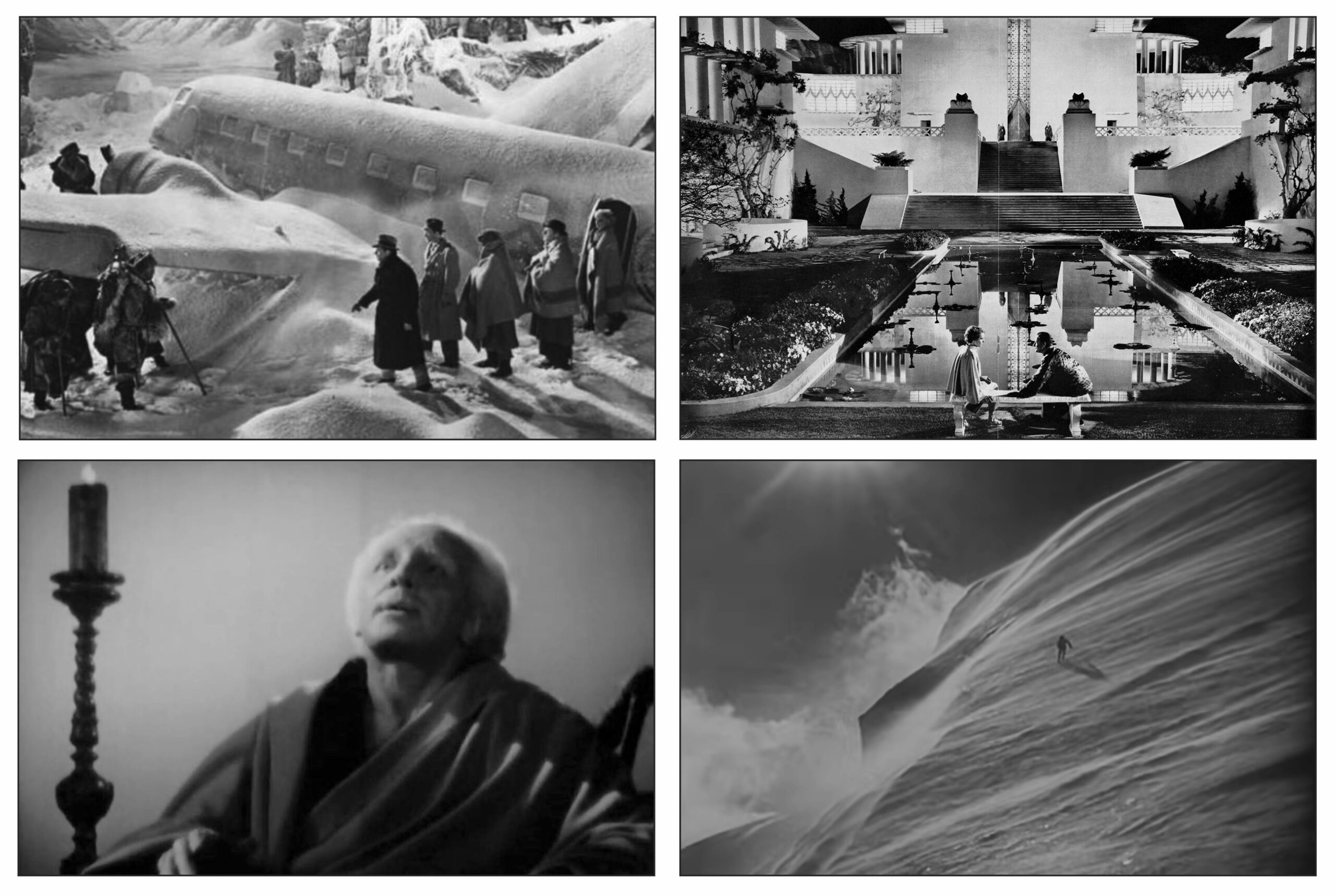
In 1937, Frank Capra directed a movie of Lost Horizon starring Ronald Colman as the diplomat, now named Robert Conway. The following stills from the movie, show the plane crash, the lamasery, the High Lama and Conway’s journey back to Shangri La:

Like the book, the movie is more exciting in the narratives of the arrival in and departure from Shangri La than in the time spent in the Himalayan utopia. Though Sam Jaffe’s portrayal of the High Lama is memorable, the monastery in the film is much more like the mansion of a Hollywood mogul than any Tibetan lamasery.


Political Upheavals

In 1720 China expelled the Mongols from Tibet which then became a part of the Chinese Empire. In 1911 the Qing dynasty was overthrown and China became a republic. Over the ensuing years political instability in China allowed Tibet to become de facto independent. Isolated from the world, it maintained a feudal system of government. Though monks and aristocrats lived pampered lives, the people suffered like the serfs of medieval Europe.  

In 1950 the newly founded People’s Republic of China sent the People’s Liberation Army to annex Tibet. According to the Chinese this was the “Peaceful Liberation of Tibet;” for the Tibetans it was the “Chinese Invasion of Tibet.” At that time the 14th Dalai Lama Tenzin Gyatso was only 15 years old. He and his regents agreed to a new People’s Government of Tibet.  

In the spring of 1959, fears that the Chinese government was going to arrest the Dalai Lama led to escalating protests and demands for Tibetan independence. The People’s Liberation Army quickly put down the uprising. The Dalai Lama fled to India where he now leads the Government of Tibet in Exile in Dharamshala. Over a thousand years after his forefathers had fled from India and found refuge in Tibet, he had returned.

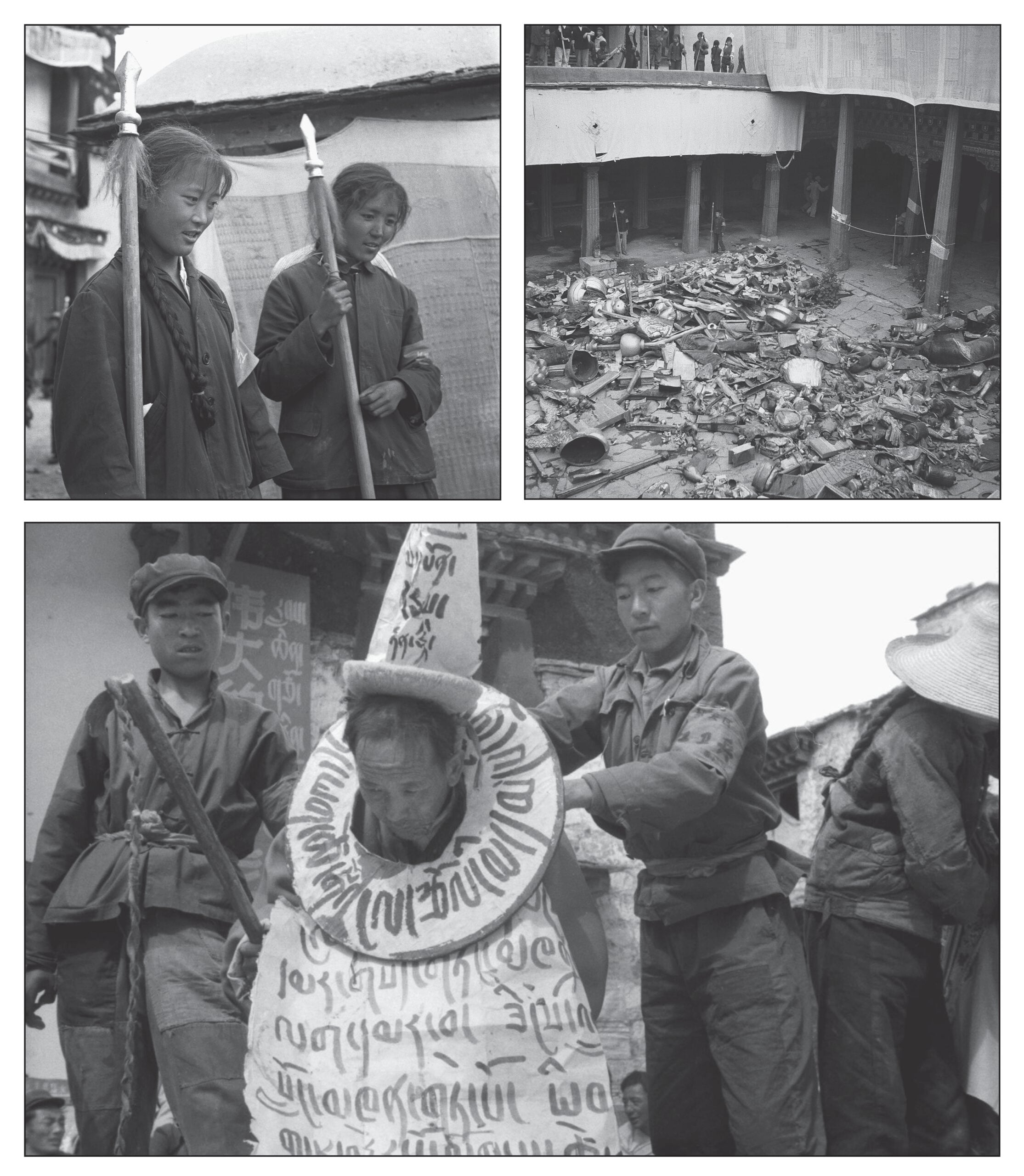
In May 1966 China’s Great Proletarian Cultural Revolution began, and in September the Red Guards arrived in Tibet. Monasteries were looted and Tibetan leaders were subjected to public humiliation in “struggle sessions.” It was only through the intervention of Zhou Enlai, that the Potala Palace was spared from the widespread destruction. The following photographs (Woeser, 2020) show the destruction at the Jokhang Temple on the upper right, a closeup of two red guards surveying the damage from the second storey of the temple on the upper left, and the struggle session of a previous mayor of Lhasa below

Tourism

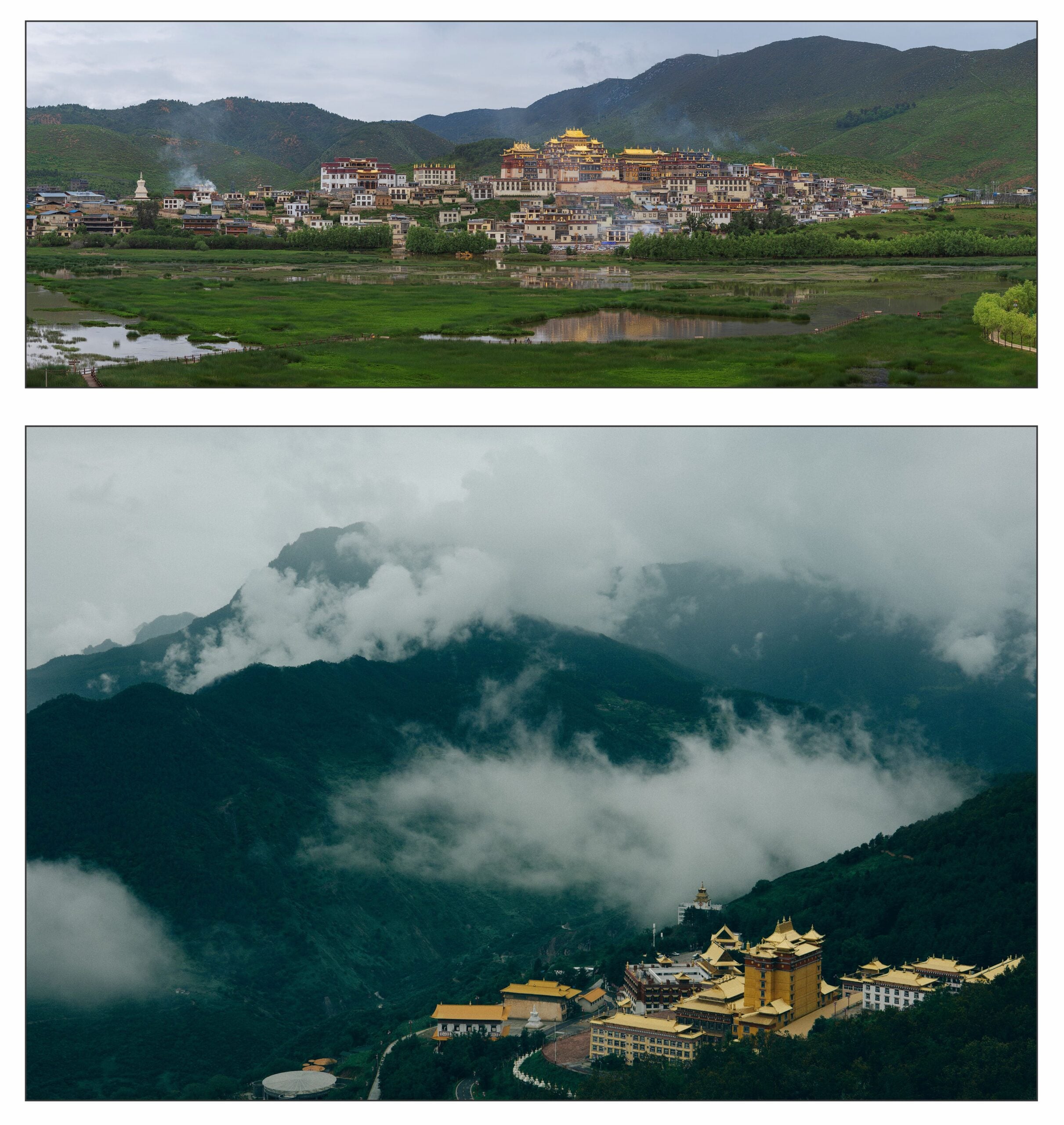
In 2001, the Chinese government renamed Zhongdian, a small city in northwestern Yunnan province, “Shangri La” after the fictional land described in James Hilton’s 1933 novel Lost Horizon (Kolas, 2008; Padget, 2023). Much of the population of the surrounding area is Tibetan. The government has rebuilt several nearby Buddhist monasteries. To the north is Khawa Karpo a sacred mountain. The following illustrations below show the Ganden Sumtseling Monastery the Muli Temple, and the east face of Khawa Karpo.


In the past, believers went on pilgrimages to sacred places; in the present, tourists search for epiphany in foreign lands. Tourists may seek out the truth, but they can be easily attracted to inventions: the tomb of Hamlet in Helsingor, the balcony of Juliet in Verona, and the land of Shangri La in China. Even sacred sites are sometimes more fictional than real. Tourism is not wrong: it supports the local populace, and it increases our understanding of other people. One must just be careful to determine what is meaningful and what is not.  


Shambhala and Shangri La

In Tibetan Buddhism Shambhala was conceived as a place of refuge from a world full of violence at the time of the Islamic invasion of India. One day the forces of truth would come out to overcome the barbarian hordes and re-establish teachings of the dharma. The prophecy need not be interpreted literally:

The real war is the struggle between the forces of enlightenment and ignorance that characterizes the path of the yogin, the tantric practitioner. When the yogin achieves adamantine gnosis, the transformative wisdom that is the goal of the of Wheel of Time path, he or she overcomes the inner barbarism that creates the evils of existence. In this esoteric, allegorical interpretation of the myth, the war between Kalkin and Islam symbolizes the radical illumination of the yogin in which correct understanding of reality dispels the darkness of ignorance. (Newman, 1995).

Shangri La was a modern fiction, also invented at a time when the world seemed to be heading into catastrophe. It shares many of the features of Shambhala. Many people have been fascinated by Shangri La. Some have sought to find it, but none have been successful:   

Ultimately, Shangri-La can be understood as a Western dream of an Eastern myth – it captures a yearning for simpler times, everlasting peace, sanctuary, and abundance protected from a violent and volatile world. But this paradise must remain elusive, for seeking it misunderstands and spurns Hilton’s fantasy. Like the most apt utopia, it is literally “nowhere” (Padget, 2023).


References

Andreev, A. I. (2014). The myth of the masters revived: the occult lives of Nikolai and Elena Roerich. Brill.

Belka, L. (2006). Maitreya in Tibetan Buddhism: image and myth. Studia Asiatica, 7(1), 55–73.

Bernbaum, E. (1980). The way to Shambhala: a search for the mythical kingdom beyond the Himalayas. St. Martin’s Press.

Boyd, J. G. (2012). In search of Shambhala? Nicholas Roerich’s 1934–5 Inner Mongolian Expedition. Inner Asia, 14 (2), 257-277.

Clark, D.J., Chapman, S. & Yao, J. (2019). Where is Shangri La. Two explorers set off to southwest China in search of the elusive valley.

Desideri, I. (translated by F de Filippi, 2005). An account of Tibet: the travels of Ippolito Desideri of Pistoia, S.J., 1712-1727. Routledge

Goswami, K. (2023). Tibet as myth: patterns of gaze in James Hilton’s Lost Horizon. In Reimagining Tibet (pp. 42–61). Routledge.

Hazra, K. L. (1995). The rise and decline of Buddhism in India. Munshiram Manoharlal Publishers.

Hilton, J. (1933). Lost horizon. Macmillan.

Kolas, A. (2008). Tourism and Tibetan culture in transition: a place called Shangrila. Routledge.

Lopez, D. S., Thupten Jinpa, & Desideri, I. (2017). Dispelling the darkness: a Jesuit’s quest for the soul of Tibet. Harvard University Press.

MacGregor, J. (1970). Tibet: a chronicle of exploration. Routledge & Kegan Paul.

Newman, J. R. (1985). A brief history of the Kalachakra. In Geshe Lhundup Sopa, Jackson, R., & Newman, J. R. (Eds). The Wheel of Time: The Kalachakra in Context. (pp 51-90). Deer Park Books.

Newman, J. R. (1995). Eschatology in the Wheel of Time Tantra. In D. S. Lopez (ed) Buddhism in Practice. (pp. 284–289). Princeton University Press.

Padget, F. (2023). Shangri-La: a case of myth-taken identity. Epoch Magazine. Issue 14.

Pereira, F. M. E. (1921) O descobrimento do Tibet pelo P. Antonio de Andrade. Coimbra

Rock, J. F. (1925). The land of the Yellow Lama: National Geographic Society explorer visits the strange kingdom of Muli, beyond the Likiang snow range of Yünnan Province, China. National Geographic Magazine, 47(4), 447-492.

Roerich, N., (1930). Shambhala. Frederick A. Stokes.

Sarao, K. T. S. (2012). The decline of Buddhism in India: a fresh perspective. Munshirm Manoharlal Publishers.

Wessels, C. (1924). Early Jesuit Travellers in Central Asia 1603–1721. Martinus Nijhoff.

Woeser, T. (2020). Forbidden memory: Tibet during the cultural revolution. Potomac Books.

Wood, M. (2005). The search for Shangri-La. In In search of myths & heroes: exploring four epic legends of the world. (pp 9-77). University of California Press. Video version available.


Wu Wei: Effortless Action

One of the central ideas in the Daodjing of Laozi is the idea of wu wei (無為, simplified 无为; wúwéi). This has been translated in many ways: “non-action,” “actionlessness,” “effortless action,” and “doing nothing.” The 37th chapter of the Daodjing considers wu wei an attribute of the eternal Dao. The 48th chapter promotes wu wei as a human virtue. The illustration shows wu wei in regular script (left) and in cursive (right).

Being True to Oneself

A foundational concept in Daoism is自然, zìrán. This word is composed of 自 (self, oneself, from, since) and 然 (right, correct, so, in this manner). Almost impossible to translate, the word has been variously rendered simply as “self-so” (Ziporyn, 2009) or more abstractly as “as-it-is-ness” (Fu, 1973, p 382). The meaning contains the idea of acting “naturally” or “spontaneously.” An underlying concept is “authenticity” – one’s action should be true to one’s nature.

Laozi uses the word in the ending to Chapter 25 of the Daodejing (with translation by Wu, 2016): 

人法地,地法天,天法道,道法自然

Man follows the ways of Earth;
Earth follows the ways of Heaven;
Heaven follows the ways of Dao;
Dao follows its own ways.

Several aspects of zìrán need consideration. First, the Dao acts through all things. As well as ordering the cosmos, the Dao acts through each individual object it contains. Human beings must ultimately follow their own zìrán.  Zhuang Zhou, commonly known as Zhuangzi (莊子), a Daoist philosopher from the 4th Century BCE, begins his writings with a description of all the different things in the universe from the mythological great Peng bird to the morning mushroom, and recommends that one must act “on the rectitude (正, zhèng) of Heaven and Earth” (Lynn, 2022, p 8). Guo Xiang (郭象, 265-312 CE) commented on this section of the Zhuangzi

“Heaven and earth” is just a blanket term used to indicate all beings. It is all individual beings that form the very substance of heaven and earth, and it is each being’s self-so [ziran] that aligns true to itself. “Self-so” [ziran] means what is so of itself [ziran], without being done by anyone or for any purpose. Thus, Peng’s ability to fly high and the sparrow’s ability to stay low, the great tree’s ability to last long and the mushroom’s ability to perish quickly, all these are done spontaneously, all are self-so [ziran] (Ziporyn, 2009, p 132.)

Second, the concept of zìrán does not mean that all things passively accept their lot in the universe. Misha Tadd (2019) argues that zìrán has as much to do with “authority” as with “authenticity.” We need to be true to our ideal selves: to seek what we should be rather than accept what we are.  

Third, the idea of acting “naturally” means acting in accord with the Dao. However, human beings do not need to return to the simple state of primitive societies to do so (Tadd, 2019, p 4). Although the idea of the “noble savage” was popular when the Daodejing was initially translated into Western languages, Laozi was not being nostalgic for a lost Eden; rather he was imagining a future utopia (Stamatov, 2023).   


Yet Nothing is Left Undone

How the Dao “follows its own ways” is described in the 37th chapter of the Daodejing. This is the final chapter in the section of the book that deals with the nature of the Dao

The commonly accepted version of the Daodejing is divided into two parts. The first 37 chapters are concerned with the Dao (way), and the next 44 with the nature of De (virtue). Some recently discovered early versions reverse the ordering of the two parts (Chan, 2025). However, for our purposes it is appropriate to follow the traditional order and to understand the nature of the Dao before we propose a way for human virtue.

The last chapter pf the first part states that the eternal Dao – the principle that governs the universe – exercises its power by means of wu wei. The following is the Chinese text of Chapter 37 together with a translation by Wu (2016) and calligraphy by Ken Wong:

道恆無為而無不為。
侯王若能守之,萬物將自化。
化而欲作,
吾將鎮之以無名之樸。
無名之樸,夫亦將不欲。
不欲以靜,天下將自定。

Dao in its eternity does nothing, yet nothing is not done.
If lords and kings can all abide by that, all things will change of themselves.
As they change, their desires start to grow;
I calm them down with the nameless pristine timber.
Calmed by the nameless pristine timber, they will have no more desire.
Desireless and calm, the world will correct its own course.

The phrase 無名之樸 is usually translated as “nameless simplicity” (e.g., Fischer, 2023). The character 樸 (), another version of which is 朴, generally means “simple.” However, it once meant “unworked wood” – hence the “nameless pristine timber” of Wu’s translation.  

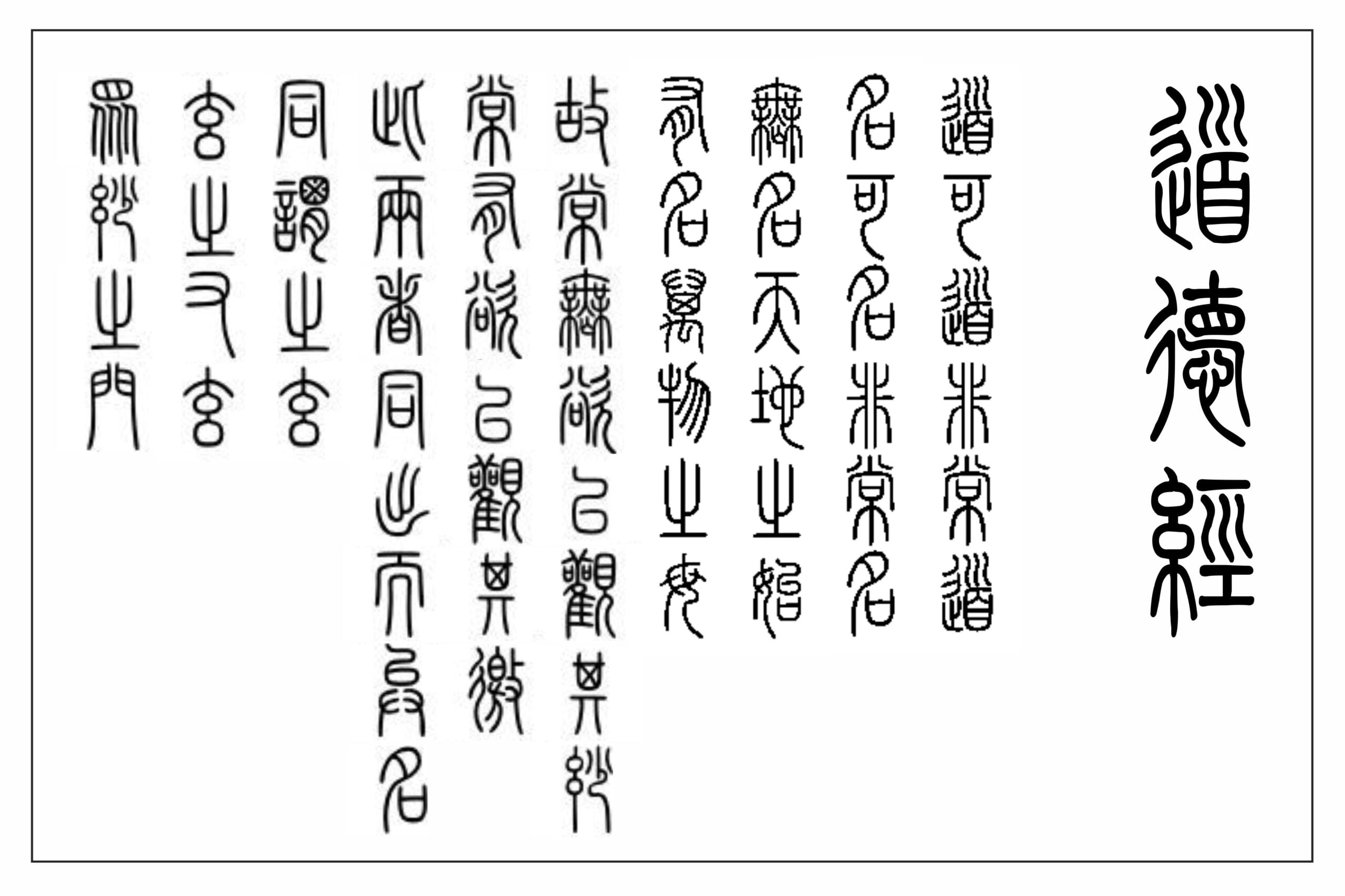
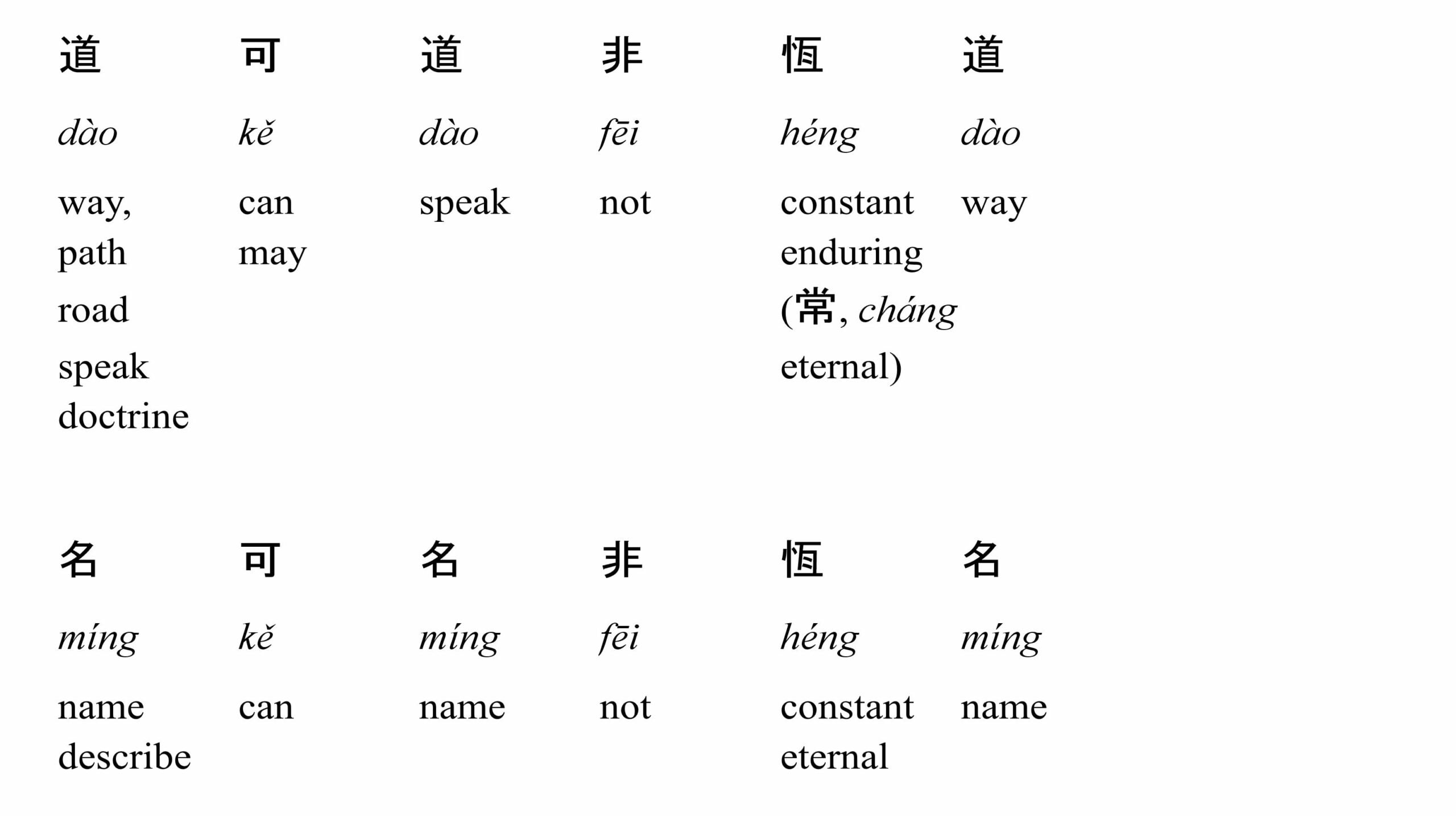
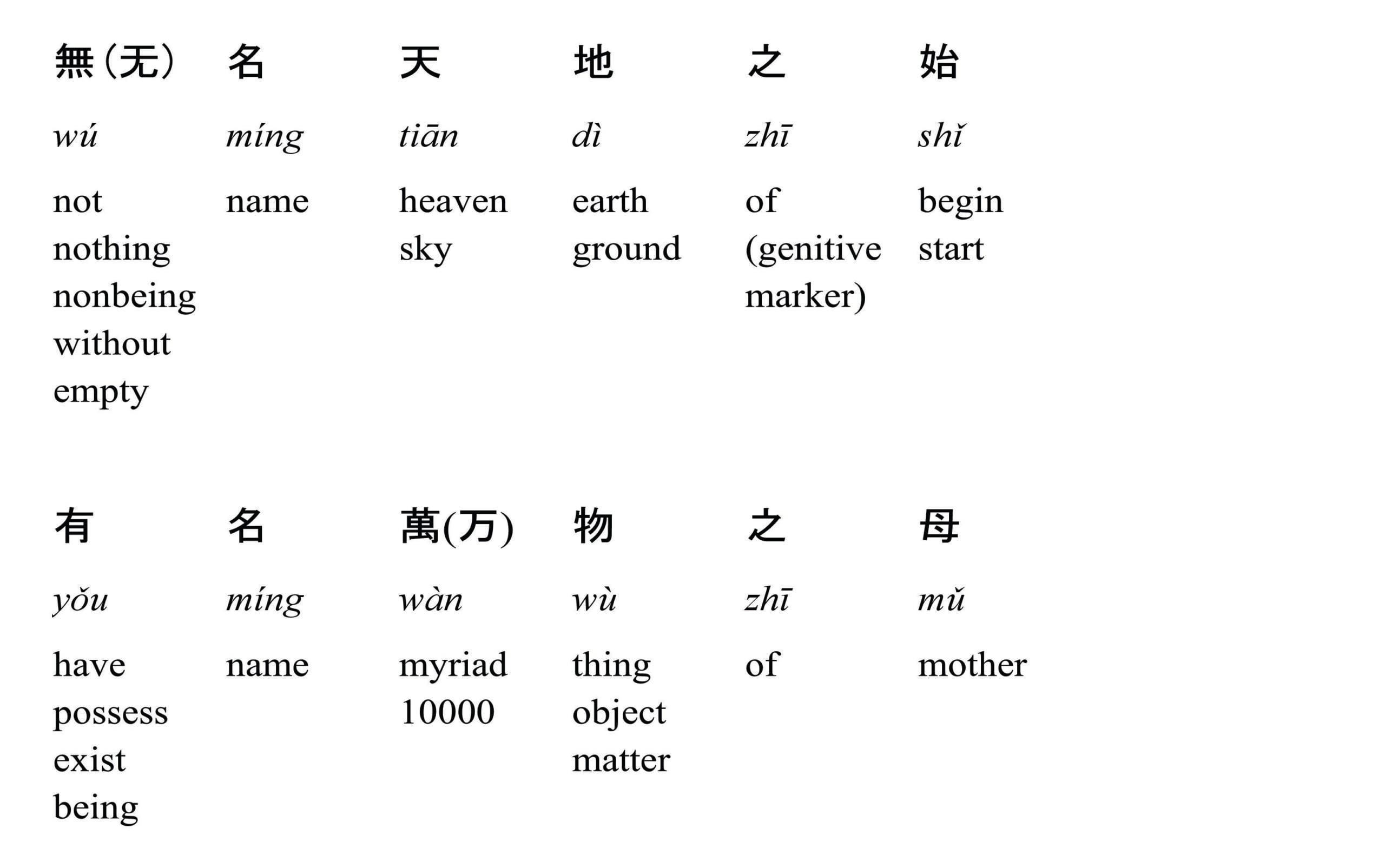
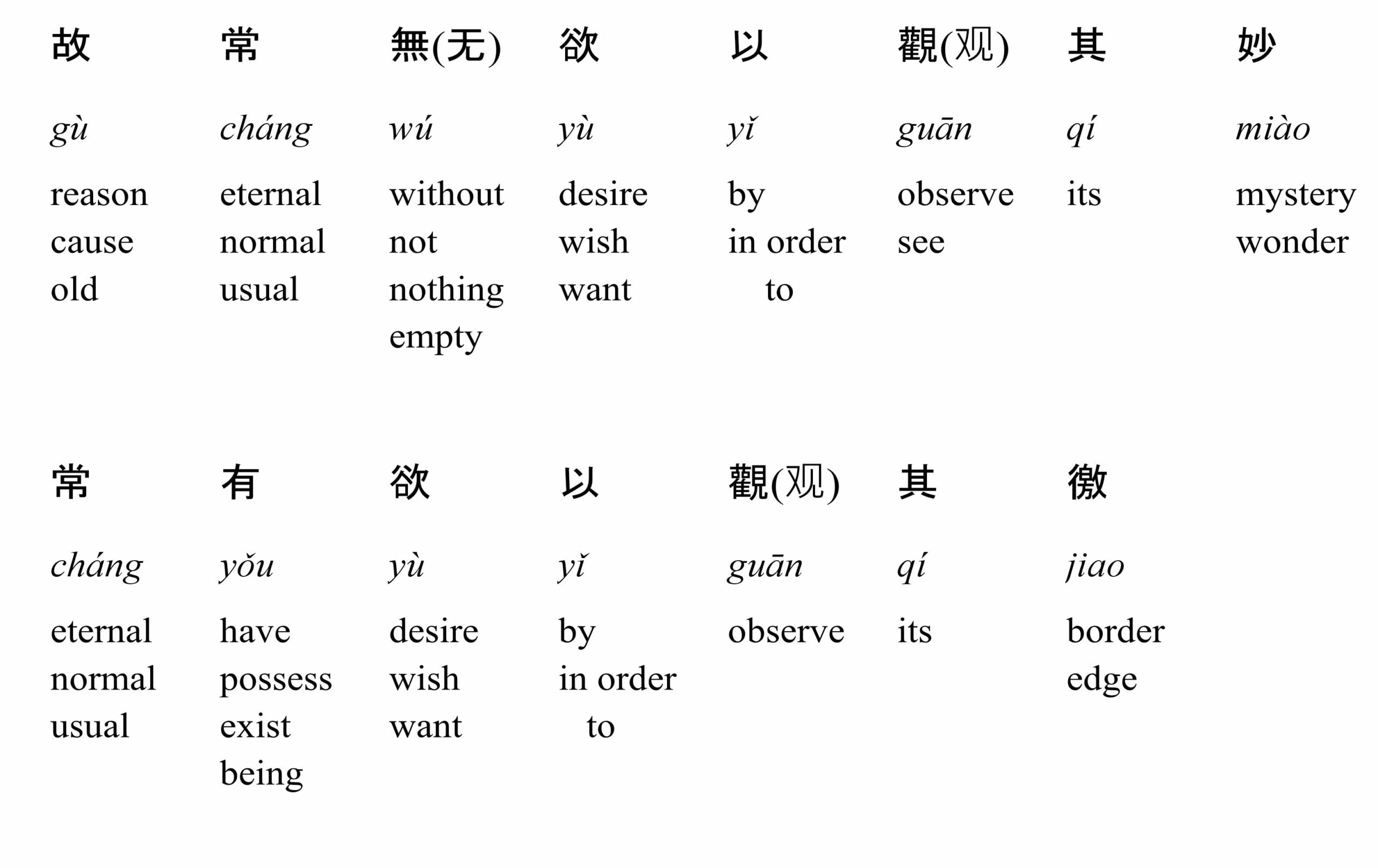
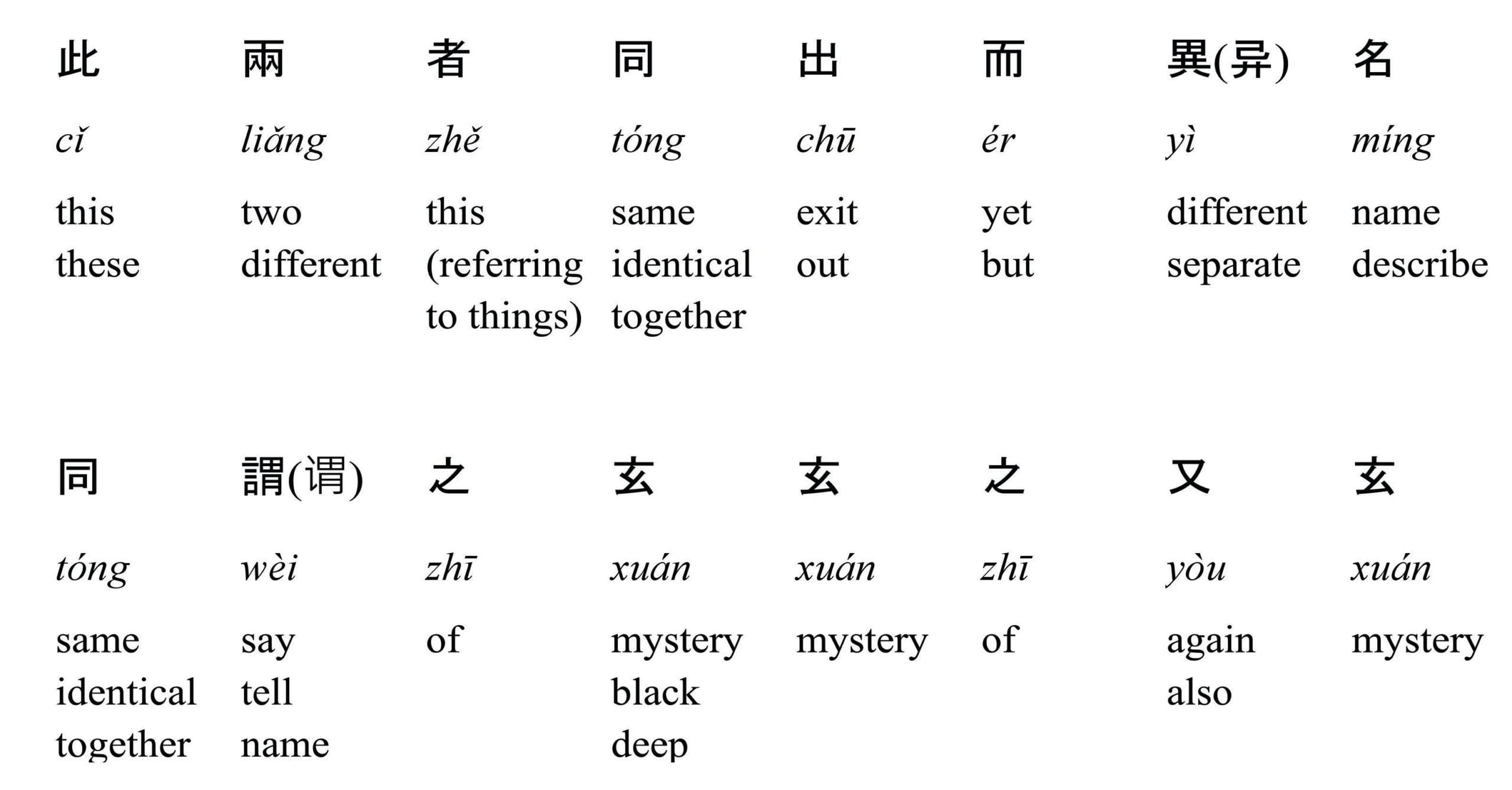
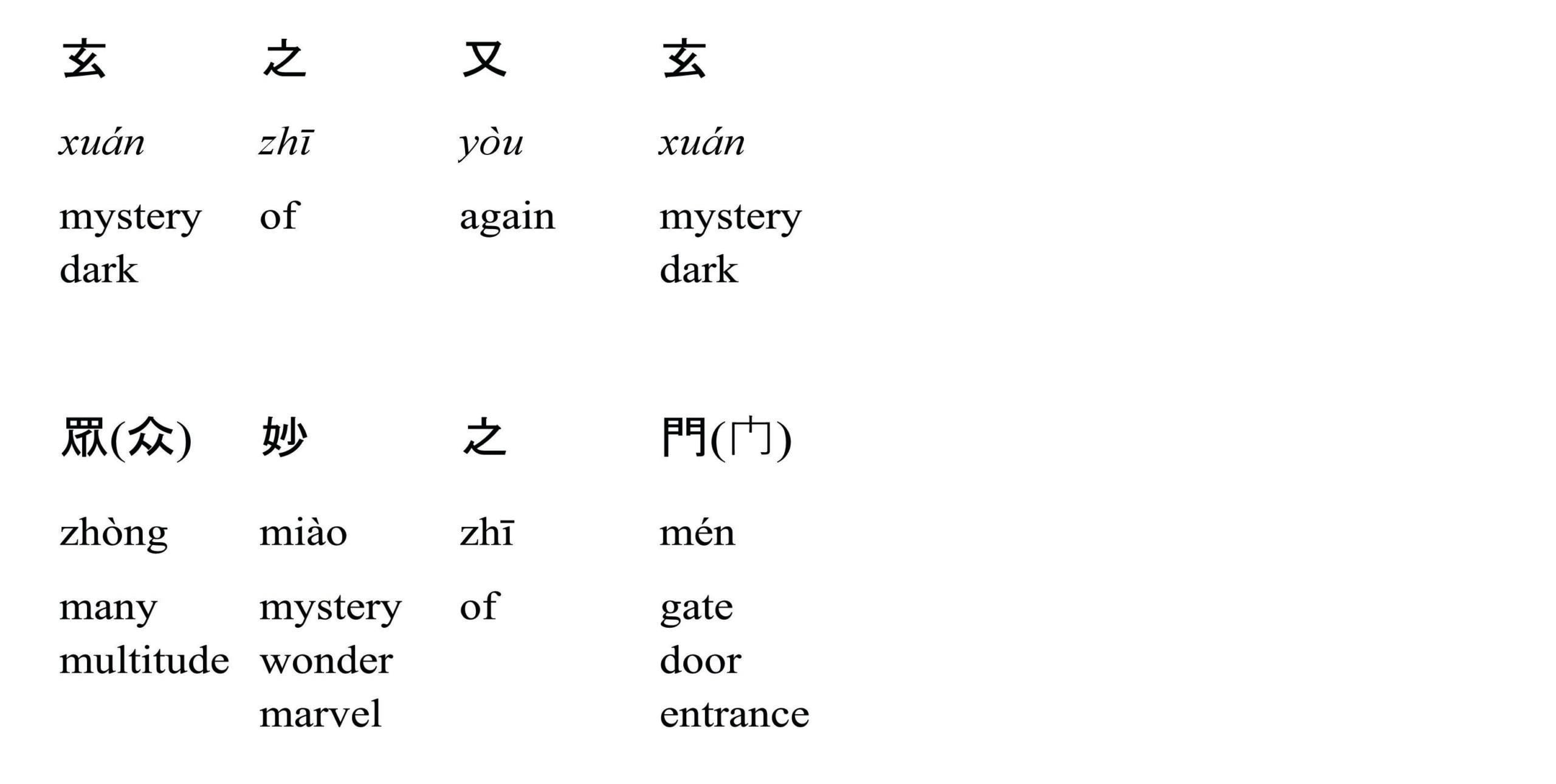
The famous first line is shown below in a character-by-character translation:

The translation of wu wei (無為) is problematic. A simple translation is “doing nothing” but that is not Laozi’s meaning. In Chapter 37 the Dao does nothing and yet somehow everything is done.  The following are suggested translations of wu wei: “non-action” (Moeller, 2016), “effortless action” (Slingerland, 2003), “unself-conscious action” (Lynn, 2022, p 3), “non-contrivance” (Fischer, 2023, p 27), and “no purposive action” (Hansard, 2003).

Loy (1985) proposed that wu wei represent “nondual action:” the activity of an individual that has no self (with intentions and goals) but is rather part of a universal self. This can eliminate the problem of free will in a deterministic universe:

whenever “I” act it is not “I” but the whole universe that “does” the action or rather is the action. If we accept that the universe is self-caused, then it acts freely whenever anything is done. Thus, from the nondualist perspective, complete determinism turns out to be equivalent to absolute freedom.

Slingerland (2003, p 7) comments

It is important to realize, however, that wu-wei properly refers not to what is actually happening (or not happening) in the realm of observable action but rather to the state of mind of the actor. That is, it refers not to what is or is not being done but to the phenomenological state of the doer. … It describes a state of personal harmony in which actions flow freely and instantly from one’s spontaneous inclinations—without the need for extended deliberation or inner struggle—and yet nonetheless accord perfectly with the dictates of the situation at hand, display an almost supernatural efficacy, and (in the Confucian context at least) harmonize with the demands of conventional morality.

Fischer (2023, p 27) describes the mental concomitant of wu wei:

It describes the state of acting genuinely, unselfconsciously, or, as we might say, “from the heart,” as opposed to doing something self-consciously, because others expect you to, or because you are coerced.


Decreasing Day by Day

In the 48th chapter of the Daodejing Laozi proposes wu wei as the ideal of human behavior. The following is the Chinese text together with a translation by Wu (2016):

為學日益,為道日損。
損之又損,以至於無為。
無為而無不為。
取天下常以無事,
及其有事,不足以取天下

To pursue learning you increase day by day; to pursue Dao you decrease day by day.
Decrease and yet again decrease, till you reach the state of Non-doing.
Do nothing and yet nothing is not done.
The world is often won without busying around;
When busying around occurs, the world cannot be won.

The third line repeats the first line of Chapter 37 as an injunction for human behavior. We must follow the same principle as the Dao. Although it is easy to say that the Dao can act according to its own self, how exactly human beings can do so is clear. The chapter states that the world can only be won without 事 (shì, business/work/responsibility).

The Zhuangzi provides several examples of acting in accord with wu wei, the most famous example being butcher Ding. The story is introduced with the comments:

The flow of my life is always channeled by its own boundaries, but the mind bent on knowledge never is. A flow channeled by its own boundaries is endangered when forced to follow something that is not, and trying to rescue it with the doings of the knowing mind only makes the danger worse. (Ziporyn, 2009, p 21).

King Hui of Liang was very impressed with the skill of his butcher Ding who was able to cut up an ox with remarkable speed and agility. When asked how he had become so adept, Ding replied:

What I love is the Course [Dao], something that advances beyond mere skill. When I first started cutting up oxen, all I looked at for three years was oxen, and yet still I was unable to see all there was to see in an ox. But now I encounter it with the spirit rather than scrutinizing it with the eyes. My understanding consciousness, beholden to its specific purposes, comes to a halt, and thus the promptings of the spirit begin to flow. I depend on Heaven’s unwrought perforations and strike the larger gaps, following along with the broader hollows. I go by how they already are, playing them as they lay. So my knife has never had to cut through the knotted nodes where the warp hits the weave, much less the gnarled joints of bone. A good cook changes his blade once a year: he slices. An ordinary cook changes his blade once a month: he hacks. I have been using this same blade for nineteen years, cutting up thousands of oxen, and yet it is still as sharp as the day it came off the whetstone. For the joints have spaces within them, and the very edge of the blade has no thickness at all. When what has no thickness enters into an empty space, it is vast and open, with more than enough room for the play of the blade. That is why my knife is still as sharp as if it had just come off the whetstone, even after nineteen years. (Ziporyn, 2009, p 22).

One might simply understand that through years of study and practice the cook had become so proficient at his that eveything was performed by learned reflex, without any need for consciousness. However, consicuousness still played a role: the cook continued:

Nonetheless, whenever I come to a clustered tangle, realizing that it is difficult to do anything about it, I instead restrain myself as if terrified, until my seeing comes to a complete halt. My activity slows, and the blade moves ever so slightly. Then all at once, I find the ox already dismembered at my feet like clumps of soil scattered on the ground. I retract the blade and stand there gazing at my work arrayed all around me, dawdling over it with satisfaction. Then I wipe off the blade and put it away. (Ziporyn, 2009, p 22)

After long thought and much practice we can become adept at anything. We behave automatically. However, consciousness still plays a role, slowing us down when problems arise, preventing mistakes that occur when one becomes more convinced of one’s skill than warranted.


The Art of Rulership

Laozi considers how leaders can best govern their people in Chapter 17 of the Daodjing. The following is the Chinese text and the translation of Wu (2009):

太上,不知有之;其次,亲而誉之;
其次,畏之;其次,侮之。
信不足焉,有不信焉。
悠兮其贵言。功成事遂,百姓皆谓:我自然。

The best ruler is one whose presence is unknown;
the second best is one who is beloved and praised;
the next best is one who is feared;
the next is one who is despised.

Where there is insufficient good faith,
there is loss of faith.

Relax and spare your words.
When the goal is achieved and the job is done,
everyone says, “We did it.”

Laozi favors the ruler who exercises wu wei, who allows his ministers to exercise their responsibilities, and who lets his people to be true to their own selves: 自然, ziran. Another translation of the final line is: The people all say: “We have done it by ourselves.” (Lin, 1977)

These ideas on government were extensively discussed in the Huainanzi, a collection of writings collected to assist the Prince of Huainan in the 2nd Century BCE (Ames,1981). The following is from one of the essays entitled The Art of Rulership:

Thus, the ruler in possession of the Way extinguishes thought and dispenses with guessing, and waiting in limpidity and vacuity, he uses words that do not boast and takes action that does not rob subordinates of responsibility. He makes demands of fulfilment according to claims made. He lets them get on with their duties without telling them how; he expects them to fulfil their duties without instructing them. He takes not knowing as his Way and being at a loss as to what to do as his treasure. Acting in this way, each of the various officials has his appointed tasks. (Ames, 1981, p 202)

The Concept of Flow

Mihaly Csíkszentmihályi (1934-2021), a Hungarian-American psychologist, became interested in why people can become so completely involved in difficult, time-consuming and sometimes dangerous activities, that they lose all sense of self and time. He described the experience as one of “flow” (Csíkszentmihályi, 1990). Nakamura and Csíkszentmihályi (in Csíkszentmihályi, 2014, p 240) describe the following subjective characteristics of being “in flow:”  

  1. Intense and focused concentration on what one is doing in the present moment
  2. Merging of action and awarenessLoss of reflective self-consciousness (i.e., loss of awareness of oneself as a social actor)
  3. A sense that one can control one’s actions; that is, a sense that one can in principle deal with the situation because one knows how to respond to whatever happens next
  4. Distortion of temporal experience (typically, a sense that time has passed faster than normal)
  5. Experience of the activity as intrinsically rewarding, such that often the end goal is just an excuse for the process.

Athletes during peak performance, musicians during virtuoso recitals, and scientists formulating a new theory all experience this state of flow. Other terms that have been used to describe it are “in the zone” or “being locked in.” The individual in the flow is fully conscious of what is going on, but there is little if any self-consciousness. The game is being played, the music is being made, the theory is being grasped.

This state can only come after one has become an expert. Only when the actions can occur automatically, can consciousness move to a higher level – directing the strategy of the game rather than making individual movements, conveying the meaning rather than playing the notes, finding the underlying pattern rather than simply recording what is happening.  

A person in a state of flow is very similar to a person acting according to the principle of wu wei (De Pryker, 2011). Both are acting effortlessly and without self-consciousness. In both action and awareness are fused. There are differences – flow empowers the individual self, whereas wu wei leads to a decrease in personal desires as one seeks greater union with the universal self. Nevertheless, the two states are far more similar than different.  

In recent years, the concepts of wu wei have been used to promote higher achievements in sports (Kee et al. 2021) and to find happiness in normal human behavior through “effortless living” (Gregory, 2018). A major difficulty is in deciding how to attain wu wei. One must become highly skilled and then become so completely involved in something that one loses oneself in the endeavor. One can try to be “mindful,” to live in the present, to eliminate personal desires, but such advice is imprecise.


The Flow of Calligraphy

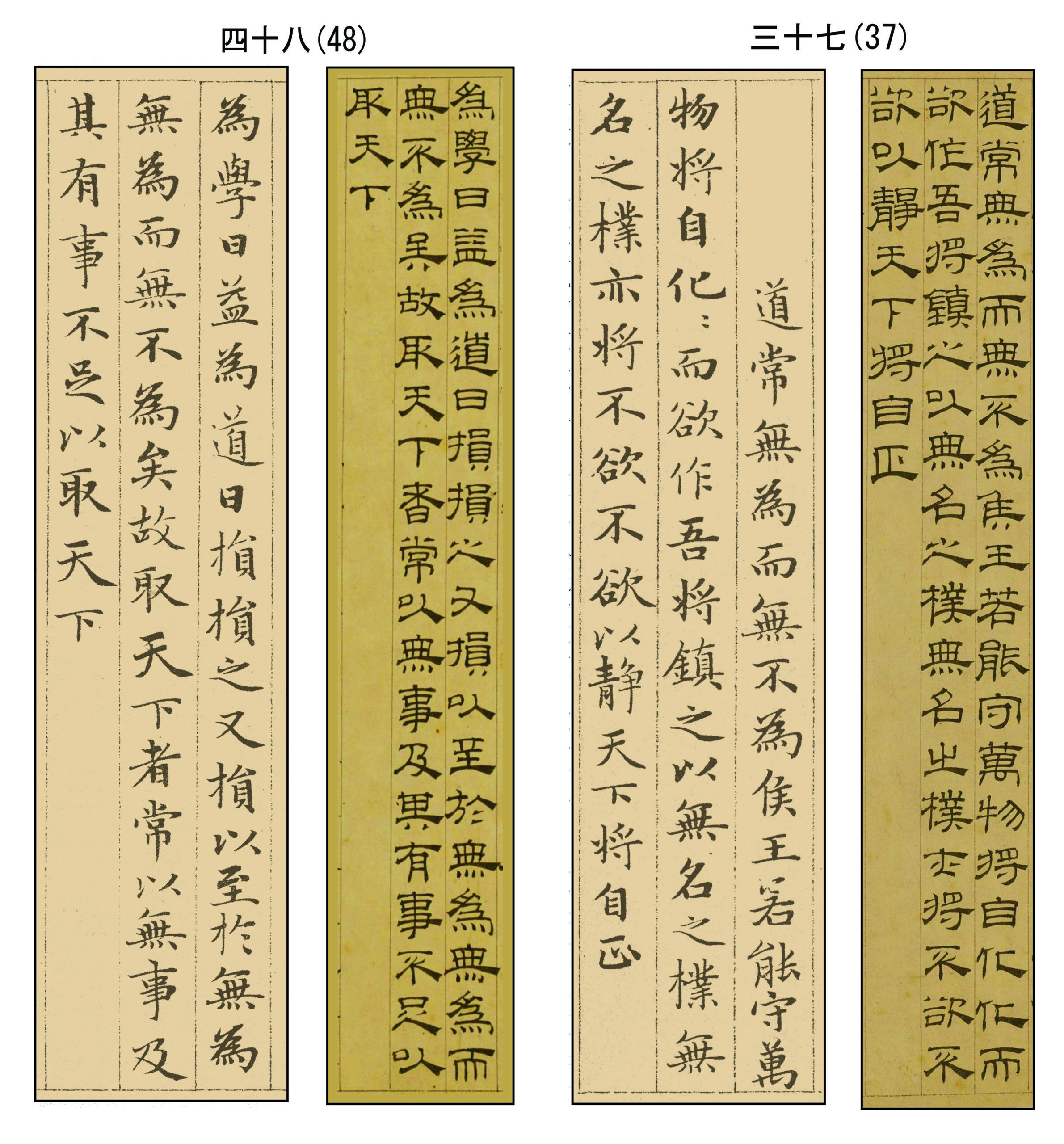
Chapters 37 and 48 of the Daodejing – the chapters that are crucial to the concept of wu wei are shown below in the calligraphy of the 13th Century Zhao Mengfu in regular script, and of the 14th Century Sheng Mao in clerical script): 

The esthetics of Chinese calligraphy depends on the flow from one character to another. The true calligrapher follows the principle of wu wei and writes effortlessly. Chiang Yee (1973, p 117) describes the essential characteristics of Chinese calligraphy:

The beauty of Chinese calligraphy is essentially the beauty of plastic movement, not of designed and motionless shape. A finished piece of it is not a symmetrical arrangement of conventional shapes, but something like the co-ordinated movements of a skilfully composed dance —impulse, momentum, momentary poise, and the interplay of active forces combining to form a balanced whole.  


Envoi

We can conclude with some comments of the poet and Trappist monk Thomas Merton in his introduction to his free translations from the Zhuangzi (2004, p 21):

The true character of wu wei is not mere inactivity but perfect action—because it is act without activity. In other words, it is action not carried out independently of Heaven and earth and in conflict with the dynamism of the whole, but in perfect harmony with the whole. It is not mere passivity, but it is action that seems both effortless and spontaneous because performed “rightly,” in perfect accordance with our nature and with our place in the scheme of things. It is completely free because there is in it no force and no violence. It is not “conditioned” or “limited” by our own individual needs and desires, or even by our own theories and ideas.

And an excerpt from his translation (p. 69):

If man, born in Tao,
Sinks into the deep shadow
Of non-action
To forget aggression and concern,
He lacks nothing
His life is secure.


References

Ames, R. T. (1981) Wu-wei in “The art of rulership” chapter of Huai Nan Tzu: its sources and philosophical orientation. Philosophy East and West, 31(2), 193-213

Chan, A. K. L. (2025). Laozi. The Stanford Encyclopedia of Philosophy.

Chiang, Y. (1973). Chinese calligraphy: an introduction to its aesthetic and technique (3rd ed.). Harvard University Press.

Csikszentmihalyi, M. (1990). Flow: the psychology of optimal experience. Harper & Row.

Csikszentmihalyi, M. (2014). Flow and the foundations of positive psychology. Springer Netherlands.

De Prycker, V. (2011). Unself-conscious control: broadening the notion of control through experiences of flow and wu-wei. Zygon, 46(1), 5–25.

Fischer, P. (2023). The annotated Laozi: a new translation of the Daodejing. State University of New York at Albany.

Fu, C. W.-H. (1973). Lao Tzu’s conception of Tao. Inquiry (Oslo), 16(1–4), 367–394.

Gregory, J. (2018). Effortless living: wu-wei and the spontaneous state of natural harmony. Inner Traditions.

Hansen (2003). Wuwei: taking no action. In Cua, A. S. (Ed.) Encyclopedia of Chinese philosophy. (pp 784-786). Routledge.

Kee, Y. H., Li, C., Zhang, C.-Q., & Wang, J. C. K. (2021). The wu-wei alternative: Effortless action and non-striving in the context of mindfulness practice and performance in sport. Asian Journal of Sport and Exercise Psychology, 1(2–3), 122–132.

Lin, P. J. (1977, open access 2020). A Translation of Lao-tzu’s Tao Te Ching and Wang Pi’s Commentary. (Volume 30 in University of Michigan Chinese Studies). University of Michigan.

Liu, X. (2015). Laozi’s philosophy: textual and conceptual analyses. In X. Liu (Ed.), Dao Companion to Daoist Philosophy (pp. 71–100). Springer Netherlands.

Loy, D. (1985). Wei-Wu-Wei: nondual action. Philosophy East & West, 35(1), 73–86.

Lynn, R. J. (2022). Zhuangzi: a new translation of the sayings of Master Zhuang as interpreted Columbia University Press.

Merton, T. (2004). The way of Chuang Tzu. Shambhala.

Moeller, H. G. (2015). Basic aspects of daoist philosophy. International Communication of Chinese Culture, 2 (2), 99–107.

Slingerland, E. G. (2003). Effortless action: Wu-wei as conceptual metaphor and spiritual ideal in early China. Oxford University Press.

Stamatov, A. (2023). The Laozi’s ideal state: nostalgia, utopia, state of nature. Religions, 14(10), 1243.

Tadd, M. (2019). Ziran: authenticity or authority? Religions, 10(3), 207.

Wu, C. Q. (2016). Thus spoke Laozi: a new translation with commentaries of Daodejing. University of Hawaii.

Ziporyn, B. (2009). Zhuangzi: the essential writings with selections from traditional commentaries. Hackett


Laozi: the Nature of the Dao

Laozi (老子, lǎozǐ, “the old master”) was a legendary character from the 6th Century BCE who put together a collection of philosophical and ethical sayings that has come to be known as the Dàodéjing (道德經 simplified:道德经; or Tao Te Ching in the Wade-Giles romanization, “The Book of the Way and of Virtue”) or Laozi after the name of the author. The illustration shows a depiction of Laozi from a scroll by Sheng Mao. Following the discovery of early versions of the text written on silk and bamboo slips dating to the 2nd Century BCE (Chan, 2016, 2025), several new translations and annotated editions have been published. This essay presents a close reading of the first chapter.   

The First Chapter

The following is the Chinese text of the first chapter (which can be followed at the websites of the Chinese Text Project or Wikibooks) and a recent English translation by Fischer (2023).

道可道,非常道。名可名,非常名。
無名天地之始;有名萬物之母。
故常無欲,以觀其妙;常有欲,
以觀其徼。此兩者,同出而異名,
同謂之玄。玄之又玄,衆妙之門

The way that can be (fully) conveyed is not the abiding Way; a name that can be (fully) descriptive is not an abiding name.

“Formlessness” is the name of the beginning of Heaven and Earth; “form” is the name of the mother of the myriad things.

Thus, if you abide in formlessness, you may thereby observe its wonders; and if you abide in form, you may thereby observe its manifestations.

These two appear together but have different names. This togetherness, we call it “mysterious” mystery and more mystery: the gateway to many wonders.

The following illustration shows on the left the first chapter in clerical script from a scroll by Sheng Mao (盛懋, fl. 14th Century) in the Palace Museum in Beijing, and on the right in regular script from a scroll by Zhao Mengfu (趙孟頫, 1254–1322). The latter includes a portrait of Laozi as a benevolent old gentleman.

The following is a recitation of the first chapter from the dao-de-jing website, and the text in pinyin romanization:

dào kě dào fēi cháng dào
míng kě míng fēi cháng míng
wú míng tiān dì zhī shǐ
yǒu míng wàn wù zhī mǔ
gù cháng wú yù yǐ guān qí miào
cháng yǒu yù yǐ guān qí jiào
cǐ liǎng zhě tóng chū ér yì míng
tóng wèi zhī xuán xuán zhī yòu xuán
zhòng miào zhī mén

The original book of sayings was likely handed down orally. The earliest extant versions were written in clerical script. However, it is possible that there might have been versions of the book written in the Small Seal script, such as imagined in the following illustration:


Or even versions written in the earlier Great Seal or Bronze script, which was used at the time that the book was supposedly created. The illustration on the right shows a Great Seal version of Chapter 1 as imagined by Wilson (2010):

This essay will concern itself with the first chapter (or verse) of Laozi’s book. Red Pine quotes De Qing (1546-1623), a Buddhist commentator, on this chapter:

Laozi’s philosophy is all here. The remaining 5000 words only expand on this first verse.


The Ineffable Dao

The first section of the chapter concerns the difficulty in expressing the nature of Dao:

The way that can be spoken of is not the eternal Way
The name that can be named is not the eternal Name.

Much of Daoist philosophy is related to the opposing concepts of Yīn (陰 simplified 阴 lunar, feminine, passive, cool) and Yáng (陽 simplified 阳 solar, masculine, active, warm). The prototypical examples of Yin and Yan are the shady north side of a hill and its sunny south side. Yin and Yang are the two opposite but interacting forces that underly the harmony of the universe. They can be represented by the tàijítú (太極圖, utmost extreme symbol), one version of which is shown on the right. The small contrasting circles within in each half show how the opposites are complementary rather than antagonistic.

The first two lines of the Daodejing provides two parallel statements on the Dao and on its name. These lines thus concern the actual Dao and its abstract name, both of which cannot be fully understood by finite beings. Actual and abstract can be considered as one of the dualities composing Yin and Yang.

The first line uses the character 道 dao in three ways: first as a noun describing a way or path, second as a verb in the sense of speaking (telling how to follow a path), and third to express the concept of an eternal Dao underlying all things. The second line acts in the same way for the character 名 (name). All languages can use the same word as noun and verb, e.g. “change” in English, but this is more common in Chinese.

In later versions of the Daodejing the character 恆 (constant) was replaced by 常 (with a similar meaning), probably because the former was the name of the fifth emperor of the Han dynasty, Lui Heng (203-157 BCE), and therefore a taboo word.

The Dao is eternal or everlasting. However,

While everlasting seems apt, describing the Dao as unchanging does not fit. This is because Laozi’s Dao serves as the substance of the cosmos and fundamental source and basis of the things of the world. It is eternally transforming and dynamic. (Chen et al., 2020, p 47)

The following is a description of the Dao by Zhuangzi (莊子, Master Zhuang, Chuang-tzu in the Wade-Giles romanization) a Daoist philosopher who lived in the 4th Century BCE (Palmer et al. 1996, pp 50-51):

The great Tao has both reality and expression,
but it does nothing and has no form.
It can be passed on, but not received.
It can be obtained, but not seen.
It is rooted in its own self,
existing before Heaven and Earth were born, indeed for eternity.
It gives divinity to the spirits and to the gods.
It brought to life Heaven and Earth.
It was before the primal air, yet it cannot be called lofty;
it was below all space and direction, yet it cannot be called deep.
It comes before either Heaven or Earth, yet it cannot be called old.

Alan Watts (1975, pp 41-42) commented on the difficulty in describing the Dao:

Thus the Tao is the course, the flow, the drift, or the process of nature, and I call it the Watercourse Way because both Lao-tzu and Chuang-tzu use the flow of water as its principal metaphor. But it is of the essence of their philosophy that the Tao cannot be defined in words and is not an idea or concept. As Chuang-tzu says, “It may be attained but not seen,” or, in other words, felt but not conceived, intuited but not categorized, divined but not explained. In a similar way, air and water cannot be cut or clutched, and their flow ceases when they are enclosed. There is no way of putting a stream in a bucket or the wind in a bag. Verbal description and definition may be compared to the latitudinal and longitudinal nets which we visualize upon the earth and the heavens to define and enclose the positions of mountains and lakes, planets and stars. But earth and heaven are not cut by these imaginary strings. As Wittgenstein [Tractatus Logico-Philosophicus, 1922] said, “Laws, like the law of causation, etc., treat of the network and not of what the network describes.”

Chapter 32 of the Daodejing ends with the statement (translated by Pepper and Wang, 2021):

Dao in this world is like a stream in the valley
Flowing into a river,
into the sea


Being and Nothingness

The second part of the first chapter presents a brief cosmogeny

These lines have been interpreted in two distinct ways. The first

reads wu 无 [non-presence, lacking, non-being] and you 有 [presence, having, being] as the subjects of statements, and name (名) as part of the predicate. The alternative reading takes wuming 无名 [without name, nameless] and youming 有名 [having name] as the subjects of the statements (Chen et al. 2020, pp 48-49).

Thus we could have

Nothingness is the name for the origin of heaven and earth
Being is the name for the mother of all things.

or

Nameless is the origin of heaven and earth
Named is the mother of all things.

Since Yin and Yang is basic to Laozi’s thinking, I have opted to use the first reading which stresses the dichotomy of being and non-being. Similar ideas are stated in Chapter 40 of the Daodejing:

天下萬物生於有,有生於無

All the things in the world are generated from you 有,
you 有 is generated from wu

There is a difference between 天地 (heaven and earth), which encompasses the whole cosmos, and 万物 (myriad things), which refers to the many different things within it. However, this distinction may not be necessary since some early sources used 万物 in both lines. (Huang, 2024, p 14)  

The dichotomy between you and wu (Hall & Ames, 1998) reflects a foundational issue in philosophy: the nature of Being. This goes back to some of the very earliest records of human thought. The creation hymn of the Hindu RgVeda (composed around 2000 BCE) states that at the beginning of time there was neither existence nor non-existence. The ancient Greek philosopher Parmenides (5th Century BCE) worried about “What is and what is not.” Shakespeare’s Hamlet considered “To be, or not to be, that is the question” and Jean-Paul Sartre compared L’être et le néant (Being and Nothingness).

The following is a comment by Zhuangzi (Palmer et al. 1996, p 15) on the origins of the universe:

There is the beginning; there is not as yet any beginning of the beginning; there is not as yet a beginning not to be a beginning of the beginning. There is what is, and there is what is not, and it is not easy to say whether what is not, is not; or whether what is, is.


The Mother of All Things

The fourth line of the first chapter proposes a feminine origin (母, mother) for all things. This idea is repeated in Chapter 6 which describes 玄牝 (xuán pìn, the mysterious female):

谷神不死,是謂玄牝。
玄牝之門,是謂天地根。
綿綿若存,用之不勤

The spirit of the valley does not die; it has been called the mysterious female
The gate of the mysterious female is called the root of heaven and earth.
It is continuous and uninterrupted; its functioning is inexhaustible.
(my translation)

Chapter 25 mentions the 天下母 (tiān xià mŭ, the mother of all under heaven):

有物混成,先天地生。
寂兮寥兮,独立不改,
周行而不殆,可以为天下母。
吾不知其名,字之曰道,强为之名曰

Which has been translated (Wu, 2016, p 57)

There was something undifferentiated and yet complete, born before Heaven and Earth,
Soundless and formless, independent and unchanging.
Revolving endlessly, it may be thought of as the Mother of all under Heaven.
I do not know its name; so I just call it Dao, and arbitrarily name it Great

Anderson (2021) has noted how the Daodejing fully recognizes the female nature of the Dao. Most of the world’s religions are androcentric: they ignore the divine feminine. At its beginning Daoism understoon that the world is based on interacting male ane female forces. And that creation comes from the female. 


From One to Many

The first chapter distinguishes between being and nothingness (yŏu 有 and wu 無 无). The 42nd chapter recounts the actual process of creation (translation by Wu, 2016):

道生一,一生二,
二生三,三生萬物。
萬物負陰而抱陽,
沖氣以為和。

Dao gives birth to One; One gives birth to Two;
Two gives birth to Three; Three gives birth to Ten Thousand things.
All things have Yin on their back and Yang in their embrace;
The Qi of the two converge and become harmony.

The idea of Yin on their back and Yang in their embrace refers to how we prefer to sit facing the sun with the shadow at our back.

The basic cosmogeny is that the primordial energy of the universe – (氣) – becomes differentiated into two opposing forces of yin and yang. These then interact to produce the myriad things of the world that exist in harmony (和).

The one-two-three progression probably just represents the evolution of the many things in the universe. However, Fischer (2023) also considers the possibility

that the “one, two, three” refer to physical energies (氣), Yin-Yang, and harmonized physical energies (和氣). That is: one, a semblance of a form emerges from formless-ness; two, the physical energy that constitutes that semblance is influenced by the Yin and Yang states that characterize all physical energies; three, once the semblance has morphed, chrysalis-like, into its final “harmonious” form, it has become a stable entity.


Mystery and Manifestation

The third section of the first chapter has led to several different translations.

Some editions (e.g. Huang, 2024) substitute 眇 (miǎo, tiny, minute) for 妙 and 噭 (jiao, pursue) for 徼. This leads to the idea of the development from minute origins toward the mature things of the present.

Another difficult is whether the character 欲 acts as a noun meaning “desire” or as an adverb casting the following parts of the sentences in the subjunctive as “may observe.” This would make無 and 有 the subjects of the sentences rather than modifiers of 欲. The Fischer translation quoted at the beginning of this essay follows this approach, as do the versions of Yu (2003), Chen et al. (2020) and Wu (2016).

Translators have more commonly considered that these two sentences compare what happens with or without desire (e.g., Addiss & Lombardo;1993; Leguin & Seaton, 1998; Lin, 2020; Liu, 2024; Loy, 1985; Red Pine, 2004; Wilson 2012). This approach fits with the Buddhist idea that one can find release from suffering by relinquishing desire. As pointed out by Watts (1975, p 96), however, the idea that virtue comes from an absence of desire is paradoxical:

Trying to get rid of desire is, surely, desiring not to desire.

If we follow this approach to the translation, we find that Laozi makes no moral judgement about desire: he just points out the differences between having it or not. Both are possible and both serve a purpose. Relinquishing desire can allow the mind a mystical vision of the origin of everything. Exercising desire allows us to understand the nature of the things of the world:

Free from desire, you can realize the mystery;
Following desire, you can see the manifestations.

However, if the chapter is to be consistent, it is probably best to keep to the duality of wu (无) and you 有:

Therefore in nothingness you may see the mystery;
In being you may see the manifestations.

Nevertheless, the different translations are not that distinct. A person can see the mystery by attuning his or her mind to nothingness. One way of doing this might be to relinquish desire.


Yin and Yang

The fourth section of the chapter tells us these two states are just different aspects of the universe, part of the union of interacting opposites that makes up the concept of Yin-Yang:


Whether these lines refer to (者) the concepts of being and nothingness or to the states of desire and non-desire depends on how the previous lines were translated. I have opted for the former.

These two are but different aspects of the same idea
This is the mystery of mysteries


The Gateway

The final section of the chapter proclaims the mystery of the Dao:

Laozi uses two words for mystery:

玄 (xuán) is dark, mysterious, unseen, withdrawn, deep. But 妙 (miào) is lighter, a wonderful mystery. (Pepper & Wang, 2021, p 17)

We can stress the “darkness,” as in Denecke (2010, p 223)

Where the dark is darker than darkness, that’s the Gateway of Subtleties.

Or simply stay with “mystery”

Mystery of mystery: the gateway to many wonders


Relations to Western Pantheism

The concept of the Dao has many similarities to Western pantheism, particularly to that proposed by Spinoza (Stamatov, 2019, 2025). Fu (1973, p 390) remarks

Both philosophers think that the ultimate way of freeing oneself from human bondage and attaining total emancipation is to have an ontological insight (Lao Tzu) into or intellectual intuition (Spinoza) of the as-it-is-ness of the world and man.

One significant difference is that Spinoza clearly names the principle underlying the universe as God.

Samuel Taylor Coleridge (1772-1834) was particularly intrigued by the writings of the Domingo Fernandez Navarrete (1610-1689), a Dominican friar who had spent many years in China and had described the principles of Daoism for Western readers (Murray, 2020). Coleridge and his close colleague William Wordsworth (1770-1850) were responsible for initiating the movement of Romanticism in English literature Wordsworth’s Lines Composed a Few Miles above Tintern Abbey, On Revisiting the Banks of the Wye during a Tour. July 13, 1798 describes a romantic pantheism that is very similar to the Dao of Laozi:

And I have felt
A presence that disturbs me with the joy
Of elevated thoughts; a sense sublime
Of something far more deeply interfused,
Whose dwelling is the light of setting suns,
And the round ocean and the living air,
And the blue sky, and in the mind of man:
A motion and a spirit, that impels
All thinking things, all objects of all thought,
And rolls through all things. 

Envoi

We can conclude by putting together the complete chapter:

The way that can be spoken of is not the eternal Way
The name that can be named is not the eternal Name.

Nothingness is the name for the origin of heaven and earth
Being is the name for the mother of all things.

Therefore through nothingness you can see the mystery;
Through being you can see the manifestations.

These two are but different aspects of the same idea
This is the mystery of mysteries

Mystery of mystery: the gateway to many wonders.

The chapter is our introduction to the Dao. The character 道 is composed of two radicals. In the upper right is a representation of the head 首(shŏu), and in the left and below is a radical denoting walking (chuò). The combination perhaps represents “to go ahead.” As such it depicts the principle that underlies the universe: the way things should and do turn out.

The Dao has several meanings:

In some places the character “dao 道” refers to a metaphysical entity understood as ultimate true existence. In other places, it seems to refer to a type of rule or principle, often reflected in natural laws or patterns. In yet other locations, dao refers to standards, norms or exemplary models for human life. (Chen et al,2020, p 2),

Fu (1973) describes six dimensions of the Dao:

(i) reality – a metaphysical symbol of things as they are
(ii) origin – the source of all there is
(iii) principle – that whereby all things become what they are
(iv) function – the laws governing the processes of change
(v) virtue – that which completes the being of each and every individual
(vi) technique – the way in which people are governed

The Dao in metaphysical terms should be considered in relation to time. As time passes, thing change. Our science indicates that such changes are not random but follow general rules. Most people also believe that these changes ultimately progress toward something: that the universe has some purpose and is in the process of becoming better. The Dao instantiates these two ideas. It is the overall principle leading the universe toward harmony. Human beings can live their lives best by attuning themselves to this movement.

The final illustration shows on the right 道written in an ecstatic cursive script by Al Chung-liang Huang for Alan Watt’s book on Tao: The Watercourse Way (1975). The fluidity of the calligraphy fits with the idea of water finding its way. On the left is shown the first chapter of the Daodejing as created by Lee Chi-Chang for the same book:


References

Addiss, S., & Lombardo, S. (1993). Tao te ching. Hackett.

Anderson, R. (2021). The Divine Feminine: Tao Te Ching. Inner Traditions.

Chan, A. K. L. (2018). The Daodejing and its tradition. In Kohn, L. (Ed.) Daoism Handbook (Volume 14 of Handbook of Orietnal Studies) (pp 1-29). Brill.

Chan, A. K. L. (2025). Laozi. The Stanford Encyclopedia of Philosophy.

Chen, G., D’Ambrosio, P., & Xiao, O. (2020). The annotated critical Laozi: with contemporary explication and traditional commentary. Brill.

Denecke, W. (2011). The race for precedence:  polemics and the vacuum of traditions in Laozi. In The dynamics of Masters literature: early Chinese thought from Confucius to Han Feizi. (pp 207-230). Harvard University Asia Center.

Fischer, P. (2023). The annotated Laozi: a new translation of the Daodejing. State University of New York at Albany.

Fu, C. W.-H. (1973). Lao Tzu’s conception of Tao. Inquiry, 16(1–4), 367–394.

Hall, D., Ames, R. (1998). You–wu. The Routledge Encyclopedia of Philosophy. Taylor & Francis. (Retrieved 15 Nov. 2025)

Huang, J. H., (2024). The Dao De Jing: Laozi’s book of life: a new translation from the ancient Chinese. Mariner.

Le Guin, U. K., & Seaton, J. P. (1998). Tao te ching: a book about the way and the power of the way. Shambhala.

Lin, P. J. (1977, open access 2020). A Translation of Lao-tzu’s Tao Te Ching and Wang Pi’s Commentary. (Volume 30 in University of Michigan Chinese Studies). University of Michigan.

Liu, K. (2024). Laozi’s Dao de jing: a new interpretation for a transformative time. Scribner.

Loy, D. (1985). Chapter One of the Tao Tê Ching: a ‘new’ interpretation. Religious Studies, 21(3), 369–379.

Murray, C. (2020). Coleridge’s Daoism? Joseph Needham, Dominican Sinology, and Romantic Pantheism. The Wordsworth Circle, 51(2), 205–220.

Palmer, M., Breuilly, E., Ming, C. W., & Ramsay, J. (1996). The book of Chuang Tzu. Arkana (reprinted by Penguin 2006)

Pepper, J.& Wang, X. H. (2021). Dao de jing in clear English including a step-by-step translation. Imagin8 Press.

Red Pine (1996, revised 2004), Lao-Tzu’s Taoteching with selected commentaries from the past 2000 years. Copper Canyon Press.

Stamatov, A. (2019). Spinoza and Laozi: God and Dao.

Stamatov, A. (2025). Dao in world philosophy: an experimental approach. In A. Stamatov (Ed.) Dialogues with classical Chinese philosophy (pp. 192–204). Routledge.

Watts, A. (1975) Tao: the watercourse way. Pantheon Books.

Wilson, W. S. (2012). Tao te ching: an all-new translation. Shambhala.

Wu, C. Q. (2016). Thus Spoke Laozi: A New Translation with Commentaries of Daodejing. University of Hawaii.

Yu, A. C. (2003). Reading the “Daodejing”: ethics and politics of the rhetoric. Chinese literature: essays, articles, reviews (CLEAR), 25, 165-187


Wallace Stevens: Toward a Supreme Fiction

Wallace Stevens (1879-1955) was an American modernist poet. Born in Reading, Pennsylvania, and educated at Harvard and the New York Law School, he worked as an executive for The Hartford Insurance Company in Connecticut. The photograph by Sylvia Salmi was taken in the 1940s, at which time he was vice-president of the company. In his free time Stevens wrote poems, publishing his first book Harmonium in 1923. Throughout his life he considered poetry as the “supreme fiction,” something that could replace religion in human life, and provide us with a more complete understanding than that provided by science or philosophy. In 1942 he published a set of poems entitled Notes toward a Supreme Fiction, to illustrate the nature and power of poetry.

The Romantic Revolution

In the late 18th and early 19th Century, artists and writers insisted that art should stress individual creativity rather than formal learning, and that the emotional response to the world was more important that the rational. Not everyone appreciated the new poetry. In 1820, the satirist Thomas Love Peacock described The Four Ages of Poetry: the iron age of wherein rude bards celebrated the exploits of their chieftains, the golden age of Homer, the silver age of civilized verse lasting from Virgil to Dryden, and the current brass age wherein poets described their feelings. His invective was venomous: he described the characteristics of romantic poetry as

harmony, which is language on the rack of Procrustes; sentiment, which is canting egotism in the mask of refined feeling; passion, which is the commotion of a weak and selfish mind; pathos, which is the whining of an unmanly spirit; and sublimity, which is the inflation of an empty head.  

Percy Bysshe Shelley wrote a response to Peacock in 1821, but he died in 1822, and A Defense of Poetry was not published until 1840. Shelley distinguished two kinds of mental action: reason (Greek logizein, logic, analysis) and imagination (Greek poiein, poetry, synthesis).

Reason is the enumeration of qualities already known; imagination is the perception of the value of those qualities, both separately and as a whole. Reason respects the differences, and imagination the similitudes of things. Reason is to imagination as the instrument to the agent, as the body to the spirit, as the shadow to the substance.

He proposed that it is through the imagination that we obtain new knowledge:

The functions of the poetical faculty are twofold: by one it creates new materials of knowledge, and power, and pleasure; by the other it engenders in the mind a desire to reproduce and arrange them according to a certain rhythm and order which may be called the beautiful and the good.

And at the end of his essay, he claimed

Poets are the hierophants of an unapprehended inspiration; the mirrors of the gigantic shadows which futurity casts upon the present; the words which express what they understand not; the trumpets which sing to battle, and feel not what they inspire; the influence which is moved not, but moves. Poets are the unacknowledged legislators of the world.

The word hierophant, used initially in the context of the Eleusinian Mysteries, comes from the Greek hieros (sacred, holy) and phainein (show, reveal).

Shelley embodied these ideas in his 1819 Ode to the West Wind (full text available). This poem describes the west wind of autumn that blows the leaves from the trees and heralds the coming winter. It ends

Make me thy lyre, even as the forest is:
What if my leaves are falling like its own!
The tumult of thy mighty harmonies

Will take from both a deep, autumnal tone,
Sweet though in sadness. Be thou, Spirit fierce,
My spirit! Be thou me, impetuous one!

Drive my dead thoughts over the universe
Like wither’d leaves to quicken a new birth!
And, by the incantation of this verse,

Scatter, as from an unextinguish’d hearth
Ashes and sparks, my words among mankind!
Be through my lips to unawaken’d earth

The trumpet of a prophecy! O Wind,
If Winter comes, can Spring be far behind?


Shelley was not alone in considering poetry as a great system for creating knowledge and understanding. In his prophetic books, William Blake described Los as the personification of the creative imagination, in despair at the state of the world following the Industrial Revolution. In the 1820 book Jerusalem: The Emanation of the Giant Albion, Los is driven by his demonic Spectre to destroy the present state of England (personified by the Giant Albion), and reforge a new world. The following is Blake’s representation of Los from page 6 of Jerusalem:

Los proclaims

I must Create a System, or be enslav’d by another Man’s
I will not Reason & Compare: my business is to Create
(Blake, Jerusalem, 1820, p 10)


Modern Ideas of Poetry

Shelley and the Romantic poets were soon criticized for being too idealistic, too removed from the real world, and too emotional. The following quotation is from a critique of Shelley by George Santayana (1863-1952), a poet and philosopher who taught at Harvard when Wallace Stevens was an undergraduate there. Stevens and Santayana became friends, exchanged poems and stayed in contact long after Stevens graduated (Mariani, 2016, pp 21-23). Santayana claimed that Shelley

could never put together any just idea of the world: he merely collected images and emotions, and out of them made worlds of his own. His poetry accordingly does not well express history, nor human character, nor the constitution of nature. What he unrolls before us instead is, in a sense, fantastic; it is a series of landscapes, passions, and cataclysms such as never were on earth, and never will be. (Santayana, 1913, pp 181-2)

After Romanticism, the Realists had their day. And as the 20th Century began, Modernism came to the fore. Modernists poets tended toward the everyday rather than the fantastic, irony rather than idealism, objectivity rather than passion, and innovation rather than derivation. In his 1942 poem Of Modern Poetry, Stevens remarked

It has to be living, to learn the speech of the place.
It has to face the men of the time and to meet
The women of the time. It has to think about war
And it has to find what will suffice. It has
To construct a new stage.

Despite being critical of Shelley’s poetry, Santayana nevertheless largely agreed with his idea that poetry creates our understanding of the world. He described the “great function of poetry:”

to repair to the material of experience, seizing hold of the reality of sensation and fancy beneath the surface of conventional ideas, and then out of that living but indefinite material to build new structures, richer, finer, fitter to the primary tendencies of our nature, truer to the ultimate possibilities of the soul. (Santayana, 1900, p 271).

Santayana realized that the creative imagination works in science as well as poetry:

Science and common sense are themselves in their way poets of no mean order, since they take the material of experience and make out of it a clear, symmetrical, and beautiful world (Santayana, 1900, p 271).

He also proposed that poetry and religion were closely related:

Poetry raised to its highest power is then identical with religion grasped in its inmost truth; at their point of union both reach their utmost purity and beneficence, for then poetry loses its frivolity and ceases to demoralize, while religion surrenders its illusions and ceases to deceive. (Santayana, 1900, p 290).

These last two quotations recall Shelley’s A Defense of Poetry:

Poetry is indeed something divine. It is at once the centre and circumference of knowledge; it is that which comprehends all science, and that to which all science must be referred

These ideas were not accepted by all modernist poets. W. H. Auden (1907-1973) had much more restrained views on the function of poetry:

For poetry makes nothing happen: it survives
In the valley of its making where executives
Would never want to tamper, flows on south
From ranches of isolation and the busy griefs,
Raw towns that we believe and die in; it survives,
A way of happening, a mouth.
(Auden, In Memory of W. B. Yeats, 1940)

Wallace Stevens, however, thought about poetry in much the same way as Shelley and Santayana (Italia, 1993). In his essay The Figure of the Youth as Virile Poet in his 1951 collection The Necessary Angel, Stevens quotes Shelley extensively:

He speaks of poetry as created by “that imperial faculty whose throne is curtained within the invisible nature of man.” He says that a poem is the very image of life expressed in its eternal truth. It is “indeed something divine. It is at once the centre and circumference of knowledge . . . the record of the best and happiest moments of the happiest and best minds . . . it arrests the vanishing apparitions which haunt the interlunations of life.” In spite of the absence of a definition and m spite of the impressions and approximations we are never at a loss to recognize poetry. As a consequence it is easy for us to propose a center of poetry, a vis or noeud vital, to which, in the absence of a definition, all the variations of definitions are peripheral. (Stevens, 1951, pp 44-45).

Stevens’ conception of the poet was very similar to Shelley’s:

what makes the poet the potent figure that he is, or was, or ought to be, is that he creates the world to which we turn incessantly and without knowing it and that he gives to life the supreme fictions without which we are unable to conceive of it. (Stevens, 1951, p 31)

Stevens used the term “fiction” to describe the creative process of poetry. “Fiction” comes from the Latin fictus the past participle of fingere meaning to shape, form, devise, feign; “poetry” comes from the Greek poeisis meaning a fabrication or creation, which is itself derived from poiein, to make or compose.

Stevens’ proposal of poetry as the process primarily responsible for our understanding of the world is similar in may ways to the Martin Heidegger’s ideas about Hölderlin’s poetry, though neither writer could have been aware of the other:

The poet names the gods and names all things with respect to what they are. This The poet names the gods and names all things with respect to what they are. This naming does not merely come about when something already previously known is furnished with a name; rather, by speaking the essential word, the poet’s naming first nominates the beings as what they are. Thus they become known as beings. Poetry is the founding of being in the word. (Heidegger, 1941, p 58)

What we can express in words we can hope to understand. Poetry is unlike other modes of expression used in religion, law, or science. Poetry is particularly and vividly close to experience, and because of its attention to sound and metaphor it makes that experience memorable. In his essay On the Contribution of Poetry to the Search for Truth, Hans-Georg Gadamer, a student of Heidegger, points out that poetry brings experience “near” to us:

A genuine poem …allows us to experience “nearness” in such a way that this nearness is held in and through the linguistic form of the poem. What is the nearness that is held there? Whenever we have to hold something, it is because it is transient and threatens to escape our grasp. In fact our fundamental experience as beings subject to time is that all things escape us, that all the events of our lives fade more and more, so that at best they glow with an almost unreal shimmer in the most distant recollection. But the poem does not fade, for the poetic word brings the transience of time to a standstill. (Gadamer, 1986, p 114)

Gadamer realizes, however, that poetry is but one of many linguistic modes used to gain  understanding of the world:

Language gives all of us our access to a world in which certain special forms of human experience arise: the religious tidings that proclaim salvation, the legal judgment that tells us what is right and what is wrong in our society, the poetic word that by being there bears witness to our own being. (Gadamer, 1986, p 115)


Supreme Fictions

Stevens first used the term “supreme fiction” in his 1923 poem A High-Toned Christian Woman (Brazeal, 2007). The main them of the poem (full text available) is that human creativity knows no hierarchy: poetry is as valuable as religion, jazz improvisations as important as choral hymns, and bawdy merriment as meaningful as moral laws. The poem begins

Poetry is the supreme fiction, madame.
Take the moral law and make a nave of it
And from the nave build haunted heaven. Thus,
The conscience is converted into palms,
Like windy citherns hankering for hymns.
We agree in principle. That’s clear. But take
The opposing law and make a peristyle,
And from the peristyle project a masque
Beyond the planets. Thus, our bawdiness,
Unpurged by epitaph, indulged at last,
Is equally converted into palms,
Squiggling like saxophones.

Stevens is indulging is word games: “nave” leads to “knave,” “palm” recalls “psalm,” and the “supreme fiction” brings to mind the “supreme being” who created everything, the creator free of any church, the godhead of Deists and Revolutionaries.

Stevens had given up his belief in the Christian God but still felt the need for something to believe in. That it might be possible to believe in a fiction was suggested in his 1942 poem Asides on an Oboe (full text available) which begins

The prologues are over. It is a question, now,
Of final belief. So, say that final belief
Must be in a fiction. It is time to choose.

Two ideas – the concept of a supreme fiction by which the poetic imagination could create and understand a world, and the need of human beings to believe in something – ran through all of Steven’s thought and poetry. In the Adagia (an unpublished collection of aphorisms), he claimed

The final belief is to believe in a fiction, which you know to be a fiction, there being nothing else. The exquisite truth is to know that it is a fiction and that you believe in it willingly (Stevens, 1997, p 903)

Unfortunately, although the word “fiction” means an imaginative creation, it also carries the connotation that it is untrue. In this regard, Stevens’ statements become contradictory since we cannot believe in something that we know to be untrue (Brazeal, 2007). Stevens is using William James’ idea of the will to believe. But, as Brazeal points out, it was not James’s view that we could just believe in anything. Rather we could believe in what we thought was true even though we had not yet fully proven it.

Stevens discussed the problems about believing in a fiction in a 1942 letter to Henry Church about Notes to a Supreme Fiction:

One evening, a week or so ago, a student at Trinity College came to the office and walked home with me. We talked about this book. I said that I thought that we had reached a point at which we could no longer really believe in anything unless we recognized that it was a fiction The student said that that was an impossibility. that there is as no such thing as believing in something that one knew was no true. It is obvious, however, that we are doing that all the time. There are things with respect to which we willingly suspend disbelief, if there is instinctive in us a will to believe, or if there is a will to believe, whether or not it is instinctive, it seems to me that we can suspend disbelief with reference to a fiction as easily as we can suspend it with reference to anything else. There are fictions that arc extensions of reality. There are plenty of people who believe in Heaven as definitely as your New England ancestors and my Dutch ancestors believed in it. But Heaven is an extension of reality (Stevens & Stevens, 1996, p 430)

Some resolution of these contradictions may be found in the way we consider fiction. Any worthwhile work of fiction must be “true to life.” If it has no relevance to real life, it is not worth reading. This is likely the meaning of Stevens’ fiction – something created by the human imagination that represents what could or does happen in real life as accurately and completely (as “truly”) as it can. Michael Frayn has discussed some of the complex relations between truth and fiction (2006).


Notes toward a Supreme Fiction

In 1942 Stevens published Notes toward a Supreme Fiction with Cummington Press, a fine press founded by Harry Duncan in 1939 in Cummington, Massachusetts. 273 copies of the 45-page book were hand-printed, 80 of which were signed by Stevens. A second edition of 330 copies was published in 1943. The book was dedicated to Henry Church, a patron of the arts, whose fortune derived from his father’s patent for baking soda (with the brand name Arm and Hammer). The design for the book’s title page was by Alessandro Giampietro. Stevens told Henry Church in a 1942 letter

that the straight lines in the designs of the book represent direction and that the circles mean comprehension. (Stevens & Stevens, 1996, p 418)

The poem (full text available) consists of a prologue of 8 lines, three sections containing ten poems, each composed of 7 unrhymed tercets (21 lines), and an epilogue in the same form as the preceding poems. The printing was set up so that the title, dedication (to Henry Church), prologue, section titles and the poems were each printed on a separate page.

The title informs us that this is not the definitive description of the supreme fiction. The poetry provides notes – either in the sense of early observations or in the sense of musical notes that can form an overarching harmony. Furthermore, it is “a” supreme fiction – the creation of Stevens rather than of the ultimate creation of everything.

The prologue is addressed to something not clearly identified, probably the creative imagination with which the poet interacts to bring forth understanding – the “vivid transparence” that leads to “peace.” Older poets would have called it their “muse.”

And for what, except for you, do I feel love?
Do I press the extremest book of the wisest man
Close to me, hidden in me day and night?
In the uncertain light of single, certain truth,
Equal in living changingness to the light
In which I meet you, in which we sit at rest,
For a moment in the central of our being,
The vivid transparence that you bring is peace.

The three sections of the book are entitled

It must be abstract
It must change
It must give pleasure

These titles denote the essential characteristics of any worthwhile fiction.

A detailed commentary is beyond the scope of this essay, which will limit itself to a few of the poems. Many scholars have provided more extensive analyses: Kermode (1960, pp 111-119), Sukenik (1967, pp 136-163), Vendler (1969, pp 168-205), Bloom (1977, pp 167-218), Cook (2007, pp 214-236), Bates (2007).  

The first poem in the first section (It must be abstract) is addressed to an “ephebe,” the name for a young man in training in Ancient Athens.  

Begin, ephebe, by perceiving the idea
Of this invention, this invented world,
The inconceivable idea of the sun.
 
You must become an ignorant man again
And see the sun again with an ignorant eye
And see it clearly in the idea of it.

The poet urges to ephebe not to accept what he has been taught – not to believe in the gods – but to make his own understanding of the world

The death of one god is the death of all.
Let purple Phoebus lie in umber harvest,
Let Phoebus slumber and die in autumn umber,
 
Phoebus is dead, ephebe. But Phoebus was
A name for something that never could be named.
There was a project for the sun and is.
 
There is a project for the sun. The sun
Must bear no name, gold flourisher, but be
In the difficulty of what it is to be.

Umber is an earth-brown pigment, but the word derives from the Latin ombra, shadow, and suggests the shades of the dead. The epithet “gold flourisher” describe the sun’s essential characteristics: the sun as an abstraction.

The final poem in the first section considers the idea of what man must become. The poet envisions a man in clothes too big for his body seeing the world clearly without regard to what religion requires or what humanity desires

Cloudless the morning. It is he. The man
In that old coat, those sagging pantaloons,
 
It is of him, ephebe, to make, to confect
The final elegance, not to console
Nor sanctify, but plainly to propound.

The 5th poem of the second section (It must change) describes a deserted plantation on a tropical island – likely in the Florida Keys, which Stevens visited many times in 1920s and 1930s.

On a blue island in a sky-wide water
The wild orange trees continued to bloom and to bear,
Long after the planter’s death. A few limes remained,
 
Where his house had fallen, three scraggy trees weighted
With garbled green. These were the planter’s turquoise
And his orange blotches, these were his zero green,
 
A green baked greener in the greenest sun.
These were his beaches, his sea-myrtles in
White sand, his patter of the long sea-slushes.

Before the recurrent hurricanes had ruined the plantations, the Florida Keys were famous for the limes used to make Key lime pie. Stevens’ poem about the planter illustrates how our conception of the world must take into account its transience. And find this beautiful. The poem’s third verse is remarkable for its portrayal of the sound of the waves upon the beach.

This poem concludes with a eulogy to the planter. Because he is no more, the eulogy is expressed in negative terms:

An unaffected man in a negative light
Could not have borne his labor nor have died
Sighing that he should leave the banjo’s twang.

Vendler (1969, p 170) transcribes the verse without the negatives:

He lived in a positive light, a man deeply affected by his islands, and therefore he could bear his labor, and could die, in spite of exile and desire, sighing that he should have to leave even so simple and small a pleasure as his banjo’s twang.

The 6th poem of the second section deals with birds:

Bethou me, said sparrow, to the crackled blade,
And you, and you, bethou me as you blow,
When in my coppice you behold me be.
 
Ah, ke! The bloody wren, the felon jay,
Ke-ke, the jug throated robin pouring out,
Bethou, bethou, bethou me in my glade.
 
There was such idiot minstrelsy in rain,
So many clappers going without bells,
That these bethous compose a heavenly gong.
 
One voice repeating, one tireless chorister,
The phrases of a single phrase, ke-ke,
A single text, granite monotony

Stevens was a connoisseur of birds and could whistle a multiplicity of birdsongs (Cook, 2007, p 224). The following are some typical songs of the birds mentioned in the first two verses

Sparrow:                                

Wren:

 Bluejay:

Robin:

As the poem provides its brilliant rendition of the different birds, it makes passing references to other birds that have found their way into poems. “Coppice” is a reference to Hardy’s The Darkling Thrush; “pouring forth” and “glade” are quoted from Keat’s Ode to a Nightingale.

                Now more than ever seems it rich to die,
         To cease upon the midnight with no pain,
                While thou art pouring forth thy soul abroad
                        In such an ecstasy!

Stevens cannot resist the wordplay between the “jug-jug” sound of the robin and “pouring out” from a jug.

However, Stevens notes that most birdsong is monotonous. Because it does not change it is not like the supreme fictions of a poet. Stevens criticizes the tendency of the Romantic poets to liken themselves to birds or to other natural phenomena. The “bethous” that he monotonously repeats are a reference to Shelley’s Ode to the West Wind.

                      Be thou, Spirit fierce,
My spirit! Be thou me, impetuous one!

Stevens’ poem concludes

These are of minstrels lacking minstrelsy,
Of an earth in which the first leaf is the tale
Of leaves, in which the sparrow is a bird

Of stone, that never changes. Bethou him, you
And you, bethou him and bethou. It is
A sound like any other. It will end.

The birdsongs are not supreme fictions because they never change.

In the 8th poem of the second section (It must change) Stevens imagines how Shelley’s Ozymandias, who thought he could impose his order on the world, could have been seduced by the beautiful Nanzia Nuncio so that the constant order that the king of kings desired could give way to changing fictions:

I am the woman stripped more nakedly
Than nakedness, standing before an inflexible
Order, saying I am the contemplated spouse.
 
Speak to me that, which spoken, will array me
In its own only precious ornament.
Set on me the spirit’s diamond coronal.
 
Clothe me entire in the final filament,
So that I tremble with such love so known
And myself am precious for your perfecting.
 
Then Ozymandias said the spouse, the bride
Is never naked. A fictive covering
Weaves always glistening from the heart and mind.

In the 7th poem of the third section (It must give pleasure), Stevens contrasts politics, the imposing or order on the world, to poetry, the discovery of order in the world. And finds pleasure in the changing order of the seasons (Lensing, 2007):

                    But to impose is not
To discover. To discover an order as of
A season, to discover summer and know it,

To discover winter and know it well, to find
Not to impose, not to have reasoned at all,
Out of nothing to have come on major weather,

It is possible, possible, possible.  

The final poem of the third section is a paean to the world we live on, affectionately referred to as the “fat girl,” the earth in all its plenitude and beauty, and “my green, my fluent mundo.” A world that we can only understand through feeling and through fiction:

That’s it: the more than rational distortion,
The fiction that results from feeling. Yes, that.
 
They will get it straight one day at the Sorbonne.
We shall return at twilight from the lecture
Pleased that the irrational is rational,
 
Until flicked by feeling, in a gildered street,
I call you by name, my green, my fluent mundo.
You will have stopped revolving except in crystal.

Notes Toward a Supreme Fiction concludes with an epilogue in which Stevens compares the poet to the soldier. Stevens may have thought this necessary in a poem written during war. However, the epilogue really does not work. Poets lay down their lines but not their lives for what they believe in. Stevens claims that poetry can give meaning to the soldier’s sacrifice. But as James Merrill pointed out in his 1985 poem Page from the Koran:

How gladly with proper words,” said Wallace Stevens
“The solider dies.” Or kills.


Death Comes for Philosopher and for poet

George Santayana resigned from Harvard University in 1911 and spent the rest of his life in Europe. He was financially supported by a small inheritance from his mother and by the royalties from his books, among which was the best-selling novel The Last Puritan (1935). His portrait by Samuel Johnson Woolf graced the cover of Tim magazine in 1936.

At the beginning of World War II, the philosopher was living in Rome. It soon became difficult to transfer money from his American publishers to Italy. In 1941, rather than undergo the stress of travelling during wartime, the 77-year-old obtained lodgings with the Sisters of the Little Company of Mary, who ran the small Calvary Hospital next door to the ancient Basilica Santo Stefano Rotondo. Since the sisters also managed a hospital in Chicago, Santayana’s publishers could pay the sisters in Chicago for his upkeep in Rome (McCormick, 1987, p 420). Santayana continued to live with the sisters after the war. Despite being a confirmed atheist, he enjoyed the liturgy, austerity and tranquility of his Catholic surroundings. Robert Lowell later commented that Santayana believed that “There is no God and Mary is His mother” (in the poem For George Santayana (1863-1952) in Life Studies, 1959). Nevertheless, Santayana maintained his scepticism to the end and insisted on being buried in non-consecrated ground.  

In the summer of 1952, Wallace Stevens wrote a poem about the old philosopher. Santayana died from stomach cancer before the poem was published later that year. As well as describing his situation in Rome, Stevens’ poem makes multiple allusions to Santayana’s 1923 Scepticism and Animal Faith (Griswold works through these references on his website). The poem (full text available) begins

On the threshold of heaven, the figures in the street
Become the figures of heaven, the majestic movement
Of men growing small in the distances of space,
Singing, with smaller and still smaller sound,
Unintelligible absolution and an end –

The threshold, Rome, and that more merciful Rome
Beyond, the two alike in the make of the mind.
It is as if in a human dignity
Two parallels become one, a perspective, of which
Men are part both in the inch and in the mile.

How easily the blown banners change to wings…
Things dark on the horizons of perception
Become accompaniments of fortune, but
Of the fortune of the spirit, beyond the eye,
Not of its sphere, and yet not far beyond,

The human end in the spirit’s greatest reach,
The extreme of the known in the presence of the extreme
Of the unknown. The newsboys’ muttering
Becomes another murmuring; the smell
Of medicine, a fragrantness not to be spoiled…

The bed, the books, the chair, the moving nuns,
The candle as it evades the sight, these are
The sources of happiness in the shape of Rome,
A shape within the ancient circles of shapes,
And these beneath the shadow of a shape

In a confusion on bed and books, a portent
On the chair, a moving transparence on the nuns,
A light on the candle tearing against the wick
To join a hovering excellence, to escape
From fire and be part only of that which

Fire is the symbol: the celestial possible.

The “more merciful Rome” of the second stanza is heaven and the parallel lines becoming one represent death as a transition to eternity. 

The poem ends:

It is a kind of total grandeur at the end,
With every visible thing enlarged and yet
No more than a bed, a chair and moving nuns,
The immensest theatre, and pillared porch,
The book and candle in your ambered room,

Total grandeur of a total edifice,
Chosen by an inquisitor of structures
For himself. He stops upon this threshold,
As if the design of all his words takes form
And frame from thinking and is realized.

The “inquisitor of structures” may refer to Santayana’s likening architecture to poetry:

Every human architect must do likewise with his edifice; he must mould his bricks or hew his stones into symmetrical solids and lay them over one another in regular strata, like a poet’s lines. (Santayana, 1900, p 261)

Griswold suggests that the final lines relate to Santayana’s

The ultimate reaches of doubt and renunciation open out for it, by an easy transition, into fields of endless variety and peace, as if through the gorges of death it had passed into a paradise where all things are crystallised into the image of themselves, and have lost their urgency and their venom. (Santayana, 1923, p 76

The following is Steven’s recitation of the poem

Wallace Stevens himself developed stomach cancer less than 3 years after Santayana (Mariani, 2016, pp 394-402). The cancer was inoperable and a gastroenterostomy was performed at St Francis Catholic Hospital in Hartford. During his recuperation Stevens met the hospital’s chaplain Father Arthur Hanley and talked to him about poetry and religion. Stevens was discharged but re-admitted a few months later. During this second and final hospitalization he agreed to be baptized by Father Hanley (Hanley 1977). Stevens had been brought up as a Lutheran as an adult he had questioned the need for any organized religion. Although Stevens was prone to irony, it appears that his final conversion was sincere. Perhaps he took to heart the words of his friend Santayana:

Scepticism is the chastity of the intellect, and it is shameful to surrender it too soon or to the first comer: there is nobility in preserving it coolly and proudly through a long youth, until at last, in the ripeness of instinct and discretion, it can be safely exchanged for fidelity and happiness. (Santayana, 1923, pp 69-70)


The Internal Paramour

One of Stevens’ last poems Final Soliloquy of the Internal Paramour was published in the Hudson Review in 1951:

Light the first light of evening, as in a room
In which we rest and, for small reason, think
The world imagined is the ultimate good.

This is, therefore, the intensest rendezvous.
It is in that thought that we collect ourselves,
Out of all the indifferences, into one thing:

Within a single thing, a single shawl
Wrapped tightly round us, since we are poor, a warmth,
A light, a power, the miraculous influence.

Here, now, we forget each other and ourselves.
We feel the obscurity of an order, a whole,
A knowledge, that which arranged the rendezvous.

Within its vital boundary, in the mind.
We say God and the imagination are one…
How high that highest candle lights the dark.

Out of this same light, out of the central mind,
We make a dwelling in the evening air,
In which being there together is enough.

The following is Stevens’ recitation of the poem

Stevens does not directly identify his internal mistress. She shares qualities with the idea of the self that, like a shawl, we wrap tightly about us. This formulation is related to Santayana’s description of the self:

If I exist, I am a living creature to whom ideas are incidents, like aeroplanes in the sky; they pass over, more or less followed by the eye, more or less listened to, recognised, or remembered; but the self slumbers and breathes below, a mysterious natural organism, full of dark yet definite potentialities; so that different events will awake it to quite disproportionate activities. The self is a fountain of joy, folly, and sorrow, a waxing and waning, stupid and dreaming creature, in the midst of a vast natural world, of which it catches but a few transient and odd perspectives. (Santayana, 1923, p 146).

However, the mistress is also the creative imagination that proposes our understanding of the world: “an order, a whole, a knowledge.” The creation of this supreme fiction may be like God speaking the words “Let there be light!” The crucial comment, “We say, God and the imagination are one …” refers to one of Stevens’ Adagia:

Proposita:
1. God and the imagination are one.
2. The thing imagined is the imaginer.
The second equals the thing imagined and the imaginer are one.
Hence, I suppose, the Imaginer is God. (Stevens, 1997, p 914)


The poem harks back to the prologue of Notes to a Supreme Fiction, which described the poetic process as a meeting between the poet and his creative self:

In the uncertain light of single, certain truth,
Equal in living changingness to the light
In which I meet you, in which we sit at rest,
For a moment in the central of our being


References

Bates, M. J. (2007). Stevens and the supreme fiction. In Serio, J. N. (Ed.). The Cambridge companion to Wallace Stevens. (pp 48-61). Cambridge University Press.

Blake, W. (1820, reprinted with commentary by Paley, M. D., 1991). Jerusalem: the emanation of the giant Albion. Princeton University Press

Bloom, H. (1977). Wallace Stevens: the poems of our climate. Cornell University Press.

Brazeal, G. (2007). The supreme fiction: fiction or fact? Journal of Modern Literature, 31, 80-100.

Carroll, J. (1987). Wallace Stevens’ supreme fiction: a new romanticism. Louisiana State University Press.

Cook, E. (2007). A reader’s guide to Wallace Stevens. Princeton University Press.

Frayn, M. (2006). Is it true about Lensky? The truth-functions of fiction and the fiction-functions of truth. In The human touch: Our part in the creation of a universe. (pp. 236-269). Faber & Faber.

Gadamer, H.-G. (translated by Walker, N. & edited by Bernasconi, R., 1986). The relevance of the beautiful and other essays. Cambridge University Press.

Hanley, A. (1977). Letter from Father Arthur Hanley to Professor Janet McCann, July 24, 1977

Heidegger, M. (1941, translated by Hoeller, K., 2000). Elucidations of Hölderlin’s poetry. Humanity Books.

Italia, P. G. (1993). Of minstrels lacking minstrelsy: Shelley and Wallace Stevens’ “Notes toward a Supreme Fiction.” Wallace Stevens Journal, 17(2), 168–179.

Kermode, J. F. (1960). Wallace Stevens. Oliver & Boyd.

Lensing, G.S. (2007). Stevens’ seasonal cycles. In Serio, J. N. (Ed.). The Cambridge companion to Wallace Stevens. (pp 118-132). Cambridge University Press.

McCormick, J. (1987). George Santayana: a biography. Alfred A. Knopf

Mariani, P. L. (2016). The whole harmonium: the life of Wallace Stevens. Simon & Schuster.

Peacock, T. L. (1820). The four ages of poetry.

Santayana, G. (1900). Interpretations of poetry and religion. Scribner.

Santayana, G. (1913). Winds of doctrine: studies in contemporary opinion. J.M. Dent & Sons.

Santayana, G. (1923). Scepticism and animal faith: introduction to a system of philosophy. Scribner.

Shelley, P. B. (1821). A defense of poetry.

Stevens, W. (1923). Harmonium. Alfred A. Knopf.

Stevens, W. (1942). Notes toward a supreme fiction. Cummington Press.

Stevens, W. (1951). The necessary angel: essays on reality and the imagination. Vintage Books.

Stevens, W. (1954). The collected poems of Wallace Stevens. Alfred A. Knopf.

Stevens, W. (1997). Collected poetry and prose. Library of America.

Stevens, W., & Stevens, H. (1996). Letters of Wallace Stevens. University of California Press.

Sukenick, R. (1967). Wallace Stevens: musing the obscure: readings, an interpretation and a guide to the collected poetry. New York University Press. Available at wallacestevens.org.

Tompsett, D. (2012). The “Supreme Fiction” as the transvaluation of religion with poetry. In Wallace Stevens and Pre-Socratic Philosophy: metaphysics and the play of violence. (pp. 131–152). Routledge.

Vendler, H. H. (1969). On extended wings: Wallace Stevens’ longer poems. Harvard University Press.


In Search of Form: The Sculpture of Henry Moore

Henry Moore (1898-1986), one of the greatest sculptors of the 20th Century, created striking three-dimensional forms using many different techniques – carving, casting, modelling – and many different materials – stone, bronze, iron, wood, concrete, polystyrene. In the words of Herbert Read (1965, p 259)

He is a maker of images – or, as I prefer to call them because they have material existence – of icons, and he is impelled to make these icons by his sense of the forms that are vital to the life of mankind.

Each of Moore’s works was derived from nature, but Moore simplified and abstracted the experience to provide an emotional understanding rather than a sensory representation This essay comments on the nature of form and considers some of Moore’s works.

Personal History

In 1966 a sculpture by Moore entitled Three Way Piece Number 2, but generally known as The Archer was erected in the square in front of Toronto’s new City Hall, designed by the modernist Finnish architect Viljo Revell (1910-1964). Revell had asked Moore to design a sculpture to complement the new building. Unfortunately, the city council refused to finance the sculpture. Undaunted, the mayor Philip Givens arranged to pay for it through private donations. Despite the misgivings of some, the sculpture and the city hall have become immensely popular. Below are two photographs from 1966, the one of the right showing Henry Moore and Philip Givens.

I was intrigued by Toronto’s controversial sculpture, and in 1968 on a trip to London, I was able to see a large exhibit of Moore’s work at the Tate (Sylvester, 1968). His work affected me deeply: the forms he presented resonated in my mind.  

In the early 1970s, Moore donated a large collection of his work to the Art Gallery of Toronto, and in 1974 the gallery opened its Henry Moore Sculpture Centre (Wilkinson, 1987). The focus of the centre is a large room containing many plaster maquettes used by Moore for casting in bronze.

In 2014, to celebrate its 40th anniversary, the centre arranged for Geoffrey Farmer to illuminate these maquettes with changing lights and to provide a sonic accompaniment for the forms (Whyte, 2014). He called the experience Every day needs an urgent whistle blown into it. It demanded your attention and I was completely fascinated by the play of light and sound on the forms. Several of the illustrations that follow are photographs taken during my visits to this particular exhibition. 


Some Comments on Form

Form is a word of many meanings. The first four meanings given by Wiktionary for the noun “form” in the sense of physical objects are:

  1. the shape or visible structure of a thing or person
  2. a thing that gives shape to other things as in a mold.
  3. regularity, beauty or elegance.
  4. the inherent nature of an object; that which the mind itself contributes as the condition of knowing; that in which the essence of a thing consists.

Ancient Greek philosophy had much to say about form (see recent commentaries by Ainsworth, 2024; Fine, 2023; Koslicki, 2018; Koslicki & Raven, 2024; and Silverman, 2014). A “Theory of Forms” is attributed to Plato and Socrates, although this theory is not clearly delineated in the dialogues of Plato. The basic concept holds that an object that we perceive through our senses is but a poor and transitory example of a perfect and eternal form (eidos) that exists in some domain separate from everyday reality. However, the true form of something can be grasped through the exercise of reason. For example (from Book X of The Republic, circe 375 BCE), though we may experience many different versions of a table, we can discern an idea of a table to which all these versions conform.

Socrates’ Allegory of the Cave (from Book VII of The Republic) is often understood as explaining the nature of forms. Socrates asks us to imagine that we are imprisoned deep in a cave. All we can see are shadows on the wall of the cave. These shadows are cast by various objects held in front a great fire by a group of puppeteers. The puppeteers themselves do not cast shadows since they are behind a wall, above which they hold their objects.  Now, suppose one of the prisoners were to escape and to climb back past the puppeteers and the fire to the entrance of the cave. She would at first be dazzled and confused by the light of the sun.  But after a while she would be able to see the real world. And if she were then to return to the cave and try to convince the other prisoners of what she had discovered, they would consider her crazy.

Socrates (or Plato) is proposing that what we normally perceive is an illusion. Reality can only be attained by leaving behind our preconceptions and grasping the true nature of the world. This is similar to the Apostle Paul’s comment (Tyson, 2024)

For now we see through a glass, darkly; but then face to face: now I know in part; but then shall I know even as also I am known.  (I Corinthians 13:12)

Indeed, Plato actually used the same metaphor in the Phaedrus (circe 370 BCE)

For there is no light of justice or temperance or any of the higher ideas which are precious to souls in the earthly copies of them: they are seen through a glass dimly; and there are few who, going to the images, behold in them the realities, and these only with difficulty. (Jowett translation)

Socrates’ allegory has been interpreted in different ways. An epistemological interpretation is that we cannot know the true reality through what we perceive, but can only discover it if we reason beyond appearances. An ethical interpretation is that we cannot know how to be good by observing the world but only by understanding the ultimate nature of goodness. Whatever the interpretation, the allegory gets lost in its details (e.g. Wilberding, 2004). Who or what are the puppeteers? What are the objects they use to cast the shadows? What is the fire in the cave that causes the shadows? It might have been simpler for the sun to cast shadows of objects in the outside world onto the wall of the cave.

We are left with the simple idea that what we perceive as good or true may not be so. The good or the true may need some deeper understanding. The religious will claim that this understanding comes by faith; the scientific will claim that it comes by reason.

Aristotle had completely different ideas about form from Plato (Fine, 2003; Ainsworth, 2024). For him, form was what gave objects their individuality. Any thing was a combination of substance (hule) and form (morphe): a theory that goes by the name of “hylomorphism.” In this approach form is not the universal and general idea of which a particular object was a poor copy, but rather that which made that particular object itself. Form was one of the four types of cause: material, formal, efficient, and final. 


The Young Moore

Henry Moore was born in 1898 in Castleford, near Leeds, Yorkshire, where his father worked as a supervisor in one of the coal mines. Having heard about Michelangelo in school, he decided at the age of 11 years that he would be a sculptor (Barassi et al, 2017, p 11).

The rolling hills of Yorkshire are a result of glacial erosion. As the glaciers retreated, they left behind “erratic” rocks that remain scattered across the landscape. The young Moore was impressed by one such erratic, Adel Rock: 

For me it was the first big, bleak lump of stone set in the landscape and surrounded by marvelous gnarled prehistoric trees. It had no feature of recognition, no element of copying of naturalism, just a bleak powerful form, very impressive. (quoted in Moore &Hedgecoe, 1986, p 35)

The following photograph is by John Hedgecoe (copied from Moore & Wilkinson, 2002, p 30)

Moore served in France with the Prince of Wales Own Civil Service Rifles and was injured by gas in 1917. After the war he obtained a veteran’s educational grant and attended Leeds School of Art from 1919-21. He then won a scholarship to the Royal College of Art in London from 1921-24. Upon graduating, he became an instructor at the college.

In London, Moore became familiar with the sculptures and the plaster casts held by the many museums in the city. A travelling fellowship also gave him an opportunity to study works in France and Italy. Moore became especially intrigued by the long history of reclining figures in sculpture. The illustration on the following page shows some historical reclining figures: the Tiberinus, a Roman sculpture from the 2nd Century CE representing the God of the River Tiber with his horn of plenty, the Dionysios from the Parthenon (5th Century BCE), the Chichen Itza Chacmool from the 9th Century CE, and Night by Michelangelo (1531).

Moore was particularly fascinated by the power of the pre-Columbian Mexican Chacmool figures, some of which he saw in the British Museum and others he read about. No one knows what these sculptures represented, nor what they were actually called. The name Chacmool, meaning “jaguar” in the Mayan language, was invented by an archeologist. The bowl on the stomach may have held offerings to the gods. In some places and at some times such offerings may have been related to human sacrifice.

Moore’s first major work Reclining Figure (1929) carved out of Hornton stone paid homage to the Chacmool sculptures of Mexico.

It has a definite influence from Mexican sculpture, from that particular figure, the Chacmool figure! Now except for the turn in the head of the Chacmool, which I think is a wonderful sculpture, you get a side view of the body, and the legs are both doing the same thing, both sides are both doing the same thing, that is it’s a symmetrical pose, and although I wasn’t consciously trying to compete with this figure in the brown Hornton one, perhaps my desire to get more three dimensions into sculpture made me use a pose in which the top leg comes over and the body is twisted, the arm is up and the other arm is down, that is, I was using a much less symmetrical pose. (quoted in Moore & Wilkinon, 2002, pp 253-4)

The following illustration shows the 1929 sculpture as well as an anonymous photograph of Moore with the sculpture in his studio in 1930:

One of Moore’s colleagues in Leeds and in London was Barbara Hepworth (1903-1975). Hepworth was likely the first modern sculptor to use the hole as an essential part of her creations (Vertu, 2021). The illustration on the right shows Pierced Form (1931), a carving in pink alabaster, that was destroyed by bombing during World War II, and only exists in this photograph. Hepworth’s creations hearken back to the gongshi or “Scholar’s Rocks,” naturally weathered stones, strangely shaped and often containing holes, that have been used as objects of contemplation in the East.     


Moore began to use holes in his sculpture soon after. In a BBC program in 1937 he remarked

A piece of stone can have a hole through it and not be weakened — if the hole is of a studied size, shape and direction. On the principle of the arch, it can remain just as strong. The first hole made through a piece of stone is a revelation. The hole connects one side to the other, making it immediately more three-dimensional. A hole can itself have as much shape-meaning as a solid mass. Sculpture in air is possible, where the stone contains only the hole, which is the intended and considered form. (quoted in Moore & Wilkinson, 2002, pp 95-96)

The following is a reclining figure carved in elmwood from 1939:

Reclining Figures

The reclining figure became Moore’s most common theme. Almost all of his reclining figures are women. The following illustration shows on the left a page of sketches from 1934. Moore reworked the page into a presentation copy in 1954 using watercolor and crayon to unify and highlight the drawings. On the right are some of his many lithographs showing reclining figures from the 1970s.

The reclining figure can convey many meanings. In its relation with the ground, it combines aspects of both the human figure and the natural landscape. Sylvester (1968, p 5) remarks

But the primary intention is ‘energy and power’: Moore’s reclining figures are not supine; they prop themselves up, are potentially active. Hence the affinity with river-gods: the idea is not simply that of a body subjected to the flow of nature’s forces but of one in which these forces are harnessed. 

To my thinking Moore’s reclining figures appear to be waking up. They may thus embody the idea of matter becoming conscious. In this respect, it is appropriate that one of Moore’s most impressive reclining figures was commissioned in 1955 for the headquarters of the United Nations Educational, Scientific and Cultural Organisation in Paris. The sculpture could serve to illustrate the awakening of collaboration between nations.

Moore initially made a plaster maquette which was 2.35 meters long. From this, seven bronze versions were cast. Since he thought that the bronze version was too dark and too small to be placed in front of the UNESCO building, Moore carved a larger (5.08 meters long) version in travertine stone, the same as used for the building. Moore often scaled his creations to fit the location. The following illustration shows the stone sculpture, the sculpture in place in Paris in a photograph by John Hedgecoe (1998, p 136), and the plaster maquette under the lights of Geoffrey Farmer in Toronto.   


Moore’s reclining figures came in many forms. An interesting version shows a relining figure on a pedestal (1960). This may relate to the 3rd-Century BCE Etruscan sarcophagi in Tuscania. The following illustration shows one such sarcophagus, a drawing from 1936 (from Clark, 1974, Figure 85), and the plaster maquette in Toronto under the lights and shadows of Geoffrey Farmer.


Relations between the Pieces

In the late 1950s Moore began to consider the idea of creating reclining figures composed of two parts. In conversation with John Hedgecoe (Moore & Hedgecoe, 1986, p 112) he remarked

Making a sculpture in two pieces means that, as you walk around it, one form gets in front of the other in ways that you cannot foresee, and you get a more surprising number of different views than when looking at a monolithic piece. … If you are doing a reclining figure, you just do the head and the legs. You leave space for the body, imagining that other part even though it isn’t there. The space then becomes very expressive.

He also related the new sculpture to childhood memories of Adel Rock:

While I was making it my Two Piece Reclining Figure recalled for me Adel Rock and the Rock at Etratat by Seurat. This particular sculpture is a mixture of the human form and the landscape, a metaphor of the relationship of humanity with the earth.

Moore is likely conflating Seurat’s Le Bec du Hoc at Grandcamp (1985), illustrated below on the right, which was at one time owned by his friend Kenneth Clark, with one of Monet’s many paintings of the Cliff at Etratat (left).

The following illustration shows a recent photograph of Adel Rock:

And finally, the Two Piece Reclining Figure 2 (1960) as a plaster maquette in Toronto and as a bronze casting in the Modern Art Museum of Fort Worth (viewed from the other side):

Moore soon began to experiment with more abstract forms placed in relation to each other. His Large Two Forms (1969) brings two shapes that might derive from pelvic bones into a close and possibly sexual relationship. The sculpture began as a small plaster maquette (16 cm) and then was carved in red Soraya marble (length 2 meters): The following illustration shows some black and white photographs by Moore (Sylvester, 1968) and a more recent color photograph:

Moore scaled the forms up using polystyrene (length 6 meters) and cast them in bronze. One of the castings was initially installed outside the Art Gallery or Ontario in 1973. In 2017 it was moved to the nearby Grange Park, where it can be more easily viewed from all directions:

Pointing

In 1940 Moore made a small (length 19 cm) sculpture in steel entitled Three Points.

He remarked that

this pointing has an emotional or physical action in it where things are just about to touch but don’t. There is some anticipation of this action. Michelangelo used the same theme in his fresco on the ceiling of the Sistine Chapel, of God creating Adam, in which the forefinger of God’s hand is just about to touch and give life to Adam. It is also like the points in the sparking plug of a car, where the spark has to jump across the gap between the points.

There is a very beautiful early French painting (Gabrielle d’Estrées with her Sister in the Bath), where one sister is just about to touch the nipple of the other. I used this sense of anticipation first in the Three Points of 1940, but there are other, later works where one form is nearly making contact with the other. It is very important that the points do not actually touch. There has to be a gap. (quoted in Moore & Wilkinson, 2002, p 260-1)

Probably the most famous of Moore’s pointed sculptures is the Oval with Points (1960). This began as a small plaster model (height 16 cm). Based on this Moore made a plaster maquette (height 110 cm) from which bronze versions were cast. Finally, he made a larger version in bronze with a height of 332 cm. the following illustration shows the original plaster model in the Art Gallery of Ontario, the large bronze version in the sculpture park run by the Henry Moore Foundation in Perry Green, Hertfordshire, and the medium-size plaster maquette under the lights of Geoffrey Farmer at the Art Gallery of Ontario:

The sculptures have a clear focus where the two points come close together. The points divide the hole in the center into two parts, which make their own form out of the emptiness. The eye wanders from the structure of the oval to the focus, then through to holes to what is beyond.


Standing Figure: Knife Edge

In 1961 Moore created a small figure (about 25 cm tall) by adding modelling clay to a fragment of a bird’s breastbone. The figure no longer exists except in a photograph by John Hedgecoe (1968, p 360). Using this as a model, Moore then made a plaster maquette that was 163 cm tall. The following illustration shows two views of the plaster maquette:

Using this maquette, Moore cast several versions of the figure in bronze and one in fibreglass. An even taller version (2.8 meters) was then cast in bronze. The following illustration shows the original model, the fibreglass casting (now in the Art Gallery of Ontario) and a bronze casting of the taller version placed as a memorial to W. B. Yeats in St Stephen’s Green in Dublin

In 1976, Moore arranged for a further enlargement – Large Standing Figure: Knife Edge. The following figure shows multiple views of one o the castings of this sculpture, now in Greenwich:

From the “front” the statue resembles a human figure with arms indicating the way to go, or an angel with wings opening to begin flight. At one time Moore called it Winged Figure, a name appropriate to its origin in the breast bone of a bird. From the “side” it does appear as a cutting edge. The form brings many ideas to mind.

The following illustration shows the fibreglass version at the Art Gallery of Ontario as experienced under the lights of Geoffrey Farmer. To me it was a little like watching the shadows on the wall of Plato’s cave.  


A Maker of Forms

This essay has only mentioned a few of the themes in Moore’s sculptures. Over his long and productive life, he considered many others: among them the mother and child, the family, seated figures, warriors, energy, and heads of various kinds. His forms were occasionally naturalistic but more often abstract. He commented on the process of abstraction:  

People say ‘Are you trying to be abstract?’ thinking then that they know what you are doing though, of course, they don’t understand what the devil it is all about. They think that abstraction means getting away from reality and it often means precisely the opposite – that you are getting closer to it, away from a visual interpretation but nearer to an emotional understanding. When I say that I am being abstract, I mean that I am trying to consider but not simply copy nature, and that I am taking account of the material I am using and the idea that I wish to release from that material. (quoted in Moore & Hedgecoe, 1986, p 87).

Moore always insisted that his work must come from nature.

One doesn’t quite know how ideas have been generated or where thy come from. Sometimes one is influenced by a particular pebble or other natural form, but it’s equally possible to sit down with a blank sheet of paper and a pencil and a scribble will turn into something which is worth developing. It depends on how much background you have to draw on. The older you are, the more observant you are of the world, of nature, and forms, and the more easily you can invent. But it has to come from somewhere in the beginning, from reality, nature. (quoted in Moore & Hedgecoe, 1986, p 122)

How do Moore’s forms relate to the ancient philosophical ideas of form? At times he seemed to be seeking the essence or perfect form of something. Some have considered his work in relation to the archetypes that underlie human thought (Neumann, 1959), but this does not help me understand the sculptures.

More often than not, Moore was creating forms rather than portraying them. He was more Aristotelian than Platonic. He followed Aristotle’s four causes: material, formal, efficient, and final. He worked with many different materials, he conceived of forms, he arranged for the material to be made into these forms to be made from the materials, and he did this to help us to understand the world and ourselves.


Final Statement

We can let Moore have the final word on his work. The following is from a 1930 article (quoted in Moore and Wilkinson, 2002, p 188)

Each sculptor differs in his aims and ideals according to his different character, personality and his point of development. The sculpture which moves me most is full blooded and self-supporting, fully in the round, that is, its component forms are completely realised and work as masses in opposition, not being merely indicated by surface cutting in relief; it is not perfectly symmetrical, it is static and it is strong and vital, giving out something of the energy and power of great mountains. It has a life of its own, independent of the object it represents.

Moore likely derived the idea of the energy and power of great mountains from reading Ezra Pound’s 1916 memoir of Henri Gaudier-Brzeska (1891-1915), a young French sculptor who died in the trenches of World War I. His wrote in the journal Vortex (quoted in Pound, 1916, p 9)

Sculptural energy is the mountain.
Sculptural feeling is the appreciation of masses in relation.
Sculptural ability is the defining of these masses by planes.

Below are some photographs of Moore with his sculptures: by Bill Brandt (1946), by Yousuf Karsh (1972) and by Arnold Newman (1966).

References

Ainsworth, T. (2024) Form vs. Matter. The Stanford Encyclopedia of Philosophy

Barassi, S., Wood, J., Moore, T. (2017). Becoming Henry Moore. Art Books Publishing

Clark, K. (1974). Henry Moore drawings. Thames and Hudson.

Fine, G. (2003). Plato on knowledge and forms. Oxford University Press.

Hedgecoe, J. (1998). A monumental vision: the sculpture of Henry Moore. Collins & Brown.

Hedgecoe, J., & Moore, H. (1968). Henry Spencer Moore. Simon & Schuster.

Koslicki, K. (2018). Form, matter, substance. Oxford University Press.

Koslicki, K., & Raven, M. J. (Eds.). (2024). The Routledge handbook of essence in philosophy. Routledge.

Moore, H., & Hedgecoe, J. (1986, reprinted 1999). Henry Moore: my ideas, inspiration and life as an artist. Collins & Brown.

Moore, H., & Wilkinson, A. G. (2002). Henry Moore, writings and conversations. Lund Humphries.

Neumann, E. (1959). The archetypal world of Henry Moore. Pantheon Books.

Pound, E. (1916). Gaudier-Brzeska: a memoir. John Lane, The Bodley Head.

Read, H. (1965). Henry Moore: a study of his life and work. Thames and Hudson.

Silverman, A. (2014). Plato’s middle period metaphysics and epistemology. The Stanford Encyclopedia of Philosophy.

Stephens, C. (2010). Henry Moore. Tate Publishing (Skira Rizzoli)

Sylvester, D. (1968). Henry Moore. Arts Council of Great Britain.

Tyson, P. G. (2015). Returning to reality: Christian Platonism for our times. Lutterworth. (Chapter 4. Platonist Ideas in the New Testament can be downloaded)

Vertu, K. (2021). The hole story. Medium, June 6, 2021.

Whyte, M. (2014). Geoffrey Farmer on Henry Moore: All that is solid melts into air. The Toronto Star, 7 July 2014

Wilberding, J. (2004). Prisoners and puppeteers in The Cave. In Sedley, D. (Ed.) Oxford Studies in Ancient Philosophy. (pp 117-140). Oxford University Press.

Wilkinson, A. G. (1984). The drawings of Henry Moore. Garland.

Wilkinson, A. G. (1987). Henry Moore remembered: the collection at the Art Gallery of Ontario in Toronto. Art Gallery of Ontario.


Some of the Evil of my Tale: Lawrence of Arabia


In late 1916, Thomas Edward Lawrence (1888-1935), a British intelligence officer stationed in Cairo, was assigned as a military liaison officer to the forces of Hussein bin Ali al-Hashimi, the Sharif of Mecca, who, with his sons Ali, Abdullah and Faisal had initiated the Arab Revolt against the Ottoman Turks in June 1916. Lawrence quickly adapted to the ways of his hosts and gained their trust. Under his leadership, the Arabs took the city of Aqaba in July 1917. This allowed the British to supply both their own army and the Arab rebels as they advanced on Jerusalem and Damascus. Lawrence led the Arabs as they disrupted the Hejaz Railway, and harried the Turkish army. His exploits were recorded on film and widely publicized by the American journalist Lowell Thomas, from whom came the epithet “Lawrence of Arabia.” Lawrence published a memoir of his experiences in 1927, Revolt in the Desert. A much more complete and introspective book on the Arab Revolt, Seven Pillars of Wisdom, was not formally published until after his death in 1935.

Early Life

Lawrence’s father Sir Thomas Chapman (1846-1919) was a gentleman landowner in Ireland, who had married a vindictively religious wife and fathered four daughters. In the late 1870s he hired a young Scotswoman, Sarah Lawrence, as a governess for his daughters. He soon fell in love with Sarah, who became pregnant and gave birth to a son in 1885. After his wife finally found out, Chapman decided to leave his family and moved with Sarah to Wales, where he assumed her surname for the sake of respectability. In 1888, Thomas Edward, was born. Three more sons were born and in 1896 the “family” settled in Oxford, where Lawrence and his brothers attended the City of Oxford High School for Boys.   

Lawrence read history at Jesus College in Oxford. His honors thesis on the architecture of the Crusader castles (Lawrence, 1910) was based on a 3-month walking tour of Ottoman Syria in the summer of 1909. The main conclusion of the thesis was that Crusader castles followed the principles of European fortifications and did not absorb any influences from local architecture. The illustration below shows  Lawrence’s pen-and-ink sketch of the south-east corner of Sahyun castle.  

Selim Ahmed

After graduating in 1910, Lawrence joined an archeological expedition to Carchemish to investigate the remains of the Hittite civilization (2nd millennium BCE), staying there until the outbreak of the war in 1914. While in Carchemish he took an intelligent young Arab boy, Selim Ahmed (1896-1918), nicknamed “Dahoum” (dark one), as his apprentice (Sattin, 2014, pp 200-202; Wilson 1989, pp 543-545). Selim nursed him during a severe attack of dysentery in 1911. For the last three years of Lawrence’s time in Syria, the two of them lived together, Lawrence teaching Selim mathematics, English and photography, and Selim helping Lawrence with his Arabic. Their relationship was intense; no one knows whether it remained platonic or became physical. The following paired photographs show Lawrence (left) trying on Selim’s clothes.  

In the introductory chapters of Seven Pillars of Wisdom (1935, pp 39-40) Lawrence recalled a visit in 1912 with Dahoum to the Qasr of Ibn Wardan, a 6th Century Byzantine castle built by Justinian I near Hama in northern Syria (Sattin, 2024, pp 164-165 provides an earlier version of the story).

The common base of the Semitic creeds, winners or losers, was the ever present idea of world-worthlessness. Their profound reaction from matter led them to preach bareness, renunciation, poverty; and the atmosphere of this invention stifled the minds of the desert pitilessly. A first knowledge of their sense of the purity of rarefaction was given me in early years, when we had ridden far out over the rolling plains of North Syria to a ruin of the Roman period which the Arabs believed was made by a prince of the border as a desert-palace for his queen. The clay of its building was said to have been kneaded for greater richness, not with water, but with the precious essential oils of flowers. My guides, sniffing the air like dogs, led me from crumbling room to room, saying, ‘This is jessamine, this violet, this rose’.

But at last Dahoum drew me: ‘Come and smell the very sweetest scent of all’, and we went into the main lodging, to the gaping window sockets of its eastern face, and there drank with open mouths of the effortless, empty, eddyless wind of the desert, throbbing past. That slow breath had been born somewhere beyond the distant Euphrates and had dragged its way across many days and nights of dead grass, to its first obstacle, the man-made walls of our broken palace. About them it seemed to fret and linger, murmuring in baby-speech. ‘This,’ they told me, ‘is the best: it has no taste.’ My Arabs were turning their backs on perfumes and luxuries to choose the things in which mankind had had no share or part.

The Canadian poet, Gwendolyn MacEwen, wrote a set of poems about T. E. Lawrence. In one she recounts the visit to the Qasr of Ibn Wardani. The poem ends

                                          We call
this room the sweetest of them all
,

You said.

            And I thought: Because there is nothing here.

I knew then that you possessed nothing of me, and I
             possessed nothing of you, Dahoum.
You were wealthy and stuffed with a wondrous nothing
             that filled the room and everything around.

You looked into my eyes, the windows to my soul,
             and said that because they were blue
You could see right through them, holes in my skull,
             to the quiet powerful sky beyond.

While he was in Carchemish, Lawrence began writing a book entitled Seven Pillars of Wisdom about the major cities of the Middle East (Aleppo, Beirut, Cairo, Constantinople, Damascus, Smyrna, and Medina). The title comes from Proverbs 9:1:

Wisdom hath builded her house, she hath hewn out her seven pillars

“Seven” had no specific meaning: it was just considered an auspicious number. Lawrence never completed the book and destroyed the drafts that he had written. He was later to use the title for his memoir of the Arab Revolt.

Soon after the war began, Lawrence enlisted and served in Cairo as an intelligence officer. Dahoum was given a stipend to stay at Carchemish to watch over the archeological site. Their halcyon days in northern Syria came to an end.

Lawrence dedicated Seven Pillars of Wisdom to S. A. He never explained who this was but almost everyone now agrees that it was Selim Ahmed (see Knightley & Simpson, 1969, pp 184-188, for reasoning). The book is prefaced with a poem to S. A. that begins

I loved you, so I drew these tides of men into my hands
     and wrote my will across the sky in stars
To earn you Freedom, the seven-pillared worthy house
     that your eyes might be shining for me
                                                          When we came.  

Dahoum died of typhus in 1918 before the Arab and British forces reached Damascus. Lawrence appears to have found this out in one of his trips behind the enemy lines. The epilogue to Seven Pillars of Wisdom begins

Damascus had not seemed a sheath for my sword, when I landed in Arabia: but its capture disclosed the exhaustion of my main springs of action. The strongest motive throughout had been a personal one, not mentioned here but present to me, I think, every hour of these two years. Active pains and joys might fling up, like towers, among my days: but refluent as air, this hidden urge re-formed, to be the persisting element of life, till near the end. It was dead, before we reached Damascus.

Selim Ahmad was the private passion driving Lawrence as he led the Arab forces in their search for freedom.   


The Beginnings of the Arab Revolt

In June, 2016, Hussein bin Ali al-Hashimi, the Sharif of Mecca, rebelled against Ottoman rule in the Hejaz (the western region of the Arabian Peninsula). By July his forces had captured the holy city of Mecca and the port of Jeddah. However, the Turks repulsed the Arabs when they tried to take Medina. The British hoped that the Arab Revolt would pin down Ottoman troops, and thereby assist the British in their advance into Palestine. In correspondence with Hussein, the British High Commissioner in Cairo, Sir Henry McMahon, made vague assurances of support for a self-governing Arabia from Palestine to the Indian Ocean and from Aleppo to Aden. The British likely thought that Husein’s revolt would not succeed, and that they would therefore not be required to fulfil their promises. Nevertheless, they sent Captain T. E. Lawrence to be a liaison officer with Hussein in October 1917. He identified Hussein’s son, Faisal bin al-Hussein bin Ali al-Hashemi, as the best leader of the Arab forces. Together they gathered together warriors from other tribes, and received supplies from the British in the Red-Sea ports of Yanbu and Weijh.

Faisal suggested that it would be much more comfortable for Lawrence to wear Arab clothes (see photograph on right):     

Suddenly Feisal asked me if I would wear Arab clothes like his own while in the camp. I should find it better for my own part, since it was a comfortable dress in which to live Arab-fashion as we must do. Besides, the tribesmen would then understand how to take me. The only wearers of khaki in their experience had been Turkish officers, before whom they took up an instinctive defence. If I wore Meccan clothes, they would behave to me as though I were really one of the leaders; and I might slip in and out of Feisal’s tent without making a sensation which he had to explain away each time to strangers. I agreed at once, very gladly; for army uniform was abominable when camel-riding or when sitting about on the ground; and the Arab things, which I had learned to manage before the war, were cleaner and more decent in the desert. Hejris [Faisal’s slave] was pleased, too, and exercised his fancy in fitting me out in splendid white silk and gold-embroidered wedding garments which had been sent to Feisal lately (was it a hint?) by his great-aunt in Mecca (Lawrence, 1935, p 126).

The following photograph shows the Arab forces at Yanbu with Faisal at the head and Lawrence (in his new white robes) on a camel behind him.


Aqaba

In early 1917, Lawrence convinced Auda Abu Tayeh, known as the “Desert Falcon”, to join the Arab Revolt. Auda was the leader of the Howeitat, a Bedouin tribe in the western part of the Arabian desert. Auda, Sharif Nasr of Syria, Lawrence, and a group of about 50 fighters undertook an arduous journey from Wejh north into the desert. This journey was a clandestine route toward the port of Aqaba. If the Turks noted the Arabian forces, they would likely believe that they were headed further north toward Amman or Damascus. As thy came out of the desert, they attracted many local Arabs to their cause so that their numbers swelled to several hundred. They then turned toward the southwest, crossed the railway and attacked Aqaba. The map below shows the Arab route in purple. The port was impregnable from the sea – the British Royal Navy had unsuccessfully tried to take the city earlier in the war. However, it was not well defended from a land attack. Led by Auda and Lawrence, the Arab forces captured Aqaba in July 2017. The attack on Aqaba was one of the great scenes in David Lean’s 1962 film Lawrence of Arabia. For the film, the town was recreated on a beach in Spain:


After the capture of Aqaba, Lawrence and a few Arab companions rode by camel across the Sinai desert to Suez (dotted purple line on the map). He arranged for the British Navy to send money and supplies to Aqaba and to take the prisoners of war back to Egypt.

The British had not suggested that Lawrence urge the Arabs to capture Aqaba. Lawrence was acting on his own recognizance. The British likely wanted the Arab Revolt to stay confined to the southern regions of the Hejaz. The victory at Aqaba was crucial to the success of the Arab Revolt. Thenceforth, British could supply the Arabs as they moved northward toward Damascus.


The illustrations below show photographs of a flag bearer at the actual battle of Aqaba, and of Lawrence on his camel after the victory.  

After returning to Aqaba from Egypt, Lawrence spent time in Wadi Rum with Faisal, who had come to join the forces of Auda in Aqaba. Wadi Rum was soon to serve as the base for the armored cars that the British supplied to aid the Arabs. The following photographs show the striking granite and sandstone cliffs around the Wadi and a spring that Lawrence found.

Lawrence (1935, p 355) described the spring:

From this rock a silver runlet issued into the sunlight. I looked in to the spout, a little thinner than my wrist, jetting out firmly from a fissure in the roof, and falling with that clean sound into a shallow, frothing pool, behind the step which served as entrance. The walls and roof of the crevice dripped with moisture. Thick ferns and grasses of the finest green made it a paradise just five feet square. Upon the water-cleansed and fragrant ledge I undressed my soiled body, and stepped into the little basin, to taste at last a freshness of moving air and water against my tired skin. It was deliciously cool. I lay there quietly, letting the clear, dark red water run over me in a ribbly stream, and rub the travel-dirt away.

In Aqaba the Arab factions consolidated into a formidable fighting force. The main leaders of the Arab Revolt are illustrated below (photos from Arab Revolt website):

Asraq

After Aqaba was taken, Lawrence and the Arab forces moved to the north. Beginning in late 1917 Lawrence used the ruins of Qasr al Asraq about 100 km east of Amman as a desert base for attacking the Hejaz Railway and the Turkish troops that tried to keep it open.

The oasis of Asraq had been used since Roman times, though the present ruins date from 1237 CE when ‘Izz ad-Din Aybak built a fortress there using basalt stone. Lawrence was particularly impressed by the huge stone doors in the gatehouse. Though each door weighed more than a ton they still swung shut:

The door was a poised slab of thick basalt, a foot thick, turning on pivots of itself, socketed into threshold and lintel. It took a great effort to start swinging and at the end went shut with a clang and crash which made tremble the west wall of the old castle (Lawrence, 1935, p 436)  

Asraq was an oasis that the northern end of the Wadi Sirhan, the ancient trading route between Syria and Dumat-al Jandal in Arabia. Lawrence was fascinated by the site and its relation to the ancient (5th– and 6th Century CE) Syrian kingdoms of Ghassan and Hira:

Then the blue fort on its rock above the rustling palms, with the fresh meadows and shining springs of water, broke on our sight. Of Azrak, as of Rumm, one said ‘Numen inest’. Both were magically haunted: but whereas Rumm was vast and echoing and God-like, Azrak’s unfathomable silence was steeped in knowledge of wandering poets, champions, lost kingdoms, all the crime and chivalry and dead magnificence of Hira and Ghassan. Each stone or blade of it was radiant with half-memory of the luminous, silky Eden, which had passed so long ago. (Lawrence, 1935, p 414).

The following illustration shows some recent photographs from the site:

The following are two of Lawrence’s own photographs from his time in Asraq: one showing the explosion of a mine on the Hejaz Railway near Deraa and one showing the fort at Asraq:


The Incident in Deraa

The crucial episode in Lawrence’s account of the Arab Revolt in Seven Pillars of Wisdom happened in Deraa in late November, 1917. According to Lawrence (1935, Chapter 80), he went there dressed in Arab clothes together with Faris, an elderly Arab, to reconnoiter the approaches to the railway station. He was arrested by a Turkish soldier (who ignored his companion), and taken to the barracks. There he was cleaned up and, in the evening, presented to the Turkish governor (or ‘Bey’), who called him beautiful and fondled him. Lawrence vehemently rejected these advances, and was sent out for a beating to teach him “everything.” After a horrific whipping and a beating that apparently progressed to rape, Lawrence was taken back to the governor, who waved him off as “too torn and bloody for his bed.” After his wounds were treated, Lawrence was left alone. He escaped and made his painful way back to Asraq. The following passages describing his experience in Deraa are from Chapter 80 of Seven Pillars of Wisdom (1935):

To keep my mind in control I numbered the blows, but after twenty lost count, and could feel only the shapeless weight of pain, not tearing claws, for which I had prepared, but a gradual cracking apart of my whole being by some too-great force whose waves rolled up my spine till they were pent within my brain, to clash terribly together. Somewhere in the place a cheap clock ticked loudly, and it distressed me that their beating was not in its time. I writhed and twisted, but was held so tightly that my struggles were useless. After the corporal ceased, the men took up, very deliberately, giving me so many, and then an interval, during which they would squabble for the next turn, ease themselves, and play unspeakably with me. This was repeated often, for what may have been no more than ten minutes. Always for the first of every new series, my head would be pulled round, to see how a hard white ridge, like a railway, darkening slowly into crimson, leaped over my skin at the instant of each stroke, with a bead of blood where two ridges crossed. As the punishment proceeded the whip fell more and more upon existing weals, biting blacker or more wet, till my flesh quivered with accumulated pain, and with terror of the next blow coming. They soon conquered my determination not to cry, but while my will ruled my lips I used only Arabic, and before the end a merciful sickness choked my utterance. …

I remembered the corporal kicking with his nailed boot to get me up; and this was true, for next day my right side was dark and lacerated, and a damaged rib made each breath stab me sharply. I remembered smiling idly at him, for a delicious warmth, probably sexual, was swelling through me: and then that he flung up his arm and hacked with the full length of his whip into my groin. This doubled me half-over, screaming, or, rather, trying impotently to scream, only shuddering through my open mouth. One giggled with amusement. A voice cried, ‘Shame, you’ve killed him’. Another slash followed. A roaring, and my eyes went black: while within me the core of life seemed to heave slowly up through the rending nerves, expelled from its body by this last indescribable pang. By the bruises perhaps they beat me further: but I next knew that I was being dragged about by two men, each disputing over a leg as though to split me apart: while a third man rode me astride. It was momently better than more flogging.

Lawrence concluded the account by stating that

the citadel of my integrity had been irrevocably lost.

The incident was not mentioned in the early biographies (Thomas, 1924, Graves, 1927) and was omitted from Revolt in the Desert (Lawrence, 1927). Lidell Hart (1934) describes the beating but makes no mention of rape.

Richard Meinertzhagen (1959, pp 31-33) reported a conversation with Lawrence in 1922:

He went on to describe the indecency and degradation he suffered at the hands of the homosexual Turks. He did not intend to publish the true account of this incident as it was too degrading, ‘had penetrated his innermost nature’ and he lived in constant fear that the true facts would be known. He had been seized, stripped and bound; then sodomized by the governor of Deraa, followed by similar treatment by the Governor’s servants. After this revolting behaviour he had been flogged.

Meinertzhagen reported seeing scars on Lawence’s back: Lawrence attributed these wounds to being dragged across barbed wire in a camel accident. Unfortunately, the veracity of Meinertzhagen’s report of his encounter with Lawrence has been questioned (Lockman, 1995).

When putting together the first version of Seven Pillars of Wisdom in 1922, Lawrence wrote to his publisher Edward Garnett

If that Deraa incident whose treatment you call severe and serene (the second sounds like a quaint failure to get my impressions across, but I know what you feel) had happened to yourself you would not have recorded it. I have a face of brass perhaps, but I put it into print very reluctantly, last of all the pages I sent to the press. For weeks I wanted to burn it in the manuscript: because I could not tell the story face to face with anyone, and I think I’ll feel sorry, when I next meet you, that you know it. The sort of man I have always mixed with doesn’t so give himself away. (Lawrence, 1938, p 358)

In a later letter to Charlotte Shaw in March 1924, Lawrence wrote

About that night. I shouldn’t tell you. because decent men don’t talk about such things. I wanted to put it plain in the book, and wrestled for days with my self-respect … which wouldn’t. hasn’t, let me. For fear of being hurt, or rather to earn five minutes respite from a pain which drove me mad, I gave away the only possession we are born into the world with — our bodily integrity. Its an unforgivable matter, an irrecoverable position: and it’s that which has made me forswear decent living, and the exercise of my not-contemptible wits and talents. (Lawrence, 2000, p 70).  

What actually happened in Deraa is not known. In the play Ross by Terence Rattigan (1960), the Turkish governor recognizes Lawrence. He instigates the beating in order to break the spirit of the man, something he considers preferable to making him a martyr. Though this is an intriguing speculation, it remains just that.

David Lean’s 1962 movie followed Lawrence’s account but showed only the beating. Jeremy Wilson’s careful and exhaustive biography (1989) accepts that what Lawrence reported actually happened. Other episodes in Seven Pillars of Wisdom accord reasonably well with the historical record despite occasional exaggerations. For example, the camel ride from Aqaba to Suez was an impressive feat but it actually took longer than Lawrence described. 

Lawrence’s recounting of the event in Deraa is overwrought. Some things could not have happened the way they were described. Lawrence could not have seen the effects of the whip on his back. The Bey in Deraa at that time was not known to be a homosexual: according to Lawrence James (1990. p 213), he appears to have been more of a womanizer. Some biographers (Barr, 2008) have therefore speculated that the episode was imagined. Desmond Stewart (1977, p 244) suggested that Lawrence’s report was a “transubstantiation” of a sadomasochistic relationship with Sharif Ali ibn al Hussein, but there is no evidence for this. Aldington (1955) accused Lawrence of exaggerating his military exploits, but still chose to accept that he was tortured and raped at Deraa (see Crawford, 1998, for how Aldington’s book was denigrated by supporters of Lawrence). Korda’s biography Hero (2010) quotes from Seven Pillars of Wisdom and comments on the beating and the rape (p 349):

There seems no good reason why Lawrence would have invented the incident – on the contrary, it seems like the kind of thing that he would have suppressed, had he not been determined to tell the whole truth even when it was distasteful and damaging to him. For he does not strain himself to come out of it with credit; it is not just his body but his spirit that was broken, and much of what happened in 1918 and what became of Lawrence later, after the war, would be incomprehensible except for Deraa.

Later in his life, Lawrence submitted himself to ritual beatings as a form of penance (Knightley & Simpson, 1969, pp 219-254; Simpson, 2008, p 286-299). However, we do not know if this type of activity predated Deraa, or occurred as a result of his experience there. My personal opinion is that Deraa was the beginning of Lawrence’s masochism.

The Deraa episode is so striking that it requires interpretation. That he was tortured and raped during his captivity there makes sense with the strange and broken life that Lawrence was to lead after the war. This was likely why he included it in his book – as explanation and exculpation.


The Road to Damascus

While the Arab forces were harrying the Turks in the inland desert, General Edmund Allenby led British and Commonwealth forces across Sinai and into Palestine. The campaign was a marvel of logistics since the forces had to be constantly supplied with water, food and ammunition through a desert region with no railways. After several major battles with Turkish and German troops, Allenby prevailed and Jerusalem surrendered on December 9, 2017. Two days later, Allenby entered the city through the Jaffa Gate. He came on foot to show appropriate reverence for the holy city. This was the first time that Jerusalem had not been under Muslim rule since 1247.

The following illustration shows a photograph of Allenby’s entry into Jerusalem and a 1918 portrait of the general by James McBey.

In February of 1918 Lowell Thomas, an American journalist met Lawrence in Jerusalem. The two men intrigued each other. On Lawrence’s invitation, Thomas came to Aqaba, bringing with him the camera man Henry Chase. Over the next several months Thomas and Chase reported Lawrence’s exploits in the desert. The film clips and slides later formed the basis for a multimedia show “With Allenby in Palestine and Lawrence in Arabia” that toured America and England in the years following the war. The name and the legend of “Lawrence of Arabia” derives mainly from Thomas. Lawrence was ambivalent about his relationship to Thomas (Crawford & Berton, 1996). On the one hand he was fascinated by fame; on the other he wanted anonymity. Lawrence did not mention Thomas in Seven Pillars of Wisdom. The illustration below (from Thomas, 1924) shows a photograph of the two of them in Aqaba in March 1918, and Lowell’s portrait of Lawrence in London in 1919.  

As the Arab forces grew in strength and experience, they became able to face the Turks in fixed battles as well as guerilla attacks. Their first main encounter was at Tafileh just south of the Dead Sea in January 1918. After multiple attacks, retreats and counter-attacks, the Arabs prevailed. The surviving Turks were pursued toward the railway:

As we turned back it began to snow; and only very late, and by a last effort did we get our hurt men in. The Turkish wounded lay out, and were dead next day. It was indefensible, as was the whole theory of war: but no special reproach lay on us for it. We risked our lives in the blizzard (the chill of victory bowing us down) to save our own fellows; and if our rule was not to lose Arabs to kill even many Turks, still less might we lose them to save Turks. (Lawrence, 1935, p 482)

In September 1918, the Arabs and Turks met at Tafas just north of Deraa. The Turkish troops had just massacred all the inhabitants of the village – men, women and children – as they retreated from Deraa. Tallal, one of the Arabs fighting with Lawrence, was from the village.  

Tallal had seen what we had seen. He gave one moan like a hurt animal; then rode to the upper ground and sat there a while on his mare, shivering and looking fixedly after the Turks. I moved near to speak to him, but Auda caught my rein and stayed me. Very slowly Tallal drew his head-cloth about his face; and then he seemed suddenly to take hold of himself, for he dashed his stirrups into the mare’s flanks and galloped headlong, bending low and swaying in the saddle, right at the main body of the enemy.

It was a long ride down a gentle slope and across a hollow. We sat there like stone while he rushed forward, the drumming of his hoofs unnaturally loud in our ears, for we had stopped shooting, and the Turks had stopped. Both armies waited for him; and he rocked on in the hushed evening till only a few lengths from the enemy. Then he sat up in the saddle and cried his war-cry, ‘Tallal, Tallal’, twice in a tremendous shout. Instantly their rifles and machine-guns crashed out, and he and his mare, riddled through and through with bullets, fell dead among the lance points.

Auda looked very cold and grim. ‘God give him mercy; we will take his price.’ He shook his rein and moved slowly after the enemy. We called up the peasants, now drunk with fear and blood, and sent them from this side and that against the retreating column. (Lawrence, 1935, pp 631-632)

On Lawrence’s orders, the Arabs took no prisoners that day. Lawrence had become an instrument of bloody war, and all compassion was lost in the frenzy of revenge.   

Damascus finally surrendered on October 1, 2018, The British and Commonwealth troops allowed the Arab forces to enter the city first. The war was won but the politics had only just begun:

We passed to work. Our aim was an Arab Government, with foundations large and native enough to employ the enthusiasm and self-sacrifice of the rebellion, translated into terms of peace. We had to save some of the old prophetic personality upon a substructure to carry that ninety per cent of the population who had been too solid to rebel, and on whose solidity the new State must rest.

Rebels, especially successful rebels, were of necessity bad subjects and worse governors. Feisal’s sorry duty would be to rid himself of his war-friends, and replace them by those elements which had been most useful to the Turkish government. (Lawrence, 1935, p 649)

Faisal arrived a few days after the surrender of Damascus and met with General Allenby:

They were a strange contrast: Feisal, large-eyed, colourless and worn, like a fine dagger; Allenby, gigantic and red and merry, fit representative of the Power which had thrown a girdle of humour and strong dealing round the world. (Lawrence, 1935, p 660)

Lawrence was exhausted. The following photograph shows him in Damascus. Once Feisal had arrived to take over the politics of government, Lawrence asked Allenby for leave to return to London.


Aftermath

With peace came politics. Fromkin’s 1989 book on the creation of the modern Middle East takes as its title, A Peace to End All Peace, a quotation from Lord Wavell who had served under Allenby, and was present at the Paris Peace Talks (1919-20):

After ‘the War to end War’ they seem to have been pretty successful in Paris at making a ‘Peace to end Peace.’

In the Middle East, the politics of power soon came into conflict with the ideals of freedom and justice. In the correspondence between McMahon and Hussein in 1916, the Arabs had been promised an independent state that stretched across the whole of the Arabian Peninsula. However, the British had not thought that the Arab Revolt would be successful. They had therefore arranged with France, in an agreement negotiated by the diplomats Mark Sykes and François Georges-Picot in 1916, to divide up the Ottoman Empire between them. And in 1917, Britain’s Foreign Secretary, Arthur Balfour, had also promised the Jews that they could find a “national home” in Palestine. And so, at the Paris Peace Conference (1920), Britain was given a mandate over Palestine, Jordan and Iraq, and France was given a similar mandate over Lebanon and Syria.

Arab leaders were granted titular kingships: Faisal bin Al-Hussein in Syria, and Abdullah bin Al-Hussein in Jordan. After Faisal rejected the French claim for a mandate in Syria in 1920, French forces invaded and Faisal was exiled. In 1921, the British arranged for Faisal to become king of Iraq. He remained king until his death in 1933. Abdullah was king of Jordan until his assassination in 1951. The Hashemites continue to this day as the royal family of Jordan. Hussein bin Ali al-Hashimi was recognized as the king of Hejaz. His eldest son, Ali bin Al-Hussein, remained in Hejaz as his heir. However, the Hashemites were soon challenged by Ibn Saud (1875-1953), who in 1932 unified most of the Arabian Peninsula into Saudi Arabia.

In the first few years after the war, Lawrence was celebrated as a hero. He and Faisal had their portraits painted by Augustus John in 1919:

Initially, Lawrence enjoyed his new fame. He began to write his memoir of the Arab Revolt, worked in the Foreign Office, served as an adviser to Secretary of State Winston Churchill, and attended the Peace Conferences in Paris. However, he soon became deeply depressed by the ongoing politics. He believed that he had betrayed his Arab friends. He felt guilty and longed for penance and anonymity.

In August, 1922, he enlisted in the Royal Air Force as a simple aircraftman under the name John Hume Ross. He wrote about the grueling and demeaning period of basic training in The Mint (posthumously published in 1955). The title likened the experience of raw recruits being converted into useful soldiers to the stamping out of coins from blank metal.

After his identity was disclosed, Lawrence changed his alias to T. E. Shaw (likely from his friendship with Bernard and Charlotte Shaw) and enlisted in the Royal Tank Corps in 1923. He transferred back to the Royal Air Force in 1925 and served until 1935 in various locations. The photograph at the right shows him in 1928 at an air force base in Miranshah in what is now Pakistan, a lonely man in a desolate landscape 

In 1923, he had purchased a forester’s cottage (Clouds Hill) in Dorset near the Bovington Camp, where he served in the Tank Corps. Furnished with books and music, the cottage became his refuge. He returned to live there after leaving the Royal Air Force in 1935.


Lawrence continued to write through all these years of anonymity. He put together a limited publication (only 8 copies) of Seven Pillars of Wisdom in 1922. Writing the memoir caused much anxiety and grief. An early version of the book was lost while changing trains at Reading station in 1919, and much of it had to be completely rewritten (Meyers, 1973). The book was not formally published until after his death in 1935. However, Lawrence issued an abbreviated version of the book, Revolt in the Desert, in 1927. He also wrote a new translation of Homer’s Odyssey in 1932. An anthology of the poems he had enjoyed, Minorities (1971), and The Mint (1955) were published posthumously.


The Death of a Hero

Lawrence loved the experience of speed. He bought his first Brough SS100, the fastest production motorcycle in the world, in 1922, and over the years before his death owned six more models of the motorcycle, which he called Boanerges (“son of thunder,’ the name that Christ gave to his disciples, the brothers James and John). The fifth of these motorcycles (1927) is illustrated above. In Chapter 16 of The Mint (written in 1929 but not published until after his death), he describes racing on his motorcycle with an airplane:

Another bend: and I have the honour of one of England’ straightest and fastest roads. The burble of my exhaust unwound like a long cord behind me. Soon my speed snapped it, and I heard only the cry of the wind which my battering head split and fended aside. The cry rose with my speed to a shriek: while the air’s coldness streamed like two jets of iced water into my dissolving eyes. I screwed them to slits, and focused my sight two hundred yards ahead of me on the empty mosaic of the tar’s gravelled undulations.

Like arrows the tiny flies pricked my cheeks: and sometimes a heavier body, some house-fly or beetle, would crash into face or lips like a spent bullet. A glance at the speedometer: seventy-eight. Boanerges is warming up. I pull the throttle right open, on the top of the slope, and we swoop flying across the dip, and up-down up-down the switchback beyond: the weighty machine launching itself like a projectile with a whirr of wheels into the air at the take-off of each rise, to land lurchingly with such a snatch of the driving chain as jerks my spine like a rictus.

Once we so fled across the evening light, with the yellow sun on my left, when a huge shadow roared just overhead. A Bristol Fighter, from Whitewash Villas, our neighbour aerodrome, was banking sharply round. I checked speed an instant to wave: and the slip-stream of my impetus snapped my arm and elbow astern, like a raised flail. The pilot pointed down the road towards Lincoln. I sat hard in the saddle, folded back my ears and went away after him, like a dog after a hare. Quickly we drew abreast, as the impulse of his dive to my level exhausted itself.

The next mile of road was rough. I braced my feet into the rests, thrust with my arms, and clenched my knees on the tank till its rubber grips goggled under my thighs. Over the first pot-hole Boanerges screamed in surprise, its mud-guard bottoming with a yawp upon the tyre. Through the plunges of the next ten seconds I clung on, wedging my gloved hand in the throttle lever so that no bump should close it and spoil our speed. Then the bicycle wrenched sideways into three long ruts: it swayed dizzily, wagging its tail for thirty awful yards. Out came the clutch, the engine raced freely: Boa checked and straightened his head with a shake, as a Brough should.

On May 13, 1935, Lawrence had a fatal accident while riding his motorcycle from Bovington Camp to his cottage Clouds Hill. He was not driving at great speed: the inquest found that his motorcycle was in second gear when it crashed, a gear with a top speed of 38 mph. However, Lawrence had suddenly came upon two boys cycling on the narrow road: he braked, skidded, and lost control. He was thrown over the handlebars and his head struck the road. Comatose, he was taken to the hospital at Bovington Camp. Lawence never regained consciousness and died on May 19. Hugh Cairns, a young Australian neurosurgeon from Oxford, came to consult on his case. Later in his life, Cairns investigated the epidemiology of concussion and promoted the use of crash helmets for motorcyclists (Hughes, 2001)  


The Seven Pillars of Wisdom

Lawrence was deeply impressed by the power of the desert. In his introductory chapters to Seven Pillars of Wisdom, he discussed how the desert had been the source for three of the world’s great religions: Judaism, Christianity and Islam. He remarked on the Semitic people (p 39):

Their largest manufacture was of creeds: almost they were monopolists of revealed religions. Three of these efforts had endured among them: two of the three had also borne export (in modified forms) to non-Semitic peoples. Christianity, translated into the diverse spirits of Greek and Latin and Teutonic tongues, had conquered Europe and America. Islam in various transformations was subjecting Africa and parts of Asia. These were Semitic successes. Their failures they kept to themselves. The fringes of their deserts were strewn with broken faiths.

It was significant that this wrack of fallen religions lay about the meeting of the desert and the sown. It pointed to the generation of all these creeds. They were assertions, not arguments; so they required a prophet to set them forth. The Arabs said there had been forty thousand prophets: we had record of at least some hundreds. None of them had been of the wilderness; but their lives were after a pattern. Their birth set them in crowded places. An unintelligible passionate yearning drove them out into the desert. There they lived a greater or lesser time in meditation and physical abandonment; and thence they returned with their imagined message articulate, to preach it to their old, and now doubting, associates. The founders of the three great creeds fulfilled this cycle: their possible coincidence was proved a law by the parallel life-histories of the myriad others, the unfortunate who failed, whom we might judge of no less true profession, but for whom time and disillusion had not heaped up dry souls ready to be set on fire. To the thinkers of the town the impulse into Nitria [one of the earliest Christian monastic communities, located in the Egyptian desert] had ever been irresistible, not probably that they found God dwelling there, but that in its solitude they heard more certainly the living word they brought with them.

The desert provided the context to what happened to Lawrence in Arabia. The faith he sought, fought for, and ultimately lost was freedom. Swedenborg (1789, pp 59-60) had described freedom as the second of the great laws that man lives by:

The first law, that man from sense and perception shall have no other knowledge than that he is endowed with life, but shall still acknowledge that the goods and truths originating in love and faith, which he thinks, wills, speaks, and does, are not from himself but from the Lord, presupposes the second, that man has freedom, and that it is also to appear as his own.

The opening paragraphs of Seven Pillars of Wisdom provide the essence of Lawrence’s story:

Some of the evil of my tale may have been inherent in our circumstances. For years we lived anyhow with one another in the naked desert, under the indifferent heaven. By day the hot sun fermented us; and we were dizzied by the beating wind. At night we were stained by dew, and shamed into pettiness by the innumerable silences of stars. We were a self-centred army without parade or gesture, devoted to freedom, the second of man’s creeds, a purpose so ravenous that it devoured all our strength, a hope so transcendent that our earlier ambitions faded in its glare.

As time went by our need to fight for the ideal increased to an unquestioning possession, riding with spur and rein over our doubts. Willy-nilly it became a faith. We had sold ourselves into its slavery, manacled ourselves together in its chain-gang, bowed ourselves to serve its holiness with all our good and ill content. The mentality of ordinary human slaves is terrible – they have lost the world – and we had surrendered, not body alone, but soul to the overmastering greed of victory. By our own act we were drained of morality, of volition, of responsibility, like dead leaves in the wind.

Jim Norton provides a reading of these words:

Jeffrey Myers (2016, pp 114-115) summarizes the life of Lawrence and the importance of the events described in Seven Pillars of Wisdom

Seven Pillars of Wisdom (1926) is the story of Lawrence’s growth in personal and political awareness. The meaning of the book is determined by the juxtaposition of his psychological needs and the pattern of historical events, by the conflict between the man who acts and the conditions of his action. Lawrence’s role in the Arab Revolt combined self-discipline with freedom and power, and his devotion to the higher cause of a ‘holy war’ enabled him to define his identity. But for Lawrence this self-discovery was destructive rather than enlightening. He gradually realized that he had been transformed from a man who had once valued each human life and had given himself in the service of freedom, to one who had been caught up in a repellent and fascinating slaughter and had lost his idealism. When he was tortured and raped at Deraa, this insight deepened into the horrible realization that he had achieved sexual pleasure from physical pain.

The Deraa experience completely destroyed his elaborately constructed network of defences and exposed his all-too-human vulnerability, broke his spirit and extinguished the possibilities of creative freedom. This crucial moment — what Erik Erikson calls ‘The Event’, or culmination and turning point of a man’s experience — dramatizes the central opposition of body and will, and forms the core of Seven Pillars as well as of Lawrence’s life.

Lawrence’s post-war career — his political activities, the composition of Seven Pillars, the enlistment in the ranks, the flagellations and even the suicidal motorcycle rides — followed inevitably from the events described in the book.

As a visual summary of his life, we can consider two portrait sketches of Lawrence by Augustus John, one at the height of his fame in 1919 and one from the period of anonymity in 1929


References

Aldington, R. (1955). Lawrence of Arabia: a biographical enquiry. Collins.

Barr, J. (2006). Setting the desert on fire: T.E. Lawrence and Britain’s secret war in Arabia, 1916-18. Bloomsbury.

Crawford, F. D. (1998). Richard Aldington and Lawrence of Arabia: a cautionary tale. Southern Illinois University Press.

Crawford, F. D., & Berton, J. A. (1996). How well did Lowell Thomas know Lawrence of Arabia? English Literature in Transition, 1880-1920, 39(3), 298-318.

Erikson, E. H. (1964). Insight and responsibility. W. W. Norton

Fromkin, D. (1989). A peace to end all peace: creating the modern Middle East, 1914-1922. André Deutsch.

Graves, R. (1927). Lawrence and the Arabs. Jonathan Cape.

Hughes, J. T. (2001). Lawrence of Arabia and Hugh Cairns: crash helmets for motorcyclists. Journal of Medical Biography, 9(4), 236–240.

James, L. (1990). The golden warrior: the life and legend of Lawrence of Arabia. Weidenfeld and Nicolson.

Knightley, P., & Simpson, C. (1969). The secret lives of Lawrence of Arabia. Nelson.

Korda, M. (2010). Hero: the life and legend of Lawrence of Arabia. Harper.

Lawrence, T. E. (1910, publicly printed 1936). Crusader castles. Golden Cockerel Press (also reprinted by Folio Society, 2010).

Lawrence, T. E. (1922, edited by Wilson, J., & Wilson, N., 2003). Seven pillars of wisdom: a triumph: the complete 1922 text. Castle Hill.

Lawrence, T. E. (1927). Revolt in the desert. Garden City Publishing (Doubleday, Doran).

Lawrence, T. E. (1932). The Odyssey of Homer. Oxford University Press.

Lawrence, T. E. (1935). Seven pillars of wisdom, a triumph. Garden City Publishing (Doubleday, Doran).

Lawrence, T. E. (edited by D, Garnett, 1938). The letters of T. E. Lawrence. Jonathan Cape.

Lawrence, T. E. (1955). The mint: a day-book of the R.A.F. depot between August and December 1922, with later notes by 352087 A/c Ross. Jonathan Cape.

Lawrence, T. E. (1971). Minorities: Good poems by small poets and small poems by good poets. Jonathan Cape.

Lawrence, T. E. (edited by J. Wilson & N. Wilson, 2000). T. E. Lawrence: correspondence with Bernard and Charlotte Shaw. Castle Hill Press.

Lean, D. (dir., 1962, DVD 2003). Lawrence of Arabia. Columbia Pictures.

Liddell Hart, B. H. (1934). T. E. Lawrence: in Arabia and after. Jonathan Cape.

Lockman, J. N. (1995). Meinertzhagen’s diary ruse, false entries on T. E. Lawrence. Cornerstone Publications.

MacEwen, G. (1982). The T.E. Lawrence poems. Mosaic Press/Valley Editions.

Meinertzhagen, R. (1959). Middle East diary, 1917-1956. Thomas Yoseloff

Meyers, J. (1973). The revisions of Seven Pillars of Wisdom. PMLA: Publications of the Modern Language Association of America, 88(5), 1066–1082.

Meyers, J. (2016). Chapter VIII. T. E. Lawrence: Seven Pillars of Wisdom. In Homosexuality and literature: 1890-1930. (pp 114-130). Bloomsbury. 

Rattigan, T. (1960). Ross. Hamish Hamilton.

Sattin, A. (2015). The young T. E. Lawrence. W. W. Norton & Company.

Simpson, A. R. B. (2008). Another life: Lawrence after Arabia. Spellmount.

Stewart, D. (1977). T. E. Lawrence. Hamish Hamilton.

Swedenborg, E. (1760, posthumously published, 1789, anonymously translated, 1867). The Athanasian Creed. New Jerusalem.

Thomas, L. (1924). With Lawrence in Arabia. Century Co.

Wilson, J. (1989). Lawrence of Arabia: the authorised biography of T.E. Lawrence. Heinemann.


Zeno of Elea

Zeno of Elea

Zeno of Elea was a Greek philosopher who lived in the 5th Century BCE. He described a set of paradoxes to prove that space and time are continuous and cannot be divided into discrete parts. The most famous of these are the Paradox of Achilles and the Tortoise, which purportedly shows that Achilles could never catch up with the much slower Tortoise, and the Paradox of the Arrow, which shows that an arrow in flight is always stationary.   


Life of Zeno

Very little is known about the life of Zeno of Elea (Palmer, 2021). Elea, modern-day Velia, was a settlement on the southwest coast of Italy, founded in 540 BCE by Greeks from Phocaea, an Ionian city on the western coast of Anatolia. The Phocians were experienced sailors who had also established colonies in Catalonia and Marseille. The Persian invasion of the Ionian cities drove most of the Phocians toward their colonies, which together with other Greek settlements formed an extensive empire called Magna Grecia. Roman ruins, including the Porta Rosa and a theater have been excavated in Velia:

Zeno was born in about 495 BCE. He became a student of the philosopher Parmenides (?515-?440 BCE), who believed in the universal unity of being: all is one, unchanging, without beginning or end. Parmenides and Zeno may have visited Athens when Socrates was a young man, though this is uncertain. Plato’s describes their interaction in his dialogue Parmenides (~370 BCE), but Plato had not yet been born when the meeting supposedly took place. Zeno may have died under torture following his rebellion against a tyrant, though the variable accounts of his death are perhaps more fantasy than history. The Capitoline Museum in Rome has a Hellenistic statue (2nd Century BCE, illustrated on the right) which is traditionally considered a representation of Zeno. His face suggests both skepticism and humor.

A Book of Paradoxes

Zeno wrote a book of forty paradoxes to defend the philosophy of Parmenides (Dowden, 2023). Unfortunately, the book did not survive and all we know about its contents are brief references in later writings by authors who may not have understood Zeno’s thinking. A paradox is a logical argument that leads to a conclusion at odds with (para, beside or beyond) accepted opinion (dox) (Strobach, 2013). A paradox may be used to demonstrate that accepted opinion is wrong, or at least open to contradictory interpretation. However, the usual intent of a paradox is to show that the premises of the argument must be incorrect since the conclusion is so obviously impossible. This is a variant of the reductio ad absurdum. Any paradox therefore presents us with a choice:

either the conclusion is not really unacceptable, or else the starting point, or the reasoning, has some non-obvious flaw. (Sainsbury, 2009, p 3)

One problem with Zeno’s paradoxes is that we do not know how to interpret them because we do not know how he intended them to be used. The following paragraphs will consider the two most famous of Zeno’s paradoxes from the point of view of modern science and mathematics.    

Achilles and the Tortoise

The original paradox appears to be have involved two runners one faster than the other. Their identification with Achilles and the Tortoise occurred later. In a race the speedy Achilles is attempting to pass a slow Tortoise, who has been given a head start. In order to catch up with the tortoise Achilles must first reach the point where the turtle began the race (t0). However, by then (t1) the tortoise has already moved ahead, albeit by a smaller distance than Achilles has traversed. Achilles must then reach the point to which the Tortoise had advanced. He can cover this extra distance by t2 but again the Tortoise has already moved ahead. Achilles continues to reach the point to which the Tortoise has advanced only to find that the Tortoise has already moved further on. Achilles can therefore never pass the Tortoise. The first three episodes of this infinite train are shown below. For ease of illustration, Achilles is made to run about 4 times faster than the Tortoise:   

The paradox basically proposes that the time taken by Achilles to catch up with the Tortoise is composed of an infinite number of intervals. Even though the later intervals may become vanishingly small, an infinite number of intervals would take an infinite amount of time. Modern mathematics, however, has shown that infinite series like that of Achilles and the Tortoise can have a finite sum. An infinite geometric series of the form

sums to a finite amount 1/(1-z) if the absolute value of z is less than 1. For the example that we have been using the value of z is 1/4, i.e., the ratio of the velocities between Tortoise and Achilles. The sum of the series is thus 4/3.

This is demonstrated through the following equations. The sum of the series (T) is equal to the time taken to cover the distance of the Tortoise’s head start (for simplicity this is made equal to 1) plus the time taken to cover the distance that the Tortoise has covered in the meantime (equal to 1/4 since for our illustration Achilles travels 4 times faster than the Tortoise) plus 1/16 for the next abortive catch-up, and so on to infinity (…). The equations demonstrate that the sum of the series equals 4/3.

The paradox can also be solved using algebraic equations. One can assume Achilles catches up with the Tortoise at a time T after travelling a distance D. The equation for Achilles is

D = T*Va      where Va is the known velocity of Achilles

And for the Tortoise is

D = T*Vt + H     where H is the distance of the head start and Vt is the velocity of the Tortoise

Combining the two equations we have

T*Va = T*Vt + H

Thence

T = H / (Va – Vt)

In our example Vtis 1/4 of Va

T = H / (3/4*Va)

Or 4/3 the time that it takes Achilles to travel the distance of the Tortoise’s head start.

These calculations can be represented graphically with distance plotted on the horizontal axis and time on the vertical axis:

A simple mathematical view of Zeno’s paradox is to set the frame of reference to the moving Tortoise and to calculate the speed of Achilles relative to this reference. In our example, the speed of Achilles relative to the Turtle is 3. This is 3/4 the speed of Achilles relative to the absolute reference and thus it will take Achilles 4/3 the time to catch up with the Tortoise.

These mathematical approaches allow us to understand the movements of Achilles and the Tortoise, to determine where they will be as time passes, and to calculate when Achilles will finally pass the Tortoise. However, they do not really resolve the paradox as presented by Zeno. If space and time are infinitely divisible into points and instants, it will take Achilles an infinite number of acts to catch up with the Tortoise, and an infinite number of acts will take forever (Black, 1970).

We do not know Zeno’s original intent in formulating his paradoxes of motion. He probably did not wish to prove that motion is impossible, and that our perception of moving things is illusory. Rather, he likely wanted to prove that space and time are continuous and cannot be divided into discrete points and instants. This would be in keeping with the monism of his teacher Parmenides. Bertrand Russell (1926, p 174) stated that

The conclusion that Zeno wishes us to draw is that plurality is a delusion and that spaces and times are really indivisible.

However, Russell goes on to propose that space and time may be infinitely divisible if we properly understand infinity.

Zeno’s Arrow

At any instant of time a flying arrow will occupy a space equal to its own size and therefore show no evidence of movement. Its flight is therefore a succession of rests. While it is moving, the arrow is always stationary.

Zeno had not observed an arrow at an instant of time: he could only imagine it. Modern high-speed photography can record moving objects at an instant of time. If the exposure time is very small, they appear unblurred, or completely stationary. The observer cannot tell that the object is moving from its instantaneous appearance.  The first person to record motion using high-speed photography was Eadweard Muybridge (1840-1904). The following set of photographs of a running man were likely taken in the 1870s and printed in 1887.  

The development of the stroboscope which could present brief flashes of bright light allowed photographers such as Harold Edgerton (1903-1990), also known as “Papa Flash,” to examine very rapidly moving objects. The following photograph from the 1950s shows a moving bullet “caught” at two instants by two stroboscopic flashes separated by only a brief time (probably of the order of 50 microseconds).  

At first glance, modern science apparently confirms the conclusion Zeno’s Arrow Paradox: at any instant of time a moving arrow, man or bullet is stationary. However, just because something looks stationary does not mean that it does not have velocity. The trajectory of the arrow can be represented by two functions denoting its horizontal (x) and vertical (y) position:

The parabolic trajectory is determined by the initial velocity (V0) of the arrow as it is released from the bow, the angle (θ) at which it is released, its initial height above the ground (y0), and downward acceleration caused by gravity (g). The following diagram shows a sample trajectory, together with views of the arrow at four instants of time. Note that the formulae do not consider the (very small) effects of friction and treat the horizontal velocity of the arrow as constant. The horizontal axis can therefore also represent time.

The invention of the calculus by Newton and Leibniz allowed us to calculate the velocity of a moving object at any instant in time. If the distance travelled can be represented by a function (f), the velocity at any instant (t) can be calculated by seeing how far the object travels in a tiny period of time (Δt)

The limit as Δt approaches zero – the derivative of the function – is the object’s instantaneous velocity. At any instant of time the object shows no evidence of movement, but it still has velocity. Though it appears stationary, it still moves. 

The calculus allows us to calculate the velocity of the arrow at any instant (Reeder 2015). However, Zeno’s paradox calls into question the idea of discrete instants in time. Motion is continuous; it is not a succession of stationary positions. William James (1910, p. 157):

Zeno’s arguments were meant to show, not that motion could not really take place, but that it could not truly be conceived as taking place by the successive occupancy of points. If a flying arrow occupies at each point of time a determinate point of space, its motion becomes nothing but a sum of rests, for it exists not, out of any point; and in the point it doesn’t move. Motion cannot truly occur as thus discretely constituted.

Time and Space

Zeno’s paradoxes have been discussed extensively (Dowden, 2013; Grünbaum, 1967; Huggett, 2018; McLaughlin, 1994; Sainsbury, 2009; Salmon, 1970; Strobach, 2013). Most writers suggest that modern mathematics can handle the paradoxes: infinite series may sum to a finite amount and instantaneous velocities can be assessed with the infinitesimal calculus.

However, the nature of time and space remain imperfectly understood. A particular problem involves what might be considered the smoothness of these dimensions. Achilles does not run through an infinite set of decreasing distances to catch up with the Tortoise. Rather he runs smoothly and quickly passes the Tortoise. The arrow does not move from one stationary position to the next as if it were in a movie flickering at a slow frame-rate. The arrow moves smoothly from the bow to the target.

Modern conceptions of space and time propose that they are not absolute (e.g., Rovelli, 2018; Markosian et al., 2018). The fabric of space and time can be altered by gravity. A large mass like our sun will distort the adjacent space. Light travelling near such a mass will be deflected by the resultant curvature. A large mass also alters time, which passes more rapidly the closer one is to the mass. It is difficult to understand how such elastic dimensions can be represented by discrete points. The effects of gravity are illustrated in the following diagram, where the four-dimensional fabric of space is shown as a 2-dimensional mesh:

Time’s Arrow

Although we often consider our universe as existing in four dimensions, the dimension of time is distinct from the three spatial dimensions. Though we can move back and forth in space, we can only move forward in time. 

Studies of statistical mechanics demonstrated that the state of a system can be described by the organization of its components. With the passage of time, this state can only change towards increasing disorder. In the formulation of Rudolf Clausius (1822-1888) of this disorder was called “entropy” (Greek en, in + trope, change). Ludwig Boltzmann (1844-1906) considered entropy in terms of statistical mechanics. He described entropy (S) in terms of the number (Ω) of possible microstates (organizations of its molecular components) that could result in a system’s macrostate (temperature, pressure, volume, density, etc.). His formulation of entropy, and of the second law of thermodynamics (with the passage of time entropy can only increase) are:

where ln is the natural logarithm and kBis Boltzmann’s constant.

The concept of entropy led Arthur Eddington to propose the idea of “Time’s Arrow:”

Let us draw an arrow arbitrarily. If as we follow the arrow we find more and more of the random element in the state of the world, then the arrow is pointing towards the future; if the random element decreases the arrow points towards the past. That is the only distinction known to physics. This follows at once if our fundamental contention is admitted that the introduction of randomness is the only thing which cannot be undone. I shall use the phrase “time’s arrow” to express this one-way property of time which has no analogue in space. (Eddington, 1927, p 67.)

Unlike Zeno’s Arrow which is concerned with the nature of motion in time, Eddington’s arrow is concerned with the nature of time itself.

The Graveyard by the Sea

In 1922, Paul Valéry wrote a long poem Le Cimetière Marin about time and mortality. Its setting is a cemetery overlooking the Mediterranean Sea at Sète in Southern France:

At the poem’s climax, Valéry calls on Zeno.:

Zénon! Cruel Zénon! Zénon d’Êlée!
M’as-tu percé de cette flèche ailée
Qui vibre, vole, et qui ne vole pas!
Le son m’enfante et la flèche me tue!
Ah! le soleil . . . Quelle ombre de tortue
Pour l’âme, Achille immobile à grands pas!

;Zeno, Zeno, cruel philosopher Zeno,
Have you then pierced me with your feathered arrow
That hums and flies, yet does not fly! The sounding
Shaft gives me life, the arrow kills. Oh, sun! —
Oh, what a tortoise-shadow to outrun
My soul, Achilles’ giant stride left standing!
(translation by C. Day-Lewis, 1950)

Zeno, Zeno, the cruel, Elean Zeno!
You’ve truly fixed me with that feathered arrow
Which quivers as it flies and never moves!
The sound begets me and the arrow kills!
Ah, sun! . . . What a tortoise shadow for the soul,
Achilles motionless in his giant stride!
(translation of David Paul, 1971)

(I have included two translations, one by Day-Lewis which maintains the rhyme scheme and a more literal version by Paul.)

Valéry’s imagery is complex, it melds Time’s Arrow with Zeno’s paradoxes of the Arrow and of Achilles and the Tortoise. Time will proceed to death and disorder before we can ever attain eternity.

Valéry does not leave usstumbling unsuccessfully after the Tortoise. His poem ends with an invocation to live completely in the life we have no matter that it leads to death.

Le vent se lève! . . . Il faut tenter de vivre!
L’air immense ouvre et referme mon livre,
La vague en poudre ose jaillir des rocs!
Envolez-vous, pages tout éblouies!
Rompez, vagues! Rompez d’eaux réjouies
Ce toit tranquille où picoraient des focs!

The wind is rising! . . . We must try to live!
The huge air opens and shuts my book: the wave
Dares to explode out of the rocks in reeking
Spray. Fly away, my sun-bewildered pages!
Break, waves! Break up with your rejoicing surges
This quiet roof where sails like doves were pecking.
(Day-Lewis)

The wind is rising! . . . We must try to live!
Hie immense air opens and shuts my book,
A wave dares burst in powder over the rocks.
Pages, whirl away in a dazzling riot!
And break, waves, rejoicing, break that quiet
Roof where foraging sails dipped their beaks!
(Paul)

The last line of the poem alludes to its opening where Valéry likened the boats sailing on the sea to doves moving on an immense roof. That quiet roof – the sea – represents the eternity that we live not long enough to understand.  

Reference

Black, M. (1970). Achilles and the tortoise. In W. C. Salmon (Ed.). Zeno’s paradoxes. (pp. 67-81). Bobbs-Merrill.

Dowden, B. (accessed 2023) Zeno’s paradoxes. Internet Encyclopedia of Philosophy

Eddington, A. S. (1928) The nature of the physical world. Cambridge University Press.

Grünbaum, A. (1967). Modern science and Zeno’s paradoxes. Wesleyan University Press.

Harrington, J. (2015). Zeno’s paradoxes and the nature of change. In Time: A Philosophical

Introduction. (pp. 17–62). Bloomsbury Academic.

Huggett, N. (2018). Zeno’s Paradoxes. Stanford Encyclopedia of Philosophy

James, W. H. (1911). Some problems of philosophy: a beginning of an introduction to philosophy. Longmans, Green.

Markosian, N., Sullivan, M., & Emery, N. (2018). Time. Stanford Encyclopedia of Philosophy  

McLaughlin, W. I. (1994). Resolving Zeno’s Paradoxes. Scientific American, 271(5), 84-89

Palmer, J. (2021). Zeno of Elea. Stanford Encyclopedia of Philosophy.

Reeder, P. (2015). Zeno’s arrow and the infinitesimal calculus. Synthese, 192(5), 1315–1335.

Rovelli, C. (translated by E. Segre & S. Carnell, 2018). The order of time. Riverhead Books.

Russell, B. (revised version, 1926). Our knowledge of the external world as a field for scientific method in philosophy. Allen and Unwin.

Sainsbury, R. M. (2009). Paradoxes (3rd edition). Cambridge University Press.

Salmon, W. C. (1970). Zeno’s paradoxes. Bobbs-Merrill.

Strobach, N. (2013). Zeno’s Paradoxes. In H. Dyke & A. Bardon (Eds) A Companion to the Philosophy of Time (pp. 30–46). John Wiley & Sons

Valéry, P. (translated by C. Day-Lewis, 1946). Le Cimetière marin / The graveyard by the sea. M. Secker & Warburg.

Valéry, P. (translated by D. Paul and edited by J. R. Lawler, 1971). Collected works of Paul Valery. Volume 1. Poems. Princeton University Press.


Gauguin

Gauguin

In 1891, Paul Gauguin (1848-1903) left his wife and five children and sailed for Tahiti, where he hoped

to immerse myself in virgin nature, to see no one but savages, live their life, with no other thought in mind but to render, the way a child would, the concepts formed in my brain and to do this with the aid of nothing but the primitive means of art, the only means that are good and true (letter quoted in Eisenman, 1997, p 77).

His decision to desert his family and follow his art has been considered by philosophers as a case study in ethics. Was his hope of artistic success adequate justification for his behavior? As luck would have it, Gauguin did become a famous artist, albeit posthumously. Can this retrospectively vindicate his flight to Tahiti? These issues are complex – both in the abstract and in terms of Gauguin’s actual life.

Life Before Art

Gauguin was born in France but spent much of his childhood in Peru, where his mother’s family had aristocratic connections. His grandmother Flora Tristan (1803-1844), a feminist and socialist, was the niece of Juan Pío Camilo de Tristán y Moscoso, who briefly served as president of South Peru.  

Gauguin returned to France to finish his schooling and then spent three years as a merchant sailor and two years in the French Navy, during which time he travelled throughout the world. When he returned to France in 1871, Gauguin was taken in by a rich relative, Gustave Arosa, an avid collector of realist and impressionist paintings. Arosa got Gauguin a job on the stock exchange, and introduced him to Camille Pissarro.

Gauguin became a very successful broker, and took up painting as a hobby. He married a young Danish woman Mette-Sophie Gad (1850–1920), and had five children. Having made a fortune on the stock market, Gauguin became an art collector himself, buying paintings by Pissarro, Cézanne, Manet, Degas, and Sisley (Bretell & Fonsmark, 2005, p 56)   

Impressionism

Gauguin had talent and he quickly learned the new Impressionist style. His paintings were included in the Impressionist Exhibitions beginning with the fifth in 1880. Below is one of his paintings from this time – Vaugirard Market Gardens, 1879 – together with a self-portrait from 1885.

The Stock Market Crash

In 1882 the Union Générale bank collapsed and the Paris Bourse crashed. By 1883 Gauguin was out of work. The family moved to Rouen where life was less expensive than in Paris. Gauguin decided to paint full time. However, he was not able to sell his paintings. Mette moved back to Denmark with most of the family in 1884, and Gauguin reluctantly followed in 1885. For a brief time, he was a salesman for French tarpaulins in Copenhagen, but he did not speak Danish and the endeavor came to nought. Mette supported the family by giving French lessons. Gauguin’s paintings found no market among the Danes. He became depressed, and sometimes was sometimes physically violent with his wife (Mathews, 2001, p 62). Mette’s family insisted that he leave.

In 1985 Gauguin returned alone to Paris. He submitted nineteen paintings to the Eighth and Final Exhibition of the Impressionist in1886, but these were not well received by either critics or buyers. Gauguin fled Paris for Pont-Aven in Brittany, an artists’ colony where living was cheap. There he worked with Emile Bernard and Louis Anquetin.   

Vision after the Sermon (1888)

Gauguin was fascinated by the deep religiosity of the Breton peasants. He developed a new style of painting to portray their lives. He began using clearly outlined blocks of flat color in the manner of the Japanese prints that had become popular in Paris. He further decided that colors should be based as much upon the imagination as upon reality. This emphasis on the creative imagination derived from the Symbolist movement in literature. Gauguin named his new style of painting “Synthetism.” This approach was also called “Cloisonnism” after the technique for decorating metalwork, whereby colored enamels are placed within spaces bordered by metal strips. A masterpiece of this approach was Gauguin’s The Vision after the Sermon, which portrays Breton peasants experiencing a vision of Jacob wrestling with the angel after a sermon on this episode from Genesis 22: 22-32 (Herban, 1977):

The figure at the lower right is Gauguin. The young peasant at the lower left is likely a portrait of Bernard’s sister Madeleine, with whom Gauguin was infatuated. The following is a description of the painting from Vargas Llosa’s novel The Way to Paradise. Vargas Llosa used the second person narrative as though someone is talking to Gauguin (or Gauguin is talking to himself). “Koké” was the name that the Tahitians called him – their best approximation of his name:  

The true miracle of the painting wasn’t the apparition of biblical characters in real life, Paul, or in the minds of those humble peasants. It was the insolent colors, daringly antinaturalist: the vermillion of the earth, the bottle green of Jacob’s clothing, the ultramarine blue of the angel, the Prussian black of the women’s garments and the pink-, green- and blue-tinted white of the great row of caps and collars interposed between the spectator, the apple tree, and the grappling pair. What was miraculous was the weightlessness reigning at the center of the painting, the space in which the tree, the cow, and the fervent women seemed to levitate under the spell of their faith. The miracle was that you had managed to vanquish prosaic realism by creating a new reality on the canvas, where the objective and the subjective, the real and the supernatural, were mingled, indivisible. Well done, Paul! Your first masterpiece, Koké! (Vargas Llosa, 2003, pp 217-218)

Gauguin also created a striking version of the crucifixion based on his time in Pont-Aven – The Yellow Christ (1889):

The Studio of the South

Back in Paris, Gauguin met the dealer Theo van Gogh and through him his brother Vincent. The two artists exchanged self-portraits. Van Gogh’s saw himself as an austere Japanese monk; Gauguin’s portrait is off-center against a floral wallpaper background includes a portrait of Emile Bernard:

Vincent invited Gauguin to stay with him in Arles in Provence. For nine weeks in late 1888 the two artists lived and worked together (Silverman, 2000; Druick et al, 2001). Although their relations were initially amicable, they disagreed on many things and the tension between them increased. If we are to believe what Gauguin later recalled in his journals (Gauguin, 2009, pp 12-14), one evening van Gogh threatened Gauguin with a razor and Gauguin decamped to stay the night in a hotel. Van Gogh then proceeded to cut off his right ear with the razor and presented the ear to one of the prostitutes in Arles. Gauguin fled to Paris and van Gogh was confined to an asylum.   

Manao Tupapau

Van Gogh and Gauguin had discussed the book Rarahu by Pierre Loti (1880), which described the author’s marriage to a Tahitian girl, and the two artists considered the possibility of painting in the islands of the Pacific. Van Gogh committed suicide in 1890. Gauguin sailed to Tahiti in 1891.
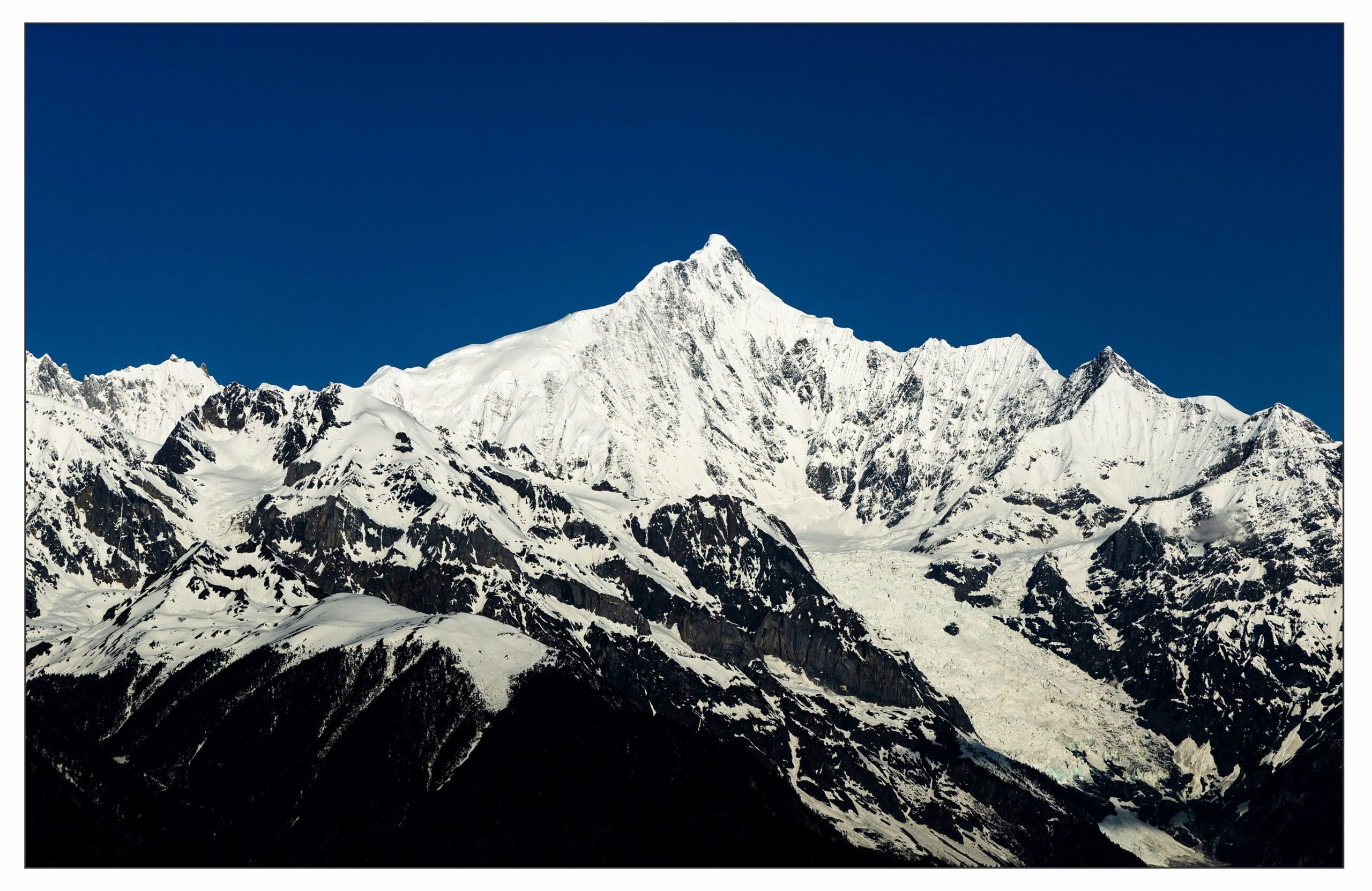
In Tahiti Gauguin took a Tahitian girl aged thirteen, Tehemana (Tehura), as his mistress. One night when returning home late to his hut, he found her lying frightened on the bed:   

Quickly, I struck a match, and I saw. . . . Tehura, immobile, naked, lying face downward flat on the bed with the eyes inordinately large with fear. She looked at me, and seemed not to recognize me. As for myself I stood for some moments strangely uncertain. A contagion emanated from the terror of Tehura. I had the illusion that a phosphorescent light was streaming from her staring eyes. Never had I seen her so beautiful, so tremulously beautiful. And then in this half-light which was surely peopled for her with dangerous apparitions and terrifying suggestions, I was afraid to make any movement which might increase the child’s paroxysm of fright. How could I know what at that moment I might seem to her? Might she not with my frightened face take me for one of the demons and specters, one of the Tupapaus, with which the legends of her race people sleepless nights? Did I really know who in truth she was herself? The intensity of fright which had dominated her as the result of the physical and moral power of her superstitions had transformed her into a strange being, entirely different from anything I had known heretofore. (Gauguin, 1919/85, pp 33-34)

In Tahitian legends the Tupapaus were malignant demons. Over the next few days Gauguin painted the scene that he had witnessed, calling it Manao Tupapau, “Spirit of the Dead Watching” (1892):

Vargas Llosa imagines his thoughts about the painting:

Yes, this was truly the painting of a savage. He regarded it with satisfaction when it seemed to him that it was finished. In him, as in the savage mind, the everyday and the fantastic were united in a single reality, somber, forbidding, infused with religiosity and desire, life and death. The lower half of the painting was objective, realist; the upper half subjective and unreal but no less authentic. The naked girl would be obscene without the fear in her eyes and the incipient downturn of her mouth. But fear didn’t diminish her beauty. It augmented it, tightening her buttocks in such an insinuating way, making them an altar of human flesh on which to celebrate a barbaric ceremony, in homage to a cruel and pagan god. And in the upper part of the canvas was the ghost, which was really more yours than Tahitian, Koké. It bore no resemblance to those demons with claws and dragon teeth that Moerenhout described. It was an old woman in a hooded cloak, like the crones of Brittany forever fixed in your memory, time-less women who, when you lived in Pont-Aven or Le Pouldu, you would meet on the streets of Finistère. They seemed half dead already, ghosts in life. If a statistical analysis were deemed necessary, the items belonging to the objective world were these: the mattress, jet-black like the girl’s hair; the yellow flowers; the greenish sheets of pounded bark; the pale green cushion; and the pink cushion, whose tint seemed to have been transferred to the girl’s upper lip. This order of reality was counterbalanced by the painting’s upper half: there the floating flowers were sparks, gleams, featherlight phosphorescent meteors aloft in a bluish mauve sky in which the colored brushstrokes suggested a cascade of pointed leaves. The ghost, in profile and very quiet, leaned against a cylindrical post, a totem of delicately colored abstract forms, reddish and glassy blue in tone. This upper half was a mutable, shifting, elusive substance, seeming as if it might evaporate at any minute. From up close, the ghost had a straight nose, swollen lips, and the large fixed eye of a parrot. You had managed to give the whole a flawless harmony, Koké. Funereal music emanated from it, and light shone from the greenish-yellow of the sheet and the orange-tinted yellow of the flowers. (Vargas Llosa, 2003, pp 22-23)

The painting is one of the most discussed of Gauguin’s Tahitian pictures. The commentary is ambivalent: 

All this is to put the painting in the best possible light. But there is surely more to it than just a charming anecdote based on local folklore. In blunt terms what we actually see is the interior of a hut at night, with a large couch, covered in a boldly flowered cloth, partially overlaid by a plain white sheet on which lies a naked girl, face down, another of the child-like, yet distinctly erotic figures who have appeared before in Gauguin’s work — pert buttocks offered invitingly to the spectator. There is even something disturbing about the way the face is half-turned towards the viewer, or rather towards the artist, Gauguin, as if he and not the figure in the background is the spirit of which she is afraid. (Sweetman, 1995, pp 326-327).

Where Do We Come From? What Are We? Where Are We Going?

In 1893 Gauguin returned to Paris and arranged to sell some of his Tahitian paintings. He was not happy in Paris and in 1895 he returned to Tahiti. Over the next few years, Gauguin became severely depressed. He had suffered a broken ankle in a brawl in Concarneau near Pont Aven and the fracture had never really healed. He drank excessively – partly to relieve the pain and partly to improve his mood. He had sores on his legs, perhaps related to syphilis or perhaps related to the malnutrition that accompanies alcoholism. In 1897 he attempted to commit suicide with arsenic but failed. After this he worked on his last great painting, D’où venons-nous? Que sommes-nous? Où allons-nous? (1898):

Gauguin described his work in a letter to Daniel de Monfried:

The canvas is 4.50 meters long and 1.70 meters high. The two upper corners are chrome yellow, with the inscription on the left and my signature on the right, as if it were a fresco, painted on a gold-colored wall whose corners had worn away. In the bottom right, a sleeping baby, then three seated women. Two figures dressed in purple confide their thoughts to one another; another figure, seated, and deliberately outsized de-spite the perspective, raises one arm in the air and looks with astonishment at these two people who dare to think of their destiny. A figure in the middle picks fruit. Two cats near a child. A white she-goat. The idol, both its arms mysteriously and rhythmically uplifted, seems to point to the next world. The seated figure leaning on her right hand seems to be listening to the idol; and finally an old woman close to death seems to accept, to be resigned [to her fate]; . . . at her feet, a strange white bird holding a lizard in its claw represents the futility of vain words. All this takes place by the edge of a stream in the woods. In the background, the sea, then the mountains of the neighboring island. Although there are different shades of color, the landscape constantly has a blue and Veronese green hue from one end to the other. All of the nude figures stand out from it in a bold orangey tone. If the Beaux-Arts pupils competing for the Prix de Rome were told: “The painting you have to do will be on the theme, ‘Where do we come from? What are we? Where are we going?’ ” what would they do? I have finished a philosophical treatise comparing that theme with the Gospel. I think it is good. (Gauguin,1990, p. 160; original letter is illustrated in Shackelford & Frèches-Thory, 2004, p 168)

The philosophical treatise he mentioned was likely The Catholic Church and Modern Times (Gauguin, 1990, pp 161-173), in which Gauguin decries the hypocrisy of the modern church and urges his readers to return to a more natural theology. His painting is a testament to these ideas.

In a letter to Charles Morrice (Goddard, 2029, p 48) Gauguin describes his painting as proceeding from right to left, with the answer to “Where do we come from?” on the right, the answer to “What are we?” in the center and the answer to “Where are we going?” on the left. Nevertheless, the painting has no simple interpretation (Shackelford & Frèches-Thory, 2004, pp 167-201). The man plucking fruit from a tree in the center perhaps refers to Adam in a modern version of Eden. The two women in purple may refer to the church and its interpretation of our origins. The idol on the left is the Tahitian Goddess Hina (Gauguin, 1953, pp 11-13). Hina represented the sky, moon, air, and spirit. From the union between Hina and Tefatou, God of matter and earth, came forth man. Hina wished that man might be reborn after death much like the moon returns each month. Tefatou insisted that, although that matter lasts forever, man must die.  

The painting stands at the cusp between earlier paintings like that of the neo-classical Between Art and Nature (1895) of Pierre Puvis de Chavannes, which Gauguin has seen on his visit back to Paris, and the Fauvist La Bonheur de Vivre (1905) of Henri Matisse. Both paintings are smaller than Gauguin’s masterpiece.


La Maison de Jouir

Gauguin decided that Tahiti was too tainted with Western civilization and decided in 1901 to move to the Marquesa Islands, about 1500 km northeast of Tahiti. There he again took a young Polynesian girl for his mistress and built himself a home that he called La Maison de Jouir. This is usually translated as the “House of Pleasure” but more precisely means the “House of Orgasm.” He continued to paint and to write, and he created many striking woodcuts and drawings. One of his paintings from 1902 was the Riders on the Beach. The pink color of the beach is in the imagination of the artist and nowhere near reality.

In these last years, Gauguin was wracked by pain and became more and more depressed. His last Self Portrait (1903) from just before his death shows the ravages of alcohol and morphine. It is presented below together with two earlier portraits, one from 1889 alluding to his time in Pont-Aven, and one from 1893 referring to his first visit to Tahiti:

Acclaim

Gauguin was never recognized in his lifetime as a painter of significance. His death in 1903 warranted only a few lines in the Paris newspapers. It was not until 1906 that his friends arranged a retrospective exhibition at the Salon d’Automne in Paris. His fame has grown since then. Art historians now consider Cézanne, van Gogh and Gauguin as the “guiding lights” (Hook, 2021, p. 21) of the modernist revolution in art that occurred in the first decades of the 20th Century. This assessment is borne out by the high prices that Gauguin’s paintings now command at auction.

Isabelle Cahn (in Shackelford & Frèches-Thory, 2004, pp 300-1) writes

He was the one who had dared take all the liberties, sparking the most advanced research, particularly in the domain of color . . .  Gauguin had perceived the decline of the West and revolted against the dictatorship of Greco-Roman culture. In his wake, other artists had tried to surpass the traditional boundaries of thought and, seeking regeneration, had taken an interest in primitive arts, children’s drawings, folk art and outsider art. An interest in the unconscious had also opened new vistas. By giving shape to his internal world, Gauguin exposed the anxiety of the modern soul and its questions about its fate, leading us to edge of our own enigma, but not weighing it down with explanations.

Bretell (1988, p 396) remarks about the effects of Gauguin’s work on later painters:

Picasso was clearly devastated by the power and raw, crude strength of the printed drawings. Matisse was overcome by the color and the apparently casual draftsmanship of the late paintings. Indeed, if one can measure the strength of an artist by that of his most brilliant followers, Gauguin would be among the very greatest from the late nineteenth century.     

Moral Luck

In 1976 Bernard Williams presented a paper on “Moral Luck,” in which he dealt extensively with the

example of the creative artist who turns away from the definite and pressing human claims on him in order to live a life in which, as he supposes, he can pursue his art.

For simplicity he calls the artist Gauguin, but he considers the case abstractly without being limited by historical facts. The main issue is that when Gauguin decided to desert his family, the only justification for his action was his hope that he would fulfil his destiny (and become a great artist), and that his art would contribute significantly to human culture. The concept of moral luck is that we cannot predict the future with any certainty. Gauguin may have died in a shipwreck before he reached Tahiti. In this event, his actions would have no justification. As chance (or “luck”) would have it, Gauguin did live to paint his greatest works in Tahiti, and did contribute significantly to the history of modern art. The problem is whether such an outcome can retrospectively justify the desertion of his family. Certainly not from the point of view of his family; probably not from the point of view of those with little interest in modern art. A secondary issue is whether aesthetic values can be used as justification for behavior that is, in itself, unethical.  

Thomas Nagel commented on Williams’s ideas and discussed moral luck in a more general way. Both authors thereafter updated their papers (Nagel, 1979; Williams, 1981), and there has been much further discussion in the literature (e.g., Lang, 2019; Nelkin 2019). Nagel described moral luck as that which occurs between the intention to act and the outcome of the intended action. Though we might profess, like Kant, that moral guilt or acclaim depends upon the intension (or “will”) rather than the outcome, in actuality, the outcome largely determines our sense of an action’s moral worth. For example, a person who drives while impaired and winds up killing a pedestrian is considered much more blameworthy than one who was similarly impaired but, as luck would have it, did not kill anyone. Moral luck points to the issue that we do not completely control the outcomes of our actions.

The following illustrations shows Williams on the left and Nagel on the right.

The Crimes of a Colonist   

At the time of Gauguin’s sojourn, Tahiti and the Marquesas were French colonies. The administrators of the colonies exploited the native Polynesians; the church taught them that their own culture was worthless and that they must convert to Christianity; whatever was worthwhile in their life was appropriated and made part of European culture. It was impossible for Gauguin not to be part of this process – he was a European and French Polynesia was a colony. However, he did not act in the same way as most of the Europeans. He lived with the natives, and tried to understand their language and their ideas. He was aware of the problems:

Circumstances exposed him to the effects of recent colonization; he saw the depredation and the irrecoverable loss first-hand. He also spoke out about colonization – and thereby earned the animus of the colonial and church authorities who hounded him until the end of his life (Maleuvre, 2018).  

Gauguin called the Polynesians “savages.” However, for him this was a term of praise rather than contempt. As quoted in the opening paragraph of this post, Gauguin aspired to become a savage. 

Sex Tourist

Gauguin’s mistresses in Tahiti and in the Marquesas were young girls of 13 or 14 years. Although it was normal at that time for Polynesian girls of that age to have sexual relations with men, it is impossible not to deplore Gauguin’s taking advantage of them for his own sexual pleasure. Reading about these girls in his book Noa Noa (“Fragrance”) is terribly disconcerting:

Indeed, it is soon clear that he is not just the average Westerner exploring for the sake of broadening his understanding of the world—he is, more than anything, a sexual tourist. Even the title Noa Noa, which means “fragrance,” is used by Gauguin to indicate the aroma of a human body particularly in sexual situations. Although sexual liaisons similar to those described by Gauguin were regularly reported in other contemporary travel accounts, Gauguin makes them central to the story and, in doing so, transforms the normally pedestrian Tahitian sojourn into an erotic holiday. (Mathews, 2001, p 178).

Most historians believe that the sores on Gauguin’s legs and the heart problems that led to his death were caused by advanced syphilis. However, since the discovery of the causative agent (Treponema pallidum) and the definitive Wassermann test did not occur until after his death, we cannot be sure. A recent examination of Gauguin’s teeth did not show evidence that he had taken the mercurial compounds that normally were used to treat the disease at that time (Mueller & Turner, 2018). Nevertheless, the prevalence of syphilis then was high – about 10% in urban populations and likely much more in those who frequented prostitutes. If Gauguin did have syphilis, he almost certainly gave the disease to his young mistresses.

The following is from a poem Guys like Gauguin (2009) by Selina Tusitala Marsh. Louis Antoine de Bougainville was a French naval captain who explored the Pacific Ocean in the late 18th century:

thanks Bougainville
for desiring ’em young
so guys like Gauguin could dream
and dream
then take his syphilitic body
downstream to the tropics
to test his artistic hypothesis
about how the uncivilised
ripen like pawpaw
are best slightly raw
delectably firm
dangling like golden prepubescent buds
seeding nymphomania
for guys like Gauguin

The Artist as Monster

Gauguin as a person was not easy to like. He was concerned only with his own presumed genius. He treated his family and his mistresses egregiously. Does this mean that we should not consider his paintings – that he should be, in our modern idiom, “cancelled” (e.g., Nayeri, 2019)? Many artists have done monstrous things (Dederer, 2003), and it is often difficult to consider their art independently of their immoral lives. We should not shy away from their sins. We should not call Gauguin’s Polysnesian mistresses “young women” but clearly state that they were girls who were seduced by a sexual predator. Nevertheless, we must consider the art for its own sake. Gauguin’s paintings are powerful: they make us experience things differently. 

References

Brettell, R. R. (1988). The Art of Paul Gauguin. National Gallery of Art.

Brettell, R. R., & Fonsmark, A.-B. (2005). Gauguin and Impressionism. Yale University Press.

Dederer, C. (2023). Monsters: a fan’s dilemma. Alfred A. Knopf.

Druick, D. W., Zegers, P., Salvesen, B., Lister, K. H., & Weaver, M. C. (2001). Van Gogh and Gauguin: the studio of the south. Thames & Hudson.

Eisenman, S. (1997). Gauguin’s skirt. Thames &Hudson.

Gauguin, P. (translated by O. F. Theis, 1919, reprinted 1985). Noa Noa: the Tahitian journal. Dover Publications.

Gauguin, P. (edited and annotated by R. Huyghe, 1951). Ancien culte mahorie. La Palme

Gauguin, P. (translated by E. Levieux and edited by D. Guérin, 1990). The writings of a savage. Paragon House.

Gauguin, P. (edited K. O’Connor, 2009) The intimate journals. Routledge.

Goddard, L. (2019). Savage tales: the writings of Paul Gauguin. Yale University Press.

Herban, M. (1977). The origin of Paul Gauguin’s Vision after the Sermon: Jacob Wrestling with the Angel (1888). The Art Bulletin59(3), 415–420.

Hook, P. (2021). Art of the extreme, 1905-1914. Profile Books.

Lang, G. (2019). Gauguin’s lucky escape: Moral luck and the morality system. In S. G. Chappell & M. van Ackeren (Eds.) Ethics Beyond the Limits. (pp. 129–147). Routledge. 

Maleuvre, D. (2018). The trial of Paul Gauguin. Mosaic, 51(1), 197–213.

Marsh, S. T. (2009). Fast talking PI. Auckland University Press.

Mathews, N. M. (2001). Paul Gauguin: an erotic life. Yale University Press.

Mueller, W. A., & Turner, C. B. (2018). Gauguin’s Teeth. Anthropology, 6: 198.

Nagel, T. (1979). Moral Luck. In Mortal Questions. (pp. 24–38) Cambridge University Press.

Nayeri, F. (November 18, 2019). Is it time Gauguin got canceled? New York Times.

Nelkin, D. N. (2019) Moral Luck. Stanford Encyclopedia of Philosophy.

Silverman, D. (2000). Van Gogh and Gauguin: the search for sacred art. Farrar, Straus & Giroux.

Shackleford, G. T. M., & Frèches-Thory, C. (2004). Gauguin Tahiti: the studio of the South Seas. Thames & Hudson.

Sweetman, D. (1995). Paul Gauguin: a life. Simon & Schuster.

Vargas Llosa, M. (translated by N. Wimmer, 2003). The way to paradise. Farrar Straus & Giroux.

Williams, B. A. O. (1981). Moral Luck. In Moral Luck: Philosophical Papers 1973-1980. (pp. 20–39) Cambridge University Press.

Williams, B. A. O., & Nagel, T. (1976). Moral Luck. Proceedings of the Aristotelian Society, Supplementary Volume, 50(1), 115–151.
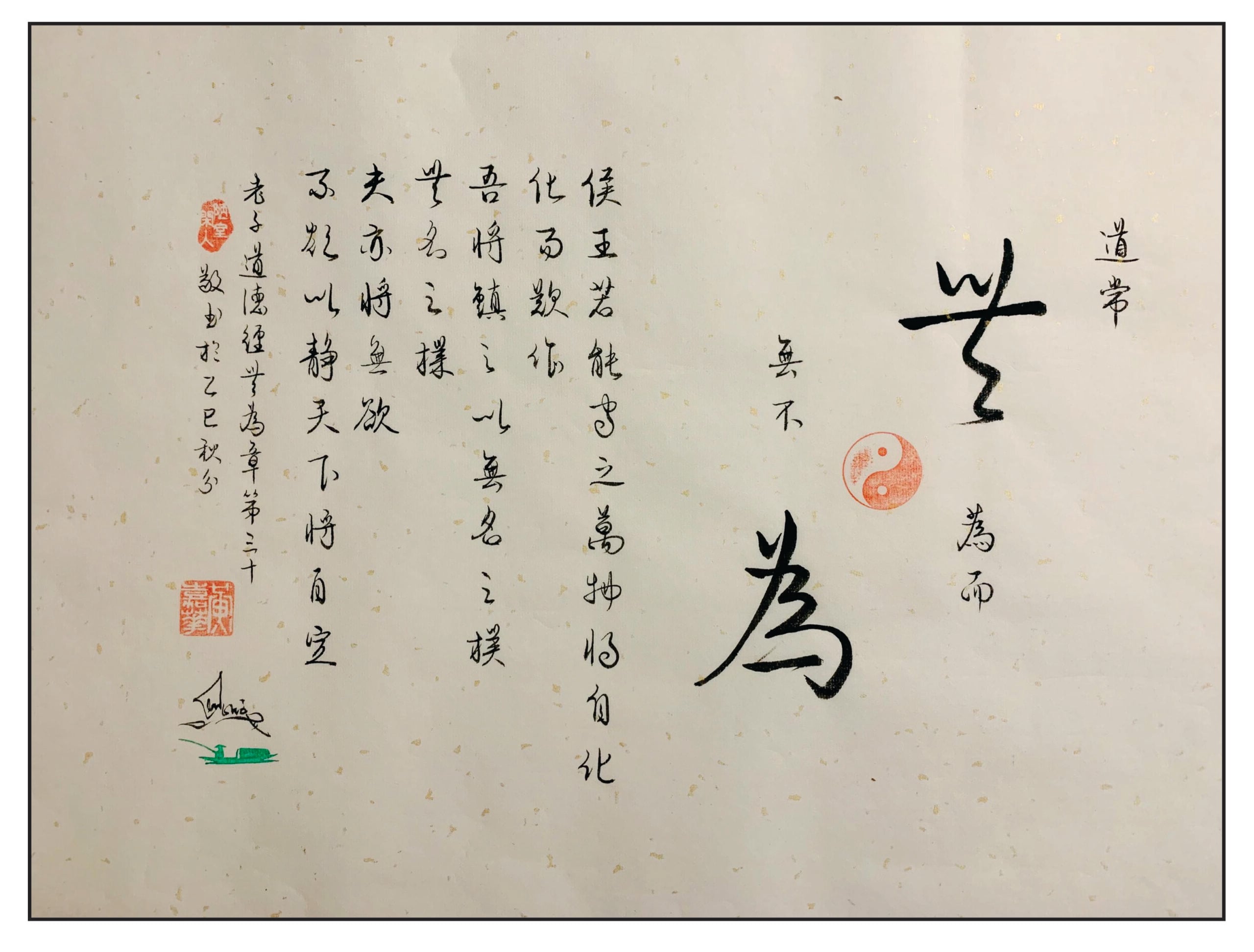


The Ethics of Belief

In the 19th-Century religious belief came under scientific scrutiny. In 1877, William Kingdon Clifford, an English mathematician and philosopher, proposed that
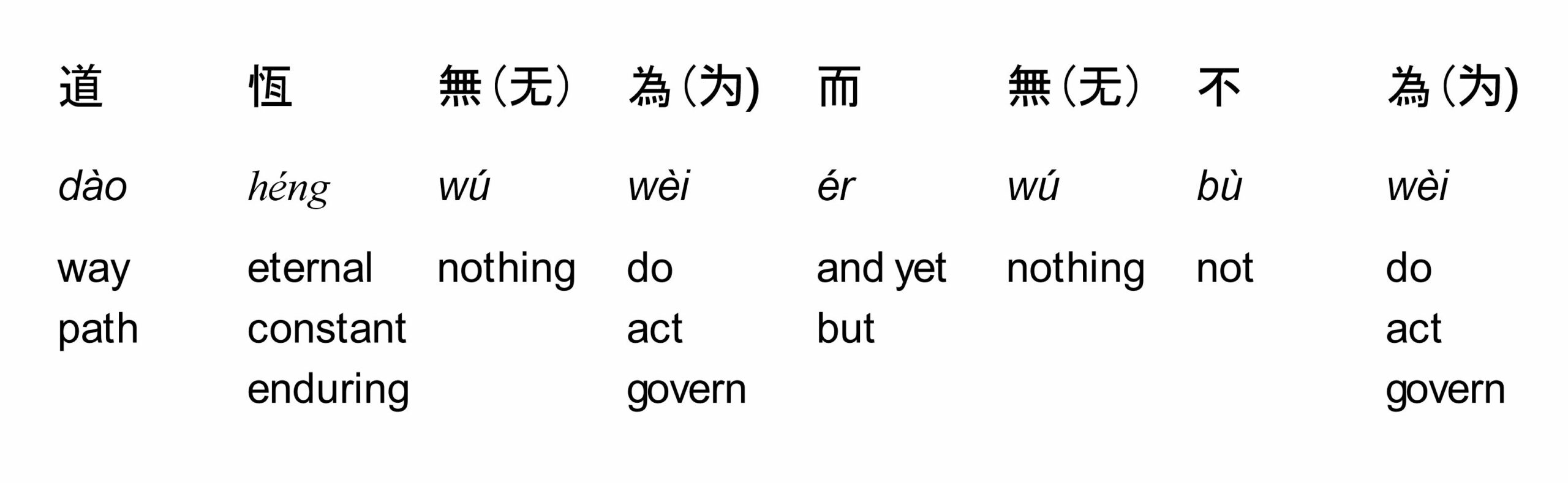
it is wrong always, everywhere and for any one, to believe anything upon insufficient evidence.
Without good supporting evidence, one should refrain from believing: it is wrong to take anything on faith. This proposal was disputed by the American philosopher and psychologist William James in an 1896 lecture entitled The Will to Believe. James argued that under certain conditions we must form beliefs and act on them, even though the evidence is insufficient. The main requirements were that the believer must choose between two “genuine” possibilities, and that the choice must be sufficiently “momentous” that not choosing would entail significant risk. The latter condition hearkens back to the “wager” of Blaise Pascal, wherein a person decides what to believe based on the consequences of these beliefs rather than the evidence for them.  

William Kingdon Clifford (1845-79)

William Clifford, a professor of mathematics and mechanics at the University of London, made significant contributions to algebra and to geometry, his ideas in the latter foreshadowing Einstein’s Theory of General Relativity. He was also interested in the philosophical implications of science, publishing essays on The Scientific Basis of Morals and The Ethics of Belief.

Clifford begins the latter essay with a story about a shipwreck:

A shipowner was about to send to sea an emigrant-ship. He knew that she was old, and not over-well built at the first; that she had seen many seas and climes, and often had needed repairs. Doubts had been suggested to him that possibly she was not seaworthy. These doubts preyed upon his mind, and made him unhappy; he thought that perhaps he ought to have her thoroughly overhauled and refitted, even though this should put him to great expense. Before the ship sailed, however, he succeeded in overcoming these melancholy reflections. He said to himself that she had gone safely through so many voyages and weathered so many storms that it was idle to suppose she would not come safely home from this trip also. He would put his trust in Providence, which could hardly fail to protect all these unhappy families that were leaving their fatherland to seek for better times elsewhere. He would dismiss from his mind all ungenerous suspicions about the honesty of builders and contractors. In such ways he acquired a sincere and comfortable conviction that his vessel was thoroughly safe and seaworthy; he watched her departure with a light heart, and benevolent wishes for the success of the exiles in their strange new home that was to be; and he got his insurance-money when she went down in mid-ocean and told no tales.

Clifford insisted that the ship-owner was responsible for the deaths of all who drowned. He may have sincerely believed in the soundness of his ship, but he had no right to so believe on the basis of the evidence before him. Clifford insisted further that had the ship not foundered, its owner was still guilty. From such examples he proposed the principle (“later known as Clifford’s principle”) that

it is wrong always, everywhere and for any one, to believe anything upon insufficient evidence.

He expounded:

If a man, holding a belief which he was taught in childhood or persuaded of afterward, keeps down and pushes away any doubts which arise about it in his mind, purposely avoids the reading of books and the company of men that call in question or discuss it, and regards as impious those questions which cannot easily be asked without disturbing it – the life of that man is one long sin against mankind.

Chignell (2018) noted that this approach to belief is similar to that of John Locke in his Essay Concerning Human Understanding (1690)

He that believes without having any Reason for believing, may be in love with his own Fancies; but neither seeks Truth as he ought, nor pays the Obedience due to his Maker, who would have him use those discerning Faculties he has given him, to keep him out of Mistake and Error.

Clifford realized that a single person cannot sift through all the evidence for everything she needs to believe. Some beliefs must be based on the authority of others. However, the believer should make some rational assessment of that authority. The proposers of the beliefs must be honest; the beliefs must be such that they can be or have been verified by those who have the time and experience to verify them; their acceptance should be independent of any personal profit to those that propose the beliefs.   

Clifford also considered the limits of inference. Most of what we know is inferred from what we and others have experienced. The fact that the sun has risen daily throughout our lives and throughout all the lives of others leads us to believe that it will continue to do so. Clifford proposed

We may believe what goes beyond our experience, only when it is inferred from that experience by the assumption that what we do not know is like what we know.

In passing Clifford noted that we have no a priori right to believe that nature is universally uniform – that the future will always follow the rules of the past. This is itself a belief – one that has worked so far. Some beliefs we need to accept.


William James (1842-1910)

William James trained as a physician but never practised medicine. Rather he pursued his interests in psychology, religion, and philosophy. In each of these fields he published books that have become essential to their respective disciplines: The Principles of Psychology (1890), The Varieties of Religious Experience (1902), and Pragmatism (1907).

In a talk to the Philosophical Clubs of Yale and Brown Universities –later published as The Will to Believe (1896) – James proposed that there are situations in which we should believe even when the evidence is insufficient. He describes three necessary conditions. First, the belief should involve a choice between two live options, i.e. ones that personally meaningful. Choosing between theosophy or Islam was likely not meaningful to his audience. Second, the choice must be unavoidable. Deciding to love or hate someone is easily avoidable – we can just be indifferent. However, accepting or denying the truth of a statement is unavoidable – the statement must be either true or false. Third and most importantly, the choice must be momentous. James used the example of joining Nansen’s expedition to the North Pole. To do so could lead to fame and glory; not to do so leaves one with nothing:

He who refuses to embrace a unique opportunity loses the prize as surely as if he tried and failed. Per contra, the option is trivial when the opportunity is not unique, when the stake is insignificant, or when the decision is reversible if it later prove unwise.

James assumed that deciding to believe is much like deciding to act. However, choosing to believe in God is not the same as choosing to join Nansen’s polar expedition. One can (and does) choose to act in certain ways. However, one does not usually choose between beliefs if there is no evidence preferring one over the other (see the criticisms of Bertrand Russell, below).  

James noted that his idea of the “momentousness” of a belief is related to Pascals famous wager. Pascal proposed that it is better to believe in God than to remain an agnostic: if we are right, we are granted “eternal beatitude,” and, if we are wrong, we lose nothing. James did not enjoy considering religious belief in the “language of the gaming-table.” Nevertheless, he was apparently convinced by Pascal’s logic. When things are that important, we must believe one way or another or risk losing all. James therefore proposed that

Our passional nature not only lawfully may, but must, decide an option between propositions, whenever it is a genuine option that cannot by its nature be decided on intellectual grounds; for to say, under such circumstances, “Do not decide, but leave the question open,” is itself a passional decision, ⸺ just like deciding yes or no, ⸺ and is attended with the same risk of losing the truth.

James concludes his lecture with a rousing quotation from the English Jurist, James Fitzjames Stephens (1829-1894):

In all important transactions of life we have to take a leap in the dark…. If we decide to leave the riddles unanswered, that is a choice; if we waver in our answer, that, too, is a choice: but whatever choice we make, we make it at our peril. If a man chooses to turn his back altogether on God and the future, no one can prevent him; no one can show beyond reasonable doubt that he is mistaken. If a man thinks otherwise and acts as he thinks, I do not see that any one can prove that he is mistaken. Each must act as he thinks best; and if he is wrong, so much the worse for him. We stand on a mountain pass in the midst of whirling snow and blinding mist through which we get glimpses now and then of paths which may be deceptive. If we stand still we shall be frozen to death. If we take the wrong road we shall be dashed to pieces. We do not certainly know whether there is any right one. What must we do? Be strong and of a good courage. Act for the best, hope for the best, and take what comes. . . .

The image is wildly romantic. It brings to mind Casper David Friedreich’s Wanderer over a Sea of Fog (1812). The concept of the “leap of faith” – the act of believing something despite the lack of convincing evidence – was commonly used in the 19th Century to counter the objections of religious skeptics. The term is often attributed to Kierkegaard though he never used it (McKinnon, 1983).     

James had used the image of the Alpine Climber in an earlier essay written in French on the “subjective method” (1877, discussed in Wernham, 1987, Chapter 2):

I find myself in a difficult place from which I can only escape by making a bold and dangerous leap. Though I wish to make the leap, I have never done so before, and I do not know if I have the ability. Let us suppose I use the subjective method: I believe what I desire. My confidence gives me strength and makes possible something which otherwise might not have been. I leap across the space and find myself out of danger. But suppose I doubt my ability because it has never before been demonstrated in such a situation: then I waver; I hesitate; at last, weak and trembling, I am compelled to an attempt by sheer despair; I miss my goal; I fall into the abyss. (my translation).

It is not clear whether James was proclaiming a right to believe when there is insufficient evidence, or whether he was asserting a duty to believe. Most people would support a general right to believe with the proviso that the belief does not harm others. Few, however, would say that we ought to believe something even though the evidence is not convincing.

James has been criticized for indulging in wishful thinking (reviewed in Koopman, 2017). When we decide to believe without any evidence, we run the clear risk of entering a fantasy world. On the other hand, perhaps we should try out new world-views. Provided they cause no harm. Crusades are not allowed.  


Blaise Pascal (1623-1662)

Blaise Pascal was a French mathematician, physicist, and philosopher. He is most famous for his studies of probability, his experiments on atmospheric pressure and his proposal that beliefs might me determined based on what they entail rather than on the empirical evidence – Pascal’s wager.

In in the posthumously published Pensées (1670 Section III), Pascal points out that believing in God leads to a promise of Heaven whereas not believing in God has no long-term benefit. We must either believe or not. So

Let us weigh the gain and the loss in wagering that God is. Let us estimate these two chances. If you gain, you gain all; if you lose, you lose nothing. Wager, then, without hesitation that He is.

The following illustration presents the premises that lead to Pascal’s wager, and the decision matrix that urges us to believe in God. The estimated benefit of believing or not is the sum (along the row in the decision matrix) of the probability-weighted benefits when God exists or not. The infinite rewards of belief in God completely outweigh the minor inconvenience of living life as a believer (Cg – a negative value). Similarly, the infinite penalties of not believing are far worse than the transient benefit of a life of indulgence (Bn – a positive value).  

Pascal’s logic falls apart in two ways (Bartha & Pasternack, 2018; Hájek, 2003, 2022). First, it does not discriminate among which of many possible Gods one should believe in. If there is a non-zero possibility of an Islamic God who rewards his followers with heaven and casts infidel Christians into hell, the infinite rewards and penalties associated with the Christian God are cancelled out. This is illustrated in the below. The astute observer will note that while the infinite benefits and costs of believing in a particular God are cancelled out, the atheist is still stuck with probabilities of death and damnation regardless of which God exists. Perhaps, this is the human lot. The atheist, however, simply assumes that both Pg and Pa are zero.

A second objection to Pascal’s wager is that it presupposes not only that God might exist but also that God would reward the believer with heaven and damn the non-believer to hell. Among the credible possibilities are a benevolent God who would forgive the non-believer, and a strict God who would damn those that professed belief simply to get to heaven as hypocrites who did not “truly” believe in their hearts.   


Bertrand Russell (1872-1970)

Bertrand Russell was an English philosopher, mathematician, and logician. He is most famous for the Principia Mathematica (1913) written together with A. N. Whitehead. This attempted to describe the basic axioms and rules underlying human logic and mathematics. Russell was also known for his pacifism and his agnosticism.

Russell was one of the first major critics of James’ The Will to Believe. In an essay on Pragmatism (1910), he pointed out the James’ arguments are appropriate to actions but have no real relevance to belief. He uses the example of a traveler at a fork in the road:

I come to a fork where there is no signpost and no passer-by, I have, from the point of view of action, a ‘forced’ option. I must take one road or other if I am to have any chance of reaching my destination; and I may have no evidence whatever as to which is the right road. I then act on one or other of the two possible hypotheses, until I find someone of whom I can ask the way. But I do not believe either hypothesis. My action is either right or wrong, but my belief is neither, since I do not entertain either of the two possible beliefs. The pragmatist assumption that I believe the road I have chosen to be the right one is erroneous.

However, belief can mean different things to different people. Religious thinkers do not consider belief in the same way as a scientist or logician. In a religious context, one can decide to believe based upon the consequents that the belief will have – salvation, heaven, etc. – rather than on the evidence for the belief. 


Henry Habberley Price (1899-1984)

H. H. Price was a Welsh philosopher with a major interest in perception and belief, and a minor interest in parapsychology. His 1961 Gifford lectures on Belief (published in 1969) analyzed the many ways in which we can believe.

He proposed that belief can be considered in two main ways – as an occurrence (a mental event) and as an attitude (a mental state). The occurrence of belief is the moment when a person decides that something is true (based on evidence or on desire) or assents to consider it true. With respect to Russell’s criticism that belief is not usually chosen, Price noted that we often come to a belief (“make up our minds”) in much the same way as we decide to act. He uses as an example: 

After waiting for him for over 1½ hours I decided that John had missed the train.

Belief can also be considered as an attitude: to believe a proposition is to be disposed to act as if that proposition were true. Other attitudes are hoping, desiring, and knowing. Having an attitude may be either conscious of not. An attitude is not necessary associated with any overt behavior: it simply represents a tendency to respond in a certain way.   

As I discussed in a previous post on Belief and Heresy, Price also pointed out that “believing that” differs from “believing in” (Price, 1965). Believing-that is used with a proposition: it considers that a proposition is true based on the evidence. Believing-in is used with things, persons, or ideas: it not only claims that these exist (existed or will exist) but also affirms many other related propositions. Christ stated

I am the resurrection, and the life: he that believeth in me, though he were dead, yet shall he live:
And whosoever liveth and believeth in me shall never die. (John 11: 25-26)

Simply asserting that Christ existed is clearly not sufficient for a person to “believe in” Christ. One must also believe that he is divine, that he died so that those who believe in him do not have to die, that he was resurrected from death, and that he lives forever. Challenging requirements for one of a skeptical disposition. However, the reward is invaluable: eternal life.  


Peter van Inwagen (1942- )

Peter van Inwagen is an American Christian philosopher who has written extensively on the philosophy of religion: An Essay on Free Will (1983), The Problem of Evil (2006), Metaphysics (2002).

In 1996 van Inwagen published a paper commenting Clifford’s principle that we should not believe anything based upon insufficient evidence. He initially remarks that although all beliefs need to be based on evidence

a strict adherence to the terms of the principle would lead to a chain of requests for further evidence that would terminate only in such presumably unanswerable questions as What evidence have you for supposing that your sensory apparatus is reliable? or Yes, but what considerations can you adduce in support of the hypothesis that the future will resemble the past?

More importantly, he points out that Clifford’s principle has mainly been applied in criticizing religious beliefs. He notes that for complicated issues in philosophy, politics, economics, and psychiatry, the available evidence even when properly scrutinised often leads to a diversity of opinion. Each of us may have our own insight or intuition as to what is true. Just as we do not consider it morally wrong to have these individual beliefs in philosophy, politics, etc., so we should allow religious beliefs even when the evidence for them is (necessarily) incomplete.    


Daniel C. Dennett (1942- )

Daniel Dennett is an American philosopher and cognitive scientist. He has written extensively on psychology (Consciousness Explained,1992), evolution (Darwin’s Dangerous Idea, 1996) and religion (Breaking the Spell, 2006). Together with Richard Dawkins, Christopher Hitchens, and Sam Harris, he is considered one of “The Four Horsemen of the New Atheism.”

One way to consider belief is as an interpretation of reality. Dennett has proposed that our brains are continually modelling what is going on in the world. What we are conscious of at any moment is as the “best draft” of our interpretive model (Dennett, 1992). Our consciousness of our selves is an abstract “center of narrative gravity” that we use to interpret our experience.  

Some philosophers and psychologists have denied the existence of beliefs (see Schwitzgel, 2019, for a review of “eliminativism”). Dennett considers beliefs (and other mental states) as helpful in interpreting the behavior of others who might have mental states similar to our own. He describes this mode of interpreting and predicting behavior as the “intentional stance:”

Here is how it works: first you decide to treat the object whose behavior is to be predicted as a rational agent; then you figure out what beliefs that agent ought to have, given its place in the world and its purpose. Then you figure out what desires it ought to have, on the same considerations, and finally you predict that this rational agent will act to further its goals in the light of its beliefs. A little practical reasoning from the chosen set of beliefs and desires will in most instances yield a decision about what the agent ought to do; that is what you predict the agent will do. (Dennett, 1987, p 17)


Whatever Gets You Thru the Night

We have touched on what various philosophers have thought about belief. What can we conclude?

To survive, human beings must understand what they can about the world in which they find themselves. In some contexts, our understanding has become highly accurate. Our perceptions tell us what things are and predict what they will do; our actions manipulate the world. In other contexts – in philosophy, politics and psychiatry, for example – we often have little understanding. We do not know whether the world has a purpose, how society could be optimally organized, or why our thinking can become disordered. Rather than just accept these uncertainties, we try out possibilities – to see whether they both fit the world and give us comfort. Often these ideas are just hunches; sometimes they become considered opinions; occasionally they become beliefs. Our beliefs are the way we make sense of the world.  

Are there ethical principles that determine what we can believe (Chignell, 2018; Schmidt & Ernst, 2020)? We should base our beliefs as much as possible on the evidence available to us. However, we should not retire to an attitude of universal skepticism. We must try out hypotheses about the what we do not know about world. We remain responsible for the consequences of our actions, even if we sincerely believed those actions appropriate. 

Contemplating the smallness of humanity in the immensity of the universe is frightening. Our beliefs provide us with some way to handle this fear. In the words of John Lennon’s 1974 song, they are “Whatever gets you thru the night.”


References

Schmidt, S., & Ernst, G. (2020). The ethics of belief and beyond: understanding mental normativity. Routledge.

Bartha, P. F. A. & Pasternack, L (Eds) (2018). Pascal’s wager Cambridge University Press.

Chignell, A. (2018) The ethics of belief. The Stanford Encyclopedia of Philosophy

Clifford, W. K. (1877). The ethics of belief. The Contemporary Review 29, 289-309. Reprinted in Clifford, W. K. (1884). The scientific basis of morals and other essays. (pp. 25–36). J. Fitzgerald (New York). 

Dennett, D. C. (1987). The intentional stance. MIT Press.

Dennett, D. C. (1991). Consciousness explained. Little, Brown.

James, W. (1877). Quelques considérations sur la méthode subjective. Critique philosophique, 2, 407-413. Reprinted in James W. (1978; Ed. Burkhardt, F., Bowers, F., & Skrupskelis, I. K.) Essays in Philosophy. Harvard University Press. 

James, W. (1896) The will to believe. The New World, 5, 327-347. Reprinted in W. James (1897) The will to believe and other essays in popular philosophy. (pp. 1-31). Longmans Green.

Hájek, A. (2003). Waging war on Pascal’s wager. Philosophical Review, 112: 27–56.

Hájek, A. (2022). Pascal’s Wager. The Stanford Encyclopedia of Philosophy

Koopman, C. (2017). The Will, the Will to Believe, and William James: an ethics of freedom as self-transformation. Journal of the History of Philosophy55(3), 491–512.

McKinnon, A. (1993). Kierkegaard and “The Leap of Faith.” Kierkegaardiana 16.

Pascal, B. (1670, translated by W. F. Trotter, 1958) Pensées/Thoughts. Dutton

Price, H. H. (1965). Belief ‘in’ and belief ‘that.’ Religious Studies, 1, 5-27

Price, H. H., 1969, Belief. Allen & Unwin.

Russell, B. (1910). Philosophical essays. Longmans, Green, and Co.

Schwitzgel, E. (2019). Belief. The Stanford Encyclopedia of Philosophy.

van Inwagen, P. (1996). “It is wrong, everywhere, always, and for anyone, to believe anything upon insufficient evidence” In J. Jordan & D. Howard-Snyder (eds.), Faith, freedom and rationality (pp 137–153). Rowman and Littlefield. Available online.

Wernham, J. C. S. (1987). James’s will-to-believe doctrine: a heretical view. McGill-Queen’s University Press.