Mathis der Maler: the Isenheim Altarpiece

Very little is known about the life of Matthias Grünewald, a painter (German Maler) who worked in the early decades of the 16th Century in Germany. He is renowned for the pictures he created between 1512 and 1516 for the altarpiece of the Monastery of Saint Anthony in Isenheim in southern Alsace. The face of Saint Sebastian in one of these paintings (above) is considered to be a self-portrait. 

Life of Mathis der Maler

Very few details are available about the life of the painter who came to be known as Matthias Grünewald (Anderson, 2003). His first name has been considered as Matthias, Matthis or Mathis. His surname is disputable: Nithart, Neithardt, Gothart or Gothardt. The name “Grünewald” (green wood) was given to him by his first biographer, Joachim van Sandrart, about a century and a half after his death. The major confusion in his biography is whether Mathis Nithart and Mathis Gothart were one or two people. My intuition is that they were two distinct individuals: one a master painter and the other a water artist (builder of fountains), who also worked as an assistant painter (cf Bruhn, 1998, pp 21-42; Sebald, 1988, 2002). 

Given this intuition, the main stages of Grünewald’s biography are as follows. He was born in about 1480 in Aschaffenburg. After learning the techniques of painting, he worked for the episcopal court of Mainz, painting altarpieces in several churches in Frankfurt. In 1512, he married Anna, a young woman of Jewish descent who had recently converted to Christianity, and bought a house near the cathedral in Frankfurt. In the same year he was commissioned to paint the altarpiece in the Monastery of Saint Anthony in Isenheim. While he worked on the altarpiece, Anna stayed in Frankfurt. Grünewald was assisted in Isenheim by an older painter, Matthis von Würzburg, and the two men lived together. After finishing the Isenheim altarpiece, they returned to Frankfurt. Grünewald continued to paint under the patronage of Cardinal Albrecht von Brandenburg, who was the Archbishop of Mainz from 1514-1545 and the Archbishop of Magdeburg from 1513-1545. Albrecht, one of the most powerful prelates in the Holy Roman Empire, was a patron of artists such as Albrecht Dürer, Lucas Cranach the Elder, and Matthias Grünewald.  

These were times of great social upheaval. Luther published his Ninety-Five Theses (A Disputation on the Power and Efficacy of Indulgences) in 1517. These were specifically addressed to Albrecht von Brandenburg, who used indulgences to support his life of luxury and patronage. The theses marked the beginning of the Protestant Reformation.

The German Peasants’ War (Deutscher Bauernkrieg) began in 1524. Though partly related to the Lutheran rebellion against the Catholic Church, the revolt was mainly directed at the feudal aristocracy. Some of the reformist clergy supported the peasants. However, Luther was terrified of the anarchy that might result, and encouraged the nobility to eliminate the rebellious peasants. Pitchforks were no match for artillery. Over 100,000 peasants were massacred and the revolt came to an end in 1525. It is not known whether Grünewald participated in the rebellion, or how he was affected by it. His friend died in 1528 in Halle where he was working as a hydraulic engineer. Grünewald appears to have moved back to Aschaffenburg where he died in 1532.

A portrait in the Chicago Art Institute, initialed MN, has been considered as a possible self-portrait by Grünewald (Mathis Nithart), though its authenticity and dating is unclear. My intuition is that it is the work of the young Grünewald and that it dates to about 1500. The following is the portrait and its description by Sebald in his poem After Nature (1988, translated by Hamburger, 2002)

       The small maple panel
shows a scarcely twenty-year-old
at the window of a narrow room.
Behind him, on a shelf not quite
in perspective, pots of paint,
a crayon, a seashell and a precious Venetian
glass filled with a translucent essence.
In one hand the painter holds
a finely carved knife of bone
with which to trim the drawing-pen
before continuing work on a female nude
that lies in front of him next to an inkwell.
Through the window on his left a
landscape with mountain and valley
and the curved line of a path is visible.


The Hospital Brothers of Saint Anthony

Saint Anthony the Great (251-356 CE) was a Christian monk from Egypt who lived most of his adult live alone in the desert. At the beginning of his desert life, he was assailed by monstrous demons and tempted by seductive women. Despite a severe asceticism bordering on starvation, he nevertheless lived to be 105 years old. Although he was buried in the desert, his remains were miraculously discovered about two centuries after his death and transferred to Constantinople. In 980, a French count named Jocelin de Châteauneuf bought the relics from Constantinople to a monastery in what is now known as Isère in the French Alps. The relics were found to alleviate a disease characterized by skin inflammation, gangrene, hallucinations and convulsions that often broke out in devastating epidemics. In 1095 Gaston de Valloire founded the Hospital Brothers of Saint Anthony (also known as the Antonines) in gratitude for his son’s miraculous cure. The Abbey of Saint Antoine in Isère became the mother church of the order.

The disease came to be known as “Saint Anthony’s Fire.” The cause was the consumption of bread made from rye contaminated by the fungus Claviceps purpurea (Grzybowski et al, 2021). The fungus produces ergotamine and other compounds: these cause peripheral vasoconstriction and excessive stimulation of the central nervous system. The nature of the disease, however, was not known in the Middle Ages: it was first attributed to blighted rye in 1676 by Denis Dodart, but the fungus itself was not identified until the 19th Century.     

Grateful patients gave land and money to the Antonines. This support allowed them to establish other hospitals in various locations in France, and later in other European countries. The Isenheim monastery in southern Alsace was founded around 1300. As the years went by, the Antonine hospitals also treated patients who suffered from leprosy, from the Black Death (an epidemic of bubonic plague) in the 14th Century, and from the syphilis epidemics of the 16th Century. The program of treatment involved prayer and the application of vinous extracts from the saint’s relics in Isère (Saint vinage). Whatever success occurred, however, was likely the result of the concomitant improvement in hygiene and nutrition.  

In 1505, the Antonines at Isenheim commissioned a carved wooden altarpiece from Niklaus Hagenauer (Mayr, 2003). The altarpiece contains a gilded central statue of Saint Anthony, flanked by Saint Augustine of Hippo and Saint Jerome: asceticism aided by doctrine and by scripture. The predella of the altarpiece contains polychrome statues of Christ and the 12 apostles. In 1512 the Antonines asked Grünewald (Mathis der Maler) to adorn the altar with paintings (Hayum, 1989; Scheja, 1969; Réau, 1920; Sieger, 2025). Over the next 4 years he created two fixed wings, two sets of retractable wings painted on both sides, and a cover for the predella The retractable wings could be opened to provide three distinct views of the altar. An animation of the opening is provided below. This has been adapted from that at the SmartHistory website, and provided with a brief excerpt of music from the first movement of Hindemith’s symphony Mathis der Maler. Following that is a diagrammatic representation of the three views.

First View of the Altarpiece

Other than on holy days, the altarpiece was kept closed and the viewer was presented with the terrifying representation of the crucified Christ. The scene is set in the darkness that fell “over all the land” (Matthew 27: 45) as Christ died.  

The gigantic body of the dead Christ is rendered with brutal naturalism and seems to leap out at one with redoubled violence, as if to take the viewer in an ambuscade: flesh in the greenish color of death with the scars of the frightful ordeal, an atrocious benumbed pain written across the face, the mouth extinguished in death, the body pulled up high by the tensile arch of the crossbeam and, at the same time, twisted with the torsion of the tree of the Cross, all limbs ripped out of joint, the loincloth in tatters, while a thorn of the crown pins the head fast in an excruciatingly painful position digging low and deep into the chest (Scheja, 1969, p 15).

The cross is contorted as though it shares in the agony. The crossbar is bowed under the weight of the dead body. The vertical post is twisted: it faces to Christ’s right above his head and to his left at his feet. The resin of the wood mixes with the blood of the dead Christ (Bryda, 2018)

The vision of Christ on the Cross as a dead body rather than as a suffering savior perhaps comes from the visions of the 14th Century mystic Saint Bridget:

The color of death spread through his flesh, and after he breathed his last human breath, his mouth gaped open so that one could see his tongue, his teeth, and the blood in his mouth. Th e dead body sagged. His knees then contracted bending to the side. His feet were cramped and twisted about the nails of the cross as if they were on hinges (quoted in Bryda, 2018, p 13)

On Christ’s right side his mother Mary swoons, and is supported by the disciple John. Near them, Mary Magdalene laments the death of her teacher. The figures vary in their size as in their importance to the story.

On the left side of the crucified Christ is a representation of John the Baptist. This is in no way realistic: John was from another time – he was beheaded before Christ was crucified. Yet he was the last of the prophets to announce the significance of Jesus as the son of God. His words are written in red:

Illum oportet crescere me autem minui
[He must increase, but I must decrease]. (John 3:30)

At the feet of the Baptist is a lamb from whose chest blood drops into a communion chalice. When John had baptised Jesus, he had proclaimed “Behold the Lamb of God!” (John 1:36) The Baptist’s right arm points dramatically to the crucified Christ. The eye may move to the attendant figures but Grünewald insists that it return to the dead Christ. 

In The Emigrants, W. G. Sebald describes the experience of Max Ferber on viewing the Isenheim crucifixion

The monstrosity of that suffering, which, emanating from the figures depicted, spread to cover the whole of Nature, only to flood back from the lifeless landscape to the humans marked by death, rose and ebbed within me like a tide. Looking at those gashed bodies, and at the witnesses of the execution, doubled up by grief like snapped reeds, I gradually understood that, beyond a certain point, pain blots out the one thing that is essential to its being experienced — consciousness — and so perhaps extinguishes itself; we know very little about this. What is certain, though, is that mental suffering is effectively without end. One may think one has reached the very limit, but there are always more torments to come. One plunges from one abyss into the next. (Sebald, 1993/1996)

Perhaps the sight of the dead Christ served to numb the pain and suffering of the patients who came to Isenheim for treatment. 

The fixed wings of the altarpiece provide a stark contrast to its horrifying centerpiece. On the left Saint Sebastion tranquilly suffers through his wounds. On the right Saint Anthony remains unperturbed by the demon threatening him through the window at his shoulder. Both Saints are invoked for protection against disease. Saint Sebastian actually survived the onslaught of arrows that pierced his body. Saint Anthony endured his temptations and lived to die of old age.

Radiographic examination of the Saint Sebastian has revealed that the head was painted over an earlier version. In After Nature, Sebald interprets this in terms of the existence of two painters: Grünewald and Mathis Nithart:

And indeed the person of Mathis Nithart
in documents of the time so flows into
the person of Grünewald that one
seems to have been the life,
then the death, too, of the other.
An X-ray photograph of the Sebastian
panel reveals beneath the elegiac
portrait of the saint
that same face again, the half-
profile only turned a tiny bit further
in the definitive overpainting.
Here two painters in one body
whose hurt flesh belonged to both
to the end pursued the study
of their own nature. At first
Nithart fashioned his self-portrait
from a mirror image, and Grünewald
with great love, precision and patience
and an interest in the skin
and hair of his companion extending
to the blue shadow of the beard
then overpainted it.
The martyrdom depicted is
the representation, to be sensed
even in the rims of the wounds,
of a male friendship wavering
between horror and loyalty.


Second View of the Altarpiece

On holy days the altarpiece was opened to show a sequence of paintings depicting episodes from the life of Christ. On the left is the Annunciation. The center, where once was presented the horror of the death of Jesus now shows the wonder of his birth. Heavenly angels provide a marvelous music while the baby Jesus plays with a golden rosary on the lap of his mother Mary. 

In 1938, Paul Hindemith completed an opera about Mathis de Maler. The prelude to the opera is a musical version of the concert of the angels in the Isenheim altarpiece. This was also used as the first movement of his 1935 Symphony Mathis der Maler. Hindemith introduces three themes: a setting of an old German hymn Es sungen drei Engeln (There sang three angels) mainly in the brass, a lively melody on the strings and a more peaceful tune on the flute. He then plays these themes against each other. The following is an illustration of the painting together with the initial introduction of the themes in the Symphony Matthis der Maler with the Vienna Radio Symphony Orchestra led by Marin Alsop:

The beautiful angel in the foreground of Grünwald’s Concert of the Angels is playing a viola da gamba, the forerunner of the modern violoncello. Grünewald was clearly familiar with the instrument, which has been closely studied and reproduced. However, the direction of the bowing is strangely reversed from normal. It is difficult to understand what his means (Rasmussen 2001). Perhaps the angel is producing heavenly rather than earthly music. Even more disconcerting is the angel directly behind and above the foreground cellist. This angel is covered in iridescent green feathers and looks upset rather than entranced by the birth of Jesus. Mellinkoff (1988) proposed that this is the angel Lucifer who rebelled against God, brought about the fall of man, and is now aghast that man will be redeemed by the birth of Christ.

Between the concert of the angels and the representation of Mary and the infant Jesus is a vision of a woman, with a crown of flames, surrounded by a bright yellow and red aureole (see below). No one is sure who she represents. Malinkoff (1988) suggests that she is Ecclesia (Church), who with the birth of Christ takes over from Synagoga as the intermediary between man and God. Others (e.g., Réau, 1920, p 187-94; Scheja, 1969, p 48) consider her to be the Eternal Mary, Queen of Heaven, the woman “clothed with the sun” of Revelation 12. She is there to witness herself in her temporal form together with her infant son.  

The most striking painting in the second view of the altarpiece is the Resurrection on the right side. Christ arises from the tomb in glory, scattering and tumbling the guards:

Joris-Karl Huysmans, the first modern critics to consider the importance of Matthias Grünewald in Trois Primitifs (1905, reprinted in part in Huysmans & Ruhmer, 1958), described The Resurrection:

As the sepulchre opens, some drunks in helmet and armour are knocked head over heels to lie sprawling in the foreground, sword in hand; one of them turns a somersault further off, behind the tomb, and lands on his head, while Christ surges upwards, stretching out his arms and displaying the bloody commas on his hands.
This is a strong and handsome Christ, fair-haired and brown-eyed, with nothing in common with the Goliath whom we watched decomposing a moment ago, fastened by nails to the still green wood of a gibbet. All round this soaring body are rays emanating from it which have begun to blur its outline; already the contours of the face are fluctuating, the features hazing over, the hair dissolving into a halo of melting gold. The light spreads out in immense curves ranging from bright yellow to purple, and finally shading off little by little into a pale blue which in turn merges with the dark blue of the night.
We witness here the revival of a Godhead ablaze with life: the formation of a glorified body gradually escaping from the carnal shell, which is disappearing in an apotheosis of flames of which it is itself the source and seat.
… Having dared to attempt this tour de force, Grünewald has carried it out with wonderful skill. In clothing the Saviour he has tried to render the changing colours of the fabrics as they are volatilized with Christ. Thus the scarlet robe turns a bright yellow, the closer it gets to the light-source of the head and neck, while the material grows lighter, becoming almost diaphanous in this river of gold. As for the white shroud which Jesus is carrying off with him, it reminds one of those Japanese fabrics which by subtle gradations change from one colour to another, for as it rises it takes on a lilac tint first of all, then becomes pure violet, and finally, like the last blue circle of the nimbus, merges into the indigo-black of the night.

This is no ordinary representation of the Resurrection. Christ has not just risen from the tomb: he has also been transfigured into a vision of the Godhead. Scheja, 1988, p 40) notes how Grünewald has accurately depicted Dante’s vision of the Trinitarian Godhead at the end of The Divine Comedy published two centuries before his painting (Paradiso XXXIII 115-120):

Nella profonda e chiara sussistenza
de l’alto lume parvermi tre giri
di tre colori e d’una contenenza;

e l’un dall’altro come iri da iri
parea reflesso, e il terzo parea foco
che quinci e quindi igualmente si spiri.

[There appeared to me in the profound and bright
reality of that exalted light
three circles of three colors and one size.

As rainbow by rainbow, one seemed reflected
by the second, and the third seemed a fire
that breathed as much from one as from the other.]
(translation by Louis Biancolli)


Third View of the Altarpiece

As well as the statues created by Niklaus Hagenauer the third view has two lateral paintings that are the obverse of the Madonna and Child and the Concert of Angels. These represent The Tribulations of Saint Anthony and The Meeting between Saint Anthony and Saint Paul.

Although often called the “temptations” of Saint Anthony, the subject of Grünewald’s painting on the right is more accurately considered his “tribulations.” Scheja (1969, p 28) tells the story from original biography of Saint Anthony written by Athanasius a few years after his death. When Anthony first went to the desert he was attacked by demons. Despite the pain, he refused to give up his devotion to Christ. Finally, the heavens opened, light streamed down from Christ in majesty, and the demons vanished. Anthony had passed his test and was worthy of his God. Anthony cried out the words written at the lower left of the painting (Hayum, 1989, p 79):     

Ubi eras ihesu boni, ubi eras? Quare not affuisti ut sanares vulnera mea?
[Where were you good Jesus, where were you? Why were you not there to heal my wounds?]

The poor wretch at the lower left of the painting represents a patient suffering from ergotism. The distal parts of his fingers have been lost to gangrene and his skin is covered with sores (Grzybowski et al, 2021). The image serves as an intermediary between the patients in the hospital and Saint Anthony. Even the fingers of Saint Anthony’s left hand are turning grey with incipient gangrene (Kluger& Brandozzi, 2023). The patients can see in the painting that their disease is the same as that of Saint Anthony. They can therefore hope that God may relieve their pain, just like he drove away the demons that tormented Saint Anthony. The following is Hindemith’s musical version of Saint Anthony and the Demons: from the beginning of the 3rd movement of his Mathis der Maler symphony:

The painting on the left is as tranquil as that on the right is turbulent.  After his tribulations, Saint Anthony sought out Saint Paul, an older ascetic who had retired to the desert. Paul convinced him that the monastic life was worth pursuing. Although the meeting was reported to have taken place in a cave, Grünewald locates it in a peaceful wooded landscape with a gently doe acting as an intermediary between the two saints. In the background a stag waits patiently. On a high branch, a raven, accustomed to providing Paul with his daily slice of bread, gets ready to deliver two slices. The head of Saint Paul is another self-portrait of Grünewald (Scheja, 1969, pp 30-33; von Mücke, 2011)


Afterlife of the Altarpiece

The altarpiece remained in the abbey church at Isenheim until the French Revolution (1789-1799) led to the suppression of the monasteries. In 1852, the altarpiece was moved to the new Unterlinden Museum located in Colmar, about 25 km north of Isenheim. The museum is housed in what was once a convent for the Dominican sisters, originally built in 13th Century.

After the Franco-Prussian War (1870-1871), Alsace became part of Germany. The unification of Germany bought with it a desire for a distinct national culture. Philosophers conceived a Northern or Gothic tradition in art, as distinguished from Mediterranean Classical art (Rosenblum, 1975; Stieglitz, 1989). Its characteristics were a sense of the sublime, an emotional intensity, a mystical predisposition, and a deep subjectivity (or inwardness, Innerlichkeit). Grünewald’s paintings fitted easily into these ideas.

During World War I, for safety’s sake, the altarpiece was taken away from Colmar to Munich, where it was exhibited to great acclaim. The peace arrangements after the war included a requirement that the altarpiece to be returned to Colmar. Since 1919, the altarpiece has lived there in the Unterlinden Museum. The following illustration shows how it is exhibited.

The visitor can go behind first section to see the paintings on the obverse side of The CrucifixionThe Annunciation and The Resurrection. And then behind the The Nativity (Angel Concert and Madonna with the Infant Jesus) to see The Temptation of Saint Anthony and The Meeting between Saint Paul and Saint Anthony.      


Otto Dix

Otto Dix (1891-1969) studied art at the Dresden Academy of Fine Arts. When war was declared in 1914, he volunteered for the army and served for the duration of the war. He took part in the Battle of the Somme in 1916, was transferred for a while to the Eastern Front, and then back to Flanders for the end of the war. He was profoundly affected by the horrors he experienced. After the war he painted images representing both his ghastly memories of trench warfare and his anger at the hypocrisy and depravity of post-war German society. He was one of the painters of Der neue Sachlichkeit (New Objectivity) Exhibition of 1925.

Dix became a professor at the Dresden Academy in 1927. A 1929 photograph by Hugo Erfurth is shown on the right. Between 1929 and 1932 he worked on a large triptych entitled Der Krieg (The War) based on old German triptychs especially that of Grünewald’s Isenheim altarpiece (Bayer, 1920).

The left wing of the triptych, entitled Aufmarsch (Deployment), depicts the soldiers leaving for the frontline early in the morning before the mists have cleared.

The right wing, entitled Nachtlicher Ruckzug (Nightly Retreat) shows a soldier (a self-portrait of the artist) trying to bring a wounded colleague back to safety behind the frontlines.


The central section, Der Krieg, takes the place of the Crucifixion in a medieval altar. Instead of Christ on the cross

a rotting corpse has been hurled onto iron girders in similar fashion. His eye sockets have already become black holes, the teeth are bared, with what remains of his uniform hanging in tatters. (Bayer 1920)

The corpse points to another dead body on the right. This is clearly an illusion to Grünewald’s Isenheim altarpiece wherein John the Baptist points dramatically to the crucified Christ. The body to which the finger points is upside down and riddled with bullet holes in much the same way as Grünewald’s Christ was covered in sores. The background to these horrors is a landscape completely destroyed by artillery.

The predella of Dix’s triptych shows several soldiers lying down under what might be a camouflage screen. It is unclear whether they are dead or sleeping. If the latter there is a clockwise circular logic to the triptych: the exhausted soldiers will wake up, advance to the front again, engage in the murderous work of war, and then retreat, wounded and exhausted to sleep another night.

Dix’s description of the war was loathed by the Nazi government, who wished to portray war as an occasion for heroism rather than a field of horror. In 1933 Dix was dismissed from his position at the Dresden Academy. Many of his paintings were removed from galleries and destroyed. Some were included in the Exhibition of Degenerate Art in 1937. Dix saved the triptych, took it apart, and stored it in a friend’s farmhouse until after the war. The Galerie der Neue Meister (Gallery of Modern Masters) in Dresden purchased the painting in 1968.     


Paul Hindemith

Paul Hindemith (1895-1963) studied music at Dr. Hoch’s Konservatorium in Frankfurt and joined the Frankfurt Symphony Orchestra after graduation. He served in the German army on the frontlines in Alsace during the last year of the war.

After the war, he founded the Amar Quartet, playing the viola, and began to compose. During the 1930s he worked on his Opera Mathis der Maler, based on the life of Matthias Grünewald. As he was writing this music, he used some of the orchestral interludes in the opera to make his Symphony Mathis der Maler which was published in 1935.  The opera was not completed until 1938. Because the Nazis considered his music degenerate, Hindemith was unable to get the opera performed in Germany. He emigrated to Switzerland in 1938 and then to the United States in 1940.

As well as the modernity of the music, the subject matter of the opera was anathema to the Nazi powers (Bruhm, 1998, 2002; Paret, 2008; Watkins, 2002; Fuller, 1997). It revealed the horrors of war: the summary executions, the raping and pillaging. One of the scenes concerned the burning of Lutheran books as ordered by the Catholic Church. This made obvious reference to the Nazi book burnings which had begun in the early 1930s.

The opera has been performed only rarely. A 1977 production starred Dietrich Fischer-Dieskau as Mathis. A striking recent production in Vienna that was captured on DVD by Naxos in 2012.

The opera is concerned with the life of Matthias Grünewald after he completes the Isenheim altarpiece. Hindemith imagines that Mathis leaves the service of Albrecht von Brandenburg and joins the rebellion of the peasants. Throughout these terrible times, images from the altarpiece (and Hindemith’s musical versions thereof) return to comfort or to haunt the painter. During the rebellion, he takes care of Regina, a young woman whose father, one of the leaders of the rebellion, was cruelly executed before her eyes. The beginning of the 6th scene of the opera finds them fleeing from the mercenaries through the forest of the Odenwald southeast of Frankfurt, Mathis tries to comfort the grieving Regina with the story of the Concert of Angels who played music at the nativity of Jesus. The following is part of the aria, as sung by Wolfgang Koch as Mathis and Katherina Tretyakova as Regina: 

             Alte Märchen woben
Uns fromme Bilder, die ein Widerscheinen
Des Höheren sind. Ihr Sinn ist dir
Fern, du kannst ihn nur erahnen.
Und frommer noch reden
Zu uns die Töne, wenn Musik, in Einfalt hier
Geboren, die Spur himmlischer Herkunft trägt.
Sieh, wie eine Schar von Engeln ewige Bahnen
In irdischen Wegen abwandelt. Wie spürt man jeden
Versenkt in sein mildes Amt. Der eine geigt
Mit wundersam gesperrtem Arm, den Bogen wägt
Er zart, damit nicht eines wenigen Schattens Rauheit
Den linden Lauf trübe. Ein andrer streicht
Gehobnen Blicks aus Saiten seine Freude.
Verhaftet scheint der dritte dem fernen Geläute
Seiner Seele und achtet leicht des Spiels.

              Wie bereit
Er ist, zugleich zu hören und zu dienen.

REGINA
Es sungen drei Engel ein süssen Gesang,
Der weit in den hohen Himmel erklang.

The following is a translation

                 Old fairy tales wove
Pious images for us that are a reflection
Of something higher. Their meaning is so
Far from you, that you can only guess.
And music speaks even more piously
When, born here in simplicity,
It brings a breath of heaven.
See how a host of angels eternally follow
Our earthly paths. How one feels each one
Is immersed in their gentle office. One plays the violin
With a wondrously bared arm, lightly bowing
Lest any roughness darken
Cloud the gentle melody. Another,
With an uplifted gaze, strokes joy from the strings.
The third seems captivated by the distant chiming
of his soul and hardly attends to the music.

                    How ready
he is to listen and serve at the same time.

REGINA
Three angels sang a sweet song
That resounded far into the heavens.


The Comfort of Images

Hindemith’s Mathis comforts the grieving Regina by describing to her his painting of the Concert of Angels. The world is difficult to understand. The suffering that occurs is often unjustified. So we tell ourselves stories – we weave together fairy tales – to make sense of the world. We can represent these stories in paintings and in music.

The story that Grünewald unfolds in the Isenheim altarpiece is the myth of a Son of God who suffered and died so that we may be redeemed and live forever. And the life of Saint Anthony who lived in holiness so that our illness can be cured. 

And even if these are only stories, the comfort they provide is real.


References

Andersson, C. (2003). Grünewald, Matthias [Gothart Nithart, Mathis; Gothardt-Neithardt, Matthis]. Grove Art Online.

Bayer, M. (2020).  Der Krieg: Otto Dix’s War Triptych, memory, and the perception of the First World War. In Hutchison, M., & Trout, S. (Eds.). Portraits of Remembrance. (pp 250-269) University of Alabama.

Bruhn, S. (1998). The temptation of Paul Hindemith: Mathis der Maler as a spiritual testimony. Pendragon. (difficult to find; preview in Google Books)

Bruhn, S, (2002). Wordless songs of love, glory, and resurrection: musical emblems of the holy in Hindemith’s saints. In Voicing the ineffable: musical representations of religious experience. (pp 157-188). Pendragon.

Bryda, G. C. (2018). The exuding wood of the cross at Isenheim. Art Bulletin, 100(2), 6–36.
Fuller, M. (1997). Hindemith’s Mathis der Maler: A parable for our times. New Blackfriars, 78(916), 260–267.
Grzybowski, A., Pawlikowska-Łagód, K., & Polak, A. (2021). Ergotism and Saint Anthony’s fire. Clinics in Dermatology, 39(6), 1088–1094.

Harrisville, R. A. (2004). Encounter with Grunewald. Currents in Theology and Mission, 31(1), 5-14.

Hayum, A. (1989). The Isenheim altarpiece: God’s medicine and the painter’s vision. Princeton University Press.

Huysmans, J.-K. & Ruhmer, E. (1958). Grünewald: the paintings. Phaidon Press.

Kluger, N., & Brandozzi, G. (2023). Digital necrosis in the Isenheim altarpiece (1512–1516). Journal of the European Academy of Dermatology and Venereology, 37(7), 1265–1267. 

Mayr, V. (2003). Hagenauer [von Hagnow; Hagnower], Nikolaus [Niclas]. Grove Art Online.

Mellinkoff, R. (1988). The devil at Isenheim: reflections of popular belief in Grünewald’s altarpiece. University of California Press.

Paret, P. (2008). Beyond Music: Hindemith’s Opera Mathis der Maler as political document. Historically Speaking, 9(5), 6–9.

Rasmussen, M. (2001). Viols, violists and Venus in Grunewald’s Isenheim Altar. Early Music, 29(1), 60–74.

Réau, L. (1920). Mathias Grünewald et le retable de Colmar. Berger-Levrault. (Available at archive.org)

Rosenblum, R. (1975). Modern painting and the northern romantic tradition: Friedrich to Rothko. Harper & Row.

Scheja, G. (1969). The Isenheim Altarpiece. H.N. Abrams.

Schloss, M. F. (1963) Grünewald and the Chicago portrait. Art Journal, 23(1), 10-16.

Sebald, W. G. (1988). Nach der Natur. Franz Greno, Nordlingen,

Sebald, W. G. (1988, translated by Hamburger, M. 2002). After nature. Hamish Hamilton.

Sebald, W. G. (1993, translated by Hulse, M., 1996). The emigrants. Harvill.

Sieger, J. (accessed 2025). Der Isenheimer Altarund seine Botschaft [The Isenheimer Altarpiece and its Message] (Google provides a reasonable translation)

Stieglitz, A. (1989). The reproduction of agony: toward a reception-history of Grünewald’s Isenheim Altar after the First World War. Oxford Art Journal, 12(2), 87–103.

Snyder, J. (1985). Northern Renaissance art: painting, sculpture, the graphic arts from 1350 to 1575. Prentice-Hall.

von Mücke, D. (2011). History and the work of art in Sebald’s After Nature. Nonsite.

Watkins, G. (2002). Prophecies and Alarms. In Proof through the Night (pp. 403-416). University of California Press.


Looking at the Human Brain: from Vesalius to the Present

Andreas Vesalius (1514-1564) published his De Humani Corporis Fabrica (On the Fabric of the Human Body) in 1543 (O’Malley, 1964). This book, based on dissections of human cadavers, provided illustrations of the human brain that were both anatomically correct and esthetically pleasing. The scientists that followed Vesalius expanded on our knowledge, and produced their own representations of the human brain. This essay traces the evolution of these pictures.

The View from Above

One of Vesalius’ most striking illustrations shows the head of a man with the top of his skull (calvarium) removed (Catani & Sandrone, 2015, p 220). The cerebral meninges (membranes) – composed of the dura mater (tough mother, P in the illustration) and the arachnoid mater (spidery mother, O) – were cut in the midline and then folded down over the edge of the skull. The cerebral hemispheres (A and B) were spread apart and the falx cerebri (cerebral sickle, D) was pulled up and folded over the left hemisphere. This revealed the corpus callosum (tough body, L) connecting the two hemispheres. At the base of the falx cerebri was a large vein later known as the inferior sagittal sinus (F, G).

In 1656, Vesalius’ illustration served as a model for Rembrandt’s representation of the brain in The Anatomy Lesson of Dr Deyman. The original painting portrayed the professor and his students in much the same way as the earlier painting The Anatomy Lesson of Dr Nicolaes Tulp (1632). After the painting was damaged by fire in 1723, all that remains are the hands of the professor as he dissects the meninges, his assistant holding the calvarium, and the cadaver of the recently executed thief, Joris Fonteyn, also known as “Black Jan:”

Anne Carson wrote a brief prose poem about the painting in her Short Talks (1992):*

A winter so cold that, walking on the Breestraat and you passed from sun to shadow, you could feel the difference run down your skull like water. It was the hunger winter of 1656 when Black Jan took up with a whore named Elsje Ottje and for a time they prospered. But one icy January day Black Jan was observed robbing a cloth merchant’s house. He ran, fell, knifed a man and was hanged on the twenty-seventh of January. How he fared then is no doubt known to you: the cold weather permitted Dr. Deyman to turn the true eye of medicine on Black Jan for three days. One wonders if Elsje ever saw Rembrandt’s painting, which shows her love thief in violent frontal foreshortening, so that his pure soles seem almost to touch the chopped-open cerebrum. Cut and cut deep to find the source of the problem, Dr. Deyman is saying as he parts the brain to either side like hair. Sadness comes groping out of it.

Carson uses two striking images: the transition from sun to shadow like water on the skull, and the parting of the brain like hair. She also remarks on the foreshortening – Rembrandt was using Mantegna’s Lamentation of the Dead Christ (1480) as a model. And she sadly links the soles of the feet to the soul of Black Jan, recently released from his cerebrum.

In a series of engravings to illustrate the brain (1802), Charles Bell produced a delicately colored view of the brain and meninges (available from the Wellcome website) very similar to that of Vesalius. The dura mater (B) is folded away. The arachnoid mater is preserved over the left hemisphere. The arachnoid mater (D) from the right hemisphere is folded over the left hemisphere. Bell identified anterior middle and posterior lobes (H, I, K) in the right hemisphere but these were not clearly demarcated. Deep in the cerebral fissure can be seen the corpus callosum (L) and the anterior cerebral artery (M).

The View from the Side

The first illustration of the brain in Vesalius’ book shows the dura mater looks viewed from the side once the skull has been removed. Of note are the superior sagittal sinus (C), and the paired blood vessels (D) that we now know as the middle meningeal artery and vein. This was before William Harvey’s 1628 differentiation of the arteries and veins

The dura was cut through and both dura and arachnoid mater werefolded down over the edge of the skull to reveal the underlying brain. Vesalius made no effort to delineate the cerebral surface accurately. The cerebral gyri are reminiscent of the random coils of the small intestine.

It was not really until the 19th Century that more realistic depictions of the cerebral gyri and sulci became available. The following illustration is from a series of beautiful hand-colored etchings produced by the surgeon John Lizars and his father Daniel Lizars in about 1825. The cerebrum and the cerebellum are well represented, together with their arteries and veins (with their red and blue colors accentuated). However, the orientation of the brainstem and its connections to the spinal cord are quite distorted.  

It was not until late in the 19th Century, as physiologists began to study the localization of function, that images distinguished the different gyri of the cerebrum. The following illustration is from the atlas of Christfried Jakob (1895). The gyrus fornicatus (arched), now known as the cingulate (girdle) gyrus, is an important part of the limbic system which mediates visceral sensation, emotion and memory. The word fornication (extramarital sex) derives from ancient brothels, which often provided vaulted or arched chambers for their clients.

In 1909 the German anatomist Korbinian Brodmann further differentiated the cerebral cortex into 52 regions based on microscopic analysis of the cortical structure (Brodmann, 1909, p 131)

Areas 1, 2, and 3 represent the primary somatosensory cortex on the postcentral gyrus. Area 4 is the primary motor cortex on the precentral gyrus. Area 17 is the primary visual cortex is the primary visual cortex located in and around the calcarine fissure. Areas 41 and 42 are auditory areas located on the superior surface of the temporal lobe. The areas are similar in the brains of other primates. However, area 10 in the frontal lobes and areas 39 and 40 at the temporoparietal junction are particularly important. In the human brain.

The View from Below

There is an illustration of the human brain viewed from below in Vesalius’ book, but it is “still relatively crude and the brain stem in particular is unlife-like” (Clarke & Dewhurst, 1972, p 62). In his Cerebri Anatome (1664), Thomas Willis provideded what has become the classical view of the base of the human brain. The original drawing was by Christopher Wren, the architect of St Paul’s cathedral (Scatliff & Johnston, 2014).


The drawing clearly demarcates the structures at the top of the brain stem: the olfactory bulb and tract (D), the optic nerve and chiasm (E), the stalk of the pituitary gland (X), and the mammillary bodies (Y). Willis shows cranial nerves of the midbrain: the oculomotor nerve (F), the trochlear nerve (G). The trigeminal nerve (H) is properly located. The lower cranial nerves are not well demarcated. These were not clearly distinguished until the work of Samuel Soemmerring in 1778 (Storey, 2022). One of the most important aspects of Willis’s illustration is that it shows the connections between the arteries supplying the brain: the circle of Willis (illustrated below). His drawing shows the complete circle but the arteries supplying the cerebellum are missing.   


Félix Vicq-d’Azyr produced a more colorful version of the basal brain in 1786 (Plate XIX). The beautiful plates for his book were produced by the engraver Alexandre Briceau. The cerebellar arteries are shown, and the frontal lobes are separated to reveal the corpus callosum:

Views of the Brain Stem

After removing the cerebral hemispheres and the cerebellum, the dorsal aspect of the brainstem becomes visible. Vesalius’ drawing of the brain stem is shown below together with a more anatomically correct diagram (derived from Martin, 2012):

Vesalius got a little carried away in describing this view of the brainstem (Catani & Sandrone, 2015, pp 124-130). He envisioned the upper part of the brainstem as the male perineum, likening the pineal gland (D) to the penis, the superior colliculi (E, G) to the testes and the inferior colliculi (F, H) to the nates (buttocks). He was unclear as to how the cerebellum was attached to the brain stem, noting only the connections to the dorsal spinal cord through the inferior peduncles (I, K).  

It is impossible to discern the functions of the brain stem by simply looking at its surface anatomy, and the names assigned to the surface features have little relevance to what goes on beneath. To understand the brainstem one first needs to determine the pathways between the different regions. The anatomy of pathways in the brain stem and cerebrum was determined in the 19th Century by dissection and later by histological studies. The following figure shows an illustration from the first edition of Gray’s Anatomy (1858, p 453). This can be compared to a recent analysis of brain pathways obtained by Flavio dell’Acqua (Wellcome website) using Diffusion Tensor Imaging (DTI), a specialized form of Magnetic Resonance Imaging (MRI). Pathways connecting different regions of the brain are colour-coded: fibers travelling up and down are blue, front to back are green, and left to right are red. The DTI image has been left-right reversed to facilitate comparison. The red fibers in the upper part of the figure represent the commissural fibers of the corpus callosum. The green fibers in the lower part of the figure show the ponto-cerebellar fibers connecting the nuclei on the pons to the cerebellum through the middle cerebellar peduncle. These fibers are not seen in the illustration of Gray and Carter.

The Brain in Axial Section

Vesalius included in his book several sections though the brain, one of which is shown below. He was mainly concerned with the cerebral ventricles, which were then thought to contain the vital spirits. In the illustration, the anterior portion of the corpus callosum (R) and much of the septum pellucidum (Y) have been bent backward to reveal the lateral ventricles. The lower part of the septum (X) remains. Within the ventricles can be seen the choroid plexus (O). Vesalius distinguished between the gray and white matter but did not otherwise concern himself with the internal structure of the cerebral hemispheres.

The following illustration is from Vicq d’Ayr’s 1786 treatise shows a section through the brain at a lower level than in Vesalius’ section. The illustration also differs from Vesalius by viewing the section from below rather than from above and by placing the front of the brain at the top. The section shows the hippocampus in the medial wall of the temporal horn of the lateral ventricle. The viewer is charmed by the fact that the left olfactory tract and bulb have been insouciantly turned to lay laterally over the cut surface of the anterior temporal lobe. 

Vicq d’Azyr was fascinated by the structures lying deep within the brain that we now call the limbic system (Parent, 2007). He showed that the major output from the hippocampus was through a bundle of fibers called the fornix that arched around underneath the corpus callosum and then descended to the mammillary body in the hypothalamus. The mammillary bodies than connected to the anterior nucleus of the thalamus through the mammillo-thalamic tract, often known as the tract of Vicq d’Azyr.

The relations between the Vesalius section and that of Vicq d’Azyr can be understood by studying an ingenious illustration from the first edition of Gray’s Anatomy (Gary & Carter, 1858, p 464) The right side of the illustration is similar to the view of Vesalius. On the left side, the section has been dissected more deeply to reveal the hippocampus as in the section by Vicq d’Azyr. The triangular membrane beneath the corpus callosum (lyra) has been cut through the descending parts of the fornix and bent backwards. This both reveals the superior aspect of the thalamus and also allows one to imagine the true course of the fornix as it curves upward, forward and then back down. This approach derives from a similar (though less effective) illustration from Vicq d’Azyr (Plate XIV). The drawing by Henry Vandyke Carter is a marvelously lucid (Richardson, 2008). One of Carter’s characteristics was to write the name directly on the illustrated structure.

The illustration below shows a modern Magnetic Resonance Image of an axial section of the normal human brain (IMAIOS.com). The section is located between the levels of the Vesalius section and that of Vicq d’Azyr:

The Brain in Coronal Section

Vicq d’Azyr included several coronal sections of the brain in his 1786 treatise, one of which (Plate XXVI) is shown at the top of the next page. The structure of the nuclei and pathways are only faintly indicated, and the reproduction has been digitally darkened to enhance them. At the top can be seen the corpus callosum connecting the two hemispheres. In the center of the section are the basal ganglia (with their characteristically striped appearance: the corpus striatum) and the thalami. Below the basal ganglia can be seen the hippocampus in cross section.

The structural details of the brain are better seen if the section is stained with chemicals that distinguish the grey and white matter. These only came into use in the late 19th Century. At that time physiologists began to study the connections between regions of the brain using electrical stimulation, and tracts were traced by studying the degenerative effects of focal lesions. At the bottom of the next page is a poster published in 1897 by Adolf von Strümpell, one of the founders of German neurology (Engmann et al., 2012). The left side of the poster reproduces a stained section, and the right side shows a diagram delineating the nuclei and their connections. The descending fibers of the pyramidal tract are indicated in red: these fibers have their cell bodies in the pre-central cortex and travel through the internal capsule into the cerebral peduncle. Fibers connecting between the hemispheres through the corpus callosum are shown in grey. The green fibers represent the connections between the nuclei of the corpus striatum and the midbrain.

The Brain in Sagittal Section

Charles Bell included in his 1802 series of engravings an illustration of the brain as viewed in a sagittal section taken just to the left of midline (Plate VII). Some of the lettering has been enhanced to facilitate the identification of the structures:

The section shows the corpus callosum (H), above the lateral ventricle (L) through which can be seen the septum pellucidum at the midline, the fornix (L), the anterior commissure (P), the third ventricle (R). Bell also identified the posterior commissure (1), the pineal gland (4), the superior and inferior colliculi (5, 6), (the testes and buttocks of Vesalius), the trochlear nerve (7) and the pontine nuclei (8).    

The mesial surface of the forebrain is shown in an illustration on the following page from Christfried Jakob’s 1899 Atlas of the Nervous System (Plate 4). Jakob, who had served as an assistant to Adolph von Strümpell, produced the first edition of his magnificent atlas in 1895 when he was only 29 years old. The second edition (1899) was soon translated into English. 

Removing the brainstemfrom the hemisphere allows one to see the mesial surface of the temporal lobes, in particular, the hippocampal gyrus and the uncus (hook, a term coined by Vicq d’Azyr) at its anterior end. Paul Broca (1878) proposed that the regions of the cerebral hemisphere surrounding the upper end of the brainstem formed an evolutionarily ancient limbic (limbus, edge) lobe of the brain (Pessoa & Hof, 2015). This region of the brain appeared to mediate visceral sensations and emotions. The following modern illustration is derived from Martin (2012):

In 1937, the American neuroanatomist James Papez proposed that circuits connecting the regions of the limbic lobe to the hypothalamus mediated the experience of emotions:

The central emotive process of cortical origin may then be conceived as being built up in the hippocampal formation and as being transferred to the mamillary body and thence through the anterior thalamic nuclei to the cortex of the gyrus cinguli. The cortex of the cingular gyrus may be looked on as the receptive region for the experiencing of emotion as the result of impulses coming from the hypothalamic region, in the same way as the area striata is considered the receptive cortex for photic excitations coming from the retina. Radiation of the emotive process from the gyrus cinguli to other regions in the cerebral cortex would add emotional coloring to psychic processes occurring elsewhere. This circuit would explain how emotion may arise in two ways: as a result of psychic activity and as a consequence of hypothalamic activity.

The following illustration is from his paper. The most important structures in the Papez circuit are the hippocampus (gh), the uncus (u), the fornix (f), the mammillary body (m), the mammillothalamic tract (mt), anterior nucleus of the thalamus (a), the cingulate gyrus (gc), the hypothalamus (p).

Papez’s studies were expanded by Paul MacLean (1949) who proposed that these structures composed a “visceral brain.” The ideas of Papez and MacLean were originally proposed by Christfried Jakob in the early years of the 20th Century (Triarhou, 2008; Catani & Sandrone, 2015, pp 104-115). However, he had moved to Buenos Aires, and his papers, published in Spanish, were not as widely read as they should have been.  

The connections between the limbic structures and the rest of the brain are far more complex than originally proposed (Kamali et al, 2023; Nieuwenhuys et al., 2008). The amygdala nucleus located in the temporal lobe anterior to the uncus, and the nucleus accumbens in the basal forebrain were not considered in the original formulation of the limbic system.   We still do not fully understand the workings of the limbic system, which we now know to be intrinsically related to memory as well as emotion.  

Envoi

All that we experience – our thoughts, feelings, memories, and dreams – are somehow mediated by the brain. Over the years we have developed more and more accurate images of this organ of the mind. We now know the place but do not yet fully understand what happens there.

Original Sources (by date)

Vesalius, A. (1543). De humani corporis fabrica libri septem. Basel: J. Oporinus. (available at archive.org; see Catani & Sandrone (2015) for translation and commentary)

Willis, T. (1664). Cerebri anatome. London: Roycroft. (available at archive.org)

Vicq-d’Azir, F. (1786). Traité d’anatomie et de physiologie. Paris: Franç. Amb. Didot l’aîné. (available at Gallica)

Bell, C. (1802). The anatomy of the brain, explained in a series of engravings. London: T. N. Longman and O. Rees. (available at Wellcome Collection)

Lizars, J. (1825?). A system of anatomical plates of the human body, accompanied with descriptions and physiological, pathological and surgical observations. Edinburgh: W. H. Lizars. (available at archive.org)

Gray, H., & Carter, H. V. (1858). Anatomy, descriptive and surgical. J.W. Parker. (available at archive.org).

Strümpell, A. von (1897). Neurologische Wandtafiln zum Gebrauche beim klinischen, anatomischen and physiologischen Unterricht. Munich: J. F. Lehmann’s Verlag. (see Carter, 2025)

Jakob, C. (1899, translated by Fisher, E. D., 1901). Atlas of the nervous system, including an epitome of the anatomy, pathology, and treatment. (2nd. Ed) W.B. Saunders. (available at archive.org)

Brodmann, K. (1909). Vergleichende Lokalisationslehre der Grosshirnrinde. Leipzig: Johann Ambrosius Barth (available at ZBMed)

Broca, P. (1878). Anatomie comparée des circonvolutions cérébrales: le grande lobe limbique et la scissure limbique dans la série des mammifères. Revue d’Anthropologie, 1:385–498. (translation (2015) available: Comparative anatomy of the cerebral convolutions: The great limbic lobe and the limbic fissure in the mammalian series. Journal of Comparative Neurology 523(17), 2501–2554.

Papez, J. W. (1937). A proposed mechanism of emotion. Archives of Neurology and Psychiatry, 38(4), 725–743.

MacLean, P. D. (1949). Psychosomatic disease and the ’visceral brain’: recent developments bearing on the Papez theory of emotion. Psychosomatic Medicine, 11:338–353.

Note on the illustrations:

The illustrations were derived from digital representations of the original publications (listed above). I have digitally enhanced the illustrations as best I could in an attempt to reach what I imagine was their original state.

References (by author)

Carson, A. (1992). Short talks. Brick Books.

Carter, A. K. (2025) De cerebro: an exhibition on the human brain. Thomas Fisher Rare Book Library. University of Toronto.

Catani, M., & Sandrone, S. (2015). Brain renaissance from Vesalius to modern neuroscience. Oxford University Press.

Clarke, E., & Dewhurst, K. (1974). An illustrated history of brain function. University of California Press.

Engmann, B., Wagner, A., & Steinberg, H. (2012). Adolf von Strümpell: a key yet neglected protagonist of neurology. Journal of Neurology, 259(10), 2211–2220.

Kamali A, Milosavljevic S, Gandhi A, Lano KR, Shobeiri P, Sherbaf FG, Sair HI, Riascos RF, Hasan KM. (2023). The cortico-limbo-thalamo-cortical circuits: an update to the original papez circuit of the human limbic system. Brain Topography, 36(3), 371-389.

Martin, J. (2012). Neuroanatomy Text and Atlas (4th ed.) McGraw-Hill Publishing.

Nieuwenhuys, R., Voogd, J., & Huijzen, C. van. (2008). The human central nervous system (4th ed.). Springer.

O’Malley, C. D. (1964). Andreas Vesalius of Brussels, 1514-1564. University of California Press.

Parent, A. (2007). Félix Vicq d’Azyr: anatomy, medicine and revolution. Canadian Journal of Neurological Sciences, 34(1), 30–37.

Pessoa, L., & Hof, P. R. (2015). From Paul Broca’s great limbic lobe to the limbic system. Journal of Comparative Neurology, 523(17), 2495–2500.

Richardson, R. (2008). The making of Mr. Gray’s anatomy. Oxford University Press.

Scatliff, J. H., & Johnston, S. (2014). Andreas Vesalius and Thomas Willis: their anatomic brain illustrations and illustrators. American Journal of Neuroradiology, 35(1), 19–22.

Storey, C. E. (2022). Then there were 12: the illustrated cranial nerves from Vesalius to Soemmerring. Journal of the History of the Neurosciences, 31(2–3), 262–278.

Triarhou, L. C. (2008). Centenary of Christfried Jakob’s discovery of the visceral brain: An unheeded precedence in affective neuroscience. Neuroscience and Biobehavioral Reviews, 32(5), 984–1000.

Wijdicks, E. F. M. (2020). Historical awareness of the brainstem: from a subsidiary structure to a vital center. Neurology, 95(11), 484–488.


Intimations of Mortality

We have been here before. The coronavirus pandemic has many precedents. Over the centuries various plagues have swept over our world. Many millions of people have died before their time. From 1347 to 1351 the Black Death killed about 30 million people in Medieval Europe: over a third of the population. From 1918 to 1920 the Great Influenza killed about 50 million people: about 2.5% of the world’s population. Each of these pandemics was as deadly as World War I (about 20 million) or World War II (about 70 million). Pandemics are more worrisome than wars: we cannot sue for peace with a virus. Most of us survived even the worst of past infections. Our systems of immunity will likely once again become victorious in this present pandemic. But just like after a war, we shall be severely chastened. How close we will have come to death will change the way we think. Everything will be seen through the mirror of our own mortality and the transience of our species. The nearness of an ending will distort our thinking. We shall have strange dreams and frightening visions.

John of Patmos

Such dreams and visions came to a man named John almost two millennia ago. In the second half of the 1st Century CE, during the reign of the Roman Emperor Domitian, the Christians of the Roman Empire were severely persecuted, the Second Temple in Jerusalem was destroyed, and the Roman Empire was shaken by attacks from without and rebellions from within. There was no pandemic but life was just as uncertain.

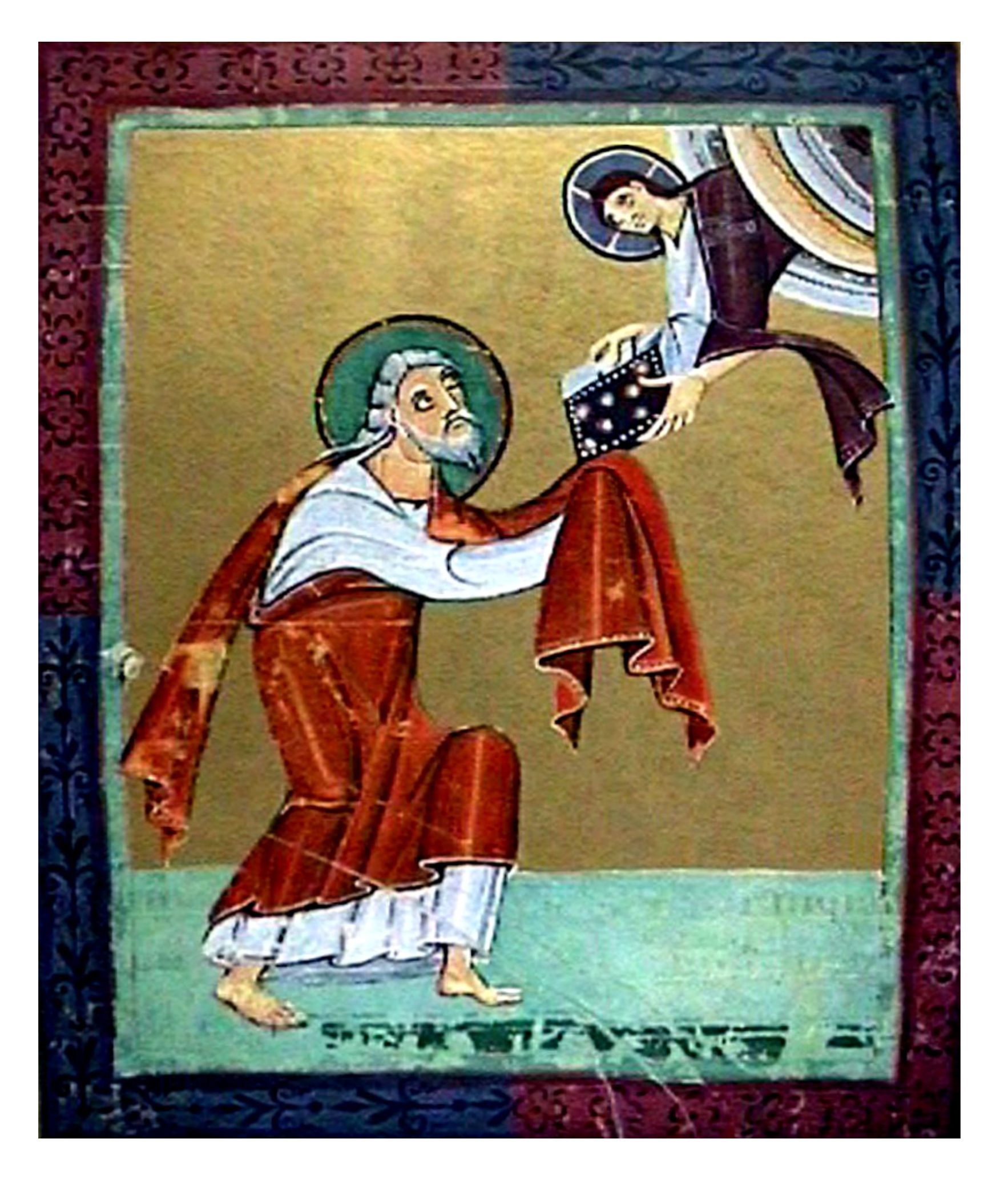
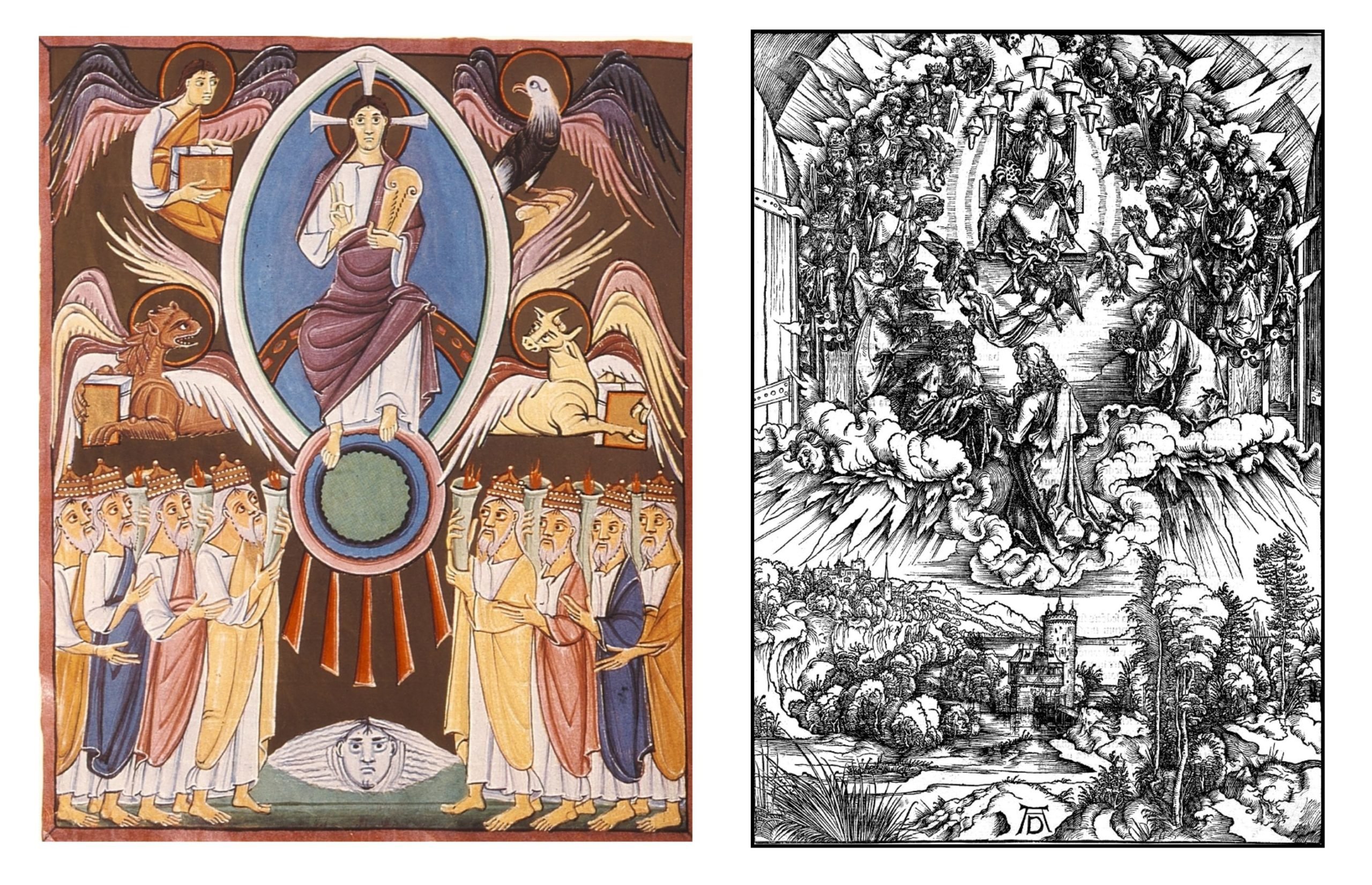
On the island of Patmos just off the west coast of what is now Turkey, a Christian named John experienced disturbing visions of the future. He described these in a manuscript that began with the word apokalypsis (Greek for “unveiling”). This became Revelation, the last book in the Christian New Testament (Koester, 2014; Quispel, 1979). The illustration on the right, from the Bamberg Apocalypse, an illuminated manuscript from the 11th Century, shows an angel telling John what he should write:

The Revelation of Jesus Christ, which God gave unto him, to shew unto his servants things which must shortly come to pass; and he sent and signified it by his angel unto his servant John (Revelation 1:1)

For many years, Christian scholars assumed that John the Apostle, the youngest of Christ’s disciples, was the author of Revelation, the Gospel of John and the three Epistles of John. Most modern scholars consider it unlikely that he wrote any of these works. They suggest three separate authors one for the gospel, one for the three epistles, and one for the apocalypse. One telling point is that each author describes the end-times very differently. For example, the Antichrist is mentioned in the epistles (e.g. 1 John 2:18), but not in the apocalypse. The author of Revelation was probably a Jewish-Christian prophet living in Asia Minor – John of Patmos. He may have written the book over many years. One suggestion is that he began writing as a Jew and later converted to Christianity (Koester, 2014, pp 68-71).

The visions described by John are stunning in their force and detail. The Whore of Babylon, the Seven-Headed Beast, and the Four Horsemen have become part of our collective consciousness.

Revelation is the most interpreted and least understood book of the Christian Bible (Quispel, 1979; Koester, 2014). Some have interpreted the visions as describing the troubled time in which they were experienced. The Seven-Headed Beast could then represent Rome (with its seven hills, or its seven emperors), and the Rider on the White Horse could represent the Parthians who threatened the peace of the Middle East. Others have considered the visions as prophesying the later history of the Christian Church. The Whore of Babylon was the papacy of Rome for Protestants and the heresies of the Reformation for Catholics. Others believe that Revelation foretells the Last Days, that are yet to come, when Christ will judge both the quick and the dead.

John’s first vision was of the Lord seated upon a throne in Heaven. This is illustrated below in the 11th-Century Bamberg Apocalypse, and in the 1498 woodcut by Albrecht Dürer. Around the throne were four beasts in the form of Man, Lion, Ox and Eagle, probably representing the evangelists Matthew, Mark, Luke and John. Around them were four and twenty elders, clothed in white and wearing crowns of gold. In the Lord’s right hand was a book “sealed with seven seals.” The structure of this book is not clear. Perhaps it is made up of seven scrolls one rolled up within the other (Quispel, 1979, p 51). A mystical lamb appears and proceeds to open each of the seals.

The Four Horsemen

As the first four seals are opened four horsemen appear:

And I saw when the Lamb opened one of the seals, and I heard, as it were the noise of thunder, one of the four beasts saying, Come and see.
And I saw, and behold a white horse: and he that sat on him had a bow; and a crown was given unto him: and he went forth conquering, and to conquer.
And when he had opened the second seal, I heard the second beast say, Come and see.
And there went out another horse that was red: and power was given to him that sat thereon to take peace from the earth, and that they should kill one another: and there was given unto him a great sword.
And when he had opened the third seal, I heard the third beast say, Come and see. And I beheld, and lo a black horse; and he that sat on him had a pair of balances in his hand.
And I heard a voice in the midst of the four beasts say, A measure of wheat for a penny, and three measures of barley for a penny; and see thou hurt not the oil and the wine.
And when he had opened the fourth seal, I heard the voice of the fourth beast say, Come and see.
And I looked, and behold a pale horse: and his name that sat on him was Death, and Hell followed with him. And power was given unto them over the fourth part of the earth, to kill with sword, and with hunger, and with death, and with the beasts of the earth. (Revelation 6:1-8)

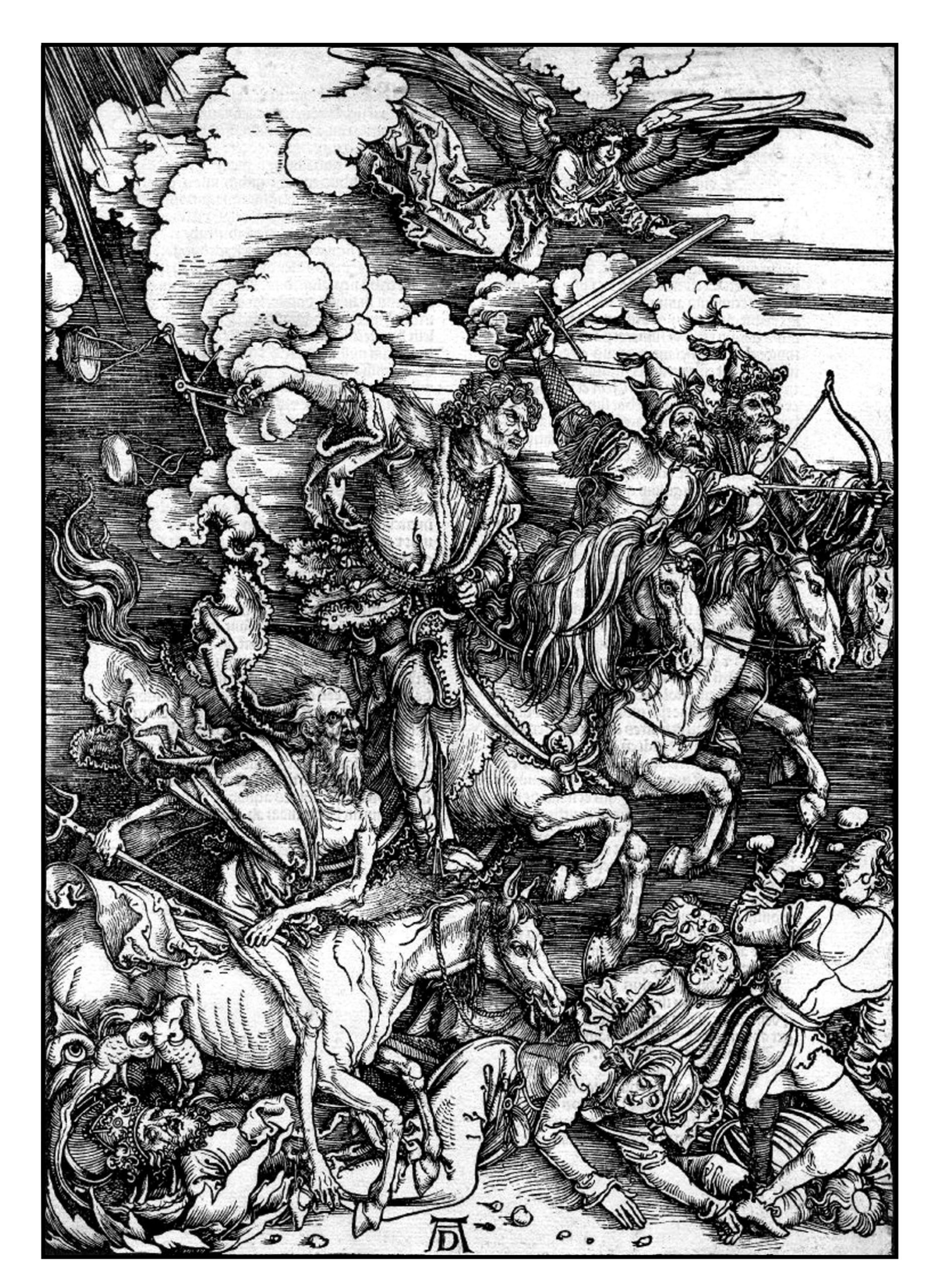
Only the fourth horseman is clearly identified by John as Death. The color of his horse has been interpreted as “pale,” although the Greek chloros is actually better translated as “green.” Perhaps John envisioned a sickly pale green color. The identity of the other three is unknown (reviewed by Koester, 2014, pp 392-398; and in Wikipedia). The rider of the black horse with his scales for weighing and pricing food was almost certainly Famine. The rider of the Red Horse was probably War. The first horsemen has been interpreted in many ways. Perhaps he is Christ, perhaps the Antichrist. Some have considered him as Conquest though this seems to overlap with the rider of the Red Horse. Pestilence or plague seems the most reasonable interpretation. His arrows could then represent the transmission of infection.

The most famous depiction of the Four Horsemen is the 1498 woodcut of Albrecht Dürer, illustrated on the right. The first three horsemen look like mercenary warriors from the Hundred Year War. Death is a skeletal figure riding an emaciated horse. He clears the world of those who die from pestilence, war and famine.


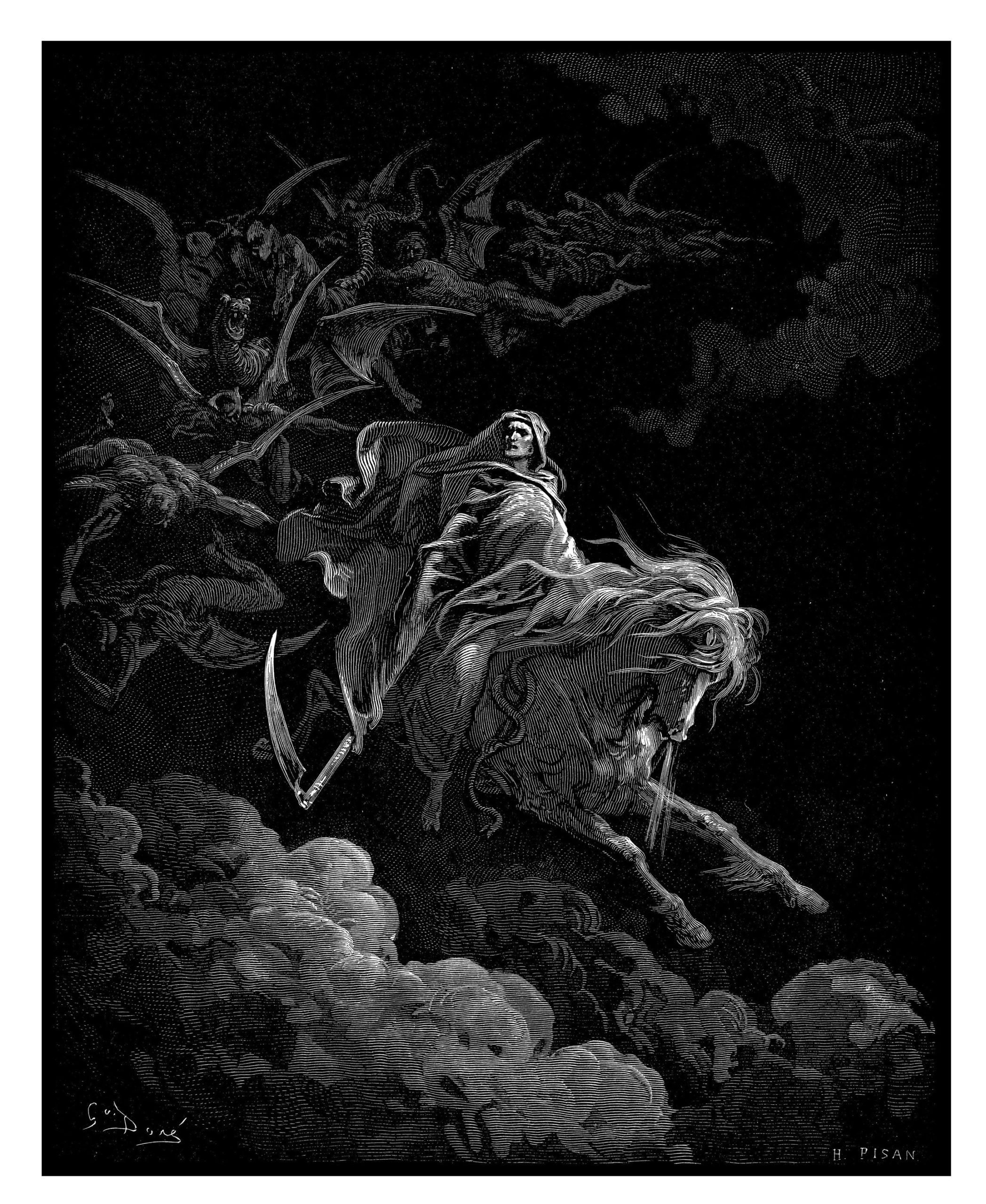
The 1865 wood-engraving by Héliodore Pelan based on a drawing by Gustave Doré gives Death a more majestic appearance, and grants him the scythe that has become his symbol. The scythe refers the apocalyptic passages in the Gospels that consider the final harvest of human souls. Doré also depicts the dark shades of Hades that John saw following after Death.


Pale Horse, Pale Rider

In 1918 Katherine Anne Porter almost died from the Great Influenza while she was in Denver working as a journalist (Barry, 1963). In 1939 she published Pale Horse, Pale Rider a short novel about that experience. In the novel she calls herself Miranda (from the Latin, “to be wondered at”). Pale Horse, Pale Rider was published together with two other stories – Old Mortality and Noon Wine – and gave its title to the collection.

The novel opens with a dream. Miranda is about to go riding, but she cannot decide which horse to borrow for a journey she does not wish to take. She decides against Miss Lucy “with the long nose and the wicked eye,” and Fiddler “who can jump ditches in the dark,” and choses Graylie “because he is not afraid of bridges.” These horses are those that were ridden long ago by Amy, the wife of Miranda’s Uncle Gabriel. Amy was a beautiful and spirited young woman, who committed suicide before Miranda was born. Her story was told in Old Mortality, one of several Miranda stories.

In the dream Miranda must go riding with a stranger who has been hanging about the place. She mounts Graylie, and urges him on. They fly off, over the hedge and the ditch and down the lane:

The stranger rode beside her, easily, lightly, his reins loose in his half-closed hand, straight and elegant in dark shabby garments that flapped upon his bones. (Porter, 1939, p 181)

Suddenly, she pulls Graylie up, the stranger rides on, and Miranda wakes up.

She remembers the events of the day before, particularly her visit to the infirmary at the army camp, and her tryst with her new boyfriend Adam, a young and handsome soldier about to be sent to France. She is not feeling well, but goes to work and once again meets Adam.

The next day she feels quite ill, and is seen by a doctor who prescribes some medications and says he will check on her later. Adam comes to see her and comforts her. They talk of their love for each other, about the war and about old songs they had heard when they were younger. One of these is a spiritual that began “Pale horse, pale rider, done taken my lover away.” The doctor returns and arranges for Miranda to be admitted to hospital. She has contracted influenza, perhaps from her visit to the infirmary.

While in hospital Miranda comes close to death but survives

Silenced she sank easily through deeps under deeps of darkness until she lay like a stone at the farthest bottom of life, knowing herself to be blind, deaf, speechless, no longer aware of the members of her own body, entirely with-drawn from all human concerns, yet alive with a peculiar lucidity and coherence; all notions of the mind, the reasonable inquiries of doubt, all ties of blood and the desires of the heart, dissolved and fell away from her, and there remained of her only a minute fiercely burning particle of being that knew itself alone, that relied upon nothing beyond itself for its strength; not susceptible to any appeal or inducement, being itself com-posed entirely of one single motive, the stubborn will to live. This fiery motionless particle set itself unaided to resist destruction, to survive and to be in its own madness of being, motiveless and planless beyond that one essential end. (pp 252-3).

She has a vision of a place reached by crossing a rainbow bridge.  Graylie was not afraid of bridges. There Miranda sees in the shimmering air “a great company of human beings,” all the people she had known in life. From this apparent heaven she returns to the reality of the hospital. She has miraculously comeback from the dead.  She lives up to her name – someone to be wondered at.

In her convalescence she learns that Adam had also became ill, probably having caught the disease from her. However, though Miranda had survived, Adam had died.

Outside the bells are ringing to celebrate the end of the war. As Miranda prepares to leave the hospital, she requests some essentials to begin her new life:

One lipstick, medium, one ounce flask Bois d’Hiver perfume, one pair gray suede gauntlets without straps, two pairs gray sheer stockings without clocks … one walking stick of silvery wood with a silver knob. (p 262).

She will be pale and elegant like the rider she dreamed about at the beginning of her illness, the rider that done take her love away. She has been irretrievably marked by death. As she leaves the hospital Miranda thinks

No more war, no more plague, only the dazed silence that follows the ceasing of the heavy guns; noiseless houses with the shades drawn, empty streets, the dead cold light of tomorrow. Now there would be time for everything. (p 264)

Life is now defined by what it is not – no war, no plague, no noise, no light. Porter’s  words recall Wilfred Owen’s 1917 poem Anthem for Doomed Youth which begins with the “monstrous anger of the guns” and ends with “each slow dusk a drawing down of blinds” (Owen, 1985, p 76).  Much poetry was written about the terrible loss of life in the Great War. Very little is concerned with the great epidemic of influenza that marked its ending (Crosby, 1989; Fisher, 2012).

Miranda’s final claim “Now there would be time for everything” is the tragedy of the book. She is now free to do as she wishes but there is nothing that she wishes to do.

Porter spent many years before she fully recovered from her experience in Denver. She did not publish her first stories until 1930, and Pale Horse, Pale Rider did not come out until 1939. Some sense of Miranda’s feelings at the end of that book is perhaps present in the 1942 portrait drawing of Porter by Paul Cadmus.


The Great Influenza

The influenza that almost killed Katherine Anne Porter swept across the world between 1918 and 1921 (Barry, 2004; Crosby, 1989; Spinney, 2017; Taubenberger & Morens, 2006). No one is sure where it began. The first cases were seen in Kansas, and the disease spread rapidly through the US army camps where young men were being trained before going to fight in France.

The following is the iconic image of the epidemic: the make-shift infirmary at Camp Funston, Kansas. The photograph is strangely still. It should be accompanied by the sound of intermittent coughing. The light rakes across the camp cots, randomly selecting one soldier or another, much as the disease would select those who would die. There was no treatment: oxygen would not be used for pneumonia until after the war (Heffner, 2013). About a quarter of the young men in this photo likely died of influenza. More US soldiers died of influenza than during battle.

The disease quickly spread to the battlefields of Europe. None of the combatant-countries wished to acknowledge that their troops were ill. Since the first officially reported cases occurred when the disease spread to Spain, the pandemic was thereafter miscalled the Spanish Flu. In this posting it is called the Great Influenza.

The 1918 pandemic was unusual in that it the young and healthy were more susceptible to the disease than the elderly. This may have been related to the close quartering of the young soldiers. Or it might have been caused by an overly reactive immune system.

Coronavirus COVID-19 acts similarly to the influenza virus in terms of its spread through airborne droplets, and in terms of how its major morbidity is due to a viral pneumonia. The coronavirus differs from the Great Influenza in that it affects the elderly more than the young. Nevertheless, we should look to the Great Influenza in terms of what might happen in our current pandemic.

A pandemic is characterized by two main parameters. The contagiousness of the disease is measured by the basic reproduction number (R0). This is the number of new people that will become infected from one individual patient. If R0 is less than 1 the disease dies out; if it is greater than 1 the disease spreads exponentially through the population. The virulence of the disease is assessed by the case fatality rate (CFR). This measures the proportion of infected patients that die.

For the Great Influenza R0 was about 2 (Ferguson et al. 2006), and the CFR was about 2.5% (Taubenberger & Morens, 2006). We do not yet know for sure how the present coronavirus COVID-19 compares. Early data from China suggest that R0 is about 2, and the CFR about 5% (Wu et al., 2020). Since we have not yet done sufficient testing to be sure of the number of cases in the population, the CFR is likely overestimated. Most of the tested cases are patients who have been severely symptomatic. If there is a significant number of asymptomatic (and untested) cases, the CFR will be lower (discussed extensively on the World in Data website). It might approach the CFR estimated for the Great Influenza, but it will be at least an order of magnitude greater than seasonal flu (<0.1%).

For those who wish to consider all the other great epidemics of human history, Wikipedia has listed their estimated values for R0 and CFR.

The numbers for COVID-19 Pandemic indicate we must be extremely cautious so as not to endure a repeat of the Great Influenza. Since stories are often more convincing than numbers, we can briefly consider the effect of the Philadelphia’s Liberty Loan Parade on September 23, 1918. Despite warnings about the influenza, the city went ahead with a huge parade to drum up support for the US war effort. A few days after the parade, hundreds of people became ill. Soon the number of ill patients increased. Hospitals rapidly became overcrowded and unable to take new cases. By the end of the years the number of cases exceeded 100,000 and the number of dead approached 13,000, over 1% of the city’s population (Barry, 2004, pp 220-227; Kopp & McGovern, 2018)). In contrast after the first recorded cases of influenza in St Louis, that city quickly instituted measures against the spread of the disease, such as closing schools and banning public gatherings. The number of deaths in St Louis per 100,000 population during the epidemic was less than half that in Philadelphia (Hatchett et al, 2007).

In Philadelphia and across the world morticians and gravediggers rapidly became overwhelmed and bodies began to pile up in the streets. In Rio de Janeiro, Jamanta, a famous carnival reveller, commandeered a tram and a luggage car and swept through the city picking up bodies and delivering them to the cemetery (Spinney, 2017, p. 54-55).

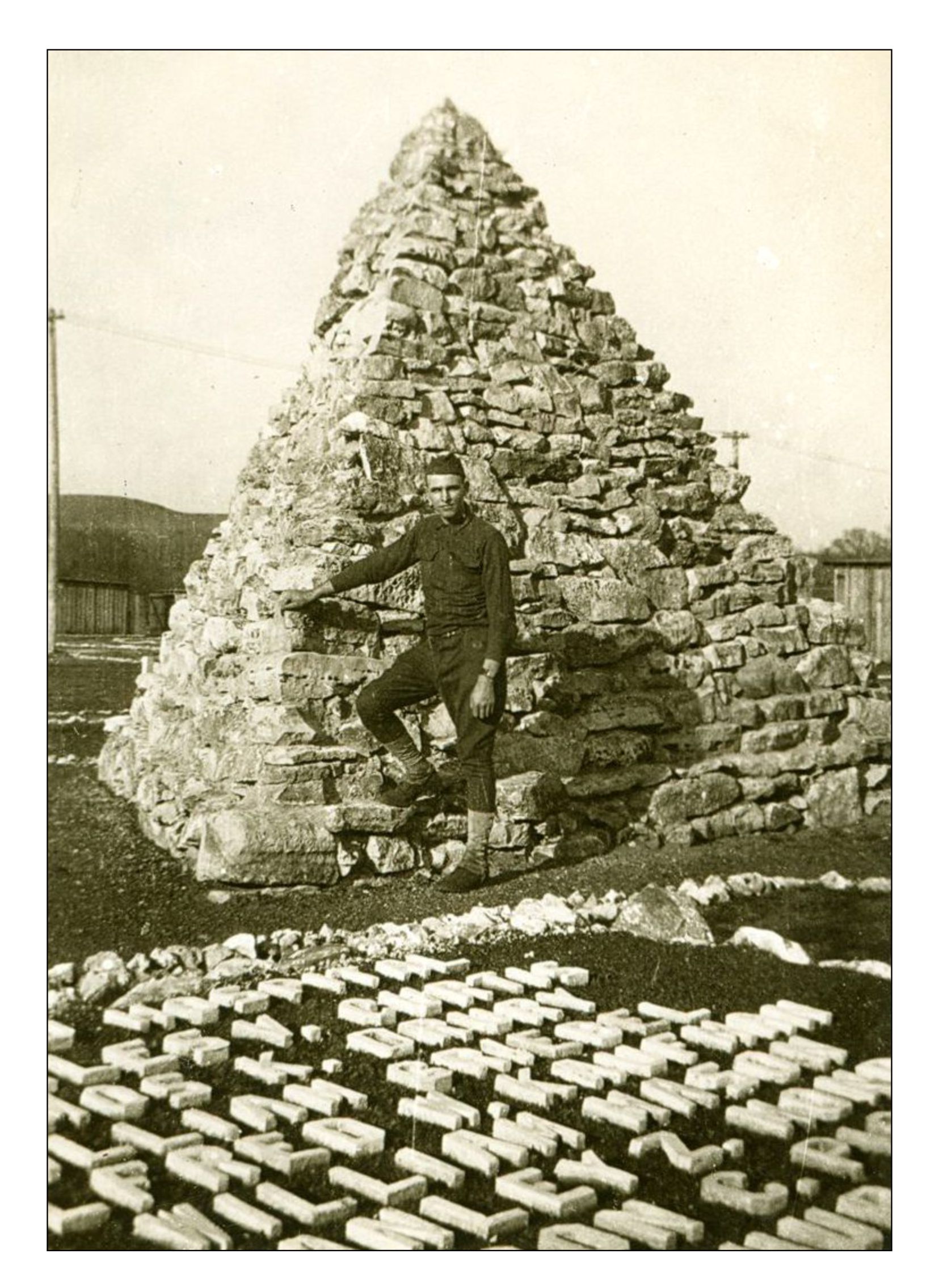
Despite its death toll, the Great Influenza was largely ignored by historians until the possibility of new influenza pandemics became real toward the end of the 20th Century. Thousands of monuments memorializing those who died in the Great War exist all over the world. Monuments to those who died of influenza are scarce, even though those who died of the disease outnumbered those who died in battle. The soldiers at Camp Fenton erected their own memorial to their colleagues who had died of the influenza (illustrated on the right, with its designer Henry Hardy). The monument was a simple pyramid of piled up stones with the names of the victims written in smaller stones on the grass. The camp and its monument have been long ago abandoned.

One of the reasons for the lack of attention that the Great Influenza received may have been that it did not fit with any overarching narrative. Though many died, they did not die for some noble cause. The disease was largely random it its killing.

The Black Death

Even though it did not kill so many, the Black Death had a far greater impact on our history. It shattered the society of the Middle Ages, disrupting the feudal system, and questioning the power of the Church. Part of this impact was due to the Bubonic Plague being far more virulent than either the influenza or the coronavirus. The Case Fatality Rate during the Black Death was over 30%. The disease was caused by a bacterium Yersinia pestis, which is endemic in rats and transmitted to human beings by fleas. The infected rats and their fleas came to Europe from the East on merchant ships. The plague began in port cities such as Naples, Venice and Genoa, are rapidly spread throughout Europe (McMillen, 2016; Snowden, 2019).

Nowadays we have antibiotics that can kill the bacteria that causes the Bubonic Plague. Furthermore, we understand how it is transmitted and can prevent this by controlling human exposure to rats and fleas. In the 14th Century there was nothing to do but flee. This flight actually increased the spread of the disease, which was carried by the fleas on all those who ran away.

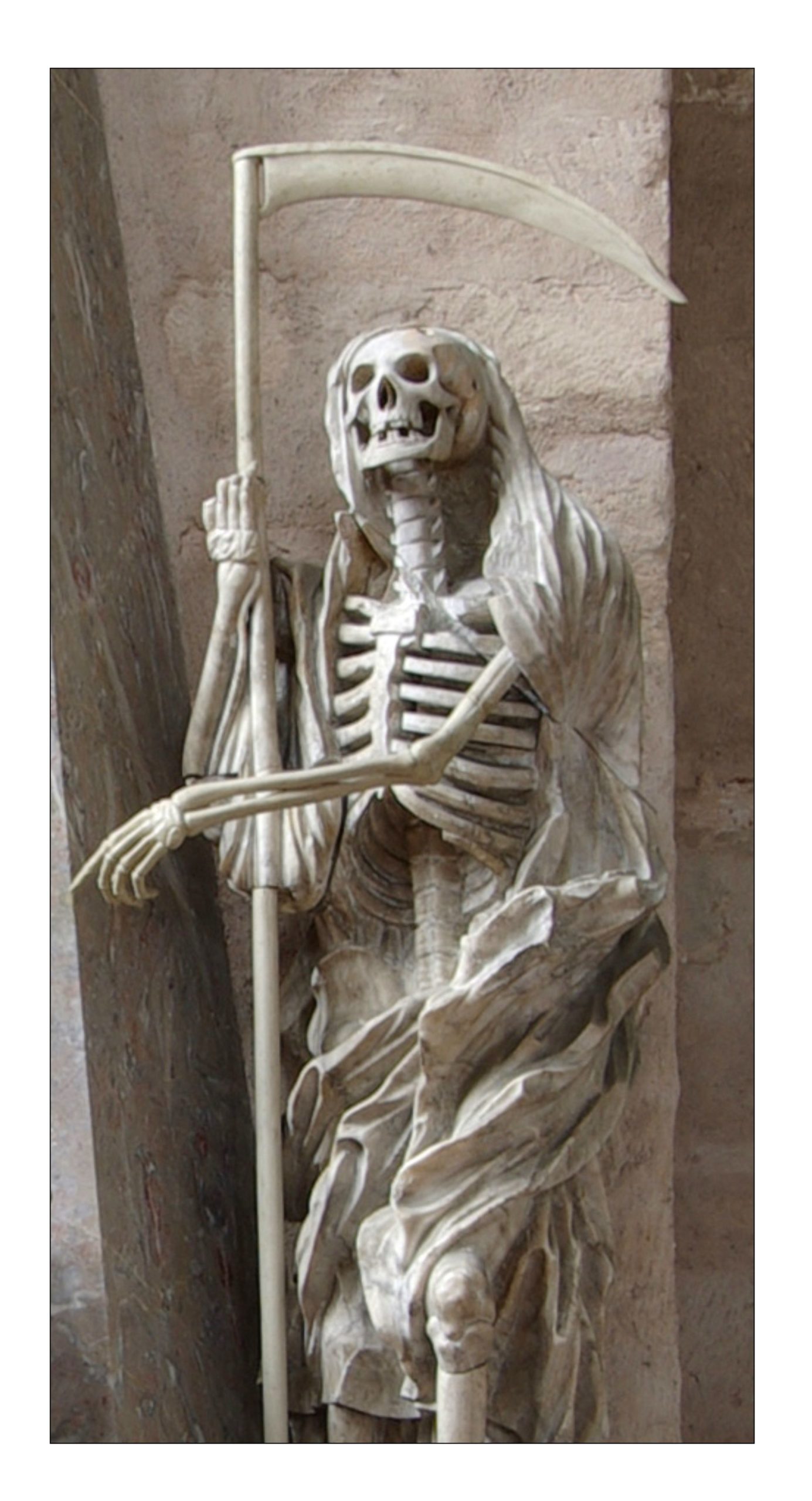
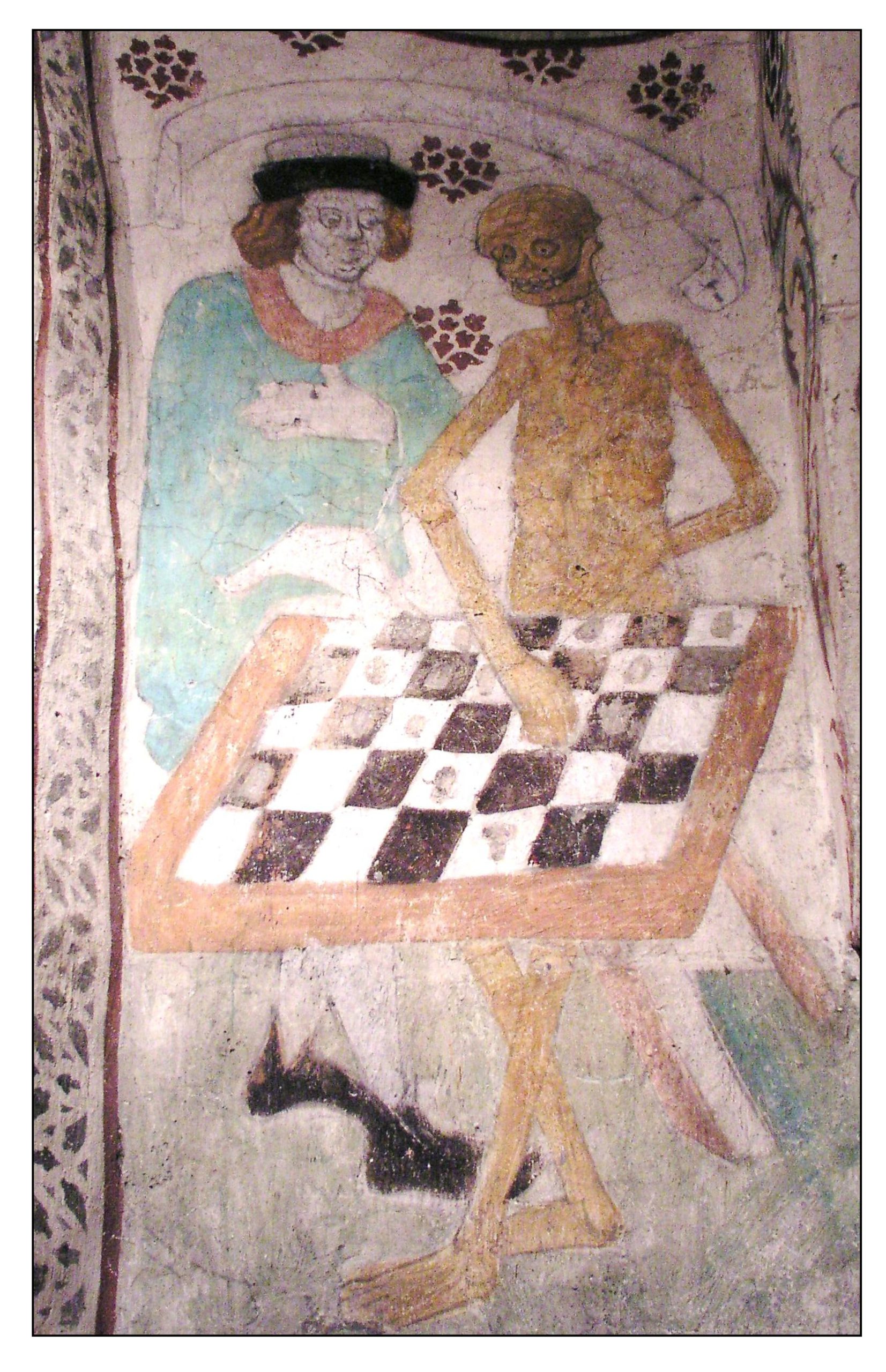
The Black Death bequeathed us with our most potent image of death as a skeletal figure, often clad in a shroud or black cloak and carrying scythe – the “grim reaper.” Such figures were often portrayed leading various people from all stations of life in a “dance of death.” The statue illustrated on the right is from the tomb in Trier Cathedral of Johann Philipp von Wallerdorff who died in 1768.

Many considered the Black Death as God’s punishment for humanity’s sins, and decided that a great return to God was necessary. Yet the plague had randomly killed both saint and sinner. Others thought that the plague was God’s demonstration that the Church had gone astray and needed to be reformed. Yet both priests and parishioners were equally affected.

And so, a few came to the idea that perhaps there was no God. The only justice in the world was at the hand of human beings. And their only recourse was themselves. And if they could ultimately survive the plague, they could perhaps settle on a different world, where reason ruled instead of faith.

The Seventh Seal

In Revelation after the four horsemen, the fifth and sixth seals are opened. These bring forth to John a vision of the Christian Martyrs, and then a vision of all those who had been saved by faith in Christ. Finally, the last seal is opened:

And when he had opened the seventh seal, there was silence in heaven about the space of half an hour. (Revelation 8:1)

Christians interpret the silence as representing the awe that occurs when one realizes the greatness of God and his program for the future. Ingmar Bergman considered it differently. Much of his work is concerned with the silence of God. All our prayers no matter how fervent are met with silence. He made this the subject of a trilogy of films: Through a Glass Darkly (1961), Winter Light (1963) and The Silence (1963).

The idea is also at the heart of his earlier 1957 film The Seventh Seal. The quotation from Revelation about the opening of the seventh seal and the silence in heaven begins the film.  A knight Antonius Block (Max von Sydow) has just returned to Sweden from the Crusades. He has brought with him a game of chess that he learned in Palestine. All of Europe is in the grip of the Black Death. On a beach Antonius prays to God. After his prayer, Death (Bengt Ekerot) appears. Antonius challenges Death to a game of Chess to decide his fate. The following is a clip from the movie. The sound of the waves goes silent when Death appears.


Bergman based the idea of the game of chess from a 1480 fresco (right) painted by Albertus Pictor in the Täby Church near Stockholm. As the film proceeds, Death ultimately wins the game, and leads Antonius and his family off in a dance of death. The film is not accurate historically: the crusades ended long before the Black Death. However, it is one of our most vivid depictions of human mortality.


Playing Chess with Death

Death is now among us. Not in as the dark figure portrayed by Bengt Ekerot, but in the form of a coronavirus epidemic. The disease is not as virulent as the Black Death. However, it is likely just as contagious and just as virulent as the virus that caused the Great Influenza. How do we prevent what happened in 1918 when Death took millions of people before their time?

How do we play our game of chess with Death? We still have no specific treatment, and there is as yet no vaccine. Unlike in 1918, however, we now have oxygen therapy and, if necessary, artificial ventilation. These procedures can help patients with pneumonia survive until their immune systems can finally destroy the virus. Furthermore, we have monitors such as finger oximeters that can determine when oxygen therapy is needed.

What is most important is to inhibit the spread of the disease in the population. The most powerful means to do this involves identifying all patients with the disease, tracing all people who have come in contact with these patients, testing these contacts, and quarantining both the patients and their contacts (whether or not they are infected) until they are no longer contagious. Since we have tests that are reasonably specific for the virus, this approach is definitely possible, and is being used successfully in China and in South Korea.

In the absence of contact tracing, we can limit the spread of the disease by staying away from our fellows beyond the distance that airborne drops can travel: “physical distancing” (a more appropriate term than “social distancing”).  Physical distancing can certainly slow down the spread of the disease so that hospital facilities for treating those patients that develop pneumonia do not become overwhelmed. However, it will ultimately have to be replaced with contact tracing. Or the Dance of Death will continue.

Despite our best efforts many people will die in the pandemic. Though we know we have to die sometime, we generally believe that this will not be tomorrow. Nowadays death is closer. We need to come to terms with it. Through whatever stories, dreams and visions we can muster. We cannot play chess well without equanimity.


References

Barry, J. M. (2004). The great influenza: The epic story of the deadliest plague in history. New York: Viking.

Crosby, A. W. (1989/2003). America’s forgotten pandemic: The influenza of 1918. Cambridge England: Cambridge University Press.

Ferguson NM; Cummings DA; Fraser C; et al. (2006). Strategies for mitigating an influenza pandemic. Nature, 442 (7101), 448–452.

Fisher, J. E. (2012). Envisioning disease, gender, and war: Women’s narratives of the 1918 influenza pandemic. New York: Palgrave Macmillan

Hatchett, R. J.; Mecher, C. E.; & Lipsitch, M. (2007). Public health interventions and epidemic intensity during the 1918 influenza pandemic. Proceedings of the National Academy of Sciences of the United States of America, 104, 7582–7587.

Heffner, J. E. (2013). The story of oxygen. Respiratory Care, 58, 18-31.

Koester, C. R. (2014). Revelation: a new translation with introduction and commentary. New Haven, CT: Yale University Press, 2014.

Kopp, J., & McGovern, B. (2018).  100 years ago, ‘Spanish flu’ shut down Philadelphia – and wiped out thousands. PhillyVoice, September 20 and 27, 2018.

McMillen, C. W. (2016). Pandemics: a very short introduction. New York: Oxford University Press.

Owen, W. (Edited by Stallworthy, J., 1985). The poems of Wilfred Owen. London: Hogarth Press.

Porter, K. A. (1939). Pale horse, pale rider: Three short novels. New York: Harcourt, Brace and Company.

Quispel, G. (1979). The secret Book of Revelation: The last book of the Bible. New York: McGraw-Hill.

Snowden, F. M. (2019). Epidemics and society: From the Black Death to the present. New Haven, CT: Yale University Press.

Spinney, L. (2017). Pale rider: The Spanish flu of 1918 and how it changed the world. London: Johnathan Cape.

Taubenberger, J. K., & Morens, D. M. (2006) 1918 Influenza: the mother of all pandemics Emerging Infectious Diseases, 12, 15-22.

West, R. B. (1963). Katherine Anne Porter: American Writers 28.  Minneapolis: University of Minnesota Press.

Wu, J.T., Leung, K., Bushman, M. et al. (2020). Estimating clinical severity of COVID-19 from the transmission dynamics in Wuhan, China. Nature Medicine 26506–510.