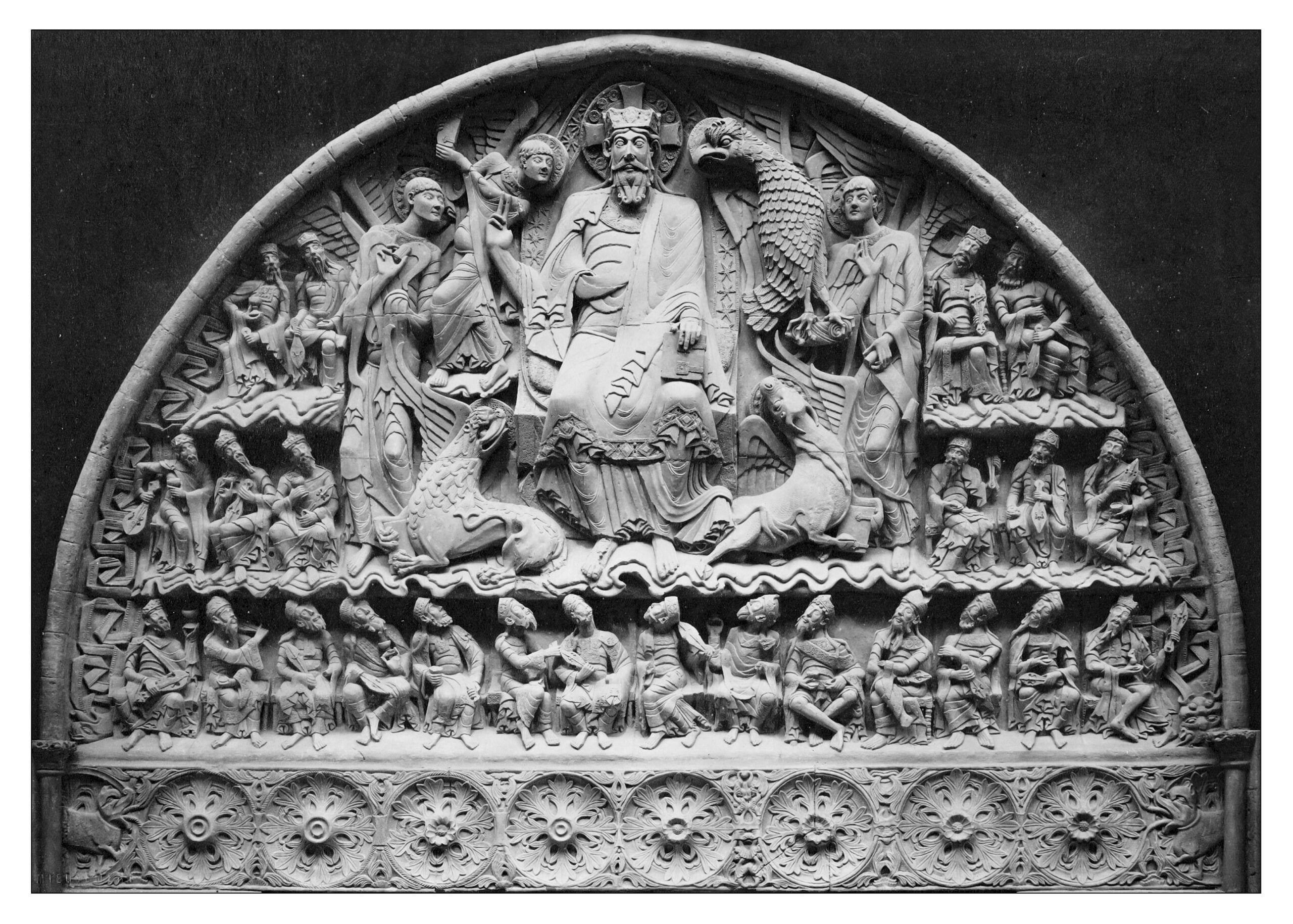
Laurence Cossé: Le Coin du Voile

Laurence Cossé’s 1996 novel Le coin du voile (A corner of the veil) describes the effects of a new and irrefutable proof for the existence of God. A priest who had resigned his calling to spend months in prayer and abstinence submits the proof for publication in Outlooks, the lay journal of the French Casuists. All those who read it are completely convinced. On seeing its effects, the Provincial of the Casuists decides to keep the proof secret until its effects can be more clearly understood. Finally, the Secretary of State at the Vatican arranges for all those who had read the proof to retire from any contact with the public and for the proof to be kept hidden. The proof becomes a pontifical secret – “a piece of information the Holy Father must not learn under any circumstance.”  

The novel, published by Gallimard in 1996, received generally positive reviews, and won several French literary prizes. Readers were charmed by the story but had some difficulty deciding on its basic nature: was it a philosophical fable, a religious thriller, a gentle satire, or an outright farce? The book touches lightly on serious matters: Burns. (1999) called it “casually profound” and Dumort (1997) considered it an “un opéra-bouffe sans la musique.” Cobb (2005, p 156) complimented the author for her “insightful reflections on the moral springs that move real human beings.” Some critics would have preferred more depth (Eder, 1999; McInerny, 1999), but this seems akin to wishing that Voltaire wrote like Diderot.

The book has been translated into English (A Corner of the Veil), German (Der Beweis, The Proof), Italian (La sesta prova, The Sixth Proof; La prova nascosta, The hidden proof) and Spanish (La punta del velo). The following illustration shows some of the covers. The French paperbacks use details from paintings by Paul Gauguin (Self Portrait with the Yellow Christ, 1891) and Michelangelo (Separation of the Earth from the Waters, Sistine Chapel, 1512). The cover of the English translation shows the ceiling of a gothic cathedral (Exeter) with a corner being pulled back to reveal the radiance of heaven.

The Casuists

The Novel begins one evening with Father Bertrand Beaulieu, editor of the Casuist journal Regards (translated as Outlooks by Linda Asher), going through his correspondence. The Casuists are clearly the Jesuits, and the journal is clearly the publication Études, established in 1856 by the French Jesuits.

The Society of Jesus was founded in Paris in 1534 by the Spanish nobleman Ignatius of Loyola and six fellow students at the University of Paris. The largest of the Catholic religious orders, it is widely involved in education, missionary work, and humanitarian activities.

Soon after the order was established, the Council of Trent (1545-1563) revised the Catholic Church’s position on the Sacrament of Penance and the process of confession. Sinners were no longer able to purchase indulgences to escape the consequences of their sins. Instead, priests listened to sinners’ confessions, assessed their remorse, provided absolution, and outlined appropriate acts of penance to make amends. This led to a need for more sophisticated moral reasoning, since many human acts cannot easily be judged according to the commandments available in the scriptures. Several Jesuits contributed extensively to the new moral philosophy, most especially Antonio Escobar y Mendoza (1589–1669) who treatise Summula casuum conscientiae (1627) outlined how moral judgments could be made on a case-by-case basis by applying knowledge of the law, ethics, and scripture. This approach came to be known as casuistry, and the Summula became the confessor’s handbook.

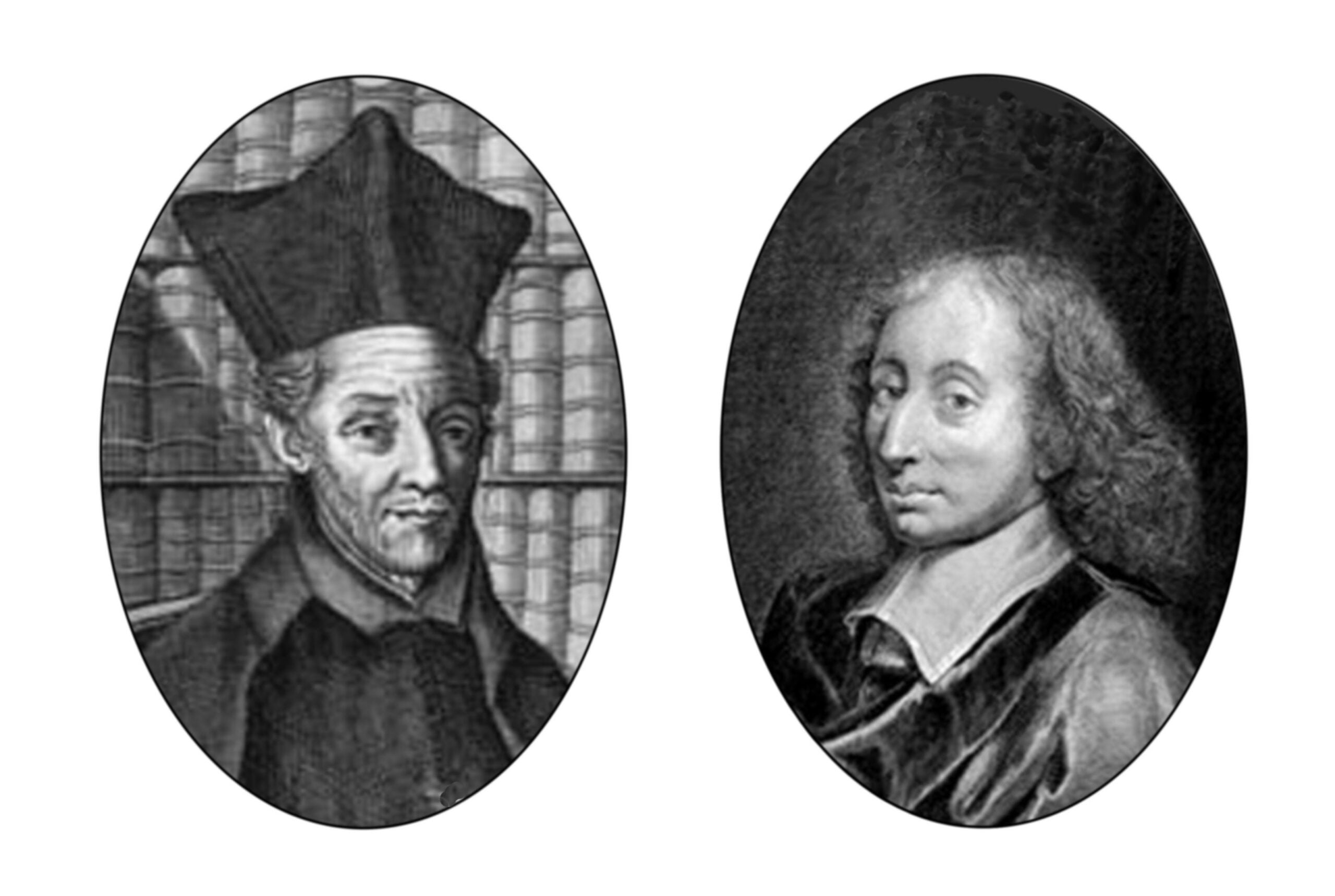
Unfortunately, some of the casuist proposals, most particularly concerning the differentiation between intentions and acts, could easily lead to moral laxity. Sinners could be excused for the bad consequences of their acts because their intentions had been good. Escobar was a strict adherent to the Jesuit rules of poverty, chastity and obedience, but sinners found it easy to abuse his moral reasoning. Thus it was said that Escobar “purchased heaven dearly for himself, but gave it away cheap to others.” Blaise Pascal (1623-1662) took Escobar to task in his Lettres Provinciales. For example, he pointed out that the casuist could reason that although it is wrong to kill someone because of hatred, one could do so blamelessly if one professed fear for one’s own safety. Escobar’s logic was no match for Pascal’s wit. “Casuistry” soon came to mean the use of clever but unsound reasoning to excuse moral culpability; indeed, “Jesuitical” took on the same connotation The following illustration shows Escobar on the left and Pascal on the right:
Nowadays, however, casuistry has returned to favor as a way to approach complex moral decisions (Jonson, 2005).

Six Pages in a Brown Envelope

In his pile of correspondence, Father Beaulieu recognizes the crazy writing on a cheap brown envelope. The sender had written to him multiple times before, each time with a different proof for the existence of God, each time failing to convince anyone. Beaulieu puts the envelope at the bottom of the pile, but later that evening finally opens it, and dutifully reads the contents:  

Dix heures vingt-cinq. Enfin. Il ne restait plus que la lettre brune. Beaulieu l’ouvrit, exaspéré d’avance. Mon Dieu, le nombre de cinglés que Vous mettez au monde. L’écriture était effrayante, une espèce de broderie ne laissant pas la moindre marge à droite ni à gauche, pas plus qu’en haut ni en bas. Il n’y avait que six feuillets, ce soir, moins que les autres fois. Beaulieu prit un carré de chocolat dans le tiroir de son bureau et commença à lire.
Six pages plus loin, il tremblait. Cette fois la preuve n’était ni arithmétique, ni physique, ni esthétique, ni astronomique, elle était irréfutable. La preuve de l’existence de Dieu était faite.

[Ten twenty-five. Finally. Only the brown letter left to go. Beaulieu opened it, already exasperated. Dear God, the number of madmen You put into the world. The handwriting was dreadful, a kind of embroidery that left no margin right or left, top or bottom. There were only six sheets tonight, fewer than the other times. Beaulieu took a square of chocolate from the desk drawer and started reading.
Six pages farther, he was trembling. This time the proof was neither arithmetical, nor physical, nor esthetical, nor astronomical; it was irrefutable. The proof of God’s existence had been achieved. (p 15)]

Beaulieu is overwhelmed. He prostrates himself on the floor as he did on the day of his ordination. After an hour he rises and visits his friend Hervé Montgaroult, a Jesuit professor whose specialty is cataphatic ontology. “Cataphatic” (from Greek cata an intensifier and phanai speak) deals with the affirmative description of the divine (e.g., God is love) as opposed to “anaphatic” (apo other) which uses negative descriptions (e.g., God is unknowable).


Proof for the Existence of God

When Beaulieu presents the professor with the proof, Montgaroult protests that “No proof of the existence of God has ever held up,” and begins to review all the historical proofs. Beaulieu finally stops him, and leaves his with the six handwritten pages, insisting that he just read.

The most famous of the historical proofs for the existence of God are the Five Ways of Thomas Aquinas (1225-1274), an Italian Dominican who taught at the University of Paris (Pasnau, 2024). These five proofs are included in both his Summa Theologica and in his Summa contra Gentiles.

Aquinas’ first proof, which argues for God as the “prime mover,” derives from Aristotle. Things are in motion; whatever is in motion must have been put into motion by something else, which itself must have been moved by something else, and so on. Since this chain of events cannot go on forever, there must be a prime mover that can move things without being moved. This must be God.

Aquinas therefore contradicted the claims of Ibn Rushd (1126-1198, also known as Averroes), a Muslim commentator on Aristotle, who argued that the chain of events does go on forever, and that God created a world that is eternal (Ben Ahmed & Pasnau, 2025; Dales, 1990, p 45). In 1484 painting by Benozzo Gozzoli, The Triumph of Thomas Aquinas, now in the Louvre, celebrates Aquinas’ victory over Averroes:
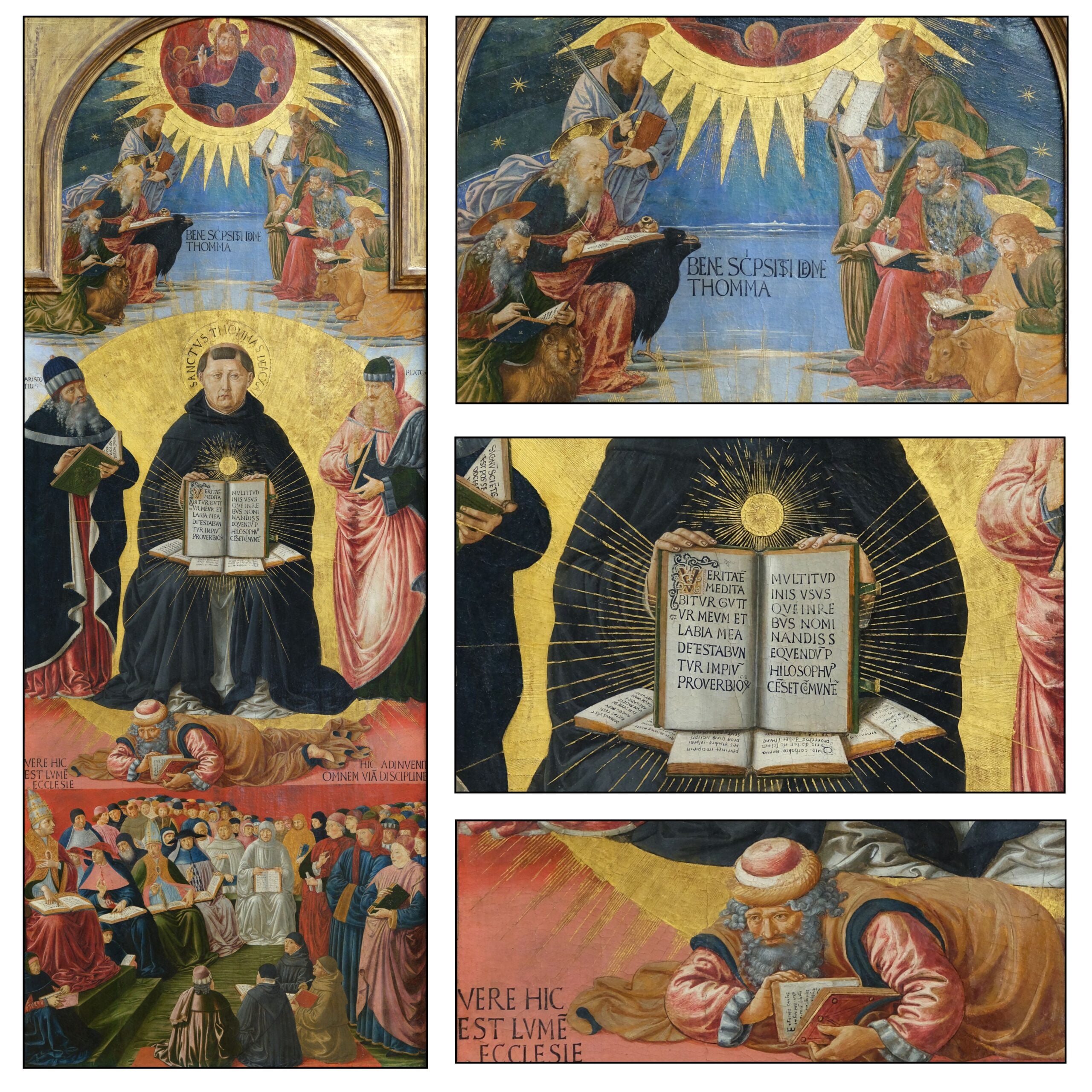
The painting derives its iconography from an earlier work probably painted in about 1330 by Lippo Memmi (Polzer, 1993) to celebrate the canonization of Thomas Aquinas in 1323.  

The upper section of the painting shows God blessing those that have revealed the truth: the Apostle Paul with the sword, Moses with the tablets and the four Evangelists who wrote the gospels, each with their symbolic creature (angel, lion, ox, eagle). Gods states:

Bene scripsisti de me, Thomma [You have written well about me, Thomas].  

In the center of the painting Thomas Aquinas, flanked by Aristotle and Plato, holds his Summa contra Gentile, which begins with an epigraph from Proverbs 8:7:

Veritatem meditabitur guttur meum et labia mea de testabuntur impium. [For my mouth shall speak truth; and wickedness is an abomination to my lips]

The first words of the Summa are

Multitudinis usus, quem in rebus nominandis sequendum philosophus censet, com muniter” obtinuit, ut sapientes dicantur qui res directe ordinant et eas bene gubernant [The usage of the multitude, which, according to the Philosopher (Aristotle) is to be followed in giving names to things, has commonly held that they are to be called wise who order things rightly and govern them well.]

The books below the central book show quotations from the Summa Theologica (see Polzer, 1993, p 43, for details).

Below Aquinas lies the vanquished Averroes. His book states:

Et faciens causas infinitas in primum librum Aristotelis physicorum [And making infinite causes in the first book of Aristotle’s Physics]

Below him is written

Vere hic est lumen ecclesie [Truly this is the light of the church]

And below this, Pope Pius II and his clergy teach the revelations of Aquinas to the assembled believers.

Aquinas is right and Averroes is wrong. Not because of logic, but because Aquinas’ conclusions fit with the teachings of the Church.

The other four proofs of Aquinas are:

Causality: God is the first cause that prevents an infinite chain of cause and effect.

Contingency: God is the necessary being from which all other derive

Degree: God is the criterion by which one can determine what is good, beautiful and true.

Teleology: God is the ultimate end to which the universe is progressing.

Another famous proof for God, which Aquinas disputed, is the Ontological Proof of Anselm of Canterbury (1033-1109). Since everyone can conceive of a being than which no greater can be thought, such a being must exist since existence is necessary to greatness.

Many other logical proofs for the existence of God have been proposed (Restivo, 2021, pp. 99-112). In a recent novel, Rebecca Goldstein (2010) considered 36 different arguments for the existence of God. 

However, it is doubtful that anyone has ever been convinced to believe in God because of logical argument. Rather such proofs are a put together subsequent to belief:

A proof of God’s existence ought really to be something by means of which one could convince oneself that God exists. But I think that what believers who have furnished such proofs have wanted to do is give their “belief” an intellectual analysis and foundation, although they themselves would never have come to believe as a result of such proofs. (Wittgenstein, 1980, 85e)

Nevertheless, after Beaulieu leaves, the skeptical Montgaroult reads the six pages, and is instantly convinced. He spends the night wandering around the streets of Paris in a mystical daze. He is particularly happy about how the new proof solves the age-old problem of evil.

God was no longer mysterious. Evil was no longer a mystery. God was no longer either heart-breaking or heartbroken, and the question that for centuries had woken men in the night would no longer arise, the hideous question of whether He had or had not a role in evil. (p 29)


Religious Qualms

The next morning, Beaulieu and Montgaroult meet with Hubert Le Dangeolet, the Provincial of the Casuists in France. He is skeptical. His first impression is that his two visitors have lost their minds. He decides not to read the proof, and locks it up in his safe. He arranges for two other Casuists, internationally known theological experts, one from Belgium and one from Switzerland, to come to Paris the next day to assess the proof. 

Beaulieu visits Martin Mauduit, the author of the proof. The name “Mauduit” is not far removed from maudit (cursed or damned). Once a priest, Martin had resigned his vocation because he felt that he could discover a new understanding of God through thought. He realized that his first attempts at new proofs for the existence of God, which he had submitted to the journal Outlooks, were abject failures. But then, after weeks of prayer and abstinence, he had woken one morning to find on his floor a six-page proof that he had no memory of writing. The proof had not been reasoned out; it had simply been revealed.   

Mauduit is described as

A small man in his sixties, frail and bald. His smile and his eyes, the assurance and joy in these features alone, recalled someone—Bertrand remembered whom almost instantly: Bishop Gaillot. The churchman about whom every French person, even his warmest supporters, had wondered in 1995 whether he was Saint Francis of Assisi or Narcissus. (pp 60-61)


Bishop Jacques Gaillot (1935-2023) was Bishop of Évreux from 1982 to 1995, at which time he was removed from his position by Pope John Paul II because of his unorthodox and outspoken positions on abortion, immigration, homosexuality, and Palestine. He came to be known as the ‘Red Cleric.’


The next day, the two experts come to Paris, read the proof, are completely convinced, and weep tears of joy. Le Dangeolet realizes that the proof is real but still remains cautious.

I’ve got to keep a cool head and a free mind. The people who have read the proof are immediately possessed by it. They no longer have the slightest objectivity. I’ve seen four of our colleagues topple over, one after the other. We can’t have our whole Casuist province in France slipping into a way of life that is positively Franciscan, and the ecstatic branch at that. (p 112)

He contacts Waldemar Waldenhag, the Father General of the Jesuit Order.


Political Upheavals

Secrets are hard to keep. Before long the government becomes aware that the Casuists possess a new proof for the existence of God. The Prime Minister of France, Jean-Charles Petitgrand, pays a clandestine visit to Le Dangeolet. He is shown the proof. He does not read it, but is completely convinced of its veracity simply by being in its presence. He decides to change his life. He retires from politics:

For the ten or fifteen years he had left to live, he would praise the Eternal One, simply, through love for his roses, for his wife, and for his fellow man. (p 107)

He issues a press release describing his resignation as due to “a sudden irruption of meaning into my life” (p 261). An advisor summarizes for the cabinet ministers what the future might hold:

Within six months, within a year, we have to imagine France as one huge monastery. Everything that today is the motivating force of the advanced liberal societies—the spirit of enterprise, the quest for wealth, the concern for efficiency, the work ethic . . . briefly, what others might call the every-man-for-himself, the activism, the copycat greed, money as guiding light—at the announcement of the proof that God exists, all of that will no longer seem important to our fellow citizens. God becomes a certainty in our midst. How do we react? We spend all our time on Him. We just about cease to work. We earn much less money, but what does it matter? We no longer yearn to change apartments, go off on vacation, send our children to American business schools. We no longer chase after money. If we do work, it’s just enough for what we need to eat and be clothed, to have a roof over our heads. Most of our time we spend meditating, praying. We study Scripture. We succor the poor, we comfort the lonely. We gaze on nature. We feel we’re opening our eyes for the first time. We breathe. (pp 146-147)

The ministers are aghast; the reader is amused. However, this description of a society concerned only with God is not an exaggeration. It must give us pause. Whatever our religious beliefs, do we really wish to put an end to human striving?

Other problems are also considered. The proof was given to the Christians, and apparently the God whose existence is now verified is the Christian God. What will those who profess belief in other Gods think of this?

The politicians confer with Le Dangeolet. A decision is made to keep the new proof secret until the Church and the State can assess its possible effects.  


A Visit to Rome

Le Dangeolet, Mauduit, and the four casuists who have read the proof travel to Rome to meet with Father General Waldemar Waldenhag. He is cautious about the proof.

Doubt about the existence of God was the only formula viable for mankind. People who wanted to believe could believe; those who preferred not to didn’t have to. No greater certainty for the one than for the other. A mutual respect—except for the periods of certainty. Certainty, on whichever side, breeds fanaticism. That’s not all it breeds, but it never fails to breed that. Look at the Crusaders, the Inquisitors, as well as the atheist revolutionaries: all of them slashed and burned and guillotined, completely confident they were doing the right thing. In the end, doubt is the only counterweight to human madness. It’s reason, that’s what doubt is. (pp 232-233)

Nevertheless, Waldenhag ultimately decides to read the six pages. He really wishes to know if the proof might solve the age-old problem of evil. How does a priest explain to someone subject to undeserved suffering how an omnipotent and benevolent God has allowed this to happen?  

I want to know why, how, and in the name of what superior plan the good and all-powerful God of the Gospel lets nations tear each other’s guts out, lets the earth crack open in the middle of cities, and lets children die of hunger. I’ve ‘explained’ it a thousand times, using those enormously sophisticated arguments inherited from Thomism that you know as well as I do, and I’ve done it with such assurance that I must have convinced people sometimes. But for me, the mystery of evil sticks in my craw. (p 237)

And after reading the pages he is as convinced as the others. The problem of evil in the universe appears to be explained

The Problem of Evil

When we consider the arguments for and against the existence of God, the problem of evil (and the suffering that it causes) is generally the atheist’s most effective argument (Mackie, 1982; van Inwagen, 2006; Speak, 2014; Perrine, 2025). If God is omniscient, he cannot be unaware of our suffering; if He is omnipotent, he must be able to intervene in the world; if He is omnibenevolent, he should act to prevent our suffering. If we accept these characteristics of God, the very fact that there is suffering in our world is incompatible with His existence. If he truly were omniscient, omnipotent and omnibenevolent, there would be no suffering.

In his Dialogues Concerning Natural Religion (1779), David Hume described the problem of evil by referring back to ancient Greek philosopher Epicurus (341-270 BCE)

Epicurus’s old questions are yet unanswered. Is he willing to prevent evil, but not able? then is he impotent. Is he able, but not willing? then is he malevolent. Is he both able and willing? whence then is evil? (Hume, 1779, part X)

Over the years theists have proposed many different arguments for the existence of evil. These justifications (or exonerations) of God go by the name of “theodicies.” None of these are convincing (Picton, 2013, pp 361-364). Ultimately, one is left with the idea that God operates at levels beyond human comprehension. We are not able to see the grand scheme of things. Nevertheless, He has assured us through scripture that he knows what is best, and that he will take care of us.


Panentheism

The next morning Waldenhag tells Le Dangeolet some snippets of what was in the six pages proving the existence of God. This is the only time in the book that the reader is given any idea of what is in the proof:

With the world God created totality of being.

Everything that is has no other meaning but being.

Through the Creation, God explores in Himself the free play of being, of all being: good, evil, sense and nonsense, splendor and horror mixed.

What is, is nothing else but God in the process of being.

We are grounded in God, each person for what he is.

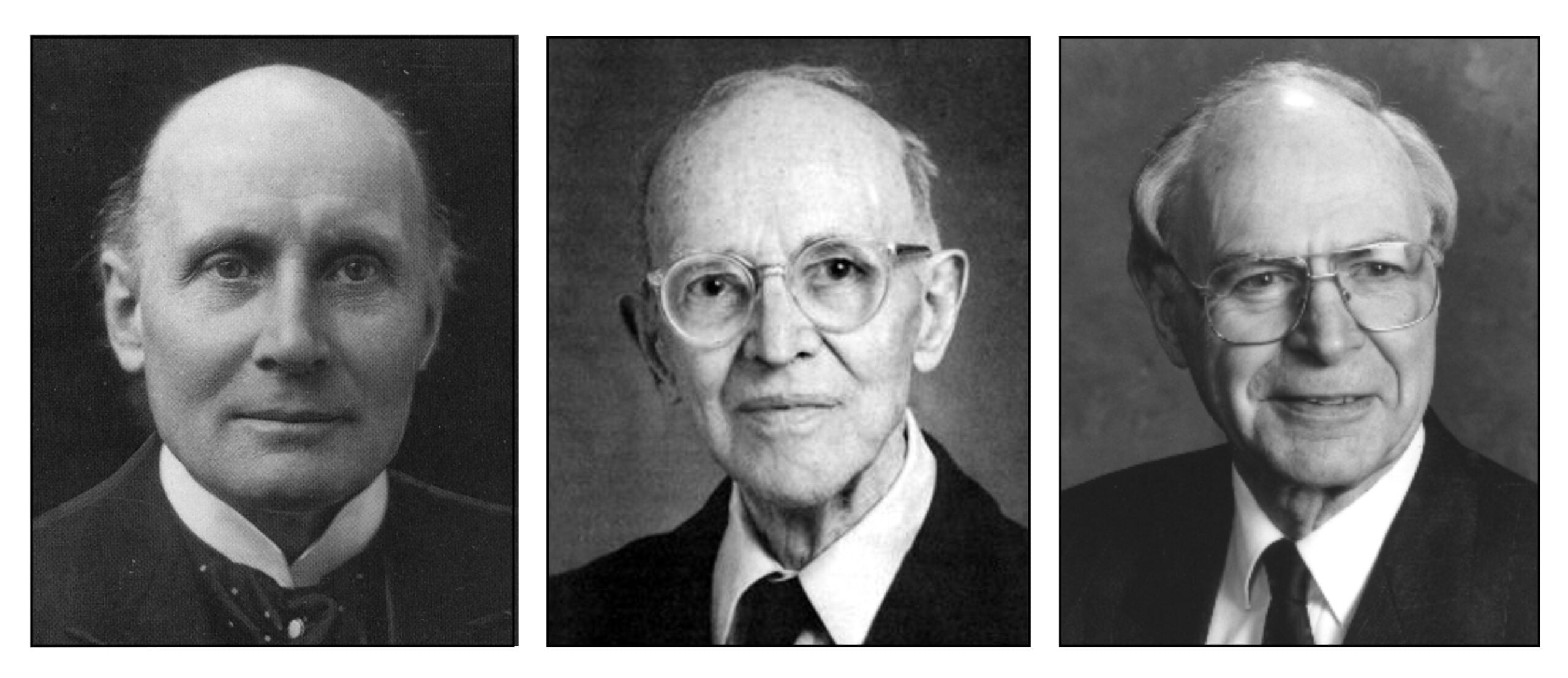
These principles are closely related to the process theology of Alfred North Whitehead (1861-1947) and to the panentheism of Charles Hartshorne (1897-2000) and Arthur Peacocke (1924-2006) – illustrated from left to right in the following figure.
The main idea of process theology is that God is the universe becoming itself. This occurs through an outpouring of God’s love and goodness into the world. Since the process is intelligible  rather than mysterious, science becomes the study of God in all his manifestations. Process theology also provides a way of reconciling the existence of God with the presence of suffering in the world. God and the universe are in the process of becoming. Evil and suffering are present to the extent that this process is as yet incomplete. The following quotation is from Whitehead’s Process and Reality (1929, p 532):

There are thus four creative phases in which the universe accomplishes its actuality. There is first the phase of conceptual origination, deficient in actuality, but infinite in its adjustment of valuation. Secondly, there is the temporal phase of physical origination, with its multiplicity of actualities. In this phase full actuality is attained; but there is deficiency in the solidarity of individuals with each other. This phase derives its determinate conditions from the first phase. Thirdly, there is the phase of perfected actuality, in which the many are one everlastingly, without the qualification of any loss either of individual identity or of completeness of unity. In everlastingness, immediacy is reconciled with objective immortality. This phase derives the conditions of its being from the two antecedent phases. In the fourth phase, the creative action completes itself. For the perfected actuality passes back into the temporal world, and qualifies this world so that each temporal actuality includes it as an immediate fact of relevant experience. For the kingdom of heaven is with us today. The action of the fourth phase is the love of God for the world. It is the particular providence for particular occasions. What is done in the world is transformed into a reality in heaven, and the reality in heaven passes back into the world. By reason of this reciprocal relation, the love in the world passes into the love in heaven, and floods back again into the world. In this sense, God is the great companion — the fellow-sufferer who understands.

Panentheism is a type of pantheism wherein God exists both within and beyond the world (Clayton & Peacocke, 2004, Attfield, 2019; Culp, 2023). Evil exists but only to the extent that the universe is as yet incompletely actualized. Burns (2019) proposes that God exists in two ways – one as the force that causes the actualization of the universe (“God the World”) and the second as the force that maximizes the good in the world (“God the Good”). This approach provides some purpose to the world and to human striving. Everything moves towards the good. Without this aspect process theology can become heartless. To return to Hume we might have a very pessimistic view of our world:

Look round this universe. What an immense profusion of beings, animated and organised, sensible and active! You admire this prodigious variety and fecundity. But inspect a little more narrowly these living existences, the only beings worth regarding. How hostile and destructive to each other! How insufficient all of them for their own happiness! How contemptible or odious to the spectator! The whole presents nothing but the idea of a blind Nature, impregnated by a great vivifying principle, and pouring forth from her lap, without discernment or parental care, her maimed and abortive children! (Hume, 1979, part XI)

The Biblical text justifying process theology and panentheism comes from Paul’s sermon on the Hill of Mars in Athens

God that made the world and all things therein, seeing that he is Lord of heaven and earth, dwelleth not in temples made with hands;

Neither is worshipped with men’s hands, as though he needed any thing, seeing he giveth to all life, and breath, and all things;

And hath made of one blood all nations of men for to dwell on all the face of the earth, and hath determined the times before appointed, and the bounds of their habitation;

That they should seek the Lord, if haply they might feel after him, and find him, though he be not far from every one of us:

For in him we live, and move, and have our being; as certain also of your own poets have said. (Acts 17:24-28)

In A Corner of the Veil, Waldenhag interprets what he has read in terms of the God the Father and God the Son

The Father accepts everything, since He is the source of everything. But He suffers everything. There is no distance between the suffering of man and the suffering of God. And the Father risks everything in His creation. Because it is totality, creation carries within itself the germs of its own destruction. The Father is at stake there. The Son saves not only mankind, but in some way He also saves the Father. He justifies the Father’s creation. (pp 254-255)

Although convinced by the proof, he still has concerns

Man informed of the proof will finally be free, his consciousness much elevated and his actions disinterested. On the other hand, knowing that God is in everything carries the risk of legitimizing any and all behavior. . . . the brute may be confirmed in his brutality, the sadistic husband confirmed in his sadism, and so on. Amorality could take hold of mankind. (p 255)

This concern might perhaps be alleviated if we agree with Burns’ concept that God is both the world becoming itself and the world becoming good.


Epilogue

At the end of the book, the Casuists present the proof to the Secretary of State for the Vatican. The final decision is not the publish the proof. All those who have read the proof will be enjoined not to repeat it to anyone. The marvelous new proof will become a pontifical secret:

Qu’est-ce qu’un secret pontifical? — C’est une information que le Saint-Père ne doit connaître sous aucun prétexte.

[What is a pontifical secret? A piece of information the Holy Father must not learn under any circumstances. (p 269)]


References

Attfield, R. (2019). Panentheisms, creation and evil. Open Theology, 5(1), 166–181.

Ben Ahmed, F. & Pasnau, R. (2025). Ibn Rushd [Averroes]. The Stanford Encyclopedia of Philosophy.

Burns, E. (1999). Apocalypse now. New York Times Book Reviews. August 1, 1999

Burns, E. D. (2019). How to prove the existence of God: an argument for conjoined panentheism. International Journal for Philosophy of Religion, 85(1), 5–21.

Clayton, P., & Peacocke, A. R. (Eds). (2004). In whom we live and move and have our being: Panentheistic reflections on God’s presence in a scientific world. William B. Eerdmans.

Cobb, K. (2005). The Blackwell guide to theology and popular culture. Blackwell 

Cossé, L. (1996). Le coin du voile. Gallimard.

Cossé, L. (translated by Asher, L., 1999). A corner of the veil. Scribner.

Culp, J. (2023). Panentheism. The Stanford Encyclopedia of Philosophy

Dales, R. C. (1990). Medieval discussions of the eternity of the world. E.J. Brill.

Dumort, J. (1997), Le coin du voile. La Jaune et la Rouge. No 523.

Eder, R. (1999). A Corner of the Veil: Proof of God in a Small Brown Envelope. New York Times. (18 July)

Goldstein, R. (2010). 36 arguments for the existence of God: a work of fiction. Pantheon Books.

Hume, D. (1779, reprinted 2006). Dialogues Concerning Natural Religion. Dover Publications.

Jonsen, A. R. (2005). Practical reasoning and moral casuistry. In Schweiker, W. (Ed.) The Blackwell companion to religious ethics. (pp 53-60). Blackwell.

Mackie, J. L. (1982). The miracle of theism: arguments for and against the existence of God. Clarendon Press.

McCombie, (1999). A Question of Faith: A new French novel slyly probes the limits of faith in our modern world. The Free Library (September, 1, 1999).

McInerny, R. (1999). End Notes: Martyrum Candidatus Laudat Exercitus. Crisis Magazine (February 1, 1999).

Pasnau, R. (2024). Thomas Aquinas. The Stanford Encyclopedia of Philosophy

Perrine, T. (2025). Humean arguments from evil against theism. Internet Encyclopedia of Philosophy.

Picton, T. W. (2013). Creature and Creator: intersections between science and religion. Picton.

Polzer, J. (1993). The “Triumph of Thomas” panel in Santa Caterina, Pisa. Meaning and date. Mitteilungen Des Kunsthistorischen Institutes in Florenz, 37(1), 29–70.

Restivo, S. P. (2021). Society and the death of God. Routledge.

Speak, D. (2014). The problem of evil. Polity Press.

Van Inwagen, P. (2006). The problem of evil. Oxford University Press.

Whitehead, A. N. (1929). Process and reality, an essay in cosmology. Macmillan.

Wittgenstein, L. (translated by P. Wench & edited by Wright, G. H. von, 1980). Culture and value. University of Chicago Press.
Paul-Émile Borduas: Le Refus Global

Paul-Émile Borduas (1905-1960) was a Quebec artist who became world-famous in the 1950s for his striking abstract paintings. In the early 1940s he had founded Les Automatistes, a group of artists interested in Surrealism. In 1948, he and his colleague had published the Refus Global (Total Refusal), a manifesto urging his fellow Québécois to throw off the oppressive authority of the Union Nationale Party and the Catholic Church. His call to freedom antagonized those in power. After being fired from his teaching position, he left Canada to work in New York and Paris. Shortly after his death in February 1960, the Liberal Party defeated the Union Nationale in the Provincial Election in June, 1960, and La Révolution Tranquille (Quiet Revolution) began to modernize Quebec society.     

Apprentice

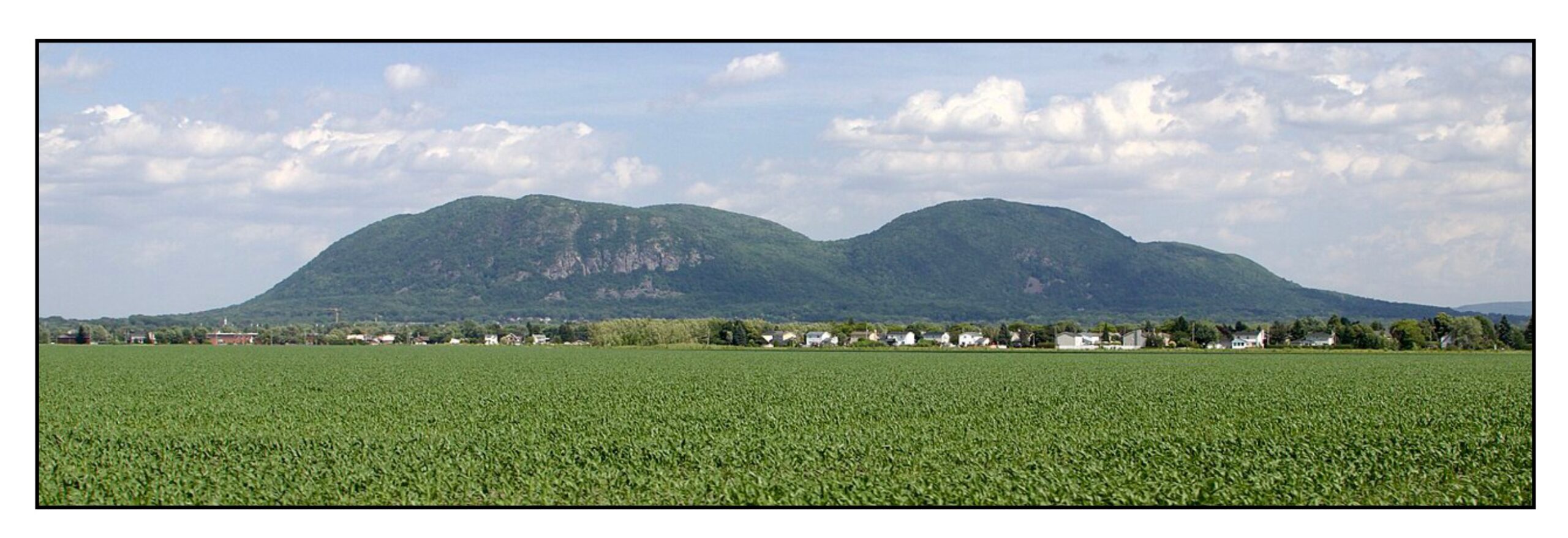
Borduas was born in Mont Saint Hilaire about 40 km east of Montreal in the valley of the Richelieu River which flows from Lake Champlain into the St Laurent River. The mountain arises abruptly from a surrounding plain famous for its apple orchards.

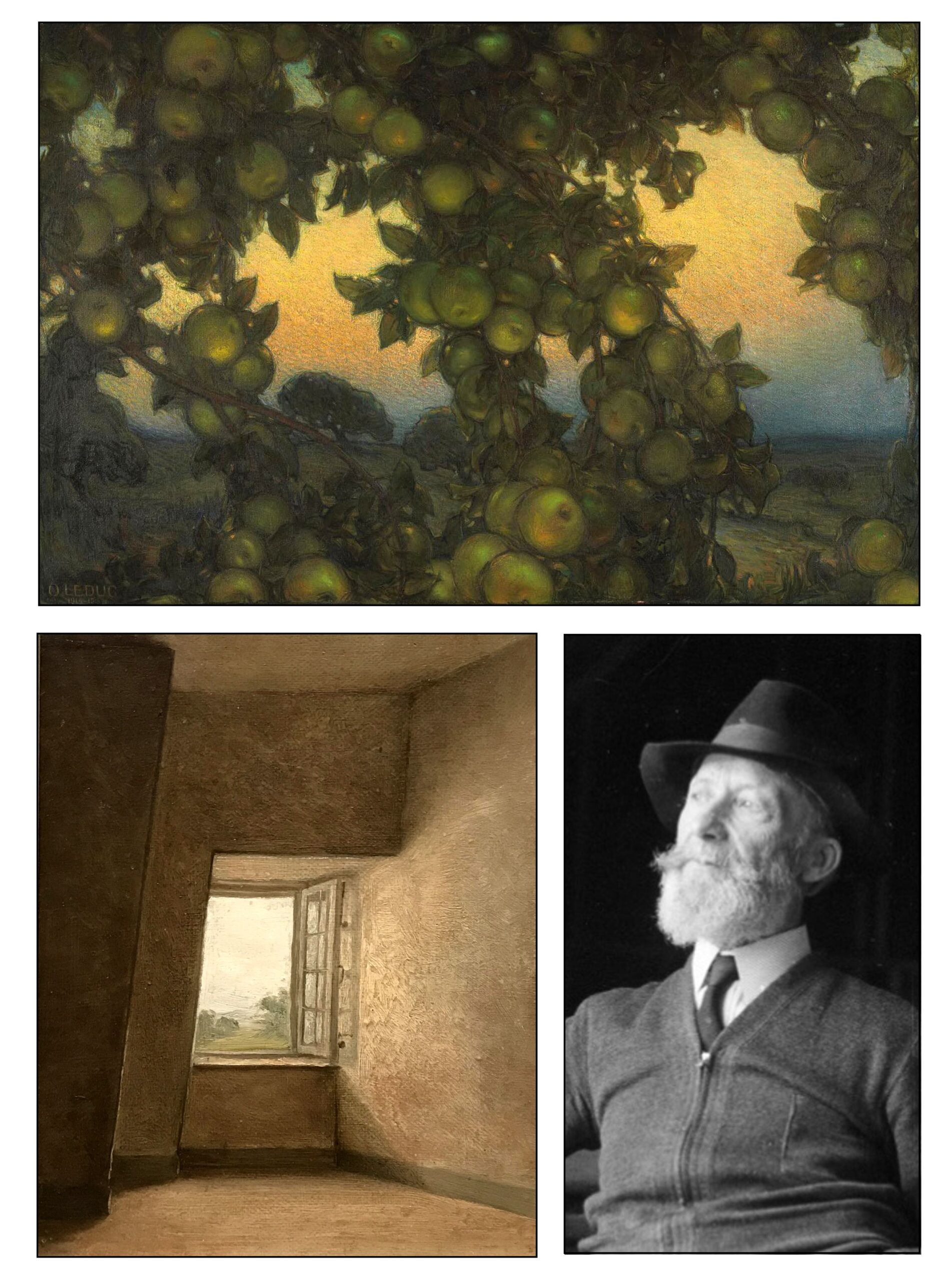
In his teens, Borduas became apprenticed to Ozias Leduc (1864-1955), a painter from the same region, and helped him at his work as a church decorator. Leduc was a talented representational artist with a modernist sensibility (Lacroix, 2019). The following illustration shows his Green Apples (1915), Open Window (1900), and a photograph from 1936.

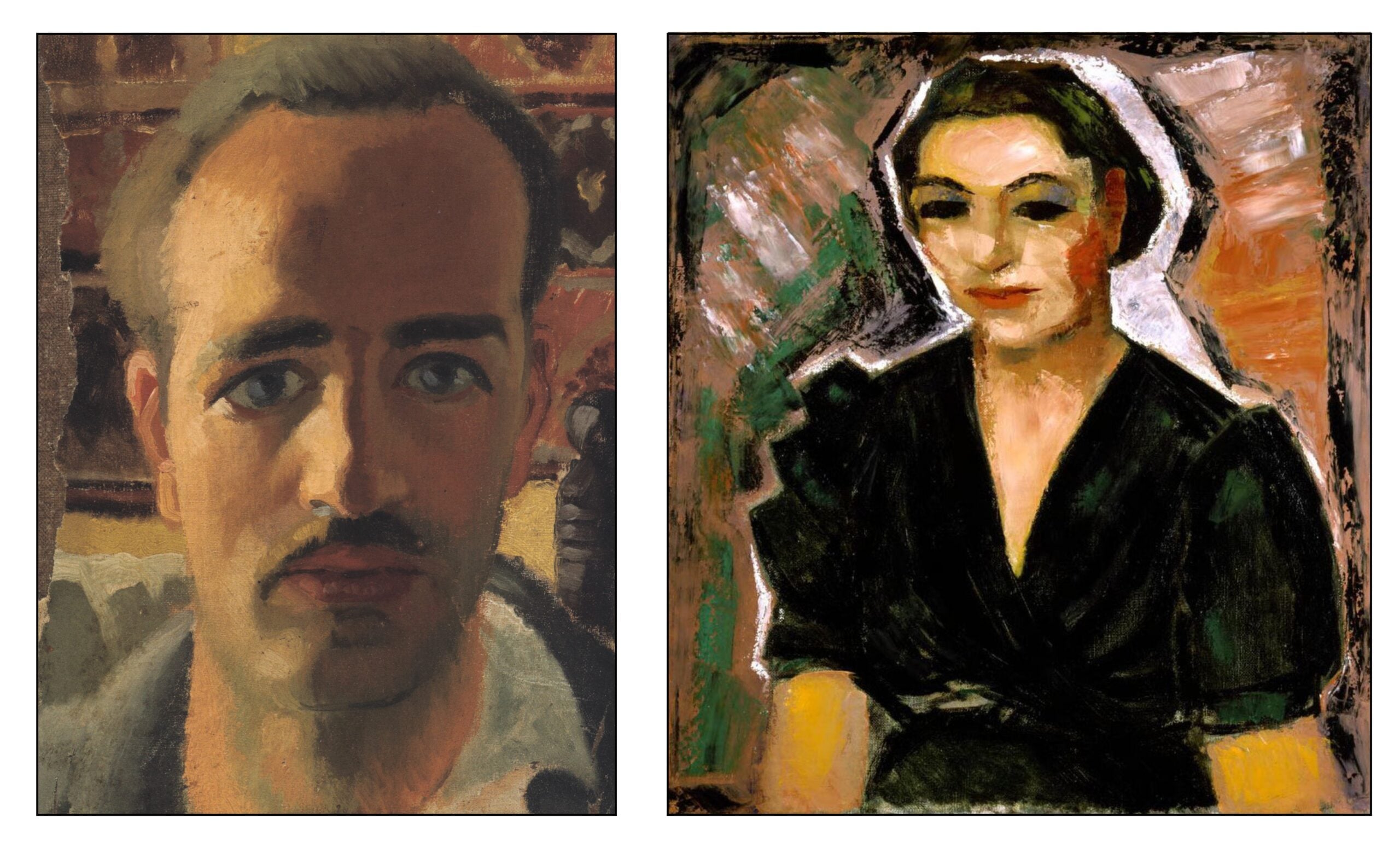
Leduc arranged for Borduas to have art lessons in Sherbrooke, and in 1923 supported his admission to the newly opened École des Beaux-Arts de Montréal. After he graduated Borduas spent a year of further study in Paris. On his return, he became an art teacher in the Catholic school system. In 1935, he married Gabrielle Goyette and settled down to family life in Mont Saint Hilaire. In 1937, he was appointed professor at the École du meuble de Montréal, which the government had just established to provide training for workers in the province’s furniture industry. The following illustration shows a Self-Portrait from 1928 and a Portrait of Madame Gagnon from 1941.


Les Automatistes

In the late 1930s Borduas became intrigued by ideas of André Breton and the Surrealists. He began to experiment in painting by instinct rather than by reason. Breton, in Le Manifeste du Surréalisme (1924), had defined surrealism as

Psychic automatism in its pure state, by which one proposes to express — verbally, by means of the written word, or in any other manner — the actual functioning of thought. Dictated by the thought, in the absence of any control exercised by reason, exempt from any aesthetic or moral concern.

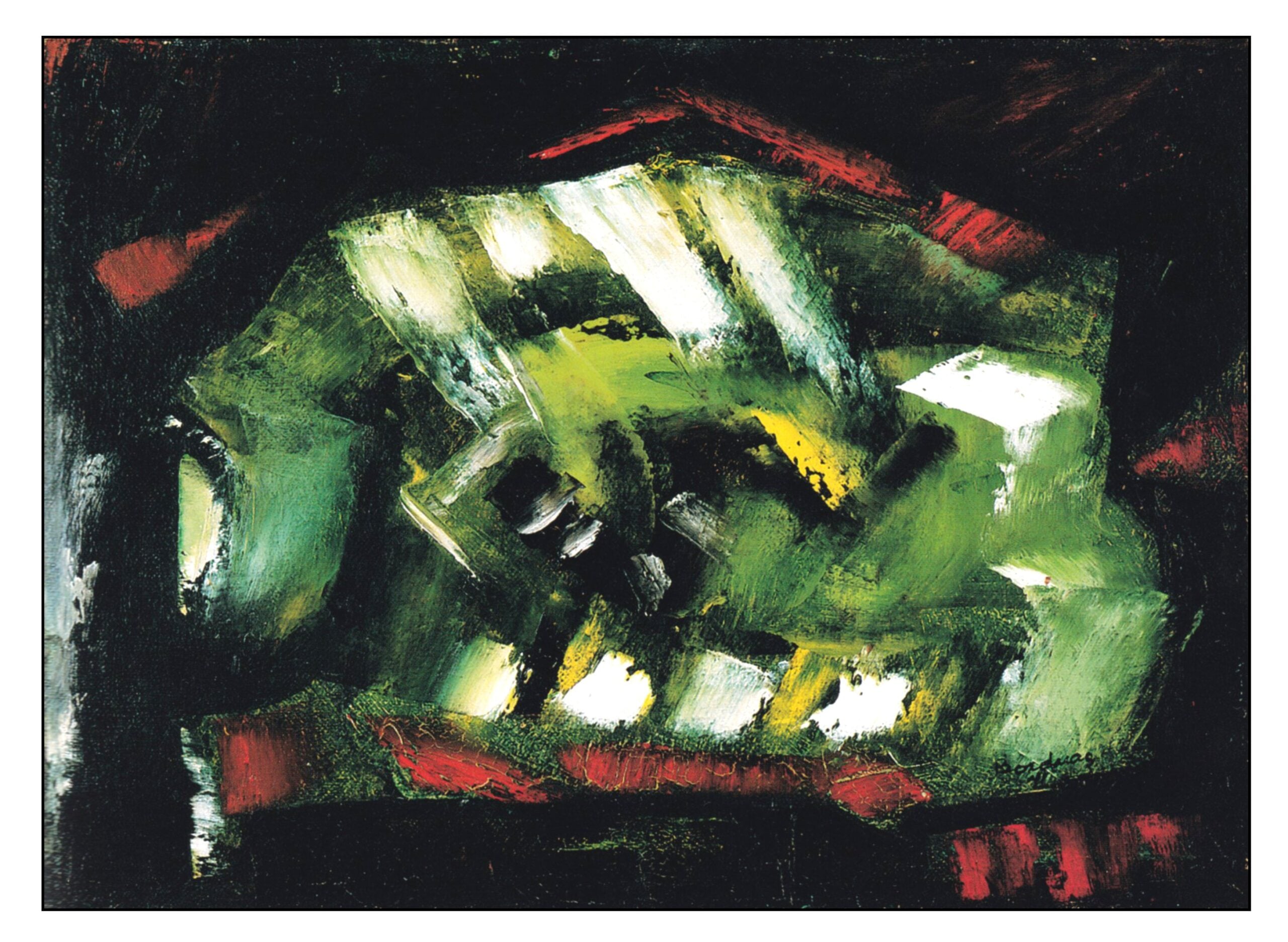
The following illustration shows one of Borduas’s early abstract paintings: Green Abstraction (1941). He described it as his “first totally non-preconceived painting” (Gagnon, 1988, p 166).  

Borduas soon put together a set of 45 gouaches painted using the principles of surrealism for a solo exhibition in Montreal in 1942 (Gagnon, 2013, pp 117-135). At the time he described his artistic technique as follows;

I begin with no preconceived idea. Faced with the white sheet, my mind free of any literary ideas, I respond to my first impulse. If I feel like placing my charcoal in the middle of the page, or to one side, I do so with no questions asked, and then go on from there. Once the first line is drawn, the page has been divided and that division starts a whole series of thoughts which proceed automatically. When I use the word “thoughts” I mean painterly thoughts: thoughts having to do with movement, rhythm, volume and light, not literary ideas. Once the drawing has been completely worked out, the same steps are followed with colour. As with the drawing, if my first impulse is to use yellow, I don’t hesitate. And the first colour determines all the others. It’s at the stage of colour that the problems of light and volume present themselves. (quoted in Nasgaard & Ellenwood, 2009, p 12).

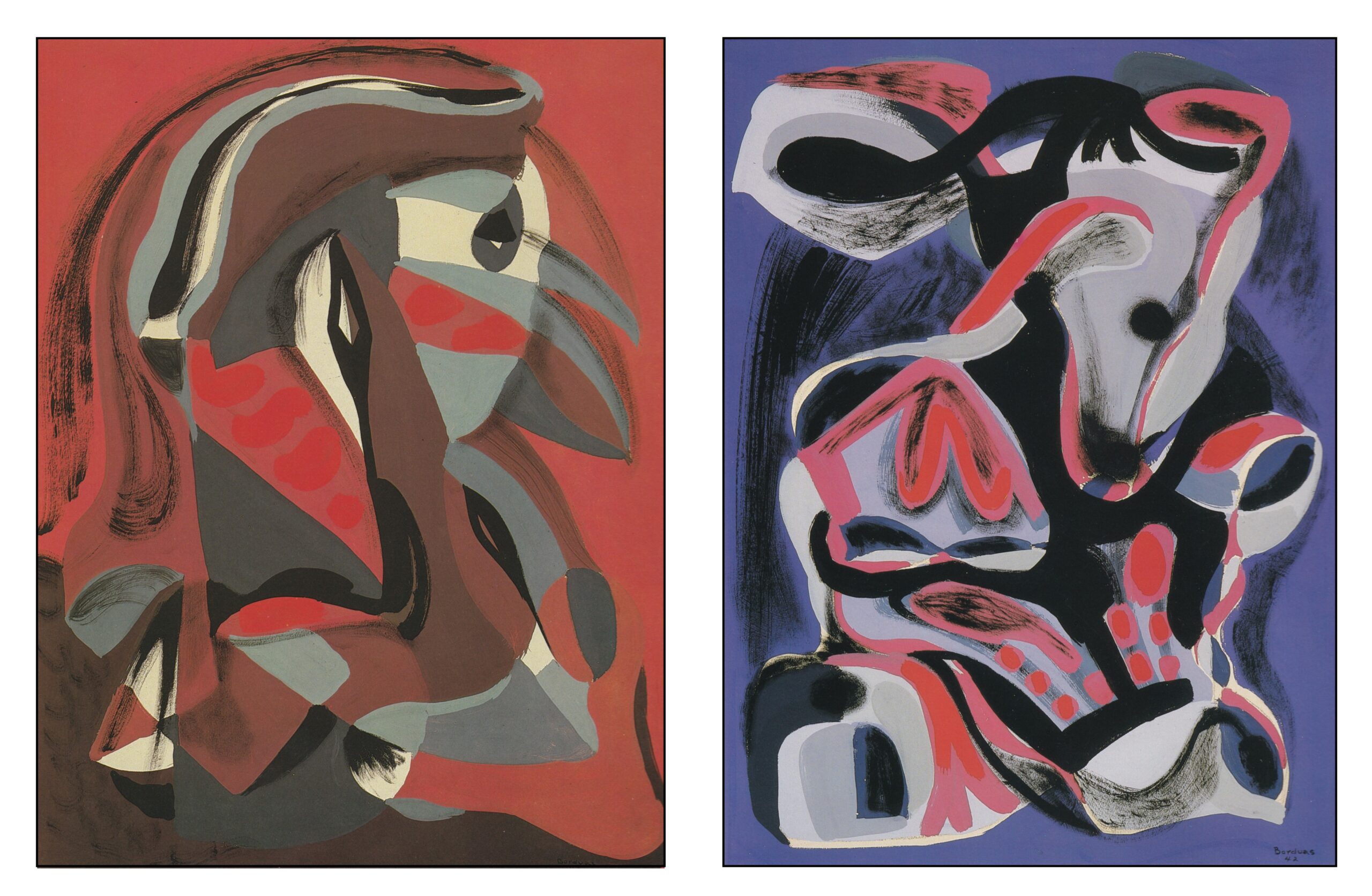
Two of the gouaches are illustrated below: Number 6 and Number 33. Some appeared to represent something – Number 6 soon became known as Le Chantecler (Rooster). Others, like Number 33, seemed completely abstract.  

Another important influence on Borduas was Marie-Alain Couturier (1897-1954). Between 1940 and 1944, the French Franciscan Father lived in North America in exile from occupied France. He spent some time in Quebec, encouraging artists to explore the new freedoms of modern art, and urging the church to support their new sense of beauty. Couturier had originally trained as a stained-glass artist, and went on to become an editor for the journal Art Sacré (Lion, 2010). Borduas had met him during his time in France, and the two interacted again when Couturier was a visiting lecturer at the École du meuble. The following is from one of Couturier’s essays published in Quebec:

It takes an effort of pure intuition to assure the birth and development of a work of art, a total abandonment to a certain obscure sense of the absolute. And, to tell the truth, there needs to be an absolute risk, which implies a state of constant insecurity for the artist. This is psychologically very difficult, often even anguishing, as it is entirely foreign to the stable order of certitudes that rule over and guarantee all other human activities. (Couturier, 1944, quoted in Warren, 2017, p 23).

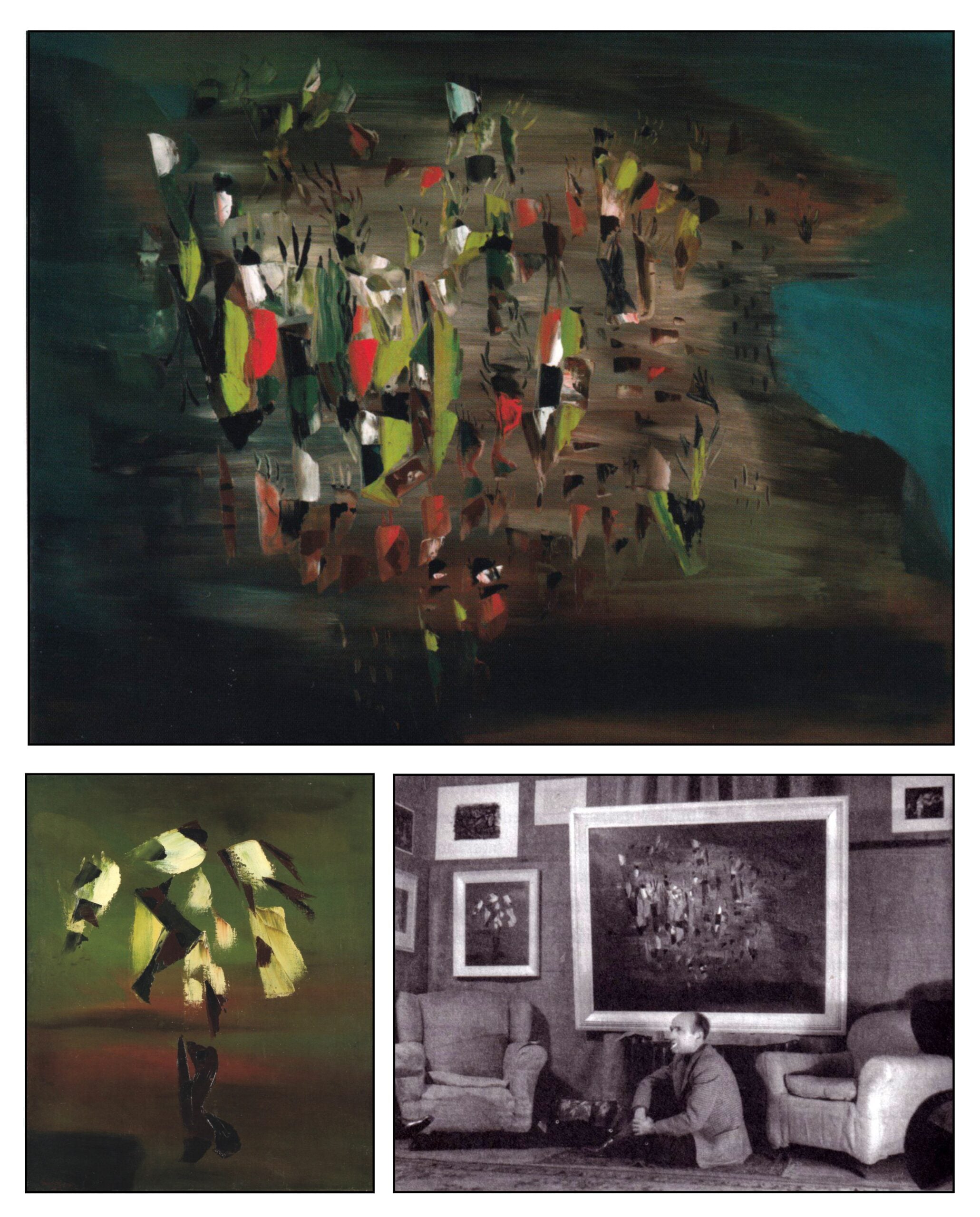
Over the next few years, Borduas assembled about him a group of talented young painters who were trying out the new modernist approaches to art. They had their first exhibition in 1947 at the house of his friend Claude Gauvreau, a poet and playwright, and brother of the painter Pierre Gauvreau. A journalist described the group as Les Automatistes from Borduas’s titles: for example, Automatisme 1.47 which later came to be known as Sous le vent de l’île (Leeward of the Island) (Nasgaard & Ellenwood, 2009; Gagnon, 2020). The following illustration shows Borduas at the exhibition in front of this painting and Automatisme 2.47 or Le Danseur.

The painting Sous le vent de l’île is impressive:

The canvas is cleanly divided into two registers. The first, consisting of broad horizontal brush strokes, corresponds to the background. A wide expanse beginning at the bottom of the picture and receding to infinity as the viewer’s gaze rises is flanked on the right by what could be interpreted as a sea meeting its shore. The space created in this way appears traversed “as if by a wind blowing from west to east:” On this background, without any apparent connection to it, a group of small red, green, black, and white blotches have been laid with a palette knife, like the pieces of a vertical veil blown about by the wind. The remarkable thing in this painting with respect to its predecessors is the extraordinary impression of depth it gives. The island, seen from above, at a height never before experienced in a Borduas work, takes on the dimensions of a continent and even the objects hanging in space remain at a certain distance from the viewer (they do not touch the edge of the canvas). (Gagnon, 2013, pp 192-193).


Le Refus Global

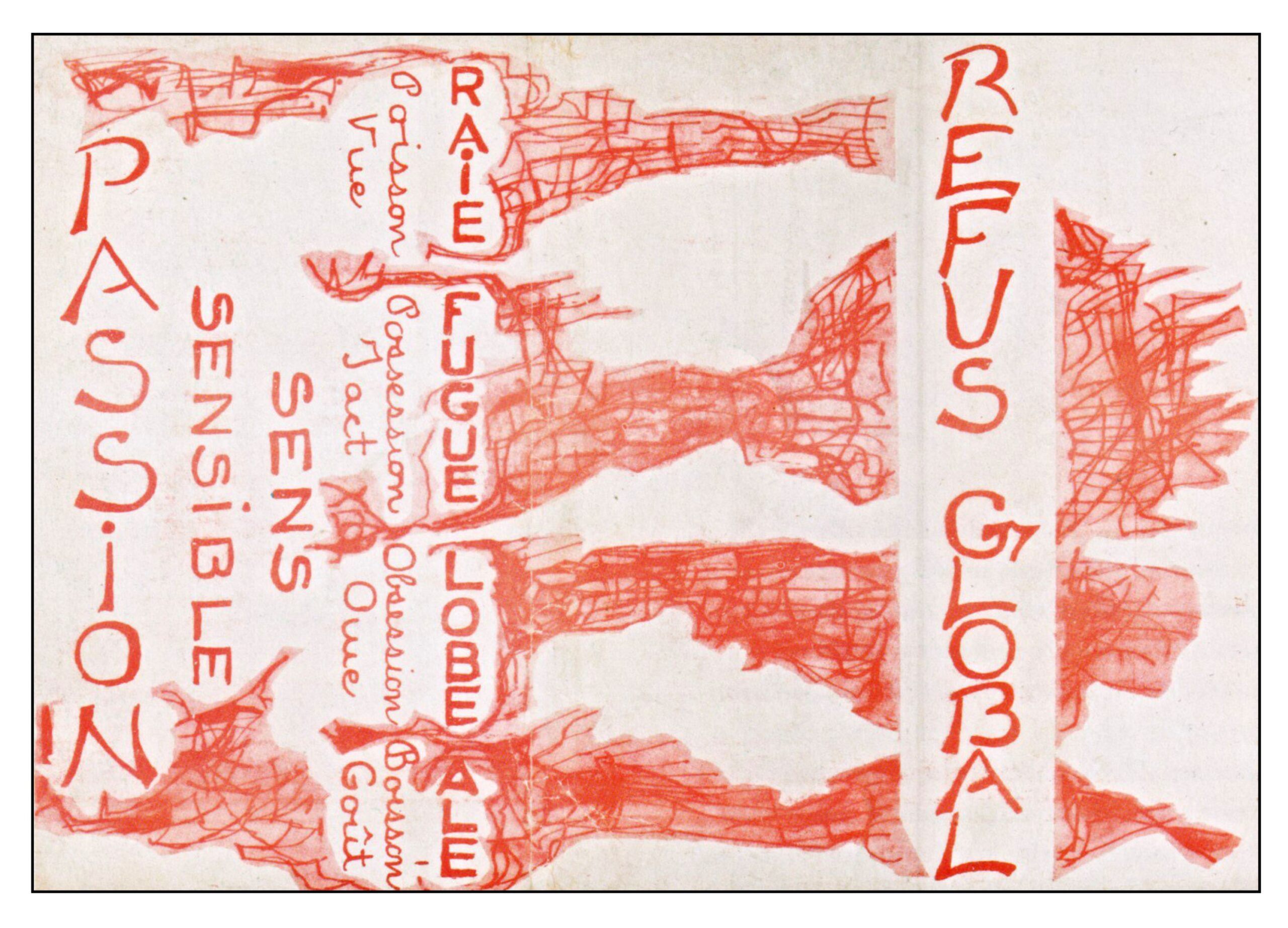
In 1948, Les Automatistes published a small manifesto entitled Le Refus Global (Total Refusal). Borduas was the lead author, and Jean-Paul Riopelle (1923-2001) designed the cover and frontispiece. Thirteen other artists also signed the manifesto, among them Marcelle Ferron (1924-2001), Claude Gauvreau (1925-1975), Fernand Leduc (1916-2014), and Françoise Sullivan (1923- ). Four hundred typescript copies were printed and only about half of these were sold (at a dollar apiece). Below is the frontispiece, which incorporates a poem by Claude Gauvreau about how information from the sensory world can be directly transformed into creative passion. The letters of the manifesto’s title are used to suggest the senses (raie for the light rays, fugue for tactile sensation, lobe for the earlobe, and ale for taste)

Borduas’s manifesto began with a rambling history of Quebec and its people and how they hade been exploited and kept in ignorance and by the Catholic Church:

Son exécrable exploitation, maintenue tant de siècles dans l’efficacité au prix desqualités les plus précieuses de la vie, se révélera enfin à la multitude de sesvictimes: dociles esclaves d’autant plus acharnés à la défendre qu’ils étaient plus misérables. L’écartèlement aura une fin. La décadence chrétienne aura entrainé dans sa chute tous les peuples, toutes les classes qu’elle aura touchées, dans l’ordre de la première à la dernière, de haut en bas.

[A loathsome exploitation, effectively maintained for centuries at the cost of the best things in life, will be exposed at last to a multitude of victims, docile slaves whose eagerness to defend their servitude has been in direct proportion to their wretchedness. The torture will end. Christian decadence in its collapse will drag down all the peoples and classes it has touched, from first to last, from top to bottom.] (translation of this and following passages by Ray Ellenwood, Borduas, 1985)

Borduas then called for a break with the past:

D’ici là notre devoir est simple. Rompre définitivement avec toutes les habitudes de la société, se désolidariser deson esprit utilitaire. Refus d’être sciemment au-dessous de nos possibilitéspsychiques. Refus de fermer les yeux sur les vices, les duperies perpétrées sous lecouvert du savoir, du service rendu, de la reconnaissance due. Refus d’uncantonnement dans la seule bourgade plastique, place fortifiée mais faciled’évitement. Refus de se taire — faites de nous ce qu’il vous plaira mais vousdevez nous entendre — refus de la gloire, des honneurs (le premier consenti): stigmates de la nuisance, de l’inconscience, de la servilité. Refus de servir, d’être utilisables pour de telles fins. Refus de toute intention, arme néfaste de la raison. À bas toutes deux, au second rang! Place à la magie! Place aux mystères objectifs! Place à l’amour! Place aux nécessités! Au refus global nous opposons la responsabilité entière.

[We must break with the conventions of society once and for all, and reject its utilitarian spirit. We must refuse to function knowingly at less than our physical and mental potential; refuse to close our eyes to vice and fraud perpetrated in the name of knowledge or favours or due respect. We refuse to be confined to the barracks of plastic arts — it’s a fortress, but easy enough to avoid. We refuse to keep silent. Do what you want with us, but you must hear us out. We will not accept your fame or attendant honours. They are the stigmata of shame, silliness and servility. We refuse to serve, or to be used for such purposes. We reject all forms of intention, the two-edged, perilous sword of reason. Down with both of them, back they go! Make way for magic! Make way for objective mysteries! Make way for love! Make way for necessities! Counterbalancing this total refusal is our complete responsibility]

And invited the reader to join in the new creative freedom:

Au terme imaginable, nous entrevoyons l’homme libéré de ses chaines inutiles, réaliser dans l’ordre imprévu, nécessaire de la spontanéité, dans l’anarchie resplendissante, la plénitude de ses dons individuels. D’ici là, sans repos ni halte, en communauté de sentiment avec les assoiffés d’un mieux-être, sans crainte des longues échéances, dans l’encouragement ou la persécution, nous poursuivrons dans la joie notre sauvage besoin de libération.

[Within a foreseeable future, men will cast off their useless chains. They will realize their full, individual potential according to the unpredictable, necessary order of spontaneity — in splendid anarchy. Until then, we will not rest or falter. Hand in hand with others thirsting for a better life, no matter how long it takes, regardless of support or persecution, we will joyfully respond to a savage need for liberation.]

The public paid little attention. However, the reaction of the church and government was swift. A month after the manifesto was published, Borduas was fired from his position at the École du meuble. The reason given in the official government letter was

*His writings and the manifestos he publishes, as well as his state of mind, make him unsuitable for the kind of teaching we wish for our students. (quoted by Ellenwood in his introduction to Borduas, 1985)

Borduas was devastated. He continued to paint and began to make abstract wooden sculptures, but he soon began to experience financial difficulties. His marriage came under great strain. In 1951 and Gabrielle finally took the children and left her husband. In 1953, Borduas abandoned Canada, moving for a few months to Provincetown on Cape Cod, and then on to New York.


New York

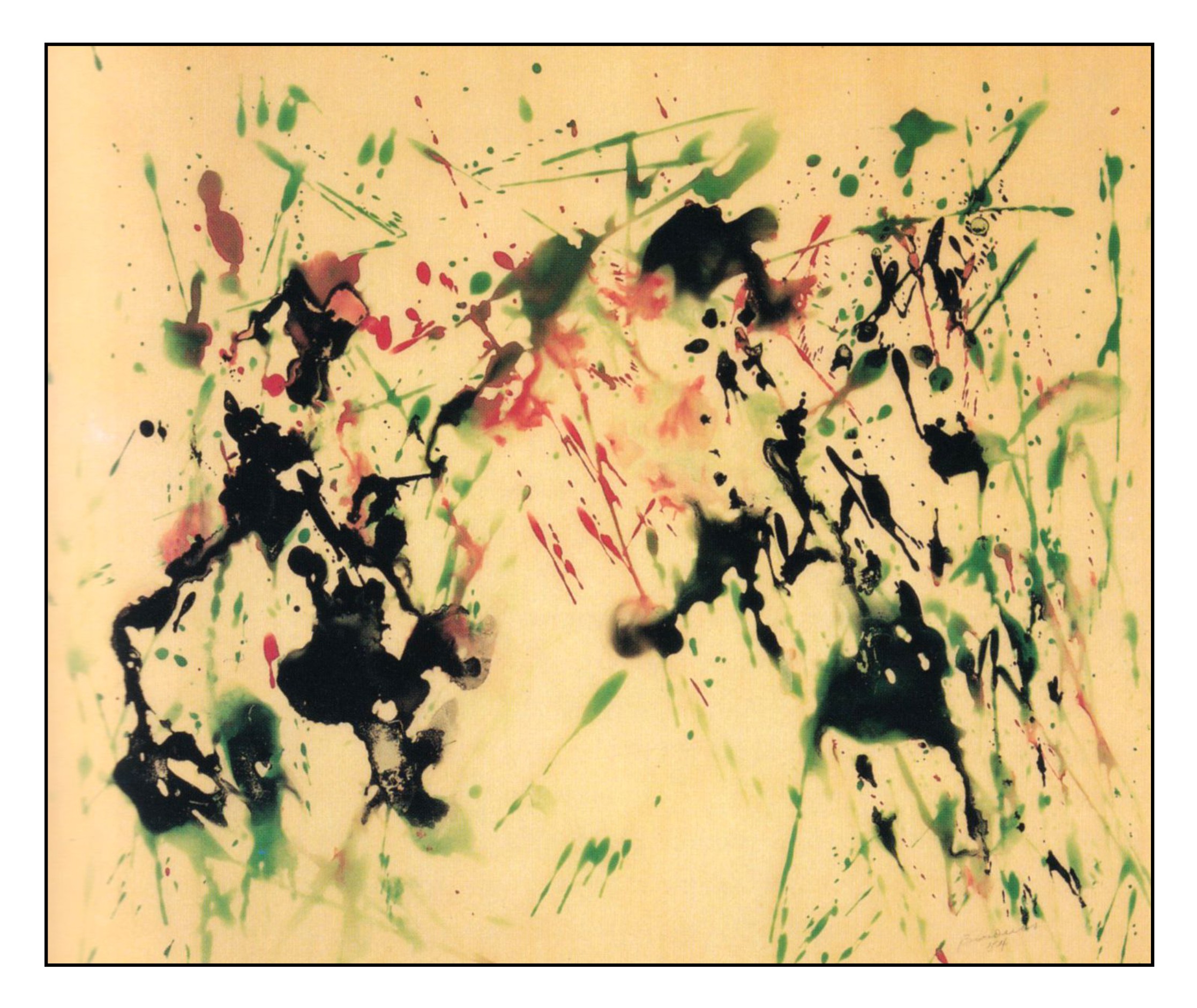
New York in 1953 was abuzz with the new Abstract Expressionism. Borduas was impressed with the “action painting” of Jackson Pollock, and created a series of his own drip paintings using watercolors. The following is Gerbes légères (Light Sheaves) from 1954:

Borduas was also intrigued by the abstract calligraphy of Franz Kline, the monumental color fields of Clyfford Still, and the powerful simplicity of Robert Motherwell. He began to apply paint in broad strokes or taches using a palette knife. His painting suggested multicolored knots of color in a thick white fabric. A striking painting from this time was Blue Drops, 1955:   

Paris

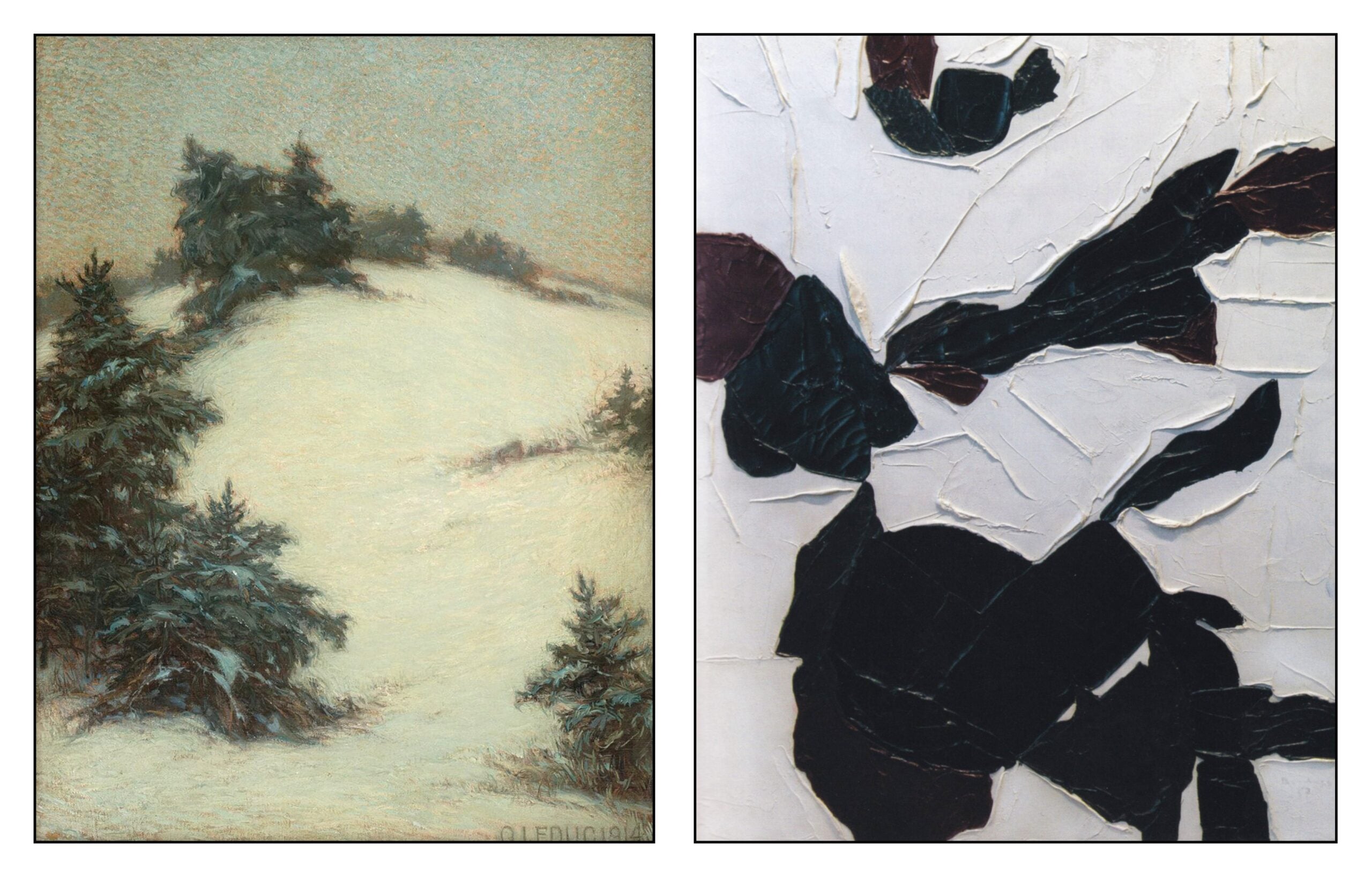
In 1955 Borduas moved to Paris. His palette became more restricted: paintings of black shapes on a white background became his iconic images. These paintings convey a deep sense of winter. They recall some of the paintings by his early master Ozias Leduc. The following illustration compares Leduc’s Grey Effect (Snow) from 1914 with Borduas’s Ardente from 1957:

The following is a quotation from Herta Wescher introducing an exhibition of his new abstract paintings in Paris in 1959:

his first burst of activity produced dynamic compositions swirling with movement in a range of shimmering tones. In later works, however, the elements were condensed and reduced in number, forming dark constellations within light grounds. White has become Borduas’ predominant colour, and he is capable of imbuing it with the most subtle of modulations. He covers his canvases with huge luminous expanses of white, at the edges of which very severe black shapes seem to terminate the space. Slowly, the jagged contours position and align themselves, and the internal structures of the compositions fall into place. Never, though, are the surfaces monotonous or schematic. Borduas applies the pigment with broad knives, and the movement of his hand leaves its mark both on the smooth areas and on those that are riddled with nervous streaks. (quoted by Gagnon 1988, p 399)


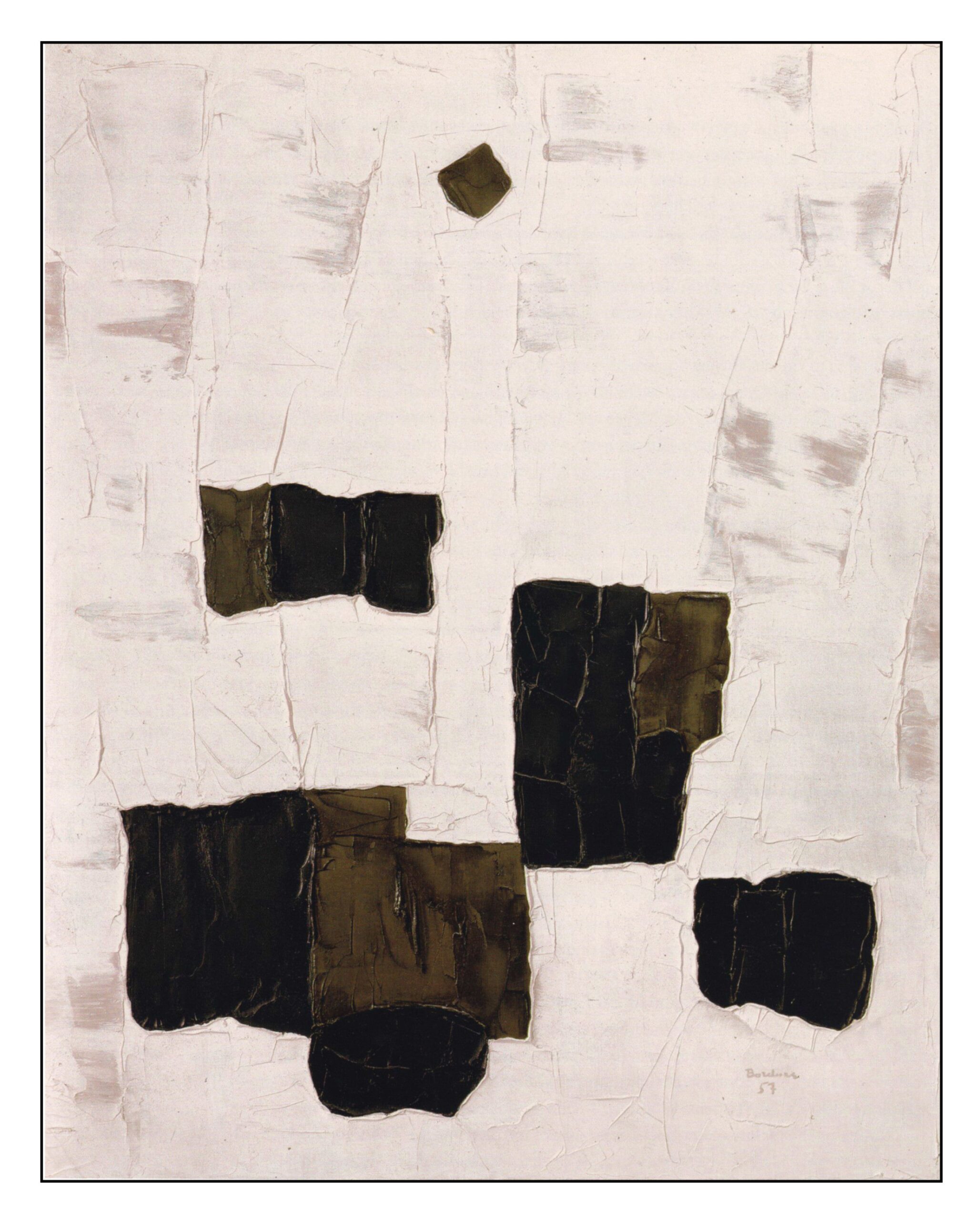
The following illustration shows Borduas’s most famous painting: L’Étoile Noire (Black Star) from 1957, now in the Montreal Museum of Fine Arts:

The painting is large – 1.62 meters high and 1.30 meters wide. Larger than anything he had painted before. It demands respect. 

The painting is very difficult to reproduce accurately. There are subtle shades of white, and patches of dark brown coalesce with the black. The edges of the taches are elevated forming lines of force throughout the image.

The following are comments on the painting by Gagnon (1988, p 202):

The use of dark brown in the three main spots towards the bottom adds considerably to the ambivalence of these dark areas. Where are we to place them? They appear both to be moving away towards infinity (black) and to be floating on the surface like blood coagulated on the skin (brown). The spots, on their own, thus encompass all positions in space, and the white is freed for other functions. It should be noted, in particular, how the white invariably covers the edges of all the dark spots with an over-lapping lip. It is thus not a background on which the spots stand out (which would be a Gestaltist reading). Might it not be a true colour field in which these black and brown spots are embedded? It is not really that either, for, as we have seen, the spots still keep their illusionistic power to evoke the abyss, the infinity of the cosmic night. In fact, the white acts as a screen. It serves to conceal some-thing from view and, like all screens, it is interesting to look at in itself If we follow the folds in the white, the edges that it forms around the spots, we will see that it encloses them in a network of lines as structured as those in a Mondrian painting. But what we have here is a Mondrian shot through with the tremor of life — in sharp contrast to the exclusively spiritual character sought by the great Dutch artist in his own works. In Borduas’ painting, the spirit is never divorced from the material; it reveals itself as much in the recesses of the paint as in the rigour of the composition.

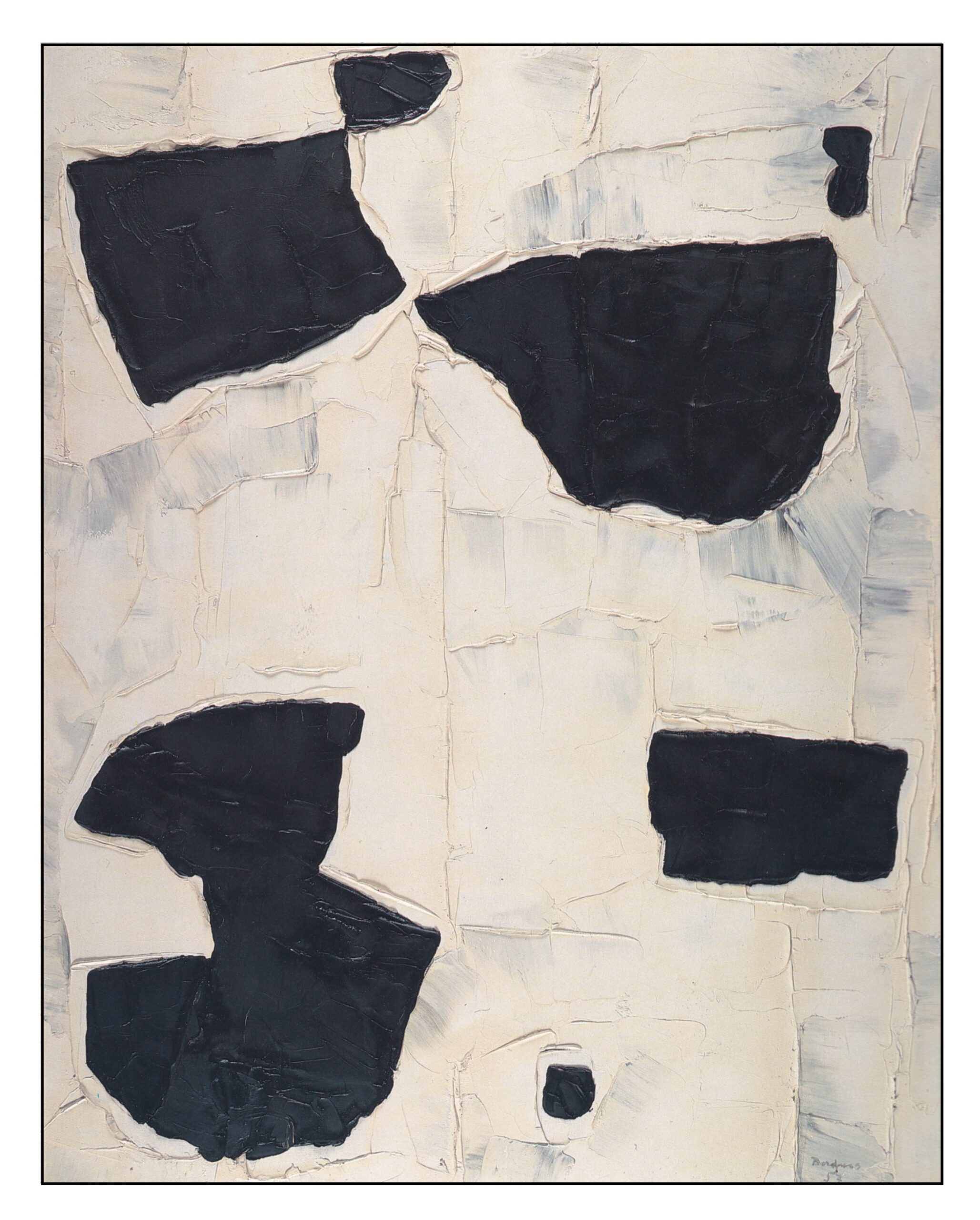
Another painting from this time is Magnetic Silence (1957). This has the same imposing size as Black Star. The black shapes at the top of the painting appear to be attracted toward each other, whereas those at the bottom appear to display repulsion. The white background on which the black shapes exist shows the energy with which Borduas created his image. The edges between the various color areas rise up with the force of their interaction. Tectonic plates come forcefully to mind.  

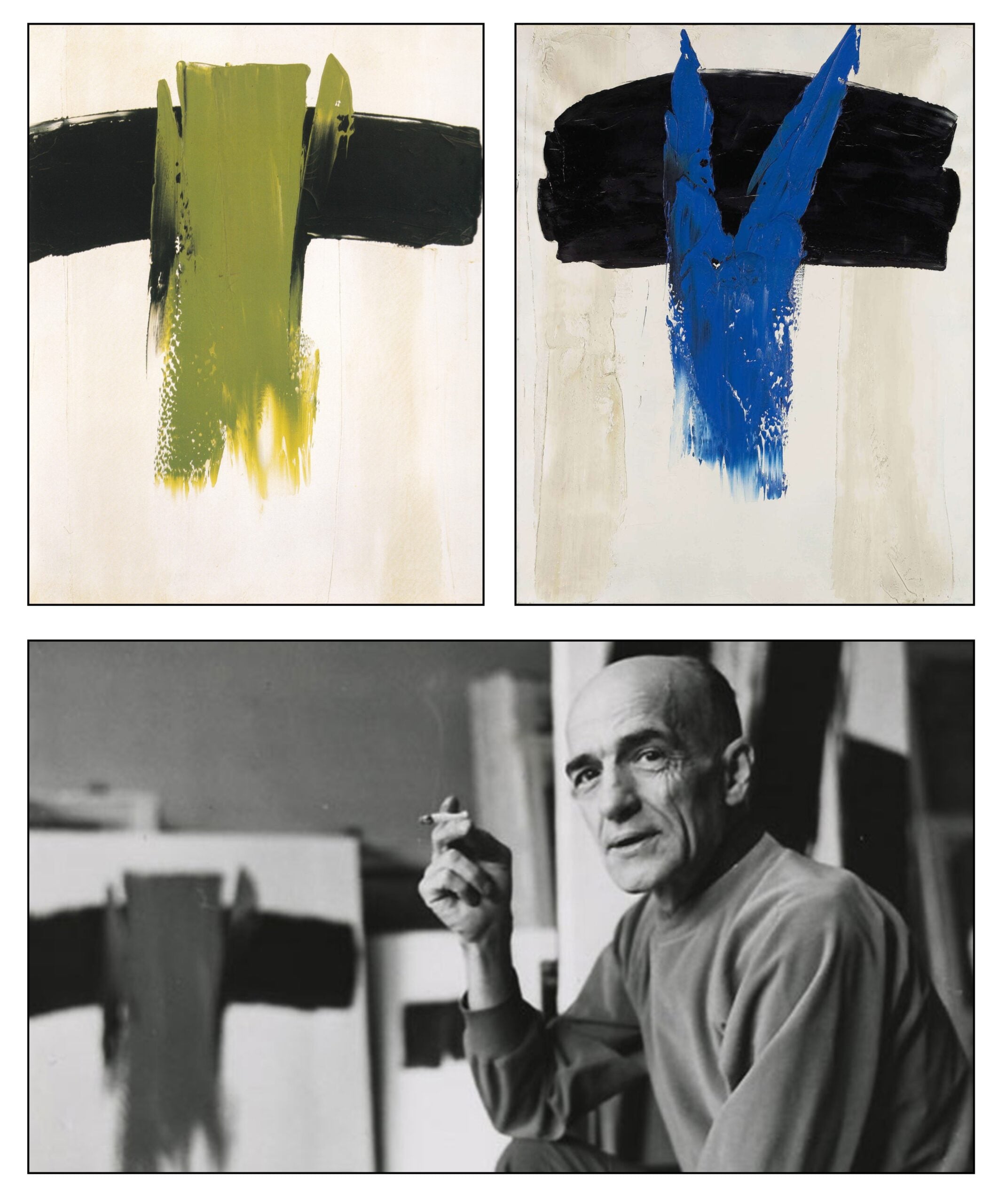
Another style that Borduas explored in Paris placed simple calligraphic shapes in black and in color on a white background. Perhaps an attempt to decode the infinite. The following illustration shows two of these paintings and a photograph from 1959:

Borduas was not well. He was depressed about his exile from Canada, and his heart was starting to fail. His mental and physical and stresses found their way into this painting:

Ma peinture deviant de plus en plus sévère, noir et blanc, simplifiée; je n’y plus rien; c’est ma “fatalité.” [My painting is becoming more and more severe, black and white, simplified; I have nothing left; it is my “fatality.”] (quoted by Lambert 2015, p 94)

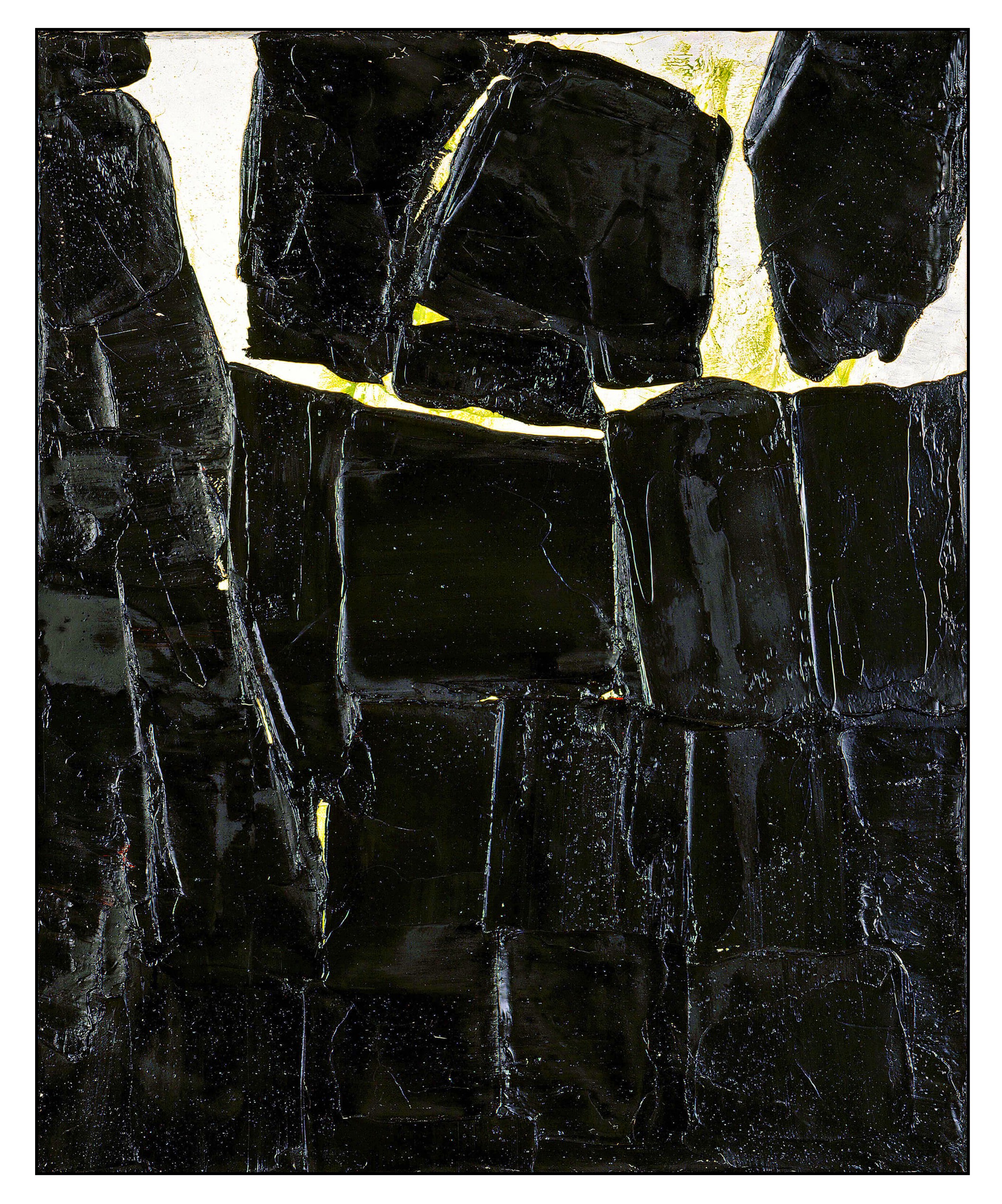
He died of a heart attack in February 1960. At his death, Borduas left on his easel a large black and white painting (later titled Composition 69):


His friend the poet Jean-Paul Filion described the painting

Une seule masse noire et immense couvrant la surface presque totale de la toile, avec, dans le haut, un mince horizon de blanc dans lequel baigne un soupçon de vert limpide et où le peintre a piqué deux petites formes noires rectangulaires, créant ainsi une perspective fascinante vers l’espace. Que viennent faire ces deux blocs, ces deux masques, ces deux fantômes comme des bouts de linceul, et qui persistent à prendre toute la place dans un espace réduit de lumière inaccessible, le tout placé comme en exergue au sommet d’un haut mur de charbon luisant? Ce qui m’entraîne à voir dans cette oeuvre limite l’illustration d’une sorte de désespoir vécu aux confins du cosmos. Ai-je tort d’imaginer cela? (quoted in Lambert, 2015, p 97).

[One immense black mass covering almost the entire surface of the canvas. At the top, a thin white horizon with a hint of limpid green, in which the painter has stuck two rectangular black shapes, thus creating a fascinating view out into space. What are they doing there, these two blocks, these two masks, these two ghosts like bits of shroud, stubbornly taking up all the room in a cramped space of inaccessible light, sitting like an epigraph atop a high wall of glistening coal? I am led to see this final work as the illustration of a sort of despair experienced at the limits of the cosmos. Am I wrong in imagining that?]


La Révolution Tranquille

While Borduas was in self-imposed exile, the political landscape of Quebec was beginning to change. Since 1936, the province had been governed by the conservative Union Nationale party led by Maurice Duplessis, except for a brief period during World War II when the Liberal Party had won an election by promising to prevent conscription. The Union Nationale had close ties to the Catholic Church, and had hung a crucifix over the speaker’s chair in the National Assembly when they first came to power in 1936. One of their recuring slogans was Le ciel est bleu; l’enfer est rouge (Heaven is blue and Hell is red, a play on the colors of the two parties – blue for the Union Nationale and red for the Liberals). The Union Nationale was vehemently anti-union, and provided little if any support for education or social security, which were controlled by the church. The government supported a strictly capitalist economy, wherein the natural resources of the province were exploited by rich foreigners.   

In late 1959, Duplessis died. In the election of June 1960, a brief four months after the death of Borduas, the Liberal Party under Jean Lesage were victorious. The Liberals instituted many reforms: the nationalization of the power companies to form Quebec Hydro, the establishment of a Quebec pension, increased support for education which now came under government rather than church control, and recognition of the unions even in the civil service. These came to be known as La Révolution Tranquille (Quiet Revolution), and the preceding period when the province was controlled by the Union Nationale came to be known as La Grande Noirceur (Great Darkness). These terms were those of the victors. In actuality, the Union Nationale period was not as dark as they believed, and the revolution turned out to be not as quiet as they wished (Bouchard, 2005).  

After 1960, there were tremendous changes in Quebec society. Most importantly, the birth rate and the frequency of attendance at church declined precipitously. It is tempting to attribute these changes to the Liberal election. However, both a declining birth rate and an increasingly secular society occurred at the same time in the rest of Canada and in Western Europe. Other more global factors were at play: the availability of contraceptive medication and a burgeoning economy. 

Whatever the actual causes, Borduas would have been pleased with the new Quebec. His Refus Global had called for these new freedoms and new responsibilities. Although his manifesto was rejected at the time it was published, the ideas that it promoted germinated and were finally acted upon. 


References

Borduas, P.-É. (1948). Refus global. Mithra-Mythe Éditeur. Text of Borduas article is available. English translation available.

Borduas, P.-É. (translated by R. Ellenwood, 1985). Total refusal. Exile Editions.

Bouchard, G. (2005). L’imaginaire de la grande noirceur et de la révolution tranquille: fictions identitaires et jeux de mémoire au Québec. Recherches Sociographiques, 46(3), 411–436.

Breton, A. (1924, translated by R. Seaver and H. R. Lane, 1969). Manifestoes of Surrealism. Ann Arbor Paperbacks (University of Michigan Press)

Gagnon, F. M. (1988). Paul-Émile Borduas. Montreal Museum of Fine Arts.

Gagnon, F. M. (2014). Paul-Émile Borduas life & work. Art Canada Institute

Gagnon, F. M. (2013). Paul-Émile Borduas: a critical biography. McGill-Queen’s University Press.

Gagnon, F. M. (trans. D. Winkler, 2020) Jean Paul Riopelle and the Automatiste Movement, McGill-Queen’s University Press.

Lacroix, L. (2019) Ozias Leduc: life and work. Art Canada Institute

Lambert, P. (2015). Borduas: le rebelle de Saint-Hilaire. Marcel Broquet, la nouvelle édition.

Lion, A. (2010). Art sacré et modernité en France: le rôle du P. Marie-Alain Couturier. Revue de l’histoire des religions, 1|2010, 109-126.

Nasgaard, R., & Ellenwood, R.  (2009). The Automatiste revolution: Montreal, 1941-1960. Douglas & McIntyre.

Warren, J.-P. (translated by S. Urquhart, 2017). Living art: individual and collective creativity: becoming Paul-Émile Borduas. Exil


W. H. Auden: September 1, 1939

Wystan Hugh Auden (1907-1973) and Christopher Isherwood (1904-1986) arrived in the United States of America on January 26, 1939. The ostensible reason for their visit was to write a book on the United States, to be published by the Hogarth Press with the title Address Not Known. The two writers had just completed a book on China, Journey to a War, which was to come out in March. However, other reasons played a larger role in their decision to emigrate. Both writers were tired of the hypocrisy, complacency and insularity of British literary life. Auden claimed, “An artist ought either to live where he has live roots or where he has no roots at all.” (Davenport-Hines, 1995, p 180). In New York City they took lodging in the George Washington Hotel at Lexington and 23rd St., had their photographs taken by Carl van Vechten, visited with Thomas Mann and his family in Princeton, wrote reviews for American magazines, and gave readings of their work. At one of these readings in April, Auden met the 18-year-old Chester Kallman (1921-1975), and fell deeply in love. The two were to remain together for the rest of Auden’s life. In June, Auden and Kallman departed on a two-month trip by Greyhound Bus across the United States, that served as their honeymoon. They visited New Orleans, stayed for a while with Frieda Lawrence in Taos, and ended up in Laguna Beach in California. On August 28, 1939, they arrived back in Manhattan.


The Beginning of World War II

In the early morning hours of September 1, 1939, Hitler’s German troops invaded Poland. One week earlier, Germany and the Union of Soviet Socialist Republics had agreed on a mutual non-aggression treaty – the Molotov-Ribbentrop pact. These negotiations had also included a secret agreement to divide up Poland between the two powers, and to allow the USSR to invade Finland and the Baltic countries.  

The Munich Agreement of September, 1938, had allowed the German annexation of the Sudetenland in Czechoslovakia. In March, 1939, a fascist Slovak State was proclaimed and Germany took over the remaining areas of what had once been Czechoslovakia. Alarmed by Hitler’s complete disregard of the Munich agreements, the United Kingdom agreed to an Anglo-Polish Alliance which would assure mutual assistance in the event of German aggression. On September 3, 1939, Britain therefore gave Germany an ultimatum requiring them to withdraw their troops from Poland. The deadline passed, and later that day Neville Chamberlain declared the United Kingdom at war with Germany. Undeterred, Germany continued its invasion. The photograph shows Hitler reviewing German troops as they crossed the border into Poland.

Auden’s Poem

The beginning of the war was for Auden the culmination of a decade of increasing despair. He expressed his thoughts in a remarkable and controversial poem entitled September 1, 1939. This was first published in The New Republic in October, 1939, and then in the book Another Time in 1940.

The poem consists of 9 stanzas, each 11 lines long. There are three stresses per line, with no dominant rhythm. The rhyme scheme is variable both in terms of the lines that rhyme and the type of rhyme: slant rhymes, assonance, and alliteration are as common as perfect rhymes, and internal rhymes as frequent as end-rhymes. Each stanza is composed of one sentence. The poem is similar in many ways to Yeats’ poem about the Easter uprising in Dublin, Easter, 1916, with its ringing call to rebellion:

All changed, changed utterly:
A terrible beauty is born.

Both poems deal with a poet’s personal response to a world-changing event. Both poems are driven by a pulsating trimeter rhythm, and adorned with multiple and various rhymes. 

After September 1, 1939 was published, Auden had second thoughts, particularly about the line that ends the penultimate stanza. In his preface to Bloomfield’s 1964 bibliography of his works he stated

A critic is entitled, of course, to prefer an earlier version to a later, but some seem to think that an author has no right to revise his work. Such an attitude seems to me mad. Most poets, I think, will agree with Valéry’s dictum: “A poem is never finished, only abandoned”. To which I would add: “Yes, but it must not be abandoned too soon”. In some cases, too, one finds that tinkering is no good and the whole poem must go. Rereading a poem of mine, 1st September, l939, after it had been published, I came to the line

We must love one another or die

and said to myself: “That’s a damned lie! We must die anyway”. So, in the nest edition, I altered it to

We must love one mother and die.

This didn’t seem to do either, so I cut the stanza. Still no good. The whole poem, I realised, was infected with an incurable dishonesty and must be scrapped.

Although the poem was omitted from Auden’s Collected Poems (1976), it continues to be read and studied (Brodsky, 1986; Hecht, 1993, pp 152-170; Fuller, 1998, pp 290-293; Mendelson, 1999, pp 73-77; Sansom, 2019). It may not be perfect but it says much that is important and, for the most part, says it very well. This essay reviews various aspects of the poem, and provides a recitation of each stanza by Tom O’Bedlam.


Fifty-Second Street

I sit in one of the dives
On Fifty-Second Street
Uncertain and afraid
As the clever hopes expire
Of a low dishonest decade:
Waves of anger and fear
Circulate over the bright 
And darkened lands of the earth,
Obsessing our private lives;
The unmentionable odour of death
Offends the September night.

The opening of the poem may have its roots in the beginning of a 1930 poem by Ogden Nash, Spring Comes to Murray Hill, which Auden had recently read. Murray Hill is a neighborhood in midtown Manhattan.

I sit in an office at 244 Madison Avenue
And say to myself you have a responsible job havenue?
Why then do you fritter away your time on this doggerel?
If you have a sore throat you can cure it by using a good goggeral,
If you have a sore foot you can get it fixed by a chiropodist,
And you can get your original sin removed by St. John the Bopodist,

However, Nash’s blithe insouciance had transformed in Auden’s poem to a keen anxiety. For which there are no cures. And spring had long passed. Now came the fall.  

In the 1930s, Fifty-Second Street between 5th and 6th Avenues in Manhattan became a center for jazz. During prohibition, the five-story brownstone buildings had provided spaces in their narrow ground floors for speakeasies. With the repeal of prohibition, these developed into bars and jazz clubs. The spaces were long, narrow, dark and windowless. They typically placed a mirrored bar on one wall and tables or booths on the other. At the far end was a tiny stage upon which small groups of musicians could play. This fostered a new jazz sound, more intimate than that of the big bands. Some famous musicians performing on the street were Coleman Hawkins, Dizzy Gillespie, Billie Holiday, Charlie Parker, and Miles Davies. The following is a night photograph of the clubs on 52nd Street:

On September 1, 1939, Auden went alone to the Dizzy Club on 52nd Street. Chester Kallman and his friend Harold Norse had discovered this gay bar a few nights before and recommended it. Auden went there alone, searching for solace in the company of strangers. Norse (1989) recalled

The dive was the sex addict’s quick fix, packed to the rafters with college buys and working-class youths under twenty-five. From street level you stepped into a writhing mass of tight boys in tighter pants … With floppy shoelaces, creased suit and tie, ash-stained, he must have looked out of place, though with his rosy California tan and sun-bleached hair he could, in the right light, pass for twenty-five. He didn’t go to pick up a boy; however, aware of the age difference and shy. he would have selected one of the two unused corner tables at the rear of the bar, which was usually deserted except for those too drunk to stand, from which he could observe boys kissing and groping under the bright lights, packed like sardines pickled in alcohol. (pp 78-79)

The “low dishonest decade” of the 1930s had been ushered in by the Wall Street Crash in October, 1929. Unemployment and despair soon spread across the world. Liberal hopes for a better world fell by the wayside. Autocratic companies used foreign wars to mobilize their people. In 1932, Japan invaded Manchuria. In 1933, Adolph Hitler was elected Chancellor of Germany. In 1935, Italy invaded Ethiopia. In 1936, the Nationalist military forces rebelled against the Republican government of Spain precipitating the bloody Spanish Civil War, which ended with the dictatorship of General Francisco Franco in 1939. While the fascist governments of Italy and Germany provided assistance to the Nationalist and the communist government of the USSR supported the Republicans, the liberal democracies of Western Europe decided not to intervene. In 1937, Japan invaded China. In March, 1938, Germany annexed Austria. In September, 1938, the Munich Agreement allowed Germany to take control of the Sudetenland in Czechoslovakia in return for future restraint. According to Neville Chamberlain, the British Prime Minister, this brought “Peace for our time.” However, Hitler paid no attention to the agreement, and went ahead with the occupation of the western half of Czechoslovakia in March 1939.

In some notes made during in his early months in New York City but only published much later, Auden remarked on the failure of all the “clever hopes” for peace and justice

If one reviews the political activity of the world’s intellectuals during the past eight years, if one counts up all the letters to the papers which they have signed, all the platforms on which they have spoken, all the congresses which they have attended, one is compelled to admit that their combined effect, apart from the money they have helped to raise for humanitarian purposes (and one must not belittle the value of that) has been nil. As far as the course of political events is concerned they might just as well have done nothing. (Auden, 1993, p 20)

Radio “waves” from all parts of the world, both where it was “darkened” night and where it was “bright” day, brought news of broken treaties and warnings of impending war. Listeners found it hard to hear and even harder to talk about it. One sensed an “unmentionable odour of death.”


Those to Whom Evil Is Done

Accurate scholarship can 
Unearth the whole offence
From Luther until now
That has driven a culture mad,
Find what occurred at Linz,
What huge imago made
A psychopathic god:
I and the public know
What all schoolchildren learn,
Those to whom evil is done
Do evil in return.

What was it that had “driven a culture mad”? Auden sometimes longed for the simplicity of life in the Middle Ages. He believed that Luther had changed all this by insisting on an individual rather than communal approach to God, and by dissociating salvation from good works. Perhaps the madness of the modern age was its selfishness: its complete lack of fellow feeling. In his later preface to the first volume of Poets of the English Language (1950), Auden wrote

Luther denied any intelligible relation between Faith and Works, Machiavelli any intelligible relation between private and public morality, and Descartes any intelligible relation between Mauer and Mind. Allegory became impossible as a literary form, and the human Amor seemed no longer a parable of the Divine Love but its blasphemous parody.

There has been no time since its own when the literature of the Middle Ages could appeal to readers as greatly as it can today, when the dualism inaugurated by Luther, Machiavelli, and Descartes has brought as to the end of our tether and we know that either we must discover a unity which can repair the fissures that separate the individual from society, feeling from intellect, and conscience from both, or we shall surely die by spiritual despair and physical annihilation.

Auden had spent 10 months in Berlin in 1928-29 and had visited Germany multiple times during the 1930s. He loved the sexual and intellectual freedom of Weimar Germany. But this came crashing down with the rise of Hitler, who became Chancellor in 1933 and anointed himself Führer a year later. No one can really tell how Hitler came to be the embodiment of evil. Jungian psychoanalysis proposed that we internalize our early social experiences as “imagos” (later known as archetypes) which later drive our behavior. Hitler’s father was domineering and violent, and Hitler’s schooling in Linz was punitive and severe. Both may have contributed to the subconscious “psychopathic god” that drove the Führer.    

The final couplet of the stanza presents the obverse of the moral law. We should love our neighbors as ourselves. For if we do them evil, they will repay us. Human history has passed through multiple cycles of evils done and revenges taken. The punitive reparations demanded of Germany after the end of World War I were a contributing factor to the onset of World War II.


What Dictators Do

Exiled Thucydides knew
All that a speech can say
About Democracy,
And what dictators do,
The elderly rubbish they talk
To an apathetic grave;
Analysed all in his book,
The enlightenment driven away,
The habit-forming pain,
Mismanagement and grief:
We must suffer them all again.

Thucydides (460-400 BCE) was an Athenian general. After losing a battle with the Spartans in 424 BCE, he was exiled from Athens. He then travelled through various regions of Greece, and wrote an account of the ongoing Peloponnesian War (431–404 BCE). This History of the Peloponnesian War, which covered events up to 411 BCE, includes a famous speech given by the Athenian leader in memory of those that died in defence of the state: Pericles’ Funeral Oration, which among other things considers the process of democracy:

We have a form of government, not fetched by imitation from the laws of our neighbouring states; (nay, we are rather a pattern to others, than they to us); which, because in the administration it hath respect not to a few, but to the multitude, is called a democracy. Wherein, though there be an equality amongst all men in point of law for their private controversies; yet in conferring of dignities one man is preferred before another to public charge, and that according to the reputation, not of his house, but of his virtue; and is not put back through poverty for the obscurity of his person, as long as he can do good service to the commonwealth. (translated by Thomas Hobbes in 1628)

The speech was not as clear as it might have been. Auden considered most of it “elderly rubbish” spoken at the “apathetic grave” of the soldiers that had died. However, it does point out that democracy requires that certain men become leaders, and that these leaders then enact laws and arrange to have them enforced. The main problem with democracy is that some leaders come to power because of popularity rather than wisdom, because of propaganda rather than policy. People vote for their leaders as much on the basis of emotion as on reason. Pericles was a charismatic leader. He had encouraged Athenian imperialism, which denied freedom to all but the ruling state, and which ultimately led to war with Sparta. Democracy comes a cropper if the wrong leader is selected. We need to be “managed” but sometime we choose the wrong manager. Once Hitler was elected, he declared himself dictator.   


Blind Skyscrapers

Into this neutral air
Where blind skyscrapers use
Their full height to proclaim
The strength of Collective Man,
Each language pours its vain
Competitive excuse:
But who can live for long
In an euphoric dream;
Out of the mirror they stare,
Imperialism’s face
And the international wrong.

The skyline of New York in the 1930s was filled with new skyscrapers. These magnificent buildings demonstrated the tremendous power of capitalism. No one had made buildings as tall as these since the Tower of Babel. Yet the Great Depression showed that raw capitalism was doomed to fail. For a few years after the Wall Street Crash, the skyscrapers that had been conceived and financed before the crash were completed. After 1935 no new skyscrapers were built in New York City until 1961. 

However, the “Collective Man” had shown that he could build great things even exploited. What might he do if free? Perhaps the “euphoric dreams” mentioned to in Auden’s poem allude to the New Deal that was enacted from 1933 to 1938 by the government of Franklin Delano Roosevelt. The “new” idea was that everyone should work together for the common good.

The following photograph below shows the night view south from the main building of the Rockefeller Center which was completed in 1933. Visible on the right is the Empire State Building (1931), the tallest building in the world until the World Trade Center was built in 1970. On the left is the Art Deco Chrysler Building (1930). In the right foreground, with the striking vertical stripes, is 500 Fifth Avenue (1930).

Looking at the mirrors of the bar, Auden could see the faces of the two main political forces at work in the world: western Europe with its colonial empires, and Russia with its dreams of international communism. Both were starting to fall apart. Gandhi was attempting to bring independence to India through satyagraha (nonviolent resistance). And in Russia, the show trials and executions of Stalin’s Great Purge had already begun.


Lost in a Haunted Wood

Faces along the bar
Cling to their average day:
The lights must never go out,
The music must always play,
All the conventions conspire 
To make this fort assume
The furniture of home;
Lest we should see where we are,
Lost in a haunted wood,
Children afraid of the night
Who have never been happy or good.

The bars on 52nd Street were set up to make the patrons feel at home. Like a “fort,” the bar was closed off from the outside world. The lights stayed on through the night and the music played into the early hours of the morning. The following is Coleman Hawkins’ Body and Soul, recorded in 1939 with RCA (Radio Corporation of America).

The following illustration shows the interior of the Onyx bar, whose neon sign shows on the left side of the earlier photograph of 52nd Street. Without the people, it is a quiet and lonely space, with mirrors reflecting dolefully back on each other. 

The stanza concludes with the mute despair of children lost in a frightening world. The fairy tales with their “haunted” woods are right.


What Mad Nijinsky Wrote

The windiest militant trash
Important Persons shout
Is not so crude as our wish:
What mad Nijinsky wrote
About Diaghilev
Is true of the normal heart;
For the error bred in the bone
Of each woman and each man
Craves what it cannot have,
Not universal love
But to be loved alone.

Auden had found some respite from the recent propaganda and demagoguery by reading through the Diary of Vaslav Nijinsky (1889-1950), written during the winter of 1918-1919 but only published in 1936. The diary was composed when Nijinsky was living in Switzerland with his wife Romola; and slowly but surely becoming mad.

Nijinsky had become a dancer with Les Ballets Russes, and the lover of its impresario Sergei Diaghilev. His most famous performance was in 1912 as the faun in a ballet that he himself choregraphed for Debussy’s L’Après-midi d’un Faune (1894), itself based on the 1876 poem by Stéphane Mallarmé about the sensuous dreams of a young faun. The following are contemporary photographs by Adolph de Meyer, showing the Nijinsky reclining with his flute as the music begins and then dancing in a stylized manner evocative of ancient Greek paintings.

When Nijinsky married the Hungarian aristocrat Romola de Pulszky in 1913, Diaghilev summarily dismissed him from the Ballet Russes, and took as a lover another beautiful young man, the choreographer, Léonide Massine. As Nijinsky lapsed into schizophrenia, Romola continued to care for him.

The diaries jump haphazardly from one topic to the next. Auden quotes a comment about Nijinsky that follows from a discussion of Georges Clemenceau, the Prime Minister of France.

I know that Clemenceau is honest; he is the policy of France. He is a hard-working man, but he was mistaken when he sent France to her death. He is a man who seeks goodness, a child with a tremendous brain. Some politicians are hypocrites like Diaghilev, who does not want universal love, but to be loved alone. I want universal love. (Nijinsky, 1936, p 27).

Madness brings the truth to light. Human beings want to be loved, but find it difficult to love one another. Most of us are like Diaghilev: selfishness is “bred in the bone.”

Brodsky (1986, p 345-6) points out the intricacy of the rhymes in this stanza. Most importantly “Diaghilev” pararhymes with “love.” But this end-rhyme is preceded by the internal consonant rhymes on the “v” of “Craves what it cannot have.”  


Who Can Speak for the Dumb?

From the conservative dark
Into the ethical life
The dense commuters come,
Repeating their morning vow;
“I will be true to the wife,
I’ll concentrate more on my work,”
And helpless governors wake
To resume their compulsory game:
Who can release them now,
Who can reach the deaf,
Who can speak for the dumb?

In this stanza Auden recounts how commuters come to the city promising themselves to do better. But the city lacks leaders who can release them from their mundane lives. The ending has its source in the advice given by his mother to King Lemuel in Proverbs

It is not for kings, O Lemuel, it is not for kings to drink wine; nor for princes strong drink:
Lest they drink, and forget the law, and pervert the judgment of any of the afflicted.
Give strong drink unto him that is ready to perish, and wine unto those that be of heavy hearts.
Let him drink, and forget his poverty, and remember his misery no more.
Open thy mouth for the dumb in the cause of all such as are appointed to destruction.
Open thy mouth, judge righteously, and plead the cause of the poor and needy.
(Proverbs 31: 4-9)

We are in need of kings who can comfort those who suffer, who can talk to the deaf and speak up for the dumb.


We Must Love One Another or Die

All I have is a voice
To undo the folded lie,
The romantic lie in the brain
Of the sensual man-in-the-street
And the lie of Authority
Whose buildings grope the sky:
There is no such thing as the State
And no one exists alone;
Hunger allows no choice
To the citizen or the police;
We must love one another or die.

This stanza provides tentative answers to the questions posed in the preceding stanza. Auden had been concerned about the role of the poet in modern society. Soon after Yeats had died in January 1939, and Auden had written In Memory of W. B. Yeats, publishing it in The New Republic in March. The poem famously claimed that “poetry makes nothing happen.” Nevertheless, it also claimed that poetry provided “a mouth.” This recitation is by Auden. 

For poetry makes nothing happen: it survives
In the valley of its making where executives
Would never want to tamper, flows on south
From ranches of isolation and the busy griefs,
Raw towns that we believe and die in; it survives,
A way of happening, a mouth.

In September 1, 1939, Auden voices what is needed to undo the lies to which we have become accustomed. Fuller (1998, p 292) suggests that the “folded lie” is “a kind of kenning for the newspaper tucked under the arm of the commuter of stanza 7.” Auden admired Old English poetry which often combined two words to give the extended meaning of one: poetical periphrasis or “kenning” (from ken, know). A second lie is the romantic idea that everything we do is for the best. And a third lie is what we are told by those in authority. The syntax of the second half of the stanza is difficult. The following is the interpretation of Anthony Hecht (1993, pp 166-7):

What follows after the colon is the truth that the poet, armed only with his “voice,” has taken upon himself to reveal. It is a double secret, enraging both to the individual and to the corporate group of “Collective Man” which constitutes “Authority.” “There is no such thing as the State” is not merely an attack upon the likes of Hitler and Stalin, and the superstates over which they tyrannize; it declares that government itself is no more than a useful fiction, one which ought to allow us as much independence and freedom from itself as possible. but there is a balancing corollary which is, at the same time, the inverse of this proposition: it is that “no one exists alone.” And this means that we are, of necessity, bound to one another, not wholly independent, and thus part of the fictive State. Both those with authority and those without it are caught in this dilemma, both citizens and police.

And so we come to the crux of the poem and line that Auden later regretted.

We must love one another or die.

Auden claimed that it made no sense. We die whether we love or not. But this is a simplistic interpretation. Surely the poet is saying that we must love one another or fail to be truly human: without love we are dead to our real selves. Or even more directly: we must either love one another or wind up killing each other.

Auden had made similar comments before. Fuller (1998, p 292) quotes from Auden’s revisions for a 1939 production of Auden and Isherwood’s 1936 play The Ascent of F6:

Man is an animal that has to love or perish.

I think that years afterward, Auden considered his younger self hopelessly naïve for telling people on the brink of a war that would lead to 80 million deaths to “love one another.” Invoking the moral law would do little to stop the advancing Panzer divisions.  

In his 1964 campaign against Barry Goldwater, Lyndon Johnson used a commercial wherein the image of a young girl picking petals from a daisy leads into the image of an exploding atomic bomb, as Johnson speaks a garbled version of Auden’s line:

*We must either love each other, or we must die.

Johnson won by a landslide. Perhaps poetry does make some things happen.


Defenceless under the Night

Defenceless under the night
Our world in stupor lies;
Yet, dotted everywhere,
Ironic points of light
Flash out wherever the Just
Exchange their messages:
May I, composed like them
Of Eros and of dust,
Beleaguered by the same
Negation and despair,
Show an affirming flame.

Auden was not clear what he should do now that war was beginning. How can one person change the world other than by standing up for what is right, telling others of one’s fears, and hoping that justice will prevail? The image of small lights flashing out their messages of good will likely comes from E. M Forster’s essay What I Believe, published in The Nation in 1938 and then as a pamphlet in 1939. Forster gave his famous “two cheers for democracy:” “one because it admits variety and two because it permits criticism.” However, he also believed in an aristocracy of “the sensitive, the considerate and the plucky.” And in the darkest times

the brighter shine the little lights, reassuring one another, signalling: “Well, at all events, I’m still here. I don’t like it very much, but how are you?” Unquenchable lights of my aristocracy! Signals of the invincible army! “Come along—anyway, let’s have a good time while we can.” I think they signal that too.

I think that Auden was skeptical about how effective these lights would be. While composing the poem, he changed “little lights” to “ironic lights.” Nevertheless, the poem ends with a prayer that he may show an “affirming flame.”

The idea of tiny lights flashing in the darkness was used by George H. W. Bush in a 1988 campaign speech to promote charitable giving as a better way of taking care of those in need than government handouts.

I have spoken of a thousand points of light, of all the community organizations that are spread like stars throughout the Nation, doing good. We will work hand in hand, encouraging, sometimes leading, sometimes being led, rewarding.

Upping the ante to a thousand does little in the way of convincing anyone that the rich will provide all the help that the poor will need.

The New Year Letter

A few months after September 1, 1939, Auden composed his New Year Letter, a long poem in tetrameter rhyming couplets to celebrate the beginning of 1940. His hopes for his “ironic points of light” were turning to “flares of desperation:”

Around me, pausing as I write,
A tiny object in the night,
Whichever way I look, I mark
Importunate along the dark
Horizon of immediacies
The flares of desperation rise
From signallers who justly plead
Their cause is piteous indeed
(Auden, 1976, p 224)

Auden had been intrigued by the possibilities of communism but had recognized its failure. He now began to turn back toward religion as a way to organize society. By the end of 1940, he was once again taking communion in the Anglican Church, which in the United States was called Episcopalian. There was no mystical moment of conversion, just a slowly increasing agreement with Christian beliefs (Carpenter, 1981, pp 283-8, 297-302).

The following quotation from the ending to Auden’s New Year Letter summarized much of the import of September 1, 1939, and hinted at his ongoing return to Christianity:

                                  Our road
Gets worse and we seem altogether
Lost as our theories, like the weather,
Veer round completely every day,
And all that we can always say
Is: true democracy begins
With free confession of our sins.
In this alone are all the same,
All are so weak that none dare claim
“I have the right to govern,” or
“Behold in me the Moral Law,”
And all real unity commences
That all have wants to satisfy
And each a power to supply.
We need to love all since we are
Each a unique particular
That is no giant, god, or dwarf,
But one odd human isomorph;
We can love each because we know
All, all of us, that this is so:
Can live since we are lived, the powers
That we create with are not ours.
(Auden, 1976, p 241)

The idea that “all have wants to satisfy and each a power to supply” is a simple description of communism. Yet communism does not work. We need some other way to facilitate the moral law. This can perhaps be obtained in the idea of an immanent God, one who lives through us when we allow it:

For in him we live, and move, and have our being (Acts 17:28) 


September 11, 2011

In the aftermath of the terrorist attacks on the World Trade Center in New York, there was a resurgence of interest in Auden’s September 1, 1939. Several newspapers reprinted the poem and it was recited on the radio. Written about a war that began in a September more than 70 years before, the poem helped people to explore the uncertainty, grief and fear that they were once again experiencing. It also provided some comfort in the idea that, even though the world had face terrible problems in the past, justice had always prevailed. Stephen Burt (2003) wrote

“September 1,1939” represents one mind, and many minds, united by a civic emergency, by illimitable apprehension, by a newly evident international enemy, and by the sudden, urgent, and disquietingly general search for an explanation—not just any explanation, but one that uses data we already have. It gropes for appropriate response to “evil,” while resorting neither to bellicose or to confidently pacifist rhetoric, enunciating instead a sustained uncertainty. The poem speaks at once to our feeling of catastrophic helplessness and, in its middle stanzas, to the understandable feeling that when anything bad happens to us (or to our society) it could be partly our fault. Moreover, it uses that feeling to claim that its resources, poetry’s resources, have at this time a special civic purpose: they can enunciate a collective confession and thus draw the just, the ironic light-bearers, together for good.


Growing Old

Auden continued to write poetry until his death. He was always unsure of his work. He revised many of his earlier poems (Quesenbery, 2008). He continued to disown September 1, 1939, and another long poem entitled Spain that he had written 2 years earlier. Neither poem is perfect. Yet both poems give voice to the feelings of the time in which they were written.

In the postscript to the poem The Cave of Making written in memory of his friend Louis MacNeice (1907-1963), Auden considered how poets so often fail to write what they should have. The “you” refers to Auden – he is talking to himself.

You hope, yes,
                          your books will excuse you,
save you from hell;
                                  nevertheless,
without looking sad,
                                    without in any way
seeming to blame
                                (He doesn’t need to,
knowing well
                         what a lover of art
like yourself pays heed to),
                                              God may reduce you
on Judgment Day
                               to tears of shame,
reciting by heart
                              the poems you would
have written, had
                               your life been good.


The illustration shows a 2014 drawing of Auden’s face (based on photographs from the 1960s) by Caroline Binch. The deep furrows are a result of Touraine‐Solente‐Golé syndrome, a genetic disorder causing hypertrophy of the skin and bones (Aronson & Ramachandran, 2011). In Auden’s words, his face “looked like a wedding cake left out in the rain” (Carpenter, 1981, p 423). The face seems to manifest his anxiety about not getting the words completely right.


References

Aronson, J. K., & Ramachandran, M. (2011). The diagnosis of art: W. H. Auden’s face. Journal of the Royal Society of Medicine, 104(1), 38–40.

Auden, W. H. (1940). Another time: poems. Faber.

Auden, W. H. (edited by Mendelson, E, 1976). Collected poems. Random House.

Auden, W. H. (edited by Mendelson, E, 1993). The prolific and the devourer. Ecco Press.

Auden, W. H., & Pearson, N. H. (1950). Poets of the English language. Viking.

Bloomfield, B. C. (1964). W.H. Auden, a bibliography: the early years through 1955. University of Virginia.

Brodsky, J. (1986). On “September 1, 1939” by W. H Auden. In Less than one: selected essays. (pp 304-356). Farrar, Straus & Giroux.

Burt, S. (2003). “September 1, 1939” revisited: or, poetry, politics, and the idea of the public. American Literary History, 15(3), 533–559.

Carpenter, H. (1981). W. H. Auden: a biography. Allen & Unwin.

Davenport-Hines, R. P. T. (1995). Auden. Heinemann.

Fuller, J. (1998). W.H. Auden: a commentary. Faber and Faber.

Hecht, A. (1993). The hidden law: the poetry of W. H. Auden. Harvard University Press.

Mendelson, E. (1999). Later Auden. Farrar, Strauss and Giroux.

Nijinsky, V. (edited by R. Nijinsky, 1936). The diary of Vaslav Nijinsky. Simon & Schuster.

Norse, H. (1989). Memoirs of a bastard angel. William Morrow.

Quesenbery, W. D. (2008). Auden’s revisions.

Sansom, I. (2019). September 1, 1939: a biography of a poem. HarperCollins.


Wallace Stevens: Toward a Supreme Fiction

Wallace Stevens (1879-1955) was an American modernist poet. Born in Reading, Pennsylvania, and educated at Harvard and the New York Law School, he worked as an executive for The Hartford Insurance Company in Connecticut. The photograph by Sylvia Salmi was taken in the 1940s, at which time he was vice-president of the company. In his free time Stevens wrote poems, publishing his first book Harmonium in 1923. Throughout his life he considered poetry as the “supreme fiction,” something that could replace religion in human life, and provide us with a more complete understanding than that provided by science or philosophy. In 1942 he published a set of poems entitled Notes toward a Supreme Fiction, to illustrate the nature and power of poetry.

The Romantic Revolution

In the late 18th and early 19th Century, artists and writers insisted that art should stress individual creativity rather than formal learning, and that the emotional response to the world was more important that the rational. Not everyone appreciated the new poetry. In 1820, the satirist Thomas Love Peacock described The Four Ages of Poetry: the iron age of wherein rude bards celebrated the exploits of their chieftains, the golden age of Homer, the silver age of civilized verse lasting from Virgil to Dryden, and the current brass age wherein poets described their feelings. His invective was venomous: he described the characteristics of romantic poetry as

harmony, which is language on the rack of Procrustes; sentiment, which is canting egotism in the mask of refined feeling; passion, which is the commotion of a weak and selfish mind; pathos, which is the whining of an unmanly spirit; and sublimity, which is the inflation of an empty head.  

Percy Bysshe Shelley wrote a response to Peacock in 1821, but he died in 1822, and A Defense of Poetry was not published until 1840. Shelley distinguished two kinds of mental action: reason (Greek logizein, logic, analysis) and imagination (Greek poiein, poetry, synthesis).

Reason is the enumeration of qualities already known; imagination is the perception of the value of those qualities, both separately and as a whole. Reason respects the differences, and imagination the similitudes of things. Reason is to imagination as the instrument to the agent, as the body to the spirit, as the shadow to the substance.

He proposed that it is through the imagination that we obtain new knowledge:

The functions of the poetical faculty are twofold: by one it creates new materials of knowledge, and power, and pleasure; by the other it engenders in the mind a desire to reproduce and arrange them according to a certain rhythm and order which may be called the beautiful and the good.

And at the end of his essay, he claimed

Poets are the hierophants of an unapprehended inspiration; the mirrors of the gigantic shadows which futurity casts upon the present; the words which express what they understand not; the trumpets which sing to battle, and feel not what they inspire; the influence which is moved not, but moves. Poets are the unacknowledged legislators of the world.

The word hierophant, used initially in the context of the Eleusinian Mysteries, comes from the Greek hieros (sacred, holy) and phainein (show, reveal).

Shelley embodied these ideas in his 1819 Ode to the West Wind (full text available). This poem describes the west wind of autumn that blows the leaves from the trees and heralds the coming winter. It ends

Make me thy lyre, even as the forest is:
What if my leaves are falling like its own!
The tumult of thy mighty harmonies

Will take from both a deep, autumnal tone,
Sweet though in sadness. Be thou, Spirit fierce,
My spirit! Be thou me, impetuous one!

Drive my dead thoughts over the universe
Like wither’d leaves to quicken a new birth!
And, by the incantation of this verse,

Scatter, as from an unextinguish’d hearth
Ashes and sparks, my words among mankind!
Be through my lips to unawaken’d earth

The trumpet of a prophecy! O Wind,
If Winter comes, can Spring be far behind?


Shelley was not alone in considering poetry as a great system for creating knowledge and understanding. In his prophetic books, William Blake described Los as the personification of the creative imagination, in despair at the state of the world following the Industrial Revolution. In the 1820 book Jerusalem: The Emanation of the Giant Albion, Los is driven by his demonic Spectre to destroy the present state of England (personified by the Giant Albion), and reforge a new world. The following is Blake’s representation of Los from page 6 of Jerusalem:

Los proclaims

I must Create a System, or be enslav’d by another Man’s
I will not Reason & Compare: my business is to Create
(Blake, Jerusalem, 1820, p 10)


Modern Ideas of Poetry

Shelley and the Romantic poets were soon criticized for being too idealistic, too removed from the real world, and too emotional. The following quotation is from a critique of Shelley by George Santayana (1863-1952), a poet and philosopher who taught at Harvard when Wallace Stevens was an undergraduate there. Stevens and Santayana became friends, exchanged poems and stayed in contact long after Stevens graduated (Mariani, 2016, pp 21-23). Santayana claimed that Shelley

could never put together any just idea of the world: he merely collected images and emotions, and out of them made worlds of his own. His poetry accordingly does not well express history, nor human character, nor the constitution of nature. What he unrolls before us instead is, in a sense, fantastic; it is a series of landscapes, passions, and cataclysms such as never were on earth, and never will be. (Santayana, 1913, pp 181-2)

After Romanticism, the Realists had their day. And as the 20th Century began, Modernism came to the fore. Modernists poets tended toward the everyday rather than the fantastic, irony rather than idealism, objectivity rather than passion, and innovation rather than derivation. In his 1942 poem Of Modern Poetry, Stevens remarked

It has to be living, to learn the speech of the place.
It has to face the men of the time and to meet
The women of the time. It has to think about war
And it has to find what will suffice. It has
To construct a new stage.

Despite being critical of Shelley’s poetry, Santayana nevertheless largely agreed with his idea that poetry creates our understanding of the world. He described the “great function of poetry:”

to repair to the material of experience, seizing hold of the reality of sensation and fancy beneath the surface of conventional ideas, and then out of that living but indefinite material to build new structures, richer, finer, fitter to the primary tendencies of our nature, truer to the ultimate possibilities of the soul. (Santayana, 1900, p 271).

Santayana realized that the creative imagination works in science as well as poetry:

Science and common sense are themselves in their way poets of no mean order, since they take the material of experience and make out of it a clear, symmetrical, and beautiful world (Santayana, 1900, p 271).

He also proposed that poetry and religion were closely related:

Poetry raised to its highest power is then identical with religion grasped in its inmost truth; at their point of union both reach their utmost purity and beneficence, for then poetry loses its frivolity and ceases to demoralize, while religion surrenders its illusions and ceases to deceive. (Santayana, 1900, p 290).

These last two quotations recall Shelley’s A Defense of Poetry:

Poetry is indeed something divine. It is at once the centre and circumference of knowledge; it is that which comprehends all science, and that to which all science must be referred

These ideas were not accepted by all modernist poets. W. H. Auden (1907-1973) had much more restrained views on the function of poetry:

For poetry makes nothing happen: it survives
In the valley of its making where executives
Would never want to tamper, flows on south
From ranches of isolation and the busy griefs,
Raw towns that we believe and die in; it survives,
A way of happening, a mouth.
(Auden, In Memory of W. B. Yeats, 1940)

Wallace Stevens, however, thought about poetry in much the same way as Shelley and Santayana (Italia, 1993). In his essay The Figure of the Youth as Virile Poet in his 1951 collection The Necessary Angel, Stevens quotes Shelley extensively:

He speaks of poetry as created by “that imperial faculty whose throne is curtained within the invisible nature of man.” He says that a poem is the very image of life expressed in its eternal truth. It is “indeed something divine. It is at once the centre and circumference of knowledge . . . the record of the best and happiest moments of the happiest and best minds . . . it arrests the vanishing apparitions which haunt the interlunations of life.” In spite of the absence of a definition and m spite of the impressions and approximations we are never at a loss to recognize poetry. As a consequence it is easy for us to propose a center of poetry, a vis or noeud vital, to which, in the absence of a definition, all the variations of definitions are peripheral. (Stevens, 1951, pp 44-45).

Stevens’ conception of the poet was very similar to Shelley’s:

what makes the poet the potent figure that he is, or was, or ought to be, is that he creates the world to which we turn incessantly and without knowing it and that he gives to life the supreme fictions without which we are unable to conceive of it. (Stevens, 1951, p 31)

Stevens used the term “fiction” to describe the creative process of poetry. “Fiction” comes from the Latin fictus the past participle of fingere meaning to shape, form, devise, feign; “poetry” comes from the Greek poeisis meaning a fabrication or creation, which is itself derived from poiein, to make or compose.

Stevens’ proposal of poetry as the process primarily responsible for our understanding of the world is similar in may ways to the Martin Heidegger’s ideas about Hölderlin’s poetry, though neither writer could have been aware of the other:

The poet names the gods and names all things with respect to what they are. This The poet names the gods and names all things with respect to what they are. This naming does not merely come about when something already previously known is furnished with a name; rather, by speaking the essential word, the poet’s naming first nominates the beings as what they are. Thus they become known as beings. Poetry is the founding of being in the word. (Heidegger, 1941, p 58)

What we can express in words we can hope to understand. Poetry is unlike other modes of expression used in religion, law, or science. Poetry is particularly and vividly close to experience, and because of its attention to sound and metaphor it makes that experience memorable. In his essay On the Contribution of Poetry to the Search for Truth, Hans-Georg Gadamer, a student of Heidegger, points out that poetry brings experience “near” to us:

A genuine poem …allows us to experience “nearness” in such a way that this nearness is held in and through the linguistic form of the poem. What is the nearness that is held there? Whenever we have to hold something, it is because it is transient and threatens to escape our grasp. In fact our fundamental experience as beings subject to time is that all things escape us, that all the events of our lives fade more and more, so that at best they glow with an almost unreal shimmer in the most distant recollection. But the poem does not fade, for the poetic word brings the transience of time to a standstill. (Gadamer, 1986, p 114)

Gadamer realizes, however, that poetry is but one of many linguistic modes used to gain  understanding of the world:

Language gives all of us our access to a world in which certain special forms of human experience arise: the religious tidings that proclaim salvation, the legal judgment that tells us what is right and what is wrong in our society, the poetic word that by being there bears witness to our own being. (Gadamer, 1986, p 115)


Supreme Fictions

Stevens first used the term “supreme fiction” in his 1923 poem A High-Toned Christian Woman (Brazeal, 2007). The main them of the poem (full text available) is that human creativity knows no hierarchy: poetry is as valuable as religion, jazz improvisations as important as choral hymns, and bawdy merriment as meaningful as moral laws. The poem begins

Poetry is the supreme fiction, madame.
Take the moral law and make a nave of it
And from the nave build haunted heaven. Thus,
The conscience is converted into palms,
Like windy citherns hankering for hymns.
We agree in principle. That’s clear. But take
The opposing law and make a peristyle,
And from the peristyle project a masque
Beyond the planets. Thus, our bawdiness,
Unpurged by epitaph, indulged at last,
Is equally converted into palms,
Squiggling like saxophones.

Stevens is indulging is word games: “nave” leads to “knave,” “palm” recalls “psalm,” and the “supreme fiction” brings to mind the “supreme being” who created everything, the creator free of any church, the godhead of Deists and Revolutionaries.

Stevens had given up his belief in the Christian God but still felt the need for something to believe in. That it might be possible to believe in a fiction was suggested in his 1942 poem Asides on an Oboe (full text available) which begins

The prologues are over. It is a question, now,
Of final belief. So, say that final belief
Must be in a fiction. It is time to choose.

Two ideas – the concept of a supreme fiction by which the poetic imagination could create and understand a world, and the need of human beings to believe in something – ran through all of Steven’s thought and poetry. In the Adagia (an unpublished collection of aphorisms), he claimed

The final belief is to believe in a fiction, which you know to be a fiction, there being nothing else. The exquisite truth is to know that it is a fiction and that you believe in it willingly (Stevens, 1997, p 903)

Unfortunately, although the word “fiction” means an imaginative creation, it also carries the connotation that it is untrue. In this regard, Stevens’ statements become contradictory since we cannot believe in something that we know to be untrue (Brazeal, 2007). Stevens is using William James’ idea of the will to believe. But, as Brazeal points out, it was not James’s view that we could just believe in anything. Rather we could believe in what we thought was true even though we had not yet fully proven it.

Stevens discussed the problems about believing in a fiction in a 1942 letter to Henry Church about Notes to a Supreme Fiction:

One evening, a week or so ago, a student at Trinity College came to the office and walked home with me. We talked about this book. I said that I thought that we had reached a point at which we could no longer really believe in anything unless we recognized that it was a fiction The student said that that was an impossibility. that there is as no such thing as believing in something that one knew was no true. It is obvious, however, that we are doing that all the time. There are things with respect to which we willingly suspend disbelief, if there is instinctive in us a will to believe, or if there is a will to believe, whether or not it is instinctive, it seems to me that we can suspend disbelief with reference to a fiction as easily as we can suspend it with reference to anything else. There are fictions that arc extensions of reality. There are plenty of people who believe in Heaven as definitely as your New England ancestors and my Dutch ancestors believed in it. But Heaven is an extension of reality (Stevens & Stevens, 1996, p 430)

Some resolution of these contradictions may be found in the way we consider fiction. Any worthwhile work of fiction must be “true to life.” If it has no relevance to real life, it is not worth reading. This is likely the meaning of Stevens’ fiction – something created by the human imagination that represents what could or does happen in real life as accurately and completely (as “truly”) as it can. Michael Frayn has discussed some of the complex relations between truth and fiction (2006).


Notes toward a Supreme Fiction

In 1942 Stevens published Notes toward a Supreme Fiction with Cummington Press, a fine press founded by Harry Duncan in 1939 in Cummington, Massachusetts. 273 copies of the 45-page book were hand-printed, 80 of which were signed by Stevens. A second edition of 330 copies was published in 1943. The book was dedicated to Henry Church, a patron of the arts, whose fortune derived from his father’s patent for baking soda (with the brand name Arm and Hammer). The design for the book’s title page was by Alessandro Giampietro. Stevens told Henry Church in a 1942 letter

that the straight lines in the designs of the book represent direction and that the circles mean comprehension. (Stevens & Stevens, 1996, p 418)

The poem (full text available) consists of a prologue of 8 lines, three sections containing ten poems, each composed of 7 unrhymed tercets (21 lines), and an epilogue in the same form as the preceding poems. The printing was set up so that the title, dedication (to Henry Church), prologue, section titles and the poems were each printed on a separate page.

The title informs us that this is not the definitive description of the supreme fiction. The poetry provides notes – either in the sense of early observations or in the sense of musical notes that can form an overarching harmony. Furthermore, it is “a” supreme fiction – the creation of Stevens rather than of the ultimate creation of everything.

The prologue is addressed to something not clearly identified, probably the creative imagination with which the poet interacts to bring forth understanding – the “vivid transparence” that leads to “peace.” Older poets would have called it their “muse.”

And for what, except for you, do I feel love?
Do I press the extremest book of the wisest man
Close to me, hidden in me day and night?
In the uncertain light of single, certain truth,
Equal in living changingness to the light
In which I meet you, in which we sit at rest,
For a moment in the central of our being,
The vivid transparence that you bring is peace.

The three sections of the book are entitled

It must be abstract
It must change
It must give pleasure

These titles denote the essential characteristics of any worthwhile fiction.

A detailed commentary is beyond the scope of this essay, which will limit itself to a few of the poems. Many scholars have provided more extensive analyses: Kermode (1960, pp 111-119), Sukenik (1967, pp 136-163), Vendler (1969, pp 168-205), Bloom (1977, pp 167-218), Cook (2007, pp 214-236), Bates (2007).  

The first poem in the first section (It must be abstract) is addressed to an “ephebe,” the name for a young man in training in Ancient Athens.  

Begin, ephebe, by perceiving the idea
Of this invention, this invented world,
The inconceivable idea of the sun.
 
You must become an ignorant man again
And see the sun again with an ignorant eye
And see it clearly in the idea of it.

The poet urges to ephebe not to accept what he has been taught – not to believe in the gods – but to make his own understanding of the world

The death of one god is the death of all.
Let purple Phoebus lie in umber harvest,
Let Phoebus slumber and die in autumn umber,
 
Phoebus is dead, ephebe. But Phoebus was
A name for something that never could be named.
There was a project for the sun and is.
 
There is a project for the sun. The sun
Must bear no name, gold flourisher, but be
In the difficulty of what it is to be.

Umber is an earth-brown pigment, but the word derives from the Latin ombra, shadow, and suggests the shades of the dead. The epithet “gold flourisher” describe the sun’s essential characteristics: the sun as an abstraction.

The final poem in the first section considers the idea of what man must become. The poet envisions a man in clothes too big for his body seeing the world clearly without regard to what religion requires or what humanity desires

Cloudless the morning. It is he. The man
In that old coat, those sagging pantaloons,
 
It is of him, ephebe, to make, to confect
The final elegance, not to console
Nor sanctify, but plainly to propound.

The 5th poem of the second section (It must change) describes a deserted plantation on a tropical island – likely in the Florida Keys, which Stevens visited many times in 1920s and 1930s.

On a blue island in a sky-wide water
The wild orange trees continued to bloom and to bear,
Long after the planter’s death. A few limes remained,
 
Where his house had fallen, three scraggy trees weighted
With garbled green. These were the planter’s turquoise
And his orange blotches, these were his zero green,
 
A green baked greener in the greenest sun.
These were his beaches, his sea-myrtles in
White sand, his patter of the long sea-slushes.

Before the recurrent hurricanes had ruined the plantations, the Florida Keys were famous for the limes used to make Key lime pie. Stevens’ poem about the planter illustrates how our conception of the world must take into account its transience. And find this beautiful. The poem’s third verse is remarkable for its portrayal of the sound of the waves upon the beach.

This poem concludes with a eulogy to the planter. Because he is no more, the eulogy is expressed in negative terms:

An unaffected man in a negative light
Could not have borne his labor nor have died
Sighing that he should leave the banjo’s twang.

Vendler (1969, p 170) transcribes the verse without the negatives:

He lived in a positive light, a man deeply affected by his islands, and therefore he could bear his labor, and could die, in spite of exile and desire, sighing that he should have to leave even so simple and small a pleasure as his banjo’s twang.

The 6th poem of the second section deals with birds:

Bethou me, said sparrow, to the crackled blade,
And you, and you, bethou me as you blow,
When in my coppice you behold me be.
 
Ah, ke! The bloody wren, the felon jay,
Ke-ke, the jug throated robin pouring out,
Bethou, bethou, bethou me in my glade.
 
There was such idiot minstrelsy in rain,
So many clappers going without bells,
That these bethous compose a heavenly gong.
 
One voice repeating, one tireless chorister,
The phrases of a single phrase, ke-ke,
A single text, granite monotony

Stevens was a connoisseur of birds and could whistle a multiplicity of birdsongs (Cook, 2007, p 224). The following are some typical songs of the birds mentioned in the first two verses

Sparrow:                                

Wren:

 Bluejay:

Robin:

As the poem provides its brilliant rendition of the different birds, it makes passing references to other birds that have found their way into poems. “Coppice” is a reference to Hardy’s The Darkling Thrush; “pouring forth” and “glade” are quoted from Keat’s Ode to a Nightingale.

                Now more than ever seems it rich to die,
         To cease upon the midnight with no pain,
                While thou art pouring forth thy soul abroad
                        In such an ecstasy!

Stevens cannot resist the wordplay between the “jug-jug” sound of the robin and “pouring out” from a jug.

However, Stevens notes that most birdsong is monotonous. Because it does not change it is not like the supreme fictions of a poet. Stevens criticizes the tendency of the Romantic poets to liken themselves to birds or to other natural phenomena. The “bethous” that he monotonously repeats are a reference to Shelley’s Ode to the West Wind.

                      Be thou, Spirit fierce,
My spirit! Be thou me, impetuous one!

Stevens’ poem concludes

These are of minstrels lacking minstrelsy,
Of an earth in which the first leaf is the tale
Of leaves, in which the sparrow is a bird

Of stone, that never changes. Bethou him, you
And you, bethou him and bethou. It is
A sound like any other. It will end.

The birdsongs are not supreme fictions because they never change.

In the 8th poem of the second section (It must change) Stevens imagines how Shelley’s Ozymandias, who thought he could impose his order on the world, could have been seduced by the beautiful Nanzia Nuncio so that the constant order that the king of kings desired could give way to changing fictions:

I am the woman stripped more nakedly
Than nakedness, standing before an inflexible
Order, saying I am the contemplated spouse.
 
Speak to me that, which spoken, will array me
In its own only precious ornament.
Set on me the spirit’s diamond coronal.
 
Clothe me entire in the final filament,
So that I tremble with such love so known
And myself am precious for your perfecting.
 
Then Ozymandias said the spouse, the bride
Is never naked. A fictive covering
Weaves always glistening from the heart and mind.

In the 7th poem of the third section (It must give pleasure), Stevens contrasts politics, the imposing or order on the world, to poetry, the discovery of order in the world. And finds pleasure in the changing order of the seasons (Lensing, 2007):

                    But to impose is not
To discover. To discover an order as of
A season, to discover summer and know it,

To discover winter and know it well, to find
Not to impose, not to have reasoned at all,
Out of nothing to have come on major weather,

It is possible, possible, possible.  

The final poem of the third section is a paean to the world we live on, affectionately referred to as the “fat girl,” the earth in all its plenitude and beauty, and “my green, my fluent mundo.” A world that we can only understand through feeling and through fiction:

That’s it: the more than rational distortion,
The fiction that results from feeling. Yes, that.
 
They will get it straight one day at the Sorbonne.
We shall return at twilight from the lecture
Pleased that the irrational is rational,
 
Until flicked by feeling, in a gildered street,
I call you by name, my green, my fluent mundo.
You will have stopped revolving except in crystal.

Notes Toward a Supreme Fiction concludes with an epilogue in which Stevens compares the poet to the soldier. Stevens may have thought this necessary in a poem written during war. However, the epilogue really does not work. Poets lay down their lines but not their lives for what they believe in. Stevens claims that poetry can give meaning to the soldier’s sacrifice. But as James Merrill pointed out in his 1985 poem Page from the Koran:

How gladly with proper words,” said Wallace Stevens
“The solider dies.” Or kills.


Death Comes for Philosopher and for poet

George Santayana resigned from Harvard University in 1911 and spent the rest of his life in Europe. He was financially supported by a small inheritance from his mother and by the royalties from his books, among which was the best-selling novel The Last Puritan (1935). His portrait by Samuel Johnson Woolf graced the cover of Tim magazine in 1936.

At the beginning of World War II, the philosopher was living in Rome. It soon became difficult to transfer money from his American publishers to Italy. In 1941, rather than undergo the stress of travelling during wartime, the 77-year-old obtained lodgings with the Sisters of the Little Company of Mary, who ran the small Calvary Hospital next door to the ancient Basilica Santo Stefano Rotondo. Since the sisters also managed a hospital in Chicago, Santayana’s publishers could pay the sisters in Chicago for his upkeep in Rome (McCormick, 1987, p 420). Santayana continued to live with the sisters after the war. Despite being a confirmed atheist, he enjoyed the liturgy, austerity and tranquility of his Catholic surroundings. Robert Lowell later commented that Santayana believed that “There is no God and Mary is His mother” (in the poem For George Santayana (1863-1952) in Life Studies, 1959). Nevertheless, Santayana maintained his scepticism to the end and insisted on being buried in non-consecrated ground.  

In the summer of 1952, Wallace Stevens wrote a poem about the old philosopher. Santayana died from stomach cancer before the poem was published later that year. As well as describing his situation in Rome, Stevens’ poem makes multiple allusions to Santayana’s 1923 Scepticism and Animal Faith (Griswold works through these references on his website). The poem (full text available) begins

On the threshold of heaven, the figures in the street
Become the figures of heaven, the majestic movement
Of men growing small in the distances of space,
Singing, with smaller and still smaller sound,
Unintelligible absolution and an end –

The threshold, Rome, and that more merciful Rome
Beyond, the two alike in the make of the mind.
It is as if in a human dignity
Two parallels become one, a perspective, of which
Men are part both in the inch and in the mile.

How easily the blown banners change to wings…
Things dark on the horizons of perception
Become accompaniments of fortune, but
Of the fortune of the spirit, beyond the eye,
Not of its sphere, and yet not far beyond,

The human end in the spirit’s greatest reach,
The extreme of the known in the presence of the extreme
Of the unknown. The newsboys’ muttering
Becomes another murmuring; the smell
Of medicine, a fragrantness not to be spoiled…

The bed, the books, the chair, the moving nuns,
The candle as it evades the sight, these are
The sources of happiness in the shape of Rome,
A shape within the ancient circles of shapes,
And these beneath the shadow of a shape

In a confusion on bed and books, a portent
On the chair, a moving transparence on the nuns,
A light on the candle tearing against the wick
To join a hovering excellence, to escape
From fire and be part only of that which

Fire is the symbol: the celestial possible.

The “more merciful Rome” of the second stanza is heaven and the parallel lines becoming one represent death as a transition to eternity. 

The poem ends:

It is a kind of total grandeur at the end,
With every visible thing enlarged and yet
No more than a bed, a chair and moving nuns,
The immensest theatre, and pillared porch,
The book and candle in your ambered room,

Total grandeur of a total edifice,
Chosen by an inquisitor of structures
For himself. He stops upon this threshold,
As if the design of all his words takes form
And frame from thinking and is realized.

The “inquisitor of structures” may refer to Santayana’s likening architecture to poetry:

Every human architect must do likewise with his edifice; he must mould his bricks or hew his stones into symmetrical solids and lay them over one another in regular strata, like a poet’s lines. (Santayana, 1900, p 261)

Griswold suggests that the final lines relate to Santayana’s

The ultimate reaches of doubt and renunciation open out for it, by an easy transition, into fields of endless variety and peace, as if through the gorges of death it had passed into a paradise where all things are crystallised into the image of themselves, and have lost their urgency and their venom. (Santayana, 1923, p 76

The following is Steven’s recitation of the poem

Wallace Stevens himself developed stomach cancer less than 3 years after Santayana (Mariani, 2016, pp 394-402). The cancer was inoperable and a gastroenterostomy was performed at St Francis Catholic Hospital in Hartford. During his recuperation Stevens met the hospital’s chaplain Father Arthur Hanley and talked to him about poetry and religion. Stevens was discharged but re-admitted a few months later. During this second and final hospitalization he agreed to be baptized by Father Hanley (Hanley 1977). Stevens had been brought up as a Lutheran as an adult he had questioned the need for any organized religion. Although Stevens was prone to irony, it appears that his final conversion was sincere. Perhaps he took to heart the words of his friend Santayana:

Scepticism is the chastity of the intellect, and it is shameful to surrender it too soon or to the first comer: there is nobility in preserving it coolly and proudly through a long youth, until at last, in the ripeness of instinct and discretion, it can be safely exchanged for fidelity and happiness. (Santayana, 1923, pp 69-70)


The Internal Paramour

One of Stevens’ last poems Final Soliloquy of the Internal Paramour was published in the Hudson Review in 1951:

Light the first light of evening, as in a room
In which we rest and, for small reason, think
The world imagined is the ultimate good.

This is, therefore, the intensest rendezvous.
It is in that thought that we collect ourselves,
Out of all the indifferences, into one thing:

Within a single thing, a single shawl
Wrapped tightly round us, since we are poor, a warmth,
A light, a power, the miraculous influence.

Here, now, we forget each other and ourselves.
We feel the obscurity of an order, a whole,
A knowledge, that which arranged the rendezvous.

Within its vital boundary, in the mind.
We say God and the imagination are one…
How high that highest candle lights the dark.

Out of this same light, out of the central mind,
We make a dwelling in the evening air,
In which being there together is enough.

The following is Stevens’ recitation of the poem

Stevens does not directly identify his internal mistress. She shares qualities with the idea of the self that, like a shawl, we wrap tightly about us. This formulation is related to Santayana’s description of the self:

If I exist, I am a living creature to whom ideas are incidents, like aeroplanes in the sky; they pass over, more or less followed by the eye, more or less listened to, recognised, or remembered; but the self slumbers and breathes below, a mysterious natural organism, full of dark yet definite potentialities; so that different events will awake it to quite disproportionate activities. The self is a fountain of joy, folly, and sorrow, a waxing and waning, stupid and dreaming creature, in the midst of a vast natural world, of which it catches but a few transient and odd perspectives. (Santayana, 1923, p 146).

However, the mistress is also the creative imagination that proposes our understanding of the world: “an order, a whole, a knowledge.” The creation of this supreme fiction may be like God speaking the words “Let there be light!” The crucial comment, “We say, God and the imagination are one …” refers to one of Stevens’ Adagia:

Proposita:
1. God and the imagination are one.
2. The thing imagined is the imaginer.
The second equals the thing imagined and the imaginer are one.
Hence, I suppose, the Imaginer is God. (Stevens, 1997, p 914)


The poem harks back to the prologue of Notes to a Supreme Fiction, which described the poetic process as a meeting between the poet and his creative self:

In the uncertain light of single, certain truth,
Equal in living changingness to the light
In which I meet you, in which we sit at rest,
For a moment in the central of our being


References

Bates, M. J. (2007). Stevens and the supreme fiction. In Serio, J. N. (Ed.). The Cambridge companion to Wallace Stevens. (pp 48-61). Cambridge University Press.

Blake, W. (1820, reprinted with commentary by Paley, M. D., 1991). Jerusalem: the emanation of the giant Albion. Princeton University Press

Bloom, H. (1977). Wallace Stevens: the poems of our climate. Cornell University Press.

Brazeal, G. (2007). The supreme fiction: fiction or fact? Journal of Modern Literature, 31, 80-100.

Carroll, J. (1987). Wallace Stevens’ supreme fiction: a new romanticism. Louisiana State University Press.

Cook, E. (2007). A reader’s guide to Wallace Stevens. Princeton University Press.

Frayn, M. (2006). Is it true about Lensky? The truth-functions of fiction and the fiction-functions of truth. In The human touch: Our part in the creation of a universe. (pp. 236-269). Faber & Faber.

Gadamer, H.-G. (translated by Walker, N. & edited by Bernasconi, R., 1986). The relevance of the beautiful and other essays. Cambridge University Press.

Hanley, A. (1977). Letter from Father Arthur Hanley to Professor Janet McCann, July 24, 1977

Heidegger, M. (1941, translated by Hoeller, K., 2000). Elucidations of Hölderlin’s poetry. Humanity Books.

Italia, P. G. (1993). Of minstrels lacking minstrelsy: Shelley and Wallace Stevens’ “Notes toward a Supreme Fiction.” Wallace Stevens Journal, 17(2), 168–179.

Kermode, J. F. (1960). Wallace Stevens. Oliver & Boyd.

Lensing, G.S. (2007). Stevens’ seasonal cycles. In Serio, J. N. (Ed.). The Cambridge companion to Wallace Stevens. (pp 118-132). Cambridge University Press.

McCormick, J. (1987). George Santayana: a biography. Alfred A. Knopf

Mariani, P. L. (2016). The whole harmonium: the life of Wallace Stevens. Simon & Schuster.

Peacock, T. L. (1820). The four ages of poetry.

Santayana, G. (1900). Interpretations of poetry and religion. Scribner.

Santayana, G. (1913). Winds of doctrine: studies in contemporary opinion. J.M. Dent & Sons.

Santayana, G. (1923). Scepticism and animal faith: introduction to a system of philosophy. Scribner.

Shelley, P. B. (1821). A defense of poetry.

Stevens, W. (1923). Harmonium. Alfred A. Knopf.

Stevens, W. (1942). Notes toward a supreme fiction. Cummington Press.

Stevens, W. (1951). The necessary angel: essays on reality and the imagination. Vintage Books.

Stevens, W. (1954). The collected poems of Wallace Stevens. Alfred A. Knopf.

Stevens, W. (1997). Collected poetry and prose. Library of America.

Stevens, W., & Stevens, H. (1996). Letters of Wallace Stevens. University of California Press.

Sukenick, R. (1967). Wallace Stevens: musing the obscure: readings, an interpretation and a guide to the collected poetry. New York University Press. Available at wallacestevens.org.

Tompsett, D. (2012). The “Supreme Fiction” as the transvaluation of religion with poetry. In Wallace Stevens and Pre-Socratic Philosophy: metaphysics and the play of violence. (pp. 131–152). Routledge.

Vendler, H. H. (1969). On extended wings: Wallace Stevens’ longer poems. Harvard University Press.


Mathis der Maler: the Isenheim Altarpiece

Very little is known about the life of Matthias Grünewald, a painter (German Maler) who worked in the early decades of the 16th Century in Germany. He is renowned for the pictures he created between 1512 and 1516 for the altarpiece of the Monastery of Saint Anthony in Isenheim in southern Alsace. The face of Saint Sebastian in one of these paintings (above) is considered to be a self-portrait. 

Life of Mathis der Maler

Very few details are available about the life of the painter who came to be known as Matthias Grünewald (Anderson, 2003). His first name has been considered as Matthias, Matthis or Mathis. His surname is disputable: Nithart, Neithardt, Gothart or Gothardt. The name “Grünewald” (green wood) was given to him by his first biographer, Joachim van Sandrart, about a century and a half after his death. The major confusion in his biography is whether Mathis Nithart and Mathis Gothart were one or two people. My intuition is that they were two distinct individuals: one a master painter and the other a water artist (builder of fountains), who also worked as an assistant painter (cf Bruhn, 1998, pp 21-42; Sebald, 1988, 2002). 

Given this intuition, the main stages of Grünewald’s biography are as follows. He was born in about 1480 in Aschaffenburg. After learning the techniques of painting, he worked for the episcopal court of Mainz, painting altarpieces in several churches in Frankfurt. In 1512, he married Anna, a young woman of Jewish descent who had recently converted to Christianity, and bought a house near the cathedral in Frankfurt. In the same year he was commissioned to paint the altarpiece in the Monastery of Saint Anthony in Isenheim. While he worked on the altarpiece, Anna stayed in Frankfurt. Grünewald was assisted in Isenheim by an older painter, Matthis von Würzburg, and the two men lived together. After finishing the Isenheim altarpiece, they returned to Frankfurt. Grünewald continued to paint under the patronage of Cardinal Albrecht von Brandenburg, who was the Archbishop of Mainz from 1514-1545 and the Archbishop of Magdeburg from 1513-1545. Albrecht, one of the most powerful prelates in the Holy Roman Empire, was a patron of artists such as Albrecht Dürer, Lucas Cranach the Elder, and Matthias Grünewald.  

These were times of great social upheaval. Luther published his Ninety-Five Theses (A Disputation on the Power and Efficacy of Indulgences) in 1517. These were specifically addressed to Albrecht von Brandenburg, who used indulgences to support his life of luxury and patronage. The theses marked the beginning of the Protestant Reformation.

The German Peasants’ War (Deutscher Bauernkrieg) began in 1524. Though partly related to the Lutheran rebellion against the Catholic Church, the revolt was mainly directed at the feudal aristocracy. Some of the reformist clergy supported the peasants. However, Luther was terrified of the anarchy that might result, and encouraged the nobility to eliminate the rebellious peasants. Pitchforks were no match for artillery. Over 100,000 peasants were massacred and the revolt came to an end in 1525. It is not known whether Grünewald participated in the rebellion, or how he was affected by it. His friend died in 1528 in Halle where he was working as a hydraulic engineer. Grünewald appears to have moved back to Aschaffenburg where he died in 1532.

A portrait in the Chicago Art Institute, initialed MN, has been considered as a possible self-portrait by Grünewald (Mathis Nithart), though its authenticity and dating is unclear. My intuition is that it is the work of the young Grünewald and that it dates to about 1500. The following is the portrait and its description by Sebald in his poem After Nature (1988, translated by Hamburger, 2002)

       The small maple panel
shows a scarcely twenty-year-old
at the window of a narrow room.
Behind him, on a shelf not quite
in perspective, pots of paint,
a crayon, a seashell and a precious Venetian
glass filled with a translucent essence.
In one hand the painter holds
a finely carved knife of bone
with which to trim the drawing-pen
before continuing work on a female nude
that lies in front of him next to an inkwell.
Through the window on his left a
landscape with mountain and valley
and the curved line of a path is visible.


The Hospital Brothers of Saint Anthony

Saint Anthony the Great (251-356 CE) was a Christian monk from Egypt who lived most of his adult live alone in the desert. At the beginning of his desert life, he was assailed by monstrous demons and tempted by seductive women. Despite a severe asceticism bordering on starvation, he nevertheless lived to be 105 years old. Although he was buried in the desert, his remains were miraculously discovered about two centuries after his death and transferred to Constantinople. In 980, a French count named Jocelin de Châteauneuf bought the relics from Constantinople to a monastery in what is now known as Isère in the French Alps. The relics were found to alleviate a disease characterized by skin inflammation, gangrene, hallucinations and convulsions that often broke out in devastating epidemics. In 1095 Gaston de Valloire founded the Hospital Brothers of Saint Anthony (also known as the Antonines) in gratitude for his son’s miraculous cure. The Abbey of Saint Antoine in Isère became the mother church of the order.

The disease came to be known as “Saint Anthony’s Fire.” The cause was the consumption of bread made from rye contaminated by the fungus Claviceps purpurea (Grzybowski et al, 2021). The fungus produces ergotamine and other compounds: these cause peripheral vasoconstriction and excessive stimulation of the central nervous system. The nature of the disease, however, was not known in the Middle Ages: it was first attributed to blighted rye in 1676 by Denis Dodart, but the fungus itself was not identified until the 19th Century.     

Grateful patients gave land and money to the Antonines. This support allowed them to establish other hospitals in various locations in France, and later in other European countries. The Isenheim monastery in southern Alsace was founded around 1300. As the years went by, the Antonine hospitals also treated patients who suffered from leprosy, from the Black Death (an epidemic of bubonic plague) in the 14th Century, and from the syphilis epidemics of the 16th Century. The program of treatment involved prayer and the application of vinous extracts from the saint’s relics in Isère (Saint vinage). Whatever success occurred, however, was likely the result of the concomitant improvement in hygiene and nutrition.  

In 1505, the Antonines at Isenheim commissioned a carved wooden altarpiece from Niklaus Hagenauer (Mayr, 2003). The altarpiece contains a gilded central statue of Saint Anthony, flanked by Saint Augustine of Hippo and Saint Jerome: asceticism aided by doctrine and by scripture. The predella of the altarpiece contains polychrome statues of Christ and the 12 apostles. In 1512 the Antonines asked Grünewald (Mathis der Maler) to adorn the altar with paintings (Hayum, 1989; Scheja, 1969; Réau, 1920; Sieger, 2025). Over the next 4 years he created two fixed wings, two sets of retractable wings painted on both sides, and a cover for the predella The retractable wings could be opened to provide three distinct views of the altar. An animation of the opening is provided below. This has been adapted from that at the SmartHistory website, and provided with a brief excerpt of music from the first movement of Hindemith’s symphony Mathis der Maler. Following that is a diagrammatic representation of the three views.

First View of the Altarpiece

Other than on holy days, the altarpiece was kept closed and the viewer was presented with the terrifying representation of the crucified Christ. The scene is set in the darkness that fell “over all the land” (Matthew 27: 45) as Christ died.  

The gigantic body of the dead Christ is rendered with brutal naturalism and seems to leap out at one with redoubled violence, as if to take the viewer in an ambuscade: flesh in the greenish color of death with the scars of the frightful ordeal, an atrocious benumbed pain written across the face, the mouth extinguished in death, the body pulled up high by the tensile arch of the crossbeam and, at the same time, twisted with the torsion of the tree of the Cross, all limbs ripped out of joint, the loincloth in tatters, while a thorn of the crown pins the head fast in an excruciatingly painful position digging low and deep into the chest (Scheja, 1969, p 15).

The cross is contorted as though it shares in the agony. The crossbar is bowed under the weight of the dead body. The vertical post is twisted: it faces to Christ’s right above his head and to his left at his feet. The resin of the wood mixes with the blood of the dead Christ (Bryda, 2018)

The vision of Christ on the Cross as a dead body rather than as a suffering savior perhaps comes from the visions of the 14th Century mystic Saint Bridget:

The color of death spread through his flesh, and after he breathed his last human breath, his mouth gaped open so that one could see his tongue, his teeth, and the blood in his mouth. Th e dead body sagged. His knees then contracted bending to the side. His feet were cramped and twisted about the nails of the cross as if they were on hinges (quoted in Bryda, 2018, p 13)

On Christ’s right side his mother Mary swoons, and is supported by the disciple John. Near them, Mary Magdalene laments the death of her teacher. The figures vary in their size as in their importance to the story.

On the left side of the crucified Christ is a representation of John the Baptist. This is in no way realistic: John was from another time – he was beheaded before Christ was crucified. Yet he was the last of the prophets to announce the significance of Jesus as the son of God. His words are written in red:

Illum oportet crescere me autem minui
[He must increase, but I must decrease]. (John 3:30)

At the feet of the Baptist is a lamb from whose chest blood drops into a communion chalice. When John had baptised Jesus, he had proclaimed “Behold the Lamb of God!” (John 1:36) The Baptist’s right arm points dramatically to the crucified Christ. The eye may move to the attendant figures but Grünewald insists that it return to the dead Christ. 

In The Emigrants, W. G. Sebald describes the experience of Max Ferber on viewing the Isenheim crucifixion

The monstrosity of that suffering, which, emanating from the figures depicted, spread to cover the whole of Nature, only to flood back from the lifeless landscape to the humans marked by death, rose and ebbed within me like a tide. Looking at those gashed bodies, and at the witnesses of the execution, doubled up by grief like snapped reeds, I gradually understood that, beyond a certain point, pain blots out the one thing that is essential to its being experienced — consciousness — and so perhaps extinguishes itself; we know very little about this. What is certain, though, is that mental suffering is effectively without end. One may think one has reached the very limit, but there are always more torments to come. One plunges from one abyss into the next. (Sebald, 1993/1996)

Perhaps the sight of the dead Christ served to numb the pain and suffering of the patients who came to Isenheim for treatment. 

The fixed wings of the altarpiece provide a stark contrast to its horrifying centerpiece. On the left Saint Sebastion tranquilly suffers through his wounds. On the right Saint Anthony remains unperturbed by the demon threatening him through the window at his shoulder. Both Saints are invoked for protection against disease. Saint Sebastian actually survived the onslaught of arrows that pierced his body. Saint Anthony endured his temptations and lived to die of old age.

Radiographic examination of the Saint Sebastian has revealed that the head was painted over an earlier version. In After Nature, Sebald interprets this in terms of the existence of two painters: Grünewald and Mathis Nithart:

And indeed the person of Mathis Nithart
in documents of the time so flows into
the person of Grünewald that one
seems to have been the life,
then the death, too, of the other.
An X-ray photograph of the Sebastian
panel reveals beneath the elegiac
portrait of the saint
that same face again, the half-
profile only turned a tiny bit further
in the definitive overpainting.
Here two painters in one body
whose hurt flesh belonged to both
to the end pursued the study
of their own nature. At first
Nithart fashioned his self-portrait
from a mirror image, and Grünewald
with great love, precision and patience
and an interest in the skin
and hair of his companion extending
to the blue shadow of the beard
then overpainted it.
The martyrdom depicted is
the representation, to be sensed
even in the rims of the wounds,
of a male friendship wavering
between horror and loyalty.


Second View of the Altarpiece

On holy days the altarpiece was opened to show a sequence of paintings depicting episodes from the life of Christ. On the left is the Annunciation. The center, where once was presented the horror of the death of Jesus now shows the wonder of his birth. Heavenly angels provide a marvelous music while the baby Jesus plays with a golden rosary on the lap of his mother Mary. 

In 1938, Paul Hindemith completed an opera about Mathis de Maler. The prelude to the opera is a musical version of the concert of the angels in the Isenheim altarpiece. This was also used as the first movement of his 1935 Symphony Mathis der Maler. Hindemith introduces three themes: a setting of an old German hymn Es sungen drei Engeln (There sang three angels) mainly in the brass, a lively melody on the strings and a more peaceful tune on the flute. He then plays these themes against each other. The following is an illustration of the painting together with the initial introduction of the themes in the Symphony Matthis der Maler with the Vienna Radio Symphony Orchestra led by Marin Alsop:

The beautiful angel in the foreground of Grünwald’s Concert of the Angels is playing a viola da gamba, the forerunner of the modern violoncello. Grünewald was clearly familiar with the instrument, which has been closely studied and reproduced. However, the direction of the bowing is strangely reversed from normal. It is difficult to understand what his means (Rasmussen 2001). Perhaps the angel is producing heavenly rather than earthly music. Even more disconcerting is the angel directly behind and above the foreground cellist. This angel is covered in iridescent green feathers and looks upset rather than entranced by the birth of Jesus. Mellinkoff (1988) proposed that this is the angel Lucifer who rebelled against God, brought about the fall of man, and is now aghast that man will be redeemed by the birth of Christ.

Between the concert of the angels and the representation of Mary and the infant Jesus is a vision of a woman, with a crown of flames, surrounded by a bright yellow and red aureole (see below). No one is sure who she represents. Malinkoff (1988) suggests that she is Ecclesia (Church), who with the birth of Christ takes over from Synagoga as the intermediary between man and God. Others (e.g., Réau, 1920, p 187-94; Scheja, 1969, p 48) consider her to be the Eternal Mary, Queen of Heaven, the woman “clothed with the sun” of Revelation 12. She is there to witness herself in her temporal form together with her infant son.  

The most striking painting in the second view of the altarpiece is the Resurrection on the right side. Christ arises from the tomb in glory, scattering and tumbling the guards:

Joris-Karl Huysmans, the first modern critics to consider the importance of Matthias Grünewald in Trois Primitifs (1905, reprinted in part in Huysmans & Ruhmer, 1958), described The Resurrection:

As the sepulchre opens, some drunks in helmet and armour are knocked head over heels to lie sprawling in the foreground, sword in hand; one of them turns a somersault further off, behind the tomb, and lands on his head, while Christ surges upwards, stretching out his arms and displaying the bloody commas on his hands.
This is a strong and handsome Christ, fair-haired and brown-eyed, with nothing in common with the Goliath whom we watched decomposing a moment ago, fastened by nails to the still green wood of a gibbet. All round this soaring body are rays emanating from it which have begun to blur its outline; already the contours of the face are fluctuating, the features hazing over, the hair dissolving into a halo of melting gold. The light spreads out in immense curves ranging from bright yellow to purple, and finally shading off little by little into a pale blue which in turn merges with the dark blue of the night.
We witness here the revival of a Godhead ablaze with life: the formation of a glorified body gradually escaping from the carnal shell, which is disappearing in an apotheosis of flames of which it is itself the source and seat.
… Having dared to attempt this tour de force, Grünewald has carried it out with wonderful skill. In clothing the Saviour he has tried to render the changing colours of the fabrics as they are volatilized with Christ. Thus the scarlet robe turns a bright yellow, the closer it gets to the light-source of the head and neck, while the material grows lighter, becoming almost diaphanous in this river of gold. As for the white shroud which Jesus is carrying off with him, it reminds one of those Japanese fabrics which by subtle gradations change from one colour to another, for as it rises it takes on a lilac tint first of all, then becomes pure violet, and finally, like the last blue circle of the nimbus, merges into the indigo-black of the night.

This is no ordinary representation of the Resurrection. Christ has not just risen from the tomb: he has also been transfigured into a vision of the Godhead. Scheja, 1988, p 40) notes how Grünewald has accurately depicted Dante’s vision of the Trinitarian Godhead at the end of The Divine Comedy published two centuries before his painting (Paradiso XXXIII 115-120):

Nella profonda e chiara sussistenza
de l’alto lume parvermi tre giri
di tre colori e d’una contenenza;

e l’un dall’altro come iri da iri
parea reflesso, e il terzo parea foco
che quinci e quindi igualmente si spiri.

[There appeared to me in the profound and bright
reality of that exalted light
three circles of three colors and one size.

As rainbow by rainbow, one seemed reflected
by the second, and the third seemed a fire
that breathed as much from one as from the other.]
(translation by Louis Biancolli)


Third View of the Altarpiece

As well as the statues created by Niklaus Hagenauer the third view has two lateral paintings that are the obverse of the Madonna and Child and the Concert of Angels. These represent The Tribulations of Saint Anthony and The Meeting between Saint Anthony and Saint Paul.

Although often called the “temptations” of Saint Anthony, the subject of Grünewald’s painting on the right is more accurately considered his “tribulations.” Scheja (1969, p 28) tells the story from original biography of Saint Anthony written by Athanasius a few years after his death. When Anthony first went to the desert he was attacked by demons. Despite the pain, he refused to give up his devotion to Christ. Finally, the heavens opened, light streamed down from Christ in majesty, and the demons vanished. Anthony had passed his test and was worthy of his God. Anthony cried out the words written at the lower left of the painting (Hayum, 1989, p 79):     

Ubi eras ihesu boni, ubi eras? Quare not affuisti ut sanares vulnera mea?
[Where were you good Jesus, where were you? Why were you not there to heal my wounds?]

The poor wretch at the lower left of the painting represents a patient suffering from ergotism. The distal parts of his fingers have been lost to gangrene and his skin is covered with sores (Grzybowski et al, 2021). The image serves as an intermediary between the patients in the hospital and Saint Anthony. Even the fingers of Saint Anthony’s left hand are turning grey with incipient gangrene (Kluger& Brandozzi, 2023). The patients can see in the painting that their disease is the same as that of Saint Anthony. They can therefore hope that God may relieve their pain, just like he drove away the demons that tormented Saint Anthony. The following is Hindemith’s musical version of Saint Anthony and the Demons: from the beginning of the 3rd movement of his Mathis der Maler symphony:

The painting on the left is as tranquil as that on the right is turbulent.  After his tribulations, Saint Anthony sought out Saint Paul, an older ascetic who had retired to the desert. Paul convinced him that the monastic life was worth pursuing. Although the meeting was reported to have taken place in a cave, Grünewald locates it in a peaceful wooded landscape with a gently doe acting as an intermediary between the two saints. In the background a stag waits patiently. On a high branch, a raven, accustomed to providing Paul with his daily slice of bread, gets ready to deliver two slices. The head of Saint Paul is another self-portrait of Grünewald (Scheja, 1969, pp 30-33; von Mücke, 2011)


Afterlife of the Altarpiece

The altarpiece remained in the abbey church at Isenheim until the French Revolution (1789-1799) led to the suppression of the monasteries. In 1852, the altarpiece was moved to the new Unterlinden Museum located in Colmar, about 25 km north of Isenheim. The museum is housed in what was once a convent for the Dominican sisters, originally built in 13th Century.

After the Franco-Prussian War (1870-1871), Alsace became part of Germany. The unification of Germany bought with it a desire for a distinct national culture. Philosophers conceived a Northern or Gothic tradition in art, as distinguished from Mediterranean Classical art (Rosenblum, 1975; Stieglitz, 1989). Its characteristics were a sense of the sublime, an emotional intensity, a mystical predisposition, and a deep subjectivity (or inwardness, Innerlichkeit). Grünewald’s paintings fitted easily into these ideas.

During World War I, for safety’s sake, the altarpiece was taken away from Colmar to Munich, where it was exhibited to great acclaim. The peace arrangements after the war included a requirement that the altarpiece to be returned to Colmar. Since 1919, the altarpiece has lived there in the Unterlinden Museum. The following illustration shows how it is exhibited.

The visitor can go behind first section to see the paintings on the obverse side of The CrucifixionThe Annunciation and The Resurrection. And then behind the The Nativity (Angel Concert and Madonna with the Infant Jesus) to see The Temptation of Saint Anthony and The Meeting between Saint Paul and Saint Anthony.      


Otto Dix

Otto Dix (1891-1969) studied art at the Dresden Academy of Fine Arts. When war was declared in 1914, he volunteered for the army and served for the duration of the war. He took part in the Battle of the Somme in 1916, was transferred for a while to the Eastern Front, and then back to Flanders for the end of the war. He was profoundly affected by the horrors he experienced. After the war he painted images representing both his ghastly memories of trench warfare and his anger at the hypocrisy and depravity of post-war German society. He was one of the painters of Der neue Sachlichkeit (New Objectivity) Exhibition of 1925.

Dix became a professor at the Dresden Academy in 1927. A 1929 photograph by Hugo Erfurth is shown on the right. Between 1929 and 1932 he worked on a large triptych entitled Der Krieg (The War) based on old German triptychs especially that of Grünewald’s Isenheim altarpiece (Bayer, 1920).

The left wing of the triptych, entitled Aufmarsch (Deployment), depicts the soldiers leaving for the frontline early in the morning before the mists have cleared.

The right wing, entitled Nachtlicher Ruckzug (Nightly Retreat) shows a soldier (a self-portrait of the artist) trying to bring a wounded colleague back to safety behind the frontlines.


The central section, Der Krieg, takes the place of the Crucifixion in a medieval altar. Instead of Christ on the cross

a rotting corpse has been hurled onto iron girders in similar fashion. His eye sockets have already become black holes, the teeth are bared, with what remains of his uniform hanging in tatters. (Bayer 1920)

The corpse points to another dead body on the right. This is clearly an illusion to Grünewald’s Isenheim altarpiece wherein John the Baptist points dramatically to the crucified Christ. The body to which the finger points is upside down and riddled with bullet holes in much the same way as Grünewald’s Christ was covered in sores. The background to these horrors is a landscape completely destroyed by artillery.

The predella of Dix’s triptych shows several soldiers lying down under what might be a camouflage screen. It is unclear whether they are dead or sleeping. If the latter there is a clockwise circular logic to the triptych: the exhausted soldiers will wake up, advance to the front again, engage in the murderous work of war, and then retreat, wounded and exhausted to sleep another night.

Dix’s description of the war was loathed by the Nazi government, who wished to portray war as an occasion for heroism rather than a field of horror. In 1933 Dix was dismissed from his position at the Dresden Academy. Many of his paintings were removed from galleries and destroyed. Some were included in the Exhibition of Degenerate Art in 1937. Dix saved the triptych, took it apart, and stored it in a friend’s farmhouse until after the war. The Galerie der Neue Meister (Gallery of Modern Masters) in Dresden purchased the painting in 1968.     


Paul Hindemith

Paul Hindemith (1895-1963) studied music at Dr. Hoch’s Konservatorium in Frankfurt and joined the Frankfurt Symphony Orchestra after graduation. He served in the German army on the frontlines in Alsace during the last year of the war.

After the war, he founded the Amar Quartet, playing the viola, and began to compose. During the 1930s he worked on his Opera Mathis der Maler, based on the life of Matthias Grünewald. As he was writing this music, he used some of the orchestral interludes in the opera to make his Symphony Mathis der Maler which was published in 1935.  The opera was not completed until 1938. Because the Nazis considered his music degenerate, Hindemith was unable to get the opera performed in Germany. He emigrated to Switzerland in 1938 and then to the United States in 1940.

As well as the modernity of the music, the subject matter of the opera was anathema to the Nazi powers (Bruhm, 1998, 2002; Paret, 2008; Watkins, 2002; Fuller, 1997). It revealed the horrors of war: the summary executions, the raping and pillaging. One of the scenes concerned the burning of Lutheran books as ordered by the Catholic Church. This made obvious reference to the Nazi book burnings which had begun in the early 1930s.

The opera has been performed only rarely. A 1977 production starred Dietrich Fischer-Dieskau as Mathis. A striking recent production in Vienna that was captured on DVD by Naxos in 2012.

The opera is concerned with the life of Matthias Grünewald after he completes the Isenheim altarpiece. Hindemith imagines that Mathis leaves the service of Albrecht von Brandenburg and joins the rebellion of the peasants. Throughout these terrible times, images from the altarpiece (and Hindemith’s musical versions thereof) return to comfort or to haunt the painter. During the rebellion, he takes care of Regina, a young woman whose father, one of the leaders of the rebellion, was cruelly executed before her eyes. The beginning of the 6th scene of the opera finds them fleeing from the mercenaries through the forest of the Odenwald southeast of Frankfurt, Mathis tries to comfort the grieving Regina with the story of the Concert of Angels who played music at the nativity of Jesus. The following is part of the aria, as sung by Wolfgang Koch as Mathis and Katherina Tretyakova as Regina: 

             Alte Märchen woben
Uns fromme Bilder, die ein Widerscheinen
Des Höheren sind. Ihr Sinn ist dir
Fern, du kannst ihn nur erahnen.
Und frommer noch reden
Zu uns die Töne, wenn Musik, in Einfalt hier
Geboren, die Spur himmlischer Herkunft trägt.
Sieh, wie eine Schar von Engeln ewige Bahnen
In irdischen Wegen abwandelt. Wie spürt man jeden
Versenkt in sein mildes Amt. Der eine geigt
Mit wundersam gesperrtem Arm, den Bogen wägt
Er zart, damit nicht eines wenigen Schattens Rauheit
Den linden Lauf trübe. Ein andrer streicht
Gehobnen Blicks aus Saiten seine Freude.
Verhaftet scheint der dritte dem fernen Geläute
Seiner Seele und achtet leicht des Spiels.

              Wie bereit
Er ist, zugleich zu hören und zu dienen.

REGINA
Es sungen drei Engel ein süssen Gesang,
Der weit in den hohen Himmel erklang.

The following is a translation

                 Old fairy tales wove
Pious images for us that are a reflection
Of something higher. Their meaning is so
Far from you, that you can only guess.
And music speaks even more piously
When, born here in simplicity,
It brings a breath of heaven.
See how a host of angels eternally follow
Our earthly paths. How one feels each one
Is immersed in their gentle office. One plays the violin
With a wondrously bared arm, lightly bowing
Lest any roughness darken
Cloud the gentle melody. Another,
With an uplifted gaze, strokes joy from the strings.
The third seems captivated by the distant chiming
of his soul and hardly attends to the music.

                    How ready
he is to listen and serve at the same time.

REGINA
Three angels sang a sweet song
That resounded far into the heavens.


The Comfort of Images

Hindemith’s Mathis comforts the grieving Regina by describing to her his painting of the Concert of Angels. The world is difficult to understand. The suffering that occurs is often unjustified. So we tell ourselves stories – we weave together fairy tales – to make sense of the world. We can represent these stories in paintings and in music.

The story that Grünewald unfolds in the Isenheim altarpiece is the myth of a Son of God who suffered and died so that we may be redeemed and live forever. And the life of Saint Anthony who lived in holiness so that our illness can be cured. 

And even if these are only stories, the comfort they provide is real.


References

Andersson, C. (2003). Grünewald, Matthias [Gothart Nithart, Mathis; Gothardt-Neithardt, Matthis]. Grove Art Online.

Bayer, M. (2020).  Der Krieg: Otto Dix’s War Triptych, memory, and the perception of the First World War. In Hutchison, M., & Trout, S. (Eds.). Portraits of Remembrance. (pp 250-269) University of Alabama.

Bruhn, S. (1998). The temptation of Paul Hindemith: Mathis der Maler as a spiritual testimony. Pendragon. (difficult to find; preview in Google Books)

Bruhn, S, (2002). Wordless songs of love, glory, and resurrection: musical emblems of the holy in Hindemith’s saints. In Voicing the ineffable: musical representations of religious experience. (pp 157-188). Pendragon.

Bryda, G. C. (2018). The exuding wood of the cross at Isenheim. Art Bulletin, 100(2), 6–36.

Fuller, M. (1997). Hindemith’s Mathis der Maler: A parable for our times. New Blackfriars, 78(916), 260–267.

Grzybowski, A., Pawlikowska-Łagód, K., & Polak, A. (2021). Ergotism and Saint Anthony’s fire. Clinics in Dermatology, 39(6), 1088–1094.

Harrisville, R. A. (2004). Encounter with Grunewald. Currents in Theology and Mission, 31(1), 5-14.

Hayum, A. (1989). The Isenheim altarpiece: God’s medicine and the painter’s vision. Princeton University Press.

Huysmans, J.-K. & Ruhmer, E. (1958). Grünewald: the paintings. Phaidon Press.

Kluger, N., & Brandozzi, G. (2023). Digital necrosis in the Isenheim altarpiece (1512–1516). Journal of the European Academy of Dermatology and Venereology, 37(7), 1265–1267. 

Mayr, V. (2003). Hagenauer [von Hagnow; Hagnower], Nikolaus [Niclas]. Grove Art Online.

Mellinkoff, R. (1988). The devil at Isenheim: reflections of popular belief in Grünewald’s altarpiece. University of California Press.

Paret, P. (2008). Beyond Music: Hindemith’s Opera Mathis der Maler as political document. Historically Speaking, 9(5), 6–9.

Rasmussen, M. (2001). Viols, violists and Venus in Grunewald’s Isenheim Altar. Early Music, 29(1), 60–74.

Réau, L. (1920). Mathias Grünewald et le retable de Colmar. Berger-Levrault. (Available at archive.org)

Rosenblum, R. (1975). Modern painting and the northern romantic tradition: Friedrich to Rothko. Harper & Row.

Scheja, G. (1969). The Isenheim Altarpiece. H.N. Abrams.

Schloss, M. F. (1963) Grünewald and the Chicago portrait. Art Journal, 23(1), 10-16.

Sebald, W. G. (1988). Nach der Natur. Franz Greno, Nordlingen,

Sebald, W. G. (1988, translated by Hamburger, M. 2002). After nature. Hamish Hamilton.

Sebald, W. G. (1993, translated by Hulse, M., 1996). The emigrants. Harvill.

Sieger, J. (accessed 2025). Der Isenheimer Altarund seine Botschaft [The Isenheimer Altarpiece and its Message] (Google provides a reasonable translation)

Stieglitz, A. (1989). The reproduction of agony: toward a reception-history of Grünewald’s Isenheim Altar after the First World War. Oxford Art Journal, 12(2), 87–103.

Snyder, J. (1985). Northern Renaissance art: painting, sculpture, the graphic arts from 1350 to 1575. Prentice-Hall.

von Mücke, D. (2011). History and the work of art in Sebald’s After Nature. Nonsite.

Watkins, G. (2002). Prophecies and Alarms. In Proof through the Night (pp. 403-416). University of California Press.


Ely Cathedral: The Ship of the Fens

Ely Cathedral was originally situated on a low island in the middle of the Fens, a region of marshland in eastern England lying inland of the Wash. Because of the flatness of the surrounding land the cathedral could be seen from great distances, appearing as the “Ship of the Fens.” The marshes were drained in the 17th Century, but it is still easy to imagine the building floating above the waters: the embodiment of Auden’s image of the English cathedrals:

Luxury liners laden with souls,
Holding to the east their hulls of stone.
(Auden, 1936, p 43; also McDiarmid, 1978, p 292)

The Present Cathedral

The following illustration shows the cathedral as viewed from the southeast.

The present building was begun in 1083 by the Normans soon after their conquest of England. They bought with them a style of architecture known as “Romanesque” on the continent but considered “Norman” in England. The style was characterized by large weight-bearing columns surmounted by semi-circular arches. As the years passed, additions, collapses and renovations to the original building left it with a blend of styles that still somehow achieve harmony rather than incoherence.

The following is the view of the cathedral from the south from Bentham (1771, Plate 42, scale 100 ft):

The West end of the cathedral shows its mixture of styles. The following illustration shows a engraving from King (1881, plate XII) as well as two modern photographs showing the Gothic arches on the Galilee Porch and the Norman arches on the south west transepts

The following is a floor plan of the cathedral:

The dashed semicircular lines in the Presbytery show the eastern extent of the original Norman cathedral.

Saxon Beginnings

The region of England northeast of London – comprising the present counties of Norfolk, Suffolk, Cambridgeshire and Essex – was settled by Angles and Saxons in the 5th and 6th Centuries CE. Multiple kingdoms were set up on the island of Britain: East Anglia, Northumbria, Mercia, Essex, Sussex, Wessex, and Kent. Augustine of Canterbury arrived in England in 597 CE; and the various Saxon kingdoms in England soon converted to Christianity.

Anna, the king of East Anglia (reigned 636-654 CE), a devout Christian, probably reigned in Exning – just east of present-day Cambridge. A large ancient earthen wall, known today as the Devil’s Dyke, stretching from the southern end of the Fens to the River Stour, appears to have built as a defense against the Mercian kingdom to the west. The following map shows the kingdom of East Anglia at the time of Anna:

Anna’s daughter Æthelthryth (or Etheldreda) was born in 636 CE (Keynes, 2003). In 652, at the age of 16, she was married to Tondberct, a prince who ruled over part of the Fens. This was a political marriage, designed to extend Anna’s domain, and Æthelthryth insisted on maintaining her virginity. As a wedding gift she was given the Isle of Ely in the Fens. The name “Ely” probable comes from the Old English elge meaning “region of eels.” Tonberct died in 655, and Æthelthryth retired to live in Ely.

After Anna died fighting against the Mercians at the battle of Bulcamp in 654, Æthelthryth was married in 660 for a second time to Ecgfrith, a 16-year-old prince of Northumbria. Once again, she insisted on maintaining her virginity. In 670, she formally took the veil as a nun and lived in the double monastery (for both monks and nuns) at Coldingham, in what is now southeast Scotland. In 672, in need of an heir, Ecgfrith decided that he wished to consummate his marriage, and sent armed men to apprehend his wife. She and her attendants fled to Ely; Ecgfrith’s men were prevented from capturing her by the tidal waters of the Fens. Æthelthryth then founded a new monastery at Ely, where she presided as abbess until her death in 679. The following illustration shows two of the capitals on the octagon pillars in Ely cathedral (from Bentham, 1771, plates 9 and 10): Æthelthryth’s taking of the veil, and her miraculous salvation by the rising waters of the Fens. On the right is a 1960 statue of Æthelthryth by Phillip Turner.

Little is known of the abbey at Ely after its founding. In 869 the Vikings conquered the kingdom of East Anglia and much of Northumbria and Mercia. Alfred the Great (849-899) ultimately prevented the Vikings from further expansion, but allowed the continuation of Danelaw in the eastern parts of England from 886 to 1066. The original abbey of Æthelthryth may have been destroyed or may have simply fallen into disuse during the early Viking period. However, Ely Abbey was re-founded toward the end of the 10th Century as a monastery for monks alone. As his boat approached Ely, King Cnut (reign 1016-1035) was impressed by the music of the monks and wrote a poem, a fragment (perhaps the refrain) of which survives (Parker, 2018):

Merie sungen ðe muneches binnen Ely
ða Cnut ching reu ðer by.
Roweþ cnites noer the lant
and here we þes muneches sæng.

[Sweetly sang the monks in Ely
When Cnut the king rowed by;
‘Row, men, nearer to the land
So we can hear the friars’ song.’]


The Norman Cathedral

Under the direction of Abbot Simeon, the Normans initiated the construction of a large abbey church in Ely in 1083. The remains of Saint Æthelthryth were moved from the old church to the new in 1106. Her marble tomb was placed in a shrine bedecked by gold and jewels behind the high altar. The building was granted cathedral status by Henry I 1109. The nave, central tower and transepts were completed by about 1140, and the western transepts and tower were finally finished by about 1190.

The nave is 72 meters long and 22 meters high. There are three levels: the arcade, gallery (or tribune) and clerestory, the last containing large windows for light (clerestory means “clear storey”). The proportions for these levels are 6:5:4 (Clifton-Taylor, 1986, p 36). The arcades of the gallery are divided into two and those of the clerestory into three. The columns alternate between piers with multiple shafts and piers with large cylindrical columns, providing a gentle visual rhythm. The aisles on either side of the main nave are each one half the width of the nave (Fernie, 2003). The roof was made of the same timbers that were used to provide the scaffolding when constructing the nave.

The following illustration shows on the left a diagram of the nave (Dehio & Bezold, 1887, plate 88), On the right is a modern photograph that shows its three levels, and at the bottom a photograph that illustrates the alternation of the main columns.

The monk’s door and the prior’s door from the cloisters into the nave were likely built and decorated in the 1130s. Both are intricately sculpted. The prior’s door (shown below in a plate from Bentham, 1771, and in a modern photograph) is surmounted by a tympanum containing Christ in Majesty surrounded by two angels. Though far less accomplished than the Romanesque sculptures in France, it has its own charm.

The Gothic Cathedral

The Galillee Porch was added to the west front of the cathedral in the first two decades of the 13th Century. As we have already noted the style is early Gothic: the blind arcades decorating the façade have pointed arches, narrow columns, and trefoil openings.

A little later, the east end of the Cathedral was extended to form a Presbytery: a space for the monks to worship separate from the choir and the nave. This extension in a richly decorated Gothic style was completed in 1252 (Maddison, 2003). The large columns of the arcade are divided into multiple smaller columns and the pointed arches are geometrically ornamented. The tribune gallery has twin trefoiled openings beneath a large pointed arch. The clerestory has lancet windows with an inner row of cinquefoil arches. The stone vault is supported by tierceron ribs.

The following illustration shows a view of the choir and presbytery toward the east by John Eaton (2016) surrounded by two views of the north wall, the left by Arthur de Smet (1972) and the right from Broughton (2008):

In 1321, work began on a large separate Lady Chapel north of the choir and presbytery. Constructing the foundations for this new building led to the central section of the cathedral being undermined by water. The central bell tower of the cathedral collapsed in 1322, damaging parts of the north transept and the choir. Under the direction of Alan of Walsingham a new octagonal tower was built, with the stonework completed by 1328 (Maddison, 2003). The crowning glory of the tower was a magnificent “lantern” built of timber that allowed light to descend into the cathedral (completed in about 1340). The following illustration shows the octagon viewed from the western tower and a diagram of the carpentry underlying the lantern from Hewett (1974, plate 76):

The following illustration shows views of the lantern from the interior of the cathedral:

Because of the lantern, Ely cathedral provides a marvelous interplay of light and shadow. Frederick Evans took many photographs in 1897 and published these in Camera Work in 1903 (Lyden, 2020). Two of his images are below:

After the stonework of the octagon was completed Bishop Hotham and Akan of Walsingham then returned to complete the lady chapel – a wonder of Decorated English Gothic. The vault is supported by interconnecting ribs forming star shapes (lierne, from French lier, to tie, or stellar vaulting). This approach supports a wider vault than the simple tierceron ribbing. The large windows are supported by thin vertical columns that extend outward to provide a buttressing effect. The following illustration shows a photograph of the chapel and a diagram of the lierne vaulting.

The chapel was completed in the 1340s. The lower sections of the walls are decorated with vegetal patterns, giving the visitor a sense of being in a garden (Broughton, 2008). The present chapel is very different from the way it was in the 14th and 15th Centuries. At that time, numerous painted sculptures existed in the niches, and the windows were made of stained glass.

The Monastery

Ely Cathedral, like Canterbury, Durham, and Norwich, was a monastic cathedral. The monks at these cathedrals followed the Benedictine order. The bishop of a monastic cathedral was the titular abbot of the monastery, but the monks were essentially led by the prior. Although most of the old cathedrals in England were monastic, some cathedrals, such as Lincoln and Hereford were secular and had no associated monastery.

The monastery (or priory) at Ely was prosperous. Many of the medieval buildings of the monastery still stand. Some are used by King’s Ely School. The following plan shows the probable layout of the monastery (Dixon, 2003). The castle motte is the site of a fortress in Norman times.

The Reformation

As the years wore on the monastery at Ely became rich. The sale of indulgences brought in much money. Death acted like the church’s tax-collector, as those in need of heaven left their land and possessions to the church rather than to their children. Pilgrims to the shrine of Æthelthryth/Etheldreda were expected to make significant donations to the church. Æthelthryth was also called Saint Audrey. Ribbons bought at her shrine were called “St Audrey’s lace,” whence comes the word “tawdry” for overpriced finery. Some Bishops at Ely made special ornate chapels for themselves: Bishop Alcock (1486-1500) at the end of the north aisle and Bishop West (1515-33) at the end of the south aisle. It was easy to accuse the church of luxury and greed.

As the 16th Century progressed, Henry VIII came to need both a new wife and a source of gold. In 1533 Henry appointed Thomas Cranmer as Archbishop of Canterbury. Cranmer allowed him to marry Anne Boleyn. In 1534, Thomas Cromwell, the king’s chancellor, arranged for Parliament to pass the Act of Supremacy declaring the king to be the head of the English Church. In 1537, Cromwell convened a synod of British bishops who produce a book The Institution of the Christian Man, espousing many of the principles proposed by Martin Luther. In 1839 Parliament passed a bill to allow the Dissolution of the Monasteries. All of the small monasteries were to be closed, their monks let go, and their assets expropriated by the king. The monasteries associated with the cathedrals were also to be closed, although some of their monks could remain as officers in the newly secularized cathedrals.

On 18 November, 1539, Prior Robert Seward and 23 other monks signed a deed of surrender of the monastery of Ely to Henry VIII (Duffy, 2020, pp 31-45). There was not much else they could do. The abbots of Gastonbury and Reading had been executed on November 13 for refusing to dissolve their houses. The monastery and cathedral were held at the pleasure of the monarch and its riches were duly plundered. In 1541 the cathedral was given a royal charter as a secular cathedral. The church which had been devoted to Saint Etheldreda and Saint Peter, was renamed “The Cathedral Church of the Holy and Undivided Trinity of Ely.”

The bishop during this time was Thomas Goodrich, a colleague of Thomas Cranmer. Trained in theology at Cambridge University, he was appointed Bishop of Ely in 1534 and remained bishop until his death in 1554. After the dissolution of the monastery, he ordered the destruction of the shrine of Ethelreda, the defacement of the statues in the Lady Chapel, and the removal of the statues in the chapels of Bishop’s Alcock and West. Every one of the 147 statues of Mary and the other saints in the Lady Chapel was beheaded. Goodrich continued as bishop after the death of Henry in 1547; during the reign of Edward VI (1547-53), he was also appointed Lord Chancellor (1552). He died in 1554, before Mary (reign 1553-8) had time to pursue her vengeance.

The following illustration shows two photographs from the 1890s by Frederick Evans showing the mutilation of the statues in the Lady Chapel and the empty plinths on the gateway to Bishop West’s chapel. Also shown is the memorial brass to Thomas Goodrich, located on the floor of the south presbytery. The bishop holds in his right hand both a bible and the seal of England, emblematic of his chancellorship.

After the Reformation the cathedrals of England fell into disrepair. The architecture was contemptuously referred to as “Gothic” or barbaric (see Clifton-Taylor, 1986, pp 9-12). In 1699, the north west transept of Ely Cathedral collapsed (Fernie, 2003, p 96). There was no money to rebuild:

To this day, Ely looks like the wounded veteran of some forgotten war. (Jenkins, 2016, pp 91-2)

Watercolors by J. M. W. Turner from the 1790s show the cathedral octagon and the dilapidated Galilee Porch.

Repair

The cathedral was extensively restored during the 19th Century: The roof of the nave was retimbered and painted; the windows were provided with stained glass; the choir was provided with new stalls and a beautifully carved choir screen; the high altar received an intricate reredos (from French arere, behind, dos, back).

The following illustration shows some of the carvings above the choir stalls. These depict episodes in the life of Jesus: the supper at Emmaus, the appearance of the risen Jesus to Thomas, and the ascension:

Ely in the Present

Most people in England no longer attend church, and those who believe that there is a God are equaled by those who believe that there is not. What should be the place of the church in modern society?

Intriguing to me are the modern statues that now adorn the cathedral. Below are illustrations of four of these works. Clockwise from the upper left are the Virgin Mary in the Lady Chapel urging us to exultation by David Wynne (2000), Christ and Mary Magdalene wondering at the mystery of the resurrection by David Wynne (1967), Christ in Majesty above the pulpit by Peter Ball (2000), and half-life-size statues by Sean Henry on the empty plinths in Bishop West’s chapel, part of an installation entitled Am I My Brothers Keeper? in 2024.

An optimistic view of the future is from Nicholas Orme (2017, p 262):

The most astonishing feature of cathedral history, when one has journeyed through its seventeen hundred years, is its immense and varied creativity. If we take buildings, there is the evolving history of their plans and construction, the sourcing of the materials, the labours of craftsmen, the elaboration of the decoration, and the successive layers of repair and restoration. There is the worship, complex in its calendar, its liturgical texts, the ways in which it is done, and the application of the worship to God, saints, or popular, needs. There is the vast range of arts involved in producing worship and its setting: sculpture, painting, stained glass, metalwork, fabrics, singing, instrumental music, and chorography. There is the written and spoken word in prayer- and hymn-books, preaching, inscriptions, archives, libraries, guide-books, and service-sheets.

A more restrained understanding of what it is like to visit a church when faith has passed away can be found in a 1954 poem by Philip Larkin entitled Church Going, the last verse of which reads:

A serious house on serious earth it is,
In whose blent air all our compulsions meet,
Are recognised, and robed as destinies.
And that much never can be obsolete,
Since someone will forever be surprising
A hunger in himself to be more serious,
And gravitating with it to this ground,
Which, he once heard, was proper to grow wise in,
If only that so many dead lie round.

References

Atherton, I. (2003). The dean and chapter: reformation and restoration. In Meadows & Ramsay, op cit, pp 169-192.

Auden, W. H. (1936). Look, stranger!  Faber & Faber

Bentham, J. (1771). The history and antiquities of the conventual and cathedral church of Ely : from the foundation of the monastery, A.D. 673, to the year 1771 : illustrated with copper-plates. Cambridge University Press.

Broughton, L. (2008). Interpreting Ely cathedral. Ely Cathedral Publications.

Clifton-Taylor, A. (1967, revised 1986). The cathedrals of England. Thames and Hudson.

Dehio, G., & Bezold, G. v (1887). Die kirchliche Baukunst des Abendlandes. Atlas 1 (Tafel 1-116). Stuttgart.

Dixon, P. (2003). The monastic buildings at Ely. In Meadows & Ramsay, op cit, pp 144-155.

Duffy, E. (2020). A people’s tragedy: studies in reformation. Bloomsbury Continuum.

Eaton, J. (2016). English medieval cathedrals. Blurb.

Fernie, E. (2003). Architecture and sculpture of Ely Cathedral in the Norman period. In Meadows & Ramsay, op cit, pp 97-11.

Hewett, C. A. (1974). English cathedral carpentry. Wayland.

Jenkins, S. (2016). England’s cathedrals. Little, Brown.

Keynes, S. (2003). Ely Abbey 672-1109. In Meadows & Ramsay, op cit, pp 3-58.

King, R. J. (1881). Handbook to the cathedrals of England. Volume 3. Eastern Division: Oxford, Peterborough, Norwich, Ely, Lincoln. J. Murray. Available at archive.org.

Lyden, A. M. (2010). The photographs of Frederick H. Evans. J. Paul Getty Museum.

McDiarmid, L. S. (1978). W. H. Auden’s “In the Year of My Youth…” The Review of English Studies, 29(115), 267–312.

Maddison, J. (2003). The Gothic Cathedral: new building in a historic context. In Meadows & Ramsay, op cit, pp 113-141.

Meadows, P., & Ramsay, N. (2003). A history of Ely Cathedral. Boydell Press.

Orme, N. (2017). The history of England’s cathedrals. Impress Books.

Parker, E. (2018). ‘Merry sang the monks’: Cnut’s Poetry and the Liber Eliensis. Scandinavica, 57(1), 14-27.


The Moissac Portal: Masterpiece of Romanesque Sculpture

n the 9th and 10th Centuries CE, Europe began to awaken from the has come to be known as the Dark Ages. Imposing churches were erected and many of these were decorated with sculptures. This new style of art and architecture, thought to be derived from that of the Roman Empire, has been called “Romanesque.” The sculpture from this time is full of a tremendous vitality and marked by a rich imagination. Some of the most impressive examples adorn the portal of the Abbaye de Saint Pierre in Moissac in southwestern France.

History of the Abbey

Moissac, situated on the confluence of the Garonne and Tarn rivers in southwest France (see map below), is surrounded by rich agricultural land. Legend has it that a monastic community was founded there in the 6th Century CE by Clovis, the first king of the Franks, though the monastery likely began a century later (Vidal et al., 1979). Over the years the monastery was pillaged by various invaders: the Arabs in the 8th Century, the Normans in the 9th Century, and the Hungarians in the 10th Century. In the 11th Century, as more and more pilgrims began to travel to Santiago de Compostella in Spain (Oursel, 1970), Moissac became an important way-station on the route from Geneva (dotted purple line):


In 1047, Saint Odilon, the 4th Abbot of Cluny, arranged for the monks in Moissac to be affiliated with the Benedictine Abbey at Cluny. In 1059, Durand de Bredon, archbishop of Toulouse, was installed as its first abbot. He arranged for the abbey church and cloisters to be rebuilt, and in 1063, the Abbaye de Saint Pierre de Moissac was reconsecrated. Abbot Durand is commemorated in a bas-relief sculpture in the east gallery of the cloisters (see illustration on the right adapted from Vidal et al, 1979). The sculptures adorning the portal and the porch were created under the direction of abbot Ansquitil (Franzé, 2015) during the years from 1100 to 1115 (Forsyth, 2010).   


The Concept of “Romanesque”

The architecture and sculpture of the middle of the 10th to the beginning of the 13th Centuries is usually considered “Romanesque,” a term (roman in French) first used by Charles de Gerville (1769-1853) in the early 19th Century (Charles & Carl, 2012). He proposed that the style was a revival of the art and architecture of the Roman world before the Barbarian invasions. In England, Romanesque architecture is often called “Norman” since it came with the Norman Invasion in the 11th Century.  

The key characteristic of Romanesque architecture was the use round arches (Toman, 2004, pp 24-30; Charles & Carl, 2012, p 17). The transition to pointed arches in the late 12th Century marked the onset of “Gothic” architecture. Both terms are inaccurate: Romanesque architecture has little to do with the Romans, and Gothic architecture has nothing to do with the Goths.

The period of time between the fall of the Roman Empire in 476 CE and the rise of the Romanesque after 1000 CE has often been considered a time of ignorance and violence – the European “Dark Ages.” However, such a concept is inappropriate. Multiple separate kingdoms existed during this time, and each of these fostered its own learning, art and architecture. The Visigothic kingdom ruled much of Spain until the Arab Conquest in the 8th Century. The Merovingian dynasty governed France from the 5th to 8th Century. The Carolingian Empire (the precursor of the Holy Roman Empire) controlled much of France and Germany in the 9th Century. The kingdom of Asturias ruled northwest Spain in the 8th to 10th Centuries. The Vikings established the Duchy of Normandy in northwest France the 10th Century. Celtic monasteries in Ireland sent their missionaries and their artists back to convert and teach the people of the old Roman Empire. And Europe could not help but be affected by the Islamic art of Moorish Spain, and the magnificent art of the Byzantine Empire and Ravenna. The period of the so-called Dark Ages was actually a time of intense artistic ferment, wherein different styles came together and interacted (Busch & Lohse, 1966; Oursel, 1973, pp 13-86; Fleischer, 2004).  

Romanesque architecture differs from Roman architecture in its use of steeples and towers. Christian churches differ from Roman temples in their concentration on interior teaching rather than external show. Romanesque sculpture differs from Roman sculpture in its vitality and imagination, characteristics that it learned from Celtic and Norse carvings, in an iconography that follows Byzantine precedents, and in an ornamental geometry that largely comes from Islam.

The French language is particularly confusing in its description of artistic styles. “Romanesque” is roman in French, and “Roman” is romain. The word romanesque in French actually means “romantic” or “novelistic.” In French, the noun roman meaning “novel” derives from an earlier word romanz, meaning “story” (or “romance”). Another use of the French term romanesque is to describe the European languages that derived from Latin, equivalent in English to “romance” The only word that is equivalent in French and English is romantique, “romantic”


The Portal

The following diagram shows the south portal of the Abbaye de Saint Pierre. Sculpture adorns all parts of the portal as well as the walls of the porch in which it is located:

Tympanum

The tympanum represents the vision of John as described in Revelation (80-100 CE). Though some have proposed that the author of the Gospel of John also wrote this Apocalypse, most scholars now believe that Revelation came from a different person: a Christian prophet who retired to meditate and write on the island of Patmos off the coast of Asia Minor near Ephesus (Koester, 2014, pp 65-69; Pagels, 2012, pp 2-3). The first of John’s visions is striking:   

And immediately I was in the spirit: and, behold, a throne was set in heaven, and one sat on the throne.

And he that sat was to look upon like a jasper and a sardine stone: and there was a rainbow round about the throne, in sight like unto an emerald.

And round about the throne were four and twenty seats: and upon the seats I saw four and twenty elders sitting, clothed in white raiment; and they had on their heads crowns of gold.

And out of the throne proceeded lightnings and thunderings and voices: and there were seven lamps of fire burning before the throne, which are the seven Spirits of God.

And before the throne there was a sea of glass like unto crystal: and in the midst of the throne, and round about the throne, were four beasts full of eyes before and behind.

And the first beast was like a lion, and the second beast like a calf, and the third beast had a face as a man, and the fourth beast was like a flying eagle. (Revelation 4: 2-7)

Christ in majesty (Maiestas Domini) is the focus of this vision. This type of representation – a bearded Christ, wearing a crown, seated on a throne, holding a book, his head surrounded by a halo that usually incorporated a crucifix – had developed over the preceding centuries in illuminated manuscripts. The following illustration shows examples from the Codex Amiatinus (700-720), the Godescalc Evangelistary (783) and the Bamberg Apocalypse (1000-1020). 


The following is a bas-relief sculpture of Christ in Majesty from the 7th-Century sarcophagus of Saint Agilbert in Jouarre, about 70 km east of Paris. 

The Moissac tympanum represents in monumental stone the words of the prophet John.


In the center, Christ in Majesty is surrounded by four creatures and two angels (Schapiro & Finn, 1985, pp 77-104; Vidal et al., 1979, pp 95-99). The feet of Christ rest upon a crystalline sea, as described in the passage from Revelation, but not in the illuminations illustrated above. Bede’s interpretation (early 8th Century) of this is that it represents the baptism that is necessary for Christian salvation (Wallis, 2013, p 134).

The setting for Umberto Eco’s 1980 novel The Name of the Rose is a monastery loosely based on the Sacra di San Michele, an abbey on Mount Pirichiano in Piedmont, Italy. However, the portal of the fictional abbey church is clearly based on that in Moissac (Geese, 2004, p 259). The young monk Adso describes his impression of the Christ in Majesty:

I saw a throne set in the sky and a figure seated on the throne. The face of the Seated One was stern and impassive, the eyes wide and glaring over a terrestrial humankind that had reached the end of its story; majestic hair and beard flowed around the face and over the chest like the waters of a river, in streams all equal, symmetrically divided in two. The crown on his head was rich in enamels and jewels, the purple imperial tunic was arranged in broad folds over the knees, woven with embroideries and laces of gold and silver thread. The left hand, resting on one knee, held a sealed book, the right was uplifted in an attitude of blessing or—I could not tell—of admonition. The face was illuminated by the tremendous beauty of a halo, containing a cross and bedecked with flowers, while around the throne and above the face of the Seated One I saw an emerald rainbow glittering. Before the throne, beneath the feet of the Seated One, a sea of crystal flowed, and around the Seated One, beside and above the throne, I saw four awful creatures—awful for me, as I looked at them, transported, but docile and dear for the Seated One, whose praises they sang without cease.

Surrounding the central figure of Christ are four creatures. Although there are other interpretations, most scholars suggest that these creatures represent the writers of the four gospels since each is holding a book:

Matthew has the human face because he begins his gospel with Jesus’ human genealogy; Mark is the lion because he begins with a voice roaring in the desert; Luke is the ox because he begins with offering in the temple; and John is the eagle because of the book’s soaring opening lines. (Koester, 2014, p 353).

Each of the creatures has six wings. Bede considered the number six auspicious because it is both the sum and product of the first three numbers (Wallis, 2013, p 135). The sculptural representations of the four creatures, with their wings and books, are marvelously dynamic – they twist themselves toward the focus of their praise. There is a striking contrast between the immobility of the central Christ and the movement of the surrounding creatures: one exists in eternity whereas the others try to portray this in human time. Beside the creatures are two angels, each holding a scroll, unopened on the left and open on the right.    

Surrounding the central group are 24 “elders” arrayed in white gowns and wearing golden crowns. No one knows who they represent. They may be: the elders of the Christian Church in Jerusalem; the Christian Apostles and the leaders of the tribes of Israel; the whole church composed of both priests and people; or those who have already died and been resurrected (Quispel, 1979, p 49; Koester, 2024, pp 360-363; Wallis, 2013, p 136). Twenty-four is another auspicious number: the product of the first four integers.

Hearn (1981, pp 170-172) stresses the remarkable variability of the elders, who differ in the posture of their legs or arms, in the way they hold their instruments, in the shape and ornamentation of their crowns, and in the decorations of their robes. Yet all the elders are the same in that they are looking at Christ.


Each of the elders holds a stringed instrument (probably a version of the vielle or medieval fiddle) but the number of strings and the shape of the sounding body vary from elder to elder. Only one appears to be actually playing his instrument with a bow (see right). Most of the elders also hold a goblet in their hand.


In The Name of the Rose, Adso is completely entranced by the elders:

Around the throne, beside the four creatures and under the feet of the Seated One, as if seen through the transparent waters of the crystal sea, as if to fill the whole space of the vision, arranged according to the triangular frame of the tympanum, rising from a base of seven plus seven, then to three plus three and then to two plus two, at either side of the great throne, on twenty-four little thrones, there were twenty-four ancients, wearing white garments and crowned in gold. Some held lutes in their hands, one a vase of perfumes, and only one was playing an instrument, all the others were in ecstasy, faces turned to the Seated One, whose praises they were singing, their limbs also twisted like the creatures’, so that all could see the Seated One, not in wild fashion, however, but with movements of ecstatic dance—as David must have danced before the Ark—so that wherever their pupils were, against the law governing the stature of bodies, they converged on the same radiant spot. Oh, what a harmony of abandonment and impulse, of unnatural and yet graceful postures, in that mystical language of limbs miraculously freed from the weight of corporeal matter, marked quantity infused with new substantial form, as if the holy band were struck by an impetuous wind, breath of life, frenzy of delight, rejoicing song of praise miraculously transformed, from the sound that it was, into image.  Bodies inhabited in every part by the Spirit, illuminated by revelation, faces overcome with amazement, eyes shining with enthusiasm, cheeks flushed with love, pupils dilated with joy: this one thunder-struck by a pleasurable consternation, that one pierced by a consternated pleasure, some transfigured by wonder, some rejuvenated by bliss, there they all were, singing with the expression of their faces, the drapery of their tunics, the position and tension of their limbs, singing a new song, lips parted in a smile of perennial praise. (p 42)

The following photographs of some of the elders and their ecstasy:

The Trumeau

Carved from one piece of stone, the trumeau (deriving from the Germanic root thruma, trunk, stump) of the Moissac portal is one of the most striking pieces of Romanesque sculpture (Vidal et al, 1979, pp 99-100; Schapiro, 1931, pp 525-529; Schapiro & Finn, 1985, pp 128-132). On the front of the pillar are arrayed three pairs of lions. The lions are similar in style to the lion of Mark in the tympanum. Each lion is definitely sexed with either female breasts or male genitalia. The iconography of lions harkens back to the Ishtar gate of Babylon, and to Coptic sculptures. Their intertwining owes much to the complex patterns of Islamic imagery. Behind the lions is a pattern of vines and rosettes.  


On the sides of the trumeau are carved sinuous and elongated representations of the prophet Jeremiah with an open scroll and the apostle Paul with a book of his letters. Jeremiah looks downward in melancholy as he laments the state of Jerusalem and foresees the Babylonian captivity. Paul looks upward with hope for the redemption offered to those who elect Christ as their savior. My intuition is that the sculpture of Paul may be a portrait of the abbot Ansquitil, who devised the iconography of the portal and supervised its construction.


The Birth and Childhood of Jesus

The walls of the porch portray two narratives related to salvation and damnation (Schapiro & Finn, 1985, pp 107-126; Forsyth, 2002). On the east wall are represented episodes from the birth and childhood of Jesus. In the lower section of the wall are the Annunciation, the Visitation, and the Adoration of the Magi. Though these were damaged during the French Revolution, the upper panel of the wall is well preserved.


It represents from right to left: the presentation in the temple (Luke 2; 23-32), the angel warning Joseph that Herod is planning to massacre the infants of Bethlehem and the flight to Egypt (Matthew 2: 13-23), and the fall of the idols of Heliopolis.

The last episode may derive from a prophecy of the Messiah in Jeremiah 43: 11-13:

And when he cometh, he shall smite the land of Egypt, and deliver such as are for death to death; and such as are for captivity to captivity; and such as are for the sword to the sword.

And I will kindle a fire in the houses of the gods of Egypt; and he shall burn them, and carry them away captives: and he shall array himself with the land of Egypt, as a shepherd putteth on his garment; and he shall go forth from thence in peace.

He shall break also the images of Bethshemesh, that is in the land of Egypt; and the houses of the gods of the Egyptians shall he burn with fire.

Heliopolis (Greek) and Bethshemesh (Hebrew) both mean “city of the sun.” A passage in one of the apocrypha describes the destruction of the idols and temples of Egypt when the Holy Family arrived for their sojourn there (Forsyth (2002; Franzé, 2015). The fall of the idols may also relate to the success of the First Crusade which had recently liberated Jerusalem in 1098 (Franzé, 2015).


Dives and Lazarus

The upper sculptures of the west wall of the porch recount the parable of Dives and Lazarus (Luke 16: 19-26).

There was a certain rich man, which was clothed in purple and fine linen, and fared sumptuously every day:

And there was a certain beggar named Lazarus, which was laid at his gate, full of sores,

And desiring to be fed with the crumbs which fell from the rich man’s table: moreover the dogs came and licked his sores.

And it came to pass, that the beggar died, and was carried by the angels into Abraham’s bosom: the rich man also died, and was buried;

And in hell he lift up his eyes, being in torments, and seeth Abraham afar off, and Lazarus in his bosom.

And he cried and said, Father Abraham, have mercy on me, and send Lazarus, that he may dip the tip of his finger in water, and cool my tongue; for I am tormented in this flame.

But Abraham said, Son, remember that thou in thy lifetime receivedst thy good things, and likewise Lazarus evil things: but now he is comforted, and thou art tormented.

And beside all this, between us and you there is a great gulf fixed: so that they which would pass from hence to you cannot; neither can they pass to us, that would come from thence.

Dives is the Latin word for a rich man, and Lazarus is the name of a beggar, derived from the Hebrew Eleazar or “God is my help” (Lazarus in this parable is not the Lazarus that Jesus later raised from the dead. Their common name is just coincidence).

During his life, Dives enjoyed his luxury and took no notice of Lazarus. After they died, Lazarus was taken to Abraham’s bosom whereas Dives went to hell. Justice was served. The parable has always been popular. The poor are more numerous than the rich.


The right side of the Moissac tableau shows Dives eating a sumptuous meal. He pays no heed to Lazarus, who lies on the ground in the lower center part of the panel, beset by dogs. At his death Lazarus is taken by the angel to the bosom of Abraham. This is in accord with the law as personified on the far left of the sculpture. The fate of Dives is played out in a separate representation lower down on the wall (not illustrated). Devils take both his soul and his accumulated riches. Like Dives, this sculpture has not survived well.

An old English ballad, dating from medieval times, retells the story with the refrain

Then Lazarus laid him down and down
And down at Dives’ door
“Some meat, some drink, brother Dives,
Bestow upon the poor”

Ralph Vaughan-Williams composed Five Variants of Dives and Lazarus for Harp and String Orchestra (1940), based on various versions of the ballad.

Henderson (1972, p 90) points out that the parable of Dives and Lazarus follows appropriately from the warnings of the prophet John that come immediately before his vision of Christ in Majesty:

Because thou sayest, I am rich, and increased with goods, and have need of nothing; and knowest not that thou art wretched, and miserable, and poor, and blind, and naked:

I counsel thee to buy of me gold tried in the fire, that thou mayest be rich; and white raiment, that thou mayest be clothed, and that the shame of thy nakedness do not appear; and anoint thine eyes with eyesalve, that thou mayest see.

As many as I love, I rebuke and chasten: be zealous therefore, and repent. (Revelation 3:17-19)


The Artists

The overall conception of the portal and the cloister of the Abbaye de Saint Pierre has long been attributed to the Abbot Ansquitil. The chronicle of Aymeric de Peyrac, an abbot of Moissac in the 14th Century wrote:

Dictus Ansquitilus fecit fieri portale pulcherrimum [The said Ansquitil arranged for the most beautiful portal to be made] (quoted by Vidal et al 1979, p 96)

The central pillar of the west gallery of cloister (illustrated on the right) has an intricately carved epigraph that reads

ANNO AB INCARNATIONE ÆTERNI PRINCIPIS MILLESIMO CENTESIMO FACTVM EST CLAUSTRVM ISTVD TEMPORE DOMNI ANSQUITILII ABBATIS AMEN VVV MDM RRR FFF

De la Haye (2023, p 133-135) suggests that the final abbreviations might have represented

VIR VITÆ VENERABILIS / MOYSSIACENSEM DOMUM MELIORAVIT / RESTITUIT RESTAURAVIT REXIT / FAUSTE FORTUNATE FELICITER,

Thus, a full translation would read

In the year 1100 following the incarnation of the Eternal Lord, this cloister was erected, in the time of the Abbot Ansquitil: a man of venerable life who improved, rebuilt, restored and governed the house of Moissac, favored, fortunate and felicitous

He also suggests that the fish scale (écaille in French, escata in the old Occitan language) ornamentation at the top of the pillar is a punning reference to the name Ansquitil.

The names of the sculptors who worked under the direction of the learned abbot remain unknown. Vidal et al (1979, p 96, my translation), however, notes

By a detail, usually unnoticed or forgotten, we know their person, if we do not know their name; because we can see them represented to the left and right of the tympanum, under the second arch: one in a working position, tools in hands, a bearded man in the prime of life; the other, young and beardless with a broad and blissful face, identifiable by the secret sign of initiation of the bare foot. They contemplate their work.


Doorway to Eternity

The doorway to a church marks the boundary between the problems of the world and the peace that comes with salvation. Just before he describes his vision of Christ in Majesty, John of Patmos conveys Christ’s message: 

Behold, I stand at the door, and knock: if any man hear my voice, and open the door, I will come in to him, and will sup with him, and he with me. (Revelation 3: 20)

Vernery (2019) comments on how the doorway is the threshold between a world wherein time and mortality hold sway and a life attuned to the mysteries of eternity. The sculptural representations provide material images of a spiritual idea:

La perception sensible des sculptures donne lieu à la construction d’une image mentale rendue une par la contemplation. Une fois cette forme conceptuelle mise en place en l’esprit, l’homme est amené à se détacher de la sensation corporelle. Laissant les images matérielles sur le parvis de l’abbatiale en en franchissant physiquement l’espace, il conserve mentalement ce qu’elles ont éveillé en lui.

[The perception of the sculptures creates a mental image that becomes unified by contemplation. Once this conceptual form becomes established in the mind, one becomes detached from bodily sensation. Leaving the material images on the square in front of the abbey church while physically crossing the space, one mentally preserves what they awakened]

The spiritual idea is the concept of Christ in Majesty. This is what separates the temporal from the eternal

Vernerey (2020) also remarks about how the very process of sculpting, wherein matter is removed to reveal the hidden form, is analogous to the crossing from the outer world into the inner mysteries. Just as the process of sculpture extracts images from raw material, so the entry into the church extracts the soul from the temporal world.

The present is much different from the days when a hundred monks led lives of prayer and ritual in Moissac. In 1793 the mobs of the French Revolution drove the monks from the abbey and damaged many of the statues that were easily accessible. Years later, the abbey church became a simple parish church. The cloister and other remaining monastery buildings became a museum.  

In our secular age we no longer believe in the specifics of salvation that Ansquitil arranged to be displayed in stone. Yet the portal still makes us think of processes beyond the flow of time, that we can write about and wonder at.


References

Busch, H., & Lohse, B. (1966). Pre-Romanesque art. Macmillan.

Charles, V., & Carl, K. (2012). Romanesque Art. Parkstone-International

de la Haye, R. (1995, revised 2023) Apogée de Moissac. L’abbaye clunisienne Saint-Pierre de Moissac à l’époque de la construction de son cloître et de son grand portail, Maastricht.

Eco, U. (1980, translated W. Weaver, 1983). The name of the rose. Harcourt Brace Jovanovich.

Eco, U. (translated W. Weaver, 1984). Postscript to The Name of the Rose. Harcourt Brace Jovanovich.

Fleischer, J. (2004). Pre-Romanesque church walls and their “language.” In Petersen, N. H., Clüver, C., & Bell, N. (Eds.). Signs of change: transformations of Christian traditions and their representation in the arts, 1000-2000. (pp 247-264) Rodopi.

Forsyth, I. H. (2002). Narrative at Moissac: Schapiro’s Legacy. Gesta, 41(2), 71–93.

Forsyth, I. H. (2010). The date of the Moissac Portal. In Maxwell, R. A. & Ambrose, K. Current directions in eleventh- and twelfth-century sculpture studies. (pp 77-99). Brepols.

Franzé, B. (2015). Moissac et l’oeuvre de l’abbé Ansquitil (1085-1115): un discours de penitence. Hortus Artium Medievalium, 21, 385-405

Geese, U. (2004). Romanesque sculpture. In R. Toman (Ed.). Romanesque: architecture, sculpture, painting. (pp 256-380). H. F. Ullman (Tandem).

Hearn, M. F. (1981). Romanesque sculpture: the revival of monumental stone sculpture in the eleventh and twelfth centuries. Cornell University Press, 1981.

Henderson, G. (1972). Early Medieval. Penguin Books.

Koester, C. R. (2014). Revelation: a new translation with introduction and commentary. (Anchor Bible). Yale University Press.

Oursel, R (Ed.) (1970). Les Chemins de Saint-Jacques: textes de saint Augustin et des Miracles de saint Jacques. Zodiaque.

Oursel, R. (1973, 1976). Floraison de la sculpture romane. 1. Les grands découvertes. 2. Le coeur et la main. Zodiaque.

Pagels, E. H. (2012). Revelations: visions, prophecy, and politics in the book of Revelation. Viking.

Quispel, G. (1979). The secret Book of Revelation: the last book of the Bible. McGraw-Hill.

Schapiro, M. (1931). The Romanesque sculpture of Moissac. The Art Bulletin, 13(3), 249–351; 13(4), 464-531

Schapiro, M., & Finn, D. (1985). The Romanesque sculpture of Moissac. Georges Braziller.

Toman, R. (Ed.). (2004). Romanesque: architecture, sculpture, painting. H. F. Ullman (Tandem).

Vernerey, É. (2020). En deux temps, un mouvement. Définir la temporalité du sacré par la sculpture sur le porche de Moissac. Temporalités

Vidal, M., Maury, J., & Porcher, J. (1979). Quercy roman. (3rd Ed.). Zodiaque.

Wallis, F. (2013). Bede: Commentary on Revelation. Liverpool University Press.


Some of the Evil of my Tale: Lawrence of Arabia


In late 1916, Thomas Edward Lawrence (1888-1935), a British intelligence officer stationed in Cairo, was assigned as a military liaison officer to the forces of Hussein bin Ali al-Hashimi, the Sharif of Mecca, who, with his sons Ali, Abdullah and Faisal had initiated the Arab Revolt against the Ottoman Turks in June 1916. Lawrence quickly adapted to the ways of his hosts and gained their trust. Under his leadership, the Arabs took the city of Aqaba in July 1917. This allowed the British to supply both their own army and the Arab rebels as they advanced on Jerusalem and Damascus. Lawrence led the Arabs as they disrupted the Hejaz Railway, and harried the Turkish army. His exploits were recorded on film and widely publicized by the American journalist Lowell Thomas, from whom came the epithet “Lawrence of Arabia.” Lawrence published a memoir of his experiences in 1927, Revolt in the Desert. A much more complete and introspective book on the Arab Revolt, Seven Pillars of Wisdom, was not formally published until after his death in 1935.

Early Life

Lawrence’s father Sir Thomas Chapman (1846-1919) was a gentleman landowner in Ireland, who had married a vindictively religious wife and fathered four daughters. In the late 1870s he hired a young Scotswoman, Sarah Lawrence, as a governess for his daughters. He soon fell in love with Sarah, who became pregnant and gave birth to a son in 1885. After his wife finally found out, Chapman decided to leave his family and moved with Sarah to Wales, where he assumed her surname for the sake of respectability. In 1888, Thomas Edward, was born. Three more sons were born and in 1896 the “family” settled in Oxford, where Lawrence and his brothers attended the City of Oxford High School for Boys.   

Lawrence read history at Jesus College in Oxford. His honors thesis on the architecture of the Crusader castles (Lawrence, 1910) was based on a 3-month walking tour of Ottoman Syria in the summer of 1909. The main conclusion of the thesis was that Crusader castles followed the principles of European fortifications and did not absorb any influences from local architecture. The illustration below shows  Lawrence’s pen-and-ink sketch of the south-east corner of Sahyun castle.  

Selim Ahmed

After graduating in 1910, Lawrence joined an archeological expedition to Carchemish to investigate the remains of the Hittite civilization (2nd millennium BCE), staying there until the outbreak of the war in 1914. While in Carchemish he took an intelligent young Arab boy, Selim Ahmed (1896-1918), nicknamed “Dahoum” (dark one), as his apprentice (Sattin, 2014, pp 200-202; Wilson 1989, pp 543-545). Selim nursed him during a severe attack of dysentery in 1911. For the last three years of Lawrence’s time in Syria, the two of them lived together, Lawrence teaching Selim mathematics, English and photography, and Selim helping Lawrence with his Arabic. Their relationship was intense; no one knows whether it remained platonic or became physical. The following paired photographs show Lawrence (left) trying on Selim’s clothes.  

In the introductory chapters of Seven Pillars of Wisdom (1935, pp 39-40) Lawrence recalled a visit in 1912 with Dahoum to the Qasr of Ibn Wardan, a 6th Century Byzantine castle built by Justinian I near Hama in northern Syria (Sattin, 2024, pp 164-165 provides an earlier version of the story).

The common base of the Semitic creeds, winners or losers, was the ever present idea of world-worthlessness. Their profound reaction from matter led them to preach bareness, renunciation, poverty; and the atmosphere of this invention stifled the minds of the desert pitilessly. A first knowledge of their sense of the purity of rarefaction was given me in early years, when we had ridden far out over the rolling plains of North Syria to a ruin of the Roman period which the Arabs believed was made by a prince of the border as a desert-palace for his queen. The clay of its building was said to have been kneaded for greater richness, not with water, but with the precious essential oils of flowers. My guides, sniffing the air like dogs, led me from crumbling room to room, saying, ‘This is jessamine, this violet, this rose’.

But at last Dahoum drew me: ‘Come and smell the very sweetest scent of all’, and we went into the main lodging, to the gaping window sockets of its eastern face, and there drank with open mouths of the effortless, empty, eddyless wind of the desert, throbbing past. That slow breath had been born somewhere beyond the distant Euphrates and had dragged its way across many days and nights of dead grass, to its first obstacle, the man-made walls of our broken palace. About them it seemed to fret and linger, murmuring in baby-speech. ‘This,’ they told me, ‘is the best: it has no taste.’ My Arabs were turning their backs on perfumes and luxuries to choose the things in which mankind had had no share or part.

The Canadian poet, Gwendolyn MacEwen, wrote a set of poems about T. E. Lawrence. In one she recounts the visit to the Qasr of Ibn Wardani. The poem ends

                                          We call
this room the sweetest of them all
,

You said.

            And I thought: Because there is nothing here.

I knew then that you possessed nothing of me, and I
             possessed nothing of you, Dahoum.
You were wealthy and stuffed with a wondrous nothing
             that filled the room and everything around.

You looked into my eyes, the windows to my soul,
             and said that because they were blue
You could see right through them, holes in my skull,
             to the quiet powerful sky beyond.

While he was in Carchemish, Lawrence began writing a book entitled Seven Pillars of Wisdom about the major cities of the Middle East (Aleppo, Beirut, Cairo, Constantinople, Damascus, Smyrna, and Medina). The title comes from Proverbs 9:1:

Wisdom hath builded her house, she hath hewn out her seven pillars

“Seven” had no specific meaning: it was just considered an auspicious number. Lawrence never completed the book and destroyed the drafts that he had written. He was later to use the title for his memoir of the Arab Revolt.

Soon after the war began, Lawrence enlisted and served in Cairo as an intelligence officer. Dahoum was given a stipend to stay at Carchemish to watch over the archeological site. Their halcyon days in northern Syria came to an end.

Lawrence dedicated Seven Pillars of Wisdom to S. A. He never explained who this was but almost everyone now agrees that it was Selim Ahmed (see Knightley & Simpson, 1969, pp 184-188, for reasoning). The book is prefaced with a poem to S. A. that begins

I loved you, so I drew these tides of men into my hands
     and wrote my will across the sky in stars
To earn you Freedom, the seven-pillared worthy house
     that your eyes might be shining for me
                                                          When we came.  

Dahoum died of typhus in 1918 before the Arab and British forces reached Damascus. Lawrence appears to have found this out in one of his trips behind the enemy lines. The epilogue to Seven Pillars of Wisdom begins

Damascus had not seemed a sheath for my sword, when I landed in Arabia: but its capture disclosed the exhaustion of my main springs of action. The strongest motive throughout had been a personal one, not mentioned here but present to me, I think, every hour of these two years. Active pains and joys might fling up, like towers, among my days: but refluent as air, this hidden urge re-formed, to be the persisting element of life, till near the end. It was dead, before we reached Damascus.

Selim Ahmad was the private passion driving Lawrence as he led the Arab forces in their search for freedom.   


The Beginnings of the Arab Revolt

In June, 2016, Hussein bin Ali al-Hashimi, the Sharif of Mecca, rebelled against Ottoman rule in the Hejaz (the western region of the Arabian Peninsula). By July his forces had captured the holy city of Mecca and the port of Jeddah. However, the Turks repulsed the Arabs when they tried to take Medina. The British hoped that the Arab Revolt would pin down Ottoman troops, and thereby assist the British in their advance into Palestine. In correspondence with Hussein, the British High Commissioner in Cairo, Sir Henry McMahon, made vague assurances of support for a self-governing Arabia from Palestine to the Indian Ocean and from Aleppo to Aden. The British likely thought that Husein’s revolt would not succeed, and that they would therefore not be required to fulfil their promises. Nevertheless, they sent Captain T. E. Lawrence to be a liaison officer with Hussein in October 1917. He identified Hussein’s son, Faisal bin al-Hussein bin Ali al-Hashemi, as the best leader of the Arab forces. Together they gathered together warriors from other tribes, and received supplies from the British in the Red-Sea ports of Yanbu and Weijh.

Faisal suggested that it would be much more comfortable for Lawrence to wear Arab clothes (see photograph on right):     

Suddenly Feisal asked me if I would wear Arab clothes like his own while in the camp. I should find it better for my own part, since it was a comfortable dress in which to live Arab-fashion as we must do. Besides, the tribesmen would then understand how to take me. The only wearers of khaki in their experience had been Turkish officers, before whom they took up an instinctive defence. If I wore Meccan clothes, they would behave to me as though I were really one of the leaders; and I might slip in and out of Feisal’s tent without making a sensation which he had to explain away each time to strangers. I agreed at once, very gladly; for army uniform was abominable when camel-riding or when sitting about on the ground; and the Arab things, which I had learned to manage before the war, were cleaner and more decent in the desert. Hejris [Faisal’s slave] was pleased, too, and exercised his fancy in fitting me out in splendid white silk and gold-embroidered wedding garments which had been sent to Feisal lately (was it a hint?) by his great-aunt in Mecca (Lawrence, 1935, p 126).

The following photograph shows the Arab forces at Yanbu with Faisal at the head and Lawrence (in his new white robes) on a camel behind him.


Aqaba

In early 1917, Lawrence convinced Auda Abu Tayeh, known as the “Desert Falcon”, to join the Arab Revolt. Auda was the leader of the Howeitat, a Bedouin tribe in the western part of the Arabian desert. Auda, Sharif Nasr of Syria, Lawrence, and a group of about 50 fighters undertook an arduous journey from Wejh north into the desert. This journey was a clandestine route toward the port of Aqaba. If the Turks noted the Arabian forces, they would likely believe that they were headed further north toward Amman or Damascus. As thy came out of the desert, they attracted many local Arabs to their cause so that their numbers swelled to several hundred. They then turned toward the southwest, crossed the railway and attacked Aqaba. The map below shows the Arab route in purple. The port was impregnable from the sea – the British Royal Navy had unsuccessfully tried to take the city earlier in the war. However, it was not well defended from a land attack. Led by Auda and Lawrence, the Arab forces captured Aqaba in July 2017. The attack on Aqaba was one of the great scenes in David Lean’s 1962 film Lawrence of Arabia. For the film, the town was recreated on a beach in Spain:


After the capture of Aqaba, Lawrence and a few Arab companions rode by camel across the Sinai desert to Suez (dotted purple line on the map). He arranged for the British Navy to send money and supplies to Aqaba and to take the prisoners of war back to Egypt.

The British had not suggested that Lawrence urge the Arabs to capture Aqaba. Lawrence was acting on his own recognizance. The British likely wanted the Arab Revolt to stay confined to the southern regions of the Hejaz. The victory at Aqaba was crucial to the success of the Arab Revolt. Thenceforth, British could supply the Arabs as they moved northward toward Damascus.


The illustrations below show photographs of a flag bearer at the actual battle of Aqaba, and of Lawrence on his camel after the victory.  

After returning to Aqaba from Egypt, Lawrence spent time in Wadi Rum with Faisal, who had come to join the forces of Auda in Aqaba. Wadi Rum was soon to serve as the base for the armored cars that the British supplied to aid the Arabs. The following photographs show the striking granite and sandstone cliffs around the Wadi and a spring that Lawrence found.

Lawrence (1935, p 355) described the spring:

From this rock a silver runlet issued into the sunlight. I looked in to the spout, a little thinner than my wrist, jetting out firmly from a fissure in the roof, and falling with that clean sound into a shallow, frothing pool, behind the step which served as entrance. The walls and roof of the crevice dripped with moisture. Thick ferns and grasses of the finest green made it a paradise just five feet square. Upon the water-cleansed and fragrant ledge I undressed my soiled body, and stepped into the little basin, to taste at last a freshness of moving air and water against my tired skin. It was deliciously cool. I lay there quietly, letting the clear, dark red water run over me in a ribbly stream, and rub the travel-dirt away.

In Aqaba the Arab factions consolidated into a formidable fighting force. The main leaders of the Arab Revolt are illustrated below (photos from Arab Revolt website):

Asraq

After Aqaba was taken, Lawrence and the Arab forces moved to the north. Beginning in late 1917 Lawrence used the ruins of Qasr al Asraq about 100 km east of Amman as a desert base for attacking the Hejaz Railway and the Turkish troops that tried to keep it open.

The oasis of Asraq had been used since Roman times, though the present ruins date from 1237 CE when ‘Izz ad-Din Aybak built a fortress there using basalt stone. Lawrence was particularly impressed by the huge stone doors in the gatehouse. Though each door weighed more than a ton they still swung shut:

The door was a poised slab of thick basalt, a foot thick, turning on pivots of itself, socketed into threshold and lintel. It took a great effort to start swinging and at the end went shut with a clang and crash which made tremble the west wall of the old castle (Lawrence, 1935, p 436)  

Asraq was an oasis that the northern end of the Wadi Sirhan, the ancient trading route between Syria and Dumat-al Jandal in Arabia. Lawrence was fascinated by the site and its relation to the ancient (5th– and 6th Century CE) Syrian kingdoms of Ghassan and Hira:

Then the blue fort on its rock above the rustling palms, with the fresh meadows and shining springs of water, broke on our sight. Of Azrak, as of Rumm, one said ‘Numen inest’. Both were magically haunted: but whereas Rumm was vast and echoing and God-like, Azrak’s unfathomable silence was steeped in knowledge of wandering poets, champions, lost kingdoms, all the crime and chivalry and dead magnificence of Hira and Ghassan. Each stone or blade of it was radiant with half-memory of the luminous, silky Eden, which had passed so long ago. (Lawrence, 1935, p 414).

The following illustration shows some recent photographs from the site:

The following are two of Lawrence’s own photographs from his time in Asraq: one showing the explosion of a mine on the Hejaz Railway near Deraa and one showing the fort at Asraq:


The Incident in Deraa

The crucial episode in Lawrence’s account of the Arab Revolt in Seven Pillars of Wisdom happened in Deraa in late November, 1917. According to Lawrence (1935, Chapter 80), he went there dressed in Arab clothes together with Faris, an elderly Arab, to reconnoiter the approaches to the railway station. He was arrested by a Turkish soldier (who ignored his companion), and taken to the barracks. There he was cleaned up and, in the evening, presented to the Turkish governor (or ‘Bey’), who called him beautiful and fondled him. Lawrence vehemently rejected these advances, and was sent out for a beating to teach him “everything.” After a horrific whipping and a beating that apparently progressed to rape, Lawrence was taken back to the governor, who waved him off as “too torn and bloody for his bed.” After his wounds were treated, Lawrence was left alone. He escaped and made his painful way back to Asraq. The following passages describing his experience in Deraa are from Chapter 80 of Seven Pillars of Wisdom (1935):

To keep my mind in control I numbered the blows, but after twenty lost count, and could feel only the shapeless weight of pain, not tearing claws, for which I had prepared, but a gradual cracking apart of my whole being by some too-great force whose waves rolled up my spine till they were pent within my brain, to clash terribly together. Somewhere in the place a cheap clock ticked loudly, and it distressed me that their beating was not in its time. I writhed and twisted, but was held so tightly that my struggles were useless. After the corporal ceased, the men took up, very deliberately, giving me so many, and then an interval, during which they would squabble for the next turn, ease themselves, and play unspeakably with me. This was repeated often, for what may have been no more than ten minutes. Always for the first of every new series, my head would be pulled round, to see how a hard white ridge, like a railway, darkening slowly into crimson, leaped over my skin at the instant of each stroke, with a bead of blood where two ridges crossed. As the punishment proceeded the whip fell more and more upon existing weals, biting blacker or more wet, till my flesh quivered with accumulated pain, and with terror of the next blow coming. They soon conquered my determination not to cry, but while my will ruled my lips I used only Arabic, and before the end a merciful sickness choked my utterance. …

I remembered the corporal kicking with his nailed boot to get me up; and this was true, for next day my right side was dark and lacerated, and a damaged rib made each breath stab me sharply. I remembered smiling idly at him, for a delicious warmth, probably sexual, was swelling through me: and then that he flung up his arm and hacked with the full length of his whip into my groin. This doubled me half-over, screaming, or, rather, trying impotently to scream, only shuddering through my open mouth. One giggled with amusement. A voice cried, ‘Shame, you’ve killed him’. Another slash followed. A roaring, and my eyes went black: while within me the core of life seemed to heave slowly up through the rending nerves, expelled from its body by this last indescribable pang. By the bruises perhaps they beat me further: but I next knew that I was being dragged about by two men, each disputing over a leg as though to split me apart: while a third man rode me astride. It was momently better than more flogging.

Lawrence concluded the account by stating that

the citadel of my integrity had been irrevocably lost.

The incident was not mentioned in the early biographies (Thomas, 1924, Graves, 1927) and was omitted from Revolt in the Desert (Lawrence, 1927). Lidell Hart (1934) describes the beating but makes no mention of rape.

Richard Meinertzhagen (1959, pp 31-33) reported a conversation with Lawrence in 1922:

He went on to describe the indecency and degradation he suffered at the hands of the homosexual Turks. He did not intend to publish the true account of this incident as it was too degrading, ‘had penetrated his innermost nature’ and he lived in constant fear that the true facts would be known. He had been seized, stripped and bound; then sodomized by the governor of Deraa, followed by similar treatment by the Governor’s servants. After this revolting behaviour he had been flogged.

Meinertzhagen reported seeing scars on Lawence’s back: Lawrence attributed these wounds to being dragged across barbed wire in a camel accident. Unfortunately, the veracity of Meinertzhagen’s report of his encounter with Lawrence has been questioned (Lockman, 1995).

When putting together the first version of Seven Pillars of Wisdom in 1922, Lawrence wrote to his publisher Edward Garnett

If that Deraa incident whose treatment you call severe and serene (the second sounds like a quaint failure to get my impressions across, but I know what you feel) had happened to yourself you would not have recorded it. I have a face of brass perhaps, but I put it into print very reluctantly, last of all the pages I sent to the press. For weeks I wanted to burn it in the manuscript: because I could not tell the story face to face with anyone, and I think I’ll feel sorry, when I next meet you, that you know it. The sort of man I have always mixed with doesn’t so give himself away. (Lawrence, 1938, p 358)

In a later letter to Charlotte Shaw in March 1924, Lawrence wrote

About that night. I shouldn’t tell you. because decent men don’t talk about such things. I wanted to put it plain in the book, and wrestled for days with my self-respect … which wouldn’t. hasn’t, let me. For fear of being hurt, or rather to earn five minutes respite from a pain which drove me mad, I gave away the only possession we are born into the world with — our bodily integrity. Its an unforgivable matter, an irrecoverable position: and it’s that which has made me forswear decent living, and the exercise of my not-contemptible wits and talents. (Lawrence, 2000, p 70).  

What actually happened in Deraa is not known. In the play Ross by Terence Rattigan (1960), the Turkish governor recognizes Lawrence. He instigates the beating in order to break the spirit of the man, something he considers preferable to making him a martyr. Though this is an intriguing speculation, it remains just that.

David Lean’s 1962 movie followed Lawrence’s account but showed only the beating. Jeremy Wilson’s careful and exhaustive biography (1989) accepts that what Lawrence reported actually happened. Other episodes in Seven Pillars of Wisdom accord reasonably well with the historical record despite occasional exaggerations. For example, the camel ride from Aqaba to Suez was an impressive feat but it actually took longer than Lawrence described. 

Lawrence’s recounting of the event in Deraa is overwrought. Some things could not have happened the way they were described. Lawrence could not have seen the effects of the whip on his back. The Bey in Deraa at that time was not known to be a homosexual: according to Lawrence James (1990. p 213), he appears to have been more of a womanizer. Some biographers (Barr, 2008) have therefore speculated that the episode was imagined. Desmond Stewart (1977, p 244) suggested that Lawrence’s report was a “transubstantiation” of a sadomasochistic relationship with Sharif Ali ibn al Hussein, but there is no evidence for this. Aldington (1955) accused Lawrence of exaggerating his military exploits, but still chose to accept that he was tortured and raped at Deraa (see Crawford, 1998, for how Aldington’s book was denigrated by supporters of Lawrence). Korda’s biography Hero (2010) quotes from Seven Pillars of Wisdom and comments on the beating and the rape (p 349):

There seems no good reason why Lawrence would have invented the incident – on the contrary, it seems like the kind of thing that he would have suppressed, had he not been determined to tell the whole truth even when it was distasteful and damaging to him. For he does not strain himself to come out of it with credit; it is not just his body but his spirit that was broken, and much of what happened in 1918 and what became of Lawrence later, after the war, would be incomprehensible except for Deraa.

Later in his life, Lawrence submitted himself to ritual beatings as a form of penance (Knightley & Simpson, 1969, pp 219-254; Simpson, 2008, p 286-299). However, we do not know if this type of activity predated Deraa, or occurred as a result of his experience there. My personal opinion is that Deraa was the beginning of Lawrence’s masochism.

The Deraa episode is so striking that it requires interpretation. That he was tortured and raped during his captivity there makes sense with the strange and broken life that Lawrence was to lead after the war. This was likely why he included it in his book – as explanation and exculpation.


The Road to Damascus

While the Arab forces were harrying the Turks in the inland desert, General Edmund Allenby led British and Commonwealth forces across Sinai and into Palestine. The campaign was a marvel of logistics since the forces had to be constantly supplied with water, food and ammunition through a desert region with no railways. After several major battles with Turkish and German troops, Allenby prevailed and Jerusalem surrendered on December 9, 2017. Two days later, Allenby entered the city through the Jaffa Gate. He came on foot to show appropriate reverence for the holy city. This was the first time that Jerusalem had not been under Muslim rule since 1247.

The following illustration shows a photograph of Allenby’s entry into Jerusalem and a 1918 portrait of the general by James McBey.

In February of 1918 Lowell Thomas, an American journalist met Lawrence in Jerusalem. The two men intrigued each other. On Lawrence’s invitation, Thomas came to Aqaba, bringing with him the camera man Henry Chase. Over the next several months Thomas and Chase reported Lawrence’s exploits in the desert. The film clips and slides later formed the basis for a multimedia show “With Allenby in Palestine and Lawrence in Arabia” that toured America and England in the years following the war. The name and the legend of “Lawrence of Arabia” derives mainly from Thomas. Lawrence was ambivalent about his relationship to Thomas (Crawford & Berton, 1996). On the one hand he was fascinated by fame; on the other he wanted anonymity. Lawrence did not mention Thomas in Seven Pillars of Wisdom. The illustration below (from Thomas, 1924) shows a photograph of the two of them in Aqaba in March 1918, and Lowell’s portrait of Lawrence in London in 1919.  

As the Arab forces grew in strength and experience, they became able to face the Turks in fixed battles as well as guerilla attacks. Their first main encounter was at Tafileh just south of the Dead Sea in January 1918. After multiple attacks, retreats and counter-attacks, the Arabs prevailed. The surviving Turks were pursued toward the railway:

As we turned back it began to snow; and only very late, and by a last effort did we get our hurt men in. The Turkish wounded lay out, and were dead next day. It was indefensible, as was the whole theory of war: but no special reproach lay on us for it. We risked our lives in the blizzard (the chill of victory bowing us down) to save our own fellows; and if our rule was not to lose Arabs to kill even many Turks, still less might we lose them to save Turks. (Lawrence, 1935, p 482)

In September 1918, the Arabs and Turks met at Tafas just north of Deraa. The Turkish troops had just massacred all the inhabitants of the village – men, women and children – as they retreated from Deraa. Tallal, one of the Arabs fighting with Lawrence, was from the village.  

Tallal had seen what we had seen. He gave one moan like a hurt animal; then rode to the upper ground and sat there a while on his mare, shivering and looking fixedly after the Turks. I moved near to speak to him, but Auda caught my rein and stayed me. Very slowly Tallal drew his head-cloth about his face; and then he seemed suddenly to take hold of himself, for he dashed his stirrups into the mare’s flanks and galloped headlong, bending low and swaying in the saddle, right at the main body of the enemy.

It was a long ride down a gentle slope and across a hollow. We sat there like stone while he rushed forward, the drumming of his hoofs unnaturally loud in our ears, for we had stopped shooting, and the Turks had stopped. Both armies waited for him; and he rocked on in the hushed evening till only a few lengths from the enemy. Then he sat up in the saddle and cried his war-cry, ‘Tallal, Tallal’, twice in a tremendous shout. Instantly their rifles and machine-guns crashed out, and he and his mare, riddled through and through with bullets, fell dead among the lance points.

Auda looked very cold and grim. ‘God give him mercy; we will take his price.’ He shook his rein and moved slowly after the enemy. We called up the peasants, now drunk with fear and blood, and sent them from this side and that against the retreating column. (Lawrence, 1935, pp 631-632)

On Lawrence’s orders, the Arabs took no prisoners that day. Lawrence had become an instrument of bloody war, and all compassion was lost in the frenzy of revenge.   

Damascus finally surrendered on October 1, 2018, The British and Commonwealth troops allowed the Arab forces to enter the city first. The war was won but the politics had only just begun:

We passed to work. Our aim was an Arab Government, with foundations large and native enough to employ the enthusiasm and self-sacrifice of the rebellion, translated into terms of peace. We had to save some of the old prophetic personality upon a substructure to carry that ninety per cent of the population who had been too solid to rebel, and on whose solidity the new State must rest.

Rebels, especially successful rebels, were of necessity bad subjects and worse governors. Feisal’s sorry duty would be to rid himself of his war-friends, and replace them by those elements which had been most useful to the Turkish government. (Lawrence, 1935, p 649)

Faisal arrived a few days after the surrender of Damascus and met with General Allenby:

They were a strange contrast: Feisal, large-eyed, colourless and worn, like a fine dagger; Allenby, gigantic and red and merry, fit representative of the Power which had thrown a girdle of humour and strong dealing round the world. (Lawrence, 1935, p 660)

Lawrence was exhausted. The following photograph shows him in Damascus. Once Feisal had arrived to take over the politics of government, Lawrence asked Allenby for leave to return to London.


Aftermath

With peace came politics. Fromkin’s 1989 book on the creation of the modern Middle East takes as its title, A Peace to End All Peace, a quotation from Lord Wavell who had served under Allenby, and was present at the Paris Peace Talks (1919-20):

After ‘the War to end War’ they seem to have been pretty successful in Paris at making a ‘Peace to end Peace.’

In the Middle East, the politics of power soon came into conflict with the ideals of freedom and justice. In the correspondence between McMahon and Hussein in 1916, the Arabs had been promised an independent state that stretched across the whole of the Arabian Peninsula. However, the British had not thought that the Arab Revolt would be successful. They had therefore arranged with France, in an agreement negotiated by the diplomats Mark Sykes and François Georges-Picot in 1916, to divide up the Ottoman Empire between them. And in 1917, Britain’s Foreign Secretary, Arthur Balfour, had also promised the Jews that they could find a “national home” in Palestine. And so, at the Paris Peace Conference (1920), Britain was given a mandate over Palestine, Jordan and Iraq, and France was given a similar mandate over Lebanon and Syria.

Arab leaders were granted titular kingships: Faisal bin Al-Hussein in Syria, and Abdullah bin Al-Hussein in Jordan. After Faisal rejected the French claim for a mandate in Syria in 1920, French forces invaded and Faisal was exiled. In 1921, the British arranged for Faisal to become king of Iraq. He remained king until his death in 1933. Abdullah was king of Jordan until his assassination in 1951. The Hashemites continue to this day as the royal family of Jordan. Hussein bin Ali al-Hashimi was recognized as the king of Hejaz. His eldest son, Ali bin Al-Hussein, remained in Hejaz as his heir. However, the Hashemites were soon challenged by Ibn Saud (1875-1953), who in 1932 unified most of the Arabian Peninsula into Saudi Arabia.

In the first few years after the war, Lawrence was celebrated as a hero. He and Faisal had their portraits painted by Augustus John in 1919:

Initially, Lawrence enjoyed his new fame. He began to write his memoir of the Arab Revolt, worked in the Foreign Office, served as an adviser to Secretary of State Winston Churchill, and attended the Peace Conferences in Paris. However, he soon became deeply depressed by the ongoing politics. He believed that he had betrayed his Arab friends. He felt guilty and longed for penance and anonymity.

In August, 1922, he enlisted in the Royal Air Force as a simple aircraftman under the name John Hume Ross. He wrote about the grueling and demeaning period of basic training in The Mint (posthumously published in 1955). The title likened the experience of raw recruits being converted into useful soldiers to the stamping out of coins from blank metal.

After his identity was disclosed, Lawrence changed his alias to T. E. Shaw (likely from his friendship with Bernard and Charlotte Shaw) and enlisted in the Royal Tank Corps in 1923. He transferred back to the Royal Air Force in 1925 and served until 1935 in various locations. The photograph at the right shows him in 1928 at an air force base in Miranshah in what is now Pakistan, a lonely man in a desolate landscape 

In 1923, he had purchased a forester’s cottage (Clouds Hill) in Dorset near the Bovington Camp, where he served in the Tank Corps. Furnished with books and music, the cottage became his refuge. He returned to live there after leaving the Royal Air Force in 1935.


Lawrence continued to write through all these years of anonymity. He put together a limited publication (only 8 copies) of Seven Pillars of Wisdom in 1922. Writing the memoir caused much anxiety and grief. An early version of the book was lost while changing trains at Reading station in 1919, and much of it had to be completely rewritten (Meyers, 1973). The book was not formally published until after his death in 1935. However, Lawrence issued an abbreviated version of the book, Revolt in the Desert, in 1927. He also wrote a new translation of Homer’s Odyssey in 1932. An anthology of the poems he had enjoyed, Minorities (1971), and The Mint (1955) were published posthumously.


The Death of a Hero

Lawrence loved the experience of speed. He bought his first Brough SS100, the fastest production motorcycle in the world, in 1922, and over the years before his death owned six more models of the motorcycle, which he called Boanerges (“son of thunder,’ the name that Christ gave to his disciples, the brothers James and John). The fifth of these motorcycles (1927) is illustrated above. In Chapter 16 of The Mint (written in 1929 but not published until after his death), he describes racing on his motorcycle with an airplane:

Another bend: and I have the honour of one of England’ straightest and fastest roads. The burble of my exhaust unwound like a long cord behind me. Soon my speed snapped it, and I heard only the cry of the wind which my battering head split and fended aside. The cry rose with my speed to a shriek: while the air’s coldness streamed like two jets of iced water into my dissolving eyes. I screwed them to slits, and focused my sight two hundred yards ahead of me on the empty mosaic of the tar’s gravelled undulations.

Like arrows the tiny flies pricked my cheeks: and sometimes a heavier body, some house-fly or beetle, would crash into face or lips like a spent bullet. A glance at the speedometer: seventy-eight. Boanerges is warming up. I pull the throttle right open, on the top of the slope, and we swoop flying across the dip, and up-down up-down the switchback beyond: the weighty machine launching itself like a projectile with a whirr of wheels into the air at the take-off of each rise, to land lurchingly with such a snatch of the driving chain as jerks my spine like a rictus.

Once we so fled across the evening light, with the yellow sun on my left, when a huge shadow roared just overhead. A Bristol Fighter, from Whitewash Villas, our neighbour aerodrome, was banking sharply round. I checked speed an instant to wave: and the slip-stream of my impetus snapped my arm and elbow astern, like a raised flail. The pilot pointed down the road towards Lincoln. I sat hard in the saddle, folded back my ears and went away after him, like a dog after a hare. Quickly we drew abreast, as the impulse of his dive to my level exhausted itself.

The next mile of road was rough. I braced my feet into the rests, thrust with my arms, and clenched my knees on the tank till its rubber grips goggled under my thighs. Over the first pot-hole Boanerges screamed in surprise, its mud-guard bottoming with a yawp upon the tyre. Through the plunges of the next ten seconds I clung on, wedging my gloved hand in the throttle lever so that no bump should close it and spoil our speed. Then the bicycle wrenched sideways into three long ruts: it swayed dizzily, wagging its tail for thirty awful yards. Out came the clutch, the engine raced freely: Boa checked and straightened his head with a shake, as a Brough should.

On May 13, 1935, Lawrence had a fatal accident while riding his motorcycle from Bovington Camp to his cottage Clouds Hill. He was not driving at great speed: the inquest found that his motorcycle was in second gear when it crashed, a gear with a top speed of 38 mph. However, Lawrence had suddenly came upon two boys cycling on the narrow road: he braked, skidded, and lost control. He was thrown over the handlebars and his head struck the road. Comatose, he was taken to the hospital at Bovington Camp. Lawence never regained consciousness and died on May 19. Hugh Cairns, a young Australian neurosurgeon from Oxford, came to consult on his case. Later in his life, Cairns investigated the epidemiology of concussion and promoted the use of crash helmets for motorcyclists (Hughes, 2001)  


The Seven Pillars of Wisdom

Lawrence was deeply impressed by the power of the desert. In his introductory chapters to Seven Pillars of Wisdom, he discussed how the desert had been the source for three of the world’s great religions: Judaism, Christianity and Islam. He remarked on the Semitic people (p 39):

Their largest manufacture was of creeds: almost they were monopolists of revealed religions. Three of these efforts had endured among them: two of the three had also borne export (in modified forms) to non-Semitic peoples. Christianity, translated into the diverse spirits of Greek and Latin and Teutonic tongues, had conquered Europe and America. Islam in various transformations was subjecting Africa and parts of Asia. These were Semitic successes. Their failures they kept to themselves. The fringes of their deserts were strewn with broken faiths.

It was significant that this wrack of fallen religions lay about the meeting of the desert and the sown. It pointed to the generation of all these creeds. They were assertions, not arguments; so they required a prophet to set them forth. The Arabs said there had been forty thousand prophets: we had record of at least some hundreds. None of them had been of the wilderness; but their lives were after a pattern. Their birth set them in crowded places. An unintelligible passionate yearning drove them out into the desert. There they lived a greater or lesser time in meditation and physical abandonment; and thence they returned with their imagined message articulate, to preach it to their old, and now doubting, associates. The founders of the three great creeds fulfilled this cycle: their possible coincidence was proved a law by the parallel life-histories of the myriad others, the unfortunate who failed, whom we might judge of no less true profession, but for whom time and disillusion had not heaped up dry souls ready to be set on fire. To the thinkers of the town the impulse into Nitria [one of the earliest Christian monastic communities, located in the Egyptian desert] had ever been irresistible, not probably that they found God dwelling there, but that in its solitude they heard more certainly the living word they brought with them.

The desert provided the context to what happened to Lawrence in Arabia. The faith he sought, fought for, and ultimately lost was freedom. Swedenborg (1789, pp 59-60) had described freedom as the second of the great laws that man lives by:

The first law, that man from sense and perception shall have no other knowledge than that he is endowed with life, but shall still acknowledge that the goods and truths originating in love and faith, which he thinks, wills, speaks, and does, are not from himself but from the Lord, presupposes the second, that man has freedom, and that it is also to appear as his own.

The opening paragraphs of Seven Pillars of Wisdom provide the essence of Lawrence’s story:

Some of the evil of my tale may have been inherent in our circumstances. For years we lived anyhow with one another in the naked desert, under the indifferent heaven. By day the hot sun fermented us; and we were dizzied by the beating wind. At night we were stained by dew, and shamed into pettiness by the innumerable silences of stars. We were a self-centred army without parade or gesture, devoted to freedom, the second of man’s creeds, a purpose so ravenous that it devoured all our strength, a hope so transcendent that our earlier ambitions faded in its glare.

As time went by our need to fight for the ideal increased to an unquestioning possession, riding with spur and rein over our doubts. Willy-nilly it became a faith. We had sold ourselves into its slavery, manacled ourselves together in its chain-gang, bowed ourselves to serve its holiness with all our good and ill content. The mentality of ordinary human slaves is terrible – they have lost the world – and we had surrendered, not body alone, but soul to the overmastering greed of victory. By our own act we were drained of morality, of volition, of responsibility, like dead leaves in the wind.

Jim Norton provides a reading of these words:

Jeffrey Myers (2016, pp 114-115) summarizes the life of Lawrence and the importance of the events described in Seven Pillars of Wisdom

Seven Pillars of Wisdom (1926) is the story of Lawrence’s growth in personal and political awareness. The meaning of the book is determined by the juxtaposition of his psychological needs and the pattern of historical events, by the conflict between the man who acts and the conditions of his action. Lawrence’s role in the Arab Revolt combined self-discipline with freedom and power, and his devotion to the higher cause of a ‘holy war’ enabled him to define his identity. But for Lawrence this self-discovery was destructive rather than enlightening. He gradually realized that he had been transformed from a man who had once valued each human life and had given himself in the service of freedom, to one who had been caught up in a repellent and fascinating slaughter and had lost his idealism. When he was tortured and raped at Deraa, this insight deepened into the horrible realization that he had achieved sexual pleasure from physical pain.

The Deraa experience completely destroyed his elaborately constructed network of defences and exposed his all-too-human vulnerability, broke his spirit and extinguished the possibilities of creative freedom. This crucial moment — what Erik Erikson calls ‘The Event’, or culmination and turning point of a man’s experience — dramatizes the central opposition of body and will, and forms the core of Seven Pillars as well as of Lawrence’s life.

Lawrence’s post-war career — his political activities, the composition of Seven Pillars, the enlistment in the ranks, the flagellations and even the suicidal motorcycle rides — followed inevitably from the events described in the book.

As a visual summary of his life, we can consider two portrait sketches of Lawrence by Augustus John, one at the height of his fame in 1919 and one from the period of anonymity in 1929


References

Aldington, R. (1955). Lawrence of Arabia: a biographical enquiry. Collins.

Barr, J. (2006). Setting the desert on fire: T.E. Lawrence and Britain’s secret war in Arabia, 1916-18. Bloomsbury.

Crawford, F. D. (1998). Richard Aldington and Lawrence of Arabia: a cautionary tale. Southern Illinois University Press.

Crawford, F. D., & Berton, J. A. (1996). How well did Lowell Thomas know Lawrence of Arabia? English Literature in Transition, 1880-1920, 39(3), 298-318.

Erikson, E. H. (1964). Insight and responsibility. W. W. Norton

Fromkin, D. (1989). A peace to end all peace: creating the modern Middle East, 1914-1922. André Deutsch.

Graves, R. (1927). Lawrence and the Arabs. Jonathan Cape.

Hughes, J. T. (2001). Lawrence of Arabia and Hugh Cairns: crash helmets for motorcyclists. Journal of Medical Biography, 9(4), 236–240.

James, L. (1990). The golden warrior: the life and legend of Lawrence of Arabia. Weidenfeld and Nicolson.

Knightley, P., & Simpson, C. (1969). The secret lives of Lawrence of Arabia. Nelson.

Korda, M. (2010). Hero: the life and legend of Lawrence of Arabia. Harper.

Lawrence, T. E. (1910, publicly printed 1936). Crusader castles. Golden Cockerel Press (also reprinted by Folio Society, 2010).

Lawrence, T. E. (1922, edited by Wilson, J., & Wilson, N., 2003). Seven pillars of wisdom: a triumph: the complete 1922 text. Castle Hill.

Lawrence, T. E. (1927). Revolt in the desert. Garden City Publishing (Doubleday, Doran).

Lawrence, T. E. (1932). The Odyssey of Homer. Oxford University Press.

Lawrence, T. E. (1935). Seven pillars of wisdom, a triumph. Garden City Publishing (Doubleday, Doran).

Lawrence, T. E. (edited by D, Garnett, 1938). The letters of T. E. Lawrence. Jonathan Cape.

Lawrence, T. E. (1955). The mint: a day-book of the R.A.F. depot between August and December 1922, with later notes by 352087 A/c Ross. Jonathan Cape.

Lawrence, T. E. (1971). Minorities: Good poems by small poets and small poems by good poets. Jonathan Cape.

Lawrence, T. E. (edited by J. Wilson & N. Wilson, 2000). T. E. Lawrence: correspondence with Bernard and Charlotte Shaw. Castle Hill Press.

Lean, D. (dir., 1962, DVD 2003). Lawrence of Arabia. Columbia Pictures.

Liddell Hart, B. H. (1934). T. E. Lawrence: in Arabia and after. Jonathan Cape.

Lockman, J. N. (1995). Meinertzhagen’s diary ruse, false entries on T. E. Lawrence. Cornerstone Publications.

MacEwen, G. (1982). The T.E. Lawrence poems. Mosaic Press/Valley Editions.

Meinertzhagen, R. (1959). Middle East diary, 1917-1956. Thomas Yoseloff

Meyers, J. (1973). The revisions of Seven Pillars of Wisdom. PMLA: Publications of the Modern Language Association of America, 88(5), 1066–1082.

Meyers, J. (2016). Chapter VIII. T. E. Lawrence: Seven Pillars of Wisdom. In Homosexuality and literature: 1890-1930. (pp 114-130). Bloomsbury. 

Rattigan, T. (1960). Ross. Hamish Hamilton.

Sattin, A. (2015). The young T. E. Lawrence. W. W. Norton & Company.

Simpson, A. R. B. (2008). Another life: Lawrence after Arabia. Spellmount.

Stewart, D. (1977). T. E. Lawrence. Hamish Hamilton.

Swedenborg, E. (1760, posthumously published, 1789, anonymously translated, 1867). The Athanasian Creed. New Jerusalem.

Thomas, L. (1924). With Lawrence in Arabia. Century Co.

Wilson, J. (1989). Lawrence of Arabia: the authorised biography of T.E. Lawrence. Heinemann.


Vincent van Gogh in Saint-Rémy

In May 1889, following several psychotic episodes in Arles, Vincent van Gogh (1853-1890) voluntarily admitted himself to the asylum at the monastery of Saint-Paul-de-Mausole in Saint-Rémy-de-Provence. He stayed there for just over a year. Despite several further episodes of severe depression and madness, van Gogh was incredibly prolific during this period, producing about 150 paintings, among them Starry Night.

Madness in Arles

Vincent van Gogh left Paris and settled in Arles in February, 1888. Profoundly affected by the quality of the light and vividness of the colors, he changed his style of painting, banishing the shadows of his earlier work. He had become fascinated by the Japanese woodblock prints that he had bought in Paris, and was intrigued by the new techniques of Paul Gauguin (1848-1903) and Emile Bernard (1868-1941) in Pont Aven, who were beginning to using flat colors within clearly defined outlines (a technique later called “cloisonnism” from the procedure of melting enamels onto a surface within compartments defined by small metal strips). Most importantly he began to heighten his colors – to paint what he felt as much as what he saw. He combined these new approaches – flat colors, clear outlines, heightened hues – with the thick impasto and broad brushstrokes of earlier Dutch painting to develop his own unique style.    

In October 1888, Gauguin came to stay with van Gogh in Arles. They shared the small Yellow House on the Place Lamartine in Arles that van Gogh had rented and decorated with the financial support of his younger brother Theo (1857-1891), an art-dealer in Paris. Vincent wanted to establish a “Studio of the South” where painters could create art appropriate to the modern age. Both Gauguin and van Gogh had very definite ideas about the future of art and they did not always agree. In particular, van Gogh wanted to paint directly from nature whereas Gauguin wanted to paint from memory and imagination (a process he called “abstraction”). They argued.

On December 23, 1888, Gauguin threatened to leave. Van Gogh became psychotic. In his madness he cut off his left ear with a razor, and presented this bloody object to a young prostitute. The following was the next day’s newspaper report (Bailey, 2016, p 157)

Hier soir, un individu se présentant à la porte de la maison de tolérance no. 1, sonnait er remettait à la femme, qui vint lui ouvrir, une oreille pliée dans un morceau de papier, lui disant «Tenez, cela vous servira.» Il s’en alla ensuite. Je vous laisse à penser l’étonnement et l’effroi dut avoir cette femme en trouvant une oreille dans ce papier. La police faisant peu après sa ronde, eut connaissance du fait … et at été sur les traces de cet étrange personage. Ce matin, M. le commissaire central et son secrétaire se sont transportés au domicile d’un peintre hollandaise nommé Vincent, place Lamartine, et ont appris par la bonne qu’elle avait trouvé ce matin un rasoir ensanglanté sur la table et a trouvé ensuite l’artiste peintre couché dans son lit avec une oreille coupée et dans un état assez grave. M. le commissaire central l’a fait transporté à l’hôpital.

[Yesterday evening, an individual presented himself at brothel no. 1, rang the bell and handed to the woman, who came to open the door, an ear folded into a piece of paper, saying “Here, this will be useful to you.” He then left. I leave you to imagine the astonishment and fear this woman must have felt when she found an ear within the paper. The police patrol coming by the brothel soon afterwards were made aware of what had happened … and were soon on the trail of this strange character. This morning, the Chief of Police and his secretary went to the home of a Dutch painter named Vincent on Place Lamartine, and learned from the maid that she had just found a bloody razor on the table. They then discovered the painter lying in bed with an amputated ear and in serious condition from loss of blood. The Chief of Police had him taken to hospital.]

Van Gogh was treated in the hospital at Arles. Theo van Gogh came down from Paris to check on his brother. Gauguin took the train back to Paris and the two artists never saw each other again. The following illustration shows van Gogh’ self-portrait (F527) from January 1889. This and later paintings are identified by their Faille number (Faille & Hammermacher, 1970; Feilchenfeldt, 2013) The portrait was painted using a mirror thud making it appear as if his right ear was amputated rather than his left. In the background is one of van Gogh’s Japanese prints: Geishas in a Landscape by Sato Torakiyu (1870s)

Over the next few months van Gogh suffered from two other bouts of severe madness for which he was hospitalized. His neighbors petitioned the police that le foux roux (the red-headed madman) not be allowed to return to the Yellow House. Finally, he agreed to be admitted to the asylum in Saint-Rémy-de-Provence. Theo arranged to pay for his treatment there, and a kindly Protestant minister accompanied him to his new home.   

No one knows what caused van Gogh’s psychotic episodes. A recent symposium (Bakker et al., 2016) discussed many possible causes but came to no conclusion. Some of the problems in making a diagnosis so long after the patient died are discussed by ter Berg et al. (2012) and Voskuil (2020). The doctors who treated him in Arles and in Saint-Rémy-de-Provence thought that he suffered from a type of epilepsy that manifested itself in mental changes rather than physical convulsions. This disorder presently goes by the name of “temporal lobe epilepsy” (Blumer, 2002). Patients with temporal lobe epilepsy experience attacks of confusion and automatic behavior. Between these attacks, the patient may be depressed. 

To my mind, van Gogh’s periods of madness were more likely due to “bipolar disorder” (Carota et al., 2005), previously known as “manic-depressive illness.” Many other creative artists have suffered from this disorder (Jamison, 1993; Johnson et al., 2012; Ludwig, 1995). Such a diagnosis would explain von Gogh’s episodes of overwhelming depression. His remarkable productivity when not depressed could be attributed to periods of hypomania.


The Asylum of Saint-Paul-de-Mausole

Saint-Rémy-de Provence is located about 20 km south of Avignon in the region called Bouches-du-Rhône (“mouths” of the Rhône – where the river empties into the Mediterranean Sea).

South of Saint-Rémy are a striking set of low limestone mountains called Les Alpilles, wherein the medieval Princes of Les Baux (from Provençal, bauç, a rocky spur), allegedly descended from the magus Balthasar, built their castle. In the early 19th Century, the mineral bauxite (a source of aluminum) was discovered and mined there.

The region near Saint-Rémy-de-Provence has been inhabited for millennia. Greeks and then Romans lived in a town called Glanum, located about one kilometer south of modern Saint Rémy. The most striking remnants of Roman times are Les Antiques: a triumphal arch and a mausoleum for the Julii family, both dating from the 1st century CE.

The modern town of Saint-Rémy was named after Saint Remigius who converted the Francs to Christianity in the 5th Century CE. In the 11th Century, a Benedictine monastery was built near the site of Glanum (Duret, 2021), taking its name from the most prominent of the Roman ruins: Saint-Paul-de-Mausole. The Romanesque monastery is renowned for its square bell tower and the peacefulness of its cloister. In 1605, the monastery was ceded to the Strict Order of St. Francis of Assissi. Over the years, these monks began to construct the adjacent hospital buildings and to care for the mentally disturbed. After the French Revolution (1789-99), the monastery was secularized. The asylum was taken over by private interests, but continued to care for mentally disturbed patients, albeit using nuns rather than monks. At the time of van Gogh’s hospitalization, the asylum was directed by Théophile Peyron, a retired naval doctor. Treatment was based on kindness and therapeutic baths.

Since there were very few patients, van Gogh was allowed both a second-story bedroom with a barred window facing east over the wheatfield, and a ground-floor painting-studio that looked out onto the enclosed hospital garden. The following illustration is an aerial view of the monastery taken from the east sometime in the 1940s (adapted from Bailey, 2018, 2019). The town of Saint-Rémy is outside the photo to the right (north) and Les Baux is to the left (south)  

The following illustration shows a view of the monastery as seen from the northeast, as painted by van Gogh in October 1889 (F803). This painting for a while belonged to Elizabeth Taylor. Below that is a recent photograph of the monastery church and cloister as viewed from the southeast.

When van Gogh arrived at the asylum he would have entered through the main door of the hospital. The following illustration shows the view from the vestibule to the enclosed garden in a painting by van Gogh (F1530, October, 1889) and in a modern photograph (Bailey, 2019).  

The following is an ink drawing of the fountain in the garden that is visible through the vestibule door (F1531, May 1889) made soon after van Gogh arrived.


Irises

During his first weeks at the asylum, van Gogh was limited to the hospital grounds, but was allowed to paint in the hospital garden. He felt comfortable in the asylum and hoped that his stay there might cure his madness. He wrote a letter to his new sister-in-law Joanna van Gogh-Bonger on May 9, 1889 (Jansen et al., 2009, 772):

Although there are a few people here who are seriously ill, the fear, the horror that I had of madness before has already been greatly softened.

And although one continually hears shouts and terrible howls as though of the animals in a menagerie, despite this the people here know each other very well, and help each other when they suffer crises. They all come to see when I’m working in the garden, and I can assure you are more discreet and more polite to leave me in peace than, for example, the good citizens of Arles.

It’s possible that I’ll stay here for quite a long time, never have I been so tranquil as here and at the hospital in Arles to be able to paint a little at last. Very near here there are some little grey or blue mountains, with very, very green wheatfields at their foot, and pines.

One of the earliest paintings from his stay in the asylum was Irises (May 1889, F608)

The painting owes much to the Japanese art that van Gogh had become fascinated by in Paris. In an 1888 letter to Theo, he had praised the Japanese way of seeing the importance of simple things

If we study Japanese art, then we see a man, undoubtedly wise and a philosopher and intelligent, who spends his time — on what? — studying the distance from the earth to the moon? — no; studying Bismarck’s politics? — no, he studies a single blade of grass.

But this blade of grass leads him to draw all the plants — then the seasons, the broad features of landscapes, finally animals, and then the human figure. He spends his life like that, and life is too short to do everything.

Just think of that; isn’t it almost a new religion that these Japanese teach us, who are so simple and live in nature as if they themselves were flowers? (Jansen et al., 2009, 686):

One particular painting which van Gogh probably saw in reproduction, is a screen with a field of irises displayed on a gold background by Ogata Korin (1658-1716):

Although the iconography is similar, the style of van Gogh’s painting is distinctly his own:

Korin’s paintings seem slick, precious, almost delicate, next to Vincent’s fleshy, jostling flowers. Van Gogh reinforced objects with bold outlines, but his thick application of paint gave the surface a tangible, almost sculptural, rather than graphic, quality. (Helvey, 2009, p 122)

One of the fascinating aspects of van Gogh’s Irises is the isolated white flower in the upper left. Helvey (2009) proposes that this is an Iris albicans as opposed to the other Iris germanica flowers, rather than a mutation (as might be the pale blue flower on the right). As such it would be much like van Gogh, a “stranger on the earth.” This quotation (from Psalm 119: 18-19) is from a sermon that a younger van Gogh gave in his days as a preacher; it provides the title for Lubin’s 1972 biography of the painter.

Open thou mine eyes, that I may behold wondrous things out of thy law.
I am a stranger in the earth: hide not thy commandments from me.

Van Gogh’s Irises was sold at auction in 1987 for what was then a record price for a painting: 49 million dollars. However, the stock market crashed and the buyer defaulted. Rather than putting the painting up for auction again (and having it not reach the same price), Sotheby’s arranged for the Getty Museum in Los Angeles to acquire it in a private purchase.

One year later, in May 1890, when the irises were again in bloom, just before leaving the asylum, van Gogh painted Bouquet of Irises (F680). The background pink of the original painting has faded over the years:


The Wheatfield

Van Gogh’s bedroom at the asylum looked out over a wheatfield. In the distance beyond the wall enclosing the field were the Alpilles. Van Gogh remarked on the view in a letter to Theo in late May, 1889:

Through the iron-barred window I can make out a square of wheat in an enclosure, a perspective in the manner of van Goyen, above which in the morning I see the sun rise in its glory. (Jansen et al., 2009, 776)

Jan van Goyen (1596-1656) was a Dutch painter of landscapes and seascapes. Van Gogh is referring to his characteristic “perspective” which used a low horizon and paid great attention to the sky and clouds. Van Gogh was different: he seldom used a low horizon for his paintings, his bright colors were the opposite of the highly restricted palette of browns, greys, ochres and greens used by van Goyen, and his brushstrokes were bold rather than fine.

The following is one of his first paintings of the wheatfield (May 1889, F720). The wheat was growing well and beginning to turn from green to gold. Although some have proposed that the view was painted from his window, I suggest that he set up his easel at the edge of the field looking southeast. This would allow him to show the wildflowers at the edge of the field in the foreground:

In mid July, 1889, van Gogh suffered a severe relapse and was unable to work for over a month. After returning to some semblance of normality, he completed several versions of the harvest in the wheatfield. In a letter to Theo from early September (Jansen et al., 2009, 800) he described the scene

Work is going quite well – I’m struggling with a canvas begun a few days before my indisposition. A reaper, the study is all yellow, terribly thickly impasted, but the subject was beautiful and simple. I then saw in this reaper – a vague figure struggling like a devil in the full heat of the day to reach the end of his toil – I then saw the image of death in it, in this sense that humanity would be the wheat being reaped. So if you like it’s the opposite of that Sower I tried before. But in this death nothing sad, it takes place in broad daylight with a sun that floods everything with a light of fine gold.

Van Gogh is comparing the painting to a study that he had made in Arles in 1888 of François Millet’s 1850 painting of The Sower. He was to make other copies in early 1890 at the asylum.  

In 1902, one version of these harvest paintings (September 1889, F619) was the first work of Van Gogh to be purchased and displayed in a museum: the Folkwang Museum, originally in Hagen and now in Essen, Germany (Lloyd et al., 2007, p 41).

After the harvest was over, van Gogh continued to paint the wheatfield. The following illustration shows a painting of the field during rain from November, 1889 (F650). Van Gogh was familiar with the convention in Japanese woodblock prints of using slanting lines to represent rain. In 1887 in Paris, he had made a copy of Hiroshige’s 1857 Sudden Shower over Shin-Ōhashi Bridge and Atake  (Pickvance, 1986, p 139).

Rilke (1907, p 56) remarked about the painting 

But now rain, rain: exhaustive and noisy like in the country, without any other sounds in between. The round edge of the wall in the monastery garden is full of mosses and has spots of an utterly luminous green, much as I have never seen.


In a letter to Emile Bernard (Jansen et al., 2007, 822) described another painting of the wheatfield (November 1889, F737) now newly planted with winter-wheat, illustrated below:

Another canvas depicts a sun rising over a field of new wheat. Receding lines of the furrows run high up on the canvas, towards a wall and a range of lilac hills. The field is violet and green-yellow. The white sun is surrounded by a large yellow aureole. In it, in contrast to the other canvas, I have tried to express calm, a great peace.

The painting is wonderfully tranquil. This contrasts with van Gogh’s inner feelings at the time. In this regard it is worthwhile to consider the “other painting” to which he contrasts it. This View of the Monastery Garden (November, 1889, F659) is one that he describes extensively in a letter to Emile Bernard:

A view of the garden of the asylum where I am, on the right a grey terrace, a section of house, some rosebushes that have lost their flowers; on the left, the earth of the garden — red ochre — earth burnt by the sun, covered in fallen pine twigs. This edge of the garden is planted with large pines with red ochre trunks and branches, with green foliage saddened by a mixture of black. These tall trees stand out against an evening sky streaked with violet against a yellow background. High up, the yellow turns to pink, turns to green. A wall — red ochre again — blocks the view, and there’s nothing above it but a violet and yellow ochre hill. Now, the first tree is an enormous trunk, but struck by lightning and sawn off. A side branch thrusts up very high, however, and falls down again in an avalanche of dark green twigs.

This dark giant — like a proud man brought low — contrasts, when seen as the character of a living being, with the pale smile of the last rose on the bush, which is fading in front of him. Under the trees, empty stone benches, dark box. The sky is reflected yellow in a puddle after the rain. A ray of sun — the last glimmer — exalts the dark ochre to orange — small dark figures prowl here and there between the trunks. You’ll understand that this combination of red ochre, of green saddened with grey, of black lines that define the outlines, this gives rise a little to the feeling of anxiety from which some of my companions in misfortune often suffer, and which is called ‘seeing red’. And what’s more, the motif of the great tree struck by lightning, the sickly green and pink smile of the last flower of autumn, confirms this idea. (Jansen et al., 2007, 822)


Cypresses

In June 1889 van Gogh was allowed to travel outside the limits of the asylum, usually in the company of one of the hospital’s orderlies. He took his easel and paints into the surrounding countryside. Several drawings and paintings from that early summer period portray some of the striking cypress trees near the asylum. Van Gogh noted his new fascination with the cypress trees in a letter to Theo (Jansen et al., 2007, 783):

The cypresses still preoccupy me, I’d like to do something with them like the canvases of the sunflowers because it astonishes me that no one has yet done them as I see them.

It’s beautiful as regards lines and proportions, like an Egyptian obelisk.

And the green has such a distinguished quality.

It’s the dark patch in a sun-drenched landscape, but it’s one of the most interesting dark notes, the most difficult to hit off exactly that I can imagine.

Now they must be seen here against the blue, in the blue, rather.

The following painting (June, 1889, F717) made just before his relapse, portrays a large cypress, linking the gold of the wheatfield to the blues of the Alpilles and the stormy sky. 


Starry Night

The most famous of van Gogh’s paintings from Saint-Rémy, Starry Night, was painted in mid-June, 1889 (F612), following a profound experience of the night stars, and just before his July madness. Unlike most of van Gogh’s paintings, this was not done directly from nature, but rather from memory and imagination – using the technique that Gauguin had called abstraction, and that van Gogh had argued so strongly against in Arles. He did not paint this in the bedroom where he had experienced the stars, but in the ground-floor studio. Images from recent paintings that were drying in the studio – of the wheatfield with the Alpilles in the background and of the cypress trees near the asylum – are combined with his memory of the night sky. The town portrayed in the foreground is likely not Saint-Rémy – the church steeple is too prominent, the town is not clearly visible from the hospital, and van Gogh made no other similar paintings. Most critics have suggested that the painting portrays a memory: “a Dutch village inserted into a Southern landscape” (Pickvance, 1986, p 103)

The band of light blue and white above the horizon probably represents the approaching dawn. The moon at the right is surrounded by an intense yellow glow. The bright white star to the left of center is probably Venus, the morning star, also known as Phosphorus or light bringer (Boime, 1984). The sky and the milky way appear to move in tumultuous waves. The central swirling pattern in the sky may have a source in the famous Hokusai’s 1831 woodblock print of The Great Wave off Kanagawa (Bailey 2018, p 81) Like Hokusai’s wave, van Gogh’s sky crests and tumbles toward the slopes of the Alpilles.

For van Gogh, the stars represented the gateways to eternity. The following is from a letter to Theo in July 1888 Jansen et al., 2007, 638):

Painters — to speak only of them — being dead and buried, speak to a following generation or to several following generations through their works. Is that all, or is there more, even? In the life of the painter, death may perhaps not be the most difficult thing.

For myself, I declare I don’t know anything about it. But the sight of the stars always makes me dream in as simple a way as the black spots on the map, representing towns and villages, make me dream.

Why, I say to myself, should the spots of light in the firmament be less accessible to us than the black spots on the map of France.

Just as we take the train to go to Tarascon or Rouen, we take death to go to a star. What’s certainly true in this argument is that while alive, we cannot go to a star, any more than once dead we’d be able to take the train. So it seems to me not impossible that cholera, the stone, consumption, cancer are celestial means of locomotion, just as steamboats, omnibuses and the railway are terrestrial ones.

To die peacefully of old age would be to go there on foot.

Erickson (1998) suggests that the three main compositional elements of the painting – the village scene, the cypress and the sky – represents different aspects of van Gogh’s religious beliefs.  The village likely means the conventional religion that he tried to follow in his youth. Erickson points out that

While every house glows with yellow light under the brilliance of the starry sky, the church remains completely dark (pp 170-171). 

The flame-like cypress tree may represent mankind’s aspirations beyond this mortal life. Cypresses have long been associated with death and van Gogh felt that death was the gateway to eternity. Since the cypress is what ties the earth to the sky, perhaps he could experience the infinite through nature rather than religion. The starry sky itself represents the Infinite.    


Beyond the Asylum

In the autumn of 1889, after recuperating from his prolonged bout of madness, van Gogh began to travel again in the countryside around the asylum. The illustration below shows the stone quarry (October, 1889, F635). The quarry near Saint-Rémy had provided stone for the building of the Greco-Roman city of Glanum, but by Vincent’s time had long fallen into disuse.

Van Gogh’s quarry paintings are intriguing since from 1890 to 2000 Paul Cézanne created a series of paintings of the Bibemus quarry near Aix-en-Provence some 75 km southeast of Saint- Rémy, e.g. La carrière de Bibémus (1895). Both painters were intrigued by the different planar surfaces and by the subtle alterations in their color with the direction of the light. The main differences between the painters are that van Gogh’s planes are more clearly outlined, and Cézanne’s brushwork is much less defined.

Another theme for the autumn of 1889 were the olive groves near the asylum. The following is one of many paintings of olive trees, with the southern sun and the Alpilles in the background (November, 1889, F710). The trees are dancing to the rhythms of the sunlight. By the time van Gogh was painting the sun, it had itself moved from when he started to paint and the blue shadows on the ground that he had painted first are no longer properly aligned. This painting thus records the passage of time as well as of the existence of the olive groves. Another interesting feature of this particular painting is that all the colors appear heightened except for the light green color of the olive tree foliage which van Gogh has precisely delineated.


Portraits

After recuperating from his summer madness, van Gogh painted three self-portraits in September 1889. Two of these are shown below (F626 and F525).

The portrait on the left shows the painter wearing a smock and holding a palette and brushes. This is a convention long used by painters and Van Gogh had likely seen a print of Rembrandt in a similar pose: the Self-portrait with Two Circles (1665) now at Kenwood House on Hampstead Heath in London. Rembrandt, however, gazes directly at the viewer whereas van Gogh looks off into the distance.

The orange-white colors of the head contrast strikingly with a dark blue and violet background that recalls the swirling sky of Starry Night. Orange and blue are classic complementary colors. From bright orange to dark blue also show a high contrast in brightness. The blue of the eyes ties everything together. Van Gogh described the portrait to Theo in a letter

One I began the first day I got up, I was thin, pale as a devil. It’s dark violet blue and the head whiteish with yellow hair, thus a colour effect. (Jansen et al., 2007, 800).

Another similar portrait, much less effective, was completed at about the same time with a pale blue background. Finally van Gogh painted a small self-portrait after he had shaved his beard. He wondered to Theo whether he should send this to his mother to show how well he had recuperated from his madness. He seemed unaware of how profoundly sad he appears: with raised internal eyebrows and down-turning mouth corners. He looks apologetically at the viewer. According to Pickvance (1986) this is probably van Gogh’s last self-portrait.

Van Gogh also produced striking portraits of the head orderly at the hospital Charles-Elzéard Trabuc and his wife, Jeanne Lafuye Trabuc (September 1889, F629 and F231). Rilke was able to see the first portrait in a dealer’s storage room in Paris (1907, p 56):

An elderly man with a short-cropped, black-and-white mustache, sparse hair of the same color, cheeks indented beneath a broad skull; the whole thing in black and white, rose, wet dark blue, and an opaque bluish white – except for the large brown eyes.

Van Gogh remarked about the orderly in a letter to Theo

He was at the hospital in Marseilles through two periods of cholera, altogether he is a man who has seen an enormous amount of suffering and death, and there is a sort of contemplative calm in his face.

It makes a rather curious contrast with the portrait I have done of myself, in which the look is vague and veiled, whereas he has something military in his small quick black eyes.

His comments to Theo about the wife were unkind, although the painting, itself, is more sympathetic.

She is a faded woman, an unhappy, resigned creature of small account, so insignificant that I have a great longing to paint that dusty blade of grass. I have talked to her sometimes when doing some olive trees behind their little house, and she told me then that she did not believe I was ill (Jansen et al., 2007, letters 800 and 801)


Studies of Earlier Artists

During the autumn of 1889 and early in 1890, van Gogh produced numerous studies of the works of Jean-François Millet (1814-1875), Eugène Delacroix (1798-1863) and Gustave Doré (1832-1883) (Naifeh, 2021). All of the copies were based on black-and-white reproductions, with van Gogh seeking to add extra levels of meaning to the images by means of color. One of his most successful copies was based on a Pièta by Eugène Delacroix. The original painting from about 1850 was small and dark, but lithographic reproductions, mirror-reversed by the printing process, were very popular. The following illustration shows the original image, the lithograph, and van Gogh’s copy (September, 1889, F630)

Van Gogh uses his favorite colors, blue and yellow. The blue may point to eternity and the yellow, like the sunrise that it promises, may represent hope. The colors are as unnatural as the posture of the dead Messiah. Van Gogh gave Christ beard as orange as his own. He was looking toward his own death and resurrection.


At Eternity’s Gate

In December, 1889 and in the early months of 1890, van Gogh suffered three more relapses into madness. During each of there periods he was unable to paint for several weeks. His hopes of getting better in the asylum began to wane.

After the last attack, in April 1890, van Gogh painted a color-study of one his own early lithographs, based on a drawing he had made in1882 of an elderly pensioner in an almshouse in the Hague. He told Theo about that drewing:

It seems to me that a painter has a duty to try to put an idea into his work. I was trying to say this in this print—but I can’t say it as beautifully, as strikingly as reality, of which this is only a dim reflection seen in a dark mirror—that it seems to me that one of the strongest pieces of evidence for the existence of ‘something on high’ in which Millet believed, namely in the existence of a God and an eternity, is the unutterably moving quality that there can be in the expression of an old man like that, without his being aware of it perhaps, as he sits so quietly in the corner of his hearth. At the same time something precious, something noble, that can’t be meant for the worms. … This is far from all theology—simply the fact that the poorest woodcutter, heath farmer or miner can have moments of emotion and mood that give him a sense of an eternal home that he is close to. (Jansen et al. 2007, 288).

The original drawing (F997 and the color study (F701) are shown below. The painting became known as At Eternity’s Gate.

In May of 1890, van Gogh left the asylum in Saint-Rémy. Theo arranged for him to stay in Auvers-sur-Oise. About 25 km northwest of Paris. There he was able to paint productively once again. However, he remained depressed and finally committed suicide by shooting himself with a revolver in July 1890. Other versions of how he died have been proposed (Naifeh and Smith, 2011; Schnabel, 2019), but suicide seems most likely. His brother Theo died 6 months later in January, 1891, most likely from the effects of tertiary syphilis. Theo’s wife Joanna van Gogh-Bonger (1862-1925) took care of van Gogh’s paintings and letters, and nurtured the posthumous fame of her brother-in-law (Luijten, 2019). A 2023 list of the 100 paintings attaining the highest prices ever at auction has 9 paintings by van Gogh, a number only exceeded by Picasso’s 14.


The Afterlife of the Paintings

Although van Gogh was only able to sell one painting during his lifetime, in the years following his death his work slowly began to exert an immense effect on other artists. Throughout his life, van Gogh attempted to portray the full meaning of the world he experienced. His paintings were directly based on what he saw, but he tried to add his intense emotional response to the visual by heightening the colors and by using powerful brushstrokes. After his death, other artists began to use these techniques

Van Gogh’s work thus became the direct precursor of the Expressionist Movement in modern art (Lloyd et al., 2007). Expressionist paintings characteristically portray the emotional response to what the artist sees. Such art is subjective rather than objective, spiritual rather than worldly, creative rather than derivative.

Furness (1973, p. 4) remarked

Many critics point to the use of the word ‘expressionist’ to designate the particular intensity of the work of those painters who strove to go beyond impressionism, beyond the passive registration of impressions towards a more violent, hectic, energetic creativity such as is found above all in van Gogh. The dissolution of conventional form, the abstract use of colour, the primacy of powerful emotion – above all the turning away from mimesis herald a new consciousness and a new approach in painting, which literature was to follow.

Two of the early groups that followed the expressionist ideals of van Gogh were Die Brücke (the bridge) which was founded in Dresden in 1905 and included Erich Heckel, Ludwig Kirchner, Emil Nolde, and Karl Schmidt-Rottluff, and Der Blaue Reiter (the blue rider) which originated in Munich 1911, and counted Wassily Kandinsky, August Macke, Franz Marc, and Gabriele Münter among its members.  

Van Gogh also had a significant effect on 20th-Century philosophy (Nichols, 2018). The existentialists looked to expressionism as a way to transcend the confining limits of reality. For Karl Jaspers (1883-1969)

existence is always incomplete and contradictory and thus points toward something that can complete and unify its paradoxes, that is, the transcendent (Longtin Hansen, 2018).

Art can act as a means to understand the transcendent:

Art acts as a cipher by revealing the deeper reality: it seems to imitate things that occur in the world, but it makes them transparent. (Jaspers, 1932, p 172)

Existentialism insists that we have the freedom to create ourselves in a world without rules; artists like van Gogh create for us a way to experience that world.


References

Bailey, M. (2016). Studio of the South: Van Gogh in Provence. Frances Lincoln (Quarto Publishing).

Bailey, M. (2018). Starry Night: Van Gogh at the Asylum. White Lion (Quarto Publishing).

Bailey, M. (2019). Living with Vincent Van Gogh: the homes and landscapes that shaped the artist. White Lion (Quarto Publishing).

Bailey, M. (2021). The illustrated Provence letters of Van Gogh. Batsford (Pavilion Books).

Bakker, N., Jansen, L., & Luijten, H. (Eds) (2020). Vincent van Gogh: a life in letters. Thames & Hudson.

Bakker, N., Tilborgh, L. van, Prins, L., & Meedendorp, T. (2016). On the verge of insanity: Van Gogh and his illness. Yale University Press.

Blumer, D. (2002). The illness of Vincent van Gogh. American Journal of Psychiatry, 159(4), 519–526.

Boime, A. (1984). Van Gogh’s Starry Night: a history of matter and a matter of history. Arts Magazine, 59(4), 86–103.

Borg, M. ter, & Trenité, D. K.-N. (2012). The cultural context of diagnosis: the case of Vincent van Gogh. Epilepsy & Behavior, 25(3), 431–439.

Carota, A., Iaria, G., Berney, A., & Bogousslavsky, J. (2005). Understanding van Gogh’s night: Bipolar Disorder1. In Bogousslavsky, J., & Boller, F. (Eds) Neurological disorders in famous artists. (pp. 121–131). Karger.

Duret, E. (2021). Un asile en Provence: La maison Saint-Paul à Saint-Rémy du XVIIIe au début du XXe siècle. Presses Universitaires de Provence.

Erickson, K. P. (1998). At eternity’s gate: the spiritual vision of Vincent Van Gogh. W.B. Eerdmans.

Faille, J. B. de la, & Hammacher, A. M. (1970). The works of Vincent van Gogh: his paintings and drawings [by] J.-B. de la Faille. (Revised, augmented and annotated edition of the original 1928 version). Meulenhoff International.

Feilchenfeldt, W. (2013). Vincent van Gogh: the years in France: complete paintings 1886-1890. Philip Wilson (I. B. Tauris).

Furness, R. S. (1973). Expressionism. Routledge.

Helvey, J. (2009). Irises: Vincent van Gogh in the garden. J. Paul Getty Museum.

Jamison, K. R. (1993). Touched with fire: manic-depressive illness and the artistic temperament. Free Press.

Jansen, L., Luijten, H., & Bakker, N. (Eds) (2009). Vincent Van Gogh: the letters; the complete illustrated and annotated edition. (6 volumes). Thames & Hudson. Letters can be accessed at the website. Selections from the letters are in Bakker et al (2020) and Bailey (2021).

Jaspers, K. (1932, translated by E. B. Ashton, 1971). Philosophy Volume 3. University of Chicago Press.  

Johnson, S. L., Murray, G., Fredrickson, B., Youngstrom, E. A., Hinshaw, S., Bass, J. M., Deckersbach, T., Schooler, J., & Salloum, I. (2012). Creativity and bipolar disorder: Touched by fire or burning with questions? Clinical Psychology Review, 32(1), 1–12.

Lloyd, J., Peppiatt, M., Bridgewater, P., Peters, O., & Stolwijk, C. (2007). Van Gogh and expressionism. Hatje Cantz Verlag.

Longtin Hansen, R. (2018). Immanent transcendence in the work of art. Jaspers and Heidegger on Van Gogh. In D. P. Nichols (Ed.). Van Gogh among the philosophers: painting, thinking, being. (pp 137-158). Lexington Books.

Lubin, A. J. (1972). Stranger on the earth: a psychological biography of Vincent van Gogh. Holt, Rinehart & Winston.

Ludwig, A. M. (1995). The price of greatness: resolving the creativity and madness controversy. Guilford Press.

Luijten, H. (2019, translated by L. Richards, 2022). Jo van Gogh-Bonger: The Woman who Made Vincent Famous. London: Bloomsbury Visual Arts

Mullins, E. (2015). Van Gogh: the asylum year. Unicorn Press Ltd.

Naifeh, S. (2021). Van Gogh and the artists he loved. Random House

Naifeh, S., & Smith, G. W. (2011). Vincent van Gogh: the life. Random House.

Nichols, D. P. (Ed.). (2018). Van Gogh among the philosophers: painting, thinking, being. Lexington Books.

Pickvance, R. (1986). Van Gogh in Saint-Rémy and Auvers. Metropolitan Museum of Art.

Rilke, R. M. (1907, translated by J. Agee, 2002). Letters on Cézanne. North Point Press.

Schnabel, J (Dir.) (2019). At eternity’s gate. Lions Gate Entertainment.

Voskuil, P. (2020). Vincent van Gogh and his illness: a reflection on a posthumous diagnostic exercise. Epilepsy & Behavior, 111, 107258


Artemisia


Conventional histories of art mention few female painters. As Germaine Greer famously pointed out in her 1979 book The Obstacle Race, this is more related to their lack of opportunity in a patriarchal and misogynistic society than to any lack of talent (see also Nochlin, 1971; 1988). Greer pointed to a “magnificent exception” to the rule that female painters do not become renowned: Artemisia Gentileschi (1593-1656), a baroque painter, whose images continue to fascinate us with their conception and shock us with their power.   


Life (Barker, 2022; Siciliano, 2017)

Artemisia was the daughter of Orazio Gentileschi (1563-1639), a painter working in Rome. Her mother died when she was 12 years old. Artemisia was not given any formal schooling, and only learned to write as an adult. However, she displayed a talent for painting and she helped her father with his work.

Orazio’s skill was in the depiction of the human figure. He initially collaborated with Agostino Tassi, an expert in perspective: Orazio would supply the figures for Agostino’s landscapes. Later Orazio became influenced by Caravaggio (1571-1610), imitating the dramatic lighting of his younger colleague, and, like him, using real models for his subjects. At the age of 17 years, Artemisia produced her first major work, Susanna and the Elders (1610), “a signal statement by a young female artist declaring her skill, knowledge, and gender” (Simon, 2017).

A year later, in May 1611, she was raped by Agostino Tassi. When Tassi refused to marry her, her father brought charges against him for violating his family’s honor (Cohen, 2000). During the 7-month trial, Artemisia was examined under torture. The judges found Agostino guilty and exiled him from Rome, though the sentence was never carried out. In 1613, Orazio Gentileschi arranged for his daughter to marry the painter Pierantonio di Vincenzo Stiattesi, and the couple moved to Florence.

In Florence, Artemisia became a successful painter. She enjoyed the patronage of the Medici family and became friends with Galileo Galilei. She became the first woman artist to be accepted as a member of the Accademia delle Arti del Disegno. She learned to read and to write. During her period in Florence she produced two versions of what was to become her most famous painting: Judith Slaying Holofernes (1614). Her husband was unable to produce any work of note, and their relations became strained. Artemisia entered into a passionate affair with Francesco Maria Maringhi, a rich nobleman.

Artemesia returned to Rome in 1620. At that time, she became friends with the French painter Simon Vouet (1590-1649), who completed a striking portrait of Artemisia around 1625 (Locker, 2015, p 129). Hanging on a gold chain around Artemisia’s neck is a medallion with an image of the Mausoleum of Helicarnassus. This tomb, constructed by Artemisia for her husband Mausoleus in 350 BCE, became one of the wonders of the world. Artemisia Genitileschi had been named after the ancient queen. Although many of the statues that adorned the tomb are now in the British Museum, nothing remains of the building which slowly crumbled under the effect of repeated earthquakes. The portrait shown below with an enlargement of the medallion, and a sketch of the Mausoleum. 


In 1626 Artemisia moved to Venice in search of patronage. However, after a few years she moved on to Naples where she lived for the rest of her life, except for a brief visit to England in 1638 where she help her father Orazio with the decoration of the Queen’s House in Greenwich. At that time, she likely painted the Self-Portrait as the Allegory of Painting which entered the collection of Charles I of England. In Naples Artemisa was one of a group of baroque painters who produced large canvases for the city’s many churches. She likely died during the outbreak of plague in Naples in 1656.


Susanna and the Elders

The story of Susanna and the Elders is recounted in Chapter 13 of the Book of Daniel. Although earlier parts of Daniel are considered canonical by all Christian Churches, Protestants consider the later parts to be apocryphal, useful for edification but not divinely inspired.

According to the story the beautiful Susanna is surprised while bathing in her garden by two lecherous elders. They ask that she lie with them. If not, they threaten to accuse her of adultery with a young man, something that would be punishable by death. Susanna refuses their blackmail, the elders bring their false charges before a court, and Susanna is condemned to death. However, a young Daniel interrupts the proceedings, and examines the two elders separately. Unable to keep to a consistent story, the elders contradict themselves. One says that the adultery occurred under an oak tree and the other describes it as under a mastic tree. The difference in size between the two trees clearly demonstrates that they are lying. Susanna is vindicated and the elders are condemned to death for bearing false witness.

The story has been represented many times. The visual depiction of the nude Susanna being ogled and set upon by the lecherous old men is deeply disconceting. The story is meant to demonstrate the evils of lechery, but the painting presents a beautiful naked female for the enjoyment of the viewer. In this context, Artemisia’s 1610 painting is perhaps salutary. Susanna is obviously discomforted by the attentions of the elders. The image invokes more pity than lust.

The men in Artemesia’s painting are younger than the elders of the story (Bel, 2005). The dark-haired man is not much older than Susanna. One wonders whether the two men may not represent Tassi and Orazio, or Tassi and his friend Cosimo Quorli. The painting predates the rape but Tassi was likely bullying Artemisia long before the final rape.   

The painting shows Susanna seated on a stone bench. The usual treatment of this subject places her in a garden. Orazio and Artemisia both lacked talent for landscapes and gardens. Some have suggested that Tasso was supposed to mentor Artemisia in the principles of landscape and perspective. In which case, the bare bench perhaps states that Artemisia refused his teachings as well as his sexual advances.

The center of the painting shows an anxious tangling of arms. Susanna’s gesture may have derived from the Michelangelo’s painting of the Expulsion from Eden in the Sistine Chapel (1510). The painting is shown below together with the detail from Michelangelo.      

In 1998, the American artist Kathleen Gilje meticulously recreated Artemisa’s 1610 painting of Susanna and the Elders. She then produced an x-ray of her copy which revealed pentimenti of an earlier version of the picture: Susanna screaming with a knife in her hand. Everything is disturbed. The violence is transferred from the rapist to the victim. Though, like the pentimenti it was never realized. 

Artemesia painted many versions of Susanna and the Elders. The following is one from 1652. This Susanna is more composed than in the earlier painting. She is less afraid of the elders’ advances and rebukes them for their lechery. 

Judith and Holofernes

The Book of Judith is another scripture considered apocryphal by the Protestant churches. It recounts how the beautiful widow Judith arrays herself in all her finery and goes with her maid Abra to the camp of Holofernes, the Assyrian general besieging the Israelite city of Bethulia. She promises to help the Assyrians take the city. Holofernes is struck by Judith’s beauty and invites her to dine in his tent. After he becomes drunk, Judith decaptitates him with his own sword. Juditha and her maid and return to Bethulia with the severed head. The Israelites display the head upon the walls of their city. The Assyrians become demoralized and flee.

In the Renaissance and the Baroque eras, representations of Judith were used to depict the courage of the people who rise up against tyranny. The following illustration shows Donatello’s 1460 sculpture (above left), Caravaggio’s 1602 painting (below left), Cristofano Allori’s 1613 painting (above right) and Artemesia’s 1613 painting (below right).

Artemesia’s first depiction of Judith Slaying Holofernes shown on the previous page was likely painted in 1612-13 just after Artemesia’s rape and during the trial of Tassi. It is impossible not to see it as a response to her violation. Artemisia’s painting certainly derives in part from Caravaggio’s but differs from this earlier representation in its realistic violence of the slaying. Judith and Abra have to work together to overcome Holofernes, who is dangerous even though he is drunk.

Artemesia painted a second version of Judith Slaying Holofernes in Florence. Although usually dated to 1620, Whitlum-Cooper (in Treves et al, 2020) proposes that it was painted early in her stay in Florence, probably using a tracing of the original painting. The main difference between the paintings is in the spurting of the blood as the sword cuts through Holofernes’ carotid artery. Drops of blood stain the bosom of Judith and the bodice of her dress.

The following are comments by Germaine Greer (1979, pp 189-191):

The painting depicts an atrocity, the murder of a naked man in his bed by two young women. They could be two female cut-throats, a prostitute and her maid slaughtering her client whose up-turned face has not had time to register the change from lust to fear. The strong diagonals of the composition all lead to the focal point, the sword blade hacking at the man’s neck from which gouts of blood spray out, mimicking the lines of the strong arms that hold him down, even as far as the rose-white bosom of the murderess.
The excuse for such portrayal is, of course, the apocryphal story of Judith and Holofernes, which might equally well justify the portrayal of Jewish beauty (as it did for Rembrandt) or of a mistress’s careless cruelty (as it did in the luscious version of Cristofano Allori). Artemisia Gentileschi’s choice of depicting the act of decapitation itself had been made before, by Elsheimer and of course by her father’s erstwhile friend, Caravaggio.
Artemisia’s treatment of the same subject clearly refers to Caravaggio’s painting, but in no spirit of emulation; rather she has decided to outdo her predecessor. The composition is swung around and tightened into a terrible knot of violence. The tension away from the act which divides Caravaggio’s canvas is abandoned, for all the interest centres upon the ferocious energy and application of dark, angry Judith, who plies her sword like a peasant woman slaughtering a calf, in a claustrophobic oval of light filled with restless see-saw movement. There is no concession to decorative effect in the composition: the warm transparency of Artemisia’s palette and her delicate chasing of linear effects, the rippling of the tufted hem of the bed-covering, the tinkle of blood against Judith’s jewelled forearm, the sprouting of Holofernes’ hair through her ropy fingers, are all expressions of callousness. The spectator is rendered incapable of pity or outrage before this icon of violence and hatred, while he is delighted by such cunning.

About a year later, in 1614, Artemesia produced a more subtle painting of Judith and her Maidservant (illustrated below) The painting represents a moment after the slaying of the Assyrian general as Juditha and Abra are about to leave the tent. They hear a noise and stop. Judith puts her hand upon the shoulder of her maid to reassure her. They must wait until everything returns to silence before escaping from the Assyrian camp. Treves (2020) remarks

Judith’s gesture of resting the sword on her shoulder has been read as a sign of victory and justice. But it is also a subtle reminder of the weight of the general’s weapon, and the blade’s dangerous proximity to Judith’s exposed neck call to mind the decapitation that has just taken place. The sword’s pommel is placed prominently towards us and refers to the recently committed brutality: its shrieking head recalls the screams of Holofernes

Another fascinating detail is Judith’s hairpin which appears to be an onyx cameo representing a warrior-guardian. Garrard (2020, p 149) points out that the shawl draped round Abra’s hips alludes to the expressive drapery on the back of Donatello’s statue of Judith. Artemesia would have been well aware of Donatello’s late masterpiece. which was displayed in the Loggia dei Lanza on the Piazza della Signoria in Florence.   

Mary Magdalene

In 1616 or 1617, Artemesia painted a sumptious Conversion of the Magdalene. The painting was likely commissioned by Maria Maddalena the Grand Duchess of Tuscany, in honor of her namesake saint.

Mary is wearing a magnificent yellow silk dress. Yellow was one of Artemesia’s favorite colors. She may have learned how to portray yellow silk from Cristofano Allori, whose Judith (illustrated earlier) is also arrayed in shining yellow.

Mary Magdalene was an important subject for Artemesia. As Garrard (2020, pp 114-5) notes

Artemisia was well aware, and savvy Florentines could also have known, that Mary Magdalene’s story broadly matched her own; a woman whose identity is stamped with a sexualized past turns a corner and takes up a new, respectable life.

In the painting, Mary sits at a table and pushes away a mirror, a symbol of vanity. On the mirror is written Optimem Partem Elegit: “She chooses the better part” (Christiansen & Mann, 2001). Since Artemesia admitted at her rape-trial that she had not learned to write, these words and the signature on the back of the Magdalene’s chair may have been added by an assistant (Christiansen & Mann, 2001). The quotation comes from Jesus’ reply to Martha who complained that her sister Mary was not helping with the housework:

But Martha was cumbered about much serving, and came to him, and said, Lord, dost thou not care that my sister hath left me to serve alone? bid her therefore that she help me.
And Jesus answered and said unto her, Martha, Martha, thou art careful and troubled about many things:
But one thing is needful: and Mary hath chosen that good part, which shall not be taken away from her. (Luke 10: 40-42)

The passage is difficult to interpret. Most commentaries suggest that Jesus is commending Mary for considering the spiritual rather than the physical. One cannot live by bread alone. However, the skeptic might side with Martha and suggest that one also cannot live without bread.

The jar at Mary’s feet represents the ointment with which an unnamed sinful woman anointed the feet of Jesus:

And, behold, a woman in the city, which was a sinner, when she knew that Jesus sat at meat in the Pharisee’s house, brought an alabaster box of ointment
And stood at his feet behind him weeping, and began to wash his feet with tears, and did wipe them with the hairs of her head, and kissed his feet, and anointed them with the ointment. (Luke 7: 37-38).

Commentators have conflated Mary Magdalene with this sinful woman and with Mary the sister of Martha.    

Self Portraits

Artemesia produced many self-portraits and many of the heroines in her history paintings are in part versions of herself. We can appropriately bid farewell to Artemisia with the beautiful Self-Portrait as the Allegory of Painting, a bravura display of her ability to capture a person at a moment of time. One wonders whether the tiny head suspended on the chain around her neck makes reference to Holofernes.

In recent years the contributions of female artists have become more and more recognized (Hessel, 2023; Morrill et al., 2019; Pollock,2013). Several recent exhibitions have highlighted the work of Artemisia Gentileschi (e.g., Christiansen and Mann, 2001; Treves et al., 2020). Artemisa remains one of the great painters, regardless of her gender.


References

Bal, M. (Ed.) (2005). The Artemisia files: Artemisia Gentileschi for feminists and other thinking people. University of Chicago Press. (especially the chapter Grounds for Comparison by the editor)
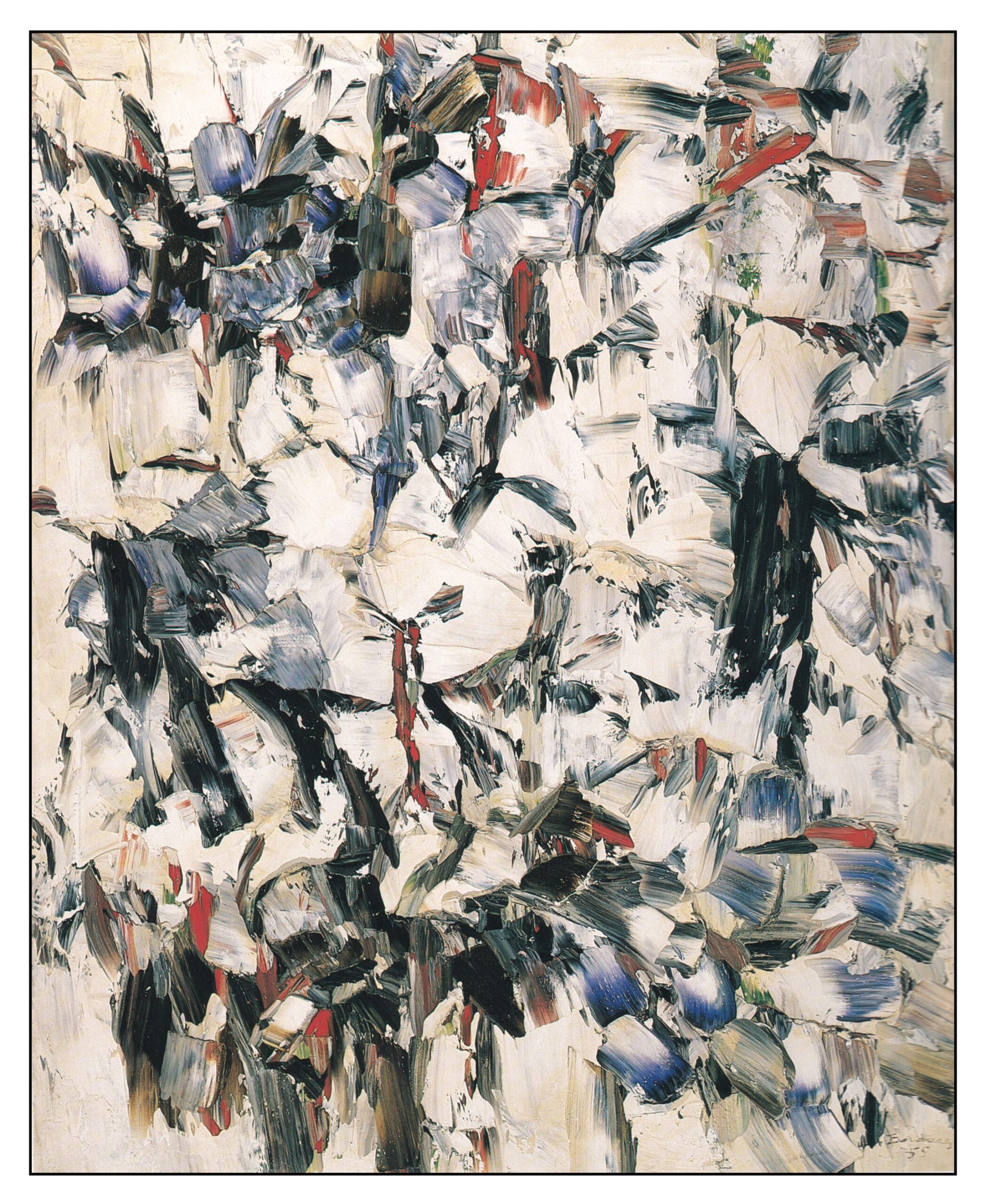
Barker, S. (2022). Artemisia Gentileschi. Getty Publications.

Bennett, B. A., & Wilkins, D. G. (1984). Donatello. Phaidon.

Christiansen, K., & Mann, J. W. (2001). Orazio and Artemisia Gentileschi. The Metropolitan Museum of Art.

Cohen, E. S. (2000). The trials of Artemisia Gentileschi: a rape as history. Sixteenth Century Journal, 31(1), 47–75.

Garrard, M. D. (2020). Artemisia Gentileschi and feminism in early modern Europe. Reaktion Books.

Greer, G. (1979). The obstacle race: the fortunes of women painters and their work. Farrar, Straus, Giroux.

Hessel, K. (2023). The story of art without men. W. W. Norton

Locker, J. (2015). Artemisia Gentileschi: the language of painting. Yale University Press.

Locker, J. (2017). Artemisia Gentileschi: the literary formation of au unlearned artist. In S. Barker, Ed. Artemisia Gentileschi in a changing light. (pp 89-101). Harvey Miller (Brepols).

Morrill, R., Elderton, L., & Wright, K. (Eds.). (2019). Great women artists. Phaidon.

Nochlin, L. (1971). Why are there no great women artists? In Gornick, V., & Moran, B. (eds.). Woman in Sexist Society: Studies in Power and Powerlessness. Basic Books.

Nochlin, L. (1988). Women, Art and Power & Other Essays. Harper Collins.

Pollock, G. (2013). Differencing the canon: feminism and the writing of art’s histories. Taylor and Francis.

Siciliano, G. (2019). I know what I am: the life and times of Artemisia Gentileschi. Fantagraphics Books.

Simons, P. (2017). Artemisia Gentileschi’s Susanna and the Elders (1610) in the Context of Counter-Reformation Rome. In S. Barker, Ed. Artemisia Gentileschi in a changing light. (pp 41-57). Harvey Miller (Brepols).

Treves, L., Barker, S., Cavazzini, P., Cropper, E., Whitlum-Cooper, F., Solinas, F., & Keith, L. (2020). Artemisia. Yale University Press.