Paul Celan: Todtnauberg
Paul Celan (1920-1970) was a Romanian-Jewish poet whose mother-tongue was German. Both his parents died in Nazi labor camps. After the war, Celan settled in Paris but continued to write poetry in German. On July 24, 1967, he gave a recitation of his poems at the University of Freiburg. The next day he visited Martin Heidegger (1889-1976) at his cabin in Todtnauberg in the Black Forest. Many believe that Celan asked Heidegger to make some statement renouncing the Nazi movement that he had joined in 1933. However, although a 1966 interview about his ties to the Nazi party was published posthumously in Der Speigel, Heidegger never made any statement about the evils of Nazism and never mentioned the Holocaust. The 1963 photograph of Paul Celan is by Lütfi Özkök.
Der Dichter (Poet)
Paul Celan was born in Czernowitz, Bukovina, in northern Romania, in 1920, as Paul Antschel. His family were German-speaking Jews, and his mother was devoted to German literature. Although Celan spoke Hebrew and Romanian, he considered German his mother-tongue. In 1938, Celan went to Tours, France, to study medicine but returned to Romania when World War II broke out in 1939.
The Germans arrived in Czernowitz in 1941, and began rounding up the Jews for forced labor in 1942. Celan’s parents were deported to a labor camp in Transnistria (present day Moldova). His father soon died there of typhus. Later, his mother was shot for not being a productive worker. Celan felt immense guilt about his parents’ deaths since he had been unable to convince them to go into hiding. However, later in 1942 he was himself sent to a German labor camp in Romania. He was finally released when the Red Army arrived in February 1944. He began to publish poetry in Bucharest after the war using the name “Celan” which is an anagram of the Romanian spelling (Ancel) of his name “Antschel.” Among these early poems was Todesfuge (Deathfugue, 1947), a searing description of the Holocaust.
When the Romanian government became communist in 1948, Celan moved to Vienna. Finding the city empty and depressing, he moved on to Paris. There he continued to publish poems in German. In 1952, he married the graphic artist Gisèle Lestrange. He began teaching German literature and translation in the École normale supérieure in Paris in 1956. The following illustrations show Paul Celan in 1938 and in 1949.
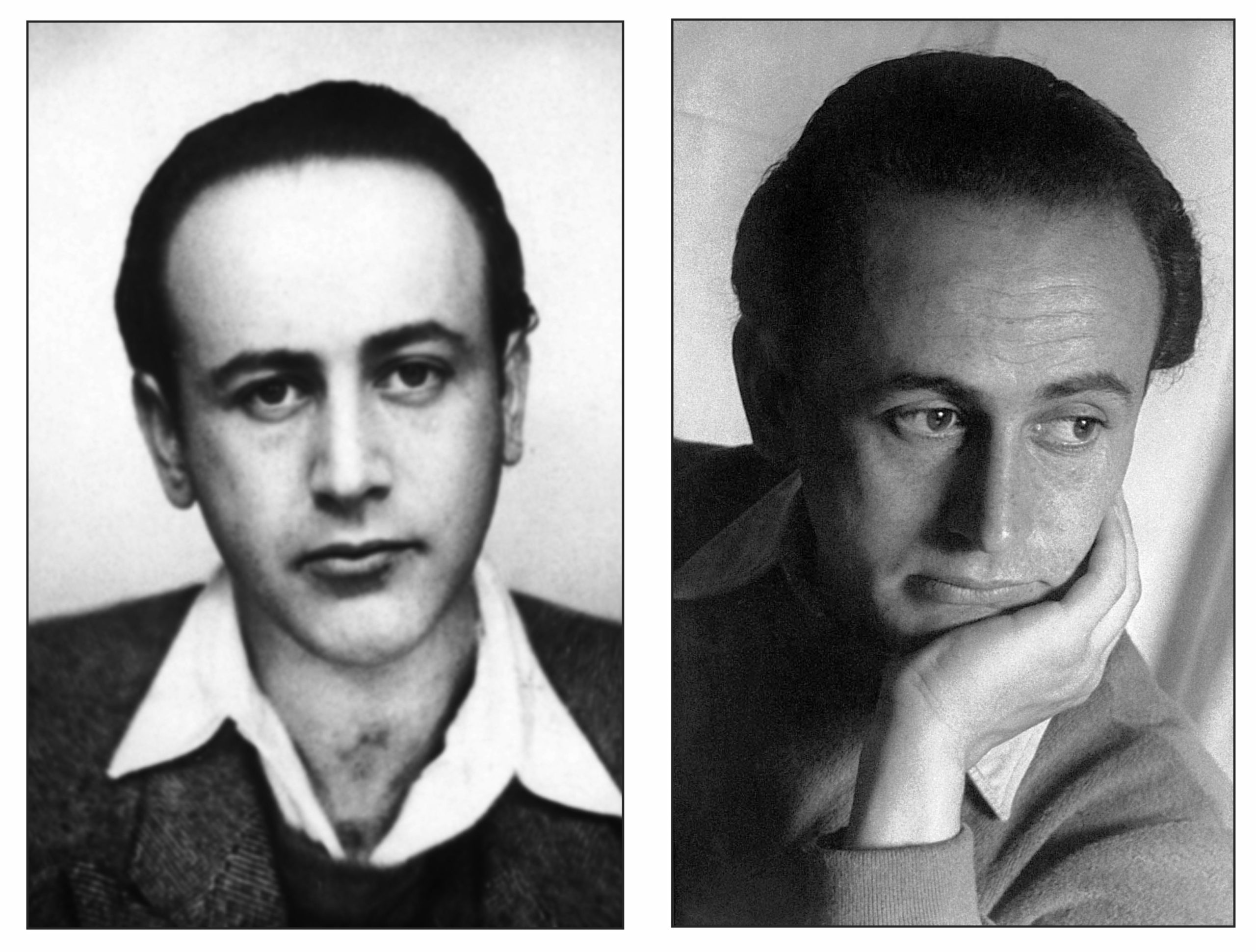
Celan befriended the poet Yvan Goll (1891-1950) in the year before he died, and helped him to translate some of his French poems into German. In 1953, his wife, Claire Goll (1890-1977), wife accused Celan of plagiarizing her husband’s work; she reiterated these claims until she died. There was no foundation in fact for her allegations, and Celan was ultimately completely exonerated (Wiedemann, 2000; Olschner, 2001; Bonnefoy, 2010; Maurel-Indart, 2010; Arno, 2026, pp 187-217). Nevertheless, Celan became severely depressed by the resultant scandal.
Despite the success of his poetry, Celan was still aware of persistent antisemitism in Germany, and he remained troubled by the accusations of Claire Goll. In the 1960s, Celan was hospitalized for depression several times, with each admission lasting for many months. During these stays he was treated with insulin shock therapy, now considered both barbaric and ineffective (Doroshow, 2007). Celan’s mental state deteriorated and he attempted suicide in early 1967. Following this attempt, his wife and child began to live apart from him out of fear for their safety.
Der Meridian
Theodor W. Adorno (1903-1969) famously remarked in 1949 in an essay that was later collected in Prisms (1955)
nach Auschwitz ein Gedicht zu schreiben, ist barbarisch, und das frißt auch die Erkenntnis an, die ausspricht, warum es unmöglich ward, heute Gedichte zu schreiben.
[To write a poem after Auschwitz is barbaric. And this corrodes even the knowledge of why it has become impossible to write poetry today.]
Celan understood the problem of poetry, and indeed all art, in the age that followed the Holocaust (Zilcosky, 2005). One could not write about beauty in the face of such terrible suffering. Nor could one describe the suffering in poetry because that would only attenuate its horror. Nevertheless, Celan not only wrote poems but also used the language of the murderers. He attempted to change how the words were perceived: to salvage the language for his mother. The following are his comments on the German language on receiving the Bremen Prize in 1958:
Reachable, near and not lost, there remained in the midst of the losses this one thing: language. It, the language, not lost, yes, in spite of everything. But it had to pass through its own answerlessness, pass through frightful muting, pass through the thousand darknesses of deathbringing speech. It passed through and gave back no words for that which happened; yet it passed through this happening. Passed through and could come to light again, ‘enriched’ by all this. (quoted by Arno, 2026, pp 185-186).
Although his early poems used the traditional formats and rhymes, after the war Celan began to write a different kind of German poetry: compressed, cryptic, polysemous. His task was facilitated by the way that Germanic languages allowed new words to be invented by combining old words (Benczes, 2005). This could be done simply for precision: an apple tree (Apfelbaum) is a special kind of tree. But more importantly it could be done by metaphor or metonymy: a brownshirt (Braunhemd) was a member of Hitler’s Sturmabteilung (stormtroopers). Celan’s use of these compounds can be seen in a brief poem from his 1967 collection Atemwende (Breathturn):
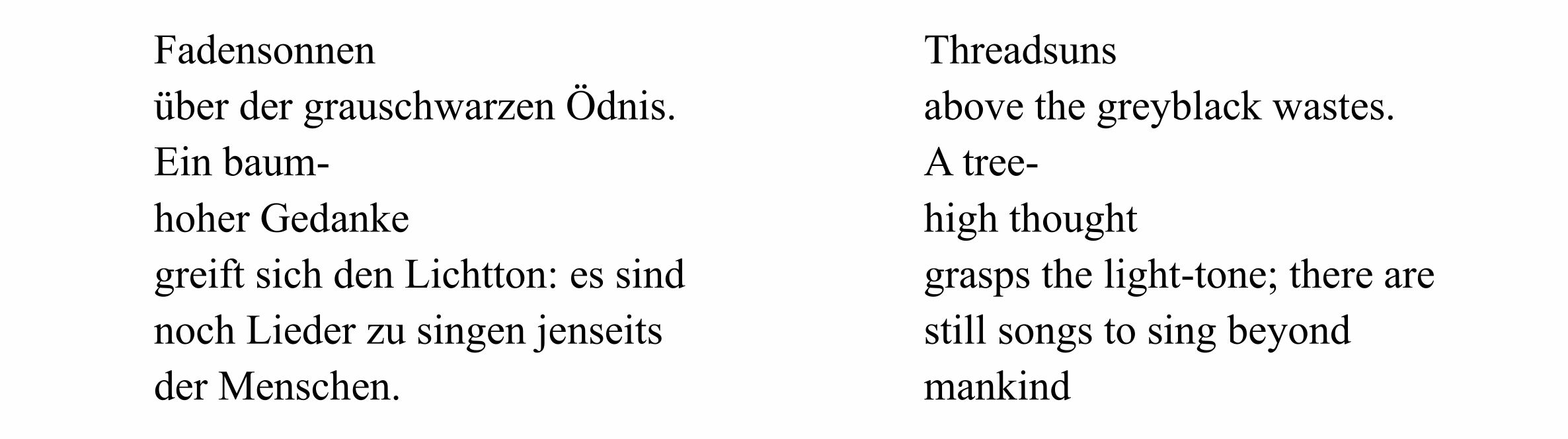
It is not clear what Celan means by Fadensonnen (Celan/Joris, 2014, pp liv and 469-470; Baldi, 2008; Felstiner, 1995, p 218). Perhaps the suns have been reduced to threads. Perhaps Celan is thinking of a Fadensonnenzeiger, an instrument that is used to measure the time when the sun is at noon so that longitude (the meridian) can be estimated. Perhaps he is referring to that time in late summer (Fadensommer) when gossamer threads drift through the air. Perhaps the suns of all our days are being threaded together by the Fates. Perhaps all these things?
The compound Lichtton is similarly polysemous. It might mean the analog recording of sound on a film by means of the intensity of the light. It might simply mean a sound as pure and transparent as light.
Felstiner comments on the poem:
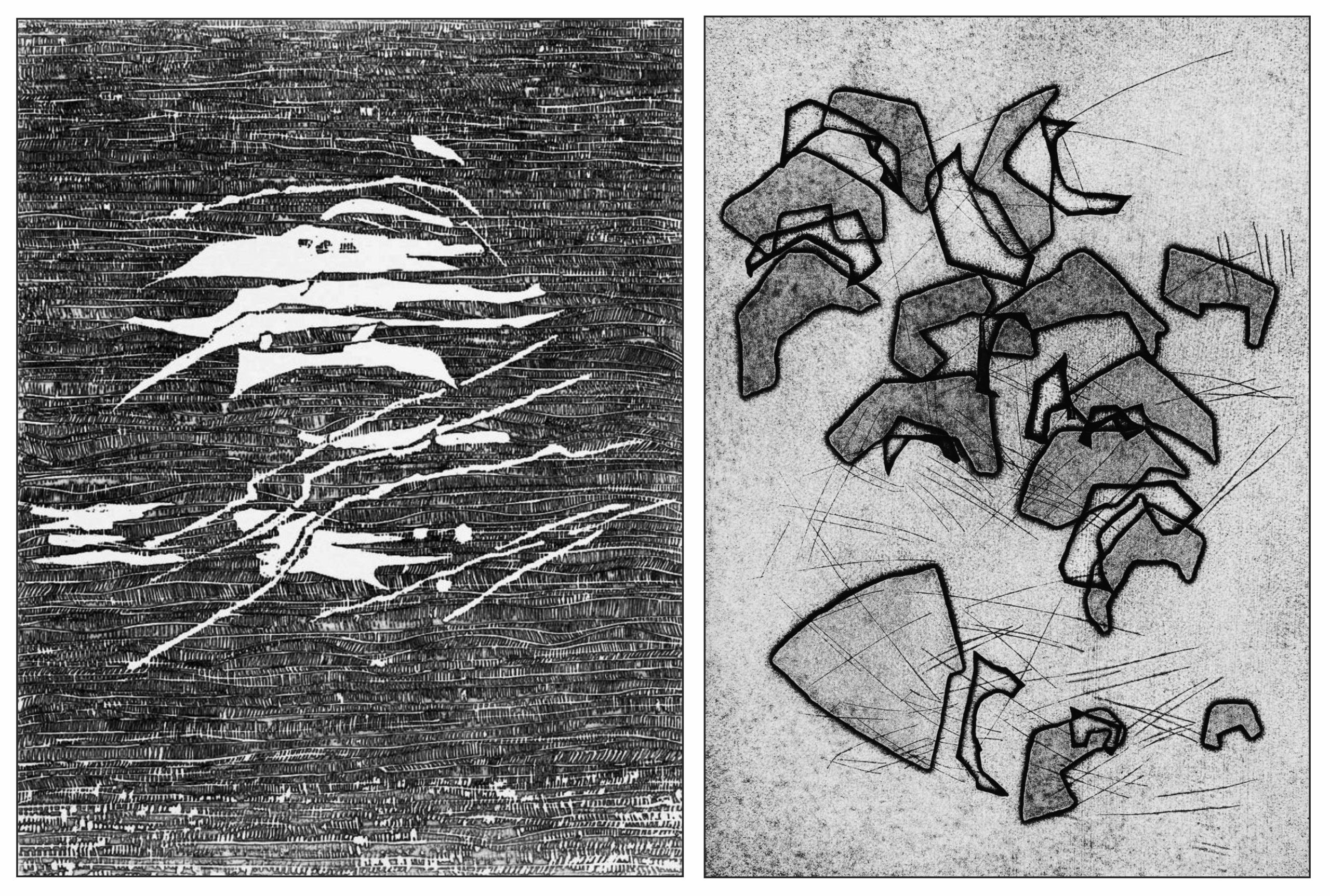
Thin yet tough threads bind the dead to the living. Here, as in an etching of his wife’s, tenuous light hovers over the waste and void before Creation. Then a “tree-high” thought—and there is light. “Oh Orpheus sings! Oh high tree in the ear!” Rilke opens his Sonnets to Orpheus. For Celan, there is no return from the underworld, but “there are / still songs to sing beyond / humankind [jenseits der Menschen]”—not in some afterlife but a step beyond those he kept covenant with. (Felstiner, 1995, p 218)
The following illustration shows two of Gisèle Lestrange’s etchings from the books Atemkristall (Breath crystal,1965) on the left and Schwarzmaut (Black toll, 1967) on the right. They are as cryptic as the poems:
The following is Celan’s recitation of the poem:
In 1996 Harrison Birtwistle set several of Celan’s poems to music and combined them with musical interludes (friezes and fantasias) in a work entitled Pulse Shadows. The following is the setting for Fadensonnen with Claron McFadden, soprano, the Arditti Quartet and the Nash Ensemble
Celan believed that poetry was a way to communicate with others, to reach through the differences and to find a shared experience. He was deeply aware of the thoughts of Emmanuel Levinas (1906-1995) and Martin Buber (1878-1965) on the relations between the self and the “other” (Ceuppens, 2020). When he received the Büchner Prize in 1960, Celan gave an acceptance speech that came to be known as The Meridian (German text of speech; translations: Celan/Glenn, 1978; Celan/Felstiner, 2001, pp 401-414; commentary: Meyerhofer, 1981). The following are two excerpts (Glenn translation). First, about the nature of the poem:
The poem is alone. It is alone and underway. Whoever writes it must remain in its company. But doesn’t the poem, for precisely that reason, at this point participate in an encounter? in the mystery of an encounter? The poem wants to reach the Other, it needs this Other, it needs a vis à vis. It searches it out and addresses it. Each thing, each person is a form of the Other for the poem, as it makes for this Other. The poem attempts to pay careful attention to everything it encounters; it has a finer sense of detail, of outline, of structure, of color, and also of the “movements” and the “suggestions.” These are, I believe, not qualities gained by an eye competing (or cooperating) with mechanical devices which are continually being brought to a higher degree of perfection. No, it is a concentration which remains aware of all of our dates. “Attention”? Permit me at this point to quote a maxim of Malebranche which occurs in Walter Benjamin’s essay on Kafka: “Attention is the natural prayer of the soul.”
Second, about the opposing poles of self and other:
I find something, like language, abstract, yet earthly, terrestrial, something circular, which traverses both poles and returns to itself, thereby I am happy to report –even crossing the tropics and tropes. I find … a meridian.
Der Denker (Thinker)
Martin Heidegger was born in Messkirch, Baden-Württemburg in 1889. He studied philosophy at the University of Freiburg, finishing his habilitation thesis in 1916. He served briefly in the German army in a non-combatant role at the end of World War I. After the war, he taught at the University of Freiburg. In 1923 he was elected professor at the University of Marburg.
In 1927 he published his major work Sein und Zeit (Being and Time), in which he addresses the nature of being:
The central theme of Heidegger’s philosophy is the question concerning the meaning (Sinn) of being (Sein). The “fundamental ontology” he advances in Being and Time departs dramatically from traditional ontology in that it asks not what there is, nor why there is what there is, nor even why there is anything at all and not nothing. The last of those questions, most famously associated with Leibniz and Schelling, is what Heidegger calls “the fundamental question of metaphysics.” It is a deep and important question, but it is not the question of fundamental ontology, for what it asks about is the totality of entities, not the meaning of being. Heidegger’s question, then, is not, Why is there anything? but rather, What does it mean for something to be? – or simply (redundantly), What is it to be? (Carman, 2003, p 8)
One special type of being is that of the individual human – Dasein, existing in the world. As human beings we can conceive both the world and ourselves within it:
For the question of being, as Heidegger conceives it, is inseparable from questions concerning the understanding and the existence of those entities for which, or rather for whom, the question of being can be a question at all, namely, ourselves, human beings. The argument of Being and Time therefore begins by referring ontology back to what Heidegger calls an “existential analytic of Dasein,” that is, an account of the basic structures of human existence. (Carman, 2003, p 9).
One essential aspect of the Dasein is its relation to time: conscious human beings are mortal. However, our thoughts may outlive our lives, provided we live with “authenticity”: Eigentlichkeit, ownedness (Carman, 2003, pp 264-313).
Heidegger realized that the nature of being is difficult if not impossible to understand through reason. He became fascinated by the idea that poetry determines the world through the words we use to describe it. (The word “poetry” derives from the Greek poiesis, making.) Heidegger interpreted the line of the poet Hölderlin (1770-1843):
Was bliebet aber, stiften die Dichter.
[But what is lasting the poets provide.]
The poet names the gods and names all things with respect to what they are. This naming does not merely come about when something already previously known is furnished with a name; rather, by speaking the essential word, the poet’s naming first nominates the beings as what they are. Thus they become known as beings. Poetry is the founding of being in the word. (Heidegger, 1941, p 59)
Soon after Adolf Hitler come to power in Germany (January 1933), Heidegger became Rector of the University Freiburg (April 1933). He joined the Nazi Party in May 1933, and remained a member until the end of the war. As Rector, Heidegger ensured the “alignment” (Gleichschaltung) of the university with the aims of the Nazi Party. He resigned from the rectorship in April 1934, but this was probably more related to his dislike of administration than to any qualms about Nazi policies.
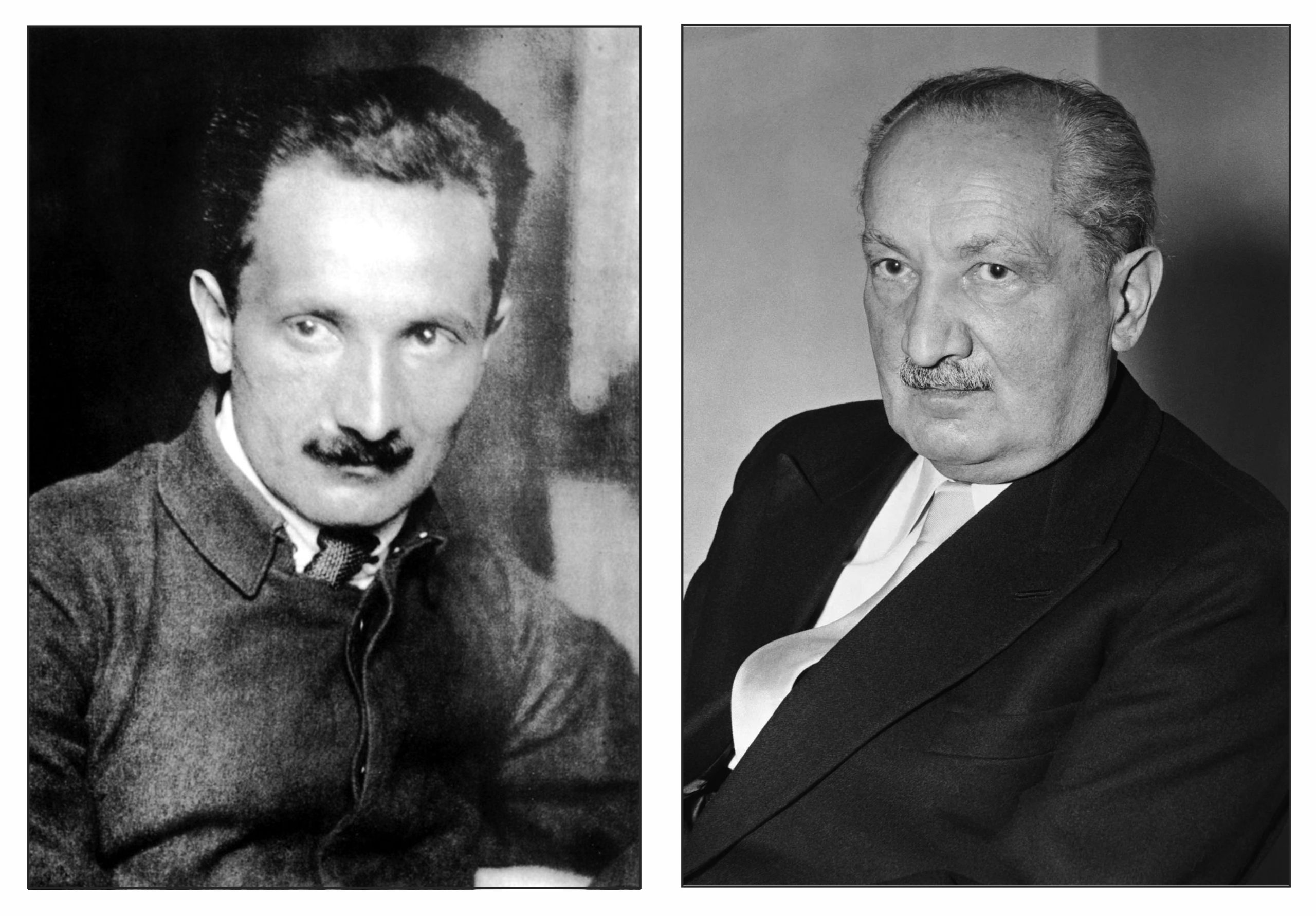
After the war, he was considered a fellow traveler (Mitläufer), the lowest category of those requiring denazification. Though he was initially banned from teaching, he was allowed to return to lecturing in 1950. The following illustrations show photographs of Heidegger taken in 1922 and in the 1960s.
Heidegger did not feel regret for his involvement with the Nazi party. After the war he was more concerned with what he perceived as the injustices done to the defeated Germans, such as the Dresden fire-bombing, the communist takeover of East Germany, the German prisoners-of-war trapped in the Soviet Union, and the Nuremburg trials. Both of his sons had been captured on the Eastern front and were prisoners-of-war. This deep sense of German victimization led to an:
inability and/or unwillingness to accept responsibility for the horrors of the Shoah and this oppugning of the Other’s claim to having suffered as much or more than he (Bamberg, 2023, p 233).
This prevented him from ever acknowledging how Naziism had been so evil, particularly toward the Jewish people. In 1966 Heidegger granted an interview about his connections to the Nazi Party with the news magazine Der Speigel (Mirror), with the proviso that this not be published until after his death in 1976. In the interview, Heidegger noted his personal support for his Jewish students, and claimed that he had tried to attenuate the effects of Nazi policies. He did not denounce fascism. He did not mention the Holocaust.
Todtnauberg
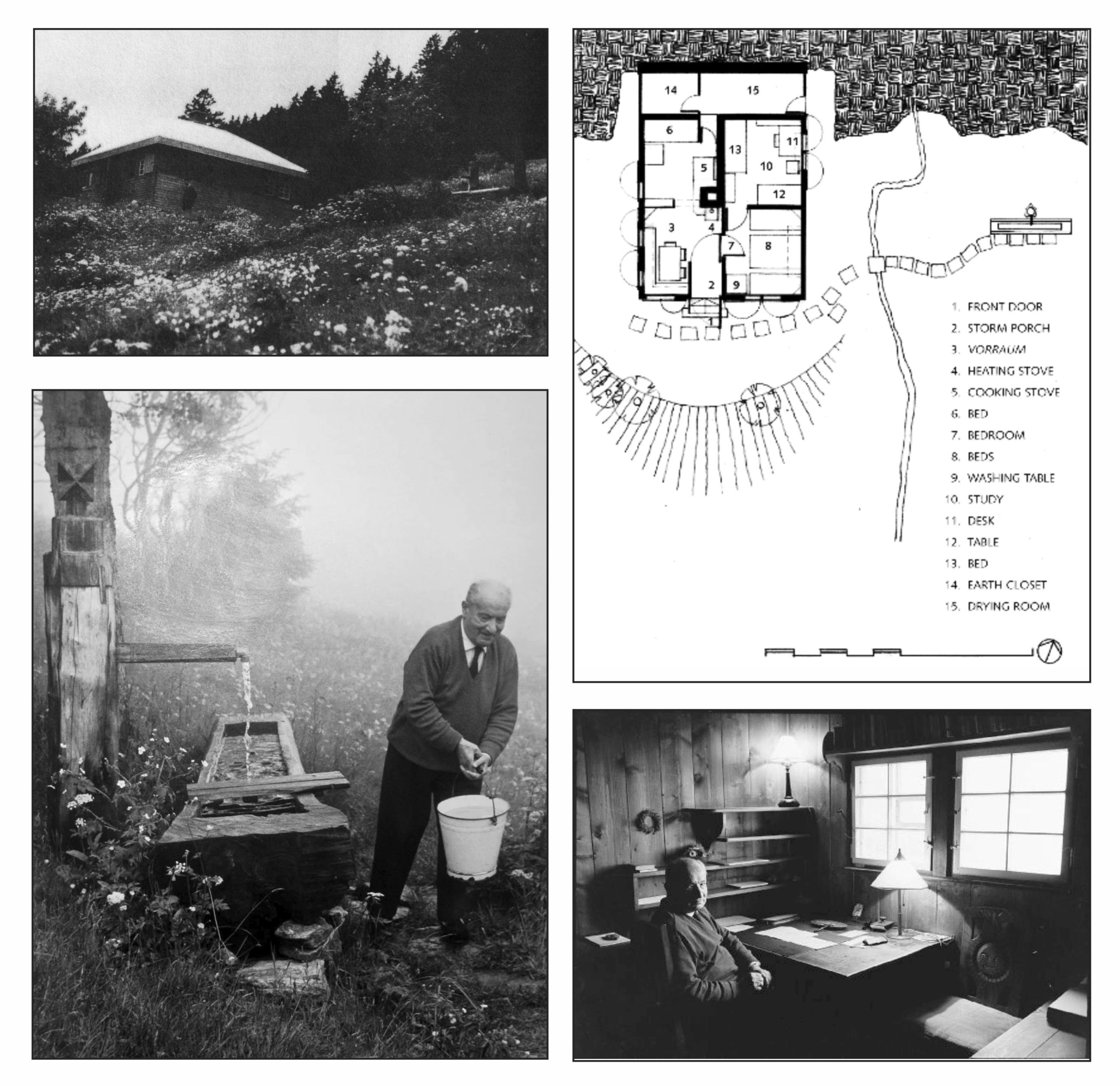
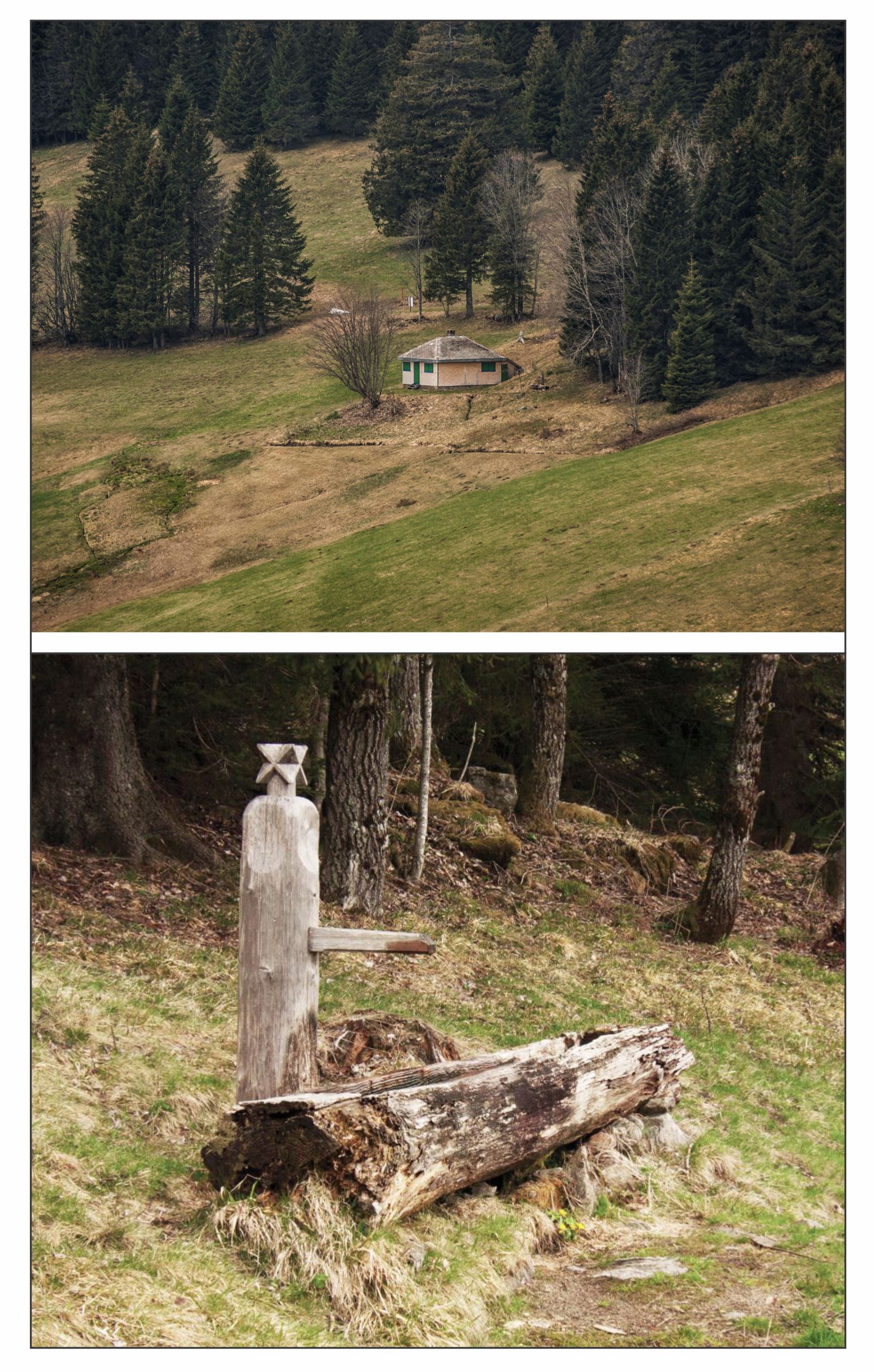
In 1922, Heidegger’s wife Elfride used an inheritance to build a small wooden Hütte (cabin) in the Schwarzwald (Black Forest) close to the village of Todtnauberg, about 30 km south of Freiburg (Sharr, 2006). About 6 x 7 meters in size, the cabin is situated on the north side of a small valley. Close by is a spring, marked by a post surmounted by a small carving of a four-sided star. Heidegger enjoyed the solitude of the Todtnauberg and wrote much of Sein und Zeit at the cabin. The following illustration shows a plan of the cabin and photographs from 1966. The photographs show the wildflowers around the cabin, Heidegger bringing water from the spring, and Heidegger sitting at his desk in the study:
The following shows some modern photographs from the thinkingplace website:
Die Begegnung (Encounter)
By the time they first met in Freidburg in 1967, Celan and Heidegger were both well acquainted with each other’s work (Lyon, 2006; Kenaan, 2021; Bamberger, 2023):
Celan had read a wide range of Heidegger’s texts and was especially taken by the manner in which Heidegger’s philosophy of language searches for the essence of language beyond communication and its emphasis on the role of poetry in revealing that essence by freeing language from its everyday use. … Heidegger, too, not only read Celan extensively for more than a decade, but also valued the poet for his ability to recover, for thinking, more original forms of listening to the saying of words. For Heidegger, Celan’s poetry opens up a rare possibility of releasing the space of language “onto its own freedom,” by subverting the grip of instrumental reason activated by the founding templates of modern thought and fully realized in the age of technology. (Kenaan, 2021, p 353)
On July 24, 1967, Celan gave a reading of his poetry at the University of Freiburg. Heidegger was seated in the first row and invited Celan to visit him the next day at his cabin in Todtnauberg. Gerhard Neumann, a young assistant to Professor Gerhart Baumann, who had invited Celan to Freiburg, drove Celan and Heidegger to the cabin. Neumann’s only description of the meeting (many years later) was that during the drive and the time at the cabin the poet and the philosopher talked about National Socialism and that there were painful silences (Lyon 2006, p 164).
The following is Celan’s report of the meeting to his wife:
The reading in Freiburg was an exceptional success: 1,200 people who listened to me with bated breath for an hour, then, having applauded me for a long time, they listened to me again for another fifteen minutes. Heidegger had come up to me—The day after my reading I was, with M. Neumann … in Heidegger’s hut (Hutte) in the Black Forest. Then there was, in the car, a grave dialogue, with clear words from me. M. Neumann, who was the witness of it, told me afterward that, for him, this conversation had something epoch-making about it. I hope that Heidegger will take up his pen and that he will write a few pages echoing that, and warning too, in the face of mounting Nazism. (August 2 letter, Celan, 2024, p 401)
Celan wrote the poem Todtnauberg on August 1 in Frankfurt (Celan/Joris, 2014, p 554). He arranged for the poem to be printed in a special limited edition, and when it was published in January 1968, he sent the first numbered copy to Heidegger (Lyon, 2006, p 187). The poem provides a cryptic description of Celan’s visit to Heidegger’s cabin:
“Todtnauberg” is really barely a poem; a single nominal phrase, choppy, distended and elliptical, unwilling to take shape, it is not the outline but the remainder—the residue—of an aborted narrative. It consists of brief notes or notations, seemingly jotted in haste with a hope for a future poem, comprehensible only to the one who wrote them. It is an extenuated poem, or, to put it better, a disappointed one. It is the poem of a disappoint-ment; as such, it is, and it says, the disappointment of poetry. (Lacoue-Labarthe, 1986/1999, pp 35-36)
The following is the poem with the Joris (2014) translation:
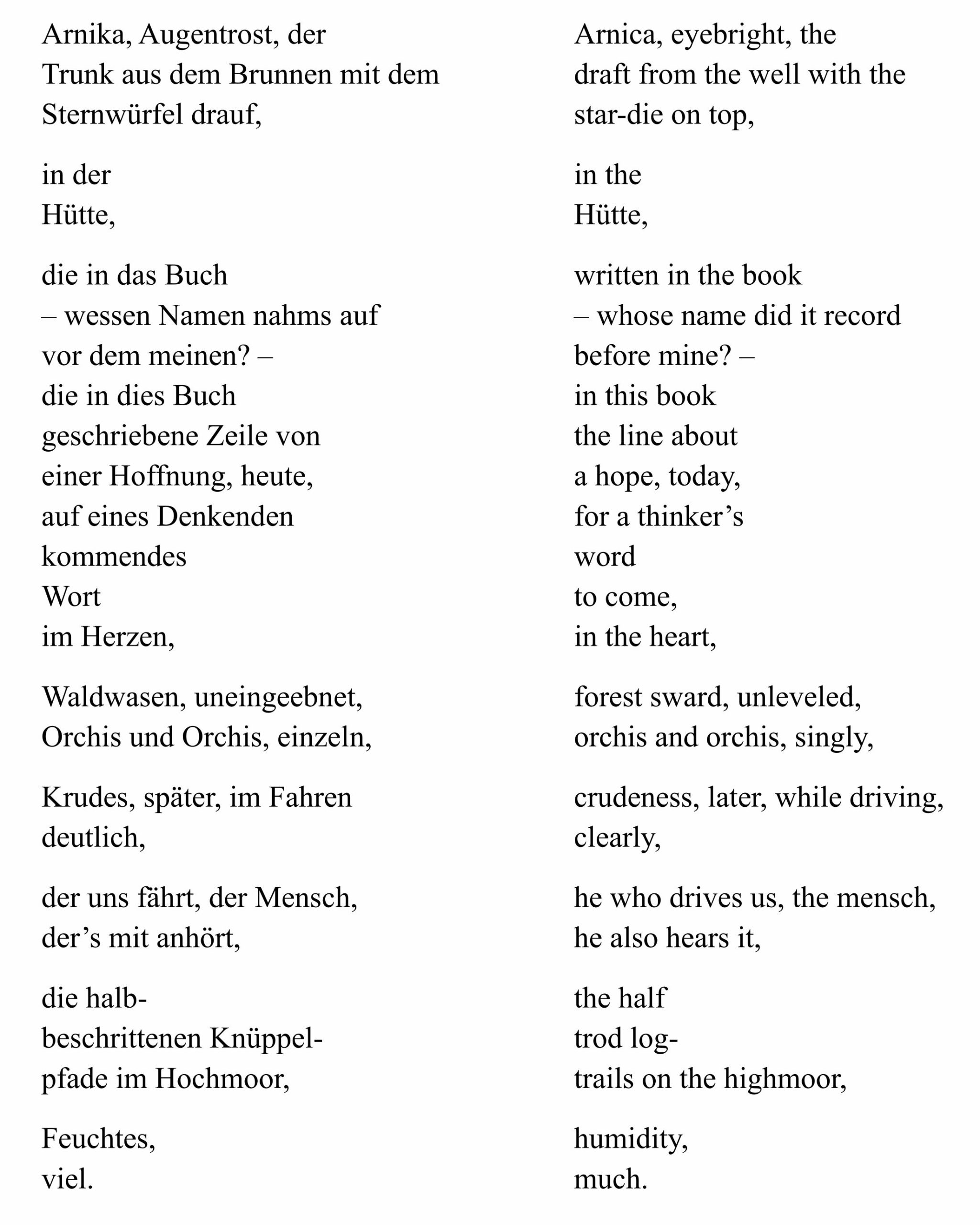
The poem contains three of Celan’s characteristic compounds: Sternwürfel, Waldwasen, and Knüppelpfade. We shall discuss these as we go through the poem.
The opening verse describes the wildflowers near the cabin and the spring with the carved star. Both flowers mentioned have been used in herbal remedies: the bright yellow Arnica for bruising and sprains, and eyebright (Euphrasia) for improving vision (Augentrost means eye-comfort). There is no convincing evidence for any therapeutic effect, but both flowers are strikingly beautiful:


The second verse describes Celan’s hesitant step into Heidegger’s cabin. Then the poet writes a brief statement into the visitors’ book. The inscription and the poem present the hope that, following the conversation in the car on the way to Todtnauberg, Heidegger would make some formal statement denouncing the evils of National Socialism and warning that it must never again come to power. The actual words written in the book were slightly different from those recorded in the poem:
Ins Hüttenbuch, mit dem Blick auf den Brunnenstern, mit einer Hoffnung auf ein kommendes Wort im Herzen. Am 25. Juli 1967 / Paul Celan (Joris, 1988)
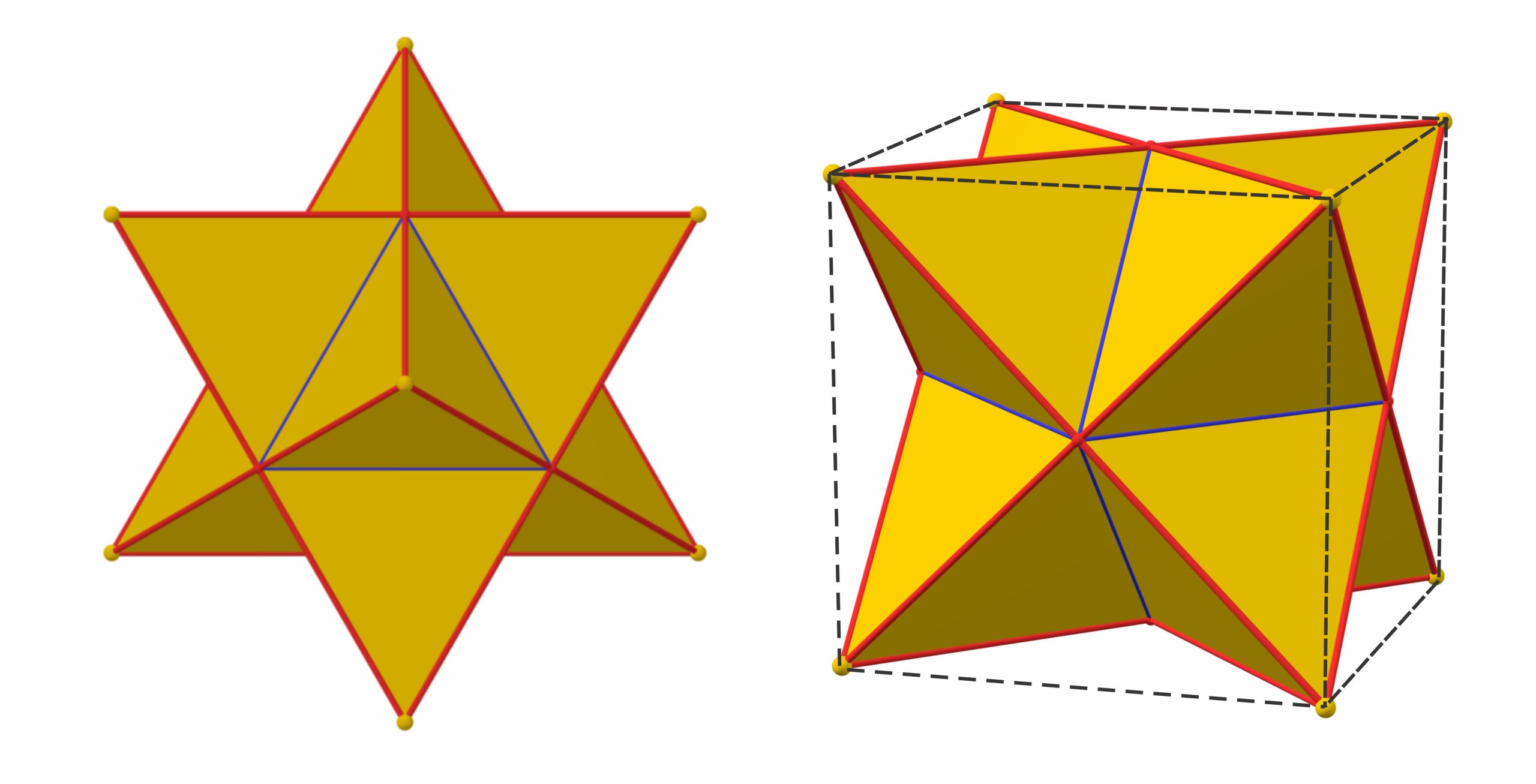
The Brunnenstern is the carved star (Stern) at the top of the post with a spout coming from the spring (Brunnen): a stellated octahedron (stella octangula) compose of two intersecting tetrahedra. This shape can be contained in a cubic space (dotted lines). In the poem, Celan uses the term Würfel, dice. It is impossible not to see the Jewish star (Magen David, shield of David, composed of intersecting triangles) when the shape is viewed from one of the apices of the tetrahedra (left). The stellated octahedron is the Magen David in 3-dimensions:
Golb (1988) notes that the “book” in which Celan writes can be construed in several ways. It is of course the Heidegger’s visitor’ book in which many previous visitors, some with ties to National Socialism, had written. But it could also be the book referred to in Revelations 20:12, a Book of Judgement in which are written the names of the damned and the saved. It also refers to the text of Celan’s poem:
For this reason, “das Buch” of line 6 becomes “dies Buch” of line 9, and the crucial question linking one text to the other, “wessen Namen nahms auf / vor dem meinen?” not only has mystical significance and is about Heidegger, but is equally Celan’s questioning of himself and of the “names” inscribed in the text of an ideological tradition that remains, in a fundamental way, his own. Similarly, the “in dies Buch / geschriebene Zeile” refers, along with its other meanings, to the lines (or continuous “line”) of the poem itself, expressing the “Hoffnung,” in a textual present (“heute”) shared by poet and reader, that within the language of the text the magic realization of its absent meeting (standing, in any case, for all poetological desire) might occur: a personal conciliation of Celan and Heidegger (Golb, 1988, p 264)
The crux of the poem is Celan’s hope for Heidegger’s kommendes Wort in Herzen. He and Heidegger have painfully talked about National Socialism and the Holocaust. And Heidegger has said that something will be said. It is possible Heidegger just meant the interview with Der Spiegel that was to be published posthumously. But that was vacuous and that was not heute (today). Celan was obviously hoping for much more.
The next five verses describe the walk that Heidegger and Celan took in the forest near the cabin, a walk that was soon aborted because of the rain. Joris (1988) comments on how the word Waldwasen has multiple meanings and connotations:
At first glance one could conceivably think that the poet has simply have chosen an erudite or “poetic” word instead of the more obvious and thus banal “Waldwiesen” – forest meadows. … A “Wase”, according to Grimm’s Dictionary of the German language, is, first of all, a piece of sod together with the plants that grow in it … Celan is not talking of some grassy surface, a pleasant meadow, but has in mind something that goes deeper and incorporates the network of underground roots…. Grimm further glosses “Wasen” as … “the piece of land on which the knacker or “Wasenmeister” (the”Master of the Wasen”) guts and buries the dead livestock, also known in South Germany and on the Rhine as “Schindanger” – “the knacker’s yard” which one could nearly translate as the “killing fields”…. Then my eye fell on yet another “Wase”, a word current in North Germany, and used to describe a bundle of dead wood, the etymology of which Grimm leads back through French “faisceau” to Latin “fasces”, the curator’s bundle of rods, which became the symbol of, and gave the word for, “fascism”.
On the Waldwasen, Celan describes two Orchis flowers. Like the poet and the philosopher, they stand separate from each other. The Orchis has testicle-shaped roots, hence its name and the crude connotations.
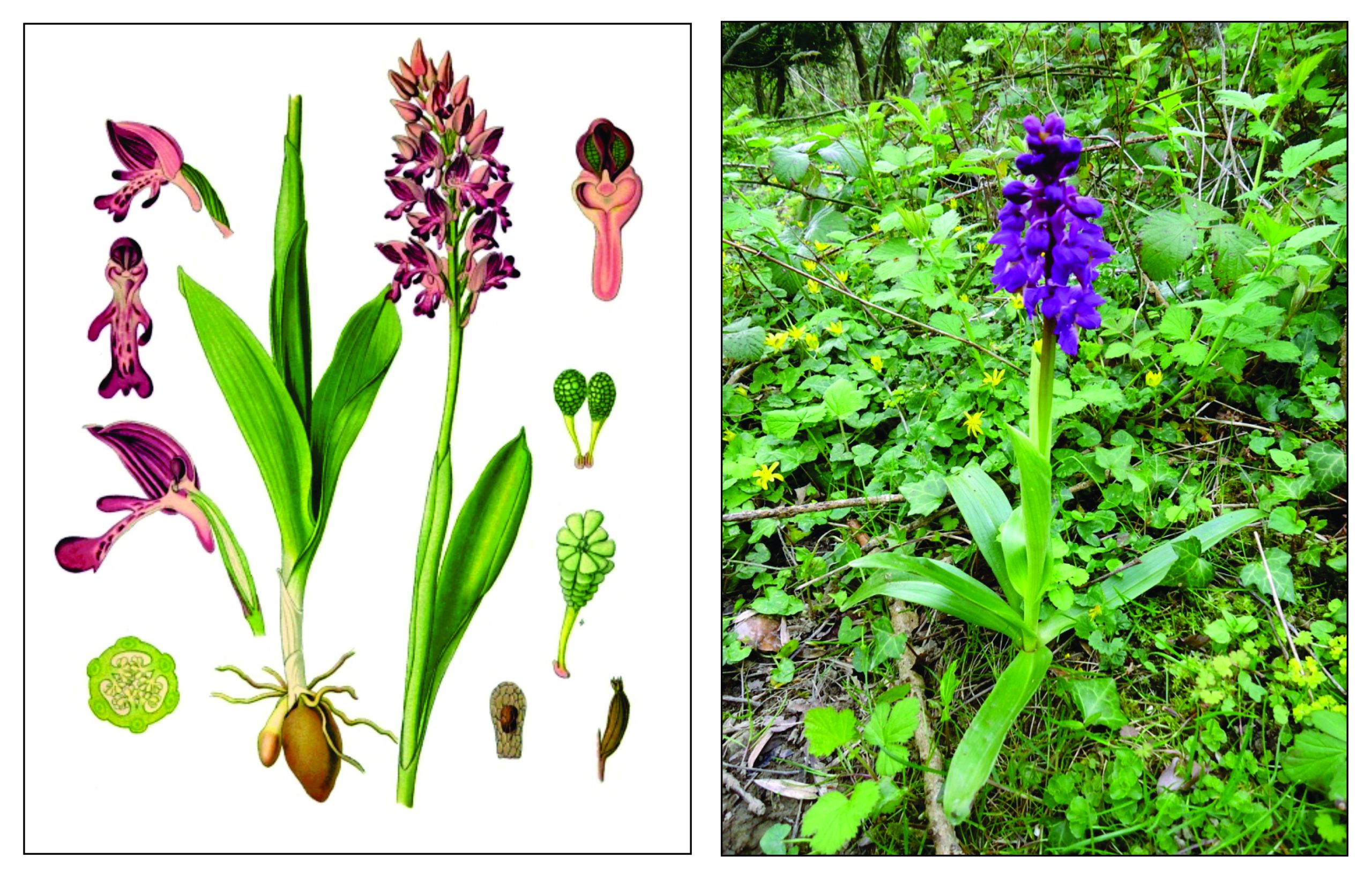
These are the flowers mentioned by Gertrude in her speech describing the death of Ophelia in Hamlet (IV, 5: 193-5):
long purples,
That liberal shepherds give a grosser name,
But our cold maids do dead men’s fingers call them.
It is possible that Celan mention of Krudes relates to these connotations of the flower. However , the word also means “raw” and might indicate that something else was said in the car. Perhaps something about the horrors of the Holocaust.
Joris (1988) comments on the log trails mentioned in the penultimate verse:
They walk on “halb- / beschrittenen Knüppel-/Pfaden..” – “half- trod/log-trails”, literally on “paths made of wood” – the German Holzwege, which refers to a path in a forest, but also, in common parlance, to a dead-end, to a mistaken route, and is, of course, the title of a well-known book by Heidegger. Celan is too subtle to use Heidegger’s word, and his “log-paths” complexify the image further as Knüppel- the German word means both “logs” and “rods” – are also used as weapons to beat people, prisoners, etc.
In 1950 Heidegger had published a set of essays written over the preceding 15 years in a book called Holzwege. Heidegger explained the title
Holz lautet ein alter Name für Wald. Im Holz sind Wege, die meist verwachsen jäh im Unbegangenen aufhören. Sie heißen Holzwege. [“Wood” is an old name for forest. In the wood there are paths, mostly overgrown, that come to an abrupt stop where the wood is untrodden. They are called Holzwege.]
As one finishes reading, one feels that Celan has clearly and simply described what happened at Todtnauberg. However, one is also deeply aware that the poem alludes to much more. The following are comments by Oyarzún (2022):
A diaphanous and at the same time unapproachable, impenetrable poem. Impenetrable, perhaps, because purely diaphanous. Everything is there in the light, in the forced light that prevails in these final poems; everything: including the formfitting reticence in which the poems are gathered. With everything clear, deutlich, how could one say that Celan’s poetry is hermetic? (p 2)
Why do I feel I cannot pronounce anything definitive about what happens in this poem? It is, perhaps, because I want to hold on to the impression— my earliest impression—that there is something unthinkable here, and this unthinkable would be the unthinkable (das Undenkbare) of an encounter without encounter, without dialogue, on a today that slips over itself (heute, Feuchtes), dislodges itself from itself, de-spairs [des-espera], drowning, falling on itself (viel: fiel). The unthinkable, das Undenkbare, imposes the terrible desolation of a forced and essential ingratitude (Undankbarkeit), a word’s immurement upon itself. (p 6)
As Oyarzún notes, the last word of the poem – viel (much) – used to modify Feuchte (wetness, humidity) is a homonym for fiel (fell, past tense of fallen).
The following is the musical setting for Todtnauberg from Harrison Birtwistle’s Pulse Shadows, with Claron McFadden, soprano, the Arditti Quartet and the Nash Ensemble.
The poem Todtnauberg was later published in Celan’s Lichtzwang (1970, light duress). Lyon (2006, pp 188-189) notes that the 1967 bibliophile edition of the poem contains a word not present in the later version: un-gesäumt meaning “without delay” just before kommendes Wort. When Celan sent Heidegger this gift, he was clearly exhorting him to make a statement about what they had discussed at Todtnauberg. Heidegger replied with a perfunctory letter of thanks for Celan’s gift. He never denounced National Socialism for its role in the Holocaust.
The following are Lacoue-Labarthe’s comments on the encounter at Todtnauberg: (Lacoue-Labarthe, 1999, p 38)
To Heidegger the thinker—the German thinker—Celan the poet—the Jewish poet—came with a single yet precise entreaty: that the thinker who listened to poetry; the same thinker who had compromised himself, however briefly and even if in the least shameful way, with just what would result in Auschwitz; the thinker who, however abundant his discussion with National Socialism, had observed total silence on Auschwitz, as history will recall; that he say just a single word: a word about pain. From there, perhaps, all might still be possible. Not “life,” which is always possible, which remained possible, as we know, even in Auschwitz, but existence, poetry, speech. Language. That is, relation to others.
Could such a word be wrenched?
In the summer of 1967 Celan writes in the guestbook of the Hütte in Todtnauberg. He no longer knows who signed before him; signatures—proper names, as it happens—matter little. At issue was a word, just a word. He writes—what? A line, or a verse. He asks only for the word, and the word, of course, is not spoken. Nothing; silence; no one. The in-advent of the word (“the event without answer”).
I do not know what word Celan could have expected. What word he felt would have had enough force to wrench him from the threat of aphasia and idiom (in-advent of the word), into which this poem, mumbled against the silence, could only sink as if into a bog. What word could suddenly have constituted an event.
I do not know. Yet something tells me it is at once the humblest and most difficult word to say, the one that requires, precisely, “a going out of the self.” The word that the West, in its pathos of redemption, has never been able to say. The word it remains for us to learn to speak, lest we should sink ourselves.
The word pardon.
Celan has placed us before this word. A sign?
Der Abschied (Farewell)
Although he continued to write poetry, Celan remained severely depressed. He met briefly with Heidegger in June 1978, and again in March 1970. Nothing significant was said at either meeting. In late April 1970, Celan committed suicide by jumping into the Seine, probably from the Pont Mirabeau. His body was recovered about 10 km downstream on May 1. The German language has several words for suicide. One of these – Freitod – combines the idea of death and freedom. It is ambivalent about whether it is the freedom of will that chooses this way of death or of the freedom from suffering that the death provides.
In 2020, 50 years after Ccelan’s death, the German artist Anselm Kiefer (1945- put together an exhibition Pour Paul Celan of monumental paintings and sculptures at the Grand Palais in Paris (Dercon, 2021). The largest of the painting Als Arche verließ es die Straße (It left the road like an ark), made of emulsion, acrylic, oil, shellac, straw, metal, charcoal and chalk on canvas, was 840 by 1520 cm. Above a desolate wintry landscape a rudimentary raft floats into a dark sky on which are written in chalk the words from several of Celan’s early poems. The following is a photograph by Jean-Pierre Dalbéra.
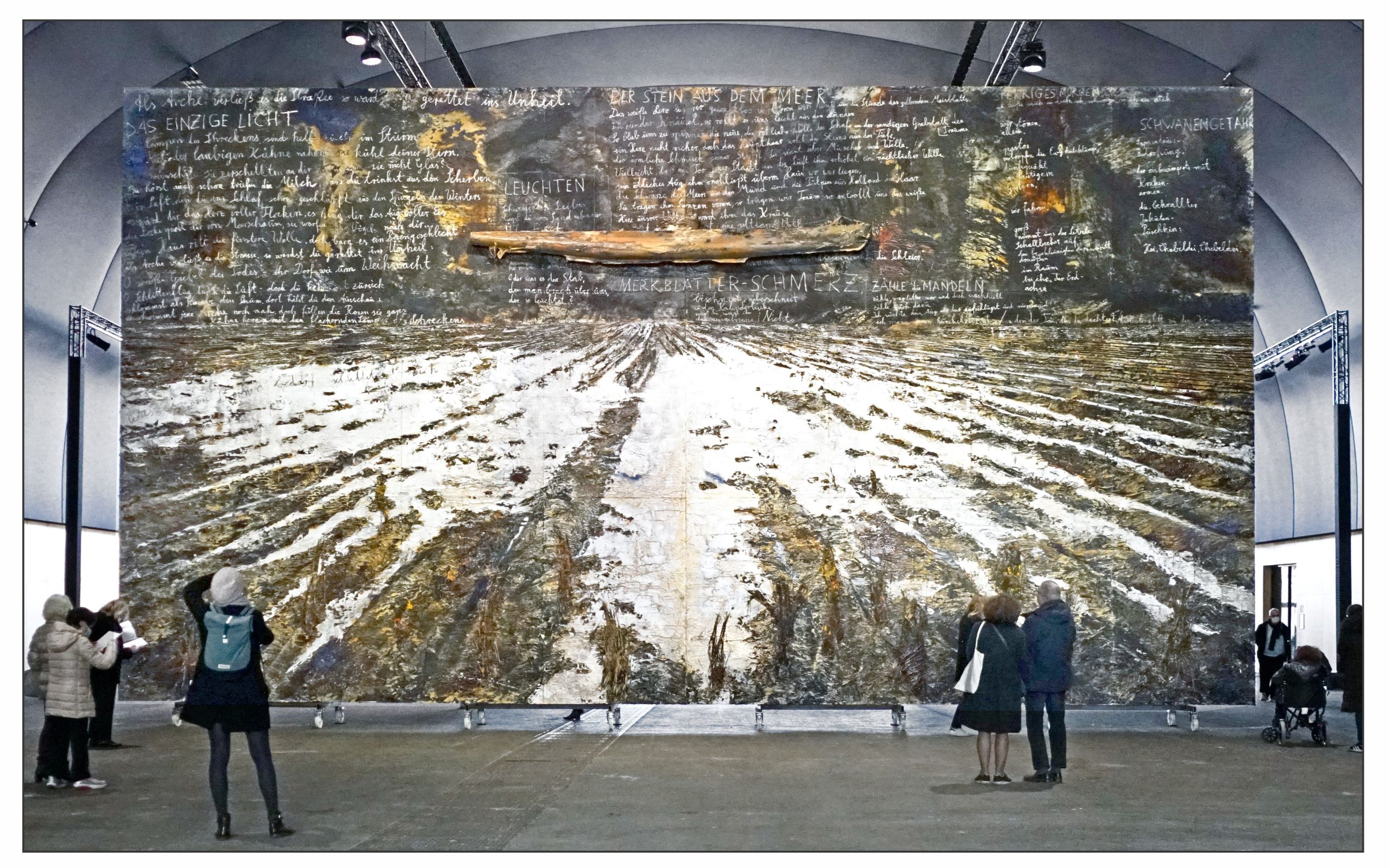
The title derives from an early poem Das einzige Licht (the only light) first published in 1948. The full poem is written on the upper right of the painting. Two lines are
Dein Haus ritt die finstere Welle, dochbarg es ein Rosengeschlecht;
Als Arche verließ es die Straße, so wardst du gerettet ins Unheil
[Your house rode the dark wave, still it covered a roselineage;
As ark it left the road, so you were rescued in harm}
References
Adorno, T. W. (1955, translated by S. M. Weber 1967, reprinted 1983). Prisms. MIT Press.
Arno, A. (translated by Gauger, S. A., 2026). Paul Celan: a life. Belknap Press (Harvard University)
Baldi, M. (2008). Fadensonnen: Il pensiero poetico al di la di luce e suono. In M. Baldi & F. Desideri (Eds.). Paul Celan: la poesia come frontiera filosofica. (pp 37-45). Firenze University Press.
Bambach, C. (2023). The (im)possibility of homecoming: Heidegger, Celan, and the aporia of language. In Benjamin, A. E. (Ed.) Heidegger and Literary Studies. (pp. 214–252). Cambridge University Press
Benczes, R. (2005). Creative noun–noun compounds. Annual Review of Cognitive Linguistics, 3, 250–268.
Bonnefoy, Y. (translated by Felstiner, J., 2010). Why Paul Celan took alarm. Publications of the Modern Language Association of America, 125(1), 204–212.
Carman, T. (2003). Heidegger’s analytic: interpretation, discourse, and authenticity in Being and time. Cambridge University Press.
Celan, P. (translated by Glenn, J., 1978). The Meridian. Chicago Review, 29(3), 29–40.
Celan, P. (translated by Hamburger, M., 1989). Poems of Paul Celan. Persea Books.
Celan, P. (translated by Felstiner, J., 2001). Selected poems and prose of Paul Celan. W.W. Norton
Celan, P. (translated by Joris, P., 2014). Breathturn into timestead: the collected later poetry. Farrar, Straus, Giroux.
Celan, P. (translated by Joris, P., 2020). Memory rose into threshold speech: the collected earlier poetry. Farrar, Straus, Giroux.
Celan, P. (translated by Kavett, J., 2024). Letters to Gisèle (1951-1970): with a selection of letters from Gisèle Celan-Lestrange. New York Review Books.
Ceuppens, R. (2020). “Your country behind the mountain, behind the year”: Insistence of an inaccessible alterity in Paul Celan’s Poetics. Language, Literature, and Interdisciplinary Studies, 3(3).
Dercon, C. (2021). Anselm Kiefer: pour Paul Celan. Réunion des musées nationaux-Grand Palais.
Doroshow, D. B. (2007). Performing a cure for schizophrenia: insulin coma therapy on the wards. Journal of the History of Medicine and Allied Sciences, 62(2), 213–243.
Felstiner, J. (1990). Paul Celan. Yale University Press.
Golb, J. D. (1988). Celan and Heidegger: a reading of “Todtnauberg.” Seminar: A Journal of Germanic Studies, 24(3), 255–268.
Heidegger, M. (1927, trans. J. Macquarrie & E. Robinson,1962). Being and time. Blackwell.
Heidegger, M. (1941, translated by Hoeller, K., 2000). Elucidations of Hölderlin’s poetry. Humanity Books.
Heidegger, M. (1950, translated by Young, J., & Haynes, K., 2002). Off the beaten track. Cambridge University Press.
Joris, P. (1988). Celan / Heidegger: Translation at the Mountain of Death.
Lacoue-Labarthe, P. (1986, translated by A. Tarnowski, 1999). Poetry as experience. Stanford University Press.
Lyon, J. K. (2006). Paul Celan and Martin Heidegger: an unresolved conversation, 1951-1970. Johns Hopkins University Press.
Kenaan, H. (2021) Celan and Heidegger at the Mountain of Death: listening to hope, Journal of the British Society for Phenomenology, 52(4), 352-365,
Maurel-Indart, H. (2010). Literary plagiarism. French Literature Series, 37, 1-15.
Meyerhofer, N. J. (1981). The poetics of Paul Celan. Twentieth Century Literature, 27(1), 72–85.
Olschner, L. (2001). Shabby and tragic. [Review of Wiedemann, B. Paul Celan – die Goll Affäre]. Times Literary Supplement (5122), 25.
Oyarzún R., P. (translated by Cross, D. J. S., 2022). Between Celan and Heidegger. State University of New York Press.
Safranski, R., (translated by E. Osers, 1998). Martin Heidegger: between good and evil. Harvard University Press.
Sharr, A. (2006). Heidegger’s hut. MIT Press.
Wiedemann, B. (2000). Paul Celan — Die Goll-Affäre. Frankfurt: Suhrkamp,
Wrathall, M. (2025). Martin Heidegger. Stanford Encyclopedia of Philosophy.
Zilcosky, J. (2005). Poetry after Auschwitz? Celan and Adorno revisited. Deutsche Vierteljahrsschrift für Literaturwissenschaft und Geistesgeschichte, 79(4), 670–691.