Jazz Poetry: The Natural Noise of Good
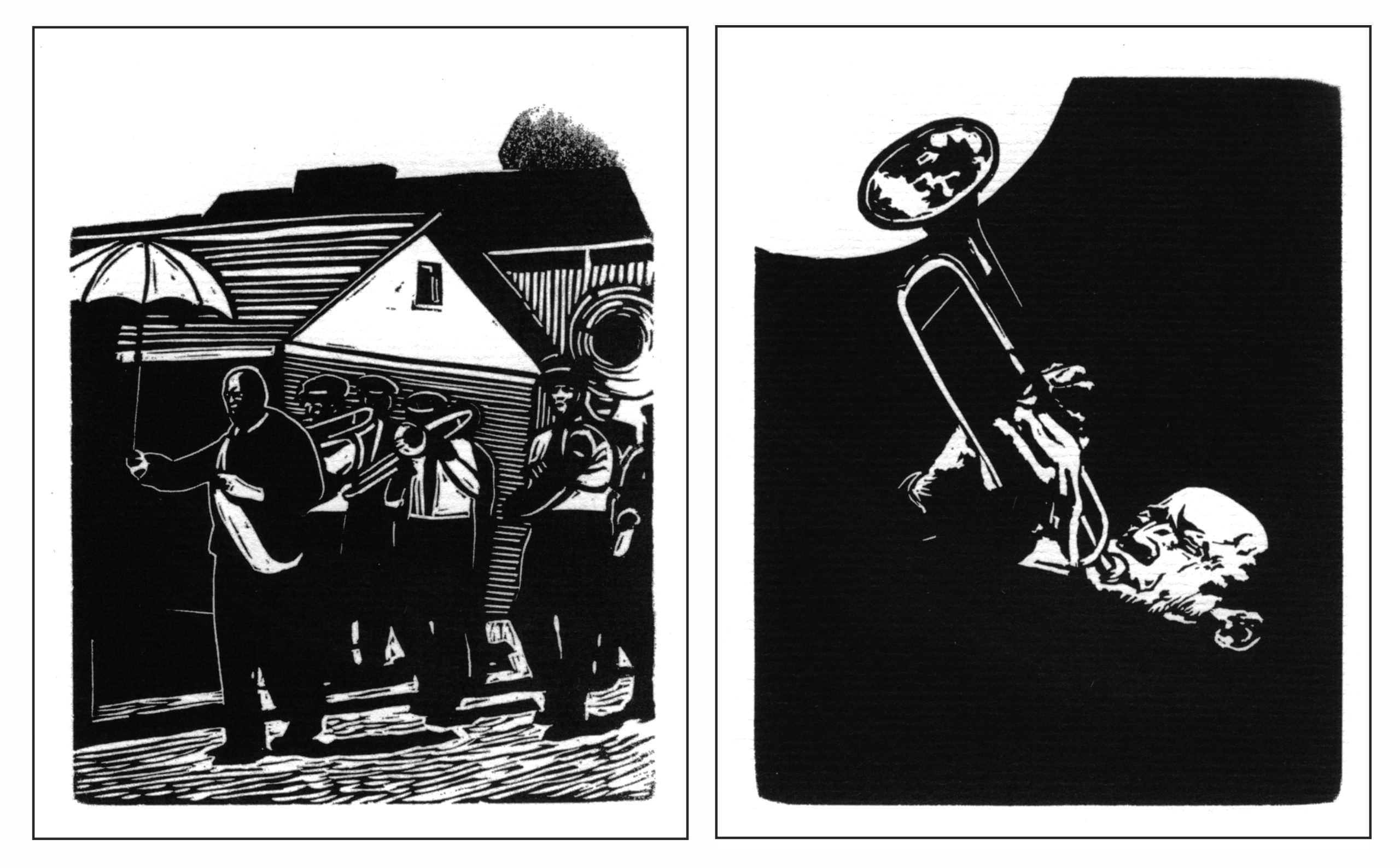
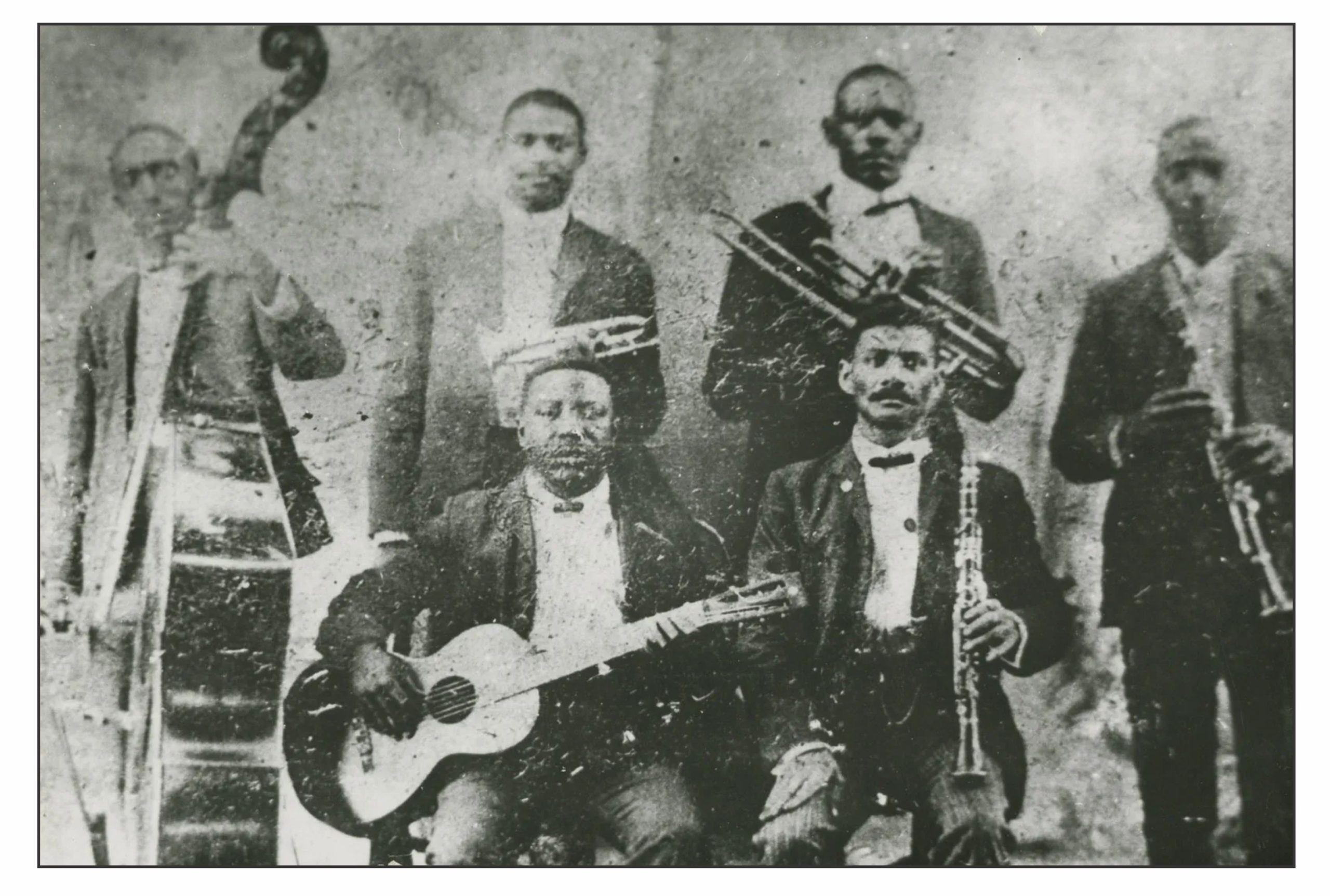
Jazz evolved at the beginning of the 20th Century in the lands drained by the Mississippi River. Slave shouts, ragtime piano, marching bands, funeral music, creole songs and dance clubs all contributed to the new form. The illustration shows an impression of Buddy Bolden in New Orleans, a primal force in early jazz (Berg 2010). At about the same time, English poetry was shedding its formalism and seeking the immediacy of conversational speech. The music of jazz was quickly taken up by modernist poets as both a subject for their poems and an inspiration for their words. Jazz poetry takes many forms: at is simplest it describes the music; at its most sophisticated it becomes part of the jazz performance. This post presents the poetry along with the music.
Legendary Origins
In 1897, a New Orleans councilman named Sidney Story sponsored a law which made prostitution illegal throughout the city except within a district between Basin Street and the Saint Louis Cemetery that came to be known as “Storyville.” One legend has it that the bands that played in the Storyville brothels invented a new music that came to be known as jazz. Jazz has always been close to sex: the word may derive from jism (energy, pep, spunk, sperm), although a more likely etiology is French jaser to chat.
One of the bands in Storyville was led by the cornetist Buddy Bolden (1877-1931). Little is known about Bolden. There are no recordings. One of his characteristic tunes was “Funky Butt.” The word “funk” refers to the smell of people dancing. Bolden used to stretch the limits of the trumpet, trying to make it talk, often producing “screams” or “squawks” to accentuate the emotional intensity of the music. He went insane in 1907 and was admitted to an asylum where he stayed until his death (long after Storyville had finally closed in 1917). Bolden’s story has been told in Ondaatje’s novel 1976 Coming though Slaughter and illustrated by Berg’s 2010 graphic novel Let the Bad Air Out from which the following linocuts are taken:
The following is a photograph of Bolden and his band:
Wynton Marsalis imagined what Bolden’s playing was like in a track called The Legend of Buddy Bolden
The origin of jazz was far more complex than the legend of Storyville suggests (Gioia, 2021). Buddy Bolden did contribute but so did numerous others. W. C. Handy composed The Memphis Blues in 1912 and The Saint Louis Blues in 1914, the first published music of the Blues. The funeral traditions of New Orleans were an important influence. Following the marching band that escorted the coffin to the cemetery was a “second line,” a spontaneous group of musicians and dancers. On the way home from the cemetery the music moved away from sadness:
The hymns played like blues on the way to the burying grounds were a momentary ritual concession to death as a conclusion, but the stomps played like blues on the way back to the quarter were the genuine article. After all, somebody else got buried, and payday was coming around. (Adams & Park, 1956, p 20)
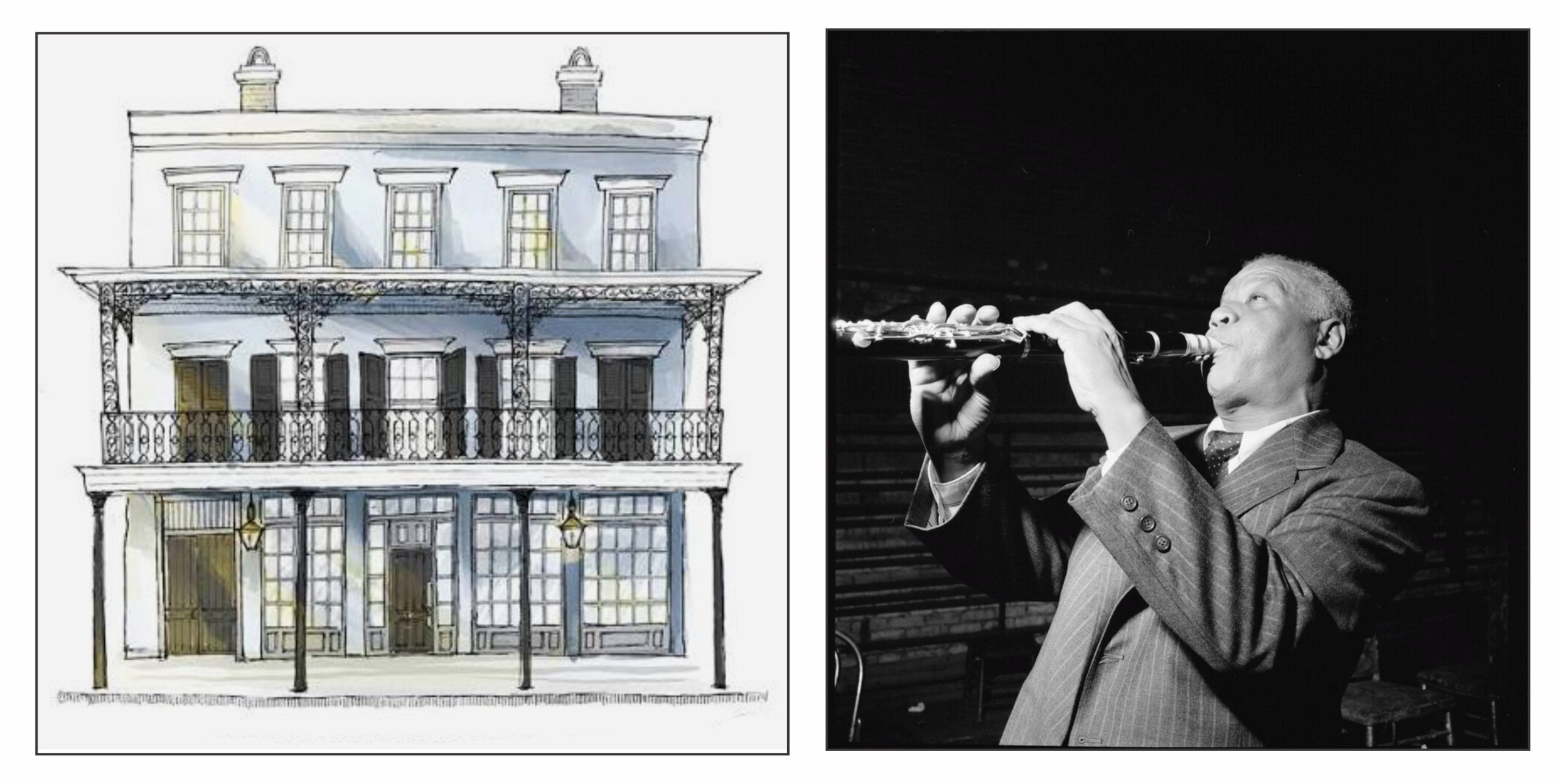
Another influence on early jazz was the mixing of European and African music in the Louisiana Creole culture. Sidney Bechet (1897-1959) was born to a “Creole of Color” family in New Orleans. He became adept at the clarinet and soprano saxophone and was one of the first jazz soloists to be recorded. The following illustration shows a portrait of Sidney Bechet and a drawing of a creole townhouse in the French Quarter of New Orleans, also known as “Crescent City” because it is located on a long curving portion of the Mississippi River.
The English poet Philip Larkin (1922-1985) was enamored of jazz and wrote extensively about both the players and the music during the 1950s and 1960s. The following is his poem For Sidney Bechet written in 1954 but published later:
That note you hold, narrowing and rising, shakes
Like New Orleans reflected on the water,
And in all ears appropriate falsehood wakes,
Building for some a legendary Quarter
Of balconies, flower-baskets and quadrilles,
Everyone making love and going shares—
Oh, play that thing! Mute glorious Storyvilles
Others may license, grouping around their chairs
Sporting-house girls like circus tigers (priced
Far above rubies) to pretend their fads,
While scholars manqués nod around unnoticed
Wrapped up in personnels like old plaids.
On me your voice falls as they say love should,
Like an enormous yes. My Crescent City
Is where your speech alone is understood,
And greeted as the natural noise of good,
Scattering long-haired grief and scored pity.
This is Larkin’s recitation of the poem:
And Bechet playing clarinet for Blue Horizon:
Poetry of the Blues
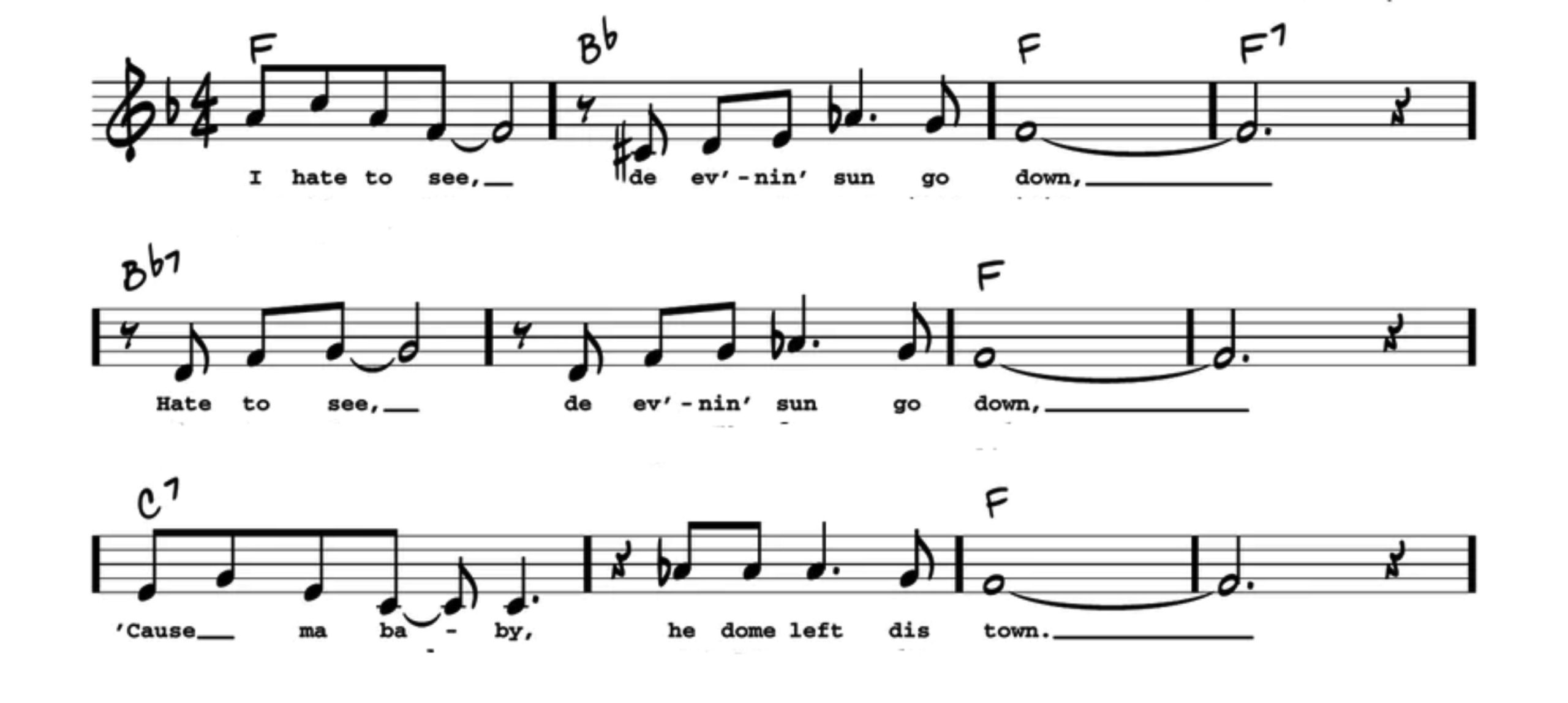
The blues became a tremendous force in jazz music and jazz poetry (Dickson, 1983; Huang, 2011). The basic structure of the blues, derived from work shouts and gospel music, is based on 12 bars of music. The first line of four bars states the subject; this is repeated sometimes with a minor variation in the words, notes or rhythm. These first two lines are like the call and response of gospel songs. In the blues the response repeats the call in a different voice, or on a different instrument. Finally, something else is said in the final four free-form bars. The following shows the beginning of W. C. Handy’s Saint Louis Blues:
Eight-bar blues follow the same format, but omit the repeating second line.
Ma Rainey (1886-1939) was one of the most successful singers of the blues. The following illustration shows Ma Rainey and her band in 1924:
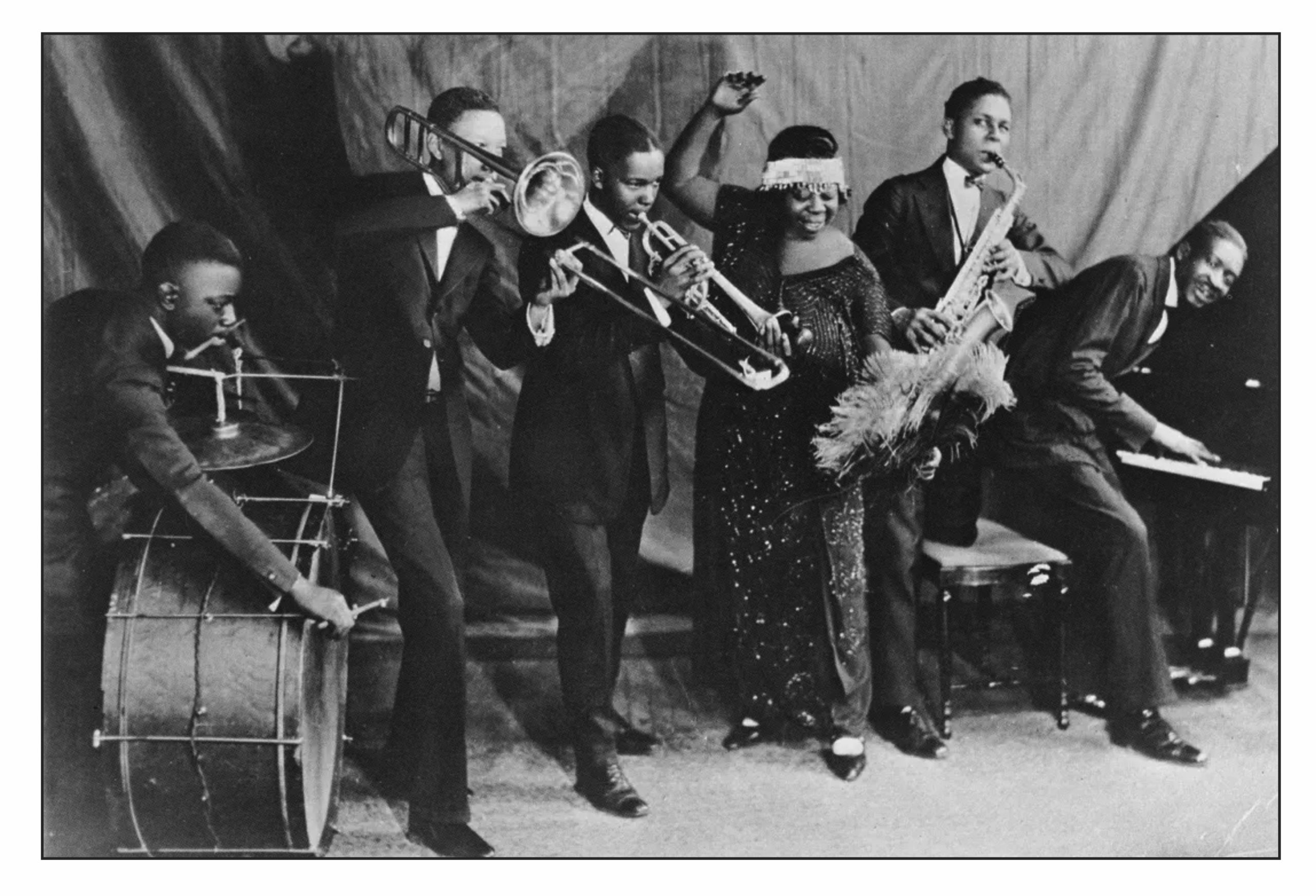
Sterling Brown (1901-1989) described the music of Ma Rainey in a 1932 poem:
I
When Ma Rainey
Comes to town,
Folks from anyplace
Miles aroun’,
From Cape Girardeau,
Poplar Bluff,
Flocks in to hear
Ma do her stuff;
Comes flivverin’ in,
Or ridin’ mules,
Or packed in trains,
Picknickin’ fools. . . .
That’s what it’s like,
Fo’ miles on down,
To New Orleans delta
An’ Mobile town,
When Ma hits
Anywheres aroun’.
II
Dey comes to hear Ma Rainey from de little river settlements,
From blackbottorn cornrows and from lumber camps;
Dey stumble in de hall, jes a-laughin’ an’ a-cacklin’,
Cheerin’ lak roarin’ water, lak wind in river swamps.
>An’ some jokers keeps deir laughs a-goin’ in de crowded aisles,
An’ some folks sits dere waitin’ wid deir aches an’ miseries,
Till Ma comes out before dem, a-smilin’ gold-toofed smiles
An’ Long Boy ripples minors on de black an’ yellow keys.
III
O Ma Rainey,
Sing yo’ song;
Now you’s back
Whah you belong,
Git way inside us,
Keep us strong. . . .
O Ma Rainey,
Li’l an’ low;
Sing us ’bout de hard luck
Roun’ our do’;
Sing us ’bout de lonesome road
We mus’ go. . . .
IV
I talked to a fellow, an’ the fellow say,
“She jes’ catch hold of us, somekindaway.
She sang Backwater Blues one day:
‘It rained fo’ days an’ de skies was dark as night,
Trouble taken place in de lowlands at night.
‘Thundered an’ lightened an’ the storm begin to roll
Thousan’s of people ain’t got no place to go.
‘Den I went an’ stood upon some high ol’ lonesome hill,
An’ looked down on the place where I used to live.’
An’ den de folks, dey natchally bowed dey heads an’ cried,
Bowed dey heavy heads, shet dey moufs up tight an’ cried,
An’ Ma lef’ de stage, an’ followed some de folks outside.”
Dere wasn’t much more de fellow say:
She jes’ gits hold of us dataway.
The middle of the fourth section of the poem quotes the actual lyrics of the Backwater Blues, a song written in response to the flooding of the Cumberland and Mississippi Rivers in 1926 and 1927. We do not have a recording of Ma Rainey singing it, but the following is a version by her protégé Bessie Smith (1892-1937):
The following is a reading of the whole poem by Sterling Brown:
Langston Hughes (1901-1967) used many techniques from jazz and blues in his poetry. Dickson (1983, p 30) describes three of these:
(1) the sometimes stretched iambic pentameter line repeated three times, a pattern integral to the classic twelve-bar blues in jazz;
(2) the trochaic sequence of stressed and unstressed syllables equal to the dotted eighth and sixteenth notes of boogie-woogie rhythm;
(3) the deliberately short, percussive interjections reminiscent of the asymmetrical patterns of 1940s bebop.
Some of Hughes’s poems are simply based on the 12-bar blues structure. The following is Hey! (1927):
Sun’s a settin’,
This is what I’m gonna sing.
Sun’s a settin’;
This is what I’m gonna sing:
I feels de blues a comin’,
Wonder what de blues’ll bring?
Each blues line is cut into two parts so that the stanza contains 6 lines instead of 3. Sometimes Hughes used the simple short lines without the repeats, as in Too Blue (1943)
I got those sad old weary blues.
I don’t know where to turn.
I don’t know where to go.
Nobody cares about you
When you sink so low.
What shall I do?
What shall I say?
Shall I take a gun and
Put myself away?
I wonder if
One bullet would do?
Hard as my head is,
It would probably take two.
But I ain’t got
Neither bullet nor gun –
And I’m too blue
To look for one.
Writing about the blues provided solace for Hughes: their very sadness relieved his feelings of despair:
The blues became an inspiration rooted in sadness, but with a complex mixture of humor and spiritual uplift. (Feinstein, 1997, p 43).
In 1958, Hughes recorded some of his poems together with a jazz combo conducted by Leonard Feather. The following is his performance of Hey! and Too Blue:
In the middle section of the performance, Hughes asks questions (What shall I do? What shall I say?) and the musicians reply in much the same way as the call and response of the basic blues (Jones, 2013, p 56)
Hughes’s most famous blues poem is The Weary Blues (1923). The poem tells of a black piano-player in a bar on Lenox Avenue in Harlem. The poem is marvellously rhythmic, changing between the slow swing sound of “a mellow croon” to the rapid patter of “pale dull pallor.” The repeating alliteration – “droning a drowsy” and “moan with melody” – brilliantly renders the sound of the piano in the night.
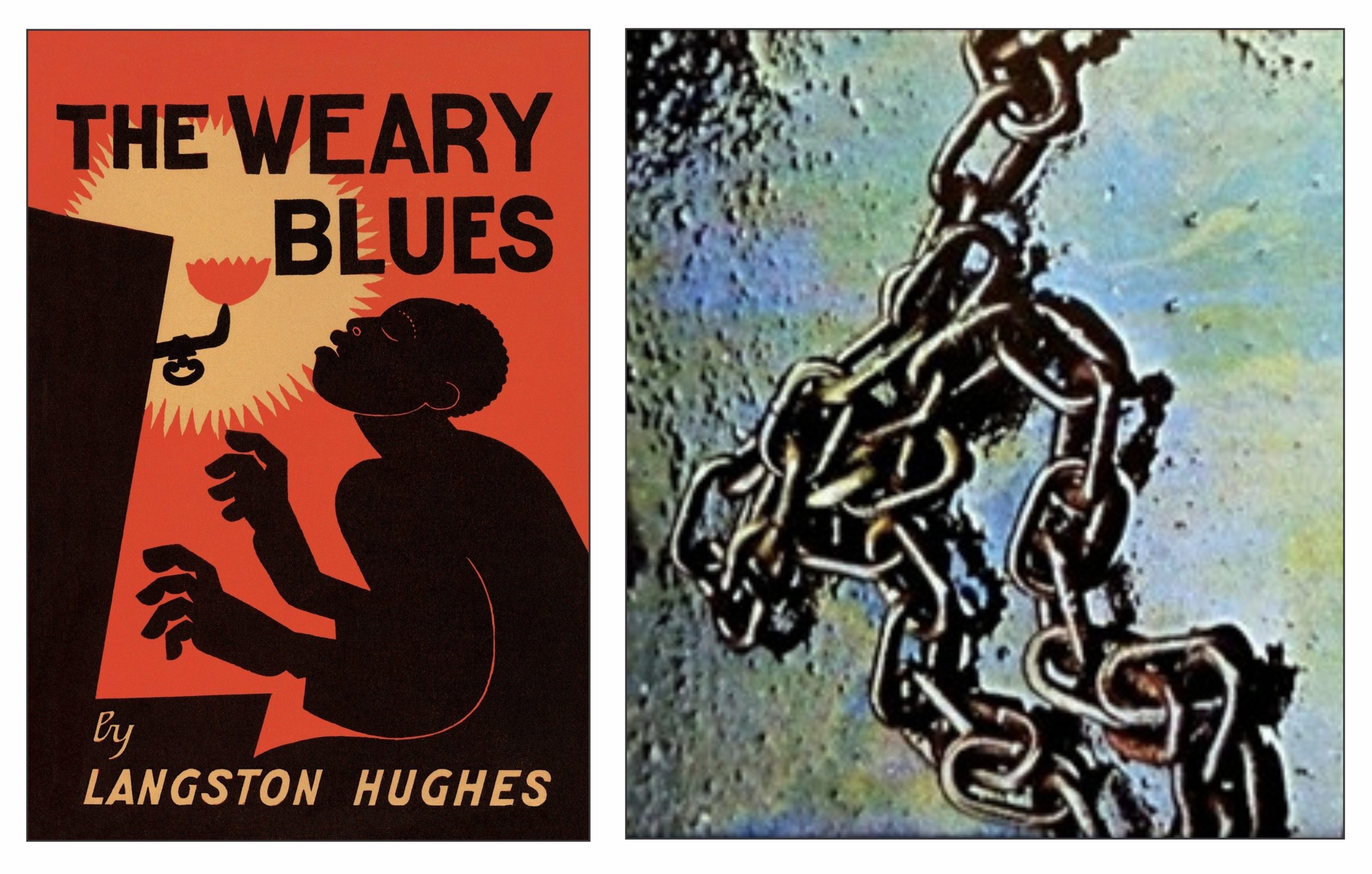
The poem was republished in Hughes’s 1926 book of the same title with a striking cover by the Mexican graphic artist Miguel Covarrubias. The cover is shown in the following illustration together with the artwork on the cover of the 1958 recording (1966 re-issue by Verve) by Fran Scott:
Droning a drowsy syncopated tune,
Rocking back and forth to a mellow croon,
I heard a Negro play.
Down on Lenox Avenue the other night
By the pale dull pallor of an old gas light
He did a lazy sway. . . .
He did a lazy sway. . . .
To the tune o’ those Weary Blues.
With his ebony hands on each ivory key
He made that poor piano moan with melody.
O Blues!
Swaying to and fro on his rickety stool
He played that sad raggy tune like a musical fool.
Sweet Blues!
Coming from a black man’s soul.
O Blues!
In a deep song voice with a melancholy tone
I heard that Negro sing, that old piano moan—
“Ain’t got nobody in all this world,
Ain’t got nobody but ma self.
I’s gwine to quit ma frownin’
And put ma troubles on the shelf.”
Thump, thump, thump, went his foot on the floor.
He played a few chords then he sang some more—
“I got the Weary Blues
And I can’t be satisfied.
Got the Weary Blues
And can’t be satisfied—
I ain’t happy no mo’
And I wish that I had died.”
And far into the night he crooned that tune.
The stars went out and so did the moon.
The singer stopped playing and went to bed
While the Weary Blues echoed through his head.
He slept like a rock or a man that’s dead.
Just before the end of the poem, the pianist sings the Weary Blues as a formal 12-bar blues song.
At its end, the poem has changed its point of view. At the beginning the poet remembered what he heard; at the end the poet imagines what might happen to the pianist:
So already in the Twenties, the principal ways in which poets were to use jazz had been established: jazz as metaphor, jazz as rhythmic base, and poetry as voice to the jazz musician.
As jazz came from African-Americans, its most eloquent poet in the Twenties (perhaps ever) was Langston Hughes, who managed all three approaches, frequently in the same poem. “Weary Blues” is a classic example. The poet hears an old blues singer in a Harlem club. He is moved by the music; he reports on the lyric; finally, by a kind of osmosis, he enters into to the old blues singer. (Richards, 2006).
The following is Hughes’s performance from the 1958 recording:
Jazz Lyrics
Poetry has always been related to song. All music involves interpretation. However, in jazz the interpretation is paramount. One remembers not so much the song as the way the singer sang it. In addition, jazz songs were much freer than other songs: they did not follow strict rhythms and used rhyme as an ornament rather than a rule. Their “phrasing” was more like speech than music. Poetry had much to learn from jazz.
One of the most famous jazz songs God Bless the Child was composed by Billie Holiday (1915-1959) and Arthur Herzog Jr. in 1939. Although it originated in an argument between Holiday and her mother about money, its final form transcends its origins to describe about the inherent unfairness of life (Hobart. 2016). You cannot expect anything from others, but can only rely on yourself. The rich do not feel obligated to help the poor. As the song notes, this fact of life is recognized repeatedly in the bible:
For whosoever hath, to him shall be given, and he shall have more abundance: but whosoever hath not, from him shall be taken away even that he hath. (Matthew 13:12)
For I say unto you, That unto every one which hath shall be given; and from him that hath not, even that he hath shall be taken away from him. (Luke 19: 26)
The latter quote (also Matthew 25:29) comes at the end of the Parable of the Talents and is said to the servant who hid his talent away and did not use it. The actual lesion is to make something from what you have been given. The following are the lyrics
Them that’s got shall have
Them that’s not shall lose
So the bible said and it still it’s news
Mama may have, papa may have
But God blessed the child that’s got his own
That’s got his own
Yes, the strong get smart
While the weak ones fade
Empty pockets don’t ever make the grade
Mama may have, papa may have
But God blessed the child that’s got his own
That’s got his own
Money, you’ve got lots of friends
Crowding ’round your door
When you’re gone and spending ends
They don’t come no more
Rich relations give crusts of bread and such
You can help yourself, but don’t take too much
Mama may have, papa may have
But God blessed the child that’s got his own
That’s got his own
He just don’t worry ’bout nothing
‘Cause he’s got his own
The following is Billie Holiday’s 1941 version with Eddie Heywood and his orchestra:
Another famous jazz lyric is Lush Life by Billy Strayhorn (1915-1967), composed sometime in the late 1930s. Strayhorn was a pianist and composer who worked with Duke Ellington. One of his other famous compositions was Take the A-Train (1939) which was based on Ellington’s instructions to Strayhorn about how to get to his apartment in Harlem after arriving in New York at Penn Station. The following are the lyrics to Lush Life:
I used to visit all the very gay places
Those come what may places
Where one relaxes on the axis of the wheel of life
To get the feel of life
From jazz and cocktails
The girls I knew had sad and sullen gray faces
With distingué traces
That used to be there you could see where they’d been washed away
By too many through the day
Twelve o’clock tales
Then you came along with your siren of song
To tempt me to madness!
I thought for a while that your poignant smile was tinged with the sadness
Of a great love for me
Ah yes! I was wrong
Again, I was wrong
Life is lonely again
And only last year everything seemed so sure
Now life is awful again
A trough full of hearts could only be a bore
A week in Paris will ease the bite of it
All I care is to smile in spite of it
I’ll forget you I will
While yet you are still burning inside my brain
Romance is mush
Stifling those who strive
I’ll live a lush life in some small dive
And there I’ll be while I rot
With the rest of those whose lives are lonely too
The song was recorded for the first time by Kay Evans (accompanied by Strayhorn) at Duke Ellington’s Carnegie Hall concert in 1948:
The song uses a line length that is determined by the meaning rather than by any preconceived form. It is fascinatingly complex. Poetry could learn much from such a lyric.
The song is full of double-entendres. The “lush” from the title evokes both luxuriance and drunkenness. Even the appearance of the term “gay,” though still used to mean lighthearted and carefree in the 1930s, likely held a coded meaning for Strayhorn, who was open about his homosexuality. The image of the wheel is especially vivid and serves as a model for the persona’s journey. The axis at the center stays still while everything else whirls around it, experiencing the rush and speed of life without actually participating in it. But the moment one steps out onto the spinning wheel, as the singer does, they are at risk of being thrown of entirely. These intricately woven metaphors elevate Strayhorn’s lyrics, and enjambment and internal rhyme give them a slightly backbeat balance, similar to the underlying swing of syncopated music. This technique also gives the poem its lush sense of abundance, provoking the lyric to literally overflow the line: (Teague, 2023, pp 228-229)
Playing Jazz
Poets have been fascinated by the interactions between the musicians that occur during the playing of jazz. Perhaps, since writing poetry is generally a solitary occupation, poets are a little jealous. The following is The Accompanist (1987) by William Matthews (1942-1997).
Don’t play too much, don’t play
too loud, don’t play the melody.
You have to anticipate her
and to subdue yourself.
She used to give me her smoky
eye when I got boisterous,
so I learned to play on tip-
toe and to play the better half
of what I might. I don’t like
to complain, though I notice
that I get around to it somehow.
We made a living and good music,
both, night after night, the blue
curlicues of smoke rubbing their
staling and wispy backs
against the ceilings, the flat
drinks and scarce taxis, the jazz life
we bitch about the way Army pals
complain about the food and then
re-up. Some people like to say
with smut in their voices how playing
the way we did at our best is partly
sexual. OK, I could tell them
a tale or two, and I’ve heard
the records Lester cut with Lady Day
and all that rap, and it’s partly
sexual but it’s mostly practice
and music. As for partly sexual,
I’ll take wholly sexual any day,
but that’s a duet and we’re talking
accompaniment. Remember “Reckless
Blues’? Bessie Smith sings out “Daddy”
and Louis Armstrong plays back “Daddy”
as clear through his horn as if he’d
spoken it. But it’s her daddy and her
story. When you play it you become
your part in it, one of her beautiful
troubles, and then, however much music
can do this, part of her consolation,
the way pain and joy eat off each other’s
plates, but mostly you play to drunks,
to the night, to the way you judge
and pardon yourself, to all that goes
not unsung, but unrecorded.
The following is Matthews’ recitation of the poem:
Matthews mentions Billie Holiday (Lady Day) and Lester Young (Pres) who accompanied her on tenor saxophone. The following is their rendition of All of Me (1941)
All of me, why not take all of me?
Can’t you see I’m no good without you?
Take my lips, I want to lose them
Take my arms, I’ll never use them
Your goodbye left me with eyes that cry
How can I go on, dear, without you?
You took the part that once was my heart
So why not take all of me?
All of me, why not take all of me?
Can’t you see I’m no good without you?
Take my lips, I want to lose them
Take my arms, I’ll never use them
Your goodbye left me with eyes that cry
How can I go on, dear, without you?
You took the best so why not take the rest?
Baby, take all of me
And the following is Reckless Blues (1925) by Bessie Smith and Louis Armstrong:
When I wasn’t nothing but a child
When I wasn’t nothing but a child
All you men tried to drive me wild
Now I’m, now I’m growing old
Now, now I’m growing old
And I’ve got what it takes to get all of you men told
My mama says I’m reckless, my daddy says I’m wild
My mama says I’m reckless, my daddy says I’m wild
I ain’t good looking but I’m somebody’s angel child
Daddy, mama wants some loving
Daddy, mama need some hugging
Darn it pretty papa
Mama wants some lovin’ I vow
Darn pretty papa
Mama wants some lovin’ right now
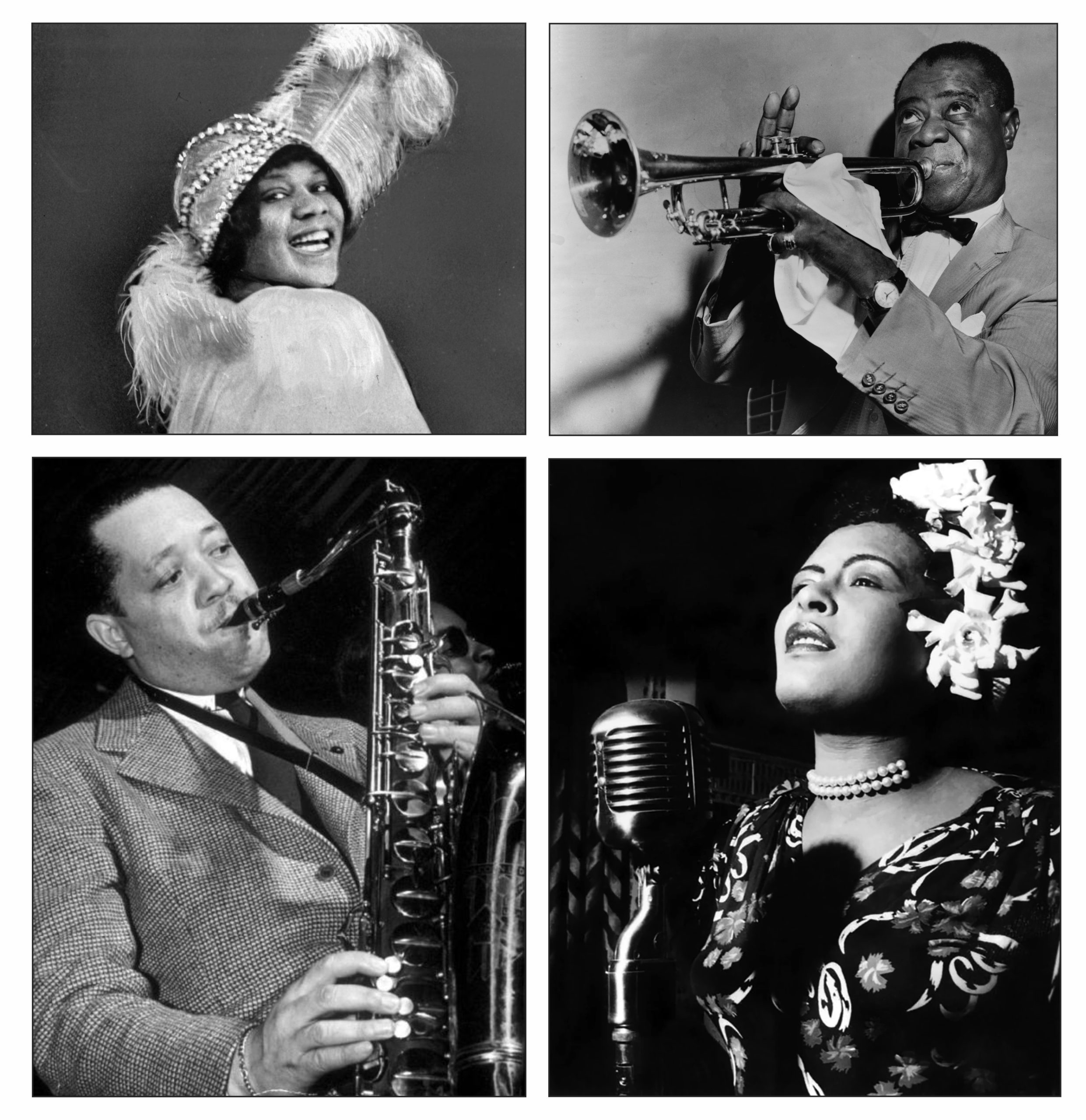
The following illustration shows Bessie Smith, Louis Armstrong, Lester Young and Billie Holiday:
Hayden Carruth (1921-2008) wrote a vivid poem about the interactions between the different members of a jazz quartet: Scrambled Eggs and Whiskey (1995) The poem describes an early breakfast at the White Tower diner for four jazz musicians who have just finished a successful late-night gig:
Scrambled eggs and whiskey
in the false-dawn light. Chicago,
a sweet town, bleak, God knows,
but sweet. Sometimes. And
weren’t we fine tonight?
When Hank set up that limping
treble roll behind me
my horn just growled and I
thought my heart would burst.
And Brad M. pressing with the
soft stick and Joe-Anne
singing low. Here we are now
in the White Tower, leaning
on one another, too tired
to go home. But don’t say a word,
don’t tell a soul, they wouldn’t
understand, they couldn’t, never
in a million years, how fine,
how magnificent we were
in that old club tonight.
White Tower was a chain of restaurants founded in 1926 in imitation of the earlier White Castle restaurants. The whiskey is a bourbon, served surreptitiously from a personal bottle in a paper bag, since the restaurant did not serve alcohol.
The musicians are feeling good about how well they played: Hank the pianist, Brad the drummer, Joe-Anne the vocalist, and the speaker as the horn player who “thought my heart would burst.” The listeners were likely enthralled by their performance, but if they weren’t, it would not matter. The musicians know how “magnificent” they were.
Jazz is characterized by variation and improvisation. The White Tower was an architectural variation on the White Castle, itself an imitation on the Chicago Water Tower. Bourbon whiskey made from corn is a variation on Scotch whisky made from barley. Whiskey with breakfast is an improvisation.
The Saxophone
Adolphe Sax (1814-1894) invented the saxophone in 1840. The new instrument was designed to have the projection of the brass instruments, the agility of the woodwinds, and a sound like the human voice. The instrument was manufactured in various sizes, of which the soprano, alto and tenor were most common. Although used in classical music, the saxophone became much more popular in marching bands and dance combos, particularly in North America. Black Americans shaped how the instrument was used in the jazz and blues repertoire: it became a symbol of black culture, expressing the sadness and anger of racial repression.
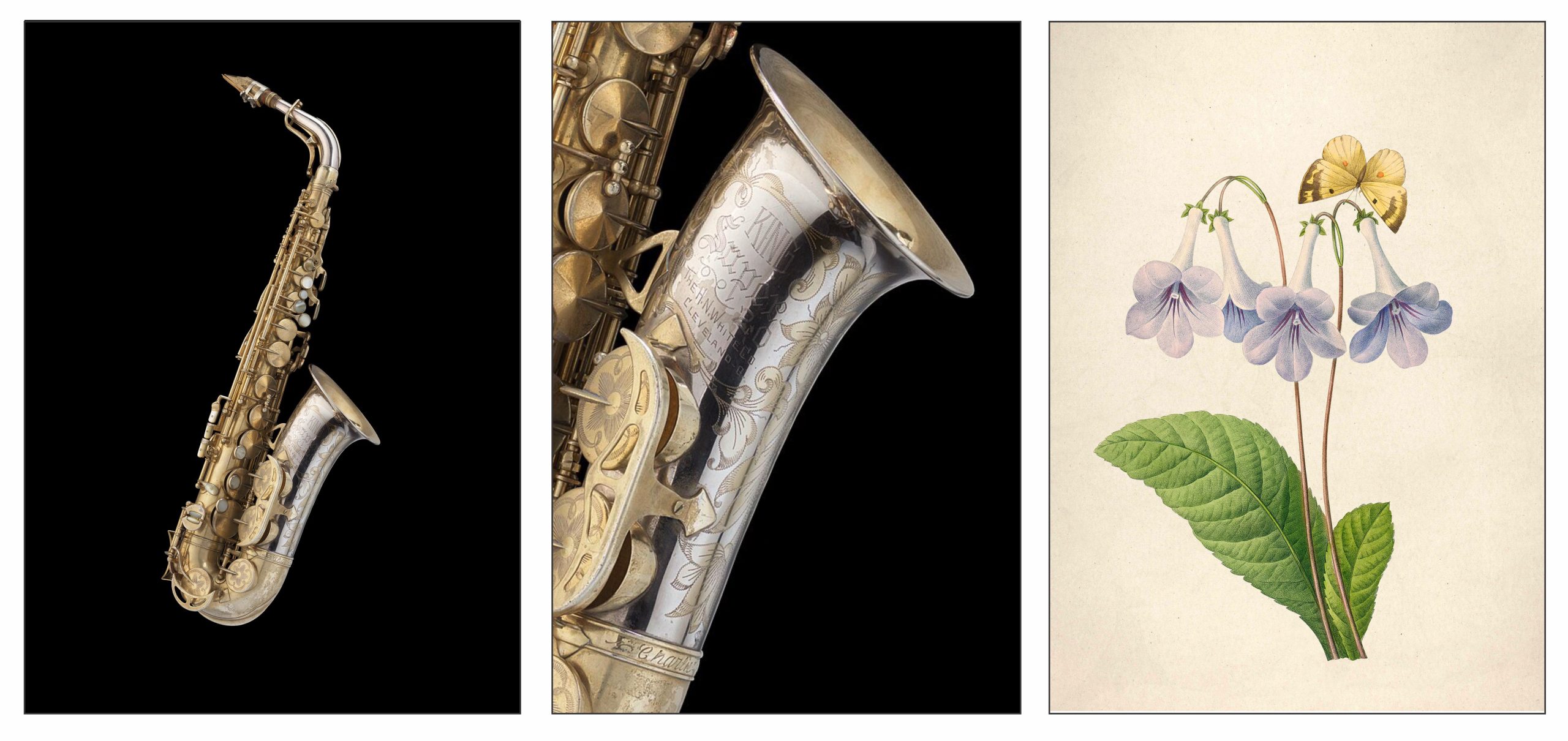
The following illustration shows Charlie Parker’s alto saxophone: the King Super 20 (H. N. White Company) with a sterling silver bell engraved with flowers. On the right of the illustration is a drawing of the Gloxinia plant whose flowers are shaped like the saxophone.
Robert Pinsky (1940- ) wrote a poem about the saxophone: Ginza Samba (1996):
A monosyllabic European called Sax
Invents a horn, walla whirledy wah, a kind of twisted
Brazen clarinet, but with its column of vibrating
Air shaped not in a cylinder but in a cone
Widening ever outward and bawaah spouting
Infinitely upward through an upturned
Swollen golden bell rimmed
Like a gloxinia flowering
In Sax’s Belgian imagination
And in the unfathomable matrix
Of mothers and fathers as a genius graven
Humming into the cells of the body
Or cupped in the resonating grail
Of memory changed and exchanged
As in the trading of brasses,
Pearls and ivory, calicos and slaves,
Laborers and girls, two
Cousins in a royal family
Of Niger known as the Birds or Hawks.
In Christendom one cousin’s child
Becomes a “favorite negro” ennobled
By decree of the Czar and founds
A great family, a line of generals,
Dandies and courtiers including the poet
Pushkin, killed in a duel concerning
His wife’s honor, while the other cousin sails
In the belly of a slaveship to the port
Of Baltimore where she is raped
And dies in childbirth, but the infant
Will marry a Seminole and in the next
Chorus of time their child fathers
A great Hawk or Bird, with many followers
Among them this great-grandchild of the Jewish
Manager of a Pushkin estate, blowing
His American breath out into the wiggly
Tune uncurling its triplets and sixteenths—the Ginza
Samba of breath and brass, the reed
Vibrating as a valve, the aether, the unimaginable
Wires and circuits of an ingenious box
Here in my room in this house built
A hundred years ago while I was elsewhere:
It is like falling in love, the atavistic
Imperative of some one
Voice or face—the skill, the copper filament,
The golden bellful of notes twirling through
Their invisible element from
Rio to Tokyo and back again gathering
Speed in the variations as they tunnel
The twin haunted labyrinths of stirrup
And anvil echoing here in the hearkening
Instrument of my skull.
The poem mentions the giants of the saxophone – Coleman Hawkins (“Hawk,” 1904-1969) and Charlie Parker (“Yardbird” or “Bird,” 1920-1955) – as well as the poet’s ties to Alexander Pushkin (1799-1837). Pushkin’s great-grandfather, an African page gifted to Peter the Great by the Ottoman Sultan, was a general in the Russian army. The poem shows how the jazz moved from Africa to America and then spread as far afield as Brazil where it learned the Samba and the clubs of the Ginza St in Tokyo.
In 2012 Pinsky performed this poem together with Laurence Hopgood on Piano, Stan Stickland on saxophones (soprano and tenor) and John Lockwood on bass for PoemJazz. The music riffs on Ginza Samba which was originally written and performed by Vince Guaraldi in 1956.
Charlie Parker (1920-1955) was one of the giants of jazz. Together with Dizzy Gillespie, Miles Davies and Thelonius Monk, he evolved a new style of jazz which was more complex and abstract than the jazz of the great swing bands. This new Bebop Jazz stretched the harmonics and rhythms of the standard tunes. Intended for listening rather than dancing it used much faster tempos and allowed much more improvisation.
However, Parker became addicted to alcohol and heroin and died at the age of 34 years. Philip Levine (1928-2015) wrote a poem about Charlie Parker’s addiction: Call it Music (2000). It describes a 1946 recording session in California where Parker could hardly stand up to play. It mentions Bird Flight, a long-running (1981-2021) radio show devoted to the life and music of Charlie Parker. It describes a 1946 recording session in California where Parker could hardly stand up to play and how Howard McGhee, a young trumpet player, tried to take care of Parker after the recording session. McGhee later became a good friend of Levine:
Some days I catch a rhythm, almost a song
in my own breath. I’m alone here
in Brooklyn Heights, late morning, the sky
above the St. George Hotel clear, clear
for New York, that is. The radio playing
“Bird Flight,” Parker in his California
tragic voice fifty years ago, his faltering
“Lover Man” just before he crashed into chaos.
I would guess that outside the recording studio
in Burbank the sun was high above the jacarandas,
it was late March, the worst of yesterday’s rain
had come and gone, the sky washed blue. Bird
could have seen for miles if he’d looked, but what
he saw was so foreign he clenched his eyes,
shook his head, and barked like a dog—just once—
and then Howard McGhee took his arm and assured him
he’d be OK. I know this because Howard told me
years later that he thought Bird could
lie down in the hotel room they shared, sleep
for an hour or more, and waken as himself.
The perfect sunlight angles into my little room
above Willow Street. I listen to my breath
come and go and try to catch its curious taste,
part milk, part iron, part blood, as it passes
from me into the world. This is not me,
this is automatic, this entering and exiting,
my body’s essential occupation without which
I am a thing. The whole process has a name,
a word I don’t know, an elegant word not
in English or Yiddish or Spanish, a word
that means nothing to me. Howard truly believed
what he said that day when he steered
Parker into a cab and drove the silent miles
beside him while the bright world
unfurled around them: filling stations, stands
of fruits and vegetables, a kiosk selling trinkets
from Mexico and the Philippines. It was all
so actual and Western, it was a new creation
coming into being, like the music of Charlie Parker
someone later called “glad,” though that day
I would have said silent, “the silent music
of Charlie Parker.” Howard said nothing.
He paid the driver and helped Bird up two flights
to their room, got his boots off, and went out
to let him sleep as the afternoon entered
the history of darkness. I’m not judging
Howard, he did better than I could have
now or then. Then I was 19, working
on the loading docks at Railway Express,
coming day by day into the damaged body
of a man while I sang into the filthy air
the Yiddish drinking songs my Zadie taught me
before his breath failed. Now Howard is gone,
eleven long years gone, the sweet voice silenced.
“The subtle bridge between Eldridge and Navarro,”
they later wrote, all that rising passion
a footnote to others. I remember in ’85
walking the halls of Cass Tech, the high school
where he taught after his performing days,
when suddenly he took my left hand in his
two hands to tell me it all worked out
for the best. Maybe he’d gotten religion,
maybe he knew how little time was left,
maybe that day he was just worn down
by my questions about Parker. To him Bird
was truly Charlie Parker, a man, a silent note
going out forever on the breath of genius
which now I hear soaring above my own breath
as this bright morning fades into afternoon.
Music, I’ll call it music. It’s what we need
as the sun staggers behind the low gray clouds
blowing relentlessly in from that nameless ocean,
the calm and endless one I’ve still to cross.
The following is a 2014 reading of the poem by Levine with the backing of Benjamin Boone and Greg Osby on alto saxophones, David Aus on piano, Spee Kosloff on bass and Brian Hamada on drums.
After McGhee took him back to the motel, an inebriated Parker set fire to his room. He was arrested and remanded for care at the Camarillo State Hospital. Parker was later very upset that his recording of Lover Man had been released. Some people are impressed by the emotional intensity of this ragged performance. The following, however, is a later and more controlled recording:
In 1997 Yusuf Komunyakaa (1947- ) wrote Testimony, a sequence of poems in homage to Charlie Parker. Each poem is set up as a double sonnet, each part of which contains 14 unrhymed lines, each line containing only three stresses. The following is the first of these: it documents Parker’s early experience as a musician in Chicago. Goon is Andrew Gardner who played alto saxophone in various jazz bands in Chicago in the 1940s. Budd Bolden played tenor saxophone in bands led by Louis Armstrong and Earl Hines, touring through the cities of middle America. He went on to be part of the Bebop scene in New York in the 1950s.
He hopped boxcars to Chitown
late fall, just a few steps
ahead of the hawk. After
sleepwalking to the 65 Club,
he begged Goon for a chance
to sit in with a borrowed sax.
He’d paid his dues for years
blowing ravenous after-hours
’til secrets filled with blues
rooted in Mississippi mud;
he confessed to Budd Johnson
that as a boy playing stickball,
sometimes he’d spy in a window
as they rehearsed back in K. C.
It was Goon who took him home,
gave him clothes & a clarinet.
Maybe that’s when he first
played laughter & crying
at the same time. Nights
sucked the day’s marrow
’til the hibernating moon grew
fat with lies & chords. Weeks
later, with the horn hocked,
he was on a slow Greyhound
headed for the Big Apple,
& “Honeysuckle Rose”
blossomed into body language,
driven by a sunset on the Hudson.
The following is from a performance of Testimony, with music composed by the Australian saxophonist Sandy Evans and with the poem recited by Michael Edward-Stevens:
In New York, Parker became a success. He had troubles with heroin and alcohol, and these resulted in the incident in California and his subsequent hospitalization. However, he recovered and the following illustration shows him in 1947 at the Three Deuces on 52nd St. in New York, with Max Roach (bass), Tommy Potter (drums) Miles Davis and Duke Jordan (piano).
Parker became immensely successful. In 1950 he became involved with the nightclub dancer Chan Richardson and they had two children together, although Parker never divorced his first wife. Their living together as black man and white woman resulted in a high level of stress in an America that in the 1950s was still very racist. In 1954 their 2-year-old daughter died of pneumonia. Parker was devastated and attempted suicide. He survived but began taking large amounts of heroin and alcohol.
The Baroness Pannonica (“Nica”) de Koenigswarter, née Rothschild, was an important patron of many jazz players in New York, providing them with extra money, food, transportation, and a place to crash in her suite at the Stanhope Hotel. Thelonius Monk and Charlie Parker were her favorites. She flew her own plane, was a competent photographer, and had worked for the Résistance in France during World War II. In 1955 Parker was with her at the Stanhope, and suddenly died of a gastric hemorrhage, likely related to his alcoholic cirrhosis. Although it was rumored that he died while injecting heroin, the truth was that he was simply watching TV.
Part XIII of Komunyakaa’s Testimony describes his death in the words of the Baroness as she faced the paparazzi hungry for scandal:
They asked questions so hard
they tried to hook the heart
& yank it through the mouth.
I smiled. They shifted
their feet & stood there
with hats in hands, hurting
for headlines: Baroness Pannonica . . .
I told them how I met my husband
at Le Touquet airport, about decoding
for De Gaulle, about my coming-out ball.
I said I heard a thunderclap,
but they didn’t want to hear
how Charlie died laughing
at jugglers on the Dorsey show.
The Stanhope buzzed with innuendo.
Yes, they had him with a needle
in his arm dead in my bathroom.
They loved to hear me say that
he was so sick he refused a shot
of gin. I told them his body
arrived at Bellevue five hours
later, tagged John Parker.
I told them how I wandered
around the Village in circles,
running into old friends,
that a cry held down my tongue
’til I found Chan, but they only
wanted us nude in bed together.
The following is a performance of this poem with Sandy Evans’s jazz combo and with Lily Dior reciting the poem:
Blue in Green
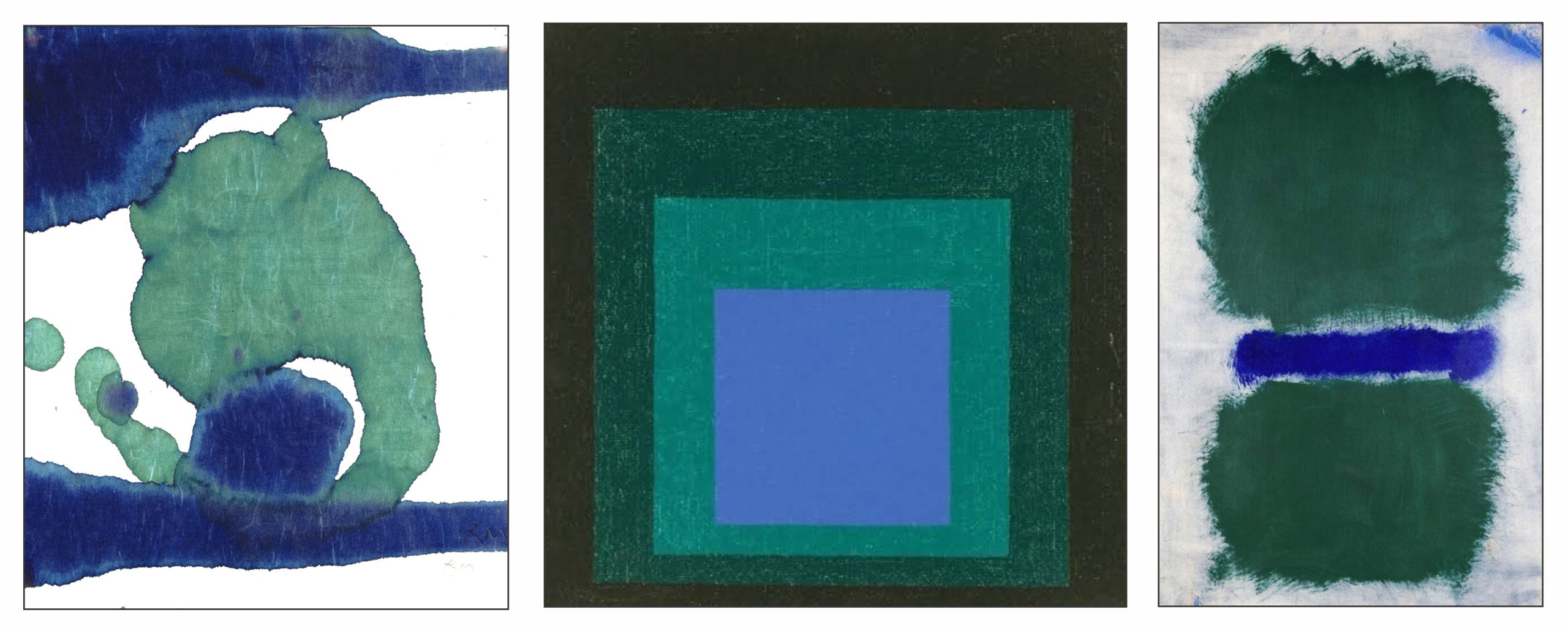
John Coltrane (1926-1967) idolized Charlie Parker. He continued Bird’s transformation of jazz. Together with Thelonius Monk and Miles Davis in the late 1950s and early 1960s, he made jazz move on from Bebop to a new style, variously described as “abstract,” “cool” or “modal.” This was at the same time as painting in New York was undergoing the rapid evolution of abstract expressionism and minimalism. Music and painting were trying to strip themselves down to their emotional origins.
The following illustration shows some of the new paintings: Robert Motherwell, from Lyric Suite (1962), Josef Albers, Homage to the Square (1956), Mark Rothko, Green Divided by Blue (1968). The paintings have been chosen to complement the music of Miles Davis, John Coltrane and Bill Evans in their famous track Blue in Green from the 1959 recording Kind of Blue.
The following is taken from Bill Evans’s liner notes from the 1559 LP release:
There is a Japanese visual art in which the artist is forced to be spontaneous. He must paint on a thin stretched parchment with a special brush and black water paint in such a way that an unnatural or interrupted stroke will destroy the line or break through the parchment.
Erasures or changes are impossible. These artists must practice a particular discipline, that of allowing the idea to express itself in communication with their hands in such a direct way that deliberation cannot interfere.
The resulting pictures lack the complex composition and textures of ordinary painting, but it is said that those who see will find something captured that escapes explanation. This conviction that direct deed is the most meaningful reflection, I believe, has prompted the evolution of the extremely severe and unique disciplines of the jazz or improvising musician.
Group improvisation is a further challenge. Aside from the weighty technical problem of collective coherent thinking, there is the very human, even social need for sympathy from all members to bend for the common result. This most difficult problem, I think, is beautifully met and solved on this recording.
As the painter needs his framework of parchment, the improvising musical group needs its framework in time. Miles Davis presents here frameworks which are exquisite in their simplicity and yet contain all that is necessary to stimulate performance with a sure reference to the primary conception.
Miles conceived these settings only hours before the recording dates and arrived with sketches which indicated to the group what was to be played. Therefore, you will hear something close to pure spontaneity in these performances. The group had never played these pieces prior to the recordings and I think without exception the first complete performance of each was a “take.”
A description of the music by Ashley Kahn (2000, p 120)
Evans’s introduction is light and airy as originally conceived, creating a peaceful landscape for the group to enter into. The bass keeps a subtle beat while Cobb’s two-handed brushwork on the snare drum offers tender rein-forcement. Miles’s muted solo arrives with an intensely languid, three-note phrase made even longer and more resonant by the natural echo of the studio (turn up the volume, and the vaulted ceiling is almost visible). Davis limits his vocabulary to long-held notes, dividing his phrasing into a series of whispered, two-part statements.
The unusual, palindromic order of solos on “Blue in Green” (trumpet-piano-tenor-piano-trumpet) further enhances the circular feel of the composition. In contrast to Davis’s sparsity, Evans’s “doubling up” (as musicians refer to tackling chord changes at twice the pace) creates a lighter feel with more movement. Even in a brief solo, he displays a daunting command of color and voicing in his chordal playing.
Coltrane finds a rhythmic middle ground between Davis and Evans, playing in a slow, deliberate tempo. His early love of Lester Young’s light and airy feel is conjured to opportune effect in his brooding, fleeting statement. Evans, and then Davis reprise their initial approaches to the tune, Miles almost fading away at one point, then returning with a sequence of subdued flourishes. Evans restates the theme, building the intensity with one last escalation of note clusters, and permits the song to dissipate and fade over a prolonged, bowed note from Chambers.
The following is an appreciative poem written in 2007 by Grace Schulman:
Blue in green: baywater seen through grasses
that quiver over it, stirring the air,
slanted against the water’s one-em dashes.
Each blade is a brushstroke on thin rice paper,
>unrehearsed, undrafted, no revision,
right on the first take. In “Blue in Green,”
on tenor sax, John Coltrane fills the blues
with mournful chords on scales older than Jubal’s,
ending in air. He’d not played it before
that recording, with that piano and bass
rising alone and, birds in flight, together.
Right on the first take. Improvisation,
he called it, but it must have been foreseen,
like the painter’s brushstroke. A wrong line
could blot the composition, snag the paper.
It had to be unstudied, like a tern’s cry,
and natural, like a rope’s clink on a mast
with wind as bass player, huge and invisible.
If only I could remember the past
without regret for the windrose petal’s fall,
for words unspoken, and without remorse
for loves withheld. Rough-draft mistakes.
If only my heart could teach my hands
to play, and get it right on the first take.
And her recitation of the poem:
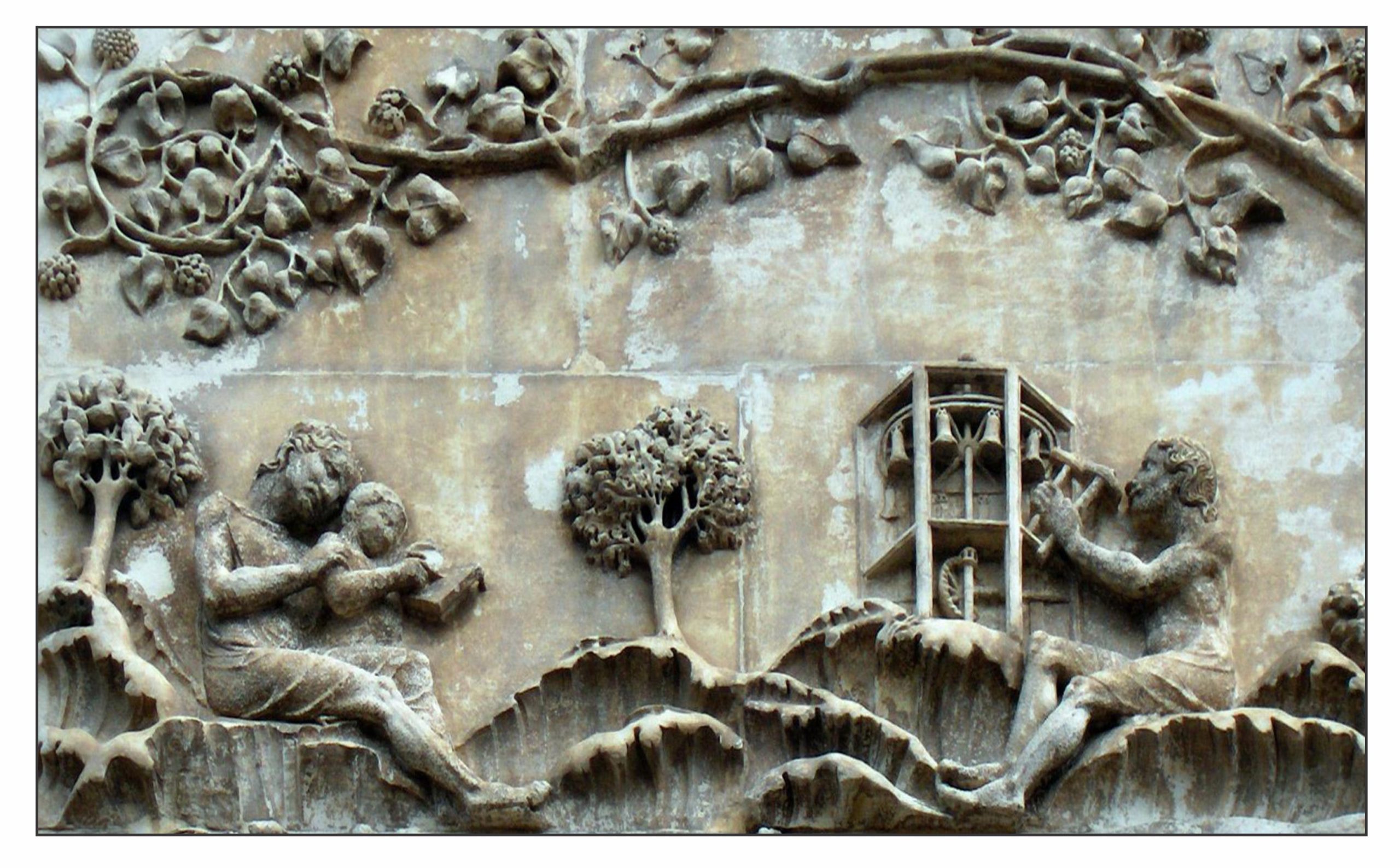
Schulman quotes from Evans’s liner notes and mentions Jubal’s bells. Jubal, a descendant of Cain was considered the originator of music (Genesis 4: 21). His half-sister Naamah was considered the first teacher of reading in some Jewish legends. The following illustration from the cathedral door in Orvieto shows Naamah and Jubal.
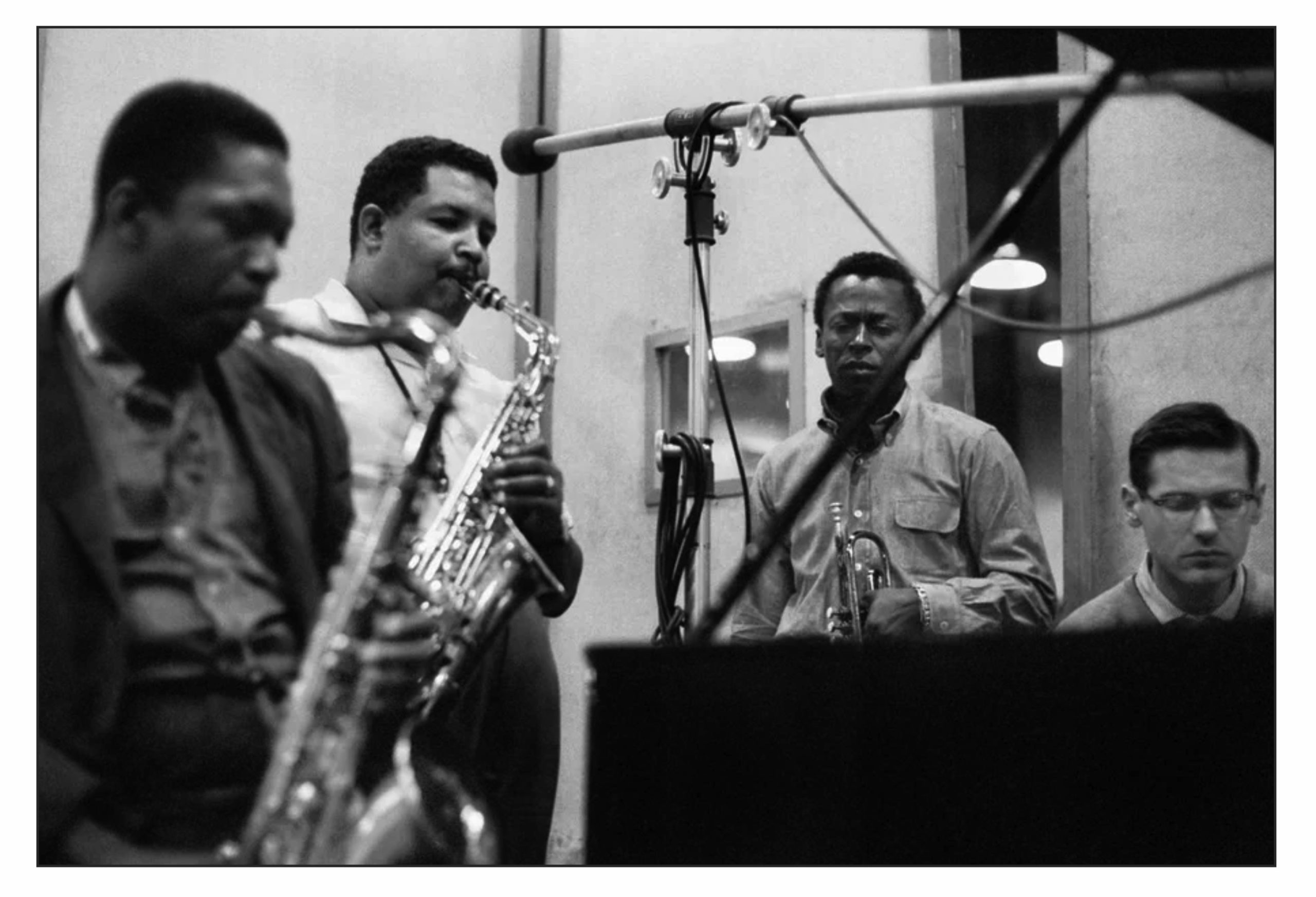
And the following photograph by Don Hunsteen shows Coltrane, Cannonball Adderley, Miles Davis and Bill Evans during the recording of Kind of Blue. (Adderley did not participate in the Blue in Green take).
AM/TRAK
In 1979 Amiri Baraka (Leroi Jones, 1934-2014) wrote an elegy entitled AM/TRAK for John Coltrane who had died of liver cancer in 1967. The title likely connects Coltrane who was known as “Trane” to the intercity train system known as Amtrak (a portmanteau word connecting “America” and rail “tracks”). It also gives the initials of the poet and suggests the poem is like a “track” in a recording.
The poem provides a musical biography of Coltrane
the poem traces the musician’s apprenticeships in various bands, influences on his musical development, his battles with drugs and alcohol, the hostility of critics, and, finally, the triumphant achievement of the great John Coltrane Quartet. (Lacey, 1986, p 14).
The poem needs to be heard rather than read. The following is a recording by Baraka:
The following three illustrations provide the text of the poem:
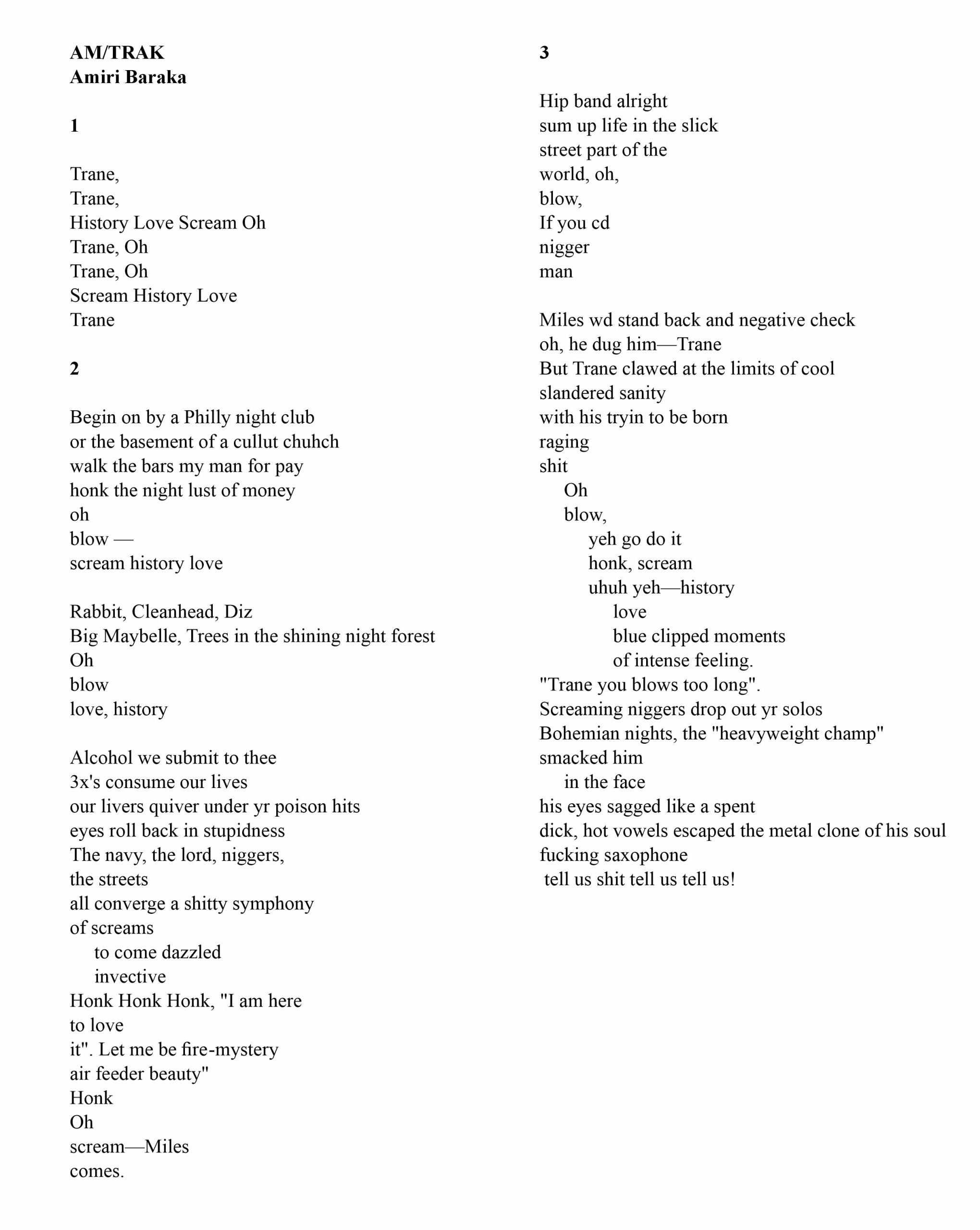
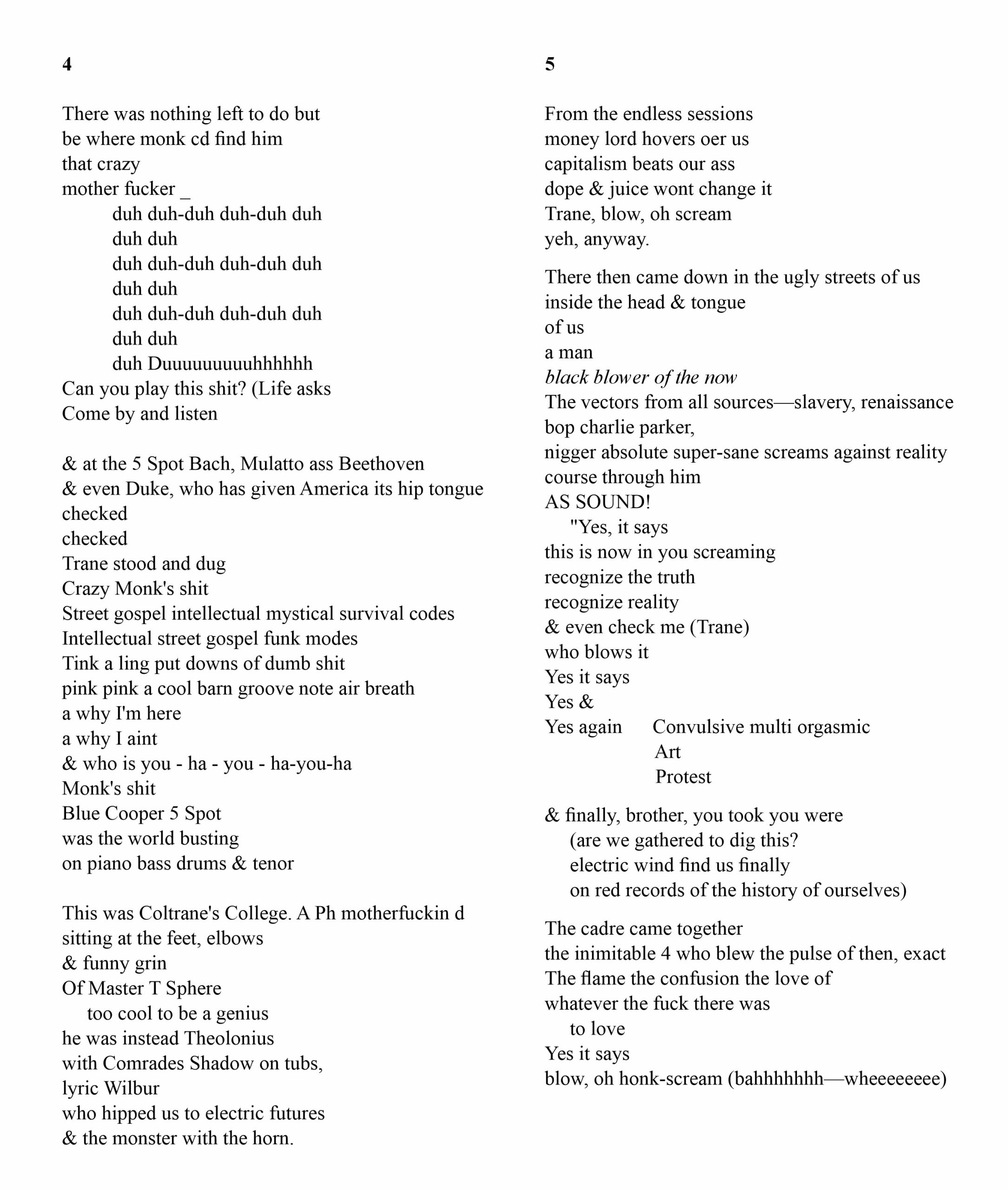
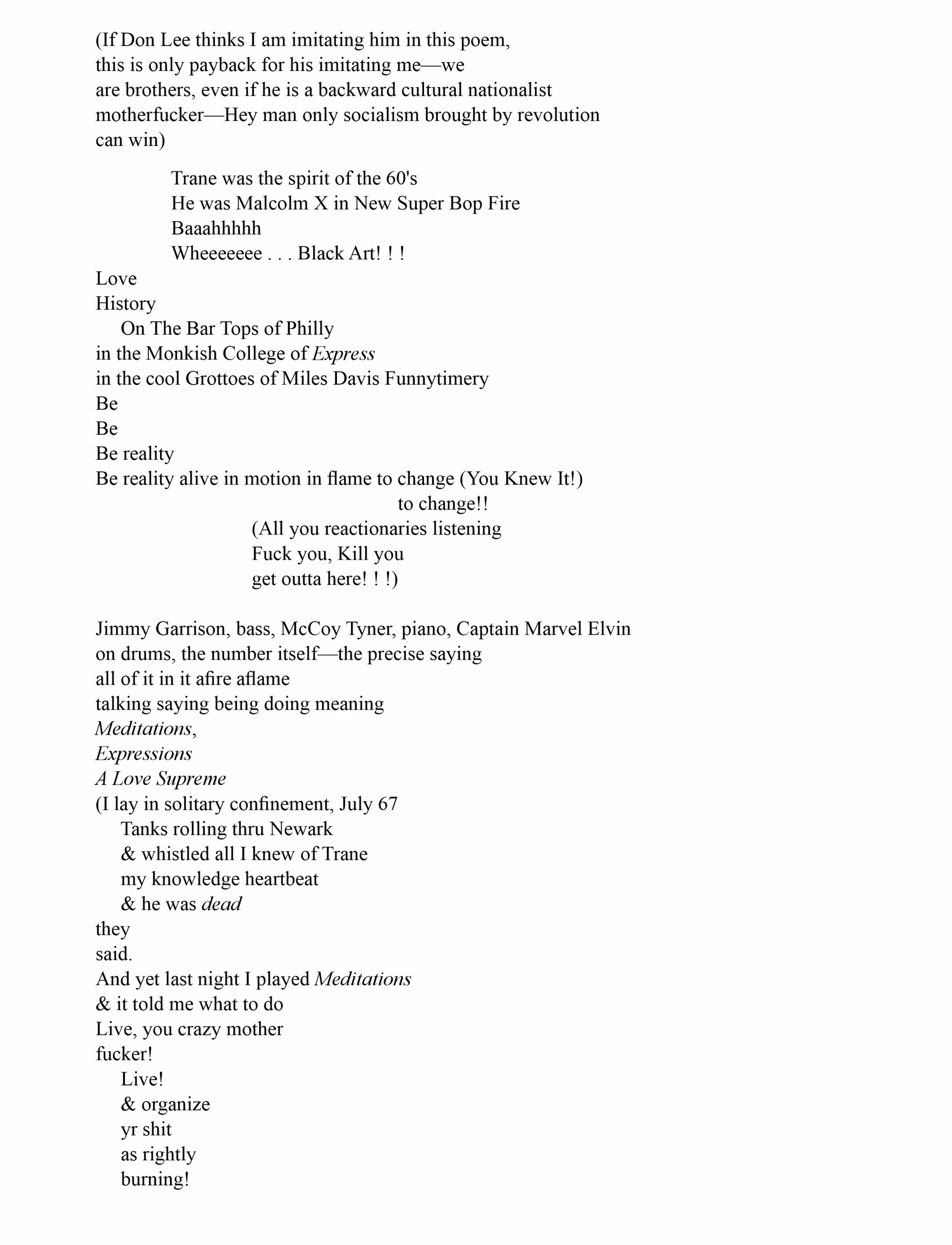
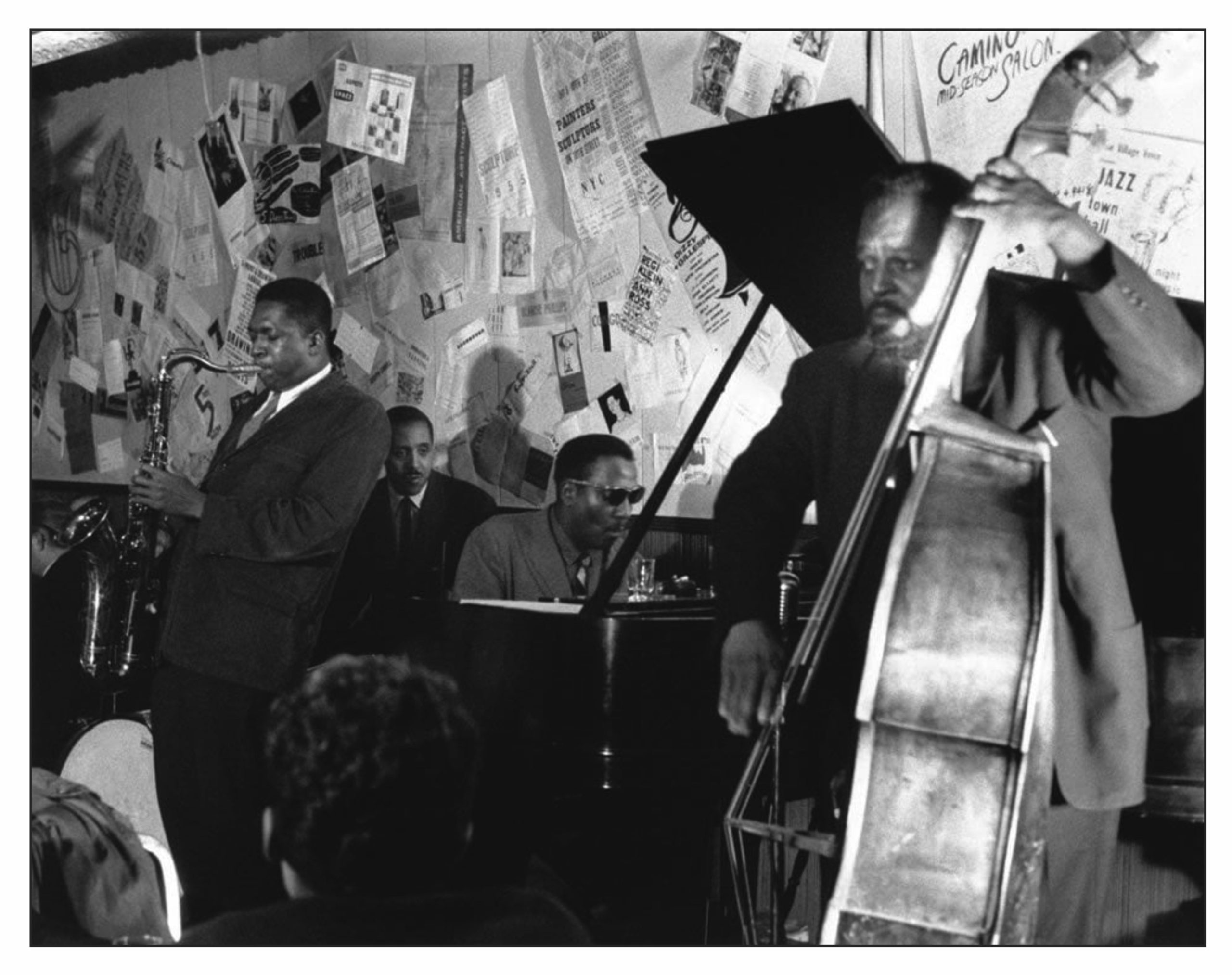
One of the most striking parts of the poem describes the interactions between Coltrane and Thelonius Monk after Coltrane and Miles Davis broke up. The following illustration shows Coltrane with Shadow Wilson, Monk and Ahmed Abdul-Malik at the 5 Spot Café in the Bowery in 1957
The following is a recording of Epistrophy from a charity concert the quartet played at Carnegie Hall during the time they were at the 5 Spot. Epistrophe is a rhetorical device that repeats a word or phrase at the ends of a set of phrases e.g. Lincoln’s “government of the people, by the people, for the people.” It is the opposite of anaphora which repeats the beginning, e.g. Churchill’s “We shall fight on the beaches, we shall fight on the landing grounds, we shall fight in the fields and in the streets.”
At the end of the poem, Baraka recalls how he was imprisoned on false charges during the riots in Newark in 1967, how he heard that Coltrane had just died, and how he consoled himself in prison by remembering some of Coltrane’s late music – issued under the title Meditations.
And yet last night I played Meditations
& it told me what to do
Live, you crazy mother
fucker!
Live!
& organize
yr shit
as rightly
burning!
The following is a recording of Serenity from First Meditations (1977). This track was the original recording by Coltrane’s quartet, but it was only issued posthumously. It is simpler and more convincing than the later sestet recording issued in 1966.
For Amiri Baraka, Coltrane embodied the Black experience in America, the ability to succeed despite all the forces arraigned against him
The poet concludes with the profoundly felt desire to approximate, in his life and art, the commitment, discipline, and beauty of John Coltrane ‘s example, an example made more compelling because of the extent to which both lives-poet’s and musician’s– have been characterized by change. Coltrane ‘s progress is measured in terms of his movement from rhythm and blues-oriented entertainer, to master of the hard bop mode, to post-bop innovator and prophetic force. By implication, the poet- former beat writer, former Black nationalist poet-priest-political activist, now Marxist poet-activist – manifests a desire progression. Taken the burden of rationalization to those critics who have lamented the seemingly chameleonic nature of the poet as well as what they perceive as his abandonment of his former cultural nationalist posture. Above all else, and in spite of the poet’s protests to the contrary, this poem is proof positive that Baraka is as much the cultural nationalist as ever. The peremptory Marxist sloganeering not withstanding, “AM/TRAK” is driven by the poet’s unequaled feel for the nuances of Black speech, knowledge of jazz music and its history, and his non-apologetic assertion of the seriousness of jazz music. (Lacey, 1986, pp 20-21).
The Passing of an Age
Jazz was immensely popular during the 1950s but beginning in the 1960s it began to cede its dominance to other musical movements such as rock, soul, rap and hip-hop. Heroin and alcohol cut a swathe through the great musicians: Charlie Parker, John Coltrane, Billie Holiday.
Frank O’Hara wrote a famous elegy for Billie Holiday: The Day Lady Died.
It is 12:20 in New York a Friday
three days after Bastille day, yes
it is 1959 and I go get a shoeshine
because I will get off the 4:19 in Easthampton
at 7:15 and then go straight to dinner
and I don’t know the people who will feed me
I walk up the muggy street beginning to sun
and have a hamburger and a malted and buy
an ugly NEW WORLD WRITING to see what the poets
in Ghana are doing these days
I go on to the bank
and Miss Stillwagon (first name Linda I once heard)
doesn’t even look up my balance for once in her life
and in the GOLDEN GRIFFIN I get a little Verlaine
for Patsy with drawings by Bonnard although I do
think of Hesiod, trans. Richmond Lattimore or
Brendan Behan’s new play or Le Balcon or Les Nègres
of Genet, but I don’t, I stick with Verlaine
after practically going to sleep with quandariness
and for Mike I just stroll into the PARK LANE
Liquor Store and ask for a bottle of Strega and
then I go back where I came from to 6th Avenue
and the tobacconist in the Ziegfeld Theatre and
casually ask for a carton of Gauloises and a carton
of Picayunes, and a NEW YORK POST with her face on it
and I am sweating a lot by now and thinking of
leaning on the john door in the 5 SPOT
while she whispered a song along the keyboard
to Mal Waldron and everyone and I stopped breathing
The following is his reading of the poem
Envoi
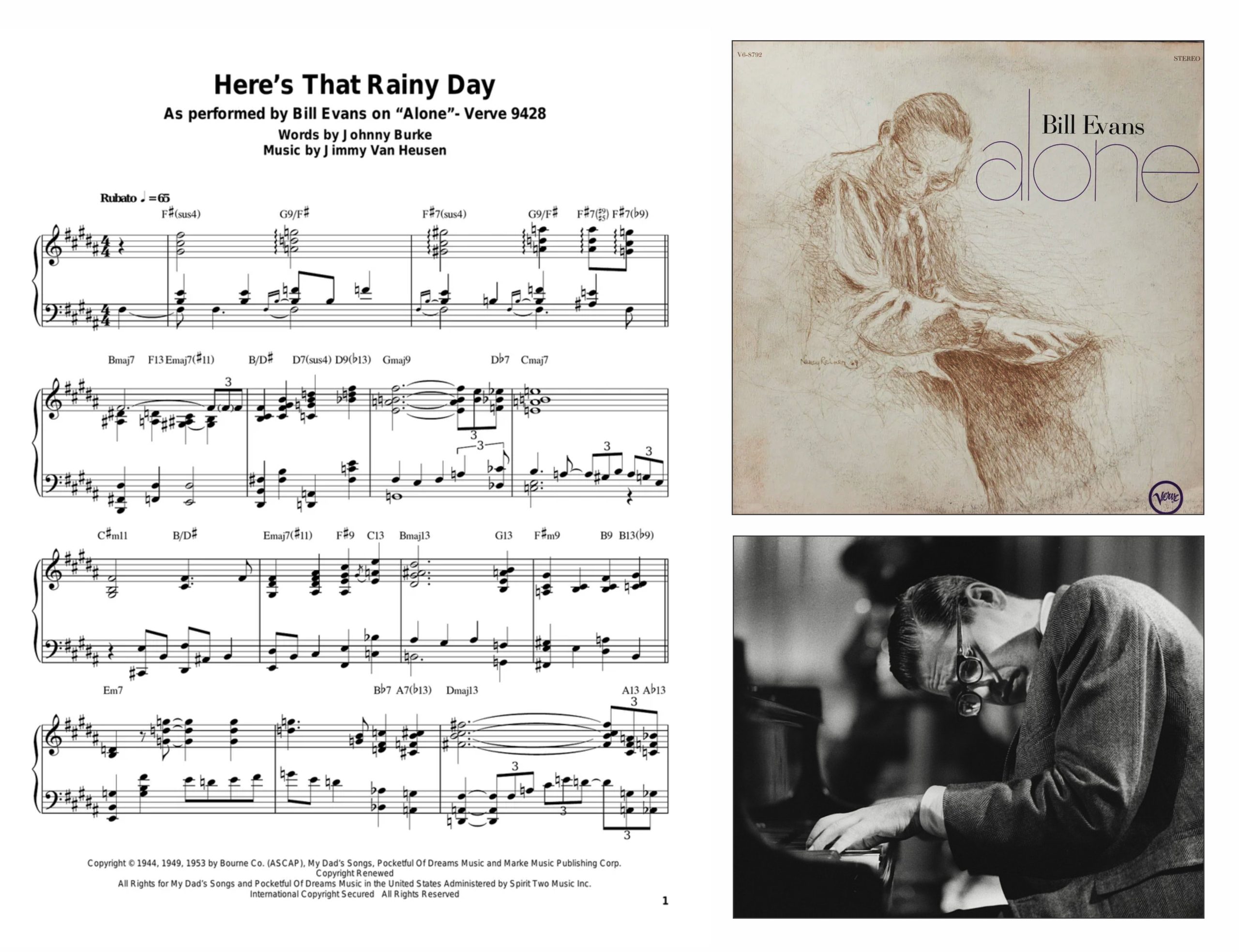
Although jazz became less popular that it once was, it has survived and continues to be an inspiration for poets (Feinstein & Komunyakaa, 1991, 1996; Young, 2006). The following is Bill Evans’s solo rendition of Here’s That Rainy Day from his 1968 album Alone:
The following illustration shows the beginning of the music, the album cover with a portrait of Evans by Nancy Reiner, and a photograph of Evans as the Glenn Gould of Jazz.
The Canadian philosopher and poet Jan Zwicky wrote an appreciation of Here’s That Rainy Day in her Songs for Relinquishing the Earth (1998). The poem describes the music and attempts to understand the story that it tells. It reminds her of the fairy tales about the sons of woodcutters who set out to gain love and fortune, experience failure, try again and with a little magic finally succeed:
On a bad day, you come in from the weather
and lean your back against the door.
This time of year it’s dark by five.
Your armchair, empty in its pool of light.
That arpeggio lifts, like warmth, from the fifth of B minor,
offers its hand – let me
tell you a story . . . But in the same breath,
semitones falling to the tonic:
you must believe and not believe:
that door you came in
you must go out again.
In the forest, the woodcutter’s son
sets the stone down from his sack and speaks to it.
And from nothing, a spring wells,
falling as it rises, spilling out
across the dark green moss.
There is sadness in the world, it says,
past telling. Learn stillness
if you would run clear.
References
Adams, H., & Park, B. R. (1956). The state of the jazz lyric. Chicago Review, 10(3), 5–20.
Baraka, I. A. (1979). Am/Trak. Phoenix Book Shop
Berg, S. (2010). Let that bad air out: Buddy Bolden’s last parade. Porcupine’s Quill.
Dickson, L. L. (1983). “Keep it in the head”: Jazz elements in modern Black American poetry. Melus, 10(1), 29–37.
Feinstein, S. (1997). Jazz poetry: from the 1920s to the present. Greenwood Press.
Feinstein, S., & Komunyakaa, Y. (1991). The jazz poetry anthology. Indiana University Press.
Feinstein, S., & Komunyakaa, Y. (1996). The second set (The jazz poetry anthology. Volume 2). Indiana University Press.
Gioia, T. (2021). The history of jazz (Third edition.). Oxford University Press.
Hobart, M. (2016). The life of a song: ‘God bless the child’ Financial Times, August 29.
Huang, H. (2011). Enter the blues: jazz poems by Langston Hughes and Sterling Brown. Hungarian Journal of English and American Studies, 17(1), 9–44.
Jones, M. D. (2011). The muse is music: jazz poetry from the Harlem Renaissance to spoken word. University of Illinois Press.
Kahn, A. (2001). Kind of blue: the making of the Miles Davis masterpiece. Da Capo Press.
Komunyakaa, Y. (2013). Testimony, a tribute to Charlie Parker: with new & selected jazz poems. Wesleyan University Press. (contains CDs of Sandy Evans’s music for the poem)
Lacey, H. C. (1986). Baraka’s “AM/TRAK”: everybody’s Coltrane poem. Obsidian II, 1(1/2), 12–21.
Ondaatje, M. (1976). Coming through slaughter. Anansi
Richards, T. (2006). Jazz and American poetry. In Gray, J., McCorkle, J., & Balkun, M. M. (Eds). The Greenwood encyclopedia of American poets and poetry. (pp 794-797). Greenwood Press.
Teague, J. E. (2023). Wail, wop: jazz poetry on the page and in performance. In Borshuk, M. (Ed). Jazz and American Culture (pp. 219–233). Cambridge University Press.
Young, K. (2006). Jazz poems. Everyman’s Library (Knopf).