Rembrandt: Self-Portraits

Rembrandt Harmenszoon van Rijn (1606-1669) was one of the greatest painters of the Dutch Golden Age, that century following the establishment of the Dutch Republic free of Spanish rule. Among his many works were about 80 self-portraits – about 40 paintings, 30 etchings and 7 drawings – far more than any other painter before him. These works were created for several purposes: to provide examples of his art for prospective buyers, to work out techniques for visually representing emotions and ideas, and to record the passage of his own life. The illustration shows a small self-portrait from 1630, painted on copper: the discerning gaze.

Life

Rembrandt was born in Leiden, located between the cities of Amsterdam and The Hague. His surname “Harmenszoon van Rijn” means son of Harmen from the Rhine. As a young man, Rembrandt was apprenticed to Jacob van Swanenberg and later to Pieter Lastman, both of whom had spent time in Italy and were aware of the new baroque painters, such as Caravaggio, who painted with sharp contrasts between light and dark. Though he opened a studio in Leiden in 1625, Rembrandt moved in 1631 to Amsterdam to find a more wealthy clientele. There he became a sought-after portraitist for the rich and famous. He also painted large group portraits such as The Night Watch (1642). In 1634 Rembrandt married Saskia van Uylenburgh, and moved into a series of evermore luxurious residences. Four children were born but only the last – a son, Titus, born in 1641 – survived infancy. After Saskia died in 1642, Rembrandt had relationships with his housekeeper, Geertge Dircx, and with Hendrickje Stoffels, with whom he had a daughter, Cornelia, in 1654. Despite his continued success, Rembrandt’s taste for the good life – a fine residence furnished with beautiful objets d’art – led to bankruptcy in 1656. Though his financial difficulties persisted, Rembrandt continued to paint both portraits and large commissioned works, such as The Anatomy Lesson of Dr Deijman (1656) and The Syndics of the Drapers’ Guild (1662) and until his death in 1669. One of his last paintings was The Return of the Prodigal Son.   

Self-Portraits

Artists have always produced self-portraits (Hall, 2014; Rudd, 2021). Medieval illuminators included miniatures of themselves at work. Artists of the early Renaissance included images of themselves in the background of their history paintings. As the Renaissance flourished, artists became recognized as divinely gifted individuals, and representations of the actual artist became as valuable as his representations of the world. Another factor contributing to the rise of self-portraits was the developing technology for manufacturing mirrors of glass to replace those of polished metal.

In the 17th Century, the market for portraits expanded beyond the aristocracy to the growing middle class. A major purpose of the self-portrait was thus to demonstrate to prospective buyers how well the artist could capture the true likeness of a person. Buyers could see for themselves both the image and its subject. Furthermore, if the artist were famous, a self-portrait would become valuable in itself. Buyers could then obtain a portrait of a person more famous than themselves.

The self-portrait also provided the artist with a means to examine how best to depict the inner life of a subject. The artist could try to capture in paint the way that he knew he was feeling. The exercise would also allow him to recognize such feelings in others and become a better portraitist.

A final purpose of the self-portrait would be to increase the artist’s awareness of his own identity. Rembrandt made many more self-portraits than any other artist before him. These images provide a record of how he appeared as he grew older. More importantly, they provide a record of how he felt.

Why did Rembrandt show such an untiring interest in his own features? It is true that in the beginning his face often served as a convenient model for studies in expression. Thus he may have come into the habit of looking at himself with a painter’s eye. But this reason alone cannot explain the tremendous quantity and the deep significance of his self-portrait production …. Rembrandt seems to have felt that he had to know himself if he wished to penetrate the problem of man’s inner life. The phenomenon of the soul attracted him as strongly in his own personality as it did in that of others, and such profound self-realization was, it seems, indispensable for his access to the spiritual and the transcendental. (Rosenberg, 1964, pp 37).

This idea that self-portraits were a means of self-realization (see also Chapman, 1990, and Osmond, 2000) has been criticized as anachronistic (see van der Wetering’s essay in White & Buvelot. 1999). Such a purpose might be appropriate to those of us living after the Romantic Revolution and Freudian Psychoanalysis, but would have seemed foreign to an artist in the 17th Century. In those days one thought about the salvation of one’s soul rather than the improvement of one’s self. Nevertheless one might be skeptical of this skepticism. Human beings have always sought to understand themselves better. It seems to me that Rembrandt was certainly intrigued by how he was changing, and how his inner self was reacting to the changes. Painting these effects could help him to know himself.

Rembrandt’s self-portraits may have also allowed him to invent himself as well. In his various costumes and guises, he could see how he might be at a different time, or in a different context:

No one demonstrates better than Rembrandt that self-portraiture is more invention than reflection. This is evident not just in his imaginary, romantic, and historical guises but in every way that he chose to present himself. However, if his self-portraits are not pure reflection they are also emphatically not fiction. For whatever the, element of invention (and justification, compensation, even delusion, all of which must be operative but which I, for the most part, would not presume to analyze), conviction stands behind each of Rembrandt’s images. The seventeenth-century individual, however much engaged in self-fashioning and self-cultivation, was sustained by belief in the authenticity of his personality (Chapman, 1990, p 7).


Tronies and Portraits

Many of Rembrandt’s early self-portraits can be considered tronies (Hirschfelder, 2000). The Dutch term tronie, derived from the Gaulish word trugna for nose, means a depiction of a bust, head or face, especially one with a definite expression or in a particular costume. The primary purpose of such a picture was not to portray the sitter, but rather to represent an idea (the transience of life, the beauty of youth, etc), illustrate an emotion (anger, humor, etc), or display a particular fashion (Renaissance dandy, noble warrior, etc). Tronies probably developed from the practice of painting heads with particular characteristics for insertion into larger historical compositions (Schwartz, 1989). After a while, however, tronies became sought after as “character studies” independently of any larger painting. Many of Rembrandt’s tronies used himself as a subject. The following are two etchings from about 1630, one demonstrating surprise and the other anger:

Schwartz (1988) remarks that the sitter for a portrait presents himself to the painter in a particular way whereas the anonymous sitter for a tronie is asked by the painter to represent something. The painter of the tronie is in control not the subject. Rembrandt worked extensively with tronies in his early years in Leiden. This experience helped him in his portraits to depict the inner emotions as well as the outward presentation of his subjects:

a crucial aspect of Rembrandt’s new and seemingly unprecedented portrait style is the direct result of his transposing certain elements of the tronie mode onto that of the portrait. From his work in Leiden, Rembrandt arrived at a system or vocabulary of physiognomic characterization that comes directly from the face paintings and …was at odds with the other portraiture of the time in important ways. While it would be superficial psychologizing to claim that Rembrandt painted “character,” “inner man,” or “the human soul” —a persistent myth from which we have not yet fully escaped— it is nonetheless clear that Rembrandt’s portraits used many of the same techniques that create the centripetal quality tronies in order to suggest a general sense of “inwardness.” If he did not paint specific “character,” Rembrandt had learned pictorial strategies by which to allude to character in general, to “passion” with a minimum of “action.” (Schwartz, 1988, p 104)

Slowly the tronies began to morph into real self-portraits. The following illustration shows an etched self-portrait from about 1630 and one of the first of his painted self-portraits from 1628. Here we have the young artist with his smoldering eyes and unruly hair: the very portrait of an unrecognized genius. The background of this portrait and of the one at the beginning of this essay are light colored. Backgrounds generally became darker as he grew older. Perhaps he became more aware of Caravaggio’s paintings; perhaps life itself became darker.   

Standard-Bearers

The Eighty-Years’ War (1568-1648) was the prolonged revolt of the Dutch people against Spain, which since 1482 had controlled the Netherlands as part of the Hapsburg Empire. The conflict brought out a tremendous sense of patriotism. Every district in every town established its own civil guard, led by a captain and his lieutenant. The company’s standard-bearer or ensign was the person selected to carry the standard into battle. Ensigns were bachelors, since their duty was to defend the standard with their lives. Typically, these young men dressed themselves in finery, cutting as dashing a figure as possible to display of their company’s ardor.

In 1636, Rembrandt painted himself in the role of a standard-bearer (Bikker, 2024). It is a bravura painting (left below). Rembrandt stands with his right arm akimbo, its silken sleeve jutting defiantly out of the picture plane. The ensign’s drooping moustache balances the jaunty plume of his cap. The lighting comes strikingly from the left, and shadows cloud the right side of the painting. Many years later in 1654, Rembrandt painted a more subdued portrait of a real standard-bearer, the wealthy Amsterdam bachelor Floris Soop (right, below).

In Praise of the Renaissance

Rembrandt was far more interested in the fashions and flamboyance of the Renaissance than he was in the costumes and reticence of his own age. His portraits of others often showed his sitters in somber black, their faces highlighted by pure white collars. But not his self-portraits. The lower part of the following illustration shows an etching (1639) and a painting (1640) of himself with his elbow resting upon a window sill or balustrade.

Rembrandt’s pose is clearly adapted from Titian’s 1509 portrait of a man, at one time considered to be the poet Ariosto (upper left). Rembrandt probably saw this painting, which in 1639 was in the collection of Alfonso Lopez, an art dealer in Amsterdam. He was likely also aware of Dürer’s 1498 self-portrait in a similar pose, perhaps by way of a print. Rembrandt’s etching would have been reversed in the printing process so that in the etching Rembrandt is looking to his left rather than to his right.

Rembrandt as Painter

One of the most intriguing of Rembrandt’s self-portraits (1652) shows the artist in a simple brown robe, likely his work-attire, staring defiantly at the viewer with his arms on his hips. Hall (2014, p 157) notes that the pose is the same as that in Holbein’s famous portrait of Henry VIII of England (1540). However, the styles of the two portraits are completely different. Rembrandt’s focus is on the face whereas Holbein’s is on the costume. Rembrandt’s face shows clear emotions – curiosity, pride, confidence – whereas Henry’s face is passive:

The following comments on Rembrandt’s self portrait are from Chapman (1990, p 87):

he wears a brown painter’s smock, belted with a sash, over a black jerkin and a collarless white shirt. Instead of the brimmed hat he has the more customary black artist’s berry. His drab brown garb, his muted hands, and the overall dark tonality of the painting focus our attention on his face and his direct, authoritative gaze. The aggressive informality of this portrait must have seemed shocking at the time. With a disarming sense of real presence, Rembrandt stands frontally, his arms akimbo, his thumbs tucked under his belt. His proud, confrontational worker’s stance conveys a self-assurance matched only in a few of the late paintings. In short, Rembrandt presents himself with unprecedented inner authority.


A Fall from Grace

When Saskia died in 1642, Rembrandt employed Geertge Dircx as a nurse and housekeeper. Their relationship soon became intimate but ended acrimoniously when Rembrandt began an affair with Hendrickje Stoffels in 1849. Geertge sued Rembrandt for breech of promise and was awarded alimony. Rembrandt never married Hendrickje, probably to ensure that Titus would inherit something from Saskia’s family. The church was sufficiently upset with this common-law arrangement that they investigated Hendrickje for “fornication.” Thus the decade of the 1640s was for Rembrandt a period of anxiety (White, 2022, pp 118-121). One way to handle this was the defiance evident in the self-portrait that we just considered.

As the 1650s began, financial difficulties began to add to Rembrandt’s family problems. Never one to skimp when he wanted something, Rembrandt began to lose money when the first Anglo-Dutch War (1652-54) caused an economic depression and patrons no longer had money to spend on portraits. In 1656, he was declared bankrupt and his possessions were auctioned off to pay his creditors (White, 2022, pp 162-175). Rembrandt moved to a small rented house. He continued to paint.

In 1658, Rembrandt painted his largest self-portrait. This painting, now part of the Frick Collection in New York, is unusual in many aspects. The artist is dressed in what appears to be an artist’s smock, but one that is bright gold in color and unmarked by any paint. The smock is tied at the waste with a red sash. This outfit may have been one of the costumes left over from previous paintings of oriental potentates. The colors, the rough brushwork, and the frontal pose are reminiscent of those used by Titian and other Venetian painters (Clark, 1964, p 130). Chapman (1990, pp 88-95) also notes that the main colors of the painting – black, white, yellow and red – are those chosen by the great Greek painter Apelles, the “Prince of Painters.”  

In the portrait, Rembrandt holds a baton in his left hand. This may simply be a painter’s mahlstick, a rod with a padded leather ball at its end, held against the painting to support and steady the brush hand. However, in the painting, it gives the impression of a royal scepter. Indeed, the whole painting seems to depict a “Philosopher King” (Clark, 1964, p 130), serenely unaffected by the vicissitudes of the world. Undoubtedly, this is what Rembrandt wished he could be at that time.

The two portraits that follow the Frick portrait, both from 1659, the larger one in London and the smaller in Edinburgh, both use the same costume: a dark coat with a turned-up collar and Rembrandt’s by now trademark beret. They show an artist coping with his problems, bordering on despair but ultimately not giving in. His collar is turned up against life’s cold.

The Kenwood Portrait

After Hendrikje died in 1663. Rembrandt spent the last years of his life alone. During this time, he made several self-portraits. Most of these show a highlighted face upon dark background. One self-portrait differs strikingly from the others: the large self-portrait in the Iveagh Bequest at Kenwood House on Hampstead Heath.

Rembrandt is dressed with a red smock and a white shirt, but has also put on a coat with fur collar. Perhaps the studio is cold. He wears a bright white cap like an artist’s halo. He holds in his left hand a palette and mahlstick. Radiographic examination of the painting shows that it initially represented the painter’s left hand in the act of painting. Rembrandt was right-handed and this right left reversal would have resulted from seeing himself in a mirror (White & Buvelot, 1999, p 220). Rembrandt revised the painting to show the artist’s left hand holding the palette. The artist’s right hand is lost in the darkness. Self-portraits find it hard to represent the hand that paints the portrait.   

The background is light in color and shows two large circles. The nature of these circles is a matter of much dispute (Porter, 1988; White & Buvelot, 1999; Gerson, 1968, p 130). One idea is that they might represent the outlines of a map showing the world in two hemispheres. However, the circles are further apart than usual in such representations. Another explication considers a famous story about Giotto. Thinking to hire the young painter, Pope Benedict IX sent one of his courtiers to obtain some evidence of Giotto’s painterly abilities. Giotto took a brush and quickly drew a perfect red circle on a piece of paper without moving his arm and without using a compass. This small piece of paper convinced the pope. Perhaps Rembrandt is claiming his two perfect circles as evidence of his own ability.  Another idea is that the two circles represent in abstract form the ideas of theory and practice, with Rembrandt standing as the artistic genius who mediates between the two.

John Fowles’ novel Daniel Martin (1977) concludes with its protagonist Daniel standing before Rembrandt’s self-portrait in Kenwood House. He had just said farewell to Jenny, his young girlfriend, and was about to return to Jane, his old love:

The sad, proud old man stared eternally out of his canvas, out of the entire knowledge of his own genius and of the inadequacy of genius before human reality. Dan stared back. The painting seemed uncomfortable in its eighteenth-century drawing-room, telling a truth such decors had been evolved to exclude. The supreme nobility of such art, the plebeian simplicity of such sadness; an immortal, a morose old Dutchman; the deepest inner loneliness, the being on trivial public show; a date beneath a frame, a presentness beyond all time, fashion, language; a puffed face, a pair of rheumy eyes, and a profound and unassuageable vision.

Dan had been working as a script-writer in Hollywood. Although he had always wanted to write a novel, he has not had the will power to leave his easy job and devote himself to more meaningful writing. 

Dan felt dwarfed, in his century, his personal being, his own art. The great picture seemed to denounce, almost to repel. Yet it lived, it was timeless, it spoke very directly, said all he had never managed to say and would never manage to say—even though, with the abruptness of that dash, he had hardly thought this before he saw himself saying the thought to the woman who would be waiting for him on the platform at Oxford that evening; telling her also what had gone before, a girl and a past walking into winter trees, knowing she would understand. He had lied a little to Jenny, to make it easier for her. But that was his secret now, his shared private mystery; which left him with the imagining of the real and the realizing of the imagined. Standing there before the Rembrandt, he experienced a kind of vertigo: the distances he had to return. It seemed frightening to him, this last of the coincidences that had dogged his recent life; to have encountered, so punctually after a farewell to many more things than one face, one choice, one future, this formidable sentinel guarding the way back.

Dan finds solace in the portrait. He must make the necessary decisions and he must choose his path for the right reasons.

He could see only one consolation in those remorseless and aloof Dutch eyes. It is not finally a matter of skill, of knowledge, of intellect; of good luck or bad; but of choosing and learning to feel. Dan began at last to detect it behind the surface of the painting; behind the sternness lay the declaration of the one true marriage in the mind mankind is allowed, the ultimate citadel of humanism. No true compassion without will, no true will without compassion.

Daniel Martin found much to see in the portrait (Horlacher, 2018, Vieth, 1991). So, we presume, did John Fowles, since much of the novel is based on his personal experience. Other viewers may find other messages in the portrait, depending on the context their own lives. The great genius of Rembrandt’s self-portraits is their ability to communicate to us what we need to know. 

An Infinite Regress

In a review of some of Rembrandt’s portraits, T. J. Clark (2014) remarked that

what we are looking at in a self-portrait is the image a painter saw in a mirror. It seems to follow that the kind of attention we are shown is special, not to say exotic: the look of someone looking is at himself looking. The trouble is that we can only decide where to put an end to that final phrase by pure fiat.

The end of this infinite regress might come when we become part of the looking, share some part of the artist’s self, see some part of ourselves in the image, and come face to face with Rembrandt.


A Lifetime of Self-Portraits

We do not know why Rembrandt painted so many self-portraits. Susan Osmond (2000) considered various reasons: as an exercise in representing faces and their emotions, in response to a demand from patrons for images of the famous artist, and to try out for himself a new persona. She concluded

Perhaps, knowing all too well that a single portrait can convey only certain selected aspects of a person at a particular point in his life, he wanted, as an artist, to take at least one subject through a lifetime, and the one he could explore most intimately was himself. Every painting has to have some unifying mood or theme, so in this respect Rembrandt had to approach each self-portrait with some sort of “programme,” but this does not rule out self-searching and examination in the process. It only limits its scope – and that probably left the artist hankering for more. In his early years, he likely knew that using himself as a model for tronies would help his face become a household item and increase his reputation. As time went on, while a ready market remained for his self-portrayals, his internal motivation may have altered or at least broadened. At times, he used the self-portrait as a forum to broadcast a persona. At others, in showing himself playing a role such as the prodigal son, a potentate, or an artist of the past, he could by allusion make comments about aspects of his inner state or his status in the flow of history. In most of the late works, contemplation of himself as an individual and as a representative of humanity seems to have played a major part.


Website

Website Rembrandt Van Rijn: life, paintings, etchings, drawings & self portraits  contains images and documentation for self-portraits and etchings


References

Bikker, J. (2024). Rembrandt van Rijn: The Standard-Bearer. nai010 publishers

Chapman, H. P. (1990). Rembrandt’s self-portraits: a study in Seventeenth-Century identity. Princeton University Press.

Clark, K. (1966). Rembrandt and the Italian Renaissance. Murray.

Clark, T. J. (2014). World of faces. London Review of Books (December 4, 2014)

Fowles, J. (1977). Daniel Martin. Little, Brown.

Hall, J. (2014). The self-portrait: a cultural history. Thames & Hudson.

Hirschfelder, D. (2000) Tronie und Porträt in der niederländischen Malerei des 17. Jahrhunderts. Berlin: Gebr. Mann Verlag

Horlacher, S. (2018). “The sad, proud old man stared eternally out of his canvas…”: media criticism, scopic regimes and the function of Rembrandt’s “Self-Portrait with Two Circles” in John Fowles’s novel Daniel Martin. Anglia, 136(4), 705–732.

Osmond, S. F. (2000). Shadow and substance – Rembrandt self-portraits. The Free Library.

Porter, J. C. (1988). Rembrandt and his circles: self portrait at Kenwood House. In Fleischer, R. E., & Scott, S. C. (Eds) The Age of Rembrandt: studies in seventeenth-century Dutch painting. (pp 188-212). Pennsylvania State University.

Rosenberg, J. (1964). Rembrandt: life and work. Phaidon.

Rudd, N. (2021). The self-portrait. Thames & Hudson.

Schwartz, F. (1989). The motions of the countenance: Rembrandt’s early portraits and the tronie. RES: Anthropology and Aesthetics, 17/18, 89-116.

Vieth, L. S. (1991). The re-humanization of art: pictorial aesthetics in John Fowles’s “The Ebony Tower” and “Daniel Martin.” Modern Fiction Studies, 37(2), 217–233. 

White, C. (2022). Rembrandt (3rd edition). Thames & Hudson Ltd.

White, C., & Buvelot, Q. (1999). Rembrandt by himself. National Gallery Publications


Intimations of Mortality

We have been here before. The coronavirus pandemic has many precedents. Over the centuries various plagues have swept over our world. Many millions of people have died before their time. From 1347 to 1351 the Black Death killed about 30 million people in Medieval Europe: over a third of the population. From 1918 to 1920 the Great Influenza killed about 50 million people: about 2.5% of the world’s population. Each of these pandemics was as deadly as World War I (about 20 million) or World War II (about 70 million). Pandemics are more worrisome than wars: we cannot sue for peace with a virus. Most of us survived even the worst of past infections. Our systems of immunity will likely once again become victorious in this present pandemic. But just like after a war, we shall be severely chastened. How close we will have come to death will change the way we think. Everything will be seen through the mirror of our own mortality and the transience of our species. The nearness of an ending will distort our thinking. We shall have strange dreams and frightening visions.

John of Patmos

Such dreams and visions came to a man named John almost two millennia ago. In the second half of the 1st Century CE, during the reign of the Roman Emperor Domitian, the Christians of the Roman Empire were severely persecuted, the Second Temple in Jerusalem was destroyed, and the Roman Empire was shaken by attacks from without and rebellions from within. There was no pandemic but life was just as uncertain.

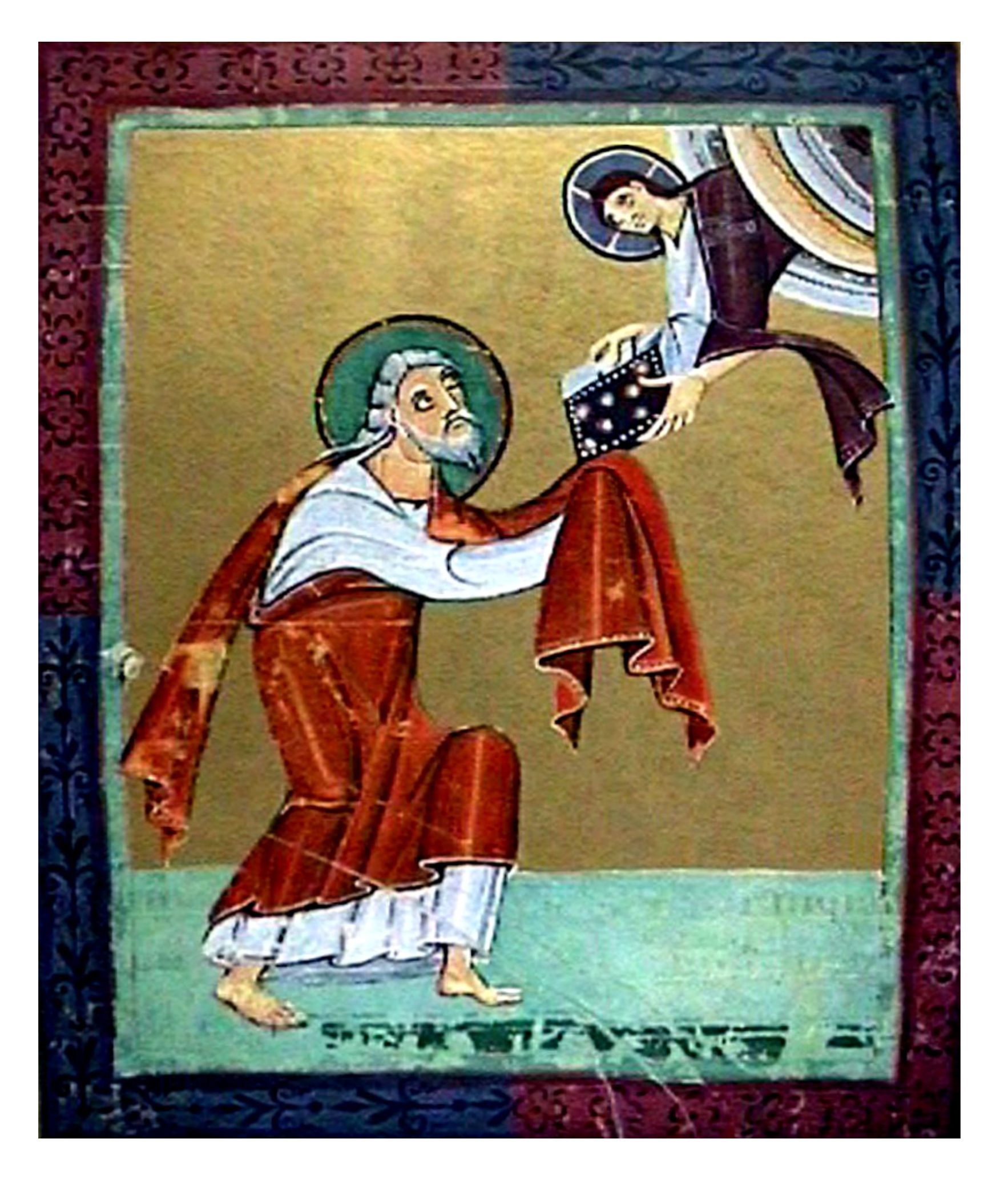
On the island of Patmos just off the west coast of what is now Turkey, a Christian named John experienced disturbing visions of the future. He described these in a manuscript that began with the word apokalypsis (Greek for “unveiling”). This became Revelation, the last book in the Christian New Testament (Koester, 2014; Quispel, 1979). The illustration on the right, from the Bamberg Apocalypse, an illuminated manuscript from the 11th Century, shows an angel telling John what he should write:

The Revelation of Jesus Christ, which God gave unto him, to shew unto his servants things which must shortly come to pass; and he sent and signified it by his angel unto his servant John (Revelation 1:1)

For many years, Christian scholars assumed that John the Apostle, the youngest of Christ’s disciples, was the author of Revelation, the Gospel of John and the three Epistles of John. Most modern scholars consider it unlikely that he wrote any of these works. They suggest three separate authors one for the gospel, one for the three epistles, and one for the apocalypse. One telling point is that each author describes the end-times very differently. For example, the Antichrist is mentioned in the epistles (e.g. 1 John 2:18), but not in the apocalypse. The author of Revelation was probably a Jewish-Christian prophet living in Asia Minor – John of Patmos. He may have written the book over many years. One suggestion is that he began writing as a Jew and later converted to Christianity (Koester, 2014, pp 68-71).

The visions described by John are stunning in their force and detail. The Whore of Babylon, the Seven-Headed Beast, and the Four Horsemen have become part of our collective consciousness.

Revelation is the most interpreted and least understood book of the Christian Bible (Quispel, 1979; Koester, 2014). Some have interpreted the visions as describing the troubled time in which they were experienced. The Seven-Headed Beast could then represent Rome (with its seven hills, or its seven emperors), and the Rider on the White Horse could represent the Parthians who threatened the peace of the Middle East. Others have considered the visions as prophesying the later history of the Christian Church. The Whore of Babylon was the papacy of Rome for Protestants and the heresies of the Reformation for Catholics. Others believe that Revelation foretells the Last Days, that are yet to come, when Christ will judge both the quick and the dead.

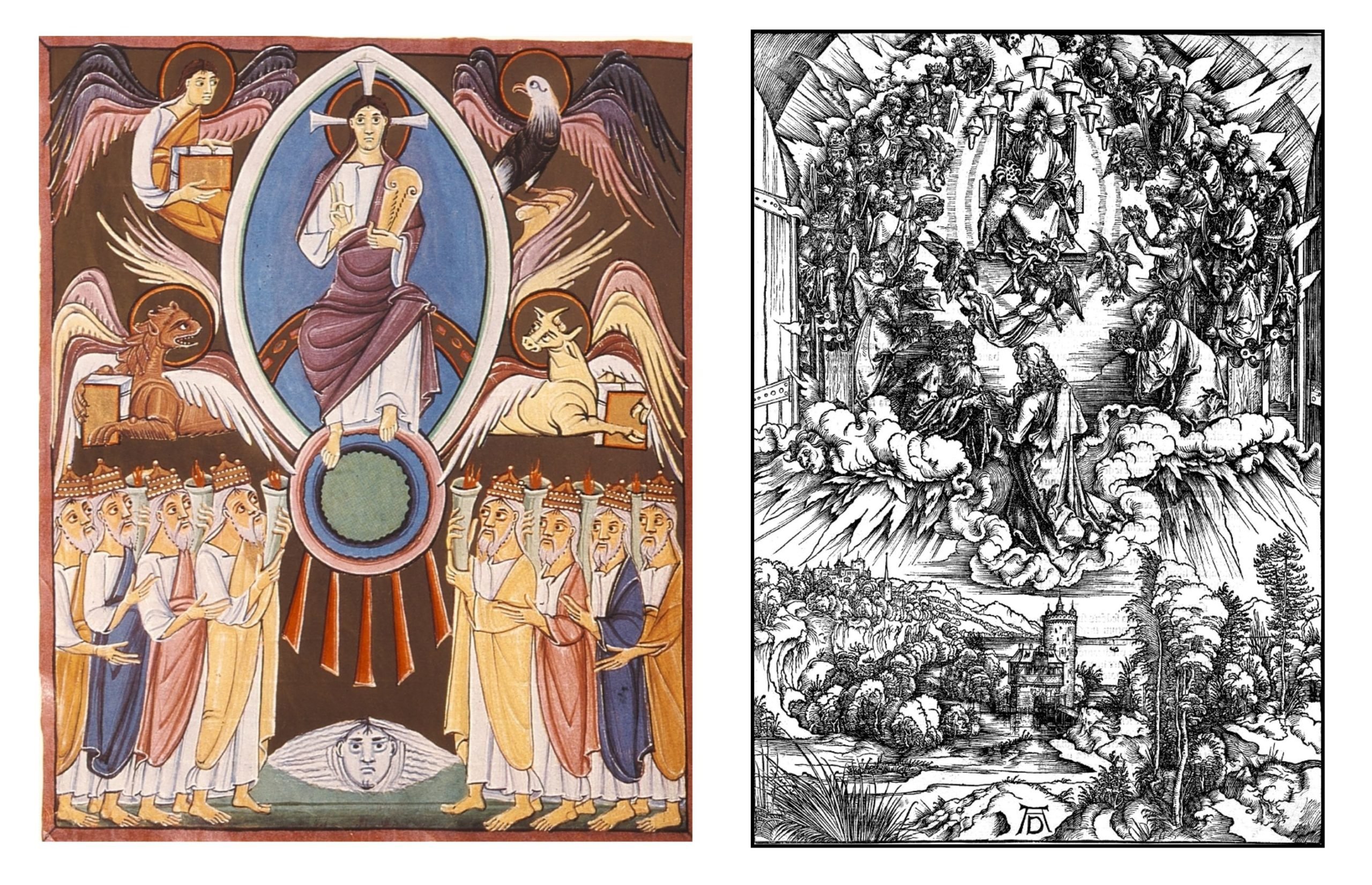
John’s first vision was of the Lord seated upon a throne in Heaven. This is illustrated below in the 11th-Century Bamberg Apocalypse, and in the 1498 woodcut by Albrecht Dürer. Around the throne were four beasts in the form of Man, Lion, Ox and Eagle, probably representing the evangelists Matthew, Mark, Luke and John. Around them were four and twenty elders, clothed in white and wearing crowns of gold. In the Lord’s right hand was a book “sealed with seven seals.” The structure of this book is not clear. Perhaps it is made up of seven scrolls one rolled up within the other (Quispel, 1979, p 51). A mystical lamb appears and proceeds to open each of the seals.

The Four Horsemen

As the first four seals are opened four horsemen appear:

And I saw when the Lamb opened one of the seals, and I heard, as it were the noise of thunder, one of the four beasts saying, Come and see.
And I saw, and behold a white horse: and he that sat on him had a bow; and a crown was given unto him: and he went forth conquering, and to conquer.
And when he had opened the second seal, I heard the second beast say, Come and see.
And there went out another horse that was red: and power was given to him that sat thereon to take peace from the earth, and that they should kill one another: and there was given unto him a great sword.
And when he had opened the third seal, I heard the third beast say, Come and see. And I beheld, and lo a black horse; and he that sat on him had a pair of balances in his hand.
And I heard a voice in the midst of the four beasts say, A measure of wheat for a penny, and three measures of barley for a penny; and see thou hurt not the oil and the wine.
And when he had opened the fourth seal, I heard the voice of the fourth beast say, Come and see.
And I looked, and behold a pale horse: and his name that sat on him was Death, and Hell followed with him. And power was given unto them over the fourth part of the earth, to kill with sword, and with hunger, and with death, and with the beasts of the earth. (Revelation 6:1-8)

Only the fourth horseman is clearly identified by John as Death. The color of his horse has been interpreted as “pale,” although the Greek chloros is actually better translated as “green.” Perhaps John envisioned a sickly pale green color. The identity of the other three is unknown (reviewed by Koester, 2014, pp 392-398; and in Wikipedia). The rider of the black horse with his scales for weighing and pricing food was almost certainly Famine. The rider of the Red Horse was probably War. The first horsemen has been interpreted in many ways. Perhaps he is Christ, perhaps the Antichrist. Some have considered him as Conquest though this seems to overlap with the rider of the Red Horse. Pestilence or plague seems the most reasonable interpretation. His arrows could then represent the transmission of infection.

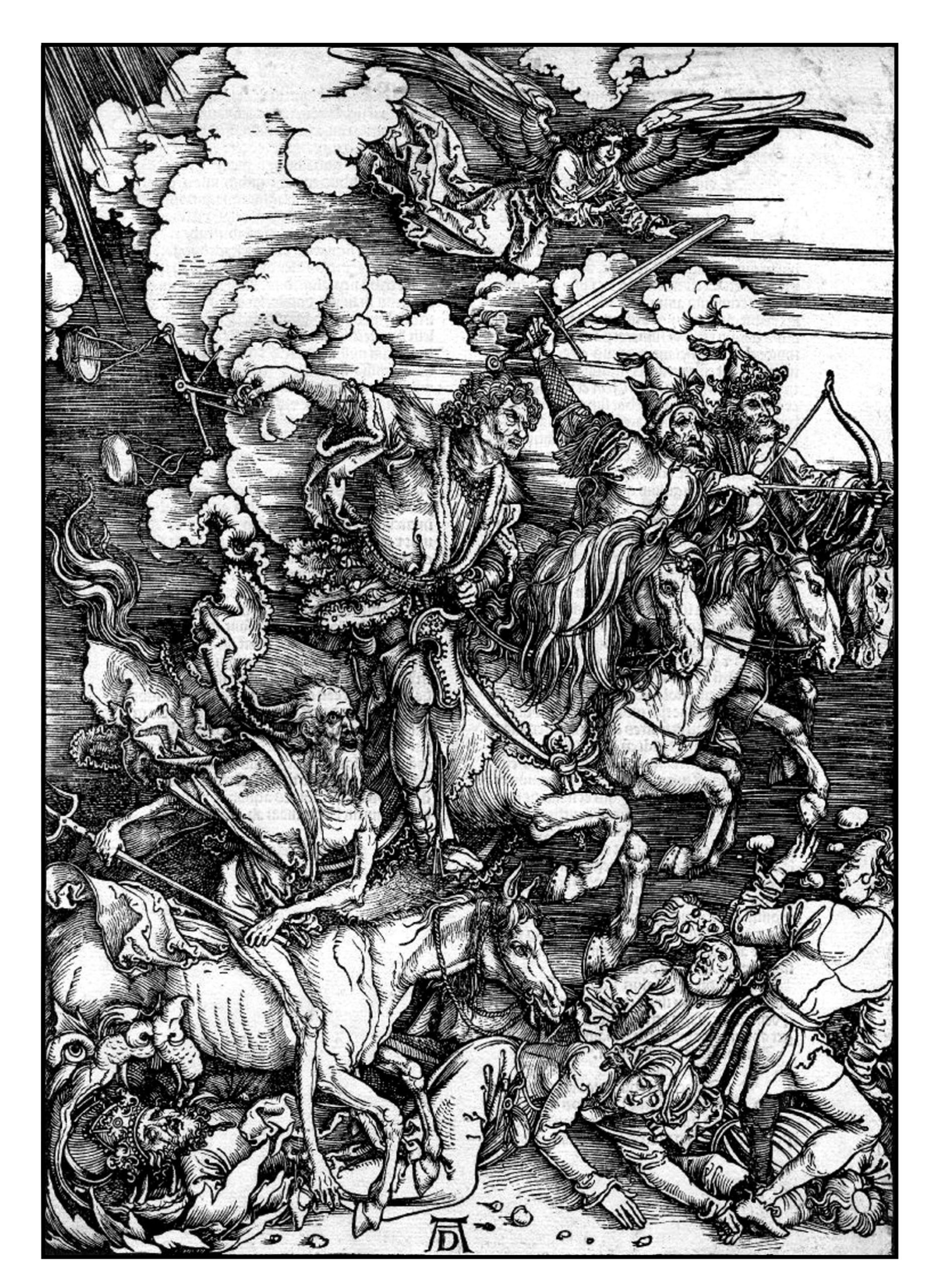
The most famous depiction of the Four Horsemen is the 1498 woodcut of Albrecht Dürer, illustrated on the right. The first three horsemen look like mercenary warriors from the Hundred Year War. Death is a skeletal figure riding an emaciated horse. He clears the world of those who die from pestilence, war and famine.


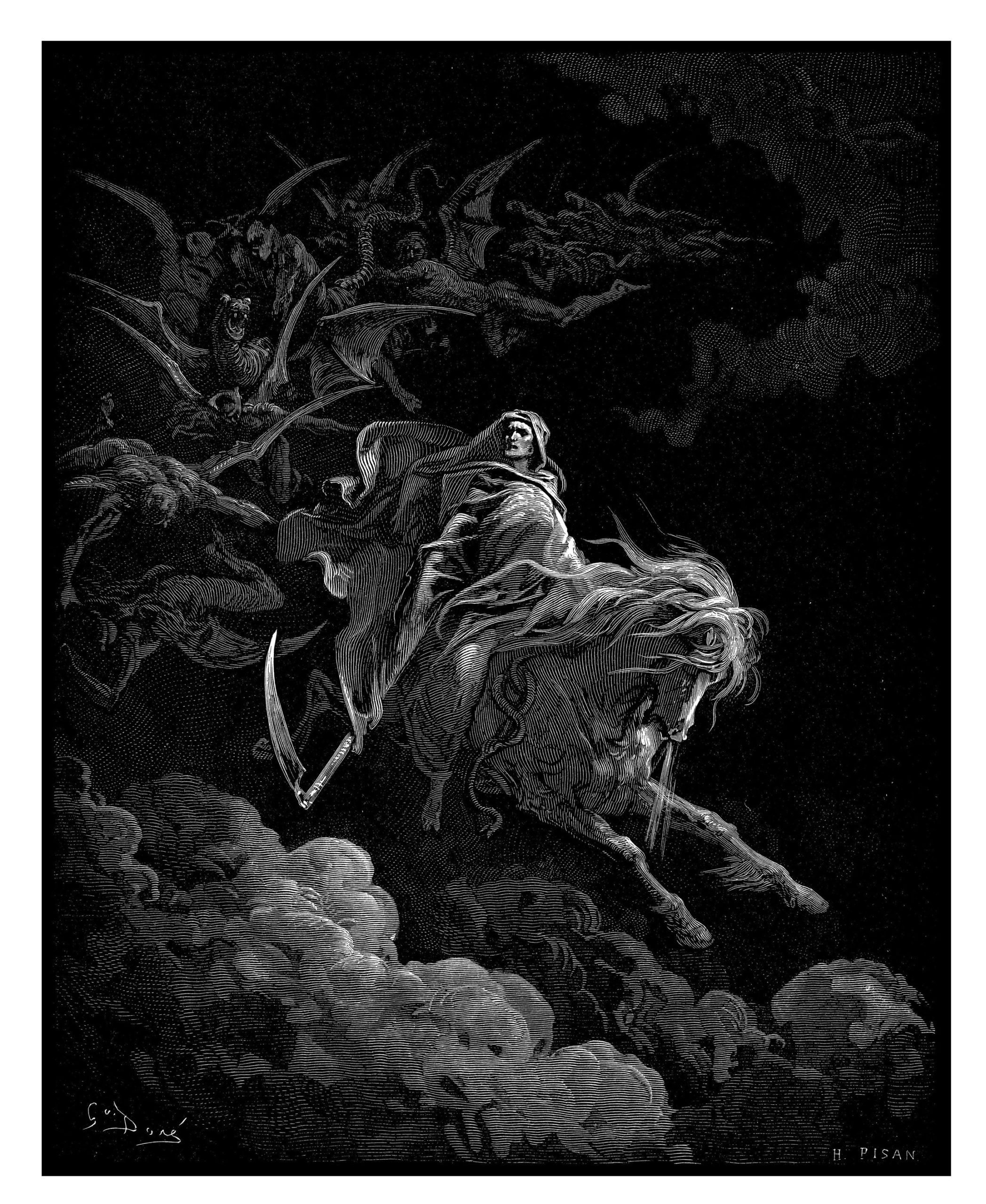
The 1865 wood-engraving by Héliodore Pelan based on a drawing by Gustave Doré gives Death a more majestic appearance, and grants him the scythe that has become his symbol. The scythe refers the apocalyptic passages in the Gospels that consider the final harvest of human souls. Doré also depicts the dark shades of Hades that John saw following after Death.


Pale Horse, Pale Rider

In 1918 Katherine Anne Porter almost died from the Great Influenza while she was in Denver working as a journalist (Barry, 1963). In 1939 she published Pale Horse, Pale Rider a short novel about that experience. In the novel she calls herself Miranda (from the Latin, “to be wondered at”). Pale Horse, Pale Rider was published together with two other stories – Old Mortality and Noon Wine – and gave its title to the collection.

The novel opens with a dream. Miranda is about to go riding, but she cannot decide which horse to borrow for a journey she does not wish to take. She decides against Miss Lucy “with the long nose and the wicked eye,” and Fiddler “who can jump ditches in the dark,” and choses Graylie “because he is not afraid of bridges.” These horses are those that were ridden long ago by Amy, the wife of Miranda’s Uncle Gabriel. Amy was a beautiful and spirited young woman, who committed suicide before Miranda was born. Her story was told in Old Mortality, one of several Miranda stories.

In the dream Miranda must go riding with a stranger who has been hanging about the place. She mounts Graylie, and urges him on. They fly off, over the hedge and the ditch and down the lane:

The stranger rode beside her, easily, lightly, his reins loose in his half-closed hand, straight and elegant in dark shabby garments that flapped upon his bones. (Porter, 1939, p 181)

Suddenly, she pulls Graylie up, the stranger rides on, and Miranda wakes up.

She remembers the events of the day before, particularly her visit to the infirmary at the army camp, and her tryst with her new boyfriend Adam, a young and handsome soldier about to be sent to France. She is not feeling well, but goes to work and once again meets Adam.

The next day she feels quite ill, and is seen by a doctor who prescribes some medications and says he will check on her later. Adam comes to see her and comforts her. They talk of their love for each other, about the war and about old songs they had heard when they were younger. One of these is a spiritual that began “Pale horse, pale rider, done taken my lover away.” The doctor returns and arranges for Miranda to be admitted to hospital. She has contracted influenza, perhaps from her visit to the infirmary.

While in hospital Miranda comes close to death but survives

Silenced she sank easily through deeps under deeps of darkness until she lay like a stone at the farthest bottom of life, knowing herself to be blind, deaf, speechless, no longer aware of the members of her own body, entirely with-drawn from all human concerns, yet alive with a peculiar lucidity and coherence; all notions of the mind, the reasonable inquiries of doubt, all ties of blood and the desires of the heart, dissolved and fell away from her, and there remained of her only a minute fiercely burning particle of being that knew itself alone, that relied upon nothing beyond itself for its strength; not susceptible to any appeal or inducement, being itself com-posed entirely of one single motive, the stubborn will to live. This fiery motionless particle set itself unaided to resist destruction, to survive and to be in its own madness of being, motiveless and planless beyond that one essential end. (pp 252-3).

She has a vision of a place reached by crossing a rainbow bridge.  Graylie was not afraid of bridges. There Miranda sees in the shimmering air “a great company of human beings,” all the people she had known in life. From this apparent heaven she returns to the reality of the hospital. She has miraculously comeback from the dead.  She lives up to her name – someone to be wondered at.

In her convalescence she learns that Adam had also became ill, probably having caught the disease from her. However, though Miranda had survived, Adam had died.

Outside the bells are ringing to celebrate the end of the war. As Miranda prepares to leave the hospital, she requests some essentials to begin her new life:

One lipstick, medium, one ounce flask Bois d’Hiver perfume, one pair gray suede gauntlets without straps, two pairs gray sheer stockings without clocks … one walking stick of silvery wood with a silver knob. (p 262).

She will be pale and elegant like the rider she dreamed about at the beginning of her illness, the rider that done take her love away. She has been irretrievably marked by death. As she leaves the hospital Miranda thinks

No more war, no more plague, only the dazed silence that follows the ceasing of the heavy guns; noiseless houses with the shades drawn, empty streets, the dead cold light of tomorrow. Now there would be time for everything. (p 264)

Life is now defined by what it is not – no war, no plague, no noise, no light. Porter’s  words recall Wilfred Owen’s 1917 poem Anthem for Doomed Youth which begins with the “monstrous anger of the guns” and ends with “each slow dusk a drawing down of blinds” (Owen, 1985, p 76).  Much poetry was written about the terrible loss of life in the Great War. Very little is concerned with the great epidemic of influenza that marked its ending (Crosby, 1989; Fisher, 2012).

Miranda’s final claim “Now there would be time for everything” is the tragedy of the book. She is now free to do as she wishes but there is nothing that she wishes to do.

Porter spent many years before she fully recovered from her experience in Denver. She did not publish her first stories until 1930, and Pale Horse, Pale Rider did not come out until 1939. Some sense of Miranda’s feelings at the end of that book is perhaps present in the 1942 portrait drawing of Porter by Paul Cadmus.


The Great Influenza

The influenza that almost killed Katherine Anne Porter swept across the world between 1918 and 1921 (Barry, 2004; Crosby, 1989; Spinney, 2017; Taubenberger & Morens, 2006). No one is sure where it began. The first cases were seen in Kansas, and the disease spread rapidly through the US army camps where young men were being trained before going to fight in France.

The following is the iconic image of the epidemic: the make-shift infirmary at Camp Funston, Kansas. The photograph is strangely still. It should be accompanied by the sound of intermittent coughing. The light rakes across the camp cots, randomly selecting one soldier or another, much as the disease would select those who would die. There was no treatment: oxygen would not be used for pneumonia until after the war (Heffner, 2013). About a quarter of the young men in this photo likely died of influenza. More US soldiers died of influenza than during battle.

The disease quickly spread to the battlefields of Europe. None of the combatant-countries wished to acknowledge that their troops were ill. Since the first officially reported cases occurred when the disease spread to Spain, the pandemic was thereafter miscalled the Spanish Flu. In this posting it is called the Great Influenza.

The 1918 pandemic was unusual in that it the young and healthy were more susceptible to the disease than the elderly. This may have been related to the close quartering of the young soldiers. Or it might have been caused by an overly reactive immune system.

Coronavirus COVID-19 acts similarly to the influenza virus in terms of its spread through airborne droplets, and in terms of how its major morbidity is due to a viral pneumonia. The coronavirus differs from the Great Influenza in that it affects the elderly more than the young. Nevertheless, we should look to the Great Influenza in terms of what might happen in our current pandemic.

A pandemic is characterized by two main parameters. The contagiousness of the disease is measured by the basic reproduction number (R0). This is the number of new people that will become infected from one individual patient. If R0 is less than 1 the disease dies out; if it is greater than 1 the disease spreads exponentially through the population. The virulence of the disease is assessed by the case fatality rate (CFR). This measures the proportion of infected patients that die.

For the Great Influenza R0 was about 2 (Ferguson et al. 2006), and the CFR was about 2.5% (Taubenberger & Morens, 2006). We do not yet know for sure how the present coronavirus COVID-19 compares. Early data from China suggest that R0 is about 2, and the CFR about 5% (Wu et al., 2020). Since we have not yet done sufficient testing to be sure of the number of cases in the population, the CFR is likely overestimated. Most of the tested cases are patients who have been severely symptomatic. If there is a significant number of asymptomatic (and untested) cases, the CFR will be lower (discussed extensively on the World in Data website). It might approach the CFR estimated for the Great Influenza, but it will be at least an order of magnitude greater than seasonal flu (<0.1%).

For those who wish to consider all the other great epidemics of human history, Wikipedia has listed their estimated values for R0 and CFR.

The numbers for COVID-19 Pandemic indicate we must be extremely cautious so as not to endure a repeat of the Great Influenza. Since stories are often more convincing than numbers, we can briefly consider the effect of the Philadelphia’s Liberty Loan Parade on September 23, 1918. Despite warnings about the influenza, the city went ahead with a huge parade to drum up support for the US war effort. A few days after the parade, hundreds of people became ill. Soon the number of ill patients increased. Hospitals rapidly became overcrowded and unable to take new cases. By the end of the years the number of cases exceeded 100,000 and the number of dead approached 13,000, over 1% of the city’s population (Barry, 2004, pp 220-227; Kopp & McGovern, 2018)). In contrast after the first recorded cases of influenza in St Louis, that city quickly instituted measures against the spread of the disease, such as closing schools and banning public gatherings. The number of deaths in St Louis per 100,000 population during the epidemic was less than half that in Philadelphia (Hatchett et al, 2007).

In Philadelphia and across the world morticians and gravediggers rapidly became overwhelmed and bodies began to pile up in the streets. In Rio de Janeiro, Jamanta, a famous carnival reveller, commandeered a tram and a luggage car and swept through the city picking up bodies and delivering them to the cemetery (Spinney, 2017, p. 54-55).

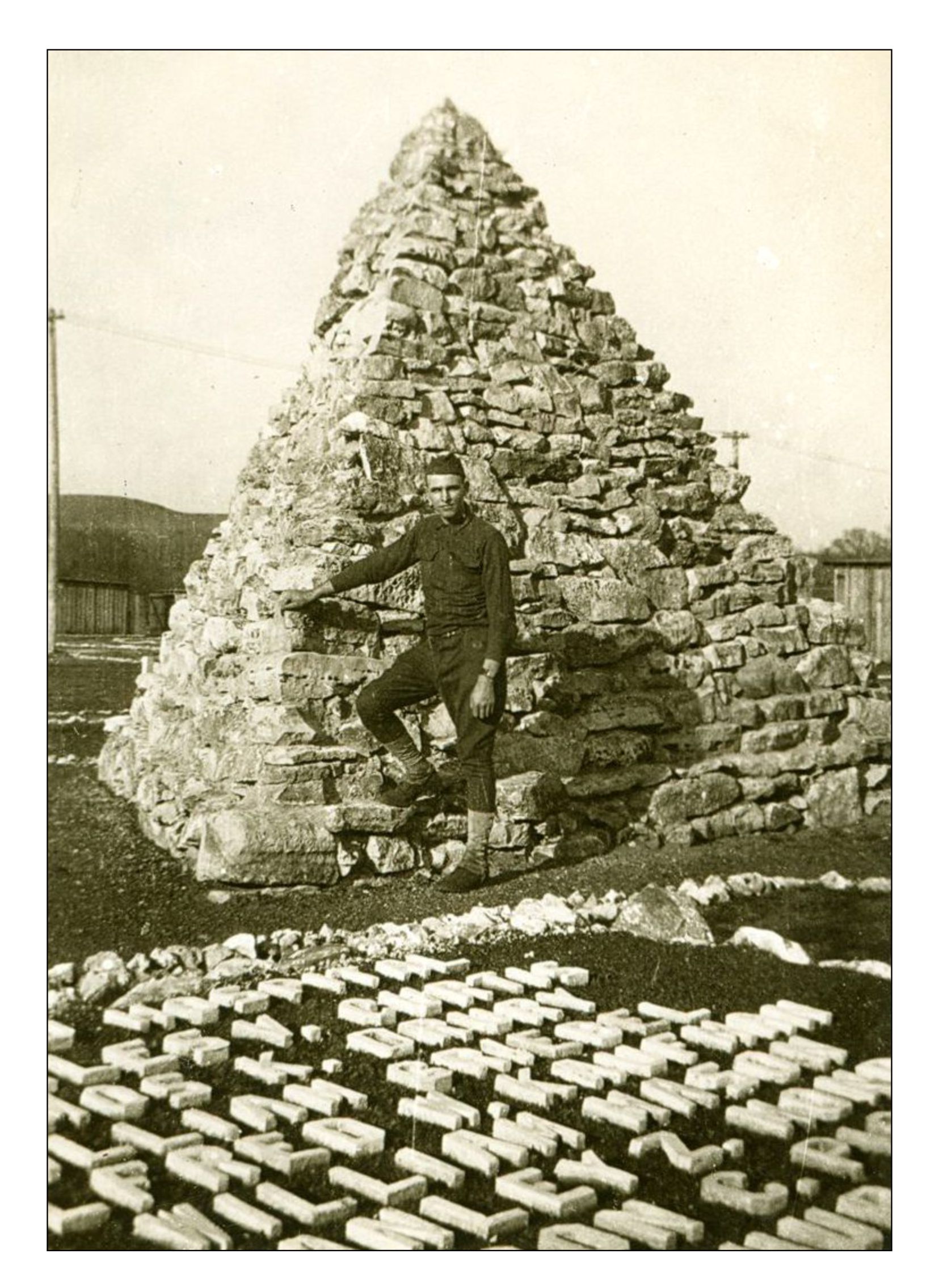
Despite its death toll, the Great Influenza was largely ignored by historians until the possibility of new influenza pandemics became real toward the end of the 20th Century. Thousands of monuments memorializing those who died in the Great War exist all over the world. Monuments to those who died of influenza are scarce, even though those who died of the disease outnumbered those who died in battle. The soldiers at Camp Fenton erected their own memorial to their colleagues who had died of the influenza (illustrated on the right, with its designer Henry Hardy). The monument was a simple pyramid of piled up stones with the names of the victims written in smaller stones on the grass. The camp and its monument have been long ago abandoned.

One of the reasons for the lack of attention that the Great Influenza received may have been that it did not fit with any overarching narrative. Though many died, they did not die for some noble cause. The disease was largely random it its killing.

The Black Death

Even though it did not kill so many, the Black Death had a far greater impact on our history. It shattered the society of the Middle Ages, disrupting the feudal system, and questioning the power of the Church. Part of this impact was due to the Bubonic Plague being far more virulent than either the influenza or the coronavirus. The Case Fatality Rate during the Black Death was over 30%. The disease was caused by a bacterium Yersinia pestis, which is endemic in rats and transmitted to human beings by fleas. The infected rats and their fleas came to Europe from the East on merchant ships. The plague began in port cities such as Naples, Venice and Genoa, are rapidly spread throughout Europe (McMillen, 2016; Snowden, 2019).

Nowadays we have antibiotics that can kill the bacteria that causes the Bubonic Plague. Furthermore, we understand how it is transmitted and can prevent this by controlling human exposure to rats and fleas. In the 14th Century there was nothing to do but flee. This flight actually increased the spread of the disease, which was carried by the fleas on all those who ran away.

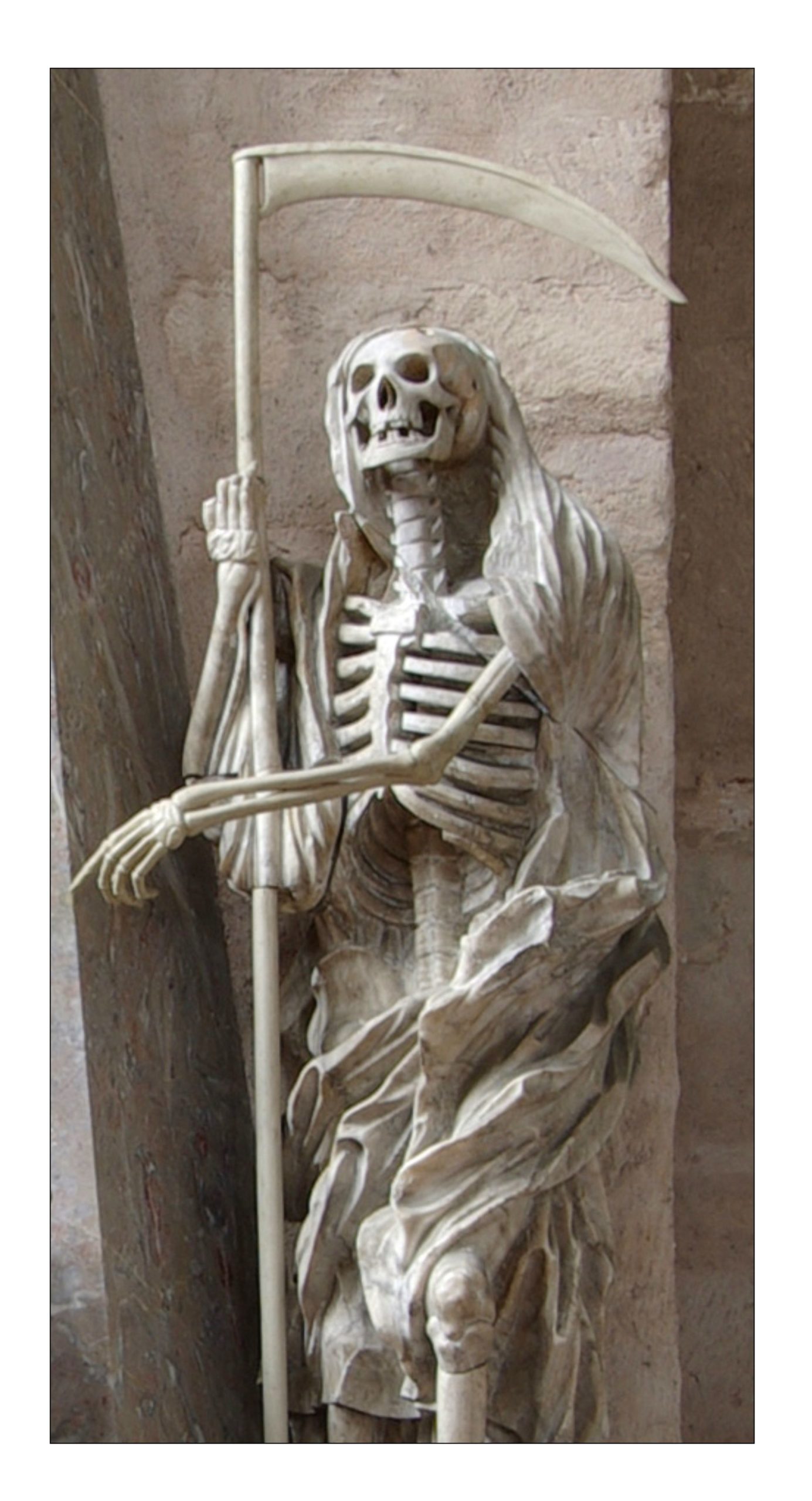
The Black Death bequeathed us with our most potent image of death as a skeletal figure, often clad in a shroud or black cloak and carrying scythe – the “grim reaper.” Such figures were often portrayed leading various people from all stations of life in a “dance of death.” The statue illustrated on the right is from the tomb in Trier Cathedral of Johann Philipp von Wallerdorff who died in 1768.

Many considered the Black Death as God’s punishment for humanity’s sins, and decided that a great return to God was necessary. Yet the plague had randomly killed both saint and sinner. Others thought that the plague was God’s demonstration that the Church had gone astray and needed to be reformed. Yet both priests and parishioners were equally affected.

And so, a few came to the idea that perhaps there was no God. The only justice in the world was at the hand of human beings. And their only recourse was themselves. And if they could ultimately survive the plague, they could perhaps settle on a different world, where reason ruled instead of faith.

The Seventh Seal

In Revelation after the four horsemen, the fifth and sixth seals are opened. These bring forth to John a vision of the Christian Martyrs, and then a vision of all those who had been saved by faith in Christ. Finally, the last seal is opened:

And when he had opened the seventh seal, there was silence in heaven about the space of half an hour. (Revelation 8:1)

Christians interpret the silence as representing the awe that occurs when one realizes the greatness of God and his program for the future. Ingmar Bergman considered it differently. Much of his work is concerned with the silence of God. All our prayers no matter how fervent are met with silence. He made this the subject of a trilogy of films: Through a Glass Darkly (1961), Winter Light (1963) and The Silence (1963).

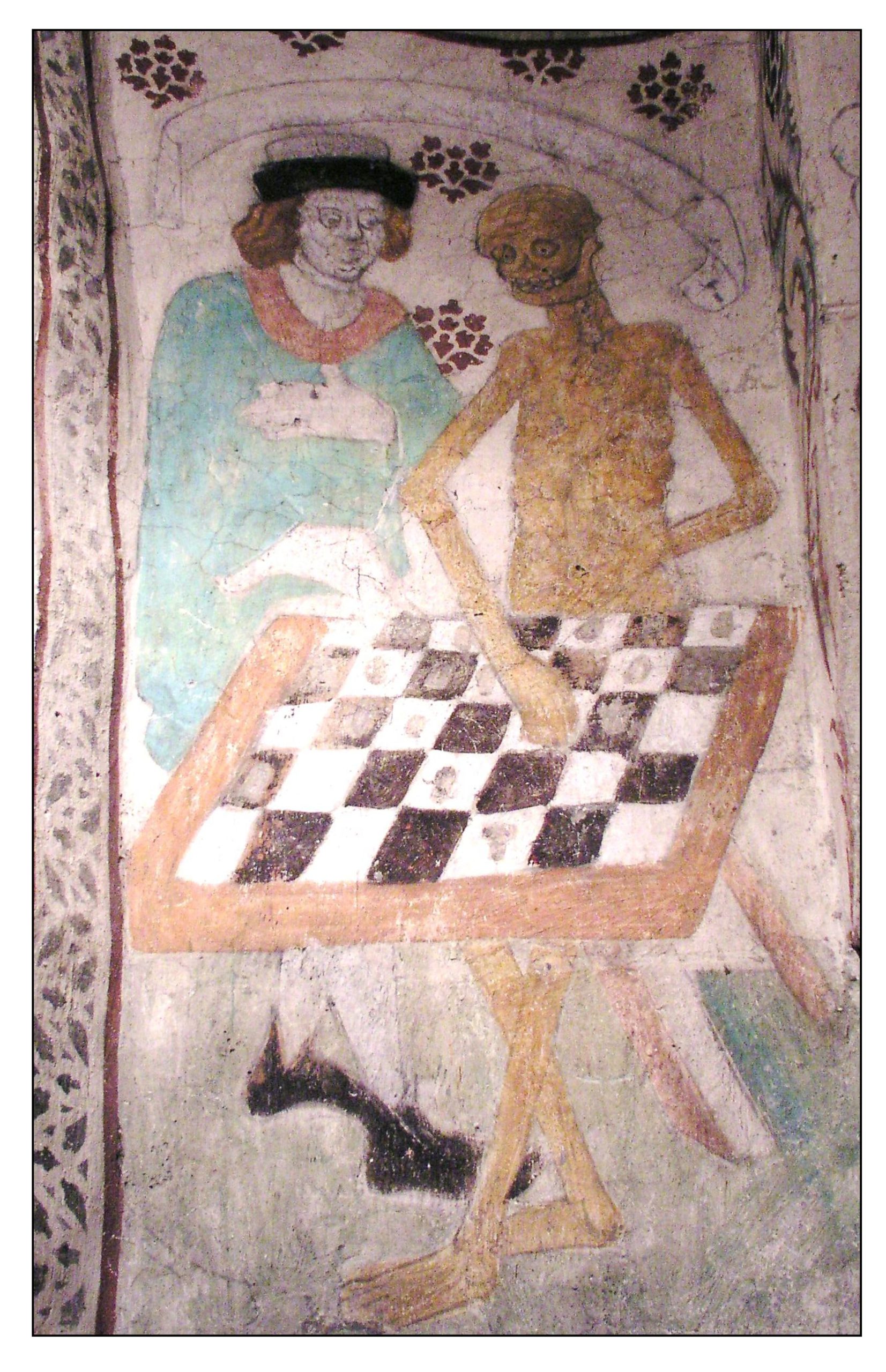
The idea is also at the heart of his earlier 1957 film The Seventh Seal. The quotation from Revelation about the opening of the seventh seal and the silence in heaven begins the film.  A knight Antonius Block (Max von Sydow) has just returned to Sweden from the Crusades. He has brought with him a game of chess that he learned in Palestine. All of Europe is in the grip of the Black Death. On a beach Antonius prays to God. After his prayer, Death (Bengt Ekerot) appears. Antonius challenges Death to a game of Chess to decide his fate. The following is a clip from the movie. The sound of the waves goes silent when Death appears.


Bergman based the idea of the game of chess from a 1480 fresco (right) painted by Albertus Pictor in the Täby Church near Stockholm. As the film proceeds, Death ultimately wins the game, and leads Antonius and his family off in a dance of death. The film is not accurate historically: the crusades ended long before the Black Death. However, it is one of our most vivid depictions of human mortality.


Playing Chess with Death

Death is now among us. Not in as the dark figure portrayed by Bengt Ekerot, but in the form of a coronavirus epidemic. The disease is not as virulent as the Black Death. However, it is likely just as contagious and just as virulent as the virus that caused the Great Influenza. How do we prevent what happened in 1918 when Death took millions of people before their time?

How do we play our game of chess with Death? We still have no specific treatment, and there is as yet no vaccine. Unlike in 1918, however, we now have oxygen therapy and, if necessary, artificial ventilation. These procedures can help patients with pneumonia survive until their immune systems can finally destroy the virus. Furthermore, we have monitors such as finger oximeters that can determine when oxygen therapy is needed.

What is most important is to inhibit the spread of the disease in the population. The most powerful means to do this involves identifying all patients with the disease, tracing all people who have come in contact with these patients, testing these contacts, and quarantining both the patients and their contacts (whether or not they are infected) until they are no longer contagious. Since we have tests that are reasonably specific for the virus, this approach is definitely possible, and is being used successfully in China and in South Korea.

In the absence of contact tracing, we can limit the spread of the disease by staying away from our fellows beyond the distance that airborne drops can travel: “physical distancing” (a more appropriate term than “social distancing”).  Physical distancing can certainly slow down the spread of the disease so that hospital facilities for treating those patients that develop pneumonia do not become overwhelmed. However, it will ultimately have to be replaced with contact tracing. Or the Dance of Death will continue.

Despite our best efforts many people will die in the pandemic. Though we know we have to die sometime, we generally believe that this will not be tomorrow. Nowadays death is closer. We need to come to terms with it. Through whatever stories, dreams and visions we can muster. We cannot play chess well without equanimity.


References

Barry, J. M. (2004). The great influenza: The epic story of the deadliest plague in history. New York: Viking.

Crosby, A. W. (1989/2003). America’s forgotten pandemic: The influenza of 1918. Cambridge England: Cambridge University Press.

Ferguson NM; Cummings DA; Fraser C; et al. (2006). Strategies for mitigating an influenza pandemic. Nature, 442 (7101), 448–452.

Fisher, J. E. (2012). Envisioning disease, gender, and war: Women’s narratives of the 1918 influenza pandemic. New York: Palgrave Macmillan

Hatchett, R. J.; Mecher, C. E.; & Lipsitch, M. (2007). Public health interventions and epidemic intensity during the 1918 influenza pandemic. Proceedings of the National Academy of Sciences of the United States of America, 104, 7582–7587.

Heffner, J. E. (2013). The story of oxygen. Respiratory Care, 58, 18-31.

Koester, C. R. (2014). Revelation: a new translation with introduction and commentary. New Haven, CT: Yale University Press, 2014.

Kopp, J., & McGovern, B. (2018).  100 years ago, ‘Spanish flu’ shut down Philadelphia – and wiped out thousands. PhillyVoice, September 20 and 27, 2018.

McMillen, C. W. (2016). Pandemics: a very short introduction. New York: Oxford University Press.

Owen, W. (Edited by Stallworthy, J., 1985). The poems of Wilfred Owen. London: Hogarth Press.

Porter, K. A. (1939). Pale horse, pale rider: Three short novels. New York: Harcourt, Brace and Company.

Quispel, G. (1979). The secret Book of Revelation: The last book of the Bible. New York: McGraw-Hill.

Snowden, F. M. (2019). Epidemics and society: From the Black Death to the present. New Haven, CT: Yale University Press.

Spinney, L. (2017). Pale rider: The Spanish flu of 1918 and how it changed the world. London: Johnathan Cape.

Taubenberger, J. K., & Morens, D. M. (2006) 1918 Influenza: the mother of all pandemics Emerging Infectious Diseases, 12, 15-22.

West, R. B. (1963). Katherine Anne Porter: American Writers 28.  Minneapolis: University of Minnesota Press.

Wu, J.T., Leung, K., Bushman, M. et al. (2020). Estimating clinical severity of COVID-19 from the transmission dynamics in Wuhan, China. Nature Medicine 26506–510.