Laozi: the Nature of the Dao
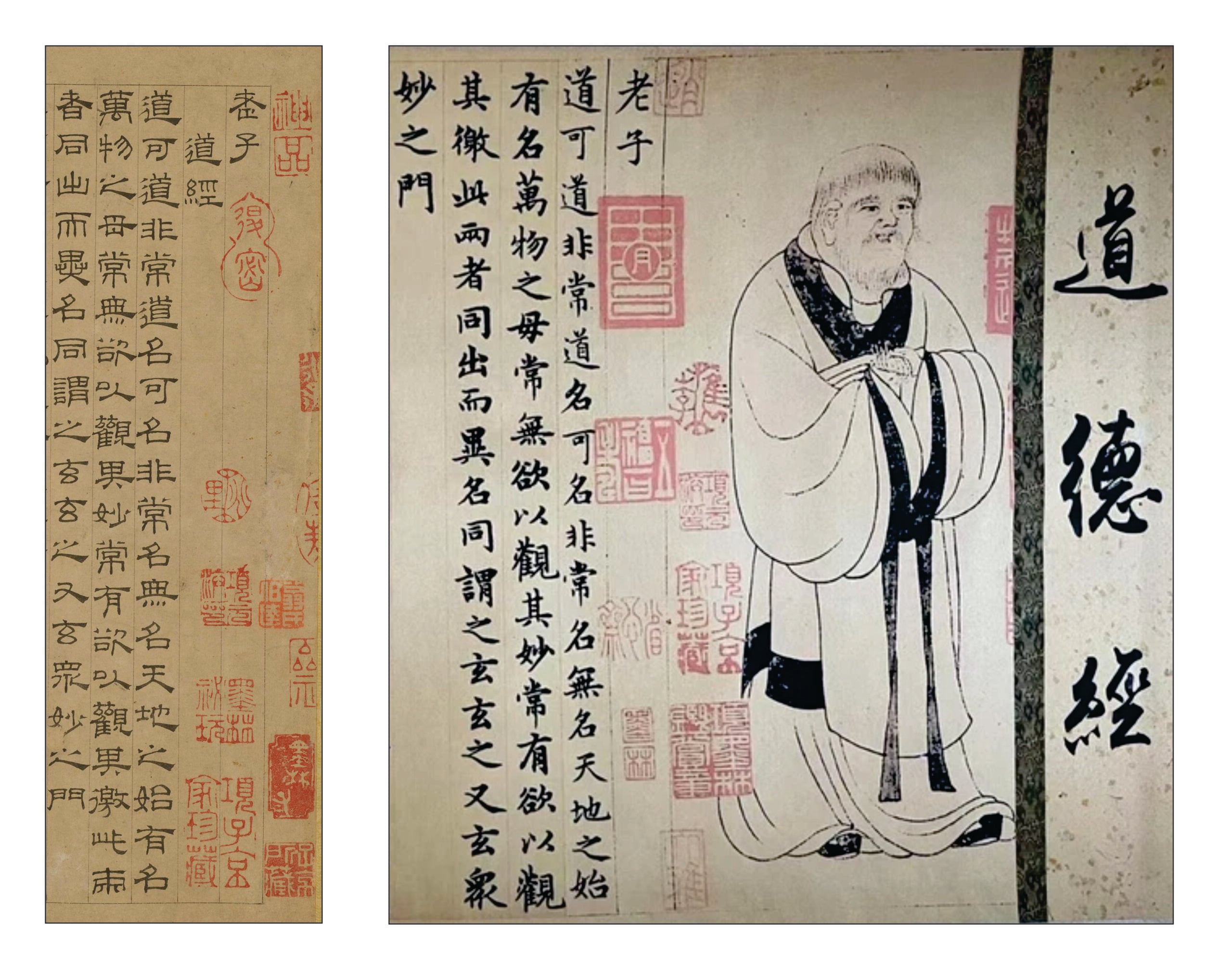
Laozi (老子, lǎozǐ, “the old master”) was a legendary character from the 6th Century BCE who put together a collection of philosophical and ethical sayings that has come to be known as the Dàodéjing (道德經 simplified:道德经; or Tao Te Ching in the Wade-Giles romanization, “The Book of the Way and of Virtue”) or Laozi after the name of the author. The illustration shows a depiction of Laozi from a scroll by Sheng Mao. Following the discovery of early versions of the text written on silk and bamboo slips dating to the 2nd Century BCE (Chan, 2016, 2025), several new translations and annotated editions have been published. This essay presents a close reading of the first chapter.
The First Chapter
The following is the Chinese text of the first chapter (which can be followed at the websites of the Chinese Text Project or Wikibooks) and a recent English translation by Fischer (2023).
道可道,非常道。名可名,非常名。
無名天地之始;有名萬物之母。
故常無欲,以觀其妙;常有欲,
以觀其徼。此兩者,同出而異名,
同謂之玄。玄之又玄,衆妙之門
The way that can be (fully) conveyed is not the abiding Way; a name that can be (fully) descriptive is not an abiding name.
“Formlessness” is the name of the beginning of Heaven and Earth; “form” is the name of the mother of the myriad things.
Thus, if you abide in formlessness, you may thereby observe its wonders; and if you abide in form, you may thereby observe its manifestations.
These two appear together but have different names. This togetherness, we call it “mysterious” mystery and more mystery: the gateway to many wonders.
The following illustration shows on the left the first chapter in clerical script from a scroll by Sheng Mao (盛懋, fl. 14th Century) in the Palace Museum in Beijing, and on the right in regular script from a scroll by Zhao Mengfu (趙孟頫, 1254–1322). The latter includes a portrait of Laozi as a benevolent old gentleman.

The following is a recitation of the first chapter from the dao-de-jing website, and the text in pinyin romanization:
dào kě dào fēi cháng dào
míng kě míng fēi cháng míng
wú míng tiān dì zhī shǐ
yǒu míng wàn wù zhī mǔ
gù cháng wú yù yǐ guān qí miào
cháng yǒu yù yǐ guān qí jiào
cǐ liǎng zhě tóng chū ér yì míng
tóng wèi zhī xuán xuán zhī yòu xuán
zhòng miào zhī mén
The original book of sayings was likely handed down orally. The earliest extant versions were written in clerical script. However, it is possible that there might have been versions of the book written in the Small Seal script, such as imagined in the following illustration:
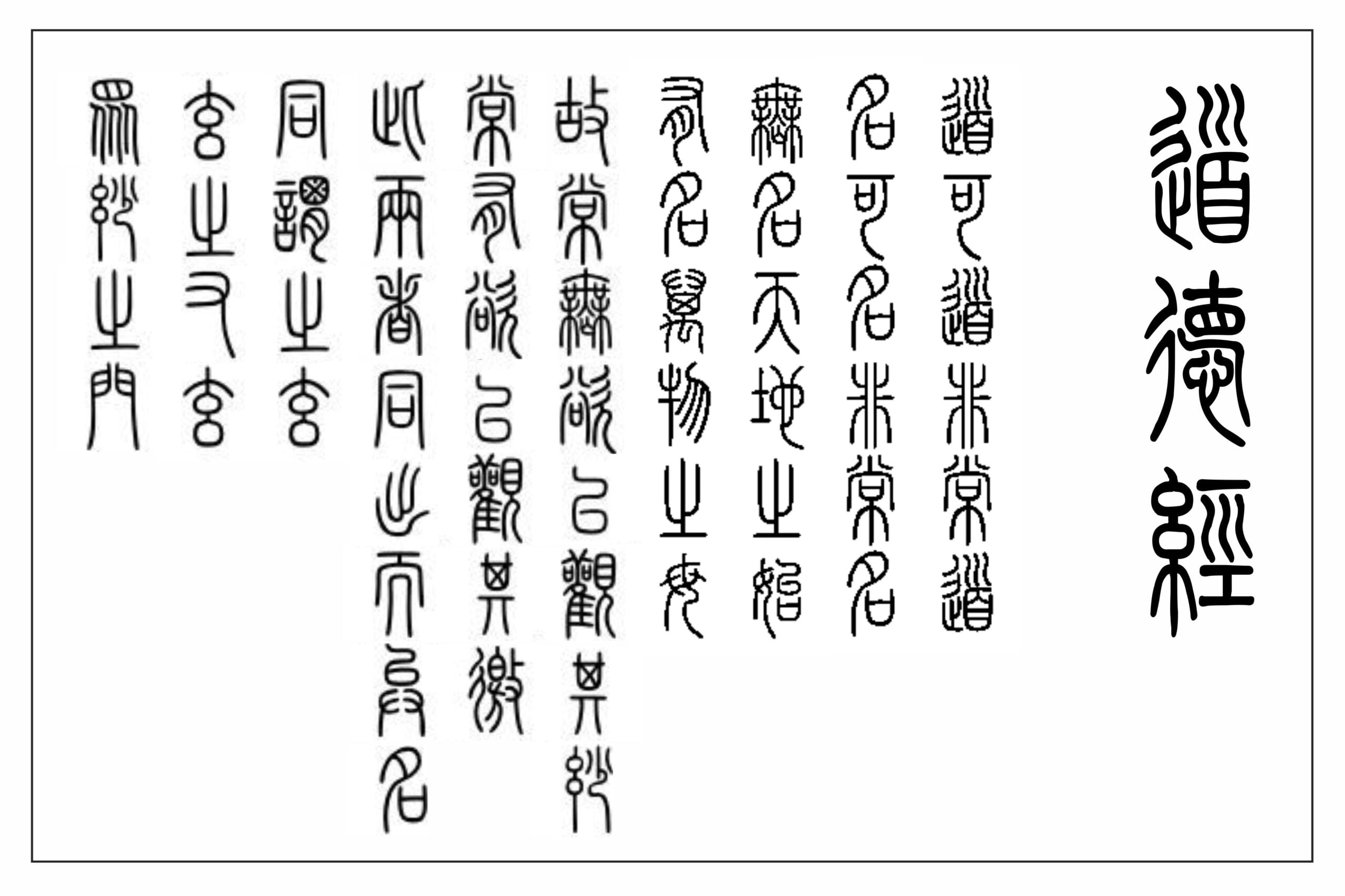
Or even versions written in the earlier Great Seal or Bronze script, which was used at the time that the book was supposedly created. The illustration on the right shows a Great Seal version of Chapter 1 as imagined by Wilson (2010):

This essay will concern itself with the first chapter (or verse) of Laozi’s book. Red Pine quotes De Qing (1546-1623), a Buddhist commentator, on this chapter:
Laozi’s philosophy is all here. The remaining 5000 words only expand on this first verse.
The Ineffable Dao
The first section of the chapter concerns the difficulty in expressing the nature of Dao:
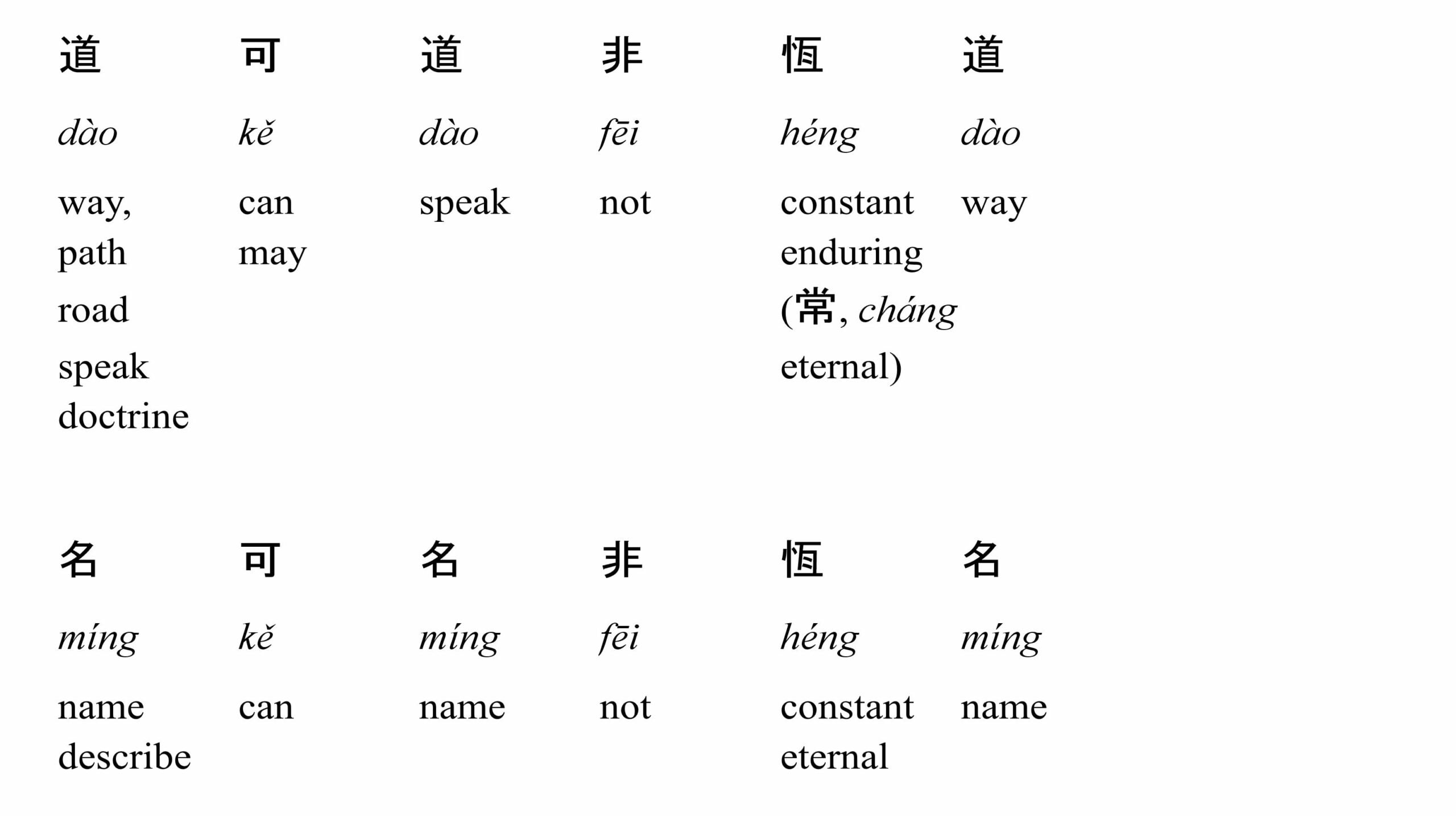
The way that can be spoken of is not the eternal Way
The name that can be named is not the eternal Name.
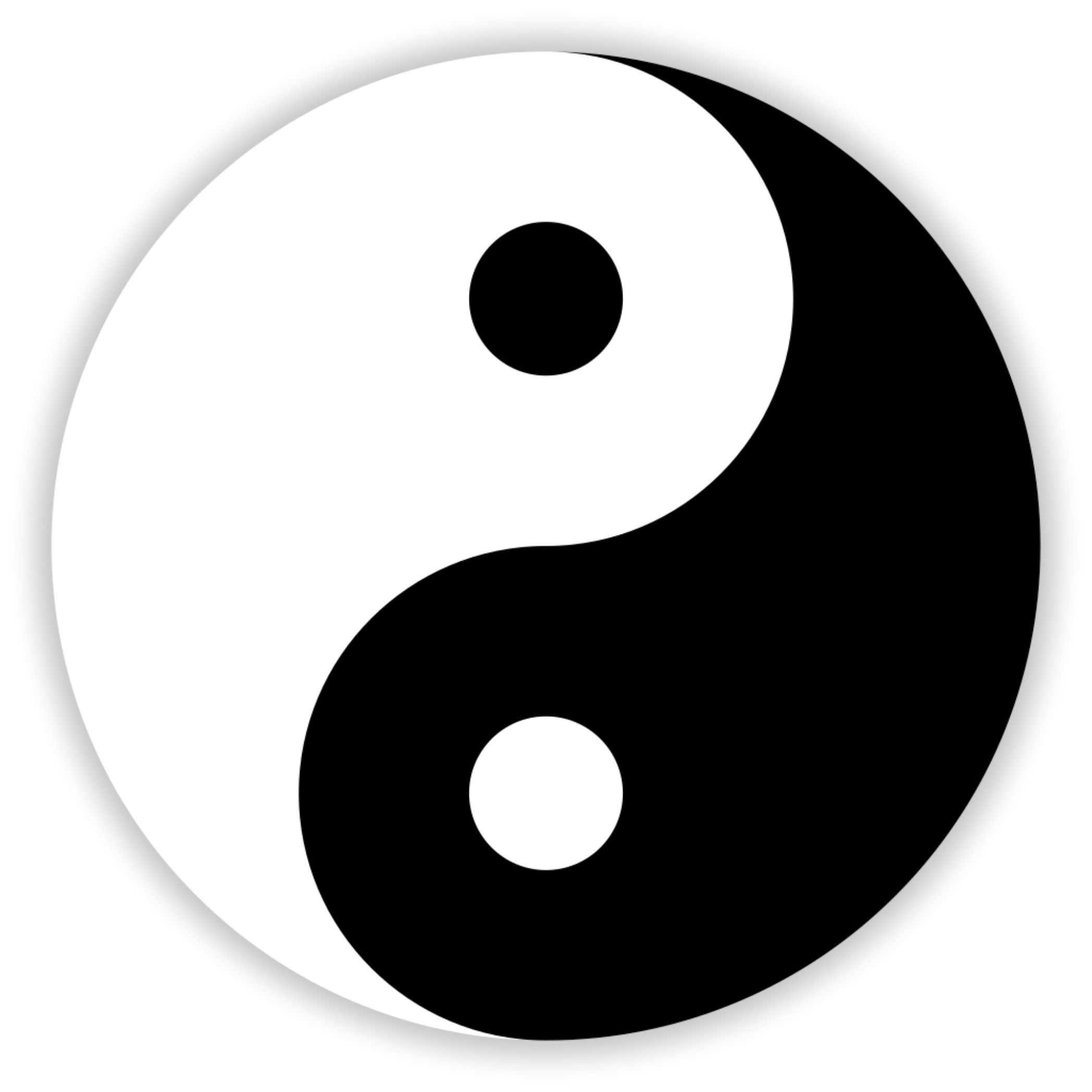 Much of Daoist philosophy is related to the opposing concepts of Yīn (陰 simplified 阴 lunar, feminine, passive, cool) and Yáng (陽 simplified 阳 solar, masculine, active, warm). The prototypical examples of Yin and Yan are the shady north side of a hill and its sunny south side. Yin and Yang are the two opposite but interacting forces that underly the harmony of the universe. They can be represented by the tàijítú (太極圖, utmost extreme symbol), one version of which is shown on the right. The small contrasting circles within in each half show how the opposites are complementary rather than antagonistic.
The first two lines of the Daodejing provides two parallel statements on the Dao and on its name. These lines thus concern the actual Dao and its abstract name, both of which cannot be fully understood by finite beings. Actual and abstract can be considered as one of the dualities composing Yin and Yang.
The first line uses the character 道 dao in three ways: first as a noun describing a way or path, second as a verb in the sense of speaking (telling how to follow a path), and third to express the concept of an eternal Dao underlying all things. The second line acts in the same way for the character 名 (name). All languages can use the same word as noun and verb, e.g. “change” in English, but this is more common in Chinese.
In later versions of the Daodejing the character 恆 (constant) was replaced by 常 (with a similar meaning), probably because the former was the name of the fifth emperor of the Han dynasty, Lui Heng (203-157 BCE), and therefore a taboo word.
The Dao is eternal or everlasting. However,
While everlasting seems apt, describing the Dao as unchanging does not fit. This is because Laozi’s Dao serves as the substance of the cosmos and fundamental source and basis of the things of the world. It is eternally transforming and dynamic. (Chen et al., 2020, p 47)
The following is a description of the Dao by Zhuangzi (莊子, Master Zhuang, Chuang-tzu in the Wade-Giles romanization) a Daoist philosopher who lived in the 4th Century BCE (Palmer et al. 1996, pp 50-51):
The great Tao has both reality and expression,
but it does nothing and has no form.
It can be passed on, but not received.
It can be obtained, but not seen.
It is rooted in its own self,
existing before Heaven and Earth were born, indeed for eternity.
It gives divinity to the spirits and to the gods.
It brought to life Heaven and Earth.
It was before the primal air, yet it cannot be called lofty;
it was below all space and direction, yet it cannot be called deep.
It comes before either Heaven or Earth, yet it cannot be called old.
Alan Watts (1975, pp 41-42) commented on the difficulty in describing the Dao:
Thus the Tao is the course, the flow, the drift, or the process of nature, and I call it the Watercourse Way because both Lao-tzu and Chuang-tzu use the flow of water as its principal metaphor. But it is of the essence of their philosophy that the Tao cannot be defined in words and is not an idea or concept. As Chuang-tzu says, “It may be attained but not seen,” or, in other words, felt but not conceived, intuited but not categorized, divined but not explained. In a similar way, air and water cannot be cut or clutched, and their flow ceases when they are enclosed. There is no way of putting a stream in a bucket or the wind in a bag. Verbal description and definition may be compared to the latitudinal and longitudinal nets which we visualize upon the earth and the heavens to define and enclose the positions of mountains and lakes, planets and stars. But earth and heaven are not cut by these imaginary strings. As Wittgenstein [Tractatus Logico-Philosophicus, 1922] said, “Laws, like the law of causation, etc., treat of the network and not of what the network describes.”
Chapter 32 of the Daodejing ends with the statement (translated by Pepper and Wang, 2021):
Dao in this world is like a stream in the valley
Flowing into a river,
into the sea
Being and Nothingness
The second part of the first chapter presents a brief cosmogeny
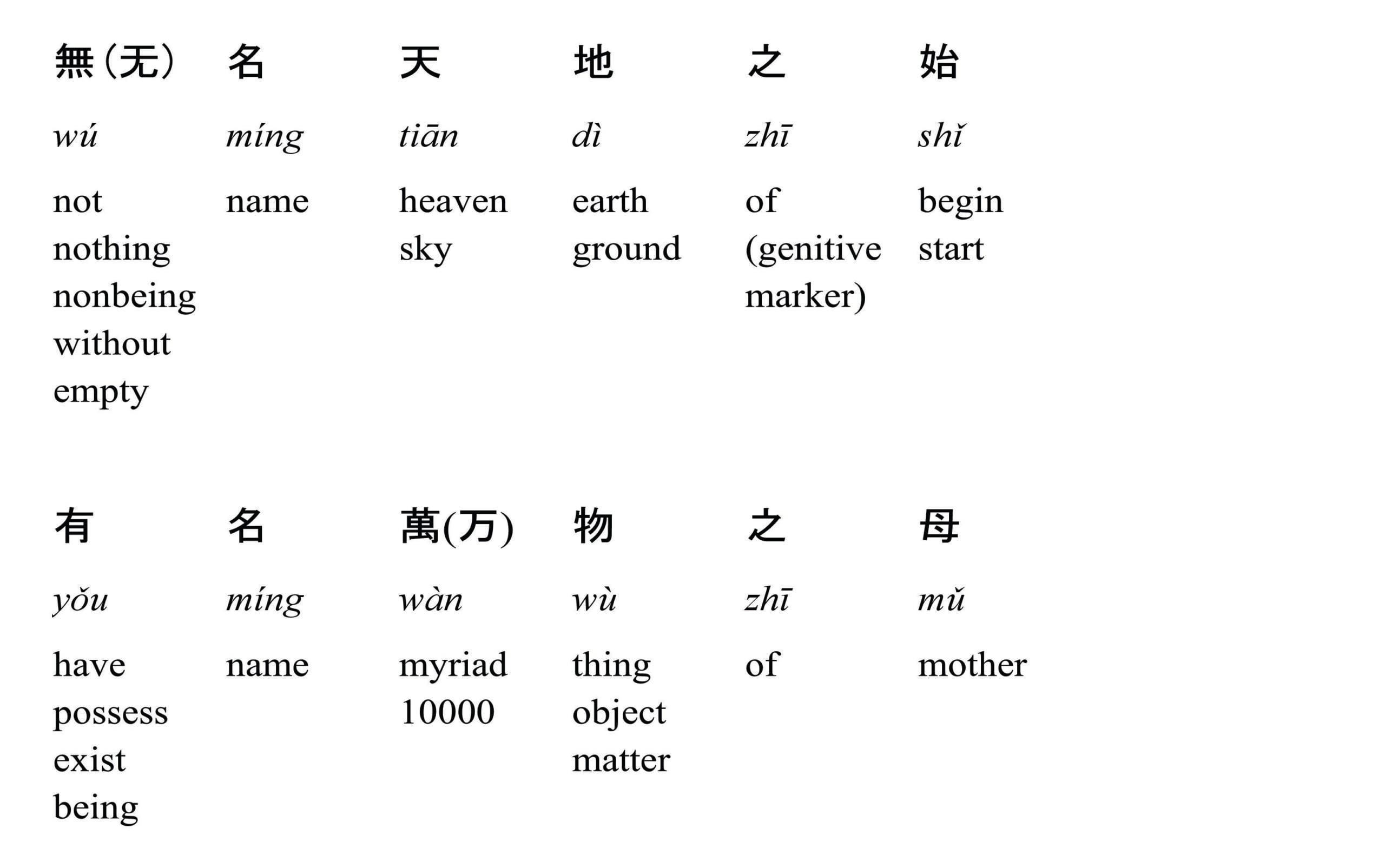
These lines have been interpreted in two distinct ways. The first
reads wu 无 [non-presence, lacking, non-being] and you 有 [presence, having, being] as the subjects of statements, and name (名) as part of the predicate. The alternative reading takes wuming 无名 [without name, nameless] and youming 有名 [having name] as the subjects of the statements (Chen et al. 2020, pp 48-49).
Thus we could have
Nothingness is the name for the origin of heaven and earth
Being is the name for the mother of all things.
or
Nameless is the origin of heaven and earth
Named is the mother of all things.
Since Yin and Yang is basic to Laozi’s thinking, I have opted to use the first reading which stresses the dichotomy of being and non-being. Similar ideas are stated in Chapter 40 of the Daodejing:
天下萬物生於有,有生於無
All the things in the world are generated from you 有,
you 有 is generated from wu 无
There is a difference between 天地 (heaven and earth), which encompasses the whole cosmos, and 万物 (myriad things), which refers to the many different things within it. However, this distinction may not be necessary since some early sources used 万物 in both lines. (Huang, 2024, p 14)
The dichotomy between you and wu (Hall & Ames, 1998) reflects a foundational issue in philosophy: the nature of Being. This goes back to some of the very earliest records of human thought. The creation hymn of the Hindu RgVeda (composed around 2000 BCE) states that at the beginning of time there was neither existence nor non-existence. The ancient Greek philosopher Parmenides (5th Century BCE) worried about “What is and what is not.” Shakespeare’s Hamlet considered “To be, or not to be, that is the question” and Jean-Paul Sartre compared L’être et le néant (Being and Nothingness).
The following is a comment by Zhuangzi (Palmer et al. 1996, p 15) on the origins of the universe:
There is the beginning; there is not as yet any beginning of the beginning; there is not as yet a beginning not to be a beginning of the beginning. There is what is, and there is what is not, and it is not easy to say whether what is not, is not; or whether what is, is.
The Mother of All Things
The fourth line of the first chapter proposes a feminine origin (母, mother) for all things. This idea is repeated in Chapter 6 which describes 玄牝 (xuán pìn, the mysterious female):
谷神不死,是謂玄牝。
玄牝之門,是謂天地根。
綿綿若存,用之不勤
The spirit of the valley does not die; it has been called the mysterious female
The gate of the mysterious female is called the root of heaven and earth.
It is continuous and uninterrupted; its functioning is inexhaustible.
(my translation)
Chapter 25 mentions the 天下母 (tiān xià mŭ, the mother of all under heaven):
有物混成,先天地生。
寂兮寥兮,独立不改,
周行而不殆,可以为天下母。
吾不知其名,字之曰道,强为之名曰
Which has been translated (Wu, 2016, p 57)
There was something undifferentiated and yet complete, born before Heaven and Earth,
Soundless and formless, independent and unchanging.
Revolving endlessly, it may be thought of as the Mother of all under Heaven.
I do not know its name; so I just call it Dao, and arbitrarily name it Great
Anderson (2021) has noted how the Daodejing fully recognizes the female nature of the Dao. Most of the world’s religions are androcentric: they ignore the divine feminine. At its beginning Daoism understoon that the world is based on interacting male ane female forces. And that creation comes from the female.
From One to Many
The first chapter distinguishes between being and nothingness (yŏu 有 and wu 無 无). The 42nd chapter recounts the actual process of creation (translation by Wu, 2016):
道生一,一生二,
二生三,三生萬物。
萬物負陰而抱陽,
沖氣以為和。
Dao gives birth to One; One gives birth to Two;
Two gives birth to Three; Three gives birth to Ten Thousand things.
All things have Yin on their back and Yang in their embrace;
The Qi of the two converge and become harmony.
The idea of Yin on their back and Yang in their embrace refers to how we prefer to sit facing the sun with the shadow at our back.
The basic cosmogeny is that the primordial energy of the universe – qì (氣) – becomes differentiated into two opposing forces of yin and yang. These then interact to produce the myriad things of the world that exist in harmony hé (和).
The one-two-three progression probably just represents the evolution of the many things in the universe. However, Fischer (2023) also considers the possibility
that the “one, two, three” refer to physical energies (氣), Yin-Yang, and harmonized physical energies (和氣). That is: one, a semblance of a form emerges from formless-ness; two, the physical energy that constitutes that semblance is influenced by the Yin and Yang states that characterize all physical energies; three, once the semblance has morphed, chrysalis-like, into its final “harmonious” form, it has become a stable entity.
Mystery and Manifestation
The third section of the first chapter has led to several different translations.
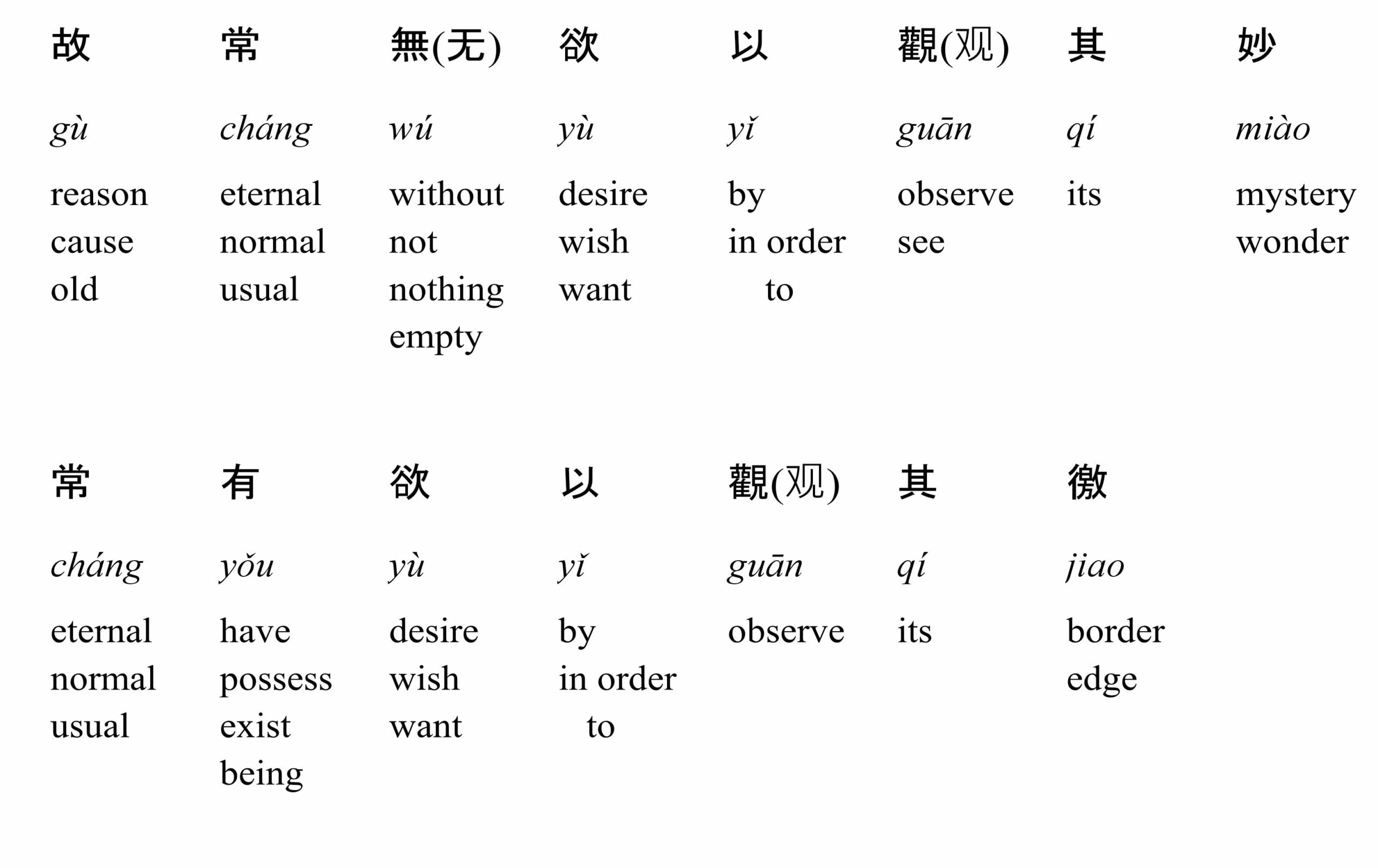
Some editions (e.g. Huang, 2024) substitute 眇 (miǎo, tiny, minute) for 妙 and 噭 (jiao, pursue) for 徼. This leads to the idea of the development from minute origins toward the mature things of the present.
Another difficult is whether the character 欲 acts as a noun meaning “desire” or as an adverb casting the following parts of the sentences in the subjunctive as “may observe.” This would make無 and 有 the subjects of the sentences rather than modifiers of 欲. The Fischer translation quoted at the beginning of this essay follows this approach, as do the versions of Yu (2003), Chen et al. (2020) and Wu (2016).
Translators have more commonly considered that these two sentences compare what happens with or without desire (e.g., Addiss & Lombardo;1993; Leguin & Seaton, 1998; Lin, 2020; Liu, 2024; Loy, 1985; Red Pine, 2004; Wilson 2012). This approach fits with the Buddhist idea that one can find release from suffering by relinquishing desire. As pointed out by Watts (1975, p 96), however, the idea that virtue comes from an absence of desire is paradoxical:
Trying to get rid of desire is, surely, desiring not to desire.
If we follow this approach to the translation, we find that Laozi makes no moral judgement about desire: he just points out the differences between having it or not. Both are possible and both serve a purpose. Relinquishing desire can allow the mind a mystical vision of the origin of everything. Exercising desire allows us to understand the nature of the things of the world:
Free from desire, you can realize the mystery;
Following desire, you can see the manifestations.
However, if the chapter is to be consistent, it is probably best to keep to the duality of wu 無(无) and you 有:
Therefore in nothingness you may see the mystery;
In being you may see the manifestations.
Nevertheless, the different translations are not that distinct. A person can see the mystery by attuning his or her mind to nothingness. One way of doing this might be to relinquish desire.
Yin and Yang
The fourth section of the chapter tells us these two states are just different aspects of the universe, part of the union of interacting opposites that makes up the concept of Yin-Yang:
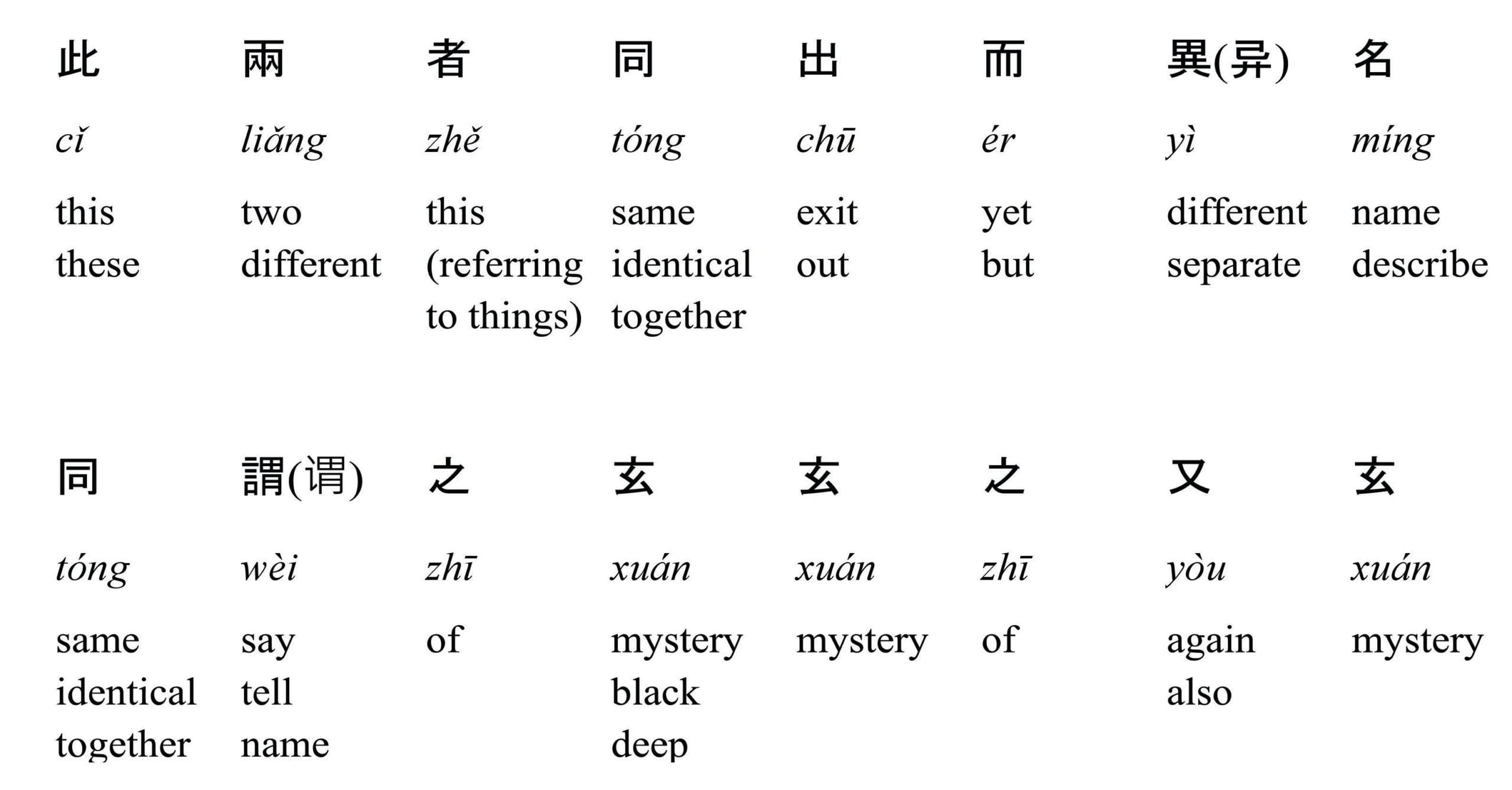
Whether these lines refer to (者) the concepts of being and nothingness or to the states of desire and non-desire depends on how the previous lines were translated. I have opted for the former.
These two are but different aspects of the same idea
This is the mystery of mysteries
The Gateway
The final section of the chapter proclaims the mystery of the Dao:
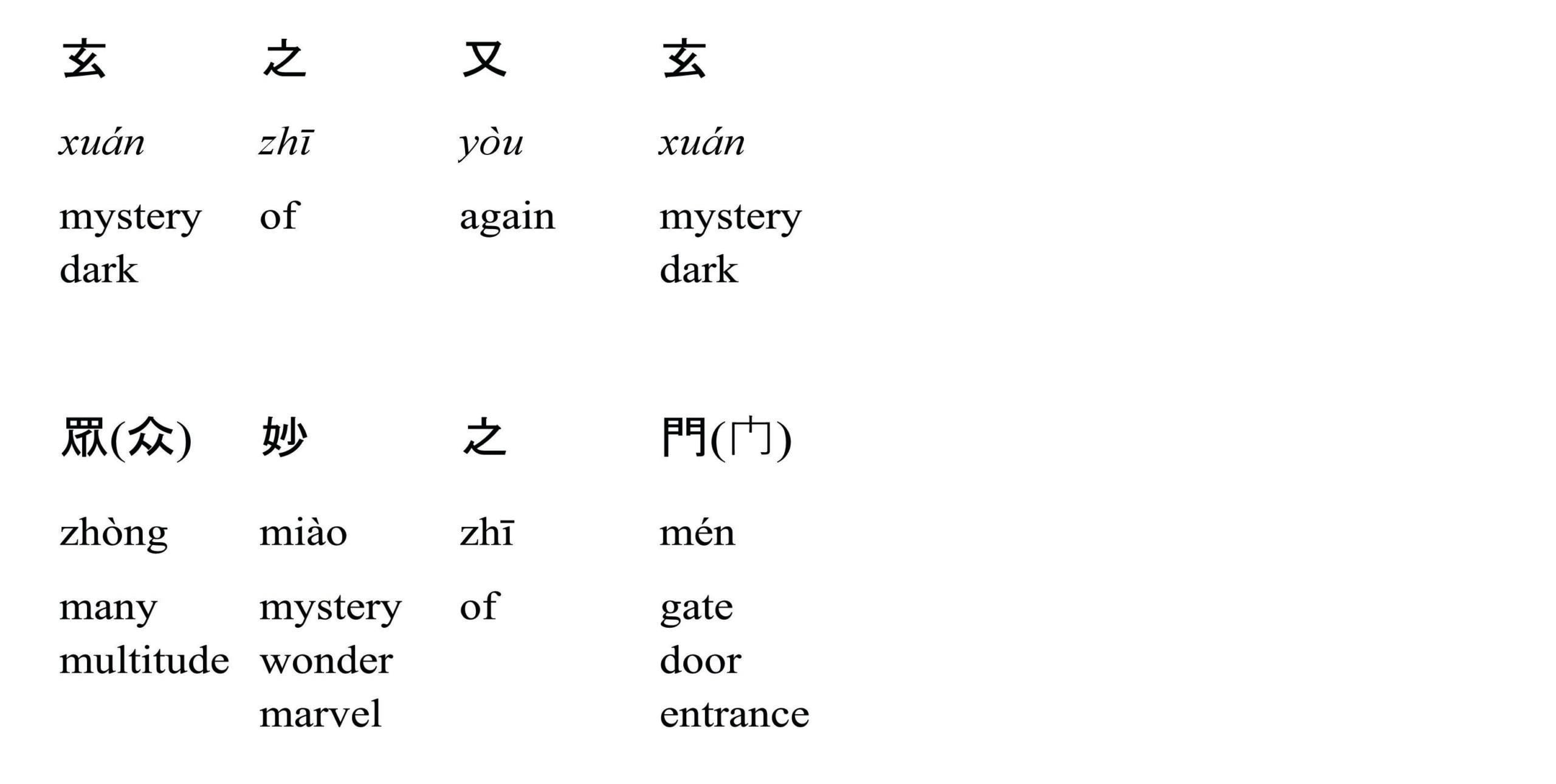
Laozi uses two words for mystery:
玄 (xuán) is dark, mysterious, unseen, withdrawn, deep. But 妙 (miào) is lighter, a wonderful mystery. (Pepper & Wang, 2021, p 17)
We can stress the “darkness,” as in Denecke (2010, p 223)
Where the dark is darker than darkness, that’s the Gateway of Subtleties.
Or simply stay with “mystery”
Mystery of mystery: the gateway to many wonders
Relations to Western Pantheism
The concept of the Dao has many similarities to Western pantheism, particularly to that proposed by Spinoza (Stamatov, 2019, 2025). Fu (1973, p 390) remarks
Both philosophers think that the ultimate way of freeing oneself from human bondage and attaining total emancipation is to have an ontological insight (Lao Tzu) into or intellectual intuition (Spinoza) of the as-it-is-ness of the world and man.
One significant difference is that Spinoza clearly names the principle underlying the universe as God.
Samuel Taylor Coleridge (1772-1834) was particularly intrigued by the writings of the Domingo Fernandez Navarrete (1610-1689), a Dominican friar who had spent many years in China and had described the principles of Daoism for Western readers (Murray, 2020). Coleridge and his close colleague William Wordsworth (1770-1850) were responsible for initiating the movement of Romanticism in English literature Wordsworth’s Lines Composed a Few Miles above Tintern Abbey, On Revisiting the Banks of the Wye during a Tour. July 13, 1798 describes a romantic pantheism that is very similar to the Dao of Laozi:
And I have felt
A presence that disturbs me with the joy
Of elevated thoughts; a sense sublime
Of something far more deeply interfused,
Whose dwelling is the light of setting suns,
And the round ocean and the living air,
And the blue sky, and in the mind of man:
A motion and a spirit, that impels
All thinking things, all objects of all thought,
And rolls through all things.
Envoi
We can conclude by putting together the complete chapter:
The way that can be spoken of is not the eternal Way
The name that can be named is not the eternal Name.
Nothingness is the name for the origin of heaven and earth
Being is the name for the mother of all things.
Therefore through nothingness you can see the mystery;
Through being you can see the manifestations.
These two are but different aspects of the same idea
This is the mystery of mysteries
Mystery of mystery: the gateway to many wonders.
The chapter is our introduction to the Dao. The character 道 is composed of two radicals. In the upper right is a representation of the head 首(shŏu), and in the left and below is a radical denoting walking 辶 (chuò). The combination perhaps represents “to go ahead.” As such it depicts the principle that underlies the universe: the way things should and do turn out.
The Dao has several meanings:
In some places the character “dao 道” refers to a metaphysical entity understood as ultimate true existence. In other places, it seems to refer to a type of rule or principle, often reflected in natural laws or patterns. In yet other locations, dao refers to standards, norms or exemplary models for human life. (Chen et al,2020, p 2),
Fu (1973) describes six dimensions of the Dao:
(i) reality – a metaphysical symbol of things as they are
(ii) origin – the source of all there is
(iii) principle – that whereby all things become what they are
(iv) function – the laws governing the processes of change
(v) virtue – that which completes the being of each and every individual
(vi) technique – the way in which people are governed
The Dao in metaphysical terms should be considered in relation to time. As time passes, thing change. Our science indicates that such changes are not random but follow general rules. Most people also believe that these changes ultimately progress toward something: that the universe has some purpose and is in the process of becoming better. The Dao instantiates these two ideas. It is the overall principle leading the universe toward harmony. Human beings can live their lives best by attuning themselves to this movement.
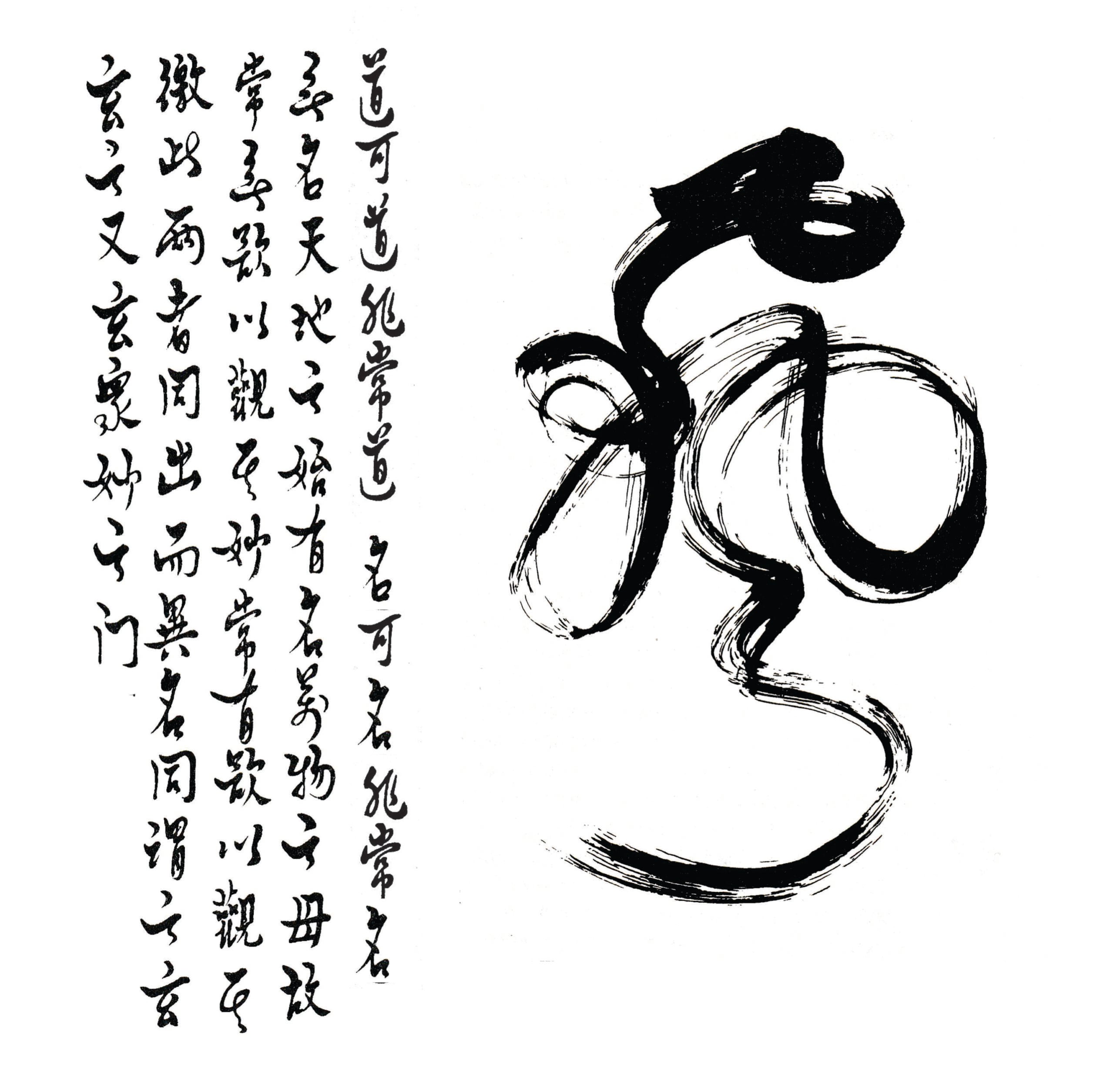
The final illustration shows on the right 道written in an ecstatic cursive script by Al Chung-liang Huang for Alan Watt’s book on Tao: The Watercourse Way (1975). The fluidity of the calligraphy fits with the idea of water finding its way. On the left is shown the first chapter of the Daodejing as created by Lee Chi-Chang for the same book:
References
Addiss, S., & Lombardo, S. (1993). Tao te ching. Hackett.
Anderson, R. (2021). The Divine Feminine: Tao Te Ching. Inner Traditions.
Chan, A. K. L. (2018). The Daodejing and its tradition. In Kohn, L. (Ed.) Daoism Handbook (Volume 14 of Handbook of Orietnal Studies) (pp 1-29). Brill.
Chan, A. K. L. (2025). Laozi. The Stanford Encyclopedia of Philosophy.
Chen, G., D’Ambrosio, P., & Xiao, O. (2020). The annotated critical Laozi: with contemporary explication and traditional commentary. Brill.
Denecke, W. (2011). The race for precedence: polemics and the vacuum of traditions in Laozi. In The dynamics of Masters literature: early Chinese thought from Confucius to Han Feizi. (pp 207-230). Harvard University Asia Center.
Fischer, P. (2023). The annotated Laozi: a new translation of the Daodejing. State University of New York at Albany.
Fu, C. W.-H. (1973). Lao Tzu’s conception of Tao. Inquiry, 16(1–4), 367–394.
Hall, D., Ames, R. (1998). You–wu. The Routledge Encyclopedia of Philosophy. Taylor & Francis. (Retrieved 15 Nov. 2025)
Huang, J. H., (2024). The Dao De Jing: Laozi’s book of life: a new translation from the ancient Chinese. Mariner.
Le Guin, U. K., & Seaton, J. P. (1998). Tao te ching: a book about the way and the power of the way. Shambhala.
Lin, P. J. (1977, open access 2020). A Translation of Lao-tzu’s Tao Te Ching and Wang Pi’s Commentary. (Volume 30 in University of Michigan Chinese Studies). University of Michigan.
Liu, K. (2024). Laozi’s Dao de jing: a new interpretation for a transformative time. Scribner.
Loy, D. (1985). Chapter One of the Tao Tê Ching: a ‘new’ interpretation. Religious Studies, 21(3), 369–379.
Murray, C. (2020). Coleridge’s Daoism? Joseph Needham, Dominican Sinology, and Romantic Pantheism. The Wordsworth Circle, 51(2), 205–220.
Palmer, M., Breuilly, E., Ming, C. W., & Ramsay, J. (1996). The book of Chuang Tzu. Arkana (reprinted by Penguin 2006)
Pepper, J.& Wang, X. H. (2021). Dao de jing in clear English including a step-by-step translation. Imagin8 Press.
Red Pine (1996, revised 2004), Lao-Tzu’s Taoteching with selected commentaries from the past 2000 years. Copper Canyon Press.
Stamatov, A. (2019). Spinoza and Laozi: God and Dao.
Stamatov, A. (2025). Dao in world philosophy: an experimental approach. In A. Stamatov (Ed.) Dialogues with classical Chinese philosophy (pp. 192–204). Routledge.
Watts, A. (1975) Tao: the watercourse way. Pantheon Books.
Wilson, W. S. (2012). Tao te ching: an all-new translation. Shambhala.
Wu, C. Q. (2016). Thus Spoke Laozi: A New Translation with Commentaries of Daodejing. University of Hawaii.
Yu, A. C. (2003). Reading the “Daodejing”: ethics and politics of the rhetoric. Chinese literature: essays, articles, reviews (CLEAR), 25, 165-187