Wu Wei: Effortless Action
One of the central ideas in the Daodjing of Laozi is the idea of wu wei (無為, simplified 无为; wúwéi). This has been translated in many ways: “non-action,” “actionlessness,” “effortless action,” and “doing nothing.” The 37th chapter of the Daodjing considers wu wei an attribute of the eternal Dao. The 48th chapter promotes wu wei as a human virtue. The illustration shows wu wei in regular script (left) and in cursive (right).
Being True to Oneself
A foundational concept in Daoism is自然, zìrán. This word is composed of 自 (self, oneself, from, since) and 然 (right, correct, so, in this manner). Almost impossible to translate, the word has been variously rendered simply as “self-so” (Ziporyn, 2009) or more abstractly as “as-it-is-ness” (Fu, 1973, p 382). The meaning contains the idea of acting “naturally” or “spontaneously.” An underlying concept is “authenticity” – one’s action should be true to one’s nature.
Laozi uses the word in the ending to Chapter 25 of the Daodejing (with translation by Wu, 2016):
人法地,地法天,天法道,道法自然
Man follows the ways of Earth;
Earth follows the ways of Heaven;
Heaven follows the ways of Dao;
Dao follows its own ways.
Several aspects of zìrán need consideration. First, the Dao acts through all things. As well as ordering the cosmos, the Dao acts through each individual object it contains. Human beings must ultimately follow their own zìrán. Zhuang Zhou, commonly known as Zhuangzi (莊子), a Daoist philosopher from the 4th Century BCE, begins his writings with a description of all the different things in the universe from the mythological great Peng bird to the morning mushroom, and recommends that one must act “on the rectitude (正, zhèng) of Heaven and Earth” (Lynn, 2022, p 8). Guo Xiang (郭象, 265-312 CE) commented on this section of the Zhuangzi
“Heaven and earth” is just a blanket term used to indicate all beings. It is all individual beings that form the very substance of heaven and earth, and it is each being’s self-so [ziran] that aligns true to itself. “Self-so” [ziran] means what is so of itself [ziran], without being done by anyone or for any purpose. Thus, Peng’s ability to fly high and the sparrow’s ability to stay low, the great tree’s ability to last long and the mushroom’s ability to perish quickly, all these are done spontaneously, all are self-so [ziran] (Ziporyn, 2009, p 132.)
Second, the concept of zìrán does not mean that all things passively accept their lot in the universe. Misha Tadd (2019) argues that zìrán has as much to do with “authority” as with “authenticity.” We need to be true to our ideal selves: to seek what we should be rather than accept what we are.
Third, the idea of acting “naturally” means acting in accord with the Dao. However, human beings do not need to return to the simple state of primitive societies to do so (Tadd, 2019, p 4). Although the idea of the “noble savage” was popular when the Daodejing was initially translated into Western languages, Laozi was not being nostalgic for a lost Eden; rather he was imagining a future utopia (Stamatov, 2023).
Yet Nothing is Left Undone
How the Dao “follows its own ways” is described in the 37th chapter of the Daodejing. This is the final chapter in the section of the book that deals with the nature of the Dao
The commonly accepted version of the Daodejing is divided into two parts. The first 37 chapters are concerned with the Dao (way), and the next 44 with the nature of De (virtue). Some recently discovered early versions reverse the ordering of the two parts (Chan, 2025). However, for our purposes it is appropriate to follow the traditional order and to understand the nature of the Dao before we propose a way for human virtue.
The last chapter pf the first part states that the eternal Dao – the principle that governs the universe – exercises its power by means of wu wei. The following is the Chinese text of Chapter 37 together with a translation by Wu (2016) and calligraphy by Ken Wong:
道恆無為而無不為。
侯王若能守之,萬物將自化。
化而欲作,
吾將鎮之以無名之樸。
無名之樸,夫亦將不欲。
不欲以靜,天下將自定。
Dao in its eternity does nothing, yet nothing is not done.
If lords and kings can all abide by that, all things will change of themselves.
As they change, their desires start to grow;
I calm them down with the nameless pristine timber.
Calmed by the nameless pristine timber, they will have no more desire.
Desireless and calm, the world will correct its own course.
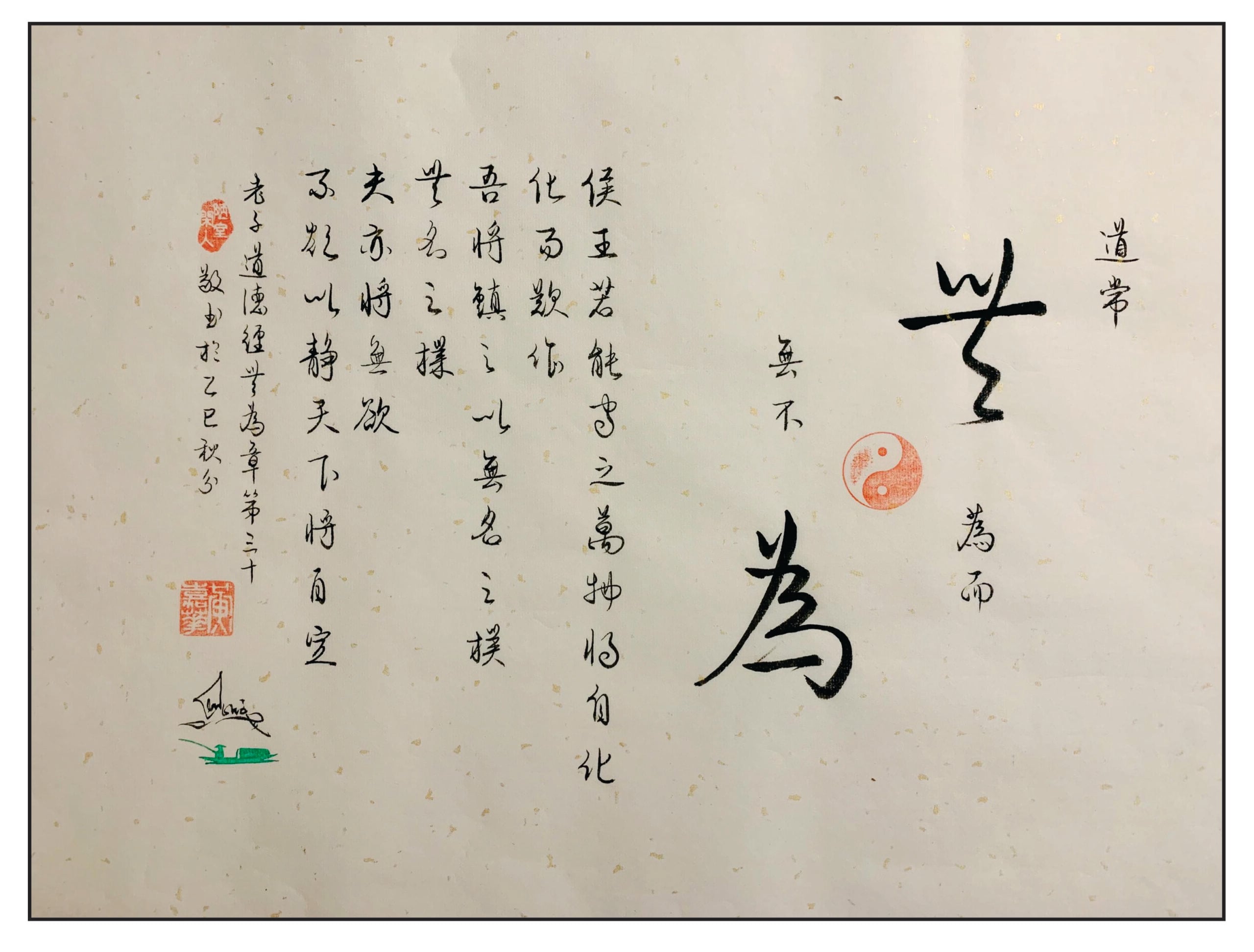
The phrase 無名之樸 is usually translated as “nameless simplicity” (e.g., Fischer, 2023). The character 樸 (pǔ), another version of which is 朴, generally means “simple.” However, it once meant “unworked wood” – hence the “nameless pristine timber” of Wu’s translation.
The famous first line is shown below in a character-by-character translation:
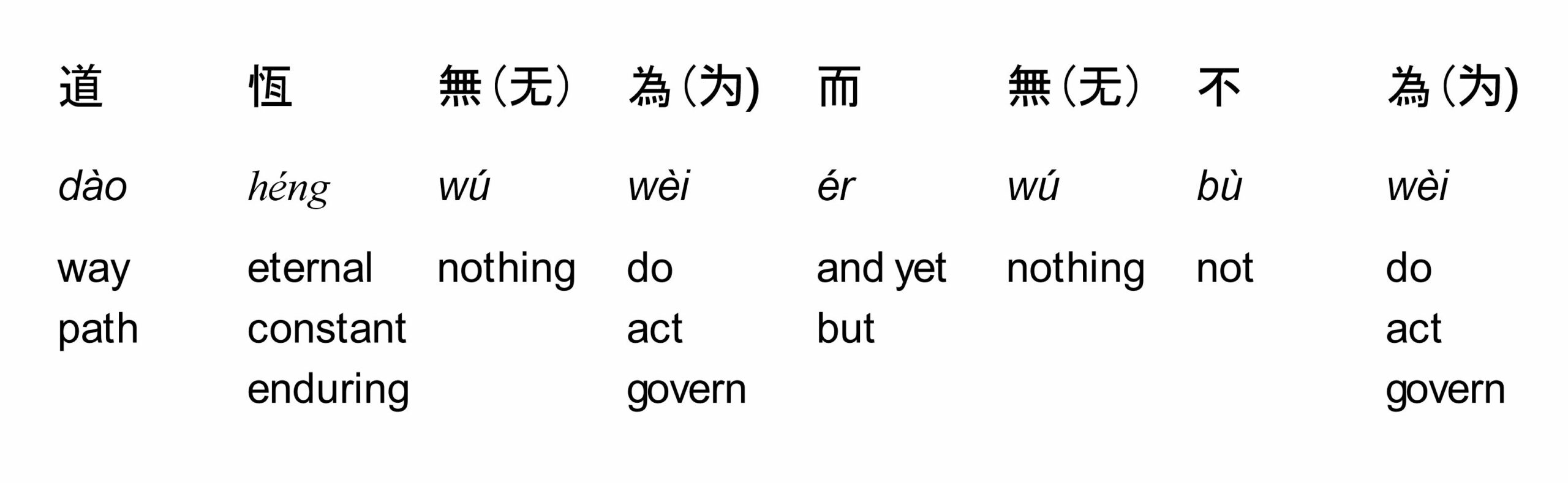
The translation of wu wei (無為) is problematic. A simple translation is “doing nothing” but that is not Laozi’s meaning. In Chapter 37 the Dao does nothing and yet somehow everything is done. The following are suggested translations of wu wei: “non-action” (Moeller, 2016), “effortless action” (Slingerland, 2003), “unself-conscious action” (Lynn, 2022, p 3), “non-contrivance” (Fischer, 2023, p 27), and “no purposive action” (Hansard, 2003).
Loy (1985) proposed that wu wei represent “nondual action:” the activity of an individual that has no self (with intentions and goals) but is rather part of a universal self. This can eliminate the problem of free will in a deterministic universe:
whenever “I” act it is not “I” but the whole universe that “does” the action or rather is the action. If we accept that the universe is self-caused, then it acts freely whenever anything is done. Thus, from the nondualist perspective, complete determinism turns out to be equivalent to absolute freedom.
Slingerland (2003, p 7) comments
It is important to realize, however, that wu-wei properly refers not to what is actually happening (or not happening) in the realm of observable action but rather to the state of mind of the actor. That is, it refers not to what is or is not being done but to the phenomenological state of the doer. … It describes a state of personal harmony in which actions flow freely and instantly from one’s spontaneous inclinations—without the need for extended deliberation or inner struggle—and yet nonetheless accord perfectly with the dictates of the situation at hand, display an almost supernatural efficacy, and (in the Confucian context at least) harmonize with the demands of conventional morality.
Fischer (2023, p 27) describes the mental concomitant of wu wei:
It describes the state of acting genuinely, unselfconsciously, or, as we might say, “from the heart,” as opposed to doing something self-consciously, because others expect you to, or because you are coerced.
Decreasing Day by Day
In the 48th chapter of the Daodejing Laozi proposes wu wei as the ideal of human behavior. The following is the Chinese text together with a translation by Wu (2016):
為學日益,為道日損。
損之又損,以至於無為。
無為而無不為。
取天下常以無事,
及其有事,不足以取天下。
To pursue learning you increase day by day; to pursue Dao you decrease day by day.
Decrease and yet again decrease, till you reach the state of Non-doing.
Do nothing and yet nothing is not done.
The world is often won without busying around;
When busying around occurs, the world cannot be won.
The third line repeats the first line of Chapter 37 as an injunction for human behavior. We must follow the same principle as the Dao. Although it is easy to say that the Dao can act according to its own self, how exactly human beings can do so is clear. The chapter states that the world can only be won without 事 (shì, business/work/responsibility).
The Zhuangzi provides several examples of acting in accord with wu wei, the most famous example being butcher Ding. The story is introduced with the comments:
The flow of my life is always channeled by its own boundaries, but the mind bent on knowledge never is. A flow channeled by its own boundaries is endangered when forced to follow something that is not, and trying to rescue it with the doings of the knowing mind only makes the danger worse. (Ziporyn, 2009, p 21).
King Hui of Liang was very impressed with the skill of his butcher Ding who was able to cut up an ox with remarkable speed and agility. When asked how he had become so adept, Ding replied:
What I love is the Course [Dao], something that advances beyond mere skill. When I first started cutting up oxen, all I looked at for three years was oxen, and yet still I was unable to see all there was to see in an ox. But now I encounter it with the spirit rather than scrutinizing it with the eyes. My understanding consciousness, beholden to its specific purposes, comes to a halt, and thus the promptings of the spirit begin to flow. I depend on Heaven’s unwrought perforations and strike the larger gaps, following along with the broader hollows. I go by how they already are, playing them as they lay. So my knife has never had to cut through the knotted nodes where the warp hits the weave, much less the gnarled joints of bone. A good cook changes his blade once a year: he slices. An ordinary cook changes his blade once a month: he hacks. I have been using this same blade for nineteen years, cutting up thousands of oxen, and yet it is still as sharp as the day it came off the whetstone. For the joints have spaces within them, and the very edge of the blade has no thickness at all. When what has no thickness enters into an empty space, it is vast and open, with more than enough room for the play of the blade. That is why my knife is still as sharp as if it had just come off the whetstone, even after nineteen years. (Ziporyn, 2009, p 22).
One might simply understand that through years of study and practice the cook had become so proficient at his that eveything was performed by learned reflex, without any need for consciousness. However, consicuousness still played a role: the cook continued:
Nonetheless, whenever I come to a clustered tangle, realizing that it is difficult to do anything about it, I instead restrain myself as if terrified, until my seeing comes to a complete halt. My activity slows, and the blade moves ever so slightly. Then all at once, I find the ox already dismembered at my feet like clumps of soil scattered on the ground. I retract the blade and stand there gazing at my work arrayed all around me, dawdling over it with satisfaction. Then I wipe off the blade and put it away. (Ziporyn, 2009, p 22)
After long thought and much practice we can become adept at anything. We behave automatically. However, consciousness still plays a role, slowing us down when problems arise, preventing mistakes that occur when one becomes more convinced of one’s skill than warranted.
The Art of Rulership
Laozi considers how leaders can best govern their people in Chapter 17 of the Daodjing. The following is the Chinese text and the translation of Wu (2009):
太上,不知有之;其次,亲而誉之;
其次,畏之;其次,侮之。
信不足焉,有不信焉。
悠兮其贵言。功成事遂,百姓皆谓:我自然。
The best ruler is one whose presence is unknown;
the second best is one who is beloved and praised;
the next best is one who is feared;
the next is one who is despised.
Where there is insufficient good faith,
there is loss of faith.
Relax and spare your words.
When the goal is achieved and the job is done,
everyone says, “We did it.”
Laozi favors the ruler who exercises wu wei, who allows his ministers to exercise their responsibilities, and who lets his people to be true to their own selves: 自然, ziran. Another translation of the final line is: The people all say: “We have done it by ourselves.” (Lin, 1977)
These ideas on government were extensively discussed in the Huainanzi, a collection of writings collected to assist the Prince of Huainan in the 2nd Century BCE (Ames,1981). The following is from one of the essays entitled The Art of Rulership:
Thus, the ruler in possession of the Way extinguishes thought and dispenses with guessing, and waiting in limpidity and vacuity, he uses words that do not boast and takes action that does not rob subordinates of responsibility. He makes demands of fulfilment according to claims made. He lets them get on with their duties without telling them how; he expects them to fulfil their duties without instructing them. He takes not knowing as his Way and being at a loss as to what to do as his treasure. Acting in this way, each of the various officials has his appointed tasks. (Ames, 1981, p 202)
The Concept of Flow
Mihaly Csíkszentmihályi (1934-2021), a Hungarian-American psychologist, became interested in why people can become so completely involved in difficult, time-consuming and sometimes dangerous activities, that they lose all sense of self and time. He described the experience as one of “flow” (Csíkszentmihályi, 1990). Nakamura and Csíkszentmihályi (in Csíkszentmihályi, 2014, p 240) describe the following subjective characteristics of being “in flow:”
- Intense and focused concentration on what one is doing in the present moment
- Merging of action and awarenessLoss of reflective self-consciousness (i.e., loss of awareness of oneself as a social actor)
- A sense that one can control one’s actions; that is, a sense that one can in principle deal with the situation because one knows how to respond to whatever happens next
- Distortion of temporal experience (typically, a sense that time has passed faster than normal)
- Experience of the activity as intrinsically rewarding, such that often the end goal is just an excuse for the process.
Athletes during peak performance, musicians during virtuoso recitals, and scientists formulating a new theory all experience this state of flow. Other terms that have been used to describe it are “in the zone” or “being locked in.” The individual in the flow is fully conscious of what is going on, but there is little if any self-consciousness. The game is being played, the music is being made, the theory is being grasped.
This state can only come after one has become an expert. Only when the actions can occur automatically, can consciousness move to a higher level – directing the strategy of the game rather than making individual movements, conveying the meaning rather than playing the notes, finding the underlying pattern rather than simply recording what is happening.
A person in a state of flow is very similar to a person acting according to the principle of wu wei (De Pryker, 2011). Both are acting effortlessly and without self-consciousness. In both action and awareness are fused. There are differences – flow empowers the individual self, whereas wu wei leads to a decrease in personal desires as one seeks greater union with the universal self. Nevertheless, the two states are far more similar than different.
In recent years, the concepts of wu wei have been used to promote higher achievements in sports (Kee et al. 2021) and to find happiness in normal human behavior through “effortless living” (Gregory, 2018). A major difficulty is in deciding how to attain wu wei. One must become highly skilled and then become so completely involved in something that one loses oneself in the endeavor. One can try to be “mindful,” to live in the present, to eliminate personal desires, but such advice is imprecise.
The Flow of Calligraphy
Chapters 37 and 48 of the Daodejing – the chapters that are crucial to the concept of wu wei are shown below in the calligraphy of the 13th Century Zhao Mengfu in regular script, and of the 14th Century Sheng Mao in clerical script):

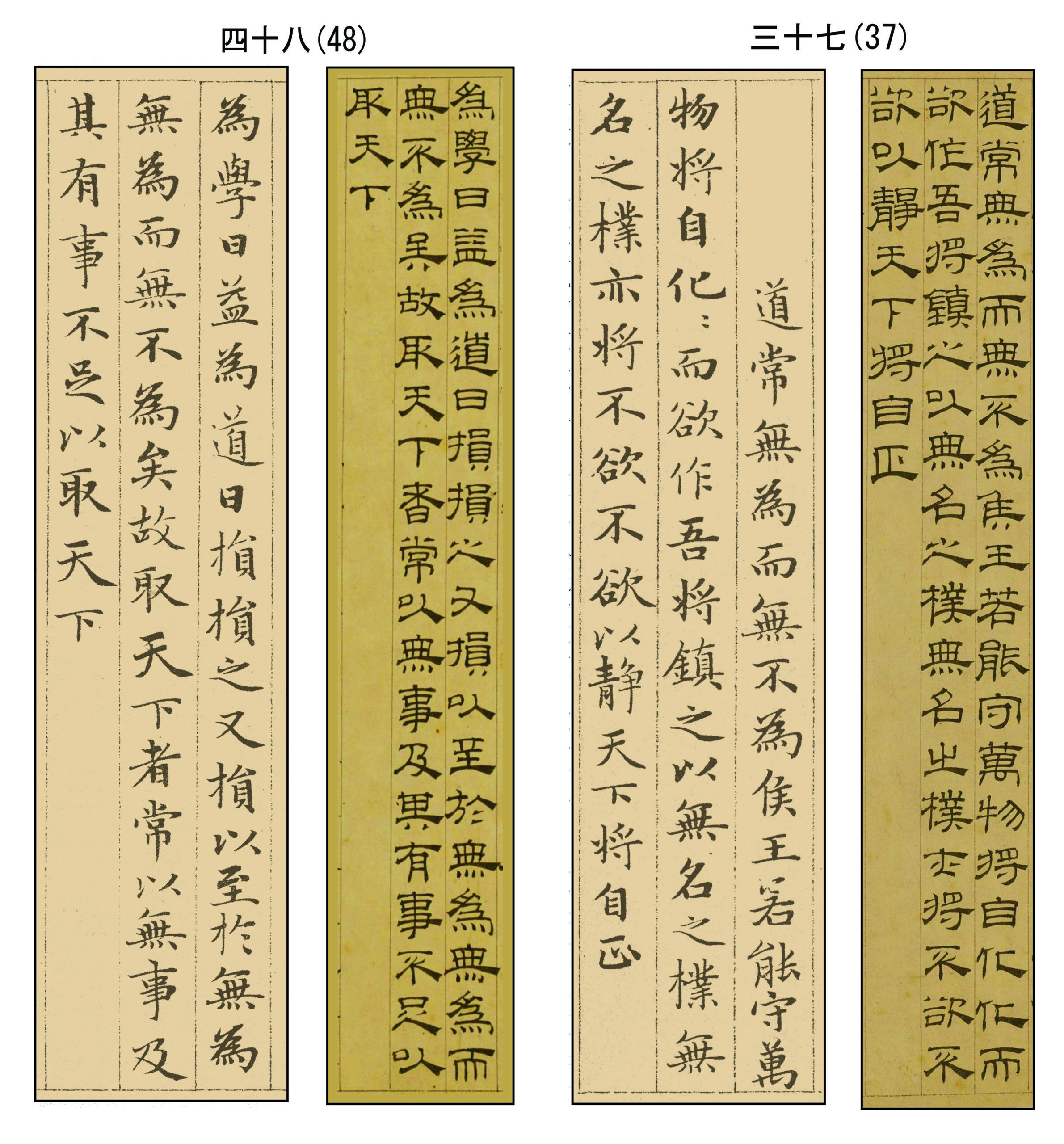
The esthetics of Chinese calligraphy depends on the flow from one character to another. The true calligrapher follows the principle of wu wei and writes effortlessly. Chiang Yee (1973, p 117) describes the essential characteristics of Chinese calligraphy:
The beauty of Chinese calligraphy is essentially the beauty of plastic movement, not of designed and motionless shape. A finished piece of it is not a symmetrical arrangement of conventional shapes, but something like the co-ordinated movements of a skilfully composed dance —impulse, momentum, momentary poise, and the interplay of active forces combining to form a balanced whole.
Envoi
We can conclude with some comments of the poet and Trappist monk Thomas Merton in his introduction to his free translations from the Zhuangzi (2004, p 21):
The true character of wu wei is not mere inactivity but perfect action—because it is act without activity. In other words, it is action not carried out independently of Heaven and earth and in conflict with the dynamism of the whole, but in perfect harmony with the whole. It is not mere passivity, but it is action that seems both effortless and spontaneous because performed “rightly,” in perfect accordance with our nature and with our place in the scheme of things. It is completely free because there is in it no force and no violence. It is not “conditioned” or “limited” by our own individual needs and desires, or even by our own theories and ideas.
And an excerpt from his translation (p. 69):
If man, born in Tao,
Sinks into the deep shadow
Of non-action
To forget aggression and concern,
He lacks nothing
His life is secure.
References
Ames, R. T. (1981) Wu-wei in “The art of rulership” chapter of Huai Nan Tzu: its sources and philosophical orientation. Philosophy East and West, 31(2), 193-213
Chan, A. K. L. (2025). Laozi. The Stanford Encyclopedia of Philosophy.
Chiang, Y. (1973). Chinese calligraphy: an introduction to its aesthetic and technique (3rd ed.). Harvard University Press.
Csikszentmihalyi, M. (1990). Flow: the psychology of optimal experience. Harper & Row.
Csikszentmihalyi, M. (2014). Flow and the foundations of positive psychology. Springer Netherlands.
De Prycker, V. (2011). Unself-conscious control: broadening the notion of control through experiences of flow and wu-wei. Zygon, 46(1), 5–25.
Fischer, P. (2023). The annotated Laozi: a new translation of the Daodejing. State University of New York at Albany.
Fu, C. W.-H. (1973). Lao Tzu’s conception of Tao. Inquiry (Oslo), 16(1–4), 367–394.
Gregory, J. (2018). Effortless living: wu-wei and the spontaneous state of natural harmony. Inner Traditions.
Hansen (2003). Wuwei: taking no action. In Cua, A. S. (Ed.) Encyclopedia of Chinese philosophy. (pp 784-786). Routledge.
Kee, Y. H., Li, C., Zhang, C.-Q., & Wang, J. C. K. (2021). The wu-wei alternative: Effortless action and non-striving in the context of mindfulness practice and performance in sport. Asian Journal of Sport and Exercise Psychology, 1(2–3), 122–132.
Lin, P. J. (1977, open access 2020). A Translation of Lao-tzu’s Tao Te Ching and Wang Pi’s Commentary. (Volume 30 in University of Michigan Chinese Studies). University of Michigan.
Liu, X. (2015). Laozi’s philosophy: textual and conceptual analyses. In X. Liu (Ed.), Dao Companion to Daoist Philosophy (pp. 71–100). Springer Netherlands.
Loy, D. (1985). Wei-Wu-Wei: nondual action. Philosophy East & West, 35(1), 73–86.
Lynn, R. J. (2022). Zhuangzi: a new translation of the sayings of Master Zhuang as interpreted Columbia University Press.
Merton, T. (2004). The way of Chuang Tzu. Shambhala.
Moeller, H. G. (2015). Basic aspects of daoist philosophy. International Communication of Chinese Culture, 2 (2), 99–107.
Slingerland, E. G. (2003). Effortless action: Wu-wei as conceptual metaphor and spiritual ideal in early China. Oxford University Press.
Stamatov, A. (2023). The Laozi’s ideal state: nostalgia, utopia, state of nature. Religions, 14(10), 1243.
Tadd, M. (2019). Ziran: authenticity or authority? Religions, 10(3), 207.
Wu, C. Q. (2016). Thus spoke Laozi: a new translation with commentaries of Daodejing. University of Hawaii.
Ziporyn, B. (2009). Zhuangzi: the essential writings with selections from traditional commentaries. Hackett