T. S. Eliot: The Cocktail Party


T. S. Eliot (1888-1965) wrote The Cocktail Party in 1948. The play begins with people making foolish conversation at a cocktail party but soon proceeds to a discussion of what it means to be married to another person, and what is required to become a saint. It was initially performed at the Edinburgh Festival in 1949 with Alec Guiness as the Unidentified Guest and Irene Worth as Celia, the prospective saint, and then moved to Broadway in 1950, where it received a Tony Award for Best Play. Critical reviews were mixed, but audiences were more enthusiastic. The play was revived briefly in 1968 with Guinness as both director and actor.

Synopsis

The play opens on the remnants of a cocktail party. The hostess Lavinia Chamberlayne had been called away, and her husband Edward had tried to cancel the party, but had been unable to contact some of the invitees: two elderly guests Julia and Alex, two youngsters, Celia and Peter, and one unidentified guest not known to the others, who enjoys his gin and water and listens bemused to the cocktail chatter. The party soon breaks up, but Edward asks the unidentified guest to stay behind because he needs someone to talk to. He confesses that Lavinia has left him. After some discussion he realizes that, although he has toyed with the idea of freedom, he wants her to return. The unidentified guest promises to bring Lavinia back the next day and leaves, singing a verse from the Irish song One-Eyed Riley:

Unidentified Guest: As I was drinkin’ gin and water,
And me bein’ the One-Eyed Riley,
Who came in but the landlord’s daughter
And she took my heart entirely.

You will keep our appointment?

Edward: I shall keep it.

Unidentified Guest:  Tooryooly toory-iley,
What’s the matter with One-Eyed Riley

This and subsequent audio clips are from the Decca recording of the play. Some sections of the play were omitted for the recording which was limited to the length of two LPs.   

Other guests return with various excuses, but mainly because they wish to talk to Edward. Peter wants his advice about Celia, with whom he has become enamoured though she does not return his feelings. Edward suggests that Peter accept the fact that that romance is not going anywhere, and that Peter should go to California to pursue his dreams of working in film. After Peter leaves, Celia returns to talk to Edward, and we realize that she and Edward have been having an affair. However, now that Lavinia has apparently left Edward and made him available, Celia realizes that she does not wish to continue their relationship.

The next afternoon everyone returns to the Chamberlayne’s. Lavinia in brought back to Edward as promised by the unidentified guest. The other guests have been summoned by telegram. Peter has decided to leave to work in films in California. Celia says goodbye to Peter and to the Chamberlaynes, Lavinia and Edward are left alone to discuss their relationship. Lavinia suggests that her husband should see a psychiatrist.

The play then skips to several weeks later at the consulting offices of the unidentified guest, who it turns out is the psychiatrist Sir Henry Harcourt-Reilly. We find out the Julia and Alex have worked with Sir Henry to get Edward, Lavinia, and Celia to come to his office. Initially Sir Henry talks with Edward alone and then Lavinia is brought in. Lavinia and Edward discuss their relationship. Lavina knew about Edward’s affair, but Edward had not realized that Lavinia had at the same time been infatuated with young Peter. Both now have no one to love but themselves, and they decide to return home together.

Celia then comes in to consult with Sir Henry. She explains that she has begun to feel “an awareness of solitude,” a separation from a world with which she has become disillusioned. Furthermore, she has experienced a “sense of sin” that does not seem to have much to do with morality. Rather it appears to be a feeling that he is not doing what she was meant to do. She needs something to devote herself to. Sir Henry agrees to help her find her calling. After Celia leaves, Julia and Alex return and the three toast together, first to Lavinia and Edward with the “words for the building of the hearth,” and then to Celia with the “words for those who go upon a journey.”

The Guardians mention Peter as also needing their help. Perhaps he might represent a separate road to salvation – that of the artist.

The final act of the play occurs two years later just before another cocktail party at the Chamberlaynes. The same people are there as in the first act. We learn that Lavinia and Edward remain together, and that Peter has become successful in films. Alex reports that Celia had joined an austere Christian nursing order and had gone to Kinkanja to care for patients dying from a pestilence. Agitators had convinced the natives that they could only stop the pestilence by slaughtering the Christians. During the subsequent insurrection, Celia had been crucified on an anthill. Lavinia asks Sir Henry why he appears unconcerned about this, and he confesses that when he first met Celia he had a premonition of her violent death, He had not known exactly how this would occur, but he had acquiesced to Celia’s decision and prepared her for her destiny.

Julia, Alex and Sir Henry leave to attend another party. The other guests remain as the Chamberlayne’s cocktail party begins.

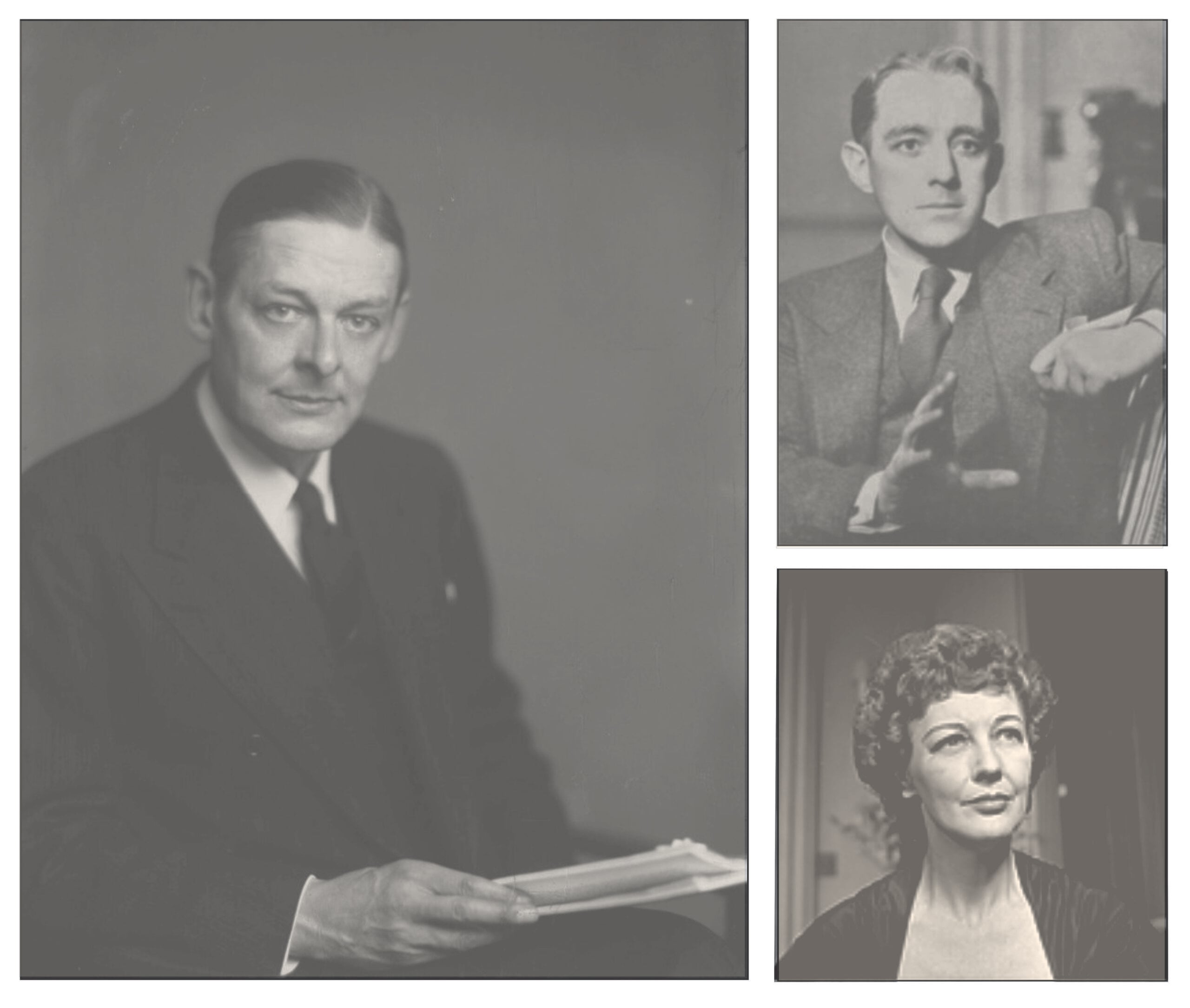
The following illustration shows a 1948 photograph of Eliot by Walter Stoneman on the left and photographs of Alec Guiness and Irene Worth from the original New York production on the right.
 

Sources for the Play

In his 1951 essay on Poetry and Drama, Eliot noted that he had used Euripides’ Alcestis (438 BCE) “as a point of departure” for The Cocktail Party. In Euripides, in gratitude for the hospitality shown to him, Apollo had granted king Admetus the privilege of living past the time the Fates had decreed for his death. The only problem was that someone else had to die in his place. Admetus’ devoted wife Alcestis agrees to take his place. Apollo tries to get Thanatos, the God of Death, not to take Alcestis, but Death is implacable. Apollo then asks Heracles to wrestle with Death and brings Alcestis back to Admetus. Eliot clearly takes from Euripides the story of Edward and Lavinia’s relationship. And we must presume that the unidentified guest in the first act is Heracles, a hero who liked to drink and to sing.

As the play progresses, the ideas of Heraclitus (c 500 BCE) come to the fore (Jones, 1960, p 132; Lesher, 2013). Just before he returns Lavinia to Edward, the unidentified guest points out that everything and everyone changes – you cannot step twice into the same river.

Ah, but we die to each other daily.
What we know of other people
Is only our memory of the moments
During which we knew them. And they have changed since then.
To pretend that they and we are the same
Is a useful and convenient social convention
Which must sometimes be broken. We must also remember
That at every meeting we are meeting a stranger.

In his play Eliot grafts onto these Classical ideas the Christian narrative of Celia’s martyrdom. In this, Sir Henry takes the role of a Priest, who stands in place of God, rather than that of a Hero, who acts for the Gods. Celia confesses to him that she has felt a “sense of sin” – something that is completely Christan, and incompatible with Classical ideas. Sir Henry informs Celia of her options and the dangers she might face, before allowing her to choose her vocation. His

ability to foresee Celia’s death is similar to the doctrine of free will, in which God can see what will happen, but where the choice is still up to the individual (Rexine, 1965, p 25)

Eliot may have also used several modern sources for the ideas he considered in The Cocktail Party. Two recent productions had used a supernatural being to alter the course of human events. In Frank Capra’s 1946 film It’s a Wonderful Life, George Bailey’s guardian angel Clarence Odbody talks him out of suicide and convinces him to return to his family (Llorens-Cubedo, 2022). In Eliot’s play the supernatural intervention is more austere, and the outcome ultimately tragic, despite the play being called a comedy. In J. B. Priestley’s 1947 play The Inspector Calls, a police inspector interrupts a family dinner party and points out to those present how their actions had led to the death of a young woman. As the play ends, the inspector vanishes: he was simply a voice asking for justice. Priestley calls out the entitled; Eliot reconciles them to their fate. Alec Guinness had acted as one of the family in the first production of Priestley’s play. In J.-P. Sartre’s play Huis Clos (“No Exit,” performed in 1944, published in 1947) one of the main characters exclaims L’enfer, c’est les autres (“Hell is other people”). In The Cocktail Party Eliot has Edward rebut this claim:    

                                     There was a door
And I could not open it. I could not touch the handle.
Why could I not walk out of my prison?
What is hell? Hell is oneself,
Hell is alone, the other figures in it
Merely projections. There is nothing to escape from
And nothing to escape to. One is always alone.

Edward’s description of his state of mind fits more easily with the existentialist idea that we alone are responsible for our actions. As Sartre said in L’existentialisme est un humanisme (“Existentialism is a Humanism,” 1946), we are “condemned to be free”


The Path to Sainthood

In the second act of the play, Sir Henry, with the assistance of Julia and Alex, reconciles Lavinia and Edward to their life together, and sets Celia on her path to sainthood. Carol Smith (1967, pp 157-158) points out that there are two ways to salvation in Christianity:

In the history of Christian mysticism from the time of the writings attributed to Dionysius the Areopagite, there have traditionally been two paths by which the soul could come to God—the Negative Way and the Affirmative Way. Followers of the Negative Way believe that God may be reached by detaching the soul from the love of all things that are not God, or, in the terms Eliot most frequently chose to use, by following the council of St. John of the Cross to divest oneself of the love of created beings. The Way of Affirmation, on the other hand, consists of the recognition that because the Christian God is immanent as well as transcendent, everything in the created world is an imperfect image of Him. Thus, all created things are to be accepted in love as images of the Divine. The Way of Affirmation, while less rigorous, has its own implicit difficulties, for the price of loving created beings ultimately involves suffering and loss.

Sir Henry brings Lavinia and Edward together and points out to themthat they both had felt a lack of love in their marriage, both had sought out relationships with others, and both had realized that these relationships had no hope of success. They must become reconciled to their own limitations; they must relearn how to live lovingly with each other. Theirs is the Affirmative Way.

Celia presents a completely different problem for Sir Henry. She has two symptoms. The first is “an awareness of solitude:”

                                I don’t mean simply
That there’s been a crash: though indeed there has been.
It isn’t simply the end of an illusion
In the ordinary way, or being ditched.
Of course that’s something that’s always happening
To all sorts of people, and they get over it
More or less, or at least they carry on.
No. I mean that what has happened has made me aware
That I’ve always been alone. That one always is alone.
Not simply the ending of one relationship,
Not even simply finding that it never existed—
But a revelation about my relationship
With everybody. Do you know –
It no longer seems worth while to speak to anyone!

The second is “a sense of sin”

It’s not the feeling of anything I’ve ever done,
Which I might get away from, or of anything in me
I could get rid of—but of emptiness, of failure
Towards someone, or something, outside of myself;
And I feel I must . . . atone—is that the word?

Sir Henry informs her that she can return to normal life

                               The condition is curable.
But the form of treatment must be your own choice:
I cannot choose for you. If that is what you wish,
I can reconcile you to the human condition,
The condition to which some who have gone as far as you
Have succeeded in returning. They may remember
The vision they have had, but they cease to regret it,
Maintain themselves by the common routine,
Learn to avoid excessive expectation,
Become tolerant of themselves and others,
Giving and taking, in the usual actions
What there is to give and take. They do not repine;
Are contented with the morning that separates
And with the evening that brings together
For casual talk before the fire
Two people who know they do not understand each other,
Breeding children whom they do not understand
And who will never understand them.

Or

There is another way, if you have the courage.
The first I could describe in familiar terms
Because you have seen it, as we all have seen it,
Illustrated, more or less, in lives of those about us.
The second is unknown, and so requires faith—
The kind of faith that issues from despair.
The destination cannot be described;
You will know very little until you get there;
You will journey blind. But the way leads towards possession
Of what you have sought for in the wrong place.

Celia chooses the second option – the negative way to salvation – and Sir Henry makes the necessary arrangements.


The Guardians

In The Cocktail Party the characters of Julia, Alex, and Sir Henry bring about the most important elements of the plot. The word “guardian” comes up initially when Edward is describing to Celia how some force within him – his “tougher self” – prevents him from changing the course of his life. Later in their conversation Celia wonders whether Julia might be serving as her guardian. At the end of the play’s second scene, Edward and Celia make a toast to the “Guardians.” We are never sure of their roles. They might be angels or magi: spiritual advisers who intervene in a person’s life to make sure that some transcendent goal is attained (Hammerschmidt, 1981). Though the appear to serve some greater good, we are not completely sure that they are not demonic. For want of any clear name, they have come to be known as the “Guardians.”

The fact that Sir Henry sings a song about “One-Eyed Riley” raises the idea the “In the land of the blind the one-eyed man is king” (Jones, 1960, p 151). This old proverb was collected by Erasmus in his Adagia (1500) – in regione caecorum rex est luscus – but its origins go back at least as far as the Genesis Rabbah (~500 CE). The following illustration (I believe from the 1968 revival at the Chichester Festival) emphasizes this aspect of the guardians: Sir Henry has a monocle, and one of Julia’s eyes is patched. The Guardians are offering a libation to the success of their charges:

Alex: The words for the building of the hearth.

Sir Henry: Let them build the hearth
Under the protection of the stars.

Alex: Let them place a chair each side of it.

Julia: May the holy ones watch over the roof,
May the Moon herself influence the bed.

Alex: The words for those who go upon a journey.

Sir Henry: Protector of travellers
Bless the road.

Alex: Watch over her in the desert.
Watch over her in the mountain.
Watch over her in the labyrinth.
Watch over her by the quicksand.

Julia: Protect her from the Voices
Protect her from the Visions
Protect her in the tumult
Protect her in the silence.

A Meaningless Martyrdom

In the short final act of the play, we learn that Celia had joined an austere nursing order and had travelled to Kinkanja to care for dying patients. The natives had somehow come to believe that she was the cause rather than the cure for the pestilence. Celia had then been crucified on an anthill. Her death appears as meaningless as it was horrible:

And just for a handful of plague-stricken natives
Who would have died anyway  

Sir Henry appears undisturbed by her death. When challenged by Lavinia he remarks

When I first met Miss Coplestone, in this room,
I saw the image, standing behind her chair,
Of a Celia Coplestone whose face showed the astonishment
Of the first five minutes after a violent death.
If this strains your credulity, Mrs. Chamberlayne,
I ask you only to entertain the suggestion
That a sudden intuition, in certain minds,
May tend to express itself at once in a picture.
That happens to me, sometimes. So it was obvious
That here was a woman under sentence of death.
That was her destiny. The only question
Then was, what sort of death? I could not know;
Because it was for her to choose the way of life
To lead to death, and, without knowing the end
Yet choose the form of death. We know the death she chose.
I did not know that she would die in this way;
She did not know. So all that I could do
Was to direct her in the way of preparation.
That way, which she accepted, led to this death.
And if that is not a happy death, what death is happy?

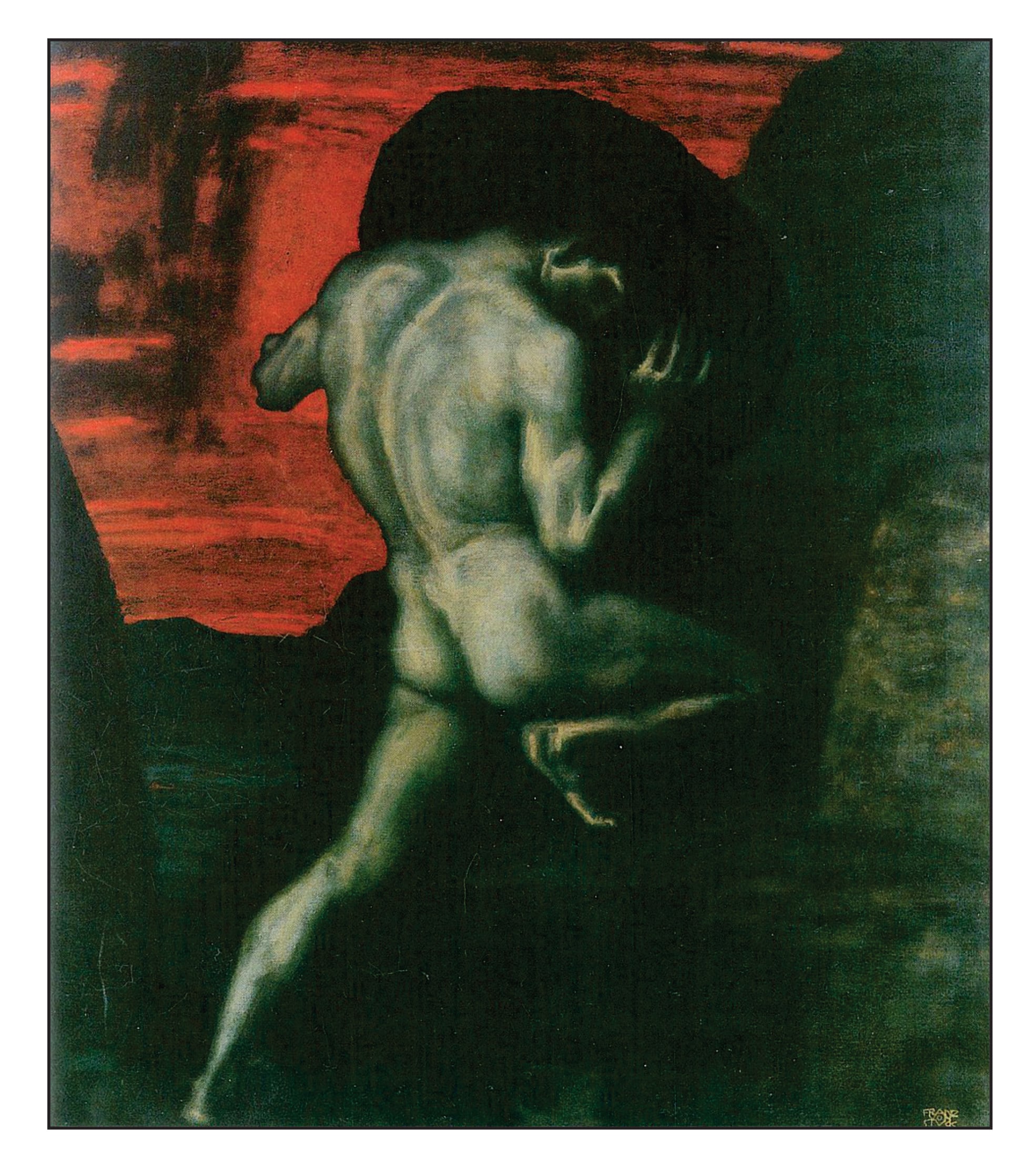
The story of Celia’s death borders on the absurd. The idea that human life is essentially absurd had just been introduced by Albert Camus in his 1942 book Le mythe de Sisyphe (“The Myth of Sisyphus”). The main idea is that human life is much like that of Sisyphus, who tried to stop death and make man immortal. His punishment was to roll an immense boulder up to the top of a hill. Just before it reaches the summit, the boulder rolls back down into the valley and Sisyphus must begin his task again. This he must do for all eternity. At the end of his essay Camus remarks that

Je laisse Sisyphe au bas de, la montagne! On retrouve toujours son fardeau. Mais Sisyphe enseigne la fidélité supérieure qui nie les dieux et soulève les rochers. Lui aussi juge que toutest bien. Cet univers désormais sans maître ne lui paraît ni stérile ni futile. Chacun des grains de cette pierre, chaque éclat minéral de cette montagne pleine de nuit, à lui seul, forme un monde. La lutte elle-même vers les sommets suffit à remplir un cœur d’homme. Il faut imaginer Sisyphe heureux.

[I leave Sisyphus at the foot of the mountain! One always finds one’s burden again. But Sisyphus teaches the higher fidelity that negates the gods and raises rocks. He too concludes that all is well. This universe henceforth without a master seems to him neither sterile nor futile. Each atom of that stone, each mineral flake of that night filled mountain, in itself forms a world. The struggle itself toward the heights is enough to fill a man’s heart. One must imagine Sisyphus happy].

The following illustration shows a 1920 painting of Sisyphus by the German painter Franz von Stuck:
In the late 1940s and the 1950s plays like Genet’s The Maids (1947), Ionesco’s The Bald Soprano (1950) and Becket’s Waiting for Godot (1950) ushered in the theatre of the absurd, wherein human beings learned to survive in a world without meaning. Eliot’s play is a harbinger of this type of drama: Celia’s fate is absurd – her death served no useful purpose.


The Magus Zoroaster

Sir Henry tries to explain his lack of concern about Celia’s death by quoting from Shelley’s Prometheus Unbound (1820). The lines are spoken by Mother Earth who encourages Prometheus to tell his story but to be aware that there are two worlds – one in which we live, and one which contains our unfulfilled dreams and ideas    

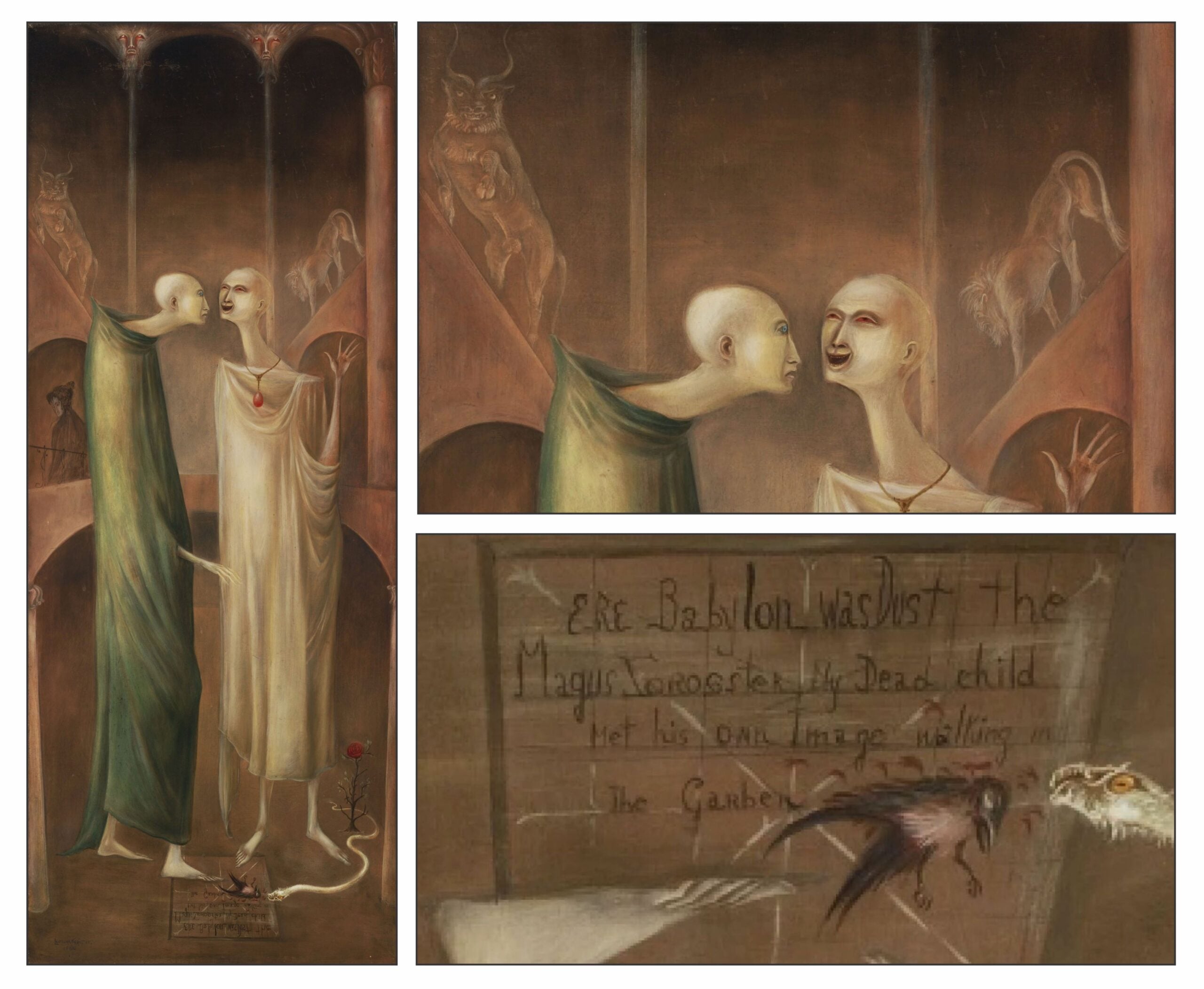
                         Ere Babylon was dust
The magus Zoroaster, my dead child,
Met his own image walking in the garden.
That apparition, sole of men, he saw.
For know there are two worlds of life and death:
One that which thou beholdest; but the other
Is underneath the grave, where do inhabit
The shadows of all forms that think and live
Till death unite them and they part no more!

The next lines (unquoted by Sir Henry) are

Dreams and the light imaginings of men,
And all that faith creates or love desires,
Terrible, strange, sublime and beauteous shapes.

Zoroaaster was a mythical Persian religious leader (magus) who may have lived around 1000 BCE. The story of the meeting with his double marks a time when he realized that he had to live up to what he was meant to be (Ranald & Ranald, 1961).

The story of Zoroaster and his image of what he was meant to be was depicted by the Mexican surrealist painter Leonora Carrington in 1960: The following illustration shows her painting. The two enlargements on the right show the supernatural powers (bull and lion), and the mirror writing on the ground that quotes from Shelley. The latter has been lightened and mirror-inverted to make the text legible.  The conflict between goodness and evil appear to be represented by the bird and snake at the feet of Zoroaster.
 

The Problems of Sainthood

As the 20th Century came to an end, the idea of the saint devoting himself or herself to the poor and dying became a little tarnished. Probably the most famous of the modern saints was Mother Teresa (1910-1997), who devoted her life to the poor of Calcutta. 

The journalist Christopher Hitchens criticized her contributions in a TV program entitled Mother Teresa: Hell’s Angel (1994). The following are two excerpts:   

Mother Teresa’s cult of death and suffering depends for its effect on the most vulnerable and helpless: abandoned babies, say, or the terminally ill, who supply the occasion for charity and the raw material for compassion. (near minute 6).

The Teresa cult is now a missionary multinational with an annual turnover over tens of millions. If concentrated in Calcutta, that would certainly support a large hospital and perhaps even make a noticeable difference. But Mother Teresa has chosen instead to spread her franchise very thinly. To her the convent and the catechism matter more than the clinics. (near minute 28)

This was followed by a book and articles (Hitchens, 1995; 2003). Hitchens was also dismayed that Teresa and the Catholic Church continued to reject birth control – something that would have been fare more effective in reducing the number of abandoned babies that Teresa cared for. Despite Hitchens’ comments, the Catholic Church rapidly advanced Mother Teresa to sainthood: she was beatified in 2003 and canonized in 2016.

Hitchens’ critiques have been supported by others (Larivée et al, 2013; Bandyopadhyay, 2018). Perhaps the most significant defect in her mission in Calcutta was that she did not provide even the rudiments of modern medical care. Compassion is essential to medicine, but dying patients should not be denied the benefit of pharmacological pain relief. Mother Teresa also seemed to represent an obsolete approach to rectifying the ills of poverty. Some adjustment of the world’s inequalities would be of far more benefit than simply treating the poor with compassion. Giving charity to those whom we exploit does not remove the stain of the exploitation.

The following illustration shows saint and critic:


Personal Epilogue

Jones (1960, p 123) quoted from a 1945 interview of T. S. Eliot by J. P. Hogan

When, in an interview, Eliot was asked, ‘How would you, out of the bitter experience of the present time, wish mankind to develop?’ he answered:
‘I should speak of a greater spiritual consciousness, which is not asking that everybody should rise to the same conscious level, but that everybody should have some awareness of the depths of spiritual development and some appreciation and respect for those more exceptional people who can proceed further in spiritual knowledge than most of us can.’

I remember being quite taken by Celia when I first read the play as a young man. I had developed some modicum of spiritual consciousness and feelings similar to those reported by Celia – an awareness of solitude and a sense of sin. I wondered whether I might meet someone like Sir Henry Harcout-Reilly who would show me what I should do with my life. I never saw a production of the play, and I never met anyone that might have been my Guardian. And although when I first read of Celia’s death it seemed noble and right, I now feel it was foolish and mistaken.


References

Bandyopadhyay, R. (2018). Volunteer tourism and religion: the cult of Mother Teresa. Annals of Tourism Research, 70, 133–136.

Camus, A. (1942). Le mythe de Sisyphe. Gallimard. English translation by J. O’Brien (1955). The Myth of Sisyphus and Other Essays. Alfred A. Knopf.

Eliot, T. S. (1950). The cocktail party: a comedy. Faber & Faber.

Eliot, T. S. (1951). Poetry and drama. Atlantic Monthly (February 1951).

Hammerschmidt, H. (1981). The role of the “Guardians” in T.S. Eliot’s Cocktail Party. Modern Drama, 24(1), 54–66.

Hitchens, C. (1994). Mother Teresa: Hell’s Angel. Channel 4 Television Program directed by Jenny Morgan, with text by Christoher Hitchens and Tariq Ali. 

Hitchens, C. (1995). The missionary position: Mother Teresa in theory and practice. Verso.

Hitchens, C. (2003). Mommie dearest. The pope beatifies Mother Teresa, a fanatic, a fundamentalist, and a fraud. Slate Magazine. October 20, 2003.

Jones, D. E. (1960). The plays of T.S. Eliot. Routledge & Kegan Paul.

Larivée, S., Sénéchal, C., & Chénard, G. (2013). Les côtés ténébreux de Mère Teresa. Studies in Religion, 42(3), 319–345.

Lesher, J. H. (2013). The self in conflict with itself: a Heraclitean theme in Eliot’s The Cocktail Party. In Knippschild, S., & García Morcillo, M. (Eds.) Seduction and power: antiquity in the visual and performing arts. (pp 122-132). Bloomsbury Academic.

Llorens-Cubedo, D. (2022). The Cocktail Party and It’s a Wonderful Life. The T.S. Eliot Studies Annual4(1), 229–252.

Priestley, J. B. (1947). An inspector calls: a play in three acts. Heinemann.

Ranald, M. L., & Ranald, R. A. (1961). Shelley’s Magus Zoroaster and the image of the Doppelgänger. Modern Language Notes, 76(1), 7–12.

Rexine, J. E. (1965). Classical and Christian foundations of T. S. Eliot’s Cocktail Party. Books Abroad, 39(1), 21–26.

Sartre, J.-P. (1947). Huis clos; suivi de Les mouches. Gallimard.

Sartre, J.-P. (1946). L’existentialisme est un humanisme. Nagel.

Shelley, P. B. (1820). Prometheus unbound: a lyrical drama in four acts. C. & J. Ollier.

Smith, C. H. (1967). T. S. Eliot’s dramatic theory and practice: from Sweeney Agonistes to the Elder Statesman. Princeton University Press.


The Divine Feminine

All the major religions of the present world are androcentric in nature and misogynistic in practice. The following are some typical injunctions in the Christian scriptures:

Let your women keep silence in the churches: for it is not permitted unto them to speak; but they are commanded to be under obedience as also saith the law.
And if they will learn any thing, let them ask their husbands at home: for it is a shame for women to speak in the church. (I Corinthians 14: 34-35)

Let the woman learn in silence with all subjection.
But I suffer not a woman to teach, nor to usurp authority over the man, but to be in silence. (1 Timothy 2: 11-12)

These rulings are in spite of (or perhaps because of) women being more attentive to religious teachings, and participating more often in religious services than men (Pew Research Foundation, 2016). The two passages nevertheless serve a purpose – they provide clear evidence that the New Testament does not always represent the word of God.

The androcentricity of organized religion differs completely from prehistoric religious beliefs, wherein God was more likely female than male (Stone, 1978). Over recent centuries, however, female aspects of the godhead have become more and more recognized. This posting briefly considers some of the manifestations of the divine feminine, and mentions what might be involved in a feminist theology. 

The Primordial Mother

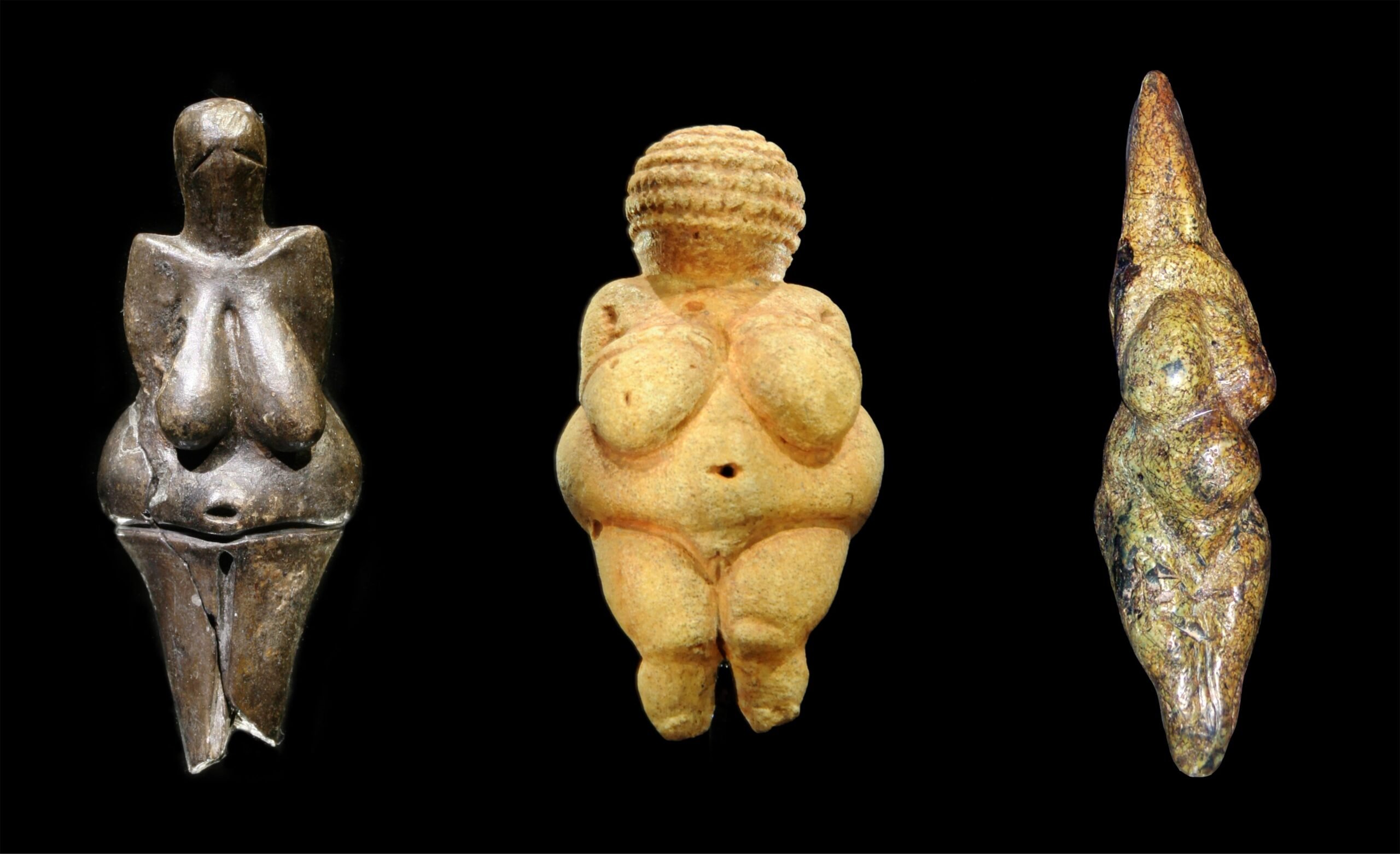
In prehistoric families, the most amazing and incomprehensible event was the birth of a child. The role of the father was little understood, and mothers were revered as the primary source of this new life. A female force was therefore naturally thought to be behind the creation of the universe, and was worshipped as a mother goddess (Graves, 1948; Neumann, 1963; Stone, 1978). Between 30,000 and 10,000 years BCE, small votive offering to the mother goddess – “Venus figurines” – were created throughout Europe. The illustration below shows (from left to right) the ceramic Venus of Dolni Vestonice in the Czech Republic, the limestone Venus of Willendorf in Austria and the serpentine Venus of Savignano in Italy:  

Barstow (1983) describes these figurines:

The goddess was faceless, as if to accentuate her universality, her ability to “stand for the power of the female. Lacking feet, she appeared to come straight up out of the earth, with which she was identified. Unclothed, her every body seem to have an efficacy. Often – but not always – she was big-breasted, and her hands were frequently placed under her breasts as if to display them. Many figurines show her entire body as ample, with huge breasts, belly and buttocks, as if the very plenitude of her body would ensure plentiful crops and hers. Sometimes she is pregnant, her enlarged belly emphasized by special markings.

In neolithic times, most societies began to worship multiple divinities, though female forces were among the most important – Ishtar in Mesopotamia, Astarte in Canaan, Persephone in Greece. and Isis in Egypt. These goddesses often displayed two aspects: one related to life and fertility and the other to death and war.

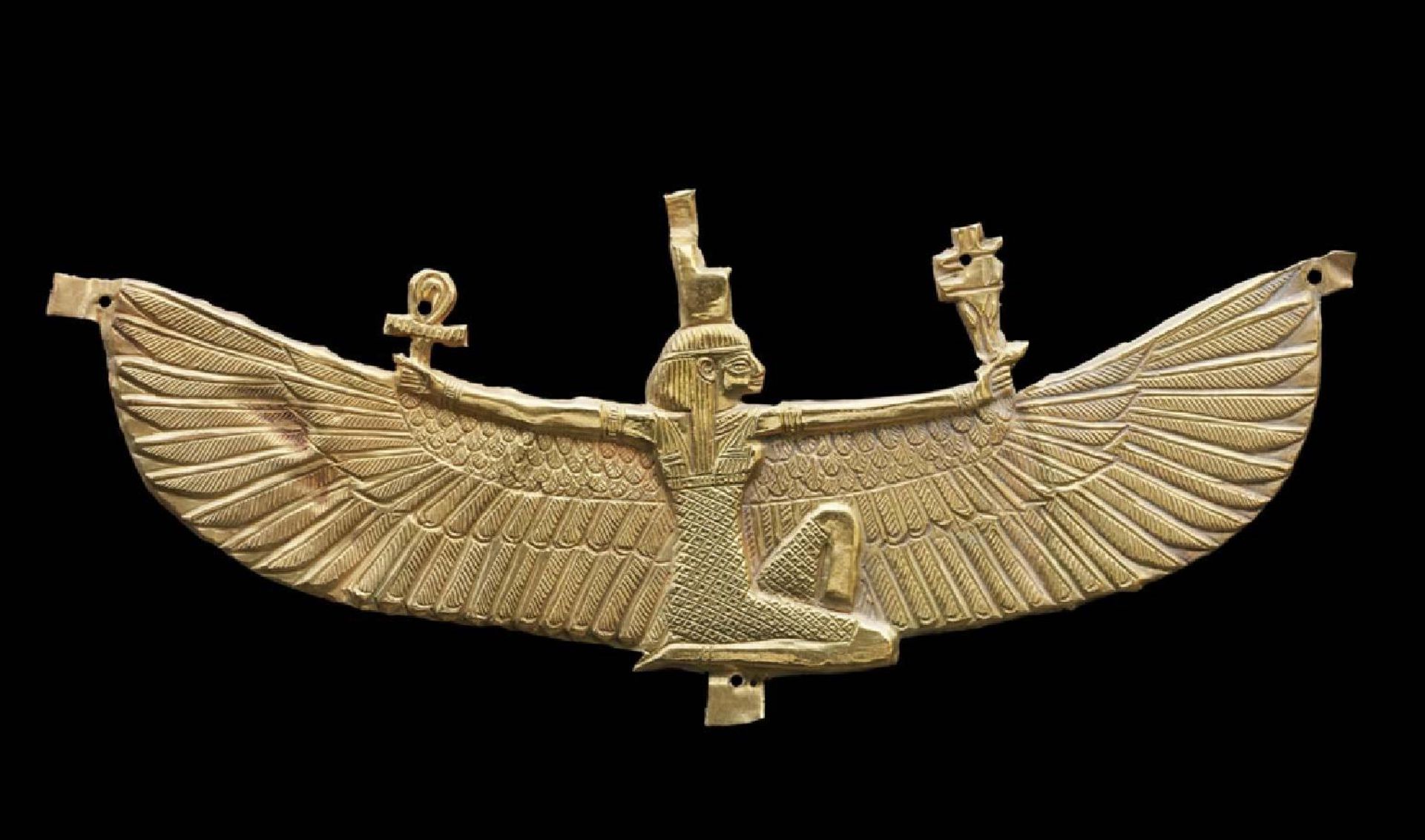
These goddesses were widely worshipped, with their followers often participating in extended rites called the “mysteries.” Apuleius’ Latin novel The Golden Ass (2nd Century CE) tells the story of Lucius who, while dabbling in the magic arts, inadvertently turned himself into an ass. At the end of the book, he attends one of the mysteries, and is changed back to human form through the power of Isis. The goddess announces herself:

I am here before you, Lucius, moved by your prayers—mother of the natural world, mistress of all the elements, firstborn offspring of the ages, highest of the deities, queen of the dead, first among the gods, the manifestation in a single body of all the gods and goddesses. I control by my will the luminous summits of the sky, the salubrious breezes of the sea, and the mournful silence of the underworld. I am the single divine being, worshipped the world over in different forms, with varying rites and under a multitude of names. Some call me Juno, others Bellona, some Hecate, and yet others Rhamnusia. But the people on both sides of Ethiopia who are lit by the first rays of the rising sun, and the Egyptians, pre-eminent for their ancient knowledge, worship me with the proper rituals and by my true name: Queen Isis. (Translation of Singer and Finkelpearl, 2021, pp 158-60)

The illustration below shows a pectoral ornament in the form of a winged Isis from the Museum of Fine Art in Boston. In her right hand, she holds an ankh, the symbol for “life”; in her left hand she holds what may be the hieroglyph for a sail, the symbol for the breath of life. On her head is a throne, indicating her majesty.

Judaism – Wisdom and Shekhinah

In the Hebrew scriptures Jahweh is most definitely male, and there is little mention of any female aspect to the deity. However, in Proverbs there are several passages spoken by the female figure of Wisdom (Hokhmah), one of which reads

I was set up from everlasting, from the beginning, or ever the earth was.
When there were no depths, I was brought forth; when there were no fountains abounding with water.
Before the mountains were settled, before the hills was I brought forth:
While as yet he had not made the earth, nor the fields, nor the highest part of the dust of the world.
When he prepared the heavens, I was there: when he set a compass upon the face of the depth:
When he established the clouds above: when he strengthened the fountains of the deep:
When he gave to the sea his decree, that the waters should not pass his commandment: when he appointed the foundations of the earth:
Then I was by him, as one brought up with him: and I was daily his delight, rejoicing always before him;
Rejoicing in the habitable part of his earth; and my delights were with the sons of men. (Proverbs, 8 22-31)

Christians have interpreted this passage as referring to Christ the Son, who they believe was with God the Father before the world began. Christ is described as “the power of God and the wisdom of God” in I Corinthians 1:24.  

This female figure of Wisdom in Proverbs is closely associated with Sophia– the goddess of wisdom and the creator of the world in Gnostic scriptures (Perkins, 1985).

Wisdom also became related to the concept of the Shekhinah – God’s “presence” or “immanence” in the world. This concept was initially used to describe the holiness of the Ark of the Covenant, but expanded to include the idea of God’s dwelling with his people. Shekhinah is manifest when believers gather to study the Torah, celebrate the Sabbath, or pray together. The Mishnah (probably derived from Jewish oral tradition in the centuries BCE) states

If two sit together and there are words of Torah spoken between them, then the Shekhinah abides among them (Pirkei Avot, 3:2)

In the medieval period, the presence of God in the world was conceived as in terms of the ten Sephiroth of the Kabbalah. The tenth Sephirah is known either as Malkuth (“kingdom”) or Shekhinah (“presence”). In Kabbalistic writings the Shekhinah became the female aspect of the Godhead (Smith, 1985; Scholem, 1991; Devine, 2014; Laura, 2015).

In the Sefer ha-Zohar (13th Century CE), the Shekhinah is considered as the intermediary between God and his people:

Every message the King requires goes forth from this Lady’s house. Any message from below that is sent to the King arrives first at the house of His Lady, and from there proceeds to the King. The Lady is thus the universal go-between, from above to below and from below to above. (Zohar 2:51a quoted by Green, 2002).

Scholem (1965) describes the uneasy status of Shekhinah in Jewish religious thought:

This discovery of a feminine element in God, which the Kabbalists tried to justify by gnostic exegesis, is of course one of the most significant steps they took. Often regarded with the utmost misgiving by strictly Rabbinical, non-Kabbalistic Jews, often distorted into inoffensiveness by embarrassed Kabbalistic apologists, this mythical conception of the feminine principle of the Shekhinah as a providential guide of Creation achieved enormous popularity among the masses of the Jewish people, so showing that here the Kabbalists had uncovered one of the primordial religious impulses still latent in Judaism. (p. 105).

Christianity – Mother Mary

Mary, mother of Jesus, is not considered extensively in the Christian scriptures. Outside of five main episodes – the angelic annunciation of the forthcoming virgin birth, the visitation with Elizabeth, the nativity of Christ, presentation of Jesus in the temple, and the crucifixion, she is scarcely mentioned. In one brief episode she visited her son while he was teaching and was ignored (Mark 6: 31-34). However, Christ did acknowledge her at the crucifixion, telling John, “Behold thy Mother!” (John 19: 26-27).

Mary was not mentioned in the first version of the Nicene Creed of 325 CE, but acknowledged as the virgin mother of Christ in the revised version of the creed in 381 CE:

Jesus Christ …. who for us men, and for our salvation, came down from heaven, and was incarnate by the Holy Ghost and of the Virgin Mary, and was made man

Since Christ was both God and Man, his mother was special – Theotokos, the bearer of God. This was first pronounced at the council of Ephesus in 431 CE. Mary the mother of God has been long venerated in the Eastern churches. The illustration below shows the mosaic (9th Century CE) in the cathedral (now mosque) of the Hagia Sophia (Holy Wisdom) in Constantinople, and the icon of Mary and the Infant Jesus of Vladimir (1131 CE).

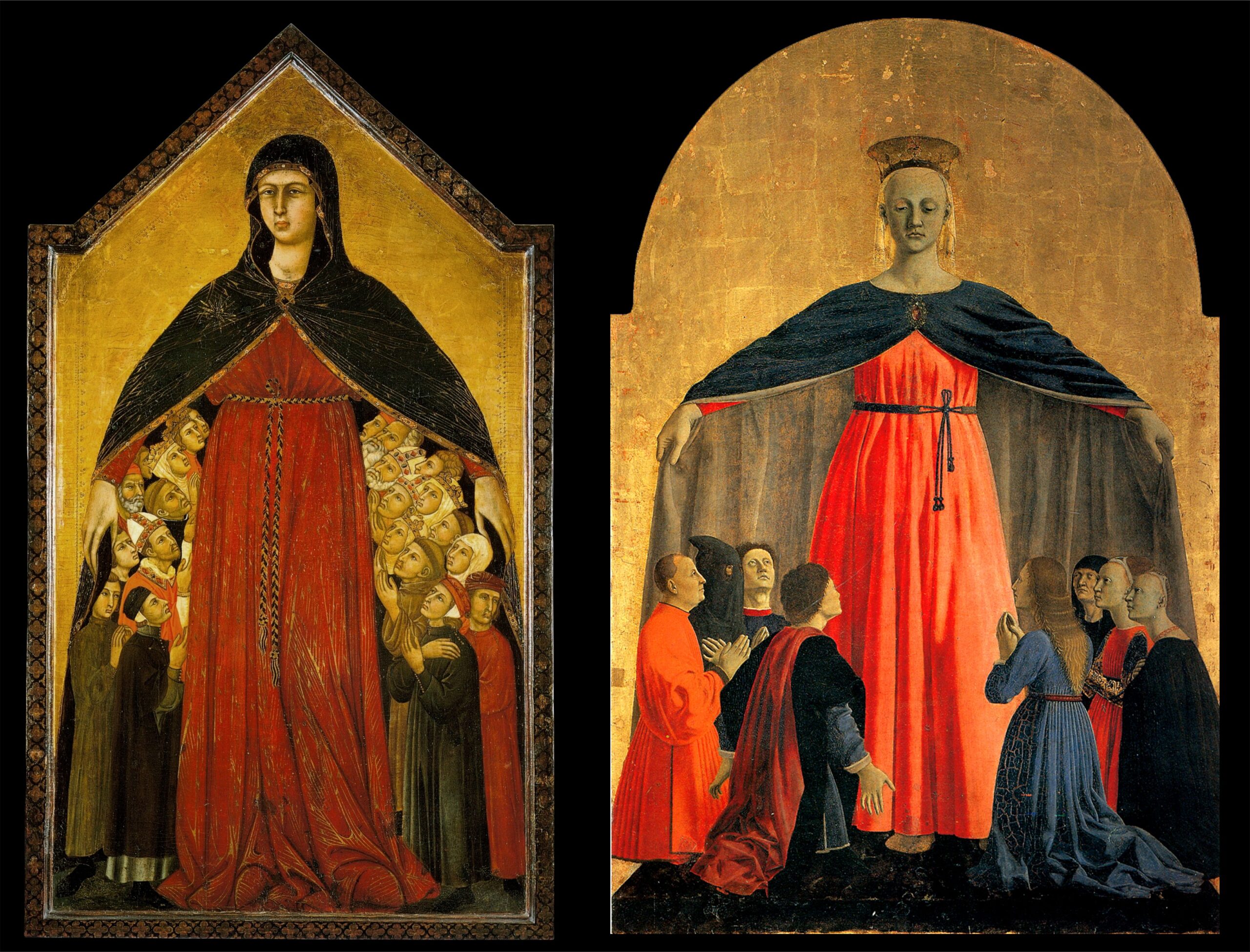
After the turn of the 1st Millennium CE, Mary began to be more and more honored in the Western Church. No one really understands this change in religious feeling. Most of the new Gothic Cathedrals in France were dedicated to Notre Dame (“our Lady”), and special Lady Chapels were built in English cathedrals. Believers thronged to images of Mary for consolation and for mercy. The following illustration shows two representations of the Madonna della Misericordia (“Lady of Mercy”), by Simone Martini (1310) and Piero della Francesca (1462).

Various traditions and beliefs have accumulated over the years so that now Marianism is an acknowledged subset of Christian beliefs, particularly in the Eastern and Roman Catholic Churches (Johnston, 1985; Leith, 2021; Matter, 1983; Rubin, 2009). In 1568 the Ave Maria was included in the Roman Catholic Breviary. The most famous setting of the prayer is by Gounod (1859) based on Bach’s Prelude No 1 (1722).

Ave Maria, gratia plena,                             Hail Mary, full of grace,
Dominus tecum                                         the Lord is with thee
benedicta tu in mulieribus                         Blessed art thou amongst women,
et benedictus fructus ventris tuis, Jesu      and blessed is the fruit of thy womb, Jesus.
Sancta Maria, Mater dei,                            Holy Mary, Mother of God,
ora pro nobis peccatoribus                        pray for us sinners,
nunc et in hora mortis nostrae.                  now and at the hour of our death. 


Theologians have long argued that Mary must have been herself conceived without sin so that she might carry the incarnation of God within her womb. This doctrine of the “immaculate conception” was discussed for many years, but only finally accepted by the Vatican in 1854. Since Mary was without sin, there was no need for her to die. Theologians therefore proposed that before her death she was instead taken up directly into heaven – “the assumption of the Virgin.” This idea finally becoming Catholic doctrine in 1950. Protestants reject both these doctrines. When it comes to Mary, the Christian churches have been loathe to allow their members the beliefs they long for.     


Hinduism

In contrast with the Western (or Abrahamic) religions, Hinduism is adorned with goddesses of many types and purposes (Kinsley, 1986; Pattanaik, 2000). Eroticism is an acknowledged part of divinity.

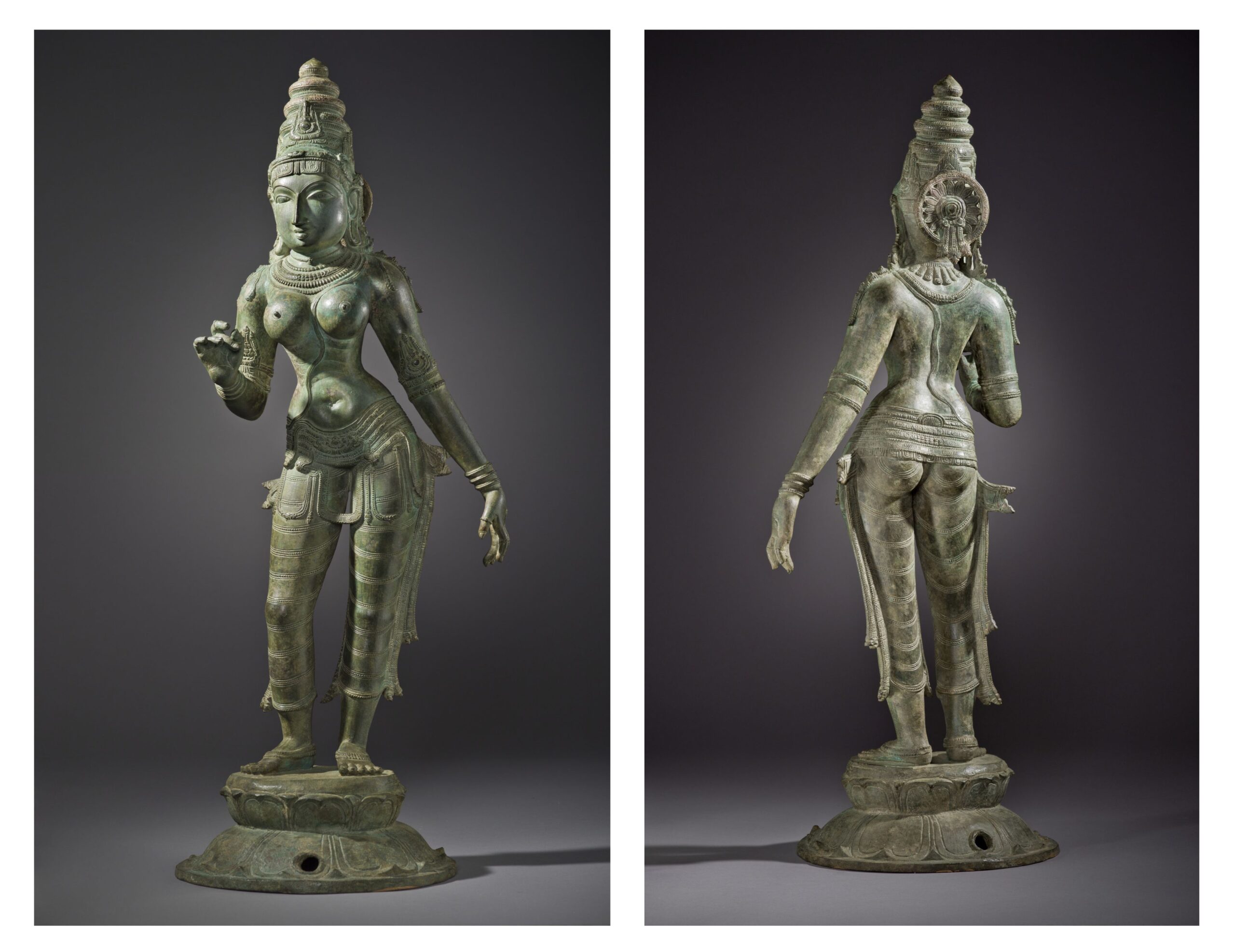
The supreme goddess Mahadevi is widely venerated. She changes form at will and goes by many names. She can exist alone as Shakti, the goddess of cosmic energy, or as Kali, the goddess of time and change. The illustration below shows a bronze statue of Bhudevi, the “Goddess of the Earth” (13th Century CE) from the Los Angeles Museum of Art

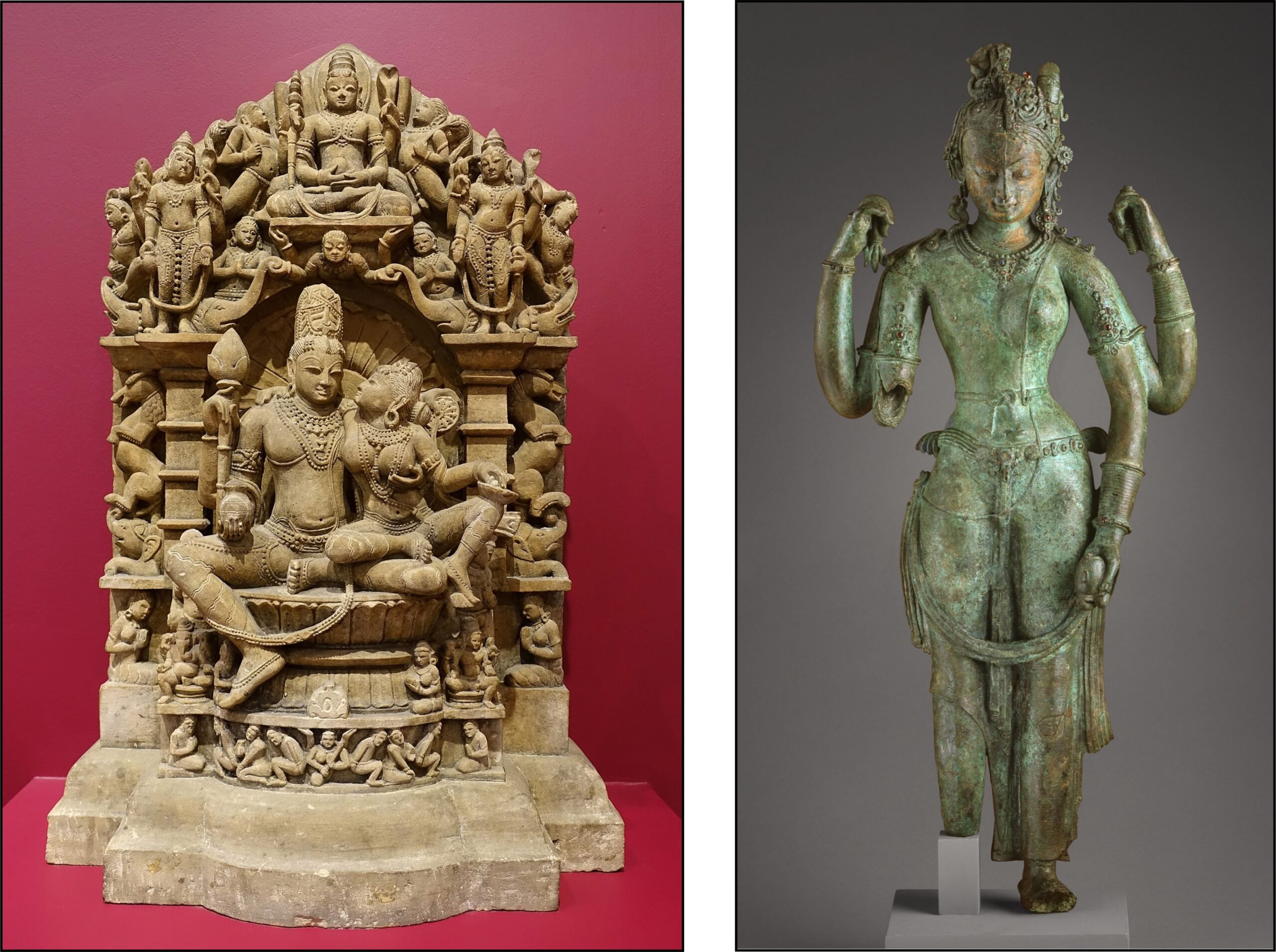
The female goddess often serves as the consort of a male divinity – Parvati with Shiva, and Lakshmi with Vishnu. Sometimes these pairs become unified into one deity – the androgynous Ardhanarishvara, whose right side is feminine and left side male. The illustration below shows a sandstone relief of Shiva and Parvati (11th Century CE) from the Dallas Museum of Art, and a bronze Ardhanarishvara (circa 1000 CE) from the Los Angeles Museum of Art.

Buddhism

Buddhism is often considered as a religion without the need for gods or goddesses. Since the universe has existed forever there is no need to postulate a divine force that once created it. However, the Buddha in his various manifestations and many of his enlightened followers (the Bodhisattvas, from bodhi, knowledge, and sattva, being) are revered as sincerely as any of the gods in more definitely theistic religions.

The Buddha and most of the Bodhisattvas are male. The hierarchy of priests and monks in Buddhism are male (Faure, 2008). However, over the centuries the feminine has made its appearance.

One of the most important of the Bodhisattvas was known as Avalokitasvara – “the lord (isvara) who gazes (lokita) down (ava) at the world.” This Bodhisattva of Compassion is described as the “Regarder of the Cries of the World” (Reeves, 2008) in Chapter 25 of the Lotus Sutra (the Sanskrit original deriving from the1st century CE, Chinese translations occurring in the third to sixth Centuries CE).

As the centuries passed and as Buddhism spread from its origin in India to Tibet, China and South East Asia, Avalokitasvara changed into female form (Yü, 2000). In Tibet, the Bodhisattva became Tara (Blofeld, 1979; Shaw, 2006). Tara herself is manifest in many different ways. Among them are white Tara, the goddess of Compassion, and green Tara, the goddess of Enlightenment. The illustration below shows an Indian stone sculpture of Avalokitasvara (9th Century CE) and a gilt copper-alloy casting of Tara (14th Century CE) from Tibet or Nepal and now in the Norton Simon Museum in Pasadena. Avalokitasvara is holding a lotus flower. Tara’s left hand shows the mudra (gesture) of teaching and her right hand the mudra of charity.

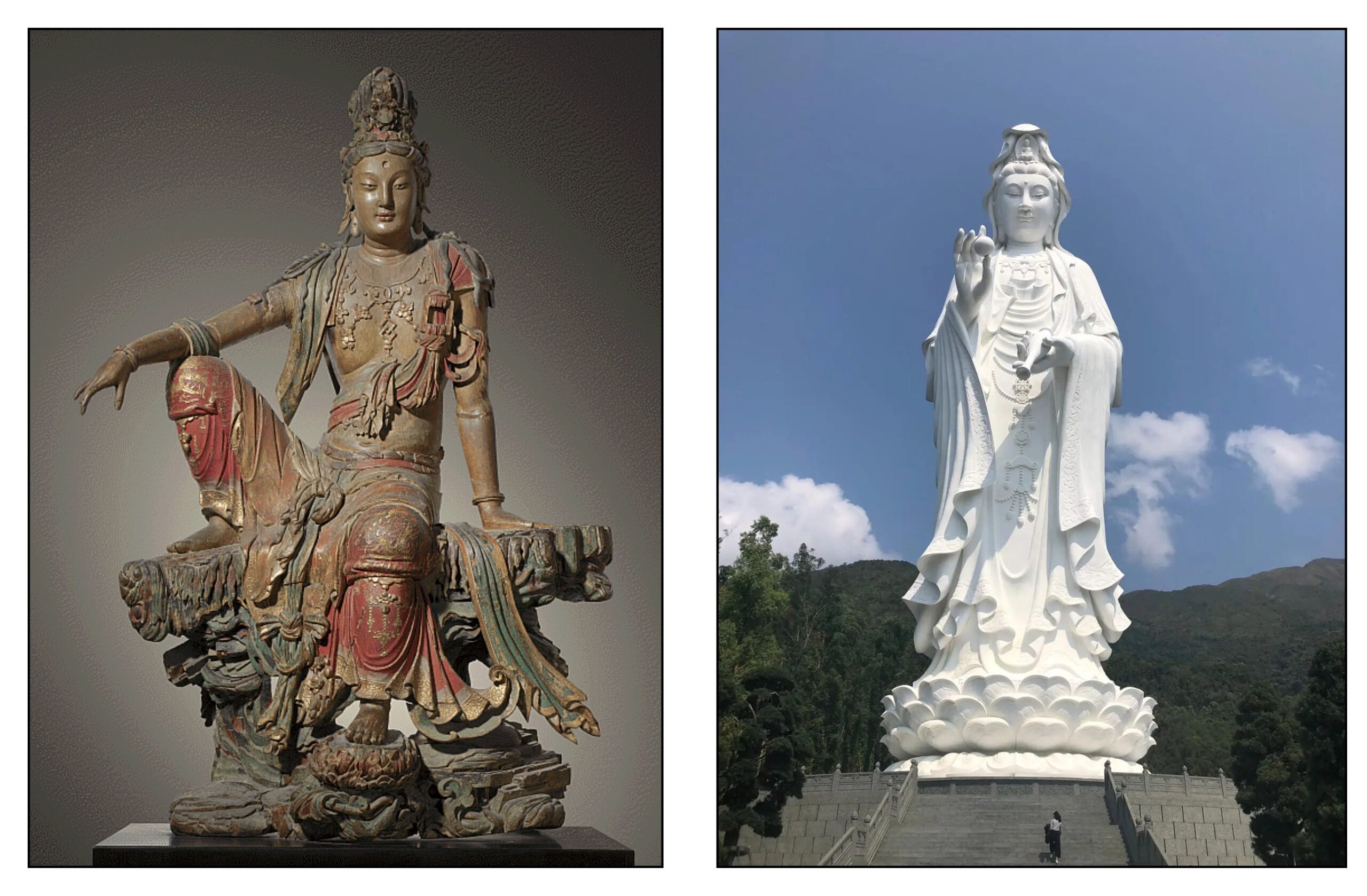
In China Avalokitasvara evolved into Guanshiyin (the Chinese translation of “the one who perceives the sounds of the world”) or Guanyin (pinyin; Kuan Yin in the Wade-Giles romanization). In Japan Guanyin became Kannon, re-assuming a male identity. The illustrations below shows a painted wooden carving of Guanyin (circa 1100 CE) in the Nelson-Atkins Museum of Art in Kansas, and a colossal statue of Guanyin (2015) in the Tsz Shan Monastery in Hong Kong.

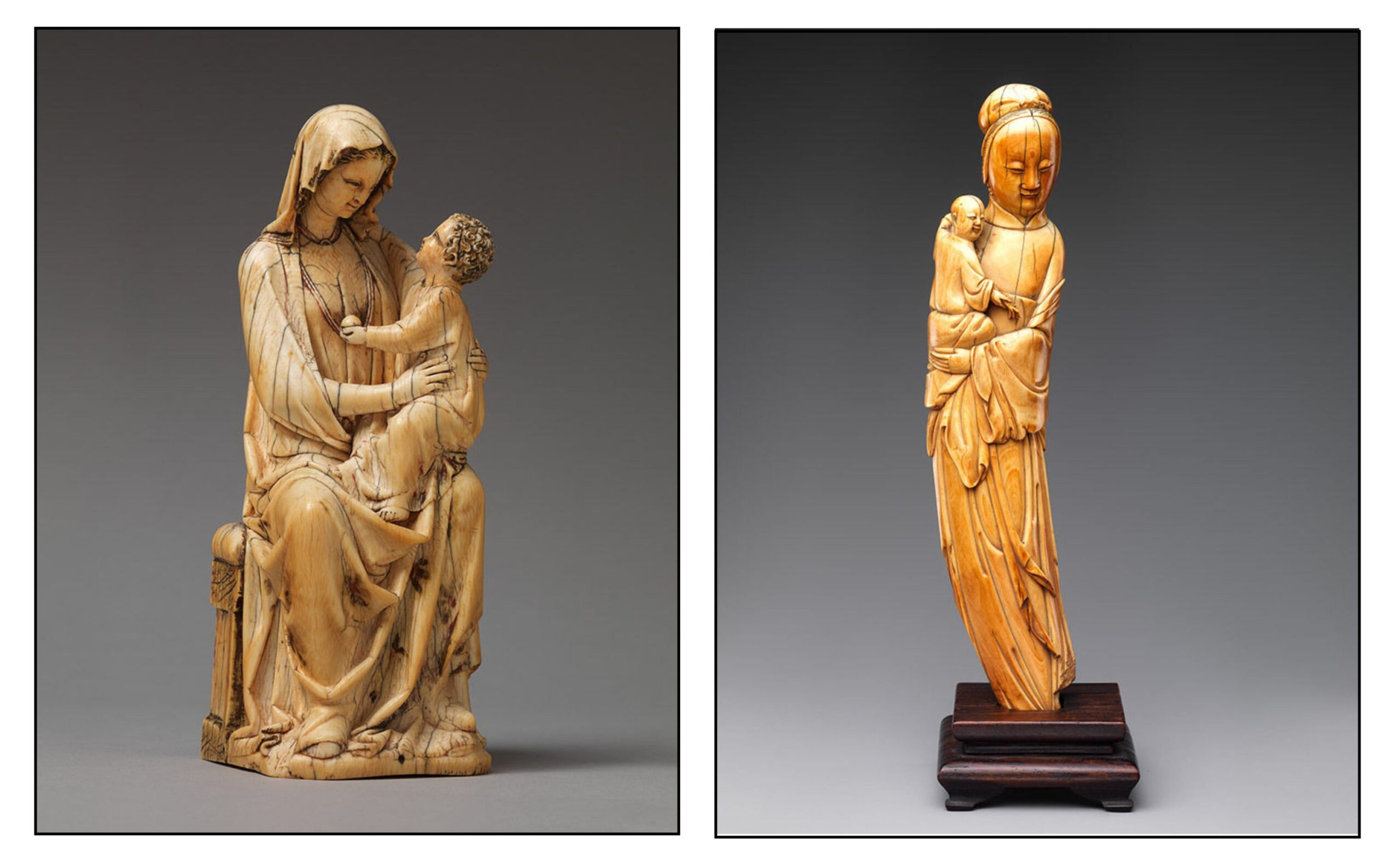
The Jesuits first arrived in China in the 16th Century. Christian concepts soon became part of life and culture in Southern China. One particular effect was the syncretism (from Greek syn together and krassis mixture) of Guanyin and the Virgin Mary (Paul, 1983; Reis-Habito, 1993). The illustration below from Pham (2021) shows two ivory carvings in the Metropolitan Museum of Ar in New York: a European representation of Mary (13th Century) and a Chinese representation of Guanyin (16th Century).  

The Eternal Feminine

With the Scientific Revolution and the Age of the Enlightenment, reason began to exert itself in the affairs of the soul. The existence of God was either denied, or considered only in the abstract. However, cold reason could not handle the emotions, which came to the fore in the Romantic Movement. Feminine forces were the means to handle feelings.

At the end of Goethe’s Faust Part II (1831), Faust, who had sold his soul to the devil in order to achieve knowledge and power, is saved from damnation by the intercession of female heavenly powers. Their final chorus in the play celebrates the power of the “Eternal Feminine.”

Alles Vergängliche                 All that has happened
Ist nur ein Gleichnis;              Is only a parable;
Das Unzulängliche                 The insufficient
Hier wird’s Ereignis;               Is now fulfilled;
Das Unbeschreibliche            The indescribable
Hier ist’s getan;                      Is now realized;
Das Ewig-Weibliche               The Eternal Feminine
Zieht uns hinan.                     Leads us upward.

The chorus has been set to music by Schumann in his Scenes from Goethe’s Faust (1853), Liszt in his Faust Symphony (1880) and by Mahler in his Symphony No 8 (1910). The following is the Mahler version:


Theosophy

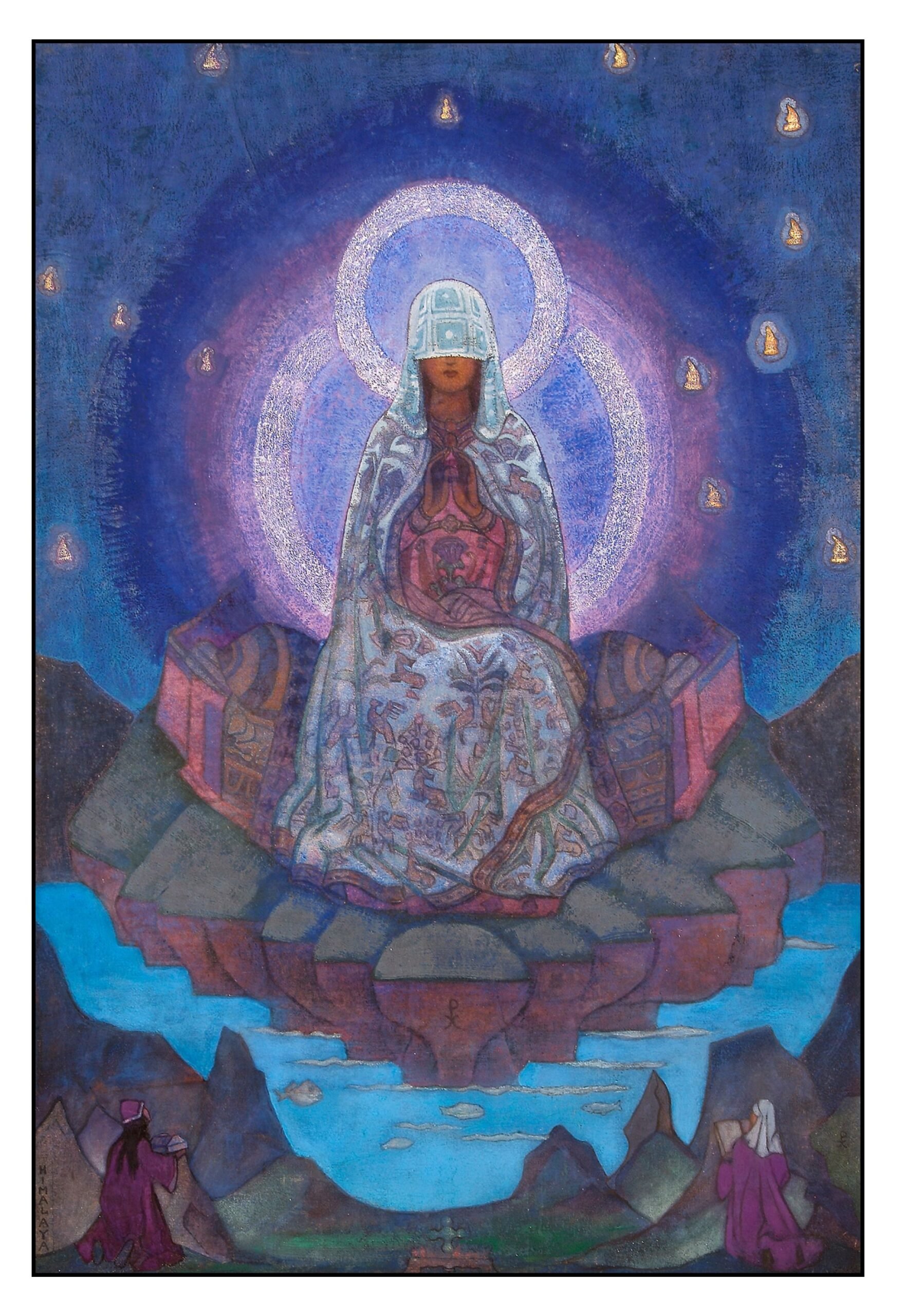
From 1875 to the middle of the 20th Century the Theosophical Movement exerted an uneasy influence on our thinking. Under the initial direction of Helena Blavatsky (1831 -1891), the movement combined Western esotericism and spiritualism with Eastern religious thought, and added a dash of charlatanism. Theosophy did promote of peace in a world enamoured of war and it did increase Western understanding of Eastern spiritual ideas. However, it ultimately foundered on its own fakery. The illustration on the right shows a painting of The Mother of the World (1937) by the Theosophist painter and explorer Nicholas Roerich.

The Gaia Hypothesis

In the 1970s, studies of how the Earth’s atmosphere constantly maintained parameters of temperature and pH that were optimum for the continuation of life led to the Gaia hypothesis, named after the Greek Goddess of the Earth, the primordial mother of all life:

the total ensemble of living organisms which constitute the biosphere can act as a single entity to regulate chemical composition, surface pH and possibly also climate. The notion of the biosphere as an active adaptive control system able to maintain the Earth in homeostasis we are calling the ‘Gaia’ hypothesis (Lovelock and Margulis, 1974)  

According to the Gaia hypothesis, human life is just a component of a larger self-regulating organism, the planetary biosphere. Some are skeptical of this hypothesis, claiming it describes the Earth’s process as determined by its future ends – teleological – rather than by its antecedent causes – mechanistic. However, just because science does not easily accommodate purpose does not mean that there is no underlying purpose to the universe.

The Gaia hypothesis has gained much recent support from the modern environmental movement. In some sense humanity has become a cancer on the life of the planet. Unchecked climate change threatens the homeostasis of the world and the life of everyone.

Feminist Theology

During the past few decades, feminist philosophers have challenged the androcentricity of the Christianity and Judaism (Anderson, 1998; Christ, 2003; Goldenberg, 1979; Johnson, 1984, 1992). These thinkers have pointed out the unfairness and inappropriateness of restricting the priesthood to men. And they have criticized mainstream theology for its focus on logic at the expense of intuition. One cannot prove the existence of God, but one can feel it.

Many people handle the unknowns of life by believing in the ethical instructions and the explanatory narratives that are available in religion. Science does not teach us what to do and does not always get us through the night. By providing a purpose to life and by promising ways to approach suffering and death, religion can help. Feminist religion – “theology” (Goldenberg, 1979) with its stress on grace and compassion promises to be far more effective than present mainstream theology.    

References

Anderson, P. S. (1998). A feminist philosophy of religion: the rationality and myths of religious belief. Blackwell.

Apuleius (2nd Century CE, selected by Singer, P., translated by Finkelpearl, E. D., and illustrated by Kendel, A., & Kendel, V., 2021). The golden ass. Liveright (division of W. W. Norton).

Barstow, A. L. (1983). The prehistoric goddess. In C. Olson (Ed). The Book of the goddess, past and present: an introduction to her religion. (pp 7-15). Crossroad.

Blofeld, J. (1979). Kuan Yin and Tara: Embodiments of wisdom-compassion. Tibet Journal, 4(3), 28-36

Christ, C. P. (2003). She who changes: re-imagining the divine in the world. Palgrave-Macmillan.

Devine, L. (2014). How Shekhinah became the God(dess) of Jewish Feminism. Feminist Theology, 23(1) 71–91.

Faure, B. (2008). The power of denial: Buddhism, purity, and gender. Princeton University Press.
Graves, R. (1948, amended and enlarged, 1961). The White Goddess; a historical grammar of poetic myth. Faber and Faber.

Green, A. (2002). Shekhinah, the Virgin Mary, and the Song of Songs: Reflections on a Kabbalistic symbol in its historical context. AJS Review, 26(1), 1-52.

Goldenberg, N. R. (1979). Changing of the gods: feminism and the end of traditional religions. Beacon Press

Johnson, E. A. (1984). The incomprehensibility of God and the image of God male and female. Theological Studies, 45(3), 441–465.

Johnson, E. A. (1985). The Marian tradition and the reality of women. Horizons, 12(1), 116–135.

Johnson, E. A. (1992). She who is: the mystery of God in feminist theological discourse. Crossroad.

Kinsley, D. R. (1986). Hindu goddesses: visions of the divine feminine in the Hindu religious tradition. University of California Press. Available at Arkiv.org

Laura, J. (2015). Kabbalah: in its beginnings. Women in Judaism12(2), 1–16.

Leith, M. J. W. (2021). The Virgin Mary: a very short introduction. Oxford University Press.

Lovelock, J. E., & Margulis, L. (1974). Atmospheric homeostasis by and for the biosphere: the Gaia hypothesis. Tellus, 26, 2-10.

Matter, E. A. (1983). The Virgin Mary: a Goddess? In C. Olson (Ed). The Book of the goddess, past and present: an introduction to her religion. (pp 80-96). Crossroad.

Neumann, E. (1963, second edition 1972, translated by R. Manheim,). The great mother: an analysis of the archetype. Princeton University Press.
Pattanaik, D. (2000). The Goddess in India: the five faces of the eternal feminine. Inner Traditions International.

Paul, D. (1983) Kuan-Yin: Savior and savioress in Chinese Pure Land Buddhism. In C. Olson (Ed). The Book of the goddess, past and present: an introduction to her religion. (pp 161-175). Crossroad.

Perkins, P. (1985). Sophia and the Mother-Father: the Gnostic Goddess.  In C. Olson (Ed). The Book of the goddess, past and present: an introduction to her religion. (pp 97-109). Crossroad.

Pew Research Center (2016). The gender gap in religion around the world. (March 22, 2016).

Pham, K.D. (2021).  Compassion, Mercy, and Love: Guanyin and the Virgin Mary. Metropolitan Museum of Art.

Reeves, G. (2008). The Lotus Sutra: a contemporary translation of a Buddhist classic. Wisdom Publications.

Reis-Habito, M. (1993). The Bodhisattva Guanyin and the Virgin Mary. Buddhist-Christian Studies, 13, 61-69

Rubin, M. (2009). Mother of God: a history of the Virgin Mary. Yale University Press.

Scholem, G. (1965, reprinted 1996). On the Kabbalah and its symbolism. Schocken Books.

Scholem, G. (1991). The feminine element in divinity. In G. Scholem. On the mystical shape of the Godhead: basic concepts in the Kabbalah. (pp 140-196). Schoken Books.

Shaw, M. E. (2006). Buddhist goddesses of India. Princeton University Press.

Smith, C. (1985). The symbol of the Shekhinah: the feminine side of God. European Judaism19(1), 43–46.

Stone, M. (1978). When God was a woman. Harcourt, Brace, Jovanovich.

Yü, C.-F. (2000). Kuan-yin the Chinese transformation of Avalokiteśvara. Columbia University Press.


Antisemitism

Hatred is directed anger. Though we can claim metaphorically to hate
unconscious objects or abstractions, hatred is typically directed at another person or persons. Hatred is evoked by suffering that we perceive they caused. Since it leads to actions against these persons, hatred can also be described as “ill
will.”

Emotions can overwhelm reason. Passion is not logical. We often hate
without any justification. Hatred must then be maintained by fictions that describe the evil nature of those we hate.

Antisemitism is the most enduring and most unjustified of human hatreds.
The ill will suffered by the Jewish people has lasted for thousands of years, and has led to countless crimes, the most terrible of which was the Holocaust wherein 6 million Jews were put to death by the Nazi Government of Germany (Bauer, 2001; Marrus, 1987). ;

Antisemitism has been inspired by many fictions. This posting considers the unfortunate power of some of the stories that paved the way to the Holocaust.


Some Simple Psychology

Anger arises when we experience suffering, especially when we believe it
to be unwarranted, and when we are thwarted from achieving what we desire,
especially when we believe that we entitled to it. Anger seeks to attack these causes: to hit out at those who strike us; to break those who obstruct us.

We tend to think of events as caused by persons. Even when forces of
nature act against us we may attribute them to a divinity or a devil, or to
those who worship them. Only in that way can anger find a target for its
release.

Sometimes the causes of our anger are too complicated to understand or too powerful to fight against. In these cases, we may vent our anger elsewhere and attack other human beings, while inventing plausible (though fictional) reasons for so doing.

…every instance of suffering, every feeling of displeasure, by whomsoever and in whatsoever way it may have been caused, whether it arises from the guilt or from the lawful activity of another person, or through the sufferer’s own fault, or without any fault, or even without any human influence, tends to transform itself into a feeling of enmity, to direct itself against fellow-humans and if possible to express itself against them. (Bernstein, 1951, p 85)

As we were growing up during childhood, we realized – at about the age
of three – that we can exert some control over our environment. We therefore created a self as the agent of this control. At about the same time we realized that the world contains other agents. These could either help us or hinder us. We became comfortable with those that helped and learned to cooperate with them. We feared the others.

The group appears to be a curious form of extension of the individual. It seems as if under the influence of the necessities of human communal life, human beings who need love and produce hate combine into new, collective and collectively selfish individualities of a higher order; directing their love inwards, their hate outward, their social instincts towards the insider, their anti-social tendencies toward the outsider. (Bernstein, 1951, p 109-110)

Those who cooperated in groups came to have similar desires and modes of
behavior. They followed the same rules and sought the same goals. Those who
were different became isolated. These “others” challenge our group-identification (Chanes, 2004, p 3). In our search for where to vent our anger, we often light upon those that are different from us. Especially if these people are small in number and not inclined to violence.

While for normal group enmity a certain regularity in the mutual expression of enmity is characteristic, the antagonism between a powerful majority and a powerless minority is characterised by a onesidedness of hostile actions which is fatal for the minority. For the latter is exposed to continual attacks and must confine itself to laborious attempts to maintain its existence, without a chance to resist actively to any extent; even its passive means of defense are totally inadequate and its existence often has to rely on nothing but periodical flight from place to place. This onesided relation of
permanent attack and failing defense is called persecution. Weak minority
groups are usually persecuted more or less emphatically. (Bernstein, 1951, p 224)

The actual psychological mechanisms that lead to antisemitism are not
really understood. Some believe that there are personality-types that are more easily convinced to vent their hatred on minorities. The role of authority and power is undoubtedly a factor (Morse & Allport, 1952; Milgram, 1974). Those who seek power or wish to maintain it gain great support by fomenting hatred. Propaganda – invented stories – have a tremendous power. For some reason the more incredible the story the more easily it is believed (Baum, 2012). Dehumanization of the victims serves to attenuate our inherent tendency to help our fellows. (Bandura et al., 1975)

For millennia the Jewish people have allowed us to vent our hatred. For
millennia we have invented reasons for our violence.

The hostility toward a minority exacerbates the feelings that initially triggered. When persecuted, a minority does not fare well in society and often comes to appear even more deserving of denigration and oppression (Beller, 2007, p 5).

Antisemitism is not caused by the Jews but by the inadequacy of those who need to hate them.

…two psychological characteristics are present in the individual antisemite: excessive hostility and the need (and a capacity) to project one’s aggression on other groups. Persons who have these traits generally suffer from feelings of inadequacy and from the feeling that their own personal borders, psychologically speaking, are easily invaded by others (Chanes, 2004, p 7)

We can perhaps conclude this section with two epigrams from Jean-Paul Sartre (1948):

If the Jew did not exist, the anti-Semite would invent him (p 13)
Antisemitism is not a Jewish problem: it is our problem. (p 152)

The People of the Covenant

The Jews consider themselves God’s chosen people. In the Hebrew
scripture Yahweh made a covenant with Abraham, and then renewed the covenant with Jacob and with Moses. The Jews were to worship Yahweh as the one true God and to follow his commandments. The Jews would then serve as an example for the rest of humanity

I the Lord have called thee in righteousness, and will hold thine hand, and will keep thee, and give thee for a covenant of the people, for a light of the Gentiles (Isaiah
42:6).

In return, the Jews would be considered special

For thou art an holy people unto the Lord
thy God, and the Lord hath chosen thee to be a peculiar people unto
himself, above all the nations that are upon the earth. (Deuteronomy 14:2)

And were promised as their home the land containing what is now the country of Israel

In the same day the Lord made a covenant with Abram, saying, Unto thy seed have I given this land, from the river of Egypt unto the great river, the river Euphrates (Genesis 15:18)

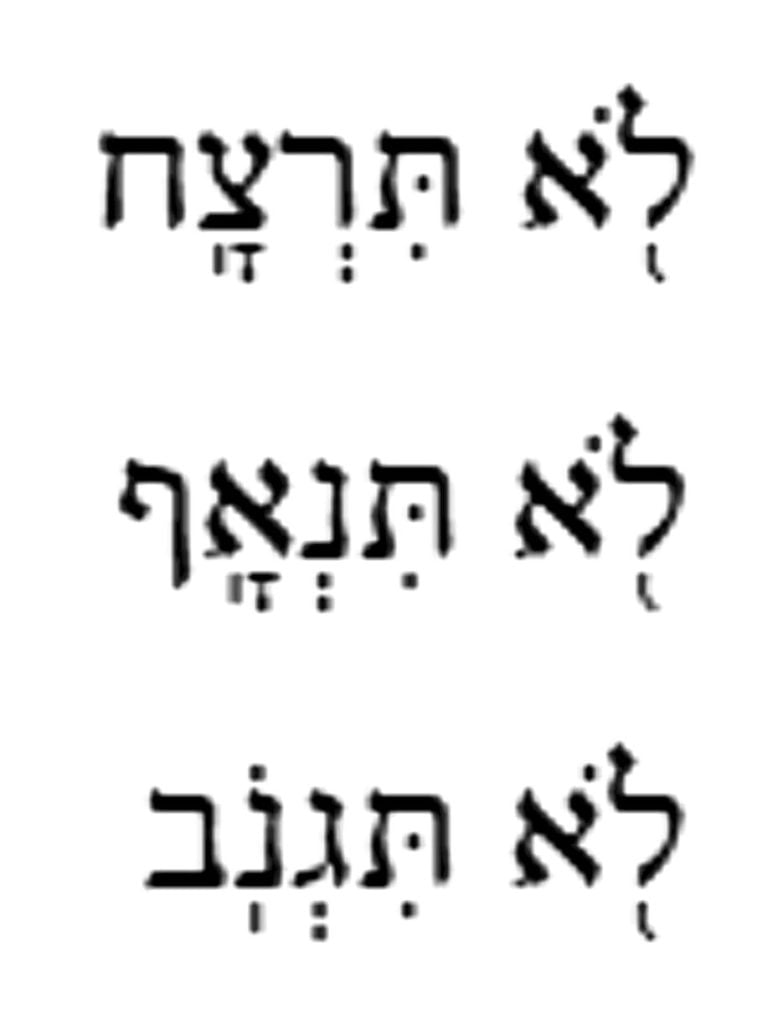
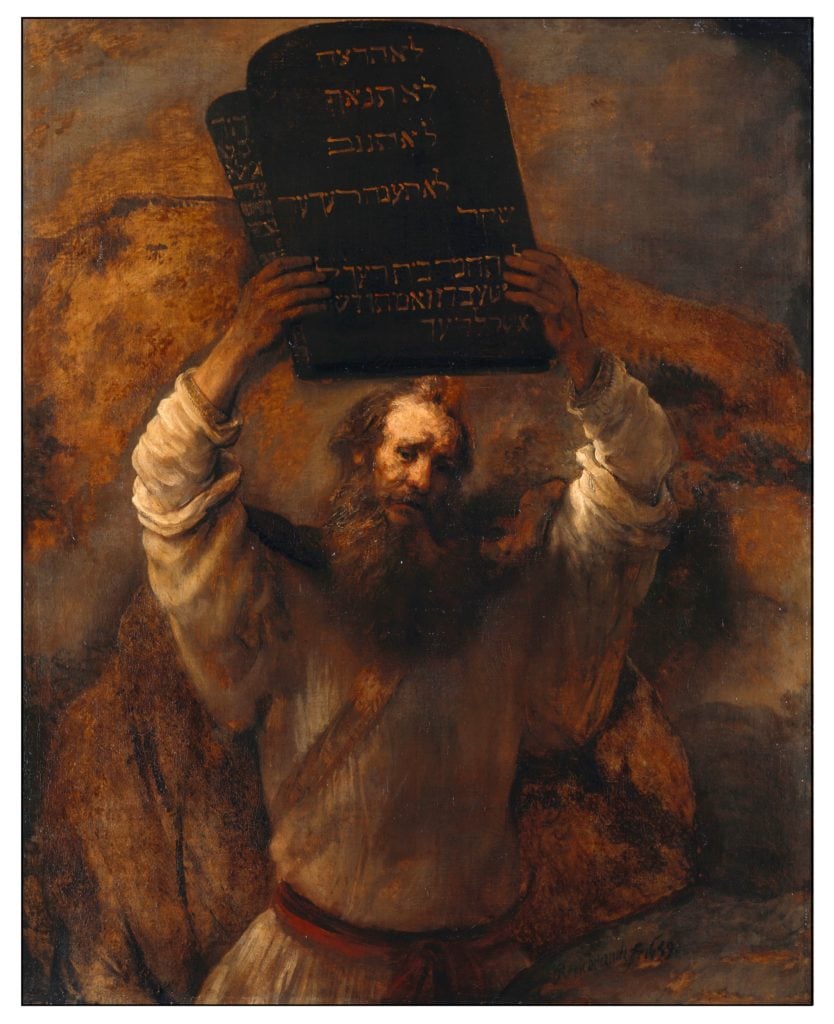
God’s covenant with the Jews was based on their keeping the commandments that he revealed to Moses. Rembrandt’s 1659 painting Moses with the Tablets of the Law shows Moses holding aloft the stone tablets on which the Ten Commandments had been written. These were engraved on two separate stones (Exodus 31:18, 32:15). In the painting, only the second tablet is completely visible giving the 6th to 10th commandments (Exodus 20:13-17). These begin with: “Thou shalt not kill. Thou shalt not commit adultery. Thou shalt not steal:” (Hebrew illustrated on the right).

No one is sure what moment in the story of the tablets Rembrandt is representing. Is it when he first displays these to the Hebrews? or when he is about to shatter them on the ground because the Hebrews had been worshipping the Golden Calf while he had been on Mount Sinai with God (Exodus 32:19)? or is it when he returns to God and brings a second set of tablets back to the chastised Hebrews (Exodus 34:1). Moses’ face is shining with revelation rather than angry. Perhaps, Rembrandt has painted the moment when Moses first displays the commandments.

No group of people is perfect. However, the Jews have contributed more than their share to the human endeavor – in philosophy, science, medicine, politics, art, music, literature. And for the most part the, laws that they accepted as part of their covenant with God have served them well. They are indeed an example to other people.

So why were and are they so often reviled? It is unlikely a reaction to their chutzpah in claiming to be God’s chosen. In the Middle Ages this was called the Insolentia Judaeorum. Yet every one of the world’s many religions claims to be just as special.

One defining aspect of the Jewish religion is that it is monotheistic. The first commandments state that a Jew must obey Jehovah and not even pay lip-service to any other god or idol:

I am the Lord thy God, which have brought thee out of the land of Egypt, out of the house of bondage.
Thou shalt have no other gods before me.
Thou shalt not make unto thee any graven image, or any likeness of any thing that is in heaven above, or that is in the earth beneath, or that is in the water under the earth.
Thou shalt not bow down thyself to them, nor serve them
(Exodus 20:2-5).

The Jewish religion thus combines the worship of one god with strict obedience to his commandments. As Prager and Telushkin (2003) have suggested, this ethical monotheism may have offended those who followed other gods. Jews refused to follow the proverbial injunction that when in Rome do as the Romans do. For example, the outburst of violence against the Jews in Alexandria in 38 CE (then part of the Roman Empire) was triggered by their refusal to place statues of the Emperor Caligula in their temples (Goldstein, 2012).

One should respect the beliefs of others. However, respect does not mean obeying rules that go against one’s own moral principles. The Jewish people’s refusal to acknowledge or worship other gods has continued to the present. In particular Jews do not recognize the divinity of Jesus Christ.

In addition to the Ten Commandments, Yahweh’s covenant with the Jewish people involved numerous other rules of behavior. These included strict stipulations about the types of food that they might eat and the methods in which this food should be prepared. Over the ages observant Jews have thus been unable to share meals with those of other faiths. And although some of the ancient Jewish philosophers – Hillel and Maimonides for example – were open to ideas beyond the Covenant, strict Judaism limited itself to the study of the Torah and its interpretations.

The Covenant with Yahweh thus isolated the Jewish people from the rest of humanity. They could not share the beliefs, the food or the thoughts of others. They antagonized others by their claim to be the chosen people.

So we have the idea that antisemitism is in part caused by the very character of the Jewish religion. This would explain why the Jews have been reviled by so many different people in so many different countries. The following was written Bernard Lazare in 1894. He was a Jewish polemicist who wrote the first defense of Captain Alfred Dreyfus. Yet even he thought that the Jews were partly to blame for antisemitism.

Inasmuch as the enemies of the Jews belonged to divers races; as they dwelled far apart from one another, were ruled by different laws and governed by opposite principles; as they had not the same customs and differed in spirit from one another, so that they could not possibly judge alike of any subject, it must needs be that the general causes of antisemitism have always resided in Israel itself, and not in those who antagonized it…. Which virtues or which vices have earned for the Jew this universal enmity? Why was he ill-treated and hated alike and in turn by the Alexandrians and the Romans, by the Persians and the Arabs, by the Turks and the Christian nations? Because, everywhere up to our own days the Jew was an unsociable being. (Lazare, 1894/1903, pp 8-9)

This seems so reasonable. Yet it is false. It does not explain the cause of antisemitism. It is just an excuse. It blames the victim for the crime.

The Crucifixion of Christ

In the early decades of the Common Era, Jesus, a Jewish teacher from Nazareth, brought new insight to the interpretation of Jewish law. He simplified the commandments by expressing them as the need to love the Lord and to love one’s neighbor as oneself. He criticized the rigid adherence to the Sabbath, and the commercialization of the Temple. He proclaimed the idea of a Kingdom of Heaven. Many of the more observant Jews were disconcerted by his teachings. The Romans were upset that he was proposing a new kingdom. Jesus was arraigned before Pilate, the Roman governor of Judea, condemned and crucified.

A few days after his death and burial, the tomb of Jesus was found empty. Many of his followers claimed that they afterwards saw him in person. They therefore believed that he had been resurrected. They continued to meet and discuss his teachings. They were either tolerated by other Jews or condemned as heretics.

A learned Jew named Saul was one of those that persecuted the followers of Jesus. However, on the road to Damascus he had a vision of Jesus that completely altered his thinking. He changed his name to Paul, and began to provide an over-arching theory about the death and resurrection of Jesus. His main ideas were that Jesus was the Son of God, the Messiah prophesied in the scriptures, that he died to release us from our sins, and that we shall all be saved from death by having faith in Jesus called Christ (the “anointed”).

For I delivered unto you first of all that which I also received, how that Christ died for our sins according to the scriptures;
And that he was buried, and that he rose again the third day according to the scriptures (I Corinthians 15:3-4)

Paul’s major teaching was that one could never attain salvation by following the Mosaic laws. No one is perfect. Everyone breaks the law. However, Christ offers salvation if we repent our sins and have faith in him.

Knowing that a man is not justified by the works of the law, but by the faith of Jesus Christ, even we have believed in Jesus Christ, that we might be justified by the faith of Christ, and not by the works of the law: for by the works of the law shall no flesh be justified. (Galatians 2:16).

Paul’s letters describing these ideas are the earliest of the Christian scriptures. Written in the years 50-60 CE these predate by 20 to 50 years the four gospels, which describe the life and teachings of Jesus.

The followers of Jesus in the 1st Century CE differed in their opinion about his relationship to the Jews. Some thought that the message of Jesus was for the Jews; others that it was for both Jews and Gentiles. Most of Paul’s teaching was directed to the Gentiles. In some of his letters he laments the inability of many of his Jewish colleagues to understand God’s new covenant.

For ye, brethren, became followers of the churches of God which in Judaea are in Christ Jesus: for ye also have suffered like things of your own countrymen, even as they have of the Jews:
Who both killed the Lord Jesus, and their own prophets, and have persecuted us; and they please not God, and are contrary to all men:
Forbidding us to speak to the Gentiles that they might be saved, to fill up their sins alway: for the wrath is come upon them to the uttermost.
(I Thessalonians 2:14-16)

Some of the gospels continued this criticism of the Jews (Crossan, 1995). This is perhaps most evident in the gospel of Matthew. He describes how the Jews forced Pilate to crucify Jesus, and willingly accepted the responsibility for his death:

When Pilate saw that he could prevail nothing, but that rather a tumult was made, he took water, and washed his hands before the multitude, saying, I am innocent of the blood of this just person: see ye to it.
Then answered all the people, and said, His blood be on us, and on our
children. (Matthew 27: 24-25)

The major event in Jewish history of the 1st Century CE was the Great Revolt of the Jews against Roman rule. This began in 66 CE and culminated in the Destruction of the Second Temple in 70 CE. The illustration below shows a representation in the Arch of Titus of the Romans carrying the spoils from the temple. Among the spoils is the great Menorah that once gave light to the Tabernacle.

At this time many Jews fled their homeland and settled in other countries. The Jewish people have been exiled at many times in its history – the Assyrian conquest (733 BCE), the Babylonian captivity (597 BCE), the Great Revolt (70 CE), the later Bar Kokhba Rebellion (132 CE). Though some Jews remained in Israel, most lived in the Diaspora (“scattering”) – far from the land that from the days of Moses they had considered their God-given home.

The Destruction of the Temple seemed to many Christians a divine response to the action of the Jews in crucifying their Lord. Though the Romans crucified Jesus, some of the early Christians considered the Jews responsible. The Jews were thus guilty of deicide and should be reviled and cast out from Christian society. Even if they were not guilty, they should be chastised for not recognizing the salvation offered by Christ – for staying with the old dispensation rather than following the new.

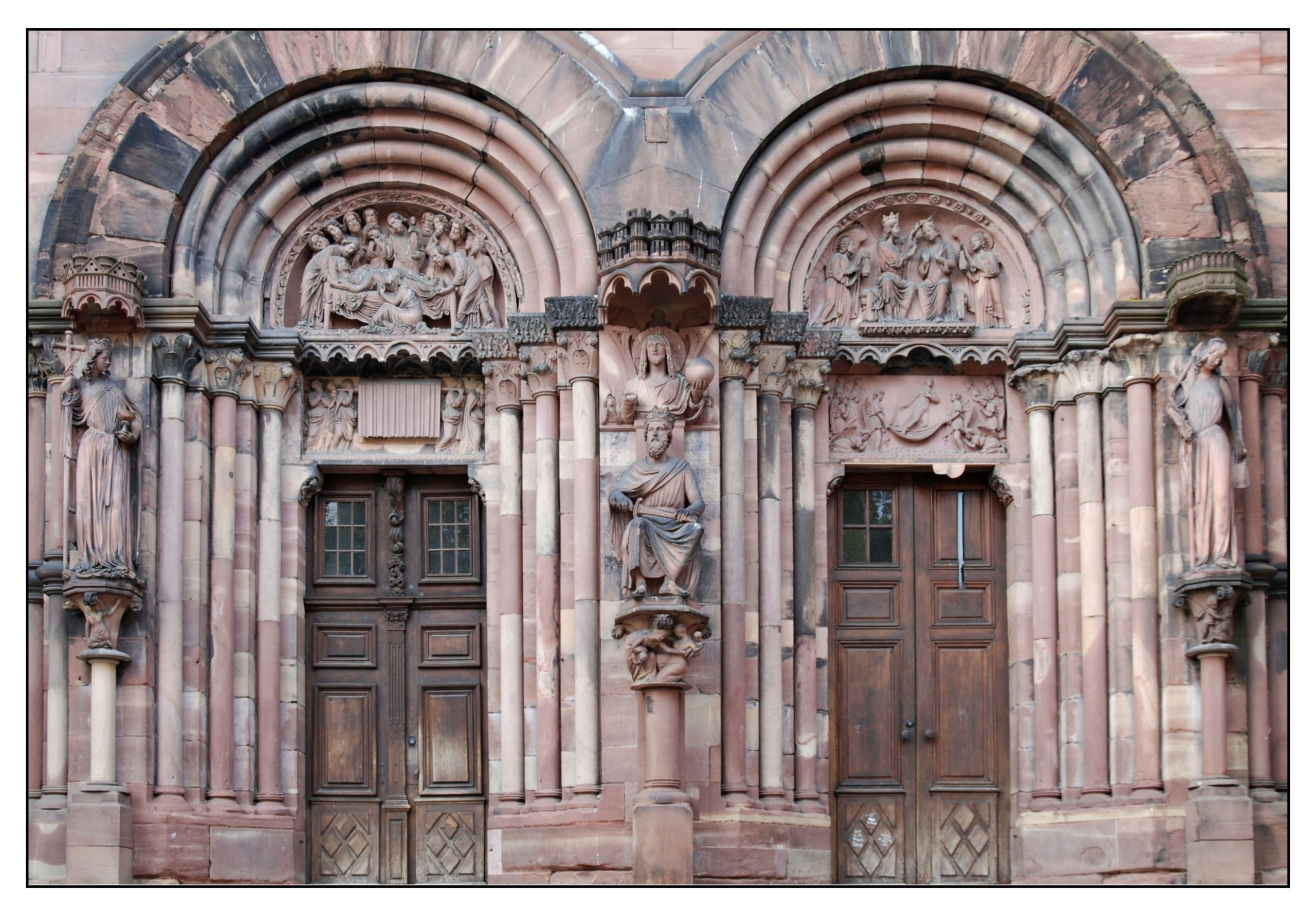
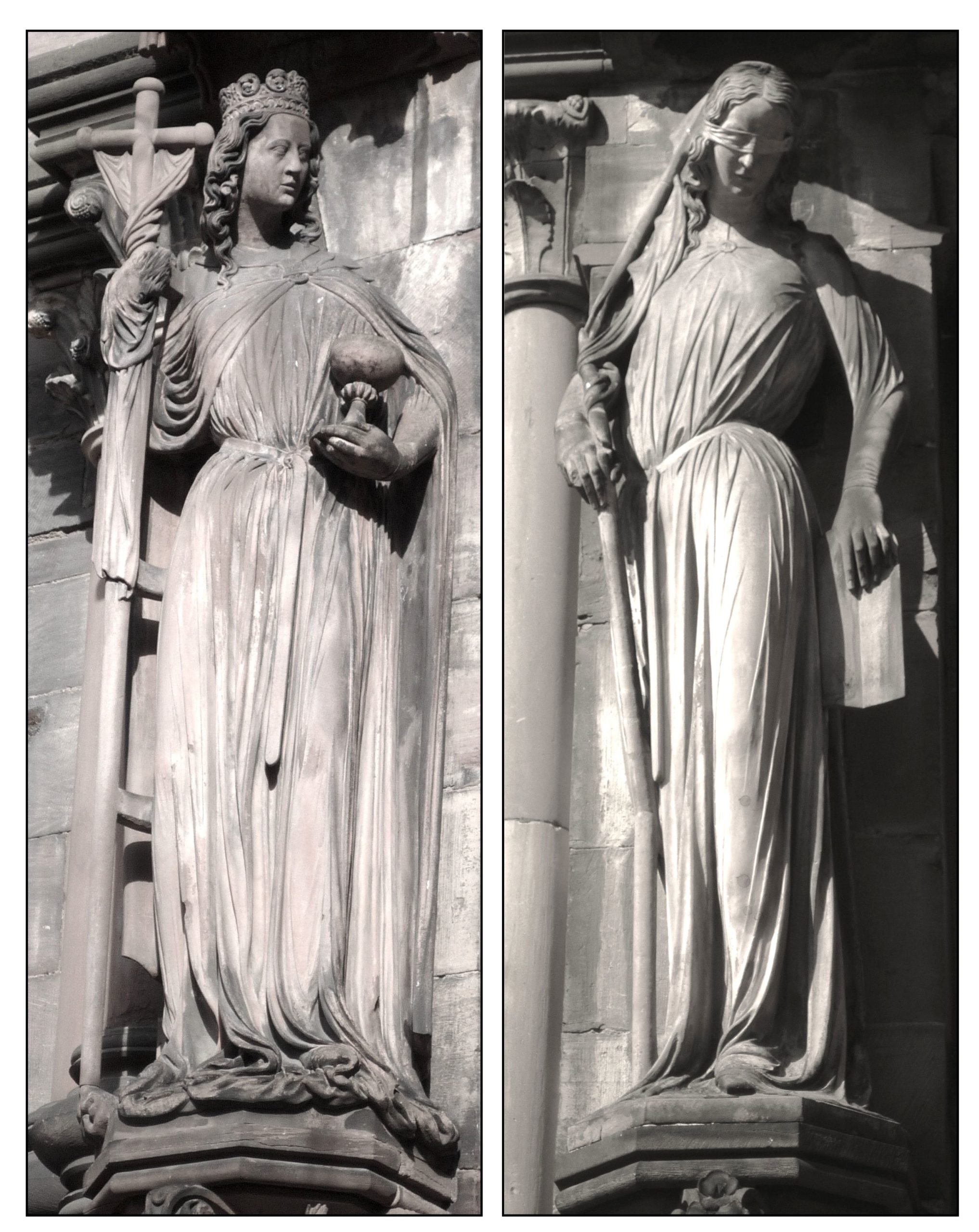
These ideas have long permeated the thinking of the Christian Church. Many of the cathedrals illustrate these concepts by contrasting sculptures of Ecclesia and Synagoga. The statues on the south portail of the Cathedral of Notre Dame in Strasbourg from the 13th Century CE are particularly impressive. Legend has it that these were created by a female sculptor Sabina von Steinbach, though there is no real evidence for this. Ecclesia with her crown, holds in her hands the cross and the chalice. She looks with pity on Synagoga, who is blindfolded and cannot see the truth. She holds in her hands the tablets of the law and the lance that the centurion used to bring the crucifixion to an end. The lance was shattered by the resurrection.

The following illustration shows the complete portail. Ecclesia and Synagoga are on the left and right sides. In the center sits Solomon in judgement between the old covenant and the new. Above him is Christ, Salvator Mundi (savior of the world). The carvings in the tympanums represent the dormition, assumption and coronation of the Virgin Mary.

The statues of Ecclesia and Synagoga are impressive examples of gothic art. Though superficially beautiful, they obscure rather than convey the truth. The feelings against the Jews that they evoke are a complete betrayal of Jesus, a Jew who taught in the synagogues of Palestine.

One might have hoped that the antisemitism of the Christian Church would have been excised by the Reformation. But this was not to be. Martin Luther was virulently antisemitic. In his The Jews and Their Lies (1543, pp 39-42) he advises Christians to burn their synagogues of the Jews, their houses, and their books, prohibit their Rabbis from teaching, not allow them to travel on the highways, and prohibit them from lending money. Luther was a harbinger of Kristallnacht.

Wild Accusations

During the Middle Ages people could not understand why life was so often brutal. An easy way to explain the various disasters was to attribute them to the Jews. If the Jews could kill God, there was no telling what other crimes they were capable of.

On Good Friday in 1144 the body of a child called William was discovered in the woods near Norwich in England. The Jews were accused of murdering the child. No credible evidence was ever found. However, a monk who had just converted from Judaism to Christianity claimed that the Jews had decided to sacrifice a Christian child to re-enact the death of Christ. Several Jews were slaughtered. William was declared a martyr. Pilgrims flocked to his tomb. Miracles occurred.

William of Norwich was the first documented case of Jews being accused of ritual murder. As the years went by similar accusations arose in multiple different regions of Europe (Goldstein, 2012). Many of these cases included the idea that the Jews used the blood of their victims to make the unleavened bread used in the celebration of Passover. This particular accusation was called the “blood libel.” It makes no sense. Kosher regulations require that observant Jews never eat food contaminated with blood. Jews go to great lengths to remove blood from meat before it can be eaten.

The Christian Bible contains the Hebrew scriptures in what it calls the Old Testament. Some of these writings described how the blood of sacrificed animals played an important role in the ceremonies of the ancient Hebrews, e.g.

And he shall kill the bullock before the Lord: and the priests, Aaron’s sons, shall bring the blood, and sprinkle the blood round about upon the altar that is by the door of the tabernacle of the congregation. (Leviticus 1:5).

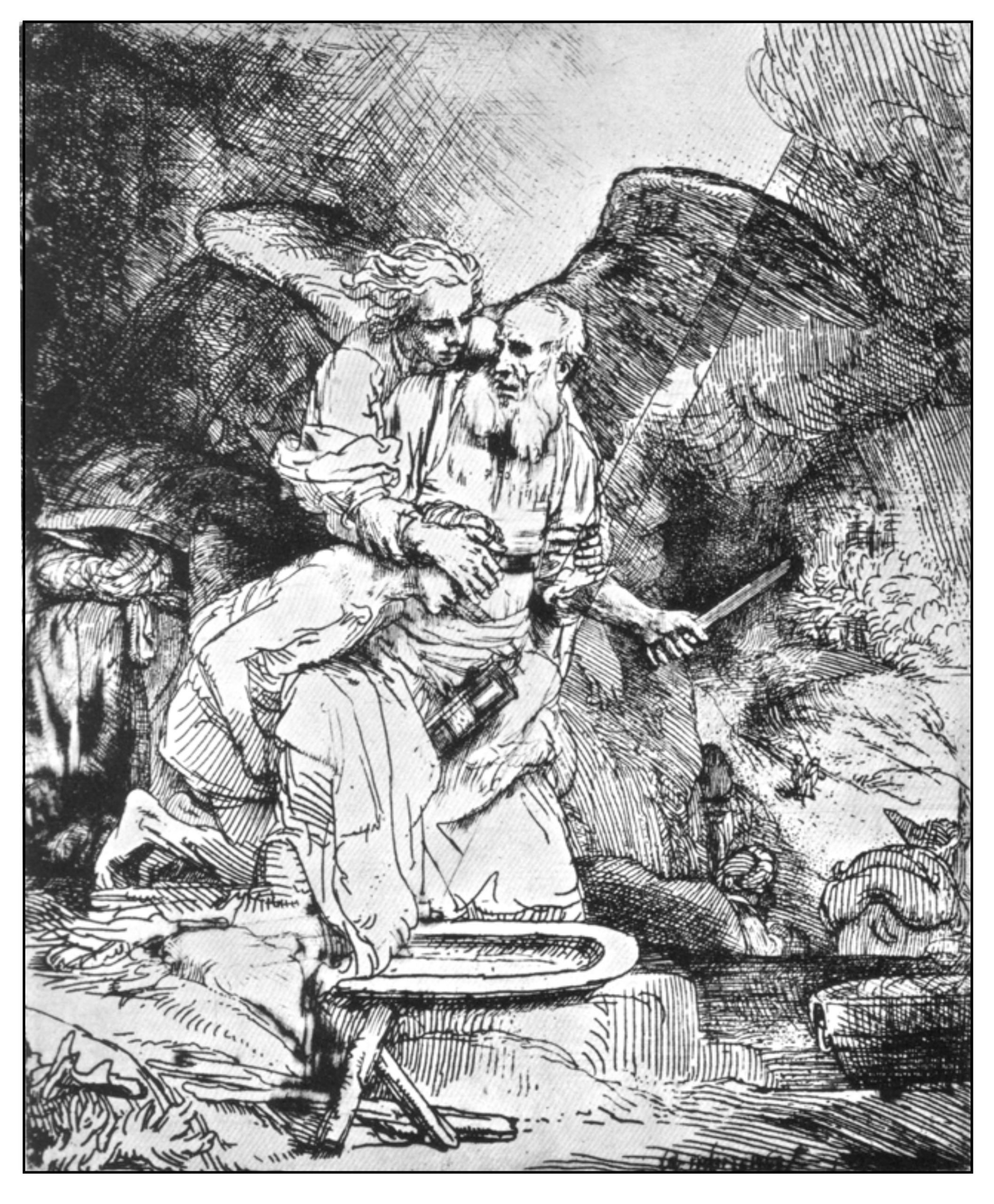
Other ancient Hebrew writings are even more disconcerting. One of the foundational stories of Judaism is the Akedah (“binding”), wherein the Patriarch Abraham, at the request of Jehovah, takes his son Isaac to Mount Moriah to sacrifice him (Genesis 22). Although an angel stays Abraham’s hand at the last moment, this fails to attenuate the story’s horror. The illustration below shows Rembrandt’s 1655 etching.

The Old Testament contains other stories wherein children were sacrificed. To defeat the Ammonites, Jephthah promised the Lord that he would sacrifice whatever came out of his house when he returned from battle. Jehovah gave the victory to the Israelites. When Jephthah returned home, his daughter came to greet him, dancing and playing the tambourine (Judges 11).

There is also a suggestion that King Manasseh sacrificed his son – the wording is “he made his son pass through the fire” (2 Kings 21:6). These events and the idea that the terrible place near Jerusalem called Gehenna or Tophet was actually a site of human sacrifice are discussed at length by Stavrakopoulou (2004). The practice was banned by Yahweh speaking through his prophet Jeremiah:

And they have built the high places of Tophet, which is in the valley of the son of Hinnom, to burn their sons and their daughters in the fire; which I commanded them not; neither came it into my heart. (Jeremiah 7:31).

One can perhaps imagine how such stories from the Old Testament might have allowed credulous people to accept the idea that the Jews might sacrifice Christian children and use their blood for their ceremonies. When one’s faith requires a belief in miracles, wild rumors are not easily contradicted.

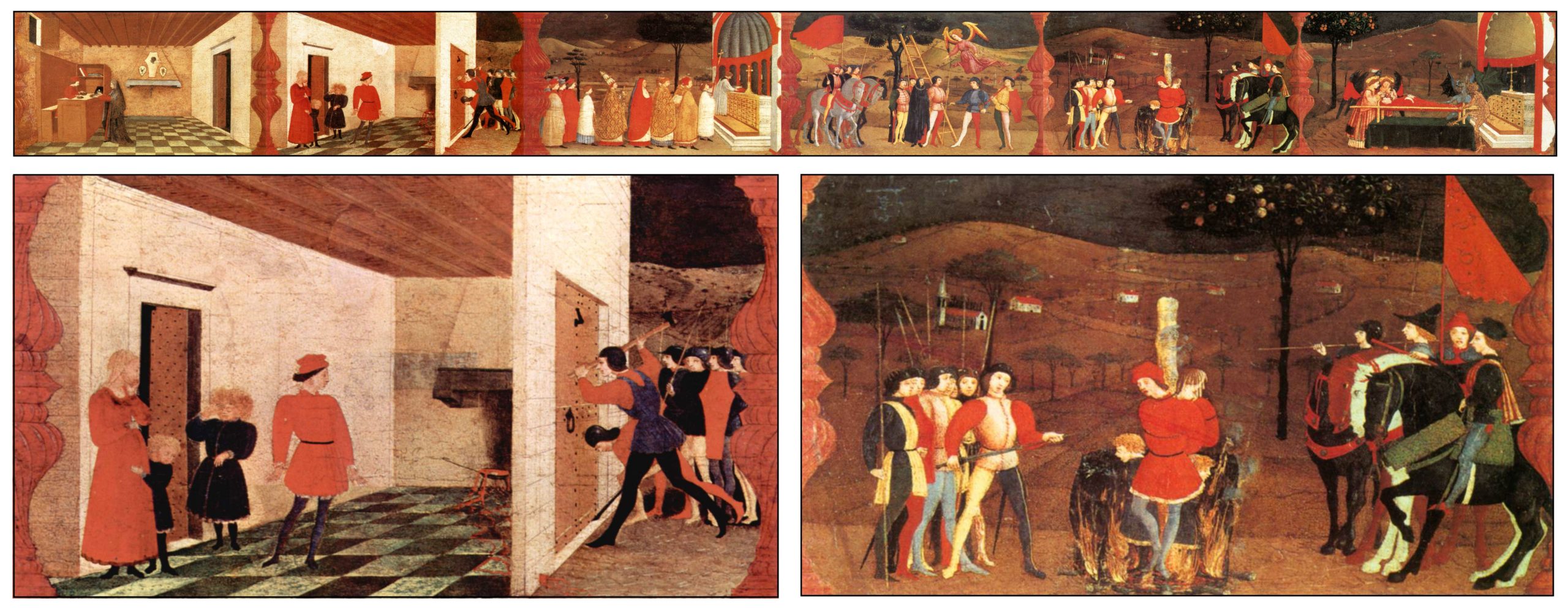
The main sacrament of the Christian Church is the Eucharist, wherein the congregation partakes of bread and wine that have been especially blessed. According to the church, these had been miraculously “transubstantiated” to the body  of Jesus, who was sacrificed to save the world. The sacramental bread is called the host (from the Latin hostia for sacrificial victim). In many places and at many times the Jews were accused of “desecrating” the host. The following illustration shows a 1469 sequence of paintings by Paolo Uccello that tell the story of the Miracle of the Desecrated Host. Both the full sequence and the particular panels illustrating the second and fifth episodes are shown. The paintings were on the predella to the altar in the Corpus Domin church in Urbino. The retable painting above the predella by Justus van Gent presented the Institution of the Eucharist.

The six episodes in the predella show

  1. a woman sells a portion of the consecrated host to a Jewish merchant
  2. when the Jew tries to burn the host, it starts to bleed, alerting the city guards
  3. a holy procession is needed to re-consecrate the host
  4. the woman is burned at the stake; she repents and an angel descends from heaven to save her
  5. the Jew and his family are burned at the stake; no angel intervenes
  6. two angels and two devils argue over the woman’s body

As the Black Death (Bubonic Plague) spread across Europe in the 14th Century, Jews were accused of poisoning wells and spreading the disease. Many Jews were condemned to death by fire fort these crimes. No one noticed that Jews died from the pandemic just as frequently as their Christian neighbors. Nor that burning Jews at the stake had no effect on the spread of the disease. A half century later, Jacob von Königshofen wrote a critical history of these times. The following is his description of the massacre of the Jews in Strasbourg at the height of the Black Death in 1349:

In the matter of this plague the Jews throughout the world were reviled and accused in all lands of having caused it through the poison which they are said to have put into the water and the wells – that is what they were accused of – and for this reason the Jews were burnt all the way from the Mediterranean into Germany, but not in Avignon, for the pope protected them there. On Saturday-that was St. Valentine’s Day, they burnt the Jews on a wooden platform in their cemetery. There were about two thousand people of them. Those who wanted to baptize themselves were spared. Many small children were taken out of the fire and baptized against the will of their fathers and mothers. And everything that was owed to the Jews was cancelled, and the Jews had to surrender all pledges and notes that they had taken for debts. The council, however, took the direct cash that the Jews possessed and divided it among the working men proportionately. The money was indeed the thing that killed the Jews. If they had been poor and if the feudal lords had not been in debt to them, they would not have been burnt. After this wealth was divided among the artisans some gave their share to the Cathedral or to the Church on the advice of their confessors. Thus were the Jews burnt at Strasbourg. (quoted in Marcus, 1938, p.47)

Forces other than the plague were at play. Debt caused as much suffering as disease. As the historian notes, “The money was indeed the thing that killed the Jews.”

Usury

The Old Testament contains several injunctions against usury. Originally “usury” was simply any interest charged on loans. The meaning of the term has changed as the relations between religion and commerce have developed. At present, usury is generally limited to exorbitant interest.

In one of the earliest mentions of usury in the Hebrew Scriptures, the Jewish people are forbidden to charge interest on loans to fellow-Jews although they may so charge strangers:

Unto a stranger thou mayest lend upon usury; but unto thy brother thou shalt not lend upon usury (Deuteronomy 23:20).

In the New Testament usury is only occasionally considered:

But love ye your enemies, and do good, and lend, hoping for nothing
again (Luke 6:35).

Nevertheless, the Christian Church decided early in its history that usury was a sin (Moehlman, 1934). In the council of Nicaea of 327 CE it forbade clergy to collect interest on any debts. In the Third Lateran Council of 1179, it decreed

Since in almost every place the crime of usury has become so prevalent that many persons give up all other business and become usurers, as if it were permitted, regarding not its prohibition in both testaments, we ordain that manifest usurers shall not be admitted to communion, nor, if they die in their sin, receive Christian burial, and that no priest shall accept their alms. (Moehlman, 1934, pp 6-7)

Thus for most of the middle ages it was difficult for people in business to obtain financial support for their enterprises. Jewish merchants, untrammeled by Christian prohibitions, unable to own land, and often prevented from practicing trades because of exclusively Christian guilds, gradually assume the responsibility for lending money in return for interest (Foxman, 2010). Some kings and princes found the linguistic abilities and financial connections of the Jews appealing and appointed them to their courts. However, most Jews remained poor and unrecognized – traders, shopkeepers, pawnbrokers and minor moneylenders.  

In later years the Catholic Church found itself in need of capital to build its churches, and revised its doctrine on usury, founding its own lending organizations called Mounts of Piety (Monte de Pieta). The oldest bank in the world, the Banca Monte dei Paschi di Siena, derives from one of these lenders. After the Reformation, Protestants re-interpreted the scriptures and established their own investment banks.

Jewish lenders prospered and some of our current banks have Jewish roots, the Rothschild banks and Goldman-Sachs being two of the biggest. However, almost all of the world’s largest banks were actually founded by Gentiles. The idea that the Jews control international banking is ludicrous. Why one should only consider the religion of a banker when he is Jewish is invidious (Foxman, 2010). One never mentions the Roman Catholic origins of the Bank of America or the Presbyterian origins of Wells Fargo. Yet Jewish bankers have long been game for hateful cartoons. The depiction of “King Rothschild” by Charles Lucien Léandre shown on the right is from the cover of Le Rire, April 16, 1898. Above Rothschild is the Golden Calf that was worshipped by the  the idea of Mammon, the idol of wealth condemned in the New Testament:

No man can serve two masters: for either he will hate the one, and love the other; or else he will hold to the one, and despise the other. Ye cannot serve God and mammon. (Matthew 6:24).

The myth of Jewish greed has become a mainstay of antisemitic thought. Richard Wagner (1850) cannot get away from it even though he is supposed to be writing about music.

According to the present constitution of this world, the Jew in truth is already more than emancipate: he rules, and will rule, so long as Money remains the power before which all our doings and our dealings lose their force.

Even Jewish writers have been convinced of the myth

Thus, by himself and by those around him; by his own laws and by those imposed upon him; by his artificial nature and circumstances, the Jew was directed to gold. He was prepared to be changer, lender, usurer, one who strives after the metal, first for the pleasures it could afford and then afterwards for the sole happiness of possessing it; one who greedily seizes gold and avariciously immobilizes it. (Lazare, 1903, p 110).

The Pale of Settlement

As the Middle Ages progressed, the Jews were expelled from many European countries: England, 1290; France, 1306; Hungary, 1349; Austria, 1421; Spain, 1492; Portugal, 1497 (Baum 2012, p. 18). Other countries required that the Jews live apart from Christians in regions that came to be known as ghettos, from the Venetian dialect word for “foundry” located near where the first ghetto was established in Venice in 1516. Other ghettos were later set up throughout Italy, and then in Germany and in Poland (Goldstein, 2012, p 130)

Many of the expelled Jews moved to Eastern Europe. They settled in the
regions that now form the countries of Poland, Lithuania, Belarus, and Ukraine. Much of this area was then part of the Kingdom of Poland. Polish nobles welcomed the new immigrants. Many Jews were used as tax-collectors. This did sit well with some of the Eastern Orthodox Slavic people who chafed under the control of Catholic Poland. In 1648, the Cossacks in Ukraine rebelled under the leadership of Bohdan Khmelnytsky. During this war, tens of thousands of Poles and Jews were massacred (Bacon 2003). The Eastern Orthodox Church was every bit as antisemitic as the Roman Catholic Church. Ukraine became independent of Poland and soon became part of the Russian Empire. Later Poland itself would be partitioned between Prussia, Austria and Russia and cease to exist as an independent kingdom.

The “Pale of Settlement” was set up in 1791 by Catherine the Great. This was an area in the Western regions of the Russian Empire wherein Jews were allowed to live. The term “pale” refers to the stakes that delineated the area
– the word was originally used to describe an area in Ireland under the control of the English crown. Over the years many of the Jews in central Russia were exiled to the Pale of Settlement. As shown in the map (adapted from Wikipedia, originally created by Thomas Gun) the Jewish percentage of the population in these regions was significant. Around 1900, the Jews in the Pale of Settlement numbered almost 5 million (about half the total number of Jews in the world), and formed about 10% of the general population of the area. 

The ghettos and the Pale of Settlement separated the Jews from their neighbors. Their resultant isolation of the Jews increased their “unlikeness” or “otherness.” By closing them off in localized areas beyond the reach of normal civil authorities, it also made them more susceptible to random violence.

In 1881, Tsar Alexander II was assassinated in St. Petersburg by a group
of revolutionaries. The group Narodnaya Volya (“People’s Will”) was
composed of Russian-born anarchists, but one young woman was Jewish. The new Tsar Alexander III believed that the Jews were behind the assassination and unleashed a series of pogroms in the Pale of Settlement to avenge his father’s death.

The word “pogrom” derives from a Russian word for storm or devastation. Christians in a community were encouraged to murder their Jewish neighbors – killers of Christ and assassins of the Emperor. The police were ordered not to intervene. These pogroms continued into for several years. Thousands of Jews were killed.

The pogroms returned in 1903-1906 during the reign of Tsar Nicholas II. These appear to have been instigated by members of the Tsar’s secret police. One political rationale for these actions against the Jews was to rally the Russian people around the Tsar and against all those that were promoting the modernization of Russia.

The first pogrom of the 20th Century began in Kishinev, Moldava (then known as Bessarabia), on Easter Sunday in 1903. A child had been found murdered, and city leaders accused the Jews of his murder. Patriotism, blood libel and deicide worked together to create a rampaging and  murderous mob (Penkower, 2004). The following is an illustration from the French Journal L’Assiette de Beurre of April, 1903, depicting the aftermath of the Easter pogrom.

The novel The Lazarus Project by Aleksander Hemon (2008), which tells the story of a survivor of the Kishinev pogrom who immigrated to the United States, provides a vivid description of the violence and its far-reaching consequents. The epic poem City of the Killings written in 1903 by the Jewish poet Chaim Bialik to commemorate the massacre begins:

Rise and go to the town of the killings and you’ll come to the yards
and with your eyes and your own hand feel the fence
and on the trees and on the stones and plaster of the walls
the congealed blood and hardened brains of the dead.

The Protocols

At about this time there appeared the first traces of The Protocols of the Elders of Zion (Nilus, 1906/1922). This document purported to be the secret plans of Jewish Leaders to take over the world. The protocols describe how these elders will sow dissension and confusion amidst the goyim and ultimately step in to rule:

In order to put public opinion into our hands we must bring it into a state of bewilderment by giving expression from all sides to so many contradictory opinions and for such length of time as will suffice to make the goyim lose their heads in the labyrinth and come to see that the best thing is to have no opinion of any kind in matters political, which it is not given to the public to understand because they are understood only by him who guides the public. This is the first secret.
The second secret requisite for the success of our government is comprised in the following; To multiply to such an extent national railings, habits, passions, conditions of civil life, that it will be impossible for anyone to know where he is in the resulting chaos, so that the people in consequence will fail to understand one another. This measure will also serve us in another way, namely, to sow discord in all parties, to dislocate all collective forces which are still unwilling to submit to us, and to discourage any kind of personal initiative which might in any degree hinder our affair. There is nothing more dangerous than personal initiative; if it has genius behind it, such initiative can do more than can be done by millions of people among whom we have sown discord. We most so direct the education of the goyim communities that whenever they come upon a matter requiring initiative they may drop their hands in despairing impotence. The strain which results from freedom of action saps the forces when it meets with the freedom of another. From this collision arise grave moral shocks, disenchantment, failures. By all these means we shall so wear down the goyim that they will be compelled to offer us international power of a nature that by its position will enable us without any violence gradually to absorb all the State forces of the world and to form a Super-Government. (Protocol 5)

The reader easily recognizes the confusions of the modern world. Our
natural paranoia quickly attributes this to outside agents rather than to the
simple complexity of political forces. Human beings have long imagined that our lives are controlled by secret societies such as the Templars, the
Rosicrucians, the Jesuits, the Illuminati, the Masons, and the New World Order (Eco, 1994, pp 132-139). The Protocols of the Elders of Zion identified these clandestine agents as the Jews.

The protocols are a complete fiction (Eisner, 2005; Hagemeister, 2008). They were largely plagiarized from a satire against the French Emperor Napoleon II written by Maurice Joly in 1864 entitled The Dialogue in Hell between Machiavelli and Montesquieu (Graves, 1921). The most widely accepted story is that a Russian exile living in France, Mathieu Golovinski, adapted Joly’s satire into an antisemitic tract at the instigation of the Tsar’s secret police, who wished to impugn the forces of modernization in Russia, and to whip up hatred of the Jews as a distraction from the government’s problems.

Despite being proven a fiction, the Protocols have been republished over and over again. The illustration at the right shows the cover of a French Version published in 1934. The design is loosely based on Léandre’s 1898 cartoon depiction of Rothschild. The cover artist goes by the alias ‘Christian Goy.” In the 20th Century the Protocols are widely published in Muslim countries, where they serve to foster animus against Israel. Why do people still believe that this tract represents the truth? It is easier to believe in a simple fiction than in complex facts. The confusion of the modern world is caused by the interactions of many different political
forces. It is simpler to believe it is caused by the Jews than to try to understand the real causes.

Rootless Cosmopolitans

During the 18th and 19th Century nationalism became one of the main forces in European politics. As the Age of Enlightenment and the Age of Revolution undermined the legitimacy of divinely ordained dynasties, the people developed the idea of a nation – a community conceived or “imagined” in three ways: shared culture, limited geographic extent, and governance by the people (Anderson, 2016). Inherent in the concept of a nation was the idea that all its citizens should have equal rights. Nationalism gained its greatest impetus from the revolutions in the United States and France in the 18th century, and from the later Revolutions of 1848 in Europe.

According to the ideals of nationalism, no one should be discriminated against on the basis of their religion. As part of this movement Jewish citizens began therefore to be accepted as equal participants in the new nations (Mendes-Flohr, 1996; Barnavi, 2003, pp 158-9). This emancipation occurred slowly: France in 1791; Prussia in 1812; Belgium in 1830; the Netherlands in 1834 the United Kingdom in 1858; Austria 1867; the United States in 1877 (reviewed in Wikipedia).  

Although nationalism wants all its citizens, regardless of their beliefs or background to be equal, it would prefer them to be homogeneous, all believing in the same national ideals. Yet no nation is homogeneous. The success of a nation depends on how it comes together despite its differences.

As nationalism progressed, suspicions about the Jewish people remained. This worry was presaged by the Conte de Clermont‑Tonnere in a speech to France’s new National Assembly in 1789. He initially proposed the principle “that the profession, or manner of worship of a man, can never be motives for depriving him of the Rights of Election.” He then listed some of the arguments against giving citizenship to the Jews and declared them invalid:

It is here I am at tacked by the adversaries of the Jews. That people, say they, are unsociable; usury is enjoined them; they cannot be united with us, either by marriage, or habitual intercourse; they are forbidden our meats, and interdicted our tables. Our armies will never be recruited by Jews; they will never take up arms for the defense of their country. The weightiest of these reproaches is unjust, the others are but specious.

However, he then recognized that Jews may have commitments outside of the nation in which they would be granted full citizenship. They have religious and financial ties to colleagues in other nations. They may wish to be governed by their own laws and judged according to their scriptures. They could thus be a nation within a nation. So he suggested that

you should deny the Jews every thing as a distinct nation, and grant them every thing as individuals.

This idea that Jews were still different from other citizens persisted. The very fact of the diaspora worked against them. With their allegiances to other Jewish communities in other countries, they seemed “cosmopolitan” rather than patriotic. They interfered with a nation’s sense of itself. In the Middle Ages the Jew was assailed because he was not Christian. In the Modern Age he was assailed because he was not truly French or German or Russian. In both cases he was not “one of us.”

The idea of the Jews as “rootless cosmopolitans” was (and is) one of the main tenets of Russian antisemitism. It was basic to the foundation of the Pale of Settlement in Tsarist times and it continued in the socialist regime that followed the Russian Revolution. The following is a description of cosmopolitans from Vissarion Belinsky, a 19th century literary critic who promoted the idea of a truly Russian literature:

The cosmopolitan is a false, senseless, strange and incomprehensive phenomenon, a manifestation in which there is something insipid and vague. He is a corrupt, unfeeling creature, totally unworthy of being called by the holy name of man (quoted in Pinkus, 1988, pp 153-154).

Despite Soviet Russia’s professed goal of the brotherhood of man, the idea of the Jew as a “rootless cosmopolitan” persisted after the Revolution. It came to a frightening culmination in the accusations against the Jewish doctors in 1952-3 (Carfield, 2002). It is frightening to note the similarity between Communist thought and the Fascist idea of Bodenlosigkeit (lack of “ground” in the sense of a place to have roots).

The ideas of nationhood radically changed the lives of many Jews (Arendt, 1951). Intent on proving themselves good citizens of the new nations, they relinquished some of their religious beliefs and behaviors. They became secular. Some even converted to the state religion, hoping to become “assimilated” into general society. Despite all these efforts to become involved as a citizen, the Jews continued to be considered alien. Rather than being welcomed as a compatriots they reviled as pretentious upstarts.

And so many Jews began to think that the only solution was to return to Palestine to found their own new nation of Israel. No longer cosmopolitan they would reclaim their homeland. Zionism would provide Jews with a nation wherein they were not alien (Miller& Ury, 2010).

These new developments made it even more difficult for the Jews who remained in the countries of their birth. Would a Jew support Israel against the interests of the country in which he lives? Zionism raised fears about the allegiance of the Jews, and provided an excuse to exile them from the nations they could not be part of.

So arose the idea that the Jews could never really be part of any non-Jewish nation. This concept was presented by T. S. Eliot (1934) in a series of talks about literary traditions. He describes “tradition:”

What I mean by tradition involves all those habitual actions, habits and customs, from the most significant religious rite to our conventional way of greeting a stranger, which represent the blood kinship of ‘the same people living in the same place.’ (p 18)

He goes on to suggest how tradition should be established and maintained:

What we can do is to use our minds, remembering that a tradition without intelligence is not worth having, to discover what is the best life for us not as a political abstraction, but as a particular people in a particular place; what in the past is worth preserving and what should be rejected; and what conditions, within our power to bring about, would foster the society that we desired. (p. 19)

And then he brings up something that is essential to any great tradition:

The population should be homogeneous; where two or more cultures exist in the same place they are likely either to be fiercely self-conscious or both to become adulterate. What is still more important is unity of religious background; and reasons of race and religion combine to make any large number of free-thinking Jews undesirable. There must be a proper balance between urban and rural, industrial and  gricultural development. And a spirit of excessive tolerance is to be deprecated.

The remarks about the free-thinking Jews are strange and terrifying. They are completely out of context in a discussion of the literary traditions of the American South. They clearly reflect the antisemitism of the writer and of his time. In the years subsequent to Eliot’s book, the great liberal democracies of the world refused to accept Jews fleeing from the Nazi regime in Germany for fear that they would pollute their national identities.

Although nationalism fostered the idea of governance by the people, it also promoted war in the pursuit of a nation’s destiny. As Anderson (2016) has pointed out, one of the measures of nationalism’s success is how easily a people will lay down their lives to defend their country. Surely cosmopolitanism is a better ideal.

Conclusion

Human beings unfortunately seem to need to hate. We make an enemy of any one who is different from us. And so we revile those who gave us the Ten Commandments. We need to stop this senseless behavior. The main way forward is to learn abou those who are not us. This will broaden our understanding. With understanding will come tolerance and cooperation. And we should follow ideals that refuse to be limited to one faith or to one nation.

References

Anderson, B. R. O’G. (1983/2016). Imagined communities: Reflections on the origin and spread of nationalism. Revised Edition. London: Verso.

Arendt, H. (1951, reprinted 1973). The origins of totalitarianism. New York:
Harcourt, Brace Jovanovich.

Bacon, G. (2003). “The House of Hannover”: Gezeirot Tah in modern Jewish historical writing.  Jewish History, 17, 179-206.

Bandura, A., Underwood, B., & Fromson, M. E. (1975). Disinhibition of aggression through diffusion of responsibility and dehumanization of victims. Journal of Research in Personality, 9, 253–269.

Barnavi, E. (2003). A historical atlas of the Jewish people: From the time of the patriarchs to the present. New York: Schocken.

Bauer, Y. (2001). A history of the Holocaust. Revised edition. New York:
Franklin Watts.

Baum, S. K. (2012). Antisemitism Explained. Lanham, MD: University Press of America.

Beck, A. T. (2002). Prisoners of hate. Behaviour Research and Therapy, 40, 209-216.

Beller, S. (2007). Antisemitism: A very short introduction. Oxford: Oxford
University Press

Bernstein, P. (1951). Jew-hate as a sociological problem. New York: Philosophical Library.

Brewer, M. B. (1999). The psychology of prejudice: Ingroup love or outgroup hate? Journal of Social Issues, 55, 429–435.

Carfield, A. M. (2002), The Soviet “Doctors’ Plot”—50 years on. BMJ,
325 (7378), 1487–9.

Chanes, J. A. (2004). Introduction and Overview. In Antisemitism: A Reference Handbook. Santa Barbara, Calif: ABC-CLIO

Clermont Tonnerre, S. (1790) Translation of a speech, spoken by the Count Clermont Tonnere, Christmas-eve last: on the subject of admitting non-Catholics, comedians, and Jews, to all the privileges of citizens, according to the Declaration of rights. Available at Hathi Trust.

Crossan, J. D. (1995). Who killed Jesus? Exposing the roots of anti-semitism in the Gospel story of the death of Jesus. San Francisco: Harper

Eco, U. (1994). Six walks in the fictional woods. Cambridge, Mass: Harvard
University Press.

Eisner, W. (2005). The plot: The secret story of the Protocols of the Elders of Zion. New York: W.W. Norton.

Eliot, T. S. (1934). After strange gods: A primer of modern heresy. London: Faber and Faber.

Foxman, A. H. (2010). Jews and money: The story of a stereotype. New York: Palgrave Macmillan.

Gelbin, C. S., & Gilman, S. L. (2017). Cosmopolitanisms and the Jews. Ann Arbor: University of Michigan Press

Goldstein, P (2012). A convenient hatred: The history of antisemitism. Brookline, MA: Facing History and Ourselves.

Graves, P. (1921) The truth about “The Protocols”: a literary forgery. The Times (London) August 16, 17, and 18. Reprinted in a pamphlet

Hagemeister, M. (2008). The Protocols of the Elders of Zion: Between history and fiction. New German Critique, 103, 83-95.

Hemon, A. (2008). The Lazarus project. New York: Riverhead Books

Lazare, B. (1903). Antisemitism, its history and causes: Translated from the French. New York: International Library Publishing Co.

Luther, M. (1543/1948) The Jews and Their Lies. Los Angeles: Christian Nationalist Crusade.

Marcus, J. R. (1938). The Jew in the medieval world: A source book: 315-1791. Cincinnati: Union of American Hebrew Congregations.

Marrus, M. R. (1987). The Holocaust in historyToronto: Lester & Orpen Dennys.

Mendes-Flohr, P. (1996). The emancipation of European Jewry. Why was it not self-evident? Studia Rosenthaliana, 30, 7-20.

Milgram, S. (1974) Obedience to authority: An experimental view. New York:
Harper.

Miller, M. L., & Ury, S. (2010) Cosmopolitanism: the end of Jewishness? European Review of History, 17, 337-359.

Morse, N. C., & Allport, F. H. (1952). The causation of anti-semitism: an investigation of seven hypotheses. Journal of Psychology 34, 197–233.

Nilus, S., (1906, translated by Marsden, V. E., 1922). Protocols of the learned elders of Zion. Reedy, West Virginia: Liberty Bell Publications

Penkower, M. N. (2004). The Kishinev Pogrom of 1903: A turning point in Jewish history. Modern Judaism, 24, 187–225,

Pinkus, B. (1988). The Jews of the Soviet Union: The history of a national minority. Cambridge: Cambridge University Press.

Prager, D., & Telushkin, J. (1981, reprinted 2003). Why the Jews? The reason for antisemitism. Touchstone Books.

Sartre, J.-P. (translated by Becker, G. J., 1948). Anti-Semite and Jew. New York:
Schocken.

Stavrakopoulou, F. (2004). King Manasseh and child sacrifice: Biblical distortions of historical realities. Berlin: Walter de Gruyter.

Sternberg, R. J. (2003). A duplex theory of hate: Development and application to terrorism, massacres, and genocide. Review of General Psychology 7, 299-328.

Wagner, R. (1850, translated by William Ashton Ellis, 1894). Jews in Music