Black Square: The Russian Avant-Garde

At the Last Futurist Exhibition of Paintings 0,10 in Petrograd in 1915, Kazimir Severinovich Malevich (1879-1935) presented a set of Suprematist paintings. Among them was a small (80 cm square) canvas showing a black square on a white background. The painting was the final step in the rebellion against representational art: pure form without content. Black Square became emblematic of the Russian Avant-Garde, a modernist movement in Russian art, which predated the Russian Revolution, and then enthusiastically celebrated the new world brought forth by that revolution. However, the new politics did not embrace the new art. In the 1920s, the Avant-Garde was criticized as “formalist,” and replaced by the more politically amenable art of Socialist Realism.

The Modernist Revolution

In the years leading up to the outbreak of World War I, artists turned away from representational art toward abstraction. The most significant of the various movements was Cubism, which began in 1907 with Picasso and Braque. Cubism changed our ideas of perspective: multiple points of view and multiple degrees of focus were presented together. This was soon followed in 1909 by the Futurism of Marinetti and Boccioni. Futurism represented experiences from multiple times simultaneously. The Fauvism of Derain and Matisse began to use of color to portray emotion rather than reality, and the Orphism of Robert and Sonia Delaunay attempted to reach harmony through color independently of form.

Artists and collectors in Russia closely followed these developments in modernism. The cloth merchant Sergei Shchukin and the textile manufacturer Ivan Morozov each put together important and extensive collections of modernist art. Shchukin opened his home on Sundays to allow the public to view the work of Picasso and Matisse. Artists travelled to France and Italy and brought the ideas of Cubism and Futurism back to Russia. The literary group Hylaea founded the Russian Futurist movement in 1912 with a manifesto entitled A Slap in the Face of Public Taste (Markov in Ioffe & White, 2012, pp 21-84). They repudiated the art and literature of the past; they celebrated the beauty of speed and machines. Some of the artists of Russian Futurism pushed toward complete abstraction, founding a small movement known as Rayonism, which depicted rays of colored light. T

he interactions between the various movements in modern art were represented in a diagram that Alfred Barr used as a cover to his 1935 book Cubism and Abstract Art:


Victory over the Sun

In 1913, the Russian Futurists presented an opera in Petrograd entitled Victory over the Sun. The libretto was written by Aleksei Kruchonykh, the music was composed by Mikhail Matyushin, and the stage settings and costumes were designed by Kazimir Malevich. In the opera, the sun, representative of the decadent past, is torn down from the sky to make way for a new world created by man’s technological expertise. The following illustration shows Malevich’s design for the costumes of the new men of the future, a sketch for the backdrop for Act II, and a poster for a later production of the opera by El Lissitzky. Malevich’s sketch of a square partially eclipsed in black is a precursor of his later painting Black Square. The Lissitzky poster shows some of the imaginary technology used by the men of the future. The title (Победа над Cолнцем, Pobeda nad Solntsem) is presented, and the banner reads (in a hybridized language) All is well that begins well and has not ended.


Last Futurist Exhibition of Paintings 0,10

The Last Futurist Exhibition of Paintings 0,10 opened in Petrograd on December 17, 2015. As its title proclaimed, the exhibition was designed to mark the end of all representational art, even that of Futurism. The meaning of the numbers “zero-ten” has never been clear (Shatskikh, 2012, pp 101-102). “Zero” likely represented the end of everything and perhaps “ten” indicated the number of artists scheduled for the exhibition, although 14 artists were ultimately included in the catalogue. Together with the exhibition, Malevich published From Cubism and Futurism to Suprematism: The New Painterly Realism (Bowlt, 1976, pp 116-135). Like all of Malevich’s writings, the thoughts tend more to ecstasy than logic:  

I have transformed myself in the zero of form and have fished myself out of the rubbishy slough of academic art. I have destroyed the ring of the horizon and got out of the circle of objects, the horizon ring that has imprisoned the artist and the forms of nature. This accursed ring, by continually revealing novelty after novelty, leads the artist away from the aim of destruction.

Only dull and impotent artists veil their work with sincerity. Art requires truth, not sincerity. Objects have vanished like smoke; to attain the new artistic culture, art advances toward creation as an end in itself and toward domination over the forms of nature.

Malevich’s Suprematist paintings were displayed in one of the rooms of the exhibition. In these paintings, simple shapes float in a white space, seeking out equilibrium and sometimes moving in front of each other. The painting entitled Black Square was mounted high in the corner of the room, in the position where one might display a religious icon: The following illustration shows a photograph of the original exhibition and a replica of the room (missing the chair and the labels) put together by the Chinese-American artist John Diao in 1985:

The original Black Square has not aged well: the black paint has crackled significantly and the white paint is scuffed and dirty. Visual and radiographic examination shows that the square was painted over other shapes, as though Malevich had come to a sudden realization that even those simple shapes should be eclipsed:

The following illustration shows two of Malevich’s more complex Suprematisms, the left one having been part of the 1915 exhibition and the right one dating 2016.

Among the artists presenting at the 1915 exhibition was Lyubov Popova (1889-1924). She had been painting in a Cubist style, but after the exhibition moved to more complete abstraction. The following is her Painterly Architectonic (1918) and Spatial Force Construction (1920);

Another artist in the exhibition was Vladimir Tatlin (1885-1953; Baier, 2012). He had denied the need for painting of any kind. Instead, he put together assemblages of materials or “counter-reliefs,” one of which is shown in the following illustration (left). He founded a movement called Constructivism, which used the new technology and materials to build things that could be used rather than admired (Lodder in Ioffe & White, pp 227-249). In 1919, he designed a spiral tower to commemorate the Third International. This was to have been made of steel and glass and to have reached a height of over 400 m. It was never constructed. The illustration (below, right) shows a model from 1920.

The Russian Revolution

Deaths in battle and shortages of food during the first years of World War I precipitated widespread unrest in Russian society. In March 1917, Tsar Nicholas II was forced to resign. The provisional government was then itself overthrown by Vladimir Lenin and the Bolsheviks in November 1917. Russia then entered into a prolonged Civil War fought mainly between the Communist Red Army and the White Army composed of those loyal to the Russian Empire. To prevent any hope that the Tsar be reinstated, Nicholas II and his family were murdered in July 1918. The Civil War finally ended in 1922 with the establishment of the Soviet Union. During the war and for many years afterward, the country was wracked by widespread famine, as communism imposed its principles upon the economy. After Lenin died in 1924, Josef Stalin became the leader of the Soviet Union.

The Suprematists and the Constructivists enthusiastically assisted in the birth of the new society, founding schools to teach arts and crafts to the workers. Malevich continued to produce his Suprematist paintings. One important painting – White on White (1918) – seemed to celebrate the revolution. The principles of the past have been swept away, leaving an almost empty canvas though which we can just discern the future.  

Other Malevich paintings from the early years after the revolution tended toward the mystical.  The following illustration shows Eight Red Rectangles, one of the paintings from the 1915 exhibition, and Mystic Suprematism from 1920. Though Malevich had rejected his Catholic upbringing, the idea that one might approach the divine through art persisted (Mashek, 2023). The term “Suprematism” contains within itself the idea of some ultimate power that the artist is attempting to perceive.


UNOVIS

In 1919 Malevich joined the School of Art in Vitebsk, a small town in the western region of the Russian Empire (now Byelorus), and a significant center of Jewish culture. In 1920, Malevich succeeded Marc Chagall as the artistic director of the school, and gathered around him a group of artists that called themselves UNOVIS: Utverditeli Novogo Iskusstva or “Champions of the New Art” (Lampe, 2012; Scheijen, 2024, pp 237 248)). The following illustration shows work by two of Malevich’s students: Georgii Riazhsky (1920) and David Yakerson (1920) 

Two other students were Kliment Redko (1921) and Ilya Chashnik (1923):

One of Malevich’s colleagues in Vitebsk was El Lissitzky (1890-1941), who produced propaganda posters supporting the new Red Army. The poster urges the “Red wedge” (Клином красным, Klinom krasnym) to “beat the whites” (бей белых, bey belykh):

El Lissitzky produced many Suprematist paintings that he called prouns. The word is likely a contraction of Pro-Unovis (Clark,1999, p 231). Probably his most famous proun is that painted as a memorial for Rosa Luxemburg, the communist revolutionary who participated in the failed Spartacist uprising in Berlin in 1919, and was summarily executed thereafter by the German military. In the original proun (left below, 1920) a black square, perhaps signifying death, obscures the faded name Rosa Luxemburg written in Cyrillic (Роза Люксембург) on a red circle that probably represents the communist revolution. A later version of the proun (1924, right) no longer showed Luxemburg’s name and used the more generic title Project for Progress.

The following are comments by T. J. Clark (1999, p 251)

I shall treat the elements in the gouache as fourfold. There is a red circle and a black square “on top” of it. There is a universe of smaller, more random Suprematist elements at the picture’s edges, most of the elements being segments of circles as if answering the shape of the central red planet. And then, written into the square and the circle — seemingly half-inscribed into them, but with color seeping back into the lines of lettering — the words ROSA LUXEMBURG, in formal script, complete with period. The effect, as I say, is simple. The symbolism is more or less transparent. Red = wor1d = revolution. Black = death = matter = nothing. (The last two terms in the series would have had, for someone under Malevich’s influence in 1920, a strong positive valency.) The arrows and aeroliths are the various forces, some of them maybe still hostile, about to be brought into the orbit of world revolution. None of this is exactly disturbed by the final inscription of Rosa Luxemburg’s name, but I do think that the presence of writing energizes and complicates the picture’s whole economy.

UNOVIS also attempted to provide art for the everyday life of the revolution. The following illustrations show a ration card designed by Aleksandr Tseitlin in 1920, and a set of cups designed by Malevich and produced in 1923:


Kandinsky

In 1913 and 1914 Wassily Kandinsky (1866-1944), a Russian painter and theorist working in Munich produced some completely abstract paintings. In 1914 he was commissioned to paint four panels for Edwin Campbell, the founder of Chevrolet Motors, to adorn the entrance foyer of his Park Avenue apartment (Roethel & Benjamin, 1979, pp 112-115). World War I delayed the transfer of the paintings to New York and they were later moved to Campbell’s house in Palm Beach. Following his divorce, the paintings were sold off for a pittance, but ultimately made their way to the Museum of Modern Art in New York. Two of the panels are shown below. They are completely free of any real-world representation. If anything, they appear as music transposed into line and color.   

When World War I broke out, Kandinsky returned to Russia, leaving his long-term partner Gabriele Münter, and settling back into his family home in Moscow. He exhibited his paintings together with Malevich, Popova and others, and in early 1917 married Nina von Andreevskaia. After the Russian Revolution he participated in the newly formed NKP (People’s Commissariat for Enlightenment), and later taught at the Institute of Artistic Culture (INKhUK), founded in 1920. However, he never felt comfortable in the new Communist Society and in 1922, he moved back to Germany to join the newly formed Bauhaus in Weimar (Poling, 1983).

Kandinsky and the Suprematists represented two extremes in abstraction: the ecstatic and the austere. However, Kandinsky was clearly affected by the work of Malevich and his colleagues. His paintings became more restrained and he began to use simple geometric shapes. The following illustrations show Multicolored Circle (1921) from his time in Moscow, and Yellow, Red and Blue (1925) one of the masterpieces from his Bauhaus years. The left side of the latter could pass for a Suprematist painting (cf the Riazhsky painting previously illustrated).

AKhRR

Russian abstract art soon elicited a backlash. In 1922, a group of disaffected artists, among them Yevgeny Katsman, Alexander Grigoriev and Sergey Malyutin, formed the Association of Artists of Revolutionary Russia (Assotsiatsia khudozhnikov revolutsionnoi Rossii, AKhRR; Scheijen, 2024, pp 323-343). They proposed that artists should support the revolution with art that the people could easily understand. The following is from their manifesto (Bowlt, 1976, p 266):  

The Great October Revolution, in liberating the creative forces of the people, has aroused the consciousness of the masses and the artists-the spokesmen of the people’s spiritual life.

Our civic duty before mankind is to set down, artistically and documentarily, the revolutionary impulse of this great moment of history.

We will depict the present day: the life of the Red Army, the workers, the peasants, the revolutionaries, and the heroes of labor.

We will provide a true picture of events and not abstract concoctions discrediting our Revolution in the face of the international proletariat.

In 1924 Lenin died and Stalin took over the leadership of the Soviet Union. He sided with the AKhRR and abstract art fell completely out of favor. Socialist Realism became the art of the people (Groys in Ioffe & White, 2012, pp 250-276; Bown et al, 2012; Glomshtok, 2011). Abstract art was considered meaningless “formalism.”


Farewell to an Era

The Russian Avant-Garde did not last long: a mere ten years occurred between the foundation of Russian Futurism and the fall from grace of Suprematism and Constructionism. Nevertheless, it was a decade of intense creativity wherein artists explored the limits of their art. One must recognize that they tried to bring about a revolution in our ideas of aesthetics. Boris Groys (in Ioffe& White, 2012, p 252) remarks that the Russian Avant-Garde

is often regarded in an aestheticized, purely formal, stylistic light, although such a view is opposed to the objectives of the Russian avant-garde, which sought to overcome the traditional contemplative attitude toward art. While today, the works of the Russian avant-garde hang in museums and are sold in galleries like any other works of art, one should not forget that Russian avant-garde artists strove to destroy the museum, to wipe it out as a social institution, ensuring the idea of art as the “individual” or “hand-made” production by an artist of objects of aesthetic contemplation which are then consumed by the spectator. As they understood it, the artists of the Russian avant-garde were producing not objects of aesthetic consumption but projects or models for a total restructuring of the world on new principles, to be implemented by collective actions and social practice in which the difference between consumer and producer, artist and spectator, work of art and object of utility, and so on, disappeared.

Though they failed in their goal of destroying the museum, they did bring to us new ways of viewing that which cannot be represented (Golding, 2000). Abstraction continued and we can see the influence of the Russian Avant-Garde in the Abstract Expressionism of the mid 20th Century. Kandinsky led toward Pollock and Malevich toward Rothko. Mark Rothko (1903-1970) was born in the Russian Empire but came as a child to the United States. His No. 1 White and Red (1962) uses a similar palette to Malevich and tries in its simplicity to understand the mystery of experience:   

References

Baier, S. (2012). Tatlin: new art for a new world. Hatje Cantz.

Barr, A. H. (1936). Cubism and abstract art. Museum of Modern Art.

Bowlt, J. E. (1976). Russian art of the avant-garde: theory and criticism, 1902-1934. Viking Press.

Bown, M. C., Balakhovskaia, F., & Lafranconi, M. (2012). Socialist realisms: Soviet painting, 1920-1970. Skira.

Clark, T. J. (1999). God is not cast down. In Farewell to an idea: episodes from a history of modernism. (pp 224-297). Yale University Press.

Costakis, G., Rudenstine, A. Z., & Starr, S. F. (1981). Russian avant-garde art: the George Costakis Collection. Abrams.

Douglas, C. (1991). Malevich: artist and theoretician. Flammarion.

Drutt, M. (2003). Kazimir Malevich: suprematism. Guggenheim Museum.

Elliott, D. (1986). New worlds: Russian art and society 1900-1937. Thames & Hudson.

Golomshtok, I. (translated by Chandler, R., 2011). Totalitarian art: in the Soviet Union, the Third Reich, Fascist Italy and the People’s Republic of China. Overlook.

Golding, J. (2000). Paths to the Absolute: Mondrian, Malevich, Kandinsky, Pollock, Newman, Rothko, and Still. Princeton University Press.

Ioffe, D. G., & White, F. (Eds.). (2012). The Russian avant-garde and radical modernism: an introductory reader. Academic Studies Press.

Kovtun, E. (2007). Russian avant-garde. Parkstone International.

Lampe, A. (2018). Chagall, Lissitzky, Malevich: the Russian avant-garde in Vitebsk, 1918-1922. Centre Pompidou.

Lodder, C. (2018). Celebrating Suprematism: new approaches to the art of Kazimir Malevich. Brill.

Masheck, J. (2023). Faith in Art: Religion, Aesthetics, and Early Abstraction. Bloomsbury.

Poling, C. V. (1983). Kandinsky: Russian and Bauhaus years. Solomon R. Guggenheim Museum

Roethel, H. K., & Benjamin, J. K. (1979). Kandinsky. Hudson Hills Press.

Scheijen, S. (2024). The avant-gardists: artists in revolt in the Russian Empire and the Soviet Union 1917-1935. Thames & Hudson.

Shatskikh, A. S. (translated by M. Schwartz, 2012). Black square: Malevich and the origin of suprematism. Yale University Press.


Paul Klee: Color and Music


The paintings of Paul Klee (1879-1940) gave us a new way to look at the world, allowing us to go beyond our immediate perceptions and see the underlying forms. 

Kunst gibt nicht das Sichtbare wieder, sondern macht sichtbar.
Art does not reproduce the visible; rather, it makes visible.
(Klee, Creative Confession, 1920/2013, part I).

Color and music were the two great principles underlying his art. The tonal relations between colors and the rhythms of their spatial presentation combine to give us understanding. Many composers have sought to express Klee’s paintings in their music, to complement his colors with their notes. This essay presents some of these compositions. On the right is a portrait of Paul Klee by Hugo Erfurth in 1922

Early Life

Klee was born in Münchenbuchsee, a small town near Bern in Switzerland, and spent his childhood and adolescence in Bern. His father was a teacher of music and his mother a singer. Klee studied the violin and became good enough to play occasionally in the city orchestra. He revered Bach and Mozart, and cared little for the music of the 19th-Century (Düchting 2012, 7-8).  

In 1898 he began to study art at the Academy of Fine Arts in Munich. He travelled to Italy, but found little inspiration in the works of the masters. His own graphic work – drawings, caricatures and etchings – was strange and uncertain.

Der Blaue Reiter

In 1911, several expressionist painters in Munich, among them, Wassily Kandinsky, Gabriele Münter, and Franz Marc, formed a new group, The Blue Rider (Gollek, 1982). They published an almanac, and in 1911 and 1912 held exhibitions of their work and modern paintings from other artists in Germany and France. Klee interacted with them, becoming aware of recent developments in art, such as the Cubism of Pablo Picasso and the Orphism of Robert Delaunay. Klee contributed several of his own works to the second exhibition.

 Klee’s Kleine Landschaft in Regenstimmung (Small Landscape in a Rainy Mood, 1913) shows the influence of Cubism. The picture shows hills in the distance and trees and rocks in the foreground. The violet and green palette is subdued, washed in the rain.   

In 1991 Walter Steffens composed a set of 4 pieces for recorder – Opus 63: Watercolors of Paul Klee. The following is the haunting third piece – Kleine Landschaft in Regenstimmung – played by Benedicta Bonitz on tenor recorder:


Paris

In 1912 Klee visited Paris. As well as visiting all the tourist spots, he spent time with Robert Delaunay, who had just written an essay on Light (Vriesen & Imdahl, 1969, pp 6-7). True painting depended on light and color. Color allowed different aspects of reality to be simultaneously and harmoniously represented. 

Art in Nature is rhythmic and abhors constraint. If art is attached to the Object, it becomes descriptive, divisive, literary. It lowers itself to imperfect means of expression, it condemns itself of its own accord, it is its own negation, it does not break free of imitative Art. …

For Art to reach the limits of sublimity, it must approach our harmonic Vision: clarity. Clarity will be color, proportions; these proportions are composed of various simultaneous measures within an action. This action must be representative harmony, the synchromatic movement (simultaneity) of light, which is the only reality. This synchromatic action will then be the Subject which is the representative harmony.

Klee agreed to translated the essay into German and his translation was published in Der Sturm in early 1913.

 One of Klee’s paintings from 1915 – Lachende Gotik (Laughing Gothic) – owes much to the ideas and the paintings of Delaunay. Suggesting the tall arches of a gothic church illuminated by the light of stained glass windows, Klee’s work owes much to Delaunay’s series of paintings of the Église Saint Séverin (1909-10).


In 2014, almost a century later, Martin Torp composed 6 Piano Pieces to Pictures by Paul Klee (“Klee-Blätter”). The following is Number 2 Lachende Gotik:


Tunis

In April 1914, Klee travelled to Tunis with August Macke, and Louis Moilliet. The brightness and clarity of the light and the variegated colors of the settlements they visited, Kairouan in particular, provided Klee with an epiphany:

Die Farbe hat mich. Ich brauche nicht nach ihr zu haschen. Sie hat mich für immer. Das ist der glücklichen Stunde Sinn: ich und die Farbe sind eins. Ich bin Maler.
Color possesses me. I don’t have to pursue it. It will possess me always, I know it. That is the meaning of this happy hour: Colour and I are one. I am a painter.
(Paul Klee diaries, April 24, 1914)

Although most of Klee’s paintings from Tunis were representational, one was completely abstract: Im Stil von Kairouan in Gemässigte übertragen (In Kairouan Style, Transposed to the Temperate, 1914):

I could find no pieces of music that directly related to Klee’s paintings from Tunis. The following is a highly rhythmic jazz piece by Marti Perramon, Joe Gallivan and the Ektal Ensemble entitled Kairouan a Klee. Their music suggests the suddenness and brightness of Klee’s Tunisian experience:


World War I

Klee’s friends, August Macke and Franz Marc joined up at the onset of the war. Macke died in September 1914, and Marc in March 1916 (in the Battle of Verdun). Klee, whose Swiss nationality gave him some respite, was finally called up in March 1916 since his father was German. As chance would have it, Klee was not assigned to the front lines: he spent the war doing clerical work in the payroll office. This gave him time to think through his philosophy of painting. He extended Delaunay’s ideas of simultaneity by joining it to the musical concept of “polyphony.” The following is from his diary in July 1916:

Thoughts at the open window of the payroll department. That everything is transitory is merely a simile. Everything we see is a proposal, a possibility, an expedient. The real truth, to begin with, remains invisible beneath the surface. …

Simple motion strikes us as banal. The time element must be eliminated. Yesterday and tomorrow as simultaneous. In music, polyphony helped to some extent to satisfy this need. …

Polyphonic painting is superior to music in that, here, the time element becomes a spatial element. The notion of simultaneity stands out even more richly. … Delaunay strove to shift the accent in art onto the time element, after the fashion of a fugue, by choosing formats that could not be encompassed in one glance.

The following illustration shows Klee’s Fuge in Rot (Fugue in Red, 1921).

The painting uses various shapes – leaf, vase circle, triangle and square – to depict the basic subjects of a fugue. Each of these shapes goes through an overlapping sequence from left to right becoming lighter as the sequence progresses. Sometimes the sequence might repeat and sometimes the subject might recur in inverted form. (see Liu, 2022, and Düchting, 2012, for further analysis).

In 2009, Jason Wright Wingate composed his Symphony Number 2 Kleetüden. The symphony consists of 27 parts, each keyed to one of Klee’s paintings. The following is the 14th section: Fuge in Rot, moderato rossastro (at a moderate reddish pace) played by L’orchestre de l’Invisible:


Bauhaus

Walter Gropius, a successful architect, took over the Grand-Ducal Saxon Academy of Fine Art in Weimar in 1919, renaming it Das Bauhaus (building house). The first members of the faculty were Johannes Itten, a Swiss painter and color-theorist, and Lyonel Feininger, a German Expressionist painter. Klee joined the faculty in 1921, and Kandinsky followed in 1922. The Bauhaus moved to Dessau in 1925. Klee continued to work and teach at the Bauhaus until 1931, when he became a Professor at the Düsseldorf Academy of Fine Art. The Bauhaus was closed when the Nazis assumed control of the Dessau city council in 1932.

Gropius envisioned artists working together to create beautiful surroundings for people to live in:

The ultimate aim of all visual arts is the complete building! To embellish buildings was once the noblest function of the fine arts; they were the indispensable components of great architecture. Today the arts exist in isolation, from which they can be rescued only through the conscious, cooperative effort of all craftsmen. Architects, painters, and sculptors must recognize anew and learn to grasp the composite character of a building both as an entity and in its separate parts. Only then will their work be imbued with the architectonic spirit which it has lost as “salon art.” …

Let us then create a new guild of craftsmen without the class distinctions that raise an arrogant barrier between craftsman and artist! Together let us desire, conceive, and create the new structure of the future, which will embrace architecture and sculpture and painting in one unity and which will one day rise toward heaven from the hands of a million workers like the crystal symbol of a new faith. (Bauhaus Manifesto, 1919)

The Bauhaus combined craft with art to produce beautifully designed furniture, buildings and paintings. Form and function were joined together. Art was wedded to technology.

Klee’s appointment at the Bauhaus gave him the time and the freedom to create. One of Klees’ early works in Weimar is Kristall-Stufung (Crystal Gradation, 1921). One is tempted to related this to Gropius’ “crystal symbol of a new faith.” The different gradations in the picture are created by multiple overlays of transparent water-colors, a technique known as “glazing.”

In 2007 Paul Osterfield wrote some chamber music for guitar, flute and clarinet entitled Klee Abstractions. The following is the second movement based on Crystal Gradations:

Another early painting from his Bauhaus years is Der Bote des Herbste (Autumn Messenger, 1922). This is the description of Carola Giedion-Welcker (quoted in Klee, 1959, p 21)

A picture organized architectonically and musically, well-knit, gently toned, and sonorous. The parallel linework is articulated in long rectangles, stripes of gray and blue that darken into violet and become more compressed. There are delicate color gradations, which in the end are definitively brought together and tied into impressive rhythmic contrasts of light and shadow. Within the angular austerity of the whole, there swell the curves, solitary and impressive, of the organic oval—the sign of the tree, of the golden yellow messenger of autumn, which dominates the picture by virtue of its formal and color values. The white sickle on the lateral plane is like a fragmentary formal echo of the main theme.

The following is a musical interpretation of the painting by Takeshi Kako (1988) on piano:

Giedeon-Welcker also noted that the picture is reminiscent of Paul Verlaine’s poem Chanson d’Automne (Song of Autumn, 1866)

[The long sobbing of the autumn violins wounds my heart with a monotonous languor. Breathless and pale, when the hour sounds, I remember the old days and weep; soon I am going away in the ill wind that carries me here and there, like a dead leaf.]

Klee’s Vor dem Schnee (Before the Snow, 1929), a painting from the late autumn when the trees are on fire and the leaves are falling, brings to mind the transience of life:  

The following is Takashi Kato’s pianistic interpretation:

Klee and the poet Rainer Maria Rilke had been friends and neighbors in an apartment building in Munich in 1919. Rilke died in 1926. This painting recalls the poet’s acute sense of time, as seen in his poem Herbst (Autumn, from Das Buch der Bilder, The Book of Pictures, 1902). The poem describes the falling leaves and realizes that we are always falling through time. The following is the poem’s ending with Robert Bly’s translation (1981):

Wir alle fallen. Diese Händ da fällt.
Und sieh dir andre an: es ist in allen
Und doc hist Einer, Welcher dieses Fallen
unendlich sanft in seinen Händen hält

We’re all falling. This hand here is falling.
And look at the other one.  … It’s in them all
And yet there is Someone, whose hands
infinitely calm, hold up all this falling.

Klee’s painting Hauptweg und Nebenwege (Highway and Byways, 1929) seemed to portray the infinite artistic possibilities provided by the Bauhaus. The painting is an example of Klee’s polyphony, as it leads us into the future on parallel and contrapuntal paths:

The following is Takashi Kako’s pianistic journey (1988) through the colors of the painting:

Klee visited Ravenna, Italy, in 1926 and was entranced by the mosaics. Some of his later paintings were made in a pointillist style that brings to mind the mosaics. One of these, Ad Parnassum (1932), shows the mountain of the muses in the distance and the ruins of a temple in the foreground. The red triangle above the sun likely represents the morning from dawn to noon and the light-yellow triangle the afternoon from noon to sunset. The painting suggests a journey beginning at the temple and ascending toward the rocky peak:

The following is the 5th movement from Peter Maxwell Davies’ Five Klee Pictures: Ad Parnassum. Maxwell Davies initially composed this piece for a high school orchestra in 1959, and then revised it in 1976 for the Philharmonia Orchestra:


The painting Eros (1923) is dominated by a rising arrow.

The painting is concerned with the erotic aspects of desire. The following is the 4th section of Wingate’s Symphony Number 2: Eros (grave libidinoso):

For Klee, the arrow symbolized “desire” in both its sexual and intellectual forms. In his Pedagogic Sketchbooks (1925, p 54), he wrote about the intellectual aspects of desire:

The father of the arrow is the thought: how do I expand my reach? Over this river? This lake? That mountain?
The contrast between man’s ideological capacity to move at random through material and metaphysical spaces and his physical limitations is the origin of all human tragedy. It is this contrast between power and prostration that implies the duality of human existence. Half-winged – half-imprisoned, this is man.


Another painting that deals with desire is Katze und Vogel (Cat and Bird, 1928). The image of the bird is fixed in the brain of the cat as it quietly waits to pounce:

The following is the 24th section of Wingate’s Symphony Number 2: Cat and Bird, andantino desideroso:

The National Socialists

All was not perfect as the decade of the 1920s progressed. Adolf Hitler and the Nazi party began their slow but inexorable rise to power. Klee’s paintings are open to many levels of interpretation. Some of these express foreboding about the times to come.

Klee’s Schwartzer Fürst (Black Prince, 1927) provides a frightening vision of power:

The following is the1st movement, Black Prince, of George Crumb’s Metamorphoses (2017), a series of pieces for piano based on paintings (Buja, 2022). The pianist, Marcantonio Barone, plays both through the piano keys and by manually activating the piano strings:


At one level we can see in Klee’s picture Ein Kreuzzugler (Crusader, 1929) an innocent medieval peasant off to liberate the holy land. The landscape is becoming visible through the crusader as he fades away. The green eyes burn. At another level we can see someone foolishly believing in something as vacuous as the Nazi ideas of racial superiority.


The following is the 1st movement from Peter Maxwell Davies’ Five Klee Pictures: Crusader. The first movement is an unnerving march. Maxwell Davies conducts the Philharmonic Orchestra.

Klee’s painting of Kleiner Blautuefel (Little Blue Devil, 1933) is ambivalent. Is the subject an agent of mischief or of chaos?

This ambivalence is nicely captured in the 3rd movement of Gunther Schuller’s 7 Studies on Themes of Paul Klee (1959) which combines jazz and classical music (Buja, 2021). The piece is performed by the Boston Symphony Orchestra under Erich Leinsdorf:

Although he abhorred the Nazis. Klee attempted to stay clear of overt politics. His painting Auftrieb und Weg – Segelflug (Up and Away – Gliding, 1932) captured his desire to get away from the coming evil:

Fabien Müller wrote a Concerto per Klee for cello and chamber orchestra in 2007. The following is the 1st movement: Auftrieb und Weg (lento, poco rubato – presto). The cellist is Pi-Chin Chien and the orchestra is the Georgisches Kammerorchester Ingolstadt conducted by Ruben Gazarian.

In January 1933, Hitler became Reich Chancellor. In March, Klee’s home was searched and his papers were confiscated. In April, he was summarily dismissed from his position at the Düsseldorf Academy of Fine Art. In December Klee moved to Bern. Although he was born in Switzerland, he was considered an immigrant, and not granted Swiss citizenship. He stayed in exile in Switzerland until his death in 1940.   

In 1937 the Nazis organize an Exhibition of Degenerate Art (Entartete Kunst) in Munich (Barron, 1991). The exhibition claimed that much of what passed for art in the preceding years had been an insult to the purity and integrity of true German culture. Thirty-five works by Paul Klee were removed from German art galleries and included in the exhibition. Among them was Der goldene Fisch (Golden Fish, 1925) which had been acquired by the National Gallery in Berlin. The painting shows a magnificent golden fish shimmering in the dark blue waters as other smaller fishes make way for his passage:

The second of George Crumb’s Metamorphoses (2017) provides a sensitive interpretation of this ancient and magical being. We may not understand its life but we can marvel at its beauty. The music (played by Marcantonio Barone) shimmers:

Exile

Klee’s time in Bern was lonely and painful. In 1935, he was diagnosed with scleroderma, an auto-immune disease that causes the skin to tighten progressively, and also affects other organs. This caused him pain, and difficulties with swallowing and breathing. Ultimately, the disease led to his death in 1940 (Suter, 2010, 2014).

Nevertheless, he continued to be very productive. One of his Bern paintings, entitled Zeichen in Gelb (Signs in Yellow, 1937), was similar to his early work exploring the significance of colors and the colors of signs.

The painting was the inspiration for the 1st movement of Hommage à Paul Klee, a concerto for 2 pianos and string orchestra by Sandor Veress (1951). The following is a performance by Andras Schiff and Denes Varjon on pianos, with Heinz Holliger conducting the Budapest Festival Orchestra.


The painting Paukenspieler (Kettledrummer, 1940) can bear multiple interpretations. On the one hand, it can simply represent a tympanist in the midst of a drum solo, caught with one drumstick raised and the other hitting the drum. On the other hand, the stark black and red colors and the angular shapes bring to mind the Nazi swastika and the drumbeat of war.

The following is the 16th section of Wingate’s Symphony Number 2 Kleetüden: Paukenspieler (grave morboso). 

One of Klee’s last paintings was Tod und Feuer (Death and Fire, 1940). The white shape in the center brings to mind a skull, the features of which are portrayed by the letters T, O and D of the German word for “death.” Outside the skull the letters recur going up from the left and down on the right. The orange and yellow colors of the background suggest flames. Klee joined his own tragedy with that of the world at war.

The following is 7th movement (Tod und Feuer) of Jim NcNeely’s Paul Klee Suite for Jazz Orchestra (2006), as played by the Swiss jazz Orchestra with the composer conducting.

Envoi

One of Klee’s most famous paintings, entitled Alter Klang (Old Sound/Ancient Harmony, 1925), encapsulates his desire to bring to painting the polyphony of music. The viewer can spend forever finding the patterns of the colors and their echoes across time.

Below are two musical interpretations: by Takashi Kako (1988) on solo piano, and by Sandor Veress (1951) in the 3rd movement of his Hommage à Paul Klee, a concerto for 2 pianos and string orchestra, with Andras Schiff and Denes Varjon on pianos, and Heinz Holliger conducting the Budapest Festival Orchestra:


We can conclude with a quotation from Klee’s Creative Confession (1920/2012, part V)

Formerly we used to represent things visible on earth, things we either liked to look at or would have liked to see. Today we reveal the reality that is behind visible things, thus expressing the belief that the visible world is merely an isolated case in relation to the universe and that there are many more other, latent realities. Things appear to assume a broader and more diversified meaning, often seemingly contradicting the rational experience of yesterday. There is a striving to emphasize the essential character of the accidental.

The essence of things had much in common with music. There is a rhythm at the heart of things. Multiple strands of meaning can interact like the themes in a fugue or the colors in a polyphonic painting.


Notes:

Klee produced many thousands of paintings over his lifetime. This essay only looks at twenty. A searchable listing of Paul Klee’s works is available. Many of his paintings have been interpreted musically (Wikipedia provides an extensive but incomplete listing). Recently, Jonathan Posthuma has composed some 50 chamber pieces related to Klee’s paintings: Paul Klee: Painted Songs.   


References

Paintings

Grohmann, W. (translated by N. Guterman, 1967). Paul Klee. H. N. Abrams.

Hopfengart, C., & Baumgartner, M. (2012). Paul Klee: life and work. Hatje Cantz.

Klee, P. (1959). The inward vision: water-colours, drawings, writings. H. N. Abrams.

Lanchner, C. (1987). Paul Klee. Museum of Modern Art.

Partsch, S. (2011). Paul Klee, 1879-1940: poet of colours, master of lines. Taschen.

Rewald, S. (1988). Paul Klee: the Berggruen Klee collection in the Metropolitan Museum of Art. Metropolitan Museum of Art.

Scholz, D., Thomson, C. (2008). The Klee universe. Hatje Cantz.

 Other References

Barron, S. (1991). Degenerate art: the fate of the avant-garde in Nazi Germany. Los Angeles County Museum of Art (H. N. Abrams).

Bly, R. (1981). Selected poems of Rainer Maria Rilke. Harper & Row.

Buja, M, (2021) Art and Music: Klee and Schuller. Interlude

Buja, M. (2022a). Art into Sound I: George Crumb’s Metamorphoses, Book I. (December 3) Book II. (December 10). Interlude.  

Buja, M. (2022b). Musicians and Artists: Peter Maxwell Davies and Paul Klee. Interlude.

Düchting, H. (1997). Paul Klee: painting music. Prestel.

Geelhaar, C. (1973). Paul Klee and the Bauhaus. New York Graphic Society.

Gollek, R (1982). Der Blaue Reiter im Lenbachhaus München: Katalog der Sammlung in der Städtischen Galerie. Prestel.

Klee, P. (1925, translated L. Moholy-Nagy, 1968). Pedagogical sketchbook. Faber and Faber.

Klee, P. (translated by P. B. Schneider, R.Y. Zachary & M. Knight, 1964) The diaries of Paul Klee, 1898-1918. University of California Press.

Klee, P. (2013). Creative Confession and other writings. Tate Publishing.

Liu, M. (2022). Paintings of music. Journal of Aesthetics and Art Criticism, 80(2), 151–163.

Suter, H. (2010). Paul Klee and his illness: bowed but not broken by suffering and adversity. Karger.

Suter, H. (2014). Case Report on the illness of Paul Klee (1879-1940). Case Reports in Dermatology, 6(1), 108–113.

Verlaine, P. (1866). Poèmes saturniens, Lemerre,

Vriesen, G., & Imdahl, M. (1969). Robert Delaunay: light and color. H.N. Abrams.

Weber, N. F. (2009). The Bauhaus group: six masters of modernism. Alfred A. Knopf.


Point of View

Point of view is an essential concept in both philosophy and art. In philosophy, point of view highlights the problem of conscious experience. To understand the consciousness of another individual we must be able to experience that individual’s point of view. This may be partially possible among individuals of the same species and culture. Yet, as Thomas Nagel (1974) points out, this becomes next to impossible when the individuals use different perceptual processes. Bats determine where things are in space by perceiving the echoes of their own ultrasonic sounds. We can track the sounds as they are emitted and received; we can record the response of the bat’s neurons to these sounds; yet we will never really understand what it is like to be a bat.

Conscious experience is particular to the perceiving individual, and is inaccessible to another. Imagination allows us to hypothesize what it might be like, but the hypothesis cannot be tested. Nagel uses the term “ascription” rather than “description:”

There is a sense in which phenomenological facts are perfectly objective: one person can know or say of another what the quality of the other’s experience is. They are subjective, however, in the sense that even this objective ascription of experience is possible only for someone sufficiently similar to the object of ascription to be able to adopt his point of view—to understand the ascription in the first person as well as in the third, so to speak.

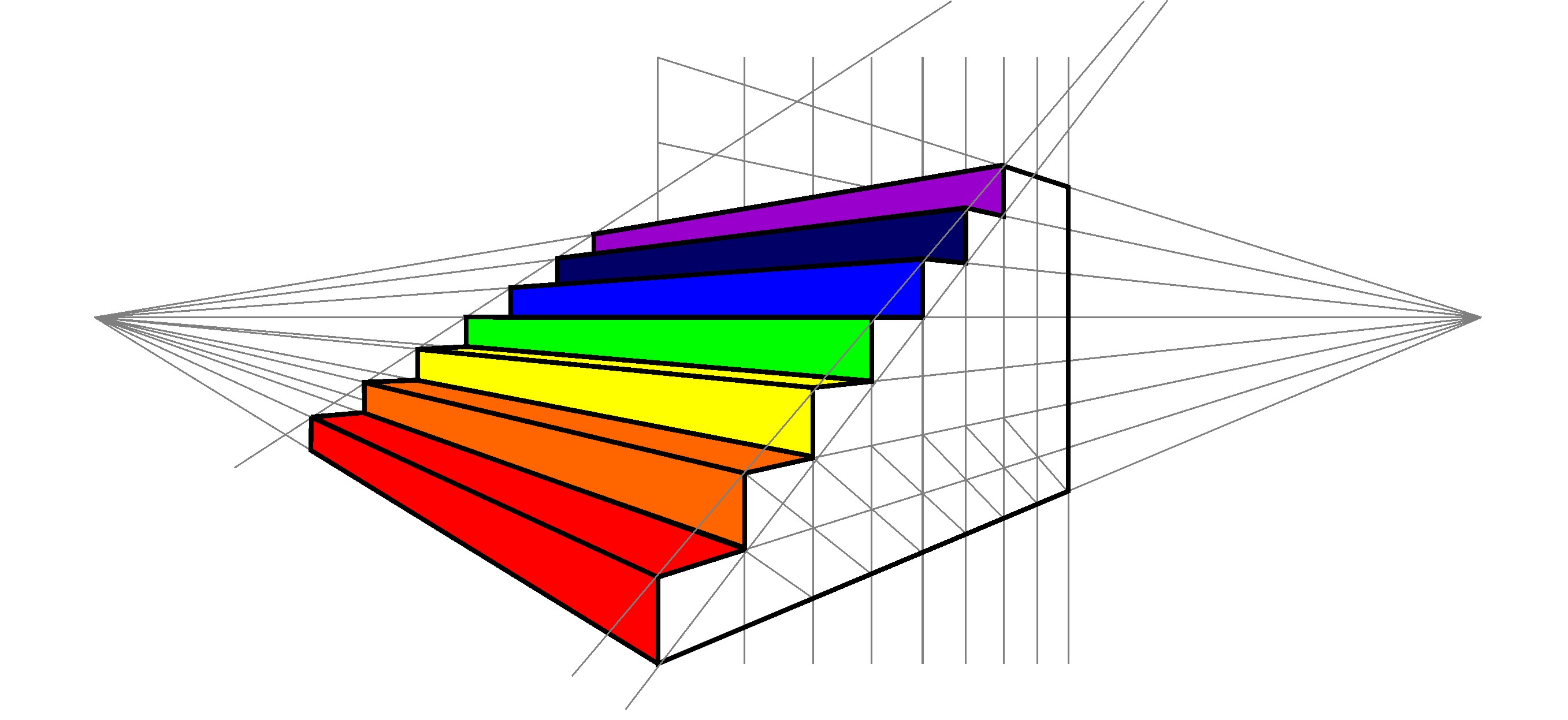
In art, point of view describes the perspective of the artist. Perspective is a set of conventions whereby an artist communicates his or her experience to another. Since the Renaissance, perspective in Western painting has used a set of geometrical rules for portraying the location and orientation of objects in space (D’Amelio, 1964). The main techniques involve visual horizons and vanishing points. The following illustration shows a set of colored steps in two-point perspective, together with their perspective guidelines.

stairs

Painters combined geometric perspective with other rules concerning shading and texture to represent reality. The Impressionists portrayed the colors of the light reaching the perceiver at every point of the visual field. Some paintings, such as those of John Frederick Peto in this website’s banner, were so successful that they became illusions of reality.

Towards the end of the 19th century artists rebelled against this approach, leaving photography to take over the role of realistic representation. Paul Cézanne became more concerned with the underlying form of what existed than with its sensory qualities. He simplified the planes and colors of what was visible so that the structure of the world could be perceived.

Inspired by Cézanne, Picasso and Braque began to push the limits of such formalism, founding a movement that came to be known as Cubism. The name came from the idea that reality might be simplified into cubes, but this is only one of many possible techniques for demonstrated structure. Outlines became prominent: Cubist paintings presented working diagrams of reality rather than mirror images (Berger, 1969). Shading was used was accentuate the outlines rather than to give the illusion of three dimensions. Transparency allowed one structure to be seen through another: foreground and background came together on the plane of the picture in a process called “passage.” Multiple different perspectives could be presented simultaneously: there was no longer any single point of view (Kahnweiler, 1920). The following illustration shows two of Picasso’s paintings of a guitarist, one before (1903) and one after (1910) the beginning of Cubism:

picasso guitarists 03 10

In the Cubist painting, the only details that suggest what is being represented are the curves and frets of the guitar. Once the viewer knows what to look for, the rest of the painting can perhaps be related to the general form of the guitarist, but this is an intimation of reality rather than an understanding. The picture is almost abstract. Other painters soon followed this path, removing ties to the visible world and creating representations of what cannot be seen.

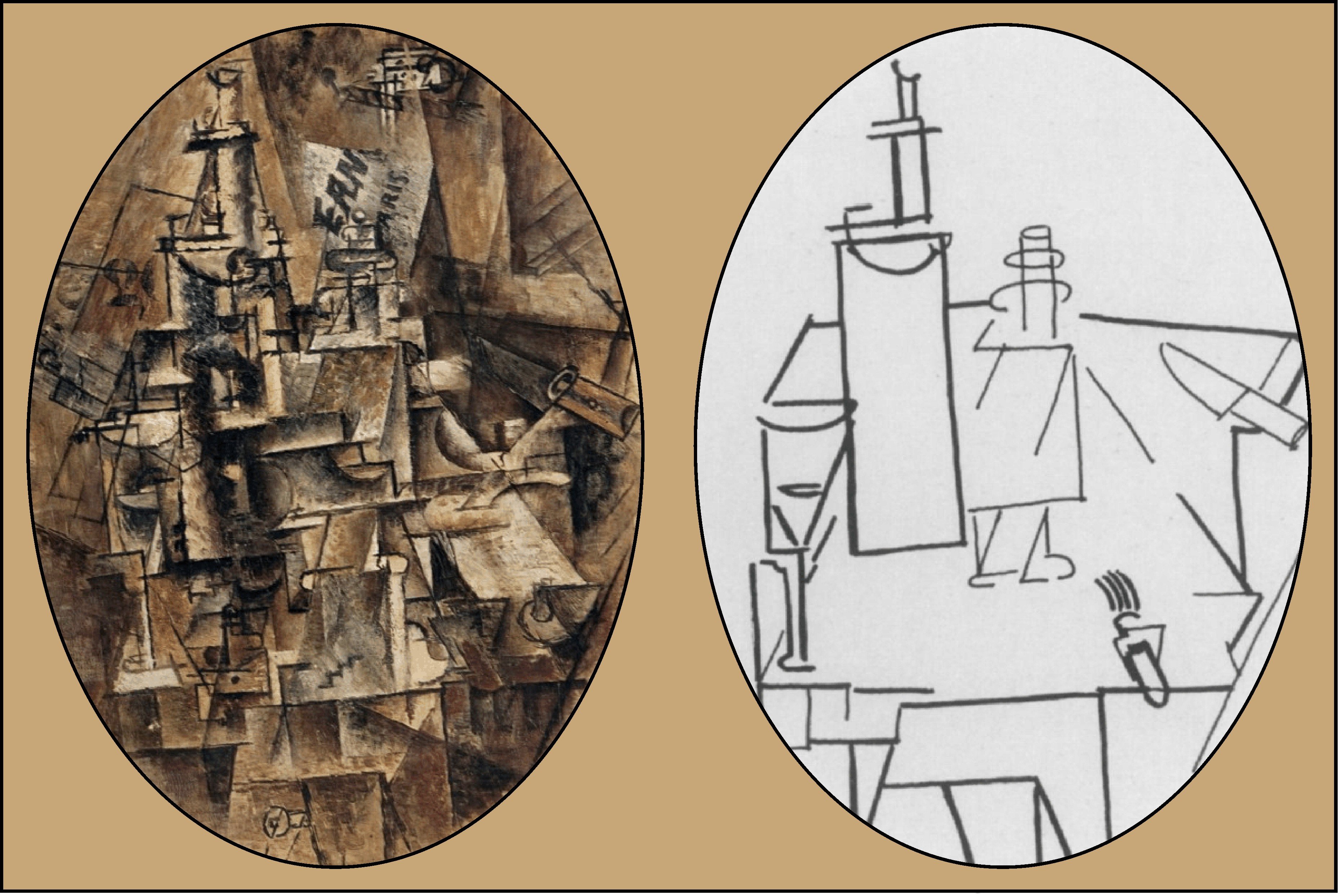
Cubist paintings continued to represent the visual world but the representations became more and more complex. The following illustration shows a painting in the Cleveland Museum of Art that represents a still life with a glass, bottle, carafe, fork and knife arrayed upon a table. However, although the painting is diagrammatic, the viewer still needs an explanatory diagram (by Henning, 1972) to see what is being represented:

picasso bottle etc

The intent of Picasso and Braque was to make painting objective rather than subjective. However, their approach came to naught. Their paintings became cluttered, idiosyncratic and incomprehensible. Some hold on reality was gained by adding illusionistic details, such as the pipes in cubist portraits, but this merely accentuated the lack of meaning in the rest of the painting. By 1912, Cubism had come to demonstrate what T. J. Clark (1999, p. 191) has called “the failure of representation.” The paintings did not communicate.

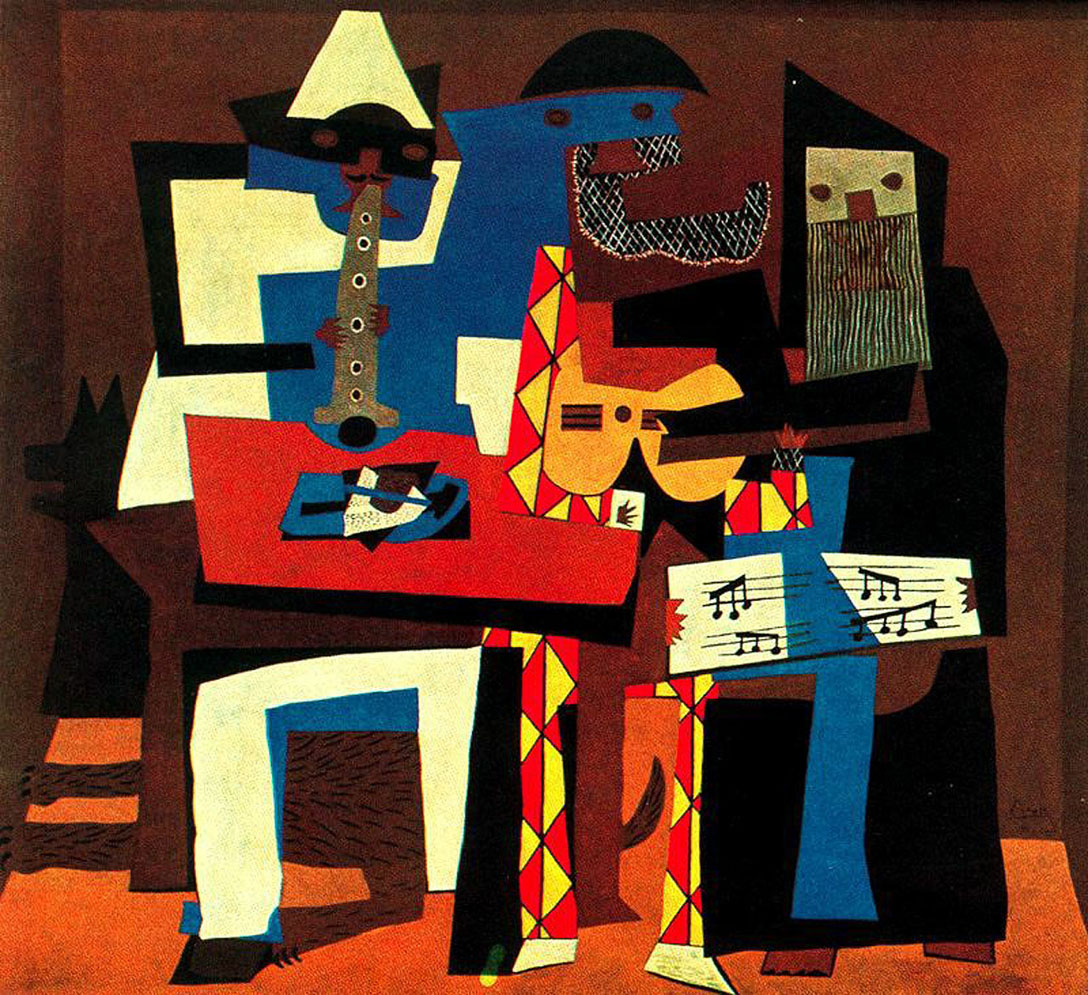
The movement changed towards a simplification rather than shattering of forms, and a return to color and texture. Synthetic Cubism became far more successful than the initial analytic version and has persisted in some form to the present. One of the masterpieces of Synthetic Cubism is Picasso’s 1921 painting of Three Musicians in the Museum of Modern Art. All three wear masks. The clarinetist dressed like Pierrot likely represents the poet Guillaume Apollinaire who died in the flu pandemic in 1918. The guitarist in the garb of Harlequin is Picasso. The vocalist on the right in the robes of a monk is Max Jacob, a Jewish poet who had just experienced mystical visions and had entered a monastic retreat. The musicians perform with a disjointed dog at their feet in a small room of doubtful perspective. The image of each musician spreads to becomes part of the others. The painting has a richness of meaning that contrasts with the aridity of Analytic Cubism.

musicians-with-masks-1921

The painting is joy to behold. It represents the pleasure of phenomenal experience: the sounds, the colors, the people. These experiences justify the evolution of consciousness:

The survival benefits of delighting in “existence” are obvious. For a start, any creature who has it as a goal to indulge its senses in the kinds of ways described will be likely to engage in a range of activities that promote its bodily and mental well-being (even if occasionally at some risk). Such a creature will do life well, we might say. (Humphrey, 2011, p. 87)

With the development of memory and thus the ability to extend consciousness over time, general awareness leads to “individuation.” (Humphrey, 2011, Chapter 9, pp. 135-146)  The phenomenal experience becomes linked to a self that persists from past to future. We develop a single point of view. Nevertheless, this individuation depends on social interactions: an individual needs others to be separate from.

Unfortunately, an individual point of view lasts only as long as the individual. One way to escape this mortality might be to dissolve the individual into some more universal consciousness. This is the goal of many of the Eastern religions: the attainment of wisdom through the loss of self.

In the Tevijja Sutta, the Buddha discusses how this might be done. The truth is not found by looking for it, but by living one’s life in the right way. Trying to understand the truth is like building a set of steps for a building when we do not know even where the building is. Better to follow the eightfold path, to attune oneself to the truth rather than attain it.

So where have we wandered in this post? Point of view is the way a person perceives the world and the way an artist represents it. Having an individual point of view is the reason for our consciousness. Expanding and sharing that point of view give us hope for persistence.

Berger, J. (1969, 1985). The moment of cubism. Reprinted in The sense of sight: Writings.  (pp. 159-188). New York: Pantheon.

Clark, T. J. (1999). Cubism and collectivity. In Farewell to an idea: Episodes from a history of modernism. (pp 168-223). New Haven: Yale University Press.

D’Amelio, J. (1964, reprinted 2004). Perspective drawing handbook. Mineola, NY: Dover.

Henning, E. B. (1972). Pablo Picasso: Bouteille, Verre, et Fourchette. Bulletin of the Cleveland Museum of Art, 59, 195-203.

Humphrey, N. (2011). Soul dust: The magic of consciousness. London: Quercus.

Kahnweiler, D. H. (1920, translated by H. Aronson, 1949). The rise of cubism. New York: Wittenborn, Schultz.

Nagel, T. (1974/1979). What is it like to be a bat? Philosophical Review, 83, 435-450. Reprinted in Mortal questions. (pp 165-180). Cambridge, UK: Cambridge University Press.

Tevijja Sutta (Digha Nikaya 1:13:27) Translation and notes provided at dharmafarer.org