Chinese calligraphy began over 3000 years ago. Over the years several distinct styles of writing evolved: oracle, bronze, seal, clerical, regular, semi-cursive (running) and cursive (grass). The Cultural Revolution (1966-1976) overturned the respect shown to these traditional modes. However, calligraphy flourished in the format of the big-character posters (大字报, dàzì bào). In the years following the revolution, Chinese calligraphy became more abstract. One of the most important modern calligraphers is Wang Dongling (王冬龄). Among his many achievements is a new writing style that he calls “chaos script” 亂書 luànshū.
A Calligrapher’s Life
Wang Dongling was born in 1946 in Rudong about 175 km north of Shanghai. He studied fine arts in Nanjing, graduating in 1966 in time for the outbreak of the Cultural Revolution. He was able to survive through this upheaval by creating big-character posters, an experience which gave him a fearful sense of freedom. He was intrigued by the traditional calligraphy that was being trashed by the revolutionaries, and in 1968 began to study with Lin Zanshi (1898-1989) in Wujiang just east of Shanghai (Barrass, 2002, p 164). This grand old calligrapher, a master of the cursive script, was known for his “iron line.” Lin survived the purges by providing calligraphy for the propaganda of the party and the poetry of Mao Zedong. After the end of the Cultural Revolution, Wang enrolled in the Zhejiang Academy of Art (now the National Academy of Art) in Hangzhou, where he studied with Lu Weizhao (1899-1980) and Sha Menghai (1900-1992). After graduating from the academy, he spent some time as a visiting fellow at the University of Minnesota and at the University of California at Santa Cruz in the United Sates. He is presently a Professor of Calligraphy at the National Academy of Art in Hangzhou.
Influences
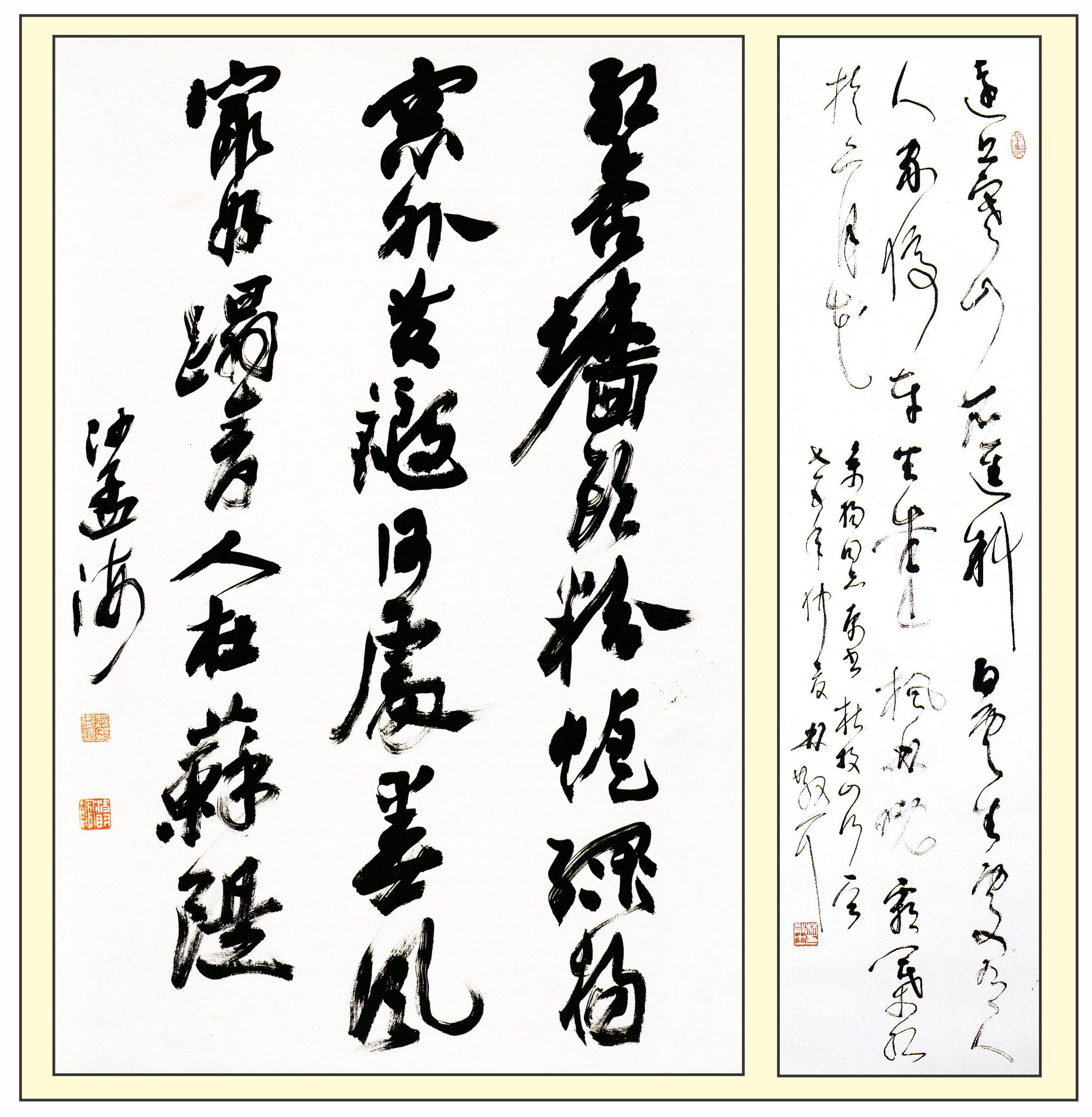
The following illustration shows calligraphy by two of his teachers: Lin Zanshi on the right and Sha Menghai on the left. Lin Zanshi wrote out the poem Going up the Hill by the Tang poet Du Mu (803–852) in 1975 using his iron line. The poem reads (Barrass, 2002, p 142)
A slanting stony path rises far up the chilly hill To where men live amidst the fleecy clouds I stop my carriage to admire the maple grove at dusk, Where frozen leaves are redder than the flowers of early spring.
In the 1980s, Sha Menghai wrote a poem about the view from his office in the Academy of Art (Barrass, 2002, p 138)
Red apricot blossom and pink butterflies can be seen over the wall While outside the window there are green willows and yellow orioles To best enjoy the spring breezes, join those who walk along Su Dongpo’s causeway across the West Lake.
East-West Interactions
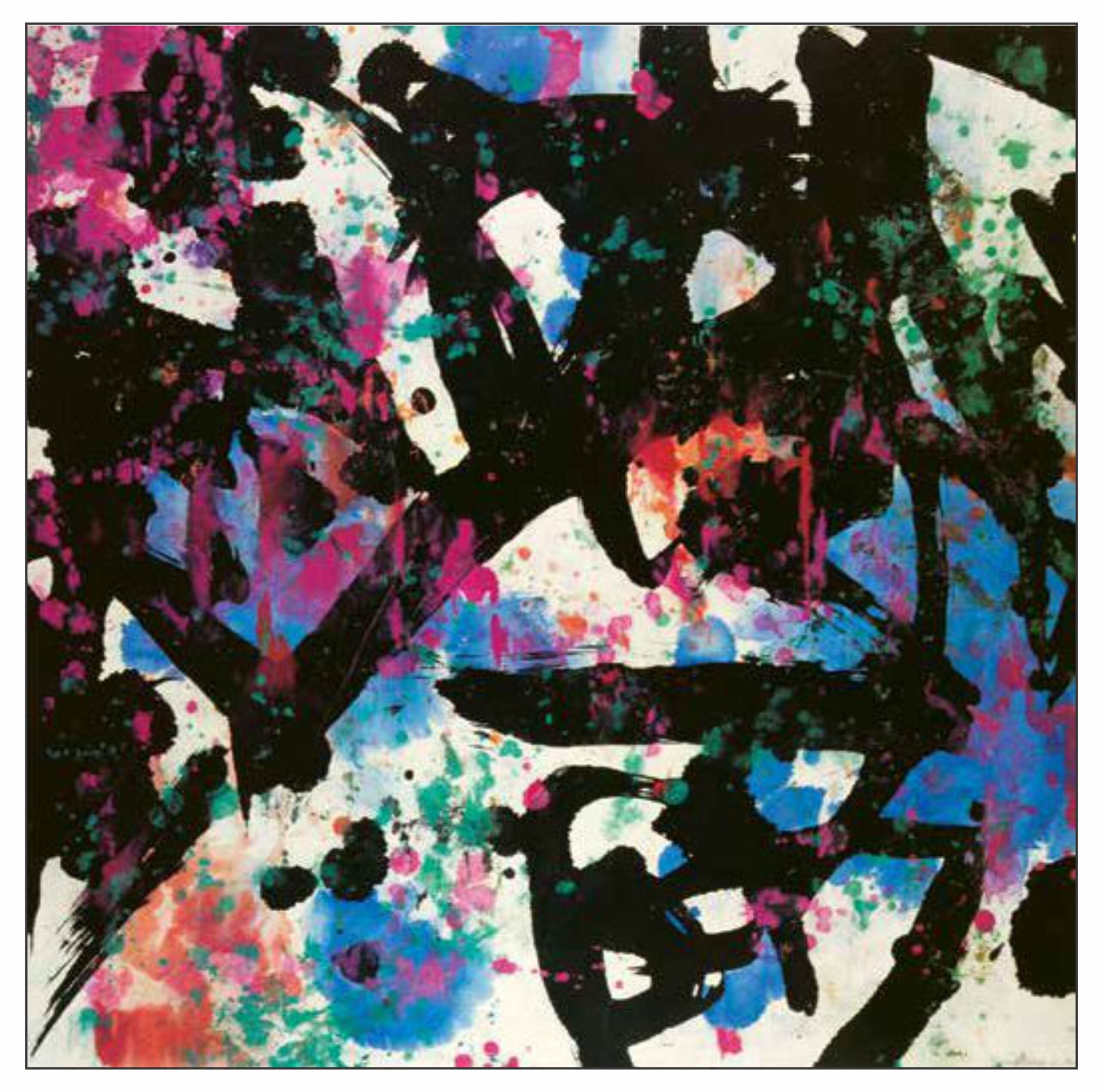
Wang was also influenced by Western abstract art. He developed a highly fluid calligraphy and combined that with the freedom of Western abstraction. The following is a work called 史記 (shǐ jì, History and Memory, 68 cm square) from 1990 (Hertel, 2016):
The black calligraphy provides a basic structure for the abstract ecstasy of the colors. Though very freely written, the calligraphy still has definite meaning.
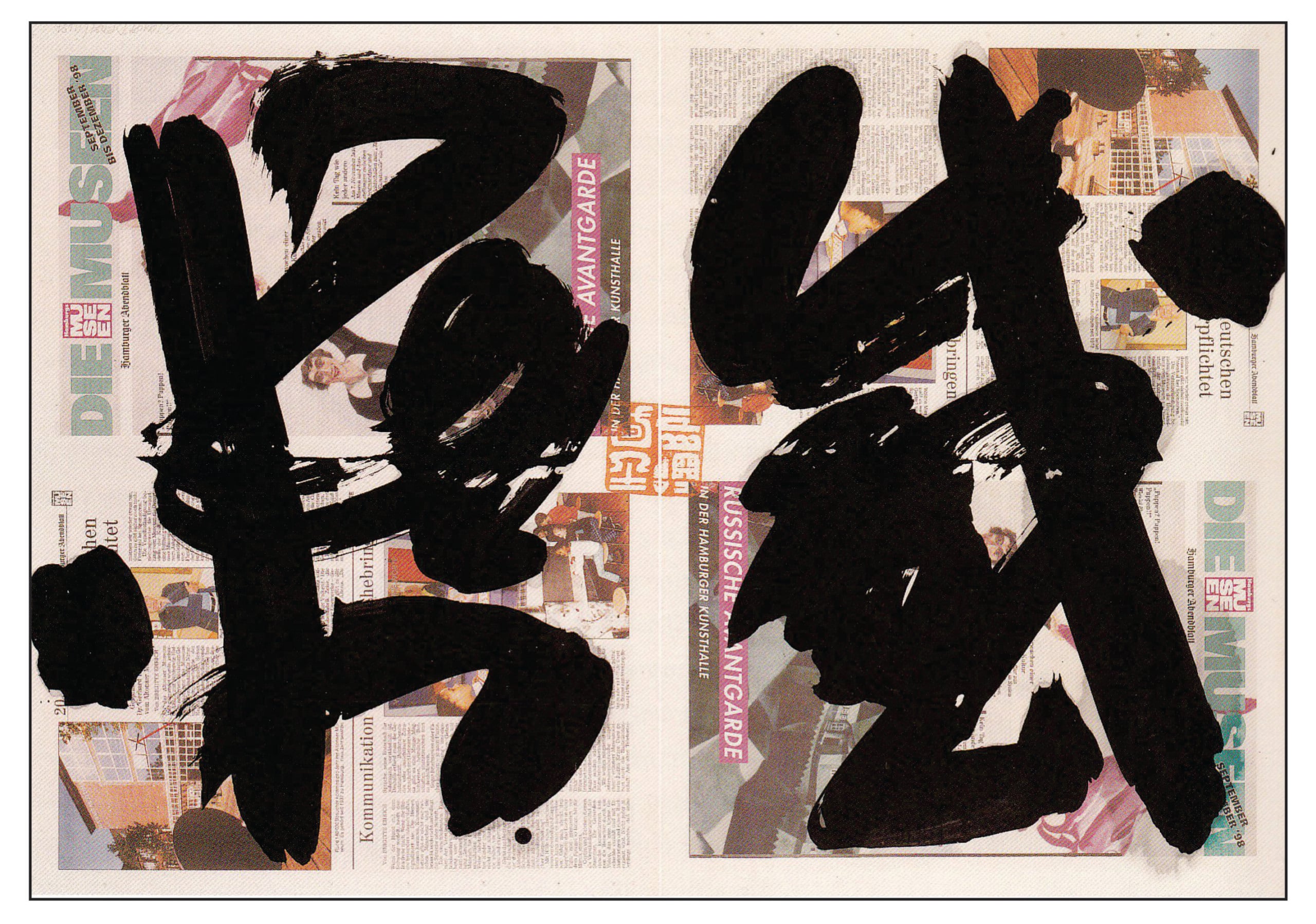
Wang also promoted direct contact between Chinese calligraphy and Western culture (Hertel, 2016). The following illustration shows Chinese calligraphy on a Western background (1999). Wang has written the character for passion/feeling (感 gǎn) on a two-page spread from a German arts magazine and then repeated the calligraphy on an identical spread.
He then placed the two sheets side by side, but with the left-hand one turned upside down. His intention was to illustrate how ‘feeling’ becomes ‘passion’ when, for example, on is ‘head-over-heels’ in love. (Barrass, 2002, p 168).
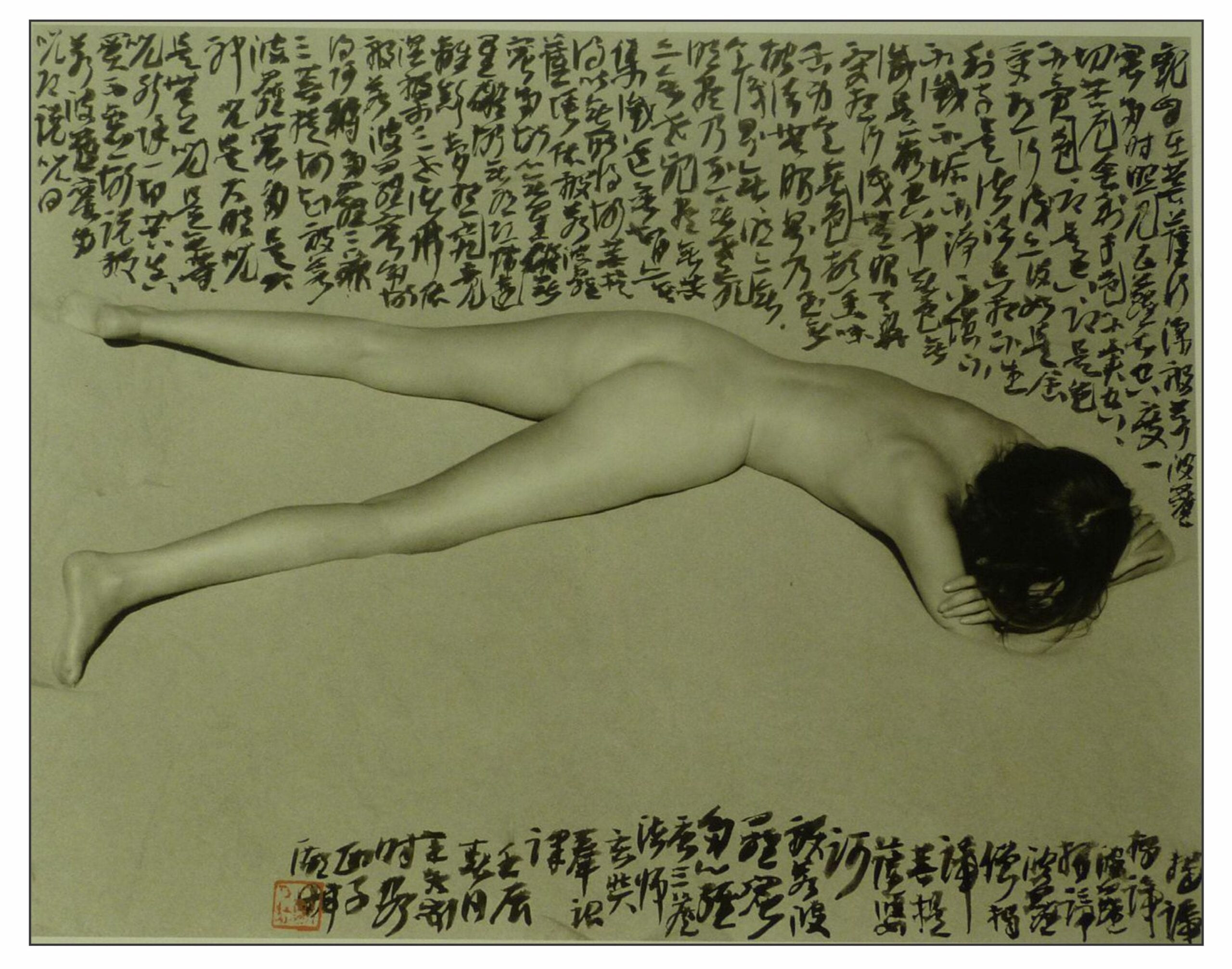
The following illustration shows another example of the interaction between East and West. In 2012, Wang wrote out the Heart Sutra on a magazine illustration (25 by 20 cm) of one of Edward Weston’s 1936 nude photographs of Charis Weston in the Oceano dunes (Iezzi, 2016). The juxtaposition is intriguing. The nude body was not a subject for Chinese artists. The main message of the Heart Sutra is that everything is “emptiness” (śūnyatā). Nothing that we perceive is real.
Large-Character Calligraphy
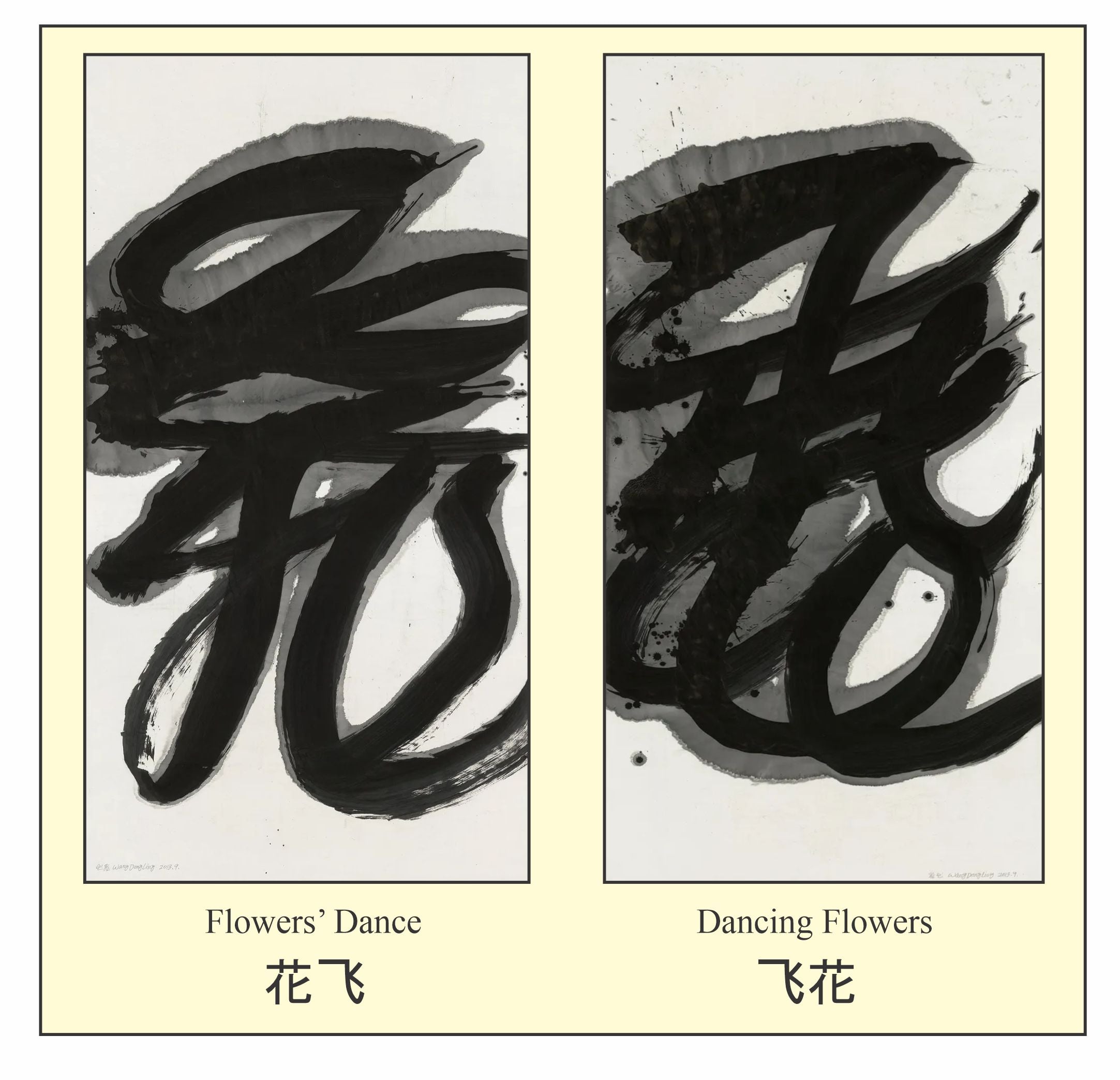
Wang was very adept at making large-character calligraphic works (大字书, dàzì shū). Unlike previous artists, he allowed the characters to overlap and to extend beyond the borders of the paper, and he let the ink to spread freely. The following illustration shows two large-character works (about 178 cm high) about flowers dancing from his 2013 exhibition.
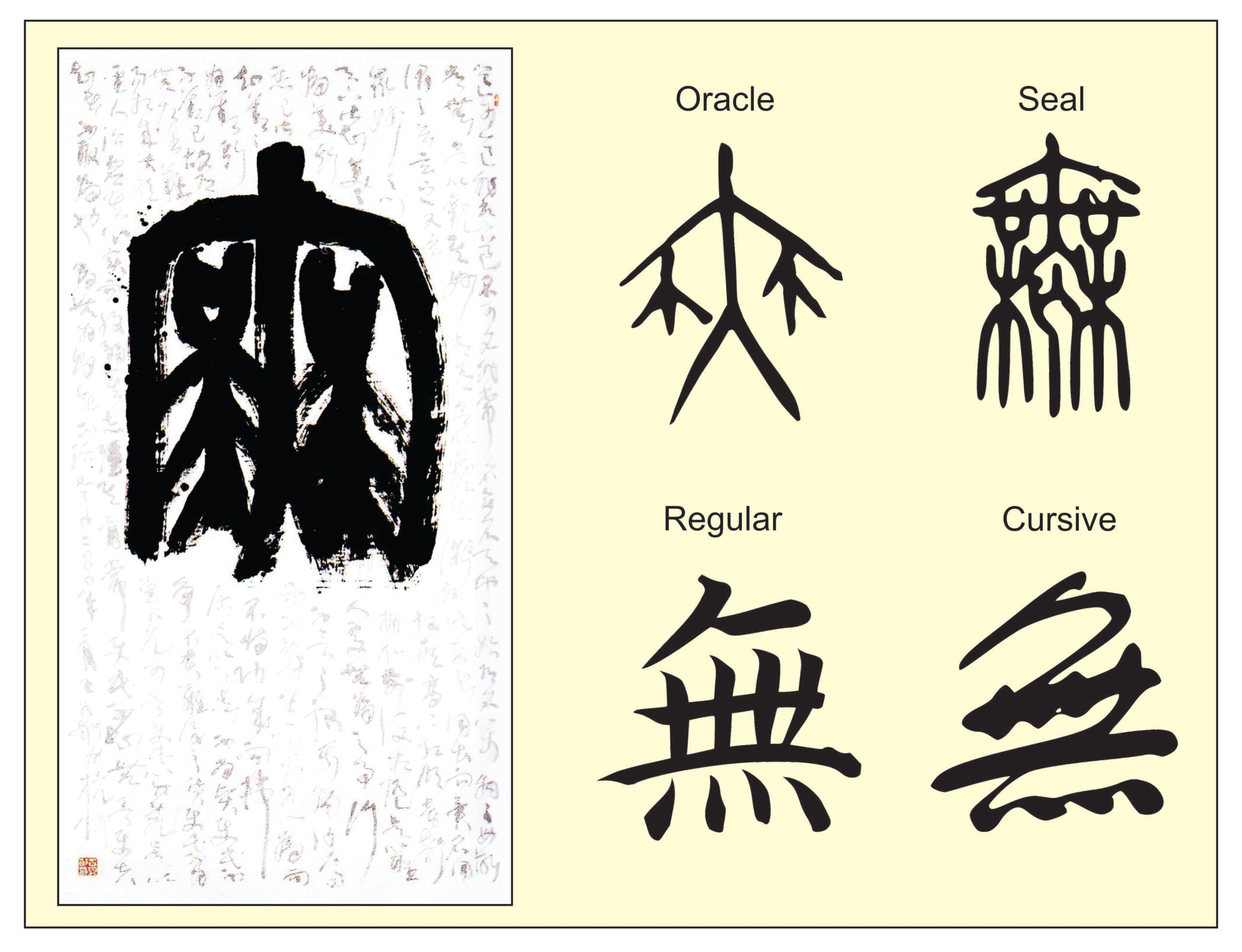
The following illustration shows on the left a large work (272 by 142 cm) entitled The Void, about the nature of the Dao created by Wang in 2000 (Barrass, 2002, p 170). The background contains calligraphy of the first two chapters of the Daodejing, written in a style similar to the “iron line” of his teacher Lin Zanshi. In the center is the character that represents absence or nothingness (無, simplified 无, wú) written in a script based on the oracle script. The right section of the illustration shows the evolution of the character from ancient times.
The following is the Chinese text of the beginning of the first chapter of the Daodejing (Wikibooks) with a recent English translation by Fischer (2023). The character 無 begins the second line:
道可道,非常道。名可名,非常名。 無名天地之始;有名萬物之母。
The way that can be (fully) conveyed is not the abiding Way; a name that can be (fully) descriptive is not an abiding name.
“Formlessness” is the name of the beginning of Heaven and Earth; “form” is the name of the mother of the myriad things.
Photographic Experiments
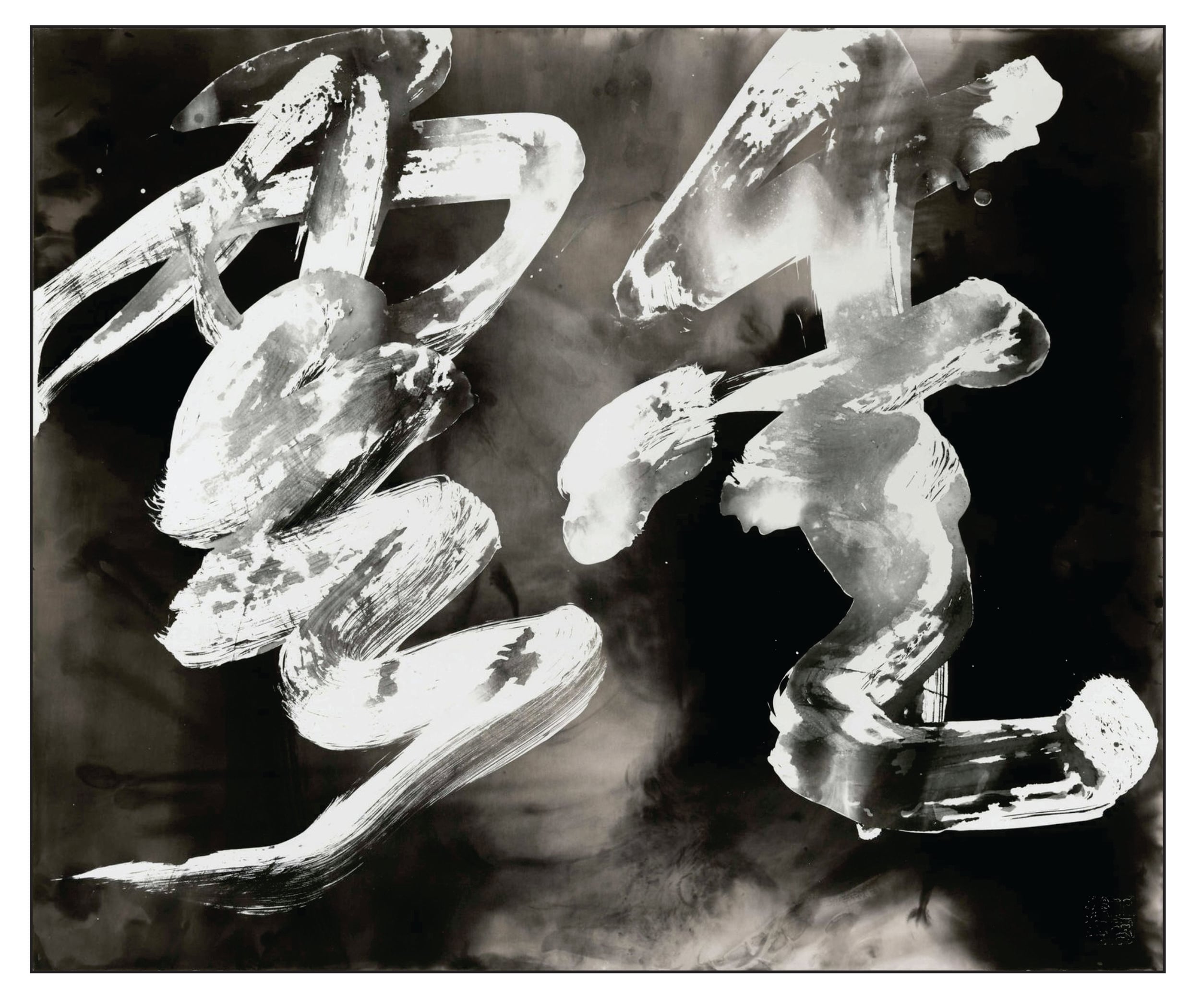
Using photosensitive paper and calligraphy written upon transparencies, Wang (2013) was able to create impressive white on black creations. The following is a gelatin silver print (51 x 61 cm) of Love Cloud (爱雲)
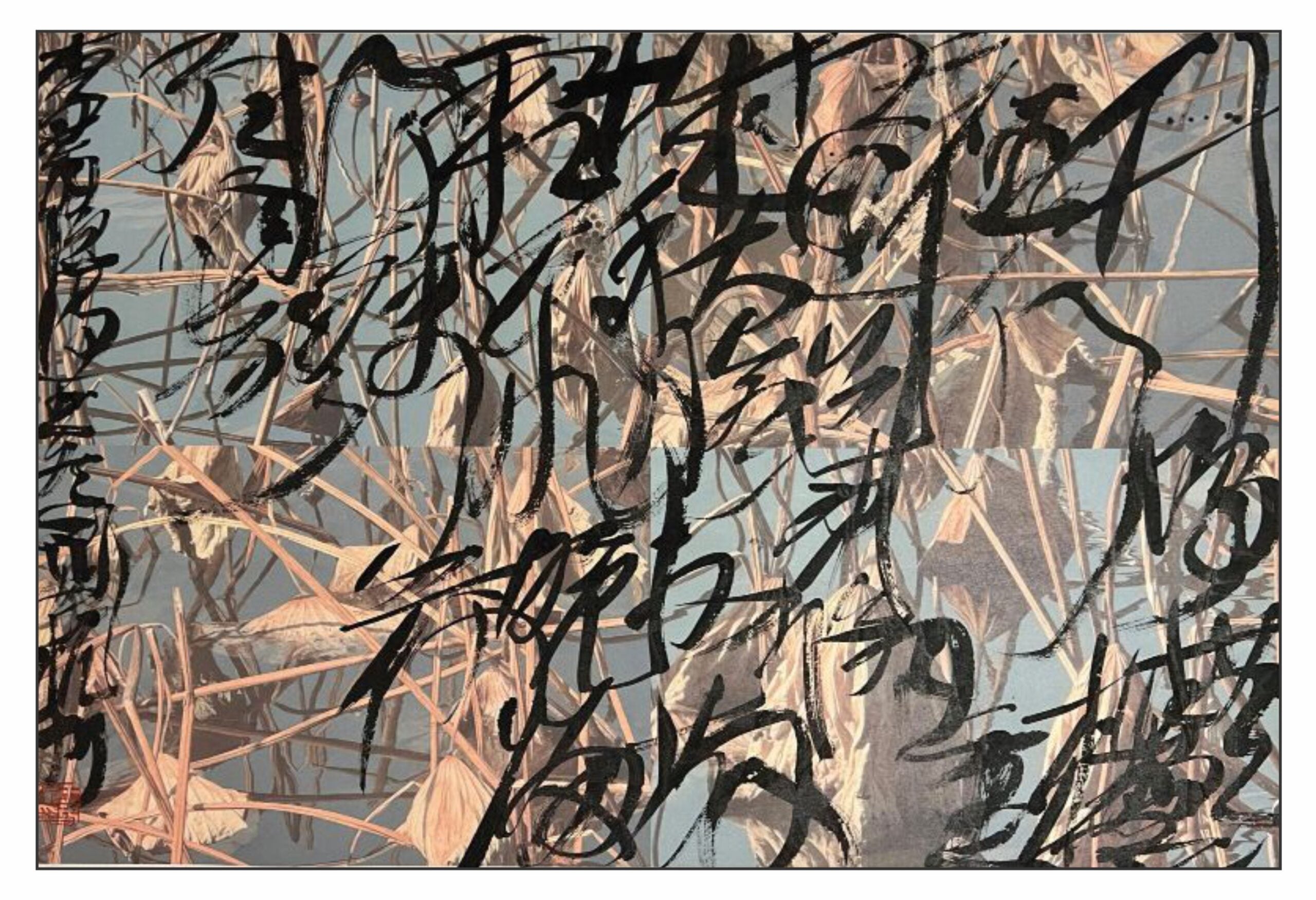
The following is calligraphy on a photographic print (51 by 69 cm) composed of four separate views of a lotus pond (Wang Dongling, 2023): Li Shangyin – Newly Washed After the Rains, the Bamboo Dock is Transformed (李商隱 – 竹塢無塵水檻清,Zhú wù wú chén shuǐ kǎn qīng)
Chaos Script
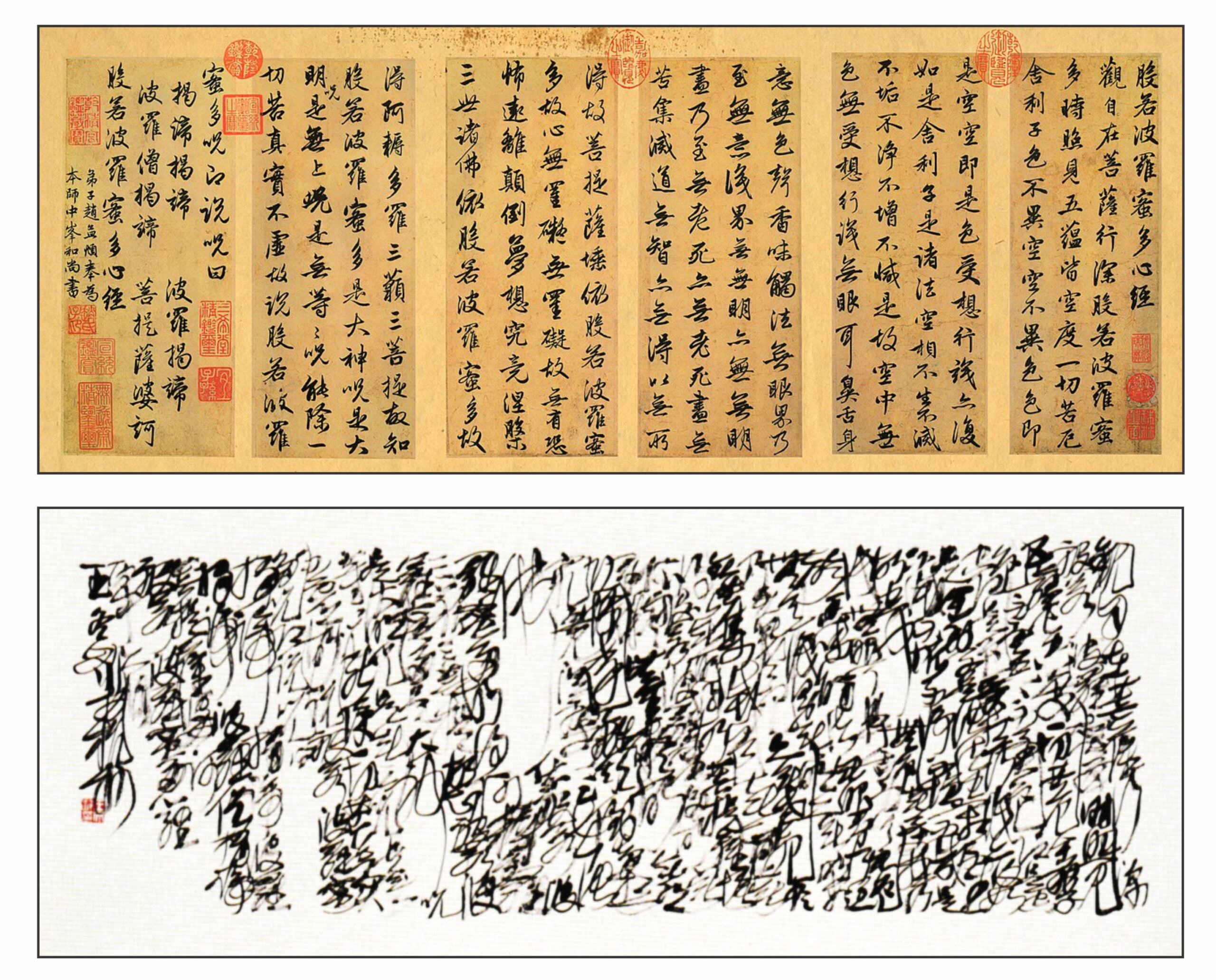
Over recent years Wang has developed a fluid cursive script called chaos script (亂書 luànshū) that breaks all the rules of traditional calligraphy (Festi & Hou, 2023). In cursive script the characters may run into each other vertically. In chaos script the characters overlap both vertically and horizontally, and can extend beyond the edges of the paper. The calligraphy is created with a long-handled brush writing on paper laid out on the ground. The resultant work shows a slow alternation of dark and light as the ink intermittently dries in the brush and must be replenished. The following illustrations show the Heart Sutra as written in regular script by Zhao Mengfu (1254–1322 CE) and in chaos script in 2016 by Wang Dongling (Ferrell et al, 2026, p 126).
The following are comments by Wang on chaos script (Wang Dongling, 2016):
Chaos Script came about gradually, over a long process of creative practice. In Chaos Script, the strokes of cursive script overlap and interweave, creating what appears to be unreadable abstract images. But the execution of Chaos Script in fact still adheres to the rules of traditional calligraphy. It is not haphazard—it appears chaotic but is actually not so. I settled on the name of Chaos Script after some deliberation. Luan evokes disorder and mess, but it also implies zhi (“control,” “govern”)—after chaos comes control. In poetry, there is a famous line [by Bai Juyi (772-846)]: “Riotous blossoms [luanhua] gradually enchant the travelers’ vision.” Chaos has a feeling of nature.
Cahos calligraphy is as much related to painting as to writing. In an essay in the catalogue of Wang’s 2016 exhibition, Britta Erickson remarks
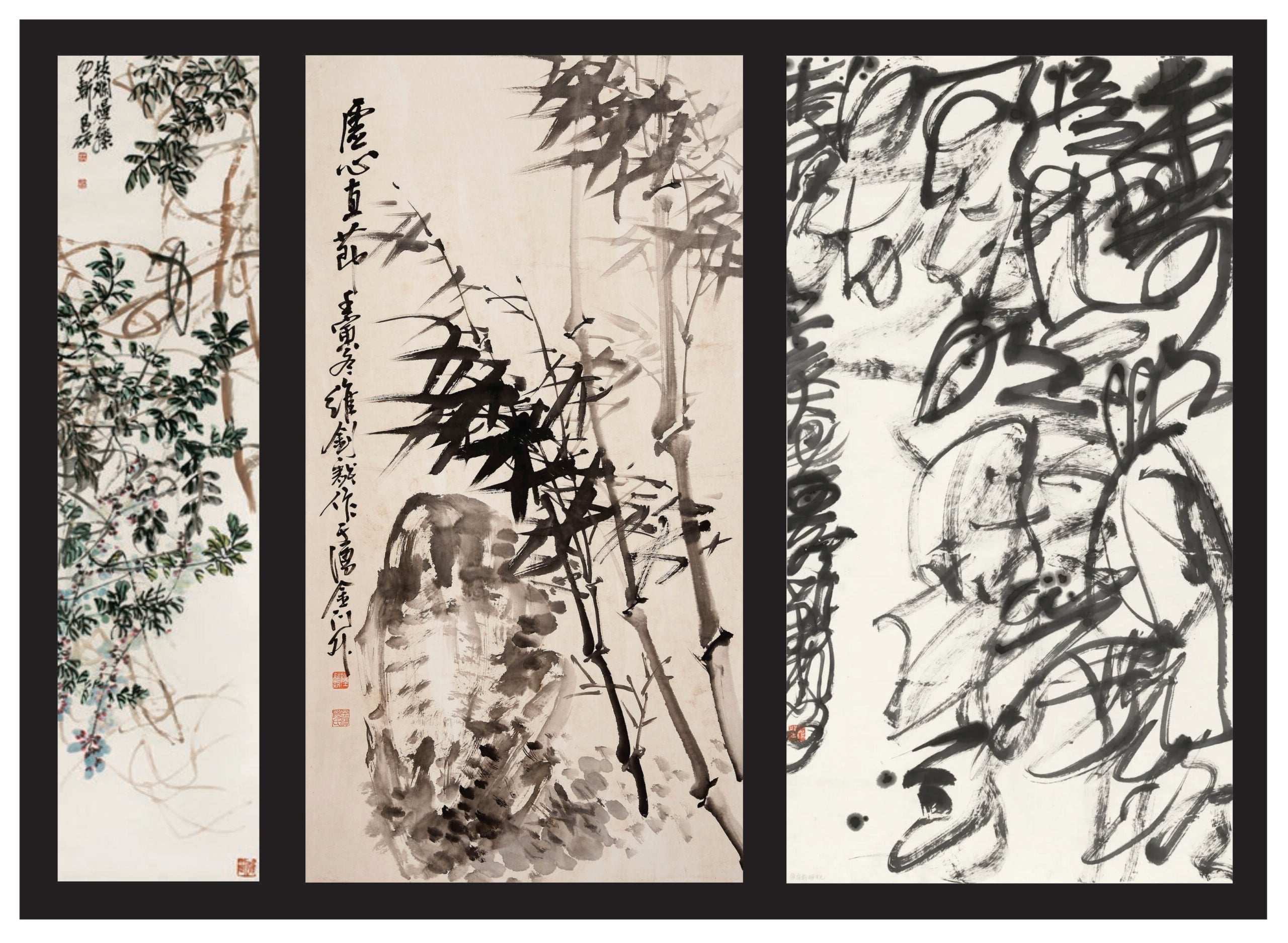
The closest comparison to Wang’s long cascades of intertwined lines that comes to mind are the vines painted by Wu Changshi 吴昌碩 (1844-1927), Professor Wang’s teacher’s teacher. One of the greatest calligraphers of the twentieth century, Wu Changshi employed calligraphic scripts in rendering natural forms. His loose, twisting renderings of vines brought together the artist’s understanding of nature, and of calligraphy, and he would allow the vines to be cropped by the paper’s edge, so that the viewer would then consider the wide spaces into which those vines stretched, beyond the frame of the painting. Wang Dongling’s Chaos Script similarly engages the mind to extrapolate beyond the paper’s edge to consider the breadth of the world into which his writing expands. The expanse can feel infinite.
The following illustration shows the transition from Wu Changshi on the left through Wang’s teacher Lu Weizhao (1899-1980) to Wang’s chaos script on the right.
Wu’s painting represents Wisteria. The inscription reads
The branches are messy and overflowing, [but] please do not chop off the vines!
The painting by Lu Weizhao depicts Bamboo and Rock (1962).
Wang’s example of chaos script is his 2019 calligraphy of the famous poem Quiet Night Thoughts by the Tang poet Li Bai (701-762):
A pool of moonlight on my bed this late hour like a banket of frost on the world. I lift my eyes to a bright mountain moon. Resigned, remembering my home, I bow. (translation Sam Hamill, 2013, p 94).
Calligraphy as Performance
Chaos script lends itself easily to performance. It is an art based on action. The following are comments by Gao Shiming (2023):
Writing becomes simple ink, markings, and traces, and the physicality and emotional tenor of the writing becomes the centre of everything. Wang’s chaos script crystallises action. When that action stops, the state and meaning of that movement linger. This state of action is a dance that arises when the mood strikes. The impulse to write chaos stems from writing in an uninhibited state of disorientation and overwhelm. In the state of writing generated by the dialectic between chaos and order, a calligrapher loses himself yet finds contentment.
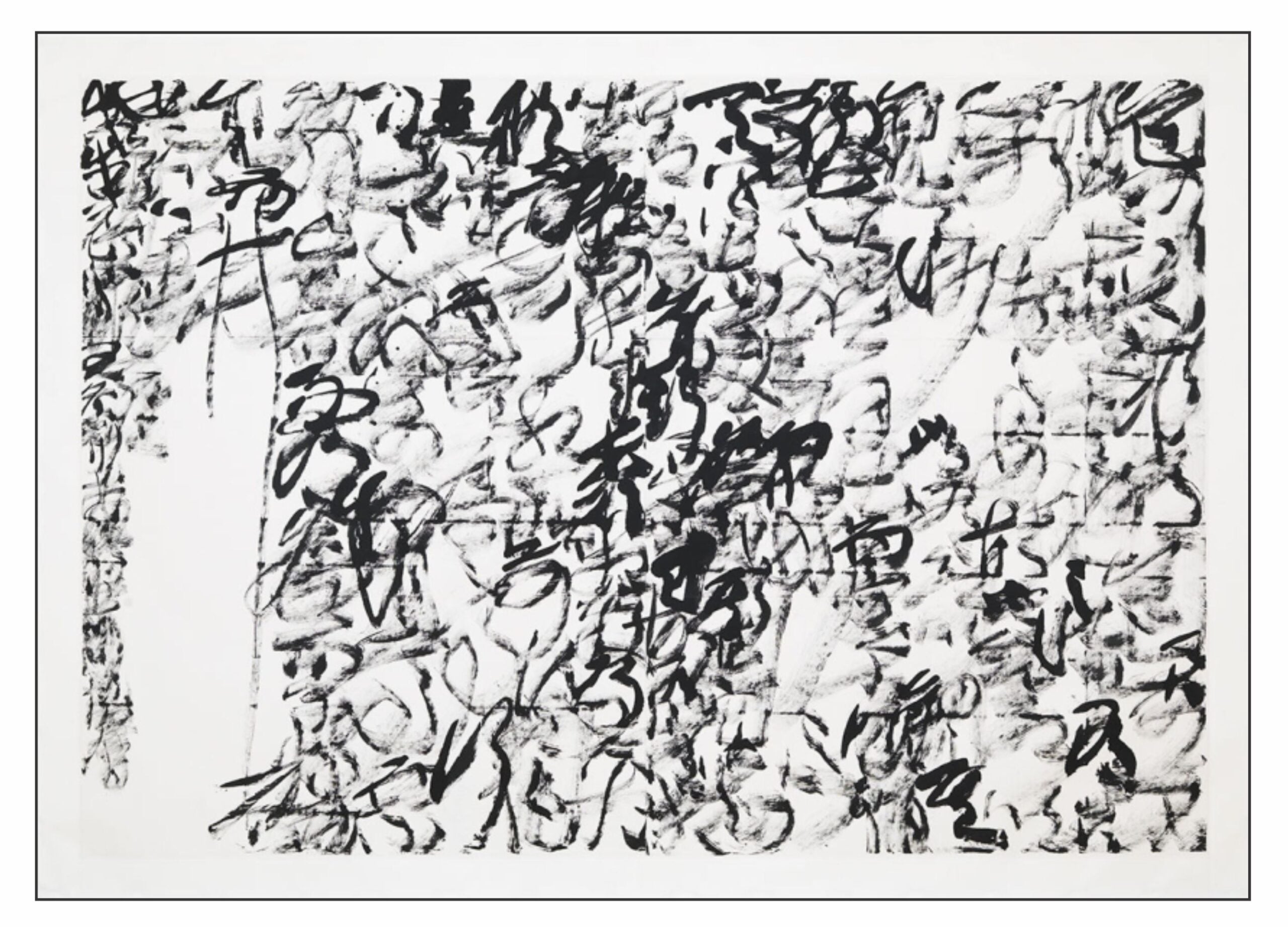
The following shows a video of Wang Dongling writing out the first two chapters of the Daodejing in chaos script at the Asia Society Museum in New York in 2018.
And the following illustrations shows the calligraphy in its final form:
References
Barrass, G. S. (2002). The Art of Calligraphy in Modern China. British Museum Press.
Ferrell, S., Kong, W., Hiro, R. I., Little, S., Moon, V., &Ng, L. W. (2026). Line, form, qi: calligraphic art from the Fondation INK collection. Los Angeles County Museum of Art.
Festi, G. & Weihuan Hou. (2024). Contemporary reinventions of Chinese calligraphy. A semiotic exploration. Ocula (Online), 25(3). https://doi.org/10.57576/ocula2024-6
Fischer, P. (2023). The annotated Laozi: a new translation of the Daodejing. State University of New York at Albany.
Gao Shiming (2023). Chaos script – the dialectic between order and chaos. China Academy of Art
Hamill, S. (2013) Crossing the Yellow River. Three hundred poems from the Chinese. Tiger bark Press.
Hertel, Shao-Lan. (2016). Lines in translation: cross-cultural encounters in modernist calligraphy, early 1980s-early 1990s. Yishu, 15(4), 6–28.
Iezzi, A. (2016). “Chinese modern calligraphy” as a reflection of Chinese contemporary culture: a comparison between modernism (Wang Dongling) and avant-garde (Xu Bing). Italian Association for Chinese Studies. Selected Papers 1, 75-116
Wang Dongling (2016). Writing Chaos. 亂書. Exhibition Catalogue published by Ink Studio, Beijing.
Wang Dongling (2024). The joy of being. 信可樂也 Exhibition Catalogue published by iPRECIATION, Singapore.
Shambhala: Mountain Sanctuary
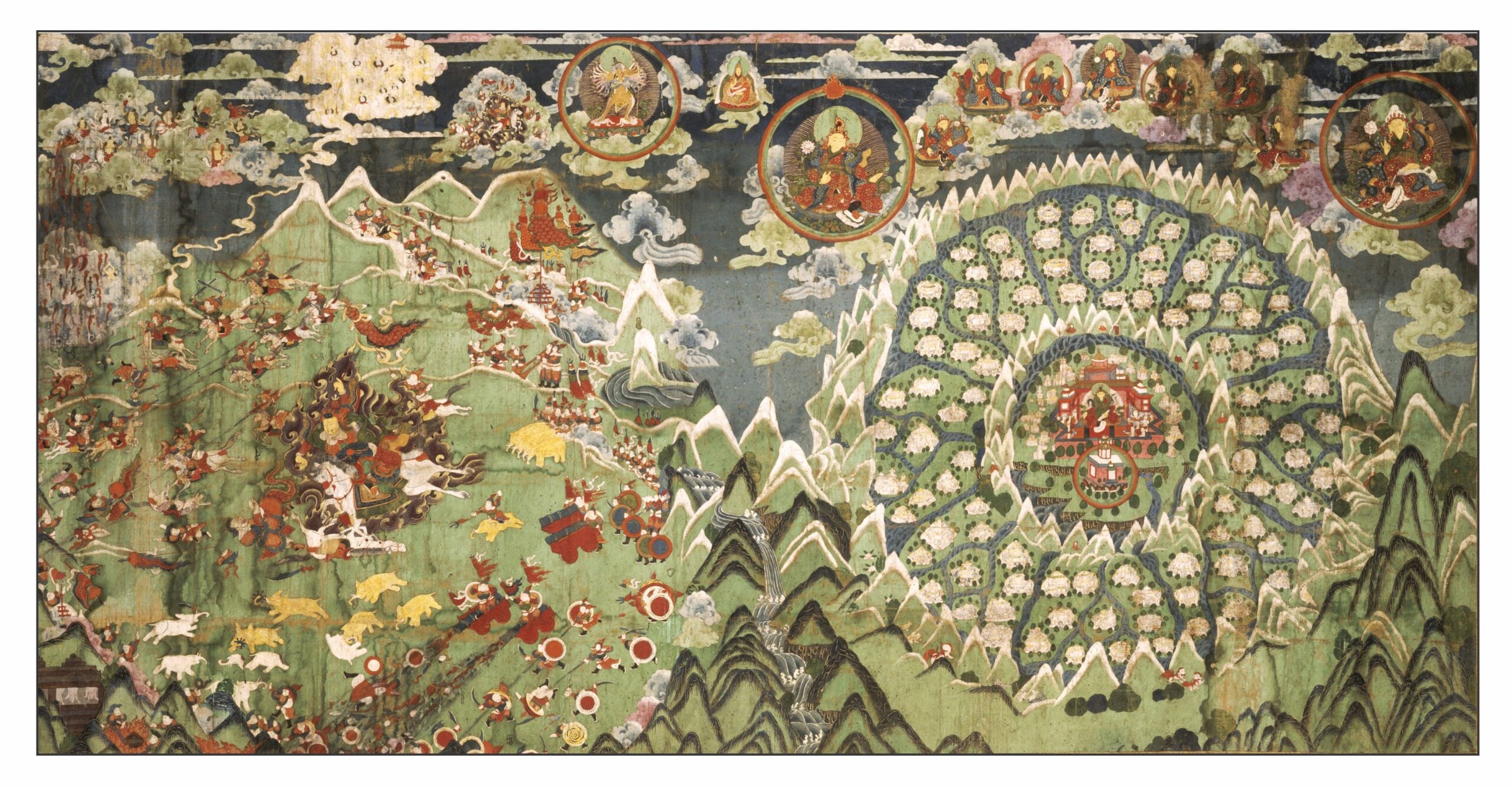
Shambhala is a mythical kingdom described in the teachings of Tibetan Buddhism as a place of sanctuary. Paintings show the kingdom isolated from the rest of the world by a ring of mountains. At the center of the kingdom is the capital Kalapa, itself surrounded by another ring of mountains. The palace of the king has roofs of solid gold and is adorned with pearls and other jewels. Outside the capital, rivers divide the kingdom into eight regions arranged like the petals of a lotus flower. Each of these regions contains 12 principalities, so that 96 princes pay allegiance to the king of Shambhala. The illustration shows a Tibetan painting of Shambhala from the 19th Century in the Musée Guimet. Many travellers have tried unsuccessfully to find Shambhala. It remains a spiritual rather than physical place.
The Geological Upheaval
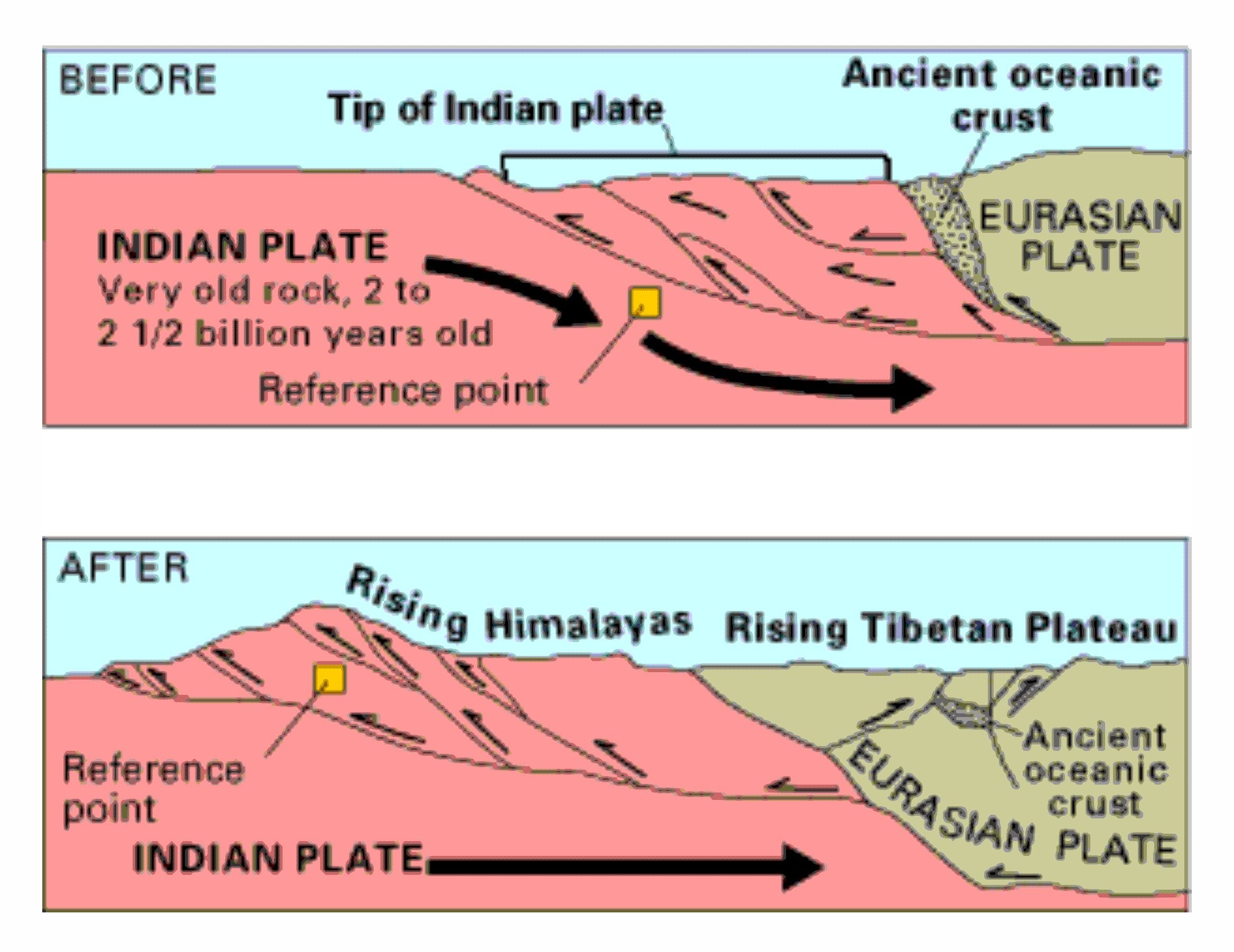
About 40 million years ago the northward-moving Indian tectonic plate collided with the Eurasian plate. The edge of the Indian plate was buckled and forced upward to form the Himalaya mountains. As the Indian plate moved under the Eurasian plate its surface rose to form Tibetan plateau.
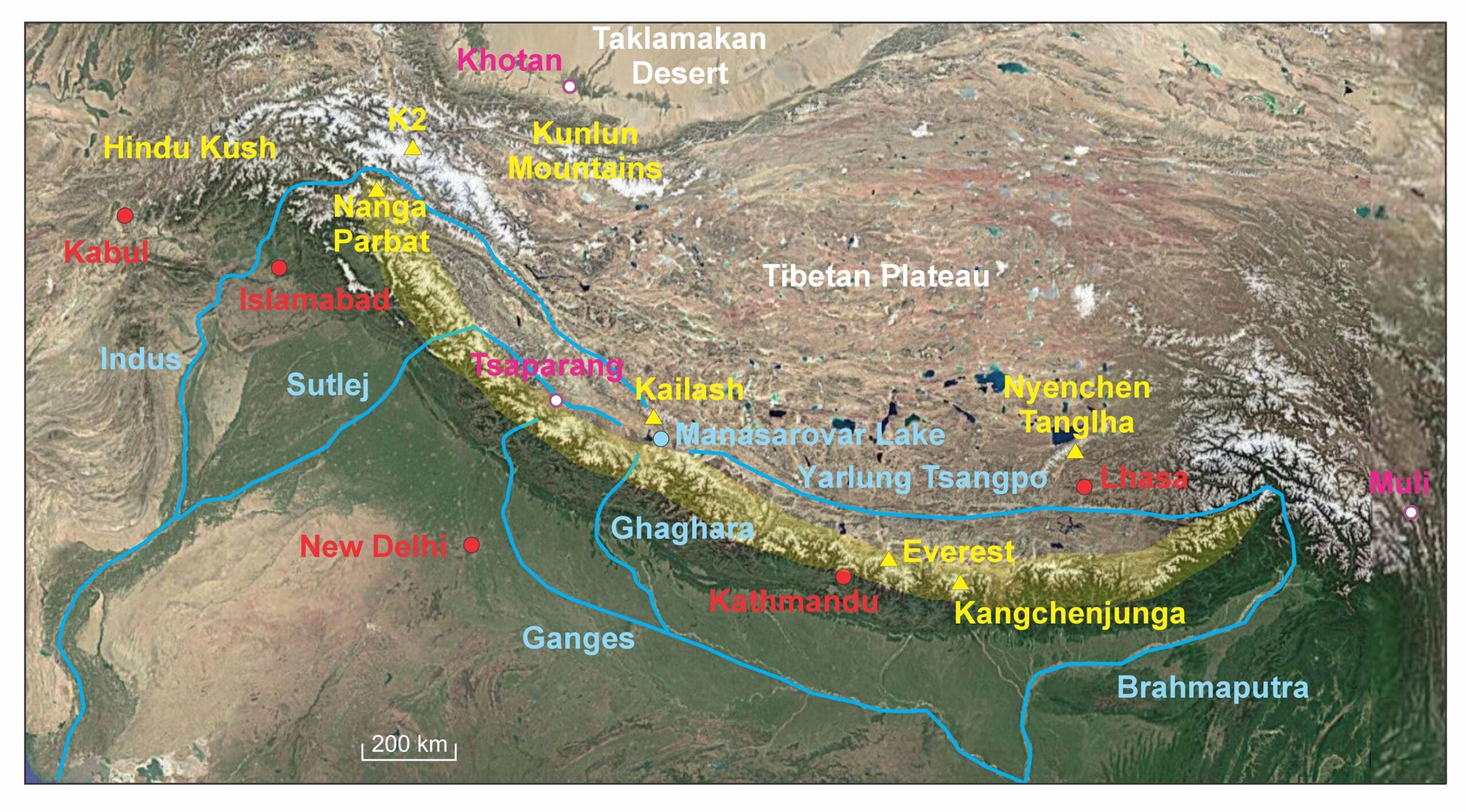
The Himalayas, stretching in a crescent from the Indus River in the west to the Brahmaputra River in the east (shaded light yellow in the following map) are the highest mountains in the world. They contain Mount Everest and nine other peaks greater than 8000 meters above sea level. The only other mountains with such height are the Karakorams with K2 as their highest peak. The Tibetan Plateau, a vast elevated region north of the Himalayas has an average height of about 4500 meters above sea level, and is often known as the “roof of the world.”
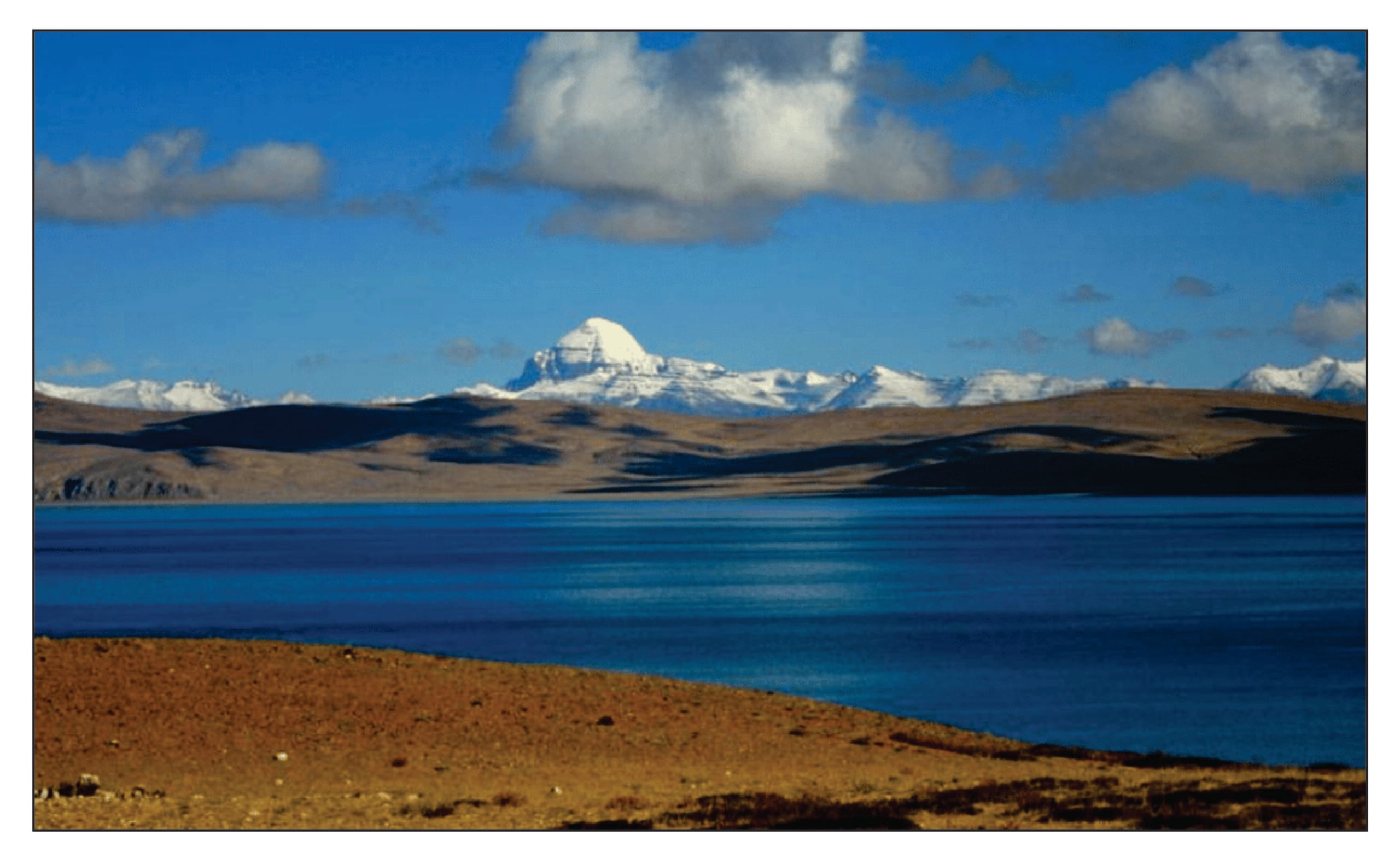
Lake Manasarovar in the southwest part of the plateau is the world’s highest freshwater lake. Its name – “lake of consciousness” – comes from the Hindu myth that it was created out of the mind of Brahma. Just north of the lake is the isolated Mount Kailash (“crystal”), which may be the Mount Meru (“wonderful”) of Hindu mythology. Meru is described as the central axis of the world, and the abode of Shiva and his consort Parvati.
Glaciers in the Himalayas are the source of many of Asia’s largest rivers. The region near Lake Manasarovar and Mount Kailash provides sources for the Indus, Sutlej, Ghaghara (which is a tributary of the Ganges) and the Yarlung Tsangpo (which becomes the Brahmaputra) Rivers. The Yellow, Yangtze, Mekong, Salween and Irrawaddy Rivers drain from the eastern edge of the Tibetan Plateau (not shown on the map).
Colliding Religions
The main ancient religions of the Indian peninsula are Hinduism, Jainism and Buddhism. Hinduism began in the valley of the Indus River around 3000 BCE and became codified in the Vedas written between 1500 and 500 BCE. The main tenet of Hinduism is the concept of dharma, a principle that both drives the universe and ordains what is right and wrong. Individuals experience a continual process of life, death and rebirth, known as samsara. Karma ensures that all actions have their just and necessary outcome, although this might not happen within one lifetime but in a later reincarnation. There is no single divinity but a multitude of forces that each play their part in the unfolding of the universe. The universe goes through long cycles of creation, preservation, decline and destruction.
Jainism developed from 800 to 500 BCE as an offshoot of Hinduism. It denied the gods – atheism – rejected violence of any kind – ahimsa – and declined worldly pleasures – ascetism. This was (and is) a religion for the few rather than for the masses.
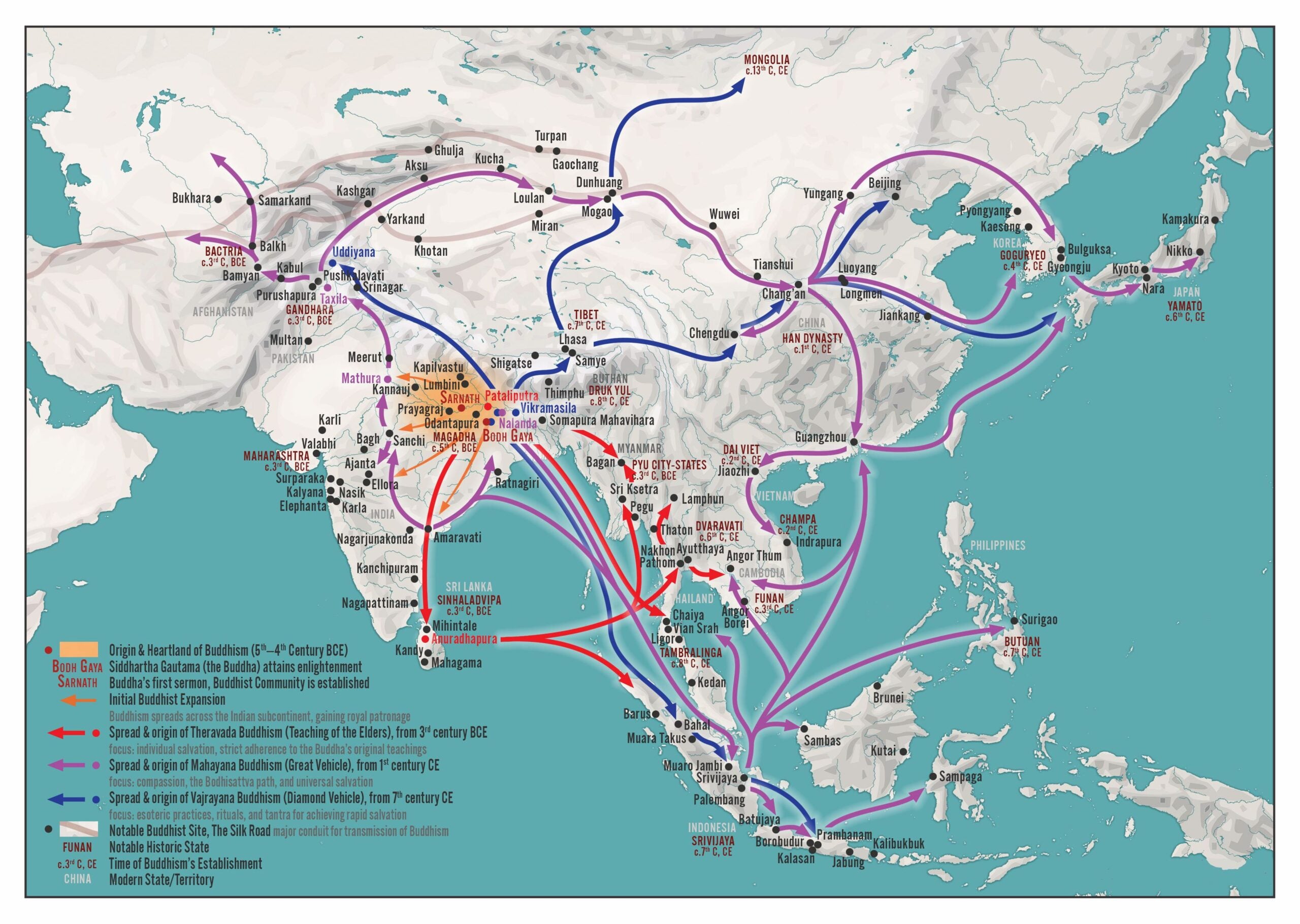
Buddhism was founded by Siddhartha Gautama who lived in northeast India around 500 BCE. He renounced his royal upbringing, and through meditation and ascetism attained release from samsara and union with the cosmos in a state of anatta (non-self). He then taught his disciples the basic principles whereby they could do the same. Suffering is caused by desire for worldly things; one can escape from suffering by rejecting desire and following the “eightfold path.” Many were attracted to this new religion and by the time of the Emperor Ashoka (3rd Century BCE), it had spread throughout the Indian peninsula, crossed the sea to Sri Lanka and travelled east to what is now Afghanistan. Travelling along the Silk Road, Buddhism reached China by the 1st Century CE, from where it later expanded into Korea and Japan. Buddhists from both India and Sri Lanka spread their religion to southeast Asia by the 3rd Century CE and thence to Indonesia and the Philippines. The following map is from the World History website
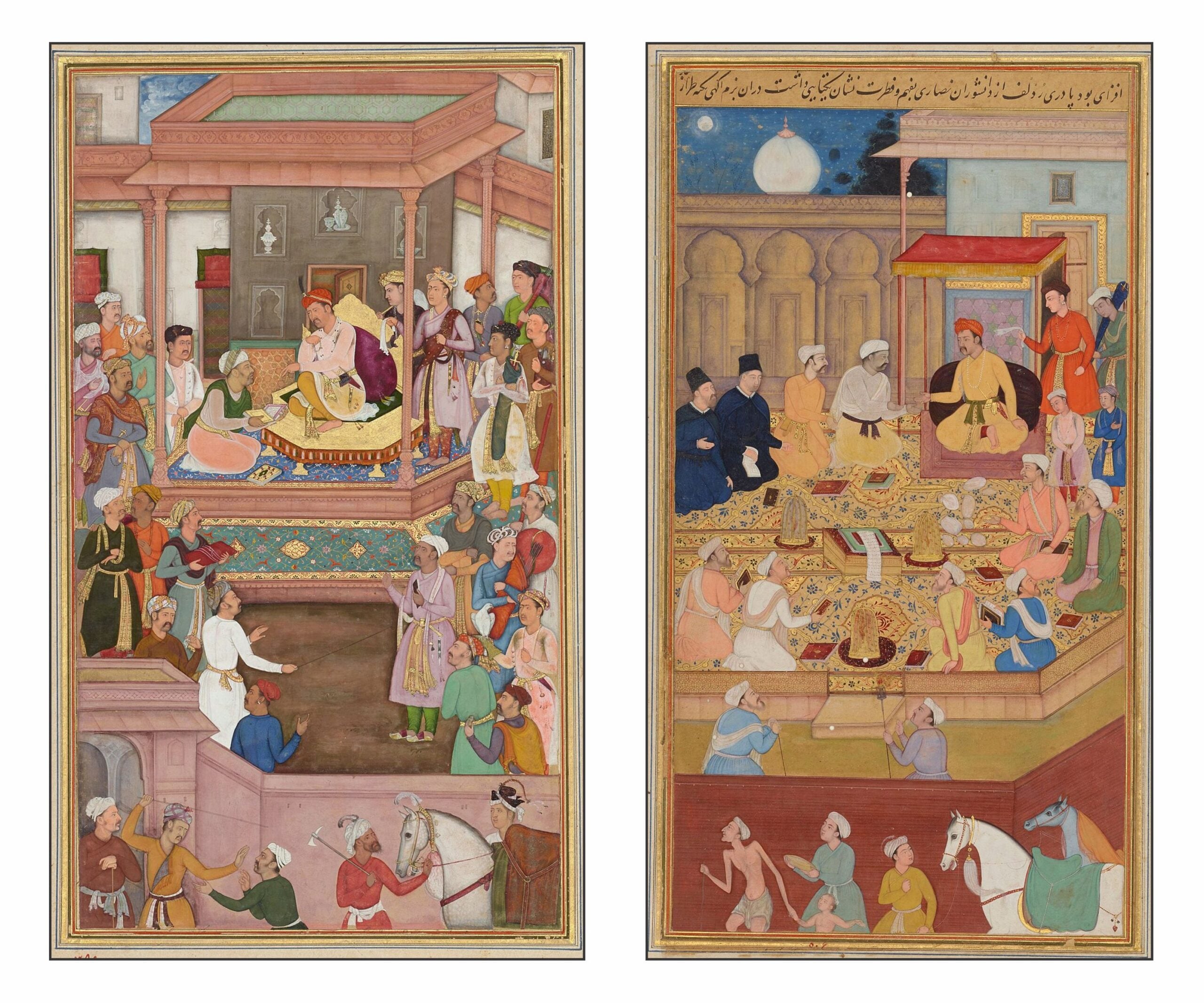
Islam was founded in 622 CE in Arabia and soon began to expand rapidly. The first incursions into the region of the Indus valley occurred in the 8th Century. Multiple invasions followed. By the 16th Century, the northern part of India was under the rule of the Mughal Empire. The court of Akbar the Great (1542-1605 CE) attracted scholars and artists. The following paintings show on the left Akbar receiving the Akbarnama (a history of his reign), and on the right Akbar discussing religion with Hindu scholars and two Portuguese missionaries. Both paintings were part of the Akbarnama (1605).
Notable in the above illustration is the absence of any Buddhists. By the time of Akbar Buddhism had essentially vanished from India. The Muslim invaders had destroyed Buddhist monasteries and slaughtered the monks. The holy sites in northern India – Sarnath and Bodh Gaya – had fallen into ruins. Most Buddhist temples had become places of Hindu worship. Remnants of Buddhist culture survived in the south, and many monks retreated to mountain sanctuaries in the far northern India and Tibet. Many scholars have tried to explain why Hinduism survived the Muslim onslaught but not Buddhism (e.g., Hazra, 1995; Sarao, 2012). Probably the most important difference was that Hinduism was a religion for the masses and Buddhism a religion for monks. Hinduism provided festivals and celebrations whereas Buddhism offered only suffering and ascetism. Another reason was that Hinduism was pluralistic in its belief. Hinduism worshipped many different gods in many different ways, whereas Buddhism tended toward rigid doctrines. Perhaps laxness in the monastic orders also contributed to their downfall: why should the people support the debauchery of monks.
The Wheel of Time
Buddhism initially reached Tibet in the 7th Century CE. With the Muslim invasions of India from the 8th to the 15th Centuries many more Buddhists fled to safety in the northern mountains. They assimilated some of the religious traditions indigenous to Tibet and many of the ideas of Hinduism. The resultant doctrines became the basis of the Vajrayana (“diamond vehicle”) branch of Buddhism, different from the Mahayana (“great vehicle) branch of Buddhism which spread into China and the Theravada (“doctrine of the elders”) branch which spread to Sri Lanka and southeast Asia.
The Tibetan Buddhist teachings were recorded in the Kalachakra (“Wheel of Time”) Tantra (“weaving/teaching”), which likely originated in the 10th or 11th Century CE. Its contents are only known through later commentaries such as the Paramadibuddha (“Supreme First Buddha”) and the Vimalaprabha (“radiance of purity”). According to the former, the Kalachakra teachings were first given by the Gautama Buddha to Suchandra the king of Shambhala who had come to seek instruction from the enlightened one. (Newman, 1985).
Shambhala is described as a country north of the Himalayas:
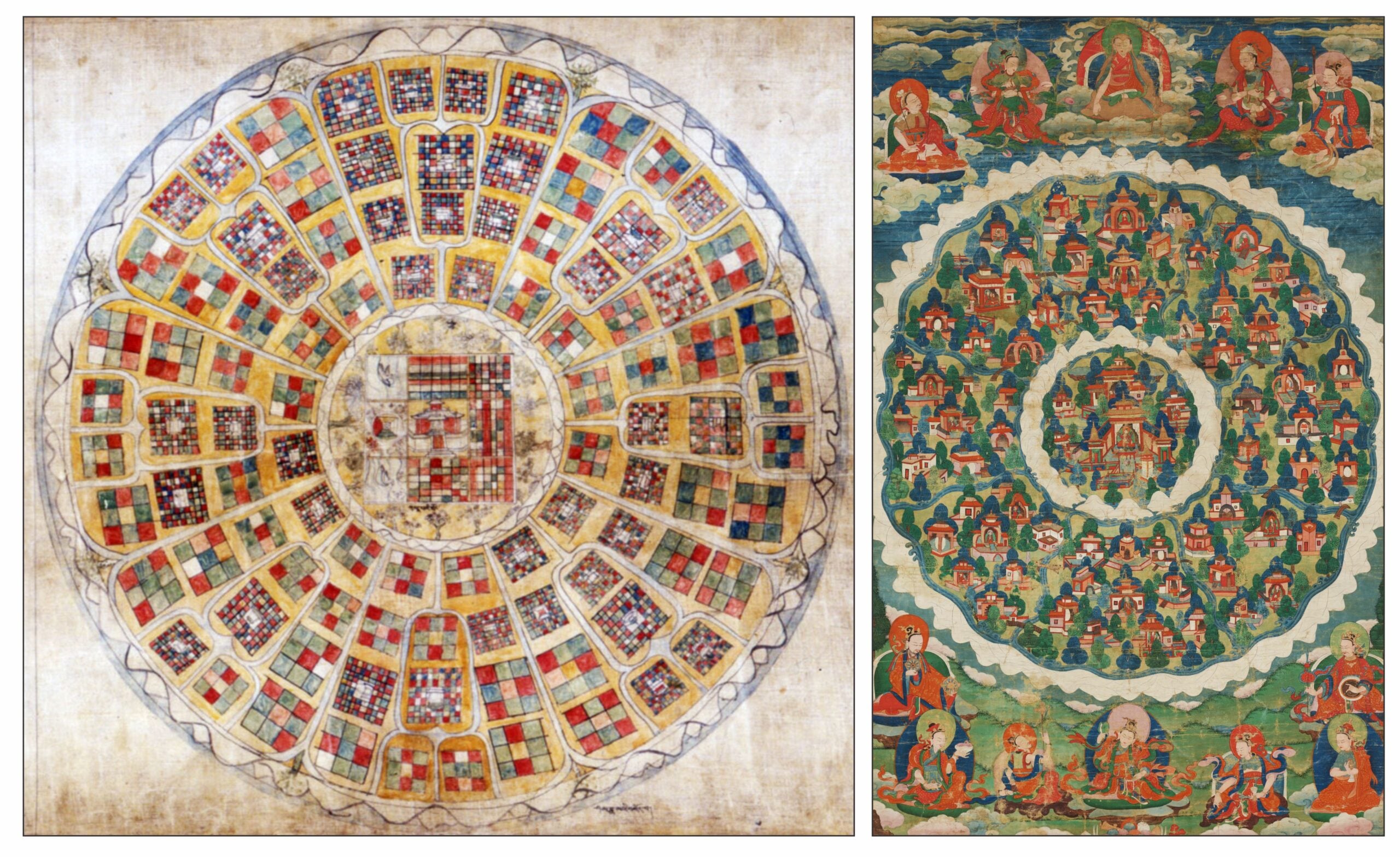
Shambhala is shaped like a giant lotus having eight petals. The outer perimeter of the entire lotus is formed by a circle of great snow mountains, as is the perimeter of the pericarp that makes up the central third of the country. The interstices of the lotus petals are formed by rivers and snow mountains, and the entire land is covered with beautiful lakes, ponds, meadows, forests, and groves.
The central pericarp of Shambhala is elevated a bit above the surrounding lotus petals, and on it stands the capital of Shambhala, Kalapa. Kalapa is twelve leagues in breadth, and its palaces are made of gold, silver, turquoise, coral, pearl, emerald, moon-crystal, and other precious stones. Kalapa blazes with such a luster that the full moon is a mere pale disc overhead. The light given off by the mirrors on the outside of the palaces is so bright that night cannot be distinguished from day. The thrones inside the palaces are made from the finest beaten gold, and from the gold of the Jambu River. In front of the thrones are crystal looking-glasses that allow one to see far into the distance. On the ceilings are special circular crystal skylights that allow one to observe the palaces, gods, and parks of the sun, moon, and stars, as well as the rotating celestial spheres, and even the zodiac, all as though they were right in front of one. Surrounding the thrones in the palaces are lattice-work screens made of sandalwood that exude fragrances that scent the air for miles. The couches and cushions are all made of the finest, most precious fabrics. (Newman, 1985, pp 54-55).
The following illustration shows two representations of Shambhala. That on the left is from a 16th Century scroll in the Rubin Museum and that on the right is a 19th-Century painting. Both owe their form to the Tibetan mandalas used to demonstrate the workings of the cosmos.
Shambala was actually first mentioned in Hindu scriptures as the place where Kalki, the next avatar of Vishnu will be born. These scriptures prophecy that when the people of the world degenerate into greed, malice and immorality, Kalki will lead an army of the righteous to defeat the barbarians and establish “a new golden age of righteousness, prosperity and social order” (Newman, 1995). Buddhists also had proposed that a new Buddha, named Maitreya (“compassionate”) would be born in the future to restore peace to a troubled world. Tibetan Buddhism fused the ideas of Kalki and Maitreya to provide a prophecy that couldcomfort the people in the days when the Muslim invasions were destroying their way of life. (Newman, 1995; Belka, 2006):
The Wheel of Time Tantra borrowed the Hindu myth of Kalki and adapted it to current religious and political conditions. The Buddhist refashioning of the prophetic myth says the Buddha taught the Wheel of Time Tantra to Sucandra, the bodhisattva emperor of the vast Central Asian empire of Sambhala. The eighth Successor to the throne of Sambhala, Yasas, unified all of the brahman families of Sambhala within a single Buddhist Adamantine Vehicle clan. For this he was given title Kalkin, which in the Buddhist myth means “chieftain.” To this day the Kalkins of Sambhala reign in their Central Asian paradise on earth, preserving the Wheel of Time teachings from the forces of barbarism without. At the end of the current age of degeneration, when the barbarian Muslims have overrun the earth outside of Sambhala, the last Kalkin, Cakrin, will assemble a great army headed by the kings of Sambhala and the Hindu gods. Kalkin Cakrin and his army—elephants, chariots, cavalry, and infantry—will come out from Sambhala to eradicate the forces of Islam. After the great Armageddon, when the barbarian horde has been obliterated, Cakrin will return to Sambhala to initiate a new age of perfection, Buddhism will flourish, people will live long, happy lives, and righteousness will reign supreme. (Newman, 1995).
At the beginning of Cakrin’s reign a wheel of iron will fall from the sky (Bernbaum, 1980, p 238). He is therefore also known as Rudra Cakrin (“wrathful one with the wheel”). The following 19th Century Tibetan painting now in the Musée Guimet shows Cakrin leading the forces of Shambhala out to overcome the barbarians:
European Explorations of Central Asia
In 1603 the Portuguese Jesuit missionary Bento de Goes travelled north from the court of Akbar the Great to Kabul and then traversed the Hindu Kush mountains with a caravan travelling on the legendary Silk Road, finally reaching China in 1605, the first European to travel the route since Marco Polo (Wessels, 1924; MacGregor, 1970).
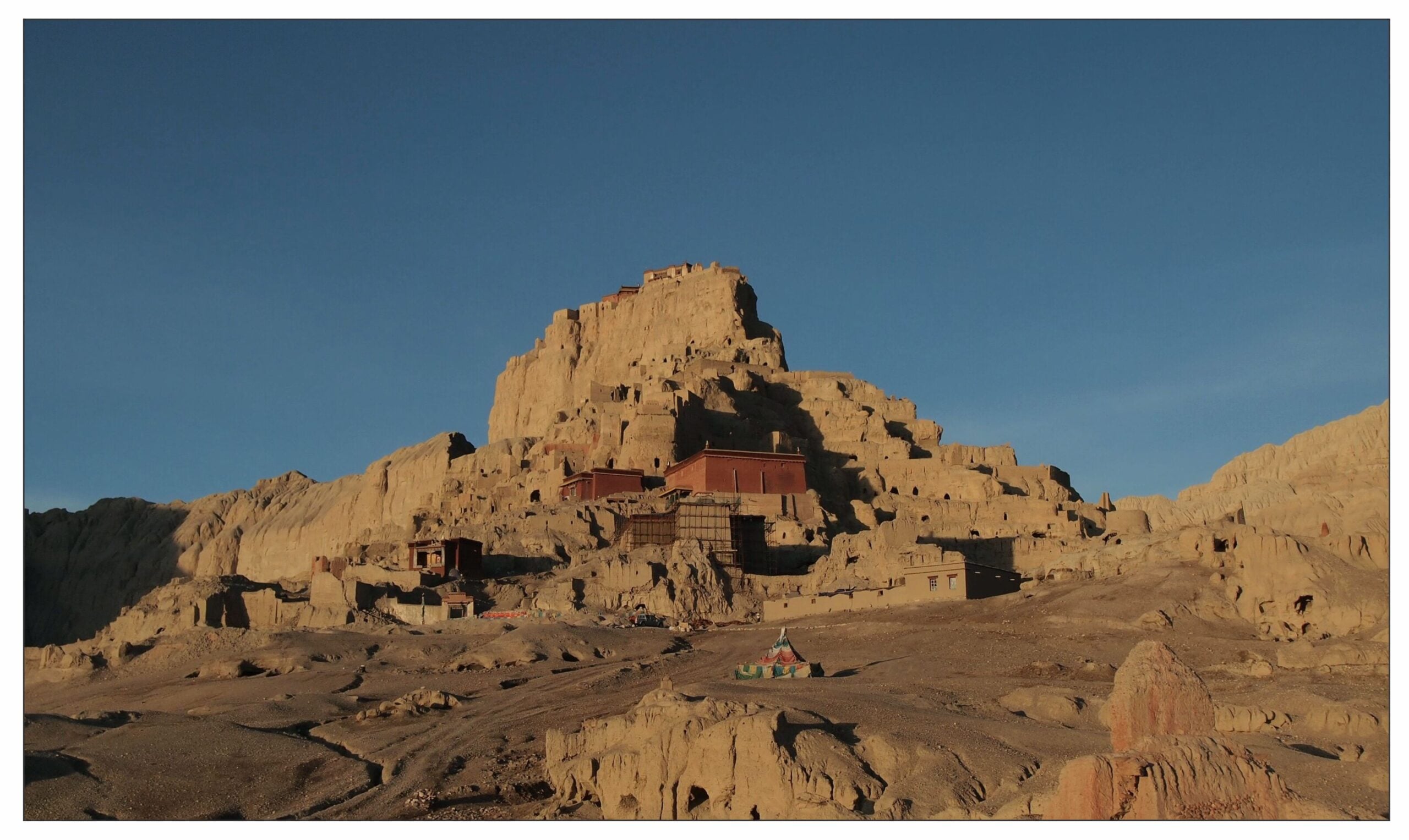
The first Europeans to travel north through the Himalayas to Tibet were the Jesuit missionaries Antonio de Andrade and Manuel Marques (Pereira, 1921; Wessels, 1924; MacGregor, 1970). In 1624 they travelled north from Delhi, following the Ganges River towards its source in the Himalayas. The passed through the Mana Pass, one of the highest mountain-passes in the world (5632 meters), and finally reached Tsaparang, the capital of the Buddhist Kingdom of Guge in southwestern Tibet. The kingdom had been founded in the 10th Century. The capital was built on prominent pyramid-shaped rock near the origins of the Sutlej River. De Andrade described the surrounding land as fertile with multiple irrigation channels. The king of Guge allowed the Jesuits to build a small Christian chapel there. However, in 1630 the kingdom of Ladakh just to the west of Guge invaded and laid the country to waste. Today, Tsaparang remains as a striking ruin in a bleak and deserted land. Wood (2005) has suggested that this ancient Buddhist mountain refuge led to the Tibetan myth of Shambhala and the modern idea of Shangri La.
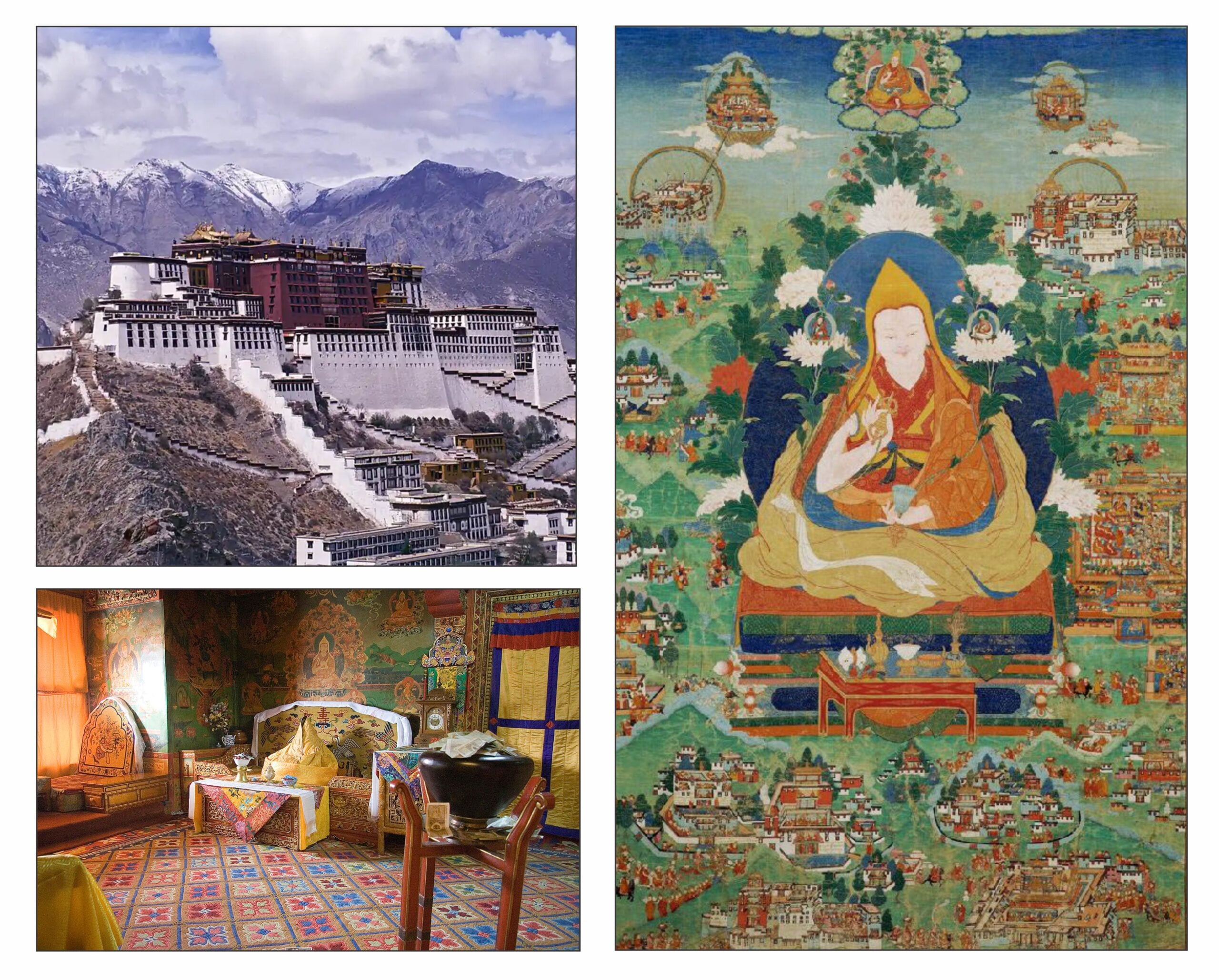
In 1661 the Austrian Jesuit Johann Grueber and his companion the Belgian Albert d’Orville travelled from northwest China into Tibet, crossing the Tangla Mountain range to visit Lhasa. They were the first Europeans to meet with the Dalai Lama (“ocean master”), Ngawang Lobsang Gyatso, the fifth in his lineage. At the time of their visit he was supervising the construction of Potala Palace, the official residence of the Dalai Lamas from 1649 until 1959. Grueber and d’Orville then travelled south, traversed the Himalayas to arrive in Kathmandu. After exchanging gifts with the King of Nepal, they descended into India.
The following illustration shows on the left the Potala palace, and a photograph of the Dalai Lama’s quarters by Luca Galuzzi. The Dalai Lama, who has not been there since 1959, is represented by his robes. On the right is an 18th Century portrait of the Dalai Lama surrounded by episodes from his life running counterclockwise from his incarnation at the upper left. Each Dalai lama is considered a manifestation of the great bodhisattva Avalokitsevara (“god who looks down”) The construction of the Potala monastery is depicted in the lower left. The Dalai Lama holds in his right hand a sceptre (vajra, thunderbolt/diamond) and in his left a bell (ghanta), the two essential symbols of Tibetan Buddhism. In a lotus flower over his right shoulder is a representation of Padmasambhava (born from the lotus), the legendary founder of Tibetan Buddhism). In another flower over his left shoulder is Thangtong Gyalpo, a great Buddhist leader, who in the 15th Century had built iron suspension bridges to facilitate travel in Tibet.
In 1712 an Italian Jesuit Ippolito Desideri came to stay in Tibet (MacGregor, 1970). He travelled north through Kashmir crossing the western Himalayas through the Fotu La pass and then making the arduous journey across the Tibetan Plateau to Lhasa. He spent many years in Tibet, studying the language and customs of the Tibetans. He was the first European to engage with the ideas of Buddhism. He debated with Buddhist scholars in their own language, becoming sufficiently adept that he could present his ideas in poetic form (Lopez et al, 2017). He tried without success to disprove their concept of reincarnation (samsara, wandering) and their desire for meditative release (nirvana, extinguishment/sunyata, emptiness).
It is fascinating to read his work (Lopez et al, 2017; Desideri, 2005). He understood the Buddhist concepts of samsara and nirvana, but he found them illogical because they did not fit with his Christian beliefs: since death must lead to either salvation or damnation, how could it possibly lead to reincarnation. He described the ultimate state of mind – nirvana – that the Buddha (“Legislator”) proposed as an escape from suffering. However, this had no attraction for him since it did not provide any greater knowledge of the God who created the universe:
In the fifth stage of supreme attainment the soul, having passed through the different stages, and being delivered from successive transmigration and purged of all those deeds which are the origin and cause of the troubles of existence, and having discarded the passions which are the cause of such deeds, and thus having destroyed their root, finally approaches this, the last stage. Thus their infernal Legislator, under the pretence of searching for the root, extirpates from the hearts of his followers the real and primary root of all things—the knowledge of God. (Desideri, 2005, p 248)
Desideri failed to consider why a Buddhist should aspire to know a Creator God since they believed the universe had existed forever.
Ippolito Desideri was the first European to visit Lake Manasarovar and Mount Kailash. The center of a world which has existed forever without need for any Creator:
Many explorers followed these early Jesuits into Tibet. Much more was learned about the land and the people. Intrigued by the idea of Shambhala the Russian artist and theosophist Nicholas Roerich (1874-1947) travelled through Central Asia and Tibet from 1925 to 1929 (Andreev, 2014; Roerich, 1930). A later expedition in 1934-5 sought Shambhala further north in Mongolia and northern China (Boyd, 2012). The theosophists claimed to have discovered the secrets of the “Masters,” an esoteric group of spiritual adepts centered in Tibet. However, there were no masters and their ideas were simply distortions of ancient Buddhist and Hindu religious thought.
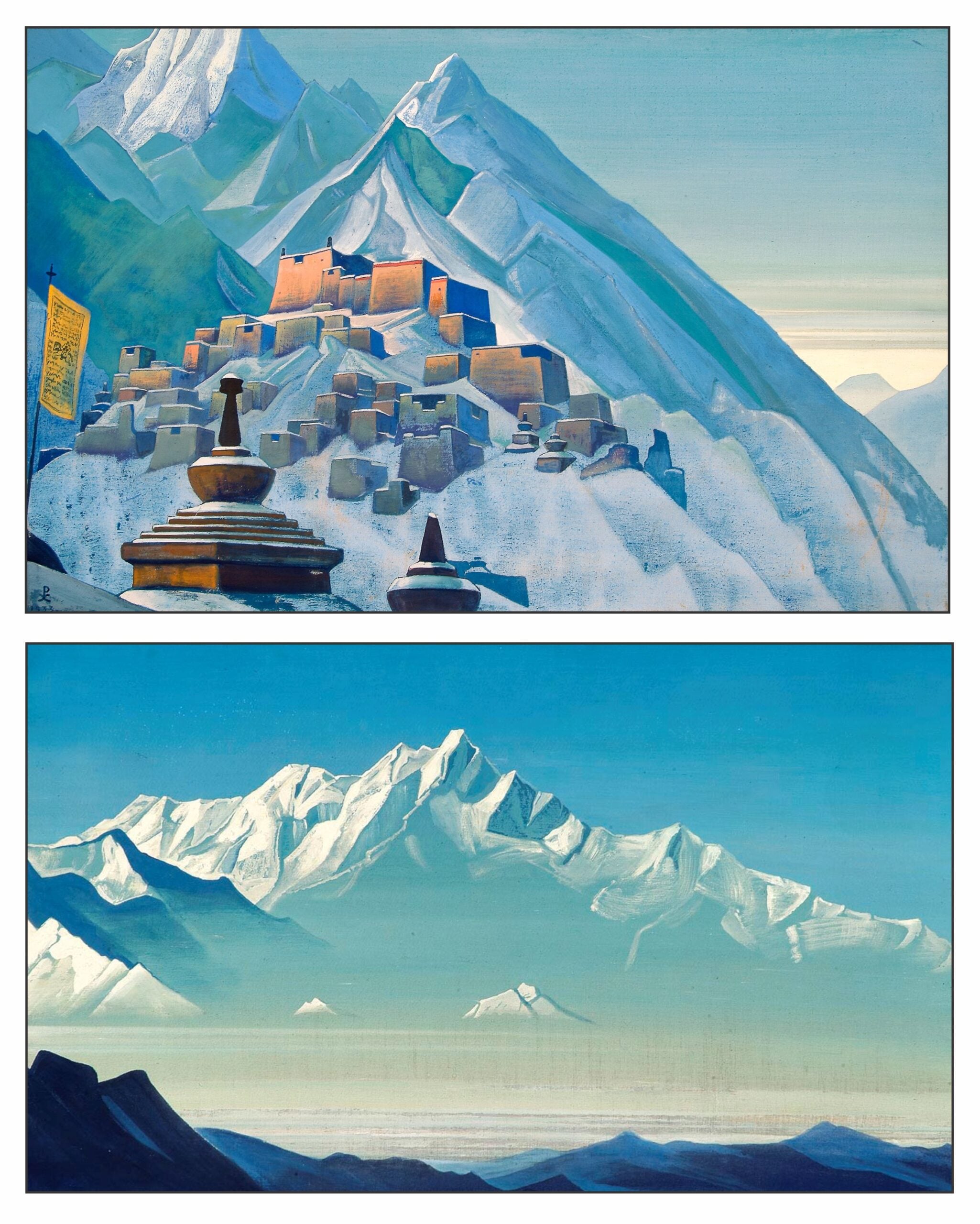
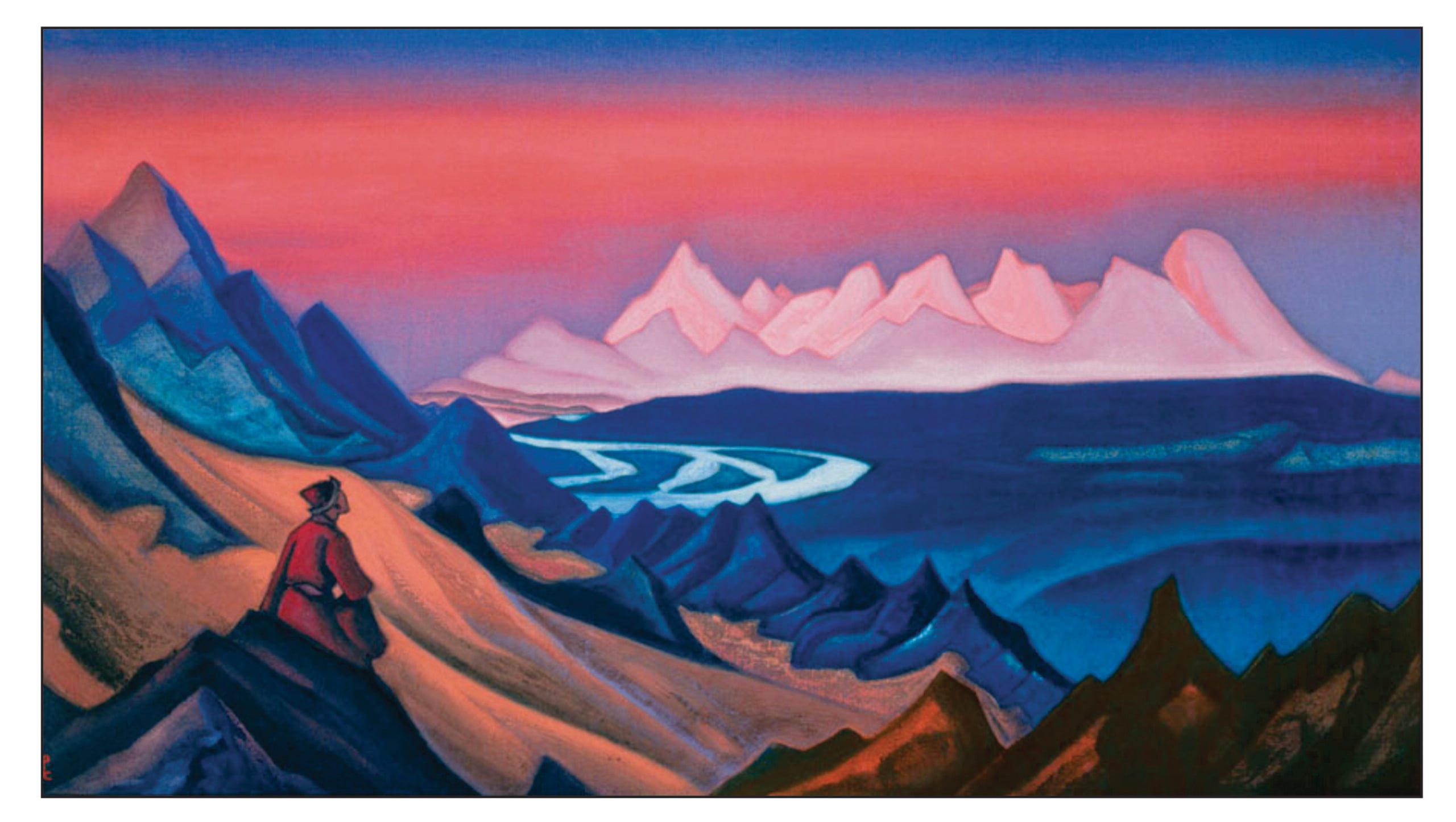
Nevertheless, Roerich was a talented artist who left us with many striking paintings of the Himalayas and Tibet. The following illustrations show paintings of Tibet (1933), The Mount of Five Treasures (1933) also known as Kangchenjunga, and The Song of Shambhala (1943). The third painting shows Shambhala in the distance: a circle of mountains lit by alpenglow.
Lost Horizon
In 1933 James Hilton, fascinated by recent accounts of travels in Tibet, wrote the novel Lost Horizon. This tells the story of the British diplomat Hugh Conway, who in 1931 supervises the evacuation of some European citizens from Baskul (likely Kabul, Afghanistan) on a plane that is bound for Peshawar (then part of the British Raj, now located in Pakistan to the west of Islamabad). However, the plane is hijacked and flies over the Himalaya mountains – Conway recognizes the Nanga Parbat and K2 mountains – to crash-land among what appear to be the Kun Lun mountains. The pilot dies in the crash, but the passengers survive and are taken by a monk to a valley named Shangri La. The following is the description of their arrival
To Conway, seeing it first, it might have been a vision fluttering out of that solitary rhythm in which lack of oxygen had encompassed all his faculties. It was, indeed, a strange and almost incredible sight. A group of coloured pavilions clung to the mountainside with none of the grim deliberation of a Rhineland castle, but rather with thc.chance delicacy of flower-petals impaled upon a crag. It was superb and exquisite. An austere emotion carried the eye upward from milk-blue roofs to the grey rock bastion above, tremendous as the Wetterhorn above Grindelwald. Beyond that, in a dazzling pyramid, soared the snow-slopes of Karakal. It might well be, Conway thought, the most terrifying mountain-scape in the world, and he imagined the immense stress of snow and glacier against which the rock function-ed as a gigantic retaining wall. Some day, per-haps, the whole mountain would split, and a half of Karakal’s icy splendour come toppling into the valley. He wondered if the slightness of the risk combined with its fearfulness might even be found agreeably stimulating.
Hardly less an enticement was the downward prospect, for the mountain wall continued to drop, nearly perpendicularly, into a cleft that could only have been the result of some cataclysm in the far past. The floor of the valley, hazily distant. welcomed the eye with greenness; sheltered from winds, and surveyed rather than dominated by the lamasery, it looked to Conway a delightfully favoured place, though if it were inhabited its community must be completely isolated by the lofty and sheerly unscalable ranges on the farther side (pp 74-75).
The following is from Orson Welles’ 1939 adaptation of the book for the Campbell Playhouse. The text has been abridged but the sense of wonder remains.
Conway discovers that the people of Shangri La grow old only very slowly. After spending some time exploring the monastery and the surrounding valley, Conway is given an audience with the High Lama, who is apparently a Catholic monk from Luxembourg who arrived in Shangri La in the 18th Century and is now about 250 years old. The lama is dying and wishes to place in Conway’s hands “the heritage and destiny of Shangri La:”
>My friend it is not an arduous task that I bequeath, for our order knows only silken bonds. To be gentle and patient, to care for the riches of the mind, to preside in wisdom and secrecy while the storm rages without. (p 223)
The lama describes the present state of world affairs and the coming storm that will be worse than the Dark Ages in Europe:
For those Dark Ages were not really so very dark—they were full of flickering lanterns, and even if the light had gone out of Europe altogether, there were other rays, literally from China to Peru, at which it could have been rekindled. But the Dark Ages that are to come will cover the whole world in a single pall; there will be neither escape nor sanctuary, save such as are too secret to be found or too humble to be noticed. And Shangri-La may hope to be both of these. (p 224)
The lama predicts that Conway and Shangri La will survive the storm:
I believe that you will live through the storm. And after, through the long age of desolation, you may still live, growing older and wiser and more patient. You will conserve the fragrance of our history and add to it the touch of your own mind. You will welcome the stranger, and teach him the rule of age and wisdom; and one of these strangers, it may be, will succeed you when you are yourself very old. Beyond that, my vision weakens, but I see, at a great distance, a new world stirring in the ruins, stirring clumsily but in hopefulness, seeking its lost and legendary treasures. And they will all be here, my son, hidden behind the mountains in the valley of Blue Moon, preserved as by miracle for a new Renaissance. (p 224-5)
As he ends his speech, the lama dies. Orson Welles’ abbreviated version of the lama’s speech conveys its essence:
A young member of the group that came from Baskul decides to escape Shangri La together with one of the young female postulants at the monastery. Conway warns that the young woman is much older than she appears and that she will become old if taken away from Shangri La. Nevertheless, Conway agrees to help them, and the story ends. In an epilogue, we learn that only Conway and an extremely Chinese woman arrive in Chongqing in western China. Initially amnesic, Conway later attempts to return to Shangri La. The last that anyone has heard is that he was travelling north from Thailand into the mountains.
The book became immensely popular. The world at that time was descending into madness and violence, and the book offered the comforting idea that what was good would nevertheless be preserved. The narrative sections of the book were exciting, but the description of Shangri La was, like all utopias, relatively boring. One interesting aspect of Shangri La is that it appeared much more European than Asian. The East simply provided a place of sanctuary for what was the best of European thought and art. Clear evidence of racism occurs as in the High Lama’s account of who should be accepted as a citizen of Shangri La (Goswami, 2023):
… our last visitor, a Japanese, arrived in 1912, and was not, to be candid, a very valuable acquisition. You see, my dear Conway, we are not quacks or charlatans; we do not and cannot guarantee success; some of our visitors derive no benefit at all from their stay here; others merely live to what might be called a normally advanced age and then die from some trifling ailment. In general we have found that Tibetans, owing to their being inured to both the altitude and other conditions, are much less sensitive than outside races; they are charming people, and we have admitted many of them, but I doubt if more than a few will pass their hundredth year. The Chinese are a little better, but even among them we have a high percentage of failures. Our best subjects, undoubtedly, are the Nordic and Latin races of Europe, perhaps the Americans would be equally adaptable … (p 170)
Hilton was ambiguous about where Shangri La was located. Conway’s plane crash-landed in the Kun Lun mountains. The ancient Buddhist kingdom of Khotan was located just north of these mountains but this had been in ruins for over a thousand years. After leaving Shangri La Conway arrived in Western China, and at the end of the book he was seeking to return to Shangri La by travelling north from Thailand. These statements suggest that Shangri La was perhaps located in the mountains of Western China, perhaps near Muli, a region that had been recently visited by the American botanist and explorer Joseph Rock, and described in an article for National Geographic (Rock, 1925, Clark et al, 2019)
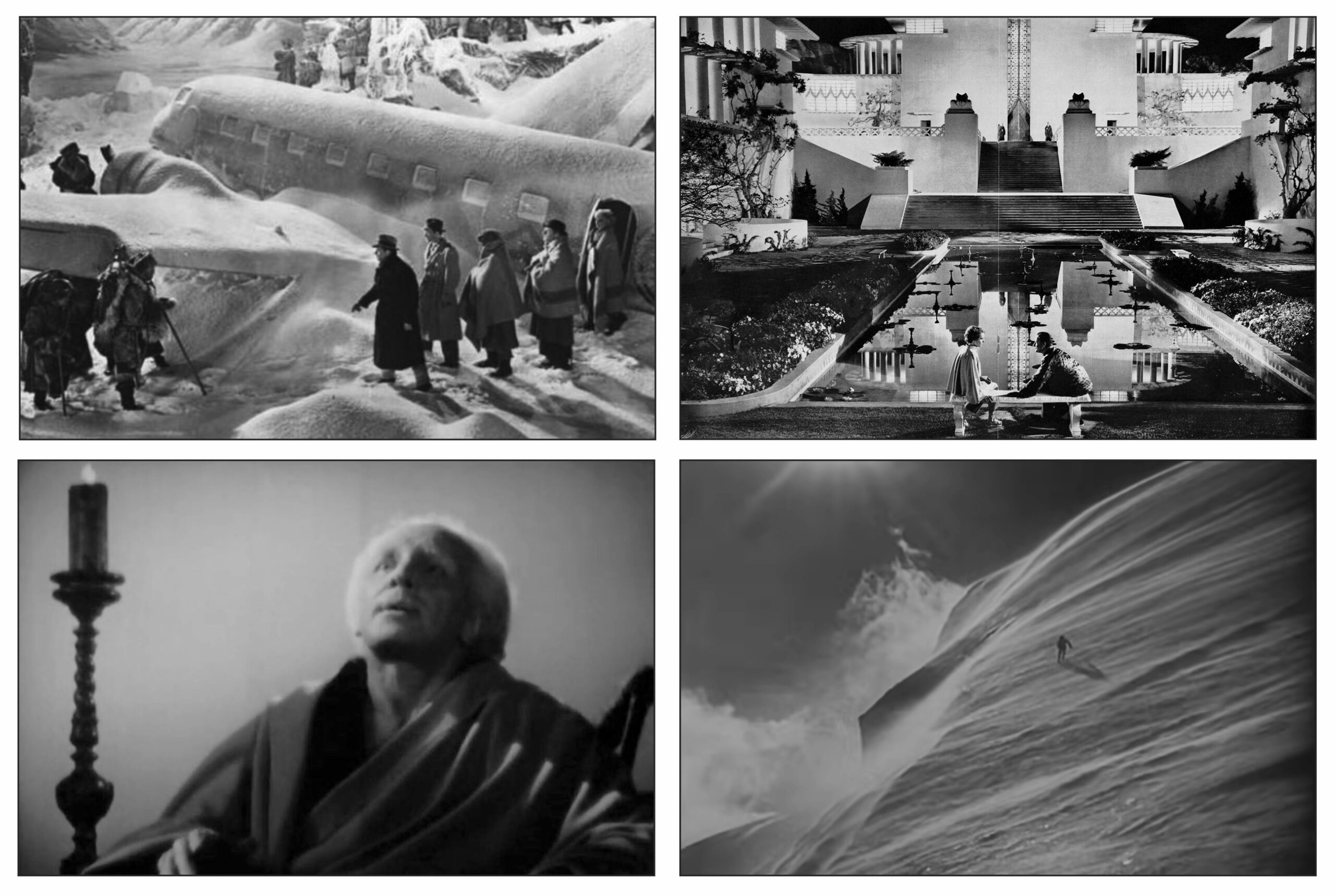
In 1937, Frank Capra directed a movie of Lost Horizon starring Ronald Colman as the diplomat, now named Robert Conway. The following stills from the movie, show the plane crash, the lamasery, the High Lama and Conway’s journey back to Shangri La:
Like the book, the movie is more exciting in the narratives of the arrival in and departure from Shangri La than in the time spent in the Himalayan utopia. Though Sam Jaffe’s portrayal of the High Lama is memorable, the monastery in the film is much more like the mansion of a Hollywood mogul than any Tibetan lamasery.
Political Upheavals
In 1720 China expelled the Mongols from Tibet which then became a part of the Chinese Empire. In 1911 the Qing dynasty was overthrown and China became a republic. Over the ensuing years political instability in China allowed Tibet to become de facto independent. Isolated from the world, it maintained a feudal system of government. Though monks and aristocrats lived pampered lives, the people suffered like the serfs of medieval Europe.
In 1950 the newly founded People’s Republic of China sent the People’s Liberation Army to annex Tibet. According to the Chinese this was the “Peaceful Liberation of Tibet;” for the Tibetans it was the “Chinese Invasion of Tibet.” At that time the 14th Dalai Lama Tenzin Gyatso was only 15 years old. He and his regents agreed to a new People’s Government of Tibet.
In the spring of 1959, fears that the Chinese government was going to arrest the Dalai Lama led to escalating protests and demands for Tibetan independence. The People’s Liberation Army quickly put down the uprising. The Dalai Lama fled to India where he now leads the Government of Tibet in Exile in Dharamshala. Over a thousand years after his forefathers had fled from India and found refuge in Tibet, he had returned.
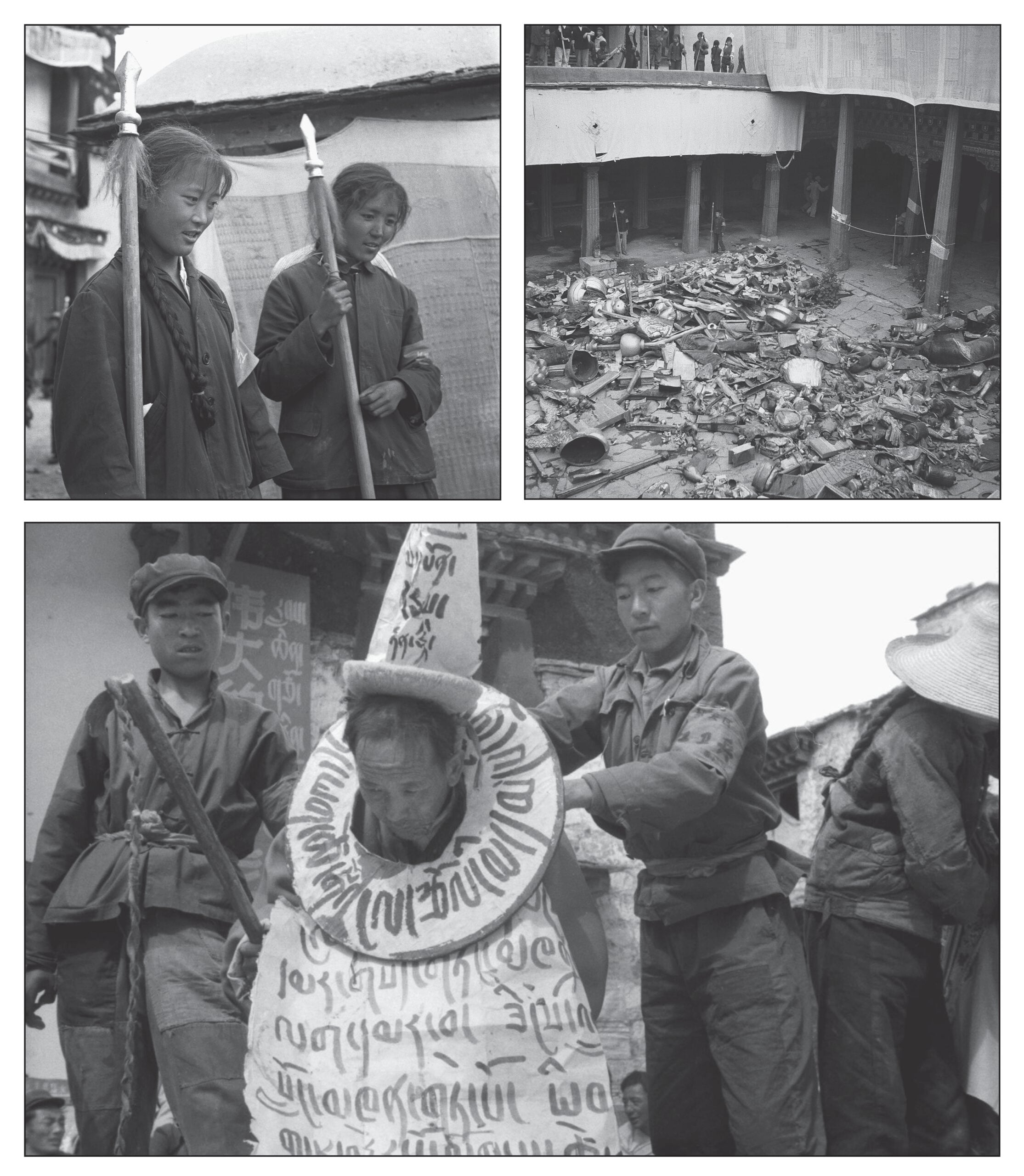
In May 1966 China’s Great Proletarian Cultural Revolution began, and in September the Red Guards arrived in Tibet. Monasteries were looted and Tibetan leaders were subjected to public humiliation in “struggle sessions.” It was only through the intervention of Zhou Enlai, that the Potala Palace was spared from the widespread destruction. The following photographs (Woeser, 2020) show the destruction at the Jokhang Temple on the upper right, a closeup of two red guards surveying the damage from the second storey of the temple on the upper left, and the struggle session of a previous mayor of Lhasa below
Tourism
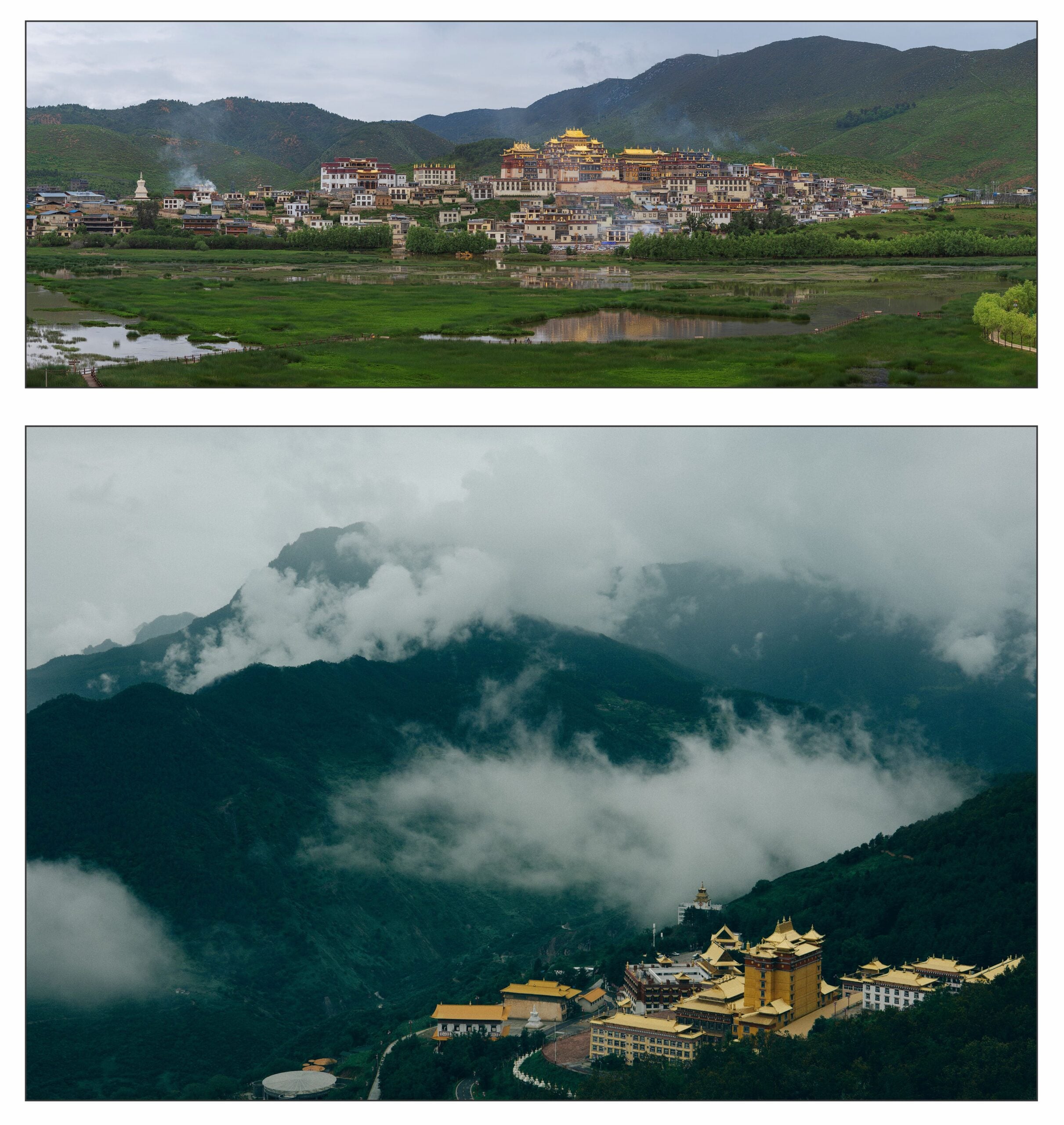
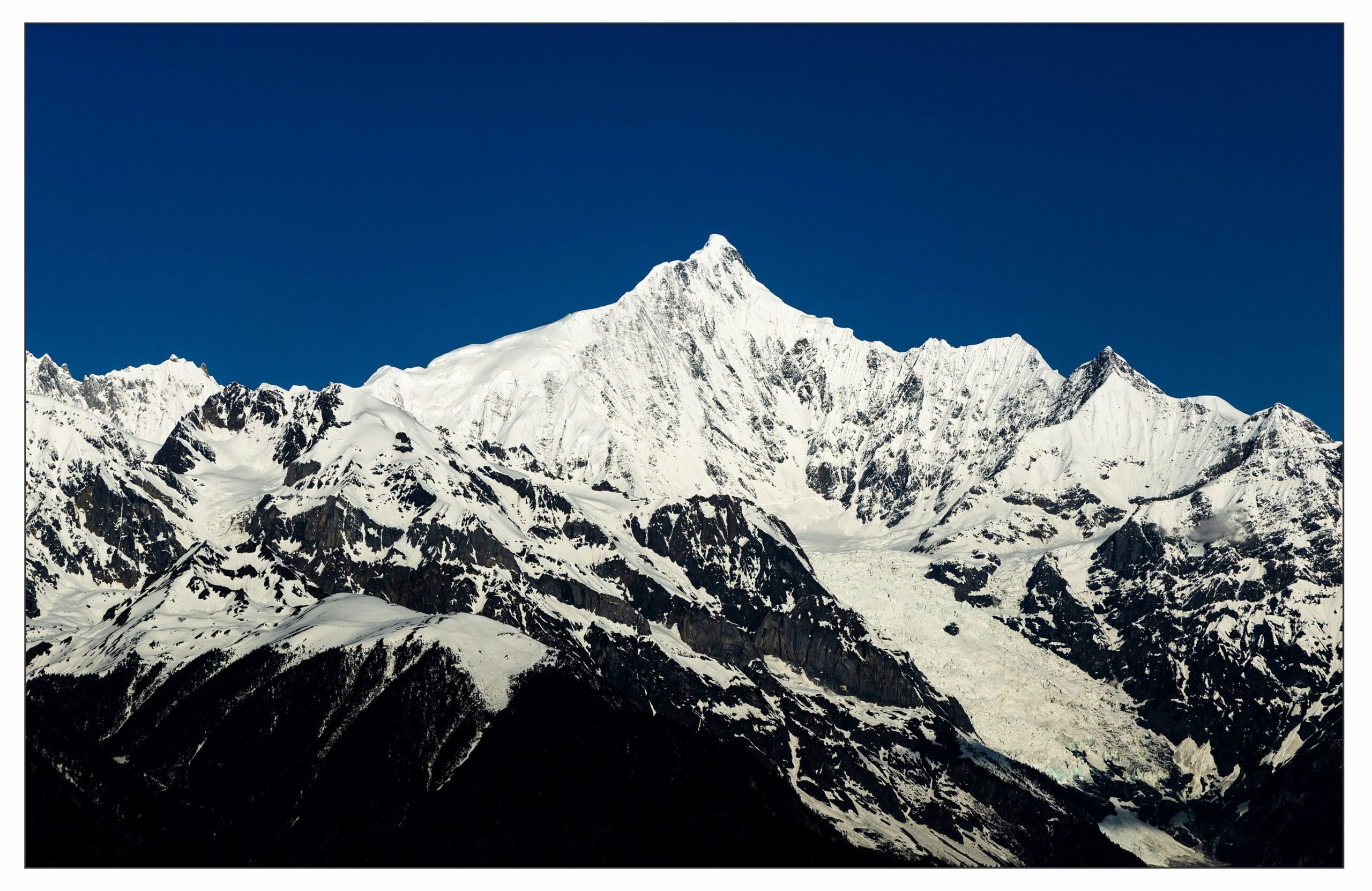
In 2001, the Chinese government renamed Zhongdian, a small city in northwestern Yunnan province, “Shangri La” after the fictional land described in James Hilton’s 1933 novel Lost Horizon (Kolas, 2008; Padget, 2023). Much of the population of the surrounding area is Tibetan. The government has rebuilt several nearby Buddhist monasteries. To the north is Khawa Karpo a sacred mountain. The following illustrations below show the Ganden Sumtseling Monastery the Muli Temple, and the east face of Khawa Karpo.
In the past, believers went on pilgrimages to sacred places; in the present, tourists search for epiphany in foreign lands. Tourists may seek out the truth, but they can be easily attracted to inventions: the tomb of Hamlet in Helsingor, the balcony of Juliet in Verona, and the land of Shangri La in China. Even sacred sites are sometimes more fictional than real. Tourism is not wrong: it supports the local populace, and it increases our understanding of other people. One must just be careful to determine what is meaningful and what is not.
Shambhala and Shangri La
In Tibetan Buddhism Shambhala was conceived as a place of refuge from a world full of violence at the time of the Islamic invasion of India. One day the forces of truth would come out to overcome the barbarian hordes and re-establish teachings of the dharma. The prophecy need not be interpreted literally:
The real war is the struggle between the forces of enlightenment and ignorance that characterizes the path of the yogin, the tantric practitioner. When the yogin achieves adamantine gnosis, the transformative wisdom that is the goal of the of Wheel of Time path, he or she overcomes the inner barbarism that creates the evils of existence. In this esoteric, allegorical interpretation of the myth, the war between Kalkin and Islam symbolizes the radical illumination of the yogin in which correct understanding of reality dispels the darkness of ignorance. (Newman, 1995).
Shangri La was a modern fiction, also invented at a time when the world seemed to be heading into catastrophe. It shares many of the features of Shambhala. Many people have been fascinated by Shangri La. Some have sought to find it, but none have been successful:
Ultimately, Shangri-La can be understood as a Western dream of an Eastern myth – it captures a yearning for simpler times, everlasting peace, sanctuary, and abundance protected from a violent and volatile world. But this paradise must remain elusive, for seeking it misunderstands and spurns Hilton’s fantasy. Like the most apt utopia, it is literally “nowhere” (Padget, 2023).
References
Andreev, A. I. (2014). The myth of the masters revived: the occult lives of Nikolai and Elena Roerich. Brill.
Belka, L. (2006). Maitreya in Tibetan Buddhism: image and myth. Studia Asiatica, 7(1), 55–73.
Bernbaum, E. (1980). The way to Shambhala: a search for the mythical kingdom beyond the Himalayas. St. Martin’s Press.
Boyd, J. G. (2012). In search of Shambhala? Nicholas Roerich’s 1934–5 Inner Mongolian Expedition. Inner Asia, 14 (2), 257-277.
Newman, J. R. (1985). A brief history of the Kalachakra. In Geshe Lhundup Sopa, Jackson, R., & Newman, J. R. (Eds). The Wheel of Time: The Kalachakra in Context. (pp 51-90). Deer Park Books.
Newman, J. R. (1995). Eschatology in the Wheel of Time Tantra. In D. S. Lopez (ed) Buddhism in Practice. (pp. 284–289). Princeton University Press.
Rock, J. F. (1925). The land of the Yellow Lama: National Geographic Society explorer visits the strange kingdom of Muli, beyond the Likiang snow range of Yünnan Province, China. National Geographic Magazine, 47(4), 447-492.
Roerich, N., (1930). Shambhala. Frederick A. Stokes.
Woeser, T. (2020). Forbidden memory: Tibet during the cultural revolution. Potomac Books.
Wood, M. (2005). The search for Shangri-La. In In search of myths & heroes: exploring four epic legends of the world. (pp 9-77). University of California Press. Video version available.
Destroy the Old!
China’s Great Proletarian Cultural Revolution (无产阶级文化大革命 pinyin: Wúchǎnjiējí Wénhuà Dàgémìng) was one of the most terrifying periods in modern Chinese history. The revolution turned upon itself in a fury of denunciation and violence. The goal was to root out those who opposed the revolution. The result was a rampage of destruction. Everything old was to be done away with to make way for the new. Those associated with the old culture were punished or executed. The poster on the right (from Wikipedia) shows the Red Guard in action against symbols of religion, capitalism and culture. The slogan reads “Destroy the old world! Establish the new!” (打破旧世界 dǎ pò jiù shì jiè 创立新世界 chuàng lì xīn shì jiè ). The Cultural Revolution began in 1966, and did not really end until the death of Mao Zedong in 1976. Much of the old was destroyed; nothing new was created.
Beginnings of the Cultural Revolution
In 1965 China was under great political stress. Attempts to increase the country’s industrial output – the Great Leap Forward (1958-1961) – had brought agricultural disaster and widespread famine. Russia had decided for coexistence with capitalism rather than confrontation. In 1961 Mao had denounced Khrushchev’s politics as revisionism, thus initiating the Sino-Soviet Split and the withdrawal of all Russian scientific and technical support from China.
Many of those in power in China began to wonder openly about the political direction of the country. Peng Dehuai, one of the generals from the Long March and the Marshal of the People’s Army in the Korean War, had dared to criticize Mao’s policies and had been removed from office in 1959. In the early 1960s President Liu Shaoqi and Secretary Deng Xiaoping had begun to question Mao’s radical socialism and to raise the possibility of using individual incentives to enhance agricultural production. In 1962, Deng quoted an old saying “It doesn’t matter whether it is a white cat or a black cat, a cat that catches mice is a good cat.” (The proverbial cats were actually black and yellow: Stewart, 2001, p. 64)
As in any society, there were corrupt as well as honest politicians. Many members of the party had used their power for personal rather than social gain. Many regions of the country had become the fiefdoms of the party bosses. Mao knew this was wrong. The pure soul of the revolution should not be adulterated with bourgeois incentives.
In January 1964 the book Quotations ofChairman Mao ( 毛主席语录 pinyin Máo zhǔ xí yǔ lù word by word: Mao head place/seat words recorded) was published. This was the famous “Little Red Book.” One billion copies were printed over the next decade. Revolutionary orthodoxy was put into words that everyone could understand. Amid the overwhelming dullness of socialist rhetoric come occasional flashes of acuity (and warning):
A revolution is not a dinner party, or writing an essay, or painting a picture, or doing embroidery; it cannot be so refined, so leisurely and gentle, so temperate, kind, courteous, restrained and magnanimous. A revolution is an insurrection, an act of violence by which one class overthrows another. (Mao Zedong, from a 1927speech, quoted in 1966, p 11-12).
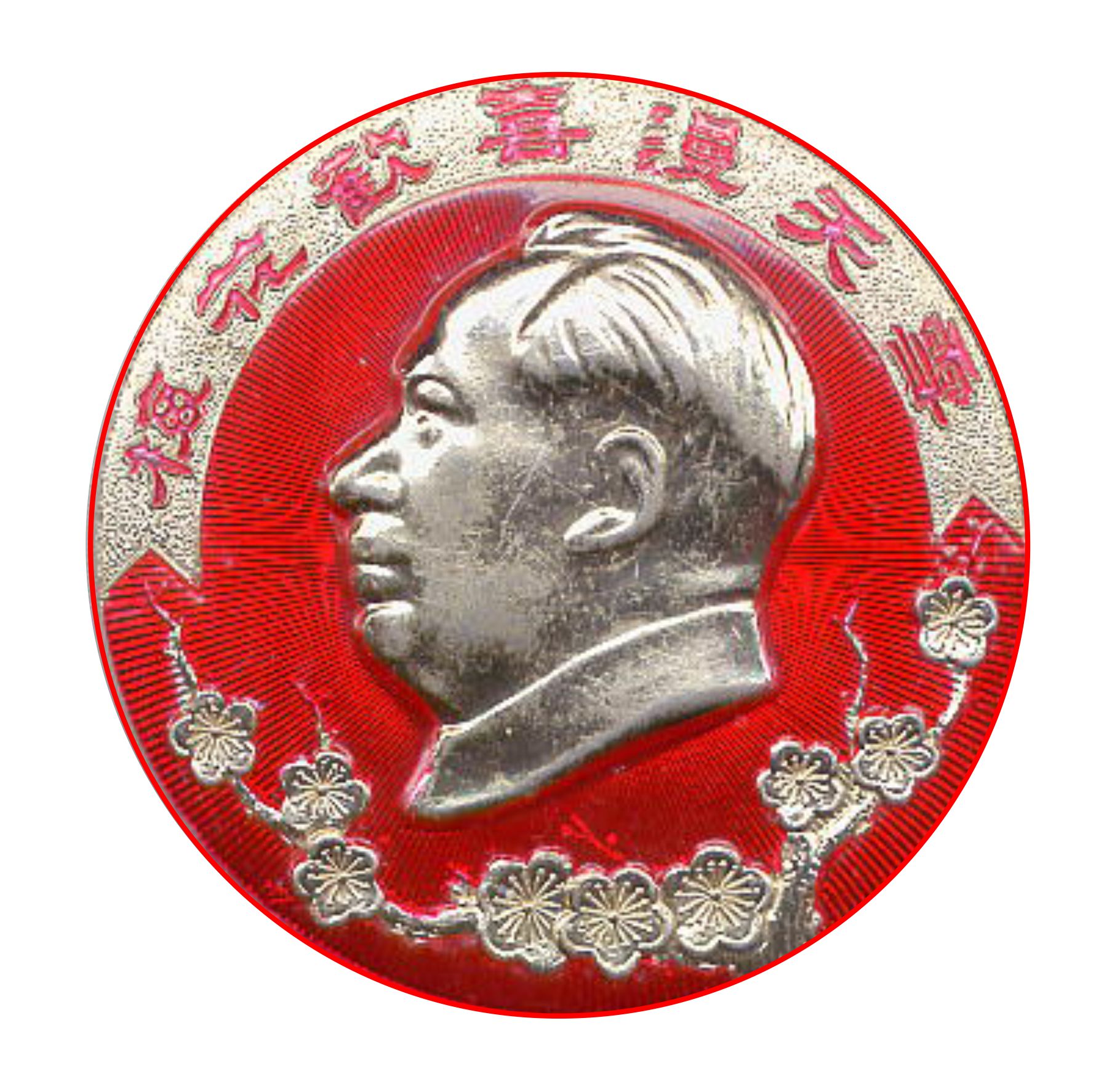
Mao badges were manufactured. The cult of personality needed to be enhanced, especially after the revisionist Khrushchev had denounced the cult of Stalin. The badge on the right includes a quotation from Mao’s 1962 poem Winter Clouds: “The plum blossoms are delighted by the snow (花欢喜漫天雪 huā huan xǐ màn tiān xuě)” The next line of the poem is “and do not care about the freezing flies.” (Barnstone, 1972, p 109). Counter-revolutionary insects were soon to face their winter.
The stage was thus set for the Great Proletarian Cultural Revolution. Indeed, many of the events had a theatrical character (Heberer, 2009). The revolution may have begun with the play, Hai Rui Dismissed from Office, written by the historian Wu Han in 1959 and first performed in 1961. This told the true story of how an honest offical had been imprisoned in 1566 by a corrupt Ming emperor. Wu Han was deputy to Peng Zhen, the mayor of Beijing and a major supporter of Deng Xiaoping. In November, 1965, a review of the play, written at Mao’s instigation, accused the author of covertly criticizing Mao for dismissing Peng Dehuai. Art must not question the revolution (or its leader).
Revolution and reason are not easy companions. Hai Rui should have been a revolutionary hero. Yet cunning and devious counter-revolutionaries must have used his story to question the leadership of Mao and derail the great revolution. Wu Han was jailed in 1966 and died in prison in 1969, possibly by suicide. Peng Zhen was deposed, but survived. The party in Beijing was in disarray. Mao could now increase his power.
The Great Proletarian Cultural Revolution was formally launched in the May 16 Notification:
Those representatives of the bourgeoisie who have sneaked into the Party, the government, the army, and various spheres of culture are a bunch of counter-revolutionary revisionists. Once conditions are ripe, they will seize political power and turn the dictatorship of the proletariat into a dictatorship of the bourgeoisie. Some of them we have already seen through; others we have not. Some are still trusted by us and are being trained as our successors, persons like Khruschev for example, who are still nestling beside us. Party committees at all levels must pay full attention to this matter. (MacFarquhar and Schoenhals, 2006, p. 47).
On May 25, Nie Yanzie, a professor in the philosophy department at Beijing University, together with some junior colleagues, wrote the first big character posters (大字报 pinyin dà zì bào) and affixed them to the walls of the university canteen (photograph at the left from Wikipedia). The text of the posters combined revolutionary rhetoric with denunciations of those in authority, in this particular instance members of the university’s party committee. Other posters were soon displayed in Tsinghua University (another university in Beijing). These were signed by a group of students calling themselves the Red Guard (红卫兵 pinyin Hóng Wèibīng character-by-character red protect soldier). Red became the symbol of the revolution and black the badge of the reactionaries. Big character posters became the revolution’s only literature.
In July, 1966, the Great Helmsman (大舵手pinyin dà duò shǒu) went swimming in the Yangtze River. A choppy side-stoke kept him afloat – no mean feat for a 72-year old overweight chronic smoker (though his fat tissue may have increased his buoyancy). The leader was ready for battle. His followers were ecstatic – everyone wanted to swim in the river of the revolution.
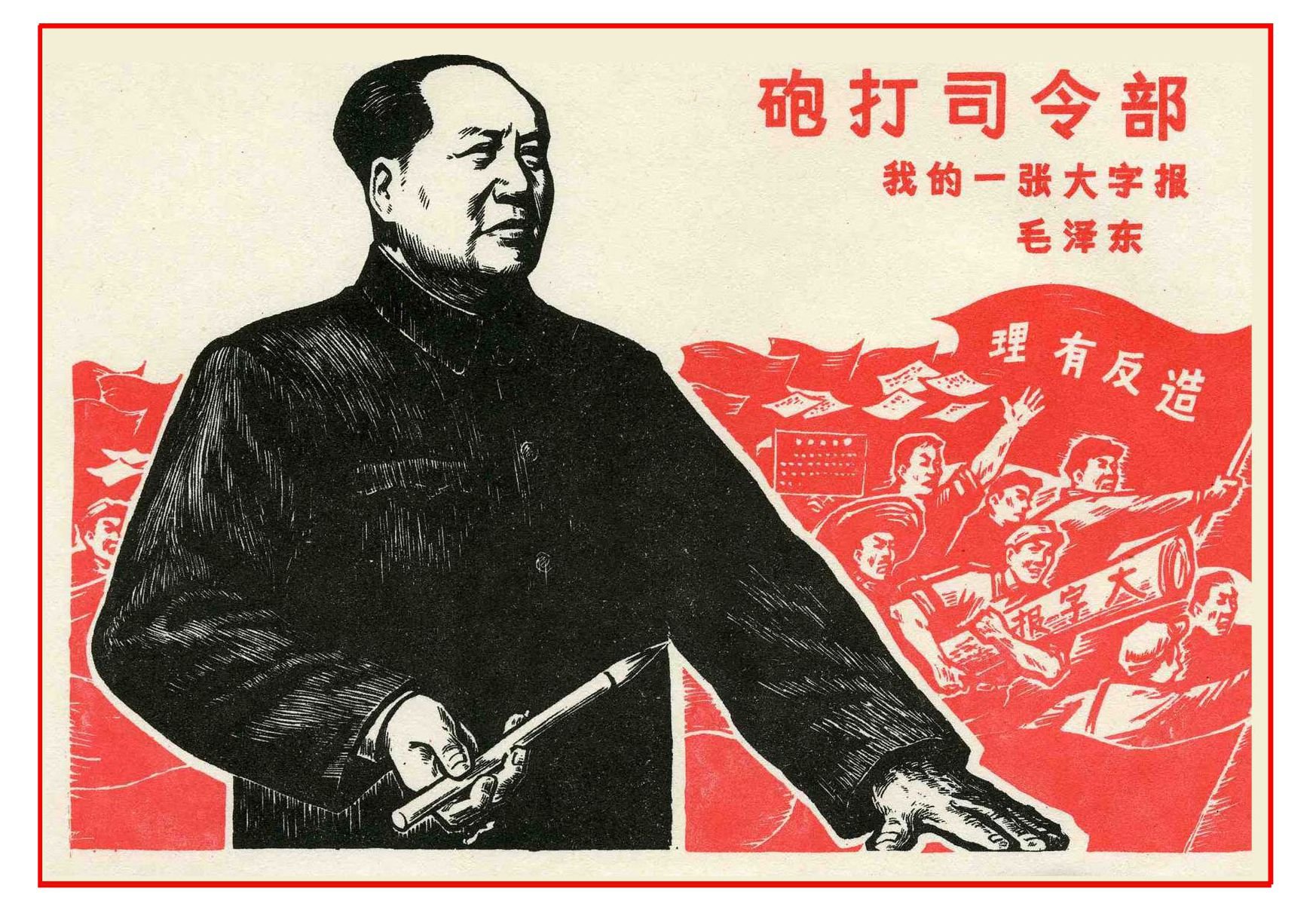
Mao gave a speech on August 6 supporting the big-character posters in the universities earlier that summer. Mao’s metaphorically wrote his own poster, asking the people to “bombard the headquarters” with suggestions and denunciations. The poster illustrated below commemorates the speech (source). The characters in the first line read “Bombard the Headquarters” (pinyin pào dă sī lìng bū; character-by-character: artillery strike commanding officer department). The second line reads “My first big-character poster” (wŏ de yī dà zì bào; me of one large character communication) and the third line is “Mao Zedong.” The characters on the flag mean “Revolution leads to truth” (or “To rebel is justified”): zào făn yŏu lĭ (make opposite is truth), and on the rolled up poster is dà zì bào. Both are written from right to left.
On August 8, Mao’s guidelines for the revolution were produced in a paper called The Sixteen Points. Although restrained, these contained the seeds of the violence that was to follow:
Trust the masses, rely on them and respect their initiative. Cast out fear. Don’t be afraid of disturbances. Chairman Mao has often told us that revolution cannot be so very refined, so gentle, so temperate, kind, courteous, restrained and magnanimous. (Point 4)
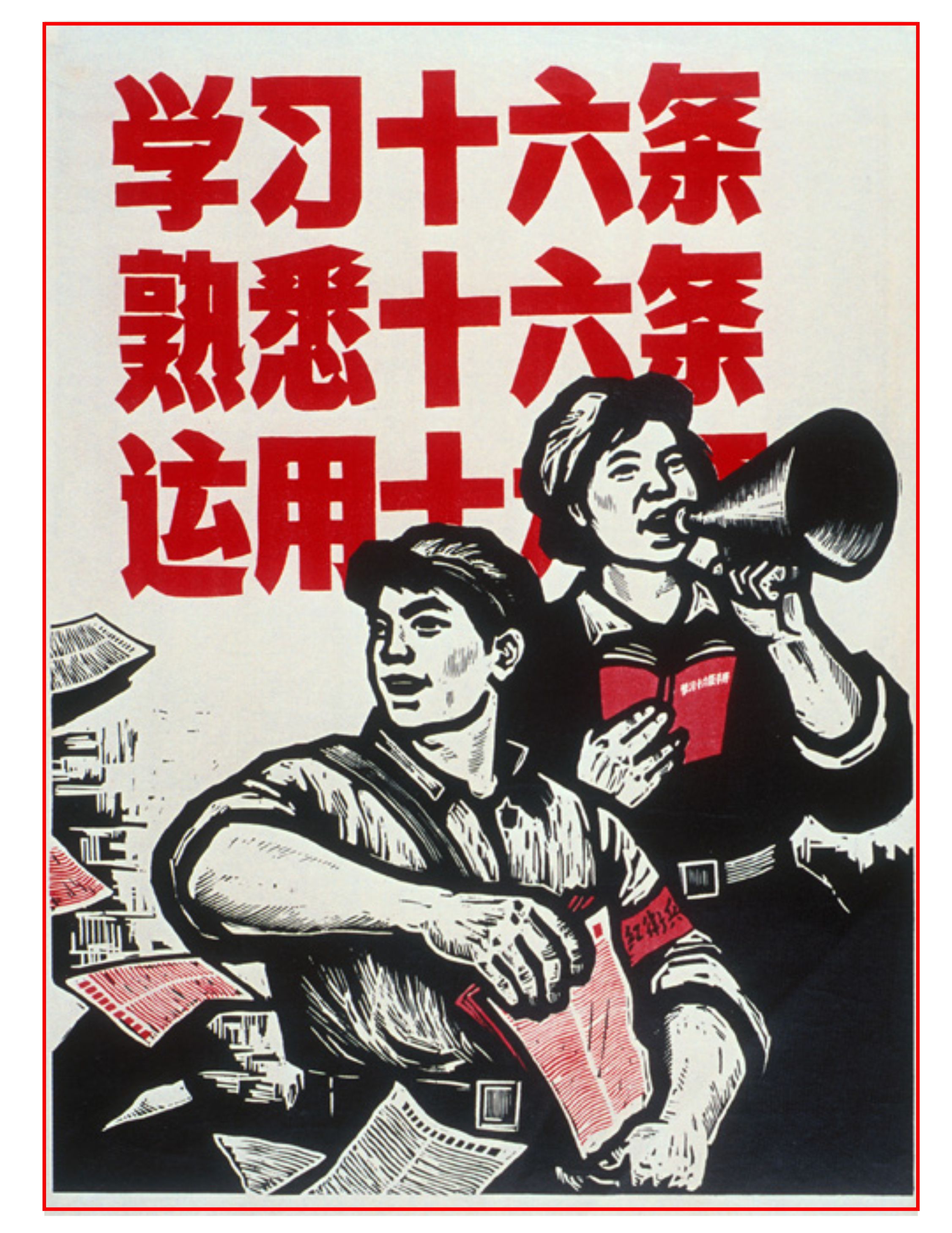
The poster on the right shows the Red Guard encouraging the masses to follow the Sixteen Points: Study the 16 Points (xué xí shí liù tiáo). Know (shú xī) the 16 Points. Use (shǐ yòng) the 16 Points.
The Course of the Revolution
On August 18, Mao endorsed the Red Guard movement at a huge rally in Tiananmen Square. He wore the red armband that was to become the badge of the student movement. The Red Guards were encouraged to “Destroy the Four Olds and Cultivate the Four News” (破四旧立四新; pinyin: Pò Sìjiù Lì Sìxīn). The terror was unleashed.
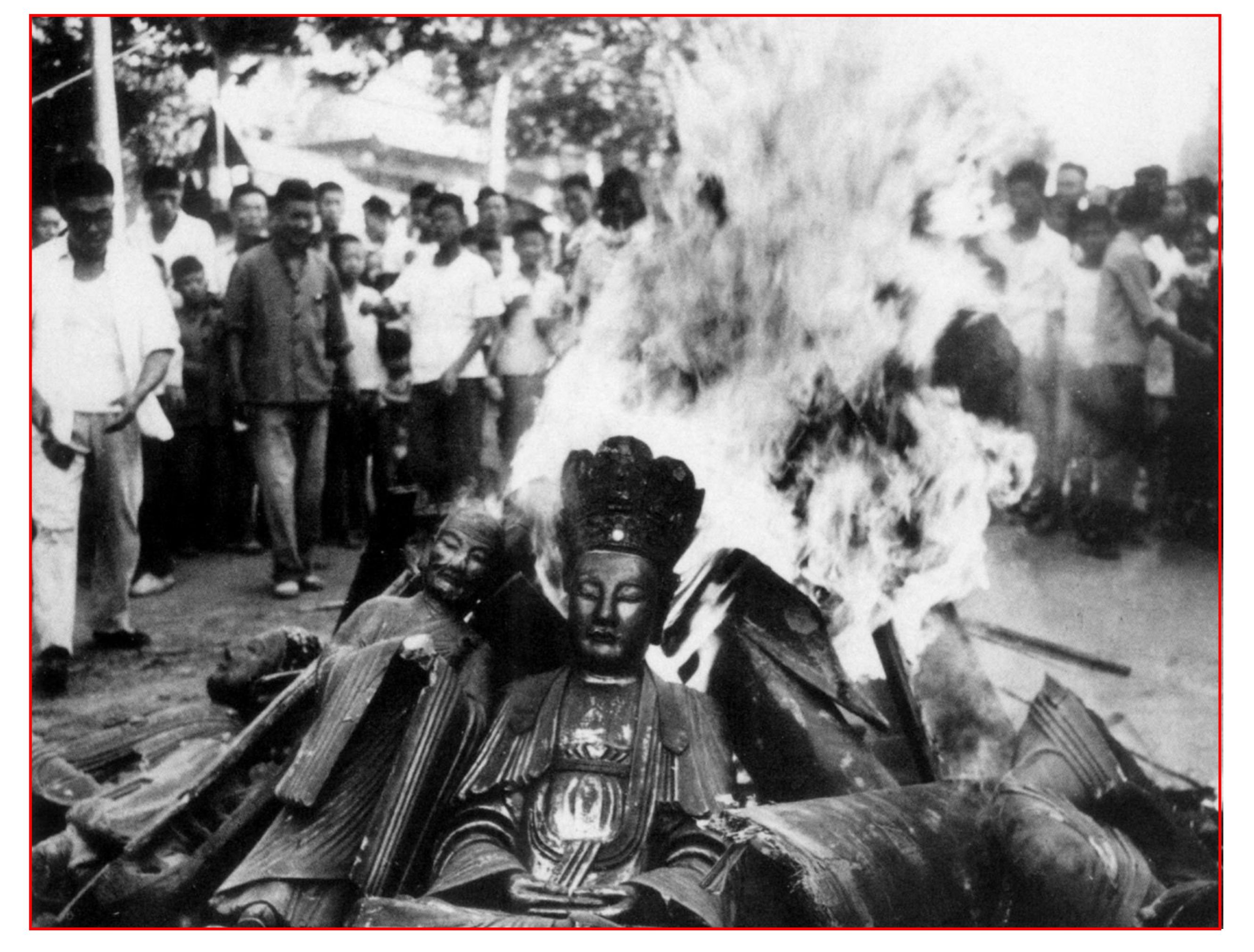
The history of the next two years is full of violence and cruelty. Books were burned and temples were desecrated (Dahpon David Ho, 2006). The photograph below shows the burning of Buddhist statues (from MacFarquhar & Schoenhals, 2006). A video shows more destruction of religious symbols. The Chinese Premier Zhou Enlai intervened to preserve some of the great cultural buildings such as the Imperial Palace in Beijing and the Potala Palace in Lhasa Tibet. In 1967 the Red Guards were formally enjoined not to sabotage state property. The idea was promoted that cultural relics were part of the nation’s glorious revolutionary traditions. Nevertheless, much had been destroyed before the Red Guards became quiescent.
Artists, intellectuals, and administrators were brought before Red Guard tribunals to confess their counter-revolutionary activities. Many were harassed and publically humiliated, many were tortured, many were summarily executed. The photograph on the left shows Peng Dehuai wearing a placard telling of his sins against the revolution. (Also shown in the video). Prolonged and brutal torture did not evoke any confession, but Peng’s imprisonment continued until his death in 1974. In the provinces, the death toll ran into the thousands (Yang Su, 2006).
By 1967 the country was a shambles. Life was cheap. Fear was everywhere. Torture and death were rampant. The economy was at a standstill – people were more engaged in tearing down than building up. The universities were no longer teaching. Different factions of the Red Guards were fighting with each other to see who could be the most radical revolutionaries. The following is a description of Red Guard activity:
Then I saw the accused woman. She was perhaps in her forties, kneeling in the middle of the room, partly naked. The room was lit by a bare fifteen-watt bulb. In its shadows, the kneeling figure on the floor looked grotesque. Her hair was in a mess, and part of it seemed to be matted with blood. Her eyes were bulging out in desperation as she shrieked: ‘Red Guard Masters! I do not have a portrait of Chiang Kai-shek! I swear I do not!’ She was banging her head on the floor so hard there were loud thuds and blood oozed from her forehead. The flesh on her back was covered with cuts and bloodstains. When she lifted her bottom in a kowtow, murky patches were visible and the smell of excrement filled the air. I was so frightened that I quickly averted my eyes. Then I saw her tormentor, a seventeen-year-old boy named Chian, whom up to now I had rather liked. He was lounging in a chair with a leather belt in his hand, playing with its brass buckle. ‘Tell the truth, or I’ll hit you again,’ he said languidly. . . I murmured, trying to control the quaking in my voice, ‘Didn’t Chairman Mao teach us to use verbal struggle [wendou] rather than violent struggle [wudou]? Maybe we shouldn’t…?’ My feeble protest was echoed by several voices in the room. But Chian cast us a disgusted sideways glance and said emphatically: ‘Draw a line between yourselves and the class enemy’. Chairman Mao says, ‘Mercy to the enemy is cruelty to the people!’ If you are afraid of blood, don’t be a Red Guard!’ His face was twisted into ugliness by fanaticism. The rest of us fell silent. Although it was impossible to feel anything but revulsion at what he was doing, we could not argue with him. We had been taught to be ruthless to class enemies. Failure to do so would make us class enemies ourselves . . . Outside the door, I saw the woman informer . . . As I glanced at her face, it dawned on me that there was no portrait of Chiang Kai-shek. She had denounced the poor woman out of vindictiveness. The Red Guards were being used to settle old scores.
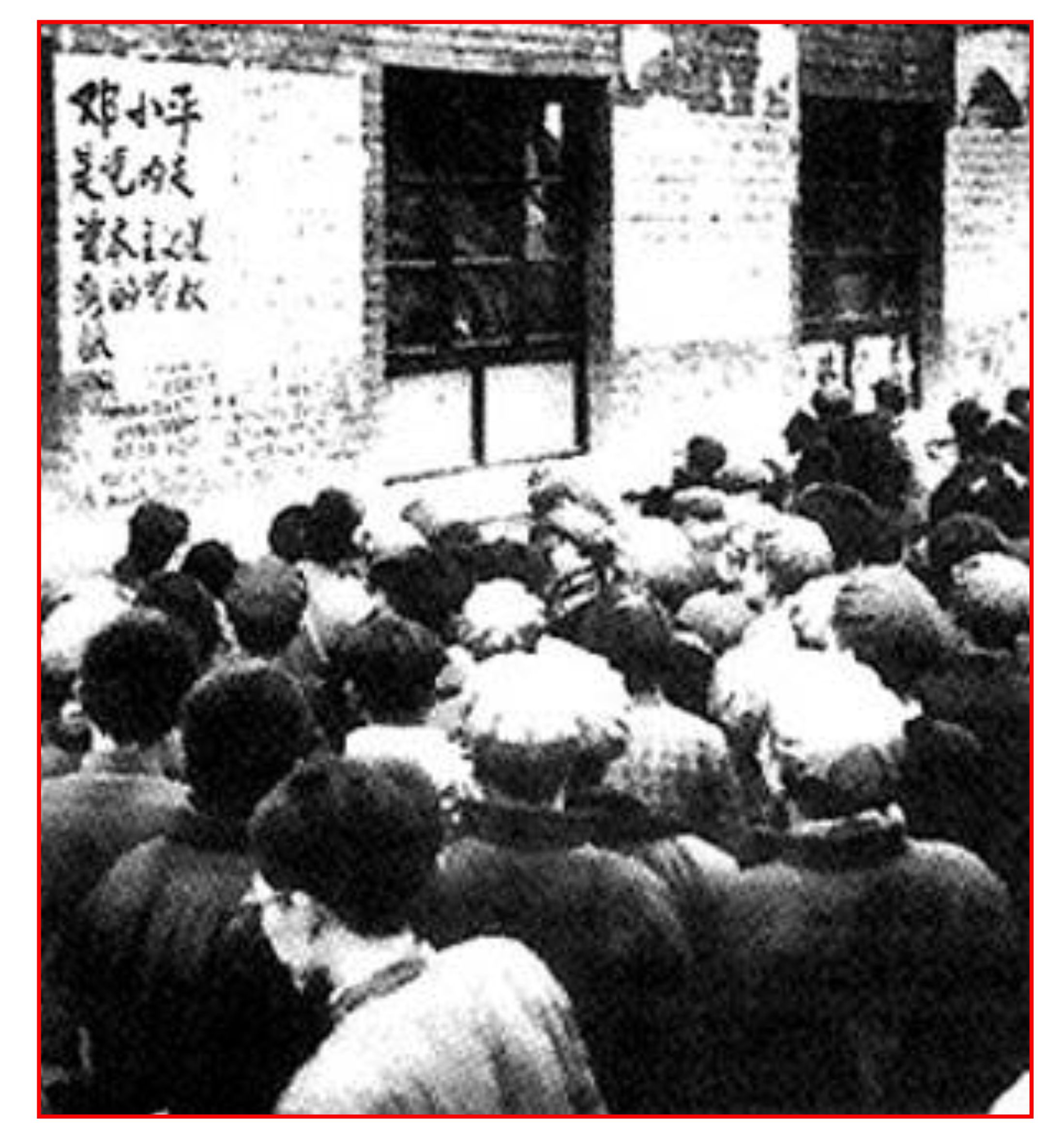
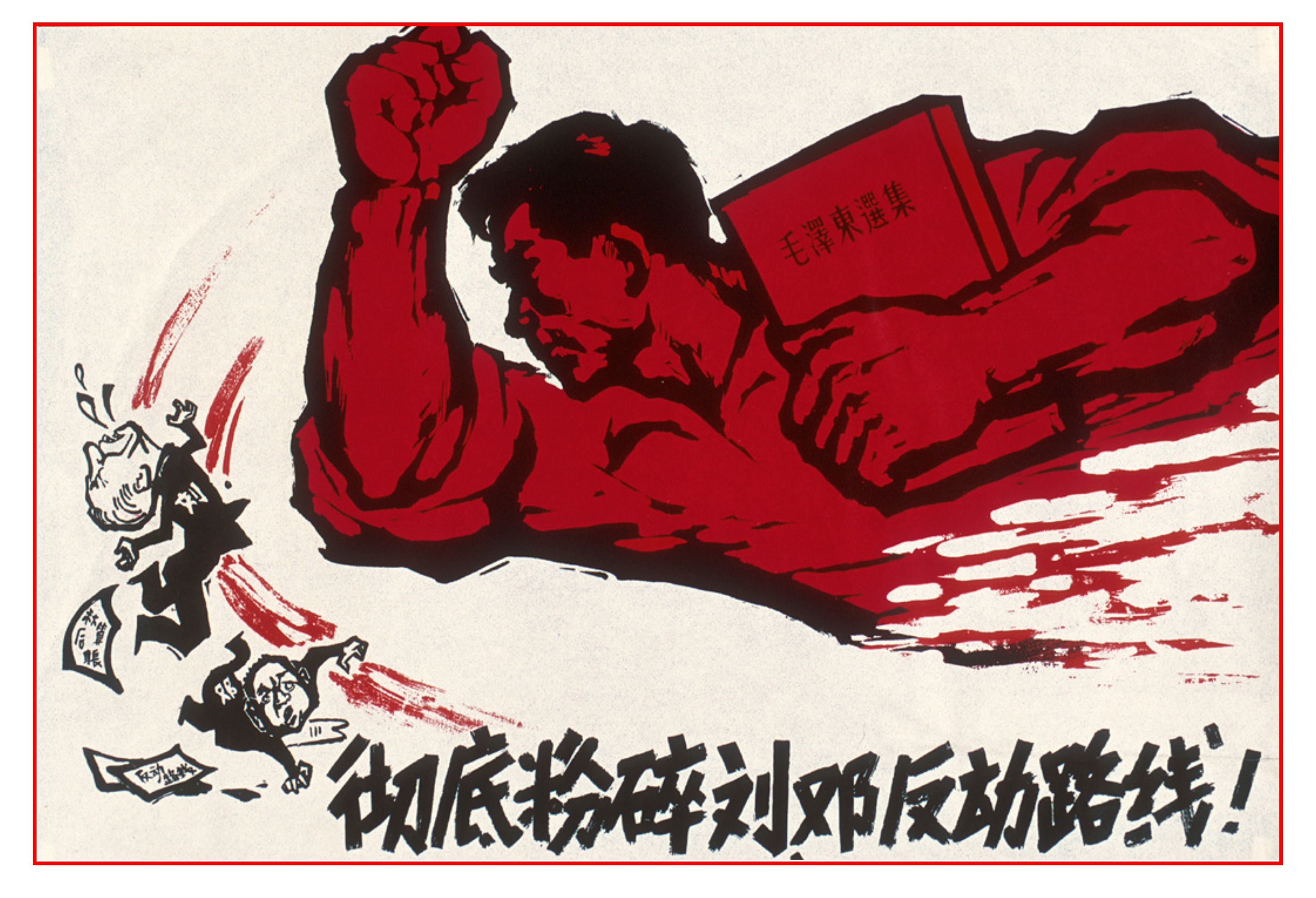
The country was in chaos. Yet Mao was in supreme control. He had rid the country of his main adversaries. The poster below exhorted the reader to “smash completely the Liu Deng counter-revolutionary line.” Similar posters are illustrated in Landsberger & van der Heijden (2009). Deng Xiaoping was exiled to work in a tractor factory. Liu Shaoqi was deposed, imprisoned and tortured, ultimately dying in 1969.
To quell the furies that he had unleashed, Mao called upon the army. Under threat, the Red Guards were disbanded and sent to the countryside to do manual labor with the peasants. The killings decreased but the fear persisted. The greatest excesses of the Cultural Revolution were largely over by the end of 1968, but the revolution continued until Mao’s death in 1976. Administrators and members of the Communist Party were denounced and exiled. The country became ungoverned.
Deng Xiaoping survived and returned to power a few years after Mao’s death. Mao’s wife and colleagues – the Gang of Four – were overthrown in 1976 and ultimately sentenced to life in prison in 1981. The Chinese Communist Party then adopted a resolution on the history of the People’s Republic of China that repudiated the Cultural Revolution as a catastrophe “responsible for the most severe setback and the heaviest losses suffered by the’ Party, the state and the people since the founding of the People’s Republic.” The resolution attributed responsibility to Mao Zedong who had “confused right and wrong and the people with the enemy.”
Violence and Youth
The terrible violence that occurred during the Cultural Revolution was largely mediated through the Red Guards. These were mainly university students. High-school students were also involved, but their actions were often more imitation than instigation. Why did these young and intelligent people turn to such cruelty?
Young people can be very passionate about ideas. Yet they lack experience. They have not learned that emotions can be mistaken. They have not seen how everything contains both good and evil. They have not understood that the right path is often not the first one.
Young people rebel against authority. Rebellion is one way to independence. Power comes to those who resist the power of others. The young had long been subservient to parents and to teachers. Some of the excesses of the Cultural Revolution may have been equivalent to exaggerated role-reversals. The Red Guards punished their victims with beatings and with dunce-caps as though they were naughty children.
Young people need a cause. They have to join together with their fellows to fight for what is right. The struggle can be against Fascism for the volunteers who went to Spain in the 30s, against the counter-revolutionaries in the Red Guards in China in the 60s, or against Western Imperialism for the Jihadists who are now in the Middle East. There is often little telling if the fight is right or wrong.
Why?
Why did this great disaster happen? The precipitating context was the impoverished state of the country. The revolution had not achieved its goals. Poverty and hunger had not been eradicated. Class structure had not been abolished. A different elite now held power: corrupt party members had replaced the capitalist exploiters. Easier to believe that the revolution had been betrayed than to consider that the revolution had been mistaken. A return to the basic principles could perhaps save the ideals of communism.
Into this state of despair came the cunning and the drive of Chairman Mao. Rather than accept any responsibility, he shifted the blame to others. He tapped the energy of the people and pulled all the strings needed to do away with all those who disagreed with him.
Mao was old and paranoid. He could not brook criticism and could not change his ways. He attempted to destroy all those who thought differently from himself. The fate of despots is to have no friends. The most amazing thing about Premier Zhou Enlai is how he was able to attenuate some of Mao’s excesses and yet survive. At the end, however, Mao even tried to erase Zhou from history, banning any public mourning after his death in 1976.
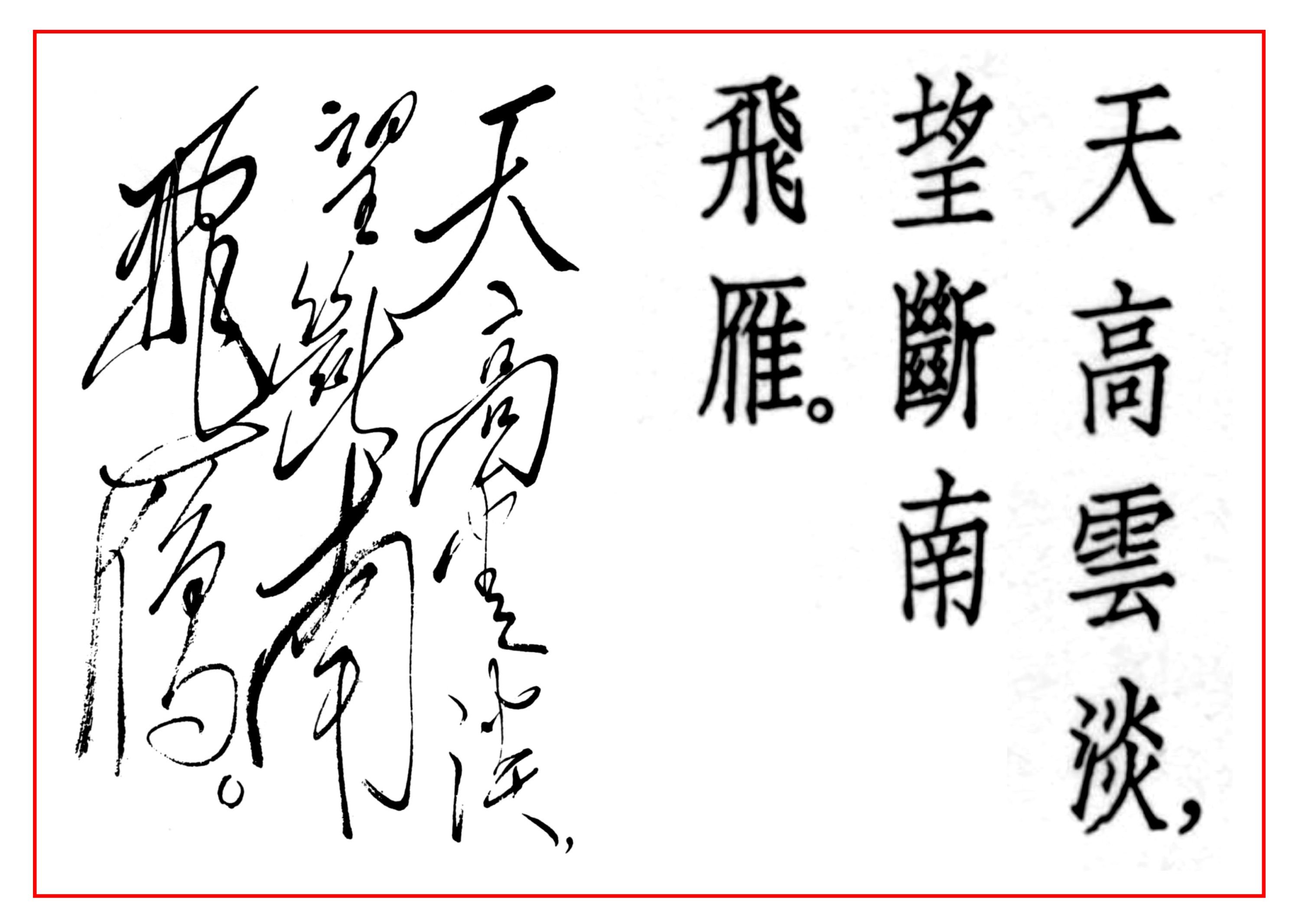
Mao had immense charisma. The leader of the Long March knew how to make people follow him. And the Chinese people were used to obedience. Mao came to be considered in much the same way as the Emperors that had ruled China for centuries. Like these emperors Mao wrote poems and practised calligraphy. The following is the beginning of his poem Liupan (Six Path) Mountain written toward the end of the Long March. The poem reads from top to bottom and from right to left in characters and in Mao’s own calligraphy:
Dazzling sky to the far cirrus clouds
I gaze at wild geese vanishing into the south
(Barnstone translation)
The poem and the calligraphy are in the style of the old masters. In art, Mao was far from revolutionary.
Mao consciously identified himself with the Emperor Qin Shihuang (260–210 BCE). Qin is famous for unifying China, beginning the Great Wall, and constructing a huge tomb for himself filled with terracotta warriors. However, he had also executed the intellectuals by burying them alive and had burned their books. Mao is quoted as saying
What does Qin Shihuang amount to? He buried only four hundred and sixty scholars alive; we have buried forty-six thousand scholars alive. Haven’t we killed counter-revolutionary intellectuals? (quoted by Hawks, 2010, p.87)
The Chinese artist and poet Li Shu, one of the victims of the Cultural Revolution, remarked about China’s first Emperor (and indirectly about Mao):
Who truly understands the sadness of Qin Shihuang? … He tried to do the right thing but it just turned out wrong. (quoted by Hawks, 2010, p. 90)
References
A comprehensive review of this time is MacFarquhar & Schoenhals, 2006; briefer considerations are Heberer, 2009, Kraus, 2012, and Wikipedia.
Dahpon David Ho (2006). To protect and preserve: resisting the “Destroy the four olds” campaign, 1966-1967. In Esherick, J. W., Paul G. Pickowicz, P. G., & Walder. A. G. (Eds). The Chinese cultural revolution as history (pp. 64-95). Stanford, CA: Stanford University Press
Domes, J. (1985). Peng Te-huai: The man and the image. London: Hurst & Co.
Hawks, S D. (2010). Summoning Confucius: Inside Shi Lu’s Imagination. In Richard King (Ed.), Art in turmoil. The Chinese Cultural Revolution, 1966-76. (pp. 58-90). Vancouver: University of British Columbia.
Heberer, T. (2009). The ‘‘Great Proletarian Cultural Revolution’’: China’s modern trauma. Journal of Modern Chinese History. 3, 165–181
Jung Chang (1991). Wild Swans: Three Daughters of China. London: Simon and Shuster.
Kraus, R. C. (2012). The Cultural Revolution: a very short introduction. New York: Oxford University Press.
Landsberger, S. R., & van der Heijden, M. (2009). Chinese posters: the IISH-Landsberger collections. Munich: Prestel. See also the webpage.
MacFarquhar, R., & Schoenhals, M. (2006). Mao’s last revolution. Cambridge, MA: Belknap Press of Harvard University Press.
Mao Zedong, (1964/1966). Quotations from Mao-Tse-tung. Beijing: Foreign Languages Press.
Mao Zedong (translated by Willis Barnstone and Ko Ching-po, 1972). The poems of Mao Tse-tung. New York: Harper & Row (reprinted 2008 by University of California Press).
Stewart, W. (2001). Deng Xiaoping: Leader in a changing China. Minneapolis: Lerner
Yang Su (2006). Mass killings in the Cultural Revolution: a study of three provinces. In Esherick, J. W., Paul G. Pickowicz, P. G., & Walder. A. G. (Eds). The Chinese cultural revolution as history (pp. 96-123). Stanford, CA: Stanford U