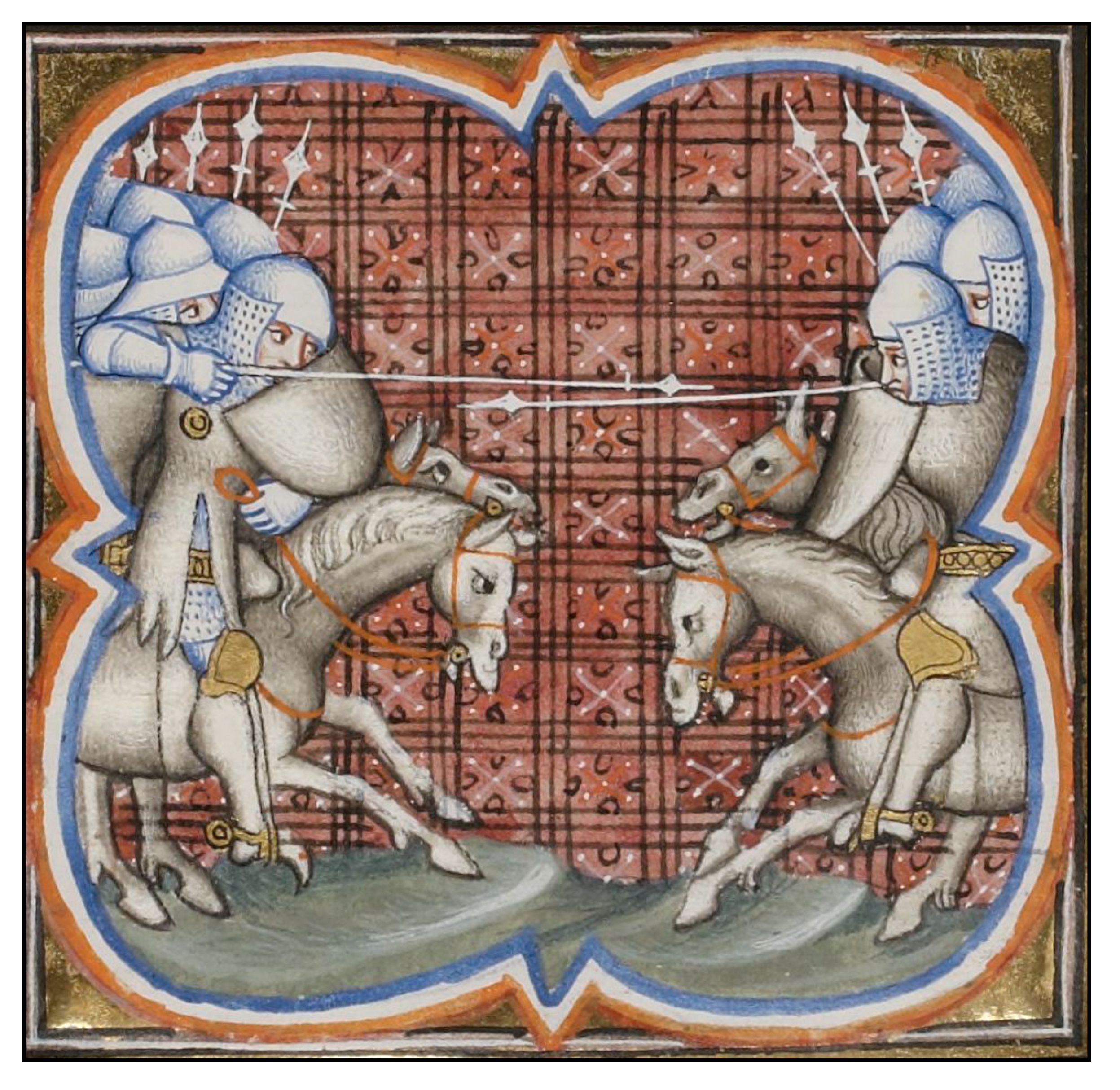
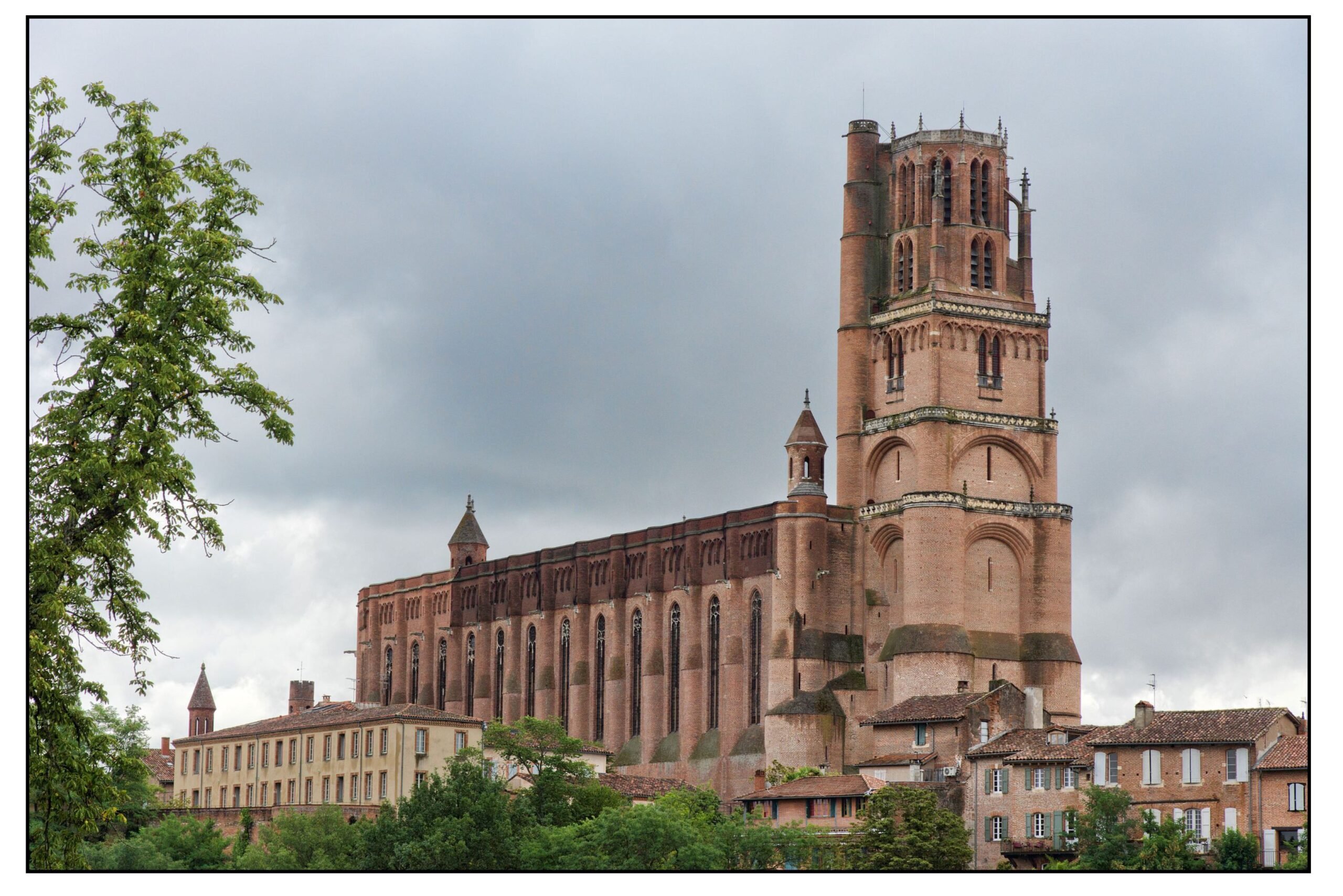
Zoroaster: Struggles between Good and Evil
Zoroaster, a legendary prophet who probably lived toward the end of the 2nd Millennium BCE, proclaimed a new religion based on a belief in a supreme god Ahura Mazda (Lord of Wisdom) who fights for truth and order (asha) against the forces of deceit and chaos (druj) led by Angra Mainyu (Evil Spirit). Since fire is the symbol of asha, Zoroastrian temples contain an eternal sacred flame, which represents the presence of Ahura Mazda. Zoroastrianism is one of the oldest organized religions of the world and one of the smallest, with only about 120,000 adherents in the world today.
History
Sometime between 4000 and 1500 BCE a people speaking a proto-Indo-European language came to Eastern Iran and Northwest India. They may have come from the Steppes or from Anatolia or both (see Heggarty et al, 2023). As well as their language they carried with them a multitude of gods and a sense of cosmic order or justice. These migrants divided into those that travelled into India speaking Indo-Aryan languages such as Sanskrit, and those that came to Iran speaking Iranian languages such as Avestan. A concept of cosmic order common to both groups became known as rta in the Sanskrit Vedas, the earliest of Hindu Scriptures, and as asha in the Avestan Gathas, the earliest Zoroastrian scriptures (Schlerath & Skjærvø, 2018).
Zarathustra was a prophet in Iran who lifted one of the many gods above the others. His name perhaps meant “handler of camels” and his God was Ahura Mazda. The name was transliterated into Greek as Zoroaster, which could be read as “pure star,” but this meaning was coincidental. No one knows anything for certain about the life of Zoroaster, but most scholars estimate that he lived sometime toward the end of the 2nd Millennium BCE (Boyce, 1989, p 190; Nigosian, 1993, p 15; Hartz, 2004, p 20; Stausberg, 2008, p 20; Malandra, 2015), although he might have lived at anytime between 1500 BCE and the founding of the Achaemenid Empire in 550 BCE by Darius the Great. Zoroastrianism became the official religion of that empire. The Behistun monument near Kermanshah shows Darius trampling his rival Gaumata and welcoming as prisoners the kings that he has conquered.
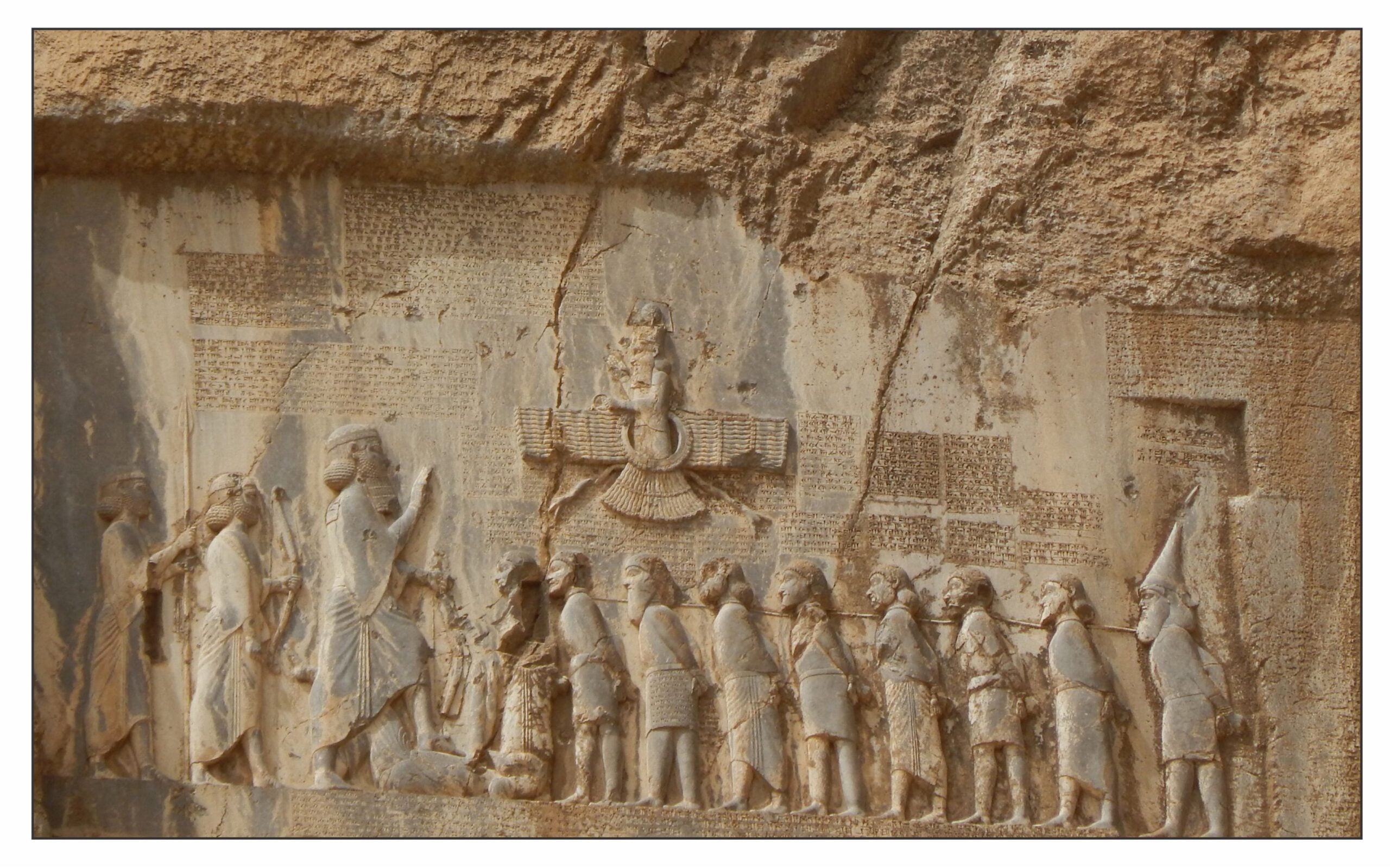
The extensive cuneiform inscription, written in Old Persian, Akkadian and Elamite, describes his conquests and affirms
King Darius says: This is what I have done, by the grace of Ahuramazda have I always acted. Whosoever shall read this inscription hereafter, let that which I have done be believed. You must not hold it to be lies.
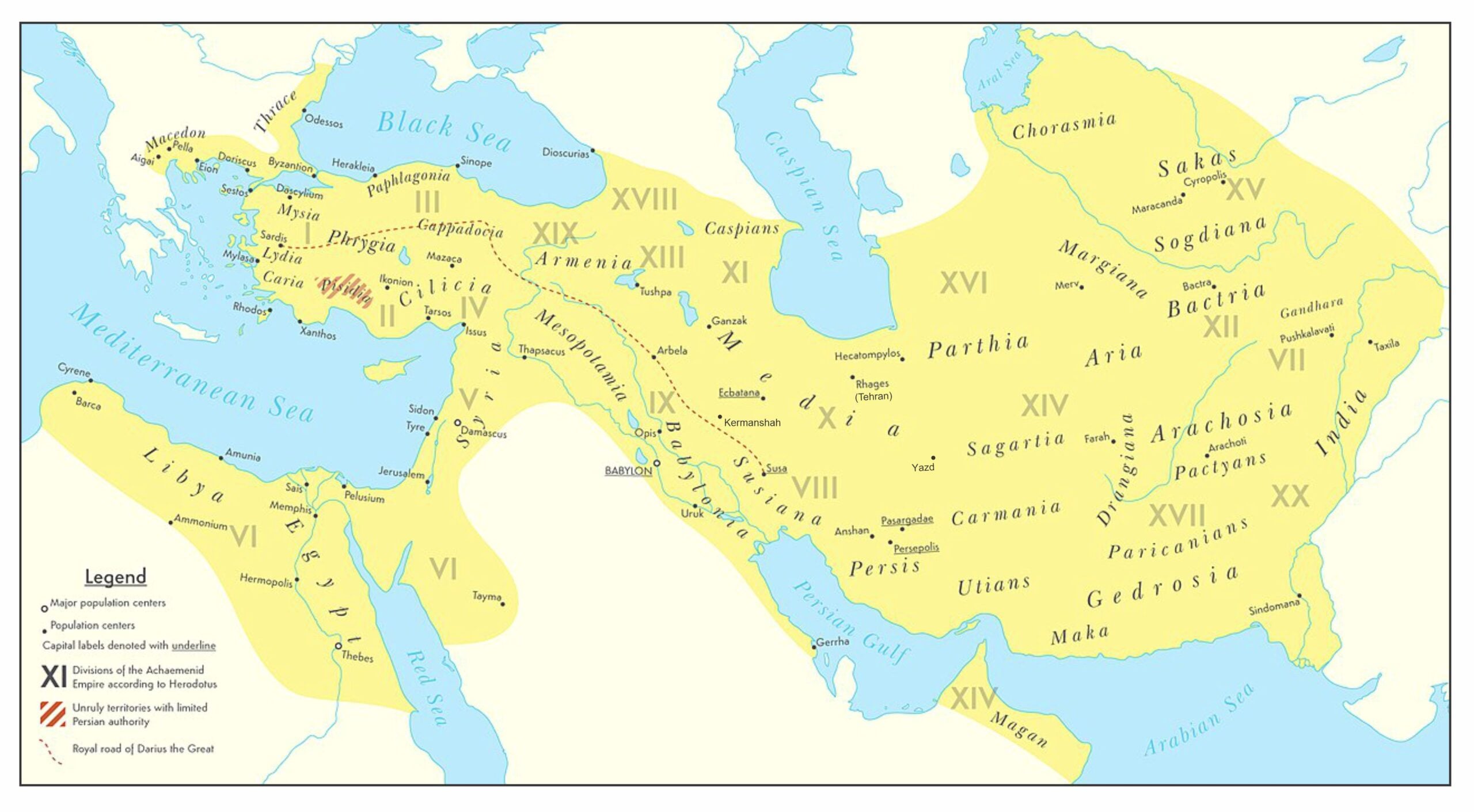
The following map shows the extent of the Achaemenid Empire (550–330 BCE):
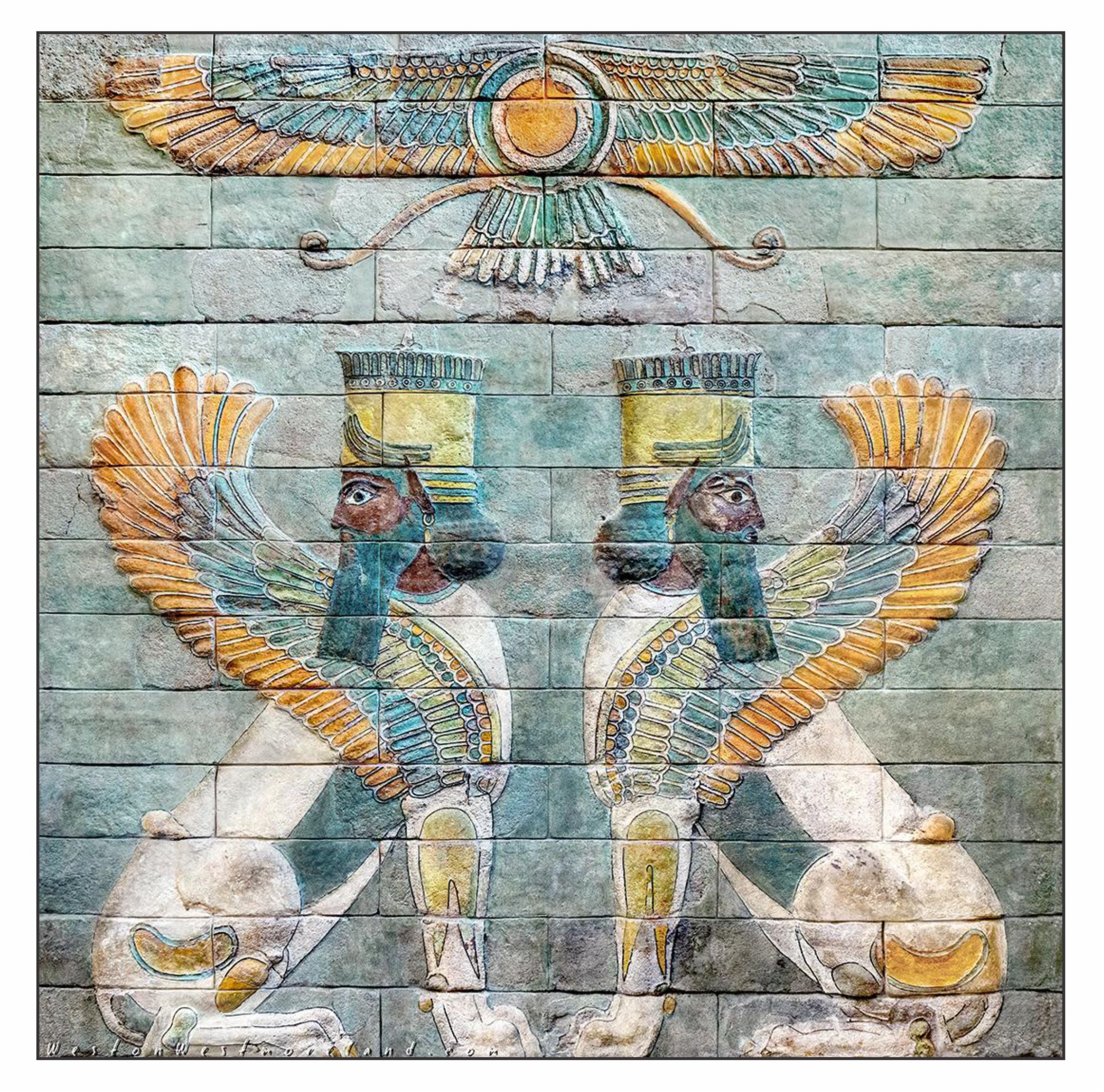
The following shows an enameled brick panel from the Palace of Darius created in Susa in about 550 BCE and presently in the Louvre Museum. It shows two guardian aladlammu, also known as lamassu: composite creatures with the body of a bull or lion, a human head and wings of an eagle (Ritter, 2010). This motif originates in earlier Mesopotamian empires, particularly the Assyrian. The human head represents intelligence, the bull’s body strength and the eagle’s wings freedom. Above the aladlammu is a winged disc which represents the grace of Ahura Mazda. This motif was also present in the Behistun inscription:
The Achaemenid Empire replaced the preceding empires of the Assyrians, Babylonians and Medians. In 480 BCE Xerxes, the son of Darius invaded Greece. Though the Persians were able to sack Athens, the invasion ultimately failed in the Peloponnese.
In 334 BCE Alexander the Great (356-323 BCE) invaded Persia. Over the next few years, he established his own empire stretching from Alexandria in Egypt to the borderlands of India. Upon his death, his general Seleucus I Nicator ruled over the eastern part of this region as the Seleucid Empire (312-63 BCE). The Romans later took control of the Western part of this empire (Syria), leaving Iran to be ruled by the Parthians (247 BCE – 224 CE). The greatest of the Parthian emperors was Mithradates I, whose name meant “gift of Mithra,” and who reigned from 165–132 BCE. Then, from 224 to 651 CE, Iran became the center of the Sasanian Empire. Throughout this prolonged period of changing empires, Zoroastrianism remained as the official Persian religion (Malandra, 2015). By the time of the Sasanian empire, the Avestan language had evolved into Middle Persian (Pahlavi), the direct ancestor of modern Persian (Farsi): Ahura Mazda was now named Ormazd, and Angra Mainyu had become Ahriman.
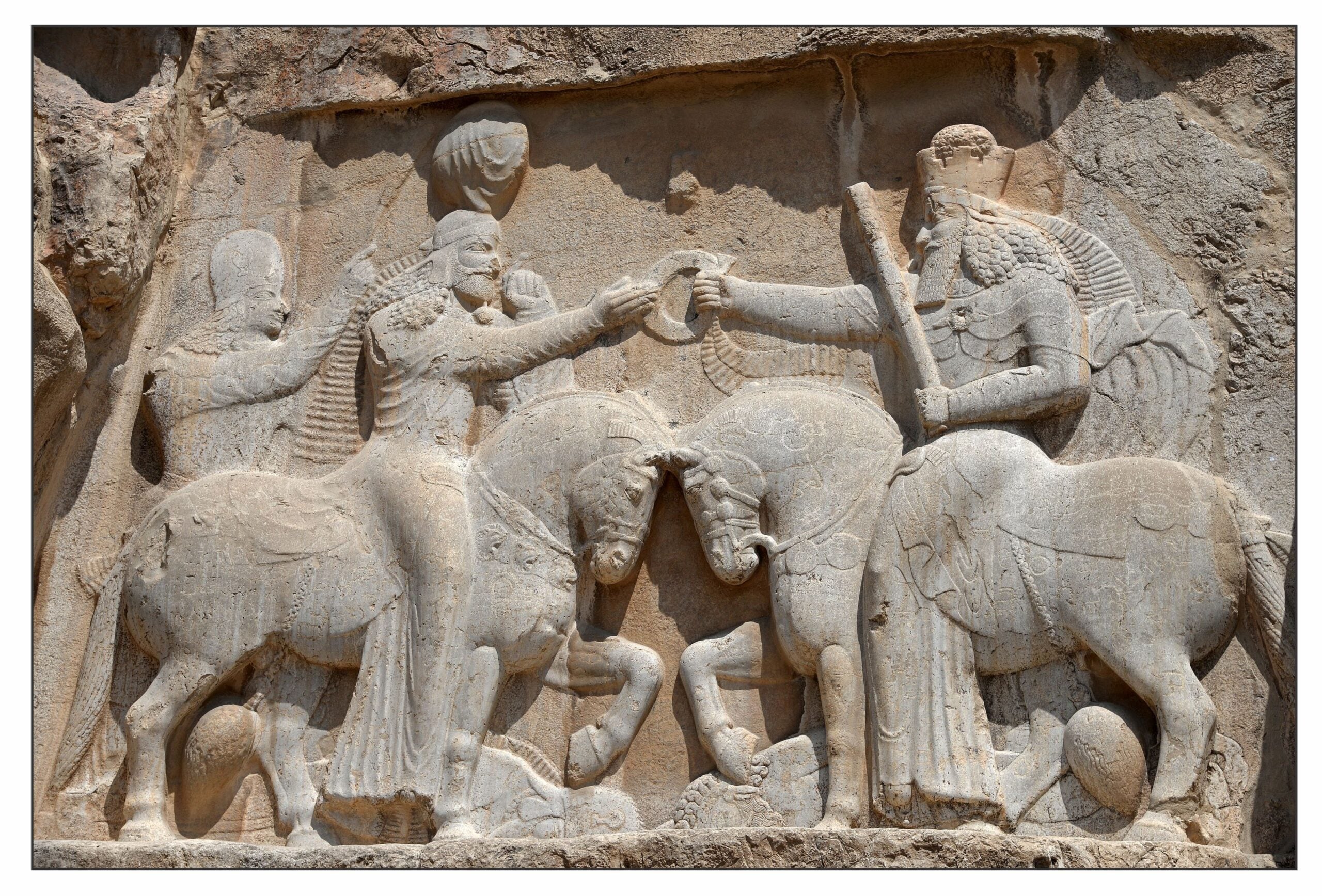
The following illustration shows a relief carving at Naqsh-e Rostam from about 235 CE, showing the investiture of Ardashir I (180–242 CE), the founder of the Sasanian Empire, as the Shahanshah (King of Kings) by Ahura Mazda. On the right, the horse of Ahura Mazda tramples Ahriman beneath its hooves. Ahura Mazda is giving the diadem of kingship to Ardashir, whose own horse tramples the body of Artabanus V, the last king of the Parthian Empire. He holds in his left hand a barsom (a bundle of twigs used in Zoroastrian rituals). Ardashir wears an elaborate turban (korymbos). Behind Ardashir is the Zoroastrian high priest, Kartir.
In 633, one year after the founding of Islam, Muslim forces under Muhammed first invaded the western regions of the Sasanian Empire. The Empire had been weakened by prolonged conflict with the Byzantine Empire, and by fragmentation into different feuding regions. Umar ibn al-Khattab, the second Rashidun caliph continued the conquest and by his death in 644 CE most of Persia was under Muslim rule. Some of the central regions, such as the province of Khorasan, were not fully subjugated until 651 (Litvinsky et al., 1996). Although under Arab rule, Persia was able to maintain much of its culture, particularly during the Abbasid Caliphate (750–1258; 1261–1517). Although Arabic became the dominant language in other areas of Muslim rule, the Persian language flourished. Ferdowski’s Shanameh, the great epic of Persian poetry, completed in 1010 CE, retold the history of Persia from ancient times to time of its writing. Nevertheless, Islam completely replaced Zoroastrianism as the state religion (Choksy 2018).
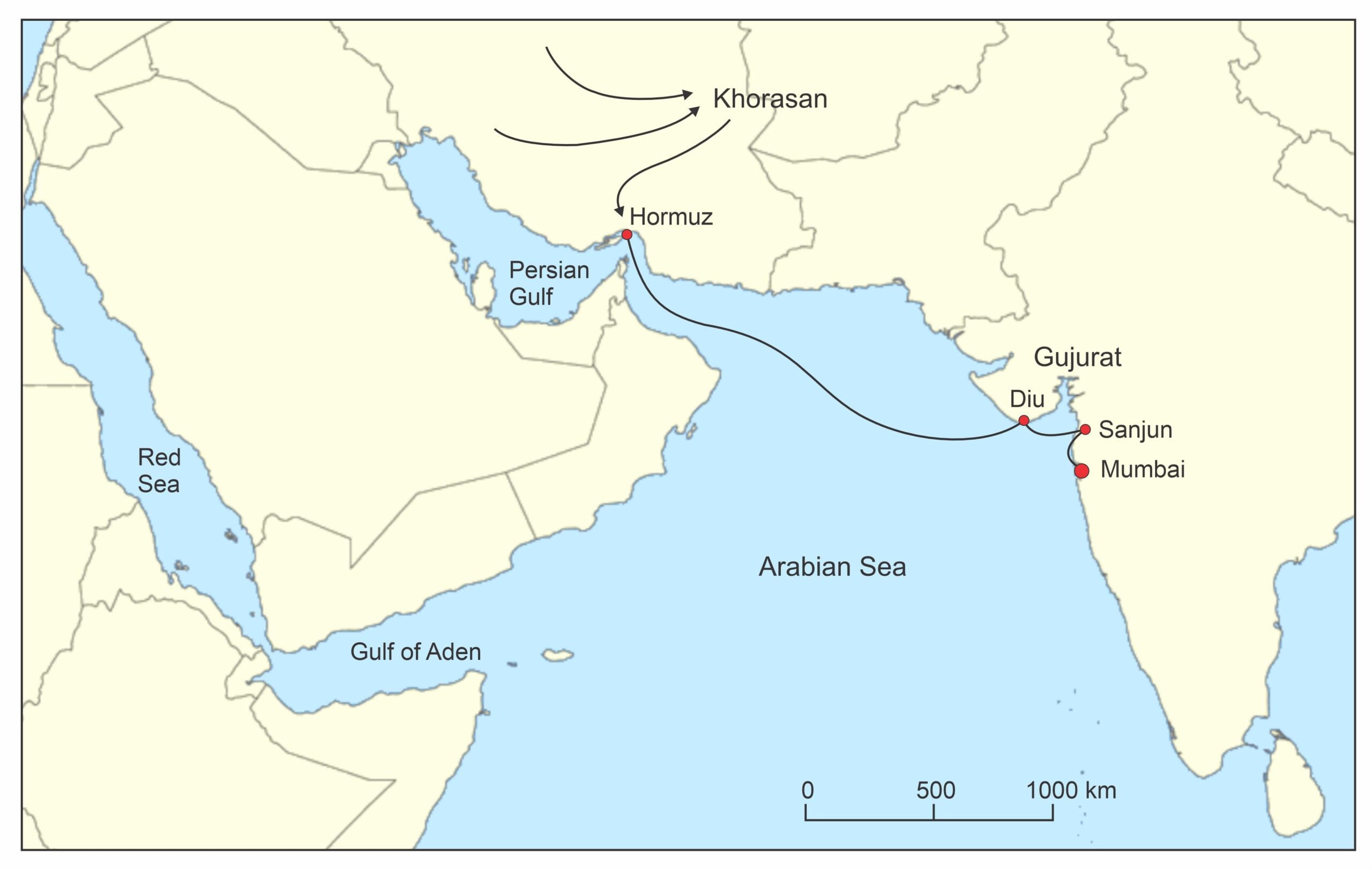
The Muslims tolerated Christians and Jews since they were “People of the Book,” but persecuted Zoroastrians as pagan infidels. Many fire-temples were transformed into mosques and many Zoroastrians converted to Isam. Some faithful Zoroastrians retreated to inland regions of Persia, such as Khorasan. In the 9th Century, Babak Khorramdin led a brief Zoroastrian rebellion against Arab rule, but this came to naught. Some Zoroastrians decided to leave their newly Islamic land and settle in India (Hinnells & Williams, 2007). Zoroastrians had traded with the Indians of the Gujarat region even before the Muslim conquest. A Zoroastrian migration to India were described in an epic poem Qissa-i Sanjan, written by a Zoroastrian priest in 1599 CE. The poem recounts how the Zoroastrians sailed from the Island of Hormuz and initially settled in Diu before moving on to Sanjun and thence to Mumbai. Although the poem describes one specific migration, groups of Zoroastrians likely moved to India from Persia over several centuries, and over several routes.
A famous story is told about the arrival of the Zoroastrians in Gujarat. The local king Jadi Rana explained that his kingdom was full and showed a cup of milk filled to the brim to illustrate this problem. One of the Zoroastrian priests added sugar to the milk to show how the new immigrants could enrich the land without displacing anyone. Asylum was granted, and Zoroastrians still partake of faloodeh – a dessert of vermicelli, milk, sugar and rosewater – at times of celebration
Over the years, the Zoroastrian immigrants became a flourishing community in northeast India, known as the Parsis or “those from Persia” (Hinnells & Williams, 2007). The Parsis have maintained the rituals of their Zoroastrian forebears. Though they remain small in numbers (about 50,000 in the present day), they have contributed extensively to the economy and culture of India. About 20,000 Zoroastrians remain in modern Iran. Other smaller Zoroastrian communities exist in North America and Europe, set up by Iranian emigrants or by Parsis mercantile connections. The total number of Zoroastrians in the world is about 120,000.
Basic Principles of Zoroastrianism
As in any religion, the founding texts of Zoroastrianism provide sometimes contradictory claims. This problem is exacerbated by the difficulty in interpreting the language in which these texts were written. A text entitled The Advice Book of Zarathustra from the Pahlavi period (probably originating in the late Sasanian dynasty but not written down until much later) begins with the following verses which summarize the main tenets of the Zoroastrian faith (Vevaina, 2015, pp 214-215; Skjaervo, 2011, pp 192-193):
The Teachers of Old, who have the foremost knowledge of the Religion, have said that, at the age of fifteen, one should know the following: “Who am I, and to whom do I belong? Where did I come from, and to where will I go back? … And what are my duties in the world of the living (getig), and what is my reward in the world of thought (menog)? … Do I belong to Ohrmazd, or do I belong to Ahreman, to the gods or to the demons, to the good or the bad? Am I a human or a demon? How many are the paths, and which is my Religion?… … Are the Origins one or two? From whom is goodness and badness?
I belong to Ohrmazd, not to Ahreman, to the gods, not to the demons, to the good, not to the bad. I am a human, not a demon, the creature of Ohrmazd, not of Ahreman … My duties and obligations are to think about Ohrmazd that he is, has always been, and will always be, that he is the immortal ruler, boundless, and pure, while Ahreman is not and shall be destroyed … have to have no doubt that good deeds are good for me and bad deeds bad for me; that my friend is Ohrmazd and my enemy Ahrimen; and that the path of the Tradition is one …The one path is that of good thought, speech, and action; paradise is the light and purity and limitlessness of Ohrmazd the Creator, who has always been and shall always be. Another is the path of evil thought, speech, and action. This is the darkness, boundedness, all evil and destruction, and badness of the wicked one, the Foul Spirit, who once upon a time was not in this creation and who once in the future shall not be in the creation of Ohrmazd, but in the end will be annihilated. …I must have no doubt about this too, that the Origins are two: the Creator and the Destroyer. The Creator is Ohrmazd, from whom all goodness and all light emanates. The Destroyer is the wicked Evil Spirit, who is all badness and full of death, wicked and deceiving. … I have to have no doubt about these things, … that very person is mortal; that the soul (gyān) is expelled and the body destroyed; that the accounting takes place at the third dawn (sidōsh); that the Resurrection and the Final Body will come about.
In summary: One God – Ahura Mazda (Ohrmazd) – created and rules the world according to the principles of asha. He and will ultimately triumph over the forces of druj (deceit, evil) led by Angra Mainyu. Human beings must follow the way of asha by means of good thought, good speech and good action. This will justify their resurrection after death.
(i) Asha
The starting point for any interpretation of Zoroastrianism is the concept of asha (or asa, depending on the transliteration). This Avestan word goes back long before Zoroaster to the time when the proto-Indo-European language was being formulated. It is homologous to rta Sanskrit (Schlerath & Skjærvø, 2018). The meaning of asha is very difficult to express in a single word. Irani (1990) proposes that it contains four main ideas:
The first is the most general philosophical concept, Truth. The second is the cosmological implication of the Order underlying the universe. The third and fourth belong to the moral dimension – Right as the most general term of moral correctness, and Justice as the moral principle of the social system.
In these early times before the monotheistic reformations of Zoroaster, one of the many gods, Mithra (or Mitra), was responsible for the maintenance of asha. The name of Mitra combines mi (bind) with tra (causing to) to suggest covenants, oaths, truth-telling and contracts – the bases of social order and harmony. Mithra is portrayed as radiating light like the sun. Boyce (1975, p 27) describes Mithra’s role:
One of the striking features of his activity is that he is concerned with upholding the great Indo-Iranian principle of rta/asa. This term, it is now generally accepted, represents a concept which cannot be precisely rendered by any single word in another tongue. It stands, it seems, for “order” in the widest sense: cosmic order, by which night gives place to day and the seasons change; the order of sacrifice, by which this natural rhythm is strengthened and maintained; social order, by which men can live together in harmony and prosperity; and moral order or “truth”. In both India and Iran to possess rta or asa, to be rtavan or asavan, was to be a just and upright being; and when used of the dead these words implied that the departed was blessed in the hereafter, having attained the Paradise which he deserved.
Ahmadi (2015) proposed that asha in effect refers to the whole of creation, that which has been ordered, and might be expressed by the word “cosmos” which derives from the Greek kosmein (to arrange or to put into proper order). (“Cosmetic” has the same etymology.)
The concept that there is some underlying order in the universe, that everything is unfolding as it should, is common to many different philosophies and religions. The asha/rta of the Indo-European forebears is closely related to Maat in Ancient Egypt, to the Dao in China and to the logos in Greek philosophy. To my mind these concepts essentially indicate that the world is intelligible. There is an order behind things that we can try to understand and to follow, “a divinity that shapes our ends, rough-hew them how we will” (Hamlet, V:2)
Asha is the subject of a Zoroastrian prayer recited during all Zoroastrian observances (Rose, 2011a, p 24)
Ashem vohu
vahishtem asti
ushta asti
ushta ahmai
hyat ashai vahishtai ashem
Asha is the best good
It is happiness [or ‘it is desired’],
according to our desire, there will be
Asha which belongs to the best Asha.”
Another translation (Nigosian 1993, p 103) is
Righteousness [is] good, it is best.
According to [our] wish it is,
according to our wish it shall be.
Righteousness belongs to Asa Vahista.
(ii) Monotheism
Zoroaster’s great contribution to human religious thought was to proclaim one God – Ahura Mazda – as the supreme creator and lord of the universe. The Jewish patriarch Abraham who may have lived sometime toward the end of the 2nd millennium BCE is generally considered the first monotheist. However, recent evidence suggests that although Jewish monotheism had its beginnings around the 1st Millenium BCE, it was not fully formulated until the period of the Babylonian Exile in the 6th Century BCE (Gnose, 1997, Chapter 2). Yahweh was initially considered as the God of the Israelites and only later evolved to be the God of the whole universe. Zoroaster probably lived at around the same time as Abraham, though both are legendary rather than historical figures, Zoroaster may have been the first prophet to preach universal monotheism, and Zoroastrianism the first monotheistic religions to survive its founder (Ferrero, 2021). The Egyptian Akhenaten (servant of Aten, 1353-1336 BCE) favored the Sun God Aten above all other gods, but Atenism did not persist beyond his brief lifetime.
Ahura Mazda was recognized before Zoroaster, though he was not as clearly defined as some of the other gods of the Indo-European pantheon, such as Mithra (god of the sun and of covenants) and Apam Napat (god of water and fertility). Zoroaster reportedly had a vision in which he met Ahura Mazda in person, and recognized him as the supreme creator, and source of asha. In the religion that he proclaimed, some of the other gods were somehow subsumed into Ahura Mazda. Hymns are offered in praise of both Ahura Mazda and Mithra. Many other gods remained separate but were still considered worthy of worship (yazata). These were subservient to the will of Ahura Mazda (Hintze, 2014). In all monotheistic religions, the supreme God, even though omnipotent, needs other heavenly beings to facilitate his plans. In the Abrahamic religions, these are called angels.
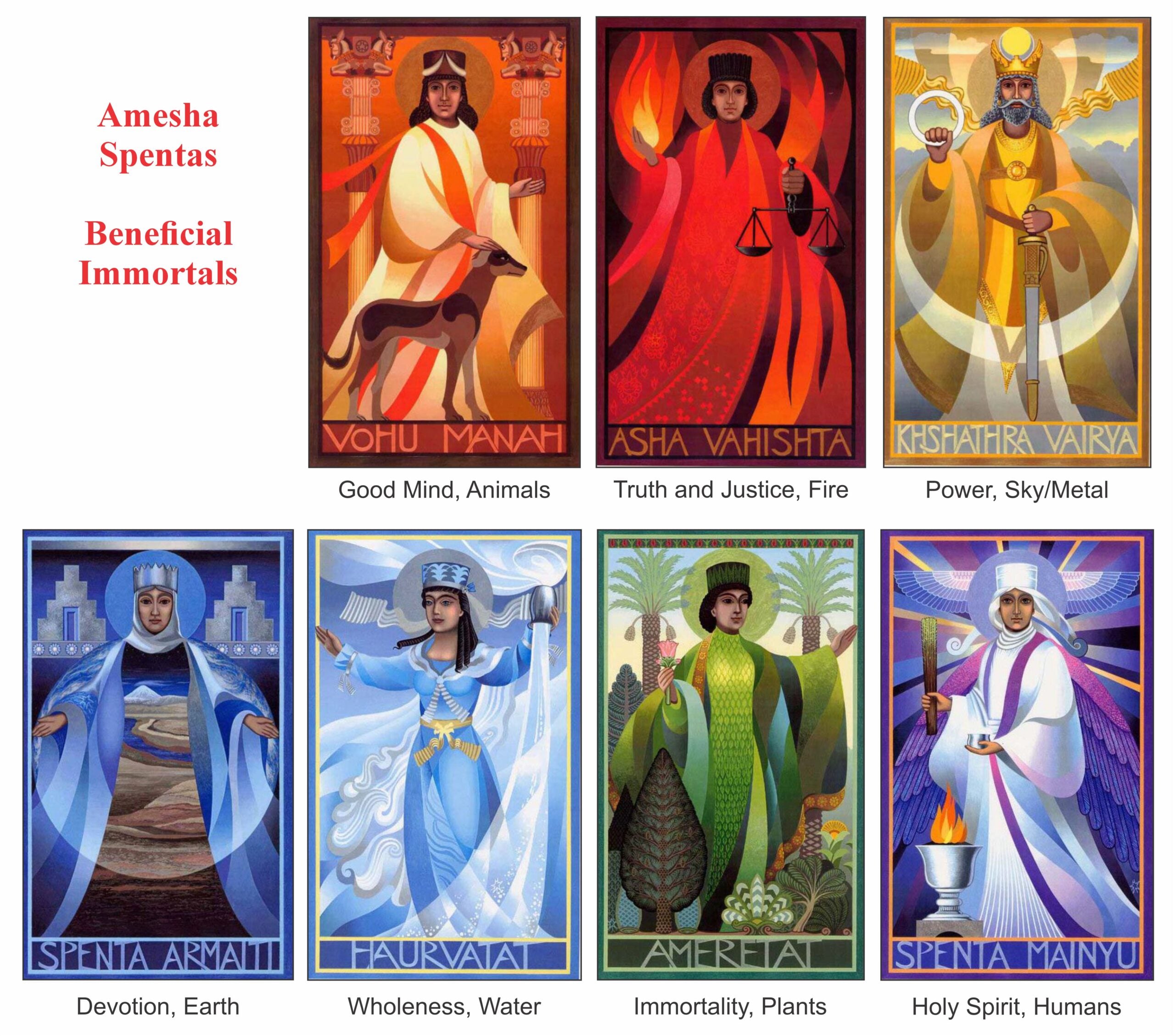
One of the earliest acts of Ahura Mazda was to create the Amesha Spenta (Immortal Benevolents). These are as much abstract concepts – emanations from the mind of Ahura Mazda – as actual divinities. They share some of the characteristics of the Seven Heavenly Virtues (prudence, justice, temperance, fortitude, faith, hope, and charity) in Christianity and their organization is related to the Five Great Elements (Pancha Mahabhuta, earth water, fire, air, ether) of Hinduism. They are generally considered six in number (Stausberg, 2008, p 29) though some authors describe seven (Rose, 2011a, p 29). The following illustration shows some modern images:
(iii) Dualism
Essential to Zoroastrianism is the concept of dualism (Gnoli, 2017; Vevaina, 2015). In the Gathas (Y 30:3-4), Zoroaster reveals his vision (or dream) about the two opposing forces in the world (Ahmadi, 2013). Our incomplete understanding of the Avestan language limits our interpretation but the following is one translation:
The two primeval Spirits, who are twins, were revealed to me in sleep. Their ways of thinking, speaking, and behaving are two: the good and the evil. And between these two ways the wise men have rightly chosen, and not the foolish ones. And when these two Spirits met, they established at the origin life and non-life, and that at the end the worst existence will be for the followers of Falsehood and for the follower of Truth the Best Thinking. (translation from Gnoli, 2017).
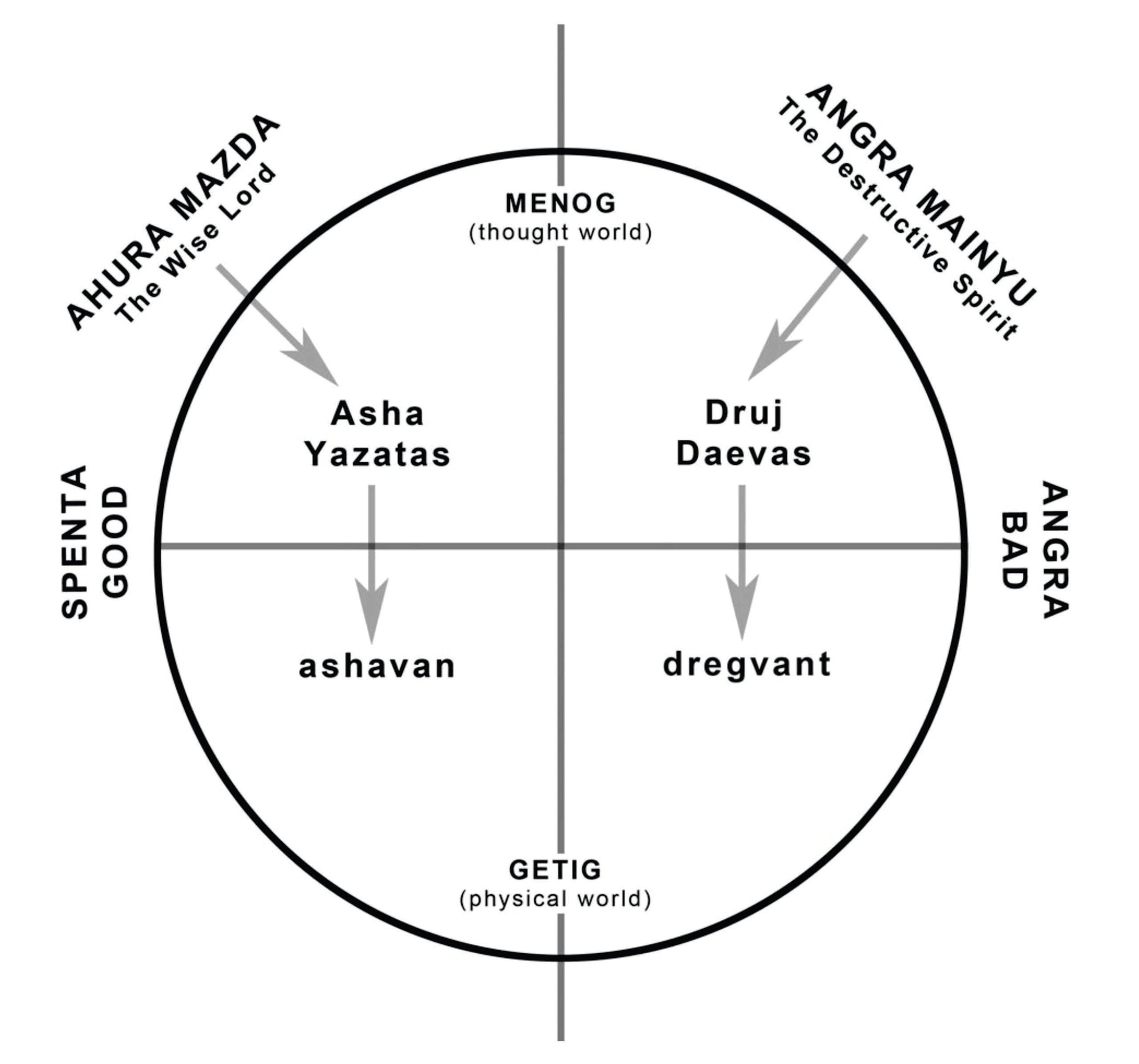
The two spirits are Ahura Mazda and Angra Mainyu. Ahura Mazda, assisted by the amesha spenta and the yazatas, supports asha (truth, justice, order, righteousness). Angra Mainyu promotes druj (lie, wrongdoing, chaos, evil) with the support of daevas (devils, demons).
Angra Mainyu is a spirit of destruction, incapable of creating anything, and inactive in the absence of creation. Its home is the kingdom of death. Boyce (1975, p 199) describes the spirit:
Angra Mainyu is seen both as actively malignant, a militant foe, and also as a mere shadow, a negation of good; for traditionally existence in the kingdom of the dead was characterised by a lack of substance, by a spectral quality without positive capacities, a nothingness.
Henning (1951, p 46) describes how Zoroaster’s dualism supplements his monotheism, by explaining the existence of evil and suffering in the universe:
Any claim that the world was created by a good and benevolent god must provoke the question why the world, in the outcome, is so very far from good. Zoroaster’s answer, that the world had been created by a good god and an evil spirit, of equal power, who set out to spoil the good work, is a complete answer: it is a logical answer, more satisfying to the thinking mind than the one given by the author of the Book of Job, who withdrew to the claim that it did not behove man to inquire into the ways of Omnipotence.
At the beginning Zoroastrianism proposed an ethical rather than an ontological dualism: good (asha, vohu) versus evil (druj, aka), rather than spirit (menog) versus matter (etig). However, as the religion evolved, the dualism extended into the ontological as well. However, the two dualisms were orthogonal to each other. Both good and evil beings could be either spiritual or material (or both). The following is an explanatory diagram from Rose (2011b, p 27):
What is special about Zoroastrian dualism is the role played by human beings. The dualism of Zoroastrianism does not remove the basic problem of monotheism: how could an omni-benevolent and omnipotent God allow so much evil and suffering in the world. However, it does allow that human beings play a very significant role in the fight against evil. By our choices and our actions we can help the forces of good (Nolan, 2025):
The battle between Good and Evil has been in process since Time began and will go on till the end of the world: but as the two powers are evenly matched, its outcome is uncertain. The decisive factor will be the collective action of humanity. Enry man or woman is free to choose which side to join: his or her support will add permanent strength to the side chosen, and so, in the long run. the acts of Man will weigh the scales in favour of the one side or the other. Thus Zoroaster, beside his principal two powers, recognizes a third, which, though not of equal rank, holds the balance. (Henning, 1951, pp 45-46).
(iv) Souls and their Fravashi
Each human being has a spiritual soul (urvan) which exists before birth and which survives the death and decay of the physical body. The fravashi are spiritual beings which foster, protect and preserve these individual souls (Boyce, 2015). The concept likely began in relation to the spirits that protect warriors during battle, but in Zoroastrianism, it became applicable to all living things. The fravashi are responsible for inserting the soul into the newborn, protecting the individual during his or her life, promoting good thoughts, speech and action, and rescuing the soul after the death of the body. Stausberg (2008, p 38) suggests that they can be considered “guardian angels.”
Various etymologies have been suggested for the word fravashi (Boyce 2015). The root var can be related to “impregnate,” or to “turn” (which with fra, away, could yield the idea of protection), or to “choose” (especially in the sense of confessing a faith).
The relationship between the fravashi and the urvan is not clear. In some Zoroastrian writings they are conjoined:
The developed doctrine came to be that each fravasi existed from the beginning of time in a spiritual (menog) state; that in due course it was born, clad in a physical body, into this world; and that after death it lived once more in a spiritual state, to be re-united again ultimately with its resurrected physical body. In both the second and third states the fravasi tended to be identified with the urvan, as these concepts merged. The question then was pondered as to which, in the present state of the world, was the most powerful, the unborn fravasi, or that of a living person, or that of a dead one? This again suggests the theorising of priestly schools rather than a point of any popular concern. The Zoroastrian answer was that the fravasis of the great men of the faith, whether already dead or not yet born, were the most powerful, but that otherwise the fjravasis of the living were the strongest – a doctrine which seems to reflect the profound universal instinct that it is better to be alive in the flesh in the present familiar world than to exist in any other state. (Boyce, 1975, p 128)
(v) The Faravahar
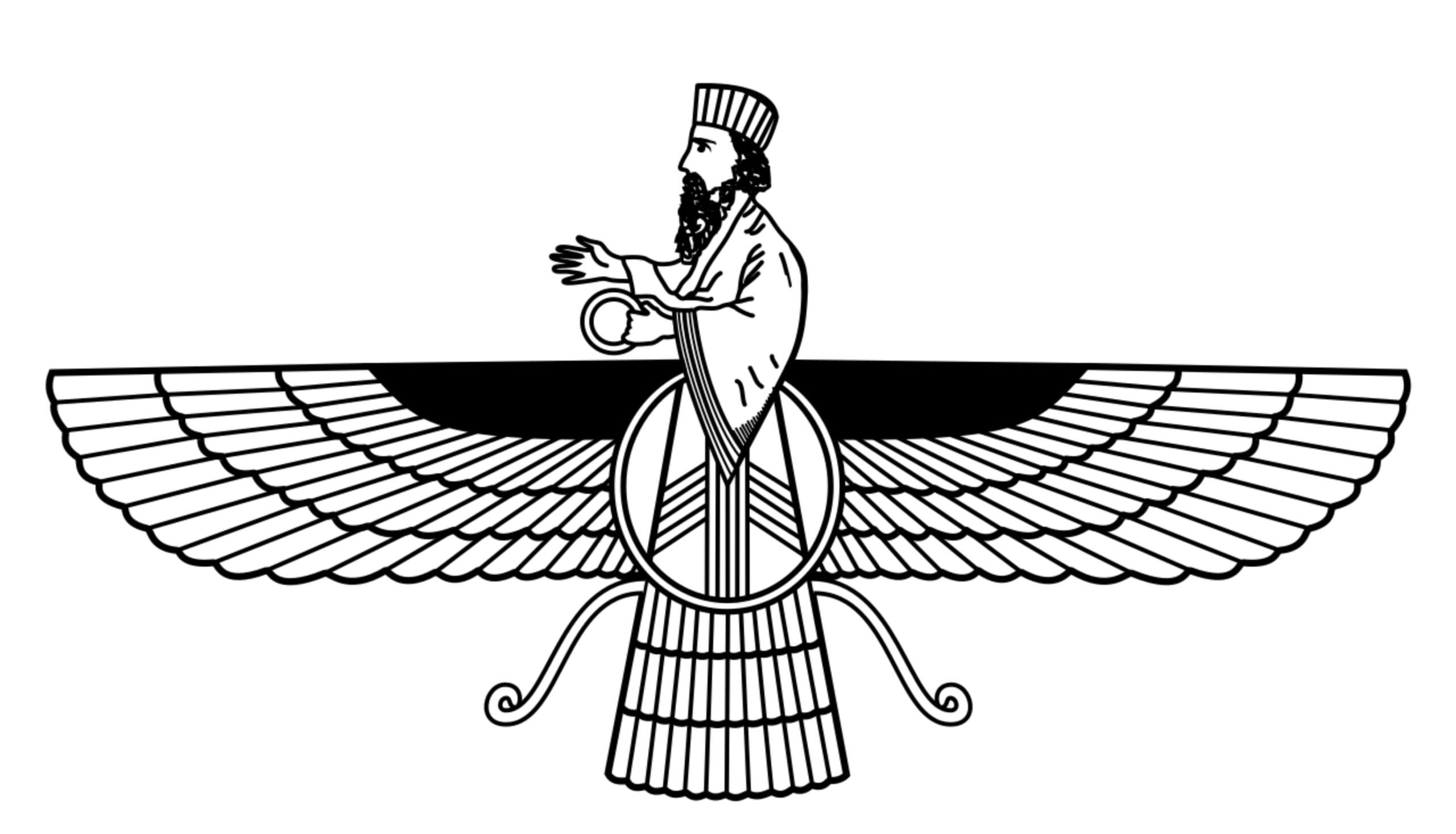
The Faravahar or Farohar has become a prominent symbol of Zoroastrianism. It has its origins in the winged disk that was used in Ancient Egyptian and Assyrian cultures to denote the power and protection of the sun god. In the Faravahar, the winged disk supports a god or person, holding a ring. In this form, the symbol first appears during the Achaemenid era.
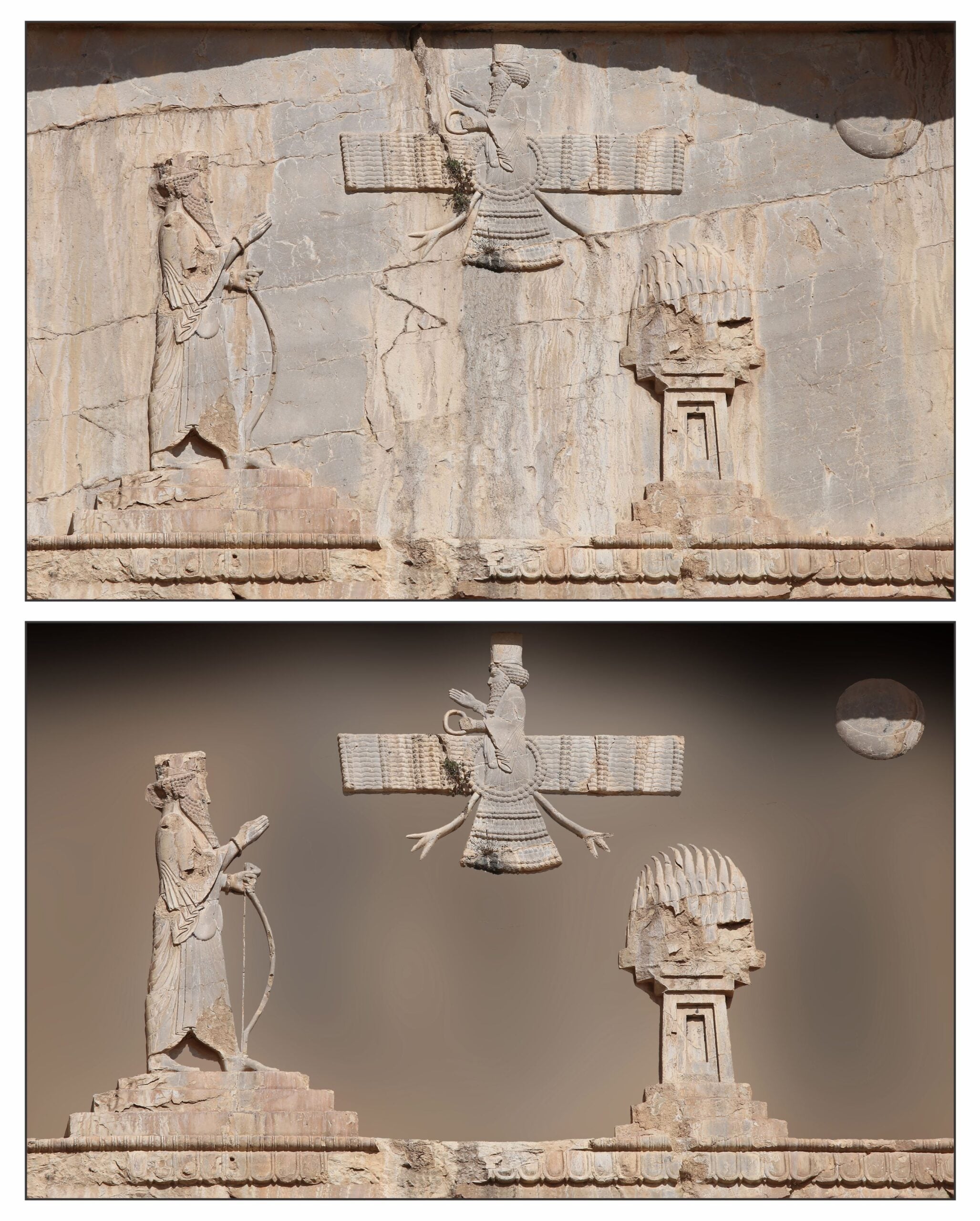
The following are photographs of the Tomb of Darius the Great at Naqsh-e Rustam (circe 500 BCE) taken by Richard Stone. The upper photograph is the original and the lower has been enhanced to show the relief carvings. Darius stands before the sacred fire and the faravahar symbol floats above.
No one is sure exactly what the faravahar symbol means. A common interpretation is that it represents Ahura Mazda. Shahbazi (1974) argues against this since the few accepted representations of Ahura Mazda, such as the previously illustrated relief at Naqsh-e Rostam, show him holding a barsom.
There are actually very few representations of Ahura Mazda. My intuition is that the supreme deity Ahura Mazda is far beyond any portrayal by human hands, and that those supposed depictions more likely represent priests in his service, or one of the Amesha Spentas such as Khshathra Vairya, who confers temporal powers on worthy human leaders.
Another interpretation of the faravahar is that the symbol represents the individual human soul and/or its fravashi. The following description is along these lines:
It represents the link between the spiritual and physical worlds. The human form in the center is encircled by a ring that represents the eternal soul. The figure’s head reminds people that they have free will, a mind and an intellect with which to choose good. The right hand points upward to lead people toward Asha, the path of Truth. In the left hand is a ring symbolizing the just power of Khshathra Vairya. The figure has wings to help the soul fly upward and progress. It has a tail that serves as a rudder to help the soul balance between the opposing forces of good and evil. These forces are represented by the curved hooks on either side of the tail. The three sections of the tail, which appear as layers of feathers, remind people of good thoughts, good words, and good deeds. Throughout life, the human soul is caught between good and evil, Truth and the Lie. But with the heavenly help, or wings, of Ahura Mazda, the soul may soar to eternal goodness and light. (Harz, 2004, p 9)
According to this approach, the faravahars depicted on the historical reliefs likely represent the the fravashi of the king or priest that is the subject of the carving. Shahbazi (1974) argues against this interpretation since the faravahar has no individuality. Furthermore, the fravashi were initially considered female whereas the faravahar is always male.
Another possibility is that the symbol represents Khshathra Vairya the Amesha Spenta of righteous power, who is typically shown holding a ring or diadem.
A final interpretation, and the one that I prefer, is that the faravahar symbolizes the concept of khvarenah (or farr in New Persian) (Shahbazi, 1980; Boyce, 1982, pp 103-105). This is the right to rule conferred by Ahura Mazda upon those deserving dominion over their fellow men. The leader may become radiant (hvar means sun), and remain so if he rules in accord with asha. The concept of khvarenah has also been translated as “divine glory”
In modern times the faravahar has been used outside of any religious connotation as a symbol of Iranian nationalism. For example, it formed part of the coat of arms of the Pahlavi dynasty who ruled Iran from 1925 until the Iranian Revolution in 1979.
(vi) Eschatology
Ultimately, Zoroastrians believe that the struggle between good and evil will be won by the forces of good, and the universe will be renewed (Moazami, 2000; Kreyenbroek, 2002; Staussberg, 2008, pp 39-42; Cereti, 2015). This is the doctrine of frashokereti (Avestan, making into initial state, restoration; Middle Persian frashgird).
When the end-times draw near, a virgin will bathe in the waters of Kayanse, a mythical lake that preserves the seed of Zoroaster, and will conceive the savior Saoshiant (he who brings strength), who will lead the forces of good. The savior is also named Astvat-ereta – ‘the one through whom Asha has bones’ (Rose, 2011b, p 44). He will defeat Angra Mainyu in battle, and will cause all who have died to be resurrected.
The Saoshyant will bring about the Resurrection, and will hold an assembly of all men and women in which they will realize their good and wicked deeds. There will be a Final Judgment and those to whom sin still clings will undergo another short period of punishment in hell (this time not as spirits but in the material body), while the righteous will again enjoy the delights of paradise. Then all the metal contained in the mountains of the earth will be melted. A river of molten metal will thus be formed, through which all men must pass; for those who are free of sins, this will be like a bath in warm milk, but those whose sins have not been completely atoned for will experience a fierce burning. All men, thus cleansed, will then meet together and praise Ohrmazd. (Kreyenbroek, 2002, p 46).
There are clear similarities between these Zoroastrian prophecies, which were most fully developed during the Achaemenid era, and the concepts of the Messiah that developed in Judaism at about the same time, and which significantly affected Christianity. Which of the prophecies came first, and how each tradition contributed to the other is not known (Hultgard in Stausberg, 2008, pp 106-110).
Mary Boyce notes that the ideas of an end-time and of a final judgement distinguishes Zoroastrianism from the prevalent idea of eternal reincarnation that is the basis of Hinduism and Buddhism.
With this belief in an end to human history Zoroaster appears to have made another profound break with pagan ideas, whereby (to judge from the Vedas) the generations of men were seen as succeeding one another remorselessly like waves of the sea. The strong sense inculcated by Zoroaster of both time and purpose, of all mankind and all spenta being striving towards a common end, a foreseeable goal, has been held by some to be the most remarkable characteristic of his teachings. (Boyce, 1975, p 233).
Another intriguing aspect of the Zoroastrian view of the final judgment is that it provides universal access to paradise. A logical problem in the Christian account of judgment is why an omnibenevolent God would not forgive everyone. In the Zoroastrian account, the good are quickly taken into the new world and those tainted by sin can have their evil erased by some sort of painful purification. The rewards offered in Zoroastrianism are quasi-universal:
The righteous who are barely affected by purification and those who become entirely good without impinging on their continued survival are saved and have the best outcome. Those who undergo so much change in the purification process that it is not entirely determinate whether the post-purification person is the same as the person before purification, and in extreme cases, it is determinate that a new person emerges from the process, albeit one who retains important continuities with the pre-purification individual. (Nolan, 2025, pp 49-50)
There are similarities here to the Catholic concept of Purgatory. However, access to Purgatory is only allowed to Christian believers who repent. Non-believers and those who do not repent remain eternally damned.
Zoroastrian Practices
(i) Fire Temples
Fire (atar) is an essential component of all Zoroastrian rituals and religious ceremonies:
The flame is considered to be the visible sign of Ahura Mazda’s presence, the symbol of his truth (asha). According to tradition, fire was used by Ahura Mazda in the creation of cattle and human beings … and fire will be used again by him when he brings about the final renovation of the universe. (Nigosian, 1993, p 112).
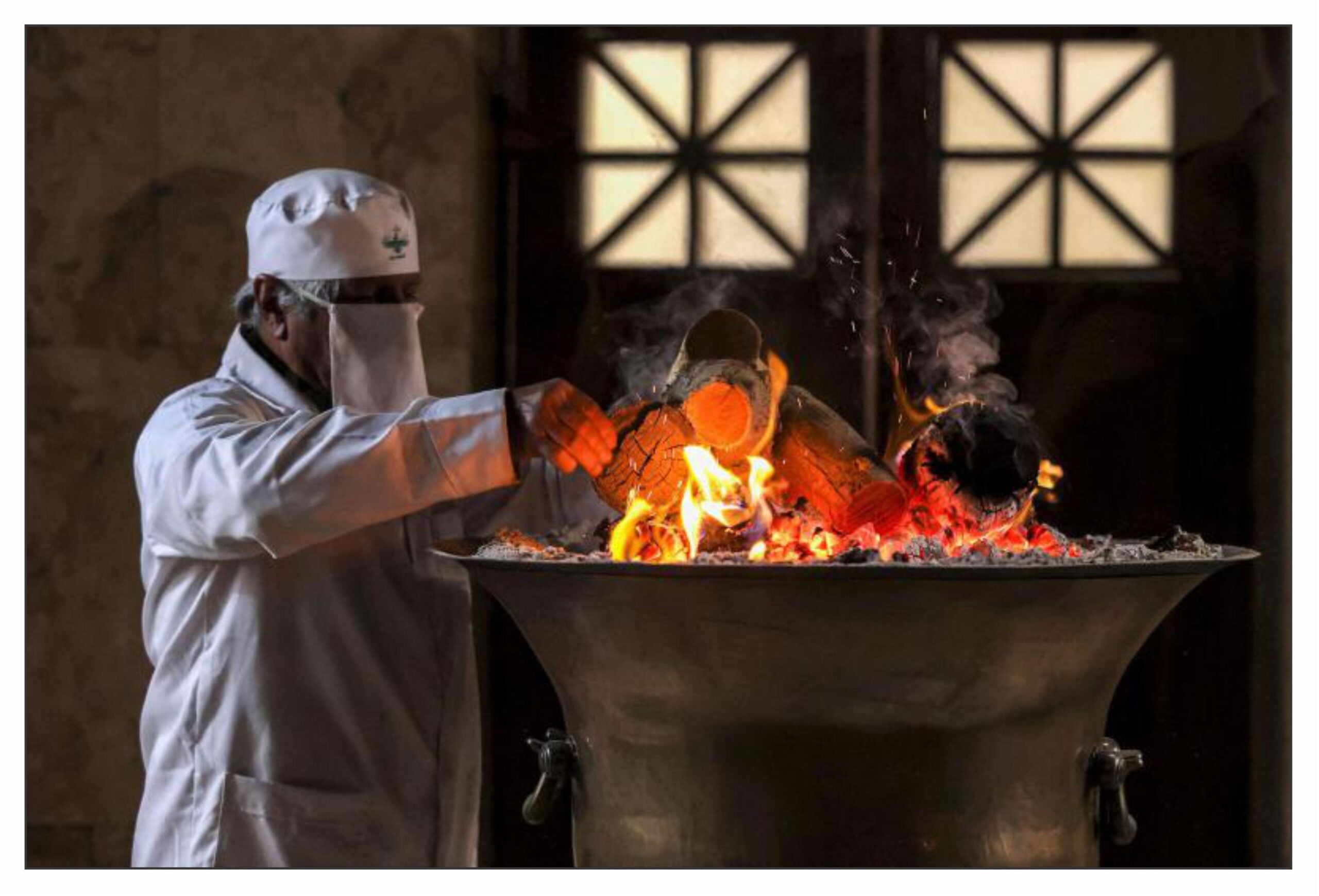
In Zoroastrian fire-temples, an eternal fire was kept burning so that worshippers could at any time be in the presence of Ahura Mazda. The fire burns during the Yazna, a ceremony wherein the priest recites passages from the Avestan scriptures. The following shows the consecrated flame in a fire-temple in Yazd in central Iran:
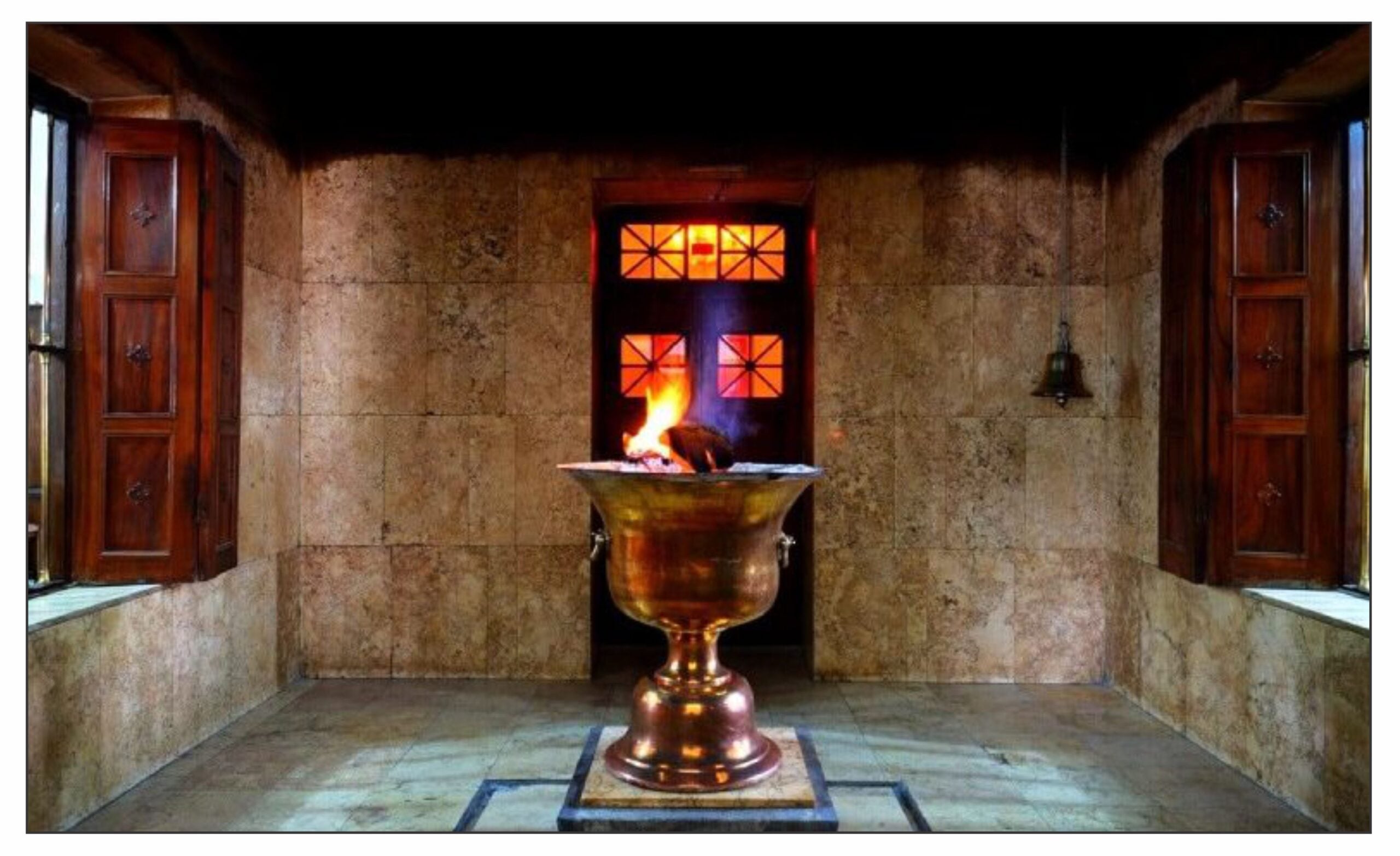
The fire must be protected from pollution. Only clean and dry wood (typically sandalwood) should be placed on the fire. Priests tending the fire wear masks so that their mortal breath does not reach the flames.
(ii) Burial
Zoroastrians did not cremate their dead for such a process would defile the fire which they hold sacred. They also did not bury their dead, for such a process would pollute the earth. They resorted to “excarnation:” leaving the corpse out for carrion birds to cleanse. In ancient times this was done in open areas of desert. After the Islamic invasion, Zoroastrians constructed specially raised buildings called dakhma (towers of silence) for their dead (Boyce, 1975, pp 325-330; Russell, 2013). These were generally located upon small hilltops.
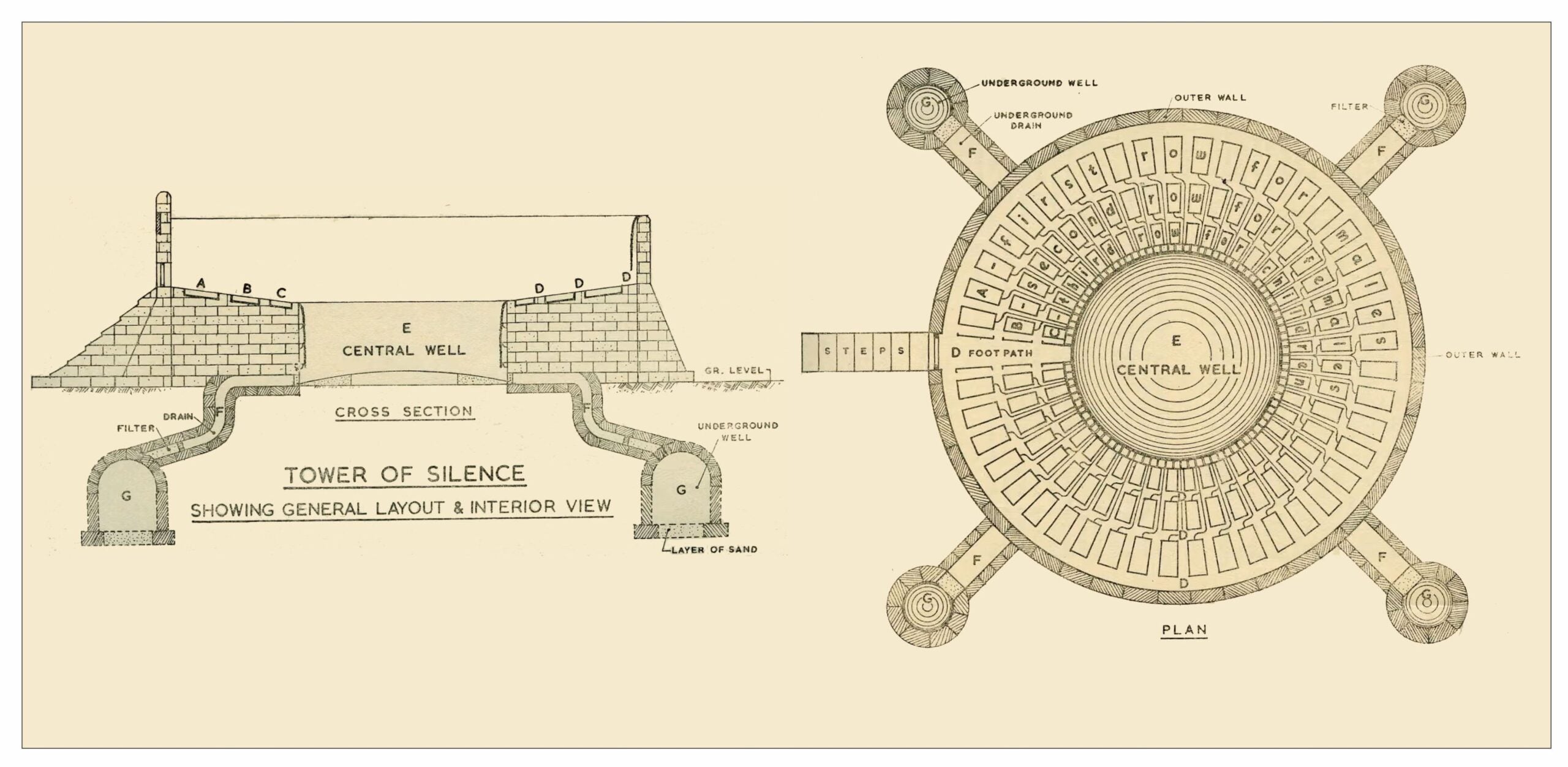
After the funeral rites the corpse was taken by dakhma attendants and laid out on beds arranged in circles around a central pit. Male bodies were relegated to the outer circle, female bodies to the next circle and the bodies of children were placed in the inner circle. After several days vultures will have stripped the bones of their decaying flesh. The bones are then raked into the central pit where they will be cleansed by the rains. Over time the cleansed bones will disintegrate and be washed by the rains into wells, whence their dust will return to the earth.
Most of the dakhmas in Iran have not been active since the Middle Ages. A few survived but their usage was declared illegal in the 1970s. The Parsis community in Mumbai maintained dakhmas in the suburbs of the city. The first tower was consecrated in 1670. With the spread of urbanization and the decline in the population of scavenger birds, these have become inactive (Karkaris, 2015).
The following diagram shows a cross-section and a bird’s eye view of a dakhma
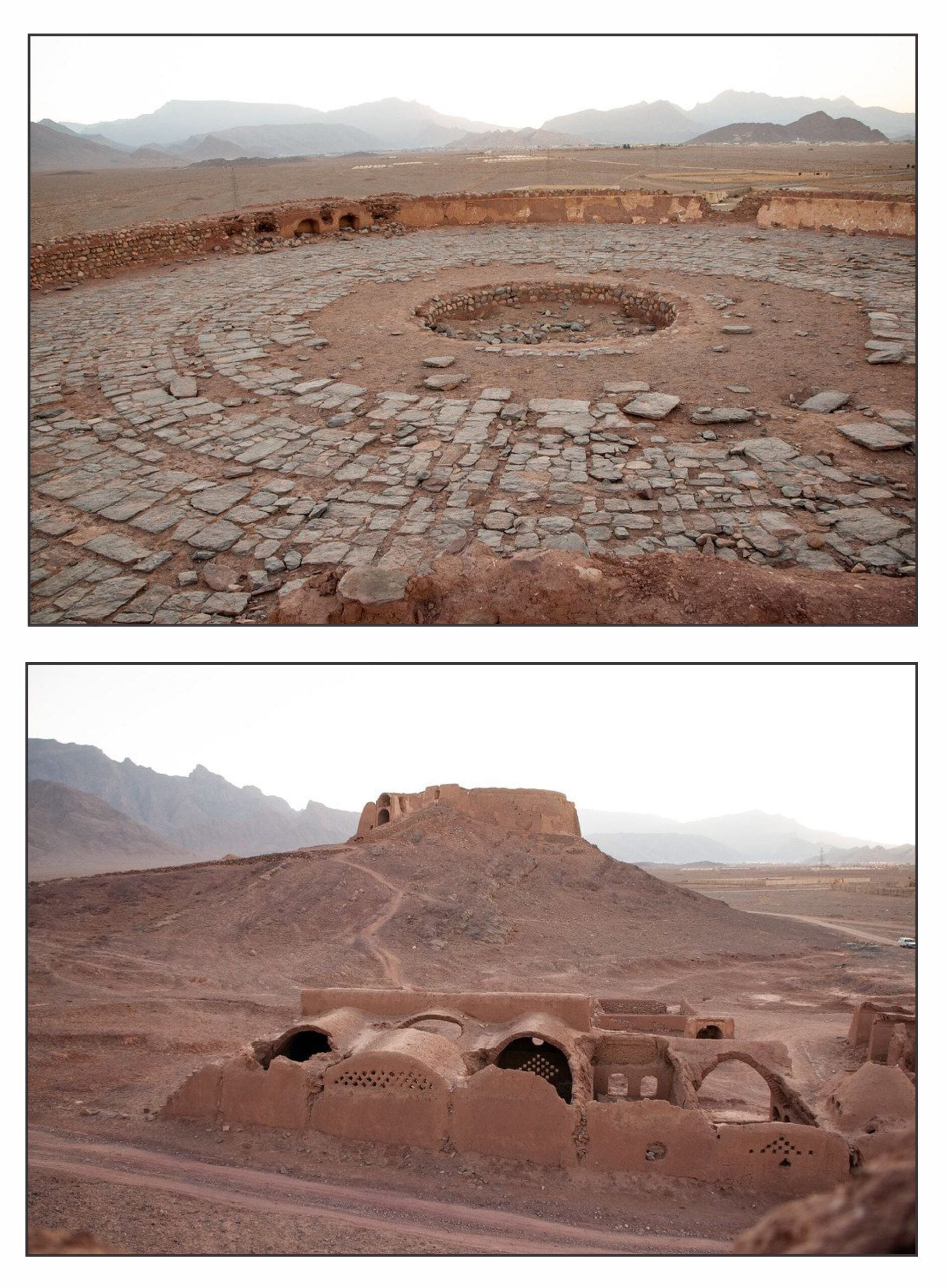
The following illustration shows two views of the dakhma at Yazd in Iran, the first from above and the second from below. .
 Nowadays most Zoroastrians are buried in the ground in concrete-sealed tombs to prevent any contamination of the earth by the decaying corpse.
Descendants of Zoroastrianism
(i) Mithraism
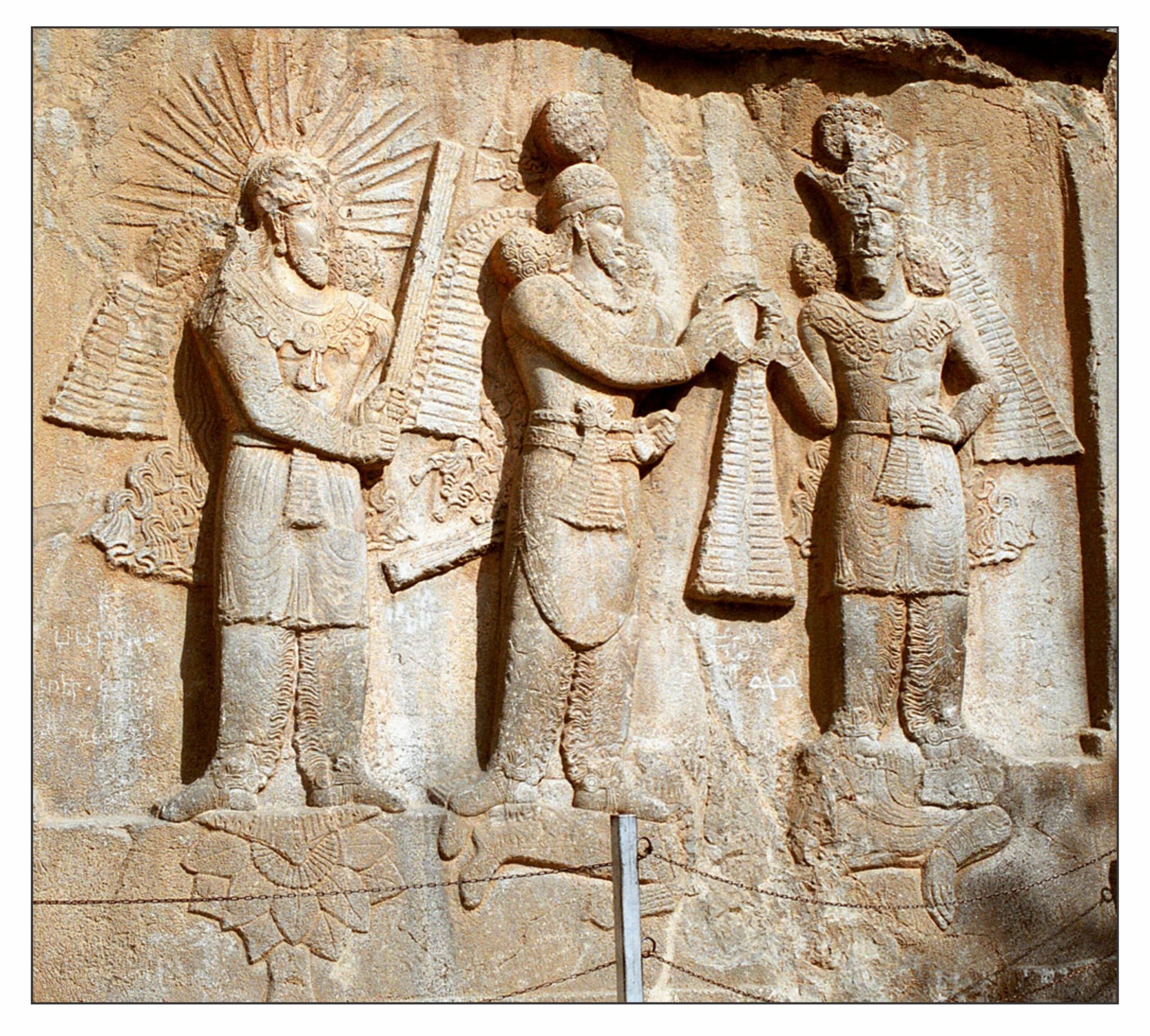
Mithra persisted as a divinity (yazata) throughout Zoroastrianism. He is frequently considered as co-equal with Ahura Mazda, and it is often difficult to determine whether a particular representation is of one or the other. The following is a relief sculpture from Taq-e Bostan, near Kermanshah, that was made in the 4th Century CE to commemorate the investiture of Ardashir II who reigned as Shahanshah from 379-383 CE. He was the brother of the Shapur the great who had reigned from 309-379 CE. The relief also celebrates the victory of the Sasanians over the Roman forces of Emperor Julian, who died on his ill-fated expedition into Persia in 363 CE.
The figure on the left represents Mithra, shining with the radiance of the sun. Mithra stands upon a lotus. This might perhaps be related to the influence of Buddhism which had spread from India into the eastern regions of the Sasanian Empire. The figure in the center is Ardashir II. There is some debate about the figure on the right. Some consider this to be Ahura Mazda who is giving the diadem of power to Ardashir. Most current interpretations suggest that it is Shapur the Great who was the Emperor before Ardashir II. At the feet of the two emperors is the defeated body of the Roman Emperor Julian.
The Roman legions fought long and exhaustive campaigns against the Parthians from 54 BCE to 217 CE, and these wars continued when the Parthians were replaced by the Sasanians. As early as the 1st Century CE, Roman Legionnaires established a secret society based on Mithras, the divinity of their enemies in these Persian Wars (Boyce, 1989, pp 469-490). Mithras, the God of the Sun, was known to be never defeated (Sol Invictus). As such he had obvious appeal to military men. The society initiates were known as the syndexi, “the men who join hands” (Fear, 2022).
Unfortunately, we know little about the nature of this society or of its beliefs. Its inner workings were only understood by its initiates, and these were sworn to secrecy. The main evidence for the society comes from the numerous temples – Mithraea – that have been unearthed throughout the Roman Empire. Each Mithraeum was constructed in a cave, or in a building made to imitate a cave. Initiates gathered there to worship Mithra and to celebrate a communal meal.
An essential part of the Mithraeum was either a fresco or a carving of Mithra slaying a bull, the “tauroctony.” The following illustration shows a marble bas-relief of the tauroctony found at Fiano Romano near Rome, and now at the Louvre museum in Paris. The carving which dates to the 2nd or 3rd Century CE is not large: 62 cm high and 67 cm wide. The figure of Mithra wears a Phrygian cap. This type of headgear with its forward pointing tip was named after a region of Anatolia, although it was commonly worn throughout the Persian Empire. Mithras half-straddles a bull that has been forced to the ground. The bull appears in profile, with its head on the viewers’ right. With his left hand, Mithras pulls back the head of the bull by the nostrils, and with his right hand, Mithras plunges a short sword into the shoulder of the bull. Mithras turns away from the bull and looks back over his right shoulder to the Sun in the upper left. A raven is with the sun. The Moon is represented in the upper right. A scorpion, serpent, and dog attack the bull from below. The bull’s tale ends in ears of wheat.
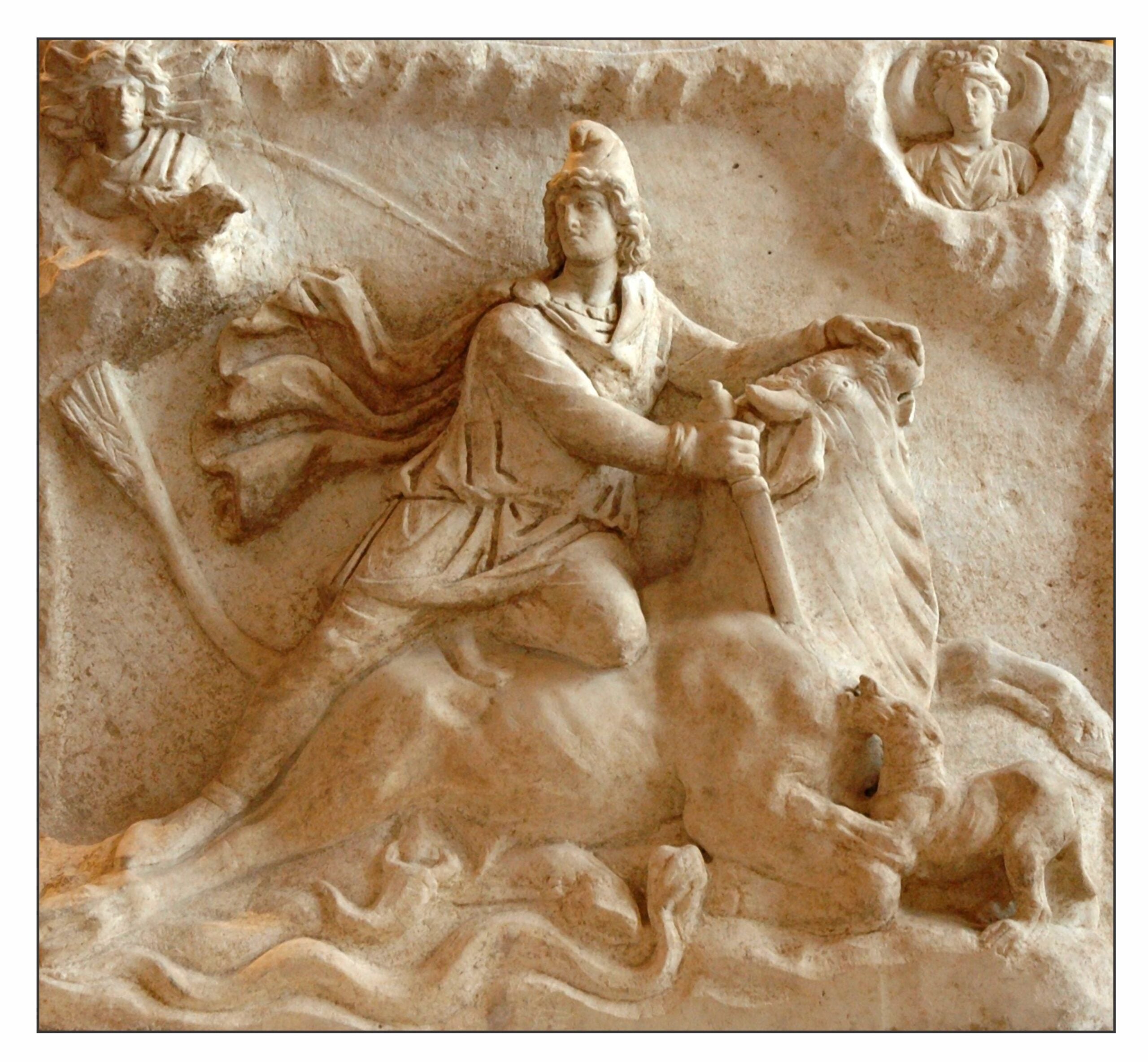
Many have tried to interpret what is symbolized by the various elements of the tauroctony. Although there might be some astrological significance to the scorpion, snake and dog, most scholars feel that the general intent is to depict some divine act that provides for human salvation:
It appears that just like the crucifixion in Christianity, the slaying of the bull was seen as opening up a path to salvation that was previously closed. The teachings of how that path had been closed in the past and why the bull needed to be sacrificed to restore the link are tragically lost to us (Fear, 2022, p 181)
The Bundahishn, a Middle Persin Zoroastrian text, recounts how a Ahura Mazda sacrificed a bull (or ox) at the beginning of creation (Chapter 3). However, another sacrifice occurs at the time of the Final Judgment during frashokereti:
Soshyant, with his assistants, performs a Yazishn ceremony in preparing the dead, and they slaughter the ox Hadhayosh in that Yazishn; from the fat of that ox and the white Haoma they prepare Hush, and give it to all men, and all men become immortal for ever and everlasting. (Bundahishn, 30, 25) (also discussed in Moazami, 20000
The tauroctony might therefore represent the longing for the end-times when men will finally become immortal. If so, the slaying of the bull in the Mithraeum would serve a similar purpose to the depiction of the crucified Christ above the altar in a Christian Church.
Mithraism came to its end when Christianity was accepted as the state religion of the Roman Empire in the 4th Century CE. The mystery religion had lasted for three centuries.
(ii) Mani and Manichaeism
The prophet Mani was born in Ctesiphon (near modern Baghdad) in the Parthian Empire in 216 CE. His father was a Jewish Christian. In his youth Mani travelled to India and became aware to Buddhist teachings. He considered himself the Paraclete that Christ claimed would come to comfort his people, though the Paraclete is generally interpreted to be the Holy Spirit. He preached a new teaching that combined ideas from Zoroastrianism and Christianity. Mani was tolerated by the Sasanian Emperor Shapur I but Bahram I was a zealous Zoroastrian and persecuted the Manichaeans. Mani was imprisoned and died in 274 CE.
Manichaeism was considered a heresy by the Christian Church and his works were destroyed. He taught a stark dualism between the good spiritual world of light and the evil material world of darkness (Widengren, 1965; Levy, 2005). He urged his followers to renounce the world so that their souls could return to the domain of light after the death of their worldly bodies. Manichaeism became widespread in the Roman Empire. Augustine of Hippo (354-430 CE) was a Manichaean before he converted to orthodox Christianity. Much of what we know about Manichaeism comes from Augustine’s writings that refute of their beliefs. Manichaeism largely died out in the Roman Empire after Christianity became the state religion in the 4th Century CE, but it persisted in regions of central Asia such as Bactria and in western China.
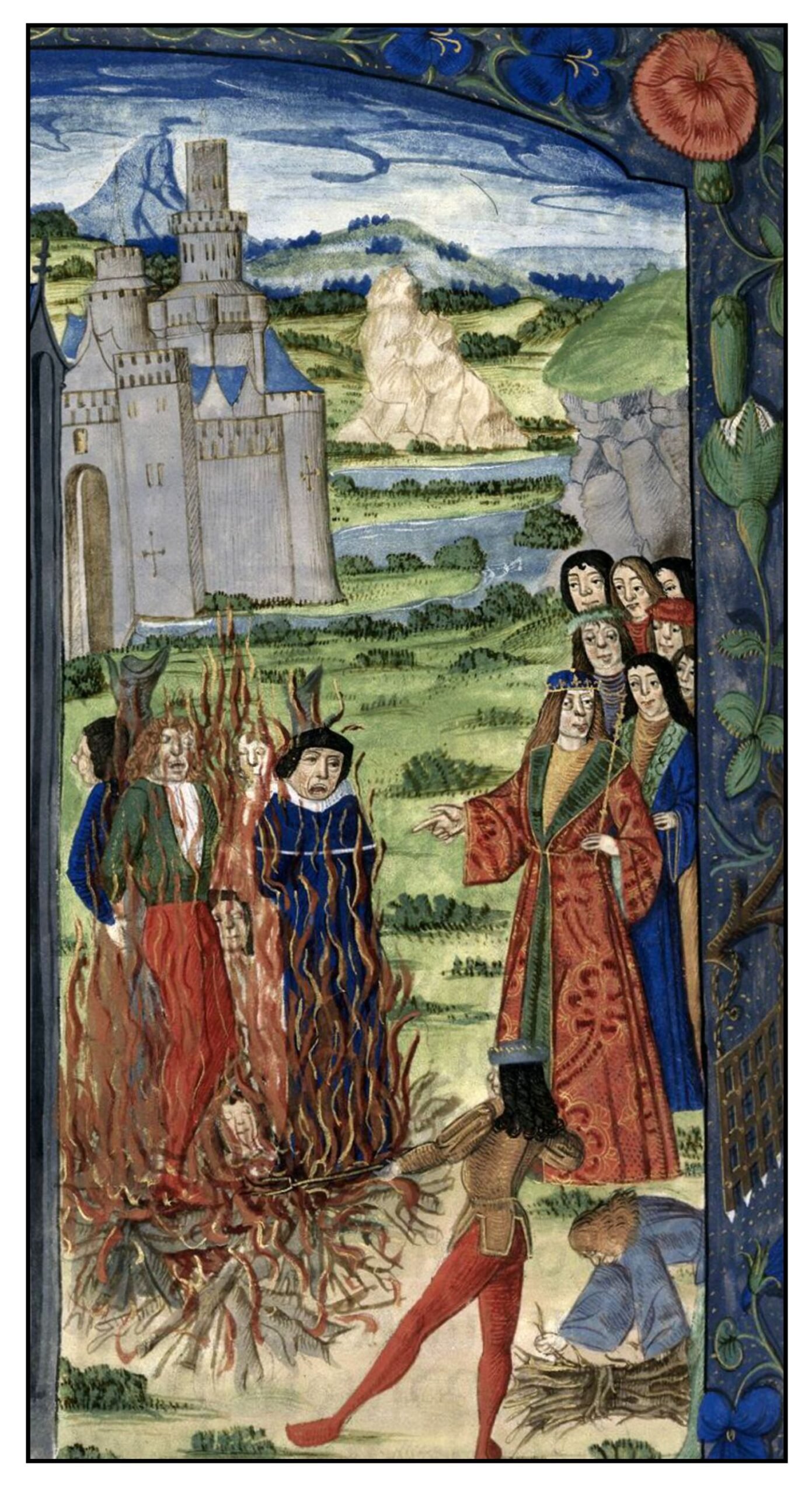
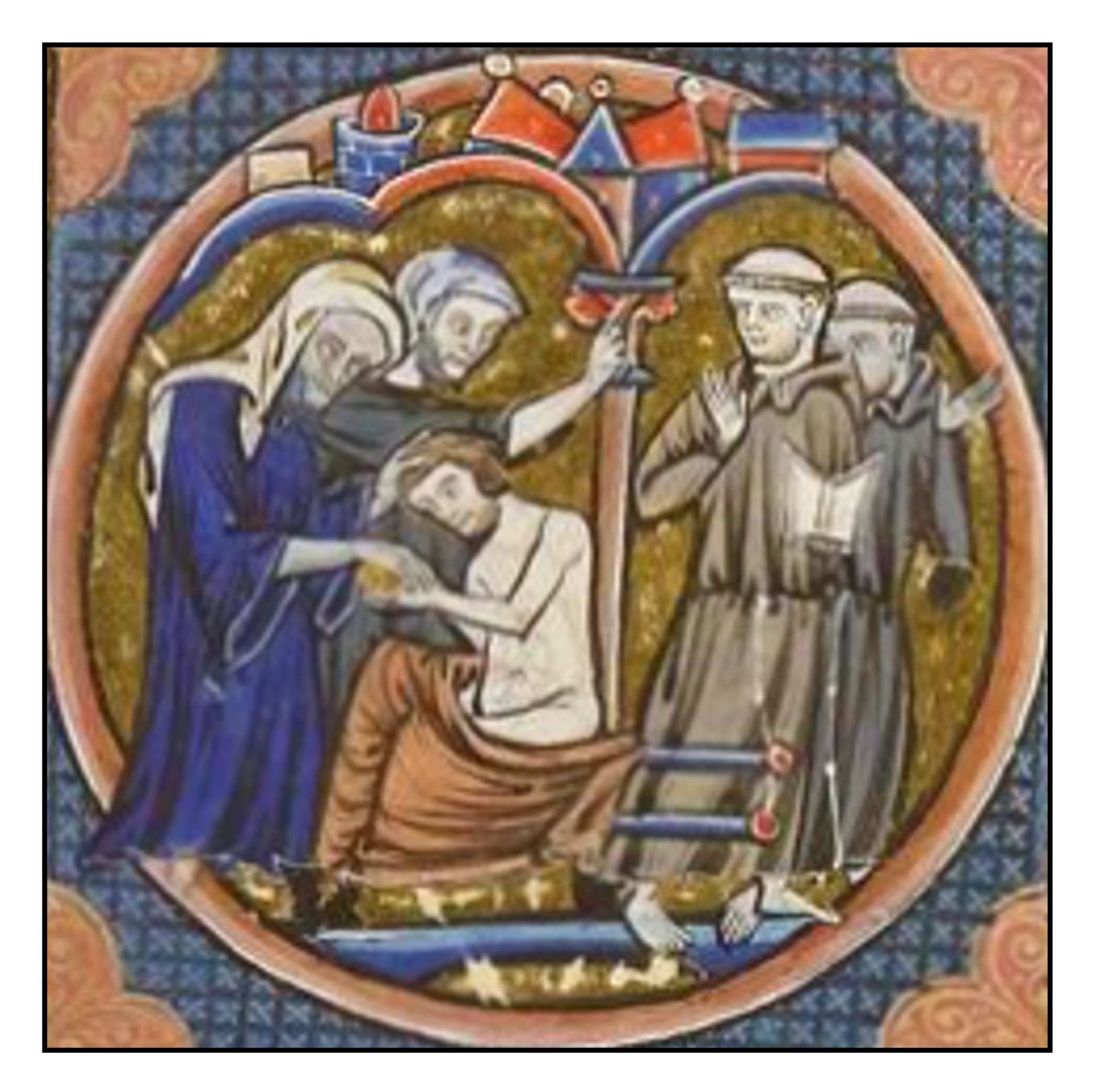
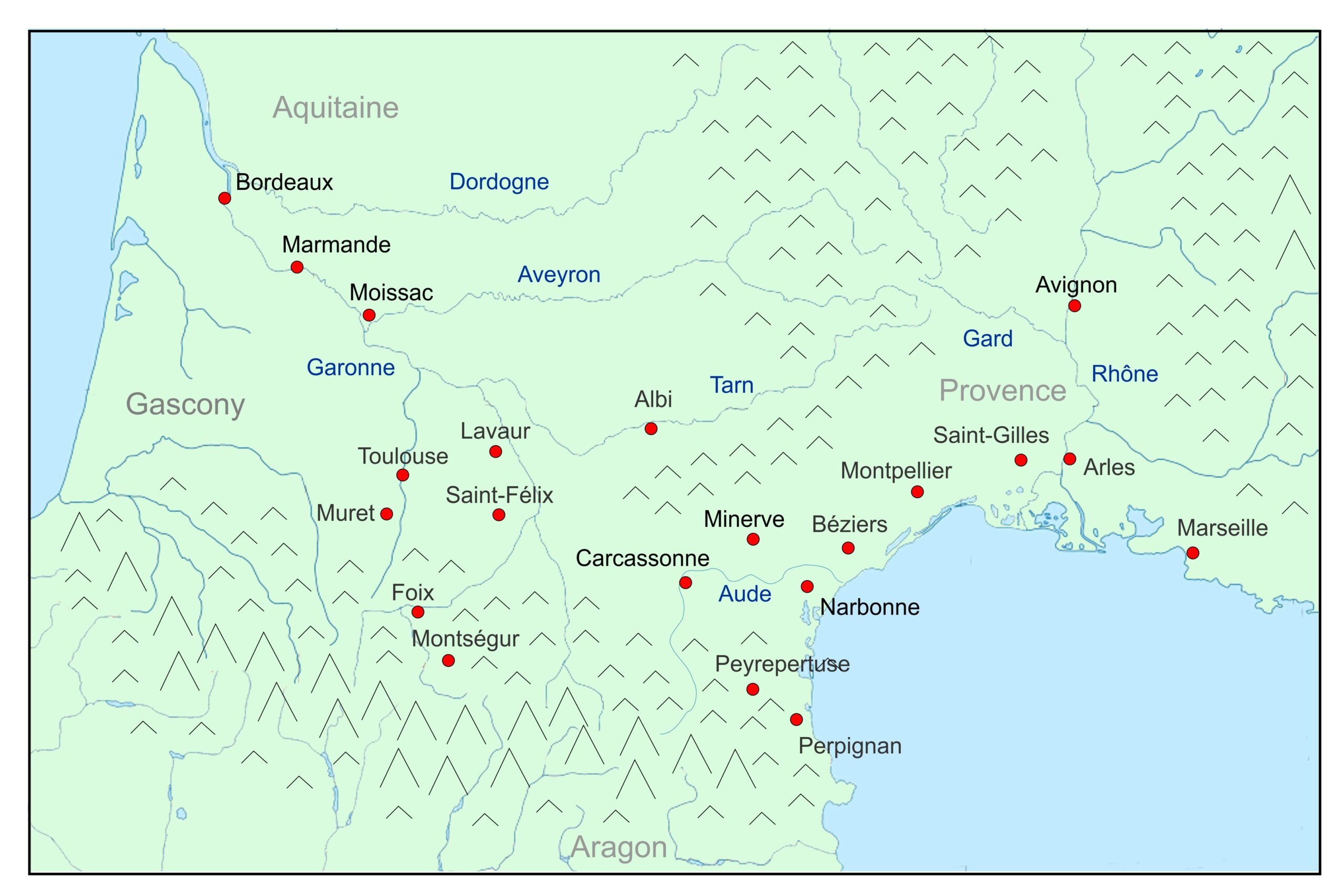
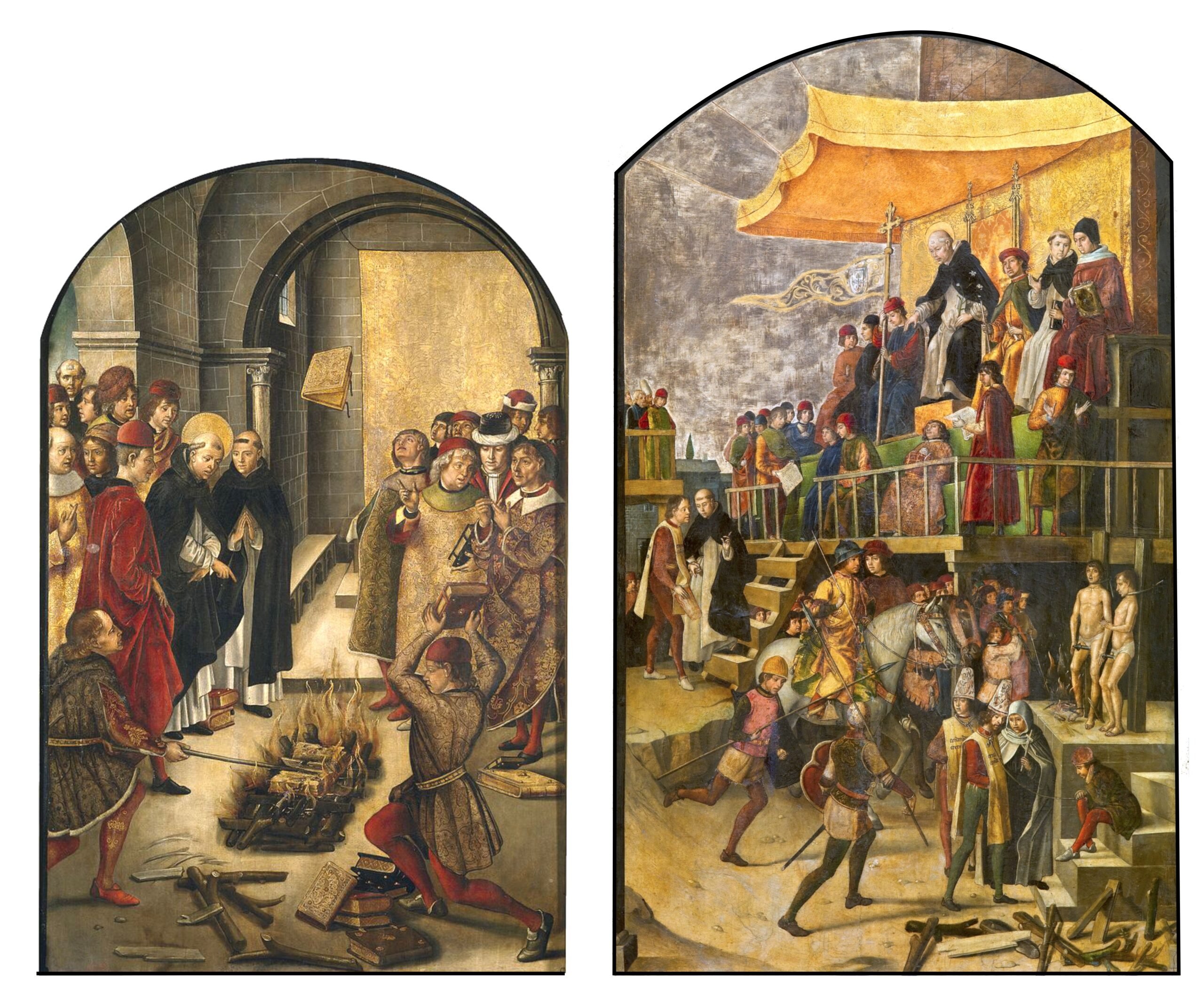
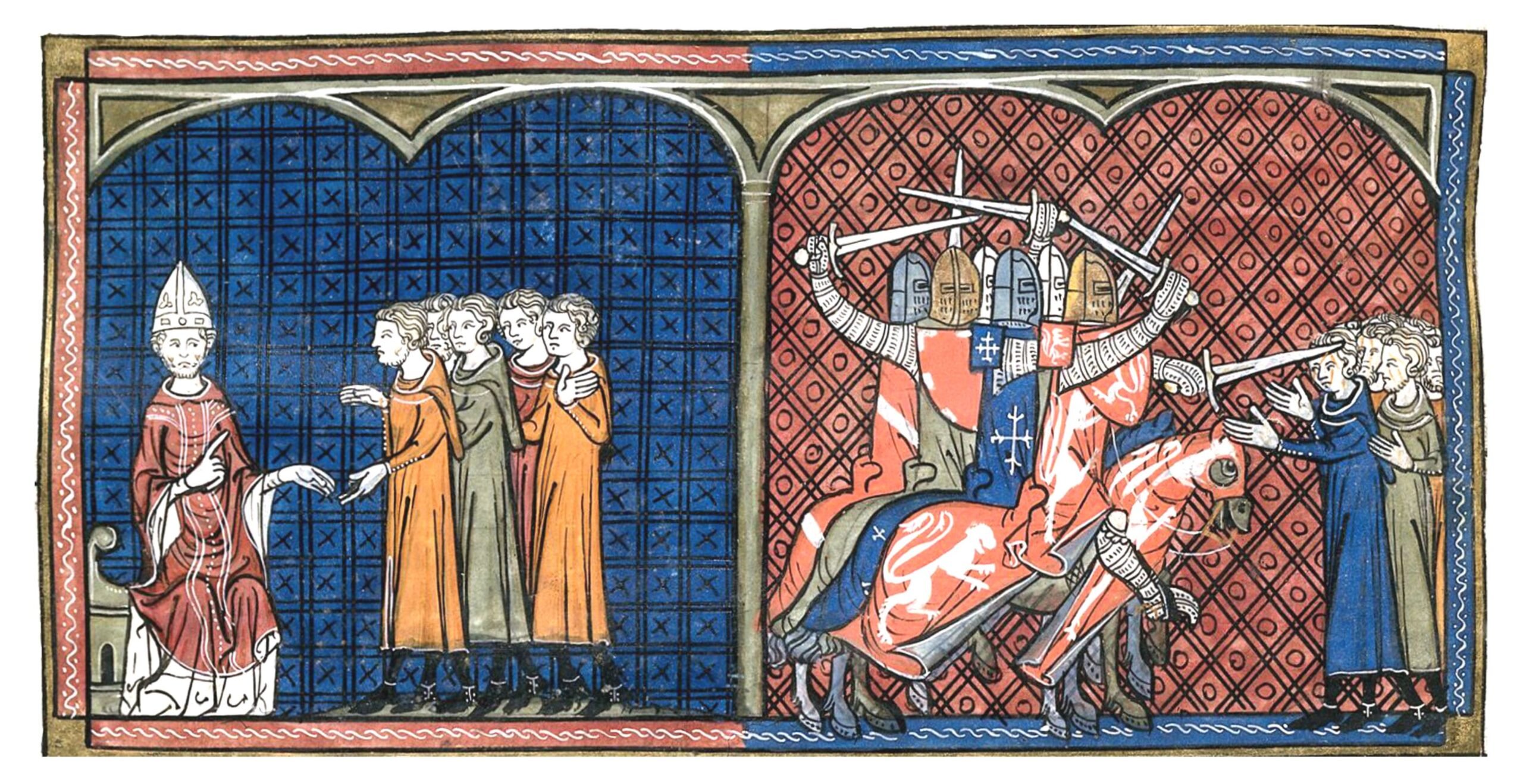
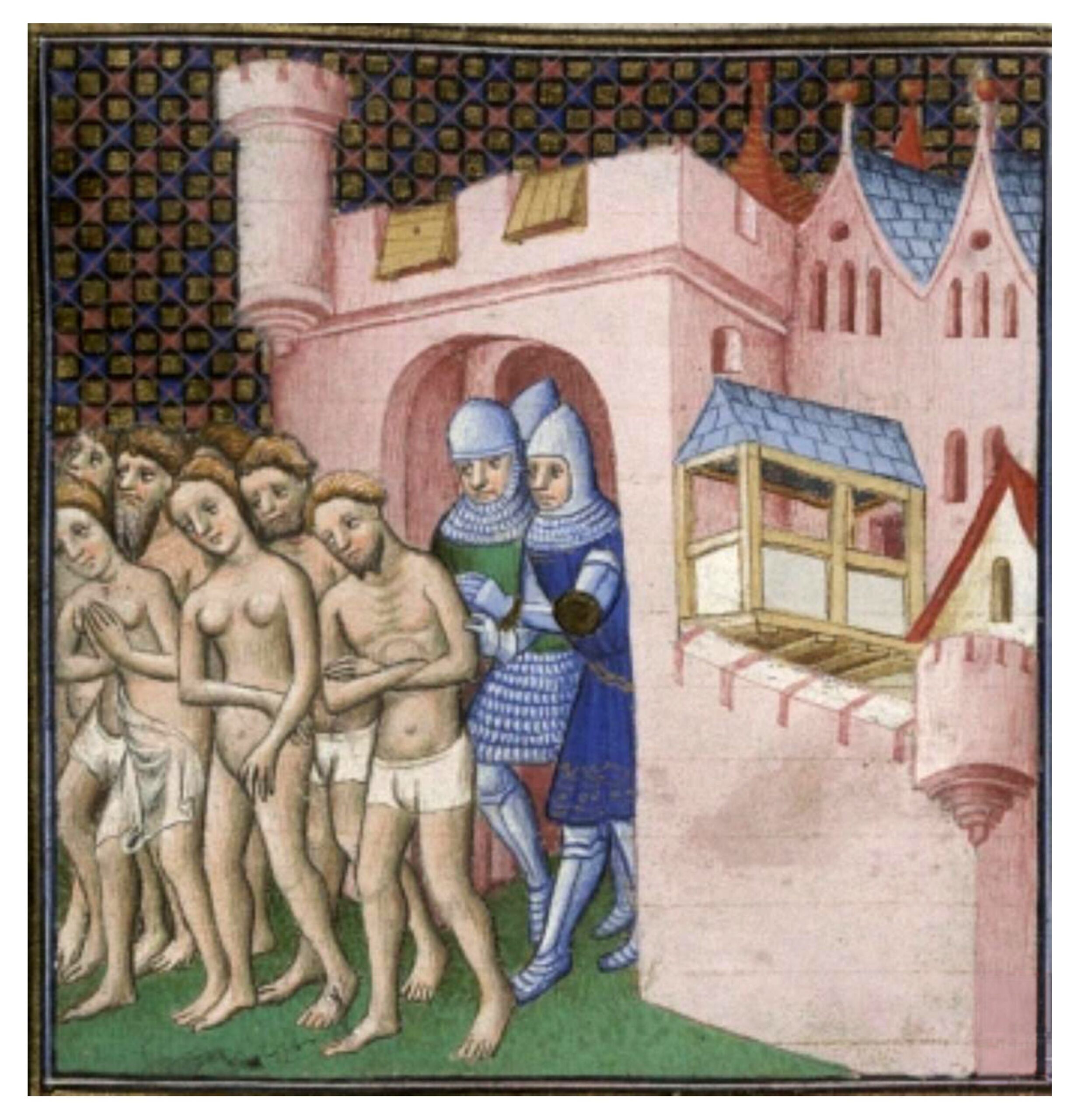
The dualistic beliefs of Manichaeism also persisted in the west in small groups of believers such as the Bogomils in Bulgaria in the 10th Century CE and the Cathars in southern France between the 12th and 14th Centuries CE.
The dualism of Mani differed from that of Zoroaster in that it was “anti-cosmic” rather than “pro-cosmic” (Boyce, 1975, p 230). Mani believed that physical world was irretrievably evil, and that human souls were painfully imprisoned in their physical bodies. By renouncing all worldly desires, they could hope to be released at death back into the spiritual world – the realm of light. Zoroaster believed the physical world basically good and that, although it was now tainted by evil, it was ultimately redeemable. At the Final Resurrection, souls would be rejoined to their now perfect physical bodies.
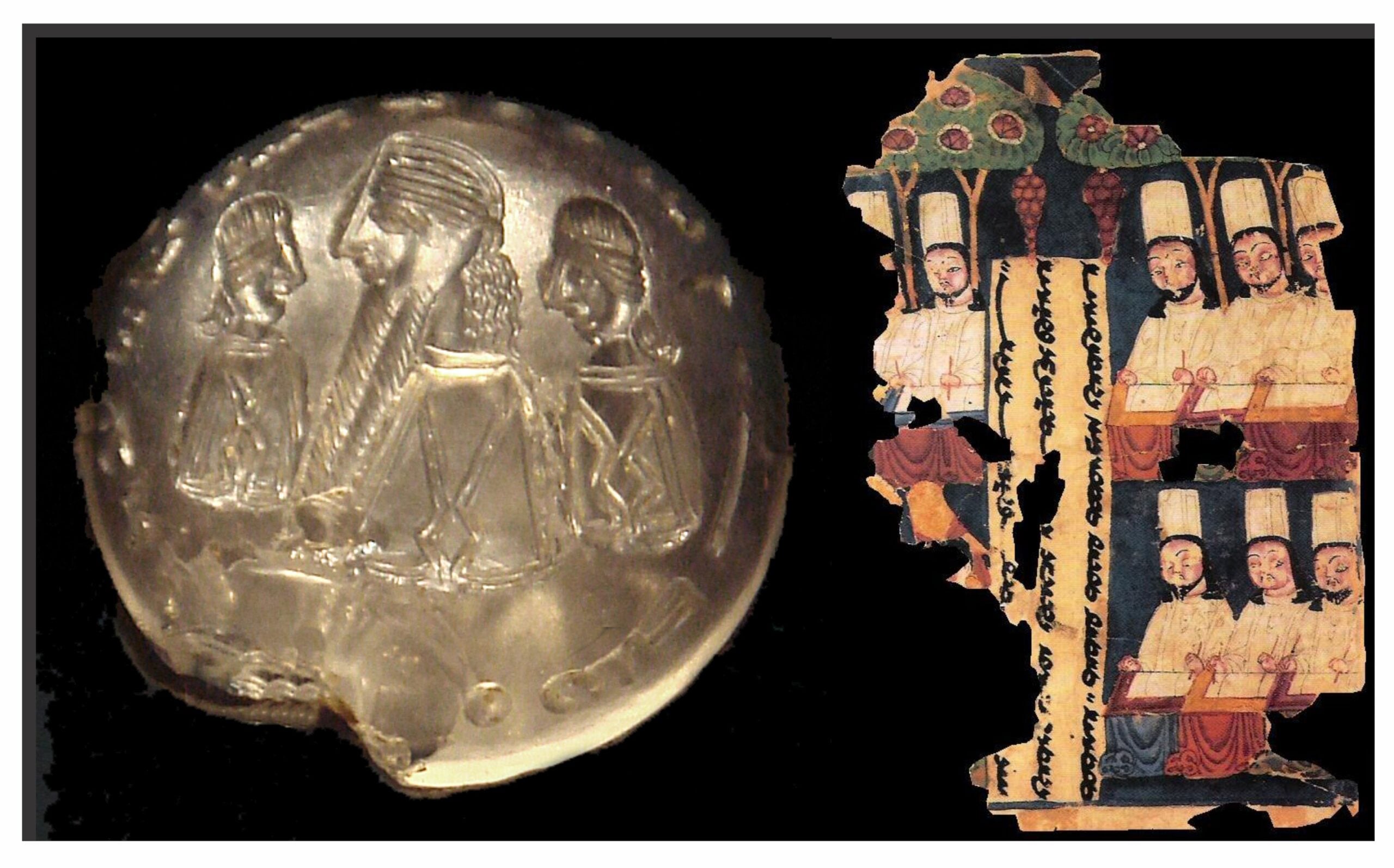
The following illustration shows on the left a small rock-crystal seal from the 3rd Century CE with a representation of the prophet Mani. This might have been used by Mani to seal his letters with wax. On the right is a manuscript fragment from the 8th to 9th Centuries CE found in Western China showing Manichaean monks.
(iii) Thus Spake Zarathustra
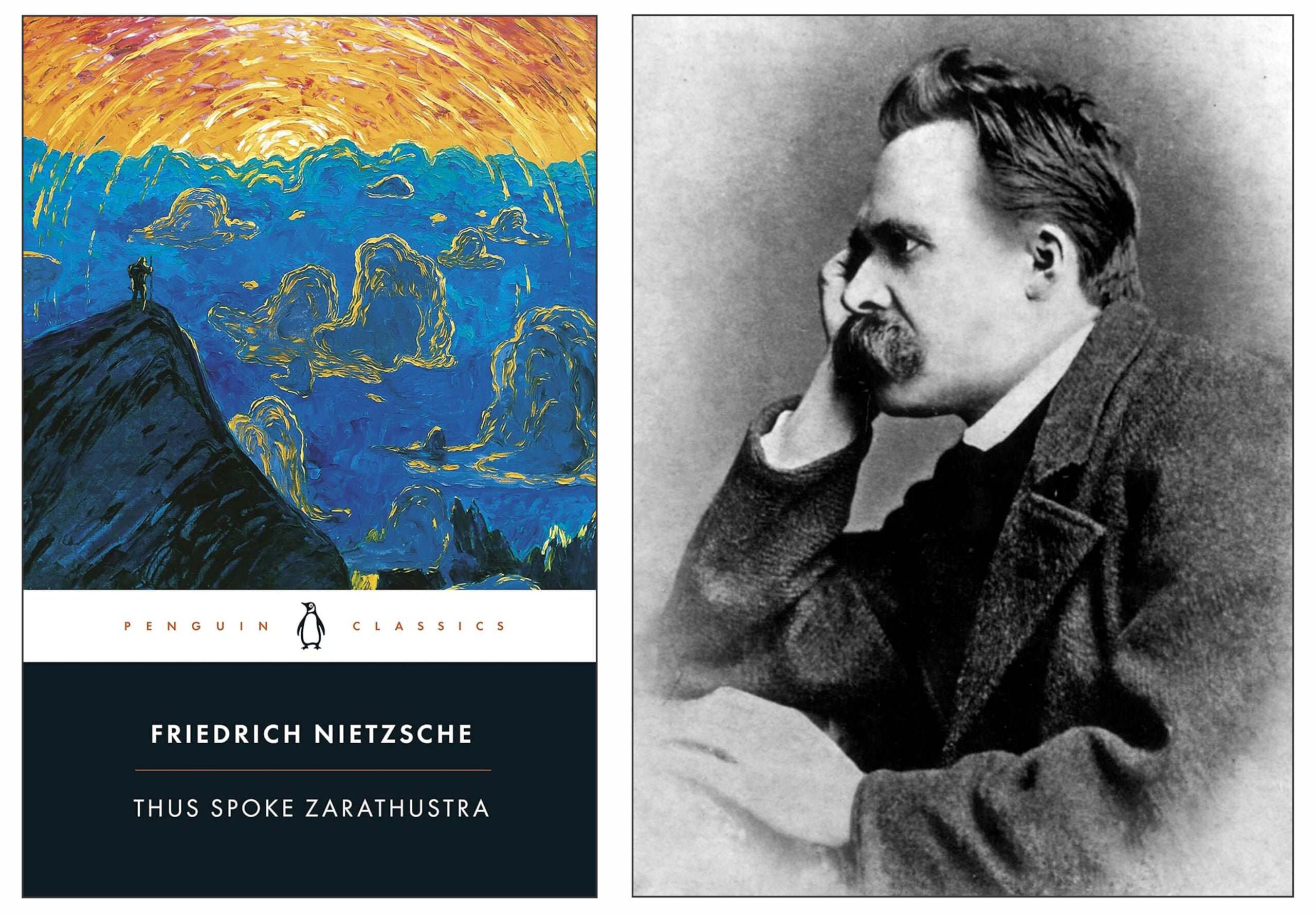
Between 1883 and 1885, Friedrich Nietzsche (1844-1900) wrote what was to become his most famous book: Also Sprach Zarathustra (Thus Spake Zarathustra). The following illustration shows a photographic portrait of Nietzsche taken in 1882 by Gustav Adolf Schultze, and the cover of the Penguin edition of the book during the 1960s with its evocative cover: Sunset Mount Blanc by Wenzel Hablik (1906).
For many people, their first introduction to Zarathustra comes through this book. Unfortunately, the book has nothing to do with ancient prophet or the religion that he founded.
Nietzsche was aware of the basic principles of Zoroastrianism through classic authors such as Herodotus and Plutarch, and he may have been familiar with some translations of their early scriptures. Nevertheless, the fictional Zarathustra does not proclaim the beliefs of Zoroastrianism. Rather, Nietzsche’s Zarathustra wishes to correct what he (or Nietzsche) believed was his great mistakes: the distinction between Good and Evil, and the subsequent foundation of human morality (Aiken, 2003; Ashouri, 2012; Pippin, 2012).
Nietzsche describes this purpose in his autobiographical Ecce Homo, written in 1888, just before his mental breakdown, but only published posthumously. The following quotation about Zarathustra shares the verbose and vainglorious character of the rest of the book. The reference to shooting well with arrows comes from Herodotus.
I have not been asked, as I should have been asked, what the name Zarathustra means in precisely my mouth, in the mouth of the first immoralist: for what constitutes the tremendous uniqueness of that Persian in history is precisely the opposite of this. Zarathustra was the first to see in the struggle between good and evil the actual wheel in the working of things: the translation of morality into the realm of metaphysics, as force, cause, end-in-itself, is his work. But this question is itself at bottom its own answer. Zarathustra created this most fateful of errors, morality: consequently he must also be the first to recognize it. Not only has he had longer and greater experience here than any other thinker — the whole of history is indeed the experimental refutation of the proposition of a so-called ‘moral world-order’ —: what is more important is that Zarathustra is more truthful than any other thinker. His teaching, and his alone, upholds truthfulness as the supreme virtue — that is to say, the opposite of the cowardice of the ‘idealist’, who takes flight in face of reality; Zarathustra has more courage in him than all other thinkers put together. To tell the truth and to shoot well with arrows: that is Persian virtue. — Have I been understood? The self-overcoming of morality through truthfulness, the self-overcoming of the moralist into his opposite — into me — that is what the name Zarathustra means in my mouth. (Nietzsche, translated by Hollingdale, pp, 124-5)
Nietzsche had much to say in Also Sprach Zarathustra, and his attempt to do so through the words and actions of an ancient prophet is wildly creative. However, the book is an incoherent mixture of parables and folktales, that veers erratically from parody to tragedy. Most of its ideas are better expressed in Nietzsche’s other books.
Nietzsche’s main goal was to argue against the “slave-morality” that had taken hold of society, a morality that promoted humility rather than accomplishment, conformity rather than initiative, weakness rather than strength. He proposed that rather than doing what others want, we should achieve what we can, accept our destiny, fulfill the possibilities within ourselves, and become an Ubermensch: “your love of your neighbour is your bad love of yourselves” (Part I:16, Hulse translation p 52). Good versus evil (böse) is replaced by good versus bad (schlecht, often used in the sense of “poorly made, shoddy”). This is a morality based on aesthetics rather than on good and evil (Poellner, 2012; Kronman, 2019).
Unfortunately, Nietzsche did not foresee what this new morality might entail. The Nazis took his ideas to heart, threw off all constraints, and tried to create a world that fulfilled what they considered their destiny (Golomb & Wistrich, 2002).
Modern man has found that world can be understood without the need to postulate a god, and that morality need not follow divine commandments. Nietzsche had famously proposed the idea that “God is dead” in his book The Gay Science (1882). In Also Sprach Zarathustra, Nietzsche realized the implications of this idea: “Nothing is true; everything is permitted” (Part IV: 9, Hulse translation, p 259). Ivan Karamazov voices a similar fear in Dostoevsky’s The Brothers Karamazov (1880) which was published at about the same time as Also Sprach Zarathustra: “If God does not exist, anything is permissible.”
Another concept that occurs toward the end of Also Sprach Zarathustra involves the circularity of time: that the world continually returns to what it once was and everything recurs:
All truth is crooked. Time itself is a circle…Must we not all have been here before – and must we not come again … must we not keep coming back forever. (Part III:2, Hulse translation, pp 146-147)
The idea that time is circular is common in Hinduism and Buddhism, which propose that the universe eternally recurs in cycles lasting many millennia. However, the Zoroastrianism concept of time is linear: the world is created, the world suffers though the battle between good and evil, and with the defeat of evil the world once again becomes as perfect as it was when it was created. One might suggest that this process could then repeat, but that is not really part of the Zoroastrian world view.
Nietzsche becomes reconciled to the eternal recurrence by proposing a variant of Kant’s categorical imperative: that one should live one’s life in such a manner that one would wish to live it in the same way when it is eternally repeated.
Nietzche’s fictional Zarathustra is both intriguing and frustrating, both charming and frightening. However he is interpreted, he is a far cry from the legendary prophet who founded a new religion based on the struggle between good and evil.
Conclusion
The world is composed of opposites: good and evil, order and chaos, growth and decay, truth and deceit. Zoroaster described this state in terms of the struggle between two opposing forces. One of the appealing aspects of the religion that he founded is its optimism: good will ultimately prevail over evil. Another is the importance of humanity to the outcome of this struggle. By choosing good over evil, we can tilt the balance between the opposing forces and accelerate the final victory.
The religion of Zoroastrianism has persisted for about three millennia, although the number of its present adherents is vanishingly small in comparison to the dominant religions of the world. Nevertheless, it remains worth our while to remember the ideas of the ancient prophet: to do as much good as we can, to contemplate the fire, and to look forward to when asha once again rules the universe.
Ashem vohu
vahishtem asti
ushta asti
ushta ahmai
hyat ashai vahishtai ashem
References
Ahmadi, A. (2013). The Twins Stanza, Y 30.3. Iranian Studies, 46(2), 227–249.
Ahmadi, A. (2015). What is aṣ̌a? Bulletin of the School of Oriental and African Studies, 78(2), 293–315.
Aiken, D. (2003). Nietzsche and his Zarathustra: A Western poet’s transformation of an Eastern priest and prophet. Zeitschrift für Religions und Geistesgeschichte, 55(4), 335–353.
Ashouri, D. (2012). Nietzsche and Persia. Encyclopaedia Iranica.
Boyce, M. (1969). On Mithra’s part in Zoroastrianism. Bulletin of the School of Oriental and African Studies, 32(1), 10–34.
Boyce, M. (1975, revised 1989). A history of Zoroastrianism. Volume 1. The early period. E. J. Brill.
Boyce, M., (1982). A history of Zoroastrianism. Volume 2. Under the Achaemenians. E. J. Brill.
Boyce, M., Grenet, F, & Beck, R. (1991). A history of Zoroastrianism. Volume 3. Zoroastrianism under Macedonian and Roman rule. E. J. Brill.
Boyce, M. (2015) Fravaši. Encyclopaedia Iranica.
Cereti, C. G. (2015). Myths, legends, eschatologies. In Stausberg, M., Vevaina, Y. S.-D., & Tessmann, A. (Eds.) The Wiley-Blackwell companion to Zoroastrianism. (pp 259-272). Wiley.
Choksy, J. K. (2018). Zoroastrianism. II. Historical review: from the Arab conquest to modern times. Encyclopaedia Iranica.
Fear, A. T. (2022). Mithras. Routledge.
Ferrero, M. (2021). From polytheism to monotheism: Zoroaster and some economic theory. Homo Oeconomicus, 38(1–4), 77–108.
Gnoli, G. (2017). Dualism. Encyclopaedia Iranica.
Gnuse, R. K. (1997). No other gods: emergent monotheism in Israel. Sheffield Academic Press.
Golomb, J., & Wistrich, R. S. (2002). Nietzsche, godfather of fascism? On the uses and abuses of a philosophy. Princeton University Press.
Hartz, P. R. (2004). Zoroastrianism. Facts on File
Heggarty, P., Anderson, C., Scarborough, M., King, B., Bouckaert, R., Jocz, L., Kümmel, M. J., Jügel, T., Irslinger, B., Pooth, R., Liljegren, H., Strand, R. F., Haig, G., Macák, M., Kim, R. I., Anonby, E., Pronk, T., Belyaev, O., Dewey-Findell, T. K., … Gray, R. D. (2023). Language trees with sampled ancestors support a hybrid model for the origin of Indo-European languages. Science , 381(6656), eabg0818.
Henning, W. B. (1951). Zoroaster. Politician or witch-doctor? Oxford University Press
Hinnells, J. R., & Williams, A. (Eds.) (2007). Parsis in India and the diaspora. Routledge.
Hintze, A. (2014a). Monotheism the Zoroastrian way. Journal of the Royal Asiatic Society, 24(2), 225–249.
Hintze, A. (2014b) FRAŠŌ.KƎRƎTI. Encyclopaedia Iranica.
Irani, K. D. (1990). The concept of Asha (a philosophical analysis). In D. G. McIntyre An Introduction to the Gathas of Zarathushtra.
Karkaria, B. (2015). Death in the city: How a lack of vultures threatens Mumbai’s ‘Towers of Silence’ The Guardian, Jan 26, 2015
Kreyenbroek, P. (2002). Millennialism and eschatology in the Zoroastrian tradition. In A. Amanat & M. Bernhardsson (Ed.). Imagining the end: visions of apocalypse from the Ancient Middle East to Modern America (pp. 33–55). I.B.Tauris.
Kronman, A. T. (2019). The world as an aesthetic phenomenon: art, truth and morality in Nietzsche’s philosophy. In Confessions of a Born-Again Pagan. (pp. 779–810). Yale University Press.
Levy, D. J. (2005). The religion of light: on Mani and Manichaeism. In Eisenstadt, S. N., Árnason, J. P., & Wittrock, B. (Eds.) Axial civilizations and world history. (pp 319-336). E. J. Brill.
Litvinsky, B. A. Jalilov A. H. & Kolesnikov A. I. (1996). The Arab Conquest. In Zhang Guand-da, Litvinsky, B., & Shabani Samghabadi, R. (Eds) History of civilizations of Central Asia. Volume III. The crossroads of civilization. AD 250 to 750. (pp 450-475). UNESCO.
Malandra, W. W. (2015). Zoroastrianism. I. Historical review up to the Arab conquest. Encyclopaedia Iranica
Malandra, W. W. (2015). Zoroaster. II. General Survey. Encyclopaedia Iranica
Moazami, M. (2000). Millennialism, eschatology, and messianic figures in Iranian tradition. J. Journal of Millennial Studies (Winter).
Nietzsche, F. W. (1885, translated by A. Tille, 1908). Thus spake Zarathustra, a book for all and none. Allen & Unwin.
Nietzsche, F. W. (1885, translated by M. Hulse, 2022). Thus spake Zarathustra, a book for all and none. Notting Hill Editions.
Nietzsche, F. W. (1888, translated by Hollingdale, R. J.,1981). Ecce homo: how one becomes what one is. Penguin Books.
Nigosian, S. A. (1993). The Zoroastrian faith: tradition and modern research. McGill-Queens University Press.
Nolan, D. (2025). Zoroastrianism and contemporary philosophy. Cambridge University Press.
Poellner, P. (2012). Aestheticist ethics. In Christopher Janaway, C. & Robertson, S. (Eds.) Nietzsche, Naturalism, and Normativity. (pp 52-80). Oxford University Press.
Ritter, N. (2010). Human-headed winged bull (aladlammu), Iconography of Deities and Demons.
Rose, J. (2011a). Zoroastrianism: a guide for the perplexed. Continuum.
Rose, J. (2011b). Zoroastrianism: an introduction. I.B. Tauris.
Russell, J. R. (2013). Burial iii. In Zoroastrianism. Encyclopaedia Iranica
Schlerath, B., & Skjærvø, P. O. (2018). Aṧa. Encyclopaedia Iranica.
Shahbazi, A. S. (1974). An Achaemenid Symbol. I: A Farewell to ‘Fravahr’ and ‘Ahuramazda’ Archäologische Mitteilungen ans Iran, 7, 135–44.
Shahbazi, A. S. (1980). An Achaemenid Symbol II. Farnah ‘(God given) Fortune’ symbolised. Archäologische Mitteilungen ans Iran 13, 119–47
Skjærvø, P. O. (2011). The spirit of Zoroastrianism. Yale University Press.
Stausberg, M. (2008). Zarathustra and Zoroastrianism: a short introduction. Equinox Pub.
Vevaina, Y S.-D. (2015). Theologies and hermeneutics. In Stausberg, M., Vevaina, Y. S.-D., & Tessmann, A. (Eds.) The Wiley-Blackwell companion to Zoroastrianism. (pp 211-234). Wiley.
Widengren, G. (1961, translated C. Kessler, 1965). Mani and manichaeism. Holt, Rinehart and Winston.