Johannes Vermeer of Delft: Woman at a Window

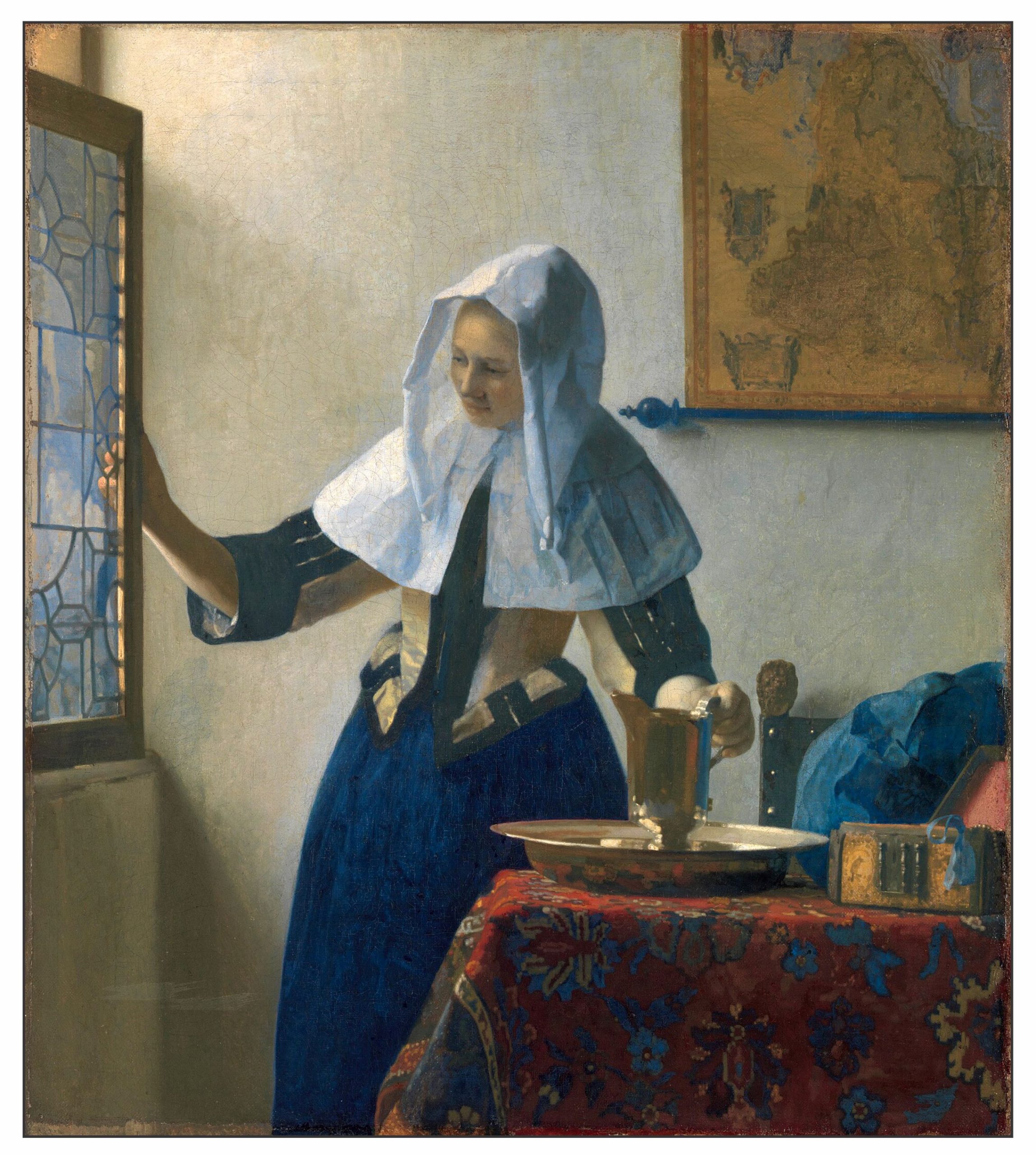
The painter Johannes Vermeer (1632-1675) lived his whole life in Delft, a city of canals in southeast Netherlands midway between The Hague and Rotterdam. He was baptized in the Dutch Reformed Church in 1632. When he married Catherina Boles in 1653, he converted to Catholicism. However, his main patrons – Pieter van Ruijven and his wife Maria de Knuijt – were members of the Remonstrant Church. No one is sure of Vermeer’s personal beliefs. Weber (2022) suggests that he might have been Catholic. Graham-Dixon (2025) argues that Vermeer was more likely drawn to the Remonstrants. One recurring subject in Vermeer’s paintings is a woman standing at a window. These solemn images convey great depths of feeling. The illustration shows a detail from Young Woman with a Water Pitcher (1662).  


The Dutch Republic and Religious Tolerance

The modern history of the Netherlands began in the 16th Century (Blockmans 2022; van Deursen, 2022, Wielenga; 2015). By the mid 16th Century, the Hapsburg Empire under Charles V, Holy Roman Emperor, Archduke of Austria, and King (Charles I) of Spain, had managed by means of war and marriage to control much of Europe. Among its territories were the “lowlands” or Netherlands that had once been part of the Burgundian Empire. However, this would soon change as the Protestant Reformation swept across northern Europe. Although Lutherans and Baptists found converts in the Netherlands, the main denomination in the northern region was Calvinism, which founded the Dutch Reformed Church in 1571.

Charles abdicated in 1555 in favor of his son Phillip II of Spain. In 1567, Phillip, a fervent Catholic, sent an army under the Duke of Alva to suppress the heretics in the Netherlands. This triggered the Eighty Years’ War (also known as the Dutch War of Independence). The northern provinces of the Netherlands joined together to resist the Hapsburgs, signing the Union of Utrecht in 1579 and formally declaring the Dutch Republic under William of Orange In 1588. The war finally ended in 1848 with the Treaty of Münster, dividing the Netherlands into the mainly Protestant Dutch Republic in the north and the Catholic Spanish Netherlands in the south.

The following illustration shows maps of the Netherlands and of the Hapsburg Empire in the early 16th Century.
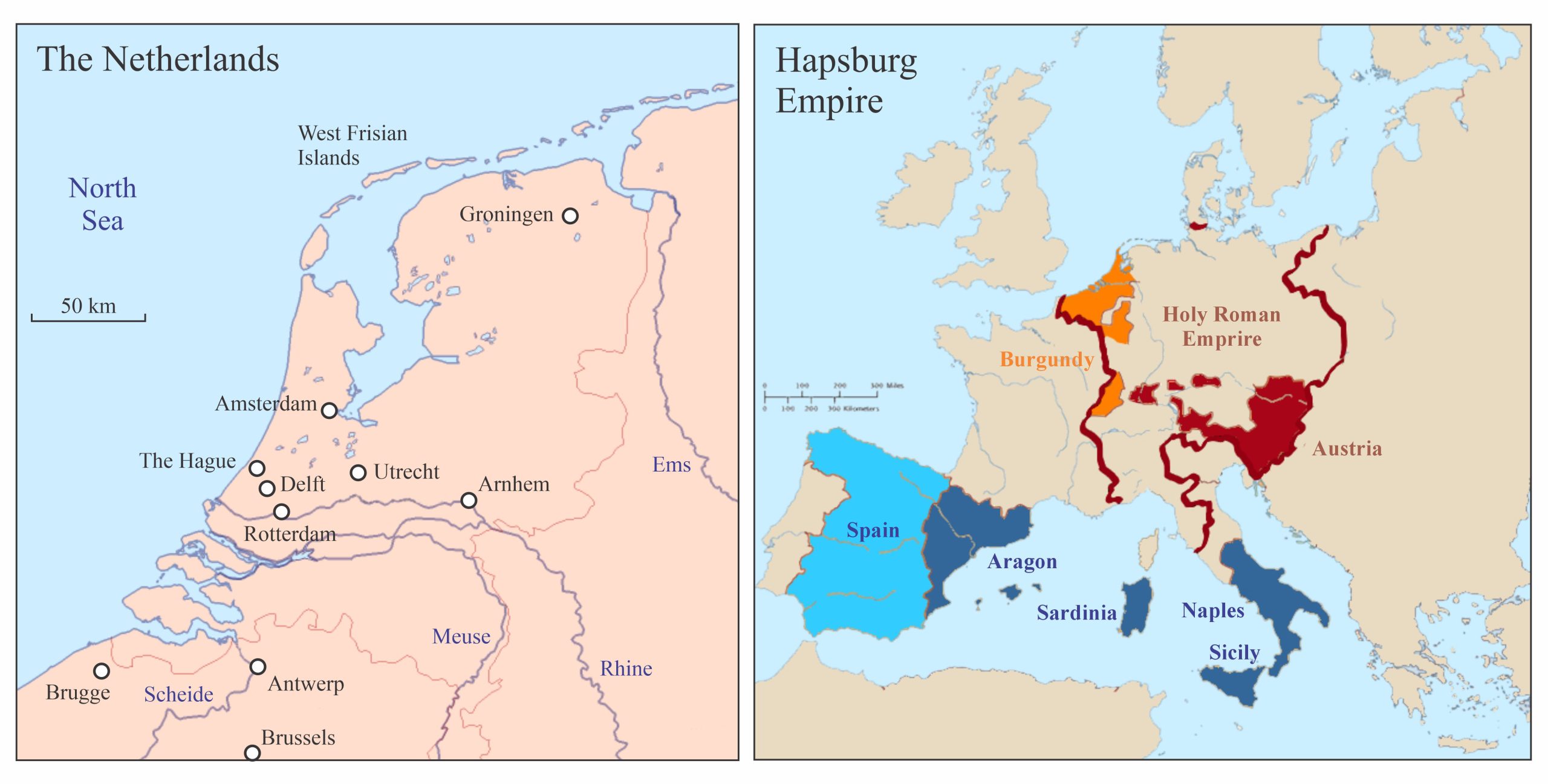
Although Calvinism was the main Protestant denomination in the Dutch Republic, various groups rebelled against some of its severe teachings. One of the dogmas was the principle of double predestination: God not only elects some people for eternal salvation, but also abandons the rest to eternal damnation. Jacobus Arminius (1560-1609) argued against predestination. Hed also proposed that Christians should worship God by following their conscience rather than the teachings priests and pastors. After the death of Arminius, a group of his followers issued Five Articles of Remonstrance (1610) describing their issues with the Calvinist beliefs of the Dutch Reformed Church. These led to the Remonstrant Church. A subset of these believers also founded the Collegiant movement in 1619.  

The people of the Dutch Republic followed many different beliefs (Kooi, 2018). About a third remained Catholic; a sizable Jewish population had come as refugees from Spain and Portugal and from Germany, and there were many different Protestant communities. The principle of tolerance – allowing each person the freedom to belief as their own conscience proposed – was one the founding edicts of the Union of Utrecht.  

One way that the Dutch Republic tolerated different beliefs was the schuilkerk or clandestine church. Although the Reformed Church was the dominant church for the country and its leaders, minority groups could also have religious meeting places However, these were only allowed in buildings that were not ostensibly churches and did not show a public façade.  

Vermeer’s religious beliefs are not known. There was a small Jesuit center near the residence that he shared with his mother-in-law (Weber, 2022, p 14). And there was a Remonstrant schuilkerk behind the residence of his main patron Pieter van Ruijven (Graham-Dixon, 2025; Montias, 1989, pp 246-262).

Delft

Johannes Vermeer lived his entire life in the city of Delft. The following his painting View of Delft (1661) now in the Mauritshuis gallery in The Hague:
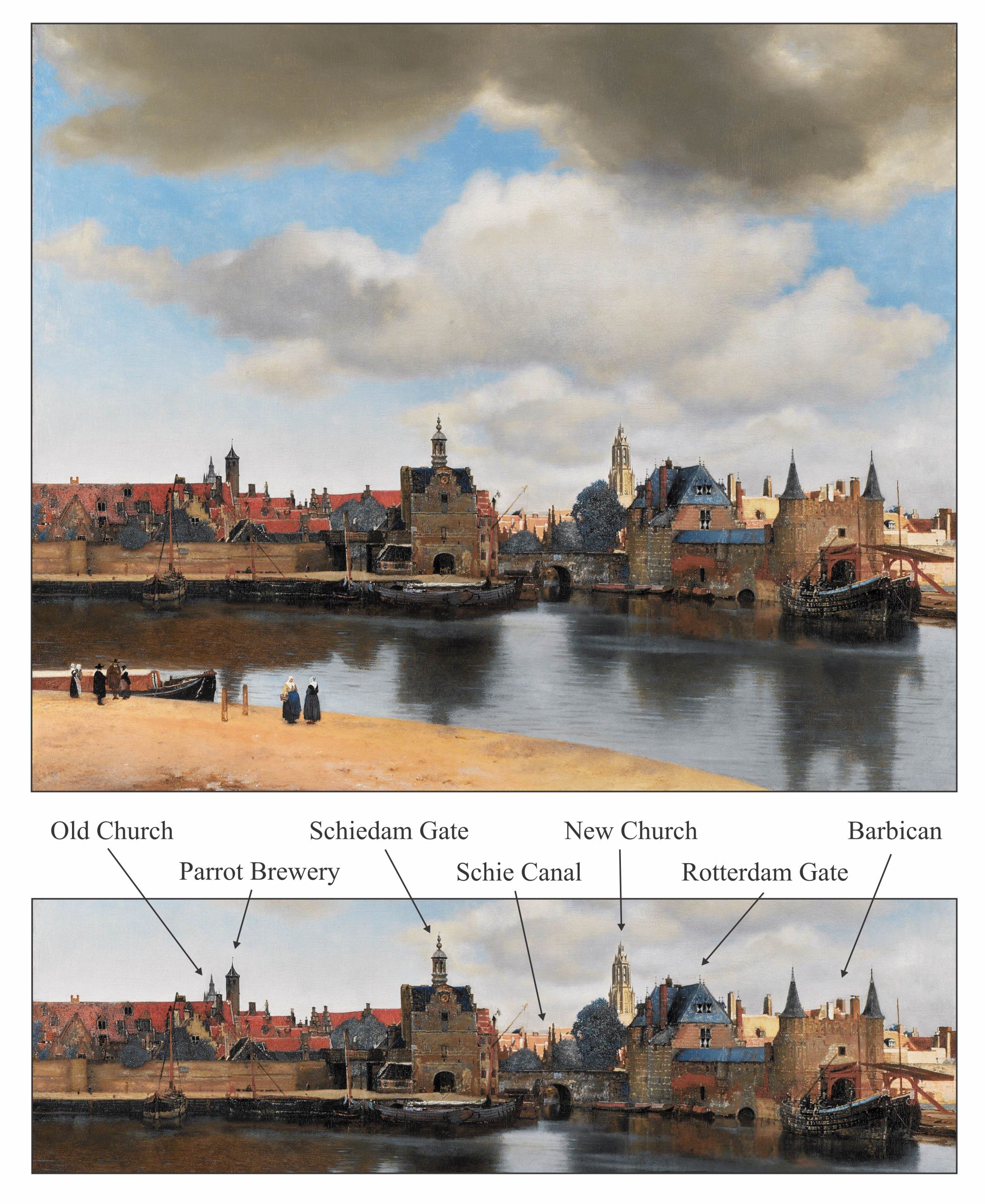
Marcel Proust was impressed by this painting and incorporated it into his novel The Captive, part of In Search of Lost Time. The following is the episode wherein the critic Bergotte goes to see Vermeer’s painting:

…an art critic having written somewhere that in Vermeer’s `View of Delft’ (lent by the Gallery at The Hague for an exhibition of Dutch painting), a picture which he adored and imagined that he knew by heart, a little patch of yellow wall (which he could not remember) was so well painted that it was, if one looked at it by itself, like some priceless specimen of Chinese art, of a beauty that was sufficient in itself, Bergotte ate a few potatoes, left the house, and went to the exhibition. At the first few steps he had to climb, he was overcome by an attack of dizziness. He walked past several pictures and was struck by the aridity and pointlessness of such an artificial kind of art, which was greatly inferior to the sunshine of a windswept Venetian palazzo, or of an ordinary house by the sea. At last he came to the Vermeer which he remembered as more striking, more different from anything else he knew, but in which, thanks to the critic’s article, he noticed for the first time some small figures in blue, that the sand was pink, and, finally, the precious substance of the tiny patch of yellow wall. His dizziness increased; he fixed his gaze, like a child upon a yellow butterfly that it wants to catch, on the precious little patch of wall. “That’s how I ought to have written,” he said. “My last books are too dry, I ought to have gone over them with a few layers of colour, made my language precious in itself, like this little patch of yellow wall.” Meanwhile he was not unconscious of the gravity of his condition. In a celestial pair of scales there appeared to him, weighing down one the pans, his own life, while the other contained the little patch of wall so beautifully painted in yellow. He felt that he had rashly sacrificed the former for the latter. “All the same,” he said to himself, “I shouldn’t like to be the headline news of this exhibition for the evening papers.”
He repeated to himself: “Little patch of yellow wall, with a sloping roof, little patch of yellow wall.” Meanwhile he sank down on to a circular settee; whereupon he suddenly ceased to think that his life was in jeopardy and, reverting to his natural optimism, told himself: “It’s nothing, merely a touch of indigestion from those potatoes, which were undercooked.” A fresh attack struck him down; he rolled from the settee to the floor, as visitors and attendants came hurrying to his assistance. He was dead. Dead for ever? Who can say? Certainly, experiments in spiritualism offer us no more proof than the dogmas of religion that the soul survives death. All that we can say is that everything is arranged in this life as though we entered it carrying a burden of obligations contracted in a former life; there is no reason inherent in the conditions of life on this earth that can make us consider ourselves obliged to do good, to be kind and thoughtful, even to be polite, nor for an atheist artist to consider himself obliged to begin over again a score of times a piece of work the admiration aroused by which will matter little to his worm-eaten body, like the patch of yellow wall painted with so much skill and refinement by an artist destined to be for ever unknown and barely identified under the name Vermeer. All these obligations, which have no sanction in our present life, seem to belong to a different world, a world based on kindness, scrupulousness, self-sacrifice, a world entirely different from this one and which we leave in order to be born on this earth, before perhaps returning there to live once again beneath sway of those unknown laws which we obeyed because we bore their precepts in our hearts, not knowing whose hand had traced them there—those laws to which every profound work of the intellect brings us nearer and which are invisible only—if then!—to fools.  (Proust, 1927/1929, pp 249-251)

No one is sure which patch of yellow wall in the painting so fatally impressed the critic. Several regions have been proposed. My own preference is for the yellow wall just to the left of the left tower of the barbican. 

The following is a 1649 map of the city together with a 3D computer reconstruction and a diagram showing the lines of sight for Vermeer’s painting:
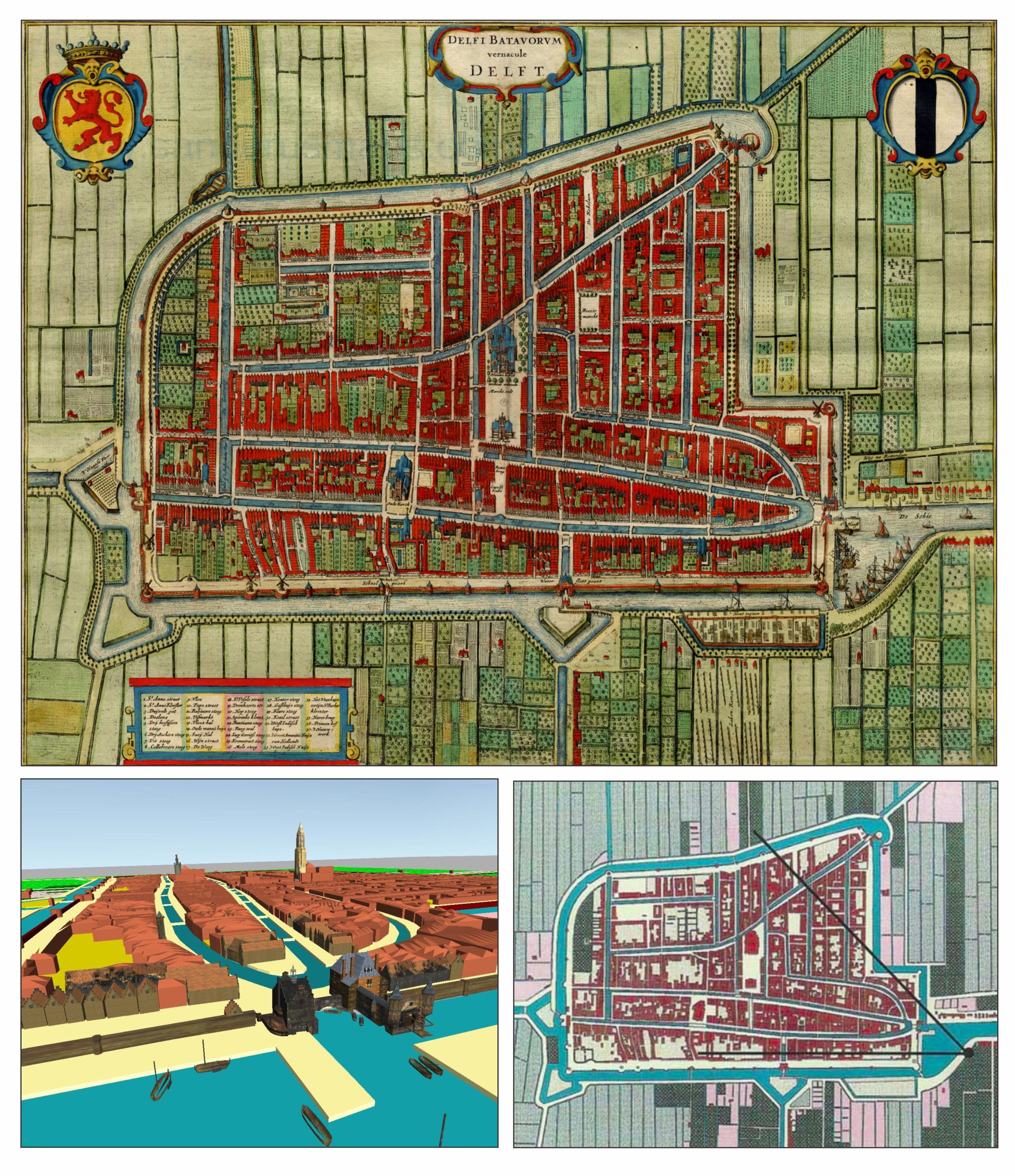
In the 17th Century Delft was home to a thriving community of painters (Liedtdke, 2001) who came together in the Guild of Saint Luke. Among them were the still-life painter Balthasar van der Ast (1593-1657), Carel Fabritius (1622-1654) who died in the Donderslag (Thunderclap), a catastrophic gunpowder explosion that laid waste much of the northern area of the city, and Egbert van der Poel (1621-1664) who famously painted the aftermath of the explosion. Gerard Houckgest (1600-1661) and Emmanuel de Witte (1616-1692) painted church interiors. Pieter de Hooch (1629-1684), Cornelis de Man (1621-1706) and Jan Steen (1626-1679) painted genre scenes. 

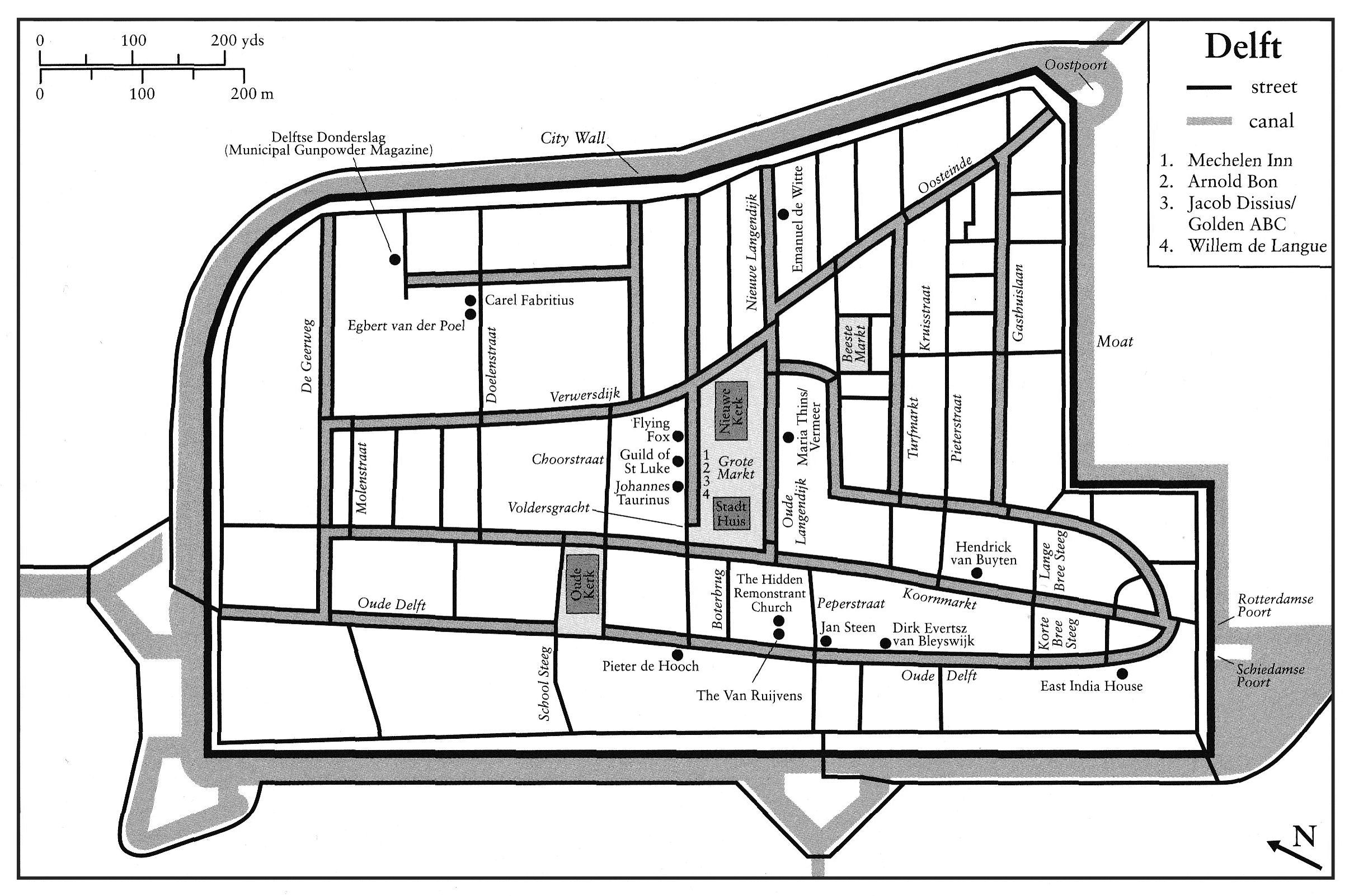
Vermeer’s father Reijnier Janszoon managed the Flying Fox Inn in the center of the city and acted as a dealer for the painters from the nearby guild. He later owned the Mechelen Inn. Little is known about Johannes Vermeer’s life. He was baptized in the Nieuwe Kirk and buried in the Oude Kirk. In 1853 he converted to Catholicism so that he could marriy Catherina Bolnes and the couple moved to the residence of his wife’s mother Margaret Thins. Near this house was a clandestine Jesuit church. In a large second-story room in this spacious house on the Oude Langendijk Vermeer set up his painting studio. The following illustration from Graham Dixon (2025, p xxiii)
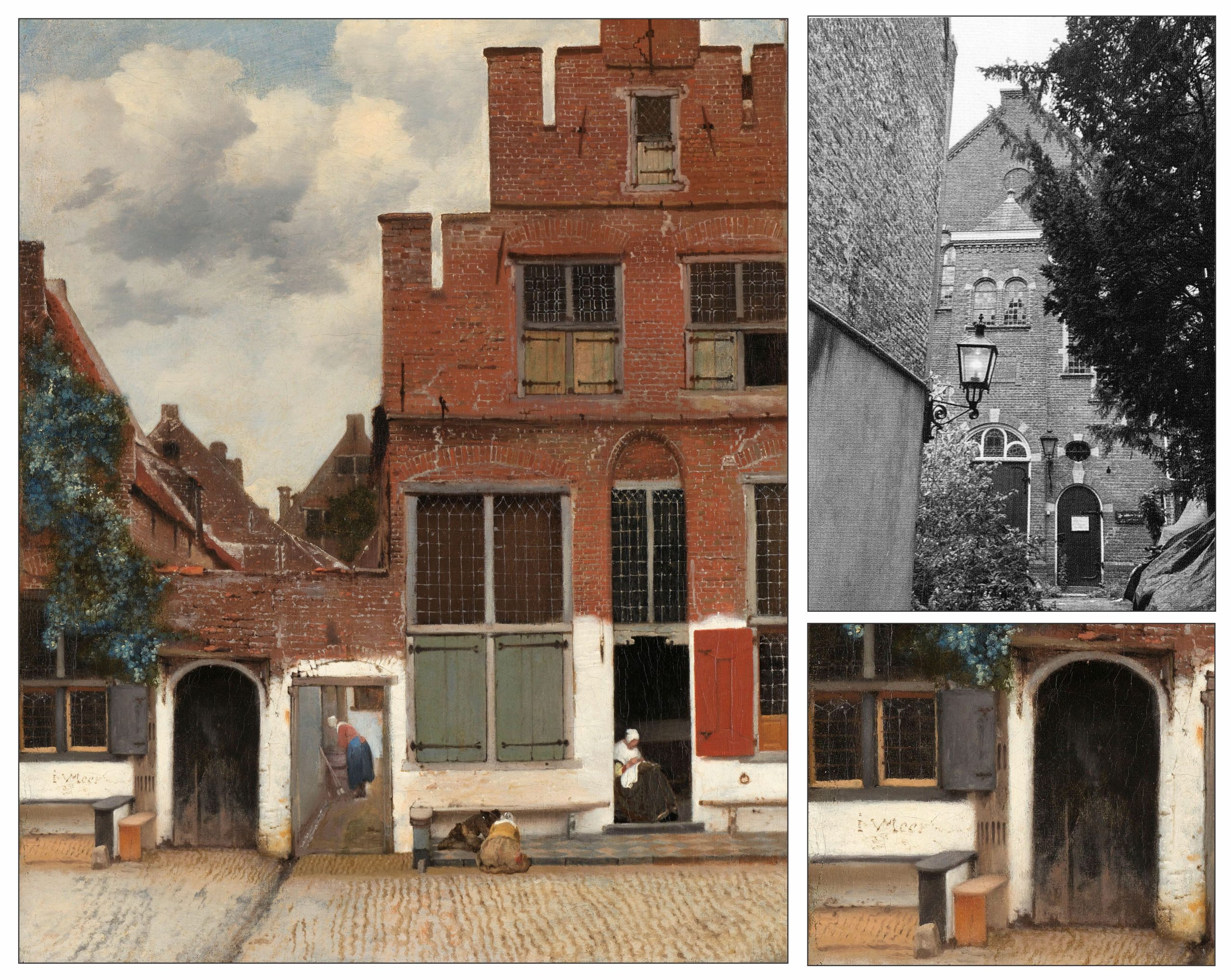
There has been much debate about the location of Vermeer’s painting The Little Street (1660). Graham Dixon (2025, pp 197-200) proposes that it represents on the left (where Vermeer placed his signature) the residence of his patrons Pieter van Ruijven and his wife Maria de Knuijt. Behind the residence, accessible through the black door was the clandestine Remonstrant Church, that is still standing today. The following illustration shows the painting on the left and a modern photograph of the church on the right.  
 

Vermeer’s Painting Techniques

Vermeer did not appear to use preparatory drawings. He was above all things a colorist. The edges of the objects in his paintings are shown by changes in color: there are no outlines. He appeared to be familiar with the new ideas about perspective (Wadum, 1995), and his paintings have a clear central vanishing point, as seen in the following diagrams. 

Several studies have proposed that Vermeer used a camera obscura or similar optical device to ensure the veracity of his paintings (Hockney, 2001; Steadman, 2001; Yeazell, 2026, pp 76-89). In a sense this would have meant that he created painted photographs. Various pieces of evidence have been adduced to support this theory. However, Liedtke (2009, p 7) pointed out that some of Vermeer’s canvases show a pinhole at the vanishing point. This suggests that he used strings to align his objects to the vanishing point. Furthermore, it is difficult to get the bright colors of a Vermeer painting in the dim light of a camera obscura. A reasonable idea is that Vermeer could have used a camera obscura as a check on the accuracy of his paintings, but that he still used conventional painting techniques.   
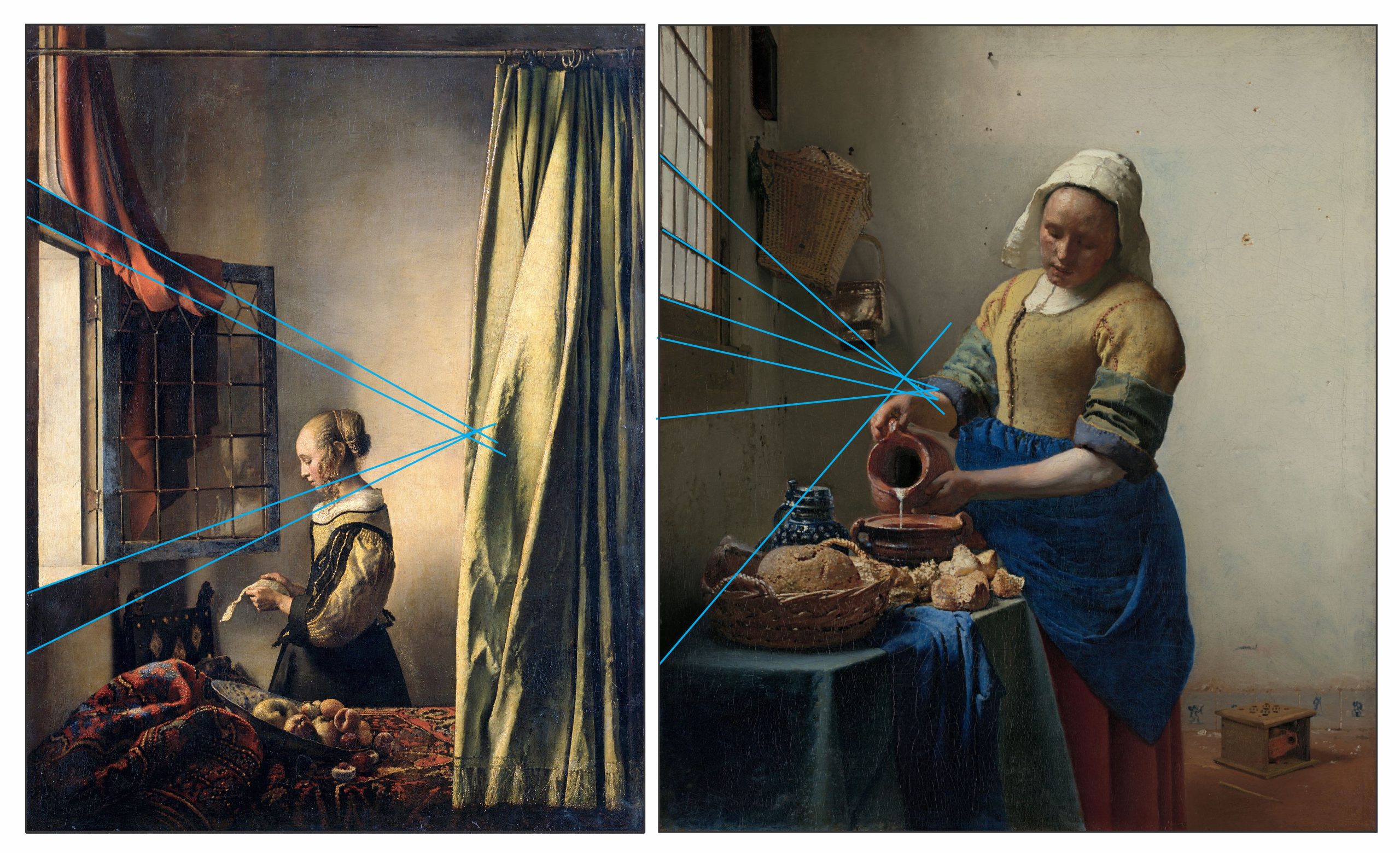
One argument against the camera obscura is the presence of perspective “errors” in the paintings. The reflection of the woman’s face in the window in Young Woman Reading a Letter at an Open Window (1657) should not be visible to the artist or viewer. Since the opening of the jug in The Milkmaid (1658) is below the vanishing point, the viewer should see the milk within the jug as it is being poured (see Janson, 2026 reporting on an observation by Keith Cardnell).  


Woman Standing at a Window

Vermeer’s paintings have a depth and seriousness that belie any simple interpretation:

Unlike the Dutch genre painters of his time, with whom he has been routinely compared, he made pictures that are uniquely introverted and conspicuously lacking in any overt ambition to amuse or entertain. While his paintings radiate a deep sense of ethical conviction, they cannot be boiled down to a series of moral platitudes. The people we see in them are invariably thoughtful, though that is really an understatement: truer to say that they are rapt, caught up in a profoundly inward state of meditation, lost in thought. They are mostly women: shown reading or writing, playing music, pouring milk, making lace, or simply looking out at us. They are framed with such solemnity that we are left in no doubt about the importance, to them, of whatever it is that they are contemplating. (Graham-Dixon, 2025, pp 3-4).

A recurrent subject of Vermeer is that of a single woman standing at a window. There are six of these paintings. The following illustration shows these paintings printed approximately to scale:
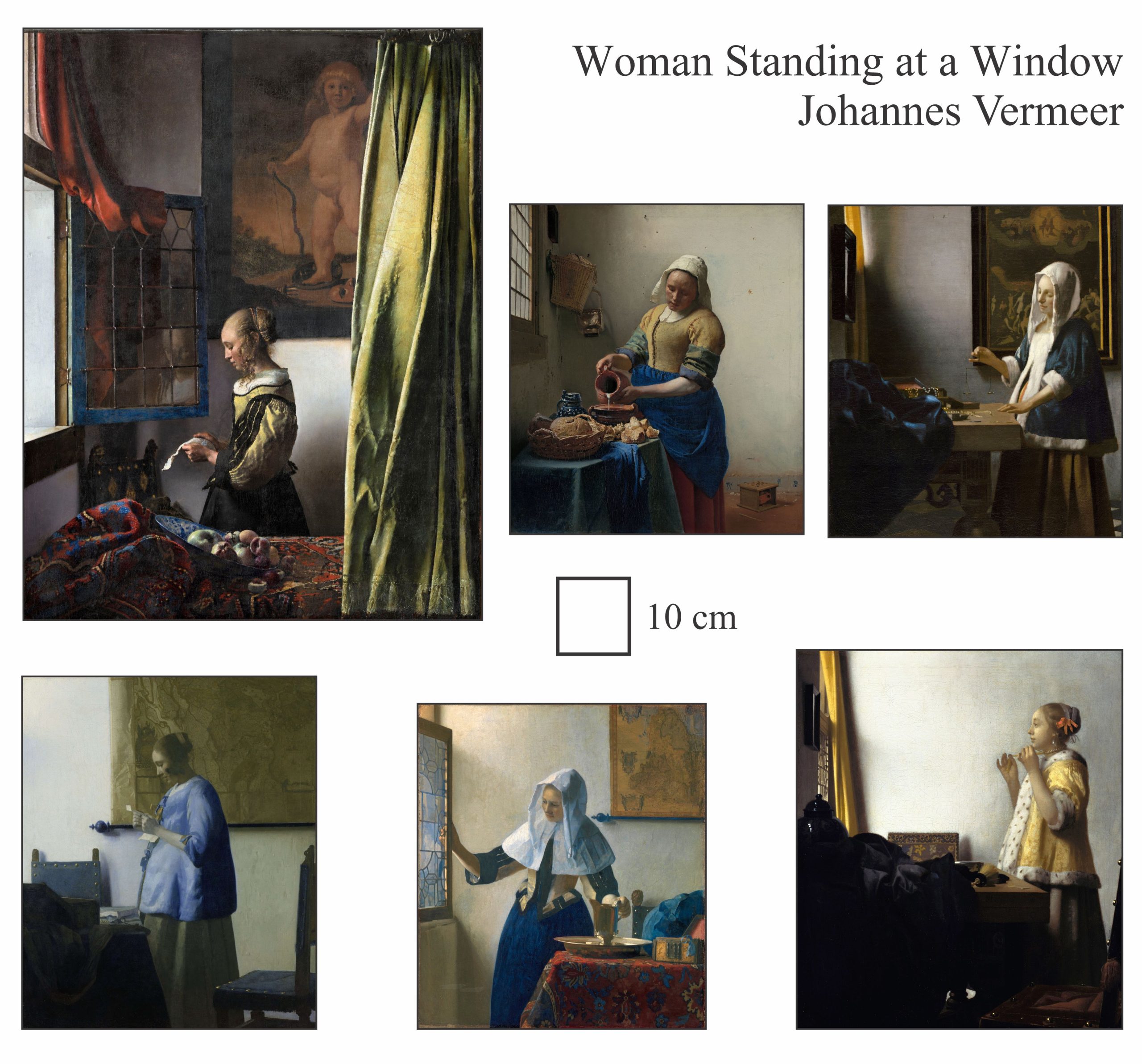
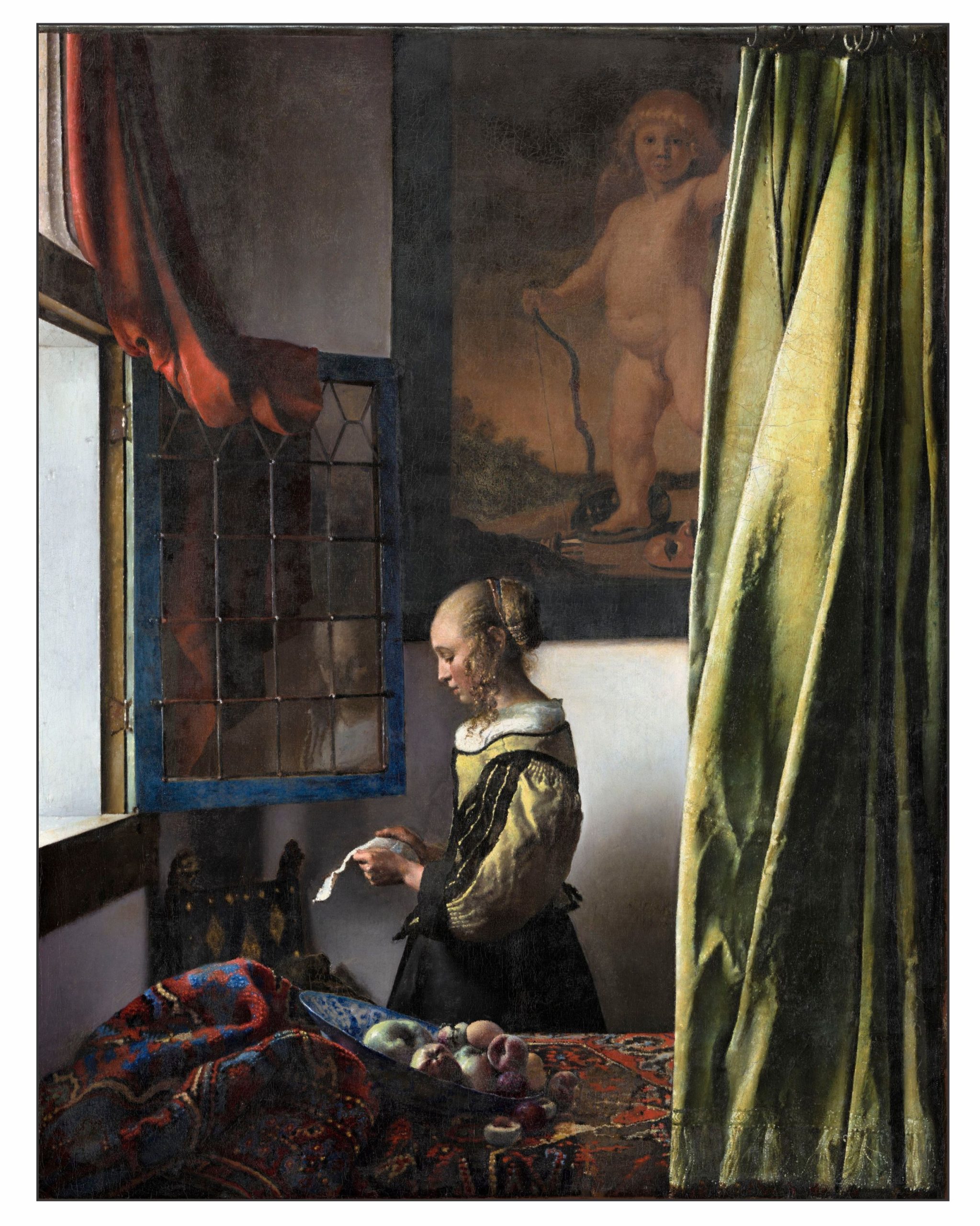
The first of these paintings is Young Woman Reading a Letter at an Open Window (1657). The viewer is not told what is in the letter. In the course of its history the upper portion of the painting had been painted over. In 2021 the Gemäldegallerie in Dresden restored the picture to its original form, revealing a painting-within-a-painting of a naked cupid. (The original image without the cupid is shown in the illustration of perspective earlier in this post.) The same painting is in the background of another of Vermeer’s paintings: A Young Woman Standing at a Virginal (1670). The cupid indicates that the paintings are concerned with romantic love. Graham Dixon (2025, pp 156-162) suggests that the 1657 painting is a love offering from Vermeer to his wife Catherine. The letter may be a profession of his love for her. The fruit on the table before the woman may represent the hope that their love bring forth fruit.

The bare wall in the painted-over version of the picture was taken to indicate the “modernity” of Vermeer. Only a modern painter would have considered a bare wall as worthy of representation (Yeazell, 2026, chapters 2 and 3). I must admit that I prefer the bare wall version. Like the bare wall in the later Woman with a Pearl Necklace (1664).
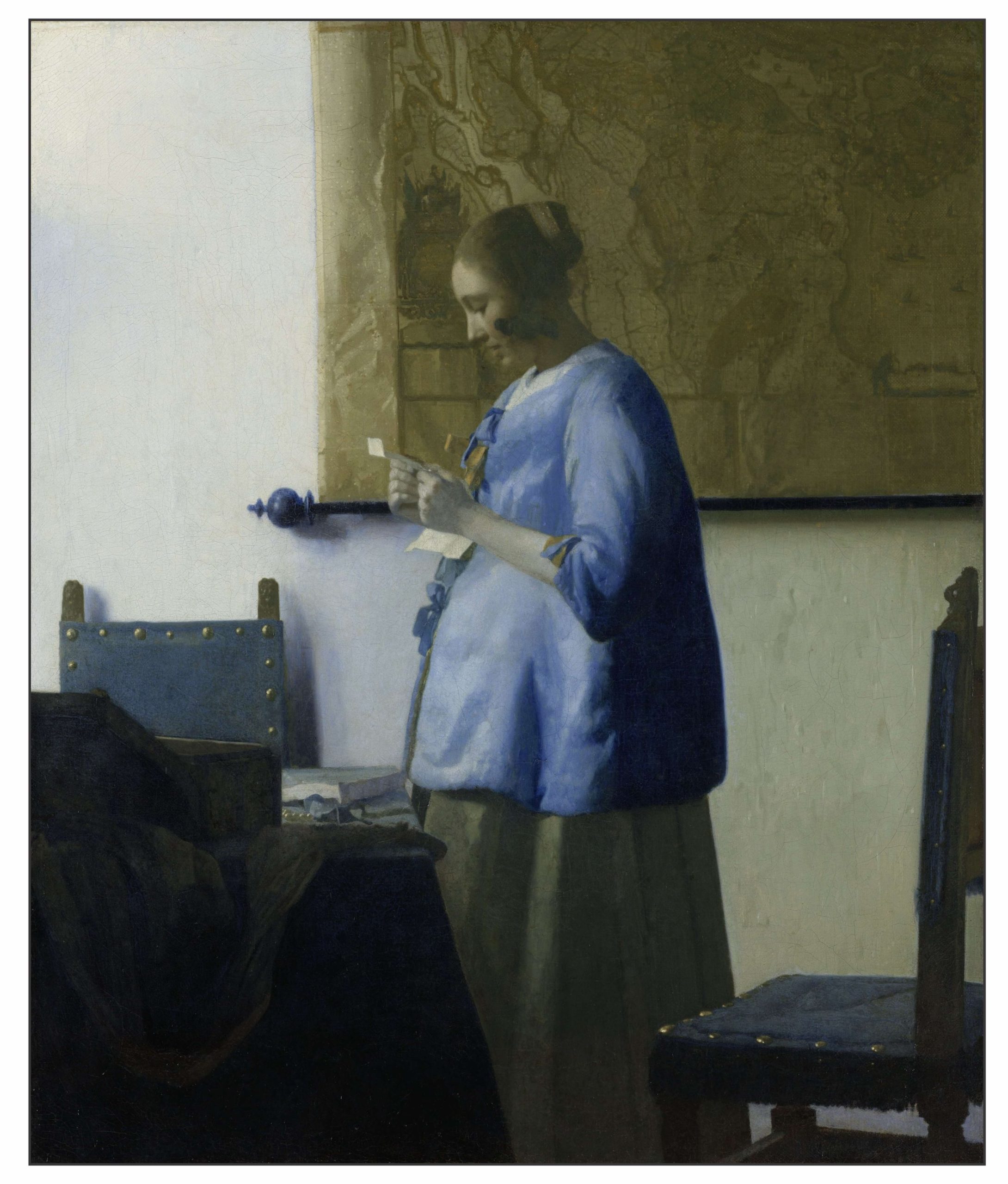
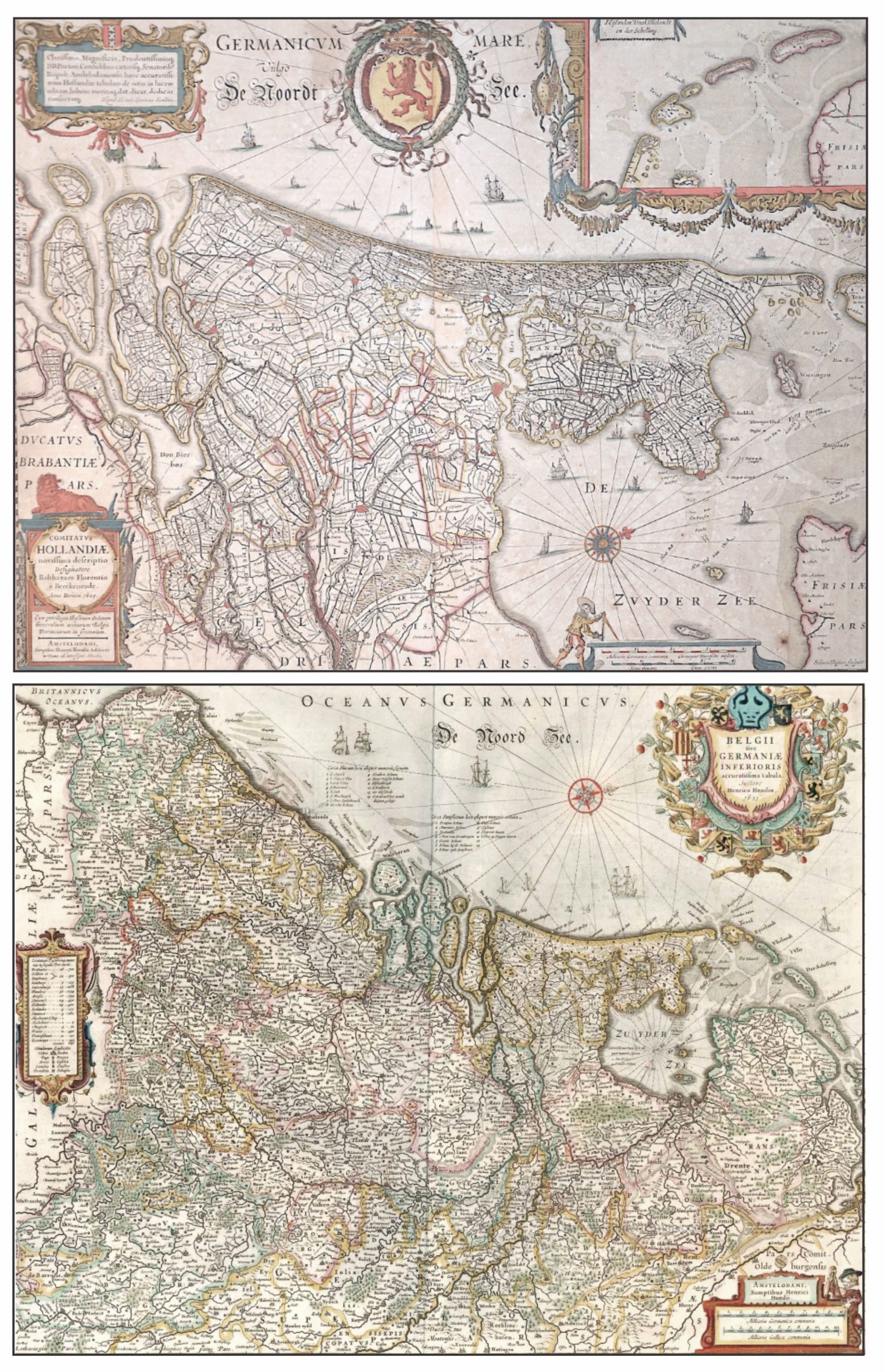
Graham-Dixon (2015, pp 239-243) pairs this painting with the later Woman in Blue Reading a Letter (1664) in the Rijksmuseum. The woman is the same, though in the later painting she is pregnant. Perhaps it is another love letter from Vermeer to his wife, who gave birth to Vermeer’s first son Johannes in 1663. The large map on the wall shows the provinces of Holland and West Friesland with the north to the right. This map was produced by Balthasar van Berckenrode in 1621 (Roeloffs & Weber, 2023, p 196). The large sea inlets south of Rotterdam are recognizable at the left. The same map is portrayed with greater clarity in Officer and Laughing Girl (1657). Since the window is not reproduced in this painting – it is only indicated by the light – perhaps the map serves to indicate the external world.    
Young Woman with a Water Pitcher (1662) now in the Metropolitan Museum of Art in New York shows a woman about to pour water into a bowl. The woman wears a white headpiece which picks up the light coming in from the window. Graham-Dixon (2025) suggests that the painting is related to the story of Jesus and the woman of Samaria (John 4: 4-42), and promotes religious tolerance. Weber (2022, pp 132-133) proposes that the painting represents the immaculate conception of Mary. Bothe interpretations are speculative. The painting may just relate the inside (domestic) world to the outside (political) world as represented by the window and the map.     
The map in this painting is by Hendrik Hondius (1631) and shows all seventeen provinces of the Netherlands, both the Dutch Republic and the Spanish Netherlands. The illustration shows versions of the two maps we have considered:
In Young Woman with a Water Pitcher, Vermeer initially had the map extend to the left side of woman’s head, but then shifted it to the right. The original position is still visible as a slight shadow on the bare wall. The new position isolates the head of the young woman for the viewer’s attention.

In Woman with a Pearl Necklace (1664) Vermeer removes the map completely and leaves us with a completely bare wall which glows as brightly as her pearls: 
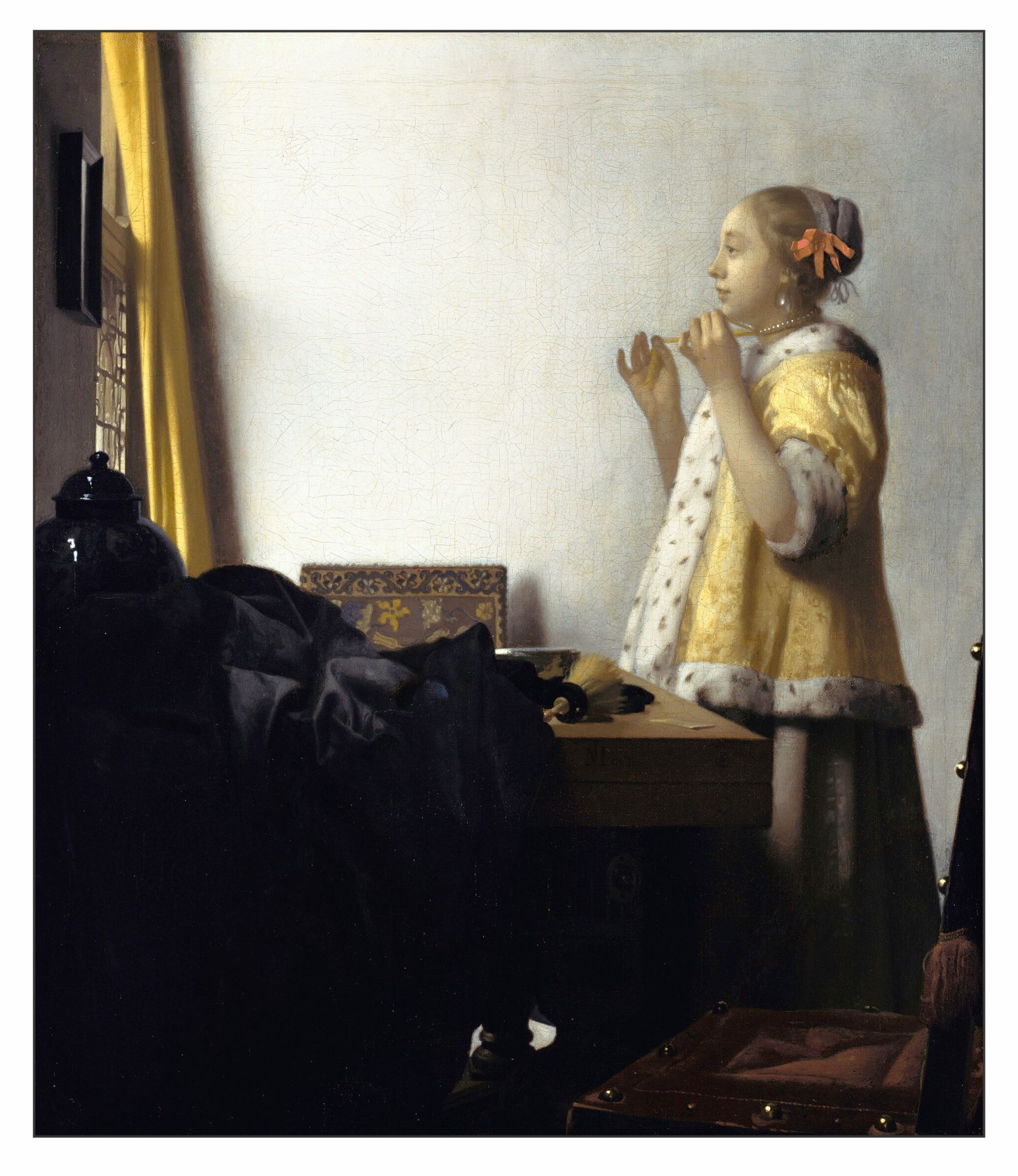
No one is sure what the painting represents. Ostensibly a young woman is enjoying how she looks in the small mirror mounted beside the window. Perhaps the woman is fixated on her looks and possessions, and fails to see the divine light pouring through the window (Weber, 2022, p 132). Perhaps, she is actually taking off her pearls, trading all her possessions for faith in Jesus: the one pearl of great price (Matthew 13: 45-46) (Graham-Dixon, 2025, pp 258-259).


A Pair of Icons

Vermeer’s main patrons were Pieter van Ruijven and his wife Maria de Knuijt (Montias, 1989, pp 246-262). After their deaths (in 1674 and 1681) their collection of Vermeer paintings passed on to their daughter Magdalena who was married to Jacob Dissius, the manager of the Golden ABC Printing Press. Magdalena died in 1682 and after Jacob’s death in 1695, twenty-one Vermeer paintings were sold at auction in Amsterdam in 1696. Among these paintings were The View of Delft, The Little Street and The Woman with a Pearl Necklace, which we have already considered.  

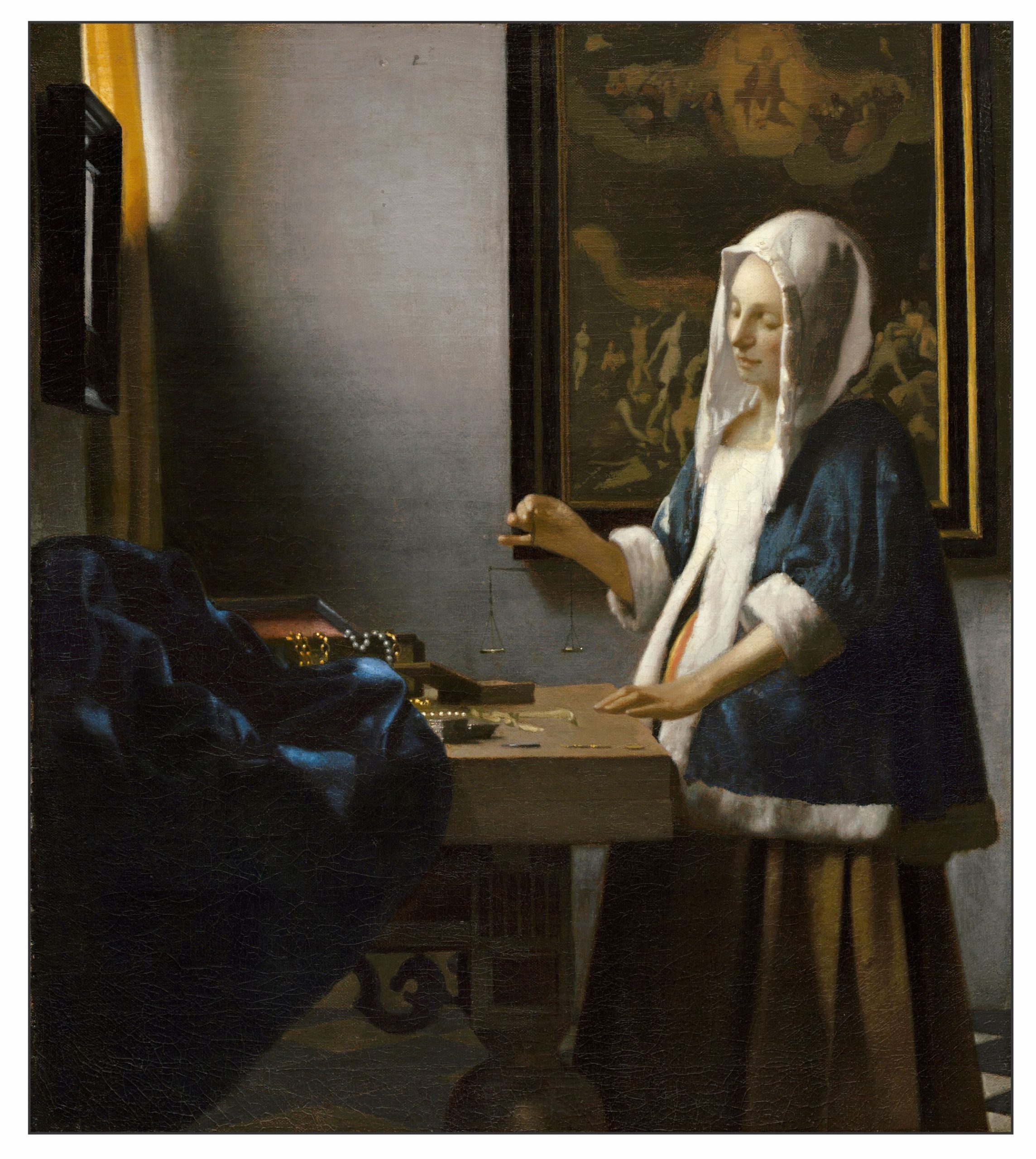
Woman with a Balance, now in the National Gallery of Art in Washington, was the first painting to be auctioned. It was initially described as a “young lady weighing gold” but there is no gold in the balances. Most scholars give a date for the painting near 1663. However, Graham-Dixon (2025, p 184) suggests that it was painted in 1659 because it seems to be paired with The Milkmaid: the paintings are similar in size and share similar physical details such as the small nail in the wall near the window. Furthermore, the two paintings were paired by the auctioneer as lots 1 and 2. 

The following are Graham-Dixon’s comments (2025, p 185) on the Woman with a Balance:

The woman weighing is richer than the woman pouring milk, to judge by her jewellery and her blue jacket trimmed with fur, so she has to work harder to get to heaven. The Day of Judgement is on her mind: on the wall behind her is a doom painting thronged with figures of the damned and the saved, beneath Christ the Judge pronouncing his final sentence. But she has no worries on that score. There is a beatific smile on her face…. She has looked herself in the eye in the mirror on the wall. She has renounced her jewellery, taken it off and placed it on the table, together with some coins. All will go to charity. Having resisted temptation, her soul remains spotless. According to the description in the auction catalogue, the woman should be weighing gold, but in fact her scales are empty. That is not to say that she is weighing nothing, just that what she is weighing happens to be invisible. She has put her conscience in the scales, and found it so light as to be weightless. She has done no evil, bears no burden of sin.

The painting has more commonly been interpreted (e.g. Blankert, 1978, p 44) as depicting a rich woman who spends her time assessing her worldly goods, not realizing that these will have no value on the Day of Judgement. However, the serenity of the woman’s expression and her pure white head-dress are more in keeping with the ideas of Graham-Dixon. 
The painting was described at auction as being “in a box.” Graham-Dixon (2025, p 189) suggests that this probably means that the frame for the picture also included

shutters that could be opened or closed, like the wings of an altarpiece, or the folding doors of a portable devotional picture.

He also suggests that The Milkmaid was likely also displayed in a similar fashion in the van Ruijven household: like two religious icons that could be opened for viewing and contemplation.

The Milkmaid (1658), now in the Rijksmuseum in Amsterdam, was the second painting to be auctioned in 1696. The title is a misnomer: the subject is a kitchen maid rather than a milkmaid, who tends to and milks the cows on a farm. The maid is pouring milk from a pitcher into a bowl. A large loaf of bread is in the basket and several pieces of another loaf are on the table.
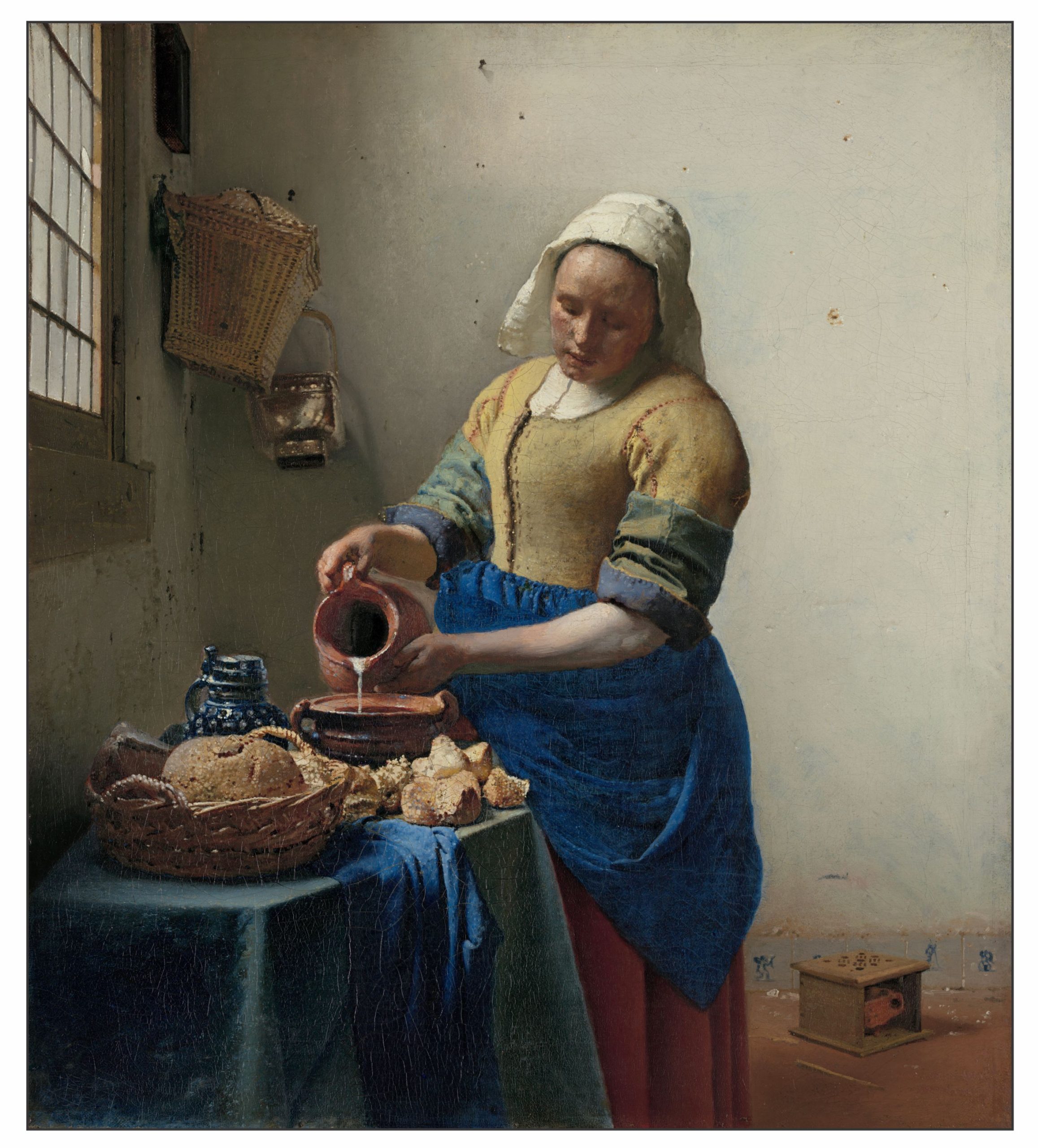
Graham-Dixon (2025, p 186) suggests that maid is preparing food for the poor:

She stands for good works, for charity, for feeding others in both the literal and the spiritual sense. In the poor houses of the town a simple preparation of bread crumbled into milk was traditionally served to the indigent, whose teeth were too weak for more solid food. This is the dish she is preparing. While the milk she pours from the jug is real enough, it also calls to mind ‘the milk of the word’ which all crave ‘as newborn babes’ (Peter I:2). Likewise the bread on the table is knobbly, substantial, dusted with flour, but it also shimmers and sparkles as if blessed by divine light. It is a reminder of the bread on the table at the Last Supper and the loaves miraculously multiplied by the sea of Galilee, ‘the true bread from heaven’, which is belief and everlasting life (John 6). These are the gifts The Milkmaid brings: real food and drink for those who hunger and thirst, but spiritual food and drink too.

Another interpretation is that she is making bread pudding: combining bread, eggs and milk that will later be cooked to make the pudding (Schwartz, 2017, p 20, quoting Harry Rand).

On the floor to the right of the maid is a stoof or footwarmer. This is a wooden box with holes on its top, into which is placed an earthenware or metallic bowel containing burning charcoal or coal embers. Footwarmers were typically used when sitting: the feet were placed on the box, and the legs and feet covered with a blanket or skirt so that the heat rose to warm the body. (These are no longer used because of the danger of carbon monoxide poisoning.) Since the heat particularly affected the nether parts, the object was often used to symbolize lust. Liedtke (2009, p 13) therefore suggests the maid is thinking amorous or lascivious thoughts during her humdrum work. However, the seriousness to the painting acts to belie any satirical or sexual interpretation. Graham-Dixon (2025, p 186) suggests that the maid has put romantic love aside. One of the uses of the footwarmer was to stay warm during long sermons in a cold church. Another interpretation is that the maid has just returned from church and is putting its teachings into practice.

Graham-Dixon (2025, p 184-185) proposes that both Woman with a Balance and The Milkmaid served as paired devotional objects in the Remonstrant home of Pieter van Ruijven and his wife Maria de Knuijt. He relates them to the Bible’s Mary and Martha, the subject of one of Vermeer’s early paintings Christ in the House of Mary and Martha (1655) 

The woman weighing is reflecting, assessing, meditating. The woman pouring milk is preparing a meal, working for others, measuring their needs. One woman is thinking, the other is doing. One is contemplative, the other is active. We have met these women before, in different clothes, in a different setting and a different place. We have met them in the Bible and we have met them in another painting by Vermeer. Are they not Martha and Mary, the Active Life and the Spiritual Life, in another guise?

The Biblical story is as follows

Now it came to pass, as they went, that he entered into a certain village: and a certain woman named Martha received him into her house.

And she had a sister called Mary, which also sat at Jesus’ feet, and heard his word.

But Martha was cumbered about much serving, and came to him, and said, Lord, dost thou not care that my sister hath left me to serve alone? bid her therefore that she help me.

And Jesus answered and said unto her, Martha, Martha, thou art careful and troubled about many things:

But one thing is needful: and Mary hath chosen that good part, which shall not be taken away from her. (Luke 10:38-42)

Graham-Dixon is correct about the difference between the two paintings. One is concerned with the activities of the day, whereas the other attends to eternity. However, the women are not sisters: one is a mistress and the other is a maid. Nevertheless, his suggestion that the pictures were objects of contemplation during prayer meetings rings true:

Woman with a Balance would seem an apt image to contemplate during a period of prayer and reflection, perhaps therefore at the start a meeting. The Milkmaid, which is about going out into the world and performing good deeds, would seem suited to the end, when people were about to leave. (Graham-Dixon, 2025, p 189).


Woman at a Window

Artists have represented many different women at many different windows (Sliwka, 2022; Weber in Roeloffs & Weber, 2023, pp 162-167). Their pictures reveal the differences between internal and external worlds, between the domestic and the politic, the imagined and the real.

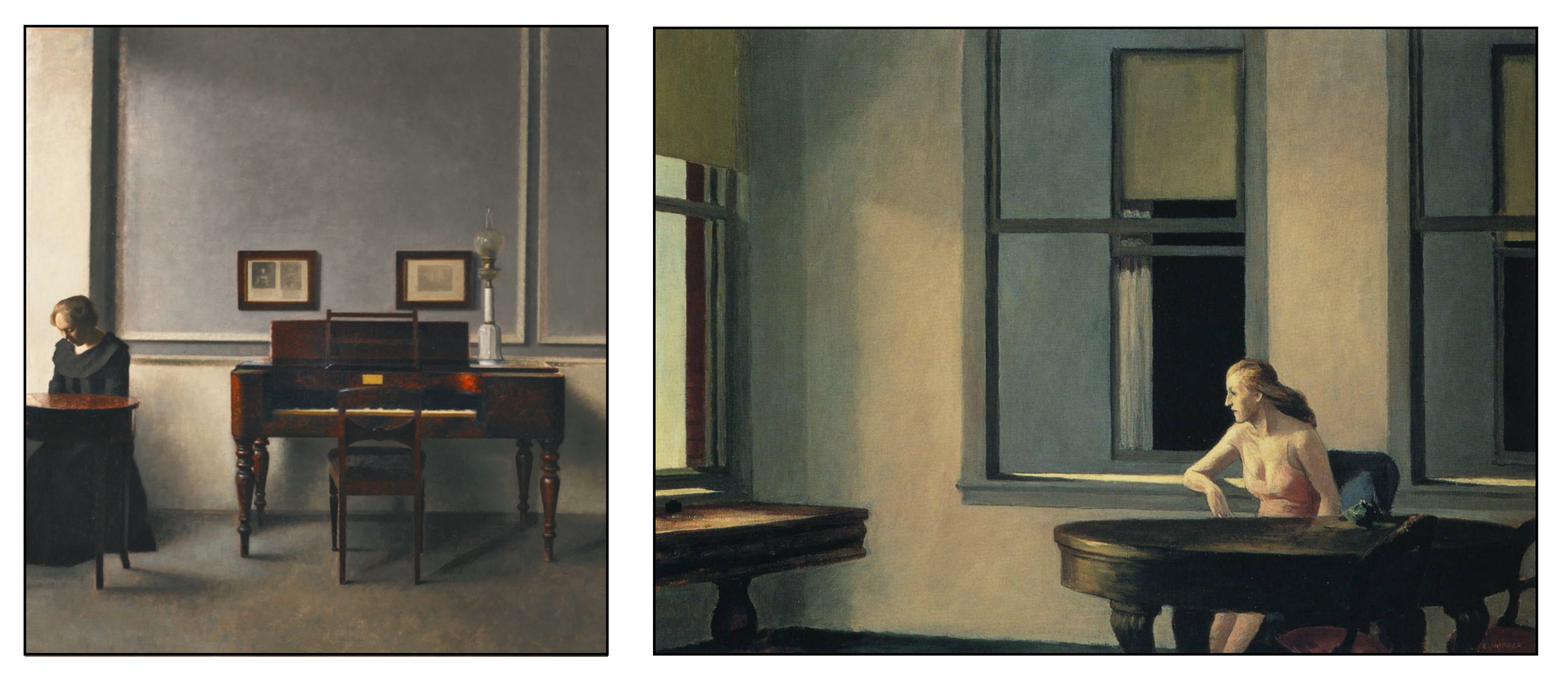
The upper part of the following illustration shows various examples: Caspar David Friedrich’s Women at a Window (1822) which portrays a longing for freedom; Wilhelm Hammeshoi’s Interior with a Woman Standing (1913) with its sense of sad solitude; and Isabel Codrinton’s The Kitchen (1927) with its underlying menace. At the bottom left is Edward Hopper’s Morning Sun (1952) showing a lonely woman about to face whatever the day may bring.
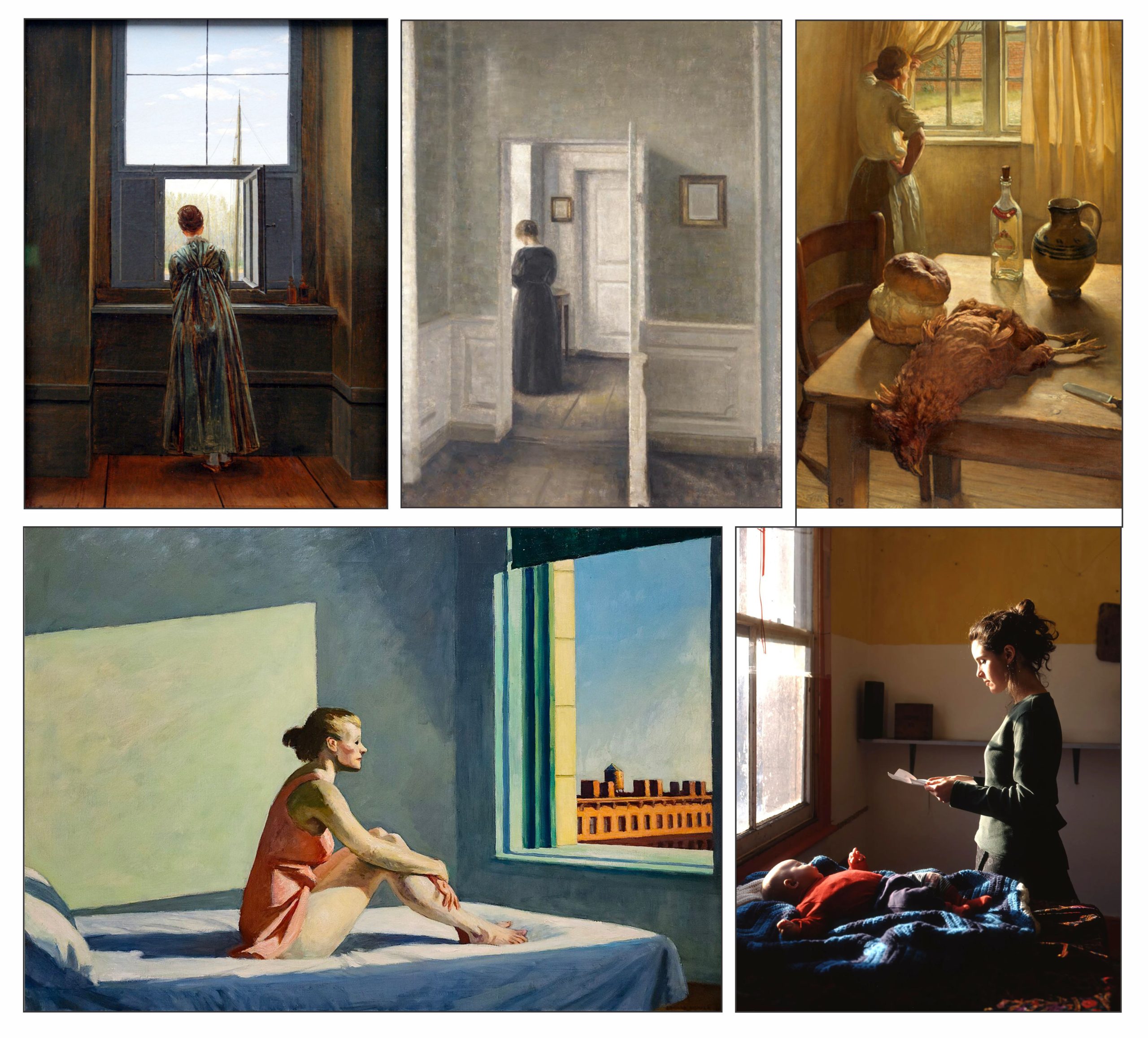
And on the bottom right is Tom Hunter’s photograph Woman Reading Possession Order (1997) which transforms Vermeer’s Young Woman Reading a Letter at an Open Window to a modern setting.

In Hunter’s composition, the sumptuous interior of Vermeer’s painting has been replaced by a squatter’s residence in Hackney, east London and the love letter substituted with an eviction notice, a copy of which accompanies the photograph, asserting the harsh reality behind this carefully staged composition. Interpreted alongside the Vermeer, we may understand the baby on the table in Hunter’s photograph as the result of the actions of Cupid upon the woman at the window and as a fruitful manifestation of the abundant produce in the Dutch painting. In contrast to the Vermeer, the window here is closed, suggesting a more fixed outcome or certain finality to the situation. The light passing through the window, however, illuminating the woman’s resigned face and the child’s head, suggests there may be hope beyond these dire circumstances. (Sliwka, 2022, p 44).


 Envoi

Vermeer’s paintings of a woman standing at a window have a solemnity that warrants contemplation. We may not fully understand their meaning, but we are sure that they are immensely important. The following is Wislawa Szymborska’s 2009 poem from Szymborska (2015, p 413) about The Milkmaid:

As long as that woman from the Rijksmuseum
in painted silence and concentration
keeps pouring milk day after day
from the jug to the bowl
the World hasn’t earned
the world’s end.

References

Blankert, A. (1978). Vermeer of Delft: complete edition of the paintings Phaidon.

Blockmans, W. P. (2022). The formation of a political union, 1300-1588.In J. C. H. Blom, & E. Lamberts (Eds). History of the low countries. (pp 55-142).  Berghahn Books.

Deursen, A. T. van. (2022). The Dutch Republic, 1588-1780. In J. C. H. Blom & E. Lamberts (Eds.) History of the Low Countries. (pp. 143–220). Berghahn Books.

Graham-Dixon, A. (2025). Vermeer: a life lost and found. Allen Lane.

Hockney, D. (2001). Secret knowledge: rediscovering the lost techniques of the old masters. Viking Studio.

Janson, J. (2026) Vermeer and the art of linear perspective. Essential Vermeer

Kooi, C. (2018). Religious Tolerance. In Helmers, H. J., & Janssen, G. H. (Eds) The Cambridge Companion to the Dutch Golden Age (pp. 208–224). Cambridge University Press.

Liedtke, W. A. (2001). Vermeer and the Delft School. Metropolitan Museum of Art. 

Liedtke, W. A. (2009). The Milkmaid by Johannes Vermeer. Metropolitan Museum of Art.

Montias, J. M. (1989). Vermeer and his milieu: a web of social history. Princeton University Press.

Proust, M. (1923, translated by Scott-Moncrieff, C. K., 1929). The captive. Modern Library.

Roelofs, P., &Weber, G. J. M. (Eds). (2023). Vermeer. Thames & Hudson.

Schwartz, G. (2017). Vermeer in detail. Ludion.

Sliwka, J. (2022). Reframed: the woman in the window. Dulwich Picture Gallery.

Steadman, P. (2001). Vermeer’s camera: uncovering the truth behind the masterpieces. Oxford University Press.

Szymborska, W. (translated by Cavanagh, C. & Barańczak, S., 2015). Map: collected and last poems. Houghton Mifflin Harcourt.

Wadum, J. (1995). Vermeer in perspective. In A.K. Wheelock (Ed) Johannes Vermeer. (pp 66-79). National Gallery of Art

Weber, G. J. M. (2022). Johannes Vermeer: faith, light and reflection. Rijksmuseum.

Wielenga, F. (translated by Richards, L., 2015). A history of the Netherlands: from the sixteenth century to the present day. Bloomsbury Academic.

Yeazell, R. B. (2026). Vermeer’s afterlives. Princeton University Press.


Edward Hopper

Edward Hopper (1882-1967) painted the independence and the loneliness of 20th-Century America. He was a realist in the days when most painters tended toward the abstract. Yet his paintings incite the imagination far more than the works of any abstract expressionist. His enigmatic images force the viewer to wonder what is going on:

Hopper was neither an illustrator nor a narrative painter. His paintings don’t tell stories. What they do is suggest—powerfully, irresistibly—that there are stories within them, waiting to be told. He shows us a moment in time, arrayed on a canvas; there’s clearly a past and a future, but it’s our task to find it for ourselves. (Block, 2016, p viii).

More than any other painter, Hopper has inspired writers to find the stories and meanings behind his paintings. This post summarizes his life, describes his working methods, and presents some of his pictures together with the writings they have stimulated. 

Early Life

Hopper was born in Nyack, a town on the Hudson River some 25 km north of the upper end of Manhattan (Levin, 1980a, 2007). He decided early to become an artist and studied at the New York School of Art and Design in Greenwich Village, where he was taught by William Merritt Chase and Robert Henri, among others. Hopper considered Thomas Eakins his artistic hero.

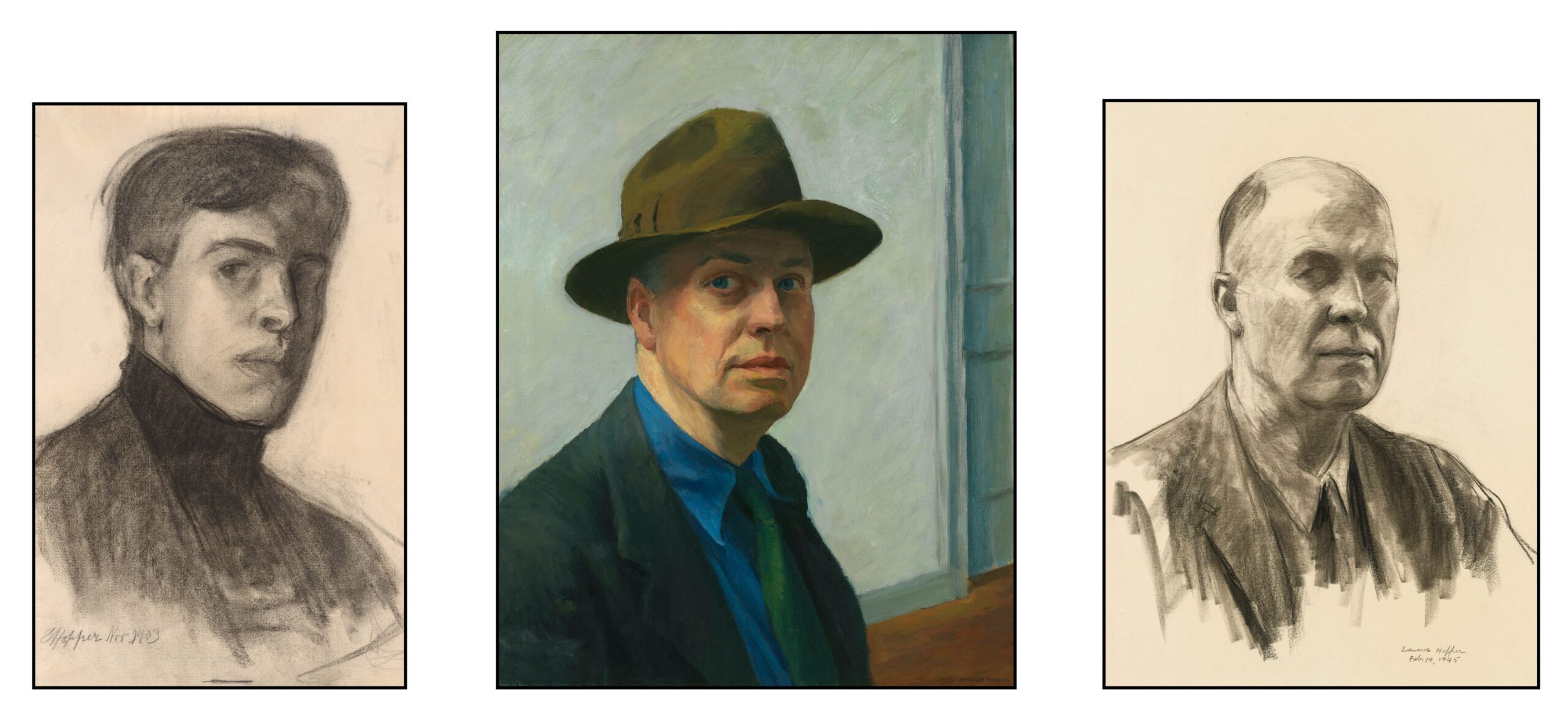
The 1903 self-portrait, illustrated on the left below, shows the conscientious young student. The others are from 1930, when he was becoming successful, and from 1945 after he had become famous.

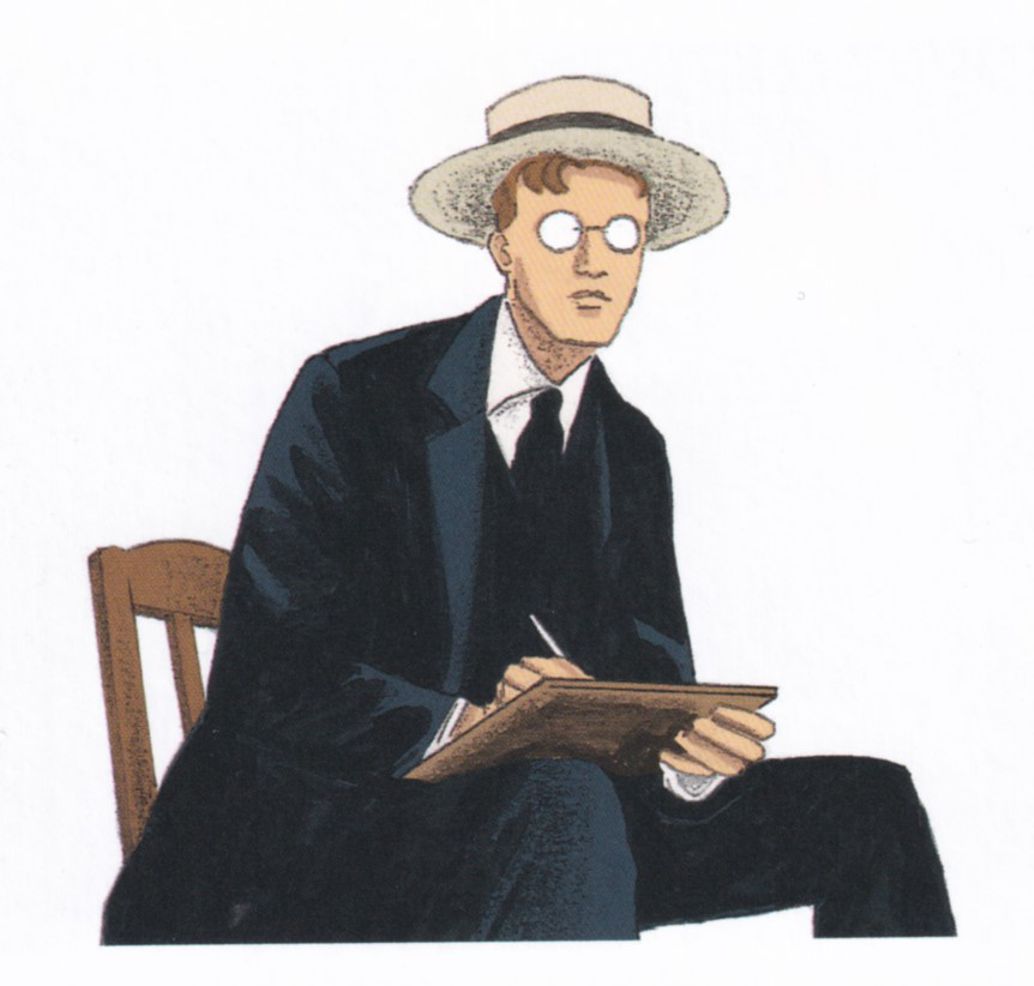
In 1906 Hopper made his first trip to Paris, where he stayed for almost one year, making occasional journeys to other cities in Europe. He returned for two further shorter visits in 1909 and 1910. In Paris, he visited the museums, attended classes, and sketched and painted en plain air. The illustration on the right from the graphic biography by Rossi and Scarduelli (2021) was derived from a 1907 photograph of the young student sketching (Levin, 2007, p 68).

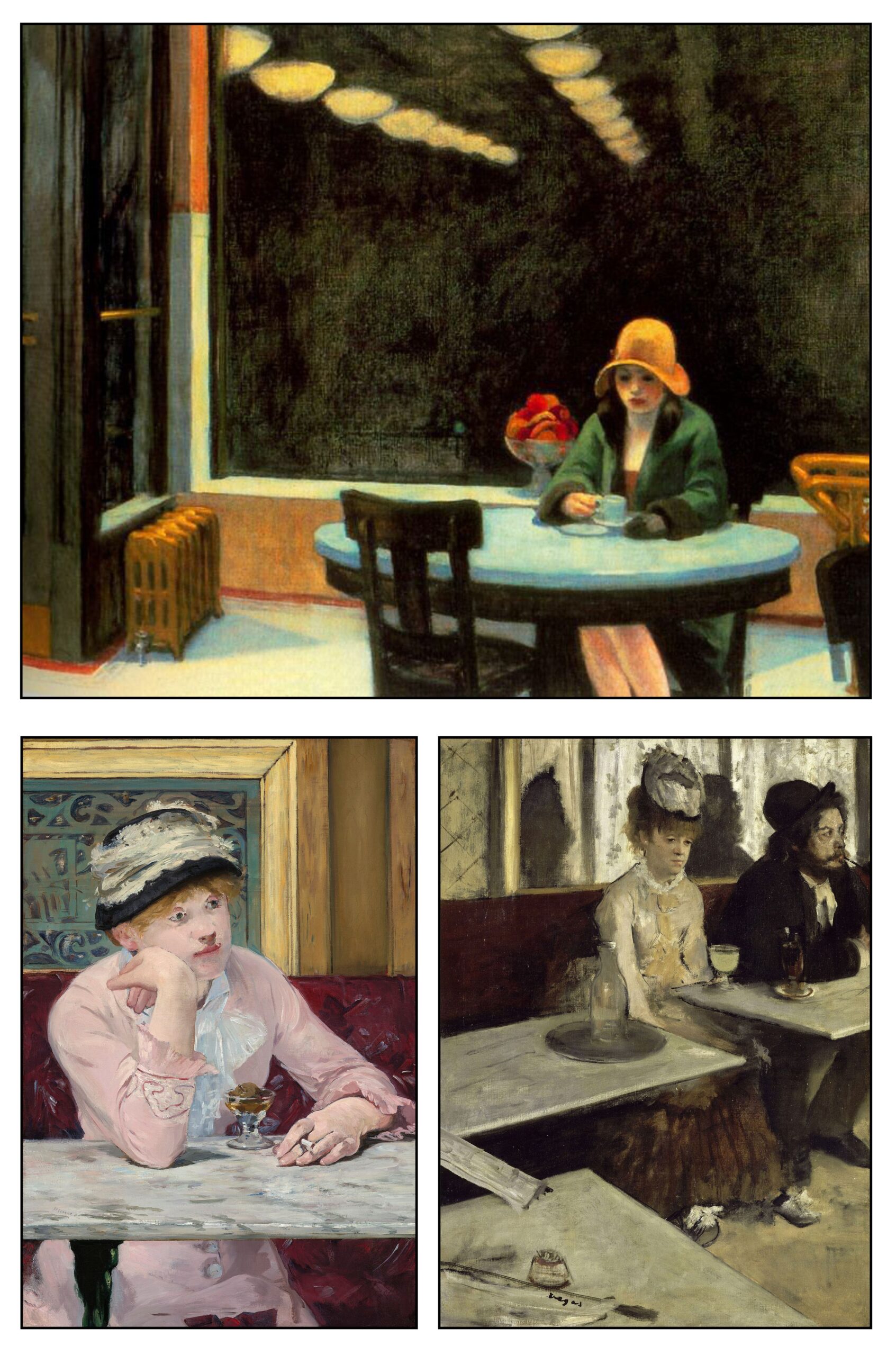
Hopper was influenced by the impressionists, in particular Edouard Manet and Edgar Degas (Kranzfelder, 2002, p 150). His later painting Automat (1927) shows similarities in mood and structure to Manet’s The Plum Brandy (1877) and to Degas’ The Absinthe Drinker (1876):

Another influence was Eugéne Atget who had photographed the empty streets of Paris (Llorens & Ottinger, 2012, p. 263). Since his camera required long exposure-times, Atget chose to photograph early in the morning before there were any people moving around in the streets. His haunting images foreshadow Hopper’s lonely city-scenes. Walter Benjamin in his Little History of Photography (1931) remarked that Atget’s photographs sometimes seem to portray the “scene of a crime.” The same can be said of many of Hopper’s paintings.

The ongoing modernist revolution in Paris had no effect on the young American. Hopper paid little attention to the post-impressionists (Van Gogh, Cézanne and Gauguin), and was apparently unaware of the current work of painters like Pablo Picasso and Henri Matisse.

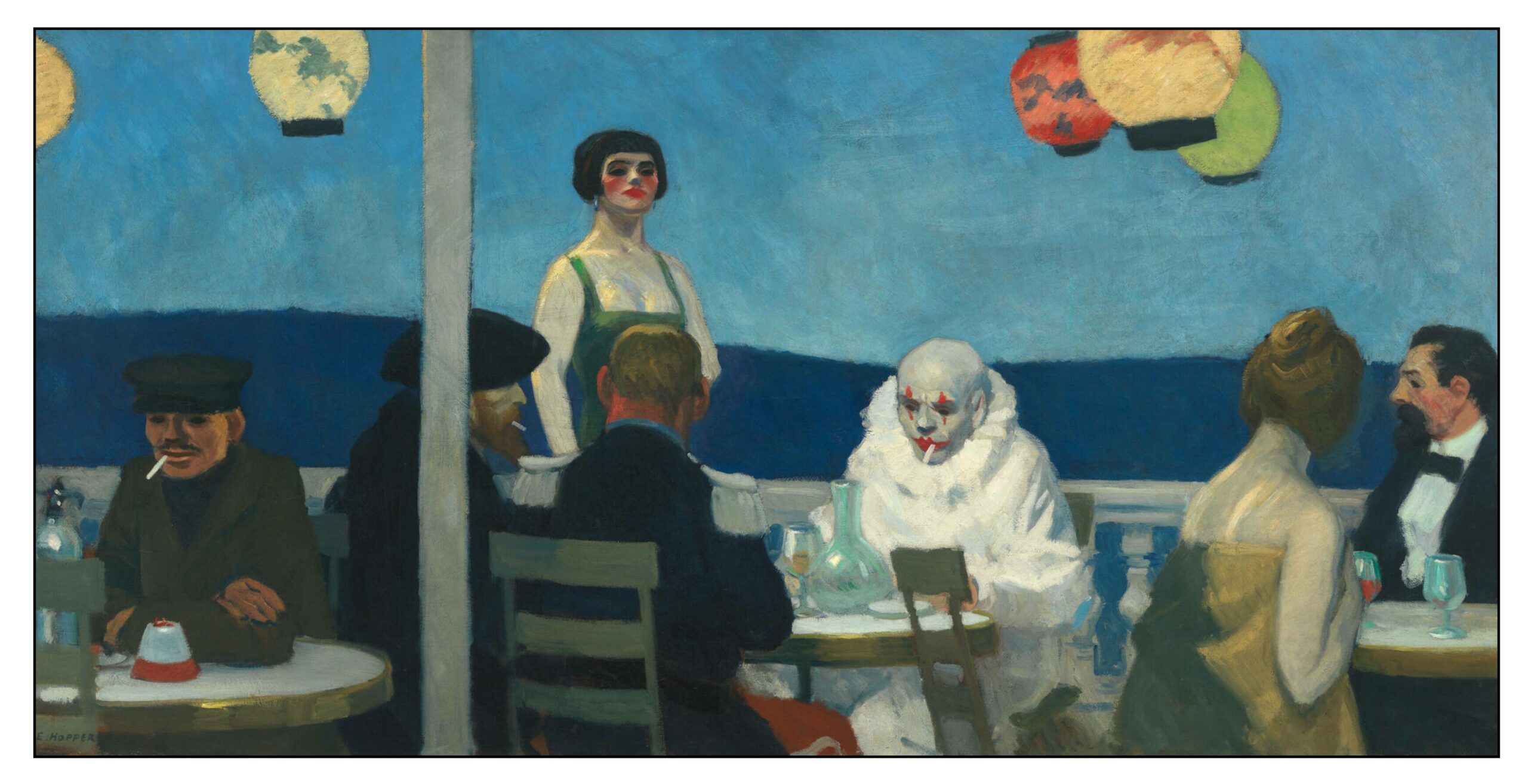
One of the last paintings from Hopper’s time in Europe was entitled Soir Bleu (1914). Various characters interact on a café terrace:

On the left is a macquereau (French: mackerel, slang for “pimp”). In the center, a garishly made-up prostitute attempts to entice a client from a table where three men are seated: someone who appears from his beret to be an artist, a soldier with epaulettes on his uniform, and a clown in full make-up and costume. On the right a bourgeois man and woman survey the scene. One is tempted to consider Hopper as the clown, out of place and without voice among the French. Three of the figures are smoking: the clown, the pimp and the artist. This may suggest something similar in their livelihoods: they all survive by selling to the rich and powerful: the couple on the right and the soldier. Hopper exhibited the painting when he returned to New York, but it was never sold and stayed in storage at his studio until his death. 

The painting’s title may come from a poem Sensation (1870) by Rimbaud, which in its second verse talks of being mute like the clown.

Par les soirs bleus d’été j’irai dans les sentiers,
Picoté par les blés, fouler l’herbe menue :
Rêveur, j’en sentirai la fraicheur à mes pieds.
Je laisserai le vent baigner ma tête nue.

Je ne parlerai pas ; je ne penserai rien.
Mais l’amour infini me montera dans l’âme ;
Et j’irai loin, bien loin, comme un bohémien,
Par la Nature,—heureux comme avec une femme.

Summer’s deep-blue evenings I will go down the lanes,
Tickled by the wheat-berries, trampling the short grass:
Dreaming, I will feel the coolness at my feet.
I will let a northern wind bathe my bare head.

I will not stir my tongue; I will think of nothing.
Yet love infinite shall at once mount in my soul;
And I will go far, very far, like a gypsy,
Through Nature,—enchanted as with a woman.
(translation by Gregory Campeau)

Back in New York, Hopper was unable to sell more than an occasional painting. He therefore supported himself by providing illustrations for magazine stories and advertisements. For a while he learned etching with Martin Lewis. From these studies, he developed a better sense of how light plays on surfaces, especially at night. He also began to define spaces more distinctly than the impressionists that he had hitherto been following.

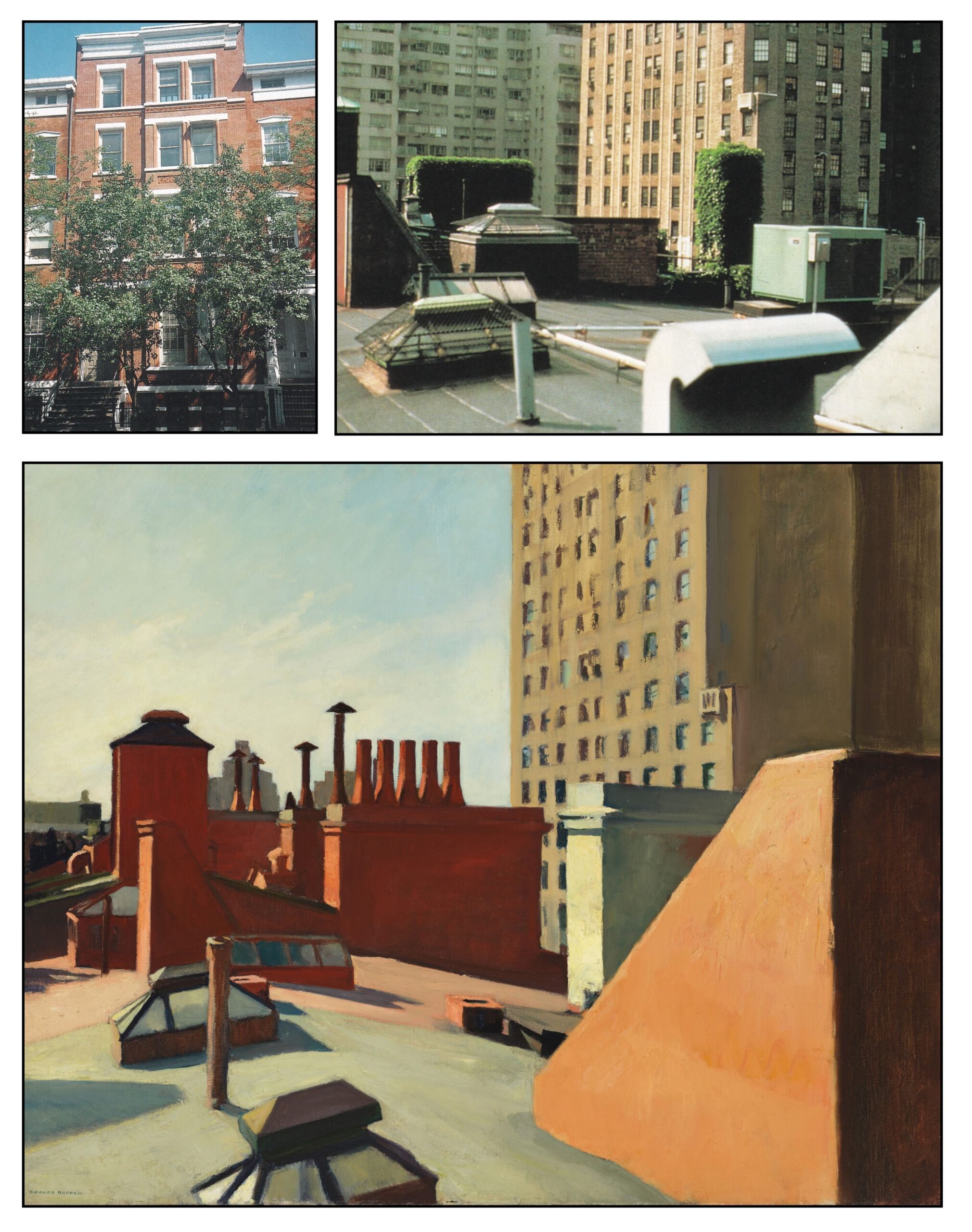
In 1913, Hopper moved into the top floor of Number 3, Washington Square North, Greenwich Village. This was his studio and residence for the rest of his life. The following illustration shows the building, the roof-top view from the top floor (Levin, 1985) and Hopper’s 1932 painting City Roofs:

Jo Nivison

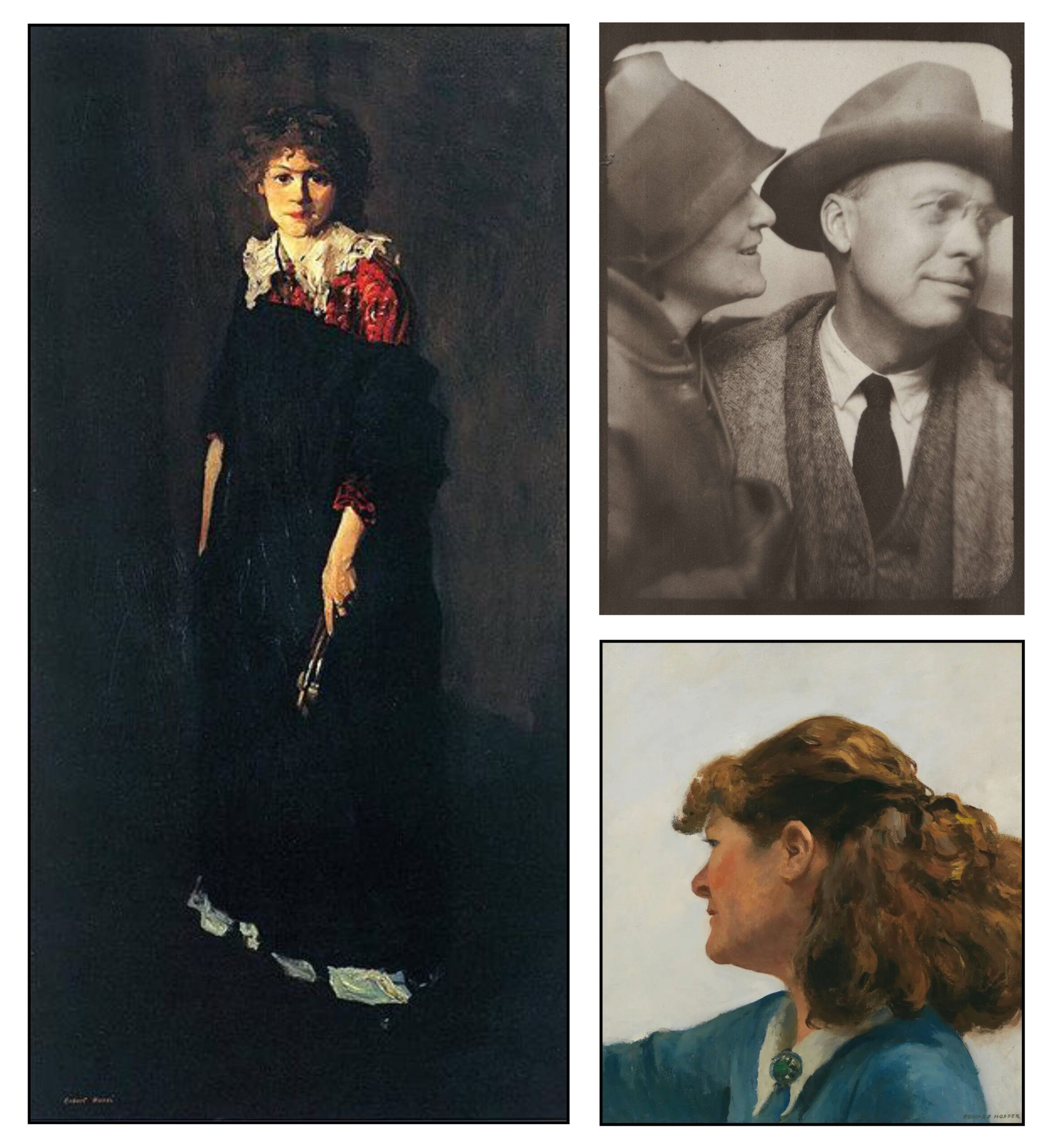
In the summer of 1923 on a painting trip to Gloucester, Massachusetts, Hopper re-encountered Jo Nivison, who had been a fellow-student at the New York School of Art and Design. They both painted water-colors and on their return to New York, Nivison was instrumental in getting Hopper’s work exhibited. They enjoyed each other’s company and were married in 1924. Both were 41 years old. They were physically and psychologically different: he was 6 ft 5 inches while she was just 5 ft; “she was gregarious, outgoing, sociable and talkative, while he was shy, quiet, solitary, and introspective” (Levin, 2007, p 168). The following illustration shows a 1906 portrait of: The Art Student Miss Josephine Nivison by Robert Henri, a photograph of Jo and Edward (from the 1930s), and a 1936 painting of Jo Painting by Hopper.  

Edward painted and Jo took care of things. She modelled for his figure paintings, and kept meticulous records of his paintings in a set of notebooks. She sometimes rebelled against her help-mate status, and urged her husband to promote her own artistic career. There were arguments, some of which degenerated into physical fights. Nevertheless, their marriage lasted until Edward’s death in 1967. Jo died a year later, leaving all her husband’s unsold paintings to the Whitney Museum of American Art. The museum also accepted her paintings, but many of these were discarded. Jo Hopper was not given the recognition that she deserved (Colleary, 2004; Levin, 1980b, 2007, pp. 717-728; McColl, 2018).   

Working Methods

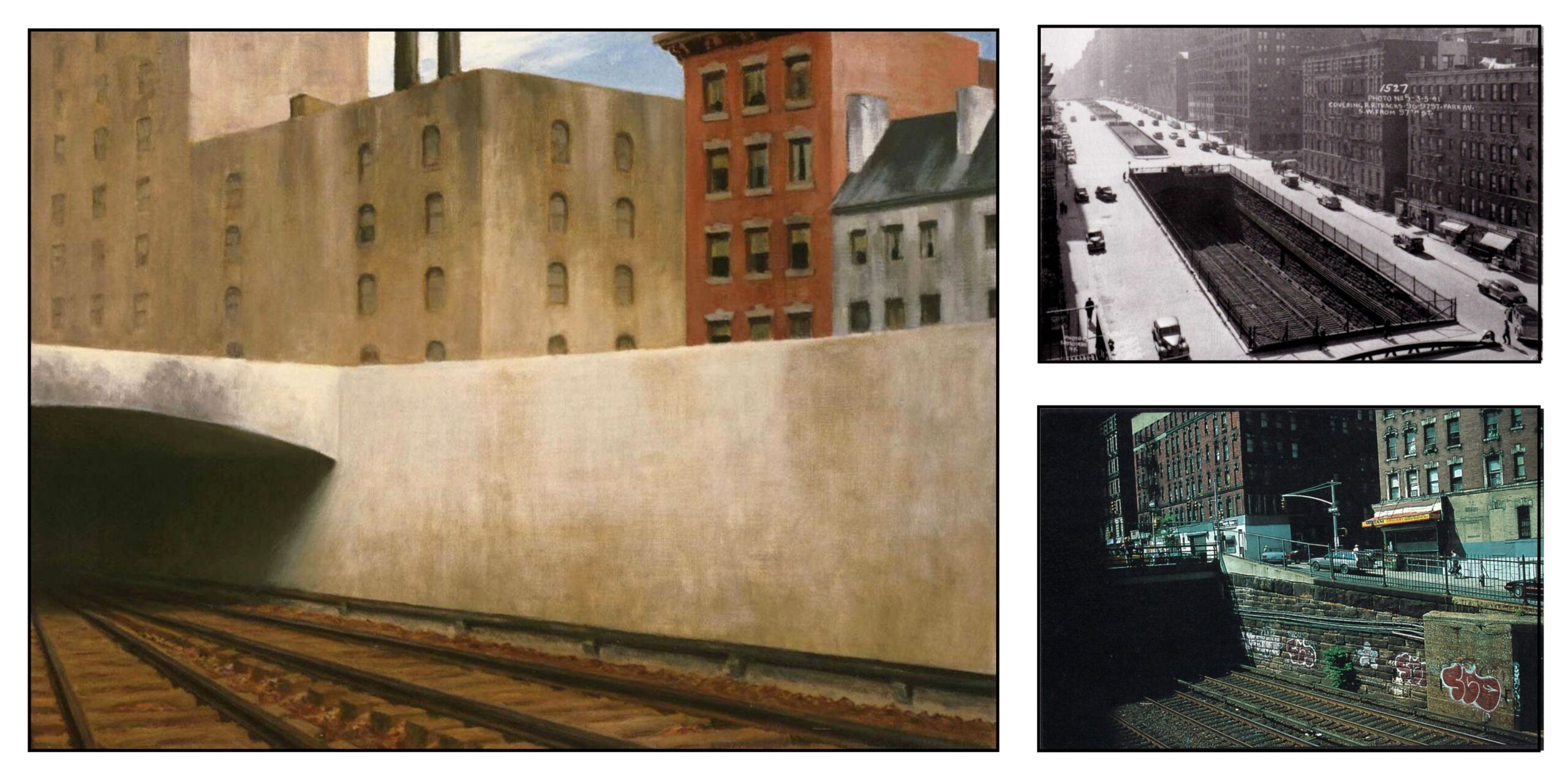
Although Hopper worked en plein air in France and during his summer excursions to New England, most of his pictures were painted in the studio from sketches made in situ. His images are thus based on reality but tempered by the imagination. The perspectives are altered; the surfaces are simplified and flattened; the colors are changed to what they might have been rather than what they were. His 1946 painting Approaching a City shows the rail lines of the Metro-North Railroad entering the tunnel at 97th Street to travel under Park Avenue to Grand Central Station. The painting provides a heightened representation of what a traveler might experience coming into a city for the first time. The illustration below shows the painting together with contemporary (Conaty,2022, p 13) and more recent (Levin, 1985) views of the scene.

The perspective of the painting would only be possible from the level of the rail-lines. Hopper has tried to see from the point of view of a passenger in a train rather than a pedestrian on Park Avenue. Even if the graffiti were erased, the opposite wall is (and was) not as it appears in the painting. Hopper has flattened its texture and removed the cables. The buildings above the wall are not those on Park Avenue, either now or when the painting was made. Conaty (2022, p 13) remarks

Here. the building types – from the nineteenth century brownstone to the modern industrial structure at the far left – suggest the passage of time in the histories that coexist, pictured as a single mass of forms seen from the train track below.  

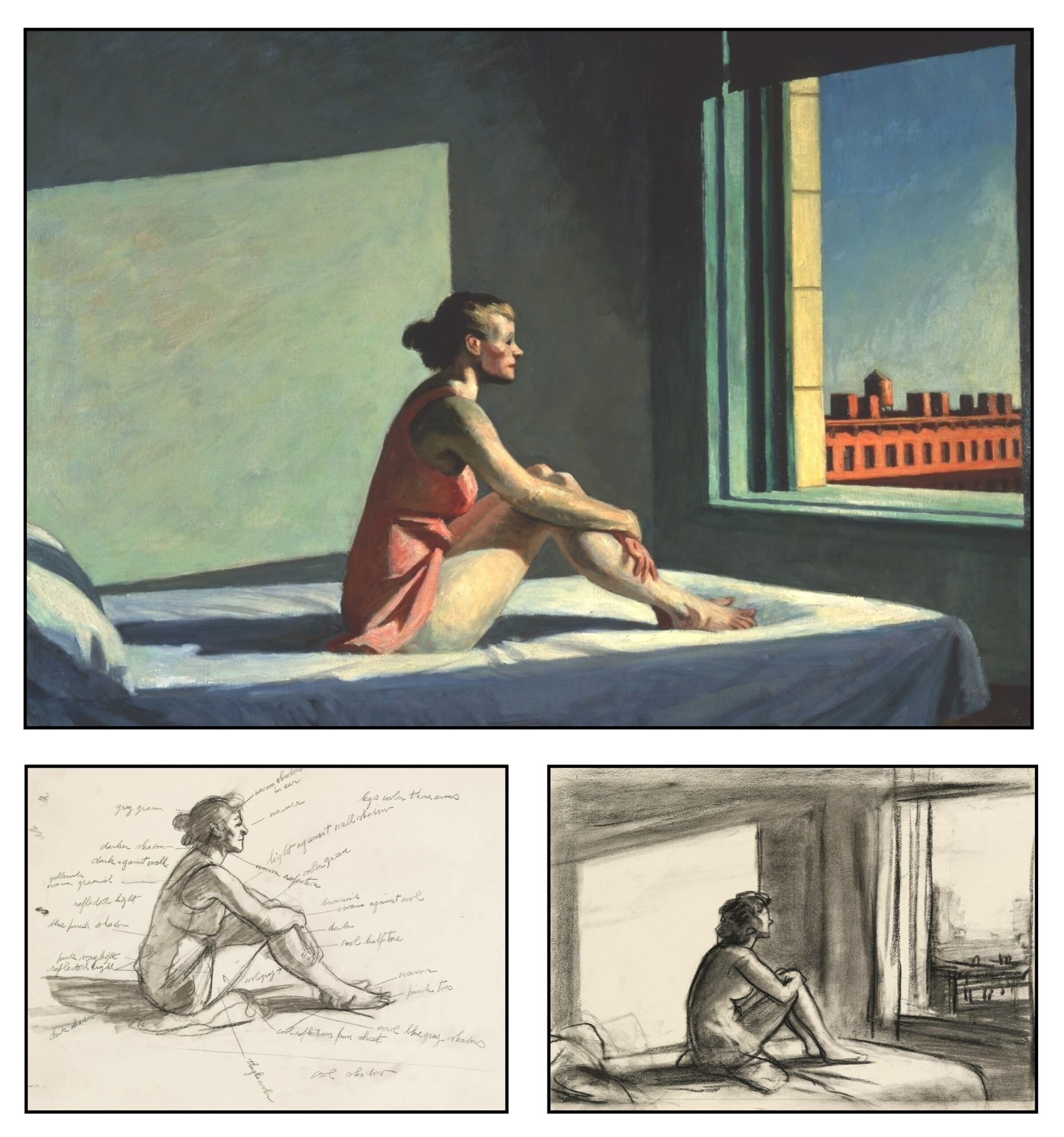
The illustration below shows Hopper’s 1954 painting Morning Sun. The preparatory sketches show both the general layout of the room the effects of the bright morning light, and a more accurate representation of the model (Jo) with extensive details about shading and color:   

The Lonely City

Although Hopper painted many different subjects, he is best known for his pictures of lonely urban surroundings. The most recent exhibition of his work at the Whitney Museum focuses on his depiction of New York City (Conaty, 2022). 

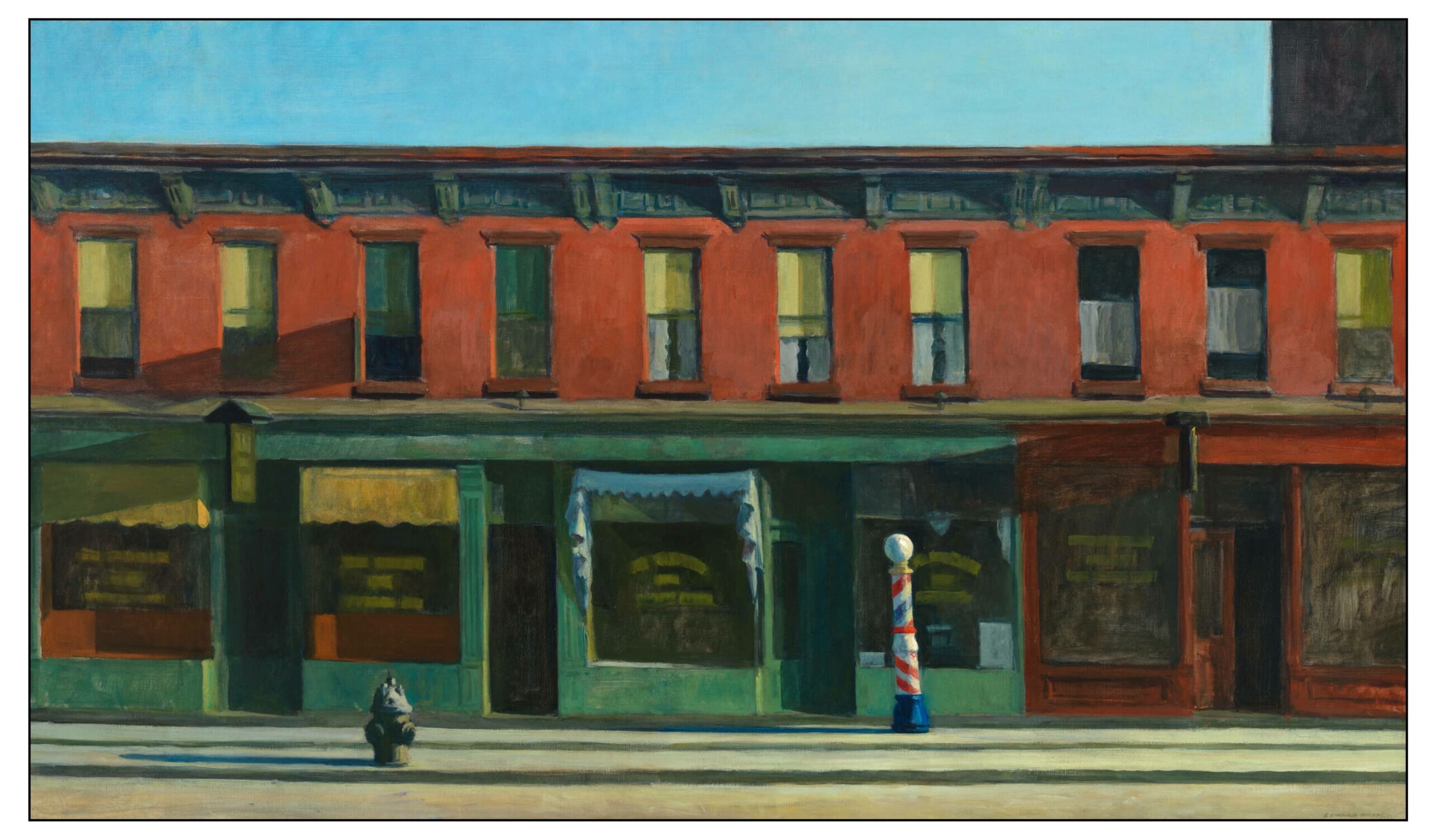
The 1930 painting Early Sunday Morning shows a deserted New York Street. Though long considered to represent 7th Avenue in Greenwich Village, recent evidence has pointed to a source on Bleeker Street (Marcum 2022). The painting has a wonderful visual rhythm: the repetition and variation between the different units and their windows reminds me of the stanzas and rhymes of poetry.

John Updike (2005 p 199) describes the painting:

Early Sunday Morning is a literally sunny picture, with even something merry about it: bucolic peace visits a humdrum urban street. We are gladdened by the day that is coming, entering from the right, heralded by the shadows it throws. The glow on the sidewalk is picked up by the yellow window shades. The barber pole is cheerful, the hydrant basks like a sluggish, knobby toad. But the silent windows, especially the darkened big shopwindows, hold behind them an ominous mortuary stillness. The undercurrents of stillness threaten to drag us down, even as the day dawns. The diurnal wheel turns, taking the sun on one of its sides. But the other side, the side where sun is absent, has its presence, too, and Hopper’s apparently noncommittal art excels in making us aware of the elsewhere, the missing, the longed-for. He is, to use a phrase generally reserved for writers, a master of suspense.

The painting takes liberties with the shadows. Neither 7th Avenue nor Bleeker Street run directly east-west, and the morning sun could not cast shadows so long and so parallel to the buildings in either place. As noted by the poet John Hollander (in Levin 1995 p 43), the long shadow on the sidewalk is especially mysterious:

           Long, slant shadows
Cast on the wan concrete
Are of nearby fallen
Verticals not ourselves.
Lying longest, most still,
Along the unsigned blank
Of sidewalk, the narrowed
Finger of shade left by
Something, thicker than trees,
Taller than these streetlamps,
Somewhere off to the right
Perhaps, and unlike an
Intrusion of ourselves,
Unseen, long, is claiming
It all, the scene, the whole.

A striking aspect of the painting is it overwhelming silence: the calm before or after the storm of normal life. Ward (2017, p 169) remarks

Hopper’s paintings are uniquely silent, conveying a sense of unnatural stillness. The silence is more active than passive, mainly because it suggests little of the calmness, tranquility, or placidity commonly associated with it. Hopper’s silences are tense—hushed decorums maintained with terrific strain.

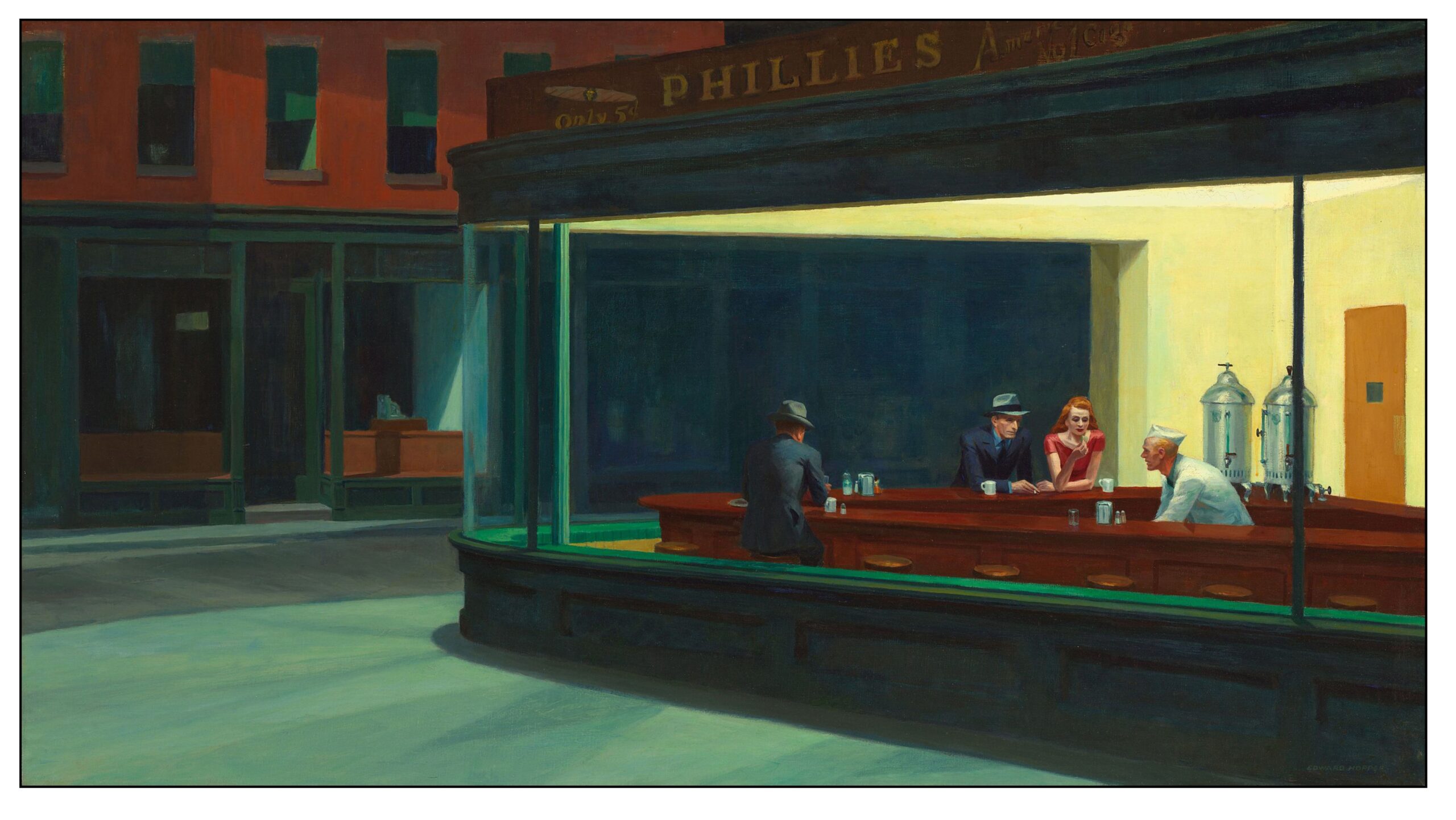
Probably Hopper’s most famous painting is The Nighthawks (1942), wherein a man and a woman sit at the counter of an all-night diner. They are served by a young waiter and observed by a solitary man at the other end of the counter. The diner is brightly lit; outside it is dark. The streets are deserted: it is likely long past midnight. We sense the couple’s anxiety and we are grateful for the light.

Hopper may have based the painting on a restaurant near the intersection of Greenwich Avenue and 7th Avenue (now Mulry Square). More likely it is an amalgam of various diners in the area. The title apparently comes from the beak-like nose of the man sitting with the woman.

The poet Mark Strand (1994, pp. 6-7) described the general effect of the picture:

The dominant feature of the scene is the long window through which we see the diner. It covers two-thirds of the canvas, forming the geometrical shape of an isosceles trapezoid, which establishes the directional pull of the painting, toward a vanishing point that cannot be witnessed, but must be imagined. Our eye travels along the face of the glass, moving from right to left, urged on by the converging sides of the trapezoid, the green tile, the counter, the row of round stools that mimic our footsteps, and the yellow-white neon glare along the top. We are not drawn into the diner but are led alongside it. Like so many scenes we register in passing, its sudden, immediate clarity absorbs us, momentarily isolating us from everything else, and then releases us to continue on our way. In Nighthawks, however, we are not easily released. The long sides of the trapezoid slant toward each other but never join, leaving the viewer midway in their trajectory. The vanishing point, like the end of the viewer’s journey or walk, is in an unreal and unrealizable place, somewhere off the canvas, out of the picture. The diner is an island of light distracting whoever might be walking by—in this case, ourselves—from journey’s end. This distraction might be construed as salvation. For a vanishing point is not just where converging lines meet, it is also where we cease to be, the end of each of our individual journeys. Looking at Nighthawks, we are suspended between contradictory imperatives—one, governed by the trapezoid, that urges us forward, and the other, governed by the image of a light place in a dark city, that urges us to stay.

Night makes us aware of our insignificance. A café can fend off these feelings. The older waiter in Hemingway’s story A Clean, Well-Lighted Place (1933) notes how his café provides an elderly customer with some sense of security in the night:

It is the light of course but it is necessary that the place be clean and pleasant. You do not want music. Certainly you do not want music. Nor can you stand before a bar with dignity although that is all that is provided for these hours. What did he fear? It was not fear or dread. It was a nothing that he knew too well. It was all a nothing and a man was nothing too. It was only that and light was all it needed and a certain cleanness and order. Some lived in it and never felt it but he knew it all was nada y pues nada y nada y pues nada. [nothing and then nothing and then nothing]

Strong (1988) remarks on the similarities between the isolation of Hopper’s images and the loneliness of Robert Frost’s poems. Hopper read and admired Frost’s poems. Jo Nivison painted a picture of him reading Frost in 1955 (Levin, 1980b). Frost’s poem Desert Places (1934) ends:

And lonely as it is, that loneliness
Will be more lonely ere it will be less –
A blanker whiteness of benighted snow
With no expression, nothing to express.

They cannot scare me with their empty spaces
Between stars – on stars where no human race is.
I have it in me so much nearer home
To scare myself with my own desert places.

There is something essentially American about the lonely individualism – the internal desert places – of Hopper, Hemingway and Frost.

Ecphrasis

Ecphrasis (Greek: words about) is the verbal description of a work of art, either real or imagined, expressed in vivid poetic language (Heffernan, 2015; Hollander 1988, 1995; Hollander & Weber, 2001; Panagiolidou, 2013). Ecphrasis is concerned with the effects the art on the viewer whereas “interpretation” deals with the what and how of these efects (Carrier, 1987). 

Perhaps more than any other artist, Hopper has stimulated the imagination of poets and writers. Poems and stories written in response to his paintings have been collected in several anthologies (Block, 2016; Levin, 1995; Lyons et al., 1995), and individual poets have composed whole books inspired by his images (Farrés, 2009; Hoggard, 2009; Strand, 1994). The following are three examples of Hopper’s images and the poetry and prose that they have evoked.

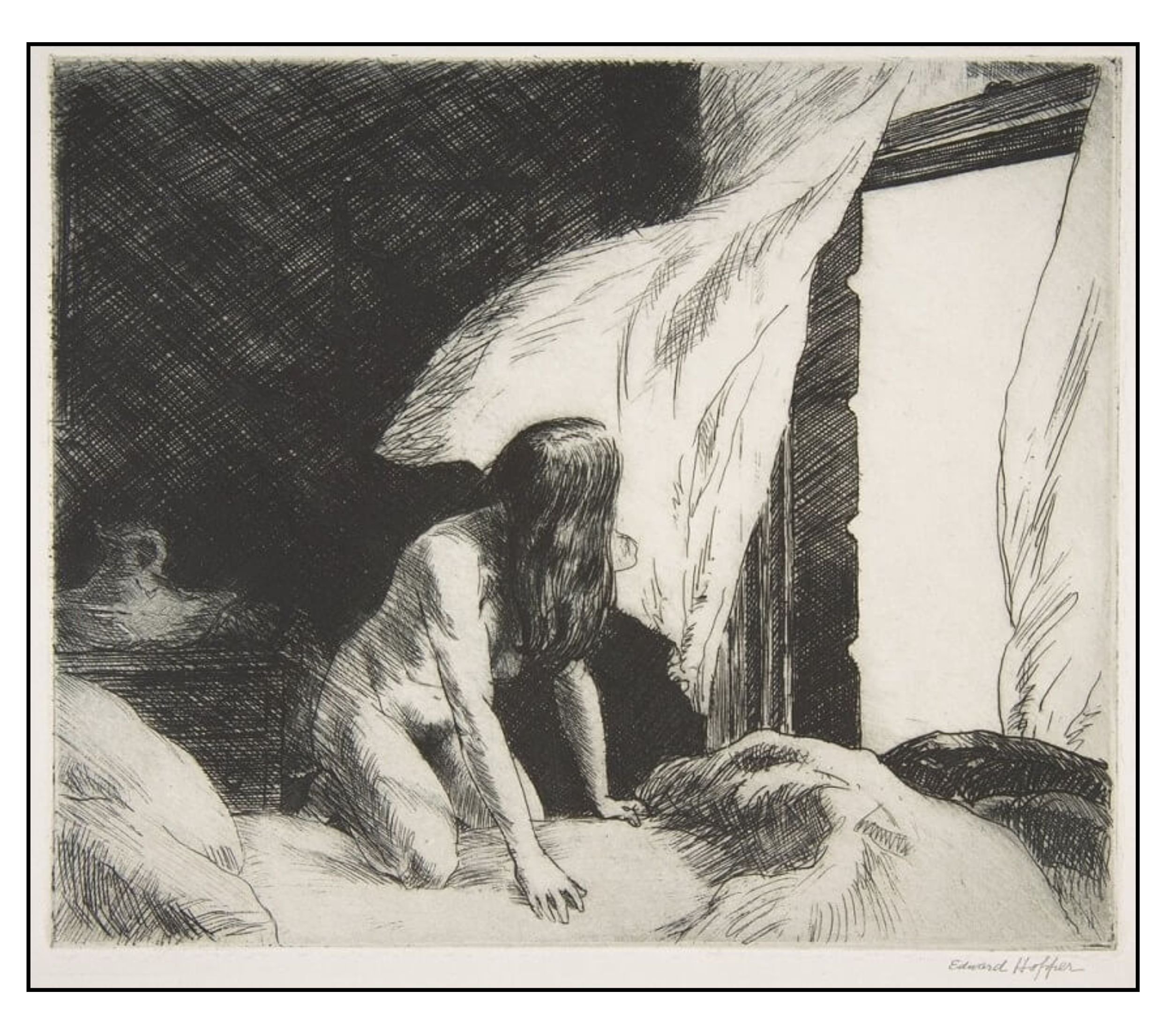
Hopper’s 1921 etching Evening Wind shows a nude woman about to lie down in bed as the wind blows the curtain into the room. The viewer feels that he is in the same room as the woman, and this intimacy recalls Degas’ paintings of women bathing. The Hopper website suggests that the sudden interruption of the wind might be akin to the appearance of a god, like the annunciation to Mary or the shower of gold that fell upon Danae.   

Robert Mezey (Levin, 1995, p 24) describes the etching in a beautifully constructed sonnet:

One foot on the floor, one knee in bed,
Bent forward on both hands as if to leap
Into a heaven of silken cloud, or keep
An old appointment — tryst, one almost said —
Some promise, some entanglement that led
In broad daylight to privacy and sleep,
To dreams of love, the rapture of the deep,
Oh, everything, that must be left unsaid —

Why then does she suddenly look aside
At a white window full of empty space
And curtains swaying inward? Does she sense
In darkening air the vast indifference
That enters in and will not be denied,
To breathe unseen upon her nakedness?

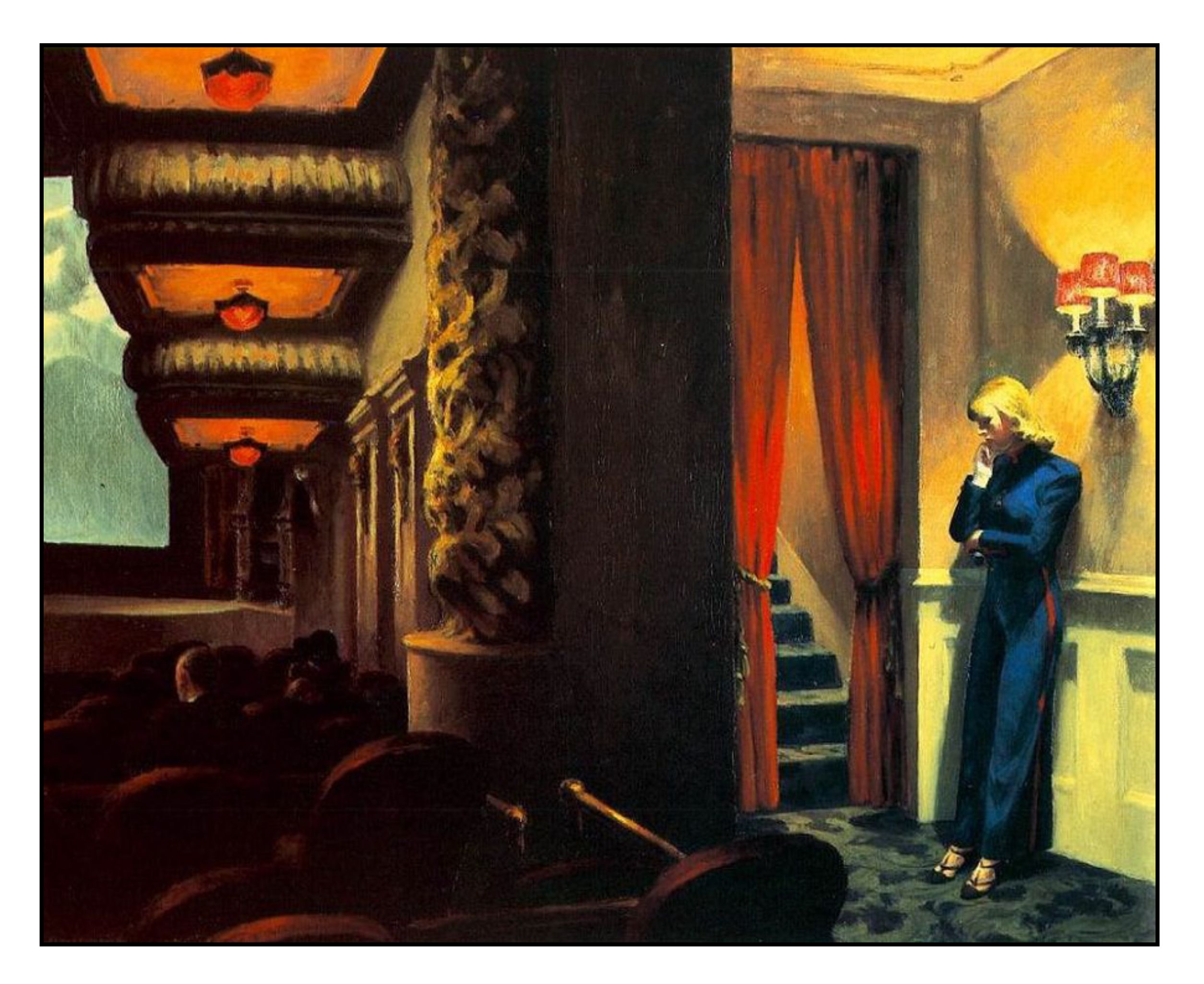
Hopper’s 1939 painting New York Movie depicts an usherette at one of the grand movie theaters in New York. She is standing beautifully and pensively near the side exit. 

Leonard Michaels (Lyons et al, 1995, p 3) wonders about who she might be:

Of course, she wasn’t going anywhere. I mean only that there was drama in the painting, a kind of personal story, and it was more engaging, more psychologically intense, than the movie on the distant blurry screen, a rectangle near the upper left corner of the painting, like a window in a dark room. The usherette isn’t looking at that movie, isn’t involved with any movie drama, any mechanical story told with cuts and fades while music works on your feelings. Her drama is mythical, the myth of Eurydice doomed to wait at the edge of darkness. The red flashes in the shadows of the painting are streaks of fire and streams and gouts of blood. Eurydice stands at the edge of Hades waiting for Orpheus. This movie theater, like many others in Hopper’s day, is called the Orpheum.

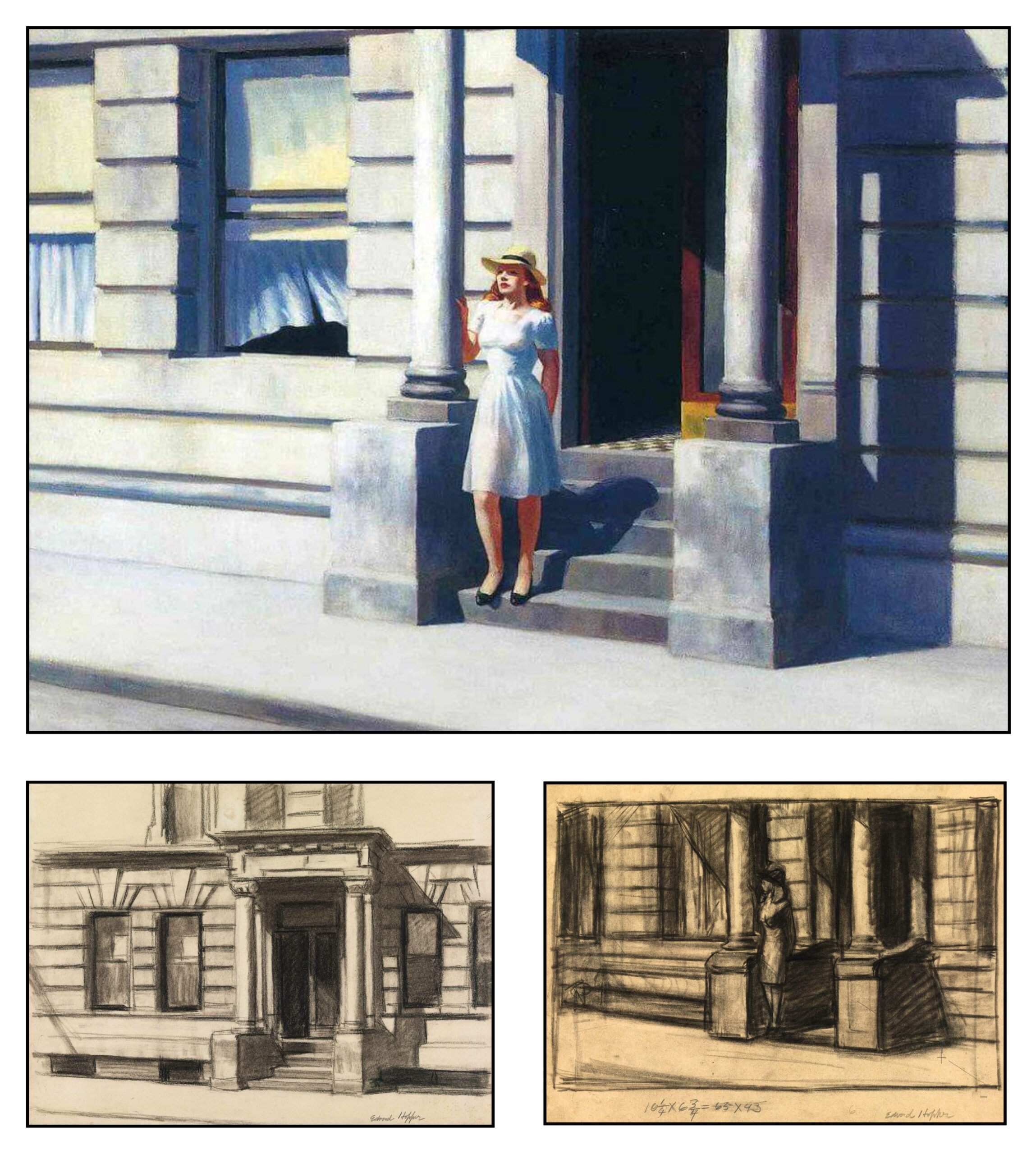
The 1943 painting of Summertime shows a young woman in a thin dress standing at the door of a New York building. She is about to face the day. She feels warm but a cooling breeze blows the dress against her body.

James Hoggard (2009) imagines Hopper talking about his painting:

It’s good you noticed, if you did
A number, I’ll say, have not come close
This one’s a nude, the clothes a guise,
a mask, a witty, illusory stab
at idiot propriety — imagination strips
everything bare, as I’ve done here:
the nipples and heft of breasts in view
and the screaming delight of thighs
rising toward the truth between them,
as suggested by the curtain’s cleft —
all this a celebration of my mood,
and my mood trumps anything that’s yours

This lass, who looks sweetly nubile now,
is Jo, my wife, whose age has been reduced
by the cleverness of my brush and paint
I’ve stripped her nearly bare, but I
have also preserved defiant ghosts
in the willful set of her swelling lips

The tensions and songs here are mine
You can do with your own what you will


Homage in Film and Photography

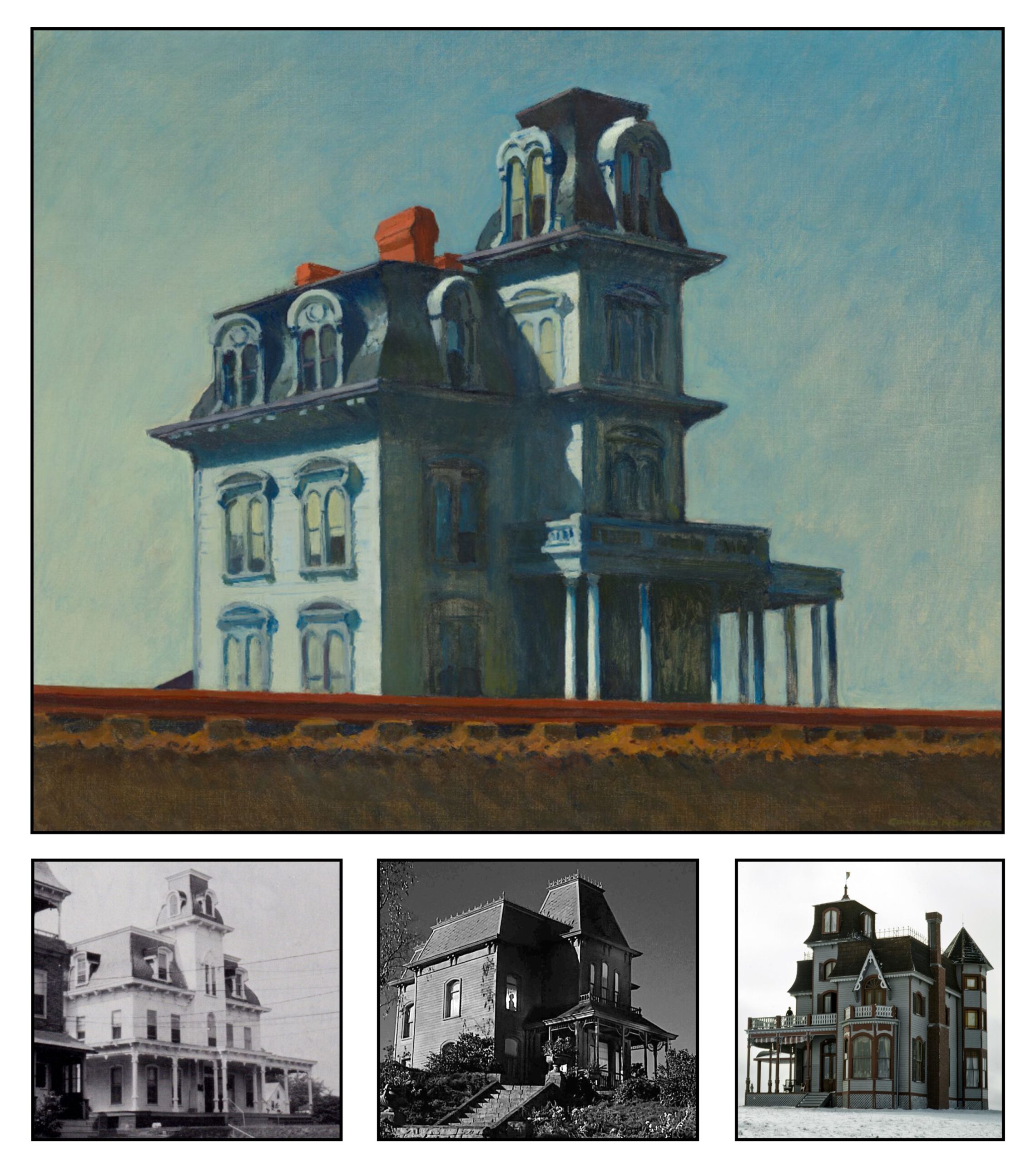
Hopper’s work has had a large influence on the visual arts as well as on poetry. Many of Hopper’s paintings depict large ornate 19th-Century houses – often standing isolated from other buildings. One such picture is House by the Railroad (1925). According to Levin (1985) this was likely partially based on a house in Haverstraw just north of his home in Nyack (lower left of the illustration below). This house is across the street from the railway: Hopper often compressed the distances between things in his paintings. The Mansard roof and central tower and columned porch were also found in other houses that Hopper painted. These houses defiantly insists on their isolated existence.

Variations on this house have appeared in several movies: most importantly Alfred Hitchcock’s Psycho (1960) and Terrence Malick’s Days of Heaven (1978). These sets are shown in the illustration above (lower middle and lower right).

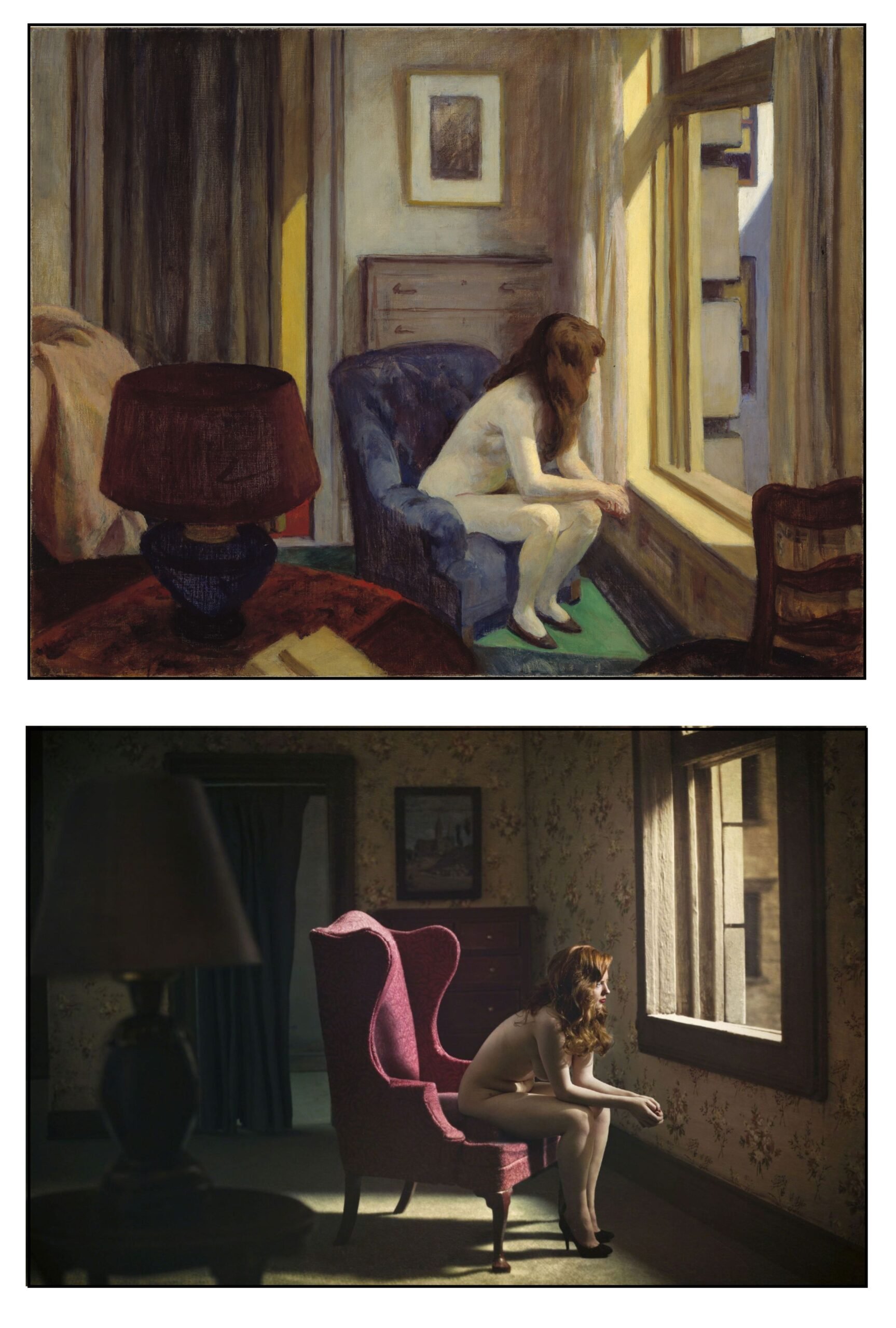
Many photographers have been profoundly influenced by Hopper’s pictures. Phillip Lorcia diCorcia photographs isolated people in urban settings: his images suggest what Hopper might have seen he had lived a further fifty years (Llorens & Ottinger 2012, pp. 306-309). Even more recently, the photographer Richard Tuschman has recreated many of Hopper’s paintings in photographs. The illustration below shows Hopper’s 1926 painting Eleven a.m. together with Tuschman’s Woman at a Window, 2013. The chair has changed from blue to pink and the model now wears heels. Most importantly her face is visible.

Empty Rooms

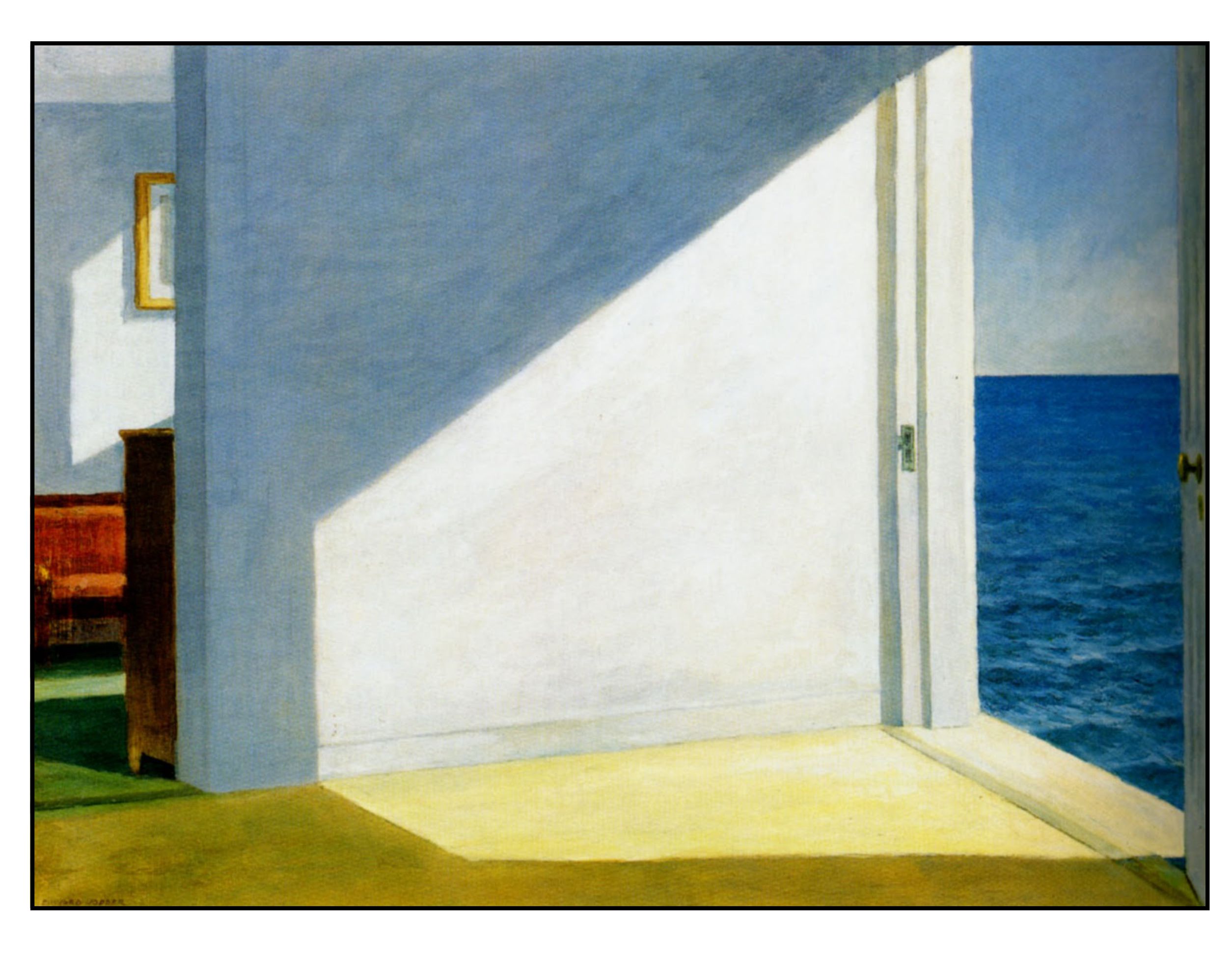
Hopper was always intrigued by the play of light in empty rooms. His 1951 painting Rooms by the Sea, shows an empty room leading through an open door to the sea. The image derives from the Hopper’s studio in Truro on Cape Cod. The door does not directly open onto the sea: Hopper has compressed the space. The main room in the painting is completely bare. On the left, however, another room can be glimpsed with a couch, a chest-of-drawers, and a painting on the wall. Hollander (2001, pp. 72-25) suggests that the two rooms might represent the memories of the past and the presentiments of the future.  

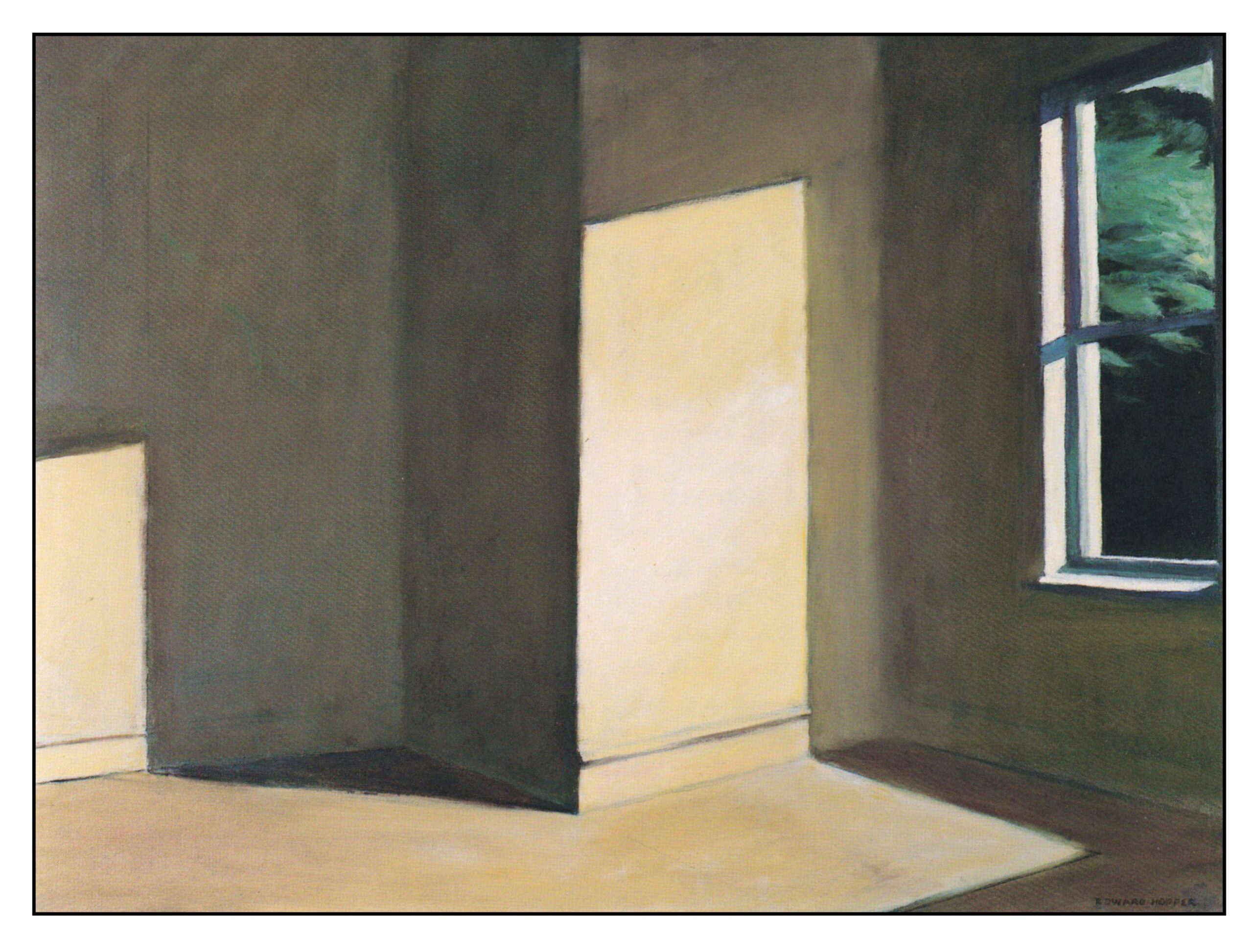
One of Hopper’s late paintings Sun in an Empty Room (1963) is devoid of detail. The room contains nothing but the light. The stark simplicity almost approaches the abstract, though Hopper would insist that the image is still tied to reality. 

Strand (1994, pp. 57-58) remarks:

In the later painting, Sun in an Empty Room, there is nothing calming about the light. It comes in a window and falls twice in the same room—on a wall close to the window and on a slightly recessed wall. That is all the action there is. We do not travel the same distance—actual or metaphorical—that we do in Rooms by the Sea. The light strikes two places at once, and we feel its terminal character instead of anything that hints of continuation. If it suggests a rhythm, it is a rhythm cut short. The room seems cropped, as if the foreground were cut away. What we have is a window wall, with the window framing the highlighted leaves of a nearby tree, and a back wall, a finality against which two tomblike parallelograms of light stand up-right. Done in 1963, it is Hopper’s last great painting, a vision of the world without us; not merely a place that excludes us, but a place emptied of us. The light, now a faded yellow against sepia-toned walls, seems to be enacting the last stages of its transience, its own stark narrative coming to a close.

Last Things

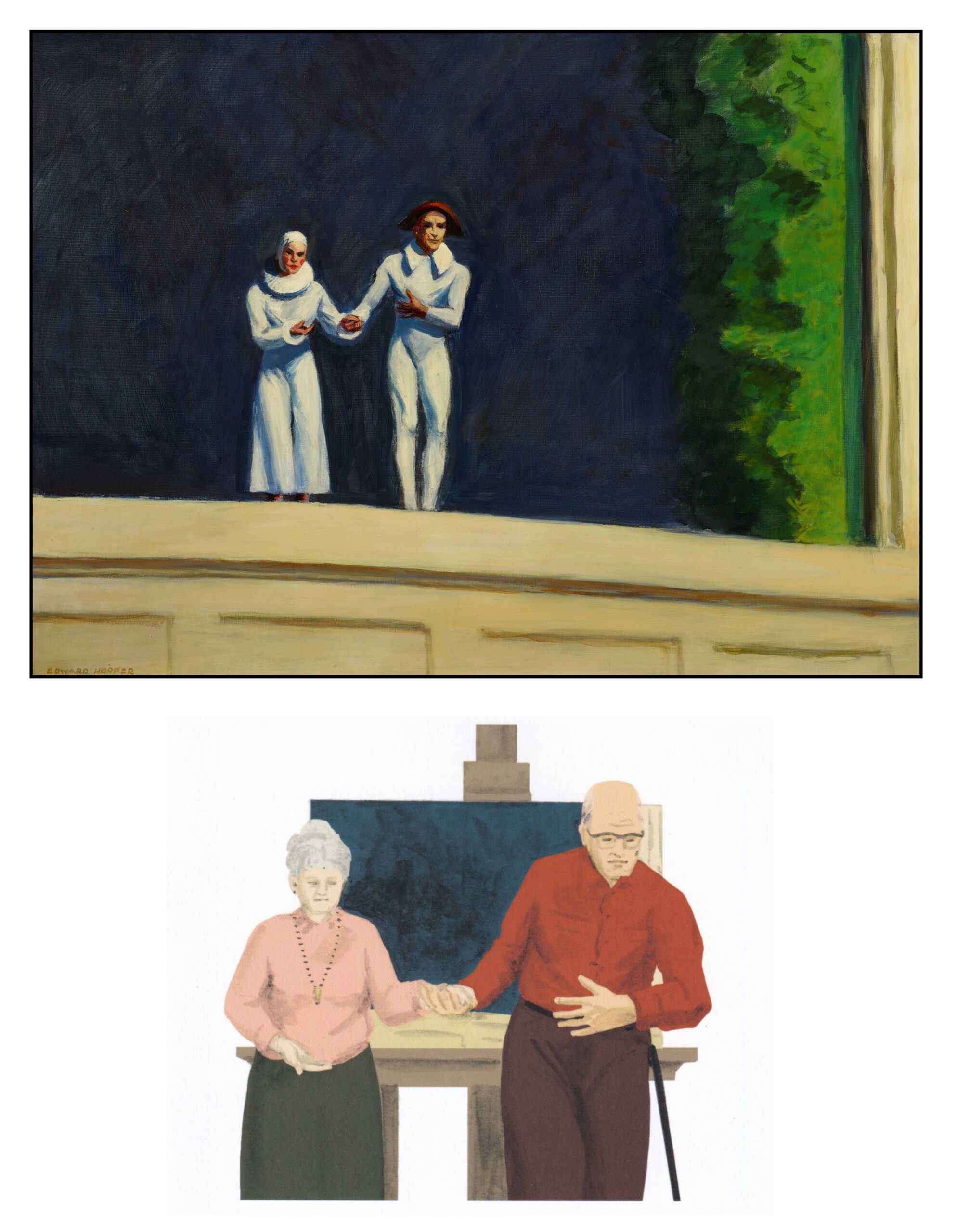
Hopper’s last painting, Two Comedians (1965) portrays two actors taking their bows on a stage raised high above the audience. They actors are the artist and his wife. Representing himself as a comedian refers back to his earlier painting Soir Bleu. The illustration below shows the painting together with Scarduelli’s impression of the elderly couple in their studio (Rossi & Scarduelli, 2021).

The Portuguese poet Ernest Farrés (translated by Lawrence Venuti, 2006) imagines Hopper’s comments on the painting

Perhaps it’s the costume
that lets me laugh,
or smile as it were —
for me they’ve been the same

Perhaps it’s the clown’s disguise
that lets me be
looser than I usually am
strutting cock-proud now,
goofy-eyed at a crowd,
the illusion of a crowd
no one sees but you and me

Clowns, we move toward stage’s edge,
a place I’ve made like a roof’s edge,
with threat or promise of a fall

But the moment seems sweet,
our domestic wars almost done,
and white-clad and foolscapped,
we seem blest as we press
toward the last edge we’ll meet,

our lyrical selves always in France,
our final days just bibelots:
Nous sommes, Jo et moi, les pierrots

Final Words

Hopper painted the real world, but he allowed his imagination to interact with his perception. Conaty (2022, p 14) remarks that he often felt torn between working from the fact and improvising upon what he saw. Hopper argued against abstract expressionism, insisting that art should always have its source in “life.” The following is his 1953 statement on art from the short-lived magazine Reality (quoted in Llorens & Ettinger, 2012, p 275):

Great art is the outward expression of an inner life in the artist, and this inner life will result in his personal vision of the world. No amount of skillful invention can replace the essential element of imagination. One of the weaknesses of much abstract painting is the attempt to substitute the inventions of the intellect for a pristine imaginative conception. The inner life of a human being is a vast and varied realm and does not concern itself alone with stimulating arrangements of color, form, and design. The term “life” as used in art is something not to be held in contempt, for it implies all of existence, and the province of art is to react to it and not to shun it. Painting will have to deal more fully and less obliquely with life and nature’s phenomena before it can again become great.


References

Block, L. (Ed.) (2016). In sunlight or in shadow: stories inspired by the paintings of Edward. Pegasus Books.

Carrier, D. (1987). Ekphrasis and interpretation: two modes of art history writing. British Journal of Aesthetics, 27(1), 20–31.

Colleary, E. T. (2004). Josephine Nivison Hopper: some newly discovered works. Woman’s Art Journal, 25(1), 3–11.

Conaty, K. (2022). Edward Hopper’s New York. Yale University Press.
Doss, E. L. (1983). Edward Hopper, Nighthawks, and Film Noir, Post Script: Essays in Film and the Humanities, 2 (2), 14–26

Farrés, E. (translated by L Venuti, 2009). Edward Hopper: Poems. Graywolf Press

Heffernan, J. A. W. (2015). Ekphrasis: Theory. In Rippl, G. (Ed.) Handbook of Intermediality. (pp. 35–49). De Gruyter.

Hoggard, J. (2009). Triangles of light: the Edward Hopper poems. Wings Press.

Hollander, J. (1988). The poetics of ekphrasis. Word & Image, 4(1), 209–219. 

Hollander, J. (1995). The gazer’s spirit: poems speaking to silent works of art. University of Chicago Press.

Hollander, J., & Weber, J. (2001). Words for images: a gallery of poems. Yale University Art Gallery.

Kranzfelder, I. (2002). Edward Hopper: 1882-1967. Taschen.

Levin, G. (1980a). Edward Hopper: the art and the artist. Norton.

Levin, G. (1980b). Josephine Verstille Nivison Hopper. Woman’s Art Journal, 1(1), 28-32.

Levin, G. (1985, revised 1998). Hopper’s places. University of California.

Levin G. (1995). The poetry of solitude: a tribute to Edward Hopper. Universe Publishing.

Levin, G. (1995, revised 2007). Edward Hopper: an intimate biography. Rizzoli.

Llorens, T. & Ottinger, D. (2012). Hopper. Distributed Art Publishers.

Lyons, D., Weinberg, A. D., & Grau, J. (1995). Edward Hopper and the American imagination. Whitney Museum of American Art.

Marcum, A. (2022). Edward Hopper’s village: Early Sunday Morning on Bleecker Street. Village Preservation Blog.  

McColl, S. (2018). Jo Hopper, Woman in the Sun. Paris Review, Feb 26, 2018.

Panagiotidou, M.-E. (2023). The poetics of ekphrasis: a stylistic approach. Springer International 

Rossi, S., & Scarduelli, G. (2021). Edward Hopper: the story of his life. Prestel Verlag

Strand, M. (1994). Hopper. Ecco Press.

Strong, P. (1988). Robert Frost’s “Nighthawks”/Edward Hopper’s “Desert Places.” Colby Library Quarterly, 24(1), 27–35

Updike, J. (2005). Still looking: essays on American art. Knopf.

Ward, J. (2017). American Silences: the realism of James Agee, Walker Evans, and Edward Hopper. Taylor & Francis.


Hammershøi

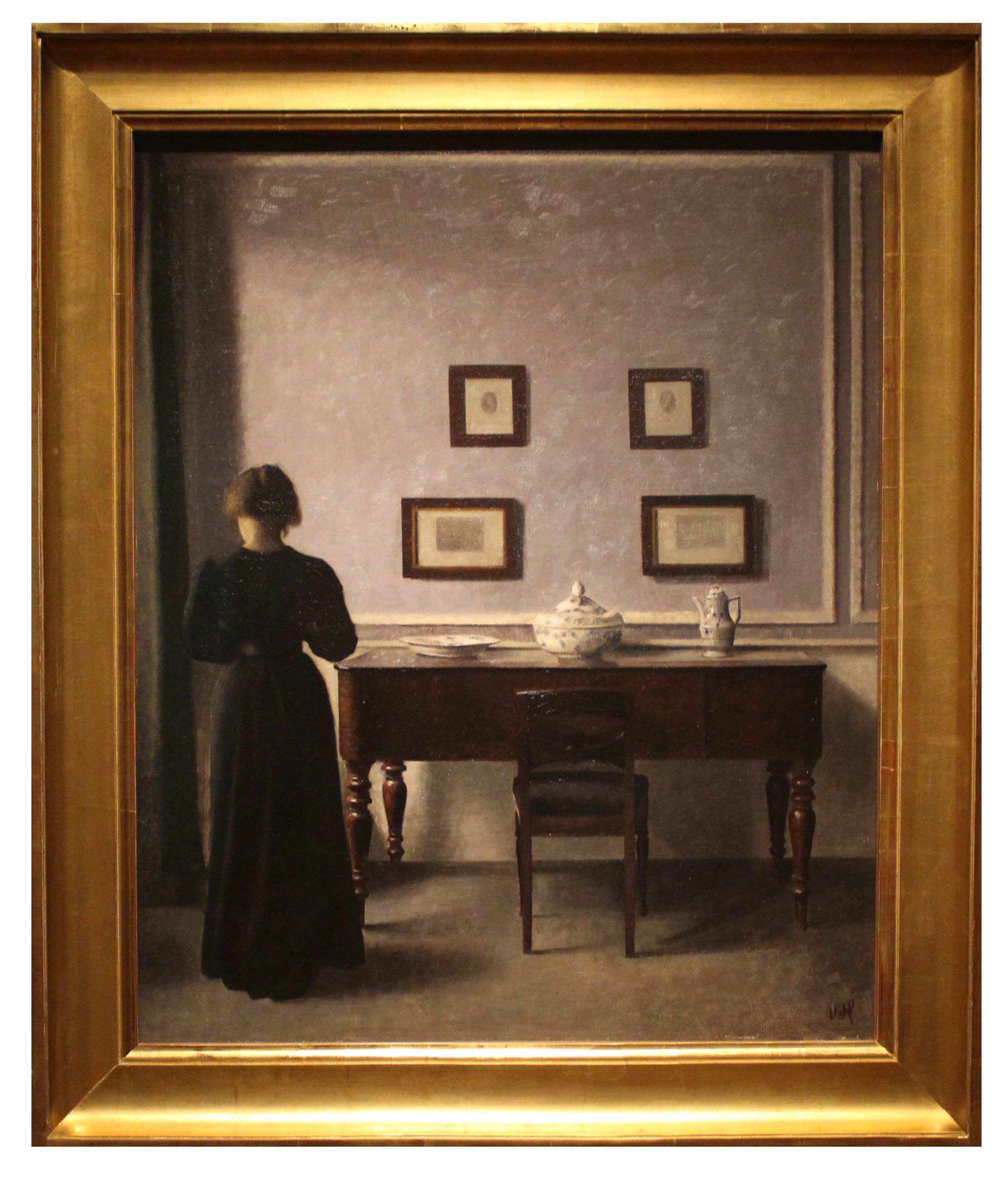
The Art Gallery of Ontario (AGO) has recently acquired a 1905 painting by the Danish painter Vilhelm Hammershøi (1864-1916), the first by this artist in a Canadian public collection: Interior with Four Etchings:

hammershoi 4 etchings BThe etchings are arranged on the wall above an elegant side-table, upon which stand three pieces of Royal Copenhagen porcelain. The details of the etchings cannot be seen, but the upper two appear to be portraits. Light comes in from the window on the left, giving a subtle violet tinge to the grey walls and emphasizing their white trim. To the left of the table stands Hammershøi’s wife Ida. She faces away from us, and we cannot see what she is doing. Perhaps she has just placed the plate on the table and has turned to look out of the window; perhaps she has taken something to the window to look at. The sunlight on her neck is vaguely erotic. Everything is balanced: the shadows share the space with the light; the blue-white porcelain complements the red-brown frames; the human figure suggests movement in a room that is otherwise completely still.

To celebrate this acquisition, the gallery is exhibiting this picture alongside 25 other Hammershøi paintings, all except one coming from the National Gallery of Denmark (Statens Museum for Kunst). The exhibition runs from April 16 to June 26, 2016. This is one of the most impressive exhibitions I have seen in recent years. I apologize that my enthusiasm has led to another long post. However, it contains more to see than to read.

Hammershøi is quite different from other painters. His palette is austere. The main colors are, gray and white and black. On one of the walls in the AGO exhibition is a commemorative poem by Sophus Clausen written in 1916. The poem, at least in the English translation, is unremarkable except for occasional lines:

How sweet to know that blacks and greys
Give shelter to the light and let it stay
…
Gray is not grey nor is black ever black.

The greys in a Hammershøi painting are subtly tinged, often with violet, sometimes with yellow, occasionally with pink or green. On the predominantly grey background, objects are delineated in subdued browns. The most striking characteristic of the paintings is the way that they represent light. Light seems almost to move through the painted surfaces, filling out the space, defining what is present, bringing people into existence, and leaving without a sound.

The restricted palate of Hammershøi’s paintings lead his friend Karl Madsen, an artist and historian, to suggest that he was Denmark’s first “neurasthenic painter” (quoted in Vad, 1992, p. 73). The diagnosis of neurasthenia was popular at the time (Harris 2013). Its various symptoms, both physical (fatigue, dizziness) and mental (anxiety, melancholy), were attributed to a weak nervous system, unable to cope with the stress of modern urban life. The diagnosis is out of fashion nowadays, though similar symptoms occur in modern disorders such as chronic fatigue syndrome and dysautonomia. Although Hammershøi was quiet and withdrawn, he was far too productive to be considered neurasthenic. Nevertheless, his paintings have a tranquility that can provide respite from the hubbub of city life. They might represent a cure for rather than a result of neurasthenia.

In this posting, the paintings in the exhibition have been photographed within their frames; other paintings by Hammershøi and paintings by other artists are shown without frames.

Early Life

hammershoi drawing B

Hammershøi was the son of a prosperous Danish businessman. He displayed an early talent for drawing, and his family arranged for him to have lessons from the painter Niels Christian Kierkegard, a cousin of Søren Kierkegaard. The drawing on the right (Vad, 1992, p 11), from when Vilhelm was 11 years old, illustrates his early appreciation of light and shadow.

He continued his studies both at the Royal Danish Academy of Art and in the Free Study Schools. One of his teachers, P. S. Krøyer remarked that

I have a pupil who paints most oddly. I do not understand him, but believe he is going to be important and do not try to influence him. (quoted in Vad, 1992, p 24)

hammershoi anna B


His 1885 Portrait of a Young Girl (his sister Anna) was entered into competition for a prize at the Academy. Though it did not win, it was acclaimed by his fellow students, who protested the judges’ decision. It is a remarkable painting: the face and posture are sensitively portrayed; the muted palette of the background gently situates the figure; the hands suggest both rest and tension. Anna’s left hand steadies the image and allows the picture’s transition from three to two dimensions.


hammershoi old stove B

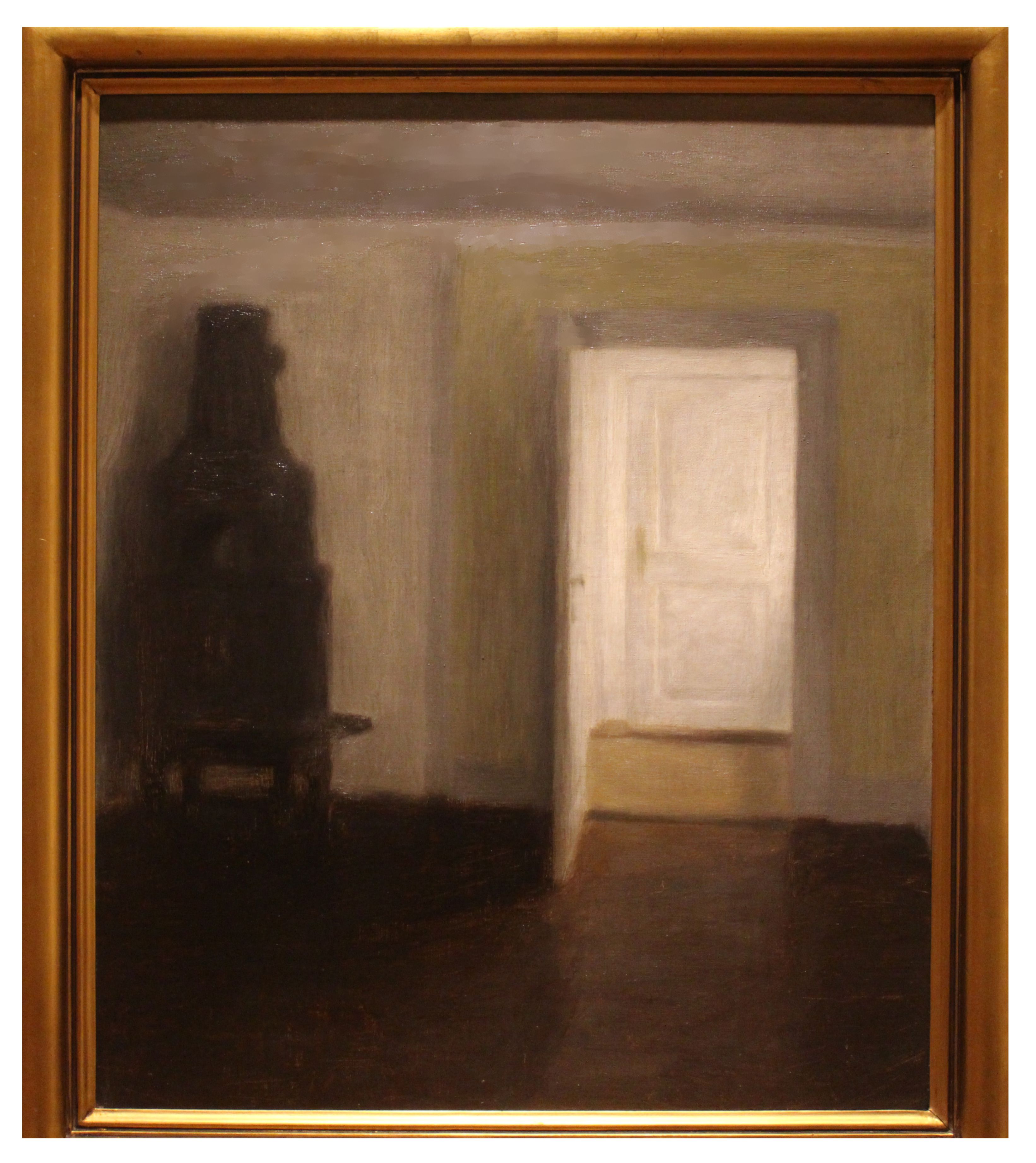
In the autumn of 1888, Hammershøi stayed with his friend Karl Madsen, who lived in an old house just north of Copenhagen. There he painted his first “interior” – a picture of an old stove with an open doorway leading into a brightly sunlit room. The light seems almost personified – it enters the other room, comes through the door, pauses on the floor and casts a shadow toward the stove. The painting makes the viewer long to go into the next room to see whence the light comes from. This type of painting was to become Hammershøi’s signature style. Though an accomplished painter of portraits and of architecture, Hammershøi is most famous for pictures showing the effects of light on lonely rooms.

In 1888, the dentist, writer and art-collector, Alfred Bramsen, bought his first painting by Hammershøi. Over the next quarter century, he was an unflagging promoter of Hammershøi’s work. After Hammershøi’s death in 1916, Bramsen arranged for the first catalogue of the paintings. Artist and patron were totally unlike: one introverted, reticent and solitary, the other gregarious, confident and worldly-wise.

With this patronage, Hammershøi became self-sufficient, and in 1891 he married Ida Ilsted, the sister of a fellow artist, Peter Ilsted. Following the wedding, Vilhelm and Ida went to Paris for six months. They then returned to Copenhagen, living for a while in the Hammershøi home together with Vilhelm’s mother.

Over the next few years, Hammershøi painted landscapes, portraits and architecture. In 1897 Bramsen commissioned a painting of Kronborg castle in Helsingør (Hamlet’s Elsinore). Hammershøi produced a masterpiece in terms of its striking perspective and subtle color.

hammershoi kronberg B

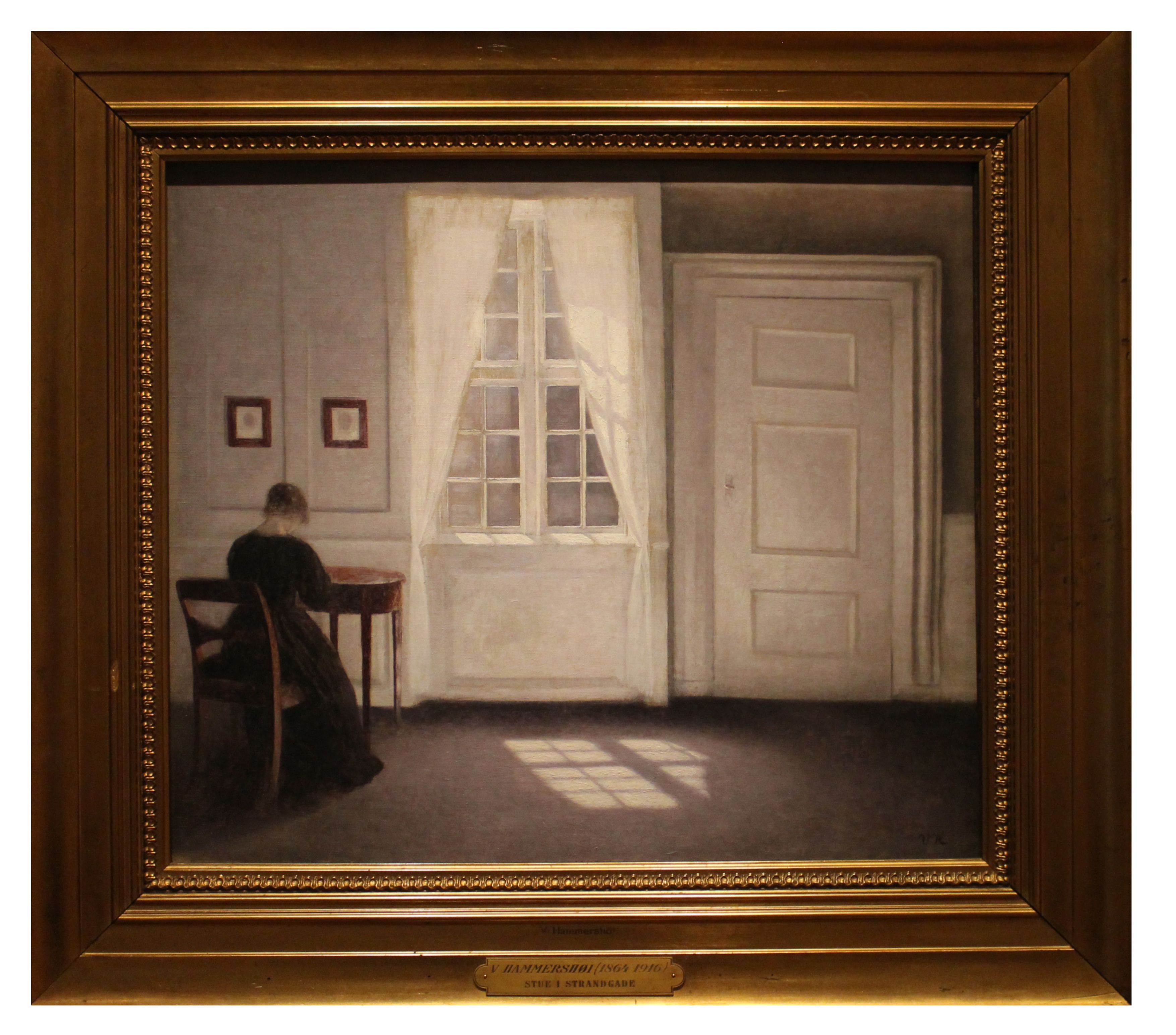
Strandgade 30

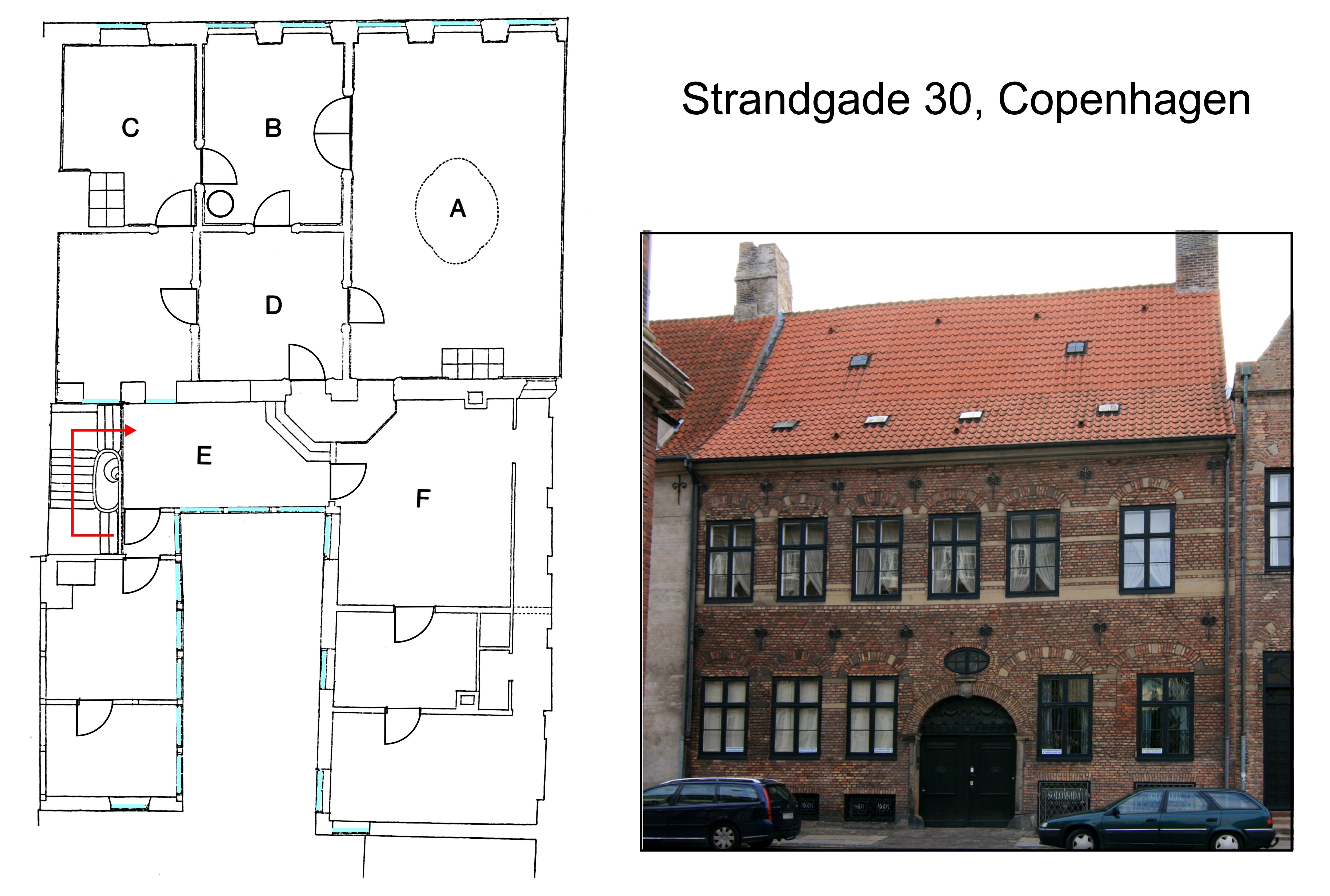
In December 1898, Hammershøi rented an apartment on the second floor of an old building on Strandgade in the old dockyard district of Copenhagen called Christianshavn. The building had been constructed in 1636. Hammershøi was likely pleased that his home originated in the time of Johannes Vermeer and Pieter de Hooch. The apartment was spacious and endowed with windows facing in all directions. As well as a home, it served as both studio space and subject matter for his art.

The building still exists. The following figures show its location on a google world-map, as well as a recent photograph (from Wikipedia) and the floor plan of the apartment (from Vad, 1992, p 187, with several revisions based on another published plan: the position of the window in room F corrected, the door between B and F doubled, and room D divided).

strandgade google

strandgade 30 plan and photo final

hammershoi strandgade sunlight

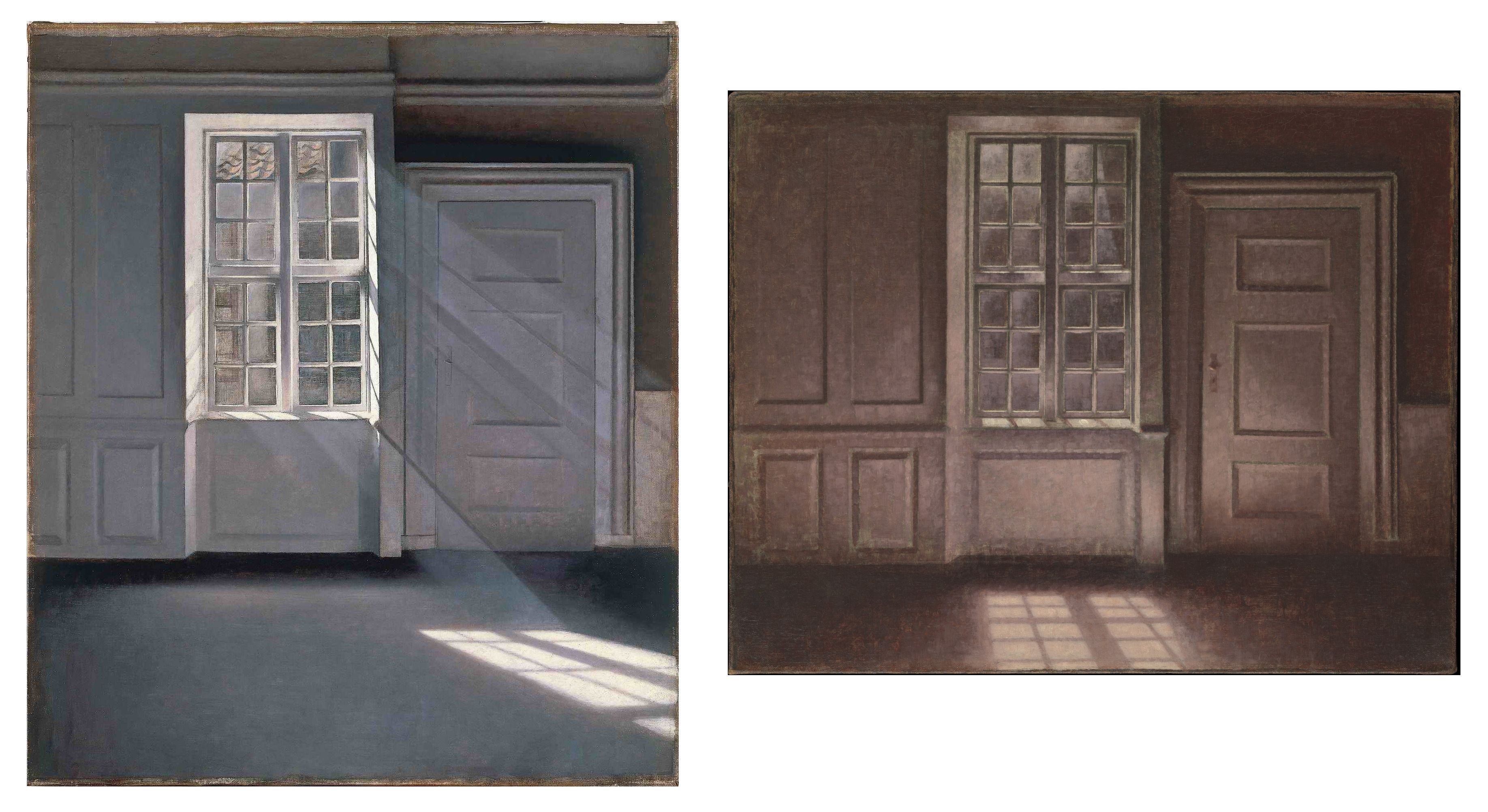
In his new apartment, Hammershøi began to paint the interior pictures that became his most recognizable images. Many of the pictures were painted in Room F facing the window and door. In some the room is empty; others include a portrait of Ida sitting or standing to the left of the window. Interior in Strandgade, Sunlight on the Floor 1901 (in the AGO exhibit and illustrated on the right) shows Ida working at some task at a table. The painting is both realistic and impressionistic. The old house had shifted slightly over the years, and the painting shows clearly that the door is slightly askew. Yet it is impossible to tell the subject of the etchings or the focus of Ida’s concentration.

This view painted with the room empty is the subject of some of Hammershøi’s most famous pictures, such as Dust Motes Dancing in the Sunbeams (1900, Ordrupgaard, Denamark) and Moonlight, Strandgade 30 (1906, Metropolitan Museum)

hammershoi sunlight and moonlight B

hammershoi interior with piano B


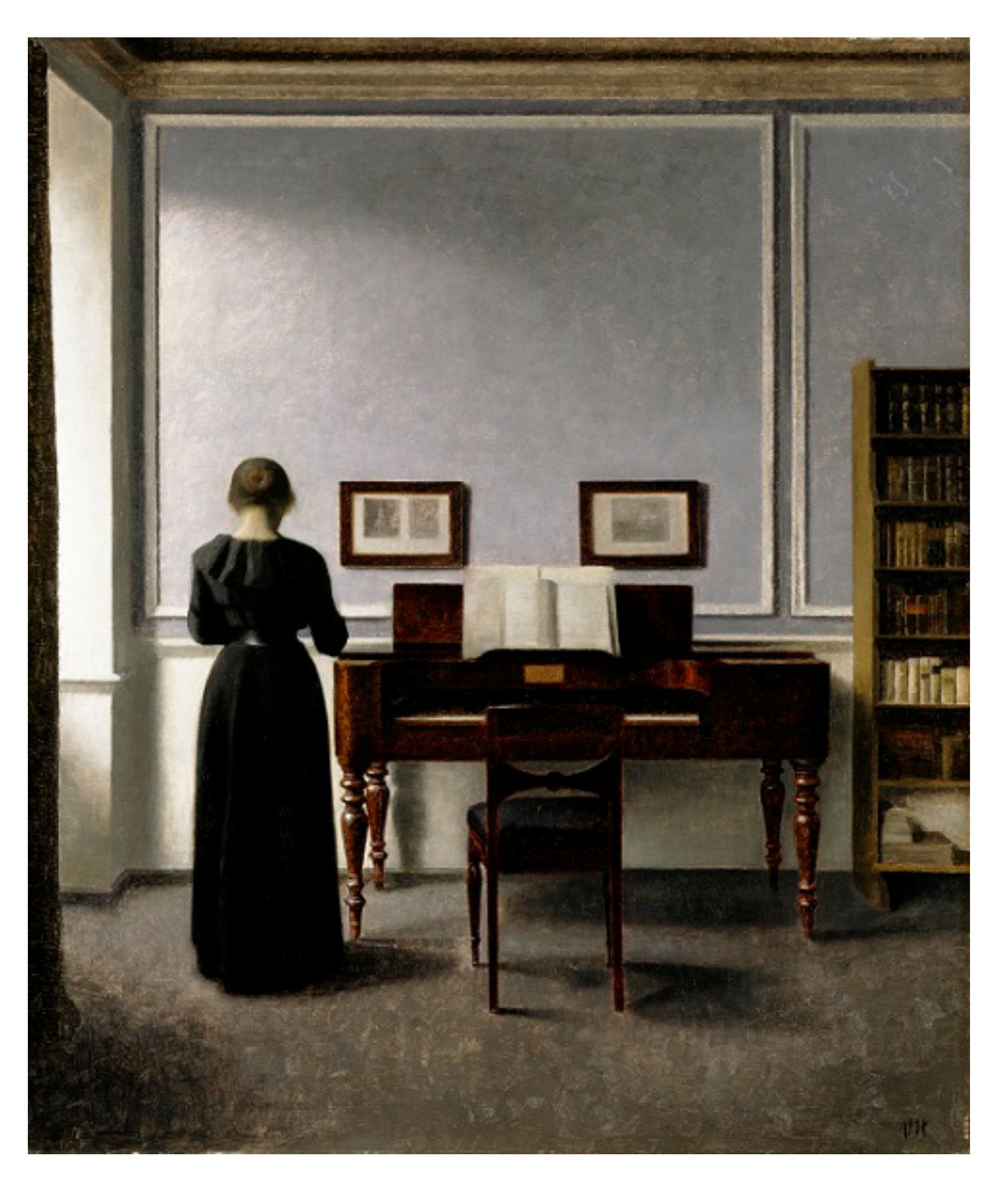
The AGO painting Interior with 4 Etchings (1905) was painted in Room A. Over the years the arrangement of the furniture changed. An earlier painting Interior with Piano, Strandgade 30 (1901), illustrated on the right, shows the same view but with a piano and a bookcase rather than a table. Hammershøi tended to simplify his pictures as he grew older. His later paintings show less detail and a more restricted palette.


hammershoi easel and bowlInterior with the Artist’s Easel (1910) was painted in Room B looking toward Room A. It is a variation on a theme long used painting: the artist at his easel. Yet here there is no artist other than the light coming in the window. Since we can only see the painting from its back, we have no idea of its subject. The true subject of the actual painting is the bowl on the table in the far room. The shape of the bowl and the reflections of the light upon its curves are rendered exquisitely. If this were a photograph rather than a painting, the bowl would be in focus, and the easel in the blurred foreground.   

Hammershøi’s new apartment was directly across from a striking building that housed the offices of the Asiatic Company. This was the subject of several large architectural paintings. The 1902 version in the AGO exhibition shows the offices in fog. The buildings are visible but the dockyard behind them, accessed through the arch, is obscure. Masts of ships are faintly visible in the harbor-fog. Other versions of this painting show the buildings without the fog.

hammershoi asiatic company XB

Sources

Hammershøi is often considered as isolated from the history of painting, as someone whose work was without either precedent or following. Yet all persons are part of the past they learn about, and all are made by the present that they experience. And everyone affects the future.

Hammershøi’s paintings ultimately derive from the great paintings of the Dutch Golden Age of the 17th Century, when Vermeer and de Hooch depicted the effects of light coming through windows onto people. Hammershøi’s paintings study the way light plays on domestic interiors, but the interiors are minimal rather than extravagant, the light is cool rather than warm, and the people are either absent or unobtrusive.

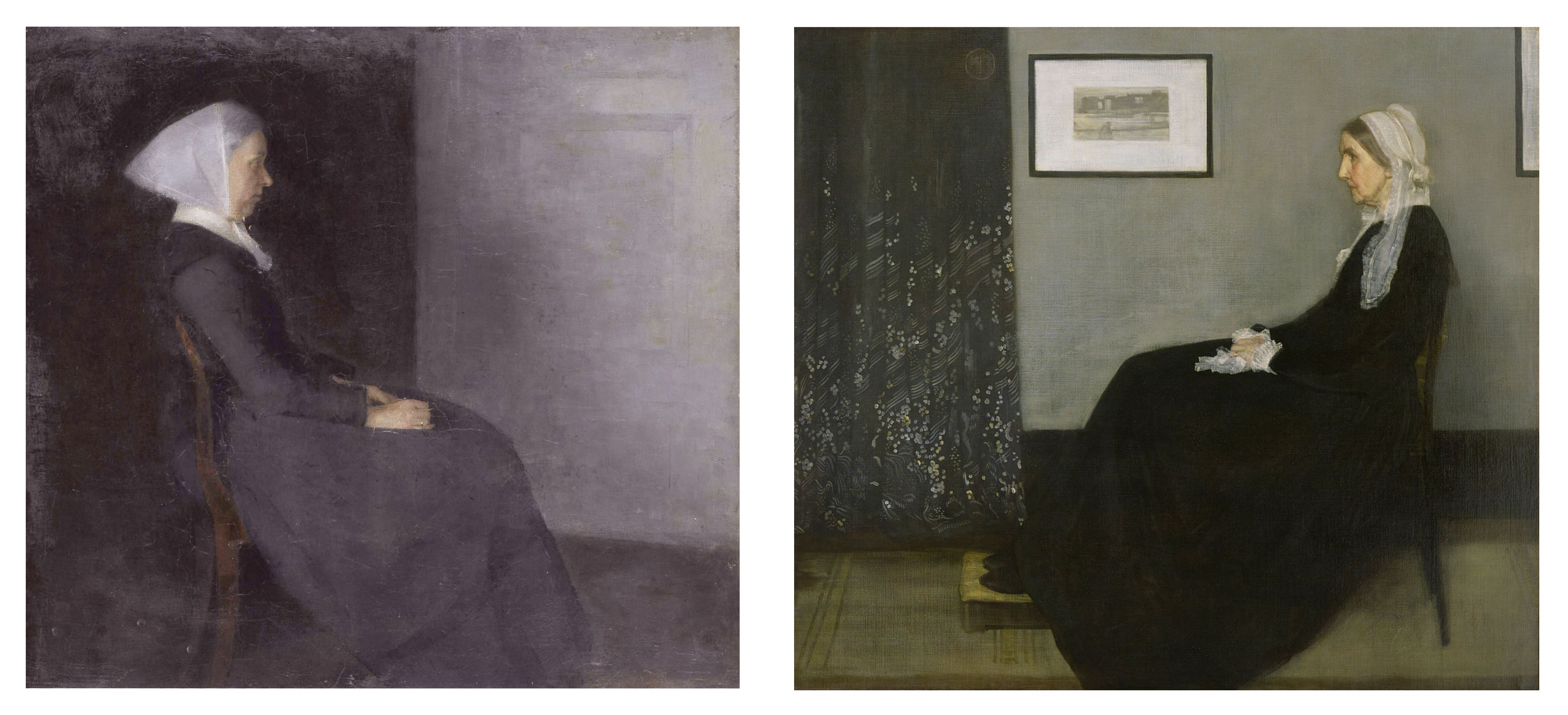
In the late 19th Century, James Abbott McNeill Whistler (1834-1903) had begun to work with a restricted palette. His most famous painting is entitled Arrangement in Grey and Black No. 1 Portrait of the Artist’s Mother (1871). In Hammershøi’s 1886 portrait of his own mother the color is even more subdued and the background even less detailed.

hammershoi and whistler

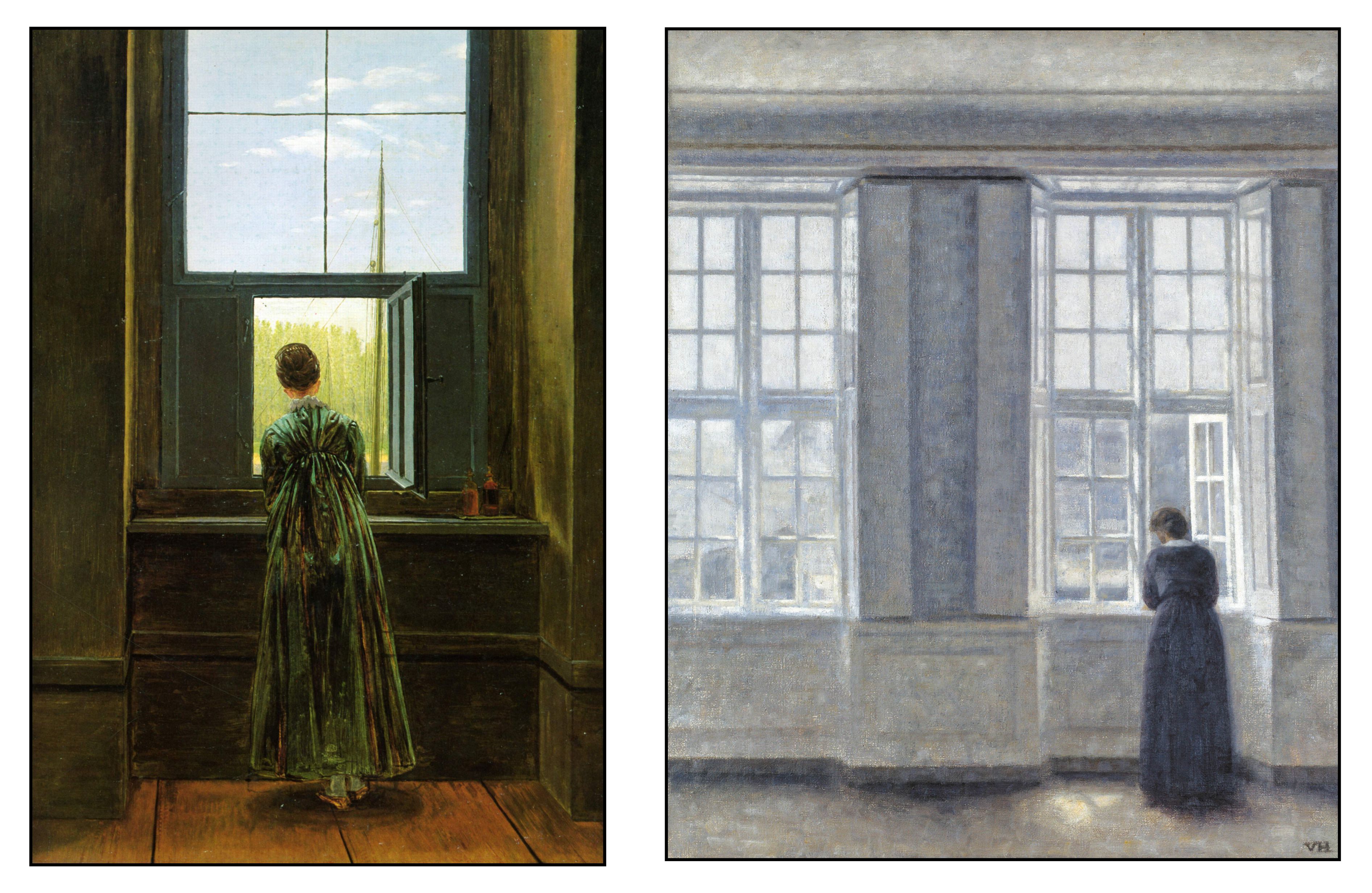
Many of Hammershøi’s interiors include a representation of Ida viewed from the back. This motif derives from the Rückenfigur (“figure viewed from the back”) used in German Romantic painting, most characteristically by Caspar David Friedrich (1774-1840). Most of Friedrich’s Rückenfiguren are in landscapes, but occasionally they are in domestic interiors. The following illustration compares Friedrich’s Woman at a Window (1822) with Hammershøi’s The Tall Windows (1913). The latter was painted after Hammershøi had moved across the street to Strandgade 25.

friedrich and hammershoi b

The Rückenfigur can be used for various purposes (Koerner, 1990, pp 233-244; Prettejohn, 2005, pp 54-59). One is to provide a foil for the viewer to enjoy the same perceptions as the artist who painted the picture. The Rückenfigur

is not just a represented object in the picture, but also the embodied subject of the aesthetic experience of the picture – we look with, rather than merely at the Rückenfigur. (Prettejohn, 2005, p 56).

In some sense the Rückenfigur obscures what the painting is about. We see the man rather than the sunset. We feel that we have come late – the glories of the sunset have already been seen and we can only imagine what the experience was like (Koerner, p. 233).

The presence of Ida in Hammershøi’s paintings differs from Friedrich’s Rückenfigur.  Most importantly, Ida usually stands or sits on the edge of the painting rather than in the center. She complements rather than obscures the picture’s subject. She gives the image a sense of intimacy: we are sharing her domestic space. We get a sense of her existence: the small tasks that make up the domestic day. She gives a human ground to what we see and prevents it from becoming too abstract.

hammershoi interior with woman standing

Sometimes, as in the Interior with a Woman Standing, Strandgade 30 (1905) painted in Room A looking into Room D, the viewer feels uncertain. By which door has she come in? Which door is she about to go out? The woman seems “caught in the moment of deciding which door to pass through” (Alsdorf, 2016, p. 271). Although this uncertainty derives simply from the static nature of the representation, it resonates with our inability to know what is in the mind of another person.


This particular problem fascinated the Danish philosopher Søren Kierkegaard (1813-1855). In a recent article, Bridget Alsdorf (2016) considers Hammershøi’s interior paintings in relation to Kierkegaard’s book Either/Or (1843). The title of the book highlights the idea of uncertainty. In the section of the book entitled Shadowgraphs. Kierkegaard wrote about the difficulty in representing in art the inner state of another person, especially the state of “reflective sorrow.” Kierkegaard’s idea is that art can only represent such a state of mind indirectly. He likens the process to a “shadowgraph:”

It is this reflective sorrow I now propose to draw out and render visible, so far as that is possible, in some pictures. I call them ‘shadowgraphs’, partly to remind the reader by the very designation that I am summoning them from the dark side of life, partly because, just like shadowgraphs, they are not visible straightaway. If I take a shadowgraph in my hand, I gain no impression from it, can form no real idea of it; it is only when I hold it up to the wall and look not at the immediate image but at what appears on the wall, it is only then that I see it. Similarly the picture I want to show here is an inner picture which can also only be detected by looking through the exterior. There may be nothing striking about the exterior, it is only when I look through it that I discover the inner picture, which is what I want to show, an inner picture too refined to be visible on the outside, woven as it is of the softest moods of the soul. If I look at a sheet of paper, to outward observation there may be nothing remarkable about it; it is only when I hold it up to the light of day and see through it that I discover the delicate inner picture which is as though too insubstantial to be seen immediately. (p. 130)

Unfortunately, Kierkegaard is quite unclear about the nature of a shadowgraph. On the one hand it might be like a transparency or silhouette through which light is projected to give an image on another surface; on the other hand it might be like a watermark seen when paper is held up to the light. In either interpretation, the image is not immediately apparent but only occurs when light is passed through the artistic representation. Kierkegaard’s metaphor is as ambiguous as the title of his book.

Kierkegaard then goes on to consider the state of reflective sorrow in three characters from literature. His bravura descriptions of their invisible state of mind either subvert his claim that such states cannot be represented in art or clearly demonstrate the process of the sympathetic shadowgraph.

Alsdorf also considers what Hammershøi might be trying to represent in his interiors by relating them to another section of Either/Or entitled The Aesthetic Validity of Marriage. In this section, Kierkegaard’s character Judge William compares romantic love with married love: the one an ever-changing erotic quest, the other an unchanging relationship. Hammershøi interiors certainly suggest the timeless intimacy of the latter.

Hammershøi’s images have a mystical aura to them. They are delicately balanced between serenity and disquiet. Perhaps a little like meditation when one begins to feel an underlying eternity but still senses the sorrows of the real world.

Many critics have remarked about the lack of narrative in Hammershøi’s paintings. When the rooms are empty, we cannot know what has happened in them; when the rooms contain a solitary person, we have difficulty seeing what she is doing and we cannot know what she is thinking.

Yet there is an emotional force in the paintings that no amount of exegesis can attenuate. The emotions are like those aroused by music. Hammershøi appreciated music, and counted the English concert pianist Leonard Borwick among his friends. We do not fault music for lack of narrative or the absence of simple interpretation. Hammershøi’s paintings fit very well with quiet music. Try them with the beginning of the Allegretto from Grieg’s 1887 Violin Sonata Opus 45 (Ingolf Turban and Jean-Jacques Dünki):


Portraits

hammershoi ida and teacup

Hammershøi was an accomplished and sensitive portraitist. The 1907 portrait of Ida with a teacup illustrates clearly the intimacy of their relationship. She stares off into space. We cannot know what she is thinking; perhaps even she does not know. The initial impression is of sadness although another version of the same portrait perhaps shows the hint of a smile. The portrait is very affecting. There is something timeless and classical about its serenity, but it is also quite momentary and individual. We can almost hear the clink of the spoon as she stirs her tea.

hammershoi willumsen

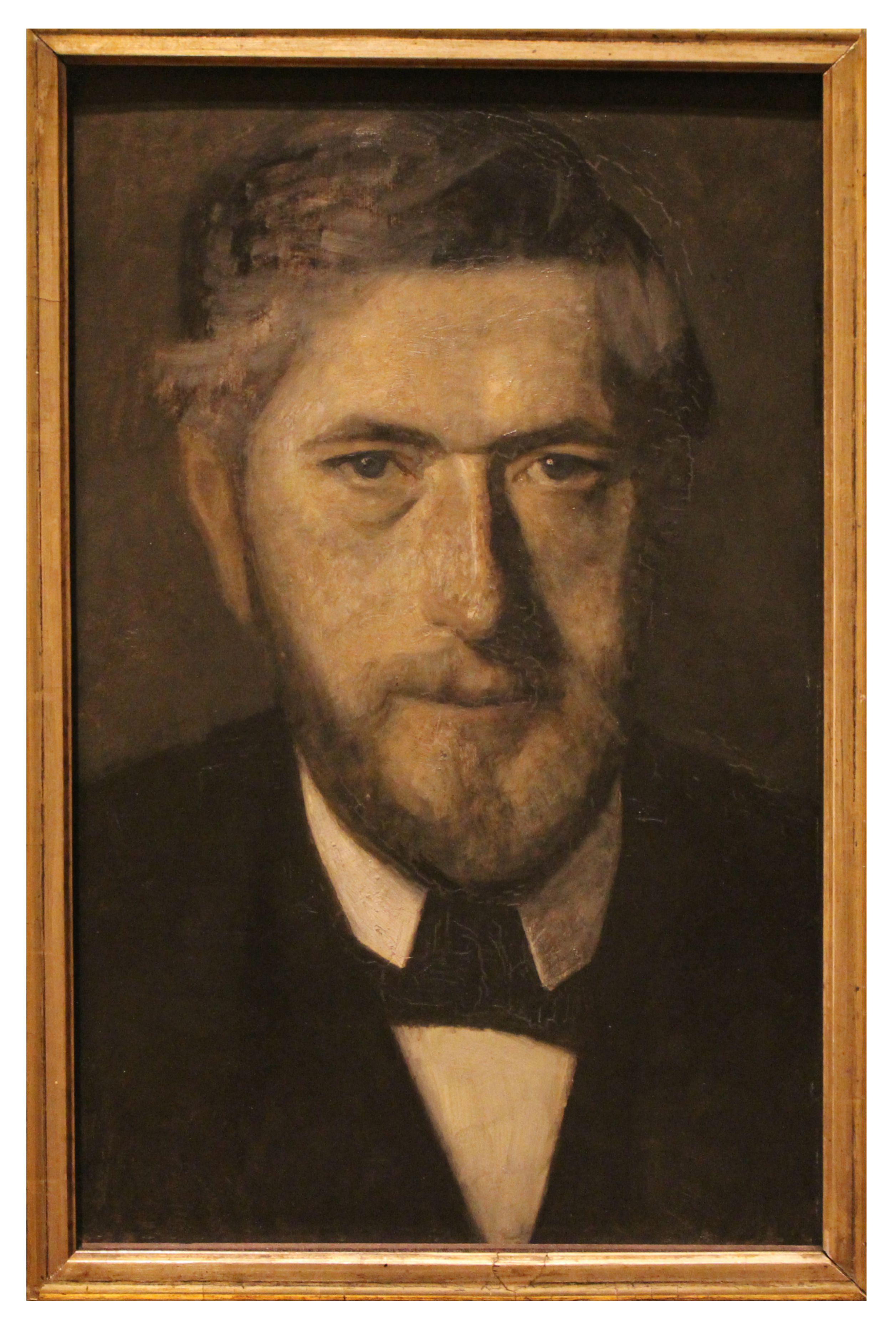
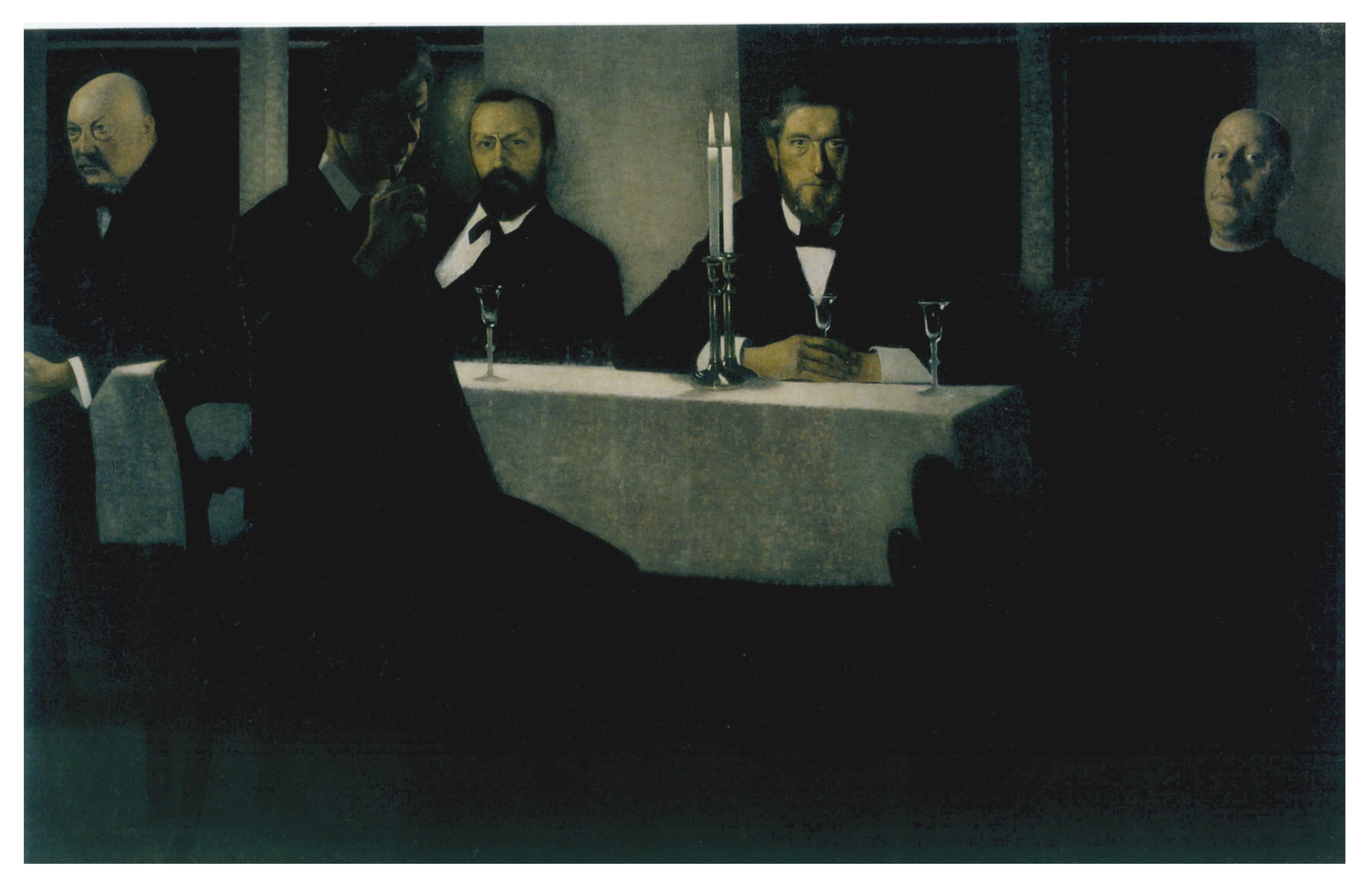
The 1901 portrait at the left is of J. F. Willumsen, a friend and fellow-artist. The strength of the gaze is clearly represented, but the portrait is otherwise unremarkable. However, this picture was a study for Hammershøi’s largest painting entitled Five Portraits, completed in 1902 and presently in the Thiel Gallery near Stockholm. This fascinating painting shows four colleagues seated around a table at night in front of the windows in Room A. Karl Madsen is on Willumsen’s right. In front of the table, Hammershøi’s brother Svend is seen in profile. The two colleagues on the edges of the painting are the architect Thorvald Bindesbøll and the painter Carl Holsøe. The latter has his feet up on a chair, and his shoes give the painting a striking three-dimensional tension. The group appears to be gathered for after-dinner drinks, following a late but not last supper. The painting’s darkness contrasts with the lightness of most of Hammershøi’s interiors (and makes it difficult to obtain a good representation – I have done my best):

hammershoi 5 portraits

The most striking aspect of this group portrait is that no one interacts with anyone else. Each person seems completely engrossed in his own thoughts. Monrad (2012, p. 29) quotes a review of the painting’s first exhibition:

The situation is more or less this; there has been profound talk about something or other that has moved everyone deeply, and they are now waiting for a conclusive word from a sixth party.

The sixth party could be the painter. This interpretation is possible, but Monrad discounts it as not in keeping with Hammershøi’s general lack of narrative.

Robert Rosenblum (in Fonsmark et al., 1998, p. 45) remarked:

The effect is like standing before a tribunal, which comes into fixed, focal focus with the hypnotic stare of Willumsen.

It is unsettling to be judged by a painting.

Despite its starkness, I find the picture comforting. Each person exists within his own intense solitude. Yet, as in the daylight pictures, the play of light on the faces and the table serves to bring them all together.

After Hammershoi

Hammershøi died of cancer in 1916. Bramsen donated his collection to the Statens Museum for Kunst in 1917. But fashions change, and in 1930 the paintings were returned to the donor. Hammershøi came to be considered only a minor artist in Denmark; in the rest of the world he was almost completely unknown. His reputation only began to change in the early 1980s when a retrospective exhibition of his paintings was mounted at Ordrupgaard, a gallery just north of Copenhagen, and other exhibitions were held in North America.

Hammershøi had little direct effect on subsequent artists. His friends Carl Holsøe and Peter Ilsted continued to paint interiors, though their pictures were more detailed and less affecting than those of Hammershøi. In France, Pierre Bonnard and Eduard Vuilliard painted domestic scenes. One might even consider the possibility of an artistic movement called “intimism’ (Hvidt, in Monrad et al., 2012, pp. 197-218). Yet their paintings lacked Hammershøi’s simplicity of color and the underlying mysticism.

The American Edward Hopper (1882-1967) painted pictures that are imbued with a similar mood to those of Hammershøi. They depict the same lonely silence, the same play of light on simple interiors, and the same existential anxiety (Rosenblum in Fonsmark et al., 1998, p. 42). Yet Hopper was likely unaware of Hammershøi’s work. Their relationship is an affinity rather than a direct connection. The following illustration compares Hammershøi’s Ida in an Interior with Piano (1901) with Hopper’s City Sunlight (1954).

hammershoi hopper

To me the glowing color spaces of Hammershøi’s paintings presage the completely abstract paintings of Mark Rothko. Rosenblum (1975) has suggested that a tradition in art that is particularly “northern,” one that sees light as cool rather than warm, one that tends towards abstractions, one that goes from Friedrich to Rothko. Rosenblum does not mention Hammershøi in his book, but we could easily place him along this path.

The Danish film director Carl Theodor Dreyer (1889-1968) was profoundly affected by Hammershøi’s images (Balló et al. 2006). The closing scene of his 1ast movie Gertrud (1968; Schamus, 2008) ends on an image that could easily be a Hammershøi painting. The movie, based on a 1906 play by the Swedish writer Hjalmar Söderberg (1869-1941), concerns the passionate life of a woman who sought the freedom to love whomever she wished to love. At the end of the movie, the elderly Gertrud, living as a recluse, is visited by her old friend Axel Nygren. She returns his letters; he burns them: they say goodbye. The final minute can perhaps serve as our farewell to Hammershøi


References

Alsdorf, B. (2016) Hammershøi’s Either/Or. Critical Inquiry, 42, 268-305.

Balló, J., Fonsmark, A.-B., Hvidt, A. R., & Tybjerg, C. (2006). Hammershøi > Dreyer. The Magic of Images. Copenhagen: Ordrupgaard.

Dreyer, C. T. (2001). Gertrud. Criterion Collection (DVD)

Fonsmark, A.-B., Wivel, M., Loyrette, H., & Rosenblum, R. (1998). Vilhelm Hammershøi, 1864-1916: Danish painter of solitude and light. Copenhagen: Ordrupgaard.

Harris, J. C. (2013). Interior with piano and woman in black (Strandgade 30) Vilhelm Hammershøi. JAMA Psychiatry, 70, 774-775.

Kierkegaard, S. (1843, translated Hannay, A., 1992). Either/or: A fragment of life. London, England: Penguin Books.

Koerner, J. L. (1990). Caspar David Friedrich and the subject of landscape. New Haven: Yale University Press.
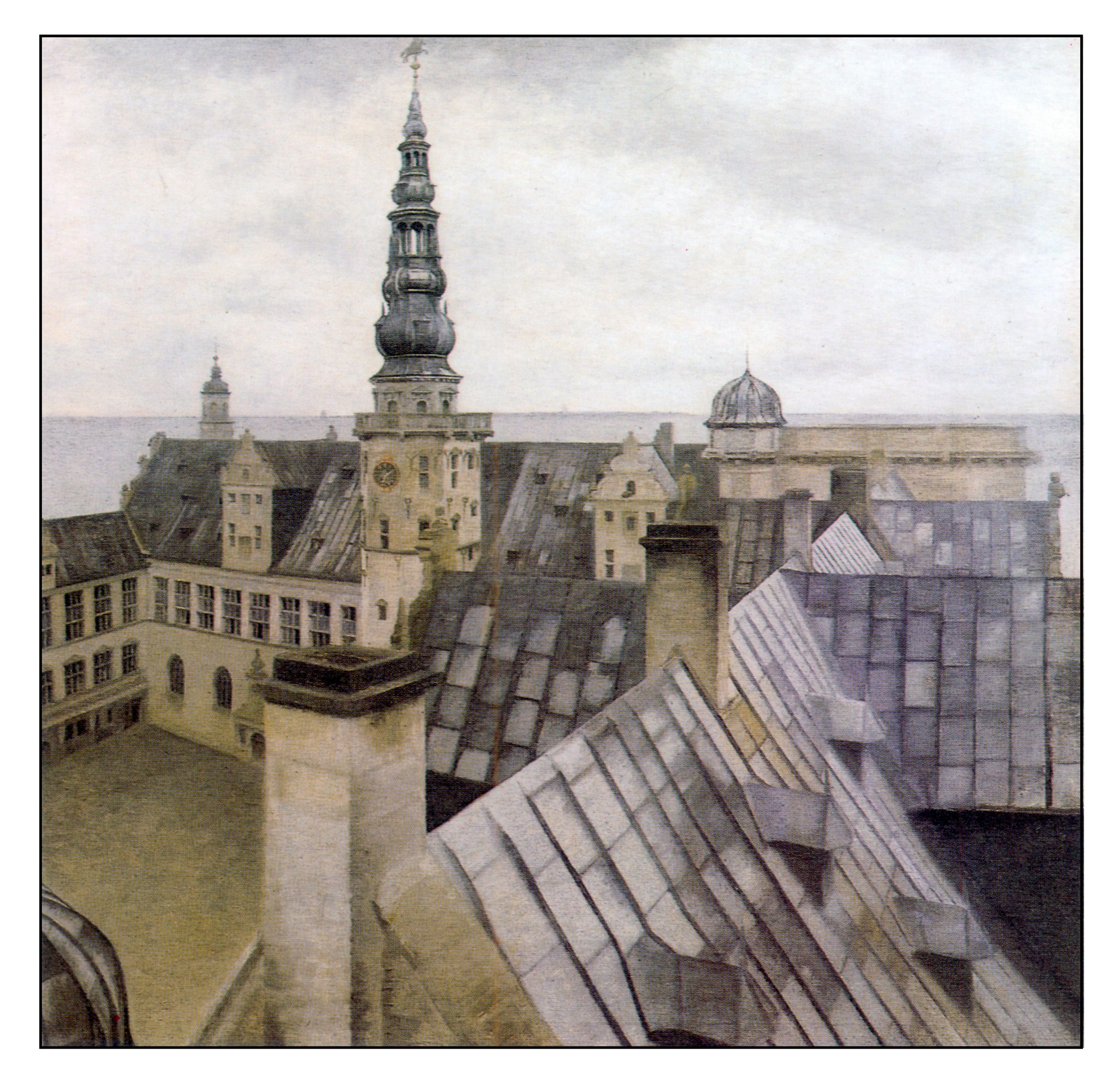
Monrad, K. (2012). Hammershøi and Europe. New York: Prestel.

Prettejohn, E. (2005). Beauty and art, 1750-2000. Oxford: Oxford University Press.
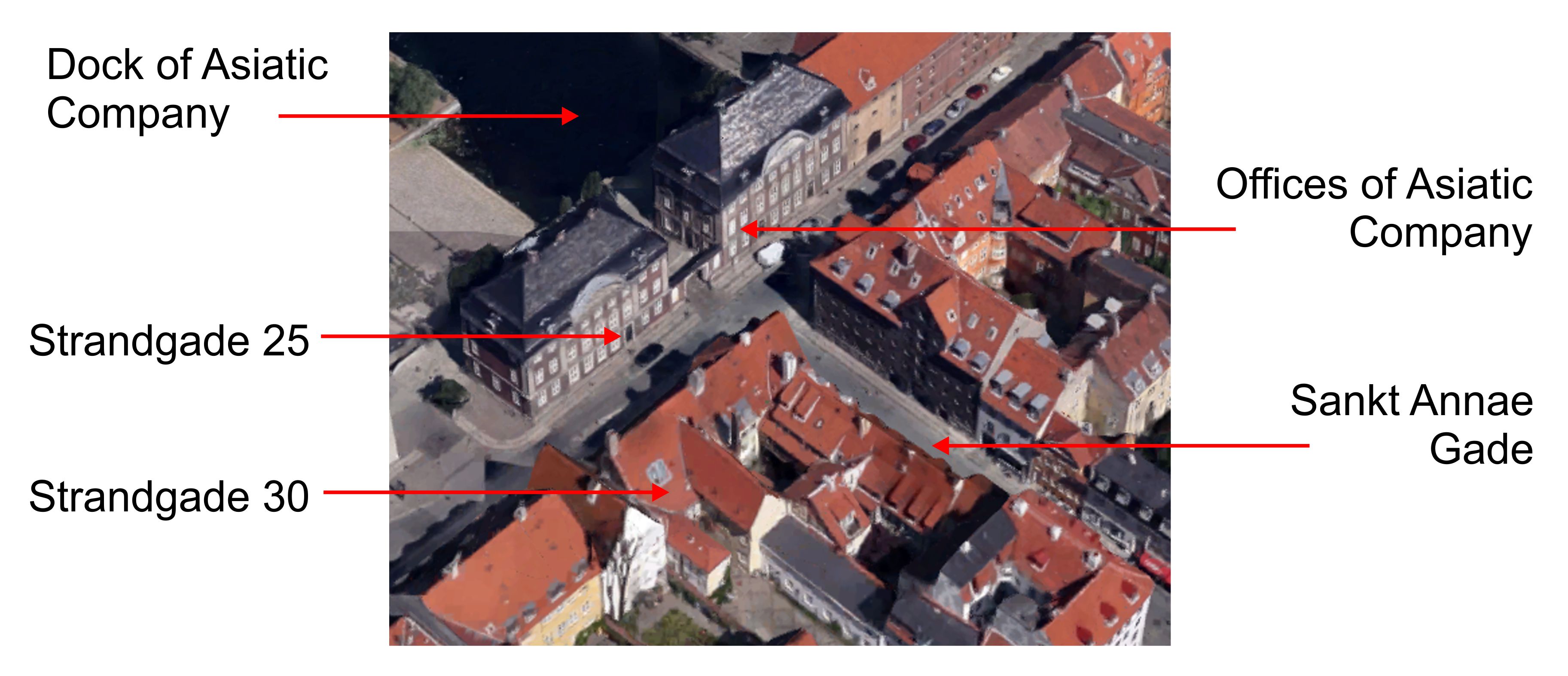
Rosenblum, R. (1975). Modern painting and the northern romantic tradition: Friedrich to Rothko. New York: Harper & Row.

Schamus, J. (2008). Carl Theodor Dreyer’s Gertrud: The moving word. Seattle: University of Washington Press.

Vad, P. (1992). Vilhelm Hammershøi and Danish art at the turn of the century. New Haven: Yale University Press.