Friedrich Hölderlin: Little Knowledge but Joy Enough

Johann Christian Friedrich Hölderlin (1770-1843) was one of Germany’s greatest lyric poets. He was exquisitely sensitive to the beauties of the natural world, and thoroughly enamoured to the glories of Ancient Greece. His verses are strikingly beautiful in their sound, and have been set to music by many composers. As a young man he was very productive, writing poems and the epistolary novel Hyperion (1799). He also made important new translations of Sophocles’ Oedipus and Antigone. However, in 1806 he lapsed into madness. From 1807 until his death, he lived alone in a room overlooking the Neckar River in Tübingen. He mumbled to himself in many languages, and occasionally wrote brief fragments of verse for visitors, signing them with various pseudonyms and fictitious dates.  This posting considers some of his poetry.The text of the poems can been enlarged by clicking on them to get a separate window.


Life

Friedrich Hölderlin was born in 1770 in Lauffen am Neckar a village just south of Heilbronn in the Duchy of Württemberg. (That year also marked the birth of Wordsworth, Beethoven, and Hegel). His father died in 1772 and his mother married Johann Gok and moved to Nürtingen. Hölderlin attended school at the monastery of Denkendorf, and then began studies for the clergy at the monastery of Maulbronn. Founded as a Cistercian monastery in 1147, Maulbronn had become a Lutheran institution after the Reformation. In 1788 Hölderlin began to study theology at the Tübinger Stift (seminary). Among his fellow-students in Tübingen were the philosophers Georg Hegel and Friedrich Schelling. Hölderlin and most of the Tübingen students were more fascinated by the ideals of the French Revolution (1789) than by the logic of theology. These were revolutionary times: what might be yet possible was replacing what always had been.

The pastel portrait (illustrated above) by Franz Carl Hiemer dates from 1792, when Hölderlin was in his final days as a student. It is the very picture of a young romantic poet: sensuously beautiful, clear-eyed and idealistic. Who could not fall in love with him?


Having decided against a career in the church, Hölderlin found employment as a tutor in the houses of the bourgeoisie. Though he was not a good teacher, these positions allowed him time to write poetry. When serving as tutor in the Gontard household in Frankfurt from 1796 to 1798, Hölderlin fell passionately in love with Susette Gontard (1769-1802), the wife of his employer. Susette returned Hölderlin’s affections. The illustration below shows a small alabaster bust of Susette by Landolin Ohmacht from around 1795.

Dismissed from his position, Hölderlin moved to Homberg, where he attempted to edit a new journal. He continued to write to Susette, and occasionally arranged secret meetings with her. She became immortalized as Diotima, the great love of the hero in Hölderlin’s novel Hyperion which was published in two parts in 1797 and 1799.

In January, 1802, Hölderlin accepted a position as tutor in the household of a German consul in Bordeaux, France. Penniless, he traveled to Bordeaux on foot, a distance of over 1000 km. The position did not work out, and he traveled back to Tübingen in May. We do not know what happened to him on the journey. He may have been robbed; he was clearly exhausted by his travel, and he was close to starvation. When he arrived in Stuttgart in June, a friend described him as “an emaciated man, pale as death, long-haired and bearded, wild-looking, habited like a beggar” (Zweig, 1939/2017, p 356). At this time, he was informed that Susette had died. She had contracted German measles from her children Though the children recovered easily, Susette who probably had some underlying lung disorder, perhaps tuberculosis, did not. Hölderlin was devastated.

Despite his despair, Hölderlin was able to complete his translations of Sophocles’ Oedipus and Antigone. However, when they were published in 1804, these translations were derided as monstrous, and considered the work of a lunatic. For example, in the opening scene of Antigone, the verb kalchainein (from kalche, the purple limpet), which means “to become dark red,” is metaphorically used to describe disturbed thoughts. Hölderlin, directly translated the Greek dēloīs gār ti kalchaínousa’ éposas as du scheinst ein rotes Wort zu färben (“you seem to dye your words red”) rather than decorously translating it as “you appear to be troubled.” His choice of words is strange and exciting (de Campos, 2007; Carson, 2008). Hölderlin’s radical translations have prevailed. Carl Orff used them for his operas Antigonae (1949) and Oedipus der Tyrann (1959), and Bertolt Brecht adapted them for his 1948 play Antigone.

Hölderlin’s grief after the death of Susette was overwhelming, and he began his descent into madness. Isaac von Sinclair, a close friend, arranged an undemanding position for him as court librarian in Homberg in 1804. However, in 1805, von Sinclair, who was a fervent supporter of the ideals of the French Revolution, was accused of treason against the Elector of Württemberg, arrested and brought to trial in Stuttgart. Hölderlin was initially considered a co-conspirator, but was soon deemed too mad to stand trial. Ultimately, von Sinclair was found not guilty. The mad Hölderlin left Homberg to return home. However, his mother could not take care of him and in 1806, the poet was admitted to the University Hospital in Tübingen where he was treated by Professor Johann von Autenreith.

In 1807 he was discharged as incurably insane into the care of a carpenter Ernst Zimmer, who took in student boarders. For the next 36 years (one half of his lifetime) Hölderlin lived in the first-floor room in a tower overlooking the Neckar River. His upkeep was supported by a small annuity from the state of Württemberg. The tower had at one time been part of the city’s medieval fortifications but was then merged into the houses on Bursagasse. The following illustration shows the tower as viewed from the Neckar River:

In the 1820s, Hölderlin was visited by a young poet, Wilhelm Waiblinger (1804-1830), who describes his experience visit in his 1830 memoir Friedrich Hölderlin’s Life, Poetry and Madness:

One ponders, wondering whether or not to knock, and feels a sense of uneasiness. After finally knocking, a loud and forceful “Come in!” can be heard. Opening the door, one finds a haggard figure standing in the middle of the room, who bows as deeply as possible and will not stop bestowing compliments, and whose mannerisms would be very graceful were there not something convulsive about them. One admires the profile, the high forehead heavy with thought, the friendly, lovable eyes, extinguished but not soulless; one sees the devastating traces of the mental illness in the cheeks, the mouth, the nose, above the eyes where an oppressive and painful wrinkle has been etched. With regret and sadness, one observes the convulsive movement which sometimes spreads throughout the entire face, forcing his shoulders to jerk and his fingers to twitch. He wears a simple jacket and likes to keep his hands in his pockets. One says a few introductory words which are then received with the most courteous obeisance and a deluge of nonsensical words which confuse the visiting stranger. Gracious as he was and, for the sake of appearance, still is, H. now feels obliged to say something friendly to the guest, to ask him a question. One comprehends a few words of his question, but most of these could not possibly be answered. Nor does Hölderlin in the least expect to be answered. On the contrary, he becomes extremely perplexed if the visitor attempts to follow up a train of thought.

Hölderlin was also visited by other students and tourists. When given paper, Hölderlin would write fragments of verses and give them to his visitors. He would sign these with various pseudonyms, one of the most popular being “Scardanelli.” Some of them would be dated with fictitious dates. On most days Hölderlin would go for walks in the city, but he would not recognize or interact with anyone. He had been given a piano, and would often improvise music for prolonged periods.  

We do not know the nature of Hölderlin’s madness William Dilthey (1910) attributed his symptoms to spiritual weariness: “that form of dispersion of spirit produced from enormous exhaustion.” He likened Hölderlin to Robert Schumann. For both, creativity came at too great a cost: they flew too close to the sun. Some writers have concluded that Hölderlin was schizophrenic (Blanchot, 1951; Jakobsen et al, 1980). Others have refrained from any definite diagnosis (Agamben, 2023; Robles, 2020). Horowski (2017) has proposed that his symptoms might have been due to mercury intoxication since von Autenreith treated him with very high does of calomel. However, Hölderlin’s symptoms clearly preceded his treatment in Tübingen. The illustration shows an etching of Hölderlin based on a sketch by J. G. Schreiner in 1826.

Alcaic Verses

Hölderlin’s German odes were composed using Alcaic verses, traditionally believed to have been invented by the Greek lyric poet Alcaeus around 600 BC (Warren, 1996). Stress in Ancient Greek is mainly related to the duration of the vowel sound, whereas stress in both German and English is more complex and can be affected by the duration, pitch and intensity of the syllable, as well as by semantics. Nevertheless, the Alcaic verse form works well in both German and English.

Alcaic verses consist of four lines. The first two lines contain 11 syllables, the third 9 syllables and the fourth 10 syllables. The stress pattern was complicated, and could be varied slightly. In the following diagram the stressed syllables are denoted by / and the unstressed by . Syllables denoted by x could be either stressed or unstressed. 

To illustrate this form, we can look at the brief poem Ehmals und Jetzt, shown below with a translation by Michael Hamburger which uses the same alcaic form:

The following shows the stress pattern in the German verse :

The following is a musical setting of the ode by Josef Matthias Hauer (1883-1959), sung by tenor Holger Falk accompanied by Steffen Schleiermacher on piano.  

To the Fates

Greek mythology postulated that human life was controlled by three sisters known as the Fates (Moirai in Greek; Parcae in Latin): Clotho, the spinner, spun the thread from her distaff onto a spindle; Lachesis, the allotter, measured out the destined amount life; and Atropos, the inflexible, cut the thread and ended the life. The following shows an image of the Fates in a tapestry created in 1983 by Patricia Taylor from a 1948 drawing by Henry Moore:

This is Hölderlin’s ode To the Fates. The translation is by Elizabeth Henderson

As the years pass, it would be a blessing to remember that once one had lived as the gods even if only for a short time. One could not ask for more.

The following is a recitation of the poem by Matthias Wiemann and a musical setting by Paul Hindemith (1895-1963), sung by Dietrich Fischer-Dieskau with Aribert Reimann accompanying him on piano. 


The Neckar

Hölderlin was born on the banks of the Neckar River. As shown in the map, this river arises in the Black Forest and flows down to join the Rhine River. Many stretches of the river are freely navigable.

The first half of Hölderlin’s poem describes how the river brought him joy and peace. The second half tells how the beauties of the river inspire him to consider what it might be like to visit the wonders of Ancient Greece: Pactolus, a river in Ionia described by Sophocles as a “golden stream;” Smyrna the great coastal city of Western Ionia, now known as Izmir; Ilion, the ancient  name for Troy; Sunium on the southernmost point of the Attic peninsula, with its temple of Poseidon; and Olympia, the site of the Olympic Games.

At the time that Hölderlin was writing his poem, it was impossible to visit Greece since it was part of the Ottoman Empire. He could only visit in his imagination. Greece attained independence in 1832, but by then Hölderlin was mad.

Below is the text of the poem with a German translation by James Mitchell, followed by a recitation by Burno Ganz The translation follows the meaning but not the alcaic form of the German poem.

Josef Matthias Hauer composed a set of brief piano pieces based upon lines from Hölderlin’s poems (Barwinek, 2023). The following are two of these pieces deriving from the poem Der Neckar, played by Anna Petrova-Foster:

Deine Wellen umspielten mich
Your waves played about me


                    wo die Meerluft
die heißen Ufer kühlt und den Lorbeerwald durchsäuselt

                    where the sea breeze
cools the hot shores and rustles through the laurel forest


Hyperion

Hölderlin published his novel Hyperion, oder der Eremit in Griechenland in two parts in 1797 and 1799. It consists of a series of letters between Hyperion, a young Greek, to his German friend Bellarmin, with some occasional letters between Hyperion and his beloved Diotima. Epistolary novels were very popular in the 18th Century: Rousseau’s Julia, ou la nouvelle New Héloise (1761), Richardson’s Pamela (1740) and Goethe’s Die Leiden des jungen Werther (1774) all used the format. Those were the days when those who were literate wrote letters.

Hyperion is short on plot and long in thought. The novel presents a general theory of beauty as the guiding light for harmonious society and of union with nature as the goal of the individual person. Hyperion participates in an insurrection against the Ottoman rule with the rebel Alabanda (modeled on Isaac von Sinclair). Later he almost dies fighting with the Russians against the Turks in the great sea battle of Chesma in 1771. Although the Russians were victorious, the Greeks remained subjugated. Hyperion’s great love Diotima, modeled on Susette Gontard, dies soon afterwards. Hyperion finally retires to live as a hermit in unspoiled nature. His concluding comment is one of reconciliation (Unger, 1984, p 36):

Wie der Zwist der Liebenden, sind die Dissonanzen der Welt. Versohnung ist mitten im Streit und alles Getrennte findet sich wieder. Es scheiden und kehren im Herzen die Adern und einiges, ewiges, gliihendes Leben is Alles

[The dissonances of the world are like the quarrel of lovers. Reconciliation is in the midst of strife, and all things divided find each other again. The veins depart from and return to the heart, and a unified, eternal, glowing life is All.]

Hyperion’s Schicksalslied occurs after the battle of Chesma (Unger, 1984, p 36). It begins in awe of the gods and ends in despair.

Brahms’ Opus 54 (1871) provides a choral setting of this song. The following are two extracts as performed by the Runfunkchor Berlin conducted by Gijs Leenars with the Deutsche Symphonie Orchester: settings of the first and last verses:


Brahms added a beautiful adagio at the end of the song. Though criticized for trying to attenuate Hyperion’s despair, this movement fits the novel, which ends with a sense of reconciliation.

Fragments from the Tower

Most of the slivers of poetry that have been preserved from Hölderlin’s time in the tower have little meaning. Occasionally there are flashes that recall the aphorism of the younger poet:

Und wenig Wissen, aber der Freude viel
Ist Sterblichen gegeben

And little knowledge, but joy enough
Is given to mortals.
Stuttgart Hölderlin Ausgabe 2.323
translated by Chernoff & Hoover

And some of the poetry from that time is genuinely beautiful. Much of it is in the form of simple rhymed verse, unlike the unrhymed hymns and odes of earlier days. One of his last poems, entitled Aussicht (Perspective), likens human life to the necessary passage of the seasons, a theme that recurs in much of Hölderlin’s poetry. Like much of his late work it is signed “Scardanelli” and dated to the preceding century:

Wenn in die Ferne geht der Menschen wohnend Leben,
Wo in die Ferne sich erglänzt die Zeit der Reben,
Ist auch dabei des Sommers leer Gefilde,
Der Wald erscheint mit seinem dunklen Bilde.

Daß die Natur ergänzt das Bild der Zeiten,
Daß die verweilt, sie schnell vorübergleiten,
Ist aus Vollkommenheit, des Himmels Höhe glänzet
Den Menschen dann, wie Bäume Blüt umkränzet.

24 Mai 1748                     Mit Untertänigkeit
                                          Scardanelli.

When the life that men live in passes faraway,
Into that future season when the vines gleam,
And the harvested fields lie empty,
Then emerges the dark shadow of the forest.

Nature completes her picture of the seasons,
And lingers while they quickly glide away,
Out of perfection, and the high heavens then shine
On men as if garlanding the trees with blossoms.

24 May 1748                     Your humble servant
                                          Scardanellli

The above translation is mine. There are few other translations available, but see Agamben (2023, p 289), and Aleksi Barrière for versions in both French and English.

The following is a recitation of the poem by Hanns Zischler:

And a photograph of the actual manuscript of the poem:  

Agamben (2023, pp 295-329) considers the various meanings of the phrase wohnend Leben (dwelling life) in the first line of the poem. He relates it to the idea of Christ’s incarnation from John 1:14:

And the Word was made flesh, and dwelt among us …

We live in life for a brief time. Perhaps we come from elsewhere, and return there when we die. Agamben also considers the word “habit,” which comes from the word “inhabit,” which is close to “dwell” in its meaning. In German, the word gewohnt means “usual” or “habitual.”  In a life of habit, one is affected by the world but does not try to change it. Such was Hölderlin’s time in the tower.


Stefan Zweig on Hölderlin’s Poetry

Hölderlin created some of our most exalted descriptions of nature and of the gods. His poetry is beautiful to read and to listen to. However, it often lacks the specificity of normal human experience. Hölderlin preferred the eternal to the everyday. His poetry may help us to understand the infinite, but provides little insight into our own finite lives. Stefan Zweig (1939, p 342) noted

Of the “four elements” known to the Greeks – fire, water, air, and earth – Hölderlin’s poetry has but three. There is lacking to it earth, the dark and clinging element, connective and formative, the emblem of plasticity and hardness. His verse is made of fire, the symbol of the ascent heavenward; it is light as air, perpetually athrill like the rustling breeze; it is transparent as water. In it scintillate the colours of the rainbow; it is ever in motion, rising and falling, the unceasing respiration of the creative mind. His poems have no anchorage in experience; they have no ties with the fertile earth; they are homeless and restless, scurrying clouds, sometimes tinged with the red dawn of enthusiasm and sometimes darkened with the shadow of melancholy, sometimes gathering into dense masses from which flash the lightnings and thunders of prophecy. Always they climb towards the zenith, towards the ethereal regions far from solid ground, beyond the immediate range of the senses.


Heidegger and Hölderlin

Martin Heidegger (1889-1976) was a German philosopher who contributed significantly to the existentialist movement. In Being and Time (1927), he focused on what it means to “be.” This question cannot be solved analytically but requires creative intuition. Thus, Heidegger was led to the idea that poetry determines the world through the words we use to describe it. The word “poetry” derives from the Greek poiesis making. 

In his essay Hölderlin and the Essence of Poetry (1941), Heidegger discussed the meaning of the concluding lines to Hölderlin’s poem Andenken (Remembrance) which dealt with his visit to Bordeaux. The last sentence of the poem reads

          Es nehmet aber
Und giebt Gedächtniss die See,
Und die Lieb’ auch heftet fleissig die Augen,
Was bliebet aber, stiften die Dichter
.

[           But it is the sea
That takes and gives remembrance
And love no less keeps eyes attentively fixed,
But what is lasting the poets provide.
translated by Hamburger, 1998]

Another translation of the last line is “But what remains is founded by the poets.” Heidegger’s interpretation follows:

This line throws light on our question of the essence of poetry. Poetry is a founding by the word and in the word. What is established in this way? What remains. But how can what remains be founded? Is it not that which has always already been present? No! Precisely what remains must be secured against being carried away; the simple must be wrested from the complex, measure must be opposed to excess. What supports and dominates beings as a whole must come into the open. Being must be disclosed, so that beings may appear. . . .

The poet names the gods and names all things with respect to what they are. This naming does not merely come about when something already previously known is furnished with a name; rather, by speaking the essential word, the poet’s naming first nominates the beings as what they are. Thus they become known as beings. Poetry is the founding of being in the word. What endures is never drawn from the transient. What is simple can never be directly derived from the complex. Measure does not lie in excess. We never find the ground in the abyss. Being is never a being. But because being and the essence of things can never be calculated and derived from what is present at hand, they must be freely created, posited, and bestowed. Such free bestowal is a founding.

But when the gods are originally named and the essence of things comes to expression so that the things first shine forth, when this occurs, man’s existence is brought into a firm relation and placed on a ground. The poet’s saying is not only foundation in the sense of a free bestowal, but also in the sense of the firm grounding of human existence on its ground. If we comprehend this essence of poetry, that it is the founding of being in the word, then we can divine something of the truth of that verse which Hölderlin spoke long after he had been taken away into the protection of the night of madness. Heidegger (1941, pp 58-59)

As the Nazis came to power in Germany, Heidegger became an enthusiastic supporter. A major problem in evaluating his philosophy is to determine whether it can be considered independently of his politics. Did his philosophy make him more susceptible to fascism? When one poetically creates an idea of a perfect society, one must be careful to consider the means used to bring it into being.       

Hölderlin and Nazi Propaganda

In Hölderlin’s time, the Holy Roman Empire no longer existed. Germany was a ragtag conglomeration of kingdoms, duchies, bishoprics and city-states. In many of his poems, Hölderlin yearned for a unified Germany, a country that could carry on the ideas of both ancient Greece and revolutionary France. His patriotism was both fervent and critical: he was upset by the petty bourgeois squabbling of his countrymen. The following is the beginning of his Gesang des Deutschens (Song to the Germans) with a translation form Sharon Krebs:

The following is the last verse from Hölderlin’s Der Tod fürs Vaterland (Death for the Fatherland). It embodies the poet’s dedication to his idealized country:  

The last three lines of this verse were engraved on the wall of the Langemarck-Halle, a memorial to the German soldiers who had died in World War I, included in the buildings for the 1936 Olympic Games.

During World War II, the Nazi government arranged for 100,000 copies of a special field edition of Hölderlin’s poetry to be printed and sent to soldiers at the front (Unger, 1988, pp 130-131; Savage, 2008; pp 6-7; Corngold & Waite, 2009). The poetry increased the morale of the soldiers and provided them with an excuse to die for their country.

How could Hölderlin’s poetry be dragooned into military service? As Savage (2008, p 6) asks

How then did the Nazis transform this scarcely militaristic poet, who never took up arms for his country, and spent the last four decades of his life in a state of spiritual benightedness, into a paragon of Prussian masculinity and patriotic self-sacrifice?

Hölderlin was not a proto-fascist. His poetry was popular not because it urged his readers toward the goals of the Nazis, but because it provided a respite from the suffering of the war:

He offered an inner sanctuary to which his readers could retreat to lick their wounds when confronted with the material deprivation, physical danger, and increasingly evident lack od freedom of everyday life under the Third Reich. (Savage, 2008, p 7).

Constantine (1988) remarked

There can be no doubt that Hölderlin was a patriot, but his patriotism was humane and not in the least militaristic. It included also—which is often overlooked—the wish first to achieve a homeland it would be a joy and a privilege to live in, one in which the ideals of liberty, equality, and fraternity would have been realized. (pp 221-222)

Hölderlin did not really care for politics. He could describe his poetic ideals but he was unable to state how they should be attained. Constantine (1988) remarks that the general tendency of German writers to be concerned with the spiritual rather than the political has been catastrophic:

The disparagement of politics by Germany’s artists and intellectuals left that sphere free for the men of blood and iron to run riot in. (p 222)


Paul Celan

Paul Celan (1920-1970) was born in Czernowitz, Romania, into a German-speaking Jewish family. His parents died in German concentration camps, and he was forced to work in a labor camp. After the war he made his way to Paris, where he lived until his suicide in 1970.

He wrote poetry in German, his mother tongue, despite the fact that the language had come to embody the evil and the suffering of Nazism. He fractured and distorted the language so that he could find the truth behind the words. Celan visited Tübingen in January (Jänner in dialect), 1961, and felt a great sympathy for Hölderlin, who also wrote in fragments and could not make himself understood. The result was the poem entitled Tübingen, Jänner, 1961

The poem is cryptic, and understanding may be helped by some notes from Joris (Celan, 2020, pp 469-471), and from Felstiner (1995, pp 172-174):

The first lines refer to the Hölderlin’s hymn Der Rhein, which states that the sons of God are the blindest of us all. Seeking to understand heaven may make one unaware of the real world. The poem then directly quotes (though in fractured form) that the source of purity is a mystery. Both Hölderlin and Celan relate the German word rein (pure) with the name of the river.

The next lines describe the tower in which Hölderlin spent the last half of his life: reflected in the Neckar River and circled by gulls.

Then we are introduced the carpenter Ernst Zimmer who was responsible for his basic care and who listened to his words.

The final verse likens Hölderlin to a patriarch or prophet with a beard that glowed. This may be a reference to the story that the face of Moses shone brightly when he came down from Sinai

And it came to pass, when Moses came down from mount Sinai with the two tables of testimony in Moses’ hand, when he came down from the mount, that Moses wist not that the skin of his face shone while he talked with him.
And when Aaron and all the children of Israel saw Moses, behold, the skin of his face shone; and they were afraid to come nigh him.
(Exodus 34:29-30)

Although Moses was able to communicate the will of God to his people, the people of the present world cannot understand the words of their prophets or poets. We only hear and incoherent babbling. Pallaksch is a nonsense word that Hölderlin used to mean “yes” or “no,” or simply uttered as an exclamation.

The following is Celan’s poem together with a translation by Pierre Joris and a reading by Bruno Ganz:

Farewell

And so we take our leave of Hölderlin, a poet who described the indescribable to a people who failed to understand him. He was one of the main exemplars of the romantic tradition (de Man, 2012), a movement that considered subjectivity as paramount. He combined the new ideas about nature that began with Rousseau with the ideals of beauty that came from Ancient Greece. The French Revolution led not to a society of Liberté, Égalité, Fraternité, but to the Terror of Robespierre and the wars of Napoleon. Hölderlin’s dream that melding the beauty of Greece to the revolution of France might bring forth a new and harmonious German society came to naught. Madness overtook his person; and a century later madness overtook Germany in the form of fascism. Yet the original dream was vivid and powerful, and it remains so.   


Hölderlin’s Poems and Translations

Hölderlin, F. (translated Henderson, E., 1962) Alcaic poems. Oswald Wolff.

Hölderlin, F., & Mörike, E. F. (translated by Middleton, C., 1972). Selected poems. University of Chicago Press.

Hölderlin, F. (translated by Sieburth, R., 1984). Hymns and Fragments. Princeton. 

Hölderlin, F. (edited by Santner, E. L., 1990). Hyperion and selected poems. Continuum.

Hölderlin, F. (translated Hamburger, M., 1998). Selected poems and fragments. Penguin Books.

Hölderlin, F. (translated by Chernoff, M., & Hoover, P., 2008). Selected poems of Friedrich Hölderlin. Omnidawn.

Hölderlin, F (translated by Mitchell, J., 2022). Poems of Friedrich Hölderlin.

Hölderlin, F. (accessed 2025) Friedrich Hölderlin: Gedichte.

Hölderlin, F. (accessed 2025) Stuttgarter Hölderlin Ausgabe


References

Agamben, G. (translated by A. L. Price, 2023). Hölderlin’s madness: chronicle of a dwelling life, 1806-1843. Seagull Books.

Barwinek, B. (2023). Expression in Josef Matthias Hauer’s piano music as exemplified by Klavierstücke mit Überschriften nach Worten von Friedrich Hölderlin Op. 25. Polski Rocznik Muzykologiczny, 21(1), 106–128.

Blanchot, M. (1951, reprinted 1995). Madness par excellence. In M. Holland (Ed.) The Blanchot Reader. (pp 110-128). Blackwells.

de Campos, H. (2007). Holderlin’s red word. In de Campos, H. (edited by A. S. Bessa & O. Cisneros). Novas: selected writings. (pp 327-333). Northwestern University Press.

Carson, A. (2008). Variations on the right to remain silent. A Public Space, Issue 7

Celan, P. (translated by Joris, P., 2020). Memory rose into threshold speech: the collected earlier poetry. Farrar, Straus, Giroux.

Constantine, D. J. (1988). Hölderlin. Clarendon.

Corngold, S., & Waite, G. (2009). A question of responsibility: Nietzsche with Hölderlin at war, 1914–1946. In Wistrich, R. S & Golomb, J. (Eds) Nietzsche, Godfather of Fascism? (pp. 196-214). Princeton University Press.

Dilthey, W. (1910, translated by A. Grugan, reprinted, 1993). Hölderlin and the causes of his madness. Philosophy Today, 37(4), 341–352.

Felstiner, J. (1990). Paul Celan: poet, survivor, Jew. Yale University Press,

Heidegger, M. (1927, trans. J. Macquarrie & E. Robinson,1962). Being and time. Blackwell.

Heidegger, M. (1941, translated by Hoeller, K., 2000). Elucidations of Hölderlin’s poetry. Humanity Books.

Horowski, R. (2017). The “madness” of Friedrich Hölderlin: an iatrogenic intoxication. Journal of Neural Transmission, 124(6), 761–763. 

Jakobson, R., & Lübbe-Grothues, G. Ein Blick auf die Aussicht von Hölderlin. (1980/2010). In Jakobson, R. (ed. Rudy, S.) Selected Writings.  Volume III, Poetry of Grammar and Grammar of Poetry (pp. 388–448). De Gruyter. [Part of this essay translated in Jakobson, R., Lübbe-Grothues, G., & Kitron, S. (1980). The language of schizophrenia: Hölderlin’s speech and poetry. Poetics Today, 2(1a), 137–144.]

de Man, P. (2012). Hölderlin and the romantic tradition. Diacritics, 40(1), 100–129. [original lecture 1959]

Robles, N. (2020). Hölderlin’s madness. Hektoen International.

Savage, R. (Robert I. (2008). Hölderlin after the catastrophe: Heidegger, Adorno, Brecht. Camden House.

Unger, R. (1984). Friedrich Hölderlin. Twayne Publishers

Waiblinger, W. (1830, translated by S. J. Thompson) Friedrich Hölderlin’s Life, Poetry and Madness

Warren, R. (1996). Alcaics in exile: W.H. Auden’s “In memory of Sigmund Freud.” Philosophy and Literature, 20(1), 111–121.

Zweig, S. (1939, translated 2017). Hölderlin, Kleist, and Nietzsche: the struggle with the daemon. Routledge.
Antigone

Sophocles’ play Antigone tells the story of a young woman who defies the laws of the state in order to do what she believes is right. The issues considered in the play remain as important now as they were almost two and a half millennia ago. Should one follow one’s conscience or obey the law? Does justice transcend the law? How does one determine what is right?

In the words of Hegel, Antigone is

one of the most sublime and in every respect most excellent works of art of all time. Everything in this tragedy is logical; the public law of the state is set in conflict over against inner family love and duty to a brother; the woman, Antigone, has the family interest as her ‘pathos’, Creon, the man, has the welfare of the community as his. (Hegel, 1975, p 464).

The word pathos most commonly means the quality of something that evokes pity. However, Hegel uses the word to denote “an inherently justified power over the heart, an essential content of rationality and freedom of will” (p 232). Pathos is the emotional commitment that defines a person – his or her driving passion.  Sophocles’ play presents the conflict of these passions.

The Theban Myths

In order to understand Antigone we need to know what has happened before the play begins. Antigone (441 BCE) was the first of what are now known as Sophocles’ three Theban Plays, the others being Oedipus Tyrranus (429 BCE) and Oedipus at Colonus (409 BCE). The plays were not conceived as a trilogy and Antigone was written before the other two. Aeschylus had also written three plays about Thebes but the initial two of these (about Laius the father of Oedipus and his version of Oedipus) have been lost. Only the third remains: Seven Against Thebes (467 BCE), which describes the siege of Thebes by the Argives. Antigone begins just after the events described in this play.

From the extant plays we can piece together the mythic narrative that leads to Antigone. Laius, king of Thebes, married to Jocasta, is told by the Delphic Oracle that he can only keep his city safe if he dies childless. After having drunkenly fathered Oedipus, Laius has his son left on Mount Cithaeron to die. However, the boy is found by a shepherd and ultimately adopted as a son by King Polybus of Corinth.

When he comes of age Oedipus is told by the Oracle that he will murder his father and marry his mother. Oedipus flees Corinth to prevent this from happening. On the way to Thebes at a place where three roads meet, he comes upon another traveler. They argue and fight; Oedipus kills the man; the man was Laius.

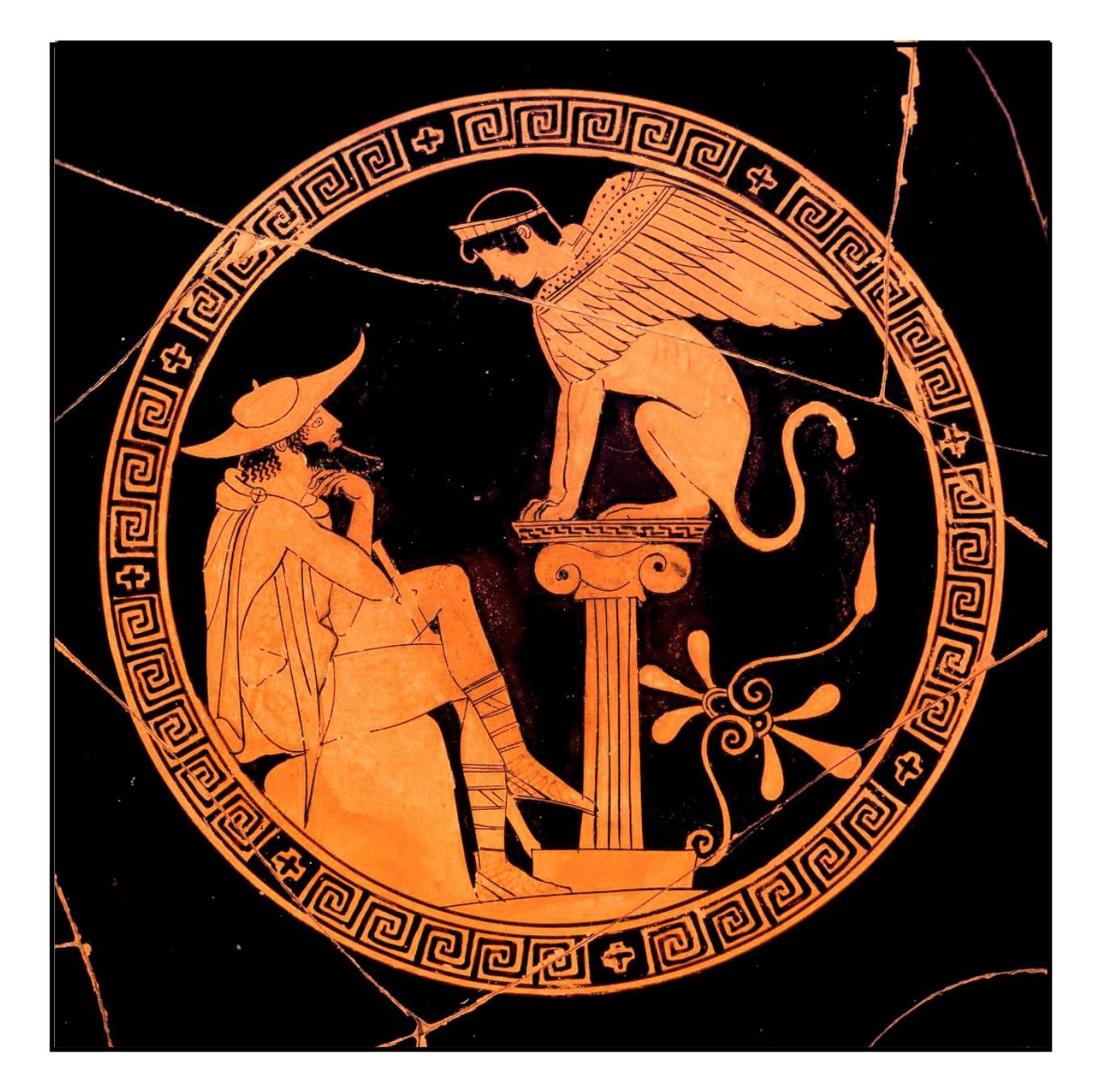
Oedipus continues on to Thebes. The city has long been plagued by the Sphinx, a monster sent by the gods because of some ancient crime of the Thebans. The Sphinx poses a riddle to all who pass by and devours those that fail to answer correctly: “What goes on four legs in the morning, two in the afternoon, and three at night.” The illustration at the right shows a representation of Oedipus and the Sphinx in a vase from around 500 BCE, now in the Vatican. (The sphinx seems much less monstrous than the legend indicated.) Oedipus solves the riddle – “man, who crawls in infancy, walks as an adult and uses a cane in old age.” This releases the city from the monster’s power. In gratitude the citizens of Thebes make Oedipus king and grant him the recently bereaved Jocasta as his wife. Oedipus and Jocasta have four children: the boys Polyneikes and Eteokles, and the girls Antigone and Ismene

The gods, displeased at the unrevenged death of Laius, bring a plague down upon Thebes. In order to stop the plague Oedipus searches for his father’s murderer. In the course of his investigations he realizes first that he was the killer, and ultimately that Laius was his father and Jocasta his mother. Jocasta hangs herself. Unable to bear the pain of his knowledge Oedipus blinds himself with Jocasta’s brooch pins. Exiled from Thebes he seeks sanctuary in the grove of the Furies at Colonus, a village near Athens. Here Theseus, king of Athens, takes pity on him.

His daughters Ismene and Antigone come to comfort their father in Colonus. In Thebes the sons of Oedipus initially decide to alternate the kingship, but Eteokles then banishes his older brother Polyneikes and becomes sole king of Thebes. Polyneikes visits Oedipus in Colonus to get his blessing for a revolt against his brother, but Oedipus curses both his sons and prophecies that they will die at each other’s hand. Oedipus dies. His daughters return to Thebes.

Polyneikes and six other generals raise an army from the rival state of Argos and attack Thebes. The Thebans ultimately defeat the besieging army. Near the end of the siege, Polyneikes and Eteokles fight and kill each other.

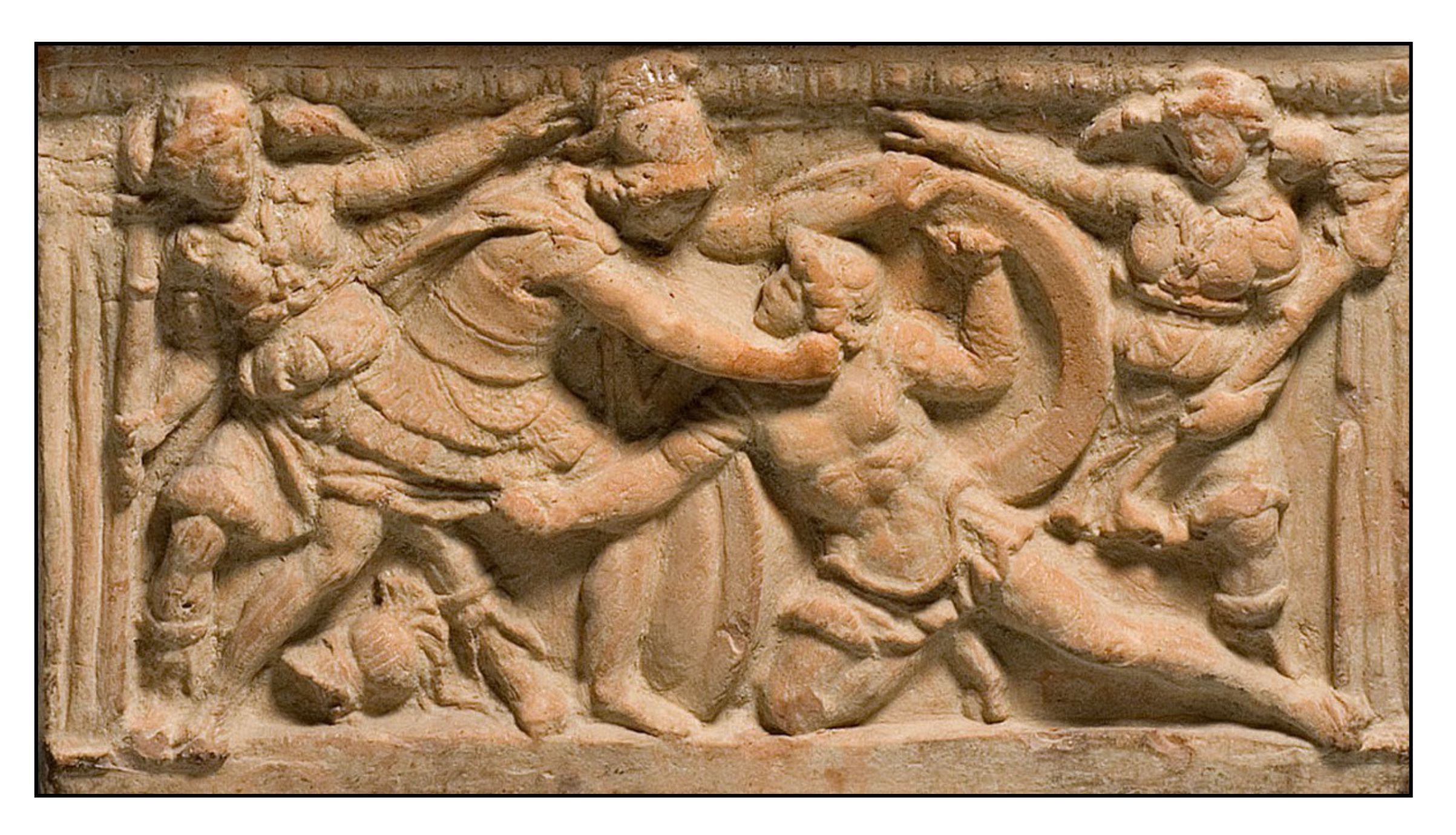
The deaths of Polyneikes and Eteokles became a popular motif for sculpture, the illustration below showing a relief on an Etruscan funerary urn from Chiusi (circe 200 BCE).

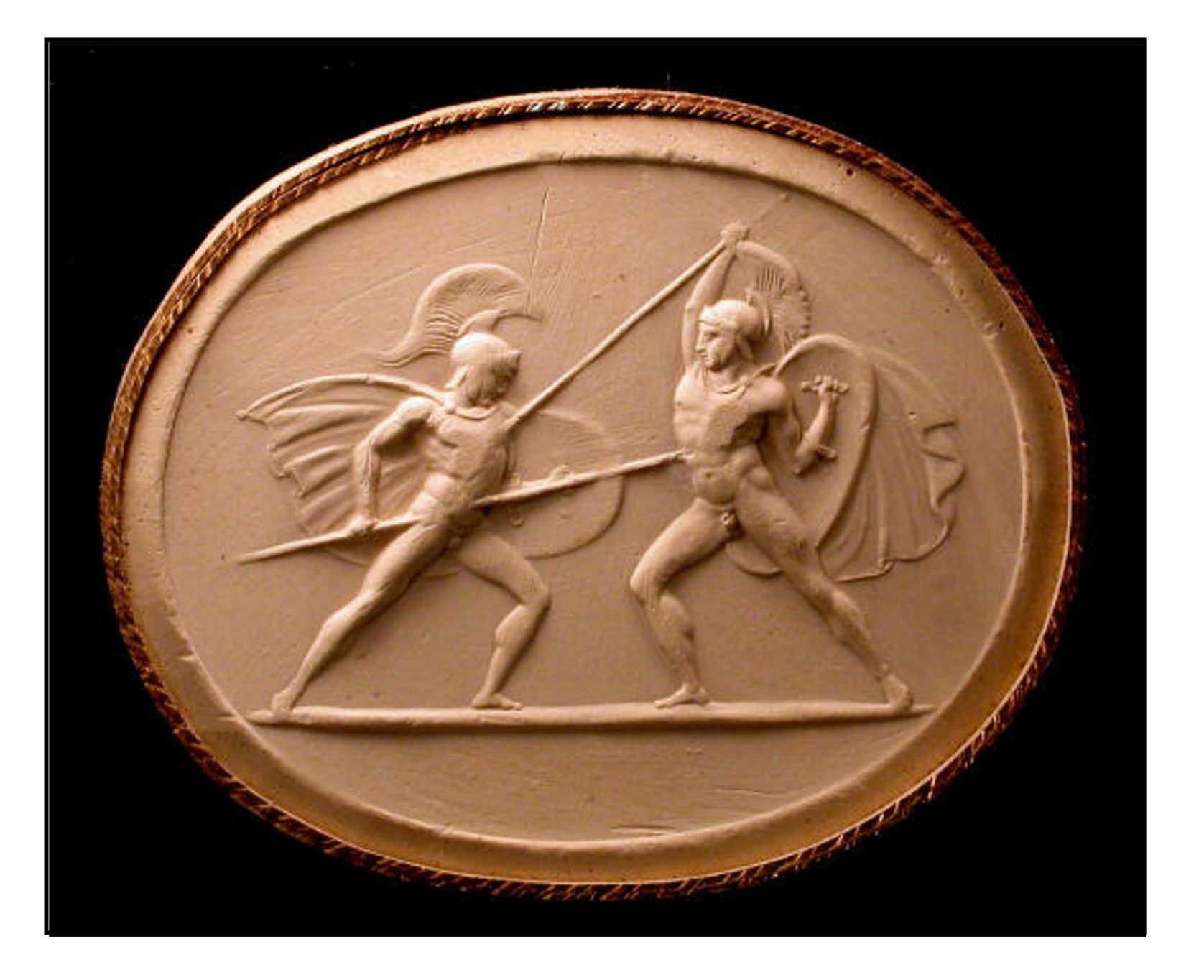
The following illustration from a 19th century jewel shows a more restrained view of the brothers’ deaths.

The Story of Antigone

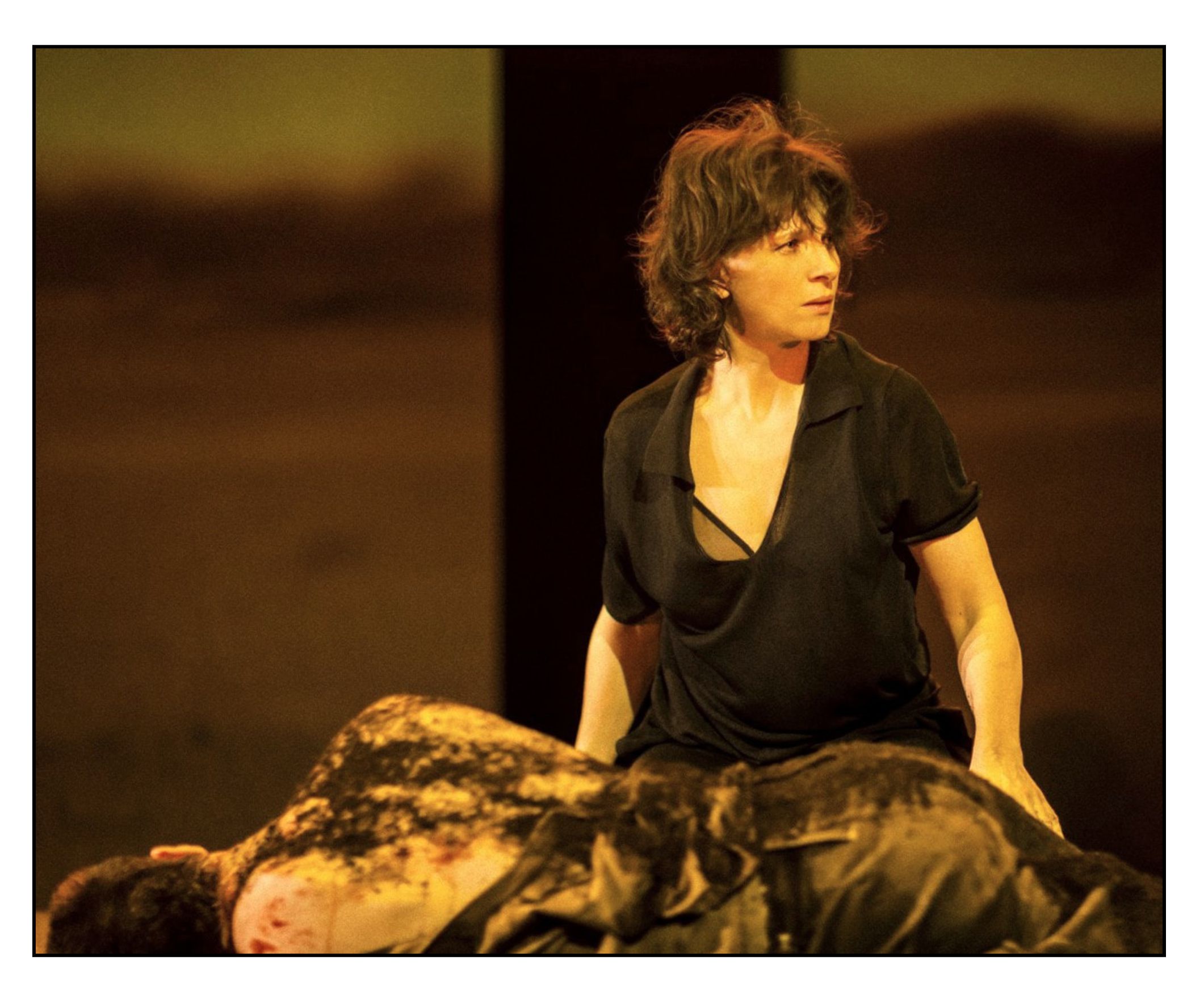
After the deaths of Polyneikes and Eteokles, Kreon, the brother of Jocasta, becomes king of Thebes. He decrees that Eteokles be given a hero’s funeral rites but that the body of the traitor Polyneikes’ be left to rot. Anyone who disobeys this ruling will be put to death. Despite the warnings of her sister, Antigone refuses to obey Kreon’s commandment and casts earth over Polyneikes’ body. The illustration below shows Juliet Binoche in the 2015 production of Antigone at the Barbican in London.

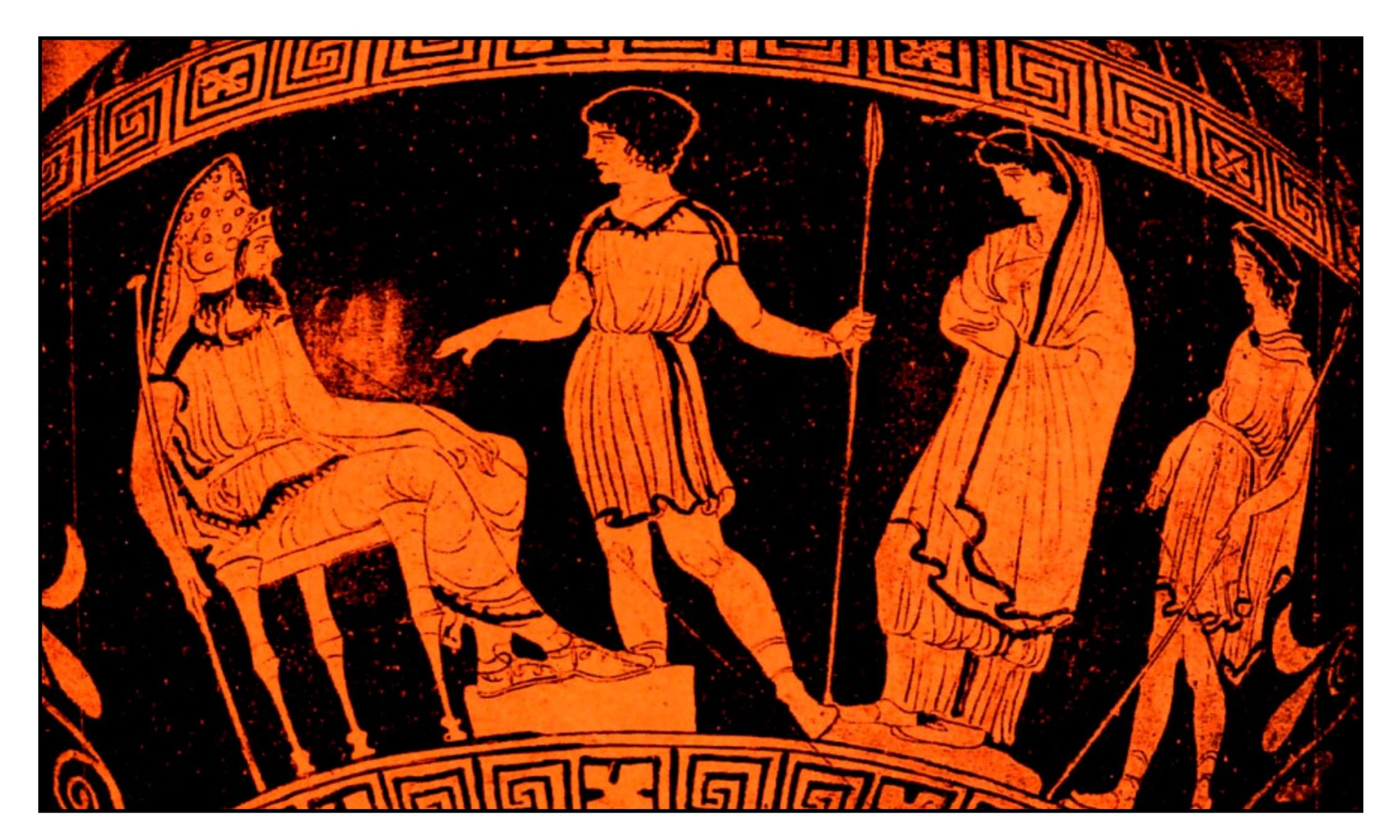
Antigone is caught in the act. The following illustration from a Greek vase (circe 400 BCE) shows Antigone, flanked by two guards holding spears, brought before Kreon.

This is the crucial exchange between the two:

Kreon:     Now tell me, not at length, but in brief space,
Knew you the order not to do it?

Antigone:                                          Yes
I knew it; what should hinder? It was plain.

Kreon:     And you made free to overstep my law?

Antigone: Because it was not Zeus who ordered it,
Nor Justice, dweller with the Nether Gods,
Gave such a law to men; nor did I deem
Your ordinance of so much binding force,
As that a mortal man could overbear
The unchangeable unwritten code of Heaven;
This is not of today and yesterday,
But lives forever, having origin
Whence no man knows: whose sanctions I were loath
In Heaven’s sight to provoke, fearing the will
Of any man. I knew that I should die –
How otherwise? Even although your voice
Had never so prescribed. And that I die
Before my hour is due, that I count gain.
For one who lives in many ills, as I –
How should he fail to gain by dying? Thus
To me the pain is light, to meet this fate:
But had I borne to leave the body of him
My mother bare unburied, then, indeed,
I might feel pain; but as it is, I cannot:
And if my present actions seems to you
Foolish – ‘tis like I am found guilty of folly
At a fool’s mouth! (ll 446-470, Young translation)

This is one of the greatest speeches ever spoken on the stage. It comes in four parts. First, Antigone scorns the proclamation of Kreon. Made neither by the gods of Olympus nor by the lords of Hades, this was an “order” rather than a “law.” Second, she vaunts the eternal “unwritten code of Heaven” that guides human behavior and that must not be disobeyed. In the third section of the speech, Antigone recognizes that her defiance might bring about her death. However, this will bring relief to one who has already lost father, mother, and two brothers. Finally, she tells Kreon that she is not the one who is acting foolishly. He who does not understand the code of Heaven is far more fool than she. The following film-clip shows Irene Papas as Antigone and Manos Katrakis as Kreon (Tzavellas, 1961):

The chorus is upset by Antigone’s defiance. Kreon refuses to grant Antigone mercy and sentences her to be buried alive in a cave. Kreon’s son, Haimon, in love with Antigone, pleads with his father, but Kreon remains adamant. In his defense, he states the case for the rule of law:

Obedience is due
To the state’s officer in small and great,
Just and unjust commandments; …
There lives no greater fiend than Anarchy;
She ruins states, turns houses out of doors
Breaks up in rout the embattled soldiery;
While Discipline preserves the multitude
Of the ordered host alive. Therefore it is
We must assist the cause of order.
(ll 665-676, Young translation)

Haimon urges his father not to be so stubborn:

it’s no disgrace for a man, even a wise man,
to learn many things and not to be too rigid.
You’ve seen trees by a raging winter torrent,
how many sway with the flood and salvage every twig,
but not the stubborn—they’re ripped out, roots and all.
Bend or break. The same when a man is sailing:
haul your sheets too taut, never give an inch,
you’ll capsize, and go the rest of the voyage
keel up and the rowing-benches under.
(ll 710-717, Fagles translation)

Kreon refuses to listen to his son.

Meanwhile, Antigone bemoans her fate. She accepts that she did what she had to do, but she regrets that she was not able to marry or have children. She does not understand why the gods have not intervened to save one who served them truly. Before she is taken to the cave she asks the Thebans to behold one who has been condemned

τὴν εὐσεβίαν σεβίσασα. (ten eusebian sebisasa) (l 943)
In an act of perfect piety (Carson translation)
For doing reverence where reverence was due. (Brown translation)

The noun eusebia means an act of reverence or piety; the verb sebizo is to worship or honor. Carson (2015, pp 5-6) remarks about this emphatic conclusion:

Both noun (eusebia) and verb (sebizo) derive from the Greek root seb-, which refers to the awe that radiates from gods to humans and is given back as worship. Everything related to this root has fear in it. But eusebia is a fear that moves as devotion – a striving out of this world into another and of another world into this.

Teiresias, the blind seer, tells Kreon that the gods are displeased: they wish Antigone to be freed and Polyneikes properly buried. Kreon orders Antigone’s release but she has already killed herself. In grief at her death, Haimon commits suicide. In grief at the death of her son, Kreon’s wife Eurydike also commits suicide. Utterly broken, Kreon is led away, his life emptied of any meaning. He is “as a dead man who can still draw breath.” (l 1167, Gibbons translation)

The Choral Odes

One of the great attractions of Sophocles’ play is the way in which the chorus of Theban elders comment on the action. The play contains six main choral odes. The first is a celebration of the Theban triumph over the besieging Argives. The most exciting recent translation of this begins

The glories of the world come sharking in all red and gold
we won the war
salvation struts
the streets of sevengated Thebes
(ll 100-102, Carson translation)

The choral odes were sung and danced by a chorus of about fifteen men in the area of the theatre known as the orchestra (“place for dancing”). Carl Orff wrote music for the performance of Antigonae (1949) that suggests how the chorus might have sounded. The following is Orff’s  music for the introduction of the Chorus and the beginning of this first ode:

The second ode, often known as the Ode to Man, considers how wonderful is the creature called man, who can navigate the sea, cultivate the land, tame the animals, build homes for protection against the elements, and find medicine for his ailments. The following translation of the beginning of the ode attempts the rhythms of the Greek:

At many things – wonders
Terrors – we feel awe
But at nothing more
Than at man. This
Being sails the gray-
White sea running before
Winter storm-winds, he
Scuds beneath high
Waves surging over him
On each side
And Gaia, the Earth
Forever undestroyed and
Unwearying, highest of
All the gods, he
Wears away, year
After year as his plows
Cross ceaselessly
Back and forth, turning
Her soil with the
Offspring of horses.
(ll 332-345, Gibbons translation)

The following is Carl Orff’s 1949 setting of the opening of the Ode to Man. Orff used the words of Hölderlin: Ungeheuer ist viel. Doch nichts ungeheuerer als der Mensch (Many things are wonderful but nothing more wonderful than man). Orff’s music captures the awe at the beginning of the ode, and then gives a driving rendition of human achievements.

The Greek word used to describe man at the beginning of this famous ode – deinos – usually means “extraordinary” or “wonderful.” It also has connotations of the supernatural or uncanny, the unexpectedly clever, or even the monstrous. The word comes from a Proto-Indo-European root dwei denoting fear. An example of this root in English is “dinosaur.” Deinos has no obvious equivalent in English. The German ungeheuer (enormous, terrible, unnatural) used by Hölderlin captures many of its meanings.

The later choral odes in Antigone tell how human hopes often come to naught, describe the power of human passion, console Antigone as she is led away to her fate, and at the end of the play praise the gods who teach us wisdom. The following are three modern translations of the final words of the chorus:

Wisdom is by far the greatest part of joy,
and reverence toward the gods must be safeguarded.
The mighty words of the proud are paid in full
with mighty blows of fate, and at long last
those blows will teach us wisdom
(ll 1347-1353, Fagles’ translation)

Wise conduct is the key to happiness
Always rule by the gods and reverence them.
Those who overbear will be brought to grief.
Fate will flail them on its winnowing floor
And in due season teach them to be wise.
(Heaney translation)

There is no happiness, but there can be wisdom.
Revere the gods; revere them always.
When men get proud, they hurl hard words, then suffer for it.
Let them grow old and take no harm yet: they still get punished.
It teaches them. It teaches us.
(Paulin translation)

Fagles has the gods teaching all of us, whereas Heaney has them only teaching the proud. Paulin gives both meanings. This section from Orff’s Antigonae is appropriately otherworldly: Um vieles ist das Denken mehr denn Glückseligkeit. (Thought is much greater than happiness).

The following is a clip from the ending to Tzavellas’ 1961 film with Manos Katrakis as Kreon and Thodoris Moudis as the leader of the chorus:

Conflict

The heart of the play is the conflict between Kreon and Antigone. Steiner (1984, pp 231-232) notes that

It has, I believe, been given to only one literary text to express all the principal constants of conflict in the condition of man. These constants are fivefold: the confrontation of men and of women; of age and of youth; of society and of the individual; of the living and the dead; of men and of god(s). The conflicts which come of these five orders of confrontation are not negotiable. Men and women, old and young, the individual and the community or state, the quick and the dead, mortals and immortals, define themselves in the conflictual process of defining each other. Self-definition and the agonistic recognition of ‘otherness’ (of l’autre) across the threatened boundaries of self, are indissociable. The polarities of masculinity and of femininity, of ageing and of youth, of private autonomy and of social collectivity, of existence and mortality, of the human and the divine, can be crystallized only in adversative terms (whatever the many shades of accommodation between them). To arrive at oneself—the primordial journey—is to come up, polemically, against ‘the other’. The boundary-conditions of the human person are those set by gender, by age, by community, by the cut between life and death, and by the potentials of accepted or denied encounter between the existential and the transcendent.

In his assessment of the play, Hegel focused on the conflict between a person’s kinship-duties and the allegiance owed to the state (Reidy, 1995; Young 2013, pp 110-139). In his mind Antigone represented civilization’s necessary change from family-loyalty to state-citizenship. This fits with Hegel’s general view of history as a sequence of dialectic conflicts between different world-views. Progress occurs as the two competing ideas become reconciled. The tragedy occurs because neither Antigone nor Kreon can see the other side of the conflict. Antigone feels no duty to the state; Kreon pays no attention to his family, completely disregarding his son’s concerns.

The balance between Antigone and Kreon is what makes Antigone a tragedy. Albert Camus (1955/1968, p 301) differentiated tragedy from drama:

the forces confronting each other in tragedy are equally legitimate, equally justified. In melodramas or dramas, on the other hand, only one force is legitimate. In other words, tragedy is ambiguous and drama simple-minded. In the former, each force is at the same time both good and bad. In the latter, one is good and the other evil (which is why, in our day and age, propaganda plays are nothing but the resurrection of melodrama). Antigone is right, but Kreon is not wrong.

In the conflict Antigone and Kreon are very similar in character. Steiner (1984, pp 184-5) points out

Both Kreon and Antigone are auto-nomists, human beings who have taken the law into their own keeping. Their respective enunciations of justice are, in the given local case, irreconcilable. But in their obsession with law, they come very close to being mirror-images.

The tragedy evolves because neither Antigone nor Kreon is able to compromise. They are both bloody minded – obstinate to the point of bloodshed. However, Kreon is the more reprehensible: his edict forbidding the burial of Polyneikes is not based on either divine rule or reasoned thought.

Three conflicting  forces are at play in Antigone. One is the law (nomos) of the state (polis). The second is the set of “unwritten rules” (agrapta nomima) that tell us what is right. The third is fate (moira) – the working out of what must necessarily happen. Of these only the first is easy to understand.

Natural Law

Antigone’s “unwritten code of Heaven” is often considered the same as the “natural law” – that which we know because it is an essential part of our being (Robinson. 1991; Burns, 2002). Natural law is understood by “conscience” – our intuitive sense of what is right and wrong. Regardless of how we are educated or how our society operates, conscience tends to work similarly: murder and incest are wrong; hospitality and compassion are right. Human history has long realized that the laws promulgated to maintain order in particular societies may come into conflict with an individual’s conscience. In these cases, the natural law should generally be paramount. This is the basis of civil disobedience. An unjust law – one that is out of harmony with the natural law – need not be obeyed:

How does one determine whether a law is just or unjust? A just law is a man made code that squares with the moral law or the law of God. An unjust law is a code that is out of harmony with the moral law. To put it in the terms of St. Thomas Aquinas: An unjust law is a human law that is not rooted in eternal law and natural law. Any law that uplifts human personality is just. Any law that degrades human personality is unjust. (King, 1963).

However, the natural law is often difficult to determine. It is understood by intuition, and followed by inclination (Maritain, 2001, pp 32-38). So when should conscience take precedence over the law? The laws promulgated by a state should be and often are derived from the natural law. However, they sometimes also exist to entrench the status of the powerful.

The laws or commandments proclaimed in religious scriptures are also related to the natural law However, even this relationship is complex. On the one hand, the natural law can be conceived as independent of divinity. Hugo Grotius famously stated that we know what is right “even if we concede … that there is no God” (etiamsi daremus … non esse Deum). Others, such as Maritain (2001, p 46), propose that the natural law as perceived by man derives from the “eternal law” as perceived by God. Human perception of the divine law is as yet imperfect.

The relation between natural law and nature is also complex. Laws of nature (phusis) are deduced from experience of the real world. They portray what is rather than what should be. Such laws can be demonstrated, analyzed and tested. The natural laws for human behavior are understood by intuition. We know what is right but we do not understand how we know. Nor can we demonstrate or test the laws that we follow.

If the natural law is the sum of human dispositions, then we might be able to study it in terms of evolution. Since most of human existence was spent in small bands that hunted and gathered on the African Savannah, many human dispositions to behave in particular ways may have been selected to promote the survival of these small groups. Commandments against murder (other than in self-defense) clearly facilitate group-survival. Edicts against incest decrease the probability of deleterious recessive genes becoming homozygous, and by promoting exogamy (marriage outside of the group) enlarge and strengthen the group.

If natural causes such as evolution are the basis for our morality, perhaps we can determine what is right by what is considered natural. Many people consider homosexuality “unnatural.” In the Abrahamic religions, early laws expressly prohibited homosexual relations on pain of death.

If a man also lie with mankind, as he lieth with a woman, both of them have committed an abomination: they shall surely be put to death; their blood shall be upon them.” (Leviticus 20:13).

Aquinas argued that homosexuality is unnatural because it does not lead to procreation, which is the natural purpose of sexual intercourse (Summa Theologica II I 94). Yet who or what defines the natural purpose of an act and why should there be only one purpose?

How does Antigone know that she is right to bury her brother, even if her act will entail her death? She is following a “custom” – the Greeks buried their dead. Other cultures cremate their dead, or leave them out to be devoured by carrion-eating birds – “sky burial.” It is difficult to see burying the dead as an absolute requirement of natural law, though some unspecified honoring of the dead seems common to all human cultures.

Fate

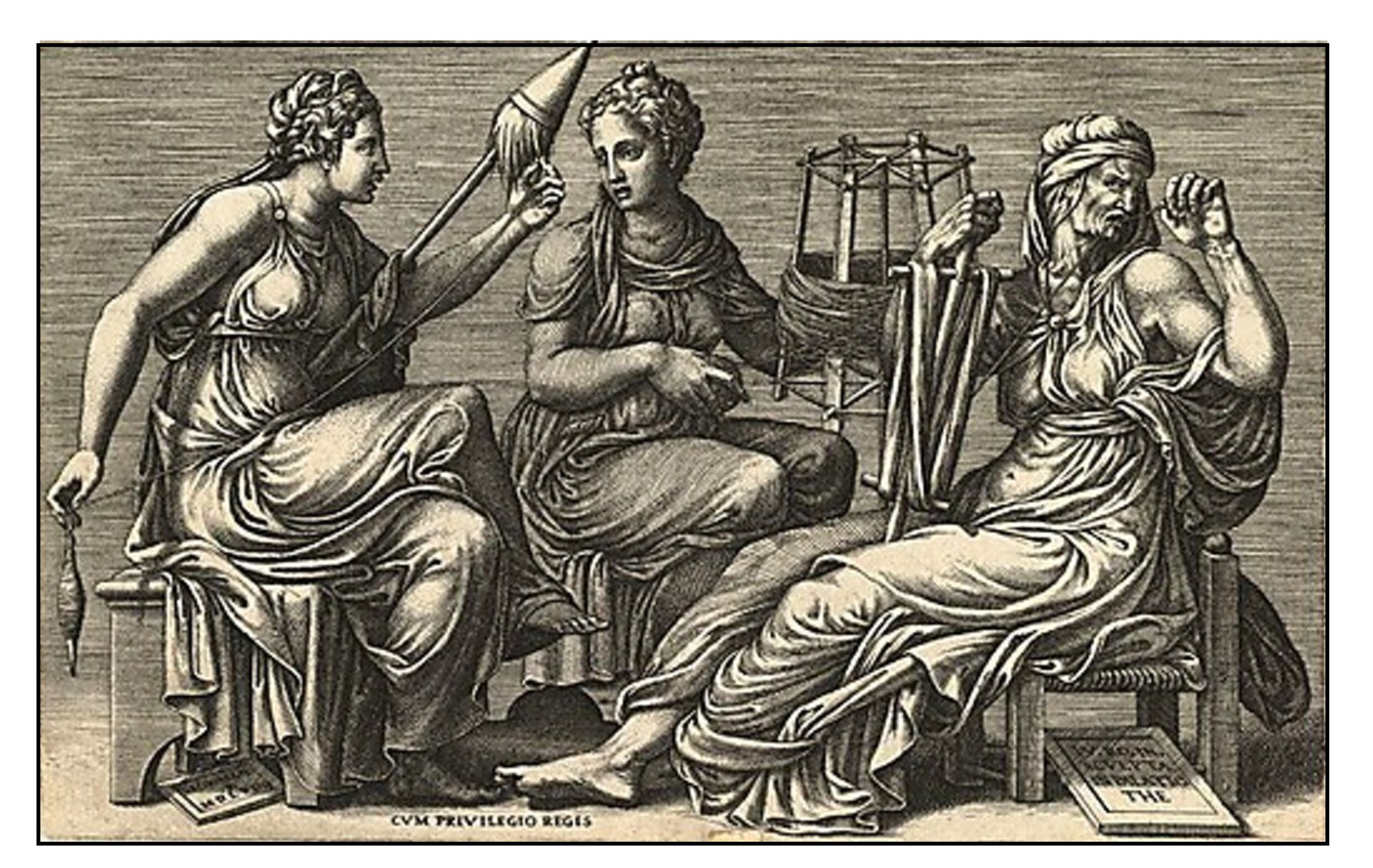
The Ancient Greeks attributed much that happens in life to fate. Fate was often personified as three women – the moirai. The word derives from meros, a part, share or portion. Clotho spins the thread of a life; Lachesis allots the life to a particular person; and Atropos cuts the thread at death. Neither human nor divine intervention can affect the actions of the fates. The following is a print of The Three Fates (1558) by Giorgio Ghisi.

Although Antigone has obeyed the unwritten code of heaven, the gods cannot intervene to save her from her ignominious death. That has been otherwise ordained – it is her fate. After Antigone is led away, the Chorus remarks that such apparently unjust ends have been suffered by others before her. Fate is a terrible thing:

The power of fate is a wonder,
dark, terrible wonder –
neither wealth nor armies
towered walls nor ships
black hulls lashed by the salt
can save us from that force.
(ll 951-954, Fagles’ translation)

Fate is described as deinos (terrible), the same word that the chorus used to describe man. We are both made and unmade by fate. We should follow the unwritten code of the gods, but doing so will not prevent death. The Fates operate according to some other code. Perhaps they follow necessity rather than justice. Perhaps they follow laws that operate beyond the individual life. The chorus briefly mentions such a possibility: Antigone may be paying for the sins of her father. However, it is possible that the Fates do not follow any code of justice. They may just enforce the physical laws by which the universe operates.

Justice

Justice is the human concept of what is right. Our words related to justice – law, morality, fairness, equity, right, righteousness – overlap in their meanings. The Greeks at the time of Sophocles also had many words (Steiner, 1984, pp 248-251; Nonet, 2006). Precise translations distinguishing these one from another are usually not possible, and the usage of the terms changed over the years.

The Greeks often personified their ideas in terms of gods. Themis was a Titaness who personified divine law. Zeus and Themis had three daughters: Dike, law; Eunomia, order; and Eirene, peace. Dike is customarily represented with a sword and a set of scales for weighing right and wrong (as in the illustrated statue from the Frankfurt Fountain of Justice, an 1887 bronze replacement for the original 1611 stone statue). Another Greek word dikaiosune came to mean both a system of justice and the virtue of righteousness (Havelock, 1969). Antigone appeals to Dike as the supporter of the unwritten laws which require the burial of the dead.

The Greeks differentiated nomos – the set of socially constructed laws – from phusis – the laws underlying the universe. The word nomima (laws, regulations, customs) derives from nomos but Antigone used it to distinguish the eternal and unwritten laws from human laws. Words do not clearly show us what is right. And they fail to clearly differentiate laws that are given from those that are constructed. Sophocles’ tragedy deals in part with our inability to know with certainty what is just.

Modern Adaptations

The story of Antigone has been retold many times (Chancellor, 1979: Steiner, 1984). These versions stress different aspects of the story, supplement the main plot with other events, or place the story in a different time and place. For brevity I shall only consider a few recent adaptations.

(i) Anouilh

During the Nazi occupation of France, Jean Anouilh wrote a version of Antigone that was set in modern times. The play was accepted by the censors and produced in Paris in 1944. Anouilh made Kreon a more sympathetic character. He removed from the play the character of Tiresias, who in Sophocles’ original play confirmed that Antigone was right. The chorus was no longer a group of Theban citizens who commented on the actions. Rather the chorus acted as a foil between the audience and the actors, describing what was going to happen and why. In this way Anouilh distanced the audience from becoming directly involved in the tragedy.

Anouilh’s Antigone is more of an existential heroine than a tragic one – she did what she did because she was seeking a reason for her life. As Kreon explains

She wanted to die! None of us was strong enough to persuade her to live. I understand now. She was born to die. She may not have known it herself, but Polynices was only an excuse.

At the end after everyone who had to die has died, Kreon goes on about his work of governing the city. The chorus explains

It’s over. Antigone’s quiet now, cured of a fever whose name we shall never know. Her work is done. A great, sad peace descends on Thebes, and on the empty palace where Creon will begin to wait for death. Only the guard are left. All that has happened is a matter of indifference to them. None of their business. They go on with their game of cards.

Anouilh’s chorus thus appears to attenuate the tragedy. However, Anouilh and his audience most certainly understood the nature of Antigone’s fever as La Résistance.

How could the German occupation authorities have allowed such a production? Steiner (1984, p. 190) notes that the evaluation of Antigone’s story in Germany between the world wars differed from that in other countries. Frightened by the communist revolts that followed the Great War, Germans saw the need for people like Kreon to maintain the safety of the state. So even if they might have felt that Antigone was right, they also knew that Kreon was not wrong. The great German philosopher Hegel had said that the state must necessarily take precedence over family and personal conscience.

(ii) Brecht

Bertolt Brecht wrote and produced a theatrically stunning version of Antigone in Switzerland in 1948. The play was preceded by a prologue set in Berlin in April 1945. This tells the story of how a young deserter from the army came to his sisters’ home bringing food for his hungry family. However, he was captured by the police and hung for treason. His body was left hanging as an example to other would-be deserters. The prologue is doubly distanced from the play. As well as being set in the near present, the prologue is narrated to the audience by one of the sisters but acted out by both. The prologue ends with a police officer asking the sisters whether they knew the traitor. The first denies her brother, but the second goes out to cut down his body.

The play then reverts to Thebes. However, the situation differs from that of Sophocles’ Antigone. Thebes had not been under siege. Rather Kreon had embarked on a war against Argos to gain their iron ore. Eteokles had been brutally killed during this war. Polyneikes saw his older brother being trampled to death, deserted from the futile battle, and was then killed by his own people. The opening choral ode, rather than celebrating the survival of the city, welcomes the wagons of booty and plunder returning from the war.

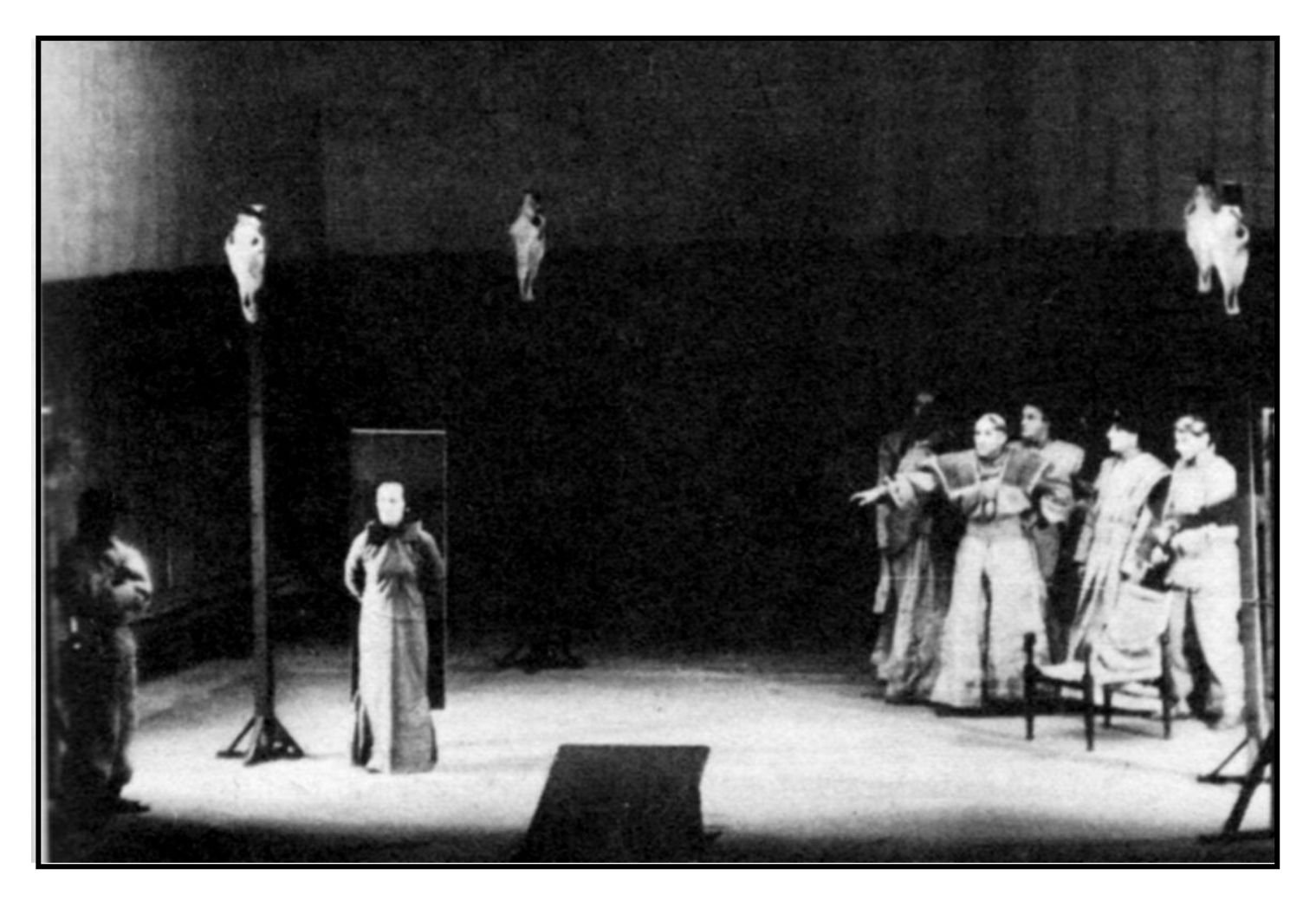
When Antigone is captured and brought before Kreon, she is bound to a board. Effectively she is carrying a door upon her back. A door she cannot open. The illustration (taken from the Suhrkamp edition of Brecht’s play) is from the first production:

Brecht’s Antigone acts politically. She defies Kreon not so much because of any unwritten laws but because she considers him an evil tyrant. She tries unsuccessfully to goad the chorus to join in her defiance. The exchange between Antigone and Kreon is more extended than in Sophocles. After her initial speech of defiance (much the same as in Sophocles), Kreon praises the success of the war, and Antigone continues:

Antigone: The men in power always threaten us with the fall of The State.
It will fall by dissension, devoured by the invaders
and so we give in to you, and give you our power, and bow down;
and because of this weakness, the city falls and is devoured by the invaders.

Kreon: Are you accusing me of throwing the city away to be devoured by the enemy?

Antigone: The city threw herself away by bowing down before you,
because when a man bows down he can’t see what’s coming at him.

The story plays itself out as in the original Greek, but at the end the city falls to its enemies. The tragedy is that of the people who foolishly followed and who keep following a tyrant. The final words of the chorus are those of despair:

For time is short
and the unknown surrounds us; and it isn’t enough
just to live unthinking and happy
and patiently bear oppression
and only learn wisdom in age.

(iii) Fugard

Athol Fugard, John Kani and Winston Ntshona created and produced a play called The Island in South Africa in 1973 as a protest against the persecutions of apartheid. The play is set in an unknown prison camp clearly modelled on Robben Island where Nelson Mandela was held. The play follows two cell mates, played by Kani and Ntshona, in prison for the minor offences of belonging to a banned organization and burning an identity card.

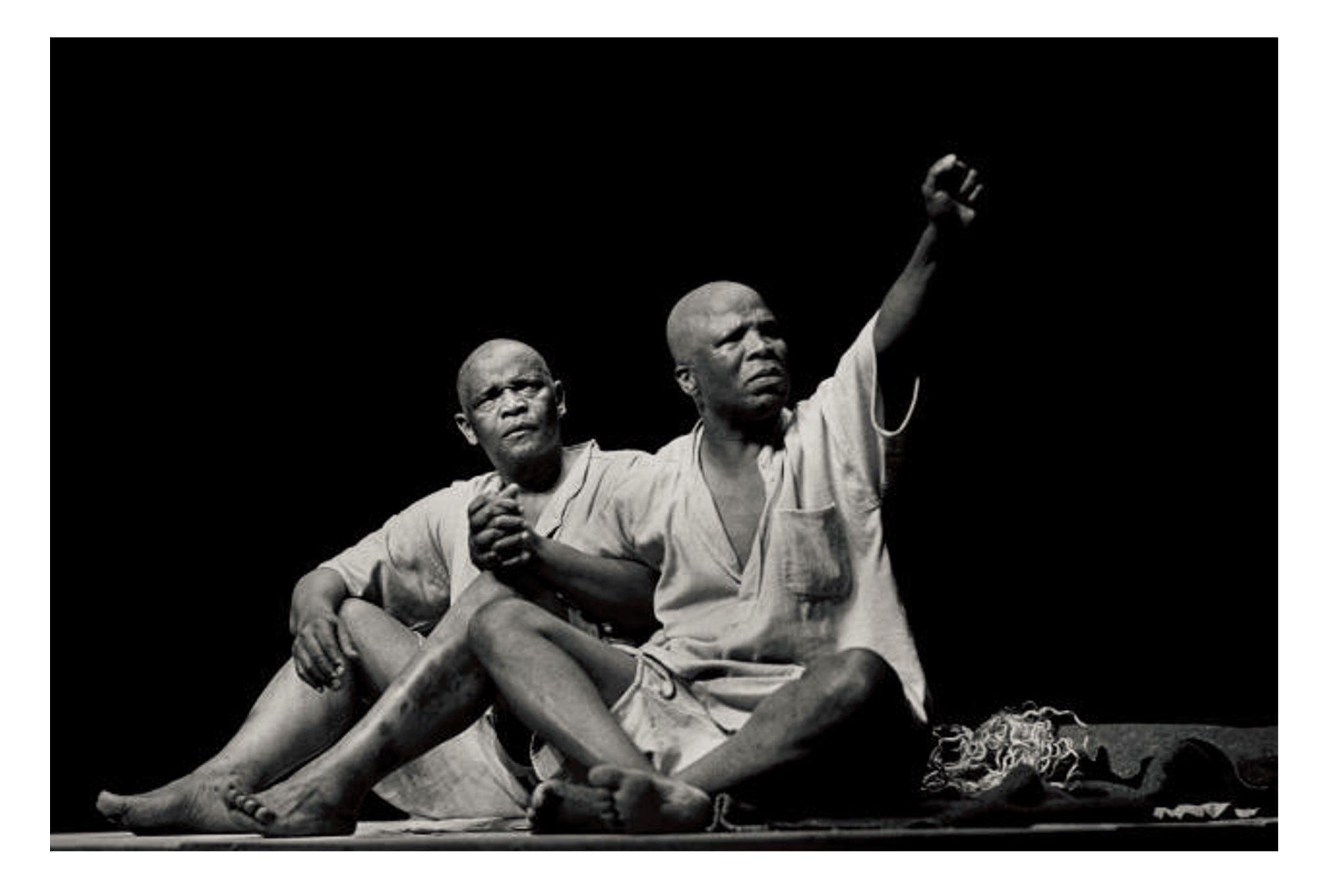
In successive scenes, the two men work at digging holes in the sand and filling them up again, rehearse a performance of Antigone that they plan to present to the camp, learn that one of them may be released but not the other, pretend to talk on the phone with friends and relatives, and finally present the dramatic confrontation between Kreon and Antigone. Below is a photograph showing Ntshona and Kani in the National Theatre revival of the play (2000):

Winston fears that his appearance as a young woman will only cause ridicule, and indeed John bursts into laughter when he first sees him in wig and costume. Yet no one laughs during the final scene when on a makeshift stage Winston tells John

You are only a man Creon. Even as there are laws made by men, so too there are others that come from God. He watches my soul for a transgression even as your spies hide in the bush at night to see who is transgressing your laws. Guilty against God I will not be for any man on this earth.

Nelson Mandela was imprisoned in 1962 for conspiring to overthrow the state. He was not released until 1990.

(iv) Carson

In 2012 Anne Carson wrote Antigonick, a version of Antigone that is more concerned with depicting the ideas and feelings of the play than rendering a literal translation. She added to the play the character of Nick, a surveyor who intermittently and mutely takes measurements of what is happening. Nick stands for the modern viewer who must somehow assess the play coming from a society many hundred years before our own.

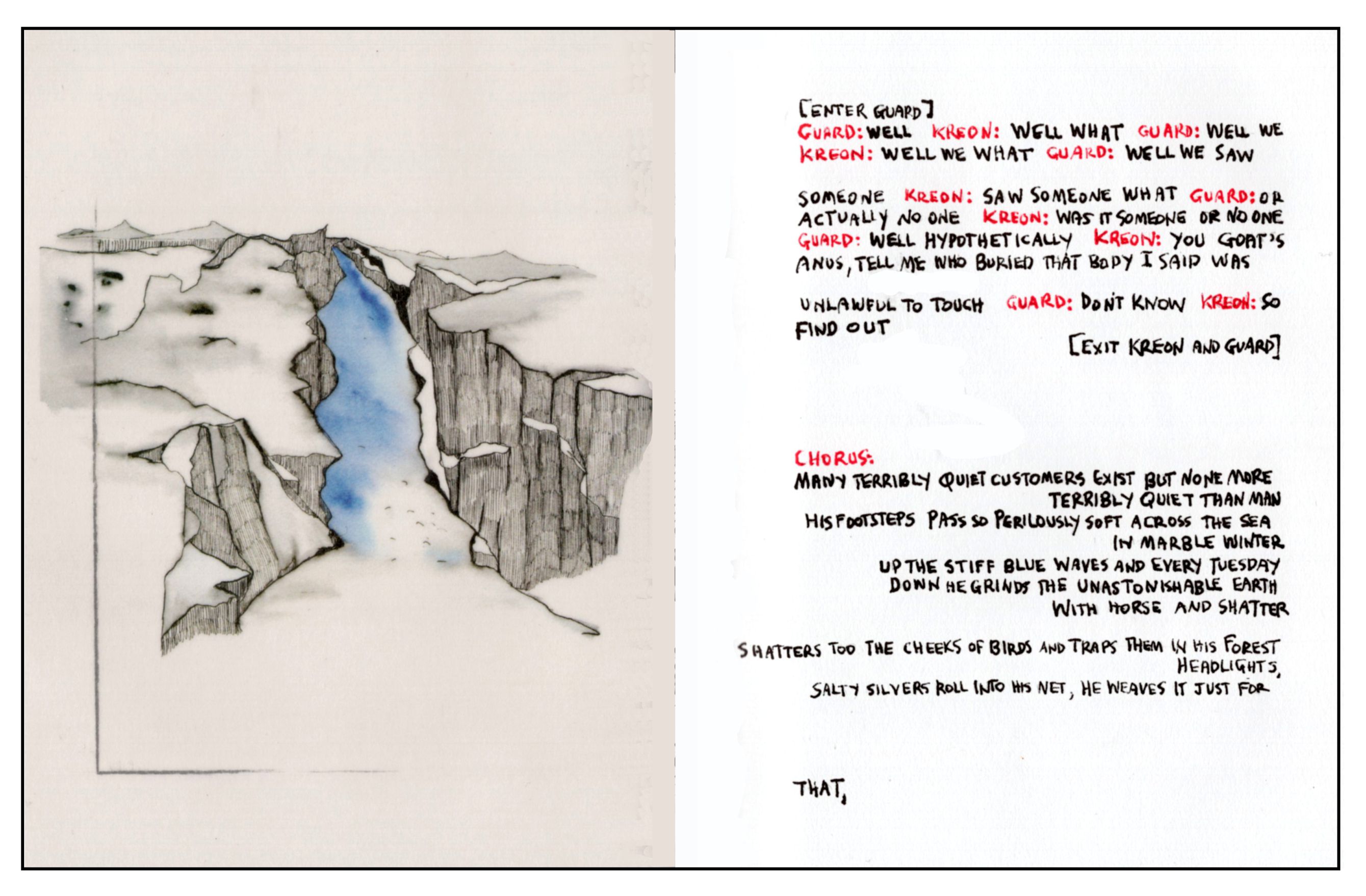
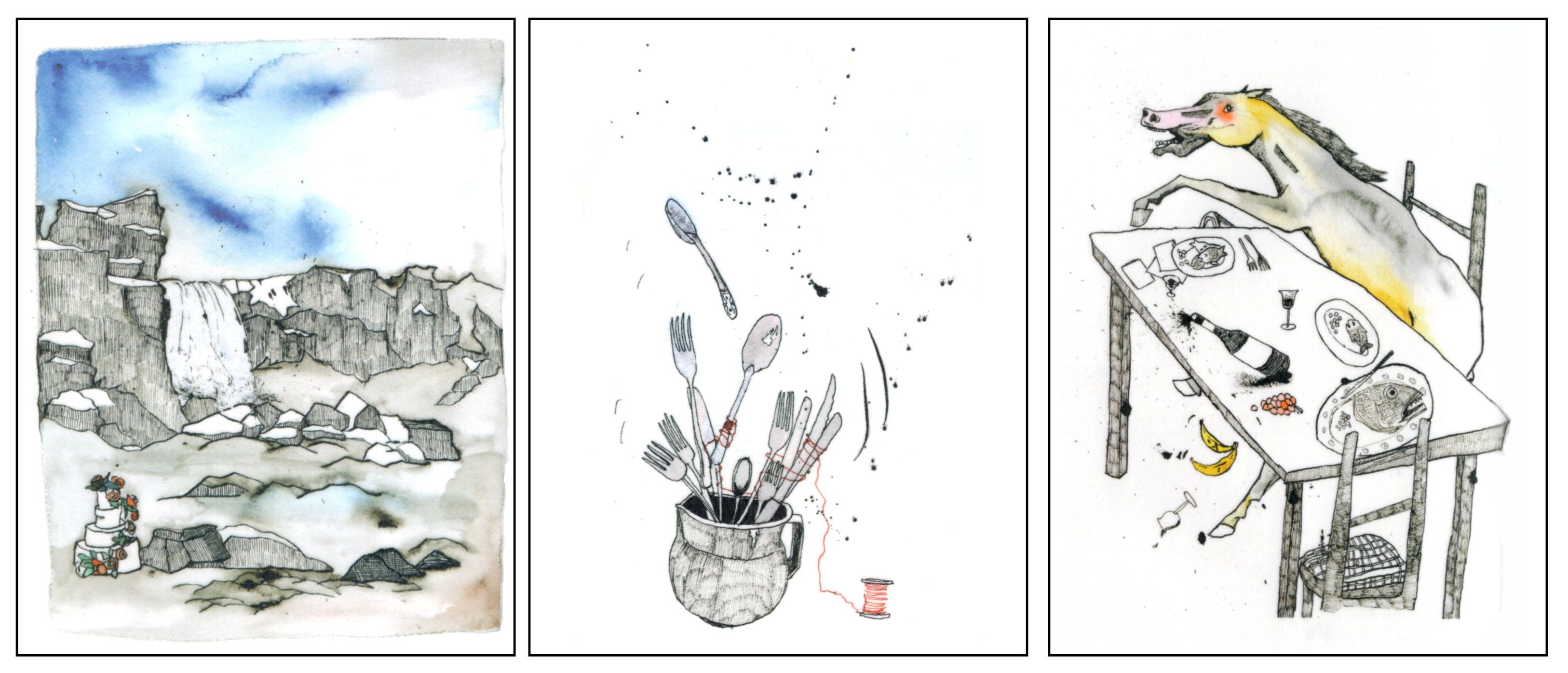
The book is presented with a text that is handwritten by Carson in small black capitals and illustrated with desolate landscapes and surrealistic images by Bianca Stone. These illustrations do not directly relate to the text but add to the book’s sense of incomprehensible passion. Below is a representation the book’s pages at the beginning of the Ode to ManAs can be seen in the ode Carson’s choice of words is designed to bring the audience the sense of the original Greek. The word deinos becomes “terribly quiet” – a description that captures the connotations of incomprehensibility and menace.

Many terribly quiet customers exist but none more
terribly quiet than man
His footsteps pass so perilously soft across the sea
in marble winter

The following illustration shows three other images from the book, one of a wedding cake in desolation, the second of cutlery flying apart under the influence of a thread (perhaps of fate), and the third of a horse upsetting a feast.

In addition, Carson sometimes includes commentary in the text. This brings the meaning up to date. In the original play just before Antigone exits to her death, the chorus provides a long discussion of the way in which fate has acted unfairly, quoting various stories from Greek mythology. A modern audience would not know these examples. In Antigonick Carson therefore replaces this choral ode by verse that slowly goes from mundane commentary to intense grief:

how is a Greek chorus like a lawyer
they’re both in the business of searching for a precedent
finding an analogy
locating a prior example
so as to be able to say
the terrible thing we’re witnessing now is
not unique you know it happened before
or something much like it
we’re not at a loss how to think about this
we’re not without guidance
there is a pattern
we can find an historically parallel case
and file it away under

Antigone buried alive Friday afternoon
compare case histories 7, 17 and 49

now I could dig up theses case histories,
tell you about Danaos and Lykourgos and the sons of Phineas
people locked up in a room or a cave or their own dark mind
it wouldn’t help you
it didn’t help me
it’s Friday afternoon
there goes Antigone to be buried alive
is there
any way
we can say
this is normal
rational
forgivable
or even in the widest definition just

no not really

(v) Zizek

In 2016 Slavoj Zizek, a provocative philosopher and communist, wrote a version of Antigone that provides three different endings. This idea of multiple endings came from Tom Tykwer’s film Run Lola Run (1998). The plot of Zizek’s Antigone proceeds as in Sophocles until Kreon sentences Antigone to death and is told by Tiresias that he has offended the gods. The first ending then follows as in Sophocles and results in the death of Antigone.

In the second ending the people of Thebes enflamed by the way Kreon offended the gods, rise up and murder him. They set fire to the city. Antigone survives though she is half-mad and does not understand why her simple act of defiance has led to such devastation. The chorus tells her that divine laws are not the ultimate authority:

A society is kept together by the bond of Word,
but the domain of logos, of what can be said,
and this mysterious vortex is what all our endeavours
and struggles are about. Our true fidelity
is to what cannot be said, and the greatest wisdom
is to know when this very fidelity
compels us to break our word, even if this word
is the highest immemorial law. This is where
you went wrong, Antigone. In sacrificing everything
for your law, you lost this law itself.

In the third ending Kreon and Antigone are reconciled, but the citizens of Thebes rise up against their rulers. Kreon is brutally executed because

Much greater evil than a lack of leadership
is an unjust leader who creates chaos in his city
by the very false order he tries to impose. Such an order
is the obscene travesty of the worst anarchy.
The people feel this and resist the leader. A true order,
on the contrary, creates the space of freedom
for all citizens. A really good master
doesn’t just limit the freedom of his subjects,
he gives freedom.

Antigone claims to be on the side of the revolution. But the leader of the people has her executed:

But the excluded
don’t need sympathy and compassion from the privileged,
they don’t want others to speak for them,
they themselves should speak and articulate their plight.
So in speaking for them, you betrayed them even more
than your uncle — you deprived them of their voice.

There is no catharsis. The revolution is brutal. The chorus attempts to excuse the horror by repeating the Ode to Man

There are many strange and wonderful things
but nothing more strangely wonderful than man

But one is left with the nightmare of revolutionaries settling scores by murder. One longs for the simplicity of Sophocles’s original wherein Kreon and Antigone were both striving to do what they thought was right. In Ziztek no one is right. Violence is the only outcome. Justice is not possible. This is not my idea of Antigone. Zizek has not found a way out of the conflict at the basis of the story. Nor has he, a committed communist, portrayed the necessity of revolution as in any way attractive.

Novels

Natalie Haynes has retold the stories of Oedipus and Antigone from the point of view of Jocasta and of Ismene in her novel The Children of Jocasta (2017). In Sophocles’ play Ismene, Antigone’s younger sister, is the only member of Oedipus’ family to survive. She initially serves as a foil for her sister, proposing compromise instead of defiance. Later she stands by her sister, though Antigone refuses her support. In Haynes’ novel the plot has changed from that of Sophocles’ plays, but the story still has its necessary confrontations and reconciliations. The plague plays the role of the Fates.

In Home Fire (2018) Kamila Shamsie has reinterpreted the story of Antigone in terms of Aneeka a young Englishwoman of Pakistani background. Her brother Parvaiz is recruited to ISIS and serves with the terrorists in Syria. Parvaiz is assassinated in Turkey when he tries to leave ISIS. The English government refuses to allow his corpse to be returned to England for burial, and arranges for it to be sent to Pakistan. Aneeka goes to Pakistan to protest this ruling but ultimately the body, the sister and her fiancé are blown to pieces in a suicide bombing.

The situation envisioned by Shamsie is clearly very possible. A citizen should have the right to be buried in his homeland. This right was recently tested in the case of Tamerlan Tsarnaev, one of the bombers at the Boston Marathon (Mendelsohn, 2013). No funeral director or cemetery in Massachusetts would accept his body. After much dispute, a Christian woman in Virginia intervened, and the body was finally buried in an unmarked grave in a small Muslim cemetery in Virginia.

Novels are discursive. They provide us with a wealth of detail, in terms of both things and thoughts. They can discuss what might have been as well as what was. They lack the harsh simplicity of a play.

A Play for All Time

Sophocles’ Antigone remains as a stirring invocation to do what is right. The world needs its Antigones. This was particularly evident in the days of Hitler (von Klemperer, 1992). Those who resisted Nazism did not succeed in changing their government. Yet they did show their countrymen that there were other ways to live and die than slavishly to follow a leader more concerned with power than with humanity.

Sophocles’ play returns time and time again. Whenever governments repress the conscience of their people. World War II generated the Antigones of Anouilh, Brecht and Orff. The situation in South Africa brought about Fugard’s The Island. The situation in Northern Ireland led to Paulin’s The Riot Act. Judith Malina translated Brecht’s Antigone while in jail in 1963 because her Living Theatre had run afoul of the US government.

The philosophy of Sophocles combines a respect for human morality and responsibility with an acquiescence to fate (Kitto, 1961, pp 123-127). In this recognition of the role played by fate, Sophocles differs from his predecessor Aeschylus:

The Aeschylean universe is one of august moral laws, infringement of which brings certain doom; the Sophoclean is one in which wrongdoing does indeed work out its own punishment, but disaster comes, too, without justification; at the most with ‘contributory negligence.’ (p 126)

Wonderful though man is he cannot control everything. This is most obvious in the fact of death. Yet before we die we can do what we believe to be right. This will not prevent our death but it will pay reverence to whatever ideas of transcendence we have conceived, be it the gods or the good.

We do not understand fate. I have already quoted the final words of Sophocles’ chorus – their praise of wisdom. Just before this they make two comments about fate. In reply to Kreon’s desire to die the chorus states

That’s in the future. We must do what lies before us.
Those who take care of these things will take their care.

And then when Kreon says that he prayed for what he longed for, they answer

Don’t pray for anything – for from whatever good
Or ill is destined for mortals, there’s no deliverance.
(Gibbons translation, ll 1334-5, 1337-8)

Sophocles is clear. Do what you think is right. Be open to the ideas of others. Do not expect reward. You will die. Life will carry on.


Texts

Note: the lines for the quotations in this posting are those in the original Greek (Brown edition) and may not fit the lines of the translations.

The Perseus Library Antigone has the full Greek text with translation and commentary by Richard Jebb (from the early 20th century).

Brown, A. (1987). Sophocles: Antigone. Warminster, Wiltshire, England: Aris & Phillips (Greek text and English translation on facing pages; good commentary)

Griffith, M. (1999). Sophocles: Antigone. Cambridge: Cambridge University Press. (Greek texts, extensive notes and commentary, but no English translation).

Performances

Orff, C., Hölderlin, F., (1949, CD conducted by Sawallisch, W., 1958, CD 2009). Antigonae. Neuhausen: Profil.

Tzavellas, G. [dir.] (film 1961, DVD 2004). Antigone. Kino International Corporation.

Translations

Carson, A., (2015). Sophokles Antigone, London: Oberon Books. This was performed at the Barbican with Juliet Binoche. It is a subdued version of Carson’s Antigonick.

Fagles, R., & Knox, B. M. G. W. (1982). The three Theban plays. London: Allen Lane/Penguin (a fine modern translation)

Gibbons, R., & Segal, C. (2003). Sophocles: Antigone. New York: Oxford University Press (a translation paying close attention to Greek poetic forms)

Heaney, S. (2004). The burial at Thebes: Sophocles’ Antigone. London: Faber and Faber. (perhaps the most beautiful of the translations)

Hölderlin, F. (1804) Sophokles Antigone. (This served as the basis for Carl Orff’s Antigonae). A translation of Hölderlin’s Antigone is available by David Constantine (BloodAxe Books, 2001). The German original is available

Paulin, T., (1985). The riot act: A version of Sophocles’ Antigone. London: Faber and Faber. (translation in modern colloquial English).

Young, G. (1906/1912). The dramas of Sophocles rendered in English verse, dramatic & lyric. Toronto: J.M. Dent & Sons. (the classical blank-verse translation). Available at archive.org

Adaptations

Anouilh, J. (1946/2005). Antigone. Paris: La Table ronde. (English translation by B. Bray & T. Freeman, Bloomsbury Methuen, 2000).

Brecht, B. (1948, edited by Werner Hecht, 1988). Brechts Antigone des Sophokles. Frankfurt: Suhrkamp. (English translation by Malina, J., 1990, Sophocles’ Antigone. New York: Applause Theatre Books).

Carson, A., (2012). Antigonick. (illustrated by Stone, B.). New York: New Directions. Carson and her colleagues presented a reading of Antigonick in 2012 at the Louisiana gallery in Denmark. The Chorus was read by Carson, Antigone by Mara Lee and Kreon by Nielsen.

Fugard, A., Kani, J., & Ntshona, W. (1974). Statements: Sizwe Bansi is dead. The island. Statements after an arrest under the Immorality Act. London: Oxford University Press.

Haynes, N. (2017). The children of Jocasta. London: Mantle Books.

Shamsie, K. (2017). Home fire. New York: Riverhead Books (Penguin)

Žižek, S. (2016). Antigone. London: Bloomsbury Academic

References

Burns, T. (2002). Sophocles’ Antigone and the history of the concept of natural law. Political Studies, 50, 545-557.

Camus, A., (1955, translated by Kennedy, E. C. 1968). On the future of tragedy. In Thody, P. (Ed.) Lyrical and critical essays. (pp. 295-310). New York: Knopf

Chancellor, G.  (1979). Hölderlin, Brecht, Anouilh: Three Versions of Antigone Orbis Litterarum, 34, 87-97

Grotius , H. (1625) De jure belli ac pacis (On the Law of War and Peace). Paris: Nicolaus Buon. (Preliminary Discourse XI) English translation available

Hegel, G. W. F. (1835, translated Knox, T. M., 1975) Hegel’s aesthetics: Lectures on fine art. Volume I. Oxford: Clarendon Press. Available 

King, M. L. Jr. (1963). Letter from a Birmingham jail. Available

Kitto, H. D. F. (1939/1961/2011). Greek tragedy: A literary study. London: Routledge.

von Klemperer, K. (1992). “What is the law that lies behind these words?” Antigone’s question and the German resistance against Hitler. Journal of Modern History 64, Suppi. (December 1992): S102-S111.

Maritain, J., (edited by Sweet, W., 2001). Natural law: Reflections on theory and practice. South Bend, IN: St. Augustine’s Press.

Mendelsohn, D. (2013) Unburied: Tamerlan Tsarnaev and the lessons of Greek Tragedy. New Yorker (May 14, 2013)

Nonet, P. (2006). Antigone’s Law. Law, Culture and the Humanities, 2, 314-335.

Reidy, D. A. (1995). Antigone, Hegel and the law: an essay. Legal Studies Forum, 19, 239-261.

Robinson, D. N. (1991). Antigone’s defense: a critical study of “Natural law theory: contemporary essays.” Review of Metaphysics, 45, 363-392.

Steiner, G. (1984). Antigones. New York: Oxford University Press.

Young, J. (2013). The philosophy of tragedy: from Plato to Žižek. Cambridge: Cambridge University Press.