The Letter of Lord Chandos: Hugo von Hofmannsthal
In 1901, Hugo von Hofmannsthal (1874-1929) wrote an essay on the inadequacy of language in the form of a letter (Ein Brief) from the fictional Philip Lord Chandos to the actual Francis Bacon (1561-1626), a famous English philosopher of science, essayist and statesman. The letter is a response to Bacon’s inquiry about the two years of unexpected silence that following Chandos’ early success as a poet. Chandos replies that he has “completely lost the ability to think or to speak of anything coherently.” He feels a deep sympathy with the world, but finds no words whereby to express this experience. He seeks but has not yet, found a language “in which inanimate things speak to me and wherein I may one day have to justify myself before an unknown judge.” The illustration shows a 1916 portrait of von Hofmannsthal by Karl Bauer.
Synopsis of the Letter
Chandos thanks Bacon for his concern. He says he is no longer the same person who wrote his early poems. He remembers that he had planned to write about the reign of Henry VIII. “Was ist der Mensch, daß er Pläne macht!” (But what is man that he should make plans!). Another scheme that he had entertained was a collection of Apothegmata that he would have called Nosce te ispsum (Know thyself). However, his thoughts ran ahead of his actions, and the world that was once open to him now evades his grasp:
Wie soll ich es versuchen, Ihnen diese seltsamen geistigen Qualen zu schildern, dies Emporschnellen der Fruchtzweige über meinen ausgereckten Händen, dies Zurückweichendes murmelnden Wassers vor meinen dürstenden Lippen?
Mein Fall ist, in Kürze, dieser: Es ist mir völlig die Fähigkeit abhanden gekommen, über irgend etwas zusammenhängend zu denken oder zu sprechen.
(This and the following audio clips are from a recitation of Ein Brief by Martin Ploderer.)
How shall I try to describe to you these strange spiritual torments, this rebounding of the fruit-branches above my outstretched hands, this recession of the murmuring stream from my thirsting lips?
My case, in short, is this: I have lost completely the ability to think or to speak of anything coherently.
The German language has two ways to express the idea of loss. The common translation of “to lose” is verlieren. Another way to say that something “has come away from my hands” – ist mir abhanden gekommen. Any blame is on that which has been lost rather than on the loser. A famous use of this idiom is in Mahler’s 1902 setting of Rückert’s Ich bin der Welt abhanden gekommen (I am lost to the world).
Chandos’ inability to think or speak is not complete. He is still able to take care of his estate. He has just lost the ability (or the will) to communicate poetically.
Chandos describes an intense, almost mystical, involvement with even the most mundane of his experiences:
Es wird mir nicht leicht, Ihnen anzudeuten, worin diese guten Augenblicke bestehen; die Worte lassen mich wiederum im Stich. Denn es ist ja etwas völlig Unbenanntes, und auch wohl kaum Benennbares, das in solchen Augenblicken, irgendeine Erscheinung meiner alltäglichen Umgebung mit einer überschwellenden Flut höheren Leben wie ein Gefäß erfüllend, mir sich ankündet. Ich kann nicht erwarten, daß Sie mich ohne Beispiel verstehen, und ich muß Sie um Nachsicht für die Kläglichkeit meiner Beispiele bitten. Eine Gießkanne, eine auf dem Feld verlassene Egge, ein Hund in der Sonne, ein ärmlicher Kirchhof, ein Krüppel, ein Kleines Bauernhaus, alles dies kann das Gefäß meiner Offenbarung werden. Jeder dieser Gegenstände und die tausend anderen ähnlichen, über die sonst ein Auge mit selbstverständlicher Gleichgültigkeit hinweggleitet, kann für mich plötzlich in irgendeinemMoment, den herbeizuführen auf keine Weise in meiner Gewalt steht, ein erhabenes undrührendes Gepräge annehmen, das auszudrücken mir alle Worte zu arm scheinen.
It is not easy for me to indicate wherein these good moments subsist; once again words desert me. For it is, indeed, something entirely unnamed, even barely nameable which, at such moments, reveals itself to me, filling like a vessel any casual object of my daily surroundings with an overflowing flood of higher life. I cannot expect you to understand me without examples, and I must plead your indulgence for their absurdity. A pitcher, a harrow abandoned in a field, a dog in the sun, a neglected cemetery, a cripple, a peasant’s hut, all these can become the vessel of my revelation. Each of these objects and a thousand others similar, over which the eye usually glides with a natural indifference, can suddenly, at any moment (which I am utterly powerless to evoke), assume for me a character so exalted and moving that words seem too poor to describe it. Even the distinct image of an absent object, in fact, can acquire the mysterious function of being filled to the brim with this silent but suddenly rising flood of divine sensation.
Chandos concludes the letter by thanking Bacon for his kindness:
Sie waren so gütig, Ihre Unzufriedenheit darüber zu äußern, daß kein von mir verfaßtes Buch mehr zu Ihnen kommt, »Sie für das Entbehren meines Umgangs zu entschädigen«. Ichf ühlte in diesem Augenblick mit einer Bestimmtheit, die nicht ganz ohne ein schmerzliches Beigefühl war, daß ich auch im kommenden und im folgenden und in allen Jahren dieses meines Lebens kein englisches und kein lateinisches Buch schreiben werde: und dies ausdem einen Grund, dessen mir peinliche Seltsamkeit mit ungeblendetem Blick dem vor Ihnen harmonisch ausgebreiteten Reiche der geistigen und leiblichen Erscheinungen an seiner Stelle einzuordnen ich Ihrer unendlichen geistigen Überlegenheit überlasse: nämlich weil dieSprache, in welcher nicht nur zu schreiben, sondern auch zu denken mir vielleicht gegeben wäre, weder die lateinische noch die englische, noch die italienische oder spanische ist,sondern eine Sprache, in welcher die stummen Dinge zuweilen zu mir sprechen, und in welcher ich vielleicht einst im Grabe vor einem unbekannten Richter mich verantworten werde.
You were kind enough to express your dissatisfaction that no book written by me reaches you any more, “to compensate for the loss of our relationship.” Reading that, I felt, with a certainty not entirely bereft of a feeling of sorrow, that neither in the coming year nor in the following nor in all the years of this my life shall I write a book, whether in English or in Latin: and this for an odd and embarrassing reason which I must leave to the boundless superiority of your mind to place in the realm of physical and spiritual values spread out harmoniously before your unprejudiced eye: to wit, because the language in which I might be able not only to write but to think is neither Latin nor English, neither Italian nor Spanish, but a language none of whose words is known to me, a language in which inanimate things speak to me and wherein I may one day have to justify myself before an unknown judge.
Fictional Context
Hofmannsthal wrote his essay in the form of a letter from Philip Lord Chandos to Francis Bacon. The letter is dated August 22, 1603. James I had just assumed the throne of England. Shakespeare was at the height of his career: Hamlet was performed in 1600, Othello in 1603, and Measure for Measure in 1604. The work of Copernicus on the Revolutions of the Heavenly Spheres (1543) had marked the beginning of the Scientific Revolution. Knowledge was becoming free of doctrine, and art becoming independent of religion.
Francis Bacon was an English statesman and philosopher of science. His Novum Organum of 1620 described how new knowledge could be induced from observations rather than deducted from axioms. He also wrote essays on a variety of topics in philosophy and religion. In 1603 there was a young Baron Chandos: Grey Bridges (1580-1621), a politician and a possible author of an anonymous collection of essays entitled Horae Subsecivae (Spare Time). The following illustration shows portraits of Bacon (left, Paul van Somer, 1617) and Bridges (right, William Larkin, 1615). However, Grey Bridges was not a poet. Though Bacon is an actual person, the Lord Chandos of Hofmannstahl’s letter is completely fictional.

Though not an actual person, Lord Chandos serves as an effective counterpoint to Bacon, representing the aesthetic approach to life as opposed to the scientific. Both forces had become strong in English Society at the time of the fictional letter.
Personal Context
The Lord Chandos of the letter is far more similar to Hofmannsthal than to any young Jacobean lord. Hofmannsthal had begun his career as a lyric poet. His poetry was “romantic” in its stress on the individual’s emotional response and “symbolist” in its search for meanings beyond reality. The 1892 poem Erlebnis (Experience) describes a vision of death and time:
Mit silbergrauem Dufte war das Tal
Der Dämmerung erfüllt, wie wenn der Mond
Durch Wolken sickert. Doch es war nicht Nacht.
Mit silbergrauem Duft des dunklen Tales
Verschwammen meine dämmernden Gedanken,
Und still versank ich in dem webenden,
Durchsichtgen Meere und verließ das Leben.
Wie wunderbare Blumen waren da,
Mit Kelchen dunkelglühend! Pflanzendickicht,
Durch das ein gelbrot Licht wie von Topasen
In warmen Strömen drang und glomm.
Das Ganze War angefüllt mit einem tiefen Schwellen
Schwermütiger Musik. Und dieses wußt ich,
Obgleich ichs nicht begreife, doch ich wußt es:
Das ist der Tod. Der ist Musik geworden,
Gewaltig sehnend, süß und dunkelglühend,
Verwandt der tiefsten Schwermut.
Aber seltsam!
Ein namenloses Heimweh weinte lautlos
In meiner Seele nach dem Leben, weinte,
Wie einer weint, wenn er auf großem Seeschiff
Mit gelben Riesensegeln gegen Abend
Auf dunkelblauem Wasser an der Stadt,
Der Vaterstadt, vorüberfährt. Da sieht er
Die Gassen, hört die Brunnen rauschen, riecht
Den Duft der Fliederbüsche, sieht sich selber.
Ein Kind, am Ufer stehn, mit Kindesaugen,
Die ängstlich sind und weinen wollen, sieht
Durchs offne Fenster Licht in seinem Zimmer –
Das große Seeschiff aber trägt ihn weiter,
Auf dunkelblauem Wasser lautlos gleitend
Mit gelben, fremdgeformten Riesensegeln.
This is a recitation of the poem by Wort Krämer
And a translation by J. D. McClatchy (2008, pp 24-5):
At dusk a silvery fragrance filled the valley,
As when the moon is viewed through a veil of cloud.
But it was not yet night. In the darkening valley
That fragrance drifted through my shadowy thoughts
And silently I sank into the wavering,
Diaphanous sea, and left my life behind.
What wondrous flowers had bloomed there,
Cups of colors darkly glowing! And a thicket
Amidst which a flame like topaz rushed,
Now surging, now gleaming in its molten course.
All of it seemed filled with the deep swell
Of a mournful music. This much I knew,
Though I cannot understand it—I knew
That this was Death, transmuted into music,
Violently yearning, sweet, dark, burning,
Akin to deepest sadness.
Yet how strange!
A nameless longing after life now wept
Inside my soul without a sound, wept
As one might weep who on a galleon
With giant gilded sails of an evening slides
Over the indigo waters past a town,
His native town. And there he spies again
The streets, hears the fountains plash, breathes
In the scent of lilacs, and sees himself again,
A child standing on the shore, wide-eyed,
Anxious and close to tears, and looks then through
An open window to see a light on in his room—
But the huge ship is bearing out to sea
Without a sound over the indigo waters
With its giant gilded unearthly sails.
As the 19th Century came to an end, Hofmannsthal began to feel uneasy about his writing, which no longer seemed to capture what he wanted to say about the world.
There is no question that Chandos’ crisis reflects a crisis of Hofmannsthal’s own; after a decade of astonishing facility and productivity, Hofmannsthal suddenly finds himself unsure of his own verbal mastery. (Bennett, 1988, p 129)
Hofmannsthal composed only a few isolated poems after 1898 (Kovach, 2002, p 86; Schaber, 1970). However, unlike the fictional Lord Chandos, he did not forsake writing. Rather he turned to drama and to opera. His 1903 play Elektra was successful, and was converted into an opera in 1909 with music by Richard Strauss. Over the next two decades continued to write libretti for Strauss operas, among them Der Rosenkavalier (1911) and Ariadne auf Naxos (1912/1916), and Arabella (1933).
Hofmannsthal stopped trying to figure out what is the mystery of life, and began to consider how people live their lives. Toward the end of Act I of Der Rosenkavalier, the Marschallin remarks
Das alles ist geheim, so viel geheim.
Und man ist dazu da, daß man’s entragt.
Und in dem “Wie” da liegt der ganze Untershied—
It’s all a mystery, so much is mysterious.
And we are here to endure it.
And in the How, there lies the whole difference—
McClatchy (2008) used this quotation as the epigraph to a selection of Hofmannsthal’s writings.
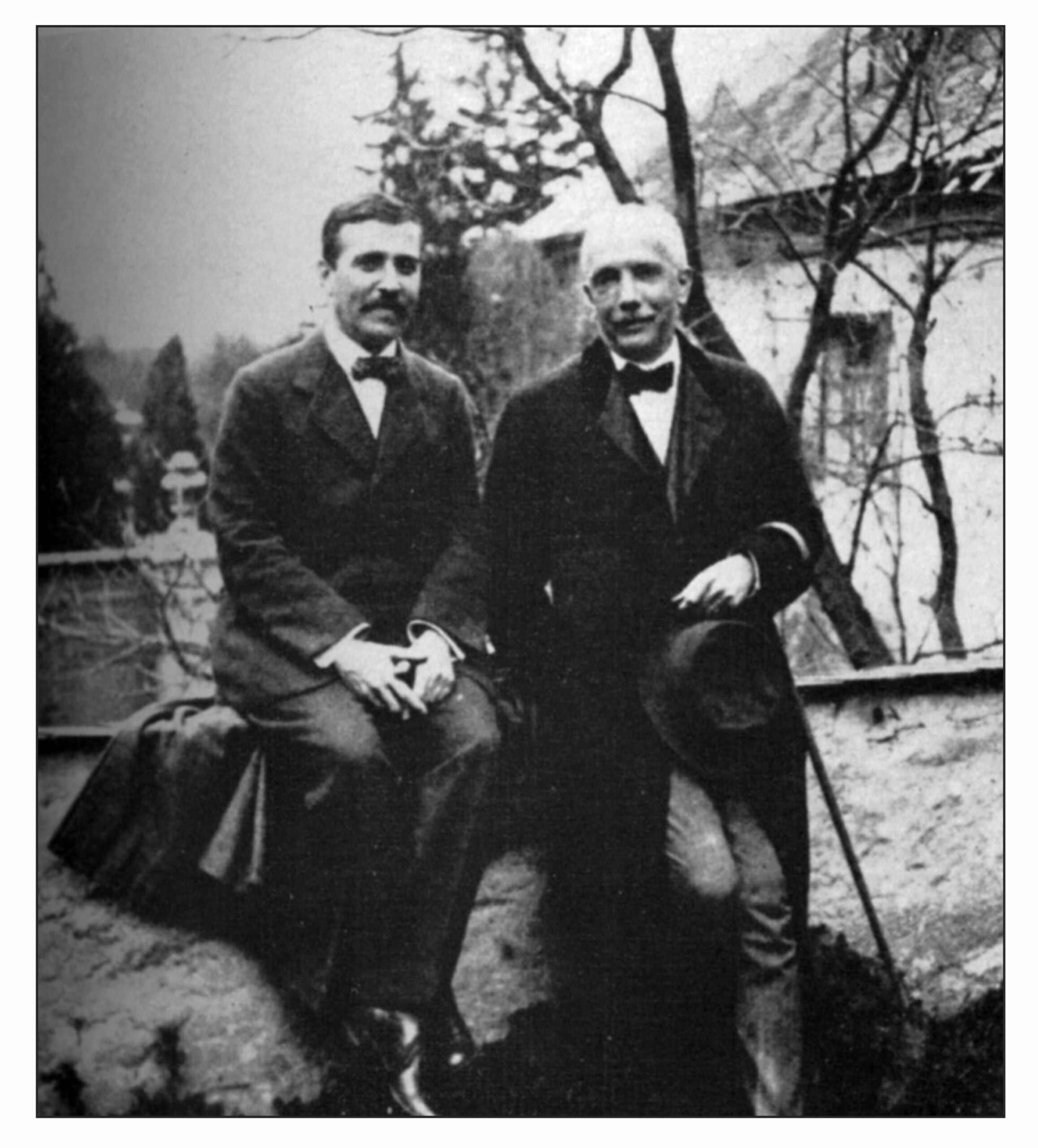
The following is a photograph of Hofmannsthal and Strauss from 1912:
The Paradox of the Letter
Many critics have noted that, given that his inability to think or speak coherently, Lord Chandos could not possibly have written his letter to Francis Bacon:
Perhaps the most peculiar thing about the Chandos letter is its inherent paradox. While the fictitious author claims to be unable to employ language effectively, the essay itself is a masterpiece of literary artistry. The images are bright, colorful, and vibrant. The selection of words and the organization of ideas are flawless. Each sentence, each phrase is constructed with care and precision, is impregnated with life and meaning. The whole is ordered so as to allow each detail to convey its message with power. In short, it is not the work of a spiritually disturbed Chandos, but of the virtuoso Hofmannsthal. (Bangerter, 1977, p 28)
The Chandos letter, taken literally, rests on the impossible condition, the absurdity, in fact, that a man in Chandos’ condition could write any letter, not to mention one involving such complexity of thought. When Chandos states that he has completely lost the ability to think or speak coherently, he precludes the possibility of writing anything, including the letter in which he makes such a statement. The point is that Chandos, who is an invented figure, did not write the letter, Hofmannsthal did. Hofmannsthal, who does not have Chandos’ problem of disorientation, is able to compose the letter that he imagines Chandos would have written had he been able to write. (Daviau, 1971, p 30)
The letter describes the state of mind of a man who can no longer communicate what he experiences to others. Hofmannsthal has to imagine what this was like. It remains problematic that one so capable of communication could really understand what it is like to have lost that ability.
The Language Crisis
For Chandos expressing his experiences in language has become impossible. Any attempt to do so leads to a whirlpool of words:
Es zerfiel mir alles in Teile, die Teile wieder in Teile und nichts mehr ließ sich mit einem Begriff umspannen. Die einzelnen Worte schwammen um mich; sie gerannen zu Augen die mich anstarrten und in die ich wieder hineinstarren muß: Wirbel sind sie, in die hinabzusehen mich schwindelt, die sich unaufhaltsam drehen und durch die hindurch man ins Leere kommt.
For me everything disintegrated into parts, those parts again into parts; no longer would anything let itself be encompassed by one idea. Single words floated round me; they congealed into eyes which stared at me and into which I was forced to stare back – whirlpools which gave me vertigo and, reeling incessantly, led into the void.
Chandos’ description of his difficulty with language relates to the Sprachkrise (language crisis) experienced by Austrian philosophers and writers at the beginning of the 20th Century (Gray, 1986). This was clearly not an aspect of writing in England in 1603: at that time, the English language had no reservations about its ability to discover knowledge or to portray beauty. As the 19th Century came to an end, however, our trust in language was beginning to crumble. Hofmannsthal wished to consider this problem in the context of a time when poets and scientists still had full command of their words.
With the industrial revolution, the place of art in society changed. Poetry was no longer the darling of the aristocracy – elevated thoughts in elevated language. To continue to have any meaning, poetry needed to become more like everyday speech and to consider everyday problems.
Chandos’s letter suggests a real pessimism about the possibility of revivifying language, indicating both that the future lies with a language which is no language and that, until this language is found, the only possibility is silence. Chandos’s pessimism can be seen in the list of objects which, in an imaginative desert, still ignite in him an occasional and momentary vision of eternity: a watering can, a deserted harrow in the fields, a dog in the sun, a wretched churchyard, a cripple, a peasant cottage. All of these ciphers suggest tiredness, desertedness, decrepitude and pathos: all seem residues of a lost unity rather than pointers to a unity to come. A similar sense of pessimism about the possibility of revivifying language, a similar sense that all that remains are a few isolated and arbitrary symbols, runs through the writings of Eliot, Yeats and Rake. Eliot ends The Waste Land by shoring a few arcane fragments of language against the ruin of the present. (Sheppard, 1976, p 324).
The language crisis extended beyond poetry. At about the same time as Hofmannsthal’s letter, Franz Mauthner (1849-1923) published his Beiträge zu einer Kritik der Sprache (Contributions to a Critique of Language, 1901-2). This called into question the very basis of language as a means of representing reality. Gray (1986, p 335) remarks
Mauthner conceives of language as a fundamentally metaphorical, and thus “mendacious,” phenomenon. The very act in which language is created, the transformation of sense data into articulated sounds, is an act of metaphorization. Due to this inherent metaphoricity, language cannot express “truth,” which, for Mauthner, can only consist in the perfect identity of language with the objective reality it is intended to express.
Ludwig Wittgenstein (1889-1951) was significantly affected by the work of Mauthner, though he was less pessimistic about the possibilities of language. He mentions Mauthner in his Tactatus Logico-Philosophicus (1922, 4.0031)
Alle Philosophie ist “Sprachkritik”. (Allerdings nicht im Sinne Mauthners.)
All philosophy is “Critique of language” (but not at all in Mauthner’s sense)
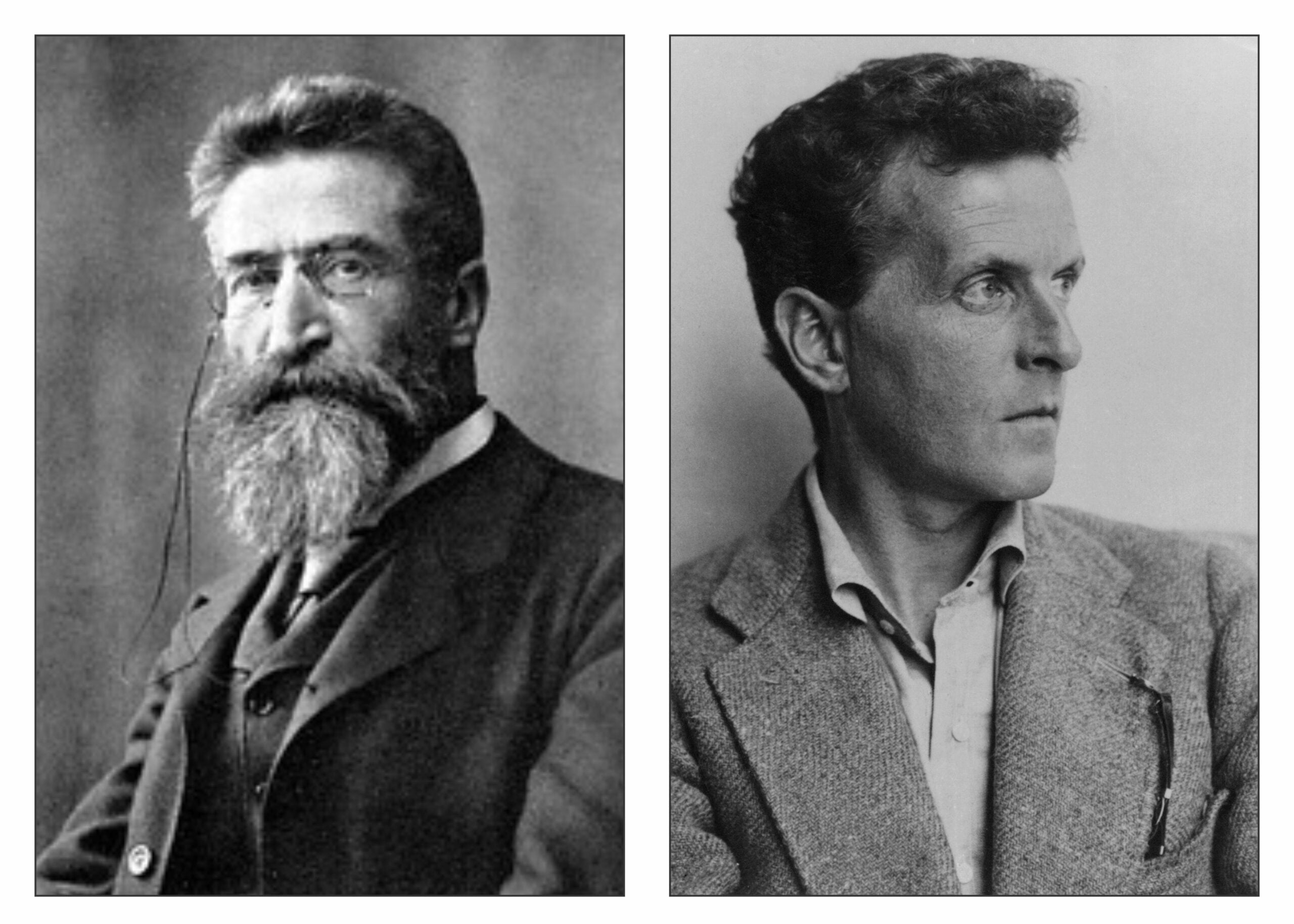
The following illustration shows portraits of Mauthner (from the 1900s) and Wittgenstein (from the 1920s)
Though mainly related to poetic language, Hofmannsthal’s letter also suggests the more general problem of the relationship between language and experience:
Chandos’ crisis points to what was to become a central philosophical preoccupation of the twentieth century, reflected in the philosophy of Ludwig Wittgenstein as well as in more recent developments such as Jacques Derrida’s deconstruction: namely, the demonstration that language can no longer be relied on as a valid signifier of a reality which exists outside itself, and in fact that we cannot ever experience a “reality” which is not already mediated by our language. (Kovach, 2002, p 94)
Like Staring into the Sun
Although Chandos concentrates on his linguistic difficulties, he also describes his recent experiences as overwhelming:
Ja, es kann auch die bestimmte Vorstellung eines abwesenden Gegenstandes sein, der dieunbegreifliche Auserwählung zu Theil wird, mit jener sanft oder jäh steigenden Flut göttlichen Gefühles bis an den Rand gefüllt zu werden.
Even the distinct image of an absent object, in fact, can acquire the mysterious function of being filled to the brim with this silent but suddenly rising flood of divine sensation.
Though he does not acknowledge it, these experiences are inherently mystical. And as such they are perhaps ineffable. Far be it for human minds to put into words the experience of the divine. The concluding proposition of Wittgenstein’s Tractatus is
Wovon man nicht sprechen kann, darüber muss man schweigen
Whereof one cannot speak, thereof one must be silent.
However, an experience that cannot be put into words – something that is impossible to understand – can be terrifying. The mystical vision of Lord Chandos is not easy to bear. In a postscript to Elizabeth Costello (2003) J. M. Coetzee imagined what it might have been like to be Chandos’ wife, who tried to share his experiences. She writes a follow-up letter to Bacon, stressing how much they need his help:
All is allegory, says my Philip. Each creature is key to all other creatures. A dog sitting in a patch of sun licking itself, says he, is at one moment a dog and at the next a vessel of revelation. And perhaps he speaks the truth, perhaps in the mind of our Creator (our Creator, I say) where we whirl about as if in a millrace we interpenetrate and are interpenetrated by fellow creatures by the thousand. But how I ask you can I live with rats and dogs and beetles crawling through me day and night, drowning and gasping, scratching at me, tugging me, urging me deeper and deeper into revelation — how? We are not made for revelation, I want to cry out, nor I nor you, my Philip, revelation that sears the eye like staring into the sun. Save me, dear Sir, save my husband! (Coetzee, 2003, p 229)
Envoi
The Letter of Lord Chandos has had far-reaching effects. Many writers have provided responses to the letter (e.g. Fraser, 1990; Spahr et al., 2002; Quignard, 2020). None have completely resolved the issues that were raised in Hofmannsthal’s letter. Modernism found a way to allow poetry in an age where language had to communicate present truth rather than talk beautifully about lofty ideas. However, we still have not really found a way to combine beauty with truth. And we have come to realize that there is much in this world that we still do not understand and cannot describe in words. We can keep trying.
References
Bangerter, L. A. (1977). Hugo von Hofmannsthal. F. Ungar.
Bennett, B. (1988). Hugo von Hofmannsthal: the theaters of consciousness. Cambridge University Press.
Coetzee, J. M. (2003). Elizabeth Costello: eight lessons. Secker & Warburg.
Daviau, D. G. (1971). Hugo von Hofmannsthal and The Chandos Letter. Modern Austrian Literature, 4(2), 28–44.
Fraser, J. (1990) In defence of language; if it needs it. University of Toronto Quarterly, 59, (2), 269-286
Gray, R. T. (1986). Aphorism and Sprachkrise in turn-of-the-century Austria. Orbis Litterarum, 41(4), 332–354.
Hofmannsthal, H. von (1902). Ein Brief. Der Tag. Berlin, Nr. 489, 18. Oktober 1902 (Teil 1); Nr. 491, 19. Oktober 1902 (Teil 2). Available at Projekt Gutenberg-DE. English translation by T. Stern & J. Stern (1952, reprinted, 2008). In J. D. McClatchy (Ed.) The whole difference: selected writings of Hugo von Hofmannsthal. (pp. 69-79). Princeton University Press. Available at Washington University website.
Kovach, T. A. (2002). A companion to the works of Hugo von Hofmannsthal. Camden House.
McClatchy, J. D. (Ed.) (2008). The whole difference: selected writings of Hugo von Hofmannsthal. Princeton University Press
Quignard, P. (2020). La réponse à Lord Chandos. Éditions Galilée.
Schaber, S. C. (1970). The Lord Chandos Letter in the light of Hofmannsthal’s lyric decade. Germanic Review, 45(1), 52–58.
Sheppard, R. (1976). The crisis of language. In Bradbury, M., & McFarlane, J. W. (Eds.). Modernism: 1890-1930. (pp 323-336). Penguin.
Spahr, R., Spiegel, H., & Vogel, O. (Eds) (2002). Lieber Lord Chandos: Antworten auf einen Brief. S. Fischer.
Wittgenstein, L. (1921, translated by C.K. Ogden, 1922, revised translation by D. F. Pears and B. F. McGuinness, 1961, reprinted 2005). Tractatus Logico-Philosophicus. Routledge.