Pontius Pilate: The Trial of Jesus
During the reign (14-37 CE) of the Roman Emperor Tibberius, Pontius Pilates served as Prefect of Judaea from 26 to 37 CE. During this time, the High Priest of the Temple was Joseph ben Caiaphas, who had succeeded his father-in-law Annas in 18 CE and served until 36 CE. Pontius Pilate was primarily responsible for the Judaea and Samaria, but the regions of Galilee and Perea were ruled as Roman vassal states by the tetrarch Herod Antipas who reigned from the death of his father Herod the Great in 4 BCE until 39 CE. Pontius Pilate presided over the trial of Jesus of Nazareth, most likely during the celebration of Passover in 33 CE. The illustration shows Jesus before Pilate, a panel of the Maestà (1311 CE) by Duccio di Buoninsegna.
History
Although the details of the trial of Jesus as reported in the Christian Gospels may or may not be true, two early historians have provided evidence that Jesus did indeed exist and that he was condemned by Pilate to die by crucifixion.
Flavius Josephus (37-100CE), a Roman Jewish historian, mentioned the crucifixion of Jesus in Book 18 of The Antiquities of the Jews (written in Greek and published in 94 CE). We do not have a copy of the original publication and the earliest known manuscripts date to about the 10th Century CE, 900 years later. Most scholars agree that the section describing Jesus is authentic but that additions were made to it as the book was copied in the monasteries (Baras, 1987). Meier (1991, pp 59-62) proposes the following translation with the additions noted in italics.
At this time there appeared Jesus, a wise man, if indeed one should call him a man. For he was a doer of startling deeds, a teacher of people who receive the truth with pleasure. And he gained a following both among many Jews and among many of Greek origin. He was the Messiah. And when Pilate, because of an accusation made by the leading men among us, condemned him to the cross, those who had loved him previously did not cease to do so. For he appeared to them on the third day, living again, just as the divine prophets had spoken of these and countless other wondrous things about him. And up until this very day the tribe of Christians, named after him, has not died out.
Tacitus (56-120 CE), a Roman historian, mentions the crucifixion of Christ in Book 15 of The Annals (written in Latin and published about 115 CE), while discussing the Fire of Rome (64 CE) during the reign (54-68 CE) of Emperor Nero. No one knows the cause of the fire, but many suspected that it was caused by Nero, perhaps to make space for new buildings, perhaps to serve as backdrop for a theatrical performance. To remove suspicion from himself, Nero then accused the Christians in Rome of starting the fire.
But all human efforts, all the lavish gifts of the emperor, and the propitiations of the gods, did not banish the sinister belief that the conflagration was the result of an order. Consequently, to get rid of the report, Nero fastened the guilt and inflicted the most exquisite tortures on a class hated for their abominations, called Christians by the populace. Christus, from whom the name had its origin, suffered the extreme penalty during the reign of Tiberius at the hands of one of our procurators, Pontius Pilatus, and a most mischievous superstition, thus checked for the moment, again broke out not only in Judaea, the first source of the evil, but even in Rome, where all things hideous and shameful from every part of the world find their centre and become popular.
At the time that Tacitus was writing the Roman officials in charge of provinces were no longer called “prefects” or “governors” but had been renamed “procurators,” in keeping with the change in their main responsibilities from military to fiscal.
Context
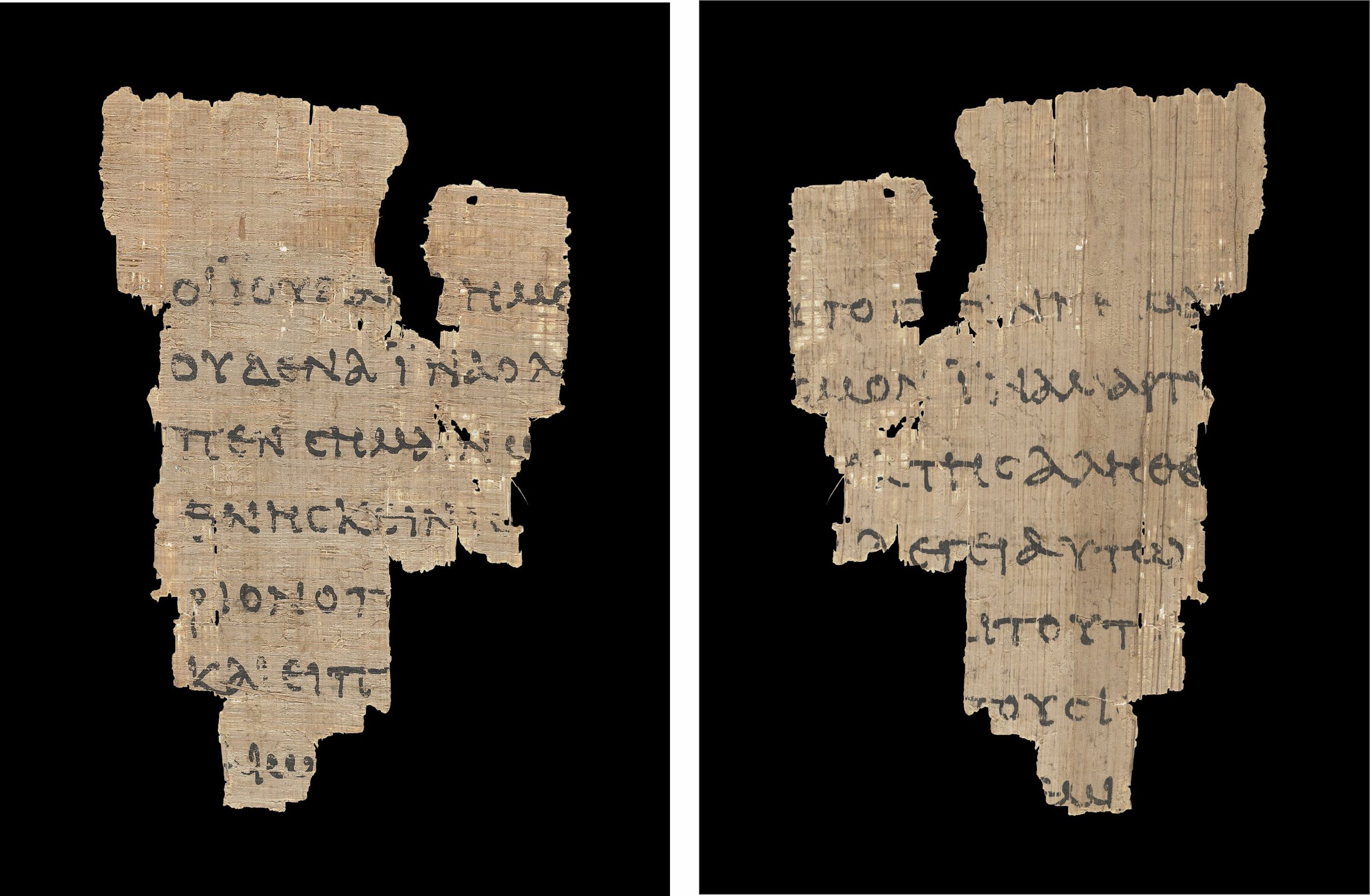
Despite the uncertainty about the reported details, the description of the trial in the gospels provides significant information about the beliefs of those that followed Jesus of Nazareth. This post will consider the narrative of the trial by focussing on the Gospel of John, written about 90 CE (Spong, 2013). The author was initially considered to be the disciple John, but most scholars now believe that the gospel was written by his followers. Although John was the last of the four canonical gospels to be written, the oldest known manuscript fragment of any gospel – the Ryland Papyrus 52 – is from a copy of John dated to the early 2nd Century CE. The papyrus is written on both sides indicating that it came from a codex rather than a scroll. The words on the papyrus concern the trial of Jesus. The first side (recto) shows part of John 18:31-33
Then said Pilate unto them, Take ye him, and judge him according to your law. The Jews therefore said unto him, It is not lawful for us to put any man to death:
That the saying of Jesus might be fulfilled, which he spake, signifying what death he should die.
Then Pilate entered into the judgment hall again, and called Jesus, and said unto him, Art thou the King of the Jews?
And the opposite side (verso) shows part of John 18:37–38
Pilate therefore said unto him, Art thou a king then? Jesus answered, Thou sayest that I am a king. To this end was I born, and for this cause came I into the world, that I should bear witness unto the truth. Every one that is of the truth heareth my voice.
Pilate saith unto him, What is truth? And when he had said this, he went out again unto the Jews, and saith unto them, I find in him no fault at all.
The beginning of the word ΑΛΗΘΕΙΑ (αλήθεια, alítheia, “truth” as in John 18: 37) can be seen at the end of the third line of the verso of the papyrus fragment (right):
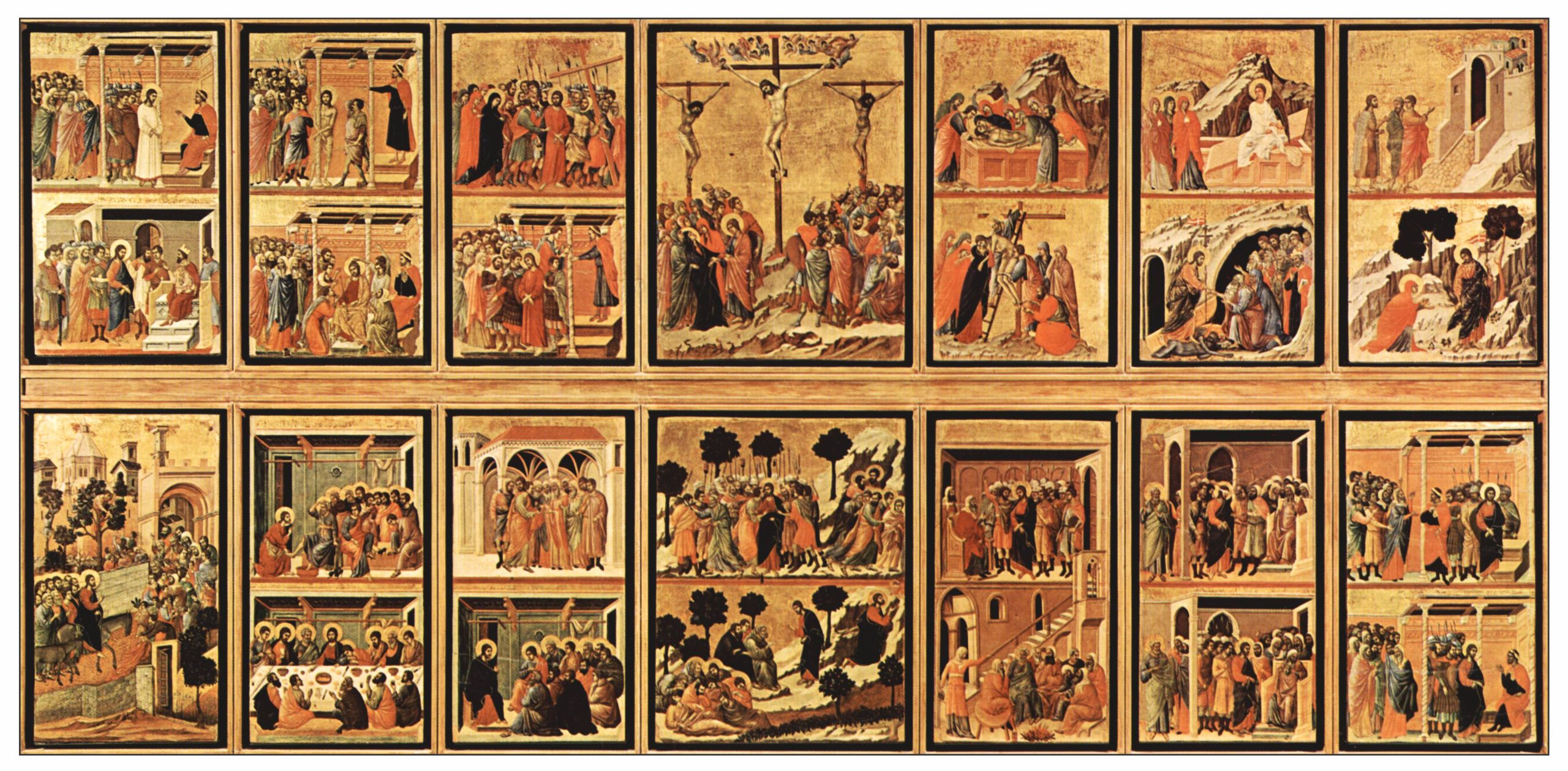
To illustrate the narrative of the trial, this post will use panels from The Passion of Christ, a series of 25 paintings by Duccio di Buoninsegna (1255–1319 on the reverse of the Maestà (1311, the enthroned Madonna with the child Jesus) in Siena Cathedral. The images were painted in egg tempera and gold leaf on wooden panels. The standard panel is 50 cm × 53.5 cm. Some panels are wider, and others have images that are twice the standard height. The narrative begins at the bottom left with the Christ’s Entry into Jerusalem and concludes at the top right with Christ’s Appearance on the Road to Emmaus. The lower half of The Passion portrays events that occur before those in the upper half, and the lower panel of each section occurs before the upper panel.

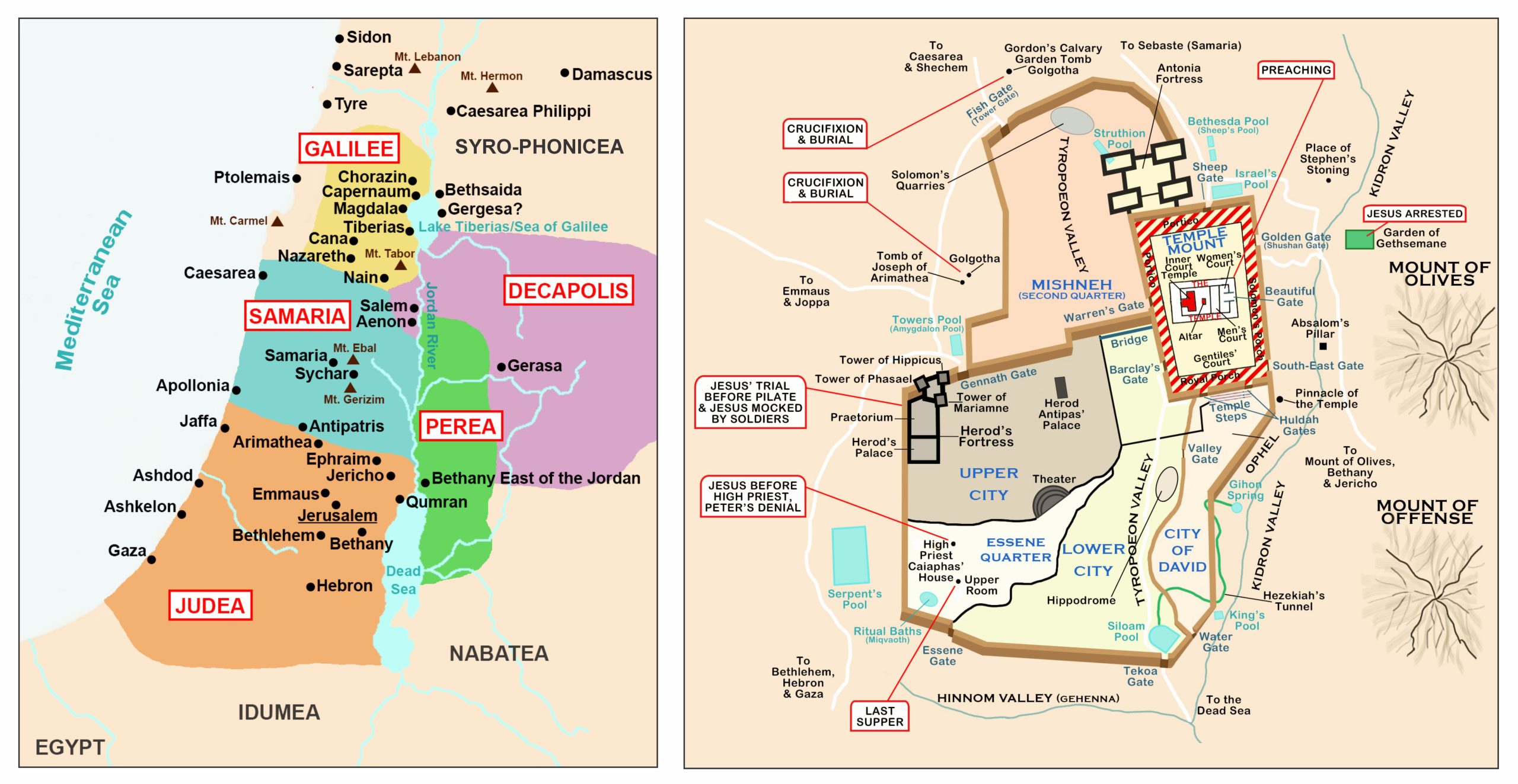
The following maps provide on the left an overview of the Roman Province of Judaea in the 1st Century CE. Pilate spent most of his time in Caesarea on the coast. During the annual celebration of the Passover, when many Jews came to Jerusalem, Pilate travelled there with a small cohort of soldiers to ensure order and prevent any outbreak of rebellion. The Jews believed they should only be ruled by God and fiercely opposed the Roman occupation of Judaea. Some Jews – the Zealots – favored armed resistance. While in Jerusalem, Pilate stayed at the palace of the late Herod the Great. On the right of the illustration is a plan of the city of Jerusalem, showing the presumed locations of the various events during the Passion of Jesus. Two different sites have been proposed for the crucifixion (and entombment). Both maps have been modified slightly from the Conforming to Jesus website.
The Arrest
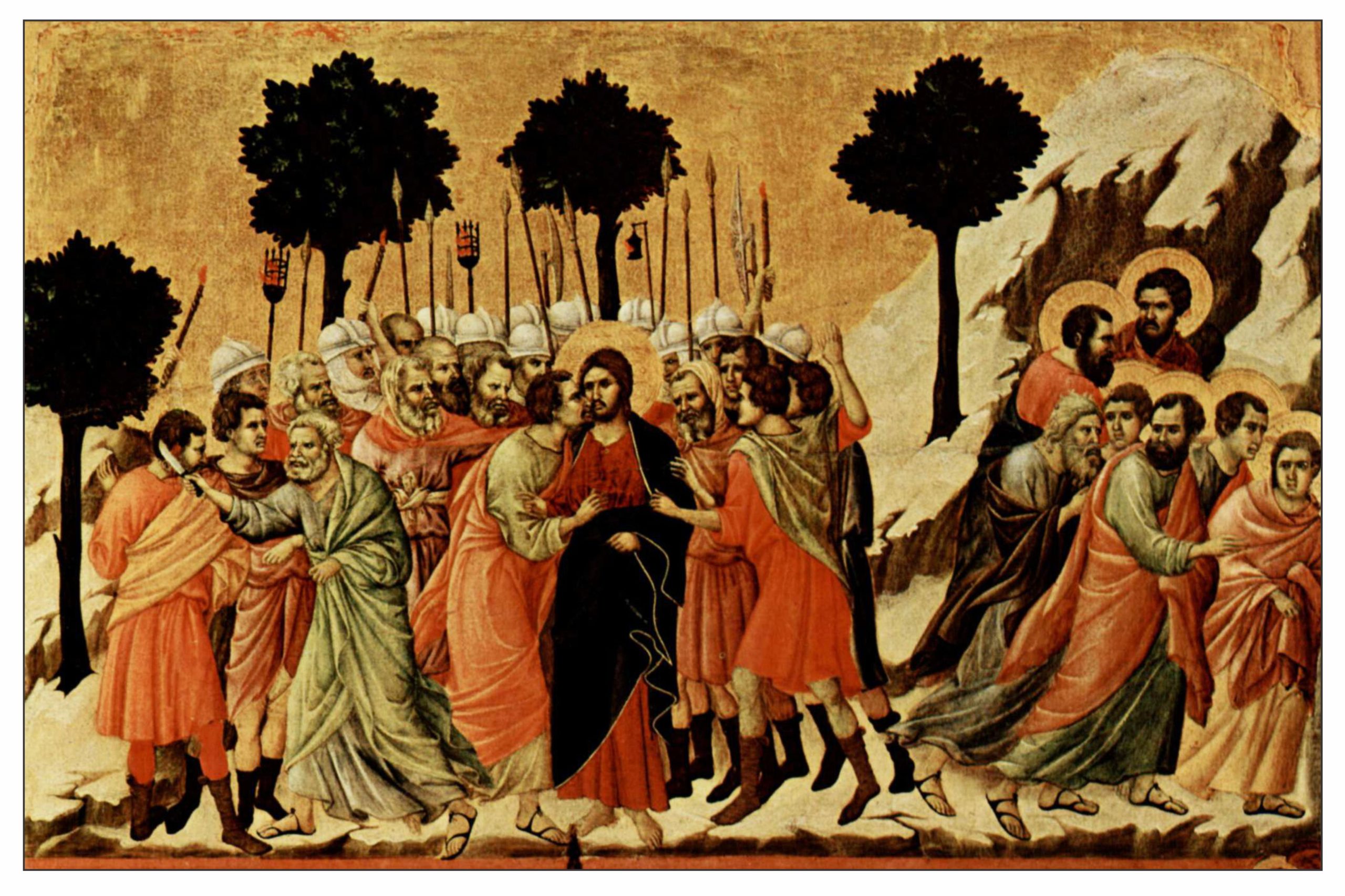
After the last supper, Jesus and his disciples retire to a garden on the slopes of Mount Olive. In Mark and Matthew the garden is named Gethsemane (“olive press”). While Jesus prays and his disciples sleep, a band of armed men led by Judas Iscariot, one of the disciples, come to arrest him.
Judas then, having received a band of men and officers from the chief priests and Pharisees, cometh thither with lanterns and torches and weapons. (John 18:3)
John does not mention the kiss whereby Judas identified Jesus, though this is described in the three synoptic gospels. Though the name “Iscariot” may indicate his birthplace in Qeriot, it may also derive from the Latin word sicarius, “assassin,” or from the Aramaic word sheqarya, “false” (Stanford, 2015, pp 23-27). In the latter cases, the name would have only been used after the death of Jesus. Spong (2013, pp 219-222) points out that the details about Judas, such as the thirty pieces of silver, and his suicide, derive from earlier traitor stories in the Hebrew scriptures. He suggests that Judas “is a mythological, literary creation, not a person of history.” However, some of the details in his history – Jesus identifying him as his betrayer at the last supper (John 13:26) and the kiss in Gethsemane (Matthew 26:48, Mark 14: 44) – seem too vivid not to be true.
There is some question as to exactly who comes to arrest Jesus. Clearly, the temple guards are involved, but John also reports (18:12) that a “captain” (χιλίαρχος, chiliarchos, tribune) and a small cohort of soldiers accompany the Temple guards. These terms were only used for Roman soldiers (see discussion in Winter, 1961, pp 44-50; and Cohn 1971, pp 71-93). One must presume that the high priests had discussed the arrest with Pilate and that he had agreed to send soldiers to ensure that nothing got out of hand. They had clearly decided to make the arrest at nighttime when Jesus was not accompanied by crowds.
Jesus asks the armed men whom they sought. When they state “Jesus of Nazarus” he replies “I am he”
Jesus therefore, knowing all things that should come upon him, went forth, and said unto them, Whom seek ye?
They answered him, Jesus of Nazareth. Jesus saith unto them, I am he. And Judas also, which betrayed him, stood with them.
As soon then as he had said unto them, I am he, they went backward, and fell to the ground. (John 18: 4-6)
John is playing on the divine name JHVH which derives from the verb “to be” and refers to God’s declaration in the burning bush “I am that I am” (Exodus 3:14). John wants to show that Jesus is proclaiming his divine status, and that the arresting party is momentarily taken aback. The question and answer are then repeated. John is trying too hard. I doubt this ever happened.
John then describes how Peter strikes off the ear of the high priest’s servant. Jesus admonishes Peter. Cool heads prevail. More extensive bloodshed does not occur.
Jesus before Caiaphas
Jesus is taken from Gethsemane to the home of Caiaphas the High Priest. John reports that he is initially taken to the house of Annas and then referred on to Caiaphas.
Peter follows the arresting party, and, while Jesus was being examined, Peter thrice denies any knowledge of him. The final chapter of John provides a parallel event wherein Peter thrice declares his love to the resurrected Jesus. Oh, that we all might have the opportunity to repudiate our betrayals.
John does not make much of the arraignment before Caiaphas. Several members of the Sanhedrin (the Jewish High Court) are present, but it is clearly not a formal meeting, since Passover had just begun (or was about to begin). The Sanhedrin has already considered the problem posed by Jesus. John 11 describes their deliberations after the raising of Lazarus from the dead:
Then gathered the chief priests and the Pharisees a council, and said, What do we? for this man doeth many miracles.
If we let him thus alone, all men will believe on him: and the Romans shall come and take away both our place and nation.
And one of them, named Caiaphas, being the high priest that same year, said unto them, Ye know nothing at all,
Nor consider that it is expedient for us, that one man should die for the people, and that the whole nation perish not. (John 11: 47-50)
The meeting at Caiaphas home after the arrest of Jesus simply confirms their earlier decision.
Now Caiaphas was he, which gave counsel to the Jews, that it was expedient that one man should die for the people. (John 18: 14).
John repeats this decision because he is smitten by its irony. According to the Christians, Jesus died that all people (not just the Jews) should be saved from the consequences of sin. Caiaphas is not aware of the full meaning of his words.
The other gospels are more explicit about the meeting with Caiaphas. Mark 14 describes how many false witnesses speak against Jesus, but that the priests are most concerned with Jesus’ blasphemous claim to be the Son of God. Such blasphemy is punishable by death according to Jewish law (Leviticus 24:16). Matthew reports how the high priest rends his garments on hearing Jesus’ blasphemy. The following illustration shows Duccio’s illustration of the arraignments before Annas and Caiaphas:
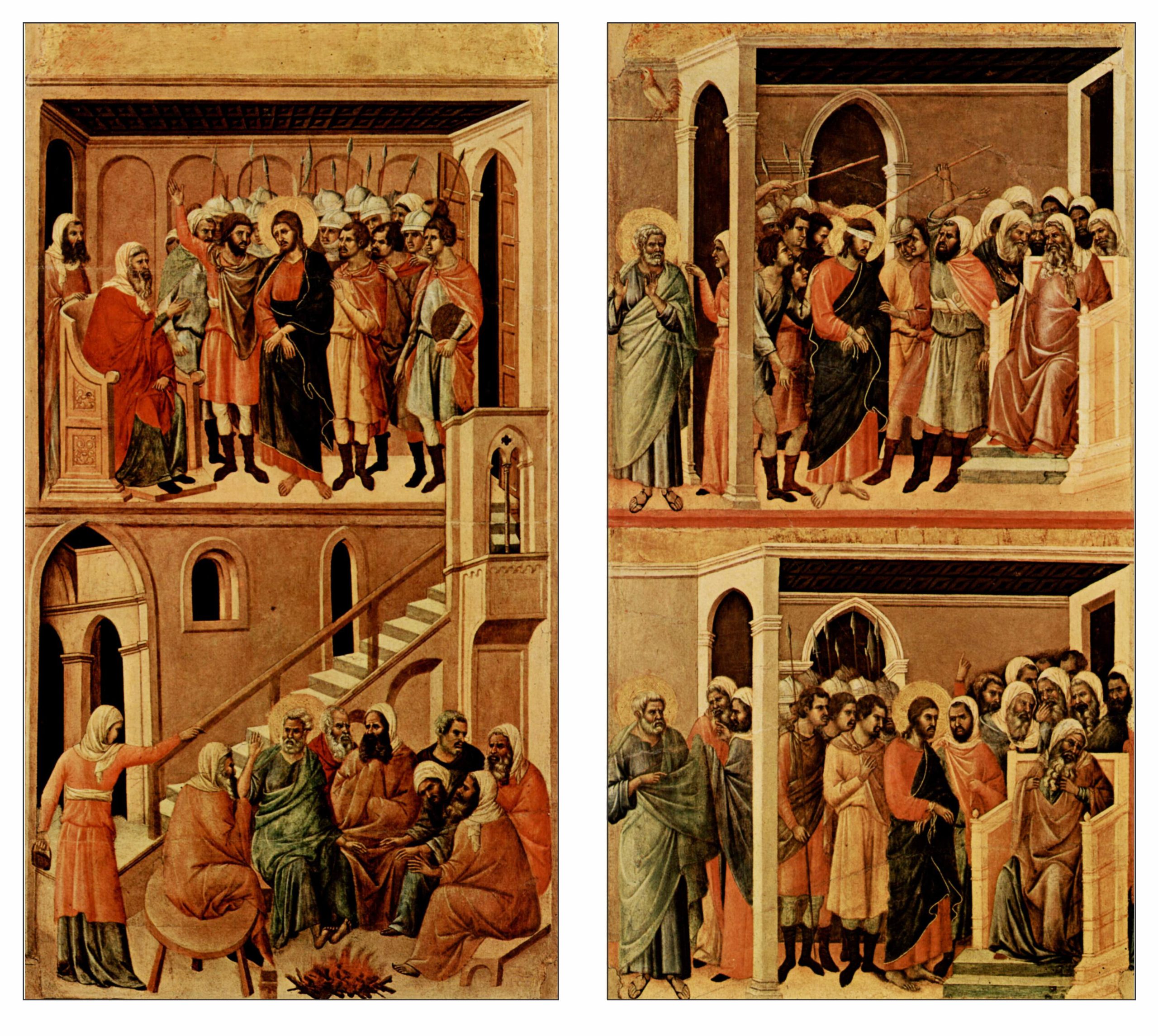
Duccio shows the arraignment before Annas (left), Caiaphas rending his garments (lower right), and the beating of the blindfolded Jesus (upper right). Duccio incorporates into these illustrations the disciple Peter (green-robed and haloed) as he makes his three denials of Jesus.
Although the High Priest and his supporters desire the death of Jesus, they may not have the legal authority to bring this about. It is generally thought that capital punishment (ius gladii, the law of the sword) in 1st Century Judaea was the preserve of the Roman occupiers. This may not be true (Kacian, 2014). Nevertheless, the priests may not wish to be held responsible for the death of Jesus since he is popular with the people. Far better to let the Romans take care of their problem. The difficulty is that the Roman authorities will not consider blasphemy against the Jewish God as a capital crime. So the priests who bring Jesus to Pilate accuse him of claiming to be the King of the Jews. John’s gospel portrays them as being unclear about this accusation but definite in their desire for his death
Pilate then went out unto them, and said, What accusation bring ye against this man?
They answered and said unto him, If he were not a malefactor, we would not have delivered him up unto thee.
Then said Pilate unto them, Take ye him, and judge him according to your law. The Jews therefore said unto him, It is not lawful for us to put any man to death (John 18:29-31).
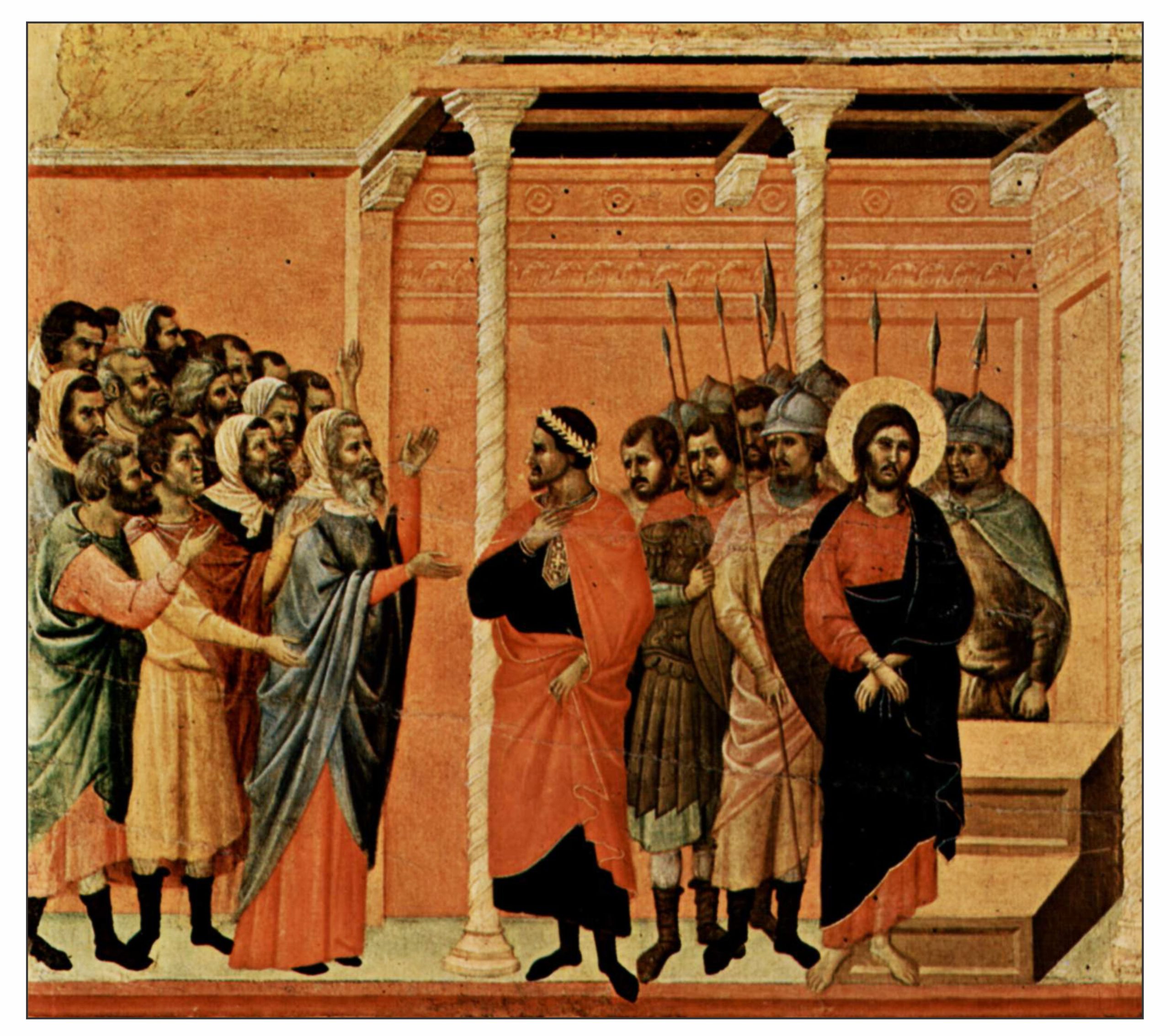
Duccio’s representation has a completely disordered perspective. There is no vanishing point. Jesus stands in front of the column he should be behind, and Pilate’s seat on the right tilts out of the picture as though he has no jurisdiction here.
Jesus before Pilate.
(i) the kingdom of heaven
Despite the confusing accusation coming from the priests, Pilate’s first question for Jesus is
Art thou the King of the Jews? (John 18: 33)
This is what he has distilled from the obfuscations of the priests. After clarifying the source of the question, Jesus answers
My kingdom is not of this world: if my kingdom were of this world, then would my servants fight, that I should not be delivered to the Jews: but now is my kingdom not from hence. (John 18: 36)
This is the essence of Jesus’ teaching: the “Kingdom of God” (or the “Kingdom of Heaven” as it was called in Matthew). He mentioned it in the beatitudes: “for theirs is the kingdom of heaven” (Matthew 5: 3, 10). And he tried to explain it in multiple parables (e.g. Matthew 13). Nevertheless, the meaning of this kingdom remains unknown (France, 2005) Some have considered it apocalyptically as what will occur after the final judgement. Others have thought about it evangelistically as the state of the world when everyone has converted to Christianity. But these future-oriented interpretations are false:
The kingdom of God cometh not with observation:
Neither shall they say, Lo here! or, lo there! for, behold, the kingdom of God is within you. (Luke 17 20-21)
The kingdom most likely represents the community of people who live harmoniously together according to the rule of loving one’s neighbor (e.g. Wenell, 2024). This is in effect the “church” in its spiritual rather than physical sense – the people not the building.
Jesus had previously distinguished between worldly and divine kingdoms when he had been asked whether it was lawful for a Jew to pay tribute to Caesar. He had answered
Shew me the tribute money. And they brought unto him a penny.
And he saith unto them, Whose is this image and superscription?
They say unto him, Caesar’s. Then saith he unto them, Render therefore unto Caesar the things which are Caesar’s; and unto God the things that are God’s. (Matthew 22:19-21)
This distinction between the two kingdoms had tremendous implications (Dusenberry, 2021). Before Jesus, religious authority and political power were intertwined. Jewish kings were subject to priests and prophets. Roman emperors were considered divine. After Jesus it became possible for a religious authority to exist independently of national boundaries, and for people to have separate allegiances to god and to king. The fact that states could evolve independently of religion allowed such things as democracy and liberty to develop. That religion existed independently of the state allowed the church to persist through the rise and fall of empires. Dusenberry (2021, p 163) quotes from a letter by the 5th Century Pope Gelasius to the Emperor Anastasius:
There are two ways, august emperor, in which the world (mundus hic) is chiefly ruled: the sacred authority of the priests (auctoritas sacra pontificum), and the royal power (regalis potestas).
At the end of his book. Dusenberry (2021, p 246) refers the French historian Fustel de Coulanges who describes the immense changes in society as the secular became separate from the sacred. The following is an extended quotation from Fustel de Coulanges’ book The Ancient City, initially published in 1864:
If, now, we recollect what has been said above on the omnipotence of the states among the ancients, ̵̵̶ ̶ if we bear in mind how far the city, in the name of its sacred character and of religion, which was inherent in it, exercised an absolute empire, ̶ we shall see that this new principle was the source whence individual liberty flowed.
The mind once freed, the greatest difficulty was overcome, and liberty was compatible with social order.
Sentiments and manners, as well as politics, were then changed. The idea which men had of the duties of the citizen were modified. The first duty no longer consisted in giving one’s time, one’s strength, one’s life to the state. Politics and war were no longer the whole of man; all the virtues were no longer comprised in patriotism, for the soul no longer had a country. Man felt that he had other obligations besides that of living and dying for the city. Christianity distinguished the private from the public virtues. By giving less honor to the latter, it elevated the former; it placed God, the family, the human individual above country, the neighbor above the city.
Law was also changed in its nature. Among all ancient nations law had been subject to, and had received all its rules from, religion. Among the Persians, the Hindus, the Jews, the Greeks, the Italians, and the Gauls, the law had been contained in the sacred books or in religious traditions, and thus every religion had made laws after its own image. Christianity is the first religion that did not claim to be the source of law. It occupied itself with the duties of men, not with their interests. Men saw it regulate neither the laws of property, nor the order of succession, nor obligations, nor legal proceedings. It placed itself outside the law, and outside all things purely terrestrial. Law was independent; it could draw its rules from nature, from the human conscience, from the powerful idea of the just that is in men’s minds. It could develop in complete liberty; could be reformed and improved without obstacle; could follow the progress of morals, and could conform itself to the interests and social needs of every generation.
(ii) witness to the truth
After Jesus’ comment on his kingdom, Pilate is not sure what Jesus means and asks again whether he is really a king. Jesus replies
Thou sayest that I am a king. To this end was I born, and for this cause came I into the world, that I should bear witness unto the truth. Every one that is of the truth heareth my voice. (John 18: 37)
This again is a key part of Jesus teachings.
I am the way, the truth, and the life: no man cometh unto the Father, but by me. (John 14:6)
There are perhaps two levels of truth (e.g. Sallis, 1995). One is related to the correspondence between one’s thoughts or statements and external reality. The second comes into play when we cannot know something, but decide to believe it is true. This is the truth of faith.
Pilate is again uncertain about what Jesus is claiming. But he is clearly not a threat to the Roman Empire:
Pilate saith unto him, What is truth? And when he had said this, he went out again unto the Jews, and saith unto them, I find in him no fault at all. (John 18: 37)
It is difficult to know whether Pilate’s comment about truth is cynical, or whether he is just confused by Jesus’ claim. Nevertheless, it earned for him the epithet “jesting Pilate” in Francis Bacon’s 1625 essay Of Truth:
What is truth? said jesting Pilate; and would not stay for an answer. Certainly there be that delight in giddiness; and count it a bondage to fix a belief; affecting free-will in thinking, as well as in acting.
(iii) Pilate attempts to release Jesus.
Pilate decides that the easiest way out of his predicament would be to release Jesus through the customary prisoner amnesty at Passover: the privilegium paschale (Curran 2025). He asks those assembled before the palace if they would like either Jesus or the rebel Barabbas to be released. These were the priests and guards that bought Jesus to Pilate. They clamor for Barabbas.
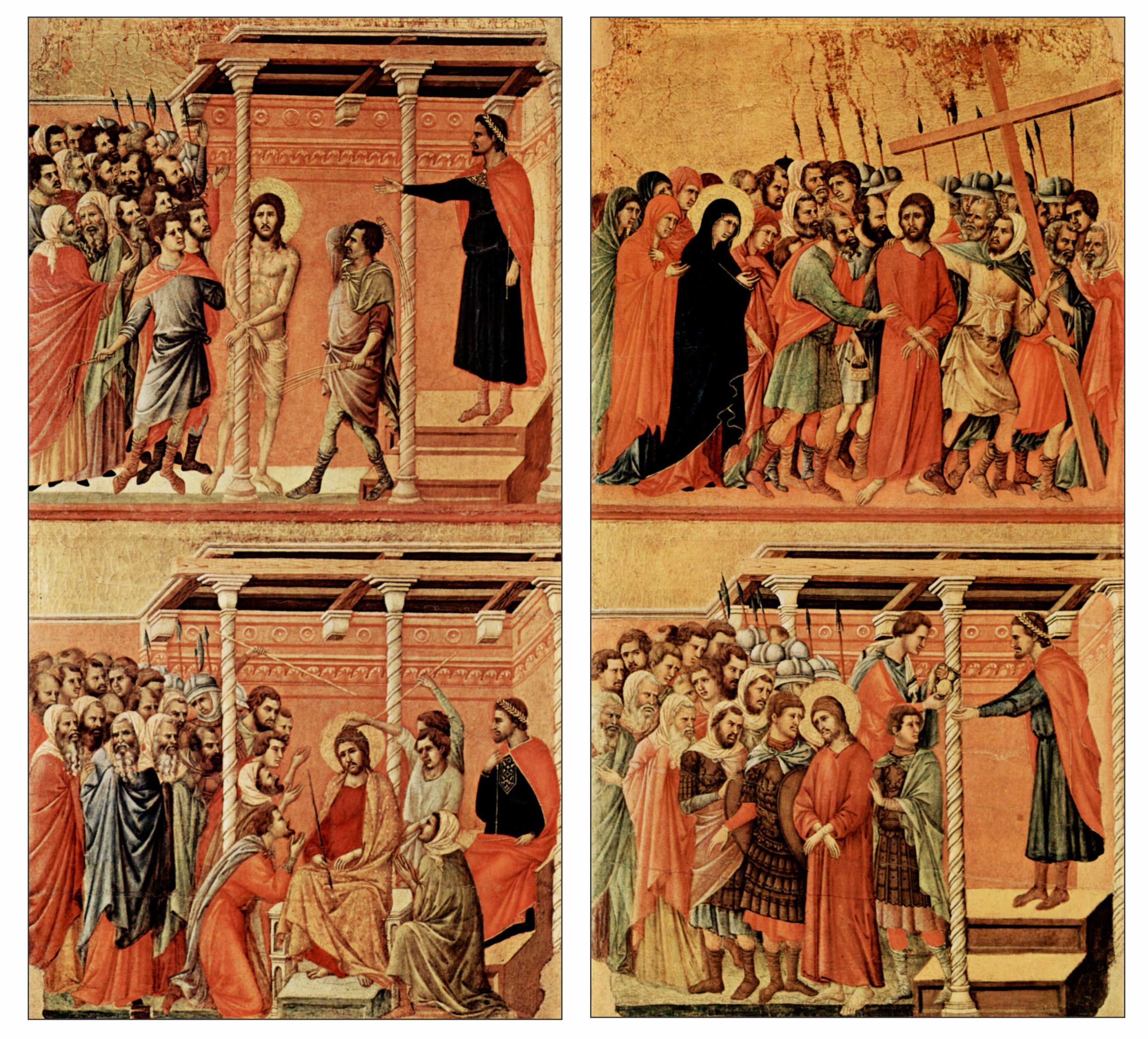
Pilate attempts to assuage the crowd by scourging Jesus. Then he has a crown of thorns placed on his head and he presents Jesus to the crowd to be mocked.
Pilate therefore went forth again, and saith unto them, Behold, I bring him forth to you, that ye may know that I find no fault in him.
Then came Jesus forth, wearing the crown of thorns, and the purple robe. And Pilate saith unto them, Behold the man!
When the chief priests therefore and officers saw him, they cried out, saying, Crucify him, crucify him. Pilate saith unto them, Take ye him, and crucify him: for I find no fault in him.
The Jews answered him, We have a law, and by our law he ought to die, because he made himself the Son of God. (John 19: 5-7).
However, the Jews could not crucify Jesus. Their laws may have required the death penalty, but crucifixion was a Roman punishment.
The scourging and mocking of Jesus are portrayed by Duccio on the left of the following illustration. On the right are representations of Pilate washing his hands and of Jesus on his way to the crucifixion:
(iv) Who art thou?
Pilate is surprised by the tenacity of the priests and their followers. He asks Jesus “Whence at thou?” He already knows that Jesus is from Nazareth. As Schiavone (2017, p 154) points out
The question has an explicitly metaphysical resonance. It is the request of someone who, not without apprehension, senses he is in the presence of the unknown. If Pilate really asked it—and the relationship between the coherence of the account and the conceptual and historical likelihood of the described facts prompts us to consider it possible—the prefect’s investigation was no longer centered on ascertaining whether a crime had been committed, but on the nature and mission of the person before him.
Jesus does not answer, Pilate reminds him that he has the power to crucify him. Christ replies
Thou couldest have no power at all against me, except it were given thee from above (John 18: 11).
Jesus is claiming that his death is ordained. It is God’s will, not Pilate’s decision. This removes any idea of assigning blame or responsibility for the death of Jesus. Dusenbury (2021, p 148) quotes the remarks by Augustine of Hippo (354-450 CE) on the gospel of John;
The man they took by force – and then tortured and killed – was one “to whom nothing could have been done unless he himself willed it” (quem nihil valuisser nisi quod ipse voluisset)
This illustrates the paradox of an all-powerful and all-knowing god. If everything is ordained, no one can be responsible for their actions.
(v) No friend of Caesar
The final argument proposed by the priests is that the kingdom proposed by Jesus is a direct threat to Caesar.
If thou let this man go, thou art not Caesar’s friend: whosoever maketh himself a king speaketh against Caesar. (John 19: 12)
The claim to be King of the Jews is treason against the emperor. Fearful that the Jews will complain to the emperor that he did not properly persecute an insurrectionist, Pilate cedes to their wishes. Wroe (1999, p 273) imagines his state of mind:
Tiberius had perhaps already received unfavorable reports of him. Would he tolerate more? Did Pilate have any stock of goodwill left? If he had, was he really going to hazard it, and with it the lives of hundreds of Jews and Romans and others, on the fate of one peculiar preacher? One man’s life could never be worth that. If he let his soldiers loose on people, he would be called a butcher. He might lose Judaea. The crowd was al-ready on the edge of tumult, and he was getting nowhere in his efforts to persuade them. Besides, he was not there in Judaea to pursue celestial fantasies or to sift the philosophy of those he sentenced. He was there to preserve law and order in the name of Rome.
Pilate then seats himself on the “Gabbatha” (pavement stone, the place of judgment), and condemns Jesus to be crucified. Agamben (2015, p 45) proposes that Pilate does not provide a formal sentence, and what is written in John is far from clear. However, there must have been a sentence since the Roman soldiers immediately carry out the crucifixion.
Pilate insists that Jesus be identified on the cross in Hebrew, Greek and Latin as “Jesus of Nazareth, King of the Jews.” The priests request that Pilate qualify this:
Then said the chief priests of the Jews to Pilate, Write not, The King of the Jews; but that he said, I am King of the Jews.
Pilate answered, What I have written I have written. (John 19: 21-22)
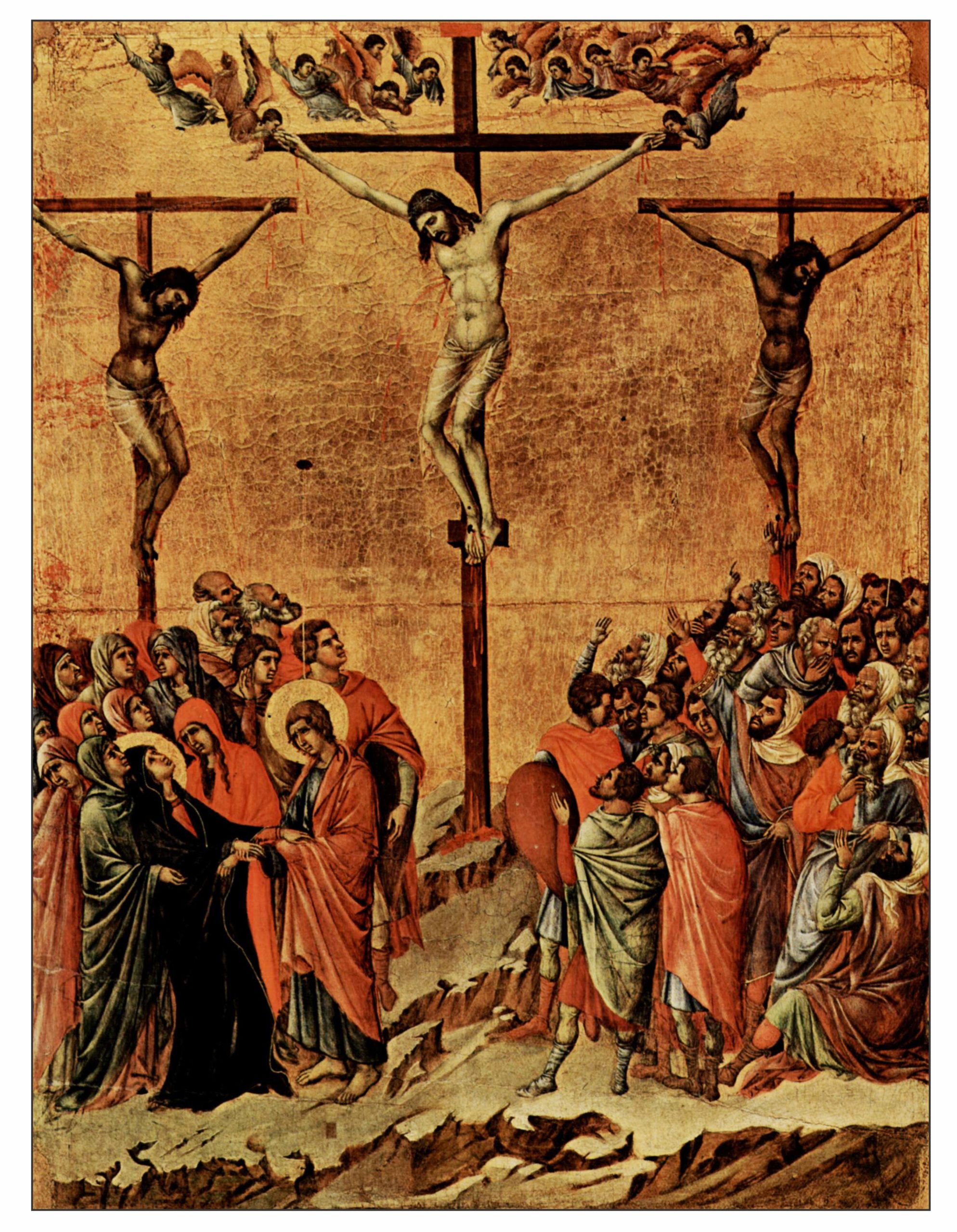
And so Christ was crucified. Together with two others, described as thieves, but probably insurrectionists, since thievery did not warrant crucifixion. In the presence of Mary his mother, Mary Magdalene, Mary of Cleopas and the disciple John:
(vi) innocence and blame
Although not mentioned in the gospel of John, Matthew describes how Pilate declares his innocence of the death of Jesus by washing his hands.
When Pilate saw that he could not prevail, but rather that a tumult was beginning, he took water and washed his hands before the multitude, saying, “I am innocent of the blood of this just person. See ye to it.” (Matthew 27: 24)
Most scholars consider this to be completely fictional. Although hand-washing was a means to declare innocence for the Jews (e.g. Deuteronomy 21:1–9), it was not a Roman custom. Nor was Pilate sensitive enough about Jewish ways to use it symbolically.
Matthew does not stop there. He then reports
Then answered all the people, and said, His blood be on us, and on our children. (Matthew 27:25)
This is the clearest example of what is present in all the gospels: a shifting of the blame for the death of Jesus from the Romans to the Jews. Crucifixion was a Roman punishment. Even if we accept as true his misgivings, Pilate condemns Jesus to death. Assembled in the courtyard of the palace is a group of temple guards and priests. They are in no way representative of the Jewish people. And in no way could they have cried out in a single voice.
At the time that the gospels were written, Rome had just destroyed the Second Temple and driven the Jews from their homeland. The Christians of that time did not wish to antagonize Rome. For the most part, the Jewish people had not been attracted to Christianity, which was becoming more and more a religion of the Gentiles. The early Christians were probably upset that their fellow Jews ignored them, and even overtly persecuted them. When Christianity became the religion of the Roman Empire, these words from the Gospels became the justification for a virulent antisemitism that culminated in the horrors of the Holocaust. The following are comments by Crossan (1995, p 152):
Those first Christians were relatively powerless Jews, and compared to them the Jewish authorities represented serious and threatening power. As long as Christians were the marginalized and disenfranchised ones, such passion fiction about Jewish responsibility and Roman innocence did nobody much harm. But, once the Roman Empire became Christian, that fiction turned lethal. In the light of later Christian anti-Judaism and eventually of genocidal anti-Semitism, it is no longer possible in retrospect to think of that passion fiction as relatively benign propaganda. However explicable its origins, defensible its invectives, and understandable its motives among Christians fighting for survival, its repetition has now become the longest lie, and, for our own integrity, we Christians must at last name it as such.
It was not really until the papal encyclical Nostre Aetate (1966, In Our Time) that the Christian Church guardedly admitted its role in the persecution of the Jews:
True, the Jewish authorities and those who followed their lead pressed for the death of Christ; still, what happened in His passion cannot be charged against all the Jews, without distinction, then alive, nor against the Jews of today. Although the Church is the new people of God, the Jews should not be presented as rejected or accursed by God, as if this followed from the Holy Scriptures. All should see to it, then, that in catechetical work or in the preaching of the word of God they do not teach anything that does not conform to the truth of the Gospel and the spirit of Christ.
(vii) what really happened
The gospels were written long after the death of Jesus. They report details about Jesus’ arraignment before Pilate that no one other than Jesus or Pilate would have been privy to. They provide a fascinating story, but one that is more likely fictional than real. Pontius Pilate is portrayed as a thoughtful and merciful prefect, unable in the end to save a charismatic and popular preacher from the wrath of the high priests whom he had offended. In reality, Pilate probably paid little attention to the claims of Jesus. He may not even have shared a common language with Jesus. They may have spoken Greek, but probably neither was completely fluent. Pilate was mainly concerned with the maintenance of order, and if the crucifixion of a peasant preacher could prevent a riot, so be it.
Two needs were addressed by the story of the trial of Jesus. First, the fledgling Christian religion did not wish to antagonize the Romans. So the blame for the death of Jesus was shifted from Rome to the Jews. Second, the Christians wished to portray the death of Jesus as fulfilling the Jewish prophecies for a Messiah. Crossan (1995) has called this the “historicization of prophecy.” He shows how this occurs in the gospels’ description of the abuse suffered by Jesus during his times before Caiaphas and before Pilate (pp 118-132). The process became even more apparent in the description of the crucifixion:
Then the soldiers, when they had crucified Jesus, took his garments, and made four parts, to every soldier a part; and also his coat: now the coat was without seam, woven from the top throughout.
They said therefore among themselves, Let us not rend it, but cast lots for it, whose it shall be: that the scripture might be fulfilled, which saith, They parted my raiment among them, and for my vesture they did cast lots. These things therefore the soldiers did. (John 19: 23-24)
The prophecy is from Psalms 22:18
They part my garments among them, and cast lots upon my vesture.
Although Christianity considers this psalm as prophetic, Jewish scholarship describes it as simply a song of lament either for the state or the singer. Crossan (1995) describes many other instances in the gospels wherein statements in the Jewish scriptures are related to events in the Passion of Jesus, whether or not they were originally meant as prophecies.
Winter (1961, p 148) summarizes his review of the trial of Jesus:
the Gospel records, when critically examined, furnish clear evidence of the fact that Jesus was executed on a charge of sedition at the order of the Emperor’s representative. At the same time the contention is made that Jesus was devoid of revolutionary ambitions. The evidence, fragmentary though it is, affords no solid basis for the view that he was engaged in any political activities of a subversive character. That he was executed as a rebel, together with others who were executed on the same charge, by no means proves that he did work for the overthrow of the existing political system. So far as the procurator was concerned, he would have seen sufficient reason for ordering the crucifixion if he had come to the conclusion that Jesus’ itinerant preaching tended to excite the masses to expect the end of the existing order.
What really happened? All we know about the trial is summed up in Josephus as quoted at the beginning of this post:
And when Pilate, because of an accusation made by the leading men among us, condemned him to the cross, those who had loved him previously did not cease to do so.
Aftermath
Pilate was recalled to Rome at the end of 36 CE (Bond, 1998, pp 92-23). He may have come into disfavor because of his harsh treatment of the Jews, but by the time he arrived in Rome Tiberius was dead. Nothing is known about Pontius Pilate after his time in Judaea, though many have imagined his latter life (e.g. Wroe, 1999; Carter, 2003).
A set of writings called The Pilate Cycle (Elliot& James, pp 165-226) composed of letters from Pilate to Tiberias and to Claudius, and narratives of the trial and crucifixion of Jesus may have originated in the 1st or 2nd Centuries CE, but whatever versions have survived were re-written centuries later and are clearly fictional. The following excerpts are from the Paradosis Pilati (Tradition of Pilate), the earliest known surviving manuscript of which dates to the 12th Century CE. It reports how Pilate was examined by Caesar on his return to Rome:
And when he had been brought to the city of the Romans and Caesar heard that Pilate was there, he sat down in the temple of the gods in the presence of the whole senate and the whole army and all the multitude of his forces. And he commanded Pilate to stand forward and said to him, ‘How could you dare to do such a thing, you most impious one, when you had seen such great signs concerning that man? By daring to do an evil deed you have destroyed the whole world.’ (p 209)
Pilate blames his actions on the Jews, and Caesar orders the destruction of their temple and the dispersement of their people. He also orders the execution of Pilate, who prays for forgiveness for himself and his wife Procla:
And when Pilate came to the place of execution, he prayed silently, ‘Lord, do not destroy me with the wicked Hebrews, for had it not been because of the nation of the lawless Jews, I would not have raised my hand against you, because they plotted a revolt against me. You know that I acted in ignorance. Therefore do not destroy me because of this sin, but pardon me, Lord, and your servant Procla, who stands with me in this hour of my death, whom you taught to prophesy that you must be nailed to the cross. Do not condemn her also because of my sin, but pardon us and number us among your righteous ones.’
And behold, when Pilate had finished his prayer, there sounded a voice from heaven, ‘All generations and families of the Gentiles shall call you blessed, because in your governorship everything was fulfilled which the prophets foretold about me. And you yourself shall appear as my witness at my second coming, when I shall judge the twelve tribes of Israel and those who have not confessed my name.’ And the prefect cut off Pilate’s head, and behold, an angel of the Lord received it. And when Procla his wife saw the angel coming and receiving his head, she was filled with joy, and immediately gave up the ghost and was buried with her husband. (pp 210-211)
The destruction of the temple ordered by Caesar did indeed occur. But this happened much later than Pilate’s return to Rome. The Jewish people revolted against Roman rule in the First Jewish-Roman War of 66-73 CE. The Romans retaliated ferociously and destroyed the Herodian temple in Jerusalem. Just as Jesus had prophesied:
And Jesus went out, and departed from the temple: and his disciples came to him for to shew him the buildings of the temple.
And Jesus said unto them, See ye not all these things? verily I say unto you, There shall not be left here one stone upon another, that shall not be thrown down. (Matthew 24: 1-2).
However, Matthew was written after the fall of the Temple. This is history converted to prophecy as opposed to prophecy historicized.
Retellings
Pilate continues to fascinate us. We imagine ourselves in his position. Would we have paid proper attention? Would we have recognized who Jesus was? Would we have been able to save him from his death? Or were we just there to set some divine plan in motion?
In The Master and Margarita (written in the 1930s) Mikhail Bulgakov tells how a Soviet novelist tries to write a novel about Pontius Pilate. He imagines a prefect with a severe migraine having to deal as best he can with an itinerant preacher who appears to understand him far better than he does himself. The following is a retelling of their conversation about truth:
“And what was it in any case that you said about the temple to the crowd in the bazaar?”
The responding voice seemed to stab at Pilate’s temple, was inexpressibly painful, and this voice was saying:
“I said, Hegemon, that the temple of the old faith would fall and a new temple of truth would be built. I said it that way so as to make it more understandable.”
“And why did you stir up the people in the bazaar, you vagrant, talking about the truth, of which you have no notion? What is truth?”
And here the procurator thought: ‘Oh, my gods! I’m asking him about something unnecessary at a trial . . . my reason no longer serves me . . .’ And again he pictured a cup of dark liquid. ‘Poison, bring me poison . .’
And again he heard the voice:
“The truth is, first of all, that your head aches, and aches so badly that you’re having faint-hearted thoughts of death. You’re not only unable to speak to me, but it is even hard for you to look at me. And l am now your unwilling torturer, which upsets me. You can’t even think about anything and only dream that your dog should come, apparently the one being you are attached to. But your suffering will soon be over, your headache will go away.”
(translated by Pevear& Volokhonsky, 2000)
Pilate’s headache is no more. Yet the trial and its effects have not gone away. The story told by the gospels led to the founding of a religion that is followed fervently or grudgingly by almost a third of the world’s people. However, the teachings of Jesus did not need to be validated by his death or resurrection. They were and are true in and of themselves. And he would not have blamed anyone for his death.
References
Agamben, G. (2013, translated by Kotsko, A., 2015). Pilate and Jesus. Stanford University Press.
Baras, Zvi (1987). The Testimonium Flavianum and the Martyrdom of James. In Feldman, L. H.; Hata, G. (Eds.). Josephus, Judaism and Christianity. (pp 338-348). Brill.
Bond, H. K. (1998). Pontius Pilate in history and interpretation. Cambridge University Press.
Bulgakov, M. (translated by Pevear, R., & Volokhonsky, L., 2000). The Master and Margarita. Penguin Books.
Carter, W. (2003). Pontius Pilate: portraits of a Roman governor. Liturgical Press
Cohn, H. H. (1971). The trial and death of Jesus. Harper & Row.
Crossan, J. D. (1995). Who killed Jesus? Exposing the roots of anti-semitism in the Gospel story of the death of Jesus. HarperSanFrancisco.
Curran, J. (2025). Pilate, Barabbas, and the privilegium paschale: law and leverage in Roman Judaea. Journal for the Study of the New Testament, 47(4), 501–525.
Dusenbury, D. L. (2021). The innocence of Pontius Pilate: how the Roman trial of Jesus shaped history. Hurst & Company.
Elliott, J. K., & James, M. R. (1993). The Apocryphal New Testament: a collection of apocryphal Christian literature in an English translation. Clarendon Press.
France, R. T. (2005). Kingdom of God. In Vanhoozer, K. J., Bartholomew, C. G., Treier, D. J., & Wright, N. T. Dictionary for theological interpretation of the Bible. (pp 420–422). Baker Academic.
Fustel de Coulanges, N, D, (1864, translated by Small, W., 1877, reprinted 1956). The Ancient city: a study on the religions, laws, and institutions of Greece and Rome. Doubleday.
Kacian, A. (2014). Potestas Gladii in Jesus’ Trial. Communications: Scientific Letters of the University of Žilina, 16(3), 20–24.
Meier, J. P. (1991). A marginal Jew: rethinking the historical Jesus. Doubleday.
Sallis, J. (1995). Double truth. State University of New York Press.
Schiavone, A. (2016, translated by J. Carden). Pontius Pilate: deciphering a memory. Liveright
Spong, J. S. (2013). The fourth gospel: tales of a Jewish mystic. HarperOne.
Stanford, P. (2015). Judas: the troubling history of the renegade apostle. Hodder & Stoughton.
Wenell, K. J. (2024). Locating the kingdom of God: performing sacred boundaries. T&T Clark
Winter, P. (1961, reprinted 2014). On the Trial of Jesus. De Gruyter.
Wroe, A. (1999). Pilate: the biography of an invented man. Jonathan Cape.