Leading Ladies: Sarah Bernhardt, Eleonora Duse, Ellen Terry

In the latter half of the 19th Century three actresses ruled supreme in the hearts of theatre-goers: the French Sarah Bernhardt (1844-1923), the Italian Eleonora Duse (1858-1924), and the English Ellen Terry (1847-1928). They played all parts: from the classics of Shakespeare and Racine, through the romantics such as Dumas and d’Annunzio, to the new naturalists such as Ibsen. They toured the world but acted only in their mother tongue. Their emotional intensity and stage presence communicated with their audiences even when their words were not understood. They were the first superstars: idolized by their public, celebrated by artists, and honored by poets.    


Beginnings

Both Ellen Terry and Eleonora Duse were born to parents who were travelling players, and both began acting in childhood. Eleonora Duse and her father continued acting after the death of Eleonora’s mother in 1875. In 1879, Eleonora received her first rave reviews for her performances as Ophelia in Hamlet and Elettra in Oreste at the Teatro dei Fiorentini in Naples. She married a fellow actor in 1881 and had a daughter Enrichetta before the two separated.

Although five of her siblings became professional actors, Ellen Terry was initially disillusioned with the theater. At the age of 16 years, she married the painter George Watts who was 30 years her senior. The marriage was unhappy, and Ellen left after a year to live with the architect Edward Godwin, with whom she had two children, Edith and Edward, who later used the fictitious surname, Craig, and who both became renowned theater-directors. Godwin encouraged Terry to act again and she was acclaimed as Portia in The Merchant of Venice in 1875, a role that she reprised many times over her career (Holyroyd, 2008, p 102).   

Sarah Bernhardt was the illegitimate daughter of a Jewish courtesan, and only came to the theater after finishing her education at a convent school. The Duc de Mornay, the half-brother of Napoleoon III and a patron of her mother, suggested that she audition for Le Conservatoire national de musique et de declamation. With his influence she was accepted, and studied there between 1860 and 1862. After leaving the conservatoire she acted at the Odéon theater but her initial roles were not successful. Though she continued to act, her main support over the next decade came from her life as a courtesan. She counted among her many lovers a Marshall of the French army, a Spanish banker, and a Turkish ambassador (Gottlieb, 2010, p 44). She likely had an affair with Victor Hugo when he directed his play Ruy Blas at the Comédie Française in 1872 (Gottleib, 2010, p 61). Though some 40 years her senior Hugo was still susceptible to female charms. Bernhardt had her first major triumph as Maria, Queen of Spain in Ruy Blas, and followed this by an acclaimed Phèdre in Racine’ tragedy in 1874.


The Acting Companies

Bernhardt’s subsequent successes at the Comédie Française allowed her to obtain backers for her own company in 1880. She put on La dame aux Camélias by Alexandre Dumas fils, and then took her company on tour to London and the United States. She had affairs with her leading actors and was briefly married to a Greek diplomat. She attracted the attention of Victorien Sardou who wrote several plays for her, notably Fédora (1882), Théodora (1884), La Tosca (1887) and Cléopâtre (1890). She arranged with Alphonse Mucha to produce magnificent art-deco posters for her shows:

Bernhardt became friends with artists and celebrities: Gustave Doré, the illustrator of Dante, the portraitist Georges Clairin, Edward VII of England when he was Prince of Wales, and Louise Abbéma, an impressionist painter and prominent lesbian. It is unclear how many of her friends were also lovers.   

In 1899, the theater built by Baron Haussmann on the Place du Châtelet in Paris was renovated and renamed the Théâtre Sarah-Bernhardt, a name it retained until the German occupation in 1941 when it was called the Théâtre de la Cité because of Bernhardt’s Jewish ancestry (Gottlieb, 2010, p 139).

Duse formed her own acting company in 1885. She had a prolonged affair with Arrigo Boito, who was later to serve as Verdi’s librettist for Otello and Falstaff.  Boito provided her with the play Cleopatre, a translation of Shakespeare’s Anthony and Cleopatra in 1887. The illustration below shows the competing Cleopatras of Duse and Bernhardt (Rader, 2018, pp 83-84):

In 1895 Duse had an affair with the poet and playwright Gabriele d’Annunzio. He wrote the play La Gioconda (1899) for her. However, later in 1899 when he sent his masterpiece La città morta, based on Ancient Greek tragedies, to her rival Sarah Bernhardt, Duse ended their affair. Nevertheless, she later performed in both this play and in d’Annunzio’s Francesca da Rimini (1901) about the tragic love affair between Francesca and her brother-in-law Paolo Malatesta, as told in Canto 5 of Dante’s Inferno.

When Duse toured Russia in 1891, she impressed the young Anton Chekhov. Duse was to become the model for Irina Arkadina in The Seagull (1895). During her tour of Russia, Duse presented Ibsen’s A Doll’s House. She was particularly fond of the role: Nora, the name of the heroine, is a diminutive of her own name (Rader, 2018, p 103). She later included other Ibsen plays in her repertoire, and visited the playwright in Oslo in 1904. After 1910, Duse had a long relationship with Lina Poletti, a poet, playwright and open Lesbian, but this was likely no more than friendship (Weaver, 1984, pp 286-290).

In 1878 Henry Irving and Ellen Terry formed a partnership to reopen the Lyceum Theatre in London. For the next 20 years, they acted together to great acclaim. Their repertoire centered on Shakespeare – Hamlet, The Merchant of Venice, Rome and Juliet, Macbeth, and Much Ado about Nothing – but they also presented other plays – Becket by Tennyson, Olivia by W. G. Wills derived from The Vicar of Wakefield, and King Charles I by William Havard. It is not known whether their relationship extended beyond the theater. Below are woodcuts of Irving and Terry by Terry’s son Edward Craig from about 1895.

Terry kept up a long epistolary relationship with Bernard Shaw, who found her an intelligent and witty correspondent. Despite the many letters, however, they only met occasionally. Terry played Lady Cicely Waynefleete in Shaw’s Captain Brassbound’s Conversion in 1906, one of her last important roles. In 1958 a set of eighteen unsigned love poems to Ellen Terry went on auction. Though attributed to Shaw (Werner, 1980), these poems were probably written by Christabel Marshall, who was Terry’s secretary for several years. Christabel ultimately changed her name to Christopher Marie St John, and became the romantic partner of Terry’s daughter Edy Craig (Holroyd, 2008, pp 321-330).    


Portraits

Bernhardt, Duse and Terry were the beauties of their day. They were the subject of glamorous portraits such as Michele Gordigiani’s 1896 portrait of Duse and Georges Clairin’s 1876 portrait of Bernhardt:

The following are portraits of Sarah Bernhardt as Cleopatra by Georges Rochegrosse (1890), of the young Ellen Terry by her husband George Watts (1864) and of Eleonora Duse by Giovanni Boldini (1895):


Ilya Repin made a striking charcoal sketch of Duse during her tour of Russia in 1891:


Photographs

Nicéphore Niéce took the first photograph in 1822. By the middle of the 19th Century photography had become widespread. Felix Nadar, the first genius of photographic portraiture, produced several images of the young Sarah Bernhardt in the early 1860s.  

The following is Adam Begley’s description of the portraits:

Loosely wrapped in a white burnoose, or in a shiny black velvet cloak, both garments voluminous, their folds teasingly suggestive, she leans on a truncated fluted column—a vulgar prop Nadar would have laughed at a decade earlier. It doesn’t matter: the eyes are otherwise occupied, caressing her flawless skin, her calm pensive face, her untamed hair. It’s not just that she appears to be naked under her wrap—the portraits carry an erotic charge that’s complicated and enhanced by the withdrawn, private ex-pression and a whisper of melancholy. The air of mystery is especially strong when she’s wearing the black velvet and looking off to her right, almost in profile; the focus is slightly blurred, her bright eyes distant and enigmatic. Her sole ornament, a cameo earring, less a decoration than an echo in miniature, draws attention to her elfin ear, deliberately exposed and adding to the impression of nakedness. (Begley 2017, p 110)

Richard Howard’s poem Hommage to Nadar – Sarah Bernhardt (2004) celebrates both the photographer and his subject:

Often enough you were naked under the cloak
            in those days; gentlemen drank
and waited, murmuring deprecations

            till the cloak dropped and your arms
which would dishevel the world – those white serpents,
            Hugo called them – were exposed,

thin as your legs, thin and white, but rusted here,
            then here, the rest white and hard . . .
Not yet:  you have not yet had success on the stage,

            and if you were a mother two
years back, Maurice never knew his father –
            did you? A nun, you wanted

to be a nun, and became a sculptor, one
            craning female torso sent
each year to the Salon, ardent clay ladies

            in postures of possession.
Mortal will is already your mode, undressed,
            uncombed, probably unwashed –

you are the child he wrote in French for, Oscar
            who understood your crying
need and overheard, just thirty years too late,

            the voice of Salome, pure
gold bangles on a tin wire pulled to breaking,
            and of course the wire did break.

You seem to be regarding, on cue but still
            offstage, in the studio,
the resonant hells your talent sanctified

            for decades of unbelievers.
and taught your century its lesson, dying
            in La Gloire, your last relâche

attended by a house of fifty thousand:
            dazed Paris, unforgiving,
relented for your farewell tour of duty

            which was to doubt if either
the Heavenly City or that wan shade of it
            our dreams have perpetuated

can function, flourish or even form unless
            it include its opposite,
unless in heaven there is hell. Divine Sarah.

The poem mentions that Bernhardt was also a competent sculptor. Oscar Wilde wrote Salomé in French expressly for Bernhardt although she never played the role. La Gloire is likely a late performance in d’Annunzio’s La gloria which had been translated into French. The theatrical term en relâche is used to describe the days when a play is not performed so that the actors can rest. The English idiom is that the theater is “dark.” Bernhardt continued working until a few days before her death. “Fifty thousand” is the estimated number who attended her funeral in 1923.

Terry and Duse were also photographed extensively. The following illustration shows a portrait of Ellen Terry by Julia Margaret Cameron taken in 1864, and a portrait of Eleonora Duse by Edward Steichen taken in 1903. The latter was taken using a soft focus, a style popular at the beginning of the 20th Century but eschewed by later photographers.


Costumes

Bernhardt, Terry and Duse all revelled in their costumes. Those of Ellen Terry were particularly striking. Edward Burne-Jones designed her outfits for Guinevere and Lawrence Alma-Tadema for Imogen. The most memorable of her costumes was the “beetle-dress” that she wore as Lady Macbeth. The gown, designed by Alice Laura Comyns-Carr and made by Ada Cort Nettleship, is embellished with green iridescent beetle wing-cases that shimmer under stage lighting. The dress has recently been restored. The illustration below shows the dress and a painting of Terry as Lady Macbeth by John Singer Sargeant (1888).


Lithographs

Lithography was invented in 1796 and come to prominence over the following century as a means for producing inexpensive color prints. William Nicholson published a set of Twelve Portraits in 1899: lithographic reproductions of hand-coloured woodcuts. Among those represented was Sarah Bernhardt. Eleonora Duse was included in a second set of portraits which came out in 1902.These portraits are shown below. In 1906 Nicholson produced for the Ellen Terry Jubilee Banquet a lithographic scroll showing all the major roles from her career. The middle section shows Ellen Terry as Lady Teazle from The School for Scandal (1877), Olivia from Olivia (1878), Ophelia from Hamlet (1878), Queen Henrietta Maria from King Charles I by William Havard (1879), and Portia from The Merchant of Venice:


Audio Recordings

In the early years of the 20th Century, it became possible to record the sounds of voices. Both Ellen Terry and Sarah Bernhardt were recorded. Although the recordings are noisy and the studio recordings very different from an actual performance, the listener can get some sense of how they sounded on the stage.

The recording of Ellen Terry giving Portia’s speech about mercy was taken in 1911. The words of the speech follow together with a painting by George Baldry of Terry as Portia in an 1895 production. Terry’s presentation is restrained but convincing:


I could not find any audio recordings of Eleonora Duse. We must content herself with a description by Arthur Symons, the British critic and poet who lived for a while in Italy and who translated several of d’Annunzio’s works:

And then that voice of hers! It can be sweet or harsh, it can laugh or cry, can be menacing or caressing. And how every word tells! Every word comes to you clearly, carrying exactly its meaning: and, somehow along with the words, an emotion, which you may resolve to ignore, but which will seize on you, which will go through and through you. Trick or instinct, there it is, the power to make you feel intensely; and that is precisely the final test of a great dramatic artist. (Symons, 1926, p 99)

The following is an excerpt from a 1910 recording of Sarah Bernhardt in the role of Phèdre. Phèdre the wife of Theseus has fallen passionately in love with her stepson Hippolytus. She confesses her shame and asks him to punish her with death.


In the Words of the Poets.

The young Oscar Wilde was quite taken by Terry’s performance of Portia. The following is his sonnet to the actress. Since I could not find any image of the golden dress, I have paired the sonnet with a portrait of Terry by Forbes-Robertson from about the same time:

Wilde was perhaps even more impressed by Sarah Bernhardt in Phèdre. The accompanying photograph was taken by Felix Nadar’s son Paul:

The young playwright Edmond Rostand, author of the wildly successful Cyrano de Bergerac (1897) wrote several plays for Sarah Bernhardt, among them La Samaritaine (1897), about the Samaritan women who gave up a life of sin to follow Christ, and l’Aiglon (Eaglet, 1900) about the Napoleon’s son. At a celebratory dinner in 1896 he presented a sonnet in praise of Sarah:

The sonnet is mainly remembered for the line Reine de l’Attitude ed Princesse des Gestes. No one could strike a pose as well as Sarah. The following is the death of La Dame aux Camélias, probably from a production in the early 1900s:

In 1907, the American poet Sara Teasdale published four sonnets in honor of Eleonora Duse. The following sonnet about her performance in Francesca da Rimini was set to music by Robert Owen. Below is a performance by soprano Jamie Reimer and pianist Stacie Haneline:


Imaginings

It is difficult for us to understand the effect these actresses had on their audiences. We have some general idea:

Ellen Terry lives on as the eternal girl actress, the symbol of health, youth, and energy, in contrast with Duse, the suffering, mature woman. Between them stands Bernhardt, the creature of passion and power, larger than life and dangerously unpredictable. (Stokes et al, 1988, p 10).

And yet

Whatever audiences perceived in the work of Bernhardt, Terry and Duse, it was clearly something that took them beyond the immediate and into wider, deeper areas of themselves. This special quality is forever inaccessible to us now, since it died with them and with the time in which they lived. It is also something that challenges historical analysis, just as it challenged description by those contemporaries who struggled to express the inexpressible in the restricting language of their reviews and articles. (Stokes et al., 1988, p 11).

So to conclude, I would like to imagine them when they played roles that to me are special. I shall do this in the order of performance. First would be Ellen Terry as Beatrice in the early 1880s. It must have been marvelous to watch her spar with Henry Irving in Much Ado About Nothing.  

And then I would have found myself enthralled by the performance of Sarah Bernhardt as Hamlet in the 1890s. She thought of Hamlet much as I do: as a man who is determined to do the right thing, who hesitates not from a weakness of will, but because he needs to be certain before he acts. This is completely different from the idea that Hamlet was someone who just could not make up his mind.


And finally, I would have been transfixed by Eleonora Duse as Hedda Gabler in the first few years of the 20th Century.

References

Begley, A. (2017). The great Nadar: the man behind the camera. Tim Duggan Books (Penguin).

Gottlieb, R. (2010). Sarah: the life of Sarah Bernhardt. Yale University

Holroyd, M. (2008). A strange eventful history: the dramatic lives of Ellen Terry, Henry Irving and their remarkable families. Chatto & Windus.

Howard, R. (2004). Inner voices: selected poems, 1963-2003. Farrar, Straus & Giroux.

Huret, J. (1899). Sarah Bernhardt. Chapman & Hall.

Izard, F. (1915). Heroines of the modern stage. Sturgis & Walton.

Rader, P. (2018). Playing to the gods: Sarah Bernhardt, Eleonora Duse, and the rivalry that changed acting forever. Simon & Schuster.

Stokes, J., Booth, M. R., & Bassnett, S. (1988). Bernhardt, Terry, Duse: the actress in her time. Cambridge University Press.

Symons, A. (1926). Eleonora Duse. Elkin Matthews.

Teasdale, S. (1907). Sonnets to Duse and other poems. Poet Lore Company.

Weaver, W. (1984). Duse, a biography. Thames & Hudson.

Werner, J. (1980). Lady, wilt thou love me? Eighteen love poems for Ellen Terry attributed to George Bernard Shaw. Stein and Day.


Metaphor and Meaning

At the close of the opening scene of Shakespeare’s Hamlet, Horatio notices the arrival of the dawn

But look, the morn, in russet mantle clad,
Walks o’er the dew of yon high eastward hill.
(Hamlet, I-1: 165-6)

No one is on the hill. Horatio is speaking metaphorically, describing the dawn as though it were a person. His words relax the tension of what has just happened. He and his colleagues have just seen the spirit of Hamlet’s father wandering in the real world where it should not be. Terror is in the air. At this moment, however, Horatio does not see a real person on the hill – this is how the dawn seems in his imagination. He takes comfort in metaphor.

Figures of Speech

According to the Oxford English Dictionary (1989), a figure of speech is

any of the various ‘forms’ of expression, deviating from the normal arrangement or use of words, which are adopted in order to give beauty, variety, or force to a composition

And a metaphor is

a figure of speech in which a name or descriptive word or phrase is transferred to an object or action different from, but analogous to, that to which it is literally applicable.

The word derives from the Greek words meta (after, beyond) and phorein (carry, bear)

A clearer sense of metaphor is that of Richards (1936, p 93)

In the simplest formulation, when we use a metaphor we have two thoughts of different things active together and supported by a single word, or phrase, whose meaning is the resultant of their interaction.

Richards identified the two thoughts as the “tenor” the “vehicle.” These he does not define, but the tenor is basically the original idea, and the vehicle is the new idea that brings to light or accentuates some aspects of the original. Thus when Romeo says that Juliet is the sun, Juliet is the tenor and the sun the vehicle. In cognitive linguistics, the tenor is generally termed the “target” and the vehicle is the “source” (Kövecses, 2002, p 4).

Black (1993) proposed that the interaction described by Richards is the projection of some characteristics of the vehicle upon the tenor. The mystery of metaphor concerns which characteristics get projected and which do not.

We often differentiate metaphor from simile. A simile makes a direct comparison between tenor and vehicle, using terms such as “like” or “as.” A simile could be considered as a tentative metaphor, or a metaphor as an elliptical simile. Metaphor is far more powerful. Romeo could have said that Juliet was like the sun, but that would not have expressed his passion. Poets often use both metaphor and simile together. Enobarbus describes Cleopatra’s arrival:

The barge she sat in, like a burnish’d throne,
Burned on the water
(Anthony and Cleopatra, II-2: 202-3)

The “burnish’d throne” is a simile, but its burning is a metaphor.

Types of Tropes

The word “trope” (Greek tropos turn) is used to describe figures of speech based on comparisons or associations. As well as metaphor and simile, we have:

allegory – a metaphor wherein the comparison is extended into a story. Bunyan’s Pilgrim’s Progress considers the life of a Christian in terms of the journey of one particular man from sin to salvation

analogy – an extended simile used to explain one process or event in terms of another that is more clearly understood.

conceit – a metaphor (or simile) wherein the comparison is highly unusual and intricately detailed.

metonymy – the use of one entity to identify another (meta beyond + onymia name). This occurs in various ways (Kövecses, 2002, pp 143-162): a part can represent the whole (“head” instead of person or animal) or vice versa (“law” instead of a policeman); a container can indicate its contents (“bottle” instead of alcohol); a piece of clothing can stand for the person who wears it (“suits” for lawyers or businessmen); an instrument can mean what it does (“pen” instead of writing); and a place can represent the people who work there (the “White House” instead the President of the United States). Metonymy can highlight a particular aspect of what is being described: to call businessmen “suits” suggests that they all dress in the same way and lack individuality. Metaphors differ from metonymy by bringing completely novel ideas into play: to call businessmen “predators” suggests that they are out for blood. Kövecses describes this difference by proposing that metonymy stays within a single cognitive domain whereas metaphor crosses into another domain. He also suggests that a simple difference between metonymy and metaphor is that only the latter can be meaningfully recast as a simile. One would not say that businessmen are “like suits,” but it is easy to claim that they are “like predators.”

symbol (Greek syn together + ballo throw)– a simple metaphorical expression typically used as a stand-in for an abstract idea (“cross” for the Christian religion, “rose” for love). Symbols can enhance the emotional impact of a statement by making the idea concrete.

synecdoche (Greek syn together + ekdoche interpret) has been variably defined over the years. It is usually considered as a subclass of metonymy wherein the whole is signified by the part.

Poetry and Language

Poetry is the natural home of metaphor. Poets portray the world in ways that help us to see what we have not noticed before, and to understand what we previously could not. They teach us how best to express ideas, and provide emotional depth for our experiences. At least this is what Shelley (1821) proposed:

They measure the circumference and sound the depths of human nature with a comprehensive and all-penetrating spirit, and they are themselves perhaps the most sincerely astonished at its manifestations; for it is less their spirit than the spirit of the age. Poets are the hierophants of an unapprehended inspiration; the mirrors of the gigantic shadows which futurity casts upon the present; the words which express what they understand not; the trumpets which sing to battle and feel not what they inspire; the influence which is moved not, but moves. Poets are the unacknowledged legislators of the world.

This is hyperbole. However, much of our normal language evolves from metaphor. The use of “leg” in relation to a table was once metaphorical, but is now just one of the many accepted meanings of the word “leg.” Etymology records the passage from figurative to literal. Present meaning is sometimes equivalent to the metaphorical origin (“metaphor”- carried over), sometimes related (“malaria” – bad air) and sometimes almost completely unrelated (“muscle” – little mouse).

Normal human language is replete with metaphorical systems (Reddy, 1993; Gibbs, 1994; Lakoff and Johnson, 2003; Kövecses, 2002). Life is a journey; argument is war; ideas are food; relations are a game. The following illustrates one such metaphorical system – theories (and arguments) are buildings:

Is that the foundation for your theory? The theory needs more support. The argument is shaky. We need some more facts or the argument will fall apart. We need to construct a strong argument for that. I haven’t figured out yet what the form of the argument will be. Here are some more facts to shore up the theory. We need to buttress the theory with solid arguments. The theory will stand or fall on the strength of that argument. The argument collapsed. They exploded his latest theory. We will show that theory to be without foundation. So far we have put together only the framework of the theory. (Lakoff and Johnson, 2003, p 46)

Although prose and poetry both make extensive use of metaphor, poetry remains apart from normal language in its intensity and novelty (Donoghue, 2014). When Shakespeare’s Cleopatra puts the asp to her breast, she says

                         Come, thou mortal wretch,
With thy sharp teeth this knot intrinsicate
Of life at once untie.
(Anthony
and Cleopatra, V-2: 330-302)

The central metaphor is that life is a knot that death can untie. However, this poetry is more than metaphor. Shakespeare invented the word “intrinsicate” probably as a combination of “intricate” and “intrinsic.” Perhaps “transient” can also be heard within the word. And the metaphor of “knot” brings “not” immediately to mind – life is defined by its negation.

Metaphor and Truth

Metaphor has an ambivalent relationship with truth (Searle, 1993). A metaphorical statement is not literally true. Juliet is not the sun. Yet literal falseness is not a defining aspect of a metaphor. The statement ‘Juliet is not the sun.’ is literally true but can still be metaphorical – perhaps she shines more subtly than the brazen sun. Even when one makes a comparison in the form of a simile, truth is still not certain. We do not know what determines that something can be “seen as” something else (Zwicky, 2003).

Most discussions of metaphor, however, contend that a metaphor can express truth –“ring true” – despite being literally false (Binkley, 1974). The meaning of a statement depends on much more that its literal translation. The intent of the speaker, the context of the statement and the sensitivity of the hearer all contribute to meaning (Speaks, 2014). And whether or not that meaning is true depends on the shared knowledge of speaker and hearer. So Davidson (1978) insists that the speaker of metaphor means what he or she says. In respect to meaning and truth metaphor is then no different from other modes of expression.

Words Proper

The subtle relationship of metaphor to truth, however, made some of the early modern philosophers skeptical about anything that could not just be said in plain English.

Thomas Hobbes (1651) said that man excelled all other animals in his ability to determine the consequences of things and to express these consequences in words. However, he found that this privilege was allayed by a tendency to absurdity, a characteristic shared by no other living creature. Among the causes of absurdity are

the use of Metaphors, Tropes, and other Rhetoricall figures, in stead of words proper. For though it be lawfull to say, (for example) in common speech, the way goeth, or leadeth hither, or thither, The Proverb sayes this or that (whereas wayes cannot go, nor Proverbs speak); yet in reckoning, and seeking of truth, such speeches are not to be admitted. (Chapter V).

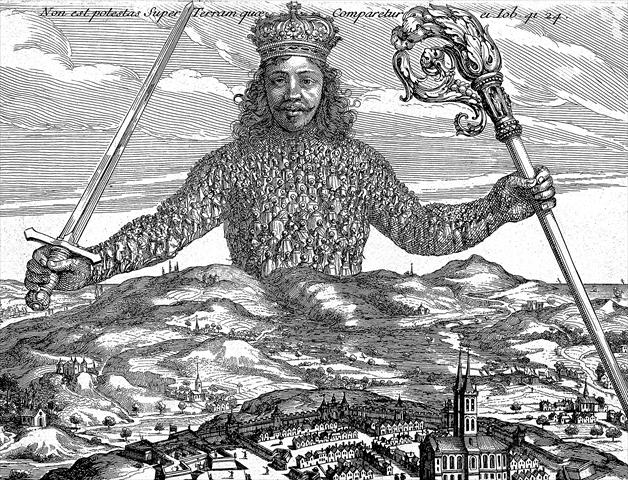
Yet this comes from the author who used the metaphor of Leviathan to describe the state, wherein the residents transfer all power to a sovereign in return for the maintenance of civil order. The frontispiece of his book – an engraving by Abraham Bosse shows the sovereign, composed of all his people, wielding the sword of civil power and the crozier of religious belief. The Latin inscription quotes from the Book of Job (41:24): Non Est potestas Super Terram quae Comparetur ei (There is no power on earth which can be compared to him).

In his Essay Concerning Human Understanding (1690), John Locke proposed that figurative speech and allusion are wholly to be avoided in any attempt to describe the truth:

Since Wit and Fancy finds easier entertainment in the World, than dry Truth, and real Knowledg, figurative Speeches, and allusion in Language, will hardly be admitted, as an Imperfection or Abuse of it. I confess in Discourses, where we seek rather Pleasure and Delight than Information and Improvement, such Ornaments as are borrowed from them, can scarce pass for Faults. But yet, if we would speak of Things as they are, we must allow, that all the Art of Rhetorick, besides Order and Clearness, all the artificial and figurative Application of Words Eloquence hath invented, are for nothing else but to insinuate wrong Ideas, move the Passions, and thereby mislead the Judgment, and so indeed are perfect cheat: And therefore however laudable or allowable Oratory may render them in Harangues and popular Addresses, they are certainly, in all Discourses that pretend to inform or instruct, wholly to be avoided ; and where Truth and Knowledg are concerned, cannot but be thought a great Fault, either of the Language or Person that makes use of them. (III: X: 34)

However, this aversion to figurative language did not stop the author from describing the mind of man using multiple metaphors:

Let us then suppose the mind to be, as we say, white paper, void of all characters, without any ideas; how comes it to be furnished? Whence comes it by that vast store which the busy and boundless fancy of man has painted on it, with an almost endless variety. (II: 1: 2)

Metaphors in Science

Scientists are much less skeptical of using figurative language than these early modern philosophers. Metaphor is the way to see what is invisible.  Analogy is the way to explain how things work.

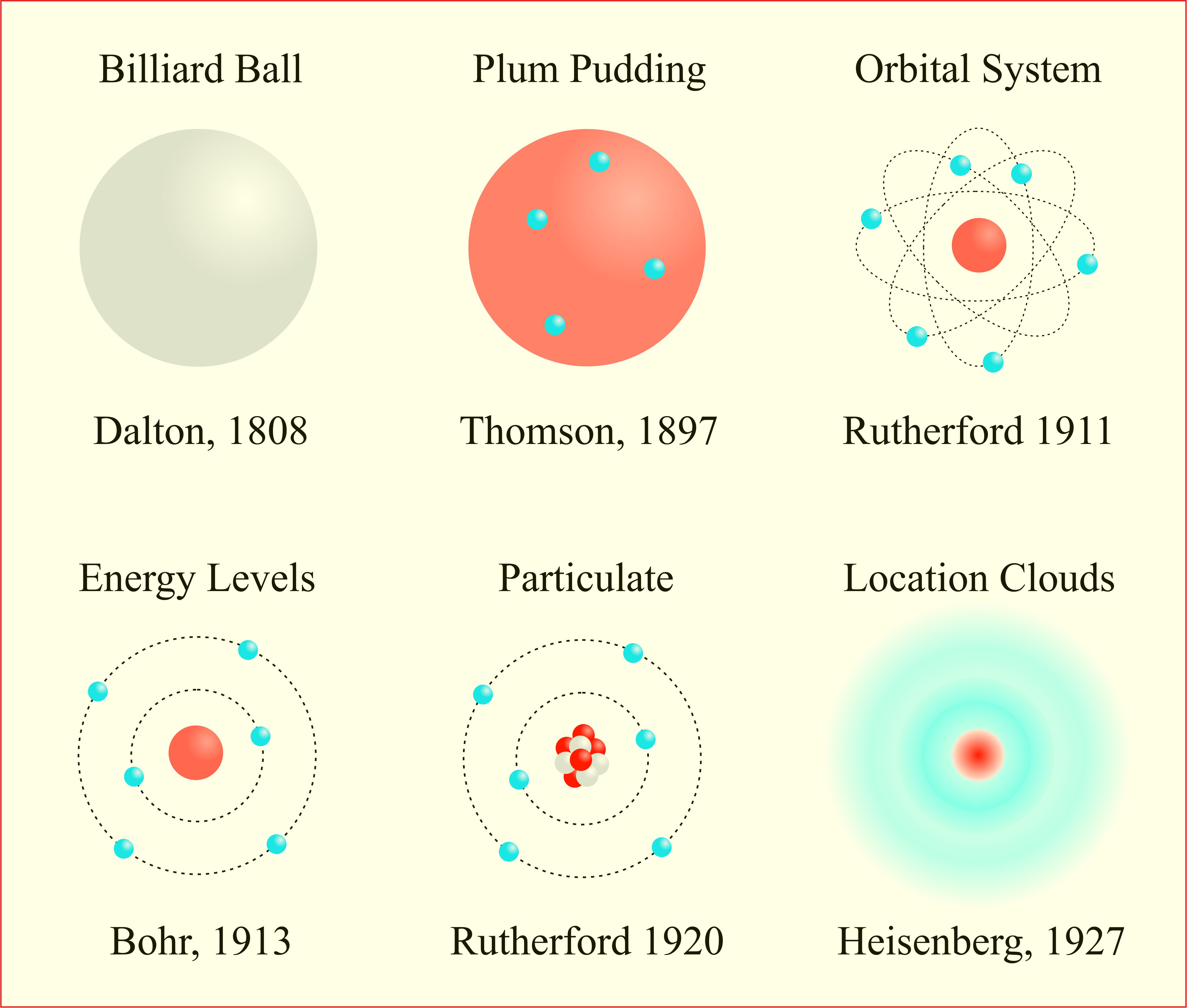
Many different metaphors have been used to illustrate the structure of the atom. These are illustrated in the following figure, which shows the structure of the carbon atom containing 6 protons, 6 neutrons and 6 electrons. Dalton’s initial idea was that atoms were like billiard balls. Thomson discovered electrons and proposed that these particles were stuck in the atom like negative plums in a positive pudding. Rutherford determined that most of the atom was space and concluded that the electrons moved in orbits around a central nucleus just like planets move around the sun. Bohr proposed that electrons could only orbit at specific distances from the nucleus. Movement from one orbit to another was associated with release or absorption of energy. Rutherford later proposed that the nucleus contained both neutrons and protons. Heisenberg demonstrated that an electron had no specific location but rather existed as a cloud of possible locations. Schrödinger found that these clouds were defined by wave functions. These equations gave probability-shapes that are called “orbitals.”

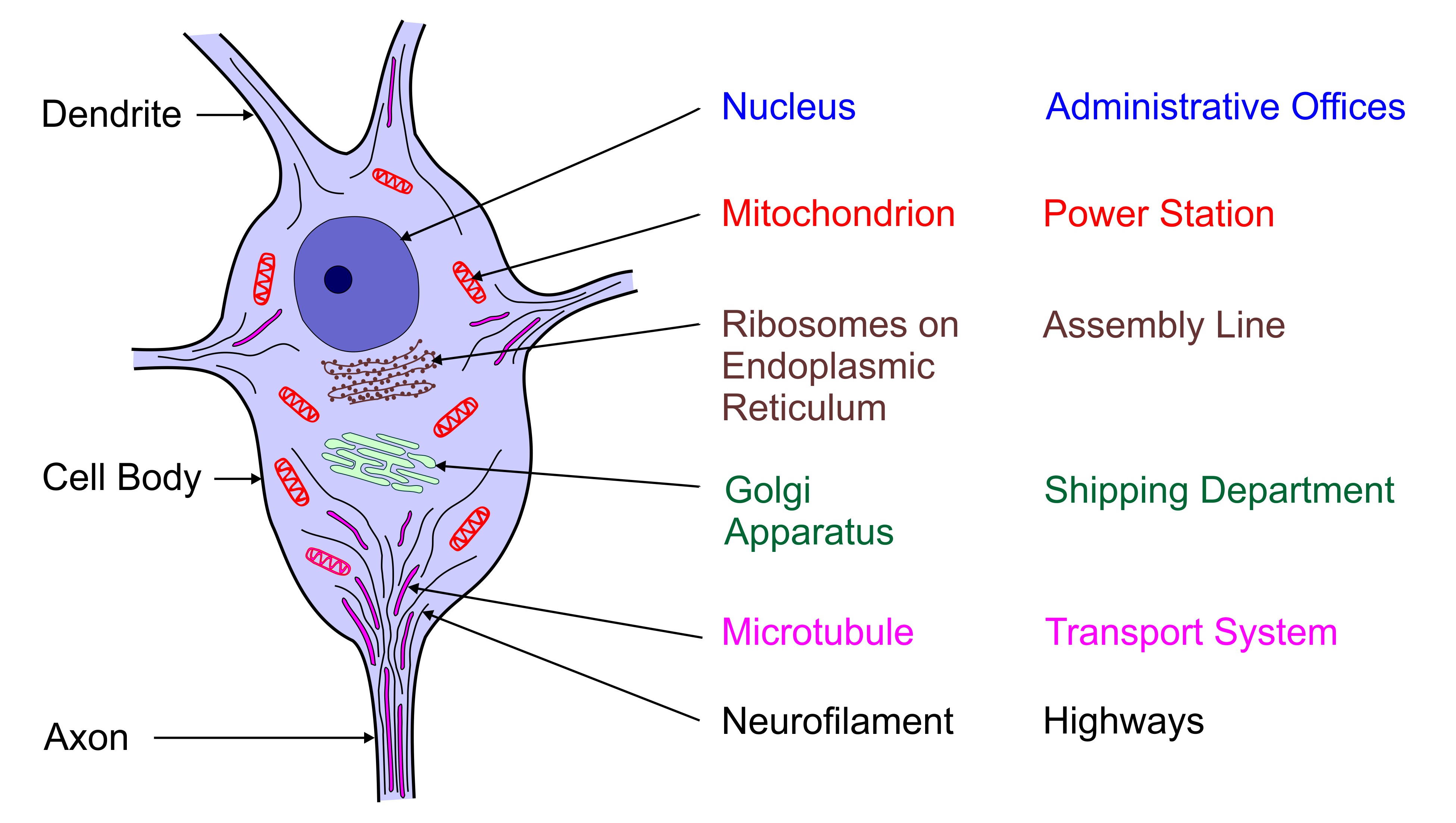
Other metaphors can help explain the workings of the different organelles in a cell. The following views the neuron in terms of a manufacturing company.

Metaphor in Religion

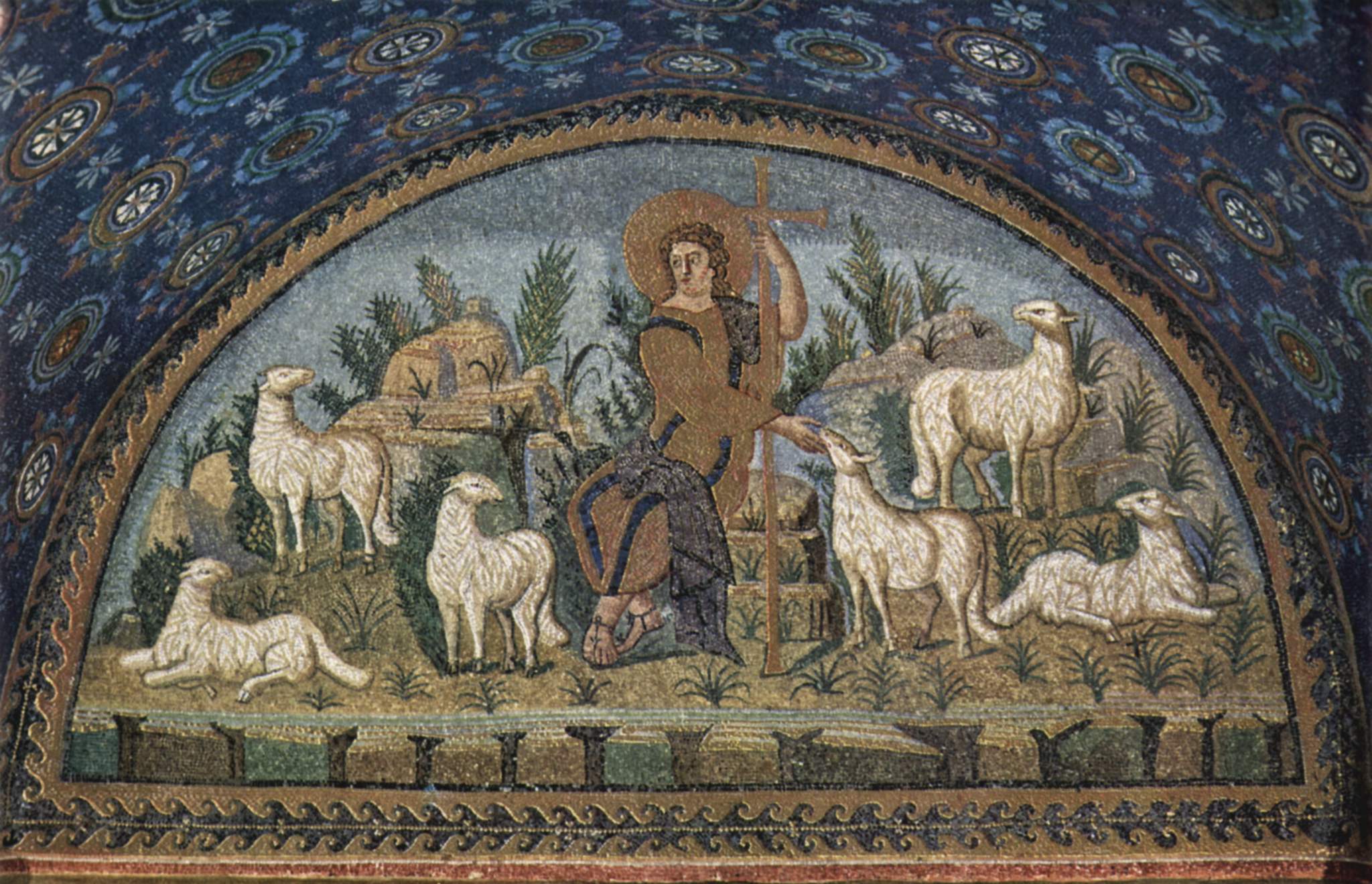
Religious scripture is permeated with metaphor (Soskice, 1985). How else can one describe what is beyond human understanding. The most famous metaphor for God in the Judeo-Christian tradition is that of the Good Shepherd (Psalm 23, John 10: 1-21). This is illustrated in the 5th-century CE mosaics in the Mausoleum of Galla Placidia in Ravenna.

This metaphor tells us that a force in the universe takes care of us like a shepherd takes care of his sheep – leading us to food and shelter, protecting us from danger, finding us when we have gone astray, if necessary dying that we might live. Thus might we gain some insight into something far beyond our understanding.

Though metaphor is acknowledged as a means for conveying religious truths, there is no accepted limit about how far one might go in terms of metaphorical interpretation. In the Christian religion, for example, should a believer consider the resurrection of Christ to be literally or metaphorically true? Most believers follow the Nicene Creed and insist that the resurrection actually happened. But could the story be metaphorical rather than historical? Richard Holloway (2001) discusses the resurrection in terms of our ability to make changes for the better rather than in terms of its historical truth. He uses the story of Rosa Parks and the Montgomery Bus Boycott as an example of a “resurrection moment:”

Resurrection is the refusal to be imprisoned any longer by history and its long hatreds; it is the determination to take the first step out of the tomb. It may be a personal circumstance that immobilises us, or a social evil that confronts us: whatever it is, we simply refuse any longer to accept it, because the logic of resurrection calls us to action. It follows, therefore, that if we say we believe in the resurrection it only has meaning if we are people who believe in the possibility of transformed lives, transformed attitudes and transformed societies. The action is the proof of the belief. So I end with what may appear to be a paradox: I can say I believe in that resurrection then, the Jesus resurrection, because I see resurrections now, see stones rolled away and new possibilities rising from old attitudes. If a belief is an action indicator rather than a purely mental event, belief in resurrection means that I must commit myself to the possibility of transformation. That means continuing to struggle with the intractability of my own nature; more importantly, it means joining with others in action to bring new life to human communities that are still held in the grip of death. (p 141).

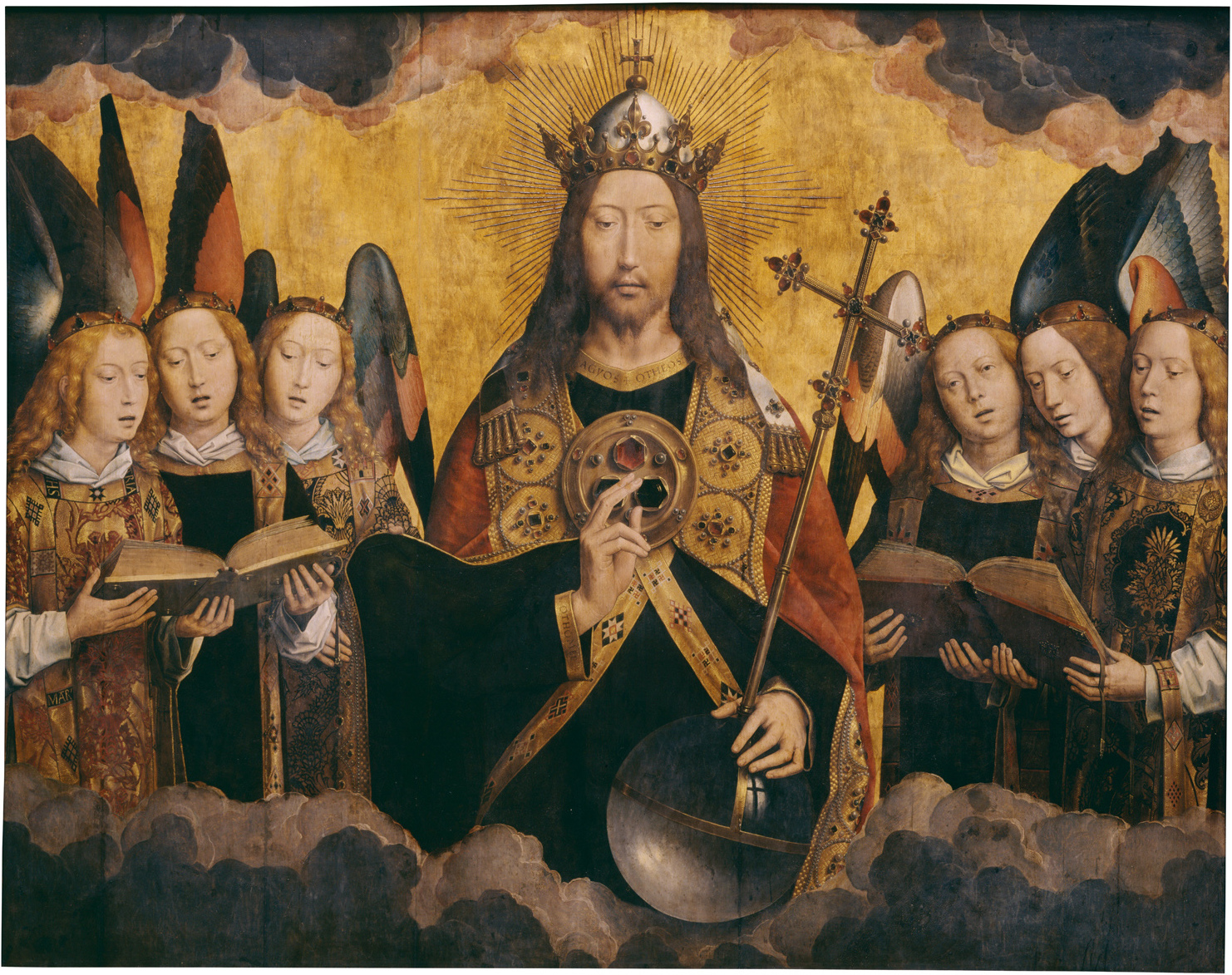
Another tenet of the Christian belief is the idea of the Second Coming – when Christ will return to the earth to judge what we have done and to reign in a new and perfect world. Christ in his majesty is depicted in Hans Memling’s Christ with Singing Angels from 1480 CE.

Should a Christian believe in this Second Coming as something that will actually occur? Or is it a metaphor for life leading ultimately toward peace and prosperity? Provided that we follow the injunctions of the religion to love our neighbor.

Envoi

In the closing scene of Shakespeare’s Hamlet, Horatio bids farewell to the dying Hamlet.

Now cracks a noble heart.—Good night, sweet prince,
And flights of angels sing thee to thy rest!
(Hamlet, V-5: 359-60)

Angels are a metaphor for the forces that might take care of us in our suffering, accompany us through whatever happens at the moment of death, and celebrate us when we have done well. There are no angels. Yet if there were, they would be with Hamlet. Horatio finds comfort in metaphor.

References

Black, M. (1993). More about metaphor. In Ortony, A. (Ed). Metaphor and thought. (pp 19-41). Cambridge UK: Cambridge University Press.

Binkley, T. (1974). On the truth and probity of metaphor Journal of Aesthetics and Art Criticism, 33, 171-180.

Davidson, D. (1978). What metaphors mean. Critical Inquiry, 5, 31-47.

Donoghue, D. (2014). Metaphor. Cambridge, MA: Harvard University Press.

Gibbs, R. W. (1994). The poetics of mind: Figurative thought, language, and understanding. Cambridge UK: Cambridge University Press.

Hobbes, T. (1651/1929). Leviathan, or the matter, form, and power of a commonwealth ecclesiastical and civil. Oxford: Clarendon Press.

Holloway, R. (2001). Doubts and loves: What is left of Christianity?. Edinburgh: Canongate.

Kövecses, Z. (2002). Metaphor: A practical introduction. New York: Oxford University Press.

Lakoff, G., & Johnson, M. (2003). Metaphors we live by. Chicago: University of Chicago Press.

Locke, J. (1690) An essay concerning human understanding. Volume I (Books 1 and 2) available at archive.org. Book 3 available at archive.org

Reddy, M.J. (1993). The conduit metaphor: a case of frame conflict in our language about language. In Ortony, A. (Ed.) Metaphor and thought. (pp. 164-201). Cambridge, UK: Cambridge University Press.

Richards, I. A. (1936). The philosophy of rhetoric. New York: Oxford University Press.

Searle, J. R. (1993). Metaphor. In Ortony, A. (Ed.) Metaphor and thought. (pp. 83-111). Cambridge, UK: Cambridge University Press.

Shelley, P. B. (1821/1915). A defense of poetry. In Salt, H. S. (Ed) Selected prose works of Shelley. (pp 75-118). London: Watts.

Soskice, J. M. (1985). Metaphor and religious language. Oxford: Clarendon Press

Speaks, J. (2014). Theories of meaning. Stanford Encyclopedia of Philosophy.

Zwicky, J. (2003). Wisdom & metaphor. Kentville, NS: Gaspereau Press.