Paul Celan: Todtnauberg

Paul Celan (1920-1970) was a Romanian-Jewish poet whose mother-tongue was German. Both his parents died in Nazi labor camps. After the war, Celan settled in Paris but continued to write poetry in German. On July 24, 1967, he gave a recitation of his poems at the University of Freiburg. The next day he visited Martin Heidegger (1889-1976) at his cabin in Todtnauberg in the Black Forest. Many believe that Celan asked Heidegger to make some statement renouncing the Nazi movement that he had joined in 1933. However, although a 1966 interview about his ties to the Nazi party was published posthumously in Der Speigel, Heidegger never made any statement about the evils of Nazism and never mentioned the Holocaust. The 1963 photograph of Paul Celan is by Lütfi Özkök.

Der Dichter (Poet)

Paul Celan was born in Czernowitz, Bukovina, in northern Romania, in 1920, as Paul Antschel. His family were German-speaking Jews, and his mother was devoted to German literature. Although Celan spoke Hebrew and Romanian, he considered German his mother-tongue. In 1938, Celan went to Tours, France, to study medicine but returned to Romania when World War II broke out in 1939.

The Germans arrived in Czernowitz in 1941, and began rounding up the Jews for forced labor in 1942. Celan’s parents were deported to a labor camp in Transnistria (present day Moldova). His father soon died there of typhus. Later, his mother was shot for not being a productive worker. Celan felt immense guilt about his parents’ deaths since he had been unable to convince them to go into hiding. However, later in 1942 he was himself sent to a German labor camp in Romania. He was finally released when the Red Army arrived in February 1944. He began to publish poetry in Bucharest after the war using the name “Celan” which is an anagram of the Romanian spelling (Ancel) of his name “Antschel.” Among these early poems was Todesfuge (Deathfugue, 1947), a searing description of the Holocaust.

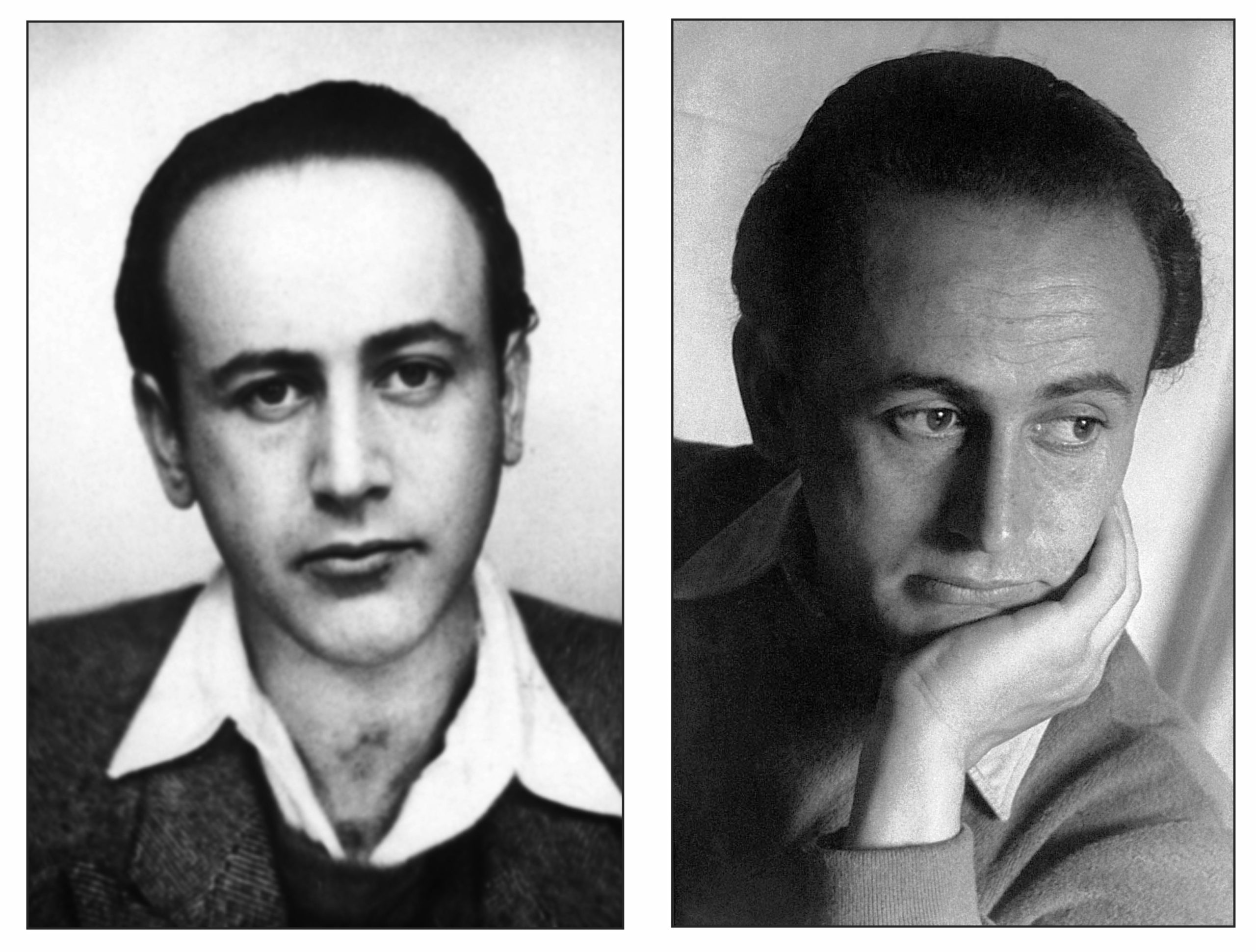
When the Romanian government became communist in 1948, Celan moved to Vienna. Finding the city empty and depressing, he moved on to Paris. There he continued to publish poems in German. In 1952, he married the graphic artist Gisèle Lestrange. He began teaching German literature and translation in the École normale supérieure in Paris in 1956. The following illustrations show Paul Celan in 1938 and in 1949.
Celan befriended the poet Yvan Goll (1891-1950) in the year before he died, and helped him to translate some of his French poems into German. In 1953, his wife, Claire Goll (1890-1977), wife accused Celan of plagiarizing her husband’s work; she reiterated these claims until she died. There was no foundation in fact for her allegations, and Celan was ultimately completely exonerated (Wiedemann, 2000; Olschner, 2001; Bonnefoy, 2010; Maurel-Indart, 2010; Arno, 2026, pp 187-217). Nevertheless, Celan became severely depressed by the resultant scandal.   

Despite the success of his poetry, Celan was still aware of persistent antisemitism in Germany, and he remained troubled by the accusations of Claire Goll. In the 1960s, Celan was hospitalized for depression several times, with each admission lasting for many months. During these stays he was treated with insulin shock therapy, now considered both barbaric and ineffective (Doroshow, 2007). Celan’s mental state deteriorated and he attempted suicide in early 1967. Following this attempt, his wife and child began to live apart from him out of fear for their safety.


Der Meridian

Theodor W. Adorno (1903-1969) famously remarked in 1949 in an essay that was later collected in Prisms (1955)

nach Auschwitz ein Gedicht zu schreiben, ist barbarisch, und das frißt auch die Erkenntnis an, die ausspricht, warum es unmöglich ward, heute Gedichte zu schreiben.
[To write a poem after Auschwitz is barbaric. And this corrodes even the knowledge of why it has become impossible to write poetry today.]

Celan understood the problem of poetry, and indeed all art, in the age that followed the Holocaust (Zilcosky, 2005). One could not write about beauty in the face of such terrible suffering. Nor could one describe the suffering in poetry because that would only attenuate its horror. Nevertheless, Celan not only wrote poems but also used the language of the murderers. He attempted to change how the words were perceived: to salvage the language for his mother. The following are his comments on the German language on receiving the Bremen Prize in 1958:

Reachable, near and not lost, there remained in the midst of the losses this one thing: language. It, the language, not lost, yes, in spite of everything. But it had to pass through its own answerlessness, pass through frightful muting, pass through the thousand darknesses of deathbringing speech. It passed through and gave back no words for that which happened; yet it passed through this happening. Passed through and could come to light again, ‘enriched’ by all this. (quoted by Arno, 2026, pp 185-186).

Although his early poems used the traditional formats and rhymes, after the war Celan began to write a different kind of German poetry: compressed, cryptic, polysemous. His task was facilitated by the way that Germanic languages allowed new words to be invented by combining old words (Benczes, 2005). This could be done simply for precision: an apple tree (Apfelbaum) is a special kind of tree. But more importantly it could be done by metaphor or metonymy: a brownshirt (Braunhemd) was a member of Hitler’s Sturmabteilung (stormtroopers). Celan’s use of these compounds can be seen in a brief poem from his 1967 collection Atemwende (Breathturn):
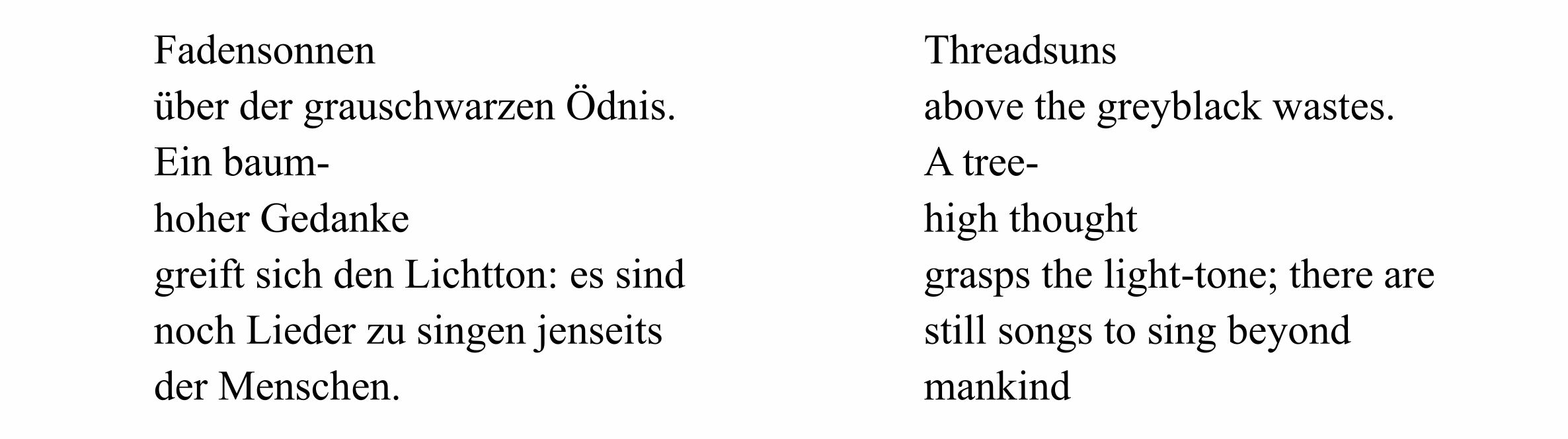
It is not clear what Celan means by Fadensonnen (Celan/Joris, 2014, pp liv and 469-470; Baldi, 2008; Felstiner, 1995, p 218). Perhaps the suns have been reduced to threads. Perhaps Celan is thinking of a Fadensonnenzeiger, an instrument that is used to measure the time when the sun is at noon so that longitude (the meridian) can be estimated. Perhaps he is referring to that time in late summer (Fadensommer) when gossamer threads drift through the air. Perhaps the suns of all our days are being threaded together by the Fates. Perhaps all these things?

The compound Lichtton is similarly polysemous. It might mean the analog recording of sound on a film by means of the intensity of the light. It might simply mean a sound as pure and transparent as light.

Felstiner comments on the poem:

Thin yet tough threads bind the dead to the living. Here, as in an etching of his wife’s, tenuous light hovers over the waste and void before Creation. Then a “tree-high” thought—and there is light. “Oh Orpheus sings! Oh high tree in the ear!” Rilke opens his Sonnets to Orpheus. For Celan, there is no return from the underworld, but “there are / still songs to sing beyond / humankind [jenseits der Menschen]”—not in some afterlife but a step beyond those he kept covenant with. (Felstiner, 1995, p 218)

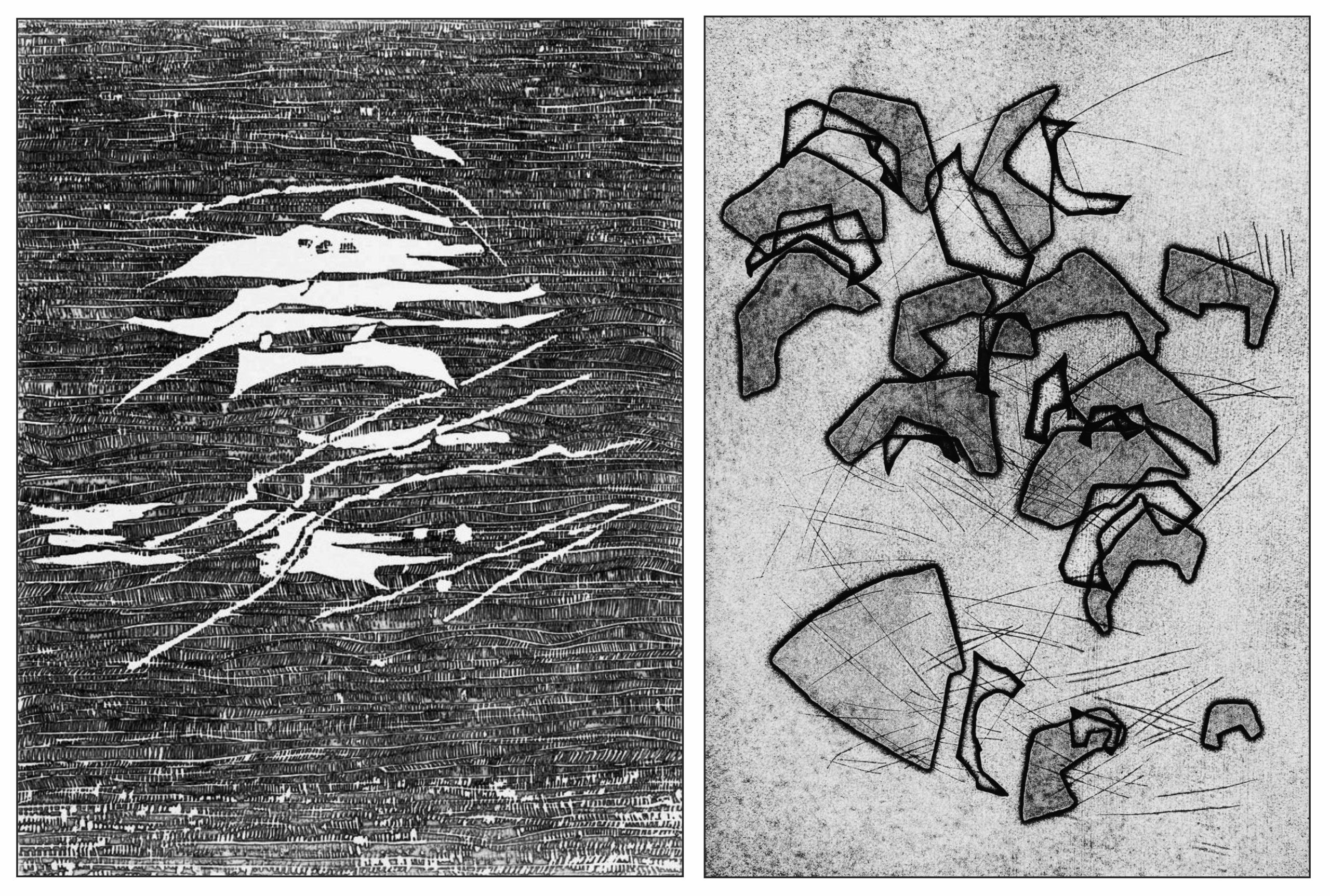
The following illustration shows two of Gisèle Lestrange’s etchings from the books Atemkristall (Breath crystal,1965) on the left and Schwarzmaut (Black toll, 1967) on the right. They are as cryptic as the poems:
The following is Celan’s recitation of the poem:

In 1996 Harrison Birtwistle set several of Celan’s poems to music and combined them with musical interludes (friezes and fantasias) in a work entitled Pulse Shadows. The following is the setting for Fadensonnen with Claron McFadden, soprano, the Arditti Quartet and the Nash Ensemble

Celan believed that poetry was a way to communicate with others, to reach through the differences and to find a shared experience. He was deeply aware of the thoughts of Emmanuel Levinas (1906-1995) and Martin Buber (1878-1965) on the relations between the self and the “other” (Ceuppens, 2020). When he received the Büchner Prize in 1960, Celan gave an acceptance speech that came to be known as The Meridian (German text of speech; translations: Celan/Glenn, 1978; Celan/Felstiner, 2001, pp 401-414; commentary: Meyerhofer, 1981). The following are two excerpts (Glenn translation). First, about the nature of the poem:

The poem is alone. It is alone and underway. Whoever writes it must remain in its company. But doesn’t the poem, for precisely that reason, at this point participate in an encounter? in the mystery of an encounter? The poem wants to reach the Other, it needs this Other, it needs a vis à vis. It searches it out and addresses it. Each thing, each person is a form of the Other for the poem, as it makes for this Other. The poem attempts to pay careful attention to everything it encounters; it has a finer sense of detail, of outline, of structure, of color, and also of the “movements” and the “suggestions.” These are, I believe, not qualities gained by an eye competing (or cooperating) with mechanical devices which are continually being brought to a higher degree of perfection. No, it is a concentration which remains aware of all of our dates. “Attention”? Permit me at this point to quote a maxim of Malebranche which occurs in Walter Benjamin’s essay on Kafka: “Attention is the natural prayer of the soul.”

Second, about the opposing poles of self and other:

I find something, like language, abstract, yet earthly, terrestrial, something circular, which traverses both poles and returns to itself, thereby I am happy to report –even crossing the tropics and tropes. I find … a meridian.


Der Denker (Thinker)

Martin Heidegger was born in Messkirch, Baden-Württemburg in 1889. He studied philosophy at the University of Freiburg, finishing his habilitation thesis in 1916. He served briefly in the German army in a non-combatant role at the end of World War I. After the war, he taught at the University of Freiburg. In 1923 he was elected professor at the University of Marburg.

In 1927 he published his major work Sein und Zeit (Being and Time), in which he addresses the nature of being:

The central theme of Heidegger’s philosophy is the question concerning the meaning (Sinn) of being (Sein). The “fundamental ontology” he advances in Being and Time departs dramatically from traditional ontology in that it asks not what there is, nor why there is what there is, nor even why there is anything at all and not nothing. The last of those questions, most famously associated with Leibniz and Schelling, is what Heidegger calls “the fundamental question of metaphysics.” It is a deep and important question, but it is not the question of fundamental ontology, for what it asks about is the totality of entities, not the meaning of being. Heidegger’s question, then, is not, Why is there anything? but rather, What does it mean for something to be? – or simply (redundantly), What is it to be? (Carman, 2003, p 8)

One special type of being is that of the individual human – Dasein, existing in the world. As human beings we can conceive both the world and ourselves within it:

For the question of being, as Heidegger conceives it, is inseparable from questions concerning the understanding and the existence of those entities for which, or rather for whom, the question of being can be a question at all, namely, ourselves, human beings. The argument of Being and Time therefore begins by referring ontology back to what Heidegger calls an “existential analytic of Dasein,” that is, an account of the basic structures of human existence. (Carman, 2003, p 9).

One essential aspect of the Dasein is its relation to time: conscious human beings are mortal. However, our thoughts may outlive our lives, provided we live with “authenticity”: Eigentlichkeit, ownedness (Carman, 2003, pp 264-313). 

Heidegger realized that the nature of being is difficult if not impossible to understand through reason. He became fascinated by the idea that poetry determines the world through the words we use to describe it. (The word “poetry” derives from the Greek poiesis, making.) Heidegger interpreted the line of the poet Hölderlin (1770-1843):

Was bliebet aber, stiften die Dichter.
[But what is lasting the poets provide.]

The poet names the gods and names all things with respect to what they are. This naming does not merely come about when something already previously known is furnished with a name; rather, by speaking the essential word, the poet’s naming first nominates the beings as what they are. Thus they become known as beings. Poetry is the founding of being in the word. (Heidegger, 1941, p 59)

Soon after Adolf Hitler come to power in Germany (January 1933), Heidegger became Rector of the University Freiburg (April 1933). He joined the Nazi Party in May 1933, and remained a member until the end of the war. As Rector, Heidegger ensured the “alignment” (Gleichschaltung) of the university with the aims of the Nazi Party. He resigned from the rectorship in April 1934, but this was probably more related to his dislike of administration than to any qualms about Nazi policies.

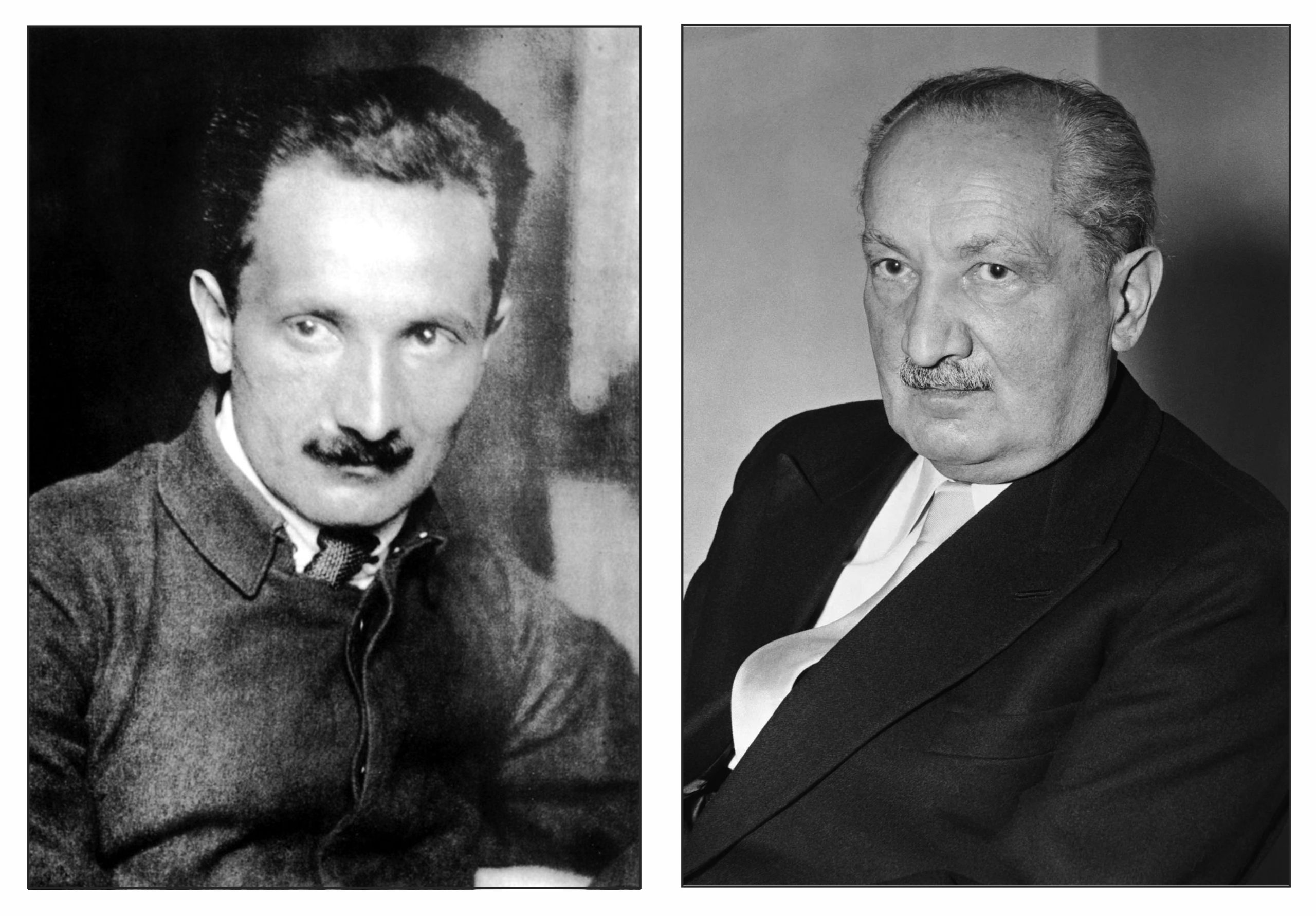
After the war, he was considered a fellow traveler (Mitläufer), the lowest category of those requiring denazification. Though he was initially banned from teaching, he was allowed to return to lecturing in 1950. The following illustrations show photographs of Heidegger taken in 1922 and in the 1960s.
Heidegger did not feel regret for his involvement with the Nazi party. After the war he was more concerned with what he perceived as the injustices done to the defeated Germans, such as the Dresden fire-bombing, the communist takeover of East Germany, the German prisoners-of-war trapped in the Soviet Union, and the Nuremburg trials. Both of his sons had been captured on the Eastern front and were prisoners-of-war. This deep sense of German victimization led to an:

inability and/or unwillingness to accept responsibility for the horrors of the Shoah and this oppugning of the Other’s claim to having suffered as much or more than he (Bamberg, 2023, p 233).

This prevented him from ever acknowledging how Naziism had been so evil, particularly toward the Jewish people. In 1966 Heidegger granted an interview about his connections to the Nazi Party with the news magazine Der Speigel (Mirror), with the proviso that this not be published until after his death in 1976. In the interview, Heidegger noted his personal support for his Jewish students, and claimed that he had tried to attenuate the effects of Nazi policies. He did not denounce fascism. He did not mention the Holocaust.


Todtnauberg

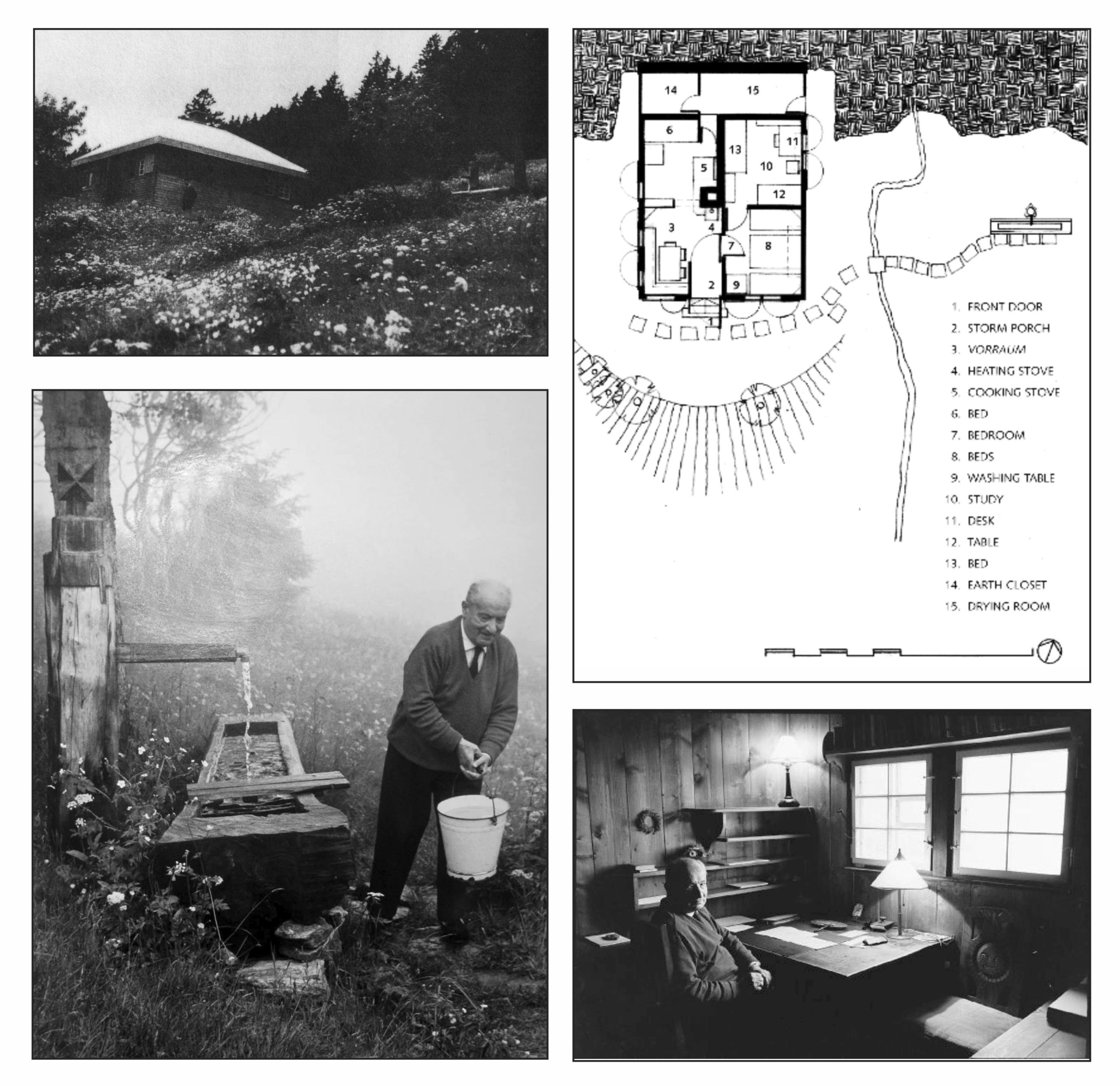
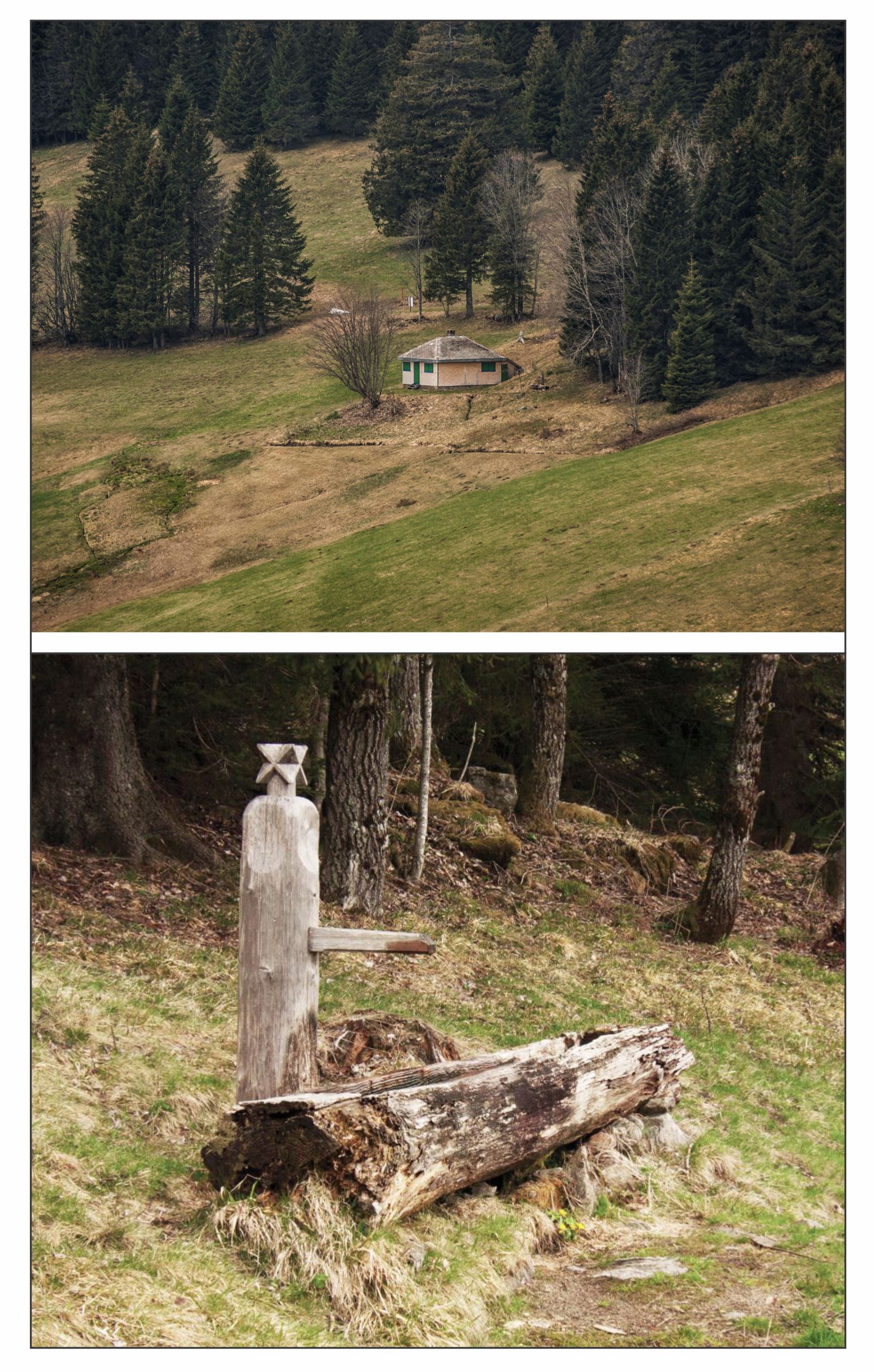
In 1922, Heidegger’s wife Elfride used an inheritance to build a small wooden Hütte (cabin) in the Schwarzwald (Black Forest) close to the village of Todtnauberg, about 30 km south of Freiburg (Sharr, 2006). About 6 x 7 meters in size, the cabin is situated on the north side of a small valley. Close by is a spring, marked by a post surmounted by a small carving of a four-sided star. Heidegger enjoyed the solitude of the Todtnauberg and wrote much of Sein und Zeit at the cabin. The following illustration shows a plan of the cabin and photographs from 1966. The photographs show the wildflowers around the cabin, Heidegger bringing water from the spring, and Heidegger sitting at his desk in the study:
The following shows some modern photographs from the thinkingplace website:
Die Begegnung (Encounter)

By the time they first met in Freidburg in 1967, Celan and Heidegger were both well acquainted with each other’s work (Lyon, 2006; Kenaan, 2021; Bamberger, 2023):

Celan had read a wide range of Heidegger’s texts and was especially taken by the manner in which Heidegger’s philosophy of language searches for the essence of language beyond communication and its emphasis on the role of poetry in revealing that essence by freeing language from its everyday use. … Heidegger, too, not only read Celan extensively for more than a decade, but also valued the poet for his ability to recover, for thinking, more original forms of listening to the saying of words. For Heidegger, Celan’s poetry opens up a rare possibility of releasing the space of language “onto its own freedom,” by subverting the grip of instrumental reason activated by the founding templates of modern thought and fully realized in the age of technology. (Kenaan, 2021, p 353)

On July 24, 1967, Celan gave a reading of his poetry at the University of Freiburg. Heidegger was seated in the first row and invited Celan to visit him the next day at his cabin in Todtnauberg. Gerhard Neumann, a young assistant to Professor Gerhart Baumann, who had invited Celan to Freiburg, drove Celan and Heidegger to the cabin. Neumann’s only description of the meeting (many years later) was that during the drive and the time at the cabin the poet and the philosopher talked about National Socialism and that there were painful silences (Lyon 2006, p 164).  

The following is Celan’s report of the meeting to his wife:

The reading in Freiburg was an exceptional success: 1,200 people who listened to me with bated breath for an hour, then, having applauded me for a long time, they listened to me again for another fifteen minutes. Heidegger had come up to me—The day after my reading I was, with M. Neumann … in Heidegger’s hut (Hutte) in the Black Forest. Then there was, in the car, a grave dialogue, with clear words from me. M. Neumann, who was the witness of it, told me afterward that, for him, this conversation had something epoch-making about it. I hope that Heidegger will take up his pen and that he will write a few pages echoing that, and warning too, in the face of mounting Nazism. (August 2 letter, Celan, 2024, p 401)

Celan wrote the poem Todtnauberg on August 1 in Frankfurt (Celan/Joris, 2014, p 554). He arranged for the poem to be printed in a special limited edition, and when it was published in January 1968, he sent the first numbered copy to Heidegger (Lyon, 2006, p 187). The poem provides a cryptic description of Celan’s visit to Heidegger’s cabin:

“Todtnauberg” is really barely a poem; a single nominal phrase, choppy, distended and elliptical, unwilling to take shape, it is not the outline but the remainder—the residue—of an aborted narrative. It consists of brief notes or notations, seemingly jotted in haste with a hope for a future poem, comprehensible only to the one who wrote them. It is an extenuated poem, or, to put it better, a disappointed one. It is the poem of a disappoint-ment; as such, it is, and it says, the disappointment of poetry. (Lacoue-Labarthe, 1986/1999, pp 35-36)

The following is the poem with the Joris (2014) translation:
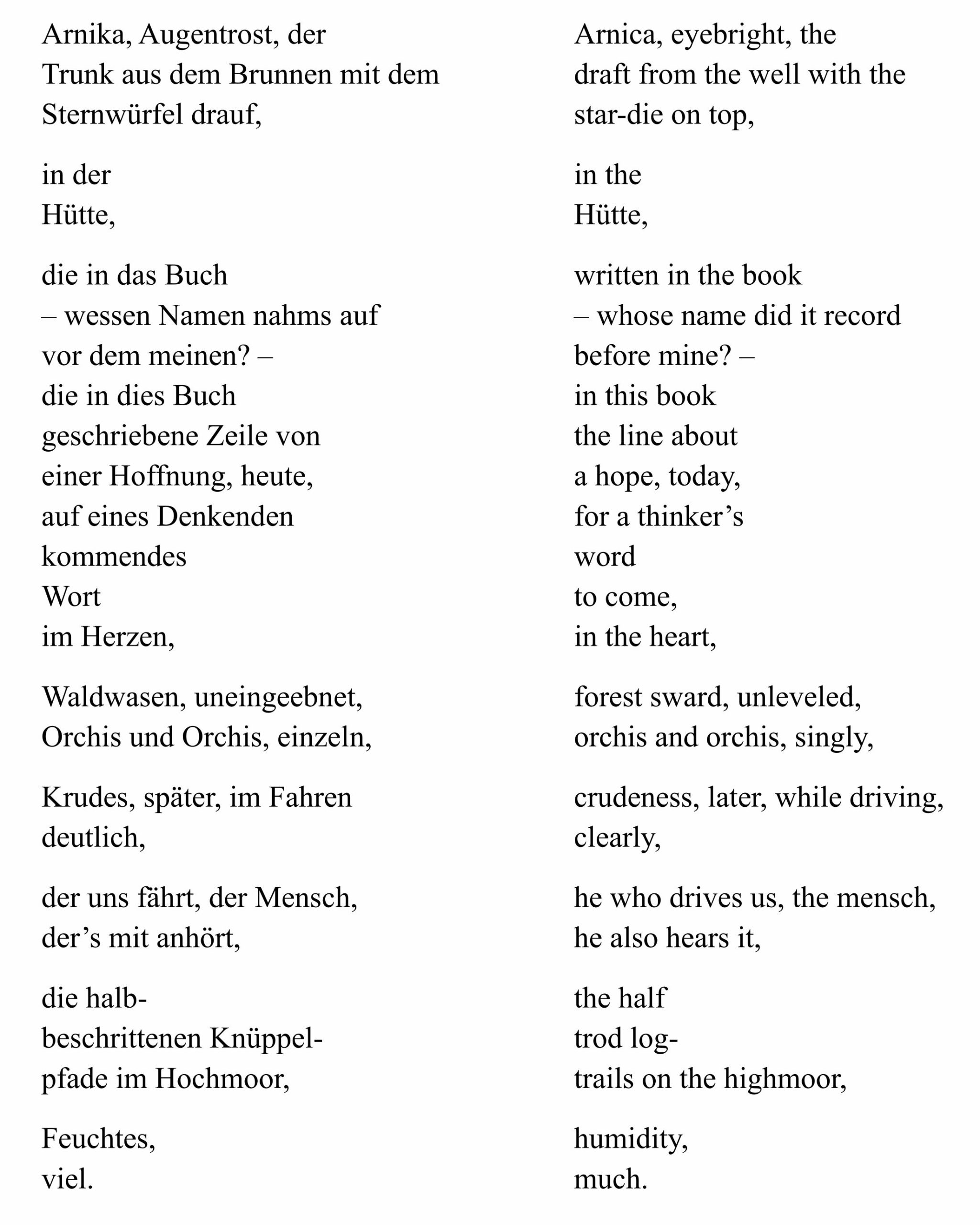
The poem contains three of Celan’s characteristic compounds: Sternwürfel, Waldwasen, and Knüppelpfade. We shall discuss these as we go through the poem.

The opening verse describes the wildflowers near the cabin and the spring with the carved star. Both flowers mentioned have been used in herbal remedies: the bright yellow Arnica for bruising and sprains, and eyebright (Euphrasia) for improving vision (Augentrost means eye-comfort). There is no convincing evidence for any therapeutic effect, but both flowers are strikingly beautiful:


 

The second verse describes Celan’s hesitant step into Heidegger’s cabin. Then the poet writes a brief statement into the visitors’ book. The inscription and the poem present the hope that, following the conversation in the car on the way to Todtnauberg, Heidegger would make some formal statement denouncing the evils of National Socialism and warning that it must never again come to power. The actual words written in the book were slightly different from those recorded in the poem:

Ins Hüttenbuch, mit dem Blick auf den Brunnenstern, mit einer Hoffnung auf ein kommendes Wort im Herzen. Am 25. Juli 1967 / Paul Celan (Joris, 1988)

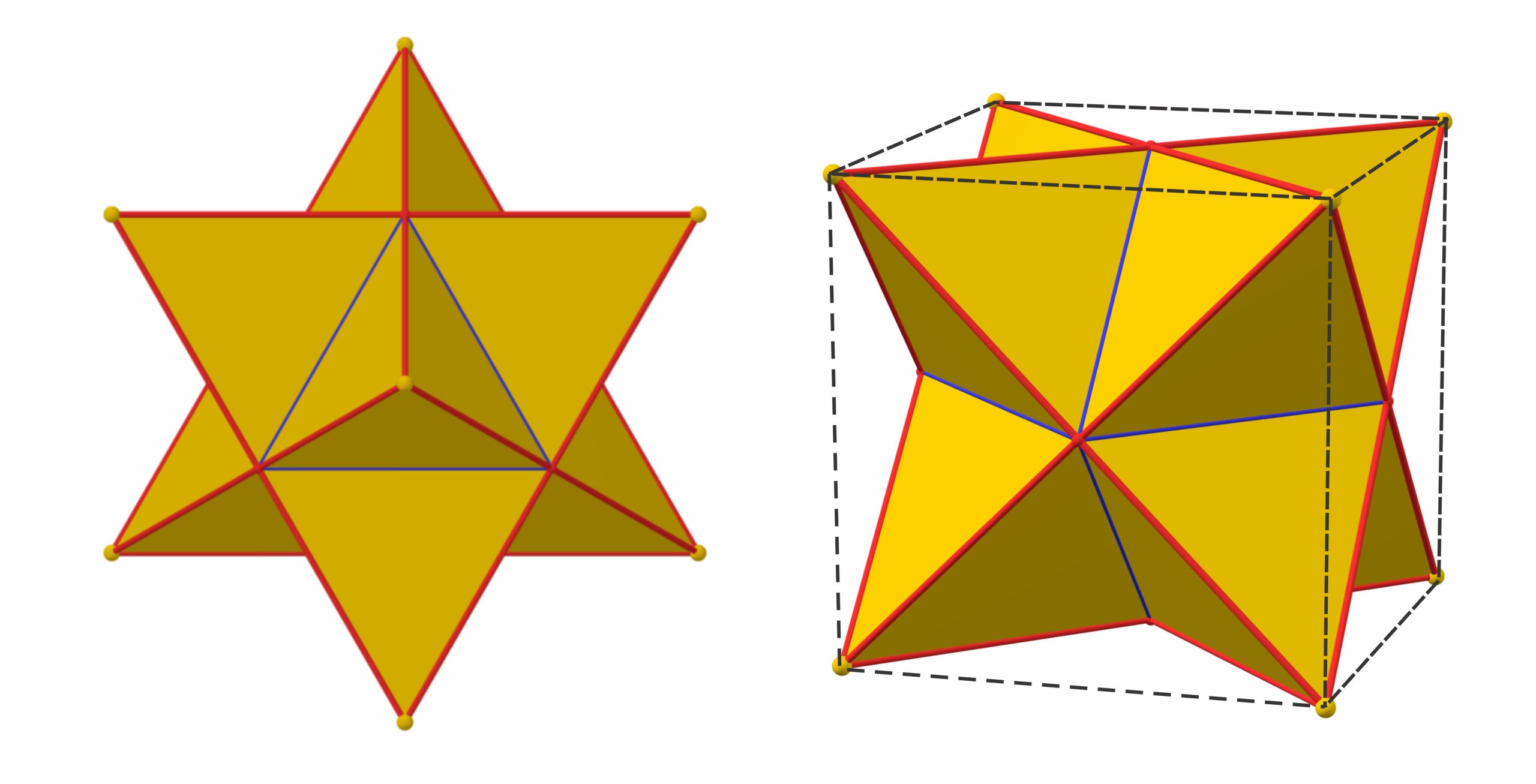
The Brunnenstern is the carved star (Stern) at the top of the post with a spout coming from the spring (Brunnen): a stellated octahedron (stella octangula) compose of two intersecting tetrahedra. This shape can be contained in a cubic space (dotted lines). In the poem, Celan uses the term Würfel, dice. It is impossible not to see the Jewish star (Magen David, shield of David, composed of intersecting triangles) when the shape is viewed from one of the apices of the tetrahedra (left). The stellated octahedron is the Magen David in 3-dimensions:
Golb (1988) notes that the “book” in which Celan writes can be construed in several ways. It is of course the Heidegger’s visitor’ book in which many previous visitors, some with ties to National Socialism, had written. But it could also be the book referred to in Revelations 20:12, a Book of Judgement in which are written the names of the damned and the saved. It also refers to the text of Celan’s poem:

For this reason, “das Buch” of line 6 becomes “dies Buch” of line 9, and the crucial question linking one text to the other, “wessen Namen nahms auf / vor dem meinen?” not only has mystical significance and is about Heidegger, but is equally Celan’s questioning of himself and of the “names” inscribed in the text of an ideological tradition that remains, in a fundamental way, his own. Similarly, the “in dies Buch / geschriebene Zeile” refers, along with its other meanings, to the lines (or continuous “line”) of the poem itself, expressing the “Hoffnung,” in a textual present (“heute”) shared by poet and reader, that within the language of the text the magic realization of its absent meeting (standing, in any case, for all poetological desire) might occur: a personal conciliation of Celan and Heidegger (Golb, 1988, p 264)

The crux of the poem is Celan’s hope for Heidegger’s kommendes Wort in Herzen. He and Heidegger have painfully talked about National Socialism and the Holocaust. And Heidegger has said that something will be said. It is possible Heidegger just meant the interview with Der Spiegel that was to be published posthumously. But that was vacuous and that was not heute (today). Celan was obviously hoping for much more.

The next five verses describe the walk that Heidegger and Celan took in the forest near the cabin, a walk that was soon aborted because of the rain. Joris (1988) comments on how the word Waldwasen has multiple meanings and connotations:   

At first glance one could conceivably think that the poet has simply have chosen an erudite or “poetic” word instead of the more obvious and thus banal “Waldwiesen” – forest meadows. … A “Wase”, according to Grimm’s Dictionary of the German language, is, first of all, a piece of sod together with the plants that grow in it …  Celan is not talking of some grassy surface, a pleasant meadow, but has in mind something that goes deeper and incorporates the network of underground roots…. Grimm further glosses “Wasen” as … “the piece of land on which the knacker or “Wasenmeister” (the”Master of the Wasen”) guts and buries the dead livestock, also known in South Germany and on the Rhine as “Schindanger” – “the knacker’s yard” which one could nearly translate as the “killing fields”…. Then my eye fell on yet another “Wase”, a word current in North Germany, and used to describe a bundle of dead wood, the etymology of which Grimm leads back through French “faisceau” to Latin “fasces”, the curator’s bundle of rods, which became the symbol of, and gave the word for, “fascism”.

On the Waldwasen, Celan describes two Orchis flowers. Like the poet and the philosopher, they stand separate from each other. The Orchis has testicle-shaped roots, hence its name and the crude connotations.

These are the flowers mentioned by Gertrude in her speech describing the death of Ophelia in Hamlet (IV, 5: 193-5):

                                                   long purples,
That liberal shepherds give a grosser name,
But our cold maids do dead men’s fingers call them.

It is possible that Celan mention of Krudes relates to these connotations of the flower. However , the word also means “raw” and might indicate that something else was said in the car. Perhaps something about the horrors of the Holocaust. 

Joris (1988) comments on the log trails mentioned in the penultimate verse:

They walk on “halb- / beschrittenen Knüppel-/Pfaden..” – “half- trod/log-trails”, literally on “paths made of wood” – the German Holzwege, which refers to a path in a forest, but also, in common parlance, to a dead-end, to a mistaken route, and is, of course, the title of a well-known book by Heidegger. Celan is too subtle to use Heidegger’s word, and his “log-paths” complexify the image further as Knüppel- the German word means both “logs” and “rods” – are also used as weapons to beat people, prisoners, etc.

In 1950 Heidegger had published a set of essays written over the preceding 15 years in a book called Holzwege. Heidegger explained the title

Holz lautet ein alter Name für Wald. Im Holz sind Wege, die meist verwachsen jäh im Unbegangenen aufhören. Sie heißen Holzwege. [“Wood” is an old name for forest. In the wood there are paths, mostly overgrown, that come to an abrupt stop where the wood is untrodden. They are called Holzwege.]

As one finishes reading, one feels that Celan has clearly and simply described what happened at Todtnauberg. However, one is also deeply aware that the poem alludes to much more. The following are comments by Oyarzún (2022):   

A diaphanous and at the same time unapproachable, impenetrable poem. Impenetrable, perhaps, because purely diaphanous. Everything is there in the light, in the forced light that prevails in these final poems; everything: including the formfitting reticence in which the poems are gathered. With everything clear, deutlich, how could one say that Celan’s poetry is hermetic? (p 2)

Why do I feel I cannot pronounce anything definitive about what happens in this poem? It is, perhaps, because I want to hold on to the impression— my earliest impression—that there is something unthinkable here, and this unthinkable would be the unthinkable (das Undenkbare) of an encounter without encounter, without dialogue, on a today that slips over itself (heute, Feuchtes), dislodges itself from itself, de-spairs [des-espera], drowning, falling on itself (viel: fiel). The unthinkable, das Undenkbare, imposes the terrible desolation of a forced and essential ingratitude (Undankbarkeit), a word’s immurement upon itself. (p 6)

As Oyarzún notes, the last word of the poem – viel (much) – used to modify Feuchte (wetness, humidity) is a homonym for fiel (fell, past tense of fallen).

The following is the musical setting for Todtnauberg from Harrison Birtwistle’s Pulse Shadows, with Claron McFadden, soprano, the Arditti Quartet and the Nash Ensemble.

The poem Todtnauberg was later published in Celan’s Lichtzwang (1970, light duress). Lyon (2006, pp 188-189) notes that the 1967 bibliophile edition of the poem contains a word not present in the later version: un-gesäumt meaning “without delay” just before kommendes Wort. When Celan sent Heidegger this gift, he was clearly exhorting him to make a statement about what they had discussed at Todtnauberg. Heidegger replied with a perfunctory letter of thanks for Celan’s gift. He never denounced National Socialism for its role in the Holocaust.    

The following are Lacoue-Labarthe’s comments on the encounter at Todtnauberg: (Lacoue-Labarthe, 1999, p 38)

To Heidegger the thinker—the German thinker—Celan the poet—the Jewish poet—came with a single yet precise entreaty: that the thinker who listened to poetry; the same thinker who had compromised himself, however briefly and even if in the least shameful way, with just what would result in Auschwitz; the thinker who, however abundant his discussion with National Socialism, had observed total silence on Auschwitz, as history will recall; that he say just a single word: a word about pain. From there, perhaps, all might still be possible. Not “life,” which is always possible, which remained possible, as we know, even in Auschwitz, but existence, poetry, speech. Language. That is, relation to others.
Could such a word be wrenched?
In the summer of 1967 Celan writes in the guestbook of the Hütte in Todtnauberg. He no longer knows who signed before him; signatures—proper names, as it happens—matter little. At issue was a word, just a word. He writes—what? A line, or a verse. He asks only for the word, and the word, of course, is not spoken. Nothing; silence; no one. The in-advent of the word (“the event without answer”).
I do not know what word Celan could have expected. What word he felt would have had enough force to wrench him from the threat of aphasia and idiom (in-advent of the word), into which this poem, mumbled against the silence, could only sink as if into a bog. What word could suddenly have constituted an event.
I do not know. Yet something tells me it is at once the humblest and most difficult word to say, the one that requires, precisely, “a going out of the self.” The word that the West, in its pathos of redemption, has never been able to say. The word it remains for us to learn to speak, lest we should sink ourselves.
The word pardon.
Celan has placed us before this word. A sign?

Der Abschied (Farewell)

Although he continued to write poetry, Celan remained severely depressed. He met briefly with Heidegger in June 1978, and again in March 1970. Nothing significant was said at either meeting. In late April 1970, Celan committed suicide by jumping into the Seine, probably from the Pont Mirabeau. His body was recovered about 10 km downstream on May 1. The German language has several words for suicide. One of these – Freitod – combines the idea of death and freedom. It is ambivalent about whether it is the freedom of will that chooses this way of death or of the freedom from suffering that the death provides.

In 2020, 50 years after Ccelan’s death, the German artist Anselm Kiefer (1945- put together an exhibition Pour Paul Celan of monumental paintings and sculptures at the Grand Palais in Paris (Dercon, 2021). The largest of the painting Als Arche verließ es die Straße (It left the road like an ark), made of emulsion, acrylic, oil, shellac, straw, metal, charcoal and chalk on canvas, was 840 by 1520 cm. Above a desolate wintry landscape a rudimentary raft floats into a dark sky on which are written in chalk the words from several of Celan’s early poems. The following is a photograph by Jean-Pierre Dalbéra.
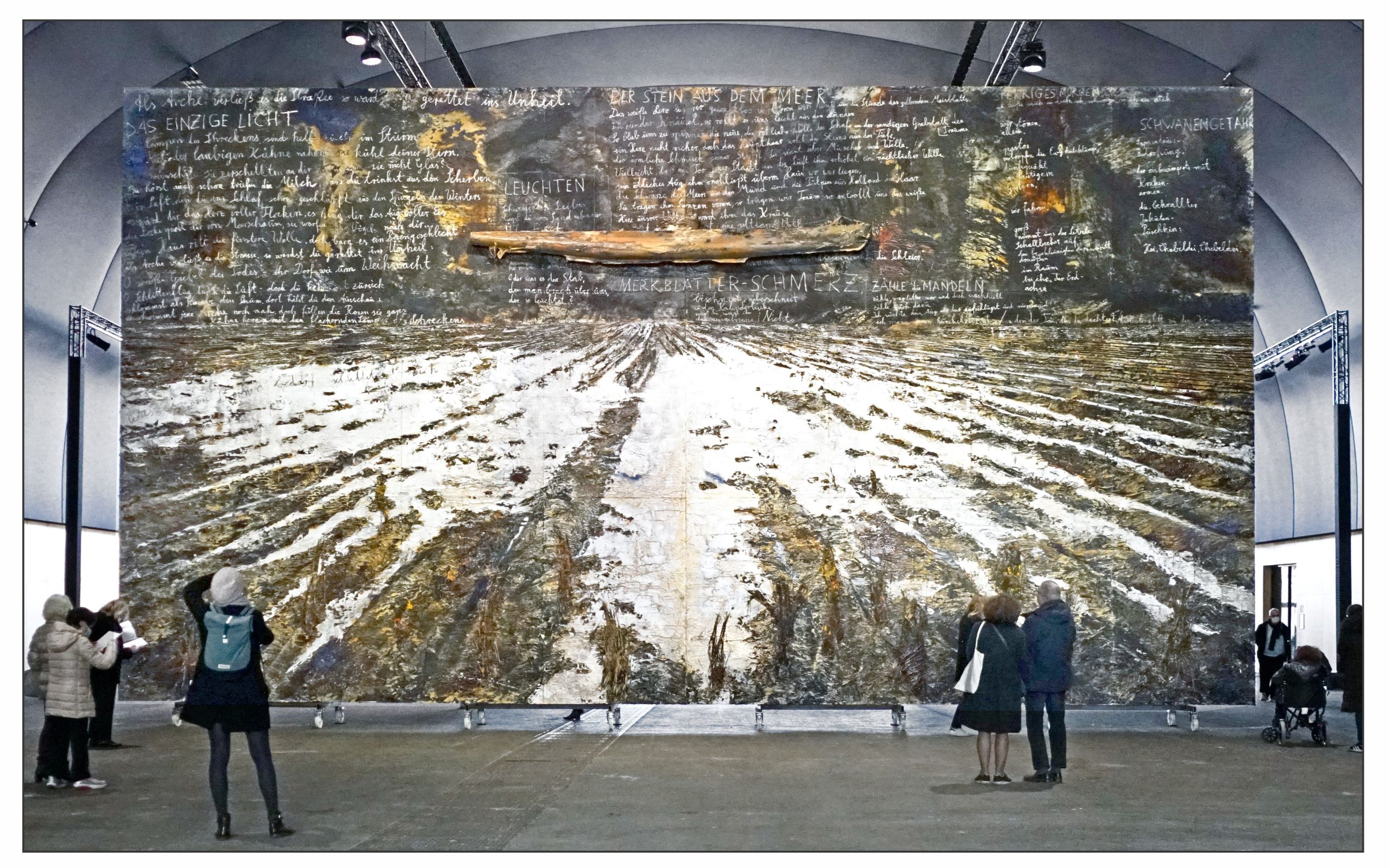
The title derives from an early poem Das einzige Licht (the only light) first published in 1948. The full poem is written on the upper right of the painting. Two lines are

Dein Haus ritt die finstere Welle, dochbarg es ein Rosengeschlecht;
Als Arche verließ es die Straße, so wardst du gerettet ins Unheil
[Your house rode the dark wave, still it covered a roselineage;
As ark it left the road, so you were rescued in harm}

References

Adorno, T. W. (1955, translated by S. M. Weber 1967, reprinted 1983). Prisms. MIT Press.

Arno, A. (translated by Gauger, S. A., 2026). Paul Celan: a life. Belknap Press (Harvard University)

Baldi, M. (2008). Fadensonnen: Il pensiero poetico al di la di luce e suono. In M. Baldi & F. Desideri (Eds.). Paul Celan: la poesia come frontiera filosofica. (pp 37-45). Firenze University Press.

Bambach, C. (2023). The (im)possibility of homecoming: Heidegger, Celan, and the aporia of language. In Benjamin, A. E. (Ed.) Heidegger and Literary Studies. (pp. 214–252). Cambridge University Press

Benczes, R. (2005). Creative noun–noun compounds. Annual Review of Cognitive Linguistics, 3, 250–268.

Bonnefoy, Y. (translated by Felstiner, J., 2010). Why Paul Celan took alarm. Publications of the Modern Language Association of America, 125(1), 204–212.

Carman, T. (2003). Heidegger’s analytic: interpretation, discourse, and authenticity in Being and time. Cambridge University Press.

Celan, P. (translated by Glenn, J., 1978). The Meridian. Chicago Review, 29(3), 29–40.

Celan, P. (translated by Hamburger, M., 1989). Poems of Paul Celan. Persea Books.

Celan, P. (translated by Felstiner, J., 2001). Selected poems and prose of Paul Celan. W.W. Norton

Celan, P. (translated by Joris, P., 2014). Breathturn into timestead: the collected later poetry. Farrar, Straus, Giroux.

Celan, P. (translated by Joris, P., 2020). Memory rose into threshold speech: the collected earlier poetry. Farrar, Straus, Giroux.

Celan, P. (translated by Kavett, J., 2024). Letters to Gisèle (1951-1970): with a selection of letters from Gisèle Celan-Lestrange. New York Review Books.

Ceuppens, R. (2020). “Your country behind the mountain, behind the year”: Insistence of an inaccessible alterity in Paul Celan’s Poetics. Language, Literature, and Interdisciplinary Studies, 3(3).

Dercon, C. (2021). Anselm Kiefer: pour Paul Celan. Réunion des musées nationaux-Grand Palais.

Doroshow, D. B. (2007). Performing a cure for schizophrenia: insulin coma therapy on the wards. Journal of the History of Medicine and Allied Sciences, 62(2), 213–243.

Felstiner, J. (1990). Paul Celan. Yale University Press.

Golb, J. D. (1988). Celan and Heidegger: a reading of “Todtnauberg.” Seminar: A Journal of Germanic Studies, 24(3), 255–268.

Heidegger, M. (1927, trans. J. Macquarrie & E. Robinson,1962). Being and time. Blackwell.

Heidegger, M. (1941, translated by Hoeller, K., 2000). Elucidations of Hölderlin’s poetry. Humanity Books.

Heidegger, M. (1950, translated by Young, J., & Haynes, K., 2002). Off the beaten track. Cambridge University Press.

Joris, P. (1988). Celan / Heidegger: Translation at the Mountain of Death.

Lacoue-Labarthe, P. (1986, translated by A. Tarnowski, 1999). Poetry as experience. Stanford University Press.

Lyon, J. K. (2006). Paul Celan and Martin Heidegger: an unresolved conversation, 1951-1970. Johns Hopkins University Press.

Kenaan, H. (2021) Celan and Heidegger at the Mountain of Death: listening to hope, Journal of the British Society for Phenomenology, 52(4), 352-365,

Maurel-Indart, H. (2010). Literary plagiarism. French Literature Series, 37, 1-15.

Meyerhofer, N. J. (1981). The poetics of Paul Celan. Twentieth Century Literature, 27(1), 72–85.

Olschner, L. (2001). Shabby and tragic. [Review of Wiedemann, B. Paul Celan – die Goll Affäre]. Times Literary Supplement (5122), 25.

Oyarzún R., P. (translated by Cross, D. J. S., 2022). Between Celan and Heidegger. State University of New York Press.

Safranski, R., (translated by E. Osers, 1998). Martin Heidegger: between good and evil. Harvard University Press.

Sharr, A. (2006). Heidegger’s hut. MIT Press.

Wiedemann, B. (2000). Paul Celan — Die Goll-Affäre. Frankfurt: Suhrkamp,

Wrathall, M. (2025). Martin Heidegger. Stanford Encyclopedia of Philosophy.

Zilcosky, J. (2005). Poetry after Auschwitz? Celan and Adorno revisited. Deutsche Vierteljahrsschrift für Literaturwissenschaft und Geistesgeschichte, 79(4), 670–691.

Antisemitism

Hatred is directed anger. Though we can claim metaphorically to hate
unconscious objects or abstractions, hatred is typically directed at another person or persons. Hatred is evoked by suffering that we perceive they caused. Since it leads to actions against these persons, hatred can also be described as “ill
will.”

Emotions can overwhelm reason. Passion is not logical. We often hate
without any justification. Hatred must then be maintained by fictions that describe the evil nature of those we hate.

Antisemitism is the most enduring and most unjustified of human hatreds.
The ill will suffered by the Jewish people has lasted for thousands of years, and has led to countless crimes, the most terrible of which was the Holocaust wherein 6 million Jews were put to death by the Nazi Government of Germany (Bauer, 2001; Marrus, 1987). ;

Antisemitism has been inspired by many fictions. This posting considers the unfortunate power of some of the stories that paved the way to the Holocaust.


Some Simple Psychology

Anger arises when we experience suffering, especially when we believe it
to be unwarranted, and when we are thwarted from achieving what we desire,
especially when we believe that we entitled to it. Anger seeks to attack these causes: to hit out at those who strike us; to break those who obstruct us.

We tend to think of events as caused by persons. Even when forces of
nature act against us we may attribute them to a divinity or a devil, or to
those who worship them. Only in that way can anger find a target for its
release.

Sometimes the causes of our anger are too complicated to understand or too powerful to fight against. In these cases, we may vent our anger elsewhere and attack other human beings, while inventing plausible (though fictional) reasons for so doing.

…every instance of suffering, every feeling of displeasure, by whomsoever and in whatsoever way it may have been caused, whether it arises from the guilt or from the lawful activity of another person, or through the sufferer’s own fault, or without any fault, or even without any human influence, tends to transform itself into a feeling of enmity, to direct itself against fellow-humans and if possible to express itself against them. (Bernstein, 1951, p 85)

As we were growing up during childhood, we realized – at about the age
of three – that we can exert some control over our environment. We therefore created a self as the agent of this control. At about the same time we realized that the world contains other agents. These could either help us or hinder us. We became comfortable with those that helped and learned to cooperate with them. We feared the others.

The group appears to be a curious form of extension of the individual. It seems as if under the influence of the necessities of human communal life, human beings who need love and produce hate combine into new, collective and collectively selfish individualities of a higher order; directing their love inwards, their hate outward, their social instincts towards the insider, their anti-social tendencies toward the outsider. (Bernstein, 1951, p 109-110)

Those who cooperated in groups came to have similar desires and modes of
behavior. They followed the same rules and sought the same goals. Those who
were different became isolated. These “others” challenge our group-identification (Chanes, 2004, p 3). In our search for where to vent our anger, we often light upon those that are different from us. Especially if these people are small in number and not inclined to violence.

While for normal group enmity a certain regularity in the mutual expression of enmity is characteristic, the antagonism between a powerful majority and a powerless minority is characterised by a onesidedness of hostile actions which is fatal for the minority. For the latter is exposed to continual attacks and must confine itself to laborious attempts to maintain its existence, without a chance to resist actively to any extent; even its passive means of defense are totally inadequate and its existence often has to rely on nothing but periodical flight from place to place. This onesided relation of
permanent attack and failing defense is called persecution. Weak minority
groups are usually persecuted more or less emphatically. (Bernstein, 1951, p 224)

The actual psychological mechanisms that lead to antisemitism are not
really understood. Some believe that there are personality-types that are more easily convinced to vent their hatred on minorities. The role of authority and power is undoubtedly a factor (Morse & Allport, 1952; Milgram, 1974). Those who seek power or wish to maintain it gain great support by fomenting hatred. Propaganda – invented stories – have a tremendous power. For some reason the more incredible the story the more easily it is believed (Baum, 2012). Dehumanization of the victims serves to attenuate our inherent tendency to help our fellows. (Bandura et al., 1975)

For millennia the Jewish people have allowed us to vent our hatred. For
millennia we have invented reasons for our violence.

The hostility toward a minority exacerbates the feelings that initially triggered. When persecuted, a minority does not fare well in society and often comes to appear even more deserving of denigration and oppression (Beller, 2007, p 5).

Antisemitism is not caused by the Jews but by the inadequacy of those who need to hate them.

…two psychological characteristics are present in the individual antisemite: excessive hostility and the need (and a capacity) to project one’s aggression on other groups. Persons who have these traits generally suffer from feelings of inadequacy and from the feeling that their own personal borders, psychologically speaking, are easily invaded by others (Chanes, 2004, p 7)

We can perhaps conclude this section with two epigrams from Jean-Paul Sartre (1948):

If the Jew did not exist, the anti-Semite would invent him (p 13)
Antisemitism is not a Jewish problem: it is our problem. (p 152)

The People of the Covenant

The Jews consider themselves God’s chosen people. In the Hebrew
scripture Yahweh made a covenant with Abraham, and then renewed the covenant with Jacob and with Moses. The Jews were to worship Yahweh as the one true God and to follow his commandments. The Jews would then serve as an example for the rest of humanity

I the Lord have called thee in righteousness, and will hold thine hand, and will keep thee, and give thee for a covenant of the people, for a light of the Gentiles (Isaiah
42:6).

In return, the Jews would be considered special

For thou art an holy people unto the Lord
thy God, and the Lord hath chosen thee to be a peculiar people unto
himself, above all the nations that are upon the earth. (Deuteronomy 14:2)

And were promised as their home the land containing what is now the country of Israel

In the same day the Lord made a covenant with Abram, saying, Unto thy seed have I given this land, from the river of Egypt unto the great river, the river Euphrates (Genesis 15:18)

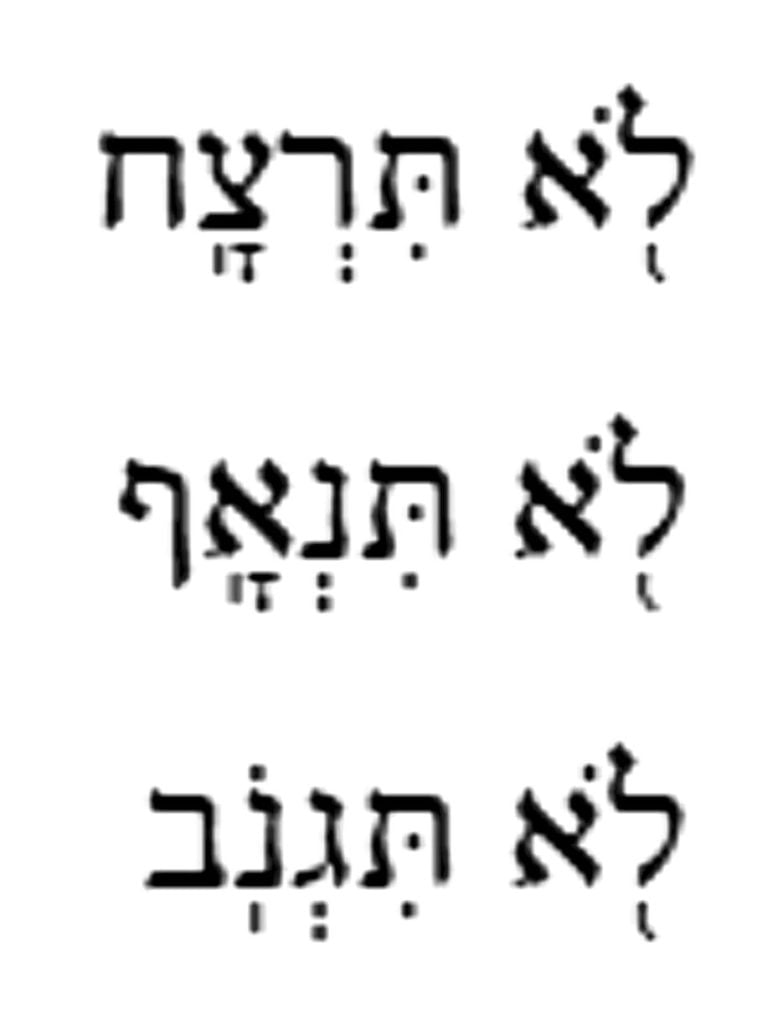
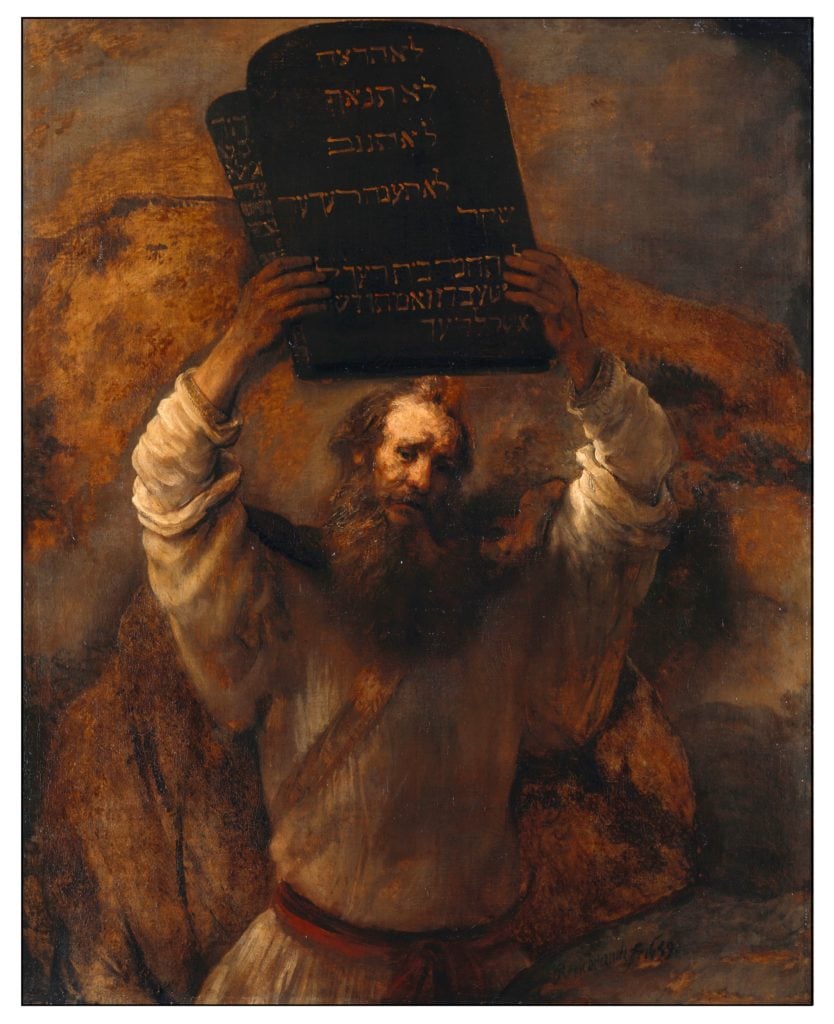
God’s covenant with the Jews was based on their keeping the commandments that he revealed to Moses. Rembrandt’s 1659 painting Moses with the Tablets of the Law shows Moses holding aloft the stone tablets on which the Ten Commandments had been written. These were engraved on two separate stones (Exodus 31:18, 32:15). In the painting, only the second tablet is completely visible giving the 6th to 10th commandments (Exodus 20:13-17). These begin with: “Thou shalt not kill. Thou shalt not commit adultery. Thou shalt not steal:” (Hebrew illustrated on the right).

No one is sure what moment in the story of the tablets Rembrandt is representing. Is it when he first displays these to the Hebrews? or when he is about to shatter them on the ground because the Hebrews had been worshipping the Golden Calf while he had been on Mount Sinai with God (Exodus 32:19)? or is it when he returns to God and brings a second set of tablets back to the chastised Hebrews (Exodus 34:1). Moses’ face is shining with revelation rather than angry. Perhaps, Rembrandt has painted the moment when Moses first displays the commandments.

No group of people is perfect. However, the Jews have contributed more than their share to the human endeavor – in philosophy, science, medicine, politics, art, music, literature. And for the most part the, laws that they accepted as part of their covenant with God have served them well. They are indeed an example to other people.

So why were and are they so often reviled? It is unlikely a reaction to their chutzpah in claiming to be God’s chosen. In the Middle Ages this was called the Insolentia Judaeorum. Yet every one of the world’s many religions claims to be just as special.

One defining aspect of the Jewish religion is that it is monotheistic. The first commandments state that a Jew must obey Jehovah and not even pay lip-service to any other god or idol:

I am the Lord thy God, which have brought thee out of the land of Egypt, out of the house of bondage.
Thou shalt have no other gods before me.
Thou shalt not make unto thee any graven image, or any likeness of any thing that is in heaven above, or that is in the earth beneath, or that is in the water under the earth.
Thou shalt not bow down thyself to them, nor serve them
(Exodus 20:2-5).

The Jewish religion thus combines the worship of one god with strict obedience to his commandments. As Prager and Telushkin (2003) have suggested, this ethical monotheism may have offended those who followed other gods. Jews refused to follow the proverbial injunction that when in Rome do as the Romans do. For example, the outburst of violence against the Jews in Alexandria in 38 CE (then part of the Roman Empire) was triggered by their refusal to place statues of the Emperor Caligula in their temples (Goldstein, 2012).

One should respect the beliefs of others. However, respect does not mean obeying rules that go against one’s own moral principles. The Jewish people’s refusal to acknowledge or worship other gods has continued to the present. In particular Jews do not recognize the divinity of Jesus Christ.

In addition to the Ten Commandments, Yahweh’s covenant with the Jewish people involved numerous other rules of behavior. These included strict stipulations about the types of food that they might eat and the methods in which this food should be prepared. Over the ages observant Jews have thus been unable to share meals with those of other faiths. And although some of the ancient Jewish philosophers – Hillel and Maimonides for example – were open to ideas beyond the Covenant, strict Judaism limited itself to the study of the Torah and its interpretations.

The Covenant with Yahweh thus isolated the Jewish people from the rest of humanity. They could not share the beliefs, the food or the thoughts of others. They antagonized others by their claim to be the chosen people.

So we have the idea that antisemitism is in part caused by the very character of the Jewish religion. This would explain why the Jews have been reviled by so many different people in so many different countries. The following was written Bernard Lazare in 1894. He was a Jewish polemicist who wrote the first defense of Captain Alfred Dreyfus. Yet even he thought that the Jews were partly to blame for antisemitism.

Inasmuch as the enemies of the Jews belonged to divers races; as they dwelled far apart from one another, were ruled by different laws and governed by opposite principles; as they had not the same customs and differed in spirit from one another, so that they could not possibly judge alike of any subject, it must needs be that the general causes of antisemitism have always resided in Israel itself, and not in those who antagonized it…. Which virtues or which vices have earned for the Jew this universal enmity? Why was he ill-treated and hated alike and in turn by the Alexandrians and the Romans, by the Persians and the Arabs, by the Turks and the Christian nations? Because, everywhere up to our own days the Jew was an unsociable being. (Lazare, 1894/1903, pp 8-9)

This seems so reasonable. Yet it is false. It does not explain the cause of antisemitism. It is just an excuse. It blames the victim for the crime.

The Crucifixion of Christ

In the early decades of the Common Era, Jesus, a Jewish teacher from Nazareth, brought new insight to the interpretation of Jewish law. He simplified the commandments by expressing them as the need to love the Lord and to love one’s neighbor as oneself. He criticized the rigid adherence to the Sabbath, and the commercialization of the Temple. He proclaimed the idea of a Kingdom of Heaven. Many of the more observant Jews were disconcerted by his teachings. The Romans were upset that he was proposing a new kingdom. Jesus was arraigned before Pilate, the Roman governor of Judea, condemned and crucified.

A few days after his death and burial, the tomb of Jesus was found empty. Many of his followers claimed that they afterwards saw him in person. They therefore believed that he had been resurrected. They continued to meet and discuss his teachings. They were either tolerated by other Jews or condemned as heretics.

A learned Jew named Saul was one of those that persecuted the followers of Jesus. However, on the road to Damascus he had a vision of Jesus that completely altered his thinking. He changed his name to Paul, and began to provide an over-arching theory about the death and resurrection of Jesus. His main ideas were that Jesus was the Son of God, the Messiah prophesied in the scriptures, that he died to release us from our sins, and that we shall all be saved from death by having faith in Jesus called Christ (the “anointed”).

For I delivered unto you first of all that which I also received, how that Christ died for our sins according to the scriptures;
And that he was buried, and that he rose again the third day according to the scriptures (I Corinthians 15:3-4)

Paul’s major teaching was that one could never attain salvation by following the Mosaic laws. No one is perfect. Everyone breaks the law. However, Christ offers salvation if we repent our sins and have faith in him.

Knowing that a man is not justified by the works of the law, but by the faith of Jesus Christ, even we have believed in Jesus Christ, that we might be justified by the faith of Christ, and not by the works of the law: for by the works of the law shall no flesh be justified. (Galatians 2:16).

Paul’s letters describing these ideas are the earliest of the Christian scriptures. Written in the years 50-60 CE these predate by 20 to 50 years the four gospels, which describe the life and teachings of Jesus.

The followers of Jesus in the 1st Century CE differed in their opinion about his relationship to the Jews. Some thought that the message of Jesus was for the Jews; others that it was for both Jews and Gentiles. Most of Paul’s teaching was directed to the Gentiles. In some of his letters he laments the inability of many of his Jewish colleagues to understand God’s new covenant.

For ye, brethren, became followers of the churches of God which in Judaea are in Christ Jesus: for ye also have suffered like things of your own countrymen, even as they have of the Jews:
Who both killed the Lord Jesus, and their own prophets, and have persecuted us; and they please not God, and are contrary to all men:
Forbidding us to speak to the Gentiles that they might be saved, to fill up their sins alway: for the wrath is come upon them to the uttermost.
(I Thessalonians 2:14-16)

Some of the gospels continued this criticism of the Jews (Crossan, 1995). This is perhaps most evident in the gospel of Matthew. He describes how the Jews forced Pilate to crucify Jesus, and willingly accepted the responsibility for his death:

When Pilate saw that he could prevail nothing, but that rather a tumult was made, he took water, and washed his hands before the multitude, saying, I am innocent of the blood of this just person: see ye to it.
Then answered all the people, and said, His blood be on us, and on our
children. (Matthew 27: 24-25)

The major event in Jewish history of the 1st Century CE was the Great Revolt of the Jews against Roman rule. This began in 66 CE and culminated in the Destruction of the Second Temple in 70 CE. The illustration below shows a representation in the Arch of Titus of the Romans carrying the spoils from the temple. Among the spoils is the great Menorah that once gave light to the Tabernacle.

At this time many Jews fled their homeland and settled in other countries. The Jewish people have been exiled at many times in its history – the Assyrian conquest (733 BCE), the Babylonian captivity (597 BCE), the Great Revolt (70 CE), the later Bar Kokhba Rebellion (132 CE). Though some Jews remained in Israel, most lived in the Diaspora (“scattering”) – far from the land that from the days of Moses they had considered their God-given home.

The Destruction of the Temple seemed to many Christians a divine response to the action of the Jews in crucifying their Lord. Though the Romans crucified Jesus, some of the early Christians considered the Jews responsible. The Jews were thus guilty of deicide and should be reviled and cast out from Christian society. Even if they were not guilty, they should be chastised for not recognizing the salvation offered by Christ – for staying with the old dispensation rather than following the new.

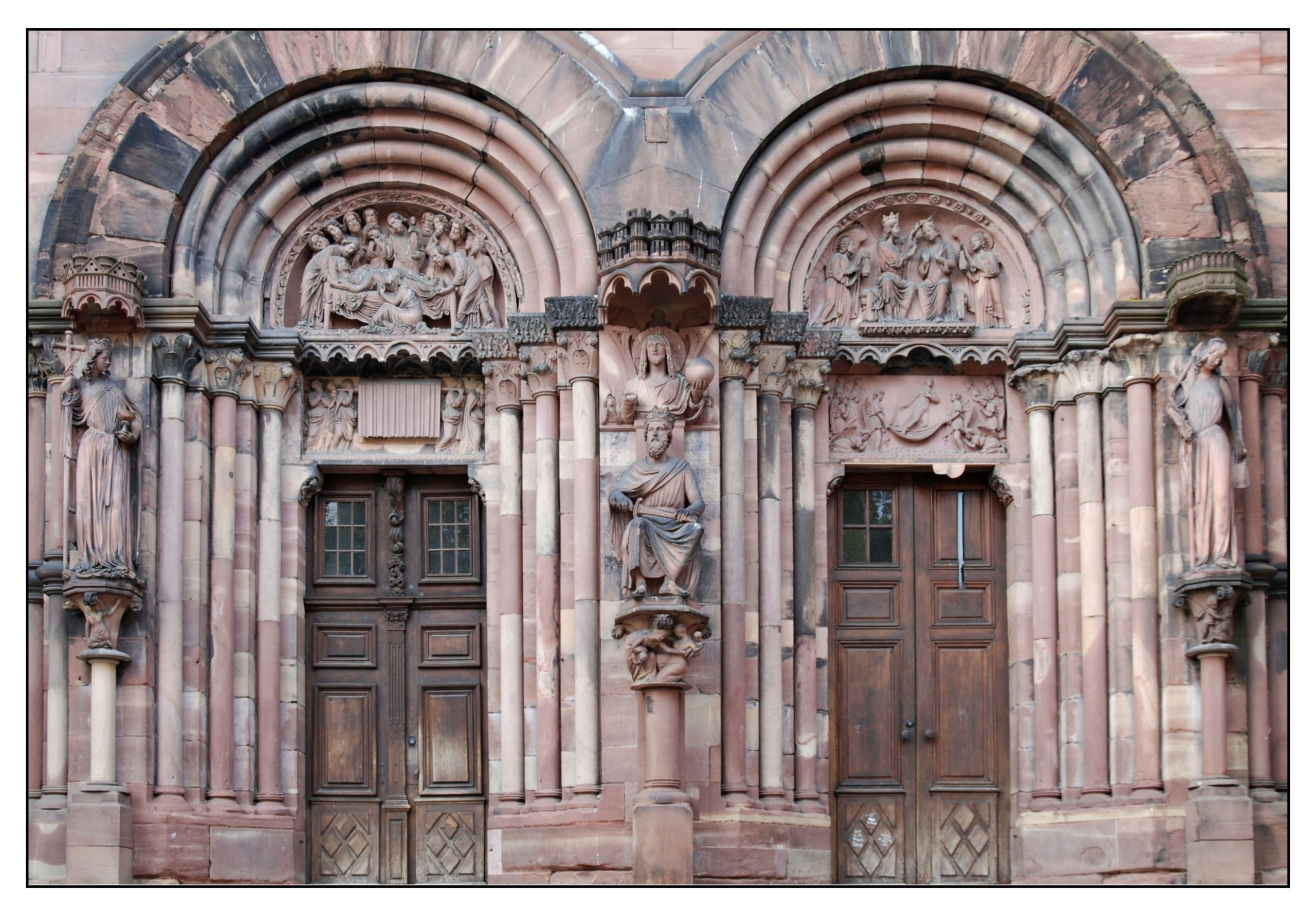
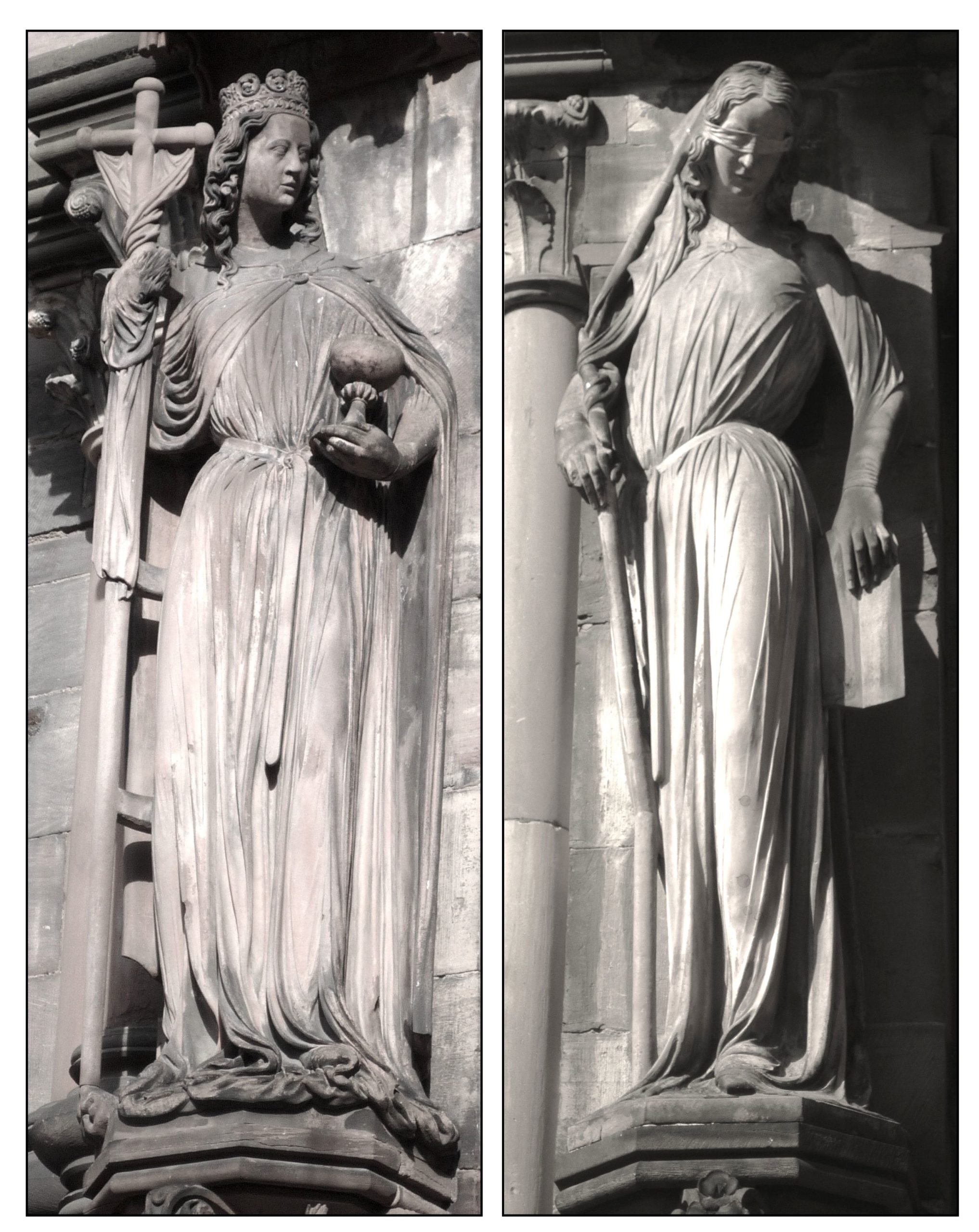
These ideas have long permeated the thinking of the Christian Church. Many of the cathedrals illustrate these concepts by contrasting sculptures of Ecclesia and Synagoga. The statues on the south portail of the Cathedral of Notre Dame in Strasbourg from the 13th Century CE are particularly impressive. Legend has it that these were created by a female sculptor Sabina von Steinbach, though there is no real evidence for this. Ecclesia with her crown, holds in her hands the cross and the chalice. She looks with pity on Synagoga, who is blindfolded and cannot see the truth. She holds in her hands the tablets of the law and the lance that the centurion used to bring the crucifixion to an end. The lance was shattered by the resurrection.

The following illustration shows the complete portail. Ecclesia and Synagoga are on the left and right sides. In the center sits Solomon in judgement between the old covenant and the new. Above him is Christ, Salvator Mundi (savior of the world). The carvings in the tympanums represent the dormition, assumption and coronation of the Virgin Mary.

The statues of Ecclesia and Synagoga are impressive examples of gothic art. Though superficially beautiful, they obscure rather than convey the truth. The feelings against the Jews that they evoke are a complete betrayal of Jesus, a Jew who taught in the synagogues of Palestine.

One might have hoped that the antisemitism of the Christian Church would have been excised by the Reformation. But this was not to be. Martin Luther was virulently antisemitic. In his The Jews and Their Lies (1543, pp 39-42) he advises Christians to burn their synagogues of the Jews, their houses, and their books, prohibit their Rabbis from teaching, not allow them to travel on the highways, and prohibit them from lending money. Luther was a harbinger of Kristallnacht.

Wild Accusations

During the Middle Ages people could not understand why life was so often brutal. An easy way to explain the various disasters was to attribute them to the Jews. If the Jews could kill God, there was no telling what other crimes they were capable of.

On Good Friday in 1144 the body of a child called William was discovered in the woods near Norwich in England. The Jews were accused of murdering the child. No credible evidence was ever found. However, a monk who had just converted from Judaism to Christianity claimed that the Jews had decided to sacrifice a Christian child to re-enact the death of Christ. Several Jews were slaughtered. William was declared a martyr. Pilgrims flocked to his tomb. Miracles occurred.

William of Norwich was the first documented case of Jews being accused of ritual murder. As the years went by similar accusations arose in multiple different regions of Europe (Goldstein, 2012). Many of these cases included the idea that the Jews used the blood of their victims to make the unleavened bread used in the celebration of Passover. This particular accusation was called the “blood libel.” It makes no sense. Kosher regulations require that observant Jews never eat food contaminated with blood. Jews go to great lengths to remove blood from meat before it can be eaten.

The Christian Bible contains the Hebrew scriptures in what it calls the Old Testament. Some of these writings described how the blood of sacrificed animals played an important role in the ceremonies of the ancient Hebrews, e.g.

And he shall kill the bullock before the Lord: and the priests, Aaron’s sons, shall bring the blood, and sprinkle the blood round about upon the altar that is by the door of the tabernacle of the congregation. (Leviticus 1:5).

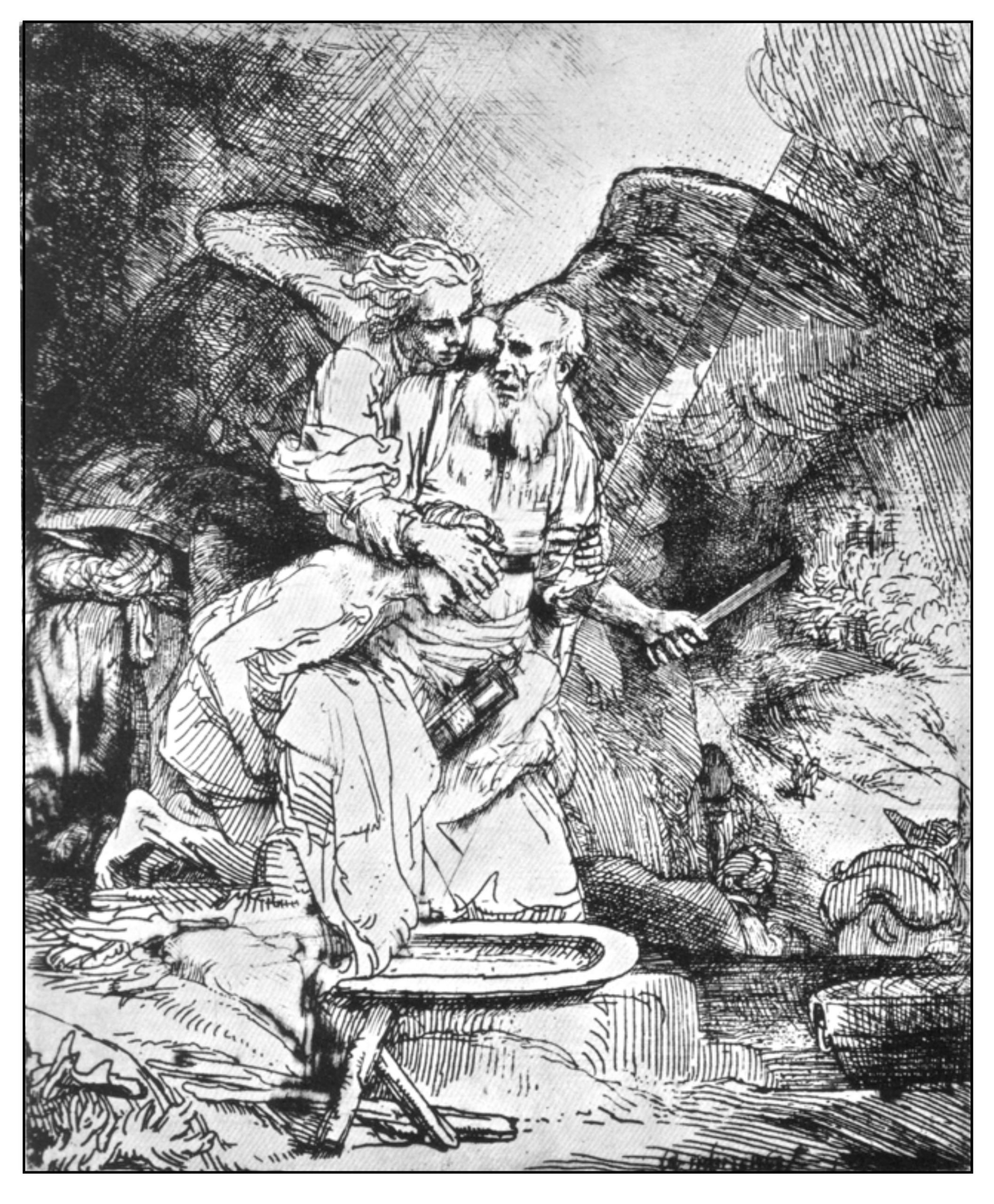
Other ancient Hebrew writings are even more disconcerting. One of the foundational stories of Judaism is the Akedah (“binding”), wherein the Patriarch Abraham, at the request of Jehovah, takes his son Isaac to Mount Moriah to sacrifice him (Genesis 22). Although an angel stays Abraham’s hand at the last moment, this fails to attenuate the story’s horror. The illustration below shows Rembrandt’s 1655 etching.

The Old Testament contains other stories wherein children were sacrificed. To defeat the Ammonites, Jephthah promised the Lord that he would sacrifice whatever came out of his house when he returned from battle. Jehovah gave the victory to the Israelites. When Jephthah returned home, his daughter came to greet him, dancing and playing the tambourine (Judges 11).

There is also a suggestion that King Manasseh sacrificed his son – the wording is “he made his son pass through the fire” (2 Kings 21:6). These events and the idea that the terrible place near Jerusalem called Gehenna or Tophet was actually a site of human sacrifice are discussed at length by Stavrakopoulou (2004). The practice was banned by Yahweh speaking through his prophet Jeremiah:

And they have built the high places of Tophet, which is in the valley of the son of Hinnom, to burn their sons and their daughters in the fire; which I commanded them not; neither came it into my heart. (Jeremiah 7:31).

One can perhaps imagine how such stories from the Old Testament might have allowed credulous people to accept the idea that the Jews might sacrifice Christian children and use their blood for their ceremonies. When one’s faith requires a belief in miracles, wild rumors are not easily contradicted.

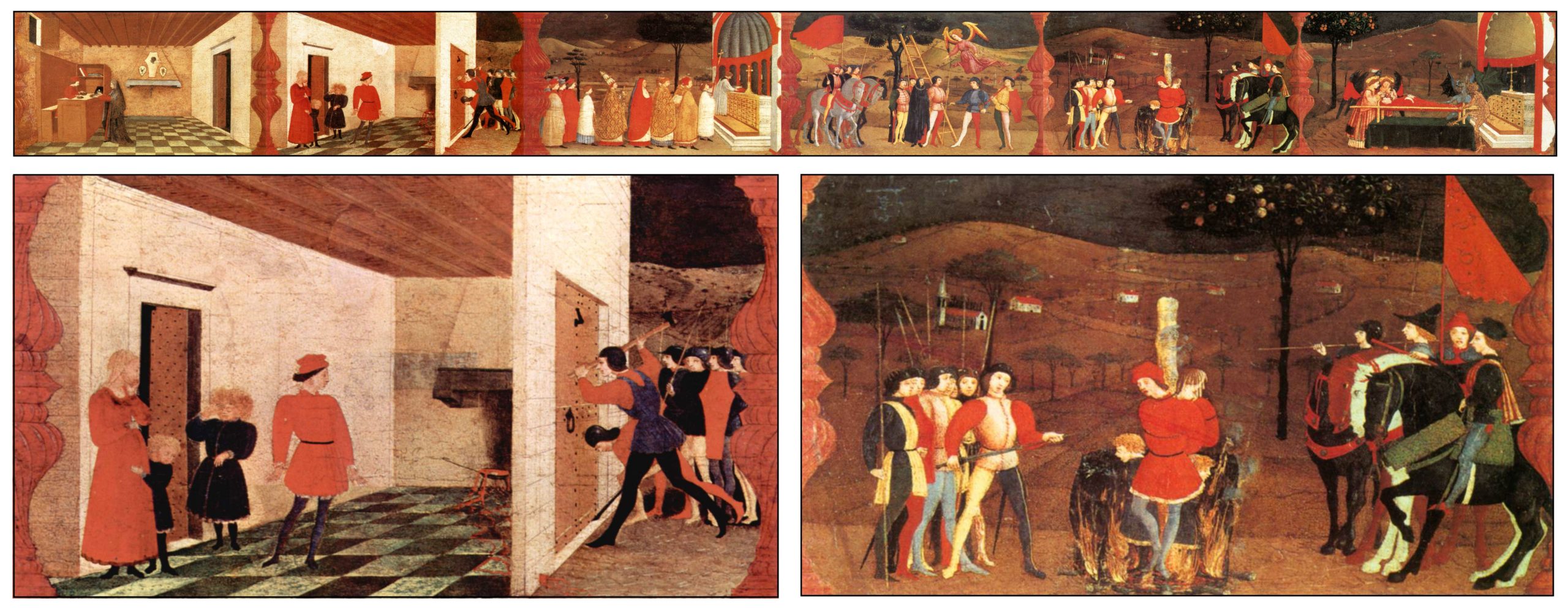
The main sacrament of the Christian Church is the Eucharist, wherein the congregation partakes of bread and wine that have been especially blessed. According to the church, these had been miraculously “transubstantiated” to the body  of Jesus, who was sacrificed to save the world. The sacramental bread is called the host (from the Latin hostia for sacrificial victim). In many places and at many times the Jews were accused of “desecrating” the host. The following illustration shows a 1469 sequence of paintings by Paolo Uccello that tell the story of the Miracle of the Desecrated Host. Both the full sequence and the particular panels illustrating the second and fifth episodes are shown. The paintings were on the predella to the altar in the Corpus Domin church in Urbino. The retable painting above the predella by Justus van Gent presented the Institution of the Eucharist.

The six episodes in the predella show

  1. a woman sells a portion of the consecrated host to a Jewish merchant
  2. when the Jew tries to burn the host, it starts to bleed, alerting the city guards
  3. a holy procession is needed to re-consecrate the host
  4. the woman is burned at the stake; she repents and an angel descends from heaven to save her
  5. the Jew and his family are burned at the stake; no angel intervenes
  6. two angels and two devils argue over the woman’s body

As the Black Death (Bubonic Plague) spread across Europe in the 14th Century, Jews were accused of poisoning wells and spreading the disease. Many Jews were condemned to death by fire fort these crimes. No one noticed that Jews died from the pandemic just as frequently as their Christian neighbors. Nor that burning Jews at the stake had no effect on the spread of the disease. A half century later, Jacob von Königshofen wrote a critical history of these times. The following is his description of the massacre of the Jews in Strasbourg at the height of the Black Death in 1349:

In the matter of this plague the Jews throughout the world were reviled and accused in all lands of having caused it through the poison which they are said to have put into the water and the wells – that is what they were accused of – and for this reason the Jews were burnt all the way from the Mediterranean into Germany, but not in Avignon, for the pope protected them there. On Saturday-that was St. Valentine’s Day, they burnt the Jews on a wooden platform in their cemetery. There were about two thousand people of them. Those who wanted to baptize themselves were spared. Many small children were taken out of the fire and baptized against the will of their fathers and mothers. And everything that was owed to the Jews was cancelled, and the Jews had to surrender all pledges and notes that they had taken for debts. The council, however, took the direct cash that the Jews possessed and divided it among the working men proportionately. The money was indeed the thing that killed the Jews. If they had been poor and if the feudal lords had not been in debt to them, they would not have been burnt. After this wealth was divided among the artisans some gave their share to the Cathedral or to the Church on the advice of their confessors. Thus were the Jews burnt at Strasbourg. (quoted in Marcus, 1938, p.47)

Forces other than the plague were at play. Debt caused as much suffering as disease. As the historian notes, “The money was indeed the thing that killed the Jews.”

Usury

The Old Testament contains several injunctions against usury. Originally “usury” was simply any interest charged on loans. The meaning of the term has changed as the relations between religion and commerce have developed. At present, usury is generally limited to exorbitant interest.

In one of the earliest mentions of usury in the Hebrew Scriptures, the Jewish people are forbidden to charge interest on loans to fellow-Jews although they may so charge strangers:

Unto a stranger thou mayest lend upon usury; but unto thy brother thou shalt not lend upon usury (Deuteronomy 23:20).

In the New Testament usury is only occasionally considered:

But love ye your enemies, and do good, and lend, hoping for nothing
again (Luke 6:35).

Nevertheless, the Christian Church decided early in its history that usury was a sin (Moehlman, 1934). In the council of Nicaea of 327 CE it forbade clergy to collect interest on any debts. In the Third Lateran Council of 1179, it decreed

Since in almost every place the crime of usury has become so prevalent that many persons give up all other business and become usurers, as if it were permitted, regarding not its prohibition in both testaments, we ordain that manifest usurers shall not be admitted to communion, nor, if they die in their sin, receive Christian burial, and that no priest shall accept their alms. (Moehlman, 1934, pp 6-7)

Thus for most of the middle ages it was difficult for people in business to obtain financial support for their enterprises. Jewish merchants, untrammeled by Christian prohibitions, unable to own land, and often prevented from practicing trades because of exclusively Christian guilds, gradually assume the responsibility for lending money in return for interest (Foxman, 2010). Some kings and princes found the linguistic abilities and financial connections of the Jews appealing and appointed them to their courts. However, most Jews remained poor and unrecognized – traders, shopkeepers, pawnbrokers and minor moneylenders.  

In later years the Catholic Church found itself in need of capital to build its churches, and revised its doctrine on usury, founding its own lending organizations called Mounts of Piety (Monte de Pieta). The oldest bank in the world, the Banca Monte dei Paschi di Siena, derives from one of these lenders. After the Reformation, Protestants re-interpreted the scriptures and established their own investment banks.

Jewish lenders prospered and some of our current banks have Jewish roots, the Rothschild banks and Goldman-Sachs being two of the biggest. However, almost all of the world’s largest banks were actually founded by Gentiles. The idea that the Jews control international banking is ludicrous. Why one should only consider the religion of a banker when he is Jewish is invidious (Foxman, 2010). One never mentions the Roman Catholic origins of the Bank of America or the Presbyterian origins of Wells Fargo. Yet Jewish bankers have long been game for hateful cartoons. The depiction of “King Rothschild” by Charles Lucien Léandre shown on the right is from the cover of Le Rire, April 16, 1898. Above Rothschild is the Golden Calf that was worshipped by the  the idea of Mammon, the idol of wealth condemned in the New Testament:

No man can serve two masters: for either he will hate the one, and love the other; or else he will hold to the one, and despise the other. Ye cannot serve God and mammon. (Matthew 6:24).

The myth of Jewish greed has become a mainstay of antisemitic thought. Richard Wagner (1850) cannot get away from it even though he is supposed to be writing about music.

According to the present constitution of this world, the Jew in truth is already more than emancipate: he rules, and will rule, so long as Money remains the power before which all our doings and our dealings lose their force.

Even Jewish writers have been convinced of the myth

Thus, by himself and by those around him; by his own laws and by those imposed upon him; by his artificial nature and circumstances, the Jew was directed to gold. He was prepared to be changer, lender, usurer, one who strives after the metal, first for the pleasures it could afford and then afterwards for the sole happiness of possessing it; one who greedily seizes gold and avariciously immobilizes it. (Lazare, 1903, p 110).

The Pale of Settlement

As the Middle Ages progressed, the Jews were expelled from many European countries: England, 1290; France, 1306; Hungary, 1349; Austria, 1421; Spain, 1492; Portugal, 1497 (Baum 2012, p. 18). Other countries required that the Jews live apart from Christians in regions that came to be known as ghettos, from the Venetian dialect word for “foundry” located near where the first ghetto was established in Venice in 1516. Other ghettos were later set up throughout Italy, and then in Germany and in Poland (Goldstein, 2012, p 130)

Many of the expelled Jews moved to Eastern Europe. They settled in the
regions that now form the countries of Poland, Lithuania, Belarus, and Ukraine. Much of this area was then part of the Kingdom of Poland. Polish nobles welcomed the new immigrants. Many Jews were used as tax-collectors. This did sit well with some of the Eastern Orthodox Slavic people who chafed under the control of Catholic Poland. In 1648, the Cossacks in Ukraine rebelled under the leadership of Bohdan Khmelnytsky. During this war, tens of thousands of Poles and Jews were massacred (Bacon 2003). The Eastern Orthodox Church was every bit as antisemitic as the Roman Catholic Church. Ukraine became independent of Poland and soon became part of the Russian Empire. Later Poland itself would be partitioned between Prussia, Austria and Russia and cease to exist as an independent kingdom.

The “Pale of Settlement” was set up in 1791 by Catherine the Great. This was an area in the Western regions of the Russian Empire wherein Jews were allowed to live. The term “pale” refers to the stakes that delineated the area
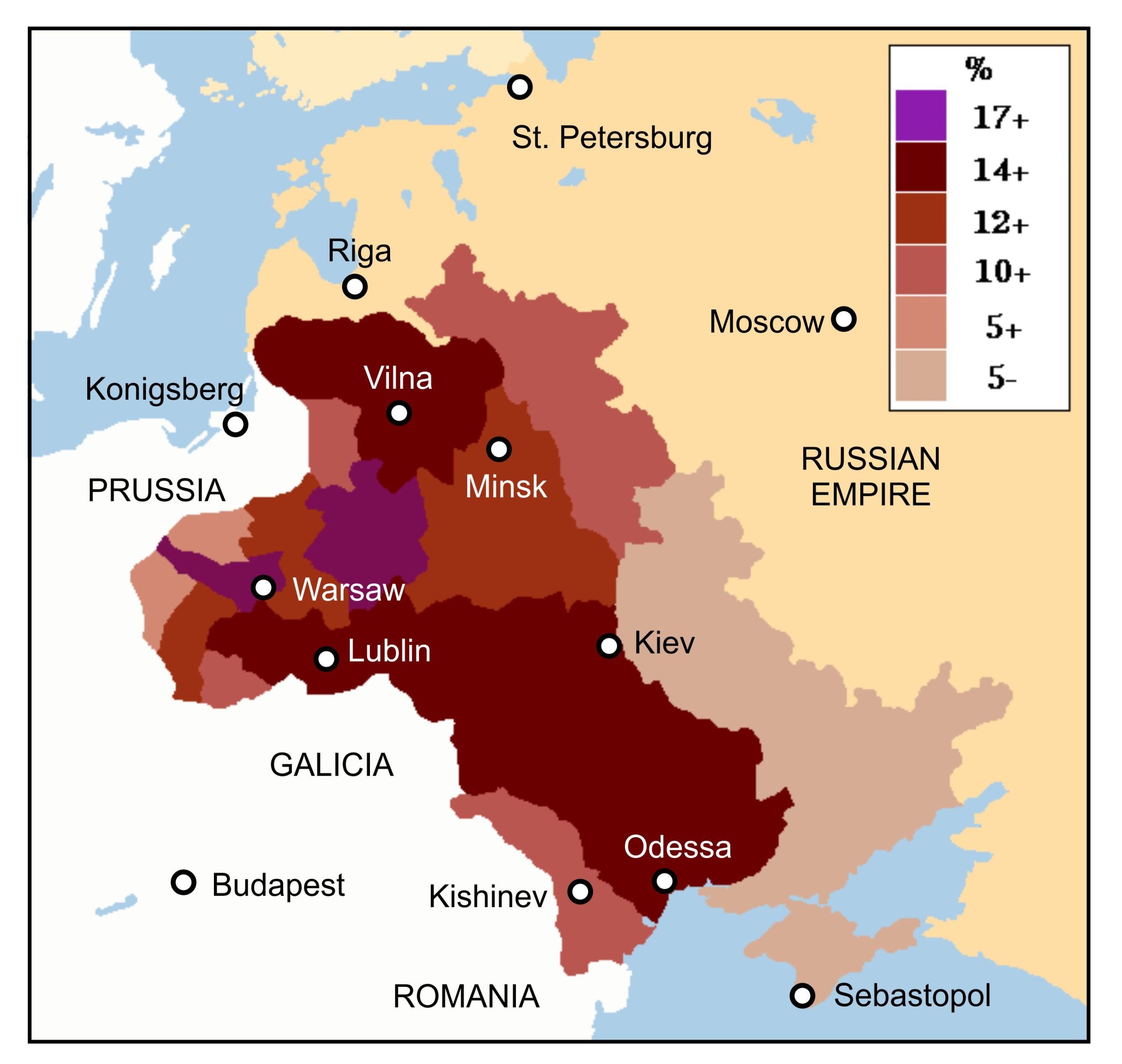
– the word was originally used to describe an area in Ireland under the control of the English crown. Over the years many of the Jews in central Russia were exiled to the Pale of Settlement. As shown in the map (adapted from Wikipedia, originally created by Thomas Gun) the Jewish percentage of the population in these regions was significant. Around 1900, the Jews in the Pale of Settlement numbered almost 5 million (about half the total number of Jews in the world), and formed about 10% of the general population of the area. 

The ghettos and the Pale of Settlement separated the Jews from their neighbors. Their resultant isolation of the Jews increased their “unlikeness” or “otherness.” By closing them off in localized areas beyond the reach of normal civil authorities, it also made them more susceptible to random violence.

In 1881, Tsar Alexander II was assassinated in St. Petersburg by a group
of revolutionaries. The group Narodnaya Volya (“People’s Will”) was
composed of Russian-born anarchists, but one young woman was Jewish. The new Tsar Alexander III believed that the Jews were behind the assassination and unleashed a series of pogroms in the Pale of Settlement to avenge his father’s death.

The word “pogrom” derives from a Russian word for storm or devastation. Christians in a community were encouraged to murder their Jewish neighbors – killers of Christ and assassins of the Emperor. The police were ordered not to intervene. These pogroms continued into for several years. Thousands of Jews were killed.

The pogroms returned in 1903-1906 during the reign of Tsar Nicholas II. These appear to have been instigated by members of the Tsar’s secret police. One political rationale for these actions against the Jews was to rally the Russian people around the Tsar and against all those that were promoting the modernization of Russia.

The first pogrom of the 20th Century began in Kishinev, Moldava (then known as Bessarabia), on Easter Sunday in 1903. A child had been found murdered, and city leaders accused the Jews of his murder. Patriotism, blood libel and deicide worked together to create a rampaging and  murderous mob (Penkower, 2004). The following is an illustration from the French Journal L’Assiette de Beurre of April, 1903, depicting the aftermath of the Easter pogrom.

The novel The Lazarus Project by Aleksander Hemon (2008), which tells the story of a survivor of the Kishinev pogrom who immigrated to the United States, provides a vivid description of the violence and its far-reaching consequents. The epic poem City of the Killings written in 1903 by the Jewish poet Chaim Bialik to commemorate the massacre begins:

Rise and go to the town of the killings and you’ll come to the yards
and with your eyes and your own hand feel the fence
and on the trees and on the stones and plaster of the walls
the congealed blood and hardened brains of the dead.

The Protocols

At about this time there appeared the first traces of The Protocols of the Elders of Zion (Nilus, 1906/1922). This document purported to be the secret plans of Jewish Leaders to take over the world. The protocols describe how these elders will sow dissension and confusion amidst the goyim and ultimately step in to rule:

In order to put public opinion into our hands we must bring it into a state of bewilderment by giving expression from all sides to so many contradictory opinions and for such length of time as will suffice to make the goyim lose their heads in the labyrinth and come to see that the best thing is to have no opinion of any kind in matters political, which it is not given to the public to understand because they are understood only by him who guides the public. This is the first secret.
The second secret requisite for the success of our government is comprised in the following; To multiply to such an extent national railings, habits, passions, conditions of civil life, that it will be impossible for anyone to know where he is in the resulting chaos, so that the people in consequence will fail to understand one another. This measure will also serve us in another way, namely, to sow discord in all parties, to dislocate all collective forces which are still unwilling to submit to us, and to discourage any kind of personal initiative which might in any degree hinder our affair. There is nothing more dangerous than personal initiative; if it has genius behind it, such initiative can do more than can be done by millions of people among whom we have sown discord. We most so direct the education of the goyim communities that whenever they come upon a matter requiring initiative they may drop their hands in despairing impotence. The strain which results from freedom of action saps the forces when it meets with the freedom of another. From this collision arise grave moral shocks, disenchantment, failures. By all these means we shall so wear down the goyim that they will be compelled to offer us international power of a nature that by its position will enable us without any violence gradually to absorb all the State forces of the world and to form a Super-Government. (Protocol 5)

The reader easily recognizes the confusions of the modern world. Our
natural paranoia quickly attributes this to outside agents rather than to the
simple complexity of political forces. Human beings have long imagined that our lives are controlled by secret societies such as the Templars, the
Rosicrucians, the Jesuits, the Illuminati, the Masons, and the New World Order (Eco, 1994, pp 132-139). The Protocols of the Elders of Zion identified these clandestine agents as the Jews.

The protocols are a complete fiction (Eisner, 2005; Hagemeister, 2008). They were largely plagiarized from a satire against the French Emperor Napoleon II written by Maurice Joly in 1864 entitled The Dialogue in Hell between Machiavelli and Montesquieu (Graves, 1921). The most widely accepted story is that a Russian exile living in France, Mathieu Golovinski, adapted Joly’s satire into an antisemitic tract at the instigation of the Tsar’s secret police, who wished to impugn the forces of modernization in Russia, and to whip up hatred of the Jews as a distraction from the government’s problems.

Despite being proven a fiction, the Protocols have been republished over and over again. The illustration at the right shows the cover of a French Version published in 1934. The design is loosely based on Léandre’s 1898 cartoon depiction of Rothschild. The cover artist goes by the alias ‘Christian Goy.” In the 20th Century the Protocols are widely published in Muslim countries, where they serve to foster animus against Israel. Why do people still believe that this tract represents the truth? It is easier to believe in a simple fiction than in complex facts. The confusion of the modern world is caused by the interactions of many different political
forces. It is simpler to believe it is caused by the Jews than to try to understand the real causes.

Rootless Cosmopolitans

During the 18th and 19th Century nationalism became one of the main forces in European politics. As the Age of Enlightenment and the Age of Revolution undermined the legitimacy of divinely ordained dynasties, the people developed the idea of a nation – a community conceived or “imagined” in three ways: shared culture, limited geographic extent, and governance by the people (Anderson, 2016). Inherent in the concept of a nation was the idea that all its citizens should have equal rights. Nationalism gained its greatest impetus from the revolutions in the United States and France in the 18th century, and from the later Revolutions of 1848 in Europe.

According to the ideals of nationalism, no one should be discriminated against on the basis of their religion. As part of this movement Jewish citizens began therefore to be accepted as equal participants in the new nations (Mendes-Flohr, 1996; Barnavi, 2003, pp 158-9). This emancipation occurred slowly: France in 1791; Prussia in 1812; Belgium in 1830; the Netherlands in 1834 the United Kingdom in 1858; Austria 1867; the United States in 1877 (reviewed in Wikipedia).  

Although nationalism wants all its citizens, regardless of their beliefs or background to be equal, it would prefer them to be homogeneous, all believing in the same national ideals. Yet no nation is homogeneous. The success of a nation depends on how it comes together despite its differences.

As nationalism progressed, suspicions about the Jewish people remained. This worry was presaged by the Conte de Clermont‑Tonnere in a speech to France’s new National Assembly in 1789. He initially proposed the principle “that the profession, or manner of worship of a man, can never be motives for depriving him of the Rights of Election.” He then listed some of the arguments against giving citizenship to the Jews and declared them invalid:

It is here I am at tacked by the adversaries of the Jews. That people, say they, are unsociable; usury is enjoined them; they cannot be united with us, either by marriage, or habitual intercourse; they are forbidden our meats, and interdicted our tables. Our armies will never be recruited by Jews; they will never take up arms for the defense of their country. The weightiest of these reproaches is unjust, the others are but specious.

However, he then recognized that Jews may have commitments outside of the nation in which they would be granted full citizenship. They have religious and financial ties to colleagues in other nations. They may wish to be governed by their own laws and judged according to their scriptures. They could thus be a nation within a nation. So he suggested that

you should deny the Jews every thing as a distinct nation, and grant them every thing as individuals.

This idea that Jews were still different from other citizens persisted. The very fact of the diaspora worked against them. With their allegiances to other Jewish communities in other countries, they seemed “cosmopolitan” rather than patriotic. They interfered with a nation’s sense of itself. In the Middle Ages the Jew was assailed because he was not Christian. In the Modern Age he was assailed because he was not truly French or German or Russian. In both cases he was not “one of us.”

The idea of the Jews as “rootless cosmopolitans” was (and is) one of the main tenets of Russian antisemitism. It was basic to the foundation of the Pale of Settlement in Tsarist times and it continued in the socialist regime that followed the Russian Revolution. The following is a description of cosmopolitans from Vissarion Belinsky, a 19th century literary critic who promoted the idea of a truly Russian literature:

The cosmopolitan is a false, senseless, strange and incomprehensive phenomenon, a manifestation in which there is something insipid and vague. He is a corrupt, unfeeling creature, totally unworthy of being called by the holy name of man (quoted in Pinkus, 1988, pp 153-154).

Despite Soviet Russia’s professed goal of the brotherhood of man, the idea of the Jew as a “rootless cosmopolitan” persisted after the Revolution. It came to a frightening culmination in the accusations against the Jewish doctors in 1952-3 (Carfield, 2002). It is frightening to note the similarity between Communist thought and the Fascist idea of Bodenlosigkeit (lack of “ground” in the sense of a place to have roots).

The ideas of nationhood radically changed the lives of many Jews (Arendt, 1951). Intent on proving themselves good citizens of the new nations, they relinquished some of their religious beliefs and behaviors. They became secular. Some even converted to the state religion, hoping to become “assimilated” into general society. Despite all these efforts to become involved as a citizen, the Jews continued to be considered alien. Rather than being welcomed as a compatriots they reviled as pretentious upstarts.

And so many Jews began to think that the only solution was to return to Palestine to found their own new nation of Israel. No longer cosmopolitan they would reclaim their homeland. Zionism would provide Jews with a nation wherein they were not alien (Miller& Ury, 2010).

These new developments made it even more difficult for the Jews who remained in the countries of their birth. Would a Jew support Israel against the interests of the country in which he lives? Zionism raised fears about the allegiance of the Jews, and provided an excuse to exile them from the nations they could not be part of.

So arose the idea that the Jews could never really be part of any non-Jewish nation. This concept was presented by T. S. Eliot (1934) in a series of talks about literary traditions. He describes “tradition:”

What I mean by tradition involves all those habitual actions, habits and customs, from the most significant religious rite to our conventional way of greeting a stranger, which represent the blood kinship of ‘the same people living in the same place.’ (p 18)

He goes on to suggest how tradition should be established and maintained:

What we can do is to use our minds, remembering that a tradition without intelligence is not worth having, to discover what is the best life for us not as a political abstraction, but as a particular people in a particular place; what in the past is worth preserving and what should be rejected; and what conditions, within our power to bring about, would foster the society that we desired. (p. 19)

And then he brings up something that is essential to any great tradition:

The population should be homogeneous; where two or more cultures exist in the same place they are likely either to be fiercely self-conscious or both to become adulterate. What is still more important is unity of religious background; and reasons of race and religion combine to make any large number of free-thinking Jews undesirable. There must be a proper balance between urban and rural, industrial and  gricultural development. And a spirit of excessive tolerance is to be deprecated.

The remarks about the free-thinking Jews are strange and terrifying. They are completely out of context in a discussion of the literary traditions of the American South. They clearly reflect the antisemitism of the writer and of his time. In the years subsequent to Eliot’s book, the great liberal democracies of the world refused to accept Jews fleeing from the Nazi regime in Germany for fear that they would pollute their national identities.

Although nationalism fostered the idea of governance by the people, it also promoted war in the pursuit of a nation’s destiny. As Anderson (2016) has pointed out, one of the measures of nationalism’s success is how easily a people will lay down their lives to defend their country. Surely cosmopolitanism is a better ideal.

Conclusion

Human beings unfortunately seem to need to hate. We make an enemy of any one who is different from us. And so we revile those who gave us the Ten Commandments. We need to stop this senseless behavior. The main way forward is to learn abou those who are not us. This will broaden our understanding. With understanding will come tolerance and cooperation. And we should follow ideals that refuse to be limited to one faith or to one nation.

References

Anderson, B. R. O’G. (1983/2016). Imagined communities: Reflections on the origin and spread of nationalism. Revised Edition. London: Verso.

Arendt, H. (1951, reprinted 1973). The origins of totalitarianism. New York:
Harcourt, Brace Jovanovich.

Bacon, G. (2003). “The House of Hannover”: Gezeirot Tah in modern Jewish historical writing.  Jewish History, 17, 179-206.

Bandura, A., Underwood, B., & Fromson, M. E. (1975). Disinhibition of aggression through diffusion of responsibility and dehumanization of victims. Journal of Research in Personality, 9, 253–269.

Barnavi, E. (2003). A historical atlas of the Jewish people: From the time of the patriarchs to the present. New York: Schocken.

Bauer, Y. (2001). A history of the Holocaust. Revised edition. New York:
Franklin Watts.

Baum, S. K. (2012). Antisemitism Explained. Lanham, MD: University Press of America.

Beck, A. T. (2002). Prisoners of hate. Behaviour Research and Therapy, 40, 209-216.

Beller, S. (2007). Antisemitism: A very short introduction. Oxford: Oxford
University Press

Bernstein, P. (1951). Jew-hate as a sociological problem. New York: Philosophical Library.

Brewer, M. B. (1999). The psychology of prejudice: Ingroup love or outgroup hate? Journal of Social Issues, 55, 429–435.

Carfield, A. M. (2002), The Soviet “Doctors’ Plot”—50 years on. BMJ,
325 (7378), 1487–9.

Chanes, J. A. (2004). Introduction and Overview. In Antisemitism: A Reference Handbook. Santa Barbara, Calif: ABC-CLIO

Clermont Tonnerre, S. (1790) Translation of a speech, spoken by the Count Clermont Tonnere, Christmas-eve last: on the subject of admitting non-Catholics, comedians, and Jews, to all the privileges of citizens, according to the Declaration of rights. Available at Hathi Trust.

Crossan, J. D. (1995). Who killed Jesus? Exposing the roots of anti-semitism in the Gospel story of the death of Jesus. San Francisco: Harper

Eco, U. (1994). Six walks in the fictional woods. Cambridge, Mass: Harvard
University Press.

Eisner, W. (2005). The plot: The secret story of the Protocols of the Elders of Zion. New York: W.W. Norton.

Eliot, T. S. (1934). After strange gods: A primer of modern heresy. London: Faber and Faber.

Foxman, A. H. (2010). Jews and money: The story of a stereotype. New York: Palgrave Macmillan.

Gelbin, C. S., & Gilman, S. L. (2017). Cosmopolitanisms and the Jews. Ann Arbor: University of Michigan Press

Goldstein, P (2012). A convenient hatred: The history of antisemitism. Brookline, MA: Facing History and Ourselves.

Graves, P. (1921) The truth about “The Protocols”: a literary forgery. The Times (London) August 16, 17, and 18. Reprinted in a pamphlet

Hagemeister, M. (2008). The Protocols of the Elders of Zion: Between history and fiction. New German Critique, 103, 83-95.

Hemon, A. (2008). The Lazarus project. New York: Riverhead Books

Lazare, B. (1903). Antisemitism, its history and causes: Translated from the French. New York: International Library Publishing Co.

Luther, M. (1543/1948) The Jews and Their Lies. Los Angeles: Christian Nationalist Crusade.

Marcus, J. R. (1938). The Jew in the medieval world: A source book: 315-1791. Cincinnati: Union of American Hebrew Congregations.

Marrus, M. R. (1987). The Holocaust in historyToronto: Lester & Orpen Dennys.

Mendes-Flohr, P. (1996). The emancipation of European Jewry. Why was it not self-evident? Studia Rosenthaliana, 30, 7-20.

Milgram, S. (1974) Obedience to authority: An experimental view. New York:
Harper.

Miller, M. L., & Ury, S. (2010) Cosmopolitanism: the end of Jewishness? European Review of History, 17, 337-359.

Morse, N. C., & Allport, F. H. (1952). The causation of anti-semitism: an investigation of seven hypotheses. Journal of Psychology 34, 197–233.

Nilus, S., (1906, translated by Marsden, V. E., 1922). Protocols of the learned elders of Zion. Reedy, West Virginia: Liberty Bell Publications

Penkower, M. N. (2004). The Kishinev Pogrom of 1903: A turning point in Jewish history. Modern Judaism, 24, 187–225,

Pinkus, B. (1988). The Jews of the Soviet Union: The history of a national minority. Cambridge: Cambridge University Press.

Prager, D., & Telushkin, J. (1981, reprinted 2003). Why the Jews? The reason for antisemitism. Touchstone Books.

Sartre, J.-P. (translated by Becker, G. J., 1948). Anti-Semite and Jew. New York:
Schocken.

Stavrakopoulou, F. (2004). King Manasseh and child sacrifice: Biblical distortions of historical realities. Berlin: Walter de Gruyter.

Sternberg, R. J. (2003). A duplex theory of hate: Development and application to terrorism, massacres, and genocide. Review of General Psychology 7, 299-328.

Wagner, R. (1850, translated by William Ashton Ellis, 1894). Jews in Music.