Point of View: Renaissance Perspective
The ancients had only an intuitive grasp of how to represent three-dimensional reality on a two-dimensional surface. In about 1420, the Florentine architect Filippo Brunelleschi (1377-1446) demonstrated how he could accurately represent urban scenes using guidelines that converged to vanishing points on the horizon. Leon Battista Alberti (1404-1472) wrote down his ideas, and discussed their geometric principles in his 1436 book Della Pittura (On Painting). Brunelleschi’s techniques were quickly adopted by Italian painters and the concept of linear perspective developed in the Renaissance governed Western painting until the early years of the 20th Century when Modernism began to consider the world through multiple simultaneous points of view.
Intuitions of Perspective in Ancient Paintings
The ancients thought that vision involved sending “rays” out from our eyes to interact with the world and somehow convey information about it back to us:
At the analytic core of the Euclidean visual ray theory is the visual cone, which comprises a bundle of innumerable rectilinear lines of flux emanating from a vertex-point within the eye, presumably at its center. Passing out through the pupil and thus circumscribed by it, this conical bundle of rays extends outward into the surrounding space, its base defining the field of view for each eye. Whatever lies within that field of view and is opaque enough to block any of the cone’s constituent rays is visually sensed in a way analogous to that in which outstretched fingers tactilely sense solid external objects. (Kemp, 2023, p 3)
Because the visual rays were linear, the ancients understood some aspects of perspective such as how the nearby objects could occlude distant objects, how the perceived sized of an object decreases as its distance from the eye increases. Because they did not have a theory of light, they did not clearly understand how shadows are made. Ancient painters nevertheless intuited some ideas of linear perspective and the use of shading to model three-dimensional shapes.
The following illustration shows one of the frescoes at the villa of Publius Fannius Synistor at Boscoreale near Pompeii which was buried in ash during the eruption of Vesuvius in 79 CE (Anderson, 1987).
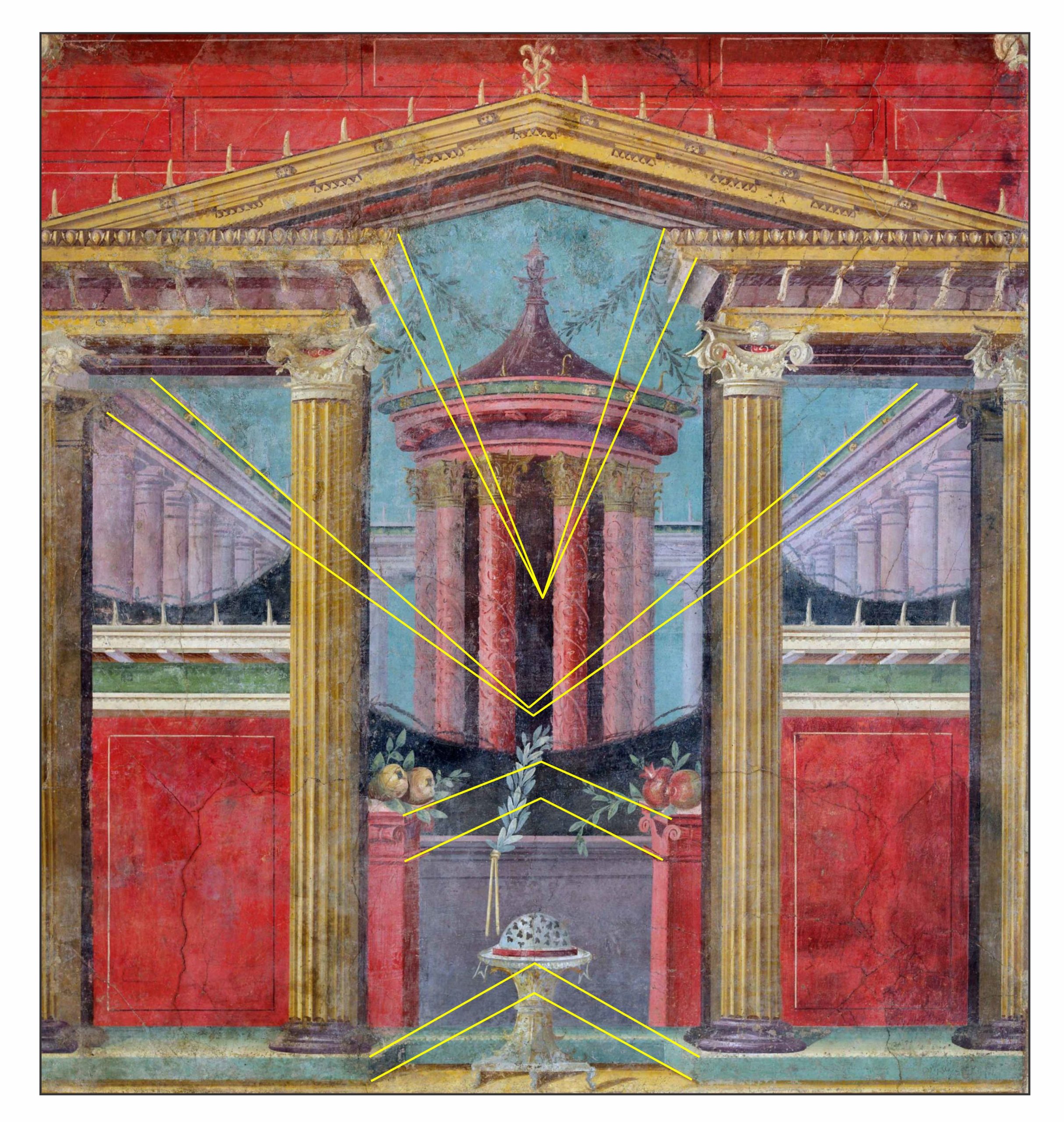
The artists used the idea that lines parallel to the ground converge at a vanishing point. However, as the yellow lines demonstrate, different regions of the painting have different central vanishing points. The viewer understands the three-dimensional space but is left a little uneasy about how everything fits. Hurt (2013) argues that the different vanishing points are appropriate to the viewers direction of gaze: when looking at the upper parts of the painting these points are higher than when looking at the lower parts. However, although the eye looks in different directions, it still maintains its position, and the rules of perspective should work regardless of the direction of gaze. More likely the ancient artist just had an incomplete understanding of linear perspective.
The Middle Ages: Let There Be Light
A major advance in our understanding of vision came from the Islamic polymath Ibn al-Haytham (Latinized as Alhazen, 965–1040), who was born in Basra (in what is now Iraq) and spent most of his life in Cairo, the capital of the Fatimid caliphate (909-1171). Alhazen demonstrated that vision occurs because of light rays entering the eye (Lindberg, 1967; Bala, 2007; Smith 2014, pp 181-227). His Kitab al-manazir (Book of Optics) dealt with the nature of light, the processes of reflection and refraction, and the anatomy of the eye.
Alhazen proposed that rather than the eye sending out “visual rays,” the visible world sends “light rays” to the eye. Vision is caused by intromission rather than extromission. Light arises from luminous sources such as the sun or lamps. Visible bodies reflect light when illuminated by such sources. Every point of the visible body thus emits light waves in all directions.
Therefore when the eye is opposite a visible object and the object is illuminated with light of any sort, light comes to the surface of the eye from the light of the visible object (Alhazen, quoted by Lindberg, 1967. p 323).
The following illustration (left side modified from Smith 2014, p 186; right side modified from an Iraqi banknote) shows Alhazen’s theory of vision:
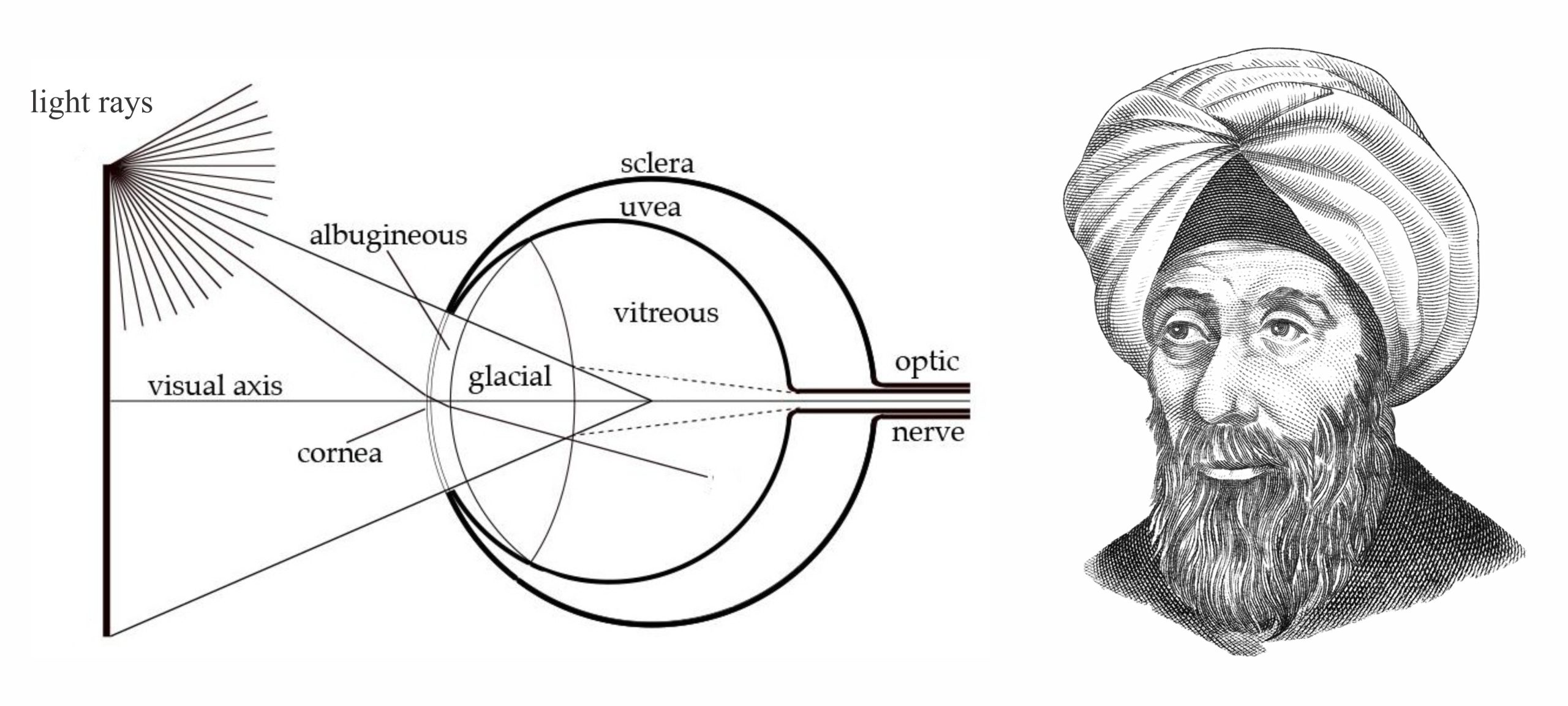
Alhazen studied and described the anatomy of the eye, and believed that vision occurred in the vitreous. Although he had a rudimentary understanding of refraction, and although he may have discovered the principle of camera obscura, he dismissed the idea of an inverted image as illogical. However, his theory could not account for our clear visual image, since all rays from all locations in the visual field would arrive together in the vitreous.
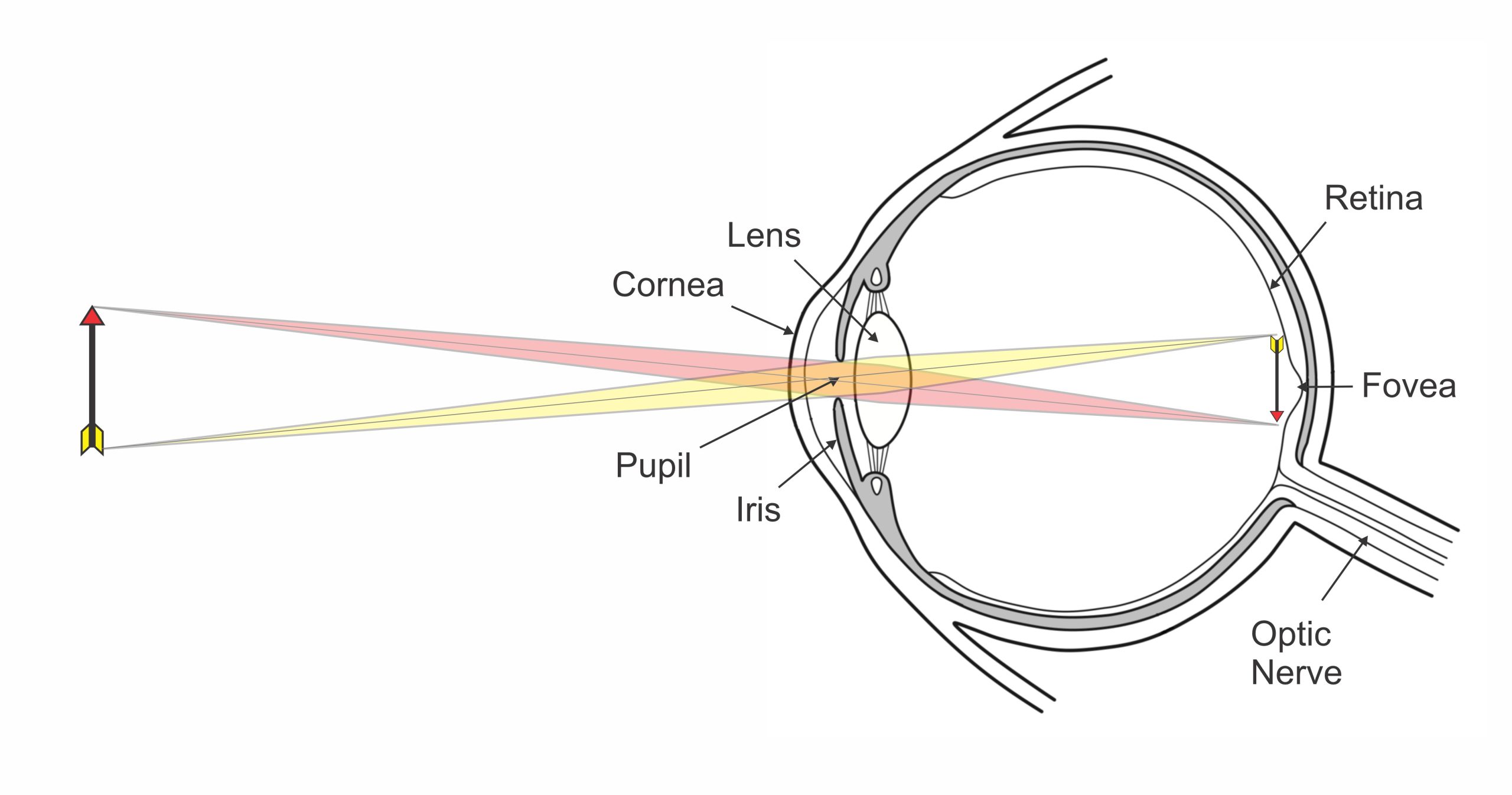
Johannes Kepler (1571-1630) was the first to clearly demonstrate that the cornea, pupil and lens of the eye focus an inverted image of the visible world upon the retina in his 1604 book Ad Vitellionem Paralipomena (Supplement to Witelo, who had written a book on the optics of Alhazen) (Smith 2014, pp 323-362). The following illustration illustrates the projection of the visual world on the retina. A cone of light rays from each part of the object is focused on a specific location on the retina through the action of the cornea, pupil and lens.
Alhazen’s book was translated into Latin around 1200 and became known as De aspectibus or Perspectiva. It was widely read. Robert Grosseteste (1168-1253), an English Bishop, and Roger Bacon (1219-1292), an English scholar of the Franciscan order, were especially enthusiastic about the new ideas of light. They recalled that God has created light on the first day of creation:
In the beginning God created the heaven and the earth.
And the earth was without form, and void; and darkness was upon the face of the deep. And the Spirit of God moved upon the face of the waters.
And God said, Let there be light: and there was light.
And God saw the light, that it was good: and God divided the light from the darkness.
And God called the light Day, and the darkness he called Night. And the evening and the morning were the first day. (Genesis 1: 1-5)
They proposed that the reason that God created light was that
he needed an essential medium through which his every action must travel between heaven and earth, especially the spreading of his divine grace to mankind. (Edgerton, 2009, p 27)
Furthermore, they suggested that by means of light God
conceived and projected the universe from its minute conception in his mind’s eye to its full-blown realization in the void (ibid).
They were perhaps too carried away in metaphor to understand the full significance of Alhazen’s work.
Medieval paintings show only a rudimentary grasp of linear perspective. The following shows a painting of the last supper from the Maestà (1311) in Siena Cathedral by Duccio di Buoninsegna (1255-1319).
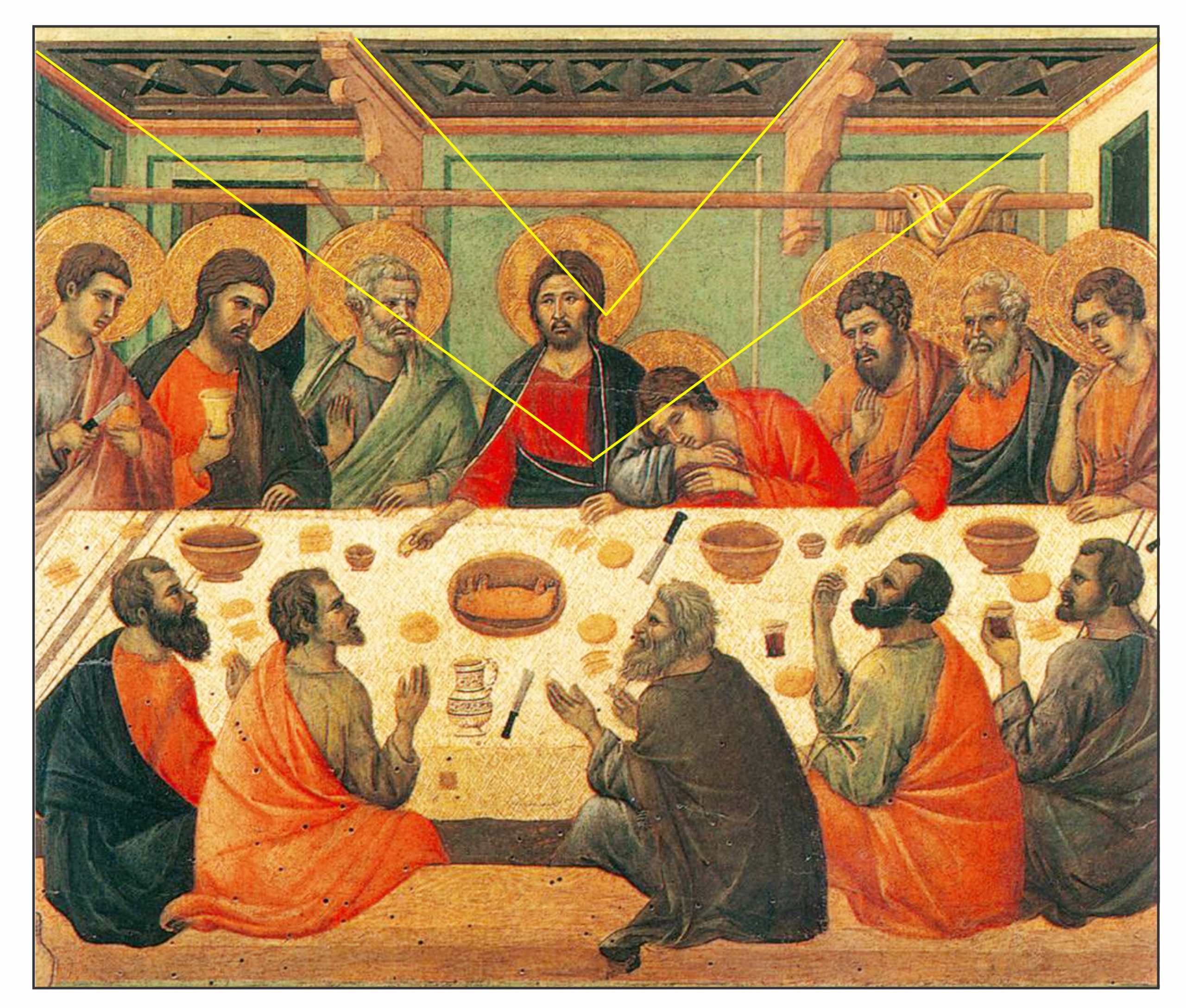
As the yellow lines demonstrate, the beams in the ceiling converge but not to a single vanishing point. The tabletop is represented as seen from above rather than from the front. Its lateral edges are parallel rather than convergent. Each of the objects seen on the table is depicted from a prototypical rather than realistic perspective; the platters are seen form above and the flagon of wine and the glasses from the side. There are no shadows: God’s light is pervasive. There is some shading of the robes, but this is more stylized than realistic.
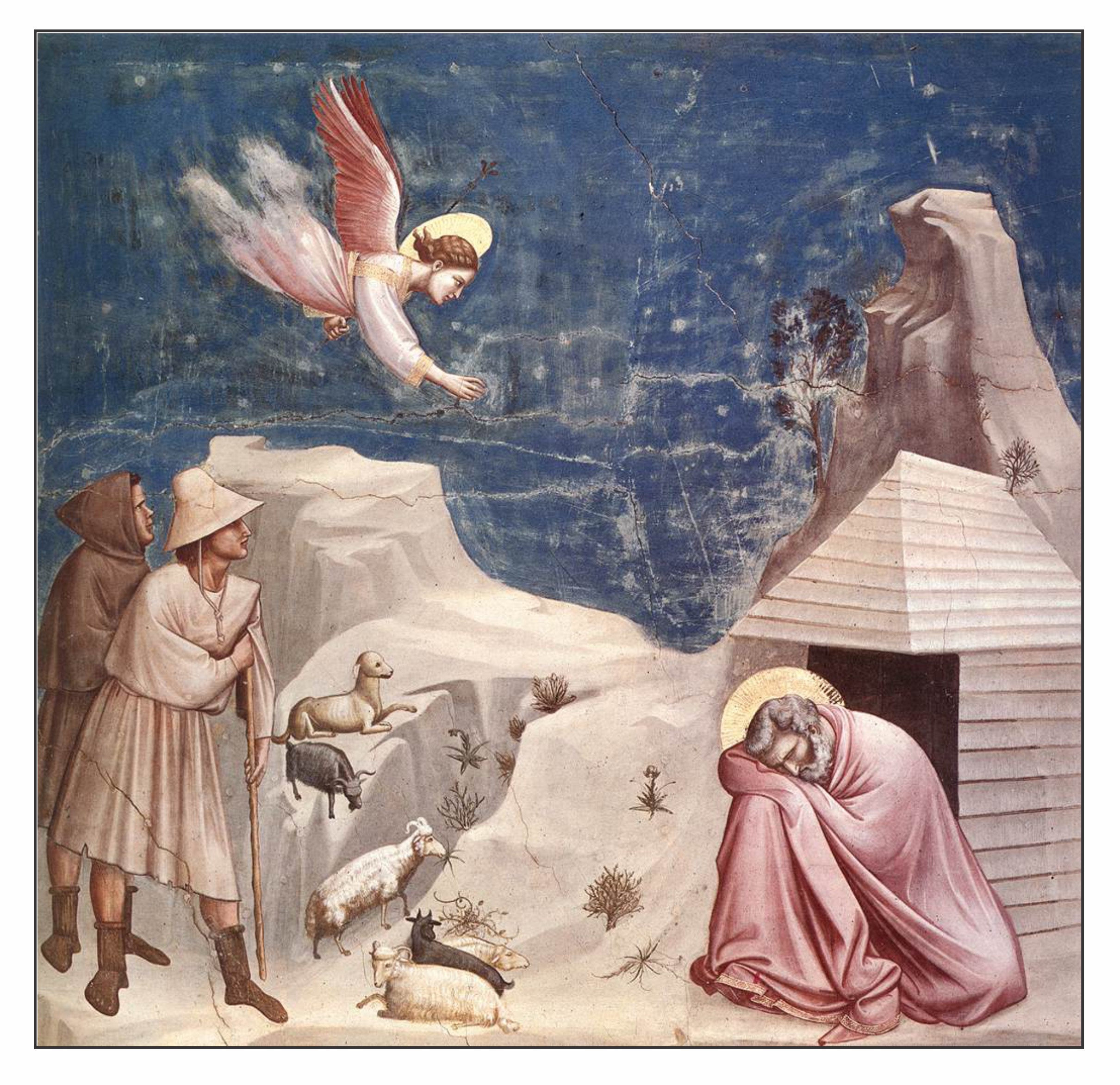
Giotto di Bondone (1267-1337) paid more attention to the effects of light and shadow and was able to portray bodies that were much more realistic than the flat two-dimensional depictions of most medieval art. His bodies had substance; they occupied space. The following illustration shows The Dream of Joseph in the Scrovegni Chapel in Padua (1305). Though the perspective of his shelter is completely unrealistic, the three-dimensionality of the dreaming Joseph is marvelous.
Filippo Brunelleschi (1377-1446)
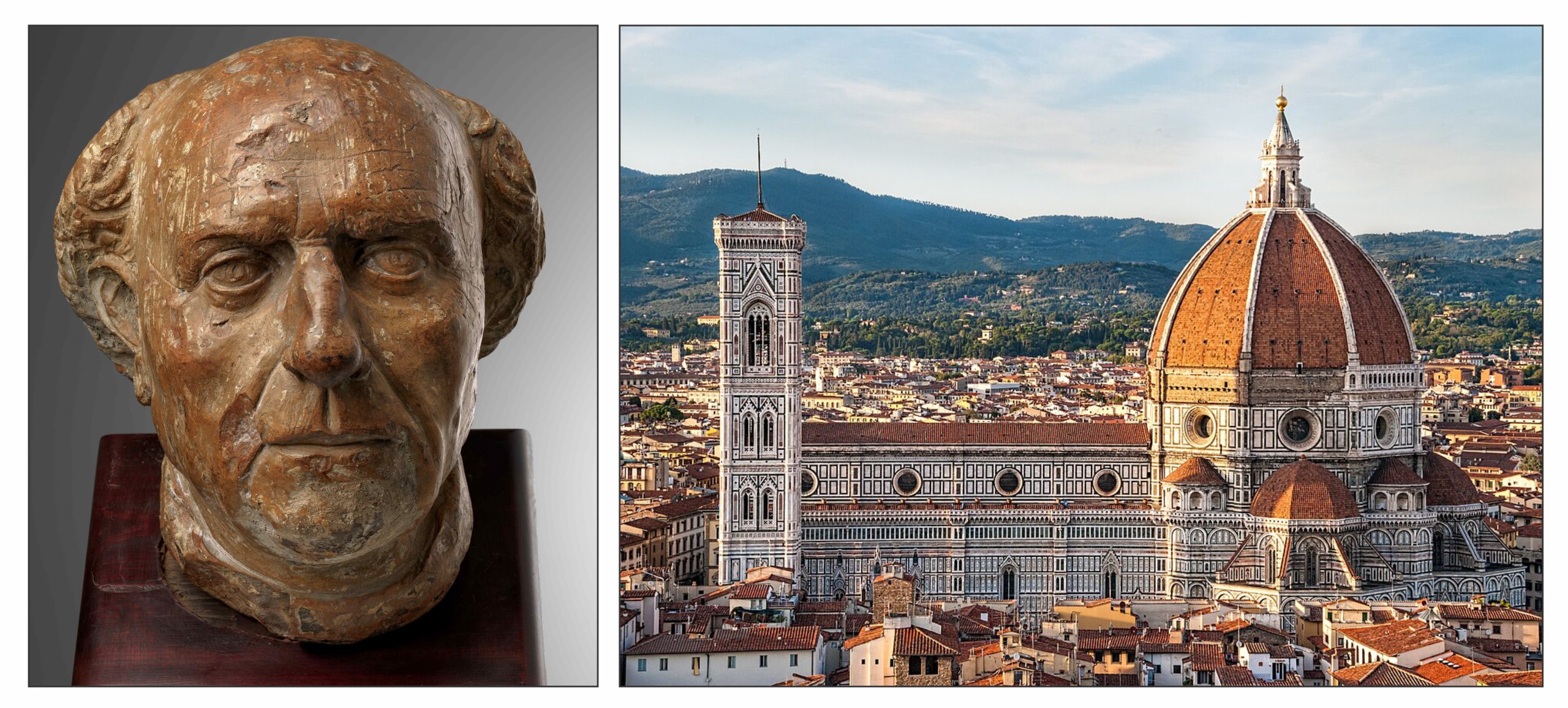
Brunelleschi was a Florentine architect, painter and sculptor. His most famous accomplishment was the building of the dome of the Santa Mari dei Fiori, the cathedral in Florence. The dome, begun in 1420 and completed in 1436, is still the largest masonry dome in the world. The following illustration shows on the left a recently discovered terra-cotta portrait of Brunelleschi made by his adopted son Andrea di Lazzaro Cavalcanti (Il Buggiano) in 1447, and on the right a photograph of the cathedral as seen from the south.
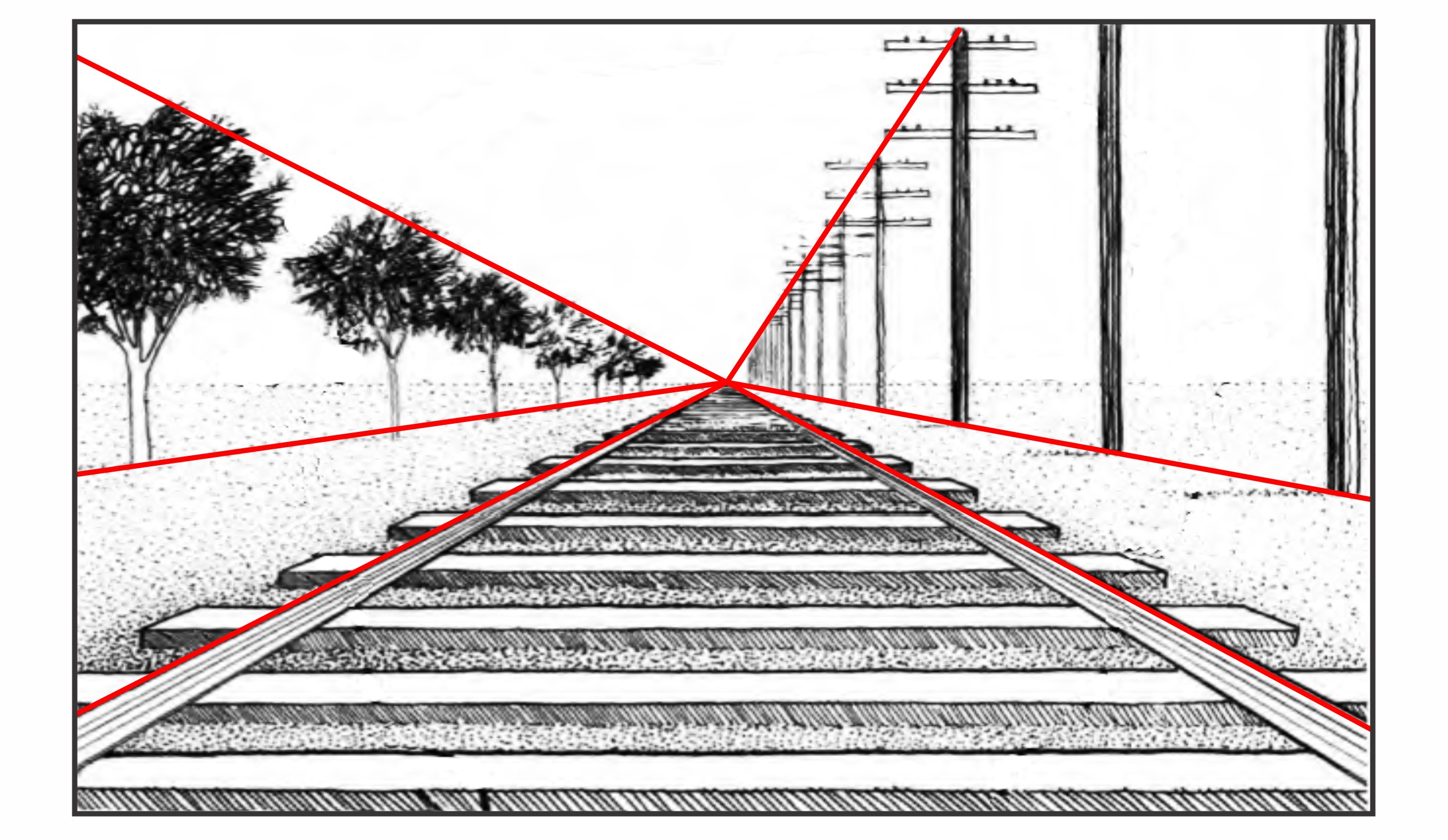
As an architect Brunelleschi was very familiar with drawing buildings. Around 1415 he proposed a way to make realistic perspective drawings. He did not leave any written description of his technique, but one assumes that he used the principle that parallel lines on planes perpendicular to or parallel to the ground converge at vanishing points located on the horizon. (Parallel lines on a plane perfectly parallel to the picture plane do not converge.) Brunelleschi’s technique was called “linear perspective” because these convergent lines can be used to estimate the size of objects at different distances from the observer. This is shown in the following illustration modified from D’Amelio (1964, p 30):
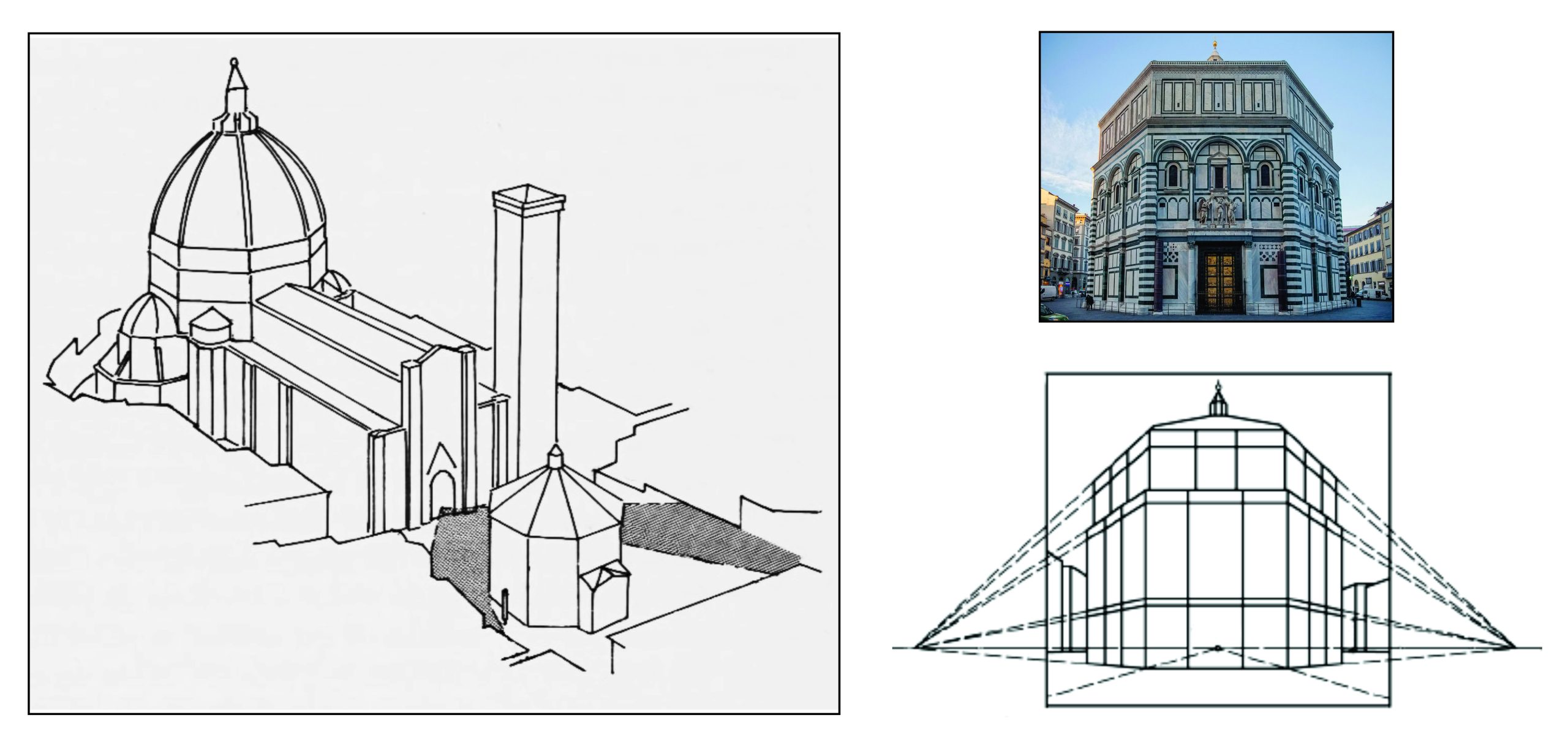
Sometime between 1415 and 1425, Brunelleschi illustrated his technique by painting on a small panel a view of the Baptistery as seen from the western door of the Cathedral of Florence. He then drilled a hole in the panel at the point on the baptistery where the painter’s line of sight intersected the image. The following illustration shows on the left the location of the Baptistery relative to the cathedral with the artist’s field of view shaded (modified from Damisch, 1994, p 92). At the upper left is a photograph of the Baptistery, and below it is a simplified representation of Brunelleschi’s painting together with the perspective guidelines and vanishing points (modified from Park, 2013, p 264).

Brunelleschi demonstrated the accuracy of his painting using a mirror (Damisch, 1994, pp 89-98; Edgerton, 2009, pp 54-68; Grave, 2010). He stood at the cathedral door, held the painting in front of him so that it was facing the baptistery, and looked trough the hole in the panel. This allowed his to see what the real baptistery looked like. He then held a mirror up before him so that he could see the reflection of his painting. The reflected painting was indistinguishable from the actual building. The following illustration shows the viewing setup on the left (modified from drawingacademy website), plus diagrams (modified from Park, 2013) of what was visible through the hole in the panel when looking at the baptistery (upper right) and at the reflected pattern (lower right):
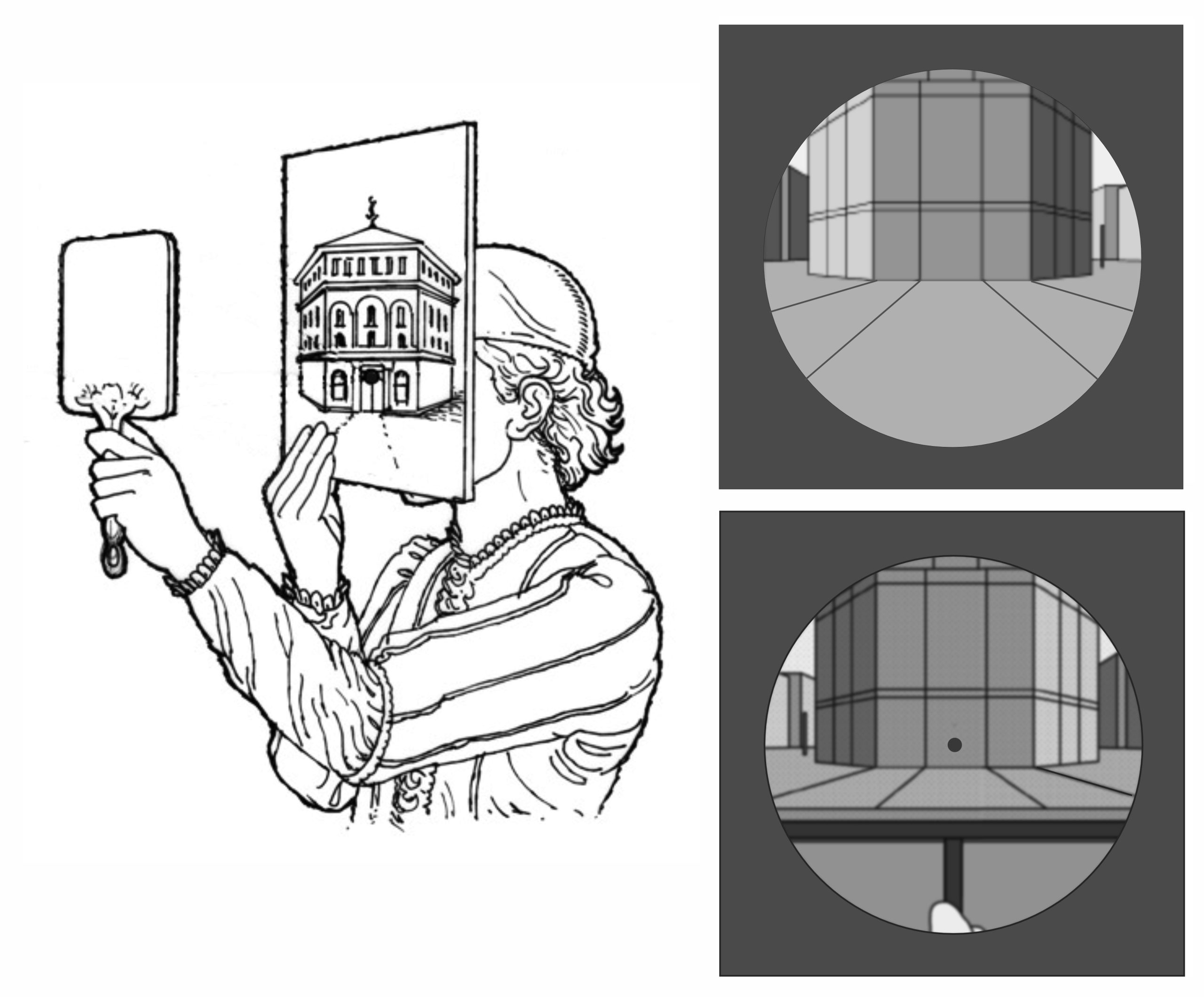
The basic structure of the Baptistery is the same in the two views. However, the astute viewer will notice that some asymmetrical details in the building, and the shading are left-right reversed in the reflected painting. The direct view would show the sun on the southern side (left) of the Baptistery. Brunelleschi may have accounted for this problem and right-left reversed his painting, but we do no know this. The painting has been lost. and descriptions of the demonstration, written more than 50 years afterward, contradict themselves.
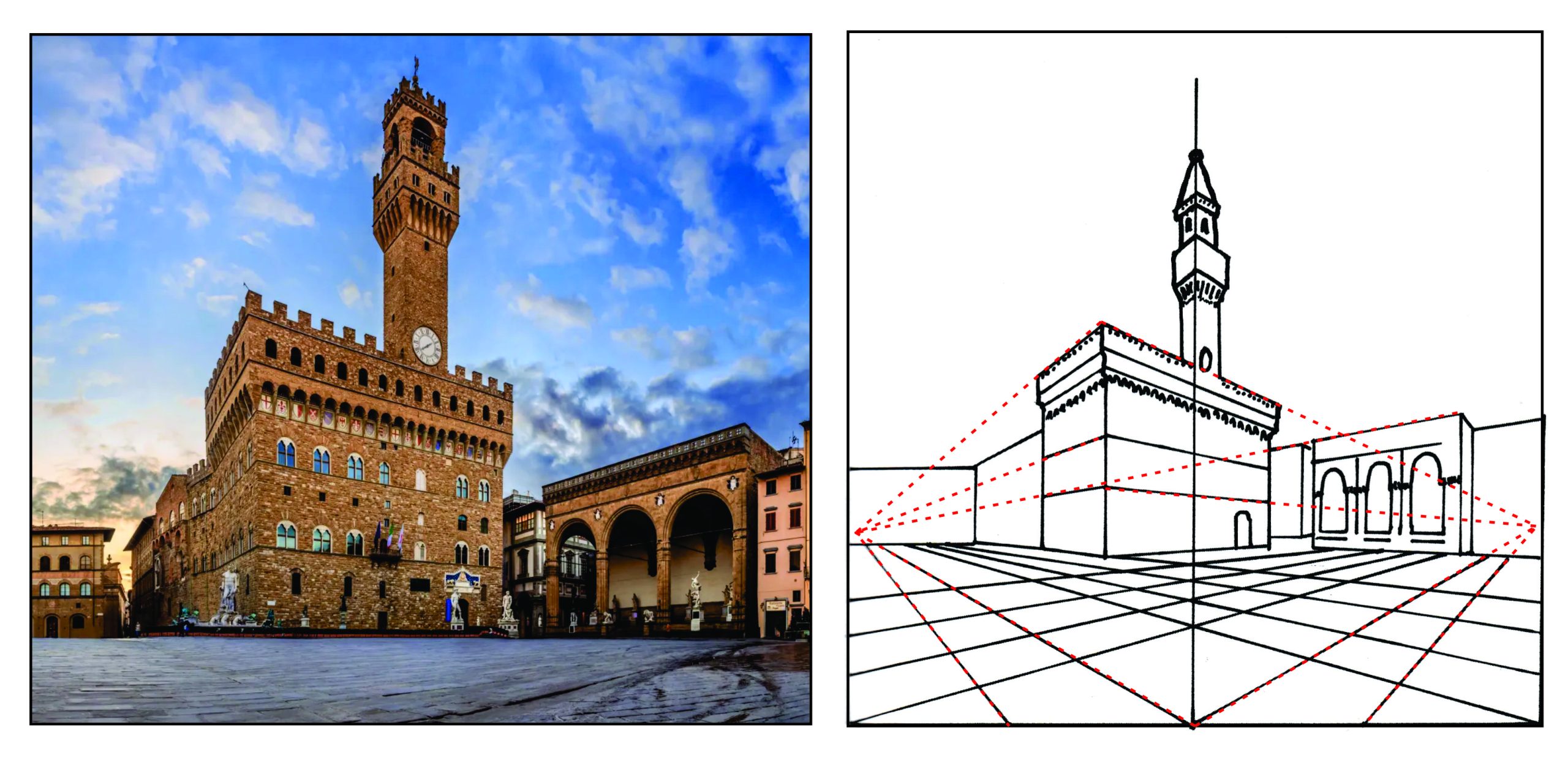
Brunelleschi painted a second demonstration panel showing the Palazzo Vecchio in Florence as viewed from the northwest corner of the Piazza della Signoria, with the adjacent Loggia dei Lanzi (Kemp, 1990, pp 9-52; Edgerton. 2009, pp 69-76). The following illustration shows on the left a modern photograph of the view, and on the right a schematic representation of what Brunelleschi must have painted together with the perspective lines (modified from Kemp, 1990, p 13). Unfortunately, the actual panel has also not survived. The buildings were the same in Brunelleschi’s time as now, but the statues in the Piazza and Loggia were not present.
The Brancacci Chapel
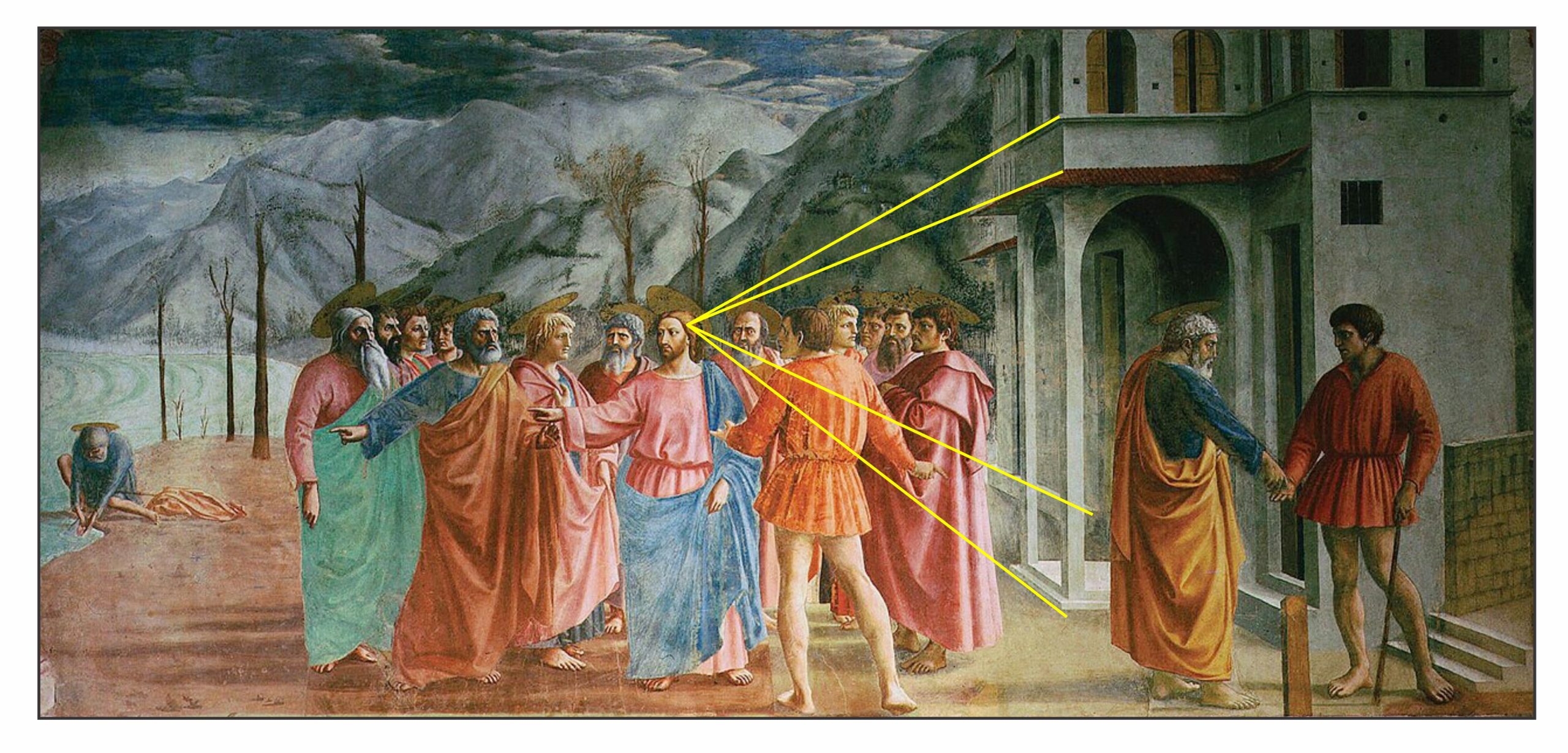
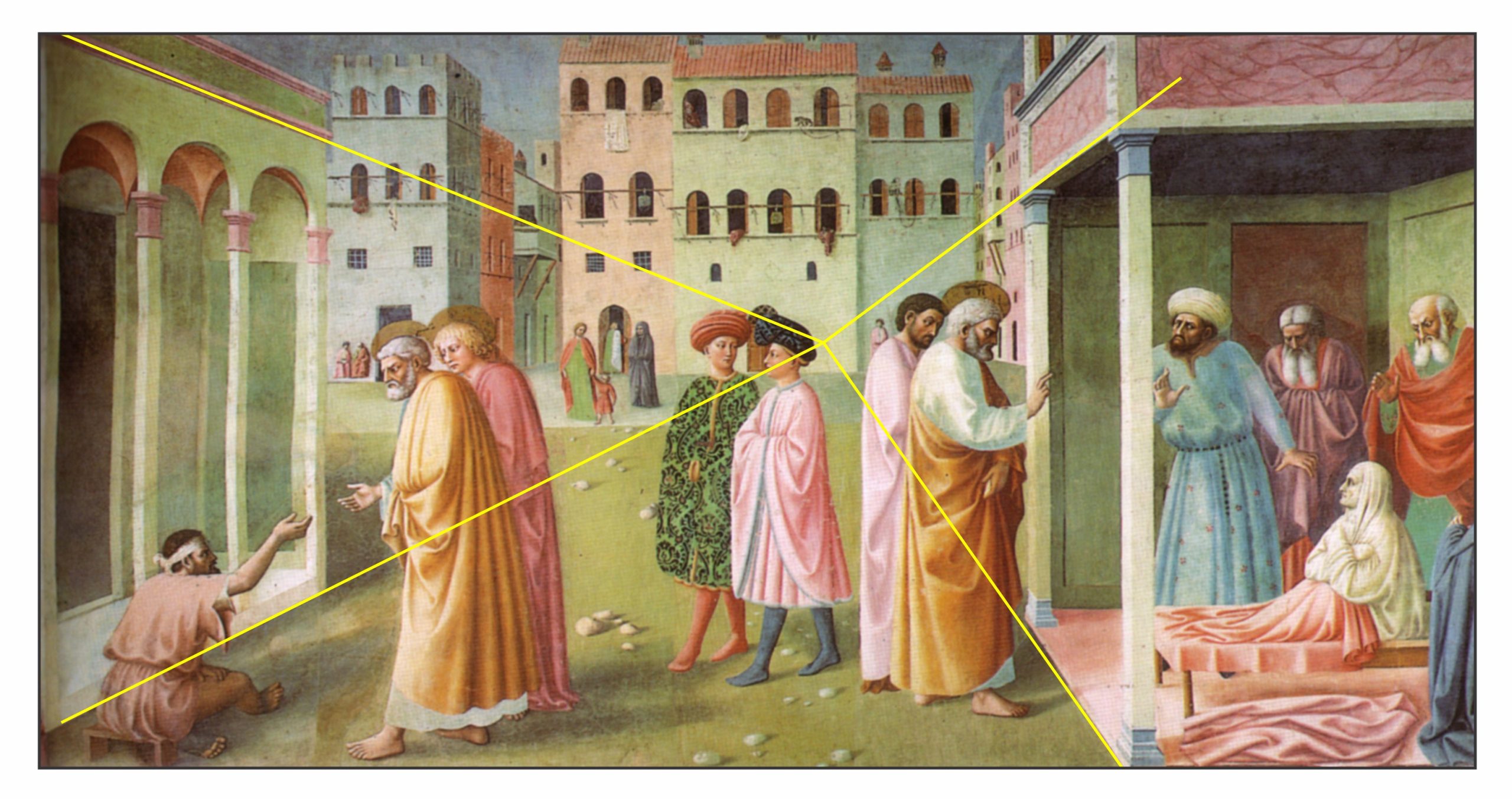
The frescoes in the Brancacci Chapel in the Church of Santa Maria del Carmine in Florence were the first demonstration of Brunelleschi’s new system of linear perspective. Most of these frescoes were painted between 1425 and 1427 by Masolino da Panicale (1383-1447), and Masaccio (1401-1428). The following illustrations show The Tribute Money by Masaccio, and The Healing of the Cripple and the Raising of Tabitha by Masolino:
Leon Battista Alberti (1404-1472)
Alberti was a polymath: architect, linguist, cryptographer, and poet (Pearson, 2022). Born in Genoa to a family exiled from Florence, he returned to Florence in 1434 and was impressed with Brunelleschi’s achievements. The following illustration shows a medallion portrait from about 1450 by Matteo de’ Pasti of Verona. The obverse shows a winged eye casting its gaze on something new to study. QUID TUM means “what next”
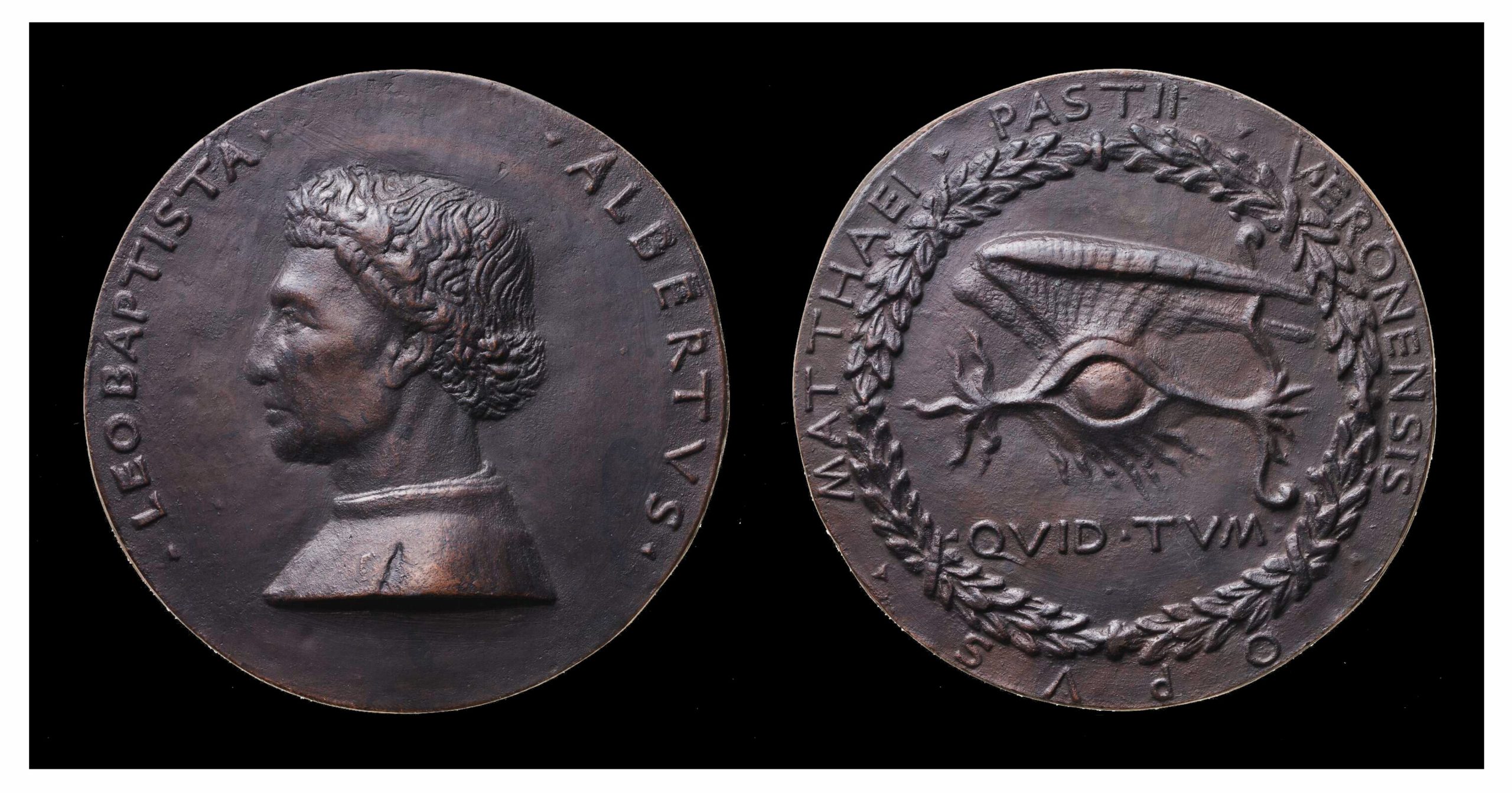
Brunelleschi left no written record of his method of linear perspective. Alberti summarized his ideas and provided some geometric justification for them in his book Della Pintura (On Painting, Latin De Pictura) written in 1436 (Edgerton, 1975, pp 32-65; Alberti/Sinisgalli, 2011). However, the book did not include any diagrams to illustrate his propositions. These were only added in later editions. Brunelleschi left no words, and Alberti left no pictures.
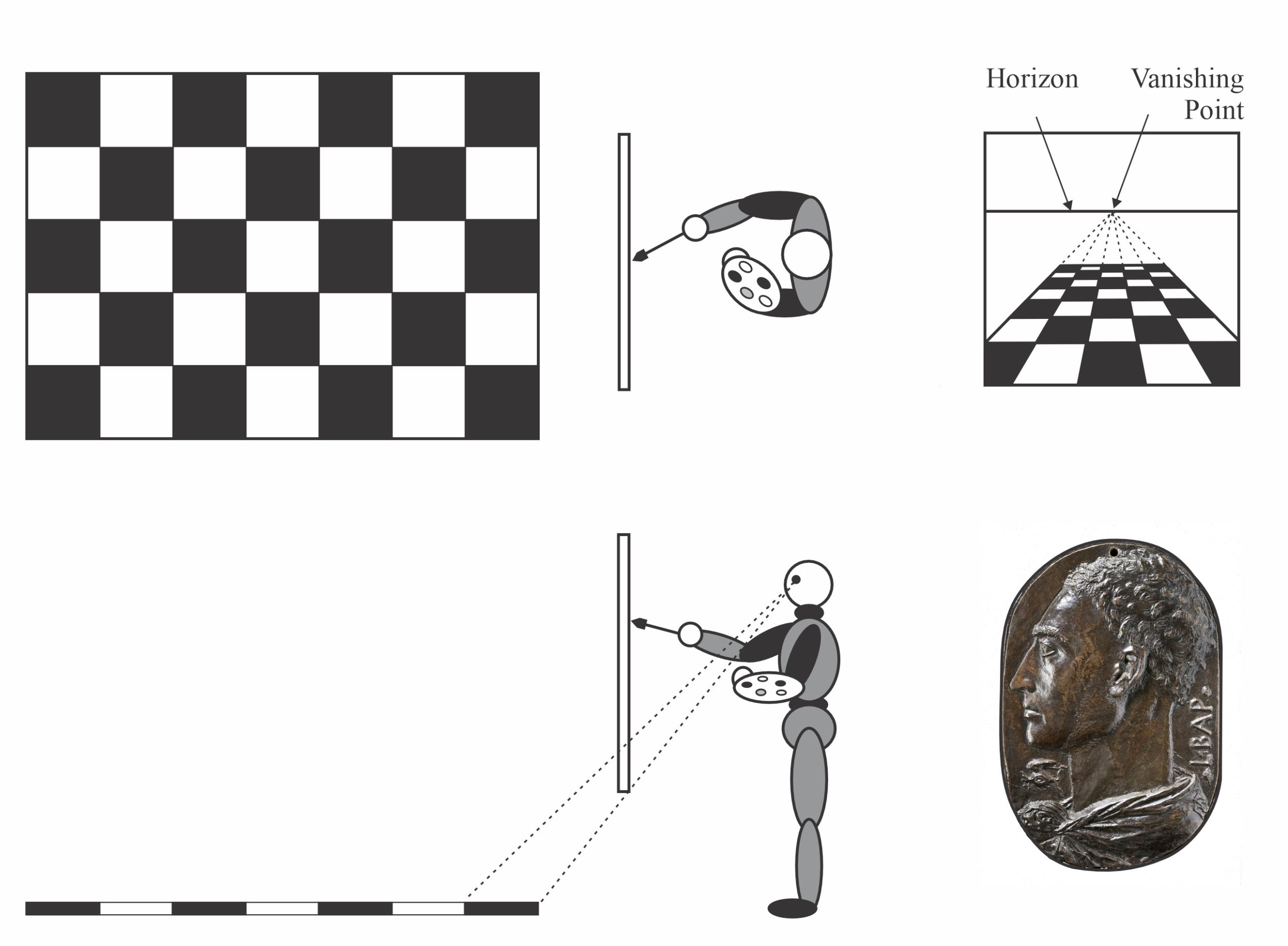
Alberti proposed that painting represents what is seen through a window (Friedberg, 2006):
First I trace as large a quadrangle as I wish, with right angles, on the surface to be painted; in this place, it certainly functions for me as an open window through which the historia is observed (Alberti, 1436, Sinisgalli translation, p 19)
The following illustration (loosely derived from Tyler & Kubovy, 2004) illustrates this concept by showing an artist painting a picture of a checkered pavement. On the left the artist and his painting are seen from the top and from the side. On the upper right is the painting, and on the lower right is a self-portrait medallion of Alberti from about 1435.
Alberti’s concept of the window was extended by later artists and writers. Albrecht Dürer (1471-1528) created a striking woodcut of a technique that could be used to draw complex objects (such as a lute) seen from unusual angles. The assistant points one end of the line to a point on the object and the artist then records where the line crosses the plane of the picture window:
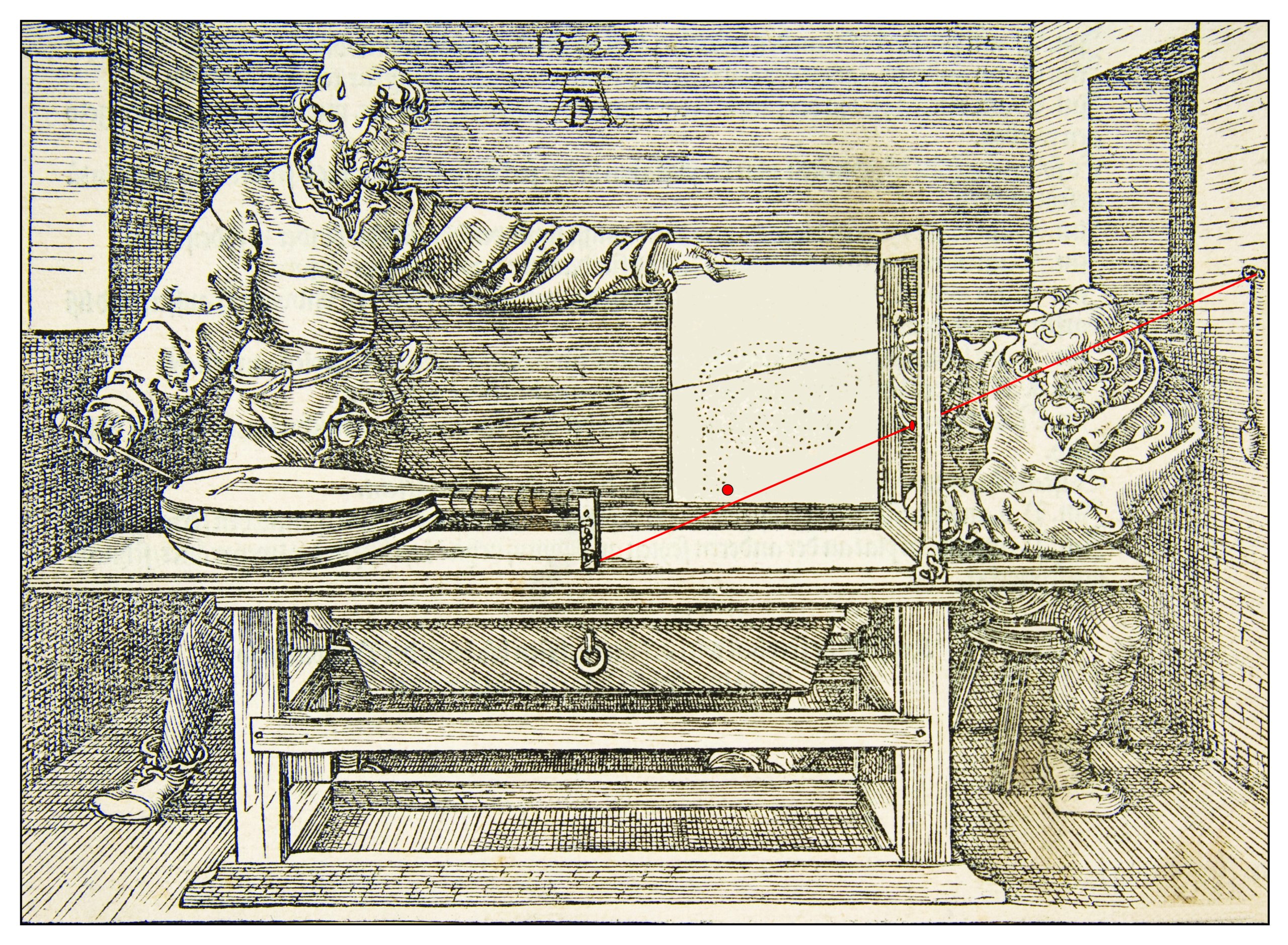
The technique would be far too tedious for an artist to use. Furthermore, as Gilbert Riedelbauch has shown, Dürer’s outlined painting is much larger than it should be for where the picture frame is located. This can be seen by drawing an imaginary line (red) from the lowest point on the pegbox of the lute to the fixed point on the right wall. This would pass through the picture plane about halfway between the upper and lower edges, and not near the bottom as shown on the dotted outline.
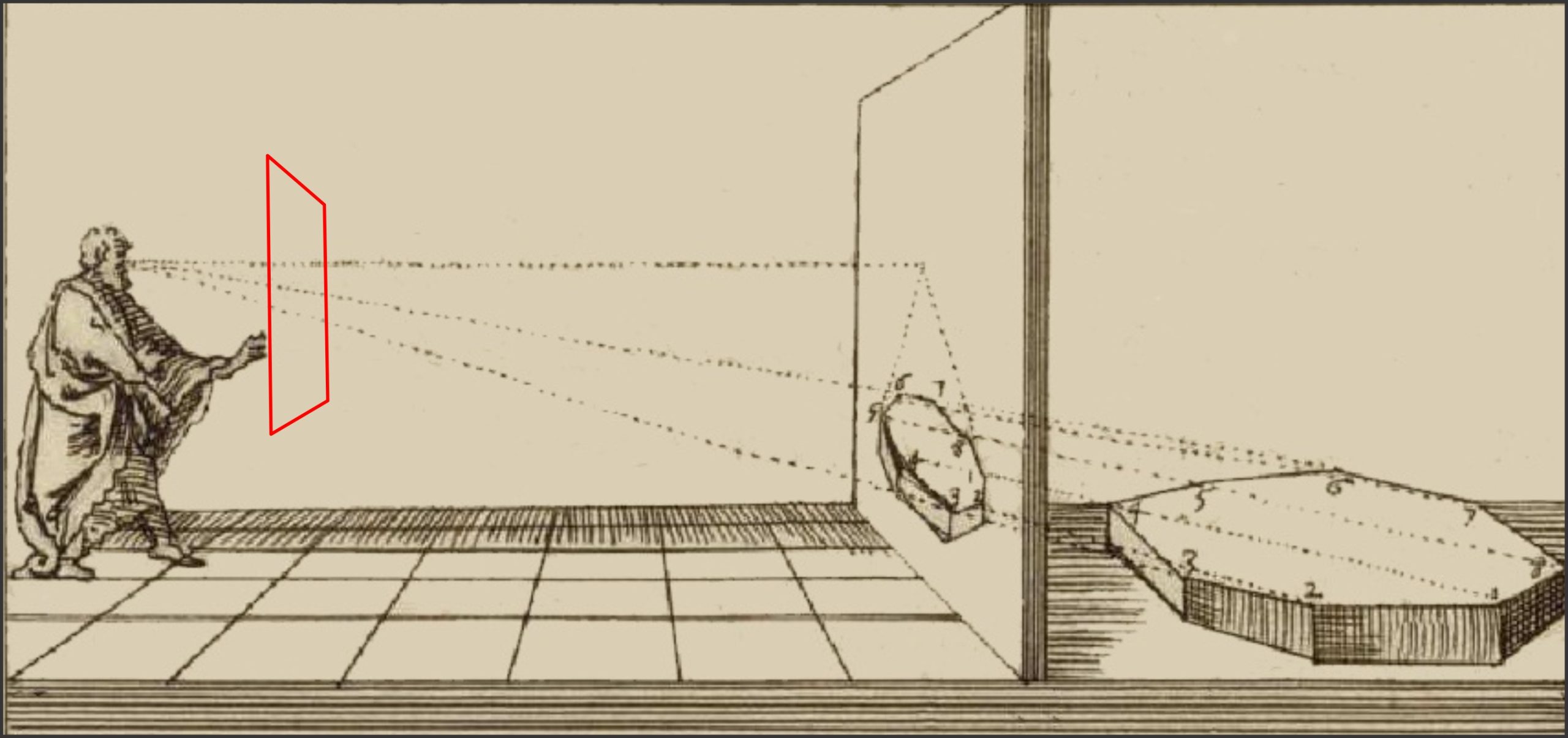
Artists had difficulty illustrating Alberti’s window. The following is an illustration from a 1583 perspective book by Iacomo Barozzi da Vignola (p 55). The image is correctly drawn but the artist is too far away from his painting, which should be where the red outline suggests:
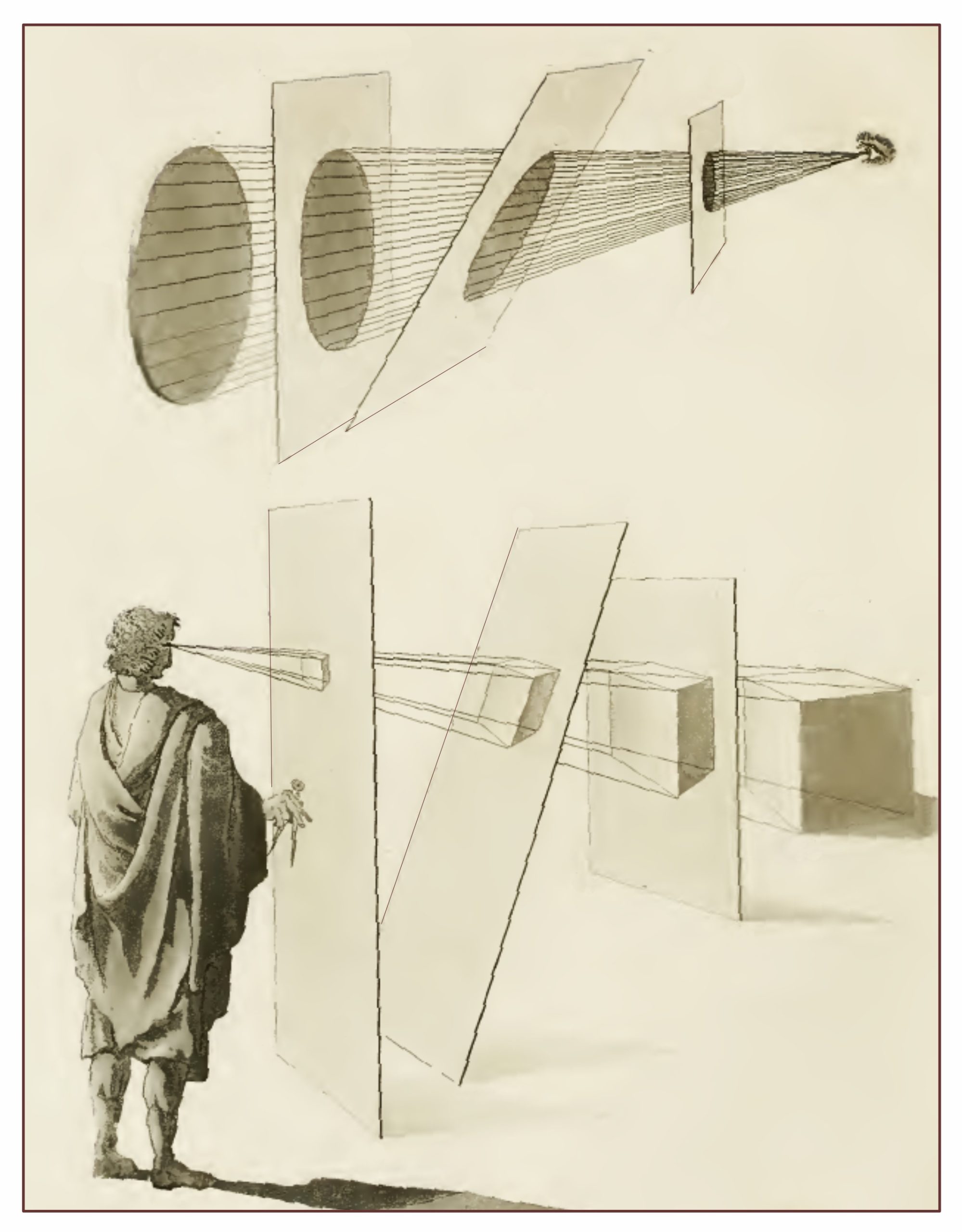
A more veridical illustration of the cone of vision and Alberti’s window is in a later book on linear perspective by James Malton called The Young Painter’s Maulstick (1800). A cone (or pyramid) of light rays comes from the object to the eye. The object can be represented where the cone intersects with the picture plane:
Alberti provided many helpful shortcuts that could be used instead of the laborious point-by-point plotting of the image. Some examples are shown in the following illustration. When plotting a pavement of alternating dark and light squares, one initially draws the central vanishing point and its guidelines (black dotted lines), One then sets up a distance point (blue dot) at eye level at a distance d1 from the picture which is itself at a distance d2 from the beginning of the pavement. By drawing a line from the distance point to the near edge of the pavement one can determine where the distant edge of the first row of tiles should be represented (purple dotted line) by where the line intersects with the picture plane (purple dot). Extending the diagonal of the first represented tile (dotted red line) then allows one to determine the distant edges of the further rows of tiles (red lines) from the intersections (red dots) of that diagonal with the vanishing-point-guidelines.
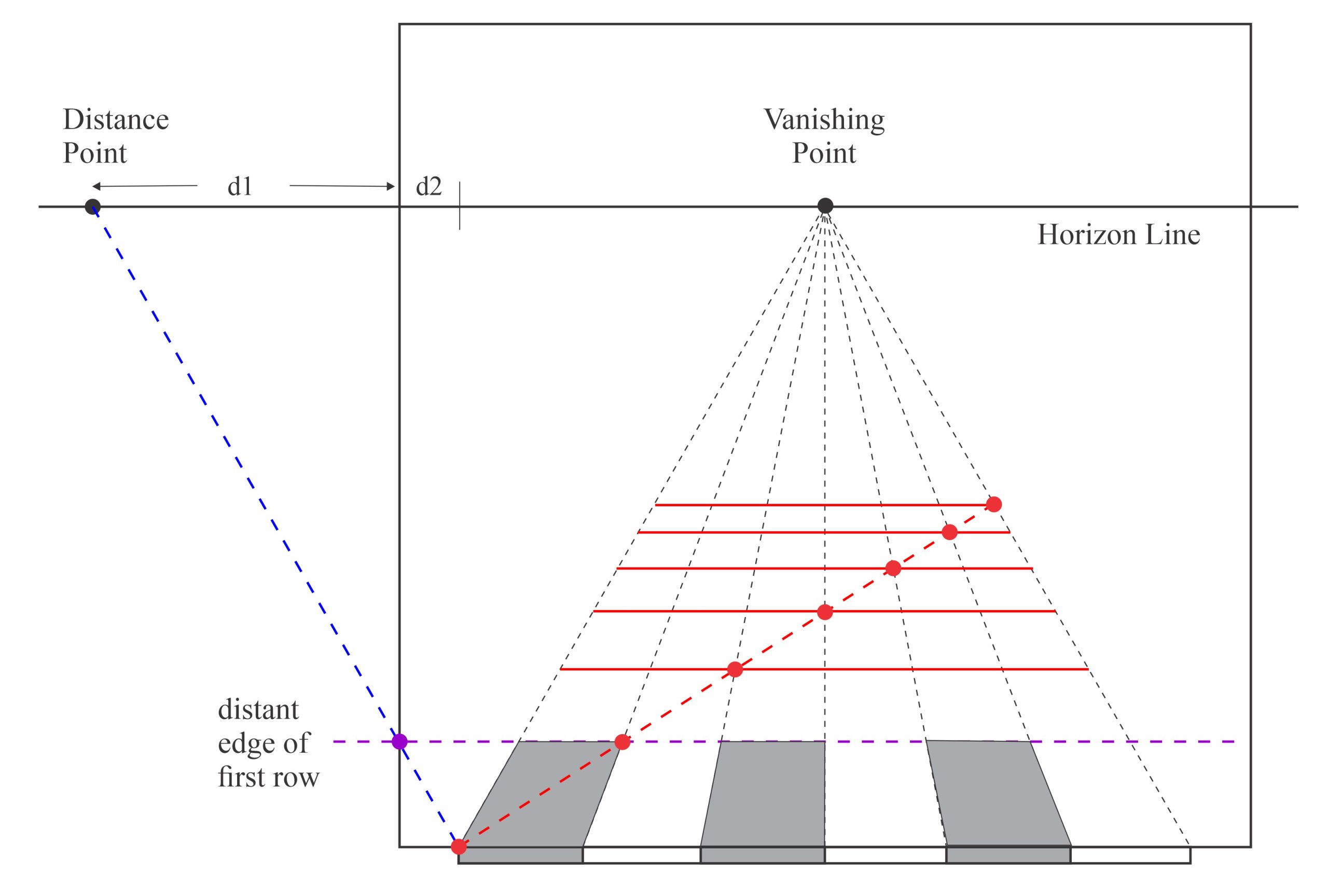
These “excellent” methods are described by Alberti/Sinisgalli (1436/2011) on pp 41-41 and illustrated on pp 173-174.
Ellipses
Alberti suggested that one could draw circles in perspective by plotting their outlines on a grid and then replotting the perspective outline on a grid that had been constructed with vanishing point guidelines (pp 54-55 with illustrations on pp 183-4), as shown in the following illustration. The circle becomes an ellipse in perspective. It is important to note that the axis of the ellipse (red) is lower, i.e. closer to the viewer, than the center of the circle seen in perspective. This means that the distant half of the perceived circle (light blue shading) is appropriately smaller than the near half
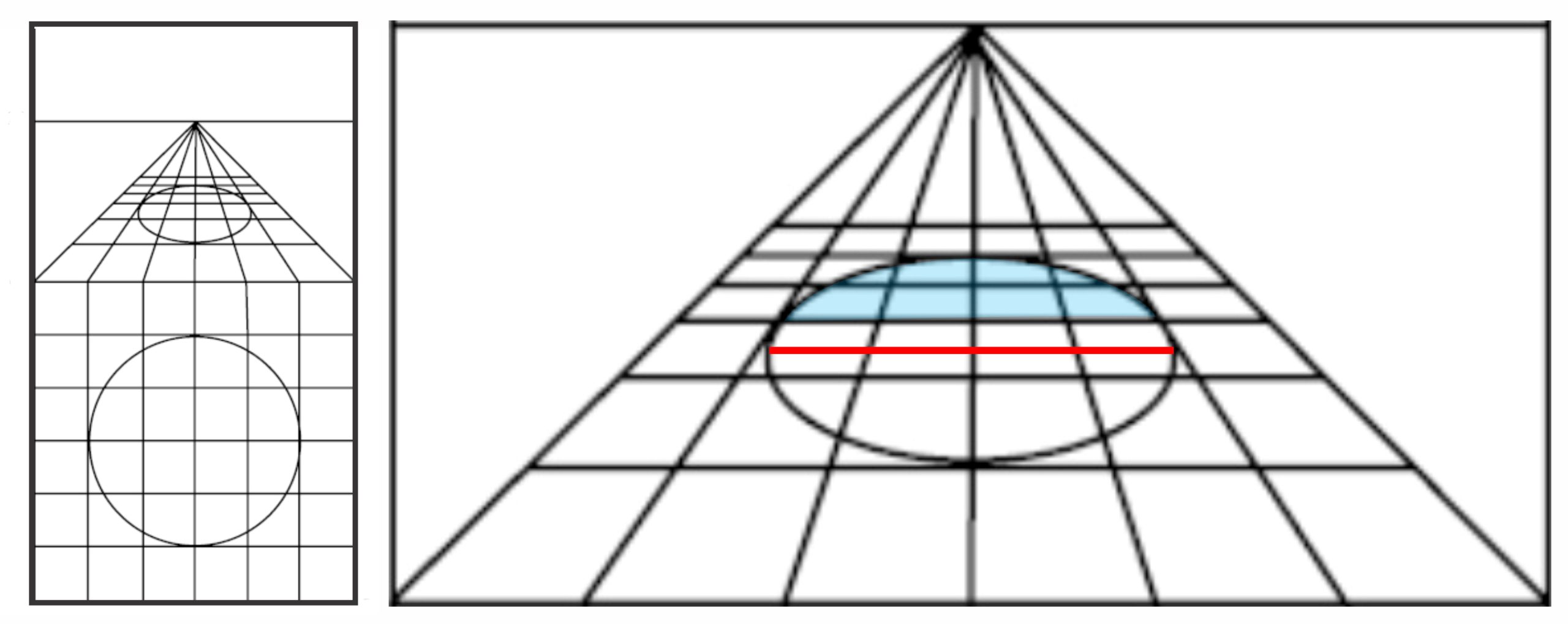
Alberti did not know that the circle plotted in perspective was an ellipse. This was only determined later by Albrecht Dürer and most importantly Johannes Kepler. Ellipses are marvelous shapes. The following quotation is from a delightful essay by David Reinfurt (2026), written as though it were an autobiography of the ellipse:
I must admit that I have a pretty amazing quality: every time that you encounter a circle from any angle (which is, well, every time you see a circle even as the angle infinitely approaches zero), the resulting shape (the light that hits your eye) is an ellipse. The same is true in three dimensions, too: the projected image of a sphere onto a plane is not merely an oval, much less an egg or any other ordinary curved form, but ALWAYS an exact ellipse.
It makes plenty of sense if you remember that an ellipse is just the oblique slice of a cone. Imagine that cone is your field of vision, with your eye at its tip. Any circle in your view will never be absolutely perpendicular to your line of sight, but rather it will be a distortion and its visible shape will be an ellipse. Renaissance constructed perspective taught us how to see like this and Baroque illusionism taught us not necessarily to believe what we see.
That’s me, then: a small pearl of geometric transcendence in your everyday vision. I describe the paths of the planets in the heavens. I am the sphere’s shadow. I am the empirical encounter with an ideal form, the particular case in point, and the closest you may ever come to seeing the face of God.
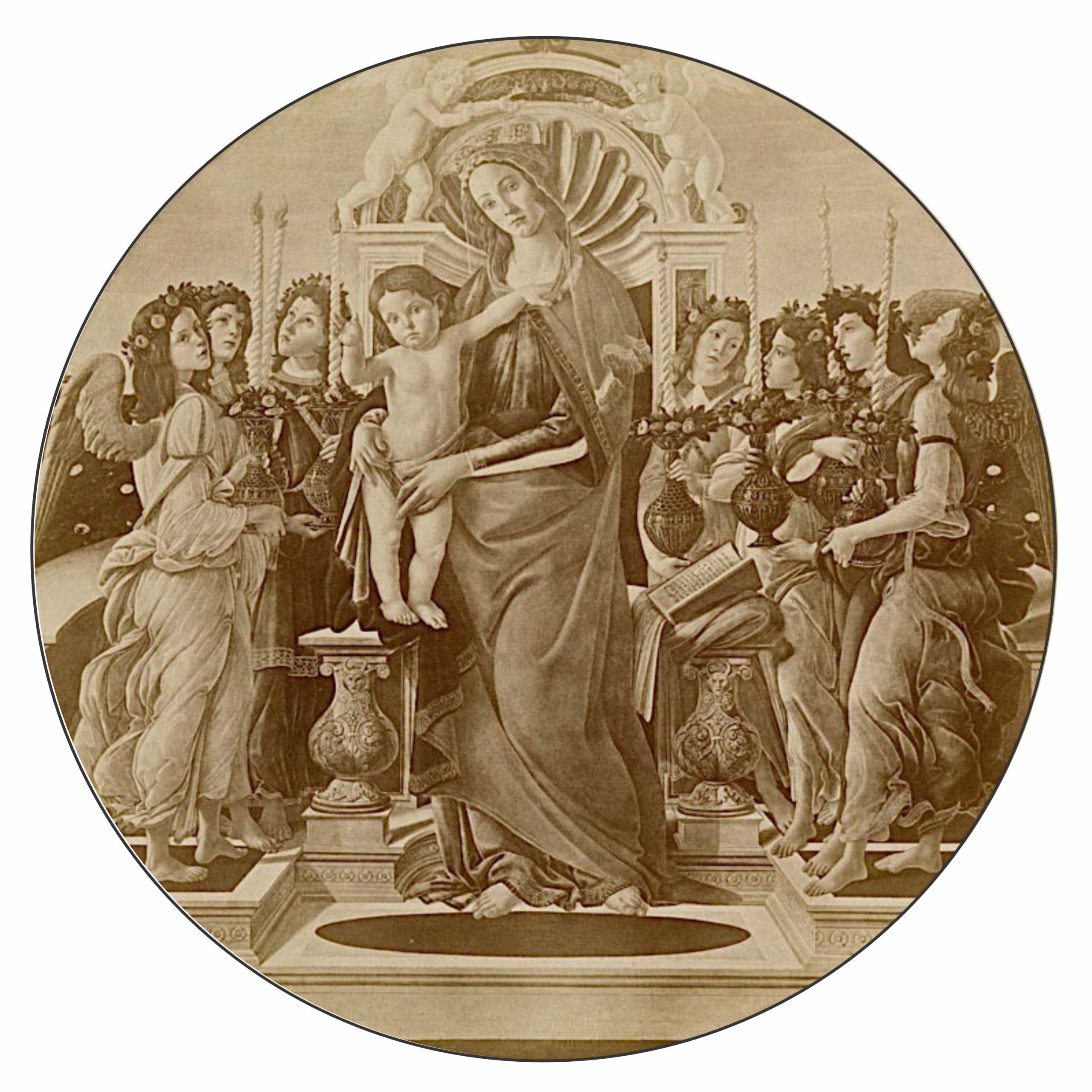
A striking example of the ellipse in Renaissance painting is the carpet at the feet of Mary in Madonna and Child with Angels Carrying Candlesticks (1490) by Sandro Botticelli. The carpet harmonizes beautifully with the circular frame of the painting. Unfortunately, the painting was destroyed during World War II, and we only have a pre-war photograph:

The Ideal City
As the 15th century progressed, the principles of linear perspective proposed by Brunelleschi and Alberti became widely used. The idea of a central vanishing point became particularly popular. In the late 15th Century, three different paintings of La città ideale (The Ideal City) were created (Damisch, 1994, pp 169-375; Krautheimer, 1994). All three were unusually elongated (about 220 to 230 cm wide and 65 to 80 cm high). The paintings were created by three different artists, but no one is sure exactly who they were. It is possible that Alberti may have been involved in their design though they were created after his death (Krautheimer, 1994, p 256). The paintings are now located in the Walters Art Museum in Baltimore, the Galleria Nazionale delle Marche in Urbino, and in the Gemäldegalerie in Berlin. They are shown in this order in the following illustration:
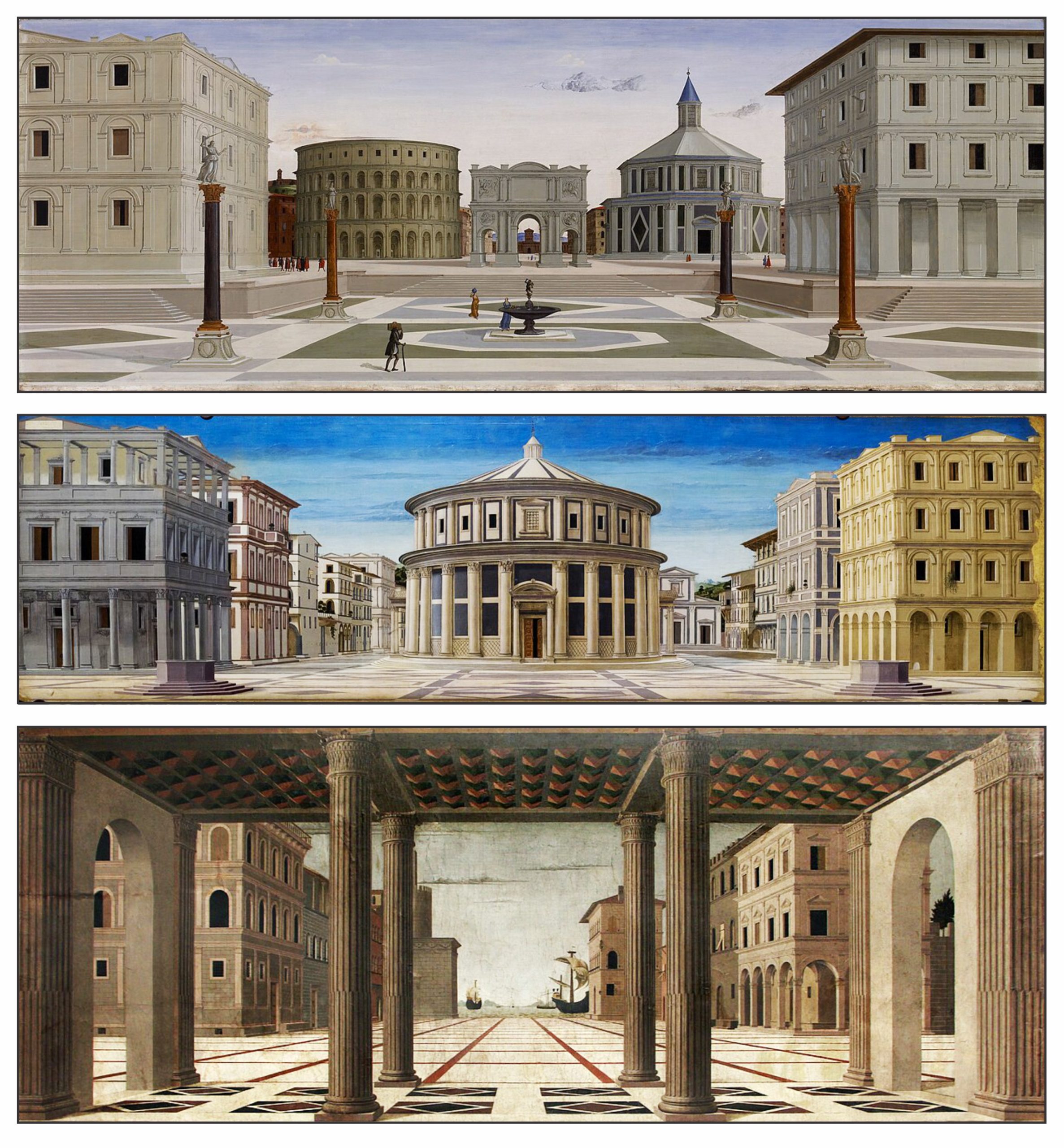
The Baltimore panel shows some scattered figures, but these may have been added after the panel was completed. Two doves on the first-floor cornice of the rightmost building of the Urbino panel may symbolize peace, but there is no other sign of animation. The Berlin panel is devoid of movement.
The panels are both fascinating and disconcerting. The buildings do not represent any actual buildings and the cities depicted are far more spacious and serene than any city in 15th Century Europe. The paintings may be imagining cities of the future but the fact that there are few if any people there suggests that such places are not for us:
what is here depicted is not an architect’s project; rather it is a vision of an urban ambient, a utopia, a higher world ruled by the principles of humanism. Unattainable within the limitations—financial, technical and organizational—set by fifteenth-century conditions and urban realities, that higher world could be built easily with ruler, T-square, compasses and paint on the surface of a panel. But it remains a vision, a never and nowhere realm: this, notwithstanding the concreteness of the designer’s architectural imagination, the clarity of spatial relations and of the interaction of space and volumes, the precision in working out proportions and the minute detailing of orders, capitals and profiles. (Krautheimer, 1994, p 239).
The panels are similar in many respects to the stage sets designed for the theater.
To build of laths, canvas and paint on a stage a never-and-nowhere grand architectural setting is not so different from designing and painting it on a panel. Both, whether in the fifteenth or in the sixteenth century, draw on the same legacy of humanist architecture. Both are intimately linked to the consistent use of perspective. Both conjure up an artificial world into which the spectator is forcefully drawn, a world beyond the reality of everyday life. (Krautheimer, 1994, p 257).
Viewing the panels one hopes that we can survive to populate these ideal cityscapes or that the actors will indeed come on stage to tell their story.
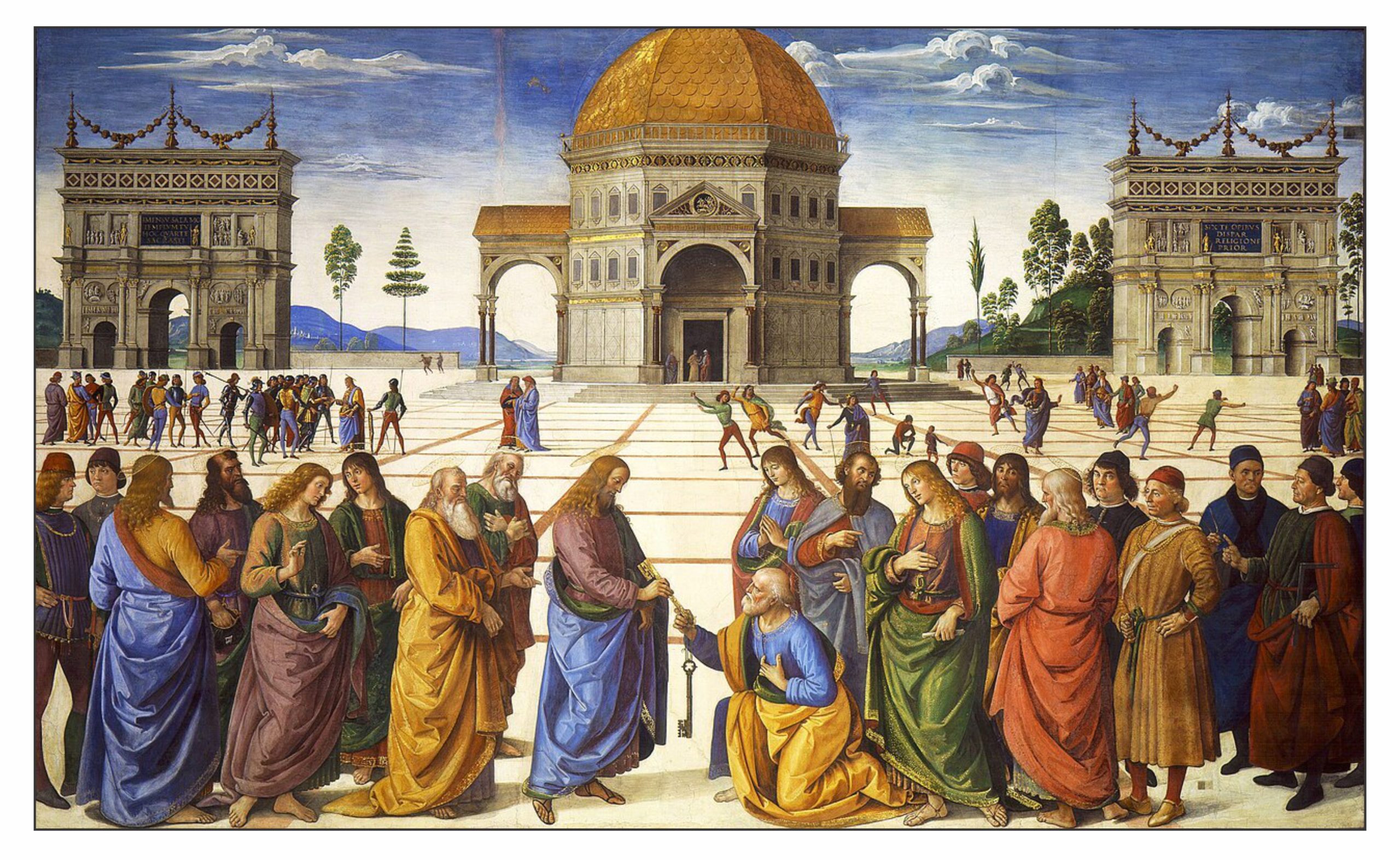
Piero Perugino (1446-1523) did create a historia for such la città ideale in his large fresco of The Delivery of the Keys to Saint Peter (1482) in the Sistine Chapel:
Multiple Vanishing Points
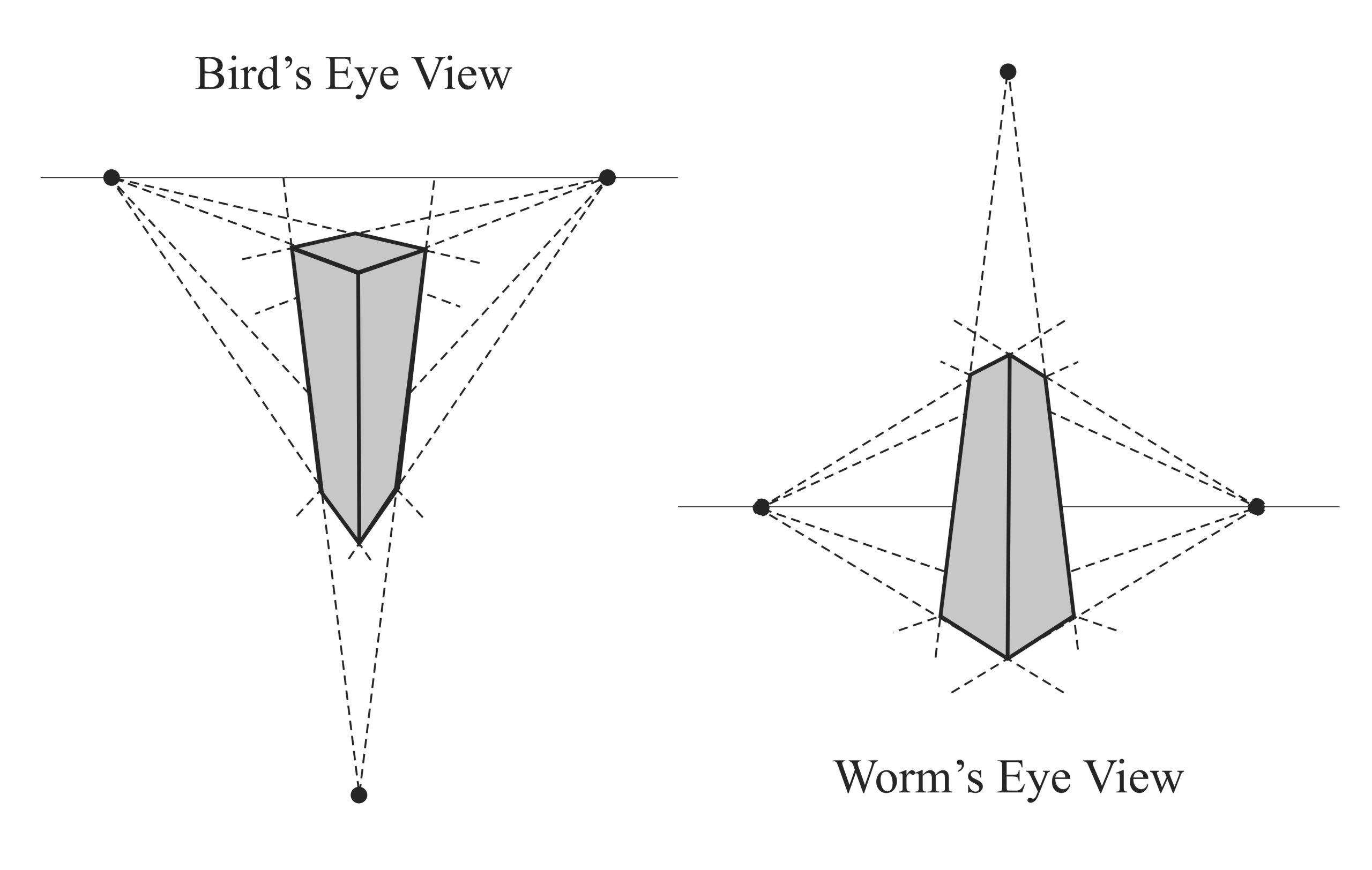
When one looks up at a building its higher parts appear smaller than the lower. This can be portrayed in linear perspective by using third vanishing point above the horizon to which the vertical edges of the building converge. This is called the worm’s eye view. Placing the third vanishing point below the object allows one to represent a bird’s eye view.
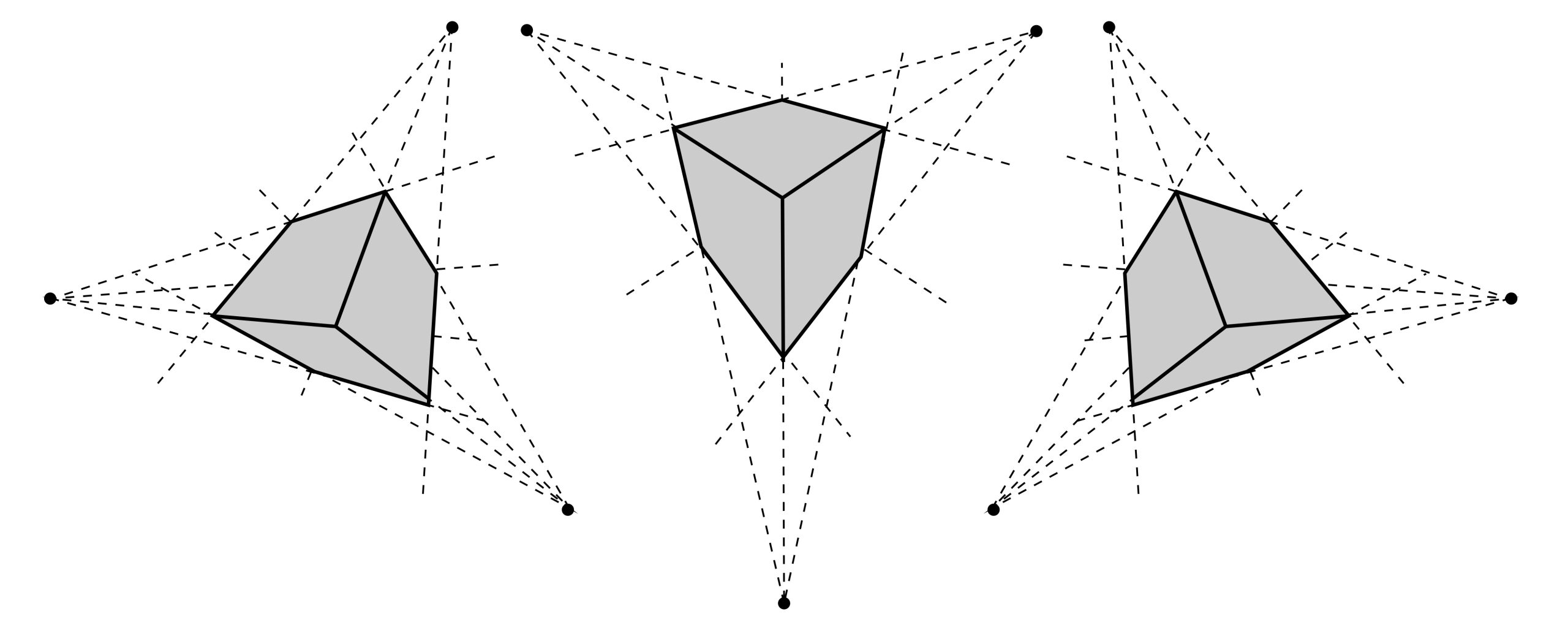
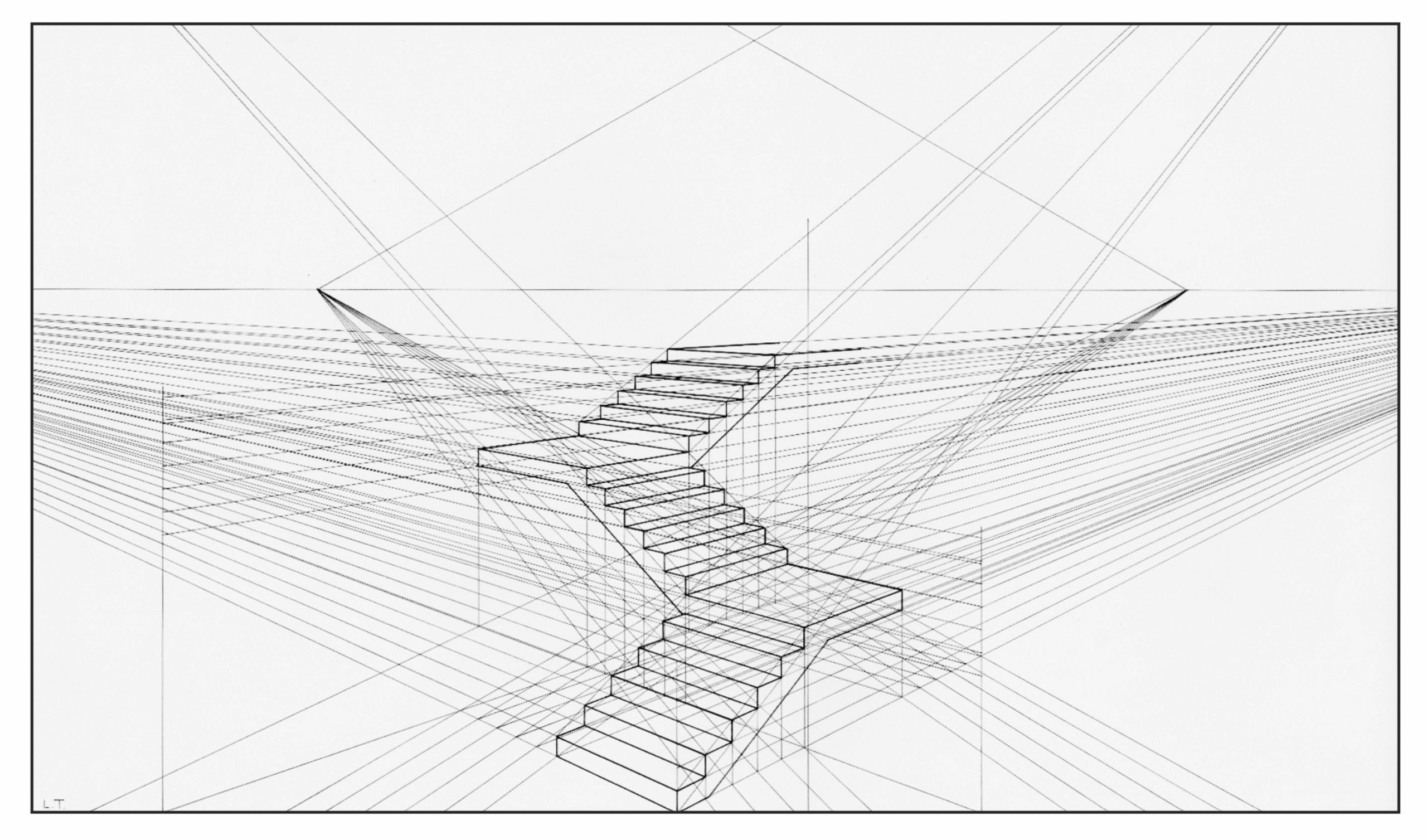
Most handbooks of perspective (e.g. Malton, 1800; D’Amelio, 1964; Attebery, 2018) consider how to portray objects in one-, two-, and three-point perspective. However, when representing planes that are not exactly vertical or horizontal, one needs multiple vanishing points, one for each slope. The following illustration shows how a cube can be rotated in linear perspective by moving the vanishing points:
The use of multiple locations for the vanishing points is illustrated in the following bravura depiction of a staircase by Luciano Testoni. The ascending slopes of the stairs require their own vanishing points.

Envoi
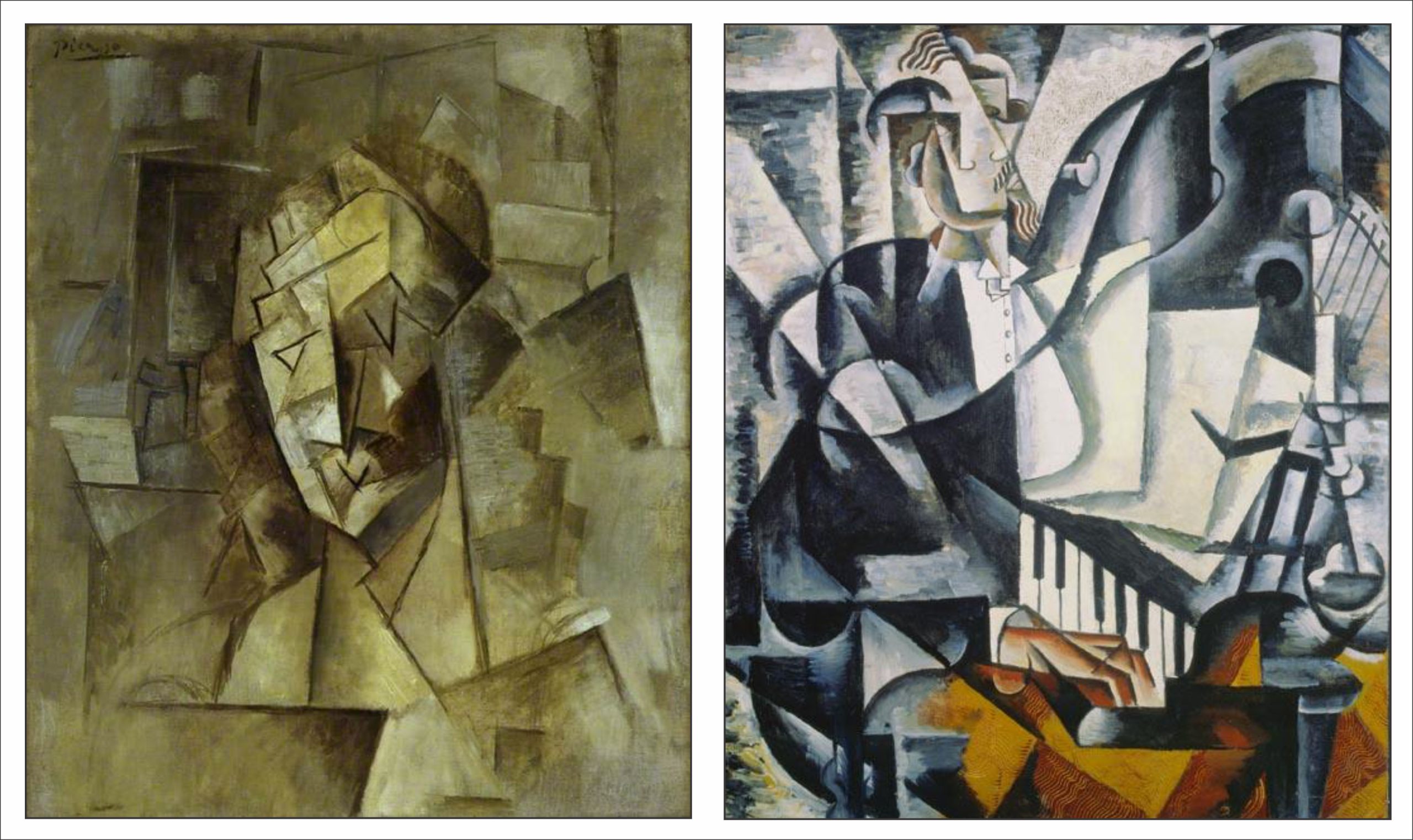
After the Renaissance, linear perspective became the governing principle for the visual arts, providing the artist with a clear space in which to tell a story. However, linear perspective was criticized as fixed at a moment of time: it does not portray how we perceive by moving our eyes from one part of a scene to another. Cubism tried to show these shifting perceptions, composing a picture out of multiple details. The following illustration shows on the left Portrait of Fernande (1909) by Pablo Picasso and on the right The Pianist (1915) by Lyubov Popova.
Furthermore, linear perspective is concerned with the appearance of an object rather than its emotional significance. In the 20th Century, the Expressionists attempted to portray the subjective effects of what was seen rather than its spatial organization.
Nevertheless, the development of linear perspective in painting during the Renaissance completely reshaped the way in which we perceived the world. Figuring out where things exist in space was essential to how we viewed the heavens, and this led to rethinking our place in the universe (Edgerton 2009).
References
Alberti, L. B. (1436, translated Sinisgalli, R., 2011). Leon Battista Alberti: On painting: a new translation and critical edition. Cambridge University Press.
Anderson, M. L. (1987). The villa of P. Fannius Synistor at Boscoreale. Bulletin of the Metropolitan Museum of Art, 45(3), 17–36.
Attebery, C. (2018). The complete guide to perspective drawing: from one-point to six-point. Routledge.
Bala, A. (2007). The Alhazen optical revolution. In The dialogue of civilizations in the birth of modern science (pp. 85–94). Palgrave Macmillan.
Barozzi da Vignola, I. (1583). Le due regole della prospettiva pratica con i comentarij del R.P.M. Egnatio Danti. Francesco Zannetti.
D’Amelio, J. (1964, republished 2004). Perspective drawing handbook. Dover Publications.
Damisch, H. (translated by Goodman, J., 1994). The origin of perspective. MIT Press.
Edgerton, S. Y. (1975). The Renaissance rediscovery of linear perspective. Basic Books.
Edgerton, S. Y. (2009). The mirror, the window, and the telescope: how Renaissance linear perspective changed our vision of the universe. Cornell University Press.
Friedberg, A. (2006). The virtual window: from Alberti to Microsoft. MIT Press
Grave, J. (2010). Brunelleschi’s perspective panels: rupture and continuity In Lee, A., Péporté, P., & Schnitker, H. (eds). Renaissance? perceptions of continuity and discontinuity in Europe, c.1300-c.1550 (pp. 161–180). Brill.
Hurt, C. (2013). Romans paint better perspective than Renaissance artists. Foundinantiquity website.
Kemp, M. (1990). The science of art: optical themes in western art from Brunelleschi to Seurat. Yale University Press.
Krautheimer, R. (1994). The panels in Urbino, Baltimore and Berlin. In Millon, H. A., Magnago Lampugnani, V. (Eds). The Renaissance from Brunelleschi to Michelangelo: the representation of architecture. (pp 233-257). Bompiani.
Lindberg, D. C. (1967). Alhazen’s theory of vision and its reception in the West. Isis, 58(3), 321–341.
Malton, J. (1800). The young painter’s maulstick (being a practical treatise on perspective; containing rules and principles for delineation on planes. Founded on the clear mechanical process of Vignola and Sirigatti; united with the theoretic principles of the celebrated Dr. Brook Taylor). Carpenter and Co.
Park, M. (2013). Brunelleschi’s discovery of perspective’s “rule.” Leonardo, 46(3), 259–265.
Pearson, C. (2022). Leon Battista Albert: the chameleon’s eye. Reaktion Books.
Reinfurt, D. (accessed 2026). Elliptical thinking. Serving Library.
Smith, A. M. (2014). From sight to light: the passage from ancient to modern optics. University of Chicago Press.
Smith, A. M. (2022). Optics to the time of Kepler. The encyclopedia of the history of science, 4(2).
Tyler, C., & Kubovy, M. (2004). Science and art of perspective. WebExhibits.