Caravaggio: The Contarelli Chapel
Michelangelo Merisi da Caravaggio (1571-1610) was born in small community called Caravaggio just east of Milan. He first became recognized as a painter of genius in 1602 when he completed a set of three paintings on the life of Saint Matthew for the Contarelli Chapel in the Church of San Luigi dei Francesi in Rome. Caravaggio had a ferocious temper and in 1606 he killed a man in a brawl and was banished from Rome. After a period of exile in Malta, Sicily and Naples, he negotiated a pardon. However, in Naples in 1609 he was violently assaulted by his enemies. He died in Porte Ercole as he tried to return to Rome. The portrait by Ottavio Leoni derives from the time when Caravaggio was in Rome at the height of his powers, though it was likely completed later.
Matteo Contarelli
The story begins with Matthieu Cointerel (1519-1585) a French Cardinal who provided support for the Church of San Luigi dei Francesi, France’s national church in Rome:
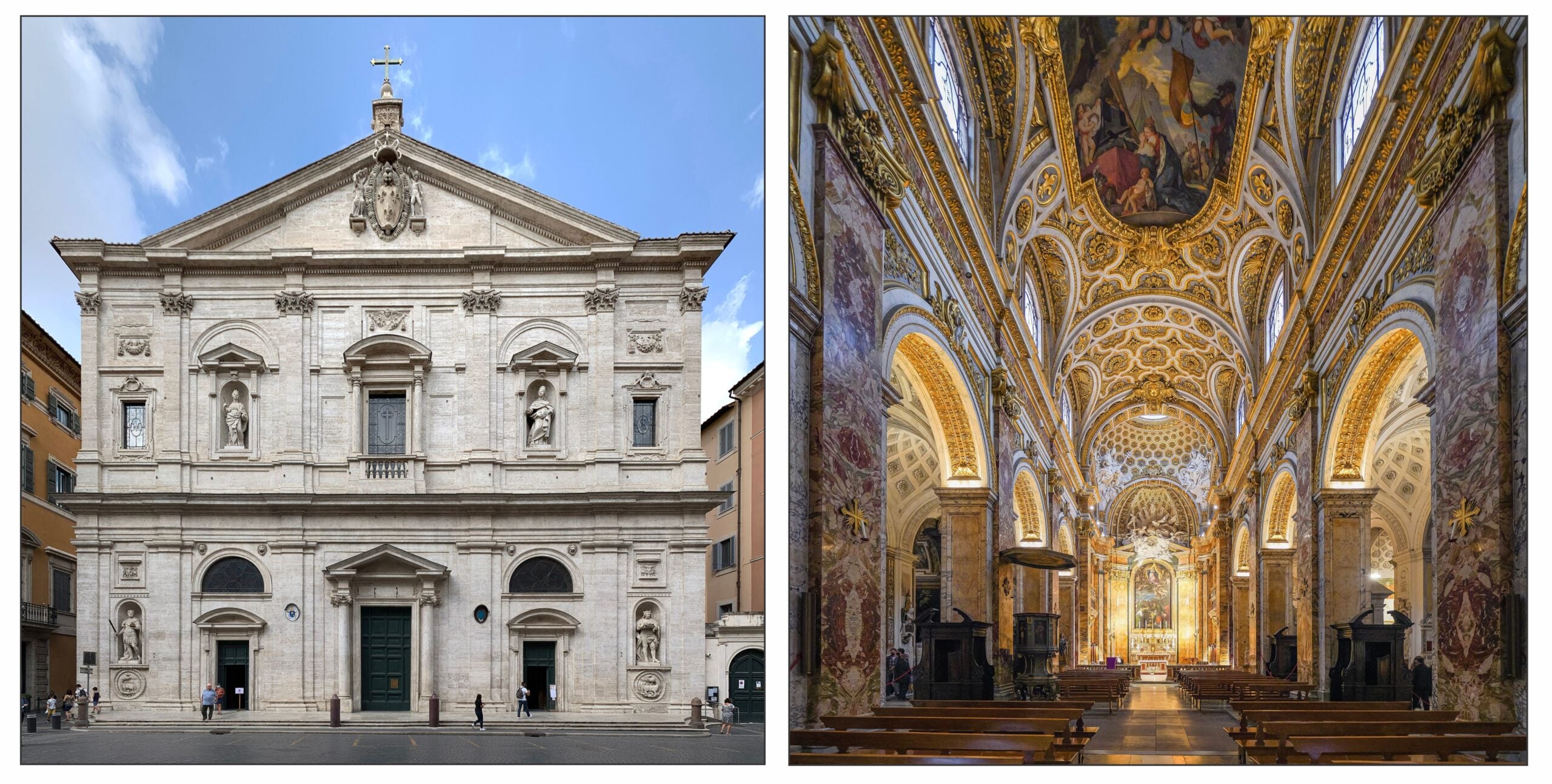
Though construction had started in 1518, all building had been halted during the sack of Rome by mutinous German troops in 1527. The church exterior was not completed until 1589, two years after the death of its benefactor Cointreau. The austere Renaissance façade now contains statues (by Pierre de l’Estache, 18th Century) of the important saints and kings that came from France: Charlemagne and Saint Louis (lower level), Saint Clothilde and Saint Jeanne de Valois (upper level). The interior decoration, much of which was completed in the 18th Century, is far more extravagant than the exterior, tending to Rococo rather than Renaissance. The ceiling has a large fresco showing the apotheosis of Saint Louis by Charles-Joseph Natoire (18th Century).
Saint Matthew
As well as supporting the building, Matteo Contarelli (as he was known in Italy) also provided an endowment for one of the side chapels to be dedicated to his namesake Saint Matthew. Matthew is traditionally considered to be the author of the Gospel of Matthew although it is likely that this gospel was written by another person, perhaps a colleague or follower of the Saint (see discussion by Allison, 2004, pp 7-72).
The calling of Matthew (also known a Levi or Alpheus) to be a disciple is mentioned briefly in the three synoptic gospels, though only in the Gospel of Matthew (9: 9-13) is he named Matthew:
And as Jesus passed forth from thence, he saw a man, named Matthew, sitting at the receipt of custom: and he saith unto him, Follow me. And he arose, and followed him.
And it came to pass, as Jesus sat at meat in the house, behold, many publicans and sinners came and sat down with him and his disciples.
And when the Pharisees saw it, they said unto his disciples, Why eateth your Master with publicans and sinners?
But when Jesus heard that, he said unto them, They that be whole need not a physician, but they that are sick.
But go ye and learn what that meaneth, I will have mercy, and not sacrifice: for I am not come to call the righteous, but sinners to repentance.
Although this is the only mention of the saint in the Bible, many legends grew up over the years about his exploits after the life of Jesus. These stories were compiled in Volume 5 of The Golden Legend by Jacobus de Voragine (1275). According to legend, Saint Matthew spread the gospel to the land of Ethiopia. While there he came upon two sorcerers who were using dragons to torment the people. By making the sign of the cross, Matthew tamed the dragons and defeated the sorcerers. He also raised from the dead the daughter (or son) of King Egippus. In return for this miracle, the king’s daughter Ephigenia became a nun. After Egippus died, his successor Hirtacus lusted after Ephigenia. Matthew refused to release her from her vows of chastity, and the infuriated king arranged for Matthew to be murdered.
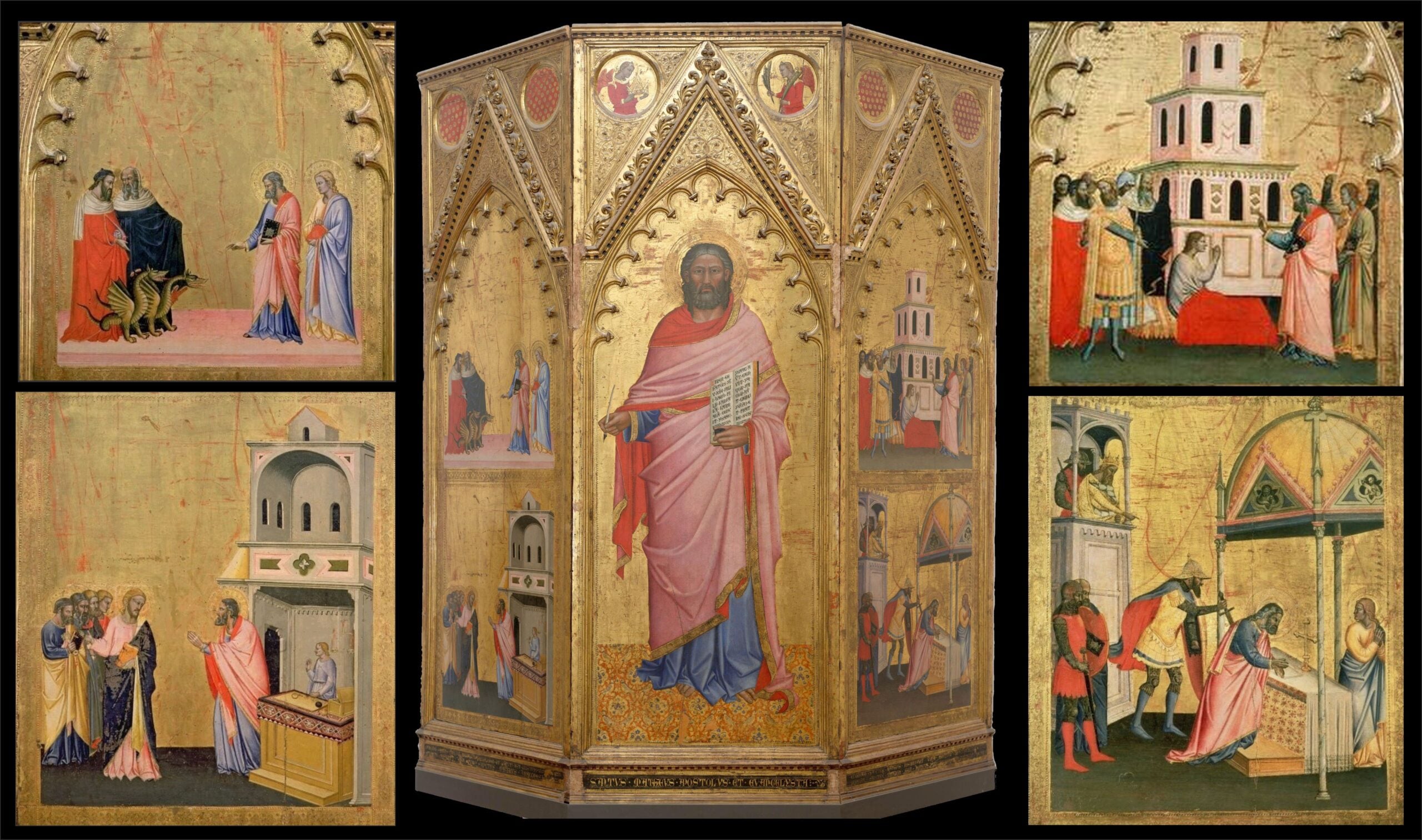
In 1868, Andrea Orcagna (1308-1368) constructed a pilaster for the Church of the Orsanmichele in Florence with scenes from the life of Saint Matthew: on the left are the calling to discipleship, and the taming of the dragons: on the right are the raising of the king’s daughter and the martyrdom of the saint; in the center is the writing of the gospel.
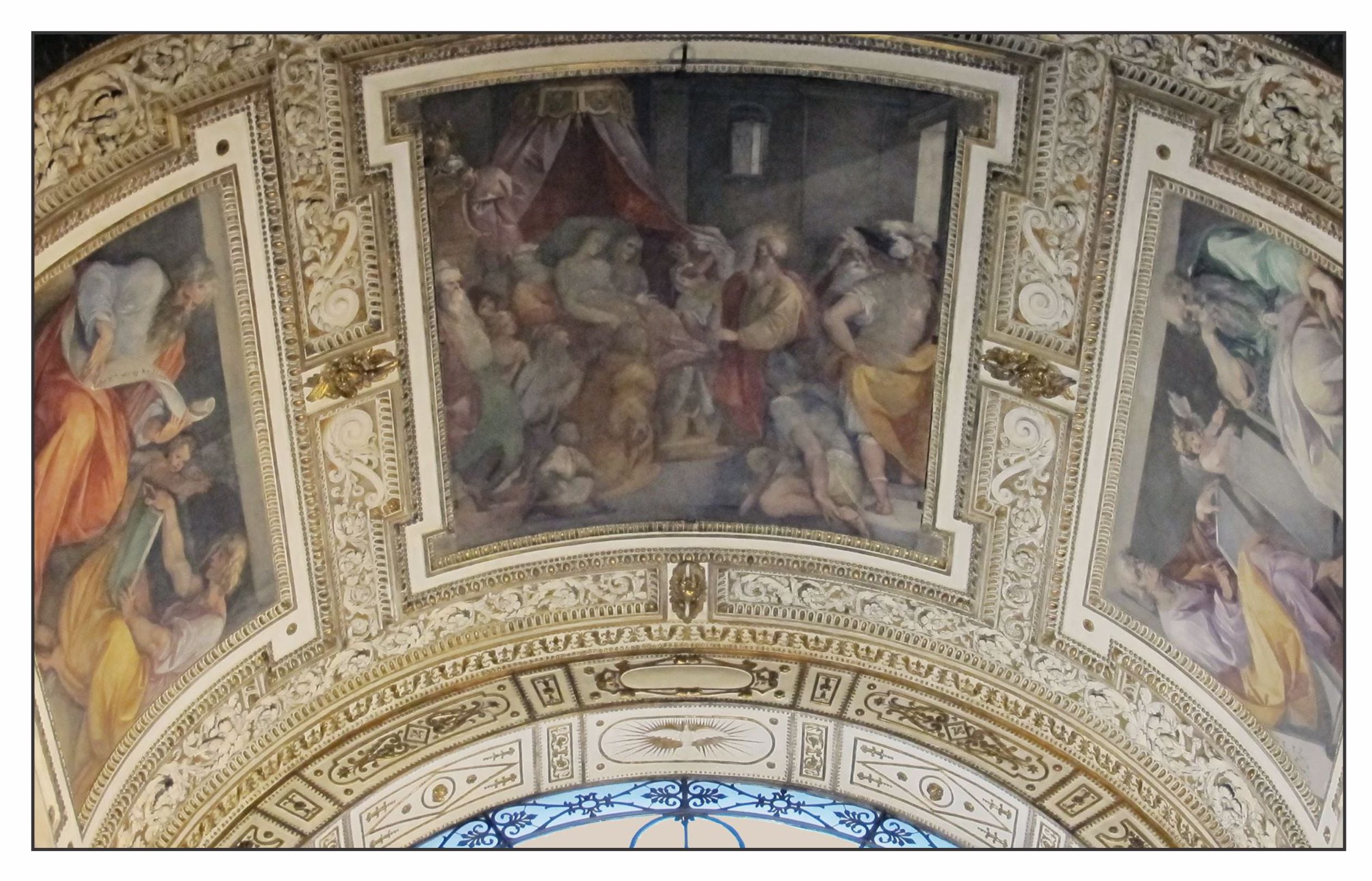
In 1587, the executors of Contarelli’s will commissioned Giuseppi Cesari, Cavalier d’Arpino (1568-1640), to provide frescos for the walls and ceiling of the chapel. He painted the barrel vault of the chapel with a fresco showing Matthew raising the king’s daughter from her death bed. On the sides of the vault were two paintings showing anonymous prophets in the style of Michelangelo but without his genius:
Matthew and the Angel
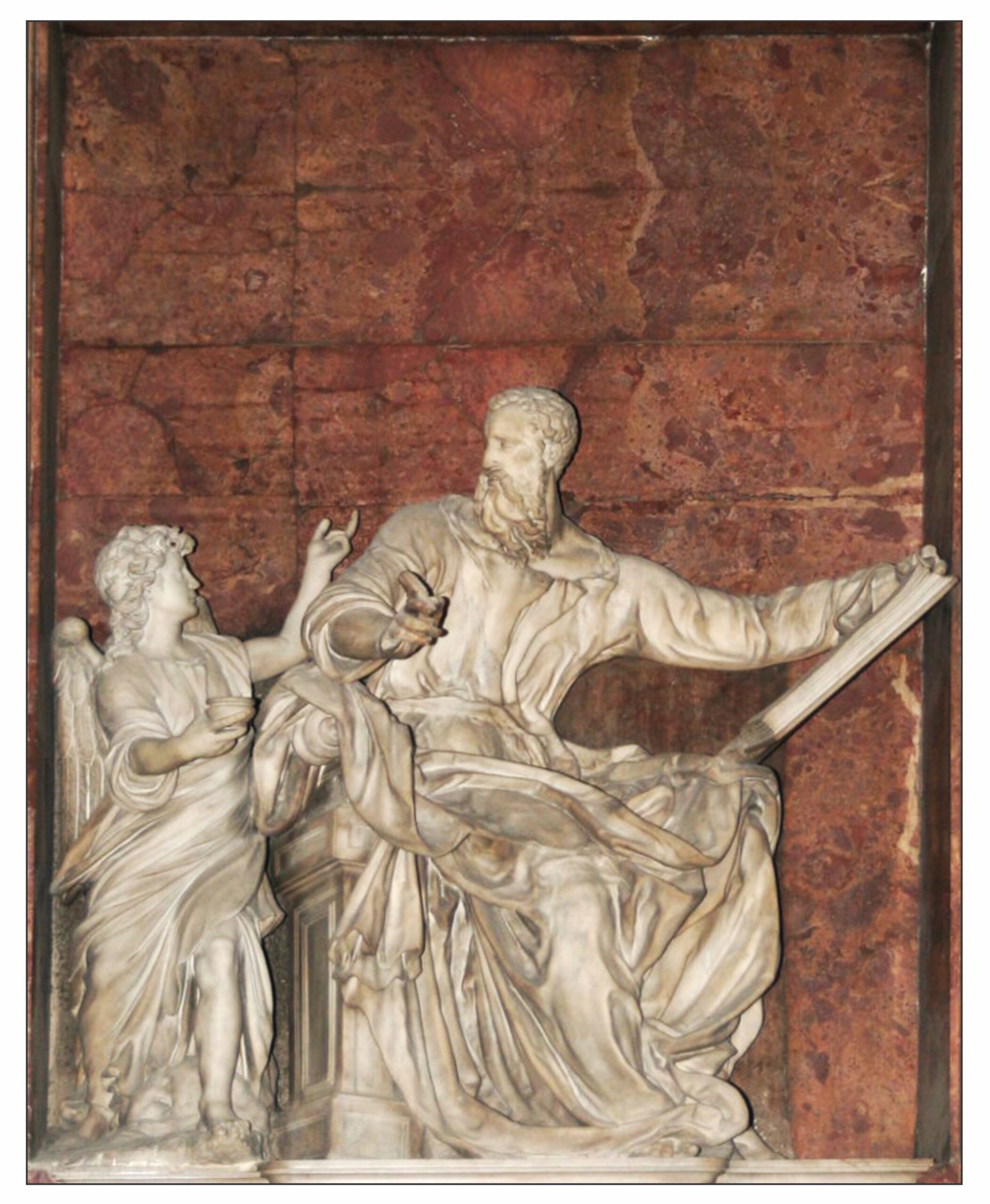
Cesari completed the ceiling in 1593. Financial difficulties delayed his payment, and the Cavalier went on to other projects. In 1587, the executor had also commissioned a sculpture depicting the inspiration of Saint Matthew from Jacques Cobaert (1535–1615) for the altar. However, he experienced great difficulty finishing the sculpture (Hess, 1951). The figure of Matthew alone was finished in 1602, but the priests deemed it incomplete and refused to take it. After Cobaert’s death, Pompeo Ferrucci provided the angel to go with Matthew, and the strangely disjointed sculpture now resides in the Church of the Santissima Trinità dei Pellegrini:
In 1599, the financing of the Contarelli Chapel was taken over by the Fabbrica (works office) of Saint Peter’s (Graham-Dixon, 2010, p 192). Cesari was offered a contract to complete the chapel, but by then he was too busy. The contract was therefore given to Caravaggio, a protégé of the Cardinal del Monte. He agreed to complete the side panels by 1600. But he would paint using oil on canvas rather than in situ frescos. Caravaggio did not make preparatory drawings, but painted directly onto the canvas using models posed under carefully controlled lighting. He painted rapidly using a severe chiaroscuro style that came to be known as “tenebrism.”
The Calling of Saint Matthew
The first painting Caravaggio completed was The Calling of Saint Matthew (1600):
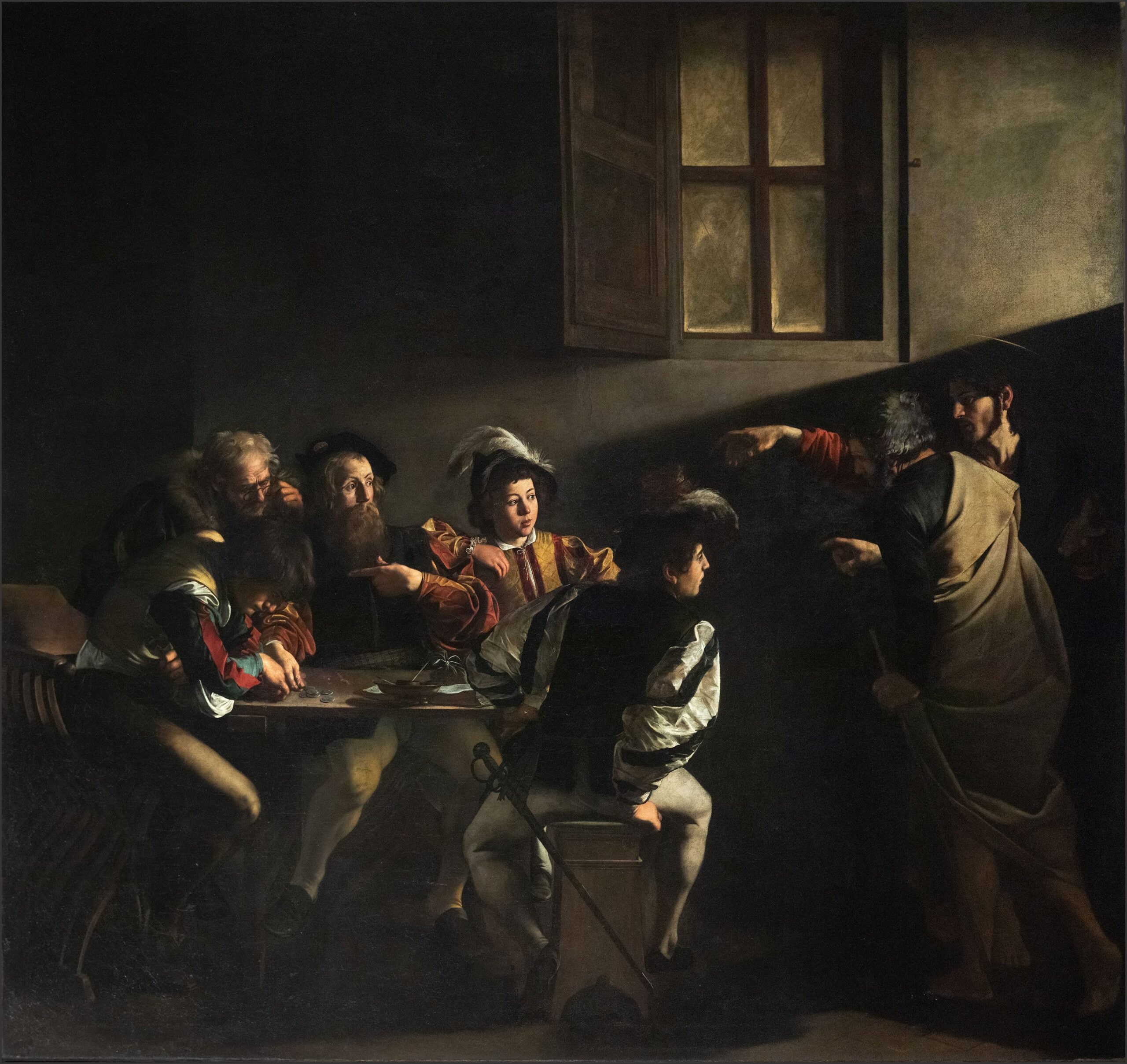
Caravaggio has transposed the event to his own time and place. On the left two people enter a darkened office. One of them has a faint halo: this is Jesus. In front on him, standing between the viewer and the savior is Saint Peter in a dull yellow cloak. From what may be an open window bright light streams diagonally into the office illuminating the faces of a group of five people at a table. There is some ambiguity about who is who (Dubouclez, 2024): I shall follow the interpretation of Graham-Dixon (2010, pp 194-197). The central person with a distinguished beard and a luxurious red and yellow doublet is Matthew Levi, a prosperous tax collector. Counting the money on the table is a rueful taxpayer. Looking over his shoulder through spectacles is an elderly man who appears to be checking the calculations. At Matthew’s left shoulder is a young page with a feathered cap and a golden doublet. At the corner of the table with his back to the viewer, dressed elegantly in black and white and wearing a sword, is Matthew’s bodyguard (or bravo). There is a space at the table: the viewer can imagine himself or herself sitting there.
The group at the table is reminiscent of an earlier painting of Caravaggio: The Cardsharps (1597). Paying taxes always seems like being cheated. Both paintings display Caravaggio’s mastery of the feathers and fashions of the day.
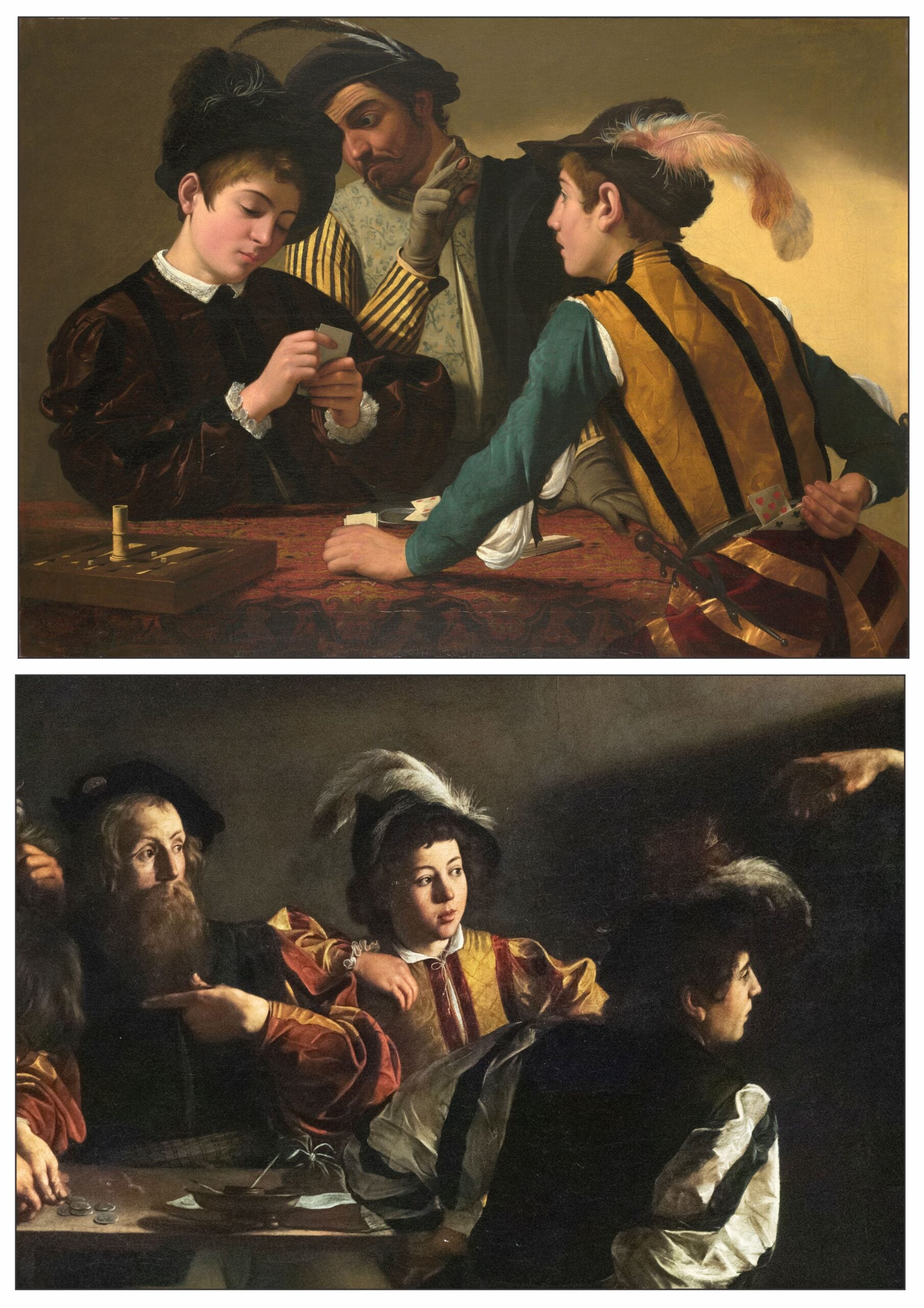
The difference is the right hand of Jesus. Jesus points to Matthew and says simply, “Follow me.” In the shadows, he holds out his left hand as though beckoning the viewer to join him as well. After his Matthew paintings, Caravaggio seldom returned to the genre subjects of his youth. It was as if he also felt called to a more meaningful life.
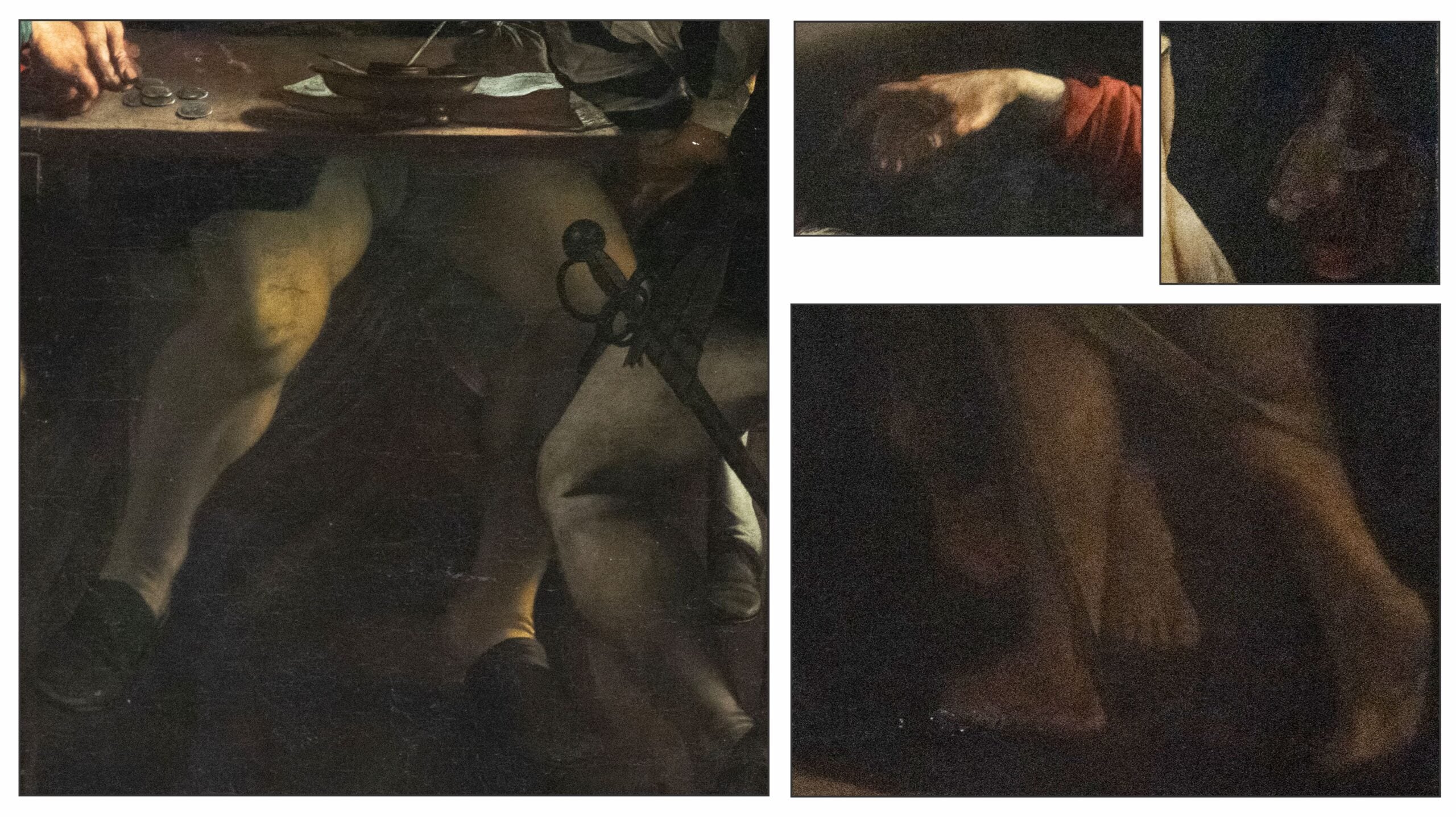
If one look carefully at the feet in the shadows on the lower right, we can see that Jesus is turning to leave the office of the tax-collector (Puttfarken, 1998, p 170). He already knows that Matthew will come after him. Matthew appears uncertain about what to do. But if we look at his legs beneath the table, we note that he is already turning toward Jesus:
Matthew, in his wine-dark velvet hat, points to his own chest as if to say “Who, me?,” but underneath the table where they sit his legs have already answered the call long before the message has reached his brain. We can see Matthew’s legs because Caravaggio has omitted one leg of the table. In the real world, it would crash to the ground. In the world Caravaggio has created, we barely notice: we are too absorbed in the dilemma of an ordinary man whose mind lags behind his heart. (Rowland, 2024, pp 3-4)
The following illustration shows on the left the legs of Matthew (and the absent table leg), on the upper right the hands of Jesus and on the lower right the feet of Peter and Jesus:
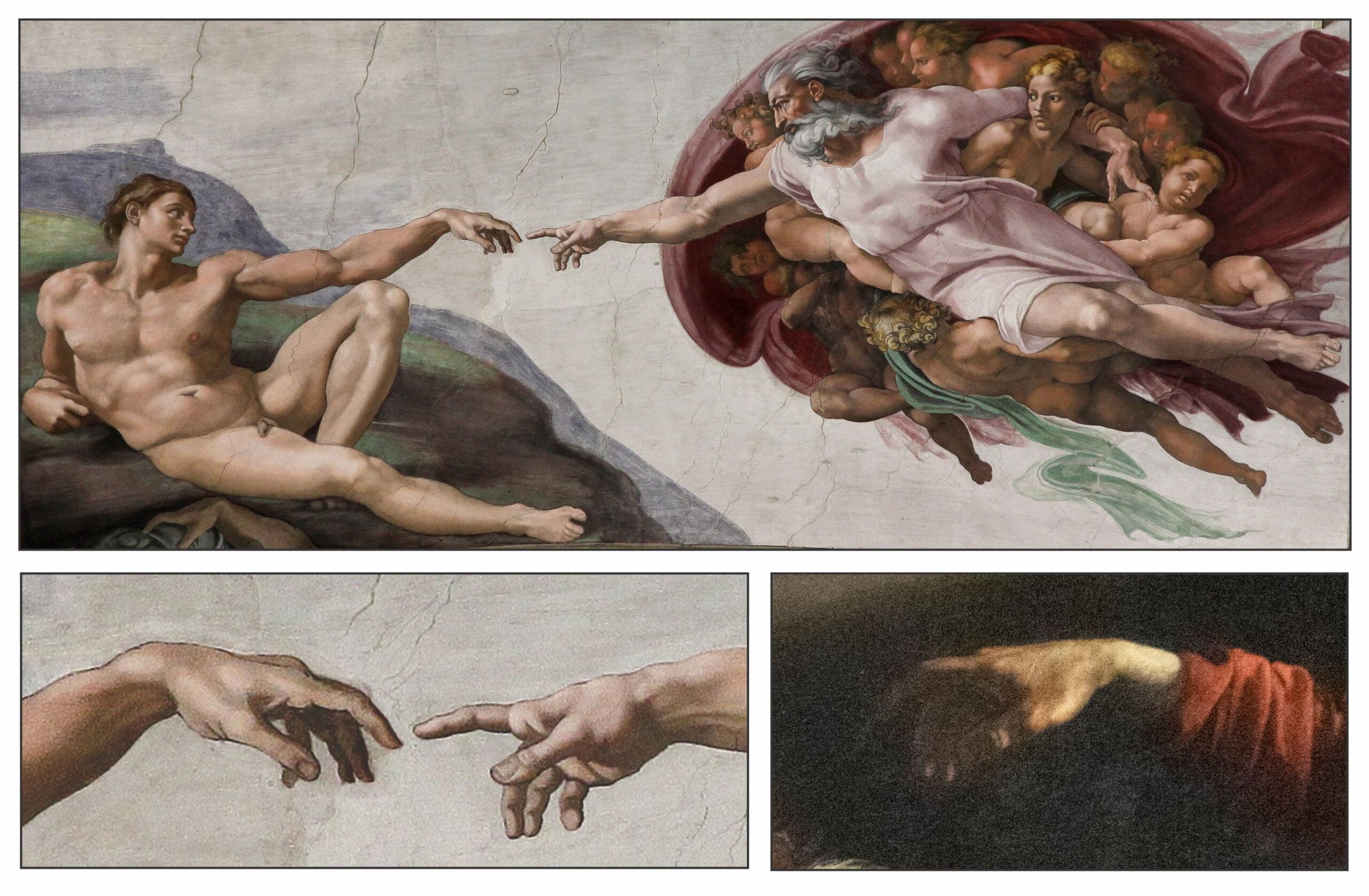
Jesus’ right hand is copied from Michelangelo:
The shrouded gesture of Christ, the most noteworthy single motif in Caravaggio’s picture, is a studied quotation from Michelangelo’s most famous image, the Creation of Adam on the Sistine ceiling. Christ’s oddly limp right hand, seen as if stopped by the camera, mirrors that of Michelangelo’s inert Adam, who is about to be invested with life by God. Christ is the New Adam, and “as in Adam all men die, so in Christ all will be brought to life” (I Corinthians 15:22). Caravaggio was no Michelangelo, yet we may see here a kind of identification, perhaps the first that Michelangelo Merisi made with his great predecessor and namesake. (Hibberd, 1983, pp 97-99).
The following illustration shows Michelangelo’s 1511 painting with an expanded view of the hands of God and Adam, and Caravaggio’s hand of Jesus, the mirror image of the hand of Adam:
The Martyrdom of Saint Matthew
The contract for the painting was very specific:
a long wide space in the form of a temple, with an altar raised up on the top of three, four, or five steps: where St Matthew dressed in vestments to celebrate the mass is killed by the hands of soldiers and it might be more artistic to show the moment of being killed, where he is wounded and already fallen, or falling but not yet dead, while in the temple there are many men, women, young and old people, and children, mostly in different attitudes of prayer, and dressed according to their station and nobility, and benches, carpets, and other furnishings, most of them terrified by the event, others appalled, and still others filled with compassion (quoted in Graham-Dixon, 2010, p 194)
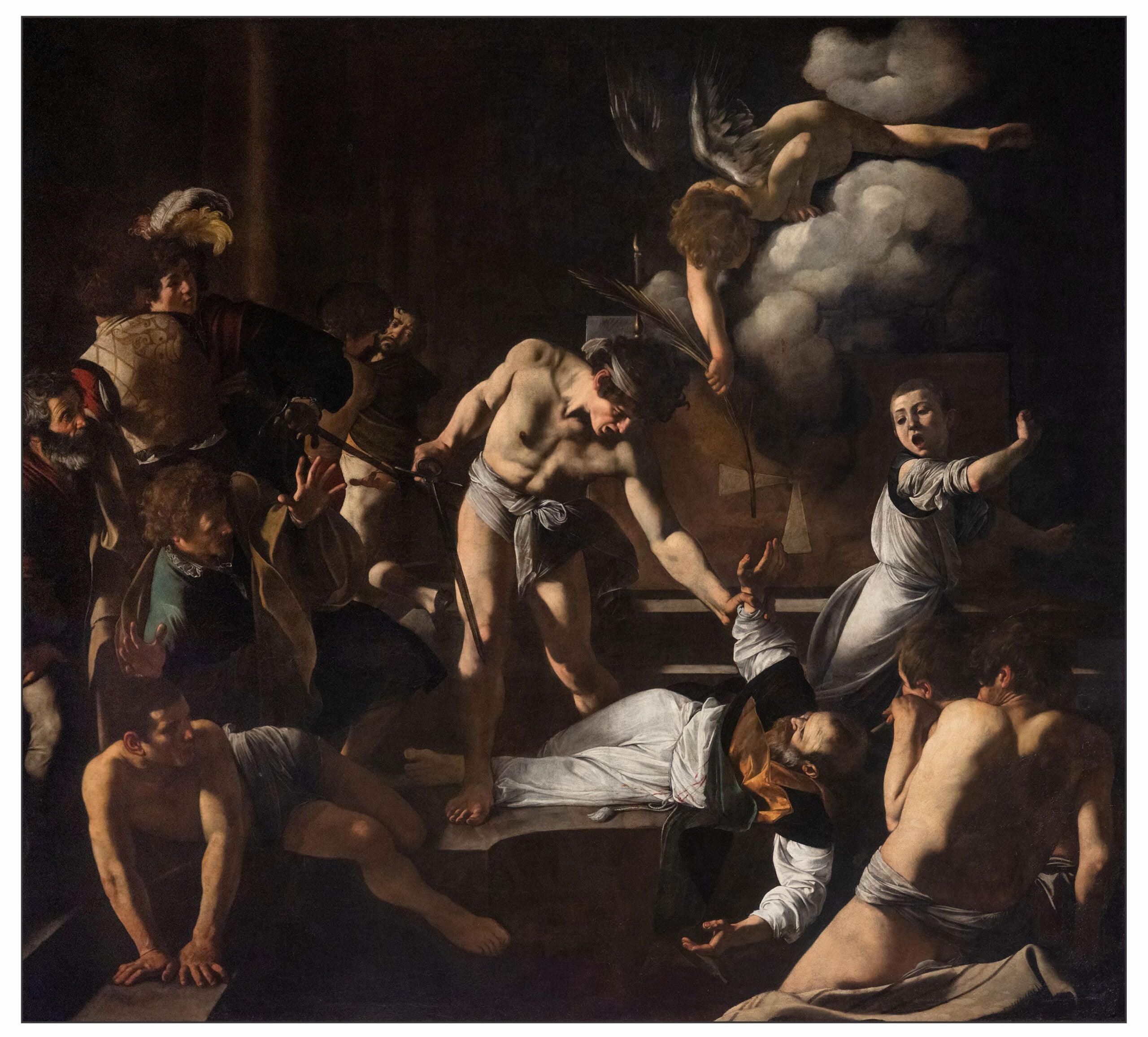
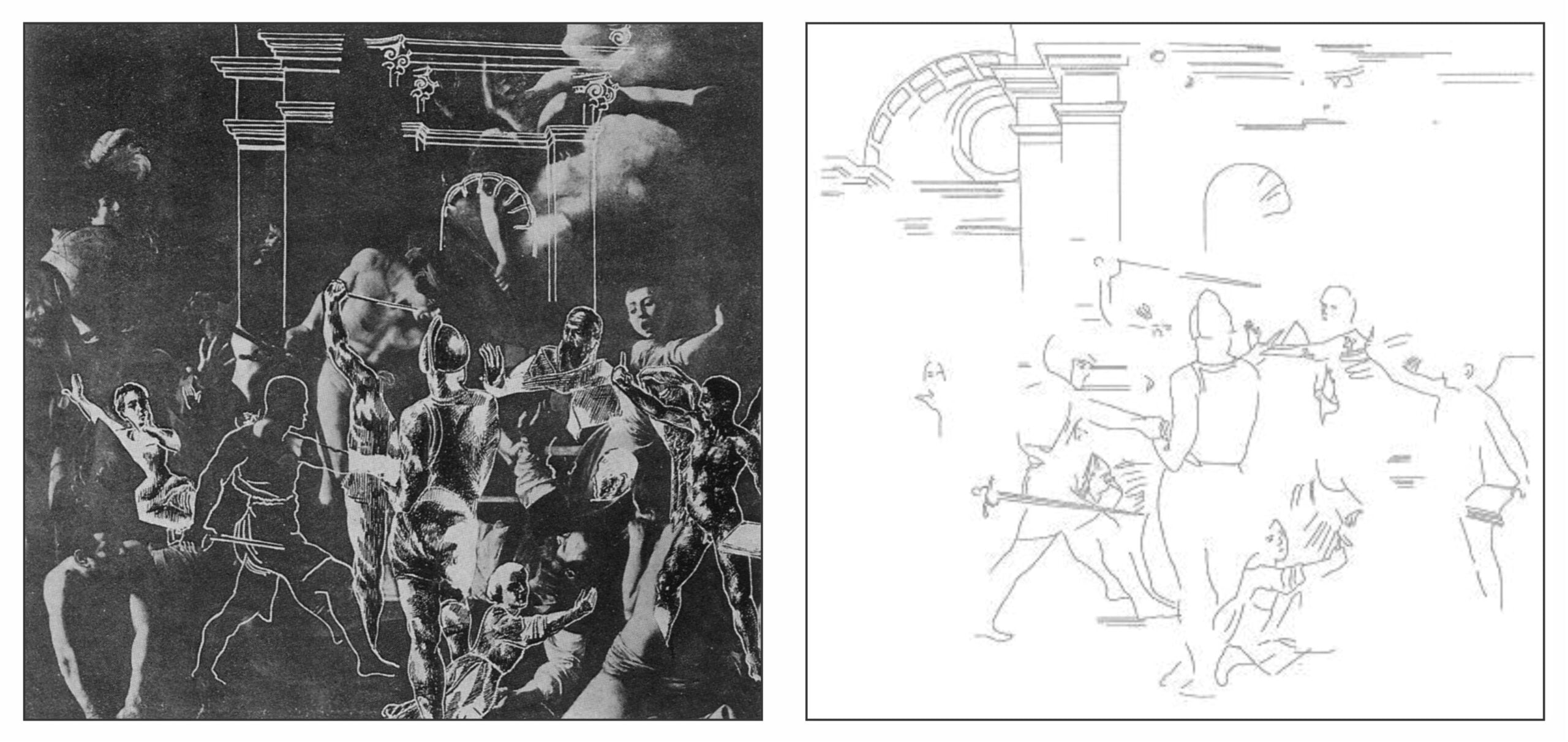
Caravaggio had no previous experience with painting more than three or four people together. He experienced great difficulty with the Martyrdom. Radiographic studies revealed pentimenti with a design completely different from the final painting. It is likely that Caravaggio had begun The Martyrdom before The Calling of Saint Matthew, given up and then returned to it after the latter was completed.
In his original effort, Caravaggio took pains to depict the altar and the temple, and outlined three assassins. The focus of the picture was a helmeted assassin with his back to the viewer. Saint Matthew is shown falling under the blows of his executioners. Caravaggio realized that this design was not working. Saint Matthew’s death was not at the center; everything was far too crowded; the central assassin was faceless.
He decided to start over. He opened up the center of the painting to show the dying Saint Matthew who has fallen to the ground. Members of the congregation turn away from the horror of his murder. Some are without clothes – probably about to be baptized. The artist himself is portrayed in the background watching the martyrdom with a combination of terror and pity. An angel reaches out to the saint to give him a palm branch, symbol of salvation and eternal life. There is now only one assassin and he faces the viewer. He is almost naked. He exudes rage.
The following illustration shows the pentimenti of the earlier versions of the painting (Camiz, 1990; Olson, 2002; Vodret-Adamo, 2011, p 73). There were several aborted attempts to portray the architecture of the temple. Caravaggio soon realized that he was not interested in architecture: most of his later paintings use a background of either dark shadows or bare walls.
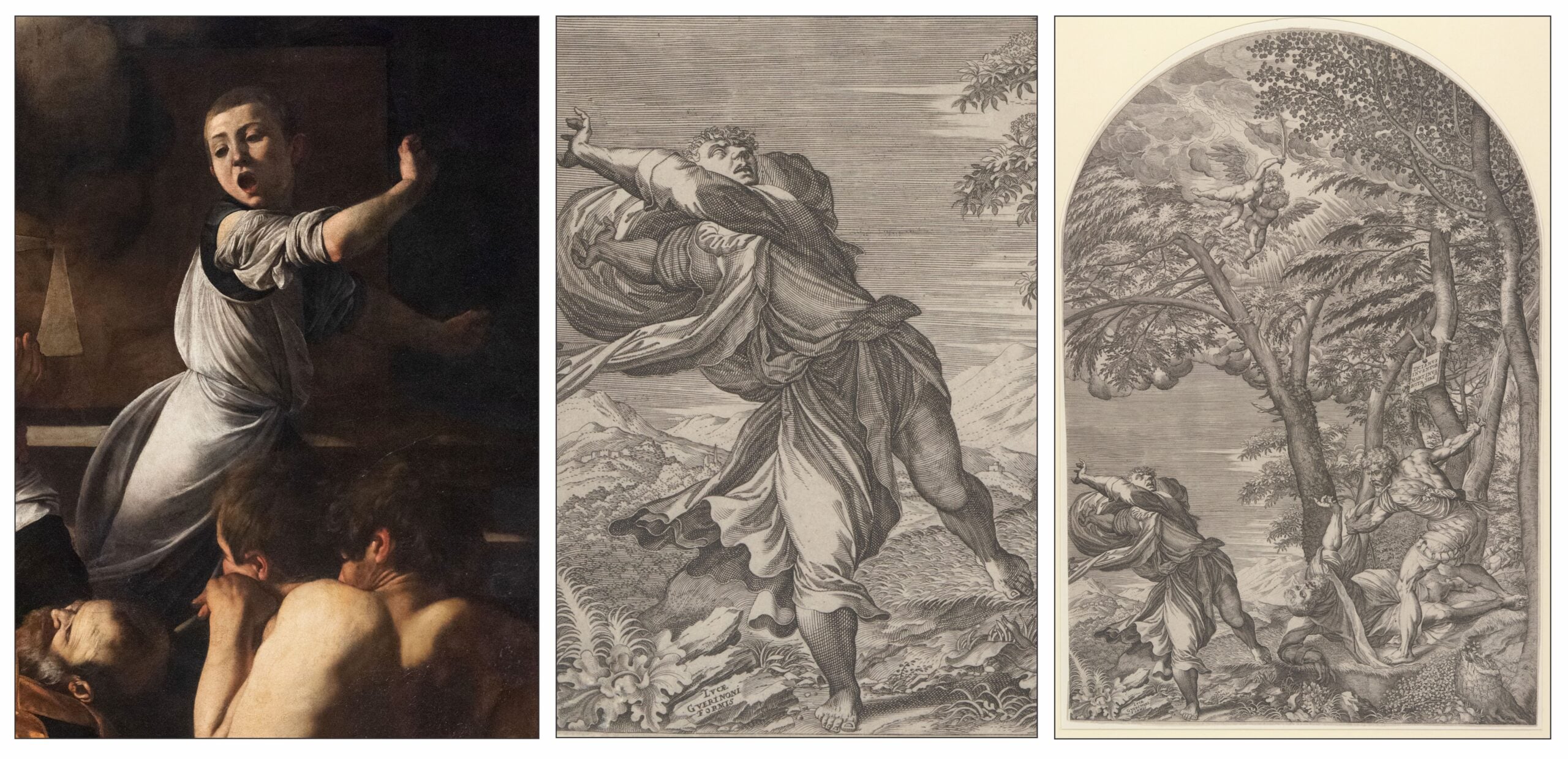
The figure on the right of the altar boy recoiling from the murder of the saint derives from Titian’s 1529 painting of The Assassination of Saint Peter of Verona, which Caravaggio has likely seen in the form of a 1560 etching by Martino Rota:
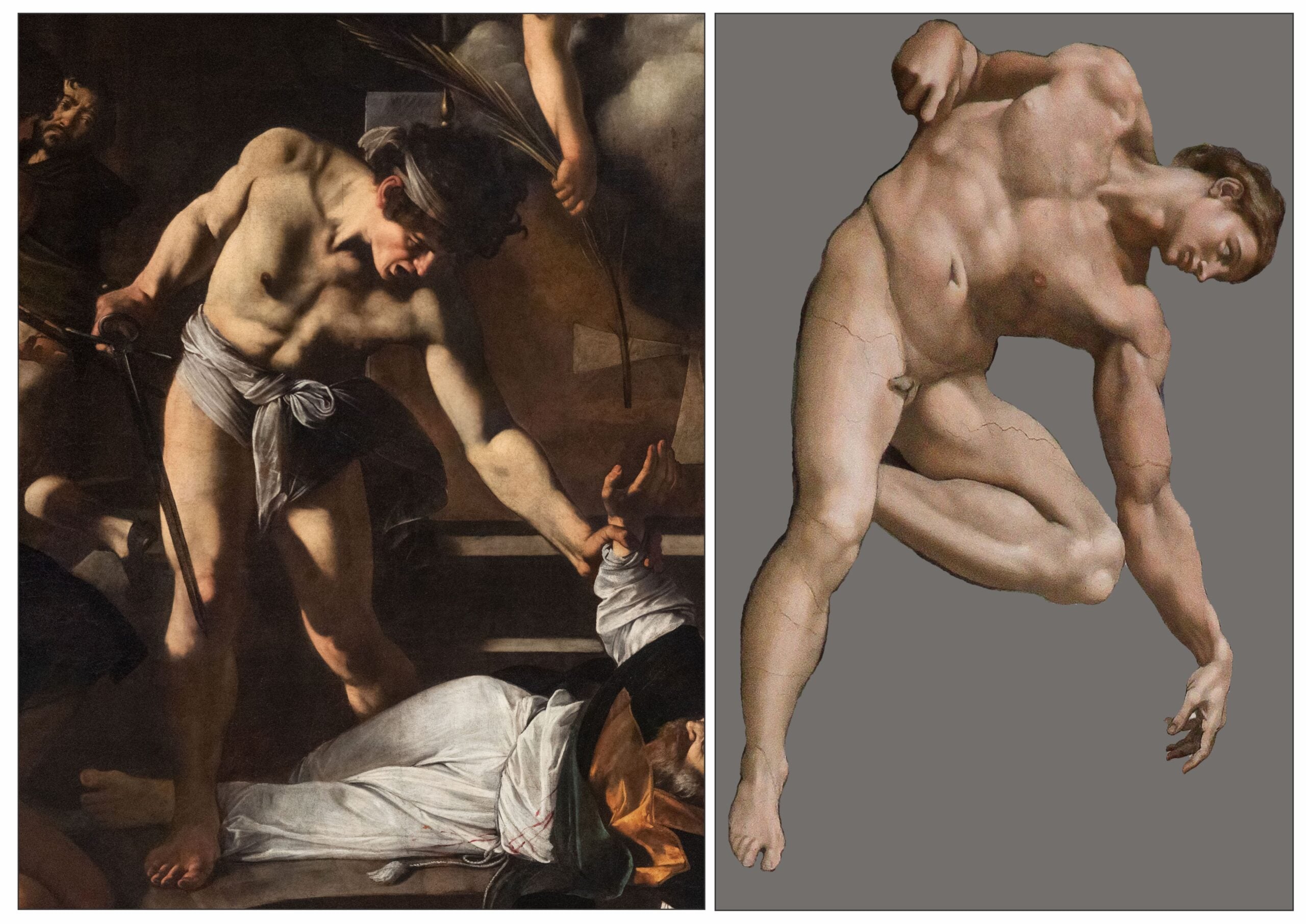
The imposing body of the assassin is reminiscent of Michelangelo’s Adam in The Creation of Adam (1511) in the Sistine Chapel (Clayton website).
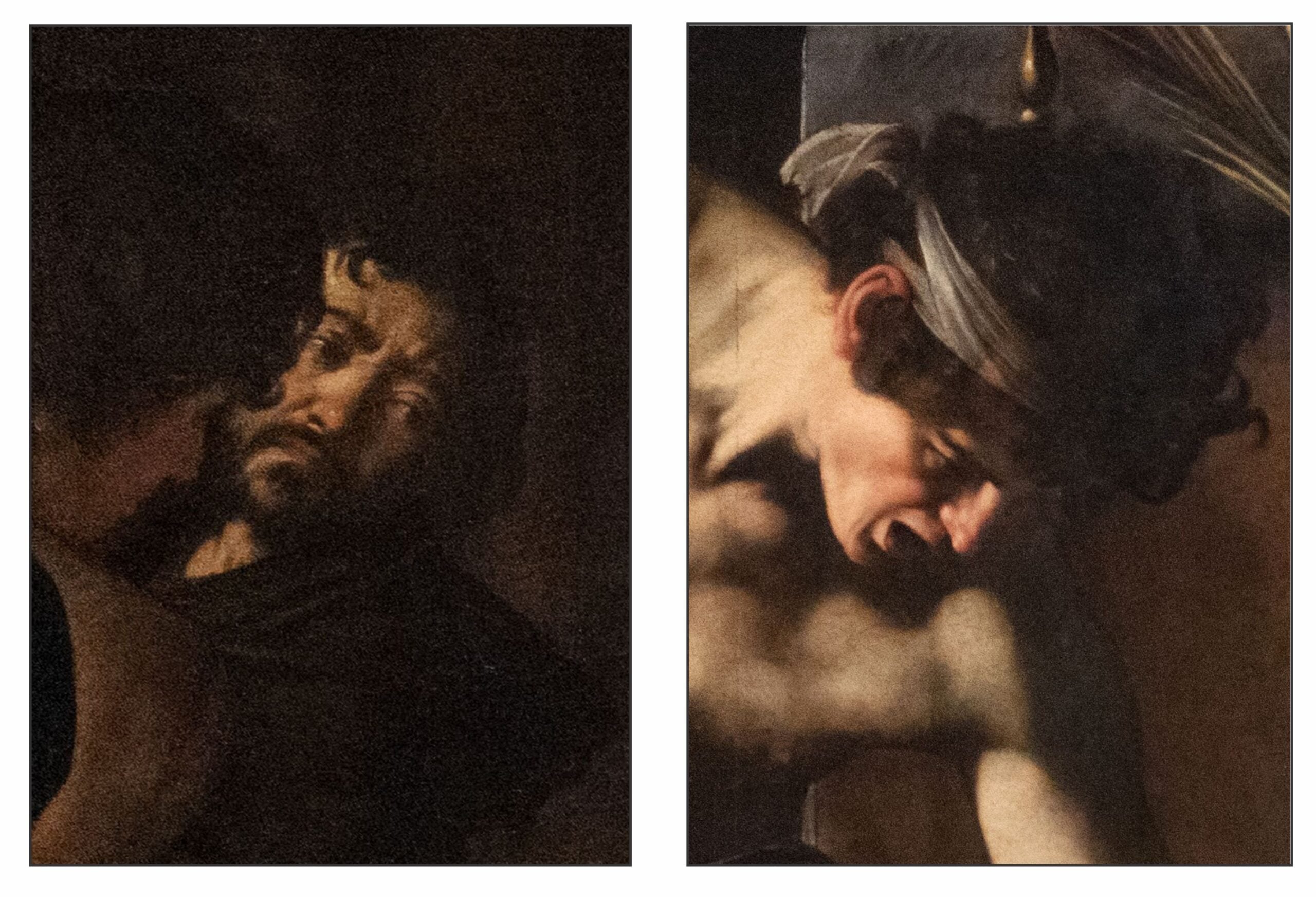
The head of Caravaggio and the head of the assassin look down in parallel on the dying saint, one in the shadows with pity and one in the light with anger:
The Inspiration of Saint Matthew
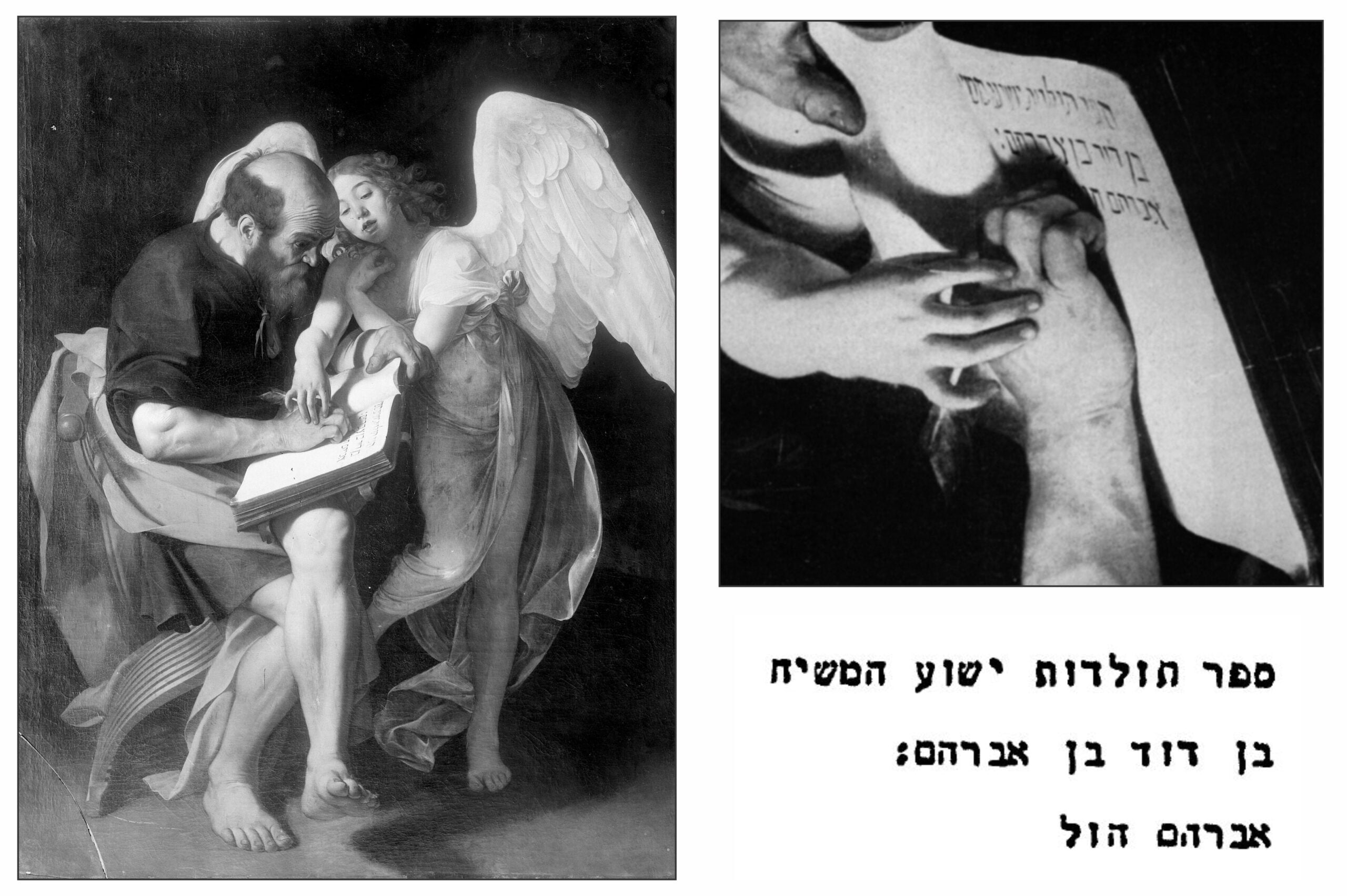
In 1602, after Contarelli’s executors had refused Cobaert’s incomplete sculpture of Saint Matthew and the Angel, they asked Caravaggio to produce a painted version for the altar (Graham-Dixon, 2010, pp 234-237). Caravaggio’s first version of The Inspiration of Saint Matthew portrayed the saint as an old man who appears not to comprehend what is going on as a youthful angel guides his hand. The writing on the tablet shows the Hebrew version of the opening two verses of Matthew’s gospel (Lavin, 1974).
The book of the generation of Jesus Christ, the son of David, the son of Abraham.
Abraham begat …
Lavin (p 64) notes that this represents the transition between Old and New Testaments:
The lineage of salvation has been announced, the founding father has been named and his seed is being sown. The light of a new age has dawned.
The Hebrew gospel is an intriguing idea. Saint Matthew was certainly Jewish and, if he was the author of the gospel that bears his name, he would probably have written it in Hebrew. However, as far as we know, the original version was in Greek, perhaps compiled by a follower of Matthew rather than by Matthew himself.
The following shows a black-and-white photograph of the painting, which was destroyed by fire in Berlin in 1945, together with an enlargement of the saint’s writing and the Hebrew text (from Lavin, 1974).
Jesus chose his disciples from ordinary people and Caravaggio wanted to show Matthew as a “simple man stunned by the directness of his revelation” (Graham Dixon, 2010, p 236):
Perhaps the most touching aspect of the painting is the intimacy of the relationship between the stooped saint and the tender young angel, whose wings enfold the whole scene in a hushed embrace. The angel is God’s messenger but also the embodiment of Christian love – a love so generous that it encompasses even those as ragged and gnarled as the cross-legged, doltish St Matthew.
The most striking aspect of Caravaggio’s Matthew is his humility. Thomas (1985) quotes from a description of Matthew by Lazius (1555):
Even though he was most learned, yet he was not at all exalted, but in accord with the meaning of his name, truly strove to present himself as humble and lowly. He would always remark that, “to whatever degree you are great, so much more be you humble in all things.” And this to the wise man: “disgrace follows the proud, but exaltation follows the humble” . . . as a pauper himself he followed Christ the pauper.
The name Matthew in Hebrew means “gift of God” (Matityahu). The gospel was not created by him but given from God.
However, the priests were dismayed by the portrayal of Matthew as a holy fool rather than an inspired saint, and refused the painting. One of Caravaggio’s patrons was happy to take the rejected canvas. He was also able to convince the priests as San Luigi dei Francesi to allow Caravaggio to create another version. In the second version, the saint was far more distinguished, albeit still barefoot:
Matthew the shockingly illiterate peasant has suddenly been turned into Matthew the dignified, grey-haired sage. This scholar-saint kneels at his desk, quill pen at the ready. He is draped in red robes and has been equipped with an expression of dignified attentiveness. Rather than guiding his uncertain hand, the angel now counts off the verses as he dictates them. The pages of the book are no longer visible, but since the angel has got to the index finger of his left hand — number two, in the gestural rhetoric of the time, since Italians counted the number one with their thumbs —it seems that he has once more got to the start of the second verse, and Abraham’s begetting of Christ’s lineage. (Graham-Dixon, 2010, p 237).
Lavin (1974) compares Caravaggio’s two versions:
In the first version the divine word was conveyed mechanically through a laborious and earthbound process of physical instruction to a humble proletarian whose chief virtue lay in his knowledge of his own ignorance. In the second version it is conveyed miraculously to a stunned intellectual through a heaven-sent process of strictly rational analysis and exposition. Again, the key to the irony lies in the divine mystery itself, which brings truth to him who is wise, be he ignorant or learned.
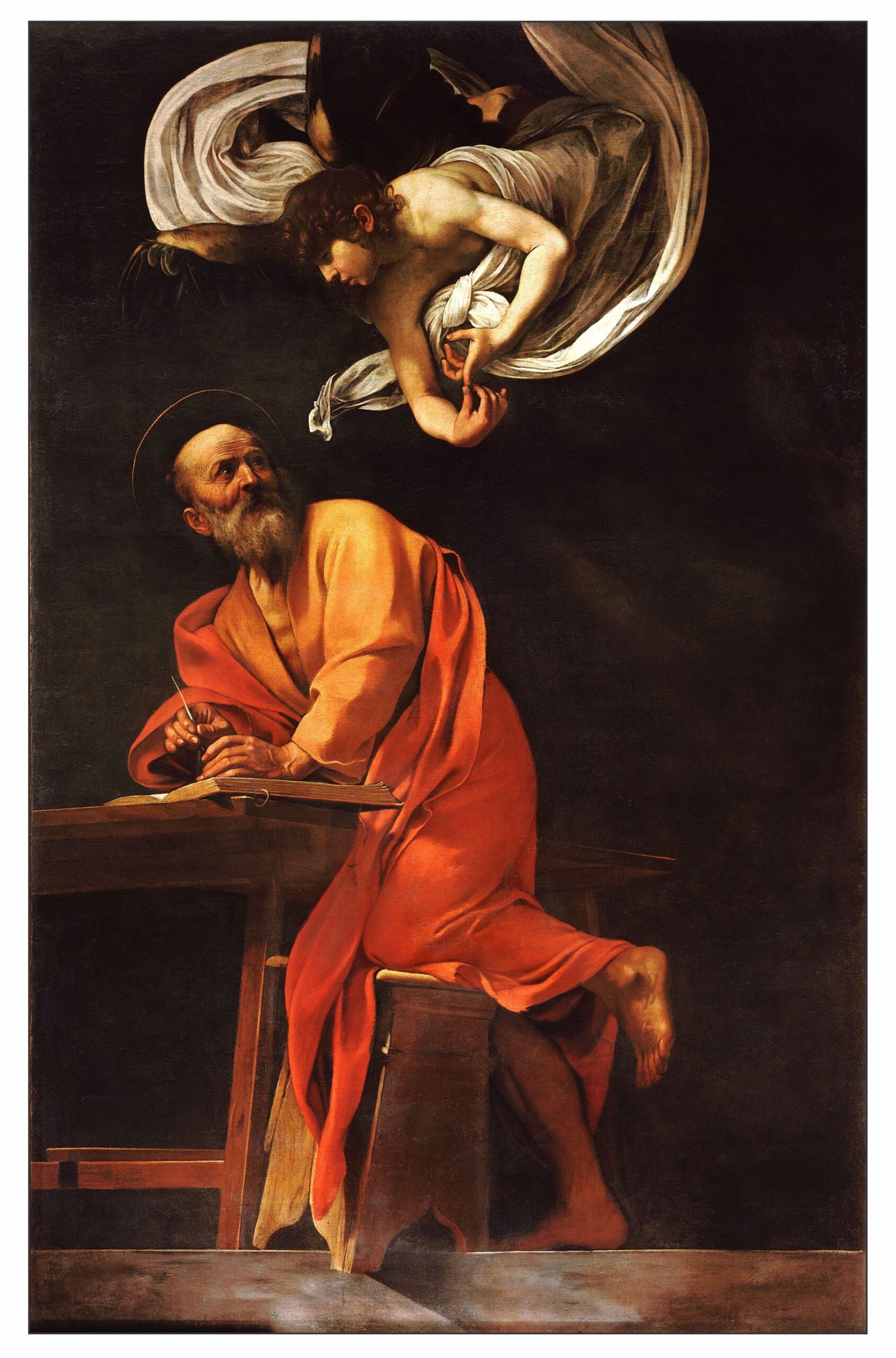
The background is almost completely dark. The figures spiral around each other: divine forces binding the saint to the angel. The saint’s robe is pulled down by gravity; the angel’s robe billows upward toward heaven.
The table at which Matthew is writing is askew, and the bench upon which he kneels threatens to tumble out of the picture frame. This feeling of imminent upset fits with the revolutionary message of the gospel.
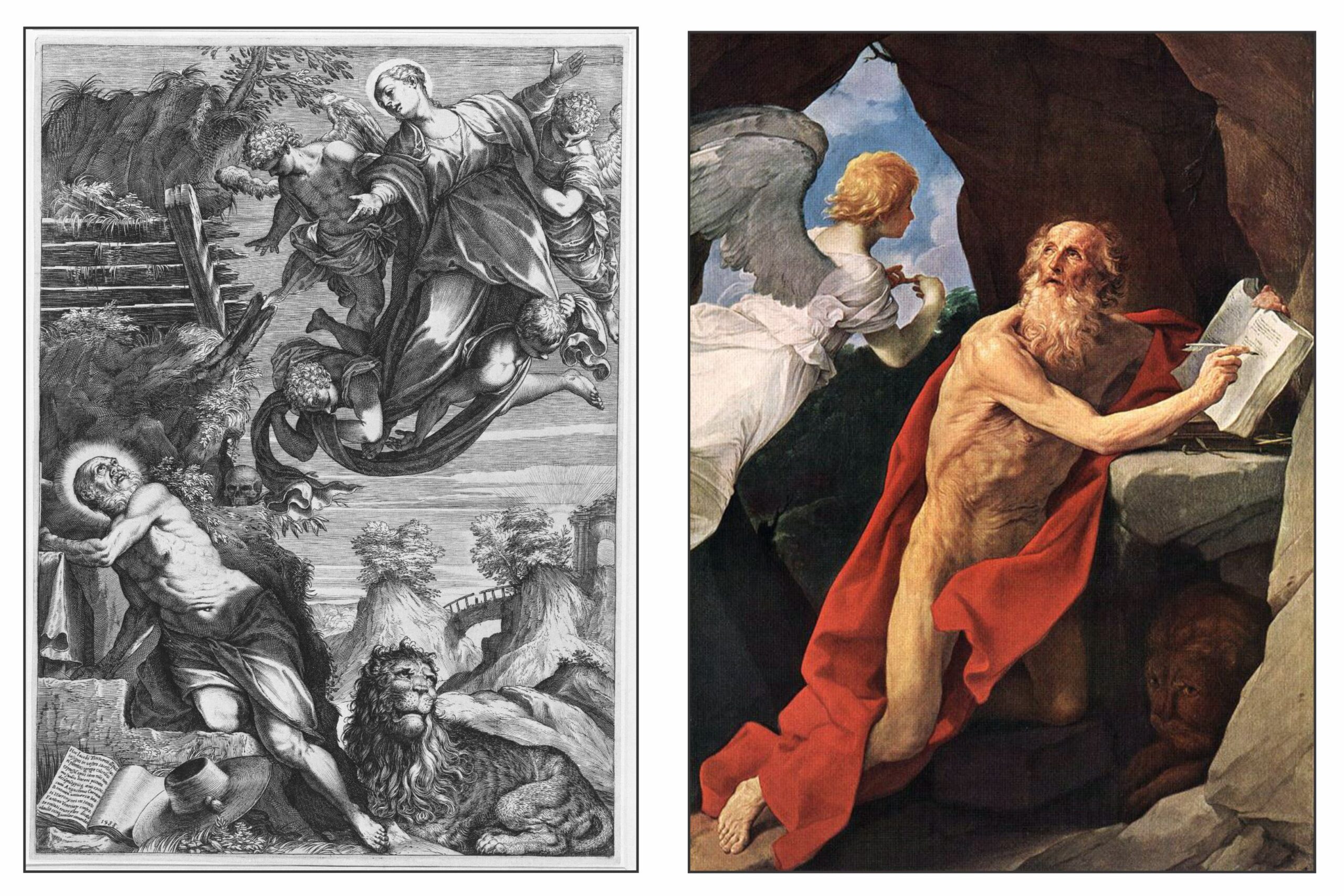
Lavin (1974) points out how Caravaggio was indebted to Tintoretto’s The Virgin Appearing to Saint Jerome (1583) which Caravaggio has probably seen in a 1588 etching by Agostino Carracci. And Caravaggio’s painting in its turn inspired Guido Reni’s 1635 depiction of Saint Jerome. The illustration shows the earlier etching on the left and later painting on the right:
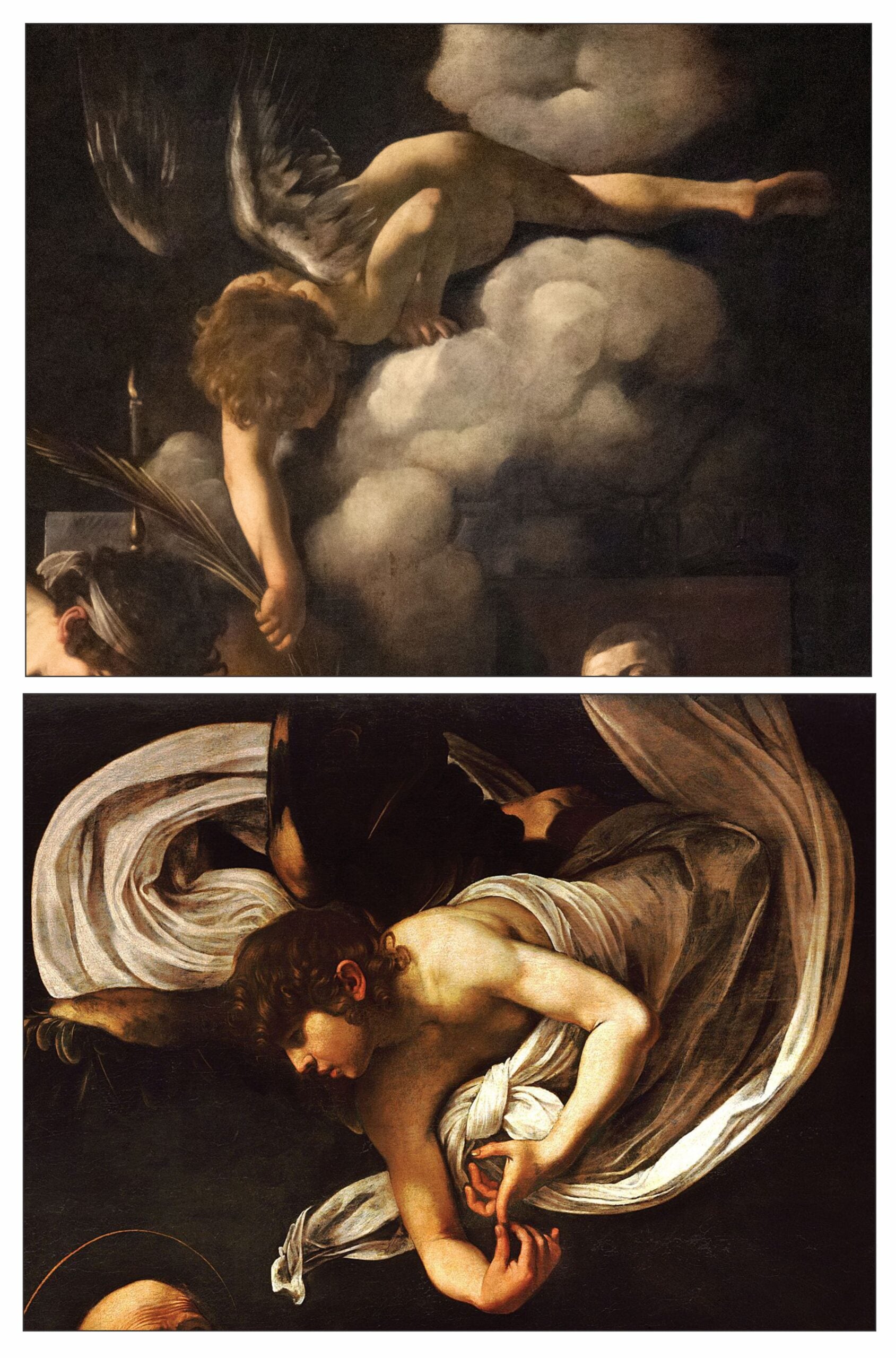
However, no one – before or after – could ever rival Caravaggio’s airborne angels. Young and sensuous. they float lightly in the clouds as erotic representatives of the divine. The following illustration compares the angels in the Inspiration and the in the Martyrdom.
Farewell
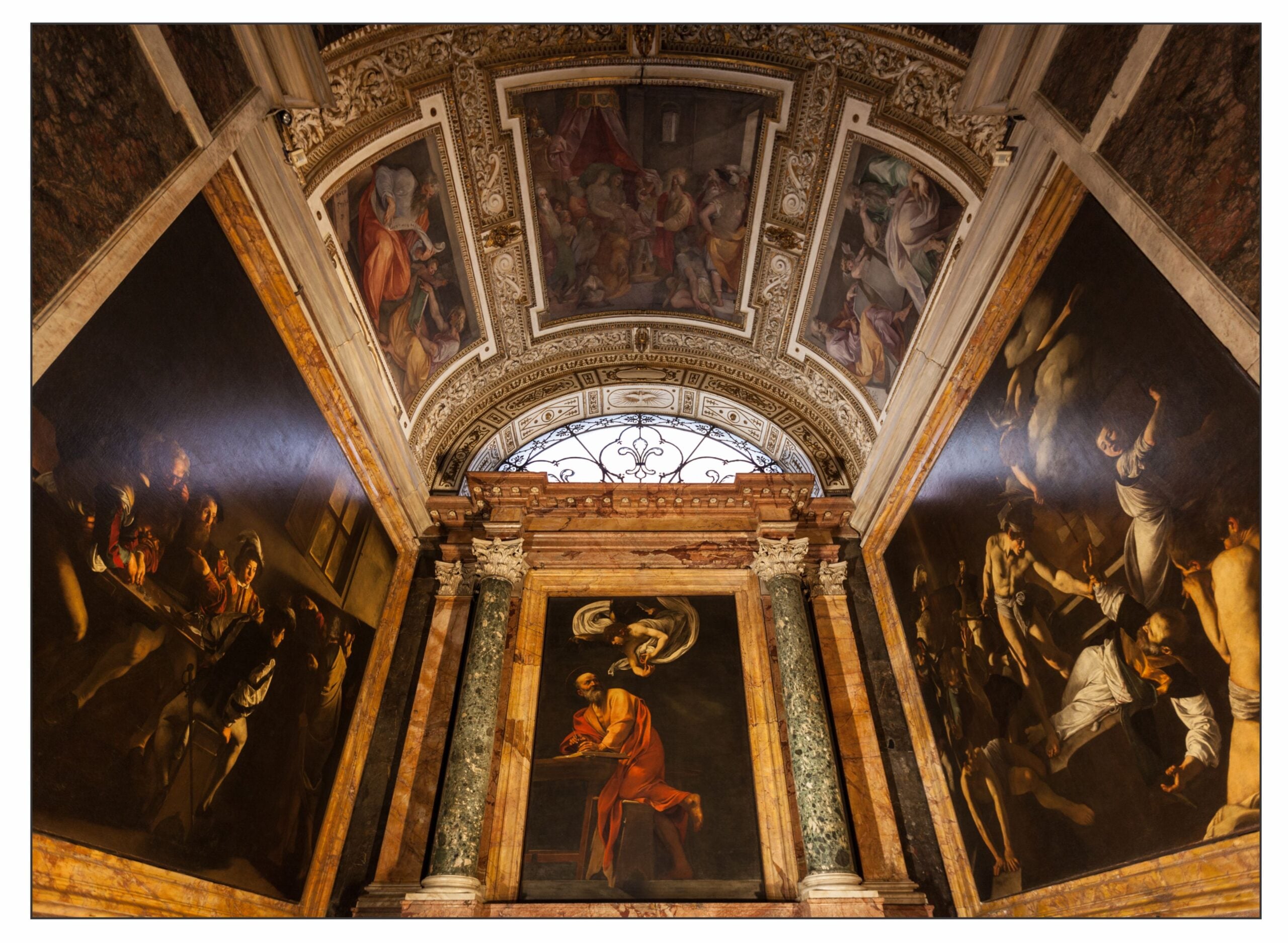
Caravaggio’s paintings for the Contarelli Chapel made him famous. They also represented a turning point in his choice of subject matter. From then on, he concentrated on religious themes. It was almost as though, like Matthew, he had been called to greater things. To see the chapel and the paintings is a deeply moving experience. But hard to describe, just as the chapel is notoriously difficult to photograph. We say farewell with a photograph by Robert Wash.
And the ending to a poem about The Calling of Saint Matthew by Karen Fish (2021, p 29)
Only a few ways to describe what actually happened—Matthew
touches his chest, indicating a confusion
with this unlikely enlistment.
His companions slouch, dumbfounded amid
the flush and feathers and swords.
There is the humble disbelief
all who are chosen share—that moment
when the world seems just a pile of hammers,
hatchets, buckets of coins—one
thinks plainly how unlikely,
absolved from all that is ordinary.
References
Allison, D. C. (2004). Matthew: a shorter commentary. T & T Clark International.
Camiz, F. T. (1990). Death and Rebirth in Caravaggio’s “Martyrdom of St. Matthew.” Artibus et Historiae, 11(22), 89–105.
Dubouclez, O. (2024). Le jeu de l’indécision. « Littéralisme » et ambivalence dans La Vocation de saint Matthieu du Caravage. Dix-septième siècle, 302(1), 5–28.
Fish, K. (2021). No chronology. University of Chicago Press.
Graham-Dixon, A. (2010). Caravaggio: a life sacred and profane. Allen Lane.
Hess, J. (1951). The chronology of the Contarelli Chapel. Burlington Magazine, 93(579), 186–201.
Hibbard, H. (1983). Caravaggio. Harper & Row.
Lavin, I. (1974). Divine inspiration in Caravaggio’s two St. Matthews. Art Bulletin, 56(1), 59–81.
Puttfarken, T. (1998). Caravaggio’s “Story of St Matthew”: a challenge to the conventions of painting. Art History, 21(2), 163–181.
Rowland, I. D. (2024). The lies of the artists: essays on Italian art, 1450-1750. MIT Press.
Thomas, T. (1985). Expressive aspects of Caravaggio’s first Inspiration of Saint Matthew. Art Bulletin, 67(4), 636–652.
Vodret Adamo, R., Cardinali, M., De Ruggieri, M. B., & Leone, G. (2011). Caravaggio: la Cappella Contarelli: Roma, Palazzo Venezia, 10 marzo-15 ottobre. Munus.
de Voragine, J. (1275, translated by W. Caxton, 1483) The Golden Legend or Lives of the Saints.