T. S. Eliot: The Cocktail Party
T. S. Eliot (1888-1965) wrote The Cocktail Party in 1948. The play begins with people making foolish conversation at a cocktail party but soon proceeds to a discussion of what it means to be married to another person, and what is required to become a saint. It was initially performed at the Edinburgh Festival in 1949 with Alec Guiness as the Unidentified Guest and Irene Worth as Celia, the prospective saint, and then moved to Broadway in 1950, where it received a Tony Award for Best Play. Critical reviews were mixed, but audiences were more enthusiastic. The play was revived briefly in 1968 with Guinness as both director and actor.
Synopsis
The play opens on the remnants of a cocktail party. The hostess Lavinia Chamberlayne had been called away, and her husband Edward had tried to cancel the party, but had been unable to contact some of the invitees: two elderly guests Julia and Alex, two youngsters, Celia and Peter, and one unidentified guest not known to the others, who enjoys his gin and water and listens bemused to the cocktail chatter. The party soon breaks up, but Edward asks the unidentified guest to stay behind because he needs someone to talk to. He confesses that Lavinia has left him. After some discussion he realizes that, although he has toyed with the idea of freedom, he wants her to return. The unidentified guest promises to bring Lavinia back the next day and leaves, singing a verse from the Irish song One-Eyed Riley:
Unidentified Guest: As I was drinkin’ gin and water,
And me bein’ the One-Eyed Riley,
Who came in but the landlord’s daughter
And she took my heart entirely.
You will keep our appointment?
Edward: I shall keep it.
Unidentified Guest: Tooryooly toory-iley,
What’s the matter with One-Eyed Riley
This and subsequent audio clips are from the Decca recording of the play. Some sections of the play were omitted for the recording which was limited to the length of two LPs.
Other guests return with various excuses, but mainly because they wish to talk to Edward. Peter wants his advice about Celia, with whom he has become enamoured though she does not return his feelings. Edward suggests that Peter accept the fact that that romance is not going anywhere, and that Peter should go to California to pursue his dreams of working in film. After Peter leaves, Celia returns to talk to Edward, and we realize that she and Edward have been having an affair. However, now that Lavinia has apparently left Edward and made him available, Celia realizes that she does not wish to continue their relationship.
The next afternoon everyone returns to the Chamberlayne’s. Lavinia in brought back to Edward as promised by the unidentified guest. The other guests have been summoned by telegram. Peter has decided to leave to work in films in California. Celia says goodbye to Peter and to the Chamberlaynes, Lavinia and Edward are left alone to discuss their relationship. Lavinia suggests that her husband should see a psychiatrist.
The play then skips to several weeks later at the consulting offices of the unidentified guest, who it turns out is the psychiatrist Sir Henry Harcourt-Reilly. We find out the Julia and Alex have worked with Sir Henry to get Edward, Lavinia, and Celia to come to his office. Initially Sir Henry talks with Edward alone and then Lavinia is brought in. Lavinia and Edward discuss their relationship. Lavina knew about Edward’s affair, but Edward had not realized that Lavinia had at the same time been infatuated with young Peter. Both now have no one to love but themselves, and they decide to return home together.
Celia then comes in to consult with Sir Henry. She explains that she has begun to feel “an awareness of solitude,” a separation from a world with which she has become disillusioned. Furthermore, she has experienced a “sense of sin” that does not seem to have much to do with morality. Rather it appears to be a feeling that he is not doing what she was meant to do. She needs something to devote herself to. Sir Henry agrees to help her find her calling. After Celia leaves, Julia and Alex return and the three toast together, first to Lavinia and Edward with the “words for the building of the hearth,” and then to Celia with the “words for those who go upon a journey.”
The Guardians mention Peter as also needing their help. Perhaps he might represent a separate road to salvation – that of the artist.
The final act of the play occurs two years later just before another cocktail party at the Chamberlaynes. The same people are there as in the first act. We learn that Lavinia and Edward remain together, and that Peter has become successful in films. Alex reports that Celia had joined an austere Christian nursing order and had gone to Kinkanja to care for patients dying from a pestilence. Agitators had convinced the natives that they could only stop the pestilence by slaughtering the Christians. During the subsequent insurrection, Celia had been crucified on an anthill. Lavinia asks Sir Henry why he appears unconcerned about this, and he confesses that when he first met Celia he had a premonition of her violent death, He had not known exactly how this would occur, but he had acquiesced to Celia’s decision and prepared her for her destiny.
Julia, Alex and Sir Henry leave to attend another party. The other guests remain as the Chamberlayne’s cocktail party begins.
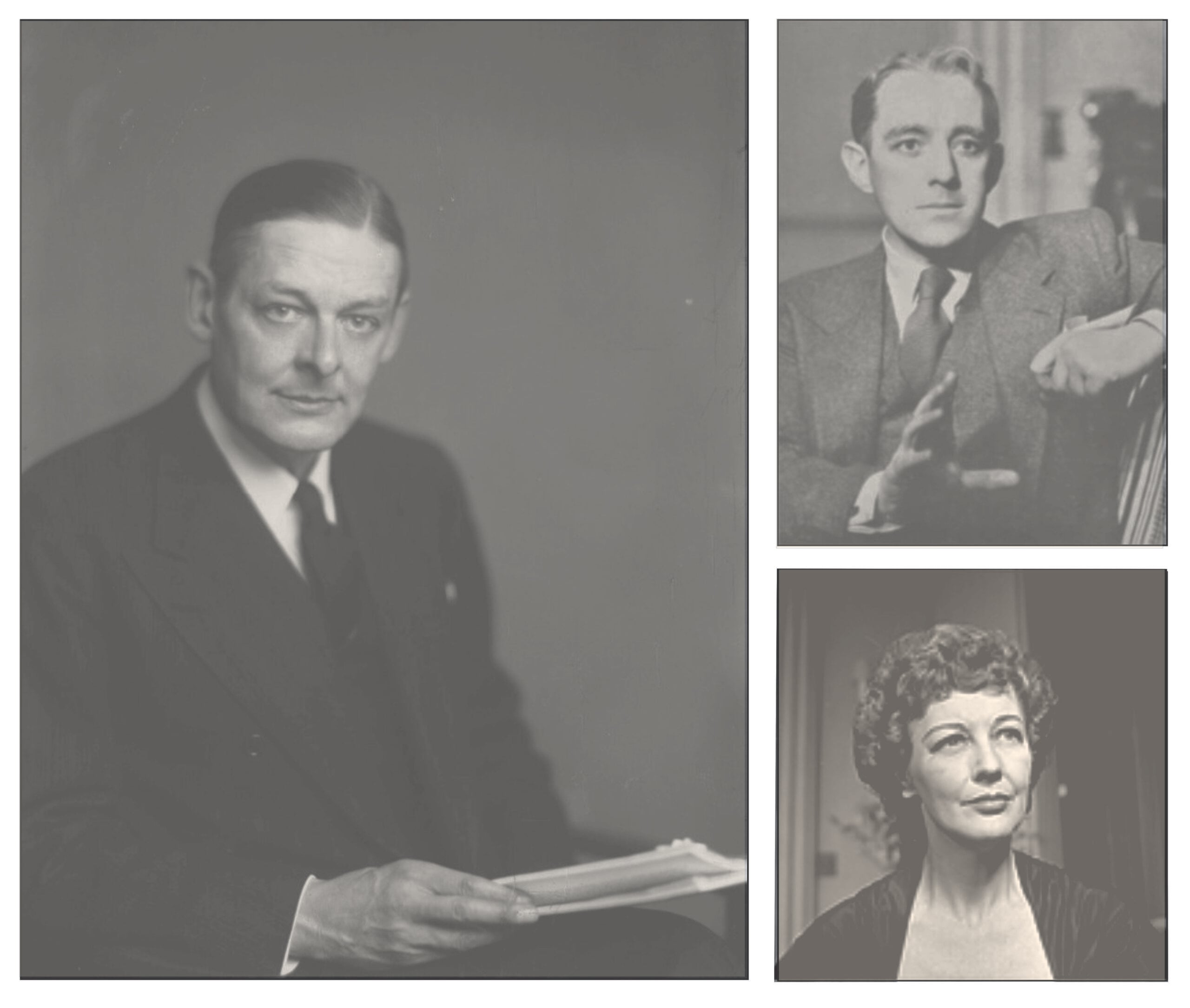
The following illustration shows a 1948 photograph of Eliot by Walter Stoneman on the left and photographs of Alec Guiness and Irene Worth from the original New York production on the right.
Sources for the Play
In his 1951 essay on Poetry and Drama, Eliot noted that he had used Euripides’ Alcestis (438 BCE) “as a point of departure” for The Cocktail Party. In Euripides, in gratitude for the hospitality shown to him, Apollo had granted king Admetus the privilege of living past the time the Fates had decreed for his death. The only problem was that someone else had to die in his place. Admetus’ devoted wife Alcestis agrees to take his place. Apollo tries to get Thanatos, the God of Death, not to take Alcestis, but Death is implacable. Apollo then asks Heracles to wrestle with Death and brings Alcestis back to Admetus. Eliot clearly takes from Euripides the story of Edward and Lavinia’s relationship. And we must presume that the unidentified guest in the first act is Heracles, a hero who liked to drink and to sing.
As the play progresses, the ideas of Heraclitus (c 500 BCE) come to the fore (Jones, 1960, p 132; Lesher, 2013). Just before he returns Lavinia to Edward, the unidentified guest points out that everything and everyone changes – you cannot step twice into the same river.
Ah, but we die to each other daily.
What we know of other people
Is only our memory of the moments
During which we knew them. And they have changed since then.
To pretend that they and we are the same
Is a useful and convenient social convention
Which must sometimes be broken. We must also remember
That at every meeting we are meeting a stranger.
In his play Eliot grafts onto these Classical ideas the Christian narrative of Celia’s martyrdom. In this, Sir Henry takes the role of a Priest, who stands in place of God, rather than that of a Hero, who acts for the Gods. Celia confesses to him that she has felt a “sense of sin” – something that is completely Christan, and incompatible with Classical ideas. Sir Henry informs Celia of her options and the dangers she might face, before allowing her to choose her vocation. His
ability to foresee Celia’s death is similar to the doctrine of free will, in which God can see what will happen, but where the choice is still up to the individual (Rexine, 1965, p 25)
Eliot may have also used several modern sources for the ideas he considered in The Cocktail Party. Two recent productions had used a supernatural being to alter the course of human events. In Frank Capra’s 1946 film It’s a Wonderful Life, George Bailey’s guardian angel Clarence Odbody talks him out of suicide and convinces him to return to his family (Llorens-Cubedo, 2022). In Eliot’s play the supernatural intervention is more austere, and the outcome ultimately tragic, despite the play being called a comedy. In J. B. Priestley’s 1947 play The Inspector Calls, a police inspector interrupts a family dinner party and points out to those present how their actions had led to the death of a young woman. As the play ends, the inspector vanishes: he was simply a voice asking for justice. Priestley calls out the entitled; Eliot reconciles them to their fate. Alec Guinness had acted as one of the family in the first production of Priestley’s play. In J.-P. Sartre’s play Huis Clos (“No Exit,” performed in 1944, published in 1947) one of the main characters exclaims L’enfer, c’est les autres (“Hell is other people”). In The Cocktail Party Eliot has Edward rebut this claim:
There was a door
And I could not open it. I could not touch the handle.
Why could I not walk out of my prison?
What is hell? Hell is oneself,
Hell is alone, the other figures in it
Merely projections. There is nothing to escape from
And nothing to escape to. One is always alone.
Edward’s description of his state of mind fits more easily with the existentialist idea that we alone are responsible for our actions. As Sartre said in L’existentialisme est un humanisme (“Existentialism is a Humanism,” 1946), we are “condemned to be free”
The Path to Sainthood
In the second act of the play, Sir Henry, with the assistance of Julia and Alex, reconciles Lavinia and Edward to their life together, and sets Celia on her path to sainthood. Carol Smith (1967, pp 157-158) points out that there are two ways to salvation in Christianity:
In the history of Christian mysticism from the time of the writings attributed to Dionysius the Areopagite, there have traditionally been two paths by which the soul could come to God—the Negative Way and the Affirmative Way. Followers of the Negative Way believe that God may be reached by detaching the soul from the love of all things that are not God, or, in the terms Eliot most frequently chose to use, by following the council of St. John of the Cross to divest oneself of the love of created beings. The Way of Affirmation, on the other hand, consists of the recognition that because the Christian God is immanent as well as transcendent, everything in the created world is an imperfect image of Him. Thus, all created things are to be accepted in love as images of the Divine. The Way of Affirmation, while less rigorous, has its own implicit difficulties, for the price of loving created beings ultimately involves suffering and loss.
Sir Henry brings Lavinia and Edward together and points out to themthat they both had felt a lack of love in their marriage, both had sought out relationships with others, and both had realized that these relationships had no hope of success. They must become reconciled to their own limitations; they must relearn how to live lovingly with each other. Theirs is the Affirmative Way.
Celia presents a completely different problem for Sir Henry. She has two symptoms. The first is “an awareness of solitude:”
I don’t mean simply
That there’s been a crash: though indeed there has been.
It isn’t simply the end of an illusion
In the ordinary way, or being ditched.
Of course that’s something that’s always happening
To all sorts of people, and they get over it
More or less, or at least they carry on.
No. I mean that what has happened has made me aware
That I’ve always been alone. That one always is alone.
Not simply the ending of one relationship,
Not even simply finding that it never existed—
But a revelation about my relationship
With everybody. Do you know –
It no longer seems worth while to speak to anyone!
The second is “a sense of sin”
It’s not the feeling of anything I’ve ever done,
Which I might get away from, or of anything in me
I could get rid of—but of emptiness, of failure
Towards someone, or something, outside of myself;
And I feel I must . . . atone—is that the word?
Sir Henry informs her that she can return to normal life
The condition is curable.
But the form of treatment must be your own choice:
I cannot choose for you. If that is what you wish,
I can reconcile you to the human condition,
The condition to which some who have gone as far as you
Have succeeded in returning. They may remember
The vision they have had, but they cease to regret it,
Maintain themselves by the common routine,
Learn to avoid excessive expectation,
Become tolerant of themselves and others,
Giving and taking, in the usual actions
What there is to give and take. They do not repine;
Are contented with the morning that separates
And with the evening that brings together
For casual talk before the fire
Two people who know they do not understand each other,
Breeding children whom they do not understand
And who will never understand them.
Or
There is another way, if you have the courage.
The first I could describe in familiar terms
Because you have seen it, as we all have seen it,
Illustrated, more or less, in lives of those about us.
The second is unknown, and so requires faith—
The kind of faith that issues from despair.
The destination cannot be described;
You will know very little until you get there;
You will journey blind. But the way leads towards possession
Of what you have sought for in the wrong place.
Celia chooses the second option – the negative way to salvation – and Sir Henry makes the necessary arrangements.
The Guardians
In The Cocktail Party the characters of Julia, Alex, and Sir Henry bring about the most important elements of the plot. The word “guardian” comes up initially when Edward is describing to Celia how some force within him – his “tougher self” – prevents him from changing the course of his life. Later in their conversation Celia wonders whether Julia might be serving as her guardian. At the end of the play’s second scene, Edward and Celia make a toast to the “Guardians.” We are never sure of their roles. They might be angels or magi: spiritual advisers who intervene in a person’s life to make sure that some transcendent goal is attained (Hammerschmidt, 1981). Though the appear to serve some greater good, we are not completely sure that they are not demonic. For want of any clear name, they have come to be known as the “Guardians.”
The fact that Sir Henry sings a song about “One-Eyed Riley” raises the idea the “In the land of the blind the one-eyed man is king” (Jones, 1960, p 151). This old proverb was collected by Erasmus in his Adagia (1500) – in regione caecorum rex est luscus – but its origins go back at least as far as the Genesis Rabbah (~500 CE). The following illustration (I believe from the 1968 revival at the Chichester Festival) emphasizes this aspect of the guardians: Sir Henry has a monocle, and one of Julia’s eyes is patched. The Guardians are offering a libation to the success of their charges:
Alex: The words for the building of the hearth.
Sir Henry: Let them build the hearth
Under the protection of the stars.
Alex: Let them place a chair each side of it.
Julia: May the holy ones watch over the roof,
May the Moon herself influence the bed.
Alex: The words for those who go upon a journey.
Sir Henry: Protector of travellers
Bless the road.
Alex: Watch over her in the desert.
Watch over her in the mountain.
Watch over her in the labyrinth.
Watch over her by the quicksand.
Julia: Protect her from the Voices
Protect her from the Visions
Protect her in the tumult
Protect her in the silence.

A Meaningless Martyrdom
In the short final act of the play, we learn that Celia had joined an austere nursing order and had travelled to Kinkanja to care for dying patients. The natives had somehow come to believe that she was the cause rather than the cure for the pestilence. Celia had then been crucified on an anthill. Her death appears as meaningless as it was horrible:
And just for a handful of plague-stricken natives
Who would have died anyway
Sir Henry appears undisturbed by her death. When challenged by Lavinia he remarks
When I first met Miss Coplestone, in this room,
I saw the image, standing behind her chair,
Of a Celia Coplestone whose face showed the astonishment
Of the first five minutes after a violent death.
If this strains your credulity, Mrs. Chamberlayne,
I ask you only to entertain the suggestion
That a sudden intuition, in certain minds,
May tend to express itself at once in a picture.
That happens to me, sometimes. So it was obvious
That here was a woman under sentence of death.
That was her destiny. The only question
Then was, what sort of death? I could not know;
Because it was for her to choose the way of life
To lead to death, and, without knowing the end
Yet choose the form of death. We know the death she chose.
I did not know that she would die in this way;
She did not know. So all that I could do
Was to direct her in the way of preparation.
That way, which she accepted, led to this death.
And if that is not a happy death, what death is happy?
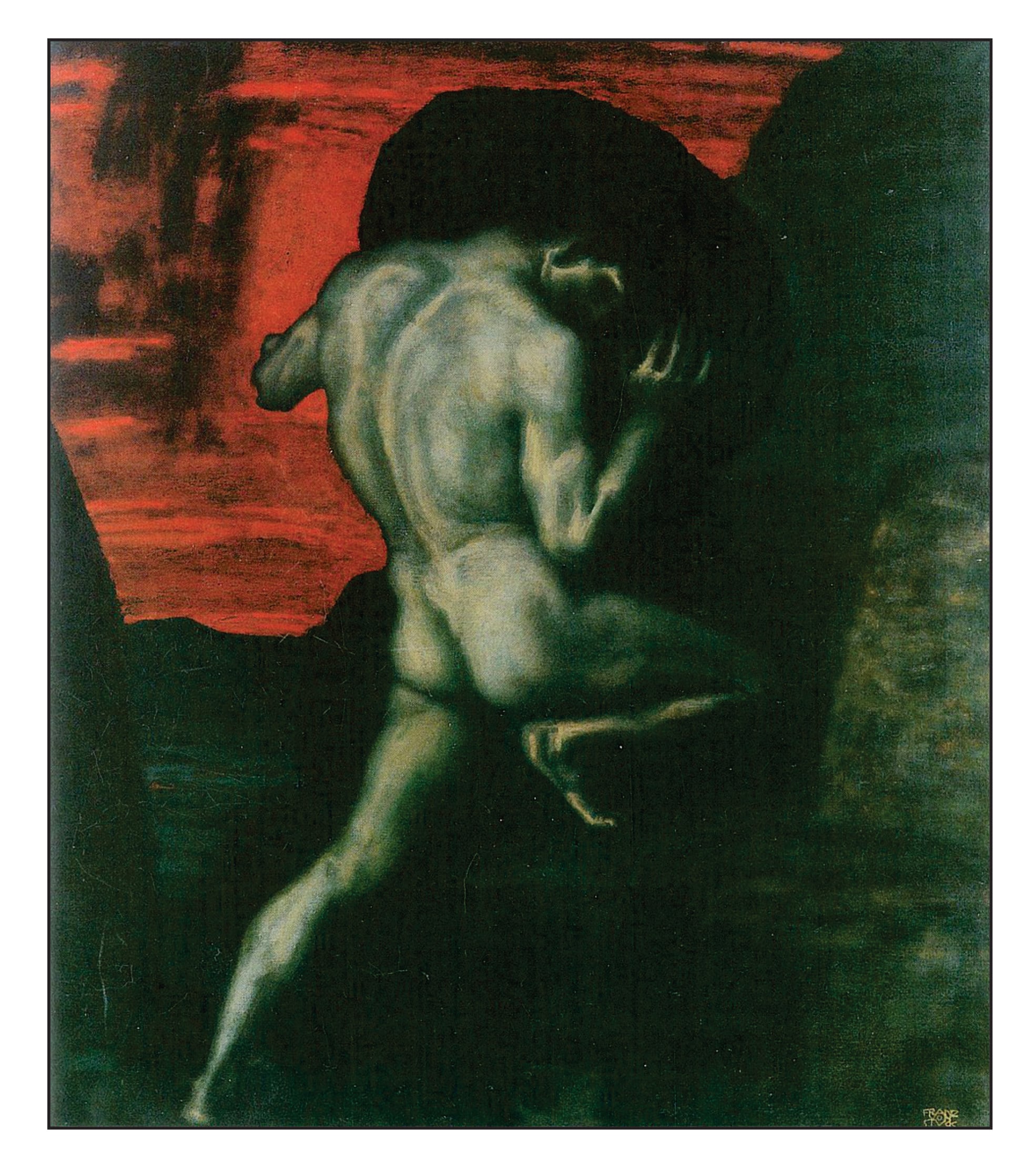
The story of Celia’s death borders on the absurd. The idea that human life is essentially absurd had just been introduced by Albert Camus in his 1942 book Le mythe de Sisyphe (“The Myth of Sisyphus”). The main idea is that human life is much like that of Sisyphus, who tried to stop death and make man immortal. His punishment was to roll an immense boulder up to the top of a hill. Just before it reaches the summit, the boulder rolls back down into the valley and Sisyphus must begin his task again. This he must do for all eternity. At the end of his essay Camus remarks that
Je laisse Sisyphe au bas de, la montagne! On retrouve toujours son fardeau. Mais Sisyphe enseigne la fidélité supérieure qui nie les dieux et soulève les rochers. Lui aussi juge que toutest bien. Cet univers désormais sans maître ne lui paraît ni stérile ni futile. Chacun des grains de cette pierre, chaque éclat minéral de cette montagne pleine de nuit, à lui seul, forme un monde. La lutte elle-même vers les sommets suffit à remplir un cœur d’homme. Il faut imaginer Sisyphe heureux.
[I leave Sisyphus at the foot of the mountain! One always finds one’s burden again. But Sisyphus teaches the higher fidelity that negates the gods and raises rocks. He too concludes that all is well. This universe henceforth without a master seems to him neither sterile nor futile. Each atom of that stone, each mineral flake of that night filled mountain, in itself forms a world. The struggle itself toward the heights is enough to fill a man’s heart. One must imagine Sisyphus happy].
The following illustration shows a 1920 painting of Sisyphus by the German painter Franz von Stuck:
In the late 1940s and the 1950s plays like Genet’s The Maids (1947), Ionesco’s The Bald Soprano (1950) and Becket’s Waiting for Godot (1950) ushered in the theatre of the absurd, wherein human beings learned to survive in a world without meaning. Eliot’s play is a harbinger of this type of drama: Celia’s fate is absurd – her death served no useful purpose.
The Magus Zoroaster
Sir Henry tries to explain his lack of concern about Celia’s death by quoting from Shelley’s Prometheus Unbound (1820). The lines are spoken by Mother Earth who encourages Prometheus to tell his story but to be aware that there are two worlds – one in which we live, and one which contains our unfulfilled dreams and ideas
Ere Babylon was dust
The magus Zoroaster, my dead child,
Met his own image walking in the garden.
That apparition, sole of men, he saw.
For know there are two worlds of life and death:
One that which thou beholdest; but the other
Is underneath the grave, where do inhabit
The shadows of all forms that think and live
Till death unite them and they part no more!
The next lines (unquoted by Sir Henry) are
Dreams and the light imaginings of men,
And all that faith creates or love desires,
Terrible, strange, sublime and beauteous shapes.
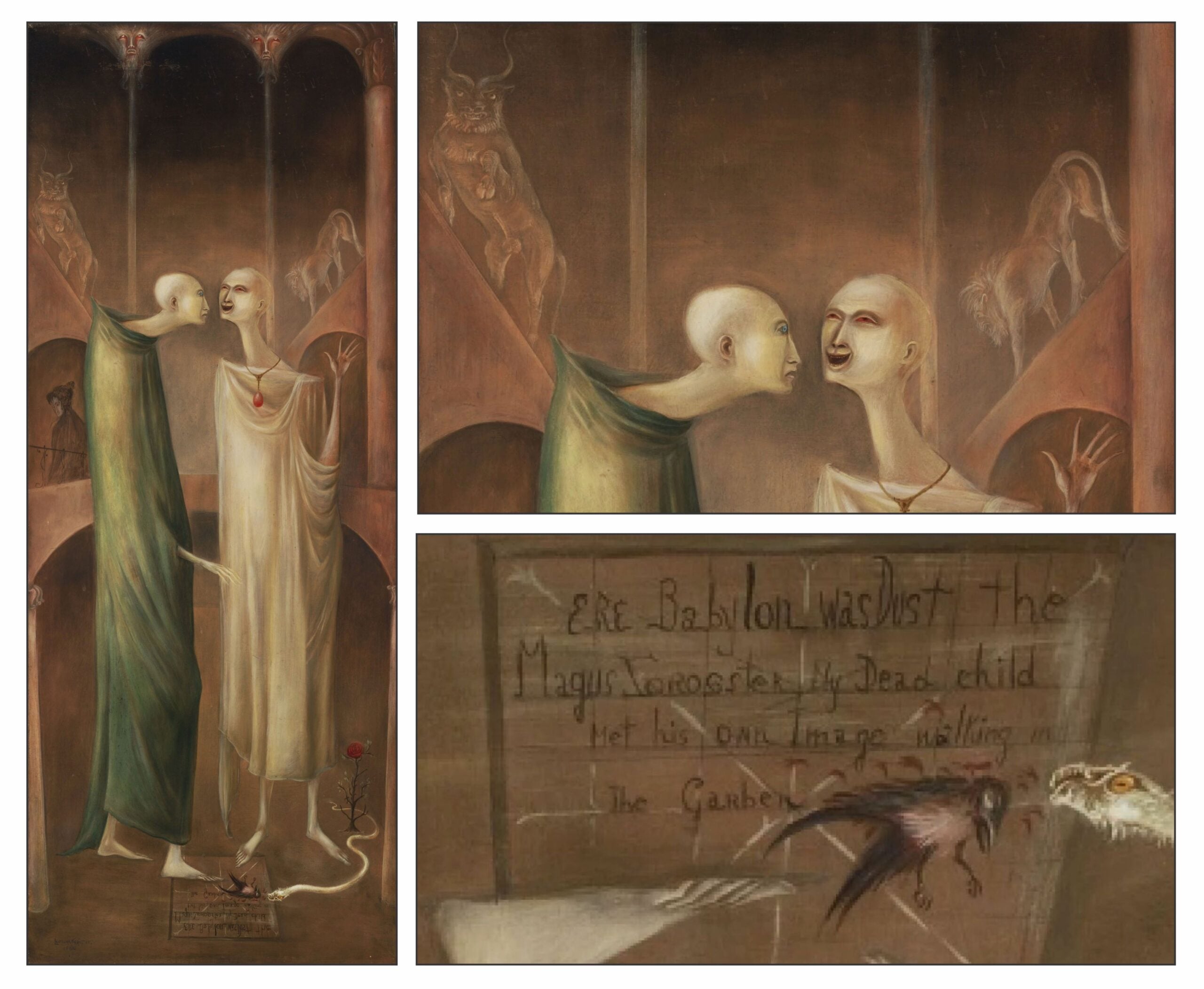
Zoroaaster was a mythical Persian religious leader (magus) who may have lived around 1000 BCE. The story of the meeting with his double marks a time when he realized that he had to live up to what he was meant to be (Ranald & Ranald, 1961).
The story of Zoroaster and his image of what he was meant to be was depicted by the Mexican surrealist painter Leonora Carrington in 1960: The following illustration shows her painting. The two enlargements on the right show the supernatural powers (bull and lion), and the mirror writing on the ground that quotes from Shelley. The latter has been lightened and mirror-inverted to make the text legible. The conflict between goodness and evil appear to be represented by the bird and snake at the feet of Zoroaster.
The Problems of Sainthood
As the 20th Century came to an end, the idea of the saint devoting himself or herself to the poor and dying became a little tarnished. Probably the most famous of the modern saints was Mother Teresa (1910-1997), who devoted her life to the poor of Calcutta.
The journalist Christopher Hitchens criticized her contributions in a TV program entitled Mother Teresa: Hell’s Angel (1994). The following are two excerpts:
Mother Teresa’s cult of death and suffering depends for its effect on the most vulnerable and helpless: abandoned babies, say, or the terminally ill, who supply the occasion for charity and the raw material for compassion. (near minute 6).
The Teresa cult is now a missionary multinational with an annual turnover over tens of millions. If concentrated in Calcutta, that would certainly support a large hospital and perhaps even make a noticeable difference. But Mother Teresa has chosen instead to spread her franchise very thinly. To her the convent and the catechism matter more than the clinics. (near minute 28)
This was followed by a book and articles (Hitchens, 1995; 2003). Hitchens was also dismayed that Teresa and the Catholic Church continued to reject birth control – something that would have been fare more effective in reducing the number of abandoned babies that Teresa cared for. Despite Hitchens’ comments, the Catholic Church rapidly advanced Mother Teresa to sainthood: she was beatified in 2003 and canonized in 2016.
Hitchens’ critiques have been supported by others (Larivée et al, 2013; Bandyopadhyay, 2018). Perhaps the most significant defect in her mission in Calcutta was that she did not provide even the rudiments of modern medical care. Compassion is essential to medicine, but dying patients should not be denied the benefit of pharmacological pain relief. Mother Teresa also seemed to represent an obsolete approach to rectifying the ills of poverty. Some adjustment of the world’s inequalities would be of far more benefit than simply treating the poor with compassion. Giving charity to those whom we exploit does not remove the stain of the exploitation.
The following illustration shows saint and critic:

Personal Epilogue
Jones (1960, p 123) quoted from a 1945 interview of T. S. Eliot by J. P. Hogan
When, in an interview, Eliot was asked, ‘How would you, out of the bitter experience of the present time, wish mankind to develop?’ he answered:
‘I should speak of a greater spiritual consciousness, which is not asking that everybody should rise to the same conscious level, but that everybody should have some awareness of the depths of spiritual development and some appreciation and respect for those more exceptional people who can proceed further in spiritual knowledge than most of us can.’
I remember being quite taken by Celia when I first read the play as a young man. I had developed some modicum of spiritual consciousness and feelings similar to those reported by Celia – an awareness of solitude and a sense of sin. I wondered whether I might meet someone like Sir Henry Harcout-Reilly who would show me what I should do with my life. I never saw a production of the play, and I never met anyone that might have been my Guardian. And although when I first read of Celia’s death it seemed noble and right, I now feel it was foolish and mistaken.
References
Bandyopadhyay, R. (2018). Volunteer tourism and religion: the cult of Mother Teresa. Annals of Tourism Research, 70, 133–136.
Camus, A. (1942). Le mythe de Sisyphe. Gallimard. English translation by J. O’Brien (1955). The Myth of Sisyphus and Other Essays. Alfred A. Knopf.
Eliot, T. S. (1950). The cocktail party: a comedy. Faber & Faber.
Eliot, T. S. (1951). Poetry and drama. Atlantic Monthly (February 1951).
Hammerschmidt, H. (1981). The role of the “Guardians” in T.S. Eliot’s Cocktail Party. Modern Drama, 24(1), 54–66.
Hitchens, C. (1994). Mother Teresa: Hell’s Angel. Channel 4 Television Program directed by Jenny Morgan, with text by Christoher Hitchens and Tariq Ali.
Hitchens, C. (1995). The missionary position: Mother Teresa in theory and practice. Verso.
Hitchens, C. (2003). Mommie dearest. The pope beatifies Mother Teresa, a fanatic, a fundamentalist, and a fraud. Slate Magazine. October 20, 2003.
Jones, D. E. (1960). The plays of T.S. Eliot. Routledge & Kegan Paul.
Larivée, S., Sénéchal, C., & Chénard, G. (2013). Les côtés ténébreux de Mère Teresa. Studies in Religion, 42(3), 319–345.
Lesher, J. H. (2013). The self in conflict with itself: a Heraclitean theme in Eliot’s The Cocktail Party. In Knippschild, S., & García Morcillo, M. (Eds.) Seduction and power: antiquity in the visual and performing arts. (pp 122-132). Bloomsbury Academic.
Llorens-Cubedo, D. (2022). The Cocktail Party and It’s a Wonderful Life. The T.S. Eliot Studies Annual, 4(1), 229–252.
Priestley, J. B. (1947). An inspector calls: a play in three acts. Heinemann.
Ranald, M. L., & Ranald, R. A. (1961). Shelley’s Magus Zoroaster and the image of the Doppelgänger. Modern Language Notes, 76(1), 7–12.
Rexine, J. E. (1965). Classical and Christian foundations of T. S. Eliot’s Cocktail Party. Books Abroad, 39(1), 21–26.
Sartre, J.-P. (1947). Huis clos; suivi de Les mouches. Gallimard.
Sartre, J.-P. (1946). L’existentialisme est un humanisme. Nagel.
Shelley, P. B. (1820). Prometheus unbound: a lyrical drama in four acts. C. & J. Ollier.
Smith, C. H. (1967). T. S. Eliot’s dramatic theory and practice: from Sweeney Agonistes to the Elder Statesman. Princeton University Press.