Paul-Émile Borduas: Le Refus Global
Paul-Émile Borduas (1905-1960) was a Quebec artist who became world-famous in the 1950s for his striking abstract paintings. In the early 1940s he had founded Les Automatistes, a group of artists interested in Surrealism. In 1948, he and his colleague had published the Refus Global (Total Refusal), a manifesto urging his fellow Québécois to throw off the oppressive authority of the Union Nationale Party and the Catholic Church. His call to freedom antagonized those in power. After being fired from his teaching position, he left Canada to work in New York and Paris. Shortly after his death in February 1960, the Liberal Party defeated the Union Nationale in the Provincial Election in June, 1960, and La Révolution Tranquille (Quiet Revolution) began to modernize Quebec society.
Apprentice
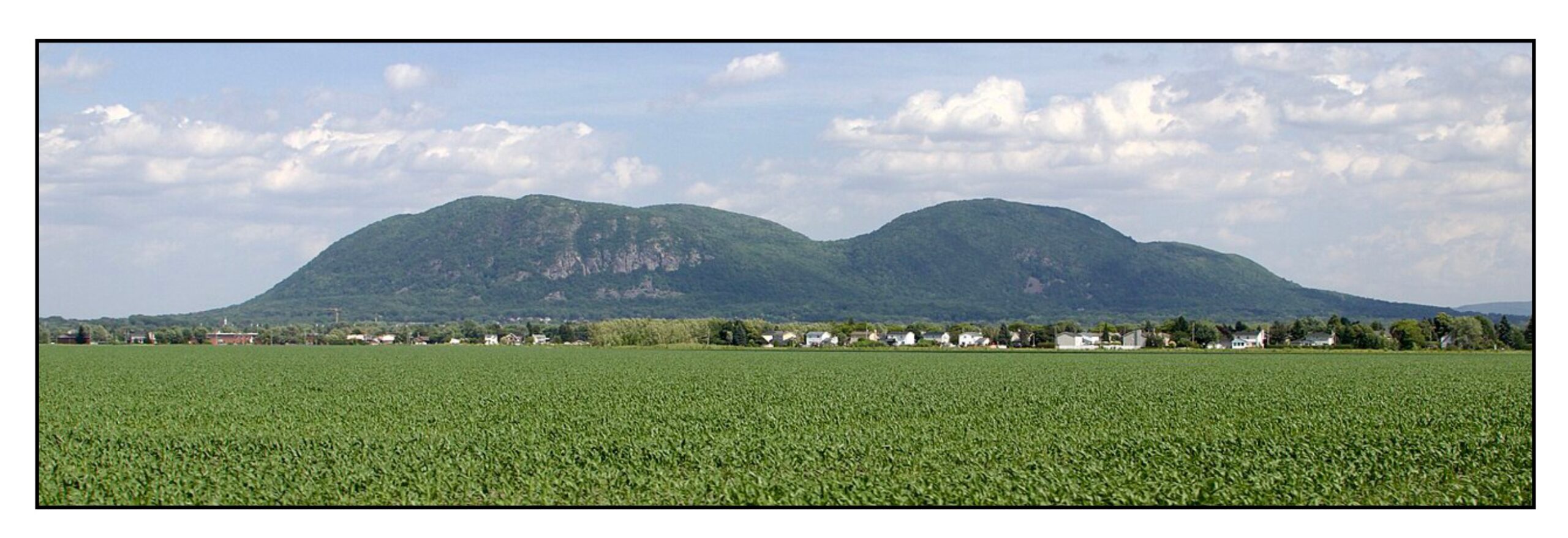
Borduas was born in Mont Saint Hilaire about 40 km east of Montreal in the valley of the Richelieu River which flows from Lake Champlain into the St Laurent River. The mountain arises abruptly from a surrounding plain famous for its apple orchards.
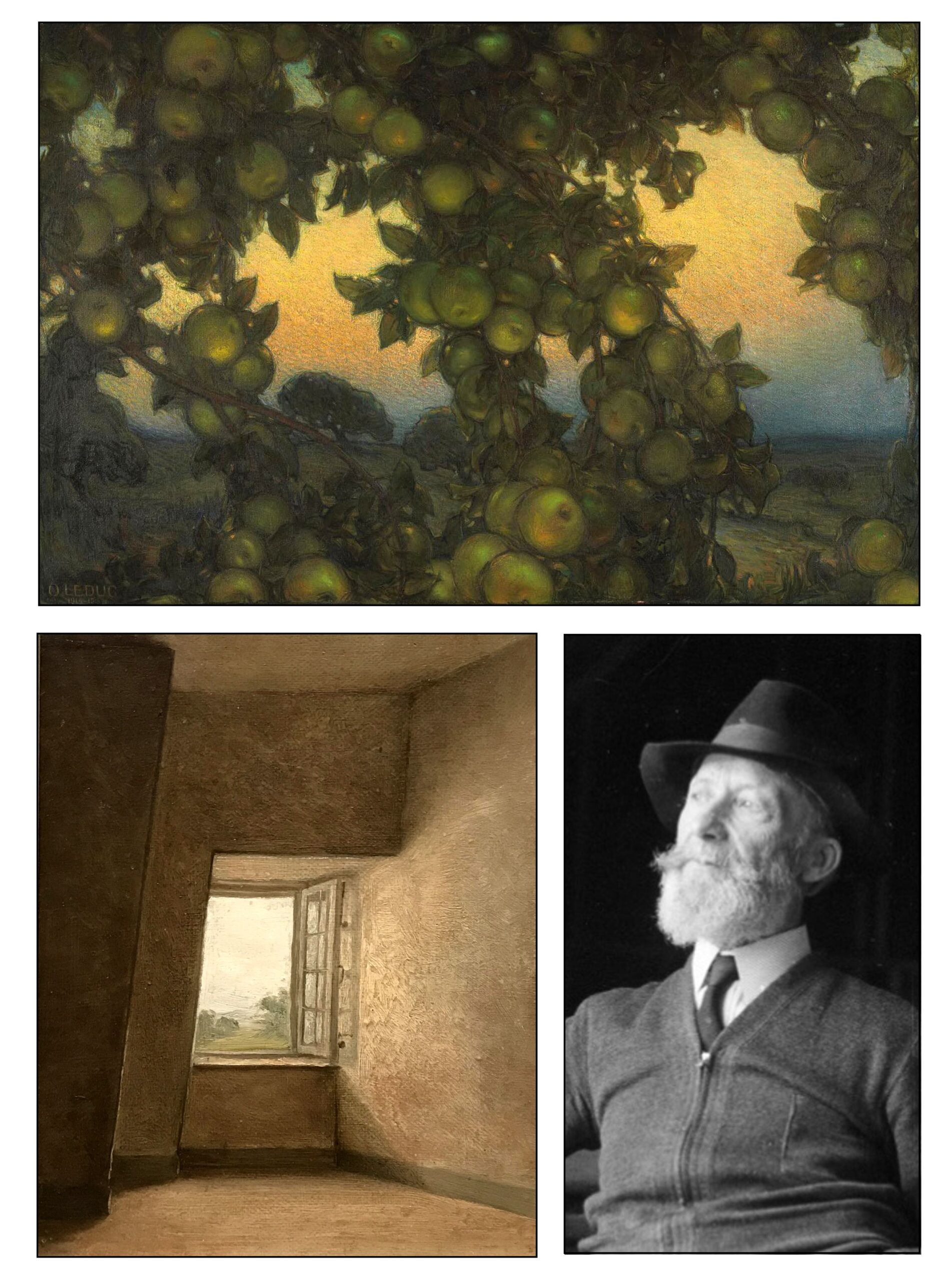
In his teens, Borduas became apprenticed to Ozias Leduc (1864-1955), a painter from the same region, and helped him at his work as a church decorator. Leduc was a talented representational artist with a modernist sensibility (Lacroix, 2019). The following illustration shows his Green Apples (1915), Open Window (1900), and a photograph from 1936.
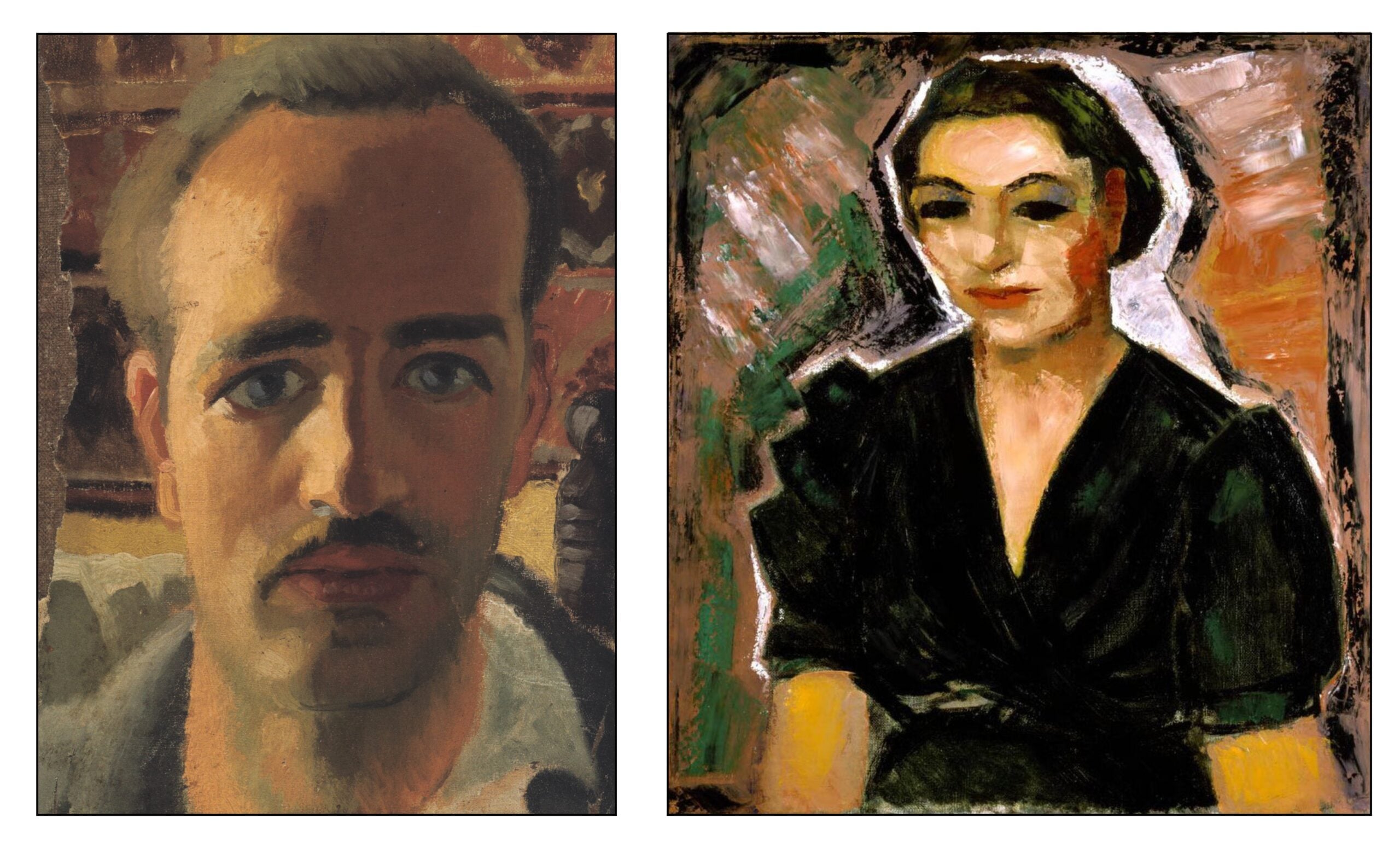
Leduc arranged for Borduas to have art lessons in Sherbrooke, and in 1923 supported his admission to the newly opened École des Beaux-Arts de Montréal. After he graduated Borduas spent a year of further study in Paris. On his return, he became an art teacher in the Catholic school system. In 1935, he married Gabrielle Goyette and settled down to family life in Mont Saint Hilaire. In 1937, he was appointed professor at the École du meuble de Montréal, which the government had just established to provide training for workers in the province’s furniture industry. The following illustration shows a Self-Portrait from 1928 and a Portrait of Madame Gagnon from 1941.
Les Automatistes
In the late 1930s Borduas became intrigued by ideas of André Breton and the Surrealists. He began to experiment in painting by instinct rather than by reason. Breton, in Le Manifeste du Surréalisme (1924), had defined surrealism as
Psychic automatism in its pure state, by which one proposes to express — verbally, by means of the written word, or in any other manner — the actual functioning of thought. Dictated by the thought, in the absence of any control exercised by reason, exempt from any aesthetic or moral concern.
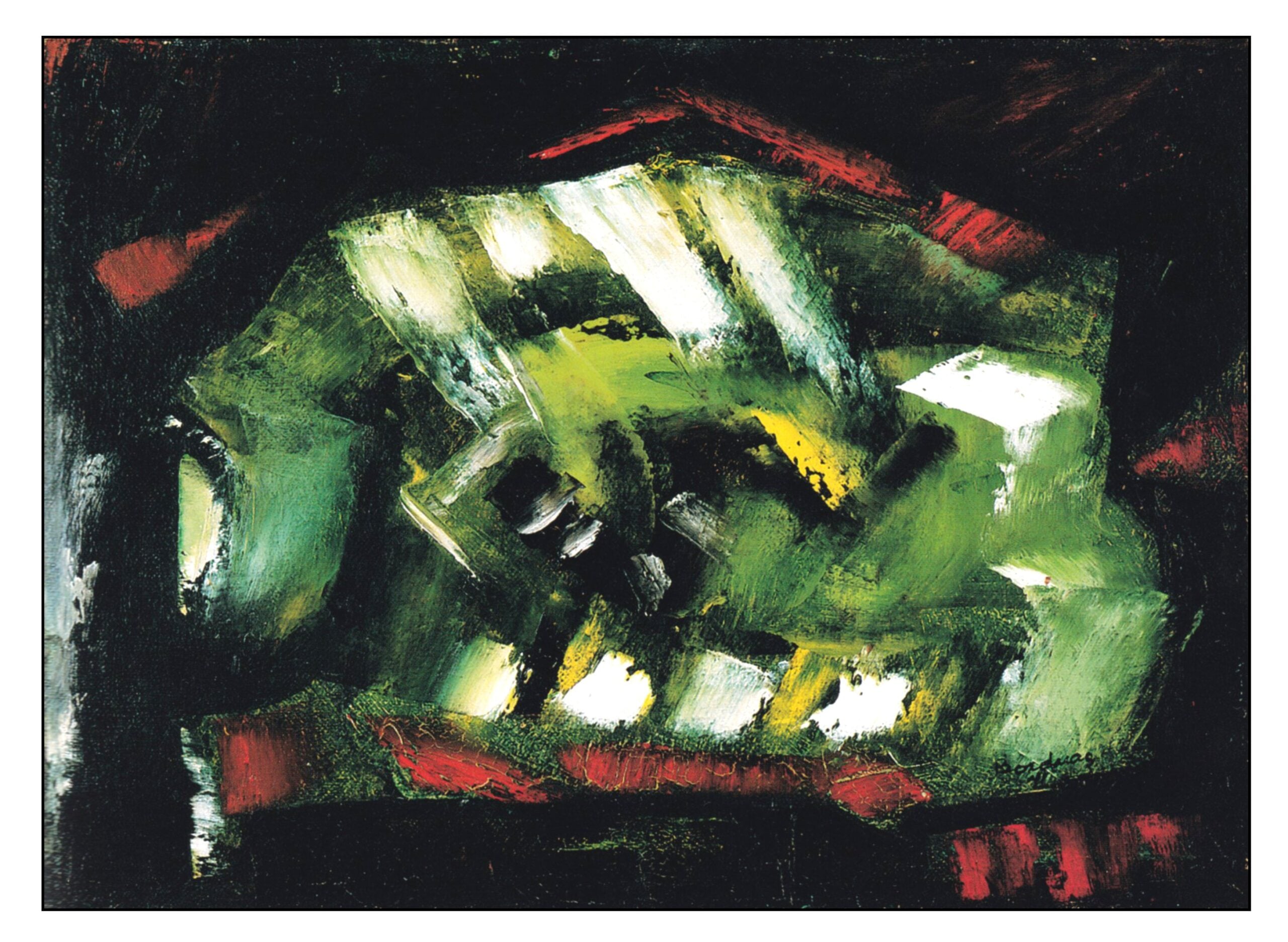
The following illustration shows one of Borduas’s early abstract paintings: Green Abstraction (1941). He described it as his “first totally non-preconceived painting” (Gagnon, 1988, p 166).
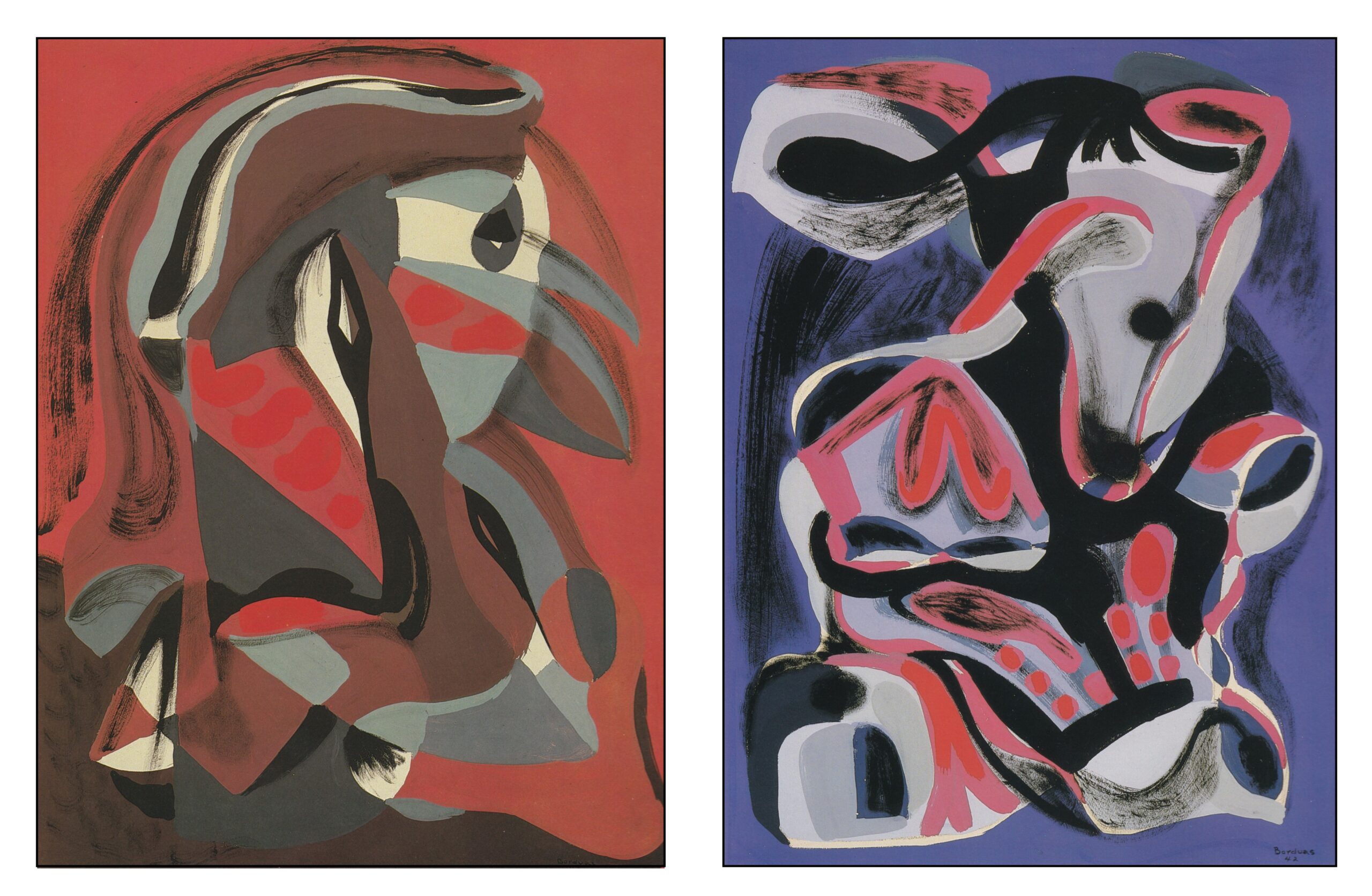
Borduas soon put together a set of 45 gouaches painted using the principles of surrealism for a solo exhibition in Montreal in 1942 (Gagnon, 2013, pp 117-135). At the time he described his artistic technique as follows;
I begin with no preconceived idea. Faced with the white sheet, my mind free of any literary ideas, I respond to my first impulse. If I feel like placing my charcoal in the middle of the page, or to one side, I do so with no questions asked, and then go on from there. Once the first line is drawn, the page has been divided and that division starts a whole series of thoughts which proceed automatically. When I use the word “thoughts” I mean painterly thoughts: thoughts having to do with movement, rhythm, volume and light, not literary ideas. Once the drawing has been completely worked out, the same steps are followed with colour. As with the drawing, if my first impulse is to use yellow, I don’t hesitate. And the first colour determines all the others. It’s at the stage of colour that the problems of light and volume present themselves. (quoted in Nasgaard & Ellenwood, 2009, p 12).
Two of the gouaches are illustrated below: Number 6 and Number 33. Some appeared to represent something – Number 6 soon became known as Le Chantecler (Rooster). Others, like Number 33, seemed completely abstract.
 Another important influence on Borduas was Marie-Alain Couturier (1897-1954). Between 1940 and 1944, the French Franciscan Father lived in North America in exile from occupied France. He spent some time in Quebec, encouraging artists to explore the new freedoms of modern art, and urging the church to support their new sense of beauty. Couturier had originally trained as a stained-glass artist, and went on to become an editor for the journal Art Sacré (Lion, 2010). Borduas had met him during his time in France, and the two interacted again when Couturier was a visiting lecturer at the École du meuble. The following is from one of Couturier’s essays published in Quebec:
It takes an effort of pure intuition to assure the birth and development of a work of art, a total abandonment to a certain obscure sense of the absolute. And, to tell the truth, there needs to be an absolute risk, which implies a state of constant insecurity for the artist. This is psychologically very difficult, often even anguishing, as it is entirely foreign to the stable order of certitudes that rule over and guarantee all other human activities. (Couturier, 1944, quoted in Warren, 2017, p 23).
Over the next few years, Borduas assembled about him a group of talented young painters who were trying out the new modernist approaches to art. They had their first exhibition in 1947 at the house of his friend Claude Gauvreau, a poet and playwright, and brother of the painter Pierre Gauvreau. A journalist described the group as Les Automatistes from Borduas’s titles: for example, Automatisme 1.47 which later came to be known as Sous le vent de l’île (Leeward of the Island) (Nasgaard & Ellenwood, 2009; Gagnon, 2020). The following illustration shows Borduas at the exhibition in front of this painting and Automatisme 2.47 or Le Danseur.
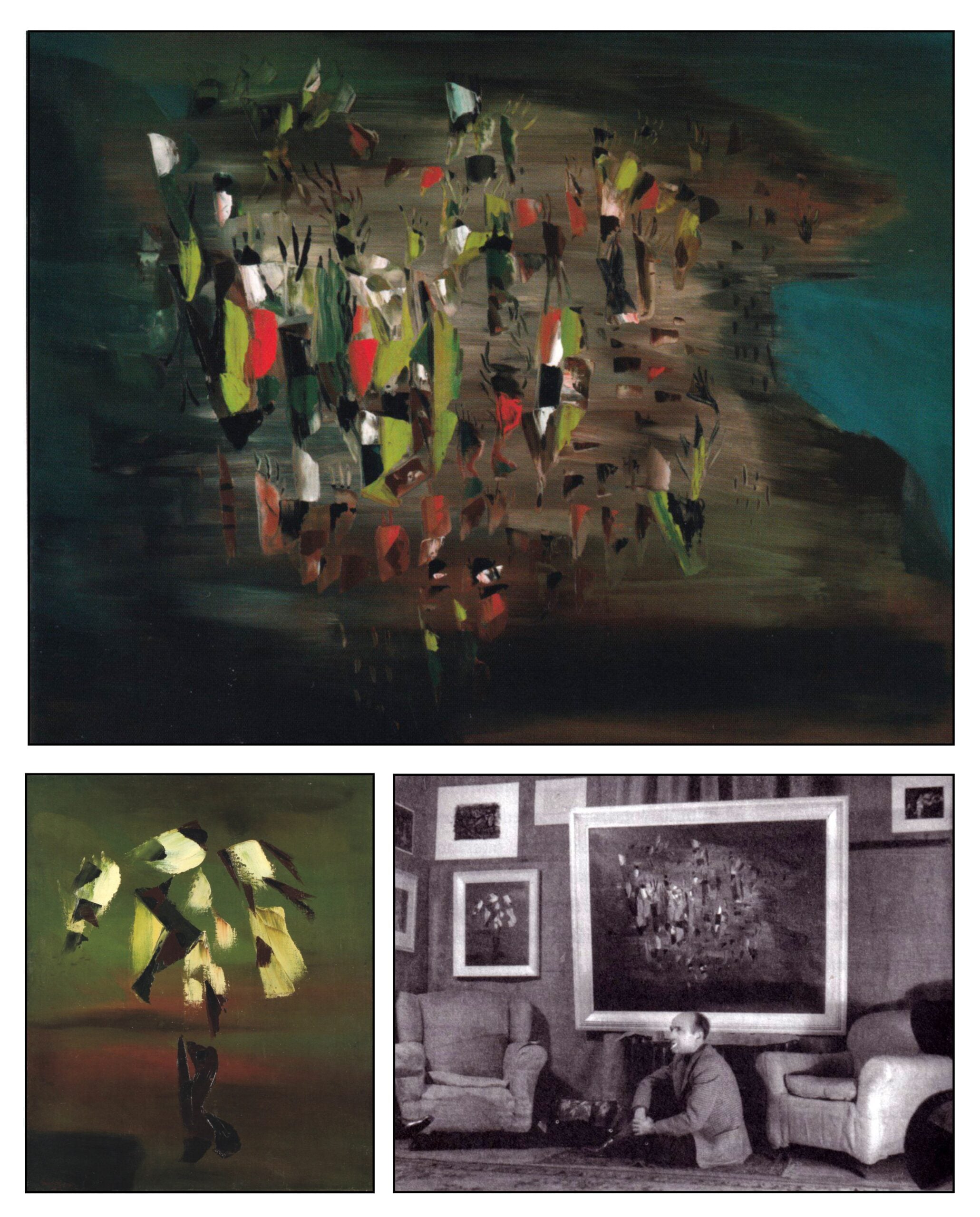
The painting Sous le vent de l’île is impressive:
The canvas is cleanly divided into two registers. The first, consisting of broad horizontal brush strokes, corresponds to the background. A wide expanse beginning at the bottom of the picture and receding to infinity as the viewer’s gaze rises is flanked on the right by what could be interpreted as a sea meeting its shore. The space created in this way appears traversed “as if by a wind blowing from west to east:” On this background, without any apparent connection to it, a group of small red, green, black, and white blotches have been laid with a palette knife, like the pieces of a vertical veil blown about by the wind. The remarkable thing in this painting with respect to its predecessors is the extraordinary impression of depth it gives. The island, seen from above, at a height never before experienced in a Borduas work, takes on the dimensions of a continent and even the objects hanging in space remain at a certain distance from the viewer (they do not touch the edge of the canvas). (Gagnon, 2013, pp 192-193).
Le Refus Global
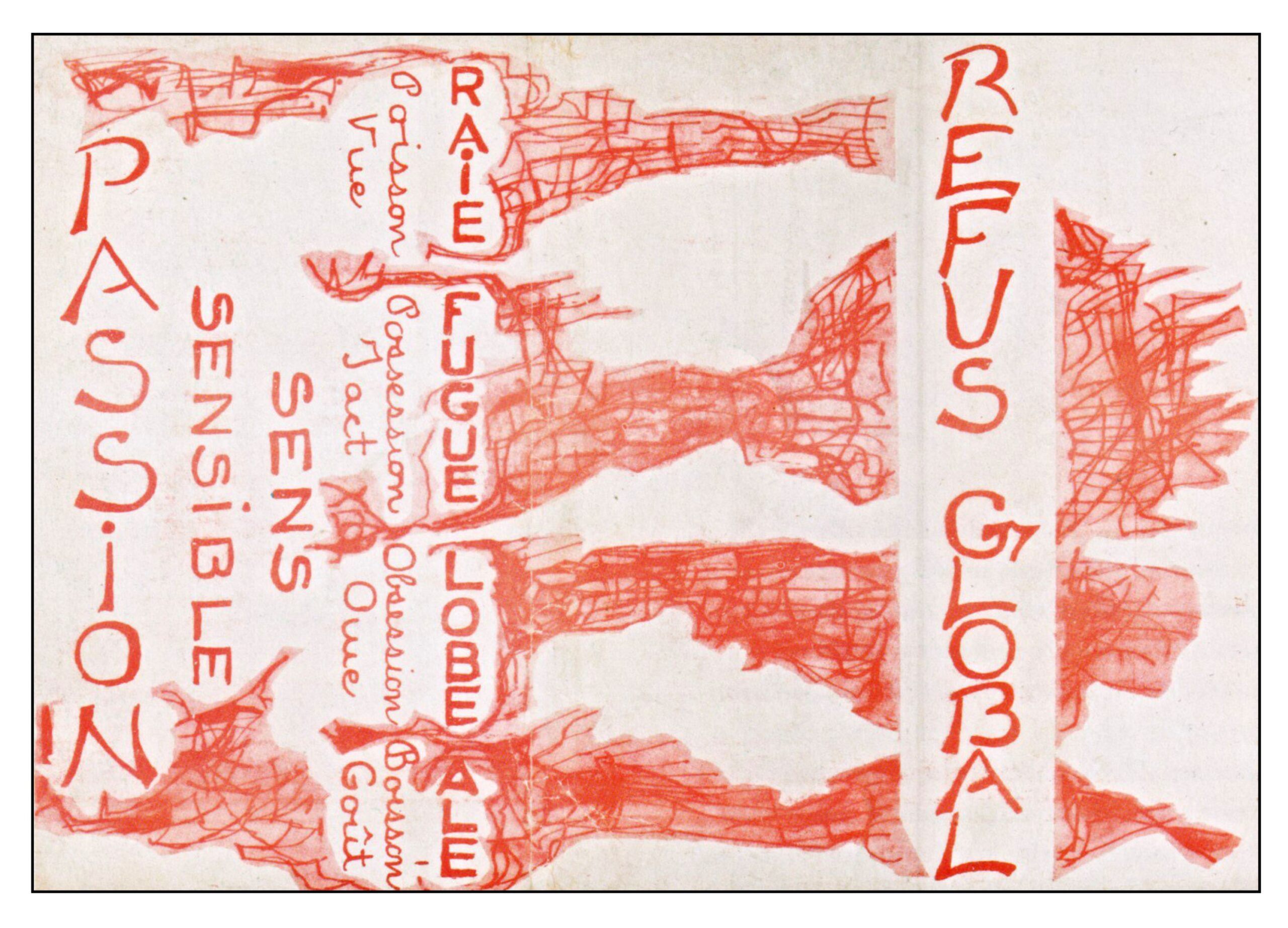
In 1948, Les Automatistes published a small manifesto entitled Le Refus Global (Total Refusal). Borduas was the lead author, and Jean-Paul Riopelle (1923-2001) designed the cover and frontispiece. Thirteen other artists also signed the manifesto, among them Marcelle Ferron (1924-2001), Claude Gauvreau (1925-1975), Fernand Leduc (1916-2014), and Françoise Sullivan (1923- ). Four hundred typescript copies were printed and only about half of these were sold (at a dollar apiece). Below is the frontispiece, which incorporates a poem by Claude Gauvreau about how information from the sensory world can be directly transformed into creative passion. The letters of the manifesto’s title are used to suggest the senses (raie for the light rays, fugue for tactile sensation, lobe for the earlobe, and ale for taste)
Borduas’s manifesto began with a rambling history of Quebec and its people and how they hade been exploited and kept in ignorance and by the Catholic Church:
Son exécrable exploitation, maintenue tant de siècles dans l’efficacité au prix desqualités les plus précieuses de la vie, se révélera enfin à la multitude de sesvictimes: dociles esclaves d’autant plus acharnés à la défendre qu’ils étaient plus misérables. L’écartèlement aura une fin. La décadence chrétienne aura entrainé dans sa chute tous les peuples, toutes les classes qu’elle aura touchées, dans l’ordre de la première à la dernière, de haut en bas.
[A loathsome exploitation, effectively maintained for centuries at the cost of the best things in life, will be exposed at last to a multitude of victims, docile slaves whose eagerness to defend their servitude has been in direct proportion to their wretchedness. The torture will end. Christian decadence in its collapse will drag down all the peoples and classes it has touched, from first to last, from top to bottom.] (translation of this and following passages by Ray Ellenwood, Borduas, 1985)
Borduas then called for a break with the past:
D’ici là notre devoir est simple. Rompre définitivement avec toutes les habitudes de la société, se désolidariser deson esprit utilitaire. Refus d’être sciemment au-dessous de nos possibilitéspsychiques. Refus de fermer les yeux sur les vices, les duperies perpétrées sous lecouvert du savoir, du service rendu, de la reconnaissance due. Refus d’uncantonnement dans la seule bourgade plastique, place fortifiée mais faciled’évitement. Refus de se taire — faites de nous ce qu’il vous plaira mais vousdevez nous entendre — refus de la gloire, des honneurs (le premier consenti): stigmates de la nuisance, de l’inconscience, de la servilité. Refus de servir, d’être utilisables pour de telles fins. Refus de toute intention, arme néfaste de la raison. À bas toutes deux, au second rang! Place à la magie! Place aux mystères objectifs! Place à l’amour! Place aux nécessités! Au refus global nous opposons la responsabilité entière.
[We must break with the conventions of society once and for all, and reject its utilitarian spirit. We must refuse to function knowingly at less than our physical and mental potential; refuse to close our eyes to vice and fraud perpetrated in the name of knowledge or favours or due respect. We refuse to be confined to the barracks of plastic arts — it’s a fortress, but easy enough to avoid. We refuse to keep silent. Do what you want with us, but you must hear us out. We will not accept your fame or attendant honours. They are the stigmata of shame, silliness and servility. We refuse to serve, or to be used for such purposes. We reject all forms of intention, the two-edged, perilous sword of reason. Down with both of them, back they go! Make way for magic! Make way for objective mysteries! Make way for love! Make way for necessities! Counterbalancing this total refusal is our complete responsibility]
And invited the reader to join in the new creative freedom:
Au terme imaginable, nous entrevoyons l’homme libéré de ses chaines inutiles, réaliser dans l’ordre imprévu, nécessaire de la spontanéité, dans l’anarchie resplendissante, la plénitude de ses dons individuels. D’ici là, sans repos ni halte, en communauté de sentiment avec les assoiffés d’un mieux-être, sans crainte des longues échéances, dans l’encouragement ou la persécution, nous poursuivrons dans la joie notre sauvage besoin de libération.
[Within a foreseeable future, men will cast off their useless chains. They will realize their full, individual potential according to the unpredictable, necessary order of spontaneity — in splendid anarchy. Until then, we will not rest or falter. Hand in hand with others thirsting for a better life, no matter how long it takes, regardless of support or persecution, we will joyfully respond to a savage need for liberation.]
The public paid little attention. However, the reaction of the church and government was swift. A month after the manifesto was published, Borduas was fired from his position at the École du meuble. The reason given in the official government letter was
*His writings and the manifestos he publishes, as well as his state of mind, make him unsuitable for the kind of teaching we wish for our students. (quoted by Ellenwood in his introduction to Borduas, 1985)
Borduas was devastated. He continued to paint and began to make abstract wooden sculptures, but he soon began to experience financial difficulties. His marriage came under great strain. In 1951 and Gabrielle finally took the children and left her husband. In 1953, Borduas abandoned Canada, moving for a few months to Provincetown on Cape Cod, and then on to New York.
New York
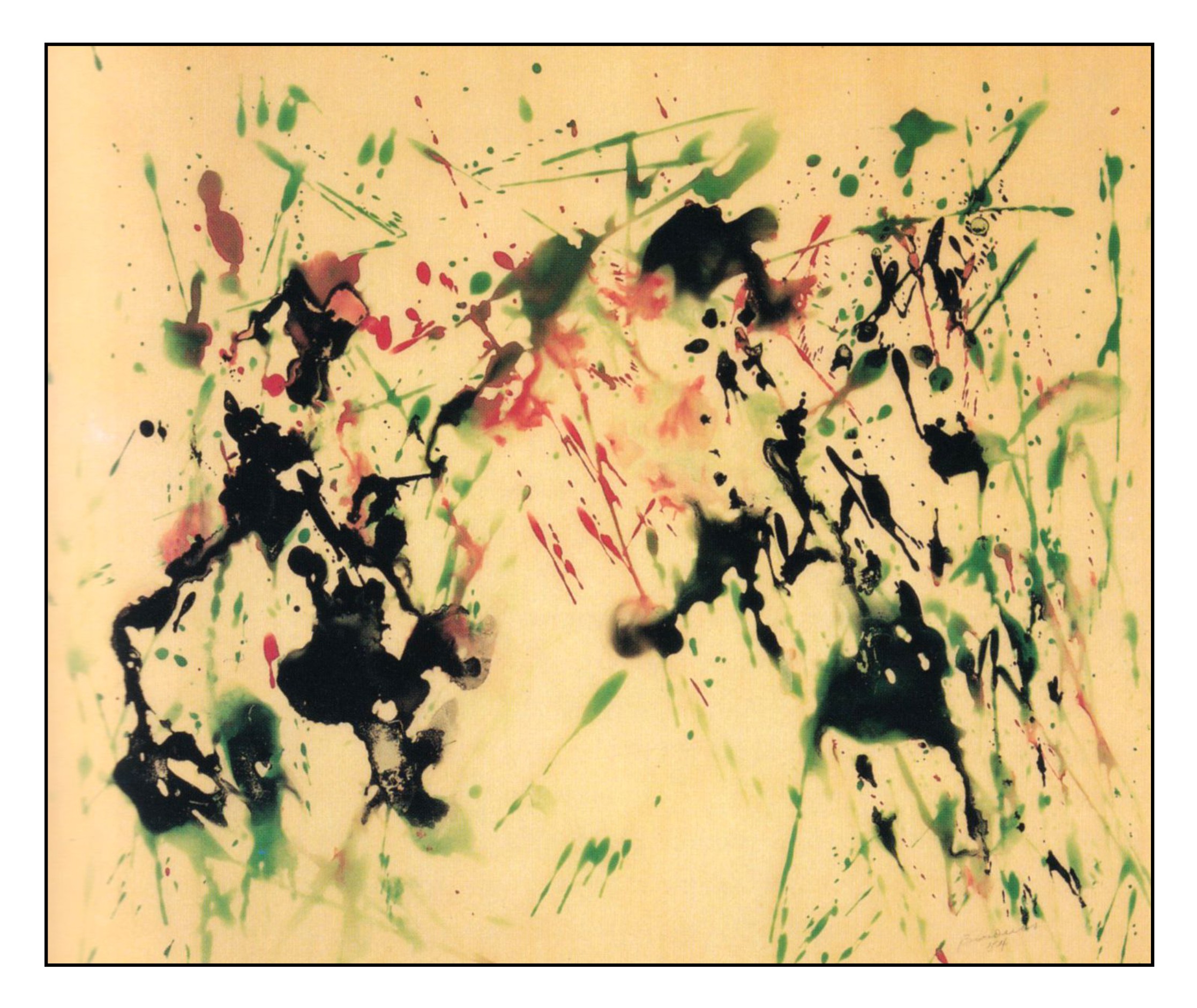
New York in 1953 was abuzz with the new Abstract Expressionism. Borduas was impressed with the “action painting” of Jackson Pollock, and created a series of his own drip paintings using watercolors. The following is Gerbes légères (Light Sheaves) from 1954:
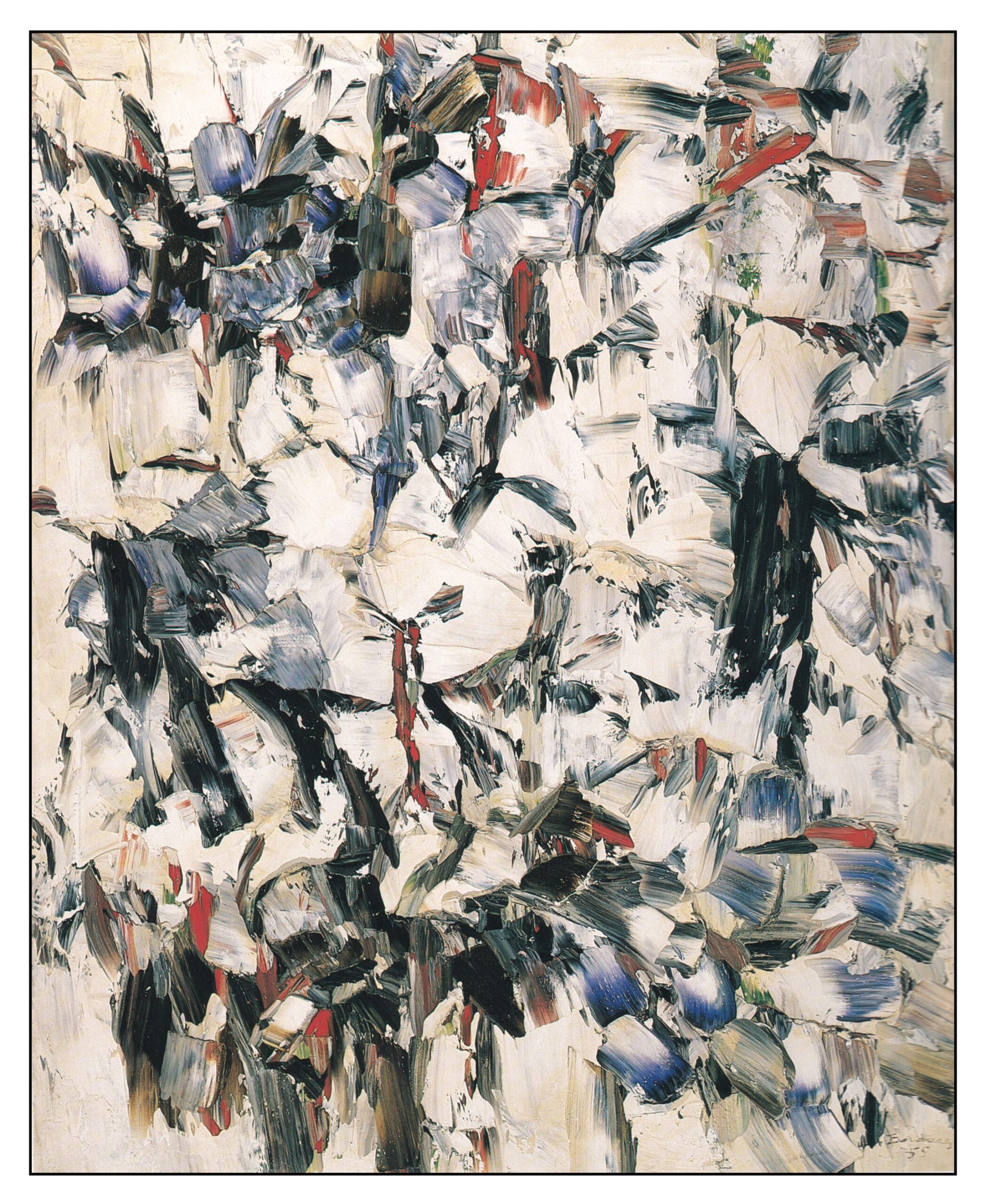
Borduas was also intrigued by the abstract calligraphy of Franz Kline, the monumental color fields of Clyfford Still, and the powerful simplicity of Robert Motherwell. He began to apply paint in broad strokes or taches using a palette knife. His painting suggested multicolored knots of color in a thick white fabric. A striking painting from this time was Blue Drops, 1955:
Paris
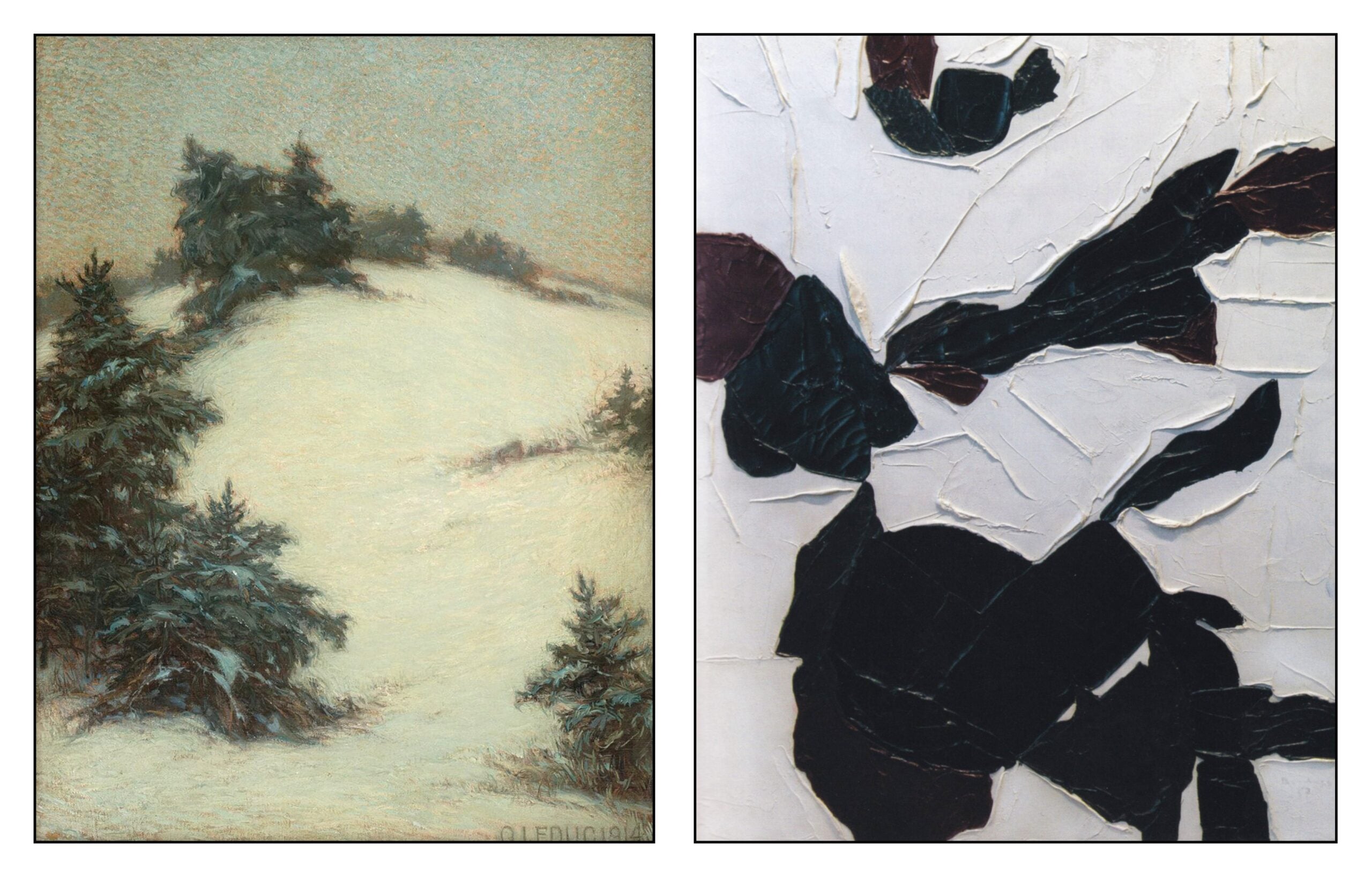
In 1955 Borduas moved to Paris. His palette became more restricted: paintings of black shapes on a white background became his iconic images. These paintings convey a deep sense of winter. They recall some of the paintings by his early master Ozias Leduc. The following illustration compares Leduc’s Grey Effect (Snow) from 1914 with Borduas’s Ardente from 1957:
The following is a quotation from Herta Wescher introducing an exhibition of his new abstract paintings in Paris in 1959:
his first burst of activity produced dynamic compositions swirling with movement in a range of shimmering tones. In later works, however, the elements were condensed and reduced in number, forming dark constellations within light grounds. White has become Borduas’ predominant colour, and he is capable of imbuing it with the most subtle of modulations. He covers his canvases with huge luminous expanses of white, at the edges of which very severe black shapes seem to terminate the space. Slowly, the jagged contours position and align themselves, and the internal structures of the compositions fall into place. Never, though, are the surfaces monotonous or schematic. Borduas applies the pigment with broad knives, and the movement of his hand leaves its mark both on the smooth areas and on those that are riddled with nervous streaks. (quoted by Gagnon 1988, p 399)
The following illustration shows Borduas’s most famous painting: L’Étoile Noire (Black Star) from 1957, now in the Montreal Museum of Fine Arts:
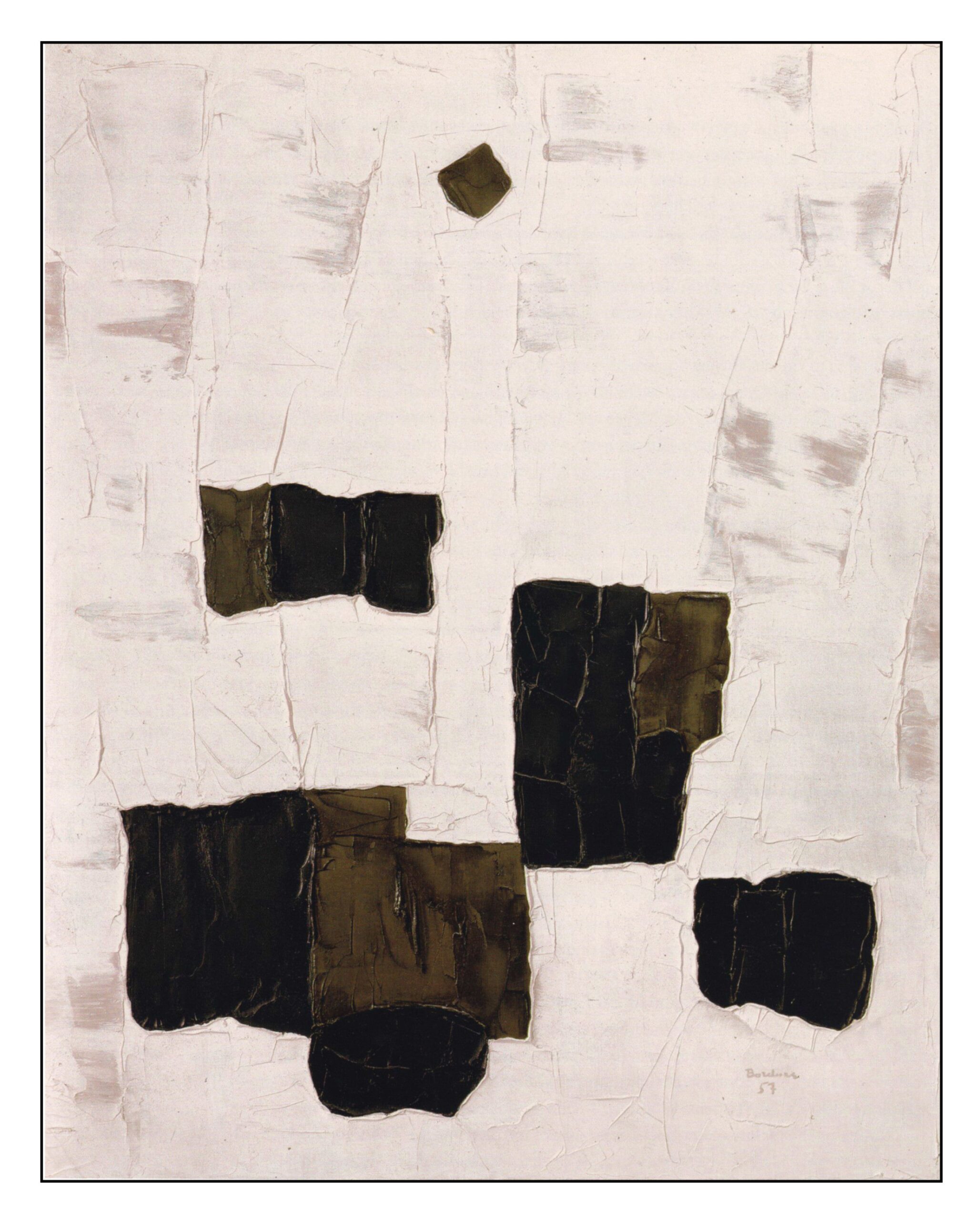
The painting is large – 1.62 meters high and 1.30 meters wide. Larger than anything he had painted before. It demands respect.
The painting is very difficult to reproduce accurately. There are subtle shades of white, and patches of dark brown coalesce with the black. The edges of the taches are elevated forming lines of force throughout the image.
The following are comments on the painting by Gagnon (1988, p 202):
The use of dark brown in the three main spots towards the bottom adds considerably to the ambivalence of these dark areas. Where are we to place them? They appear both to be moving away towards infinity (black) and to be floating on the surface like blood coagulated on the skin (brown). The spots, on their own, thus encompass all positions in space, and the white is freed for other functions. It should be noted, in particular, how the white invariably covers the edges of all the dark spots with an over-lapping lip. It is thus not a background on which the spots stand out (which would be a Gestaltist reading). Might it not be a true colour field in which these black and brown spots are embedded? It is not really that either, for, as we have seen, the spots still keep their illusionistic power to evoke the abyss, the infinity of the cosmic night. In fact, the white acts as a screen. It serves to conceal some-thing from view and, like all screens, it is interesting to look at in itself If we follow the folds in the white, the edges that it forms around the spots, we will see that it encloses them in a network of lines as structured as those in a Mondrian painting. But what we have here is a Mondrian shot through with the tremor of life — in sharp contrast to the exclusively spiritual character sought by the great Dutch artist in his own works. In Borduas’ painting, the spirit is never divorced from the material; it reveals itself as much in the recesses of the paint as in the rigour of the composition.
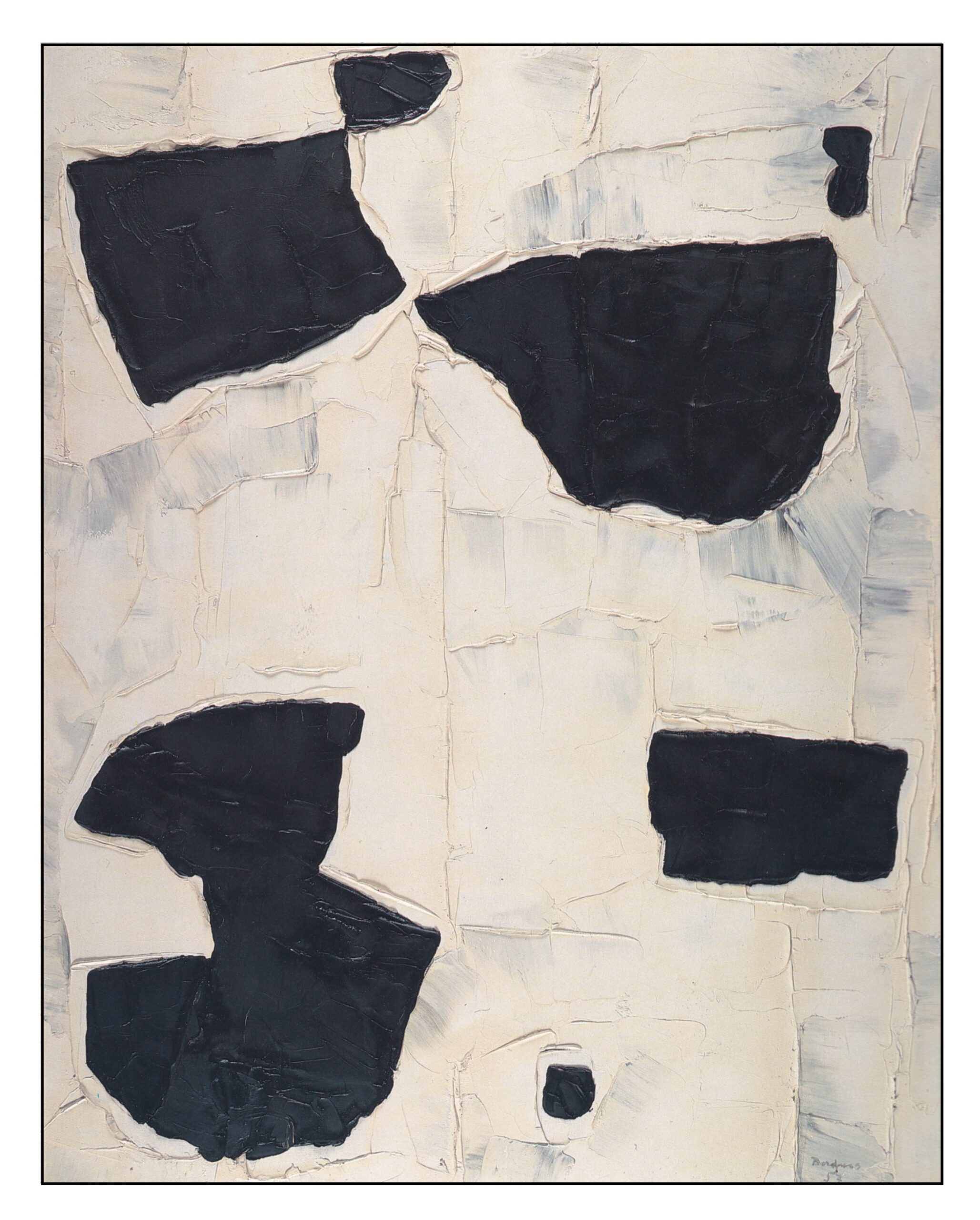
Another painting from this time is Magnetic Silence (1957). This has the same imposing size as Black Star. The black shapes at the top of the painting appear to be attracted toward each other, whereas those at the bottom appear to display repulsion. The white background on which the black shapes exist shows the energy with which Borduas created his image. The edges between the various color areas rise up with the force of their interaction. Tectonic plates come forcefully to mind.
Another style that Borduas explored in Paris placed simple calligraphic shapes in black and in color on a white background. Perhaps an attempt to decode the infinite. The following illustration shows two of these paintings and a photograph from 1959:
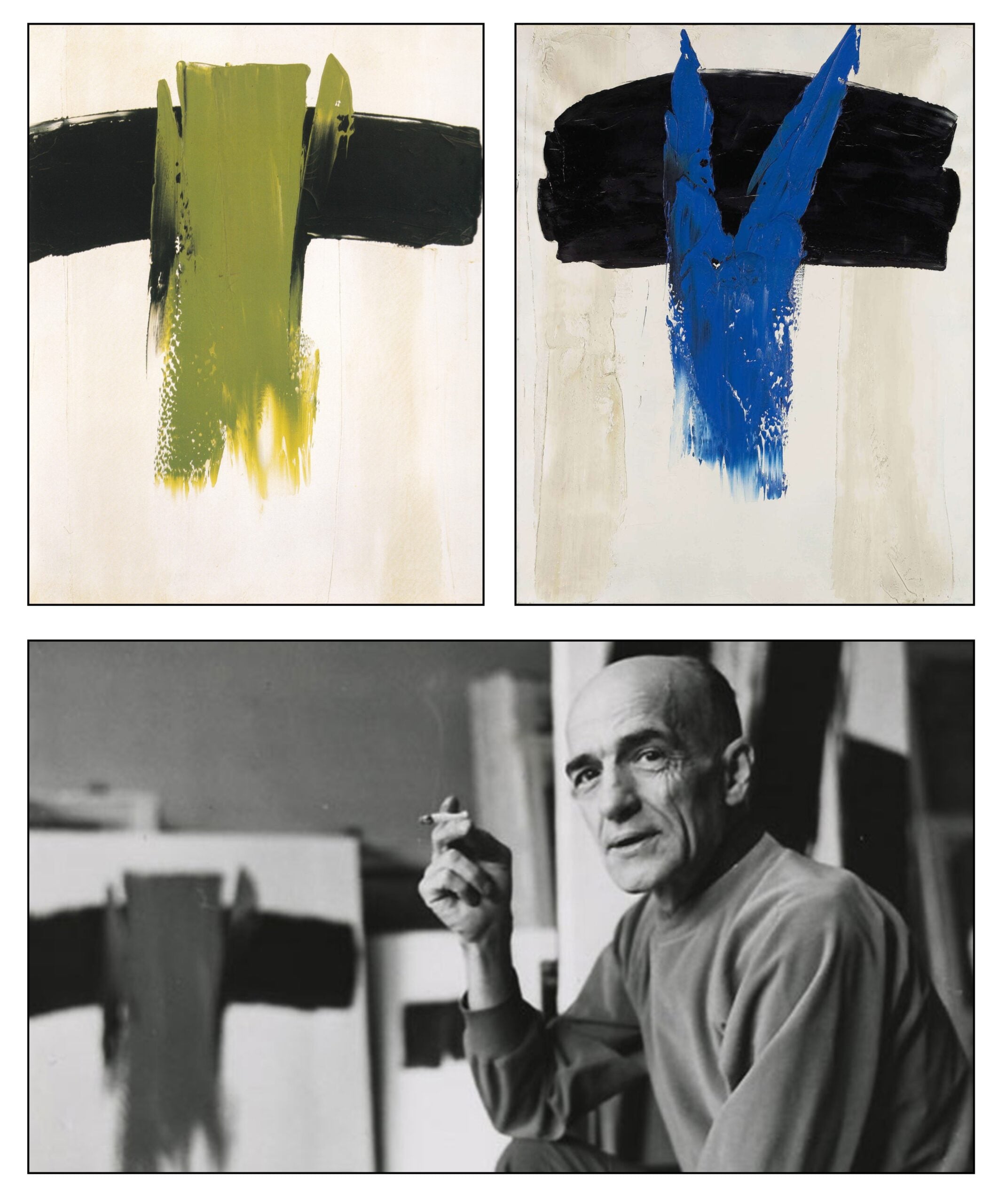
Borduas was not well. He was depressed about his exile from Canada, and his heart was starting to fail. His mental and physical and stresses found their way into this painting:
Ma peinture deviant de plus en plus sévère, noir et blanc, simplifiée; je n’y plus rien; c’est ma “fatalité.” [My painting is becoming more and more severe, black and white, simplified; I have nothing left; it is my “fatality.”] (quoted by Lambert 2015, p 94)
He died of a heart attack in February 1960. At his death, Borduas left on his easel a large black and white painting (later titled Composition 69):
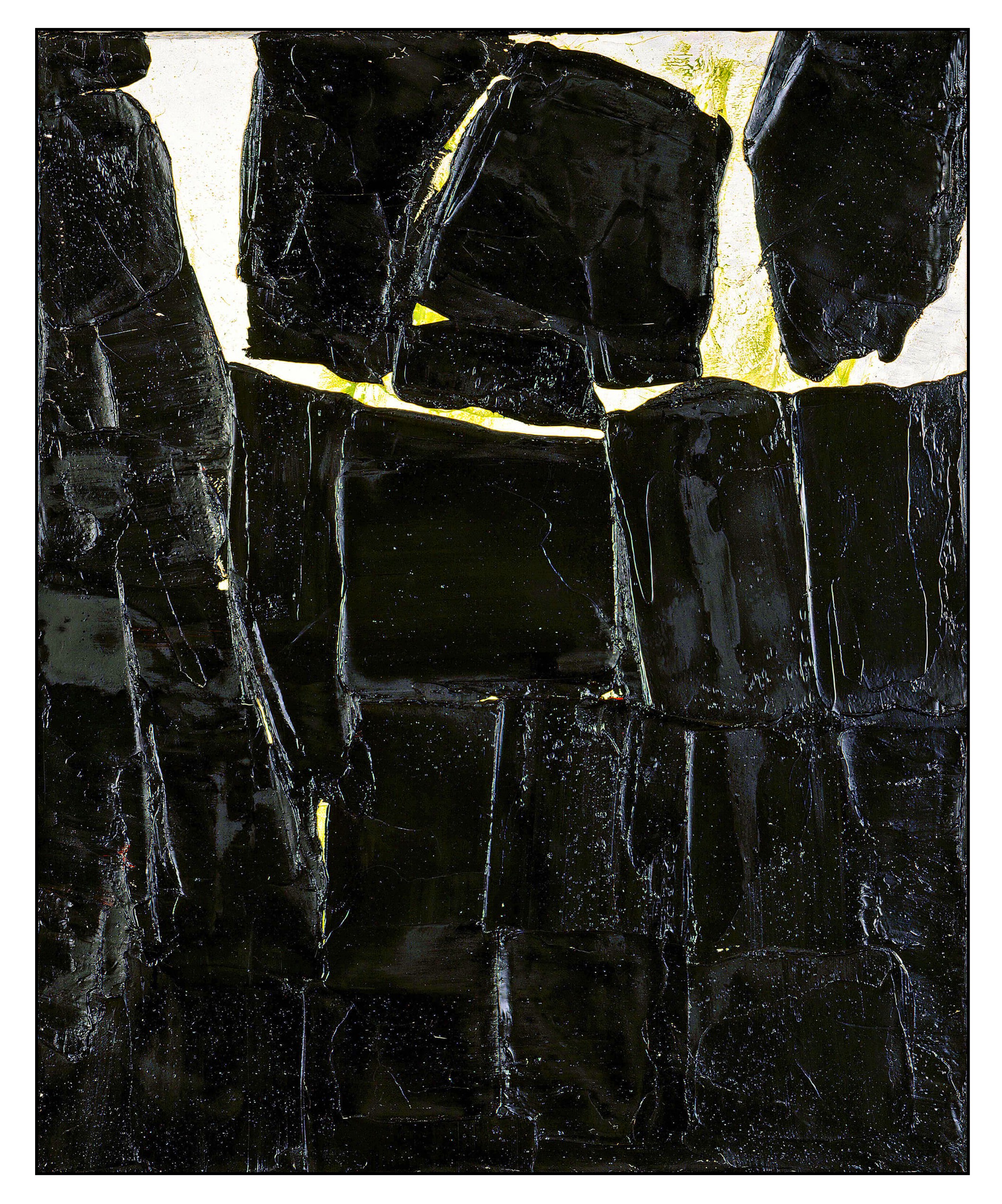
His friend the poet Jean-Paul Filion described the painting
Une seule masse noire et immense couvrant la surface presque totale de la toile, avec, dans le haut, un mince horizon de blanc dans lequel baigne un soupçon de vert limpide et où le peintre a piqué deux petites formes noires rectangulaires, créant ainsi une perspective fascinante vers l’espace. Que viennent faire ces deux blocs, ces deux masques, ces deux fantômes comme des bouts de linceul, et qui persistent à prendre toute la place dans un espace réduit de lumière inaccessible, le tout placé comme en exergue au sommet d’un haut mur de charbon luisant? Ce qui m’entraîne à voir dans cette oeuvre limite l’illustration d’une sorte de désespoir vécu aux confins du cosmos. Ai-je tort d’imaginer cela? (quoted in Lambert, 2015, p 97).
[One immense black mass covering almost the entire surface of the canvas. At the top, a thin white horizon with a hint of limpid green, in which the painter has stuck two rectangular black shapes, thus creating a fascinating view out into space. What are they doing there, these two blocks, these two masks, these two ghosts like bits of shroud, stubbornly taking up all the room in a cramped space of inaccessible light, sitting like an epigraph atop a high wall of glistening coal? I am led to see this final work as the illustration of a sort of despair experienced at the limits of the cosmos. Am I wrong in imagining that?]
La Révolution Tranquille
While Borduas was in self-imposed exile, the political landscape of Quebec was beginning to change. Since 1936, the province had been governed by the conservative Union Nationale party led by Maurice Duplessis, except for a brief period during World War II when the Liberal Party had won an election by promising to prevent conscription. The Union Nationale had close ties to the Catholic Church, and had hung a crucifix over the speaker’s chair in the National Assembly when they first came to power in 1936. One of their recuring slogans was Le ciel est bleu; l’enfer est rouge (Heaven is blue and Hell is red, a play on the colors of the two parties – blue for the Union Nationale and red for the Liberals). The Union Nationale was vehemently anti-union, and provided little if any support for education or social security, which were controlled by the church. The government supported a strictly capitalist economy, wherein the natural resources of the province were exploited by rich foreigners.
In late 1959, Duplessis died. In the election of June 1960, a brief four months after the death of Borduas, the Liberal Party under Jean Lesage were victorious. The Liberals instituted many reforms: the nationalization of the power companies to form Quebec Hydro, the establishment of a Quebec pension, increased support for education which now came under government rather than church control, and recognition of the unions even in the civil service. These came to be known as La Révolution Tranquille (Quiet Revolution), and the preceding period when the province was controlled by the Union Nationale came to be known as La Grande Noirceur (Great Darkness). These terms were those of the victors. In actuality, the Union Nationale period was not as dark as they believed, and the revolution turned out to be not as quiet as they wished (Bouchard, 2005).
After 1960, there were tremendous changes in Quebec society. Most importantly, the birth rate and the frequency of attendance at church declined precipitously. It is tempting to attribute these changes to the Liberal election. However, both a declining birth rate and an increasingly secular society occurred at the same time in the rest of Canada and in Western Europe. Other more global factors were at play: the availability of contraceptive medication and a burgeoning economy.
Whatever the actual causes, Borduas would have been pleased with the new Quebec. His Refus Global had called for these new freedoms and new responsibilities. Although his manifesto was rejected at the time it was published, the ideas that it promoted germinated and were finally acted upon.
References
Borduas, P.-É. (1948). Refus global. Mithra-Mythe Éditeur. Text of Borduas article is available. English translation available.
Borduas, P.-É. (translated by R. Ellenwood, 1985). Total refusal. Exile Editions.
Bouchard, G. (2005). L’imaginaire de la grande noirceur et de la révolution tranquille: fictions identitaires et jeux de mémoire au Québec. Recherches Sociographiques, 46(3), 411–436.
Breton, A. (1924, translated by R. Seaver and H. R. Lane, 1969). Manifestoes of Surrealism. Ann Arbor Paperbacks (University of Michigan Press)
Gagnon, F. M. (1988). Paul-Émile Borduas. Montreal Museum of Fine Arts.
Gagnon, F. M. (2014). Paul-Émile Borduas life & work. Art Canada Institute
Gagnon, F. M. (2013). Paul-Émile Borduas: a critical biography. McGill-Queen’s University Press.
Gagnon, F. M. (trans. D. Winkler, 2020) Jean Paul Riopelle and the Automatiste Movement, McGill-Queen’s University Press.
Lacroix, L. (2019) Ozias Leduc: life and work. Art Canada Institute
Lambert, P. (2015). Borduas: le rebelle de Saint-Hilaire. Marcel Broquet, la nouvelle édition.
Lion, A. (2010). Art sacré et modernité en France: le rôle du P. Marie-Alain Couturier. Revue de l’histoire des religions, 1|2010, 109-126.
Nasgaard, R., & Ellenwood, R. (2009). The Automatiste revolution: Montreal, 1941-1960. Douglas & McIntyre.
Warren, J.-P. (translated by S. Urquhart, 2017). Living art: individual and collective creativity: becoming Paul-Émile Borduas. Exil