Artemisia


Conventional histories of art mention few female painters. As Germaine Greer famously pointed out in her 1979 book The Obstacle Race, this is more related to their lack of opportunity in a patriarchal and misogynistic society than to any lack of talent (see also Nochlin, 1971; 1988). Greer pointed to a “magnificent exception” to the rule that female painters do not become renowned: Artemisia Gentileschi (1593-1656), a baroque painter, whose images continue to fascinate us with their conception and shock us with their power.   


Life (Barker, 2022; Siciliano, 2017)

Artemisia was the daughter of Orazio Gentileschi (1563-1639), a painter working in Rome. Her mother died when she was 12 years old. Artemisia was not given any formal schooling, and only learned to write as an adult. However, she displayed a talent for painting and she helped her father with his work.

Orazio’s skill was in the depiction of the human figure. He initially collaborated with Agostino Tassi, an expert in perspective: Orazio would supply the figures for Agostino’s landscapes. Later Orazio became influenced by Caravaggio (1571-1610), imitating the dramatic lighting of his younger colleague, and, like him, using real models for his subjects. At the age of 17 years, Artemisia produced her first major work, Susanna and the Elders (1610), “a signal statement by a young female artist declaring her skill, knowledge, and gender” (Simon, 2017).

A year later, in May 1611, she was raped by Agostino Tassi. When Tassi refused to marry her, her father brought charges against him for violating his family’s honor (Cohen, 2000). During the 7-month trial, Artemisia was examined under torture. The judges found Agostino guilty and exiled him from Rome, though the sentence was never carried out. In 1613, Orazio Gentileschi arranged for his daughter to marry the painter Pierantonio di Vincenzo Stiattesi, and the couple moved to Florence.

In Florence, Artemisia became a successful painter. She enjoyed the patronage of the Medici family and became friends with Galileo Galilei. She became the first woman artist to be accepted as a member of the Accademia delle Arti del Disegno. She learned to read and to write. During her period in Florence she produced two versions of what was to become her most famous painting: Judith Slaying Holofernes (1614). Her husband was unable to produce any work of note, and their relations became strained. Artemisia entered into a passionate affair with Francesco Maria Maringhi, a rich nobleman.

Artemesia returned to Rome in 1620. At that time, she became friends with the French painter Simon Vouet (1590-1649), who completed a striking portrait of Artemisia around 1625 (Locker, 2015, p 129). Hanging on a gold chain around Artemisia’s neck is a medallion with an image of the Mausoleum of Helicarnassus. This tomb, constructed by Artemisia for her husband Mausoleus in 350 BCE, became one of the wonders of the world. Artemisia Genitileschi had been named after the ancient queen. Although many of the statues that adorned the tomb are now in the British Museum, nothing remains of the building which slowly crumbled under the effect of repeated earthquakes. The portrait shown below with an enlargement of the medallion, and a sketch of the Mausoleum. 


In 1626 Artemisia moved to Venice in search of patronage. However, after a few years she moved on to Naples where she lived for the rest of her life, except for a brief visit to England in 1638 where she help her father Orazio with the decoration of the Queen’s House in Greenwich. At that time, she likely painted the Self-Portrait as the Allegory of Painting which entered the collection of Charles I of England. In Naples Artemisa was one of a group of baroque painters who produced large canvases for the city’s many churches. She likely died during the outbreak of plague in Naples in 1656.


Susanna and the Elders

The story of Susanna and the Elders is recounted in Chapter 13 of the Book of Daniel. Although earlier parts of Daniel are considered canonical by all Christian Churches, Protestants consider the later parts to be apocryphal, useful for edification but not divinely inspired.

According to the story the beautiful Susanna is surprised while bathing in her garden by two lecherous elders. They ask that she lie with them. If not, they threaten to accuse her of adultery with a young man, something that would be punishable by death. Susanna refuses their blackmail, the elders bring their false charges before a court, and Susanna is condemned to death. However, a young Daniel interrupts the proceedings, and examines the two elders separately. Unable to keep to a consistent story, the elders contradict themselves. One says that the adultery occurred under an oak tree and the other describes it as under a mastic tree. The difference in size between the two trees clearly demonstrates that they are lying. Susanna is vindicated and the elders are condemned to death for bearing false witness.

The story has been represented many times. The visual depiction of the nude Susanna being ogled and set upon by the lecherous old men is deeply disconceting. The story is meant to demonstrate the evils of lechery, but the painting presents a beautiful naked female for the enjoyment of the viewer. In this context, Artemisia’s 1610 painting is perhaps salutary. Susanna is obviously discomforted by the attentions of the elders. The image invokes more pity than lust.

The men in Artemesia’s painting are younger than the elders of the story (Bel, 2005). The dark-haired man is not much older than Susanna. One wonders whether the two men may not represent Tassi and Orazio, or Tassi and his friend Cosimo Quorli. The painting predates the rape but Tassi was likely bullying Artemisia long before the final rape.   

The painting shows Susanna seated on a stone bench. The usual treatment of this subject places her in a garden. Orazio and Artemisia both lacked talent for landscapes and gardens. Some have suggested that Tasso was supposed to mentor Artemisia in the principles of landscape and perspective. In which case, the bare bench perhaps states that Artemisia refused his teachings as well as his sexual advances.

The center of the painting shows an anxious tangling of arms. Susanna’s gesture may have derived from the Michelangelo’s painting of the Expulsion from Eden in the Sistine Chapel (1510). The painting is shown below together with the detail from Michelangelo.      

In 1998, the American artist Kathleen Gilje meticulously recreated Artemisa’s 1610 painting of Susanna and the Elders. She then produced an x-ray of her copy which revealed pentimenti of an earlier version of the picture: Susanna screaming with a knife in her hand. Everything is disturbed. The violence is transferred from the rapist to the victim. Though, like the pentimenti it was never realized. 

Artemesia painted many versions of Susanna and the Elders. The following is one from 1652. This Susanna is more composed than in the earlier painting. She is less afraid of the elders’ advances and rebukes them for their lechery. 

Judith and Holofernes

The Book of Judith is another scripture considered apocryphal by the Protestant churches. It recounts how the beautiful widow Judith arrays herself in all her finery and goes with her maid Abra to the camp of Holofernes, the Assyrian general besieging the Israelite city of Bethulia. She promises to help the Assyrians take the city. Holofernes is struck by Judith’s beauty and invites her to dine in his tent. After he becomes drunk, Judith decaptitates him with his own sword. Juditha and her maid and return to Bethulia with the severed head. The Israelites display the head upon the walls of their city. The Assyrians become demoralized and flee.

In the Renaissance and the Baroque eras, representations of Judith were used to depict the courage of the people who rise up against tyranny. The following illustration shows Donatello’s 1460 sculpture (above left), Caravaggio’s 1602 painting (below left), Cristofano Allori’s 1613 painting (above right) and Artemesia’s 1613 painting (below right).

Artemesia’s first depiction of Judith Slaying Holofernes shown on the previous page was likely painted in 1612-13 just after Artemesia’s rape and during the trial of Tassi. It is impossible not to see it as a response to her violation. Artemisia’s painting certainly derives in part from Caravaggio’s but differs from this earlier representation in its realistic violence of the slaying. Judith and Abra have to work together to overcome Holofernes, who is dangerous even though he is drunk.

Artemesia painted a second version of Judith Slaying Holofernes in Florence. Although usually dated to 1620, Whitlum-Cooper (in Treves et al, 2020) proposes that it was painted early in her stay in Florence, probably using a tracing of the original painting. The main difference between the paintings is in the spurting of the blood as the sword cuts through Holofernes’ carotid artery. Drops of blood stain the bosom of Judith and the bodice of her dress.

The following are comments by Germaine Greer (1979, pp 189-191):

The painting depicts an atrocity, the murder of a naked man in his bed by two young women. They could be two female cut-throats, a prostitute and her maid slaughtering her client whose up-turned face has not had time to register the change from lust to fear. The strong diagonals of the composition all lead to the focal point, the sword blade hacking at the man’s neck from which gouts of blood spray out, mimicking the lines of the strong arms that hold him down, even as far as the rose-white bosom of the murderess.
The excuse for such portrayal is, of course, the apocryphal story of Judith and Holofernes, which might equally well justify the portrayal of Jewish beauty (as it did for Rembrandt) or of a mistress’s careless cruelty (as it did in the luscious version of Cristofano Allori). Artemisia Gentileschi’s choice of depicting the act of decapitation itself had been made before, by Elsheimer and of course by her father’s erstwhile friend, Caravaggio.
Artemisia’s treatment of the same subject clearly refers to Caravaggio’s painting, but in no spirit of emulation; rather she has decided to outdo her predecessor. The composition is swung around and tightened into a terrible knot of violence. The tension away from the act which divides Caravaggio’s canvas is abandoned, for all the interest centres upon the ferocious energy and application of dark, angry Judith, who plies her sword like a peasant woman slaughtering a calf, in a claustrophobic oval of light filled with restless see-saw movement. There is no concession to decorative effect in the composition: the warm transparency of Artemisia’s palette and her delicate chasing of linear effects, the rippling of the tufted hem of the bed-covering, the tinkle of blood against Judith’s jewelled forearm, the sprouting of Holofernes’ hair through her ropy fingers, are all expressions of callousness. The spectator is rendered incapable of pity or outrage before this icon of violence and hatred, while he is delighted by such cunning.

About a year later, in 1614, Artemesia produced a more subtle painting of Judith and her Maidservant (illustrated below) The painting represents a moment after the slaying of the Assyrian general as Juditha and Abra are about to leave the tent. They hear a noise and stop. Judith puts her hand upon the shoulder of her maid to reassure her. They must wait until everything returns to silence before escaping from the Assyrian camp. Treves (2020) remarks

Judith’s gesture of resting the sword on her shoulder has been read as a sign of victory and justice. But it is also a subtle reminder of the weight of the general’s weapon, and the blade’s dangerous proximity to Judith’s exposed neck call to mind the decapitation that has just taken place. The sword’s pommel is placed prominently towards us and refers to the recently committed brutality: its shrieking head recalls the screams of Holofernes

Another fascinating detail is Judith’s hairpin which appears to be an onyx cameo representing a warrior-guardian. Garrard (2020, p 149) points out that the shawl draped round Abra’s hips alludes to the expressive drapery on the back of Donatello’s statue of Judith. Artemesia would have been well aware of Donatello’s late masterpiece. which was displayed in the Loggia dei Lanza on the Piazza della Signoria in Florence.   

Mary Magdalene

In 1616 or 1617, Artemesia painted a sumptious Conversion of the Magdalene. The painting was likely commissioned by Maria Maddalena the Grand Duchess of Tuscany, in honor of her namesake saint.

Mary is wearing a magnificent yellow silk dress. Yellow was one of Artemesia’s favorite colors. She may have learned how to portray yellow silk from Cristofano Allori, whose Judith (illustrated earlier) is also arrayed in shining yellow.

Mary Magdalene was an important subject for Artemesia. As Garrard (2020, pp 114-5) notes

Artemisia was well aware, and savvy Florentines could also have known, that Mary Magdalene’s story broadly matched her own; a woman whose identity is stamped with a sexualized past turns a corner and takes up a new, respectable life.

In the painting, Mary sits at a table and pushes away a mirror, a symbol of vanity. On the mirror is written Optimem Partem Elegit: “She chooses the better part” (Christiansen & Mann, 2001). Since Artemesia admitted at her rape-trial that she had not learned to write, these words and the signature on the back of the Magdalene’s chair may have been added by an assistant (Christiansen & Mann, 2001). The quotation comes from Jesus’ reply to Martha who complained that her sister Mary was not helping with the housework:

But Martha was cumbered about much serving, and came to him, and said, Lord, dost thou not care that my sister hath left me to serve alone? bid her therefore that she help me.
And Jesus answered and said unto her, Martha, Martha, thou art careful and troubled about many things:
But one thing is needful: and Mary hath chosen that good part, which shall not be taken away from her. (Luke 10: 40-42)

The passage is difficult to interpret. Most commentaries suggest that Jesus is commending Mary for considering the spiritual rather than the physical. One cannot live by bread alone. However, the skeptic might side with Martha and suggest that one also cannot live without bread.

The jar at Mary’s feet represents the ointment with which an unnamed sinful woman anointed the feet of Jesus:

And, behold, a woman in the city, which was a sinner, when she knew that Jesus sat at meat in the Pharisee’s house, brought an alabaster box of ointment
And stood at his feet behind him weeping, and began to wash his feet with tears, and did wipe them with the hairs of her head, and kissed his feet, and anointed them with the ointment. (Luke 7: 37-38).

Commentators have conflated Mary Magdalene with this sinful woman and with Mary the sister of Martha.    

Self Portraits

Artemesia produced many self-portraits and many of the heroines in her history paintings are in part versions of herself. We can appropriately bid farewell to Artemisia with the beautiful Self-Portrait as the Allegory of Painting, a bravura display of her ability to capture a person at a moment of time. One wonders whether the tiny head suspended on the chain around her neck makes reference to Holofernes.

In recent years the contributions of female artists have become more and more recognized (Hessel, 2023; Morrill et al., 2019; Pollock,2013). Several recent exhibitions have highlighted the work of Artemisia Gentileschi (e.g., Christiansen and Mann, 2001; Treves et al., 2020). Artemisa remains one of the great painters, regardless of her gender.


References

Bal, M. (Ed.) (2005). The Artemisia files: Artemisia Gentileschi for feminists and other thinking people. University of Chicago Press. (especially the chapter Grounds for Comparison by the editor)

Barker, S. (2022). Artemisia Gentileschi. Getty Publications.

Bennett, B. A., & Wilkins, D. G. (1984). Donatello. Phaidon.

Christiansen, K., & Mann, J. W. (2001). Orazio and Artemisia Gentileschi. The Metropolitan Museum of Art.

Cohen, E. S. (2000). The trials of Artemisia Gentileschi: a rape as history. Sixteenth Century Journal, 31(1), 47–75.

Garrard, M. D. (2020). Artemisia Gentileschi and feminism in early modern Europe. Reaktion Books.

Greer, G. (1979). The obstacle race: the fortunes of women painters and their work. Farrar, Straus, Giroux.

Hessel, K. (2023). The story of art without men. W. W. Norton

Locker, J. (2015). Artemisia Gentileschi: the language of painting. Yale University Press.

Locker, J. (2017). Artemisia Gentileschi: the literary formation of au unlearned artist. In S. Barker, Ed. Artemisia Gentileschi in a changing light. (pp 89-101). Harvey Miller (Brepols).

Morrill, R., Elderton, L., & Wright, K. (Eds.). (2019). Great women artists. Phaidon.

Nochlin, L. (1971). Why are there no great women artists? In Gornick, V., & Moran, B. (eds.). Woman in Sexist Society: Studies in Power and Powerlessness. Basic Books.

Nochlin, L. (1988). Women, Art and Power & Other Essays. Harper Collins.

Pollock, G. (2013). Differencing the canon: feminism and the writing of art’s histories. Taylor and Francis.

Siciliano, G. (2019). I know what I am: the life and times of Artemisia Gentileschi. Fantagraphics Books.

Simons, P. (2017). Artemisia Gentileschi’s Susanna and the Elders (1610) in the Context of Counter-Reformation Rome. In S. Barker, Ed. Artemisia Gentileschi in a changing light. (pp 41-57). Harvey Miller (Brepols).

Treves, L., Barker, S., Cavazzini, P., Cropper, E., Whitlum-Cooper, F., Solinas, F., & Keith, L. (2020). Artemisia. Yale University Press.


Apostola Apostolorum

Apostola apostolorum

In the gospels of the Christian New Testament, Mary Magdalene was the first person to recognize the risen Christ. He told her to tell the disciples the news of his resurrection, thus honoring her as the “apostle to the apostles.” In the Gnostic Gospels she appears as a visionary disciple of Jesus. In the centuries after her life, her story was conflated with that of the sinful woman who anointed the feet of Jesus at a feast in the house of Simon, and Mary thus became a model of repentance. This posting discusses these and other ways in which we conceive of Mary Magdalene.

The Tower

Mary Magdalene’s name likely comes from Magdala, a settlement on the Sea of Galilee during the years 300 BCE to 300 CE. Recent archeological excavations have unearthed evidence there of a synagogue, in which was found the “Magdala Stone,” with carvings showing a Menorah and images of the Second Temple in Jerusalem, destroyed by the Romans in 70 CE. The Aramaic word magdala means “tower.” These may have been related to fortification towers or to towers used for the drying of fish.

Another possible reason for Mary Magdalene’s name is that she was called the “Tower” for the strength of her faith in much the same way as Peter was called the “Rock” for his unwavering devotion (Valerio, 2021, pp 19-20). Saint Jerome (347-420 CE) reported that:

Mary of Magdala received the epithet ‘fortified with towers’ because of her earnestness and strength of faith, and was privileged to see the rising Christ before even the apostles. (quoted in Haskins, 1993, p 58)

Noli me tangere

Mary Magdalene is specifically mentioned in the canonical gospels in connection with three events in the life of Jesus (Haskins, 1993, Chapter 1; Lupieri, 2011; Valerio, 2021, Chapter 1):

(i) During the time when Jesus was preaching and healing the sick near Capernaum, the gospel of Luke describes his entourage as consisting of the twelve disciples

And certain women, which had been healed of evil spirits and infirmities, Mary called Magdalene, out of whom went seven devils,
And Joanna the wife of Chuza Herod’s steward, and Susanna, and many others, which ministered unto him of their substance. (Luke 8: 2-3)

No one knows for certain what was meant by the casting out of demons in those times. It likely represented a charismatic healing of an emotionally disturbed person. After Mary was cured of her affliction, she followed her healer, and provided him with monetary support.

(ii) Later, Mary Magdalene, Mary, the mother of James and Joseph, and Mary, the mother of Jesus, were present at the crucifixion of Jesus and his subsequent burial in the tomb of Joseph of Arimathea. In the synoptic gospels, no mention is made of any of the disciples being present: they were presumably terrified of being associated with the crucified Jesus. The gospel of John reports that a beloved disciple was also there:

Now there stood by the cross of Jesus his mother, and his mother’s sister, Mary the wife of Cleophas, and Mary Magdalene.
When Jesus therefore saw his mother, and the disciple standing by, whom he loved, he saith unto his mother, Woman, behold thy son!
Then saith he to the disciple, Behold thy mother! (John, 19: 25-27)

Though the disciple “whom he loved” is usually considered to be John, it is also possible to interpret this passage as referring to Mary Magdalene.

(iii) The final mention of Mary Magdalene is in the discovery of the empty tomb by the women who came to anoint the dead body of Jesus with spices and ointments. What then occurred is variously described in the different gospels. In most accounts, the women tell the disciples about the empty tomb, but no one understands what has happened. In one account (Matthew), Jesus then appears to all the women. In the clearest account (John), Mary Magdalene alone is the first to recognize the risen Christ:

But Mary stood without at the sepulchre weeping: and as she wept, she stooped down, and looked into the sepulchre,
And seeth two angels in white sitting, the one at the head, and the other at the feet, where the body of Jesus had lain.
And they say unto her, Woman, why weepest thou? She saith unto them, Because they have taken away my Lord, and I know not where they have laid him.
And when she had thus said, she turned herself back, and saw Jesus standing, and knew not that it was Jesus.
Jesus saith unto her, Woman, why weepest thou? Whom seekest thou? She, supposing him to be the gardener, saith unto him, Sir, if thou have borne him hence, tell me where thou hast laid him, and I will take him away.
Jesus saith unto her, Mary. She turned herself, and saith unto him, Rabboni; which is to say, Master.
Jesus saith unto her, Touch me not; for I am not yet ascended to my Father: but go to my brethren, and say unto them, I ascend unto my Father, and your Father; and to my God, and your God.
Mary Magdalene came and told the disciples that she had seen the Lord, and that he had spoken these things unto her. (John 20: 11-18)

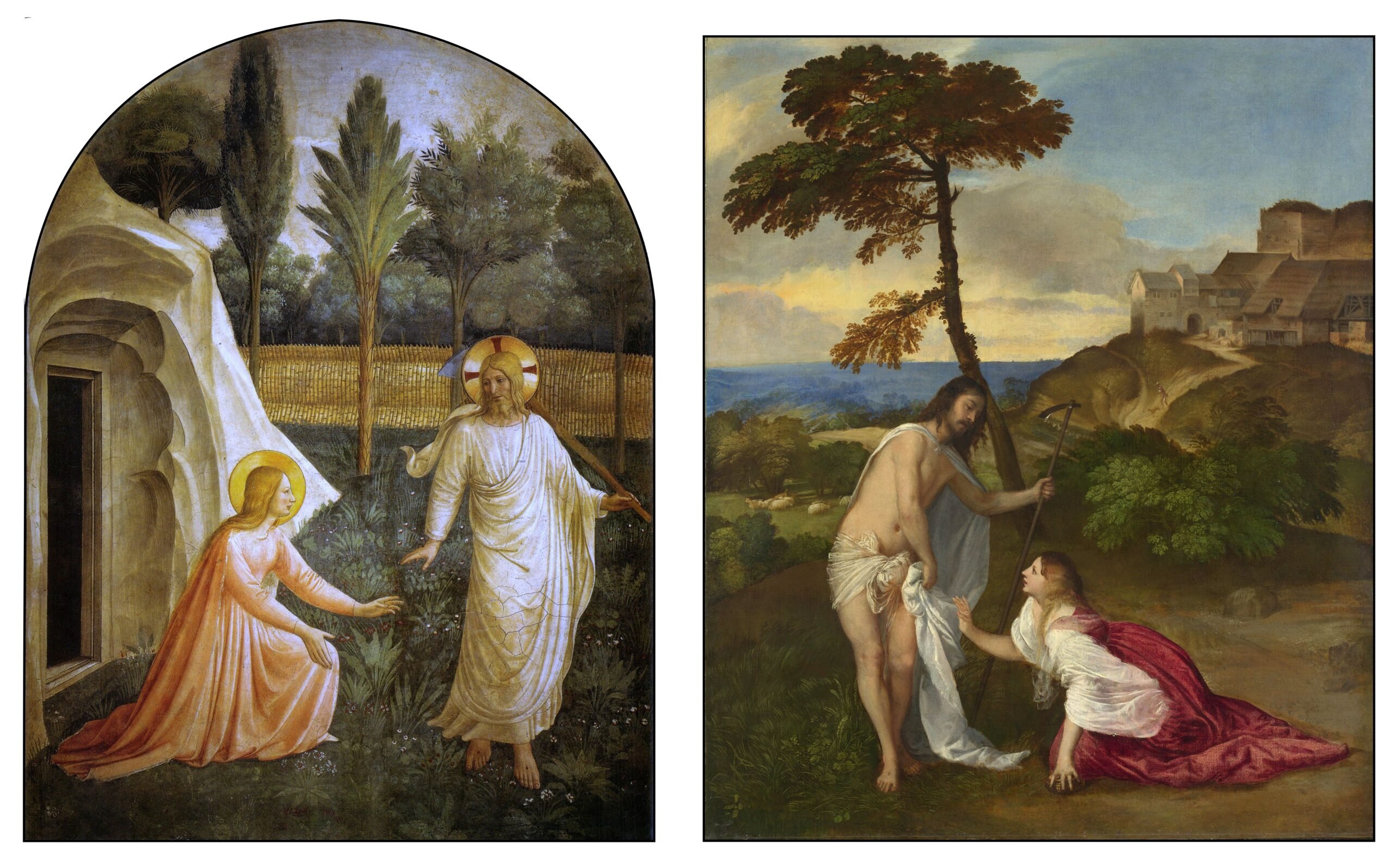
Jesus’ unusual request that she touch him not (Noli me tangere in the Vulgate) became the subject of multiple paintings and engravings. Christ is often shown with a gardening tool or holding a banner with a red cross, signifying his resurrection. The scene is set in a garden in the soft light of morning. This new garden takes the place of that lost in Eden. Illustrated below are a fresco by Fra Angelico (1442) and a painting by Titian (1520).

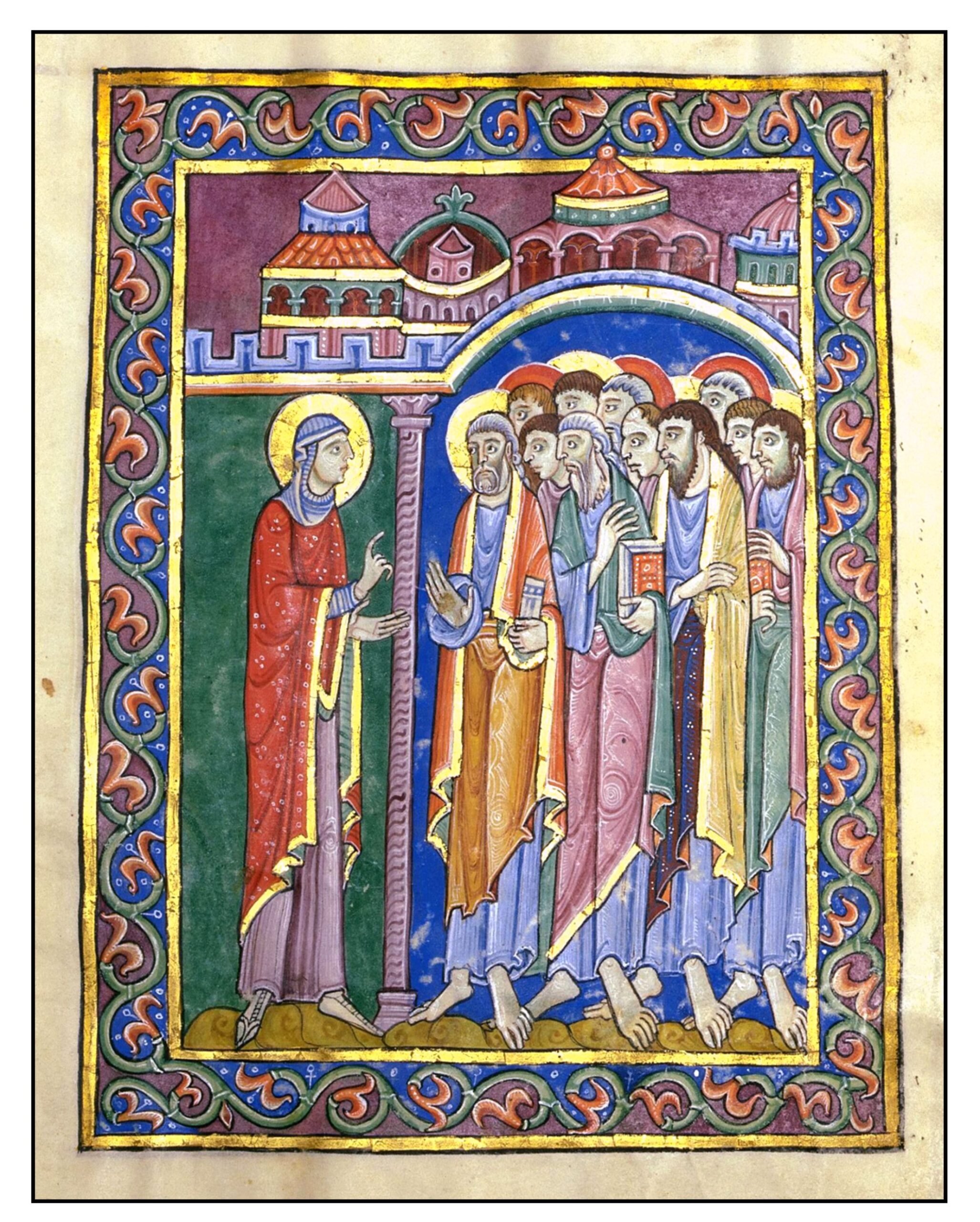
By being the first to recognize the resurrected Jesus, Mary Magdalene became the apostola apostolorum, the apostle to the apostles, the person who first proclaimed the news of the resurrection. The Latin title allows the gender to be noted: Mary Magdalene was the female apostle who first told the male apostles about the resurrection. This was the subject of an illustration in the St Alban’s psalter (circe 1140 CE), a masterpiece of English Romanesque painting (Carrasco, 1999):

Though the early church considered the Magdalene as the apostola apostolorum, this recognition was often given grudgingly by male priests who could not understand why such a role was granted to a woman. Mary was often related to Eve: Eve brought sin and death to man in the garden of Eden, Mary Magdalene witnessed man’s salvation from sin in the garden of Arimathea. In the words of Augustine of Hippo (354-430 CE): per feminam mors, per feminam vita (“death through woman; life through woman” quoted by Jansen, 1998).

The Beloved Companion

Mary Magdalene occurs frequently in other reports of Jesus written soon after his death. Fragments of The Gospel of Mary written in Coptic were discovered in 1896. This likely dates to the mid-1st Century CE, but concerns a tradition in early Christianity going back to a devoted follower of Jesus named Mary who, though not specifically named, was probably Mary Magdalene (King, 2003; Meyer & de Boer, 2004). Other Coptic writings such as the Gospel of Thomas, the Gospel of Philip and Pistis Sophia (“Faith and Wisdom”), discovered in Nag Hammadi in 1945, also mention Mary, sometimes specifically calling her the Magdalene.

Compared to the canonical gospels, these “Gnostic” gospels are more concerned with the path from illusion to enlightenment than from repentance to salvation. Key to the Gnostic view of life is the need to seek the truth within oneself:

When you know yourselves, then you will be known, and you will understand that you are children of the living father. But if you do not now yourselves, then you dwell in poverty and you are poverty. (Gospel of Thomas, in Meyer, 2008, p 116)

In the Gnostic Gospels, Mary Magdalene is described as the beloved companion of Jesus:

The Saviour loved Mary of Magdala more than all the disciples, and he kissed her often on her mouth. (Gospel of Philip, in Meyer, 2008, p 142).

Several modern novelists have considered the close relationship between Mary Magdalene and Jesus (reviewed in Valerio, 2021, Chapter 5). Kazantzakis’ The Last Temptation of Christ (1951) describes how Jesus, as he is dying on the cross, had a vision of a future life wherein he and Mary raised a family. Saramago’s The Gospel according to Jesus Christ (1991) describes how the courtesan Mary introduced the young Jesus to physical love, and later left her profession to become his devoted companion. Valerio (2021, p 91) notes that that modern novelistic treatments of Jesus are concerned about the “irreconcilability of sacred and profane love” and “the incomprehension of a God of love who paradoxically is unable to love a woman to the fullest.”   

Many have speculated that Mary might have been married to Jesus. In 2012, this idea was brought into prominence by the discovery of a ancient papyrus fragment containing the words “Jesus said to them, ‘my wife…’ ” Unfortunately, this was later determined to be a forgery (Sabar 2020). 

Whatever their relationship, Mary Magdalene was privy to teachings of Jesus of which the other disciples were unaware:

Peter said to Mary, ‘Sister, we know that the Saviour loved you mor than all other women. Tell us the words of the Saviour that you remember, the things you know that we don’t because we have not heard them.’ Mary responded, ‘I will teach you about what is hidden from you.’ (Gospel of Mary, in Meyer 2008, p 640)

In later fragments of the Gospel of Mary, the Magdalene describes the ascent of the soul away from darkness, desire, ignorance and wrath, until it is finally set loose from the world and attains rest (Meyer, 2008, p 642). 

In several of the Gnostic Gospels, the male disciples, Peter in particular, complain about Mary’s special status and dispute her reports of Jesus and his teachings. Over the time that these gospels were written, orthodox beliefs were consolidating around the idea that women were inferior to men and could not serve as Christian priests. And these priests desired that believers should be taught the truth by the church rather than seek it within themselves.

Beata Peccatrix

Mary, deriving from the Hebrew “Miriam,” the sister of Moses, was a common name in Palestine at the time of Jesus. The many women named Mary in the gospels are difficult to distinguish and are often conflated into one person. In 591 CE, Pope Gregory the Great proposed that Mary of Bethany and Mary Magdalene were one and the same person (discussed by Haskins, 1993, pp 95-97, and Ehrman 2006, pp. 187-92). This placed Mary Magdalene at the raising of Lazarus from the dead (John 11) and at the anointing of Jesus:

Then took Mary a pound of ointment of spikenard, very costly, and anointed the feet of Jesus, and wiped his feet with her hair: and the house was filled with the odour of the ointment. (John 12: 3).

In Matthew and Mark’s version the anointing took place at a dinner in the house of Simon, and in Luke’s version, the unnamed woman who anointed the feet of Jesus was a “sinner.” Since Mary Magdalene had been exorcised of seven devils, Gregory inferred that she had been subject to all the seven deadly sins. His pronouncement led to the idea that Mary Magdalene was a prostitute who gave up her life of luxury and indulgence to become a follower of Jesus. Mary is also often conflated with the unnamed “woman taken in adultery” that Jesus saved from the Pharisees who wished to stone her (John 8).

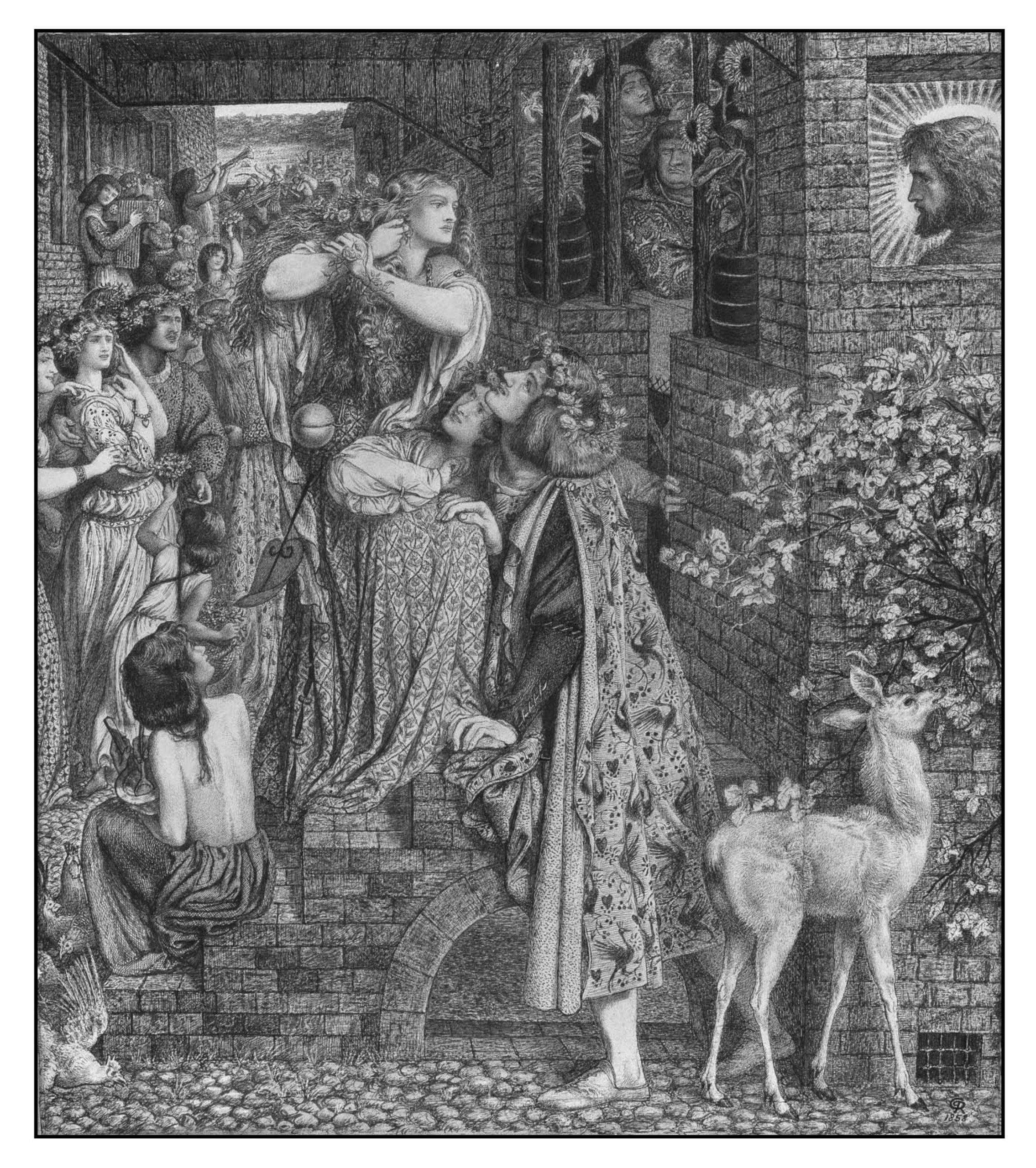
The dramatic moment of her decision to renounce her life of sin is illustrated in the 1858 drawing Mary Magdalene at the Door of Simon the Pharisee by Dante Gabriel Rossetti together with its accompanying sonnet:

Why wilt thou cast the roses from thine hair?
Nay, be thou all a rose,—wreath, lips, and cheek.
⁠Nay, not this house,—that banquet-house we seek;
See how they kiss and enter; come thou there.
This delicate day of love we two will share
⁠Till at our ear love’s whispering night shall speak.
⁠What, sweet one,—hold’st thou still the foolish freak?
Nay, when I kiss thy feet they ‘ll leave the stair.”

“Oh loose me! Seest thou not my Bridegroom’s face
⁠That draws me to Him? For His feet my kiss,
⁠⁠My hair, my tears He craves to-day:—and oh!
What words can tell what other day and place
⁠Shall see me clasp those blood-stained feet of His?
⁠⁠He needs me, calls me, loves me: let me go!”

At the center of the drawing Mary (a portrait of the actress Ruth Herbert) sees Jesus and casts the roses from her hair. Despite the protestation of her richly dressed companion (a portrait of the poet Charles Swinburne), she decides to leave the procession of revelers.

After Pope Gregory’s conflation of Mary with the sinful woman who repented of her sins and anointed the feet of Christ, the Magdalene became commonly viewed as the beata peccatrix (“holy sinner”). Numerous paintings have depicted her stunning beauty and her sincere repentance (Haskins,1993, particularly Chapters 5, 6 and 7). Below is Caravaggio’s Penitent Magdalene (1595).

A beautiful young woman with auburn hair sits in a shadowy room; she has removed her jewelry and is quietly weeping. This was the first realistic portrait of the Magdalene: Caravaggio had used an actual prostitute as his model. In his commentary on the painting Hunt (2012, p 174) remarks   

Caravaggio paints the Magdalene possibly ambiguously, choosing the moment after she has loosened her hair, an act sometimes perceived as a provocative act in which a courtesan would have usually prepared to bed a client-lover, but here more likely an allusion for her preparation to wash Christ’s feet. … the chains on the floor around the Magdalene in the painting may be gold but they could nonetheless be interpreted as having bound the Magdalene to a life of rich material “possession”—even the putative “demonic” possession from which she was exorcised.

Apostolos-Cappadona (2005, p 219) comments on the position of the Magdalene’s head

Leaning toward her left shoulder, her lowered head droops downward and her chin tilts onto her collarbone in a pose empathetic to that of the crucified Christ.

Unfortunately, paintings of the repentant Magdalene often lapse into sentimentality. Indeed, the word “maudlin” derives from her name. Many paintings are extremely disconcerting in the sense that the viewer is invited to enjoy the view of her naked body while thinking holy thoughts about the denial of the flesh.

Misogyny in many forms runs through the history of Christianity and plays forever with our understanding of the Magdalene:  

One can’t help but think that the men who relish this recollection of Mary the penitent sinner are those who are trying to inform their own world with their own vision of what sexual and gendered relationships ought to be, with women not enticing men with the dangers of sex but falling at their feet in humble submission and penitence. (Ehrman, 2006, p 192).

One of the legacies of the concept of the Magdalene as a reformed prostitute was the foundation of institutions to help wayward females. Though some of these may have provided safe asylum for abused women, many simply imprisoned and exploited their charges. The most notorious of these institutions were the Magdalene Laundries in Ireland. Here unmarried mothers gave birth to children that were taken from them. As penance for their sins, they then worked as slaves in laundries to raise money for the church.


Legends of Mary

Mary Magdalene the Apostle soon inspired some amazing stories. These were collected by Jacobus de Voragine for his book about the saints entitled The Golden Legend (circe 1260). 

According to legend, Mary Magdalene together with Bishop Maximin, Martha and the resurrected Lazarus were cast adrift in the Mediterranean Sea by an anti-Christian mob. Though the boat has neither rudder nor tackle, they were miraculously carried to the West and made landfall in the Camargue near Marseille. There on the steps of a pagan temple, Mary Magdalene preached the gospel of Christ. One of the pagan leaders came to the temple to make offerings to the gods so that his wife might bear him a child. Mary prayed that the Lord might give them a son. When his wife conceived, the leader decided that they should go to Saint Peter in Rome on a pilgrimage of thanks. Unfortunately, during the voyage a storm arose and the wife died in childbirth. Fearful that they had offended the gods, the sailors left her and the newborn son on a rocky island. When the pagan leader reached Rome, Saint Peter consoled him, told him that all would be well, and took him to Jerusalem to see where Jesus had lived and died.

When the pagan leader finally travelled back to Marseille, he came upon the rocky island where his dead wife had been left. There he found his two-year-old son, capering on the rocks and nursing at the breast of his dead mother. Mary Magdalene had miraculously intervened to preserve the body of the mother and the life of the son.

After several years preaching the gospel in the South of France, Mary Magdalene retired to a deserted mountainous region, where she lived for thirty years as a hermit. During this time, she had no need of earthly food. Instead, she was daily transported into the sky to dine with the angels. Ultimately, she received her last communion from Bishop Maximin and died. The Basilicas of Sainte Marie Madeleine in both Saint-Maximin-la-Sainte-Baume, Provence, and Vézelay, Burgundy, purport to have relics of the saint.

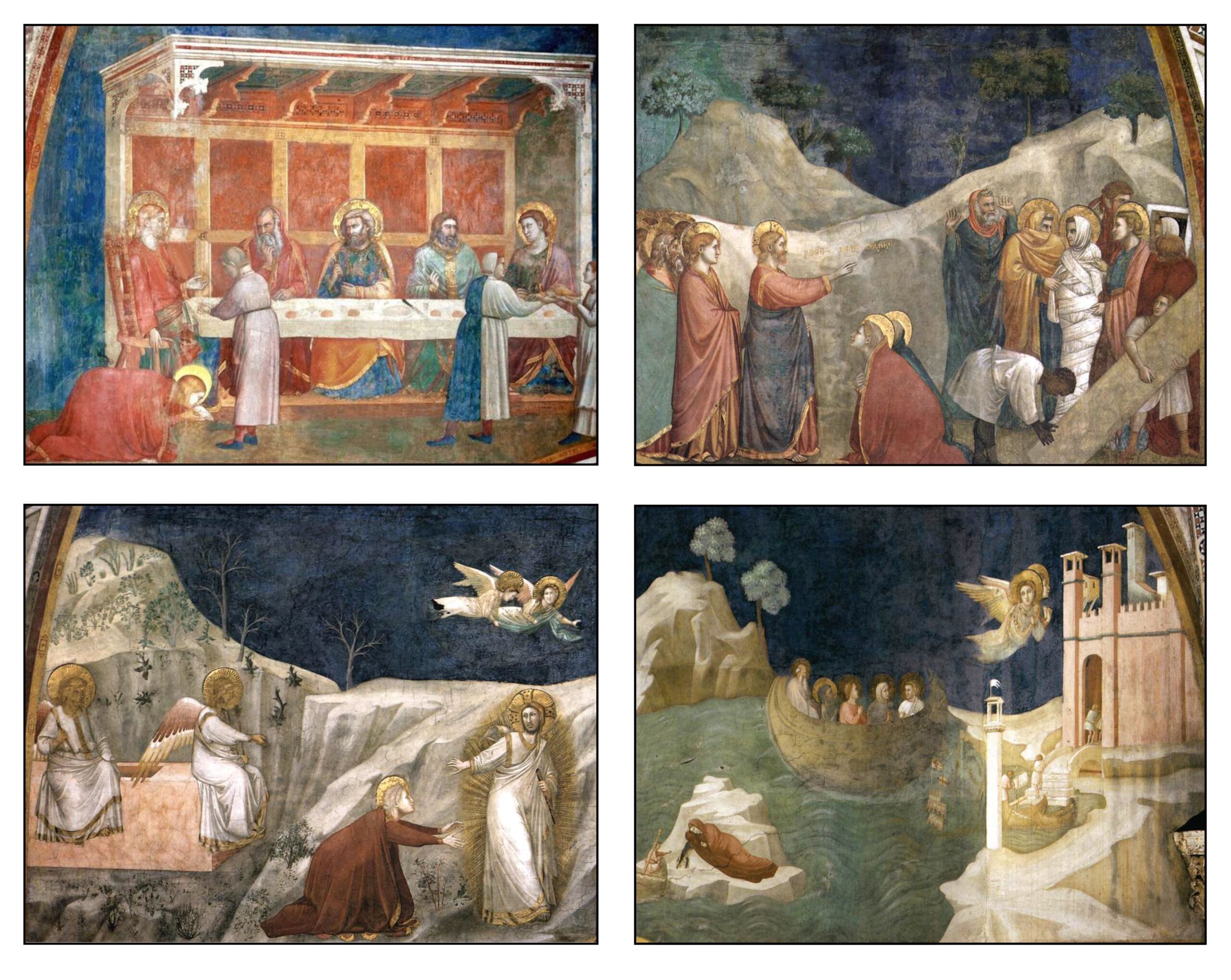
The story of the Magdalene arriving in France and the miracle of the child who was nourished at his dead mother’s breast is depicted in one of the frescos (illustrated below, lower right) by pupils of Giotto in the Magdalen Chapel of the Basilica of Saint Francis in Assisi (Mignozzi, 2019). Other frescos in the cycle illustrate the anointing of Jesus, the raising of Lazaurus, and the Noli me tangere episode. In the Lazarus episode, Christ speaks the words “Lazarus come forth” (Vulgate Lazare veni foras, John 11: 43). In the fresco these words are written in reverse order, to illustrate how they travelled from Jesus to Lazarus:

Jacopo de Voragine also reports the story that Mary Magdalene was married to John the Evangilist, and that John left Mary on their wedding night to follow Jesus. Indignant that she had been deprived of her husband, Mary indulged herself in the pleasures of the flesh. Not willing to let the calling of John be the cause of her damnation, Jesus later convinced her to repent and join his disciples. This version of the story was expanded in Yourcenar’s passionate story of the Madeleine in her collection of prose poems entitled Fires (1935). Though Mary loves Jesus passionately, she realizes that she must give him up to his destiny:

So as not to ruin his career as Saviour, I consented to see him die as a mistress consents to the rich marriage of the man she loves. (p 72).

Ascetic Mary

The Golden Legend also included the story of Mary of Egypt, a prostitute born in the 4th Century CE, who left her profession and became a hermit in the desert. Her clothes wasted away so that her hair was her only covering.

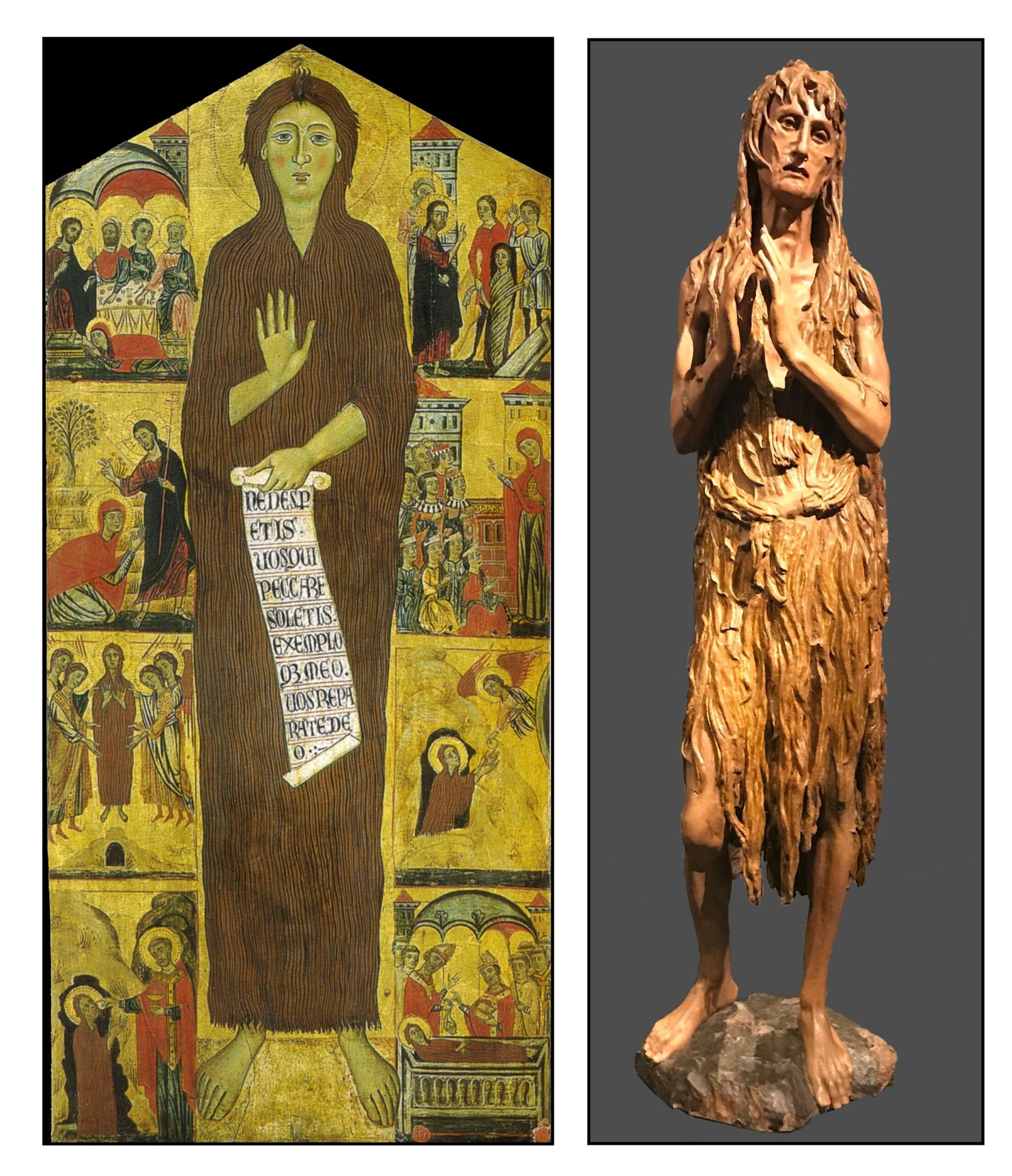
Mary of Egypt was soon conflated with Mary Magdalene. The depiction of the Magdalene covered in her own hair began in Italy with the painting of the Master of the Magdalene (1285) illustrated on the left below (Bradfield, 2002; Huggins, 2016). In the central portrait, Mary holds a banner stating

Ne desp[er]etis vos qui peccare soletis exemploque meo vos reparate Deo (Despair not you who are accustomed to sin, and by my example, return to God.)

On both sides of are episodes from her life: On the left are shown Mary Anointing Christ’s Feet, Noli Me Tangere, Mary Borne to Heaven by Angels, and Bishop Maximin giving Mary her Last Communion. On the right are The Resurrection of Lazarus, Mary Magdalene Preaching, An Angel Feeding Mary in the Desert, and the Funeral of Mary Magdalene

In 1455, Donatello created a wooden sculpture of The Penitent Magdalene, unclothed except for her own hair (illustrated on the right above). In 1492, Riemenschneider carved a series of panels for the altar of Church of Saint Mary Magdalene in Münnerstadt, Germany (Chapuis, 1999, Kalden-Rosenfeld, 2004). These show Christ in the House of Simon, Noli me Tangere, Mary Magdalene’s Last Communion, and Mary Magdalene’s Entombment. In the latter two panels (on the right) Mary is clothed only in her hair, although in these examples the hair appears to grow from all her body:

*7

The Visionary

In the Gospel of Mary, Mary asks Jesus about a vision she experienced:

She said, ‘I saw the Lord in a vision and I said to him, “Lord, I saw you today in a vision.” He answered me, “Blessed are you for not wavering at seeing me. For where the mind is, there is the treasure.” I said to him, “So now, Lord, does a person who sees a vision see it with the soul or with the spirit?” The Saviour answered, “A person does not see with the soul or with the spirit. Rather, the mind which exists between these two sees the vision …” ’ (Meyer, 2008,pp 641-2)

This makes a skeptic wonder whether her meeting the resurrected Jesus was a visionary rather than real experience. In his Vie de Jésus (1863) Renan noted that Mary Magdalene had earlier been exorcised of her devils, and therefore questioned the veracity of Mary Magdalene’s encounter with Jesus in the garden outside the empty tomb.

The life of Jesus, to the historian, ends with his last sigh. But so deep was the trace which he had left in the hearts of his disciples and of a few devoted women, that, for weeks to come, he was to them living and consoling. Had his body been taken away, or did enthusiasm, always credulous, afterwards generate the mass of accounts by which faith in the resurrection was sought to be established? This, for want of peremptory evidence, we shall never know. We may say, however, that the strong imagination of Mary Magdalene here enacted a principal part. Divine power of love! Sacred moments in which the passion of a hallucinated woman gives to the world a resurrected God!

The request of Jesus that Mary not touch him was unusual. Was it because he was just a vision and that there was nothing to touch?

The Holy Grail

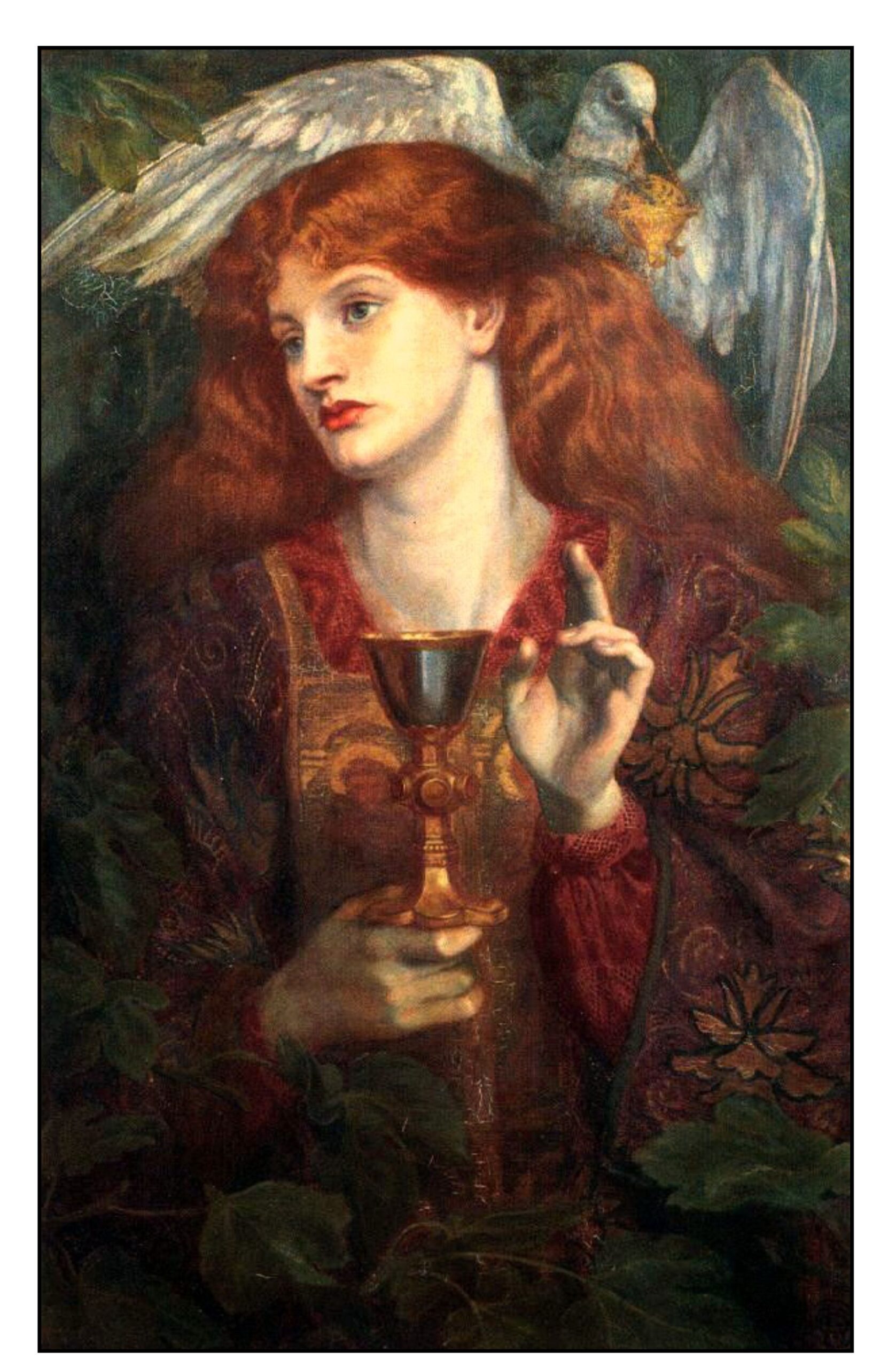
The Holy Grail (old French San Gréal) is a long-lost treasure sought by knights of old. The most common interpretation is that it is the cup (“holy chalice”) used by Jesus at the last supper. The word “grail” might have derived from the Greek krater (a bowl used for mixing wine with water). According to some legends this cup was also used by Joseph of Arimathea to catch the blood dripping from the wounds of the crucified Jesus. Other legends describe how the cup was then brought by Joseph to France or Britain, and kept in some undiscovered Castle of the Holy Grail, where it was guarded by the Grail Maiden. Dante Gabriel Rossetti painted this Damsel of the Sanct Gréal in 1874 (illustrated on the right).

In 1982, Baigent, Leigh and Lincoln published a reinterpretation of these legends in The Holy Blood and the Holy Grail. Based upon a reading of san gréal as sang réal (royal blood), they conceived the holy grail as representing the bloodline of Jesus. They proposed that Mary Magdalene conceived one or more children by Jesus and raised her family in France. Saint Sarah of Provence was perhaps her daughter (Starbird, 1993). Baigent and his co-authors proposed that, over the years, the descendants of Jesus and Mary were protected by the Cathars, the Knights Templar, and the Priory of Sion against the forces of orthodoxy that tried to destroy them. These speculations are the basis of Brown’s bestseller The Da Vinci Code (2003), in which the last surviving descendant of Jesus and Mary Magdalene is ultimately discovered in modern Paris.  

Epilogue

We can never know the real Mary Magdalene. She has become a legend, and legends have various interpretations. Perhaps her most characteristic trait is her human-ness: she is not tainted with divinity. She enjoyed physical love, repented of her sins, and had one main loving relationship with a man, who was crucified for what he taught. After his death, Mary had visions of his continued presence. She tried to continue his teaching, but was maligned for being a woman. She gave birth to a daughter and fled to France to raise her family. 


References

Apostolos-Cappadona, D. (2005). “Pray with tears and your request will find a hearing”: On the iconology of the Magdalene’s tears. In Hawley, J. S., & Patton, K. C. (Eds.) Holy tears: weeping in the religious imagination. (pp. 201-228). Princeton University Press,

Baigent, M., Leigh, R.; & Lincoln, H. (1982). The Holy Blood and the Holy Grail. Jonathan Cape.

Bradfield, B. (2002). The hair of the Desert Magdalen: its use and meaning in Donatello’s Mary Magdalen and Tuscan art of the late Fifteenth Century. York Medieval Yearbook 1

Brown, D. (2003). The Da Vinci Code. Doubleday.

Carrasco, M. E. (1999). The imagery of the Magdalen in Christina of Markyate’s Psalter (St. Albans Psalter). Gesta, 38 (1), 67-80.

Chapuis, J. (1999). Tilman Riemenschneider: master sculptor of the late Middle Ages. Yale University Press.

Ehrman, B. D. (2006). Peter, Paul, and Mary Magdalene: the followers of Jesus in history and legend. Oxford University Press.

Haskins, S. (1993). Mary Magdalen: myth and metaphor. HarperCollins.

Huggins, R. V. (2016). A brief guide to the iconography of the anonymous Mary Magdalen Cycle Panel in Florence’s Galleria dell’Accademia

Hunt, P. (2012). Irony and realism in the iconography of Caravaggio’s Penitent Magdalene. In Erhardt, M. A., & Morris, A. M. (eds.) Mary Magdalene, Iconographic Studies from the Middle Ages to the Baroque. (pp. 161-186). Brill.

Kalden-Rosenfeld, I. (2004). Tilman Riemenschneider: the Sculptor and his workshop. Langewiesche.

King, K. L. (2003). The Gospel of Mary of Magdala: Jesus and the first woman apostle. Polebridge Press.

Jansen, (1998). Maria Magdalena: Apostolorum Apostola. In Kienzle, B. M., & Walker, P. J. (Eds). Women preachers and prophets through two millennia of Christianity. (pp. 57-96). University of California Press.

Lupieri, E. F. (2019). The earliest Magdalene: Varied portrayals in early gospel narratives. In Lupieri, E. F.(ed.) Mary Magdalene from the New Testament to the New Age and Beyond. (pp. 11-25). Brill.

Meyer, M. W., & de Boer, E. (2004). The Gospels of Mary: the secret tradition of Mary Magdalene, the companion of Jesus. HarperSanFrancisco.

Meyer, M. (2008). The Gnostic Gospels. Folio Society.

Mignozzi, M. (2019). Suspended between sacred and profane: the iconography of Mary Magdalene from its origins to the Fifteenth Century. In Lupieri, E. F.(ed.) Mary Magdalene from the New Testament to the New Age and Beyond. (pp 189-252). Brill.

Renan, E. (1863). La vie de Jésus. Michel Lévy. (English translation by C. E. Wilbour, 1891)

Sabar, A. (2020). Veritas: a Harvard professor, a con man and the Gospel of Jesus’s Wife. New York: Doubleday.

Saramago, J. (1991, translated by Pontiero, G., 1994). The Gospel according to Jesus Christ. Harcourt Brace.

Starbird, M. (1993). The woman with the alabaster jar: Mary Magdalen and the Holy Grail, Bear & Company,

Valerio, A. (translated W. Wheatley, 2021). Mary Magdalene. Europa Editions.

Yourcenar, M. (1935, republished 1974, translated by D. Katz, 1981) Fires. Farrar, Strauss, Giroux.