Antonello da Messina: Sicilian Master
Antonello da Messina (~1430-1479) was born in Messina, Sicily. While studying in Naples, he became aware of a technique of painting using oil-based pigments that had originated in the Netherlands with Jan van Eyck (~1390-1441) and his followers. Antonello soon became a master of this new method. He was an expert portraitist able to capture his sitters’ distinct identities and depths of feeling. The illustration shows a painting from 1473, that was once thought to be a self-portrait, but there is no real evidence for this. Although many of Antonello’s works have been lost, three absolute masterpieces have survived: Saint Jerome in his Study, The Virgin Annunciate, both dated to around 1474, and Saint Sebastien from about 1478.
Learning How to Paint with Oils
In his Lives of the Most Excellent Painters, Sculptors, and Architects (1568), Giorgio Vasari considered Antonello da Messina as pivotal in the transition between tempera and oil painting in Italy. The use of linseed oil in painting began in northern Europe, most particularly in Flanders. First used for painting wood carvings, by around 1400 oil-based pigments were being used for panel paintings. Jan van Eyck is often considered the pioneer of this new technique (Ferrari, 2013). Oil-paints dried more slowly than tempera and were more easily mixed. These advantages led to more exact representations of color and texture. The oil medium allowed for “pictorial second thoughts, enabling the picture to be modified as work on it progressed” (Pope-Hennessy, 1966, p 60). Furthermore, the surface of oil paintings is glossy rather than matte: oil paintings appear to glow with internal light.
Antonello first became aware of some of these new paintings when he was apprenticed to Niccolo Colantonio in Naples in the mid to later 1440s. Alfonso the Magnanimous (1396-1458), king of Aragon, Sicily and Naples, possessed the beautiful Lomellini Triptych by Jan van Eyck that is now long lost (Borchert, 2019). This was described by Bartholomeo Facio in 1456:
His is a remarkable picture in the most private apartments of King Alfonso, in which there is a Virgin Mary notably for its grace and modesty, with an Angel Gabriel, of exceptional beauty and with hair surpassing reality, announcing that the Son of God will be born of her; and a John the Baptist that declares the wonderful sanctity and austerity of his life, and Jerome like a living being in a library done with rare art (quoted by Borchert, 2019, p 36).
The lost triptych was likely a small devotional painting like van Eyck’s 1437 Dresden Triptych (below). Only 33 cm high, this triptych could be folded up and carried by a travelling merchant for use as a portable altar during daily prayer. The Lomellini triptych was probably of similar size but with an annunciation at the center and Saints Jerome and John in the wings.
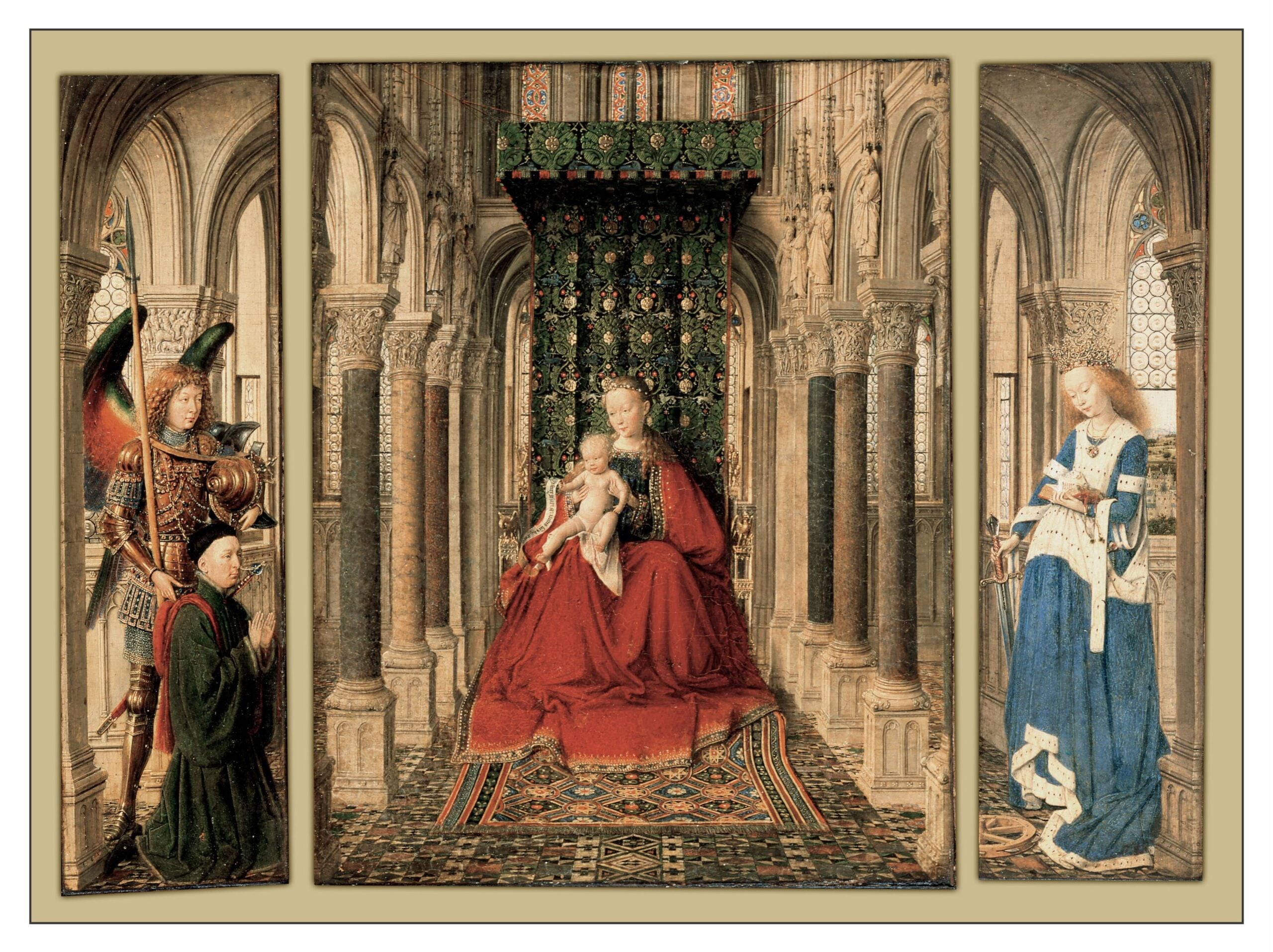
Antonello was clearly impressed by this and other Flemish paintings in Alfonso’s collection. Vasari claimed that he therefore travelled to Flanders to study with Jan van Eyck:
Having arrived in Bruges, he became very intimate with the said Johann, making him presents of many drawings in the Italian manner and other things, insomuch that the latter, moved by this and by the respect shown by Antonello, and being now old, was content that he should see his method of coloring in oil; wherefore Antonello did not depart from that place until he had gained a thorough knowledge of that way of coloring, which he desired so greatly to know. And no long time after, Johann having died, Antonello returned from Flanders in order to revisit his native country and to communicate to all Italy a secret so useful, beautiful, and advantageous.
Unfortunately, this would have been impossible. Jan van Eyck died in 1441, when Antonello was only 11 years old. However, nothing is known about Antonello in the 1450s. He might therefore have travelled to Bruges during this time and studied with some of van Eyck’s followers (Wright, 1980). As well as learning about oil-painting from the Flemish artists, Antonello may have taught them, in exchange, some of the new Italian insights into perspective (Edgerton, 1975).
Another possibility is that Antonello interacted with Petrus Christus (1410-1476), one of van Eyck’s most prominent disciples, in Italy rather than Flanders. There is some evidence that the two painters may have been present at the same time in Milan at the court of Francesco Sforza (Ainsworth & Martens, 1994, p 61).
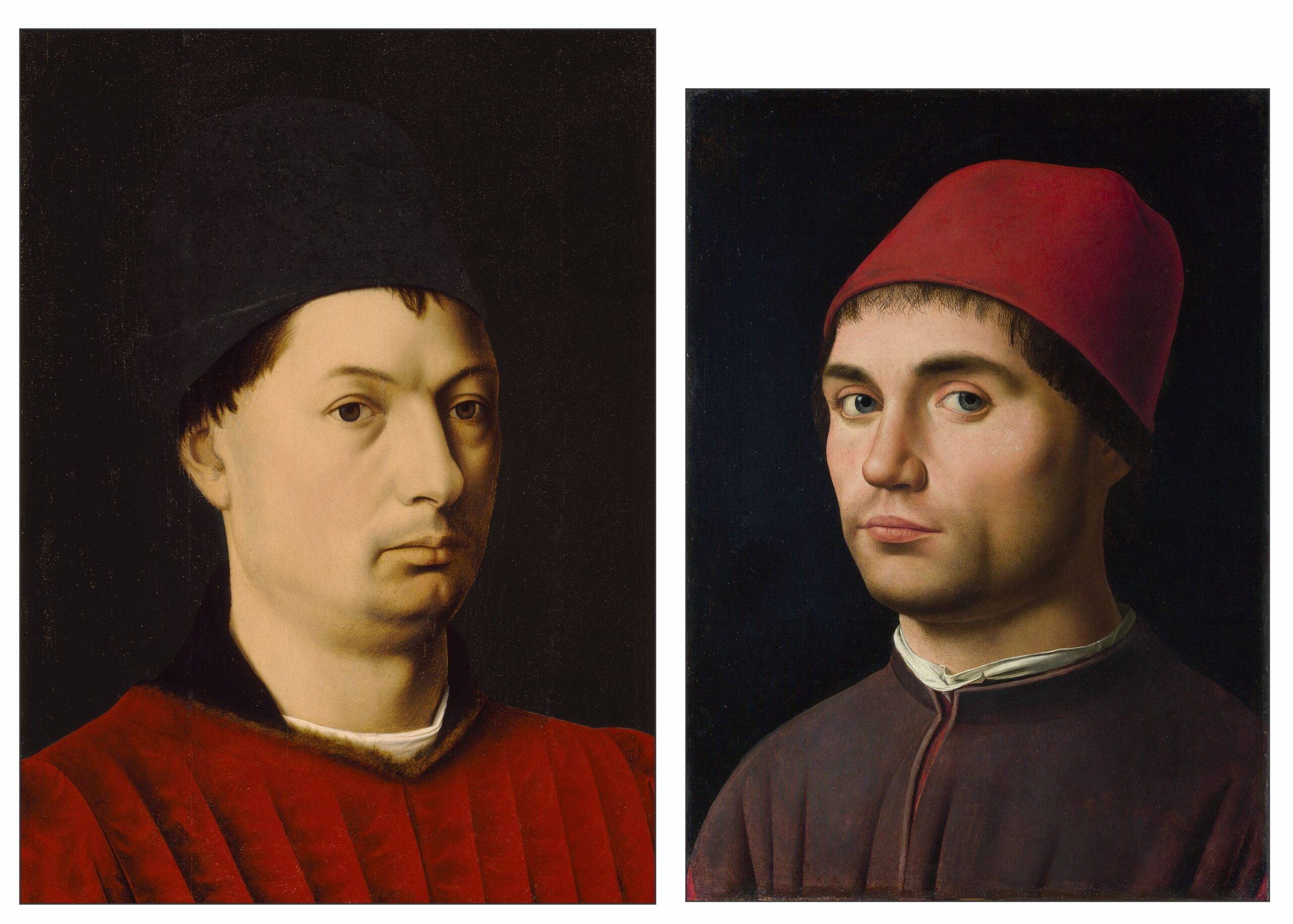
Antonello returned home to Sicily in 1460, and worked there for several years but nothing is really known about his whereabouts in the late 1460s. Perhaps he travelled at that time to Bruges and interacted there with Petrus and other painters, such as Hans Memling (1430-1494). There are striking similarities between Petrus’ Portrait of a Man (1465?) on the left side of the following illustration and Antonello’s later portrait from 1473.
The following illustration shows Antonello’s Salvator Mundi from 1465 on the left and a similar painting by Hans Memling from 1475. It appears too close a likeness not to have been the result of personal interaction between the artists.
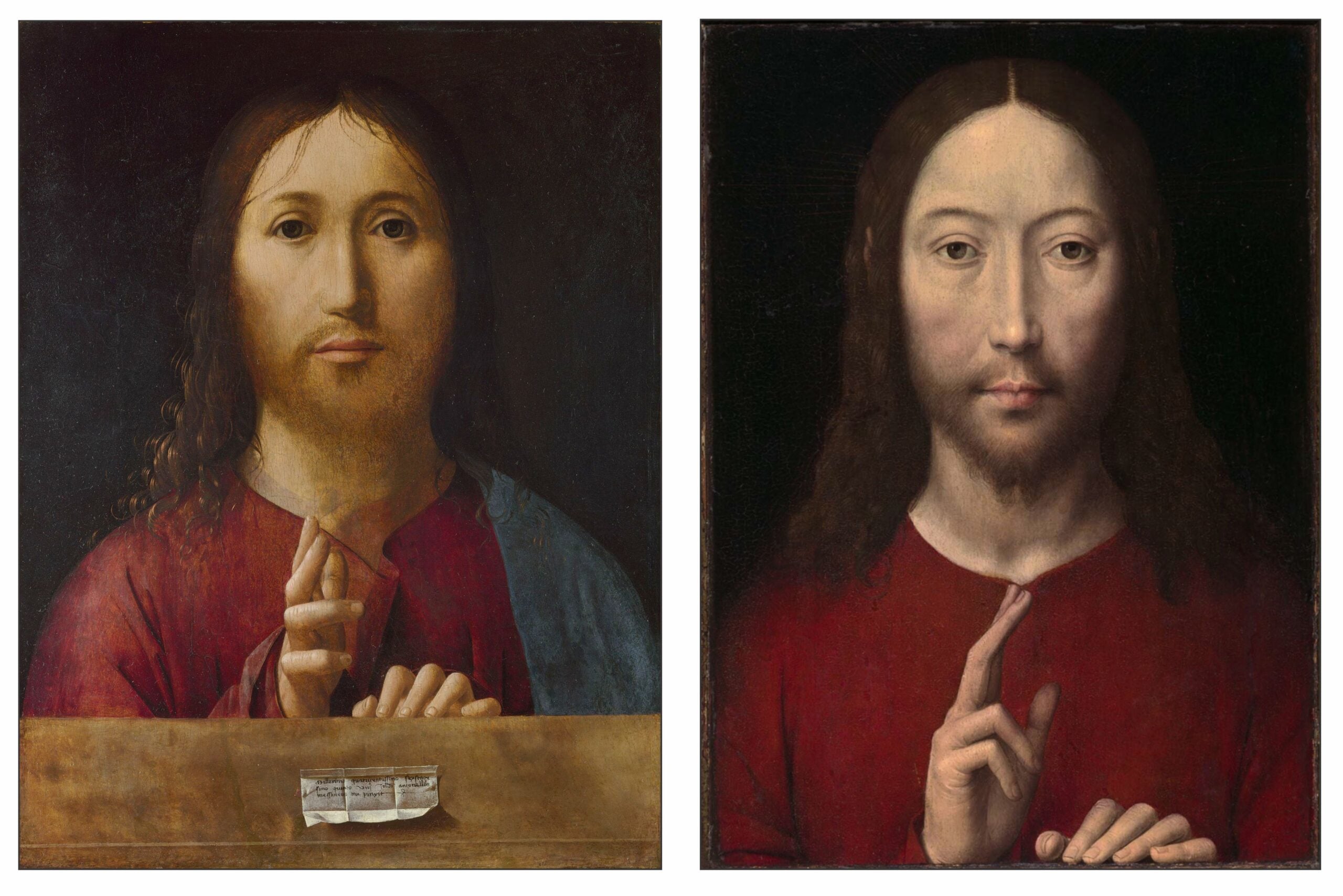
Compared to the paintings of the Flemish painters, Antonello’s are more natural, more distinctive and more emotional. They express themselves. We sense a real person rather than an image.
Antonello stayed in Venice for a brief period beginning in late 1475. While there, he interacted with Venetian artists such as Giovanni Bellini (1430-1516) and Andrea Mantegna (1431-1506). An apocryphal story tells how Bellini posed as a nobleman and had his portrait painted by Antonio so that he could observe the technique of oil painting (Cardona & Villa, 2019, p 29).
An important development that occurred in Venice in the late 15th Century was oil-painting on canvas rather than wood. Sail-canvas was in ready supply in this maritime city. Canvas did not crack or warp like wood, and its light weight allowed for much larger paintings. Though Antonello did not paint on canvas, Bellini painted some of his late paintings on canvas, and oil on canvas became the usual technique for the next generation of Venetian painters such as Giorgione (1470-1510), and Titian (1488-1576).
In 1476, Antonello was offered a position on the Sforza court in Milan, but he declined and returned to Messina. He died there in 1479, having provided a dowry for his daughter and placed his son Jacobello in charge of his studio. Jacobello’s only surviving painting is signed Jacobus Antonelli, filius non humani pictoris (son of a painter who was more than human) (Cardona & Villa, 2019, p 39).
Over the years, many of Antonello’s works vanished. Some were destroyed in the earthquakes to Messina was prone. Others were lost in the bombing of World War II. Many of his paintings were small and easily lost. Only about 40 paintings remain.
Renaissance Portraits
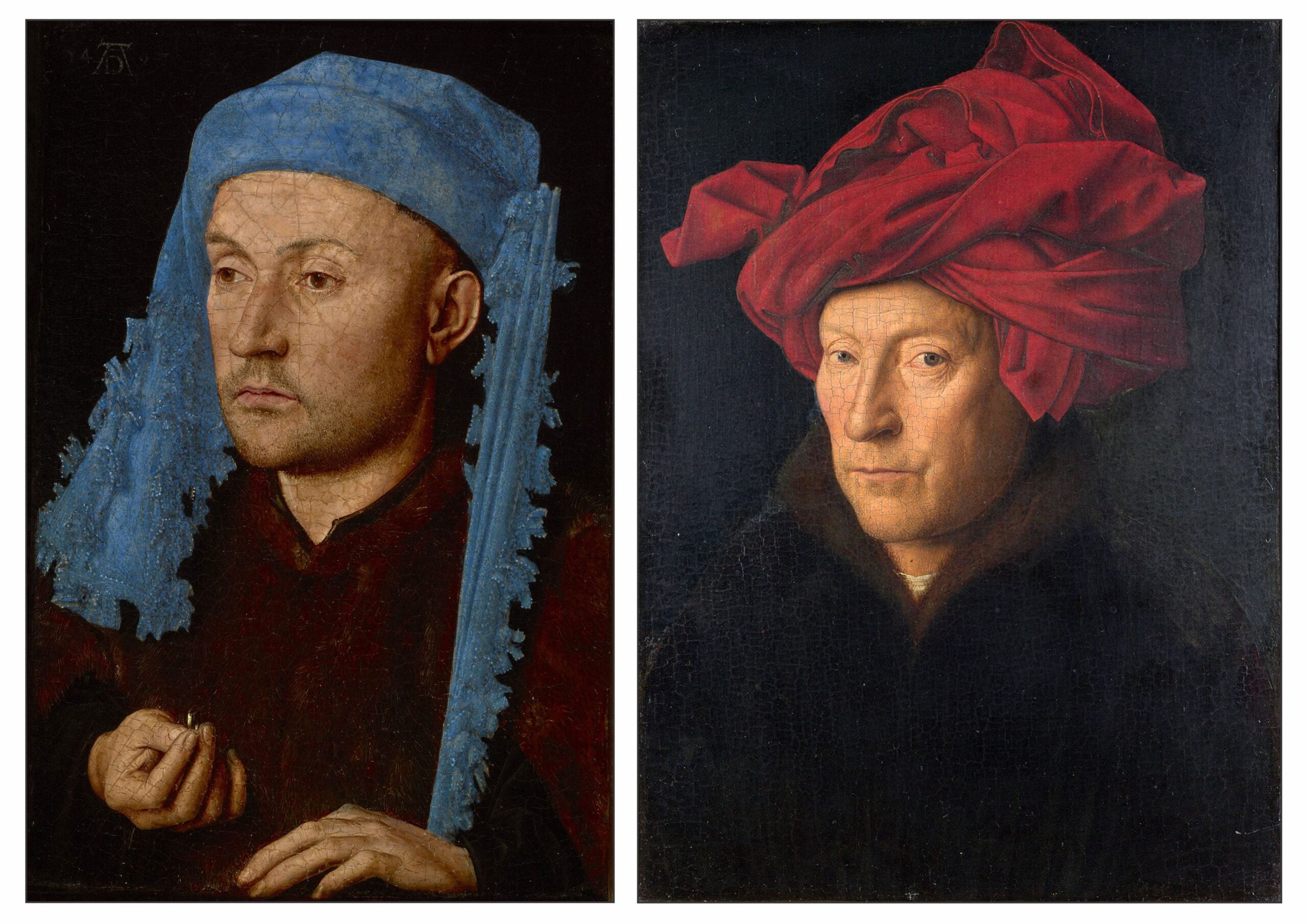
During the later Middle Ages, the rich and the powerful wished to gain some hold on immortality by having their portraits painted. Initially this was done by giving an altarpiece to a church and having themselves included in the painting as the donors. Over time, painters began to provide portraits independently of the church. Jan van Eyck was again one of the most prominent of the early portraitists. The following illustration shows two of his portraits, both from around 1433. The sitter on the left is holding a ring. This could indicate that the sitter is a goldsmith, that he has just become engaged to be married, or that he has assumed a position of authority requiring the use of a signet ring. On the left the sitter is wearing is a striking blue chaperon, and on the right a marvelous red turban. The latter may be a self portrait.
Antonello learned from the Flemish painters, and became the “first Italian painter for whom the independent portrait was an art form in its own right” (Pope-Hennessy, 1966, p 60). He became particularly adept at presenting the individuality of the eyes. In this he was a believer in Saint Jerome:
Speculum mentis est facies, et taciti oculi cordis fatentur arcana.
The face is the mirror of the mind and, without speaking, confesses the secrets of the heart.
The following illustration shows four of his portraits. The upper left is from the late 1460s and the others from the early 1470s. One of Antonello’s characteristic effects was to add is signature in a cartellino on a ledge at the bottom of the image (the two lower portraits). This trompe l’oeil representation of a folded piece of paper perhaps guarantees the veracity of the portrait: if the artist can represent a scrap of paper that well, then he must have captured the likeness exactly. The typical message on the cartellino read “Antonello messianeus me pinxit” together with a date (Renzo Villa in Cardona & Villa, 2019, pp 81-107)
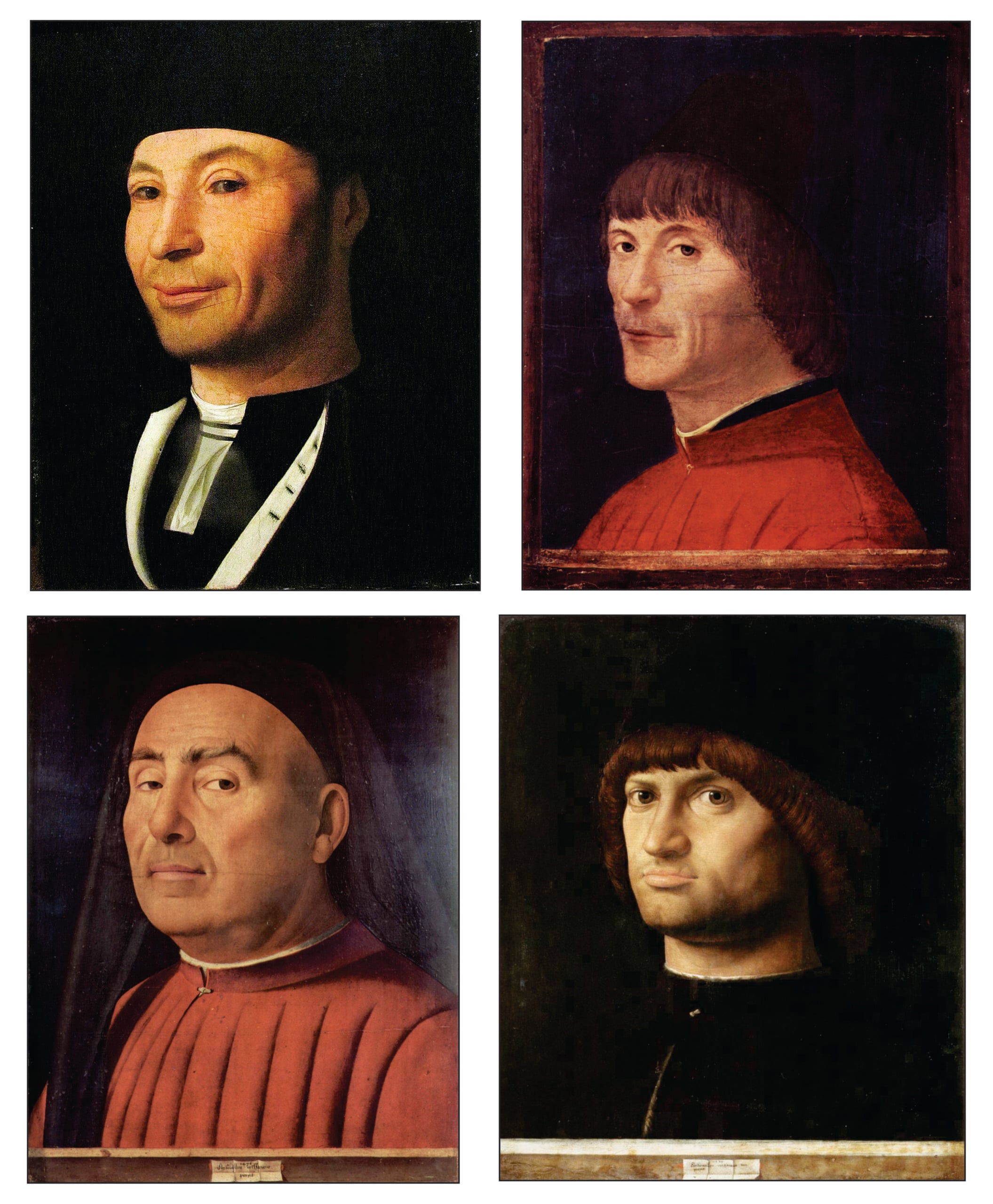
We consider ourselves able to read both character and emotion in the human face. For example, in the preceding portraits we might find mockery/amusement, diffidence/cunning, disdain/skepticism, and truculence/stubbornness. Indeed, the last portrait is often known as Il Condottiero, the name for an Italian mercenary leader.
The following is an evaluation of the portrait at the lower left by Nicola Gardini, an Italian novelist (in Cardona & Villa, 2019, p 289):
The face is the theatre. And it is doubly so. On the one hand, it provides a stage where events or a story, no matter how slight, can unfold: the eyebrows arch, the eyelids are lowered, a rebellious tuft of eyebrow hairs stands up, a wart is displayed in the centre of his forehead, which creases into furrows that extend down to the side. There is no fixity: that face reveals an ex-pression, a current frame of mind or psychological circumstance. On the other hand, the mask, the moral core of the expression, the underlying truth behind events elevating the circumstance to a natural truth. This is where the man reveals himself, both as he is and as he appears with all his distinctive features: the smugness, the miserly smile (Antonello has managed to make his eyebrows smile far more than his mouth), a sense of condescension and satisfaction, his robustness, that air of good health, cleanliness, prosperity … Clearly pleased with himself and full of self-worth, this man certainly knows a thing or two. And he keeps as far away as he can from death.
However, we should be careful. Though we can recognize the most striking of human emotions, we often miss subtle changes. And we are more often wrong than right about the underlying character.
The portrait in the upper left is particularly appealing. Though it has been considered the portrait of a sailor or a pirate, it is almost certainly a portrait of a Sicilian aristocrat, willing to have his representation immortalized by the talented artist. He is not dressed in a modern maritime uniform but wearing a Sicilian woolen cape or cappuloro (Cardona & Villa, 2019, p 32). The Sicilian novelist Leonardo Sciasia notes that we recognize the face but really do not know the person behind it:
Who does the unknown man resemble? A mafioso from the countryside or one from the best neighborhoods, the member of parliament who sits on the right, or on the left, the peasant or the lawyer? He looks like the writer of these notes (it’s been said), and he certainly looks like Antonello. And just try to pin down the social status and the individual human nature of this personage. Impossible. Is he a noble or a plebeian? A notary or a farmer? A gentleman or a lout? A painter, a poet, an assassin? “He resembles.” There you have it. (translated and quoted by Ingrid Rowland, 2024, pp 21-22)
Antonello’s portraits are easily approachable. They all make clear eye contact:
Antonello is also a sensitive to the humanity of the viewer, who is given consistent points of entry into the work. These entry points are established not only with eye contact, but with the parapet, which gives a clear boundary between observer and observed, and the cartellino, which looks as if one has just unfolded it. (House, 2025, p 41)
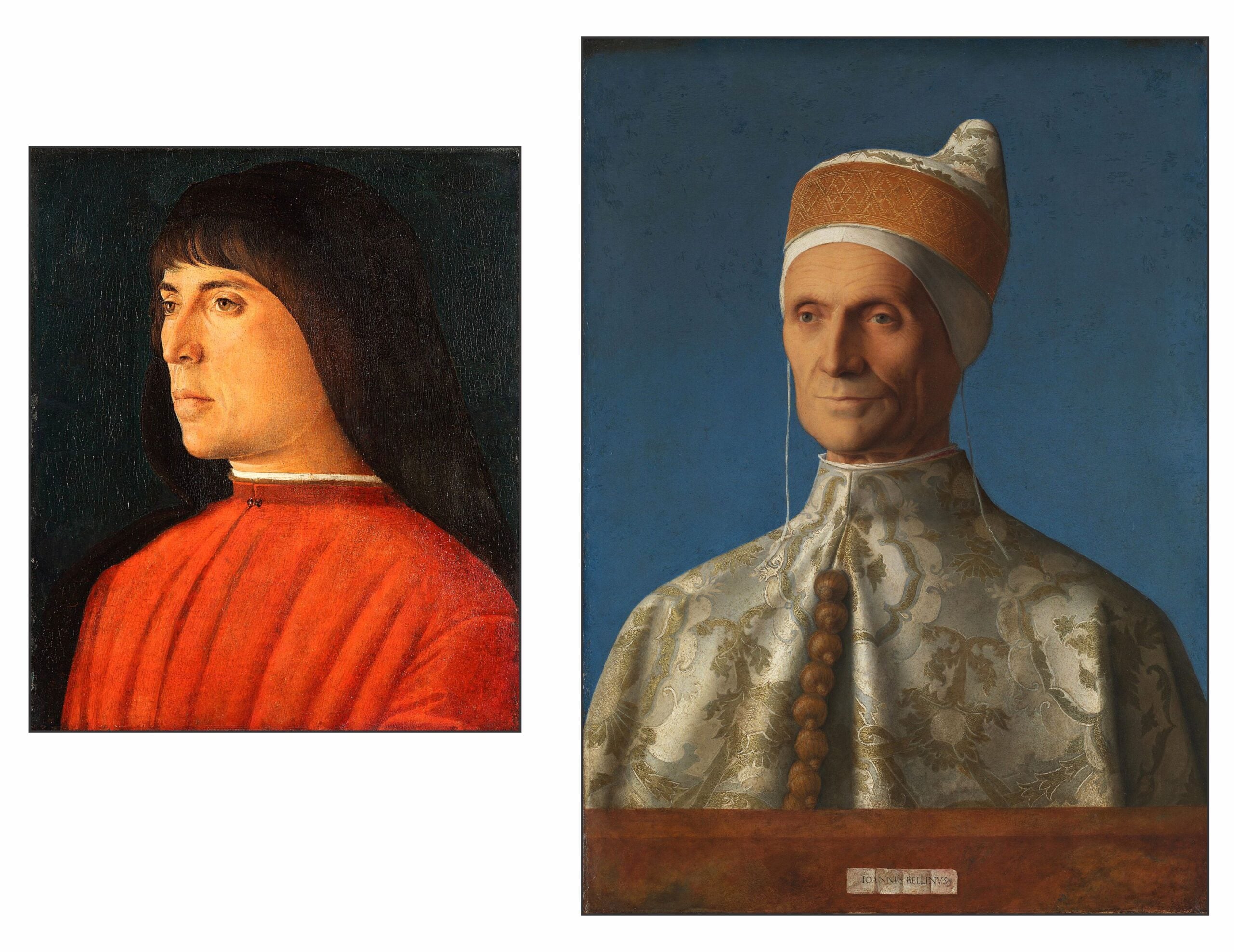
When Antonello was in Venice in 1475-6, he was able to show the Venetian painters the techniques of oil-based portraits. The following are two portraits by Giovanni Bellini. The Portrait of a Young Man on the left dates to around the time of Antonello’s visit. It is clearly similar to Antonello’s paintings. The Portrait of Doge Leonardo Loredan is from 1501. Antonello’s technique has been supplemented by the amazing color sense that characterizes Venetian painting. Interestingly, Bellini has added to his masterpiece a painted cartellino in the style of Antonello:
Ecco Homo
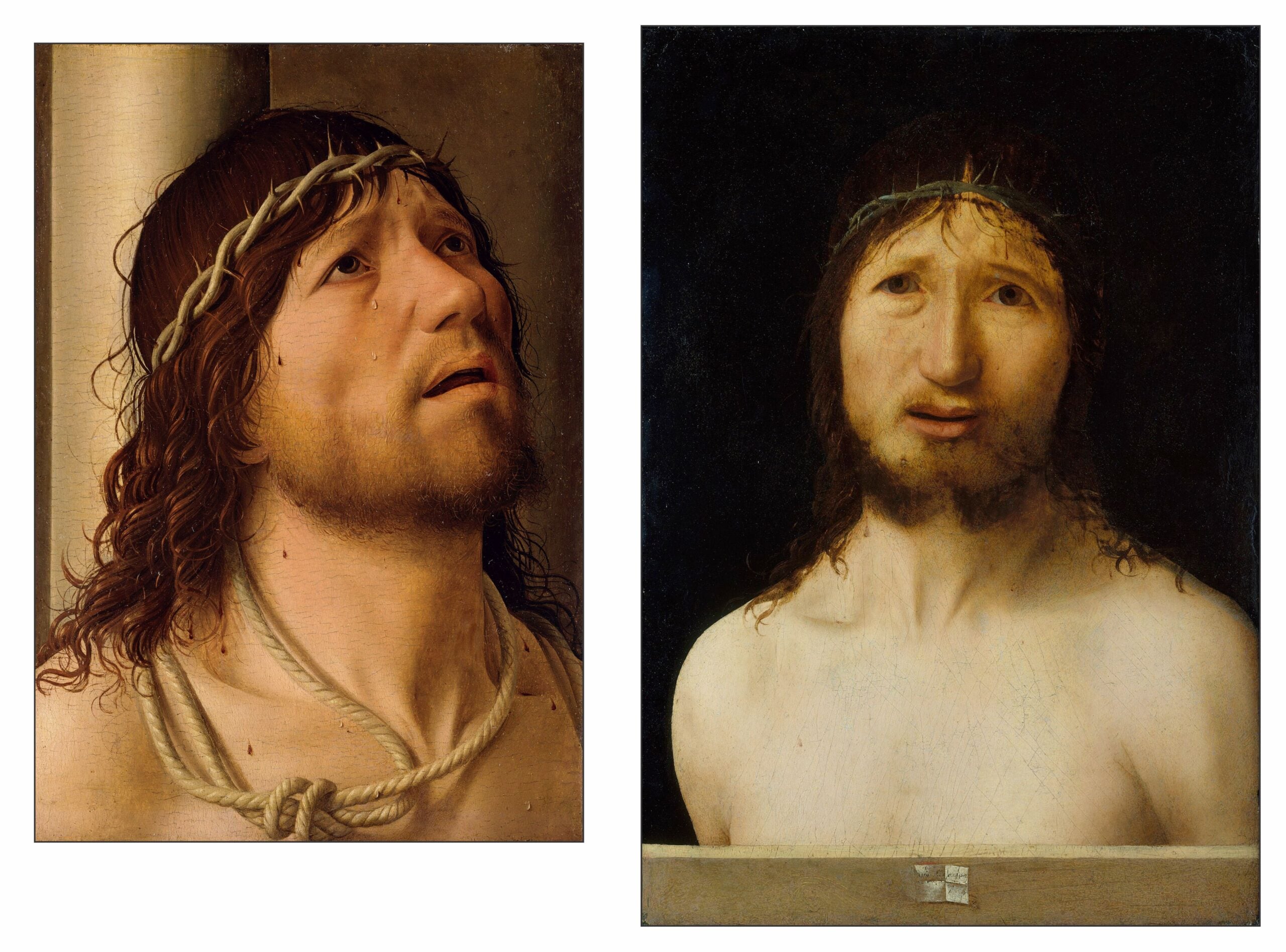
Antonello used the abilities he had developed in portraiture to create representations of the face of Christ that are utterly convincing in their humanity and depth of feeling. One of his favorite themes was that of Ecco Homo (Behold the man) as described in the Gospel of John:
Then Pilate therefore took Jesus, and scourged him.
And the soldiers platted a crown of thorns, and put it on his head, and they put on him a purple robe,
And said, Hail, King of the Jews! and they smote him with their hands.
Pilate therefore went forth again, and saith unto them, Behold, I bring him forth to you, that ye may know that I find no fault in him.
Then came Jesus forth, wearing the crown of thorns, and the purple robe. And Pilate saith unto them, Behold the man! (John 19 1-5)
The following illustration shows two of Antonello’s paintings of Ecco Homo, the left from 1476 and the right from 1470.
Saint Sebastian
Saint Sebastian was a 3rd Century Roman Christian martyred during the Diocletian Persecutions. Initially, he was shot with arrows, but this miraculously did not kill him, and he was nursed back to health by Saint Irene. Later, he was clubbed to death and thrown into the Cloaca Maxima – Rome’s main sewer. During the Middle Ages, Saint Sebastian was invoked as a defender against the plague. If he could survive being shot with arrows, surely he could help those who were afflicted by the disease. Depictions of Saint Sebastian allowed painters to portray the nude male body. Antonello’s depiction is probably the most sensuous of the early representations of the saint. In recent years, the saint has become a gay icon and the patron of the Lesbian-Gay-Bisexual-Transgender-Queer communities.
Antonello’s Saint Sebastian was painted in the mid 1470s for the altar of the Church of San Guliano in Venice at the height of one of the plague epidemics to which Venice was so susceptible (Humphrey, 1993, pp 195-229). The altarpiece also contained a representation of Saint Christopher, probably painted by Antonello’s son, and a carved sculpture of Saint Rocco, another saint who offered protection from the plague. The latter was also the patron of the Scuola di San Rocco which was established in 1478. The altarpiece did not last long: the statue and the painting of Saint Christopher have been lost, and Antonello’s painting is now in Dresden.
Antonello’s painting owed much to an earlier altar triptych of Saint Sebastian (1470). However, Antonello’s saint is much more convincing than Bellini’s flatly outlined figure.

The Saint stands in a serenely ordered space that recalls the paintings of Piero della Francesca, who wrote a treatise De prospectiva pingendi (On the Perspective of Painting) in the mid 1470s. Perhaps Antonello visited him in Urbino during his travels (Campbell, 2021). House (2025, p 131) quotes Roberto Longhi as claiming that Antonello assimilated Piero’s teachings and brought them to Venice.
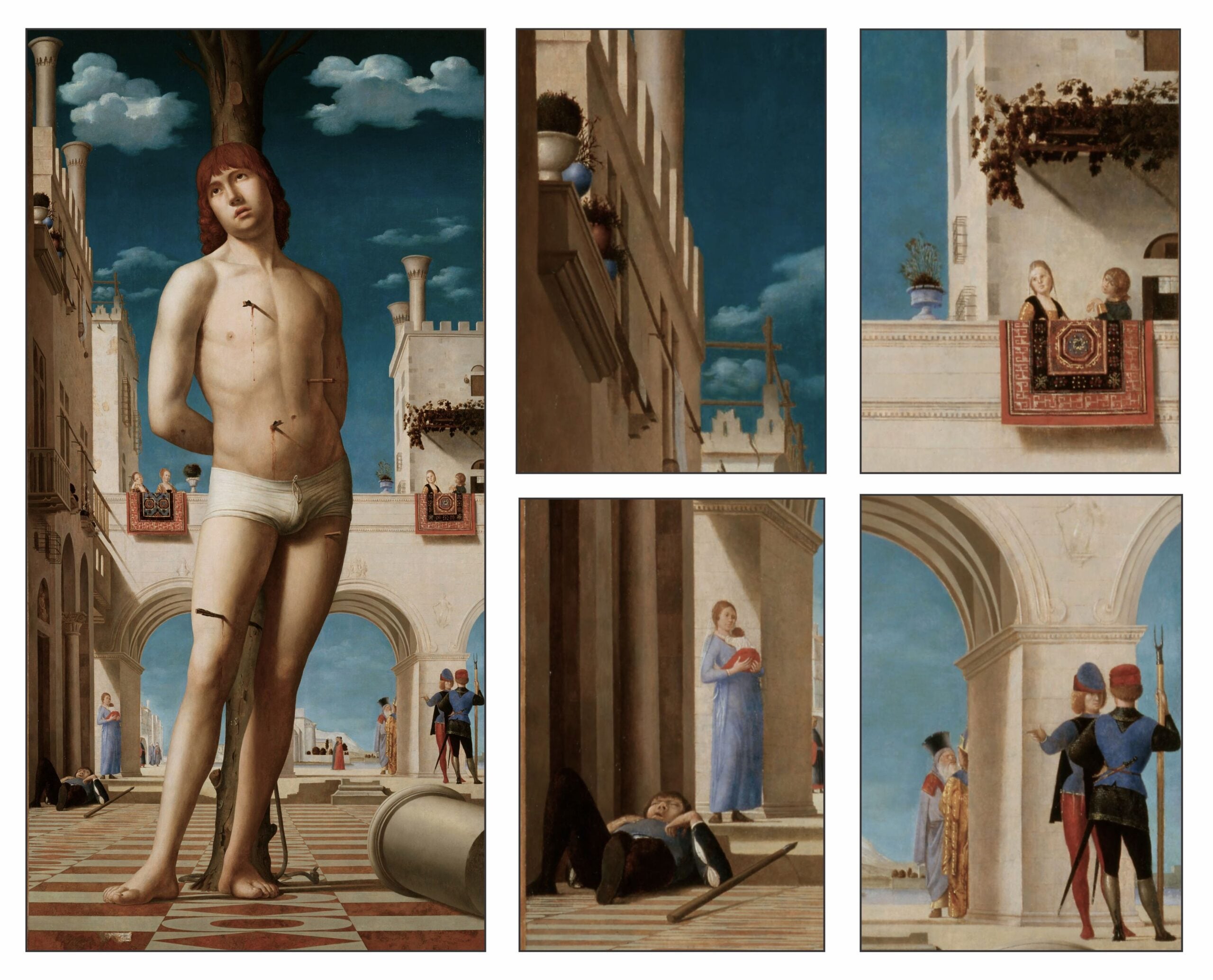
On the left a guard sleeps in a marvel of foreshortening. Elsewhere the people of the city converse, and go about their appointed ways. Though the saint is being martyred, everything is as it should be according to divine perspective.
Saint Jerome
Jerome (342-420) CE) was a Christian saint who in his youth spent a prolonged period of ascetic penance in the deserts of Syria. Legend has it that during this time he removed a thorn from the paw of a lion, and that the lion then became his lifelong companion. After his sojourn in the desert, he came to Rome where he translated the Bible into Latin, and made extensive commentaries on scripture. His version of the Bible – the Vulgate (from versio vulgata, the commonly used version) – remains the official Latin version of the Bible in the Catholic Church. Jerome became the patron saint of translators, librarians, and students.
Jerome became a popular subject in the paintings of the early Renaissance. The following illustration shows on the left a painting of Saint Jerome by Jan van Eyck that was likely finished by Petrus Christus in 1442, and on the right a 1444 painting by Niccolo Colantonio, with whom Antonello was apprenticed in Naples.
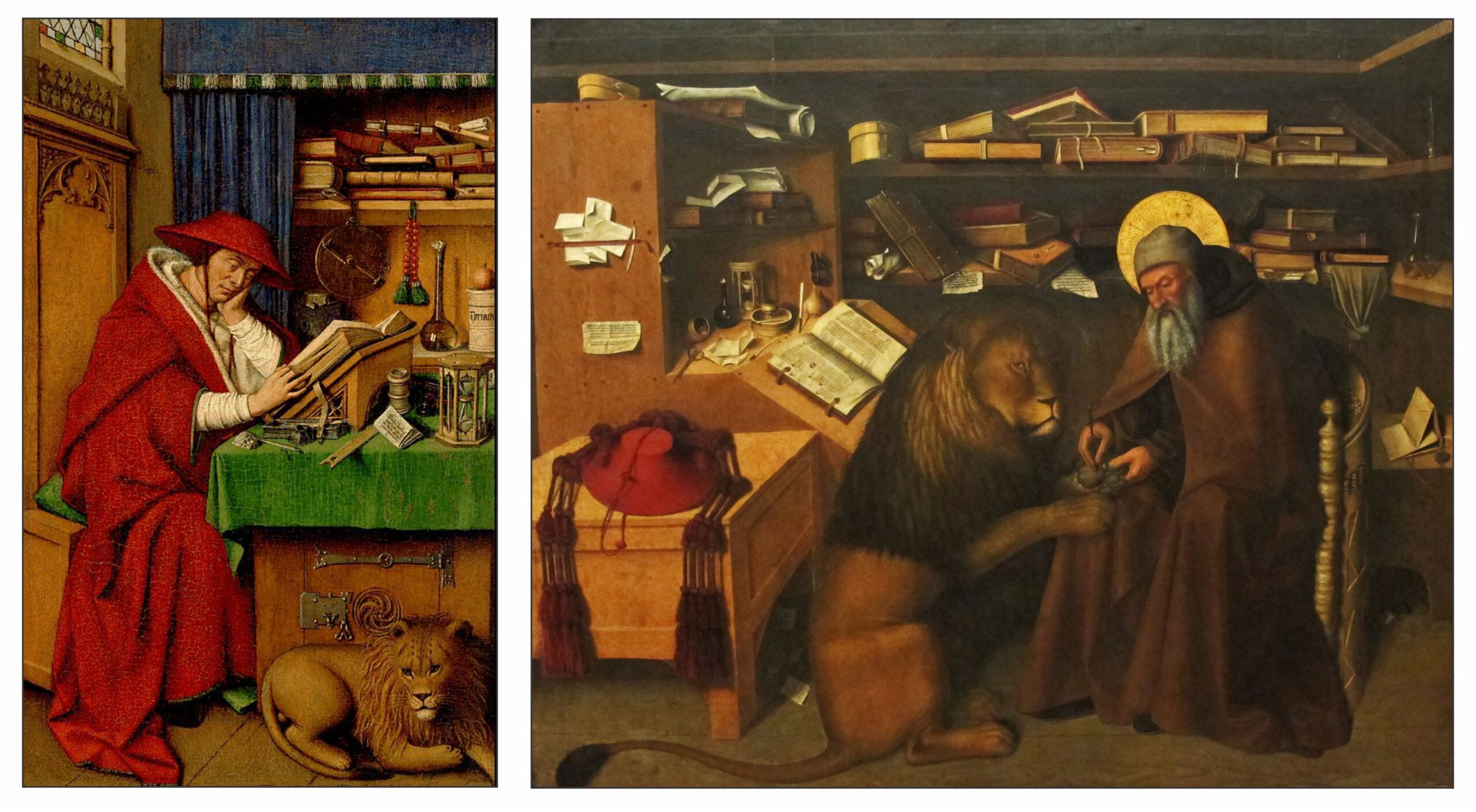
The late Middle Ages ushered in the “Humanities” as a field of study. Initially, this concerned the language, history and philosophy of the Greek, Roman and Hebrew civilizations. The goal of these studies was to facilitate a deeper interpretation of Biblical texts. Study of the humanities (humanitas) was thus considered a handmaiden to the study of divinity (divinitas). Saint Jerome with his immense knowledge of the ancient languages came to personify this new field of study. Over the years the Humanities expanded to include study of all texts. The Humanities then became was distinguished from both Theology – the study of sacred rather than secular scriptures –and the Sciences – the study of observed data.
Antonello painted his Saint Jerome in his Study in 1474. The painting is not large (46 by 36 cm) but it is intricately detailed (Jolly, 1983):
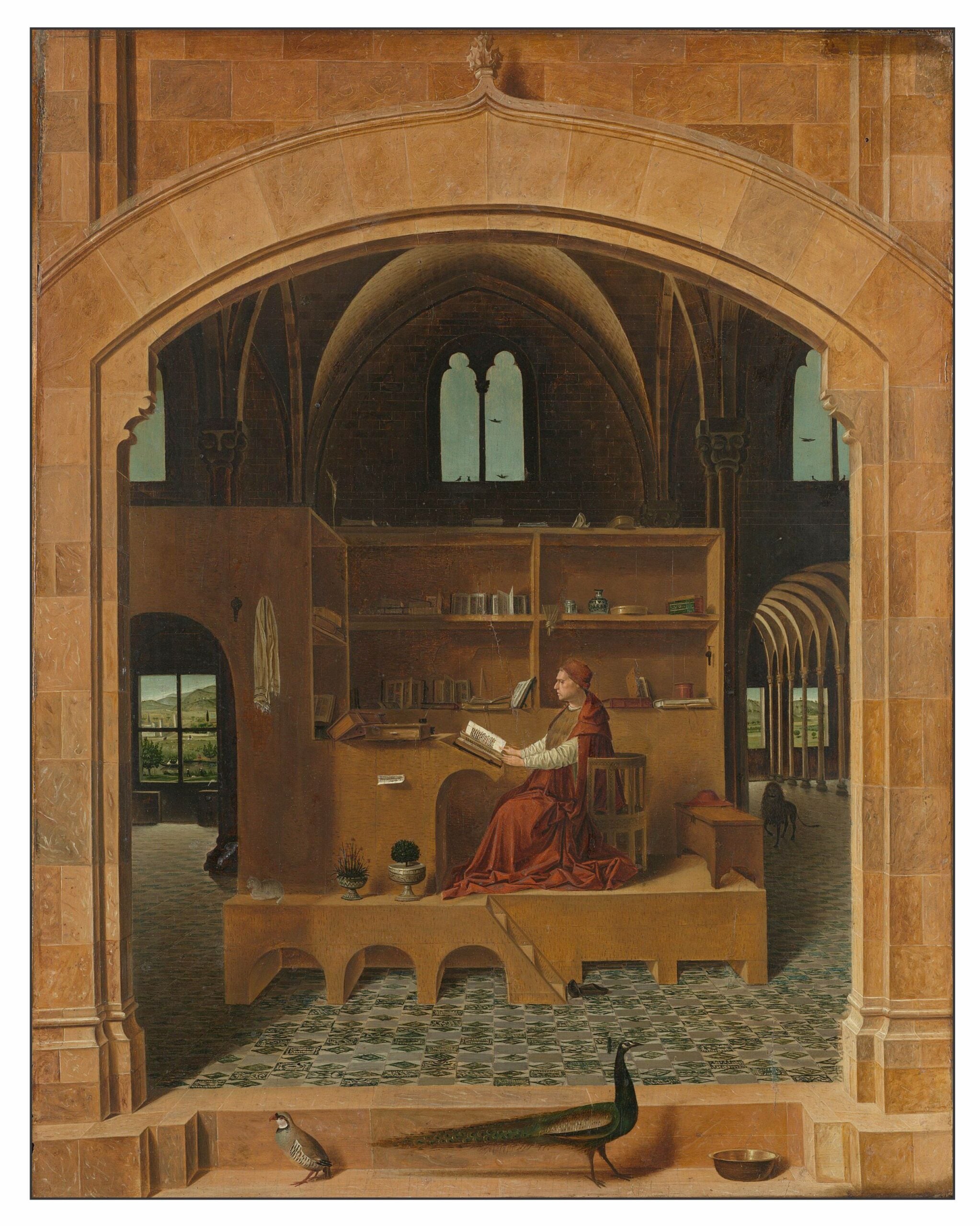
The painting shows Jerome reading in his study, as revealed through a monastery doorway. In the foreground the partridge, peacock, and water-bowl symbolize worldliness, immortality and ascetic purity. His lion can be seen in the shadows to the right of the study. A peaceful countryside rests beyond the monastic windows:
The following illustration shows some of the details in the painting. The landscape seen through the window on the left contains people walking with a dog, rowing a boat, and riding a horse – all going about their normal lives independently of the saint in his isolated study.
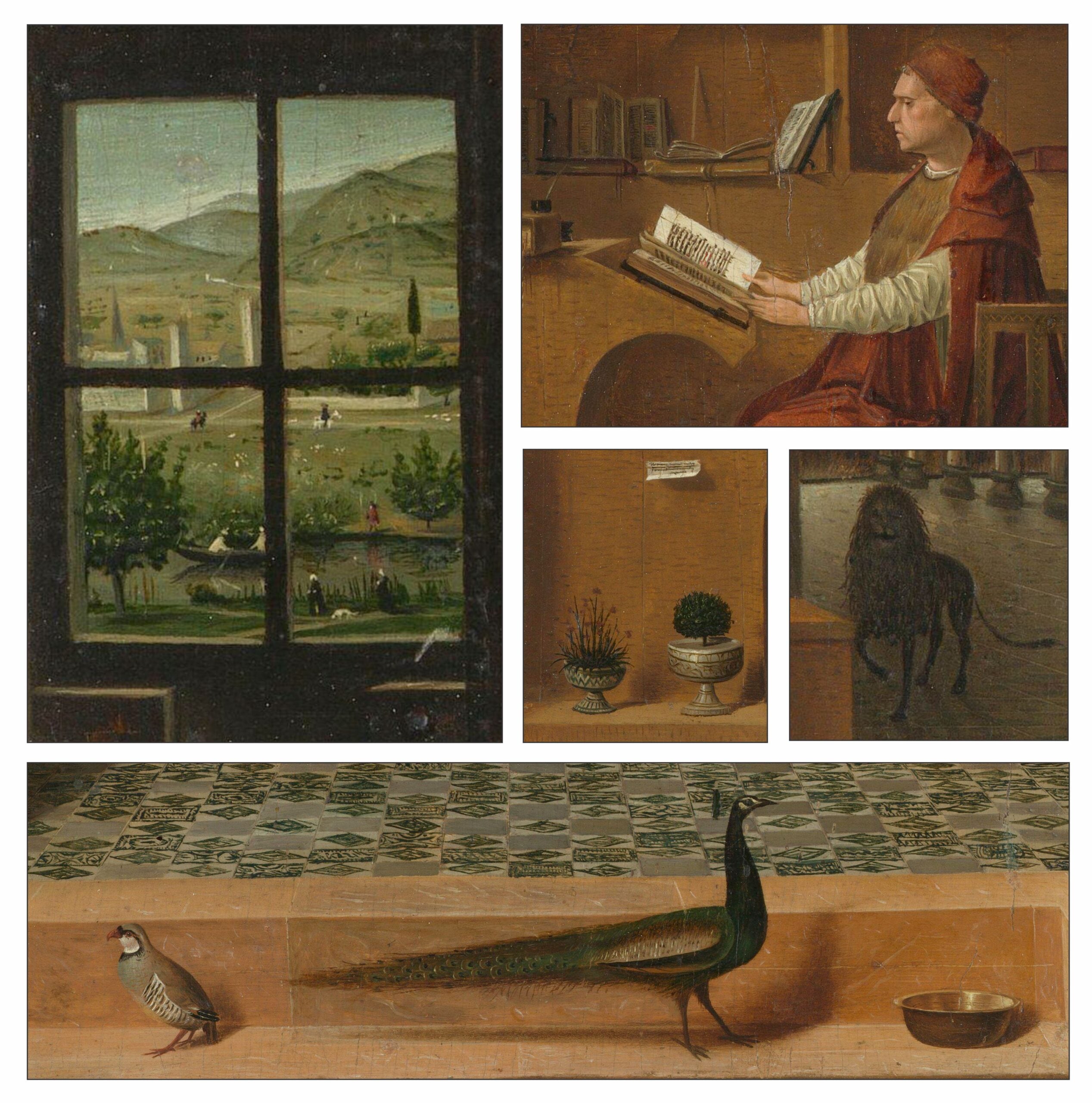
The Italian writer Elizabetta Rasy (In Cardona & Villa, 2019, p 78) comments on the figure of the saint
Unlike Jan van Eyck’s Saint Jerome blissfully reading with his cheek resting on his hand, Antonello’s saint is not particularly relaxed nor is he sitting properly. In fact, he seems to be almost on the edge of his seat. stretching his arms out towards the book rest like someone carrying out an action or making an effort. Reading may not always be an effort, but it is certainly an action. It is this very tension that gives rise to the power of a figure who does not appear conventionally devotional or indeed anything like the kind old monk depicted by Colantonio, Antonello’s master.
She further comments on the painting’s tension between reality and imagination (in Cardona & Frederico Villa, 2019, p79):
Yet the entire space of the work suggests something else. Let’s take look at the lion. Instead of holding his paw out for the saint to remove the famous thorn or sitting crouched at his feet, he is roaming aimlessly in the corridor, nothing like a lion, not even the lion in the legend, but more like those animals appearing in dreams, in places and in ways they shouldn’t, like incongruous presences. That lion standing in the shade, a forest but of an elegant marble corridor, is an apparition that shifts the entire scene into the realm of dreams. Over on the other side is a paper label attached to the wooden wall of Jerome’s cell, in plain sight. Is it the artist’s signature? A message for the observer? No, it is impossible to read those words, they are just a series of illegible scribbles that do not belong to any human alphabet. Have you ever tried to read something in your dreams? It’s impossible. Those forever unknowable words are written in the language of the most secret nocturnal images. This is the time-less stance of Antonello’s Saint Jerome in the study: every element in this setting, saint included, is here, now, near, tangible and shamelessly real. Yet every element in the entire conspicuously asymmetrical space of the picture is mysterious and represents a distant Beyond that enchants us and draws us out.
Virgin Annunciate
During the Middle Ages in Europe the veneration of the Virgin Mary underwent an extraordinary growth. This was partly related to the writings of Bernard de Clairvaux, who experienced visions of the Virgin, and who founded the Cistercian Order, and partly the need for solace during the terrible years of the Black Death. If the plague had been sent by a God of Justice and Judgment, the people could not really appeal to him for relief. So they asked the Virgin Mary to intercede, the divine feminine being far more compassionate than the male. Many of the great cathedrals were named after Notre Dame or Santa Maria. The virgin appeared to her followers, and, at the sites of these visions, shrines were established to attract pilgrims. Walsingham in Norfolk, England is one of the earliest Marian shrines
Artists celebrated the many different aspects of Mary’s life from the Annunciation to the Assumption (Verdon, 2005). One of the most popular subjects was the Annunciation as described in the Gospel of Luke (1:26-31):
….the angel Gabriel was sent from God unto a city of Galilee, named Nazareth,
To a virgin espoused to a man whose name was Joseph, of the house of David; and the virgin’s name was Mary.
And the angel came in unto her, and said, Hail, thou that art highly favoured, the Lord is with thee: blessed art thou among women.
And when she saw him, she was troubled at his saying, and cast in her mind what manner of salutation this should be.
And the angel said unto her, Fear not, Mary: for thou hast found favour with God.
And, behold, thou shalt conceive in thy womb, and bring forth a son, and shalt call his name Jesus.
The paintings typically showed Gabriel interrupting Mary as she read from the scriptures The angel is usually on the left and in profile; the virgin on the right and turned toward the viewer. The following illustration shows the 1333 Annunciation Altarpiece of Simoni Martin and Lippo Lemmi now in the Uffizi Gallery in Florence. The words of the angel float across the gold background through the olive branch of divine peace and the lily of virgin purity:
Ave [Maria] gratia plena dominus tecum
Hail [Mary] full of grace, the lord is with you.
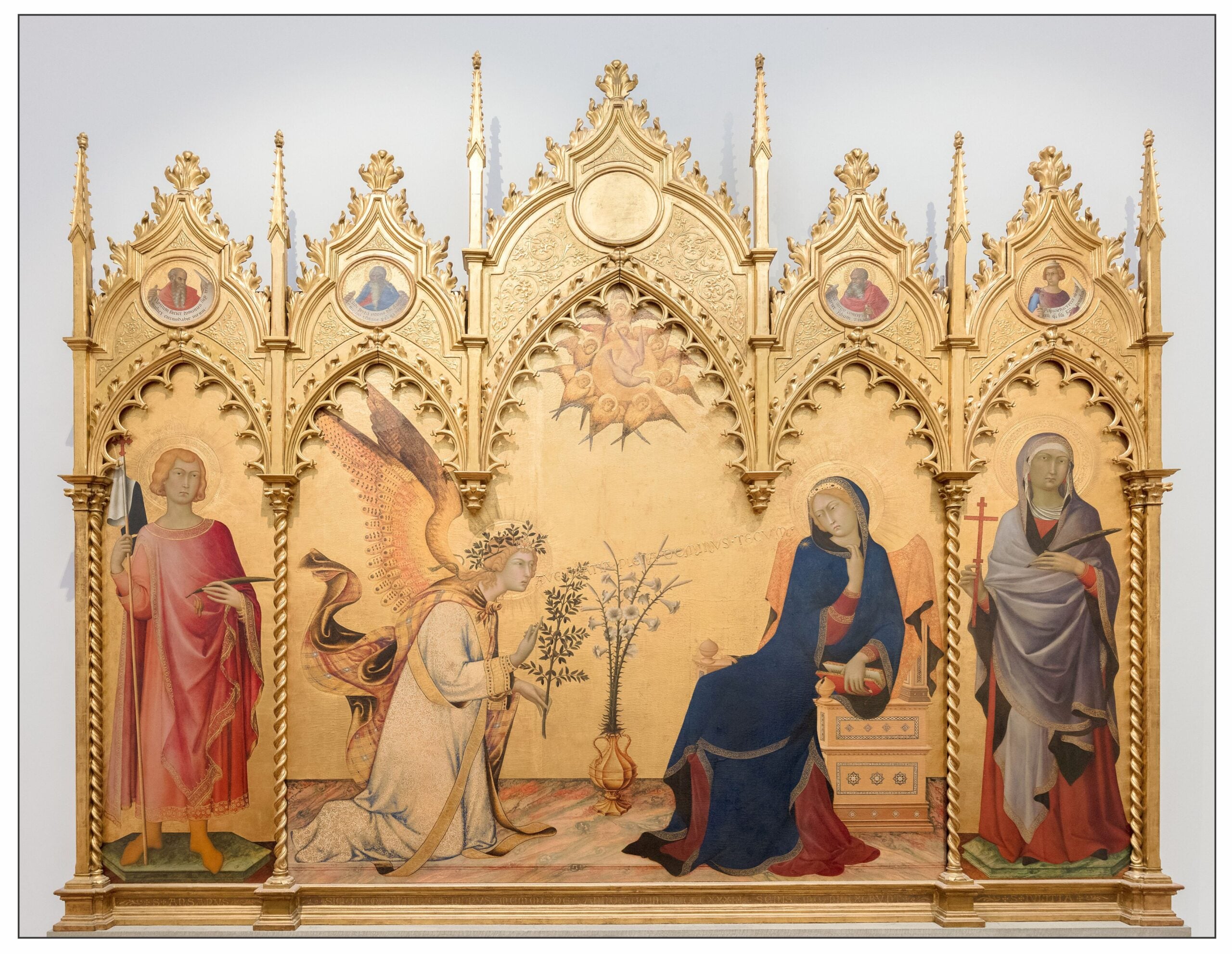
Sometimes the annunciation was painted on two panels and that representing Mary was called the Vergine Annunziata (Virgin Annunciate). Antonello da Messina was the first painter to represent the Virgin Annunciate alone.
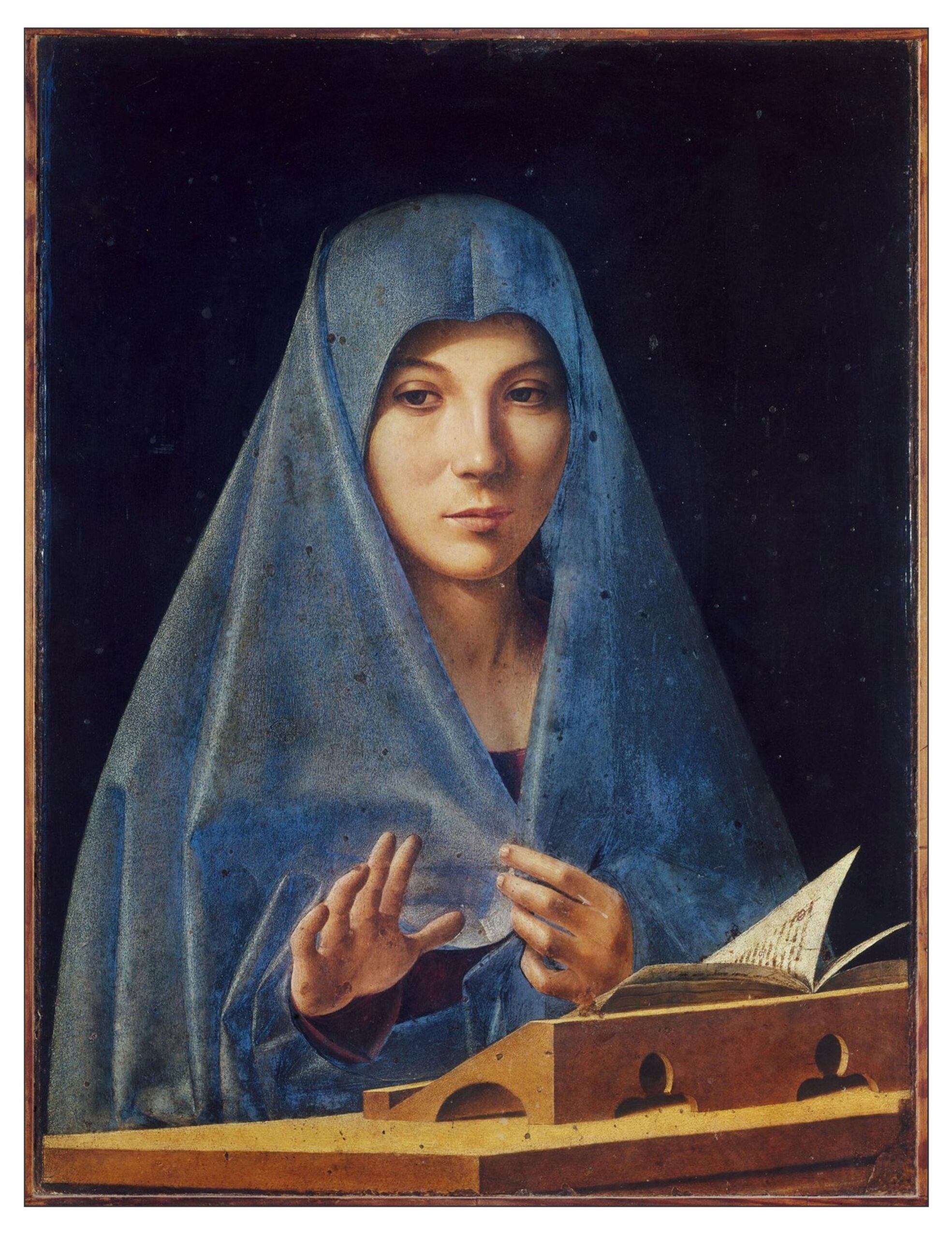
His 1476 painting shows the virgin in a simple blue shawl. The background is dark rather than gold. Mary looks down and to the left at a kneeling Gabriel who is not represented, and perhaps not clearly visible in the real world. Her expression is as enigmatic at that of Leonardo’s Mona Lisa (1506). Mary’s right hand is lifted partly in surprise, partly in reluctance. Her right hand gathers her shawl close.
The painting represents the miraculous moment of the incarnation, of the divine becoming human. The following are comments by Klaus Krüger (2015):
The image presents the Virgin in a tranquil, clearly structured composition. The strict symmetry and frontality are reminiscent of an icon. Only the implied movement of the right hand, which reaches forward into the pictorial space, and the direction of the Virgin’s gaze, which almost imperceptibly follows the turning of her body, subtly indicate that a scenic incident, namely the Annunciation, is taking place. Antonello radically reduces the event of the Annunciation by depicting only the very moment in which the Virgin receives the Word of God, and with it the divine fruit of her womb. The actual descent of the divine Logos remains imperceptible to the eyes. It can only be inferred from Mary’s reaction and from the reflection of the light that shines on her from above, and which appears to radiate all the more intensely against the dark background. The actual subject of the image is thus the paradoxical manifestation of the invisible in the visible, of light amidst darkness, of the Word in the flesh, in sum: of the divine in the temporal.
Humanism
As the Middle Ages developed into the Renaissance, the study of the Humanities, which initially were concerned with the languages in which the scriptures were written, broadened to include philosophy, ethics and history. Scholars became more familiar with the ancient texts, and took to heart the statemen of Protagoras (490-420 BCE) that “Man is the measure of all things.” They found that they could order their lives through the exercise of human reason as well as or instead of through faith in divine instruction. The Humanities thus gave birth to the philosophy of Humanism (Davies, 2001, pp 125-135).
Renaissance Humanism was facilitated by several developments. Beginning in the mid 15th Century, the printing press gave people ready access to books and ideas. No longer were thoughts locked up in the libraries of the church. The new sciences provided ways to look at the world in relation to human beings rather than as divinely determined. And painting became more realistic, the spaces more three-dimensional, and the faces more human.
Antonello da Messina infused his paintings with this new humanism. His portraits show real people who run the gamut of human emotions. His depictions of Christ show a man of sorrow rather than a suffering God. His saints live out their lives in a world that is seen from a human rather than a divine perspective. His Virgin Mary is a wonderfully realized young woman rather than a pious saint.
References
Ainsworth, M. W., & Martens, M. P. J. (1994). Petrus Christus: Renaissance master of Bruges. Metropolitan Museum of Art.
Barbera, G., Christiansen, K., & Bayer, A. (2005). Antonello da Messina: Sicily’s Renaissance master. Metropolitan Museum of Art.
Borchert, T.-H. (2019). The impact of Jan van Eyck’s lost Lomellini-Triptych and his Genoese patrons. Colnaghi Studies, 4, 30-61.
Campbell, C. (2021). Unknowables. Antonello da Messina. London Review of Books, 43 (19) October 7.
Cardona, C., & Villa, G. C. F. (2019). Antonello da Messina. Skira Editore.
Davies, T. (2001). Humanism. Routledge.
Edgerton, S. Y. (1975). The Renaissance rediscovery of linear perspective. Basic Books.
Ferrari, S. (2013). Van Eyck. Prestel.
House, A. S. (2025). Antonello da Messina and the history of art. Routledge
Humfrey, P. (1993). The altarpiece in Renaissance Venice. Yale University Press.
Jolly, P. H. (1983). Antonello da Messina’s Saint Jerome in His Study: an iconographic analysis. Art Bulletin, 65(2), 238-253.
Krüger, K. (2015). Mute mysteries of the divine logos: on the pictorial poetics of incarnation. In Melion, W. S., & Wandel, L. P. (Eds.). Image and Incarnation: the early modern doctrine of the pictorial image. (pp 76–108). Brill.
Pope-Hennessy, J. (1966). The Portrait in the Renaissance. Phaidon.
Robb, D. M. (1936). The iconography of the Annunciation in the Fourteenth and Fifteenth Centuries. The Art Bulletin, 18(4), 480–526.
Rowland, I. D. (2024). The lies of the artists: essays on Italian art, 1450-1750. MIT Press.
Vasari, G. (1568). The Lives of the Most Excellent Painters, Sculptors, and Architects. Antonello da Messina. Translation on website of Adriene De Angelis.
Verdon, T. & Rossi F. (2005). Mary in Western art. Pope John Paul II Cultural Center
von Rohr Scaff, S. (2002). The Virgin Annunciate in Italian Art of the Late Middle Ages and Renaissance. College Literature, 29(3), 109–123.
Wright, J. (1980). Antonello da Messina: the origins of his style and technique. Art History, 3, 41-60.