Ely Cathedral: The Ship of the Fens

Ely Cathedral was originally situated on a low island in the middle of the Fens, a region of marshland in eastern England lying inland of the Wash. Because of the flatness of the surrounding land the cathedral could be seen from great distances, appearing as the “Ship of the Fens.” The marshes were drained in the 17th Century, but it is still easy to imagine the building floating above the waters: the embodiment of Auden’s image of the English cathedrals:

Luxury liners laden with souls,
Holding to the east their hulls of stone.
(Auden, 1936, p 43; also McDiarmid, 1978, p 292)

The Present Cathedral

The following illustration shows the cathedral as viewed from the southeast.

The present building was begun in 1083 by the Normans soon after their conquest of England. They bought with them a style of architecture known as “Romanesque” on the continent but considered “Norman” in England. The style was characterized by large weight-bearing columns surmounted by semi-circular arches. As the years passed, additions, collapses and renovations to the original building left it with a blend of styles that still somehow achieve harmony rather than incoherence.

The following is the view of the cathedral from the south from Bentham (1771, Plate 42, scale 100 ft):

The West end of the cathedral shows its mixture of styles. The following illustration shows a engraving from King (1881, plate XII) as well as two modern photographs showing the Gothic arches on the Galilee Porch and the Norman arches on the south west transepts

The following is a floor plan of the cathedral:

The dashed semicircular lines in the Presbytery show the eastern extent of the original Norman cathedral.

Saxon Beginnings

The region of England northeast of London – comprising the present counties of Norfolk, Suffolk, Cambridgeshire and Essex – was settled by Angles and Saxons in the 5th and 6th Centuries CE. Multiple kingdoms were set up on the island of Britain: East Anglia, Northumbria, Mercia, Essex, Sussex, Wessex, and Kent. Augustine of Canterbury arrived in England in 597 CE; and the various Saxon kingdoms in England soon converted to Christianity.

Anna, the king of East Anglia (reigned 636-654 CE), a devout Christian, probably reigned in Exning – just east of present-day Cambridge. A large ancient earthen wall, known today as the Devil’s Dyke, stretching from the southern end of the Fens to the River Stour, appears to have built as a defense against the Mercian kingdom to the west. The following map shows the kingdom of East Anglia at the time of Anna:

Anna’s daughter Æthelthryth (or Etheldreda) was born in 636 CE (Keynes, 2003). In 652, at the age of 16, she was married to Tondberct, a prince who ruled over part of the Fens. This was a political marriage, designed to extend Anna’s domain, and Æthelthryth insisted on maintaining her virginity. As a wedding gift she was given the Isle of Ely in the Fens. The name “Ely” probable comes from the Old English elge meaning “region of eels.” Tonberct died in 655, and Æthelthryth retired to live in Ely.

After Anna died fighting against the Mercians at the battle of Bulcamp in 654, Æthelthryth was married in 660 for a second time to Ecgfrith, a 16-year-old prince of Northumbria. Once again, she insisted on maintaining her virginity. In 670, she formally took the veil as a nun and lived in the double monastery (for both monks and nuns) at Coldingham, in what is now southeast Scotland. In 672, in need of an heir, Ecgfrith decided that he wished to consummate his marriage, and sent armed men to apprehend his wife. She and her attendants fled to Ely; Ecgfrith’s men were prevented from capturing her by the tidal waters of the Fens. Æthelthryth then founded a new monastery at Ely, where she presided as abbess until her death in 679. The following illustration shows two of the capitals on the octagon pillars in Ely cathedral (from Bentham, 1771, plates 9 and 10): Æthelthryth’s taking of the veil, and her miraculous salvation by the rising waters of the Fens. On the right is a 1960 statue of Æthelthryth by Phillip Turner.

Little is known of the abbey at Ely after its founding. In 869 the Vikings conquered the kingdom of East Anglia and much of Northumbria and Mercia. Alfred the Great (849-899) ultimately prevented the Vikings from further expansion, but allowed the continuation of Danelaw in the eastern parts of England from 886 to 1066. The original abbey of Æthelthryth may have been destroyed or may have simply fallen into disuse during the early Viking period. However, Ely Abbey was re-founded toward the end of the 10th Century as a monastery for monks alone. As his boat approached Ely, King Cnut (reign 1016-1035) was impressed by the music of the monks and wrote a poem, a fragment (perhaps the refrain) of which survives (Parker, 2018):

Merie sungen ðe muneches binnen Ely
ða Cnut ching reu ðer by.
Roweþ cnites noer the lant
and here we þes muneches sæng.

[Sweetly sang the monks in Ely
When Cnut the king rowed by;
‘Row, men, nearer to the land
So we can hear the friars’ song.’]


The Norman Cathedral

Under the direction of Abbot Simeon, the Normans initiated the construction of a large abbey church in Ely in 1083. The remains of Saint Æthelthryth were moved from the old church to the new in 1106. Her marble tomb was placed in a shrine bedecked by gold and jewels behind the high altar. The building was granted cathedral status by Henry I 1109. The nave, central tower and transepts were completed by about 1140, and the western transepts and tower were finally finished by about 1190.

The nave is 72 meters long and 22 meters high. There are three levels: the arcade, gallery (or tribune) and clerestory, the last containing large windows for light (clerestory means “clear storey”). The proportions for these levels are 6:5:4 (Clifton-Taylor, 1986, p 36). The arcades of the gallery are divided into two and those of the clerestory into three. The columns alternate between piers with multiple shafts and piers with large cylindrical columns, providing a gentle visual rhythm. The aisles on either side of the main nave are each one half the width of the nave (Fernie, 2003). The roof was made of the same timbers that were used to provide the scaffolding when constructing the nave.

The following illustration shows on the left a diagram of the nave (Dehio & Bezold, 1887, plate 88), On the right is a modern photograph that shows its three levels, and at the bottom a photograph that illustrates the alternation of the main columns.

The monk’s door and the prior’s door from the cloisters into the nave were likely built and decorated in the 1130s. Both are intricately sculpted. The prior’s door (shown below in a plate from Bentham, 1771, and in a modern photograph) is surmounted by a tympanum containing Christ in Majesty surrounded by two angels. Though far less accomplished than the Romanesque sculptures in France, it has its own charm.

The Gothic Cathedral

The Galillee Porch was added to the west front of the cathedral in the first two decades of the 13th Century. As we have already noted the style is early Gothic: the blind arcades decorating the façade have pointed arches, narrow columns, and trefoil openings.

A little later, the east end of the Cathedral was extended to form a Presbytery: a space for the monks to worship separate from the choir and the nave. This extension in a richly decorated Gothic style was completed in 1252 (Maddison, 2003). The large columns of the arcade are divided into multiple smaller columns and the pointed arches are geometrically ornamented. The tribune gallery has twin trefoiled openings beneath a large pointed arch. The clerestory has lancet windows with an inner row of cinquefoil arches. The stone vault is supported by tierceron ribs.

The following illustration shows a view of the choir and presbytery toward the east by John Eaton (2016) surrounded by two views of the north wall, the left by Arthur de Smet (1972) and the right from Broughton (2008):

In 1321, work began on a large separate Lady Chapel north of the choir and presbytery. Constructing the foundations for this new building led to the central section of the cathedral being undermined by water. The central bell tower of the cathedral collapsed in 1322, damaging parts of the north transept and the choir. Under the direction of Alan of Walsingham a new octagonal tower was built, with the stonework completed by 1328 (Maddison, 2003). The crowning glory of the tower was a magnificent “lantern” built of timber that allowed light to descend into the cathedral (completed in about 1340). The following illustration shows the octagon viewed from the western tower and a diagram of the carpentry underlying the lantern from Hewett (1974, plate 76):

The following illustration shows views of the lantern from the interior of the cathedral:

Because of the lantern, Ely cathedral provides a marvelous interplay of light and shadow. Frederick Evans took many photographs in 1897 and published these in Camera Work in 1903 (Lyden, 2020). Two of his images are below:

After the stonework of the octagon was completed Bishop Hotham and Akan of Walsingham then returned to complete the lady chapel – a wonder of Decorated English Gothic. The vault is supported by interconnecting ribs forming star shapes (lierne, from French lier, to tie, or stellar vaulting). This approach supports a wider vault than the simple tierceron ribbing. The large windows are supported by thin vertical columns that extend outward to provide a buttressing effect. The following illustration shows a photograph of the chapel and a diagram of the lierne vaulting.

The chapel was completed in the 1340s. The lower sections of the walls are decorated with vegetal patterns, giving the visitor a sense of being in a garden (Broughton, 2008). The present chapel is very different from the way it was in the 14th and 15th Centuries. At that time, numerous painted sculptures existed in the niches, and the windows were made of stained glass.

The Monastery

Ely Cathedral, like Canterbury, Durham, and Norwich, was a monastic cathedral. The monks at these cathedrals followed the Benedictine order. The bishop of a monastic cathedral was the titular abbot of the monastery, but the monks were essentially led by the prior. Although most of the old cathedrals in England were monastic, some cathedrals, such as Lincoln and Hereford were secular and had no associated monastery.

The monastery (or priory) at Ely was prosperous. Many of the medieval buildings of the monastery still stand. Some are used by King’s Ely School. The following plan shows the probable layout of the monastery (Dixon, 2003). The castle motte is the site of a fortress in Norman times.

The Reformation

As the years wore on the monastery at Ely became rich. The sale of indulgences brought in much money. Death acted like the church’s tax-collector, as those in need of heaven left their land and possessions to the church rather than to their children. Pilgrims to the shrine of Æthelthryth/Etheldreda were expected to make significant donations to the church. Æthelthryth was also called Saint Audrey. Ribbons bought at her shrine were called “St Audrey’s lace,” whence comes the word “tawdry” for overpriced finery. Some Bishops at Ely made special ornate chapels for themselves: Bishop Alcock (1486-1500) at the end of the north aisle and Bishop West (1515-33) at the end of the south aisle. It was easy to accuse the church of luxury and greed.

As the 16th Century progressed, Henry VIII came to need both a new wife and a source of gold. In 1533 Henry appointed Thomas Cranmer as Archbishop of Canterbury. Cranmer allowed him to marry Anne Boleyn. In 1534, Thomas Cromwell, the king’s chancellor, arranged for Parliament to pass the Act of Supremacy declaring the king to be the head of the English Church. In 1537, Cromwell convened a synod of British bishops who produce a book The Institution of the Christian Man, espousing many of the principles proposed by Martin Luther. In 1839 Parliament passed a bill to allow the Dissolution of the Monasteries. All of the small monasteries were to be closed, their monks let go, and their assets expropriated by the king. The monasteries associated with the cathedrals were also to be closed, although some of their monks could remain as officers in the newly secularized cathedrals.

On 18 November, 1539, Prior Robert Seward and 23 other monks signed a deed of surrender of the monastery of Ely to Henry VIII (Duffy, 2020, pp 31-45). There was not much else they could do. The abbots of Gastonbury and Reading had been executed on November 13 for refusing to dissolve their houses. The monastery and cathedral were held at the pleasure of the monarch and its riches were duly plundered. In 1541 the cathedral was given a royal charter as a secular cathedral. The church which had been devoted to Saint Etheldreda and Saint Peter, was renamed “The Cathedral Church of the Holy and Undivided Trinity of Ely.”

The bishop during this time was Thomas Goodrich, a colleague of Thomas Cranmer. Trained in theology at Cambridge University, he was appointed Bishop of Ely in 1534 and remained bishop until his death in 1554. After the dissolution of the monastery, he ordered the destruction of the shrine of Ethelreda, the defacement of the statues in the Lady Chapel, and the removal of the statues in the chapels of Bishop’s Alcock and West. Every one of the 147 statues of Mary and the other saints in the Lady Chapel was beheaded. Goodrich continued as bishop after the death of Henry in 1547; during the reign of Edward VI (1547-53), he was also appointed Lord Chancellor (1552). He died in 1554, before Mary (reign 1553-8) had time to pursue her vengeance.

The following illustration shows two photographs from the 1890s by Frederick Evans showing the mutilation of the statues in the Lady Chapel and the empty plinths on the gateway to Bishop West’s chapel. Also shown is the memorial brass to Thomas Goodrich, located on the floor of the south presbytery. The bishop holds in his right hand both a bible and the seal of England, emblematic of his chancellorship.

After the Reformation the cathedrals of England fell into disrepair. The architecture was contemptuously referred to as “Gothic” or barbaric (see Clifton-Taylor, 1986, pp 9-12). In 1699, the north west transept of Ely Cathedral collapsed (Fernie, 2003, p 96). There was no money to rebuild:

To this day, Ely looks like the wounded veteran of some forgotten war. (Jenkins, 2016, pp 91-2)

Watercolors by J. M. W. Turner from the 1790s show the cathedral octagon and the dilapidated Galilee Porch.

Repair

The cathedral was extensively restored during the 19th Century: The roof of the nave was retimbered and painted; the windows were provided with stained glass; the choir was provided with new stalls and a beautifully carved choir screen; the high altar received an intricate reredos (from French arere, behind, dos, back).

The following illustration shows some of the carvings above the choir stalls. These depict episodes in the life of Jesus: the supper at Emmaus, the appearance of the risen Jesus to Thomas, and the ascension:

Ely in the Present

Most people in England no longer attend church, and those who believe that there is a God are equaled by those who believe that there is not. What should be the place of the church in modern society?

Intriguing to me are the modern statues that now adorn the cathedral. Below are illustrations of four of these works. Clockwise from the upper left are the Virgin Mary in the Lady Chapel urging us to exultation by David Wynne (2000), Christ and Mary Magdalene wondering at the mystery of the resurrection by David Wynne (1967), Christ in Majesty above the pulpit by Peter Ball (2000), and half-life-size statues by Sean Henry on the empty plinths in Bishop West’s chapel, part of an installation entitled Am I My Brothers Keeper? in 2024.

An optimistic view of the future is from Nicholas Orme (2017, p 262):

The most astonishing feature of cathedral history, when one has journeyed through its seventeen hundred years, is its immense and varied creativity. If we take buildings, there is the evolving history of their plans and construction, the sourcing of the materials, the labours of craftsmen, the elaboration of the decoration, and the successive layers of repair and restoration. There is the worship, complex in its calendar, its liturgical texts, the ways in which it is done, and the application of the worship to God, saints, or popular, needs. There is the vast range of arts involved in producing worship and its setting: sculpture, painting, stained glass, metalwork, fabrics, singing, instrumental music, and chorography. There is the written and spoken word in prayer- and hymn-books, preaching, inscriptions, archives, libraries, guide-books, and service-sheets.

A more restrained understanding of what it is like to visit a church when faith has passed away can be found in a 1954 poem by Philip Larkin entitled Church Going, the last verse of which reads:

A serious house on serious earth it is,
In whose blent air all our compulsions meet,
Are recognised, and robed as destinies.
And that much never can be obsolete,
Since someone will forever be surprising
A hunger in himself to be more serious,
And gravitating with it to this ground,
Which, he once heard, was proper to grow wise in,
If only that so many dead lie round.

References

Atherton, I. (2003). The dean and chapter: reformation and restoration. In Meadows & Ramsay, op cit, pp 169-192.

Auden, W. H. (1936). Look, stranger!  Faber & Faber

Bentham, J. (1771). The history and antiquities of the conventual and cathedral church of Ely : from the foundation of the monastery, A.D. 673, to the year 1771 : illustrated with copper-plates. Cambridge University Press.

Broughton, L. (2008). Interpreting Ely cathedral. Ely Cathedral Publications.

Clifton-Taylor, A. (1967, revised 1986). The cathedrals of England. Thames and Hudson.

Dehio, G., & Bezold, G. v (1887). Die kirchliche Baukunst des Abendlandes. Atlas 1 (Tafel 1-116). Stuttgart.

Dixon, P. (2003). The monastic buildings at Ely. In Meadows & Ramsay, op cit, pp 144-155.

Duffy, E. (2020). A people’s tragedy: studies in reformation. Bloomsbury Continuum.

Eaton, J. (2016). English medieval cathedrals. Blurb.

Fernie, E. (2003). Architecture and sculpture of Ely Cathedral in the Norman period. In Meadows & Ramsay, op cit, pp 97-11.

Hewett, C. A. (1974). English cathedral carpentry. Wayland.

Jenkins, S. (2016). England’s cathedrals. Little, Brown.

Keynes, S. (2003). Ely Abbey 672-1109. In Meadows & Ramsay, op cit, pp 3-58.

King, R. J. (1881). Handbook to the cathedrals of England. Volume 3. Eastern Division: Oxford, Peterborough, Norwich, Ely, Lincoln. J. Murray. Available at archive.org.

Lyden, A. M. (2010). The photographs of Frederick H. Evans. J. Paul Getty Museum.

McDiarmid, L. S. (1978). W. H. Auden’s “In the Year of My Youth…” The Review of English Studies, 29(115), 267–312.

Maddison, J. (2003). The Gothic Cathedral: new building in a historic context. In Meadows & Ramsay, op cit, pp 113-141.

Meadows, P., & Ramsay, N. (2003). A history of Ely Cathedral. Boydell Press.

Orme, N. (2017). The history of England’s cathedrals. Impress Books.

Parker, E. (2018). ‘Merry sang the monks’: Cnut’s Poetry and the Liber Eliensis. Scandinavica, 57(1), 14-27.
“Death is Nothing to Us”

Death is inevitable. What it entails is largely unknown. Some believe that it permanently ends an individual’s existence; others that it simply provides a transition to another form of life. Most people fear it, but some consider it with equanimity. Among the latter are the followers of Epicurus, who claimed

Death is nothing to us. For what has been dissolved has no sense-experience, and what has no sense-experience is nothing to us.
(Epicurus, reported by Diogenes Laertius, translated by Inwood and Gerson, 1997, p 32; another translation is by Yonge, 1983, p. 474).

Epicurus proposed
that human beings are made of complex compounds of atoms. At death these
compounds dissolve, releasing the atoms to form other things. The body decays
and the soul evaporates. Once we are dead, we are no more. We cannot feel what
it is like to be dead. And the dead certainly cannot experience pain. Death should
therefore not be feared.

Epicureanism was
popular during the Roman period. A common Latin epitaph summarized the life of
the Epicurean as a brief interlude between the nothingness preceding birth and
the nothingness following death:

          Non fui, fui, non sum, non curo
          (I was not; I was; I am not; I do not care).


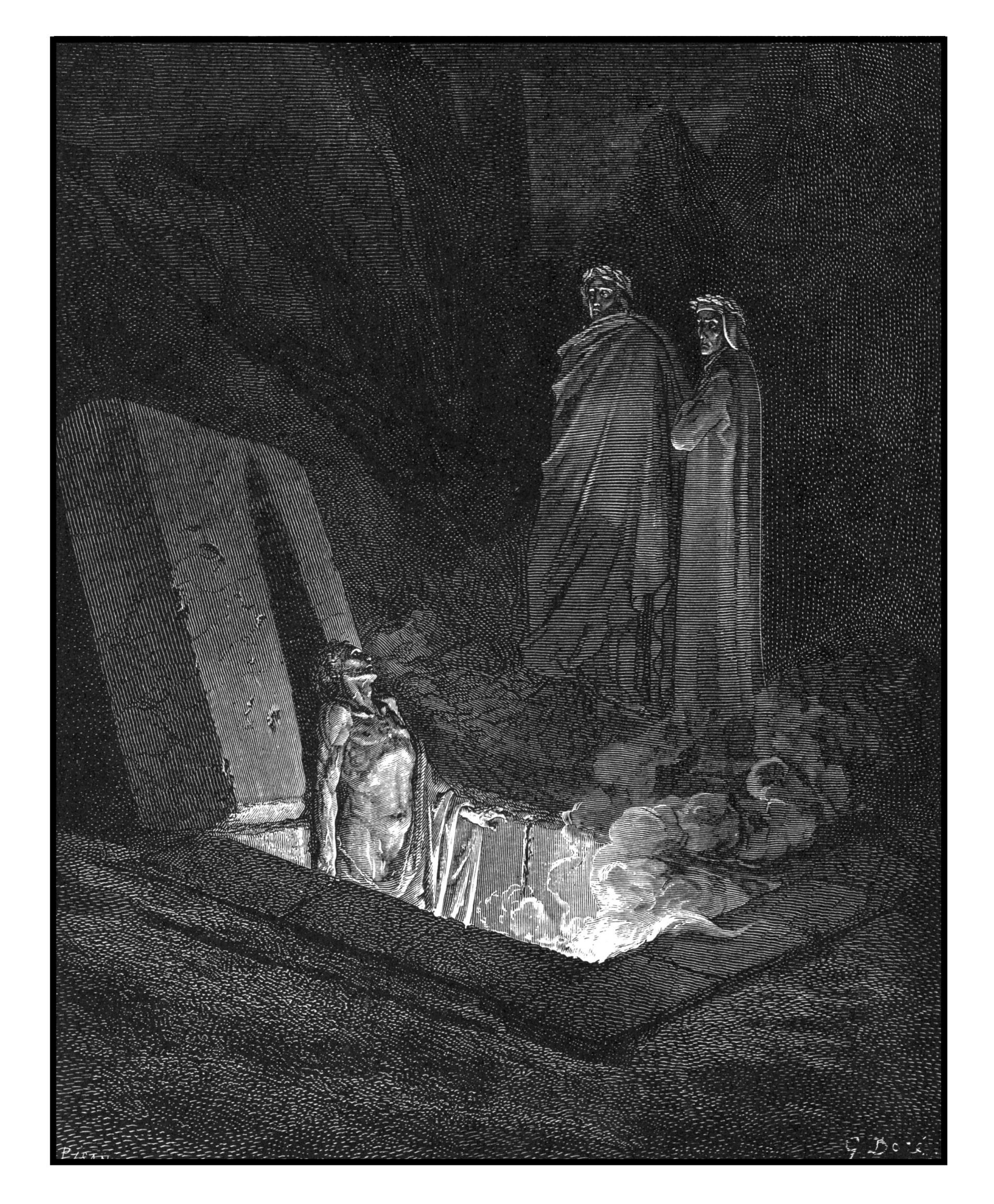
Gustav Doré’s illustration (1857) of Dante’s Sixth Circle.

As Christianity became the official religion of the Roman Empire, Epicureanism faded into obscurity. Dante placed the Epicureans in the Sixth Circle of his Inferno (1320, Canto X). Those who did not believe in the afterlife were forced to spend eternity in graves that were completely closed just as in life their tenants’ obstinacy kept them from the truth. The graves were filled with fired graves just as in life the Epicureans were consumed by their heresy.

As the Western world
moved away from the dogmatism of the Middle Ages, the idea that man was not immortal
was once again considered. Those who now reject any belief in an afterlife sometimes
adopt the bravado of the Epicurean epitaph. But more often than not they care
deeply about death as the defining event in a life. It is not nothing.

Atoms and the Void

The philosophy of
Epicurus derives from the atomism of Democritus (460-370 BCE). Democritus was
born and lived in Abdera, a city in Northern Greece, at about the same time as
Socrates was active in Athens. Democritus maintained that everything was made
of tiny indestructible atoms (Berryman, 2016). He claimed to have learned this
from Leucippus, about whom little is known, and who may be more mythical than
real.

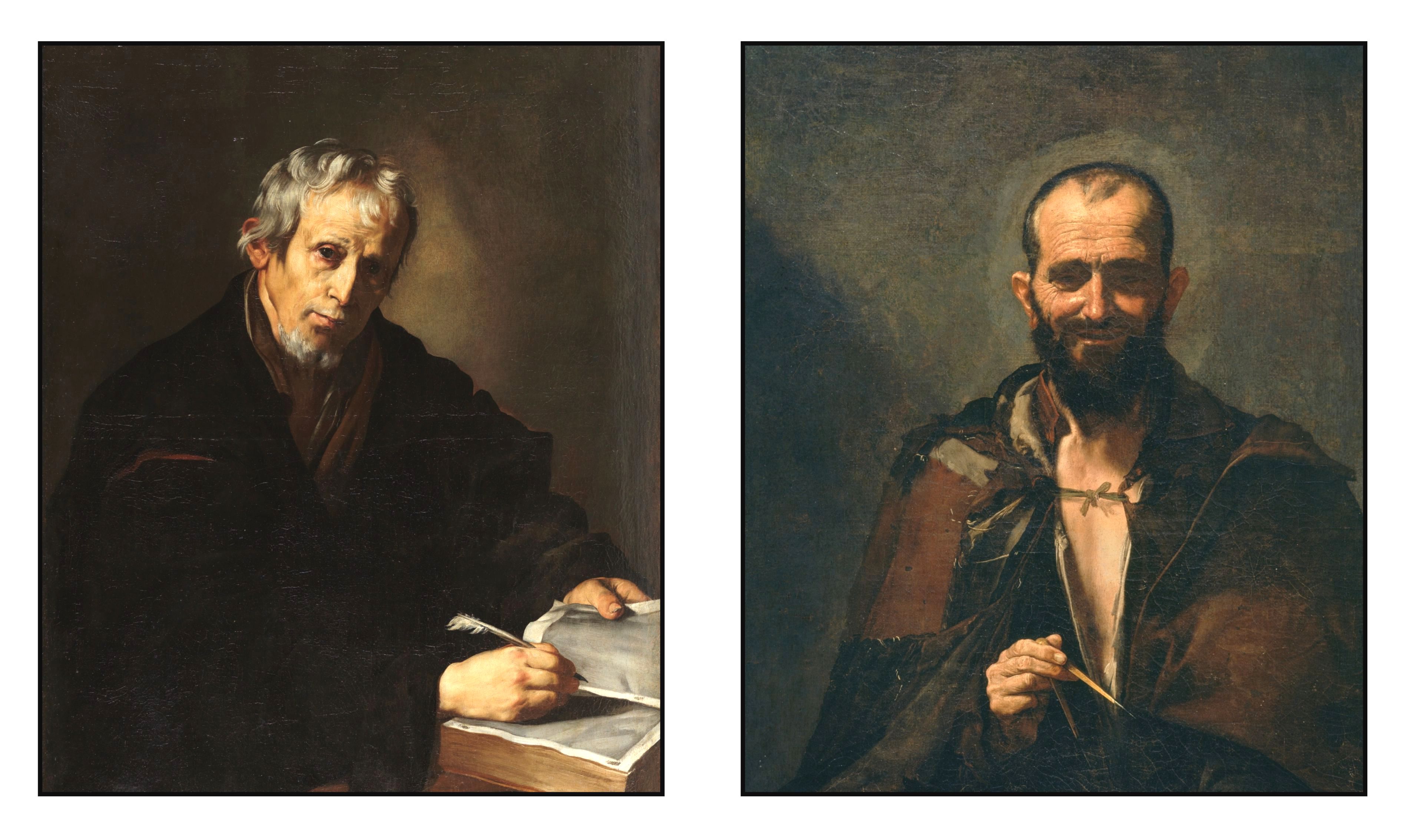
Democritus was called the “laughing philosopher” to distinguish him from Heraclitus (535-475 BCE), the “crying philosopher,” who believed that nothing was indestructible and that everything is forever changing. The cheerful and the tearful.

Jusepe de Ribera’s imagined portraits of Heraclitus (1615) and of Democritus (1630), both now in the Prado Museum

Of the many
writings of Democritus, we now have only fragments, the most famous of which
is    

By convention sweet is sweet, bitter is bitter, hot is hot, cold is cold, color is color; but in truth there are only atoms and the void (translation by Will Durant, 1939, p 393).

The concepts of
the atom and the void were derived from a combination of observation and logic.
Everyone perceives that the world contains objects and that these objects move:
matter and motion. Objects can be broken down into smaller pieces, and these
pieces can themselves be broken down into even tinier particles. But this
breaking down can only proceed so far, or all objects would by now have been
broken down to nothing. There must therefore be some indivisible particle
beyond which matter cannot be further broken. These atoms (from the Greek atomos,
uncuttable) are so tiny that they are cannot be seen by the eye: invisible and indivisible.
The void is necessary to explain how things move. How could something change
its location unless there were empty space for it to move into?

Atoms are infinite
in number but of a finite number of types. Moving atoms collide with one
another and join to form compounds. These compounds interact with each other to
create all that exists in the world. Combining atoms is like forming words with
the letters of the alphabet. From a few letters come a myriad words.

Though atoms are
eternal, the compounds that they form are transient. Rock erodes to sand, which
under pressure becomes stone again. Water evaporates and then condenses. Living
things develop, become mature and then die. At death, the components of the
body break apart, releasing its atoms for making other compounds.

          Imperious Caesar, dead and turn’d to clay,
          Might stop a hole to keep the wind away (
Hamlet, V:1)

The soul is
composed of atoms just like everything else. The atoms of the soul are extremely
fine, perhaps similar to the atoms of fire. They permeate the body, giving it a
conscious spirit. When the body dies, the atoms of the soul dissolve back into
the void like all the other atoms of the body. The soul does not persist beyond
death. There is no afterlife. We are transient like everything else, mortal
like all other living things.

Democritus’ absolute materialism differed from the philosophy of Plato, who proposed the primacy of ideas. Indeed, Plato was so upset with his rival’s teachings that he reportedly urged that all the books of Democritus should be burned (Diogenes Laertius, p 393). So much for freedom of thought in a republic governed by philosophers.   

The Garden of Epicurus

The ideas of
Democritus were extended by Epicurus (341-270 BCE), who was born on the Greek
island of Samos off the west coast of Turkey. In 306 BCE Epicurus established a
school of philosophy in Athens that met in a garden below the Acropolis (Jones,
1989; Konstan, 2018; O’Keefe, 2010; Wilson, 2015).

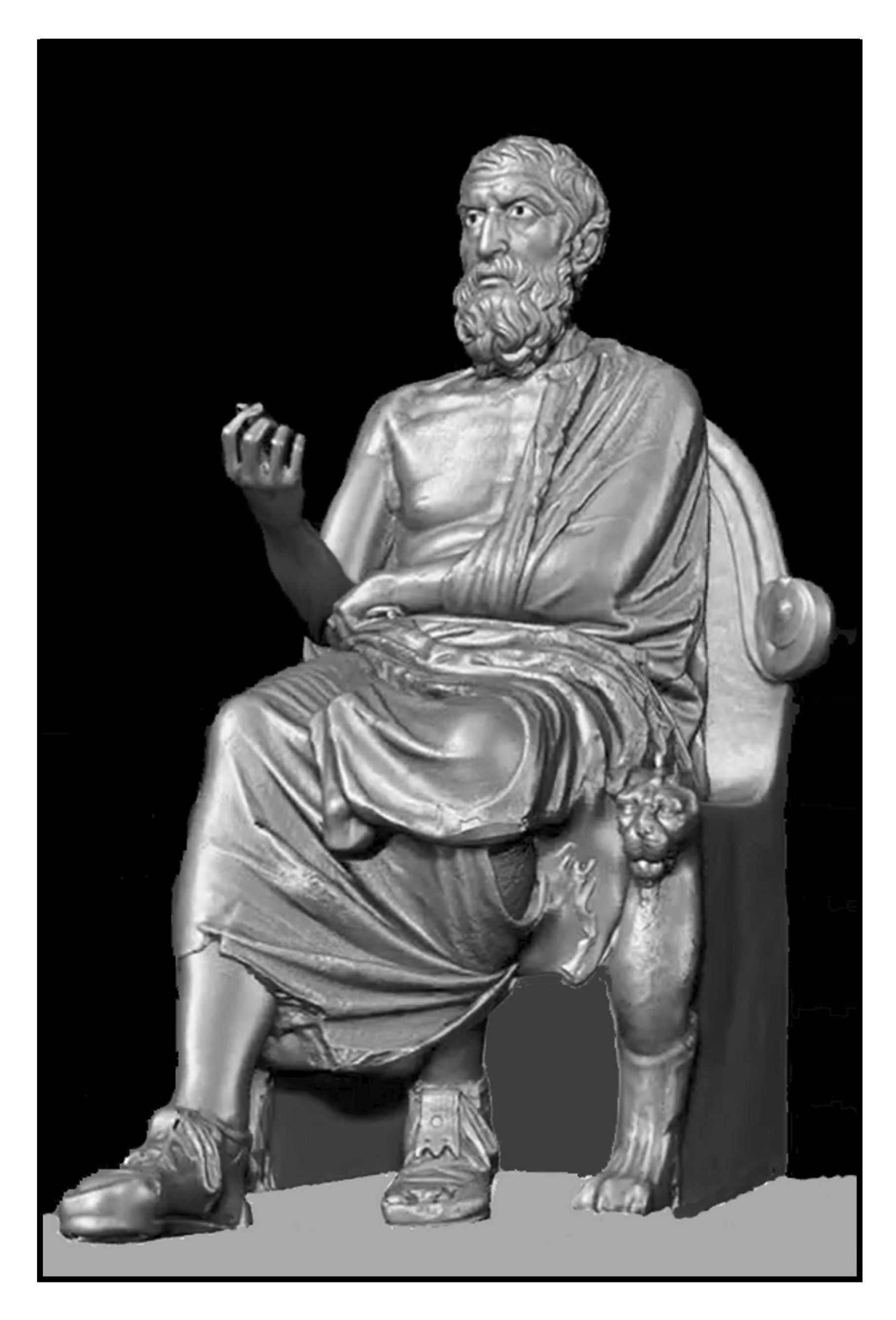
Epicurus (a digital reconstruction by Bernard Frischer that combines a head from Naples with a body from Florence)

He wrote extensively though none of his books survived the anti-heretical campaigns of the Christian Church. Most of what we know about Epicurus is preserved in the biography written by Diogenes Laertius (3rd Century CE), which includes some of the letters written by the philosopher to his colleagues, and a listing of his Principle Doctrines (Kyriai Doxai). The philosophy of Epicurus was popular in the Roman Empire, and several statues of Epicurus have survived in Roman copies (see right).

Among the lost books
of Epicurus was the Kanon (Rule, Criterion) which discussed how true knowledge
could be obtained. Epicurus proposed that sensation is the most dependable
criterion of truth – the world is what we perceive. Ideas derive from rather
than precede the analysis of sensory information. This seems to have differed
from the ideas of Democritus, who believed that our perceptions were as much
convention as reality.

In the lost Peri
Physis
(On Nature) Epicurus presented and extended the atomism of
Democritus. He acknowledged that there are only atoms and the void. The body
and the soul are made of atoms that fall apart when the corporeal body dies and
the conscious soul ceases. We do not live forever.

Epicurus appears to have deviated from the fixed determinism of Democritus byproposing the idea of the clinamen (swerve). Atoms falling through the void would never collide to form compounds unless some atoms at some time swerved from their predetermined path. Democritus also suggested that this unpredictable random movement was the basis of our free will, when we act according to what is desired of the future rather than what has been ordained by the past. In recent years similar ideas based on the uncertain behavior of atoms in the brain have been used to explain free will. Unfortunately, these ideas have little explanatory value. My actions are no more free when determined by random events in the present than when determined by the fixed events of the past.

Free will was
important to Epicurus because he wished us to choose the good life. This depended
on maximizing our happiness. Although maligned by Christian polemicists as a decadent
libertine, Epicurus actually practiced an ascetic hedonism. He valued most the
simple sensory pleasures of his garden and the friendship of his colleagues. He
eschewed any participation in politics as causing too much anxiety. His goal
was ataraxia (tranquility, peace of mind, from a- not and tarasso,
disturb). 

Although he was
described as an atheist, Epicurus thought that the gods were real because our
ideas of them were just too clear to be ignored. However, he argued that the
gods were not in any way concerned with human affairs. Like true Epicurean, the
gods enjoy themselves and refuse to be bothered by human politics.

Epicurus proposed
that we should not be frightened of death. Since our consciousness ceases when
we die, death is not painful. Since the gods are not concerned with human
beings, they have not provided an afterlife of punishment for all that we have
done wrong. If we attain a life of ataraxia, it matters not how long we
live (Lesses, 2002; Mitsis, 2002). Death is the natural and inevitable end to
life. The following is from the Letter to Monoeceus:

Get used to
believing that death is nothing to us. For all good and bad consists in
sense-experience, and death is the privation of sense-experience. Hence, a
correct knowledge of the fact that death is nothing to us makes the mortality
of life a matter for contentment, not by adding a limitless time to life but by
removing the longing for immortality. For there is nothing fearful in life for
one who has grasped that there is nothing fearful in the absence of life. Thus,
he is a fool who says that he fears death not because it will be painful when
present but because it is painful when it is still to come. For that which
while present causes no distress causes unnecessary pain when merely
anticipated. So death, the most frightening of bad things, is nothing to us;
since when we exist, death is not yet present, and when death is present, then
we do not exist. (Inwood & Gerson, 1997, p 29)

Epicurus practiced
what he preached. He died from an attack of kidney stones. Despite severe and
prolonged pain, he maintained his ataraxia. His cheerfulness of mind and
his memory of philosophy counterbalanced his afflictions.

De Rerum Natura

In about 50 BCE
Titus Lucretius Carus published a long Latin poem about the Nature of Things.
The poem probably derives from the Peri Physis of Epicurus. Little is
known about the poet. In his Chronicon (circa 380 CE), written some 400
years later, Saint Jerome included an entry for the year 94 BCE:

Titus Lucretius,
poet, is born. After a love-philtre had turned him mad, and he had written, in
the intervals of his insanity, several books which Cicero revised, he killed
himself by his own hand in the forty-fourth year of his age. (translation by
Santayana, 1910, p 19)

Saint Jerome was a
devout Christian, completely opposed to the beliefs of Epicurus, who claimed
that the gods had nothing to do with human life, and who denied the immortality
of the soul. Most critics feel that Jerome was simply trying to belittle the
poet and to cast his work as nonsense: be not seduced by Epicureanism, since madness
and suicide follow from such heresies (e.g., Sedley, 2018, and Smith, 1992 in
his introduction to the Loeb edition of De Rerum Natura). However, the
biography may contain some threads of truth:   

The love-philtre in this report sounds apocryphal; and the story of the madness and suicide attributes too edifying an end to an atheist and Epicurean not to be suspected. If anything lends colour to the story it is a certain consonance which we may feel between its tragic incidents and the genius of the poet as revealed in his work, where we find a strange scorn of love, a strange vehemence, and a high melancholy. It is by no means incredible that the author of such a poem should have been at some time the slave of a pathological passion, that his vehemence and inspiration should have passed into mania, and that he should have taken his own life. (Santayana, 1910, pp 19-20).

De Rerum
Natura
is like no other
poem: a scientific treatise expressed in verse. The poetry is characterized by
brilliant language and intense imagery. Most impressive is the ongoing energy
of the argument as Lucretius moves from atoms to death, from the soul to the
cosmos, from the weather to the plague.

The poem begins
with a beautiful invocation of Venus as the mother of Aeneas, founder of Rome,
as the patron of all the creative forces in the world, and as the
personification of Epicurean pleasure:

     Life-stirring Venus, Mother of Aeneas and of Rome,
     Pleasure of men and gods, you make all things beneath the dome
     Of sliding constellations teem, you throng the fruited earth
     And the ship-freighted sea — for every species comes to birth
     Conceived through you, and rises forth and gazes on the light.
     The winds flee from you, Goddess, your arrival puts to flight
     The clouds of heaven. For you, the crafty earth contrives sweet flowers,
     For you, the oceans laugh, the skies grow peaceful after showers,
     Awash with light. (I: 1-10 Stalling translation)

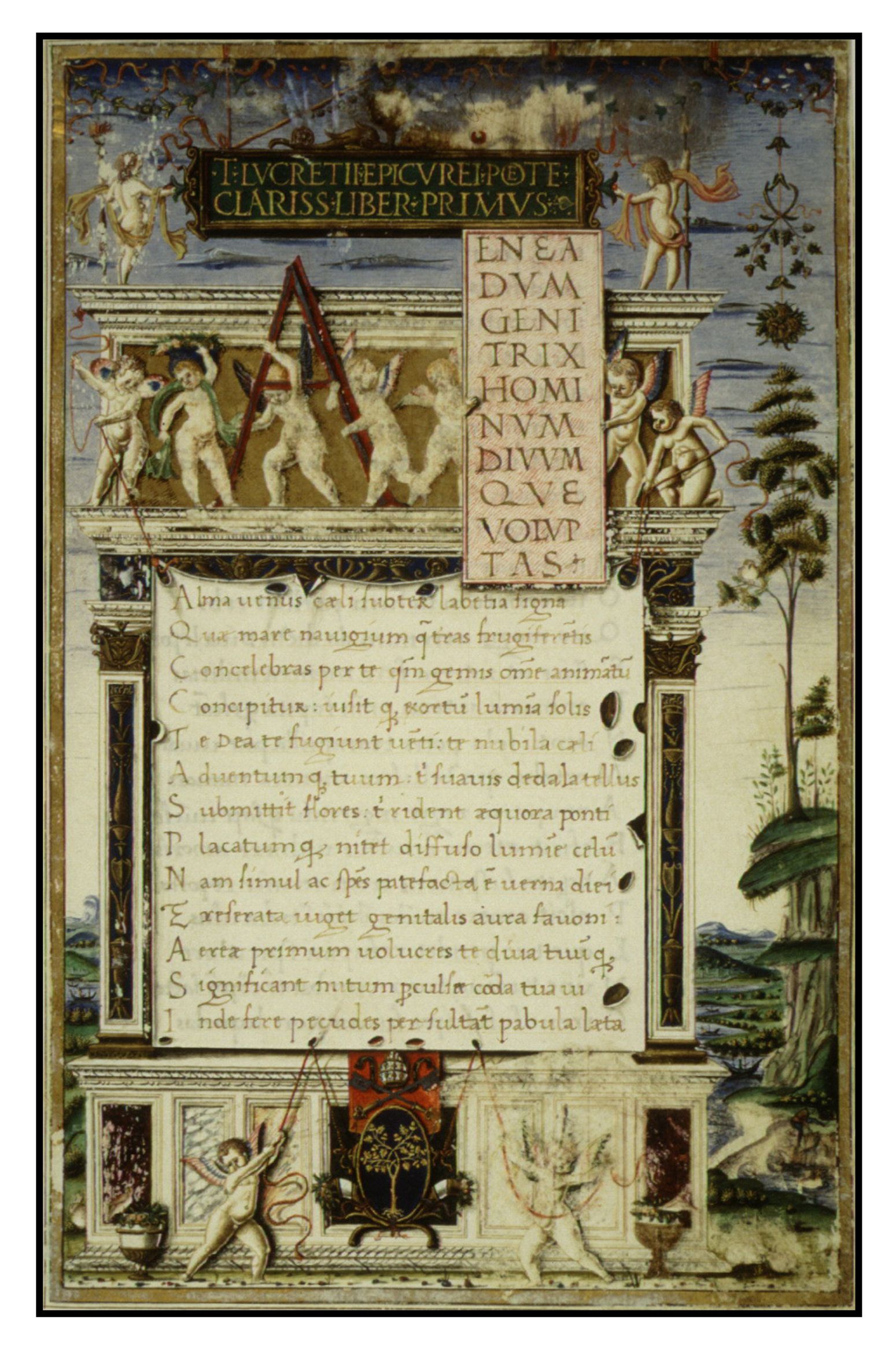
On the right is the first page of a 1483 manuscript copy of the poem made for Pope Sixtus IV by Girolamo di Matteo de Tauris. The Latin text begins

Aeneadum genetrix, hominum divomque voluptas,
Alma Venus, caeli subter labentia signa
Quae mare navigerum, quae terras frugiferentis

The beginning of
the poem immediately questions the Epicurean view that the gods are not
involved with the human world. Why should Lucretius invoke Venus as a partner
in his poetry? The gods are a problem for Epicureanism: if they are real, they
must be made of atoms and, if so, they cannot be immortal; yet, if they are
mortal, they are not gods. Lucretius probably considered the gods more as
metaphors than as real beings. Later in the poem (II: 646-660) he remarks that it
is customary to call the sea Neptune, the corn Ceres and the wine Bacchus
without actually meaning that these things are divine.

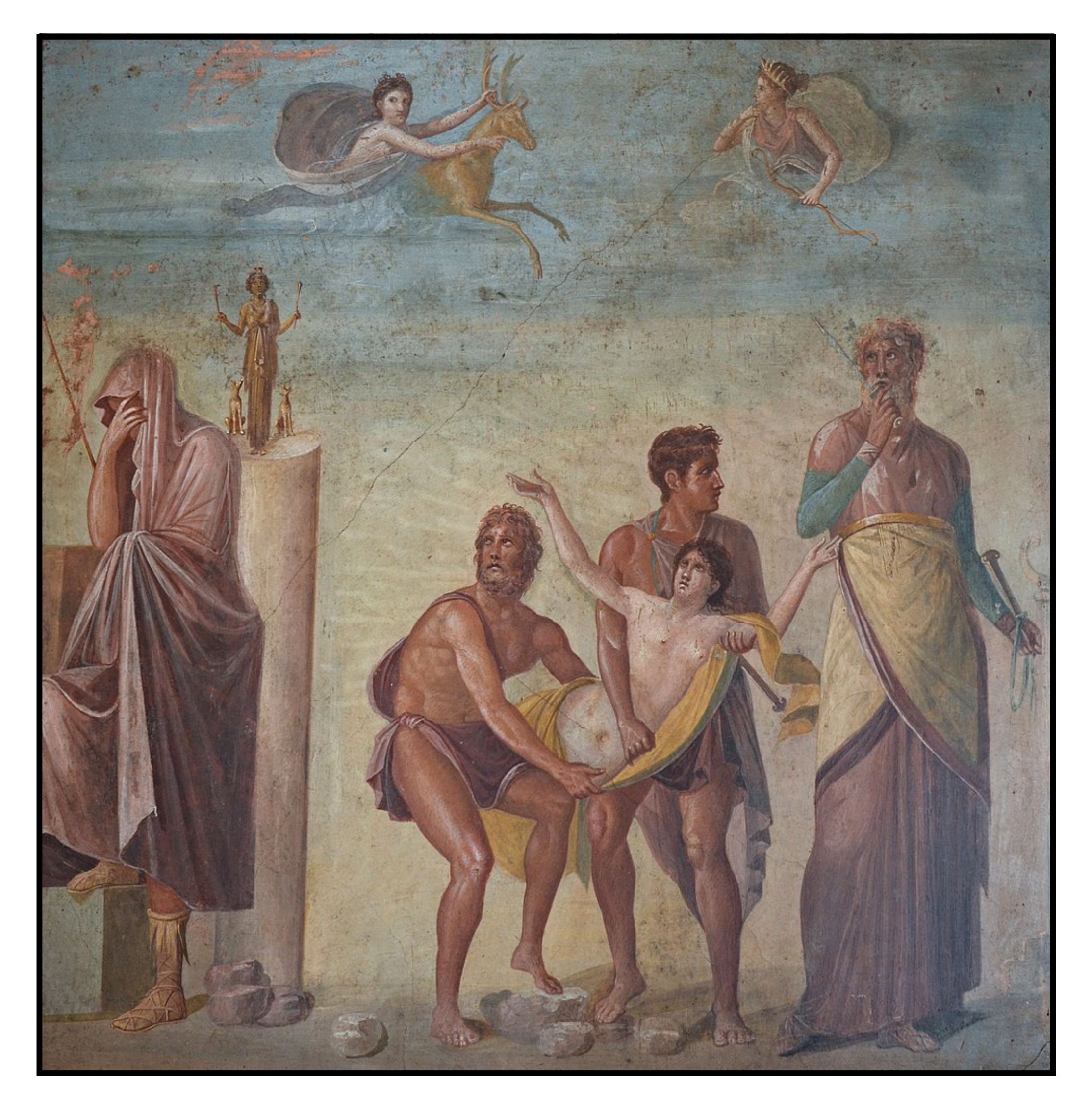
Lucretius quickly indicates that superstitious belief in the gods can lead to terrible wrongs by recounting the story of Iphigenia, daughter of Agamemnon, who was sacrificed at Aulis to propitiate the anger of the goddess Artemis, and obtain fair winds to send the Greek ships to Troy. The illustration at the left shows a fresco in the House of Tragic Poet in Pompeii from about the same time as Lucretius. Iphigenia is carried by Achilles and Ulysses to be sacrificed by Calchas the priest, while her father on the left refuses to observe her death. Above, the goddess Artemis arranges for a stag to be substituted for Iphigenia, who will be spirited away. However, this will be done without any of the Greeks realizing that Iphigenia was not actually sacrificed. Human sacrifice is also part of the Hebrew Bible, which recounts the attempted sacrifice of Isaac in Genesis 22 and the actual sacrifice of Jephthah’s daughter in Judges 11. As Lucretius clearly states, Iphigenia was

          An innocent girl betrayed to a sort of incest
          To be struck down by the piety of her father
          Who hoped in that way to get a good start for his fleet.
          That is the sort of horror religion produces.
          (I: 98-101, Sisson translation).

De Rerum
Natura
recounts the
principles of atomism espoused by Epicurus. Lucretius describes the clinamen
or swerve, and notes its importance for free will. We are not completely
determined by our past:

Again, if all motion is always one long chain, and new motion arises out of the old in order in-variable, and if the first-beginnings do not make by swerving a beginning of motion such as to break the decrees of fate, that cause may not follow cause from infinity, whence comes this free will in living creatures all over the earth, whence I say is this will wrested from the fates by which we proceed whither pleasure leads each, swerving also our motions not at fixed times and fixed places, but just where our mind has taken us? (II: 252-260, Rouse translation).

Lucretius considers death in many ways. The following passage provides the principal Epicurean argument:

           So death is nothing, and matters nothing to us
           Once it is clear that the mind is mortal stuff.
           …
           So when we are dead and when our body and soul
           Which together make us one, have come apart,
           Nothing can happen to us, we shall not be there,
           Nothing whatever will have the power to move us,
           Not even if earth and sea got mixed into one.
           (III: 830-1, 838-842, Sisson translation)

Lucretius also
adds the analogy of the mirror to the Epicurean comparison of the time before
birth to the time after death. If we are not concerned with what occurred
before we are born, why should we be afraid of its mirror-image: the time after
we have died and once again do not exist:

           Now look back: all the time that ever existed
           Before we were born, was nothing at all to us.
           It is a mirror which nature holds up for us
          To show us what it will be like after our death.
          Is it very horrible? Is there anything sad in it?
          Is it any different from sleep? It is more untroubled.
          (III: 972-977, Sisson translation)

The poem goes on
to consider many natural phenomena. Some of the explanations that Lucretius
offers are good, and some are similar to those proposed in modern science.
However, most of the explanations are wrong. Science and poetry are not well
suited: poetry attempts to say things that will last forever, whereas science is
always changing.

At the end of the
VI Book of De Rerum Natura Lucretius vividly describes the great Plague
of Athens that began in 430 BCE during the Peloponnesian War. There is great
debate about the nature of the plague, which was perhaps caused by an
Ebola-like hemorrhagic fever. 

     The symptom first to strike was fiery fever in the head,
     And both eyes, burning hectic bright, were all shot through with red.
     The throat as well would sweat with blood, all black within. And stung
     With sores, the pathway of the voice would clog and choke. The tongue,
     Interpreter of the mind, oozed pus, and, made limp with the smart,
     Was too heavy to move, and rough. Thence the disease would start,
     Passing the gullet, to fill the chest, and flood the heavy heart
     Of the afflicted, and then, indeed, all of the gates of Life
     Began to give. From the open mouth, there would exhale a rife
     Stink, like the stench of rank unburied corpses left to rot.
     And then all of the powers of the mind and body, brought
     To the very brink of doom, began to flicker. Mental strain
     Ever danced attendance on intolerable pain;
     Pleas mingled with moans. Ceaseless retching, lasting day
     And night, was ever causing seizure and cramp, and wasting away
     The strength of men already racked with suffering and worn out.
     (VI: 1145-1161
, Stallings translation)

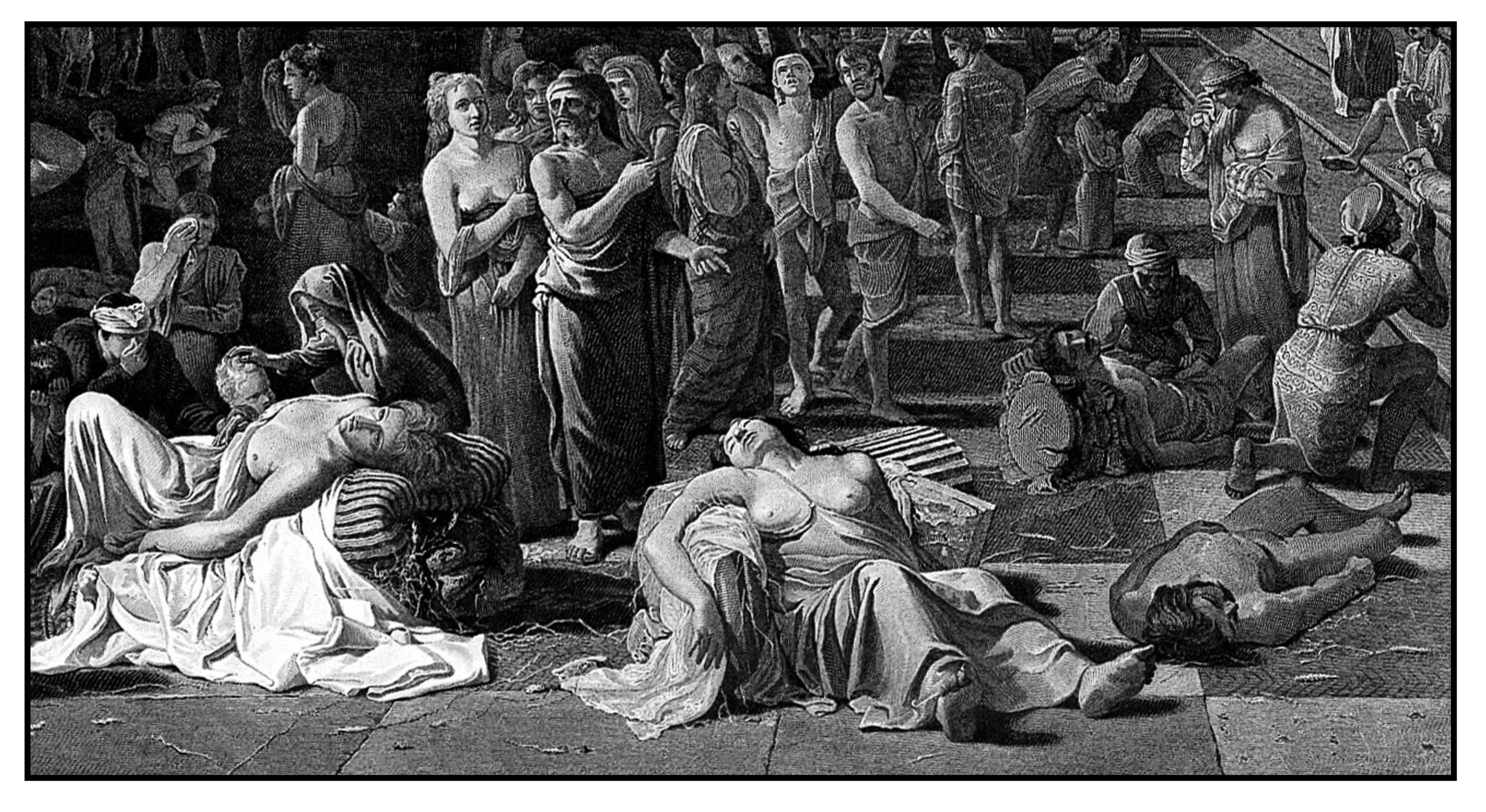
Death was everywhere. Below is a detail of an engraving (from the Wellcome Library) from a 1654 painting by Michael Sweerts, once thought to represent the plague of Athens:

The Plague of Athens

The prevalence of
death tore at the moral fabric of the city:

     The present grief was overwhelming. No one any more
     Observed the rites of burial they had observed before,
     For the whole populace was thrown in disarray and cowed.
     Each mourner buried his dead just as the time and means allowed.
     Squalid Poverty and Sudden Disaster would conspire
     To drive men on to desperate deeds — so they’d place on a pyre
     Constructed by another their own loved-ones, and set fire

     To it with wails and lamentation. And often they would shed
     Much blood in the struggle rather than desert their dead.
     (VI: 1278-1286, Stallings translation)

De Rerum
Natura
ends here. Most
critics feel that Lucretius died before he could finish his poem, and that he
probably intended to explain how philosophy could help one face the horrors of
such a plague with equanimity. But he did not. And one wonders if he could not.

Stoicism

At the time of
Epicurus, Athens was home to several other schools of philosophy. The most
important of these were the Skeptics who refused to believe in anything, and
the Stoics who differed from the Epicureans mainly in their promotions of
virtue rather than pleasure as the goal of human life (Baltzly, 2019; Long, 1986).
The Stoics proposed that the universe proceeded according to its own Logos, and
that human benefit was not necessarily part of this determined path. One had to
accept one’s fate and do the best that one could. The Stoical idea of the Logos
goes back to Heraclitus. Indeed, Stoics and Epicureans can trace their
emotional origins to tearful Heraclitus and cheerful Democritus.  

Marcus Aurelius

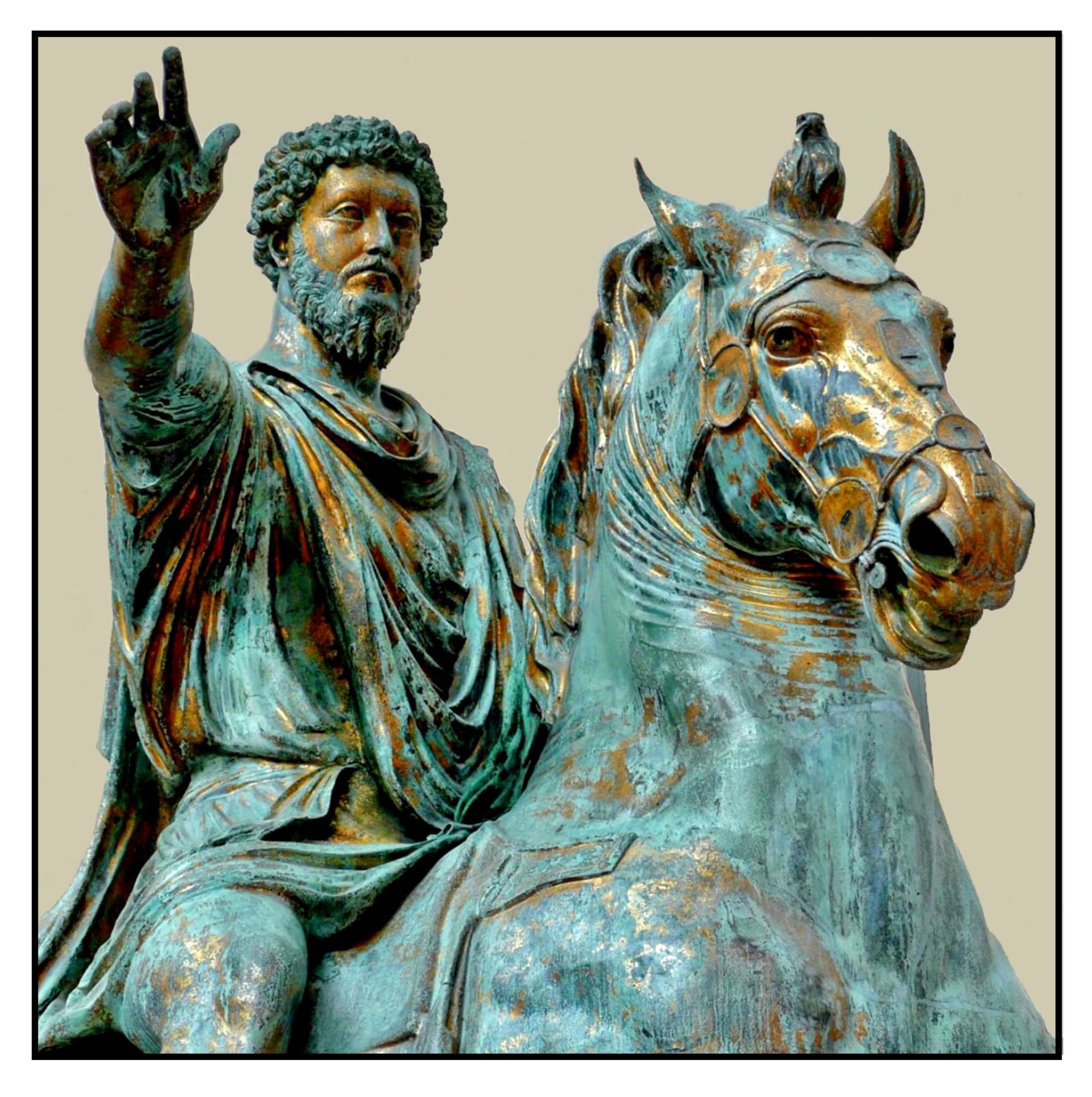
The Stoics also differed from the Epicureans in their approach to death. While the Epicureans tried to ignore death, the Stoics paid it constant attention. Death brings one’s life to an end, and therefore settles the sum of one’s virtues and achievements. Life should therefore be lived as if death were imminent. The Roman Emperor Marcus Aurelius, the 175 CE statue of whom is illustrated on the left, voiced these Stoical precepts in his Meditations:

Every moment think steadily as a Roman and a man, to do what thou hast in hand with perfect and simple dignity, and feeling of affection, and freedom, and justice; and to give thy self relief from all other thoughts. And thou wilt give thyself relief, if thou doest every act of thy life as if it were the last, laying aside all carelessness and passionate aversion from the commands of reason, and all hypocrisy, and self-love, and discontent with the portion which has been given to thee.

Do not act as if thou wert going to live ten thousand years Death hangs over thee. While thou livest, while it is in thy power, be good

(Marcus Aurelius, 180 CE, II: 5 and III: 17, translation by Long)

Stoicism became
more popular with the Romans than Epicureanism. And Stoicism fitted more easily
to the doctrines of Christianity, which accepted and transformed the Stoic idea
of Logos, making Christ its personification.  

Epicurus and Modernity

The works of Democritus
and Epicurus did not survive beyond Roman times. However, a manuscript of De
Rerum Natura
by Lucretius was diligently copied and re-copied by Christian monks,
and finally discovered in a German monastery in 1417 by Poggio Bracciolini (Greenblatt, 2011). The
first printed publication of De Rerum Natura was in 1473.

The rediscovered book
brought the atomism of Democritus and Epicurus to the attention of the
philosophers and scientists of Europe. Pierre Gassendi (1592-1665) in France
and Robert Boyle (1627-1691) in England were attracted to the explanatory power
of atoms and developed a “corpuscular philosophy” (Wilson, 2008). They tried
but failed to reconcile this atomism with Christian beliefs in the immortal
soul and a beneficent God.

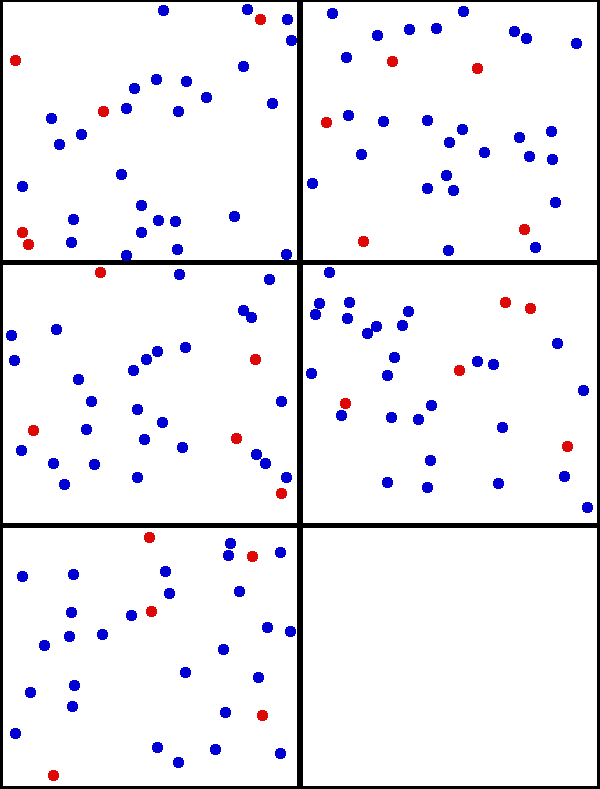
As science progressed, corpuscular philosophy developed into modern chemistry. Atoms of different types combine to form molecules of various chemical compounds. The pressure of a gas depends on the force exerted by the continual movement of its molecules. This is illustrated on the right, in which five of the molecules are colored red to make their motion easier to follow. The molecules move like the motes of dust in the sunlight that were described in De Rerum Natura (Book II:62-79). Science now knows that atoms are not indivisible, but modern science owes much to Lucretius. 

As the Enlightenment
progressed, some thinkers decided to reject God and immortality and to accept
Epicurus’ views of death. Of these perhaps the most famous is David Hume
(1711-1776) who, when dying of cancer, was interviewed by James Boswell
(1740-1795). Boswell was disconcerted by Hume’s refusal to believe in the
afterlife, and by his cheerfulness in the face of death (Miller, 1995):

I asked him if the thought of annihilation never gave him any uneasiness. He said not the least; no more than the thought that he had not been, as Lucretius observes. (Boswell, 1776).   

Fear of Death

Despite the
cheerfulness with which Epicurus and Hume faced death, Epicurean logic fails to
convince most human beings not to fear death. Since death before maturity
prevents us from reproducing, evolution must clearly have given preference to
those whose fear of death made them avoid potentially fatal situations.

Epicurus promoted
pleasure as the goal of life, but had difficulty handling its relation to time.
Common sense definitely presumes that pleasure is greater when it lasts longer.
A death that shortens a potentially pleasurable life should therefore be
feared. Epicurus proposed that ataraxia is the same regardless of the
duration, but his argument is unconvincing:

Epicurus holds that pleasure is the supreme good, and yet claims that there is no greater pleasure to be had in an infinite period than in a brief and limited one. Now one who regards good as entirely a matter of virtue is entitled to say that one has a completely happy life when completely virtuous. Here it is denied that time adds anything to the supreme good. But if one believes that the happy life is constituted by pleasure, then one cannot consistently maintain that pleasure does not increase with duration, or else the same will apply to pain. Or are we to say that the longer one is in pain the more miserable one is, but deny that duration has any bearing on the desirability of pleasure. (Cicero, 45 BCE, II: 88)

Nagel (1990) makes
a similar point:

Observed from without, human beings obviously have a natural lifespan and cannot live much longer than a hundred years. A man’s sense of his own experience, on the other hand, does not embody this idea of a natural limit. His existence defines for him an essentially open-ended possible future, containing the usual mixture of goods and evils that he has found so tolerable in the past. Having been gratuitously introduced to the world by a collection of natural, historical, and social accidents, he finds himself the subject of a life, with an indeterminate and not essentially limited future. Viewed in this way, death, no matter how inevitable, is an abrupt cancellation of indefinitely extensive possible goods. Normality seems to have nothing to do with it, for the fact that we will all inevitably die in a few score years cannot by itself imply that it would not be good to live longer.

Most people feel
that death comes before their lives have been properly completed. Some things
have not yet been experienced, others have not yet been atoned for; their
achievement is not enough, their legacy not sufficient. As Cicero (44 BCE)
remarked “No one is so old that he does not expect to live a year longer.”

The Makropulos Case

How much longer should
one then wish to live? Forever may be as frightening as tomorrow. This idea was
considered in an important paper by Bernard Williams (1973) that took as its
point of origin a play by Karel Capek that premiered in Prague in 1922 – The
Makropulos Case.
Leos Janacek’s operatic version of the play was produced
in Brno in 1925.

In the play Emilia
Marty, a beautiful and successful opera singer, turns out to be Elina
Makropulos, a young Greek woman who was given an elixir of longevity by her
physician-father in 1601. Having lived over 300 years without aging she has
returned to Prague to find the elixir’s formula so that she can further prolong
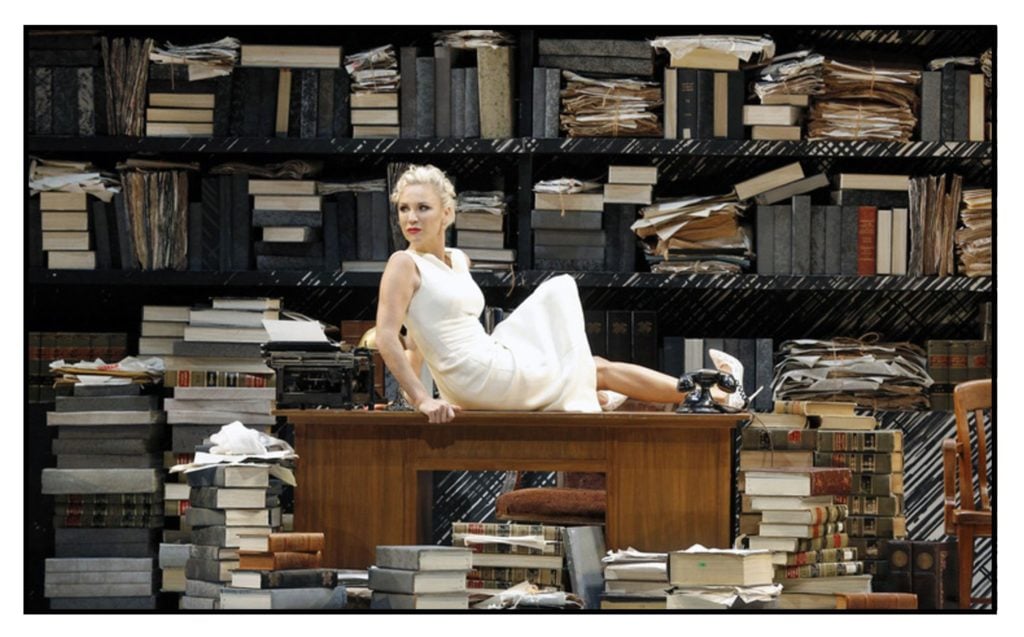
her youth. The following photograph from the San Francisco Opera (2016) shows
Nadja Michael in the role of Emilia in the first act of the opera (which takes
place in a law office):

In the end Emilia
decides that she does not want to live longer. She explains to the others:

               Oh, life should not last so long!
               If you only realized how easy life is for you!
               You are so close to everything!
               For you, everything makes sense!
               For you, everything has value!
               – for the trivial chance reason
               that you are going to die soon.
               … It’s all in vain
               whether you sing or keep silent –
               no pleasure in being good
               no pleasure in being bad.
               No pleasure on earth,
               No pleasure in heaven.
               And one comes to learn
               that the soul has died inside one.
               (Janacek version)

Williams (1973) agrees
with Emilia. After a while immortality will become tedious. Human desires are
designed for shorter periods. Evolution has made us long to live longer. Yet
the usual span of human life gives us about the right amount of time to
experience what we can, and to accomplish what we should.

Aubade

Another aspect of
death not considered in Epicurean philosophy is that it is the end of the
“person.” Each individual spends a lifetime developing a collection of
experiences and achievements, out of which are derived a set of values and an
accumulated knowledge. Warren (2004, chapter 4) considers these as the personal
“narrative.” At death the story ends. The person vanishes. Some traces will be
preserved in the memories of others but these are but faint copies of the
original.

This is the reason
why Lucretius’ analogy of the mirror does not work. We are not concerned with
the time before we were born because we did not exist then. However, this is
not the mirror image of the time after our death when we again do not exist.
Because in the meantime we have existed. Time only goes one way.

Personal annihilation is perhaps the most frightening part of death. On December 23, 1977, Philip Larkin published a poem about death in the Times Literary Supplement. (The full text is available at this link). In a letter to a friend he called it “a real infusion of Christmas cheer” (Larkin, Burnett, 2012, p 495). Fletcher (2007) provides some discussion of the poem and its relation to one of John Betjeman’s. An aubade is typically the dawn song of a lover as he leaves his mistress. Larkin’s poem is a death song about leaving his life. He is intensely afraid:

          The mind blanks at the glare. Not in remorse
          —The good not done, the love not given, time
          Torn off unused—nor wretchedly because
          An only life can take so long to climb
          Clear of its wrong beginnings, and may never;
          But at the total emptiness for ever,
          The sure extinction that we travel to
          And shall be lost in always. Not to be here,
          Not to be anywhere,
          And soon; nothing more terrible, nothing more true.

He laments the
inability of religious faith or philosophical reason to provide any comfort:

                                 Religion used to try,
          That vast moth-eaten musical brocade
          Created to pretend we never die,
          And specious stuff that says
No rational being 
          Can fear a thing it will not feel, not seeing
          That this is what we fear—no sight, no sound,
          No touch or taste or smell, nothing to think with,
          Nothing to love or link with,
          The anaesthetic from which none come round.

Larkin provides us with no resolution of this fear. In the final lines of the poem he watches as the dawn breaks and people get ready for work. Phones will ring and letters will be delivered. Communication is perhaps our only comfort. The following is Larkin’s recitation of the poem.

Endings

So we come to the
end of this essay on endings. Though death is not desired, it is inevitable.
Epicurus was right about there being nothing after death, but death itself is
not nothing. It marks the transition of a life from the individual
consciousness to the memory of others. Henry James noted in 1916 when his final
stroke began, “So here it is, the distinguished thing” (Edel, 1968, Callahan, 2005).

References

Baltzly, D. (2019). Stoicism. Stanford Encyclopedia of Philosophy.

Berryman, S. (2016). Democritus. Stanford Encyclopedia of Philosophy.

Boswell, J. (1776, reprinted 1970). An account of my last interview with David Hume. In Weis C. M. and Pottle F. A. (Eds) Boswell in Extremes. 1776-1778. New York: McGraw Hill. (pp 11-15). Also available at PhilosophyTalk website.

Callahan,
D. (2005). Death: ‘The Distinguished Thing,’ Hastings Center Report, 35, S5-S8.

Čapek,
K., (translated and introduced by Majer, P., & Porter, C., 1999). Four
plays
. London: Methuen Drama.

Cicero, M. T. (45 BCE, translated by Woolf, R., and edited by Annas, J., 2001). On Moral Ends. Cambridge, UK: Cambridge University Press. Available at Archive.org

Cicero, M. T. (44 BCE, translated by A. P. Peabody, 1884). Cicero de Senectute (on old age). Little Brown, Boston. Available at Archive.org

Diogenes Laertius (3rd Century CE, translated by Yonge, C. D., 1853). The lives and opinions of eminent philosophers. London: Henry G. Bohn.  Available at Archive.org

Durant, W. (1939). The story of civilization: Part II: The life of Greece. New York: Simon and Schuster. Available at Archive.org

Edel, L. (1968). The deathbed notes of Henry James. The Atlantic Monthly, (June 1968)

Fletcher, C. (2007). John Betjeman’s Before the Anaesthetic, orA Real Fright’: A Source for Philip
Larkin’s ‘Aubade’. Notes and Queries, 54, 179-181

Greenblatt, S. (2011). The swerve: How the
world became modern
. New York: W.W. Norton.

Inwood, B., & Gerson, L. P. (1997). Hellenistic
philosophy: Introductory readings
. 2nd Edition. Indianapolis: Hackett.

Jones, H. (1989). The Epicurean tradition.
London: Routledge.

Konstan, D. (2018). Epicurus. Stanford Encyclopedia of Philosophy.

Larkin, P. (edited by A. Burnett, 2012). The
complete poems of Philip Larkin
. London: Faber and Faber.

Lesses, G. (2002).
Happiness, completeness, and indifference to death in Epicurean ethical theory.
Apeiron, 35 (4), 57–68.

Long, A. A. (1986). Hellenistic philosophy: Stoics,
Epicureans, Sceptics
. 2nd Edition
Berkeley: University of California Press.

Lucretius, C. T. (~50BCE, translated by W. H.
D. Rouse, 1924, with introduction and revisions by M. F. Smith, 1992). De
rerum natura
. Cambridge, Mass: Harvard University Press (Loeb Classical
Library). (Latin with English prose translation)

Lucretius, C. T. (translated by C. H. Sisson,
1976). De rerum natura: The poem on nature; a translation. Manchester:
Carcanet New Press. (Blank verse translation)

Lucretius, C. T. (translated by A.E. Stallings, 2007). The nature of things. London: Penguin Classics. (Translation in rhyming couplets)

Marcus Aurelius Antoninus (180 CE, translated by G. Long, 1862). Meditations. New York: F. M. Lupton. Available at Archive.org.

Miller, S. (1995). The death of Hume. Wilson Quarterly, 19 (3). 30-39

Mitsis, P. (2002).
Happiness and death in Epicurean ethics. Apeiron, 35 (4), 41–55.

Nagel. T. (1970). Death. Nous, 4,
73-80. Reprinted in Nagel, T. (1979). Mortal Questions (pp 1-10)
Cambridge UK; Cambridge University Press.

O’Keefe, T. (2010). Epicureanism.
Durham, UK: Acumen.

Santayana, G. (1910). Three philosophical poets: Lucretius, Dante, and Goethe. Cambridge, MA: Harvard University.

Sedley, D. (2018). Lucretius. Stanford Encyclopedia of Philosophy.

Warren, J. (2004). Facing death:
Epicurus and his critics
. Oxford: Oxford University Press.

Williams, B. (1973). The
Makropoulos case: Reflections on the tedium of immortality. Reprinted in his Problems
of the Self.
(pp 82-100).  New York: Cambridge University Press.

Wilson, C. (2015). Epicureanism: a very short introduction. Oxford: Oxford University Press.  

Wilson, C. (2008). Epicureanism at the
origins of modernity.
Oxford: Oxford University Press.


Remembrance

The onset of World War I brought into question the very idea of European civilization. Mankind’s ongoing progress to a better world appeared no longer pre-ordained. Promises of future peace and plenty were forever broken. Henry James wrote in a letter to Howard Sturgis on August 5, the day after Britain declared war of Germany.

The plunge of civilization into the abyss of blood and darkness by the wanton fiat of those two infamous autocrats is a thing that so gives away the whole long age during which we had supposed the world to be, with whatever abatement, gradually bettering, that to have to take it all now for what the treacherous years were all the while really making for and meaning is too tragic for my words. (James, 1920, p 398)

(The “autocrats” were Kaiser Wilhelm II of Germany and Franz Josef I of Austria.) The complex sentence is typical of James, the master of convoluted qualification. Rudyard Kipling later said the same in fewer words in his Common Form for the Epitaphs of the War:

If any question why we died,
Tell them, because our fathers lied.

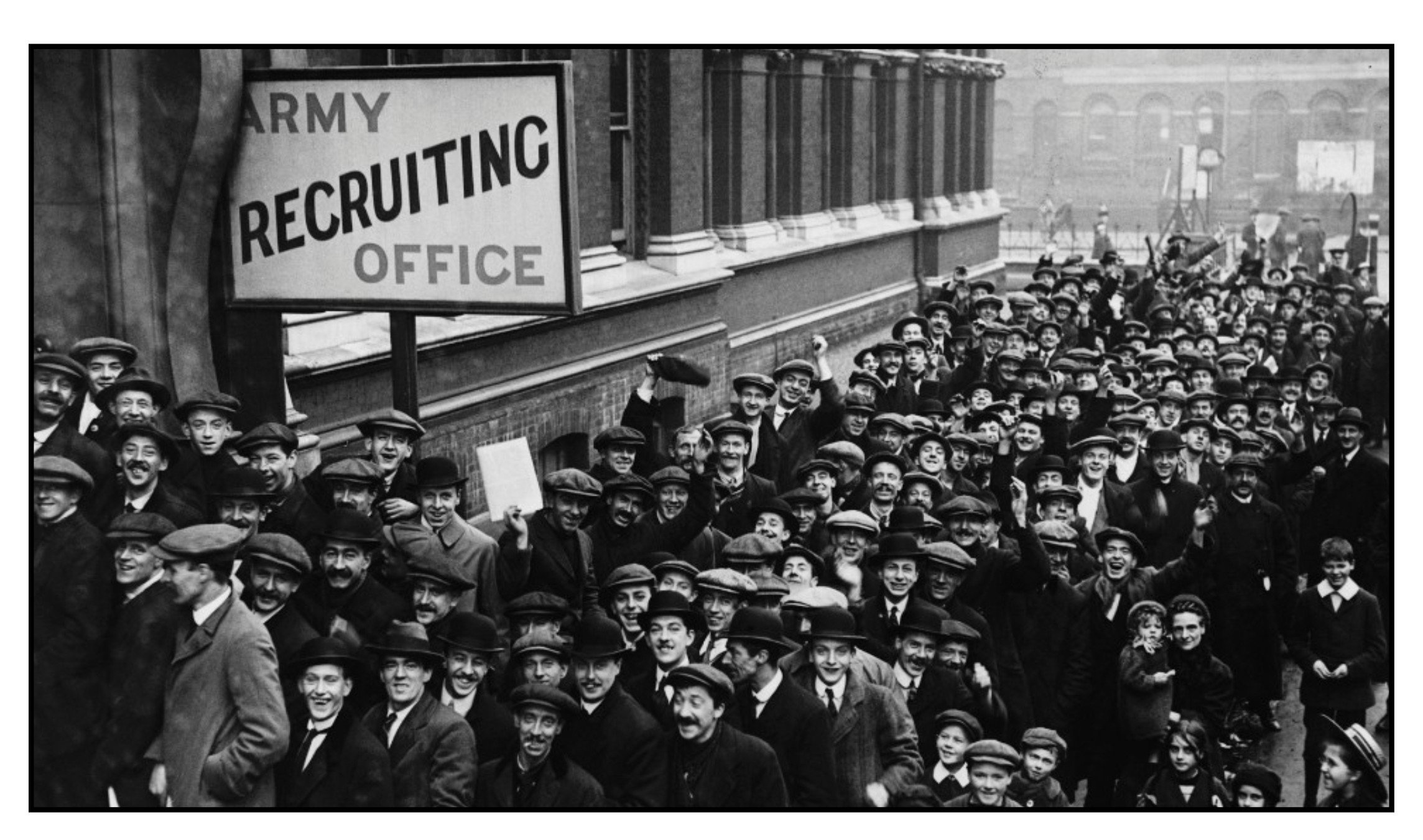
However, at the beginning of the war, the general population had no such reservations. People rallied to support their King and Empire. Young men thronged enthusiastically to the recruiting centres.

recruitingXb

On looking at photographs of these happy volunteers, Philip Larkin wrote in 1960 a poem called MCMXIV

Those long uneven lines
Standing as patiently
As if they were stretched outside
The Oval or Villa Park,
The crowns of hats, the sun
On moustached archaic faces
Grinning as if it were all
An August Bank Holiday lark;

And the shut shops, the bleached
Established names on the sunblinds,
The farthings and sovereigns,
And dark-clothed children at play
Called after kings and queens,
The tin advertisements
For cocoa and twist, and the pubs
Wide open all day;

And the countryside not caring:
The place-names all hazed over
With flowering grasses, and fields
Shadowing Domesday lines
Under wheat’s restless silence;
The differently-dressed servants
With tiny rooms in huge houses,
The dust behind limousines;

Never such innocence,
Never before or since,
As changed itself to past
Without a word – the men
Leaving the gardens tidy,
The thousands of marriages
Lasting a little while longer:
Never such innocence again.

The title gives “1914” in Roman numerals, the way dates are written on the war memorials. The crowds lined up as if for a sporting event – cricket at the Oval or soccer at Villa Park. The innocence of England went back to medieval times when the country was surveyed for the Domesday Book of 1086. It was a land of simple pleasures, of hot cocoa steaming in a mug and pipe-tobacco sold in a “twist.” It was a society, where everyone from lord to maid knew their place.

Over the next four years, everything changed. The pubs that had once been open all day became restricted in their hours so that workers did not become too inebriated to produce munitions. Servants fought alongside their betters and began to wonder about why they were different. In the years that followed the war, the British Empire began slowly to unravel. The war etched itself into modern memory through poetry, photographs, painting and music (Silkin, 1972; Fusell, 1975; Malvern, 2004).

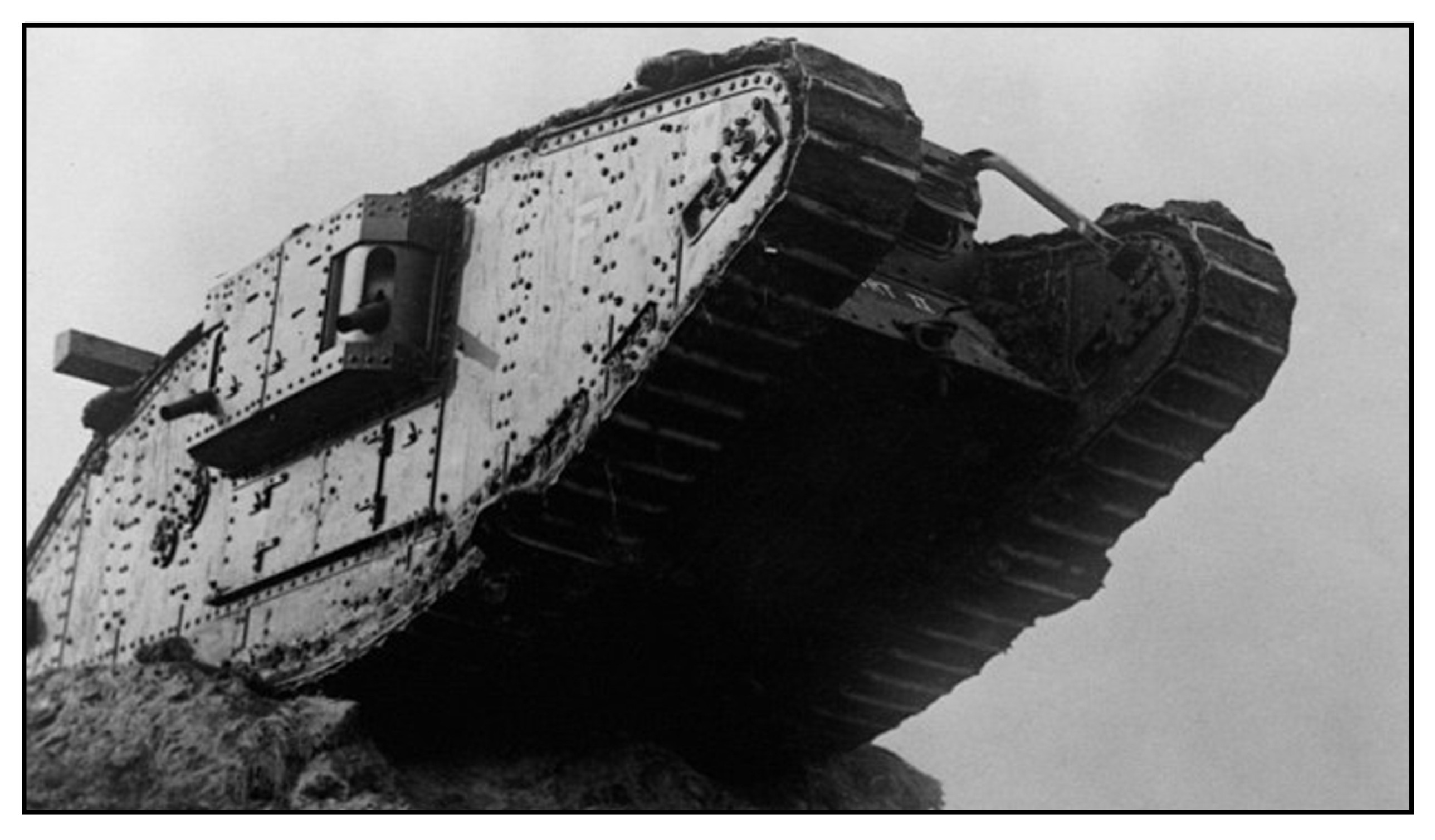
The bravado of the war’s first months soon ceded to harsh reality. Young men in their thousands marched to their deaths; trenches were dug like graves in the once-fertile land; the instruments and engines of war grew more efficient and terrible; form and sound became incomprehensible in the exploding shells; death came even in the air that soldiers breathed.

tank Xb

Siegfried Sassoon described trench warfare in his 1917 poem Attack:

At dawn the ridge emerges massed and dun
In the wild purple of the glow’ring sun,
Smouldering through spouts of drifting smoke that shroud
The menacing scarred slope; and, one by one,
Tanks creep and topple forward to the wire.
The barrage roars and lifts. Then, clumsily bowed
With bombs and guns and shovels and battle-gear,
Men jostle and climb to meet the bristling fire.
Lines of grey, muttering faces, masked with fear,
They leave their trenches, going over the top,
While time ticks blank and busy on their wrists,
And hope, with furtive eyes and grappling fists,
Flounders in mud. O Jesus, make it stop!

Broodseinde, 1917

Broodseinde, 1917

Sassoon was awarded the Military Cross for his bravery. He often went out on his own to engage the German lines, and was called “Mad Jack” for these near-suicidal exploits. Deeply disillusioned by the conduct of the war and the waste of life, in 1917 he wrote to his commanding officer a letter entitled Finished with the War: A Soldier’s Declaration, and forwarded a copy of this to the press. Rather than prosecuting him for treason, the military authorities sent him to Craiglockhart Hospital to be treated for neurasthenia or “shell shock.” At the hospital, Sassoon met and encouraged another soldier-poet, Wilfred Owen.

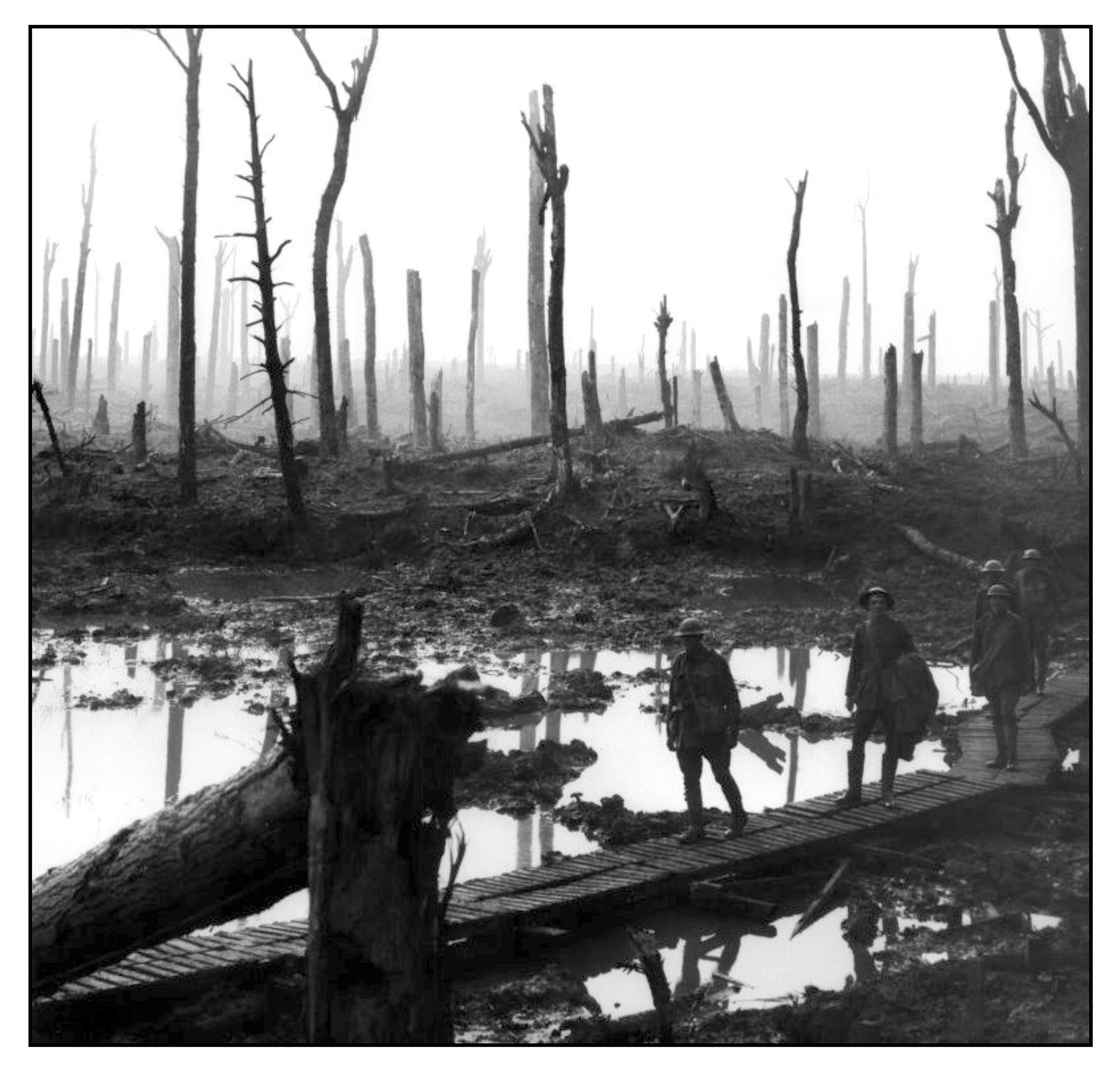
The Great War altered forever the way that we see the world. More than in any previous war, the public was able to see what actually happened from photographs of soldiers in action. These were strictly censored. Nevertheless, the published photographs showed clearly both the isolation of the soldiers and the desolation of the land.

Ypres, 1917

Ypres, 1917

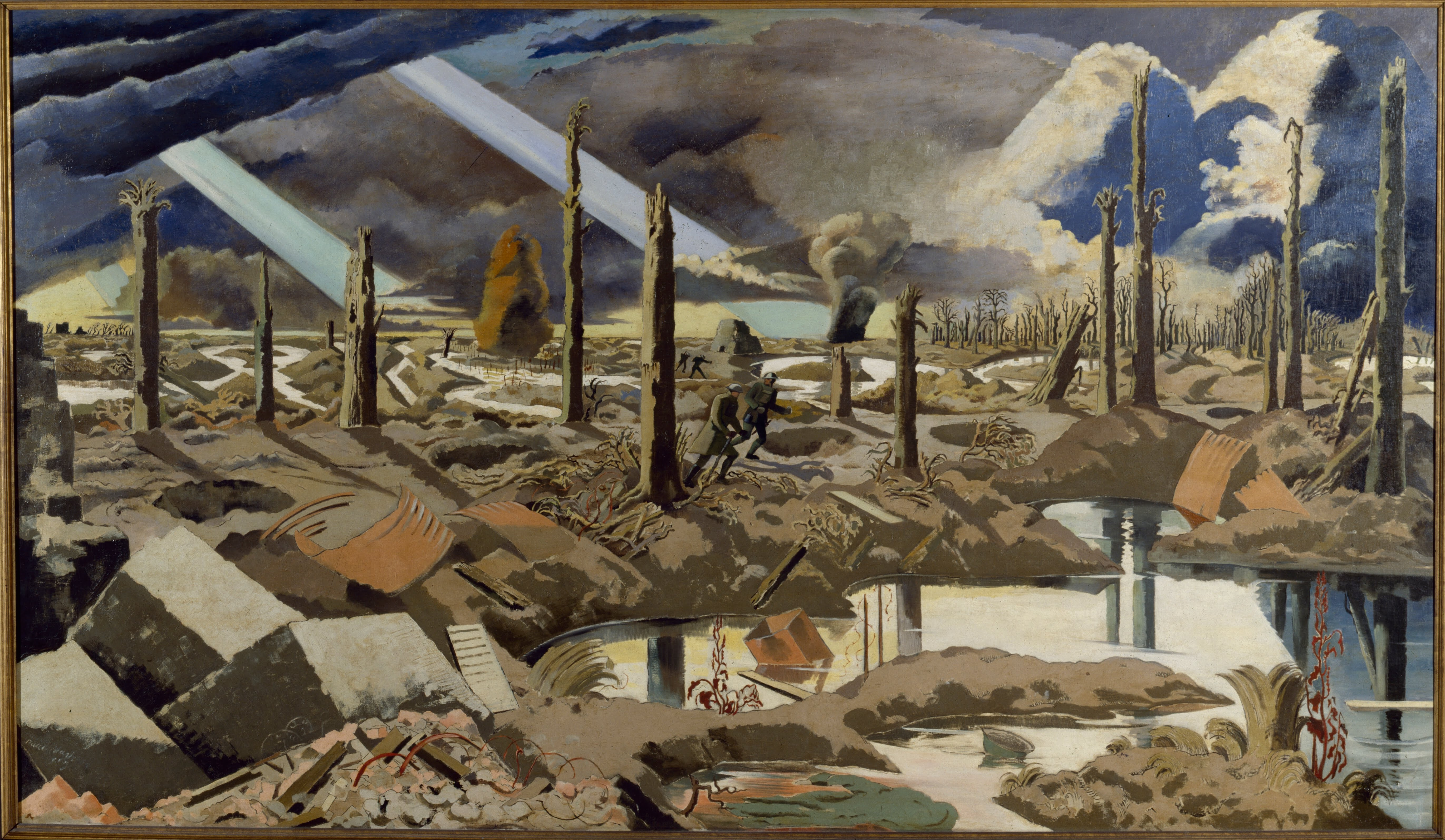
Paintings no longer portrayed romance and courage but horror and fear. Paul Nash was a war-artist who served with the British Army at Ypres in 1917. He wrote to his wife

Sunset and sunrise are blasphemous, they are mockeries to man, only the black rain out of the bruised and swollen clouds all though the bitter black night is fit atmosphere in such a land. The rain drives on, the stinking mud becomes more evilly yellow, the shell holes fill up with green-white water, the roads and tracks are covered in inches of slime, the black dying trees ooze and sweat and the shells never cease. They alone plunge overhead, tearing away the rotting tree stumps, breaking the plank roads, striking down horses and mules, annihilating, maiming, maddening, they plunge into the grave which is this land; one huge grave, and cast up on it the poor dead. It is unspeakable, godless, hopeless. I am no longer an artist interested and curious, I am a messenger who will bring back word from the men who are fighting to those who want the war to go on for ever. Feeble, inarticulate, will be my message, but it will have a bitter truth, and may it burn their lousy souls. (quoted by Haycock, 2009, p. 278)

His impressions formed the basis for his painting The Menin Road:

Nash,_Paul_-_The_Menin_Road_-_Google_Art_Project

After the Allies broke through their defences in 2018, Germany sued for peace. Negotiations began in October and the war was finally ended by an armistice between the Allies and Germany signed on November 11 at 5 am in a railway carriage in the forest of Compiègne. Hostilities were to cease at 11 am that day “the eleventh hour of the eleventh day of the eleventh month.” At that time each year since then, we have paused to remember those who died in battle.

Wilfred Owen was killed in action at the crossing of the Sambre-Oise canal on November 4, a brief week before the war ended. One of his last poems imagined what might happen when he died. The slant rhymes underline the uneasiness of his Strange Meeting.

It seemed that out of battle I escaped
Down some profound dull tunnel, long since scooped
Through granites which titanic wars had groined.
Yet also there encumbered sleepers groaned,
Too fast in thought or death to be bestirred.
Then, as I probed them, one sprang up, and stared
With piteous recognition in fixed eyes,
Lifting distressful hands, as if to bless.
And by his smile, I knew that sullen hall, –
By his dead smile I knew we stood in Hell.
With a thousand pains that vision’s face was grained;
Yet no blood reached there from the upper ground,
And no guns thumped, or down the flues made moan.
‘Strange friend,’ I said, ‘here is no cause to mourn.’
‘None,’ said that other, ‘save the undone years,
The hopelessness. Whatever hope is yours,
Was my life also; I went hunting wild
After the wildest beauty in the world,
Which lies not calm in eyes, or braided hair,
But mocks the steady running of the hour,
And if it grieves, grieves richlier than here.
For by my glee might many men have laughed,
And of my weeping something had been left,
Which must die now. I mean the truth untold,
The pity of war, the pity war distilled.
Now men will go content with what we spoiled,
Or, discontent, boil bloody, and be spilled.
They will be swift with swiftness of the tigress.
None will break ranks, though nations trek from progress.
Courage was mine, and I had mystery,
Wisdom was mine, and I had mastery:
To miss the march of this retreating world
Into vain citadels that are not walled.
Then, when much blood had clogged their chariot-wheels,
I would go up and wash them from sweet wells
Even with truths that lie too deep for taint.
I would have poured my spirit without stint
But not through wounds; not on the cess of war.
Foreheads of men have bled where no wounds were.
‘I am the enemy you killed, my friend.
I knew you in this dark: for so you frowned
Yesterday through me as you jabbed and killed.
I parried; but my hands were loath and cold.
Let us sleep now . . .’

The dead soldier’s description of the life that might have been, the laughter and the tears cut short, portrays “the pity war distilled.” Strange Meeting was one of several poems by Owen that were set to music by Benjamin Britten in the War Requiem, composed for the 1962 consecration of the new Coventry Cathedral. The old cathedral had been destroyed by bombing in World War II, which began only twenty-one years after the end of the “war to end all wars.”

Britten used as an epigraph to the score a quotation from the draft preface that Owen had written to a planned book of his poems on the war:

My subject is War, and the pity of War.
The Poetry is in the pity …
All a poet can do today is warn.

Owen’s words and Britten’s music provide context for today’s Remembrance. The following clip provides the ending to the War Requiem. The final lines of Owen’s poem, beginning with “I am the enemy you killed,” lead into the final section of the mass, initially sung by the two male soloists and a boys’ choir, before ending with the full chorus.

In paradisum deducant te angeli
In tu adventu suscipiant te martyres
et perducant te in civitatem sanctam Jerusalem.
Chorus angelorum te suscipiat et cum Lazaro
quondam pauper aeternam habeas requiem.
Requiem aeternam dona eis, Domine:
et lux perpetua luceat eis.
Requiescant in pace.

(May the angels lead you into paradise and at your arrival may the martyrs receive you and bring you into the holy city of Jerusalem. May the choir of angels receive you and may you have eternal rest together with Lazarus who once was poor. Lord, grant them eternal rest and let perpetual light shine upon them. May they rest in peace.)

References  

Fussell, P. (1975). The Great War and modern memory. New York: Oxford University Press.

Haycock, D. B. (2009). A crisis of brilliance: Five young British artists and the Great War. London: Old Street.

Holmes, R. (2001). The First World War in photographs. London: Carlton Book.

James, H (edited by P. Lubbock, 1920). Letters. London: Macmillan.

Larkin, P. (edited and annotated by Burnett, A., 2012). The complete poems of Philip Larkin. London: Faber & Faber.

Malvern, S. (2004). Modern art, Britain, and the Great War: Witnessing, testimony, and remembrance. New Haven: Yale University Press.

Owen, W. (edited and annotated by Stallworthy, J., 1963). The poems of Wilfred Owen. London: Chatto & Windus

Sassoon, S. (1961). Collected poems, 1908-1956. London: Faber & Faber.

Silkin, J. (1972). Out of battle: The poetry of the Great War. London: Oxford University Press.