Paul Klee: Color and Music


The paintings of Paul Klee (1879-1940) gave us a new way to look at the world, allowing us to go beyond our immediate perceptions and see the underlying forms. 

Kunst gibt nicht das Sichtbare wieder, sondern macht sichtbar.
Art does not reproduce the visible; rather, it makes visible.
(Klee, Creative Confession, 1920/2013, part I).

Color and music were the two great principles underlying his art. The tonal relations between colors and the rhythms of their spatial presentation combine to give us understanding. Many composers have sought to express Klee’s paintings in their music, to complement his colors with their notes. This essay presents some of these compositions. On the right is a portrait of Paul Klee by Hugo Erfurth in 1922

Early Life

Klee was born in Münchenbuchsee, a small town near Bern in Switzerland, and spent his childhood and adolescence in Bern. His father was a teacher of music and his mother a singer. Klee studied the violin and became good enough to play occasionally in the city orchestra. He revered Bach and Mozart, and cared little for the music of the 19th-Century (Düchting 2012, 7-8).  

In 1898 he began to study art at the Academy of Fine Arts in Munich. He travelled to Italy, but found little inspiration in the works of the masters. His own graphic work – drawings, caricatures and etchings – was strange and uncertain.

Der Blaue Reiter

In 1911, several expressionist painters in Munich, among them, Wassily Kandinsky, Gabriele Münter, and Franz Marc, formed a new group, The Blue Rider (Gollek, 1982). They published an almanac, and in 1911 and 1912 held exhibitions of their work and modern paintings from other artists in Germany and France. Klee interacted with them, becoming aware of recent developments in art, such as the Cubism of Pablo Picasso and the Orphism of Robert Delaunay. Klee contributed several of his own works to the second exhibition.

 Klee’s Kleine Landschaft in Regenstimmung (Small Landscape in a Rainy Mood, 1913) shows the influence of Cubism. The picture shows hills in the distance and trees and rocks in the foreground. The violet and green palette is subdued, washed in the rain.   

In 1991 Walter Steffens composed a set of 4 pieces for recorder – Opus 63: Watercolors of Paul Klee. The following is the haunting third piece – Kleine Landschaft in Regenstimmung – played by Benedicta Bonitz on tenor recorder:


Paris

In 1912 Klee visited Paris. As well as visiting all the tourist spots, he spent time with Robert Delaunay, who had just written an essay on Light (Vriesen & Imdahl, 1969, pp 6-7). True painting depended on light and color. Color allowed different aspects of reality to be simultaneously and harmoniously represented. 

Art in Nature is rhythmic and abhors constraint. If art is attached to the Object, it becomes descriptive, divisive, literary. It lowers itself to imperfect means of expression, it condemns itself of its own accord, it is its own negation, it does not break free of imitative Art. …

For Art to reach the limits of sublimity, it must approach our harmonic Vision: clarity. Clarity will be color, proportions; these proportions are composed of various simultaneous measures within an action. This action must be representative harmony, the synchromatic movement (simultaneity) of light, which is the only reality. This synchromatic action will then be the Subject which is the representative harmony.

Klee agreed to translated the essay into German and his translation was published in Der Sturm in early 1913.

 One of Klee’s paintings from 1915 – Lachende Gotik (Laughing Gothic) – owes much to the ideas and the paintings of Delaunay. Suggesting the tall arches of a gothic church illuminated by the light of stained glass windows, Klee’s work owes much to Delaunay’s series of paintings of the Église Saint Séverin (1909-10).


In 2014, almost a century later, Martin Torp composed 6 Piano Pieces to Pictures by Paul Klee (“Klee-Blätter”). The following is Number 2 Lachende Gotik:


Tunis

In April 1914, Klee travelled to Tunis with August Macke, and Louis Moilliet. The brightness and clarity of the light and the variegated colors of the settlements they visited, Kairouan in particular, provided Klee with an epiphany:

Die Farbe hat mich. Ich brauche nicht nach ihr zu haschen. Sie hat mich für immer. Das ist der glücklichen Stunde Sinn: ich und die Farbe sind eins. Ich bin Maler.
Color possesses me. I don’t have to pursue it. It will possess me always, I know it. That is the meaning of this happy hour: Colour and I are one. I am a painter.
(Paul Klee diaries, April 24, 1914)

Although most of Klee’s paintings from Tunis were representational, one was completely abstract: Im Stil von Kairouan in Gemässigte übertragen (In Kairouan Style, Transposed to the Temperate, 1914):

I could find no pieces of music that directly related to Klee’s paintings from Tunis. The following is a highly rhythmic jazz piece by Marti Perramon, Joe Gallivan and the Ektal Ensemble entitled Kairouan a Klee. Their music suggests the suddenness and brightness of Klee’s Tunisian experience:


World War I

Klee’s friends, August Macke and Franz Marc joined up at the onset of the war. Macke died in September 1914, and Marc in March 1916 (in the Battle of Verdun). Klee, whose Swiss nationality gave him some respite, was finally called up in March 1916 since his father was German. As chance would have it, Klee was not assigned to the front lines: he spent the war doing clerical work in the payroll office. This gave him time to think through his philosophy of painting. He extended Delaunay’s ideas of simultaneity by joining it to the musical concept of “polyphony.” The following is from his diary in July 1916:

Thoughts at the open window of the payroll department. That everything is transitory is merely a simile. Everything we see is a proposal, a possibility, an expedient. The real truth, to begin with, remains invisible beneath the surface. …

Simple motion strikes us as banal. The time element must be eliminated. Yesterday and tomorrow as simultaneous. In music, polyphony helped to some extent to satisfy this need. …

Polyphonic painting is superior to music in that, here, the time element becomes a spatial element. The notion of simultaneity stands out even more richly. … Delaunay strove to shift the accent in art onto the time element, after the fashion of a fugue, by choosing formats that could not be encompassed in one glance.

The following illustration shows Klee’s Fuge in Rot (Fugue in Red, 1921).

The painting uses various shapes – leaf, vase circle, triangle and square – to depict the basic subjects of a fugue. Each of these shapes goes through an overlapping sequence from left to right becoming lighter as the sequence progresses. Sometimes the sequence might repeat and sometimes the subject might recur in inverted form. (see Liu, 2022, and Düchting, 2012, for further analysis).

In 2009, Jason Wright Wingate composed his Symphony Number 2 Kleetüden. The symphony consists of 27 parts, each keyed to one of Klee’s paintings. The following is the 14th section: Fuge in Rot, moderato rossastro (at a moderate reddish pace) played by L’orchestre de l’Invisible:


Bauhaus

Walter Gropius, a successful architect, took over the Grand-Ducal Saxon Academy of Fine Art in Weimar in 1919, renaming it Das Bauhaus (building house). The first members of the faculty were Johannes Itten, a Swiss painter and color-theorist, and Lyonel Feininger, a German Expressionist painter. Klee joined the faculty in 1921, and Kandinsky followed in 1922. The Bauhaus moved to Dessau in 1925. Klee continued to work and teach at the Bauhaus until 1931, when he became a Professor at the Düsseldorf Academy of Fine Art. The Bauhaus was closed when the Nazis assumed control of the Dessau city council in 1932.

Gropius envisioned artists working together to create beautiful surroundings for people to live in:

The ultimate aim of all visual arts is the complete building! To embellish buildings was once the noblest function of the fine arts; they were the indispensable components of great architecture. Today the arts exist in isolation, from which they can be rescued only through the conscious, cooperative effort of all craftsmen. Architects, painters, and sculptors must recognize anew and learn to grasp the composite character of a building both as an entity and in its separate parts. Only then will their work be imbued with the architectonic spirit which it has lost as “salon art.” …

Let us then create a new guild of craftsmen without the class distinctions that raise an arrogant barrier between craftsman and artist! Together let us desire, conceive, and create the new structure of the future, which will embrace architecture and sculpture and painting in one unity and which will one day rise toward heaven from the hands of a million workers like the crystal symbol of a new faith. (Bauhaus Manifesto, 1919)

The Bauhaus combined craft with art to produce beautifully designed furniture, buildings and paintings. Form and function were joined together. Art was wedded to technology.

Klee’s appointment at the Bauhaus gave him the time and the freedom to create. One of Klees’ early works in Weimar is Kristall-Stufung (Crystal Gradation, 1921). One is tempted to related this to Gropius’ “crystal symbol of a new faith.” The different gradations in the picture are created by multiple overlays of transparent water-colors, a technique known as “glazing.”

In 2007 Paul Osterfield wrote some chamber music for guitar, flute and clarinet entitled Klee Abstractions. The following is the second movement based on Crystal Gradations:

Another early painting from his Bauhaus years is Der Bote des Herbste (Autumn Messenger, 1922). This is the description of Carola Giedion-Welcker (quoted in Klee, 1959, p 21)

A picture organized architectonically and musically, well-knit, gently toned, and sonorous. The parallel linework is articulated in long rectangles, stripes of gray and blue that darken into violet and become more compressed. There are delicate color gradations, which in the end are definitively brought together and tied into impressive rhythmic contrasts of light and shadow. Within the angular austerity of the whole, there swell the curves, solitary and impressive, of the organic oval—the sign of the tree, of the golden yellow messenger of autumn, which dominates the picture by virtue of its formal and color values. The white sickle on the lateral plane is like a fragmentary formal echo of the main theme.

The following is a musical interpretation of the painting by Takeshi Kako (1988) on piano:

Giedeon-Welcker also noted that the picture is reminiscent of Paul Verlaine’s poem Chanson d’Automne (Song of Autumn, 1866)

[The long sobbing of the autumn violins wounds my heart with a monotonous languor. Breathless and pale, when the hour sounds, I remember the old days and weep; soon I am going away in the ill wind that carries me here and there, like a dead leaf.]

Klee’s Vor dem Schnee (Before the Snow, 1929), a painting from the late autumn when the trees are on fire and the leaves are falling, brings to mind the transience of life:  

The following is Takashi Kato’s pianistic interpretation:

Klee and the poet Rainer Maria Rilke had been friends and neighbors in an apartment building in Munich in 1919. Rilke died in 1926. This painting recalls the poet’s acute sense of time, as seen in his poem Herbst (Autumn, from Das Buch der Bilder, The Book of Pictures, 1902). The poem describes the falling leaves and realizes that we are always falling through time. The following is the poem’s ending with Robert Bly’s translation (1981):

Wir alle fallen. Diese Händ da fällt.
Und sieh dir andre an: es ist in allen
Und doc hist Einer, Welcher dieses Fallen
unendlich sanft in seinen Händen hält

We’re all falling. This hand here is falling.
And look at the other one.  … It’s in them all
And yet there is Someone, whose hands
infinitely calm, hold up all this falling.

Klee’s painting Hauptweg und Nebenwege (Highway and Byways, 1929) seemed to portray the infinite artistic possibilities provided by the Bauhaus. The painting is an example of Klee’s polyphony, as it leads us into the future on parallel and contrapuntal paths:

The following is Takashi Kako’s pianistic journey (1988) through the colors of the painting:

Klee visited Ravenna, Italy, in 1926 and was entranced by the mosaics. Some of his later paintings were made in a pointillist style that brings to mind the mosaics. One of these, Ad Parnassum (1932), shows the mountain of the muses in the distance and the ruins of a temple in the foreground. The red triangle above the sun likely represents the morning from dawn to noon and the light-yellow triangle the afternoon from noon to sunset. The painting suggests a journey beginning at the temple and ascending toward the rocky peak:

The following is the 5th movement from Peter Maxwell Davies’ Five Klee Pictures: Ad Parnassum. Maxwell Davies initially composed this piece for a high school orchestra in 1959, and then revised it in 1976 for the Philharmonia Orchestra:


The painting Eros (1923) is dominated by a rising arrow.

The painting is concerned with the erotic aspects of desire. The following is the 4th section of Wingate’s Symphony Number 2: Eros (grave libidinoso):

For Klee, the arrow symbolized “desire” in both its sexual and intellectual forms. In his Pedagogic Sketchbooks (1925, p 54), he wrote about the intellectual aspects of desire:

The father of the arrow is the thought: how do I expand my reach? Over this river? This lake? That mountain?
The contrast between man’s ideological capacity to move at random through material and metaphysical spaces and his physical limitations is the origin of all human tragedy. It is this contrast between power and prostration that implies the duality of human existence. Half-winged – half-imprisoned, this is man.


Another painting that deals with desire is Katze und Vogel (Cat and Bird, 1928). The image of the bird is fixed in the brain of the cat as it quietly waits to pounce:

The following is the 24th section of Wingate’s Symphony Number 2: Cat and Bird, andantino desideroso:

The National Socialists

All was not perfect as the decade of the 1920s progressed. Adolf Hitler and the Nazi party began their slow but inexorable rise to power. Klee’s paintings are open to many levels of interpretation. Some of these express foreboding about the times to come.

Klee’s Schwartzer Fürst (Black Prince, 1927) provides a frightening vision of power:

The following is the1st movement, Black Prince, of George Crumb’s Metamorphoses (2017), a series of pieces for piano based on paintings (Buja, 2022). The pianist, Marcantonio Barone, plays both through the piano keys and by manually activating the piano strings:


At one level we can see in Klee’s picture Ein Kreuzzugler (Crusader, 1929) an innocent medieval peasant off to liberate the holy land. The landscape is becoming visible through the crusader as he fades away. The green eyes burn. At another level we can see someone foolishly believing in something as vacuous as the Nazi ideas of racial superiority.


The following is the 1st movement from Peter Maxwell Davies’ Five Klee Pictures: Crusader. The first movement is an unnerving march. Maxwell Davies conducts the Philharmonic Orchestra.

Klee’s painting of Kleiner Blautuefel (Little Blue Devil, 1933) is ambivalent. Is the subject an agent of mischief or of chaos?

This ambivalence is nicely captured in the 3rd movement of Gunther Schuller’s 7 Studies on Themes of Paul Klee (1959) which combines jazz and classical music (Buja, 2021). The piece is performed by the Boston Symphony Orchestra under Erich Leinsdorf:

Although he abhorred the Nazis. Klee attempted to stay clear of overt politics. His painting Auftrieb und Weg – Segelflug (Up and Away – Gliding, 1932) captured his desire to get away from the coming evil:

Fabien Müller wrote a Concerto per Klee for cello and chamber orchestra in 2007. The following is the 1st movement: Auftrieb und Weg (lento, poco rubato – presto). The cellist is Pi-Chin Chien and the orchestra is the Georgisches Kammerorchester Ingolstadt conducted by Ruben Gazarian.

In January 1933, Hitler became Reich Chancellor. In March, Klee’s home was searched and his papers were confiscated. In April, he was summarily dismissed from his position at the Düsseldorf Academy of Fine Art. In December Klee moved to Bern. Although he was born in Switzerland, he was considered an immigrant, and not granted Swiss citizenship. He stayed in exile in Switzerland until his death in 1940.   

In 1937 the Nazis organize an Exhibition of Degenerate Art (Entartete Kunst) in Munich (Barron, 1991). The exhibition claimed that much of what passed for art in the preceding years had been an insult to the purity and integrity of true German culture. Thirty-five works by Paul Klee were removed from German art galleries and included in the exhibition. Among them was Der goldene Fisch (Golden Fish, 1925) which had been acquired by the National Gallery in Berlin. The painting shows a magnificent golden fish shimmering in the dark blue waters as other smaller fishes make way for his passage:

The second of George Crumb’s Metamorphoses (2017) provides a sensitive interpretation of this ancient and magical being. We may not understand its life but we can marvel at its beauty. The music (played by Marcantonio Barone) shimmers:

Exile

Klee’s time in Bern was lonely and painful. In 1935, he was diagnosed with scleroderma, an auto-immune disease that causes the skin to tighten progressively, and also affects other organs. This caused him pain, and difficulties with swallowing and breathing. Ultimately, the disease led to his death in 1940 (Suter, 2010, 2014).

Nevertheless, he continued to be very productive. One of his Bern paintings, entitled Zeichen in Gelb (Signs in Yellow, 1937), was similar to his early work exploring the significance of colors and the colors of signs.

The painting was the inspiration for the 1st movement of Hommage à Paul Klee, a concerto for 2 pianos and string orchestra by Sandor Veress (1951). The following is a performance by Andras Schiff and Denes Varjon on pianos, with Heinz Holliger conducting the Budapest Festival Orchestra.


The painting Paukenspieler (Kettledrummer, 1940) can bear multiple interpretations. On the one hand, it can simply represent a tympanist in the midst of a drum solo, caught with one drumstick raised and the other hitting the drum. On the other hand, the stark black and red colors and the angular shapes bring to mind the Nazi swastika and the drumbeat of war.

The following is the 16th section of Wingate’s Symphony Number 2 Kleetüden: Paukenspieler (grave morboso). 

One of Klee’s last paintings was Tod und Feuer (Death and Fire, 1940). The white shape in the center brings to mind a skull, the features of which are portrayed by the letters T, O and D of the German word for “death.” Outside the skull the letters recur going up from the left and down on the right. The orange and yellow colors of the background suggest flames. Klee joined his own tragedy with that of the world at war.

The following is 7th movement (Tod und Feuer) of Jim NcNeely’s Paul Klee Suite for Jazz Orchestra (2006), as played by the Swiss jazz Orchestra with the composer conducting.

Envoi

One of Klee’s most famous paintings, entitled Alter Klang (Old Sound/Ancient Harmony, 1925), encapsulates his desire to bring to painting the polyphony of music. The viewer can spend forever finding the patterns of the colors and their echoes across time.

Below are two musical interpretations: by Takashi Kako (1988) on solo piano, and by Sandor Veress (1951) in the 3rd movement of his Hommage à Paul Klee, a concerto for 2 pianos and string orchestra, with Andras Schiff and Denes Varjon on pianos, and Heinz Holliger conducting the Budapest Festival Orchestra:


We can conclude with a quotation from Klee’s Creative Confession (1920/2012, part V)

Formerly we used to represent things visible on earth, things we either liked to look at or would have liked to see. Today we reveal the reality that is behind visible things, thus expressing the belief that the visible world is merely an isolated case in relation to the universe and that there are many more other, latent realities. Things appear to assume a broader and more diversified meaning, often seemingly contradicting the rational experience of yesterday. There is a striving to emphasize the essential character of the accidental.

The essence of things had much in common with music. There is a rhythm at the heart of things. Multiple strands of meaning can interact like the themes in a fugue or the colors in a polyphonic painting.


Notes:

Klee produced many thousands of paintings over his lifetime. This essay only looks at twenty. A searchable listing of Paul Klee’s works is available. Many of his paintings have been interpreted musically (Wikipedia provides an extensive but incomplete listing). Recently, Jonathan Posthuma has composed some 50 chamber pieces related to Klee’s paintings: Paul Klee: Painted Songs.   


References

Paintings

Grohmann, W. (translated by N. Guterman, 1967). Paul Klee. H. N. Abrams.

Hopfengart, C., & Baumgartner, M. (2012). Paul Klee: life and work. Hatje Cantz.

Klee, P. (1959). The inward vision: water-colours, drawings, writings. H. N. Abrams.

Lanchner, C. (1987). Paul Klee. Museum of Modern Art.

Partsch, S. (2011). Paul Klee, 1879-1940: poet of colours, master of lines. Taschen.

Rewald, S. (1988). Paul Klee: the Berggruen Klee collection in the Metropolitan Museum of Art. Metropolitan Museum of Art.

Scholz, D., Thomson, C. (2008). The Klee universe. Hatje Cantz.

 Other References

Barron, S. (1991). Degenerate art: the fate of the avant-garde in Nazi Germany. Los Angeles County Museum of Art (H. N. Abrams).

Bly, R. (1981). Selected poems of Rainer Maria Rilke. Harper & Row.

Buja, M, (2021) Art and Music: Klee and Schuller. Interlude

Buja, M. (2022a). Art into Sound I: George Crumb’s Metamorphoses, Book I. (December 3) Book II. (December 10). Interlude.  

Buja, M. (2022b). Musicians and Artists: Peter Maxwell Davies and Paul Klee. Interlude.

Düchting, H. (1997). Paul Klee: painting music. Prestel.

Geelhaar, C. (1973). Paul Klee and the Bauhaus. New York Graphic Society.

Gollek, R (1982). Der Blaue Reiter im Lenbachhaus München: Katalog der Sammlung in der Städtischen Galerie. Prestel.

Klee, P. (1925, translated L. Moholy-Nagy, 1968). Pedagogical sketchbook. Faber and Faber.

Klee, P. (translated by P. B. Schneider, R.Y. Zachary & M. Knight, 1964) The diaries of Paul Klee, 1898-1918. University of California Press.

Klee, P. (2013). Creative Confession and other writings. Tate Publishing.

Liu, M. (2022). Paintings of music. Journal of Aesthetics and Art Criticism, 80(2), 151–163.

Suter, H. (2010). Paul Klee and his illness: bowed but not broken by suffering and adversity. Karger.

Suter, H. (2014). Case Report on the illness of Paul Klee (1879-1940). Case Reports in Dermatology, 6(1), 108–113.

Verlaine, P. (1866). Poèmes saturniens, Lemerre,

Vriesen, G., & Imdahl, M. (1969). Robert Delaunay: light and color. H.N. Abrams.

Weber, N. F. (2009). The Bauhaus group: six masters of modernism. Alfred A. Knopf.


History, Myth and Fiction

This post describes some of the events that occurred in Ronda, a town in southern Spain, during the summer of 1936. After the Spanish Civil War broke out, Anarchists quickly took control of the town, and murdered many supporters of the Nationalist cause. Two months later, advancing Nationalist forces captured Ronda, and drove most of its people from their homes. Those that refused to leave suffered bloody reprisals. These events quickly became mythic rather than historic. In one story, the Anarchists had murdered the town’s Falangists by having them beaten to death in the town’s plaza and then thrown into the canyon that cuts through the center of the town. Ernest Hemingway recounted this version in his 1940 novel For Whom the Bell Tolls. However, most historians now agree that this never happened.  

Ronda

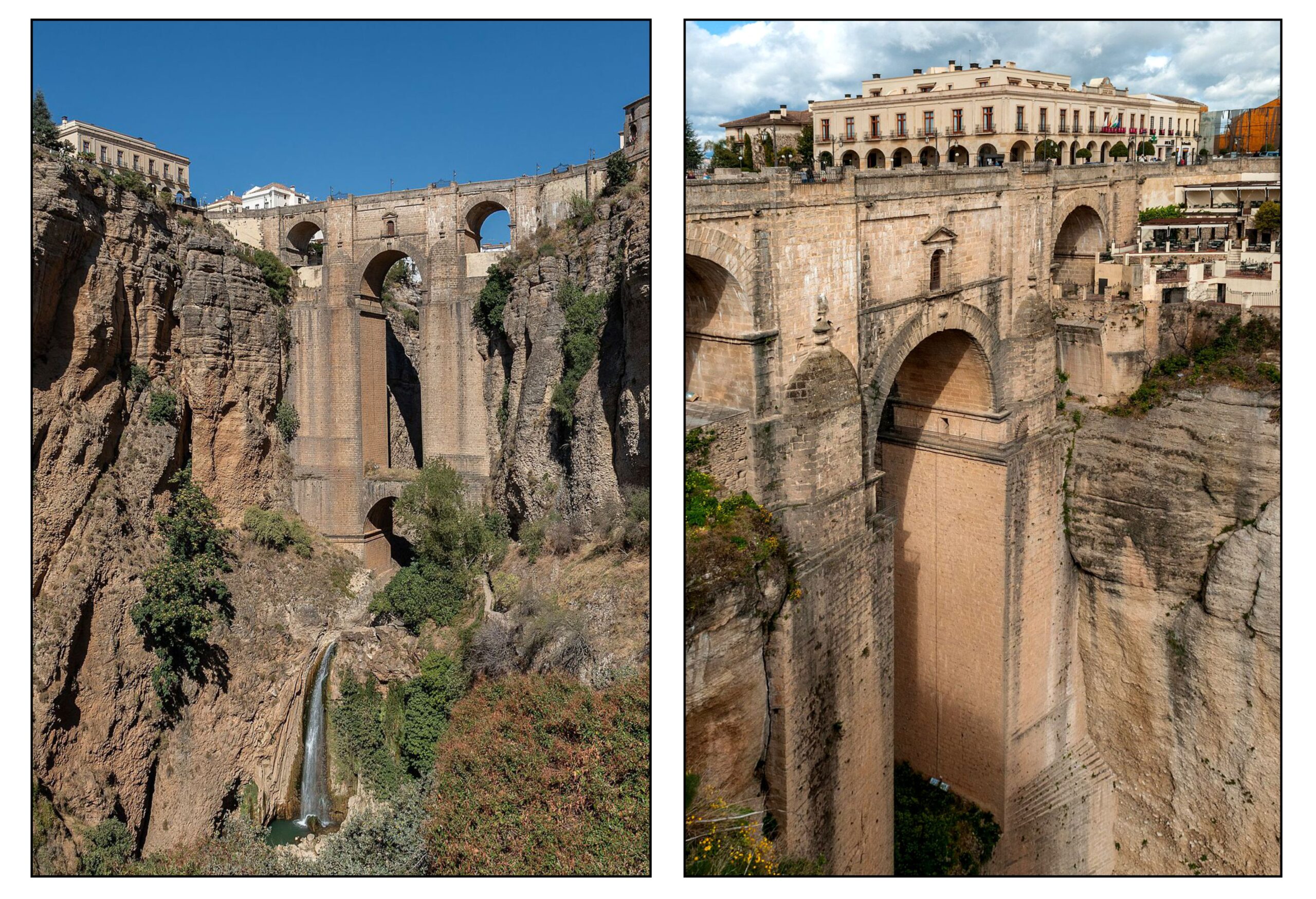
Ronda is one of the most beautiful of the pueblos blancos (“white towns”) perched on the inland hills of Andalusia. The name comes from the buildings that were white-washed to protect them from the heat of the sun. Through the center of Ronda runs the Guadalevin River, which has carved through the limestone cliffs a steep-walled canyon, el tajo, reaching depths of more than 100 meters. The most striking bridge over the river is the Puente Nuevo constructed in 1793 at the point where the canyon opens into the huge valley know as la caldera (cauldron) The following illustration shows the bridge viewed from the West (left) and from the Southeast (right).

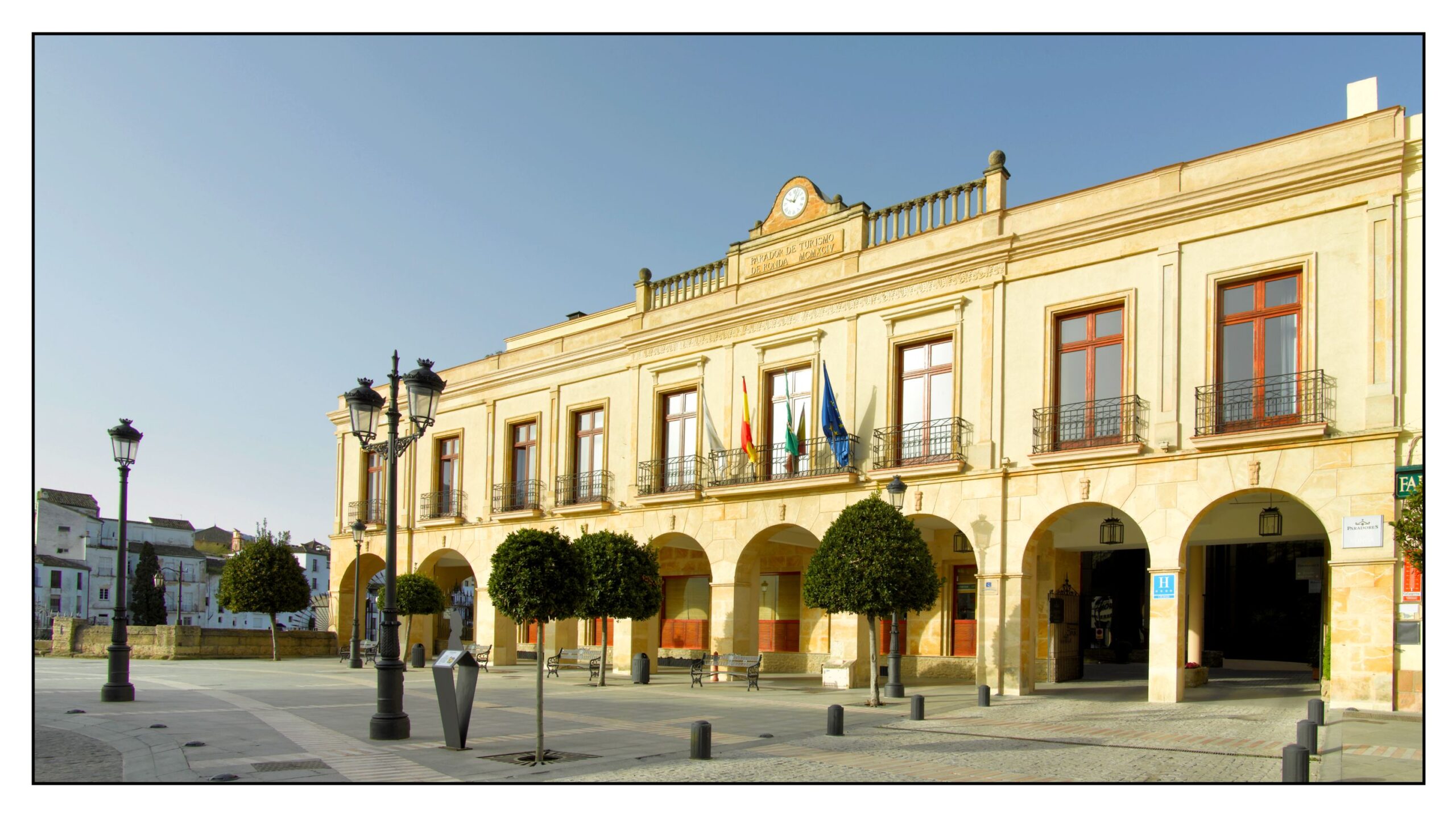
The large building just to the north of the bridge used to be Ronda’s casa consistorial (town hall) where the ayuntamiento or local council met. In the 1990s this was converted into a parador (state-owned luxury hotel). The following illustration shows the old city hall with its arcades facing the large town square. On the far left can be seen a low wall looking over the canyon.

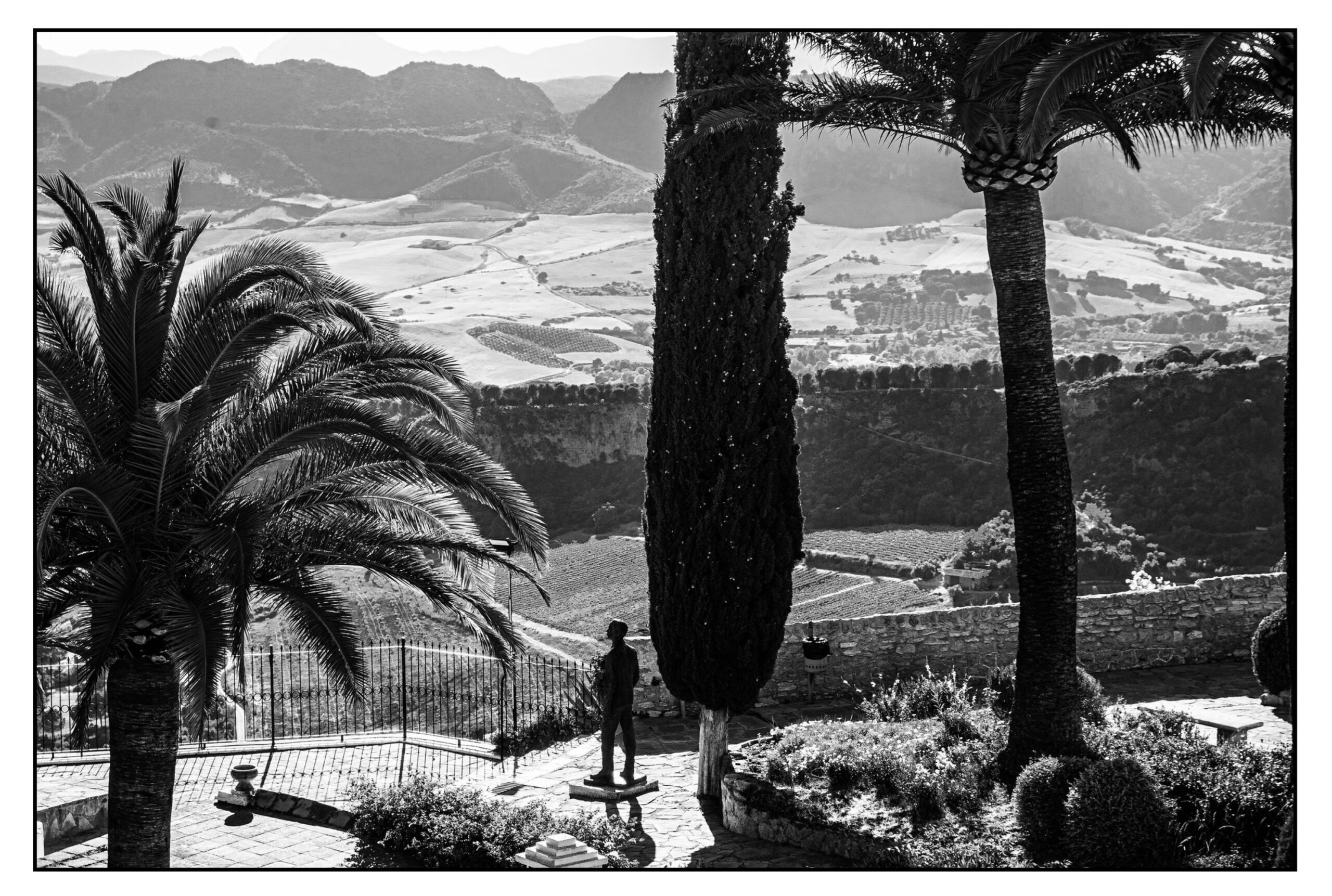
Ronda has many other luxury hotels. The Hotel Reina Victoria, a summer resort for the English stationed in Gibraltar, was built on the cliff overlooking la caldera in 1906. The German poet Rainer Maria Rilke stayed there for several months in the winter of 1912-1913. The gardens beside the hotel have a commemorative statue of Rilke gazing out over valley (shown below in a photograph by Bryan Appleyard).

In Ronda, Rilke continued working on a set of poems that would not be complete until ten more years had passed – the Duino Elegies. He was also able to compose several poems about Spain. In the third part of a poem called The Spanish Trilogy he praised the peasants he could see in the valley, hoping that he might become as attuned to the universe as a simple shepherd:

Langsamen Schrittes, nicht leicht, nachdenklichen Körpers,
aber im Stehn ist er herrlich. Noch immer dürfte ein Gott
heimlich in diese Gestalt und würde nicht minder.
Abwechselnd weilt er und zieht, wie selber der Tag,
und Schatten der Wolken
durchgehn ihn, als dächte der Raum
langsam Gedanken für ihn.

slow stepping, not light-footed, his body lost in thought,
but splendid when he stands still. A God might
secretly take his form and not be any the lesser.
By turns he tarries and continues on like the day itself
and the shadows of the clouds
pass through him, as if the vast space
were thinking slow thoughts for him.
(translation Paul Archer)

The poetry is beautiful. However, one cannot help but wonder about how shepherd felt looking up toward the hotel on the cliff. And whether this young shepherd would participate in the revolution some twenty years later.

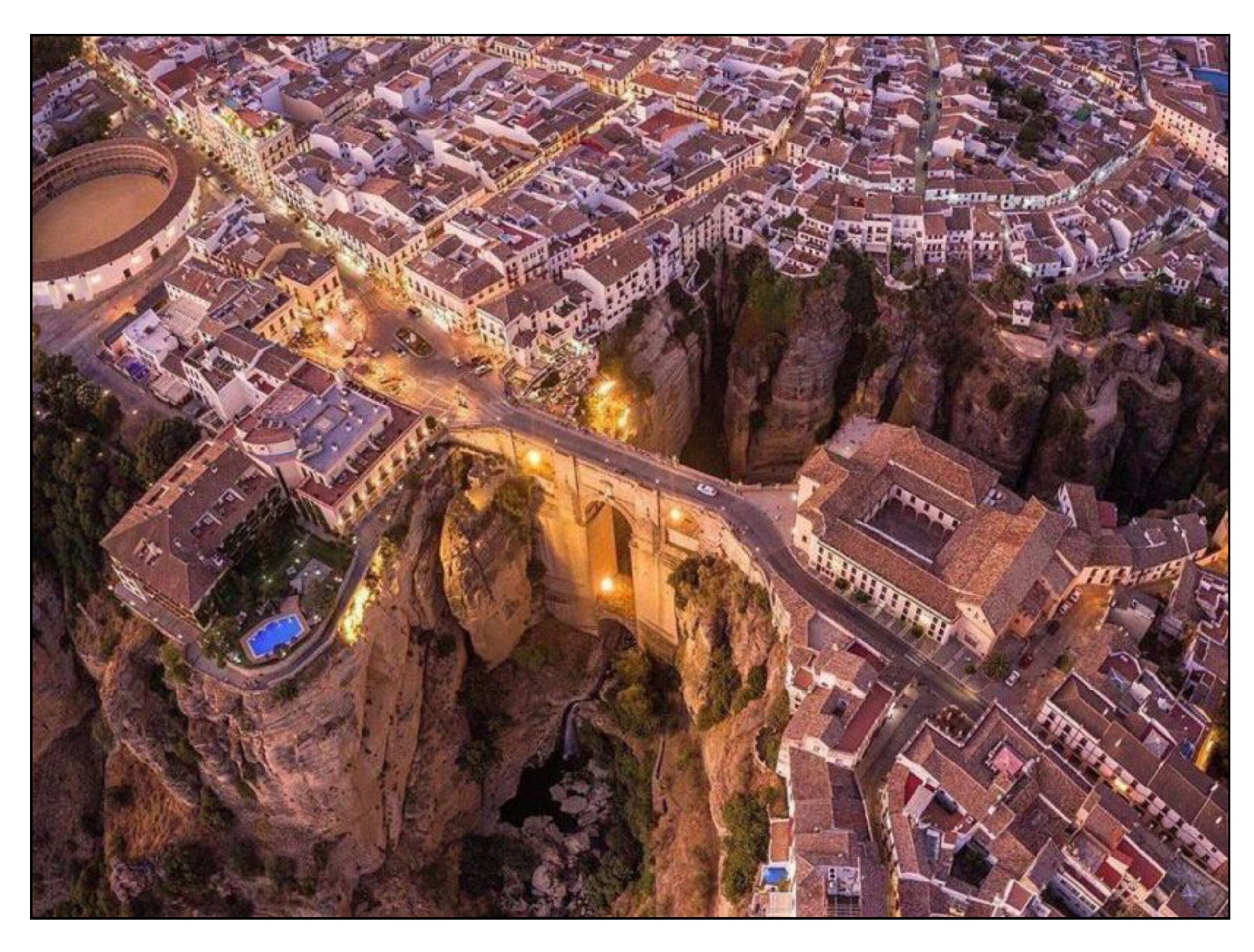
As well as the canyon and its bridge, Ronda is famous for its plaza de toros (bullring) which was built in 1785. The bullring is seen in the upper left of the aerial view of Ronda in the following illustration:

Ernest Hemingway (1899-1961) first visited Ronda in 1923 and became enamored of its site and of the bullfights (Buckley, 1997). In his 1932 book on the traditions of bullfighting, Death in the Afternoon, he remarked

There is one town that would be better than Aranjuez to see your first bullfight in if you are only going to see one and that is Ronda.

Hemingway visited Spain during the Civil War, although at that time he could not visit Ronda, which was controlled by the Nationalists. He returned to Ronda many times in the 1950s. For the bullfights, and for the memories.


The Spanish Civil War

In 1931, the Spanish king was deposed and a new government was proclaimed: the Second Spanish Republic, the first having lasted for less than two years (1873-1874) before being aborted by a military coup. The governing coalition of the Second Republic was composed of many separate and feuding parties, among them Anarchists, Communists, Republicans and Catalonian Separatists. The right-wing opposition contained parties favoring the Monarchy or the Catholic Church. The Falangist party, a fascist organization was founded in 1933 in response to the new republic.

The government had to deal with multiple problems

  • much of the land was owned by the aristocrats, who managed large tracts of land (latifundia), and who treated the peasants as slaves
  • the military was far larger and more powerful than necessary for a country that had long ago lost its empire
  • the church sided with the generals and the aristocrats, for they were the source of their power and wealth
  • the new industries, run by a small number of capitalists, exploited the workers who made the factories run, and who were organizing into unions
  • the police force – the Guardia Civil – mainly existed to support the landed aristocrats and the capitalists.

The course of the Second Republic was extremely turbulent. The government reduced funds for the military, and closed down the military academy in Zaragoza, run by General Franciso Franco. Strikes occurred and these were put down with excessive force. Attempts to take land away from the latifundista were unsuccessful. The government tried to restrict the role of the church in the educational system. Many of the poor, urged on by anarchists and communists, attacked the church. In 1933, Pope Pius XI published an encyclical Dilectissima Nobis (“Dear to us”) specifically deploring the anti-clerical violence in Spain.

In the election of January,1936, the left-wing parties in the Popular Front won a majority against a coalition of the right-wing parties named the National Front. Many have suggested that the election was rigged to some extent, and the voting was followed by much violence. Manuel Azana Diaz (1880-1940), who had served in various positions in the preceding government, became the president of the newly elected Republican government.

In July 1936, General Emilio Mola, supported by General Franciso Franco, called for a coup to end the republic and to return the nation to its previous form. The leftist parties reacted by calling for a Revolution of the workers. The country descended into anarchy. The Nationalists (or Rebels) were able to take control the north of the country, but the Republicans (or Loyalists) held off the coup in the south and in the major cities. The Civil War had begun (Thomas, 1961; Graham, 2005: Payne, 2012).

The governments of Germany and Italy immediately provided assistance to the Nationalists, and Russia came in on the side of the Republicans. England and France decided that they should not intervene in the internal politics of Spain. However, volunteers from these and many other countries (even Germany and Italy) began to organize the International Brigades to fight with the Republicans: among them were the Abraham Lincoln Brigade from the United States and the Mackenzie-Papineau Brigade from Canada.

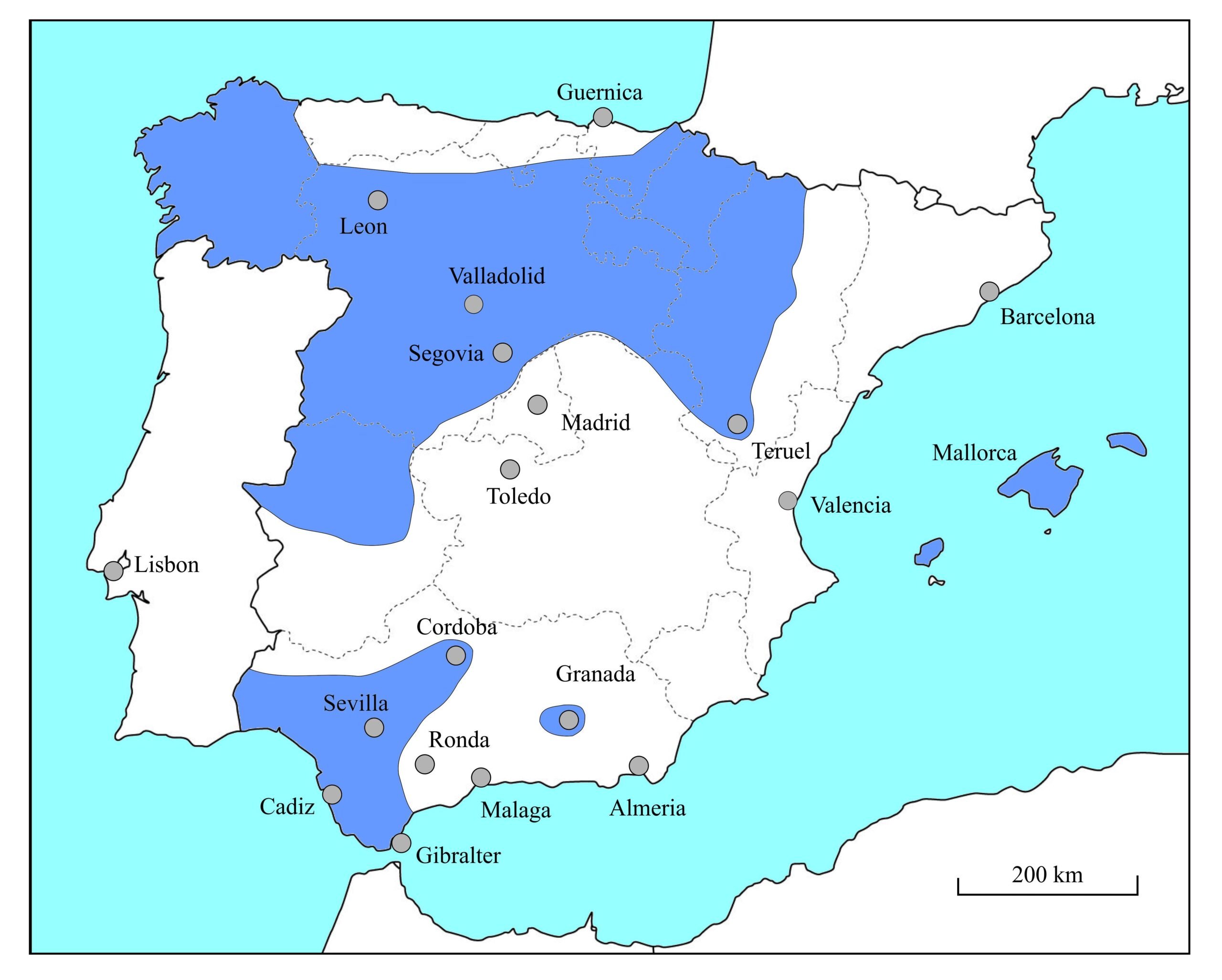
Soon after the coup was declared, Franco borrowed planes from Italy and Germany and transported troops from North Africa to shore up the Nationalists in Seville, a Catholic stronghold. The regions of the country controlled by the Nationalists (blue) and the Republicans (white) in July, 1936) are shown in the following map (derived from Preston, 2012, p 658): 

From Seville, General Franco sent troops northward to join up with the Nationalists besieging Madrid. Another key point in the fighting was near Teruel, where Nationalist soldiers were attempting to advance to the sea to cut off Barcelona from Madrid. Franco also sent troops eastward to relieve the city of Granada.

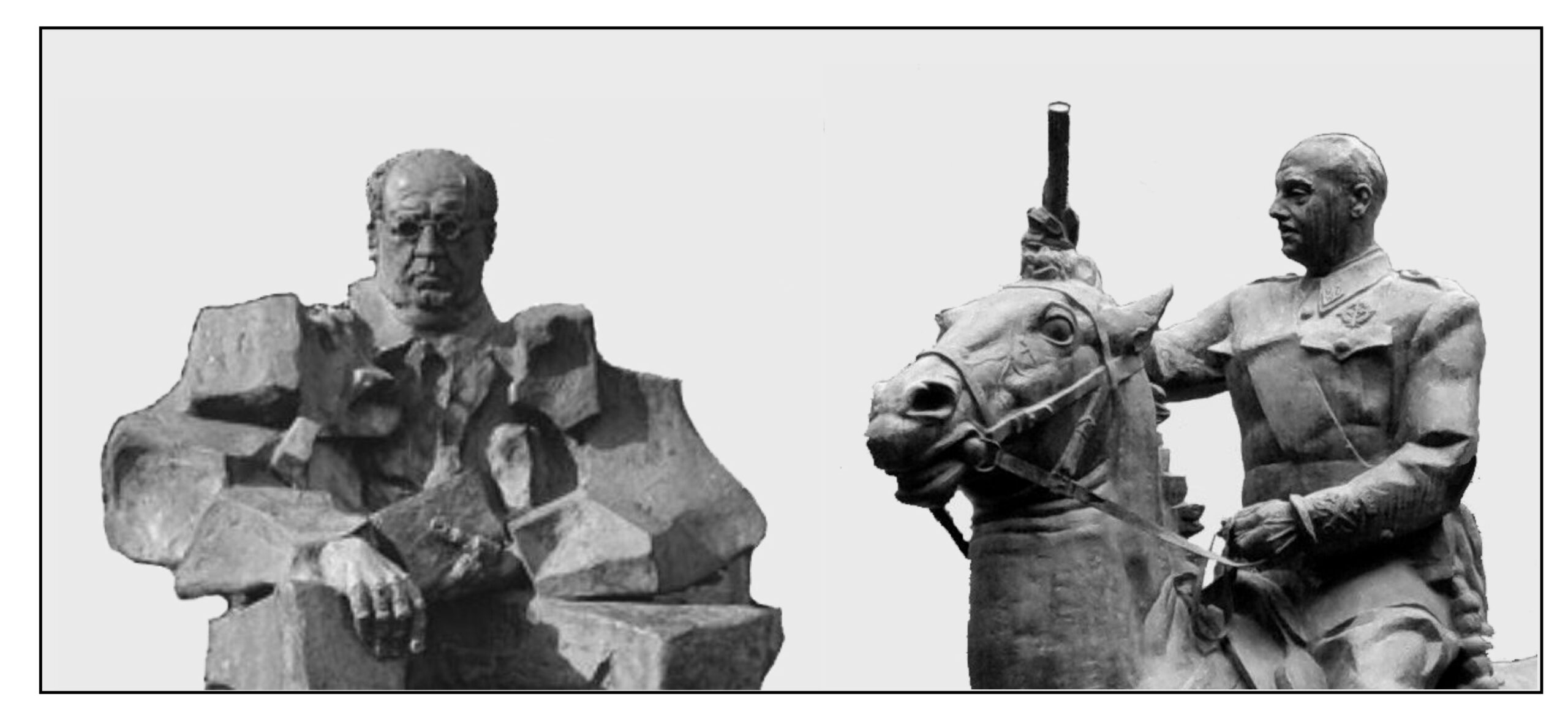
Mola died in a plane crash in June of 1937, and General Franciso Franco Bahamonde (1892-1975) became the supreme leader (el caudillo) of the Nationalist forces. The following illustration shows the leaders of the two sides. On the left is a modernist stone statue of Manuel Azena by José Noja and Pablo Serrano that was not erected until 1979. On the right is a bronze equestrian statue of Francisco Franco by José Capuz Mamano initially cast in 1964. Various versions of this statue were erected in several of the major cities of Spain.

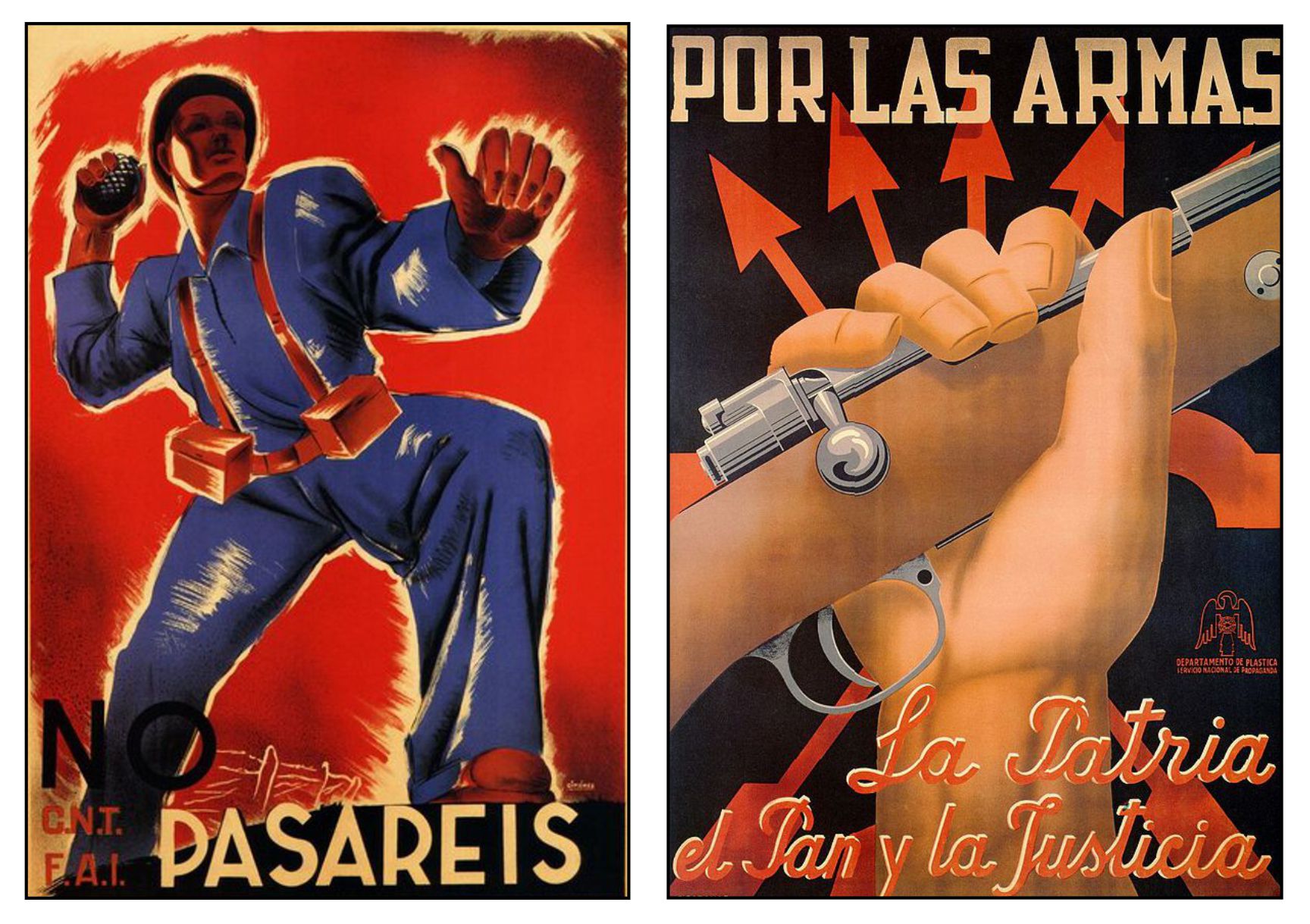
The following figure shows propaganda posters from both sides of the civil war. On the left is a poster stating “No Pasareis” (You shall not pass). This slogan and its variant “No Pasaran” (They shall not pass) was used by the Republicans throughout the war. The Communist politician Dolores Ibarruri Gomez (also known as La Pasionara – the passionate one) used the latter version in a famous speech urging on the defenders of Madrid in November 1936. The Republican poster comes from the two parties that were the mainstay of the Popular Front: the CNT (Confederacion Nacional de Trabajo) and the FAI (Federacion Anarquista Iberica). The right poster is from the Falangists. In the background are the four red arrows held together by a yoke, the Spanish version of the fasces (bundle of rods) of the Italian Fascists. Superimposed is a hand on a rifle. The call is “To arms – Homeland, Bread and Justice.”

Events in Ronda during 1936ca)

Soon after the military coup was declared in July, 1936, members of the CNT took control in Ronda and many of the small towns in Andalusia. Members of the Guardia Civil and many local Nationalist leaders were executed. Similar outbreaks of violence occurred in many regions of Spain. This “red terror” was not condoned by the Republican Government, which had difficulty controlling its many factions.

Once the Nationalists had shored up control of Seville, Franco placed the bloodthirsty General Queipo de Llano in command of retaking Southern Spain. After Granada was relieved, the Nationalists returned to the other cities of Andalusia. Reaching Ronda in September, 1936 they quickly subdued the town, and took bloody revenge. Those killed by the Nationalists far outnumbered those who had been murdered in the summer (Preston, 2012).

Exactly what had happened in Ronda during these early months of the war was not clear. The Nationalists declared that the anarchists had murdered several hundred people and thrown them over the cliff. This claim was used to justify their reprisals.

Many of the townspeople left Ronda and fled to Malaga, but this city soon fell to the Nationalists in February 1937. Republicans in Malaga were rounded up and shot. The Nationalists boasted that they executed more Republicans in seven days than the Republicans had killed in the seven months they were in control of the city (Preston, 2012, p 177).

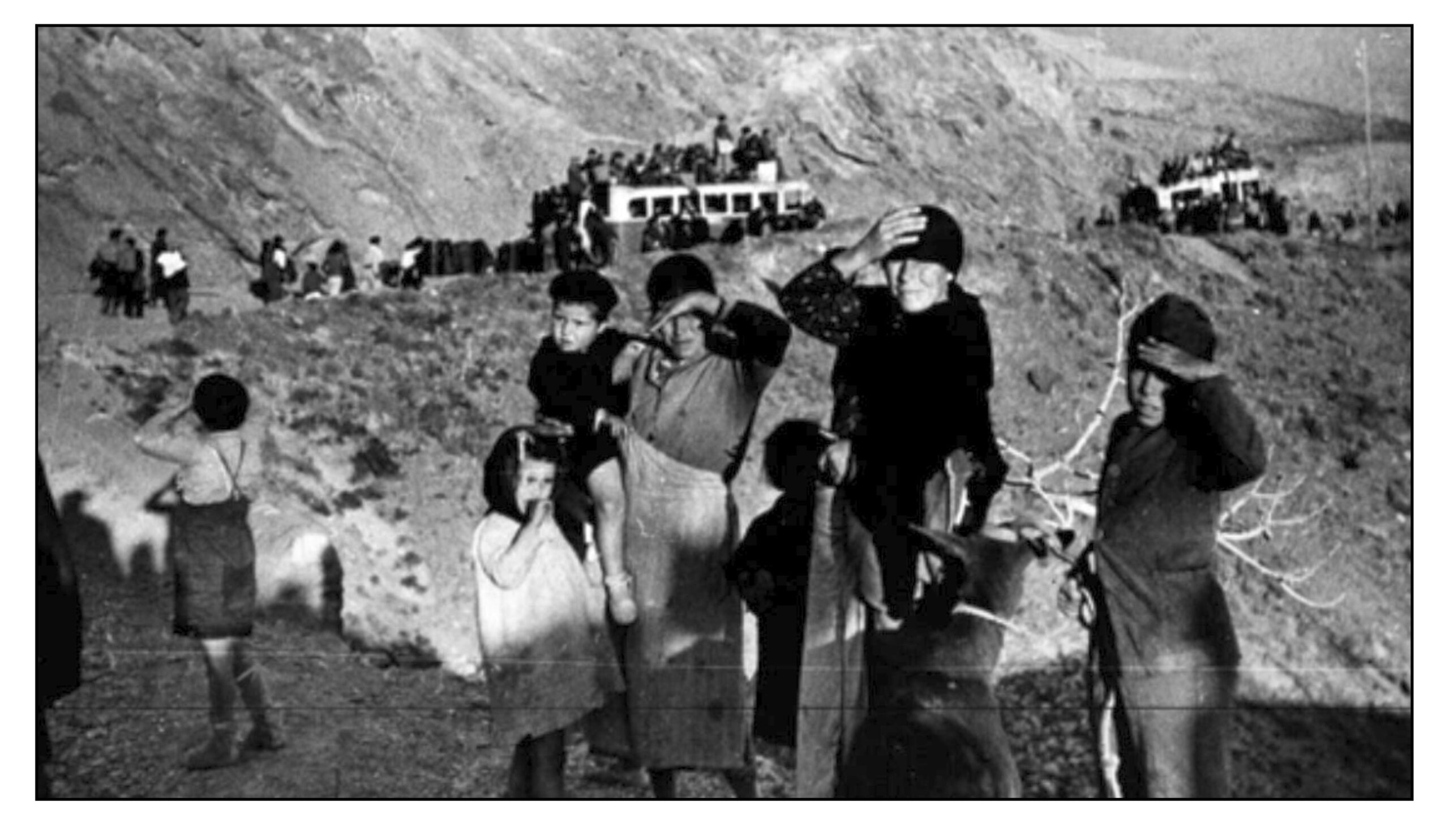
Most of the citizens of Malaga, together with a few surviving Republican soldiers, then tried to reach Almeria along the coastal road – walking, riding donkeys and hanging onto rickety vehicles for a distance of about 200 km. These refugees were strafed and bombed by planes, and shelled by Nationalists warships. The number of people killed in what became known as the Malaga-Almeria Massacre was over 3000. The Canadian physician Norman Bethune used the few vehicles available to him to help the refugees travel to Almeria (Stewart, R., & Majada Neila, 2014), but this had little effect. The following photograph shows the refugees:

For Whom the Bell Tolls

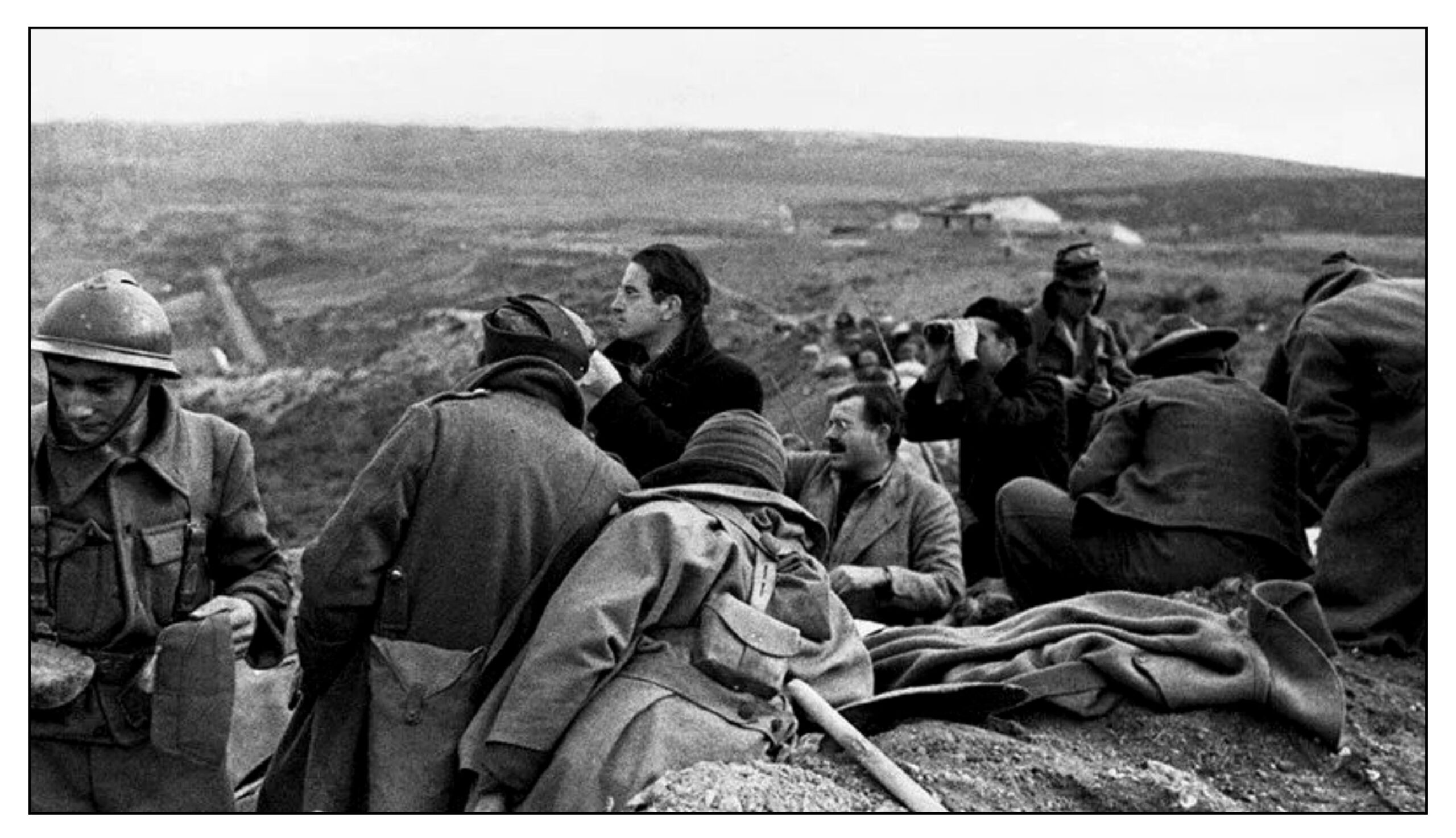
Ernest Hemingway came to Spain toward the end of 1937 to produce a documentary film on the Civil War – The Spanish Earth – to help raise money for the Republicans. The photograph below shows him in the Republican trenches at Teruel (low center) together with the filmmaker Joris Ivens (high center).

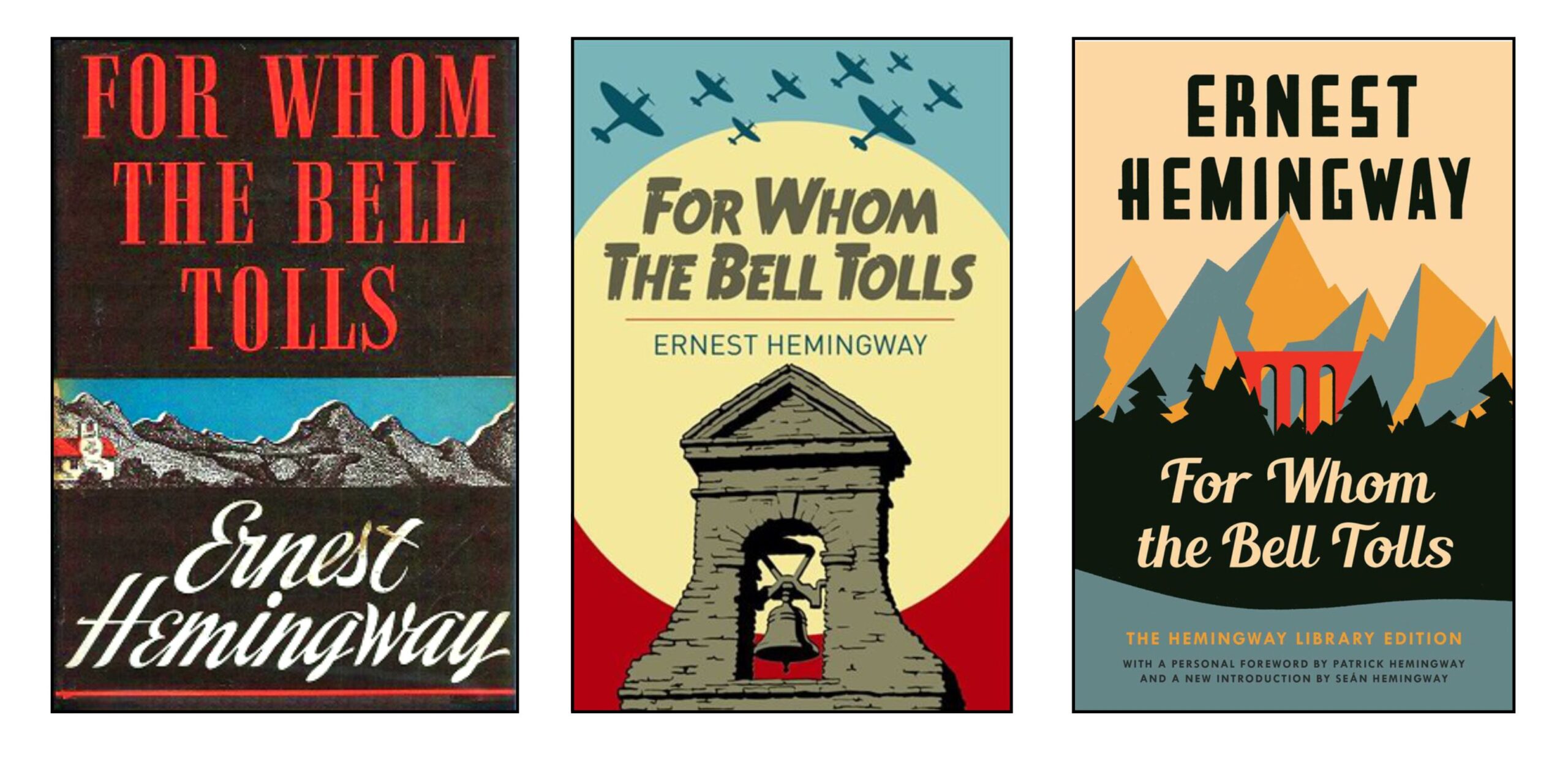
After the Spanish Civil War ended in1939, Hemingway wrote For Whom the Bell Tolls (1940), a novel based on what he had heard about the violence perpetrated by both sides during the conflict. The following illustration shows some of the covers used by various editions of the book, the original on the left:

The epigraph to the novel is from John Donne’s Meditations upon Emergent Occasions (1624) The quotation ends with:

any mans death diminishes me, because I am involved in Mankinde; And therefore never send to know for whom the bell tolls; It tolls for thee.

The novel’s central character is Robert Jordan, an American Professor of Spanish, and an explosives expert, now a volunteer serving with the Republicans. In the spring of 1937, he is ordered to blow up a mountain-bridge to prevent Nationalist forces from Segovia from reaching Madrid. For this task he recruits the help of a band of Republican guerillas, led by Pablo and his woman Pilar. Jordan falls in love with Maria, a beautiful young woman serving as the band’s cook. Maria’s father, the Republican mayor of Valladolid, and her mother had been executed by the Nationalists early in the war. She herself had her head shaved, and was raped and imprisoned, before finally escaping to the mountains.

One evening, Pilar tells Jordan and Maria what had happened in Ronda at the beginning of the war. Pablo, the leader of the local anarchists in the town, had captured the barracks of the Guardia Civil and executed all the guards. He had also rounded up the main supporters of the Nationalists and imprisoned them in the city council. Pilar describes the center of the town (see preceding illustrations):  

The town is built on the high bank above the river and there is a square there with a fountain and there are benches and there are big trees that give a shade for the benches. The balconies of the houses look out on the plaza. Six streets enter on the plaza and there is an arcade from the houses that goes around the plaza so that one can walk in the shade of the arcade when the sun is hot. On three sides of the plaza is the arcade and on the fourth side is the walk shaded by the trees beside the edge of the cliff with, far below, the river. It is three hundred feet down to the river.

Pilar then describes how the town square was set up for the execution of the fascists:

Pablo organized it all as he did the attack on the barracks. First he had the entrances to the streets blocked off with carts though to organize the plaza for a capea. For an amateur bull fight. The fascists were all held in the Ayuntamiento, the city hall, which was the largest building on one side of the plaza. It was there the clock was set in the wall and it was in the buildings under the arcade that the club of the fascists was.

Pablo organized the peasants and workers who had gathered in the square:

He placed them in two lines as you would place men for a rope pulling contest, or as they stand in a city to watch the ending of a bicycle road race with just room for the cyclists to pass between, or as men stood to allow the passage of a holy image in a procession. Two meters was left between the lines and they ex-tended from the door of the Avuntamiento clear across the plaza to the edge of the cliff. So that, from the doorway of the Ayuntamiento, looking across the plaza, one coming out would see two solid lines of people waiting.
They were armed with flails such as are used to beat out the grain and they were a good flail’s length apart. All did not have flails, as enough flails could not be obtained. But most had flails obtained from the store of Don Guillermo Martin, who was a fascist and sold all sorts of agricultural implements. And those who did not have flails had heavy herdsman’s clubs, or ox-goads, and some had wooden pitchforks; those with wooden tines that are used to fork the chaff and straw into the air after the flailing. Some had sickles and reaping hooks but these Pablo placed at the far end where the lines reached the edge of the cliff.

The assembled crowd was told that they must kill the fascists by beating them to death. One of the peasants asked Pilar why, and she reported the following exchange:

“To save bullets” I said. “And that each man should have his share in the responsibility”
“That it should start then. That it should start.” And I looked at him and saw that he was crying. “Why are you crying, Joaquin?” I asked him. “This is not to cry about.”
“I cannot help it, Pilar,” he said. “I have never killed any one.”

One by one, the fascists were led out of the city hall and made their way through the crowd of peasants. One by one, they were beaten and clubbed to death. And one by one, their bodies were cast over the edge of the cliff into el tajo.

This fictional representation of the Anarchist terror in Ronda is extremely powerful. In the novel Hemingway also describes Nationalist atrocities in Valladolid – the summary execution of Maria’s parents and her abuse and rape by the Falangists. This vivid portrayal of the brutality of the war should make us rethink our hatreds. We are all in this life together; we are diminished by the death of any man; the bell tolls for us.  

Later in the novel, Jordan and the guerilla band succeed in blowing up the bridge. but Jordan is severely wounded and unable to move. He convinces that the rest of the band to retreat while he stays to delay the advancing Nationalists. He insists that Maria leave with the guerillas. The novel ends with Jordan trying to stay conscious as the soldiers come closer. Talking to himself, he claims

And if you wait and hold them up even a little while or just get the officer that may make all the difference. One thing well done can make ⸺  

Hemingway leaves the thought unfinished. The novel ends with an officer of the Nationalist forces riding slowly up toward where Jordan awaits him. 

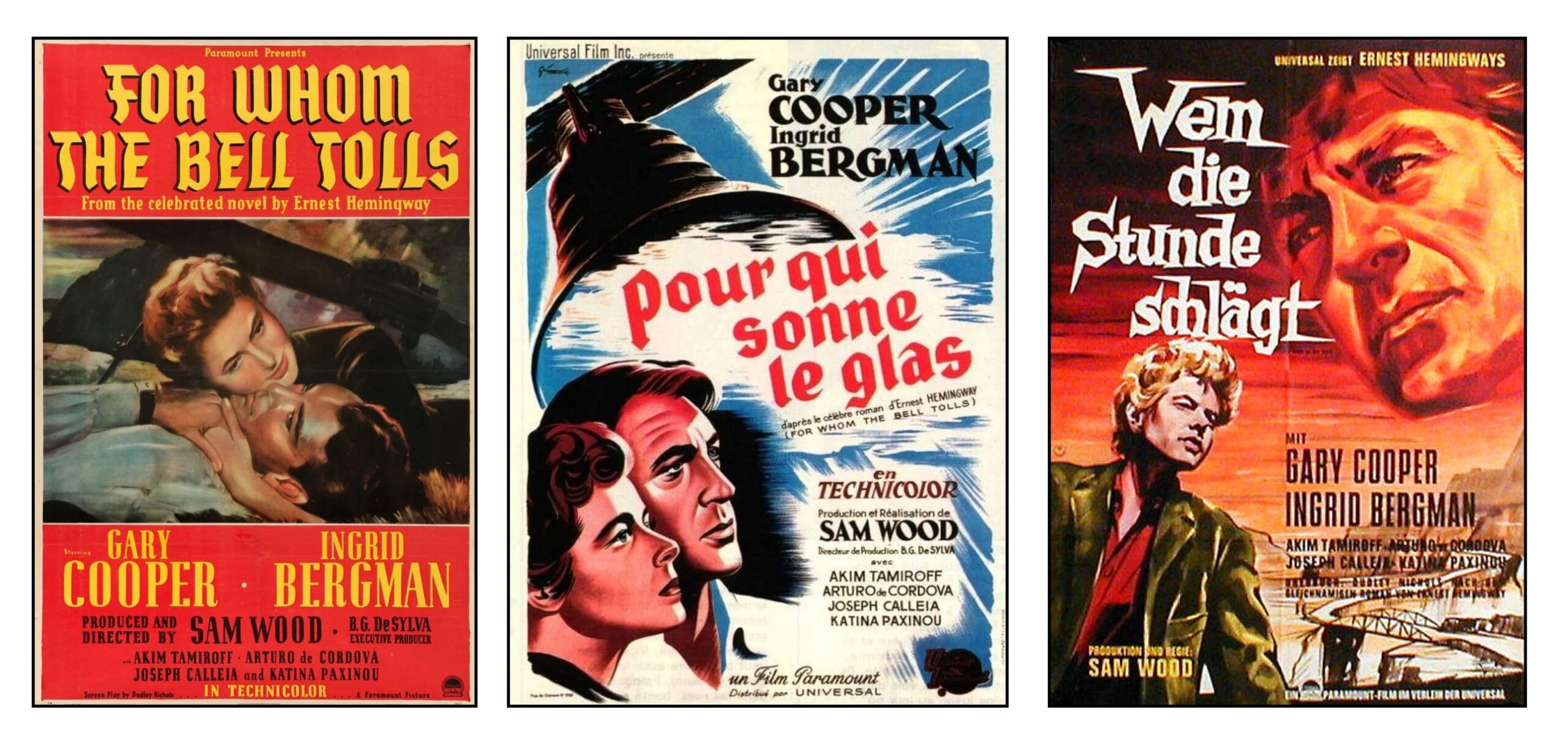
The book sold well, and in 1943 it was made into a film starring Gary Cooper as Jordan, Ingrid Bergman as Maria, Akim Tamiroff as Pablo and Katina Paxinou as Pilar. The film was an international success, although it was not distributed in France or Germany until after World War II (see posters below). The film received multiple nominations for the Academy Awards, with Katina Paxinou winning for best supporting actress.

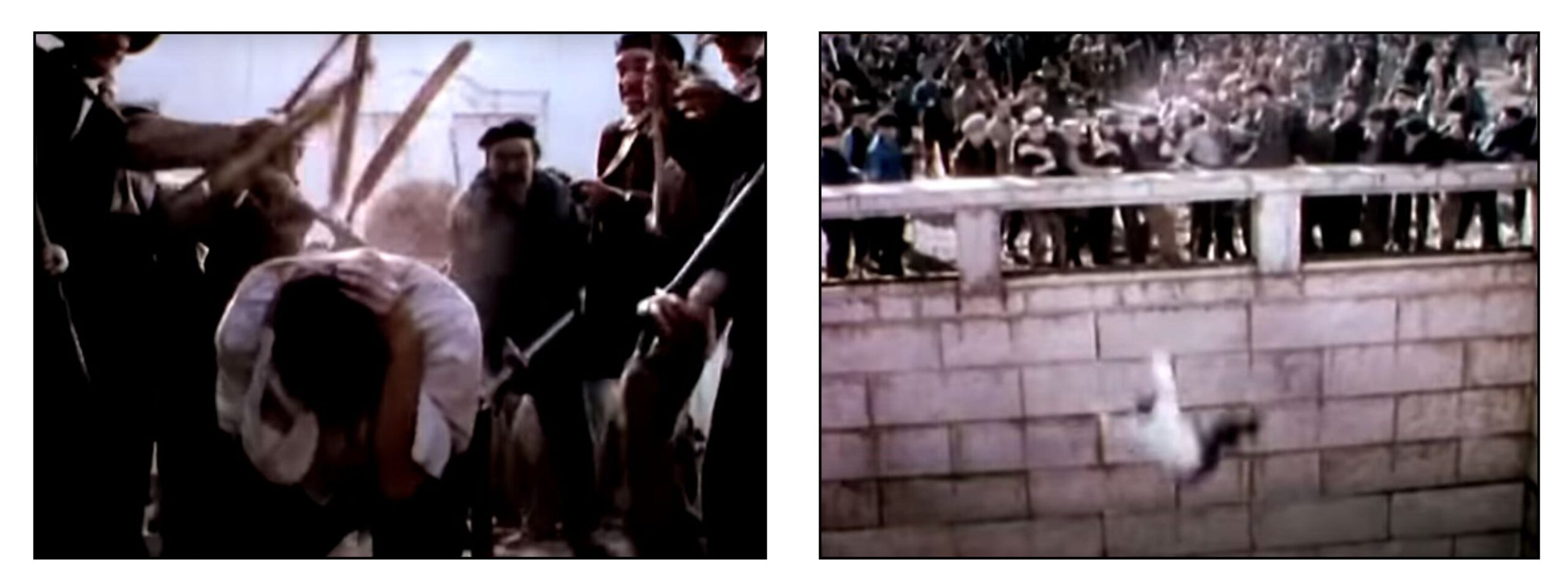
The film follows the novel quite closely. When Pilar recounts her tale of what happened in Ronda at the beginning of the Civil War, the movie shows in flashback some of the brutal executions in the plaza:

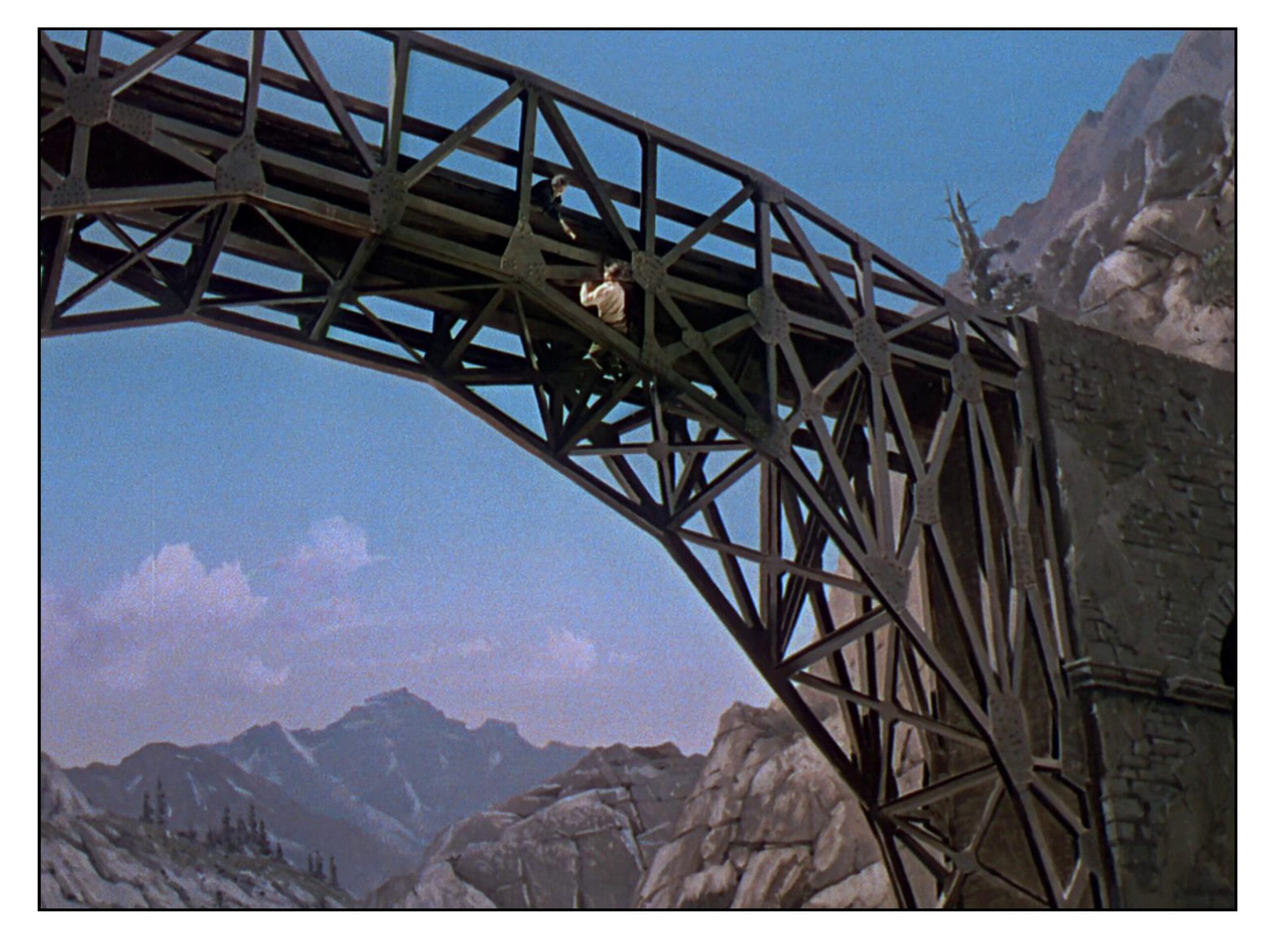
The bridge that Jordan dynamites just before the end of the movie is as high as the Puente Nuevo in Ronda:

Historical Accounts of the Events in Ronda

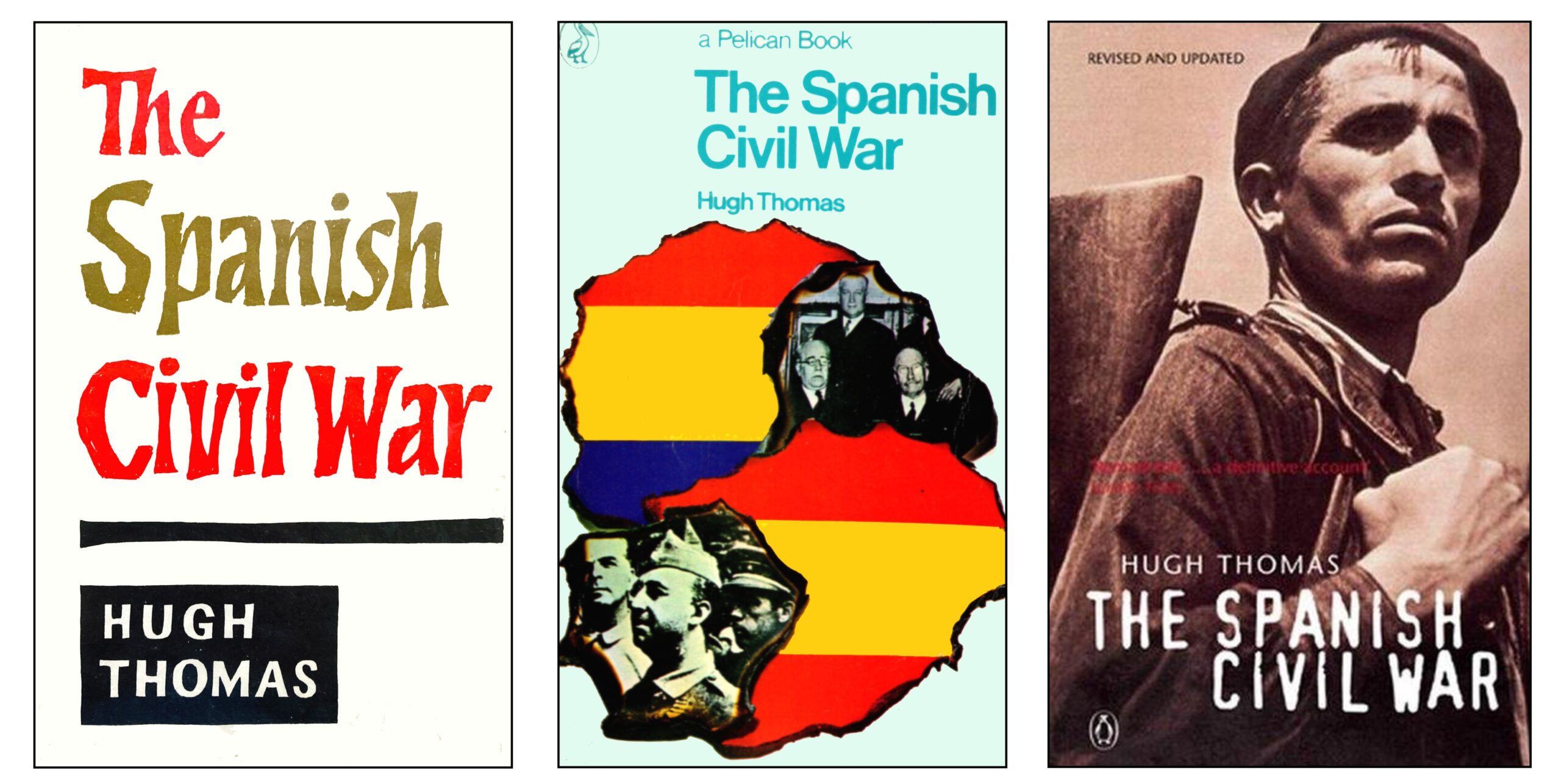
The history of The Spanish Civil War (1961) by Hugh Thomas was the first major examination of what happened in Spain during the war. The book became a best seller soon after it was published and it has since gone through two revisions and multiple printings:

Thomas discussed the events in Ronda:

In country districts. revolution itself often consisted primarily of the murder of the upper classes or the bourgeoisie. Thus the description, in Ernest Hemingway’s novel For Whom the Bell Tolls, of how the inhabitants of a small pueblo first beat the male members of the middle class and then flung them over a cliff, is near to the reality of what happened in the famous Andalusian town of Ronda (though the work was the responsibility of a gang from Malaga). There, 512 were murdered in the first month of war. (p 263 in 1989 printing)

Other historians have proposed that the Ronda executions described by Hemingway, although based on accounts he had heard, was completely fictional. Buckley (1997) described what happened in Ronda in the Summer of 1936, according to the records maintained in the town hall:

On 19 July 1936 the commander of the small army garrison in Ronda, upon reports of a military uprising in Morocco, went to the Town Hall with a small platoon and demanded that the mayor submit to his authority and publicly announce that the city was under martial law and the army was taking control. The mayor belonged to the left-wing coalition known as the Popular Front. He refused to follow the commander’s orders and swiftly disarmed him and his small band of soldiers, heavily outnumbered by the peasant groups beginning to assemble on the plaza outside the town hall. Thus, Ronda remained loyal to the Republican government of Madrid, and did not fall to the fascists until 18 September 1936.
However, it would be would be wrong to assume that during these two months the Republican government in Madrid had any control over the town or its inhabitants. As soon as the reports of a military rising in Africa began to spread, the peasants from neighboring villages poured into Ronda and in effect took control. Although the mayor was nominally in charge, the real power belonged to a “Comite” formed by the peasants themselves, most of whom belonged to CNT (Confederacion Nacional del Trabajo), the Anarchist Labor Union.
The task of this committee was three-fold: first, to arrest all persons suspected of having fascist sympathies; second, to insure that food was evenly distributed to all inhabitants (money was outlawed and vouchers with the CNT rubber-stamp were issued); third, to prepare to defend Ronda from a probable attack by fascist troops stationed in Seville.
The word “revolution” immediately comes to mind when we attempt to describe the situation in Ronda in summer 1936. The Secretary’s “Record of Proceedings” for 28 July 1936, preserved in Ronda’s Town Hall, displays revolutionary rhetoric: “[W]e are living through a moment of historic transcendence … the fascist coup has spurred the populace to rise to the last man and to demand social justice . . . a new society is being born, based upon liberty, justice and equality … justice has now become `revolutionary justice’ designed to cleanse the state of all fascist elements as well as to establish the basis for a new social order etc.”

Many priests and supporters of the Nationalist cause were executed. However, these victims were not killed in the plaza, but were driven away from the center of the town and shot. It is difficult to determine the number of those killed, but it was likely much less than the 512 claimed by the Nationalists. None of the bodies were thrown into el tajo. This story seems to have been invented by General Queipo to inflame his troops as they went about their reprisals.

Corbin (1995) considers the story about the executions in the plaza and the casting of the bodies into el tajo as an example of myth-making. Myths have their basis in historical events but the stories become altered in the telling, often to justify the actions of those in power:

Any story of the past has a double construction and a double truth. The truth of the tale told is its historical truth; the truth of its telling is its mythical truth.

The story of the executions by el tajo served the purpose of the Nationalists: it portrayed the class hatred of the anarchists and communists and the violence that they promulgated in the early weeks of the Civil War. This then justified their violent repression. Society must be protected from any recurrence of such revolutionary terror.   

In The Spanish Holocaust (2012) which describes the repression of the Spanish Republicans during and after the Civil War, Paul Preston summarizes the events in Ronda:

Famous for its Roman and Arab bridges and its exquisite eighteenth-century bullring, Ronda had suffered a pitiless repression at the hands of anarchists led by a character known as ‘El Gitano.’ Initially, the CNT committee had maintained a degree of order although churches were sacked and images destroyed, but soon there were murders being carried out by anarchists from Malaga and also by locals. However, there is no substance to the claim, first made by Queipo in a broadcast on 18 August and popularized by Ernest Hemingway’s novel For Whom the Bell Tolls, that large numbers of prisoners were killed by being thrown into the tajo. The many rightist victims were shot in the cemetery. Francoist sources claim that victims of the red terror from Ronda and the nearby pueblos of Gaucin and Arriate numbered over six hundred. On 16 September, when Varela took the town, the defenders fled and his forces suffered only three casualties in the assault. His men stopped and interrogated anyone found in streets and shot many of them. Over half of the population fled towards Malaga. Under the new authorities, those of the town’s defenders who had not fled were subjected to a bloody repression and the theft of their property. (p 171)

In the White City

The American poet, Philip Levine, spent time in Spain trying to learn more about the Spanish Civil War and the poets that wrote about it (Levine, 2016). He also wrote about Ronda in a prose-poem entitled In the White City (2009).

From up there—& he points to the bridge high above us—they tossed down the fat barber, the Falangist, to his death. “It is all in the book by the American communist.” “The communist?” I say. Yes, the friend of Fidel Castro, Comrade Hemingway “The tourists come because of your Mr. Hemingway, that is why you are here.” Who can argue with this young, balding lieutenant of the Guardia Civil who has dared to leave his barracks lacking his tricorne & with only a small sidearm? In felt house slippers he stands at ease on the west streets of his town, Ronda, to show me the world. “On those rocks,” he continues, pointing to a ledge half way down the gorge, “he first hits & his belly explodes. Then they rape his beautiful daughter, the film star that is Swedish, & when they have finish they shave her head. That is why we execute them all.” Does he mean that is why in the novel the Nationalists executed them. (I am careful not to say “the fascists”; it is 1965.) “No, no, executed them here, in life or death”—he smiles at his little joke—“up there on the bridge”— & he points again,— “by military firing squad one at a time, properly. That is why the whole town must witness & learn. It is educational.” But, I insist, the death of the Falangist was merely in a novel that made no effort to be true to events, una novela, a fiction, a best seller. The lieutenant enjoys this repartee, he’s amused by my innocence, he shakes his head, he is discreet & patient with this visitor to his ancient city that boasts the first Plaza de Toros in all the world. “You Americans,” and he suppresses his laughter, “you think because he was a famous red he could not tell the truth. They do not give Noble Prizes to liars.”

The poem illustrates how history becomes mixed up with fiction, with movies, and with photographs to form the myths that we remember about the past. Hemingway was not a communist and, though he spent time in Cuba, he was not a friend of Castro (Michaud, 2012). This idea stems from photographs of the two of them together at a fishing competition, the only time they ever met. The character Maria in Hemingway’s novel, played by the Swedish film-star in the movie, was the daughter of a mayor who was executed in the Civil War, but this was in a different town, and the mayor there was a Republican executed by the Nationalists. The poem ends with the idea that fiction written by a winner of the Noble (sic) Prize has to be true.

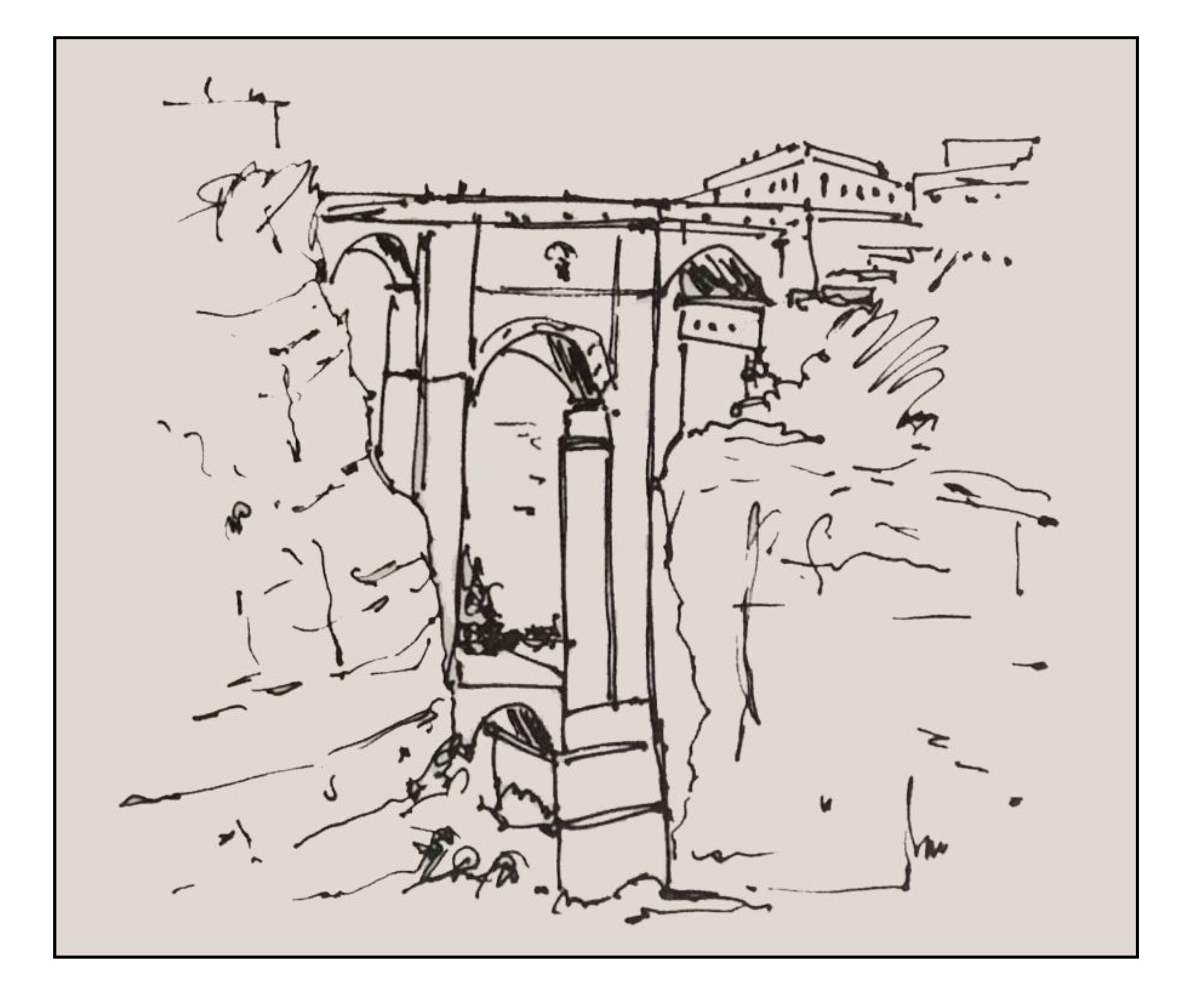
The following is an etching of the Puente Nuevo in Ronda done by Gary Young for a broadside edition of Levine’s poem.

Epilogue

By the spring of 1938, the Nationalists ultimately made their way to the sea, isolating Barcelona from Madrid. After Franco’s troops marched into Barcelona in January 1939, Manuel Azana was among the thousands of refugees who fled from Barcelona to France. In March, Madrid was taken and Franco declared victory on April 1, 1939, and became the Prime Minister of Spain, continuing in this office until 1973. During and after the war, many thousands of Republicans were executed by the Nationalists in a repression known as the “white terror” or the “Spanish Holocaust” (Preston, 2012). Hemingway’s novel was translated into Spanish as Por quién doblan las campanas, but was not allowed into Spain until 1969. The movie was not shown there until 1978. Hugh Thomas’s history of the war was forbidden in Spain until after the death of Franco in 1975. Today Spain continues to unearth the bodies of those executed during and after the war, and to seek some understanding of the violence and brutality of those days (Anderson, 2017). The myths need to be converted back into history.

References

Anderson, P. (2017). Knowing and acknowledging Spain’s dark Civil War past. Journal of Contemporary History52(1), 129–139.

Buckley, R. (1997): Revolution in Ronda: the facts in Hemingway’s For Whom the Bell Tolls. Hemingway Review, 17(1), 49-57.

Corbin, J. (1995). Truth and myth in history: an example from the Spanish Civil War. Journal of Interdisciplinary History, 25(4), 609-625

Graham, H. (2005). The Spanish Civil War: a very short introduction. Oxford University Press.

Hemingway, E. (1932). Death in the afternoon. Scribner.

Hemingway, E. (1940). For whom the bell tolls. Scribner.

Levine, P. (2009). News of the world: poems. Alfred A. Knopf.

Levine, P. (2016). The Spanish Civil War in Poetry. In Levine, P. (edited by Hirsch E., 2016). My lost poets: a life in poetry. (pp 139-163). Alfred A. Knopf.

Michaud, J. (2012). Hemingway, Castro, and Cuba. New Yorker (May 24, 2012).

Payne, S. G. (2012). The Spanish Civil War. Cambridge University Press.

Preston, P. (2012). The Spanish holocaust: inquisition and extermination in Twentieth-Century Spain. HarperPress.

Stewart, R., & Majada Neila, J. (2014). Bethune in Spain. McGill-Queen’s University Press.

Thomas, H. (1961, revised and enlarged, 1989). The Spanish Civil War. Harper & Row.