The Moissac Portal: Masterpiece of Romanesque Sculpture

n the 9th and 10th Centuries CE, Europe began to awaken from the has come to be known as the Dark Ages. Imposing churches were erected and many of these were decorated with sculptures. This new style of art and architecture, thought to be derived from that of the Roman Empire, has been called “Romanesque.” The sculpture from this time is full of a tremendous vitality and marked by a rich imagination. Some of the most impressive examples adorn the portal of the Abbaye de Saint Pierre in Moissac in southwestern France.

History of the Abbey

Moissac, situated on the confluence of the Garonne and Tarn rivers in southwest France (see map below), is surrounded by rich agricultural land. Legend has it that a monastic community was founded there in the 6th Century CE by Clovis, the first king of the Franks, though the monastery likely began a century later (Vidal et al., 1979). Over the years the monastery was pillaged by various invaders: the Arabs in the 8th Century, the Normans in the 9th Century, and the Hungarians in the 10th Century. In the 11th Century, as more and more pilgrims began to travel to Santiago de Compostella in Spain (Oursel, 1970), Moissac became an important way-station on the route from Geneva (dotted purple line):


In 1047, Saint Odilon, the 4th Abbot of Cluny, arranged for the monks in Moissac to be affiliated with the Benedictine Abbey at Cluny. In 1059, Durand de Bredon, archbishop of Toulouse, was installed as its first abbot. He arranged for the abbey church and cloisters to be rebuilt, and in 1063, the Abbaye de Saint Pierre de Moissac was reconsecrated. Abbot Durand is commemorated in a bas-relief sculpture in the east gallery of the cloisters (see illustration on the right adapted from Vidal et al, 1979). The sculptures adorning the portal and the porch were created under the direction of abbot Ansquitil (Franzé, 2015) during the years from 1100 to 1115 (Forsyth, 2010).   


The Concept of “Romanesque”

The architecture and sculpture of the middle of the 10th to the beginning of the 13th Centuries is usually considered “Romanesque,” a term (roman in French) first used by Charles de Gerville (1769-1853) in the early 19th Century (Charles & Carl, 2012). He proposed that the style was a revival of the art and architecture of the Roman world before the Barbarian invasions. In England, Romanesque architecture is often called “Norman” since it came with the Norman Invasion in the 11th Century.  

The key characteristic of Romanesque architecture was the use round arches (Toman, 2004, pp 24-30; Charles & Carl, 2012, p 17). The transition to pointed arches in the late 12th Century marked the onset of “Gothic” architecture. Both terms are inaccurate: Romanesque architecture has little to do with the Romans, and Gothic architecture has nothing to do with the Goths.

The period of time between the fall of the Roman Empire in 476 CE and the rise of the Romanesque after 1000 CE has often been considered a time of ignorance and violence – the European “Dark Ages.” However, such a concept is inappropriate. Multiple separate kingdoms existed during this time, and each of these fostered its own learning, art and architecture. The Visigothic kingdom ruled much of Spain until the Arab Conquest in the 8th Century. The Merovingian dynasty governed France from the 5th to 8th Century. The Carolingian Empire (the precursor of the Holy Roman Empire) controlled much of France and Germany in the 9th Century. The kingdom of Asturias ruled northwest Spain in the 8th to 10th Centuries. The Vikings established the Duchy of Normandy in northwest France the 10th Century. Celtic monasteries in Ireland sent their missionaries and their artists back to convert and teach the people of the old Roman Empire. And Europe could not help but be affected by the Islamic art of Moorish Spain, and the magnificent art of the Byzantine Empire and Ravenna. The period of the so-called Dark Ages was actually a time of intense artistic ferment, wherein different styles came together and interacted (Busch & Lohse, 1966; Oursel, 1973, pp 13-86; Fleischer, 2004).  

Romanesque architecture differs from Roman architecture in its use of steeples and towers. Christian churches differ from Roman temples in their concentration on interior teaching rather than external show. Romanesque sculpture differs from Roman sculpture in its vitality and imagination, characteristics that it learned from Celtic and Norse carvings, in an iconography that follows Byzantine precedents, and in an ornamental geometry that largely comes from Islam.

The French language is particularly confusing in its description of artistic styles. “Romanesque” is roman in French, and “Roman” is romain. The word romanesque in French actually means “romantic” or “novelistic.” In French, the noun roman meaning “novel” derives from an earlier word romanz, meaning “story” (or “romance”). Another use of the French term romanesque is to describe the European languages that derived from Latin, equivalent in English to “romance” The only word that is equivalent in French and English is romantique, “romantic”


The Portal

The following diagram shows the south portal of the Abbaye de Saint Pierre. Sculpture adorns all parts of the portal as well as the walls of the porch in which it is located:

Tympanum

The tympanum represents the vision of John as described in Revelation (80-100 CE). Though some have proposed that the author of the Gospel of John also wrote this Apocalypse, most scholars now believe that Revelation came from a different person: a Christian prophet who retired to meditate and write on the island of Patmos off the coast of Asia Minor near Ephesus (Koester, 2014, pp 65-69; Pagels, 2012, pp 2-3). The first of John’s visions is striking:   

And immediately I was in the spirit: and, behold, a throne was set in heaven, and one sat on the throne.

And he that sat was to look upon like a jasper and a sardine stone: and there was a rainbow round about the throne, in sight like unto an emerald.

And round about the throne were four and twenty seats: and upon the seats I saw four and twenty elders sitting, clothed in white raiment; and they had on their heads crowns of gold.

And out of the throne proceeded lightnings and thunderings and voices: and there were seven lamps of fire burning before the throne, which are the seven Spirits of God.

And before the throne there was a sea of glass like unto crystal: and in the midst of the throne, and round about the throne, were four beasts full of eyes before and behind.

And the first beast was like a lion, and the second beast like a calf, and the third beast had a face as a man, and the fourth beast was like a flying eagle. (Revelation 4: 2-7)

Christ in majesty (Maiestas Domini) is the focus of this vision. This type of representation – a bearded Christ, wearing a crown, seated on a throne, holding a book, his head surrounded by a halo that usually incorporated a crucifix – had developed over the preceding centuries in illuminated manuscripts. The following illustration shows examples from the Codex Amiatinus (700-720), the Godescalc Evangelistary (783) and the Bamberg Apocalypse (1000-1020). 


The following is a bas-relief sculpture of Christ in Majesty from the 7th-Century sarcophagus of Saint Agilbert in Jouarre, about 70 km east of Paris. 

The Moissac tympanum represents in monumental stone the words of the prophet John.
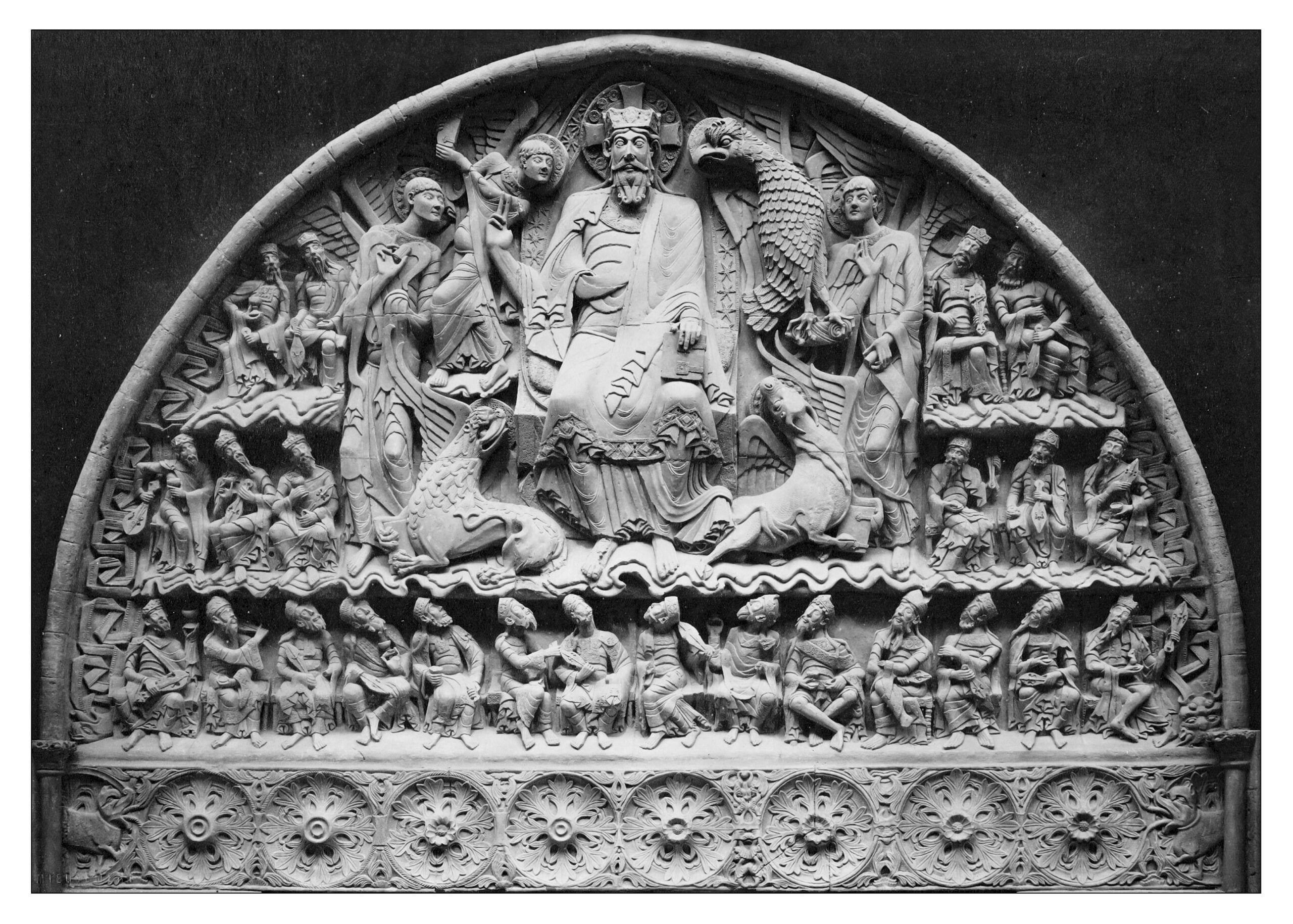
 

In the center, Christ in Majesty is surrounded by four creatures and two angels (Schapiro & Finn, 1985, pp 77-104; Vidal et al., 1979, pp 95-99). The feet of Christ rest upon a crystalline sea, as described in the passage from Revelation, but not in the illuminations illustrated above. Bede’s interpretation (early 8th Century) of this is that it represents the baptism that is necessary for Christian salvation (Wallis, 2013, p 134).

The setting for Umberto Eco’s 1980 novel The Name of the Rose is a monastery loosely based on the Sacra di San Michele, an abbey on Mount Pirichiano in Piedmont, Italy. However, the portal of the fictional abbey church is clearly based on that in Moissac (Geese, 2004, p 259). The young monk Adso describes his impression of the Christ in Majesty:

I saw a throne set in the sky and a figure seated on the throne. The face of the Seated One was stern and impassive, the eyes wide and glaring over a terrestrial humankind that had reached the end of its story; majestic hair and beard flowed around the face and over the chest like the waters of a river, in streams all equal, symmetrically divided in two. The crown on his head was rich in enamels and jewels, the purple imperial tunic was arranged in broad folds over the knees, woven with embroideries and laces of gold and silver thread. The left hand, resting on one knee, held a sealed book, the right was uplifted in an attitude of blessing or—I could not tell—of admonition. The face was illuminated by the tremendous beauty of a halo, containing a cross and bedecked with flowers, while around the throne and above the face of the Seated One I saw an emerald rainbow glittering. Before the throne, beneath the feet of the Seated One, a sea of crystal flowed, and around the Seated One, beside and above the throne, I saw four awful creatures—awful for me, as I looked at them, transported, but docile and dear for the Seated One, whose praises they sang without cease.

Surrounding the central figure of Christ are four creatures. Although there are other interpretations, most scholars suggest that these creatures represent the writers of the four gospels since each is holding a book:

Matthew has the human face because he begins his gospel with Jesus’ human genealogy; Mark is the lion because he begins with a voice roaring in the desert; Luke is the ox because he begins with offering in the temple; and John is the eagle because of the book’s soaring opening lines. (Koester, 2014, p 353).

Each of the creatures has six wings. Bede considered the number six auspicious because it is both the sum and product of the first three numbers (Wallis, 2013, p 135). The sculptural representations of the four creatures, with their wings and books, are marvelously dynamic – they twist themselves toward the focus of their praise. There is a striking contrast between the immobility of the central Christ and the movement of the surrounding creatures: one exists in eternity whereas the others try to portray this in human time. Beside the creatures are two angels, each holding a scroll, unopened on the left and open on the right.    

Surrounding the central group are 24 “elders” arrayed in white gowns and wearing golden crowns. No one knows who they represent. They may be: the elders of the Christian Church in Jerusalem; the Christian Apostles and the leaders of the tribes of Israel; the whole church composed of both priests and people; or those who have already died and been resurrected (Quispel, 1979, p 49; Koester, 2024, pp 360-363; Wallis, 2013, p 136). Twenty-four is another auspicious number: the product of the first four integers.

Hearn (1981, pp 170-172) stresses the remarkable variability of the elders, who differ in the posture of their legs or arms, in the way they hold their instruments, in the shape and ornamentation of their crowns, and in the decorations of their robes. Yet all the elders are the same in that they are looking at Christ.


Each of the elders holds a stringed instrument (probably a version of the vielle or medieval fiddle) but the number of strings and the shape of the sounding body vary from elder to elder. Only one appears to be actually playing his instrument with a bow (see right). Most of the elders also hold a goblet in their hand.


In The Name of the Rose, Adso is completely entranced by the elders:

Around the throne, beside the four creatures and under the feet of the Seated One, as if seen through the transparent waters of the crystal sea, as if to fill the whole space of the vision, arranged according to the triangular frame of the tympanum, rising from a base of seven plus seven, then to three plus three and then to two plus two, at either side of the great throne, on twenty-four little thrones, there were twenty-four ancients, wearing white garments and crowned in gold. Some held lutes in their hands, one a vase of perfumes, and only one was playing an instrument, all the others were in ecstasy, faces turned to the Seated One, whose praises they were singing, their limbs also twisted like the creatures’, so that all could see the Seated One, not in wild fashion, however, but with movements of ecstatic dance—as David must have danced before the Ark—so that wherever their pupils were, against the law governing the stature of bodies, they converged on the same radiant spot. Oh, what a harmony of abandonment and impulse, of unnatural and yet graceful postures, in that mystical language of limbs miraculously freed from the weight of corporeal matter, marked quantity infused with new substantial form, as if the holy band were struck by an impetuous wind, breath of life, frenzy of delight, rejoicing song of praise miraculously transformed, from the sound that it was, into image.  Bodies inhabited in every part by the Spirit, illuminated by revelation, faces overcome with amazement, eyes shining with enthusiasm, cheeks flushed with love, pupils dilated with joy: this one thunder-struck by a pleasurable consternation, that one pierced by a consternated pleasure, some transfigured by wonder, some rejuvenated by bliss, there they all were, singing with the expression of their faces, the drapery of their tunics, the position and tension of their limbs, singing a new song, lips parted in a smile of perennial praise. (p 42)

The following photographs of some of the elders and their ecstasy:

The Trumeau

Carved from one piece of stone, the trumeau (deriving from the Germanic root thruma, trunk, stump) of the Moissac portal is one of the most striking pieces of Romanesque sculpture (Vidal et al, 1979, pp 99-100; Schapiro, 1931, pp 525-529; Schapiro & Finn, 1985, pp 128-132). On the front of the pillar are arrayed three pairs of lions. The lions are similar in style to the lion of Mark in the tympanum. Each lion is definitely sexed with either female breasts or male genitalia. The iconography of lions harkens back to the Ishtar gate of Babylon, and to Coptic sculptures. Their intertwining owes much to the complex patterns of Islamic imagery. Behind the lions is a pattern of vines and rosettes.  


On the sides of the trumeau are carved sinuous and elongated representations of the prophet Jeremiah with an open scroll and the apostle Paul with a book of his letters. Jeremiah looks downward in melancholy as he laments the state of Jerusalem and foresees the Babylonian captivity. Paul looks upward with hope for the redemption offered to those who elect Christ as their savior. My intuition is that the sculpture of Paul may be a portrait of the abbot Ansquitil, who devised the iconography of the portal and supervised its construction.


The Birth and Childhood of Jesus

The walls of the porch portray two narratives related to salvation and damnation (Schapiro & Finn, 1985, pp 107-126; Forsyth, 2002). On the east wall are represented episodes from the birth and childhood of Jesus. In the lower section of the wall are the Annunciation, the Visitation, and the Adoration of the Magi. Though these were damaged during the French Revolution, the upper panel of the wall is well preserved.


It represents from right to left: the presentation in the temple (Luke 2; 23-32), the angel warning Joseph that Herod is planning to massacre the infants of Bethlehem and the flight to Egypt (Matthew 2: 13-23), and the fall of the idols of Heliopolis.

The last episode may derive from a prophecy of the Messiah in Jeremiah 43: 11-13:

And when he cometh, he shall smite the land of Egypt, and deliver such as are for death to death; and such as are for captivity to captivity; and such as are for the sword to the sword.

And I will kindle a fire in the houses of the gods of Egypt; and he shall burn them, and carry them away captives: and he shall array himself with the land of Egypt, as a shepherd putteth on his garment; and he shall go forth from thence in peace.

He shall break also the images of Bethshemesh, that is in the land of Egypt; and the houses of the gods of the Egyptians shall he burn with fire.

Heliopolis (Greek) and Bethshemesh (Hebrew) both mean “city of the sun.” A passage in one of the apocrypha describes the destruction of the idols and temples of Egypt when the Holy Family arrived for their sojourn there (Forsyth (2002; Franzé, 2015). The fall of the idols may also relate to the success of the First Crusade which had recently liberated Jerusalem in 1098 (Franzé, 2015).


Dives and Lazarus

The upper sculptures of the west wall of the porch recount the parable of Dives and Lazarus (Luke 16: 19-26).

There was a certain rich man, which was clothed in purple and fine linen, and fared sumptuously every day:

And there was a certain beggar named Lazarus, which was laid at his gate, full of sores,

And desiring to be fed with the crumbs which fell from the rich man’s table: moreover the dogs came and licked his sores.

And it came to pass, that the beggar died, and was carried by the angels into Abraham’s bosom: the rich man also died, and was buried;

And in hell he lift up his eyes, being in torments, and seeth Abraham afar off, and Lazarus in his bosom.

And he cried and said, Father Abraham, have mercy on me, and send Lazarus, that he may dip the tip of his finger in water, and cool my tongue; for I am tormented in this flame.

But Abraham said, Son, remember that thou in thy lifetime receivedst thy good things, and likewise Lazarus evil things: but now he is comforted, and thou art tormented.

And beside all this, between us and you there is a great gulf fixed: so that they which would pass from hence to you cannot; neither can they pass to us, that would come from thence.

Dives is the Latin word for a rich man, and Lazarus is the name of a beggar, derived from the Hebrew Eleazar or “God is my help” (Lazarus in this parable is not the Lazarus that Jesus later raised from the dead. Their common name is just coincidence).

During his life, Dives enjoyed his luxury and took no notice of Lazarus. After they died, Lazarus was taken to Abraham’s bosom whereas Dives went to hell. Justice was served. The parable has always been popular. The poor are more numerous than the rich.


The right side of the Moissac tableau shows Dives eating a sumptuous meal. He pays no heed to Lazarus, who lies on the ground in the lower center part of the panel, beset by dogs. At his death Lazarus is taken by the angel to the bosom of Abraham. This is in accord with the law as personified on the far left of the sculpture. The fate of Dives is played out in a separate representation lower down on the wall (not illustrated). Devils take both his soul and his accumulated riches. Like Dives, this sculpture has not survived well.

An old English ballad, dating from medieval times, retells the story with the refrain

Then Lazarus laid him down and down
And down at Dives’ door
“Some meat, some drink, brother Dives,
Bestow upon the poor”

Ralph Vaughan-Williams composed Five Variants of Dives and Lazarus for Harp and String Orchestra (1940), based on various versions of the ballad.

Henderson (1972, p 90) points out that the parable of Dives and Lazarus follows appropriately from the warnings of the prophet John that come immediately before his vision of Christ in Majesty:

Because thou sayest, I am rich, and increased with goods, and have need of nothing; and knowest not that thou art wretched, and miserable, and poor, and blind, and naked:

I counsel thee to buy of me gold tried in the fire, that thou mayest be rich; and white raiment, that thou mayest be clothed, and that the shame of thy nakedness do not appear; and anoint thine eyes with eyesalve, that thou mayest see.

As many as I love, I rebuke and chasten: be zealous therefore, and repent. (Revelation 3:17-19)


The Artists

The overall conception of the portal and the cloister of the Abbaye de Saint Pierre has long been attributed to the Abbot Ansquitil. The chronicle of Aymeric de Peyrac, an abbot of Moissac in the 14th Century wrote:

Dictus Ansquitilus fecit fieri portale pulcherrimum [The said Ansquitil arranged for the most beautiful portal to be made] (quoted by Vidal et al 1979, p 96)

The central pillar of the west gallery of cloister (illustrated on the right) has an intricately carved epigraph that reads

ANNO AB INCARNATIONE ÆTERNI PRINCIPIS MILLESIMO CENTESIMO FACTVM EST CLAUSTRVM ISTVD TEMPORE DOMNI ANSQUITILII ABBATIS AMEN VVV MDM RRR FFF

De la Haye (2023, p 133-135) suggests that the final abbreviations might have represented

VIR VITÆ VENERABILIS / MOYSSIACENSEM DOMUM MELIORAVIT / RESTITUIT RESTAURAVIT REXIT / FAUSTE FORTUNATE FELICITER,

Thus, a full translation would read

In the year 1100 following the incarnation of the Eternal Lord, this cloister was erected, in the time of the Abbot Ansquitil: a man of venerable life who improved, rebuilt, restored and governed the house of Moissac, favored, fortunate and felicitous

He also suggests that the fish scale (écaille in French, escata in the old Occitan language) ornamentation at the top of the pillar is a punning reference to the name Ansquitil.

The names of the sculptors who worked under the direction of the learned abbot remain unknown. Vidal et al (1979, p 96, my translation), however, notes

By a detail, usually unnoticed or forgotten, we know their person, if we do not know their name; because we can see them represented to the left and right of the tympanum, under the second arch: one in a working position, tools in hands, a bearded man in the prime of life; the other, young and beardless with a broad and blissful face, identifiable by the secret sign of initiation of the bare foot. They contemplate their work.


Doorway to Eternity

The doorway to a church marks the boundary between the problems of the world and the peace that comes with salvation. Just before he describes his vision of Christ in Majesty, John of Patmos conveys Christ’s message: 

Behold, I stand at the door, and knock: if any man hear my voice, and open the door, I will come in to him, and will sup with him, and he with me. (Revelation 3: 20)

Vernery (2019) comments on how the doorway is the threshold between a world wherein time and mortality hold sway and a life attuned to the mysteries of eternity. The sculptural representations provide material images of a spiritual idea:

La perception sensible des sculptures donne lieu à la construction d’une image mentale rendue une par la contemplation. Une fois cette forme conceptuelle mise en place en l’esprit, l’homme est amené à se détacher de la sensation corporelle. Laissant les images matérielles sur le parvis de l’abbatiale en en franchissant physiquement l’espace, il conserve mentalement ce qu’elles ont éveillé en lui.

[The perception of the sculptures creates a mental image that becomes unified by contemplation. Once this conceptual form becomes established in the mind, one becomes detached from bodily sensation. Leaving the material images on the square in front of the abbey church while physically crossing the space, one mentally preserves what they awakened]

The spiritual idea is the concept of Christ in Majesty. This is what separates the temporal from the eternal

Vernerey (2020) also remarks about how the very process of sculpting, wherein matter is removed to reveal the hidden form, is analogous to the crossing from the outer world into the inner mysteries. Just as the process of sculpture extracts images from raw material, so the entry into the church extracts the soul from the temporal world.

The present is much different from the days when a hundred monks led lives of prayer and ritual in Moissac. In 1793 the mobs of the French Revolution drove the monks from the abbey and damaged many of the statues that were easily accessible. Years later, the abbey church became a simple parish church. The cloister and other remaining monastery buildings became a museum.  

In our secular age we no longer believe in the specifics of salvation that Ansquitil arranged to be displayed in stone. Yet the portal still makes us think of processes beyond the flow of time, that we can write about and wonder at.


References

Busch, H., & Lohse, B. (1966). Pre-Romanesque art. Macmillan.

Charles, V., & Carl, K. (2012). Romanesque Art. Parkstone-International

de la Haye, R. (1995, revised 2023) Apogée de Moissac. L’abbaye clunisienne Saint-Pierre de Moissac à l’époque de la construction de son cloître et de son grand portail, Maastricht.

Eco, U. (1980, translated W. Weaver, 1983). The name of the rose. Harcourt Brace Jovanovich.

Eco, U. (translated W. Weaver, 1984). Postscript to The Name of the Rose. Harcourt Brace Jovanovich.

Fleischer, J. (2004). Pre-Romanesque church walls and their “language.” In Petersen, N. H., Clüver, C., & Bell, N. (Eds.). Signs of change: transformations of Christian traditions and their representation in the arts, 1000-2000. (pp 247-264) Rodopi.

Forsyth, I. H. (2002). Narrative at Moissac: Schapiro’s Legacy. Gesta, 41(2), 71–93.

Forsyth, I. H. (2010). The date of the Moissac Portal. In Maxwell, R. A. & Ambrose, K. Current directions in eleventh- and twelfth-century sculpture studies. (pp 77-99). Brepols.

Franzé, B. (2015). Moissac et l’oeuvre de l’abbé Ansquitil (1085-1115): un discours de penitence. Hortus Artium Medievalium, 21, 385-405

Geese, U. (2004). Romanesque sculpture. In R. Toman (Ed.). Romanesque: architecture, sculpture, painting. (pp 256-380). H. F. Ullman (Tandem).

Hearn, M. F. (1981). Romanesque sculpture: the revival of monumental stone sculpture in the eleventh and twelfth centuries. Cornell University Press, 1981.

Henderson, G. (1972). Early Medieval. Penguin Books.

Koester, C. R. (2014). Revelation: a new translation with introduction and commentary. (Anchor Bible). Yale University Press.

Oursel, R (Ed.) (1970). Les Chemins de Saint-Jacques: textes de saint Augustin et des Miracles de saint Jacques. Zodiaque.

Oursel, R. (1973, 1976). Floraison de la sculpture romane. 1. Les grands découvertes. 2. Le coeur et la main. Zodiaque.

Pagels, E. H. (2012). Revelations: visions, prophecy, and politics in the book of Revelation. Viking.

Quispel, G. (1979). The secret Book of Revelation: the last book of the Bible. McGraw-Hill.

Schapiro, M. (1931). The Romanesque sculpture of Moissac. The Art Bulletin, 13(3), 249–351; 13(4), 464-531

Schapiro, M., & Finn, D. (1985). The Romanesque sculpture of Moissac. Georges Braziller.

Toman, R. (Ed.). (2004). Romanesque: architecture, sculpture, painting. H. F. Ullman (Tandem).

Vernerey, É. (2020). En deux temps, un mouvement. Définir la temporalité du sacré par la sculpture sur le porche de Moissac. Temporalités

Vidal, M., Maury, J., & Porcher, J. (1979). Quercy roman. (3rd Ed.). Zodiaque.

Wallis, F. (2013). Bede: Commentary on Revelation. Liverpool University Press.


Intimations of Mortality

We have been here before. The coronavirus pandemic has many precedents. Over the centuries various plagues have swept over our world. Many millions of people have died before their time. From 1347 to 1351 the Black Death killed about 30 million people in Medieval Europe: over a third of the population. From 1918 to 1920 the Great Influenza killed about 50 million people: about 2.5% of the world’s population. Each of these pandemics was as deadly as World War I (about 20 million) or World War II (about 70 million). Pandemics are more worrisome than wars: we cannot sue for peace with a virus. Most of us survived even the worst of past infections. Our systems of immunity will likely once again become victorious in this present pandemic. But just like after a war, we shall be severely chastened. How close we will have come to death will change the way we think. Everything will be seen through the mirror of our own mortality and the transience of our species. The nearness of an ending will distort our thinking. We shall have strange dreams and frightening visions.

John of Patmos

Such dreams and visions came to a man named John almost two millennia ago. In the second half of the 1st Century CE, during the reign of the Roman Emperor Domitian, the Christians of the Roman Empire were severely persecuted, the Second Temple in Jerusalem was destroyed, and the Roman Empire was shaken by attacks from without and rebellions from within. There was no pandemic but life was just as uncertain.

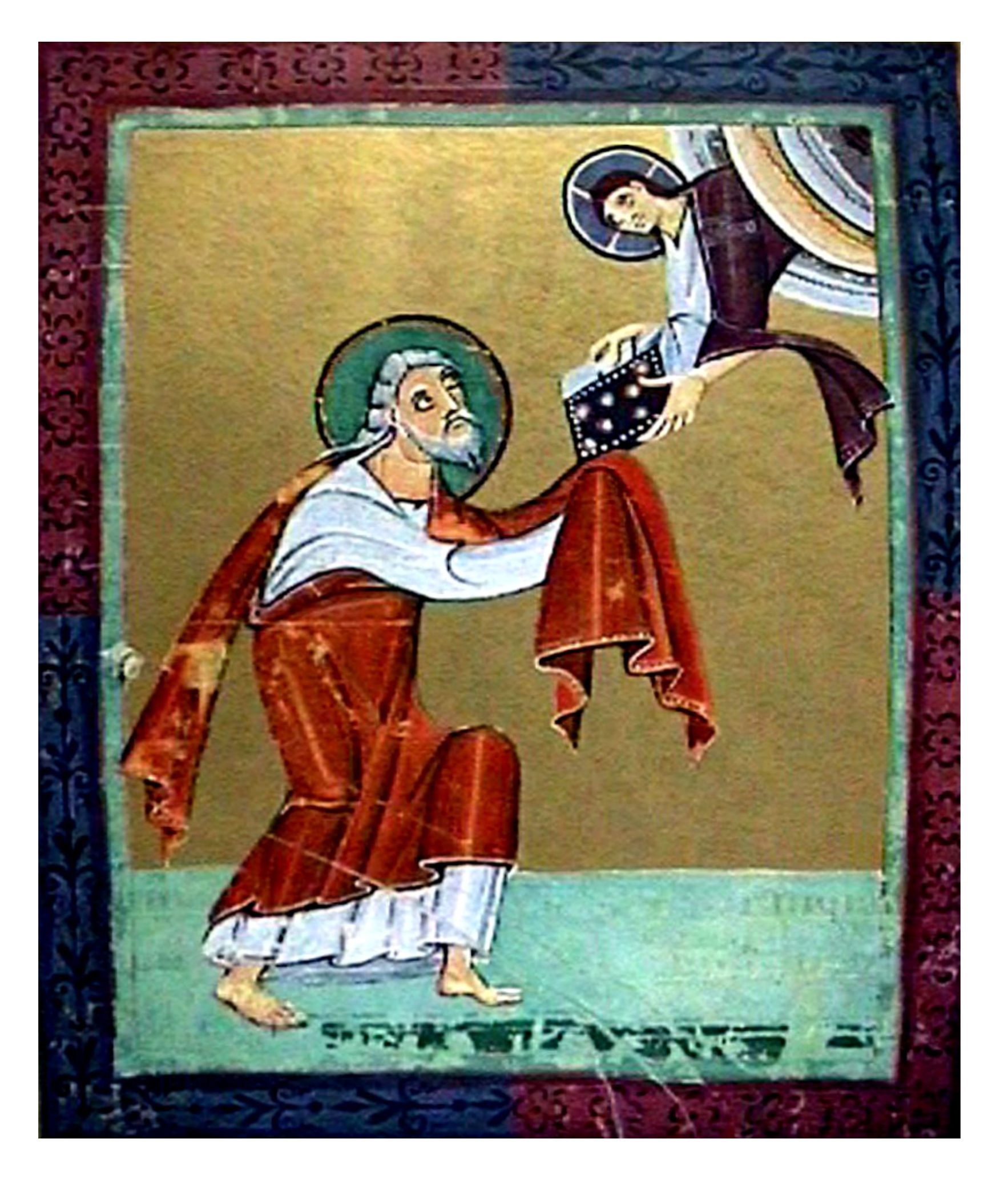
On the island of Patmos just off the west coast of what is now Turkey, a Christian named John experienced disturbing visions of the future. He described these in a manuscript that began with the word apokalypsis (Greek for “unveiling”). This became Revelation, the last book in the Christian New Testament (Koester, 2014; Quispel, 1979). The illustration on the right, from the Bamberg Apocalypse, an illuminated manuscript from the 11th Century, shows an angel telling John what he should write:

The Revelation of Jesus Christ, which God gave unto him, to shew unto his servants things which must shortly come to pass; and he sent and signified it by his angel unto his servant John (Revelation 1:1)

For many years, Christian scholars assumed that John the Apostle, the youngest of Christ’s disciples, was the author of Revelation, the Gospel of John and the three Epistles of John. Most modern scholars consider it unlikely that he wrote any of these works. They suggest three separate authors one for the gospel, one for the three epistles, and one for the apocalypse. One telling point is that each author describes the end-times very differently. For example, the Antichrist is mentioned in the epistles (e.g. 1 John 2:18), but not in the apocalypse. The author of Revelation was probably a Jewish-Christian prophet living in Asia Minor – John of Patmos. He may have written the book over many years. One suggestion is that he began writing as a Jew and later converted to Christianity (Koester, 2014, pp 68-71).

The visions described by John are stunning in their force and detail. The Whore of Babylon, the Seven-Headed Beast, and the Four Horsemen have become part of our collective consciousness.

Revelation is the most interpreted and least understood book of the Christian Bible (Quispel, 1979; Koester, 2014). Some have interpreted the visions as describing the troubled time in which they were experienced. The Seven-Headed Beast could then represent Rome (with its seven hills, or its seven emperors), and the Rider on the White Horse could represent the Parthians who threatened the peace of the Middle East. Others have considered the visions as prophesying the later history of the Christian Church. The Whore of Babylon was the papacy of Rome for Protestants and the heresies of the Reformation for Catholics. Others believe that Revelation foretells the Last Days, that are yet to come, when Christ will judge both the quick and the dead.

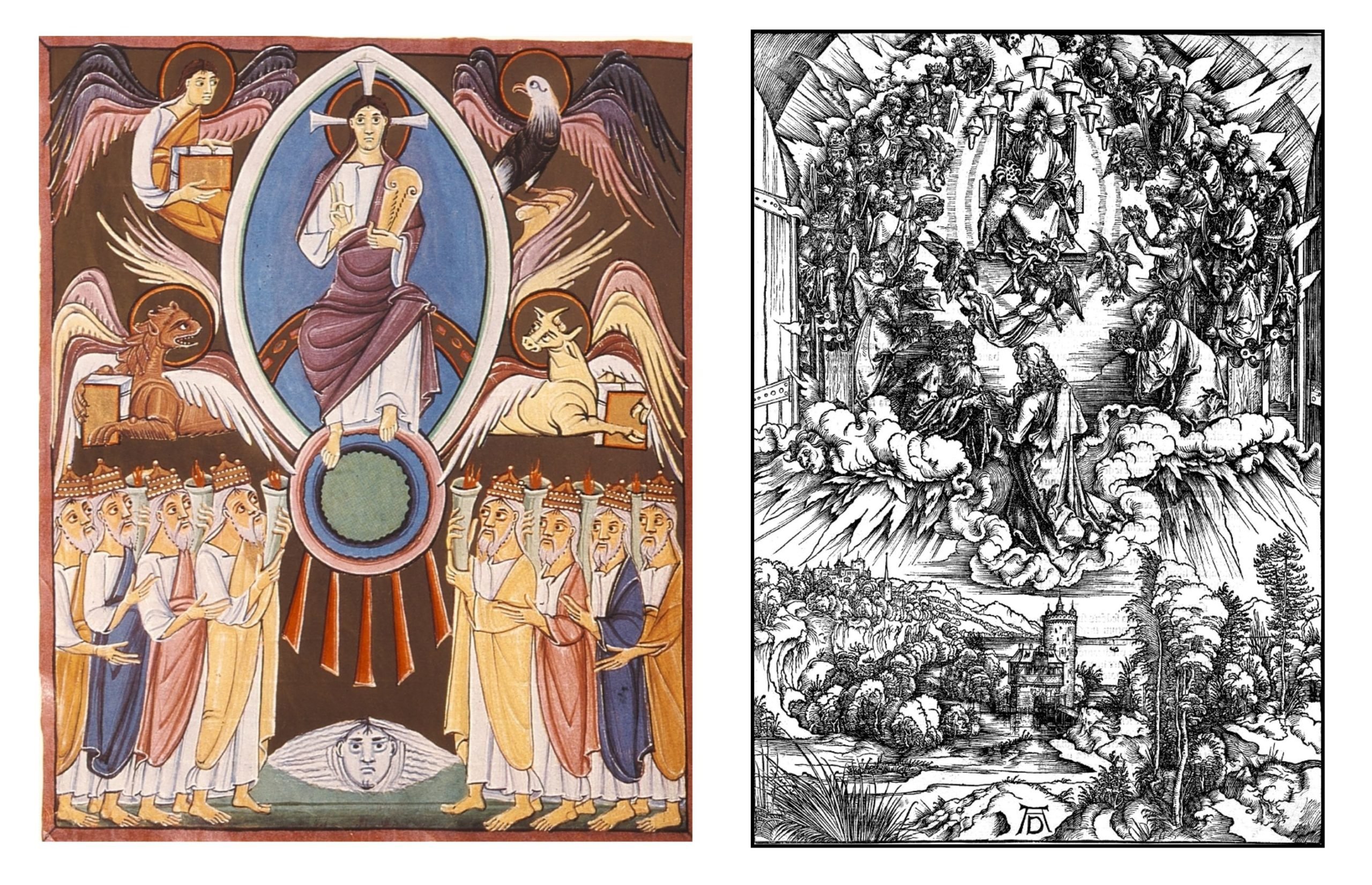
John’s first vision was of the Lord seated upon a throne in Heaven. This is illustrated below in the 11th-Century Bamberg Apocalypse, and in the 1498 woodcut by Albrecht Dürer. Around the throne were four beasts in the form of Man, Lion, Ox and Eagle, probably representing the evangelists Matthew, Mark, Luke and John. Around them were four and twenty elders, clothed in white and wearing crowns of gold. In the Lord’s right hand was a book “sealed with seven seals.” The structure of this book is not clear. Perhaps it is made up of seven scrolls one rolled up within the other (Quispel, 1979, p 51). A mystical lamb appears and proceeds to open each of the seals.

The Four Horsemen

As the first four seals are opened four horsemen appear:

And I saw when the Lamb opened one of the seals, and I heard, as it were the noise of thunder, one of the four beasts saying, Come and see.
And I saw, and behold a white horse: and he that sat on him had a bow; and a crown was given unto him: and he went forth conquering, and to conquer.
And when he had opened the second seal, I heard the second beast say, Come and see.
And there went out another horse that was red: and power was given to him that sat thereon to take peace from the earth, and that they should kill one another: and there was given unto him a great sword.
And when he had opened the third seal, I heard the third beast say, Come and see. And I beheld, and lo a black horse; and he that sat on him had a pair of balances in his hand.
And I heard a voice in the midst of the four beasts say, A measure of wheat for a penny, and three measures of barley for a penny; and see thou hurt not the oil and the wine.
And when he had opened the fourth seal, I heard the voice of the fourth beast say, Come and see.
And I looked, and behold a pale horse: and his name that sat on him was Death, and Hell followed with him. And power was given unto them over the fourth part of the earth, to kill with sword, and with hunger, and with death, and with the beasts of the earth. (Revelation 6:1-8)

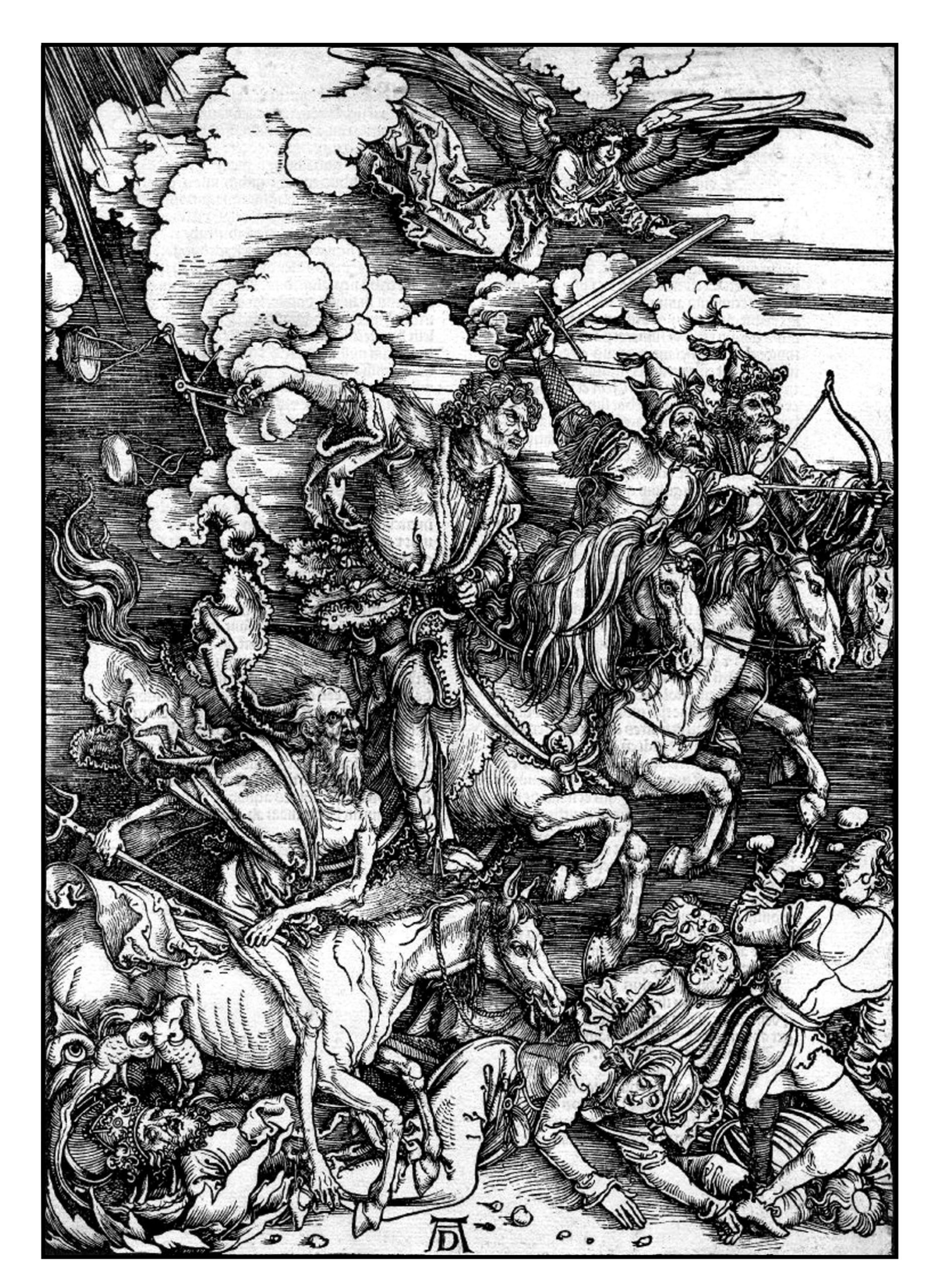
Only the fourth horseman is clearly identified by John as Death. The color of his horse has been interpreted as “pale,” although the Greek chloros is actually better translated as “green.” Perhaps John envisioned a sickly pale green color. The identity of the other three is unknown (reviewed by Koester, 2014, pp 392-398; and in Wikipedia). The rider of the black horse with his scales for weighing and pricing food was almost certainly Famine. The rider of the Red Horse was probably War. The first horsemen has been interpreted in many ways. Perhaps he is Christ, perhaps the Antichrist. Some have considered him as Conquest though this seems to overlap with the rider of the Red Horse. Pestilence or plague seems the most reasonable interpretation. His arrows could then represent the transmission of infection.

The most famous depiction of the Four Horsemen is the 1498 woodcut of Albrecht Dürer, illustrated on the right. The first three horsemen look like mercenary warriors from the Hundred Year War. Death is a skeletal figure riding an emaciated horse. He clears the world of those who die from pestilence, war and famine.


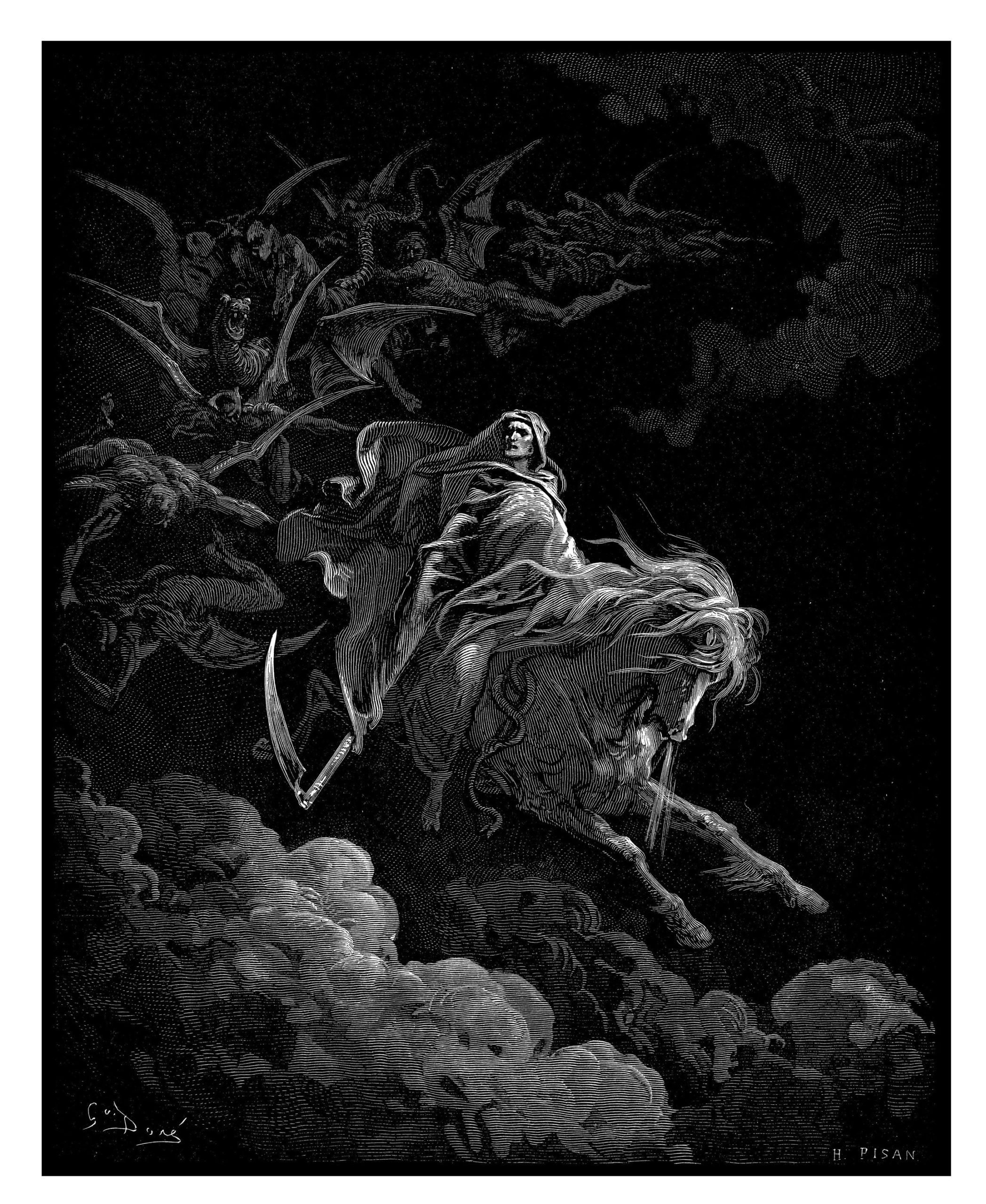
The 1865 wood-engraving by Héliodore Pelan based on a drawing by Gustave Doré gives Death a more majestic appearance, and grants him the scythe that has become his symbol. The scythe refers the apocalyptic passages in the Gospels that consider the final harvest of human souls. Doré also depicts the dark shades of Hades that John saw following after Death.


Pale Horse, Pale Rider

In 1918 Katherine Anne Porter almost died from the Great Influenza while she was in Denver working as a journalist (Barry, 1963). In 1939 she published Pale Horse, Pale Rider a short novel about that experience. In the novel she calls herself Miranda (from the Latin, “to be wondered at”). Pale Horse, Pale Rider was published together with two other stories – Old Mortality and Noon Wine – and gave its title to the collection.

The novel opens with a dream. Miranda is about to go riding, but she cannot decide which horse to borrow for a journey she does not wish to take. She decides against Miss Lucy “with the long nose and the wicked eye,” and Fiddler “who can jump ditches in the dark,” and choses Graylie “because he is not afraid of bridges.” These horses are those that were ridden long ago by Amy, the wife of Miranda’s Uncle Gabriel. Amy was a beautiful and spirited young woman, who committed suicide before Miranda was born. Her story was told in Old Mortality, one of several Miranda stories.

In the dream Miranda must go riding with a stranger who has been hanging about the place. She mounts Graylie, and urges him on. They fly off, over the hedge and the ditch and down the lane:

The stranger rode beside her, easily, lightly, his reins loose in his half-closed hand, straight and elegant in dark shabby garments that flapped upon his bones. (Porter, 1939, p 181)

Suddenly, she pulls Graylie up, the stranger rides on, and Miranda wakes up.

She remembers the events of the day before, particularly her visit to the infirmary at the army camp, and her tryst with her new boyfriend Adam, a young and handsome soldier about to be sent to France. She is not feeling well, but goes to work and once again meets Adam.

The next day she feels quite ill, and is seen by a doctor who prescribes some medications and says he will check on her later. Adam comes to see her and comforts her. They talk of their love for each other, about the war and about old songs they had heard when they were younger. One of these is a spiritual that began “Pale horse, pale rider, done taken my lover away.” The doctor returns and arranges for Miranda to be admitted to hospital. She has contracted influenza, perhaps from her visit to the infirmary.

While in hospital Miranda comes close to death but survives

Silenced she sank easily through deeps under deeps of darkness until she lay like a stone at the farthest bottom of life, knowing herself to be blind, deaf, speechless, no longer aware of the members of her own body, entirely with-drawn from all human concerns, yet alive with a peculiar lucidity and coherence; all notions of the mind, the reasonable inquiries of doubt, all ties of blood and the desires of the heart, dissolved and fell away from her, and there remained of her only a minute fiercely burning particle of being that knew itself alone, that relied upon nothing beyond itself for its strength; not susceptible to any appeal or inducement, being itself com-posed entirely of one single motive, the stubborn will to live. This fiery motionless particle set itself unaided to resist destruction, to survive and to be in its own madness of being, motiveless and planless beyond that one essential end. (pp 252-3).

She has a vision of a place reached by crossing a rainbow bridge.  Graylie was not afraid of bridges. There Miranda sees in the shimmering air “a great company of human beings,” all the people she had known in life. From this apparent heaven she returns to the reality of the hospital. She has miraculously comeback from the dead.  She lives up to her name – someone to be wondered at.

In her convalescence she learns that Adam had also became ill, probably having caught the disease from her. However, though Miranda had survived, Adam had died.

Outside the bells are ringing to celebrate the end of the war. As Miranda prepares to leave the hospital, she requests some essentials to begin her new life:

One lipstick, medium, one ounce flask Bois d’Hiver perfume, one pair gray suede gauntlets without straps, two pairs gray sheer stockings without clocks … one walking stick of silvery wood with a silver knob. (p 262).

She will be pale and elegant like the rider she dreamed about at the beginning of her illness, the rider that done take her love away. She has been irretrievably marked by death. As she leaves the hospital Miranda thinks

No more war, no more plague, only the dazed silence that follows the ceasing of the heavy guns; noiseless houses with the shades drawn, empty streets, the dead cold light of tomorrow. Now there would be time for everything. (p 264)

Life is now defined by what it is not – no war, no plague, no noise, no light. Porter’s  words recall Wilfred Owen’s 1917 poem Anthem for Doomed Youth which begins with the “monstrous anger of the guns” and ends with “each slow dusk a drawing down of blinds” (Owen, 1985, p 76).  Much poetry was written about the terrible loss of life in the Great War. Very little is concerned with the great epidemic of influenza that marked its ending (Crosby, 1989; Fisher, 2012).

Miranda’s final claim “Now there would be time for everything” is the tragedy of the book. She is now free to do as she wishes but there is nothing that she wishes to do.

Porter spent many years before she fully recovered from her experience in Denver. She did not publish her first stories until 1930, and Pale Horse, Pale Rider did not come out until 1939. Some sense of Miranda’s feelings at the end of that book is perhaps present in the 1942 portrait drawing of Porter by Paul Cadmus.


The Great Influenza

The influenza that almost killed Katherine Anne Porter swept across the world between 1918 and 1921 (Barry, 2004; Crosby, 1989; Spinney, 2017; Taubenberger & Morens, 2006). No one is sure where it began. The first cases were seen in Kansas, and the disease spread rapidly through the US army camps where young men were being trained before going to fight in France.

The following is the iconic image of the epidemic: the make-shift infirmary at Camp Funston, Kansas. The photograph is strangely still. It should be accompanied by the sound of intermittent coughing. The light rakes across the camp cots, randomly selecting one soldier or another, much as the disease would select those who would die. There was no treatment: oxygen would not be used for pneumonia until after the war (Heffner, 2013). About a quarter of the young men in this photo likely died of influenza. More US soldiers died of influenza than during battle.

The disease quickly spread to the battlefields of Europe. None of the combatant-countries wished to acknowledge that their troops were ill. Since the first officially reported cases occurred when the disease spread to Spain, the pandemic was thereafter miscalled the Spanish Flu. In this posting it is called the Great Influenza.

The 1918 pandemic was unusual in that it the young and healthy were more susceptible to the disease than the elderly. This may have been related to the close quartering of the young soldiers. Or it might have been caused by an overly reactive immune system.

Coronavirus COVID-19 acts similarly to the influenza virus in terms of its spread through airborne droplets, and in terms of how its major morbidity is due to a viral pneumonia. The coronavirus differs from the Great Influenza in that it affects the elderly more than the young. Nevertheless, we should look to the Great Influenza in terms of what might happen in our current pandemic.

A pandemic is characterized by two main parameters. The contagiousness of the disease is measured by the basic reproduction number (R0). This is the number of new people that will become infected from one individual patient. If R0 is less than 1 the disease dies out; if it is greater than 1 the disease spreads exponentially through the population. The virulence of the disease is assessed by the case fatality rate (CFR). This measures the proportion of infected patients that die.

For the Great Influenza R0 was about 2 (Ferguson et al. 2006), and the CFR was about 2.5% (Taubenberger & Morens, 2006). We do not yet know for sure how the present coronavirus COVID-19 compares. Early data from China suggest that R0 is about 2, and the CFR about 5% (Wu et al., 2020). Since we have not yet done sufficient testing to be sure of the number of cases in the population, the CFR is likely overestimated. Most of the tested cases are patients who have been severely symptomatic. If there is a significant number of asymptomatic (and untested) cases, the CFR will be lower (discussed extensively on the World in Data website). It might approach the CFR estimated for the Great Influenza, but it will be at least an order of magnitude greater than seasonal flu (<0.1%).

For those who wish to consider all the other great epidemics of human history, Wikipedia has listed their estimated values for R0 and CFR.

The numbers for COVID-19 Pandemic indicate we must be extremely cautious so as not to endure a repeat of the Great Influenza. Since stories are often more convincing than numbers, we can briefly consider the effect of the Philadelphia’s Liberty Loan Parade on September 23, 1918. Despite warnings about the influenza, the city went ahead with a huge parade to drum up support for the US war effort. A few days after the parade, hundreds of people became ill. Soon the number of ill patients increased. Hospitals rapidly became overcrowded and unable to take new cases. By the end of the years the number of cases exceeded 100,000 and the number of dead approached 13,000, over 1% of the city’s population (Barry, 2004, pp 220-227; Kopp & McGovern, 2018)). In contrast after the first recorded cases of influenza in St Louis, that city quickly instituted measures against the spread of the disease, such as closing schools and banning public gatherings. The number of deaths in St Louis per 100,000 population during the epidemic was less than half that in Philadelphia (Hatchett et al, 2007).

In Philadelphia and across the world morticians and gravediggers rapidly became overwhelmed and bodies began to pile up in the streets. In Rio de Janeiro, Jamanta, a famous carnival reveller, commandeered a tram and a luggage car and swept through the city picking up bodies and delivering them to the cemetery (Spinney, 2017, p. 54-55).

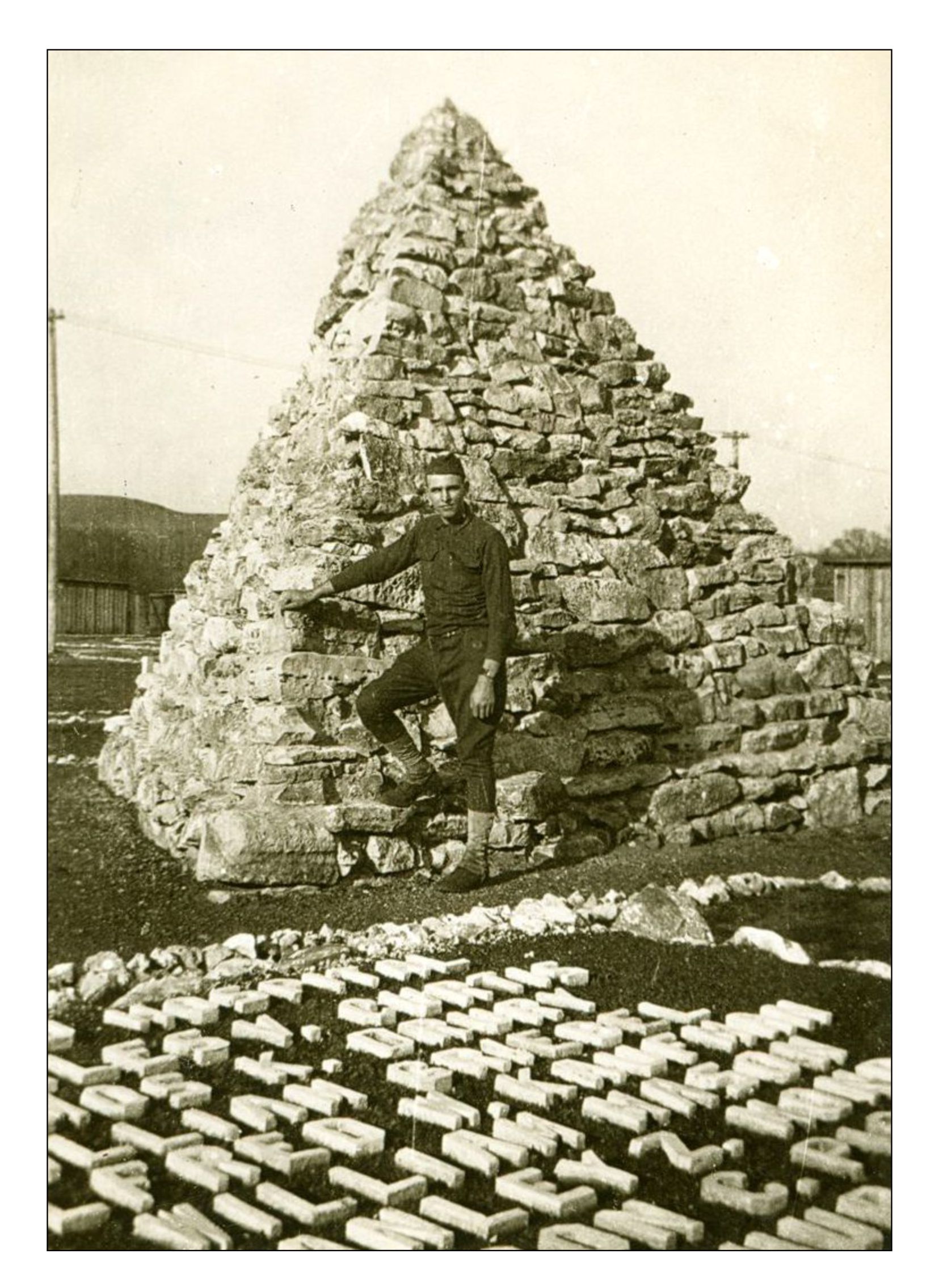
Despite its death toll, the Great Influenza was largely ignored by historians until the possibility of new influenza pandemics became real toward the end of the 20th Century. Thousands of monuments memorializing those who died in the Great War exist all over the world. Monuments to those who died of influenza are scarce, even though those who died of the disease outnumbered those who died in battle. The soldiers at Camp Fenton erected their own memorial to their colleagues who had died of the influenza (illustrated on the right, with its designer Henry Hardy). The monument was a simple pyramid of piled up stones with the names of the victims written in smaller stones on the grass. The camp and its monument have been long ago abandoned.

One of the reasons for the lack of attention that the Great Influenza received may have been that it did not fit with any overarching narrative. Though many died, they did not die for some noble cause. The disease was largely random it its killing.

The Black Death

Even though it did not kill so many, the Black Death had a far greater impact on our history. It shattered the society of the Middle Ages, disrupting the feudal system, and questioning the power of the Church. Part of this impact was due to the Bubonic Plague being far more virulent than either the influenza or the coronavirus. The Case Fatality Rate during the Black Death was over 30%. The disease was caused by a bacterium Yersinia pestis, which is endemic in rats and transmitted to human beings by fleas. The infected rats and their fleas came to Europe from the East on merchant ships. The plague began in port cities such as Naples, Venice and Genoa, are rapidly spread throughout Europe (McMillen, 2016; Snowden, 2019).

Nowadays we have antibiotics that can kill the bacteria that causes the Bubonic Plague. Furthermore, we understand how it is transmitted and can prevent this by controlling human exposure to rats and fleas. In the 14th Century there was nothing to do but flee. This flight actually increased the spread of the disease, which was carried by the fleas on all those who ran away.

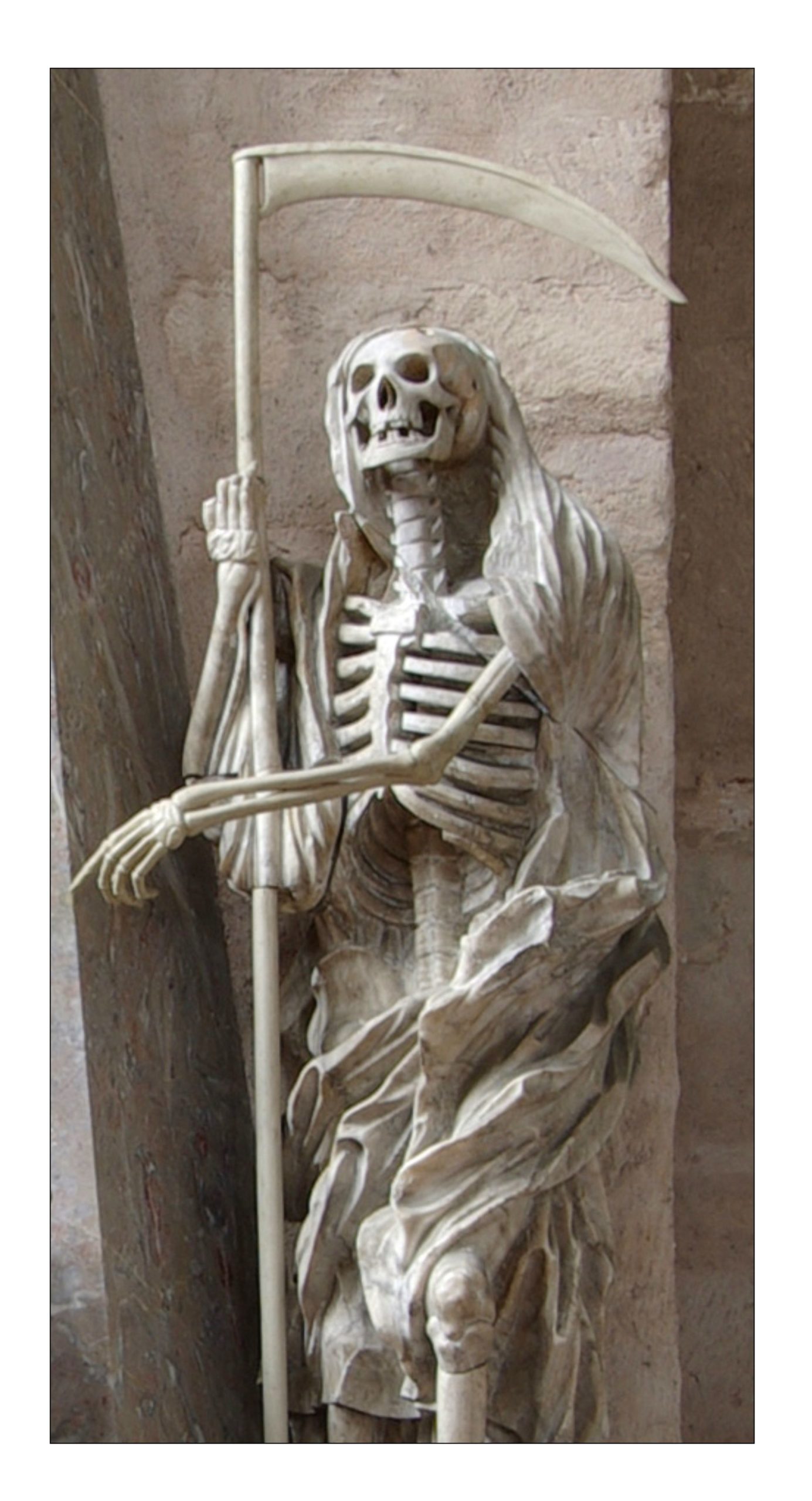
The Black Death bequeathed us with our most potent image of death as a skeletal figure, often clad in a shroud or black cloak and carrying scythe – the “grim reaper.” Such figures were often portrayed leading various people from all stations of life in a “dance of death.” The statue illustrated on the right is from the tomb in Trier Cathedral of Johann Philipp von Wallerdorff who died in 1768.

Many considered the Black Death as God’s punishment for humanity’s sins, and decided that a great return to God was necessary. Yet the plague had randomly killed both saint and sinner. Others thought that the plague was God’s demonstration that the Church had gone astray and needed to be reformed. Yet both priests and parishioners were equally affected.

And so, a few came to the idea that perhaps there was no God. The only justice in the world was at the hand of human beings. And their only recourse was themselves. And if they could ultimately survive the plague, they could perhaps settle on a different world, where reason ruled instead of faith.

The Seventh Seal

In Revelation after the four horsemen, the fifth and sixth seals are opened. These bring forth to John a vision of the Christian Martyrs, and then a vision of all those who had been saved by faith in Christ. Finally, the last seal is opened:

And when he had opened the seventh seal, there was silence in heaven about the space of half an hour. (Revelation 8:1)

Christians interpret the silence as representing the awe that occurs when one realizes the greatness of God and his program for the future. Ingmar Bergman considered it differently. Much of his work is concerned with the silence of God. All our prayers no matter how fervent are met with silence. He made this the subject of a trilogy of films: Through a Glass Darkly (1961), Winter Light (1963) and The Silence (1963).

The idea is also at the heart of his earlier 1957 film The Seventh Seal. The quotation from Revelation about the opening of the seventh seal and the silence in heaven begins the film.  A knight Antonius Block (Max von Sydow) has just returned to Sweden from the Crusades. He has brought with him a game of chess that he learned in Palestine. All of Europe is in the grip of the Black Death. On a beach Antonius prays to God. After his prayer, Death (Bengt Ekerot) appears. Antonius challenges Death to a game of Chess to decide his fate. The following is a clip from the movie. The sound of the waves goes silent when Death appears.


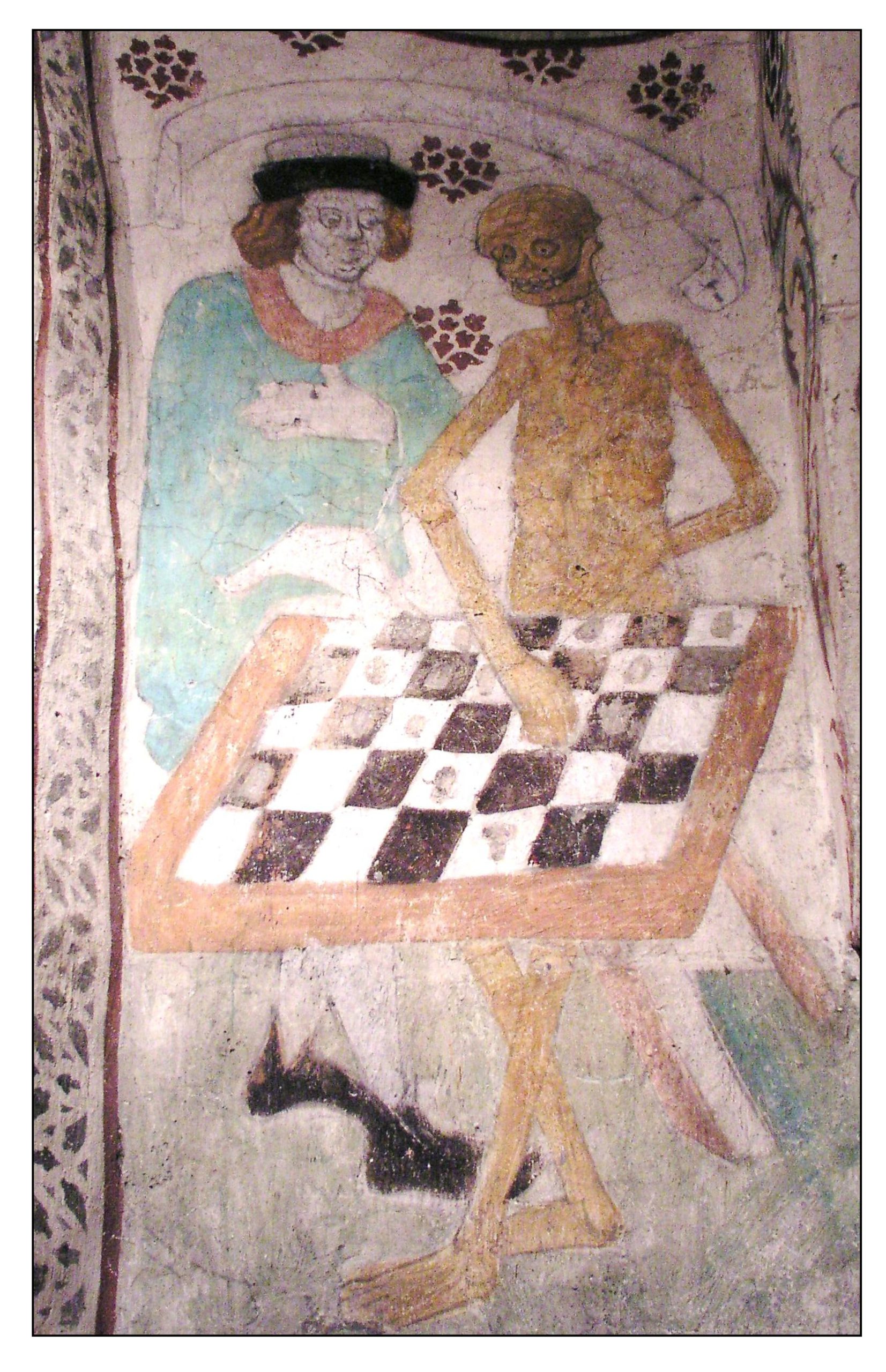
Bergman based the idea of the game of chess from a 1480 fresco (right) painted by Albertus Pictor in the Täby Church near Stockholm. As the film proceeds, Death ultimately wins the game, and leads Antonius and his family off in a dance of death. The film is not accurate historically: the crusades ended long before the Black Death. However, it is one of our most vivid depictions of human mortality.


Playing Chess with Death

Death is now among us. Not in as the dark figure portrayed by Bengt Ekerot, but in the form of a coronavirus epidemic. The disease is not as virulent as the Black Death. However, it is likely just as contagious and just as virulent as the virus that caused the Great Influenza. How do we prevent what happened in 1918 when Death took millions of people before their time?

How do we play our game of chess with Death? We still have no specific treatment, and there is as yet no vaccine. Unlike in 1918, however, we now have oxygen therapy and, if necessary, artificial ventilation. These procedures can help patients with pneumonia survive until their immune systems can finally destroy the virus. Furthermore, we have monitors such as finger oximeters that can determine when oxygen therapy is needed.

What is most important is to inhibit the spread of the disease in the population. The most powerful means to do this involves identifying all patients with the disease, tracing all people who have come in contact with these patients, testing these contacts, and quarantining both the patients and their contacts (whether or not they are infected) until they are no longer contagious. Since we have tests that are reasonably specific for the virus, this approach is definitely possible, and is being used successfully in China and in South Korea.

In the absence of contact tracing, we can limit the spread of the disease by staying away from our fellows beyond the distance that airborne drops can travel: “physical distancing” (a more appropriate term than “social distancing”).  Physical distancing can certainly slow down the spread of the disease so that hospital facilities for treating those patients that develop pneumonia do not become overwhelmed. However, it will ultimately have to be replaced with contact tracing. Or the Dance of Death will continue.

Despite our best efforts many people will die in the pandemic. Though we know we have to die sometime, we generally believe that this will not be tomorrow. Nowadays death is closer. We need to come to terms with it. Through whatever stories, dreams and visions we can muster. We cannot play chess well without equanimity.


References

Barry, J. M. (2004). The great influenza: The epic story of the deadliest plague in history. New York: Viking.

Crosby, A. W. (1989/2003). America’s forgotten pandemic: The influenza of 1918. Cambridge England: Cambridge University Press.

Ferguson NM; Cummings DA; Fraser C; et al. (2006). Strategies for mitigating an influenza pandemic. Nature, 442 (7101), 448–452.

Fisher, J. E. (2012). Envisioning disease, gender, and war: Women’s narratives of the 1918 influenza pandemic. New York: Palgrave Macmillan

Hatchett, R. J.; Mecher, C. E.; & Lipsitch, M. (2007). Public health interventions and epidemic intensity during the 1918 influenza pandemic. Proceedings of the National Academy of Sciences of the United States of America, 104, 7582–7587.

Heffner, J. E. (2013). The story of oxygen. Respiratory Care, 58, 18-31.

Koester, C. R. (2014). Revelation: a new translation with introduction and commentary. New Haven, CT: Yale University Press, 2014.

Kopp, J., & McGovern, B. (2018).  100 years ago, ‘Spanish flu’ shut down Philadelphia – and wiped out thousands. PhillyVoice, September 20 and 27, 2018.

McMillen, C. W. (2016). Pandemics: a very short introduction. New York: Oxford University Press.

Owen, W. (Edited by Stallworthy, J., 1985). The poems of Wilfred Owen. London: Hogarth Press.

Porter, K. A. (1939). Pale horse, pale rider: Three short novels. New York: Harcourt, Brace and Company.

Quispel, G. (1979). The secret Book of Revelation: The last book of the Bible. New York: McGraw-Hill.

Snowden, F. M. (2019). Epidemics and society: From the Black Death to the present. New Haven, CT: Yale University Press.

Spinney, L. (2017). Pale rider: The Spanish flu of 1918 and how it changed the world. London: Johnathan Cape.

Taubenberger, J. K., & Morens, D. M. (2006) 1918 Influenza: the mother of all pandemics Emerging Infectious Diseases, 12, 15-22.

West, R. B. (1963). Katherine Anne Porter: American Writers 28.  Minneapolis: University of Minnesota Press.

Wu, J.T., Leung, K., Bushman, M. et al. (2020). Estimating clinical severity of COVID-19 from the transmission dynamics in Wuhan, China. Nature Medicine 26506–510.