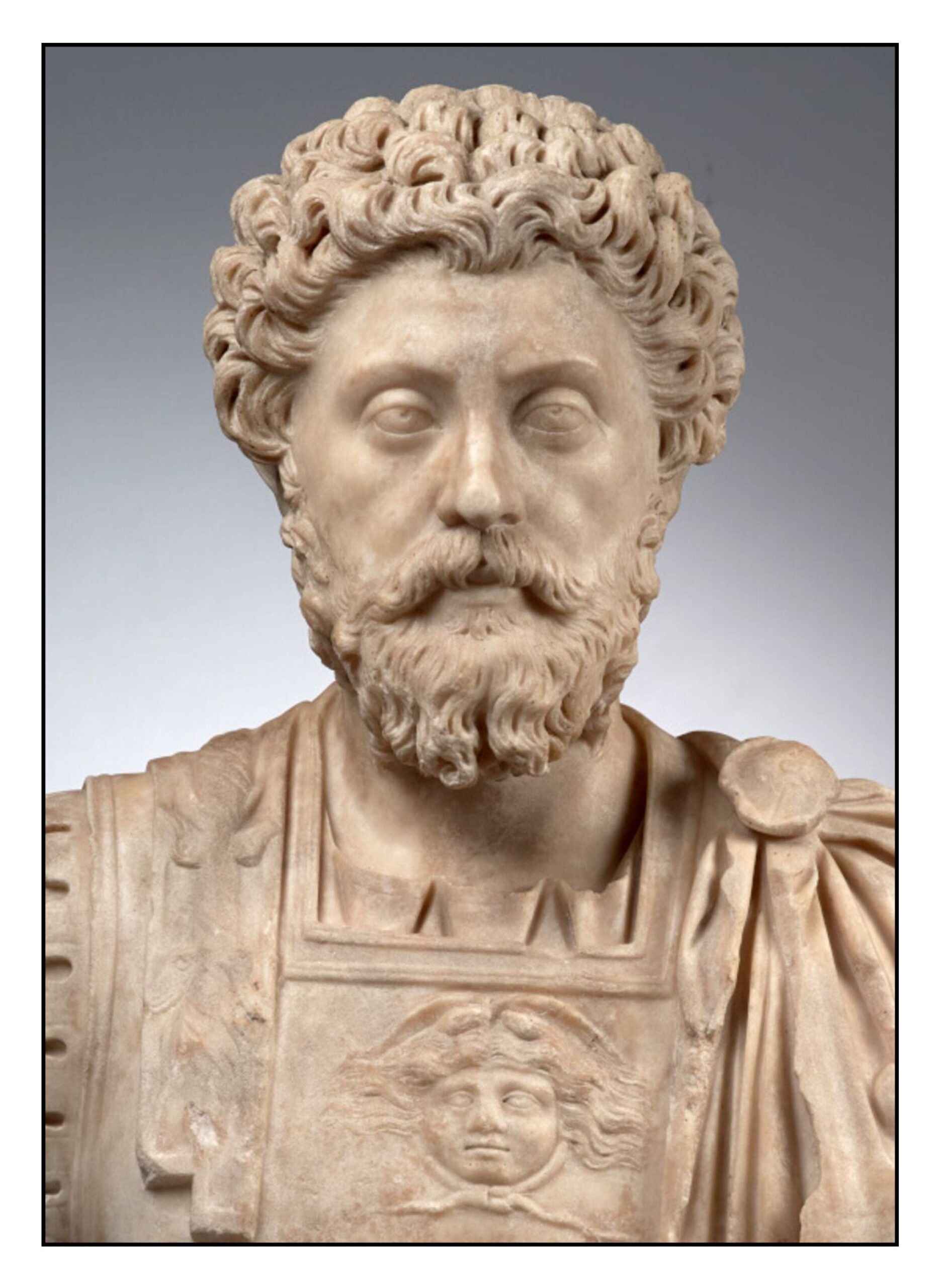
Silk Roads: Paths for the Faithful
The Silk Roads were overland routes connecting China to the Mediterranean Sea, which allowed the trading of silk, paper, gold, jewels, horses, and other goods. These began during the 2nd Century BCE at the time of the Roman Empire in the West and the Han Dynasty in the East. The Silk Roads remained active until the 15th Century CE, when they were largely replaced by maritime trading routes. At present they are mainly used for archeological research and tourism. The illustration shows a modern camel caravan in the desert near Dunhuang. As well as trade goods, the Silk Roads facilitated the movement of religious ideas. Judaism, Zoroastrianism, Buddhism, Manichaeism, Christianity, and Islam followed the Silk Roads into China. Mithraism, Manichaeism and Islam spread into Europe.
Central Asia
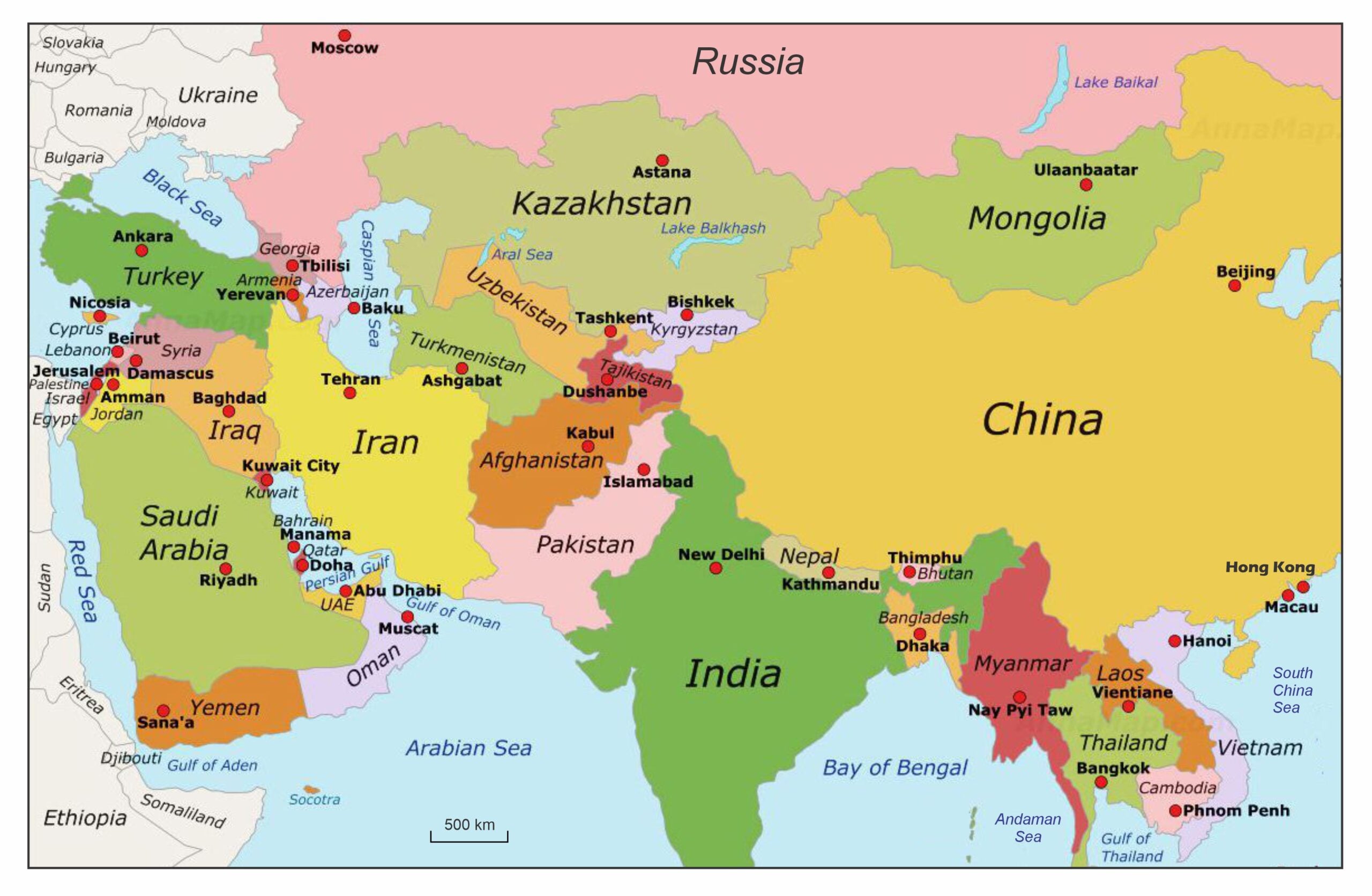
A map of the present political boundaries in central Asia will allow us to get our bearings:
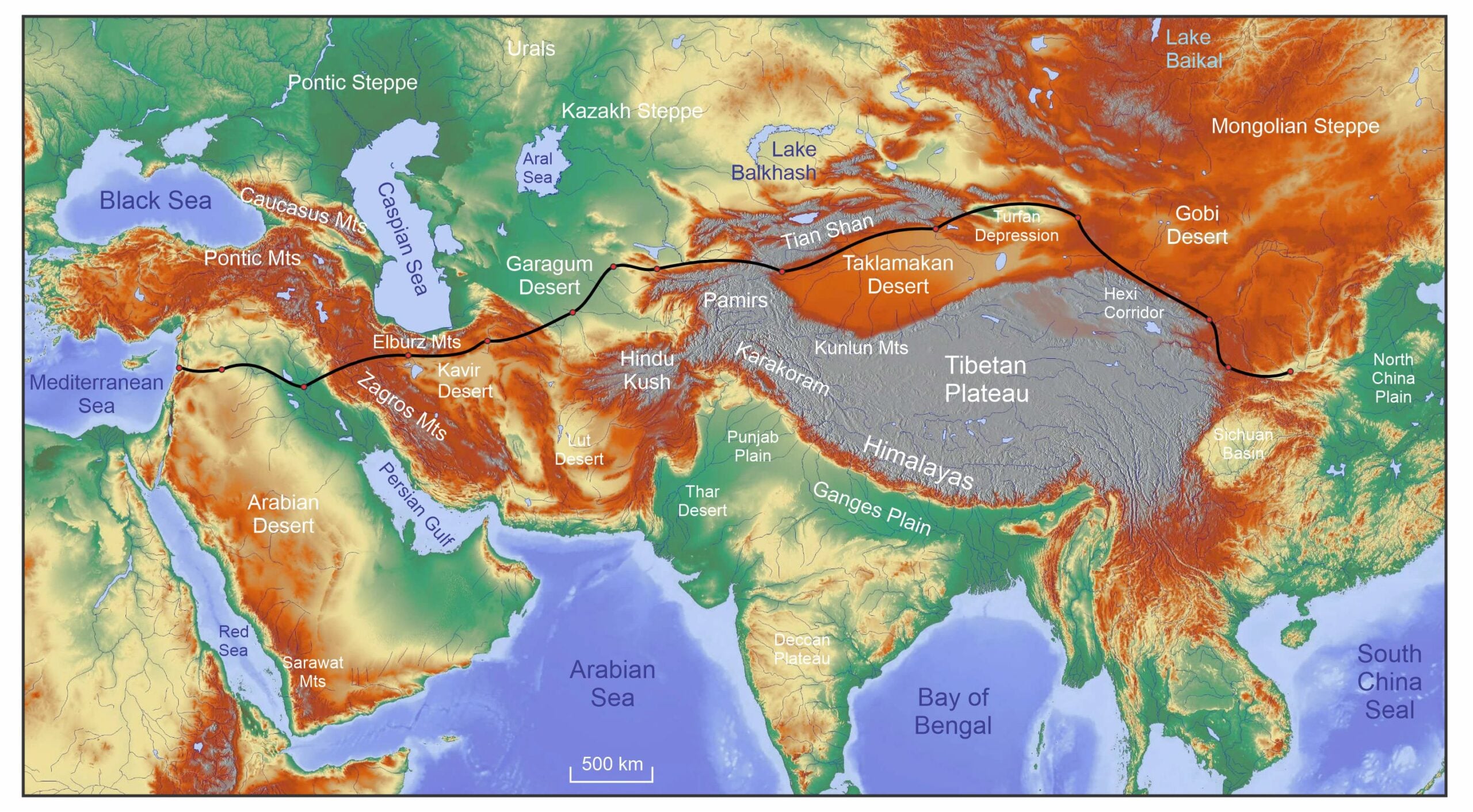
The following map shows the topography of the region and traces one of the many possible Silk Roads from Chang’an (Xi’an) in China to Tyre on the Mediterranean.
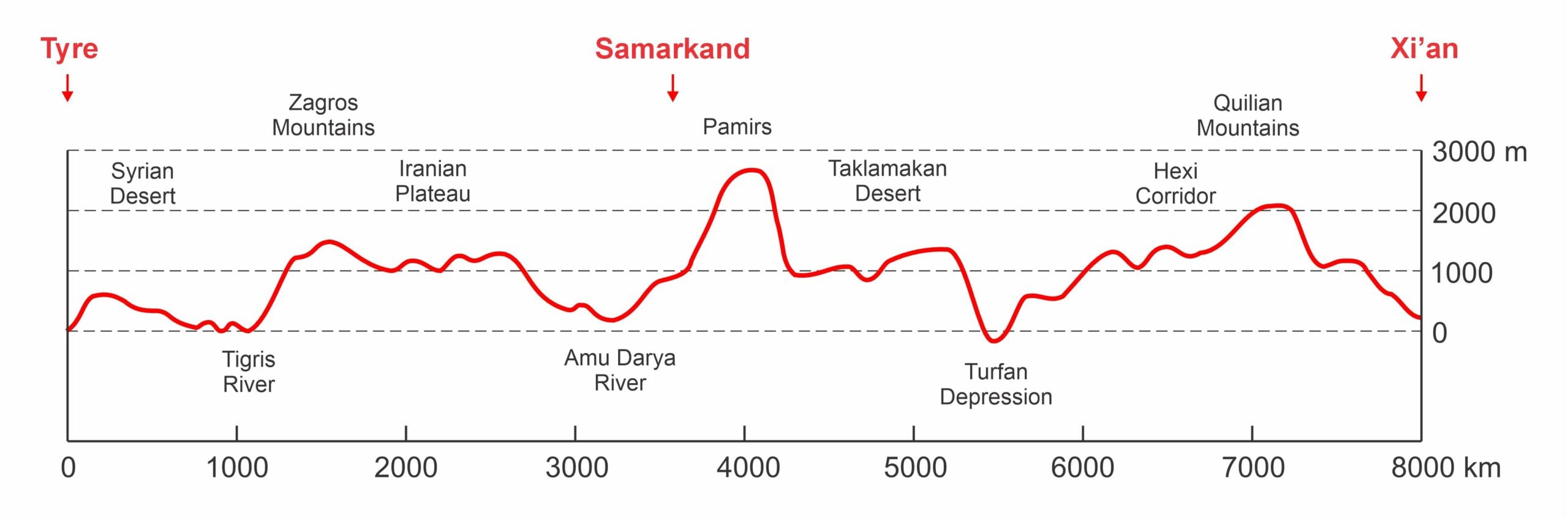
The following diagram, modified from Wood (2002), shows the changes in altitude (in meters above sea level) over the journey. It also notes the main mountains that are traversed, the deserts that are crossed and the main rivers on the way.
The Silk Roads spanned some 8000 km and were active for about 1700 years. They are described in multiple recent books (Frankopan, 2016; Hansen, 2017; Millward, 2013, Torr, 2018, Whitfield, 2024; Wood 2002). A striking TV series from Japan can be downloaded from archive.org. The following two maps by Simeon Netchev show the Silk Roads at two different points in time: the first map when trade began between the Roman Empire and the Han Dynasty in the 1st Century BCE, and the second map when the Silk Roads were at their height during the late 8th Century CE with the Tang Dynasty in China and the Abbasid Caliphate in the West. The first map also shows the maritime routes connecting China, India and Europe, and the monsoon winds that facilitate them. These sea connections are sometimes considered the “Golden Road” (Dalrymple, 2025, pp 4-5).
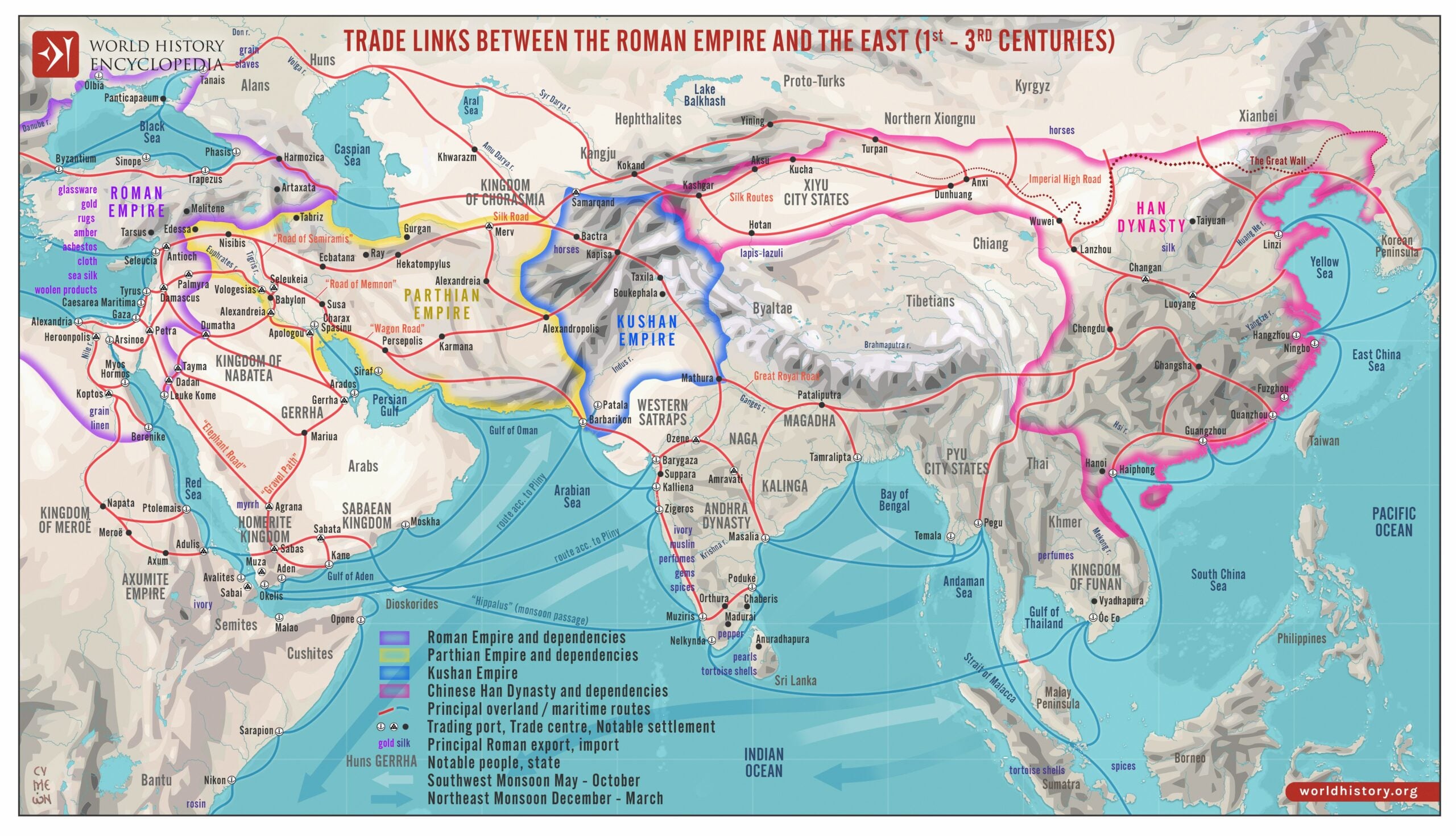
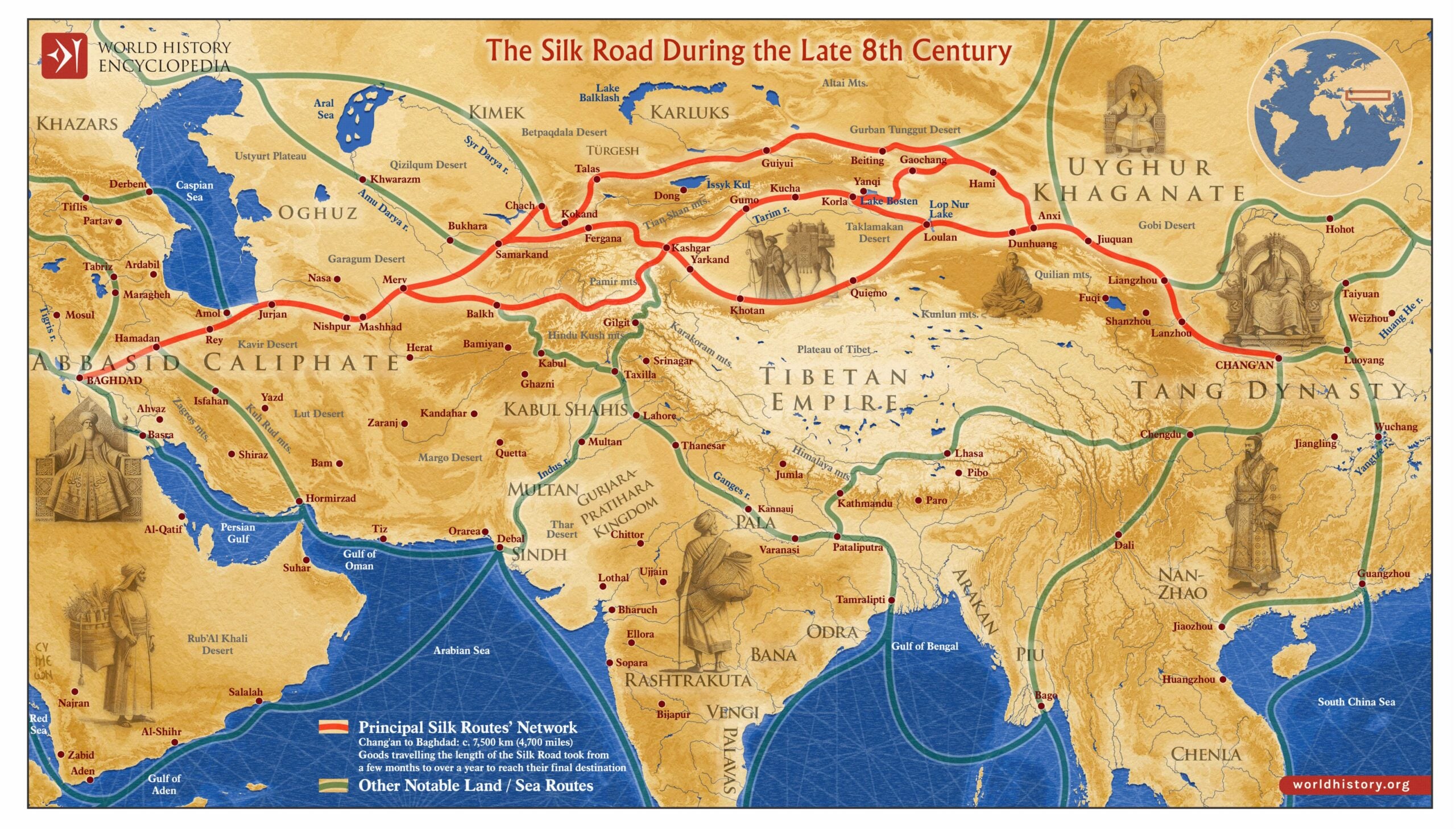
The Mongol Empires (1206-1368) supported trade along the Silk Roads. However, in the 14th Century CE the Mongol Empires fragmented, and the expansion of the Ottoman Empire (1299-1922) blocked overland connections between the Silk Roads and Europe. Trade between China and Europe continued using the maritime routes. Vasco da Gama made his first voyage from Portugal to India around the Cape of Good Hope in 1497. The overland Silk Roads soon became used only for local trade, and desert sands reclaimed many of the ancient trading posts (Beckwith, 2009, pp 232-262; Torr, 2018, pp 105-126).
Many different empires established themselves for periods of time in central Asia (Beckwith, 2009). The following diagram, modified from Waugh (2009), shows some of the most important. Though having its capital in the east, the Mongol Empire (1206-1368 CE) extended all the way to Europe.
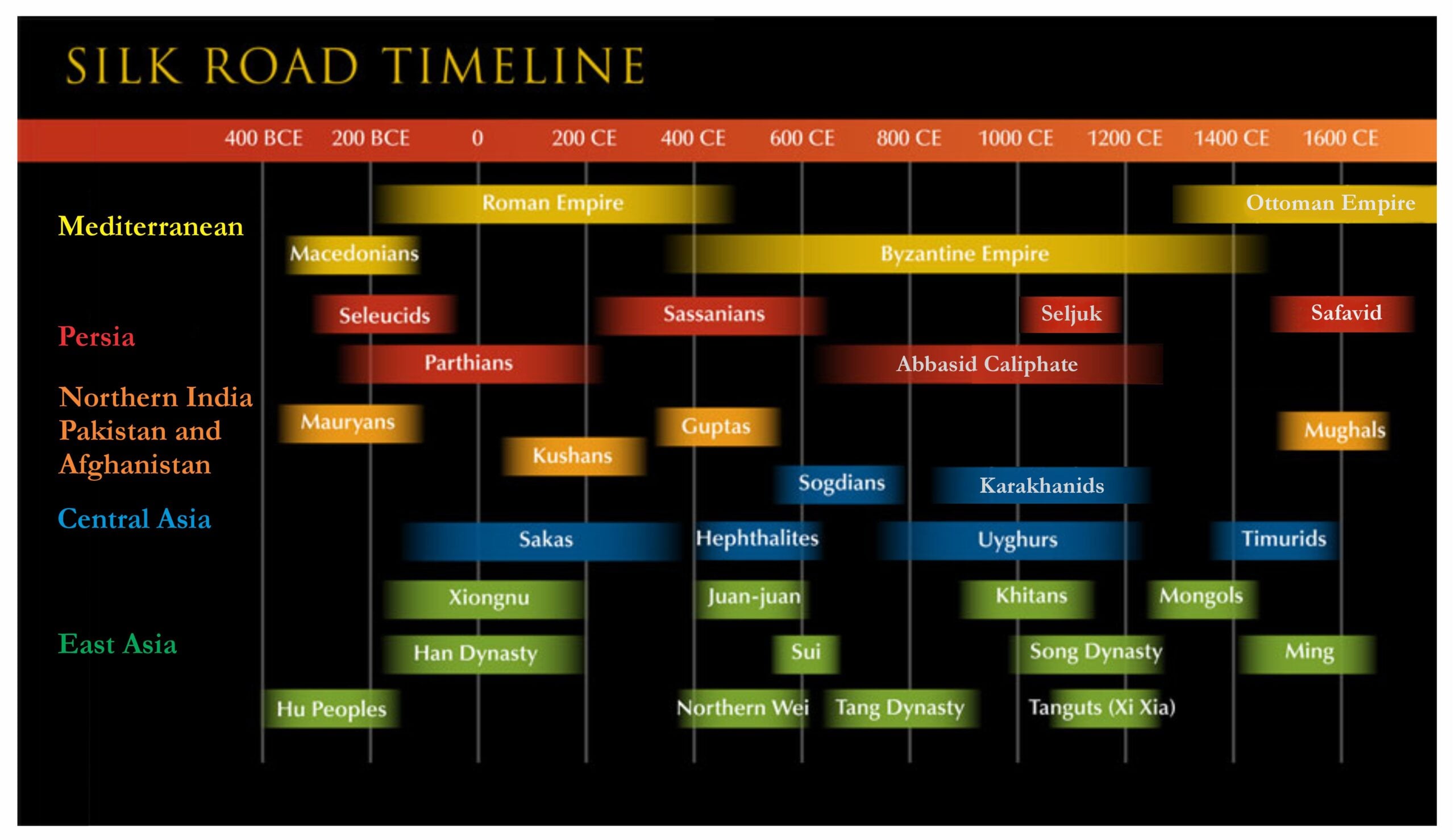
The Library at Dunhuang
Since it will play a role in much of what will be said about the movement of religions along the Silk Roads, we shall briefly mention the Mogao Caves at Dunhuang (墩, dūn, tumulus/mound + 煌,huáng, shining/brilliant). Dunhuang, located on an oasis containing Crescent Lake and is surrounded by sand dunes, was an important stop on the Silk Road from the time of its beginning in the 2nd Century BCE (Hansen, 2017, pp 288-335). Nearby is the Jade Gate – an opening in the Great Wall of China that allows entrance to the Hexi Corridor connecting the cities of Chang’an and Luoyang to the deserts of Xinjiang in Western China.
Buddhist monks first arrived in Dunhuang in the early centuries of the common era. In the 4th Century CE, they began carving caves into of the sandstone cliffs 25 km southeast of the city. These Mogao Caves – “Caves of a Thousand Buddhas” – are a system of about 500 separate temples decorated with wall paintings and sculptures and connected by intricate stairs and platforms. By the 9th Century, the monk Hong Bian had made the Three Realms Monastery near the caves into an important center of learning. When he died, his statue was placed in Cave 17. On the wall behind him were painted two banyan trees with a water bottle and a cloth bag hanging on the branches. Under one tree an acolyte holds a fan; under the other, a disciple holds the monk’s staff.
In 1002 CE the Karakhanids spread into the Taklamakan Desert and destroyed the Buddhist City of Khotan (Sinor, 1990). Though they had once followed both Buddhism and Christianity, the Karakhanids had converted to Islam in 934 CE and considered all other faiths as infidels. Fearful that Dunhuang might also be destroyed, the monks put all their treasured manuscripts and paintings in Cave 17 with the statue of Hong Bian, and sealed the cave off from the outside world (Rong, 1999).
In 1900, while sweeping sand from the temple floor of Cave 17, a Daoist monk, a custodian for the caves, realized that the rear wall was false and discovered that the sealed-off chamber contained piles of ancient manuscripts. In sum there were about 50,000 manuscripts and other objects in the cave, which became known as the “Library Cave.” In 1907 the newly discovered treasure trove was examined by the explorer Aurel Stein, who purchased many of the manuscripts for the British Museum (Morgan & Walters, 2012). Paul Pelliot visited in 1908 and bought a set of manuscripts for the Bibliothèque nationale de France.
The following illustration shows on the left the entrance to the Mogao Caves. Most of the building is from the 20th Century. On the upper right is the statue of Hong Bian in the Library Cave. On the lower right is an impression of what the cave must have looked like in 1900.
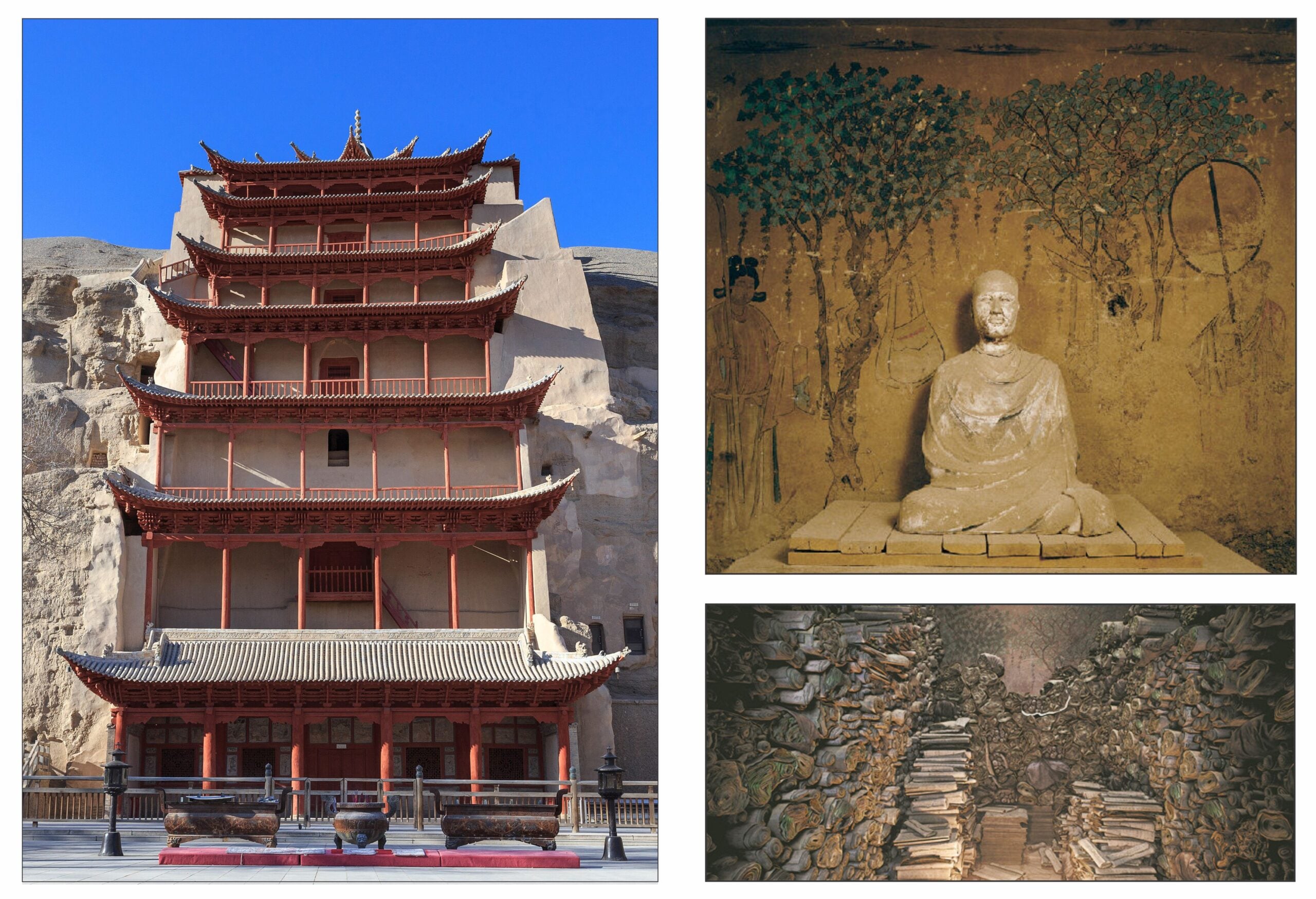
Most of the manuscripts found at Mogao concerned Buddhism and were written in Chinese. However, some of the manuscripts related to other religions such as Manichaeism, Christianity, Judaism and Daoism. Many ancient languages other than Chinese were also represented: Sanskrit, Tibetan, Sogdian, Hebrew, and Old Uyghur.
Judaism
One of the manuscripts from the Library Cave is a Hebrew prayer for forgiveness (selihah). At one time it was folded up, perhaps so that it could be carried easily in a small container as an amulet to ward off evil. The text does not directly quote scripture but is very biblical in its wording. The following illustration shows the complete manuscript on the upper left. The photograph has been lightened to facilitate reading. On the upper right is an enlargement of the first 4 lines together with a transcription (Koller, 2024). The English translation of these 4 lines is below together with a quotation form the book of Numbers showing a similar style.
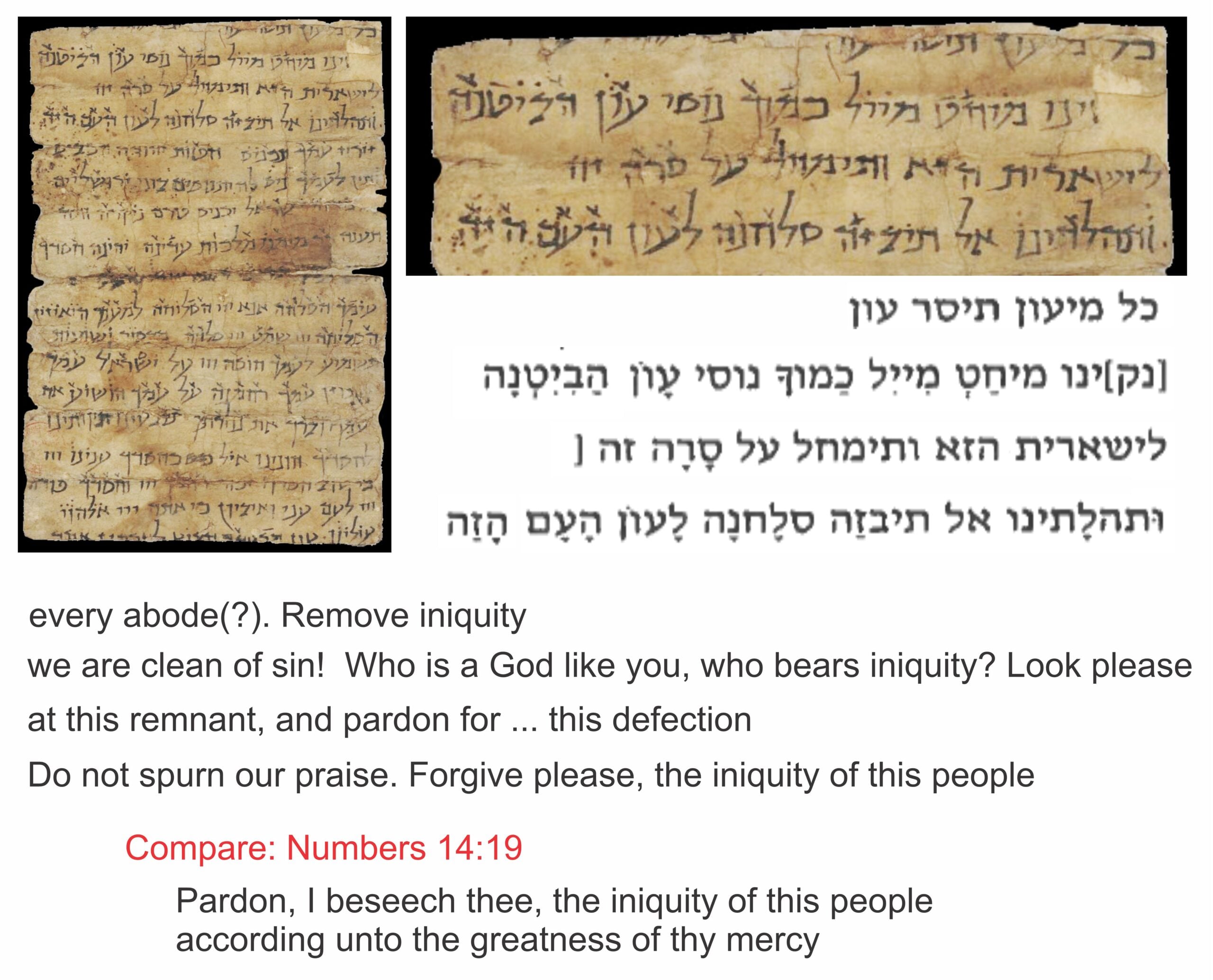
The manuscript is dated to around 800 CE. This and a few other Hebrew manuscripts from other stations on the Silk Road suggest that Jewish merchants were involved in the trade between China and the West. There may therefore have been Jews in China during the Tang dynasty or even earlier. A group of Jews in Kaifeng in central China petitioned the emperor to build a synagogue in 1163 CE (Berg, 2024). Their ancestors may have originally travelled to China over the Silk Roads. Their descendants still live today in China.
Zoroastrians
The religion of Zoroastrianism was established toward the end of the second Millenium BCE, and became the state religion of the main Persian Empires: the Achaemenid (559-331 BCE), Parthian (559 BCE – 331 BCE) and Sasanian (224–651 CE). Zoroastrian priests were generally called magi.
(i) Biblical Magi
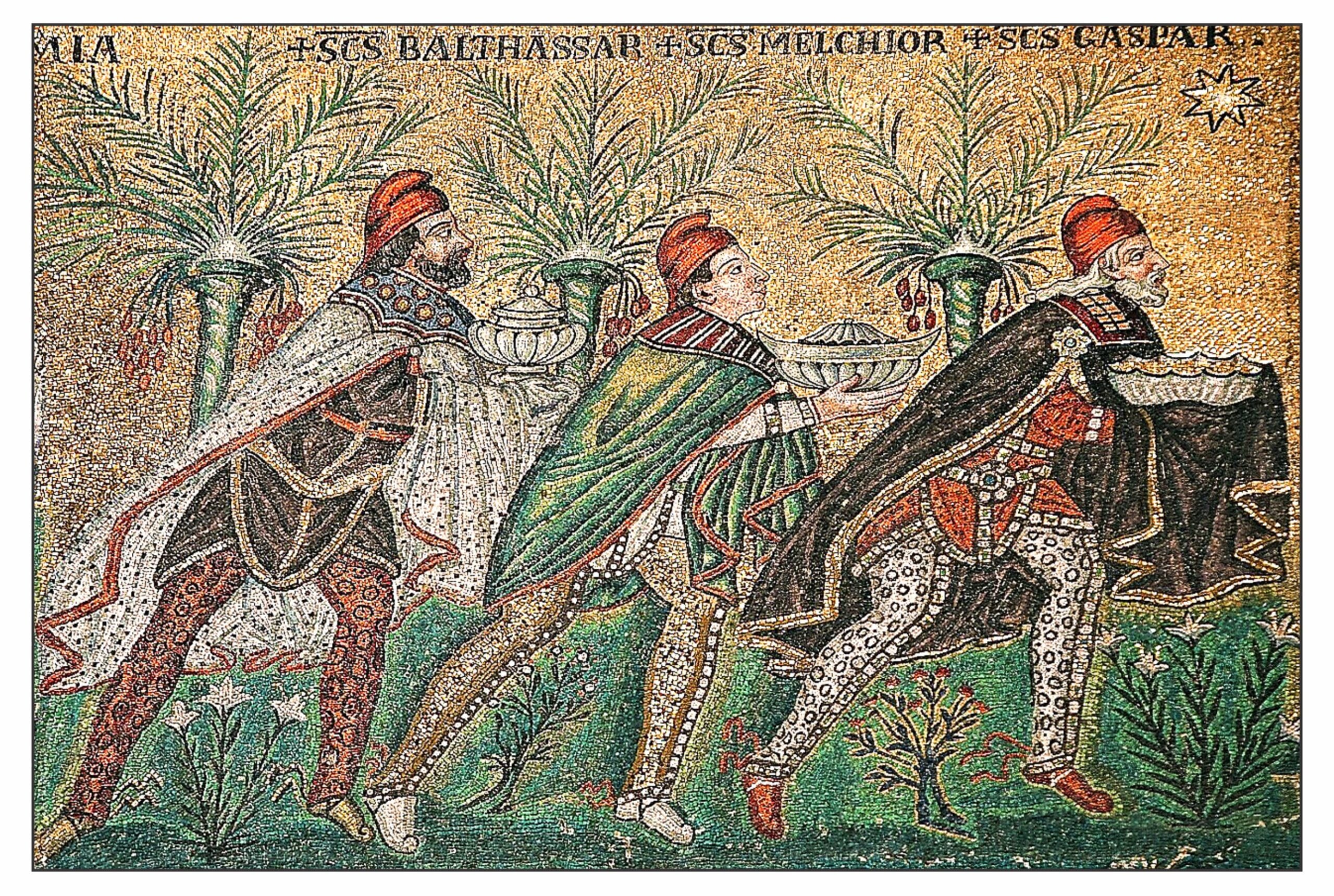
The Gospel of Matthew relates how three magi (translated as “wise men”) came from the East to visit the newborn Jesus in Bethlehem.
Now when Jesus was born in Bethlehem of Judaea in the days of Herod the king, behold, there came wise men from the east to Jerusalem,
Saying, Where is he that is born King of the Jews? for we have seen his star in the east, and are come to worship him. (Matthew 2: 1-2)
These wise men may have been Zoroastrian priests from Persia. If so, they would have travelled along the Silk Roads. The illustration below shows a mosaic representation of the magi from the Basilica of Sant’Apollinare Nuove in Ravenna (565 CE). The magi are shown in typical Persian clothing: flowing capes and Phrygian caps.
(ii) Mithraism
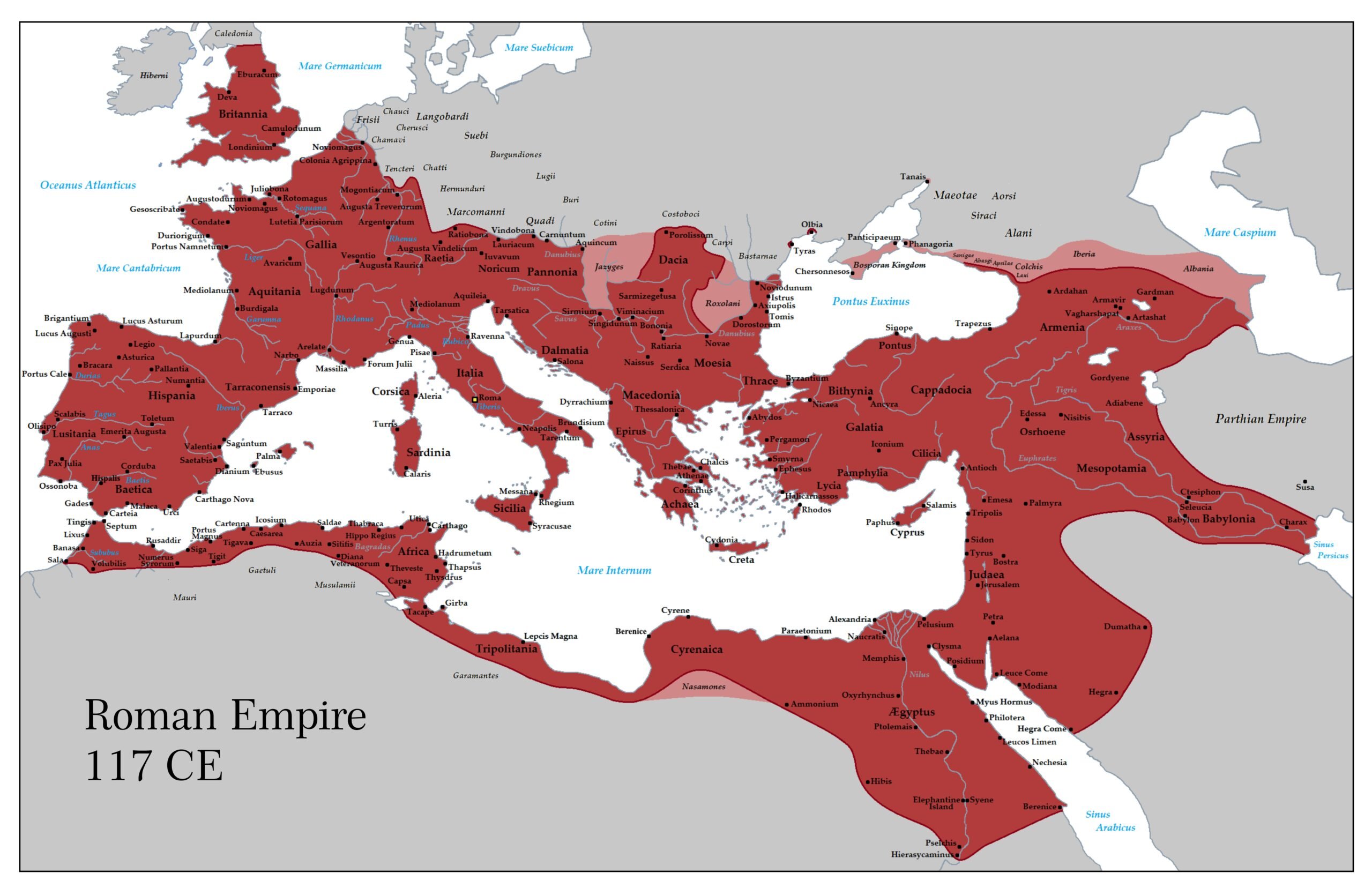
Mithraism was a Roman Mystery Cult focused on the God Mithras, one of the many Gods (yazata) worshipped in Zoroastrianism. The cult involved secret meetings in underground temples called Mithraea, archeological evidence for which has been found throughout the Roman Empire:
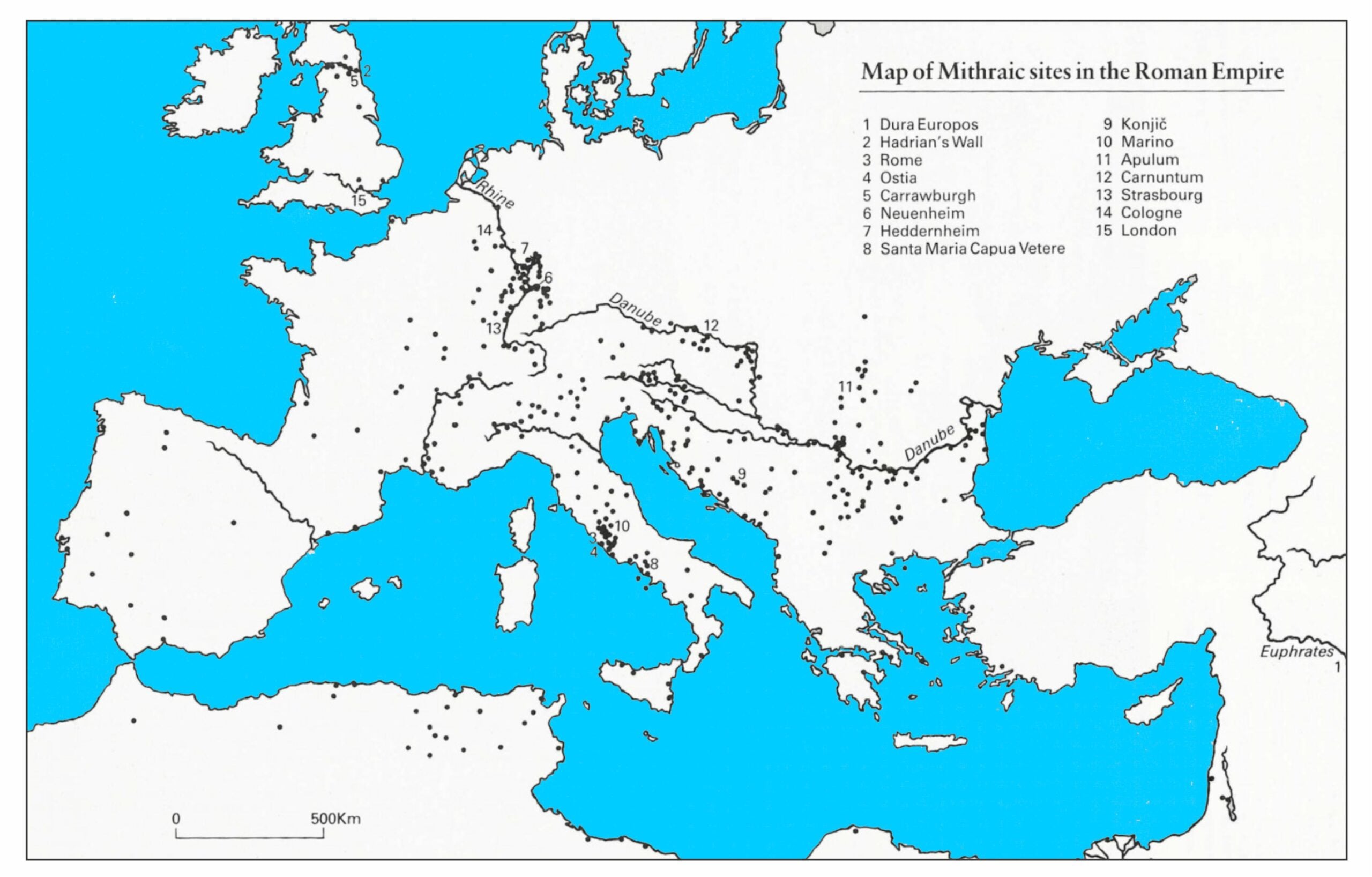
Mithraism was active from about 50 CE to about 300 CE. In the 4th Century CE Christianity was mandated as the sole state religion in the Roman Empire (Edict of Thessalonica, 380 CE). Thereafter Mithraism essentially vanished.
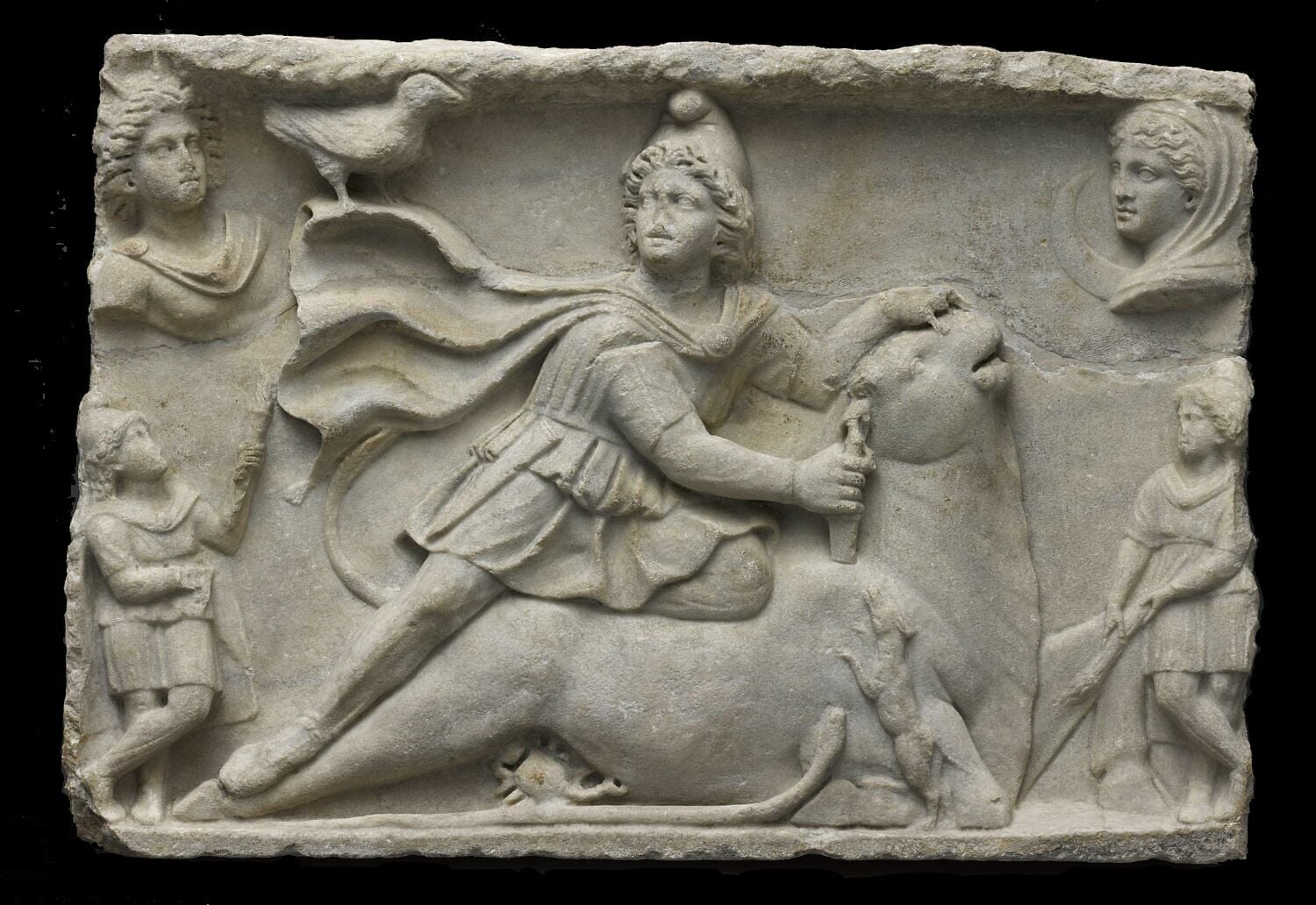
The Mithraeum was set up for a communal feast for the initiates, who were almost always men and mainly soldiers. One essential part of the temple was a fresco or sculpture of Mithras slaying a bull – the “tauroctony.” No one really understands what this sacrifice means. It might have something to do with redemption and salvation, much like the crucifix in a Christian church.
The iconography was stable across its many different locations. In the center, the God Mithras slays the bull. Above are representations of the sun and the moon, and below the bull is attacked by a crab, a snake and a dog. The following illustration shows a tauroctony from the 2nd Century CE unearthed from the Villa Borghese in Rome:
The cult was originally believed to have been imported into the Roman Empire by soldiers who had fought in the Parthian wars, a series of conflicts occurring from 54 BCE to 217 CE, and who had thereby been exposed to the Gods of Zoroastrianism. However, there are relatively few Mithraea in the Eastern reaches of the Empire. And there is no evidence that the worship of Mithra in Persia involved any of the apparent rituals that occurred in the Roman Mithraea. Some have therefore suggested that the cult was a Roman invention (e.g. Stoll, 2022). Indeed, some of the earliest Mithraea are concentrated near the city of Rome (Chalupa, 2016), Nevertheless, the cult was devoted to one of the Zoroastrian gods, and most of the early descriptions of the cult acknowledged its Persian origins (Boyce et al, 1991, pp 468-490).
One possibility is that Roman Mithraism allowed its cult members to embrace an “otherness” and make themselves distinct from their fellows:
the imagery of Mithras dressed in the Persian garment and soft shoes with Phrygian cap on top of his curly hair alluded to the Greek topoi of Persians who were Rome’s ‘exotic other’ and ‘fiercest foe’. Such an iconography enabled the Roman Mithraists to depict their god as a foreign deity and to identify themselves as those Roman elites who had the knowledge of worshiping the foreign god. The Oriental imagery of Mithras created a boundary for Mithraic brotherhood and distinguished the cultic community from other forms of religiosity and religious groups in the wider cultural and religious boundaries of Rome. Whatever its origin, the Roman mystery cult of Mithras strongly relied on Roman attitudes and romantic visions of Persia and the Parthians in particular. (Mahzjoo, 2024).
(iii) Sogdians
At the time when trading was at its height, the main middlemen on the Silk Roads were Sogdian merchants (Pin Lyu, 2024). Sogdia was the name for the area of land between the Amu Darya (or Oxus) and the Sri Darya Rivers. Its capital was Samarkand. The following map shows the location of Sogdia in Central Asia. The black lines show several of the Silk Roads:
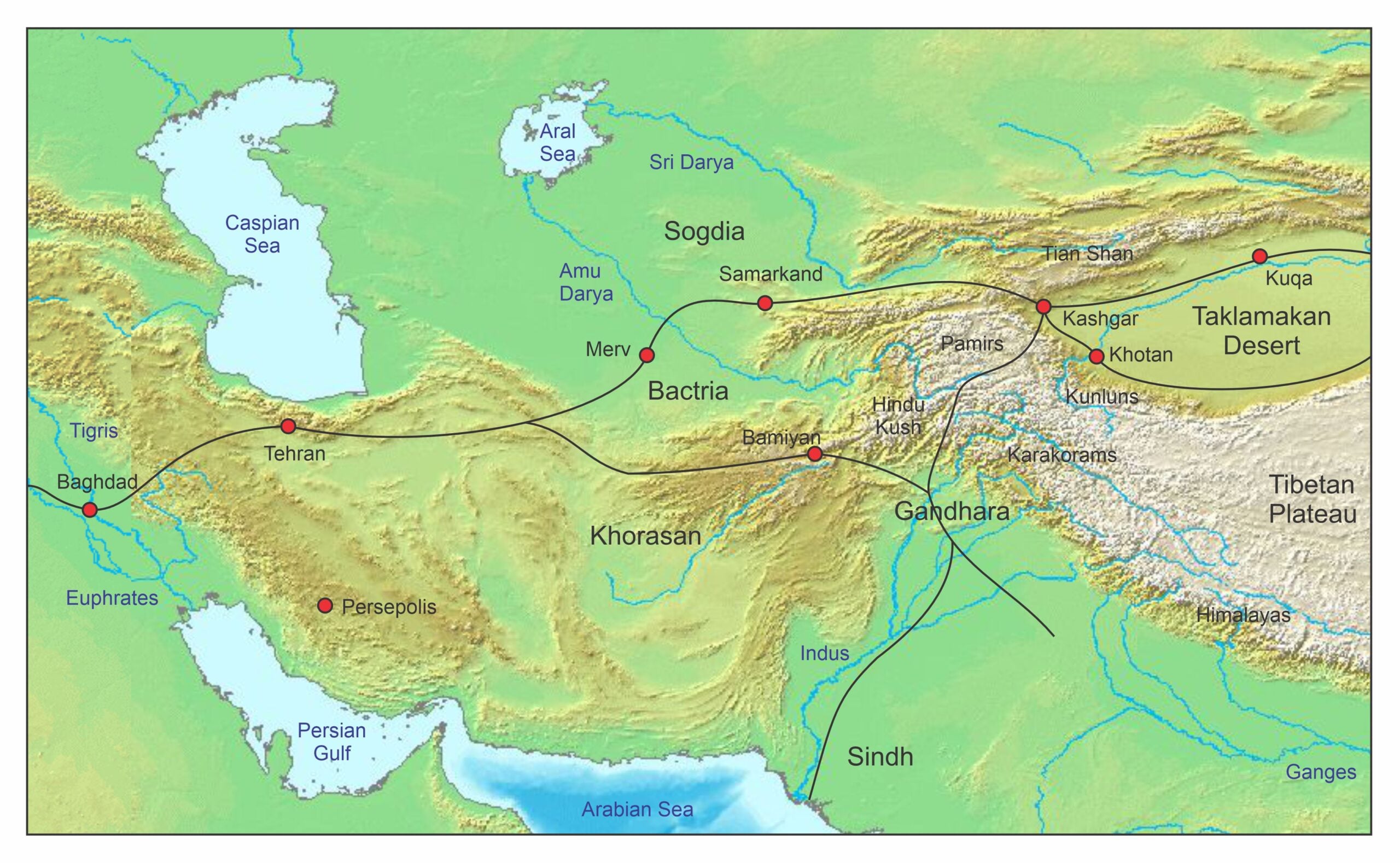
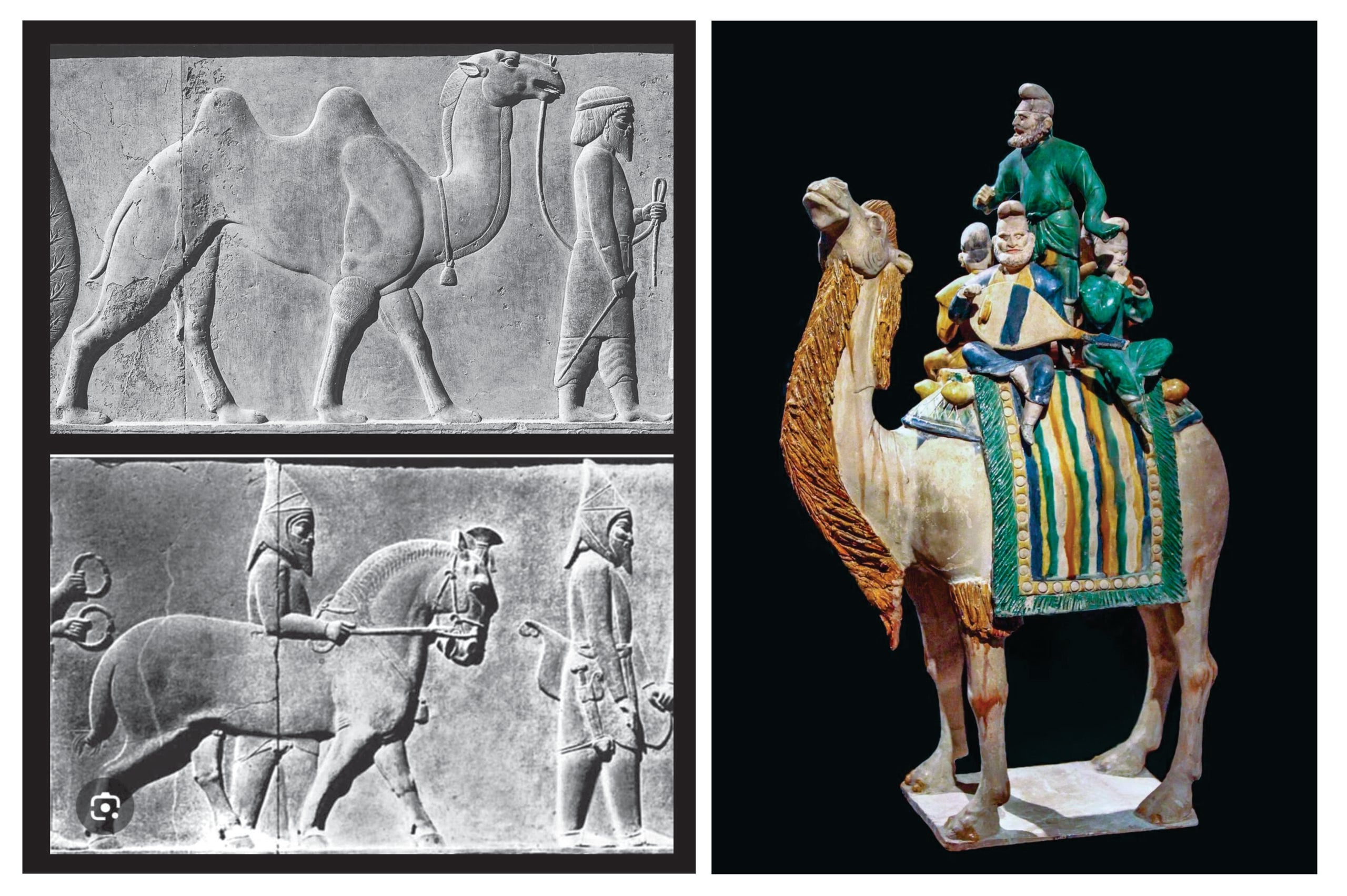
The Sogdians were descendants of the ancient Scythians. At the time of the Achaemenid Empire, when they were known as Saka, they paid tribute to the Persian Emperor in the form of camels and horses.
During the time of the Sasanian Empire, Sogdia was at the eastern limits of the empire and practiced Zoroastrianism (Grenet, 2015). When the empire was invaded by the Muslims, these frontier regions were able to maintain their religious practices for several centuries.
During the Abbasid Caliphate the Sogdians traded extensively with the Chinese and established large merchant colonies in cities of northern China.
The following illustration shows on the left two bas-relief representations of Saka bringing camels and horses to the Emperor at Persepolis (6th-5th Century BCE). On the right is a Tang dynasty porcelain statuette showing a group of Sogdian musicians on a camel. This was found in Xi’an and dates to 723 CE.
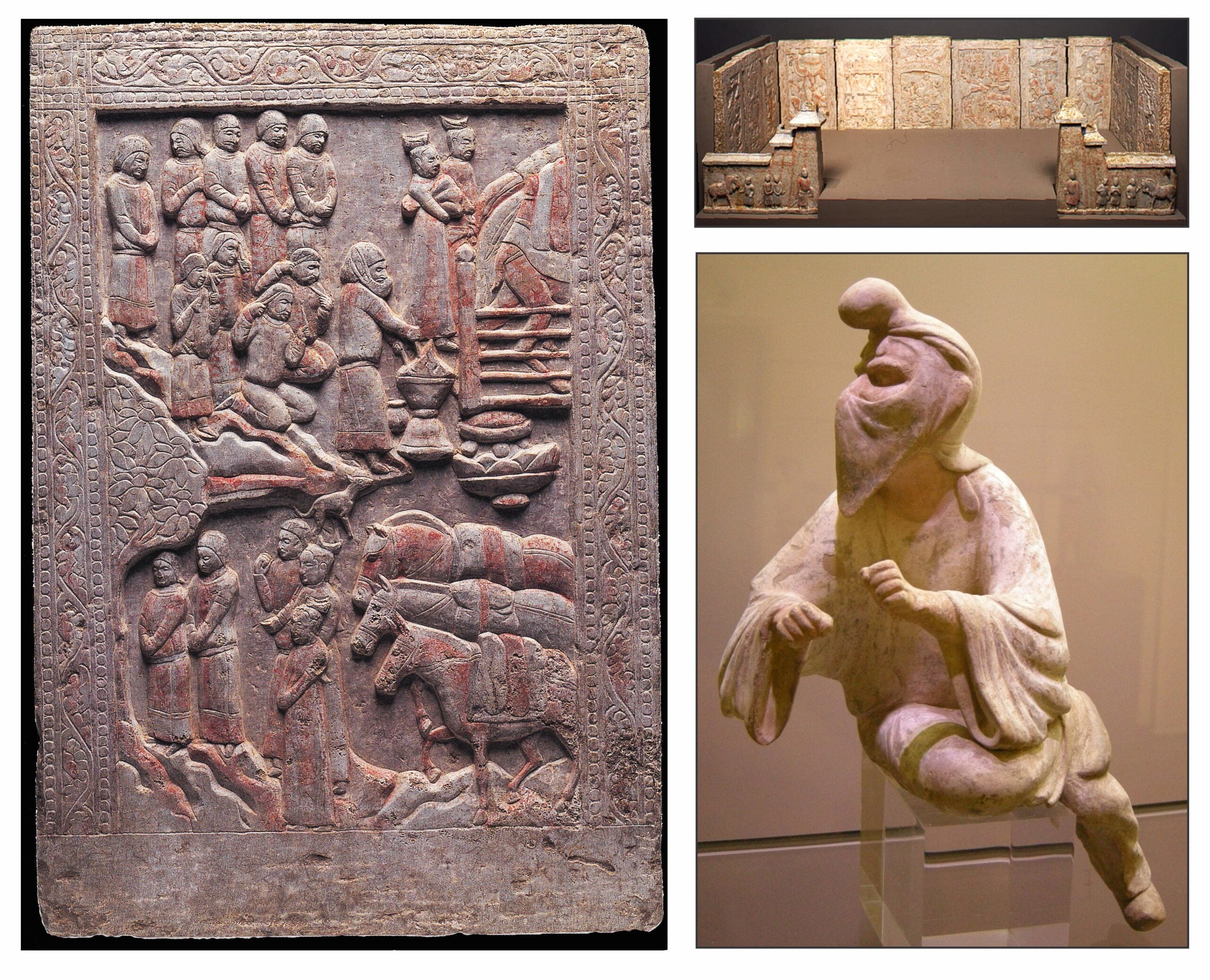
Zoroastrian funerary practices mandated that the corpse should not be allowed to pollute either the air or the land. Neither cremation nor burial was possible. Zoroastrians typically laid the corpse out on a stone bed and allowed vultures to strip the flesh from the bones. In China, Zoroastrians compromised by constructing closed tombs within which the deceased was laid out on a funerary couch and allowed to decay above ground. If the deceased was a rich merchant, this funerary bed could be quite ornate. The following illustration shows on the left a carving from a 6th Century Zoroastrian funerary couch in Northern China, now in the Miho Museum in Japan. The upper half of the carving shows a Zoroastrian priest caring for the sacred fire during the funeral service for the deceased. He is recognized by the face mask that prevents him from contaminating the fire with his mortal breath. The mourners are behind the priest. A camel is recognized to the right of the sacred fire, and several pack horses are seen below. The upper right of the illustration shows how the complete funerary couch was set up.
The lower right shows a small ceramic statuette of a Zoroastrian priest with a face mask. Although he is sometimes considered a camel driver, he is more likely a priest tending to the sacred fire. The face mask is just too typical. The statuette was found in northern China and dates to the 8th Century CE.
Buddhism
Gautama Buddha lived in the northeastern region of India in the 6th or 5th Century BCE. After his death his followers taught the new dharma throughout the Indian subcontinent. The Mauryan Empire (320 BCE–185 BCE) expanded to incorporate Greco-Persian lands in what is now Pakistan and Afghanistan. Ashoka (304–232 BCE), the third Mauryan Emperor, promoted Buddhist thought throughout his domain.
(i) Gandhara
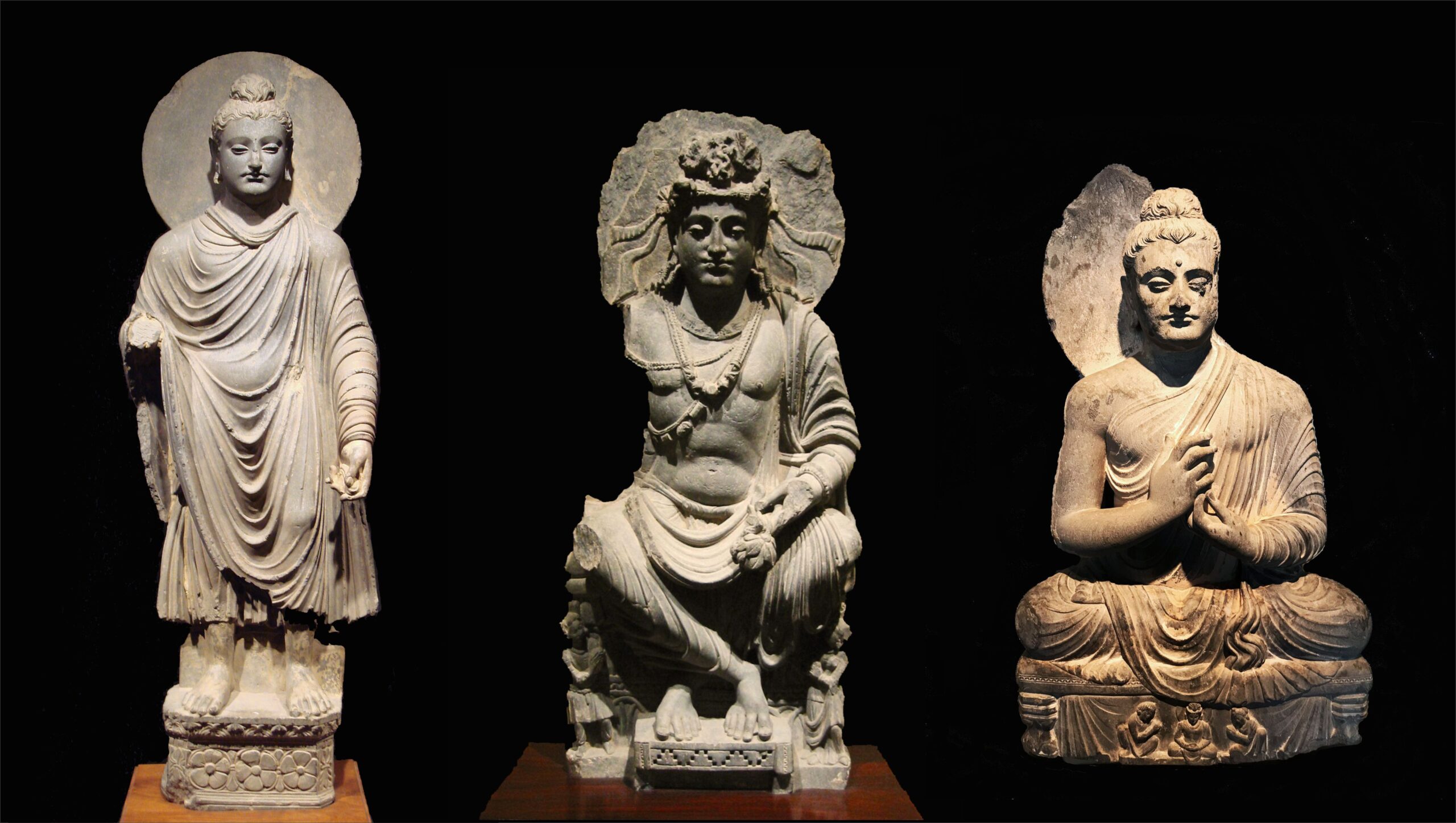
Few representations of the Buddha occur form the first centuries of the new religion. Since the teaching proclaimed that the everyday world was transient and misleading, artistic representations may have been considered unworthy. This changed when the faithful encountered artists of the Greco-Persian world in a region of northwest India called Gandhara. Realistic sculptures of the Buddha and his disciples proliferated. The following illustrations shows sculpture of the Buddha made in the Gandhara from the 1st, 2nd and 5th Centuries CE:
(ii) Colossal Buddhas
As their religion spread along the Silk Roads, Buddhist monks began to carve statues of the Buddha out of the sandstone cliffs along the route. Some of these assumed colossal sizes (Wong, 2019). The earliest large Buddhas, up to 15 m tall, were carved at the Yungang Grottoes near Datong in Northern China beginning in 465 CE. Colossal seated Buddhas, 33 and 23 m tall, were carved in the Mogao caves near Dunhuang in the 7th and 8th Centuries CE.
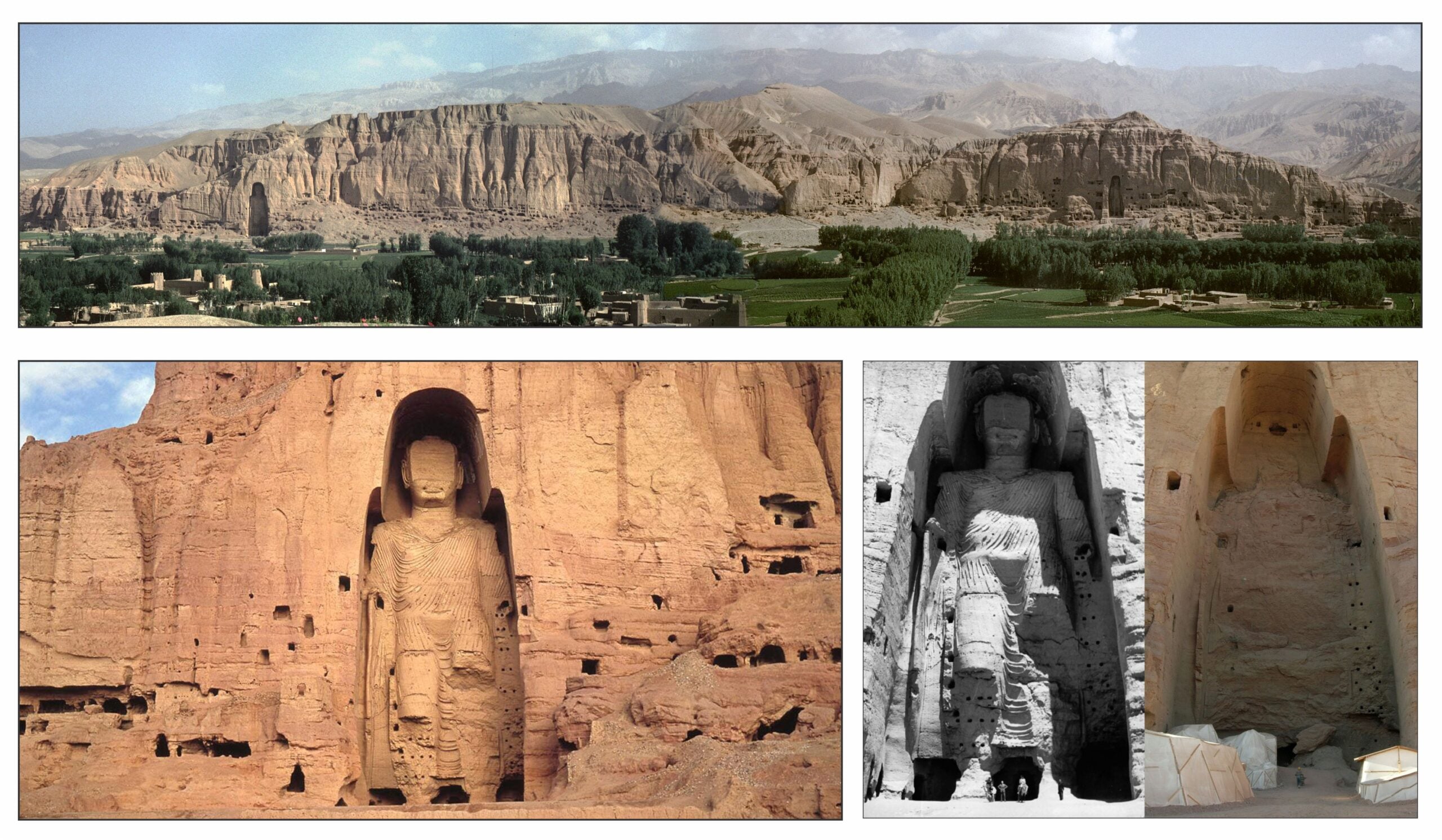
And around 600 CE, in Bamiyan, located in present-day Afghanistan, 130 km northwest of Kabul, two huge standing Buddhas were carved, one 38 m and the other 55 m tall. Since details such as the folds in the robe and the facial features could not be carved in the sandstone, these were added to the rough-hewn statues using stucco. The arms were constructed using stucco on wooden armatures. Over the years much of the stucco work eroded away leaving the large ungainly limestone forms.
The people in the area when the statues were carved were Hephthalites. These people followed several different religions (Zoroastrianism, Christianity, and Manichaeism) and tolerated the work of the Buddhist monks.
In 2001 the Taliban enforced a Muslim edict forbidding artistic representations of human beings. The two Bamiyan Buddhas were destroyed.
The following illustration shows at the top a panorama of the Buddhas in the Bamiyan Valley before their destruction. The lower left of the illustration shows a close-up of the larger of the two Buddhas. The lower right compares before and after its destruction.
(iii) Avalokistesvara
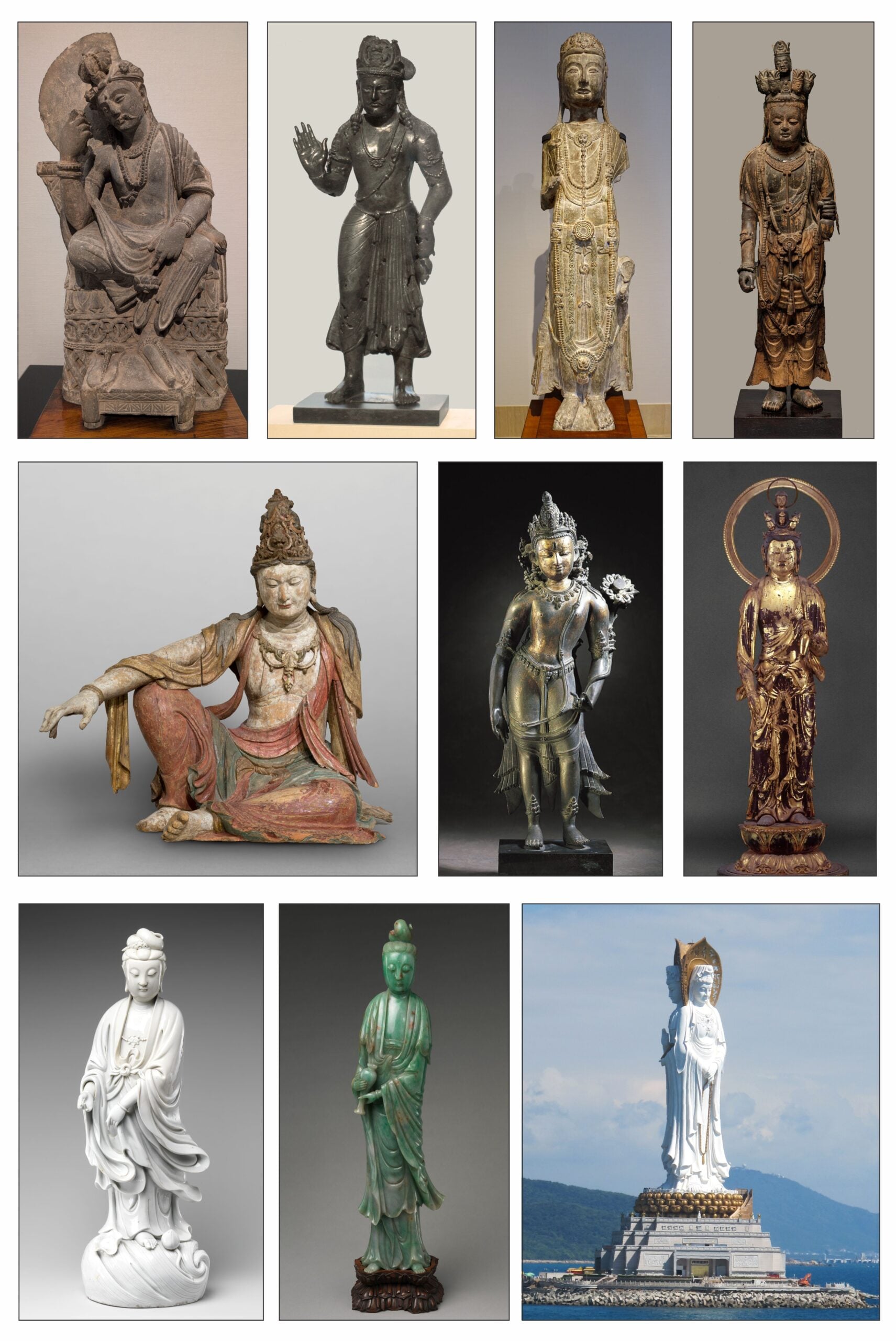
Avalokistesvara was the bodhisattva of compassion. His name in Sanskrit means “he who looks down,” i.e. he who considers the concerns of the faithful. As Avalokitesvara travelled along the Silk Roads to China he slowly changed gender from male to female (Stein, 1986; Suebsantiwongse, 2025; Yu, 2001). In China she became known as Guānshìyīn, (觀世音, look/observe+people/world +sound/voice: “the one who perceives the cries of the world”) or Guanyin. As the deity moved to Japan, she became known as Kannon, and veered back toward masculinity.
Avalokistsevara characteristically holds a lotus flower and sometimes prayer bead. Sometimes he or she has multiple heads which make her vision and hearing more acute. Occasionally the deity has multiple arms the better to aid those in need. As Guanyin, she often carries a vase of pure water to relieve suffering.
The following illustration shows the transformation of Avalokistesvara. In order from left to right and then form up to down:
- Stone, Avalokistesvara, Gandhara, 3rd Century CE
- Bronze, Avalokistesvara, Gandhara, 4th Century CE
- Stone, Avalokistesvara, Northern China, 6th Century CE
- Wood, Avalokistesvara with multiple heads, Northern China 11th Century CE
- Wood, Avalokistesvara “seated at royal ease,” China, 11th Century CE
- Bronze, Avalokistesvara, Nepal, 14th Century CE
- Gilded Wood, Kannon, Japan 11th Century CE
- Porcelain, Guanyin, China 17th Century CE
- Jade, Guanyin, China, 19th Century CE
- Titanium callosal statue (78 m) Nanshan Guanyin, Hainan Island, 21st Century CE
(iv) The Diamond Sutra
As Buddhism travelled along the Silk Roads to China, the sacred texts began to be translated from Sanskrit to Chinese. One of the most important translators was Kumarajiva (344–413 CE) who was born in Kuqa on the northern edge of the Taklamakan desert. His father was a Buddhist monk from Kashmir. Around 400 CE Kumarajiva travelled to Chang’an where he wrote most of his translations of the Buddhist literature.
The original Diamond Sutra was likely composed shortly after the time of Gautama Buddha’s life in the 5th Century BCE. However, it was not formally written down in Sanskrit until the 2nd or 3rd Century CE. The sutra narrates a dialogue between the Buddha and his elderly disciple Subhūti about the nature of reality and how to attain the wisdom that would release one from suffering. The world is transient and illusory; one must release oneself from any attachments; one must seek emptiness. The following is from Red Pine’s introduction to his translation of the sutra (2001):
following his Enlightenment, the Buddha had taught people to free themselves from suffering by realizing the impermanence and interdependence of everything upon which their suffering depended, including and especially themselves. The Buddha called this the realization of shunyata (emptiness), the view that because nothing exists independently of other things, it has no nature of its own, and every-thing is therefore empty, and this emptiness is the true nature of reality. Later, when the Buddha began teaching people to view emptiness itself as empty and to put the emptiness of emptiness to work in the liberation of all beings, few disciples grasped this new teaching, which he called the perfection of wisdom, the wisdom beyond wisdom.
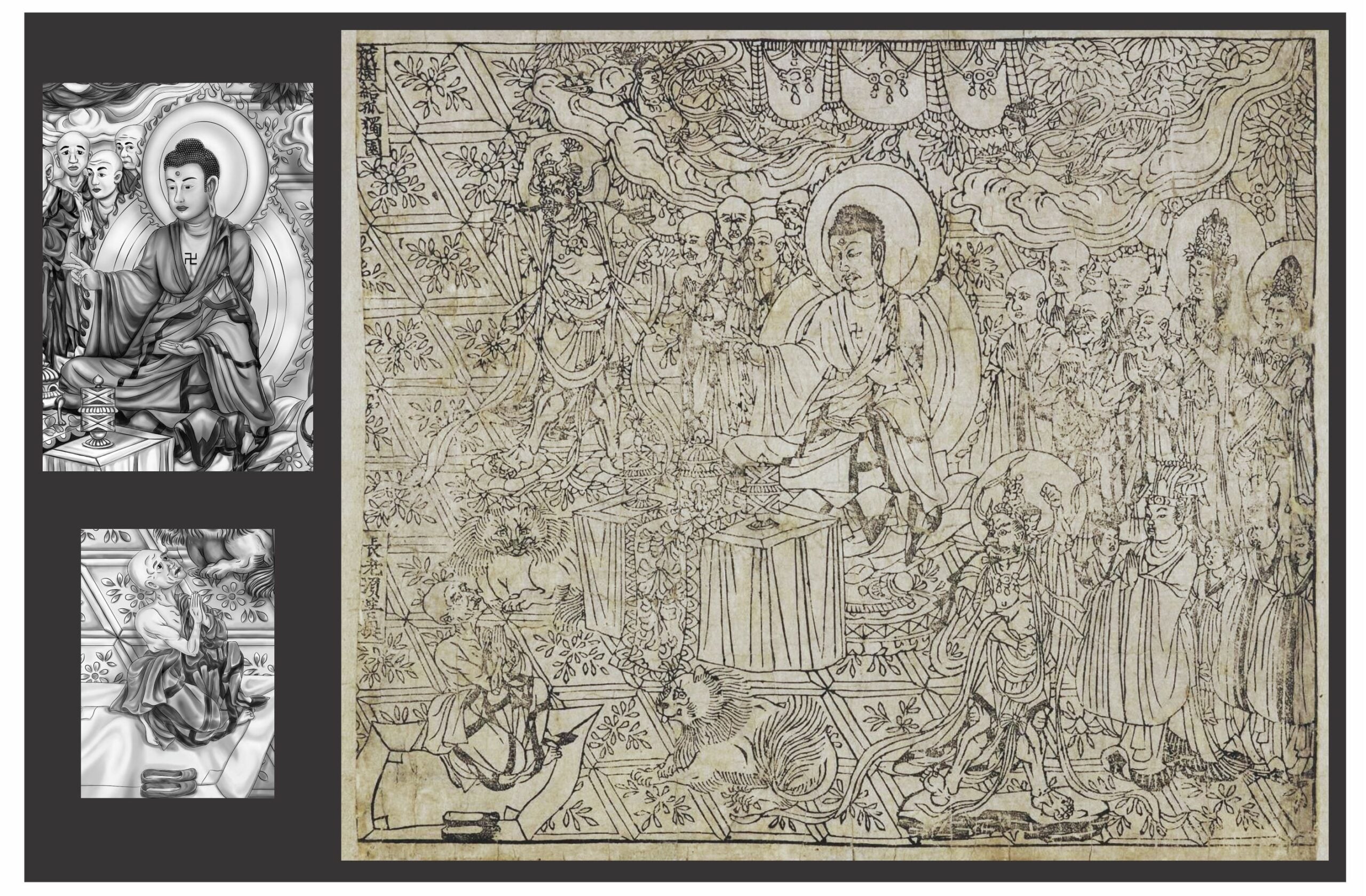
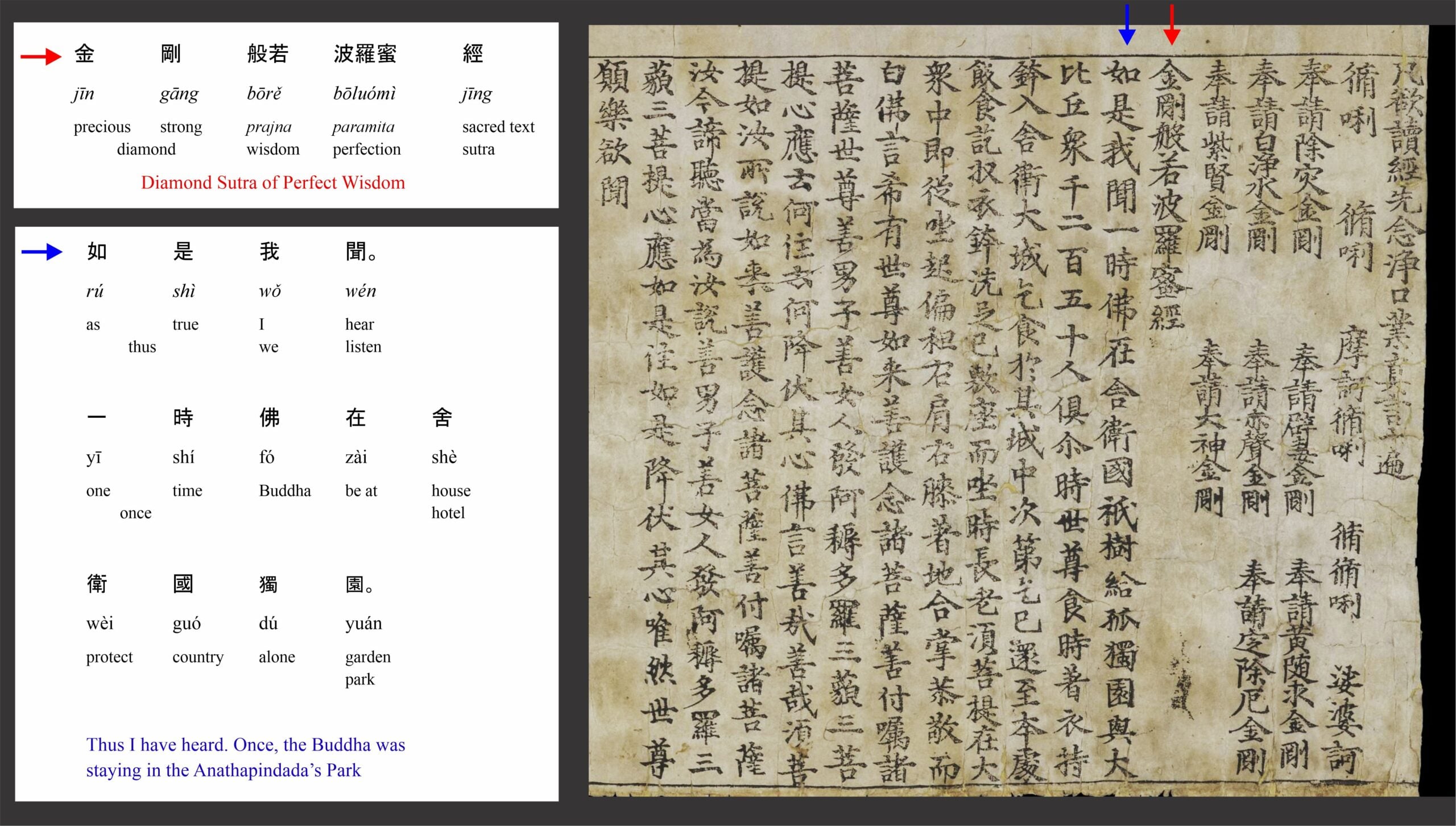
One of the most important discoveries in the Mogao Caves near Dunhuang was a woodblock-printed copy of Kumarajiva’s translation of the Diamond Sutra. The pages were printed by Wang Jie in 868 CE, probably in Sichuan, and then pasted together to form a scroll about 5 m long. The colophon gives the date and notes that the sutra was being made freely available to all who wished to read. This is the oldest printed book of which we have a copy.
The frontispiece of the scroll shows a woodblock drawing of the Buddha surrounded by bodhisattvas, and supernatural guardians. In the lower left is the disciple Subhūti. The following illustration shows this print together with details of the Buddha and his disciple redrawn by Zhao Ming An.
The following illustration shows the first page of text in the scroll along with a character-by-character translation of the title and the first few words of the sutra:
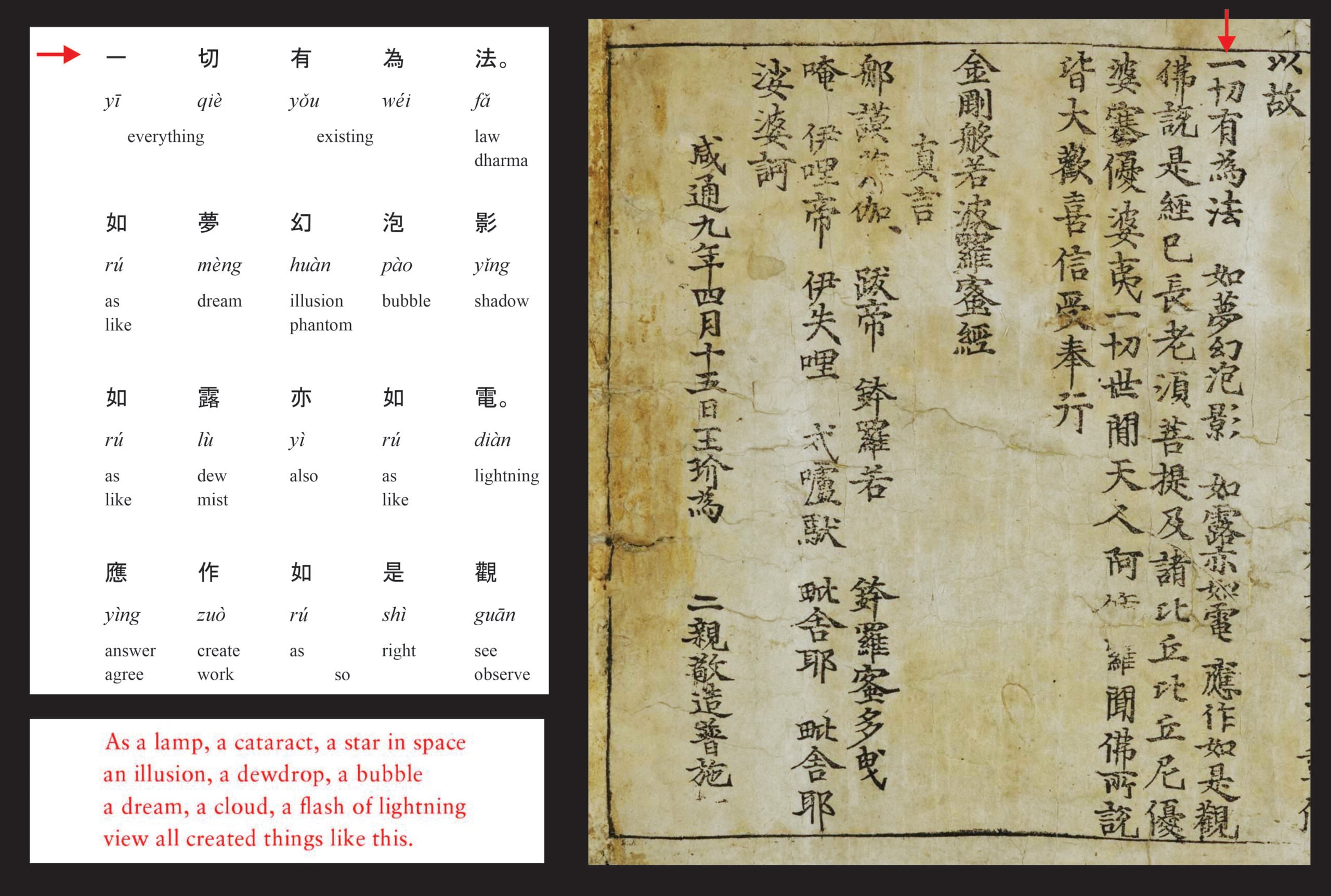
And the following illustration shows the last page of the scroll which includes the famous verse that the Buddha uses to describe the transience of the world. On the left, a character-by-character translation is followed by the English version of Red Pine, based on both the Sanskrit and the Chinese versions of the sutra (2001):
Christianity
During the first 4 centuries of Christianity, the nature of Jesus as both God and Man was extensively discussed. One position was that Jesus was of two distinct natures – dyophysite; another was that his two aspects were conjoined as one – miaphysite; and yet another was that his Jesus became fully divine – monophysite. Though these old distinctions are almost impossible to understand in modern times, in the 5th Century CE they were matters of life and death. The Church of the East (also known as the Assyrian Church) distinguished itself as miaphysite, and became separate from the dyophysite Byzantine and Roman Churches in 451CE. These latter churches condemned as heretical the monophysite teachings of Nestorius, a theologian in the 5th Century. The Church of the East is often known as the “Nestorian Church,” although its views on the nature of Jesus actually differed from those of Nestorius (Brock, 1996). Although the Church of the East remained separate from the Western Churches for many centuries, it has now established communal relations with the Roman Catholic Church.
(i) The Dunhuang Glora
Among the manuscripts found in the Mogao caves was a Chinese Christian Hymn loosely based on the Gloria in Excelsis Deo (Glory to God in the highest), also known as the Greater Doxology (words of praise), especially the version used in the Church of the East. The manuscript was probably written about 800 CE and provides clear evidence that missionaries of the Church of the East had travelled on the Silk Roads to China and were actively proselytizing there centuries before the Jesuits first arrived in the 15th Century CE (Moule, 1930, Teng Li, 2024).
The hymn has 11 verses each containing 4 lines of length 7 syllables, in keeping with Chinese poetic practice. The following illustration shows the beginning of the hymn together with a character-by-character translation of the title and the first line.
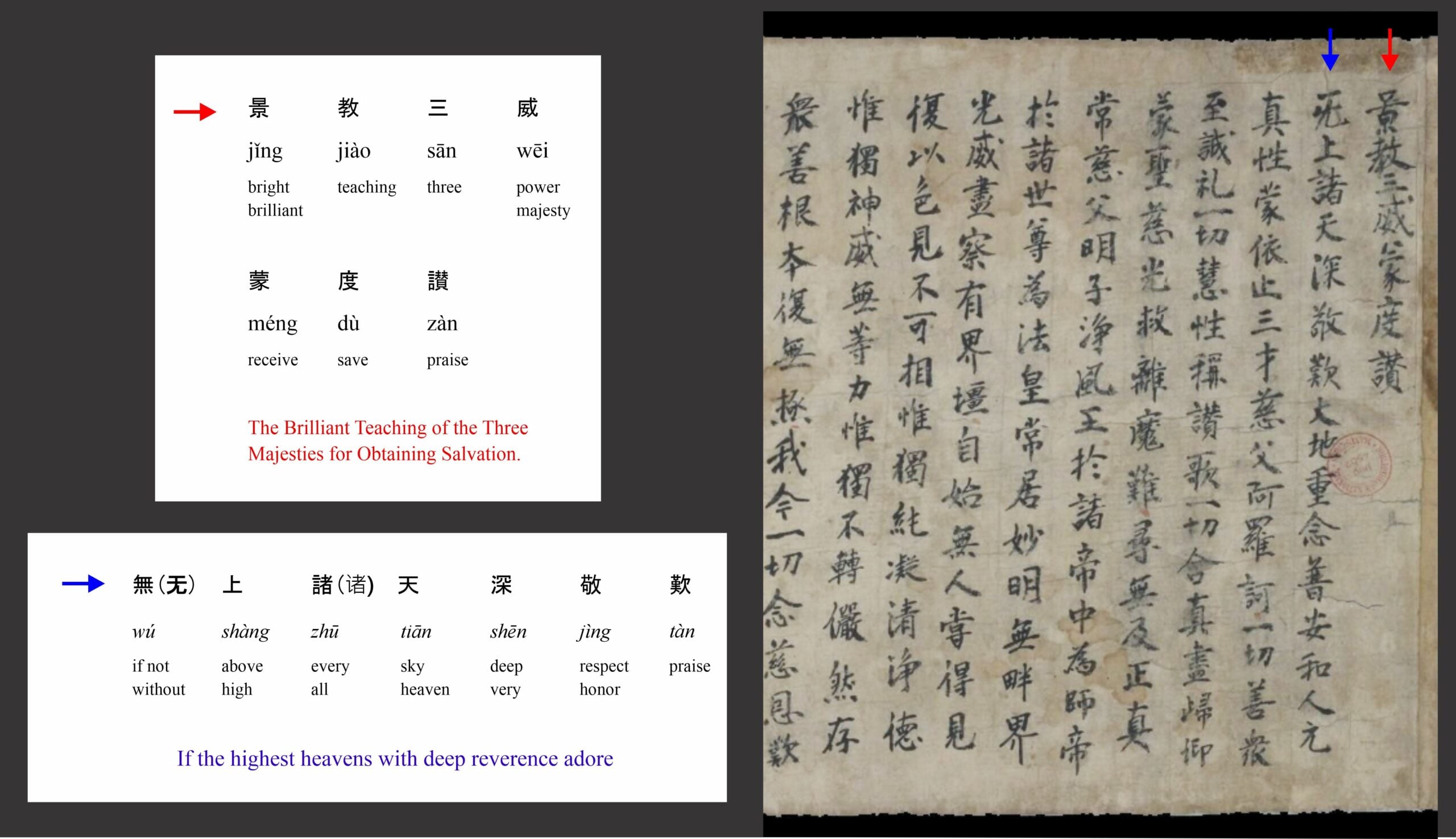
The following is a translation of the first three verses of the hymn (Moule, 1930, p 53; Henson, 2017, p 329)
If the highest heavens with deep reverence adore,
If the great earth earnestly ponders on general peace and harmony,
If man’s first true nature receives confidence and rest,
It is due to Alohê the merciful Father of the universe.
All the congregation of the good worship with complete sincerity;
All enlightened natures praise and sing;
All who have souls trust and look up to the utmost;
Receiving holy merciful light to save from the devil.
Hard to find, impossible to reach, upright, true, eternal,
Merciful Father, shining Son, holy Spirit, King,
Among all rulers you are Master Ruler,
Among all the world-honoured you are spiritual Monarch
“Alohê” is a Chinese transcription of the Syriac name for God.
(ii) The Jingjiao Stele
In 781 CE a monument dedicated to the Christian faith (景教,jingjiao, luminous religion) was erected in Chang’an (Keevak,2008; McGrath, 2021). The limestone stele is almost 3 m high. At the top is a cross and a nine-character title. The following illustration shows the stele in situ (before it was moved to a museum), an enlargement of the title, and a character-by-character translation.
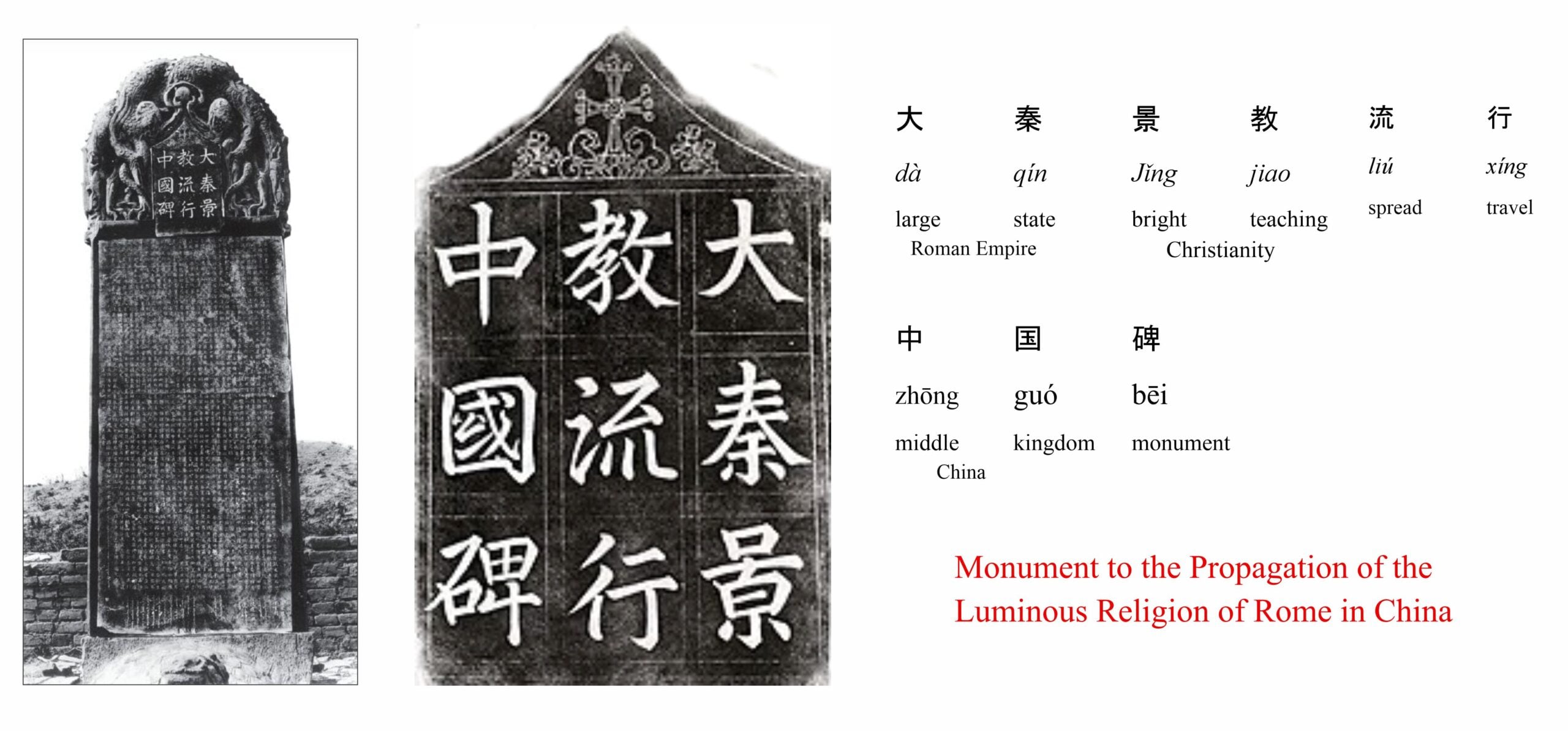
The stele summarizes the beliefs of the Christian Church in an inscription of about 1900 characters. This mentions that the Christian church was first established in China in 635 CE through the efforts of the monk Alopen. At the bottom of the stele is a much shorter inscription in Syriac.
After the end of the Tang dynasty 907 CE, Christianity almost disappeared (Teng Li, 2024). The Jingjiao Stele was buried, either for protection by the monks or as an act of desecration by those who reviled the foreign religion. It was unearthed during the 17th Century.
Nevertheless, the Church of the East continued to send missionaries along the Silk Roads and several centuries later, Christian Churches were built throughout the Mongol Empire. The Mongol Empire (1206–1368) and the Yuan Dynasty in China (1271–1368) were tolerant of the different religions. The foreign religions of Buddhism, Christianity, and Manichaeism contributed as much to society as the homegrown Daoism and Confucianism.
Manichaeism
Mani (216-274 CE) was a Persian prophet who conceived the world as divided between the light and the dark. He taught that the human soul was imprisoned by birth into the material world, and that the suffering that this entailed would only cease at death, which released the soul from the body. If one died free from sin, one’s soul would return to the realm of light. The dualistic religion that he founded – Manichaeism – flourished in the centuries after his death, spreading all the way to Spain in the west and China in the East.
(i) Spread to Europe
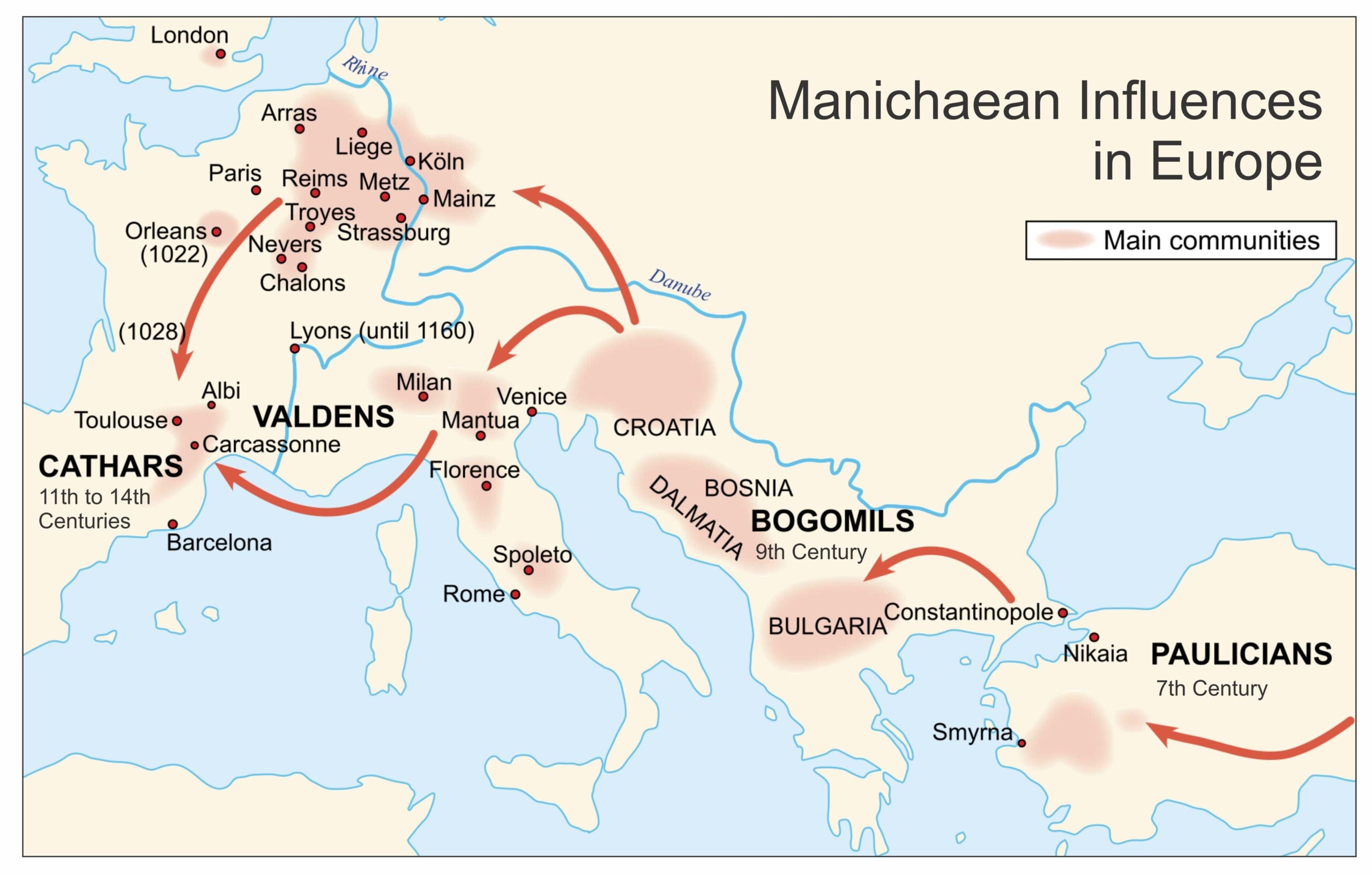
In Europe, Manichaeism declined after Christianity became the state religion of the Roman Empire. However, some isolated groups, such as the Bogomils in Bulgaria and the Cathars in Southeast France, continued to follow Mani’s teachings:
(ii) Spread to China
Manichaeism spread along the Silk Roads into China during the Tang Dynasty (618-907 CE). During the Uyghur Kahnate (744–840 CE) in what is now Northern China and Mongolia, Manichaeism was acknowledged as the state religion (Mackerras, 1990).
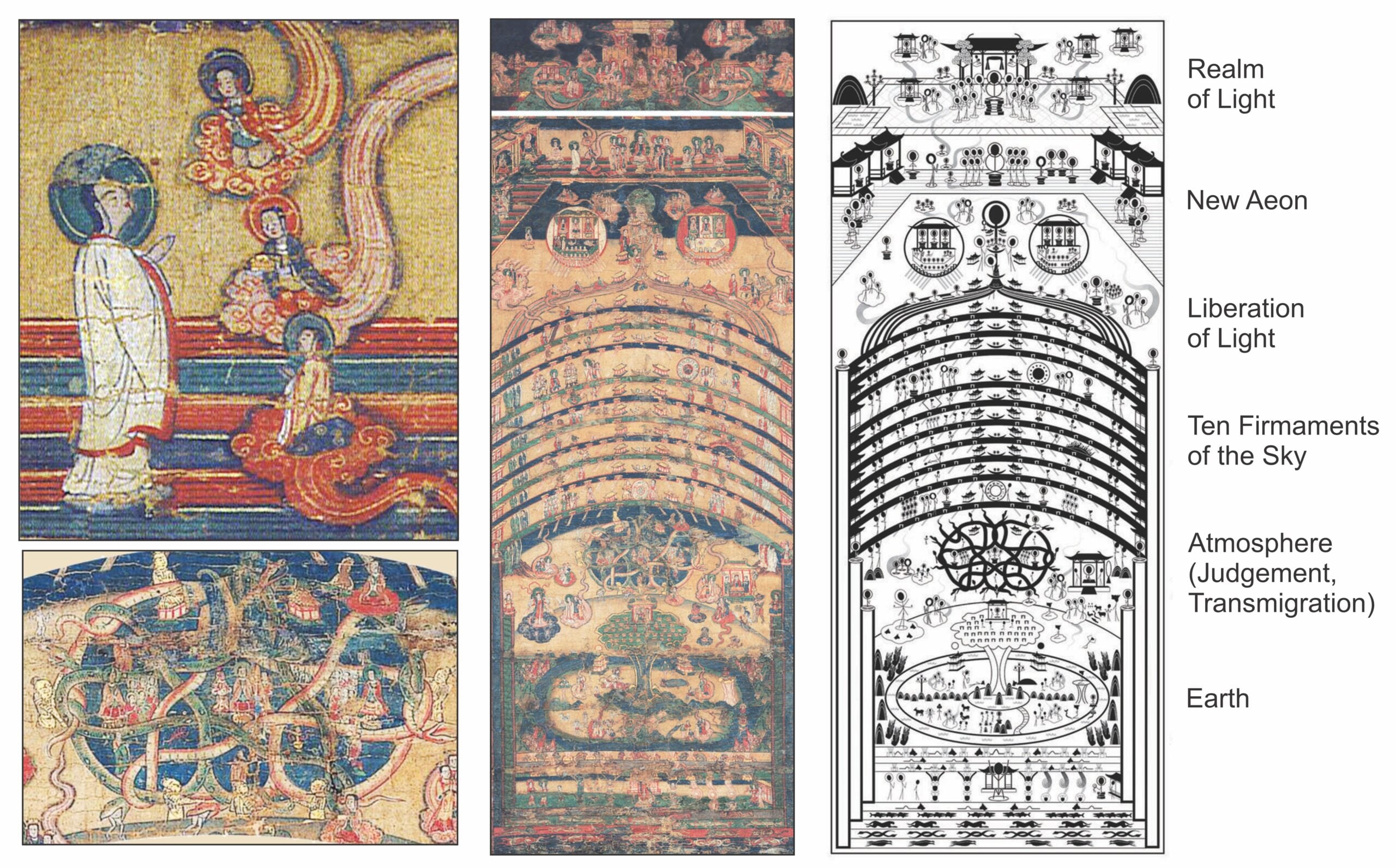
During the Yuan Dynasty (1271–1368 CE), a large silk painting (158 by 60 centimetres) was made to illustrate the Manichaean cosmology. This showed the realm of light at the top. In the center was a representation of the judgment that occurs at death: the decision whether the soul is released into the realm of light or sent back to the hell on earth. The following illustration shows the painting with some explanatory analysis (Gulaczi, 2015, pp 247-258), and enlargements showing a portrait of Mani (from the left side of the New Aeon level) and details of the tangled judgement process:
In Cao’an a small town on the west coast of China, a small temple built in 1339 CE was dedicated to Mani, the “Buddha of Light” (Lieu, 1998, pp 188-193). Over the years the temple became used for Buddhist practices. The following illustration shows the bas-relief portrait of Mani over the altar and the inscribed stone in the grounds of the temple.
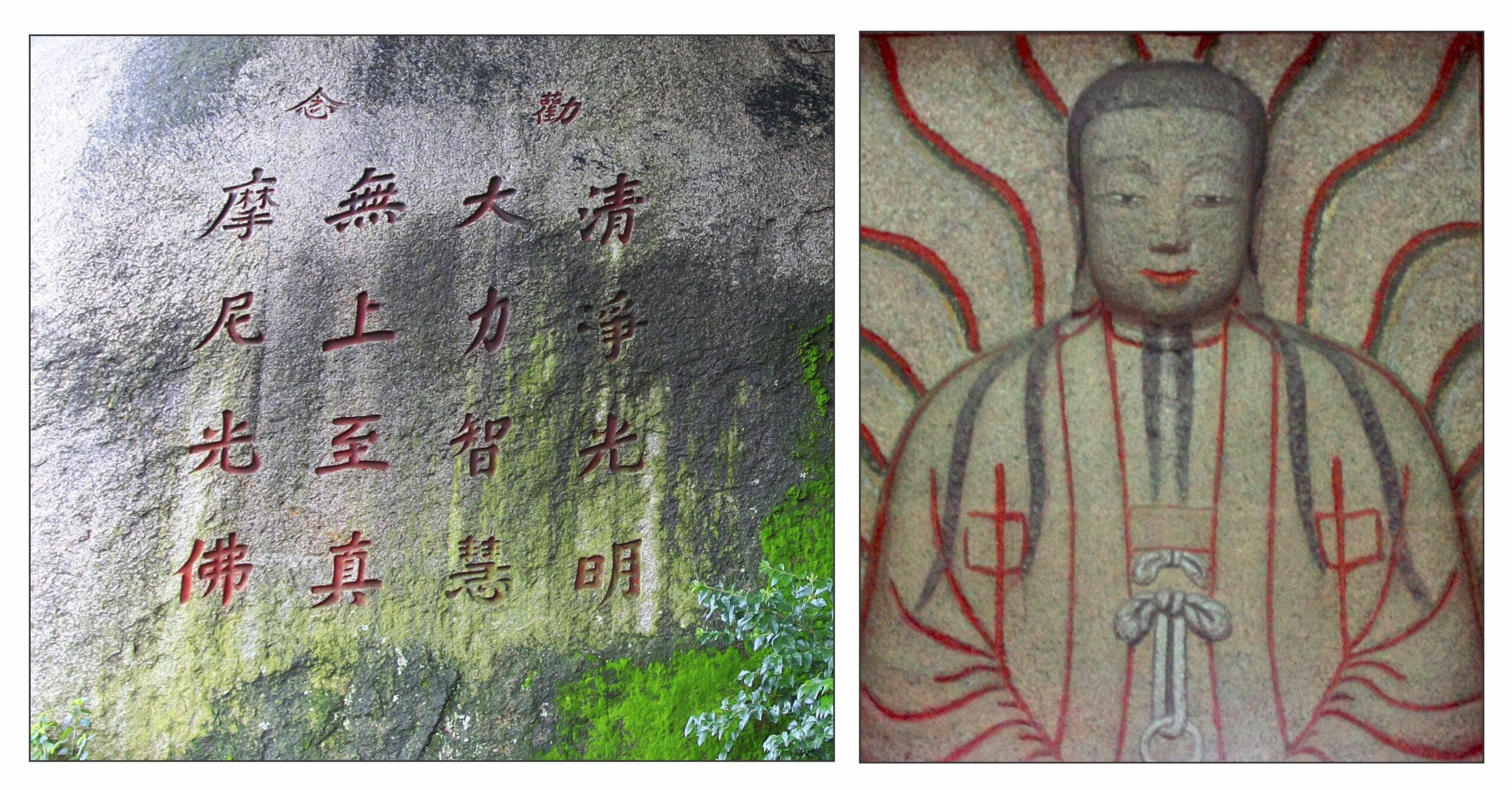
The inscription reads
Purity (清净, qīngjìng), Light (光明, guāngmíng),
Power (大力, dàlì), Wisdom (智慧, zhìhuì)
Supreme (無上, wúshàng), Ultimate Truth (至真, zhìzhēn)
Mani (摩尼, móní), the Buddha of Light (光佛 guāngfú)
The first four are the attributes of the Manichaean Heavenly Father. Mani considered himself as a prophet in the line of Zoroaster, Buddha and Christ. As such he could be conceived as one of the manifestations of the divine – the Buddha of Light.
Islam
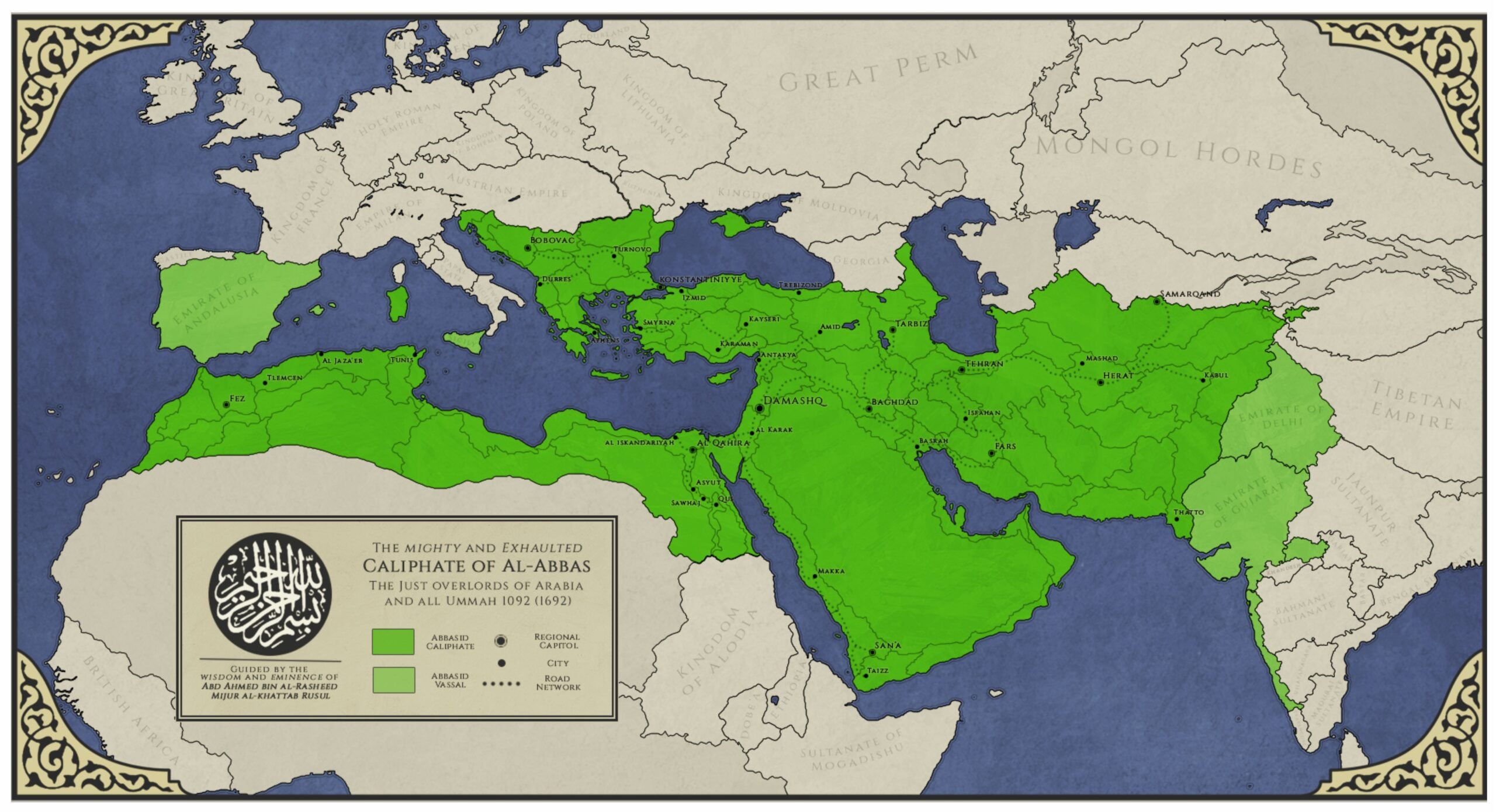
After its founding in Arabia in 622 CE, Islam quickly spread to adjacent regions. By the time of the Abbasid Caliphate (750–1258 CE), the community of the faithful (Ummah) extended all the way from Spain to the borders of China:
(i) Abbasid Caliphate
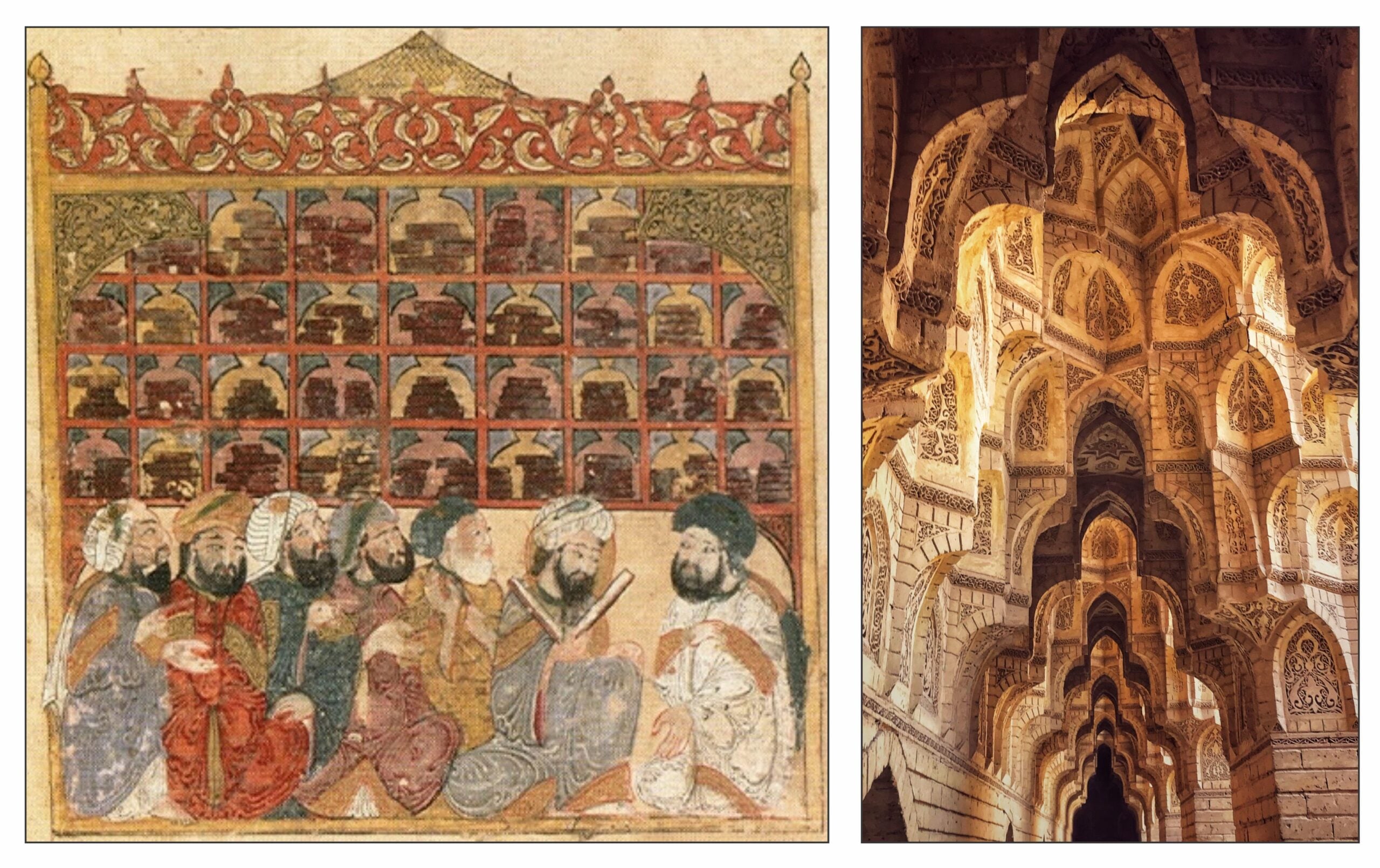
The Abbasid Caliphate with its capital in Baghdad oversaw a period of great prosperity and learning, that later became known as the Islamic Golden Age. At a time when Europe was going through the Dark Ages, Baghdad was a place where scholars studied and preserved the literature of the past and contributed to our knowledge such new ideas as algebra and trigonometry. Islamic physicians distinguished different diseases, and Islamic physicists mapped the heavens. Abassid architecture developed gorgeous arches and domes, stucco decoration with arabesque patterns, and walls covered with multicolored tiling.
The Abbasids made great use of the newly discovered paper (Schatzmiller, 2018). The technology of papermaking originated in China around the 1st Century CE and was brought to the Middle East through the Silk Roads. The first paper mill in Baghdad was built in 795 CE. Paper made it easy to provide inexpensive books for scholars to study. Knowledge became no longer limited to the elites.
The following illustration shows on the left a painting of a scholars in a library during the Abbasid Caliphate taken from a 13th Century manuscript. This may represent the House of Wisdom, also known as the Grand Library of Baghdad, which was founded in the 8th Century CE. On the right is a photograph of a honeycomb archway (muquarnas) from the Abbasid Palace in Baghdad built in the 12th Century CE.
(ii) The Great Mosque in Xi’an
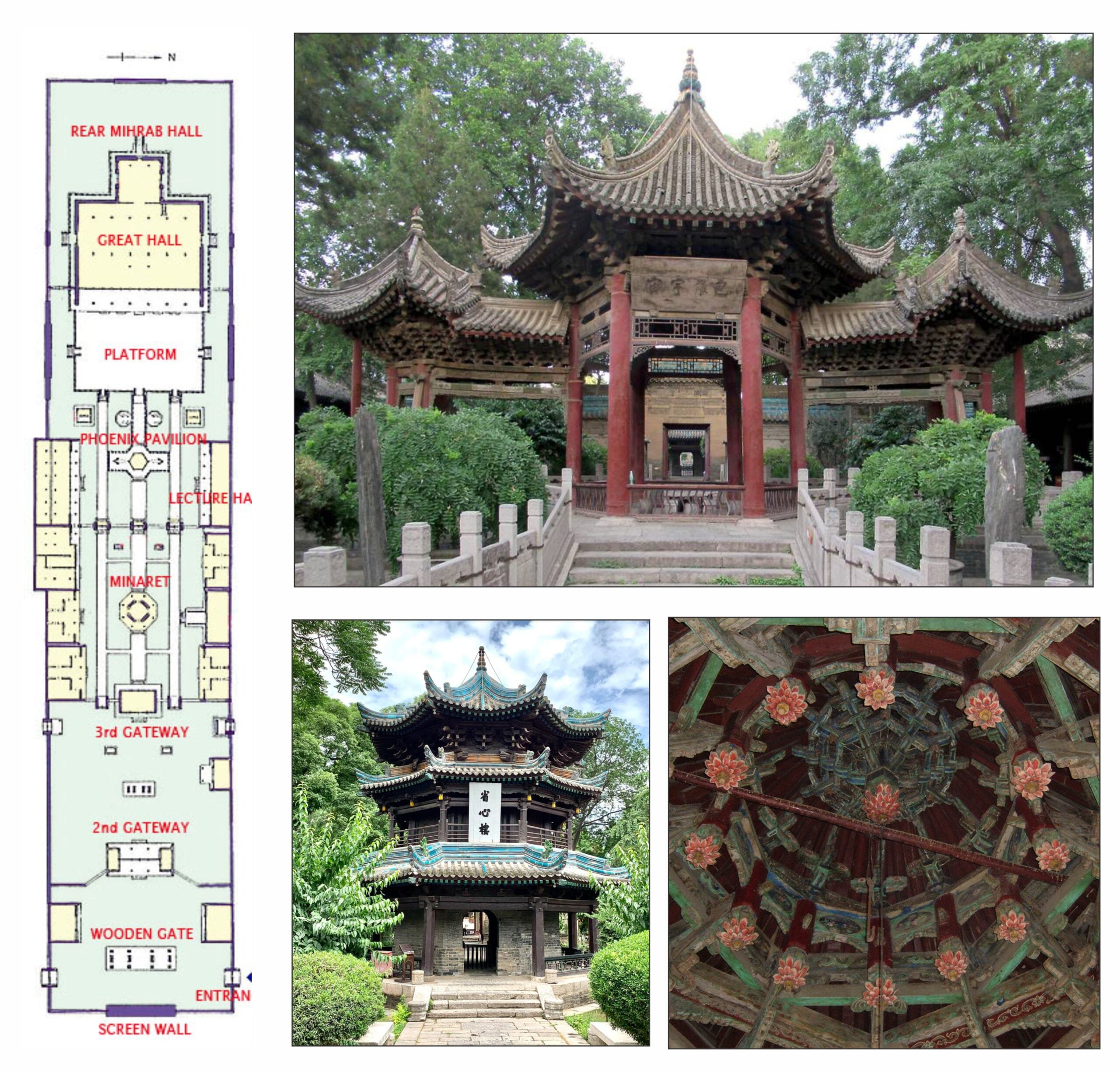
Islamic merchants came to China along the Silk Roads. By the 8th Century the Muslim population of Chang’an (Xi’an) was sufficient to warrant the building of a mosque in the form of a temple. The Great Mosque of Xi’an (西安大清真寺,Xī’ān Dà Qīngzhēnsì) was first constructed in 742 CE, and rebuilt in its present form in 1384. Islam was referred to as 清真教 (Qīngzhēnjiào: pure and true religion), and a mosque is generally referred to as 清真寺 (Qīngzhēnsì: pure and true temple).
The following illustration shows a plan of the mosque together with photographs of the Phoenix Pavillion (鳳亭, fèng tíng), the “Examining the heart tower” (省心楼,shěng xīn lóu) which probably served as a minaret, and the ceiling of the Phoenix Pavilion:
Epilogue
For many centuries the Silk Roads were a conduit for goods to travel between East and West. The East produced silk, paper, tea, and porcelain. The West gave gold, silver, glass, cotton, and leather. The regions along the Silk Roads provided horses, camels, rugs, lapis lazuli and jade.
As well the Silk Roads allowed different religions to travel to distant countries. Buddhism came to China. Islam spread to both the East and the West. Judaism, Zoroastrianism, Manichaeism, and Christianity also journeyed with the caravans. Travellers on the Silk Roads were missionaries as well as merchants (Foltz, 2010).
Some feeling for the people of the Silk Roads can be found in the poem The Golden Road to Samarkand by James Elroy Flecker (1814-1915), a British poet who briefly worked in the consular services in the Middle East before dying at a young age of tuberculosis. The conclusion to his play Hassan, published posthumously in 1922, is a conversation among the members of a caravan about to leave Baghdad for Samarkand:
We are the Pilgrims, master; we shall go
Always a little further: it may be
Beyond that last blue mountain barred with snow
Across that angry or that glimmering sea.
White on a throne or guarded in a cave
There lives a prophet who can understand
Why men were born: but surely we are brave,
Who take the Golden Road to Samarkand
…
Sweet to ride forth at evening from the wells,
When shadows pass gigantic on the sand,
And softly through the silence beat the bells
Along the Golden Road to Samarkand.
We travel not for trafficking alone;
By hotter winds our fiery hearts are fanned:
For lust of knowing what should not be known,
We take the Golden Road to Samarkand.
The following is a reading of these verses by Roger Helmer
And the musical introduction to the Japanese TV series on The Silk Roads by Kitaro:
References
Beckwith, C. I. (2009). Empires of the Silk Road: a history of central Eurasia from the Bronze Age to the present. Princeton University Press,
Berg, I. M. (2000). Among the Jewish descendants of Kaifeng. Judaism, 49(1), 103.
Boyce, M., Grenet, F, & Beck, R. (1991). A history of Zoroastrianism. Volume 3. Zoroastrianism under Macedonian and Roman rule. E. J. Brill.
Brock, S. P. (1996). The ‘Nestorian’ Church: A Lamentable Misnomer. Bulletin of the John Rylands Library, 78(3), 23–35.
Chalupa, A. (2016). The origins of the Roman cult of Mithras in the light of new evidence and interpretations: the current state of affairs. Religio, 24(1), 65-96.
Dalrymple, W. (2025). The golden road: how ancient India transformed the world. Bloomsbury.
Flecker, J. E. (1922). Hassan: the story of Hassan of Bagdad and how he came to make the golden journey to Samarkand: a play in five acts. William Heinemann.
Foltz, R. C. (2010). Religions of the Silk Road: premodern patterns of globalization. (2nd Ed). Palgrave Macmillan.
Frankopan, P. (2016). The Silk Roads: a new history of the world. Alfred A. Knopf.
Grenet, F. (2015). Zoroastrianism in central Asia. In Stausberg, M., Vevaina, Y. S.-D., & Tessmann, A. (Eds.) The Wiley-Blackwell companion to Zoroastrianism. (pp 129-146). Wiley.
Gulácsi, Z. (2015). Mani’s pictures: the didactic images of the Manichaeans from Sasanian Mesopotamia to Uygur Central Asia and Tang-Ming China. Brill.
Hansen, V. (2017). The Silk Road: a new history with documents. Oxford University Press.
Keevak, M. (2008). The story of a stele: China’s Nestorian Monument and its reception in the West, 1625-1916. Hong Kong University Press.
Koller, A. (2024). A Hebrew text from the Silk Road: a prayer for forgiveness and success from the Eighth Century. In Berger, S. Z. et al. (Eds). Wisdom has built her house. A tribute in honor of and in memory of Mrs. Leah Adler. (pp 181-187). Yeshiva University.
Lieu, S. N. C. (1998). Manichaeism in Central Asia and China. Brill.
Lijuan Li (2021). On the transmission of the Gloria in excelsis Deo: Daqin jingjiao sanwei mengdu zan 大秦景教三威蒙度讃 In Talay, Shabo. (Ed.). Überleben im Schatten: Geschichte und Kultur des syrischen Christentums. (pp 111-113). Harrassowitz Verlag.
Mackerras, C. (1990, online 2008). The Uighurs. In Sinor, D. (Ed.). The Cambridge history of early Inner Asia. (pp 317-342). Cambridge University Press.
Mazhjoo, N. (2020). Being Mithraist: Embracing ‘other’ in the Roman cultural milieu. In A. W. Irvin (Ed.), Community and Identity at the Edges of the Classical World (pp. 139–153). John Wiley & Sons, Inc.
McGrath, A, (2021). China’s buried Christian history. Sapentia.
Millward, J. A. (2013). The silk road: a very short introduction. Oxford University Press.
Morgan, J., & Walters, C. (2012). Journeys on the Silk Road: a desert explorer, Buddha’s secret library, and the unearthing of the world’s oldest printed book. Lyons Press.
Moule, A. C. (1930). Christians in China: Before the Year 1550. Macmillan
Pin Lyu (2024). The Sogdians: the ‘Cultural Bees’ of Eurasia. In Henderson, J., L. Morgan, S., & Salonia, M. (Eds). Reimagining the Silk Roads: Interactions and Perceptions Across Eurasia. (pp 145-160). Taylor & Francis
Rong, X. (translated by Hansen, V., 1999). The nature of the Dunhuang library cave and the reasons for its sealing. Cahiers d’Extrême-Asie, 11(1), 247–275.
Red Pine. (2001). The Diamond Sutra: the perfection of wisdom. Counterpoint.
Schatzmiller, M. (2018). The adoption of paper in the Middle East, 700-1300 AD. Journal of the economic and social history of the Orient, 61 1-32.
Sinor, D. (1990, online 2008). The Karakhanids and early Islam. In Sinor, D. (Ed.). The Cambridge history of early Inner Asia. (pp 343-370). Cambridge University Press.
Stein, R. A. (1986). Avalokiteśvara/Kouan-yin, un exemple de transformation d’un dieu en déesse. Cahiers d’Extrême-Asie, 2(1), 17–80.
Stoll, O. (2022). The Cult of Mithras and the Roman Imperial Army. In Dillon, M. & Christopher, M. (Eds) Religion and classical warfare: the Roman Empire. (pp227-249) Pen and Sword.
Suebsantiwongse, S. (2025). A network of compassion: the transmission and development of the cult and iconography of Cakravarticintāmaṇi Avalokiteśvara across the Maritime Silk Routes. Religions, 16(2), 178.
Teng Li (2024). Christianity on the Silk Roads. In Henderson, J., L. Morgan, S., & Salonia, M. (Eds). Reimagining the Silk Roads: Interactions and Perceptions Across Eurasia. (pp 174-185). Taylor & Francis
Torr, G. (2018). The Silk Roads: a history of the great trading routes between East and West. Arcturus.
Waugh, D. C. (2009). The Silk Roads in history. Expedition, 52(3), 9-22.
Whitfield, S. (Ed.). (2019). Silk Roads: peoples, cultures, landscapes. University of California Press.
Wong, D. C. (2019). Colossal Buddha Statues along the Silk Road. Acta Via Serica, 4(2), 1–27.
Wood, F. (2002). The Silk Road: two thousand years in the heart of Asia. University of California Press.
Yü, C-F. (2001). Kuan-yin: the Chinese transformation of Avalokitesvara. Columbia University Press.