Ely Cathedral: The Ship of the Fens

Ely Cathedral was originally situated on a low island in the middle of the Fens, a region of marshland in eastern England lying inland of the Wash. Because of the flatness of the surrounding land the cathedral could be seen from great distances, appearing as the “Ship of the Fens.” The marshes were drained in the 17th Century, but it is still easy to imagine the building floating above the waters: the embodiment of Auden’s image of the English cathedrals:

Luxury liners laden with souls,
Holding to the east their hulls of stone.
(Auden, 1936, p 43; also McDiarmid, 1978, p 292)

The Present Cathedral

The following illustration shows the cathedral as viewed from the southeast.

The present building was begun in 1083 by the Normans soon after their conquest of England. They bought with them a style of architecture known as “Romanesque” on the continent but considered “Norman” in England. The style was characterized by large weight-bearing columns surmounted by semi-circular arches. As the years passed, additions, collapses and renovations to the original building left it with a blend of styles that still somehow achieve harmony rather than incoherence.

The following is the view of the cathedral from the south from Bentham (1771, Plate 42, scale 100 ft):

The West end of the cathedral shows its mixture of styles. The following illustration shows a engraving from King (1881, plate XII) as well as two modern photographs showing the Gothic arches on the Galilee Porch and the Norman arches on the south west transepts

The following is a floor plan of the cathedral:

The dashed semicircular lines in the Presbytery show the eastern extent of the original Norman cathedral.

Saxon Beginnings

The region of England northeast of London – comprising the present counties of Norfolk, Suffolk, Cambridgeshire and Essex – was settled by Angles and Saxons in the 5th and 6th Centuries CE. Multiple kingdoms were set up on the island of Britain: East Anglia, Northumbria, Mercia, Essex, Sussex, Wessex, and Kent. Augustine of Canterbury arrived in England in 597 CE; and the various Saxon kingdoms in England soon converted to Christianity.

Anna, the king of East Anglia (reigned 636-654 CE), a devout Christian, probably reigned in Exning – just east of present-day Cambridge. A large ancient earthen wall, known today as the Devil’s Dyke, stretching from the southern end of the Fens to the River Stour, appears to have built as a defense against the Mercian kingdom to the west. The following map shows the kingdom of East Anglia at the time of Anna:

Anna’s daughter Æthelthryth (or Etheldreda) was born in 636 CE (Keynes, 2003). In 652, at the age of 16, she was married to Tondberct, a prince who ruled over part of the Fens. This was a political marriage, designed to extend Anna’s domain, and Æthelthryth insisted on maintaining her virginity. As a wedding gift she was given the Isle of Ely in the Fens. The name “Ely” probable comes from the Old English elge meaning “region of eels.” Tonberct died in 655, and Æthelthryth retired to live in Ely.

After Anna died fighting against the Mercians at the battle of Bulcamp in 654, Æthelthryth was married in 660 for a second time to Ecgfrith, a 16-year-old prince of Northumbria. Once again, she insisted on maintaining her virginity. In 670, she formally took the veil as a nun and lived in the double monastery (for both monks and nuns) at Coldingham, in what is now southeast Scotland. In 672, in need of an heir, Ecgfrith decided that he wished to consummate his marriage, and sent armed men to apprehend his wife. She and her attendants fled to Ely; Ecgfrith’s men were prevented from capturing her by the tidal waters of the Fens. Æthelthryth then founded a new monastery at Ely, where she presided as abbess until her death in 679. The following illustration shows two of the capitals on the octagon pillars in Ely cathedral (from Bentham, 1771, plates 9 and 10): Æthelthryth’s taking of the veil, and her miraculous salvation by the rising waters of the Fens. On the right is a 1960 statue of Æthelthryth by Phillip Turner.

Little is known of the abbey at Ely after its founding. In 869 the Vikings conquered the kingdom of East Anglia and much of Northumbria and Mercia. Alfred the Great (849-899) ultimately prevented the Vikings from further expansion, but allowed the continuation of Danelaw in the eastern parts of England from 886 to 1066. The original abbey of Æthelthryth may have been destroyed or may have simply fallen into disuse during the early Viking period. However, Ely Abbey was re-founded toward the end of the 10th Century as a monastery for monks alone. As his boat approached Ely, King Cnut (reign 1016-1035) was impressed by the music of the monks and wrote a poem, a fragment (perhaps the refrain) of which survives (Parker, 2018):

Merie sungen ðe muneches binnen Ely
ða Cnut ching reu ðer by.
Roweþ cnites noer the lant
and here we þes muneches sæng.

[Sweetly sang the monks in Ely
When Cnut the king rowed by;
‘Row, men, nearer to the land
So we can hear the friars’ song.’]


The Norman Cathedral

Under the direction of Abbot Simeon, the Normans initiated the construction of a large abbey church in Ely in 1083. The remains of Saint Æthelthryth were moved from the old church to the new in 1106. Her marble tomb was placed in a shrine bedecked by gold and jewels behind the high altar. The building was granted cathedral status by Henry I 1109. The nave, central tower and transepts were completed by about 1140, and the western transepts and tower were finally finished by about 1190.

The nave is 72 meters long and 22 meters high. There are three levels: the arcade, gallery (or tribune) and clerestory, the last containing large windows for light (clerestory means “clear storey”). The proportions for these levels are 6:5:4 (Clifton-Taylor, 1986, p 36). The arcades of the gallery are divided into two and those of the clerestory into three. The columns alternate between piers with multiple shafts and piers with large cylindrical columns, providing a gentle visual rhythm. The aisles on either side of the main nave are each one half the width of the nave (Fernie, 2003). The roof was made of the same timbers that were used to provide the scaffolding when constructing the nave.

The following illustration shows on the left a diagram of the nave (Dehio & Bezold, 1887, plate 88), On the right is a modern photograph that shows its three levels, and at the bottom a photograph that illustrates the alternation of the main columns.

The monk’s door and the prior’s door from the cloisters into the nave were likely built and decorated in the 1130s. Both are intricately sculpted. The prior’s door (shown below in a plate from Bentham, 1771, and in a modern photograph) is surmounted by a tympanum containing Christ in Majesty surrounded by two angels. Though far less accomplished than the Romanesque sculptures in France, it has its own charm.

The Gothic Cathedral

The Galillee Porch was added to the west front of the cathedral in the first two decades of the 13th Century. As we have already noted the style is early Gothic: the blind arcades decorating the façade have pointed arches, narrow columns, and trefoil openings.

A little later, the east end of the Cathedral was extended to form a Presbytery: a space for the monks to worship separate from the choir and the nave. This extension in a richly decorated Gothic style was completed in 1252 (Maddison, 2003). The large columns of the arcade are divided into multiple smaller columns and the pointed arches are geometrically ornamented. The tribune gallery has twin trefoiled openings beneath a large pointed arch. The clerestory has lancet windows with an inner row of cinquefoil arches. The stone vault is supported by tierceron ribs.

The following illustration shows a view of the choir and presbytery toward the east by John Eaton (2016) surrounded by two views of the north wall, the left by Arthur de Smet (1972) and the right from Broughton (2008):

In 1321, work began on a large separate Lady Chapel north of the choir and presbytery. Constructing the foundations for this new building led to the central section of the cathedral being undermined by water. The central bell tower of the cathedral collapsed in 1322, damaging parts of the north transept and the choir. Under the direction of Alan of Walsingham a new octagonal tower was built, with the stonework completed by 1328 (Maddison, 2003). The crowning glory of the tower was a magnificent “lantern” built of timber that allowed light to descend into the cathedral (completed in about 1340). The following illustration shows the octagon viewed from the western tower and a diagram of the carpentry underlying the lantern from Hewett (1974, plate 76):

The following illustration shows views of the lantern from the interior of the cathedral:

Because of the lantern, Ely cathedral provides a marvelous interplay of light and shadow. Frederick Evans took many photographs in 1897 and published these in Camera Work in 1903 (Lyden, 2020). Two of his images are below:

After the stonework of the octagon was completed Bishop Hotham and Akan of Walsingham then returned to complete the lady chapel – a wonder of Decorated English Gothic. The vault is supported by interconnecting ribs forming star shapes (lierne, from French lier, to tie, or stellar vaulting). This approach supports a wider vault than the simple tierceron ribbing. The large windows are supported by thin vertical columns that extend outward to provide a buttressing effect. The following illustration shows a photograph of the chapel and a diagram of the lierne vaulting.

The chapel was completed in the 1340s. The lower sections of the walls are decorated with vegetal patterns, giving the visitor a sense of being in a garden (Broughton, 2008). The present chapel is very different from the way it was in the 14th and 15th Centuries. At that time, numerous painted sculptures existed in the niches, and the windows were made of stained glass.

The Monastery

Ely Cathedral, like Canterbury, Durham, and Norwich, was a monastic cathedral. The monks at these cathedrals followed the Benedictine order. The bishop of a monastic cathedral was the titular abbot of the monastery, but the monks were essentially led by the prior. Although most of the old cathedrals in England were monastic, some cathedrals, such as Lincoln and Hereford were secular and had no associated monastery.

The monastery (or priory) at Ely was prosperous. Many of the medieval buildings of the monastery still stand. Some are used by King’s Ely School. The following plan shows the probable layout of the monastery (Dixon, 2003). The castle motte is the site of a fortress in Norman times.

The Reformation

As the years wore on the monastery at Ely became rich. The sale of indulgences brought in much money. Death acted like the church’s tax-collector, as those in need of heaven left their land and possessions to the church rather than to their children. Pilgrims to the shrine of Æthelthryth/Etheldreda were expected to make significant donations to the church. Æthelthryth was also called Saint Audrey. Ribbons bought at her shrine were called “St Audrey’s lace,” whence comes the word “tawdry” for overpriced finery. Some Bishops at Ely made special ornate chapels for themselves: Bishop Alcock (1486-1500) at the end of the north aisle and Bishop West (1515-33) at the end of the south aisle. It was easy to accuse the church of luxury and greed.

As the 16th Century progressed, Henry VIII came to need both a new wife and a source of gold. In 1533 Henry appointed Thomas Cranmer as Archbishop of Canterbury. Cranmer allowed him to marry Anne Boleyn. In 1534, Thomas Cromwell, the king’s chancellor, arranged for Parliament to pass the Act of Supremacy declaring the king to be the head of the English Church. In 1537, Cromwell convened a synod of British bishops who produce a book The Institution of the Christian Man, espousing many of the principles proposed by Martin Luther. In 1839 Parliament passed a bill to allow the Dissolution of the Monasteries. All of the small monasteries were to be closed, their monks let go, and their assets expropriated by the king. The monasteries associated with the cathedrals were also to be closed, although some of their monks could remain as officers in the newly secularized cathedrals.

On 18 November, 1539, Prior Robert Seward and 23 other monks signed a deed of surrender of the monastery of Ely to Henry VIII (Duffy, 2020, pp 31-45). There was not much else they could do. The abbots of Gastonbury and Reading had been executed on November 13 for refusing to dissolve their houses. The monastery and cathedral were held at the pleasure of the monarch and its riches were duly plundered. In 1541 the cathedral was given a royal charter as a secular cathedral. The church which had been devoted to Saint Etheldreda and Saint Peter, was renamed “The Cathedral Church of the Holy and Undivided Trinity of Ely.”

The bishop during this time was Thomas Goodrich, a colleague of Thomas Cranmer. Trained in theology at Cambridge University, he was appointed Bishop of Ely in 1534 and remained bishop until his death in 1554. After the dissolution of the monastery, he ordered the destruction of the shrine of Ethelreda, the defacement of the statues in the Lady Chapel, and the removal of the statues in the chapels of Bishop’s Alcock and West. Every one of the 147 statues of Mary and the other saints in the Lady Chapel was beheaded. Goodrich continued as bishop after the death of Henry in 1547; during the reign of Edward VI (1547-53), he was also appointed Lord Chancellor (1552). He died in 1554, before Mary (reign 1553-8) had time to pursue her vengeance.

The following illustration shows two photographs from the 1890s by Frederick Evans showing the mutilation of the statues in the Lady Chapel and the empty plinths on the gateway to Bishop West’s chapel. Also shown is the memorial brass to Thomas Goodrich, located on the floor of the south presbytery. The bishop holds in his right hand both a bible and the seal of England, emblematic of his chancellorship.

After the Reformation the cathedrals of England fell into disrepair. The architecture was contemptuously referred to as “Gothic” or barbaric (see Clifton-Taylor, 1986, pp 9-12). In 1699, the north west transept of Ely Cathedral collapsed (Fernie, 2003, p 96). There was no money to rebuild:

To this day, Ely looks like the wounded veteran of some forgotten war. (Jenkins, 2016, pp 91-2)

Watercolors by J. M. W. Turner from the 1790s show the cathedral octagon and the dilapidated Galilee Porch.

Repair

The cathedral was extensively restored during the 19th Century: The roof of the nave was retimbered and painted; the windows were provided with stained glass; the choir was provided with new stalls and a beautifully carved choir screen; the high altar received an intricate reredos (from French arere, behind, dos, back).

The following illustration shows some of the carvings above the choir stalls. These depict episodes in the life of Jesus: the supper at Emmaus, the appearance of the risen Jesus to Thomas, and the ascension:

Ely in the Present

Most people in England no longer attend church, and those who believe that there is a God are equaled by those who believe that there is not. What should be the place of the church in modern society?

Intriguing to me are the modern statues that now adorn the cathedral. Below are illustrations of four of these works. Clockwise from the upper left are the Virgin Mary in the Lady Chapel urging us to exultation by David Wynne (2000), Christ and Mary Magdalene wondering at the mystery of the resurrection by David Wynne (1967), Christ in Majesty above the pulpit by Peter Ball (2000), and half-life-size statues by Sean Henry on the empty plinths in Bishop West’s chapel, part of an installation entitled Am I My Brothers Keeper? in 2024.

An optimistic view of the future is from Nicholas Orme (2017, p 262):

The most astonishing feature of cathedral history, when one has journeyed through its seventeen hundred years, is its immense and varied creativity. If we take buildings, there is the evolving history of their plans and construction, the sourcing of the materials, the labours of craftsmen, the elaboration of the decoration, and the successive layers of repair and restoration. There is the worship, complex in its calendar, its liturgical texts, the ways in which it is done, and the application of the worship to God, saints, or popular, needs. There is the vast range of arts involved in producing worship and its setting: sculpture, painting, stained glass, metalwork, fabrics, singing, instrumental music, and chorography. There is the written and spoken word in prayer- and hymn-books, preaching, inscriptions, archives, libraries, guide-books, and service-sheets.

A more restrained understanding of what it is like to visit a church when faith has passed away can be found in a 1954 poem by Philip Larkin entitled Church Going, the last verse of which reads:

A serious house on serious earth it is,
In whose blent air all our compulsions meet,
Are recognised, and robed as destinies.
And that much never can be obsolete,
Since someone will forever be surprising
A hunger in himself to be more serious,
And gravitating with it to this ground,
Which, he once heard, was proper to grow wise in,
If only that so many dead lie round.

References

Atherton, I. (2003). The dean and chapter: reformation and restoration. In Meadows & Ramsay, op cit, pp 169-192.

Auden, W. H. (1936). Look, stranger!  Faber & Faber

Bentham, J. (1771). The history and antiquities of the conventual and cathedral church of Ely : from the foundation of the monastery, A.D. 673, to the year 1771 : illustrated with copper-plates. Cambridge University Press.

Broughton, L. (2008). Interpreting Ely cathedral. Ely Cathedral Publications.

Clifton-Taylor, A. (1967, revised 1986). The cathedrals of England. Thames and Hudson.

Dehio, G., & Bezold, G. v (1887). Die kirchliche Baukunst des Abendlandes. Atlas 1 (Tafel 1-116). Stuttgart.

Dixon, P. (2003). The monastic buildings at Ely. In Meadows & Ramsay, op cit, pp 144-155.

Duffy, E. (2020). A people’s tragedy: studies in reformation. Bloomsbury Continuum.

Eaton, J. (2016). English medieval cathedrals. Blurb.

Fernie, E. (2003). Architecture and sculpture of Ely Cathedral in the Norman period. In Meadows & Ramsay, op cit, pp 97-11.

Hewett, C. A. (1974). English cathedral carpentry. Wayland.

Jenkins, S. (2016). England’s cathedrals. Little, Brown.

Keynes, S. (2003). Ely Abbey 672-1109. In Meadows & Ramsay, op cit, pp 3-58.

King, R. J. (1881). Handbook to the cathedrals of England. Volume 3. Eastern Division: Oxford, Peterborough, Norwich, Ely, Lincoln. J. Murray. Available at archive.org.

Lyden, A. M. (2010). The photographs of Frederick H. Evans. J. Paul Getty Museum.

McDiarmid, L. S. (1978). W. H. Auden’s “In the Year of My Youth…” The Review of English Studies, 29(115), 267–312.

Maddison, J. (2003). The Gothic Cathedral: new building in a historic context. In Meadows & Ramsay, op cit, pp 113-141.

Meadows, P., & Ramsay, N. (2003). A history of Ely Cathedral. Boydell Press.

Orme, N. (2017). The history of England’s cathedrals. Impress Books.

Parker, E. (2018). ‘Merry sang the monks’: Cnut’s Poetry and the Liber Eliensis. Scandinavica, 57(1), 14-27.


The Moissac Portal: Masterpiece of Romanesque Sculpture

n the 9th and 10th Centuries CE, Europe began to awaken from the has come to be known as the Dark Ages. Imposing churches were erected and many of these were decorated with sculptures. This new style of art and architecture, thought to be derived from that of the Roman Empire, has been called “Romanesque.” The sculpture from this time is full of a tremendous vitality and marked by a rich imagination. Some of the most impressive examples adorn the portal of the Abbaye de Saint Pierre in Moissac in southwestern France.

History of the Abbey

Moissac, situated on the confluence of the Garonne and Tarn rivers in southwest France (see map below), is surrounded by rich agricultural land. Legend has it that a monastic community was founded there in the 6th Century CE by Clovis, the first king of the Franks, though the monastery likely began a century later (Vidal et al., 1979). Over the years the monastery was pillaged by various invaders: the Arabs in the 8th Century, the Normans in the 9th Century, and the Hungarians in the 10th Century. In the 11th Century, as more and more pilgrims began to travel to Santiago de Compostella in Spain (Oursel, 1970), Moissac became an important way-station on the route from Geneva (dotted purple line):


In 1047, Saint Odilon, the 4th Abbot of Cluny, arranged for the monks in Moissac to be affiliated with the Benedictine Abbey at Cluny. In 1059, Durand de Bredon, archbishop of Toulouse, was installed as its first abbot. He arranged for the abbey church and cloisters to be rebuilt, and in 1063, the Abbaye de Saint Pierre de Moissac was reconsecrated. Abbot Durand is commemorated in a bas-relief sculpture in the east gallery of the cloisters (see illustration on the right adapted from Vidal et al, 1979). The sculptures adorning the portal and the porch were created under the direction of abbot Ansquitil (Franzé, 2015) during the years from 1100 to 1115 (Forsyth, 2010).   


The Concept of “Romanesque”

The architecture and sculpture of the middle of the 10th to the beginning of the 13th Centuries is usually considered “Romanesque,” a term (roman in French) first used by Charles de Gerville (1769-1853) in the early 19th Century (Charles & Carl, 2012). He proposed that the style was a revival of the art and architecture of the Roman world before the Barbarian invasions. In England, Romanesque architecture is often called “Norman” since it came with the Norman Invasion in the 11th Century.  

The key characteristic of Romanesque architecture was the use round arches (Toman, 2004, pp 24-30; Charles & Carl, 2012, p 17). The transition to pointed arches in the late 12th Century marked the onset of “Gothic” architecture. Both terms are inaccurate: Romanesque architecture has little to do with the Romans, and Gothic architecture has nothing to do with the Goths.

The period of time between the fall of the Roman Empire in 476 CE and the rise of the Romanesque after 1000 CE has often been considered a time of ignorance and violence – the European “Dark Ages.” However, such a concept is inappropriate. Multiple separate kingdoms existed during this time, and each of these fostered its own learning, art and architecture. The Visigothic kingdom ruled much of Spain until the Arab Conquest in the 8th Century. The Merovingian dynasty governed France from the 5th to 8th Century. The Carolingian Empire (the precursor of the Holy Roman Empire) controlled much of France and Germany in the 9th Century. The kingdom of Asturias ruled northwest Spain in the 8th to 10th Centuries. The Vikings established the Duchy of Normandy in northwest France the 10th Century. Celtic monasteries in Ireland sent their missionaries and their artists back to convert and teach the people of the old Roman Empire. And Europe could not help but be affected by the Islamic art of Moorish Spain, and the magnificent art of the Byzantine Empire and Ravenna. The period of the so-called Dark Ages was actually a time of intense artistic ferment, wherein different styles came together and interacted (Busch & Lohse, 1966; Oursel, 1973, pp 13-86; Fleischer, 2004).  

Romanesque architecture differs from Roman architecture in its use of steeples and towers. Christian churches differ from Roman temples in their concentration on interior teaching rather than external show. Romanesque sculpture differs from Roman sculpture in its vitality and imagination, characteristics that it learned from Celtic and Norse carvings, in an iconography that follows Byzantine precedents, and in an ornamental geometry that largely comes from Islam.

The French language is particularly confusing in its description of artistic styles. “Romanesque” is roman in French, and “Roman” is romain. The word romanesque in French actually means “romantic” or “novelistic.” In French, the noun roman meaning “novel” derives from an earlier word romanz, meaning “story” (or “romance”). Another use of the French term romanesque is to describe the European languages that derived from Latin, equivalent in English to “romance” The only word that is equivalent in French and English is romantique, “romantic”


The Portal

The following diagram shows the south portal of the Abbaye de Saint Pierre. Sculpture adorns all parts of the portal as well as the walls of the porch in which it is located:

Tympanum

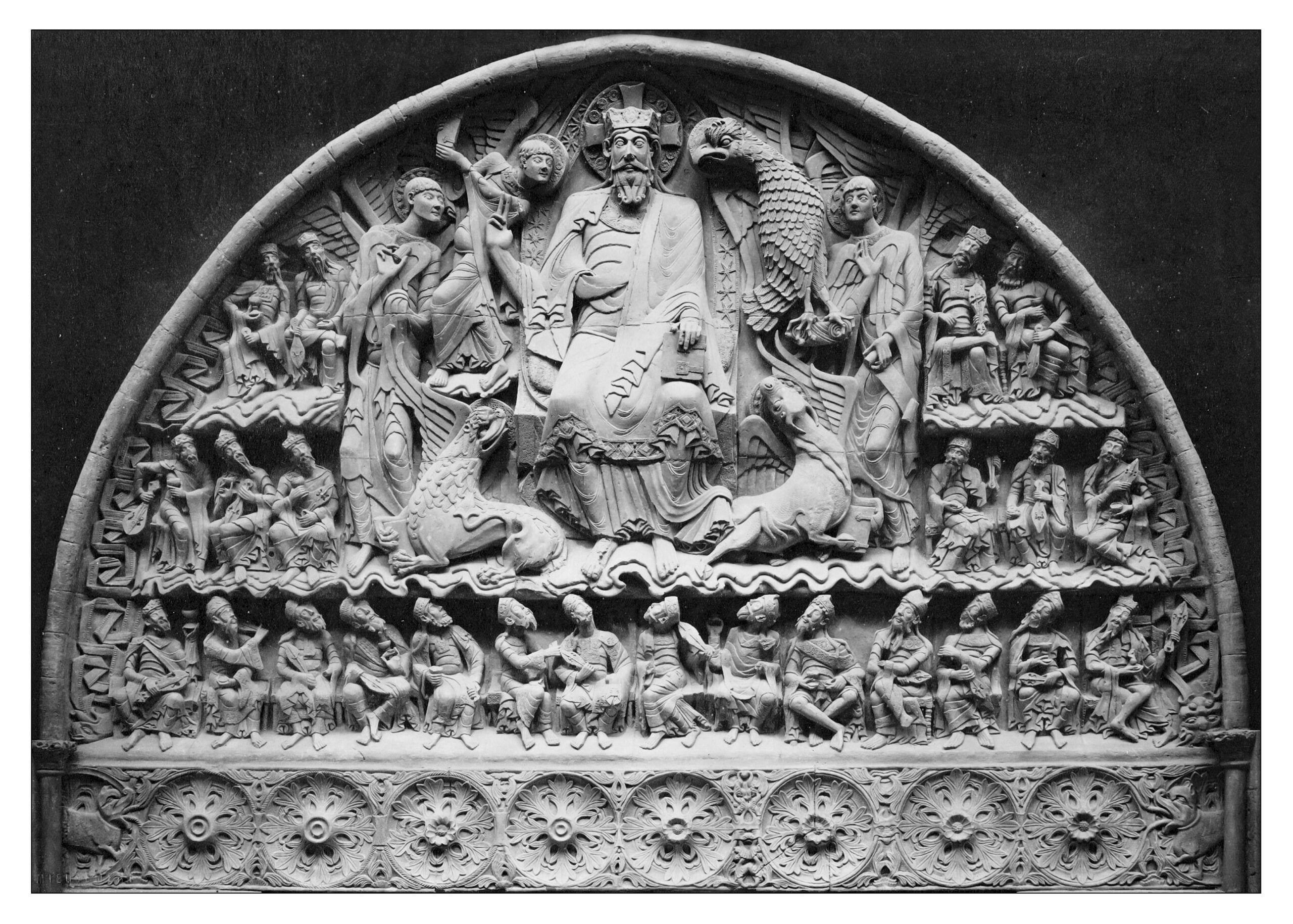
The tympanum represents the vision of John as described in Revelation (80-100 CE). Though some have proposed that the author of the Gospel of John also wrote this Apocalypse, most scholars now believe that Revelation came from a different person: a Christian prophet who retired to meditate and write on the island of Patmos off the coast of Asia Minor near Ephesus (Koester, 2014, pp 65-69; Pagels, 2012, pp 2-3). The first of John’s visions is striking:   

And immediately I was in the spirit: and, behold, a throne was set in heaven, and one sat on the throne.

And he that sat was to look upon like a jasper and a sardine stone: and there was a rainbow round about the throne, in sight like unto an emerald.

And round about the throne were four and twenty seats: and upon the seats I saw four and twenty elders sitting, clothed in white raiment; and they had on their heads crowns of gold.

And out of the throne proceeded lightnings and thunderings and voices: and there were seven lamps of fire burning before the throne, which are the seven Spirits of God.

And before the throne there was a sea of glass like unto crystal: and in the midst of the throne, and round about the throne, were four beasts full of eyes before and behind.

And the first beast was like a lion, and the second beast like a calf, and the third beast had a face as a man, and the fourth beast was like a flying eagle. (Revelation 4: 2-7)

Christ in majesty (Maiestas Domini) is the focus of this vision. This type of representation – a bearded Christ, wearing a crown, seated on a throne, holding a book, his head surrounded by a halo that usually incorporated a crucifix – had developed over the preceding centuries in illuminated manuscripts. The following illustration shows examples from the Codex Amiatinus (700-720), the Godescalc Evangelistary (783) and the Bamberg Apocalypse (1000-1020). 


The following is a bas-relief sculpture of Christ in Majesty from the 7th-Century sarcophagus of Saint Agilbert in Jouarre, about 70 km east of Paris. 

The Moissac tympanum represents in monumental stone the words of the prophet John.


In the center, Christ in Majesty is surrounded by four creatures and two angels (Schapiro & Finn, 1985, pp 77-104; Vidal et al., 1979, pp 95-99). The feet of Christ rest upon a crystalline sea, as described in the passage from Revelation, but not in the illuminations illustrated above. Bede’s interpretation (early 8th Century) of this is that it represents the baptism that is necessary for Christian salvation (Wallis, 2013, p 134).

The setting for Umberto Eco’s 1980 novel The Name of the Rose is a monastery loosely based on the Sacra di San Michele, an abbey on Mount Pirichiano in Piedmont, Italy. However, the portal of the fictional abbey church is clearly based on that in Moissac (Geese, 2004, p 259). The young monk Adso describes his impression of the Christ in Majesty:

I saw a throne set in the sky and a figure seated on the throne. The face of the Seated One was stern and impassive, the eyes wide and glaring over a terrestrial humankind that had reached the end of its story; majestic hair and beard flowed around the face and over the chest like the waters of a river, in streams all equal, symmetrically divided in two. The crown on his head was rich in enamels and jewels, the purple imperial tunic was arranged in broad folds over the knees, woven with embroideries and laces of gold and silver thread. The left hand, resting on one knee, held a sealed book, the right was uplifted in an attitude of blessing or—I could not tell—of admonition. The face was illuminated by the tremendous beauty of a halo, containing a cross and bedecked with flowers, while around the throne and above the face of the Seated One I saw an emerald rainbow glittering. Before the throne, beneath the feet of the Seated One, a sea of crystal flowed, and around the Seated One, beside and above the throne, I saw four awful creatures—awful for me, as I looked at them, transported, but docile and dear for the Seated One, whose praises they sang without cease.

Surrounding the central figure of Christ are four creatures. Although there are other interpretations, most scholars suggest that these creatures represent the writers of the four gospels since each is holding a book:

Matthew has the human face because he begins his gospel with Jesus’ human genealogy; Mark is the lion because he begins with a voice roaring in the desert; Luke is the ox because he begins with offering in the temple; and John is the eagle because of the book’s soaring opening lines. (Koester, 2014, p 353).

Each of the creatures has six wings. Bede considered the number six auspicious because it is both the sum and product of the first three numbers (Wallis, 2013, p 135). The sculptural representations of the four creatures, with their wings and books, are marvelously dynamic – they twist themselves toward the focus of their praise. There is a striking contrast between the immobility of the central Christ and the movement of the surrounding creatures: one exists in eternity whereas the others try to portray this in human time. Beside the creatures are two angels, each holding a scroll, unopened on the left and open on the right.    

Surrounding the central group are 24 “elders” arrayed in white gowns and wearing golden crowns. No one knows who they represent. They may be: the elders of the Christian Church in Jerusalem; the Christian Apostles and the leaders of the tribes of Israel; the whole church composed of both priests and people; or those who have already died and been resurrected (Quispel, 1979, p 49; Koester, 2024, pp 360-363; Wallis, 2013, p 136). Twenty-four is another auspicious number: the product of the first four integers.

Hearn (1981, pp 170-172) stresses the remarkable variability of the elders, who differ in the posture of their legs or arms, in the way they hold their instruments, in the shape and ornamentation of their crowns, and in the decorations of their robes. Yet all the elders are the same in that they are looking at Christ.


Each of the elders holds a stringed instrument (probably a version of the vielle or medieval fiddle) but the number of strings and the shape of the sounding body vary from elder to elder. Only one appears to be actually playing his instrument with a bow (see right). Most of the elders also hold a goblet in their hand.


In The Name of the Rose, Adso is completely entranced by the elders:

Around the throne, beside the four creatures and under the feet of the Seated One, as if seen through the transparent waters of the crystal sea, as if to fill the whole space of the vision, arranged according to the triangular frame of the tympanum, rising from a base of seven plus seven, then to three plus three and then to two plus two, at either side of the great throne, on twenty-four little thrones, there were twenty-four ancients, wearing white garments and crowned in gold. Some held lutes in their hands, one a vase of perfumes, and only one was playing an instrument, all the others were in ecstasy, faces turned to the Seated One, whose praises they were singing, their limbs also twisted like the creatures’, so that all could see the Seated One, not in wild fashion, however, but with movements of ecstatic dance—as David must have danced before the Ark—so that wherever their pupils were, against the law governing the stature of bodies, they converged on the same radiant spot. Oh, what a harmony of abandonment and impulse, of unnatural and yet graceful postures, in that mystical language of limbs miraculously freed from the weight of corporeal matter, marked quantity infused with new substantial form, as if the holy band were struck by an impetuous wind, breath of life, frenzy of delight, rejoicing song of praise miraculously transformed, from the sound that it was, into image.  Bodies inhabited in every part by the Spirit, illuminated by revelation, faces overcome with amazement, eyes shining with enthusiasm, cheeks flushed with love, pupils dilated with joy: this one thunder-struck by a pleasurable consternation, that one pierced by a consternated pleasure, some transfigured by wonder, some rejuvenated by bliss, there they all were, singing with the expression of their faces, the drapery of their tunics, the position and tension of their limbs, singing a new song, lips parted in a smile of perennial praise. (p 42)

The following photographs of some of the elders and their ecstasy:

The Trumeau

Carved from one piece of stone, the trumeau (deriving from the Germanic root thruma, trunk, stump) of the Moissac portal is one of the most striking pieces of Romanesque sculpture (Vidal et al, 1979, pp 99-100; Schapiro, 1931, pp 525-529; Schapiro & Finn, 1985, pp 128-132). On the front of the pillar are arrayed three pairs of lions. The lions are similar in style to the lion of Mark in the tympanum. Each lion is definitely sexed with either female breasts or male genitalia. The iconography of lions harkens back to the Ishtar gate of Babylon, and to Coptic sculptures. Their intertwining owes much to the complex patterns of Islamic imagery. Behind the lions is a pattern of vines and rosettes.  


On the sides of the trumeau are carved sinuous and elongated representations of the prophet Jeremiah with an open scroll and the apostle Paul with a book of his letters. Jeremiah looks downward in melancholy as he laments the state of Jerusalem and foresees the Babylonian captivity. Paul looks upward with hope for the redemption offered to those who elect Christ as their savior. My intuition is that the sculpture of Paul may be a portrait of the abbot Ansquitil, who devised the iconography of the portal and supervised its construction.


The Birth and Childhood of Jesus

The walls of the porch portray two narratives related to salvation and damnation (Schapiro & Finn, 1985, pp 107-126; Forsyth, 2002). On the east wall are represented episodes from the birth and childhood of Jesus. In the lower section of the wall are the Annunciation, the Visitation, and the Adoration of the Magi. Though these were damaged during the French Revolution, the upper panel of the wall is well preserved.


It represents from right to left: the presentation in the temple (Luke 2; 23-32), the angel warning Joseph that Herod is planning to massacre the infants of Bethlehem and the flight to Egypt (Matthew 2: 13-23), and the fall of the idols of Heliopolis.

The last episode may derive from a prophecy of the Messiah in Jeremiah 43: 11-13:

And when he cometh, he shall smite the land of Egypt, and deliver such as are for death to death; and such as are for captivity to captivity; and such as are for the sword to the sword.

And I will kindle a fire in the houses of the gods of Egypt; and he shall burn them, and carry them away captives: and he shall array himself with the land of Egypt, as a shepherd putteth on his garment; and he shall go forth from thence in peace.

He shall break also the images of Bethshemesh, that is in the land of Egypt; and the houses of the gods of the Egyptians shall he burn with fire.

Heliopolis (Greek) and Bethshemesh (Hebrew) both mean “city of the sun.” A passage in one of the apocrypha describes the destruction of the idols and temples of Egypt when the Holy Family arrived for their sojourn there (Forsyth (2002; Franzé, 2015). The fall of the idols may also relate to the success of the First Crusade which had recently liberated Jerusalem in 1098 (Franzé, 2015).


Dives and Lazarus

The upper sculptures of the west wall of the porch recount the parable of Dives and Lazarus (Luke 16: 19-26).

There was a certain rich man, which was clothed in purple and fine linen, and fared sumptuously every day:

And there was a certain beggar named Lazarus, which was laid at his gate, full of sores,

And desiring to be fed with the crumbs which fell from the rich man’s table: moreover the dogs came and licked his sores.

And it came to pass, that the beggar died, and was carried by the angels into Abraham’s bosom: the rich man also died, and was buried;

And in hell he lift up his eyes, being in torments, and seeth Abraham afar off, and Lazarus in his bosom.

And he cried and said, Father Abraham, have mercy on me, and send Lazarus, that he may dip the tip of his finger in water, and cool my tongue; for I am tormented in this flame.

But Abraham said, Son, remember that thou in thy lifetime receivedst thy good things, and likewise Lazarus evil things: but now he is comforted, and thou art tormented.

And beside all this, between us and you there is a great gulf fixed: so that they which would pass from hence to you cannot; neither can they pass to us, that would come from thence.

Dives is the Latin word for a rich man, and Lazarus is the name of a beggar, derived from the Hebrew Eleazar or “God is my help” (Lazarus in this parable is not the Lazarus that Jesus later raised from the dead. Their common name is just coincidence).

During his life, Dives enjoyed his luxury and took no notice of Lazarus. After they died, Lazarus was taken to Abraham’s bosom whereas Dives went to hell. Justice was served. The parable has always been popular. The poor are more numerous than the rich.


The right side of the Moissac tableau shows Dives eating a sumptuous meal. He pays no heed to Lazarus, who lies on the ground in the lower center part of the panel, beset by dogs. At his death Lazarus is taken by the angel to the bosom of Abraham. This is in accord with the law as personified on the far left of the sculpture. The fate of Dives is played out in a separate representation lower down on the wall (not illustrated). Devils take both his soul and his accumulated riches. Like Dives, this sculpture has not survived well.

An old English ballad, dating from medieval times, retells the story with the refrain

Then Lazarus laid him down and down
And down at Dives’ door
“Some meat, some drink, brother Dives,
Bestow upon the poor”

Ralph Vaughan-Williams composed Five Variants of Dives and Lazarus for Harp and String Orchestra (1940), based on various versions of the ballad.

Henderson (1972, p 90) points out that the parable of Dives and Lazarus follows appropriately from the warnings of the prophet John that come immediately before his vision of Christ in Majesty:

Because thou sayest, I am rich, and increased with goods, and have need of nothing; and knowest not that thou art wretched, and miserable, and poor, and blind, and naked:

I counsel thee to buy of me gold tried in the fire, that thou mayest be rich; and white raiment, that thou mayest be clothed, and that the shame of thy nakedness do not appear; and anoint thine eyes with eyesalve, that thou mayest see.

As many as I love, I rebuke and chasten: be zealous therefore, and repent. (Revelation 3:17-19)


The Artists

The overall conception of the portal and the cloister of the Abbaye de Saint Pierre has long been attributed to the Abbot Ansquitil. The chronicle of Aymeric de Peyrac, an abbot of Moissac in the 14th Century wrote:

Dictus Ansquitilus fecit fieri portale pulcherrimum [The said Ansquitil arranged for the most beautiful portal to be made] (quoted by Vidal et al 1979, p 96)

The central pillar of the west gallery of cloister (illustrated on the right) has an intricately carved epigraph that reads

ANNO AB INCARNATIONE ÆTERNI PRINCIPIS MILLESIMO CENTESIMO FACTVM EST CLAUSTRVM ISTVD TEMPORE DOMNI ANSQUITILII ABBATIS AMEN VVV MDM RRR FFF

De la Haye (2023, p 133-135) suggests that the final abbreviations might have represented

VIR VITÆ VENERABILIS / MOYSSIACENSEM DOMUM MELIORAVIT / RESTITUIT RESTAURAVIT REXIT / FAUSTE FORTUNATE FELICITER,

Thus, a full translation would read

In the year 1100 following the incarnation of the Eternal Lord, this cloister was erected, in the time of the Abbot Ansquitil: a man of venerable life who improved, rebuilt, restored and governed the house of Moissac, favored, fortunate and felicitous

He also suggests that the fish scale (écaille in French, escata in the old Occitan language) ornamentation at the top of the pillar is a punning reference to the name Ansquitil.

The names of the sculptors who worked under the direction of the learned abbot remain unknown. Vidal et al (1979, p 96, my translation), however, notes

By a detail, usually unnoticed or forgotten, we know their person, if we do not know their name; because we can see them represented to the left and right of the tympanum, under the second arch: one in a working position, tools in hands, a bearded man in the prime of life; the other, young and beardless with a broad and blissful face, identifiable by the secret sign of initiation of the bare foot. They contemplate their work.


Doorway to Eternity

The doorway to a church marks the boundary between the problems of the world and the peace that comes with salvation. Just before he describes his vision of Christ in Majesty, John of Patmos conveys Christ’s message: 

Behold, I stand at the door, and knock: if any man hear my voice, and open the door, I will come in to him, and will sup with him, and he with me. (Revelation 3: 20)

Vernery (2019) comments on how the doorway is the threshold between a world wherein time and mortality hold sway and a life attuned to the mysteries of eternity. The sculptural representations provide material images of a spiritual idea:

La perception sensible des sculptures donne lieu à la construction d’une image mentale rendue une par la contemplation. Une fois cette forme conceptuelle mise en place en l’esprit, l’homme est amené à se détacher de la sensation corporelle. Laissant les images matérielles sur le parvis de l’abbatiale en en franchissant physiquement l’espace, il conserve mentalement ce qu’elles ont éveillé en lui.

[The perception of the sculptures creates a mental image that becomes unified by contemplation. Once this conceptual form becomes established in the mind, one becomes detached from bodily sensation. Leaving the material images on the square in front of the abbey church while physically crossing the space, one mentally preserves what they awakened]

The spiritual idea is the concept of Christ in Majesty. This is what separates the temporal from the eternal

Vernerey (2020) also remarks about how the very process of sculpting, wherein matter is removed to reveal the hidden form, is analogous to the crossing from the outer world into the inner mysteries. Just as the process of sculpture extracts images from raw material, so the entry into the church extracts the soul from the temporal world.

The present is much different from the days when a hundred monks led lives of prayer and ritual in Moissac. In 1793 the mobs of the French Revolution drove the monks from the abbey and damaged many of the statues that were easily accessible. Years later, the abbey church became a simple parish church. The cloister and other remaining monastery buildings became a museum.  

In our secular age we no longer believe in the specifics of salvation that Ansquitil arranged to be displayed in stone. Yet the portal still makes us think of processes beyond the flow of time, that we can write about and wonder at.


References

Busch, H., & Lohse, B. (1966). Pre-Romanesque art. Macmillan.

Charles, V., & Carl, K. (2012). Romanesque Art. Parkstone-International

de la Haye, R. (1995, revised 2023) Apogée de Moissac. L’abbaye clunisienne Saint-Pierre de Moissac à l’époque de la construction de son cloître et de son grand portail, Maastricht.

Eco, U. (1980, translated W. Weaver, 1983). The name of the rose. Harcourt Brace Jovanovich.

Eco, U. (translated W. Weaver, 1984). Postscript to The Name of the Rose. Harcourt Brace Jovanovich.

Fleischer, J. (2004). Pre-Romanesque church walls and their “language.” In Petersen, N. H., Clüver, C., & Bell, N. (Eds.). Signs of change: transformations of Christian traditions and their representation in the arts, 1000-2000. (pp 247-264) Rodopi.

Forsyth, I. H. (2002). Narrative at Moissac: Schapiro’s Legacy. Gesta, 41(2), 71–93.

Forsyth, I. H. (2010). The date of the Moissac Portal. In Maxwell, R. A. & Ambrose, K. Current directions in eleventh- and twelfth-century sculpture studies. (pp 77-99). Brepols.

Franzé, B. (2015). Moissac et l’oeuvre de l’abbé Ansquitil (1085-1115): un discours de penitence. Hortus Artium Medievalium, 21, 385-405

Geese, U. (2004). Romanesque sculpture. In R. Toman (Ed.). Romanesque: architecture, sculpture, painting. (pp 256-380). H. F. Ullman (Tandem).

Hearn, M. F. (1981). Romanesque sculpture: the revival of monumental stone sculpture in the eleventh and twelfth centuries. Cornell University Press, 1981.

Henderson, G. (1972). Early Medieval. Penguin Books.

Koester, C. R. (2014). Revelation: a new translation with introduction and commentary. (Anchor Bible). Yale University Press.

Oursel, R (Ed.) (1970). Les Chemins de Saint-Jacques: textes de saint Augustin et des Miracles de saint Jacques. Zodiaque.

Oursel, R. (1973, 1976). Floraison de la sculpture romane. 1. Les grands découvertes. 2. Le coeur et la main. Zodiaque.

Pagels, E. H. (2012). Revelations: visions, prophecy, and politics in the book of Revelation. Viking.

Quispel, G. (1979). The secret Book of Revelation: the last book of the Bible. McGraw-Hill.

Schapiro, M. (1931). The Romanesque sculpture of Moissac. The Art Bulletin, 13(3), 249–351; 13(4), 464-531

Schapiro, M., & Finn, D. (1985). The Romanesque sculpture of Moissac. Georges Braziller.

Toman, R. (Ed.). (2004). Romanesque: architecture, sculpture, painting. H. F. Ullman (Tandem).

Vernerey, É. (2020). En deux temps, un mouvement. Définir la temporalité du sacré par la sculpture sur le porche de Moissac. Temporalités

Vidal, M., Maury, J., & Porcher, J. (1979). Quercy roman. (3rd Ed.). Zodiaque.

Wallis, F. (2013). Bede: Commentary on Revelation. Liverpool University Press.