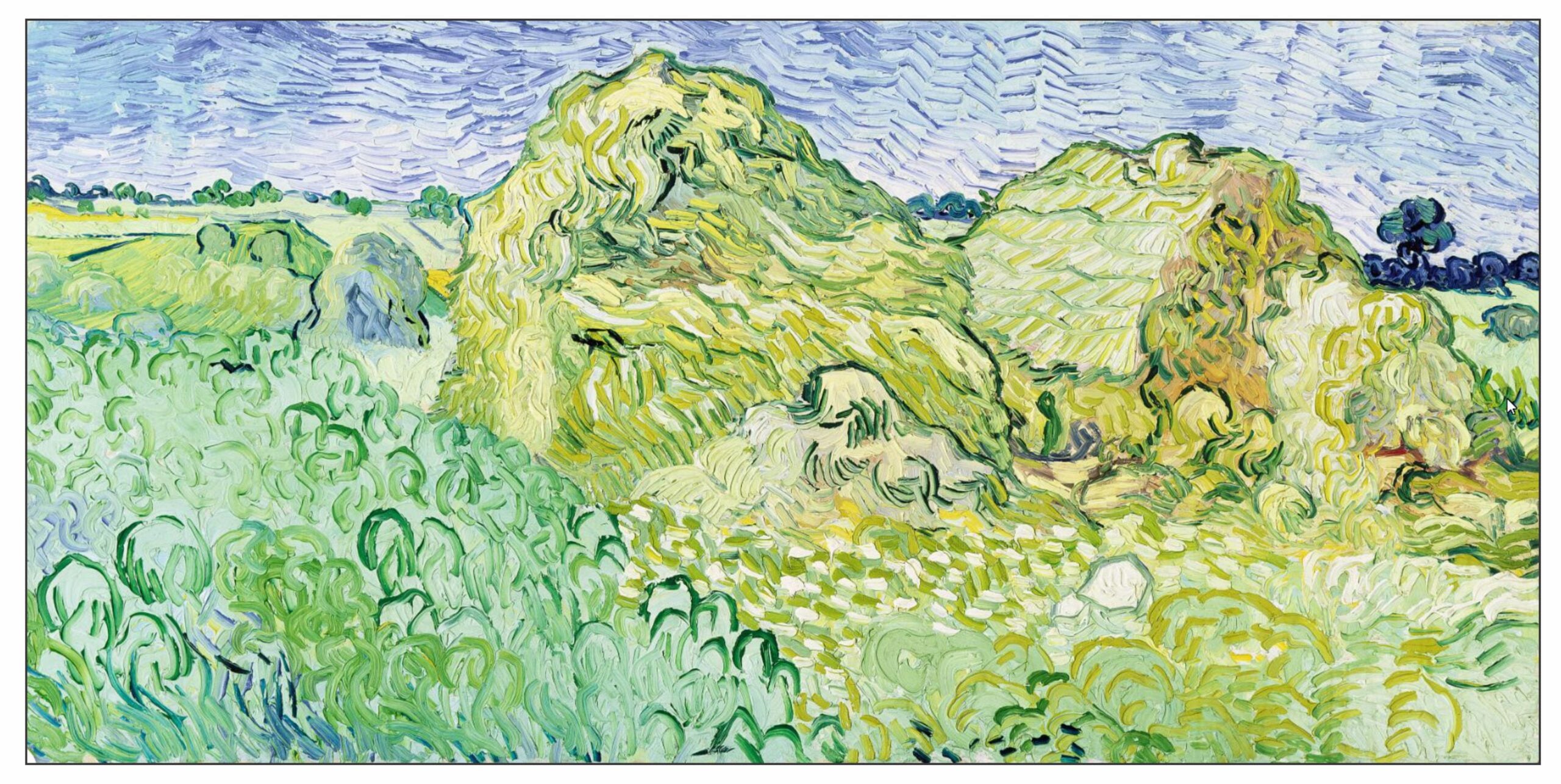
Vincent Van Gogh: The Double-Square Paintings

After a period of severe depression at the hospital at Saint-Rémy in the spring of 1890, Vincent Van Gogh (1853-1890) asked to be discharged. He left Saint-Rémy on May 16, 1890, and visited his brother Theo in Paris for a few days, before travelling to Auvers-sur-Oise, a small town about 30 km northwest of Paris, where Charles-François Daubigny had lived, and where several Impressionists, among them Camille Pissarro and Paul Cézanne, had painted. Auvers was also the home of Paul-Ferdinand Gachet, a kindly physician whom Theo had asked to accept his brother as a patient. Van Gogh arrived in Auvers on May 20, 1890. Over the next ten weeks he created 74 paintings. Among these, twelve used a “double-square” format: 100 by 50 cm. In these paintings, Van Gogh attempted to express his new vision of the world. Unfortunately, his depression persisted and on the evening of July 27, 1890, he shot himself with a revolver, dying from the injury two days later. The illustration shows his last self-portrait painted in Saint-Rémy in September, 1889.  

Doctor Gachet

Paul-Ferdinand Gachet (1828-1909) had trained at the Salpêtrière Hospital, but had retired to Auvers where he practised homeopathy. After his wife died in 1875, Gachet lived the life of a melancholy widower with his two children, Marguerite (born 1869) and Paul Jr. (born 1873). He collected paintings, and was himself an amateur artist. He possessed a small printing press.

Van Gogh met Doctor Gachet on the day of his arrival in Auvers. He found him a sad and sensitive man, but realized that he would probably not be able to help him with his depression. In a letter to Theo, he remarked

I think that we must in no way count on Dr Gachet. In the first place he’s iller than I am, it seemed to me, or let’s say just as much, there you have it. Now when one blind man leads another blind man, do they not both fall into the ditch?

Nevertheless, Von Gogh visited him frequently over the next several weeks and the two became friends. In a letter to his sister on June 5, he reported

I have found a true friend in Dr. Gachet, something like another brother, so much do we resemble each other physically and also mentally.

On June 3 he painted a portrait of the doctor (Saltzman, 1998). The doctor sits at a red garden table on which rests a foxglove plant. Foxglove, a source of digitalis, signifies the doctor’s medical profession. Also on the table are two yellow books: Germinie Lacerteux (1865) and Manette Salomon (1867) by Edmond and Jules de Goncourt. These novels, representative of the new movement of realism, tell depressing stories, and Van Gogh likely included them in the painting to reflect the doctor’s melancholy. The portrait is currently in a private collection. A copy of questionable authenticity is held by the Louvre.
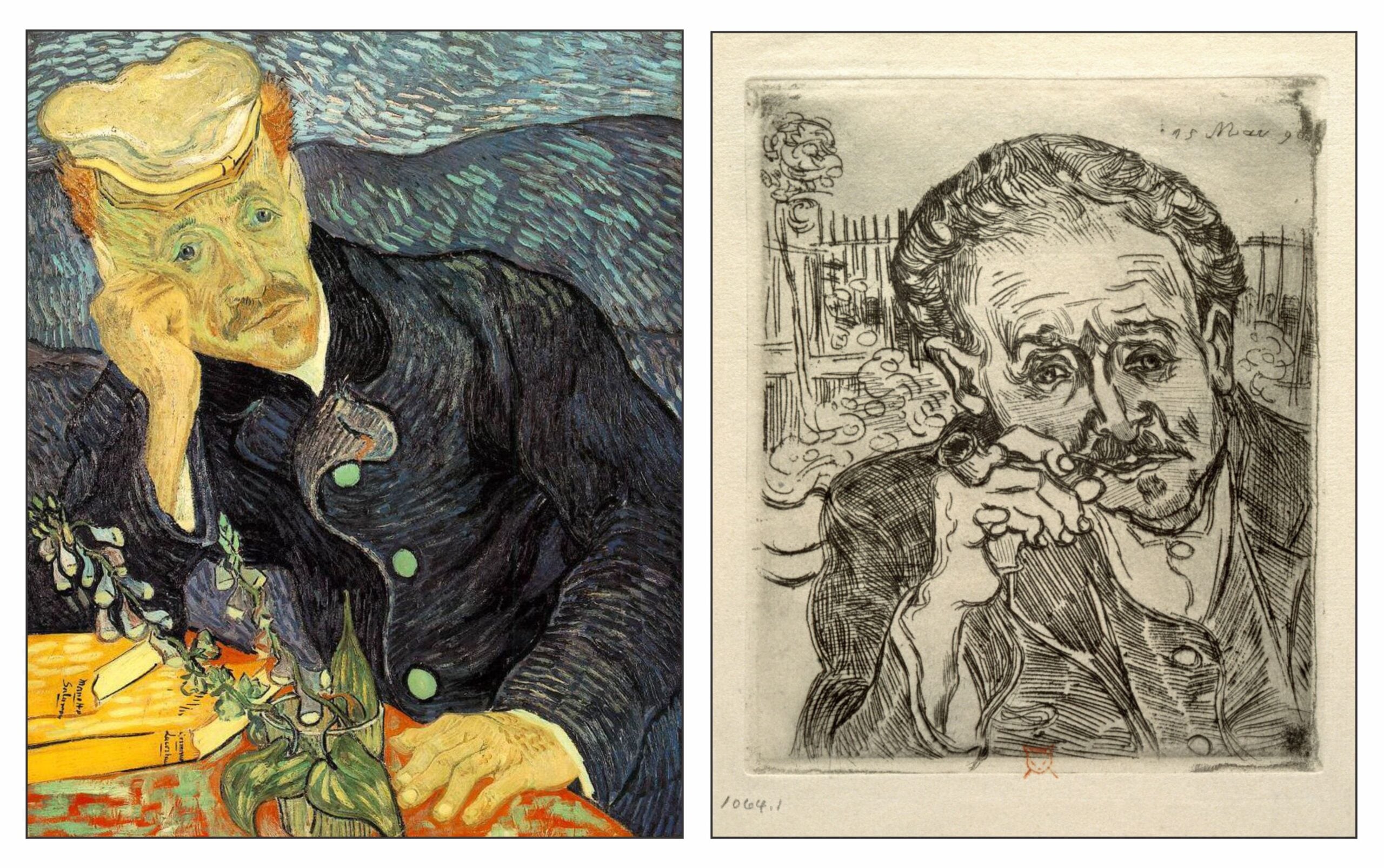
And on June 19 Gachet gave Van Gogh a prepared copper plate so that he could sketch another portrait for an etching. The plate was later etched, and multiple copies were printed either by Doctor Gachet or his son. One of them must have added the incorrect date 15 Mai 90 in a shaky backward handwriting so that it would come out properly on the print. This is the only etching that Van Gogh ever made, though his extensive experience with a reed-pen drawings made him a master of this approach.      

In a letter to his sister Wilhelmina, Van Gogh describes what he wanted to convey in his painting: 

I should like to paint portraits which would appear after a century to people living then as apparitions. By which I mean that I do not endeavour to achieve this by a photographic resemblance, but by means of our impassioned expressions – that is to say, using our knowledge of and our modern taste for colour as a means of arriving at the expression and the intensification of the character. So the portrait of Dr. Gachet shows you a face the colour of an overheated brick, and scorched by the sun, with reddish hair and a white cap, surrounded by a rustic scenery with a background of blue hills; his clothes are ultramarine – this brings out the face and makes it paler, notwithstanding the fact that it is brick-coloured.


Daubigny

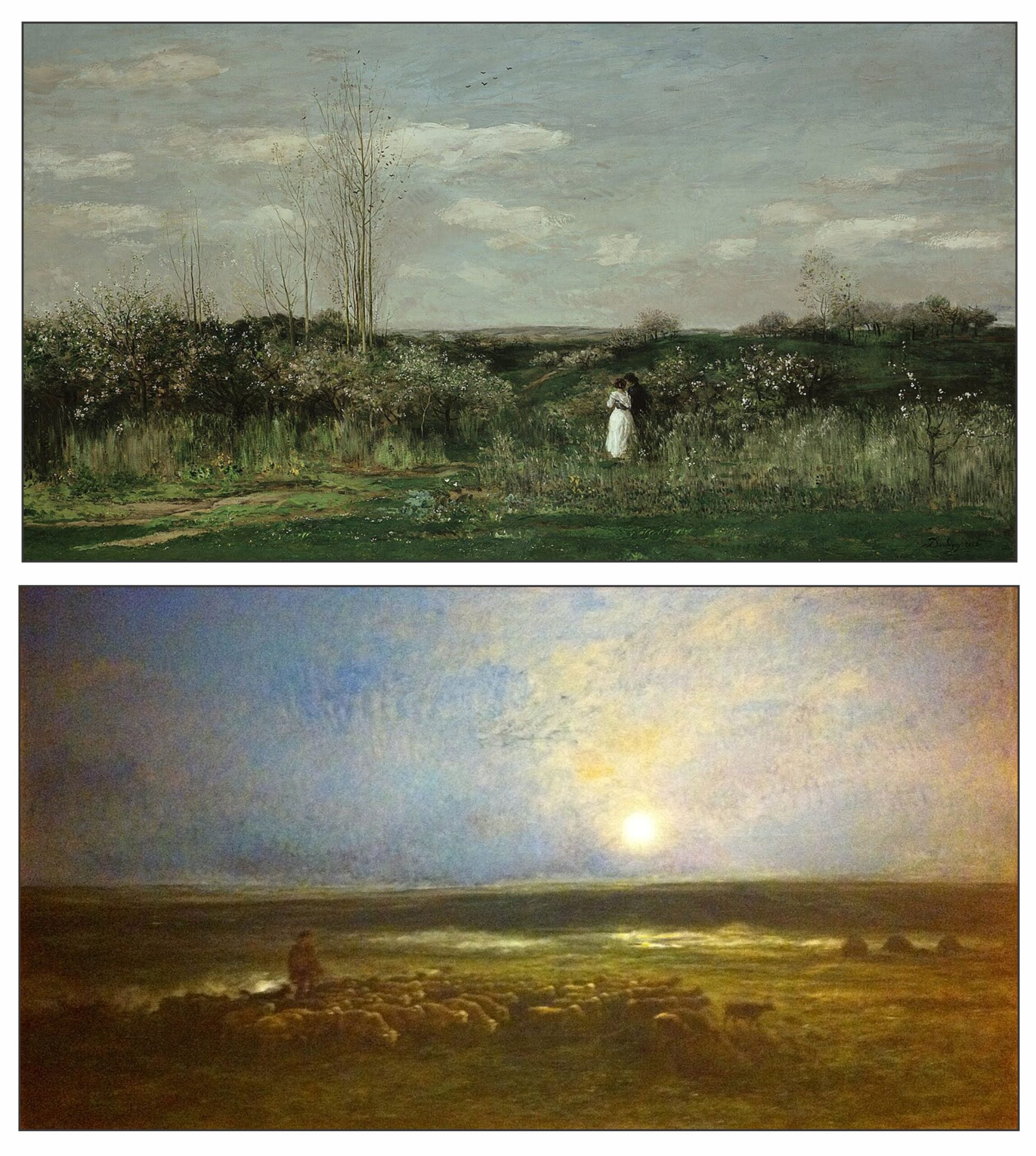
Charles-François Daubigny (1817-1878) was one of the first artists, together with Corot and Courbet, to practise painting en plein air. He wanted to capture the fleeting changes in light and color that happen in real life rather than in the studio. Daubigny settled in Auvers in 1860. While there he used a boat as a floating studio to paint the light effects on the Oise and Seine Rivers. His paintings are considered precursors to Impressionism. The following illustration shows two paintings: Springtime (1868) and Moonrise at Auvers or Return of the Flock (1878) 
Van Gogh held Daubigny in high regard (Bakker, 2015). He visited Daubigny’s widow in Auvers and painted the garden to the Daubigny villa on July 10, 1890:
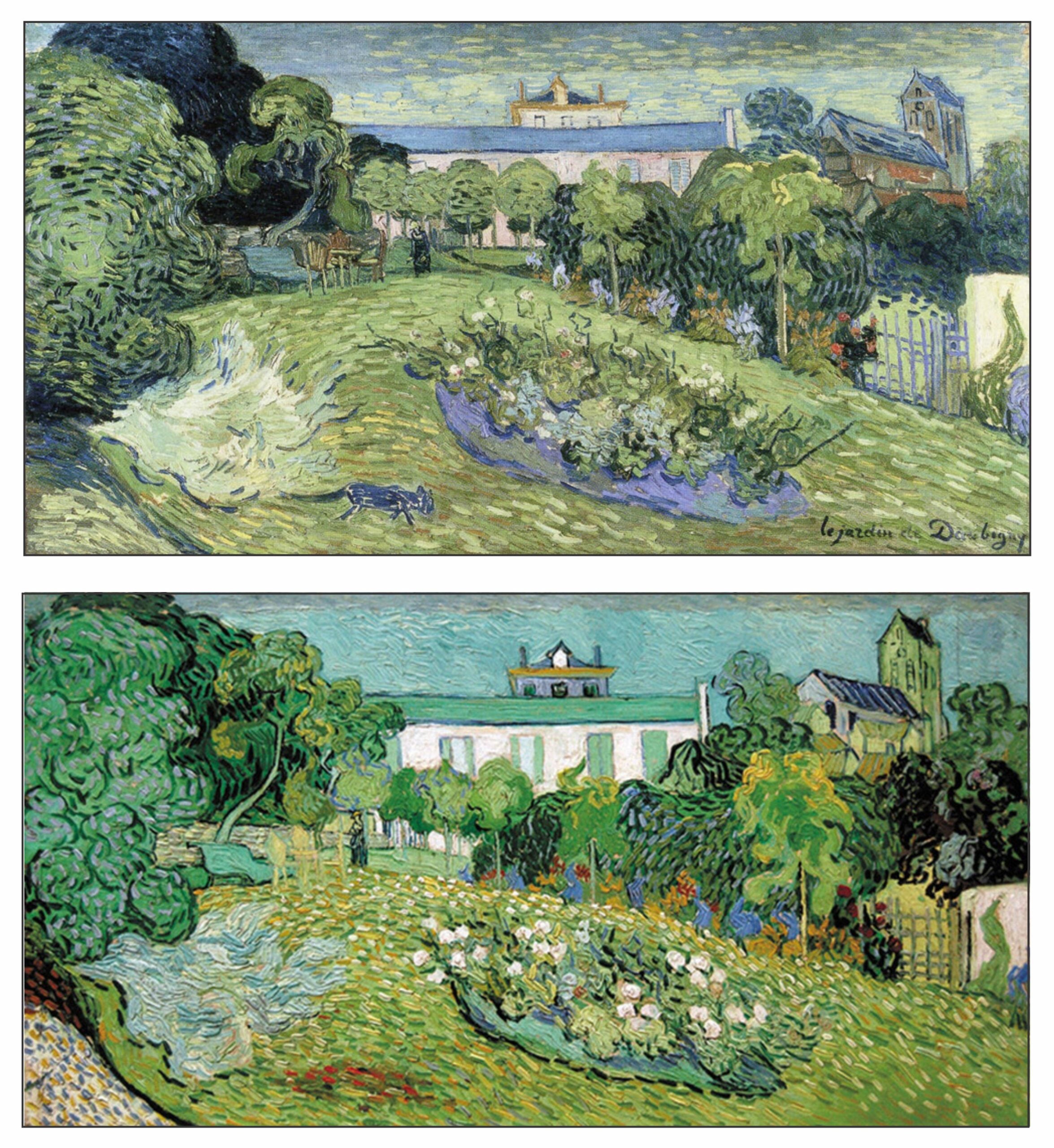
The first painting with the cat in the foreground is now in the Kunstmuseum in Basel and the later copy, painted on July 23, is in the Hiroshima Museum of Art. In the background to the right is the Romanesque Church of Notre-Dame-de-l’Assomption, just east of the villa. Van Gogh also made another smaller painting which focussed on the roses in the Daubigny garden. This painting was famously painted on a checkered napkin since Van Gogh had run out of canvas.  

Auvers-sur-Oise

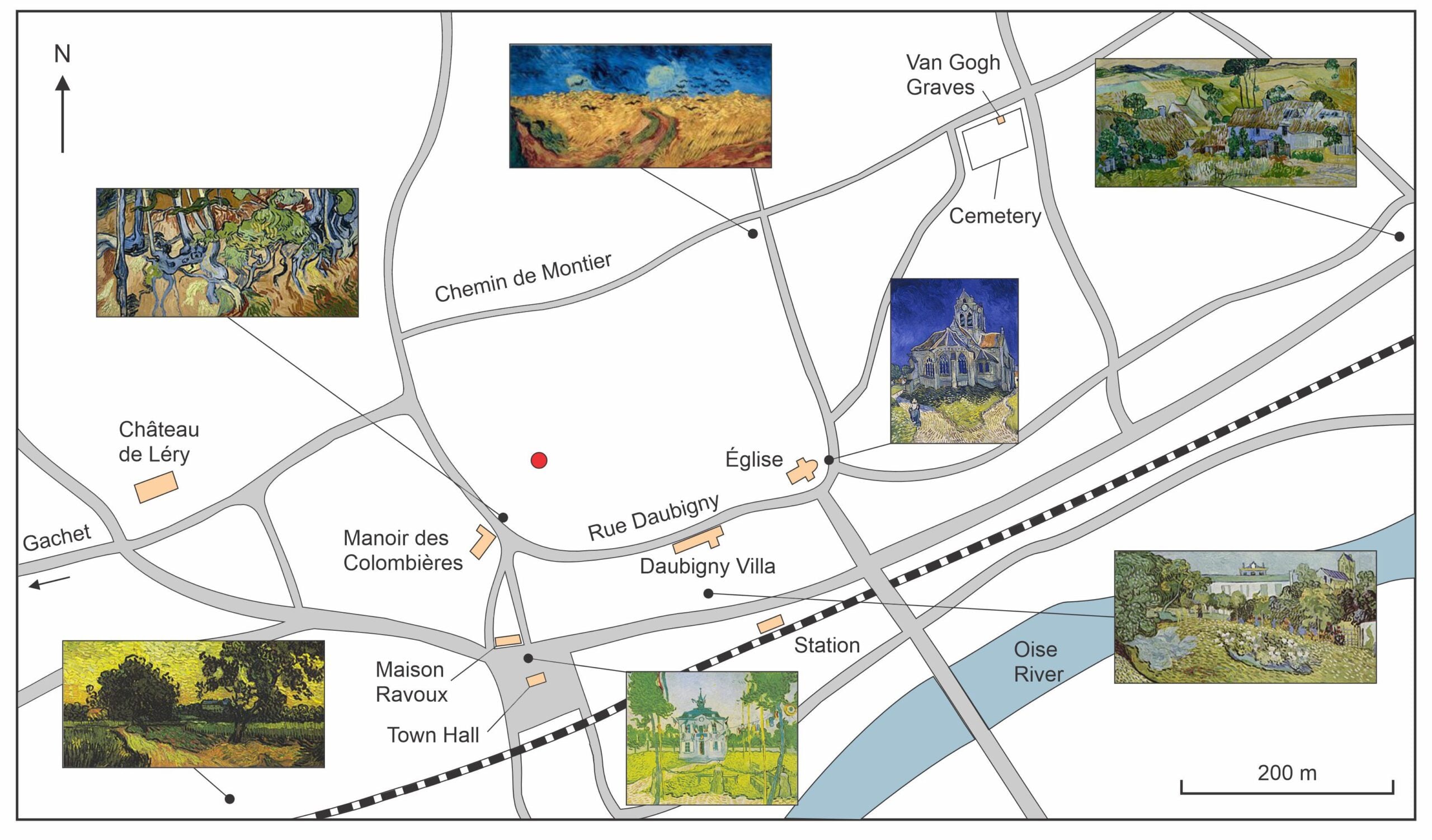
The following map of Auvers-sur-Oise, simplified from Van der Veen (2023a) shows the Daubigny Villa, the Maison Ravoux where Van Gogh found lodging, and the locations where he painted several of his pictures.
The Double-Square Format

In mid June Van Gogh had begun to use canvases that were 100 by 50 cm for some of his paintings – a double-square format (Pickvance, 1986, p 258; Coquery 2023; Bailey, 2021a, pp 102-115). Two of the July paintings of Daubigny’s garden were in this format. Daubigny had painted his landscapes using wide canvasses, and it is possible that Van Gogh chose his new format with his predecessor in mind. Van Gogh had also been impressed the recent painting Inter Artes et Naturam (1890) of Pierre Puvis de Chavannes (1824-1898) which he had seen in Paris (Wattenmaker, 1981). This is 295 x 830 cm, almost a triple-square
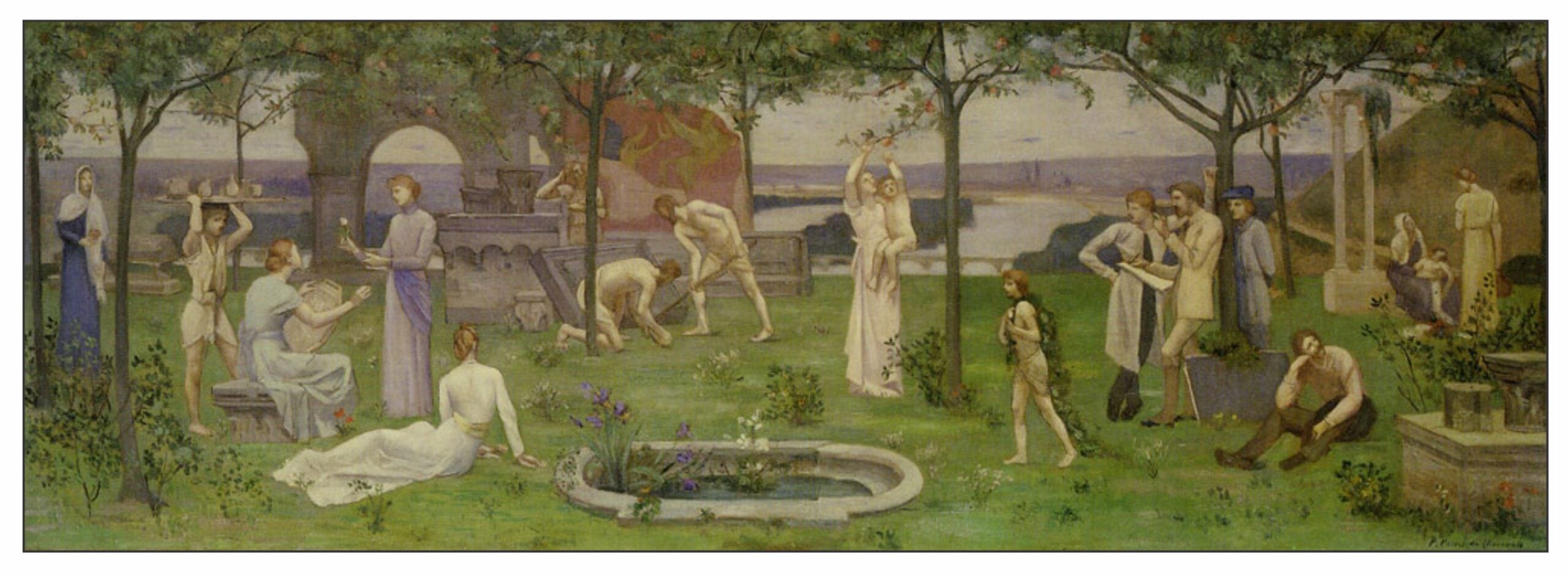
Puvis de Chavannes’ painting shows figures unearthing architectural relics, creating ceramics, and picking blossoms in a park beside the River Seine. All under the watchful eyes of several artists who are sketching their endeavors. The painting celebrates both artistic creativity and the beauty of nature without which art could not occur. Puvis de Chavanne made the original for Musée des Beaux-Arts in Rouen, but he also made several smaller copies. The following is Van Gogh’s description in his letter to his sister Wilhelmina on June 5

On one side two women, dressed in simple long robes, are talking together, and one the other side men with the air of artists; in the middle of the picture a woman with her child on her arm is picking a flower off an apple tree in bloom. One figure is forget-me-not blue, another bright citron yellow, another of a delicate pink colour, another white, another violet. Underneath their feet a meadow dotted with little white and yellow flowers. A blue distance with a white town and a river. All humanity, all nature simplified, but as they might be if they are not like that.
This description does not tell you anything – but when one sees this picture, when one looks at it for a long time, one gets the feeling of being present at a rebirth, total but benevolent, of all things one should have believed in, should have wished for – a strange and happy meeting of very distant antiquities and crude modernity.


The following is Van Gogh’s description of his first double-square paintings in his letter to Theo on June 24, 1890:

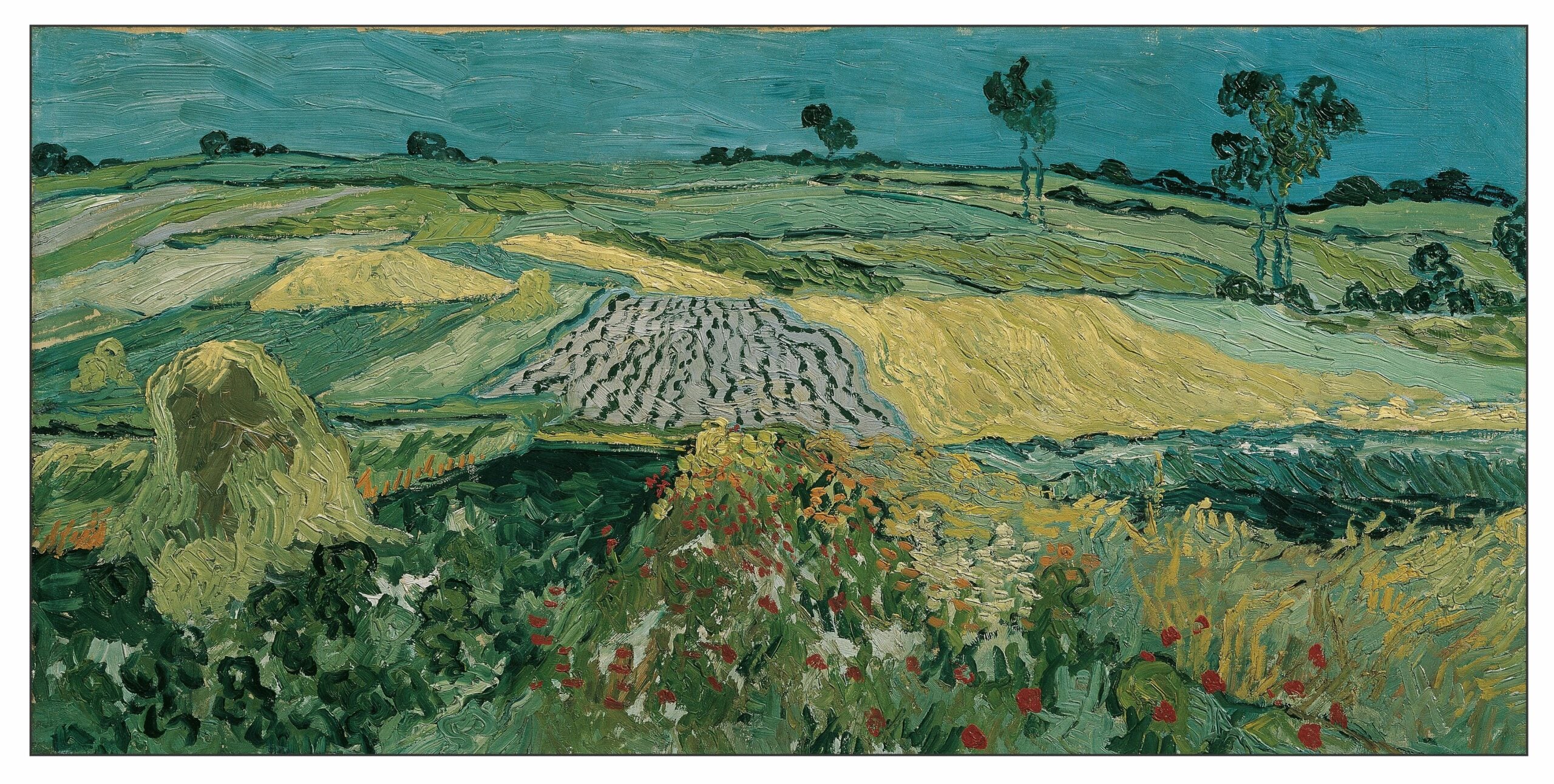
Then I have a canvas one metre long by only 50 centimetres high, of fields of wheat, and one that makes a pendant of undergrowth, lilac trunks of poplars, and underneath them some flower-dotted grass, pink, yellow, white and various greens.

The following is the first of these paintings, Wheatfields near Auvers:
This is the mysterious Undergrowth with Two Figures:
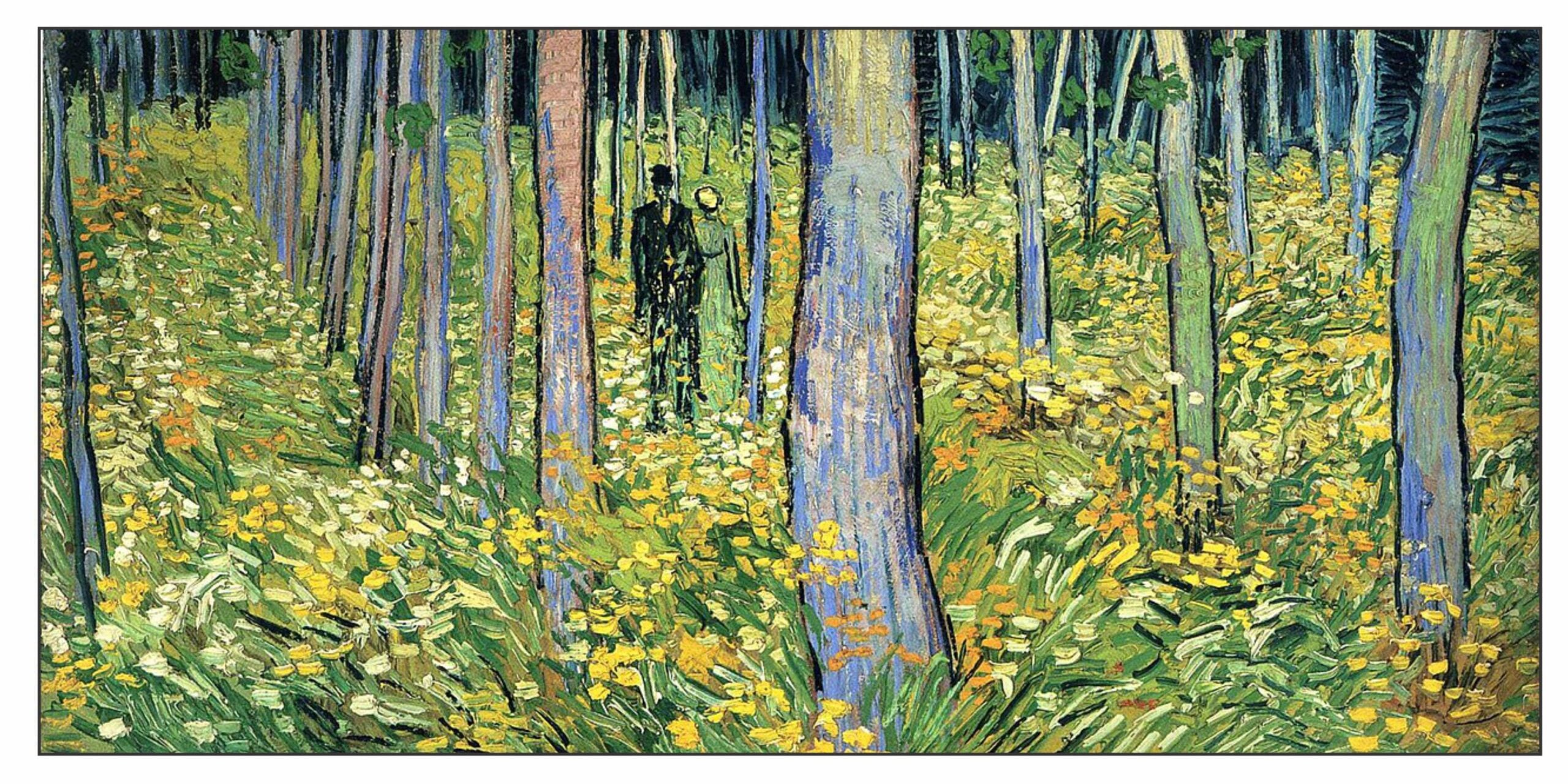
Coquery (2023) comments on the latter

No horizon here, rather a closed space punctuated by the hypnotic rows of poplars with their uncertain vanishing lines; and in the foreground a trunk that is abnormally large compared to the others, designed to intensify the perspective. The geometry of the trunks, emphasized by strong black outlines, contrasts with the vigorous profusion of grasses and flowers, more thickly painted and hardly credible as undergrowth.
Strangely, Van Gogh does not mention the ghostly, frontally rendered couple, and the uncertainty of scale as they seem to float between the trunks and the waist-high grass that sprinkles their Sunday clothes. The pair – especially the man who wears a kind of top hat – resembles a bridal couple who have strayed too far from a church square. It represents the last instance of the loving-couple motif that pervades the artist’s oeuvre like a poignant regret.
In its haunting geometry this painting can be read as a reinterpretation of the orchard in Pierre Puvis de Chavannes’s great work, Inter artes et naturam.

Puvis de Chavannes might have represented the beauty of antiquity, but Van Gogh distilled into his painting the loneliness of modern life.

The following is Landscape at Twilight:
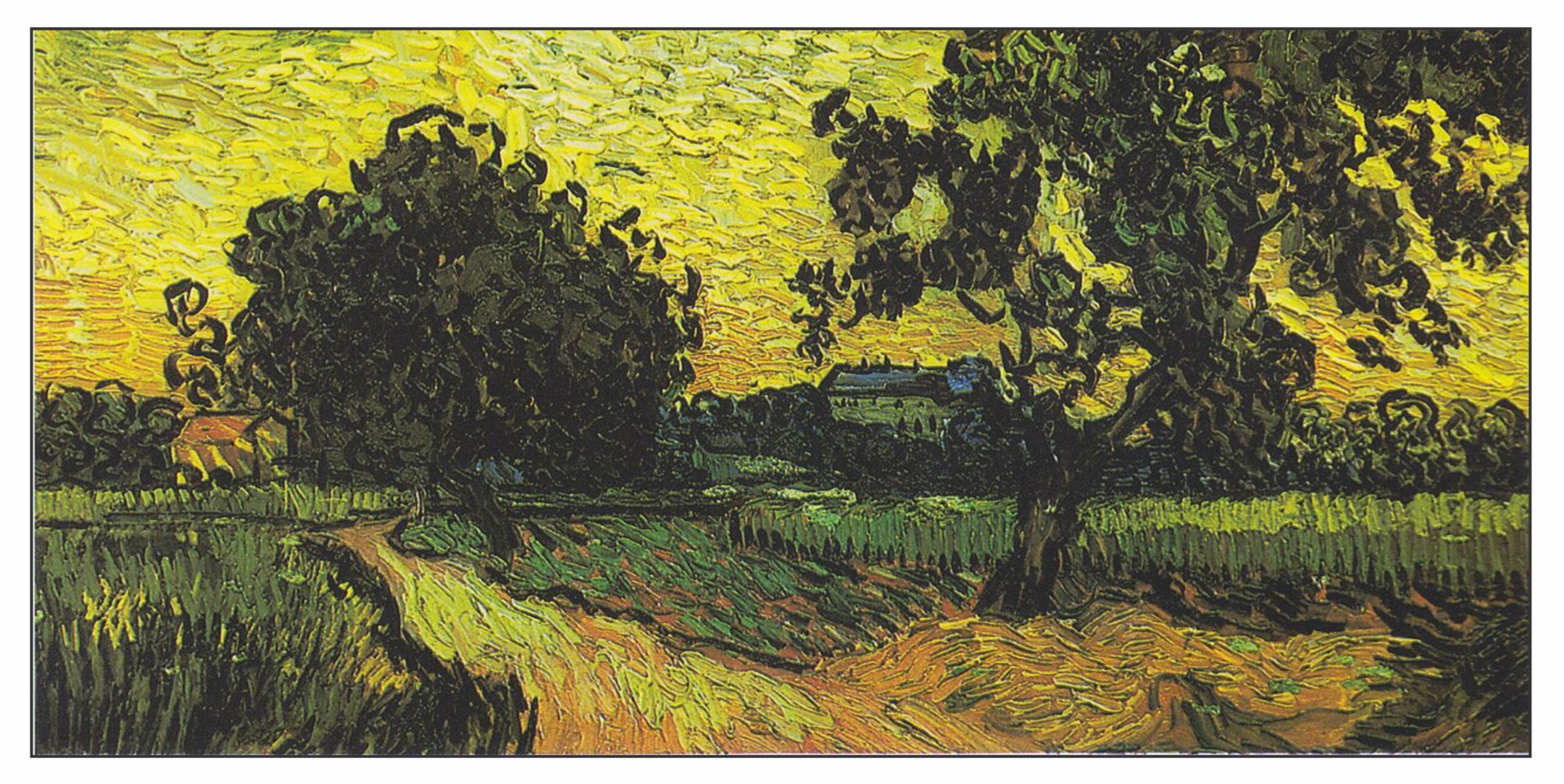
The painting is reminiscent of some of the twilight paintings of Daubigny, although Van Gogh’s colours are more intense and his brushwork far more energetic. The picture is evenly divided into bright sky and darker land. In the distance is the Château de Léry, built in 1635.

Van Gogh describes the painting in his letter of June 24

Finally a night effect – two completely dark pear trees against yellowing sky with wheatfields, and in the violet background the castle encased in the dark greenery.

A week after these first three double-square pictures, Van Gogh painted a portrait of Marguerite Gachet at the Piano using his new format, but orienting it vertically. In a letter to Theo on June 28, he described the painting

Yesterday and the day before I painted Mlle. Gachet’s portrait, which I hope you will see soon; the dress is pink, the wall in the background green with orange spots, the carpet red with green spots, the piano dark violet; it is 1 metre high by 50 cm wide.

The following illustration shows the portrait and an excerpt from the letter where Van Gogh suggests that the portrait and the Wheatfields near Auvers would complement each other. The illustration shows the two paintings aligned as proposed: 
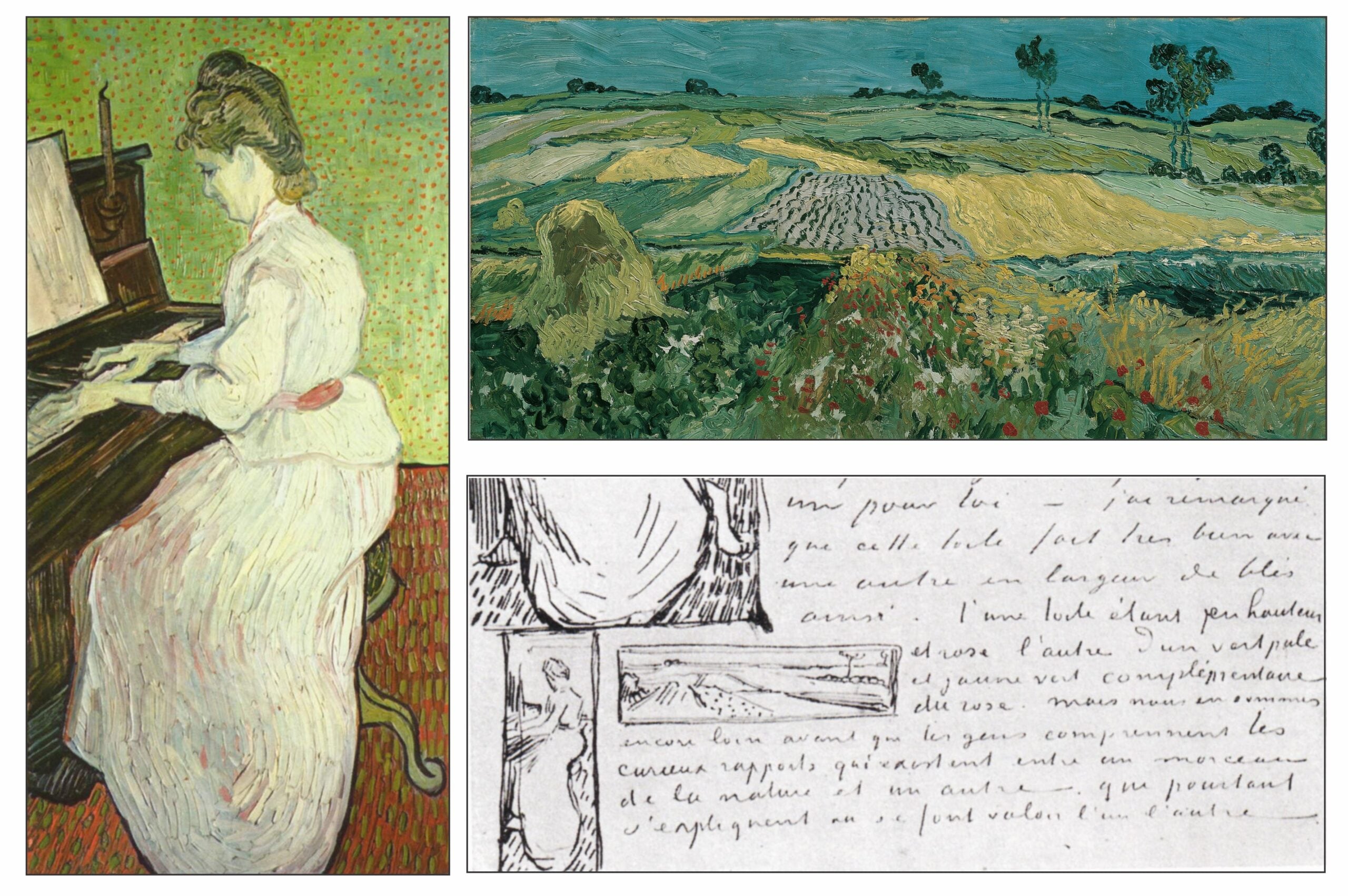
J’ai remarqué que cette toile fait très bien avec une autre en largeur, de blés, ainsi l’une toile étant en hauteur et rose, l’autre d’un vert pâle et jaune vert complémentaire du rose; mais nous en sommes encore loin avant que les gens comprennent les curieux rapports qui existent entre un morceau de la nature et un autre, qui pourtant s’expliquent et se font valoir l’un l’autre.
[I have noticed that this canvas goes very well with another horizontal one of wheat, as one canvas is vertical and in pink tones, the other pale green and greenish yellow, the complementary of pink; but we are still far from the time when people will understand the curious relation between one fragment of nature and another, which all the same explain each other and enhance each other.]


Wheatfields under Turbulent Skies

Vincent Van Gogh visited Paris in early June and became aware of the stresses of his brother Theo. His newborn son had been sick, and Theo himself was uncertain whether to stay at his position with the art dealers Boussod and Valadon, or to strike out on his own. Vincent realized what a burden he had been for his brother. In a letter to Theo on July 10 he states

It’s no small thing when all together we feel the daily bread in danger, no small thing when for other causes than that we also feel our existence to be fragile.
Once back here I too still felt very saddened, and had continued to feel the storm that threatens you also weighing upon me. What can be done – you see I usually try to be quite good-humoured, but my life, too, is attacked at the very root, my step also is faltering.

He then states that he has just completed two

immense stretches of wheatfields under turbulent skies, and I made a point of trying to express sadness, extreme loneliness. You’ll see this soon, I hope – for I hope to bring them to you in Paris as soon as possible, since I’d almost believe that these canvases will tell you what I can’t say in words, what I consider healthy and fortifying about the countryside.

One of the paintings was Wheatfields under Thunderclouds, now in the Van Gogh Museum:
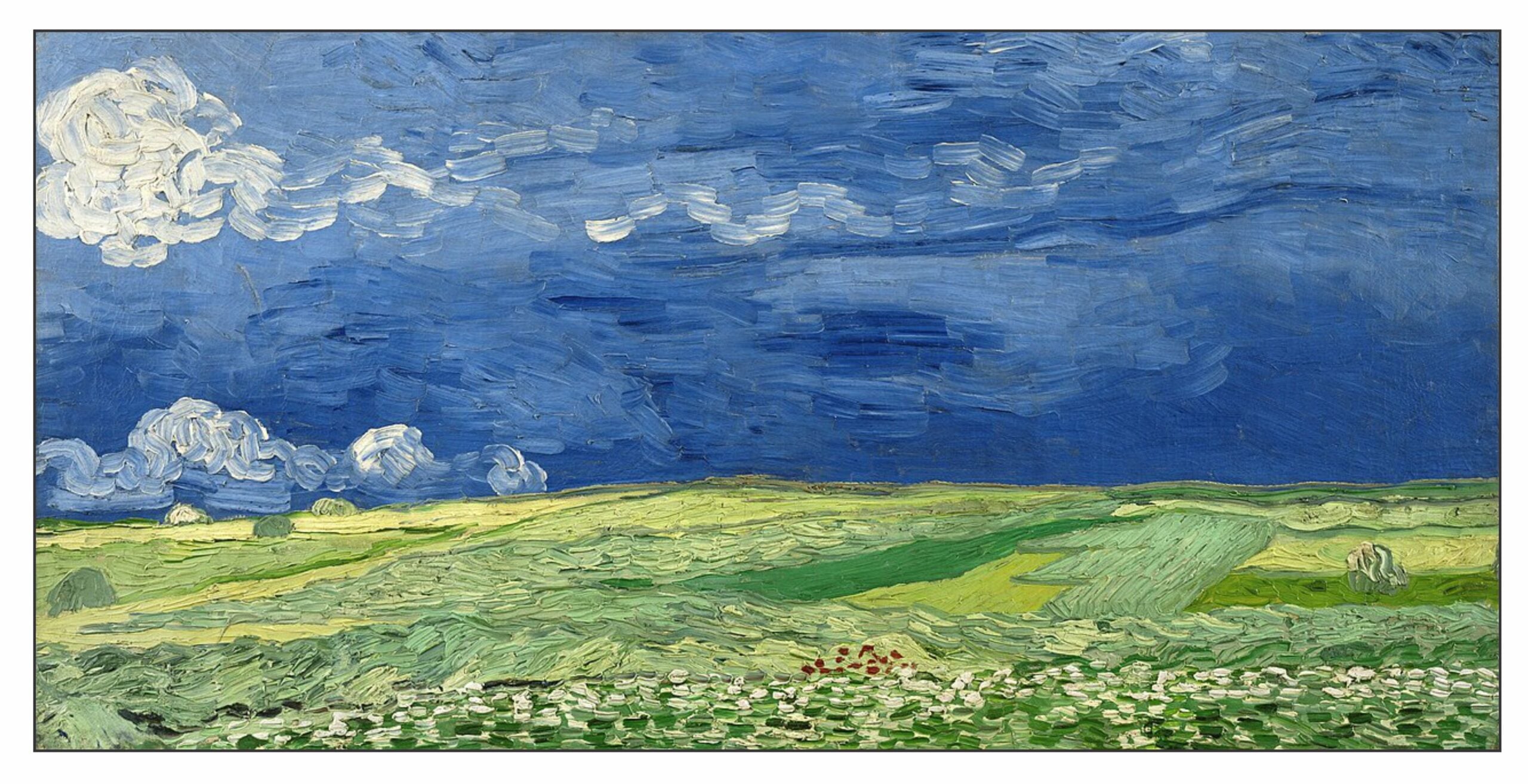
Coquery (2023, p 141) remarks that

This is the most austere of the double squares and the only one giving a predominant role to the sky, which is enlivened with heavy impasto and broad, lush brushstrokes. 

Despite the storm building up on the left, the painting conveys an abiding sense of peacefulness. The storm will come, but the fields will remain, the green will become golden and the harvest will begin.

The second painting is Wheatfield with Crows, also in the Van Gogh Museum.
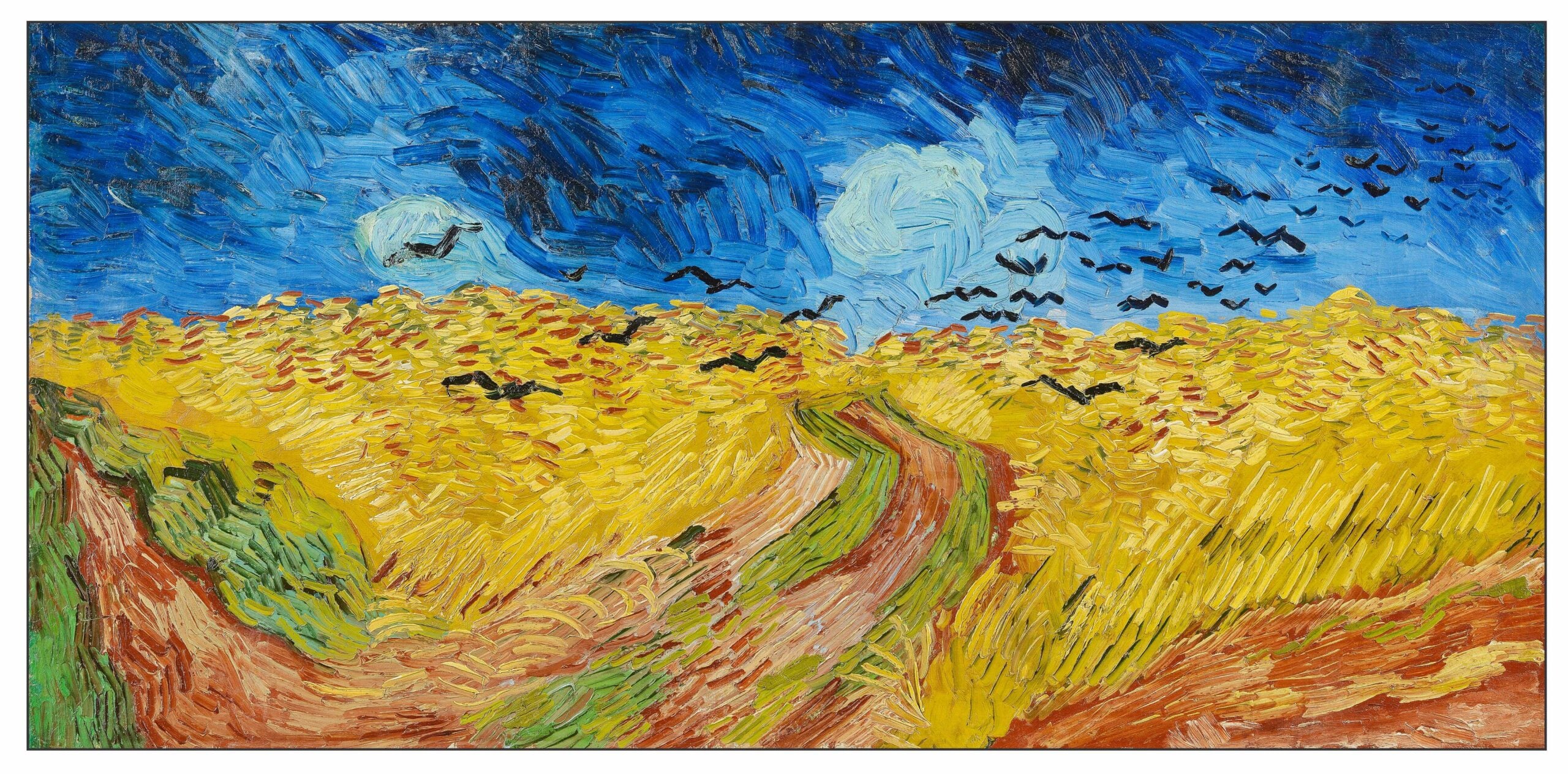
The painting is stormy. The brushstrokes are ragged. The sharp contrasts between blue and yellow and between red and green heighten the emotional intensity of the painting.  

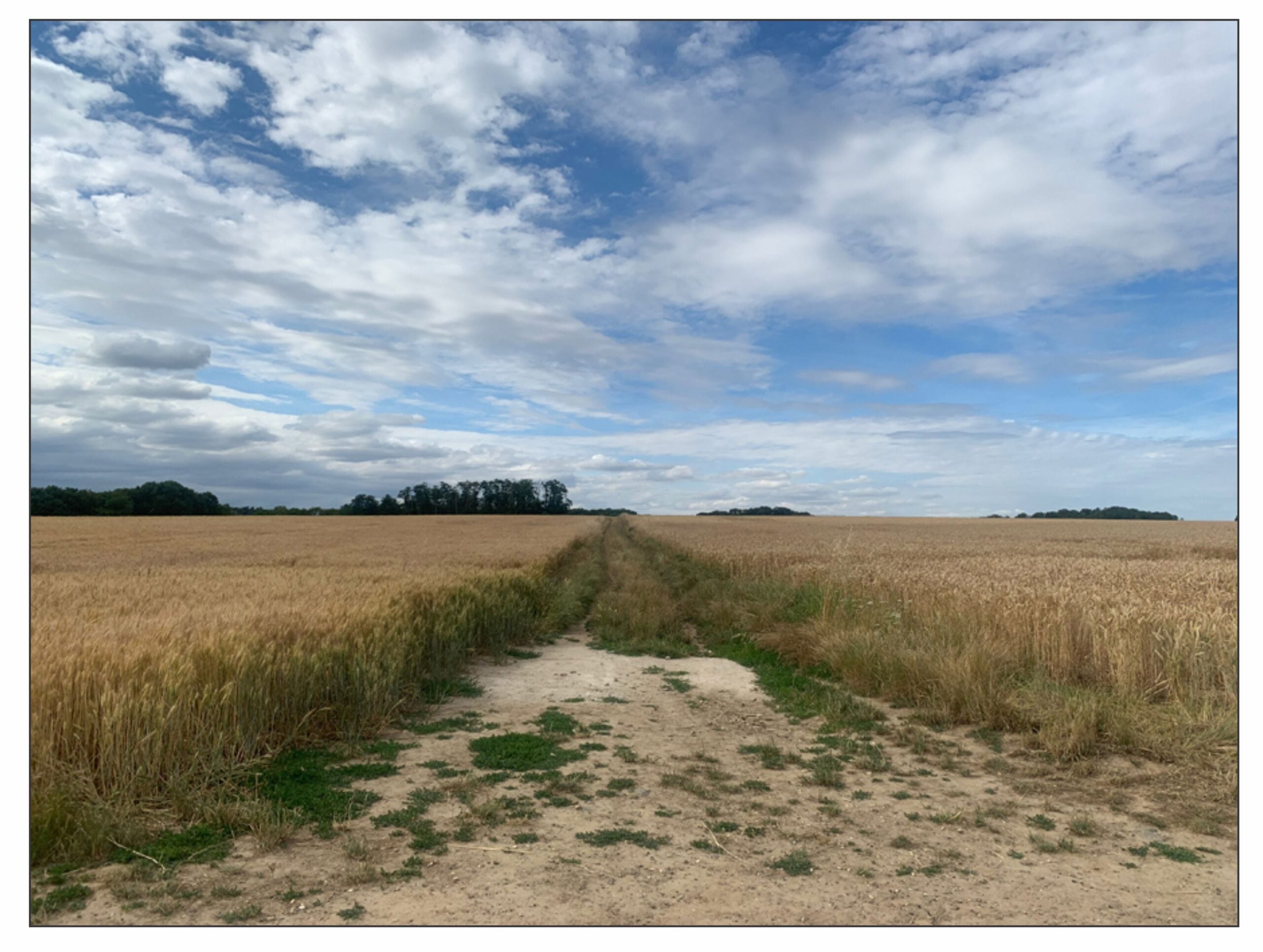
Although the horizon is clear there is no single vanishing point and no unifying perspective. The painting appears to show two triangular wheatfields. Wouter van der Veen (2023) took two photographs from the probable location of this painting. The first shows a path between two fields viewed from the side of the Chemin de Montier
The following shows the same scene photographed using a panoramic lens. Now the scene looks much more like the painting:
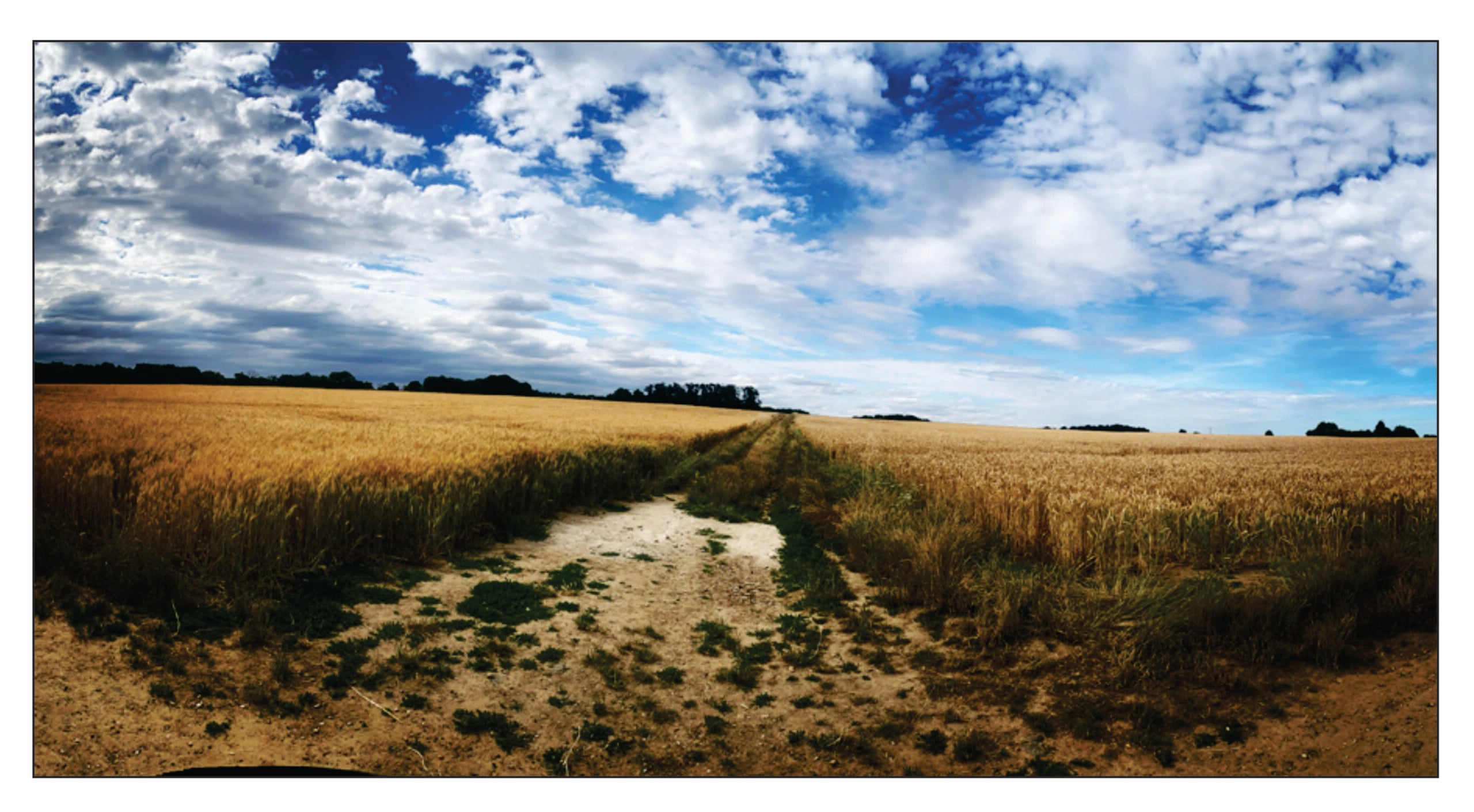
Van Gogh was using a panoramic perspective. This is much closer to what the human eye sees. Our field of vision is about 120˚ vertical by 200˚ degrees horizontal. This fits very well with Van Gogh’s double-square format. Most paintings deal with only the center of our field of vision where we see binocularly (about 120˚ square) and leave the periphery unrepresented.   

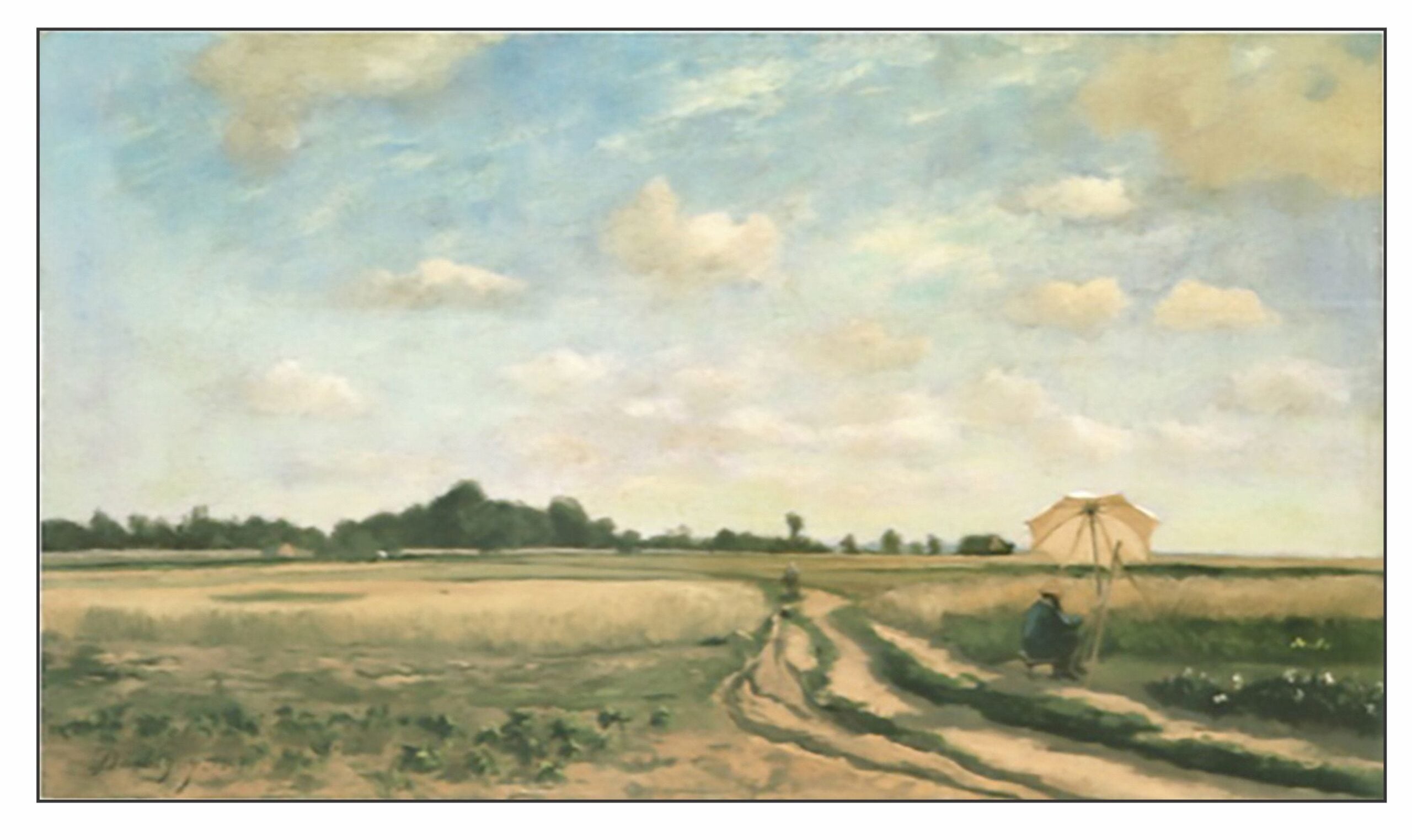
Bailey (2021a, p 24; 2021b) points to an 1843 painting by Daubigny that was likely taken from the same spot. Van Gogh may have known the painting and may have sought out the same location. However, there is a huge contrast between Daubigny’s peace and Van Gogh’s storm.  
Any interpretation of Wheatfield with Crows is forever tainted with the fact that the painting was long considered Van Gogh’s last painting before his suicide (Bailey 2021b). However, it is now known that the painting was finished almost three weeks before. It is not a harbinger of death. Rather, Erickson (1998, p 162) points out the Van Gogh considered wheatfields far more restorative than ominous. She quotes from a letter to Theo on July 2

It is just in learning to suffer without complaint, in learning to look on pain without repugnance, that you risk vertigo, and yet it is possible, yet you may even catch a glimpse of a vague likelihood that on the other side of life we shall see good reason for the existence of pain, which seen from here sometimes so fills the whole horizon that it takes on the proportions of a hopeless deluge. We know very little about this, about its proportions, and it is better to look at a wheat field, even in the form of a picture.

Van Gogh was clearly suffering and he was contemplating death, but he looked to the wheatfields for affirmation. Erickson remarks (p 164)

If the roads, as they run out of the painting or disappear among the resplendent wheat, in Crows over the Wheatfield, were intended to represent death, it is a death of triumph and ultimate release. Taking into consideration van Gogh’s view of death, the images of crows and wheat, and country roads begin to come together to show what van Gogh describes as the “healthful and restorative forces” of the French countryside. The vast, troubled skies of deep royal blue, which occupy almost half of the compositional space of the painting are symbolic of the infinite, the ultimate goal of the artist’s pilgrimage. [the quotation is from the July 10 letter]


Harvest

By mid-July the harvest was in full swing. Van Gogh painted a peaceful representation of a Field with Haystacks


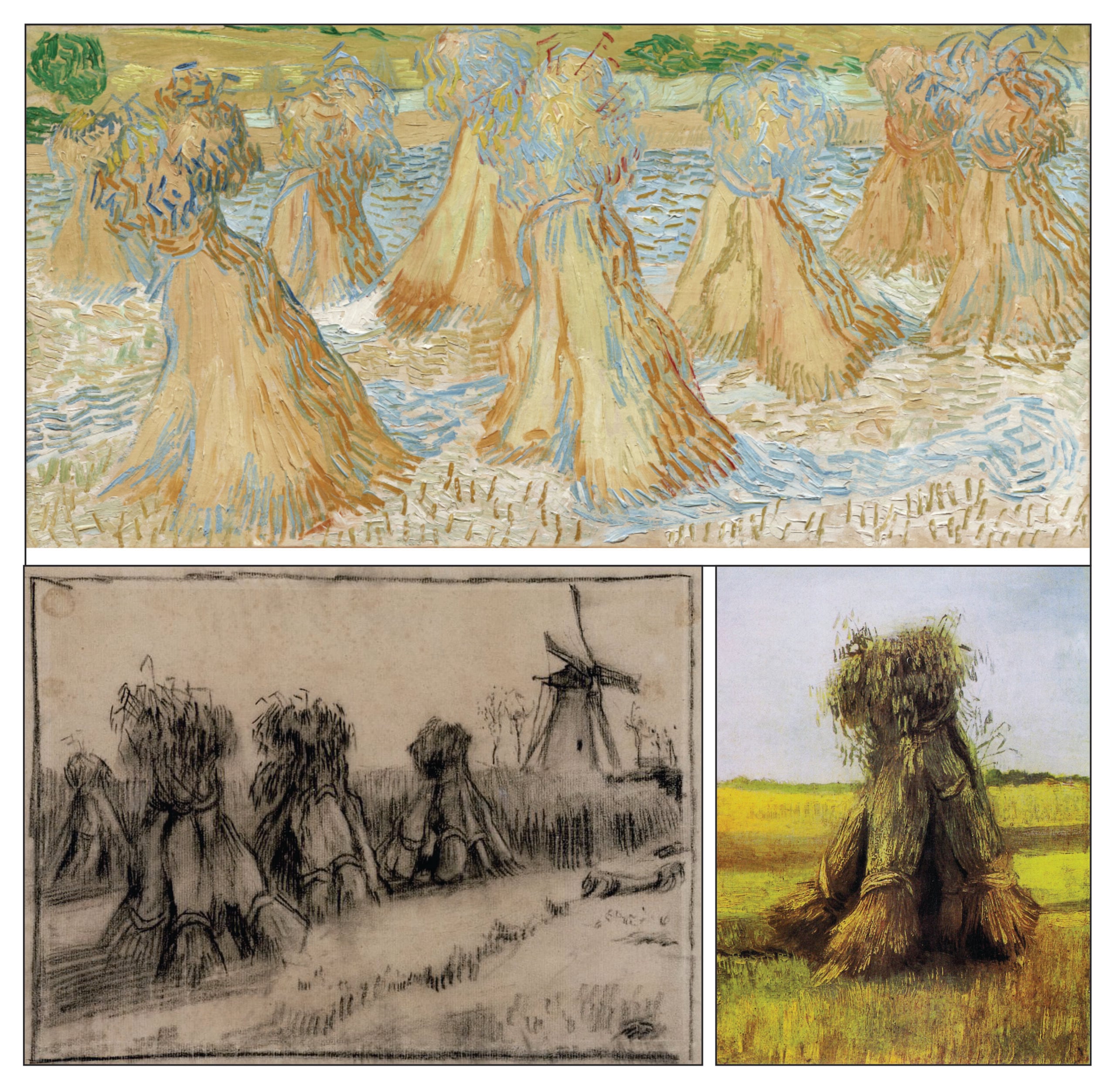
Van Gogh had long delighted in the harvest. The following illustration shows his representation of Wheat Sheaves from July 1890, together with an earlier drawing and painting from 1885. The 1890 painting is almost ethereal in its lightness.
 

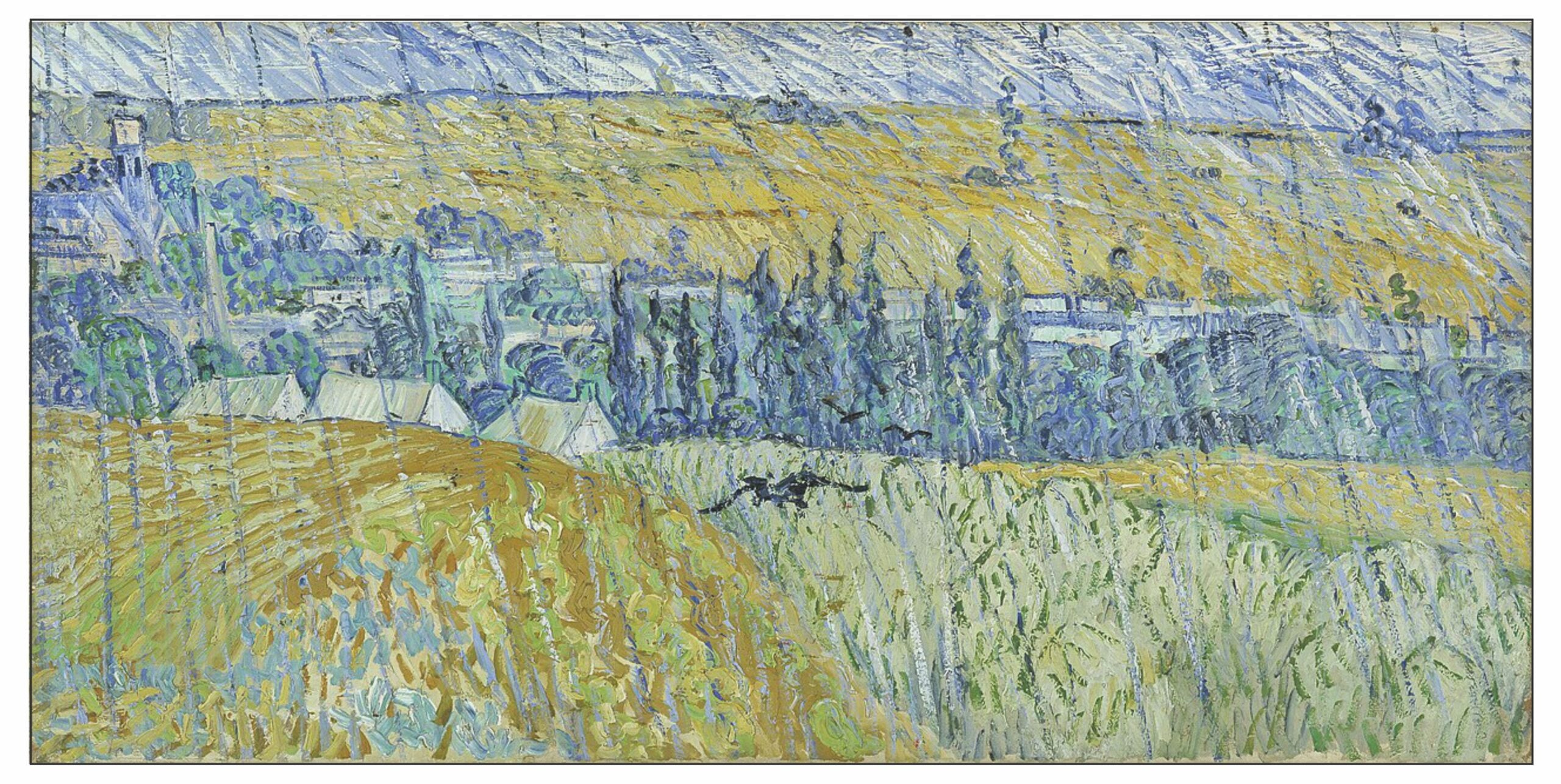
Even the rain did not dampen his peaceful feelings. The following painting of harvest fields in the rain was created on July 18. The crows are present, but they are part of the landscape:
 

Farms

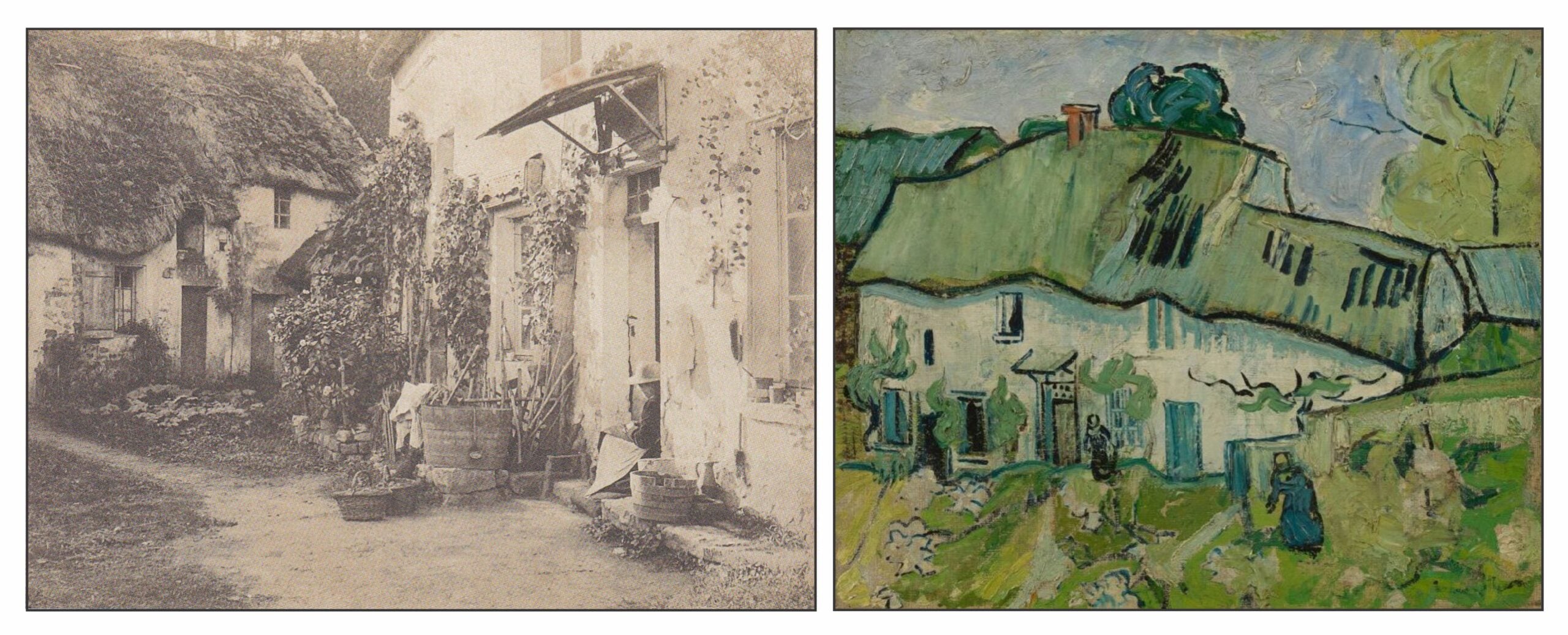
Soon after his arrival in Auvers, Van Gogh had painted a group of thatched farmhouses just to the east of Auvers.  The following illustration shows a photograph from 1887 (Van der Veen, 2023a, p 54) and one of Van Gogh’s paintings from late May or early June:
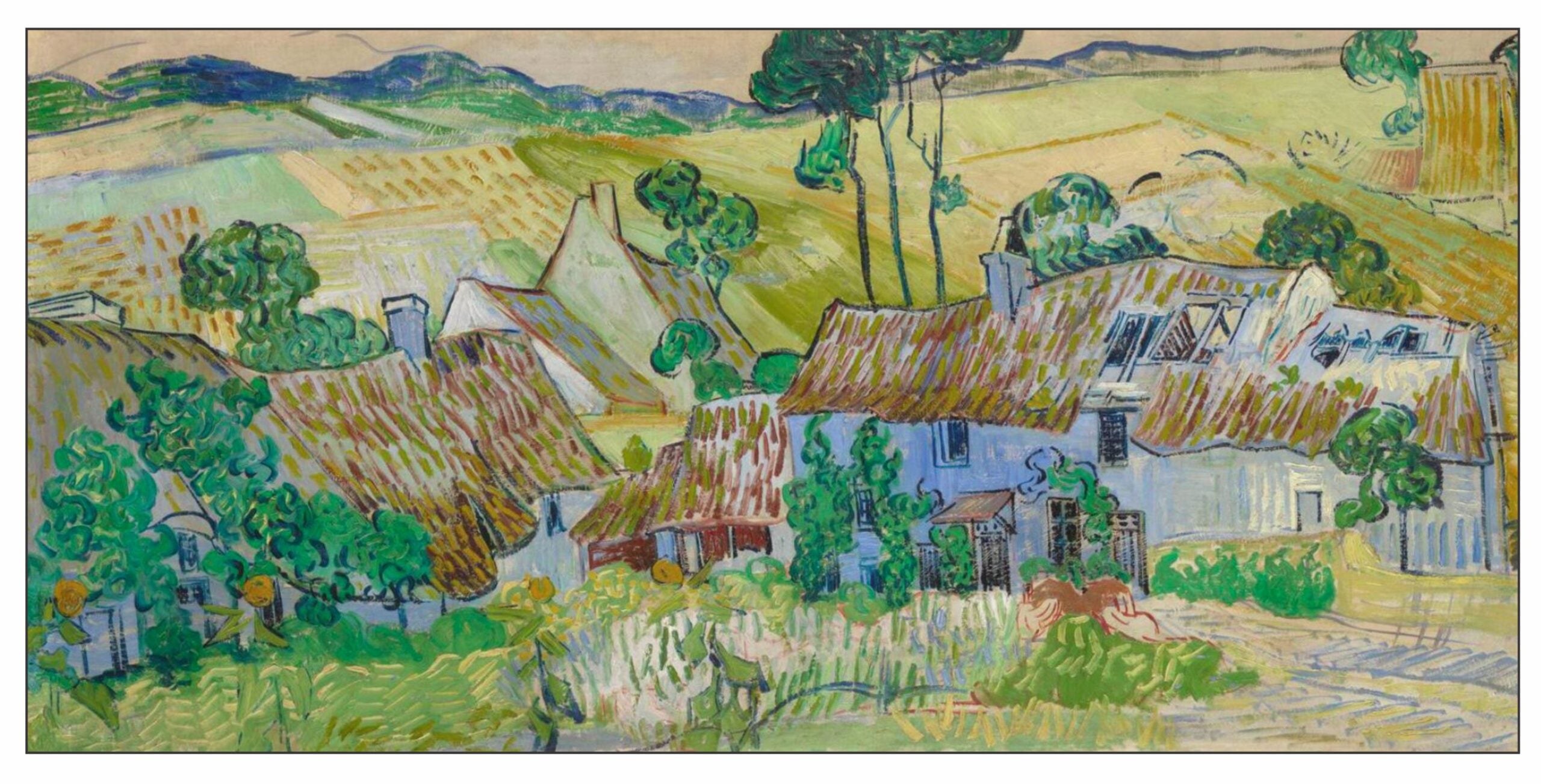
In the final days of his life, probably on July 26, Van Gogh returned to these farms and created a wonderfully peaceful picture of the farms. The double-square format allowed him to represent the whole group of farm buildings nestled together:
 

Tree Roots

Van Gogh’s last picture, painted on the day that he shot himself, was probably Tree Roots (Maes, & van Tilborgh, 2012). Some parts of the background are just flat colors and lack the final brushstrokes that Vang Gogh typically used. Van Gogh finished all his other paintings except for the Farms near Auvers, in which a small area of the sky was not completed. The painting represents the roots of trees at the side of a road.
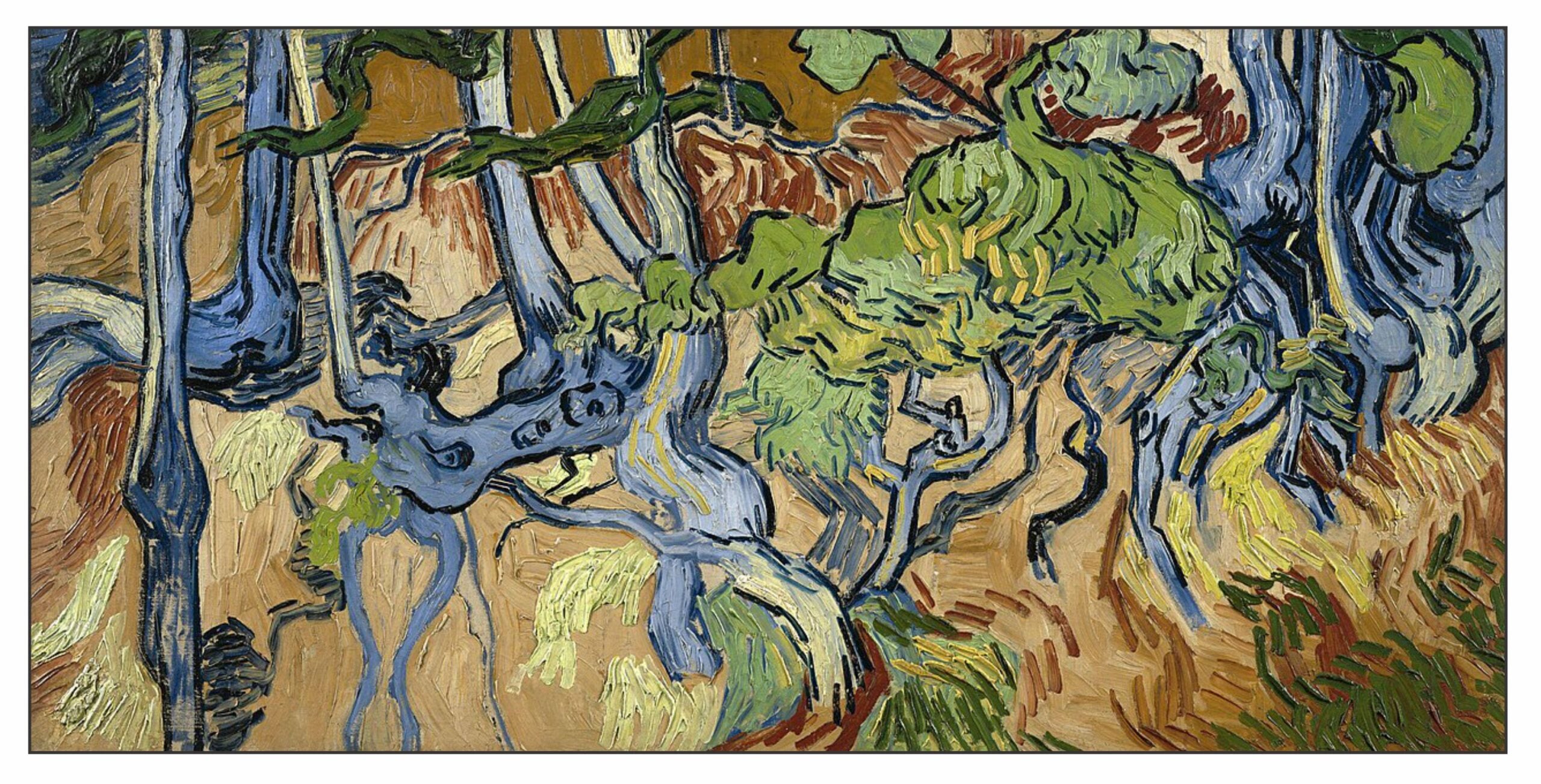
The following are comments by Pickvance (1986, pp 282-3):

Ambiguous, stylized, vitalistic, life-affirming, antinaturalistic yet palpably organic: a kind of prototype for an Art Nouveau frieze. No foreground, no element on which the viewer can get his spatial bearings, no sky to differentiate back-ground from foreground, no stabilizing horizontal. The roots and trunks are vertical; the ground plane is almost vertical. The motif could be part of the steep rise of the hillside, with the village below and the plain above, that characterizes the length of Auvers; van Gogh could have found it at almost any point. The image is passionately observed, yet objectively rendered.

Van der Veen (2020) found a postcard showing Rue Daubigny in the early years of the 20th Century. That allowed him to pinpoint the location of Van Gogh’s tree roots:
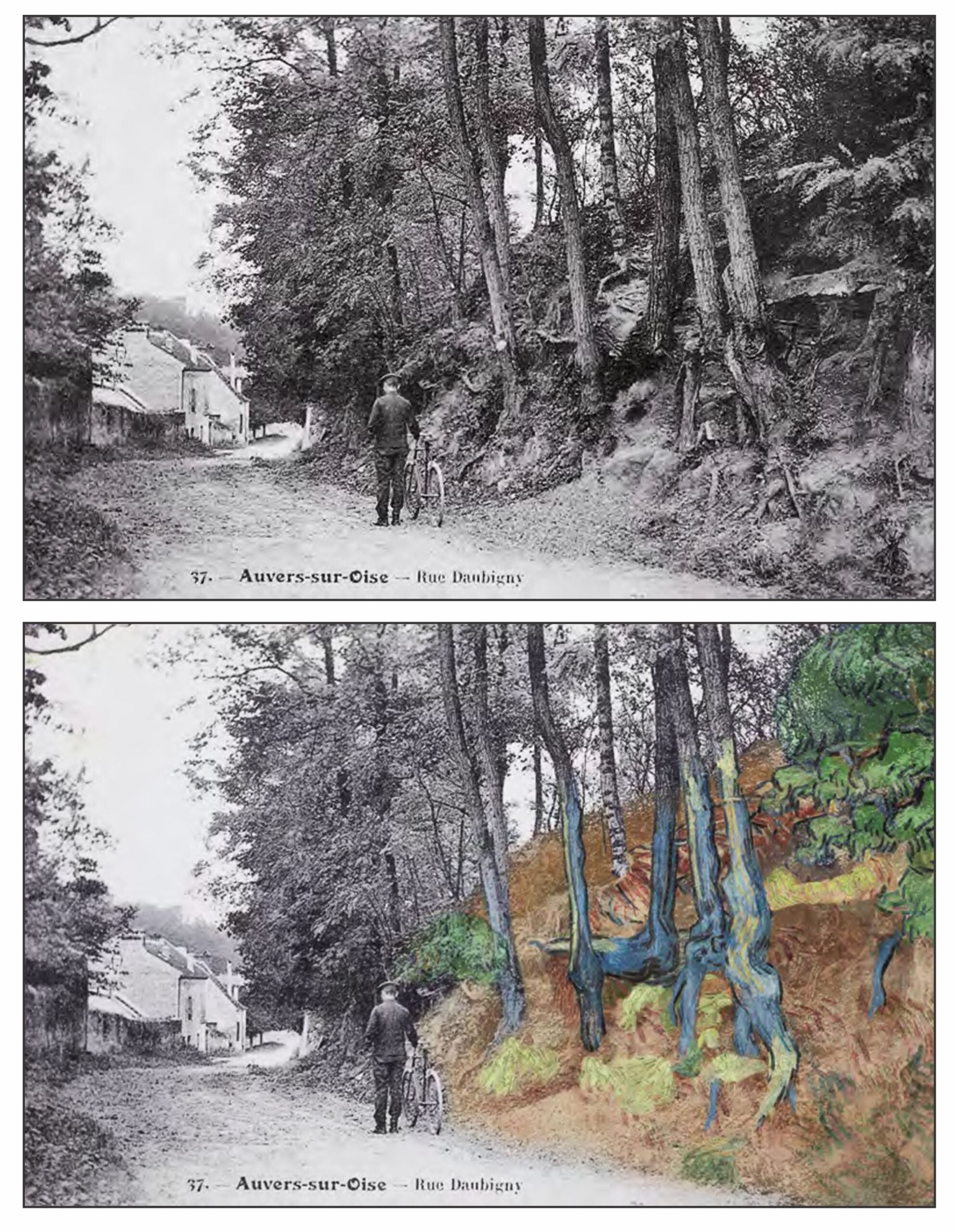
Suicide

After painting Tree Roots and bringing it back to his room at the Maison Ravoux, Van Gogh went out in the early evening of July 27 “behind the chateau.” There he shot himself with a revolver (Bailey 2021a, pp 117-125). Though he aimed at the heart, the bullet entered the lung or upper abdomen. After the shot, he must have lost consciousness for a brief time. When he came to, he searched for the revolver “to finish the job” but was unable to find it. However, he was able to walk painfully back to his lodgings. Doctors Gachet and Mazery examined him but decided that there was nothing that they could do. Theo Van Gogh was notified and arrived in Auvers on July 28. Van Gogh died at 1:30 am on July 29.

Doctor Gachet made a sketch of Van Gogh on his deathbed. Of interest is that he did not sketch the details of Van Gogh’s wounded left ear. He later made an etching from the sketch. Both are rudimentary. Gachet signed his works “Paul Van Ryssel” (or PVR) using the name of his birthplace near Lille (“Ryssel” in Flemish).
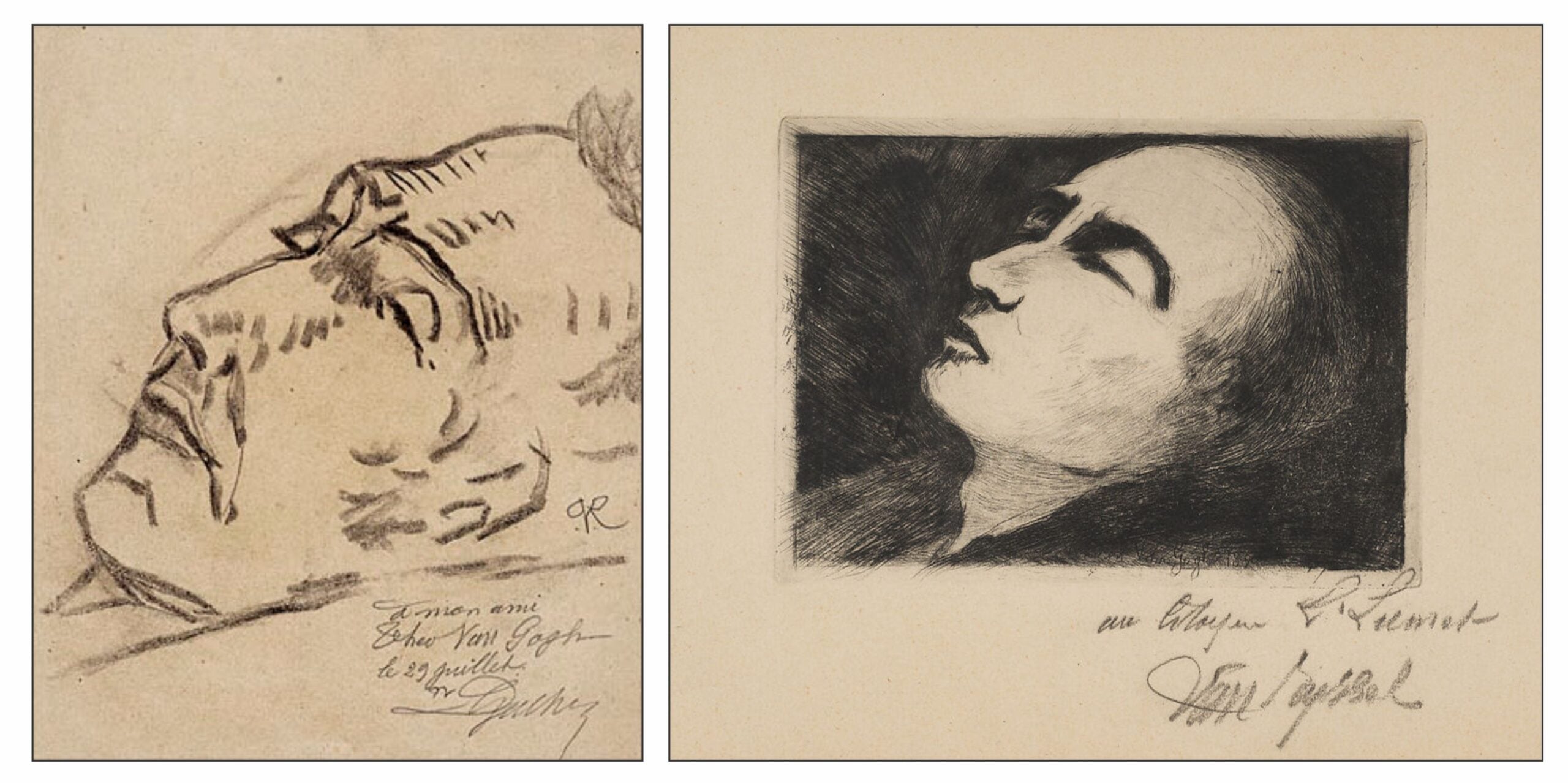
The location of the suicide is usually assumed to be north of Château Léry. However, this would have required a very long walk back to Maison Ravoux for a mortally wounded man. Van der Veen (2023c) has argued that the Manoir des Colombières was also referred to as a château, and claimed that the site of Van Gogh’s suicide was close to where he had made his last picture: the red dot on the map presented earlier in this posting, only 200 m from his lodgings. A rusted revolver found around 1960 in fields near Auvers was probably the one used by Van Gogh. He had apparently taken it from its owner, Arthur Ravoux, the manager of the inn where Van Gogh lodged (Bakker et al., 2016, p 80).   

It is impossible to know what led to Van Gogh’s decision to kill himself (Bakker et al., 2016). He suffered from recurrent episodes of depression. He felt he was a tremendous burden to his brother. Though he was convinced of the significance of his art, no one other than his brother and a few friends seemed to think it had any worth. 

Aftermath

Van Gogh was buried in the cemetery at Auvers. His brother Theo died six months later, apparently of the late effects of syphilis, though grief may have played a role. Though he was initially buried in Utrecht, where he was hospitalized, His wife Joanna Bonger-Van Gogh arranged for his body to be transferred to Auvers in 1914, and the two graves rest side by side, covered with ivy that came from a cutting from the garden of Doctor Gachet:
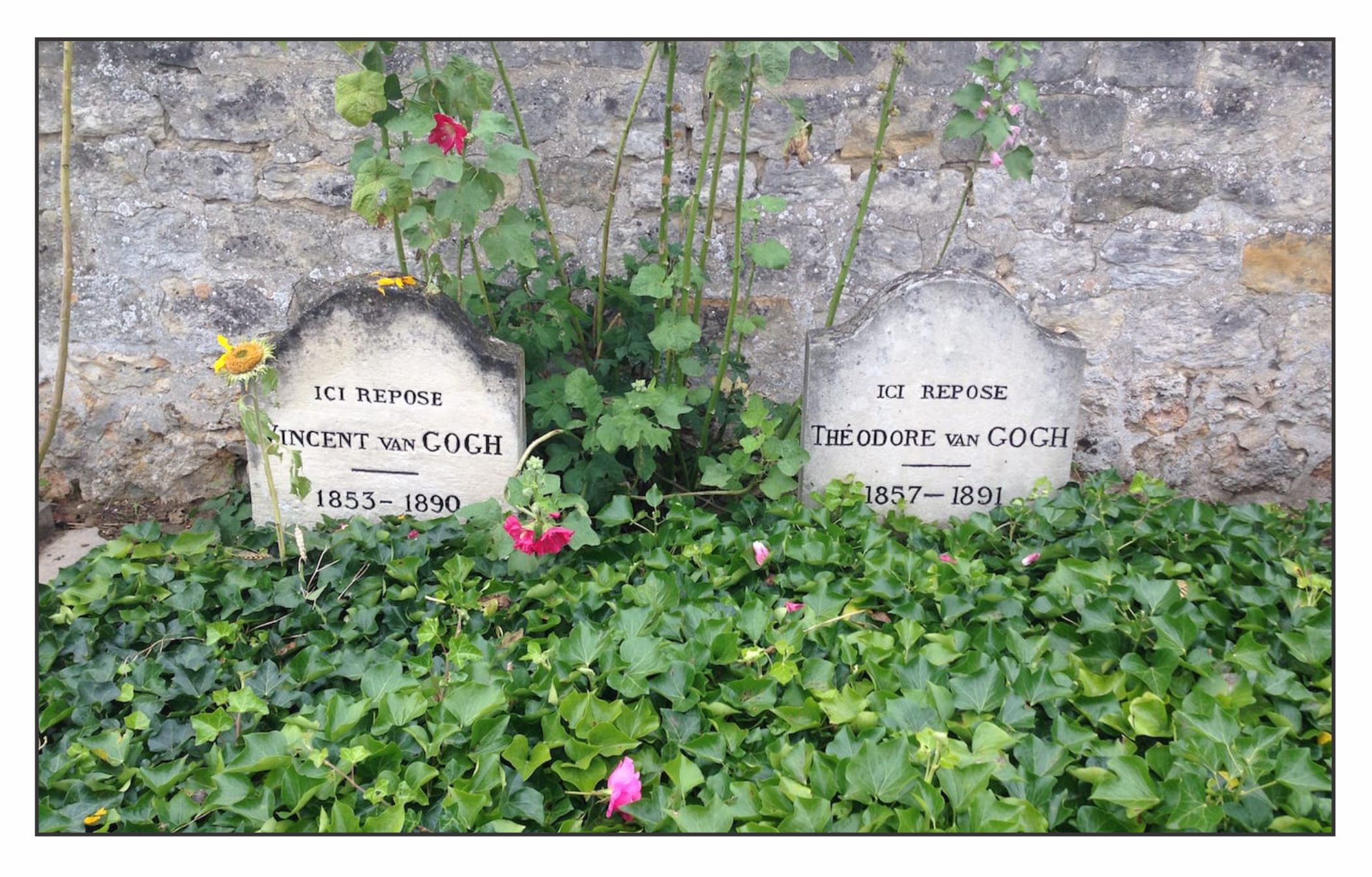
After Theo’s death, Johanna Van Gogh-Bonger retired to Bussum, just east of Amsterdam, where she earned a living through translation and by taking in lodgers. She edited the correspondence between Theo and Vincent, and kept together all of Vincent’s paintings. She continually promoted her brother-in-law’s work to dealers and museums, and in the early years of the 20th Century he finally began to receive the recognition he deserved (Luijten, 2023). The following illustration shows a 1905 portrait of Joanna by her second husband Johan Cohen Gosschalk, and a photograph of her in Amsterdam from 1909. On the wall is Van Gogh’s Landscape at Twilight.  
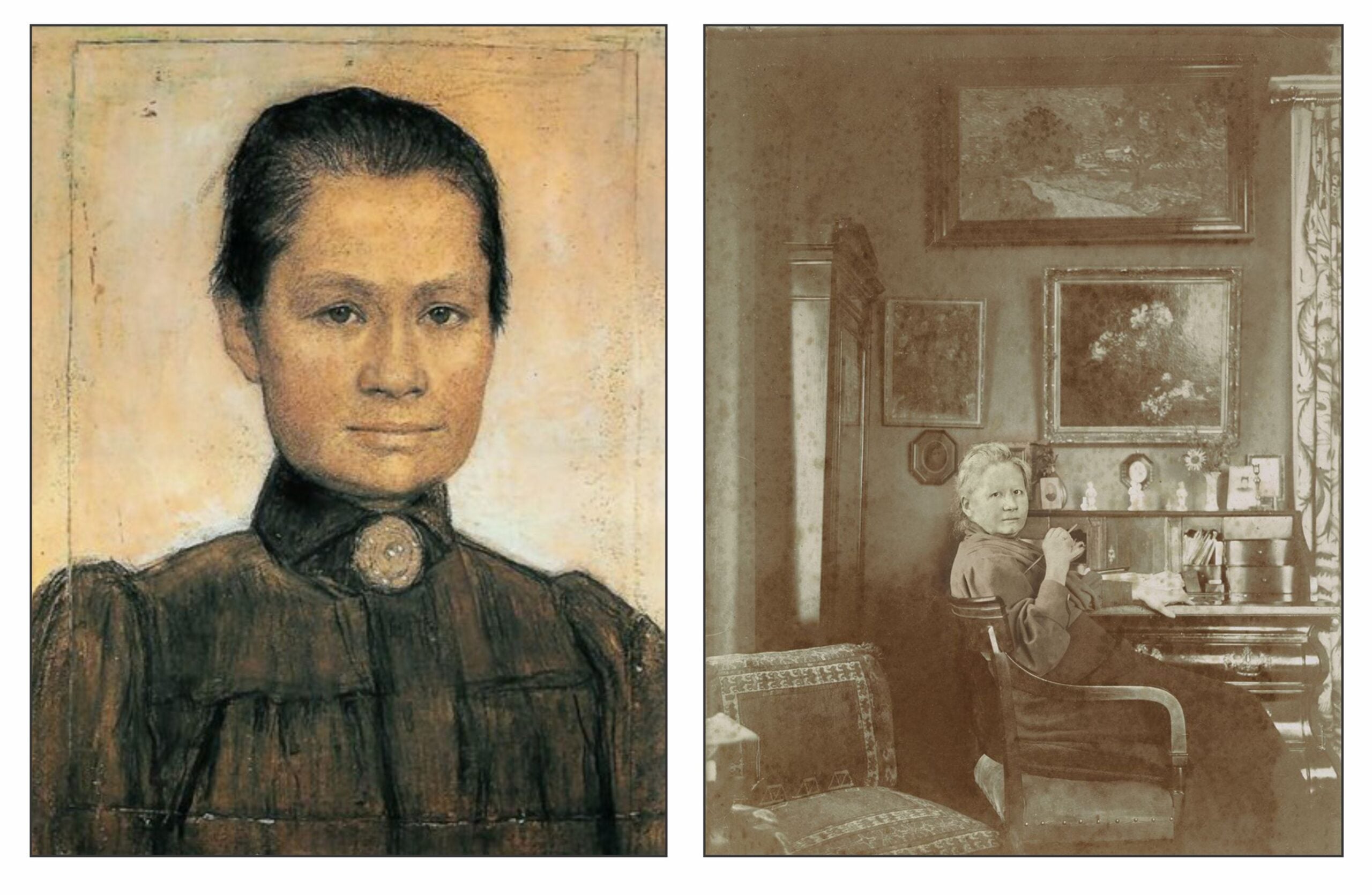
The Double-Square Paintings

The following table lists the double-square paintings. The number is from the de la Faille catalogue (1928) 
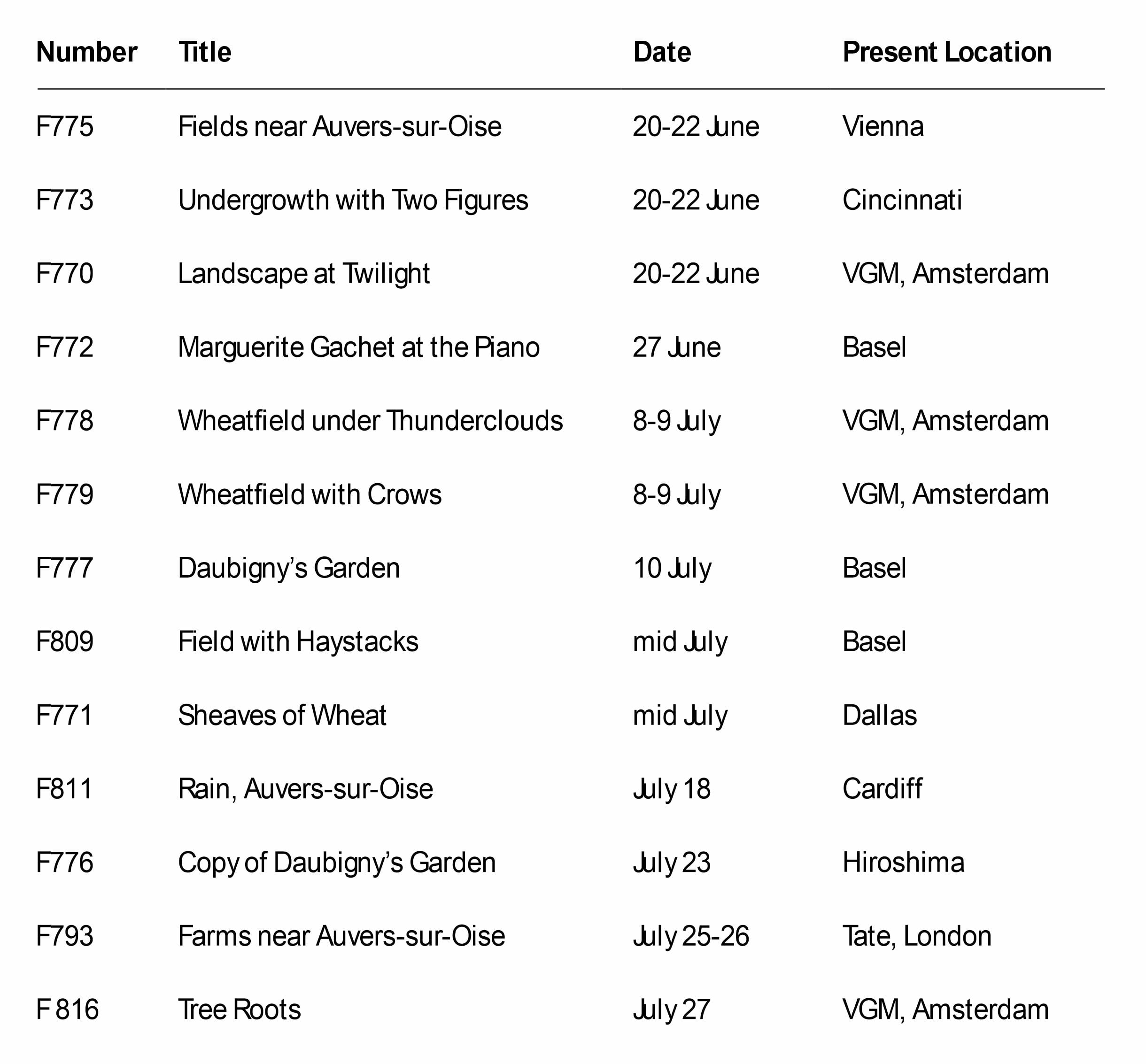
 

References

Bailey, M. (2021a). Van Gogh’s finale: Auvers and the artist’s rise to fame. Frances Lincoln.

Bailey, M. (2021b). Van Gogh’s mysterious Wheatfield with Crows—what does it really mean? The Art Newspaper. September 3, 2021.

Bakker, N. (2015). In Daubigny’s footsteps: Vincent Van Gogh. In Ambrosini, L., Fowle, F., Bakker, N., Boitelle, R., van Dijk, M., & Clarke, M. Inspiring Impressionism: Daubigny, Monet, Van Gogh. (pp 104-129). National Galleries of Scotland.

Bakker, N., Meedendorp, T., & van Tilborg, L. (2023). Van Gogh in Auvers-sur-Oise: his final months. Thames & Hudson.

Bakker, N., Tilborgh, L. van, Prins, L., & Meedendorp, T. (2016). On the verge of insanity: Van Gogh and his illness. Yale University Press.

Coquery, E. (2023). On the threshold of a ‘New Painting’: the double square works. In Bakker et al. (2023) (pp 134-161).

de la Faille, J.-B. (1928).  L’Œuvre de Vincent van Gogh: catalogue raisonné, ouvrage accompagné de la reproduction de plus de 1.600 tableaux, dessins, aquarelles et gravures du Maître. (6 vols). Les Éditions G. van Oest.

Erickson, K. P. (1998). At eternity’s gate: the spiritual vision of Vincent Van Gogh. W.B. Eerdmans.

Luijten, H. (translated by L. Richards, 2023). Jo van Gigh-Bonger: the woman who made Vincent famous. Bloomsbury Visual Arts.

Maes, B., & van Tilborgh, L. (2012). Van Gogh’s Tree Roots up close. In van Tilborgh, L. (Ed.) Van Gogh: new findings. (pp 55-710) WBooks (Zwolle).

Pickvance, R. (1986). Van Gogh in Saint-Rémy and Auvers. Metropolitan Museum of Art.

Saltzman, C. (1998). Portrait of Dr. Gachet: the story of a van Gogh masterpiece: modernism, money, politics, collectors, dealers, taste, greed, and loss. Viking.

Van Tilburgh, L. (2023). A short biography of unbearable suffering: Van Gogh’s chosen end. In In Bakker et al. (2023) (pp 162-177).

Van der Veen, W. (2020). Attacked at the very root: An investigation into Van Gogh’s last days. Arthénon

Van der Veen, W. (2023a). Exploring Auvers-sur-Oise: people and places. In Bakker et al. (2023) (pp 34-57).

Van der Veen, W. (2023b). The secret of Wheat Field with Crows. Arthénon

Van der Veen, W. (2023c). About the place where Van Gogh took his own life. Arthénon

Wattenmaker, R.-J. (1981). Vincent van Gogh and Puvis de Chavannes. Vie des arts, 26(104), 94–96.


Vincent van Gogh in Saint-Rémy

In May 1889, following several psychotic episodes in Arles, Vincent van Gogh (1853-1890) voluntarily admitted himself to the asylum at the monastery of Saint-Paul-de-Mausole in Saint-Rémy-de-Provence. He stayed there for just over a year. Despite several further episodes of severe depression and madness, van Gogh was incredibly prolific during this period, producing about 150 paintings, among them Starry Night.

Madness in Arles

Vincent van Gogh left Paris and settled in Arles in February, 1888. Profoundly affected by the quality of the light and vividness of the colors, he changed his style of painting, banishing the shadows of his earlier work. He had become fascinated by the Japanese woodblock prints that he had bought in Paris, and was intrigued by the new techniques of Paul Gauguin (1848-1903) and Emile Bernard (1868-1941) in Pont Aven, who were beginning to using flat colors within clearly defined outlines (a technique later called “cloisonnism” from the procedure of melting enamels onto a surface within compartments defined by small metal strips). Most importantly he began to heighten his colors – to paint what he felt as much as what he saw. He combined these new approaches – flat colors, clear outlines, heightened hues – with the thick impasto and broad brushstrokes of earlier Dutch painting to develop his own unique style.    

In October 1888, Gauguin came to stay with van Gogh in Arles. They shared the small Yellow House on the Place Lamartine in Arles that van Gogh had rented and decorated with the financial support of his younger brother Theo (1857-1891), an art-dealer in Paris. Vincent wanted to establish a “Studio of the South” where painters could create art appropriate to the modern age. Both Gauguin and van Gogh had very definite ideas about the future of art and they did not always agree. In particular, van Gogh wanted to paint directly from nature whereas Gauguin wanted to paint from memory and imagination (a process he called “abstraction”). They argued.

On December 23, 1888, Gauguin threatened to leave. Van Gogh became psychotic. In his madness he cut off his left ear with a razor, and presented this bloody object to a young prostitute. The following was the next day’s newspaper report (Bailey, 2016, p 157)

Hier soir, un individu se présentant à la porte de la maison de tolérance no. 1, sonnait er remettait à la femme, qui vint lui ouvrir, une oreille pliée dans un morceau de papier, lui disant «Tenez, cela vous servira.» Il s’en alla ensuite. Je vous laisse à penser l’étonnement et l’effroi dut avoir cette femme en trouvant une oreille dans ce papier. La police faisant peu après sa ronde, eut connaissance du fait … et at été sur les traces de cet étrange personage. Ce matin, M. le commissaire central et son secrétaire se sont transportés au domicile d’un peintre hollandaise nommé Vincent, place Lamartine, et ont appris par la bonne qu’elle avait trouvé ce matin un rasoir ensanglanté sur la table et a trouvé ensuite l’artiste peintre couché dans son lit avec une oreille coupée et dans un état assez grave. M. le commissaire central l’a fait transporté à l’hôpital.

[Yesterday evening, an individual presented himself at brothel no. 1, rang the bell and handed to the woman, who came to open the door, an ear folded into a piece of paper, saying “Here, this will be useful to you.” He then left. I leave you to imagine the astonishment and fear this woman must have felt when she found an ear within the paper. The police patrol coming by the brothel soon afterwards were made aware of what had happened … and were soon on the trail of this strange character. This morning, the Chief of Police and his secretary went to the home of a Dutch painter named Vincent on Place Lamartine, and learned from the maid that she had just found a bloody razor on the table. They then discovered the painter lying in bed with an amputated ear and in serious condition from loss of blood. The Chief of Police had him taken to hospital.]

Van Gogh was treated in the hospital at Arles. Theo van Gogh came down from Paris to check on his brother. Gauguin took the train back to Paris and the two artists never saw each other again. The following illustration shows van Gogh’ self-portrait (F527) from January 1889. This and later paintings are identified by their Faille number (Faille & Hammermacher, 1970; Feilchenfeldt, 2013) The portrait was painted using a mirror thud making it appear as if his right ear was amputated rather than his left. In the background is one of van Gogh’s Japanese prints: Geishas in a Landscape by Sato Torakiyu (1870s)

Over the next few months van Gogh suffered from two other bouts of severe madness for which he was hospitalized. His neighbors petitioned the police that le foux roux (the red-headed madman) not be allowed to return to the Yellow House. Finally, he agreed to be admitted to the asylum in Saint-Rémy-de-Provence. Theo arranged to pay for his treatment there, and a kindly Protestant minister accompanied him to his new home.   

No one knows what caused van Gogh’s psychotic episodes. A recent symposium (Bakker et al., 2016) discussed many possible causes but came to no conclusion. Some of the problems in making a diagnosis so long after the patient died are discussed by ter Berg et al. (2012) and Voskuil (2020). The doctors who treated him in Arles and in Saint-Rémy-de-Provence thought that he suffered from a type of epilepsy that manifested itself in mental changes rather than physical convulsions. This disorder presently goes by the name of “temporal lobe epilepsy” (Blumer, 2002). Patients with temporal lobe epilepsy experience attacks of confusion and automatic behavior. Between these attacks, the patient may be depressed. 

To my mind, van Gogh’s periods of madness were more likely due to “bipolar disorder” (Carota et al., 2005), previously known as “manic-depressive illness.” Many other creative artists have suffered from this disorder (Jamison, 1993; Johnson et al., 2012; Ludwig, 1995). Such a diagnosis would explain von Gogh’s episodes of overwhelming depression. His remarkable productivity when not depressed could be attributed to periods of hypomania.


The Asylum of Saint-Paul-de-Mausole

Saint-Rémy-de Provence is located about 20 km south of Avignon in the region called Bouches-du-Rhône (“mouths” of the Rhône – where the river empties into the Mediterranean Sea).

South of Saint-Rémy are a striking set of low limestone mountains called Les Alpilles, wherein the medieval Princes of Les Baux (from Provençal, bauç, a rocky spur), allegedly descended from the magus Balthasar, built their castle. In the early 19th Century, the mineral bauxite (a source of aluminum) was discovered and mined there.

The region near Saint-Rémy-de-Provence has been inhabited for millennia. Greeks and then Romans lived in a town called Glanum, located about one kilometer south of modern Saint Rémy. The most striking remnants of Roman times are Les Antiques: a triumphal arch and a mausoleum for the Julii family, both dating from the 1st century CE.

The modern town of Saint-Rémy was named after Saint Remigius who converted the Francs to Christianity in the 5th Century CE. In the 11th Century, a Benedictine monastery was built near the site of Glanum (Duret, 2021), taking its name from the most prominent of the Roman ruins: Saint-Paul-de-Mausole. The Romanesque monastery is renowned for its square bell tower and the peacefulness of its cloister. In 1605, the monastery was ceded to the Strict Order of St. Francis of Assissi. Over the years, these monks began to construct the adjacent hospital buildings and to care for the mentally disturbed. After the French Revolution (1789-99), the monastery was secularized. The asylum was taken over by private interests, but continued to care for mentally disturbed patients, albeit using nuns rather than monks. At the time of van Gogh’s hospitalization, the asylum was directed by Théophile Peyron, a retired naval doctor. Treatment was based on kindness and therapeutic baths.

Since there were very few patients, van Gogh was allowed both a second-story bedroom with a barred window facing east over the wheatfield, and a ground-floor painting-studio that looked out onto the enclosed hospital garden. The following illustration is an aerial view of the monastery taken from the east sometime in the 1940s (adapted from Bailey, 2018, 2019). The town of Saint-Rémy is outside the photo to the right (north) and Les Baux is to the left (south)  

The following illustration shows a view of the monastery as seen from the northeast, as painted by van Gogh in October 1889 (F803). This painting for a while belonged to Elizabeth Taylor. Below that is a recent photograph of the monastery church and cloister as viewed from the southeast.

When van Gogh arrived at the asylum he would have entered through the main door of the hospital. The following illustration shows the view from the vestibule to the enclosed garden in a painting by van Gogh (F1530, October, 1889) and in a modern photograph (Bailey, 2019).  

The following is an ink drawing of the fountain in the garden that is visible through the vestibule door (F1531, May 1889) made soon after van Gogh arrived.


Irises

During his first weeks at the asylum, van Gogh was limited to the hospital grounds, but was allowed to paint in the hospital garden. He felt comfortable in the asylum and hoped that his stay there might cure his madness. He wrote a letter to his new sister-in-law Joanna van Gogh-Bonger on May 9, 1889 (Jansen et al., 2009, 772):

Although there are a few people here who are seriously ill, the fear, the horror that I had of madness before has already been greatly softened.

And although one continually hears shouts and terrible howls as though of the animals in a menagerie, despite this the people here know each other very well, and help each other when they suffer crises. They all come to see when I’m working in the garden, and I can assure you are more discreet and more polite to leave me in peace than, for example, the good citizens of Arles.

It’s possible that I’ll stay here for quite a long time, never have I been so tranquil as here and at the hospital in Arles to be able to paint a little at last. Very near here there are some little grey or blue mountains, with very, very green wheatfields at their foot, and pines.

One of the earliest paintings from his stay in the asylum was Irises (May 1889, F608)

The painting owes much to the Japanese art that van Gogh had become fascinated by in Paris. In an 1888 letter to Theo, he had praised the Japanese way of seeing the importance of simple things

If we study Japanese art, then we see a man, undoubtedly wise and a philosopher and intelligent, who spends his time — on what? — studying the distance from the earth to the moon? — no; studying Bismarck’s politics? — no, he studies a single blade of grass.

But this blade of grass leads him to draw all the plants — then the seasons, the broad features of landscapes, finally animals, and then the human figure. He spends his life like that, and life is too short to do everything.

Just think of that; isn’t it almost a new religion that these Japanese teach us, who are so simple and live in nature as if they themselves were flowers? (Jansen et al., 2009, 686):

One particular painting which van Gogh probably saw in reproduction, is a screen with a field of irises displayed on a gold background by Ogata Korin (1658-1716):

Although the iconography is similar, the style of van Gogh’s painting is distinctly his own:

Korin’s paintings seem slick, precious, almost delicate, next to Vincent’s fleshy, jostling flowers. Van Gogh reinforced objects with bold outlines, but his thick application of paint gave the surface a tangible, almost sculptural, rather than graphic, quality. (Helvey, 2009, p 122)

One of the fascinating aspects of van Gogh’s Irises is the isolated white flower in the upper left. Helvey (2009) proposes that this is an Iris albicans as opposed to the other Iris germanica flowers, rather than a mutation (as might be the pale blue flower on the right). As such it would be much like van Gogh, a “stranger on the earth.” This quotation (from Psalm 119: 18-19) is from a sermon that a younger van Gogh gave in his days as a preacher; it provides the title for Lubin’s 1972 biography of the painter.

Open thou mine eyes, that I may behold wondrous things out of thy law.
I am a stranger in the earth: hide not thy commandments from me.

Van Gogh’s Irises was sold at auction in 1987 for what was then a record price for a painting: 49 million dollars. However, the stock market crashed and the buyer defaulted. Rather than putting the painting up for auction again (and having it not reach the same price), Sotheby’s arranged for the Getty Museum in Los Angeles to acquire it in a private purchase.

One year later, in May 1890, when the irises were again in bloom, just before leaving the asylum, van Gogh painted Bouquet of Irises (F680). The background pink of the original painting has faded over the years:


The Wheatfield

Van Gogh’s bedroom at the asylum looked out over a wheatfield. In the distance beyond the wall enclosing the field were the Alpilles. Van Gogh remarked on the view in a letter to Theo in late May, 1889:

Through the iron-barred window I can make out a square of wheat in an enclosure, a perspective in the manner of van Goyen, above which in the morning I see the sun rise in its glory. (Jansen et al., 2009, 776)

Jan van Goyen (1596-1656) was a Dutch painter of landscapes and seascapes. Van Gogh is referring to his characteristic “perspective” which used a low horizon and paid great attention to the sky and clouds. Van Gogh was different: he seldom used a low horizon for his paintings, his bright colors were the opposite of the highly restricted palette of browns, greys, ochres and greens used by van Goyen, and his brushstrokes were bold rather than fine.

The following is one of his first paintings of the wheatfield (May 1889, F720). The wheat was growing well and beginning to turn from green to gold. Although some have proposed that the view was painted from his window, I suggest that he set up his easel at the edge of the field looking southeast. This would allow him to show the wildflowers at the edge of the field in the foreground:

In mid July, 1889, van Gogh suffered a severe relapse and was unable to work for over a month. After returning to some semblance of normality, he completed several versions of the harvest in the wheatfield. In a letter to Theo from early September (Jansen et al., 2009, 800) he described the scene

Work is going quite well – I’m struggling with a canvas begun a few days before my indisposition. A reaper, the study is all yellow, terribly thickly impasted, but the subject was beautiful and simple. I then saw in this reaper – a vague figure struggling like a devil in the full heat of the day to reach the end of his toil – I then saw the image of death in it, in this sense that humanity would be the wheat being reaped. So if you like it’s the opposite of that Sower I tried before. But in this death nothing sad, it takes place in broad daylight with a sun that floods everything with a light of fine gold.

Van Gogh is comparing the painting to a study that he had made in Arles in 1888 of François Millet’s 1850 painting of The Sower. He was to make other copies in early 1890 at the asylum.  

In 1902, one version of these harvest paintings (September 1889, F619) was the first work of Van Gogh to be purchased and displayed in a museum: the Folkwang Museum, originally in Hagen and now in Essen, Germany (Lloyd et al., 2007, p 41).

After the harvest was over, van Gogh continued to paint the wheatfield. The following illustration shows a painting of the field during rain from November, 1889 (F650). Van Gogh was familiar with the convention in Japanese woodblock prints of using slanting lines to represent rain. In 1887 in Paris, he had made a copy of Hiroshige’s 1857 Sudden Shower over Shin-Ōhashi Bridge and Atake  (Pickvance, 1986, p 139).

Rilke (1907, p 56) remarked about the painting 

But now rain, rain: exhaustive and noisy like in the country, without any other sounds in between. The round edge of the wall in the monastery garden is full of mosses and has spots of an utterly luminous green, much as I have never seen.


In a letter to Emile Bernard (Jansen et al., 2007, 822) described another painting of the wheatfield (November 1889, F737) now newly planted with winter-wheat, illustrated below:

Another canvas depicts a sun rising over a field of new wheat. Receding lines of the furrows run high up on the canvas, towards a wall and a range of lilac hills. The field is violet and green-yellow. The white sun is surrounded by a large yellow aureole. In it, in contrast to the other canvas, I have tried to express calm, a great peace.

The painting is wonderfully tranquil. This contrasts with van Gogh’s inner feelings at the time. In this regard it is worthwhile to consider the “other painting” to which he contrasts it. This View of the Monastery Garden (November, 1889, F659) is one that he describes extensively in a letter to Emile Bernard:

A view of the garden of the asylum where I am, on the right a grey terrace, a section of house, some rosebushes that have lost their flowers; on the left, the earth of the garden — red ochre — earth burnt by the sun, covered in fallen pine twigs. This edge of the garden is planted with large pines with red ochre trunks and branches, with green foliage saddened by a mixture of black. These tall trees stand out against an evening sky streaked with violet against a yellow background. High up, the yellow turns to pink, turns to green. A wall — red ochre again — blocks the view, and there’s nothing above it but a violet and yellow ochre hill. Now, the first tree is an enormous trunk, but struck by lightning and sawn off. A side branch thrusts up very high, however, and falls down again in an avalanche of dark green twigs.

This dark giant — like a proud man brought low — contrasts, when seen as the character of a living being, with the pale smile of the last rose on the bush, which is fading in front of him. Under the trees, empty stone benches, dark box. The sky is reflected yellow in a puddle after the rain. A ray of sun — the last glimmer — exalts the dark ochre to orange — small dark figures prowl here and there between the trunks. You’ll understand that this combination of red ochre, of green saddened with grey, of black lines that define the outlines, this gives rise a little to the feeling of anxiety from which some of my companions in misfortune often suffer, and which is called ‘seeing red’. And what’s more, the motif of the great tree struck by lightning, the sickly green and pink smile of the last flower of autumn, confirms this idea. (Jansen et al., 2007, 822)


Cypresses

In June 1889 van Gogh was allowed to travel outside the limits of the asylum, usually in the company of one of the hospital’s orderlies. He took his easel and paints into the surrounding countryside. Several drawings and paintings from that early summer period portray some of the striking cypress trees near the asylum. Van Gogh noted his new fascination with the cypress trees in a letter to Theo (Jansen et al., 2007, 783):

The cypresses still preoccupy me, I’d like to do something with them like the canvases of the sunflowers because it astonishes me that no one has yet done them as I see them.

It’s beautiful as regards lines and proportions, like an Egyptian obelisk.

And the green has such a distinguished quality.

It’s the dark patch in a sun-drenched landscape, but it’s one of the most interesting dark notes, the most difficult to hit off exactly that I can imagine.

Now they must be seen here against the blue, in the blue, rather.

The following painting (June, 1889, F717) made just before his relapse, portrays a large cypress, linking the gold of the wheatfield to the blues of the Alpilles and the stormy sky. 


Starry Night

The most famous of van Gogh’s paintings from Saint-Rémy, Starry Night, was painted in mid-June, 1889 (F612), following a profound experience of the night stars, and just before his July madness. Unlike most of van Gogh’s paintings, this was not done directly from nature, but rather from memory and imagination – using the technique that Gauguin had called abstraction, and that van Gogh had argued so strongly against in Arles. He did not paint this in the bedroom where he had experienced the stars, but in the ground-floor studio. Images from recent paintings that were drying in the studio – of the wheatfield with the Alpilles in the background and of the cypress trees near the asylum – are combined with his memory of the night sky. The town portrayed in the foreground is likely not Saint-Rémy – the church steeple is too prominent, the town is not clearly visible from the hospital, and van Gogh made no other similar paintings. Most critics have suggested that the painting portrays a memory: “a Dutch village inserted into a Southern landscape” (Pickvance, 1986, p 103)

The band of light blue and white above the horizon probably represents the approaching dawn. The moon at the right is surrounded by an intense yellow glow. The bright white star to the left of center is probably Venus, the morning star, also known as Phosphorus or light bringer (Boime, 1984). The sky and the milky way appear to move in tumultuous waves. The central swirling pattern in the sky may have a source in the famous Hokusai’s 1831 woodblock print of The Great Wave off Kanagawa (Bailey 2018, p 81) Like Hokusai’s wave, van Gogh’s sky crests and tumbles toward the slopes of the Alpilles.

For van Gogh, the stars represented the gateways to eternity. The following is from a letter to Theo in July 1888 Jansen et al., 2007, 638):

Painters — to speak only of them — being dead and buried, speak to a following generation or to several following generations through their works. Is that all, or is there more, even? In the life of the painter, death may perhaps not be the most difficult thing.

For myself, I declare I don’t know anything about it. But the sight of the stars always makes me dream in as simple a way as the black spots on the map, representing towns and villages, make me dream.

Why, I say to myself, should the spots of light in the firmament be less accessible to us than the black spots on the map of France.

Just as we take the train to go to Tarascon or Rouen, we take death to go to a star. What’s certainly true in this argument is that while alive, we cannot go to a star, any more than once dead we’d be able to take the train. So it seems to me not impossible that cholera, the stone, consumption, cancer are celestial means of locomotion, just as steamboats, omnibuses and the railway are terrestrial ones.

To die peacefully of old age would be to go there on foot.

Erickson (1998) suggests that the three main compositional elements of the painting – the village scene, the cypress and the sky – represents different aspects of van Gogh’s religious beliefs.  The village likely means the conventional religion that he tried to follow in his youth. Erickson points out that

While every house glows with yellow light under the brilliance of the starry sky, the church remains completely dark (pp 170-171). 

The flame-like cypress tree may represent mankind’s aspirations beyond this mortal life. Cypresses have long been associated with death and van Gogh felt that death was the gateway to eternity. Since the cypress is what ties the earth to the sky, perhaps he could experience the infinite through nature rather than religion. The starry sky itself represents the Infinite.    


Beyond the Asylum

In the autumn of 1889, after recuperating from his prolonged bout of madness, van Gogh began to travel again in the countryside around the asylum. The illustration below shows the stone quarry (October, 1889, F635). The quarry near Saint-Rémy had provided stone for the building of the Greco-Roman city of Glanum, but by Vincent’s time had long fallen into disuse.

Van Gogh’s quarry paintings are intriguing since from 1890 to 2000 Paul Cézanne created a series of paintings of the Bibemus quarry near Aix-en-Provence some 75 km southeast of Saint- Rémy, e.g. La carrière de Bibémus (1895). Both painters were intrigued by the different planar surfaces and by the subtle alterations in their color with the direction of the light. The main differences between the painters are that van Gogh’s planes are more clearly outlined, and Cézanne’s brushwork is much less defined.

Another theme for the autumn of 1889 were the olive groves near the asylum. The following is one of many paintings of olive trees, with the southern sun and the Alpilles in the background (November, 1889, F710). The trees are dancing to the rhythms of the sunlight. By the time van Gogh was painting the sun, it had itself moved from when he started to paint and the blue shadows on the ground that he had painted first are no longer properly aligned. This painting thus records the passage of time as well as of the existence of the olive groves. Another interesting feature of this particular painting is that all the colors appear heightened except for the light green color of the olive tree foliage which van Gogh has precisely delineated.


Portraits

After recuperating from his summer madness, van Gogh painted three self-portraits in September 1889. Two of these are shown below (F626 and F525).

The portrait on the left shows the painter wearing a smock and holding a palette and brushes. This is a convention long used by painters and Van Gogh had likely seen a print of Rembrandt in a similar pose: the Self-portrait with Two Circles (1665) now at Kenwood House on Hampstead Heath in London. Rembrandt, however, gazes directly at the viewer whereas van Gogh looks off into the distance.

The orange-white colors of the head contrast strikingly with a dark blue and violet background that recalls the swirling sky of Starry Night. Orange and blue are classic complementary colors. From bright orange to dark blue also show a high contrast in brightness. The blue of the eyes ties everything together. Van Gogh described the portrait to Theo in a letter

One I began the first day I got up, I was thin, pale as a devil. It’s dark violet blue and the head whiteish with yellow hair, thus a colour effect. (Jansen et al., 2007, 800).

Another similar portrait, much less effective, was completed at about the same time with a pale blue background. Finally van Gogh painted a small self-portrait after he had shaved his beard. He wondered to Theo whether he should send this to his mother to show how well he had recuperated from his madness. He seemed unaware of how profoundly sad he appears: with raised internal eyebrows and down-turning mouth corners. He looks apologetically at the viewer. According to Pickvance (1986) this is probably van Gogh’s last self-portrait.

Van Gogh also produced striking portraits of the head orderly at the hospital Charles-Elzéard Trabuc and his wife, Jeanne Lafuye Trabuc (September 1889, F629 and F231). Rilke was able to see the first portrait in a dealer’s storage room in Paris (1907, p 56):

An elderly man with a short-cropped, black-and-white mustache, sparse hair of the same color, cheeks indented beneath a broad skull; the whole thing in black and white, rose, wet dark blue, and an opaque bluish white – except for the large brown eyes.

Van Gogh remarked about the orderly in a letter to Theo

He was at the hospital in Marseilles through two periods of cholera, altogether he is a man who has seen an enormous amount of suffering and death, and there is a sort of contemplative calm in his face.

It makes a rather curious contrast with the portrait I have done of myself, in which the look is vague and veiled, whereas he has something military in his small quick black eyes.

His comments to Theo about the wife were unkind, although the painting, itself, is more sympathetic.

She is a faded woman, an unhappy, resigned creature of small account, so insignificant that I have a great longing to paint that dusty blade of grass. I have talked to her sometimes when doing some olive trees behind their little house, and she told me then that she did not believe I was ill (Jansen et al., 2007, letters 800 and 801)


Studies of Earlier Artists

During the autumn of 1889 and early in 1890, van Gogh produced numerous studies of the works of Jean-François Millet (1814-1875), Eugène Delacroix (1798-1863) and Gustave Doré (1832-1883) (Naifeh, 2021). All of the copies were based on black-and-white reproductions, with van Gogh seeking to add extra levels of meaning to the images by means of color. One of his most successful copies was based on a Pièta by Eugène Delacroix. The original painting from about 1850 was small and dark, but lithographic reproductions, mirror-reversed by the printing process, were very popular. The following illustration shows the original image, the lithograph, and van Gogh’s copy (September, 1889, F630)

Van Gogh uses his favorite colors, blue and yellow. The blue may point to eternity and the yellow, like the sunrise that it promises, may represent hope. The colors are as unnatural as the posture of the dead Messiah. Van Gogh gave Christ beard as orange as his own. He was looking toward his own death and resurrection.


At Eternity’s Gate

In December, 1889 and in the early months of 1890, van Gogh suffered three more relapses into madness. During each of there periods he was unable to paint for several weeks. His hopes of getting better in the asylum began to wane.

After the last attack, in April 1890, van Gogh painted a color-study of one his own early lithographs, based on a drawing he had made in1882 of an elderly pensioner in an almshouse in the Hague. He told Theo about that drewing:

It seems to me that a painter has a duty to try to put an idea into his work. I was trying to say this in this print—but I can’t say it as beautifully, as strikingly as reality, of which this is only a dim reflection seen in a dark mirror—that it seems to me that one of the strongest pieces of evidence for the existence of ‘something on high’ in which Millet believed, namely in the existence of a God and an eternity, is the unutterably moving quality that there can be in the expression of an old man like that, without his being aware of it perhaps, as he sits so quietly in the corner of his hearth. At the same time something precious, something noble, that can’t be meant for the worms. … This is far from all theology—simply the fact that the poorest woodcutter, heath farmer or miner can have moments of emotion and mood that give him a sense of an eternal home that he is close to. (Jansen et al. 2007, 288).

The original drawing (F997 and the color study (F701) are shown below. The painting became known as At Eternity’s Gate.

In May of 1890, van Gogh left the asylum in Saint-Rémy. Theo arranged for him to stay in Auvers-sur-Oise. About 25 km northwest of Paris. There he was able to paint productively once again. However, he remained depressed and finally committed suicide by shooting himself with a revolver in July 1890. Other versions of how he died have been proposed (Naifeh and Smith, 2011; Schnabel, 2019), but suicide seems most likely. His brother Theo died 6 months later in January, 1891, most likely from the effects of tertiary syphilis. Theo’s wife Joanna van Gogh-Bonger (1862-1925) took care of van Gogh’s paintings and letters, and nurtured the posthumous fame of her brother-in-law (Luijten, 2019). A 2023 list of the 100 paintings attaining the highest prices ever at auction has 9 paintings by van Gogh, a number only exceeded by Picasso’s 14.


The Afterlife of the Paintings

Although van Gogh was only able to sell one painting during his lifetime, in the years following his death his work slowly began to exert an immense effect on other artists. Throughout his life, van Gogh attempted to portray the full meaning of the world he experienced. His paintings were directly based on what he saw, but he tried to add his intense emotional response to the visual by heightening the colors and by using powerful brushstrokes. After his death, other artists began to use these techniques

Van Gogh’s work thus became the direct precursor of the Expressionist Movement in modern art (Lloyd et al., 2007). Expressionist paintings characteristically portray the emotional response to what the artist sees. Such art is subjective rather than objective, spiritual rather than worldly, creative rather than derivative.

Furness (1973, p. 4) remarked

Many critics point to the use of the word ‘expressionist’ to designate the particular intensity of the work of those painters who strove to go beyond impressionism, beyond the passive registration of impressions towards a more violent, hectic, energetic creativity such as is found above all in van Gogh. The dissolution of conventional form, the abstract use of colour, the primacy of powerful emotion – above all the turning away from mimesis herald a new consciousness and a new approach in painting, which literature was to follow.

Two of the early groups that followed the expressionist ideals of van Gogh were Die Brücke (the bridge) which was founded in Dresden in 1905 and included Erich Heckel, Ludwig Kirchner, Emil Nolde, and Karl Schmidt-Rottluff, and Der Blaue Reiter (the blue rider) which originated in Munich 1911, and counted Wassily Kandinsky, August Macke, Franz Marc, and Gabriele Münter among its members.  

Van Gogh also had a significant effect on 20th-Century philosophy (Nichols, 2018). The existentialists looked to expressionism as a way to transcend the confining limits of reality. For Karl Jaspers (1883-1969)

existence is always incomplete and contradictory and thus points toward something that can complete and unify its paradoxes, that is, the transcendent (Longtin Hansen, 2018).

Art can act as a means to understand the transcendent:

Art acts as a cipher by revealing the deeper reality: it seems to imitate things that occur in the world, but it makes them transparent. (Jaspers, 1932, p 172)

Existentialism insists that we have the freedom to create ourselves in a world without rules; artists like van Gogh create for us a way to experience that world.


References

Bailey, M. (2016). Studio of the South: Van Gogh in Provence. Frances Lincoln (Quarto Publishing).

Bailey, M. (2018). Starry Night: Van Gogh at the Asylum. White Lion (Quarto Publishing).

Bailey, M. (2019). Living with Vincent Van Gogh: the homes and landscapes that shaped the artist. White Lion (Quarto Publishing).

Bailey, M. (2021). The illustrated Provence letters of Van Gogh. Batsford (Pavilion Books).

Bakker, N., Jansen, L., & Luijten, H. (Eds) (2020). Vincent van Gogh: a life in letters. Thames & Hudson.

Bakker, N., Tilborgh, L. van, Prins, L., & Meedendorp, T. (2016). On the verge of insanity: Van Gogh and his illness. Yale University Press.

Blumer, D. (2002). The illness of Vincent van Gogh. American Journal of Psychiatry, 159(4), 519–526.

Boime, A. (1984). Van Gogh’s Starry Night: a history of matter and a matter of history. Arts Magazine, 59(4), 86–103.

Borg, M. ter, & Trenité, D. K.-N. (2012). The cultural context of diagnosis: the case of Vincent van Gogh. Epilepsy & Behavior, 25(3), 431–439.

Carota, A., Iaria, G., Berney, A., & Bogousslavsky, J. (2005). Understanding van Gogh’s night: Bipolar Disorder1. In Bogousslavsky, J., & Boller, F. (Eds) Neurological disorders in famous artists. (pp. 121–131). Karger.

Duret, E. (2021). Un asile en Provence: La maison Saint-Paul à Saint-Rémy du XVIIIe au début du XXe siècle. Presses Universitaires de Provence.

Erickson, K. P. (1998). At eternity’s gate: the spiritual vision of Vincent Van Gogh. W.B. Eerdmans.

Faille, J. B. de la, & Hammacher, A. M. (1970). The works of Vincent van Gogh: his paintings and drawings [by] J.-B. de la Faille. (Revised, augmented and annotated edition of the original 1928 version). Meulenhoff International.

Feilchenfeldt, W. (2013). Vincent van Gogh: the years in France: complete paintings 1886-1890. Philip Wilson (I. B. Tauris).

Furness, R. S. (1973). Expressionism. Routledge.

Helvey, J. (2009). Irises: Vincent van Gogh in the garden. J. Paul Getty Museum.

Jamison, K. R. (1993). Touched with fire: manic-depressive illness and the artistic temperament. Free Press.

Jansen, L., Luijten, H., & Bakker, N. (Eds) (2009). Vincent Van Gogh: the letters; the complete illustrated and annotated edition. (6 volumes). Thames & Hudson. Letters can be accessed at the website. Selections from the letters are in Bakker et al (2020) and Bailey (2021).

Jaspers, K. (1932, translated by E. B. Ashton, 1971). Philosophy Volume 3. University of Chicago Press.  

Johnson, S. L., Murray, G., Fredrickson, B., Youngstrom, E. A., Hinshaw, S., Bass, J. M., Deckersbach, T., Schooler, J., & Salloum, I. (2012). Creativity and bipolar disorder: Touched by fire or burning with questions? Clinical Psychology Review, 32(1), 1–12.

Lloyd, J., Peppiatt, M., Bridgewater, P., Peters, O., & Stolwijk, C. (2007). Van Gogh and expressionism. Hatje Cantz Verlag.

Longtin Hansen, R. (2018). Immanent transcendence in the work of art. Jaspers and Heidegger on Van Gogh. In D. P. Nichols (Ed.). Van Gogh among the philosophers: painting, thinking, being. (pp 137-158). Lexington Books.

Lubin, A. J. (1972). Stranger on the earth: a psychological biography of Vincent van Gogh. Holt, Rinehart & Winston.

Ludwig, A. M. (1995). The price of greatness: resolving the creativity and madness controversy. Guilford Press.

Luijten, H. (2019, translated by L. Richards, 2022). Jo van Gogh-Bonger: The Woman who Made Vincent Famous. London: Bloomsbury Visual Arts

Mullins, E. (2015). Van Gogh: the asylum year. Unicorn Press Ltd.

Naifeh, S. (2021). Van Gogh and the artists he loved. Random House

Naifeh, S., & Smith, G. W. (2011). Vincent van Gogh: the life. Random House.

Nichols, D. P. (Ed.). (2018). Van Gogh among the philosophers: painting, thinking, being. Lexington Books.

Pickvance, R. (1986). Van Gogh in Saint-Rémy and Auvers. Metropolitan Museum of Art.

Rilke, R. M. (1907, translated by J. Agee, 2002). Letters on Cézanne. North Point Press.

Schnabel, J (Dir.) (2019). At eternity’s gate. Lions Gate Entertainment.

Voskuil, P. (2020). Vincent van Gogh and his illness: a reflection on a posthumous diagnostic exercise. Epilepsy & Behavior, 111, 107258