Rembrandt: Self-Portraits

Rembrandt Harmenszoon van Rijn (1606-1669) was one of the greatest painters of the Dutch Golden Age, that century following the establishment of the Dutch Republic free of Spanish rule. Among his many works were about 80 self-portraits – about 40 paintings, 30 etchings and 7 drawings – far more than any other painter before him. These works were created for several purposes: to provide examples of his art for prospective buyers, to work out techniques for visually representing emotions and ideas, and to record the passage of his own life. The illustration shows a small self-portrait from 1630, painted on copper: the discerning gaze.

Life

Rembrandt was born in Leiden, located between the cities of Amsterdam and The Hague. His surname “Harmenszoon van Rijn” means son of Harmen from the Rhine. As a young man, Rembrandt was apprenticed to Jacob van Swanenberg and later to Pieter Lastman, both of whom had spent time in Italy and were aware of the new baroque painters, such as Caravaggio, who painted with sharp contrasts between light and dark. Though he opened a studio in Leiden in 1625, Rembrandt moved in 1631 to Amsterdam to find a more wealthy clientele. There he became a sought-after portraitist for the rich and famous. He also painted large group portraits such as The Night Watch (1642). In 1634 Rembrandt married Saskia van Uylenburgh, and moved into a series of evermore luxurious residences. Four children were born but only the last – a son, Titus, born in 1641 – survived infancy. After Saskia died in 1642, Rembrandt had relationships with his housekeeper, Geertge Dircx, and with Hendrickje Stoffels, with whom he had a daughter, Cornelia, in 1654. Despite his continued success, Rembrandt’s taste for the good life – a fine residence furnished with beautiful objets d’art – led to bankruptcy in 1656. Though his financial difficulties persisted, Rembrandt continued to paint both portraits and large commissioned works, such as The Anatomy Lesson of Dr Deijman (1656) and The Syndics of the Drapers’ Guild (1662) and until his death in 1669. One of his last paintings was The Return of the Prodigal Son.   

Self-Portraits

Artists have always produced self-portraits (Hall, 2014; Rudd, 2021). Medieval illuminators included miniatures of themselves at work. Artists of the early Renaissance included images of themselves in the background of their history paintings. As the Renaissance flourished, artists became recognized as divinely gifted individuals, and representations of the actual artist became as valuable as his representations of the world. Another factor contributing to the rise of self-portraits was the developing technology for manufacturing mirrors of glass to replace those of polished metal.

In the 17th Century, the market for portraits expanded beyond the aristocracy to the growing middle class. A major purpose of the self-portrait was thus to demonstrate to prospective buyers how well the artist could capture the true likeness of a person. Buyers could see for themselves both the image and its subject. Furthermore, if the artist were famous, a self-portrait would become valuable in itself. Buyers could then obtain a portrait of a person more famous than themselves.

The self-portrait also provided the artist with a means to examine how best to depict the inner life of a subject. The artist could try to capture in paint the way that he knew he was feeling. The exercise would also allow him to recognize such feelings in others and become a better portraitist.

A final purpose of the self-portrait would be to increase the artist’s awareness of his own identity. Rembrandt made many more self-portraits than any other artist before him. These images provide a record of how he appeared as he grew older. More importantly, they provide a record of how he felt.

Why did Rembrandt show such an untiring interest in his own features? It is true that in the beginning his face often served as a convenient model for studies in expression. Thus he may have come into the habit of looking at himself with a painter’s eye. But this reason alone cannot explain the tremendous quantity and the deep significance of his self-portrait production …. Rembrandt seems to have felt that he had to know himself if he wished to penetrate the problem of man’s inner life. The phenomenon of the soul attracted him as strongly in his own personality as it did in that of others, and such profound self-realization was, it seems, indispensable for his access to the spiritual and the transcendental. (Rosenberg, 1964, pp 37).

This idea that self-portraits were a means of self-realization (see also Chapman, 1990, and Osmond, 2000) has been criticized as anachronistic (see van der Wetering’s essay in White & Buvelot. 1999). Such a purpose might be appropriate to those of us living after the Romantic Revolution and Freudian Psychoanalysis, but would have seemed foreign to an artist in the 17th Century. In those days one thought about the salvation of one’s soul rather than the improvement of one’s self. Nevertheless one might be skeptical of this skepticism. Human beings have always sought to understand themselves better. It seems to me that Rembrandt was certainly intrigued by how he was changing, and how his inner self was reacting to the changes. Painting these effects could help him to know himself.

Rembrandt’s self-portraits may have also allowed him to invent himself as well. In his various costumes and guises, he could see how he might be at a different time, or in a different context:

No one demonstrates better than Rembrandt that self-portraiture is more invention than reflection. This is evident not just in his imaginary, romantic, and historical guises but in every way that he chose to present himself. However, if his self-portraits are not pure reflection they are also emphatically not fiction. For whatever the, element of invention (and justification, compensation, even delusion, all of which must be operative but which I, for the most part, would not presume to analyze), conviction stands behind each of Rembrandt’s images. The seventeenth-century individual, however much engaged in self-fashioning and self-cultivation, was sustained by belief in the authenticity of his personality (Chapman, 1990, p 7).


Tronies and Portraits

Many of Rembrandt’s early self-portraits can be considered tronies (Hirschfelder, 2000). The Dutch term tronie, derived from the Gaulish word trugna for nose, means a depiction of a bust, head or face, especially one with a definite expression or in a particular costume. The primary purpose of such a picture was not to portray the sitter, but rather to represent an idea (the transience of life, the beauty of youth, etc), illustrate an emotion (anger, humor, etc), or display a particular fashion (Renaissance dandy, noble warrior, etc). Tronies probably developed from the practice of painting heads with particular characteristics for insertion into larger historical compositions (Schwartz, 1989). After a while, however, tronies became sought after as “character studies” independently of any larger painting. Many of Rembrandt’s tronies used himself as a subject. The following are two etchings from about 1630, one demonstrating surprise and the other anger:

Schwartz (1988) remarks that the sitter for a portrait presents himself to the painter in a particular way whereas the anonymous sitter for a tronie is asked by the painter to represent something. The painter of the tronie is in control not the subject. Rembrandt worked extensively with tronies in his early years in Leiden. This experience helped him in his portraits to depict the inner emotions as well as the outward presentation of his subjects:

a crucial aspect of Rembrandt’s new and seemingly unprecedented portrait style is the direct result of his transposing certain elements of the tronie mode onto that of the portrait. From his work in Leiden, Rembrandt arrived at a system or vocabulary of physiognomic characterization that comes directly from the face paintings and …was at odds with the other portraiture of the time in important ways. While it would be superficial psychologizing to claim that Rembrandt painted “character,” “inner man,” or “the human soul” —a persistent myth from which we have not yet fully escaped— it is nonetheless clear that Rembrandt’s portraits used many of the same techniques that create the centripetal quality tronies in order to suggest a general sense of “inwardness.” If he did not paint specific “character,” Rembrandt had learned pictorial strategies by which to allude to character in general, to “passion” with a minimum of “action.” (Schwartz, 1988, p 104)

Slowly the tronies began to morph into real self-portraits. The following illustration shows an etched self-portrait from about 1630 and one of the first of his painted self-portraits from 1628. Here we have the young artist with his smoldering eyes and unruly hair: the very portrait of an unrecognized genius. The background of this portrait and of the one at the beginning of this essay are light colored. Backgrounds generally became darker as he grew older. Perhaps he became more aware of Caravaggio’s paintings; perhaps life itself became darker.   

Standard-Bearers

The Eighty-Years’ War (1568-1648) was the prolonged revolt of the Dutch people against Spain, which since 1482 had controlled the Netherlands as part of the Hapsburg Empire. The conflict brought out a tremendous sense of patriotism. Every district in every town established its own civil guard, led by a captain and his lieutenant. The company’s standard-bearer or ensign was the person selected to carry the standard into battle. Ensigns were bachelors, since their duty was to defend the standard with their lives. Typically, these young men dressed themselves in finery, cutting as dashing a figure as possible to display of their company’s ardor.

In 1636, Rembrandt painted himself in the role of a standard-bearer (Bikker, 2024). It is a bravura painting (left below). Rembrandt stands with his right arm akimbo, its silken sleeve jutting defiantly out of the picture plane. The ensign’s drooping moustache balances the jaunty plume of his cap. The lighting comes strikingly from the left, and shadows cloud the right side of the painting. Many years later in 1654, Rembrandt painted a more subdued portrait of a real standard-bearer, the wealthy Amsterdam bachelor Floris Soop (right, below).

In Praise of the Renaissance

Rembrandt was far more interested in the fashions and flamboyance of the Renaissance than he was in the costumes and reticence of his own age. His portraits of others often showed his sitters in somber black, their faces highlighted by pure white collars. But not his self-portraits. The lower part of the following illustration shows an etching (1639) and a painting (1640) of himself with his elbow resting upon a window sill or balustrade.

Rembrandt’s pose is clearly adapted from Titian’s 1509 portrait of a man, at one time considered to be the poet Ariosto (upper left). Rembrandt probably saw this painting, which in 1639 was in the collection of Alfonso Lopez, an art dealer in Amsterdam. He was likely also aware of Dürer’s 1498 self-portrait in a similar pose, perhaps by way of a print. Rembrandt’s etching would have been reversed in the printing process so that in the etching Rembrandt is looking to his left rather than to his right.

Rembrandt as Painter

One of the most intriguing of Rembrandt’s self-portraits (1652) shows the artist in a simple brown robe, likely his work-attire, staring defiantly at the viewer with his arms on his hips. Hall (2014, p 157) notes that the pose is the same as that in Holbein’s famous portrait of Henry VIII of England (1540). However, the styles of the two portraits are completely different. Rembrandt’s focus is on the face whereas Holbein’s is on the costume. Rembrandt’s face shows clear emotions – curiosity, pride, confidence – whereas Henry’s face is passive:

The following comments on Rembrandt’s self portrait are from Chapman (1990, p 87):

he wears a brown painter’s smock, belted with a sash, over a black jerkin and a collarless white shirt. Instead of the brimmed hat he has the more customary black artist’s berry. His drab brown garb, his muted hands, and the overall dark tonality of the painting focus our attention on his face and his direct, authoritative gaze. The aggressive informality of this portrait must have seemed shocking at the time. With a disarming sense of real presence, Rembrandt stands frontally, his arms akimbo, his thumbs tucked under his belt. His proud, confrontational worker’s stance conveys a self-assurance matched only in a few of the late paintings. In short, Rembrandt presents himself with unprecedented inner authority.


A Fall from Grace

When Saskia died in 1642, Rembrandt employed Geertge Dircx as a nurse and housekeeper. Their relationship soon became intimate but ended acrimoniously when Rembrandt began an affair with Hendrickje Stoffels in 1849. Geertge sued Rembrandt for breech of promise and was awarded alimony. Rembrandt never married Hendrickje, probably to ensure that Titus would inherit something from Saskia’s family. The church was sufficiently upset with this common-law arrangement that they investigated Hendrickje for “fornication.” Thus the decade of the 1640s was for Rembrandt a period of anxiety (White, 2022, pp 118-121). One way to handle this was the defiance evident in the self-portrait that we just considered.

As the 1650s began, financial difficulties began to add to Rembrandt’s family problems. Never one to skimp when he wanted something, Rembrandt began to lose money when the first Anglo-Dutch War (1652-54) caused an economic depression and patrons no longer had money to spend on portraits. In 1656, he was declared bankrupt and his possessions were auctioned off to pay his creditors (White, 2022, pp 162-175). Rembrandt moved to a small rented house. He continued to paint.

In 1658, Rembrandt painted his largest self-portrait. This painting, now part of the Frick Collection in New York, is unusual in many aspects. The artist is dressed in what appears to be an artist’s smock, but one that is bright gold in color and unmarked by any paint. The smock is tied at the waste with a red sash. This outfit may have been one of the costumes left over from previous paintings of oriental potentates. The colors, the rough brushwork, and the frontal pose are reminiscent of those used by Titian and other Venetian painters (Clark, 1964, p 130). Chapman (1990, pp 88-95) also notes that the main colors of the painting – black, white, yellow and red – are those chosen by the great Greek painter Apelles, the “Prince of Painters.”  

In the portrait, Rembrandt holds a baton in his left hand. This may simply be a painter’s mahlstick, a rod with a padded leather ball at its end, held against the painting to support and steady the brush hand. However, in the painting, it gives the impression of a royal scepter. Indeed, the whole painting seems to depict a “Philosopher King” (Clark, 1964, p 130), serenely unaffected by the vicissitudes of the world. Undoubtedly, this is what Rembrandt wished he could be at that time.

The two portraits that follow the Frick portrait, both from 1659, the larger one in London and the smaller in Edinburgh, both use the same costume: a dark coat with a turned-up collar and Rembrandt’s by now trademark beret. They show an artist coping with his problems, bordering on despair but ultimately not giving in. His collar is turned up against life’s cold.

The Kenwood Portrait

After Hendrikje died in 1663. Rembrandt spent the last years of his life alone. During this time, he made several self-portraits. Most of these show a highlighted face upon dark background. One self-portrait differs strikingly from the others: the large self-portrait in the Iveagh Bequest at Kenwood House on Hampstead Heath.

Rembrandt is dressed with a red smock and a white shirt, but has also put on a coat with fur collar. Perhaps the studio is cold. He wears a bright white cap like an artist’s halo. He holds in his left hand a palette and mahlstick. Radiographic examination of the painting shows that it initially represented the painter’s left hand in the act of painting. Rembrandt was right-handed and this right left reversal would have resulted from seeing himself in a mirror (White & Buvelot, 1999, p 220). Rembrandt revised the painting to show the artist’s left hand holding the palette. The artist’s right hand is lost in the darkness. Self-portraits find it hard to represent the hand that paints the portrait.   

The background is light in color and shows two large circles. The nature of these circles is a matter of much dispute (Porter, 1988; White & Buvelot, 1999; Gerson, 1968, p 130). One idea is that they might represent the outlines of a map showing the world in two hemispheres. However, the circles are further apart than usual in such representations. Another explication considers a famous story about Giotto. Thinking to hire the young painter, Pope Benedict IX sent one of his courtiers to obtain some evidence of Giotto’s painterly abilities. Giotto took a brush and quickly drew a perfect red circle on a piece of paper without moving his arm and without using a compass. This small piece of paper convinced the pope. Perhaps Rembrandt is claiming his two perfect circles as evidence of his own ability.  Another idea is that the two circles represent in abstract form the ideas of theory and practice, with Rembrandt standing as the artistic genius who mediates between the two.

John Fowles’ novel Daniel Martin (1977) concludes with its protagonist Daniel standing before Rembrandt’s self-portrait in Kenwood House. He had just said farewell to Jenny, his young girlfriend, and was about to return to Jane, his old love:

The sad, proud old man stared eternally out of his canvas, out of the entire knowledge of his own genius and of the inadequacy of genius before human reality. Dan stared back. The painting seemed uncomfortable in its eighteenth-century drawing-room, telling a truth such decors had been evolved to exclude. The supreme nobility of such art, the plebeian simplicity of such sadness; an immortal, a morose old Dutchman; the deepest inner loneliness, the being on trivial public show; a date beneath a frame, a presentness beyond all time, fashion, language; a puffed face, a pair of rheumy eyes, and a profound and unassuageable vision.

Dan had been working as a script-writer in Hollywood. Although he had always wanted to write a novel, he has not had the will power to leave his easy job and devote himself to more meaningful writing. 

Dan felt dwarfed, in his century, his personal being, his own art. The great picture seemed to denounce, almost to repel. Yet it lived, it was timeless, it spoke very directly, said all he had never managed to say and would never manage to say—even though, with the abruptness of that dash, he had hardly thought this before he saw himself saying the thought to the woman who would be waiting for him on the platform at Oxford that evening; telling her also what had gone before, a girl and a past walking into winter trees, knowing she would understand. He had lied a little to Jenny, to make it easier for her. But that was his secret now, his shared private mystery; which left him with the imagining of the real and the realizing of the imagined. Standing there before the Rembrandt, he experienced a kind of vertigo: the distances he had to return. It seemed frightening to him, this last of the coincidences that had dogged his recent life; to have encountered, so punctually after a farewell to many more things than one face, one choice, one future, this formidable sentinel guarding the way back.

Dan finds solace in the portrait. He must make the necessary decisions and he must choose his path for the right reasons.

He could see only one consolation in those remorseless and aloof Dutch eyes. It is not finally a matter of skill, of knowledge, of intellect; of good luck or bad; but of choosing and learning to feel. Dan began at last to detect it behind the surface of the painting; behind the sternness lay the declaration of the one true marriage in the mind mankind is allowed, the ultimate citadel of humanism. No true compassion without will, no true will without compassion.

Daniel Martin found much to see in the portrait (Horlacher, 2018, Vieth, 1991). So, we presume, did John Fowles, since much of the novel is based on his personal experience. Other viewers may find other messages in the portrait, depending on the context their own lives. The great genius of Rembrandt’s self-portraits is their ability to communicate to us what we need to know. 

An Infinite Regress

In a review of some of Rembrandt’s portraits, T. J. Clark (2014) remarked that

what we are looking at in a self-portrait is the image a painter saw in a mirror. It seems to follow that the kind of attention we are shown is special, not to say exotic: the look of someone looking is at himself looking. The trouble is that we can only decide where to put an end to that final phrase by pure fiat.

The end of this infinite regress might come when we become part of the looking, share some part of the artist’s self, see some part of ourselves in the image, and come face to face with Rembrandt.


A Lifetime of Self-Portraits

We do not know why Rembrandt painted so many self-portraits. Susan Osmond (2000) considered various reasons: as an exercise in representing faces and their emotions, in response to a demand from patrons for images of the famous artist, and to try out for himself a new persona. She concluded

Perhaps, knowing all too well that a single portrait can convey only certain selected aspects of a person at a particular point in his life, he wanted, as an artist, to take at least one subject through a lifetime, and the one he could explore most intimately was himself. Every painting has to have some unifying mood or theme, so in this respect Rembrandt had to approach each self-portrait with some sort of “programme,” but this does not rule out self-searching and examination in the process. It only limits its scope – and that probably left the artist hankering for more. In his early years, he likely knew that using himself as a model for tronies would help his face become a household item and increase his reputation. As time went on, while a ready market remained for his self-portrayals, his internal motivation may have altered or at least broadened. At times, he used the self-portrait as a forum to broadcast a persona. At others, in showing himself playing a role such as the prodigal son, a potentate, or an artist of the past, he could by allusion make comments about aspects of his inner state or his status in the flow of history. In most of the late works, contemplation of himself as an individual and as a representative of humanity seems to have played a major part.


Website

Website Rembrandt Van Rijn: life, paintings, etchings, drawings & self portraits  contains images and documentation for self-portraits and etchings


References

Bikker, J. (2024). Rembrandt van Rijn: The Standard-Bearer. nai010 publishers

Chapman, H. P. (1990). Rembrandt’s self-portraits: a study in Seventeenth-Century identity. Princeton University Press.

Clark, K. (1966). Rembrandt and the Italian Renaissance. Murray.

Clark, T. J. (2014). World of faces. London Review of Books (December 4, 2014)

Fowles, J. (1977). Daniel Martin. Little, Brown.

Hall, J. (2014). The self-portrait: a cultural history. Thames & Hudson.

Hirschfelder, D. (2000) Tronie und Porträt in der niederländischen Malerei des 17. Jahrhunderts. Berlin: Gebr. Mann Verlag

Horlacher, S. (2018). “The sad, proud old man stared eternally out of his canvas…”: media criticism, scopic regimes and the function of Rembrandt’s “Self-Portrait with Two Circles” in John Fowles’s novel Daniel Martin. Anglia, 136(4), 705–732.

Osmond, S. F. (2000). Shadow and substance – Rembrandt self-portraits. The Free Library.

Porter, J. C. (1988). Rembrandt and his circles: self portrait at Kenwood House. In Fleischer, R. E., & Scott, S. C. (Eds) The Age of Rembrandt: studies in seventeenth-century Dutch painting. (pp 188-212). Pennsylvania State University.

Rosenberg, J. (1964). Rembrandt: life and work. Phaidon.

Rudd, N. (2021). The self-portrait. Thames & Hudson.

Schwartz, F. (1989). The motions of the countenance: Rembrandt’s early portraits and the tronie. RES: Anthropology and Aesthetics, 17/18, 89-116.

Vieth, L. S. (1991). The re-humanization of art: pictorial aesthetics in John Fowles’s “The Ebony Tower” and “Daniel Martin.” Modern Fiction Studies, 37(2), 217–233. 

White, C. (2022). Rembrandt (3rd edition). Thames & Hudson Ltd.

White, C., & Buvelot, Q. (1999). Rembrandt by himself. National Gallery Publications


Apostola Apostolorum

Apostola apostolorum

In the gospels of the Christian New Testament, Mary Magdalene was the first person to recognize the risen Christ. He told her to tell the disciples the news of his resurrection, thus honoring her as the “apostle to the apostles.” In the Gnostic Gospels she appears as a visionary disciple of Jesus. In the centuries after her life, her story was conflated with that of the sinful woman who anointed the feet of Jesus at a feast in the house of Simon, and Mary thus became a model of repentance. This posting discusses these and other ways in which we conceive of Mary Magdalene.

The Tower

Mary Magdalene’s name likely comes from Magdala, a settlement on the Sea of Galilee during the years 300 BCE to 300 CE. Recent archeological excavations have unearthed evidence there of a synagogue, in which was found the “Magdala Stone,” with carvings showing a Menorah and images of the Second Temple in Jerusalem, destroyed by the Romans in 70 CE. The Aramaic word magdala means “tower.” These may have been related to fortification towers or to towers used for the drying of fish.

Another possible reason for Mary Magdalene’s name is that she was called the “Tower” for the strength of her faith in much the same way as Peter was called the “Rock” for his unwavering devotion (Valerio, 2021, pp 19-20). Saint Jerome (347-420 CE) reported that:

Mary of Magdala received the epithet ‘fortified with towers’ because of her earnestness and strength of faith, and was privileged to see the rising Christ before even the apostles. (quoted in Haskins, 1993, p 58)

Noli me tangere

Mary Magdalene is specifically mentioned in the canonical gospels in connection with three events in the life of Jesus (Haskins, 1993, Chapter 1; Lupieri, 2011; Valerio, 2021, Chapter 1):

(i) During the time when Jesus was preaching and healing the sick near Capernaum, the gospel of Luke describes his entourage as consisting of the twelve disciples

And certain women, which had been healed of evil spirits and infirmities, Mary called Magdalene, out of whom went seven devils,
And Joanna the wife of Chuza Herod’s steward, and Susanna, and many others, which ministered unto him of their substance. (Luke 8: 2-3)

No one knows for certain what was meant by the casting out of demons in those times. It likely represented a charismatic healing of an emotionally disturbed person. After Mary was cured of her affliction, she followed her healer, and provided him with monetary support.

(ii) Later, Mary Magdalene, Mary, the mother of James and Joseph, and Mary, the mother of Jesus, were present at the crucifixion of Jesus and his subsequent burial in the tomb of Joseph of Arimathea. In the synoptic gospels, no mention is made of any of the disciples being present: they were presumably terrified of being associated with the crucified Jesus. The gospel of John reports that a beloved disciple was also there:

Now there stood by the cross of Jesus his mother, and his mother’s sister, Mary the wife of Cleophas, and Mary Magdalene.
When Jesus therefore saw his mother, and the disciple standing by, whom he loved, he saith unto his mother, Woman, behold thy son!
Then saith he to the disciple, Behold thy mother! (John, 19: 25-27)

Though the disciple “whom he loved” is usually considered to be John, it is also possible to interpret this passage as referring to Mary Magdalene.

(iii) The final mention of Mary Magdalene is in the discovery of the empty tomb by the women who came to anoint the dead body of Jesus with spices and ointments. What then occurred is variously described in the different gospels. In most accounts, the women tell the disciples about the empty tomb, but no one understands what has happened. In one account (Matthew), Jesus then appears to all the women. In the clearest account (John), Mary Magdalene alone is the first to recognize the risen Christ:

But Mary stood without at the sepulchre weeping: and as she wept, she stooped down, and looked into the sepulchre,
And seeth two angels in white sitting, the one at the head, and the other at the feet, where the body of Jesus had lain.
And they say unto her, Woman, why weepest thou? She saith unto them, Because they have taken away my Lord, and I know not where they have laid him.
And when she had thus said, she turned herself back, and saw Jesus standing, and knew not that it was Jesus.
Jesus saith unto her, Woman, why weepest thou? Whom seekest thou? She, supposing him to be the gardener, saith unto him, Sir, if thou have borne him hence, tell me where thou hast laid him, and I will take him away.
Jesus saith unto her, Mary. She turned herself, and saith unto him, Rabboni; which is to say, Master.
Jesus saith unto her, Touch me not; for I am not yet ascended to my Father: but go to my brethren, and say unto them, I ascend unto my Father, and your Father; and to my God, and your God.
Mary Magdalene came and told the disciples that she had seen the Lord, and that he had spoken these things unto her. (John 20: 11-18)

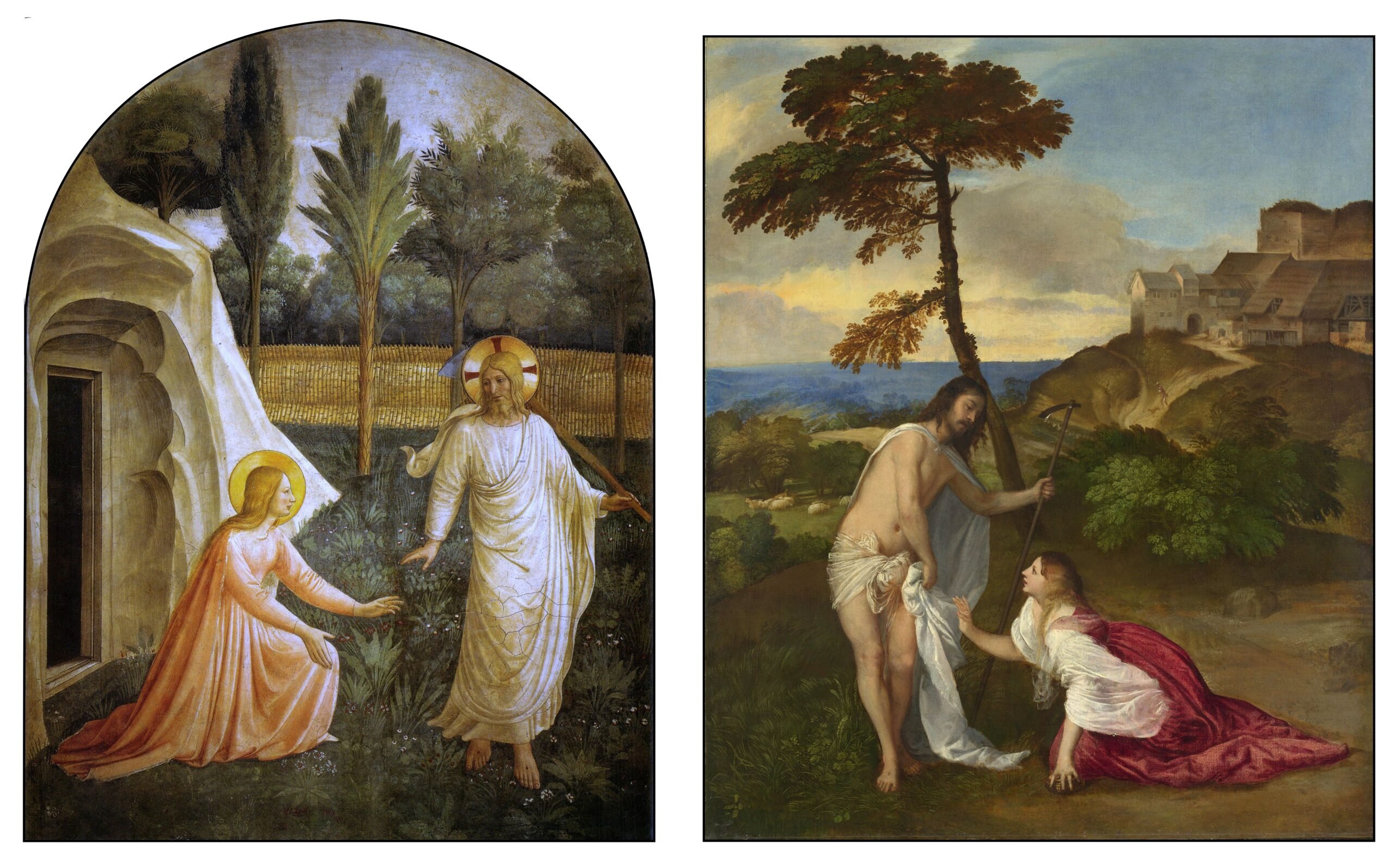
Jesus’ unusual request that she touch him not (Noli me tangere in the Vulgate) became the subject of multiple paintings and engravings. Christ is often shown with a gardening tool or holding a banner with a red cross, signifying his resurrection. The scene is set in a garden in the soft light of morning. This new garden takes the place of that lost in Eden. Illustrated below are a fresco by Fra Angelico (1442) and a painting by Titian (1520).

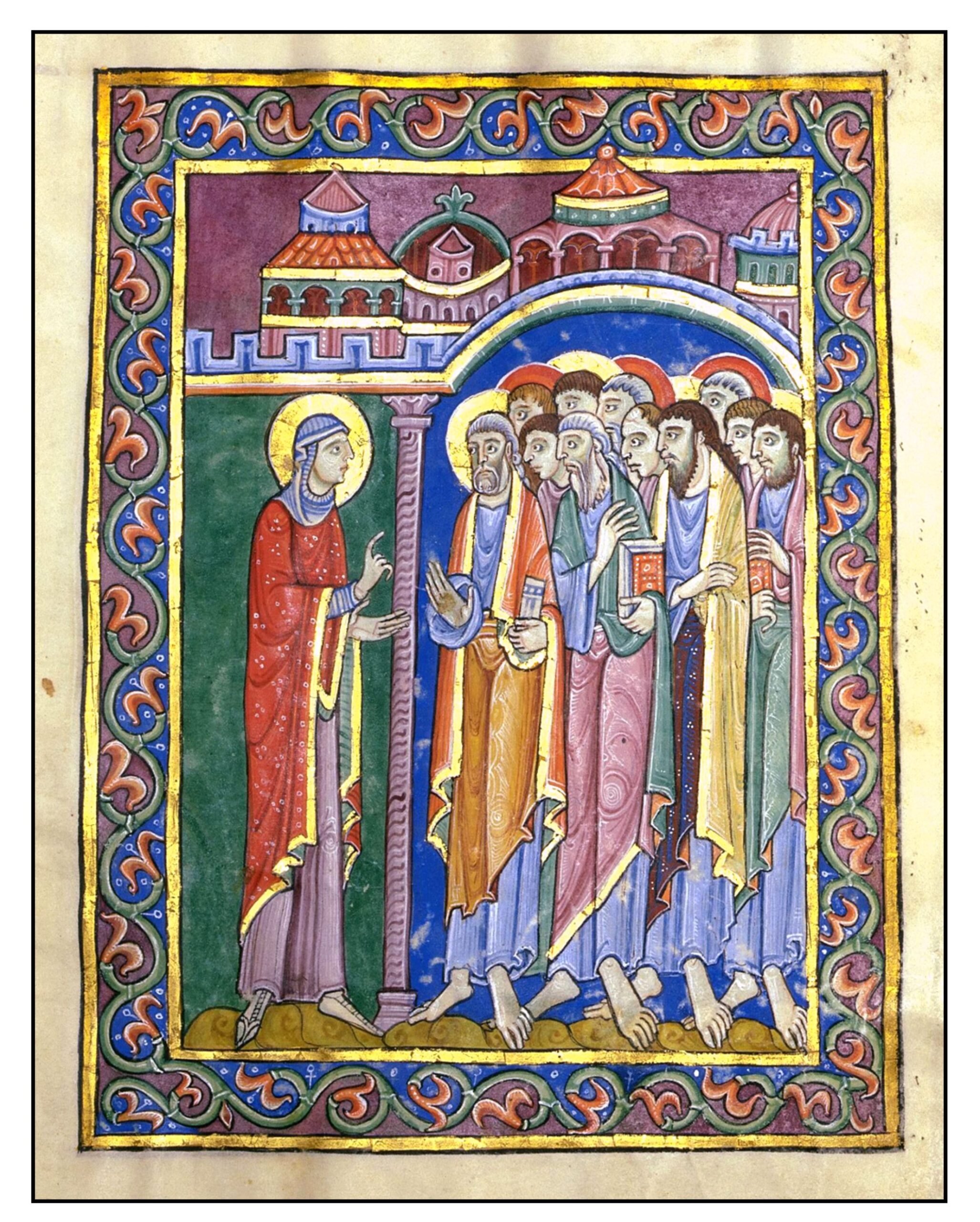
By being the first to recognize the resurrected Jesus, Mary Magdalene became the apostola apostolorum, the apostle to the apostles, the person who first proclaimed the news of the resurrection. The Latin title allows the gender to be noted: Mary Magdalene was the female apostle who first told the male apostles about the resurrection. This was the subject of an illustration in the St Alban’s psalter (circe 1140 CE), a masterpiece of English Romanesque painting (Carrasco, 1999):

Though the early church considered the Magdalene as the apostola apostolorum, this recognition was often given grudgingly by male priests who could not understand why such a role was granted to a woman. Mary was often related to Eve: Eve brought sin and death to man in the garden of Eden, Mary Magdalene witnessed man’s salvation from sin in the garden of Arimathea. In the words of Augustine of Hippo (354-430 CE): per feminam mors, per feminam vita (“death through woman; life through woman” quoted by Jansen, 1998).

The Beloved Companion

Mary Magdalene occurs frequently in other reports of Jesus written soon after his death. Fragments of The Gospel of Mary written in Coptic were discovered in 1896. This likely dates to the mid-1st Century CE, but concerns a tradition in early Christianity going back to a devoted follower of Jesus named Mary who, though not specifically named, was probably Mary Magdalene (King, 2003; Meyer & de Boer, 2004). Other Coptic writings such as the Gospel of Thomas, the Gospel of Philip and Pistis Sophia (“Faith and Wisdom”), discovered in Nag Hammadi in 1945, also mention Mary, sometimes specifically calling her the Magdalene.

Compared to the canonical gospels, these “Gnostic” gospels are more concerned with the path from illusion to enlightenment than from repentance to salvation. Key to the Gnostic view of life is the need to seek the truth within oneself:

When you know yourselves, then you will be known, and you will understand that you are children of the living father. But if you do not now yourselves, then you dwell in poverty and you are poverty. (Gospel of Thomas, in Meyer, 2008, p 116)

In the Gnostic Gospels, Mary Magdalene is described as the beloved companion of Jesus:

The Saviour loved Mary of Magdala more than all the disciples, and he kissed her often on her mouth. (Gospel of Philip, in Meyer, 2008, p 142).

Several modern novelists have considered the close relationship between Mary Magdalene and Jesus (reviewed in Valerio, 2021, Chapter 5). Kazantzakis’ The Last Temptation of Christ (1951) describes how Jesus, as he is dying on the cross, had a vision of a future life wherein he and Mary raised a family. Saramago’s The Gospel according to Jesus Christ (1991) describes how the courtesan Mary introduced the young Jesus to physical love, and later left her profession to become his devoted companion. Valerio (2021, p 91) notes that that modern novelistic treatments of Jesus are concerned about the “irreconcilability of sacred and profane love” and “the incomprehension of a God of love who paradoxically is unable to love a woman to the fullest.”   

Many have speculated that Mary might have been married to Jesus. In 2012, this idea was brought into prominence by the discovery of a ancient papyrus fragment containing the words “Jesus said to them, ‘my wife…’ ” Unfortunately, this was later determined to be a forgery (Sabar 2020). 

Whatever their relationship, Mary Magdalene was privy to teachings of Jesus of which the other disciples were unaware:

Peter said to Mary, ‘Sister, we know that the Saviour loved you mor than all other women. Tell us the words of the Saviour that you remember, the things you know that we don’t because we have not heard them.’ Mary responded, ‘I will teach you about what is hidden from you.’ (Gospel of Mary, in Meyer 2008, p 640)

In later fragments of the Gospel of Mary, the Magdalene describes the ascent of the soul away from darkness, desire, ignorance and wrath, until it is finally set loose from the world and attains rest (Meyer, 2008, p 642). 

In several of the Gnostic Gospels, the male disciples, Peter in particular, complain about Mary’s special status and dispute her reports of Jesus and his teachings. Over the time that these gospels were written, orthodox beliefs were consolidating around the idea that women were inferior to men and could not serve as Christian priests. And these priests desired that believers should be taught the truth by the church rather than seek it within themselves.

Beata Peccatrix

Mary, deriving from the Hebrew “Miriam,” the sister of Moses, was a common name in Palestine at the time of Jesus. The many women named Mary in the gospels are difficult to distinguish and are often conflated into one person. In 591 CE, Pope Gregory the Great proposed that Mary of Bethany and Mary Magdalene were one and the same person (discussed by Haskins, 1993, pp 95-97, and Ehrman 2006, pp. 187-92). This placed Mary Magdalene at the raising of Lazarus from the dead (John 11) and at the anointing of Jesus:

Then took Mary a pound of ointment of spikenard, very costly, and anointed the feet of Jesus, and wiped his feet with her hair: and the house was filled with the odour of the ointment. (John 12: 3).

In Matthew and Mark’s version the anointing took place at a dinner in the house of Simon, and in Luke’s version, the unnamed woman who anointed the feet of Jesus was a “sinner.” Since Mary Magdalene had been exorcised of seven devils, Gregory inferred that she had been subject to all the seven deadly sins. His pronouncement led to the idea that Mary Magdalene was a prostitute who gave up her life of luxury and indulgence to become a follower of Jesus. Mary is also often conflated with the unnamed “woman taken in adultery” that Jesus saved from the Pharisees who wished to stone her (John 8).

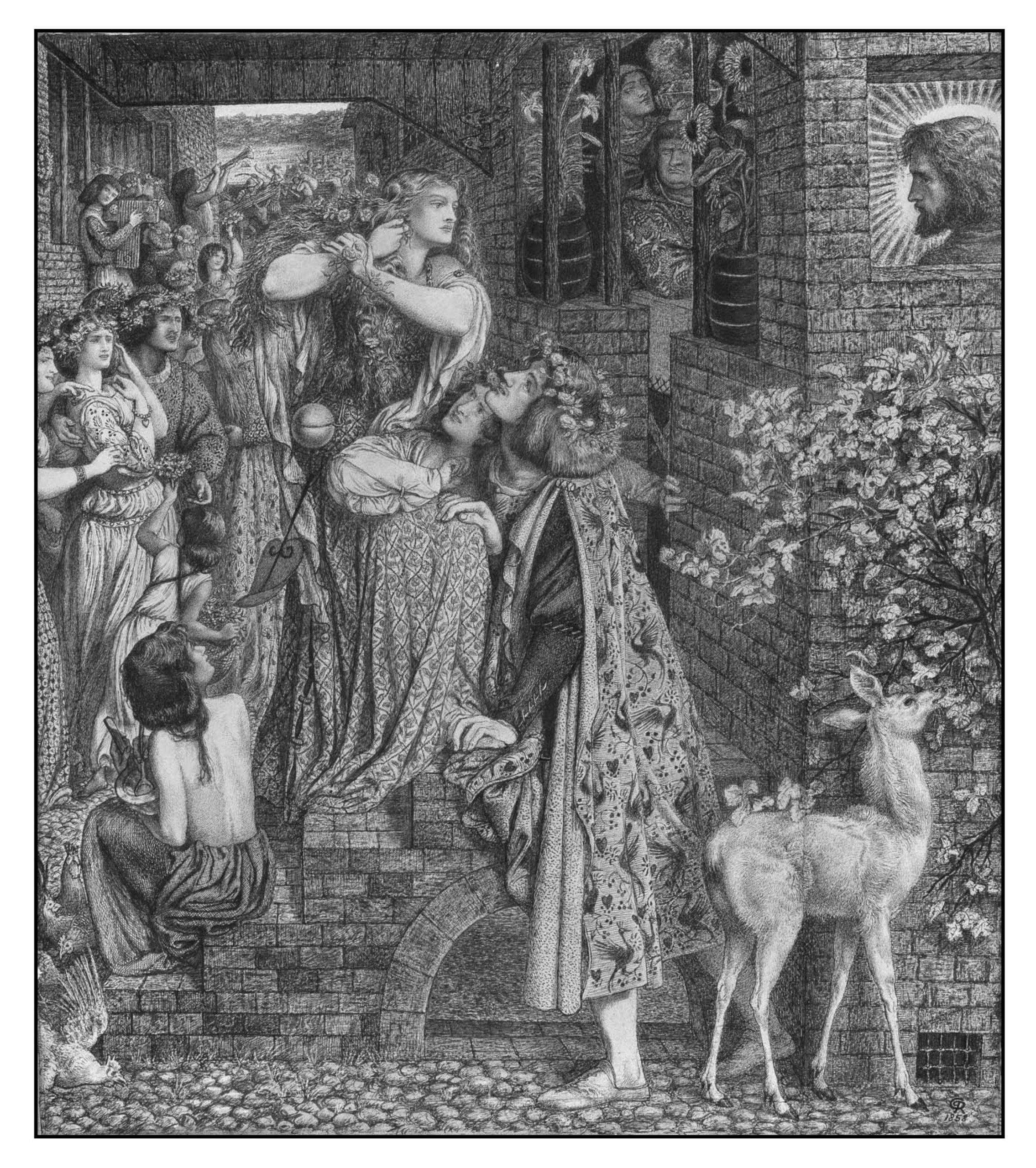
The dramatic moment of her decision to renounce her life of sin is illustrated in the 1858 drawing Mary Magdalene at the Door of Simon the Pharisee by Dante Gabriel Rossetti together with its accompanying sonnet:

Why wilt thou cast the roses from thine hair?
Nay, be thou all a rose,—wreath, lips, and cheek.
⁠Nay, not this house,—that banquet-house we seek;
See how they kiss and enter; come thou there.
This delicate day of love we two will share
⁠Till at our ear love’s whispering night shall speak.
⁠What, sweet one,—hold’st thou still the foolish freak?
Nay, when I kiss thy feet they ‘ll leave the stair.”

“Oh loose me! Seest thou not my Bridegroom’s face
⁠That draws me to Him? For His feet my kiss,
⁠⁠My hair, my tears He craves to-day:—and oh!
What words can tell what other day and place
⁠Shall see me clasp those blood-stained feet of His?
⁠⁠He needs me, calls me, loves me: let me go!”

At the center of the drawing Mary (a portrait of the actress Ruth Herbert) sees Jesus and casts the roses from her hair. Despite the protestation of her richly dressed companion (a portrait of the poet Charles Swinburne), she decides to leave the procession of revelers.

After Pope Gregory’s conflation of Mary with the sinful woman who repented of her sins and anointed the feet of Christ, the Magdalene became commonly viewed as the beata peccatrix (“holy sinner”). Numerous paintings have depicted her stunning beauty and her sincere repentance (Haskins,1993, particularly Chapters 5, 6 and 7). Below is Caravaggio’s Penitent Magdalene (1595).

A beautiful young woman with auburn hair sits in a shadowy room; she has removed her jewelry and is quietly weeping. This was the first realistic portrait of the Magdalene: Caravaggio had used an actual prostitute as his model. In his commentary on the painting Hunt (2012, p 174) remarks   

Caravaggio paints the Magdalene possibly ambiguously, choosing the moment after she has loosened her hair, an act sometimes perceived as a provocative act in which a courtesan would have usually prepared to bed a client-lover, but here more likely an allusion for her preparation to wash Christ’s feet. … the chains on the floor around the Magdalene in the painting may be gold but they could nonetheless be interpreted as having bound the Magdalene to a life of rich material “possession”—even the putative “demonic” possession from which she was exorcised.

Apostolos-Cappadona (2005, p 219) comments on the position of the Magdalene’s head

Leaning toward her left shoulder, her lowered head droops downward and her chin tilts onto her collarbone in a pose empathetic to that of the crucified Christ.

Unfortunately, paintings of the repentant Magdalene often lapse into sentimentality. Indeed, the word “maudlin” derives from her name. Many paintings are extremely disconcerting in the sense that the viewer is invited to enjoy the view of her naked body while thinking holy thoughts about the denial of the flesh.

Misogyny in many forms runs through the history of Christianity and plays forever with our understanding of the Magdalene:  

One can’t help but think that the men who relish this recollection of Mary the penitent sinner are those who are trying to inform their own world with their own vision of what sexual and gendered relationships ought to be, with women not enticing men with the dangers of sex but falling at their feet in humble submission and penitence. (Ehrman, 2006, p 192).

One of the legacies of the concept of the Magdalene as a reformed prostitute was the foundation of institutions to help wayward females. Though some of these may have provided safe asylum for abused women, many simply imprisoned and exploited their charges. The most notorious of these institutions were the Magdalene Laundries in Ireland. Here unmarried mothers gave birth to children that were taken from them. As penance for their sins, they then worked as slaves in laundries to raise money for the church.


Legends of Mary

Mary Magdalene the Apostle soon inspired some amazing stories. These were collected by Jacobus de Voragine for his book about the saints entitled The Golden Legend (circe 1260). 

According to legend, Mary Magdalene together with Bishop Maximin, Martha and the resurrected Lazarus were cast adrift in the Mediterranean Sea by an anti-Christian mob. Though the boat has neither rudder nor tackle, they were miraculously carried to the West and made landfall in the Camargue near Marseille. There on the steps of a pagan temple, Mary Magdalene preached the gospel of Christ. One of the pagan leaders came to the temple to make offerings to the gods so that his wife might bear him a child. Mary prayed that the Lord might give them a son. When his wife conceived, the leader decided that they should go to Saint Peter in Rome on a pilgrimage of thanks. Unfortunately, during the voyage a storm arose and the wife died in childbirth. Fearful that they had offended the gods, the sailors left her and the newborn son on a rocky island. When the pagan leader reached Rome, Saint Peter consoled him, told him that all would be well, and took him to Jerusalem to see where Jesus had lived and died.

When the pagan leader finally travelled back to Marseille, he came upon the rocky island where his dead wife had been left. There he found his two-year-old son, capering on the rocks and nursing at the breast of his dead mother. Mary Magdalene had miraculously intervened to preserve the body of the mother and the life of the son.

After several years preaching the gospel in the South of France, Mary Magdalene retired to a deserted mountainous region, where she lived for thirty years as a hermit. During this time, she had no need of earthly food. Instead, she was daily transported into the sky to dine with the angels. Ultimately, she received her last communion from Bishop Maximin and died. The Basilicas of Sainte Marie Madeleine in both Saint-Maximin-la-Sainte-Baume, Provence, and Vézelay, Burgundy, purport to have relics of the saint.

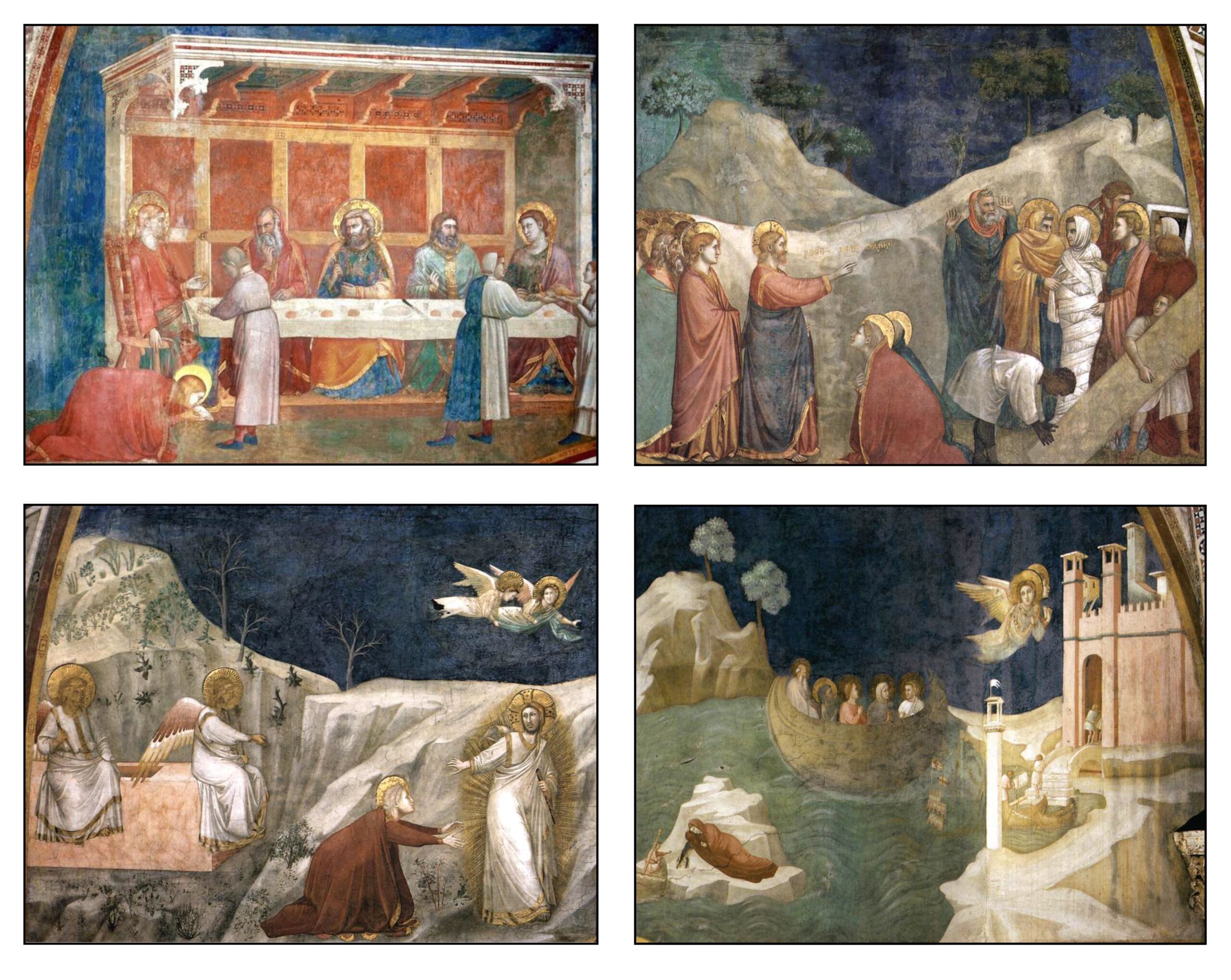
The story of the Magdalene arriving in France and the miracle of the child who was nourished at his dead mother’s breast is depicted in one of the frescos (illustrated below, lower right) by pupils of Giotto in the Magdalen Chapel of the Basilica of Saint Francis in Assisi (Mignozzi, 2019). Other frescos in the cycle illustrate the anointing of Jesus, the raising of Lazaurus, and the Noli me tangere episode. In the Lazarus episode, Christ speaks the words “Lazarus come forth” (Vulgate Lazare veni foras, John 11: 43). In the fresco these words are written in reverse order, to illustrate how they travelled from Jesus to Lazarus:

Jacopo de Voragine also reports the story that Mary Magdalene was married to John the Evangilist, and that John left Mary on their wedding night to follow Jesus. Indignant that she had been deprived of her husband, Mary indulged herself in the pleasures of the flesh. Not willing to let the calling of John be the cause of her damnation, Jesus later convinced her to repent and join his disciples. This version of the story was expanded in Yourcenar’s passionate story of the Madeleine in her collection of prose poems entitled Fires (1935). Though Mary loves Jesus passionately, she realizes that she must give him up to his destiny:

So as not to ruin his career as Saviour, I consented to see him die as a mistress consents to the rich marriage of the man she loves. (p 72).

Ascetic Mary

The Golden Legend also included the story of Mary of Egypt, a prostitute born in the 4th Century CE, who left her profession and became a hermit in the desert. Her clothes wasted away so that her hair was her only covering.

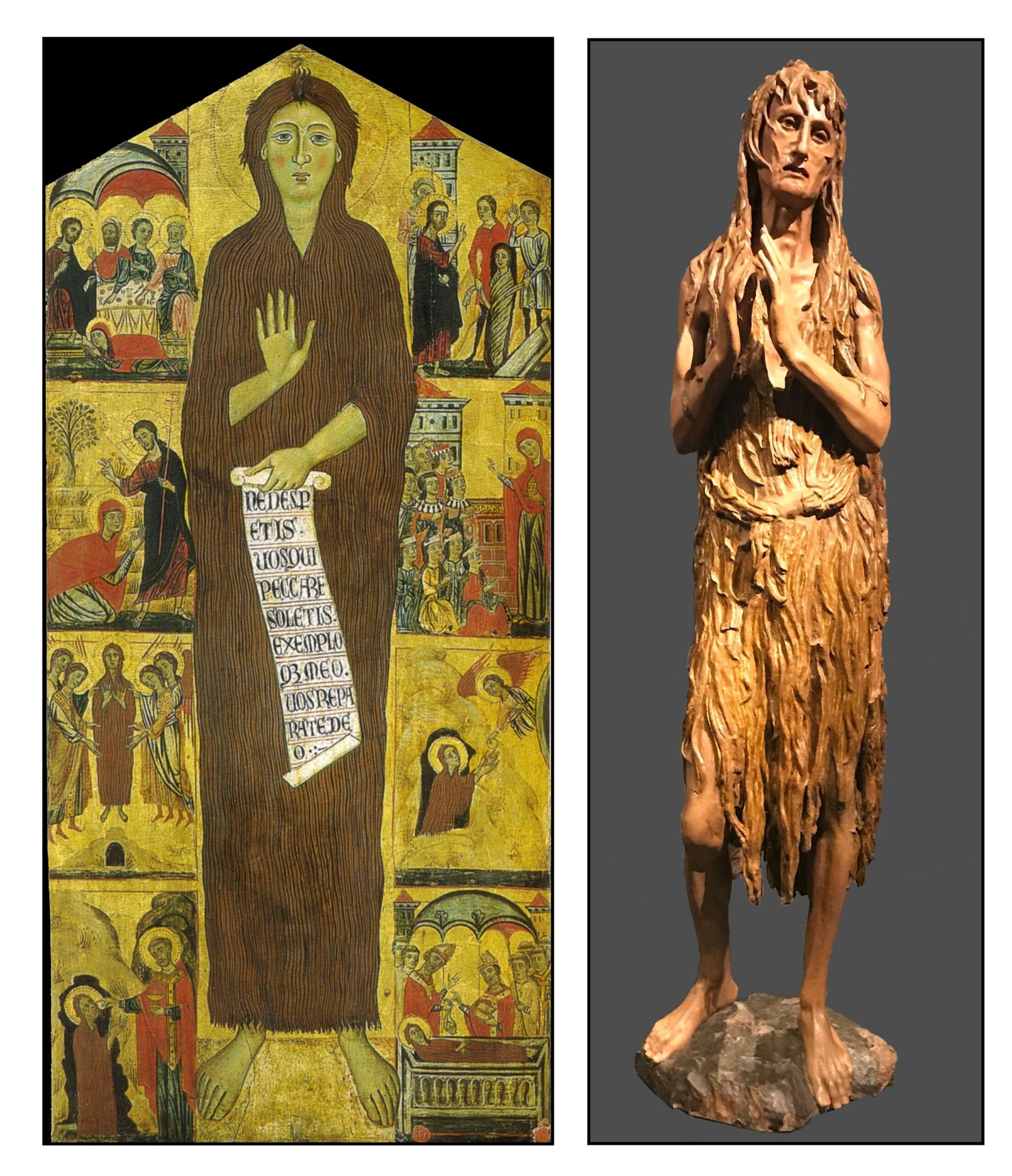
Mary of Egypt was soon conflated with Mary Magdalene. The depiction of the Magdalene covered in her own hair began in Italy with the painting of the Master of the Magdalene (1285) illustrated on the left below (Bradfield, 2002; Huggins, 2016). In the central portrait, Mary holds a banner stating

Ne desp[er]etis vos qui peccare soletis exemploque meo vos reparate Deo (Despair not you who are accustomed to sin, and by my example, return to God.)

On both sides of are episodes from her life: On the left are shown Mary Anointing Christ’s Feet, Noli Me Tangere, Mary Borne to Heaven by Angels, and Bishop Maximin giving Mary her Last Communion. On the right are The Resurrection of Lazarus, Mary Magdalene Preaching, An Angel Feeding Mary in the Desert, and the Funeral of Mary Magdalene

In 1455, Donatello created a wooden sculpture of The Penitent Magdalene, unclothed except for her own hair (illustrated on the right above). In 1492, Riemenschneider carved a series of panels for the altar of Church of Saint Mary Magdalene in Münnerstadt, Germany (Chapuis, 1999, Kalden-Rosenfeld, 2004). These show Christ in the House of Simon, Noli me Tangere, Mary Magdalene’s Last Communion, and Mary Magdalene’s Entombment. In the latter two panels (on the right) Mary is clothed only in her hair, although in these examples the hair appears to grow from all her body:

*7

The Visionary

In the Gospel of Mary, Mary asks Jesus about a vision she experienced:

She said, ‘I saw the Lord in a vision and I said to him, “Lord, I saw you today in a vision.” He answered me, “Blessed are you for not wavering at seeing me. For where the mind is, there is the treasure.” I said to him, “So now, Lord, does a person who sees a vision see it with the soul or with the spirit?” The Saviour answered, “A person does not see with the soul or with the spirit. Rather, the mind which exists between these two sees the vision …” ’ (Meyer, 2008,pp 641-2)

This makes a skeptic wonder whether her meeting the resurrected Jesus was a visionary rather than real experience. In his Vie de Jésus (1863) Renan noted that Mary Magdalene had earlier been exorcised of her devils, and therefore questioned the veracity of Mary Magdalene’s encounter with Jesus in the garden outside the empty tomb.

The life of Jesus, to the historian, ends with his last sigh. But so deep was the trace which he had left in the hearts of his disciples and of a few devoted women, that, for weeks to come, he was to them living and consoling. Had his body been taken away, or did enthusiasm, always credulous, afterwards generate the mass of accounts by which faith in the resurrection was sought to be established? This, for want of peremptory evidence, we shall never know. We may say, however, that the strong imagination of Mary Magdalene here enacted a principal part. Divine power of love! Sacred moments in which the passion of a hallucinated woman gives to the world a resurrected God!

The request of Jesus that Mary not touch him was unusual. Was it because he was just a vision and that there was nothing to touch?

The Holy Grail

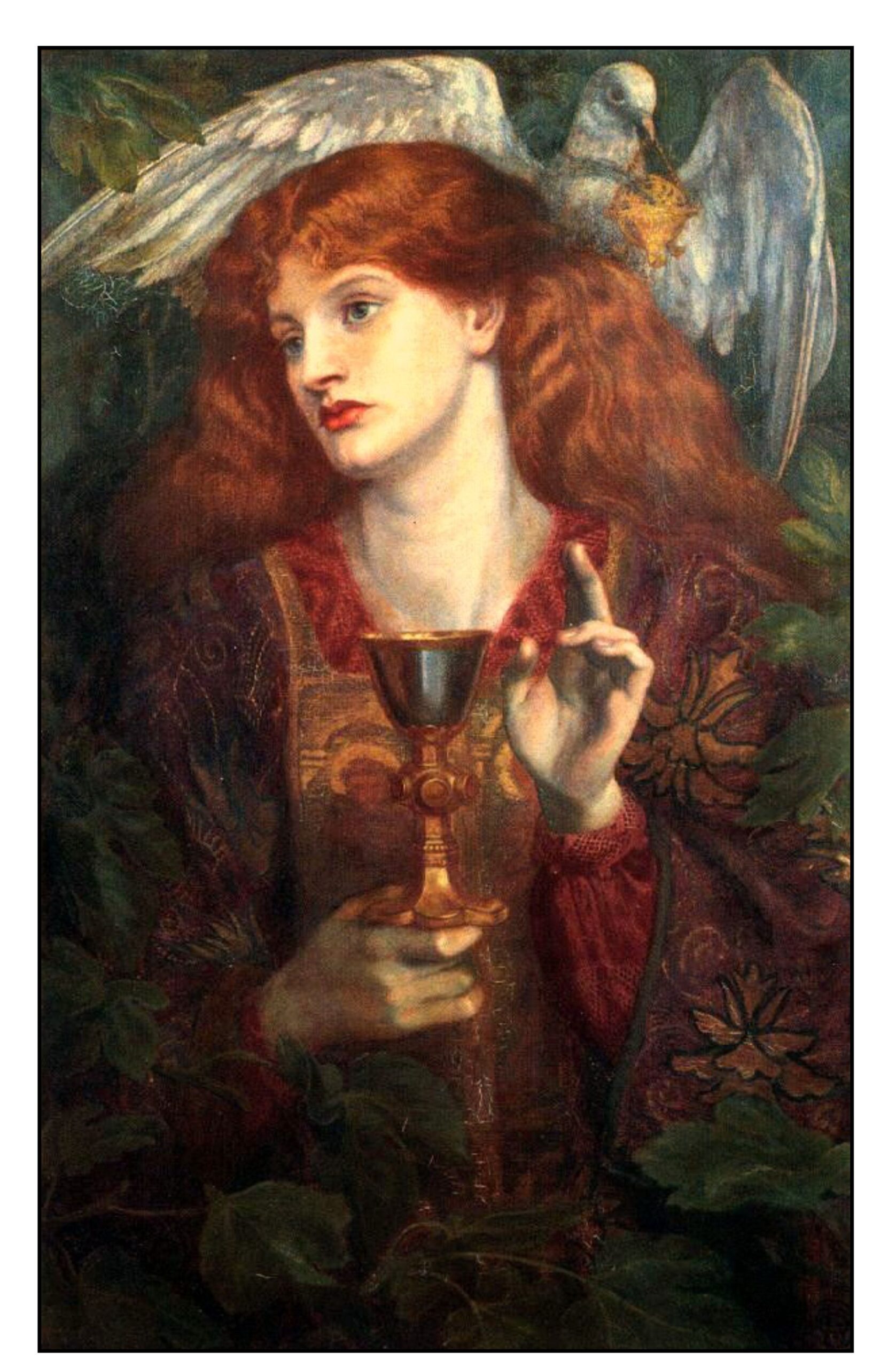
The Holy Grail (old French San Gréal) is a long-lost treasure sought by knights of old. The most common interpretation is that it is the cup (“holy chalice”) used by Jesus at the last supper. The word “grail” might have derived from the Greek krater (a bowl used for mixing wine with water). According to some legends this cup was also used by Joseph of Arimathea to catch the blood dripping from the wounds of the crucified Jesus. Other legends describe how the cup was then brought by Joseph to France or Britain, and kept in some undiscovered Castle of the Holy Grail, where it was guarded by the Grail Maiden. Dante Gabriel Rossetti painted this Damsel of the Sanct Gréal in 1874 (illustrated on the right).

In 1982, Baigent, Leigh and Lincoln published a reinterpretation of these legends in The Holy Blood and the Holy Grail. Based upon a reading of san gréal as sang réal (royal blood), they conceived the holy grail as representing the bloodline of Jesus. They proposed that Mary Magdalene conceived one or more children by Jesus and raised her family in France. Saint Sarah of Provence was perhaps her daughter (Starbird, 1993). Baigent and his co-authors proposed that, over the years, the descendants of Jesus and Mary were protected by the Cathars, the Knights Templar, and the Priory of Sion against the forces of orthodoxy that tried to destroy them. These speculations are the basis of Brown’s bestseller The Da Vinci Code (2003), in which the last surviving descendant of Jesus and Mary Magdalene is ultimately discovered in modern Paris.  

Epilogue

We can never know the real Mary Magdalene. She has become a legend, and legends have various interpretations. Perhaps her most characteristic trait is her human-ness: she is not tainted with divinity. She enjoyed physical love, repented of her sins, and had one main loving relationship with a man, who was crucified for what he taught. After his death, Mary had visions of his continued presence. She tried to continue his teaching, but was maligned for being a woman. She gave birth to a daughter and fled to France to raise her family. 


References

Apostolos-Cappadona, D. (2005). “Pray with tears and your request will find a hearing”: On the iconology of the Magdalene’s tears. In Hawley, J. S., & Patton, K. C. (Eds.) Holy tears: weeping in the religious imagination. (pp. 201-228). Princeton University Press,

Baigent, M., Leigh, R.; & Lincoln, H. (1982). The Holy Blood and the Holy Grail. Jonathan Cape.

Bradfield, B. (2002). The hair of the Desert Magdalen: its use and meaning in Donatello’s Mary Magdalen and Tuscan art of the late Fifteenth Century. York Medieval Yearbook 1

Brown, D. (2003). The Da Vinci Code. Doubleday.

Carrasco, M. E. (1999). The imagery of the Magdalen in Christina of Markyate’s Psalter (St. Albans Psalter). Gesta, 38 (1), 67-80.

Chapuis, J. (1999). Tilman Riemenschneider: master sculptor of the late Middle Ages. Yale University Press.

Ehrman, B. D. (2006). Peter, Paul, and Mary Magdalene: the followers of Jesus in history and legend. Oxford University Press.

Haskins, S. (1993). Mary Magdalen: myth and metaphor. HarperCollins.

Huggins, R. V. (2016). A brief guide to the iconography of the anonymous Mary Magdalen Cycle Panel in Florence’s Galleria dell’Accademia

Hunt, P. (2012). Irony and realism in the iconography of Caravaggio’s Penitent Magdalene. In Erhardt, M. A., & Morris, A. M. (eds.) Mary Magdalene, Iconographic Studies from the Middle Ages to the Baroque. (pp. 161-186). Brill.

Kalden-Rosenfeld, I. (2004). Tilman Riemenschneider: the Sculptor and his workshop. Langewiesche.

King, K. L. (2003). The Gospel of Mary of Magdala: Jesus and the first woman apostle. Polebridge Press.

Jansen, (1998). Maria Magdalena: Apostolorum Apostola. In Kienzle, B. M., & Walker, P. J. (Eds). Women preachers and prophets through two millennia of Christianity. (pp. 57-96). University of California Press.

Lupieri, E. F. (2019). The earliest Magdalene: Varied portrayals in early gospel narratives. In Lupieri, E. F.(ed.) Mary Magdalene from the New Testament to the New Age and Beyond. (pp. 11-25). Brill.

Meyer, M. W., & de Boer, E. (2004). The Gospels of Mary: the secret tradition of Mary Magdalene, the companion of Jesus. HarperSanFrancisco.

Meyer, M. (2008). The Gnostic Gospels. Folio Society.

Mignozzi, M. (2019). Suspended between sacred and profane: the iconography of Mary Magdalene from its origins to the Fifteenth Century. In Lupieri, E. F.(ed.) Mary Magdalene from the New Testament to the New Age and Beyond. (pp 189-252). Brill.

Renan, E. (1863). La vie de Jésus. Michel Lévy. (English translation by C. E. Wilbour, 1891)

Sabar, A. (2020). Veritas: a Harvard professor, a con man and the Gospel of Jesus’s Wife. New York: Doubleday.

Saramago, J. (1991, translated by Pontiero, G., 1994). The Gospel according to Jesus Christ. Harcourt Brace.

Starbird, M. (1993). The woman with the alabaster jar: Mary Magdalen and the Holy Grail, Bear & Company,

Valerio, A. (translated W. Wheatley, 2021). Mary Magdalene. Europa Editions.

Yourcenar, M. (1935, republished 1974, translated by D. Katz, 1981) Fires. Farrar, Strauss, Giroux.