Vincent Van Gogh: The Double-Square Paintings
After a period of severe depression at the hospital at Saint-Rémy in the spring of 1890, Vincent Van Gogh (1853-1890) asked to be discharged. He left Saint-Rémy on May 16, 1890, and visited his brother Theo in Paris for a few days, before travelling to Auvers-sur-Oise, a small town about 30 km northwest of Paris, where Charles-François Daubigny had lived, and where several Impressionists, among them Camille Pissarro and Paul Cézanne, had painted. Auvers was also the home of Paul-Ferdinand Gachet, a kindly physician whom Theo had asked to accept his brother as a patient. Van Gogh arrived in Auvers on May 20, 1890. Over the next ten weeks he created 74 paintings. Among these, twelve used a “double-square” format: 100 by 50 cm. In these paintings, Van Gogh attempted to express his new vision of the world. Unfortunately, his depression persisted and on the evening of July 27, 1890, he shot himself with a revolver, dying from the injury two days later. The illustration shows his last self-portrait painted in Saint-Rémy in September, 1889.
Doctor Gachet
Paul-Ferdinand Gachet (1828-1909) had trained at the Salpêtrière Hospital, but had retired to Auvers where he practised homeopathy. After his wife died in 1875, Gachet lived the life of a melancholy widower with his two children, Marguerite (born 1869) and Paul Jr. (born 1873). He collected paintings, and was himself an amateur artist. He possessed a small printing press.
Van Gogh met Doctor Gachet on the day of his arrival in Auvers. He found him a sad and sensitive man, but realized that he would probably not be able to help him with his depression. In a letter to Theo, he remarked
I think that we must in no way count on Dr Gachet. In the first place he’s iller than I am, it seemed to me, or let’s say just as much, there you have it. Now when one blind man leads another blind man, do they not both fall into the ditch?
Nevertheless, Von Gogh visited him frequently over the next several weeks and the two became friends. In a letter to his sister on June 5, he reported
I have found a true friend in Dr. Gachet, something like another brother, so much do we resemble each other physically and also mentally.
On June 3 he painted a portrait of the doctor (Saltzman, 1998). The doctor sits at a red garden table on which rests a foxglove plant. Foxglove, a source of digitalis, signifies the doctor’s medical profession. Also on the table are two yellow books: Germinie Lacerteux (1865) and Manette Salomon (1867) by Edmond and Jules de Goncourt. These novels, representative of the new movement of realism, tell depressing stories, and Van Gogh likely included them in the painting to reflect the doctor’s melancholy. The portrait is currently in a private collection. A copy of questionable authenticity is held by the Louvre.
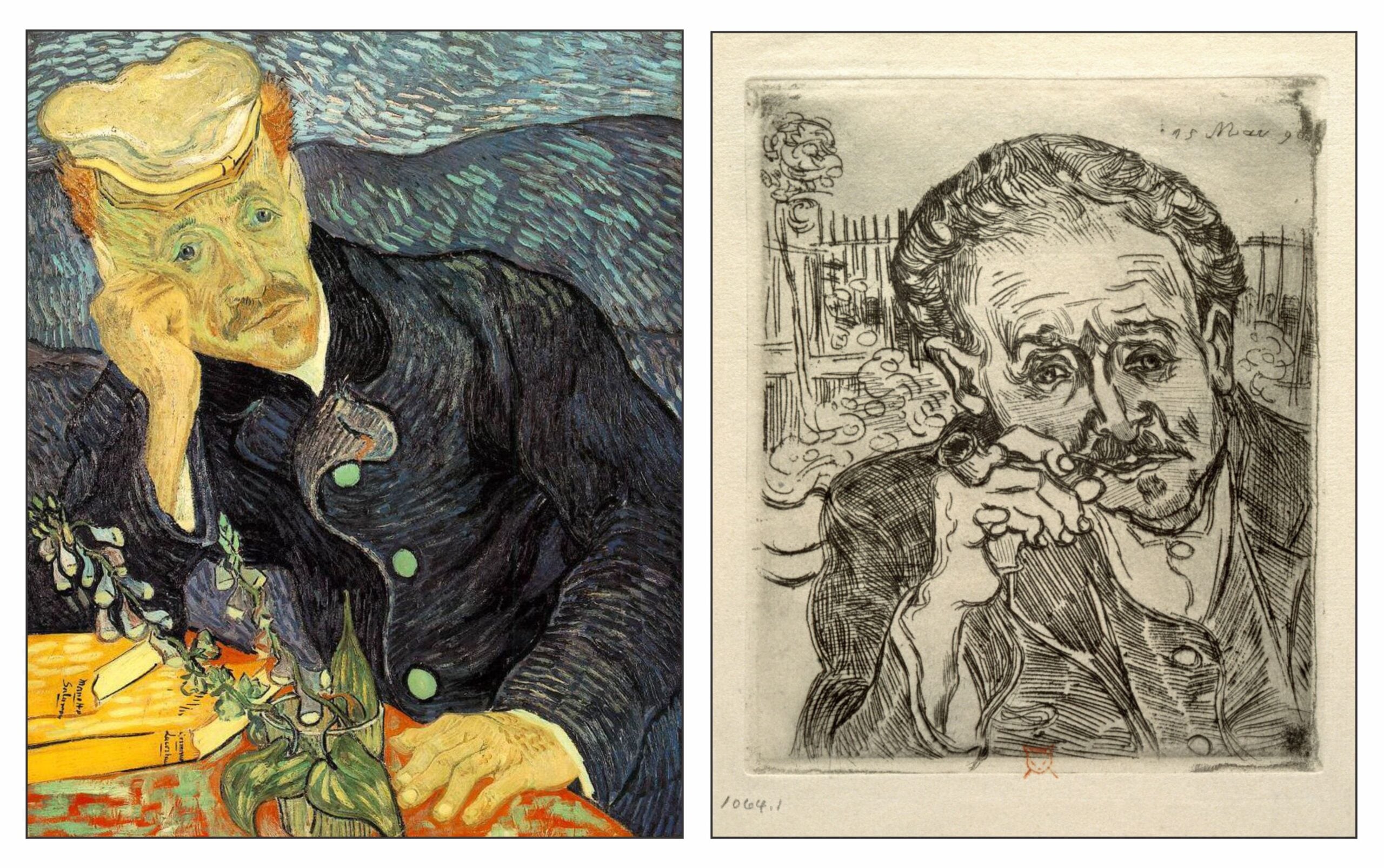 And on June 19 Gachet gave Van Gogh a prepared copper plate so that he could sketch another portrait for an etching. The plate was later etched, and multiple copies were printed either by Doctor Gachet or his son. One of them must have added the incorrect date 15 Mai 90 in a shaky backward handwriting so that it would come out properly on the print. This is the only etching that Van Gogh ever made, though his extensive experience with a reed-pen drawings made him a master of this approach.
In a letter to his sister Wilhelmina, Van Gogh describes what he wanted to convey in his painting:
I should like to paint portraits which would appear after a century to people living then as apparitions. By which I mean that I do not endeavour to achieve this by a photographic resemblance, but by means of our impassioned expressions – that is to say, using our knowledge of and our modern taste for colour as a means of arriving at the expression and the intensification of the character. So the portrait of Dr. Gachet shows you a face the colour of an overheated brick, and scorched by the sun, with reddish hair and a white cap, surrounded by a rustic scenery with a background of blue hills; his clothes are ultramarine – this brings out the face and makes it paler, notwithstanding the fact that it is brick-coloured.
Daubigny
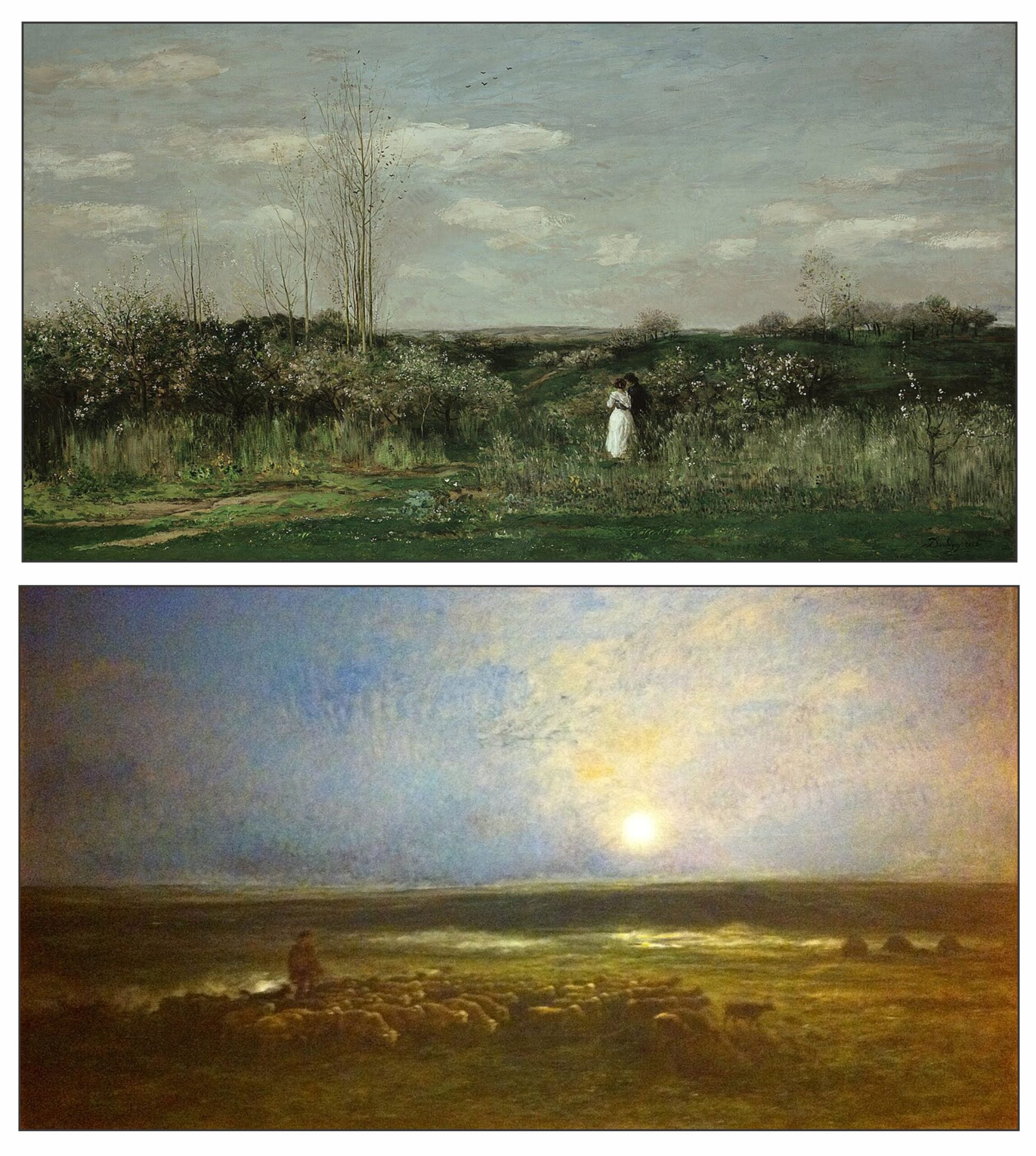
Charles-François Daubigny (1817-1878) was one of the first artists, together with Corot and Courbet, to practise painting en plein air. He wanted to capture the fleeting changes in light and color that happen in real life rather than in the studio. Daubigny settled in Auvers in 1860. While there he used a boat as a floating studio to paint the light effects on the Oise and Seine Rivers. His paintings are considered precursors to Impressionism. The following illustration shows two paintings: Springtime (1868) and Moonrise at Auvers or Return of the Flock (1878)
Van Gogh held Daubigny in high regard (Bakker, 2015). He visited Daubigny’s widow in Auvers and painted the garden to the Daubigny villa on July 10, 1890:
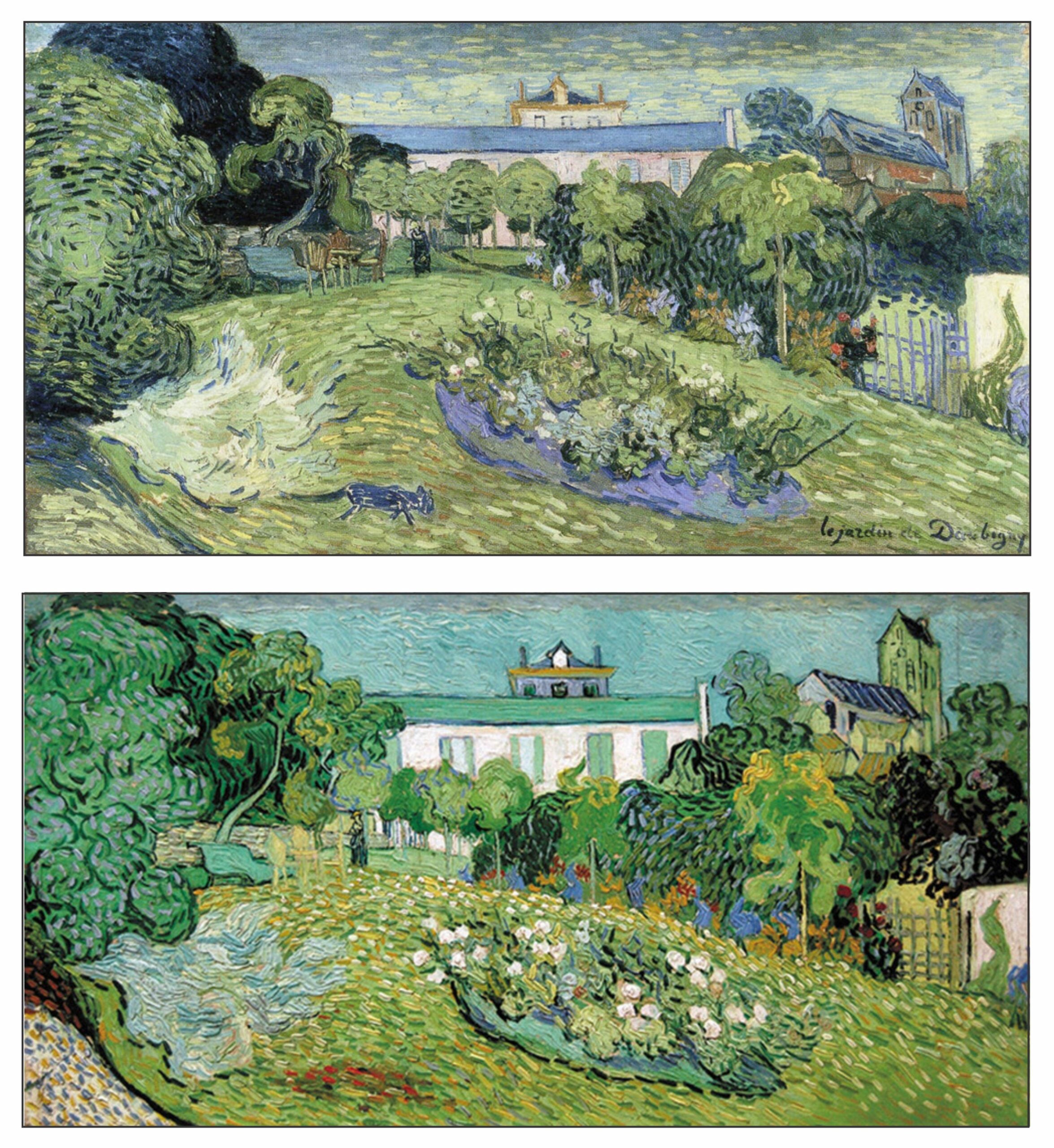
The first painting with the cat in the foreground is now in the Kunstmuseum in Basel and the later copy, painted on July 23, is in the Hiroshima Museum of Art. In the background to the right is the Romanesque Church of Notre-Dame-de-l’Assomption, just east of the villa. Van Gogh also made another smaller painting which focussed on the roses in the Daubigny garden. This painting was famously painted on a checkered napkin since Van Gogh had run out of canvas.
Auvers-sur-Oise
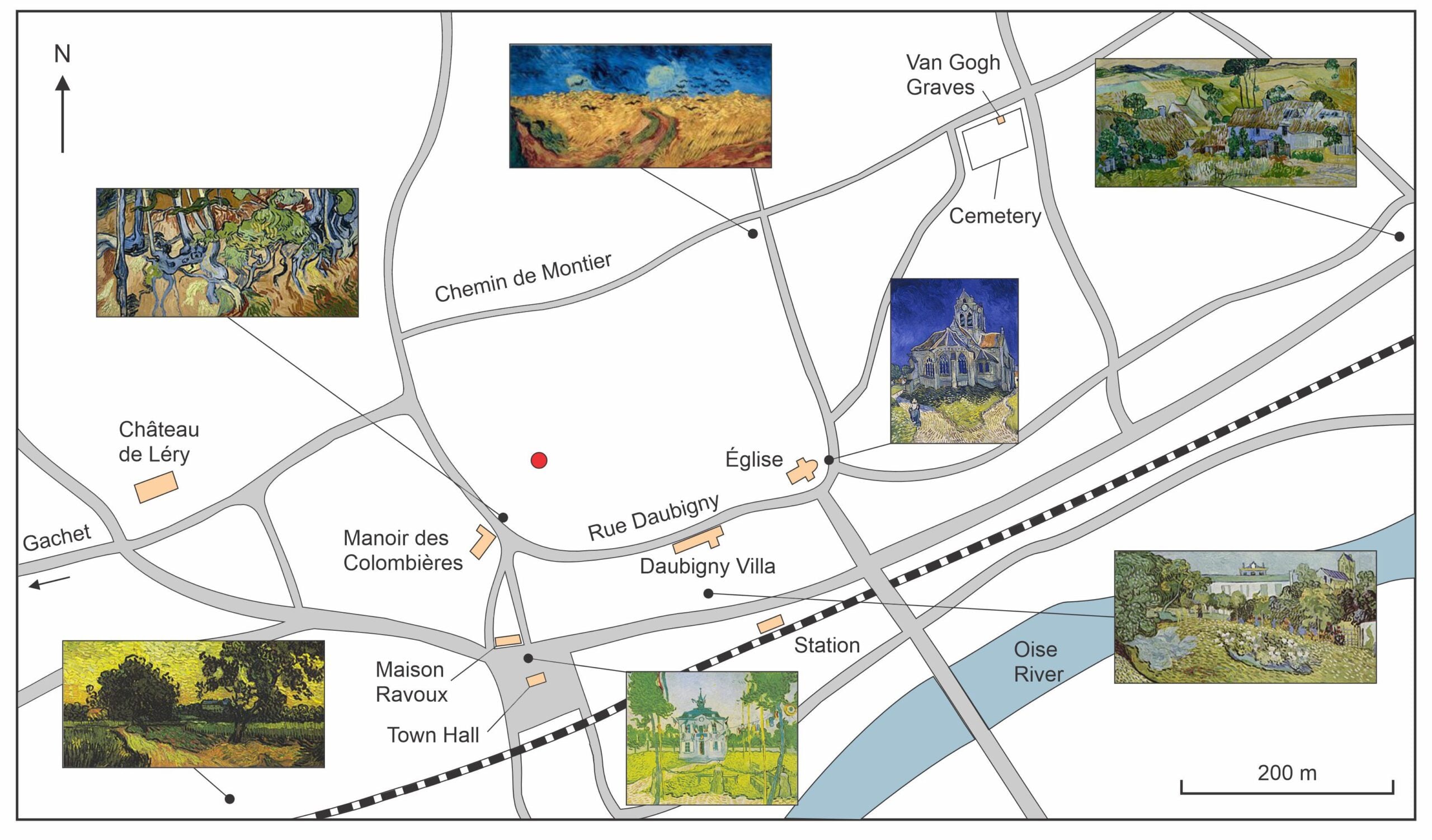
The following map of Auvers-sur-Oise, simplified from Van der Veen (2023a) shows the Daubigny Villa, the Maison Ravoux where Van Gogh found lodging, and the locations where he painted several of his pictures.
The Double-Square Format
In mid June Van Gogh had begun to use canvases that were 100 by 50 cm for some of his paintings – a double-square format (Pickvance, 1986, p 258; Coquery 2023; Bailey, 2021a, pp 102-115). Two of the July paintings of Daubigny’s garden were in this format. Daubigny had painted his landscapes using wide canvasses, and it is possible that Van Gogh chose his new format with his predecessor in mind. Van Gogh had also been impressed the recent painting Inter Artes et Naturam (1890) of Pierre Puvis de Chavannes (1824-1898) which he had seen in Paris (Wattenmaker, 1981). This is 295 x 830 cm, almost a triple-square
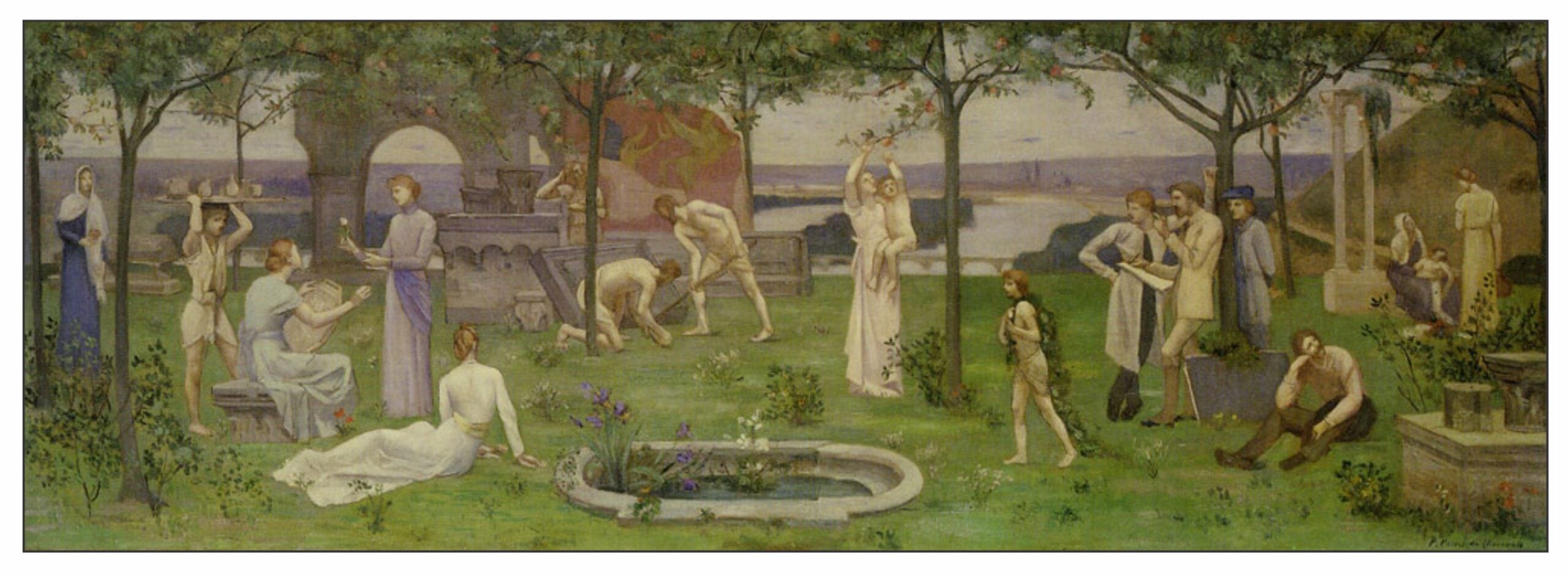
Puvis de Chavannes’ painting shows figures unearthing architectural relics, creating ceramics, and picking blossoms in a park beside the River Seine. All under the watchful eyes of several artists who are sketching their endeavors. The painting celebrates both artistic creativity and the beauty of nature without which art could not occur. Puvis de Chavanne made the original for Musée des Beaux-Arts in Rouen, but he also made several smaller copies. The following is Van Gogh’s description in his letter to his sister Wilhelmina on June 5
On one side two women, dressed in simple long robes, are talking together, and one the other side men with the air of artists; in the middle of the picture a woman with her child on her arm is picking a flower off an apple tree in bloom. One figure is forget-me-not blue, another bright citron yellow, another of a delicate pink colour, another white, another violet. Underneath their feet a meadow dotted with little white and yellow flowers. A blue distance with a white town and a river. All humanity, all nature simplified, but as they might be if they are not like that.
This description does not tell you anything – but when one sees this picture, when one looks at it for a long time, one gets the feeling of being present at a rebirth, total but benevolent, of all things one should have believed in, should have wished for – a strange and happy meeting of very distant antiquities and crude modernity.
The following is Van Gogh’s description of his first double-square paintings in his letter to Theo on June 24, 1890:
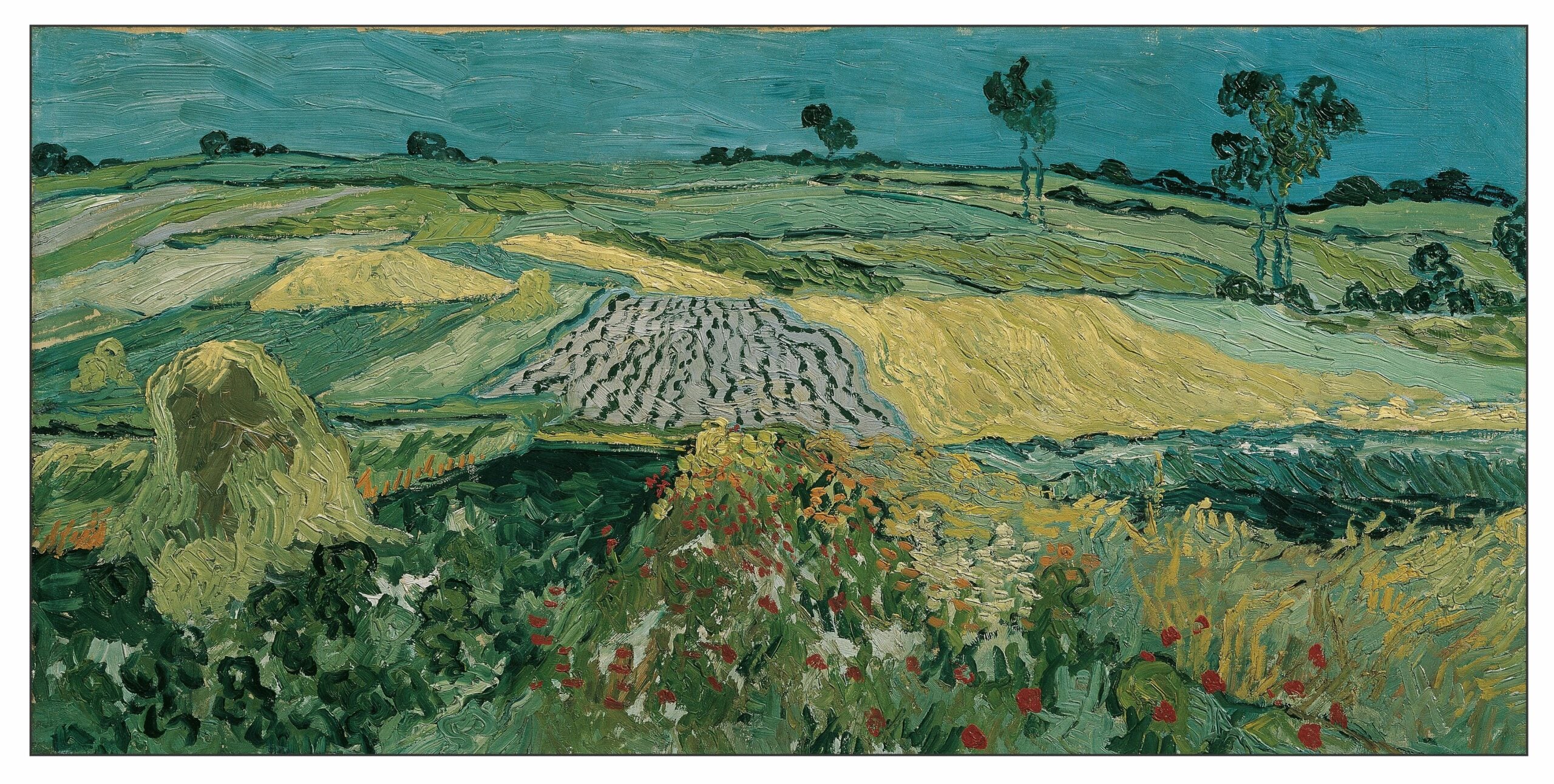
Then I have a canvas one metre long by only 50 centimetres high, of fields of wheat, and one that makes a pendant of undergrowth, lilac trunks of poplars, and underneath them some flower-dotted grass, pink, yellow, white and various greens.
The following is the first of these paintings, Wheatfields near Auvers:
This is the mysterious Undergrowth with Two Figures:
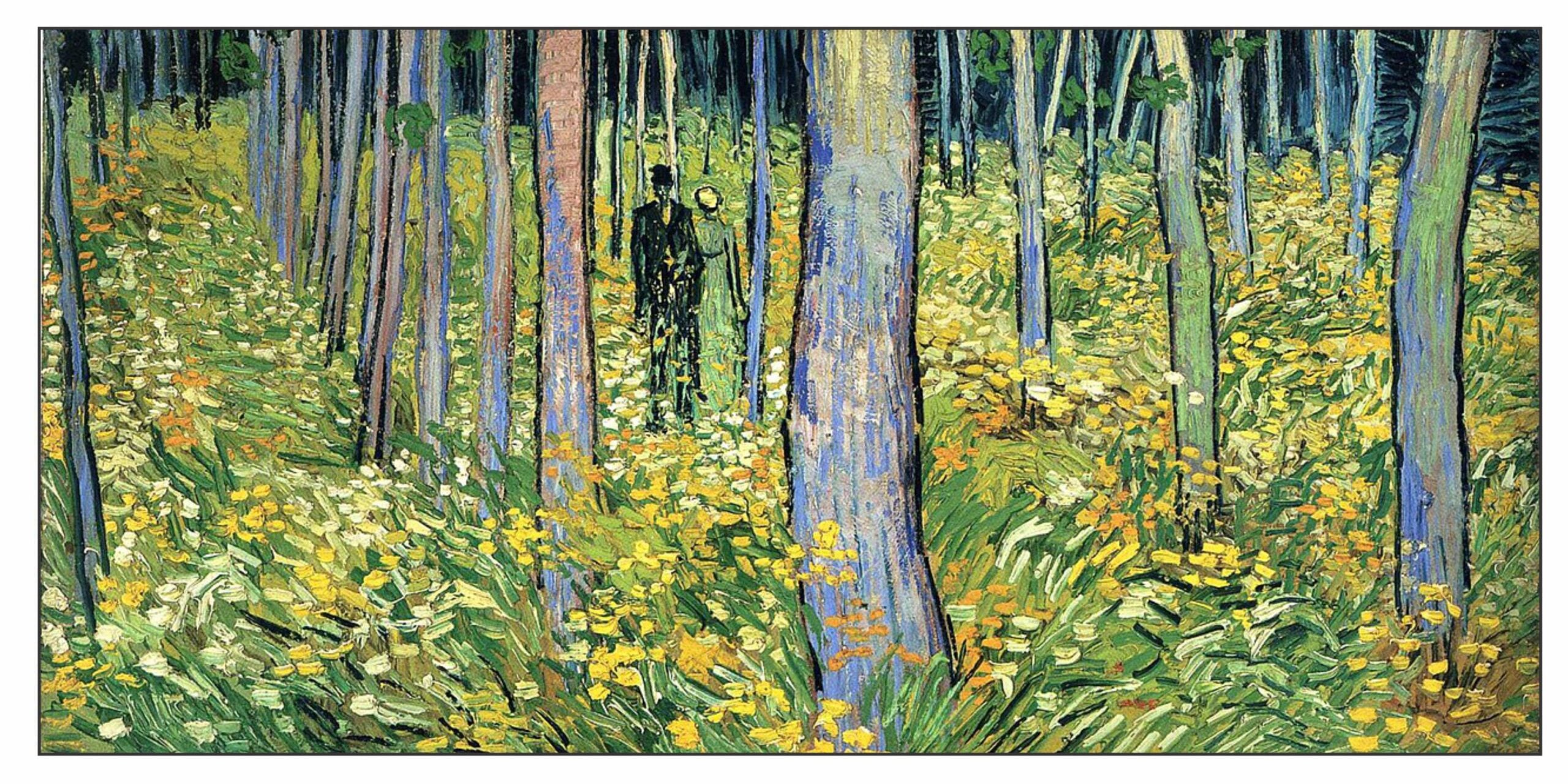
Coquery (2023) comments on the latter
No horizon here, rather a closed space punctuated by the hypnotic rows of poplars with their uncertain vanishing lines; and in the foreground a trunk that is abnormally large compared to the others, designed to intensify the perspective. The geometry of the trunks, emphasized by strong black outlines, contrasts with the vigorous profusion of grasses and flowers, more thickly painted and hardly credible as undergrowth.
Strangely, Van Gogh does not mention the ghostly, frontally rendered couple, and the uncertainty of scale as they seem to float between the trunks and the waist-high grass that sprinkles their Sunday clothes. The pair – especially the man who wears a kind of top hat – resembles a bridal couple who have strayed too far from a church square. It represents the last instance of the loving-couple motif that pervades the artist’s oeuvre like a poignant regret.
In its haunting geometry this painting can be read as a reinterpretation of the orchard in Pierre Puvis de Chavannes’s great work, Inter artes et naturam.
Puvis de Chavannes might have represented the beauty of antiquity, but Van Gogh distilled into his painting the loneliness of modern life.
The following is Landscape at Twilight:
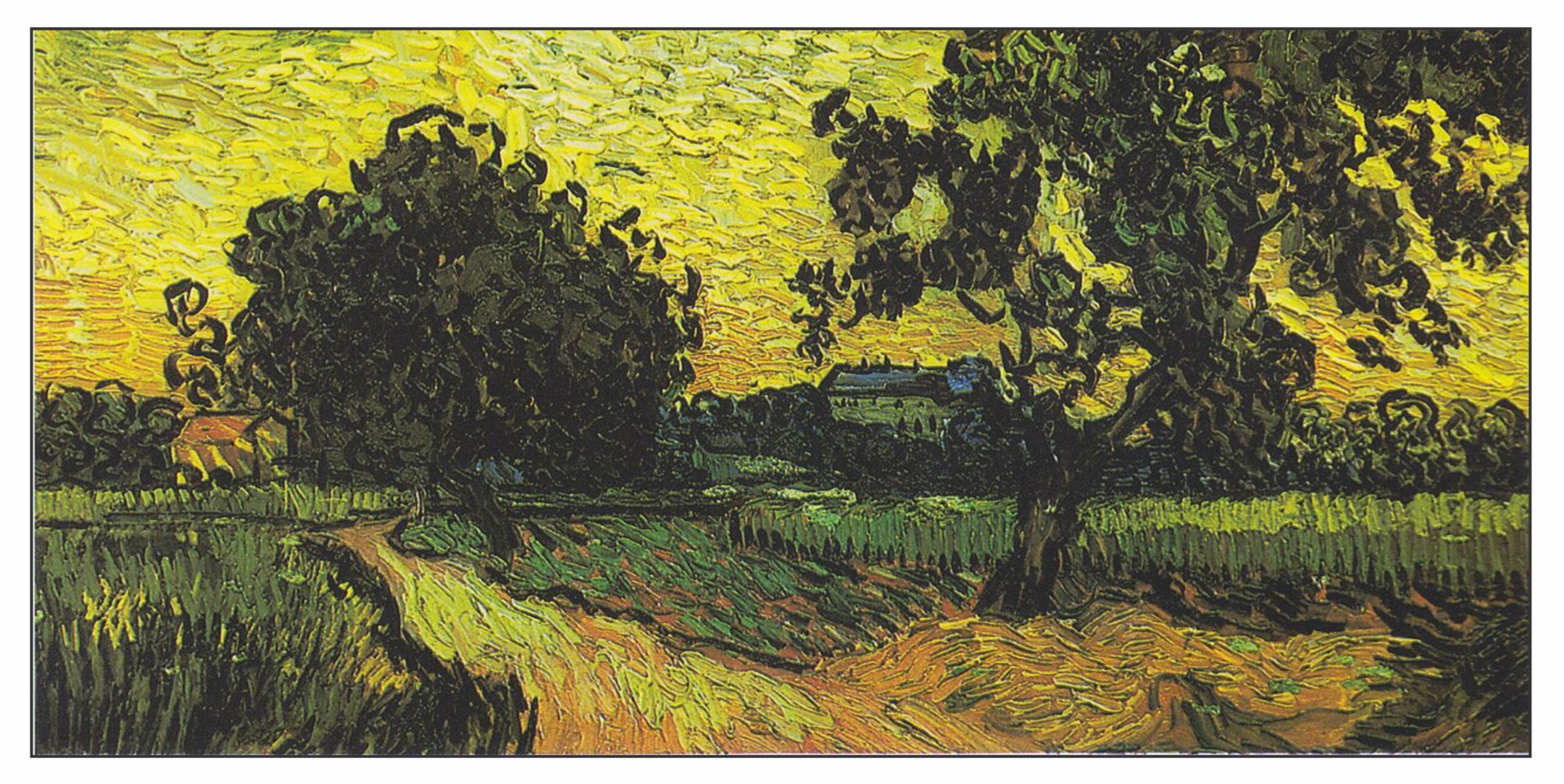
The painting is reminiscent of some of the twilight paintings of Daubigny, although Van Gogh’s colours are more intense and his brushwork far more energetic. The picture is evenly divided into bright sky and darker land. In the distance is the Château de Léry, built in 1635.
Van Gogh describes the painting in his letter of June 24
Finally a night effect – two completely dark pear trees against yellowing sky with wheatfields, and in the violet background the castle encased in the dark greenery.
A week after these first three double-square pictures, Van Gogh painted a portrait of Marguerite Gachet at the Piano using his new format, but orienting it vertically. In a letter to Theo on June 28, he described the painting
Yesterday and the day before I painted Mlle. Gachet’s portrait, which I hope you will see soon; the dress is pink, the wall in the background green with orange spots, the carpet red with green spots, the piano dark violet; it is 1 metre high by 50 cm wide.
The following illustration shows the portrait and an excerpt from the letter where Van Gogh suggests that the portrait and the Wheatfields near Auvers would complement each other. The illustration shows the two paintings aligned as proposed:
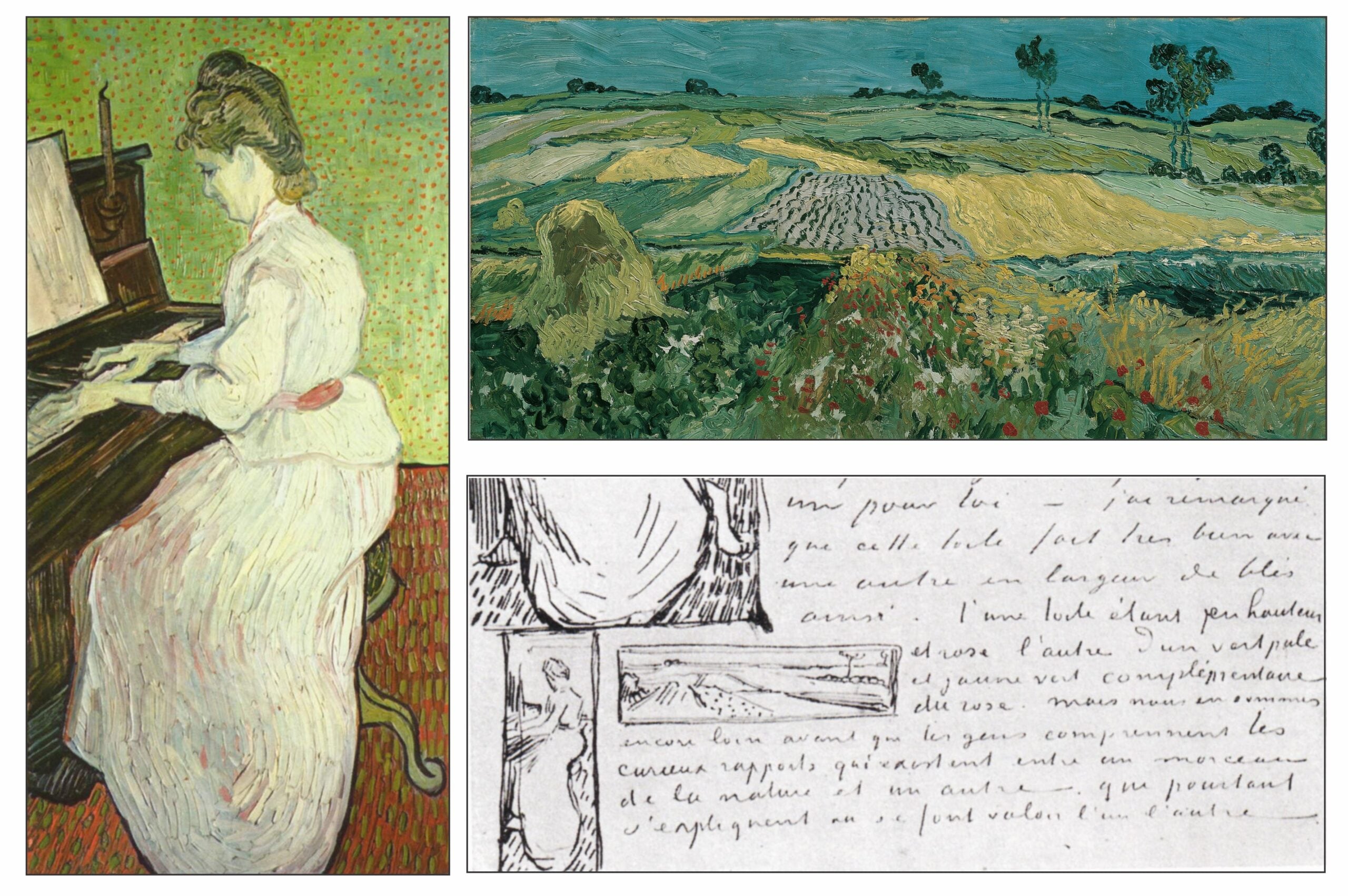
J’ai remarqué que cette toile fait très bien avec une autre en largeur, de blés, ainsi l’une toile étant en hauteur et rose, l’autre d’un vert pâle et jaune vert complémentaire du rose; mais nous en sommes encore loin avant que les gens comprennent les curieux rapports qui existent entre un morceau de la nature et un autre, qui pourtant s’expliquent et se font valoir l’un l’autre.
[I have noticed that this canvas goes very well with another horizontal one of wheat, as one canvas is vertical and in pink tones, the other pale green and greenish yellow, the complementary of pink; but we are still far from the time when people will understand the curious relation between one fragment of nature and another, which all the same explain each other and enhance each other.]
Wheatfields under Turbulent Skies
Vincent Van Gogh visited Paris in early June and became aware of the stresses of his brother Theo. His newborn son had been sick, and Theo himself was uncertain whether to stay at his position with the art dealers Boussod and Valadon, or to strike out on his own. Vincent realized what a burden he had been for his brother. In a letter to Theo on July 10 he states
It’s no small thing when all together we feel the daily bread in danger, no small thing when for other causes than that we also feel our existence to be fragile.
Once back here I too still felt very saddened, and had continued to feel the storm that threatens you also weighing upon me. What can be done – you see I usually try to be quite good-humoured, but my life, too, is attacked at the very root, my step also is faltering.
He then states that he has just completed two
immense stretches of wheatfields under turbulent skies, and I made a point of trying to express sadness, extreme loneliness. You’ll see this soon, I hope – for I hope to bring them to you in Paris as soon as possible, since I’d almost believe that these canvases will tell you what I can’t say in words, what I consider healthy and fortifying about the countryside.
One of the paintings was Wheatfields under Thunderclouds, now in the Van Gogh Museum:
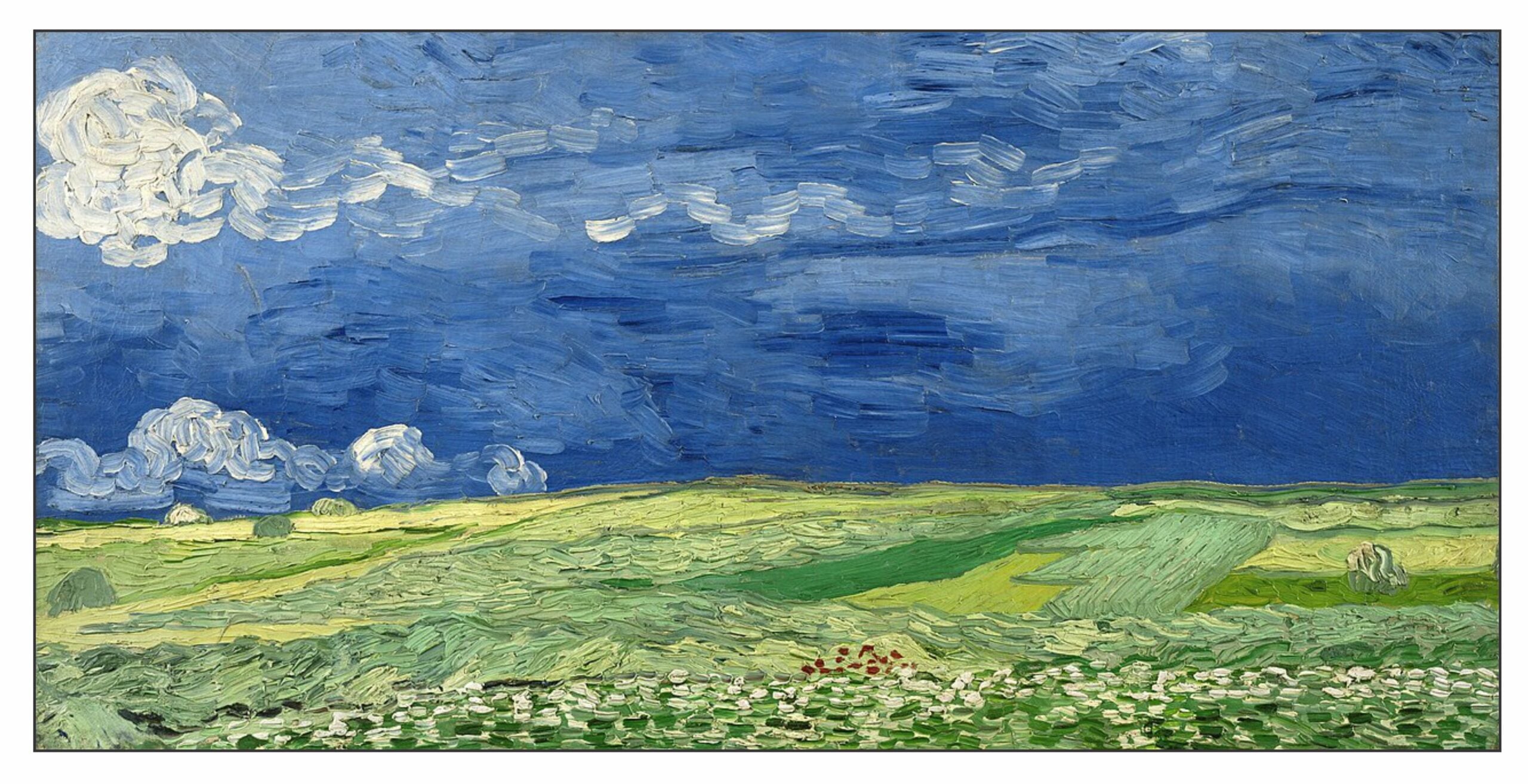
Coquery (2023, p 141) remarks that
This is the most austere of the double squares and the only one giving a predominant role to the sky, which is enlivened with heavy impasto and broad, lush brushstrokes.
Despite the storm building up on the left, the painting conveys an abiding sense of peacefulness. The storm will come, but the fields will remain, the green will become golden and the harvest will begin.
The second painting is Wheatfield with Crows, also in the Van Gogh Museum.
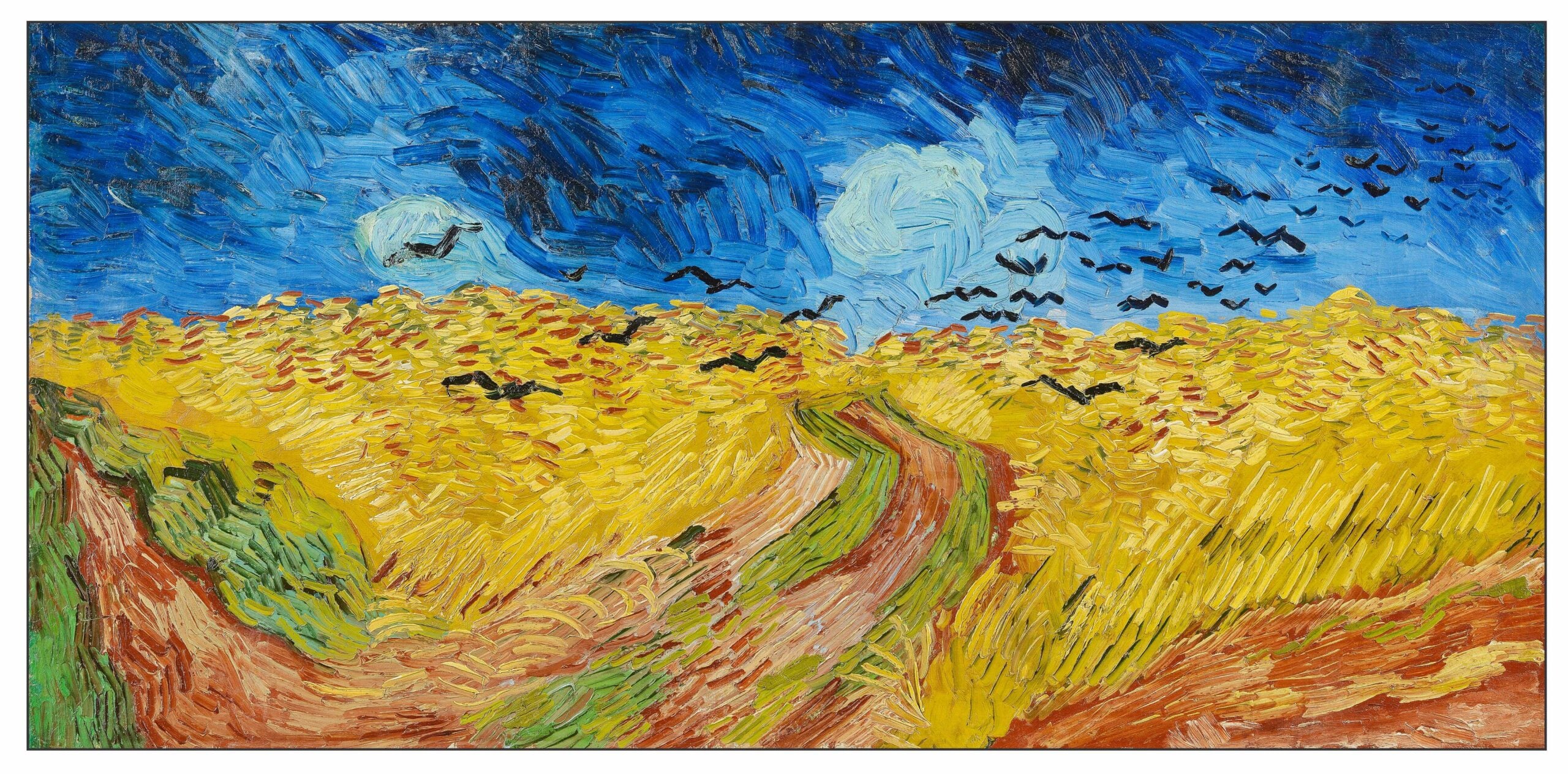
The painting is stormy. The brushstrokes are ragged. The sharp contrasts between blue and yellow and between red and green heighten the emotional intensity of the painting.
Although the horizon is clear there is no single vanishing point and no unifying perspective. The painting appears to show two triangular wheatfields. Wouter van der Veen (2023) took two photographs from the probable location of this painting. The first shows a path between two fields viewed from the side of the Chemin de Montier
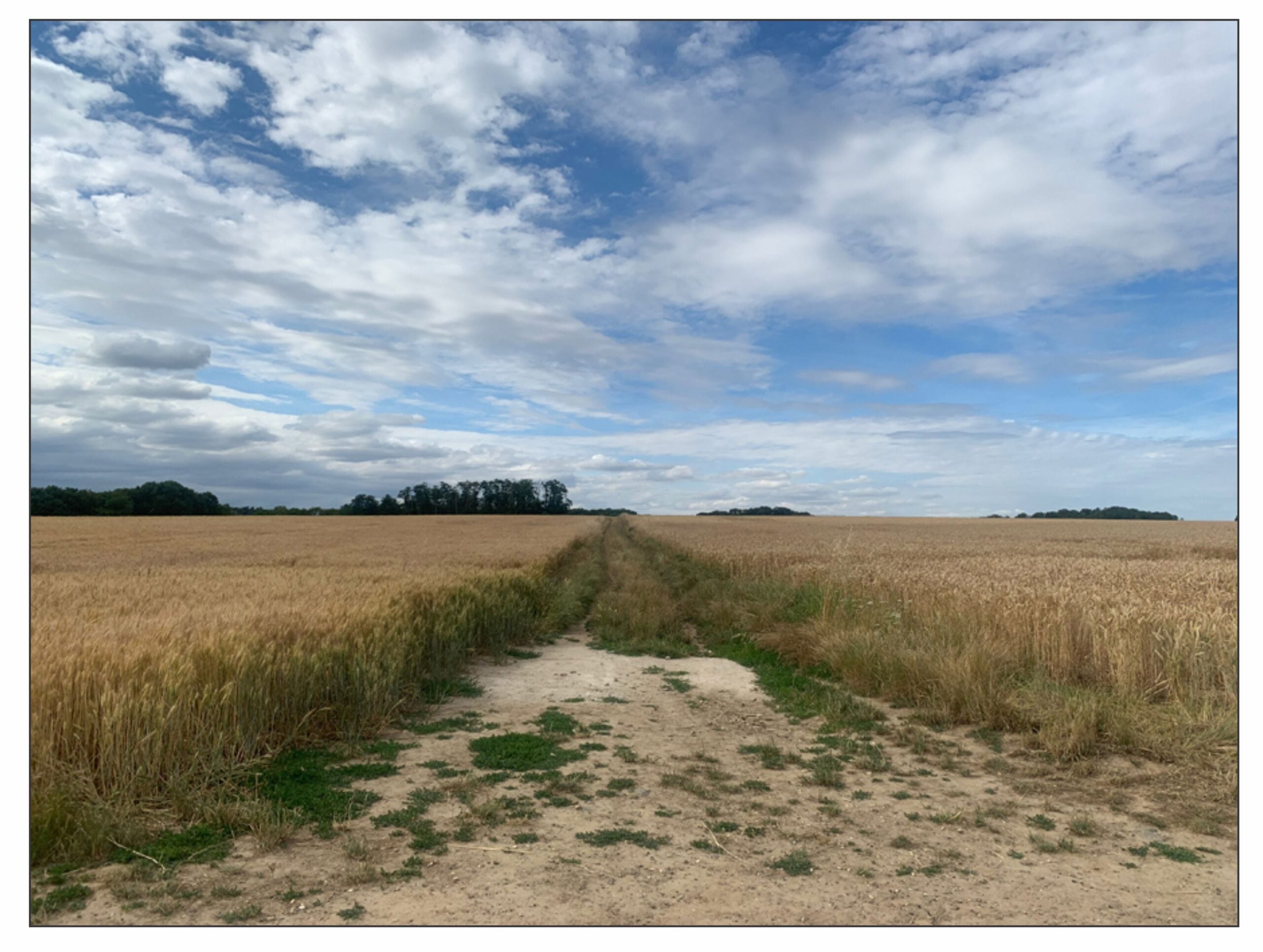
The following shows the same scene photographed using a panoramic lens. Now the scene looks much more like the painting:
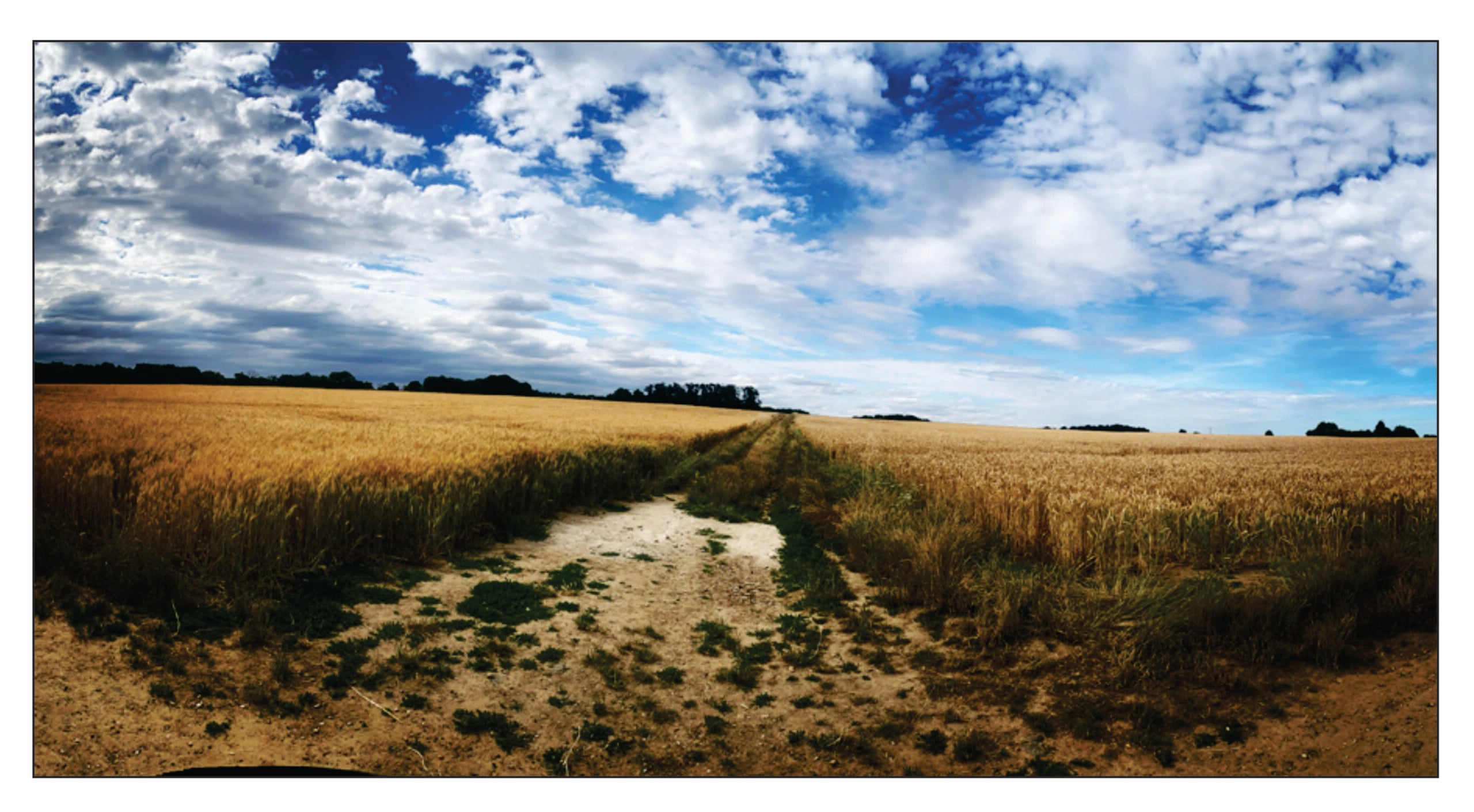
Van Gogh was using a panoramic perspective. This is much closer to what the human eye sees. Our field of vision is about 120˚ vertical by 200˚ degrees horizontal. This fits very well with Van Gogh’s double-square format. Most paintings deal with only the center of our field of vision where we see binocularly (about 120˚ square) and leave the periphery unrepresented.
Bailey (2021a, p 24; 2021b) points to an 1843 painting by Daubigny that was likely taken from the same spot. Van Gogh may have known the painting and may have sought out the same location. However, there is a huge contrast between Daubigny’s peace and Van Gogh’s storm.
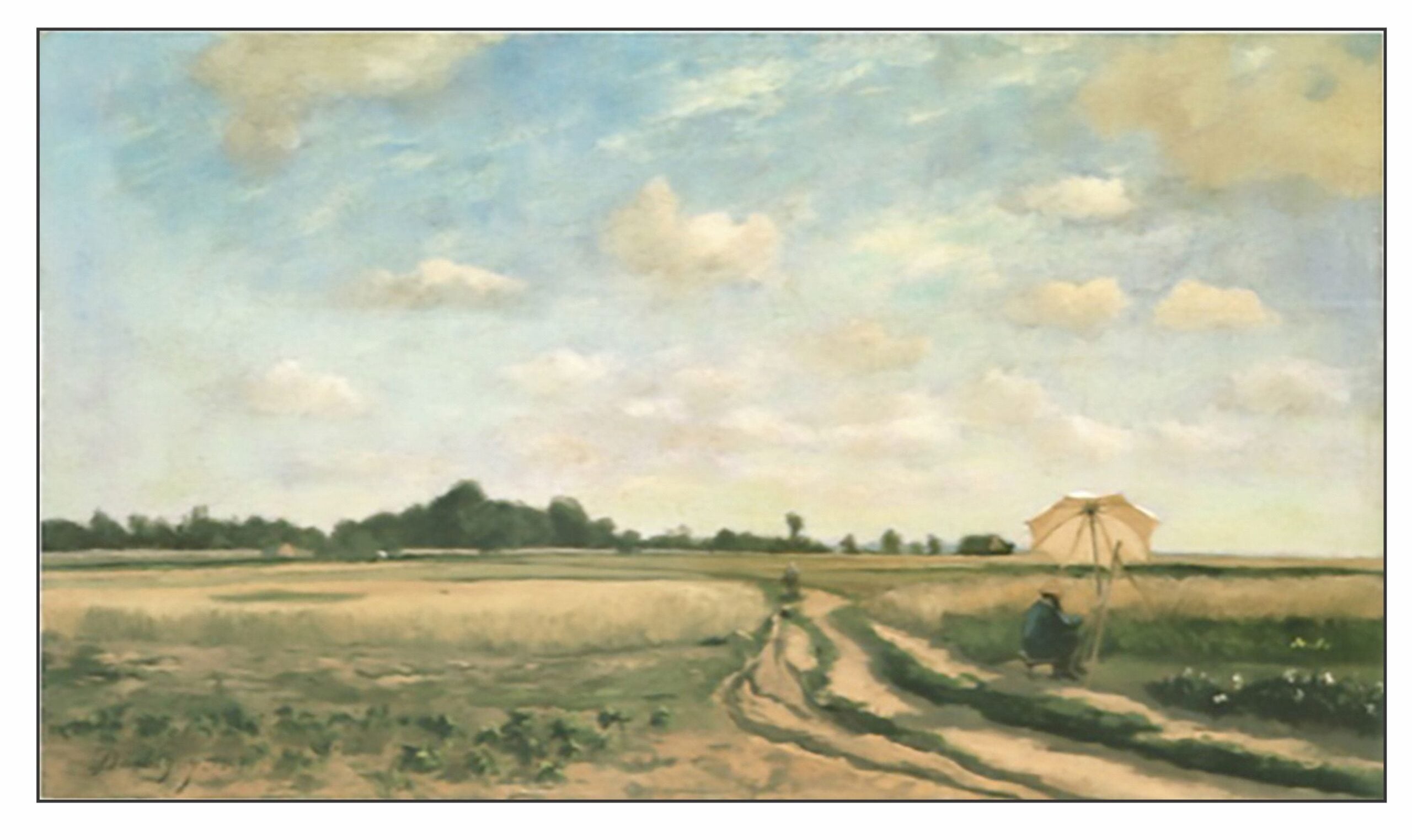
Any interpretation of Wheatfield with Crows is forever tainted with the fact that the painting was long considered Van Gogh’s last painting before his suicide (Bailey 2021b). However, it is now known that the painting was finished almost three weeks before. It is not a harbinger of death. Rather, Erickson (1998, p 162) points out the Van Gogh considered wheatfields far more restorative than ominous. She quotes from a letter to Theo on July 2
It is just in learning to suffer without complaint, in learning to look on pain without repugnance, that you risk vertigo, and yet it is possible, yet you may even catch a glimpse of a vague likelihood that on the other side of life we shall see good reason for the existence of pain, which seen from here sometimes so fills the whole horizon that it takes on the proportions of a hopeless deluge. We know very little about this, about its proportions, and it is better to look at a wheat field, even in the form of a picture.
Van Gogh was clearly suffering and he was contemplating death, but he looked to the wheatfields for affirmation. Erickson remarks (p 164)
If the roads, as they run out of the painting or disappear among the resplendent wheat, in Crows over the Wheatfield, were intended to represent death, it is a death of triumph and ultimate release. Taking into consideration van Gogh’s view of death, the images of crows and wheat, and country roads begin to come together to show what van Gogh describes as the “healthful and restorative forces” of the French countryside. The vast, troubled skies of deep royal blue, which occupy almost half of the compositional space of the painting are symbolic of the infinite, the ultimate goal of the artist’s pilgrimage. [the quotation is from the July 10 letter]
Harvest
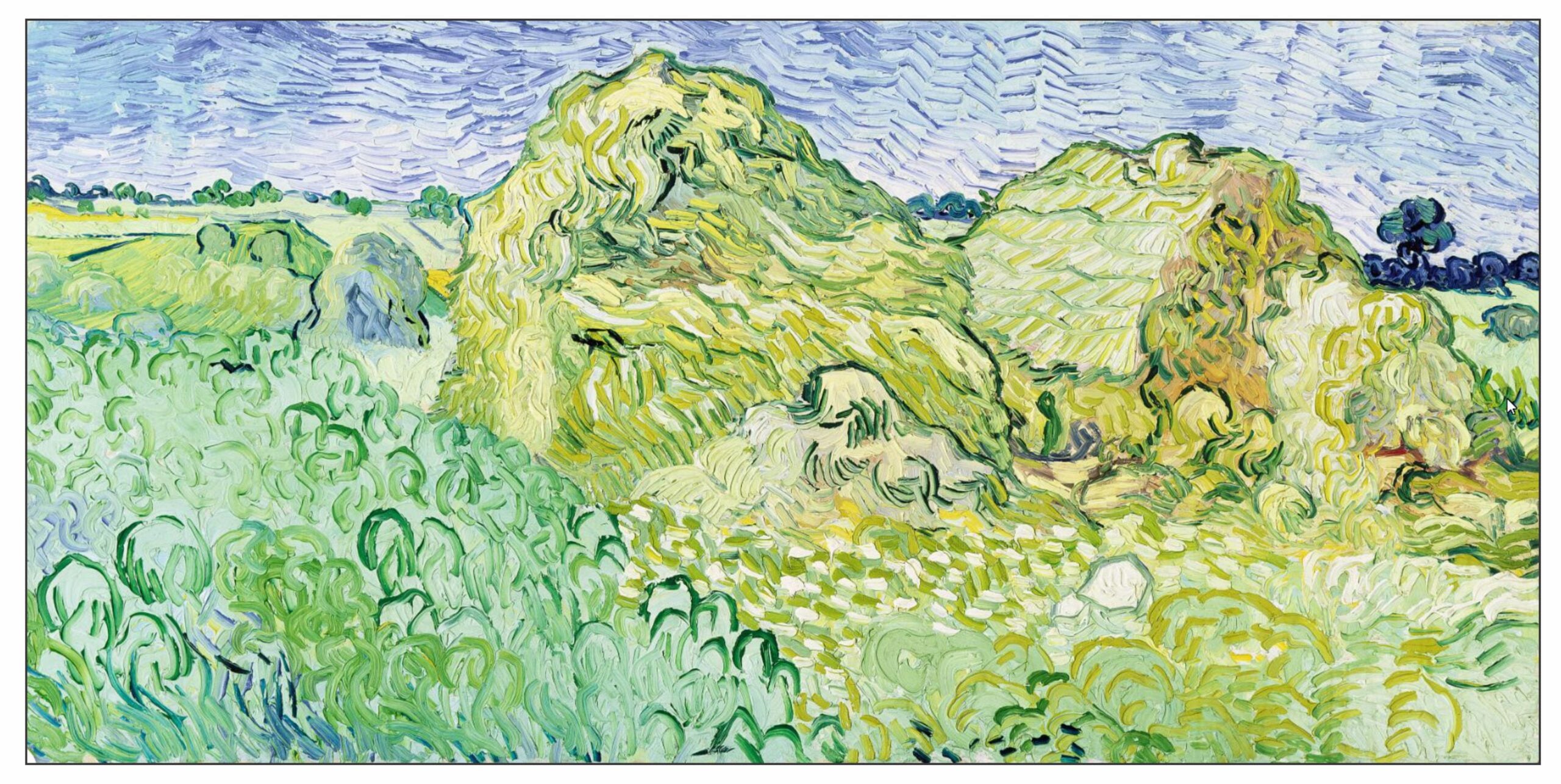
By mid-July the harvest was in full swing. Van Gogh painted a peaceful representation of a Field with Haystacks:
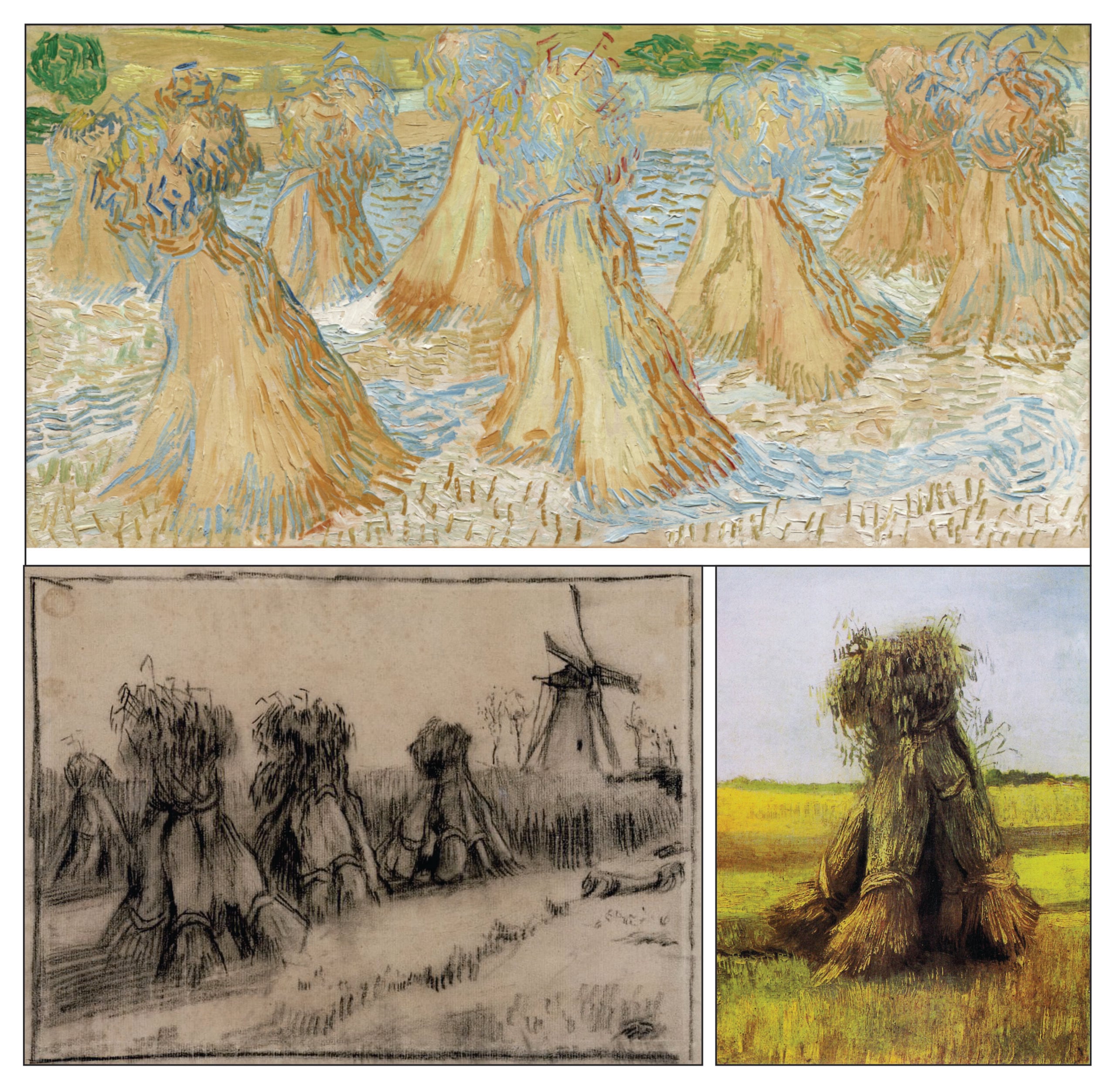
Van Gogh had long delighted in the harvest. The following illustration shows his representation of Wheat Sheaves from July 1890, together with an earlier drawing and painting from 1885. The 1890 painting is almost ethereal in its lightness.
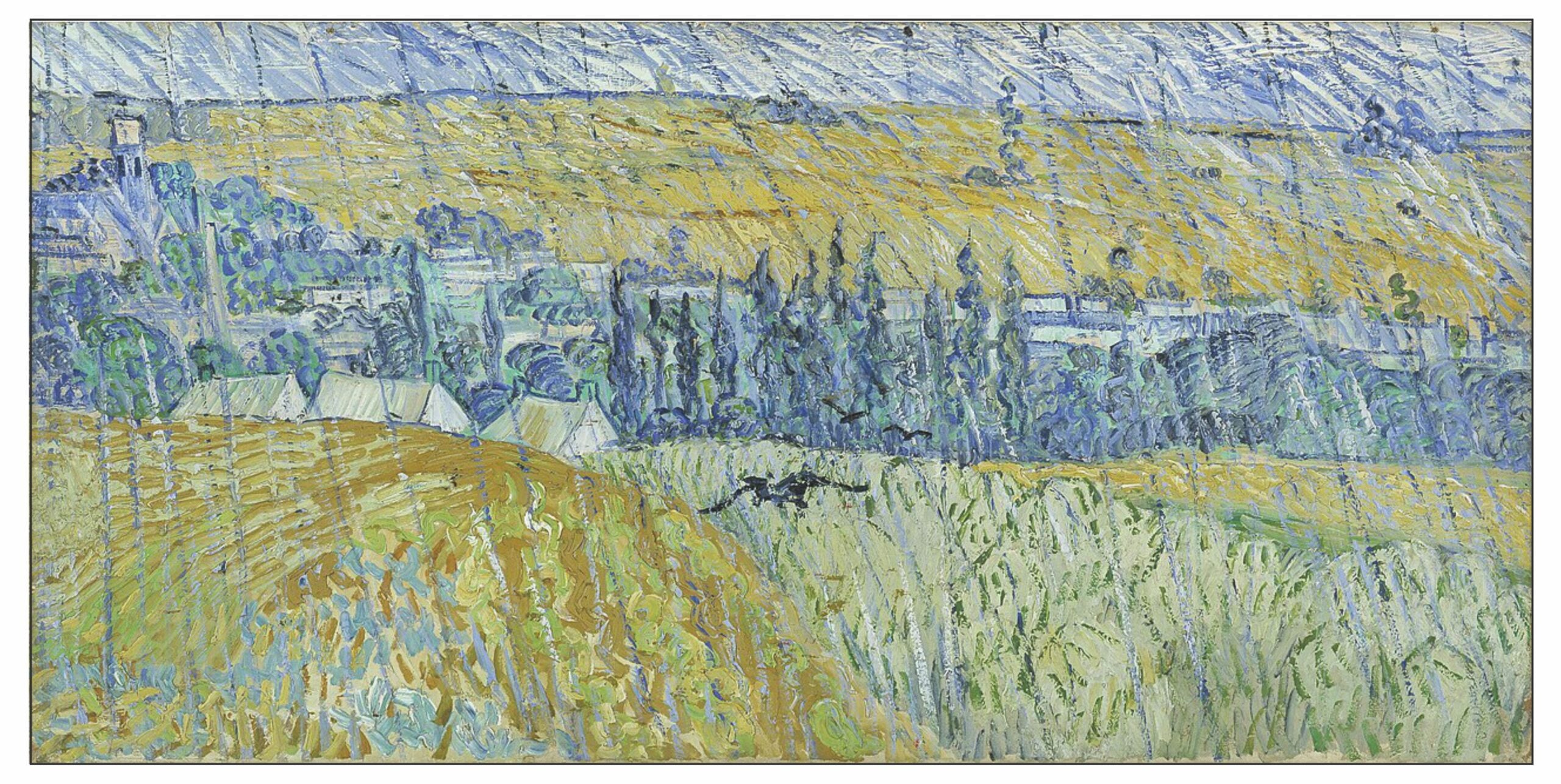
Even the rain did not dampen his peaceful feelings. The following painting of harvest fields in the rain was created on July 18. The crows are present, but they are part of the landscape:
Farms
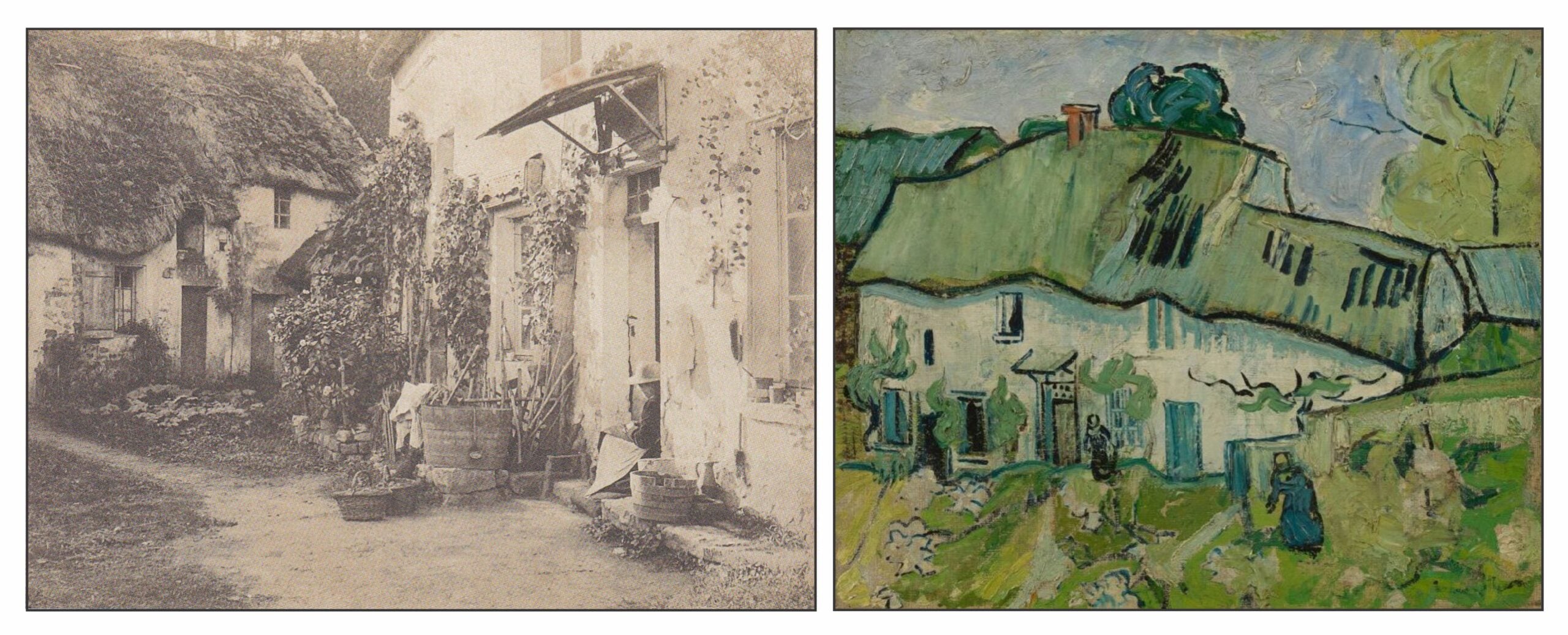
Soon after his arrival in Auvers, Van Gogh had painted a group of thatched farmhouses just to the east of Auvers. The following illustration shows a photograph from 1887 (Van der Veen, 2023a, p 54) and one of Van Gogh’s paintings from late May or early June:
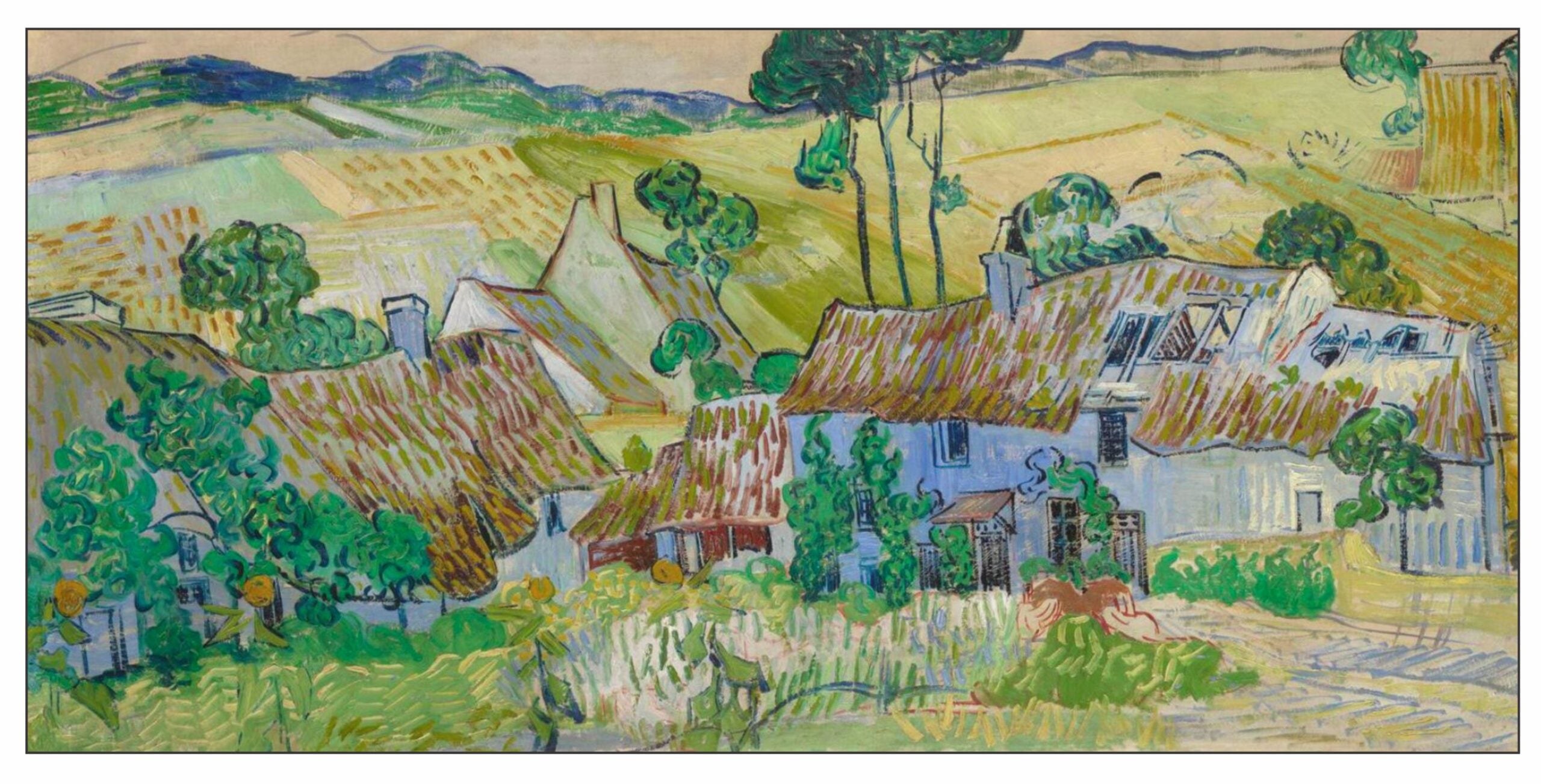
In the final days of his life, probably on July 26, Van Gogh returned to these farms and created a wonderfully peaceful picture of the farms. The double-square format allowed him to represent the whole group of farm buildings nestled together:
Tree Roots
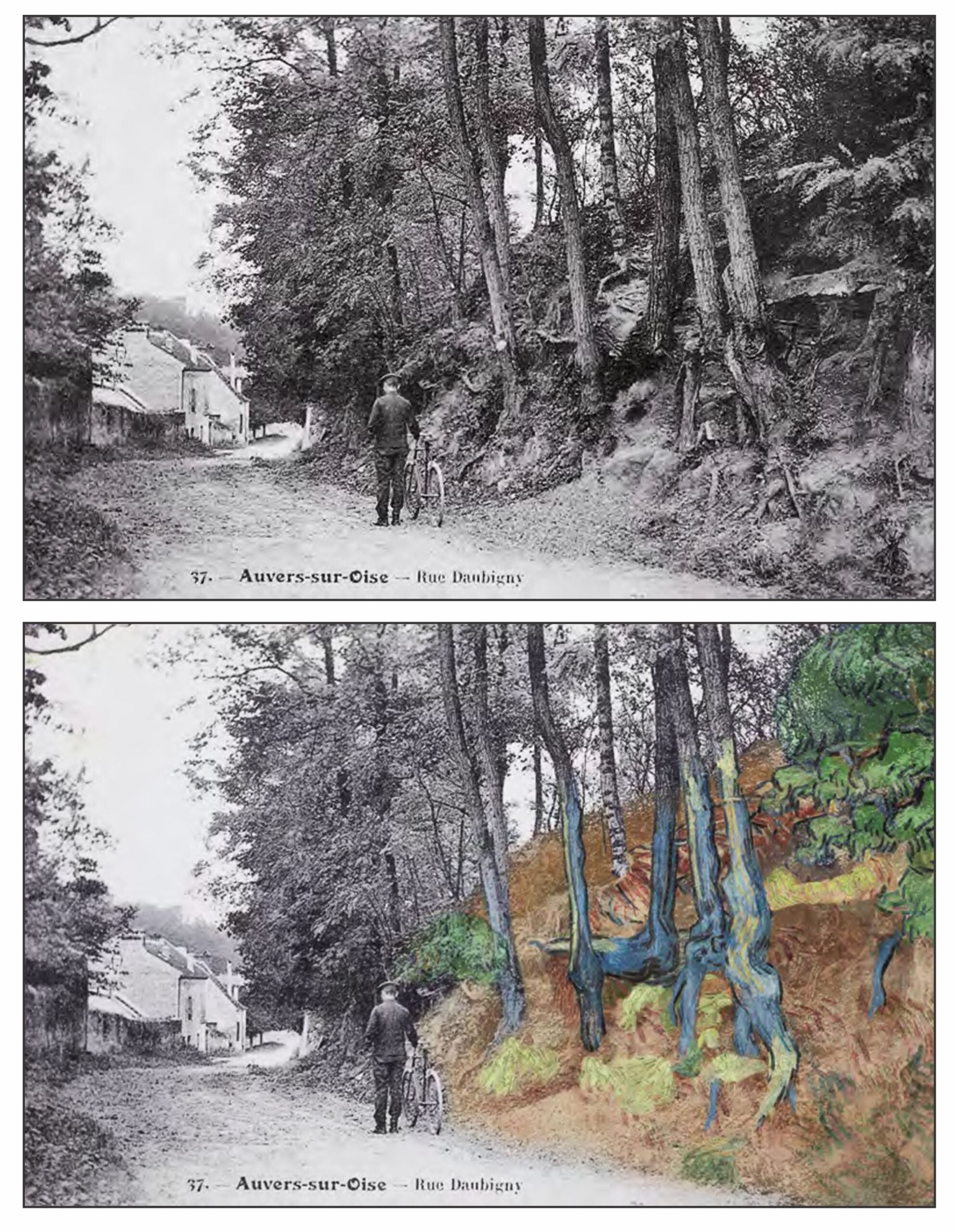
Van Gogh’s last picture, painted on the day that he shot himself, was probably Tree Roots (Maes, & van Tilborgh, 2012). Some parts of the background are just flat colors and lack the final brushstrokes that Vang Gogh typically used. Van Gogh finished all his other paintings except for the Farms near Auvers, in which a small area of the sky was not completed. The painting represents the roots of trees at the side of a road.
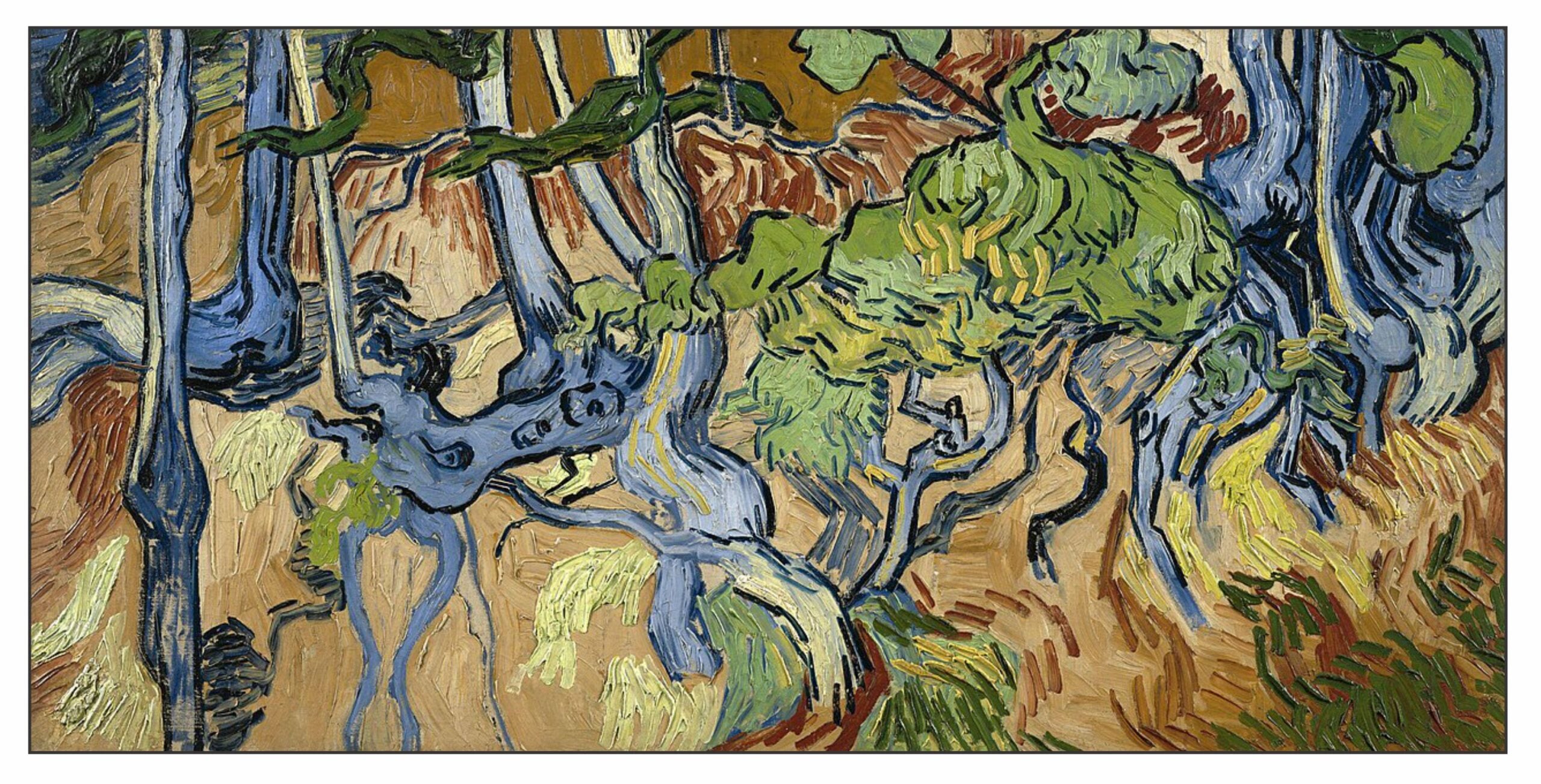
The following are comments by Pickvance (1986, pp 282-3):
Ambiguous, stylized, vitalistic, life-affirming, antinaturalistic yet palpably organic: a kind of prototype for an Art Nouveau frieze. No foreground, no element on which the viewer can get his spatial bearings, no sky to differentiate back-ground from foreground, no stabilizing horizontal. The roots and trunks are vertical; the ground plane is almost vertical. The motif could be part of the steep rise of the hillside, with the village below and the plain above, that characterizes the length of Auvers; van Gogh could have found it at almost any point. The image is passionately observed, yet objectively rendered.
Van der Veen (2020) found a postcard showing Rue Daubigny in the early years of the 20th Century. That allowed him to pinpoint the location of Van Gogh’s tree roots:
Suicide
After painting Tree Roots and bringing it back to his room at the Maison Ravoux, Van Gogh went out in the early evening of July 27 “behind the chateau.” There he shot himself with a revolver (Bailey 2021a, pp 117-125). Though he aimed at the heart, the bullet entered the lung or upper abdomen. After the shot, he must have lost consciousness for a brief time. When he came to, he searched for the revolver “to finish the job” but was unable to find it. However, he was able to walk painfully back to his lodgings. Doctors Gachet and Mazery examined him but decided that there was nothing that they could do. Theo Van Gogh was notified and arrived in Auvers on July 28. Van Gogh died at 1:30 am on July 29.
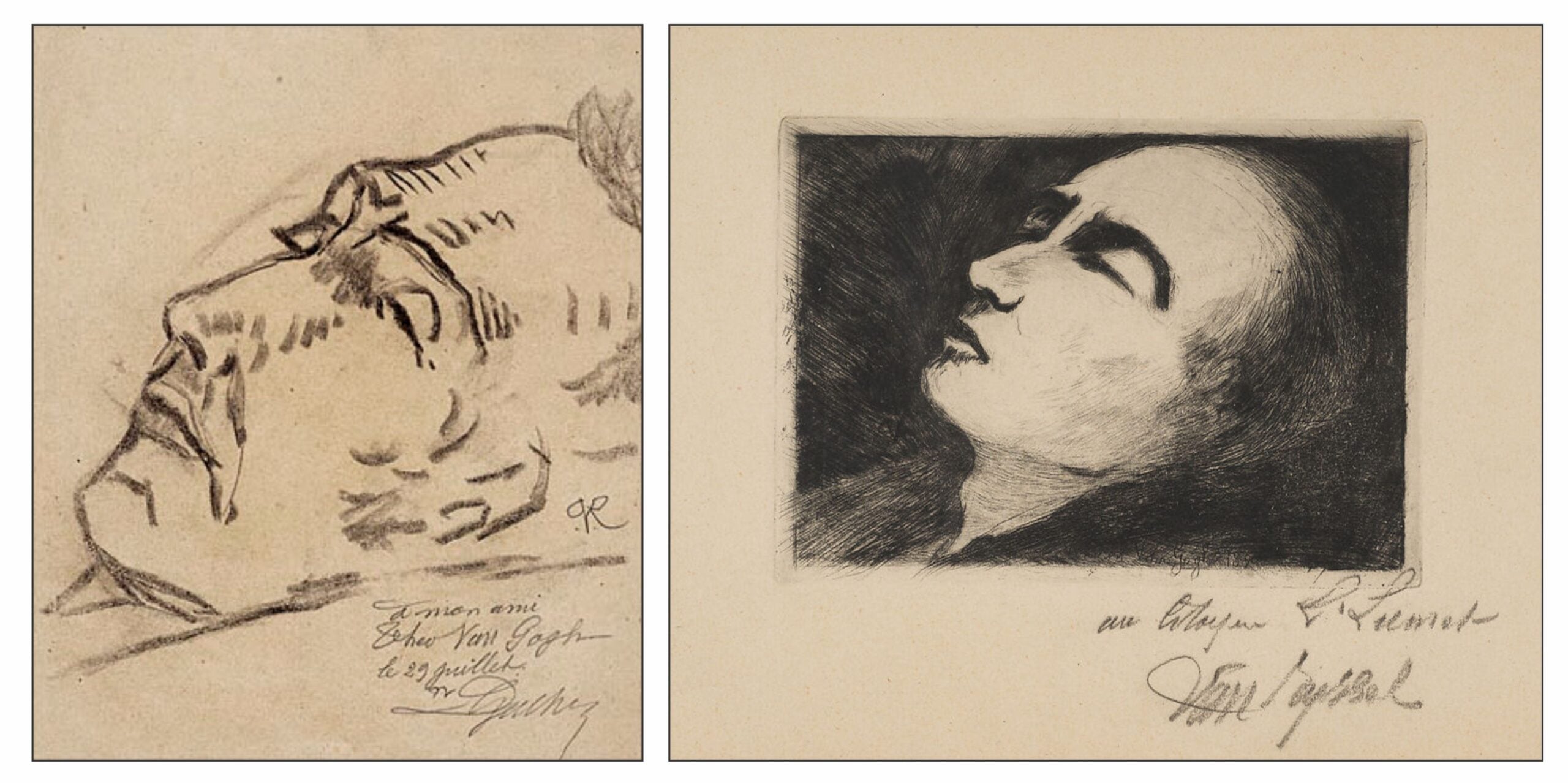
Doctor Gachet made a sketch of Van Gogh on his deathbed. Of interest is that he did not sketch the details of Van Gogh’s wounded left ear. He later made an etching from the sketch. Both are rudimentary. Gachet signed his works “Paul Van Ryssel” (or PVR) using the name of his birthplace near Lille (“Ryssel” in Flemish).
The location of the suicide is usually assumed to be north of Château Léry. However, this would have required a very long walk back to Maison Ravoux for a mortally wounded man. Van der Veen (2023c) has argued that the Manoir des Colombières was also referred to as a château, and claimed that the site of Van Gogh’s suicide was close to where he had made his last picture: the red dot on the map presented earlier in this posting, only 200 m from his lodgings. A rusted revolver found around 1960 in fields near Auvers was probably the one used by Van Gogh. He had apparently taken it from its owner, Arthur Ravoux, the manager of the inn where Van Gogh lodged (Bakker et al., 2016, p 80).
It is impossible to know what led to Van Gogh’s decision to kill himself (Bakker et al., 2016). He suffered from recurrent episodes of depression. He felt he was a tremendous burden to his brother. Though he was convinced of the significance of his art, no one other than his brother and a few friends seemed to think it had any worth.
Aftermath
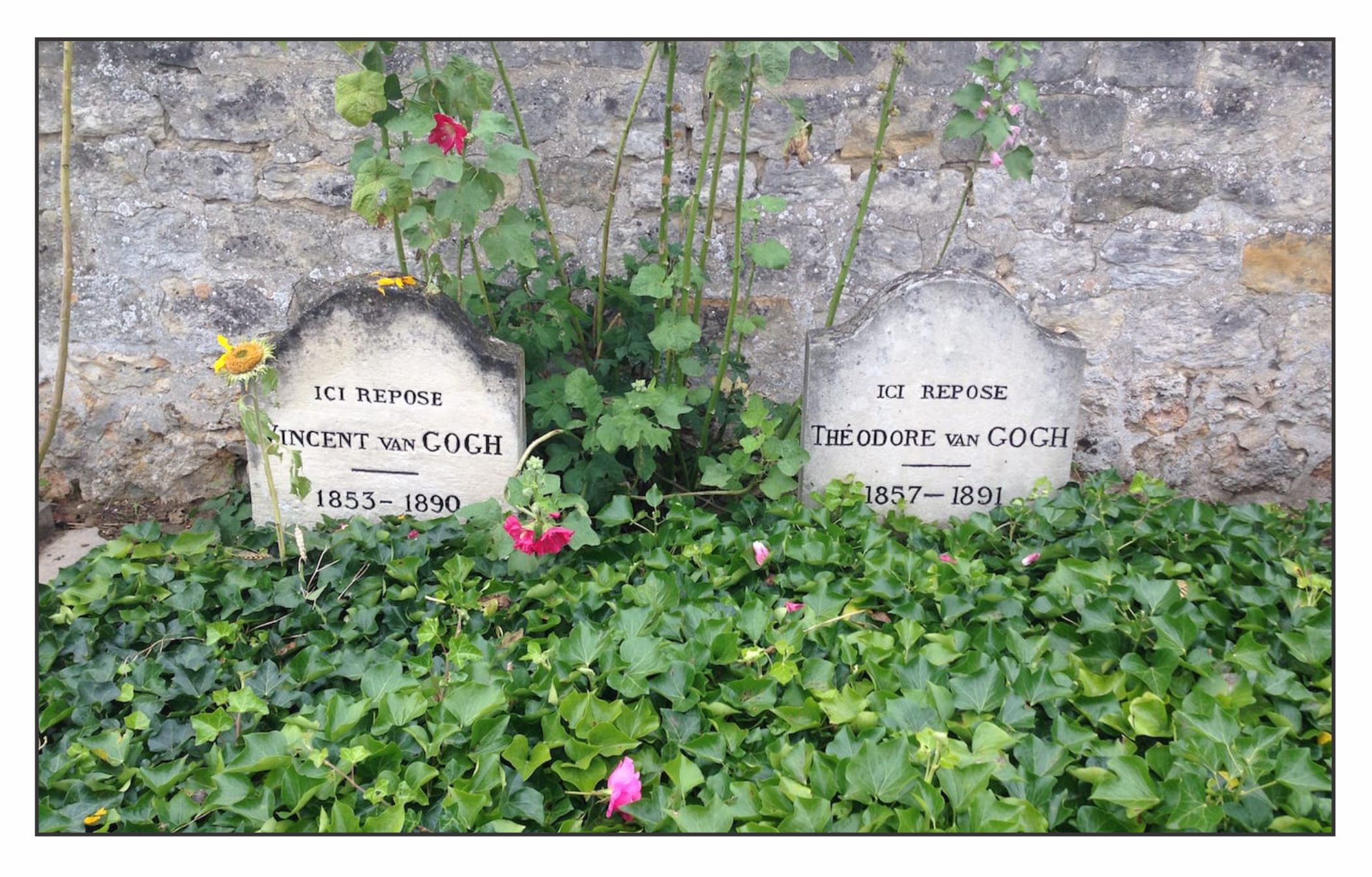
Van Gogh was buried in the cemetery at Auvers. His brother Theo died six months later, apparently of the late effects of syphilis, though grief may have played a role. Though he was initially buried in Utrecht, where he was hospitalized, His wife Joanna Bonger-Van Gogh arranged for his body to be transferred to Auvers in 1914, and the two graves rest side by side, covered with ivy that came from a cutting from the garden of Doctor Gachet:
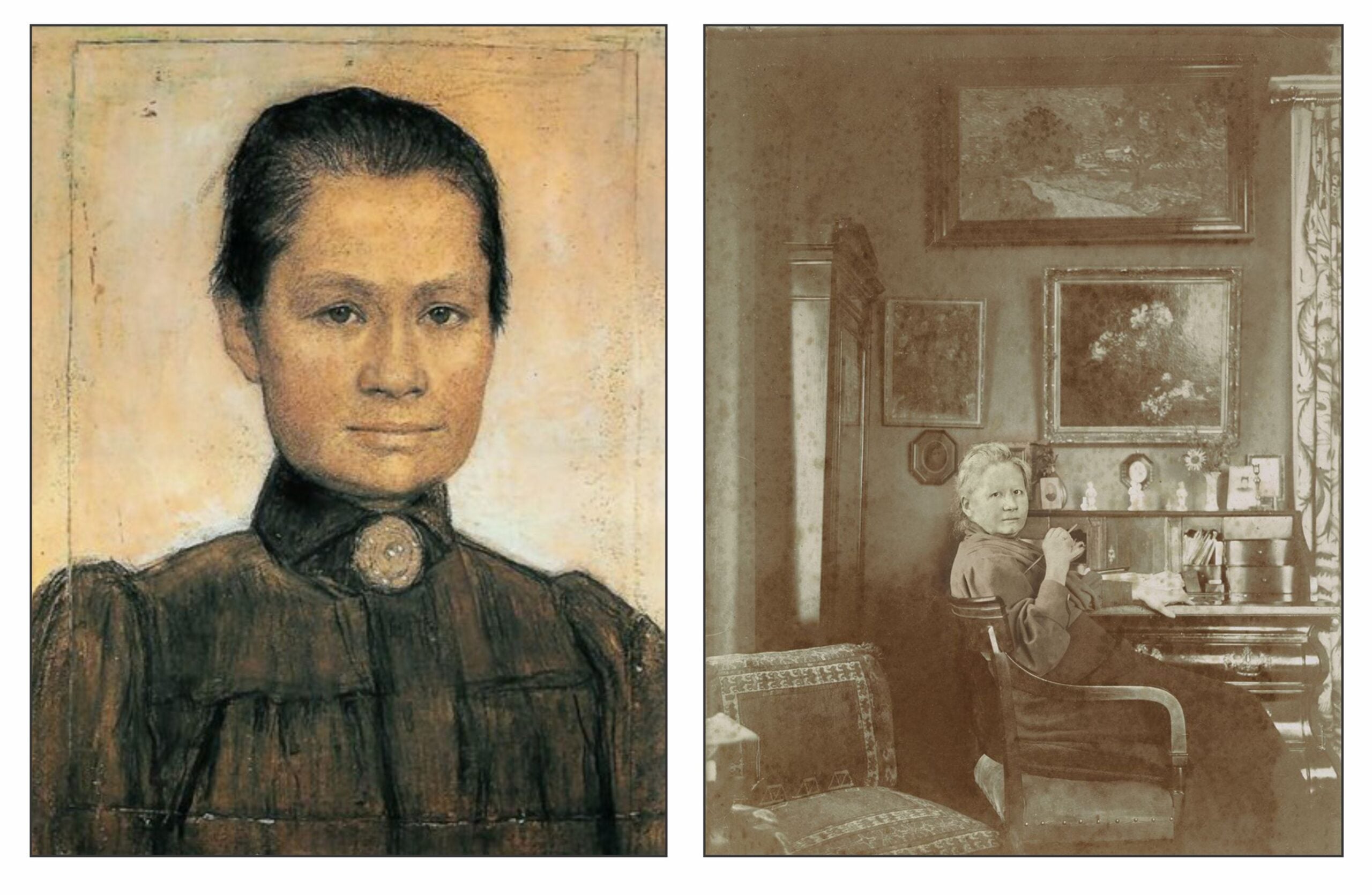
After Theo’s death, Johanna Van Gogh-Bonger retired to Bussum, just east of Amsterdam, where she earned a living through translation and by taking in lodgers. She edited the correspondence between Theo and Vincent, and kept together all of Vincent’s paintings. She continually promoted her brother-in-law’s work to dealers and museums, and in the early years of the 20th Century he finally began to receive the recognition he deserved (Luijten, 2023). The following illustration shows a 1905 portrait of Joanna by her second husband Johan Cohen Gosschalk, and a photograph of her in Amsterdam from 1909. On the wall is Van Gogh’s Landscape at Twilight.
The Double-Square Paintings
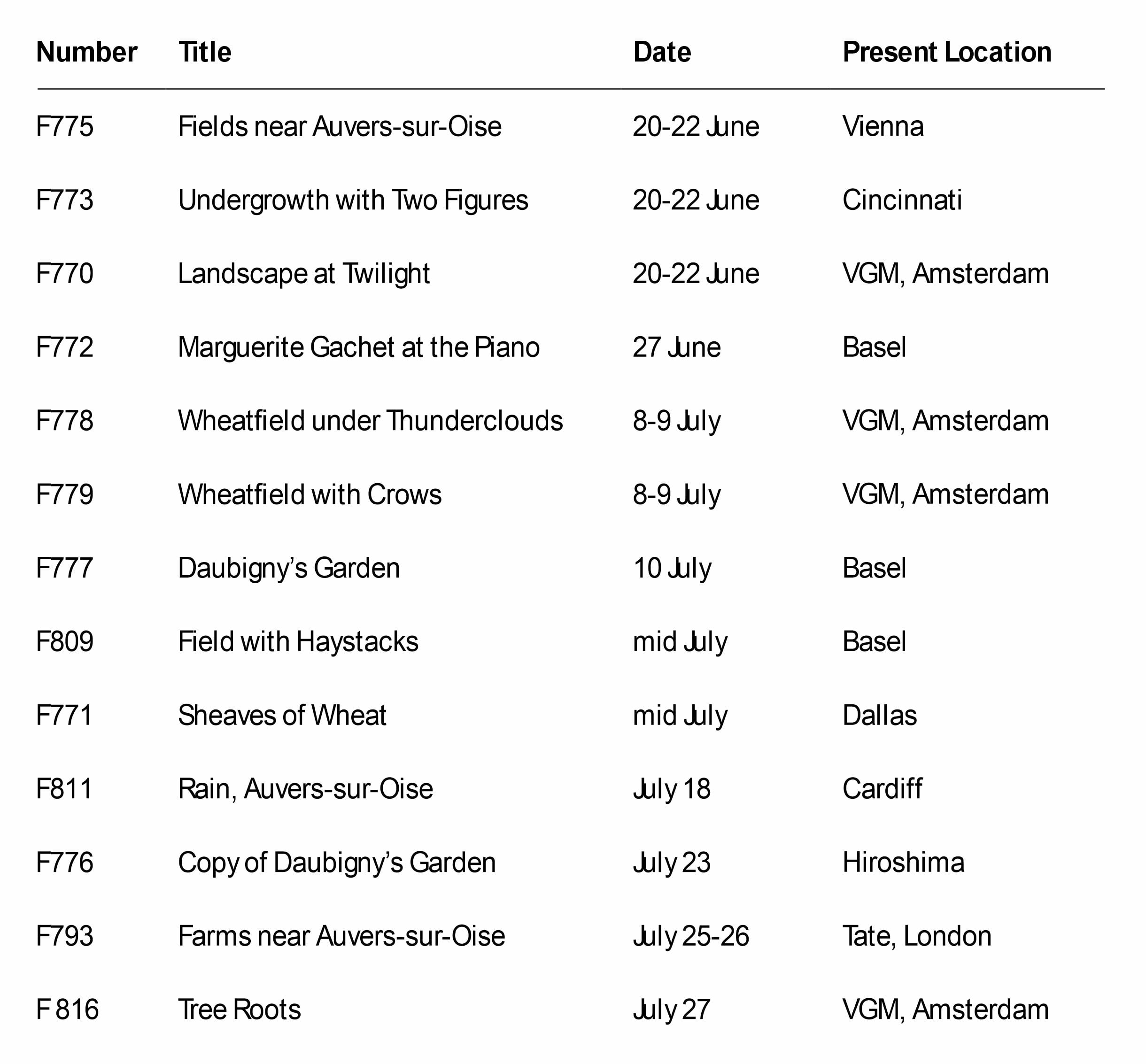
The following table lists the double-square paintings. The number is from the de la Faille catalogue (1928)
References
Bailey, M. (2021a). Van Gogh’s finale: Auvers and the artist’s rise to fame. Frances Lincoln.
Bailey, M. (2021b). Van Gogh’s mysterious Wheatfield with Crows—what does it really mean? The Art Newspaper. September 3, 2021.
Bakker, N. (2015). In Daubigny’s footsteps: Vincent Van Gogh. In Ambrosini, L., Fowle, F., Bakker, N., Boitelle, R., van Dijk, M., & Clarke, M. Inspiring Impressionism: Daubigny, Monet, Van Gogh. (pp 104-129). National Galleries of Scotland.
Bakker, N., Meedendorp, T., & van Tilborg, L. (2023). Van Gogh in Auvers-sur-Oise: his final months. Thames & Hudson.
Bakker, N., Tilborgh, L. van, Prins, L., & Meedendorp, T. (2016). On the verge of insanity: Van Gogh and his illness. Yale University Press.
Coquery, E. (2023). On the threshold of a ‘New Painting’: the double square works. In Bakker et al. (2023) (pp 134-161).
de la Faille, J.-B. (1928). L’Œuvre de Vincent van Gogh: catalogue raisonné, ouvrage accompagné de la reproduction de plus de 1.600 tableaux, dessins, aquarelles et gravures du Maître. (6 vols). Les Éditions G. van Oest.
Erickson, K. P. (1998). At eternity’s gate: the spiritual vision of Vincent Van Gogh. W.B. Eerdmans.
Luijten, H. (translated by L. Richards, 2023). Jo van Gigh-Bonger: the woman who made Vincent famous. Bloomsbury Visual Arts.
Maes, B., & van Tilborgh, L. (2012). Van Gogh’s Tree Roots up close. In van Tilborgh, L. (Ed.) Van Gogh: new findings. (pp 55-710) WBooks (Zwolle).
Pickvance, R. (1986). Van Gogh in Saint-Rémy and Auvers. Metropolitan Museum of Art.
Saltzman, C. (1998). Portrait of Dr. Gachet: the story of a van Gogh masterpiece: modernism, money, politics, collectors, dealers, taste, greed, and loss. Viking.
Van Tilburgh, L. (2023). A short biography of unbearable suffering: Van Gogh’s chosen end. In In Bakker et al. (2023) (pp 162-177).
Van der Veen, W. (2020). Attacked at the very root: An investigation into Van Gogh’s last days. Arthénon
Van der Veen, W. (2023a). Exploring Auvers-sur-Oise: people and places. In Bakker et al. (2023) (pp 34-57).
Van der Veen, W. (2023b). The secret of Wheat Field with Crows. Arthénon
Van der Veen, W. (2023c). About the place where Van Gogh took his own life. Arthénon
Wattenmaker, R.-J. (1981). Vincent van Gogh and Puvis de Chavannes. Vie des arts, 26(104), 94–96.