Mathis der Maler: the Isenheim Altarpiece

Very little is known about the life of Matthias Grünewald, a painter (German Maler) who worked in the early decades of the 16th Century in Germany. He is renowned for the pictures he created between 1512 and 1516 for the altarpiece of the Monastery of Saint Anthony in Isenheim in southern Alsace. The face of Saint Sebastian in one of these paintings (above) is considered to be a self-portrait. 

Life of Mathis der Maler

Very few details are available about the life of the painter who came to be known as Matthias Grünewald (Anderson, 2003). His first name has been considered as Matthias, Matthis or Mathis. His surname is disputable: Nithart, Neithardt, Gothart or Gothardt. The name “Grünewald” (green wood) was given to him by his first biographer, Joachim van Sandrart, about a century and a half after his death. The major confusion in his biography is whether Mathis Nithart and Mathis Gothart were one or two people. My intuition is that they were two distinct individuals: one a master painter and the other a water artist (builder of fountains), who also worked as an assistant painter (cf Bruhn, 1998, pp 21-42; Sebald, 1988, 2002). 

Given this intuition, the main stages of Grünewald’s biography are as follows. He was born in about 1480 in Aschaffenburg. After learning the techniques of painting, he worked for the episcopal court of Mainz, painting altarpieces in several churches in Frankfurt. In 1512, he married Anna, a young woman of Jewish descent who had recently converted to Christianity, and bought a house near the cathedral in Frankfurt. In the same year he was commissioned to paint the altarpiece in the Monastery of Saint Anthony in Isenheim. While he worked on the altarpiece, Anna stayed in Frankfurt. Grünewald was assisted in Isenheim by an older painter, Matthis von Würzburg, and the two men lived together. After finishing the Isenheim altarpiece, they returned to Frankfurt. Grünewald continued to paint under the patronage of Cardinal Albrecht von Brandenburg, who was the Archbishop of Mainz from 1514-1545 and the Archbishop of Magdeburg from 1513-1545. Albrecht, one of the most powerful prelates in the Holy Roman Empire, was a patron of artists such as Albrecht Dürer, Lucas Cranach the Elder, and Matthias Grünewald.  

These were times of great social upheaval. Luther published his Ninety-Five Theses (A Disputation on the Power and Efficacy of Indulgences) in 1517. These were specifically addressed to Albrecht von Brandenburg, who used indulgences to support his life of luxury and patronage. The theses marked the beginning of the Protestant Reformation.

The German Peasants’ War (Deutscher Bauernkrieg) began in 1524. Though partly related to the Lutheran rebellion against the Catholic Church, the revolt was mainly directed at the feudal aristocracy. Some of the reformist clergy supported the peasants. However, Luther was terrified of the anarchy that might result, and encouraged the nobility to eliminate the rebellious peasants. Pitchforks were no match for artillery. Over 100,000 peasants were massacred and the revolt came to an end in 1525. It is not known whether Grünewald participated in the rebellion, or how he was affected by it. His friend died in 1528 in Halle where he was working as a hydraulic engineer. Grünewald appears to have moved back to Aschaffenburg where he died in 1532.

A portrait in the Chicago Art Institute, initialed MN, has been considered as a possible self-portrait by Grünewald (Mathis Nithart), though its authenticity and dating is unclear. My intuition is that it is the work of the young Grünewald and that it dates to about 1500. The following is the portrait and its description by Sebald in his poem After Nature (1988, translated by Hamburger, 2002)

       The small maple panel
shows a scarcely twenty-year-old
at the window of a narrow room.
Behind him, on a shelf not quite
in perspective, pots of paint,
a crayon, a seashell and a precious Venetian
glass filled with a translucent essence.
In one hand the painter holds
a finely carved knife of bone
with which to trim the drawing-pen
before continuing work on a female nude
that lies in front of him next to an inkwell.
Through the window on his left a
landscape with mountain and valley
and the curved line of a path is visible.


The Hospital Brothers of Saint Anthony

Saint Anthony the Great (251-356 CE) was a Christian monk from Egypt who lived most of his adult live alone in the desert. At the beginning of his desert life, he was assailed by monstrous demons and tempted by seductive women. Despite a severe asceticism bordering on starvation, he nevertheless lived to be 105 years old. Although he was buried in the desert, his remains were miraculously discovered about two centuries after his death and transferred to Constantinople. In 980, a French count named Jocelin de Châteauneuf bought the relics from Constantinople to a monastery in what is now known as Isère in the French Alps. The relics were found to alleviate a disease characterized by skin inflammation, gangrene, hallucinations and convulsions that often broke out in devastating epidemics. In 1095 Gaston de Valloire founded the Hospital Brothers of Saint Anthony (also known as the Antonines) in gratitude for his son’s miraculous cure. The Abbey of Saint Antoine in Isère became the mother church of the order.

The disease came to be known as “Saint Anthony’s Fire.” The cause was the consumption of bread made from rye contaminated by the fungus Claviceps purpurea (Grzybowski et al, 2021). The fungus produces ergotamine and other compounds: these cause peripheral vasoconstriction and excessive stimulation of the central nervous system. The nature of the disease, however, was not known in the Middle Ages: it was first attributed to blighted rye in 1676 by Denis Dodart, but the fungus itself was not identified until the 19th Century.     

Grateful patients gave land and money to the Antonines. This support allowed them to establish other hospitals in various locations in France, and later in other European countries. The Isenheim monastery in southern Alsace was founded around 1300. As the years went by, the Antonine hospitals also treated patients who suffered from leprosy, from the Black Death (an epidemic of bubonic plague) in the 14th Century, and from the syphilis epidemics of the 16th Century. The program of treatment involved prayer and the application of vinous extracts from the saint’s relics in Isère (Saint vinage). Whatever success occurred, however, was likely the result of the concomitant improvement in hygiene and nutrition.  

In 1505, the Antonines at Isenheim commissioned a carved wooden altarpiece from Niklaus Hagenauer (Mayr, 2003). The altarpiece contains a gilded central statue of Saint Anthony, flanked by Saint Augustine of Hippo and Saint Jerome: asceticism aided by doctrine and by scripture. The predella of the altarpiece contains polychrome statues of Christ and the 12 apostles. In 1512 the Antonines asked Grünewald (Mathis der Maler) to adorn the altar with paintings (Hayum, 1989; Scheja, 1969; Réau, 1920; Sieger, 2025). Over the next 4 years he created two fixed wings, two sets of retractable wings painted on both sides, and a cover for the predella The retractable wings could be opened to provide three distinct views of the altar. An animation of the opening is provided below. This has been adapted from that at the SmartHistory website, and provided with a brief excerpt of music from the first movement of Hindemith’s symphony Mathis der Maler. Following that is a diagrammatic representation of the three views.

First View of the Altarpiece

Other than on holy days, the altarpiece was kept closed and the viewer was presented with the terrifying representation of the crucified Christ. The scene is set in the darkness that fell “over all the land” (Matthew 27: 45) as Christ died.  

The gigantic body of the dead Christ is rendered with brutal naturalism and seems to leap out at one with redoubled violence, as if to take the viewer in an ambuscade: flesh in the greenish color of death with the scars of the frightful ordeal, an atrocious benumbed pain written across the face, the mouth extinguished in death, the body pulled up high by the tensile arch of the crossbeam and, at the same time, twisted with the torsion of the tree of the Cross, all limbs ripped out of joint, the loincloth in tatters, while a thorn of the crown pins the head fast in an excruciatingly painful position digging low and deep into the chest (Scheja, 1969, p 15).

The cross is contorted as though it shares in the agony. The crossbar is bowed under the weight of the dead body. The vertical post is twisted: it faces to Christ’s right above his head and to his left at his feet. The resin of the wood mixes with the blood of the dead Christ (Bryda, 2018)

The vision of Christ on the Cross as a dead body rather than as a suffering savior perhaps comes from the visions of the 14th Century mystic Saint Bridget:

The color of death spread through his flesh, and after he breathed his last human breath, his mouth gaped open so that one could see his tongue, his teeth, and the blood in his mouth. Th e dead body sagged. His knees then contracted bending to the side. His feet were cramped and twisted about the nails of the cross as if they were on hinges (quoted in Bryda, 2018, p 13)

On Christ’s right side his mother Mary swoons, and is supported by the disciple John. Near them, Mary Magdalene laments the death of her teacher. The figures vary in their size as in their importance to the story.

On the left side of the crucified Christ is a representation of John the Baptist. This is in no way realistic: John was from another time – he was beheaded before Christ was crucified. Yet he was the last of the prophets to announce the significance of Jesus as the son of God. His words are written in red:

Illum oportet crescere me autem minui
[He must increase, but I must decrease]. (John 3:30)

At the feet of the Baptist is a lamb from whose chest blood drops into a communion chalice. When John had baptised Jesus, he had proclaimed “Behold the Lamb of God!” (John 1:36) The Baptist’s right arm points dramatically to the crucified Christ. The eye may move to the attendant figures but Grünewald insists that it return to the dead Christ. 

In The Emigrants, W. G. Sebald describes the experience of Max Ferber on viewing the Isenheim crucifixion

The monstrosity of that suffering, which, emanating from the figures depicted, spread to cover the whole of Nature, only to flood back from the lifeless landscape to the humans marked by death, rose and ebbed within me like a tide. Looking at those gashed bodies, and at the witnesses of the execution, doubled up by grief like snapped reeds, I gradually understood that, beyond a certain point, pain blots out the one thing that is essential to its being experienced — consciousness — and so perhaps extinguishes itself; we know very little about this. What is certain, though, is that mental suffering is effectively without end. One may think one has reached the very limit, but there are always more torments to come. One plunges from one abyss into the next. (Sebald, 1993/1996)

Perhaps the sight of the dead Christ served to numb the pain and suffering of the patients who came to Isenheim for treatment. 

The fixed wings of the altarpiece provide a stark contrast to its horrifying centerpiece. On the left Saint Sebastion tranquilly suffers through his wounds. On the right Saint Anthony remains unperturbed by the demon threatening him through the window at his shoulder. Both Saints are invoked for protection against disease. Saint Sebastian actually survived the onslaught of arrows that pierced his body. Saint Anthony endured his temptations and lived to die of old age.

Radiographic examination of the Saint Sebastian has revealed that the head was painted over an earlier version. In After Nature, Sebald interprets this in terms of the existence of two painters: Grünewald and Mathis Nithart:

And indeed the person of Mathis Nithart
in documents of the time so flows into
the person of Grünewald that one
seems to have been the life,
then the death, too, of the other.
An X-ray photograph of the Sebastian
panel reveals beneath the elegiac
portrait of the saint
that same face again, the half-
profile only turned a tiny bit further
in the definitive overpainting.
Here two painters in one body
whose hurt flesh belonged to both
to the end pursued the study
of their own nature. At first
Nithart fashioned his self-portrait
from a mirror image, and Grünewald
with great love, precision and patience
and an interest in the skin
and hair of his companion extending
to the blue shadow of the beard
then overpainted it.
The martyrdom depicted is
the representation, to be sensed
even in the rims of the wounds,
of a male friendship wavering
between horror and loyalty.


Second View of the Altarpiece

On holy days the altarpiece was opened to show a sequence of paintings depicting episodes from the life of Christ. On the left is the Annunciation. The center, where once was presented the horror of the death of Jesus now shows the wonder of his birth. Heavenly angels provide a marvelous music while the baby Jesus plays with a golden rosary on the lap of his mother Mary. 

In 1938, Paul Hindemith completed an opera about Mathis de Maler. The prelude to the opera is a musical version of the concert of the angels in the Isenheim altarpiece. This was also used as the first movement of his 1935 Symphony Mathis der Maler. Hindemith introduces three themes: a setting of an old German hymn Es sungen drei Engeln (There sang three angels) mainly in the brass, a lively melody on the strings and a more peaceful tune on the flute. He then plays these themes against each other. The following is an illustration of the painting together with the initial introduction of the themes in the Symphony Matthis der Maler with the Vienna Radio Symphony Orchestra led by Marin Alsop:

The beautiful angel in the foreground of Grünwald’s Concert of the Angels is playing a viola da gamba, the forerunner of the modern violoncello. Grünewald was clearly familiar with the instrument, which has been closely studied and reproduced. However, the direction of the bowing is strangely reversed from normal. It is difficult to understand what his means (Rasmussen 2001). Perhaps the angel is producing heavenly rather than earthly music. Even more disconcerting is the angel directly behind and above the foreground cellist. This angel is covered in iridescent green feathers and looks upset rather than entranced by the birth of Jesus. Mellinkoff (1988) proposed that this is the angel Lucifer who rebelled against God, brought about the fall of man, and is now aghast that man will be redeemed by the birth of Christ.

Between the concert of the angels and the representation of Mary and the infant Jesus is a vision of a woman, with a crown of flames, surrounded by a bright yellow and red aureole (see below). No one is sure who she represents. Malinkoff (1988) suggests that she is Ecclesia (Church), who with the birth of Christ takes over from Synagoga as the intermediary between man and God. Others (e.g., Réau, 1920, p 187-94; Scheja, 1969, p 48) consider her to be the Eternal Mary, Queen of Heaven, the woman “clothed with the sun” of Revelation 12. She is there to witness herself in her temporal form together with her infant son.  

The most striking painting in the second view of the altarpiece is the Resurrection on the right side. Christ arises from the tomb in glory, scattering and tumbling the guards:

Joris-Karl Huysmans, the first modern critics to consider the importance of Matthias Grünewald in Trois Primitifs (1905, reprinted in part in Huysmans & Ruhmer, 1958), described The Resurrection:

As the sepulchre opens, some drunks in helmet and armour are knocked head over heels to lie sprawling in the foreground, sword in hand; one of them turns a somersault further off, behind the tomb, and lands on his head, while Christ surges upwards, stretching out his arms and displaying the bloody commas on his hands.
This is a strong and handsome Christ, fair-haired and brown-eyed, with nothing in common with the Goliath whom we watched decomposing a moment ago, fastened by nails to the still green wood of a gibbet. All round this soaring body are rays emanating from it which have begun to blur its outline; already the contours of the face are fluctuating, the features hazing over, the hair dissolving into a halo of melting gold. The light spreads out in immense curves ranging from bright yellow to purple, and finally shading off little by little into a pale blue which in turn merges with the dark blue of the night.
We witness here the revival of a Godhead ablaze with life: the formation of a glorified body gradually escaping from the carnal shell, which is disappearing in an apotheosis of flames of which it is itself the source and seat.
… Having dared to attempt this tour de force, Grünewald has carried it out with wonderful skill. In clothing the Saviour he has tried to render the changing colours of the fabrics as they are volatilized with Christ. Thus the scarlet robe turns a bright yellow, the closer it gets to the light-source of the head and neck, while the material grows lighter, becoming almost diaphanous in this river of gold. As for the white shroud which Jesus is carrying off with him, it reminds one of those Japanese fabrics which by subtle gradations change from one colour to another, for as it rises it takes on a lilac tint first of all, then becomes pure violet, and finally, like the last blue circle of the nimbus, merges into the indigo-black of the night.

This is no ordinary representation of the Resurrection. Christ has not just risen from the tomb: he has also been transfigured into a vision of the Godhead. Scheja, 1988, p 40) notes how Grünewald has accurately depicted Dante’s vision of the Trinitarian Godhead at the end of The Divine Comedy published two centuries before his painting (Paradiso XXXIII 115-120):

Nella profonda e chiara sussistenza
de l’alto lume parvermi tre giri
di tre colori e d’una contenenza;

e l’un dall’altro come iri da iri
parea reflesso, e il terzo parea foco
che quinci e quindi igualmente si spiri.

[There appeared to me in the profound and bright
reality of that exalted light
three circles of three colors and one size.

As rainbow by rainbow, one seemed reflected
by the second, and the third seemed a fire
that breathed as much from one as from the other.]
(translation by Louis Biancolli)


Third View of the Altarpiece

As well as the statues created by Niklaus Hagenauer the third view has two lateral paintings that are the obverse of the Madonna and Child and the Concert of Angels. These represent The Tribulations of Saint Anthony and The Meeting between Saint Anthony and Saint Paul.

Although often called the “temptations” of Saint Anthony, the subject of Grünewald’s painting on the right is more accurately considered his “tribulations.” Scheja (1969, p 28) tells the story from original biography of Saint Anthony written by Athanasius a few years after his death. When Anthony first went to the desert he was attacked by demons. Despite the pain, he refused to give up his devotion to Christ. Finally, the heavens opened, light streamed down from Christ in majesty, and the demons vanished. Anthony had passed his test and was worthy of his God. Anthony cried out the words written at the lower left of the painting (Hayum, 1989, p 79):     

Ubi eras ihesu boni, ubi eras? Quare not affuisti ut sanares vulnera mea?
[Where were you good Jesus, where were you? Why were you not there to heal my wounds?]

The poor wretch at the lower left of the painting represents a patient suffering from ergotism. The distal parts of his fingers have been lost to gangrene and his skin is covered with sores (Grzybowski et al, 2021). The image serves as an intermediary between the patients in the hospital and Saint Anthony. Even the fingers of Saint Anthony’s left hand are turning grey with incipient gangrene (Kluger& Brandozzi, 2023). The patients can see in the painting that their disease is the same as that of Saint Anthony. They can therefore hope that God may relieve their pain, just like he drove away the demons that tormented Saint Anthony. The following is Hindemith’s musical version of Saint Anthony and the Demons: from the beginning of the 3rd movement of his Mathis der Maler symphony:

The painting on the left is as tranquil as that on the right is turbulent.  After his tribulations, Saint Anthony sought out Saint Paul, an older ascetic who had retired to the desert. Paul convinced him that the monastic life was worth pursuing. Although the meeting was reported to have taken place in a cave, Grünewald locates it in a peaceful wooded landscape with a gently doe acting as an intermediary between the two saints. In the background a stag waits patiently. On a high branch, a raven, accustomed to providing Paul with his daily slice of bread, gets ready to deliver two slices. The head of Saint Paul is another self-portrait of Grünewald (Scheja, 1969, pp 30-33; von Mücke, 2011)


Afterlife of the Altarpiece

The altarpiece remained in the abbey church at Isenheim until the French Revolution (1789-1799) led to the suppression of the monasteries. In 1852, the altarpiece was moved to the new Unterlinden Museum located in Colmar, about 25 km north of Isenheim. The museum is housed in what was once a convent for the Dominican sisters, originally built in 13th Century.

After the Franco-Prussian War (1870-1871), Alsace became part of Germany. The unification of Germany bought with it a desire for a distinct national culture. Philosophers conceived a Northern or Gothic tradition in art, as distinguished from Mediterranean Classical art (Rosenblum, 1975; Stieglitz, 1989). Its characteristics were a sense of the sublime, an emotional intensity, a mystical predisposition, and a deep subjectivity (or inwardness, Innerlichkeit). Grünewald’s paintings fitted easily into these ideas.

During World War I, for safety’s sake, the altarpiece was taken away from Colmar to Munich, where it was exhibited to great acclaim. The peace arrangements after the war included a requirement that the altarpiece to be returned to Colmar. Since 1919, the altarpiece has lived there in the Unterlinden Museum. The following illustration shows how it is exhibited.

The visitor can go behind first section to see the paintings on the obverse side of The CrucifixionThe Annunciation and The Resurrection. And then behind the The Nativity (Angel Concert and Madonna with the Infant Jesus) to see The Temptation of Saint Anthony and The Meeting between Saint Paul and Saint Anthony.      


Otto Dix

Otto Dix (1891-1969) studied art at the Dresden Academy of Fine Arts. When war was declared in 1914, he volunteered for the army and served for the duration of the war. He took part in the Battle of the Somme in 1916, was transferred for a while to the Eastern Front, and then back to Flanders for the end of the war. He was profoundly affected by the horrors he experienced. After the war he painted images representing both his ghastly memories of trench warfare and his anger at the hypocrisy and depravity of post-war German society. He was one of the painters of Der neue Sachlichkeit (New Objectivity) Exhibition of 1925.

Dix became a professor at the Dresden Academy in 1927. A 1929 photograph by Hugo Erfurth is shown on the right. Between 1929 and 1932 he worked on a large triptych entitled Der Krieg (The War) based on old German triptychs especially that of Grünewald’s Isenheim altarpiece (Bayer, 1920).

The left wing of the triptych, entitled Aufmarsch (Deployment), depicts the soldiers leaving for the frontline early in the morning before the mists have cleared.

The right wing, entitled Nachtlicher Ruckzug (Nightly Retreat) shows a soldier (a self-portrait of the artist) trying to bring a wounded colleague back to safety behind the frontlines.


The central section, Der Krieg, takes the place of the Crucifixion in a medieval altar. Instead of Christ on the cross

a rotting corpse has been hurled onto iron girders in similar fashion. His eye sockets have already become black holes, the teeth are bared, with what remains of his uniform hanging in tatters. (Bayer 1920)

The corpse points to another dead body on the right. This is clearly an illusion to Grünewald’s Isenheim altarpiece wherein John the Baptist points dramatically to the crucified Christ. The body to which the finger points is upside down and riddled with bullet holes in much the same way as Grünewald’s Christ was covered in sores. The background to these horrors is a landscape completely destroyed by artillery.

The predella of Dix’s triptych shows several soldiers lying down under what might be a camouflage screen. It is unclear whether they are dead or sleeping. If the latter there is a clockwise circular logic to the triptych: the exhausted soldiers will wake up, advance to the front again, engage in the murderous work of war, and then retreat, wounded and exhausted to sleep another night.

Dix’s description of the war was loathed by the Nazi government, who wished to portray war as an occasion for heroism rather than a field of horror. In 1933 Dix was dismissed from his position at the Dresden Academy. Many of his paintings were removed from galleries and destroyed. Some were included in the Exhibition of Degenerate Art in 1937. Dix saved the triptych, took it apart, and stored it in a friend’s farmhouse until after the war. The Galerie der Neue Meister (Gallery of Modern Masters) in Dresden purchased the painting in 1968.     


Paul Hindemith

Paul Hindemith (1895-1963) studied music at Dr. Hoch’s Konservatorium in Frankfurt and joined the Frankfurt Symphony Orchestra after graduation. He served in the German army on the frontlines in Alsace during the last year of the war.

After the war, he founded the Amar Quartet, playing the viola, and began to compose. During the 1930s he worked on his Opera Mathis der Maler, based on the life of Matthias Grünewald. As he was writing this music, he used some of the orchestral interludes in the opera to make his Symphony Mathis der Maler which was published in 1935.  The opera was not completed until 1938. Because the Nazis considered his music degenerate, Hindemith was unable to get the opera performed in Germany. He emigrated to Switzerland in 1938 and then to the United States in 1940.

As well as the modernity of the music, the subject matter of the opera was anathema to the Nazi powers (Bruhm, 1998, 2002; Paret, 2008; Watkins, 2002; Fuller, 1997). It revealed the horrors of war: the summary executions, the raping and pillaging. One of the scenes concerned the burning of Lutheran books as ordered by the Catholic Church. This made obvious reference to the Nazi book burnings which had begun in the early 1930s.

The opera has been performed only rarely. A 1977 production starred Dietrich Fischer-Dieskau as Mathis. A striking recent production in Vienna that was captured on DVD by Naxos in 2012.

The opera is concerned with the life of Matthias Grünewald after he completes the Isenheim altarpiece. Hindemith imagines that Mathis leaves the service of Albrecht von Brandenburg and joins the rebellion of the peasants. Throughout these terrible times, images from the altarpiece (and Hindemith’s musical versions thereof) return to comfort or to haunt the painter. During the rebellion, he takes care of Regina, a young woman whose father, one of the leaders of the rebellion, was cruelly executed before her eyes. The beginning of the 6th scene of the opera finds them fleeing from the mercenaries through the forest of the Odenwald southeast of Frankfurt, Mathis tries to comfort the grieving Regina with the story of the Concert of Angels who played music at the nativity of Jesus. The following is part of the aria, as sung by Wolfgang Koch as Mathis and Katherina Tretyakova as Regina: 

             Alte Märchen woben
Uns fromme Bilder, die ein Widerscheinen
Des Höheren sind. Ihr Sinn ist dir
Fern, du kannst ihn nur erahnen.
Und frommer noch reden
Zu uns die Töne, wenn Musik, in Einfalt hier
Geboren, die Spur himmlischer Herkunft trägt.
Sieh, wie eine Schar von Engeln ewige Bahnen
In irdischen Wegen abwandelt. Wie spürt man jeden
Versenkt in sein mildes Amt. Der eine geigt
Mit wundersam gesperrtem Arm, den Bogen wägt
Er zart, damit nicht eines wenigen Schattens Rauheit
Den linden Lauf trübe. Ein andrer streicht
Gehobnen Blicks aus Saiten seine Freude.
Verhaftet scheint der dritte dem fernen Geläute
Seiner Seele und achtet leicht des Spiels.

              Wie bereit
Er ist, zugleich zu hören und zu dienen.

REGINA
Es sungen drei Engel ein süssen Gesang,
Der weit in den hohen Himmel erklang.

The following is a translation

                 Old fairy tales wove
Pious images for us that are a reflection
Of something higher. Their meaning is so
Far from you, that you can only guess.
And music speaks even more piously
When, born here in simplicity,
It brings a breath of heaven.
See how a host of angels eternally follow
Our earthly paths. How one feels each one
Is immersed in their gentle office. One plays the violin
With a wondrously bared arm, lightly bowing
Lest any roughness darken
Cloud the gentle melody. Another,
With an uplifted gaze, strokes joy from the strings.
The third seems captivated by the distant chiming
of his soul and hardly attends to the music.

                    How ready
he is to listen and serve at the same time.

REGINA
Three angels sang a sweet song
That resounded far into the heavens.


The Comfort of Images

Hindemith’s Mathis comforts the grieving Regina by describing to her his painting of the Concert of Angels. The world is difficult to understand. The suffering that occurs is often unjustified. So we tell ourselves stories – we weave together fairy tales – to make sense of the world. We can represent these stories in paintings and in music.

The story that Grünewald unfolds in the Isenheim altarpiece is the myth of a Son of God who suffered and died so that we may be redeemed and live forever. And the life of Saint Anthony who lived in holiness so that our illness can be cured. 

And even if these are only stories, the comfort they provide is real.


References

Andersson, C. (2003). Grünewald, Matthias [Gothart Nithart, Mathis; Gothardt-Neithardt, Matthis]. Grove Art Online.

Bayer, M. (2020).  Der Krieg: Otto Dix’s War Triptych, memory, and the perception of the First World War. In Hutchison, M., & Trout, S. (Eds.). Portraits of Remembrance. (pp 250-269) University of Alabama.

Bruhn, S. (1998). The temptation of Paul Hindemith: Mathis der Maler as a spiritual testimony. Pendragon. (difficult to find; preview in Google Books)

Bruhn, S, (2002). Wordless songs of love, glory, and resurrection: musical emblems of the holy in Hindemith’s saints. In Voicing the ineffable: musical representations of religious experience. (pp 157-188). Pendragon.

Bryda, G. C. (2018). The exuding wood of the cross at Isenheim. Art Bulletin, 100(2), 6–36.

Fuller, M. (1997). Hindemith’s Mathis der Maler: A parable for our times. New Blackfriars, 78(916), 260–267.

Grzybowski, A., Pawlikowska-Łagód, K., & Polak, A. (2021). Ergotism and Saint Anthony’s fire. Clinics in Dermatology, 39(6), 1088–1094.

Harrisville, R. A. (2004). Encounter with Grunewald. Currents in Theology and Mission, 31(1), 5-14.

Hayum, A. (1989). The Isenheim altarpiece: God’s medicine and the painter’s vision. Princeton University Press.

Huysmans, J.-K. & Ruhmer, E. (1958). Grünewald: the paintings. Phaidon Press.

Kluger, N., & Brandozzi, G. (2023). Digital necrosis in the Isenheim altarpiece (1512–1516). Journal of the European Academy of Dermatology and Venereology, 37(7), 1265–1267. 

Mayr, V. (2003). Hagenauer [von Hagnow; Hagnower], Nikolaus [Niclas]. Grove Art Online.

Mellinkoff, R. (1988). The devil at Isenheim: reflections of popular belief in Grünewald’s altarpiece. University of California Press.

Paret, P. (2008). Beyond Music: Hindemith’s Opera Mathis der Maler as political document. Historically Speaking, 9(5), 6–9.

Rasmussen, M. (2001). Viols, violists and Venus in Grunewald’s Isenheim Altar. Early Music, 29(1), 60–74.

Réau, L. (1920). Mathias Grünewald et le retable de Colmar. Berger-Levrault. (Available at archive.org)

Rosenblum, R. (1975). Modern painting and the northern romantic tradition: Friedrich to Rothko. Harper & Row.

Scheja, G. (1969). The Isenheim Altarpiece. H.N. Abrams.

Schloss, M. F. (1963) Grünewald and the Chicago portrait. Art Journal, 23(1), 10-16.

Sebald, W. G. (1988). Nach der Natur. Franz Greno, Nordlingen,

Sebald, W. G. (1988, translated by Hamburger, M. 2002). After nature. Hamish Hamilton.

Sebald, W. G. (1993, translated by Hulse, M., 1996). The emigrants. Harvill.

Sieger, J. (accessed 2025). Der Isenheimer Altarund seine Botschaft [The Isenheimer Altarpiece and its Message] (Google provides a reasonable translation)

Stieglitz, A. (1989). The reproduction of agony: toward a reception-history of Grünewald’s Isenheim Altar after the First World War. Oxford Art Journal, 12(2), 87–103.

Snyder, J. (1985). Northern Renaissance art: painting, sculpture, the graphic arts from 1350 to 1575. Prentice-Hall.

von Mücke, D. (2011). History and the work of art in Sebald’s After Nature. Nonsite.

Watkins, G. (2002). Prophecies and Alarms. In Proof through the Night (pp. 403-416). University of California Press.


First Snow, Algoma

Alexander Young Jackson (1882-1974) studied art in France and Italy during the first years of the 20th Century. He learned the techniques of the Impressionists but was also affected by Van Gogh and Cézanne. After painting for a while in Quebec, he moved from Montreal to Toronto in 1914, and became friends with James MacDonald (1873-1932), Lawren Harris (1885-1970) and Tom Thomson (1877-1917). This group of painters began to paint en plein air in the wilderness in Northern Ontario. Their paintings forged a new style of landscape painting that combined aspects of neo-impressionism, art deco, and expressionism. In 1915, Jackson enlisted in the Canadian army and was wounded in 1916. After convalescence he returned to active service as an official war artist from 1917 to 1919. In late 1919, he joined Harris, MacDonald and Frank Johnston (1888-1949) on a trip to the Algoma wilderness. Drawings and oil sketches from this trip provided the basis for his 1920 painting First Snow, Algoma. In 1920, Jackson became a founding member of the Group of Seven, an association of Canadian landscape artists, which lasted from 1920 to 1933.

Early Paintings

Between 1905 and 1912, Jackson made several trips to Europe to learn the new painting styles. Back in Montreal, he produced landscapes using the techniques of impressionism. One of these paintings was The Edge of the Maple Woods (1910). Although it accurately portrayed the light of an early winter scene the focus of the painting was the dark shadow of a tree on the ground. What is not there is as important as what is.

During his visits to Europe, Jackson was also affected by the Cézanne, Van Gogh and the post-impressionists. In the small painting Autumn in Picardy, he used their broad brush-strokes and heightened color-palette to produce an image that conveys the brightness of the scene. The Canadian critics were not impressed: one dubbed the style “hot mush” (King, 2010, p 106)

Jackson’s 1910 painting The Edge of the Maple Woods was exhibited over the following years in Montreal and Toronto. The picture drew the attention of Lawren Harris, one of the heirs to the Massey-Harris agricultural-machinery fortune, and also a painter. He bought the painting from Jackson and the two became fast friends. In 1913, Harris convinced Jackson to move to Toronto, where they shared studio space. There Jackson soon made the acquaintance of James MacDonald, Frank Johnston, and Tom Thomson, who worked with a Toronto graphics firm called Grip, which published a satirical magazine and produced designs for advertisements, brochures, catalogues and posters.    

On the basis of sketches made during a trip to Georgian Bay in Northern Ontario, Jackson produced a large painting in Harris’s studio. The painting was originally called The Northland but later came to be known as Terre Sauvage. The painting combines the post-impressionist brushstrokes with some of the graphic techniques of Art Deco. In lithography, elements were portrayed in outlines filled with flat colors. In Jackson’s painting, the trees are outlined but the colors within the outline are textured by the brush.

The landscape is both powerful and pristine. MacDonald called the painting “Mount Ararat” since “it looked like the first land that appeared after the Flood subsided” (Jackson, 1958, p 25).  

In October 1914, Jackson and Thomson spent time together in Algonquin Park. Jackson gave his companion some academic painting tips, and Thomson responded with advice on wilderness living. They canoed through various regions of the park, making multiple drawings and oil sketches. These were about 20 by 25 cm in size and thus easily portable from one campsite to another. One of the sketches, shown on the right, became the basis of a studio painting called The Red Maple (shown on the next page). 

World War I

As it became apparent that the war was not going to be over by Christmas, Jackson returned to Montreal in 1915 and enlisted in the 60th Infantry Battalion. After training, he was shipped to France in the spring of 1916, and fought in the battles near Vimy Ridge. He was wounded on June 11, 1917, and sent back to England to convalesce. On returning to active service, he was appointed an official war artist and promoted from private to lieutenant (Butlin, 1996, Brandon, 2021; Hunter, 2022). He painted war scenes near Ypres in Belgium, and then portrayed the Canadian troops returning to Halifax. The photographs on the right show him in 1915 and 1919.

One of the most striking his war paintings was House at Ypres (1917). The following illustrations show the original sketch and the finished painting. What is fascinating about the image is how the devastation of the war has laid open the structure of the buildings. The peacefulness of the image’s symmetry is at odds with the violence that revealed it. Jackson depicted war’s effects on humble houses rather than the more usual image of the ruined Cloth Hall:

In focusing on the skeletal remains of homely dwellings in which men and women had lived and worked, the artist evokes the destruction of ordinary life with particular force, yet in a remarkably understated way. (Butlin, 1996).

In Trenches near Angres (1918), Jackson portrayed a land blown apart by explosives, riddled with trenches and covered with barbed wire. His impressionist technique finds an abstract beauty in the ravaged scene.   

Jackson’s painting contrasts with the more dramatic and expressionist view of the trenches captured in a gouache image by the Otto Dix (1891-1961), who fought in the German army in the same regions of Northern France (Brandon, 2014). 


Jackson was significantly influenced by the British war artist Paul Nash (1889-1946). Jackson’s 1918 painting of Copse, Evening shows many similarities to Nash’s Menin Road, which went through many variations from 1917 until its final version in 1919.

The Algoma Paintings

When his commission as a war artist ended in 1919, Jackson returned to Toronto. One of his first artistic endeavors was a trip with Harris, Johnston and MacDonald to the Algoma region of Northern Ontario in the fall of 1919. Several railways had been built in Northern Ontario to provide transportation for the mines and logging camps. These are illustrated on the map below. The Algoma Central Railway had been built over the first years of the 20th Century. By 1914 the line extended from Sault-Ste-Marie to Hearst, a distance of 476 km.

Lawren Harris arranged with the company to provide the artists with a boxcar, ACR 10557, fitted with bunk beds, a stove, a table and chairs. The boxcar was taken by the freight train (right) and left at different sidings, where the artists could find places to paint. The country through which the railway ran was stunningly beautiful. Just north of Agawa Bay was the canyon of the Agawa River. Further south, the Montreal and Batchewana Rivers tumbled down to Lake Superior. Everywhere were lakes and beaver ponds.

Jackson (1957, also 1958) remembered:

In the autumn Harris had arranged a sketching party in Algoma and had a box car fitted up with bunks and a stove. Along with the canoe we had a three-wheel jigger worked by hand to go up and down the tracks. There were few trains on the Algoma Central Railway at that time. Our car was hitched to the passenger train or the way freight and left on a siding. The only inhabitants were the section men. The box car became a studio. There was Harris, MacDonald, Frank Johnston and my-self. The railroad runs north for two hundred miles from Sault Ste. Marie to Hearst on the CNR crossing the CPR at Franz. It is a heavily wooded country, birch and maple, poplar, spruce and white pine, a country of big hills that drop down steeply to Lake Superior. The rivers cut through them and romp down in a series of rapids and waterfalls to the lake. In October it is a blaze of colour.

….The nights were frosty, but in the box car with the fire in the stove we were snug and warm and discussions and arguments would last until late in the night—from Plato to Picasso, from Madame Blavatskv to Mary Baker Eddy—between Harris, a Baptist and later a Theosophist, and MacDonald, a Presbyterian interested in Christian Science. Outside the aurora would be playing antics in the sky and the murmur of the rapids or a distant waterfall blended with the silence of the night. Every few days we would have our box car moved to another siding.

In an earlier description of their time in Algoma, Jackson (1921) expressed the difficulties and the ultimate satisfaction they found in attempting to depict the beauties of the land:

Sketching here demanded a quick decision in composition, an ignoring or summarizing of much of the detail, a searching-out of significant form, and a colour analysis that must never err on the side of timidity. One must know the north country intimately to appreciate the great variety of its forms. The impression of monotony that one receives from a train is soon dissipated when one gets into the bush. To fall into a formula for interpreting it is hardly possible. From sunlight in the hardwoods with bleached violet-white tree trunks against a blaze of red and orange, we wander into the denser spruce and pine woods, where the sunlight filters through — gold and silver splashes — playing with startling vividness on a birch trunk or a patch of green moss. Such a subject would change entirely every ten minutes and, unless the first impression was firmly adhered to, the sketch would end in confusion. Turning from these to the subtle differences in a frieze of pine, spruce, and cedar or the slighter graceful forms of the birch woods, one had to change the method of approach in each case; the first demanded fulness and brilliancy of colour, the second depth and warmth, the next subtlety in design and colour; and these extreme differences we found commingled all through.
He noted that MacDonald

has a predilection for Bald Rock, bald only because it was once well singed by a fire which roared up the hillside from below, and left a tumbled tangle of charred tree trunks and a few gaunt standing pines to silhouette the sky. From here there was an outlook over range on range of forested hills, red and gold with maple and birch, or dark with patches of spruce and pine; here and there the sheen of small lakes.
This fits with MacDonald’s 1921 painting Forest Wilderness:

Jackson was intrigued by the areas in Algoma that had been burnt by forest fires. One of his paintings from the Algoma trip, now in Hart House at the University of Toronto is called October Morning, Algoma. The painting was based on a view of Wartz Lake (now known as Wart Lake). Gary McGuffin (see website, and also the DVD Painted Land: Ellis, 2015) has taken photographs of the lake from where Jackson must have painted:

The Ontario Northland shows many areas that have been burnt from forest fires started by lightening in the summer woods. Frank Johnston depicted another region in his 1920 painting Fire-Swept, Algoma (Cole, 2014). The following illustrations show both the original drawing and the final painting:

Jackson’s most important painting from this Algoma trip was First Snow, Algoma which he completed in 1921. The painting is intriguing in that the original sketches for it apparently did not show the burnt stumps in the foreground (Dejardin, 2023). The original visual experience was likely something similar to MacDonald’s Forest Wilderness (1921).

In creating the final painting, Jackson appears to have combined his Algoma experience with his memories of the war and the blasted and burnt trees of that covered the countryside of Flanders (Brandon, 2001). In addition, he added the snow, almost as though he was seeking to quieten his memories of those terrifying times. There is nothing so peaceful as falling snow. As he was painting the final version of this picture, he was also laying his demons to rest. This was not easy. As Larsen (2009, p 94) remarks

Dabbing white dots over an image can be a difficult and risky undertaking; there must be just enough snowflakes to make the image come alive. Too little would not be effective, and too many might obscure the scene and ruin the entire painting.

The Group of Seven

In 1920, a group of painters that worked for Grip joined with Lawren Harris and A. Y. Jackson to found the Group of Seven (Mellon, 1970; King 2010; Weinberg, 2021). The group held its first exhibition at the Art Museum of Toronto (now the Art Gallery of Ontario). They created a logo (illustrated on the left) as befitted a group with ties to the graphic arts. In the forward to their exhibition, they proposed that

an Art must grow and flower in the land before the country will be a real home for its people

Although he was one of the guiding lights for their ideas of a new Canadian art, Tom Thomson had drowned in Canoe Lake in Algonquin Park in 1917 (Town & Silcox, 1977). At Grip Ltd., MacDonald and Johnston had been joined by Franklin Carmichael (1890-1945), Arthur Lismer (1885-1969) and Fred Varley (1881-1969). Although there are no photographs of the whole Group of Seven together, the following image from 1920 shows six of the founding members (Carmichael is missing) around a table at the Arts and Letters Club. From left to right are Frederick Varley, A. Y. Jackson, Lawren Harris, Barker Fairley (not a member), Frank Johnston, Arthur Lismer, and J. E. H. MacDonald.

Although each member of the group painted in their own style, the group shared several important characteristics. They were all patriotic, believing that their images of the Canadian landscape would help to establish a distinct Canadian identity. They preferred the wilderness to civilization. They insisted that their paintings should originate in nature rather than in the studio. They thought that landscape painting should be more than representational: it should also convey the emotions that their experience had evoked. In this respect they were following the Northern romantic tradition (Rosenblum, 1975; Nasgaard, 1984). They tried to understand and reveal the underlying form of what they experienced. They used the heightened colors and broad brush-strokes of the impressionists, and the sinuous outlines of Art Deco graphics.  


Later Years

A. Y. Jackon continued to paint the landscapes of Canada until his eighties. He sketched and painted the land from Vancouver Island to Newfoundland, and from Ontario to the Northwest Territories (Jackson, 1958; Groves, 1969; Larsen, 2009). One of his recurring images was of the barns in the snow. The following illustrations show the drawing, oil sketch and final painting of Red Barn (1930).

Jackson always based his paintings on direct experience. The following shows his 1955 painting of Shoreline, Wawa, Lake Superior, together with a modern photograph of the tiny cove where he had painted (Waddington& Waddington, 2013). Even at the age of 73 years, Jackson was still scrambling over rocks looking for the perfect place to paint.

We shall leave him there then: painting the land that he loved, feeling the breeze off Lake Superior, and listening to its waters lapping on the beach.

References

Brandon, L. (2001). Shattered landscape: The Great War and the art of the Group of Seven. Canadian Military History, 10(1), 58-66.

Brandon, L. (2014). Transformations: A.Y. Jackson & Otto Dix. Canadian War Museum.

Brandon, L. (2021). War Art in Canada: a critical history. Art Canada Institute.

Butlin, S. (1996). Landscape as memorial: A.Y. Jackson and the landscape of the Western Front, 1917–1918. Canadian Military History, 5(2), 62-70. 

Cole, T. B. (2014). Fire-Swept, Algoma: Franz Johnston. Journal of the American Medical Association (JAMA), 312(5), 466–467.

Dejardin, I. (2023). Conversations with Ian Dejardin: AY Jackson & JEH MacDonald. Available on YouTube. A related discussion is on TikTok.

Duval, P. (1978). The tangled garden: the art of J. E. H. MacDonald.  Cerebrus/Prentice-Hall.

Ellis, P (director, 2015) Painted Land: In search of the Group of Seven. DVD. White Pine Pictures. Sizzle reel available on Vimeo. Still pictures by Gary McGuffin.

Groves, N. J. (1969). A. Y.’s Canada. Pencil drawings by A.Y. Jackson. Clarke, Irwin.

Hunter, D. (2022). Jackson’s wars: A. Y. Jackson, the birth of the Group of Seven, and the Great War. McGill-Queen’s University Press

Jackson, A. Y. (1921). Sketching in Algoma. The Canadian Forum, 1(6), 174-175

Jackson, A. Y. (1957). Box-car Days in Algoma 1919-20. Canadian Art, 14, 136–41.

Jackson, A. Y. (1958). A painter’s country: the autobiography of A. Y. Jackson. Clarke, Irwin.

King, R. (2010). Defiant spirits: the modernist revolution of the Group of Seven. McMichael Canadian Art Collection.

Larsen, W. (2009). A. Y. Jackson: the life of a landscape painter. Dundurn.

Mellen, P. (1970). The Group of Seven. McClelland and Stewart.

Nasgaard, R. (1984). The mystic north: symbolist landscape painting in northern Europe and North America, 1890-1940. Art Gallery of Ontario and University of Toronto Press.

Oliver, D. F., & Brandon, L. (2000). Canvas of war: painting the Canadian experience, 1914 to 1945. Douglas & McIntyre.

Rosenblum, R. (1975). Modern painting and the northern romantic tradition: Friedrich to Rothko. Harper & Row.

Town, H., & Silcox, D. P. (1977). Tom Thomson: the silence and the storm. McClelland and Stewart.

Waddington, J., & Waddington, S. (2016). In the footsteps of the Group of Seven. Goose Lane Editions.

Weinberg, R. (2021). The Group of Seven movement: overview and analysis. TheArtStory.org


The Saddest Story

“This is the saddest story I have ever heard.” So begins Ford Madox Ford’s 1915 novel The Good Soldier: A Tale of Passion. The narrator, John Dowell, and his wife Florence were rich Americans, living in Europe. They spent their summers at the spa town of Bad Nauheim, Germany, where Florence underwent therapy for her heart condition. In 1904, the Dowells had met an English couple, Edward and Leonora Ashburnham, at the spa. In the following summers, the two couples continued to meet there:

We had known the Ashburnhams for nine seasons of the town of Nauheim with an extreme intimacy – or, rather with an acquaintanceship as loose and easy and yet as close as a good glove’s with your hand. My wife and I knew Captain and Mrs. Ashburnham as well as it was possible to know anybody, and yet, in another sense, we knew nothing at all about them (p. 11).

The narrator immediately triggers our interest. He also alerts us that he may not completely understand the story he is about to tell us. Why is it the saddest story he has ever heard? Who told it to him? We shall quickly find out that he was one of the main characters in the story. He directly experienced most of its events, but was apparently quite unaware of their causes. His understanding was pieced together later from what others told him, and may not be correct. We may have to figure out what happened for ourselves.

This posting considers the story and its context. It describes the complex relationship between two couples in Europe in the years leading up to the outbreak of World War I. It shows a way of life that was falling apart, and a world wherein one was no longer governed by any general morality, but simply sought what one desired.

Outline

A brief summary of the plot of The Good Soldier, arranged chronologically rather than in the order of John Dowell’s narration, follows. This outline is far simpler than the actual plot, but it will provide some hooks on which to hang my comments.

1892: Edward Ashburnham, a landed English gentleman, marries Leonora Powys, an Irish Catholic. Their marriage turns out to be unhappy, and Edward, according to Leonora, has affairs with other women, some involving much loss of money. In order to improve their financial situation, the Ashburnhams rent out the family home, and go to India where Edward takes up a commission with the British Army.

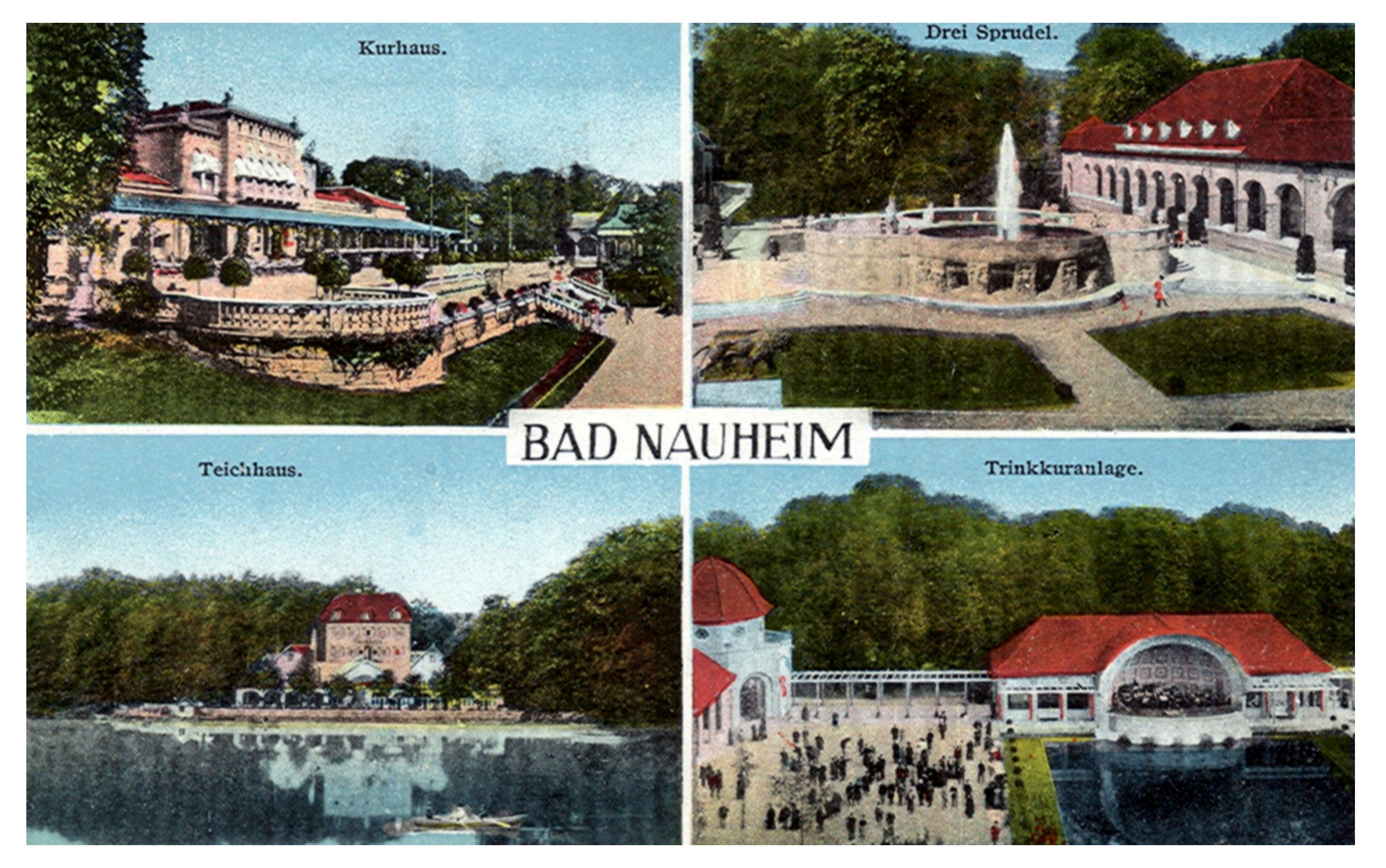
1900: John Dowell, a rich American, marries Florence Hurlbird, and takes her to Europe for their honeymoon. During the voyage across the Atlantic, Florence suffers a crisis of the heart during a violent storm. Her physicians forbid any further sea voyage and any sexual relations with her husband. The Dowells wander through Europe, spending their summers at Bad Nauheim, where Florence is treated for her heart condition. The following is a postcard from Bad Nauheim from around 1914:

Bad_Nauheim_Postcardxb

1904: Edward’s affairs have continued, the most recent of which has involved Maisie Maidan, a young woman with a heart problem, and the wife of one of Edward’s fellow-officers. The Ashburnhams come to Bad Nauheim for treatment of Edward’s “heart” disease, and bring Maisie with them. The Dowells and the Ashburnhams meet at the spa. Soon after their meeting they visit the nearby town of Marburg which has significant associations to Martin Luther and the Protestant Reformation. During the visit Florence flirts with Edward, and upsets Leonora by insulting the Irish Catholics. On their return to Bad Nauheim, they find that Maisie has died of a heart attack. .

Summer 1913: The two couples have been meeting in Bad Nauheim each summer for 9 years. This year Nancy Rufford, the 21-year old ward of the Ashburnhams, has joined them. Edward appears to be falling in love with Nancy and accompanies her to an evening concert in the spa grounds. Florence later goes to join them. She returns very upset, goes to her room, and dies, apparently of a heart attack.

Autumn 1913: John Dowell inherits a great deal of money from the Hurlbird family. He is invited to visit the Ashburnhams in England. Leonora informs him that Florence’s death was a suicide. For years she had been carrying on an affair with Edward without John being aware. On the night of her death, unobserved by Edward or Nancy, Florence had heard Edward tell Nancy that she was the person he cared most for in the world. She was devastated to realize that her affair with Edward was over.

End of 1913: Edward has become unhappily and madly in love with Nancy. He is starting to behave irrationally. Leonora decides that Nancy should sleep with her husband to save his sanity. Nancy comes to Edward’s bedroom but he rejects her. He decides to send Nancy away to India to be with her father, but hopes that she will remain in love with him. Edward bids farewell to Nancy at the train station without betraying any emotion. A few days later, Nancy sends a telegram from Brindisi in Italy, where she is about to board the steamer to India, saying that she is having a wonderful time. Edward believes that she no longer loves him and commits suicide. Nancy hears of his suicide and goes mad.

1914: Leonora marries again. John Dowell buys the Ashburnham home. He goes to India and brings Nancy back. She remains insane.

The Passionate Author

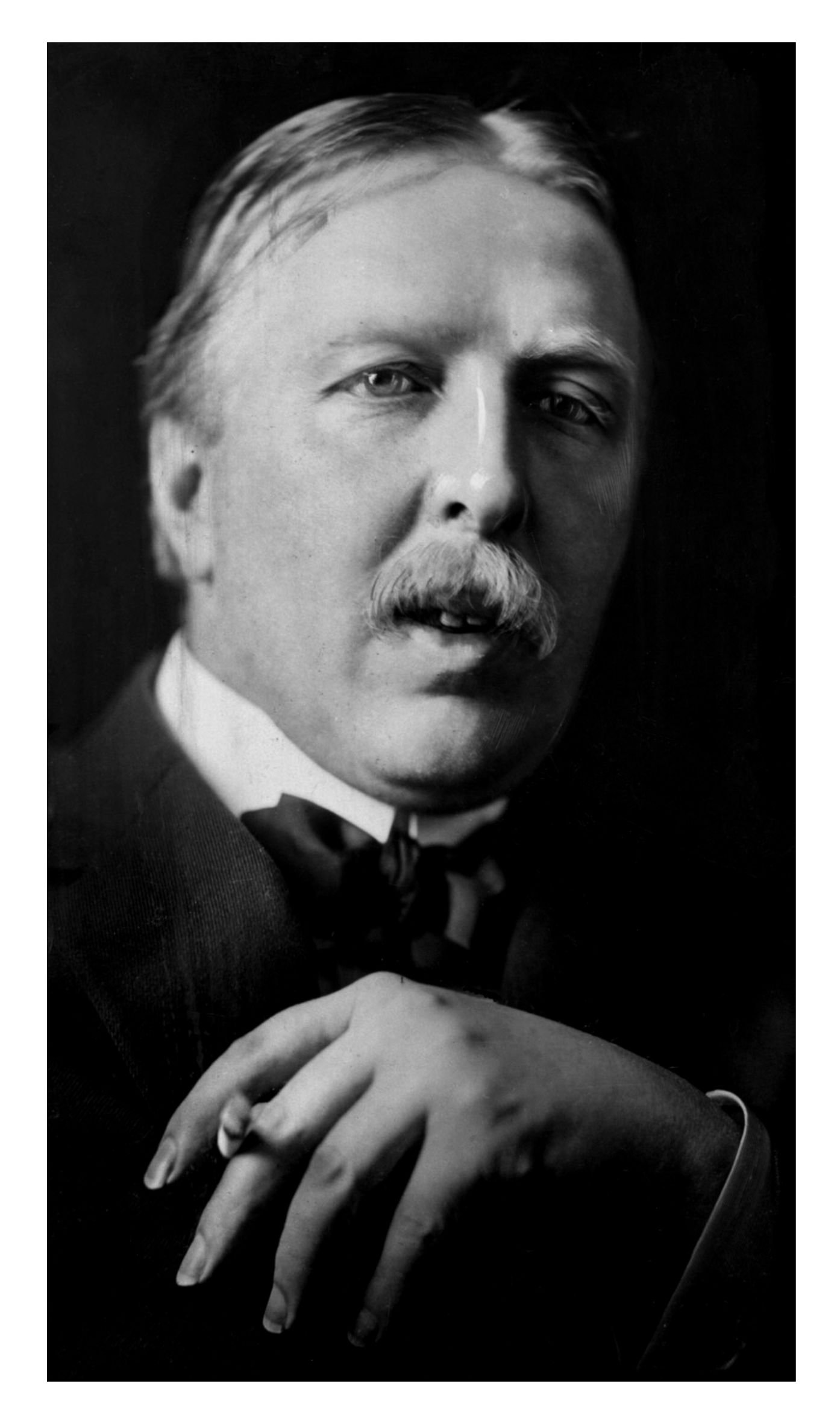
Photograph of Ford Madox Hueffer by E. O. Hoppe, 1912

Photograph of Ford Madox Hueffer by E. O. Hoppe, 1912

The story of the novel is complexly intertwined with the life of its author (Saunders, 1996). Ford was born in 1873 as Ford Hueffer. His maternal grandfather was the Pre-Raphaelite painter Ford Madox Brown. After his father, the German-born music critic for the London Times, died in 1889, Ford left school without going on to university and became a writer. One of his early books was a biography of his grandfather. Ford collaborated with Joseph Conrad, wrote reviews and published many novels, the most popular of which were the three books about Catherine Howard and Henry VIII, The Fifth Queen.

Ford had eloped with Elsie Martindale, a school classmate, in 1894. After several years, their marriage became unhappy, and Ford apparently began to have affairs with other women. One of his affairs in the early years of the new century may have been with Elsie’s younger sister, Mary, who was far more vivacious than his serious wife. Succumbing to these family tensions, Ford went to Germany for treatment at various spas for depression, anxiety and agoraphobia. He later recalled

The illness was purely imaginary; that made it none the better. It was enhanced by wickedly unskilful doctoring. … But the memory of those years is of one uninterrupted mental agony (Ford, 1932, p. 261).

In 1908 Ford founded the English Review, a literary journal which published work by various established authors with whom he had become acquainted – Hardy, Conrad, Galsworthy, James – and supported the early careers of Joyce, Pound, and Lawrence. His colleague in this endeavor was Arthur Marwood. The finances of the review were precarious, and Ford was forced to sell it in 1909. In addition to the monetary problems, Marwood had apparently made improper advances to Elsie, and Ford could no longer trust him.

In 1908 Ford began an overt affair with the novelist Violet Hunt, which lasted until the war. Elsie refused to give him a divorce. In 1910 Ford went to Germany to obtain German citizenship on the basis of his father’s birth, and then to arrange a German divorce. Although this plan did not work out, Ford returned to England and introduced Violet as Mrs. Hueffer though it appears they had never formally married. When Ford described Violet as “Mrs Ford Madox Hueffer” in print, Elsie sued.  Ford and Hunt became embroiled in a long-lasting scandal.

Ford published The Good Soldier in 1915. He subsequently served in the British army in France, an experience which later led to the Parade’s End sequence of novels (1924-1928). After the war, Ford became involved with the artist Stella Bowen. He changed his name to Ford Maddox Ford in 1919. One reason was that he disliked the German name. Another was perhaps that he could live together with Stella under the new name. A new edition of The Good Soldier published in 1927 was dedicated to Stella Ford.

Ford was a man who easily became passionately involved with women. In The Good Soldier, John Dowell remarks

… the real fierceness of desire, the real heat of a passion long continued and  withering up the soul of a man is the craving for identity with the woman  that he loves. He desires to see with the same eyes, to touch with the same sense of touch, to hear with the same ears, to lose his identity, to be enveloped, to be supported. For, whatever may be said of the relation of the sexes, there is no man who loves a woman that does not desire to come to her for the renewal of his courage, for the cutting asunder of his difficulties. And that will be the mainspring of his desire for her. We are all so afraid, we are all so alone, we all so need from the outside the assurance of our own worthiness to exist.
So, for a time, if such a passion come to fruition, the man will get what he wants. He will get the moral support, the encouragement, the relief from the sense of loneliness, the assurance of his own worth. But these things pass away; inevitably they pass away as the shadows pass across sundials. It is sad, but it is so. (pp.92-93)

An Unreliable Narrator

John Dowell’s telling of the story is like that of someone recalling the past, often digressing to explain the background of some person or event, often going back over what he has already described but from a different perspective. It is remarkably similar to the way in which Ford wrote Return to Yesterday, his 1932 set of autobiographical essays. His essay on Some Cures begins with the different therapies he underwent for his agoraphobia, but soon digresses to recall breakfasts with John Galsworthy, the humane way to slaughter pigs, and an anecdote about Émile Zola in London.

Ford called his approach to a story-telling “Impressionism,” describing the technique in two issues of Poetry and Drama, published in 1914 (and reprinted in the 2010 Oxford edition of the The Good Soldier). The idea was to intrigue the reader:

For the first business of Impressionism is to produce an impression, and the only way in literature to produce an impression is to awaken interest. And, in a sustained argument, you can only keep interest awakened by keeping alive, by whatever means you may have at your disposal, the surprise of your reader. You must state your argument; you must illustrate it, and then you must stick in something that appears to have nothing whatever to do with either subject or illustration, so that the reader will exclaim: ‘What the devil is the fellow driving at?’ And then you must go on in the same way – arguing, illustrating and startling and arguing, startling and illustrating – until at the very end your contentions will appear like a ravelled skein. And then, in the last few lines, you will draw towards you the master string of that seeming confusion, and the whole pattern of the carpet, the whole design of the net-work will be apparent. (p. 208)

Though Ford called his technique “Impressionism,” the only thing it really shares with painterly Impressionism is the idea that “A picture should come out of its frame and seize the spectator.” Ford’s approach is essentially Modernist and is more related to Cubism, which was developing at that time in the visual arts. This technique fits very well with cinematic adaptation, where flashbacks, rapid cuts, and shifting perspectives are natural (Harris, 2015). The BBC adaptation of the novel (Billington, 1981) is surprisingly effective.

However, John Dowell’s digressive approach to the story is not his most striking aspect as a narrator. Much of what his tells us is second-hand, pieced together from what others told him. He, himself, is remarkably lacking in perception. We have very right therefore to doubt his interpretation of the events. He is an “unreliable narrator” (Booth, 1961, pp. 155-159). Such a narrator considers the story from a perspective that differs from that of the actual author. Unreliable narrators come in all sorts: some are simply unaware, others are deceptive (Kermode, 1974; Segal, 2015). The reader is left with uncertainty: we must make up our own minds about what happened and why, and we shall never know for sure. The unreliable narrator emphasizes our epistemological uncertainty (Hynes, 1961). Even though we may be fairly confident about the external world, we can never know what is going on in the mind of another. “I don’t know” recurs like a refrain throughout the book.

gs cover001xx b

The central event of the book is the death of Florence, who had gone to bring Edward and Nancy back from the concert in the park. According to her husband, she was upset to hear that Edward considered Nancy, and not herself, the person that he loved most in the world. The cover of the first edition of the book illustrated this episode (right). John Dowell’s description is

Anyhow, there you have the picture, the immensely tall trees, elms most of them, towering and feathering away up into the black mistiness that trees seem to gather about them at night; the silhouettes of those two upon the seat; the beams of light coming from the Casino, the woman all in black peeping with fear behind the tree-trunk. It is melodrama; but I can’t help it. (pp. 89-90)

Yet John Dowell was not there. He only heard about what Edward told Nancy several months later from Edward. He did not know what happened. He only heard several months later from Leonora that Florence had been carrying on an affair with Edward for the preceding nine years. He initially had another explanation for why Florence was upset: that she saw her husband with a man named “Bagshawe,” who was telling him about Florence’s other sexual affairs with a person known as “Jimmy.”

John concluded that Florence’s intense anxiety brought on a heart attack. She was found dead in her room with a bottle of amyl nitrate heart medication in her hand. Later he came to believe that she did not have a heart problem, and supposes that she actually took prussic acid. This poison was known to Ford. His father-in-law, William Martindale, had committed suicide in this manner. During the dark years of his depression, Ford himself carried around a bottle of prussic acid. Supposedly his affair with Violet Hunt began in 1908 when she took away his bottle and suggested that he try “the old traditional way of comfort” (Saunders, 1996, p. 285; Abdalla, 2015).

However, we may question John’s account of Florence’s death. Florence’s uncle had recently died and left her a large amount of money. This was likely why she was dressed in mourning, and therefore unobserved by either Nancy or Edward on the night of the concert. After Florence’s death, Florence’s personal money and the inheritance from her uncle all came to John. John’s description of these bequests (pp. 152-4) comes long after the description of his wife’s death. Florence’s uncle wished that a significant part of his money be used to found an institute for patients with heart disorders. John describes the legal confusion about this part of the will. Despite his claim that he does not need the money, it seems clear that none of it will ever go to any such institute.

Was the death of Florence something other than suicide? Was it murder? There was motive enough – John stood to gain immensely from her death. Poole (1990) has interpreted the story of The Good Soldier along these lines. Nothing is for sure. In an interesting aside John Dowell remarks

I have, I am aware, told this story in a very rambling way so that it may be difficult for anyone to find their path through what may be a sort of maze. I cannot help it. I have stuck to my idea of being in a country cottage with a silent listener, hearing between the gusts of the wind and amidst the noises of the distant sea, the story as it comes. And, when one discusses an affair – a long, sad affair – one goes back, one goes forward. One remembers points that one has forgotten and one explains them all the more minutely since one recognizes that one has forgotten to mention them in their proper places and that one may have given, by omitting them, a false impression. I console myself with thinking that this is a real story and that, after all, real stories are probably told best in the way a person telling a story would tell them. They will then seem most real. (p. 154)

Here John Dowell is using the techniques of literary Impressionism. Perhaps he is lapsing into the persona of the novel’s author Ford Madox Ford. Or perhaps what he is telling us is actually a work of fiction, a story to excuse and cover up what actually happened.

Life at the Spa

At the turn of the 20th century it was fashionable for the rich to spend time in the spa towns of Europe, undergoing various kinds of therapy for various ailments, both real and imaginary. Water therapy has a long history (Mihina & Anderson, 2010; van Tubergen & van der Linden, 2002). In Europe many towns with access to natural springs developed spas, the term coming from the town of Spa in Belgium, which had been famous for its curative waters as far back as the Middle Ages.

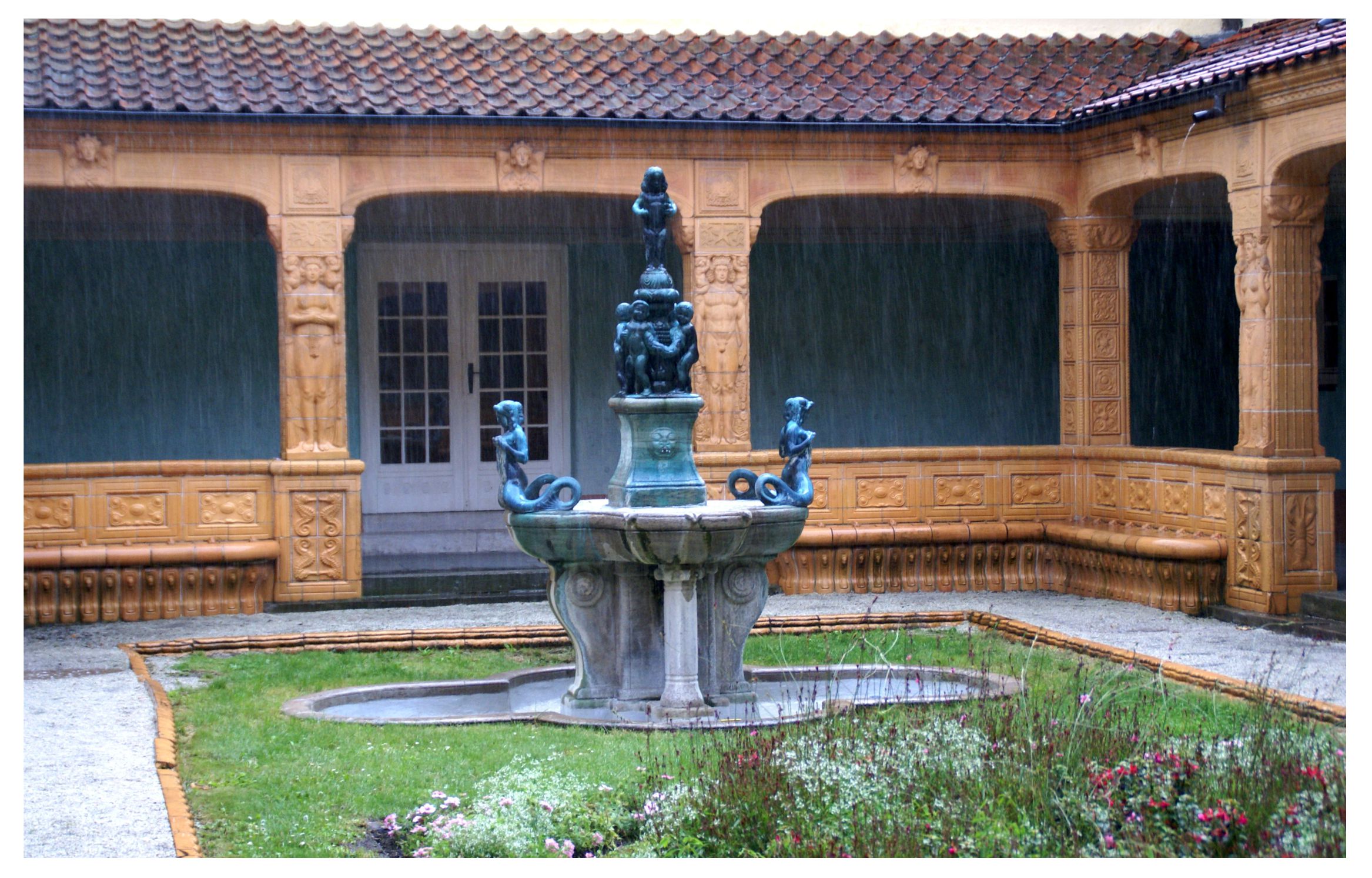
Much of the story of The Good Soldier takes place at the spa town of Bad Nauheim. Ford stayed there with Violet Hunt in August 1910. The spa in Bad Nauheim underwent a striking Jugendstil renovation between 1901 and 1911. The following photographs are from a recent album.

bad nauheim fountain

badnauheim bath

bad nauheim in the rain
The actual therapeutic effectiveness of spa therapy is controversial. Although it can improve a patient’s feeling of wellbeing, spa therapy likely does not change the underlying disease process (e.g. Verhagen et al., 2015). The spa may be a source of rest and relaxation, but it is not a place for cure or care.

Spas are perhaps symptomatic of a decadent society, wherein the rich waste their time in pampered luxury. Times have changed. Unfortunately, we still have the idle rich and we still have spas.

Something evil in the day.

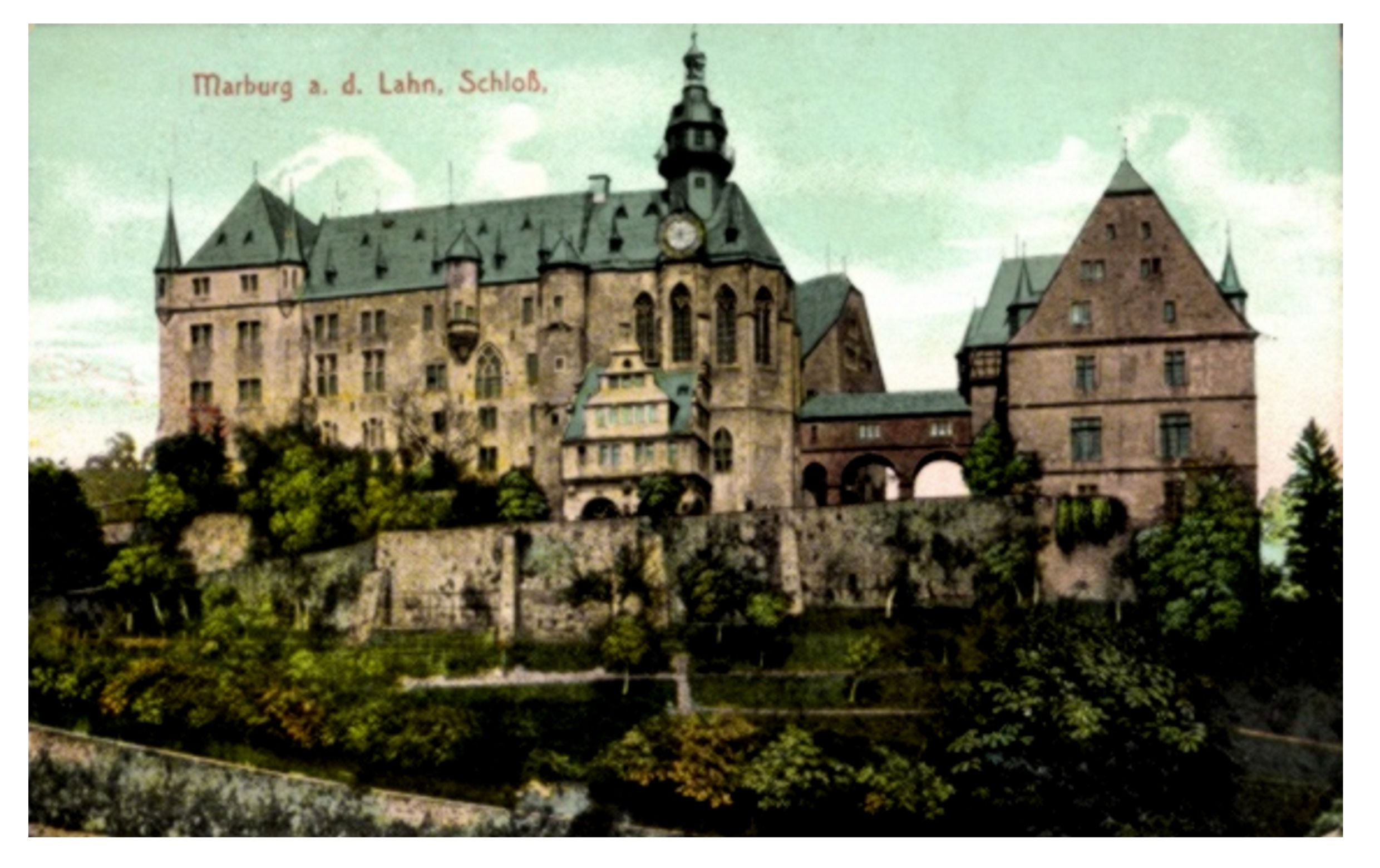
Soon after they meet, the Dowells and the Ashburnhams go on a day-trip to Marburg, a small town not far from Bad Nauheim. The town’s picturesque castle is illustrated in the following postcard from 1909:

marburg 1909 x b

Marburg Castle was the site of a 1529 meeting between Martin Luther and Ulrich Zwingli. The purpose was to develop a unified set of principles for the new Protestant belief. Unfortunately they could not agree on the nature of the Eucharist. They both disagreed with the Roman Catholics position that the bread and wine served during the celebration of the Holy Supper actually became the body and blood of Christ: the outer attributes remained the same but the inner substances changed – “transubstantiation.” However, they could not agree on a new beleif. Zwingli and the Calvinists believed that the Eucharist was symbolic and that the bread and wine did not change. Luther believed in “consubstantiation” – that the consecrated bread and wine were both bread and wine and body and blood of Christ. Documents at Marburg Castle describe this major disagreement at the beginning of the Protestant Reformation. .

The term “Protestant” comes from another document. After the 1521 Edict of Worms had condemned Luther’s ideas as heretical (as covered in my previous posting Here I Stand), another congress published the First Edict of Speyer in 1526, which granted the member states of the Holy Roman Empire some freedom in their choice of belief. A Second Edict of Speyer revoked this freedom in 1529. Various princes and leaders in the Empire quickly issued the Protest at Speyer objecting to this second edict. This Protest maintained the right of the princes and their subjects to determine the way in which they practised their religion, and asserted that Christian belief should derive solely from the scriptures. This all sounds very idealistic, but the protest goes on to affirm the edict’s condemnation of Anabaptists as heretical and urges that they be brought to trial and executed.

The Protest at Speyer may have led to the name “Protestant,” but it does not really establish the core beliefs of Protestantism. For Lutherans, these were enshrined in the Augsburg Confession of 1530. Over succeeding years, other Protestant factions each wrote their own Articles of Belief.

If anything, the Colloquy of Marburg demonstrated clearly that there was to be no unity in belief. The legacy of the Reformation was one of strife. Against the Roman Church and ultimately among themselves.

During the visit to Marburg Castle, Florence Dowell is acting as tour guide. She gets her history wrong but she is enthusiastic. She points to a documents from the Colloquy of Marburg:

She continued, looking up into Captain Ashburnham’s eyes: “It’s because of that piece of paper that you’re honest, sober, industrious, provident, and clean-lived. If it weren’t for that piece of paper you’d be like the Irish or the Italians or the Poles, but particularly the Irish. . . .”
And she laid one finger upon Captain Ashburnham’ s wrist.
I was aware of something treacherous, something frightful, something evil in the day. I can’t define it and can’t find a simile for it. It wasn’t as if a snake had looked out of a hole. No, it was as if my heart had missed a beat. It was as if we were going to run and cry out; all four of us in separate directions, averting our heads. In Ashburnham’s face I know that there was absolute panic. I was horribly frightened and then I discovered that the pain in my left wrist was caused by Leonora’s clutching it. (p 40).

What was the evil? Leonora runs out of the castle with John. She asks him why he does not see what is going on. Later John would understand that this was the beginning of Florence’s affair with Edward, but at the time he was completely unaware. Leonora realizes John’s naiveté, and claims that she felt insulted because she is Irish-Catholic. John is relieved – this can easily be solved by an apology.

Perhaps, the evil that John sensed was the complete breakdown of society’s codes of sexual morality. Green (1981) says that The Good Soldier portrays “a bitter, nostalgic vision of a world in which a sense of responsibility has been whittled down to a façade of respectability” (p 94), “a world whose only certainty is its lack of moral architecture’ (p 102). John wonders

Is the whole thing a folly and a mockery? Am I no better than a eunuch or is the proper man – the man with the right to existence – a raging stallion forever neighing after his neighbour’s womankind?
I don’t know. And there is nothing to guide us. And if everything is so nebulous about a matter so elementary as the morals of sex, what is there to guide us in the more subtle morality of all other personal contacts, associations, and activities? Or are we meant to act on impulse alone? It is all a darkness. (pp 16-17).

But surely this was not the evil that was felt on that afternoon in Marburg? The reader senses some deeper moral horror, something worse than the shocking sexual goings-on, worse even than murder, if that was indeed the cause of the deaths of Maisie on that very day, and of Florence nine years later.

Protestantism may have played a role in this meaninglessness. Perhaps the Protestant Reformation had fostered individual ambition at the expense of the general good. Ford enjoyed the easy Catholicism of Southern Germany, and hated the striving Protestantism of the Prussian North (Preece, 2015). A year after the Marburg visit, the authoritarian Prussians would precipitate the First World War.

This then is perhaps the real evil that we sense. This is why everything seems to happen on August 4th: Florence’s birthday, her elopement with John Dowell, the meeting between the Dowells and the Ashburnhams, and the visit to Nauheim. Great Britain declared war on Germany on August 4, 1914, when Germany rejected an ultimatum to remove its troops from Belgium.

World War I was the horror lurking under what happened at Bad Nauheim and Marburg. Society danced its way through sexual desire and monetary greed. It focused on its own imaginary ailments and paid no attention to what was happening in the world. Society was oblivious: death was in the air and no one noticed. Within five years 18 million people would be killed.

Editions of The Good Soldier (page references are to the Oxford 2010 edition).

Hueffer, F. M. (1915) The good soldier: A tale of passion. Oxford: Robert Lane (Bodley Head).

Ford, F. M., (edited and introduced by Stannard, M., 1995/2012). The good soldier. Authoritative text. New York: W.W. Norton and Co.

Ford, F. M (introduced and annotated by Kermode, F., 2005).The good soldier. New York: Barnes & Noble.

Ford, F. M (edited and introduced by Saunders, M., 2012).The good soldier: A tale of passion. Oxford: Oxford University Press.

An electronic edition of the novel is also available at Project Gutenberg

References

Abdalla, V. (2015). The Good Soldier: A tale of poison. Lethal little bottles in the work of Ford Madox Ford and Violet Hunt. In Saunders, M., & Haslam, S. (Eds) Ford Madox Ford’s The good soldier: Centenary essays. (pp. 197-212). Leiden: Brill Rodopi.

Billington, K. (Dir) (1981/2007). The good soldier [DVD]. Silver Spring, MD: Acorn Media

Booth, W. C. (1967). The rhetoric of fiction. Chicago: University of Chicago Press.

Ford, F. M. (1932). Return to yesterday. New York: Liveright.

Green, R. (1981). Ford Madox Ford: Prose and politics. Cambridge [England]: Cambridge University Press.

Harris, J. (2015).  Screening The Good Soldier. In Saunders, M., & In Haslam, S. (Eds). Ford Madox Ford’s The Good Soldier: Centenary essays. (pp. 103-116). Leiden: Brill Rodopi.

Hynes, S. (1961).  The epistemology of “The Good Soldier.” Sewanee Review, 69, 225-235.

Kermode, F. (1974). Novels: recognition and deception. Critical Inquiry, 1, 103-121.

Mihina, A. L. & Anderson, S. K. (2010). Natural spa and hydrotherapy. Theory and practice. Upper Saddle River, NJ: Pearson.

Poole, R. (1990). The real plot line of Ford Madox Ford’s The Good Soldier: an essay in applied deconstruction. Textual Practice, 4, 391-427.

Preece, J. (2015). Anglo-German dilemmas in The Good Soldier, or Europe on the brink in 1913. In Saunders, M., & Haslam, S. (Eds) Ford Madox Ford’s The Good Soldier: Centenary essays. (pp. 223-239). Leiden: Brill Rodopi.

Saunders, M. (1996). Ford Madox Ford: A dual life. Volume 1. The world before the war.  Oxford: Oxford University Press.

Segal, E. (2015). The Good Soldier and the problem of compositional (un)reliability. In Saunders, M., & Haslam, S. (Eds) Ford Madox Ford’s The Good Soldier: Centenary essays. (pp. 64-77). Leiden: Brill Rodopi.

van Tubergen, A., & van der Linden, S. (2002). A brief history of spa therapy. Annals of Rheumatic Diseases, 61, 273–275.

Verhagen, A.P., Bierma-Zeinstra, S.M., Boers, M., Cardoso, J.R., Lambeck, J., De Bie, R., & De Vet, H.C. (2025). Balneotherapy (or spa therapy) for rheumatoid arthritis. An abridged version of Cochrane Systematic Review. European Journal of Physical and Rehabilitation Medicine, 51, 833-47.


Remembrance

The onset of World War I brought into question the very idea of European civilization. Mankind’s ongoing progress to a better world appeared no longer pre-ordained. Promises of future peace and plenty were forever broken. Henry James wrote in a letter to Howard Sturgis on August 5, the day after Britain declared war of Germany.

The plunge of civilization into the abyss of blood and darkness by the wanton fiat of those two infamous autocrats is a thing that so gives away the whole long age during which we had supposed the world to be, with whatever abatement, gradually bettering, that to have to take it all now for what the treacherous years were all the while really making for and meaning is too tragic for my words. (James, 1920, p 398)

(The “autocrats” were Kaiser Wilhelm II of Germany and Franz Josef I of Austria.) The complex sentence is typical of James, the master of convoluted qualification. Rudyard Kipling later said the same in fewer words in his Common Form for the Epitaphs of the War:

If any question why we died,
Tell them, because our fathers lied.

However, at the beginning of the war, the general population had no such reservations. People rallied to support their King and Empire. Young men thronged enthusiastically to the recruiting centres.

recruitingXb

On looking at photographs of these happy volunteers, Philip Larkin wrote in 1960 a poem called MCMXIV

Those long uneven lines
Standing as patiently
As if they were stretched outside
The Oval or Villa Park,
The crowns of hats, the sun
On moustached archaic faces
Grinning as if it were all
An August Bank Holiday lark;

And the shut shops, the bleached
Established names on the sunblinds,
The farthings and sovereigns,
And dark-clothed children at play
Called after kings and queens,
The tin advertisements
For cocoa and twist, and the pubs
Wide open all day;

And the countryside not caring:
The place-names all hazed over
With flowering grasses, and fields
Shadowing Domesday lines
Under wheat’s restless silence;
The differently-dressed servants
With tiny rooms in huge houses,
The dust behind limousines;

Never such innocence,
Never before or since,
As changed itself to past
Without a word – the men
Leaving the gardens tidy,
The thousands of marriages
Lasting a little while longer:
Never such innocence again.

The title gives “1914” in Roman numerals, the way dates are written on the war memorials. The crowds lined up as if for a sporting event – cricket at the Oval or soccer at Villa Park. The innocence of England went back to medieval times when the country was surveyed for the Domesday Book of 1086. It was a land of simple pleasures, of hot cocoa steaming in a mug and pipe-tobacco sold in a “twist.” It was a society, where everyone from lord to maid knew their place.

Over the next four years, everything changed. The pubs that had once been open all day became restricted in their hours so that workers did not become too inebriated to produce munitions. Servants fought alongside their betters and began to wonder about why they were different. In the years that followed the war, the British Empire began slowly to unravel. The war etched itself into modern memory through poetry, photographs, painting and music (Silkin, 1972; Fusell, 1975; Malvern, 2004).

The bravado of the war’s first months soon ceded to harsh reality. Young men in their thousands marched to their deaths; trenches were dug like graves in the once-fertile land; the instruments and engines of war grew more efficient and terrible; form and sound became incomprehensible in the exploding shells; death came even in the air that soldiers breathed.

tank Xb

Siegfried Sassoon described trench warfare in his 1917 poem Attack:

At dawn the ridge emerges massed and dun
In the wild purple of the glow’ring sun,
Smouldering through spouts of drifting smoke that shroud
The menacing scarred slope; and, one by one,
Tanks creep and topple forward to the wire.
The barrage roars and lifts. Then, clumsily bowed
With bombs and guns and shovels and battle-gear,
Men jostle and climb to meet the bristling fire.
Lines of grey, muttering faces, masked with fear,
They leave their trenches, going over the top,
While time ticks blank and busy on their wrists,
And hope, with furtive eyes and grappling fists,
Flounders in mud. O Jesus, make it stop!

Broodseinde, 1917

Broodseinde, 1917

Sassoon was awarded the Military Cross for his bravery. He often went out on his own to engage the German lines, and was called “Mad Jack” for these near-suicidal exploits. Deeply disillusioned by the conduct of the war and the waste of life, in 1917 he wrote to his commanding officer a letter entitled Finished with the War: A Soldier’s Declaration, and forwarded a copy of this to the press. Rather than prosecuting him for treason, the military authorities sent him to Craiglockhart Hospital to be treated for neurasthenia or “shell shock.” At the hospital, Sassoon met and encouraged another soldier-poet, Wilfred Owen.

The Great War altered forever the way that we see the world. More than in any previous war, the public was able to see what actually happened from photographs of soldiers in action. These were strictly censored. Nevertheless, the published photographs showed clearly both the isolation of the soldiers and the desolation of the land.

Ypres, 1917

Ypres, 1917

Paintings no longer portrayed romance and courage but horror and fear. Paul Nash was a war-artist who served with the British Army at Ypres in 1917. He wrote to his wife

Sunset and sunrise are blasphemous, they are mockeries to man, only the black rain out of the bruised and swollen clouds all though the bitter black night is fit atmosphere in such a land. The rain drives on, the stinking mud becomes more evilly yellow, the shell holes fill up with green-white water, the roads and tracks are covered in inches of slime, the black dying trees ooze and sweat and the shells never cease. They alone plunge overhead, tearing away the rotting tree stumps, breaking the plank roads, striking down horses and mules, annihilating, maiming, maddening, they plunge into the grave which is this land; one huge grave, and cast up on it the poor dead. It is unspeakable, godless, hopeless. I am no longer an artist interested and curious, I am a messenger who will bring back word from the men who are fighting to those who want the war to go on for ever. Feeble, inarticulate, will be my message, but it will have a bitter truth, and may it burn their lousy souls. (quoted by Haycock, 2009, p. 278)

His impressions formed the basis for his painting The Menin Road:

Nash,_Paul_-_The_Menin_Road_-_Google_Art_Project

After the Allies broke through their defences in 2018, Germany sued for peace. Negotiations began in October and the war was finally ended by an armistice between the Allies and Germany signed on November 11 at 5 am in a railway carriage in the forest of Compiègne. Hostilities were to cease at 11 am that day “the eleventh hour of the eleventh day of the eleventh month.” At that time each year since then, we have paused to remember those who died in battle.

Wilfred Owen was killed in action at the crossing of the Sambre-Oise canal on November 4, a brief week before the war ended. One of his last poems imagined what might happen when he died. The slant rhymes underline the uneasiness of his Strange Meeting.

It seemed that out of battle I escaped
Down some profound dull tunnel, long since scooped
Through granites which titanic wars had groined.
Yet also there encumbered sleepers groaned,
Too fast in thought or death to be bestirred.
Then, as I probed them, one sprang up, and stared
With piteous recognition in fixed eyes,
Lifting distressful hands, as if to bless.
And by his smile, I knew that sullen hall, –
By his dead smile I knew we stood in Hell.
With a thousand pains that vision’s face was grained;
Yet no blood reached there from the upper ground,
And no guns thumped, or down the flues made moan.
‘Strange friend,’ I said, ‘here is no cause to mourn.’
‘None,’ said that other, ‘save the undone years,
The hopelessness. Whatever hope is yours,
Was my life also; I went hunting wild
After the wildest beauty in the world,
Which lies not calm in eyes, or braided hair,
But mocks the steady running of the hour,
And if it grieves, grieves richlier than here.
For by my glee might many men have laughed,
And of my weeping something had been left,
Which must die now. I mean the truth untold,
The pity of war, the pity war distilled.
Now men will go content with what we spoiled,
Or, discontent, boil bloody, and be spilled.
They will be swift with swiftness of the tigress.
None will break ranks, though nations trek from progress.
Courage was mine, and I had mystery,
Wisdom was mine, and I had mastery:
To miss the march of this retreating world
Into vain citadels that are not walled.
Then, when much blood had clogged their chariot-wheels,
I would go up and wash them from sweet wells
Even with truths that lie too deep for taint.
I would have poured my spirit without stint
But not through wounds; not on the cess of war.
Foreheads of men have bled where no wounds were.
‘I am the enemy you killed, my friend.
I knew you in this dark: for so you frowned
Yesterday through me as you jabbed and killed.
I parried; but my hands were loath and cold.
Let us sleep now . . .’

The dead soldier’s description of the life that might have been, the laughter and the tears cut short, portrays “the pity war distilled.” Strange Meeting was one of several poems by Owen that were set to music by Benjamin Britten in the War Requiem, composed for the 1962 consecration of the new Coventry Cathedral. The old cathedral had been destroyed by bombing in World War II, which began only twenty-one years after the end of the “war to end all wars.”

Britten used as an epigraph to the score a quotation from the draft preface that Owen had written to a planned book of his poems on the war:

My subject is War, and the pity of War.
The Poetry is in the pity …
All a poet can do today is warn.

Owen’s words and Britten’s music provide context for today’s Remembrance. The following clip provides the ending to the War Requiem. The final lines of Owen’s poem, beginning with “I am the enemy you killed,” lead into the final section of the mass, initially sung by the two male soloists and a boys’ choir, before ending with the full chorus.

In paradisum deducant te angeli
In tu adventu suscipiant te martyres
et perducant te in civitatem sanctam Jerusalem.
Chorus angelorum te suscipiat et cum Lazaro
quondam pauper aeternam habeas requiem.
Requiem aeternam dona eis, Domine:
et lux perpetua luceat eis.
Requiescant in pace.

(May the angels lead you into paradise and at your arrival may the martyrs receive you and bring you into the holy city of Jerusalem. May the choir of angels receive you and may you have eternal rest together with Lazarus who once was poor. Lord, grant them eternal rest and let perpetual light shine upon them. May they rest in peace.)

References  

Fussell, P. (1975). The Great War and modern memory. New York: Oxford University Press.

Haycock, D. B. (2009). A crisis of brilliance: Five young British artists and the Great War. London: Old Street.

Holmes, R. (2001). The First World War in photographs. London: Carlton Book.

James, H (edited by P. Lubbock, 1920). Letters. London: Macmillan.

Larkin, P. (edited and annotated by Burnett, A., 2012). The complete poems of Philip Larkin. London: Faber & Faber.

Malvern, S. (2004). Modern art, Britain, and the Great War: Witnessing, testimony, and remembrance. New Haven: Yale University Press.

Owen, W. (edited and annotated by Stallworthy, J., 1963). The poems of Wilfred Owen. London: Chatto & Windus

Sassoon, S. (1961). Collected poems, 1908-1956. London: Faber & Faber.

Silkin, J. (1972). Out of battle: The poetry of the Great War. London: Oxford University Press.