Ely Cathedral was originally situated on a low island in the middle of the Fens, a region of marshland in eastern England lying inland of the Wash. Because of the flatness of the surrounding land the cathedral could be seen from great distances, appearing as the “Ship of the Fens.” The marshes were drained in the 17th Century, but it is still easy to imagine the building floating above the waters: the embodiment of Auden’s image of the English cathedrals:
Luxury liners laden with souls,
Holding to the east their hulls of stone.
(Auden, 1936, p 43; also McDiarmid, 1978, p 292)
The Present Cathedral
The following illustration shows the cathedral as viewed from the southeast.
The present building was begun in 1083 by the Normans soon after their conquest of England. They bought with them a style of architecture known as “Romanesque” on the continent but considered “Norman” in England. The style was characterized by large weight-bearing columns surmounted by semi-circular arches. As the years passed, additions, collapses and renovations to the original building left it with a blend of styles that still somehow achieve harmony rather than incoherence.
The following is the view of the cathedral from the south from Bentham (1771, Plate 42, scale 100 ft):
The West end of the cathedral shows its mixture of styles. The following illustration shows a engraving from King (1881, plate XII) as well as two modern photographs showing the Gothic arches on the Galilee Porch and the Norman arches on the south west transepts
The following is a floor plan of the cathedral:
The dashed semicircular lines in the Presbytery show the eastern extent of the original Norman cathedral.
Saxon Beginnings
The region of England northeast of London – comprising the present counties of Norfolk, Suffolk, Cambridgeshire and Essex – was settled by Angles and Saxons in the 5th and 6th Centuries CE. Multiple kingdoms were set up on the island of Britain: East Anglia, Northumbria, Mercia, Essex, Sussex, Wessex, and Kent. Augustine of Canterbury arrived in England in 597 CE; and the various Saxon kingdoms in England soon converted to Christianity.
Anna, the king of East Anglia (reigned 636-654 CE), a devout Christian, probably reigned in Exning – just east of present-day Cambridge. A large ancient earthen wall, known today as the Devil’s Dyke, stretching from the southern end of the Fens to the River Stour, appears to have built as a defense against the Mercian kingdom to the west. The following map shows the kingdom of East Anglia at the time of Anna:
Anna’s daughter Æthelthryth (or Etheldreda) was born in 636 CE (Keynes, 2003). In 652, at the age of 16, she was married to Tondberct, a prince who ruled over part of the Fens. This was a political marriage, designed to extend Anna’s domain, and Æthelthryth insisted on maintaining her virginity. As a wedding gift she was given the Isle of Ely in the Fens. The name “Ely” probable comes from the Old English elge meaning “region of eels.” Tonberct died in 655, and Æthelthryth retired to live in Ely.
After Anna died fighting against the Mercians at the battle of Bulcamp in 654, Æthelthryth was married in 660 for a second time to Ecgfrith, a 16-year-old prince of Northumbria. Once again, she insisted on maintaining her virginity. In 670, she formally took the veil as a nun and lived in the double monastery (for both monks and nuns) at Coldingham, in what is now southeast Scotland. In 672, in need of an heir, Ecgfrith decided that he wished to consummate his marriage, and sent armed men to apprehend his wife. She and her attendants fled to Ely; Ecgfrith’s men were prevented from capturing her by the tidal waters of the Fens. Æthelthryth then founded a new monastery at Ely, where she presided as abbess until her death in 679. The following illustration shows two of the capitals on the octagon pillars in Ely cathedral (from Bentham, 1771, plates 9 and 10): Æthelthryth’s taking of the veil, and her miraculous salvation by the rising waters of the Fens. On the right is a 1960 statue of Æthelthryth by Phillip Turner.
Little is known of the abbey at Ely after its founding. In 869 the Vikings conquered the kingdom of East Anglia and much of Northumbria and Mercia. Alfred the Great (849-899) ultimately prevented the Vikings from further expansion, but allowed the continuation of Danelaw in the eastern parts of England from 886 to 1066. The original abbey of Æthelthryth may have been destroyed or may have simply fallen into disuse during the early Viking period. However, Ely Abbey was re-founded toward the end of the 10th Century as a monastery for monks alone. As his boat approached Ely, King Cnut (reign 1016-1035) was impressed by the music of the monks and wrote a poem, a fragment (perhaps the refrain) of which survives (Parker, 2018):
Merie sungen ðe muneches binnen Ely
ða Cnut ching reu ðer by.
Roweþ cnites noer the lant
and here we þes muneches sæng.
[Sweetly sang the monks in Ely
When Cnut the king rowed by;
‘Row, men, nearer to the land
So we can hear the friars’ song.’]
The Norman Cathedral
Under the direction of Abbot Simeon, the Normans initiated the construction of a large abbey church in Ely in 1083. The remains of Saint Æthelthryth were moved from the old church to the new in 1106. Her marble tomb was placed in a shrine bedecked by gold and jewels behind the high altar. The building was granted cathedral status by Henry I 1109. The nave, central tower and transepts were completed by about 1140, and the western transepts and tower were finally finished by about 1190.
The nave is 72 meters long and 22 meters high. There are three levels: the arcade, gallery (or tribune) and clerestory, the last containing large windows for light (clerestory means “clear storey”). The proportions for these levels are 6:5:4 (Clifton-Taylor, 1986, p 36). The arcades of the gallery are divided into two and those of the clerestory into three. The columns alternate between piers with multiple shafts and piers with large cylindrical columns, providing a gentle visual rhythm. The aisles on either side of the main nave are each one half the width of the nave (Fernie, 2003). The roof was made of the same timbers that were used to provide the scaffolding when constructing the nave.
The following illustration shows on the left a diagram of the nave (Dehio & Bezold, 1887, plate 88), On the right is a modern photograph that shows its three levels, and at the bottom a photograph that illustrates the alternation of the main columns.
The monk’s door and the prior’s door from the cloisters into the nave were likely built and decorated in the 1130s. Both are intricately sculpted. The prior’s door (shown below in a plate from Bentham, 1771, and in a modern photograph) is surmounted by a tympanum containing Christ in Majesty surrounded by two angels. Though far less accomplished than the Romanesque sculptures in France, it has its own charm.
The Gothic Cathedral
The Galillee Porch was added to the west front of the cathedral in the first two decades of the 13th Century. As we have already noted the style is early Gothic: the blind arcades decorating the façade have pointed arches, narrow columns, and trefoil openings.
A little later, the east end of the Cathedral was extended to form a Presbytery: a space for the monks to worship separate from the choir and the nave. This extension in a richly decorated Gothic style was completed in 1252 (Maddison, 2003). The large columns of the arcade are divided into multiple smaller columns and the pointed arches are geometrically ornamented. The tribune gallery has twin trefoiled openings beneath a large pointed arch. The clerestory has lancet windows with an inner row of cinquefoil arches. The stone vault is supported by tierceron ribs.
The following illustration shows a view of the choir and presbytery toward the east by John Eaton (2016) surrounded by two views of the north wall, the left by Arthur de Smet (1972) and the right from Broughton (2008):
In 1321, work began on a large separate Lady Chapel north of the choir and presbytery. Constructing the foundations for this new building led to the central section of the cathedral being undermined by water. The central bell tower of the cathedral collapsed in 1322, damaging parts of the north transept and the choir. Under the direction of Alan of Walsingham a new octagonal tower was built, with the stonework completed by 1328 (Maddison, 2003). The crowning glory of the tower was a magnificent “lantern” built of timber that allowed light to descend into the cathedral (completed in about 1340). The following illustration shows the octagon viewed from the western tower and a diagram of the carpentry underlying the lantern from Hewett (1974, plate 76):
The following illustration shows views of the lantern from the interior of the cathedral:
Because of the lantern, Ely cathedral provides a marvelous interplay of light and shadow. Frederick Evans took many photographs in 1897 and published these in Camera Work in 1903 (Lyden, 2020). Two of his images are below:
After the stonework of the octagon was completed Bishop Hotham and Akan of Walsingham then returned to complete the lady chapel – a wonder of Decorated English Gothic. The vault is supported by interconnecting ribs forming star shapes (lierne, from French lier, to tie, or stellar vaulting). This approach supports a wider vault than the simple tierceron ribbing. The large windows are supported by thin vertical columns that extend outward to provide a buttressing effect. The following illustration shows a photograph of the chapel and a diagram of the lierne vaulting.
The chapel was completed in the 1340s. The lower sections of the walls are decorated with vegetal patterns, giving the visitor a sense of being in a garden (Broughton, 2008). The present chapel is very different from the way it was in the 14th and 15th Centuries. At that time, numerous painted sculptures existed in the niches, and the windows were made of stained glass.
The Monastery
Ely Cathedral, like Canterbury, Durham, and Norwich, was a monastic cathedral. The monks at these cathedrals followed the Benedictine order. The bishop of a monastic cathedral was the titular abbot of the monastery, but the monks were essentially led by the prior. Although most of the old cathedrals in England were monastic, some cathedrals, such as Lincoln and Hereford were secular and had no associated monastery.
The monastery (or priory) at Ely was prosperous. Many of the medieval buildings of the monastery still stand. Some are used by King’s Ely School. The following plan shows the probable layout of the monastery (Dixon, 2003). The castle motte is the site of a fortress in Norman times.
The Reformation
As the years wore on the monastery at Ely became rich. The sale of indulgences brought in much money. Death acted like the church’s tax-collector, as those in need of heaven left their land and possessions to the church rather than to their children. Pilgrims to the shrine of Æthelthryth/Etheldreda were expected to make significant donations to the church. Æthelthryth was also called Saint Audrey. Ribbons bought at her shrine were called “St Audrey’s lace,” whence comes the word “tawdry” for overpriced finery. Some Bishops at Ely made special ornate chapels for themselves: Bishop Alcock (1486-1500) at the end of the north aisle and Bishop West (1515-33) at the end of the south aisle. It was easy to accuse the church of luxury and greed.
As the 16th Century progressed, Henry VIII came to need both a new wife and a source of gold. In 1533 Henry appointed Thomas Cranmer as Archbishop of Canterbury. Cranmer allowed him to marry Anne Boleyn. In 1534, Thomas Cromwell, the king’s chancellor, arranged for Parliament to pass the Act of Supremacy declaring the king to be the head of the English Church. In 1537, Cromwell convened a synod of British bishops who produce a book The Institution of the Christian Man, espousing many of the principles proposed by Martin Luther. In 1839 Parliament passed a bill to allow the Dissolution of the Monasteries. All of the small monasteries were to be closed, their monks let go, and their assets expropriated by the king. The monasteries associated with the cathedrals were also to be closed, although some of their monks could remain as officers in the newly secularized cathedrals.
On 18 November, 1539, Prior Robert Seward and 23 other monks signed a deed of surrender of the monastery of Ely to Henry VIII (Duffy, 2020, pp 31-45). There was not much else they could do. The abbots of Gastonbury and Reading had been executed on November 13 for refusing to dissolve their houses. The monastery and cathedral were held at the pleasure of the monarch and its riches were duly plundered. In 1541 the cathedral was given a royal charter as a secular cathedral. The church which had been devoted to Saint Etheldreda and Saint Peter, was renamed “The Cathedral Church of the Holy and Undivided Trinity of Ely.”
The bishop during this time was Thomas Goodrich, a colleague of Thomas Cranmer. Trained in theology at Cambridge University, he was appointed Bishop of Ely in 1534 and remained bishop until his death in 1554. After the dissolution of the monastery, he ordered the destruction of the shrine of Ethelreda, the defacement of the statues in the Lady Chapel, and the removal of the statues in the chapels of Bishop’s Alcock and West. Every one of the 147 statues of Mary and the other saints in the Lady Chapel was beheaded. Goodrich continued as bishop after the death of Henry in 1547; during the reign of Edward VI (1547-53), he was also appointed Lord Chancellor (1552). He died in 1554, before Mary (reign 1553-8) had time to pursue her vengeance.
The following illustration shows two photographs from the 1890s by Frederick Evans showing the mutilation of the statues in the Lady Chapel and the empty plinths on the gateway to Bishop West’s chapel. Also shown is the memorial brass to Thomas Goodrich, located on the floor of the south presbytery. The bishop holds in his right hand both a bible and the seal of England, emblematic of his chancellorship.
After the Reformation the cathedrals of England fell into disrepair. The architecture was contemptuously referred to as “Gothic” or barbaric (see Clifton-Taylor, 1986, pp 9-12). In 1699, the north west transept of Ely Cathedral collapsed (Fernie, 2003, p 96). There was no money to rebuild:
To this day, Ely looks like the wounded veteran of some forgotten war. (Jenkins, 2016, pp 91-2)
Watercolors by J. M. W. Turner from the 1790s show the cathedral octagon and the dilapidated Galilee Porch.
Repair
The cathedral was extensively restored during the 19th Century: The roof of the nave was retimbered and painted; the windows were provided with stained glass; the choir was provided with new stalls and a beautifully carved choir screen; the high altar received an intricate reredos (from French arere, behind, dos, back).
The following illustration shows some of the carvings above the choir stalls. These depict episodes in the life of Jesus: the supper at Emmaus, the appearance of the risen Jesus to Thomas, and the ascension:
Ely in the Present
Most people in England no longer attend church, and those who believe that there is a God are equaled by those who believe that there is not. What should be the place of the church in modern society?
Intriguing to me are the modern statues that now adorn the cathedral. Below are illustrations of four of these works. Clockwise from the upper left are the Virgin Mary in the Lady Chapel urging us to exultation by David Wynne (2000), Christ and Mary Magdalene wondering at the mystery of the resurrection by David Wynne (1967), Christ in Majesty above the pulpit by Peter Ball (2000), and half-life-size statues by Sean Henry on the empty plinths in Bishop West’s chapel, part of an installation entitled Am I My Brothers Keeper? in 2024.
An optimistic view of the future is from Nicholas Orme (2017, p 262):
The most astonishing feature of cathedral history, when one has journeyed through its seventeen hundred years, is its immense and varied creativity. If we take buildings, there is the evolving history of their plans and construction, the sourcing of the materials, the labours of craftsmen, the elaboration of the decoration, and the successive layers of repair and restoration. There is the worship, complex in its calendar, its liturgical texts, the ways in which it is done, and the application of the worship to God, saints, or popular, needs. There is the vast range of arts involved in producing worship and its setting: sculpture, painting, stained glass, metalwork, fabrics, singing, instrumental music, and chorography. There is the written and spoken word in prayer- and hymn-books, preaching, inscriptions, archives, libraries, guide-books, and service-sheets.
A more restrained understanding of what it is like to visit a church when faith has passed away can be found in a 1954 poem by Philip Larkin entitled Church Going, the last verse of which reads:
A serious house on serious earth it is,
In whose blent air all our compulsions meet,
Are recognised, and robed as destinies.
And that much never can be obsolete,
Since someone will forever be surprising
A hunger in himself to be more serious,
And gravitating with it to this ground,
Which, he once heard, was proper to grow wise in,
If only that so many dead lie round.
References
Atherton, I. (2003). The dean and chapter: reformation and restoration. In Meadows & Ramsay, op cit, pp 169-192.
Auden, W. H. (1936). Look, stranger! Faber & Faber
Fernie, E. (2003). Architecture and sculpture of Ely Cathedral in the Norman period. In Meadows & Ramsay, op cit, pp 97-11.
Hewett, C. A. (1974). English cathedral carpentry. Wayland.
Jenkins, S. (2016). England’s cathedrals. Little, Brown.
Keynes, S. (2003). Ely Abbey 672-1109. In Meadows & Ramsay, op cit, pp 3-58.
King, R. J. (1881). Handbook to the cathedrals of England.Volume 3. Eastern Division: Oxford, Peterborough, Norwich, Ely, Lincoln. J. Murray. Available at archive.org.
Lyden, A. M. (2010). The photographs of Frederick H. Evans. J. Paul Getty Museum.
McDiarmid, L. S. (1978). W. H. Auden’s “In the Year of My Youth…” The Review of English Studies, 29(115), 267–312.
Maddison, J. (2003). The Gothic Cathedral: new building in a historic context. In Meadows & Ramsay, op cit, pp 113-141.
Meadows, P., & Ramsay, N. (2003). A history of Ely Cathedral. Boydell Press.
Orme, N. (2017). The history of England’s cathedrals. Impress Books.
Parker, E. (2018). ‘Merry sang the monks’: Cnut’s Poetry and the Liber Eliensis. Scandinavica, 57(1), 14-27.
Looking at the Human Brain: from Vesalius to the Present
Andreas Vesalius (1514-1564) published his De Humani Corporis Fabrica (On the Fabric of the Human Body) in 1543 (O’Malley, 1964). This book, based on dissections of human cadavers, provided illustrations of the human brain that were both anatomically correct and esthetically pleasing. The scientists that followed Vesalius expanded on our knowledge, and produced their own representations of the human brain. This essay traces the evolution of these pictures.
The View from Above
One of Vesalius’ most striking illustrations shows the head of a man with the top of his skull (calvarium) removed (Catani & Sandrone, 2015, p 220). The cerebral meninges (membranes) – composed of the dura mater (tough mother, P in the illustration) and the arachnoid mater (spidery mother, O) – were cut in the midline and then folded down over the edge of the skull. The cerebral hemispheres (A and B) were spread apart and the falx cerebri (cerebral sickle, D) was pulled up and folded over the left hemisphere. This revealed the corpus callosum (tough body, L) connecting the two hemispheres. At the base of the falx cerebri was a large vein later known as the inferior sagittal sinus (F, G).
In 1656, Vesalius’ illustration served as a model for Rembrandt’s representation of the brain in The Anatomy Lesson of Dr Deyman. The original painting portrayed the professor and his students in much the same way as the earlier painting The Anatomy Lesson of Dr Nicolaes Tulp (1632). After the painting was damaged by fire in 1723, all that remains are the hands of the professor as he dissects the meninges, his assistant holding the calvarium, and the cadaver of the recently executed thief, Joris Fonteyn, also known as “Black Jan:”
Anne Carson wrote a brief prose poem about the painting in her Short Talks (1992):*
A winter so cold that, walking on the Breestraat and you passed from sun to shadow, you could feel the difference run down your skull like water. It was the hunger winter of 1656 when Black Jan took up with a whore named Elsje Ottje and for a time they prospered. But one icy January day Black Jan was observed robbing a cloth merchant’s house. He ran, fell, knifed a man and was hanged on the twenty-seventh of January. How he fared then is no doubt known to you: the cold weather permitted Dr. Deyman to turn the true eye of medicine on Black Jan for three days. One wonders if Elsje ever saw Rembrandt’s painting, which shows her love thief in violent frontal foreshortening, so that his pure soles seem almost to touch the chopped-open cerebrum. Cut and cut deep to find the source of the problem, Dr. Deyman is saying as he parts the brain to either side like hair. Sadness comes groping out of it.
Carson uses two striking images: the transition from sun to shadow like water on the skull, and the parting of the brain like hair. She also remarks on the foreshortening – Rembrandt was using Mantegna’s Lamentation of the Dead Christ (1480) as a model. And she sadly links the soles of the feet to the soul of Black Jan, recently released from his cerebrum.
In a series of engravings to illustrate the brain (1802), Charles Bell produced a delicately colored view of the brain and meninges (available from the Wellcome website) very similar to that of Vesalius. The dura mater (B) is folded away. The arachnoid mater is preserved over the left hemisphere. The arachnoid mater (D) from the right hemisphere is folded over the left hemisphere. Bell identified anterior middle and posterior lobes (H, I, K) in the right hemisphere but these were not clearly demarcated. Deep in the cerebral fissure can be seen the corpus callosum (L) and the anterior cerebral artery (M).
The View from the Side
The first illustration of the brain in Vesalius’ book shows the dura mater looks viewed from the side once the skull has been removed. Of note are the superior sagittal sinus (C), and the paired blood vessels (D) that we now know as the middle meningeal artery and vein. This was before William Harvey’s 1628 differentiation of the arteries and veins
The dura was cut through and both dura and arachnoid mater werefolded down over the edge of the skull to reveal the underlying brain. Vesalius made no effort to delineate the cerebral surface accurately. The cerebral gyri are reminiscent of the random coils of the small intestine.
It was not really until the 19th Century that more realistic depictions of the cerebral gyri and sulci became available. The following illustration is from a series of beautiful hand-colored etchings produced by the surgeon John Lizars and his father Daniel Lizars in about 1825. The cerebrum and the cerebellum are well represented, together with their arteries and veins (with their red and blue colors accentuated). However, the orientation of the brainstem and its connections to the spinal cord are quite distorted.
It was not until late in the 19th Century, as physiologists began to study the localization of function, that images distinguished the different gyri of the cerebrum. The following illustration is from the atlas of Christfried Jakob (1895). The gyrus fornicatus (arched), now known as the cingulate (girdle) gyrus, is an important part of the limbic system which mediates visceral sensation, emotion and memory. The word fornication (extramarital sex) derives from ancient brothels, which often provided vaulted or arched chambers for their clients.
In 1909 the German anatomist Korbinian Brodmann further differentiated the cerebral cortex into 52 regions based on microscopic analysis of the cortical structure (Brodmann, 1909, p 131)
Areas 1, 2, and 3 represent the primary somatosensory cortex on the postcentral gyrus. Area 4 is the primary motor cortex on the precentral gyrus. Area 17 is the primary visual cortex is the primary visual cortex located in and around the calcarine fissure. Areas 41 and 42 are auditory areas located on the superior surface of the temporal lobe. The areas are similar in the brains of other primates. However, area 10 in the frontal lobes and areas 39 and 40 at the temporoparietal junction are particularly important. In the human brain.
The View from Below
There is an illustration of the human brain viewed from below in Vesalius’ book, but it is “still relatively crude and the brain stem in particular is unlife-like” (Clarke & Dewhurst, 1972, p 62). In his Cerebri Anatome (1664), Thomas Willis provideded what has become the classical view of the base of the human brain. The original drawing was by Christopher Wren, the architect of St Paul’s cathedral (Scatliff & Johnston, 2014).
The drawing clearly demarcates the structures at the top of the brain stem: the olfactory bulb and tract (D), the optic nerve and chiasm (E), the stalk of the pituitary gland (X), and the mammillary bodies (Y). Willis shows cranial nerves of the midbrain: the oculomotor nerve (F), the trochlear nerve (G). The trigeminal nerve (H) is properly located. The lower cranial nerves are not well demarcated. These were not clearly distinguished until the work of Samuel Soemmerring in 1778 (Storey, 2022). One of the most important aspects of Willis’s illustration is that it shows the connections between the arteries supplying the brain: the circle of Willis (illustrated below). His drawing shows the complete circle but the arteries supplying the cerebellum are missing.
Félix Vicq-d’Azyr produced a more colorful version of the basal brain in 1786 (Plate XIX). The beautiful plates for his book were produced by the engraver Alexandre Briceau. The cerebellar arteries are shown, and the frontal lobes are separated to reveal the corpus callosum:
Views of the Brain Stem
After removing the cerebral hemispheres and the cerebellum, the dorsal aspect of the brainstem becomes visible. Vesalius’ drawing of the brain stem is shown below together with a more anatomically correct diagram (derived from Martin, 2012):
Vesalius got a little carried away in describing this view of the brainstem (Catani & Sandrone, 2015, pp 124-130). He envisioned the upper part of the brainstem as the male perineum, likening the pineal gland (D) to the penis, the superior colliculi (E, G) to the testes and the inferior colliculi (F, H) to the nates (buttocks). He was unclear as to how the cerebellum was attached to the brain stem, noting only the connections to the dorsal spinal cord through the inferior peduncles (I, K).
It is impossible to discern the functions of the brain stem by simply looking at its surface anatomy, and the names assigned to the surface features have little relevance to what goes on beneath. To understand the brainstem one first needs to determine the pathways between the different regions. The anatomy of pathways in the brain stem and cerebrum was determined in the 19th Century by dissection and later by histological studies. The following figure shows an illustration from the first edition of Gray’s Anatomy (1858, p 453). This can be compared to a recent analysis of brain pathways obtained by Flavio dell’Acqua (Wellcome website) using Diffusion Tensor Imaging (DTI), a specialized form of Magnetic Resonance Imaging (MRI). Pathways connecting different regions of the brain are colour-coded: fibers travelling up and down are blue, front to back are green, and left to right are red. The DTI image has been left-right reversed to facilitate comparison. The red fibers in the upper part of the figure represent the commissural fibers of the corpus callosum. The green fibers in the lower part of the figure show the ponto-cerebellar fibers connecting the nuclei on the pons to the cerebellum through the middle cerebellar peduncle. These fibers are not seen in the illustration of Gray and Carter.
The Brain in Axial Section
Vesalius included in his book several sections though the brain, one of which is shown below. He was mainly concerned with the cerebral ventricles, which were then thought to contain the vital spirits. In the illustration, the anterior portion of the corpus callosum (R) and much of the septum pellucidum (Y) have been bent backward to reveal the lateral ventricles. The lower part of the septum (X) remains. Within the ventricles can be seen the choroid plexus (O). Vesalius distinguished between the gray and white matter but did not otherwise concern himself with the internal structure of the cerebral hemispheres.
The following illustration is from Vicq d’Ayr’s 1786 treatise shows a section through the brain at a lower level than in Vesalius’ section. The illustration also differs from Vesalius by viewing the section from below rather than from above and by placing the front of the brain at the top. The section shows the hippocampus in the medial wall of the temporal horn of the lateral ventricle. The viewer is charmed by the fact that the left olfactory tract and bulb have been insouciantly turned to lay laterally over the cut surface of the anterior temporal lobe.
Vicq d’Azyr was fascinated by the structures lying deep within the brain that we now call the limbic system (Parent, 2007). He showed that the major output from the hippocampus was through a bundle of fibers called the fornix that arched around underneath the corpus callosum and then descended to the mammillary body in the hypothalamus. The mammillary bodies than connected to the anterior nucleus of the thalamus through the mammillo-thalamic tract, often known as the tract of Vicq d’Azyr.
The relations between the Vesalius section and that of Vicq d’Azyr can be understood by studying an ingenious illustration from the first edition of Gray’s Anatomy (Gary & Carter, 1858, p 464) The right side of the illustration is similar to the view of Vesalius. On the left side, the section has been dissected more deeply to reveal the hippocampus as in the section by Vicq d’Azyr. The triangular membrane beneath the corpus callosum (lyra) has been cut through the descending parts of the fornix and bent backwards. This both reveals the superior aspect of the thalamus and also allows one to imagine the true course of the fornix as it curves upward, forward and then back down. This approach derives from a similar (though less effective) illustration from Vicq d’Azyr (Plate XIV). The drawing by Henry Vandyke Carter is a marvelously lucid (Richardson, 2008). One of Carter’s characteristics was to write the name directly on the illustrated structure.
The illustration below shows a modern Magnetic Resonance Image of an axial section of the normal human brain (IMAIOS.com). The section is located between the levels of the Vesalius section and that of Vicq d’Azyr:
The Brain in Coronal Section
Vicq d’Azyr included several coronal sections of the brain in his 1786 treatise, one of which (Plate XXVI) is shown at the top of the next page. The structure of the nuclei and pathways are only faintly indicated, and the reproduction has been digitally darkened to enhance them. At the top can be seen the corpus callosum connecting the two hemispheres. In the center of the section are the basal ganglia (with their characteristically striped appearance: the corpus striatum) and the thalami. Below the basal ganglia can be seen the hippocampus in cross section.
The structural details of the brain are better seen if the section is stained with chemicals that distinguish the grey and white matter. These only came into use in the late 19th Century. At that time physiologists began to study the connections between regions of the brain using electrical stimulation, and tracts were traced by studying the degenerative effects of focal lesions. At the bottom of the next page is a poster published in 1897 by Adolf von Strümpell, one of the founders of German neurology (Engmann et al., 2012). The left side of the poster reproduces a stained section, and the right side shows a diagram delineating the nuclei and their connections. The descending fibers of the pyramidal tract are indicated in red: these fibers have their cell bodies in the pre-central cortex and travel through the internal capsule into the cerebral peduncle. Fibers connecting between the hemispheres through the corpus callosum are shown in grey. The green fibers represent the connections between the nuclei of the corpus striatum and the midbrain.
The Brain in Sagittal Section
Charles Bell included in his 1802 series of engravings an illustration of the brain as viewed in a sagittal section taken just to the left of midline (Plate VII). Some of the lettering has been enhanced to facilitate the identification of the structures:
The section shows the corpus callosum (H), above the lateral ventricle (L) through which can be seen the septum pellucidum at the midline, the fornix (L), the anterior commissure (P), the third ventricle (R). Bell also identified the posterior commissure (1), the pineal gland (4), the superior and inferior colliculi (5, 6), (the testes and buttocks of Vesalius), the trochlear nerve (7) and the pontine nuclei (8).
The mesial surface of the forebrain is shown in an illustration on the following page from Christfried Jakob’s 1899 Atlas of the Nervous System (Plate 4). Jakob, who had served as an assistant to Adolph von Strümpell, produced the first edition of his magnificent atlas in 1895 when he was only 29 years old. The second edition (1899) was soon translated into English.
Removing the brainstemfrom the hemisphere allows one to see the mesial surface of the temporal lobes, in particular, the hippocampal gyrus and the uncus (hook, a term coined by Vicq d’Azyr) at its anterior end. Paul Broca (1878) proposed that the regions of the cerebral hemisphere surrounding the upper end of the brainstem formed an evolutionarily ancient limbic (limbus, edge) lobe of the brain (Pessoa & Hof, 2015). This region of the brain appeared to mediate visceral sensations and emotions. The following modern illustration is derived from Martin (2012):
In 1937, the American neuroanatomist James Papez proposed that circuits connecting the regions of the limbic lobe to the hypothalamus mediated the experience of emotions:
The central emotive process of cortical origin may then be conceived as being built up in the hippocampal formation and as being transferred to the mamillary body and thence through the anterior thalamic nuclei to the cortex of the gyrus cinguli. The cortex of the cingular gyrus may be looked on as the receptive region for the experiencing of emotion as the result of impulses coming from the hypothalamic region, in the same way as the area striata is considered the receptive cortex for photic excitations coming from the retina. Radiation of the emotive process from the gyrus cinguli to other regions in the cerebral cortex would add emotional coloring to psychic processes occurring elsewhere. This circuit would explain how emotion may arise in two ways: as a result of psychic activity and as a consequence of hypothalamic activity.
The following illustration is from his paper. The most important structures in the Papez circuit are the hippocampus (gh), the uncus (u), the fornix (f), the mammillary body (m), the mammillothalamic tract (mt), anterior nucleus of the thalamus (a), the cingulate gyrus (gc), the hypothalamus (p).
Papez’s studies were expanded by Paul MacLean (1949) who proposed that these structures composed a “visceral brain.” The ideas of Papez and MacLean were originally proposed by Christfried Jakob in the early years of the 20th Century (Triarhou, 2008; Catani & Sandrone, 2015, pp 104-115). However, he had moved to Buenos Aires, and his papers, published in Spanish, were not as widely read as they should have been.
The connections between the limbic structures and the rest of the brain are far more complex than originally proposed (Kamali et al, 2023; Nieuwenhuys et al., 2008). The amygdala nucleus located in the temporal lobe anterior to the uncus, and the nucleus accumbens in the basal forebrain were not considered in the original formulation of the limbic system. We still do not fully understand the workings of the limbic system, which we now know to be intrinsically related to memory as well as emotion.
Envoi
All that we experience – our thoughts, feelings, memories, and dreams – are somehow mediated by the brain. Over the years we have developed more and more accurate images of this organ of the mind. We now know the place but do not yet fully understand what happens there.
Original Sources (by date)
Vesalius, A. (1543). De humani corporis fabrica libri septem. Basel: J. Oporinus. (available at archive.org; see Catani & Sandrone (2015) for translation and commentary)
Willis, T. (1664). Cerebri anatome. London: Roycroft. (available at archive.org)
Vicq-d’Azir, F. (1786). Traité d’anatomie et de physiologie. Paris: Franç. Amb. Didot l’aîné. (available at Gallica)
Bell, C. (1802). The anatomy of the brain, explained in a series of engravings. London: T. N. Longman and O. Rees. (available at Wellcome Collection)
Lizars, J. (1825?). A system of anatomical plates of the human body, accompanied with descriptions and physiological, pathological and surgical observations. Edinburgh: W. H. Lizars. (available at archive.org)
Gray, H., & Carter, H. V. (1858). Anatomy, descriptive and surgical. J.W. Parker. (available at archive.org).
Strümpell, A. von (1897). Neurologische Wandtafiln zum Gebrauche beim klinischen, anatomischen and physiologischen Unterricht. Munich: J. F. Lehmann’s Verlag. (see Carter, 2025)
Jakob, C. (1899, translated by Fisher, E. D., 1901). Atlas of the nervous system, including an epitome of the anatomy, pathology, and treatment. (2nd. Ed) W.B. Saunders. (available at archive.org)
Brodmann, K. (1909). Vergleichende Lokalisationslehre der Grosshirnrinde. Leipzig: Johann Ambrosius Barth (available at ZBMed)
Broca, P. (1878). Anatomie comparée des circonvolutions cérébrales: le grande lobe limbique et la scissure limbique dans la série des mammifères. Revue d’Anthropologie, 1:385–498. (translation (2015) available: Comparative anatomy of the cerebral convolutions: The great limbic lobe and the limbic fissure in the mammalian series. Journal of Comparative Neurology 523(17), 2501–2554.
Papez, J. W. (1937). A proposed mechanism of emotion. Archives of Neurology and Psychiatry, 38(4), 725–743.
MacLean, P. D. (1949). Psychosomatic disease and the ’visceral brain’: recent developments bearing on the Papez theory of emotion. Psychosomatic Medicine, 11:338–353.
Note on the illustrations:
The illustrations were derived from digital representations of the original publications (listed above). I have digitally enhanced the illustrations as best I could in an attempt to reach what I imagine was their original state.
References (by author)
Carson, A. (1992). Short talks. Brick Books.
Carter, A. K. (2025) De cerebro: an exhibition on the human brain. Thomas Fisher Rare Book Library. University of Toronto.
Catani, M., & Sandrone, S. (2015). Brain renaissance from Vesalius to modern neuroscience. Oxford University Press.
Clarke, E., & Dewhurst, K. (1974). An illustrated history of brain function. University of California Press.
Engmann, B., Wagner, A., & Steinberg, H. (2012). Adolf von Strümpell: a key yet neglected protagonist of neurology. Journal of Neurology, 259(10), 2211–2220.
Kamali A, Milosavljevic S, Gandhi A, Lano KR, Shobeiri P, Sherbaf FG, Sair HI, Riascos RF, Hasan KM. (2023). The cortico-limbo-thalamo-cortical circuits: an update to the original papez circuit of the human limbic system. Brain Topography, 36(3), 371-389.
Martin, J. (2012). Neuroanatomy Text and Atlas (4th ed.) McGraw-Hill Publishing.
Nieuwenhuys, R., Voogd, J., & Huijzen, C. van. (2008). The human central nervous system (4th ed.). Springer.
O’Malley, C. D. (1964). Andreas Vesalius of Brussels, 1514-1564. University of California Press.
Parent, A. (2007). Félix Vicq d’Azyr: anatomy, medicine and revolution. Canadian Journal of Neurological Sciences, 34(1), 30–37.
Pessoa, L., & Hof, P. R. (2015). From Paul Broca’s great limbic lobe to the limbic system. Journal of Comparative Neurology, 523(17), 2495–2500.
Richardson, R. (2008). The making of Mr. Gray’s anatomy. Oxford University Press.
Scatliff, J. H., & Johnston, S. (2014). Andreas Vesalius and Thomas Willis: their anatomic brain illustrations and illustrators. American Journal of Neuroradiology, 35(1), 19–22.
Storey, C. E. (2022). Then there were 12: the illustrated cranial nerves from Vesalius to Soemmerring. Journal of the History of the Neurosciences, 31(2–3), 262–278.
Triarhou, L. C. (2008). Centenary of Christfried Jakob’s discovery of the visceral brain: An unheeded precedence in affective neuroscience. Neuroscience and Biobehavioral Reviews, 32(5), 984–1000.
Wijdicks, E. F. M. (2020). Historical awareness of the brainstem: from a subsidiary structure to a vital center. Neurology, 95(11), 484–488.
Words and Music: Schubert and Goethe
Franz Peter Schubert (1797-1828) died young, but not before he was able to compose music that has become justly famous. As well as symphonies, piano works, sacred music, and chamber works, he composed over 600 songs or Lieder. This essay considers a few of his over 70 settings for poems by Johann Wolfgang von Goethe (1749-1832)
Lifeof Schubert
Schubert was born and died in Vienna. His father, a teacher, recognized his gift for music and arranged for him to obtain a scholarship to the Stadtkonvikt (Imperial Seminary), where he received special training from Anton Salieri. After leaving the seminary, Schubert supported himself by teaching at his father’s school, giving music lessons (notably to the daughters of Count Esterházy), and by writing music for the theater and the church. Ultimately, he was able to publish his own works. The etching by Joseph Kupelwieser on the right shows Schubert in 1821. The following illustration shows a watercolor portrait of Schubert by Wilhelm August Rieder from 1825:
Schubert developed numerous friends among the nobility, and among the singers and actors who entertained them. Joseph von Spaun, an important patron, hosted many musical evenings for Schubert and his friends. These became known as the “Schubertiades.” The following oil sketch is by Moritz von Schwind (1804-1871). He had attended one of the Schubertiades as a young man and painted this from memory in 1868. Schubert is at the piano and the baritone, Johann Michael Vogl, is singing one of his songs.
Erlkönig
One of Schubert’s earliest songs was a setting for Goethe’s 1782 poem Erlkönig. Goethe adapted the story an old Danish ballad wherein the daughter of the King of the Fairies chases after a man she desires. Goethe’s poemtells the story of how a man rides through the night holding his young son in his arms. The Erlkönig desires the beautiful young boy for his own, and cajoles him to come away with him. Though the boy sees and hears the Erlkönig, his father dismisses his claims as illusions. Finally, the Erlkönig, unable to convince the child to come with him, takes the child by force. The father arrives home. His son is dead.
The poem deals with the mortality of children. Schubert’s mother gave birth to 14 children but only 5 survived infancy. No matter how fast one’s father rode, death claimed most children as his own. The poem also considers the nature of evil and desire: the powerful Erlkönig will have the child, no matter what. Desire triumphs: innocence is no defence.
The poem uses four distinct voices: the narrator, the father, the son, and the Erlkönig, These are shown in different colors in the following text:
Schubert composed his setting for Erlkönig in 1815 (Deutsch catalogue number 328). In 1821 it became his first published piece of music: Opus 1. The song is for one vocalist, but distinguishes the four different voices of the poem through different rhythmic and harmonic characteristics. In addition, the piano provides a fifth part: throughout the song, the right hand repeats in triplets the hoofbeats of the fleeing horse, while the left hand portrays its frantic breathing (Bodley, 2023, pp 166-171; Gorrell, 1993, pp 112-116; Newbould, 1997, pp 57-59). Both singer and accompanist arrive totally exhausted at the ballad’s end. The following shows the score for bars 10 to 21 of the song.
Below are performances by Sarah Walker accompanied on piano by Graham Johnson, and by Thomas Quasthoff accompanied by the Chamber Orchestra of Europe led by Claudio Abbado in an arrangement by Max Reger from 1914
Gretchen am Spinnrade
Goethe’s Faust (1808, lines 3374-3414) included a ballad sung by Gretchen (Margarete) who sits at her spinning wheel and thinks about her lover Faust:
Mephistopheles is helping Faust to seduce the young and beautiful Gretchen. Gretchen is in love but feels intense anxiety. She will soon become pregnant and tragedy will ensue. Goethe partially based the story of Gretchen on the life of Susanna Margaretha Brandt, who was seduced, gave birth to an illegitimate child, murdered her child, and was then executed for infanticide in Frankfurt in 1772 (Birkner, 1999).
Schubert’s setting of the song (D 118) was written in 1814 and later published as his Opus 2 in 1821. The piano accompaniment provides the rhythms of the spinning wheel in the right hand and the treadle in the left hand:
The song is a bravura representation of passion and foreboding (Bodley, 2023, pp160-166) The following is a performance by Dawn Upshaw with Richard Goode on piano.
Franz Liszt (1811-1886) was an early champion of Schubert’s Lieder. In 1835-39, he published piano transcriptions of 12 Schubert Songs (S558). The piano arrangement of Gretchen am Spinnrade (S558/8) includes an extra introduction, some thickening of the chords, and raising the “vocal” pitch by an octave for the last verse. The following is a performance by Idil Birit:
Gesang des Harfners
In Book 2 of Goethe’s Wilhelm Meisters Lehrjahre (“The Apprenticeship of Wilhelm Meister” 1808), Wilhelm searches out the lodgings of an old harpist, named Augustin, and listens to him singing. On the right is an illustration by William Sharp from the Heritage edition of the book. The words of the song are shown below in German and in a literal translation. Below these versions is the wildly poetic translation of Thomas Carlyle for the first English translation of Geothe’s book
Schubert composed several settings for this song. The following version (D 480, 2; 1816), with tenor John Mark Ainsley accompanied by Graham Johnson, is a youthful questioning of theological implications of human suffering. If God is good and merciful, why do we have to suffer? When we make mistakes, why cannot we be forgiven?
A later version (D 480, 3; 1822) presents the song more as tragedy than as question. This setting is performed by baritone Thomas Quasthoff with Charles Spencer on piano.
Mignons Gesang
In Goethe’s Wilhelm Meisters Lehrjahre, Mignon is a traumatized young girl af 12 or 13 years, who was kidnaped in Italy and brought to Germany to perform with a theater troupe. She communicates only by song and dance. Wilhelm adopts her as his own child. In one of her songs, accompanied by the old harpist, she describes the feeling of longing for something that she cannot attain. The illustration on the right is by William Sharp. The words of her song are given below in German, in a literal English translation, and in a poetic translation by Thomas Carlyle:
The following is a performance of Schubert’s setting of Mignon’s song (D877) by Nancy Argenta accompanied by Melvyn Tan on fortepiano:
Wandrers Nachtlied
Goethe wrote his first Wanderer’s Nightsong in 1776. He had just become a courtier in Weimar and he sent this poem of youthful unrest to Charlotte von Stein, a lady in waiting at the court. The following is the German text and an English translation by Henry Wadsworth Longfellow.
Schubert’s musical setting (D 224, 1815) accentuates the tranquility of the poem’s ending rather than the suffering at its beginning. He changed Erquickung (refreshment) to Entzückung (delight). As Dietrich Fischer-Dieskau remarked (1976, pp 43-44),
Anyone asking for peace in this fashion must have already found it.
The following is Dietrich Fischer-Dieskau’s performance of the song with Jörg Demus on piano
And the illustration below gives the autograph:
Goethe wrote a second Wandrers Nachtlied in 1780 on the wall of a gamekeeper’s lodge where he stayed the night while hiking in the hills just outside of Ilmenau. Goethe visited the same lodge in 1831 just a few months before his death and recognized his writing on the wall. The following is the German text of the poem together with an English translation by Henry Wadsworth Longfellow:
The illustration below shows the poet as a young courtier in 1779 (Georg May) and as a venerated sage in 1828 (Joseph Stieler):
Schubert composed a setting for the poem (D 768) in 1822. At that time, he was 25 years old, younger than Goethe when he wrote the poem (31 years). The music beautifully presents the poet’s yearning for peace. The following is a performance by Dietrich Fischer-Dieskau and Jörg Demus on piano:
And the following is the song as performed by Kian Soltani on cello accompanied by Aaron Pilsan:
Life and Death
Schubert contracted syphilis in 1822. Over the next few years, despite treatment with mercurials, the disease progressed, and by 1828 had begun to involve the nervous system. In 1829 Schubert developed typhoid fever and this finally caused his death at the age of 31 years (Mckay, 1996, Chapter 12; Bevan 1998). Goethe was troubled throughout his life by a bipolar mood disorder but survived into his eighties (Steinberg & Schönknecht, 2020). Though he was born 48 years before Schubert, he died four years later than the young composer. Death comes when it must and pays no heed to genius.
References
Bevan. P. G. (1998). Adversity: Schubert’s illnesses and their background. In B. Newbould (Ed.) Schubert Studies. (pp. 244–266). Routledge.
Birkner, S. (1999). Goethes Gretchen: das Leben und Sterben der Kindsmörderin Susanna Margaretha Brandt. Insel.
Bodley, L. B. (2023). Schubert: a musical wayfarer. Yale University Press.
Fischer-Dieskau, D. (1971, translated by K. S. Whitton, 1976). Schubert: a biographical study of his songs. Cassell.
von Goethe, J. W. (1796, translated by Thomas Carlyle, 1824, reprinted with illustrations by William Sharp, 1959) Wilhelm Meister’s Apprenticeship. Heritage Press.
von Goethe, J. W. (1808, translated by W. Kaufman, 1961). Faust. Doubleday.
von Goethe, J. W. (translated by Luke, D., 2005). Selected poetry. Penguin.
Gorrell, L. (1993). The nineteenth-century German lied. Amadeus Press.
McKay, E. N. (1996). Franz Schubert: a biography. Oxford University Press.
Newbould, B. (1997). Schubert, the music and the man. University of California Press.
Steinberg, H., & Schönknecht, P. (2020). Goethe: A bipolar personality? Periodicity of affective states in Johann Wolfgang von Goethe as reflected by Paul Julius Möbius. Journal of Medical Biography, 28(3), 174–180.
Wilson, A. N. (2024). Goethe: his Faustian life. Bloomsbury Continuum.
The Moissac Portal: Masterpiece of Romanesque Sculpture
n the 9th and 10th Centuries CE, Europe began to awaken from the has come to be known as the Dark Ages. Imposing churches were erected and many of these were decorated with sculptures. This new style of art and architecture, thought to be derived from that of the Roman Empire, has been called “Romanesque.” The sculpture from this time is full of a tremendous vitality and marked by a rich imagination. Some of the most impressive examples adorn the portal of the Abbaye de Saint Pierre in Moissac in southwestern France.
History of the Abbey
Moissac, situated on the confluence of the Garonne and Tarn rivers in southwest France (see map below), is surrounded by rich agricultural land. Legend has it that a monastic community was founded there in the 6th Century CE by Clovis, the first king of the Franks, though the monastery likely began a century later (Vidal et al., 1979). Over the years the monastery was pillaged by various invaders: the Arabs in the 8th Century, the Normans in the 9th Century, and the Hungarians in the 10th Century. In the 11th Century, as more and more pilgrims began to travel to Santiago de Compostella in Spain (Oursel, 1970), Moissac became an important way-station on the route from Geneva (dotted purple line):
In 1047, Saint Odilon, the 4th Abbot of Cluny, arranged for the monks in Moissac to be affiliated with the Benedictine Abbey at Cluny. In 1059, Durand de Bredon, archbishop of Toulouse, was installed as its first abbot. He arranged for the abbey church and cloisters to be rebuilt, and in 1063, the Abbaye de Saint Pierre de Moissac was reconsecrated. Abbot Durand is commemorated in a bas-relief sculpture in the east gallery of the cloisters (see illustration on the right adapted from Vidal et al, 1979). The sculptures adorning the portal and the porch were created under the direction of abbot Ansquitil (Franzé, 2015) during the years from 1100 to 1115 (Forsyth, 2010).
The Concept of “Romanesque”
The architecture and sculpture of the middle of the 10th to the beginning of the 13th Centuries is usually considered “Romanesque,” a term (roman in French) first used by Charles de Gerville (1769-1853) in the early 19th Century (Charles & Carl, 2012). He proposed that the style was a revival of the art and architecture of the Roman world before the Barbarian invasions. In England, Romanesque architecture is often called “Norman” since it came with the Norman Invasion in the 11th Century.
The key characteristic of Romanesque architecture was the use round arches (Toman, 2004, pp 24-30; Charles & Carl, 2012, p 17). The transition to pointed arches in the late 12th Century marked the onset of “Gothic” architecture. Both terms are inaccurate: Romanesque architecture has little to do with the Romans, and Gothic architecture has nothing to do with the Goths.
The period of time between the fall of the Roman Empire in 476 CE and the rise of the Romanesque after 1000 CE has often been considered a time of ignorance and violence – the European “Dark Ages.” However, such a concept is inappropriate. Multiple separate kingdoms existed during this time, and each of these fostered its own learning, art and architecture. The Visigothic kingdom ruled much of Spain until the Arab Conquest in the 8th Century. The Merovingian dynasty governed France from the 5th to 8th Century. The Carolingian Empire (the precursor of the Holy Roman Empire) controlled much of France and Germany in the 9th Century. The kingdom of Asturias ruled northwest Spain in the 8th to 10th Centuries. The Vikings established the Duchy of Normandy in northwest France the 10th Century. Celtic monasteries in Ireland sent their missionaries and their artists back to convert and teach the people of the old Roman Empire. And Europe could not help but be affected by the Islamic art of Moorish Spain, and the magnificent art of the Byzantine Empire and Ravenna. The period of the so-called Dark Ages was actually a time of intense artistic ferment, wherein different styles came together and interacted (Busch & Lohse, 1966; Oursel, 1973, pp 13-86; Fleischer, 2004).
Romanesque architecture differs from Roman architecture in its use of steeples and towers. Christian churches differ from Roman temples in their concentration on interior teaching rather than external show. Romanesque sculpture differs from Roman sculpture in its vitality and imagination, characteristics that it learned from Celtic and Norse carvings, in an iconography that follows Byzantine precedents, and in an ornamental geometry that largely comes from Islam.
The French language is particularly confusing in its description of artistic styles. “Romanesque” is roman in French, and “Roman” is romain. The word romanesque in French actually means “romantic” or “novelistic.” In French, the noun roman meaning “novel” derives from an earlier word romanz, meaning “story” (or “romance”). Another use of the French term romanesque is to describe the European languages that derived from Latin, equivalent in English to “romance” The only word that is equivalent in French and English is romantique, “romantic”
The Portal
The following diagram shows the south portal of the Abbaye de Saint Pierre. Sculpture adorns all parts of the portal as well as the walls of the porch in which it is located:
Tympanum
The tympanum represents the vision of John as described in Revelation (80-100 CE). Though some have proposed that the author of the Gospel of John also wrote this Apocalypse, most scholars now believe that Revelation came from a different person: a Christian prophet who retired to meditate and write on the island of Patmos off the coast of Asia Minor near Ephesus (Koester, 2014, pp 65-69; Pagels, 2012, pp 2-3). The first of John’s visions is striking:
And immediately I was in the spirit: and, behold, a throne was set in heaven, and one sat on the throne.
And he that sat was to look upon like a jasper and a sardine stone: and there was a rainbow round about the throne, in sight like unto an emerald.
And round about the throne were four and twenty seats: and upon the seats I saw four and twenty elders sitting, clothed in white raiment; and they had on their heads crowns of gold.
And out of the throne proceeded lightnings and thunderings and voices: and there were seven lamps of fire burning before the throne, which are the seven Spirits of God.
And before the throne there was a sea of glass like unto crystal: and in the midst of the throne, and round about the throne, were four beasts full of eyes before and behind.
And the first beast was like a lion, and the second beast like a calf, and the third beast had a face as a man, and the fourth beast was like a flying eagle. (Revelation 4: 2-7)
Christ in majesty (Maiestas Domini) is the focus of this vision. This type of representation – a bearded Christ, wearing a crown, seated on a throne, holding a book, his head surrounded by a halo that usually incorporated a crucifix – had developed over the preceding centuries in illuminated manuscripts. The following illustration shows examples from the Codex Amiatinus (700-720), the Godescalc Evangelistary (783) and the Bamberg Apocalypse (1000-1020).
The following is a bas-relief sculpture of Christ in Majesty from the 7th-Century sarcophagus of Saint Agilbert in Jouarre, about 70 km east of Paris.
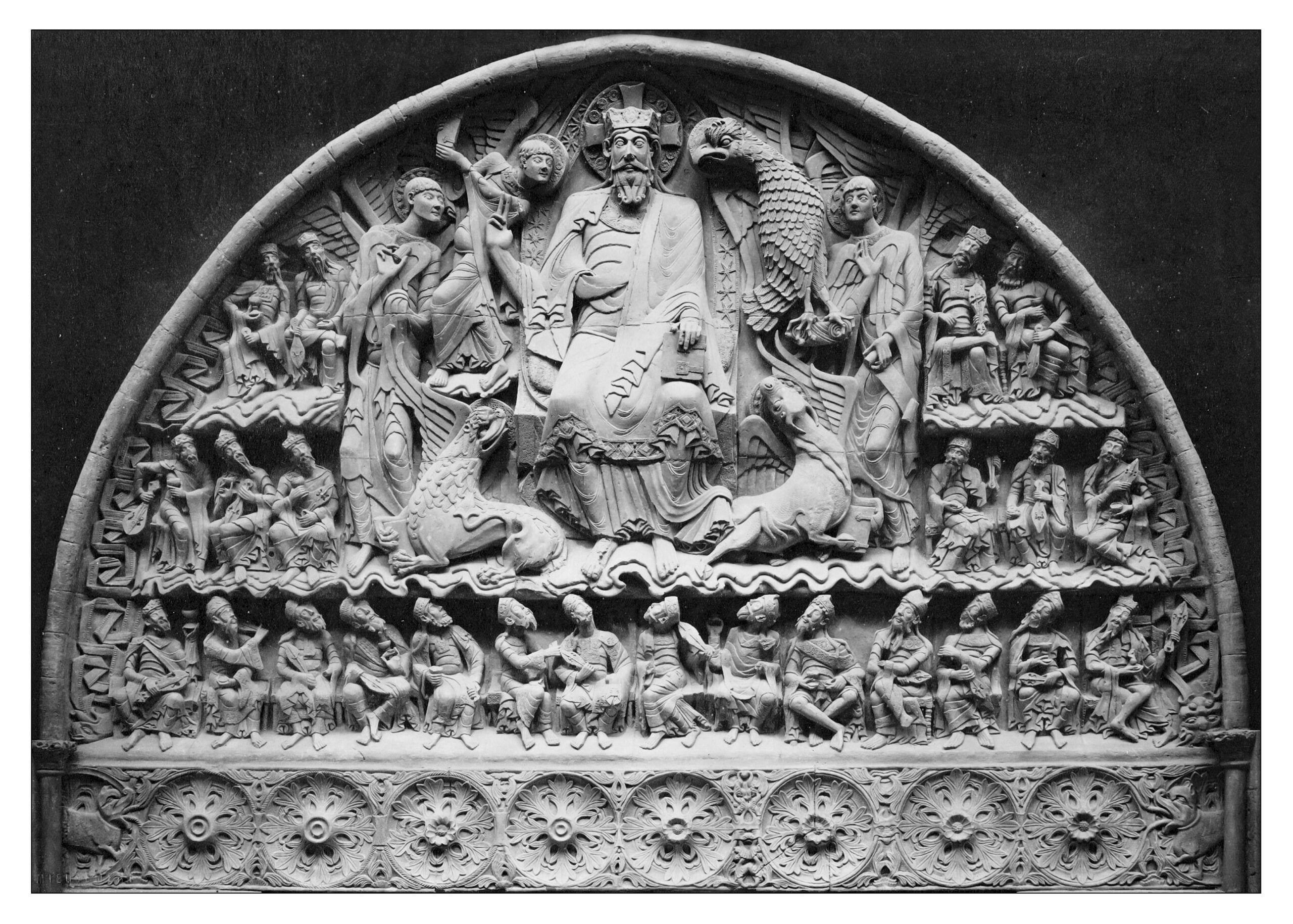
The Moissac tympanum represents in monumental stone the words of the prophet John.
In the center, Christ in Majesty is surrounded by four creatures and two angels (Schapiro & Finn, 1985, pp 77-104; Vidal et al., 1979, pp 95-99). The feet of Christ rest upon a crystalline sea, as described in the passage from Revelation, but not in the illuminations illustrated above. Bede’s interpretation (early 8th Century) of this is that it represents the baptism that is necessary for Christian salvation (Wallis, 2013, p 134).
The setting for Umberto Eco’s 1980 novel The Name of the Rose is a monastery loosely based on the Sacra di San Michele, an abbey on Mount Pirichiano in Piedmont, Italy. However, the portal of the fictional abbey church is clearly based on that in Moissac (Geese, 2004, p 259). The young monk Adso describes his impression of the Christ in Majesty:
I saw a throne set in the sky and a figure seated on the throne. The face of the Seated One was stern and impassive, the eyes wide and glaring over a terrestrial humankind that had reached the end of its story; majestic hair and beard flowed around the face and over the chest like the waters of a river, in streams all equal, symmetrically divided in two. The crown on his head was rich in enamels and jewels, the purple imperial tunic was arranged in broad folds over the knees, woven with embroideries and laces of gold and silver thread. The left hand, resting on one knee, held a sealed book, the right was uplifted in an attitude of blessing or—I could not tell—of admonition. The face was illuminated by the tremendous beauty of a halo, containing a cross and bedecked with flowers, while around the throne and above the face of the Seated One I saw an emerald rainbow glittering. Before the throne, beneath the feet of the Seated One, a sea of crystal flowed, and around the Seated One, beside and above the throne, I saw four awful creatures—awful for me, as I looked at them, transported, but docile and dear for the Seated One, whose praises they sang without cease.
Surrounding the central figure of Christ are four creatures. Although there are other interpretations, most scholars suggest that these creatures represent the writers of the four gospels since each is holding a book:
Matthew has the human face because he begins his gospel with Jesus’ human genealogy; Mark is the lion because he begins with a voice roaring in the desert; Luke is the ox because he begins with offering in the temple; and John is the eagle because of the book’s soaring opening lines. (Koester, 2014, p 353).
Each of the creatures has six wings. Bede considered the number six auspicious because it is both the sum and product of the first three numbers (Wallis, 2013, p 135). The sculptural representations of the four creatures, with their wings and books, are marvelously dynamic – they twist themselves toward the focus of their praise. There is a striking contrast between the immobility of the central Christ and the movement of the surrounding creatures: one exists in eternity whereas the others try to portray this in human time. Beside the creatures are two angels, each holding a scroll, unopened on the left and open on the right.
Surrounding the central group are 24 “elders” arrayed in white gowns and wearing golden crowns. No one knows who they represent. They may be: the elders of the Christian Church in Jerusalem; the Christian Apostles and the leaders of the tribes of Israel; the whole church composed of both priests and people; or those who have already died and been resurrected (Quispel, 1979, p 49; Koester, 2024, pp 360-363; Wallis, 2013, p 136). Twenty-four is another auspicious number: the product of the first four integers.
Hearn (1981, pp 170-172) stresses the remarkable variability of the elders, who differ in the posture of their legs or arms, in the way they hold their instruments, in the shape and ornamentation of their crowns, and in the decorations of their robes. Yet all the elders are the same in that they are looking at Christ.
Each of the elders holds a stringed instrument (probably a version of the vielle or medieval fiddle) but the number of strings and the shape of the sounding body vary from elder to elder. Only one appears to be actually playing his instrument with a bow (see right). Most of the elders also hold a goblet in their hand.
In The Name of the Rose, Adso is completely entranced by the elders:
Around the throne, beside the four creatures and under the feet of the Seated One, as if seen through the transparent waters of the crystal sea, as if to fill the whole space of the vision, arranged according to the triangular frame of the tympanum, rising from a base of seven plus seven, then to three plus three and then to two plus two, at either side of the great throne, on twenty-four little thrones, there were twenty-four ancients, wearing white garments and crowned in gold. Some held lutes in their hands, one a vase of perfumes, and only one was playing an instrument, all the others were in ecstasy, faces turned to the Seated One, whose praises they were singing, their limbs also twisted like the creatures’, so that all could see the Seated One, not in wild fashion, however, but with movements of ecstatic dance—as David must have danced before the Ark—so that wherever their pupils were, against the law governing the stature of bodies, they converged on the same radiant spot. Oh, what a harmony of abandonment and impulse, of unnatural and yet graceful postures, in that mystical language of limbs miraculously freed from the weight of corporeal matter, marked quantity infused with new substantial form, as if the holy band were struck by an impetuous wind, breath of life, frenzy of delight, rejoicing song of praise miraculously transformed, from the sound that it was, into image. Bodies inhabited in every part by the Spirit, illuminated by revelation, faces overcome with amazement, eyes shining with enthusiasm, cheeks flushed with love, pupils dilated with joy: this one thunder-struck by a pleasurable consternation, that one pierced by a consternated pleasure, some transfigured by wonder, some rejuvenated by bliss, there they all were, singing with the expression of their faces, the drapery of their tunics, the position and tension of their limbs, singing a new song, lips parted in a smile of perennial praise. (p 42)
The following photographs of some of the elders and their ecstasy:
The Trumeau
Carved from one piece of stone, the trumeau (deriving from the Germanic root thruma, trunk, stump) of the Moissac portal is one of the most striking pieces of Romanesque sculpture (Vidal et al, 1979, pp 99-100; Schapiro, 1931, pp 525-529; Schapiro & Finn, 1985, pp 128-132). On the front of the pillar are arrayed three pairs of lions. The lions are similar in style to the lion of Mark in the tympanum. Each lion is definitely sexed with either female breasts or male genitalia. The iconography of lions harkens back to the Ishtar gate of Babylon, and to Coptic sculptures. Their intertwining owes much to the complex patterns of Islamic imagery. Behind the lions is a pattern of vines and rosettes.
On the sides of the trumeau are carved sinuous and elongated representations of the prophet Jeremiah with an open scroll and the apostle Paul with a book of his letters. Jeremiah looks downward in melancholy as he laments the state of Jerusalem and foresees the Babylonian captivity. Paul looks upward with hope for the redemption offered to those who elect Christ as their savior. My intuition is that the sculpture of Paul may be a portrait of the abbot Ansquitil, who devised the iconography of the portal and supervised its construction.
The Birth and Childhood of Jesus
The walls of the porch portray two narratives related to salvation and damnation (Schapiro & Finn, 1985, pp 107-126; Forsyth, 2002). On the east wall are represented episodes from the birth and childhood of Jesus. In the lower section of the wall are the Annunciation, the Visitation, and the Adoration of the Magi. Though these were damaged during the French Revolution, the upper panel of the wall is well preserved.
It represents from right to left: the presentation in the temple (Luke 2; 23-32), the angel warning Joseph that Herod is planning to massacre the infants of Bethlehem and the flight to Egypt (Matthew 2: 13-23), and the fall of the idols of Heliopolis.
The last episode may derive from a prophecy of the Messiah in Jeremiah 43: 11-13:
And when he cometh, he shall smite the land of Egypt, and deliver such as are for death to death; and such as are for captivity to captivity; and such as are for the sword to the sword.
And I will kindle a fire in the houses of the gods of Egypt; and he shall burn them, and carry them away captives: and he shall array himself with the land of Egypt, as a shepherd putteth on his garment; and he shall go forth from thence in peace.
He shall break also the images of Bethshemesh, that is in the land of Egypt; and the houses of the gods of the Egyptians shall he burn with fire.
Heliopolis (Greek) and Bethshemesh (Hebrew) both mean “city of the sun.” A passage in one of the apocrypha describes the destruction of the idols and temples of Egypt when the Holy Family arrived for their sojourn there (Forsyth (2002; Franzé, 2015). The fall of the idols may also relate to the success of the First Crusade which had recently liberated Jerusalem in 1098 (Franzé, 2015).
Dives and Lazarus
The upper sculptures of the west wall of the porch recount the parable of Dives and Lazarus (Luke 16: 19-26).
There was a certain rich man, which was clothed in purple and fine linen, and fared sumptuously every day:
And there was a certain beggar named Lazarus, which was laid at his gate, full of sores,
And desiring to be fed with the crumbs which fell from the rich man’s table: moreover the dogs came and licked his sores.
And it came to pass, that the beggar died, and was carried by the angels into Abraham’s bosom: the rich man also died, and was buried;
And in hell he lift up his eyes, being in torments, and seeth Abraham afar off, and Lazarus in his bosom.
And he cried and said, Father Abraham, have mercy on me, and send Lazarus, that he may dip the tip of his finger in water, and cool my tongue; for I am tormented in this flame.
But Abraham said, Son, remember that thou in thy lifetime receivedst thy good things, and likewise Lazarus evil things: but now he is comforted, and thou art tormented.
And beside all this, between us and you there is a great gulf fixed: so that they which would pass from hence to you cannot; neither can they pass to us, that would come from thence.
Dives is the Latin word for a rich man, and Lazarus is the name of a beggar, derived from the Hebrew Eleazar or “God is my help” (Lazarus in this parable is not the Lazarus that Jesus later raised from the dead. Their common name is just coincidence).
During his life, Dives enjoyed his luxury and took no notice of Lazarus. After they died, Lazarus was taken to Abraham’s bosom whereas Dives went to hell. Justice was served. The parable has always been popular. The poor are more numerous than the rich.
The right side of the Moissac tableau shows Dives eating a sumptuous meal. He pays no heed to Lazarus, who lies on the ground in the lower center part of the panel, beset by dogs. At his death Lazarus is taken by the angel to the bosom of Abraham. This is in accord with the law as personified on the far left of the sculpture. The fate of Dives is played out in a separate representation lower down on the wall (not illustrated). Devils take both his soul and his accumulated riches. Like Dives, this sculpture has not survived well.
An old English ballad, dating from medieval times, retells the story with the refrain
Then Lazarus laid him down and down And down at Dives’ door “Some meat, some drink, brother Dives, Bestow upon the poor”
Ralph Vaughan-Williams composed Five Variants of Dives and Lazarus for Harp and String Orchestra (1940), based on various versions of the ballad.
Henderson (1972, p 90) points out that the parable of Dives and Lazarus follows appropriately from the warnings of the prophet John that come immediately before his vision of Christ in Majesty:
Because thou sayest, I am rich, and increased with goods, and have need of nothing; and knowest not that thou art wretched, and miserable, and poor, and blind, and naked:
I counsel thee to buy of me gold tried in the fire, that thou mayest be rich; and white raiment, that thou mayest be clothed, and that the shame of thy nakedness do not appear; and anoint thine eyes with eyesalve, that thou mayest see.
As many as I love, I rebuke and chasten: be zealous therefore, and repent. (Revelation 3:17-19)
The Artists
The overall conception of the portal and the cloister of the Abbaye de Saint Pierre has long been attributed to the Abbot Ansquitil. The chronicle of Aymeric de Peyrac, an abbot of Moissac in the 14th Century wrote:
Dictus Ansquitilus fecit fieri portale pulcherrimum [The said Ansquitil arranged for the most beautiful portal to be made] (quoted by Vidal et al 1979, p 96)
The central pillar of the west gallery of cloister (illustrated on the right) has an intricately carved epigraph that reads
ANNO AB INCARNATIONE ÆTERNI PRINCIPIS MILLESIMO CENTESIMO FACTVM EST CLAUSTRVM ISTVD TEMPORE DOMNI ANSQUITILII ABBATIS AMEN VVV MDM RRR FFF
De la Haye (2023, p 133-135) suggests that the final abbreviations might have represented
VIR VITÆ VENERABILIS / MOYSSIACENSEM DOMUM MELIORAVIT / RESTITUIT RESTAURAVIT REXIT / FAUSTE FORTUNATE FELICITER,
Thus, a full translation would read
In the year 1100 following the incarnation of the Eternal Lord, this cloister was erected, in the time of the Abbot Ansquitil: a man of venerable life who improved, rebuilt, restored and governed the house of Moissac, favored, fortunate and felicitous
He also suggests that the fish scale (écaille in French, escata in the old Occitan language) ornamentation at the top of the pillar is a punning reference to the name Ansquitil.
The names of the sculptors who worked under the direction of the learned abbot remain unknown. Vidal et al (1979, p 96, my translation), however, notes
By a detail, usually unnoticed or forgotten, we know their person, if we do not know their name; because we can see them represented to the left and right of the tympanum, under the second arch: one in a working position, tools in hands, a bearded man in the prime of life; the other, young and beardless with a broad and blissful face, identifiable by the secret sign of initiation of the bare foot. They contemplate their work.
Doorway to Eternity
The doorway to a church marks the boundary between the problems of the world and the peace that comes with salvation. Just before he describes his vision of Christ in Majesty, John of Patmos conveys Christ’s message:
Behold, I stand at the door, and knock: if any man hear my voice, and open the door, I will come in to him, and will sup with him, and he with me. (Revelation 3: 20)
Vernery (2019) comments on how the doorway is the threshold between a world wherein time and mortality hold sway and a life attuned to the mysteries of eternity. The sculptural representations provide material images of a spiritual idea:
La perception sensible des sculptures donne lieu à la construction d’une image mentale rendue une par la contemplation. Une fois cette forme conceptuelle mise en place en l’esprit, l’homme est amené à se détacher de la sensation corporelle. Laissant les images matérielles sur le parvis de l’abbatiale en en franchissant physiquement l’espace, il conserve mentalement ce qu’elles ont éveillé en lui.
[The perception of the sculptures creates a mental image that becomes unified by contemplation. Once this conceptual form becomes established in the mind, one becomes detached from bodily sensation. Leaving the material images on the square in front of the abbey church while physically crossing the space, one mentally preserves what they awakened]
The spiritual idea is the concept of Christ in Majesty. This is what separates the temporal from the eternal
Vernerey (2020) also remarks about how the very process of sculpting, wherein matter is removed to reveal the hidden form, is analogous to the crossing from the outer world into the inner mysteries. Just as the process of sculpture extracts images from raw material, so the entry into the church extracts the soul from the temporal world.
The present is much different from the days when a hundred monks led lives of prayer and ritual in Moissac. In 1793 the mobs of the French Revolution drove the monks from the abbey and damaged many of the statues that were easily accessible. Years later, the abbey church became a simple parish church. The cloister and other remaining monastery buildings became a museum.
In our secular age we no longer believe in the specifics of salvation that Ansquitil arranged to be displayed in stone. Yet the portal still makes us think of processes beyond the flow of time, that we can write about and wonder at.
References
Busch, H., & Lohse, B. (1966). Pre-Romanesque art. Macmillan.
Charles, V., & Carl, K. (2012). Romanesque Art. Parkstone-International
Eco, U. (1980, translated W. Weaver, 1983). The name of the rose. Harcourt Brace Jovanovich.
Eco, U. (translated W. Weaver, 1984). Postscript to The Name of the Rose. Harcourt Brace Jovanovich.
Fleischer, J. (2004). Pre-Romanesque church walls and their “language.” In Petersen, N. H., Clüver, C., & Bell, N. (Eds.). Signs of change: transformations of Christian traditions and their representation in the arts, 1000-2000. (pp 247-264) Rodopi.
Forsyth, I. H. (2002). Narrative at Moissac: Schapiro’s Legacy. Gesta, 41(2), 71–93.
Forsyth, I. H. (2010). The date of the Moissac Portal. In Maxwell, R. A. & Ambrose, K. Current directions in eleventh- and twelfth-century sculpture studies. (pp 77-99). Brepols.
Franzé, B. (2015). Moissac et l’oeuvre de l’abbé Ansquitil (1085-1115): un discours de penitence. Hortus Artium Medievalium, 21, 385-405
Geese, U. (2004). Romanesque sculpture. In R. Toman (Ed.). Romanesque: architecture, sculpture, painting. (pp 256-380). H. F. Ullman (Tandem).
Hearn, M. F. (1981). Romanesque sculpture: the revival of monumental stone sculpture in the eleventh and twelfth centuries. Cornell University Press, 1981.
Henderson, G. (1972). Early Medieval. Penguin Books.
Koester, C. R. (2014). Revelation: a new translation with introduction and commentary. (Anchor Bible). Yale University Press.
Oursel, R (Ed.) (1970). Les Chemins de Saint-Jacques: textes de saint Augustin et des Miracles de saint Jacques. Zodiaque.
Oursel, R. (1973, 1976). Floraison de la sculpture romane. 1. Les grands découvertes. 2. Le coeur et la main. Zodiaque.
Pagels, E. H. (2012). Revelations: visions, prophecy, and politics in the book of Revelation. Viking.
Quispel, G. (1979). The secret Book of Revelation: the last book of the Bible. McGraw-Hill.
Schapiro, M. (1931). The Romanesque sculpture of Moissac. The Art Bulletin, 13(3), 249–351; 13(4), 464-531
Schapiro, M., & Finn, D. (1985). The Romanesque sculpture of Moissac. Georges Braziller.
Toman, R. (Ed.). (2004). Romanesque: architecture, sculpture, painting. H. F. Ullman (Tandem).
Vernerey, É. (2020). En deux temps, un mouvement. Définir la temporalité du sacré par la sculpture sur le porche de Moissac. Temporalités
Vidal, M., Maury, J., & Porcher, J. (1979). Quercy roman. (3rd Ed.). Zodiaque.
Wallis, F. (2013). Bede: Commentary on Revelation. Liverpool University Press.
Some of the Evil of my Tale: Lawrence of Arabia
In late 1916, Thomas Edward Lawrence (1888-1935), a British intelligence officer stationed in Cairo, was assigned as a military liaison officer to the forces of Hussein bin Ali al-Hashimi, the Sharif of Mecca, who, with his sons Ali, Abdullah and Faisal had initiated the Arab Revolt against the Ottoman Turks in June 1916. Lawrence quickly adapted to the ways of his hosts and gained their trust. Under his leadership, the Arabs took the city of Aqaba in July 1917. This allowed the British to supply both their own army and the Arab rebels as they advanced on Jerusalem and Damascus. Lawrence led the Arabs as they disrupted the Hejaz Railway, and harried the Turkish army. His exploits were recorded on film and widely publicized by the American journalist Lowell Thomas, from whom came the epithet “Lawrence of Arabia.” Lawrence published a memoir of his experiences in 1927, Revolt in the Desert. A much more complete and introspective book on the Arab Revolt, Seven Pillars of Wisdom, was not formally published until after his death in 1935.
Early Life
Lawrence’s father Sir Thomas Chapman (1846-1919) was a gentleman landowner in Ireland, who had married a vindictively religious wife and fathered four daughters. In the late 1870s he hired a young Scotswoman, Sarah Lawrence, as a governess for his daughters. He soon fell in love with Sarah, who became pregnant and gave birth to a son in 1885. After his wife finally found out, Chapman decided to leave his family and moved with Sarah to Wales, where he assumed her surname for the sake of respectability. In 1888, Thomas Edward, was born. Three more sons were born and in 1896 the “family” settled in Oxford, where Lawrence and his brothers attended the City of Oxford High School for Boys.
Lawrence read history at Jesus College in Oxford. His honors thesis on the architecture of the Crusader castles (Lawrence, 1910) was based on a 3-month walking tour of Ottoman Syria in the summer of 1909. The main conclusion of the thesis was that Crusader castles followed the principles of European fortifications and did not absorb any influences from local architecture. The illustration below shows Lawrence’s pen-and-ink sketch of the south-east corner of Sahyun castle.
Selim Ahmed
After graduating in 1910, Lawrence joined an archeological expedition to Carchemish to investigate the remains of the Hittite civilization (2nd millennium BCE), staying there until the outbreak of the war in 1914. While in Carchemish he took an intelligent young Arab boy, Selim Ahmed (1896-1918), nicknamed “Dahoum” (dark one), as his apprentice (Sattin, 2014, pp 200-202; Wilson 1989, pp 543-545). Selim nursed him during a severe attack of dysentery in 1911. For the last three years of Lawrence’s time in Syria, the two of them lived together, Lawrence teaching Selim mathematics, English and photography, and Selim helping Lawrence with his Arabic. Their relationship was intense; no one knows whether it remained platonic or became physical. The following paired photographs show Lawrence (left) trying on Selim’s clothes.
In the introductory chapters of Seven Pillars of Wisdom (1935, pp 39-40) Lawrence recalled a visit in 1912 with Dahoum to the Qasr of Ibn Wardan, a 6th Century Byzantine castle built by Justinian I near Hama in northern Syria (Sattin, 2024, pp 164-165 provides an earlier version of the story).
The common base of the Semitic creeds, winners or losers, was the ever present idea of world-worthlessness. Their profound reaction from matter led them to preach bareness, renunciation, poverty; and the atmosphere of this invention stifled the minds of the desert pitilessly. A first knowledge of their sense of the purity of rarefaction was given me in early years, when we had ridden far out over the rolling plains of North Syria to a ruin of the Roman period which the Arabs believed was made by a prince of the border as a desert-palace for his queen. The clay of its building was said to have been kneaded for greater richness, not with water, but with the precious essential oils of flowers. My guides, sniffing the air like dogs, led me from crumbling room to room, saying, ‘This is jessamine, this violet, this rose’.
But at last Dahoum drew me: ‘Come and smell the very sweetest scent of all’, and we went into the main lodging, to the gaping window sockets of its eastern face, and there drank with open mouths of the effortless, empty, eddyless wind of the desert, throbbing past. That slow breath had been born somewhere beyond the distant Euphrates and had dragged its way across many days and nights of dead grass, to its first obstacle, the man-made walls of our broken palace. About them it seemed to fret and linger, murmuring in baby-speech. ‘This,’ they told me, ‘is the best: it has no taste.’ My Arabs were turning their backs on perfumes and luxuries to choose the things in which mankind had had no share or part.
The Canadian poet, Gwendolyn MacEwen, wrote a set of poems about T. E. Lawrence. In one she recounts the visit to the Qasr of Ibn Wardani. The poem ends
We call this room the sweetest of them all,
You said.
And I thought: Because there is nothing here.
I knew then that you possessed nothing of me, and I possessed nothing of you, Dahoum. You were wealthy and stuffed with a wondrous nothing that filled the room and everything around.
You looked into my eyes, the windows to my soul, and said that because they were blue You could see right through them, holes in my skull, to the quiet powerful sky beyond.
While he was in Carchemish, Lawrence began writing a book entitled Seven Pillars of Wisdom about the major cities of the Middle East (Aleppo, Beirut, Cairo, Constantinople, Damascus, Smyrna, and Medina). The title comes from Proverbs 9:1:
Wisdom hath builded her house, she hath hewn out her seven pillars
“Seven” had no specific meaning: it was just considered an auspicious number. Lawrence never completed the book and destroyed the drafts that he had written. He was later to use the title for his memoir of the Arab Revolt.
Soon after the war began, Lawrence enlisted and served in Cairo as an intelligence officer. Dahoum was given a stipend to stay at Carchemish to watch over the archeological site. Their halcyon days in northern Syria came to an end.
Lawrence dedicated Seven Pillars of Wisdom to S. A. He never explained who this was but almost everyone now agrees that it was Selim Ahmed (see Knightley & Simpson, 1969, pp 184-188, for reasoning). The book is prefaced with a poem to S. A. that begins
I loved you, so I drew these tides of men into my hands and wrote my will across the sky in stars To earn you Freedom, the seven-pillared worthy house that your eyes might be shining for me When we came.
Dahoum died of typhus in 1918 before the Arab and British forces reached Damascus. Lawrence appears to have found this out in one of his trips behind the enemy lines. The epilogue to Seven Pillars of Wisdom begins
Damascus had not seemed a sheath for my sword, when I landed in Arabia: but its capture disclosed the exhaustion of my main springs of action. The strongest motive throughout had been a personal one, not mentioned here but present to me, I think, every hour of these two years. Active pains and joys might fling up, like towers, among my days: but refluent as air, this hidden urge re-formed, to be the persisting element of life, till near the end. It was dead, before we reached Damascus.
Selim Ahmad was the private passion driving Lawrence as he led the Arab forces in their search for freedom.
The Beginnings of the Arab Revolt
In June, 2016, Hussein bin Ali al-Hashimi, the Sharif of Mecca, rebelled against Ottoman rule in the Hejaz (the western region of the Arabian Peninsula). By July his forces had captured the holy city of Mecca and the port of Jeddah. However, the Turks repulsed the Arabs when they tried to take Medina. The British hoped that the Arab Revolt would pin down Ottoman troops, and thereby assist the British in their advance into Palestine. In correspondence with Hussein, the British High Commissioner in Cairo, Sir Henry McMahon, made vague assurances of support for a self-governing Arabia from Palestine to the Indian Ocean and from Aleppo to Aden. The British likely thought that Husein’s revolt would not succeed, and that they would therefore not be required to fulfil their promises. Nevertheless, they sent Captain T. E. Lawrence to be a liaison officer with Hussein in October 1917. He identified Hussein’s son, Faisal bin al-Hussein bin Ali al-Hashemi, as the best leader of the Arab forces. Together they gathered together warriors from other tribes, and received supplies from the British in the Red-Sea ports of Yanbu and Weijh.
Faisal suggested that it would be much more comfortable for Lawrence to wear Arab clothes (see photograph on right):
Suddenly Feisal asked me if I would wear Arab clothes like his own while in the camp. I should find it better for my own part, since it was a comfortable dress in which to live Arab-fashion as we must do. Besides, the tribesmen would then understand how to take me. The only wearers of khaki in their experience had been Turkish officers, before whom they took up an instinctive defence. If I wore Meccan clothes, they would behave to me as though I were really one of the leaders; and I might slip in and out of Feisal’s tent without making a sensation which he had to explain away each time to strangers. I agreed at once, very gladly; for army uniform was abominable when camel-riding or when sitting about on the ground; and the Arab things, which I had learned to manage before the war, were cleaner and more decent in the desert. Hejris [Faisal’s slave] was pleased, too, and exercised his fancy in fitting me out in splendid white silk and gold-embroidered wedding garments which had been sent to Feisal lately (was it a hint?) by his great-aunt in Mecca (Lawrence, 1935, p 126).
The following photograph shows the Arab forces at Yanbu with Faisal at the head and Lawrence (in his new white robes) on a camel behind him.
Aqaba
In early 1917, Lawrence convinced Auda Abu Tayeh, known as the “Desert Falcon”, to join the Arab Revolt. Auda was the leader of the Howeitat, a Bedouin tribe in the western part of the Arabian desert. Auda, Sharif Nasr of Syria, Lawrence, and a group of about 50 fighters undertook an arduous journey from Wejh north into the desert. This journey was a clandestine route toward the port of Aqaba. If the Turks noted the Arabian forces, they would likely believe that they were headed further north toward Amman or Damascus. As thy came out of the desert, they attracted many local Arabs to their cause so that their numbers swelled to several hundred. They then turned toward the southwest, crossed the railway and attacked Aqaba. The map below shows the Arab route in purple. The port was impregnable from the sea – the British Royal Navy had unsuccessfully tried to take the city earlier in the war. However, it was not well defended from a land attack. Led by Auda and Lawrence, the Arab forces captured Aqaba in July 2017. The attack on Aqaba was one of the great scenes in David Lean’s 1962 film Lawrence of Arabia. For the film, the town was recreated on a beach in Spain:
After the capture of Aqaba, Lawrence and a few Arab companions rode by camel across the Sinai desert to Suez (dotted purple line on the map). He arranged for the British Navy to send money and supplies to Aqaba and to take the prisoners of war back to Egypt.
The British had not suggested that Lawrence urge the Arabs to capture Aqaba. Lawrence was acting on his own recognizance. The British likely wanted the Arab Revolt to stay confined to the southern regions of the Hejaz. The victory at Aqaba was crucial to the success of the Arab Revolt. Thenceforth, British could supply the Arabs as they moved northward toward Damascus.
The illustrations below show photographs of a flag bearer at the actual battle of Aqaba, and of Lawrence on his camel after the victory.
After returning to Aqaba from Egypt, Lawrence spent time in Wadi Rum with Faisal, who had come to join the forces of Auda in Aqaba. Wadi Rum was soon to serve as the base for the armored cars that the British supplied to aid the Arabs. The following photographs show the striking granite and sandstone cliffs around the Wadi and a spring that Lawrence found.
Lawrence (1935, p 355) described the spring:
From this rock a silver runlet issued into the sunlight. I looked in to the spout, a little thinner than my wrist, jetting out firmly from a fissure in the roof, and falling with that clean sound into a shallow, frothing pool, behind the step which served as entrance. The walls and roof of the crevice dripped with moisture. Thick ferns and grasses of the finest green made it a paradise just five feet square. Upon the water-cleansed and fragrant ledge I undressed my soiled body, and stepped into the little basin, to taste at last a freshness of moving air and water against my tired skin. It was deliciously cool. I lay there quietly, letting the clear, dark red water run over me in a ribbly stream, and rub the travel-dirt away.
In Aqaba the Arab factions consolidated into a formidable fighting force. The main leaders of the Arab Revolt are illustrated below (photos from Arab Revolt website):
Asraq
After Aqaba was taken, Lawrence and the Arab forces moved to the north. Beginning in late 1917 Lawrence used the ruins of Qasr al Asraq about 100 km east of Amman as a desert base for attacking the Hejaz Railway and the Turkish troops that tried to keep it open.
The oasis of Asraq had been used since Roman times, though the present ruins date from 1237 CE when ‘Izz ad-Din Aybak built a fortress there using basalt stone. Lawrence was particularly impressed by the huge stone doors in the gatehouse. Though each door weighed more than a ton they still swung shut:
The door was a poised slab of thick basalt, a foot thick, turning on pivots of itself, socketed into threshold and lintel. It took a great effort to start swinging and at the end went shut with a clang and crash which made tremble the west wall of the old castle (Lawrence, 1935, p 436)
Asraq was an oasis that the northern end of the Wadi Sirhan, the ancient trading route between Syria and Dumat-al Jandal in Arabia. Lawrence was fascinated by the site and its relation to the ancient (5th– and 6th Century CE) Syrian kingdoms of Ghassan and Hira:
Then the blue fort on its rock above the rustling palms, with the fresh meadows and shining springs of water, broke on our sight. Of Azrak, as of Rumm, one said ‘Numen inest’. Both were magically haunted: but whereas Rumm was vast and echoing and God-like, Azrak’s unfathomable silence was steeped in knowledge of wandering poets, champions, lost kingdoms, all the crime and chivalry and dead magnificence of Hira and Ghassan. Each stone or blade of it was radiant with half-memory of the luminous, silky Eden, which had passed so long ago. (Lawrence, 1935, p 414).
The following illustration shows some recent photographs from the site:
The following are two of Lawrence’s own photographs from his time in Asraq: one showing the explosion of a mine on the Hejaz Railway near Deraa and one showing the fort at Asraq:
The Incident in Deraa
The crucial episode in Lawrence’s account of the Arab Revolt in Seven Pillars of Wisdom happened in Deraa in late November, 1917. According to Lawrence (1935, Chapter 80), he went there dressed in Arab clothes together with Faris, an elderly Arab, to reconnoiter the approaches to the railway station. He was arrested by a Turkish soldier (who ignored his companion), and taken to the barracks. There he was cleaned up and, in the evening, presented to the Turkish governor (or ‘Bey’), who called him beautiful and fondled him. Lawrence vehemently rejected these advances, and was sent out for a beating to teach him “everything.” After a horrific whipping and a beating that apparently progressed to rape, Lawrence was taken back to the governor, who waved him off as “too torn and bloody for his bed.” After his wounds were treated, Lawrence was left alone. He escaped and made his painful way back to Asraq. The following passages describing his experience in Deraa are from Chapter 80 of Seven Pillars of Wisdom (1935):
To keep my mind in control I numbered the blows, but after twenty lost count, and could feel only the shapeless weight of pain, not tearing claws, for which I had prepared, but a gradual cracking apart of my whole being by some too-great force whose waves rolled up my spine till they were pent within my brain, to clash terribly together. Somewhere in the place a cheap clock ticked loudly, and it distressed me that their beating was not in its time. I writhed and twisted, but was held so tightly that my struggles were useless. After the corporal ceased, the men took up, very deliberately, giving me so many, and then an interval, during which they would squabble for the next turn, ease themselves, and play unspeakably with me. This was repeated often, for what may have been no more than ten minutes. Always for the first of every new series, my head would be pulled round, to see how a hard white ridge, like a railway, darkening slowly into crimson, leaped over my skin at the instant of each stroke, with a bead of blood where two ridges crossed. As the punishment proceeded the whip fell more and more upon existing weals, biting blacker or more wet, till my flesh quivered with accumulated pain, and with terror of the next blow coming. They soon conquered my determination not to cry, but while my will ruled my lips I used only Arabic, and before the end a merciful sickness choked my utterance. …
I remembered the corporal kicking with his nailed boot to get me up; and this was true, for next day my right side was dark and lacerated, and a damaged rib made each breath stab me sharply. I remembered smiling idly at him, for a delicious warmth, probably sexual, was swelling through me: and then that he flung up his arm and hacked with the full length of his whip into my groin. This doubled me half-over, screaming, or, rather, trying impotently to scream, only shuddering through my open mouth. One giggled with amusement. A voice cried, ‘Shame, you’ve killed him’. Another slash followed. A roaring, and my eyes went black: while within me the core of life seemed to heave slowly up through the rending nerves, expelled from its body by this last indescribable pang. By the bruises perhaps they beat me further: but I next knew that I was being dragged about by two men, each disputing over a leg as though to split me apart: while a third man rode me astride. It was momently better than more flogging.
Lawrence concluded the account by stating that
the citadel of my integrity had been irrevocably lost.
The incident was not mentioned in the early biographies (Thomas, 1924, Graves, 1927) and was omitted from Revolt in the Desert (Lawrence, 1927). Lidell Hart (1934) describes the beating but makes no mention of rape.
Richard Meinertzhagen (1959, pp 31-33) reported a conversation with Lawrence in 1922:
He went on to describe the indecency and degradation he suffered at the hands of the homosexual Turks. He did not intend to publish the true account of this incident as it was too degrading, ‘had penetrated his innermost nature’ and he lived in constant fear that the true facts would be known. He had been seized, stripped and bound; then sodomized by the governor of Deraa, followed by similar treatment by the Governor’s servants. After this revolting behaviour he had been flogged.
Meinertzhagen reported seeing scars on Lawence’s back: Lawrence attributed these wounds to being dragged across barbed wire in a camel accident. Unfortunately, the veracity of Meinertzhagen’s report of his encounter with Lawrence has been questioned (Lockman, 1995).
When putting together the first version of Seven Pillars of Wisdom in 1922, Lawrence wrote to his publisher Edward Garnett
If that Deraa incident whose treatment you call severe and serene (the second sounds like a quaint failure to get my impressions across, but I know what you feel) had happened to yourself you would not have recorded it. I have a face of brass perhaps, but I put it into print very reluctantly, last of all the pages I sent to the press. For weeks I wanted to burn it in the manuscript: because I could not tell the story face to face with anyone, and I think I’ll feel sorry, when I next meet you, that you know it. The sort of man I have always mixed with doesn’t so give himself away. (Lawrence, 1938, p 358)
In a later letter to Charlotte Shaw in March 1924, Lawrence wrote
About that night. I shouldn’t tell you. because decent men don’t talk about such things. I wanted to put it plain in the book, and wrestled for days with my self-respect … which wouldn’t. hasn’t, let me. For fear of being hurt, or rather to earn five minutes respite from a pain which drove me mad, I gave away the only possession we are born into the world with — our bodily integrity. Its an unforgivable matter, an irrecoverable position: and it’s that which has made me forswear decent living, and the exercise of my not-contemptible wits and talents. (Lawrence, 2000, p 70).
What actually happened in Deraa is not known. In the play Ross by Terence Rattigan (1960), the Turkish governor recognizes Lawrence. He instigates the beating in order to break the spirit of the man, something he considers preferable to making him a martyr. Though this is an intriguing speculation, it remains just that.
David Lean’s 1962 movie followed Lawrence’s account but showed only the beating. Jeremy Wilson’s careful and exhaustive biography (1989) accepts that what Lawrence reported actually happened. Other episodes in Seven Pillars of Wisdom accord reasonably well with the historical record despite occasional exaggerations. For example, the camel ride from Aqaba to Suez was an impressive feat but it actually took longer than Lawrence described.
Lawrence’s recounting of the event in Deraa is overwrought. Some things could not have happened the way they were described. Lawrence could not have seen the effects of the whip on his back. The Bey in Deraa at that time was not known to be a homosexual: according to Lawrence James (1990. p 213), he appears to have been more of a womanizer. Some biographers (Barr, 2008) have therefore speculated that the episode was imagined. Desmond Stewart (1977, p 244) suggested that Lawrence’s report was a “transubstantiation” of a sadomasochistic relationship with Sharif Ali ibn al Hussein, but there is no evidence for this. Aldington (1955) accused Lawrence of exaggerating his military exploits, but still chose to accept that he was tortured and raped at Deraa (see Crawford, 1998, for how Aldington’s book was denigrated by supporters of Lawrence). Korda’s biography Hero (2010) quotes from Seven Pillars of Wisdom and comments on the beating and the rape (p 349):
There seems no good reason why Lawrence would have invented the incident – on the contrary, it seems like the kind of thing that he would have suppressed, had he not been determined to tell the whole truth even when it was distasteful and damaging to him. For he does not strain himself to come out of it with credit; it is not just his body but his spirit that was broken, and much of what happened in 1918 and what became of Lawrence later, after the war, would be incomprehensible except for Deraa.
Later in his life, Lawrence submitted himself to ritual beatings as a form of penance (Knightley & Simpson, 1969, pp 219-254; Simpson, 2008, p 286-299). However, we do not know if this type of activity predated Deraa, or occurred as a result of his experience there. My personal opinion is that Deraa was the beginning of Lawrence’s masochism.
The Deraa episode is so striking that it requires interpretation. That he was tortured and raped during his captivity there makes sense with the strange and broken life that Lawrence was to lead after the war. This was likely why he included it in his book – as explanation and exculpation.
The Road to Damascus
While the Arab forces were harrying the Turks in the inland desert, General Edmund Allenby led British and Commonwealth forces across Sinai and into Palestine. The campaign was a marvel of logistics since the forces had to be constantly supplied with water, food and ammunition through a desert region with no railways. After several major battles with Turkish and German troops, Allenby prevailed and Jerusalem surrendered on December 9, 2017. Two days later, Allenby entered the city through the Jaffa Gate. He came on foot to show appropriate reverence for the holy city. This was the first time that Jerusalem had not been under Muslim rule since 1247.
The following illustration shows a photograph of Allenby’s entry into Jerusalem and a 1918 portrait of the general by James McBey.
In February of 1918 Lowell Thomas, an American journalist met Lawrence in Jerusalem. The two men intrigued each other. On Lawrence’s invitation, Thomas came to Aqaba, bringing with him the camera man Henry Chase. Over the next several months Thomas and Chase reported Lawrence’s exploits in the desert. The film clips and slides later formed the basis for a multimedia show “With Allenby in Palestine and Lawrence in Arabia” that toured America and England in the years following the war. The name and the legend of “Lawrence of Arabia” derives mainly from Thomas. Lawrence was ambivalent about his relationship to Thomas (Crawford & Berton, 1996). On the one hand he was fascinated by fame; on the other he wanted anonymity. Lawrence did not mention Thomas in Seven Pillars of Wisdom. The illustration below (from Thomas, 1924) shows a photograph of the two of them in Aqaba in March 1918, and Lowell’s portrait of Lawrence in London in 1919.
As the Arab forces grew in strength and experience, they became able to face the Turks in fixed battles as well as guerilla attacks. Their first main encounter was at Tafileh just south of the Dead Sea in January 1918. After multiple attacks, retreats and counter-attacks, the Arabs prevailed. The surviving Turks were pursued toward the railway:
As we turned back it began to snow; and only very late, and by a last effort did we get our hurt men in. The Turkish wounded lay out, and were dead next day. It was indefensible, as was the whole theory of war: but no special reproach lay on us for it. We risked our lives in the blizzard (the chill of victory bowing us down) to save our own fellows; and if our rule was not to lose Arabs to kill even many Turks, still less might we lose them to save Turks. (Lawrence, 1935, p 482)
In September 1918, the Arabs and Turks met at Tafas just north of Deraa. The Turkish troops had just massacred all the inhabitants of the village – men, women and children – as they retreated from Deraa. Tallal, one of the Arabs fighting with Lawrence, was from the village.
Tallal had seen what we had seen. He gave one moan like a hurt animal; then rode to the upper ground and sat there a while on his mare, shivering and looking fixedly after the Turks. I moved near to speak to him, but Auda caught my rein and stayed me. Very slowly Tallal drew his head-cloth about his face; and then he seemed suddenly to take hold of himself, for he dashed his stirrups into the mare’s flanks and galloped headlong, bending low and swaying in the saddle, right at the main body of the enemy.
It was a long ride down a gentle slope and across a hollow. We sat there like stone while he rushed forward, the drumming of his hoofs unnaturally loud in our ears, for we had stopped shooting, and the Turks had stopped. Both armies waited for him; and he rocked on in the hushed evening till only a few lengths from the enemy. Then he sat up in the saddle and cried his war-cry, ‘Tallal, Tallal’, twice in a tremendous shout. Instantly their rifles and machine-guns crashed out, and he and his mare, riddled through and through with bullets, fell dead among the lance points.
Auda looked very cold and grim. ‘God give him mercy; we will take his price.’ He shook his rein and moved slowly after the enemy. We called up the peasants, now drunk with fear and blood, and sent them from this side and that against the retreating column. (Lawrence, 1935, pp 631-632)
On Lawrence’s orders, the Arabs took no prisoners that day. Lawrence had become an instrument of bloody war, and all compassion was lost in the frenzy of revenge.
Damascus finally surrendered on October 1, 2018, The British and Commonwealth troops allowed the Arab forces to enter the city first. The war was won but the politics had only just begun:
We passed to work. Our aim was an Arab Government, with foundations large and native enough to employ the enthusiasm and self-sacrifice of the rebellion, translated into terms of peace. We had to save some of the old prophetic personality upon a substructure to carry that ninety per cent of the population who had been too solid to rebel, and on whose solidity the new State must rest.
Rebels, especially successful rebels, were of necessity bad subjects and worse governors. Feisal’s sorry duty would be to rid himself of his war-friends, and replace them by those elements which had been most useful to the Turkish government. (Lawrence, 1935, p 649)
Faisal arrived a few days after the surrender of Damascus and met with General Allenby:
They were a strange contrast: Feisal, large-eyed, colourless and worn, like a fine dagger; Allenby, gigantic and red and merry, fit representative of the Power which had thrown a girdle of humour and strong dealing round the world. (Lawrence, 1935, p 660)
Lawrence was exhausted. The following photograph shows him in Damascus. Once Feisal had arrived to take over the politics of government, Lawrence asked Allenby for leave to return to London.
Aftermath
With peace came politics. Fromkin’s 1989 book on the creation of the modern Middle East takes as its title, A Peace to End All Peace, a quotation from Lord Wavell who had served under Allenby, and was present at the Paris Peace Talks (1919-20):
After ‘the War to end War’ they seem to have been pretty successful in Paris at making a ‘Peace to end Peace.’
In the Middle East, the politics of power soon came into conflict with the ideals of freedom and justice. In the correspondence between McMahon and Hussein in 1916, the Arabs had been promised an independent state that stretched across the whole of the Arabian Peninsula. However, the British had not thought that the Arab Revolt would be successful. They had therefore arranged with France, in an agreement negotiated by the diplomats Mark Sykes and François Georges-Picot in 1916, to divide up the Ottoman Empire between them. And in 1917, Britain’s Foreign Secretary, Arthur Balfour, had also promised the Jews that they could find a “national home” in Palestine. And so, at the Paris Peace Conference (1920), Britain was given a mandate over Palestine, Jordan and Iraq, and France was given a similar mandate over Lebanon and Syria.
Arab leaders were granted titular kingships: Faisal bin Al-Hussein in Syria, and Abdullah bin Al-Hussein in Jordan. After Faisal rejected the French claim for a mandate in Syria in 1920, French forces invaded and Faisal was exiled. In 1921, the British arranged for Faisal to become king of Iraq. He remained king until his death in 1933. Abdullah was king of Jordan until his assassination in 1951. The Hashemites continue to this day as the royal family of Jordan. Hussein bin Ali al-Hashimi was recognized as the king of Hejaz. His eldest son, Ali bin Al-Hussein, remained in Hejaz as his heir. However, the Hashemites were soon challenged by Ibn Saud (1875-1953), who in 1932 unified most of the Arabian Peninsula into Saudi Arabia.
In the first few years after the war, Lawrence was celebrated as a hero. He and Faisal had their portraits painted by Augustus John in 1919:
Initially, Lawrence enjoyed his new fame. He began to write his memoir of the Arab Revolt, worked in the Foreign Office, served as an adviser to Secretary of State Winston Churchill, and attended the Peace Conferences in Paris. However, he soon became deeply depressed by the ongoing politics. He believed that he had betrayed his Arab friends. He felt guilty and longed for penance and anonymity.
In August, 1922, he enlisted in the Royal Air Force as a simple aircraftman under the name John Hume Ross. He wrote about the grueling and demeaning period of basic training in The Mint (posthumously published in 1955). The title likened the experience of raw recruits being converted into useful soldiers to the stamping out of coins from blank metal.
After his identity was disclosed, Lawrence changed his alias to T. E. Shaw (likely from his friendship with Bernard and Charlotte Shaw) and enlisted in the Royal Tank Corps in 1923. He transferred back to the Royal Air Force in 1925 and served until 1935 in various locations. The photograph at the right shows him in 1928 at an air force base in Miranshah in what is now Pakistan, a lonely man in a desolate landscape
In 1923, he had purchased a forester’s cottage (Clouds Hill) in Dorset near the Bovington Camp, where he served in the Tank Corps. Furnished with books and music, the cottage became his refuge. He returned to live there after leaving the Royal Air Force in 1935.
Lawrence continued to write through all these years of anonymity. He put together a limited publication (only 8 copies) of Seven Pillars of Wisdom in 1922. Writing the memoir caused much anxiety and grief. An early version of the book was lost while changing trains at Reading station in 1919, and much of it had to be completely rewritten (Meyers, 1973). The book was not formally published until after his death in 1935. However, Lawrence issued an abbreviated version of the book, Revolt in the Desert, in 1927. He also wrote a new translation of Homer’s Odyssey in 1932. An anthology of the poems he had enjoyed, Minorities (1971), and The Mint (1955) were published posthumously.
The Death of a Hero
Lawrence loved the experience of speed. He bought his first Brough SS100, the fastest production motorcycle in the world, in 1922, and over the years before his death owned six more models of the motorcycle, which he called Boanerges (“son of thunder,’ the name that Christ gave to his disciples, the brothers James and John). The fifth of these motorcycles (1927) is illustrated above. In Chapter 16 of The Mint (written in 1929 but not published until after his death), he describes racing on his motorcycle with an airplane:
Another bend: and I have the honour of one of England’ straightest and fastest roads. The burble of my exhaust unwound like a long cord behind me. Soon my speed snapped it, and I heard only the cry of the wind which my battering head split and fended aside. The cry rose with my speed to a shriek: while the air’s coldness streamed like two jets of iced water into my dissolving eyes. I screwed them to slits, and focused my sight two hundred yards ahead of me on the empty mosaic of the tar’s gravelled undulations.
Like arrows the tiny flies pricked my cheeks: and sometimes a heavier body, some house-fly or beetle, would crash into face or lips like a spent bullet. A glance at the speedometer: seventy-eight. Boanerges is warming up. I pull the throttle right open, on the top of the slope, and we swoop flying across the dip, and up-down up-down the switchback beyond: the weighty machine launching itself like a projectile with a whirr of wheels into the air at the take-off of each rise, to land lurchingly with such a snatch of the driving chain as jerks my spine like a rictus.
Once we so fled across the evening light, with the yellow sun on my left, when a huge shadow roared just overhead. A Bristol Fighter, from Whitewash Villas, our neighbour aerodrome, was banking sharply round. I checked speed an instant to wave: and the slip-stream of my impetus snapped my arm and elbow astern, like a raised flail. The pilot pointed down the road towards Lincoln. I sat hard in the saddle, folded back my ears and went away after him, like a dog after a hare. Quickly we drew abreast, as the impulse of his dive to my level exhausted itself.
The next mile of road was rough. I braced my feet into the rests, thrust with my arms, and clenched my knees on the tank till its rubber grips goggled under my thighs. Over the first pot-hole Boanerges screamed in surprise, its mud-guard bottoming with a yawp upon the tyre. Through the plunges of the next ten seconds I clung on, wedging my gloved hand in the throttle lever so that no bump should close it and spoil our speed. Then the bicycle wrenched sideways into three long ruts: it swayed dizzily, wagging its tail for thirty awful yards. Out came the clutch, the engine raced freely: Boa checked and straightened his head with a shake, as a Brough should.
On May 13, 1935, Lawrence had a fatal accident while riding his motorcycle from Bovington Camp to his cottage Clouds Hill. He was not driving at great speed: the inquest found that his motorcycle was in second gear when it crashed, a gear with a top speed of 38 mph. However, Lawrence had suddenly came upon two boys cycling on the narrow road: he braked, skidded, and lost control. He was thrown over the handlebars and his head struck the road. Comatose, he was taken to the hospital at Bovington Camp. Lawence never regained consciousness and died on May 19. Hugh Cairns, a young Australian neurosurgeon from Oxford, came to consult on his case. Later in his life, Cairns investigated the epidemiology of concussion and promoted the use of crash helmets for motorcyclists (Hughes, 2001)
The Seven Pillars of Wisdom
Lawrence was deeply impressed by the power of the desert. In his introductory chapters to Seven Pillars of Wisdom, he discussed how the desert had been the source for three of the world’s great religions: Judaism, Christianity and Islam. He remarked on the Semitic people (p 39):
Their largest manufacture was of creeds: almost they were monopolists of revealed religions. Three of these efforts had endured among them: two of the three had also borne export (in modified forms) to non-Semitic peoples. Christianity, translated into the diverse spirits of Greek and Latin and Teutonic tongues, had conquered Europe and America. Islam in various transformations was subjecting Africa and parts of Asia. These were Semitic successes. Their failures they kept to themselves. The fringes of their deserts were strewn with broken faiths.
It was significant that this wrack of fallen religions lay about the meeting of the desert and the sown. It pointed to the generation of all these creeds. They were assertions, not arguments; so they required a prophet to set them forth. The Arabs said there had been forty thousand prophets: we had record of at least some hundreds. None of them had been of the wilderness; but their lives were after a pattern. Their birth set them in crowded places. An unintelligible passionate yearning drove them out into the desert. There they lived a greater or lesser time in meditation and physical abandonment; and thence they returned with their imagined message articulate, to preach it to their old, and now doubting, associates. The founders of the three great creeds fulfilled this cycle: their possible coincidence was proved a law by the parallel life-histories of the myriad others, the unfortunate who failed, whom we might judge of no less true profession, but for whom time and disillusion had not heaped up dry souls ready to be set on fire. To the thinkers of the town the impulse into Nitria [one of the earliest Christian monastic communities, located in the Egyptian desert] had ever been irresistible, not probably that they found God dwelling there, but that in its solitude they heard more certainly the living word they brought with them.
The desert provided the context to what happened to Lawrence in Arabia. The faith he sought, fought for, and ultimately lost was freedom. Swedenborg (1789, pp 59-60) had described freedom as the second of the great laws that man lives by:
The first law, that man from sense and perception shall have no other knowledge than that he is endowed with life, but shall still acknowledge that the goods and truths originating in love and faith, which he thinks, wills, speaks, and does, are not from himself but from the Lord, presupposes the second, that man has freedom, and that it is also to appear as his own.
The opening paragraphs of Seven Pillars of Wisdom provide the essence of Lawrence’s story:
Some of the evil of my tale may have been inherent in our circumstances. For years we lived anyhow with one another in the naked desert, under the indifferent heaven. By day the hot sun fermented us; and we were dizzied by the beating wind. At night we were stained by dew, and shamed into pettiness by the innumerable silences of stars. We were a self-centred army without parade or gesture, devoted to freedom, the second of man’s creeds, a purpose so ravenous that it devoured all our strength, a hope so transcendent that our earlier ambitions faded in its glare.
As time went by our need to fight for the ideal increased to an unquestioning possession, riding with spur and rein over our doubts. Willy-nilly it became a faith. We had sold ourselves into its slavery, manacled ourselves together in its chain-gang, bowed ourselves to serve its holiness with all our good and ill content. The mentality of ordinary human slaves is terrible – they have lost the world – and we had surrendered, not body alone, but soul to the overmastering greed of victory. By our own act we were drained of morality, of volition, of responsibility, like dead leaves in the wind.
Jim Norton provides a reading of these words:
Jeffrey Myers (2016, pp 114-115) summarizes the life of Lawrence and the importance of the events described in Seven Pillars of Wisdom
Seven Pillars of Wisdom (1926) is the story of Lawrence’s growth in personal and political awareness. The meaning of the book is determined by the juxtaposition of his psychological needs and the pattern of historical events, by the conflict between the man who acts and the conditions of his action. Lawrence’s role in the Arab Revolt combined self-discipline with freedom and power, and his devotion to the higher cause of a ‘holy war’ enabled him to define his identity. But for Lawrence this self-discovery was destructive rather than enlightening. He gradually realized that he had been transformed from a man who had once valued each human life and had given himself in the service of freedom, to one who had been caught up in a repellent and fascinating slaughter and had lost his idealism. When he was tortured and raped at Deraa, this insight deepened into the horrible realization that he had achieved sexual pleasure from physical pain.
The Deraa experience completely destroyed his elaborately constructed network of defences and exposed his all-too-human vulnerability, broke his spirit and extinguished the possibilities of creative freedom. This crucial moment — what Erik Erikson calls ‘The Event’, or culmination and turning point of a man’s experience — dramatizes the central opposition of body and will, and forms the core of Seven Pillars as well as of Lawrence’s life.
Lawrence’s post-war career — his political activities, the composition of Seven Pillars, the enlistment in the ranks, the flagellations and even the suicidal motorcycle rides — followed inevitably from the events described in the book.
As a visual summary of his life, we can consider two portrait sketches of Lawrence by Augustus John, one at the height of his fame in 1919 and one from the period of anonymity in 1929
References
Aldington, R. (1955). Lawrence of Arabia: a biographical enquiry. Collins.
Barr, J. (2006). Setting the desert on fire: T.E. Lawrence and Britain’s secret war in Arabia, 1916-18. Bloomsbury.
Crawford, F. D. (1998). Richard Aldington and Lawrence of Arabia: a cautionary tale. Southern Illinois University Press.
Crawford, F. D., & Berton, J. A. (1996). How well did Lowell Thomas know Lawrence of Arabia? English Literature in Transition, 1880-1920, 39(3), 298-318.
Erikson, E. H. (1964). Insight and responsibility. W. W. Norton
Fromkin, D. (1989). A peace to end all peace: creating the modern Middle East, 1914-1922. André Deutsch.
Graves, R. (1927). Lawrence and the Arabs. Jonathan Cape.
Hughes, J. T. (2001). Lawrence of Arabia and Hugh Cairns: crash helmets for motorcyclists. Journal of Medical Biography, 9(4), 236–240.
James, L. (1990). The golden warrior: the life and legend of Lawrence of Arabia. Weidenfeld and Nicolson.
Knightley, P., & Simpson, C. (1969). The secret lives of Lawrence of Arabia. Nelson.
Korda, M. (2010). Hero: the life and legend of Lawrence of Arabia. Harper.
Lawrence, T. E. (1910, publicly printed 1936). Crusader castles. Golden Cockerel Press (also reprinted by Folio Society, 2010).
Lawrence, T. E. (1922, edited by Wilson, J., & Wilson, N., 2003). Seven pillars of wisdom: a triumph: the complete 1922 text. Castle Hill.
Lawrence, T. E. (1927). Revolt in the desert. Garden City Publishing (Doubleday, Doran).
Lawrence, T. E. (1932). The Odyssey of Homer. Oxford University Press.
Lawrence, T. E. (1935). Seven pillars of wisdom, a triumph. Garden City Publishing (Doubleday, Doran).
Lawrence, T. E. (edited by D, Garnett, 1938). The letters of T. E. Lawrence. Jonathan Cape.
Lawrence, T. E. (1955). The mint: a day-book of the R.A.F. depot between August and December 1922, with later notes by 352087 A/c Ross. Jonathan Cape.
Lawrence, T. E. (1971). Minorities: Good poems by small poets and small poems by good poets. Jonathan Cape.
Lawrence, T. E. (edited by J. Wilson & N. Wilson, 2000). T. E. Lawrence: correspondence with Bernard and Charlotte Shaw. Castle Hill Press.
Lean, D. (dir., 1962, DVD 2003). Lawrence of Arabia. Columbia Pictures.
Liddell Hart, B. H. (1934). T. E. Lawrence: in Arabia and after. Jonathan Cape.
Lockman, J. N. (1995). Meinertzhagen’s diary ruse, false entries on T. E. Lawrence. Cornerstone Publications.
MacEwen, G. (1982). The T.E. Lawrence poems. Mosaic Press/Valley Editions.
Meinertzhagen, R. (1959). Middle East diary, 1917-1956. Thomas Yoseloff
Meyers, J. (1973). The revisions of Seven Pillars of Wisdom. PMLA: Publications of the Modern Language Association of America, 88(5), 1066–1082.
Meyers, J. (2016). Chapter VIII. T. E. Lawrence: Seven Pillars of Wisdom. In Homosexuality and literature: 1890-1930. (pp 114-130). Bloomsbury.
Rattigan, T. (1960). Ross. Hamish Hamilton.
Sattin, A. (2015). The young T. E. Lawrence. W. W. Norton & Company.
Simpson, A. R. B. (2008). Another life: Lawrence after Arabia. Spellmount.
Stewart, D. (1977). T. E. Lawrence. Hamish Hamilton.
Swedenborg, E. (1760, posthumously published, 1789, anonymously translated, 1867). The Athanasian Creed. New Jerusalem.
Thomas, L. (1924). With Lawrence in Arabia. Century Co.
Wilson, J. (1989). Lawrence of Arabia: the authorised biography of T.E. Lawrence. Heinemann.
Le Corbusier: The Measurement of Man
Le Corbusier (1887-1965) was a Swiss-born architect, painter and urban planner. He is generally considered as one of the main forces in the development of modernist architecture. UNESCO has designated 17 of his building projects as “world heritage sites,” more than any other architect. In the 1940s Le Corbusier developed a system of measurements called the Modulor to assist in the fitting buildings to human beings. The first building to be constructed using the Modulor was the Unité d’Habitation, a striking and innovative residential building in Marseille, begun in 1947 and completed in 1952. In recent years, Le Corbusier has been criticized for his antisemitism and his fascist leanings. These critiques do not detract from the importance of his work but do explain how his buildings sometimes seem inhuman.
Life
Le Corbusier was born as Charles-Édouard Jeanneret in La Chaux-de-Fonds, a Swiss city near the French border that is the center of the country’s watch-making industry (Weber, 2008). At the time of Le Corbusier’s childhood, the city was prosperous and full of Art Nouveau buildings. Le Corbusier studied art, but had no formal training in architecture.
In the early years of the 20th Century, he travelled extensively in Europe visiting the architectural treasures in Austria, Hungary, Bulgaria, Greece, Turkey, Italy, France, Germany and Belgium. He was particularly impressed by the Florence Charterhouse (Certosa):
Le Corbusier’s growing passion for urban planning stemmed from his experience there:
The beginning of these studies. for me, goes back to my visit to the Carthusian monastery of Ema near Florence, in 1907. In the musical landscape of Tuscany I saw a modern city crowning a hill. The noblest silhouette in the landscape, an uninterrupted crown of monks’ cells; each cell has a view on the plane, and opens on a lower level on an entirely closed garden. I thought I had never seen such a happy interpretation of a dwelling. The back of each cell opens by a door and a wicket on a circular street. The street is covered by an arcade: the cloister. Through this way the monastery services operate—prayer, visits, food. funerals. This “modern city” dates from the fifteenth century. Its radiant vision has always stayed with me. (Le Corbusier, 1930)
Another formative experience was the 14 months (1908-1910) that he spent in Paris as a draftsman in the offices of Auguste Perret (1874-1954), a pioneer in the architectural use of reinforced concrete. He also worked briefly in Berlin with Peter Behrens (1868-1940), an innovative industrial designer and architect.
During World War I, Le Corbusier taught in the art school in La Chaux-de-Fonds, and began to design houses for clients in the city, using some to the ideas he had developed in his travels. In 1915 he designed the Dom-Ino House. This was composed of concrete floor-slabs supported by a small number of concrete pillars and with connecting stairs on one side. The concept allowed complete freedom in designing the interior of each floor, and in creating the external walls and windows, since there was no need for load-bearing walls or supporting beams.
The name combines the Latin domus (home) with the name of the pieces used in the game of dominoes. The design could be used by itself in a single house, repeated upwards to form skyscrapers, or duplicated laterally to make row houses.
In 1917 Le Corbusier moved to Paris and opened an architectural practice with his cousin Pierre Jeanneret. He also became intrigued by Cubism, and together with the painter Amédée Ozenfant founded an artistic movement devoted to pure forms and called “Purism.” (For some reason they considered Cubism too “romantic.”) They published their ideas in the magazine L’Esprit Nouveau (1920-1925). To celebrate the sense of the new, Charles-Édouard Jeanneret began to use the name Le Corbusier. This derived from the surname Lecorbesier (itself stemming from an old word for “shoemaker”) of one of his Belgian ancestors. Weber (2008, p 178) suggested that the new name also
endowed its bearer with the ability to have others “courber,” or bend to his will. Above all, “Le Corbusier” gave Charles-Édouard Jeanneret the toughness and resiliency he felt he needed.
LeCorbusier became a French citizen in 1930. The following illustration shows some early photographs of Le Corbusier. The first is from 1912, the second is a 1927 portrait by Man Ray and the third is a 1937 photograph by Rogi André:
Towards a New Architecture
In the early 1920s Le Corbusier proposed some new principles for modern architecture. His general approach to design and architecture can be summarized in the epigram “A house is a machine for living in” (Le Corbusier, 1923, p 95). An important manifesto, entitled Les 5 points d’une architecture nouvelle, went through several different formulations. The 5 principles as ultimately delineated in 1927 can be summarized:
Pilotis (supporting columns): The ground floor of a building is replaced by a set of concrete supporting columns so that the actual building is raised above the ground
Roof Gardens: The roof becomes the top floor of the building and can be used for various purposes: pools, exercise areas, gardens.
Floorplan: The floors are supported by continuations of the pilotis. The absence of load-bearing walls then provides complete flexibility in the design of the floorplan.
Horizontal Windows: Windows no longer need to be part of the building’s support and can be horizontal or vertical as the need arises.
Façade: Since the building’s exterior does not contribute to its support, the architect can design a façade without restraint. Windows could extend over the whole external surface
In 1925, Le Corbusier made a proposal for the redevelopment of Paris called Le Plan Voisin after its sponsor Gabriel Voisin (1880-1973), a pioneering manufacturer of planes and automobiles (Le Corbusier, 1925; Frampton, 2024, Chapter 3). The plan was focused on a commercial central area with 18 cruciform skyscrapers surrounded by parkland. Le Corbusier conceived of these as 200 meters high (about 60 stories). This center was surrounded by self-contained residential blocks of about 10 stories. Each of these blocks would include its own shopping center. The following illustrations show some architectural drawings for the planned city:
Thankfully Le Corbusier’s plan for Paris was never realized. However, the concept of a commercial city-center composed of skyscrapers surrounded by dormitory regions for those who work in the central towers has become widespread. As pointed out by Jane Jacobs (1961) this leads to the death of the city downtown, which becomes dark and deserted after office hours. As she noted (p 446) “His vision of skyscrapers in the park degenerated in real life into skyscrapers in parking lots.” A major problem with Le Corbusier’s ideas is that they lack the social strength of intersecting city streets: the corners where the inhabitants congregate to shop, eat, drink, meet friends, and people-watch.
Another idea that Le Corbusier pursued in these early years was that of tracés régulateurs (regulating lines). His paper describing this concept was initially published in L’Esprit Nouveau in 1921 and then reprinted in his book Vers une Architecture (1923). Le Corbusier was far from precise about defining a regulating line:
A regulating line is an assurance against capriciousness …. A satisfaction of a spiritual order which leads to the pursuit of ingenious and harmonious relations. It confers on the work the quality of rhythm. The regulating line brings in this tangible form of mathematics which gives the reassuring perception of order.
In his examples he uses various geometric projections such as the 3-4-5 triangle, and the golden rectangle (with the longer side 1.618 times the shorter). The following illustration shows a hypothetical villa with the main geometric principle, a triangle formed by the sides and diagonal of a golden rectangle, highlighted in red. Various regulating lines parallel and perpendicular to the diagonal can determine the location of the doors and windows.
Le Corbusier apparently did not use the regulating lines in the initial design of his building, but. used them post hoc to explain the harmony of his creation (Herz-Fischler, 1984)
The Golden Ratio
One of the geometric principles used in Le Corbusier’s early designs was the golden ratio. The importance of this to his later work warrants a brief digression.
At the beginning of the 13th century CE in Pisa, Leonardo Fibonnaci described the mathematics underlying the breeding of rabbits as a sequence of numbers:
0, 1, 1, 2, 3, 5, 8, 13, 21, 34, 55…
Each number represents the sum of the two preceding numbers. In mathematical terms the sequence is defined by
Fn=Fn-1+Fn-2; F0=0; F1=1
Fibonacci had been exposed to the mathematics of the Arab world through his travels with his father, a merchant who traded with Algiers. The Fibonacci sequence was known in the Muslim world, and likely goes back to the ancient Indian mathematics used to analyze Sanskrit poetry (Singh, 1985). Fibonacci’s Liber Abaci (Book of Calculation) was one of the first books in Europe to use the Arabic numerals and the decimal system.
If we take the ratio between adjacent numbers in the series, we obtain a value that approaches the “golden ratio” of 1.6180. For example, 34/21 is 1.6190, and 55/34 is 1.6176. The golden ratio (also called the “golden section”) is commonly represented by the Greek letter phi ( ϕ ), from Phidias the Greek sculptor and architect who may have used the ratio in his design of the Parthenon (Cook, 1914, p. 420), although this is unlikely (Barr, 1929; Markowsky, 1992). Phi is defined as the ratio of the sum of two quantities to the larger quantity when this ratio is equal to that between the two quantities:
ϕ = a/b = (a+b)/a
The golden ratio has several intriguing mathematical characteristics. Most importantly, phi (1.6180) is equal to its reciprocal (0.6180) plus 1:
ϕ = 1/ϕ + 1
If we multiply both sides of this equation by ϕ, we can derive the quadratic equation
ϕ 2 – ϕ – 1 = 0
This gives roots
(1 ± sqrt (5) ) / 2
One root is equivalent to ϕ and the other equivalent to -1/ϕ. From these ideas Binet derived a formula to calculate any Fibonacci number without having to compute all the preceding numbers. The Fibonacci number would be the closest integer to that calculated by:
ϕ n / sqrt (5)
Fibonacci numbers and the golden ratio play important roles in nature by determining, among other things, the locations of leaves on plant stems and the spiral arrangements of pine cones (Cook, 1914: Posamentier, & Lehmann, 2007).
Fibonacci numbers and the golden ratio are used in schemes for tiling surfaces (Grünbaum & Shephard, 1987). Many tiling systems, or tessellations, use regular pentagrams. The diagonal of a regular pentagram is equal to the length of the side multiplied by phi. Penrose tilings (1974) use regular pentagrams and other shapes determined by phi to produce patterns that are quasiperiodic – the parts do not translate from one region to another and cannot be exactly predicted. These tilings may explain how crystals grow and may be a metaphor for how neurons connect – following rules but giving patterns that are not fully explained by them (Penrose, 1989). The recently developed aperiodic one-stone tiling systems (Smith et al 2023) are also derived from pentagrams.
A square added onto the longer side of a golden rectangle will give another golden rectangle and this process can be continued over and over. To produce the diagram on the following page, a tiny yellow golden rectangle has an orange square added to its longer side to form a new golden rectangle. A sand-colored square added to its longer side produces another golden rectangle.
A logarithmic spiral or spira mirabilis (“miraculous spiral”) is fascinating because its shape remains the same as the radius increases. This spiral is typically computed using polar coordinates and depends on the value of e, the base of the natural logarithms. A special logarithmic spiral called the “golden spiral,” whose radius decreases by a factor of the golden ratio every quarter turn, can be inscribed within these rectangles. In the golden spiral, four irrational numbers are at play: the golden ratio ( ϕ ), the square root of five, the base of the natural logarithms ( e ), and the ubiquitous π.
Why discuss these concepts? In aesthetics we tend to find that a rectangle with sides that follow the golden ratio more pleasing than rectangles that are either longer or more like a square. The golden ratio and Fibonacci numbers have therefore been used extensively in the design of buildings and the layout of paintings (see Chapter 7 in Posamentier, & Lehmann, 2007). As we shall see, the golden ratio was particularly important in Le Corbusier’s later work.
However, we may find evidence for it more often than we should. It is easy to measure two things and find their relationship close to the golden ratio. Some things actually do not fit this famous ratio. The dimensions of paintings considered to be masterpieces cluster around a ratio of 1.34 rather than 1.618 (Olariu, 1999). The preferred sizes for photographs and book pages tend to show side-ratios that are less than phi.
Many claims have been made concerning the geometry of sacred places (Doczi, 1981; Skinner, 2006). Perhaps, the beautiful mathematics underlying their locations and their architecture may reflect the transcendent. Perhaps, not. Much of the work on sacred geometry mixes mathematics with wishful thinking. Although it seems almost blasphemous to say it, God may not have been as enamored of mathematics as his creatures.
The Modulor
Discovering the geometric principles of the human body has long been a goal of artists and architects. Probably the most famous representation of the human form is the drawing of Vitruvian man made by Leonardo da Vinci in 1487. The proportions are based on those reported by the Roman architect Vitruvius (1st century BCE). His books were re-discovered in the early 15th century and used by Leon Battista Alberti in his own treatise on architecture. The underlying idea of these measurements is
As man is the image of God and the proportions of his body are produced by divine will, so the proportions in architecture have to embrace and express the cosmic order (Wittkower, 1971, p 101)
Leonardo’s drawing shows a man inscribed within both a square and a circle. This follows from the description in Vitruvius:
… in the human body the central point is naturally the navel. For if a man be placed flat on his back, with his hands and feet extended, and a pair of compasses centred at his navel, the fingers and toes of his two hands and feet will touch the circumference of a circle described therefrom. And just as the human body yields a circular outline, so too a square figure may be found from it. For if we measure the distance from the soles of the feet to the top of the head, and then apply that measure to the outstretched arms, the breadth will be found to be the same as the height, as in the case of plane surfaces which are perfectly square. (Vitruvius, Book III, Chapter 1).
Some of these measurements are not as exact in reality as in representation. The arm-span of a normal human being is on average several centimeters longer than the height (Schott, 1992; Brown et al., 2000). We do not fit exactly into a square.
In Leonardo’s drawing, certain measurements are clearly indicated by lines. For example, the cubit measurement from the elbow to the fingertip is marked off in the vertical to shows that a man’s height is equal to four cubits. The finger-tip to finger-tip distance with arms outstretched also equals four cubits. The width of the shoulders is one cubit. The length of the upper arm is half a cubit.
The drawing also shows evidence for the golden ratio ϕ (about 1.618) (Doczi, 1981, p. 93). For example, the height to the top of the head is ϕ times the height to the navel. Similarly, the cubit is ϕ times the distance from elbow to wrist. Most importantly, the side of the square in the drawing is ϕ times the radius of the circle.
The square and the circle are often taken to represent the earth and the heaven. Justifying the one to the other is a problem for both philosophy and geometry. An exact solution to the problem of squaring the circle – geometrically constructing a square with the same area as the circle using straight edge and compass – is impossible. The value of π is not just irrational (cannot be represented by a ratio of integers) but also transcendental (cannot be represented as the root of a polynomial). The square root of 2 is irrational but since it is the root of the equation x2-2=0, it is not transcendental. Both π and e the root of the natural logarithms are transcendental. Several approximate ways to rectify the circle exist (e.g. Dixon, 1991). Some approaches to squaring the circle use the value ϕ, which is easy to represent geometrically (see later). For example, (6/5)(1+ϕ) is equal to π with an accuracy of 4 decimal places.
Most of the proportions in the human body involved small whole numbers. Height was equivalent to 4 cubits, 6 feet or 10 hands (wrist to fingertip). This allowed the Renaissance architects to find inspiration in the rules of music (Wittkower, 1971, pp 101-154; Evans, 1995). The Pythagoreans had shown that combining notes with frequencies in the ratio of such small numbers resulted in musical harmony: the octave of 2:1, the perfect fifth of 3:2, the perfect fourth of 4:3, and the major third of 5:4. Alberti proposed that visual harmony could be obtained by using similar ratios. Both architecture and music could then represent the harmony of the universe. Rooms could be designed with sides proportionate to the frequencies of consonant chords. Once the dimensions of the sides were selected the height would be tuned between the others. This could be done using the arithmetic mean (a+b)/2), the geometric mean or the harmonious mean 2ab/(a+b). When a is one half b these means are the perfect fifth, augmented fourth, and perfect fourth, respectively. Since the renaissance, Western musical scales have changed to use “equal temperament.” This is based on a constant ratio difference between adjacent notes in a scale rather than determining individual notes by simple Pythagorean ratios of the base note. And architecture no longer uses musical scales to create visual harmony (see Evans, 1995 for review).
Apart from such mystical uses as understanding the music and geometry of God, the proportions of the human body have definite practical applications. Artists use them to facilitate their representations of the human form. Clothiers use anthropometric measurements to design clothes and to determine the range of sizes. Architects use the proportions to determine standard measurements for designing buildings and furniture.
Le Corbusier became fascinated by the proportions of the human form. During the early 1940s, he developed a system called the “modulor.” This set of proportions is shown in the following diagram is derived from geometric procedures described by Elisa Maillard and illustrated in TheModulor (1950/54, pp 36-45). From the midpoint of the left side of a square the arc of a circle with radius equal to the distance from that point to the opposite corner of the square is drawn to intersect with the extended side of the square. This is the classical way to construct rectangles that show the golden ratio. From the intersection, a right-angled triangle is constructed with its right angle at the midpoint of the right side of the triangle. From the level of the upper apex of this triangle, a square each with sides equal to the initial square is drawn, and another square below that. The original square is then superimposed on the two new squares. The diagram is then “normalized” to fit a man with height about 6 feet (183 cm):
This geometric procedure has been faulted (Rozhkovskaya, 2020). However, I have worked out the steps quite precisely and they do indeed give the modular levels described by Le Corbusier (see also the extensive entry in French Wikipedia):
The diagram below (Le Corbusier, 1952; also in Frampton, 2024, p 175) shows the various measurements of the Modulor system, and a variety of panels (un jeu de panneaux) based on the measurements (discussed by Flora, 2023). These could serve as models for doors, windows, tables, shelves etc.
As well as the levels given in the preceding diagrams, we can also take difference measurements, particularly 43 (113-70), 27 (113-2*43) and 16 (2*43-70). The measurements in the Modulor system can then give standard measurements for architectural designs. For example, the height of a room should be 226 cm (7.4 feet). Other architectural and design measurements are then derived (Le Corbusier, 1954, Figure 26):
Whether the proportions contained in the Modulor are a reasonable representation of the normal human form is a matter for debate. For example, most North American rooms tend to have a height of about 8 feet (244 cm) – significantly more than the Modular’s 226 cm. Most tables tend to be 30 inches (76 cm) high rather than the Modulor’s 70 cm. The Modulor arbitrarily portrays an idealized male: it does not consider the normal variability of the human form, and it fails to include the female (Tell, 2018).
Unité d’Habitation, Marseille
Le Corbusier first used his Modulor system in the design of the in the Unité d’Habitation Marseille (also known as Cité Radieuse) (Sbriglio, 2004; Janson et al, 2007). This large apartment building was built to provide housing for people who had lost their homes during World War II. The building was begun in 1947 and completed in 1952. The whole structure is constructed of rough-cast reinforced concrete, the French name of which, béton brut (raw concrete), led to the unfortunate term “brutalist” architecture used to describe later buildings constructed in the same manner (Beanland, 2016)
The building is 135 meters long, 24 meters wide, and 56 meters high. The structure is raised off the ground on a set of large pylons (pilotis) shaped like inverted cones. There are 330 separate apartments. Most of these (with the exception of those on the southern end of the building) traverse the width of the building. Each of the apartments spans two levels and extends from one side of the building to the other. This means that entrance corridors (internal streets) need only occur on every third floor. The arrangement of the apartments is shown in the following illustrations:
The following illustration shows two photographs taken by Lucien Hervé during the construction of the building. Hervé and Le Corbusier became quite close and Hervé went on to photograph most of Le Corbusier’s later buildings (Beer, 2004; Sbriglio, 2011). His austere black-and-white prints clearly delineated the tactile surfaces and the underlying structure of the buildings. The photographs below highlight the rough finish of the pilotis and the concrete skeleton of the building:
Le Corbusier wished to build a community-dwelling that contained within itself everything needed for everyday life. He was inspired by the utopian idea of a “phalanstery” (a combination of phalanx, military unit, and monastery) proposed by Charles Fourier (1772-1837), and by the Florence Charterhouse that he had visited in his youth (Serenyi, 1967). His idea was to create “a building that is a town” (Janson et al, 2007, p 7). Two floors of the Unité d’Habitation are therefore devoted to commerce (stores, hotel, restaurant). The roof was designed for communal use with a meeting-room, paddling-pool, open-air gymnasium, and running-track and to provide stunning views of both the Mediterranean Sea and the inland mountains.
The illustration below shows one of the internal streets, and the two-story commercial street (with the storefront of the bookstore). Below that is a photograph of the rooftop showing the pool, the community meeting room (what was once a kindergarten), the elevator shaft and the inverted cone of one of the ventilation shafts.
Modular ratios determined everything from the overall dimensions of the building to the sizes of cupboards and rooms. Variations of the Le Corbusier logo of the man-with-arm-upraised were cast into the south wall of the building. The illustration below is derived from recent photograph by Cemal Emden. Below that are two photographs by Lucien Hervé taken during construction:
One striking aspect of the Unité d’Habitation is the way that Le Corbusier designed variations into the regularity. The surface of the building is made visually appealing by the interplay between the concrete brise-soleils (sun shades) and the colors of the walls between the balconies. The following photograph by Paul Koslowski (1997) shows the building as viewed from the southwest:
Fitting human beings into modules can make them feel either free or restricted. Variations can take away the rigidity, allowing a sense of community rather than imprisonment. Perhaps the Modulor works best if it entails both the setting of standards and their modulation.
Despite his enthusiasm for proportions, Le Corbusier realized that everything must still be subject to aesthetic criteria. The Modulor is a springboard not a strait-jacket. And sometimes it may not work:
…at the very moment when the golden figures and the diagrams point to a perfectly orthodox solution I may reply ‘That may be so, but it is not beautiful.’ (1950/54, p. 183)
In relation to variation, Le Corbusier states
I claim for art the right to diversity. I accept on behalf of art the duty of novelty, of the never-seen, the never-conceived. I demand of art the role of the challenger … of play and interplay, play being the very manifestation of the spirit. (p. 220, ellipsis in original)
Apartments were inserted into the building’s skeleton like bottles into a double-sided wine-rack. One apartment had its main floor above the internal street and the other had its main floor below. This entailed two different floor plans:
The living room (4 and 11) is two stories high. The following photographs are from a recent sale:
The main living quarters (on the single-story section of the apartment) are more cramped:
This building is visually striking. However, it did not succeed in what it set out to do (Mumford, 1963; Serenyi, 1967; Janson et al., 2007). Although the living rooms are spacious, the rest of the apartment is very cramped. Originally designed for families, the apartments are more appropriate for single people or couples. The total floor area of the most common apartment layout (illustrated in the previous diagrams) is 98 square meters (1055 square feet). There is little privacy or sound-proofing. The only access to natural light is in the living room and at one end of the small bedrooms. The “interior street” is cold and gloomy (see previous illustration)
The communal shopping street is largely unused: the population of the building is not sufficient to support multiple shops. Ther restaurant (Le Ventre de l’Architecte, “Belly of the Architect”), the hotel, and the bookstore are successful mainly because of the tourists who visit the building. The kindergarten is no longer. The following are comments from Serenyi (1967)
It seems to me that, ideally at least, each apartment of the Marseilles Block is designed for a single human being, living completely alone, while sharing the advantages of a larger collective order. Each apartment, then, must be understood as a bachelor’s quarter and the whole building as a bachelor’s hostel, with communal facilities available to the inhabitants at all times. Used by families of various sizes, the building is, at least to a large measure, a failure.
Mumford (1963, p 62) criticized the excessive application of the Modulor:
Like the old Greek innkeeper who chopped off his guests’ legs or stretched their frames to fit his beds, the architect of Unity House seeks with violence to accommodate human beings to the inflexible dimensions of his monumental edifice.
The design was duplicated by Le Corbusier in several other locations. The general idea of a city in a building has been followed in many other countries. These have had a varied reception. Many post-war communal housing developments have been considered as brutal as the concrete from which they were constructed. Exposed concrete does not weather as well in the cold, damp North as in the Mediterranean sun.
Later Works
During the last 20 years of his life Le Corbusier was able to realize many of his architectural dreams (Emden, 2017). He continued to use the Modulor as his basic principle of design and concrete as his main structural material. He major ambition was to build self-contained communities. Many other architects imitated his techniques: for example, Oscar Niemeyer, who designed the planned city of Brasilia in Brazil, Mario Pani Darqui, who produced many of the buildings of modern Mexico City.
The following illustrations show two of his most famous buildings. The Chapel of Notre-Dame du Haut in Ronchamp, France, was completed in 1955. The National Assembly Building in Chandigarh, India, was completed in 1962.
The following are portraits of Corbusier in the later years of his life. The upper photograph is from 1949; the lower left photograph by Franz Hubmann is from 1955; the lower right by Joop van Bilsen is from 1964.
The Measurement of Man
In 2015 a large exhibition on the work of Le Corbusier – Le Corbusier: mesures de l’homme – was held to commemorate the 50th anniversary of his death at the Centre Pompidou in Paris (Migayrou & Cinqualbre, 2015): That same year saw the publication of three books questioning his life and ideas, and accusing him of being an antisemite and a fascist (Chaslin, 2015; Perelman, 2015; Xavier de Jarcy, 2015). The authors of these critiques and several other prominent individuals wrote an open letter to the Minister of Culture and Communication, proposing that the French government no longer promote the work of Le Corbusier, but rather educate the public about his antisemitic and fascist leanings. This “Le Corbusier Scandal” persists to this day (Brott, 2017; Xavier de Jarcy & Perelman, 2018).
Le Corbusier was antisemitic (see chapters by Cohen and Fainholz in Badouï, 2020). He did not like Jews and believed that they had contributed to the deterioration of French culture. He wished that they might be transferred to Palestine or to some other non-European country. He worked for the Vichy government though he was not directly involved in that government’s actions against French Jews. The fact that his opinions were very common during his time does not excuse them. However, he did not act on his prejudices.
Le Corbusier participated in the short-lived French fascist party called Le Faisceau, founded by Georges Valois (1878-1945) in 1925. The party derived its name from the Partito Nazionale Fascista (1921-1943), and used the fasces as its symbol. The illustration on the right shows the party logos for the Italian and French parties. Le Corbusier contributed articles about urban development to Le Faisceau’s journal Le NouveauSiècle (Antliff, 1997; Brott 2016), Valois praised these ideas: “Le Corbusier’s grandiose designs express the profound thought of fascism.”
The use of the Fasces – a bundle of wooden rods bound together, sometimes including an axe – derives from the Etruscans. It originally symbolized the power of a magistrate to punish offenders (using either the rods or the axe). Over the years, this meaning became conflated with the fable about how people should work together because individual rods could be broken but a bundle of rods could not. In this way the symbol came to combine justice with unity (Brennan, 2022). The general idea of fascism is that the individual citizen must sacrifice his or her desires and act together to fulfil the goals of the leader.
Le Faisceau was not clear about its political goals. Valois proposed a general revolt against bourgeois rule but never really instigated any revolution. The party and its journal ceased to exist in 1928. Valois later switched his allegiance to more left-wing political groups. He was active in La Résistance during the Nazi occupation of France, was arrested in 1944, and died of typhus in at the Bergen-Belsen concentration camp in 1945.
Le Corbusier’s involvement with this early fascist party does not render him culpable of the terrible things later perpetrated by fascism of Italy and Germany. However, it does indicate his political naïveté, and highlights some real problems with his urban planning and his architecture.
The design of communal housing and the planning of cities is extremely difficult. The architect must provide for many people without sacrificing them as individuals. Many critics have considered Corbusier’s ideas about urban planning as lacking the human touch. They seem more appropriate to barracks rather than homes: the building is more important than its inhabitants.. If this is so, we are tending to a fascist style of architecture, where individuals function together as modules in a whole.
The Marxist philosopher Ernst Bloch (1885-1977) commented on Le Corbusier’s designs for communal housing:
the real human beings in these houses and cities become normalized termites, or within a “dwelling machine” they become foreign cells, still too organic (1959, translated and reprinted, 1988).
The following is from Perelman (2015, p 70), whose book is titled Le Corbusier: Une Froid Vision du Monde (a cold view of the world)
En tant que totalité concrète structurée, l’oeuvre-système de Le Corbusier est indéfectiblement associée à une visualisation totalitaire de la vie, à une compulsion répétitive de l’idée de machine (humaine, architecturale, urbaine), à l’inquiétant projet d’un urbanisme de la rareté visuelle, au froid alignement de blocs d’édifices standardisés et unidimensionnels.
[As a structured concrete whole, Le Corbusier’s body of work is indelibly associated with a totalitarian view of life, compulsively repeating the idea of the machine (human, architectural, urban), planning cities devoid of visual variation, composed of coldly aligned blocks of standardized, one-dimensional buildings] (my translation)
Standards are important for architecture. They make it possible for architects to fit buildings to human beings. However, they run the danger of removing any individuality from the final structures. Zöllner (2014) has reviewed the history of how we have come up with standard human measurements from Vitruvius to the Modulor. He notes that at the same time as Le Corbusier was formulating the Modulor, Ernst Neufert (1900-1986) in Germany was promoting a completely different system based on the octameter (12.5 cm, one eighth of a meter):
Neufert’s octameter standards were used throughout Germany and occupied Europe to facilitate the tremendous building program of the Nazi war effort (Vossoughian, 2015). Neufert’s Architect’s Data, initially published in 1931, continues to be a sourcebook for architectural standards (2023). Neither the Modulor nor the Octameter accurately portrays the average human being let alone properly considers his or her variability,
Epilogue
Art depends on variations. The beautiful combines old and new, similar and different, harmony and dissonance. The architecture of Corbusier is often beautiful. Yet this beauty derives from his aesthetic sense and not from the application of the Modulor system.
Buildings must always fit the general size of the human being. Monuments of overwhelming size are common if fascist societies: they exist only to make us feel insignificant. The Basilica of the Valle de los Caidos in Spain is probably the clearest example. Huge and cold, without natural light, this monument to the dead of the Spanish Civil War provides no sense of reconciliation or redemption. Le Corbusier’s buildings do not overwhelm us in this way. However, they do force upon us the arbitrary measurements of the Modulor.
Architecture must use proportions that are pleasing to those that use the buildings. “Pleasing” is an aesthetic judgment, one that often depends on what we feel comfortable with. Le Corbusier used a modular approach to designing communal housing. The measurement of man is important but man should not be forced to fit arbitrary measures.
Current developments in architectures have moved away from the modular approach and now stress the individual human context rather than the universal standard (e.g. Alexander, 1979). Each part of the building should be adaptable to what a particular human user will do in that space.
References
Alexander, C. (1979). The timeless way of building. New York: Oxford University Press
Antliff, M. (1997). La Cite française: Georges Valois, Le Corbusier, and Fascist theories of urbanism. In Affron, M., & Antliff, M. Fascist visions: art and ideology in France and Italy. (pp 134-170). Princeton University Press.
Barr, M. (1929). Parameters of beauty. Architecture, 60, 325-328.
Baudouï, R. (2020). Le Corbusier: 1930-2020. Polémiques, mémoire et histoire. Tallandier.
Beanland, C. (2016). Concrete concept: brutalist buildings around the world. Frances Lincoln.
Beer, O. (2004). Lucien Hervé: building images. Getty Research Institute.
Bloch, E. (trans F. Mecklenburg 1988). Building in empty spaces. In Bloch, E. The utopian function of art and literature: selected essays. (pp 186-199) MIT Press.
Brennan, T. C. (2022). The Fasces: a history of Ancient Rome’s most dangerous political symbol. Oxford University Press.
Brott, S. (2016). The ghost in the city industrial complex: Le Corbusier and the fascist theory of Urbanisme. Journal of Architecture and Urbanism, 40(2), 131–142.
Brott, S. (2017). The Le Corbusier Scandal, or, was Le Corbusier a Fascist? Fascism, 6(2), 196–227.
Brown, J. K., Whittemore, K. T., Knapp, T. R. (2000). Is arm span an accurate measure of height in young and middle-age adults? Clinical Nursing Research, 9, 84-94.
Chaslin, F. (2015). Un Corbusier. Seuil.
Cook, T. A. (1914) The curves of life: an account of spiral formations and their application to growth in nature, to science and to art; with special reference to the manuscripts of Leonardo da Vinci. Constable. Available at Archive.org
Dixon, R. (1991). Mathographics. New York: Dover Publications.
Doczi, G. (1981). The power of limits: Proportional harmonies in nature, art, and architecture. Boulder, Colo: Shambhala Publications.
Dunlap, R. A. (1997). The golden ratio and Fibonacci numbers. Singapore: World Scientific
Emden, C. (2017). Le Corbusier: the complete buildings. Prestel.
Evans, R. (1995). The projective cast: Architecture and its three geometries. Cambridge, Mass: MIT Press.
Florio, W. (2023.). Le Corbusier’s Modulor and ‘le jeu des panneaux’: a parametric approach. In ICGG 2022 – Proceedings of the 20th International Conference on Geometry and Graphics (pp. 465–476). Springer International Publishing.
Frampton, K. (2001, revised 2024). Le Corbusier. Thames & Hudson
Grünbaum, B., & Shephard, G. C. (1987). Tilings and patterns. New York: W.H. Freeman
Herz-Fischler, R. (1984). Le Corbusier’s “Regulating Lines” for the Villa at Garches (1927) and Other Early Works. Journal of the Society of Architectural Historians, 43(1), 53–59.
Jacobs, J. (1961). The death and life of great American cities. Vintage books.
Janson, A., Krohn, C., & Grunwald, A. (2007). Le Corbusier: Unité d’habitation, Marseille. Edition Axel Menges.
Le Corbusier. (1923, translated by J. Rodker, 1931, reprinted 1986). Towards a new architecture. Dover Publications.
Le Corbusier (1925). «Plan Voisin» de Paris 1925. In Boesiger, W., & Stonorov, O. (Eds.). (2015). Le Corbusier – oeuvre complète. volume 1, 1910-1929. (p 109-119). Birkhäuser
Le Corbusier (1927). Les 5 points d’une architecture nouvelle. In Boesiger, W., & Stonorov, O. (Eds.). (2015). Le Corbusier – oeuvre complète. volume 1, 1910-1929. (p 128). Birkhäuser.
Le Corbusier (1930, translated by E. S. Aujame, 1991). Precisions on the present state of architecture and city planning. MIT Press.
Le Corbusier (1950, translated by P. de Francia and A. Bostock, 1954). The modulor: a harmonious measure to the human scale, universally applicable to architecture and mechanics. Faber & Faber
Le Corbusier (1952). Le Modulor. In Boesiger, W. (Ed.). (2015). Le Corbusier – oeuvre complète. volume 5, 1946-1952. (pp178-184). Birkhäuser
Markowsky, G. (1992). Misconceptions about the Golden Ratio. College Mathematics Journal, 23(1), 2-19
Migayrou, F., & Cinqualbre, O. (2015). Le Corbusier: mesures de l’homme. Centre Pompidou.
Mumford, L. (1963). The Marseille ‘folly.’ In Mumford L. The highway and the city. (pp 53-66). Harcourt, Brace & World.
Neufert, E., (2023). Architects’ data (6th English edition.). Wiley-Blackwell.
Olariu, A. (1998). Golden section and the art of painting. arXiv:physics/9908036v1[physics.soc-ph]
Penrose, R. (1974), Role of aesthetics in pure and applied research. Bulletin of the Institute of Mathematics and its Applications, 10, 266-271
Penrose, R. (1989). The emperor’s new mind: Concerning computers, minds, and the laws of physics. Oxford University Press.
Perelman, M. (2015). Le Corbusier. Une vision froide de l’architecture, Paris, Michalon
Posamentier, A. S.; Lehmann, I. (2007). The fabulous Fibonacci numbers. Amherst, NY: Prometheus Books.
Rozhkovskaya, N. (2020). Mathematical commentary on Le Corbusier’s Modulor. Nexus Network Journal, 22(2), 411–428.
Sbriglio, J. (2004). Le Corbusier: l’Unité d’habitation de Marseille et les autres unités d’habitation à Rezé-les-Nantes, Berlin, Briey en Forêt et Firminy. Fondation le Corbusier.
Sbriglio, J. (2011). Le Corbusier and Lucien Hervé: A Dialogue Between Architect and Photographer. Los Angeles: J Paul Getty Museum.
Schott, G.D. (1992). The extent of man from Vitruvius to Marfan. Lancet. 340: 1518-20.
Serenyi, P. (1967). Le Corbusier, Fourier, and the Monastery of Ema. The Art Bulletin, 49(4), 277–286.
Singh, P. (1985). The so-called Fibonacci numbers in ancient and medieval India. Historia Mathematica, 12, 229-244.
Skinner, S. (2006). Sacred geometry: deciphering the code. New York: Sterling.
Tell, D. (2019). Measurement and modernity: height, gender, and Le Corbusier’s Modulor. Public Culture, 31(1), 21–43.
Vitruvius (translated M. H. Morgan, 1914) Ten Books on Architecture. Cambridge, MA: Harvard University Press. Available at Project Gutenberg.
Vossoughian, N. (2015). From A4 paper to the Octametric brick: Ernst Neufert and the geo-politics of standardisation in Nazi Germany. Journal of Architecture, 20(4), 675–698.
Weber, N. F. (2008). Le Corbusier: a life. Alfred A. Knopf.
Wittkower, R. (1971). Architectural principles in the age of humanism. New York: W.W. Norton
Xavier de Jarcy, (2015). Le Corbusier. un fascisme français, Paris, Albin Michel.
Xavier de Jarcy, & Perelman M. (Eds). Le Corbusier, zones d’ombre, Paris: Éditions Non Standard, 2018
Zöllner, F. (2014). Anthropomorphism: from Vitruvius to Neufert, from measurement to the module of fascism. In Cepl, J., & Wagner, K. (Eds.). Images of the body in architecture: anthropology and built space. (pp 47-75). Wasmuth.
First Snow, Algoma
Alexander Young Jackson (1882-1974) studied art in France and Italy during the first years of the 20th Century. He learned the techniques of the Impressionists but was also affected by Van Gogh and Cézanne. After painting for a while in Quebec, he moved from Montreal to Toronto in 1914, and became friends with James MacDonald (1873-1932), Lawren Harris (1885-1970) and Tom Thomson (1877-1917). This group of painters began to paint en plein air in the wilderness in Northern Ontario. Their paintings forged a new style of landscape painting that combined aspects of neo-impressionism, art deco, and expressionism. In 1915, Jackson enlisted in the Canadian army and was wounded in 1916. After convalescence he returned to active service as an official war artist from 1917 to 1919. In late 1919, he joined Harris, MacDonald and Frank Johnston (1888-1949) on a trip to the Algoma wilderness. Drawings and oil sketches from this trip provided the basis for his 1920 painting First Snow, Algoma. In 1920, Jackson became a founding member of the Group of Seven, an association of Canadian landscape artists, which lasted from 1920 to 1933.
Early Paintings
Between 1905 and 1912, Jackson made several trips to Europe to learn the new painting styles. Back in Montreal, he produced landscapes using the techniques of impressionism. One of these paintings was The Edge of the Maple Woods (1910). Although it accurately portrayed the light of an early winter scene the focus of the painting was the dark shadow of a tree on the ground. What is not there is as important as what is.
During his visits to Europe, Jackson was also affected by the Cézanne, Van Gogh and the post-impressionists. In the small painting Autumn in Picardy, he used their broad brush-strokes and heightened color-palette to produce an image that conveys the brightness of the scene. The Canadian critics were not impressed: one dubbed the style “hot mush” (King, 2010, p 106)
Jackson’s 1910 painting The Edge of the Maple Woods was exhibited over the following years in Montreal and Toronto. The picture drew the attention of Lawren Harris, one of the heirs to the Massey-Harris agricultural-machinery fortune, and also a painter. He bought the painting from Jackson and the two became fast friends. In 1913, Harris convinced Jackson to move to Toronto, where they shared studio space. There Jackson soon made the acquaintance of James MacDonald, Frank Johnston, and Tom Thomson, who worked with a Toronto graphics firm called Grip, which published a satirical magazine and produced designs for advertisements, brochures, catalogues and posters.
On the basis of sketches made during a trip to Georgian Bay in Northern Ontario, Jackson produced a large painting in Harris’s studio. The painting was originally called The Northland but later came to be known as Terre Sauvage. The painting combines the post-impressionist brushstrokes with some of the graphic techniques of Art Deco. In lithography, elements were portrayed in outlines filled with flat colors. In Jackson’s painting, the trees are outlined but the colors within the outline are textured by the brush.
The landscape is both powerful and pristine. MacDonald called the painting “Mount Ararat” since “it looked like the first land that appeared after the Flood subsided” (Jackson, 1958, p 25).
In October 1914, Jackson and Thomson spent time together in Algonquin Park. Jackson gave his companion some academic painting tips, and Thomson responded with advice on wilderness living. They canoed through various regions of the park, making multiple drawings and oil sketches. These were about 20 by 25 cm in size and thus easily portable from one campsite to another. One of the sketches, shown on the right, became the basis of a studio painting called The Red Maple (shown on the next page).
World War I
As it became apparent that the war was not going to be over by Christmas, Jackson returned to Montreal in 1915 and enlisted in the 60th Infantry Battalion. After training, he was shipped to France in the spring of 1916, and fought in the battles near Vimy Ridge. He was wounded on June 11, 1917, and sent back to England to convalesce. On returning to active service, he was appointed an official war artist and promoted from private to lieutenant (Butlin, 1996, Brandon, 2021; Hunter, 2022). He painted war scenes near Ypres in Belgium, and then portrayed the Canadian troops returning to Halifax. The photographs on the right show him in 1915 and 1919.
One of the most striking his war paintings was House at Ypres (1917). The following illustrations show the original sketch and the finished painting. What is fascinating about the image is how the devastation of the war has laid open the structure of the buildings. The peacefulness of the image’s symmetry is at odds with the violence that revealed it. Jackson depicted war’s effects on humble houses rather than the more usual image of the ruined Cloth Hall:
In focusing on the skeletal remains of homely dwellings in which men and women had lived and worked, the artist evokes the destruction of ordinary life with particular force, yet in a remarkably understated way. (Butlin, 1996).
In Trenches near Angres (1918), Jackson portrayed a land blown apart by explosives, riddled with trenches and covered with barbed wire. His impressionist technique finds an abstract beauty in the ravaged scene.
Jackson’s painting contrasts with the more dramatic and expressionist view of the trenches captured in a gouache image by the Otto Dix (1891-1961), who fought in the German army in the same regions of Northern France (Brandon, 2014).
Jackson was significantly influenced by the British war artist Paul Nash (1889-1946). Jackson’s 1918 painting of Copse, Evening shows many similarities to Nash’s Menin Road, which went through many variations from 1917 until its final version in 1919.
The Algoma Paintings
When his commission as a war artist ended in 1919, Jackson returned to Toronto. One of his first artistic endeavors was a trip with Harris, Johnston and MacDonald to the Algoma region of Northern Ontario in the fall of 1919. Several railways had been built in Northern Ontario to provide transportation for the mines and logging camps. These are illustrated on the map below. The Algoma Central Railway had been built over the first years of the 20th Century. By 1914 the line extended from Sault-Ste-Marie to Hearst, a distance of 476 km.
Lawren Harris arranged with the company to provide the artists with a boxcar, ACR 10557, fitted with bunk beds, a stove, a table and chairs. The boxcar was taken by the freight train (right) and left at different sidings, where the artists could find places to paint. The country through which the railway ran was stunningly beautiful. Just north of Agawa Bay was the canyon of the Agawa River. Further south, the Montreal and Batchewana Rivers tumbled down to Lake Superior. Everywhere were lakes and beaver ponds.
Jackson (1957, also 1958) remembered:
In the autumn Harris had arranged a sketching party in Algoma and had a box car fitted up with bunks and a stove. Along with the canoe we had a three-wheel jigger worked by hand to go up and down the tracks. There were few trains on the Algoma Central Railway at that time. Our car was hitched to the passenger train or the way freight and left on a siding. The only inhabitants were the section men. The box car became a studio. There was Harris, MacDonald, Frank Johnston and my-self. The railroad runs north for two hundred miles from Sault Ste. Marie to Hearst on the CNR crossing the CPR at Franz. It is a heavily wooded country, birch and maple, poplar, spruce and white pine, a country of big hills that drop down steeply to Lake Superior. The rivers cut through them and romp down in a series of rapids and waterfalls to the lake. In October it is a blaze of colour.
….The nights were frosty, but in the box car with the fire in the stove we were snug and warm and discussions and arguments would last until late in the night—from Plato to Picasso, from Madame Blavatskv to Mary Baker Eddy—between Harris, a Baptist and later a Theosophist, and MacDonald, a Presbyterian interested in Christian Science. Outside the aurora would be playing antics in the sky and the murmur of the rapids or a distant waterfall blended with the silence of the night. Every few days we would have our box car moved to another siding.
In an earlier description of their time in Algoma, Jackson (1921) expressed the difficulties and the ultimate satisfaction they found in attempting to depict the beauties of the land:
Sketching here demanded a quick decision in composition, an ignoring or summarizing of much of the detail, a searching-out of significant form, and a colour analysis that must never err on the side of timidity. One must know the north country intimately to appreciate the great variety of its forms. The impression of monotony that one receives from a train is soon dissipated when one gets into the bush. To fall into a formula for interpreting it is hardly possible. From sunlight in the hardwoods with bleached violet-white tree trunks against a blaze of red and orange, we wander into the denser spruce and pine woods, where the sunlight filters through — gold and silver splashes — playing with startling vividness on a birch trunk or a patch of green moss. Such a subject would change entirely every ten minutes and, unless the first impression was firmly adhered to, the sketch would end in confusion. Turning from these to the subtle differences in a frieze of pine, spruce, and cedar or the slighter graceful forms of the birch woods, one had to change the method of approach in each case; the first demanded fulness and brilliancy of colour, the second depth and warmth, the next subtlety in design and colour; and these extreme differences we found commingled all through.
He noted that MacDonald
has a predilection for Bald Rock, bald only because it was once well singed by a fire which roared up the hillside from below, and left a tumbled tangle of charred tree trunks and a few gaunt standing pines to silhouette the sky. From here there was an outlook over range on range of forested hills, red and gold with maple and birch, or dark with patches of spruce and pine; here and there the sheen of small lakes.
This fits with MacDonald’s 1921 painting Forest Wilderness:
Jackson was intrigued by the areas in Algoma that had been burnt by forest fires. One of his paintings from the Algoma trip, now in Hart House at the University of Toronto is called October Morning, Algoma. The painting was based on a view of Wartz Lake (now known as Wart Lake). Gary McGuffin (see website, and also the DVD Painted Land: Ellis, 2015) has taken photographs of the lake from where Jackson must have painted:
The Ontario Northland shows many areas that have been burnt from forest fires started by lightening in the summer woods. Frank Johnston depicted another region in his 1920 painting Fire-Swept, Algoma (Cole, 2014). The following illustrations show both the original drawing and the final painting:
Jackson’s most important painting from this Algoma trip was First Snow, Algoma which he completed in 1921. The painting is intriguing in that the original sketches for it apparently did not show the burnt stumps in the foreground (Dejardin, 2023). The original visual experience was likely something similar to MacDonald’s Forest Wilderness (1921).
In creating the final painting, Jackson appears to have combined his Algoma experience with his memories of the war and the blasted and burnt trees of that covered the countryside of Flanders (Brandon, 2001). In addition, he added the snow, almost as though he was seeking to quieten his memories of those terrifying times. There is nothing so peaceful as falling snow. As he was painting the final version of this picture, he was also laying his demons to rest. This was not easy. As Larsen (2009, p 94) remarks
Dabbing white dots over an image can be a difficult and risky undertaking; there must be just enough snowflakes to make the image come alive. Too little would not be effective, and too many might obscure the scene and ruin the entire painting.
The Group of Seven
In 1920, a group of painters that worked for Grip joined with Lawren Harris and A. Y. Jackson to found the Group of Seven (Mellon, 1970; King 2010; Weinberg, 2021). The group held its first exhibition at the Art Museum of Toronto (now the Art Gallery of Ontario). They created a logo (illustrated on the left) as befitted a group with ties to the graphic arts. In the forward to their exhibition, they proposed that
an Art must grow and flower in the land before the country will be a real home for its people
Although he was one of the guiding lights for their ideas of a new Canadian art, Tom Thomson had drowned in Canoe Lake in Algonquin Park in 1917 (Town & Silcox, 1977). At Grip Ltd., MacDonald and Johnston had been joined by Franklin Carmichael (1890-1945), Arthur Lismer (1885-1969) and Fred Varley (1881-1969). Although there are no photographs of the whole Group of Seven together, the following image from 1920 shows six of the founding members (Carmichael is missing) around a table at the Arts and Letters Club. From left to right are Frederick Varley, A. Y. Jackson, Lawren Harris, Barker Fairley (not a member), Frank Johnston, Arthur Lismer, and J. E. H. MacDonald.
Although each member of the group painted in their own style, the group shared several important characteristics. They were all patriotic, believing that their images of the Canadian landscape would help to establish a distinct Canadian identity. They preferred the wilderness to civilization. They insisted that their paintings should originate in nature rather than in the studio. They thought that landscape painting should be more than representational: it should also convey the emotions that their experience had evoked. In this respect they were following the Northern romantic tradition (Rosenblum, 1975; Nasgaard, 1984). They tried to understand and reveal the underlying form of what they experienced. They used the heightened colors and broad brush-strokes of the impressionists, and the sinuous outlines of Art Deco graphics.
Later Years
A. Y. Jackon continued to paint the landscapes of Canada until his eighties. He sketched and painted the land from Vancouver Island to Newfoundland, and from Ontario to the Northwest Territories (Jackson, 1958; Groves, 1969; Larsen, 2009). One of his recurring images was of the barns in the snow. The following illustrations show the drawing, oil sketch and final painting of Red Barn (1930).
Jackson always based his paintings on direct experience. The following shows his 1955 painting of Shoreline, Wawa, Lake Superior, together with a modern photograph of the tiny cove where he had painted (Waddington& Waddington, 2013). Even at the age of 73 years, Jackson was still scrambling over rocks looking for the perfect place to paint.
We shall leave him there then: painting the land that he loved, feeling the breeze off Lake Superior, and listening to its waters lapping on the beach.
References
Brandon, L. (2001). Shattered landscape: The Great War and the art of the Group of Seven. Canadian Military History, 10(1), 58-66.
Brandon, L. (2014). Transformations: A.Y. Jackson & Otto Dix. Canadian War Museum.
Butlin, S. (1996). Landscape as memorial: A.Y. Jackson and the landscape of the Western Front, 1917–1918. Canadian Military History, 5(2), 62-70.
Cole, T. B. (2014). Fire-Swept, Algoma: Franz Johnston. Journal of the American Medical Association(JAMA),312(5), 466–467.
Dejardin, I. (2023). Conversations with Ian Dejardin: AY Jackson & JEH MacDonald. Available on YouTube. A related discussion is on TikTok.
Duval, P. (1978). The tangled garden: the art of J. E. H. MacDonald. Cerebrus/Prentice-Hall.
Ellis, P (director, 2015) Painted Land: In search of the Group of Seven. DVD. White Pine Pictures. Sizzle reel available on Vimeo. Still pictures by Gary McGuffin.
Groves, N. J. (1969). A. Y.’s Canada. Pencil drawings by A.Y. Jackson. Clarke, Irwin.
Hunter, D. (2022). Jackson’s wars: A. Y. Jackson, the birth of the Group of Seven, and the Great War. McGill-Queen’s University Press
Jackson, A. Y. (1921). Sketching in Algoma. The Canadian Forum, 1(6), 174-175
Jackson, A. Y. (1957). Box-car Days in Algoma 1919-20. Canadian Art, 14, 136–41.
Jackson, A. Y. (1958). A painter’s country: the autobiography of A. Y. Jackson. Clarke, Irwin.
King, R. (2010). Defiant spirits: the modernist revolution of the Group of Seven. McMichael Canadian Art Collection.
Larsen, W. (2009). A. Y. Jackson: the life of a landscape painter. Dundurn.
Mellen, P. (1970). The Group of Seven. McClelland and Stewart.
Nasgaard, R. (1984). The mystic north: symbolist landscape painting in northern Europe and North America, 1890-1940. Art Gallery of Ontario and University of Toronto Press.
Oliver, D. F., & Brandon, L. (2000). Canvas of war: painting the Canadian experience, 1914 to 1945. Douglas & McIntyre.
Rosenblum, R. (1975). Modern painting and the northern romantic tradition: Friedrich to Rothko. Harper & Row.
Town, H., & Silcox, D. P. (1977). Tom Thomson: the silence and the storm. McClelland and Stewart.
Waddington, J., & Waddington, S. (2016). In the footsteps of the Group of Seven. Goose Lane Editions.
Weinberg, R. (2021). The Group of Seven movement: overview and analysis. TheArtStory.org
Artemisia
Conventional histories of art mention few female painters. As Germaine Greer famously pointed out in her 1979 book The Obstacle Race, this is more related to their lack of opportunity in a patriarchal and misogynistic society than to any lack of talent (see also Nochlin, 1971; 1988). Greer pointed to a “magnificent exception” to the rule that female painters do not become renowned: Artemisia Gentileschi (1593-1656), a baroque painter, whose images continue to fascinate us with their conception and shock us with their power.
Life (Barker, 2022; Siciliano, 2017)
Artemisia was the daughter of Orazio Gentileschi (1563-1639), a painter working in Rome. Her mother died when she was 12 years old. Artemisia was not given any formal schooling, and only learned to write as an adult. However, she displayed a talent for painting and she helped her father with his work.
Orazio’s skill was in the depiction of the human figure. He initially collaborated with Agostino Tassi, an expert in perspective: Orazio would supply the figures for Agostino’s landscapes. Later Orazio became influenced by Caravaggio (1571-1610), imitating the dramatic lighting of his younger colleague, and, like him, using real models for his subjects. At the age of 17 years, Artemisia produced her first major work, Susanna and the Elders (1610), “a signal statement by a young female artist declaring her skill, knowledge, and gender” (Simon, 2017).
A year later, in May 1611, she was raped by Agostino Tassi. When Tassi refused to marry her, her father brought charges against him for violating his family’s honor (Cohen, 2000). During the 7-month trial, Artemisia was examined under torture. The judges found Agostino guilty and exiled him from Rome, though the sentence was never carried out. In 1613, Orazio Gentileschi arranged for his daughter to marry the painter Pierantonio di Vincenzo Stiattesi, and the couple moved to Florence.
In Florence, Artemisia became a successful painter. She enjoyed the patronage of the Medici family and became friends with Galileo Galilei. She became the first woman artist to be accepted as a member of the Accademia delle Arti del Disegno. She learned to read and to write. During her period in Florence she produced two versions of what was to become her most famous painting: Judith Slaying Holofernes (1614). Her husband was unable to produce any work of note, and their relations became strained. Artemisia entered into a passionate affair with Francesco Maria Maringhi, a rich nobleman.
Artemesia returned to Rome in 1620. At that time, she became friends with the French painter Simon Vouet (1590-1649), who completed a striking portrait of Artemisia around 1625 (Locker, 2015, p 129). Hanging on a gold chain around Artemisia’s neck is a medallion with an image of the Mausoleum of Helicarnassus. This tomb, constructed by Artemisia for her husband Mausoleus in 350 BCE, became one of the wonders of the world. Artemisia Genitileschi had been named after the ancient queen. Although many of the statues that adorned the tomb are now in the British Museum, nothing remains of the building which slowly crumbled under the effect of repeated earthquakes. The portrait shown below with an enlargement of the medallion, and a sketch of the Mausoleum.
In 1626 Artemisia moved to Venice in search of patronage. However, after a few years she moved on to Naples where she lived for the rest of her life, except for a brief visit to England in 1638 where she help her father Orazio with the decoration of the Queen’s House in Greenwich. At that time, she likely painted the Self-Portrait as the Allegory of Painting which entered the collection of Charles I of England. In Naples Artemisa was one of a group of baroque painters who produced large canvases for the city’s many churches. She likely died during the outbreak of plague in Naples in 1656.
Susanna and the Elders
The story of Susanna and the Elders is recounted in Chapter 13 of the Book of Daniel. Although earlier parts of Daniel are considered canonical by all Christian Churches, Protestants consider the later parts to be apocryphal, useful for edification but not divinely inspired.
According to the story the beautiful Susanna is surprised while bathing in her garden by two lecherous elders. They ask that she lie with them. If not, they threaten to accuse her of adultery with a young man, something that would be punishable by death. Susanna refuses their blackmail, the elders bring their false charges before a court, and Susanna is condemned to death. However, a young Daniel interrupts the proceedings, and examines the two elders separately. Unable to keep to a consistent story, the elders contradict themselves. One says that the adultery occurred under an oak tree and the other describes it as under a mastic tree. The difference in size between the two trees clearly demonstrates that they are lying. Susanna is vindicated and the elders are condemned to death for bearing false witness.
The story has been represented many times. The visual depiction of the nude Susanna being ogled and set upon by the lecherous old men is deeply disconceting. The story is meant to demonstrate the evils of lechery, but the painting presents a beautiful naked female for the enjoyment of the viewer. In this context, Artemisia’s 1610 painting is perhaps salutary. Susanna is obviously discomforted by the attentions of the elders. The image invokes more pity than lust.
The men in Artemesia’s painting are younger than the elders of the story (Bel, 2005). The dark-haired man is not much older than Susanna. One wonders whether the two men may not represent Tassi and Orazio, or Tassi and his friend Cosimo Quorli. The painting predates the rape but Tassi was likely bullying Artemisia long before the final rape.
The painting shows Susanna seated on a stone bench. The usual treatment of this subject places her in a garden. Orazio and Artemisia both lacked talent for landscapes and gardens. Some have suggested that Tasso was supposed to mentor Artemisia in the principles of landscape and perspective. In which case, the bare bench perhaps states that Artemisia refused his teachings as well as his sexual advances.
The center of the painting shows an anxious tangling of arms. Susanna’s gesture may have derived from the Michelangelo’s painting of the Expulsion from Eden in the Sistine Chapel (1510). The painting is shown below together with the detail from Michelangelo.
In 1998, the American artist Kathleen Gilje meticulously recreated Artemisa’s 1610 painting of Susanna and the Elders. She then produced an x-ray of her copy which revealed pentimenti of an earlier version of the picture: Susanna screaming with a knife in her hand. Everything is disturbed. The violence is transferred from the rapist to the victim. Though, like the pentimenti it was never realized.
Artemesia painted many versions of Susanna and the Elders. The following is one from 1652. This Susanna is more composed than in the earlier painting. She is less afraid of the elders’ advances and rebukes them for their lechery.
Judith and Holofernes
The Book of Judith is another scripture considered apocryphal by the Protestant churches. It recounts how the beautiful widow Judith arrays herself in all her finery and goes with her maid Abra to the camp of Holofernes, the Assyrian general besieging the Israelite city of Bethulia. She promises to help the Assyrians take the city. Holofernes is struck by Judith’s beauty and invites her to dine in his tent. After he becomes drunk, Judith decaptitates him with his own sword. Juditha and her maid and return to Bethulia with the severed head. The Israelites display the head upon the walls of their city. The Assyrians become demoralized and flee.
In the Renaissance and the Baroque eras, representations of Judith were used to depict the courage of the people who rise up against tyranny. The following illustration shows Donatello’s 1460 sculpture (above left), Caravaggio’s 1602 painting (below left), Cristofano Allori’s 1613 painting (above right) and Artemesia’s 1613 painting (below right).
Artemesia’s first depiction of Judith Slaying Holofernes shown on the previous page was likely painted in 1612-13 just after Artemesia’s rape and during the trial of Tassi. It is impossible not to see it as a response to her violation. Artemisia’s painting certainly derives in part from Caravaggio’s but differs from this earlier representation in its realistic violence of the slaying. Judith and Abra have to work together to overcome Holofernes, who is dangerous even though he is drunk.
Artemesia painted a second version of Judith Slaying Holofernes in Florence. Although usually dated to 1620, Whitlum-Cooper (in Treves et al, 2020) proposes that it was painted early in her stay in Florence, probably using a tracing of the original painting. The main difference between the paintings is in the spurting of the blood as the sword cuts through Holofernes’ carotid artery. Drops of blood stain the bosom of Judith and the bodice of her dress.
The following are comments by Germaine Greer (1979, pp 189-191):
The painting depicts an atrocity, the murder of a naked man in his bed by two young women. They could be two female cut-throats, a prostitute and her maid slaughtering her client whose up-turned face has not had time to register the change from lust to fear. The strong diagonals of the composition all lead to the focal point, the sword blade hacking at the man’s neck from which gouts of blood spray out, mimicking the lines of the strong arms that hold him down, even as far as the rose-white bosom of the murderess. The excuse for such portrayal is, of course, the apocryphal story of Judith and Holofernes, which might equally well justify the portrayal of Jewish beauty (as it did for Rembrandt) or of a mistress’s careless cruelty (as it did in the luscious version of Cristofano Allori). Artemisia Gentileschi’s choice of depicting the act of decapitation itself had been made before, by Elsheimer and of course by her father’s erstwhile friend, Caravaggio. Artemisia’s treatment of the same subject clearly refers to Caravaggio’s painting, but in no spirit of emulation; rather she has decided to outdo her predecessor. The composition is swung around and tightened into a terrible knot of violence. The tension away from the act which divides Caravaggio’s canvas is abandoned, for all the interest centres upon the ferocious energy and application of dark, angry Judith, who plies her sword like a peasant woman slaughtering a calf, in a claustrophobic oval of light filled with restless see-saw movement. There is no concession to decorative effect in the composition: the warm transparency of Artemisia’s palette and her delicate chasing of linear effects, the rippling of the tufted hem of the bed-covering, the tinkle of blood against Judith’s jewelled forearm, the sprouting of Holofernes’ hair through her ropy fingers, are all expressions of callousness. The spectator is rendered incapable of pity or outrage before this icon of violence and hatred, while he is delighted by such cunning.
About a year later, in 1614, Artemesia produced a more subtle painting of Judith and her Maidservant (illustrated below) The painting represents a moment after the slaying of the Assyrian general as Juditha and Abra are about to leave the tent. They hear a noise and stop. Judith puts her hand upon the shoulder of her maid to reassure her. They must wait until everything returns to silence before escaping from the Assyrian camp. Treves (2020) remarks
Judith’s gesture of resting the sword on her shoulder has been read as a sign of victory and justice. But it is also a subtle reminder of the weight of the general’s weapon, and the blade’s dangerous proximity to Judith’s exposed neck call to mind the decapitation that has just taken place. The sword’s pommel is placed prominently towards us and refers to the recently committed brutality: its shrieking head recalls the screams of Holofernes
Another fascinating detail is Judith’s hairpin which appears to be an onyx cameo representing a warrior-guardian. Garrard (2020, p 149) points out that the shawl draped round Abra’s hips alludes to the expressive drapery on the back of Donatello’s statue of Judith. Artemesia would have been well aware of Donatello’s late masterpiece. which was displayed in the Loggia dei Lanza on the Piazza della Signoria in Florence.
Mary Magdalene
In 1616 or 1617, Artemesia painted a sumptious Conversion of the Magdalene. The painting was likely commissioned by Maria Maddalena the Grand Duchess of Tuscany, in honor of her namesake saint.
Mary is wearing a magnificent yellow silk dress. Yellow was one of Artemesia’s favorite colors. She may have learned how to portray yellow silk from Cristofano Allori, whose Judith (illustrated earlier) is also arrayed in shining yellow.
Mary Magdalene was an important subject for Artemesia. As Garrard (2020, pp 114-5) notes
Artemisia was well aware, and savvy Florentines could also have known, that Mary Magdalene’s story broadly matched her own; a woman whose identity is stamped with a sexualized past turns a corner and takes up a new, respectable life.
In the painting, Mary sits at a table and pushes away a mirror, a symbol of vanity. On the mirror is written Optimem Partem Elegit: “She chooses the better part” (Christiansen & Mann, 2001). Since Artemesia admitted at her rape-trial that she had not learned to write, these words and the signature on the back of the Magdalene’s chair may have been added by an assistant (Christiansen & Mann, 2001). The quotation comes from Jesus’ reply to Martha who complained that her sister Mary was not helping with the housework:
But Martha was cumbered about much serving, and came to him, and said, Lord, dost thou not care that my sister hath left me to serve alone? bid her therefore that she help me. And Jesus answered and said unto her, Martha, Martha, thou art careful and troubled about many things: But one thing is needful: and Mary hath chosen that good part, which shall not be taken away from her. (Luke 10: 40-42)
The passage is difficult to interpret. Most commentaries suggest that Jesus is commending Mary for considering the spiritual rather than the physical. One cannot live by bread alone. However, the skeptic might side with Martha and suggest that one also cannot live without bread.
The jar at Mary’s feet represents the ointment with which an unnamed sinful woman anointed the feet of Jesus:
And, behold, a woman in the city, which was a sinner, when she knew that Jesus sat at meat in the Pharisee’s house, brought an alabaster box of ointment And stood at his feet behind him weeping, and began to wash his feet with tears, and did wipe them with the hairs of her head, and kissed his feet, and anointed them with the ointment. (Luke 7: 37-38).
Commentators have conflated Mary Magdalene with this sinful woman and with Mary the sister of Martha.
Self Portraits
Artemesia produced many self-portraits and many of the heroines in her history paintings are in part versions of herself. We can appropriately bid farewell to Artemisia with the beautiful Self-Portrait as the Allegory of Painting, a bravura display of her ability to capture a person at a moment of time. One wonders whether the tiny head suspended on the chain around her neck makes reference to Holofernes.
In recent years the contributions of female artists have become more and more recognized (Hessel, 2023; Morrill et al., 2019; Pollock,2013). Several recent exhibitions have highlighted the work of Artemisia Gentileschi (e.g., Christiansen and Mann, 2001; Treves et al., 2020). Artemisa remains one of the great painters, regardless of her gender.
References
Bal, M. (Ed.) (2005). The Artemisia files: Artemisia Gentileschi for feminists and other thinking people. University of Chicago Press. (especially the chapter Grounds for Comparison by the editor)
Barker, S. (2022). Artemisia Gentileschi. Getty Publications.
Bennett, B. A., & Wilkins, D. G. (1984). Donatello. Phaidon.
Christiansen, K., & Mann, J. W. (2001). Orazio and Artemisia Gentileschi. The Metropolitan Museum of Art.
Cohen, E. S. (2000). The trials of Artemisia Gentileschi: a rape as history. Sixteenth Century Journal, 31(1), 47–75.
Garrard, M. D. (2020). Artemisia Gentileschi and feminism in early modern Europe. Reaktion Books.
Greer, G. (1979). The obstacle race: the fortunes of women painters and their work. Farrar, Straus, Giroux.
Hessel, K. (2023). The story of art without men. W. W. Norton
Locker, J. (2015). Artemisia Gentileschi: the language of painting. Yale University Press.
Locker, J. (2017). Artemisia Gentileschi: the literary formation of au unlearned artist. In S. Barker, Ed. Artemisia Gentileschi in a changing light. (pp 89-101). Harvey Miller (Brepols).
Morrill, R., Elderton, L., & Wright, K. (Eds.). (2019). Great women artists. Phaidon.
Nochlin, L. (1971). Why are there no great women artists? In Gornick, V., & Moran, B. (eds.). Woman in Sexist Society: Studies in Power and Powerlessness. Basic Books.
Nochlin, L. (1988). Women, Art and Power & Other Essays. Harper Collins.
Pollock, G. (2013). Differencing the canon: feminism and the writing of art’s histories. Taylor and Francis.
Siciliano, G. (2019). I know what I am: the life and times of Artemisia Gentileschi. Fantagraphics Books.
Simons, P. (2017). Artemisia Gentileschi’s Susanna and the Elders (1610) in the Context of Counter-Reformation Rome. In S. Barker, Ed. Artemisia Gentileschi in a changing light. (pp 41-57). Harvey Miller (Brepols).
Treves, L., Barker, S., Cavazzini, P., Cropper, E., Whitlum-Cooper, F., Solinas, F., & Keith, L. (2020). Artemisia. Yale University Press.
Du Fu: Poet, Sage, Historian
Du Fu: Poet, Sage, Historian
Du Fu (712-770 CE) was a poet during a time of great political upheaval in China. He was born near Luoyang and spent much of his young adulthood in the Yanzhou region, finally settling down to a minor official position in Chang’an, the imperial capital. In 755 CE, An Lushan, a disgruntled general, led a rebellion against the Tang dynasty. The emperor was forced to flee Chang’an (modern Xian), and chaos reigned for the next eight years. For more than a year Du Fu was held captive in Chang’an by the rebels. After escaping, he made his way south, living for a time in a thatched cottage in Chengdu, and later at various places along the Yangtze River. His poetry is characterized by an intense love of nature, by elements of Chan Buddhism, and by a deep compassion for all those caught up in the turmoil of history. This is a longer post than usual. I have become fascinated by Du Fu.
Failing the Examinations
Du Fu (Tu Fu in the Wades Gilles transliteration system, the family name likely deriving from the name of a pear tree) was born in 712 CE near Luoyang, the eastern capital of the Tang Dynasty (Hung, 1952; Owen, 1981). The following map (adapted from Young, 2008, and Collet and Cheng, 2014) shows places of importance in his life:
Du Fu’s father was a minor official. His mother appears to have died during his childhood, and Du Fu was raised by his stepmother and an aunt. Du Fu studied hard, but in 735 CE he failed the jenshi (advanced scholar) examinations. No one knows why: politics and spite may have played their part. He spent the next few years with his father who was then stationed in Yanzhou,
Du Fu met Li Bai (700-762 CE) in 744 CE. Despite the difference in their ages, the two poets became fast friends. However, they were only able to meet occasionally, their lives being separated by politics and war.
Du Fu attempted the jenshi examinations again in 746, and was again rejected. Nevertheless, he was able to obtain a minor position in the imperial civil service in Chang’an. This allowed him to marry and raise a small family.
Taishan
We can begin our examination of Du Fu’s poetry with one of the early poems written during his time in Yanzhou: Gazing on the Peak (737 CE). The peak is Taishan (exalted mountain), located in Northeastern China. Taishan is one of the Five Great Mountains (Wuyue) of ancient China. Today one can reach the summit by climbing up some 7000 steps (see illustration on the right), but in Du Fu’s time the climb would have been more difficult. The following is the poem in printed Chinese characters (Hànzì) and in Pinyin transliteration:
The poem is in the lǜshī (regulated verse) form which requires eight lines (four couplets), with each line containing the same number of characters: 5- or 7-character lǜshī are the most common. Each line is separated into phrases, with a 5-character line composed of an initial 2-character phrase and a final 3-character phrase. The last words of each couplet rhyme. Rhyme in Chinese is based on the vowel sound. Within the lines there were complex rules for the tonality of the sounds (Zong Qi Cai, 2008, Chapter 8; Wai-lim Yip, 1997, pp 171-221). These rules do not always carry over to the way the characters are pronounced in modern Chinese. The following is a reading of the poem in Mandarin (from Librivox).
Chinese poetry is directed at both the ear and the eye, and fine calligraphy enhances the appreciations of a poem. Ding Qian has written out Du Fu’s Wàng yuè in beautiful cursive script (going from top down and from left to right):
The following is a character-by-character translation (adapted from Hinton, 2019, p 2):
gaze/behold mountain
Daizong (ancient name for Taishan) then like what Qi Lu (regions near Taishan) green/blue never end create change concentrate divine beauty Yin Yang (Taoist concepts of dark and light) cleave dusk dawn heave chest birth layer cloud burst eye enter return bird soon when reach extreme summit one glance all mountain small.
And this is the English translation of Stephen Owen (2008, poem 1.2):
Gazing on the Peak
And what then is Daizong like? — over Qi and Lu, green unending. Creation compacted spirit splendors here, Dark and Light, riving dusk and dawn. Exhilarating the breast, it produces layers of cloud; splitting eye-pupils, it has homing birds entering. Someday may I climb up to its highest summit, with one sweeping view see how small all other mountains are
The interpretation of the poem requires some knowledge of its allusions. In the fourth line, Du Fu is referring to the taijitu symbol of Taoism (illustrated on the right) that contrasts the principles of yin (dark, female, moon) and yang (light, male, sun). Du Fu proposes that Taishan divides the world into two ways of looking. Some have suggested that the taijitu symbol originally represented the dark (north) side and the light (south) side of a mountain, and this idea fits easily with the poem.
All translators have had difficulty with the third couplet (reviewed by Hsieh, 1994). My feeling is that Du Fu is noticing layers of clouds at the mountain’s upper reaches – the chest if one considers the mountain like a human body – and birds swooping around the peaks – where the eye sockets of the body would be. However, it is also possible that Du Fu is breathing heavily from the climb and that his eyes are surprised by the birds. Perhaps both meanings are valid, with Du Fu and the mountain becoming one. Du Fu may have been experiencing the meditative state of Chan Buddhism, with a mind was “wide-open and interfused with this mountain landscape, no distinction between subjective and objective” (Hinton, 2019, p 6). One might also consider Du Fu’s mental state: at the time he wrote this poem he had just failed the jenshi exams. This might have caused some breast-beating and tears, as well as his final resolve to climb the mountain and see how small all his problems actually were.
The last couplet refers to Mencius’ description of the visit of Confucius to Taishan (Mengzi VIIA:24):
He ascended the Tai Mountain, and all beneath the heavens appeared to him small. So he who has contemplated the sea, finds it difficult to think anything of other waters, and he who has wandered in the gate of the sage, finds it difficult to think anything of the words of others.
Zhang’s Hermitage
During his time in Yanzhou Du Fu visited a hermit named Zhang near the Stonegate Mountain, one of the lesser peaks near Taishan. Zhang was likely a follower of the new Chan Buddhism, which promoted meditation as a means to empty the mind of suffering and allow the universal life force to permeate one’s being. Buddhism first came to China during the Han dynasty (206BCE – 220CE). Since many of the concepts of Buddhism were similar to those of Taoism, the new religion spread quickly (Hinton, 2020). A type of Buddhism that stressed the role of meditation began to develop in the 6th Century CE, and called itself chan, a Chinese transcription of the Sanskrit dhyana (meditation). In later years this would lead to the Zen Buddhism of Japan. There are many allusions to Buddhism and especially to Chan ideas in Du Fu’s poetry (Rouzer, 2020; Zhang, 2018)
Du Fu reportedly wrote the following poem on one of the walls of Zhang’s hermitage. The poem is a seven-character lǜshī. The following is the poem in Chinese characters (Owen, 2008, poem 1.4) and in pinyin:
The following is a character-by-character translation (adapted from Hinton, 2019, p 22):
inscribe Zhang family recluse house
spring mountain absence friend alone you search chop tree crack crack mountain again mystery creek pathway remnant cold pass ice snow stone gate slant sun reach forest place no desire night know gold silver breath/spirit far injure morning see deer deer wander ride burgeon dark thus confuse leave place facing you suspect this drift empty boat.
And this is a translation by Kenneth Rexroth (1956):
Written on the Wall at Chang’s Hermitage
It is Spring in the mountains. I come alone seeking you. The sound of chopping wood echos Between the silent peaks. The streams are still icy. There is snow on the trail. At sunset I reach your grove In the stony mountain pass. You want nothing, although at night You can see the aura of gold And silver ore all around you. You have learned to be gentle As the mountain deer you have tamed. The way back forgotten, hidden Away, I become like you, An empty boat, floating, adrift.
Notable in the poem is the idea of wú (third character) which can be translated as “absence, nothing, not” (Hinton, 2019, p 24) This is an essential concept of Chan Buddhism – the emptying of the mind so that it can become a receptacle for true awareness. The third and fourth characters of the first line might be simply translated as “alone (without a friend),” but one might also venture “with absence as a companion” or “with an empty mind.” This fits with the image of the empty boat at the end of the poem.
Zheng Qian, a drinking companion of Li Bai and Du Fu, suggested the idea of combining poetry, painting and calligraphy. The Emperor was impressed and called the combination sānjué (three perfections) (Sullivan, 1974). Li Bai and Du Fu likely tried their hand at painting and calligraphy but no versions of their sānjué efforts have survived. The Ming painter and calligrapher Wang Shimin (1592–1680 CE) illustrated the second couplet of Du Fu’s poem from Zhang’s hermitage in his album Du Fu’s Poetic Thoughts now at the Palace Museum in Beijing.
The An Lushan Rebellion
Toward the end 755 CE, An Lushan, a general on the northern frontier rebelled against the empire and captured the garrison town of Fanyang (or Jicheng) located in what is now part of Beijing. Within a month the rebels captured Luoyang. The emperor and much of his court fled Chang’an, travelling through the Qinling Mountains to find sanctuary in the province of Shu. The city of Chang’an fell to the rebels in the middle of 756 CE.
Below is shown a painting of Emperor Ming-Huang’s Flight to Shu. Though attributed to the Tang painter Li Zhaodao (675-758 CE), this was actually painted in his style several hundred years later during the Song Dynasty. Shu is the ancient name for what is now known as Sichuan province. This masterpiece of early Chinese painting is now in the National Palace Museum in Taipei. Two enlargements are included: the emperor with his red coat is shown at the lower right; at the lower left advance members of his entourage begin climbing the mountain paths.
The rebellion lasted for eight long years. The northern part of the country was devastated. Death from either war or famine was widespread. Censuses before and after the rebellion suggested a death toll of some 36 million people, making it one of the worst catastrophes in human history. However, most scholars now doubt these numbers and consider the death toll as closer to 13 million. Nevertheless, it was a murderous time.
Moonlit Night
At the beginning of the rebellion, Du Fu managed to get his family to safety in the northern town of Fuzhou, but he was himself held captive in Chang’an. Fortunately, he was not considered important enough to be executed, and he finally managed to escape in 757 CE. The following shows a poem from 756 CE in characters (Owen, 2008, poem 4.18), pinyin transcription, and character-by-character translation (Alexander, 2008):
The following is a reading of the poem from Librivox:
Vikam Seth (1997) translated the poem keeping the Chinese rhyme scheme: the last character rhymes for all four couplets:
Moonlit Night
In Fuzhou, far away, my wife is watching The moon alone tonight, and my thoughts fill With sadness for my children, who can’t think Of me here in Changan; they’re too young still. Her cloud-soft hair is moist with fragrant mist. In the clear light her white arms sense the chill. When will we feel the moonlight dry our tears, Leaning together on our window-sill?
Alec Roth wrote a suite of songs based on Vikam Seth’s translations of Du Fu. The following is his setting for Moonlit Night with tenor Mark Padmore:
David Young (2008) provides a free-verse translation:
Tonight in this same moonlight my wife is alone at her window in Fuzhou I can hardly bear to think of my children too young to understand why I can’t come to them her hair must be damp from the mist her arms cold jade in the moonlight when will we stand together by those slack curtains while the moonlight dries the tear-streaks on our faces?
The poem may have been written or at least conceived during the celebration of the full moon in the autumn. Families customarily viewed the moon together and Du Fu imagines his wife viewing the moon alone. The mention of the wife’s chamber in the second line may refer to either her actual bedroom or metonymically to herself as the inmost room in Du Fu’s heart (Hawkes, 1967). David Young (2008) remarks that this may be “the first Chinese poem to address romantic sentiments to a wife,” instead of a colleague or a courtesan.
David Hawkes (1967) notes the parallelism of the third couplet:
Spring View (or Spring Landscape), the most famous poem written by Du Fu in Chang’an during the rebellion, tells how nature persists despite the ravages of effects of war and time. Subjective emotions and objective reality become one. The character wàng (view, landscape) can mean both the act of perceiving or what is actually perceived. In addition, it can sometimes mean the present scene or what is to be expected in the future (much like the English word “prospect”). The illustration below shows the text in Chinese characters (Owen, 2008, poem 4.25), in pinyin and in a character-by-character translation (adapted from Hawkes, 1967, Alexander, 2008, and Zong-Qi Cai, 2008):
The following is a reading of the poem from the website associated with How to Read Chinese Poetry (ZongQi-Cai, 2008, poem 8.1):
The next illustration shows the poem as written by three calligraphers. All versions read from top down and from right to left. On the left is standard script by Anita Wang; on the right the calligraphy by Lii Shiuh Lou is gently cursive. At the bottom the calligraphy by an anonymous calligrapher is unrestrained: it accentuates the root of the growing grass (8th character) and the radicals that compose the character for regret/hate (16th character) fly apart.
The following are two translations, the first by David Hinton, which uses an English line of a constant length to approximate the Chinese 5-character line (2020a):
The country in ruins, rivers and mountains continue. The city grows lush with spring.
Blossoms scatter tears for us, and all these separations in a bird’s cry startle the heart.
Beacon-fires three months ablaze: by now a mere letter’s worth ten thousand in gold,
and worry’s thinned my hair to such white confusion I can’t even keep this hairpin in.
A second translation, with preservation of the rhyme scheme and phrasal structure, is by Keith Holyoak (2015)
The state is in ruin; yet mountains and rivers endure. In city gardens weeds run riot this spring.
These dark times move flowers to sprinkle tears; the separations send startled birds on the wing.
For three months now the beacon fires have burned; a letter from home would mean more than anything.
I’ve pulled out so many of my white hairs too few are left to hold my hatpin in!
The second couplet has been interpreted in different ways. Most translations (including the two just quoted) consider it as representing nature’s lament for the evil times. For example, Hawkes (1967) suggests that “nature is grieving in sympathy with the beholder at the ills which beset him.” However, Michael Yang (2016) proposes that “In times of adversity, nature may simply be downright uncaring and unfriendly, thereby adding to the woes of mankind.” He translates the couplet
Mourning the times, I weep at the sight of flowers; Hating separation, I find the sound of birds startling.
The last two lines of the poem refer the hair-style of the Tang Dynasty: men wore their hair in a topknot, and their hats were “anchored to their heads with a large hatpin which passed through the topknot of hair” (Hawkes, 1967). Most interpreters have been struck by the difference between the solemn anguish of the poem’s first six lines, and the self-mockery of the final couplet (Hawkes, 1967, p 46; Chou, 1995, p 115). This juxtaposition of the tragic and the pitiable accentuates the poet’s bewilderment.
The Thatched Cottage
Disillusioned by the war and by the politics of vengeance that followed, Du Fu and his family retired to a thatched cottage in Chengdu, where he lived from 759-765. A replica of this cottage has been built there in a park celebrating both Du Fu and Chinese Poetry:
Many of the poems that Du Fu wrote in Chengdu celebrated the simple joys of nature. He often used isolated quatrains to find parallels between his emotions and the world around him. This brief form called juéjù (curtailed lines) was widely used by his colleagues Li Bai (701–762) and Wang Wei (699–759). The form consists of two couplets juxtaposed in meaning and rhyming across their last character (Wong, 1970; Zong-Qi Cai, 2008, Chapter 10). The following poem (Owen, 2008, poem 9.63) describing willow-catkins (illustrated on the right) and sleeping ducks gives a deep feeling of peace. These are the Chinese characters and pinyin transcription followed by the character-by-character translation (Alexander, 2008):
grain path poplar/willow blossom pave white carpet little stream lotus leaves pile green money bamboo shoot root sprout no person see sand on duckling beside mother sleep
The following translation is by Burton Watson (2002):
Willow fluff along the path spreads a white carpet; lotus leaves dot the stream, plating it with green coins. By bamboo roots, tender shoots where no one sees them; on the sand, baby ducks asleep beside their mother.
Shui Chien-Tung provided the following calligraphy for the poem (Cooper, 1973). He used aspects of the ancient scripts (circles, curves and dots) in some of the characters to give a sense of simplicity and timelessness. The illustration shows the calligraphy of the poem on the left and the evolution of the characters yáng (willow, poplar) and fú (duck) on the right.
Another quatrain from Chengdu describes a night scene on the river. The following shows the poem in Chinese characters (Owen, 2008, poem 13.61), in pinyin, and in a character-by-character translation (mine):
This is the translation by J. P. Seaton (Seaton & Cryer, 1987):
The River moves, moon travels rock, Streams unreal, clouds there among the flowers. The bird perches, knows the ancient Tao Sails go: They can’t know where.
As the river flows by, the moon’s reflection slowly travels across the rocks near the shore. The water reflects the clouds between the lilies. A bird on a branch understands the nature of the universe. A boat passes, going home we know not where.
The poem conveys a sense of the complexity of the world where reflections and reality intermingle, a desire to understand the meaning of our life, and a fear that time is passing and we do not know where it will take us. All this in twenty characters. Such concision is extremely difficult in English. An attempt:
River and rocks reflect the moon and clouds amid the lilies resting birds understand the way sails pass seeking home somewhere.
The following shows a painting by Huang Yon-hou to illustrate the poem. This was used as the frontispiece (and cover) of the book Bright Moon, Perching Bird (Seaton & Cryer, 1987). On the right is calligraphy of the poem by Mo Ji-yu.
Above the Gorges
In 765 CE Du Fu and his family left Chengdu and travelled eastward on the Yangtze River. The region of Luoyang had been recently recovered by imperial forces and Du Fu was perhaps trying to return home (Hung, 1952). He stayed for a while in Kuizhou (present day Baidicheng) at the beginning of the Three Gorges (Qutang, Wu and Xiing).
While there Du Fu wrote a series of meditations called Autumn Thoughts (or more literally Stirred by Autumn). This is the second of these poems in Chinese characters and in pinyin:
A character-by-character translation (Alexander, 2008) is:
Kui prefecture lonely wall set sun slant Every rely north dipper gaze capital city Hear ape real fall three sound tear Sent mission vain follow eight month raft Picture ministry incense stove apart hidden pillow Mountain tower white battlements hide sad reed-whistle Ask look stone on [Chinese wisteria] moon Already reflect islet before rushes reeds flowers
The following is Stephen Owen’s translation (Owen, 2008 poem 17.27):
On Kuizhou’s lonely walls setting sunlight slants, then always I trust the North Dipper to lead my gaze to the capital. Listening to gibbons I really shed tears at their third cry, accepting my mission I pointlessly follow the eighth-month raft. The censer in the ministry with portraits eludes the pillow where I lie, ill towers’ white-plastered battlements hide the sad reed pipes. Just look there at the moon, in wisteria on the rock, it has already cast its light by sandbars on flowers of the reeds.
The poem is striking in the difference between the first three couplets and the last. At the beginning of the poem Du Fu is feeling regret that he is not in Chang’an which is located due north of Kuizhou (in the direction of the Big Dipper which points to the North Star). Owen notes that “There was an old rhyme that a traveler in the gorges would shed tears when the gibbons cried out three times.” The eighth month raft may refer to another old story about a vessel that came every eight months and took a man up to the Milky Way. Owen commented on the third couplet that “The “muralled ministry” is where were located the commemorative portraits of officers, civil and military, who had done exceptional service to the dynasty.” Incense was burned when petitions were presented. The final couplet disregards all the preceding nostalgia and simply appreciates the beauty of the moment.
The Ming painter Wang Shimin illustrated this final couplet in one of the leaves from his album Du Fu’s Poetic Thoughts.
Later in Kuizhou, Du Fu entertained a librarian named Li who was returning north to take up an appointment in Chang’an. The following is the beginning of a poem (Owen, 2008, poem 19.34) describing Li’s departure in Chinese characters and in pinyin:
A character-by-character translation is:
blue/green curtain white boat/raft Yizhou arrive Wu gorge autumn waves heaven/sky earth/ground turn (around) stone/rock leave/exit fall listen maple leaf down scull/oar swing carry point chrysanthemum flower open/blume
The following is Stephen Owen’s translation:
When the white barge with green curtains came from Yizhou, with autumn billows in the Wu Gorges, heaven and earth were turning. Where rocks came out, from below you listened to the leaves of maples falling, as the sweep moved back and forth you pointed behind to chrysanthemums in bloom.
The Ming painter Wang Shimin illustrated the second couplet in one of the leaves from his album Du Fu’s Poetic Thoughts. The painting shows the bright red leaves of the maples. In front of the riverside house one can see the multicolored chrysanthemums that Li is pointing to. Harmony exists between the wild and the cultivated.
On the River
After his sojourn in Kuizhou, Du Fu and his family continued their journey down the Yangtze River. However, the poet was ill and was unable to make it beyond Tanzhou (now Changsha) where he died in 770 CE. No one knows where he is buried. In the 1960’s radical students dug up a grave purported to be his to “eliminate the remaining poison of feudalism,” but found the grave empty.
One of Du Fu’s last poems was Night Thoughts While Travelling. The following is the poem in Chinese characters (Owen, 2008, poem 14.63) and in pinyin (Alexander, 2008):
The following is a reading of the poem from Librivox:
Holyoak (2015) provides a rhymed translation:
The fine grass by the riverbank stirs in the breeze; the tall mast in the night is a lonely sliver.
Stars hang all across the vast plain; the moon bobs in the flow of the great river.
My poetry has not made a name for me; now age and sickness have cost me the post I was given.
Drifting, drifting, what do I resemble? A lone gull lost between earth and heaven.
Kenneth Rexroth (1956) translates the poem in free verse:
Night Thoughts While Travelling
A light breeze rustles the reeds Along the river banks. The Mast of my lonely boat soars Into the night. Stars blossom Over the vast desert of Waters. Moonlight flows on the Surging river. My poems have Made me famous but I grow Old, ill and tired, blown hither And yon; I am like a gull Lost between heaven and earth.
The following shows the poem in calligraphy with three styles. On the left the poem is written in clerical script, in the center in regular script and on the right is unrestrained cursive script. All examples were taken from Chinese sites selling calligraphy.
Changing Times
During the Tang Dynasty (618–907 CE) the role of literature, and poetry in particular, in society changed dramatically (Owen, 2011):
In the 650s, literature was centered almost entirely in the imperial court; by the end of the era literature had become the possession of an educated elite, who might serve in government, but whose cultural life was primarily outside the court.
During Du Fu’s lifetime, poetry became no longer a part of the ancient traditions; rather it began to be concerned with the present and with the personal. Lucas Bender (2021) describes the traditional role of poetry in a society following the precepts of Confucianism:
Most people … would be incapable on their own of adequately conceptualizing the world or perfectly responding to its contingency, and therefore needed to rely on the models left by sages and worthies. Many of these models were embodied in texts, including literary texts, which could thus offer an arena for ethical activity. Poetry, for example, was understood to offer models of cognition, feeling, and commitment that would ineluctably shape readers’ understanding of and responses to their own circumstances. One way of being a good person, therefore, involved reading good poetry and writing more of it, thereby propagating the normative models of the tradition in one’s own time and transmitting them to the future. (p 317)
Du Fu found himself bewildered by the state of the world. He sought to convey this confusion rather than explain it:
Du Fu doubts the possibility of indefinitely applicable moral categories. The conceptual tools by which we make moral judgments, he suggests, are always inherited from a past that can – and, in a world as various and changeable as ours has proven to be, often will – diverge from the exigencies of the present. As a result, not only are our values unlikely to be either universal or timeless; more important, if we pay careful attention to the details of our experience, they are unlikely to work unproblematically even here and now. (Bender, 2021, p 319)
The complexity of Du Fu’s poetry – the difficulty in understanding some of his juxtapositions – becomes a challenge. The past provides no help in the interpretation. We must figure out for themselves what relates the mountain, the clouds and the poet’s breathing in the first poem we considered. And in the last poem we must try to locate for ourselves the place of the gull between heaven and earth.
References
Alexander, M. (2008). A little book of Du Fu. Mark Alexander. (Much of the material in the book is available on Chinese Poems website).
Bender, L. R. (2021). Du Fu transforms: tradition and ethics amid societal collapse. Harvard University Asia Center.
Chan, J. W. (2018). Du Fu: the poet as historian. In Zong-Qi Cai. (Ed.) How to read Chinese poetry in context: poetic culture from antiquity through the Tang. (pp 236-247). Columbia University Press.
Chou, E. S. (1995). Reconsidering Tu Fu: literary greatness and cultural context. Cambridge University Press.
Collet, H., & Cheng, W. (2014). Tu Fu: Dieux et diables pleurant, poèmes. Moundarren.
Cooper, A. R. V. (1973). Li Po and Tu Fu. Penguin Books.
Egan, R. (2020). Ming-Qing paintings inscribed with Du Fu’s poetic lines. In Xiaofei Tian (Ed.). Reading Du Fu: nine views. (pp 129-142). Hong Kong University Press
Hawkes, D. (1967 revised and reprinted, 2016). A little primer of Tu Fu. New York Review of Books.
Hinton, D. (1989, expanded and revised 2020a). The selected poems of Tu Fu. New Directions.
Hinton, D. (2019). Awakened cosmos: the mind of classical Chinese poetry. Shambhala.
Hinton, D. (2020b). China root: Taoism, Ch’an, and original Zen. Shambhala
Holyoak, K. (2015). Facing the moon: poems of Li Bai and Du Fu. Oyster River Press.
Hsieh, D. (1994). Du Fu’s “Gazing at the Mountain.” Chinese Literature, Essays, Articles, Reviews, 16, 1–18.
Hung, W. (1952, reprinted 2014). Tu Fu: China’s Greatest Poet. Harvard University Press
Owen, S. (1981). Tu Fu. In S. Owen, The Great Age of Chinese Poetry: The High T’ang. (pp 183-224). Yale University.
Owen, S. (2010). The cultural Tang (650–1020). In Chang, K. S., & Owen, S. (Eds). The Cambridge History of Chinese Literature (Vol. 1, pp. 286–380). Cambridge University Press.
Owen, S., (edited by P. W. Kroll & D. X. Warner, 2016). The poetry of Du Fu. (6 volumes). De Gruyter. (Available to download in pdf format.)
Rexroth, K. (1956). One hundred poems from the Chinese. New Directions.
Rouzer, P. (2020). Refuges and refugees: how Du Fu writes Buddhism. In Xiaofei Tian (Ed.). Reading Du Fu: nine views. (pp. 75-92). Hong Kong University Press.
Seaton, J. P., & Cryer, J. (with calligraphy by Mo Ji-yu, and painting by Huang Yon-hou, 1987). Bright moon, perching bird: poems of Li Po and Tu Fu. Wesleyan University Press.
Seth, V. (1997). Three Chinese poets: translations of poems by Wang Wei, Li Bai and Du Fu. Phoenis.
Sullivan, M. (1974). The three perfections: Chinese painting, poetry, and calligraphy. Thames and Hudson.
Xiaofei Tian (Ed.). (2020). Reading Du Fu: nine views. Hong Kong University Press.
Zhang, Y. (2018). On 10 Chan-Buddhism images in the poetry of Du Fu. Studies in Chinese Religions, 4(3), 318–340.
Wai-lim Yip. (1997). Chinese Poetry, Duke University Press.
Watson, B. (2002). The selected poems of Du Fu. Columbia University Press.
Wong, S. S. (1970) The quatrains (Chüeh-Chü 絕句) of Tu Fu. Monumenta Serica, 29, 142-162
Yang, M. V. (2016). Man and nature: a study of Du Fu’s poetry. Monumenta Serica, 50, 315-336.
Young, D. (2008). Du Fu: a life in poetry. Alfred A. Knopf.
Zong-Qi Cai (2008). How to read Chinese poetry: a guided anthology. Columbia University Press. (audio files are available at website).
History, Myth and Fiction
This post describes some of the events that occurred in Ronda, a town in southern Spain, during the summer of 1936. After the Spanish Civil War broke out, Anarchists quickly took control of the town, and murdered many supporters of the Nationalist cause. Two months later, advancing Nationalist forces captured Ronda, and drove most of its people from their homes. Those that refused to leave suffered bloody reprisals. These events quickly became mythic rather than historic. In one story, the Anarchists had murdered the town’s Falangists by having them beaten to death in the town’s plaza and then thrown into the canyon that cuts through the center of the town. Ernest Hemingway recounted this version in his 1940 novel For Whom the Bell Tolls. However, most historians now agree that this never happened.
Ronda
Ronda is one of the most beautiful of the pueblos blancos (“white towns”) perched on the inland hills of Andalusia. The name comes from the buildings that were white-washed to protect them from the heat of the sun. Through the center of Ronda runs the Guadalevin River, which has carved through the limestone cliffs a steep-walled canyon, el tajo, reaching depths of more than 100 meters. The most striking bridge over the river is the PuenteNuevo constructed in 1793 at the point where the canyon opens into the huge valley know as la caldera (cauldron) The following illustration shows the bridge viewed from the West (left) and from the Southeast (right).
The large building just to the north of the bridge used to be Ronda’s casa consistorial (town hall) where the ayuntamiento or local council met. In the 1990s this was converted into a parador (state-owned luxury hotel). The following illustration shows the old city hall with its arcades facing the large town square. On the far left can be seen a low wall looking over the canyon.
Ronda has many other luxury hotels. The Hotel Reina Victoria, a summer resort for the English stationed in Gibraltar, was built on the cliff overlooking la caldera in 1906. The German poet Rainer Maria Rilke stayed there for several months in the winter of 1912-1913. The gardens beside the hotel have a commemorative statue of Rilke gazing out over valley (shown below in a photograph by Bryan Appleyard).
In Ronda, Rilke continued working on a set of poems that would not be complete until ten more years had passed – the Duino Elegies. He was also able to compose several poems about Spain. In the third part of a poem called The Spanish Trilogy he praised the peasants he could see in the valley, hoping that he might become as attuned to the universe as a simple shepherd:
Langsamen Schrittes, nicht leicht, nachdenklichen Körpers, aber im Stehn ist er herrlich. Noch immer dürfte ein Gott heimlich in diese Gestalt und würde nicht minder. Abwechselnd weilt er und zieht, wie selber der Tag, und Schatten der Wolken durchgehn ihn, als dächte der Raum langsam Gedanken für ihn.
slow stepping, not light-footed, his body lost in thought, but splendid when he stands still. A God might secretly take his form and not be any the lesser. By turns he tarries and continues on like the day itself and the shadows of the clouds pass through him, as if the vast space were thinking slow thoughts for him. (translation Paul Archer)
The poetry is beautiful. However, one cannot help but wonder about how shepherd felt looking up toward the hotel on the cliff. And whether this young shepherd would participate in the revolution some twenty years later.
As well as the canyon and its bridge, Ronda is famous for its plaza de toros (bullring) which was built in 1785. The bullring is seen in the upper left of the aerial view of Ronda in the following illustration:
Ernest Hemingway (1899-1961) first visited Ronda in 1923 and became enamored of its site and of the bullfights (Buckley, 1997). In his 1932 book on the traditions of bullfighting, Death in the Afternoon, he remarked
There is one town that would be better than Aranjuez to see your first bullfight in if you are only going to see one and that is Ronda.
Hemingway visited Spain during the Civil War, although at that time he could not visit Ronda, which was controlled by the Nationalists. He returned to Ronda many times in the 1950s. For the bullfights, and for the memories.
The Spanish Civil War
In 1931, the Spanish king was deposed and a new government was proclaimed: the Second Spanish Republic, the first having lasted for less than two years (1873-1874) before being aborted by a military coup. The governing coalition of the Second Republic was composed of many separate and feuding parties, among them Anarchists, Communists, Republicans and Catalonian Separatists. The right-wing opposition contained parties favoring the Monarchy or the Catholic Church. The Falangist party, a fascist organization was founded in 1933 in response to the new republic.
The government had to deal with multiple problems
much of the land was owned by the aristocrats, who managed large tracts of land (latifundia), and who treated the peasants as slaves
the military was far larger and more powerful than necessary for a country that had long ago lost its empire
the church sided with the generals and the aristocrats, for they were the source of their power and wealth
the new industries, run by a small number of capitalists, exploited the workers who made the factories run, and who were organizing into unions
the police force – the Guardia Civil – mainly existed to support the landed aristocrats and the capitalists.
The course of the Second Republic was extremely turbulent. The government reduced funds for the military, and closed down the military academy in Zaragoza, run by General Franciso Franco. Strikes occurred and these were put down with excessive force. Attempts to take land away from the latifundista were unsuccessful. The government tried to restrict the role of the church in the educational system. Many of the poor, urged on by anarchists and communists, attacked the church. In 1933, Pope Pius XI published an encyclical Dilectissima Nobis (“Dear to us”) specifically deploring the anti-clerical violence in Spain.
In the election of January,1936, the left-wing parties in the Popular Front won a majority against a coalition of the right-wing parties named the National Front. Many have suggested that the election was rigged to some extent, and the voting was followed by much violence. Manuel Azana Diaz (1880-1940), who had served in various positions in the preceding government, became the president of the newly elected Republican government.
In July 1936, General Emilio Mola, supported by General Franciso Franco, called for a coup to end the republic and to return the nation to its previous form. The leftist parties reacted by calling for a Revolution of the workers. The country descended into anarchy. The Nationalists (or Rebels) were able to take control the north of the country, but the Republicans (or Loyalists) held off the coup in the south and in the major cities. The Civil War had begun (Thomas, 1961; Graham, 2005: Payne, 2012).
The governments of Germany and Italy immediately provided assistance to the Nationalists, and Russia came in on the side of the Republicans. England and France decided that they should not intervene in the internal politics of Spain. However, volunteers from these and many other countries (even Germany and Italy) began to organize the International Brigades to fight with the Republicans: among them were the Abraham Lincoln Brigade from the United States and the Mackenzie-Papineau Brigade from Canada.
Soon after the coup was declared, Franco borrowed planes from Italy and Germany and transported troops from North Africa to shore up the Nationalists in Seville, a Catholic stronghold. The regions of the country controlled by the Nationalists (blue) and the Republicans (white) in July, 1936) are shown in the following map (derived from Preston, 2012, p 658):
From Seville, General Franco sent troops northward to join up with the Nationalists besieging Madrid. Another key point in the fighting was near Teruel, where Nationalist soldiers were attempting to advance to the sea to cut off Barcelona from Madrid. Franco also sent troops eastward to relieve the city of Granada.
Mola died in a plane crash in June of 1937, and General Franciso Franco Bahamonde (1892-1975) became the supreme leader (el caudillo) of the Nationalist forces. The following illustration shows the leaders of the two sides. On the left is a modernist stone statue of Manuel Azena by José Noja and Pablo Serrano that was not erected until 1979. On the right is a bronze equestrian statue of Francisco Franco by José Capuz Mamano initially cast in 1964. Various versions of this statue were erected in several of the major cities of Spain.
The following figure shows propaganda posters from both sides of the civil war. On the left is a poster stating “No Pasareis” (You shall not pass). This slogan and its variant “No Pasaran” (They shall not pass) was used by the Republicans throughout the war. The Communist politician Dolores Ibarruri Gomez (also known as La Pasionara – the passionate one) used the latter version in a famous speech urging on the defenders of Madrid in November 1936. The Republican poster comes from the two parties that were the mainstay of the Popular Front: the CNT (Confederacion Nacional de Trabajo) and the FAI (Federacion Anarquista Iberica). The right poster is from the Falangists. In the background are the four red arrows held together by a yoke, the Spanish version of the fasces (bundle of rods) of the Italian Fascists. Superimposed is a hand on a rifle. The call is “To arms – Homeland, Bread and Justice.”
Events in Ronda during 1936ca)
Soon after the military coup was declared in July, 1936, members of the CNT took control in Ronda and many of the small towns in Andalusia. Members of the Guardia Civil and many local Nationalist leaders were executed. Similar outbreaks of violence occurred in many regions of Spain. This “red terror” was not condoned by the Republican Government, which had difficulty controlling its many factions.
Once the Nationalists had shored up control of Seville, Franco placed the bloodthirsty General Queipo de Llano in command of retaking Southern Spain. After Granada was relieved, the Nationalists returned to the other cities of Andalusia. Reaching Ronda in September, 1936 they quickly subdued the town, and took bloody revenge. Those killed by the Nationalists far outnumbered those who had been murdered in the summer (Preston, 2012).
Exactly what had happened in Ronda during these early months of the war was not clear. The Nationalists declared that the anarchists had murdered several hundred people and thrown them over the cliff. This claim was used to justify their reprisals.
Many of the townspeople left Ronda and fled to Malaga, but this city soon fell to the Nationalists in February 1937. Republicans in Malaga were rounded up and shot. The Nationalists boasted that they executed more Republicans in seven days than the Republicans had killed in the seven months they were in control of the city (Preston, 2012, p 177).
Most of the citizens of Malaga, together with a few surviving Republican soldiers, then tried to reach Almeria along the coastal road – walking, riding donkeys and hanging onto rickety vehicles for a distance of about 200 km. These refugees were strafed and bombed by planes, and shelled by Nationalists warships. The number of people killed in what became known as the Malaga-Almeria Massacre was over 3000. The Canadian physician Norman Bethune used the few vehicles available to him to help the refugees travel to Almeria (Stewart, R., & Majada Neila, 2014), but this had little effect. The following photograph shows the refugees:
For Whom the Bell Tolls
Ernest Hemingway came to Spain toward the end of 1937 to produce a documentary film on the Civil War – The Spanish Earth – to help raise money for the Republicans. The photograph below shows him in the Republican trenches at Teruel (low center) together with the filmmaker Joris Ivens (high center).
After the Spanish Civil War ended in1939, Hemingway wrote For Whom the Bell Tolls (1940), a novel based on what he had heard about the violence perpetrated by both sides during the conflict. The following illustration shows some of the covers used by various editions of the book, the original on the left:
The epigraph to the novel is from John Donne’s Meditations upon Emergent Occasions (1624) The quotation ends with:
any mans death diminishes me, because I am involved in Mankinde; And therefore never send to know for whom the bell tolls; It tolls for thee.
The novel’s central character is Robert Jordan, an American Professor of Spanish, and an explosives expert, now a volunteer serving with the Republicans. In the spring of 1937, he is ordered to blow up a mountain-bridge to prevent Nationalist forces from Segovia from reaching Madrid. For this task he recruits the help of a band of Republican guerillas, led by Pablo and his woman Pilar. Jordan falls in love with Maria, a beautiful young woman serving as the band’s cook. Maria’s father, the Republican mayor of Valladolid, and her mother had been executed by the Nationalists early in the war. She herself had her head shaved, and was raped and imprisoned, before finally escaping to the mountains.
One evening, Pilar tells Jordan and Maria what had happened in Ronda at the beginning of the war. Pablo, the leader of the local anarchists in the town, had captured the barracks of the Guardia Civil and executed all the guards. He had also rounded up the main supporters of the Nationalists and imprisoned them in the city council. Pilar describes the center of the town (see preceding illustrations):
The town is built on the high bank above the river and there is a square there with a fountain and there are benches and there are big trees that give a shade for the benches. The balconies of the houses look out on the plaza. Six streets enter on the plaza and there is an arcade from the houses that goes around the plaza so that one can walk in the shade of the arcade when the sun is hot. On three sides of the plaza is the arcade and on the fourth side is the walk shaded by the trees beside the edge of the cliff with, far below, the river. It is three hundred feet down to the river.
Pilar then describes how the town square was set up for the execution of the fascists:
Pablo organized it all as he did the attack on the barracks. First he had the entrances to the streets blocked off with carts though to organize the plaza for a capea. For an amateur bull fight. The fascists were all held in the Ayuntamiento, the city hall, which was the largest building on one side of the plaza. It was there the clock was set in the wall and it was in the buildings under the arcade that the club of the fascists was.
Pablo organized the peasants and workers who had gathered in the square:
He placed them in two lines as you would place men for a rope pulling contest, or as they stand in a city to watch the ending of a bicycle road race with just room for the cyclists to pass between, or as men stood to allow the passage of a holy image in a procession. Two meters was left between the lines and they ex-tended from the door of the Avuntamiento clear across the plaza to the edge of the cliff. So that, from the doorway of the Ayuntamiento, looking across the plaza, one coming out would see two solid lines of people waiting. They were armed with flails such as are used to beat out the grain and they were a good flail’s length apart. All did not have flails, as enough flails could not be obtained. But most had flails obtained from the store of Don Guillermo Martin, who was a fascist and sold all sorts of agricultural implements. And those who did not have flails had heavy herdsman’s clubs, or ox-goads, and some had wooden pitchforks; those with wooden tines that are used to fork the chaff and straw into the air after the flailing. Some had sickles and reaping hooks but these Pablo placed at the far end where the lines reached the edge of the cliff.
The assembled crowd was told that they must kill the fascists by beating them to death. One of the peasants asked Pilar why, and she reported the following exchange:
“To save bullets” I said. “And that each man should have his share in the responsibility” “That it should start then. That it should start.” And I looked at him and saw that he was crying. “Why are you crying, Joaquin?” I asked him. “This is not to cry about.” “I cannot help it, Pilar,” he said. “I have never killed any one.”
One by one, the fascists were led out of the city hall and made their way through the crowd of peasants. One by one, they were beaten and clubbed to death. And one by one, their bodies were cast over the edge of the cliff into el tajo.
This fictional representation of the Anarchist terror in Ronda is extremely powerful. In the novel Hemingway also describes Nationalist atrocities in Valladolid – the summary execution of Maria’s parents and her abuse and rape by the Falangists. This vivid portrayal of the brutality of the war should make us rethink our hatreds. We are all in this life together; we are diminished by the death of any man; the bell tolls for us.
Later in the novel, Jordan and the guerilla band succeed in blowing up the bridge. but Jordan is severely wounded and unable to move. He convinces that the rest of the band to retreat while he stays to delay the advancing Nationalists. He insists that Maria leave with the guerillas. The novel ends with Jordan trying to stay conscious as the soldiers come closer. Talking to himself, he claims
And if you wait and hold them up even a little while or just get the officer that may make all the difference. One thing well done can make ⸺
Hemingway leaves the thought unfinished. The novel ends with an officer of the Nationalist forces riding slowly up toward where Jordan awaits him.
The book sold well, and in 1943 it was made into a film starring Gary Cooper as Jordan, Ingrid Bergman as Maria, Akim Tamiroff as Pablo and Katina Paxinou as Pilar. The film was an international success, although it was not distributed in France or Germany until after World War II (see posters below). The film received multiple nominations for the Academy Awards, with Katina Paxinou winning for best supporting actress.
The film follows the novel quite closely. When Pilar recounts her tale of what happened in Ronda at the beginning of the Civil War, the movie shows in flashback some of the brutal executions in the plaza:
The bridge that Jordan dynamites just before the end of the movie is as high as the Puente Nuevo in Ronda:
Historical Accounts of the Events in Ronda
The history of The Spanish Civil War (1961) by Hugh Thomas was the first major examination of what happened in Spain during the war. The book became a best seller soon after it was published and it has since gone through two revisions and multiple printings:
Thomas discussed the events in Ronda:
In country districts. revolution itself often consisted primarily of the murder of the upper classes or the bourgeoisie. Thus the description, in Ernest Hemingway’s novel For Whom the Bell Tolls, of how the inhabitants of a small pueblo first beat the male members of the middle class and then flung them over a cliff, is near to the reality of what happened in the famous Andalusian town of Ronda (though the work was the responsibility of a gang from Malaga). There, 512 were murdered in the first month of war. (p 263 in 1989 printing)
Other historians have proposed that the Ronda executions described by Hemingway, although based on accounts he had heard, was completely fictional. Buckley (1997) described what happened in Ronda in the Summer of 1936, according to the records maintained in the town hall:
On 19 July 1936 the commander of the small army garrison in Ronda, upon reports of a military uprising in Morocco, went to the Town Hall with a small platoon and demanded that the mayor submit to his authority and publicly announce that the city was under martial law and the army was taking control. The mayor belonged to the left-wing coalition known as the Popular Front. He refused to follow the commander’s orders and swiftly disarmed him and his small band of soldiers, heavily outnumbered by the peasant groups beginning to assemble on the plaza outside the town hall. Thus, Ronda remained loyal to the Republican government of Madrid, and did not fall to the fascists until 18 September 1936. However, it would be would be wrong to assume that during these two months the Republican government in Madrid had any control over the town or its inhabitants. As soon as the reports of a military rising in Africa began to spread, the peasants from neighboring villages poured into Ronda and in effect took control. Although the mayor was nominally in charge, the real power belonged to a “Comite” formed by the peasants themselves, most of whom belonged to CNT (Confederacion Nacional del Trabajo), the Anarchist Labor Union. The task of this committee was three-fold: first, to arrest all persons suspected of having fascist sympathies; second, to insure that food was evenly distributed to all inhabitants (money was outlawed and vouchers with the CNT rubber-stamp were issued); third, to prepare to defend Ronda from a probable attack by fascist troops stationed in Seville. The word “revolution” immediately comes to mind when we attempt to describe the situation in Ronda in summer 1936. The Secretary’s “Record of Proceedings” for 28 July 1936, preserved in Ronda’s Town Hall, displays revolutionary rhetoric: “[W]e are living through a moment of historic transcendence … the fascist coup has spurred the populace to rise to the last man and to demand social justice . . . a new society is being born, based upon liberty, justice and equality … justice has now become `revolutionary justice’ designed to cleanse the state of all fascist elements as well as to establish the basis for a new social order etc.”
Many priests and supporters of the Nationalist cause were executed. However, these victims were not killed in the plaza, but were driven away from the center of the town and shot. It is difficult to determine the number of those killed, but it was likely much less than the 512 claimed by the Nationalists. None of the bodies were thrown into el tajo. This story seems to have been invented by General Queipo to inflame his troops as they went about their reprisals.
Corbin (1995) considers the story about the executions in the plaza and the casting of the bodies into el tajo as an example of myth-making. Myths have their basis in historical events but the stories become altered in the telling, often to justify the actions of those in power:
Any story of the past has a double construction and a double truth. The truth of the tale told is its historical truth; the truth of its telling is its mythical truth.
The story of the executions by el tajo served the purpose of the Nationalists: it portrayed the class hatred of the anarchists and communists and the violence that they promulgated in the early weeks of the Civil War. This then justified their violent repression. Society must be protected from any recurrence of such revolutionary terror.
In The Spanish Holocaust (2012) which describes the repression of the Spanish Republicans during and after the Civil War, Paul Preston summarizes the events in Ronda:
Famous for its Roman and Arab bridges and its exquisite eighteenth-century bullring, Ronda had suffered a pitiless repression at the hands of anarchists led by a character known as ‘El Gitano.’ Initially, the CNT committee had maintained a degree of order although churches were sacked and images destroyed, but soon there were murders being carried out by anarchists from Malaga and also by locals. However, there is no substance to the claim, first made by Queipo in a broadcast on 18 August and popularized by Ernest Hemingway’s novel For Whom the Bell Tolls, that large numbers of prisoners were killed by being thrown into the tajo. The many rightist victims were shot in the cemetery. Francoist sources claim that victims of the red terror from Ronda and the nearby pueblos of Gaucin and Arriate numbered over six hundred. On 16 September, when Varela took the town, the defenders fled and his forces suffered only three casualties in the assault. His men stopped and interrogated anyone found in streets and shot many of them. Over half of the population fled towards Malaga. Under the new authorities, those of the town’s defenders who had not fled were subjected to a bloody repression and the theft of their property. (p 171)
In the White City
The American poet, Philip Levine, spent time in Spain trying to learn more about the Spanish Civil War and the poets that wrote about it (Levine, 2016). He also wrote about Ronda in a prose-poem entitled In the White City (2009).
From up there—& he points to the bridge high above us—they tossed down the fat barber, the Falangist, to his death. “It is all in the book by the American communist.” “The communist?” I say. Yes, the friend of Fidel Castro, Comrade Hemingway “The tourists come because of your Mr. Hemingway, that is why you are here.” Who can argue with this young, balding lieutenant of the Guardia Civil who has dared to leave his barracks lacking his tricorne & with only a small sidearm? In felt house slippers he stands at ease on the west streets of his town, Ronda, to show me the world. “On those rocks,” he continues, pointing to a ledge half way down the gorge, “he first hits & his belly explodes. Then they rape his beautiful daughter, the film star that is Swedish, & when they have finish they shave her head. That is why we execute them all.” Does he mean that is why in the novel the Nationalists executed them. (I am careful not to say “the fascists”; it is 1965.) “No, no, executed them here, in life or death”—he smiles at his little joke—“up there on the bridge”— & he points again,— “by military firing squad one at a time, properly. That is why the whole town must witness & learn. It is educational.” But, I insist, the death of the Falangist was merely in a novel that made no effort to be true to events, una novela, a fiction, a best seller. The lieutenant enjoys this repartee, he’s amused by my innocence, he shakes his head, he is discreet & patient with this visitor to his ancient city that boasts the first Plaza de Toros in all the world. “You Americans,” and he suppresses his laughter, “you think because he was a famous red he could not tell the truth. They do not give Noble Prizes to liars.”
The poem illustrates how history becomes mixed up with fiction, with movies, and with photographs to form the myths that we remember about the past. Hemingway was not a communist and, though he spent time in Cuba, he was not a friend of Castro (Michaud, 2012). This idea stems from photographs of the two of them together at a fishing competition, the only time they ever met. The character Maria in Hemingway’s novel, played by the Swedish film-star in the movie, was the daughter of a mayor who was executed in the Civil War, but this was in a different town, and the mayor there was a Republican executed by the Nationalists. The poem ends with the idea that fiction written by a winner of the Noble (sic) Prize has to be true.
The following is an etching of the Puente Nuevo in Ronda done by Gary Young for a broadside edition of Levine’s poem.
Epilogue
By the spring of 1938, the Nationalists ultimately made their way to the sea, isolating Barcelona from Madrid. After Franco’s troops marched into Barcelona in January 1939, Manuel Azana was among the thousands of refugees who fled from Barcelona to France. In March, Madrid was taken and Franco declared victory on April 1, 1939, and became the Prime Minister of Spain, continuing in this office until 1973. During and after the war, many thousands of Republicans were executed by the Nationalists in a repression known as the “white terror” or the “Spanish Holocaust” (Preston, 2012). Hemingway’s novel was translated into Spanish as Por quién doblan las campanas, but was not allowed into Spain until 1969. The movie was not shown there until 1978. Hugh Thomas’s history of the war was forbidden in Spain until after the death of Franco in 1975. Today Spain continues to unearth the bodies of those executed during and after the war, and to seek some understanding of the violence and brutality of those days (Anderson, 2017). The myths need to be converted back into history.
References
Anderson, P. (2017). Knowing and acknowledging Spain’s dark Civil War past. Journal of Contemporary History, 52(1), 129–139.
Buckley, R. (1997): Revolution in Ronda: the facts in Hemingway’s For Whom the Bell Tolls. Hemingway Review, 17(1), 49-57.
Corbin, J. (1995). Truth and myth in history: an example from the Spanish Civil War. Journal of Interdisciplinary History, 25(4), 609-625
Graham, H. (2005). The Spanish Civil War: a very short introduction. Oxford University Press.
Hemingway, E. (1932). Death in the afternoon. Scribner.
Hemingway, E. (1940). For whom the bell tolls. Scribner.
Levine, P. (2009). News of the world: poems. Alfred A. Knopf.
Levine, P. (2016). The Spanish Civil War in Poetry. In Levine, P. (edited by Hirsch E., 2016). My lost poets: a life in poetry. (pp 139-163). Alfred A. Knopf.
Michaud, J. (2012). Hemingway, Castro, and Cuba. New Yorker (May 24, 2012).
Payne, S. G. (2012). The Spanish Civil War. Cambridge University Press.
Preston, P. (2012). The Spanish holocaust: inquisition and extermination in Twentieth-Century Spain. HarperPress.
Stewart, R., & Majada Neila, J. (2014). Bethune in Spain. McGill-Queen’s University Press.
Thomas, H. (1961, revised and enlarged, 1989). The Spanish Civil War. Harper & Row.