Caravaggio: The Contarelli Chapel

Michelangelo Merisi da Caravaggio (1571-1610) was born in small community called Caravaggio just east of Milan. He first became recognized as a painter of genius in 1602 when he completed a set of three paintings on the life of Saint Matthew for the Contarelli Chapel in the Church of San Luigi dei Francesi in Rome. Caravaggio had a ferocious temper and in 1606 he killed a man in a brawl and was banished from Rome. After a period of exile in Malta, Sicily and Naples, he negotiated a pardon. However, in Naples in 1609 he was violently assaulted by his enemies. He died in Porte Ercole as he tried to return to Rome. The portrait by Ottavio Leoni derives from the time when Caravaggio was in Rome at the height of his powers, though it was likely completed later.

Matteo Contarelli

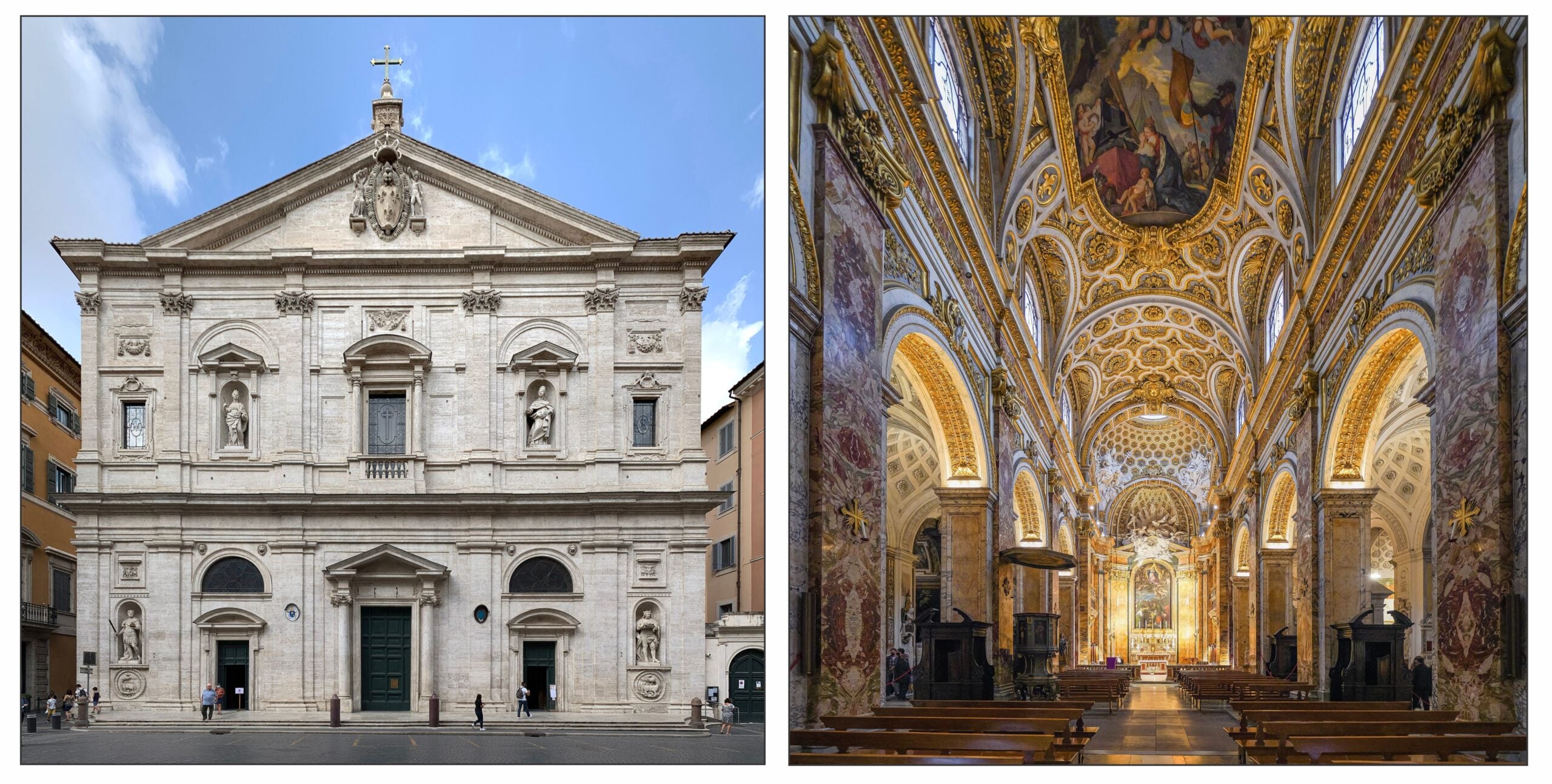
The story begins with Matthieu Cointerel (1519-1585) a French Cardinal who provided support for the Church of San Luigi dei Francesi, France’s national church in Rome:

Though construction had started in 1518, all building had been halted during the sack of Rome by mutinous German troops in 1527. The church exterior was not completed until 1589, two years after the death of its benefactor Cointreau. The austere Renaissance façade now contains statues (by Pierre de l’Estache, 18th Century) of the important saints and kings that came from France: Charlemagne and Saint Louis (lower level), Saint Clothilde and Saint Jeanne de Valois (upper level). The interior decoration, much of which was completed in the 18th Century, is far more extravagant than the exterior, tending to Rococo rather than Renaissance. The ceiling has a large fresco showing the apotheosis of Saint Louis by Charles-Joseph Natoire (18th Century).  


Saint Matthew

As well as supporting the building, Matteo Contarelli (as he was known in Italy) also provided an endowment for one of the side chapels to be dedicated to his namesake Saint Matthew. Matthew is traditionally considered to be the author of the Gospel of Matthew although it is likely that this gospel was written by another person, perhaps a colleague or follower of the Saint (see discussion by Allison, 2004, pp 7-72).

The calling of Matthew (also known a Levi or Alpheus) to be a disciple is mentioned briefly in the three synoptic gospels, though only in the Gospel of Matthew (9: 9-13) is he named Matthew:

And as Jesus passed forth from thence, he saw a man, named Matthew, sitting at the receipt of custom: and he saith unto him, Follow me. And he arose, and followed him.

And it came to pass, as Jesus sat at meat in the house, behold, many publicans and sinners came and sat down with him and his disciples.

And when the Pharisees saw it, they said unto his disciples, Why eateth your Master with publicans and sinners?

But when Jesus heard that, he said unto them, They that be whole need not a physician, but they that are sick.

But go ye and learn what that meaneth, I will have mercy, and not sacrifice: for I am not come to call the righteous, but sinners to repentance.

Although this is the only mention of the saint in the Bible, many legends grew up over the years about his exploits after the life of Jesus. These stories were compiled in Volume 5 of The Golden Legend by Jacobus de Voragine (1275). According to legend, Saint Matthew spread the gospel to the land of Ethiopia. While there he came upon two sorcerers who were using dragons to torment the people. By making the sign of the cross, Matthew tamed the dragons and defeated the sorcerers. He also raised from the dead the daughter (or son) of King Egippus. In return for this miracle, the king’s daughter Ephigenia became a nun. After Egippus died, his successor Hirtacus lusted after Ephigenia. Matthew refused to release her from her vows of chastity, and the infuriated king arranged for Matthew to be murdered.  

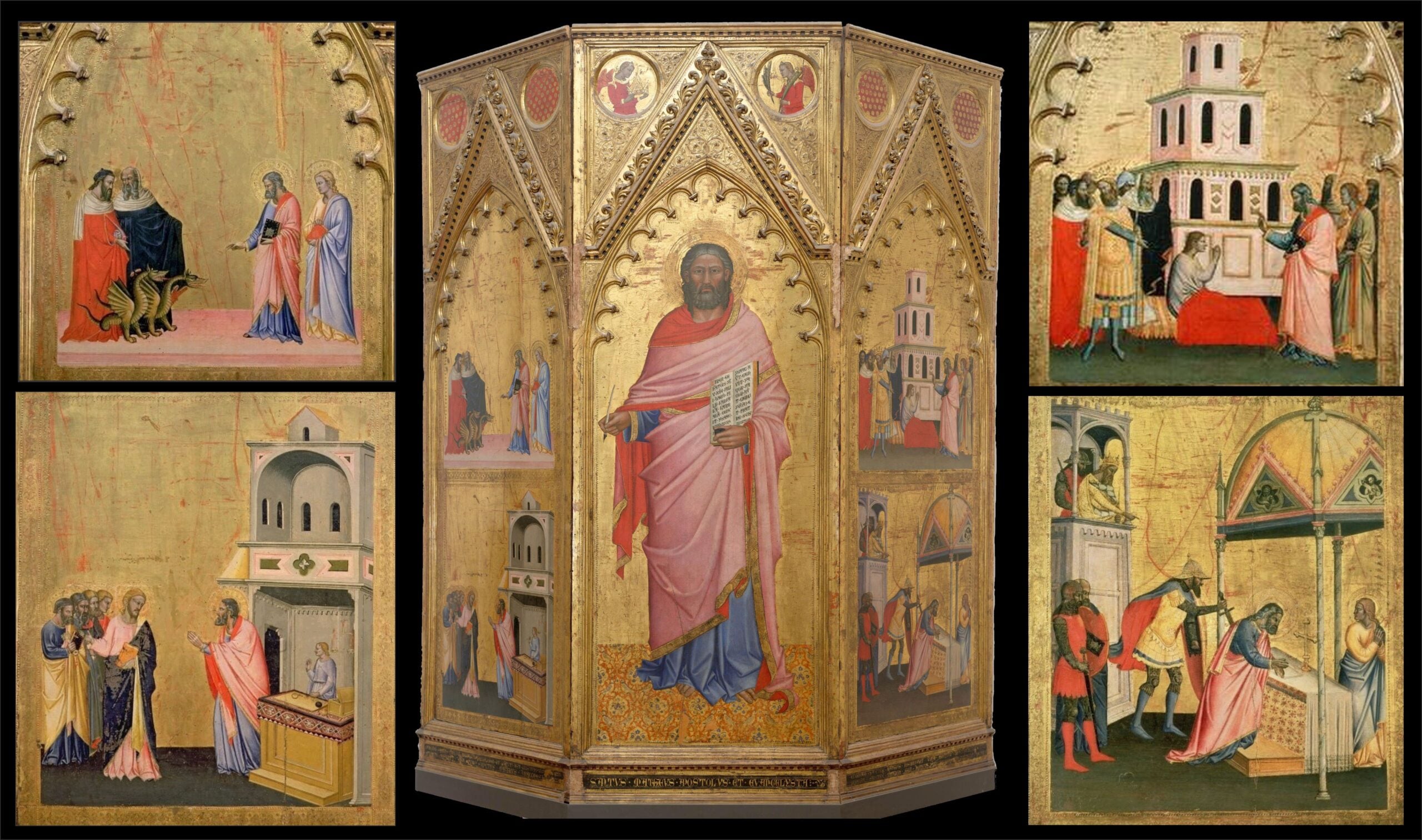
In 1868, Andrea Orcagna (1308-1368) constructed a pilaster for the Church of the Orsanmichele in Florence with scenes from the life of Saint Matthew: on the left are the calling to discipleship, and the taming of the dragons: on the right are the raising of the king’s daughter and the martyrdom of the saint; in the center is the writing of the gospel.  

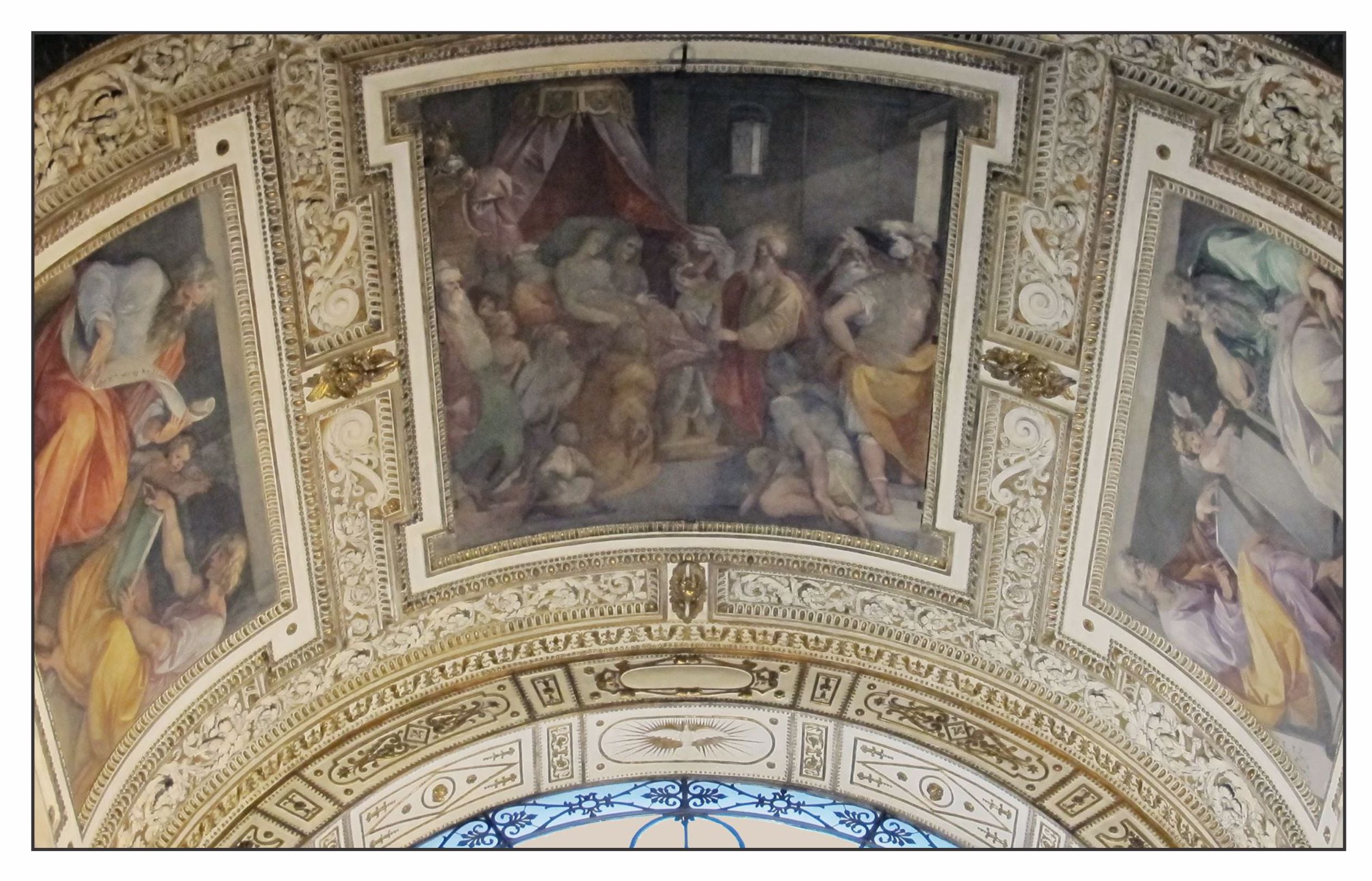
In 1587, the executors of Contarelli’s will commissioned Giuseppi Cesari, Cavalier d’Arpino (1568-1640), to provide frescos for the walls and ceiling of the chapel. He painted the barrel vault of the chapel with a fresco showing Matthew raising the king’s daughter from her death bed. On the sides of the vault were two paintings showing anonymous prophets in the style of Michelangelo but without his genius:

Matthew and the Angel

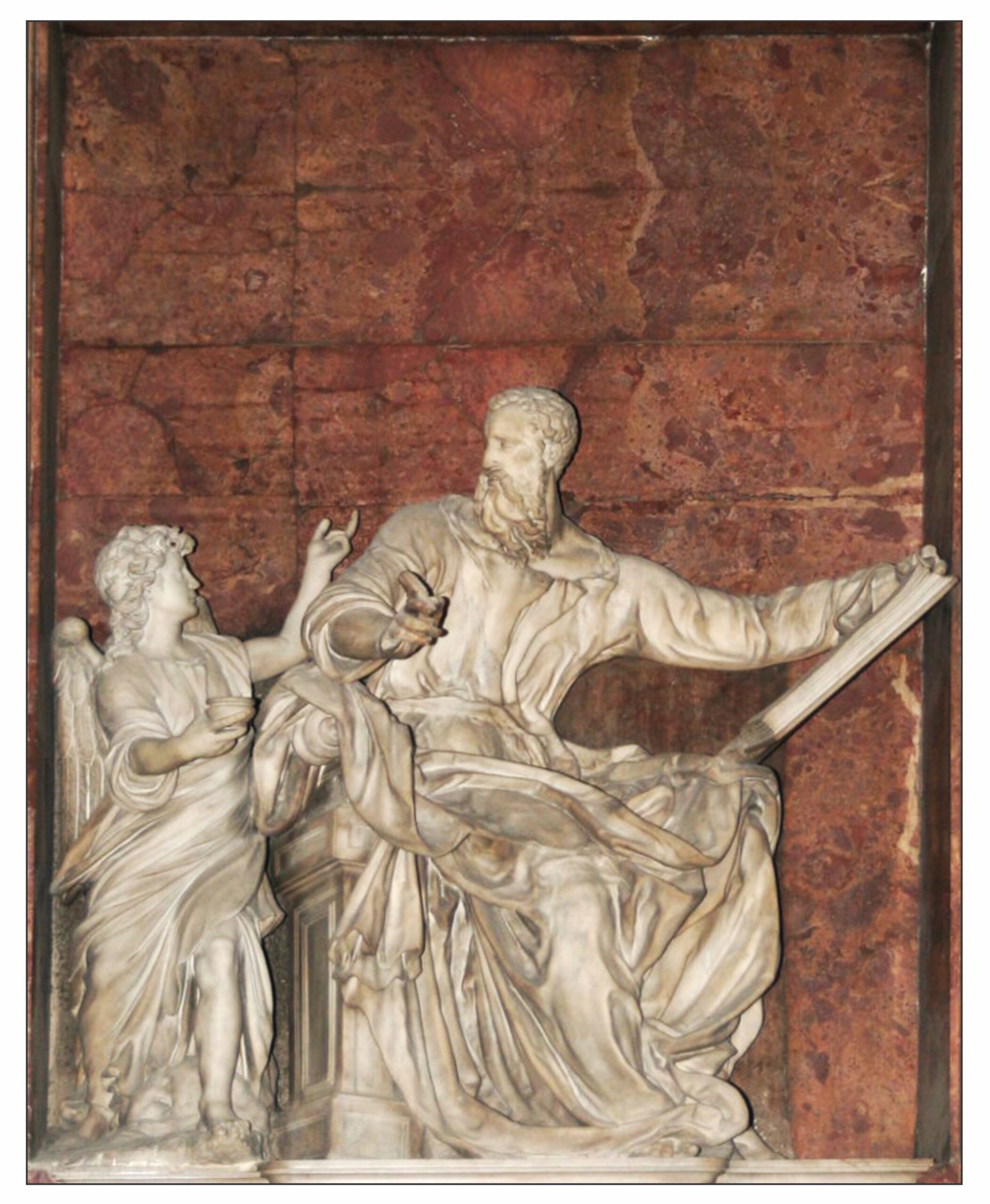
Cesari completed the ceiling in 1593. Financial difficulties delayed his payment, and the Cavalier went on to other projects. In 1587, the executor had also commissioned a sculpture depicting the inspiration of Saint Matthew from Jacques Cobaert (1535–1615) for the altar. However, he experienced great difficulty finishing the sculpture (Hess, 1951). The figure of Matthew alone was finished in 1602, but the priests deemed it incomplete and refused to take it. After Cobaert’s death, Pompeo Ferrucci provided the angel to go with Matthew, and the strangely disjointed sculpture now resides in the Church of the Santissima Trinità dei Pellegrini:

In 1599, the financing of the Contarelli Chapel was taken over by the Fabbrica (works office) of Saint Peter’s (Graham-Dixon, 2010, p 192). Cesari was offered a contract to complete the chapel, but by then he was too busy. The contract was therefore given to Caravaggio, a protégé of the Cardinal del Monte. He agreed to complete the side panels by 1600. But he would paint using oil on canvas rather than in situ frescos. Caravaggio did not make preparatory drawings, but painted directly onto the canvas using models posed under carefully controlled lighting. He painted rapidly using a severe chiaroscuro style that came to be known as “tenebrism.”

The Calling of Saint Matthew

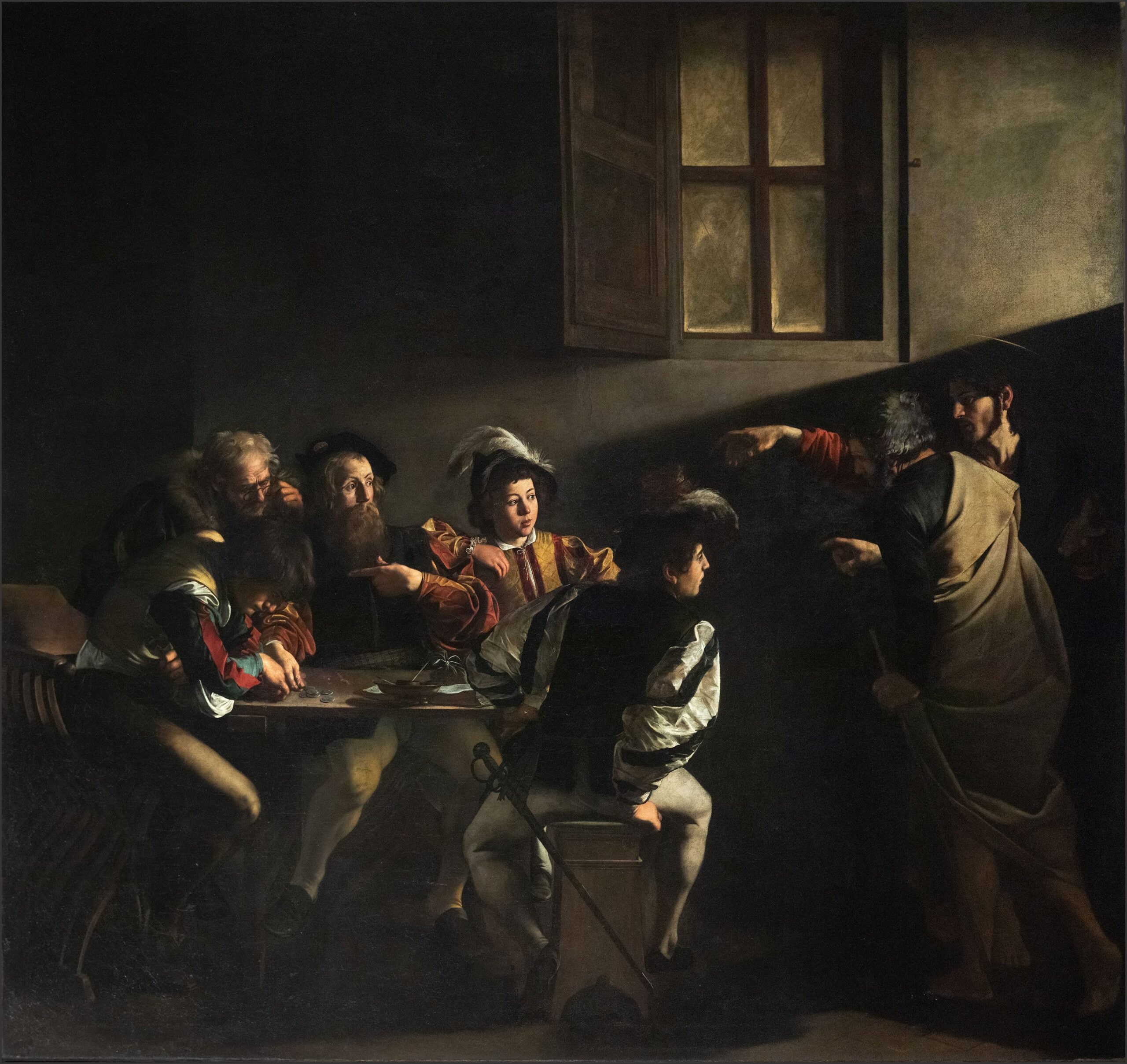
The first painting Caravaggio completed was The Calling of Saint Matthew (1600):

Caravaggio has transposed the event to his own time and place. On the left two people enter a darkened office. One of them has a faint halo: this is Jesus. In front on him, standing between the viewer and the savior is Saint Peter in a dull yellow cloak. From what may be an open window bright light streams diagonally into the office illuminating the faces of a group of five people at a table. There is some ambiguity about who is who (Dubouclez, 2024): I shall follow the interpretation of Graham-Dixon (2010, pp 194-197). The central person with a distinguished beard and a luxurious red and yellow doublet is Matthew Levi, a prosperous tax collector. Counting the money on the table is a rueful taxpayer. Looking over his shoulder through spectacles is an elderly man who appears to be checking the calculations. At Matthew’s left shoulder is a young page with a feathered cap and a golden doublet. At the corner of the table with his back to the viewer, dressed elegantly in black and white and wearing a sword, is Matthew’s bodyguard (or bravo). There is a space at the table: the viewer can imagine himself or herself sitting there.

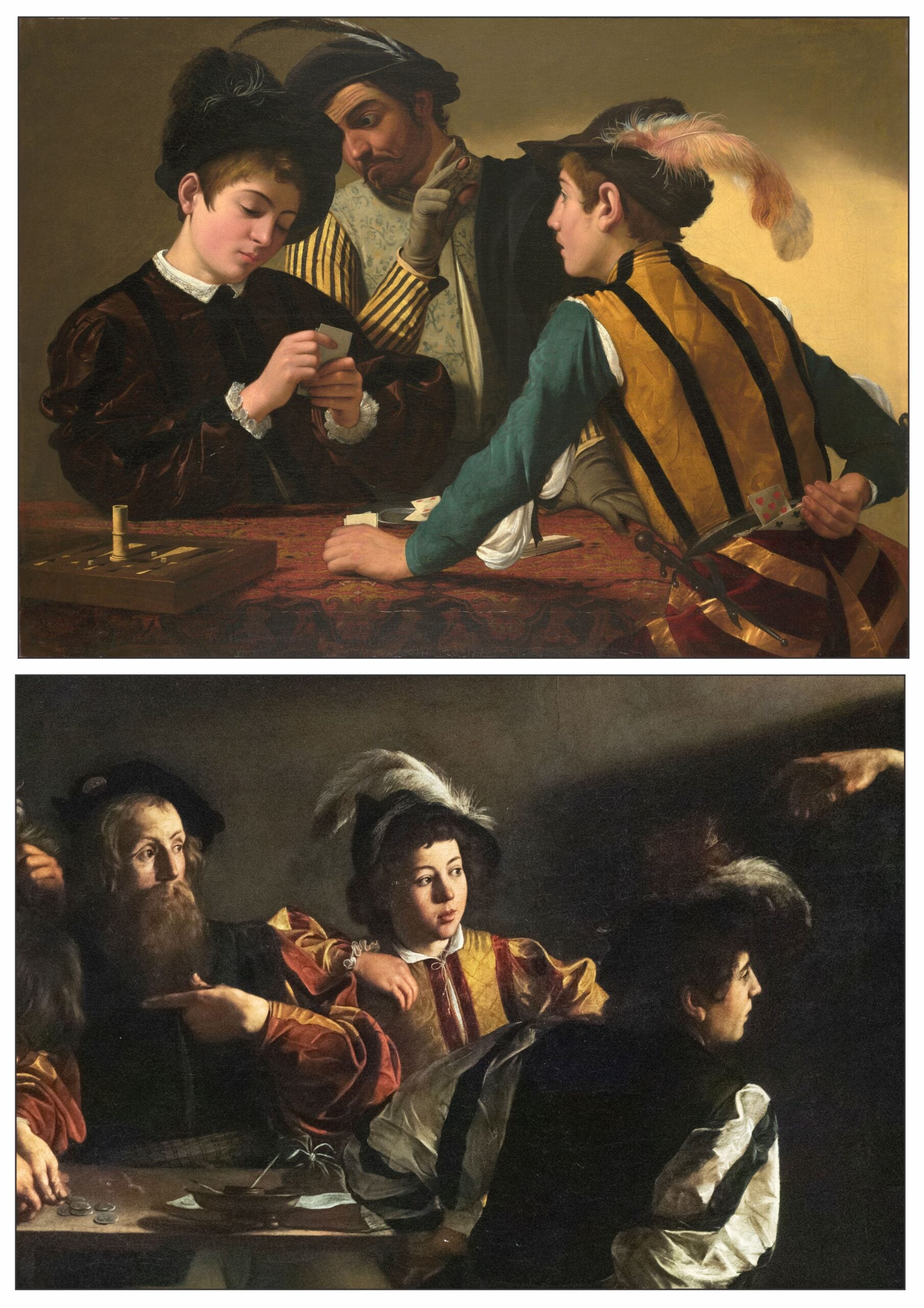
The group at the table is reminiscent of an earlier painting of Caravaggio: The Cardsharps (1597). Paying taxes always seems like being cheated. Both paintings display Caravaggio’s mastery of the feathers and fashions of the day.

The difference is the right hand of Jesus. Jesus points to Matthew and says simply, “Follow me.” In the shadows, he holds out his left hand as though beckoning the viewer to join him as well. After his Matthew paintings, Caravaggio seldom returned to the genre subjects of his youth. It was as if he also felt called to a more meaningful life.

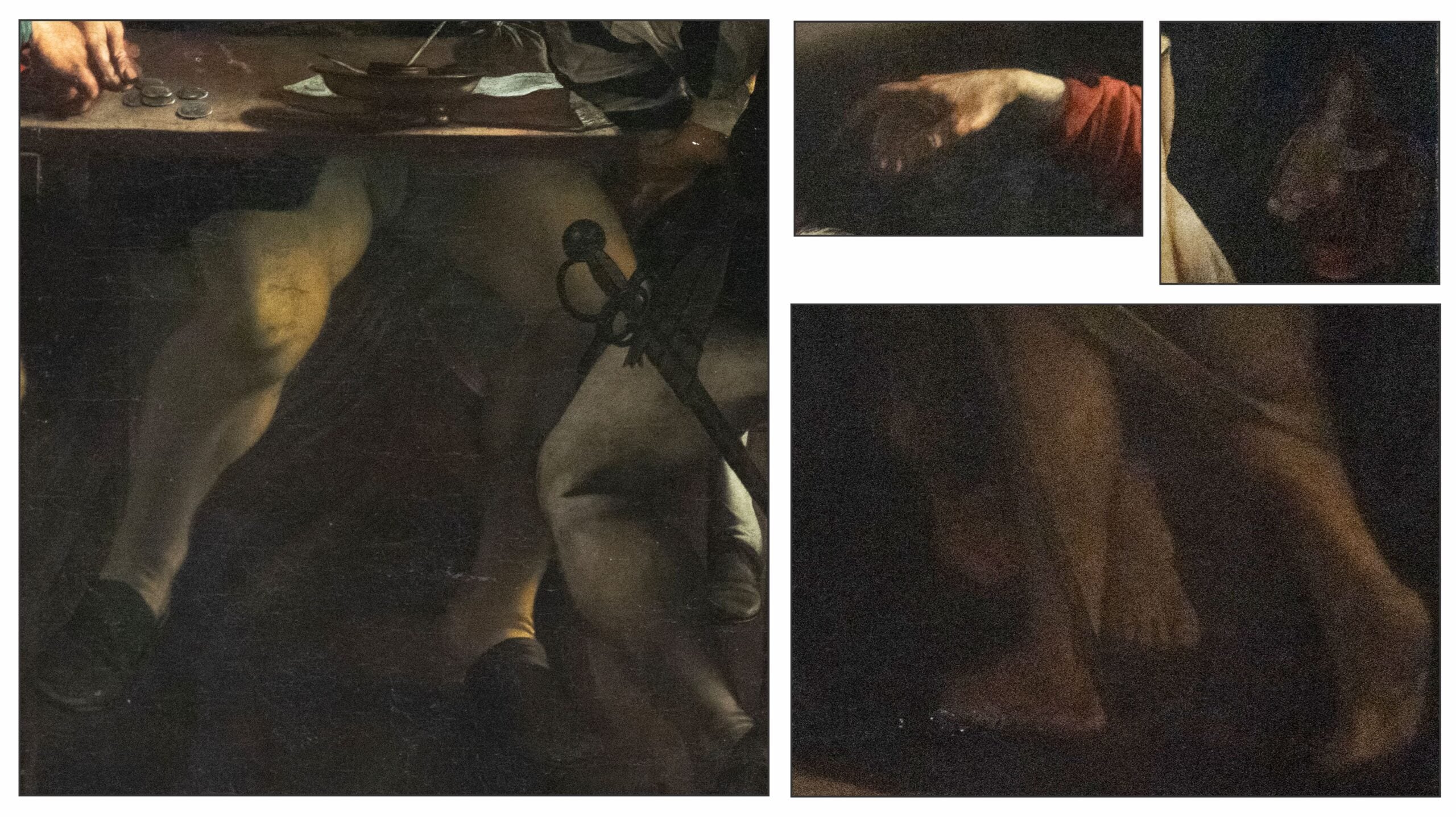
If one look carefully at the feet in the shadows on the lower right, we can see that Jesus is turning to leave the office of the tax-collector (Puttfarken, 1998, p 170). He already knows that Matthew will come after him. Matthew appears uncertain about what to do. But if we look at his legs beneath the table, we note that he is already turning toward Jesus:

Matthew, in his wine-dark velvet hat, points to his own chest as if to say “Who, me?,” but underneath the table where they sit his legs have already answered the call long before the message has reached his brain. We can see Matthew’s legs because Caravaggio has omitted one leg of the table. In the real world, it would crash to the ground. In the world Caravaggio has created, we barely notice: we are too absorbed in the dilemma of an ordinary man whose mind lags behind his heart. (Rowland, 2024, pp 3-4)

The following illustration shows on the left the legs of Matthew (and the absent table leg), on the upper right the hands of Jesus and on the lower right the feet of Peter and Jesus:

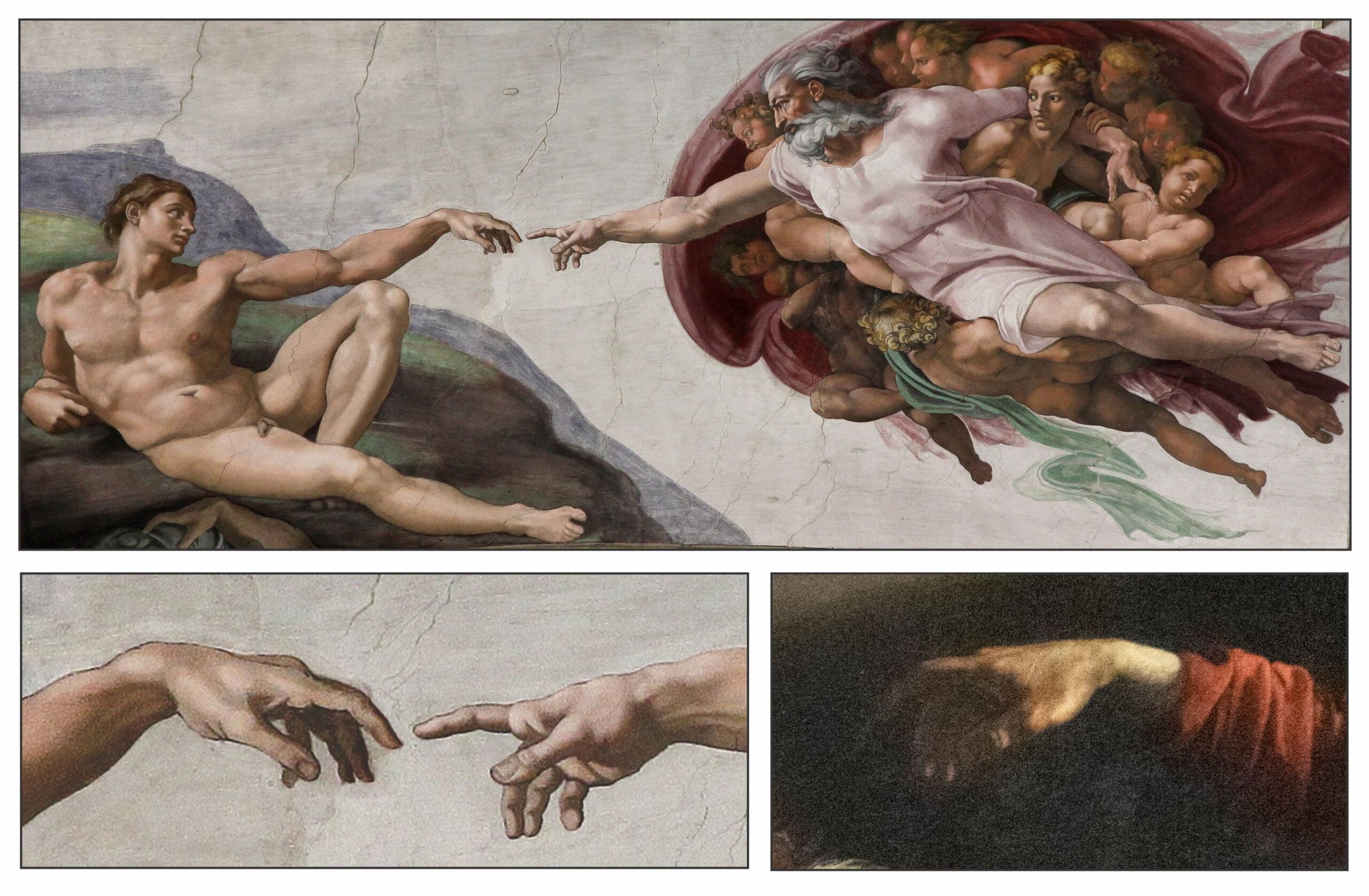
Jesus’ right hand is copied from Michelangelo:

The shrouded gesture of Christ, the most noteworthy single motif in Caravaggio’s picture, is a studied quotation from Michelangelo’s most famous image, the Creation of Adam on the Sistine ceiling. Christ’s oddly limp right hand, seen as if stopped by the camera, mirrors that of Michelangelo’s inert Adam, who is about to be invested with life by God. Christ is the New Adam, and “as in Adam all men die, so in Christ all will be brought to life” (I Corinthians 15:22). Caravaggio was no Michelangelo, yet we may see here a kind of identification, perhaps the first that Michelangelo Merisi made with his great predecessor and namesake. (Hibberd, 1983, pp 97-99).

The following illustration shows Michelangelo’s 1511 painting with an expanded view of the hands of God and Adam, and Caravaggio’s hand of Jesus, the mirror image of the hand of Adam:


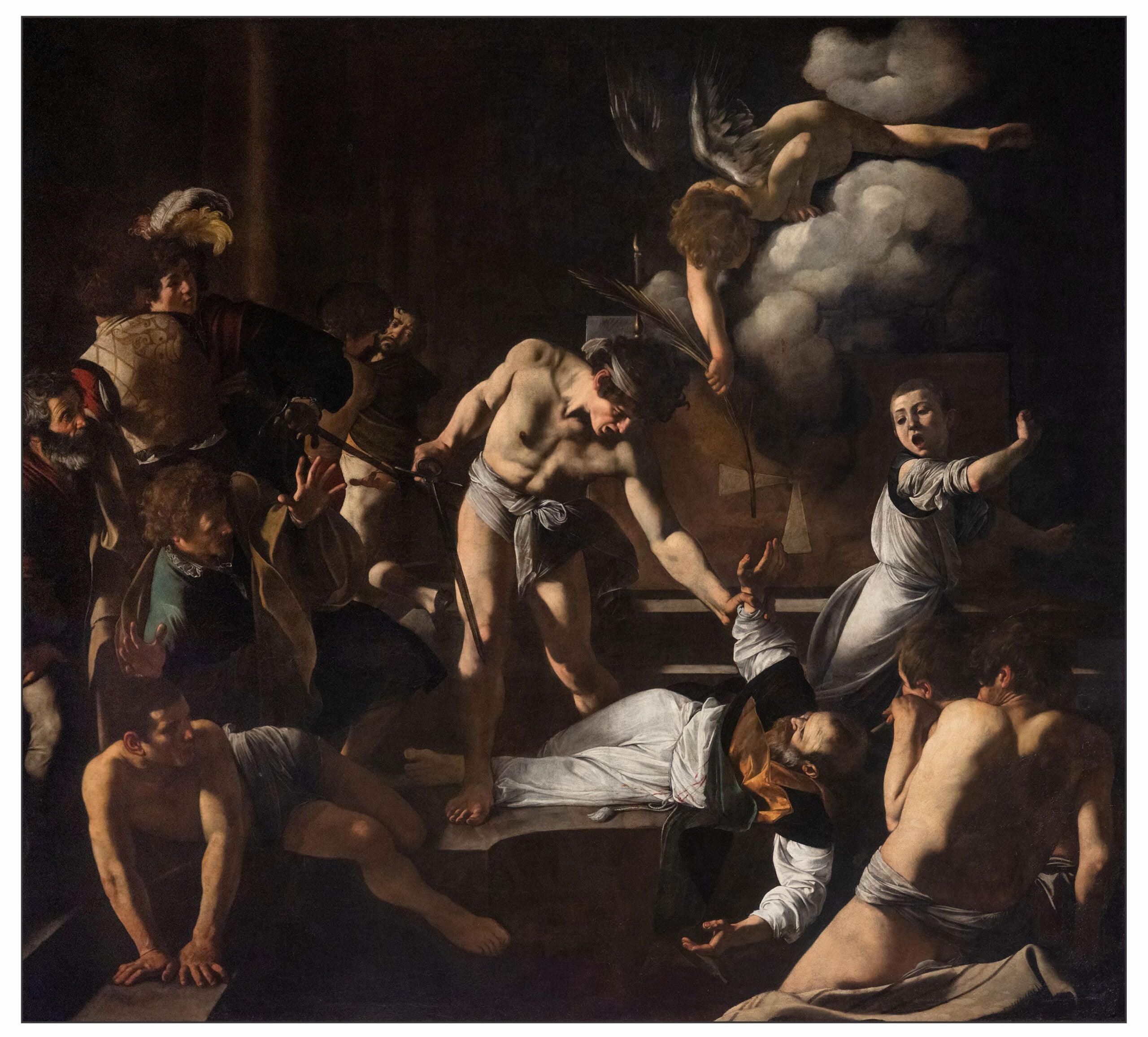
The Martyrdom of Saint Matthew

The contract for the painting was very specific:

a long wide space in the form of a temple, with an altar raised up on the top of three, four, or five steps: where St Matthew dressed in vestments to celebrate the mass is killed by the hands of soldiers and it might be more artistic to show the moment of being killed, where he is wounded and already fallen, or falling but not yet dead, while in the temple there are many men, women, young and old people, and children, mostly in different attitudes of prayer, and dressed according to their station and nobility, and benches, carpets, and other furnishings, most of them terrified by the event, others appalled, and still others filled with compassion (quoted in Graham-Dixon, 2010, p 194)

Caravaggio had no previous experience with painting more than three or four people together. He experienced great difficulty with the Martyrdom. Radiographic studies revealed pentimenti with a design completely different from the final painting. It is likely that Caravaggio had begun The Martyrdom before The Calling of Saint Matthew, given up and then returned to it after the latter was completed. 

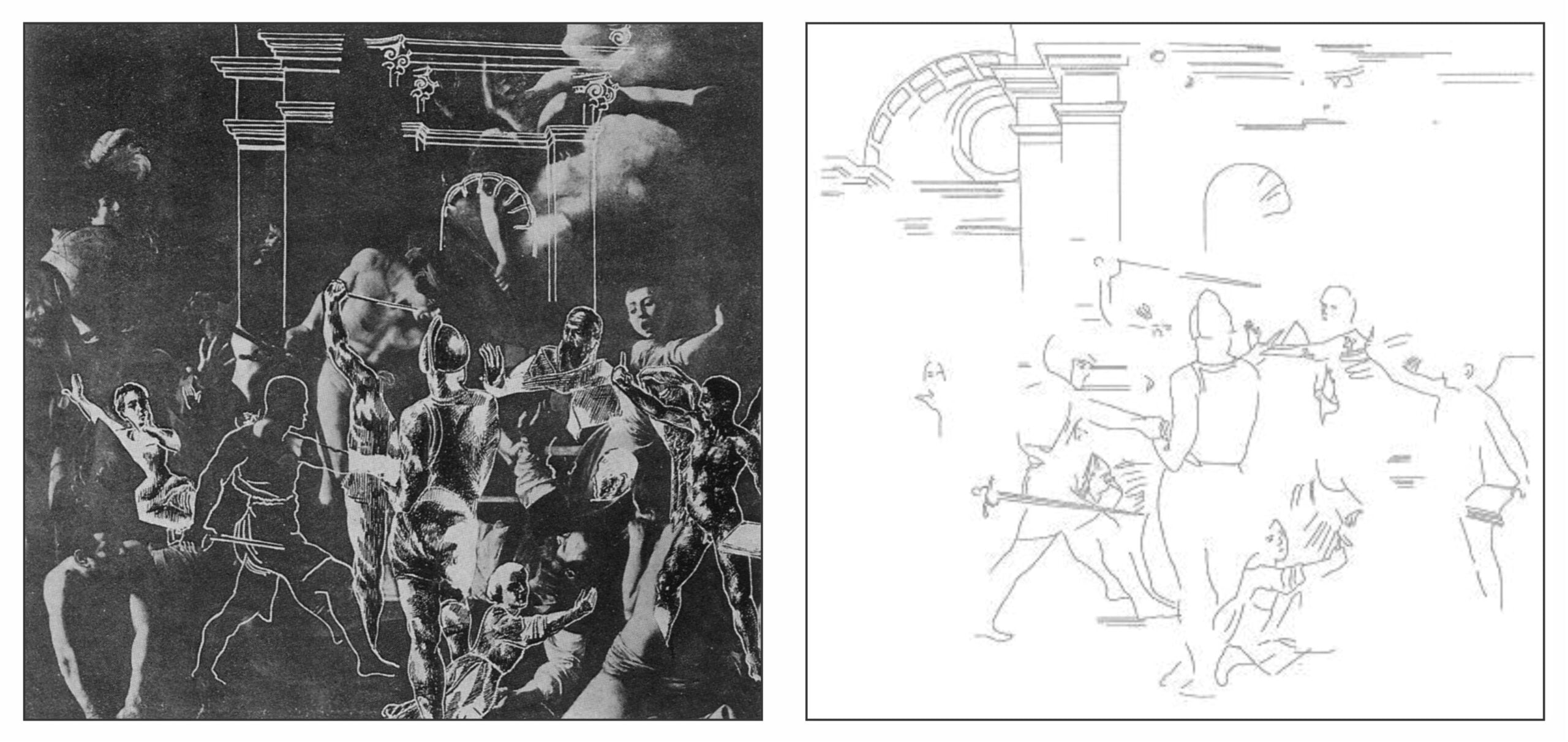
In his original effort, Caravaggio took pains to depict the altar and the temple, and outlined three assassins. The focus of the picture was a helmeted assassin with his back to the viewer. Saint Matthew is shown falling under the blows of his executioners. Caravaggio realized that this design was not working. Saint Matthew’s death was not at the center; everything was far too crowded; the central assassin was faceless.

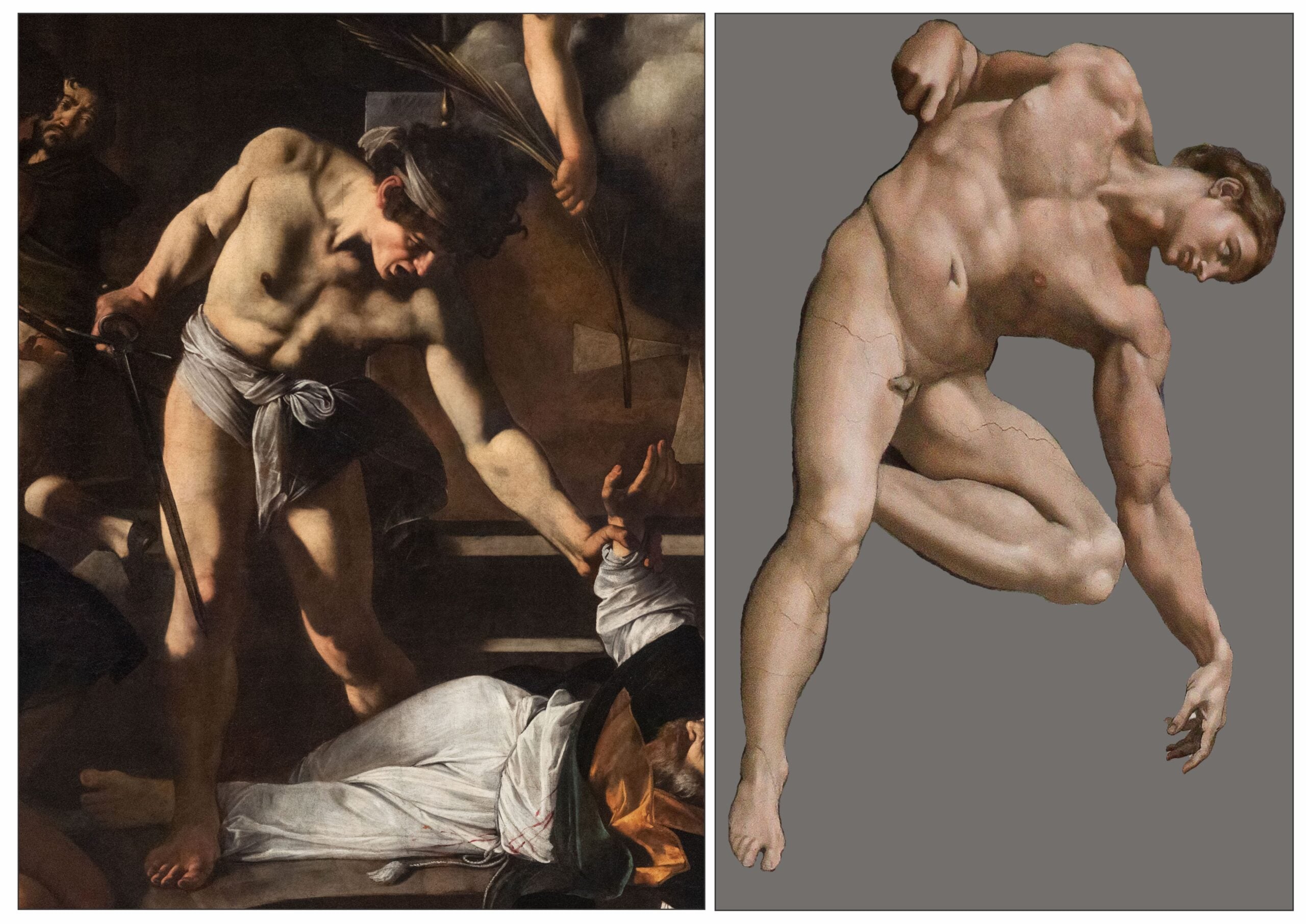
He decided to start over. He opened up the center of the painting to show the dying Saint Matthew who has fallen to the ground. Members of the congregation turn away from the horror of his murder. Some are without clothes – probably about to be baptized. The artist himself is portrayed in the background watching the martyrdom with a combination of terror and pity. An angel reaches out to the saint to give him a palm branch, symbol of salvation and eternal life. There is now only one assassin and he faces the viewer. He is almost naked. He exudes rage.

The following illustration shows the pentimenti of the earlier versions of the painting (Camiz, 1990; Olson, 2002; Vodret-Adamo, 2011, p 73). There were several aborted attempts to portray the architecture of the temple. Caravaggio soon realized that he was not interested in architecture: most of his later paintings use a background of either dark shadows or bare walls.

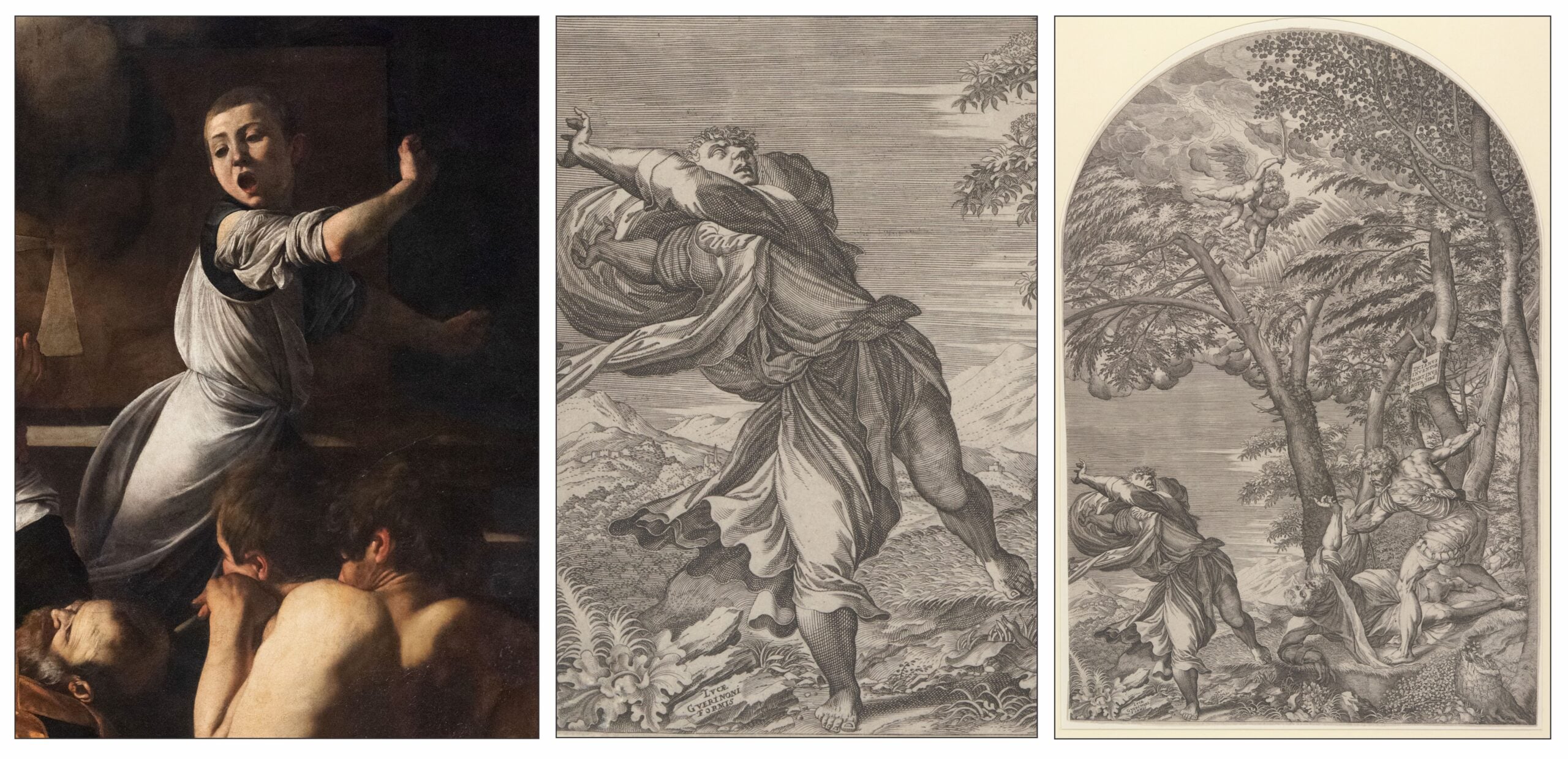
The figure on the right of the altar boy recoiling from the murder of the saint derives from Titian’s 1529 painting of The Assassination of Saint Peter of Verona, which Caravaggio has likely seen in the form of a 1560 etching by Martino Rota:

The imposing body of the assassin is reminiscent of Michelangelo’s Adam in The Creation of Adam (1511) in the Sistine Chapel (Clayton website).

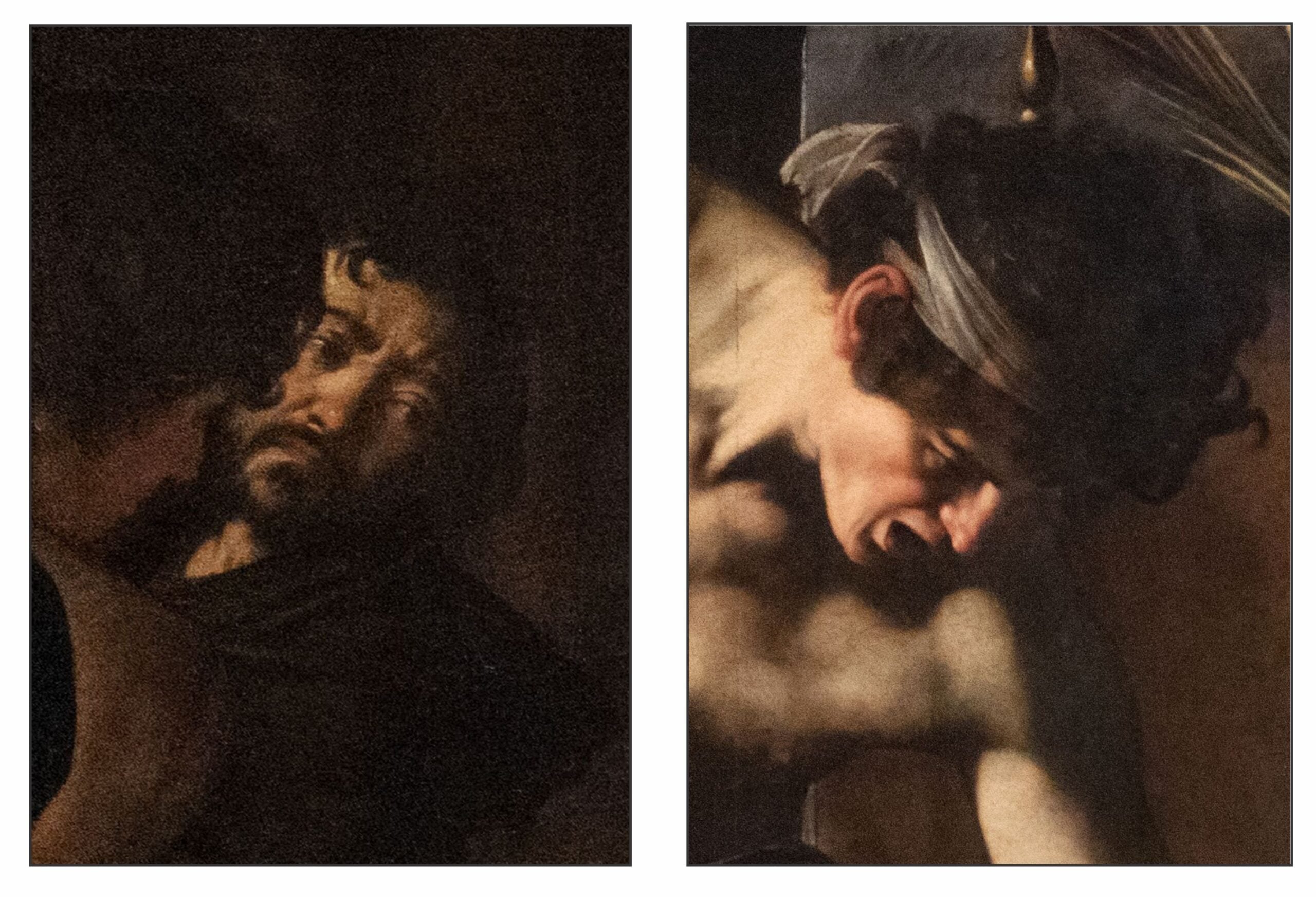
The head of Caravaggio and the head of the assassin look down in parallel on the dying saint, one in the shadows with pity and one in the light with anger:

The Inspiration of Saint Matthew

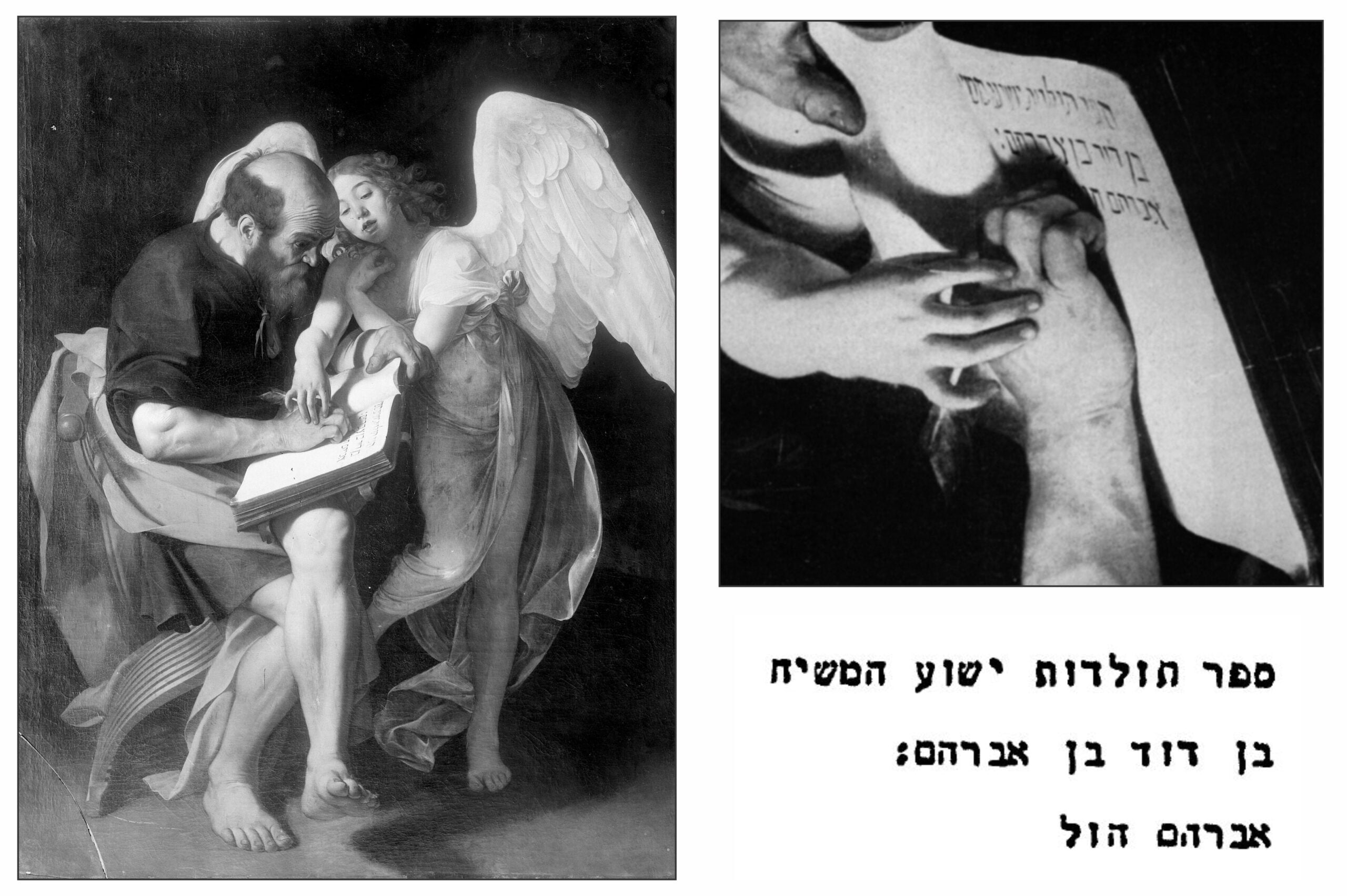
In 1602, after Contarelli’s executors had refused Cobaert’s incomplete sculpture of Saint Matthew and the Angel, they asked Caravaggio to produce a painted version for the altar (Graham-Dixon, 2010, pp 234-237). Caravaggio’s first version of The Inspiration of Saint Matthew portrayed the saint as an old man who appears not to comprehend what is going on as a youthful angel guides his hand. The writing on the tablet shows the Hebrew version of the opening two verses of Matthew’s gospel (Lavin, 1974).

The book of the generation of Jesus Christ, the son of David, the son of Abraham.

Abraham begat …

Lavin (p 64) notes that this represents the transition between Old and New Testaments:

The lineage of salvation has been announced, the founding father has been named and his seed is being sown. The light of a new age has dawned.

The Hebrew gospel is an intriguing idea. Saint Matthew was certainly Jewish and, if he was the author of the gospel that bears his name, he would probably have written it in Hebrew. However, as far as we know, the original version was in Greek, perhaps compiled by a follower of Matthew rather than by Matthew himself.

The following shows a black-and-white photograph of the painting, which was destroyed by fire in Berlin in 1945, together with an enlargement of the saint’s writing and the Hebrew text (from Lavin, 1974).

Jesus chose his disciples from ordinary people and Caravaggio wanted to show Matthew as a “simple man stunned by the directness of his revelation” (Graham Dixon, 2010, p 236):

Perhaps the most touching aspect of the painting is the intimacy of the relationship between the stooped saint and the tender young angel, whose wings enfold the whole scene in a hushed embrace. The angel is God’s messenger but also the embodiment of Christian love – a love so generous that it encompasses even those as ragged and gnarled as the cross-legged, doltish St Matthew.  

The most striking aspect of Caravaggio’s Matthew is his humility. Thomas (1985) quotes from a description of Matthew by Lazius (1555): 

Even though he was most learned, yet he was not at all exalted, but in accord with the meaning of his name, truly strove to present himself as humble and lowly. He would always remark that, “to whatever degree you are great, so much more be you humble in all things.” And this to the wise man: “disgrace follows the proud, but exaltation follows the humble” . . . as a pauper himself he followed Christ the pauper.

The name Matthew in Hebrew means “gift of God” (Matityahu). The gospel was not created by him but given from God. 

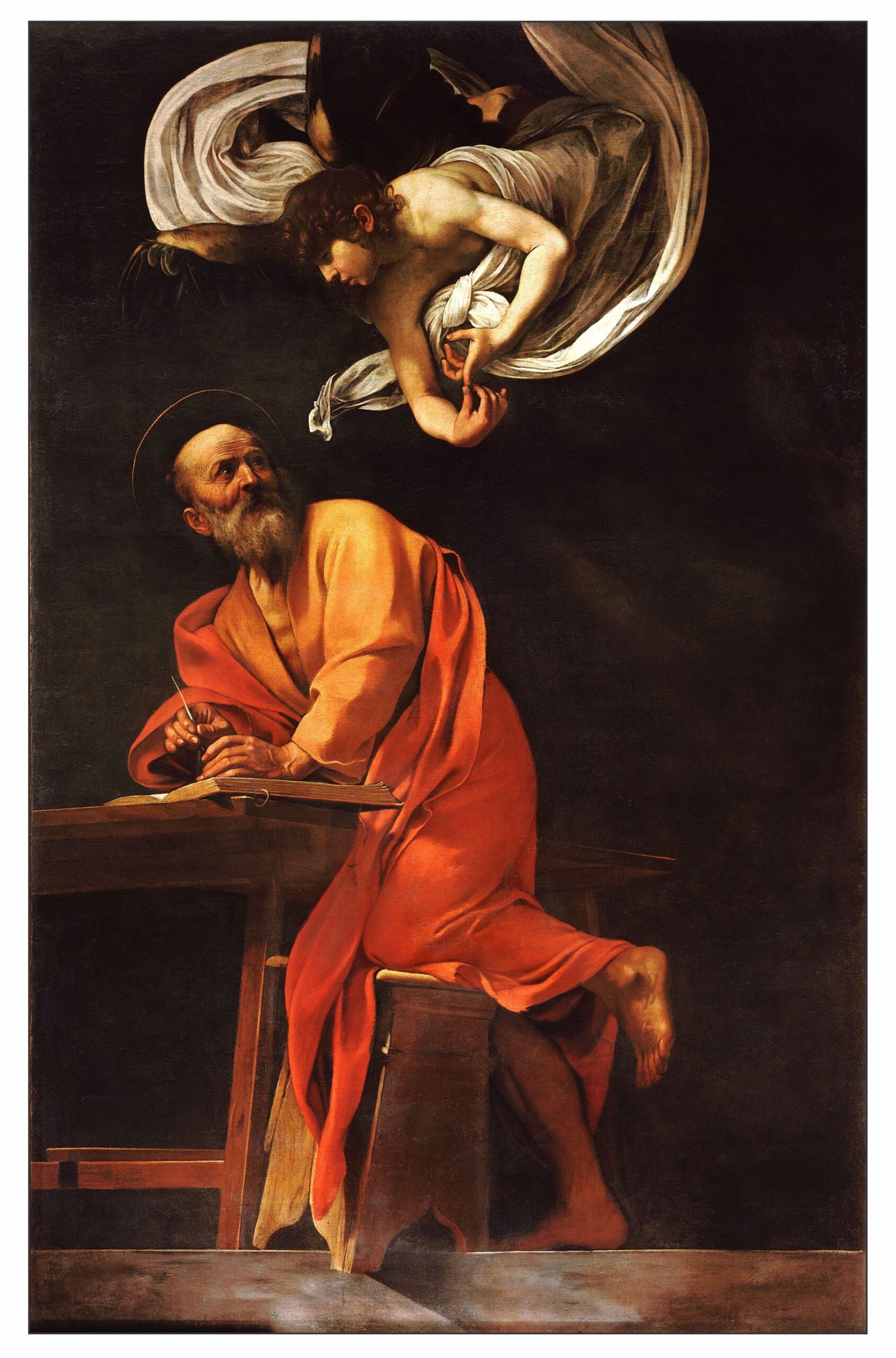
However, the priests were dismayed by the portrayal of Matthew as a holy fool rather than an inspired saint, and refused the painting. One of Caravaggio’s patrons was happy to take the rejected canvas. He was also able to convince the priests as San Luigi dei Francesi to allow Caravaggio to create another version. In the second version, the saint was far more distinguished, albeit still barefoot:

Matthew the shockingly illiterate peasant has suddenly been turned into Matthew the dignified, grey-haired sage. This scholar-saint kneels at his desk, quill pen at the ready. He is draped in red robes and has been equipped with an expression of dignified attentiveness. Rather than guiding his uncertain hand, the angel now counts off the verses as he dictates them. The pages of the book are no longer visible, but since the angel has got to the index finger of his left hand — number two, in the gestural rhetoric of the time, since Italians counted the number one with their thumbs —it seems that he has once more got to the start of the second verse, and Abraham’s begetting of Christ’s lineage. (Graham-Dixon, 2010, p 237).

Lavin (1974) compares Caravaggio’s two versions:

In the first version the divine word was conveyed mechanically through a laborious and earthbound process of physical instruction to a humble proletarian whose chief virtue lay in his knowledge of his own ignorance. In the second version it is conveyed miraculously to a stunned intellectual through a heaven-sent process of strictly rational analysis and exposition. Again, the key to the irony lies in the divine mystery itself, which brings truth to him who is wise, be he ignorant or learned.


The background is almost completely dark. The figures spiral around each other: divine forces binding the saint to the angel. The saint’s robe is pulled down by gravity; the angel’s robe billows upward toward heaven.

The table at which Matthew is writing is askew, and the bench upon which he kneels threatens to tumble out of the picture frame. This feeling of imminent upset fits with the revolutionary message of the gospel.

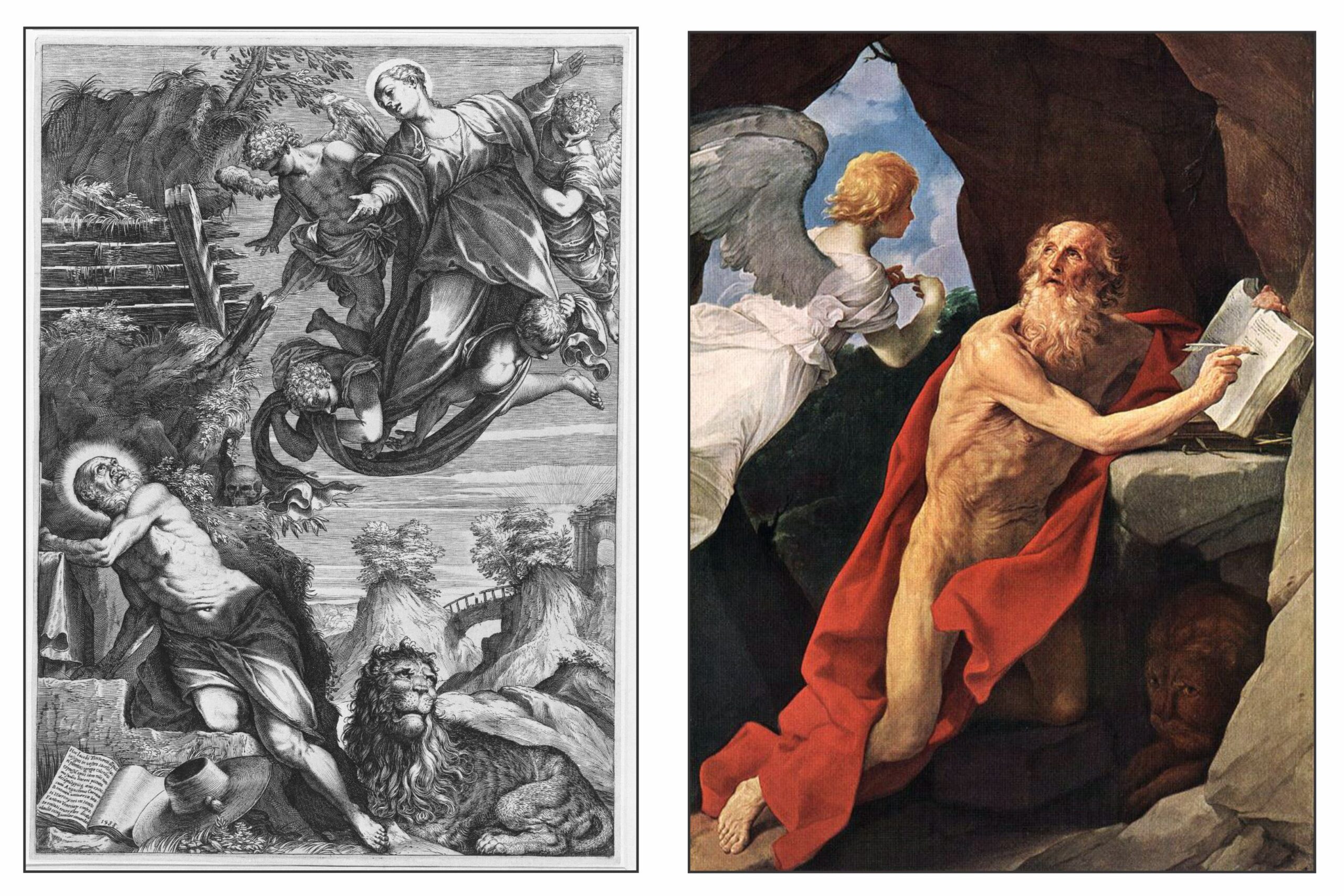
Lavin (1974) points out how Caravaggio was indebted to Tintoretto’s The Virgin Appearing to Saint Jerome (1583) which Caravaggio has probably seen in a 1588 etching by Agostino Carracci. And Caravaggio’s painting in its turn inspired Guido Reni’s 1635 depiction of Saint Jerome. The illustration shows the earlier etching on the left and later painting on the right:


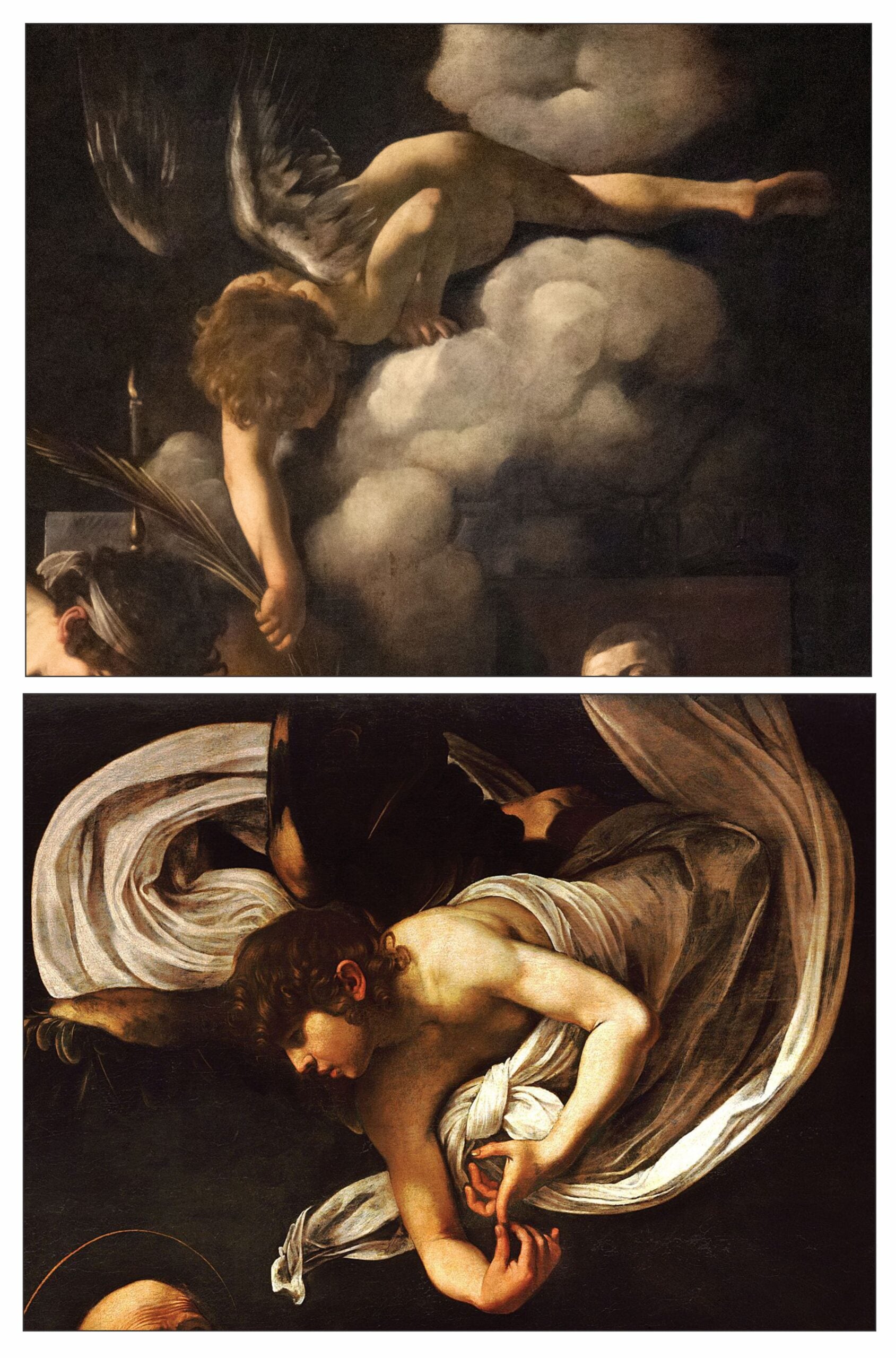
However, no one – before or after – could ever rival Caravaggio’s airborne angels. Young and sensuous. they float lightly in the clouds as erotic representatives of the divine. The following illustration compares the angels in the Inspiration and the in the Martyrdom.  

Farewell

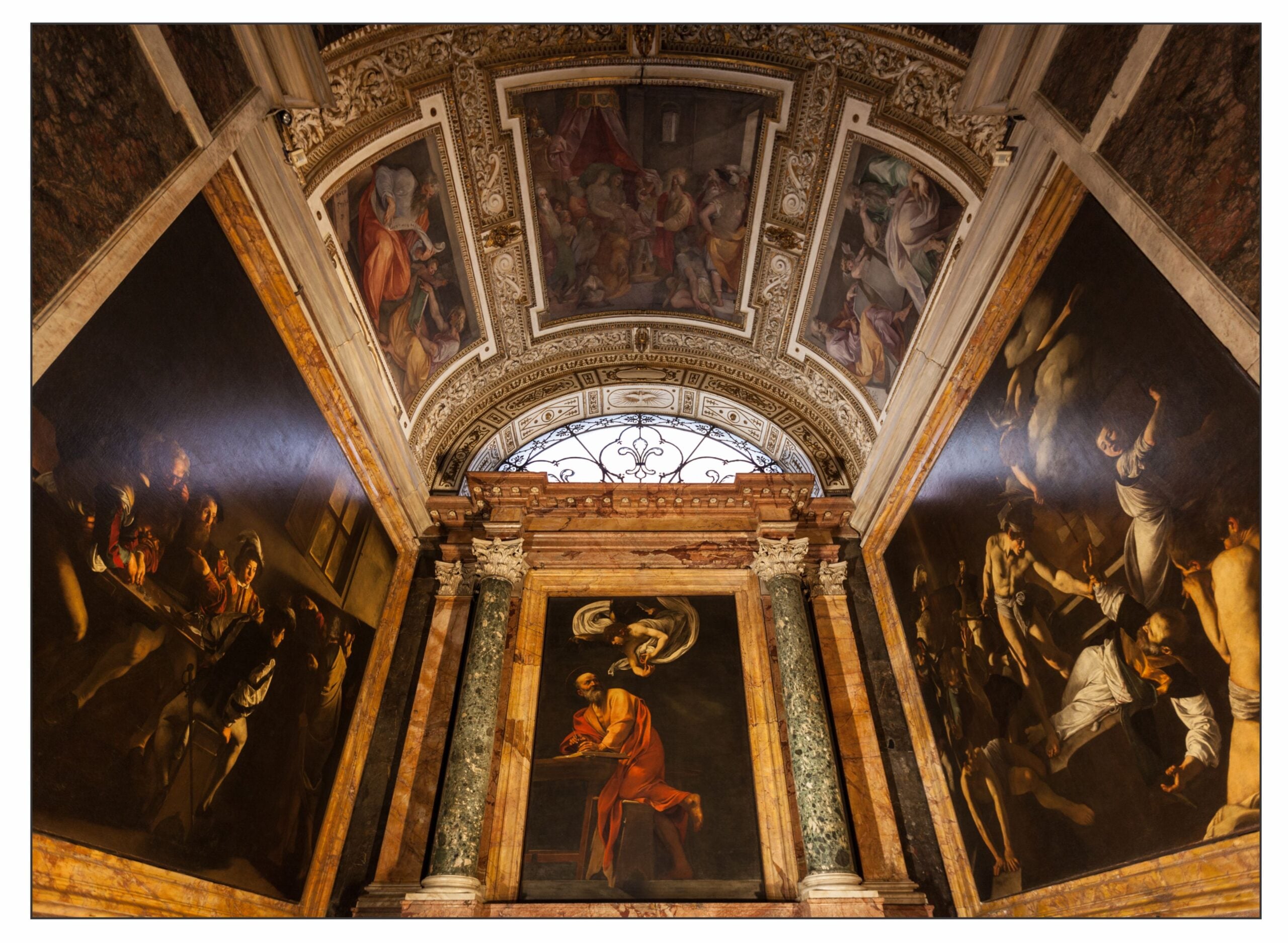
Caravaggio’s paintings for the Contarelli Chapel made him famous. They also represented a turning point in his choice of subject matter. From then on, he concentrated on religious themes. It was almost as though, like Matthew, he had been called to greater things. To see the chapel and the paintings is a deeply moving experience. But hard to describe, just as the chapel is notoriously difficult to photograph. We say farewell with a photograph by Robert Wash.

And the ending to a poem about The Calling of Saint Matthew by Karen Fish (2021, p 29)

Only a few ways to describe what actually happened—Matthew
touches his chest, indicating a confusion
with this unlikely enlistment.
His companions slouch, dumbfounded amid
the flush and feathers and swords.
There is the humble disbelief
all who are chosen share—that moment
when the world seems just a pile of hammers,
hatchets, buckets of coins—one
thinks plainly how unlikely,
absolved from all that is ordinary.

References

Allison, D. C. (2004). Matthew: a shorter commentary. T & T Clark International.

Camiz, F. T. (1990). Death and Rebirth in Caravaggio’s “Martyrdom of St. Matthew.” Artibus et Historiae, 11(22), 89–105.

Dubouclez, O. (2024). Le jeu de l’indécision. « Littéralisme » et ambivalence dans La Vocation de saint Matthieu du Caravage. Dix-septième siècle, 302(1), 5–28.

Fish, K. (2021). No chronology. University of Chicago Press.

Graham-Dixon, A. (2010). Caravaggio: a life sacred and profane. Allen Lane.

Hess, J. (1951). The chronology of the Contarelli Chapel. Burlington Magazine, 93(579), 186–201.

Hibbard, H. (1983). Caravaggio. Harper & Row.

Lavin, I. (1974). Divine inspiration in Caravaggio’s two St. Matthews. Art Bulletin, 56(1), 59–81.

Puttfarken, T. (1998). Caravaggio’s “Story of St Matthew”: a challenge to the conventions of painting. Art History, 21(2), 163–181.

Rowland, I. D. (2024). The lies of the artists: essays on Italian art, 1450-1750. MIT Press.

Thomas, T. (1985). Expressive aspects of Caravaggio’s first Inspiration of Saint Matthew. Art Bulletin, 67(4), 636–652.

Vodret Adamo, R., Cardinali, M., De Ruggieri, M. B., & Leone, G. (2011). Caravaggio: la Cappella Contarelli: Roma, Palazzo Venezia, 10 marzo-15 ottobre. Munus.

de Voragine, J. (1275, translated by W. Caxton, 1483) The Golden Legend or Lives of the Saints.


Bai Juyi: Pearls Falling on Jade

Bai Juyi (白居易, pinyin Bǎi Jūyì, or Po Chü-i in Wade-Gilles transliteration, 772-846 CE) was a Chinese poet. In 815, after inappropriately advising the emperor, he was exiled from the capital Chang’an to JiuJiang on the Yangtze River. One night, at a farewell party on the river for a friend, he heard a musician playing the pipa. Entranced by her music, he found out that she had once been a sought-after courtesan in the capital. After her beauty had faded away, she had retired to the provinces, where she played her music and lamented her lost youth. Moved by her plight, Bai Juyi composed his Pipa Xing (琵琶行, “Ballad of the Pipa”). The illustration shows a drawing of the poet and the pipa player from a scroll by Guo Xu (1456–1532).

Life of the Poet

Bai Juyi was born in Northern China and came to the capital Chang’an to pass his examinations for the civil service in 800. There he became close friends with the novelist and poet Yuan Zhen (779-831) (Tan, 2025). He soon became a prolific and popular poet, with the courtesy name Lètiān (樂天, happiness of heaven: optimism) (Waley, 1949). Bai Juyi and his predecessors, Li Bai, Wang Wei and Du Fu, are considered the four great poets of the Tang Dynasty (Geng, 2021). He became renowned in Japan where he was known as Haku Rakuten from the Japanese transliteration of his courtesy name (白楽天). In 815, the prime minister Wu Yuanheng was brutally assassinated because he would not agree to the demands of some rebellious warlords. Bai Juyi wrote a memorial calling upon the emperor to seek out and punish the assassins. However, the politics were complicated. Bai Juyi was considered presumptuous – it was not for him, a tutor in the imperial household, to advise the emperor. He was exiled and demoted to a minor position (“master of the horse”, essentially an adjutant) in Jiujiang, then known as Jiangzhou (Waley, 1949, pp 101-104). While there, he heard the playing of a pipa near the river and wrote his famous poem The Ballad of the Pipa. Bai Juyi was allowed to return to Chang’an in 1819. He then served for periods of time as governor of Hangzhou and governor of Suzhou. Bai Juyi was a devoted Chan Buddhist and when he grew old, he retired to a Buddhist monastery near the Longmen caves famous for their colossal statues of Buddha (carved in 672 and 676). At the monastery he was able to compile a full collection of his poems before his death.

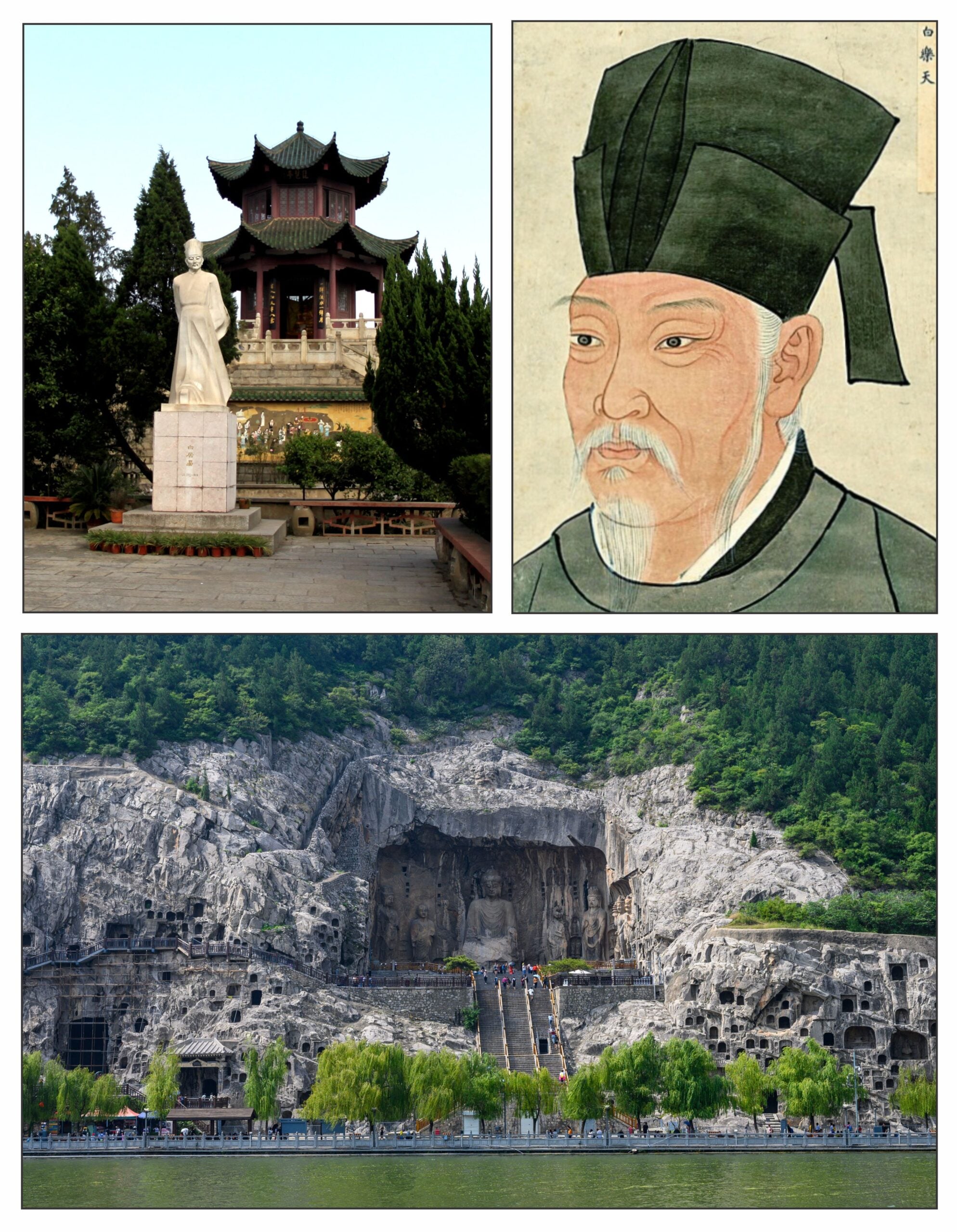
The following illustration shows in the upper left a statue of Bai Juyi at the Pipa Pavilion in Jiujiang, in the upper right a posthumous portrait of the poet by Chen Hongshou, a 17th Century painter, and at the bottom a view of the Longmen caves.

Translating the Ballad of the Pipa

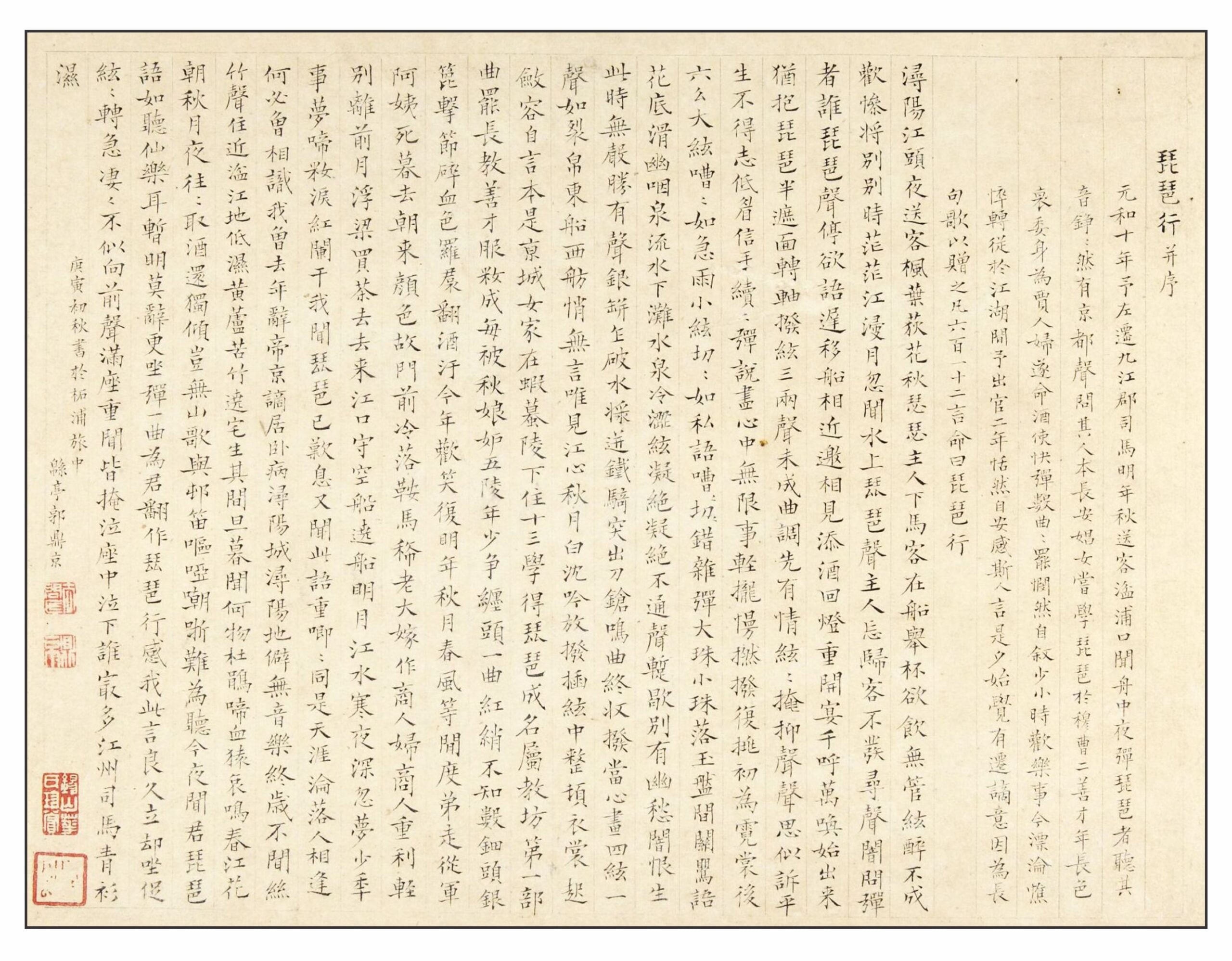
The poem is written in rhyming couplets with 88 lines each of 7 characters for a total 616 characters. It is preceded by a preface of 138 characters. The following is the poem in elegant regular-script calligraphy by Guo Dingjing (17th Century CE), now in the Princeton University Art Museum:

The Chinese text of the poem is readily available, as is an early English translation by Witter Bynner in his book The Jade Mountain (1929). Several other English translations have been published: Fuller, 2018, pp 283-289; Giles, 1888, pp 157-160; Harris, 2009, pp 21-26; Watson, 1984, pp 249–252; Xu et al, 1987, pp 292-296: Xu, 1994, pp 18-121; Yip, 2004, pp 288-297. Other translations are available on the internet: Phil Multic and Gan Siowck Lee.

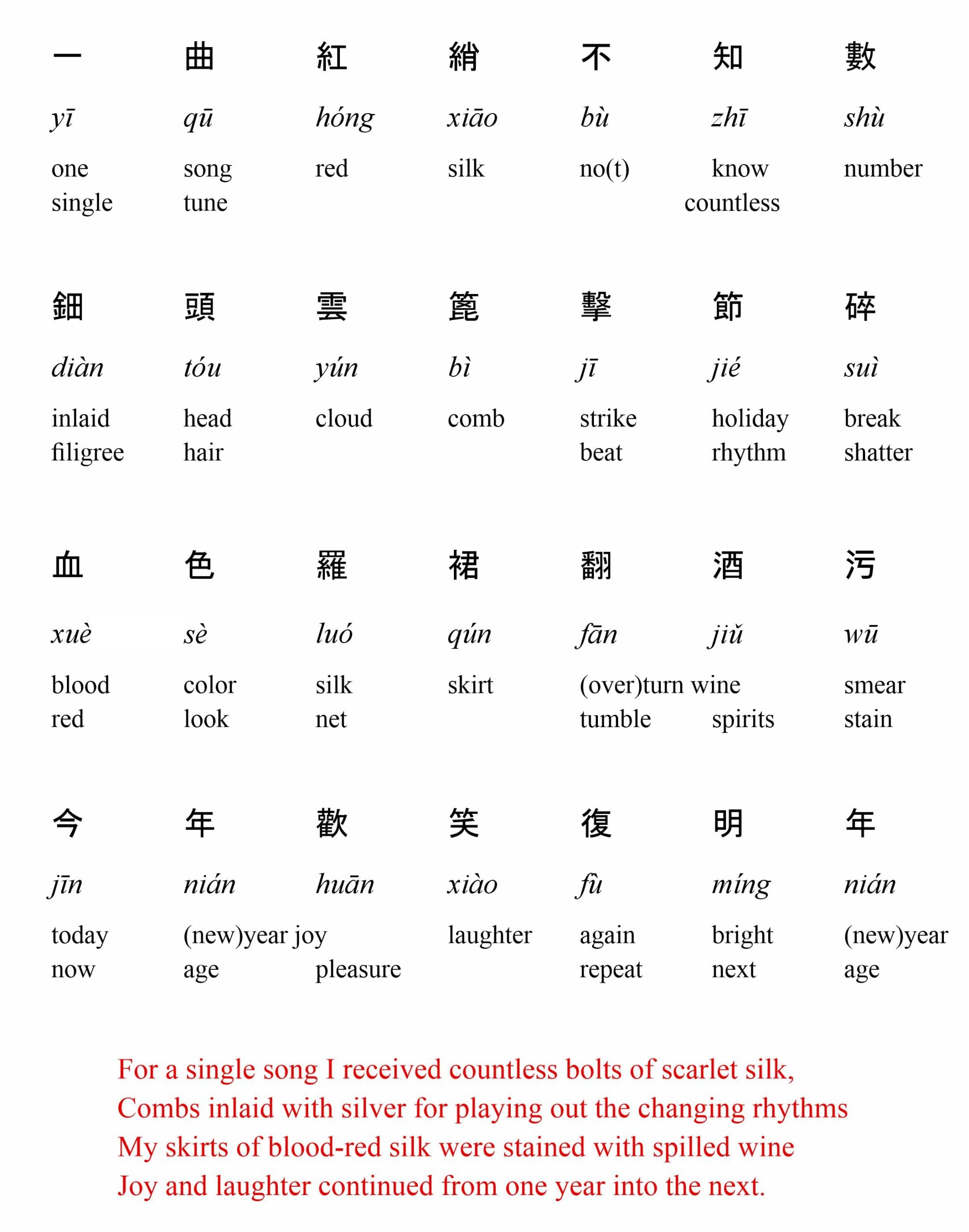
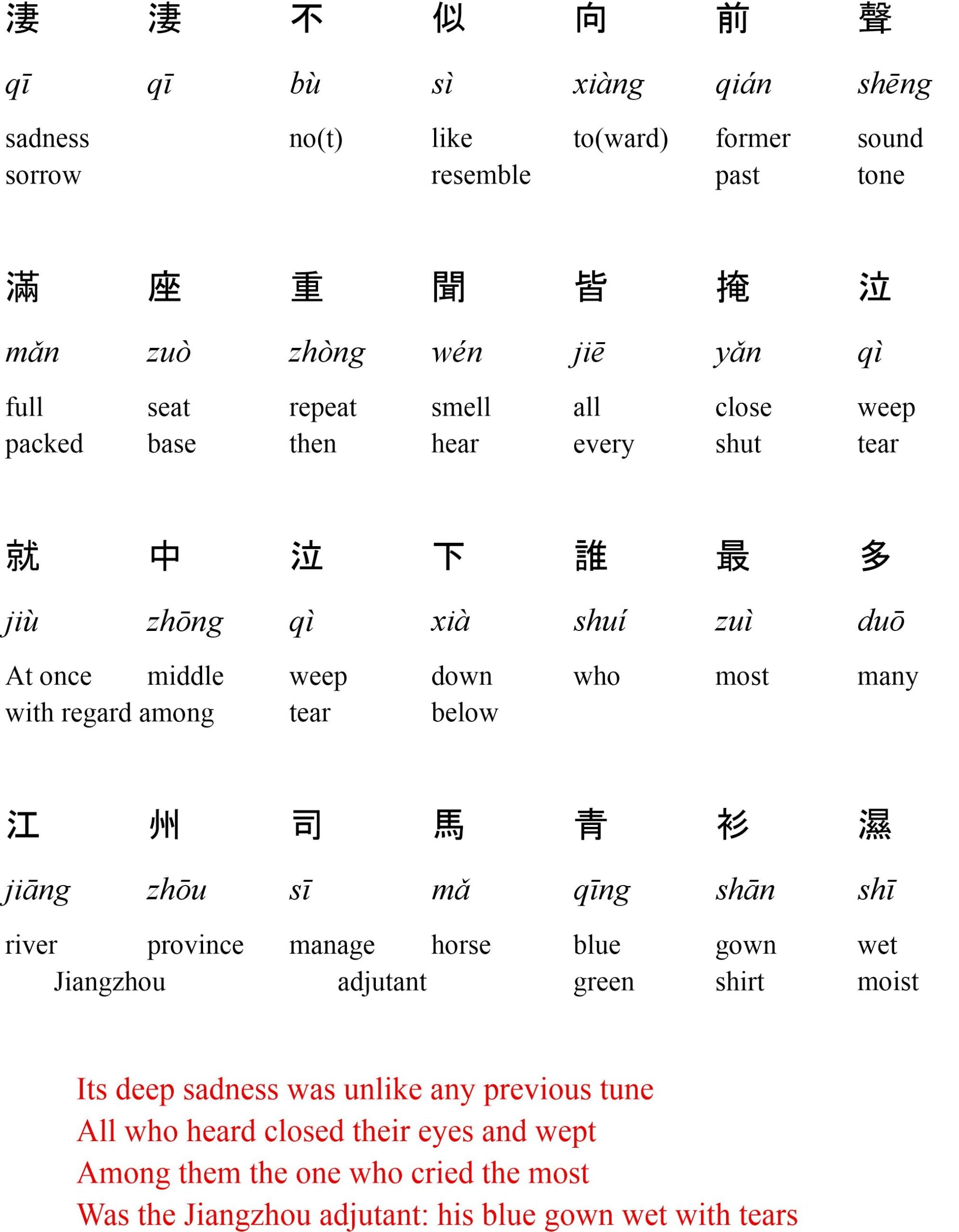
The poem is difficult to translate since its sound patterns are as important as its meaning (Peng, 2023; Yu & Chang, 2024). This post will provide some sense of the Chinese sound patterns of Bai Juyi’s poem with recitations by Pu Cunxin and accompanying pipa by Wu Yuxia, taken from a production by China Global Television Network. After Giles’ s initial prose version, most English translations have use blank verse and made some attempt to imitate the sounds of the original. The translation of Xu Yuanzhong (1987, 1994) uses rhyming hexameter couplets. The translations in red accompanying the character-by-character transcriptions in this post are mine; they are heavily indebted to the other available translations.

The Setting

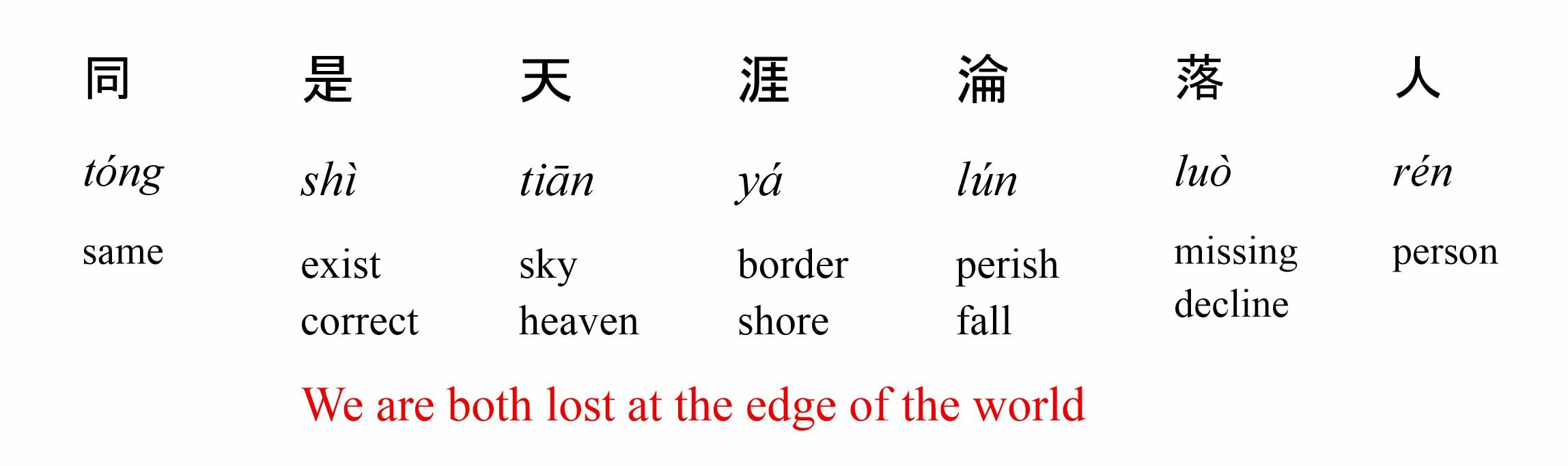
Bai Juyi provides his poem with a preface that sets the time and the place. During his banishment to JiuJiang, while saying farewell to a visitor one evening on the banks of the Yangtze, he hears the music of a pipa. He finds out that the player had once been a famous musician and courtesan at the court in Chang’an. However, as she had grown old, her beauty had faded, and she had retired unhappily to the provinces. Bai Juyi is struck by the similarity of his fate to hers, and mourns their mutual fall from grace:

Moved by her story, he writes a long poem about the pipa player on the river far from Chang’an

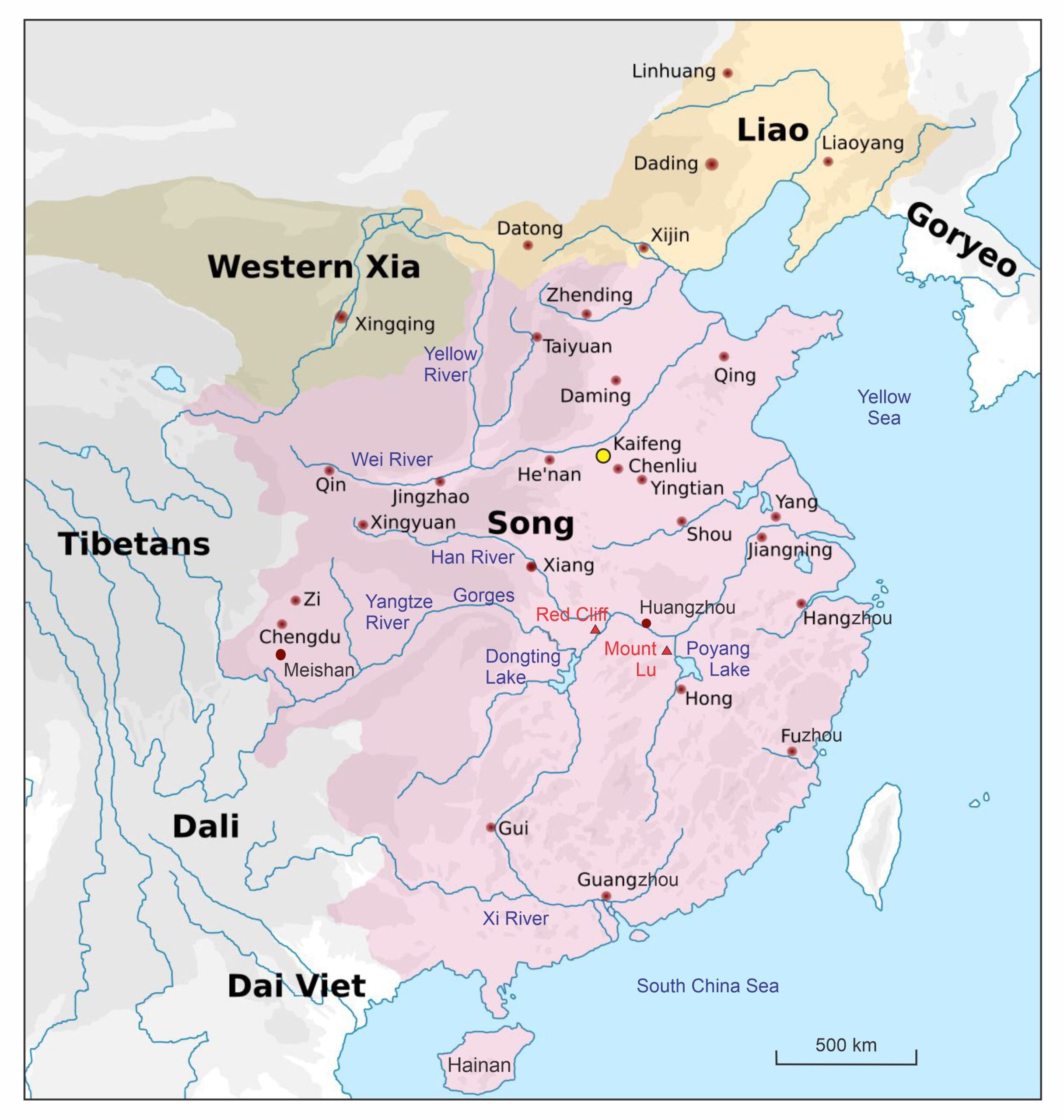
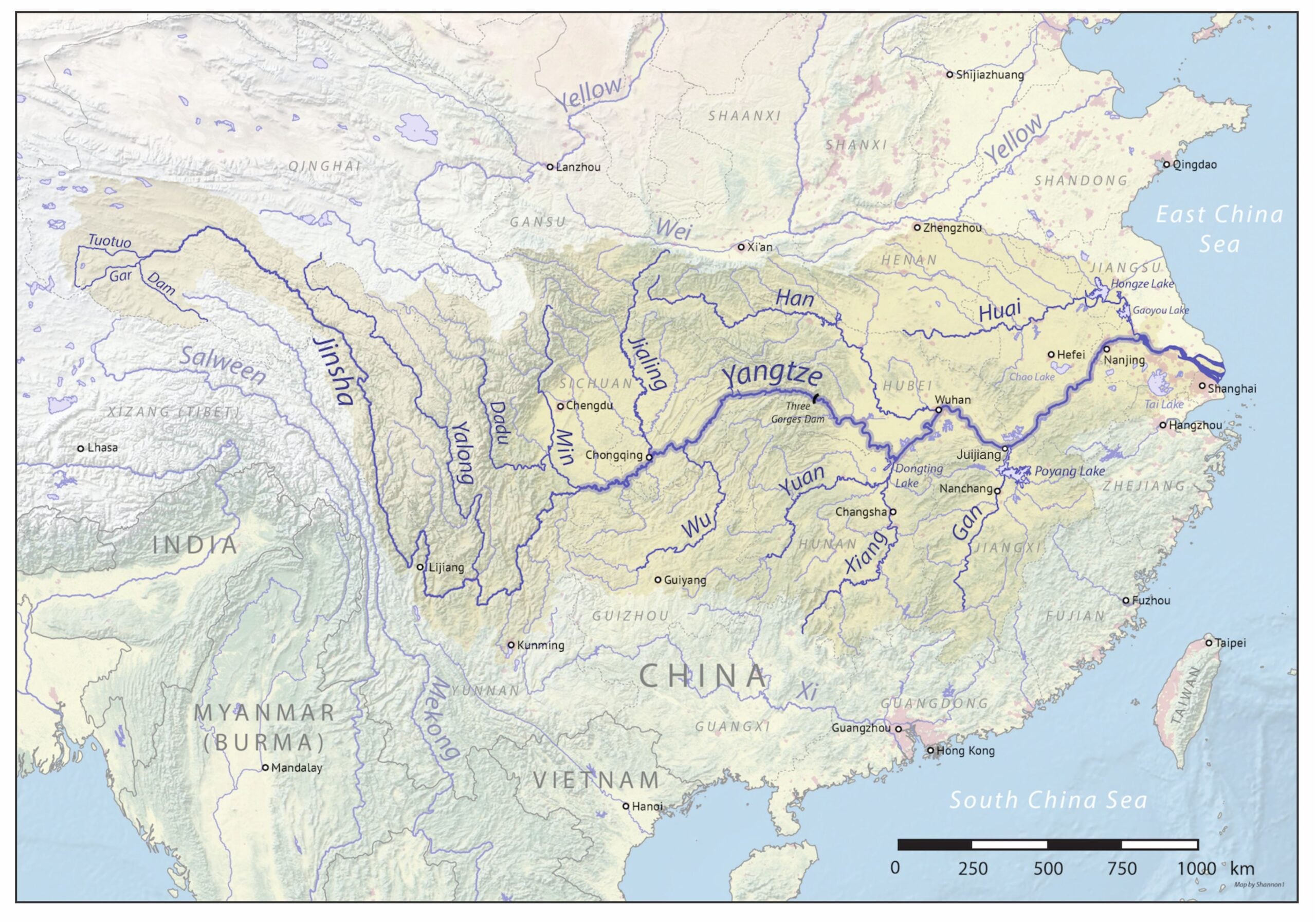
Jiujiang, which had once been known as Jiangzhou, is a city on the Yangtze River. The region of the river near Jiujiang was sometimes known as the Xunyang River. The Yangtze River, the third longest river in the world, is about 1.5 km wide at Jiujiang. Lake Pongyi, which was once called Pengli Lake, the largest freshwater lake in China, drains into the Yangtze at the eastern edge of the city:

Bai Juyi is throwing a farewell party for his departing friend on a small pleasure boat on the river. As shown in the following illustration from Hangzhou in eastern China, these small rowboats still provide spaces for celebrations on the waters. In Jiujiang it is autumn: the maple leaves have turned scarlet, and the plumes of the silver grass have reached their peak. 

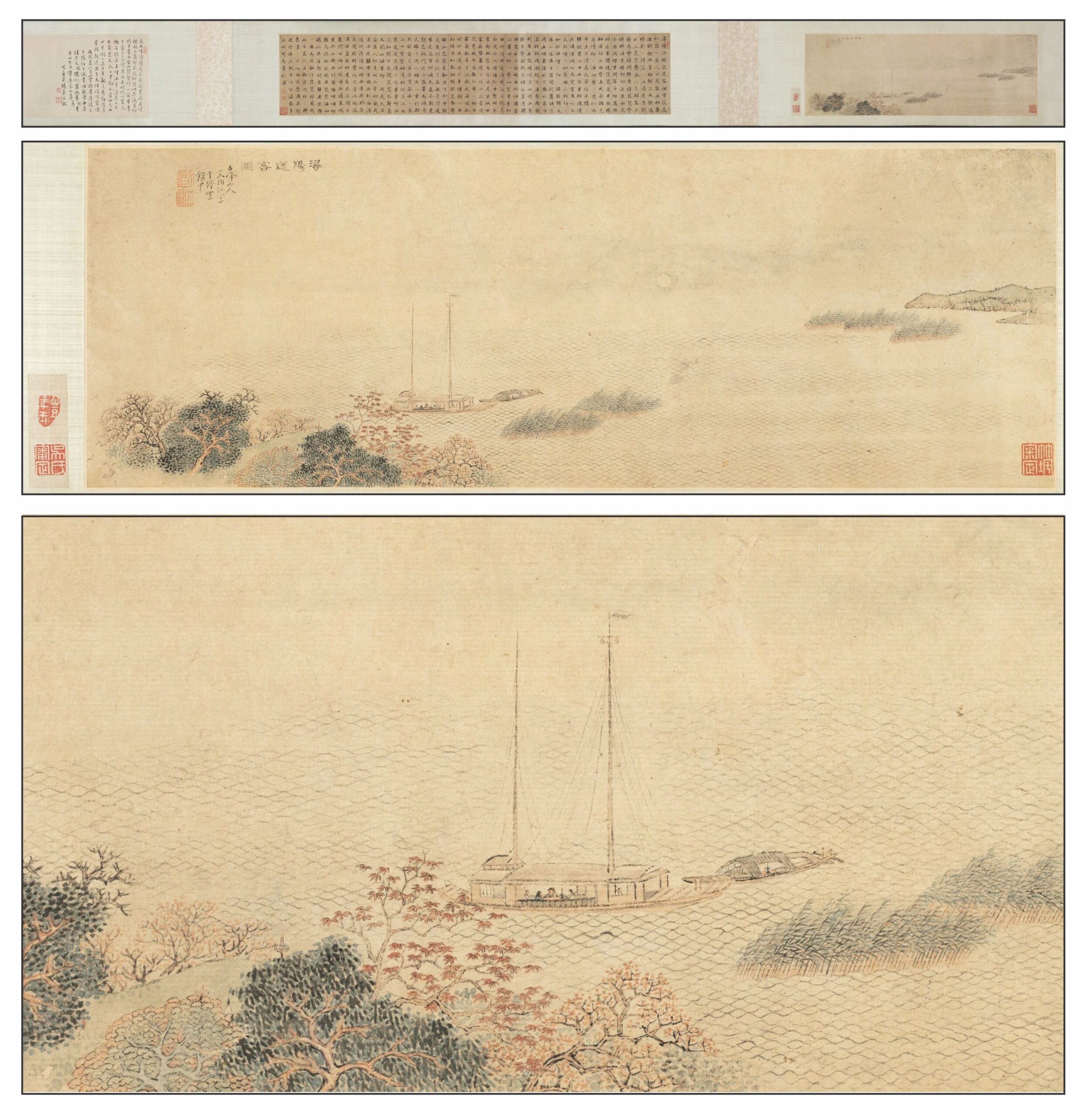
The following illustration shows a scroll with calligraphy of Pipa Xing by Wen Zhengming (1470-1559) at the National Palace Museum, Taipei. At the top is the painting at the beginning of the scroll. In the middle is an enlargement of the boat with the poet and his guest listening to the pipa player. At the bottom is the beginning of the calligraphy in semi-cursive (or running) script. The first line (on the left) has the title:

Beginning of the Ballad

The initial lines of the ballad describe the autumn leaves and the silver grass. The farewell party begins but there is no music:

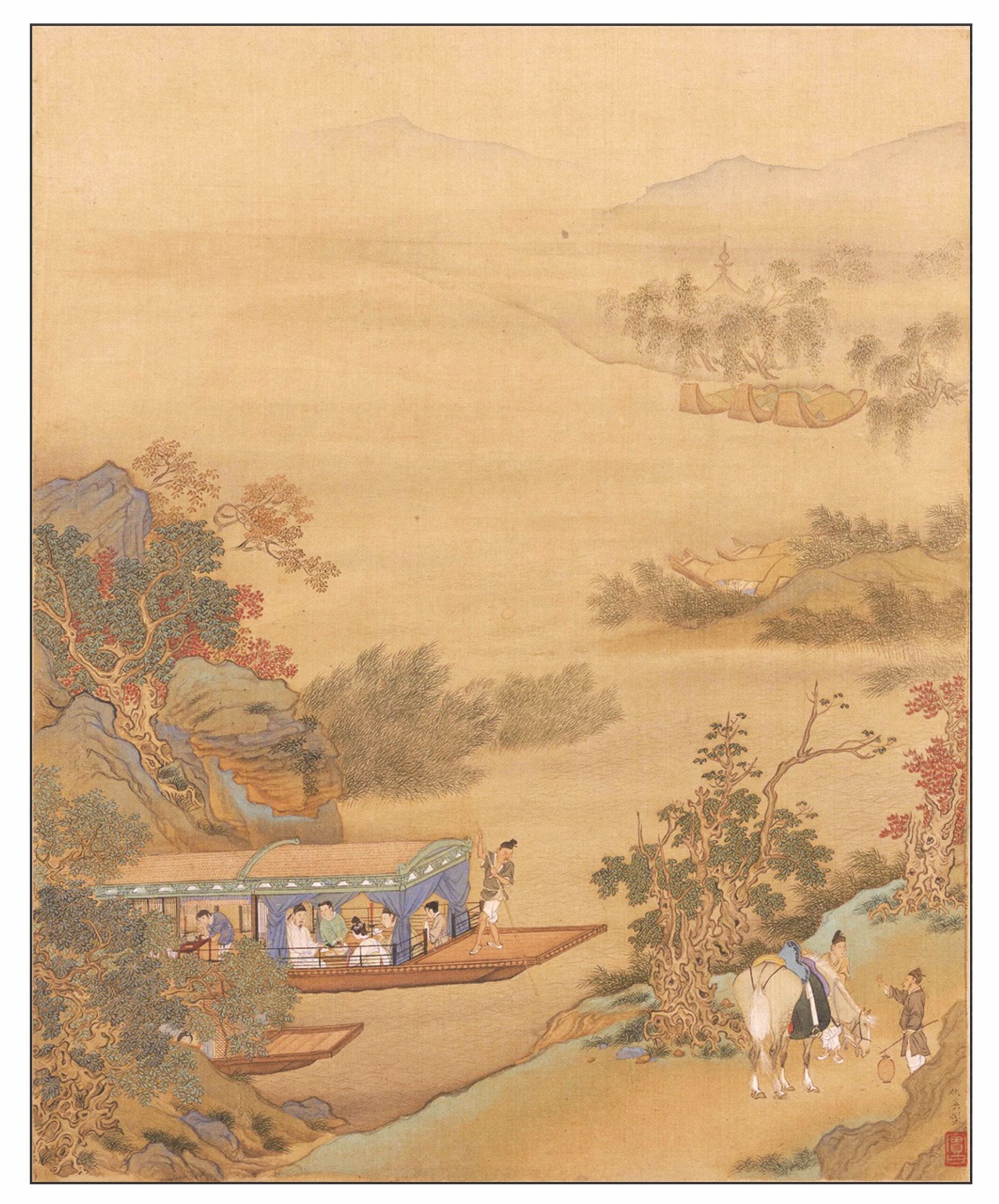
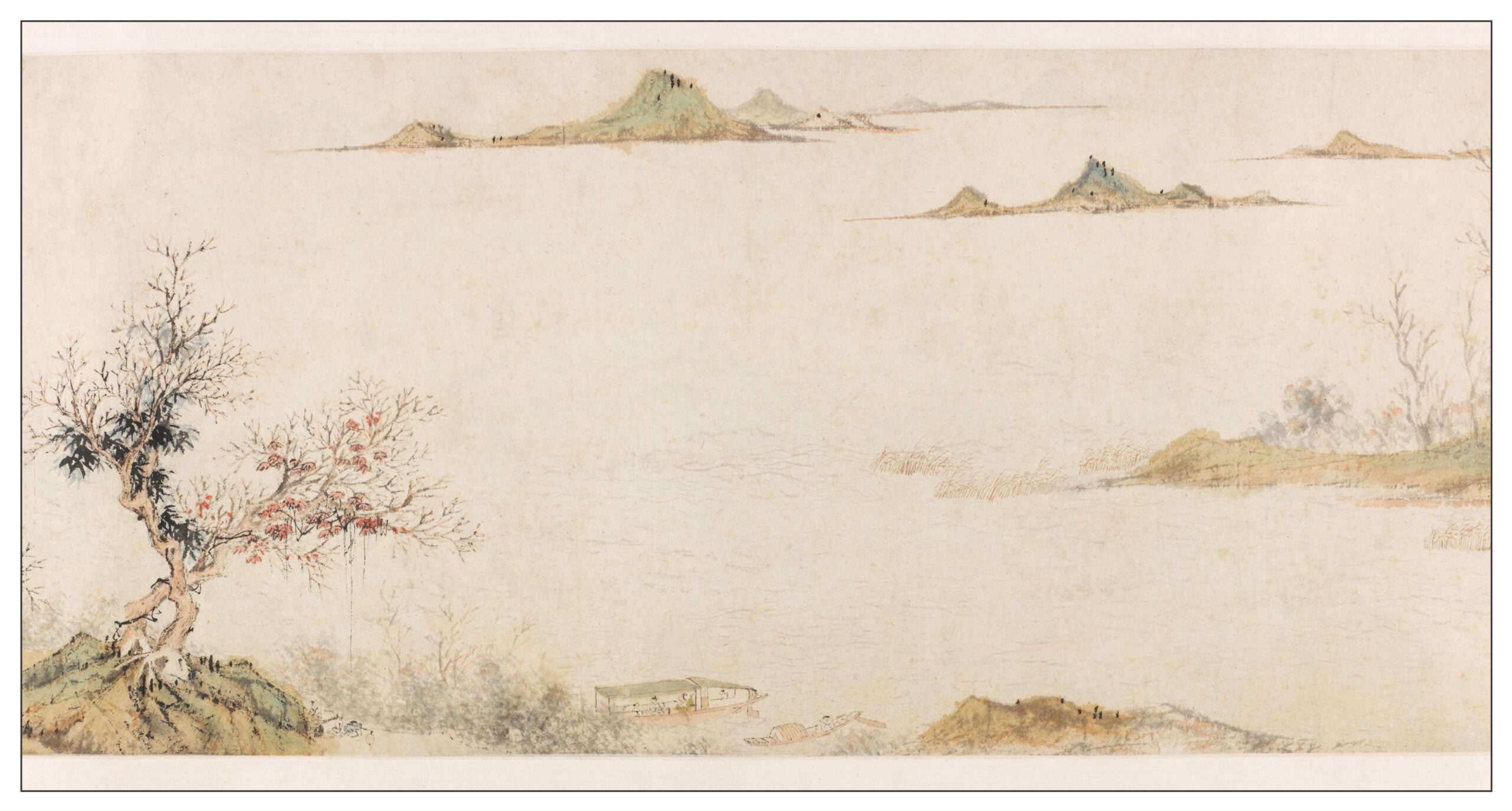
The opening scene of the poem was portrayed in a silk-painting (34 x 41 cm) in an album by Qiu Ying (1494-1552) now at the Palace Museum in Beijing:


The Pipa

As the party laments the absence of music, the sound of a pipa is heard across the water from another boat. The partygoers are completely entranced. They call out and ask the musician to play for them. She agrees but holds the pipa up to hide her face.

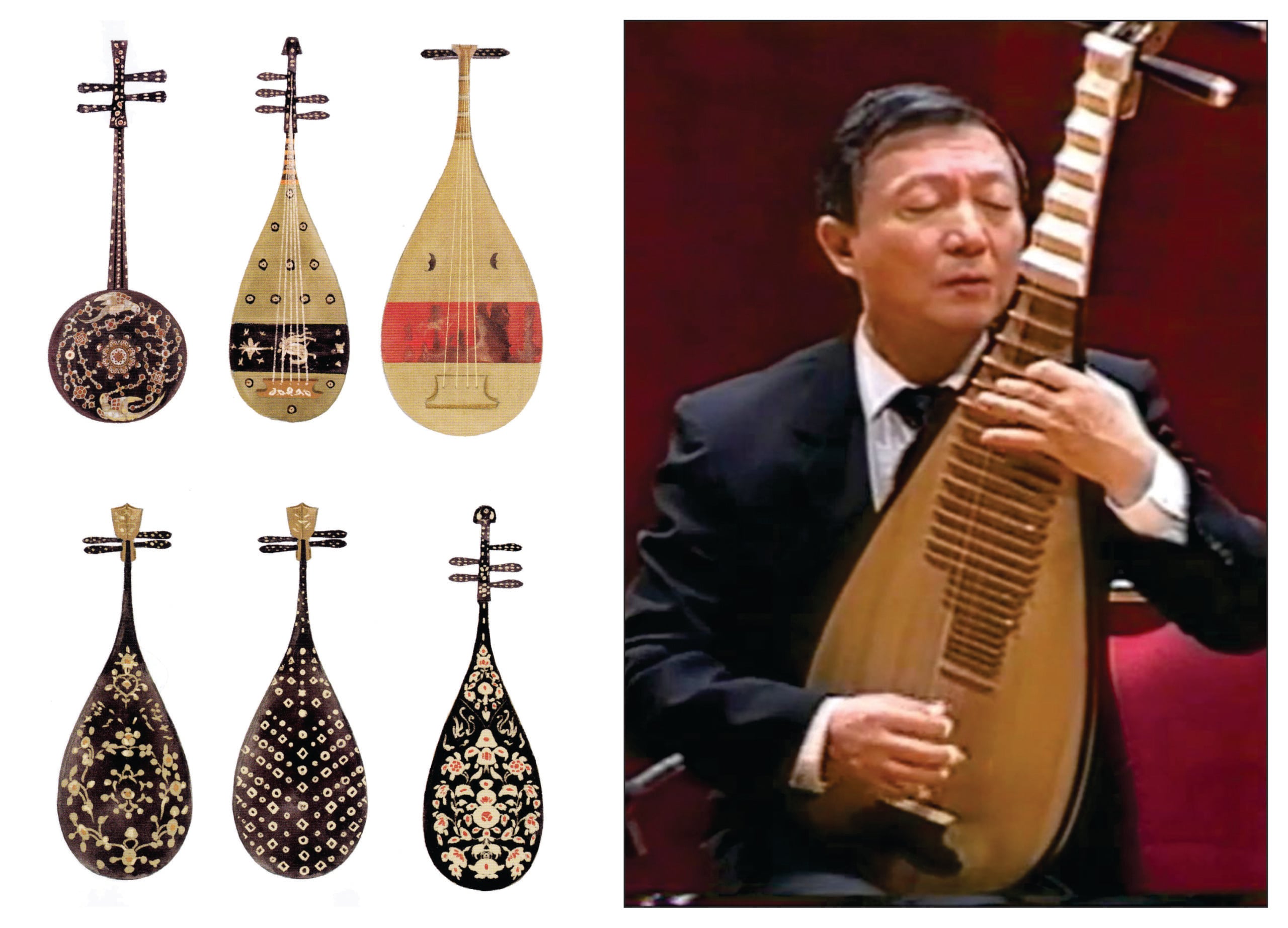
The pipa is a Chinese plucked string instrument very similar to the European lute (Wong, 2011). Both instruments have their origin in the Middle East. The pipa came to China via the Silk Roads during the Han Dynasty (206 BCE–220 CE). The instrument typically has 4 strings though some old pipas have 5. Though early pitas have as few as 4 frets, modern pitas can have up to 30. Though occasionally round, the body of the pipa is usually pear-shaped. Traditionally the pipa was played for small intimate groups, but in modern times electronic amplification has allowed pipa virtuosos to play for larger audiences. The following illustration shows some ancient pitas and a photograph of Liu Dehai (1937-2020), one the greatest pipa players of recent times.

The following is a performance of “Xunyang Moonlit Night” (阳月夜, Xúnyáng yuè yè) by Liu Dehai.

The Music

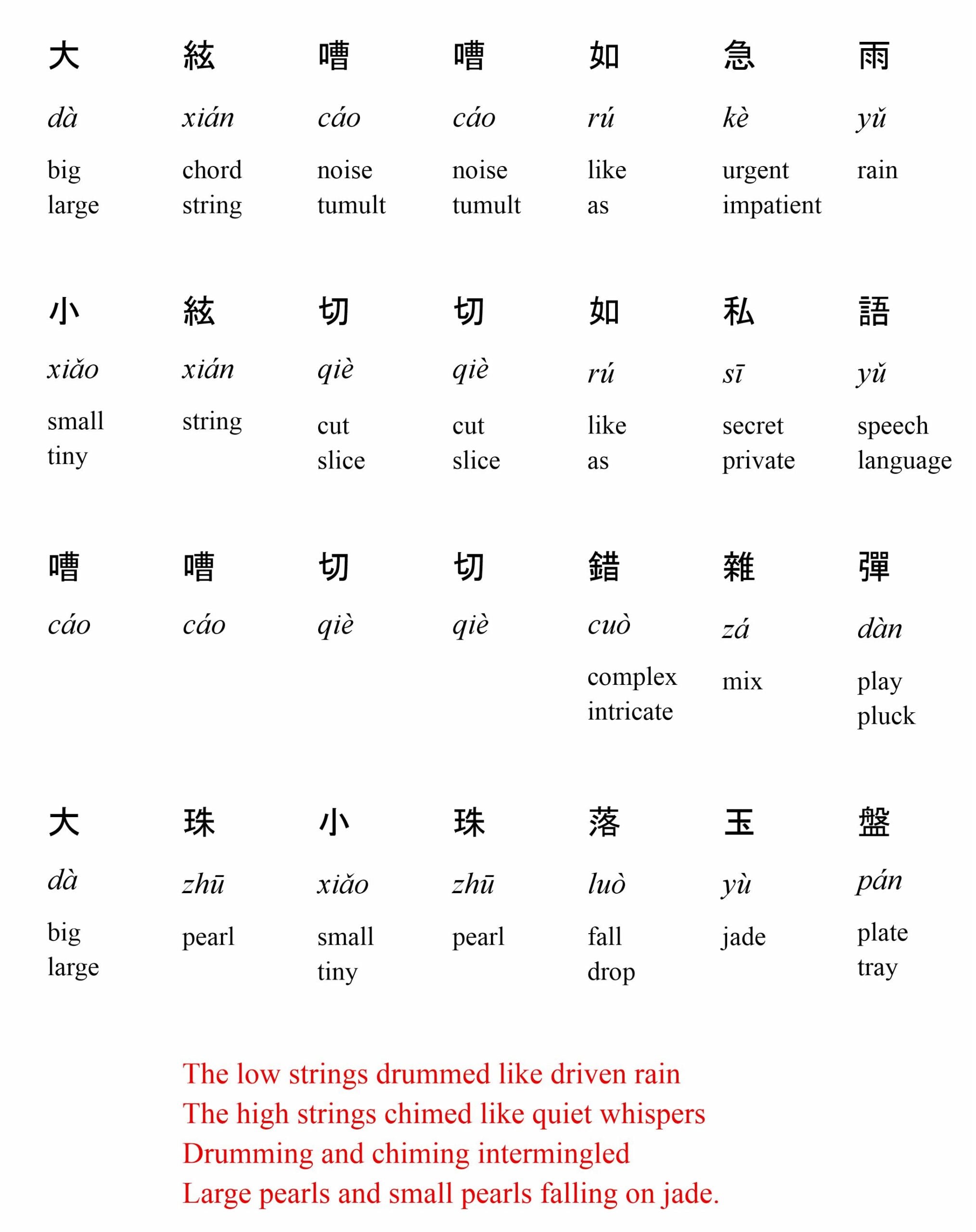
The poem then provides a bravura description of the music of the pipa:

These are some of the most famous lines of poetry in China. They have been variously translated. The following version by Xu Yuan-Zhong (1984; 1987) uses the same rhyme scheme as the Chinese poem:

The thick strings loudly thrummed like the pattering rain
The fine strings softly tinkled in murmuring strain.
When mingling loud and soft notes were together played,
’Twas like large and small pearls dropping on plate of jade.

Witter Bynner (1929) uses blank verse in his translation:

The large strings hummed like rain,
The small strings whispered like a secret,
Hummed, whispered—and then were intermingled
Like a pouring of large and small pearls into a plate of jade.

And the following translation is by Isabel Wong (2011), a musician rather than a poet:

The lowest string hummed like pouring rain;
The higher strings whispered as lover’s pillow talk.
Humming and whispering intermingled
I,ikc the sound of big and small pearls gradually falling into a jade plate.

The architects of the Oriental Pearl Tower (1994) in Shanghai based their design on Bai Juyi’s image of pearls falling onto jade:


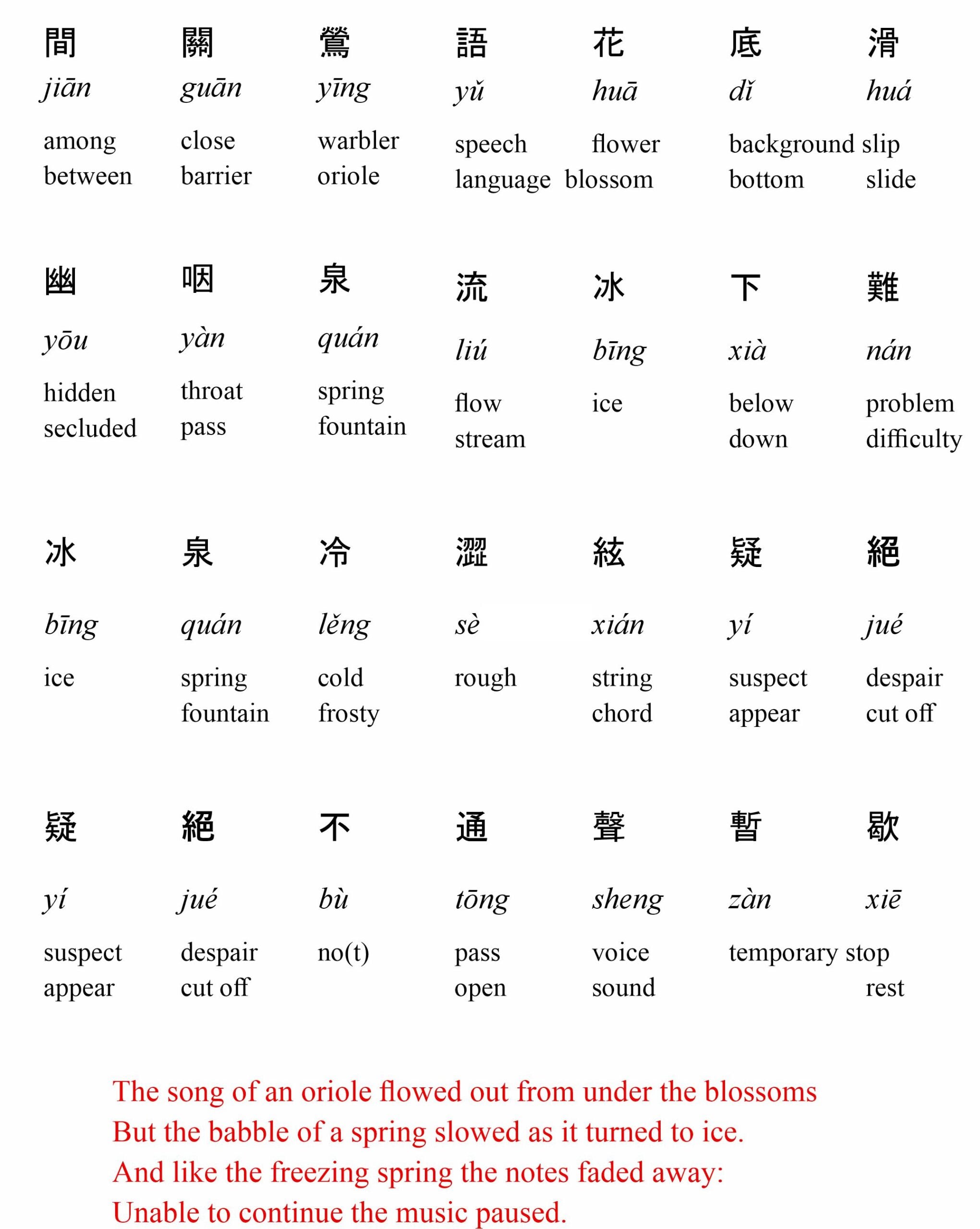
Following the music of the pearls, the pipa provides the quiet song of an oriole, and then like a freezing brook the music slows to a stop:


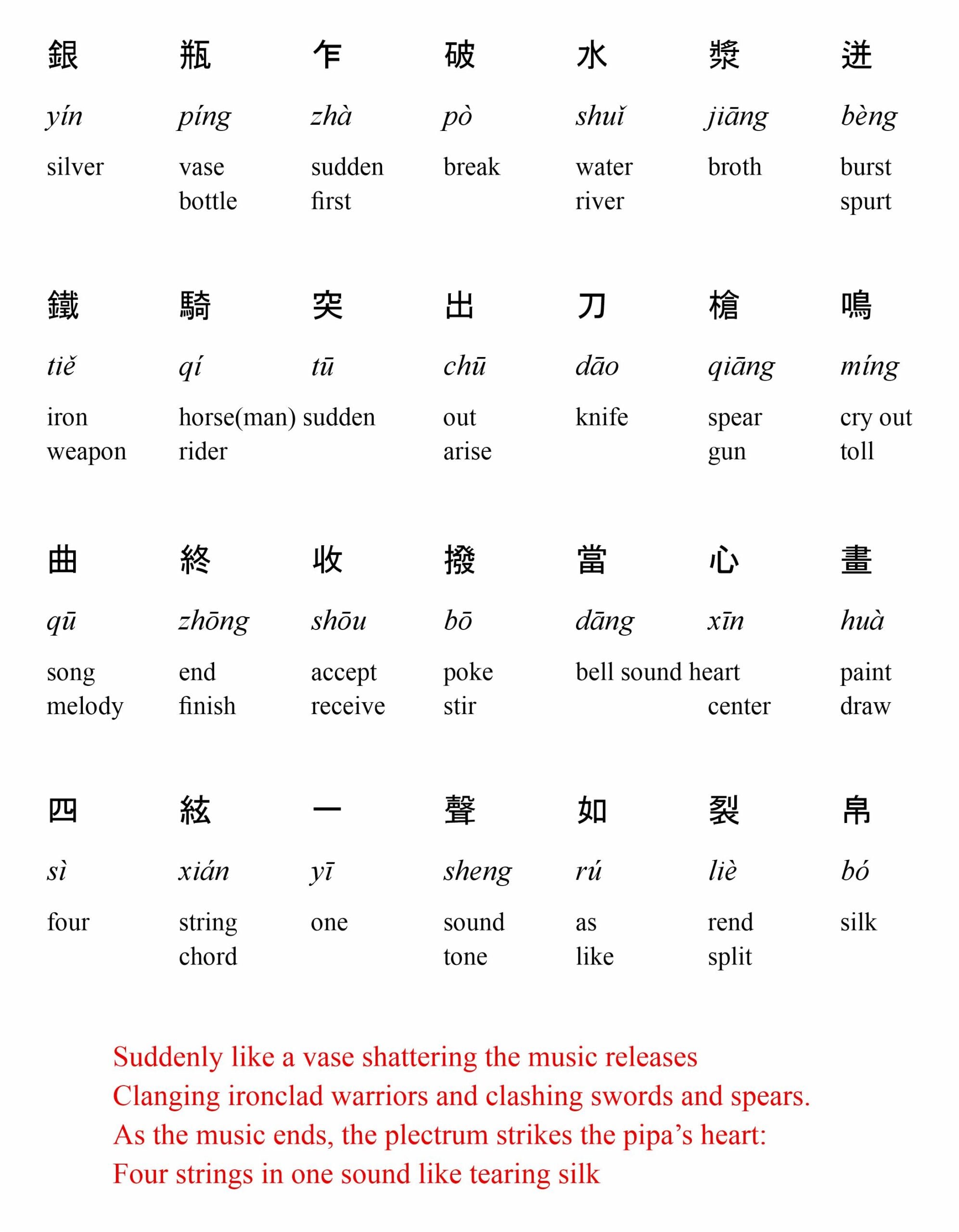
After a brief pause the pipa plays a wild crescendo that sounds like the charge of armored warriors, and then suddenly the player stops.


The Life of the Pipa Player

During the ensuing silence, the pipa player tells her story. She was once a highly acclaimed musician in Chang’an. Her beauty and her talent were the toast of the court.

This description of the life of a successful musician and courtesan in Chang’an has been translated in many ways. One version is especially vivid. In 1917, Ezra Pound (1885-1972) published Three Cantos in Poetry Magazine, and again in the American edition of his book Lustra. This was the beginning of a set of Cantos that ultimately numbered 109. These initial three cantos – often called the Ur-Cantos – were extensively revised when Pound published A Draft of XVI Cantos in 1925. Much of the original Canto II is no longer evident in the new sequence. The general theme of Ur-Canto II was the “poetics of loss” (Carr, 2018). Pound describes the ruins of the ducal palace in Mantua, and mourns the loss of most of the music of the troubadours. And then he provides a brief description of the setting of Bai Juyi’s poem and the words of pipa player:  

     Yin-yo laps in the reeds, my guest departs,
The maple leaves blot up their shadows,
The sky is full of autumn,
We drink our parting in saki.
Out of the night comes troubling lute music,
And we cry out, asking the singer’s name,
And get this answer:
                                   “Many a one
Brought me rich presents; my hair was full of jade,
And my slashed skirts, drenched in expensive dyes,
Were dipped in crimson, sprinkled with rare wines.
I was well taught my arts at Ga-ma-rio,
And then one year I faded out and married.”
The lute-bowl hid her face.
                              We heard her weeping.

It was not until much later that Pound’s allusion to Bai Juyi was recognized (e.g. in Weinberger, 2007, p 128; discussed on the Pound Cantos Project website)

Pound had no knowledge of the Chinese language. In his book Cathay (1915), he “translated” a set of 15 Chinese poems based on the notes of Ernest Fenollosa who had studied Chinese poetry with the Japanese professors Mori and Ariga. Despite his lack of training in Chinese, Pound intuitively grasped the essence of the poems (see discussion by Yip, 1969). The brief excerpt from Ur-Canto II is typical of his translations. The meaning is clear though the words are not the same as in the original.

In Pound’s poem, Yin-yo is the Japanese transliteration of Chinese characters for the Xunyang River (Romaji, Jinyō-kō), and Gamaryo is the Japanese version of 蟆陵, which literally translated is “Toad Hill” (Fuller, 2017, p 286). This is the region in Chang’an city near the burial site of the Confucian scholar Dong Zhongshu (179–104 BCE). In Bai Juyi’s poem, the pipa player says that this is where she grew up (and learned how to play the pipa).   

To return to the poem: The pipa player’s high life did not last forever. Her brother went off to the army, her mother died, her looks faded, and she was no longer as sought after as before. She married a tea-merchant and came to live in Jiangzhou. Her husband is usually away on business. Alone on her boat she plays the pipa and remembers happier days.

Listening to her story Bai Juyi feels an intense sympathy: he too has fallen from grace and now lives alone far away from the capital.  The musician plays a final intense song:

We do not know the music that Bai Juyi found so moving. The following is a piece entitled Night Thoughts composed and played by Wu Man (1963- ), who studied with Liu Dehai.

Wu Man’s composition derives from a famous poem by Li Bai, who spent much of his later life in exile from the capital. The following translation is by Xu Yuan-Zhong (1984, p 125).

靜夜思                    A Tranquil Night

床前明月光             Before my bed a pool of light
疑是地上霜             Is it hoarfrost upon the ground
舉頭望明月             Eyes raised I see the moon so bright
低頭思故鄉             Head bent in homesickness I’m drowned

The Life of the Poem

Bai Juyi’s poem was popular among calligraphers and artists. The following is a scroll by Wen Boren (1502-1575) now in the Cleveland Museum.

And the next illustration is a painting by Lu Zhi (1495-1576), from a calligraphy scroll now in the National Museum of Asian Art at the Smithsonian Institution. The boats near the lower shore are as lost as the poet and the pipa player:

And the following is an illustration by Hua Zhangyi from a retelling of Bai Juyi’s poem (Liu Yang, & Hua Zhangyi, 2024) for children: the poet dedicates his poem to the pipa player.


References

Bynner, W. & Kiang Kang-Hu, (1929). The jade mountain: a Chinese anthology, being three hundred poems of the T’ang dynasty, 618-906. Alfred A. Knopf.

Carr, H. (2018). The Ur-Cantos. In R. Parker (Ed.) Readings in the Cantos. (pp 9-32). Clemson University Press.

Fuller, M. (2018). An Introduction to Chinese Poetry: From the Canon of Poetry to the Lyrics of the Song Dynasty. Harvard University Asia Center.

Geng, L. (2021). The four great Tang poets. In A Comprehensive Study of Tang Poetry II (pp. 1–42). Routledge.

Giles, H. A. (1884, revised 1923). Gems of Chinese Literature. Bernard Quaritch

Harris, P. (2009). Three hundred Tang poems. Alfred A. Knopf (Everyman’s Library)

Liu Yang, & Hua Zhangyi, (2024). 琵琶行 (Pipa Song). CITIC Press.

Peng, Y. (2023). A comparative study on two English translations of Song of a Pipa Player from the perspective of translation aesthetics. Frontiers in Humanities and Social Sciences, 3(4), 36-40.

Pound, E. (1915). Cathay. Elkin Mathews.

Pound, E. (1917a). Three Cantos II. Poetry, 10 (4), 180-188

Pound, E. (1917b). Lustra of Ezra Pound: with earlier poems. Alfred A. Knopf.

Tan, M. A. (2025). Bai Juyi and Yuan Zhen. In Z. Zhang & V. H. Mair (Eds.) Routledge Handbook of Traditional Chinese Literature (pp. 151–161). Routledge.

Waley, A. (1949, reprinted 2005). The Life and Times of Po Chu-i. Routledge.

Watson, B. (1984) The Columbia book of Chinese poetry: from early times to the thirteenth century. Columbia University Press.  

Weinberger, E. (Ed.). (2007). The New Directions Anthology of Classical Chinese Poetry. Carcanet.

Wong, I. (2011). The Music of China. In Capwell, C., Nettl, B., Bolman, P., Dueck, B., Rommen, T., Wong, I., & Turino, T. (Eds.). Excursions in World Music, 6th Edition. (pp 88-131). Taylor & Francis

Xu, Y., Loh, B., & Wu, J. (1987). 300 Tang poems: a new translation. The Commercial Press.

Xu Yuan Zhong (1994). Songs of the immortals: an anthology of classical Chinese poetry. Penguin Books in association with New World Press.

Yip, W. (1969). Ezra Pound’s Cathay. Princeton University Press.
Yip, W. (2004). Chinese Poetry: An Anthology of Major Modes and Genres. (2nd ed., Revised).  Duke University Press.

Yu, Y., & Chang, C. (2024). Text complexity and translation styles from the perspective of individuation: a case study of the English translations of Pipa Xing. Humanities & Social Sciences Communications, 11(1), Article 159.


Silk Roads: Paths for the Faithful

The Silk Roads were overland routes connecting China to the Mediterranean Sea, which allowed the trading of silk, paper, gold, jewels, horses, and other goods. These began during the 2nd Century BCE at the time of the Roman Empire in the West and the Han Dynasty in the East. The Silk Roads remained active until the 15th Century CE, when they were largely replaced by maritime trading routes. At present they are mainly used for archeological research and tourism. The illustration shows a modern camel caravan in the desert near Dunhuang. As well as trade goods, the Silk Roads facilitated the movement of religious ideas. Judaism, Zoroastrianism, Buddhism, Manichaeism, Christianity, and Islam followed the Silk Roads into China. Mithraism, Manichaeism and Islam spread into Europe.   

Central Asia

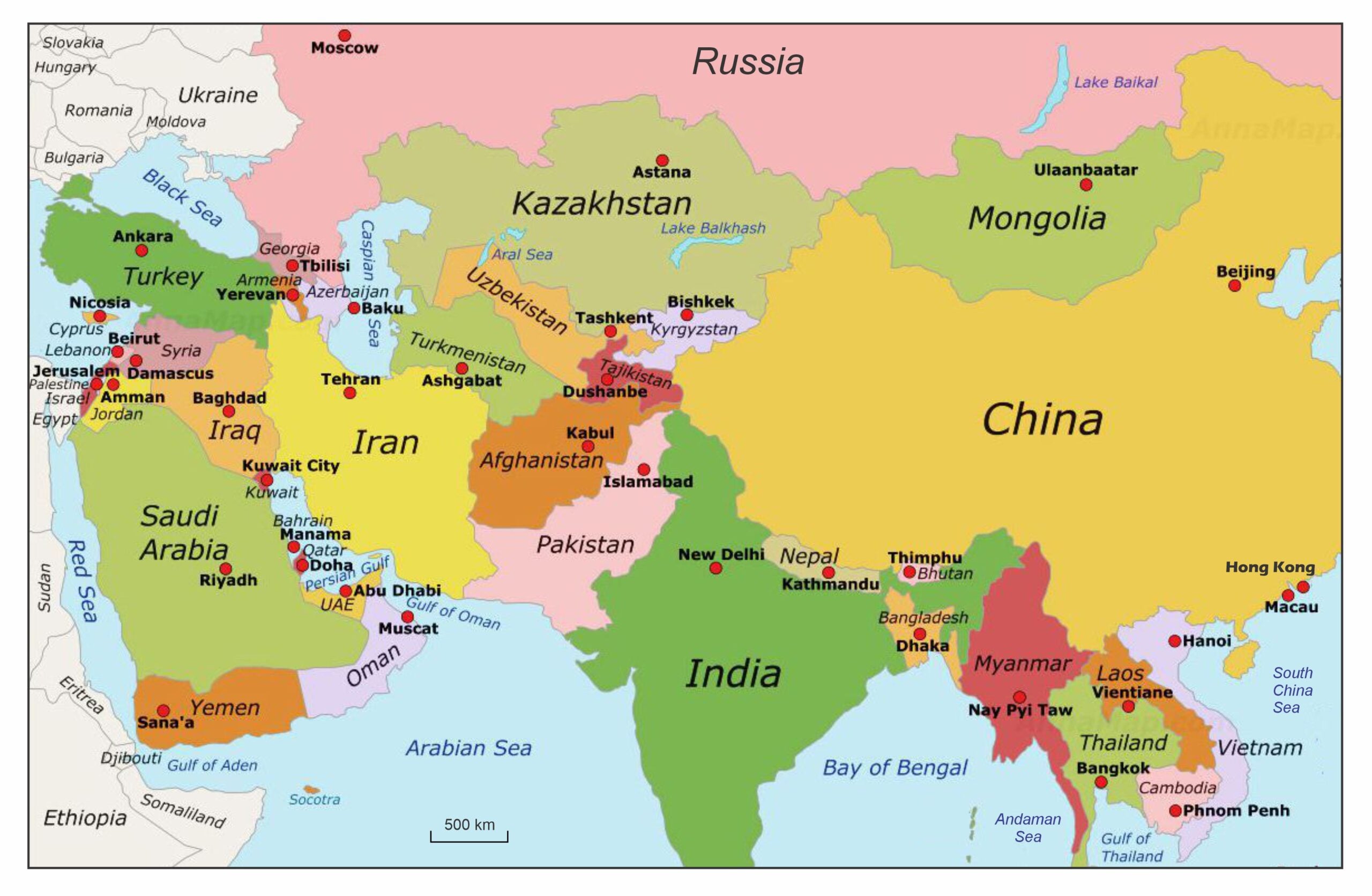
A map of the present political boundaries in central Asia will allow us to get our bearings:

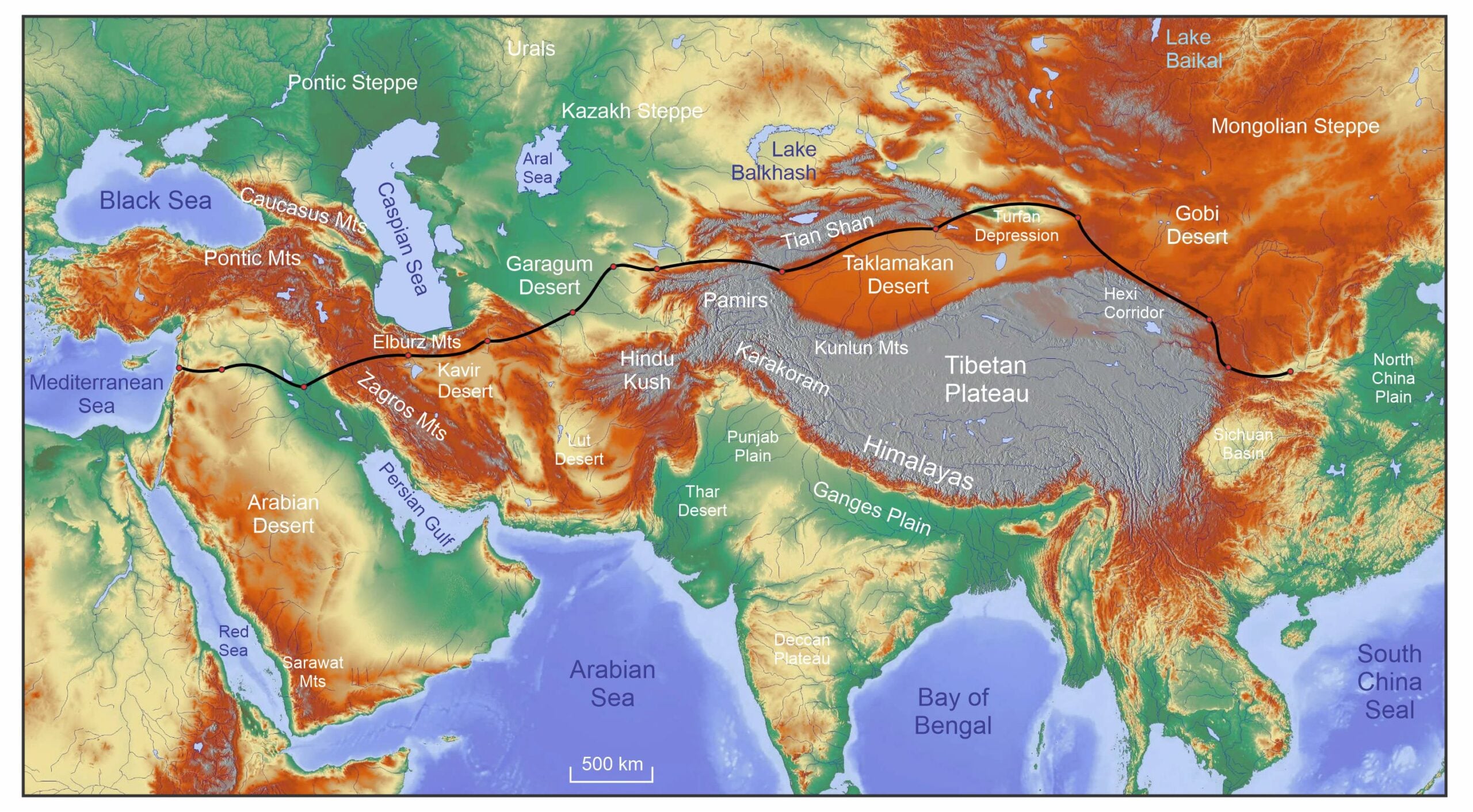
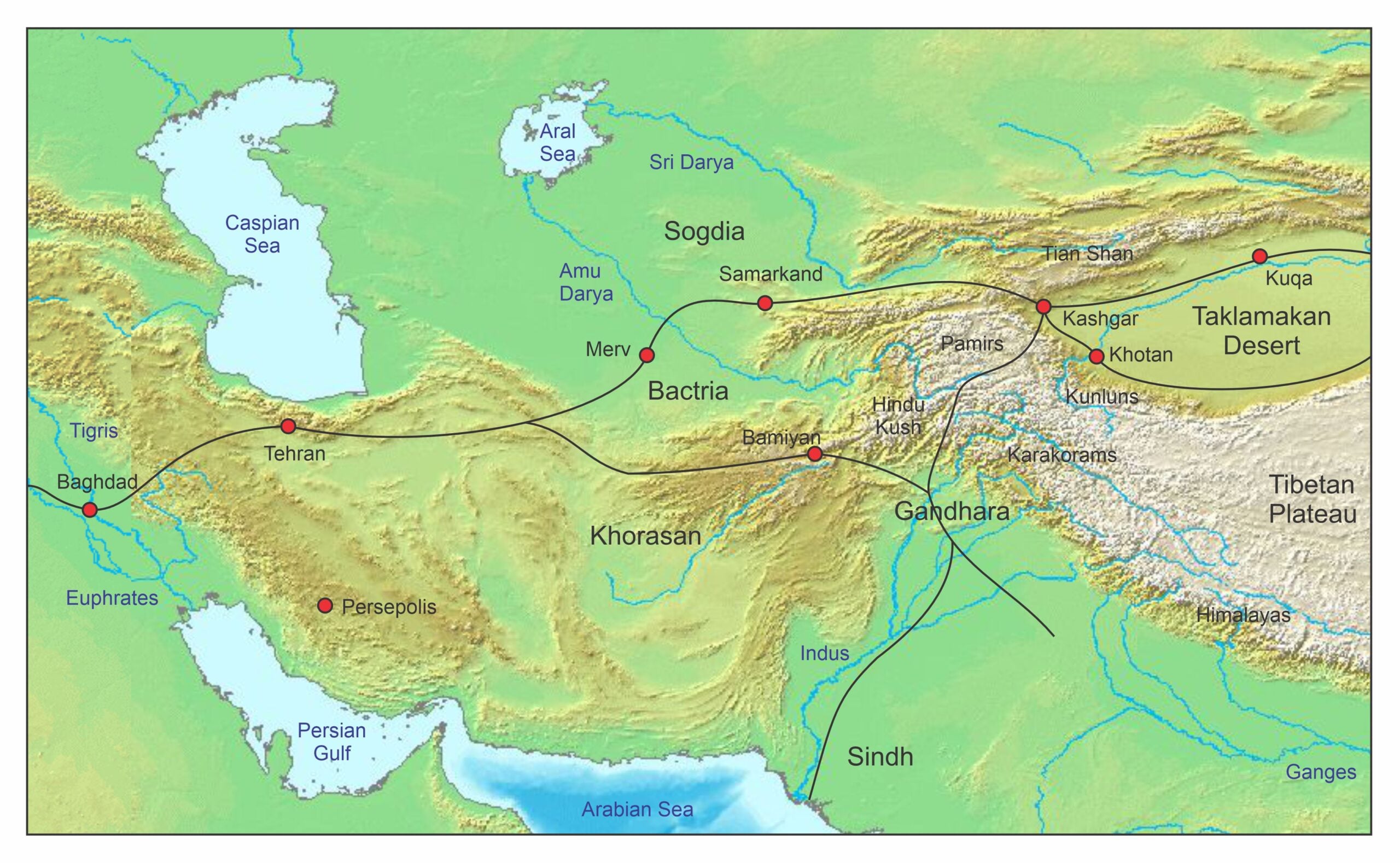
The following map shows the topography of the region and traces one of the many possible Silk Roads from Chang’an (Xi’an) in China to Tyre on the Mediterranean.

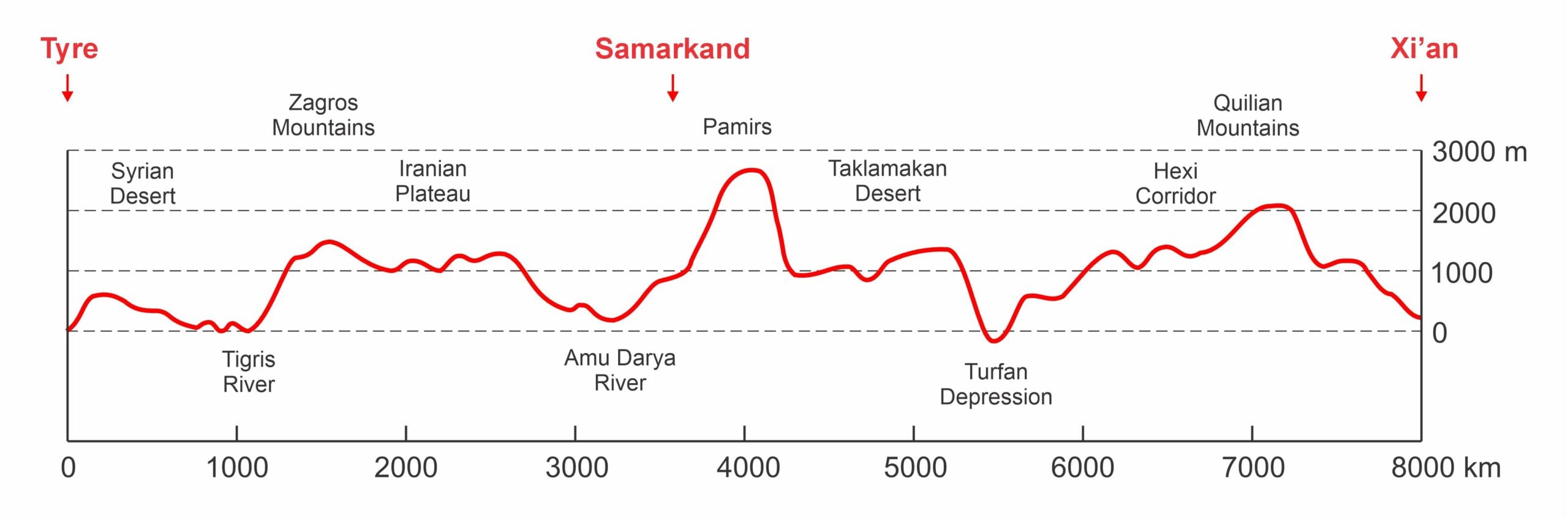
The following diagram, modified from Wood (2002), shows the changes in altitude (in meters above sea level) over the journey. It also notes the main mountains that are traversed, the deserts that are crossed and the main rivers on the way.  

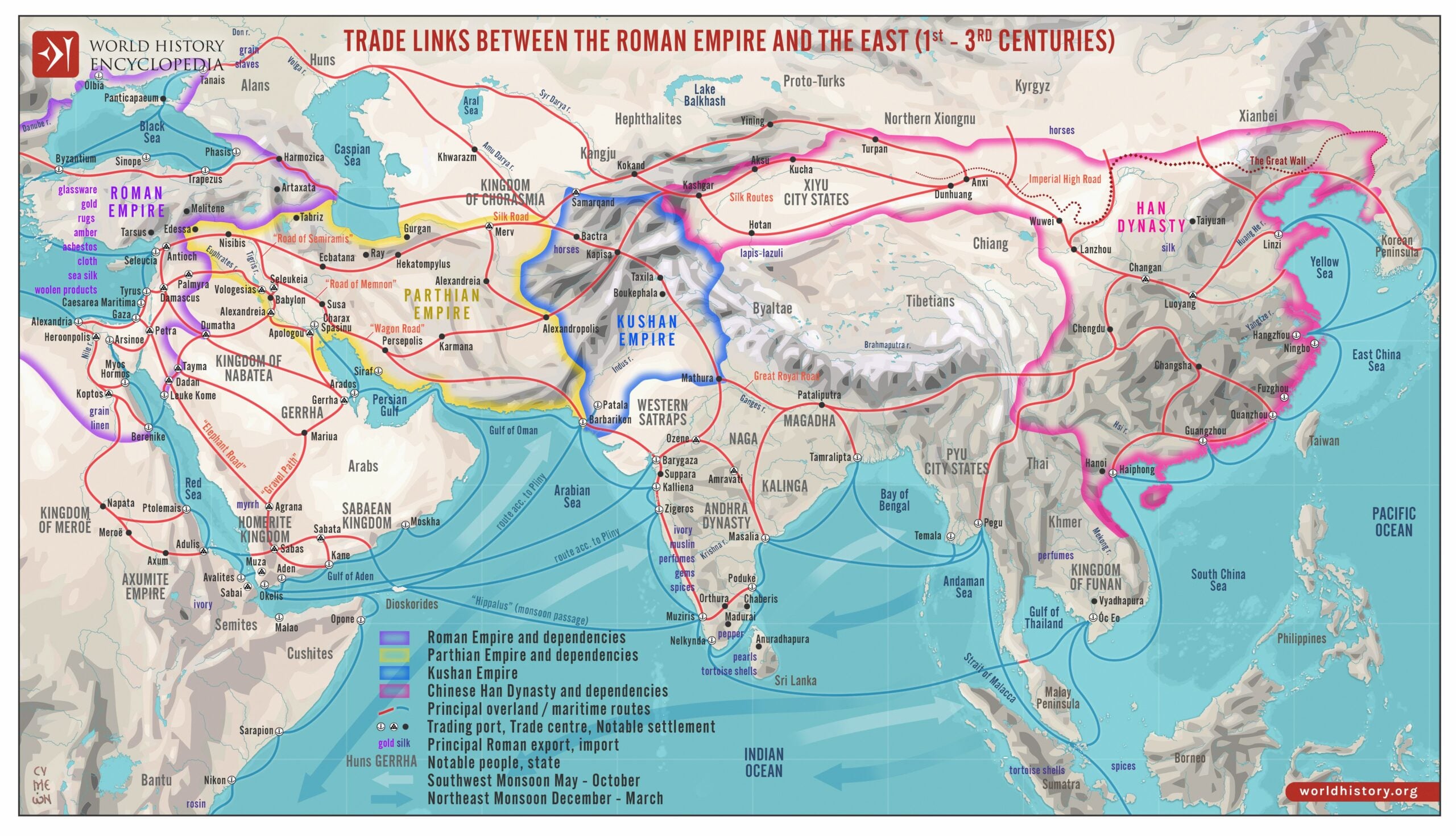
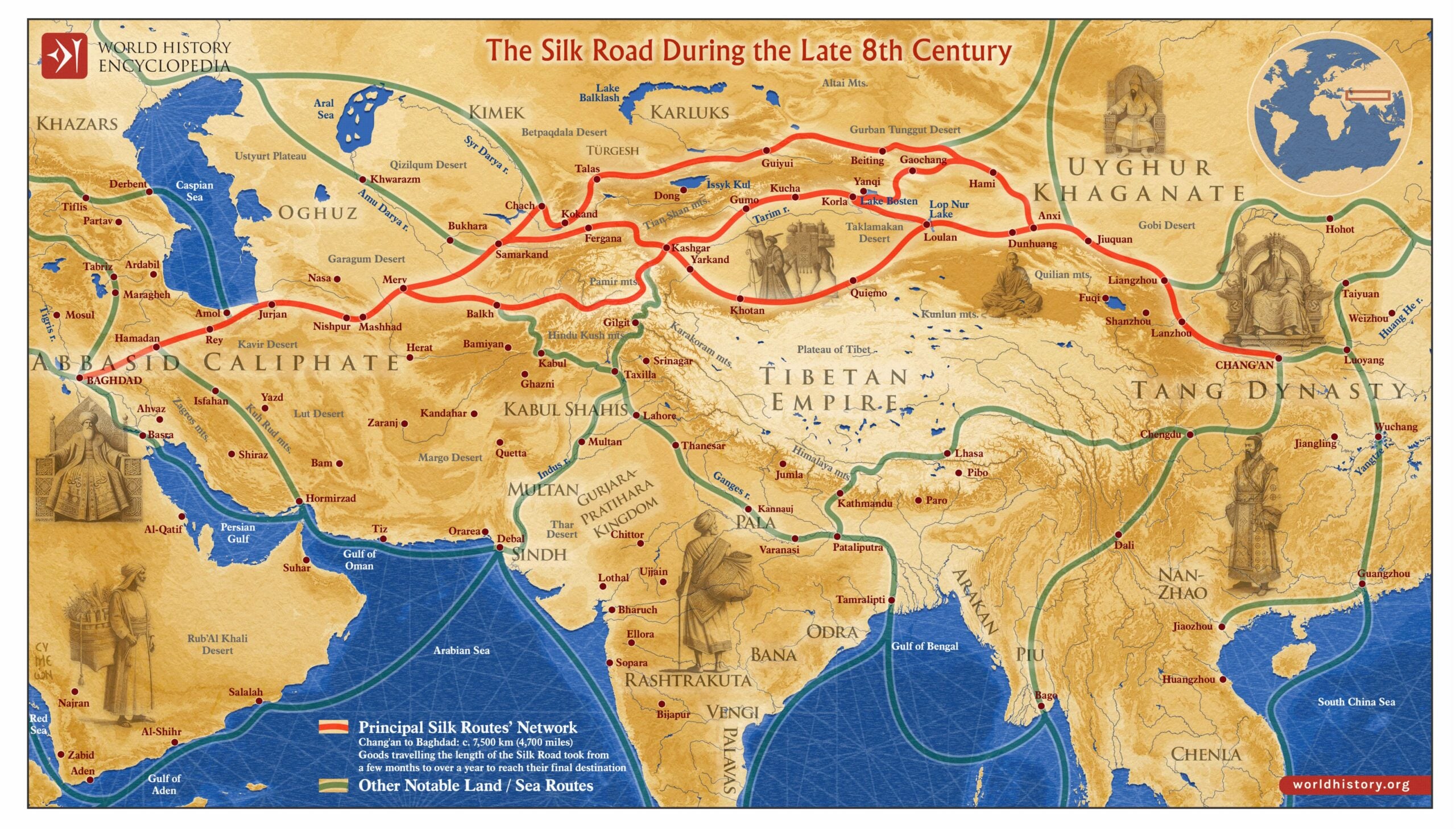
The Silk Roads spanned some 8000 km and were active for about 1700 years. They are described in multiple recent books (Frankopan, 2016; Hansen, 2017; Millward, 2013, Torr, 2018, Whitfield, 2024; Wood 2002). A striking TV series from Japan can be downloaded from archive.org. The following two maps by Simeon Netchev show the Silk Roads at two different points in time: the first map when trade began between the Roman Empire and the Han Dynasty in the 1st Century BCE, and the second map when the Silk Roads were at their height during the late 8th Century CE with the Tang Dynasty in China and the Abbasid Caliphate in the West. The first map also shows the maritime routes connecting China, India and Europe, and the monsoon winds that facilitate them. These sea connections are sometimes considered the “Golden Road” (Dalrymple, 2025, pp 4-5).

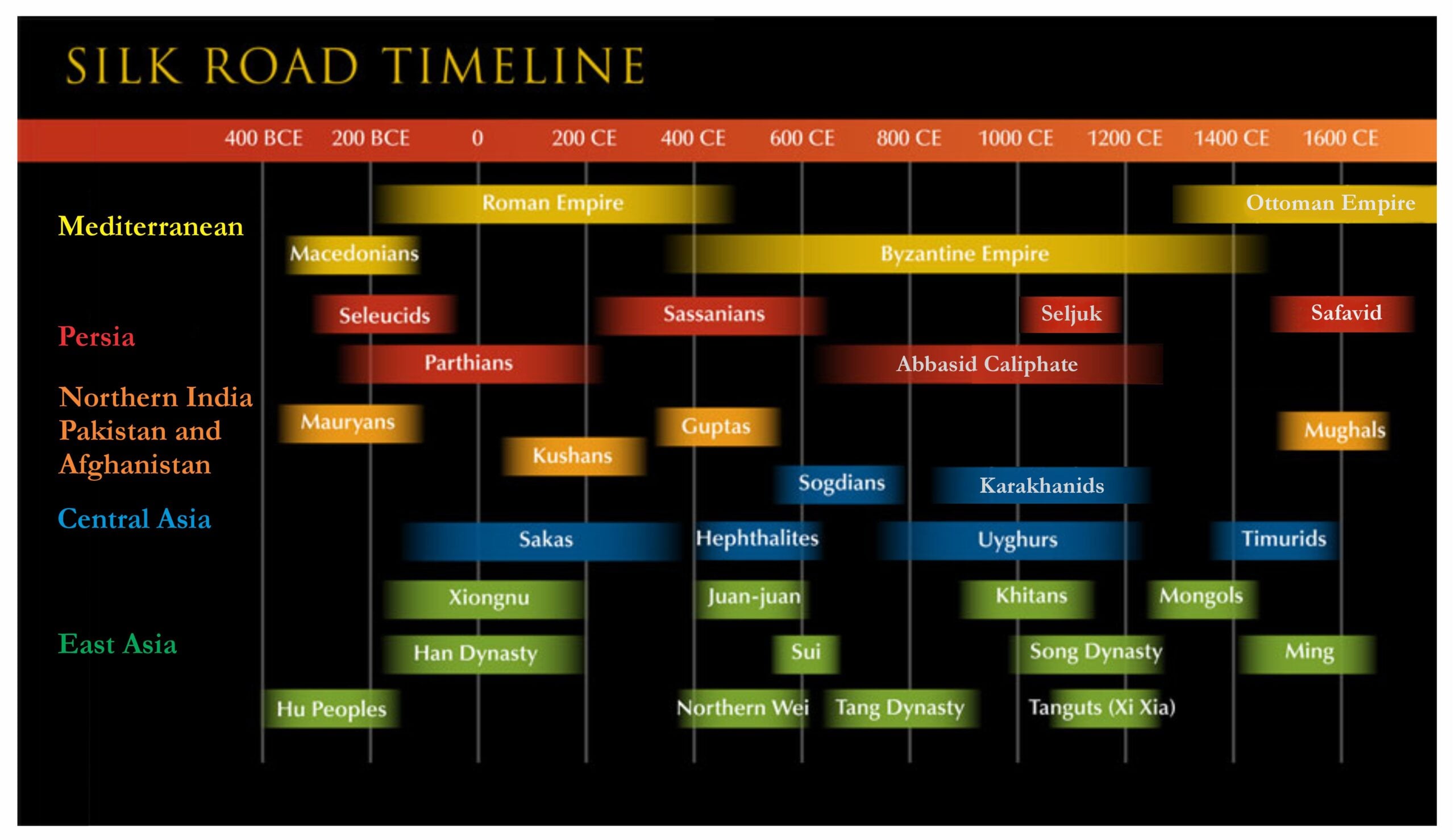
The Mongol Empires (1206-1368) supported trade along the Silk Roads. However, in the 14th Century CE the Mongol Empires fragmented, and the expansion of the Ottoman Empire (1299-1922) blocked overland connections between the Silk Roads and Europe. Trade between China and Europe continued using the maritime routes. Vasco da Gama made his first voyage from Portugal to India around the Cape of Good Hope in 1497. The overland Silk Roads soon became used only for local trade, and desert sands reclaimed many of the ancient trading posts (Beckwith, 2009, pp 232-262; Torr, 2018, pp 105-126).    

Many different empires established themselves for periods of time in central Asia (Beckwith, 2009). The following diagram, modified from Waugh (2009), shows some of the most important. Though having its capital in the east, the Mongol Empire (1206-1368 CE) extended all the way to Europe. 


The Library at Dunhuang

Since it will play a role in much of what will be said about the movement of religions along the Silk Roads, we shall briefly mention the Mogao Caves at Dunhuang (墩, dūn, tumulus/mound + 煌,huáng, shining/brilliant). Dunhuang, located on an oasis containing Crescent Lake and is surrounded by sand dunes, was an important stop on the Silk Road from the time of its beginning in the 2nd Century BCE (Hansen, 2017, pp 288-335). Nearby is the Jade Gate – an opening in the Great Wall of China that allows entrance to the Hexi Corridor connecting the cities of Chang’an and Luoyang to the deserts of Xinjiang in Western China.

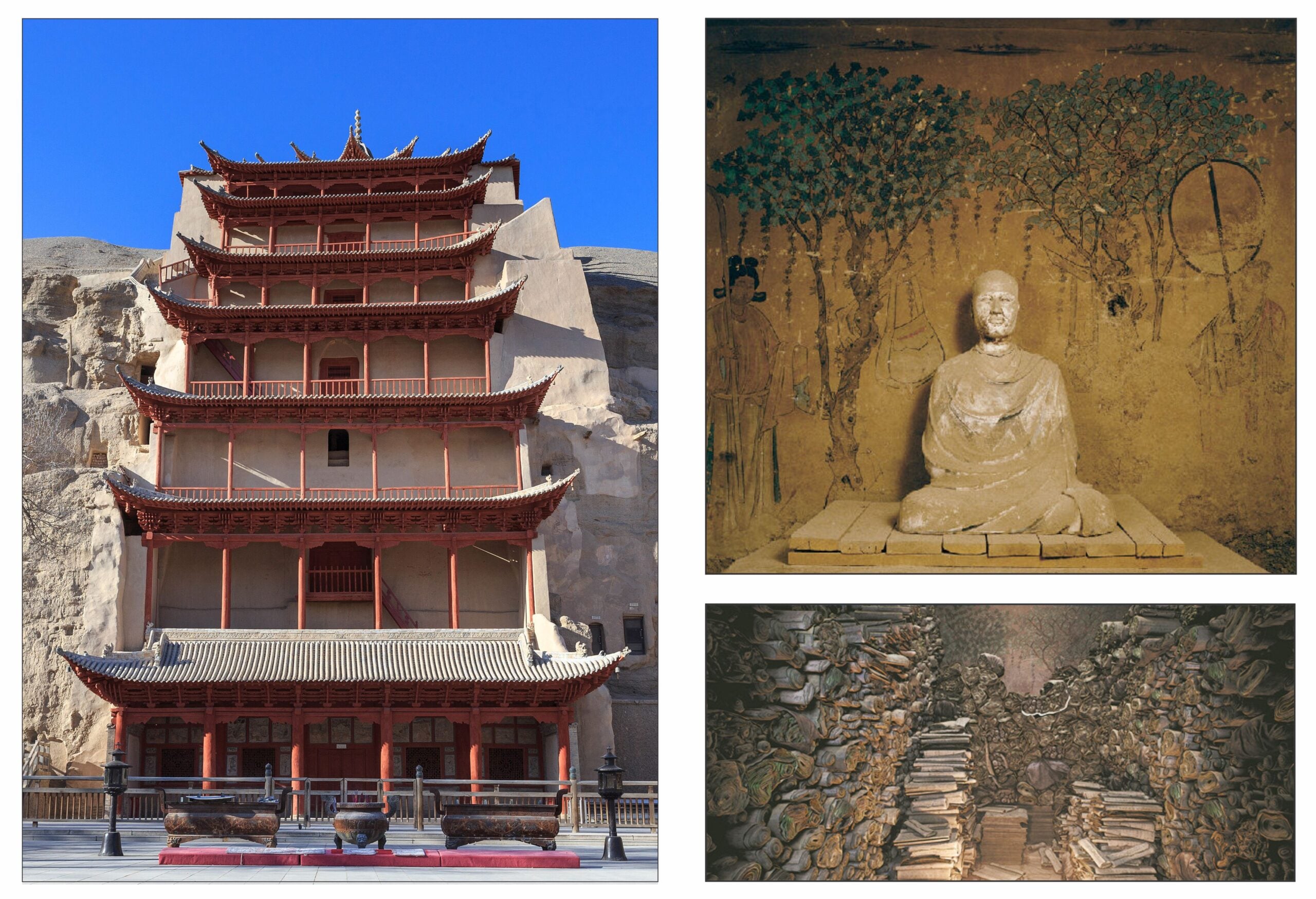
Buddhist monks first arrived in Dunhuang in the early centuries of the common era. In the 4th Century CE, they began carving caves into of the sandstone cliffs 25 km southeast of the city. These Mogao Caves – “Caves of a Thousand Buddhas” – are a system of about 500 separate temples decorated with wall paintings and sculptures and connected by intricate stairs and platforms. By the 9th Century, the monk Hong Bian had made the Three Realms Monastery near the caves into an important center of learning. When he died, his statue was placed in Cave 17. On the wall behind him were painted two banyan trees with a water bottle and a cloth bag hanging on the branches. Under one tree an acolyte holds a fan; under the other, a disciple holds the monk’s staff.

In 1002 CE the Karakhanids spread into the Taklamakan Desert and destroyed the Buddhist City of Khotan (Sinor, 1990). Though they had once followed both Buddhism and Christianity, the Karakhanids had converted to Islam in 934 CE and considered all other faiths as infidels. Fearful that Dunhuang might also be destroyed, the monks put all their treasured manuscripts and paintings in Cave 17 with the statue of Hong Bian, and sealed the cave off from the outside world (Rong, 1999). 

In 1900, while sweeping sand from the temple floor of Cave 17, a Daoist monk, a custodian for the caves, realized that the rear wall was false and discovered that the sealed-off chamber contained piles of ancient manuscripts. In sum there were about 50,000 manuscripts and other objects in the cave, which became known as the “Library Cave.” In 1907 the newly discovered treasure trove was examined by the explorer Aurel Stein, who purchased many of the manuscripts for the British Museum (Morgan & Walters, 2012). Paul Pelliot visited in 1908 and bought a set of manuscripts for the Bibliothèque nationale de France.

The following illustration shows on the left the entrance to the Mogao Caves. Most of the building is from the 20th Century. On the upper right is the statue of Hong Bian in the Library Cave. On the lower right is an impression of what the cave must have looked like in 1900.

Most of the manuscripts found at Mogao concerned Buddhism and were written in Chinese. However, some of the manuscripts related to other religions such as Manichaeism, Christianity, Judaism and Daoism. Many ancient languages other than Chinese were also represented: Sanskrit, Tibetan, Sogdian, Hebrew, and Old Uyghur.

Judaism

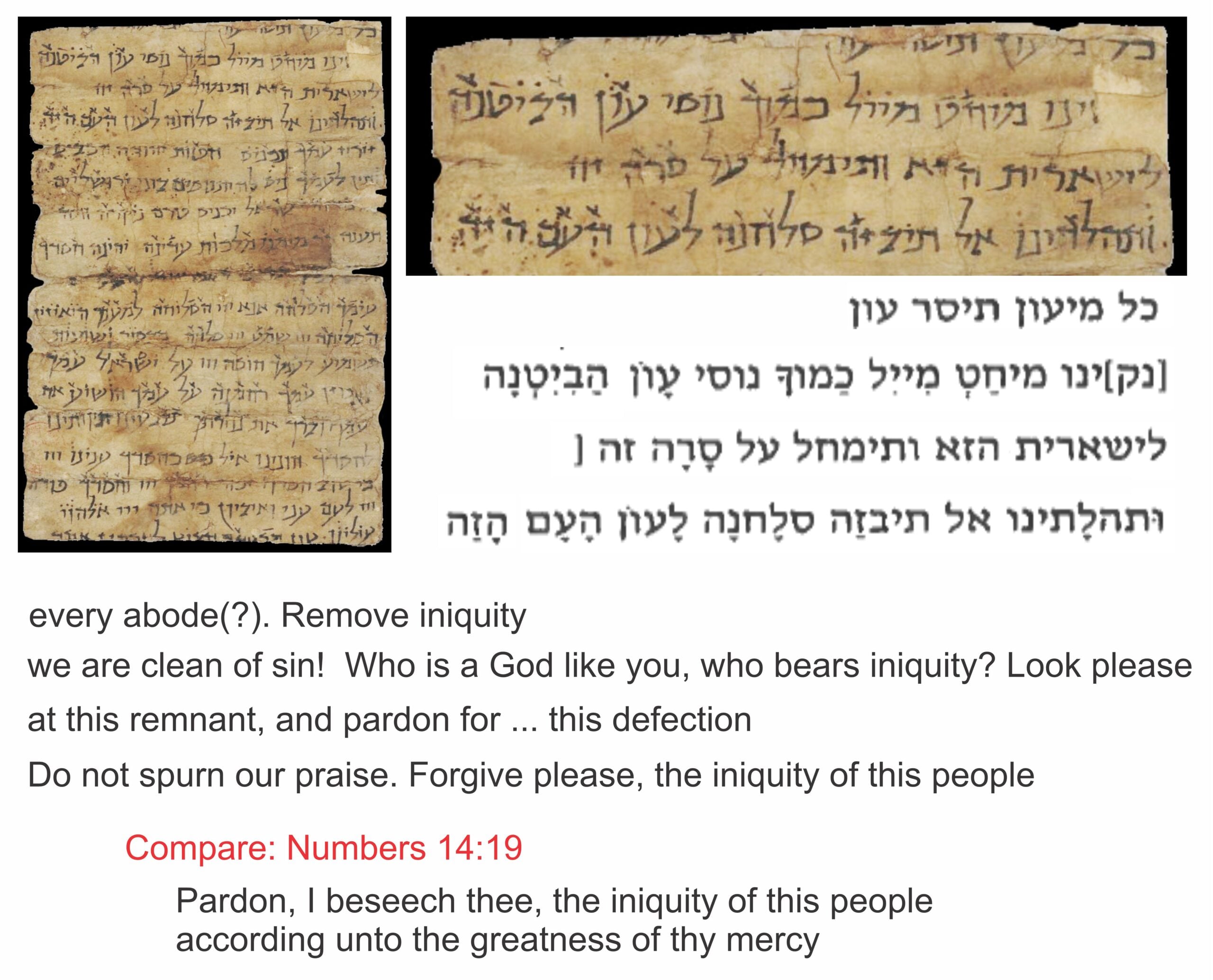
One of the manuscripts from the Library Cave is a Hebrew prayer for forgiveness (selihah). At one time it was folded up, perhaps so that it could be carried easily in a small container as an amulet to ward off evil. The text does not directly quote scripture but is very biblical in its wording. The following illustration shows the complete manuscript on the upper left. The photograph has been lightened to facilitate reading. On the upper right is an enlargement of the first 4 lines together with a transcription (Koller, 2024). The English translation of these 4 lines is below together with a quotation form the book of Numbers showing a similar style.

The manuscript is dated to around 800 CE. This and a few other Hebrew manuscripts from other stations on the Silk Road suggest that Jewish merchants were involved in the trade between China and the West. There may therefore have been Jews in China during the Tang dynasty or even earlier. A group of Jews in Kaifeng in central China petitioned the emperor to build a synagogue in 1163 CE (Berg, 2024). Their ancestors may have originally travelled to China over the Silk Roads. Their descendants still live today in China.


Zoroastrians

The religion of Zoroastrianism was established toward the end of the second Millenium BCE, and became the state religion of the main Persian Empires: the Achaemenid (559-331 BCE), Parthian (559 BCE – 331 BCE) and Sasanian (224–651 CE). Zoroastrian priests were generally called magi.

(i) Biblical Magi

The Gospel of Matthew relates how three magi (translated as “wise men”) came from the East to visit the newborn Jesus in Bethlehem.

Now when Jesus was born in Bethlehem of Judaea in the days of Herod the king, behold, there came wise men from the east to Jerusalem,

Saying, Where is he that is born King of the Jews? for we have seen his star in the east, and are come to worship him. (Matthew 2: 1-2)

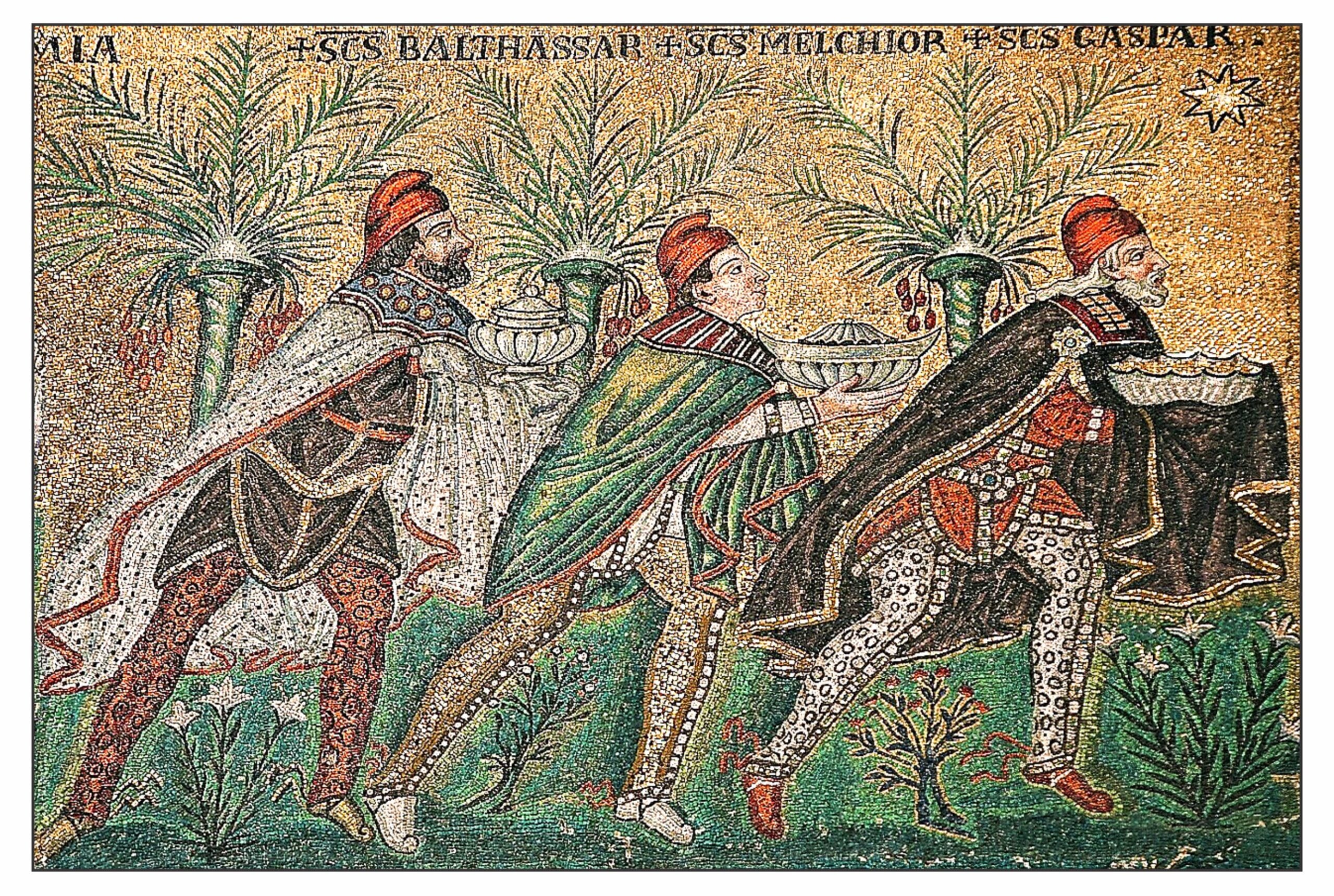
These wise men may have been Zoroastrian priests from Persia. If so, they would have travelled along the Silk Roads. The illustration below shows a mosaic representation of the magi from the Basilica of Sant’Apollinare Nuove in Ravenna (565 CE). The magi are shown in typical Persian clothing: flowing capes and Phrygian caps.

(ii) Mithraism

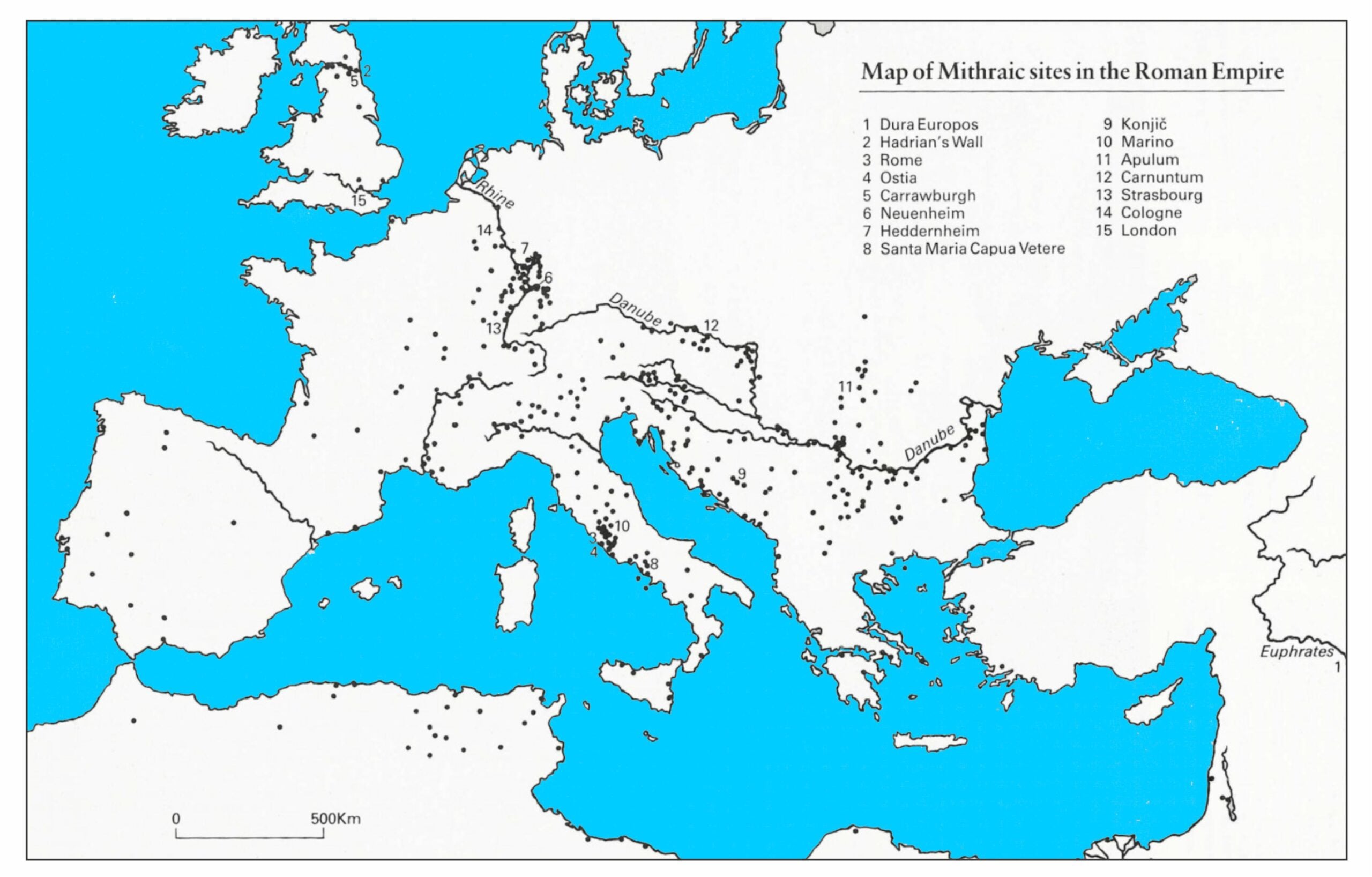
Mithraism was a Roman Mystery Cult focused on the God Mithras, one of the many Gods (yazata) worshipped in Zoroastrianism. The cult involved secret meetings in underground temples called Mithraea, archeological evidence for which has been found throughout the Roman Empire:

Mithraism was active from about 50 CE to about 300 CE. In the 4th Century CE Christianity was mandated as the sole state religion in the Roman Empire (Edict of Thessalonica, 380 CE). Thereafter Mithraism essentially vanished.

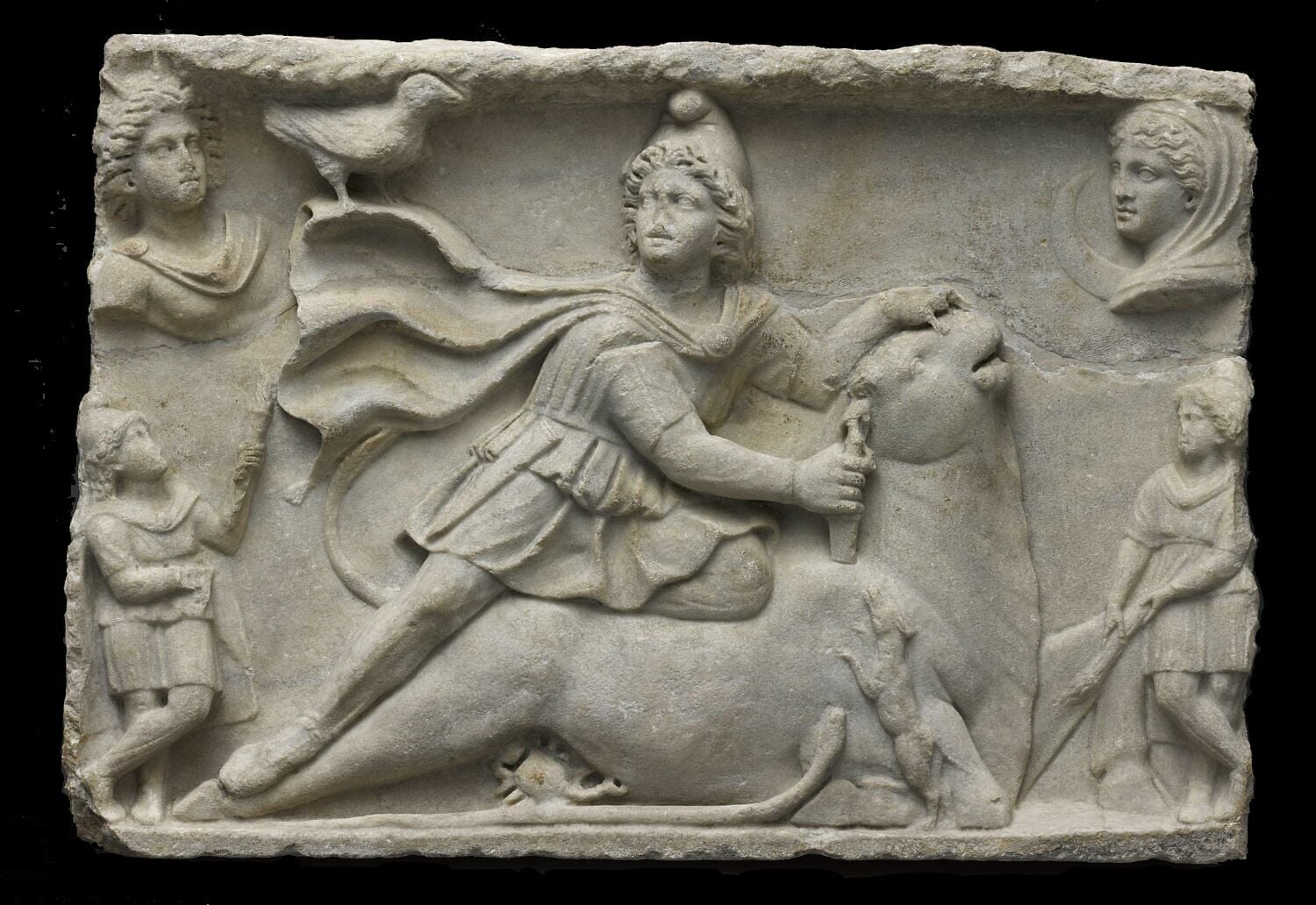
The Mithraeum was set up for a communal feast for the initiates, who were almost always men and mainly soldiers. One essential part of the temple was a fresco or sculpture of Mithras slaying a bull – the “tauroctony.” No one really understands what this sacrifice means. It might have something to do with redemption and salvation, much like the crucifix in a Christian church.

The iconography was stable across its many different locations. In the center, the God Mithras slays the bull. Above are representations of the sun and the moon, and below the bull is attacked by a crab, a snake and a dog. The following illustration shows a tauroctony from the 2nd Century CE unearthed from the Villa Borghese in Rome:   

The cult was originally believed to have been imported into the Roman Empire by soldiers who had fought in the Parthian wars, a series of conflicts occurring from 54 BCE to 217 CE, and who had thereby been exposed to the Gods of Zoroastrianism. However, there are relatively few Mithraea in the Eastern reaches of the Empire. And there is no evidence that the worship of Mithra in Persia involved any of the apparent rituals that occurred in the Roman Mithraea. Some have therefore suggested that the cult was a Roman invention (e.g. Stoll, 2022). Indeed, some of the earliest Mithraea are concentrated near the city of Rome (Chalupa, 2016), Nevertheless, the cult was devoted to one of the Zoroastrian gods, and most of the early descriptions of the cult acknowledged its Persian origins (Boyce et al, 1991, pp 468-490).

One possibility is that Roman Mithraism allowed its cult members to embrace an “otherness” and make themselves distinct from their fellows:

the imagery of Mithras dressed in the Persian garment and soft shoes with Phrygian cap on top of his curly hair alluded to the Greek topoi of Persians who were Rome’s ‘exotic other’ and ‘fiercest foe’. Such an iconography enabled the Roman Mithraists to depict their god as a foreign deity and to identify themselves as those Roman elites who had the knowledge of worshiping the foreign god. The Oriental imagery of Mithras created a boundary for Mithraic brotherhood and distinguished the cultic community from other forms of religiosity and religious groups in the wider cultural and religious boundaries of Rome. Whatever its origin, the Roman mystery cult of Mithras strongly relied on Roman attitudes and romantic visions of Persia and the Parthians in particular. (Mahzjoo, 2024).


(iii) Sogdians

At the time when trading was at its height, the main middlemen on the Silk Roads were Sogdian merchants (Pin Lyu, 2024). Sogdia was the name for the area of land between the Amu Darya (or Oxus) and the Sri Darya Rivers. Its capital was Samarkand. The following map shows the location of Sogdia in Central Asia. The black lines show several of the Silk Roads:

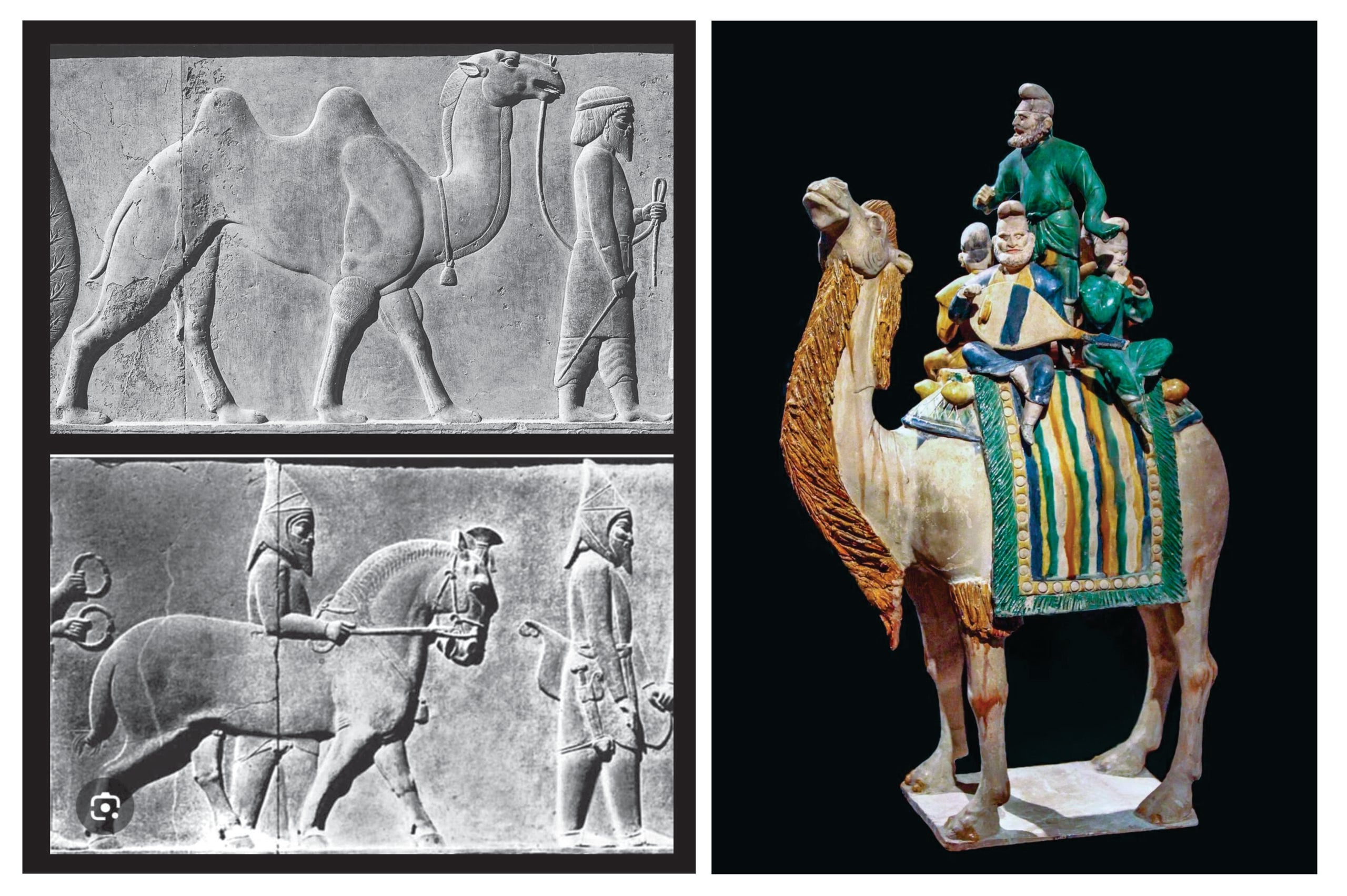
The Sogdians were descendants of the ancient Scythians. At the time of the Achaemenid Empire, when they were known as Saka, they paid tribute to the Persian Emperor in the form of camels and horses.

During the time of the Sasanian Empire, Sogdia was at the eastern limits of the empire and practiced Zoroastrianism (Grenet, 2015). When the empire was invaded by the Muslims, these frontier regions were able to maintain their religious practices for several centuries.

During the Abbasid Caliphate the Sogdians traded extensively with the Chinese and established large merchant colonies in cities of northern China.

The following illustration shows on the left two bas-relief representations of Saka bringing camels and horses to the Emperor at Persepolis (6th-5th Century BCE). On the right is a Tang dynasty porcelain statuette showing a group of Sogdian musicians on a camel. This was found in Xi’an and dates to 723 CE. 

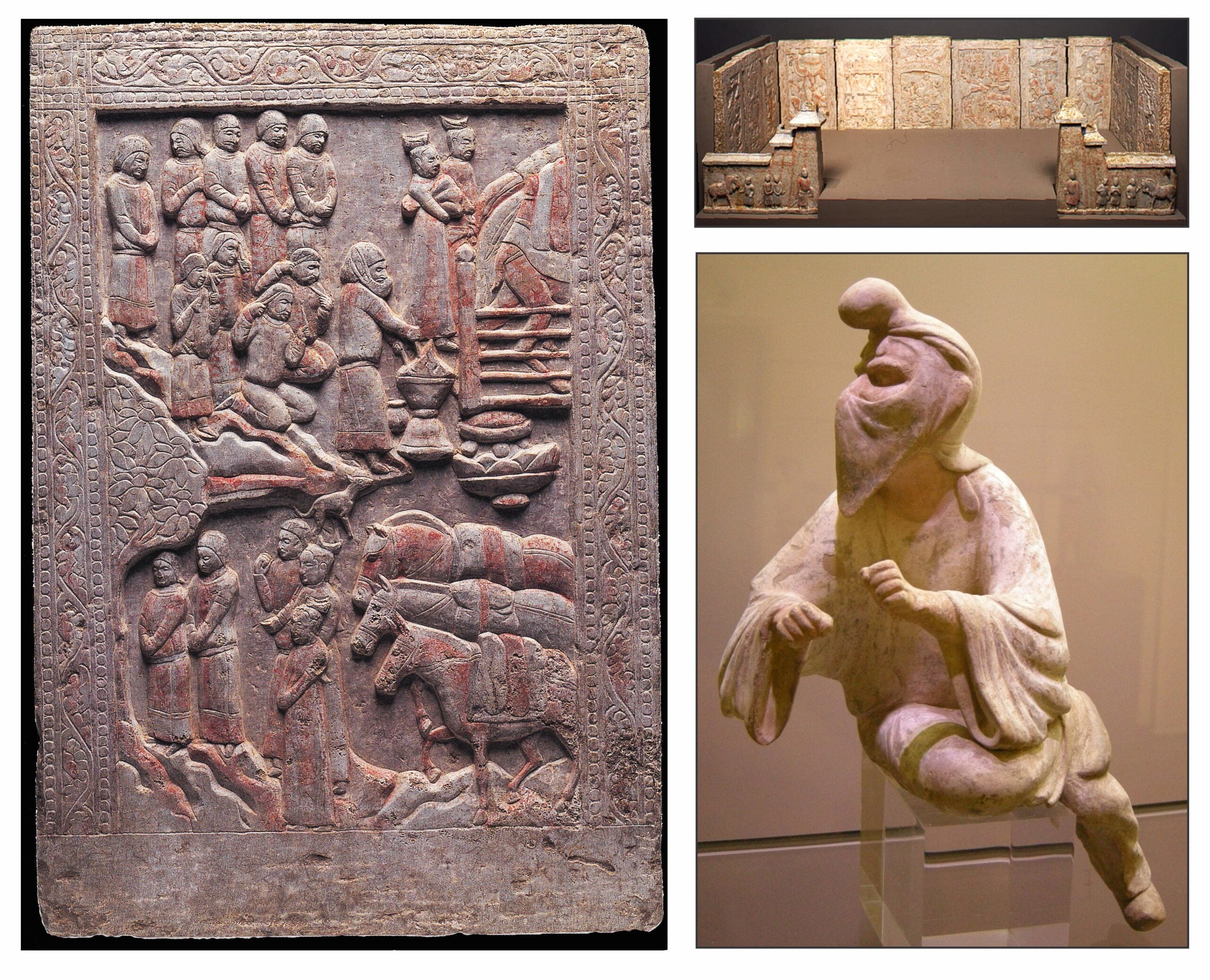
Zoroastrian funerary practices mandated that the corpse should not be allowed to pollute either the air or the land. Neither cremation nor burial was possible. Zoroastrians typically laid the corpse out on a stone bed and allowed vultures to strip the flesh from the bones. In China, Zoroastrians compromised by constructing closed tombs within which the deceased was laid out on a funerary couch and allowed to decay above ground. If the deceased was a rich merchant, this funerary bed could be quite ornate. The following illustration shows on the left a carving from a 6th Century Zoroastrian funerary couch in Northern China, now in the Miho Museum in Japan. The upper half of the carving shows a Zoroastrian priest caring for the sacred fire during the funeral service for the deceased. He is recognized by the face mask that prevents him from contaminating the fire with his mortal breath. The mourners are behind the priest. A camel is recognized to the right of the sacred fire, and several pack horses are seen below. The upper right of the illustration shows how the complete funerary couch was set up.

The lower right shows a small ceramic statuette of a Zoroastrian priest with a face mask. Although he is sometimes considered a camel driver, he is more likely a priest tending to the sacred fire. The face mask is just too typical. The statuette was found in northern China and dates to the 8th Century CE.


Buddhism

Gautama Buddha lived in the northeastern region of India in the 6th or 5th Century BCE. After his death his followers taught the new dharma throughout the Indian subcontinent. The Mauryan Empire (320 BCE–185 BCE) expanded to incorporate Greco-Persian lands in what is now Pakistan and Afghanistan. Ashoka (304–232 BCE), the third Mauryan Emperor, promoted Buddhist thought throughout his domain. 

(i) Gandhara

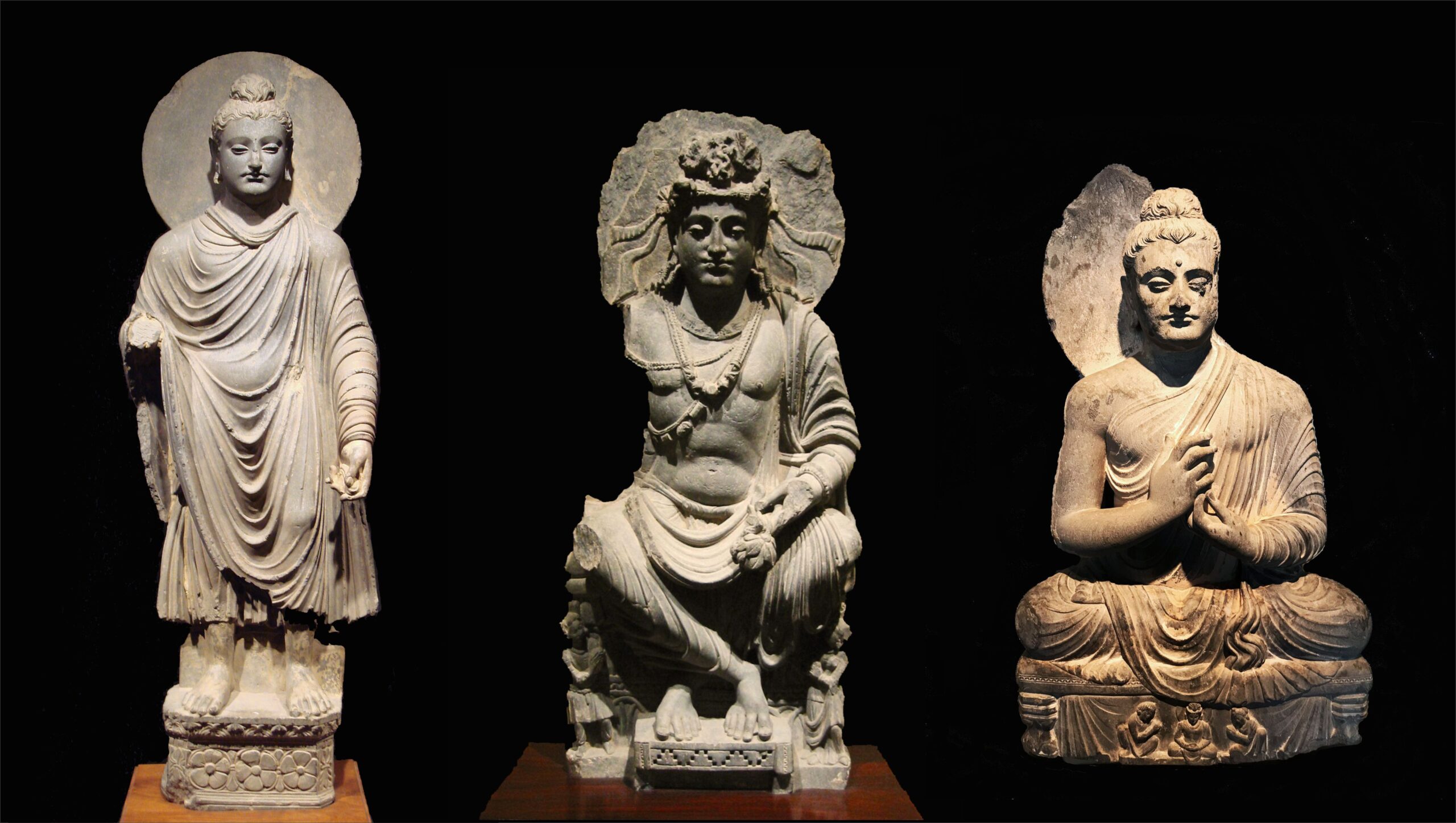
Few representations of the Buddha occur form the first centuries of the new religion. Since the teaching proclaimed that the everyday world was transient and misleading, artistic representations may have been considered unworthy. This changed when the faithful encountered artists of the Greco-Persian world in a region of northwest India called Gandhara. Realistic sculptures of the Buddha and his disciples proliferated. The following illustrations shows sculpture of the Buddha made in the Gandhara from the 1st, 2nd and 5th Centuries CE:


(ii) Colossal Buddhas

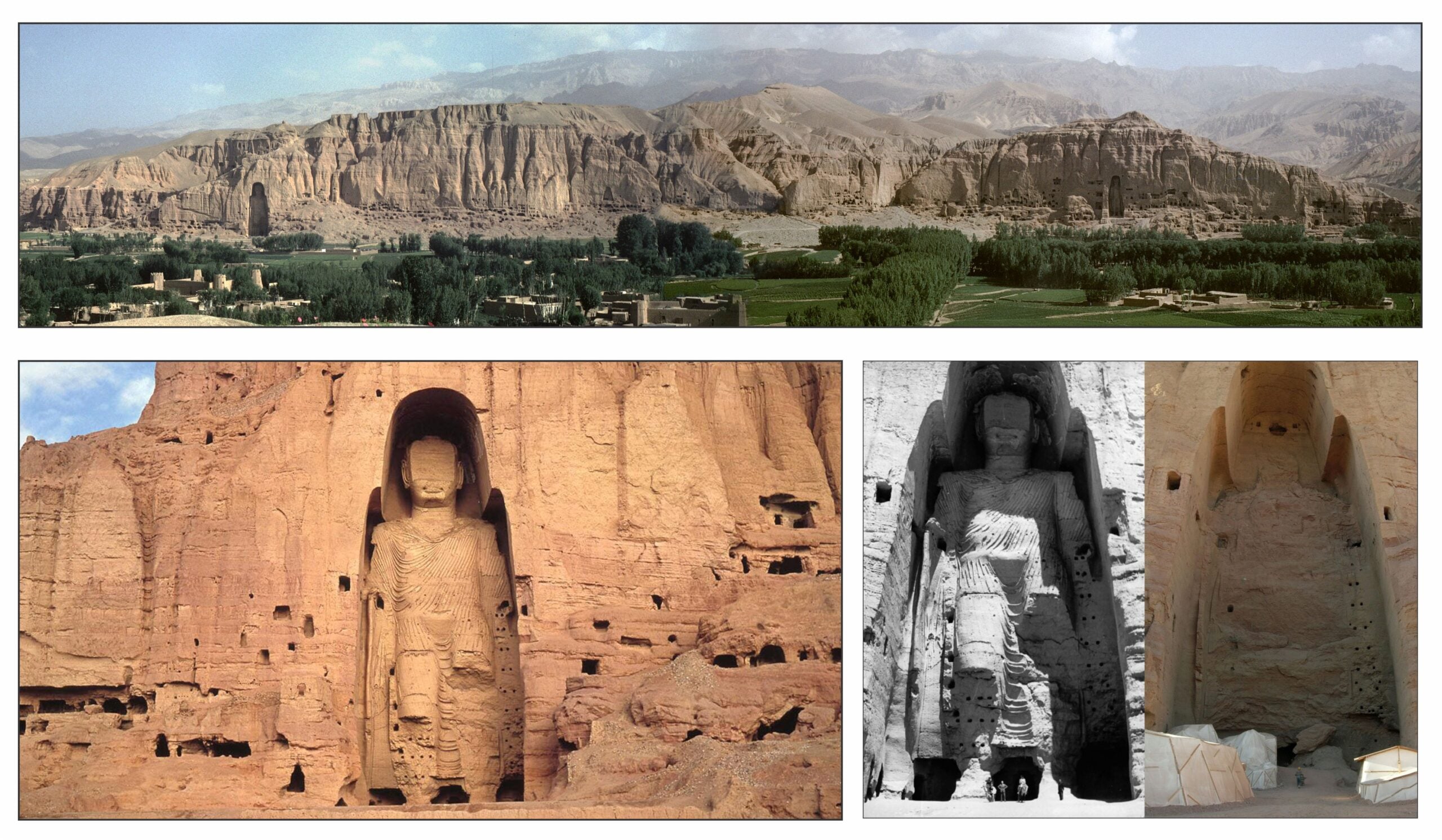
As their religion spread along the Silk Roads, Buddhist monks began to carve statues of the Buddha out of the sandstone cliffs along the route. Some of these assumed colossal sizes (Wong, 2019). The earliest large Buddhas, up to 15 m tall, were carved at the Yungang Grottoes near Datong in Northern China beginning in 465 CE. Colossal seated Buddhas, 33 and 23 m tall, were carved in the Mogao caves near Dunhuang in the 7th and 8th Centuries CE.

And around 600 CE, in Bamiyan, located in present-day Afghanistan, 130 km northwest of Kabul, two huge standing Buddhas were carved, one 38 m and the other 55 m tall. Since details such as the folds in the robe and the facial features could not be carved in the sandstone, these were added to the rough-hewn statues using stucco. The arms were constructed using stucco on wooden armatures. Over the years much of the stucco work eroded away leaving the large ungainly limestone forms.

The people in the area when the statues were carved were Hephthalites. These people followed several different religions (Zoroastrianism, Christianity, and Manichaeism) and tolerated the work of the Buddhist monks.

In 2001 the Taliban enforced a Muslim edict forbidding artistic representations of human beings. The two Bamiyan Buddhas were destroyed.

The following illustration shows at the top a panorama of the Buddhas in the Bamiyan Valley before their destruction. The lower left of the illustration shows a close-up of the larger of the two Buddhas. The lower right compares before and after its destruction.


(iii) Avalokistesvara

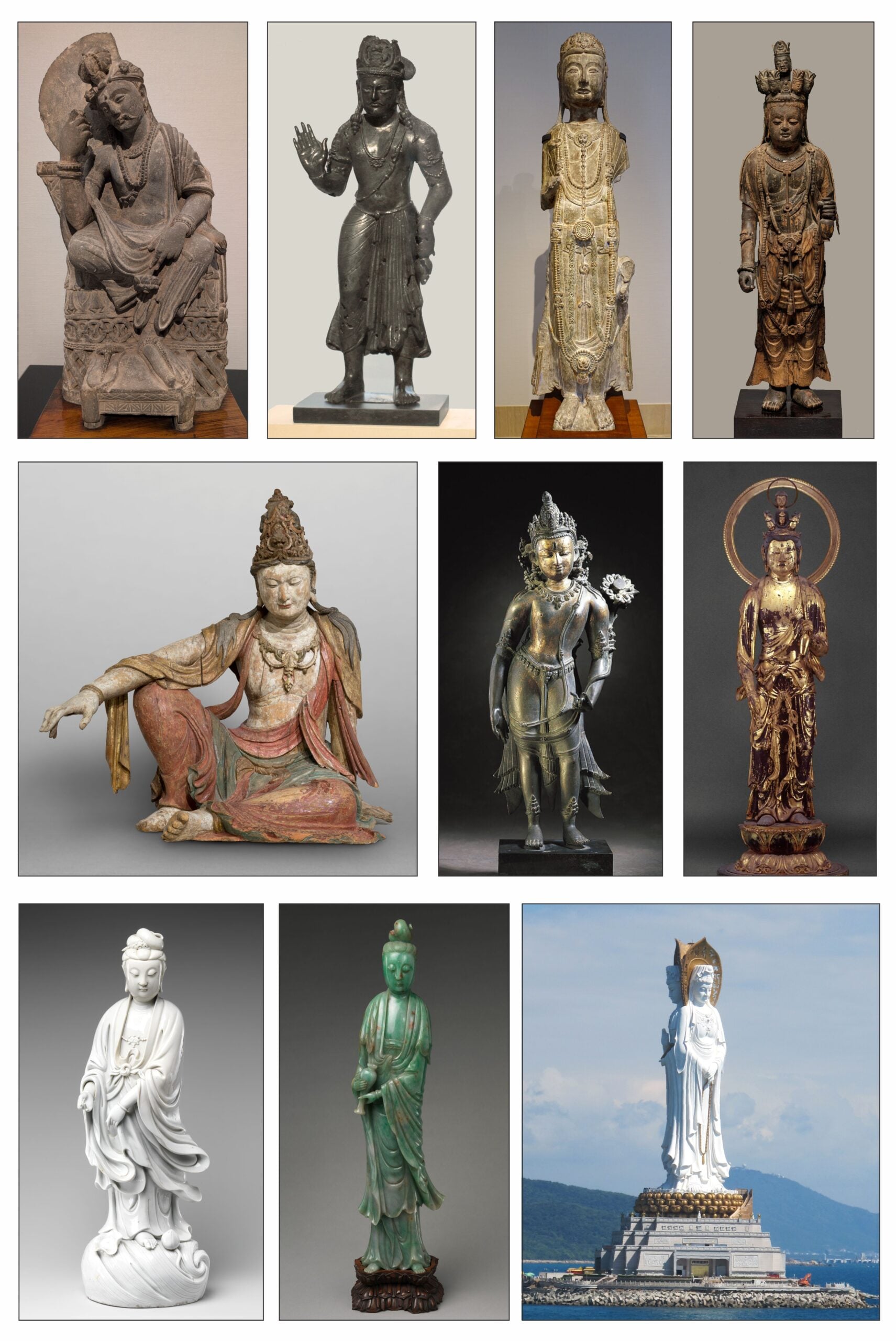
Avalokistesvara was the bodhisattva of compassion. His name in Sanskrit means “he who looks down,” i.e. he who considers the concerns of the faithful. As Avalokitesvara travelled along the Silk Roads to China he slowly changed gender from male to female (Stein, 1986; Suebsantiwongse, 2025; Yu, 2001). In China she became known as Guānshìyīn, (觀世音, look/observe+people/world +sound/voice: “the one who perceives the cries of the world”) or Guanyin. As the deity moved to Japan, she became known as Kannon, and veered back toward masculinity.

Avalokistsevara characteristically holds a lotus flower and sometimes prayer bead. Sometimes he or she has multiple heads which make her vision and hearing more acute. Occasionally the deity has multiple arms the better to aid those in need. As Guanyin, she often carries a vase of pure water to relieve suffering.

The following illustration shows the transformation of Avalokistesvara. In order from left to right and then form up to down:

  1. Stone, Avalokistesvara, Gandhara, 3rd Century CE
  2. Bronze, Avalokistesvara, Gandhara, 4th Century CE
  3. Stone, Avalokistesvara, Northern China, 6th Century CE
  4. Wood, Avalokistesvara with multiple heads, Northern China 11th Century CE
  5. Wood, Avalokistesvara “seated at royal ease,” China, 11th Century CE
  6. Bronze, Avalokistesvara, Nepal, 14th Century CE
  7. Gilded Wood, Kannon, Japan 11th Century CE
  8. Porcelain, Guanyin, China 17th Century CE
  9. Jade, Guanyin, China, 19th Century CE
  10. Titanium callosal statue (78 m) Nanshan Guanyin, Hainan Island, 21st Century CE


(iv) The Diamond Sutra

As Buddhism travelled along the Silk Roads to China, the sacred texts began to be translated from Sanskrit to Chinese. One of the most important translators was Kumarajiva (344–413 CE) who was born in Kuqa on the northern edge of the Taklamakan desert. His father was a Buddhist monk from Kashmir. Around 400 CE Kumarajiva travelled to Chang’an where he wrote most of his translations of the Buddhist literature.

The original Diamond Sutra was likely composed shortly after the time of Gautama Buddha’s life in the 5th Century BCE. However, it was not formally written down in Sanskrit until the 2nd or 3rd Century CE. The sutra narrates a dialogue between the Buddha and his elderly disciple Subhūti about the nature of reality and how to attain the wisdom that would release one from suffering. The world is transient and illusory; one must release oneself from any attachments; one must seek emptiness. The following is from Red Pine’s introduction to his translation of the sutra (2001):

following his Enlightenment, the Buddha had taught people to free themselves from suffering by realizing the impermanence and interdependence of everything upon which their suffering depended, including and especially themselves. The Buddha called this the realization of shunyata (emptiness), the view that because nothing exists independently of other things, it has no nature of its own, and every-thing is therefore empty, and this emptiness is the true nature of reality. Later, when the Buddha began teaching people to view emptiness itself as empty and to put the emptiness of emptiness to work in the liberation of all beings, few disciples grasped this new teaching, which he called the perfection of wisdom, the wisdom beyond wisdom.

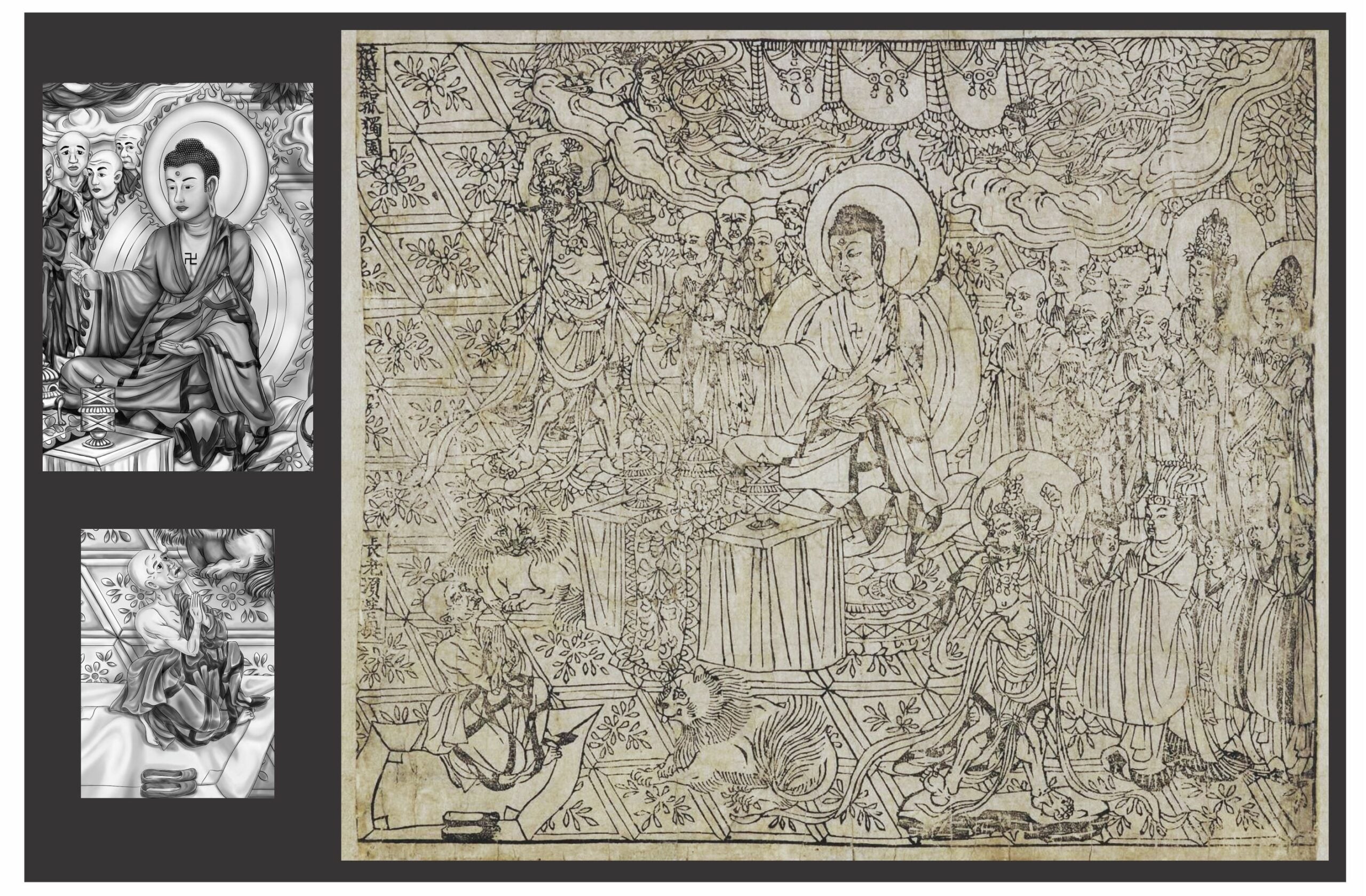
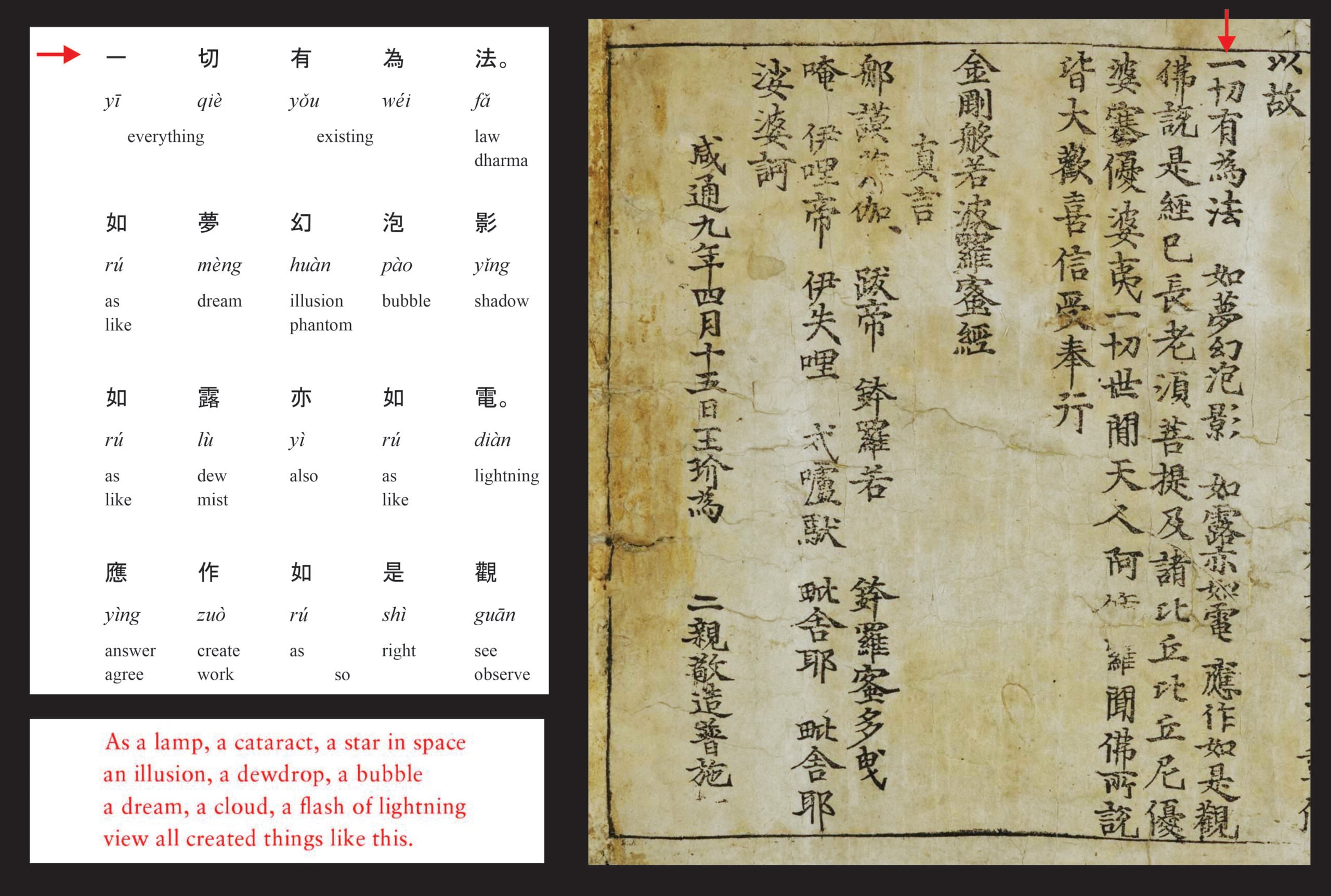
One of the most important discoveries in the Mogao Caves near Dunhuang was a woodblock-printed copy of Kumarajiva’s translation of the Diamond Sutra. The pages were printed by Wang Jie in 868 CE, probably in Sichuan, and then pasted together to form a scroll about 5 m long. The colophon gives the date and notes that the sutra was being made freely available to all who wished to read. This is the oldest printed book of which we have a copy.  

The frontispiece of the scroll shows a woodblock drawing of the Buddha surrounded by bodhisattvas, and supernatural guardians. In the lower left is the disciple Subhūti. The following illustration shows this print together with details of the Buddha and his disciple redrawn by Zhao Ming An.

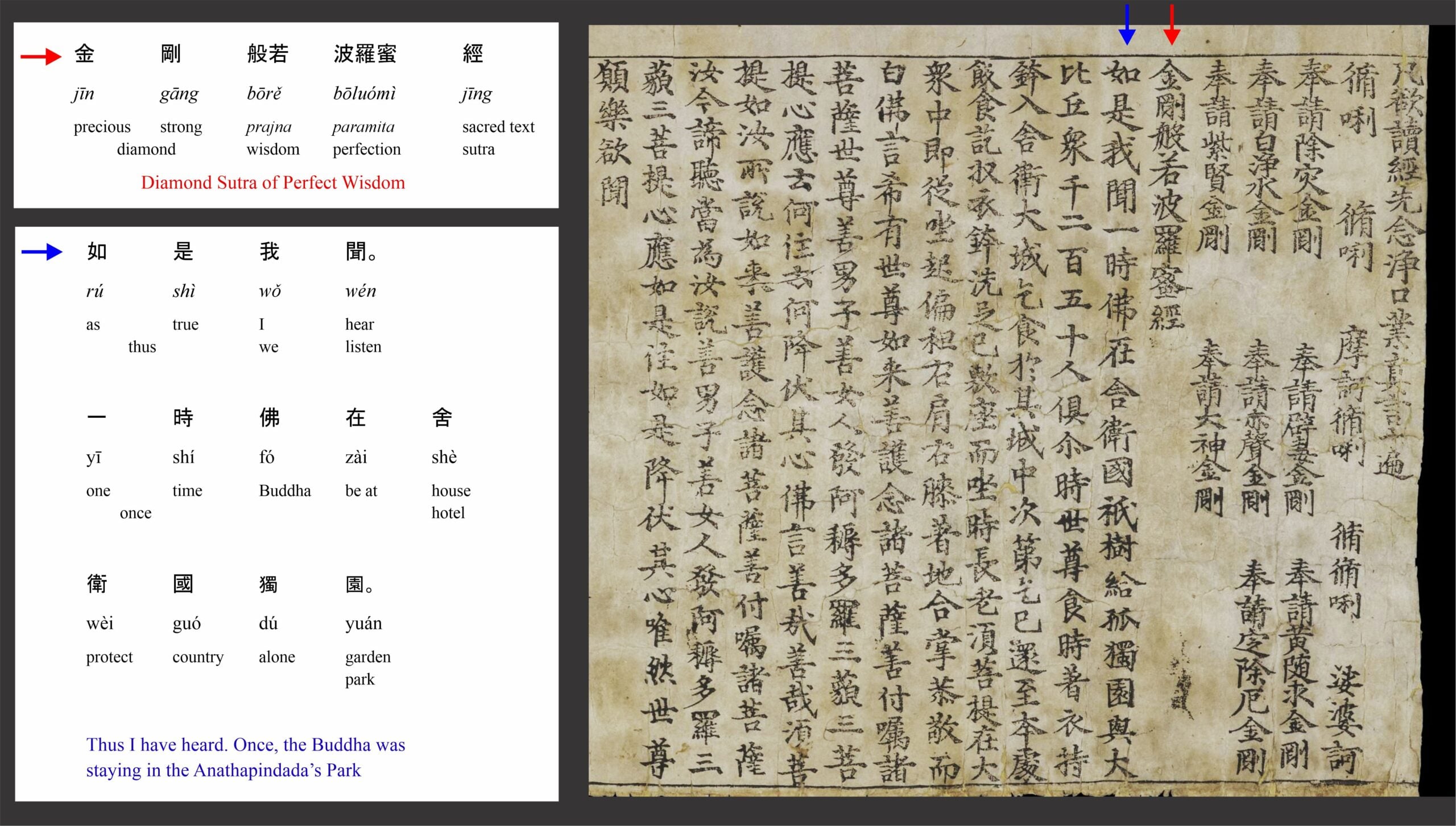
The following illustration shows the first page of text in the scroll along with a character-by-character translation of the title and the first few words of the sutra:

And the following illustration shows the last page of the scroll which includes the famous verse that the Buddha uses to describe the transience of the world. On the left, a character-by-character translation is followed by the English version of Red Pine, based on both the Sanskrit and the Chinese versions of the sutra (2001):


Christianity

During the first 4 centuries of Christianity, the nature of Jesus as both God and Man was extensively discussed. One position was that Jesus was of two distinct natures – dyophysite; another was that his two aspects were conjoined as one – miaphysite; and yet another was that his Jesus became fully divine – monophysite. Though these old distinctions are almost impossible to understand in modern times, in the 5th Century CE they were matters of life and death. The Church of the East (also known as the Assyrian Church) distinguished itself as miaphysite, and became separate from the dyophysite Byzantine and Roman Churches in 451CE. These latter churches condemned as heretical the monophysite teachings of Nestorius, a theologian in the 5th Century. The Church of the East is often known as the “Nestorian Church,” although its views on the nature of Jesus actually differed from those of Nestorius (Brock, 1996). Although the Church of the East remained separate from the Western Churches for many centuries, it has now established communal relations with the Roman Catholic Church.


(i) The Dunhuang Glora

Among the manuscripts found in the Mogao caves was a Chinese Christian Hymn loosely based on the Gloria in Excelsis Deo (Glory to God in the highest), also known as the Greater Doxology (words of praise), especially the version used in the Church of the East. The manuscript was probably written about 800 CE and provides clear evidence that missionaries of the Church of the East had travelled on the Silk Roads to China and were actively proselytizing there centuries before the Jesuits first arrived in the 15th Century CE (Moule, 1930, Teng Li, 2024).

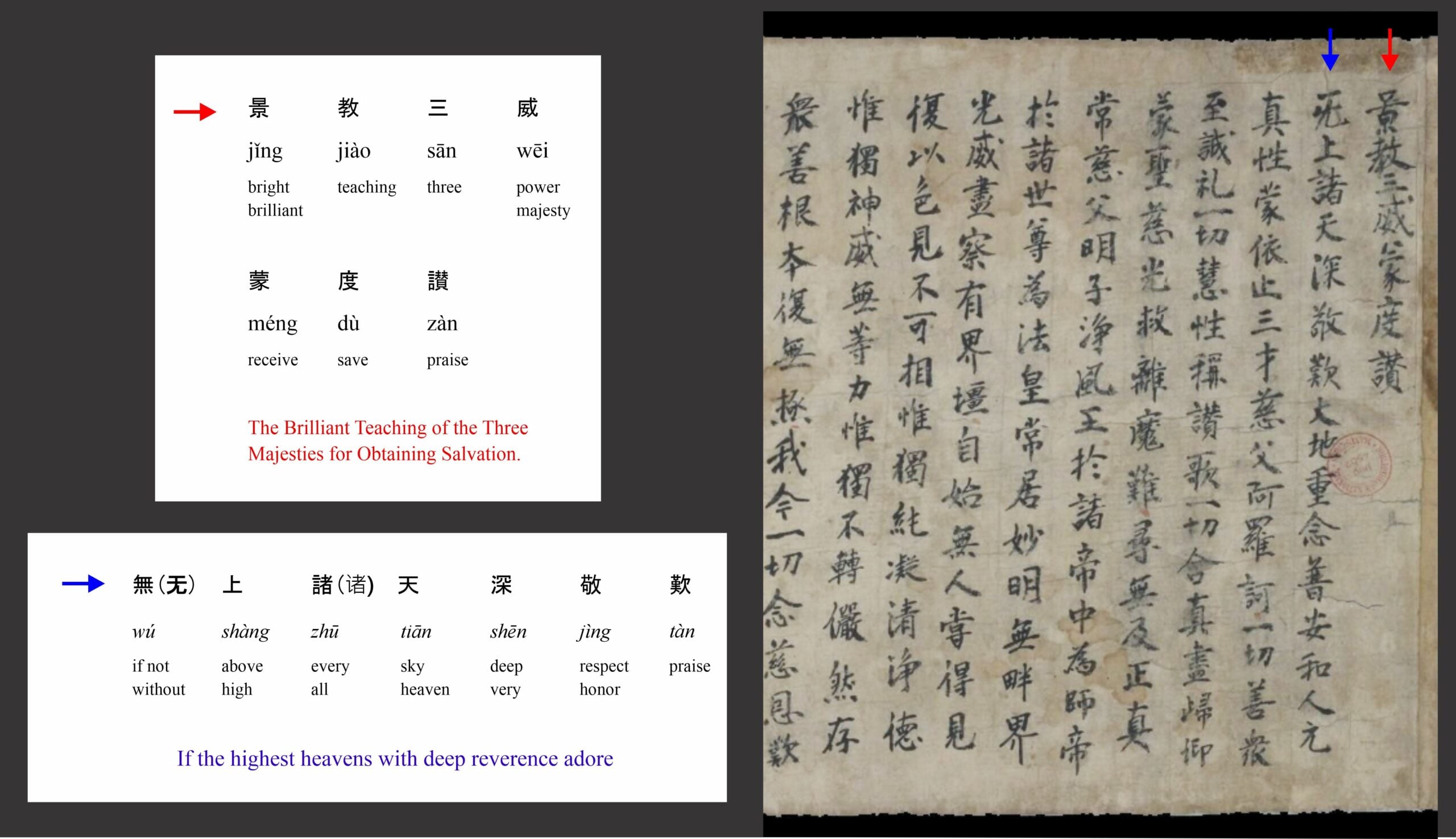
The hymn has 11 verses each containing 4 lines of length 7 syllables, in keeping with Chinese poetic practice. The following illustration shows the beginning of the hymn together with a character-by-character translation of the title and the first line.   


The following is a translation of the first three verses of the hymn (Moule, 1930, p 53; Henson, 2017, p 329)

If the highest heavens with deep reverence adore,
If the great earth earnestly ponders on general peace and harmony,
If man’s first true nature receives confidence and rest,
It is due to Alohê the merciful Father of the universe.

All the congregation of the good worship with complete sincerity;
All enlightened natures praise and sing;
All who have souls trust and look up to the utmost;
Receiving holy merciful light to save from the devil.

Hard to find, impossible to reach, upright, true, eternal,
Merciful Father, shining Son, holy Spirit, King,
Among all rulers you are Master Ruler,
Among all the world-honoured you are spiritual Monarch

“Alohê” is a Chinese transcription of the Syriac name for God.


(ii) The Jingjiao Stele

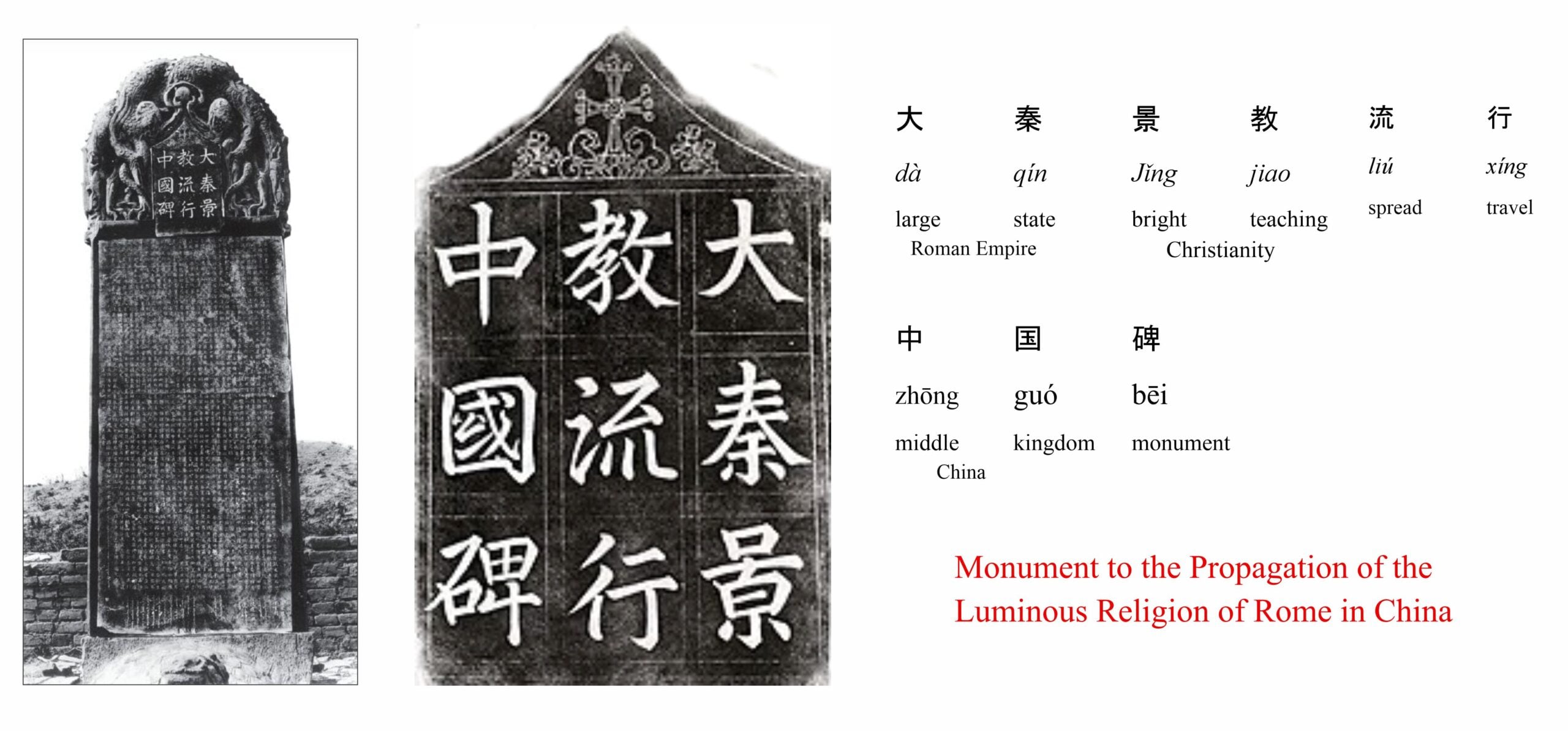
In 781 CE a monument dedicated to the Christian faith (景教,jingjiao, luminous religion) was erected in Chang’an (Keevak,2008; McGrath, 2021). The limestone stele is almost 3 m high. At the top is a cross and a nine-character title. The following illustration shows the stele in situ (before it was moved to a museum), an enlargement of the title, and a character-by-character translation.

The stele summarizes the beliefs of the Christian Church in an inscription of about 1900 characters. This mentions that the Christian church was first established in China in 635 CE through the efforts of the monk Alopen. At the bottom of the stele is a much shorter inscription in Syriac.

After the end of the Tang dynasty 907 CE, Christianity almost disappeared (Teng Li, 2024). The Jingjiao Stele was buried, either for protection by the monks or as an act of desecration by those who reviled the foreign religion. It was unearthed during the 17th Century.

Nevertheless, the Church of the East continued to send missionaries along the Silk Roads and several centuries later, Christian Churches were built throughout the Mongol Empire. The Mongol Empire (1206–1368) and the Yuan Dynasty in China (1271–1368) were tolerant of the different religions. The foreign religions of Buddhism, Christianity, and Manichaeism contributed as much to society as the homegrown Daoism and Confucianism.

Manichaeism

Mani (216-274 CE) was a Persian prophet who conceived the world as divided between the light and the dark. He taught that the human soul was imprisoned by birth into the material world, and that the suffering that this entailed would only cease at death, which released the soul from the body. If one died free from sin, one’s soul would return to the realm of light. The dualistic religion that he founded – Manichaeism – flourished in the centuries after his death, spreading all the way to Spain in the west and China in the East.

(i) Spread to Europe

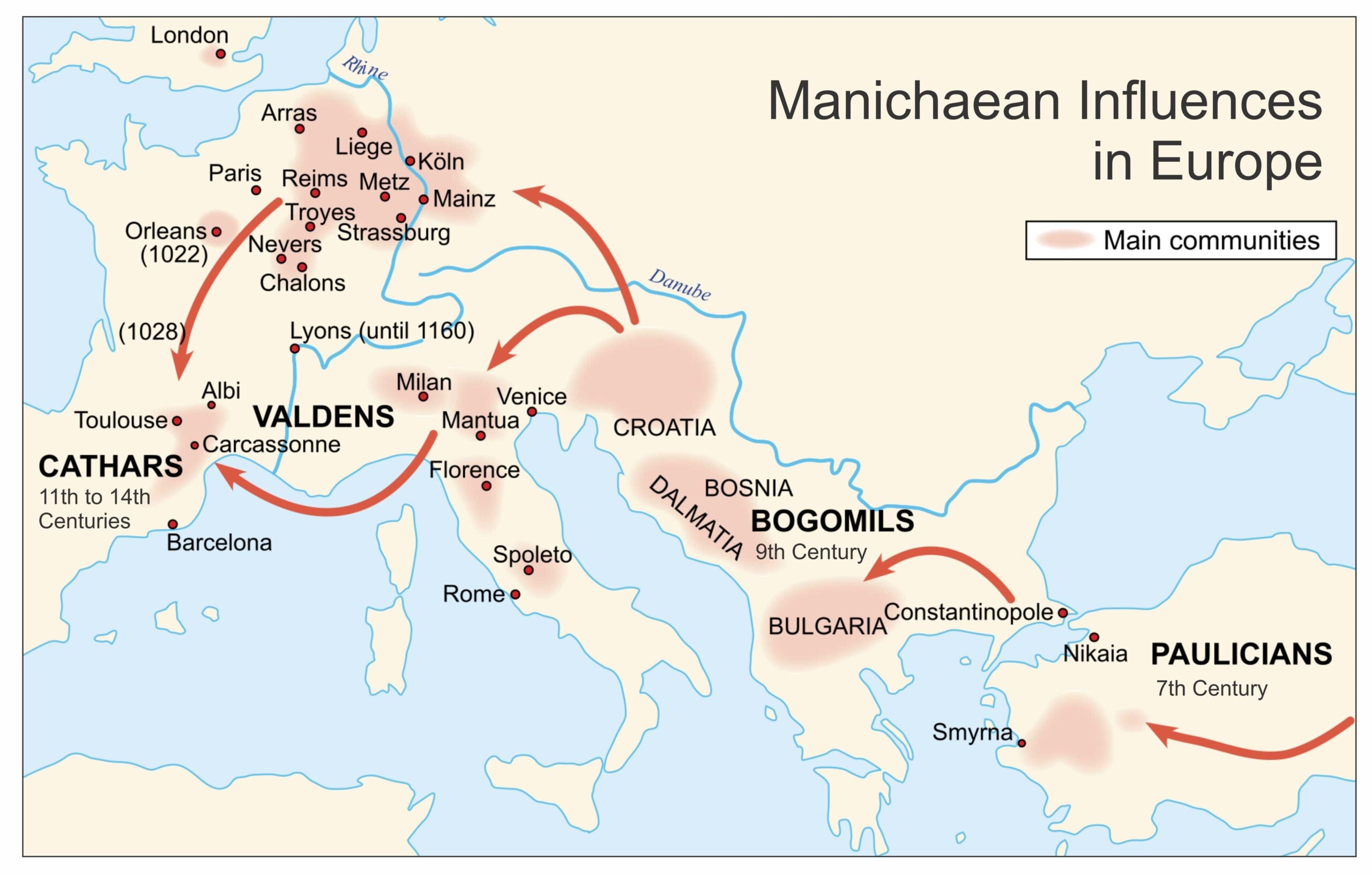
In Europe, Manichaeism declined after Christianity became the state religion of the Roman Empire. However, some isolated groups, such as the Bogomils in Bulgaria and the Cathars in Southeast France, continued to follow Mani’s teachings:

(ii) Spread to China

Manichaeism spread along the Silk Roads into China during the Tang Dynasty (618-907 CE). During the Uyghur Kahnate (744–840 CE) in what is now Northern China and Mongolia, Manichaeism was acknowledged as the state religion (Mackerras, 1990).

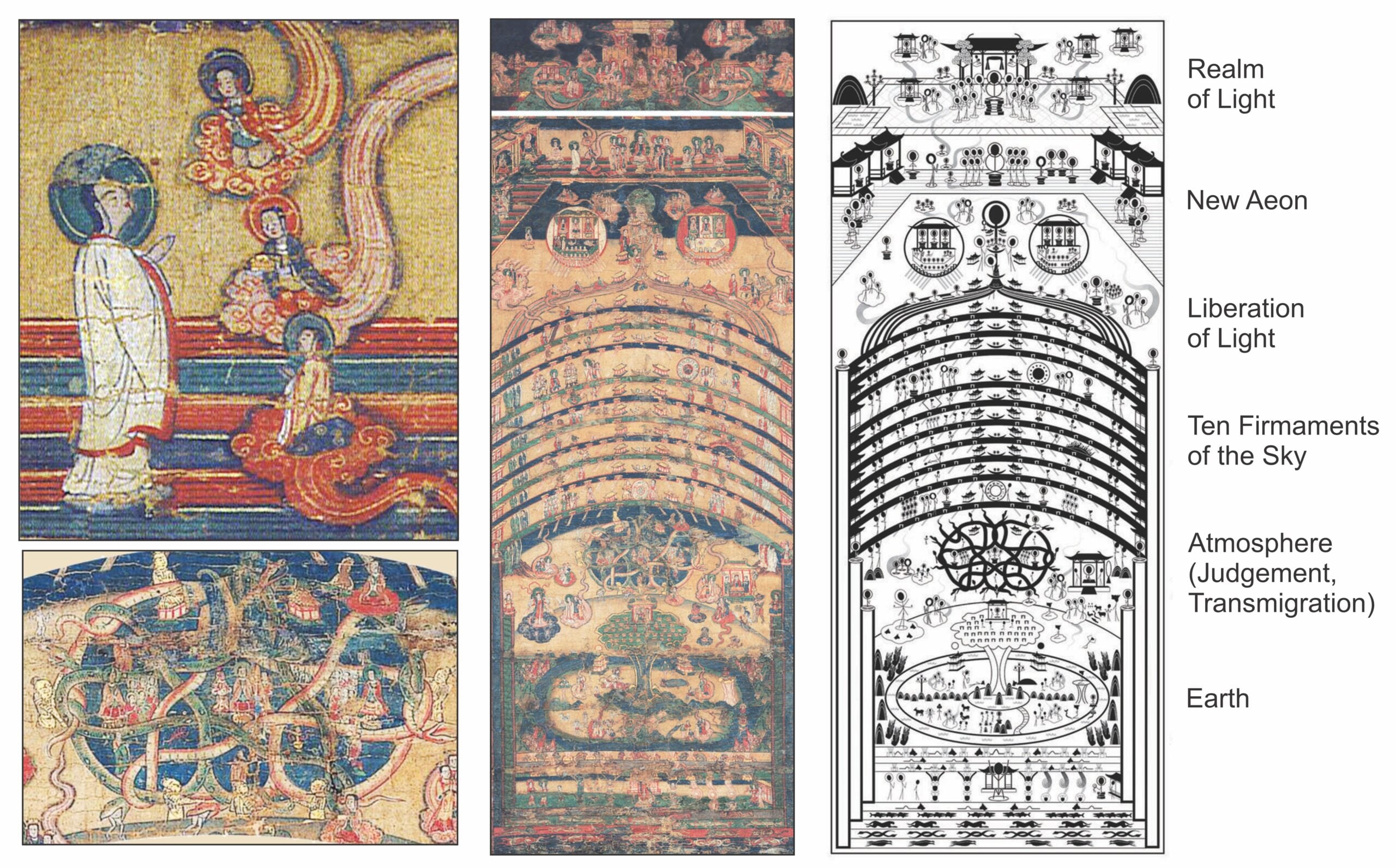
During the Yuan Dynasty (1271–1368 CE), a large silk painting (158 by 60 centimetres) was made to illustrate the Manichaean cosmology. This showed the realm of light at the top. In the center was a representation of the judgment that occurs at death: the decision whether the soul is released into the realm of light or sent back to the hell on earth. The following illustration shows the painting with some explanatory analysis (Gulaczi, 2015, pp 247-258), and enlargements showing a portrait of Mani (from the left side of the New Aeon level) and details of the tangled judgement process: 

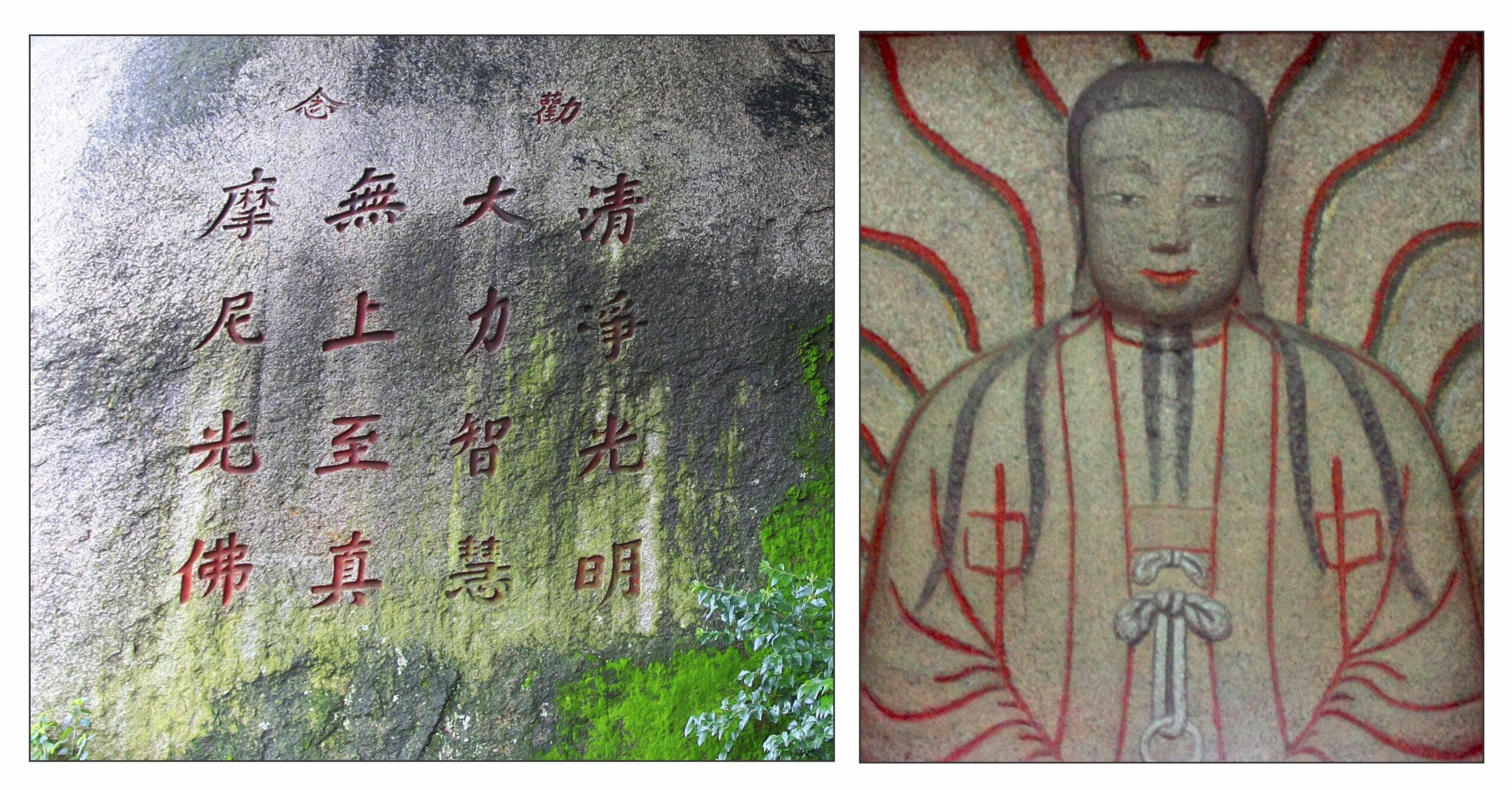
In Cao’an a small town on the west coast of China, a small temple built in 1339 CE was dedicated to Mani, the “Buddha of Light” (Lieu, 1998, pp 188-193).  Over the years the temple became used for Buddhist practices. The following illustration shows the bas-relief portrait of Mani over the altar and the inscribed stone in the grounds of the temple.

The inscription reads

Purity (清净, qīngjìng), Light (光明, guāngmíng),

Power (大力, dàlì), Wisdom (智慧, zhìhuì)

Supreme (無上, shàng), Ultimate Truth (至真, zhìzhēn)

Mani (摩尼, móní), the Buddha of Light (光佛 guāngfú)

The first four are the attributes of the Manichaean Heavenly Father. Mani considered himself as a prophet in the line of Zoroaster, Buddha and Christ. As such he could be conceived as one of the manifestations of the divine – the Buddha of Light.


Islam

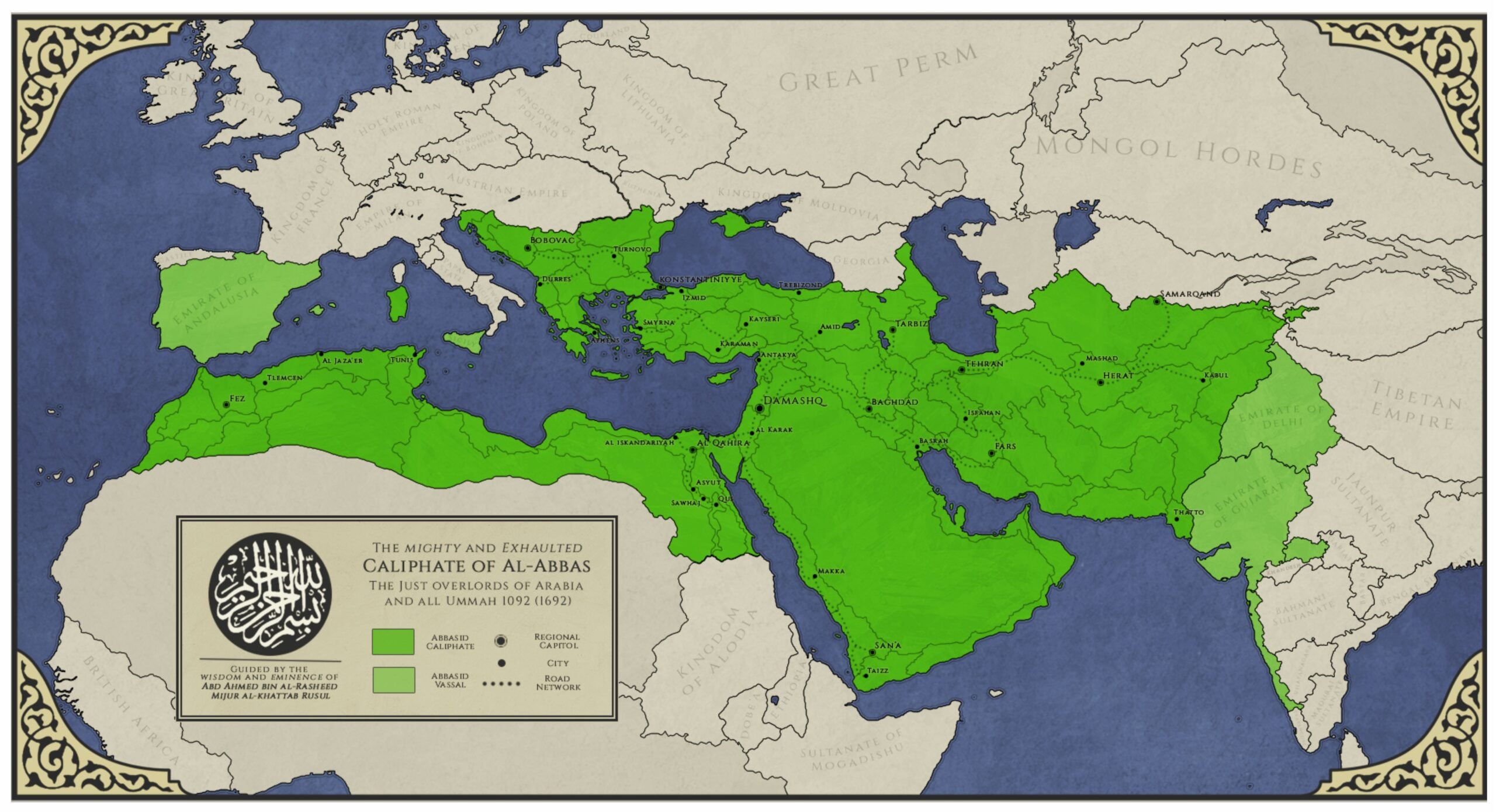
After its founding in Arabia in 622 CE, Islam quickly spread to adjacent regions. By the time of the Abbasid Caliphate (750–1258 CE), the community of the faithful (Ummah) extended all the way from Spain to the borders of China:


(i) Abbasid Caliphate

The Abbasid Caliphate with its capital in Baghdad oversaw a period of great prosperity and learning, that later became known as the Islamic Golden Age. At a time when Europe was going through the Dark Ages, Baghdad was a place where scholars studied and preserved the literature of the past and contributed to our knowledge such new ideas as algebra and trigonometry. Islamic physicians distinguished different diseases, and Islamic physicists mapped the heavens. Abassid architecture developed gorgeous arches and domes, stucco decoration with arabesque patterns, and walls covered with multicolored tiling.

The Abbasids made great use of the newly discovered paper (Schatzmiller, 2018). The technology of papermaking originated in China around the 1st Century CE and was brought to the Middle East through the Silk Roads. The first paper mill in Baghdad was built in 795 CE. Paper made it easy to provide inexpensive books for scholars to study. Knowledge became no longer limited to the elites.    

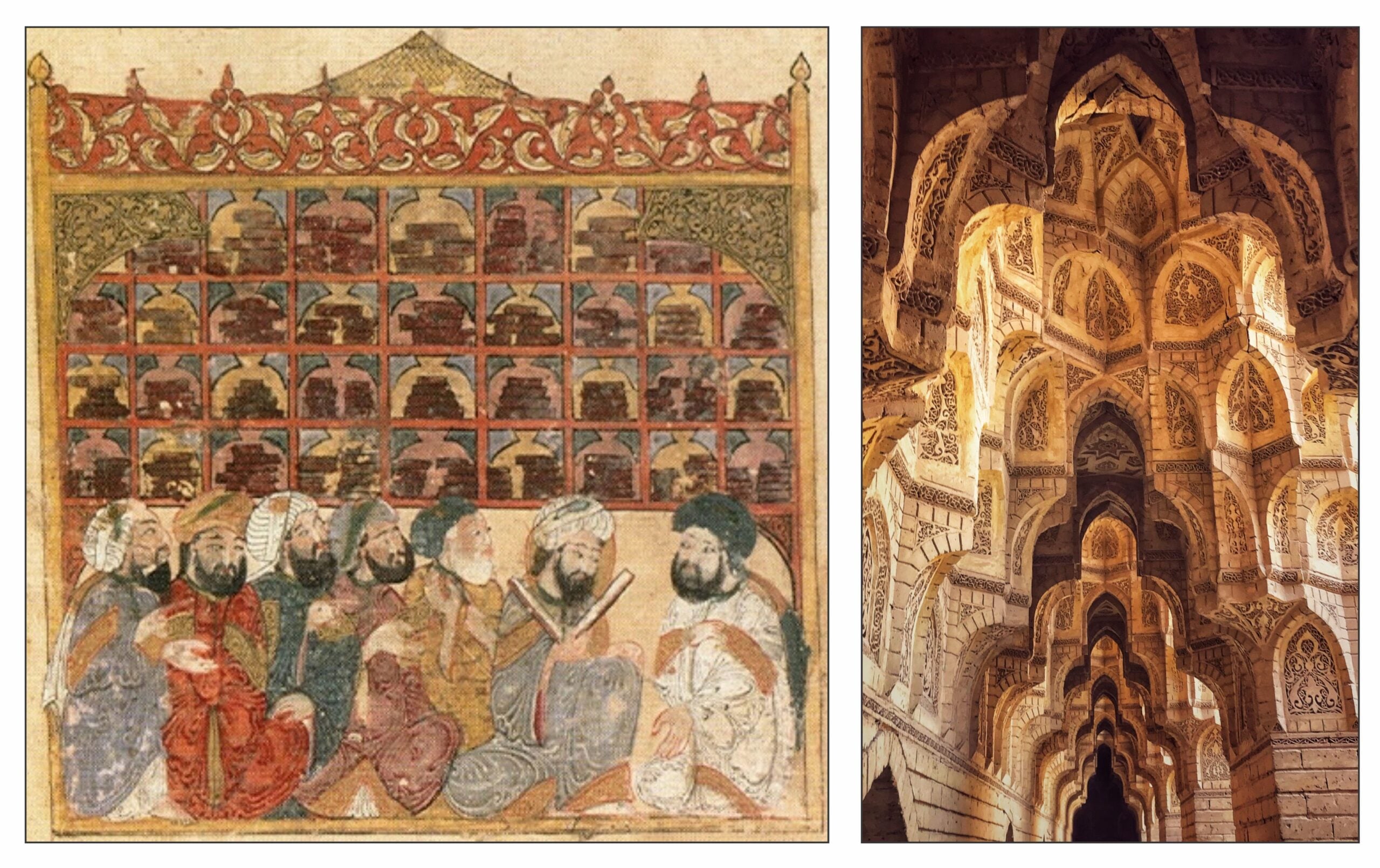
The following illustration shows on the left a painting of a scholars in a library during the Abbasid Caliphate taken from a 13th Century manuscript. This may represent the House of Wisdom, also known as the Grand Library of Baghdad, which was founded in the 8th Century CE. On the right is a photograph of a honeycomb archway (muquarnas) from the Abbasid Palace in Baghdad built in the 12th Century CE.

(ii) The Great Mosque in Xi’an

Islamic merchants came to China along the Silk Roads. By the 8th Century the Muslim population of Chang’an (Xi’an) was sufficient to warrant the building of a mosque in the form of a temple. The Great Mosque of Xi’an (西安大清真寺,Xī’ān Dà Qīngzhēnsì) was first constructed in 742 CE, and rebuilt in its present form in 1384. Islam was referred to as 清真教 (Qīngzhēnjiào: pure and true religion), and a mosque is generally referred to as 清真寺 (Qīngzhēnsì: pure and true temple).

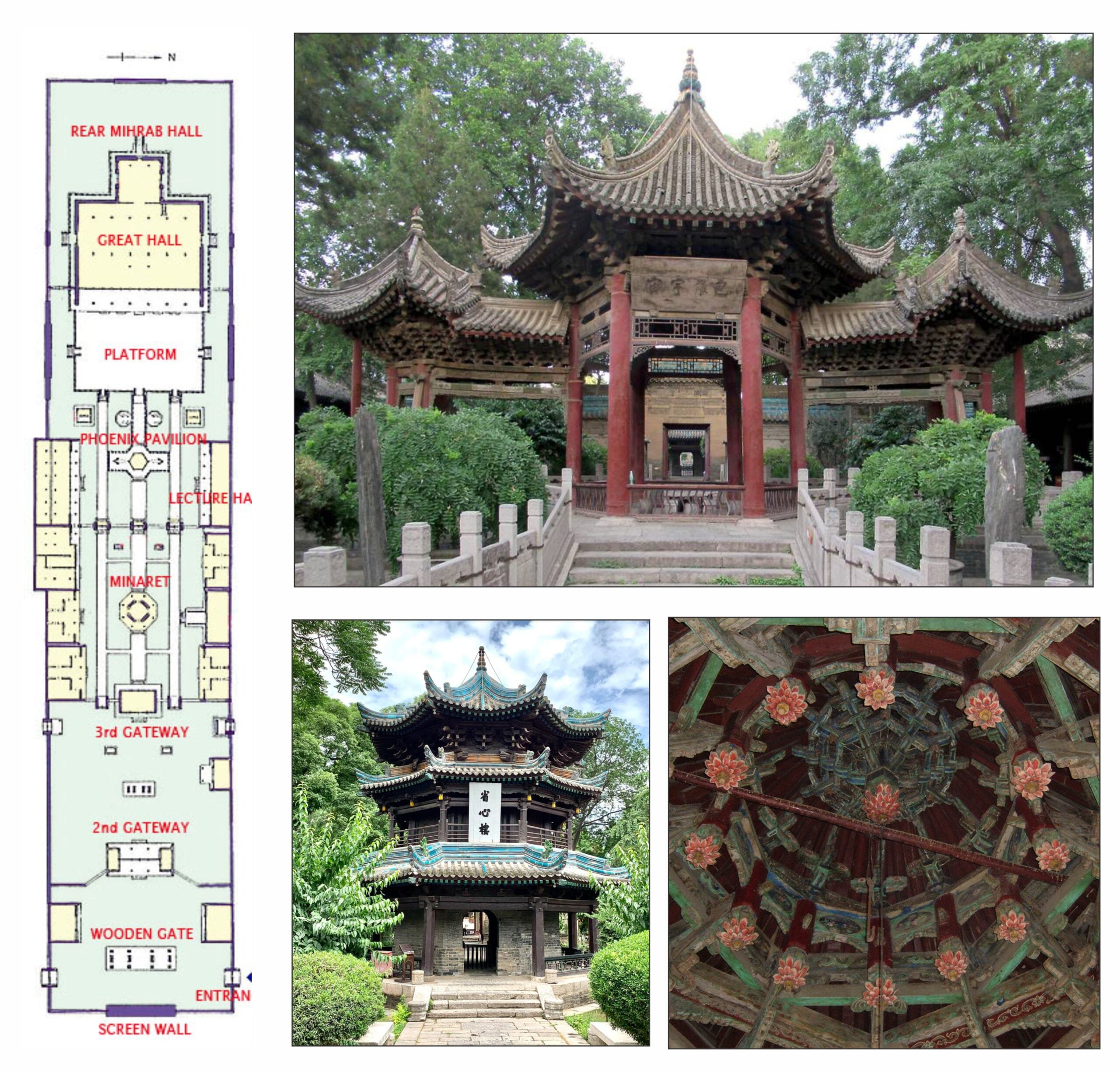
The following illustration shows a plan of the mosque together with photographs of the Phoenix Pavillion (鳳亭, fèng tíng), the “Examining the heart tower” (省心楼,shěng xīn lóu) which probably served as a minaret, and the ceiling of the Phoenix Pavilion:


Epilogue

For many centuries the Silk Roads were a conduit for goods to travel between East and West. The East produced silk, paper, tea, and porcelain. The West gave gold, silver, glass, cotton, and leather. The regions along the Silk Roads provided horses, camels, rugs, lapis lazuli and jade.

As well the Silk Roads allowed different religions to travel to distant countries. Buddhism came to China. Islam spread to both the East and the West. Judaism, Zoroastrianism, Manichaeism, and Christianity also journeyed with the caravans. Travellers on the Silk Roads were missionaries as well as merchants (Foltz, 2010). 

Some feeling for the people of the Silk Roads can be found in the poem The Golden Road to Samarkand by James Elroy Flecker (1814-1915), a British poet who briefly worked in the consular services in the Middle East before dying at a young age of tuberculosis. The conclusion to his play Hassan, published posthumously in 1922, is a conversation among the members of a caravan about to leave Baghdad for Samarkand: 

We are the Pilgrims, master; we shall go
Always a little further: it may be
Beyond that last blue mountain barred with snow
Across that angry or that glimmering sea.

White on a throne or guarded in a cave
There lives a prophet who can understand
Why men were born: but surely we are brave,
Who take the Golden Road to Samarkand

Sweet to ride forth at evening from the wells,
When shadows pass gigantic on the sand,
And softly through the silence beat the bells
Along the Golden Road to Samarkand.

We travel not for trafficking alone;
By hotter winds our fiery hearts are fanned:
For lust of knowing what should not be known,
We take the Golden Road to Samarkand.

The following is a reading of these verses by Roger Helmer

And the musical introduction to the Japanese TV series on The Silk Roads by Kitaro:


References

Beckwith, C. I. (2009). Empires of the Silk Road: a history of central Eurasia from the Bronze Age to the present. Princeton University Press,

Berg, I. M. (2000). Among the Jewish descendants of Kaifeng. Judaism, 49(1), 103.

Boyce, M., Grenet, F, & Beck, R. (1991). A history of Zoroastrianism. Volume 3. Zoroastrianism under Macedonian and Roman rule. E. J. Brill.

Brock, S. P. (1996). The ‘Nestorian’ Church: A Lamentable Misnomer. Bulletin of the John Rylands Library, 78(3), 23–35.

Chalupa, A. (2016). The origins of the Roman cult of Mithras in the light of new evidence and interpretations: the current state of affairs. Religio, 24(1), 65-96.

Dalrymple, W. (2025). The golden road: how ancient India transformed the world. Bloomsbury.

Flecker, J. E. (1922). Hassan: the story of Hassan of Bagdad and how he came to make the golden journey to Samarkand: a play in five acts. William Heinemann.

Foltz, R. C. (2010). Religions of the Silk Road: premodern patterns of globalization. (2nd Ed). Palgrave Macmillan.

Frankopan, P. (2016). The Silk Roads: a new history of the world. Alfred A. Knopf.

Grenet, F. (2015). Zoroastrianism in central Asia. In Stausberg, M., Vevaina, Y. S.-D., & Tessmann, A. (Eds.) The Wiley-Blackwell companion to Zoroastrianism. (pp 129-146). Wiley.

Gulácsi, Z. (2015). Mani’s pictures: the didactic images of the Manichaeans from Sasanian Mesopotamia to Uygur Central Asia and Tang-Ming China. Brill.

Hansen, V. (2017). The Silk Road: a new history with documents. Oxford University Press.

Keevak, M. (2008). The story of a stele: China’s Nestorian Monument and its reception in the West, 1625-1916. Hong Kong University Press.

Koller, A. (2024). A Hebrew text from the Silk Road: a prayer for forgiveness and success from the Eighth Century.  In Berger, S. Z. et al. (Eds). Wisdom has built her house. A tribute in honor of and in memory of Mrs. Leah Adler. (pp 181-187). Yeshiva University. 

Lieu, S. N. C. (1998). Manichaeism in Central Asia and China. Brill.

Lijuan Li (2021). On the transmission of the Gloria in excelsis Deo: Daqin jingjiao sanwei mengdu zan 大秦景教三威蒙度讃 In Talay, Shabo. (Ed.). Überleben im Schatten: Geschichte und Kultur des syrischen Christentums. (pp 111-113). Harrassowitz Verlag.

Mackerras, C. (1990, online 2008). The Uighurs. In Sinor, D. (Ed.). The Cambridge history of early Inner Asia. (pp 317-342). Cambridge University Press.

Mazhjoo, N. (2020). Being Mithraist: Embracing ‘other’ in the Roman cultural milieu. In A. W. Irvin (Ed.), Community and Identity at the Edges of the Classical World (pp. 139–153). John Wiley & Sons, Inc.

McGrath, A, (2021). China’s buried Christian history. Sapentia.

Millward, J. A. (2013). The silk road: a very short introduction. Oxford University Press.

Morgan, J., & Walters, C. (2012). Journeys on the Silk Road: a desert explorer, Buddha’s secret library, and the unearthing of the world’s oldest printed book. Lyons Press.

Moule, A. C. (1930). Christians in China: Before the Year 1550. Macmillan

Pin Lyu (2024). The Sogdians: the ‘Cultural Bees’ of Eurasia. In Henderson, J., L. Morgan, S., & Salonia, M. (Eds). Reimagining the Silk Roads: Interactions and Perceptions Across Eurasia. (pp 145-160). Taylor & Francis

Rong, X. (translated by Hansen, V., 1999). The nature of the Dunhuang library cave and the reasons for its sealing. Cahiers d’Extrême-Asie, 11(1), 247–275.

Red Pine. (2001). The Diamond Sutra: the perfection of wisdom. Counterpoint.

Schatzmiller, M. (2018). The adoption of paper in the Middle East, 700-1300 AD. Journal of the economic and social history of the Orient, 61 1-32.

Sinor, D. (1990, online 2008). The Karakhanids and early Islam. In Sinor, D. (Ed.). The Cambridge history of early Inner Asia. (pp 343-370). Cambridge University Press.

Stein, R. A. (1986). Avalokiteśvara/Kouan-yin, un exemple de transformation d’un dieu en déesse. Cahiers d’Extrême-Asie, 2(1), 17–80.

Stoll, O. (2022). The Cult of Mithras and the Roman Imperial Army. In Dillon, M. & Christopher, M. (Eds) Religion and classical warfare: the Roman Empire. (pp227-249) Pen and Sword.

Suebsantiwongse, S. (2025). A network of compassion: the transmission and development of the cult and iconography of Cakravarticintāmaṇi Avalokiteśvara across the Maritime Silk Routes. Religions, 16(2), 178.

Teng Li (2024). Christianity on the Silk Roads. In Henderson, J., L. Morgan, S., & Salonia, M. (Eds). Reimagining the Silk Roads: Interactions and Perceptions Across Eurasia. (pp 174-185). Taylor & Francis

Torr, G. (2018). The Silk Roads: a history of the great trading routes between East and West. Arcturus.

Waugh, D. C. (2009). The Silk Roads in history. Expedition, 52(3), 9-22.

Whitfield, S. (Ed.). (2019). Silk Roads: peoples, cultures, landscapes. University of California Press.

Wong, D. C. (2019). Colossal Buddha Statues along the Silk Road. Acta Via Serica, 4(2), 1–27.

Wood, F. (2002). The Silk Road: two thousand years in the heart of Asia. University of California Press.

Yü, C-F. (2001). Kuan-yin: the Chinese transformation of Avalokitesvara. Columbia University Press.


Zoroaster: Struggles between Good and Evil

Zoroaster, a legendary prophet who probably lived toward the end of the 2nd Millennium BCE, proclaimed a new religion based on a belief in a supreme god Ahura Mazda (Lord of Wisdom) who fights for truth and order (asha) against the forces of deceit and chaos (druj) led by Angra Mainyu (Evil Spirit). Since fire is the symbol of asha, Zoroastrian temples contain an eternal sacred flame, which represents the presence of Ahura Mazda. Zoroastrianism is one of the oldest organized religions of the world and one of the smallest, with only about 120,000 adherents in the world today.


History

Sometime between 4000 and 1500 BCE a people speaking a proto-Indo-European language came to Eastern Iran and Northwest India. They may have come from the Steppes or from Anatolia or both (see Heggarty et al, 2023). As well as their language they carried with them a multitude of gods and a sense of cosmic order or justice. These migrants divided into those that travelled into India speaking Indo-Aryan languages such as Sanskrit, and those that came to Iran speaking Iranian languages such as Avestan. A concept of cosmic order common to both groups became known as rta in the Sanskrit Vedas, the earliest of Hindu Scriptures, and as asha in the Avestan Gathas, the earliest Zoroastrian scriptures (Schlerath & Skjærvø, 2018).

Zarathustra was a prophet in Iran who lifted one of the many gods above the others. His name perhaps meant “handler of camels” and his God was Ahura Mazda. The name was transliterated into Greek as Zoroaster, which could be read as “pure star,” but this meaning was coincidental. No one knows anything for certain about the life of Zoroaster, but most scholars estimate that he lived sometime toward the end of the 2nd Millennium BCE (Boyce, 1989, p 190; Nigosian, 1993, p 15; Hartz, 2004, p 20; Stausberg, 2008, p 20; Malandra, 2015), although he might have lived at anytime between 1500 BCE and the founding of the Achaemenid Empire in 550 BCE by Darius the Great. Zoroastrianism became the official religion of that empire. The Behistun monument near Kermanshah shows Darius trampling his rival Gaumata and welcoming as prisoners the kings that he has conquered.

The extensive cuneiform inscription, written in Old Persian, Akkadian and Elamite, describes his conquests and affirms

King Darius says: This is what I have done, by the grace of Ahuramazda have I always acted. Whosoever shall read this inscription hereafter, let that which I have done be believed. You must not hold it to be lies.

The following map shows the extent of the Achaemenid Empire (550–330 BCE):

The following shows an enameled brick panel from the Palace of Darius created in Susa in about 550 BCE and presently in the Louvre Museum. It shows two guardian aladlammu, also known as lamassu: composite creatures with the body of a bull or lion, a human head and wings of an eagle (Ritter, 2010). This motif originates in earlier Mesopotamian empires, particularly the Assyrian. The human head represents intelligence, the bull’s body strength and the eagle’s wings freedom. Above the aladlammu is a winged disc which represents the grace of Ahura Mazda. This motif was also present in the Behistun inscription:

The Achaemenid Empire replaced the preceding empires of the Assyrians, Babylonians and Medians. In 480 BCE Xerxes, the son of Darius invaded Greece. Though the Persians were able to sack Athens, the invasion ultimately failed in the Peloponnese.  

In 334 BCE Alexander the Great (356-323 BCE) invaded Persia. Over the next few years, he established his own empire stretching from Alexandria in Egypt to the borderlands of India. Upon his death, his general Seleucus I Nicator ruled over the eastern part of this region as the Seleucid Empire (312-63 BCE). The Romans later took control of the Western part of this empire (Syria), leaving Iran to be ruled by the Parthians (247 BCE – 224 CE). The greatest of the Parthian emperors was Mithradates I, whose name meant “gift of Mithra,” and who reigned from 165–132 BCE. Then, from 224 to 651 CE, Iran became the center of the Sasanian Empire. Throughout this prolonged period of changing empires, Zoroastrianism remained as the official Persian religion (Malandra, 2015). By the time of the Sasanian empire, the Avestan language had evolved into Middle Persian (Pahlavi), the direct ancestor of modern Persian (Farsi): Ahura Mazda was now named Ormazd, and Angra Mainyu had become Ahriman.

The following illustration shows a relief carving at Naqsh-e Rostam from about 235 CE, showing the investiture of Ardashir I (180–242 CE), the founder of the Sasanian Empire, as the Shahanshah (King of Kings) by Ahura Mazda. On the right, the horse of Ahura Mazda tramples Ahriman beneath its hooves. Ahura Mazda is giving the diadem of kingship to Ardashir, whose own horse tramples the body of Artabanus V, the last king of the Parthian Empire. He holds in his left hand a barsom (a bundle of twigs used in Zoroastrian rituals). Ardashir wears an elaborate turban (korymbos). Behind Ardashir is the Zoroastrian high priest, Kartir.   

In 633, one year after the founding of Islam, Muslim forces under Muhammed first invaded the western regions of the Sasanian Empire. The Empire had been weakened by prolonged conflict with the Byzantine Empire, and by fragmentation into different feuding regions. Umar ibn al-Khattab, the second Rashidun caliph continued the conquest and by his death in 644 CE most of Persia was under Muslim rule. Some of the central regions, such as the province of Khorasan, were not fully subjugated until 651 (Litvinsky et al., 1996). Although under Arab rule, Persia was able to maintain much of its culture, particularly during the Abbasid Caliphate (750–1258; 1261–1517). Although Arabic became the dominant language in other areas of Muslim rule, the Persian language flourished. Ferdowski’s Shanameh, the great epic of Persian poetry, completed in 1010 CE, retold the history of Persia from ancient times to time of its writing. Nevertheless, Islam completely replaced Zoroastrianism as the state religion (Choksy 2018).

The Muslims tolerated Christians and Jews since they were “People of the Book,” but persecuted Zoroastrians as pagan infidels. Many fire-temples were transformed into mosques and many Zoroastrians converted to Isam. Some faithful Zoroastrians retreated to inland regions of Persia, such as Khorasan. In the 9th Century, Babak Khorramdin led a brief Zoroastrian rebellion against Arab rule, but this came to naught. Some Zoroastrians decided to leave their newly Islamic land and settle in India (Hinnells & Williams, 2007). Zoroastrians had traded with the Indians of the Gujarat region even before the Muslim conquest. A Zoroastrian migration to India were described in an epic poem Qissa-i Sanjan, written by a Zoroastrian priest in 1599 CE. The poem recounts how the Zoroastrians sailed from the Island of Hormuz and initially settled in Diu before moving on to Sanjun and thence to Mumbai. Although the poem describes one specific migration, groups of Zoroastrians likely moved to India from Persia over several centuries, and over several routes.

A famous story is told about the arrival of the Zoroastrians in Gujarat. The local king Jadi Rana explained that his kingdom was full and showed a cup of milk filled to the brim to illustrate this problem. One of the Zoroastrian priests added sugar to the milk to show how the new immigrants could enrich the land without displacing anyone. Asylum was granted, and Zoroastrians still partake of faloodeh – a dessert of vermicelli, milk, sugar and rosewater – at times of celebration

Over the years, the Zoroastrian immigrants became a flourishing community in northeast India, known as the Parsis or “those from Persia” (Hinnells & Williams, 2007). The Parsis have maintained the rituals of their Zoroastrian forebears. Though they remain small in numbers (about 50,000 in the present day), they have contributed extensively to the economy and culture of India. About 20,000 Zoroastrians remain in modern Iran. Other smaller Zoroastrian communities exist in North America and Europe, set up by Iranian emigrants or by Parsis mercantile connections. The total number of Zoroastrians in the world is about 120,000.

Basic Principles of Zoroastrianism

As in any religion, the founding texts of Zoroastrianism provide sometimes contradictory claims. This problem is exacerbated by the difficulty in interpreting the language in which these texts were written. A text entitled The Advice Book of Zarathustra from the Pahlavi period (probably originating in the late Sasanian dynasty but not written down until much later) begins with the following verses which summarize the main tenets of the Zoroastrian faith (Vevaina, 2015, pp 214-215; Skjaervo, 2011, pp 192-193):

The Teachers of Old, who have the foremost knowledge of the Religion, have said that, at the age of fifteen, one should know the following: “Who am I, and to whom do I belong? Where did I come from, and to where will I go back? … And what are my duties in the world of the living (getig), and what is my reward in the world of thought (menog)? … Do I belong to Ohrmazd, or do I belong to Ahreman, to the gods or to the demons, to the good or the bad? Am I a human or a demon? How many are the paths, and which is my Religion?… … Are the Origins one or two? From whom is goodness and badness?

I belong to Ohrmazd, not to Ahreman, to the gods, not to the demons, to the good, not to the bad. I am a human, not a demon, the creature of Ohrmazd, not of Ahreman … My duties and obligations are to think about Ohrmazd that he is, has always been, and will always be, that he is the immortal ruler, boundless, and pure, while Ahreman is not and shall be destroyed … have to have no doubt that good deeds are good for me and bad deeds bad for me; that my friend is Ohrmazd and my enemy Ahrimen; and that the path of the Tradition is one …The one path is that of good thought, speech, and action; paradise is the light and purity and limitlessness of Ohrmazd the Creator, who has always been and shall always be. Another is the path of evil thought, speech, and action. This is the darkness, boundedness, all evil and destruction, and badness of the wicked one, the Foul Spirit, who once upon a time was not in this creation and who once in the future shall not be in the creation of Ohrmazd, but in the end will be annihilated. …I must have no doubt about this too, that the Origins are two: the Creator and the Destroyer. The Creator is Ohrmazd, from whom all goodness and all light emanates. The Destroyer is the wicked Evil Spirit, who is all badness and full of death, wicked and deceiving. … I have to have no doubt about these things, … that very person is mortal; that the soul (gyān) is expelled and the body destroyed; that the accounting takes place at the third dawn (sidōsh); that the Resurrection and the Final Body will come about.

In summary: One God – Ahura Mazda (Ohrmazd) – created and rules the world according to the principles of asha. He and will ultimately triumph over the forces of druj (deceit, evil) led by Angra Mainyu. Human beings must follow the way of asha by means of good thought, good speech and good action. This will justify their resurrection after death.


(i) Asha

The starting point for any interpretation of Zoroastrianism is the concept of asha (or asa, depending on the transliteration). This Avestan word goes back long before Zoroaster to the time when the proto-Indo-European language was being formulated. It is homologous to rta Sanskrit (Schlerath & Skjærvø, 2018). The meaning of asha is very difficult to express in a single word. Irani (1990) proposes that it contains four main ideas:

The first is the most general philosophical concept, Truth. The second is the cosmological implication of the Order underlying the universe. The third and fourth belong to the moral dimension – Right as the most general term of moral correctness, and Justice as the moral principle of the social system.

In these early times before the monotheistic reformations of Zoroaster, one of the many gods, Mithra (or Mitra), was responsible for the maintenance of asha. The name of Mitra combines mi (bind) with tra (causing to) to suggest covenants, oaths, truth-telling and contracts – the bases of social order and harmony. Mithra is portrayed as radiating light like the sun. Boyce (1975, p 27) describes Mithra’s role:

One of the striking features of his activity is that he is concerned with upholding the great Indo-Iranian principle of rta/asa. This term, it is now generally accepted, represents a concept which cannot be precisely rendered by any single word in another tongue. It stands, it seems, for “order” in the widest sense: cosmic order, by which night gives place to day and the seasons change; the order of sacrifice, by which this natural rhythm is strengthened and maintained; social order, by which men can live together in harmony and prosperity; and moral order or “truth”. In both India and Iran to possess rta or asa, to be rtavan or asavan, was to be a just and upright being; and when used of the dead these words implied that the departed was blessed in the hereafter, having attained the Paradise which he deserved.

Ahmadi (2015) proposed that asha in effect refers to the whole of creation, that which has been ordered, and might be expressed by the word “cosmos” which derives from the Greek kosmein (to arrange or to put into proper order). (“Cosmetic” has the same etymology.)

The concept that there is some underlying order in the universe, that everything is unfolding as it should, is common to many different philosophies and religions. The asha/rta of the Indo-European forebears is closely related to Maat in Ancient Egypt, to the Dao in China and to the logos in Greek philosophy. To my mind these concepts essentially indicate that the world is intelligible. There is an order behind things that we can try to understand and to follow, “a divinity that shapes our ends, rough-hew them how we will” (Hamlet, V:2)

Asha is the subject of a Zoroastrian prayer recited during all Zoroastrian observances (Rose, 2011a, p 24)

Ashem vohu
vahishtem asti
ushta asti
ushta ahmai
hyat ashai vahishtai ashem

Asha is the best good
It is happiness [or ‘it is desired’],
according to our desire, there will be
Asha which belongs to the best Asha.”

Another translation (Nigosian 1993, p 103) is

Righteousness [is] good, it is best.
According to [our] wish it is,
according to our wish it shall be.
Righteousness belongs to Asa Vahista.


(ii) Monotheism

Zoroaster’s great contribution to human religious thought was to proclaim one God – Ahura Mazda – as the supreme creator and lord of the universe. The Jewish patriarch Abraham who may have lived sometime toward the end of the 2nd millennium BCE is generally considered the first monotheist. However, recent evidence suggests that although Jewish monotheism had its beginnings around the 1st Millenium BCE, it was not fully formulated until the period of the Babylonian Exile in the 6th Century BCE (Gnose, 1997, Chapter 2). Yahweh was initially considered as the God of the Israelites and only later evolved to be the God of the whole universe. Zoroaster probably lived at around the same time as Abraham, though both are legendary rather than historical figures, Zoroaster may have been the first prophet to preach universal monotheism, and Zoroastrianism the first monotheistic religions to survive its founder (Ferrero, 2021). The Egyptian Akhenaten (servant of Aten, 1353-1336 BCE) favored the Sun God Aten above all other gods, but Atenism did not persist beyond his brief lifetime.

Ahura Mazda was recognized before Zoroaster, though he was not as clearly defined as some of the other gods of the Indo-European pantheon, such as Mithra (god of the sun and of covenants) and Apam Napat (god of water and fertility). Zoroaster reportedly had a vision in which he met Ahura Mazda in person, and recognized him as the supreme creator, and source of asha. In the religion that he proclaimed, some of the other gods were somehow subsumed into Ahura Mazda. Hymns are offered in praise of both Ahura Mazda and Mithra. Many other gods remained separate but were still considered worthy of worship (yazata). These were subservient to the will of Ahura Mazda (Hintze, 2014). In all monotheistic religions, the supreme God, even though omnipotent, needs other heavenly beings to facilitate his plans. In the Abrahamic religions, these are called angels.

One of the earliest acts of Ahura Mazda was to create the Amesha Spenta (Immortal Benevolents). These are as much abstract concepts – emanations from the mind of Ahura Mazda – as actual divinities. They share some of the characteristics of the Seven Heavenly Virtues (prudence, justice, temperance, fortitude, faith, hope, and charity) in Christianity and their organization is related to the Five Great Elements (Pancha Mahabhuta, earth water, fire, air, ether) of Hinduism. They are generally considered six in number (Stausberg, 2008, p 29) though some authors describe seven (Rose, 2011a, p 29). The following illustration shows some modern images:

(iii) Dualism

Essential to Zoroastrianism is the concept of dualism (Gnoli, 2017; Vevaina, 2015). In the Gathas (Y 30:3-4), Zoroaster reveals his vision (or dream) about the two opposing forces in the world (Ahmadi, 2013). Our incomplete understanding of the Avestan language limits our interpretation but the following is one translation:

The two primeval Spirits, who are twins, were revealed to me in sleep. Their ways of thinking, speaking, and behaving are two: the good and the evil. And between these two ways the wise men have rightly chosen, and not the foolish ones. And when these two Spirits met, they established at the origin life and non-life, and that at the end the worst existence will be for the followers of Falsehood and for the follower of Truth the Best Thinking. (translation from Gnoli, 2017).

The two spirits are Ahura Mazda and Angra Mainyu. Ahura Mazda, assisted by the amesha spenta and the yazatas, supports asha (truth, justice, order, righteousness). Angra Mainyu promotes druj (lie, wrongdoing, chaos, evil) with the support of daevas (devils, demons).

Angra Mainyu is a spirit of destruction, incapable of creating anything, and inactive in the absence of creation. Its home is the kingdom of death. Boyce (1975, p 199) describes the spirit:

Angra Mainyu is seen both as actively malignant, a militant foe, and also as a mere shadow, a negation of good; for traditionally existence in the kingdom of the dead was characterised by a lack of substance, by a spectral quality without positive capacities, a nothingness.

Henning (1951, p 46) describes how Zoroaster’s dualism supplements his monotheism, by explaining the existence of evil and suffering in the universe:

Any claim that the world was created by a good and benevolent god must provoke the question why the world, in the outcome, is so very far from good. Zoroaster’s answer, that the world had been created by a good god and an evil spirit, of equal power, who set out to spoil the good work, is a complete answer: it is a logical answer, more satisfying to the thinking mind than the one given by the author of the Book of Job, who withdrew to the claim that it did not behove man to inquire into the ways of Omnipotence.

At the beginning Zoroastrianism proposed an ethical rather than an ontological dualism: good (asha, vohu) versus evil (druj, aka), rather than spirit (menog) versus matter (etig). However, as the religion evolved, the dualism extended into the ontological as well. However, the two dualisms were orthogonal to each other. Both good and evil beings could be either spiritual or material (or both). The following is an explanatory diagram from Rose (2011b, p 27):

What is special about Zoroastrian dualism is the role played by human beings. The dualism of Zoroastrianism does not remove the basic problem of monotheism: how could an omni-benevolent and omnipotent God allow so much evil and suffering in the world. However, it does allow that human beings play a very significant role in the fight against evil. By our choices and our actions we can help the forces of good (Nolan, 2025): 

The battle between Good and Evil has been in process since Time began and will go on till the end of the world: but as the two powers are evenly matched, its outcome is uncertain. The decisive factor will be the collective action of humanity. Enry man or woman is free to choose which side to join: his or her support will add permanent strength to the side chosen, and so, in the long run. the acts of Man will weigh the scales in favour of the one side or the other. Thus Zoroaster, beside his principal two powers, recognizes a third, which, though not of equal rank, holds the balance. (Henning, 1951, pp 45-46).


(iv) Souls and their Fravashi

Each human being has a spiritual soul (urvan) which exists before birth and which survives the death and decay of the physical body. The fravashi are spiritual beings which foster, protect and preserve these individual souls (Boyce, 2015). The concept likely began in relation to the spirits that protect warriors during battle, but in Zoroastrianism, it became applicable to all living things. The fravashi are responsible for inserting the soul into the newborn, protecting the individual during his or her life, promoting good thoughts, speech and action, and rescuing the soul after the death of the body.  Stausberg (2008, p 38) suggests that they can be considered “guardian angels.”

Various etymologies have been suggested for the word fravashi (Boyce 2015). The root var can be related to “impregnate,” or to “turn” (which with fra, away, could yield the idea of protection), or to “choose” (especially in the sense of confessing a faith).

The relationship between the fravashi and the urvan is not clear. In some Zoroastrian writings they are conjoined:

The developed doctrine came to be that each fravasi existed from the beginning of time in a spiritual (menog) state; that in due course it was born, clad in a physical body, into this world; and that after death it lived once more in a spiritual state, to be re-united again ultimately with its resurrected physical body. In both the second and third states the fravasi tended to be identified with the urvan, as these concepts merged. The question then was pondered as to which, in the present state of the world, was the most powerful, the unborn fravasi, or that of a living person, or that of a dead one? This again suggests the theorising of priestly schools rather than a point of any popular concern. The Zoroastrian answer was that the fravasis of the great men of the faith, whether already dead or not yet born, were the most powerful, but that otherwise the fjravasis of the living were the strongest – a doctrine which seems to reflect the profound universal instinct that it is better to be alive in the flesh in the present familiar world than to exist in any other state. (Boyce, 1975, p 128)


(v) The Faravahar

The Faravahar or Farohar has become a prominent symbol of Zoroastrianism. It has its origins in the winged disk that was used in Ancient Egyptian and Assyrian cultures to denote the power and protection of the sun god. In the Faravahar, the winged disk supports a god or person, holding a ring. In this form, the symbol first appears during the Achaemenid era.   


The following are photographs of the Tomb of Darius the Great at Naqsh-e Rustam (circe 500 BCE) taken by Richard Stone. The upper photograph is the original and the lower has been enhanced to show the relief carvings. Darius stands before the sacred fire and the faravahar symbol floats above.

No one is sure exactly what the faravahar symbol means. A common interpretation is that it represents Ahura Mazda. Shahbazi (1974) argues against this since the few accepted representations of Ahura Mazda, such as the previously illustrated relief at Naqsh-e Rostam, show him holding a barsom.

There are actually very few representations of Ahura Mazda. My intuition is that the supreme deity Ahura Mazda is far beyond any portrayal by human hands, and that those supposed depictions more likely represent priests in his service, or one of the Amesha Spentas such as Khshathra Vairya, who confers temporal powers on worthy human leaders.

Another interpretation of the faravahar is that the symbol represents the individual human soul and/or its fravashi.  The following description is along these lines:   

It represents the link between the spiritual and physical worlds. The human form in the center is encircled by a ring that represents the eternal soul. The figure’s head reminds people that they have free will, a mind and an intellect with which to choose good. The right hand points upward to lead people toward Asha, the path of Truth. In the left hand is a ring symbolizing the just power of Khshathra Vairya. The figure has wings to help the soul fly upward and progress. It has a tail that serves as a rudder to help the soul balance between the opposing forces of good and evil. These forces are represented by the curved hooks on either side of the tail. The three sections of the tail, which appear as layers of feathers, remind people of good thoughts, good words, and good deeds. Throughout life, the human soul is caught between good and evil, Truth and the Lie. But with the heavenly help, or wings, of Ahura Mazda, the soul may soar to eternal goodness and light. (Harz, 2004, p 9)

According to this approach, the faravahars depicted on the historical reliefs likely represent the the fravashi of the king or priest that is the subject of the carving. Shahbazi (1974) argues against this interpretation since the faravahar has no individuality. Furthermore, the fravashi were initially considered female whereas the faravahar is always male.

Another possibility is that the symbol represents Khshathra Vairya the Amesha Spenta of righteous power, who is typically shown holding a ring or diadem.

A final interpretation, and the one that I prefer, is that the faravahar symbolizes the concept of khvarenah (or farr in New Persian) (Shahbazi, 1980; Boyce, 1982, pp 103-105). This is the right to rule conferred by Ahura Mazda upon those deserving dominion over their fellow men. The leader may become radiant (hvar means sun), and remain so if he rules in accord with asha. The concept of khvarenah has also been translated as “divine glory”

In modern times the faravahar has been used outside of any religious connotation as a symbol of Iranian nationalism. For example, it formed part of the coat of arms of the Pahlavi dynasty who ruled Iran from 1925 until the Iranian Revolution in 1979.  


(vi) Eschatology

Ultimately, Zoroastrians believe that the struggle between good and evil will be won by the forces of good, and the universe will be renewed (Moazami, 2000; Kreyenbroek, 2002; Staussberg, 2008, pp 39-42; Cereti, 2015). This is the doctrine of frashokereti (Avestan, making into initial state, restoration; Middle Persian frashgird).

When the end-times draw near, a virgin will bathe in the waters of Kayanse, a mythical lake that preserves the seed of Zoroaster, and will conceive the savior Saoshiant (he who brings strength), who will lead the forces of good. The savior is also named Astvat-ereta – ‘the one through whom Asha has bones’ (Rose, 2011b, p 44). He will defeat Angra Mainyu in battle, and will cause all who have died to be resurrected.

The Saoshyant will bring about the Resurrection, and will hold an assembly of all men and women in which they will realize their good and wicked deeds. There will be a Final Judgment and those to whom sin still clings will undergo another short period of punishment in hell (this time not as spirits but in the material body), while the righteous will again enjoy the delights of paradise. Then all the metal contained in the mountains of the earth will be melted. A river of molten metal will thus be formed, through which all men must pass; for those who are free of sins, this will be like a bath in warm milk, but those whose sins have not been completely atoned for will experience a fierce burning. All men, thus cleansed, will then meet together and praise Ohrmazd. (Kreyenbroek, 2002, p 46).

There are clear similarities between these Zoroastrian prophecies, which were most fully developed during the Achaemenid era, and the concepts of the Messiah that developed in Judaism at about the same time, and which significantly affected Christianity. Which of the prophecies came first, and how each tradition contributed to the other is not known (Hultgard in Stausberg, 2008, pp 106-110).

Mary Boyce notes that the ideas of an end-time and of a final judgement distinguishes Zoroastrianism from the prevalent idea of eternal reincarnation that is the basis of Hinduism and Buddhism.

With this belief in an end to human history Zoroaster appears to have made another profound break with pagan ideas, whereby (to judge from the Vedas) the generations of men were seen as succeeding one another remorselessly like waves of the sea. The strong sense inculcated by Zoroaster of both time and purpose, of all mankind and all spenta being striving towards a common end, a foreseeable goal, has been held by some to be the most remarkable characteristic of his teachings.  (Boyce, 1975, p 233).

Another intriguing aspect of the Zoroastrian view of the final judgment is that it provides universal access to paradise. A logical problem in the Christian account of judgment is why an omnibenevolent God would not forgive everyone. In the Zoroastrian account, the good are quickly taken into the new world and those tainted by sin can have their evil erased by some sort of painful purification. The rewards offered in Zoroastrianism are quasi-universal:

The righteous who are barely affected by purification and those who become entirely good without impinging on their continued survival are saved and have the best outcome. Those who undergo so much change in the purification process that it is not entirely determinate whether the post-purification person is the same as the person before purification, and in extreme cases, it is determinate that a new person emerges from the process, albeit one who retains important continuities with the pre-purification individual. (Nolan, 2025, pp 49-50)

There are similarities here to the Catholic concept of Purgatory. However, access to Purgatory is only allowed to Christian believers who repent. Non-believers and those who do not repent remain eternally damned.


Zoroastrian Practices

(i) Fire Temples

Fire (atar) is an essential component of all Zoroastrian rituals and religious ceremonies:

The flame is considered to be the visible sign of Ahura Mazda’s presence, the symbol of his truth (asha). According to tradition, fire was used by Ahura Mazda in the creation of cattle and human beings … and fire will be used again by him when he brings about the final renovation of the universe. (Nigosian, 1993, p 112). 

In Zoroastrian fire-temples, an eternal fire was kept burning so that worshippers could at any time be in the presence of Ahura Mazda. The fire burns during the Yazna, a ceremony wherein the priest recites passages from the Avestan scriptures.  The following shows the consecrated flame in a fire-temple in Yazd in central Iran:

The fire must be protected from pollution. Only clean and dry wood (typically sandalwood) should be placed on the fire. Priests tending the fire wear masks so that their mortal breath does not reach the flames.   


(ii) Burial

Zoroastrians did not cremate their dead for such a process would defile the fire which they hold sacred. They also did not bury their dead, for such a process would pollute the earth. They resorted to “excarnation:” leaving the corpse out for carrion birds to cleanse. In ancient times this was done in open areas of desert. After the Islamic invasion, Zoroastrians constructed specially raised buildings called dakhma (towers of silence) for their dead (Boyce, 1975, pp 325-330; Russell, 2013). These were generally located upon small hilltops.

After the funeral rites the corpse was taken by dakhma attendants and laid out on beds arranged in circles around a central pit. Male bodies were relegated to the outer circle, female bodies to the next circle and the bodies of children were placed in the inner circle. After several days vultures will have stripped the bones of their decaying flesh. The bones are then raked into the central pit where they will be cleansed by the rains. Over time the cleansed bones will disintegrate and be washed by the rains into wells, whence their dust will return to the earth.

Most of the dakhmas in Iran have not been active since the Middle Ages. A few survived but their usage was declared illegal in the 1970s. The Parsis community in Mumbai maintained dakhmas in the suburbs of the city. The first tower was consecrated in 1670. With the spread of urbanization and the decline in the population of scavenger birds, these have become inactive (Karkaris, 2015).

The following diagram shows a cross-section and a bird’s eye view of a dakhma

The following illustration shows two views of the dakhma at Yazd in Iran, the first from above and the second from below. .

Nowadays most Zoroastrians are buried in the ground in concrete-sealed tombs to prevent any contamination of the earth by the decaying corpse.


Descendants of Zoroastrianism

(i) Mithraism

Mithra persisted as a divinity (yazata) throughout Zoroastrianism. He is frequently considered as co-equal with Ahura Mazda, and it is often difficult to determine whether a particular representation is of one or the other. The following is a relief sculpture from Taq-e Bostan, near Kermanshah, that was made in the 4th Century CE to commemorate the investiture of Ardashir II who reigned as Shahanshah from 379-383 CE. He was the brother of the Shapur the great who had reigned from 309-379 CE. The relief also celebrates the victory of the Sasanians over the Roman forces of Emperor Julian, who died on his ill-fated expedition into Persia in 363 CE.  

The figure on the left represents Mithra, shining with the radiance of the sun. Mithra stands upon a lotus. This might perhaps be related to the influence of Buddhism which had spread from India into the eastern regions of the Sasanian Empire. The figure in the center is Ardashir II. There is some debate about the figure on the right. Some consider this to be Ahura Mazda who is giving the diadem of power to Ardashir. Most current interpretations suggest that it is Shapur the Great who was the Emperor before Ardashir II. At the feet of the two emperors is the defeated body of the Roman Emperor Julian.   

The Roman legions fought long and exhaustive campaigns against the Parthians from 54 BCE to 217 CE, and these wars continued when the Parthians were replaced by the Sasanians. As early as the 1st Century CE, Roman Legionnaires established a secret society based on Mithras, the divinity of their enemies in these Persian Wars (Boyce, 1989, pp 469-490). Mithras, the God of the Sun, was known to be never defeated (Sol Invictus). As such he had obvious appeal to military men. The society initiates were known as the syndexi, “the men who join hands” (Fear, 2022).

Unfortunately, we know little about the nature of this society or of its beliefs. Its inner workings were only understood by its initiates, and these were sworn to secrecy. The main evidence for the society comes from the numerous temples – Mithraea – that have been unearthed throughout the Roman Empire. Each Mithraeum was constructed in a cave, or in a building made to imitate a cave. Initiates gathered there to worship Mithra and to celebrate a communal meal.  

An essential part of the Mithraeum was either a fresco or a carving of Mithra slaying a bull, the “tauroctony.” The following illustration shows a marble bas-relief of the tauroctony found at Fiano Romano near Rome, and now at the Louvre museum in Paris. The carving which dates to the 2nd or 3rd Century CE is not large: 62 cm high and 67 cm wide. The figure of Mithra wears a Phrygian cap. This type of headgear with its forward pointing tip was named after a region of Anatolia, although it was commonly worn throughout the Persian Empire. Mithras half-straddles a bull that has been forced to the ground. The bull appears in profile, with its head on the viewers’ right. With his left hand, Mithras pulls back the head of the bull by the nostrils, and with his right hand, Mithras plunges a short sword into the shoulder of the bull. Mithras turns away from the bull and looks back over his right shoulder to the Sun in the upper left. A raven is with the sun. The Moon is represented in the upper right. A scorpion, serpent, and dog attack the bull from below. The bull’s tale ends in ears of wheat.   

Many have tried to interpret what is symbolized by the various elements of the tauroctony. Although there might be some astrological significance to the scorpion, snake and dog, most scholars feel that the general intent is to depict some divine act that provides for human salvation:

It appears that just like the crucifixion in Christianity, the slaying of the bull was seen as opening up a path to salvation that was previously closed. The teachings of how that path had been closed in the past and why the bull needed to be sacrificed to restore the link are tragically lost to us (Fear, 2022, p 181)  

The Bundahishn, a Middle Persin Zoroastrian text, recounts how a Ahura Mazda sacrificed a bull (or ox) at the beginning of creation (Chapter 3). However, another sacrifice occurs at the time of the Final Judgment during frashokereti:

Soshyant, with his assistants, performs a Yazishn ceremony in preparing the dead, and they slaughter the ox Hadhayosh in that Yazishn; from the fat of that ox and the white Haoma they prepare Hush, and give it to all men, and all men become immortal for ever and everlasting. (Bundahishn, 30, 25) (also discussed in Moazami, 20000

The tauroctony might therefore represent the longing for the end-times when men will finally become immortal. If so, the slaying of the bull in the Mithraeum would serve a similar purpose to the depiction of the crucified Christ above the altar in a Christian Church.    

Mithraism came to its end when Christianity was accepted as the state religion of the Roman Empire in the 4th Century CE. The mystery religion had lasted for three centuries. 


(ii) Mani and Manichaeism

The prophet Mani was born in Ctesiphon (near modern Baghdad) in the Parthian Empire in 216 CE. His father was a Jewish Christian.  In his youth Mani travelled to India and became aware to Buddhist teachings. He considered himself the Paraclete that Christ claimed would come to comfort his people, though the Paraclete is generally interpreted to be the Holy Spirit. He preached a new teaching that combined ideas from Zoroastrianism and Christianity. Mani was tolerated by the Sasanian Emperor Shapur I but Bahram I was a zealous Zoroastrian and persecuted the Manichaeans. Mani was imprisoned and died in 274 CE. 

Manichaeism was considered a heresy by the Christian Church and his works were destroyed. He taught a stark dualism between the good spiritual world of light and the evil material world of darkness (Widengren, 1965; Levy, 2005). He urged his followers to renounce the world so that their souls could return to the domain of light after the death of their worldly bodies. Manichaeism became widespread in the Roman Empire. Augustine of Hippo (354-430 CE) was a Manichaean before he converted to orthodox Christianity. Much of what we know about Manichaeism comes from Augustine’s writings that refute of their beliefs. Manichaeism largely died out in the Roman Empire after Christianity became the state religion in the 4th Century CE, but it persisted in regions of central Asia such as Bactria and in western China.

The dualistic beliefs of Manichaeism also persisted in the west in small groups of believers such as the Bogomils in Bulgaria in the 10th Century CE and the Cathars in southern France between the 12th and 14th Centuries CE. 

The dualism of Mani differed from that of Zoroaster in that it was “anti-cosmic” rather than “pro-cosmic” (Boyce, 1975, p 230). Mani believed that physical world was irretrievably evil, and that human souls were painfully imprisoned in their physical bodies. By renouncing all worldly desires, they could hope to be released at death back into the spiritual world – the realm of light.  Zoroaster believed the physical world basically good and that, although it was now tainted by evil, it was ultimately redeemable. At the Final Resurrection, souls would be rejoined to their now perfect physical bodies.

The following illustration shows on the left a small rock-crystal seal from the 3rd Century CE with a representation of the prophet Mani. This might have been used by Mani to seal his letters with wax. On the right is a manuscript fragment from the 8th to 9th Centuries CE found in Western China showing Manichaean monks.


(iii) Thus Spake Zarathustra

Between 1883 and 1885, Friedrich Nietzsche (1844-1900) wrote what was to become his most famous book: Also Sprach Zarathustra (Thus Spake Zarathustra). The following illustration shows a photographic portrait of Nietzsche taken in 1882 by Gustav Adolf Schultze, and the cover of the Penguin edition of the book during the 1960s with its evocative cover: Sunset Mount Blanc by Wenzel Hablik (1906).

For many people, their first introduction to Zarathustra comes through this book. Unfortunately, the book has nothing to do with ancient prophet or the religion that he founded.  

Nietzsche was aware of the basic principles of Zoroastrianism through classic authors such as Herodotus and Plutarch, and he may have been familiar with some translations of their early scriptures. Nevertheless, the fictional Zarathustra does not proclaim the beliefs of Zoroastrianism. Rather, Nietzsche’s Zarathustra wishes to correct what he (or Nietzsche) believed was his great mistakes: the distinction between Good and Evil, and the subsequent foundation of human morality (Aiken, 2003; Ashouri, 2012; Pippin, 2012).

Nietzsche describes this purpose in his autobiographical Ecce Homo, written in 1888, just before his mental breakdown, but only published posthumously. The following quotation about Zarathustra shares the verbose and vainglorious character of the rest of the book. The reference to shooting well with arrows comes from Herodotus.

I have not been asked, as I should have been asked, what the name Zarathustra means in precisely my mouth, in the mouth of the first immoralist: for what constitutes the tremendous uniqueness of that Persian in history is precisely the opposite of this. Zarathustra was the first to see in the struggle between good and evil the actual wheel in the working of things: the translation of morality into the realm of metaphysics, as force, cause, end-in-itself, is his work. But this question is itself at bottom its own answer. Zarathustra created this most fateful of errors, morality: consequently he must also be the first to recognize it. Not only has he had longer and greater experience here than any other thinker — the whole of history is indeed the experimental refutation of the proposition of a so-called ‘moral world-order’ —: what is more important is that Zarathustra is more truthful than any other thinker. His teaching, and his alone, upholds truthfulness as the supreme virtue — that is to say, the opposite of the cowardice of the ‘idealist’, who takes flight in face of reality; Zarathustra has more courage in him than all other thinkers put together. To tell the truth and to shoot well with arrows: that is Persian virtue. — Have I been understood? The self-overcoming of morality through truthfulness, the self-overcoming of the moralist into his opposite — into me — that is what the name Zarathustra means in my mouth. (Nietzsche, translated by Hollingdale, pp, 124-5)

Nietzsche had much to say in Also Sprach Zarathustra, and his attempt to do so through the words and actions of an ancient prophet is wildly creative. However, the book is an incoherent mixture of parables and folktales, that veers erratically from parody to tragedy. Most of its ideas are better expressed in Nietzsche’s other books.

Nietzsche’s main goal was to argue against the “slave-morality” that had taken hold of society, a morality that promoted humility rather than accomplishment, conformity rather than initiative, weakness rather than strength. He proposed that rather than doing what others want, we should achieve what we can, accept our destiny, fulfill the possibilities within ourselves, and become an Ubermensch: “your love of your neighbour is your bad love of yourselves” (Part I:16, Hulse translation p 52). Good versus evil (böse) is replaced by good versus bad (schlecht, often used in the sense of “poorly made, shoddy”). This is a morality based on aesthetics rather than on good and evil (Poellner, 2012; Kronman, 2019). 

Unfortunately, Nietzsche did not foresee what this new morality might entail. The Nazis took his ideas to heart, threw off all constraints, and tried to create a world that fulfilled what they considered their destiny (Golomb & Wistrich, 2002).

Modern man has found that world can be understood without the need to postulate a god, and that morality need not follow divine commandments. Nietzsche had famously proposed the idea that “God is dead” in his book The Gay Science (1882). In Also Sprach Zarathustra, Nietzsche realized the implications of this idea: “Nothing is true; everything is permitted” (Part IV: 9, Hulse translation, p 259). Ivan Karamazov voices a similar fear in Dostoevsky’s The Brothers Karamazov (1880) which was published at about the same time as Also Sprach Zarathustra: “If God does not exist, anything is permissible.”    

Another concept that occurs toward the end of Also Sprach Zarathustra involves the circularity of time: that the world continually returns to what it once was and everything recurs:

All truth is crooked. Time itself is a circle…Must we not all have been here before – and must we not come again … must we not keep coming back forever.  (Part III:2, Hulse translation, pp 146-147)

The idea that time is circular is common in Hinduism and Buddhism, which propose that the universe eternally recurs in cycles lasting many millennia. However, the Zoroastrianism concept of time is linear: the world is created, the world suffers though the battle between good and evil, and with the defeat of evil the world once again becomes as perfect as it was when it was created. One might suggest that this process could then repeat, but that is not really part of the Zoroastrian world view.

Nietzsche becomes reconciled to the eternal recurrence by proposing a variant of Kant’s categorical imperative: that one should live one’s life in such a manner that one would wish to live it in the same way when it is eternally repeated.

Nietzche’s fictional Zarathustra is both intriguing and frustrating, both charming and frightening. However he is interpreted, he is a far cry from the legendary prophet who founded a new religion based on the struggle between good and evil.


Conclusion

The world is composed of opposites: good and evil, order and chaos, growth and decay, truth and deceit. Zoroaster described this state in terms of the struggle between two opposing forces. One of the appealing aspects of the religion that he founded is its optimism: good will ultimately prevail over evil. Another is the importance of humanity to the outcome of this struggle. By choosing good over evil, we can tilt the balance between the opposing forces and accelerate the final victory.

The religion of Zoroastrianism has persisted for about three millennia, although the number of its present adherents is vanishingly small in comparison to the dominant religions of the world. Nevertheless, it remains worth our while to remember the ideas of the ancient prophet: to do as much good as we can, to contemplate the fire, and to look forward to when asha once again rules the universe.  

Ashem vohu
vahishtem asti
ushta asti
ushta ahmai
hyat ashai vahishtai ashem


References

Ahmadi, A. (2013). The Twins Stanza, Y 30.3. Iranian Studies, 46(2), 227–249.

Ahmadi, A. (2015). What is aṣ̌a? Bulletin of the School of Oriental and African Studies, 78(2), 293–315.

Aiken, D. (2003). Nietzsche and his Zarathustra: A Western poet’s transformation of an Eastern priest and prophet. Zeitschrift für Religions und Geistesgeschichte, 55(4), 335–353.

Ashouri, D. (2012). Nietzsche and Persia. Encyclopaedia Iranica.

Boyce, M. (1969). On Mithra’s part in Zoroastrianism. Bulletin of the School of Oriental and African Studies, 32(1), 10–34.

Boyce, M. (1975, revised 1989). A history of Zoroastrianism. Volume 1. The early period. E. J. Brill.

Boyce, M., (1982). A history of Zoroastrianism. Volume 2. Under the Achaemenians. E. J. Brill.

Boyce, M., Grenet, F, & Beck, R.  (1991). A history of Zoroastrianism. Volume 3. Zoroastrianism under Macedonian and Roman rule. E. J. Brill.

Boyce, M. (2015) Fravaši. Encyclopaedia Iranica.

Cereti, C. G. (2015). Myths, legends, eschatologies. In Stausberg, M., Vevaina, Y. S.-D., & Tessmann, A. (Eds.) The Wiley-Blackwell companion to Zoroastrianism. (pp 259-272). Wiley.

Choksy, J. K. (2018). Zoroastrianism. II. Historical review: from the Arab conquest to modern times. Encyclopaedia Iranica.  

Fear, A. T. (2022). Mithras. Routledge.

Ferrero, M. (2021). From polytheism to monotheism: Zoroaster and some economic theory. Homo Oeconomicus, 38(1–4), 77–108.

Gnoli, G. (2017). Dualism. Encyclopaedia Iranica.

Gnuse, R. K. (1997). No other gods: emergent monotheism in Israel. Sheffield Academic Press.

Golomb, J., & Wistrich, R. S. (2002). Nietzsche, godfather of fascism? On the uses and abuses of a philosophy. Princeton University Press.
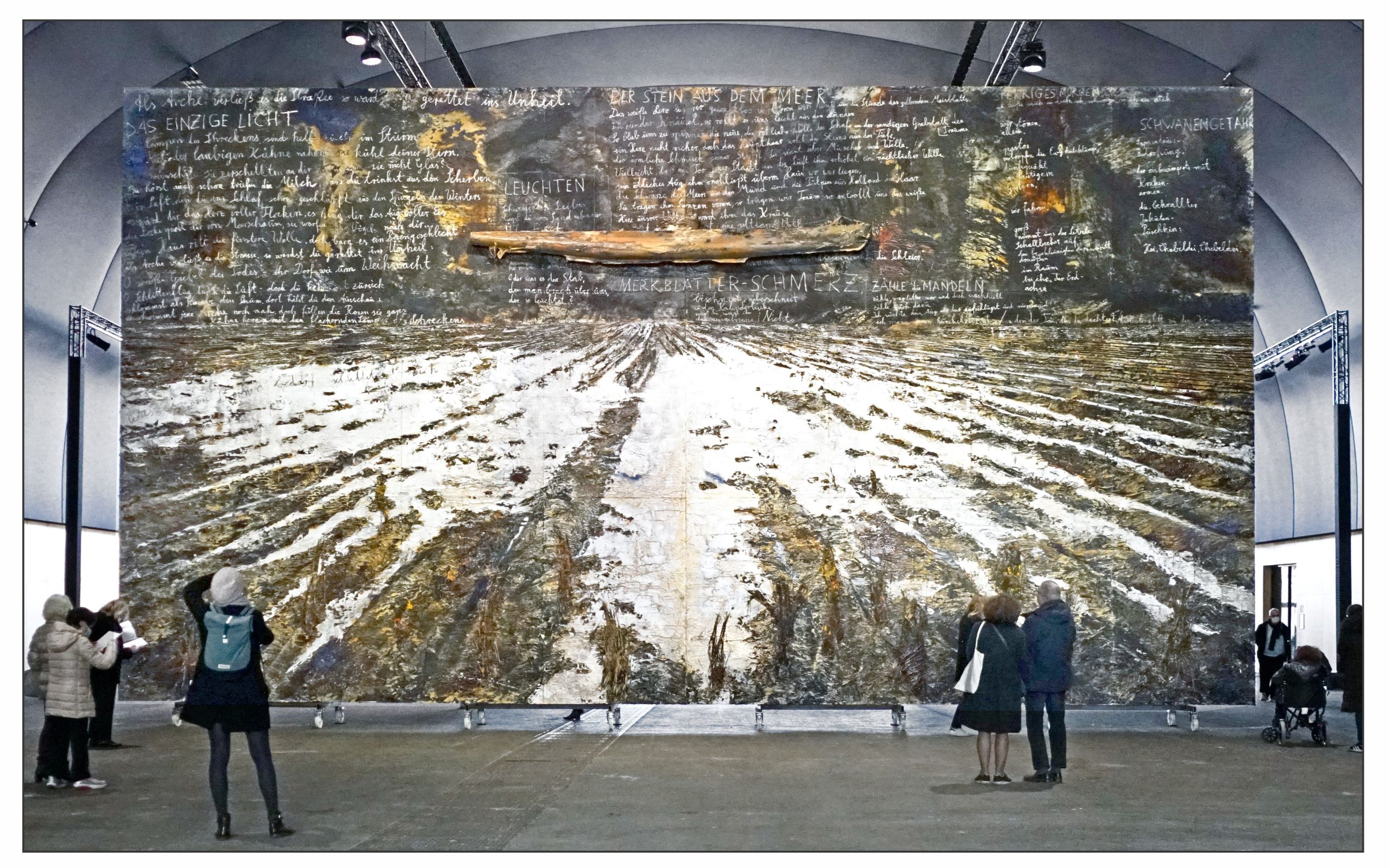
Hartz, P. R. (2004). Zoroastrianism. Facts on File

Heggarty, P., Anderson, C., Scarborough, M., King, B., Bouckaert, R., Jocz, L., Kümmel, M. J., Jügel, T., Irslinger, B., Pooth, R., Liljegren, H., Strand, R. F., Haig, G., Macák, M., Kim, R. I., Anonby, E., Pronk, T., Belyaev, O., Dewey-Findell, T. K., … Gray, R. D. (2023). Language trees with sampled ancestors support a hybrid model for the origin of Indo-European languages. Science , 381(6656), eabg0818.

Henning, W. B. (1951). Zoroaster. Politician or witch-doctor? Oxford University Press

Hinnells, J. R., & Williams, A. (Eds.) (2007). Parsis in India and the diaspora. Routledge.

Hintze, A. (2014a). Monotheism the Zoroastrian way. Journal of the Royal Asiatic Society, 24(2), 225–249.

Hintze, A. (2014b) FRAŠŌ.KƎRƎTI. Encyclopaedia Iranica.

Irani, K. D. (1990). The concept of Asha (a philosophical analysis).  In D. G. McIntyre An Introduction to the Gathas of Zarathushtra.  

Karkaria, B. (2015). Death in the city: How a lack of vultures threatens Mumbai’s ‘Towers of Silence’ The Guardian, Jan 26, 2015

Kreyenbroek, P. (2002). Millennialism and eschatology in the Zoroastrian tradition. In A. Amanat & M. Bernhardsson (Ed.). Imagining the end: visions of apocalypse from the Ancient Middle East to Modern America (pp. 33–55). I.B.Tauris.

Kronman, A. T. (2019). The world as an aesthetic phenomenon: art, truth and morality in Nietzsche’s philosophy. In Confessions of a Born-Again Pagan. (pp. 779–810). Yale University Press.

Levy, D. J. (2005). The religion of light: on Mani and Manichaeism. In Eisenstadt, S. N., Árnason, J. P., & Wittrock, B. (Eds.) Axial civilizations and world history. (pp 319-336). E. J. Brill.

Litvinsky, B. A. Jalilov A. H. & Kolesnikov A. I. (1996). The Arab Conquest. In Zhang Guand-da, Litvinsky, B., & Shabani Samghabadi, R. (Eds) History of civilizations of Central Asia. Volume III. The crossroads of civilization. AD 250 to 750. (pp 450-475). UNESCO.

Malandra, W. W. (2015). Zoroastrianism. I. Historical review up to the Arab conquest. Encyclopaedia Iranica

Malandra, W. W. (2015). Zoroaster. II. General Survey. Encyclopaedia Iranica

Moazami, M. (2000). Millennialism, eschatology, and messianic figures in Iranian tradition. J. Journal of Millennial Studies (Winter).

Nietzsche, F. W. (1885, translated by A. Tille, 1908). Thus spake Zarathustra, a book for all and none. Allen & Unwin.

Nietzsche, F. W. (1885, translated by M. Hulse, 2022). Thus spake Zarathustra, a book for all and none. Notting Hill Editions.

Nietzsche, F. W. (1888, translated by Hollingdale, R. J.,1981). Ecce homo: how one becomes what one is. Penguin Books.

Nigosian, S. A. (1993). The Zoroastrian faith: tradition and modern research. McGill-Queens University Press.

Nolan, D. (2025). Zoroastrianism and contemporary philosophy. Cambridge University Press.

Poellner, P. (2012). Aestheticist ethics. In Christopher Janaway, C. & Robertson, S. (Eds.) Nietzsche, Naturalism, and Normativity. (pp 52-80). Oxford University Press.

Ritter, N. (2010). Human-headed winged bull (aladlammu), Iconography of Deities and Demons.

Rose, J. (2011a). Zoroastrianism: a guide for the perplexed. Continuum.

Rose, J. (2011b). Zoroastrianism: an introduction. I.B. Tauris.

Russell, J. R. (2013). Burial iii. In Zoroastrianism. Encyclopaedia Iranica

Schlerath, B., & Skjærvø, P. O. (2018). Aṧa. Encyclopaedia Iranica.

Shahbazi, A. S. (1974). An Achaemenid Symbol. I: A Farewell to ‘Fravahr’ and ‘Ahuramazda’ Archäologische Mitteilungen ans Iran, 7, 135–44.

Shahbazi, A. S. (1980). An Achaemenid Symbol II. Farnah ‘(God given) Fortune’ symbolised. Archäologische Mitteilungen ans Iran 13, 119–47

Skjærvø, P. O. (2011). The spirit of Zoroastrianism. Yale University Press.

Stausberg, M. (2008). Zarathustra and Zoroastrianism: a short introduction. Equinox Pub.

Vevaina, Y S.-D. (2015). Theologies and hermeneutics. In Stausberg, M., Vevaina, Y. S.-D., & Tessmann, A. (Eds.) The Wiley-Blackwell companion to Zoroastrianism. (pp 211-234). Wiley.

Widengren, G. (1961, translated C. Kessler, 1965). Mani and manichaeism. Holt, Rinehart and Winston.


Antonello da Messina: Sicilian Master

Antonello da Messina (~1430-1479) was born in Messina, Sicily. While studying in Naples, he became aware of a technique of painting using oil-based pigments that had originated in the Netherlands with Jan van Eyck (~1390-1441) and his followers. Antonello soon became a master of this new method. He was an expert portraitist able to capture his sitters’ distinct identities and depths of feeling. The illustration shows a painting from 1473, that was once thought to be a self-portrait, but there is no real evidence for this. Although many of Antonello’s works have been lost, three absolute masterpieces have survived: Saint Jerome in his Study, The Virgin Annunciate, both dated to around 1474, and Saint Sebastien from about 1478. 

Learning How to Paint with Oils

In his Lives of the Most Excellent Painters, Sculptors, and Architects (1568), Giorgio Vasari considered Antonello da Messina as pivotal in the transition between tempera and oil painting in Italy. The use of linseed oil in painting began in northern Europe, most particularly in Flanders. First used for painting wood carvings, by around 1400 oil-based pigments were being used for panel paintings. Jan van Eyck is often considered the pioneer of this new technique (Ferrari, 2013). Oil-paints dried more slowly than tempera and were more easily mixed. These advantages led to more exact representations of color and texture. The oil medium allowed for “pictorial second thoughts, enabling the picture to be modified as work on it progressed” (Pope-Hennessy, 1966, p 60). Furthermore, the surface of oil paintings is glossy rather than matte: oil paintings appear to glow with internal light.

Antonello first became aware of some of these new paintings when he was apprenticed to Niccolo Colantonio in Naples in the mid to later 1440s. Alfonso the Magnanimous (1396-1458), king of Aragon, Sicily and Naples, possessed the beautiful Lomellini Triptych by Jan van Eyck that is now long lost (Borchert, 2019). This was described by Bartholomeo Facio in 1456:

His is a remarkable picture in the most private apartments of King Alfonso, in which there is a Virgin Mary notably for its grace and modesty, with an Angel Gabriel, of exceptional beauty and with hair surpassing reality, announcing that the Son of God will be born of her; and a John the Baptist that declares the wonderful sanctity and austerity of his life, and Jerome like a living being in a library done with rare art (quoted by Borchert, 2019, p 36).

The lost triptych was likely a small devotional painting like van Eyck’s 1437 Dresden Triptych (below). Only 33 cm high, this triptych could be folded up and carried by a travelling merchant for use as a portable altar during daily prayer. The Lomellini triptych was probably of similar size but with an annunciation at the center and Saints Jerome and John in the wings.

Antonello was clearly impressed by this and other Flemish paintings in Alfonso’s collection. Vasari claimed that he therefore travelled to Flanders to study with Jan van Eyck:

Having arrived in Bruges, he became very intimate with the said Johann, making him presents of many drawings in the Italian manner and other things, insomuch that the latter, moved by this and by the respect shown by Antonello, and being now old, was content that he should see his method of coloring in oil; wherefore Antonello did not depart from that place until he had gained a thorough knowledge of that way of coloring, which he desired so greatly to know. And no long time after, Johann having died, Antonello returned from Flanders in order to revisit his native country and to communicate to all Italy a secret so useful, beautiful, and advantageous.  

Unfortunately, this would have been impossible. Jan van Eyck died in 1441, when Antonello was only 11 years old. However, nothing is known about Antonello in the 1450s. He might therefore have travelled to Bruges during this time and studied with some of van Eyck’s followers (Wright, 1980). As well as learning about oil-painting from the Flemish artists, Antonello may have taught them, in exchange, some of the new Italian insights into perspective (Edgerton, 1975).

Another possibility is that Antonello interacted with Petrus Christus (1410-1476), one of van Eyck’s most prominent disciples, in Italy rather than Flanders. There is some evidence that the two painters may have been present at the same time in Milan at the court of Francesco Sforza (Ainsworth & Martens, 1994, p 61).

Antonello returned home to Sicily in 1460, and worked there for several years but nothing is really known about his whereabouts in the late 1460s. Perhaps he travelled at that time to Bruges and interacted there with Petrus and other painters, such as Hans Memling (1430-1494). There are striking similarities between Petrus’ Portrait of a Man (1465?) on the left side of the following illustration and Antonello’s later portrait from 1473.

The following illustration shows Antonello’s Salvator Mundi from 1465 on the left and a similar painting by Hans Memling from 1475. It appears too close a likeness not to have been the result of personal interaction between the artists. 

Compared to the paintings of the Flemish painters, Antonello’s are more natural, more distinctive and more emotional. They express themselves. We sense a real person rather than an image.

Antonello stayed in Venice for a brief period beginning in late 1475. While there, he interacted with Venetian artists such as Giovanni Bellini (1430-1516) and Andrea Mantegna (1431-1506). An apocryphal story tells how Bellini posed as a nobleman and had his portrait painted by Antonio so that he could observe the technique of oil painting (Cardona & Villa, 2019, p 29).

An important development that occurred in Venice in the late 15th Century was oil-painting on canvas rather than wood. Sail-canvas was in ready supply in this maritime city. Canvas did not crack or warp like wood, and its light weight allowed for much larger paintings. Though Antonello did not paint on canvas, Bellini painted some of his late paintings on canvas, and oil on canvas became the usual technique for the next generation of Venetian painters such as Giorgione (1470-1510), and Titian (1488-1576).

In 1476, Antonello was offered a position on the Sforza court in Milan, but he declined and returned to Messina. He died there in 1479, having provided a dowry for his daughter and placed his son Jacobello in charge of his studio. Jacobello’s only surviving painting is signed Jacobus Antonelli, filius non humani pictoris (son of a painter who was more than human) (Cardona & Villa, 2019, p 39).

Over the years, many of Antonello’s works vanished. Some were destroyed in the earthquakes to Messina was prone. Others were lost in the bombing of World War II. Many of his paintings were small and easily lost. Only about 40 paintings remain.

Renaissance Portraits

During the later Middle Ages, the rich and the powerful wished to gain some hold on immortality by having their portraits painted. Initially this was done by giving an altarpiece to a church and having themselves included in the painting as the donors. Over time, painters began to provide portraits independently of the church. Jan van Eyck was again one of the most prominent of the early portraitists. The following illustration shows two of his portraits, both from around 1433. The sitter on the left is holding a ring. This could indicate that the sitter is a goldsmith, that he has just become engaged to be married, or that he has assumed a position of authority requiring the use of a signet ring. On the left the sitter is wearing is a striking blue chaperon, and on the right a marvelous red turban. The latter may be a self portrait.

Antonello learned from the Flemish painters, and became the “first Italian painter for whom the independent portrait was an art form in its own right” (Pope-Hennessy, 1966, p 60). He became particularly adept at presenting the individuality of the eyes. In this he was a believer in Saint Jerome:

Speculum mentis est facies, et taciti oculi cordis fatentur arcana.
The face is the mirror of the mind and, without speaking, confesses the secrets of the heart.

The following illustration shows four of his portraits. The upper left is from the late 1460s and the others from the early 1470s. One of Antonello’s characteristic effects was to add is signature in a cartellino on a ledge at the bottom of the image (the two lower portraits). This trompe l’oeil representation of a folded piece of paper perhaps guarantees the veracity of the portrait: if the artist can represent a scrap of paper that well, then he must have captured the likeness exactly. The typical message on the cartellino read “Antonello messianeus me pinxit” together with a date (Renzo Villa in Cardona & Villa, 2019, pp 81-107)

We consider ourselves able to read both character and emotion in the human face. For example, in the preceding portraits we might find mockery/amusement, diffidence/cunning, disdain/skepticism, and truculence/stubbornness. Indeed, the last portrait is often known as Il Condottiero, the name for an Italian mercenary leader.

The following is an evaluation of the portrait at the lower left by Nicola Gardini, an Italian novelist (in Cardona & Villa, 2019, p 289):

The face is the theatre. And it is doubly so. On the one hand, it provides a stage where events or a story, no matter how slight, can unfold: the eyebrows arch, the eyelids are lowered, a rebellious tuft of eyebrow hairs stands up, a wart is displayed in the centre of his forehead, which creases into furrows that extend down to the side. There is no fixity: that face reveals an ex-pression, a current frame of mind or psychological circumstance. On the other hand, the mask, the moral core of the expression, the underlying truth behind events elevating the circumstance to a natural truth. This is where the man reveals himself, both as he is and as he appears with all his distinctive features: the smugness, the miserly smile (Antonello has managed to make his eyebrows smile far more than his mouth), a sense of condescension and satisfaction, his robustness, that air of good health, cleanliness, prosperity … Clearly pleased with himself and full of self-worth, this man certainly knows a thing or two. And he keeps as far away as he can from death.

However, we should be careful. Though we can recognize the most striking of human emotions, we often miss subtle changes. And we are more often wrong than right about the underlying character.

The portrait in the upper left is particularly appealing. Though it has been considered the portrait of a sailor or a pirate, it is almost certainly a portrait of a Sicilian aristocrat, willing to have his representation immortalized by the talented artist. He is not dressed in a modern maritime uniform but wearing a Sicilian woolen cape or cappuloro (Cardona & Villa, 2019, p 32). The Sicilian novelist Leonardo Sciasia notes that we recognize the face but really do not know the person behind it:

Who does the unknown man resemble? A mafioso from the countryside or one from the best neighborhoods, the member of parliament who sits on the right, or on the left, the peasant or the lawyer? He looks like the writer of these notes (it’s been said), and he certainly looks like Antonello. And just try to pin down the social status and the individual human nature of this personage. Impossible. Is he a noble or a plebeian? A notary or a farmer? A gentleman or a lout? A painter, a poet, an assassin? “He resembles.” There you have it. (translated and quoted by Ingrid Rowland, 2024, pp 21-22)

Antonello’s portraits are easily approachable. They all make clear eye contact:

Antonello is also a sensitive to the humanity of the viewer, who is given consistent points of entry into the work. These entry points are established not only with eye contact, but with the parapet, which gives a clear boundary between observer and observed, and the cartellino, which looks as if one has just unfolded it. (House, 2025, p 41)

When Antonello was in Venice in 1475-6, he was able to show the Venetian painters the techniques of oil-based portraits. The following are two portraits by Giovanni Bellini.  The Portrait of a Young Man on the left dates to around the time of Antonello’s visit. It is clearly similar to Antonello’s paintings. The Portrait of Doge Leonardo Loredan is from 1501. Antonello’s technique has been supplemented by the amazing color sense that characterizes Venetian painting. Interestingly, Bellini has added to his masterpiece a painted cartellino in the style of Antonello:


Ecco Homo

Antonello used the abilities he had developed in portraiture to create representations of the face of Christ that are utterly convincing in their humanity and depth of feeling. One of his favorite themes was that of Ecco Homo (Behold the man) as described in the Gospel of John:

Then Pilate therefore took Jesus, and scourged him.

And the soldiers platted a crown of thorns, and put it on his head, and they put on him a purple robe,

And said, Hail, King of the Jews! and they smote him with their hands.

Pilate therefore went forth again, and saith unto them, Behold, I bring him forth to you, that ye may know that I find no fault in him.

Then came Jesus forth, wearing the crown of thorns, and the purple robe. And Pilate saith unto them, Behold the man! (John 19 1-5)

The following illustration shows two of Antonello’s paintings of Ecco Homo, the left from 1476 and the right from 1470.


Saint Sebastian

Saint Sebastian was a 3rd Century Roman Christian martyred during the Diocletian Persecutions. Initially, he was shot with arrows, but this miraculously did not kill him, and he was nursed back to health by Saint Irene. Later, he was clubbed to death and thrown into the Cloaca Maxima – Rome’s main sewer.  During the Middle Ages, Saint Sebastian was invoked as a defender against the plague. If he could survive being shot with arrows, surely he could help those who were afflicted by the disease. Depictions of Saint Sebastian allowed painters to portray the nude male body. Antonello’s depiction is probably the most sensuous of the early representations of the saint. In recent years, the saint has become a gay icon and the patron of the Lesbian-Gay-Bisexual-Transgender-Queer communities.

Antonello’s Saint Sebastian was painted in the mid 1470s for the altar of the Church of San Guliano in Venice at the height of one of the plague epidemics to which Venice was so susceptible (Humphrey, 1993, pp 195-229). The altarpiece also contained a representation of Saint Christopher, probably painted by Antonello’s son, and a carved sculpture of Saint Rocco, another saint who offered protection from the plague. The latter was also the patron of the Scuola di San Rocco which was established in 1478. The altarpiece did not last long: the statue and the painting of Saint Christopher have been lost, and Antonello’s painting is now in Dresden.

Antonello’s painting owed much to an earlier altar triptych of Saint Sebastian (1470). However, Antonello’s saint is much more convincing than Bellini’s flatly outlined figure.

The Saint stands in a serenely ordered space that recalls the paintings of Piero della Francesca, who wrote a treatise De prospectiva pingendi (On the Perspective of Painting) in the mid 1470s. Perhaps Antonello visited him in Urbino during his travels (Campbell, 2021). House (2025, p 131) quotes Roberto Longhi as claiming that Antonello assimilated Piero’s teachings and brought them to Venice.

On the left a guard sleeps in a marvel of foreshortening. Elsewhere the people of the city converse, and go about their appointed ways. Though the saint is being martyred, everything is as it should be according to divine perspective.


Saint Jerome

Jerome (342-420) CE) was a Christian saint who in his youth spent a prolonged period of ascetic penance in the deserts of Syria. Legend has it that during this time he removed a thorn from the paw of a lion, and that the lion then became his lifelong companion. After his sojourn in the desert, he came to Rome where he translated the Bible into Latin, and made extensive commentaries on scripture. His version of the Bible – the Vulgate (from versio vulgata, the commonly used version) – remains the official Latin version of the Bible in the Catholic Church. Jerome became the patron saint of translators, librarians, and students.

Jerome became a popular subject in the paintings of the early Renaissance.  The following illustration shows on the left a painting of Saint Jerome by Jan van Eyck that was likely finished by Petrus Christus in 1442, and on the right a 1444 painting by Niccolo Colantonio, with whom Antonello was apprenticed in Naples.   

The late Middle Ages ushered in the “Humanities” as a field of study. Initially, this concerned the language, history and philosophy of the Greek, Roman and Hebrew civilizations. The goal of these studies was to facilitate a deeper interpretation of Biblical texts. Study of the humanities (humanitas) was thus considered a handmaiden to the study of divinity (divinitas). Saint Jerome with his immense knowledge of the ancient languages came to personify this new field of study. Over the years the Humanities expanded to include study of all texts. The Humanities then became was distinguished from both Theology – the study of sacred rather than secular scriptures –and the Sciences – the study of observed data.    

Antonello painted his Saint Jerome in his Study in 1474. The painting is not large (46 by 36 cm) but it is intricately detailed (Jolly, 1983):

The painting shows Jerome reading in his study, as revealed through a monastery doorway. In the foreground the partridge, peacock, and water-bowl symbolize worldliness, immortality and ascetic purity. His lion can be seen in the shadows to the right of the study. A peaceful countryside rests beyond the monastic windows:

The following illustration shows some of the details in the painting. The landscape seen through the window on the left contains people walking with a dog, rowing a boat, and riding a horse – all going about their normal lives independently of the saint in his isolated study.

The Italian writer Elizabetta Rasy (In Cardona & Villa, 2019, p 78) comments on the figure of the saint

Unlike Jan van Eyck’s Saint Jerome blissfully reading with his cheek resting on his hand, Antonello’s saint is not particularly relaxed nor is he sitting properly. In fact, he seems to be almost on the edge of his seat. stretching his arms out towards the book rest like someone carrying out an action or making an effort. Reading may not always be an effort, but it is certainly an action. It is this very tension that gives rise to the power of a figure who does not appear conventionally devotional or indeed anything like the kind old monk depicted by Colantonio, Antonello’s master.

She further comments on the painting’s tension between reality and imagination (in Cardona & Frederico Villa, 2019, p79):

Yet the entire space of the work suggests something else. Let’s take look at the lion. Instead of holding his paw out for the saint to remove the famous thorn or sitting crouched at his feet, he is roaming aimlessly in the corridor, nothing like a lion, not even the lion in the legend, but more like those animals appearing in dreams, in places and in ways they shouldn’t, like incongruous presences. That lion standing in the shade, a forest but of an elegant marble corridor, is an apparition that shifts the entire scene into the realm of dreams. Over on the other side is a paper label attached to the wooden wall of Jerome’s cell, in plain sight. Is it the artist’s signature? A message for the observer? No, it is impossible to read those words, they are just a series of illegible scribbles that do not belong to any human alphabet. Have you ever tried to read something in your dreams? It’s impossible. Those forever unknowable words are written in the language of the most secret nocturnal images. This is the time-less stance of Antonello’s Saint Jerome in the study: every element in this setting, saint included, is here, now, near, tangible and shamelessly real. Yet every element in the entire conspicuously asymmetrical space of the picture is mysterious and represents a distant Beyond that enchants us and draws us out.


Virgin Annunciate

During the Middle Ages in Europe the veneration of the Virgin Mary underwent an extraordinary growth. This was partly related to the writings of Bernard de Clairvaux, who experienced visions of the Virgin, and who founded the Cistercian Order, and partly the need for solace during the terrible years of the Black Death. If the plague had been sent by a God of Justice and Judgment, the people could not really appeal to him for relief. So they asked the Virgin Mary to intercede, the divine feminine being far more compassionate than the male. Many of the great cathedrals were named after Notre Dame or Santa Maria. The virgin appeared to her followers, and, at the sites of these visions, shrines were established to attract pilgrims. Walsingham in Norfolk, England is one of the earliest Marian shrines

Artists celebrated the many different aspects of Mary’s life from the Annunciation to the Assumption (Verdon, 2005). One of the most popular subjects was the Annunciation as described in the Gospel of Luke (1:26-31):

….the angel Gabriel was sent from God unto a city of Galilee, named Nazareth,

To a virgin espoused to a man whose name was Joseph, of the house of David; and the virgin’s name was Mary.

And the angel came in unto her, and said, Hail, thou that art highly favoured, the Lord is with thee: blessed art thou among women.

And when she saw him, she was troubled at his saying, and cast in her mind what manner of salutation this should be.

And the angel said unto her, Fear not, Mary: for thou hast found favour with God.

And, behold, thou shalt conceive in thy womb, and bring forth a son, and shalt call his name Jesus.

The paintings typically showed Gabriel interrupting Mary as she read from the scriptures The angel is usually on the left and in profile; the virgin on the right and turned toward the viewer. The following illustration shows the 1333 Annunciation Altarpiece of Simoni Martin and Lippo Lemmi now in the Uffizi Gallery in Florence. The words of the angel float across the gold background through the olive branch of divine peace and the lily of virgin purity:

Ave [Maria] gratia plena dominus tecum
Hail [Mary] full of grace, the lord is with you.

Sometimes the annunciation was painted on two panels and that representing Mary was called the Vergine Annunziata (Virgin Annunciate). Antonello da Messina was the first painter to represent the Virgin Annunciate alone.


His 1476 painting shows the virgin in a simple blue shawl. The background is dark rather than gold. Mary looks down and to the left at a kneeling Gabriel who is not represented, and perhaps not clearly visible in the real world. Her expression is as enigmatic at that of Leonardo’s Mona Lisa (1506). Mary’s right hand is lifted partly in surprise, partly in reluctance. Her right hand gathers her shawl close.

The painting represents the miraculous moment of the incarnation, of the divine becoming human. The following are comments by Klaus Krüger (2015):

The image presents the Virgin in a tranquil, clearly structured composition. The strict symmetry and frontality are reminiscent of an icon. Only the implied movement of the right hand, which reaches forward into the pictorial space, and the direction of the Virgin’s gaze, which almost imperceptibly follows the turning of her body, subtly indicate that a scenic incident, namely the Annunciation, is taking place. Antonello radically reduces the event of the Annunciation by depicting only the very moment in which the Virgin receives the Word of God, and with it the divine fruit of her womb. The actual descent of the divine Logos remains imperceptible to the eyes. It can only be inferred from Mary’s reaction and from the reflection of the light that shines on her from above, and which appears to radiate all the more intensely against the dark background. The actual subject of the image is thus the paradoxical manifestation of the invisible in the visible, of light amidst darkness, of the Word in the flesh, in sum: of the divine in the temporal.


Humanism

As the Middle Ages developed into the Renaissance, the study of the Humanities, which initially were concerned with the languages in which the scriptures were written, broadened to include philosophy, ethics and history. Scholars became more familiar with the ancient texts, and took to heart the statemen of Protagoras (490-420 BCE) that “Man is the measure of all things.” They found that they could order their lives through the exercise of human reason as well as or instead of through faith in divine instruction. The Humanities thus gave birth to the philosophy of Humanism (Davies, 2001, pp 125-135).

Renaissance Humanism was facilitated by several developments. Beginning in the mid 15th Century, the printing press gave people ready access to books and ideas. No longer were thoughts locked up in the libraries of the church. The new sciences provided ways to look at the world in relation to human beings rather than as divinely determined. And painting became more realistic, the spaces more three-dimensional, and the faces more human.

Antonello da Messina infused his paintings with this new humanism. His portraits show real people who run the gamut of human emotions. His depictions of Christ show a man of sorrow rather than a suffering God. His saints live out their lives in a world that is seen from a human rather than a divine perspective. His Virgin Mary is a wonderfully realized young woman rather than a pious saint. 

References

Ainsworth, M. W., & Martens, M. P. J. (1994). Petrus Christus: Renaissance master of Bruges. Metropolitan Museum of Art.

Barbera, G., Christiansen, K., & Bayer, A. (2005). Antonello da Messina: Sicily’s Renaissance master. Metropolitan Museum of Art.

Borchert, T.-H. (2019). The impact of Jan van Eyck’s lost Lomellini-Triptych and his Genoese patrons. Colnaghi Studies, 4, 30-61.

Campbell, C. (2021). Unknowables. Antonello da Messina. London Review of Books, 43 (19) October 7.

Cardona, C., & Villa, G. C. F. (2019). Antonello da Messina. Skira Editore.

Davies, T. (2001). Humanism. Routledge.

Edgerton, S. Y. (1975). The Renaissance rediscovery of linear perspective. Basic Books.

Ferrari, S. (2013). Van Eyck. Prestel.

House, A. S. (2025). Antonello da Messina and the history of art. Routledge

Humfrey, P. (1993). The altarpiece in Renaissance Venice. Yale University Press.

Jolly, P. H. (1983). Antonello da Messina’s Saint Jerome in His Study: an iconographic analysis. Art Bulletin, 65(2), 238-253.

Krüger, K. (2015). Mute mysteries of the divine logos: on the pictorial poetics of incarnation. In Melion, W. S., & Wandel, L. P. (Eds.). Image and Incarnation: the early modern doctrine of the pictorial image. (pp 76–108). Brill.

Pope-Hennessy, J. (1966). The Portrait in the Renaissance. Phaidon.

Robb, D. M. (1936). The iconography of the Annunciation in the Fourteenth and Fifteenth Centuries. The Art Bulletin, 18(4), 480–526.

Rowland, I. D. (2024). The lies of the artists: essays on Italian art, 1450-1750. MIT Press.

Vasari, G. (1568). The Lives of the Most Excellent Painters, Sculptors, and Architects. Antonello da Messina. Translation on website of Adriene De Angelis.

Verdon, T. & Rossi F. (2005). Mary in Western art. Pope John Paul II Cultural Center

von Rohr Scaff, S. (2002). The Virgin Annunciate in Italian Art of the Late Middle Ages and Renaissance. College Literature, 29(3), 109–123.

Wright, J. (1980). Antonello da Messina: the origins of his style and technique. Art History, 3, 41-60.


Shambhala: Mountain Sanctuary

Shambhala is a mythical kingdom described in the teachings of Tibetan Buddhism as a place of sanctuary. Paintings show the kingdom isolated from the rest of the world by a ring of mountains. At the center of the kingdom is the capital Kalapa, itself surrounded by another ring of mountains. The palace of the king has roofs of solid gold and is adorned with pearls and other jewels. Outside the capital, rivers divide the kingdom into eight regions arranged like the petals of a lotus flower. Each of these regions contains 12 principalities, so that 96 princes pay allegiance to the king of Shambhala. The illustration shows a Tibetan painting of Shambhala from the 19th Century in the Musée Guimet. Many travellers have tried unsuccessfully to find Shambhala. It remains a spiritual rather than physical place.     


The Geological Upheaval

About 40 million years ago the northward-moving Indian tectonic plate collided with the Eurasian plate. The edge of the Indian plate was buckled and forced upward to form the Himalaya mountains. As the Indian plate moved under the Eurasian plate its surface rose to form Tibetan plateau.

The Himalayas, stretching in a crescent from the Indus River in the west to the Brahmaputra River in the east (shaded light yellow in the following map) are the highest mountains in the world. They contain Mount Everest and nine other peaks greater than 8000 meters above sea level. The only other mountains with such height are the Karakorams with K2 as their highest peak. The Tibetan Plateau, a vast elevated region north of the Himalayas has an average height of about 4500 meters above sea level, and is often known as the “roof of the world.”

Lake Manasarovar in the southwest part of the plateau is the world’s highest freshwater lake. Its name – “lake of consciousness” – comes from the Hindu myth that it was created out of the mind of Brahma. Just north of the lake is the isolated Mount Kailash (“crystal”), which may be the Mount Meru (“wonderful”) of Hindu mythology. Meru is described as the central axis of the world, and the abode of Shiva and his consort Parvati.    

Glaciers in the Himalayas are the source of many of Asia’s largest rivers. The region near Lake Manasarovar and Mount Kailash provides sources for the Indus, Sutlej, Ghaghara (which is a tributary of the Ganges) and the Yarlung Tsangpo (which becomes the Brahmaputra) Rivers. The Yellow, Yangtze, Mekong, Salween and Irrawaddy Rivers drain from the eastern edge of the Tibetan Plateau (not shown on the map).

Colliding Religions

The main ancient religions of the Indian peninsula are Hinduism, Jainism and Buddhism. Hinduism began in the valley of the Indus River around 3000 BCE and became codified in the Vedas written between 1500 and 500 BCE. The main tenet of Hinduism is the concept of dharma, a principle that both drives the universe and ordains what is right and wrong. Individuals experience a continual process of life, death and rebirth, known as samsara. Karma ensures that all actions have their just and necessary outcome, although this might not happen within one lifetime but in a later reincarnation. There is no single divinity but a multitude of forces that each play their part in the unfolding of the universe. The universe goes through long cycles of creation, preservation, decline and destruction.

Jainism developed from 800 to 500 BCE as an offshoot of Hinduism. It denied the gods – atheism – rejected violence of any kind – ahimsa – and declined worldly pleasures – ascetism. This was (and is) a religion for the few rather than for the masses.

Buddhism was founded by Siddhartha Gautama who lived in northeast India around 500 BCE. He renounced his royal upbringing, and through meditation and ascetism attained release from samsara and union with the cosmos in a state of anatta (non-self). He then taught his disciples the basic principles whereby they could do the same. Suffering is caused by desire for worldly things; one can escape from suffering by rejecting desire and following the “eightfold path.” Many were attracted to this new religion and by the time of the Emperor Ashoka (3rd Century BCE), it had spread throughout the Indian peninsula, crossed the sea to Sri Lanka and travelled east to what is now Afghanistan. Travelling along the Silk Road, Buddhism reached China by the 1st Century CE, from where it later expanded into Korea and Japan. Buddhists from both India and Sri Lanka spread their religion to southeast Asia by the 3rd Century CE and thence to Indonesia and the Philippines. The following map is from the World History website

Islam was founded in 622 CE in Arabia and soon began to expand rapidly. The first incursions into the region of the Indus valley occurred in the 8th Century. Multiple invasions followed.  By the 16th Century, the northern part of India was under the rule of the Mughal Empire. The court of Akbar the Great (1542-1605 CE) attracted scholars and artists. The following paintings show on the left Akbar receiving the Akbarnama (a history of his reign), and on the right Akbar discussing religion with Hindu scholars and two Portuguese missionaries. Both paintings were part of the Akbarnama (1605).

Notable in the above illustration is the absence of any Buddhists. By the time of Akbar Buddhism had essentially vanished from India. The Muslim invaders had destroyed Buddhist monasteries and slaughtered the monks. The holy sites in northern India – Sarnath and Bodh Gaya – had fallen into ruins. Most Buddhist temples had become places of Hindu worship. Remnants of Buddhist culture survived in the south, and many monks retreated to mountain sanctuaries in the far northern India and Tibet. Many scholars have tried to explain why Hinduism survived the Muslim onslaught but not Buddhism (e.g., Hazra, 1995; Sarao, 2012). Probably the most important difference was that Hinduism was a religion for the masses and Buddhism a religion for monks. Hinduism provided festivals and celebrations whereas Buddhism offered only suffering and ascetism. Another reason was that Hinduism was pluralistic in its belief. Hinduism worshipped many different gods in many different ways, whereas Buddhism tended toward rigid doctrines. Perhaps laxness in the monastic orders also contributed to their downfall: why should the people support the debauchery of monks.


The Wheel of Time

Buddhism initially reached Tibet in the 7th Century CE. With the Muslim invasions of India from the 8th to the 15th Centuries many more Buddhists fled to safety in the northern mountains. They assimilated some of the religious traditions indigenous to Tibet and many of the ideas of Hinduism. The resultant doctrines became the basis of the Vajrayana (“diamond vehicle”) branch of Buddhism, different from the Mahayana (“great vehicle) branch of Buddhism which spread into China and the Theravada (“doctrine of the elders”) branch which spread to Sri Lanka and southeast Asia.

The Tibetan Buddhist teachings were recorded in the Kalachakra (“Wheel of Time”) Tantra (“weaving/teaching”), which likely originated in the 10th or 11th Century CE. Its contents are only known through later commentaries such as the Paramadibuddha (“Supreme First Buddha”) and the Vimalaprabha (“radiance of purity”). According to the former, the Kalachakra teachings were first given by the Gautama Buddha to Suchandra the king of Shambhala who had come to seek instruction from the enlightened one. (Newman, 1985).

Shambhala is described as a country north of the Himalayas:

Shambhala is shaped like a giant lotus having eight petals. The outer perimeter of the entire lotus is formed by a circle of great snow mountains, as is the perimeter of the pericarp that makes up the central third of the country. The interstices of the lotus petals are formed by rivers and snow mountains, and the entire land is covered with beautiful lakes, ponds, meadows, forests, and groves.

The central pericarp of Shambhala is elevated a bit above the surrounding lotus petals, and on it stands the capital of Shambhala, Kalapa. Kalapa is twelve leagues in breadth, and its palaces are made of gold, silver, turquoise, coral, pearl, emerald, moon-crystal, and other precious stones. Kalapa blazes with such a luster that the full moon is a mere pale disc overhead. The light given off by the mirrors on the outside of the palaces is so bright that night cannot be distinguished from day. The thrones inside the palaces are made from the finest beaten gold, and from the gold of the Jambu River. In front of the thrones are crystal looking-glasses that allow one to see far into the distance. On the ceilings are special circular crystal skylights that allow one to observe the palaces, gods, and parks of the sun, moon, and stars, as well as the rotating celestial spheres, and even the zodiac, all as though they were right in front of one. Surrounding the thrones in the palaces are lattice-work screens made of sandalwood that exude fragrances that scent the air for miles. The couches and cushions are all made of the finest, most precious fabrics. (Newman, 1985, pp 54-55).

The following illustration shows two representations of Shambhala. That on the left is from a 16th Century scroll in the Rubin Museum and that on the right is a 19th-Century painting. Both owe their form to the Tibetan mandalas used to demonstrate the workings of the cosmos.

Shambala was actually first mentioned in Hindu scriptures as the place where Kalki, the next avatar of Vishnu will be born. These scriptures prophecy that when the people of the world degenerate into greed, malice and immorality, Kalki will lead an army of the righteous to defeat the barbarians and establish “a new golden age of righteousness, prosperity and social order” (Newman, 1995). Buddhists also had proposed that a new Buddha, named Maitreya (“compassionate”) would be born in the future to restore peace to a troubled world. Tibetan Buddhism fused the ideas of Kalki and Maitreya to provide a prophecy that couldcomfort the people in the days when the Muslim invasions were destroying their way of life. (Newman, 1995; Belka, 2006):

The Wheel of Time Tantra borrowed the Hindu myth of Kalki and adapted it to current religious and political conditions. The Buddhist refashioning of the prophetic myth says the Buddha taught the Wheel of Time Tantra to Sucandra, the bodhisattva emperor of the vast Central Asian empire of Sambhala. The eighth Successor to the throne of Sambhala, Yasas, unified all of the brahman families of Sambhala within a single Buddhist Adamantine Vehicle clan. For this he was given title Kalkin, which in the Buddhist myth means “chieftain.” To this day the Kalkins of Sambhala reign in their Central Asian paradise on earth, preserving the Wheel of Time teachings from the forces of barbarism without. At the end of the current age of degeneration, when the barbarian Muslims have overrun the earth outside of Sambhala, the last Kalkin, Cakrin, will assemble a great army headed by the kings of Sambhala and the Hindu gods. Kalkin Cakrin and his army—elephants, chariots, cavalry, and infantry—will come out from Sambhala to eradicate the forces of Islam. After the great Armageddon, when the barbarian horde has been obliterated, Cakrin will return to Sambhala to initiate a new age of perfection, Buddhism will flourish, people will live long, happy lives, and righteousness will reign supreme. (Newman, 1995).

At the beginning of Cakrin’s reign a wheel of iron will fall from the sky (Bernbaum, 1980, p 238). He is therefore also known as Rudra Cakrin (“wrathful one with the wheel”). The following 19th Century Tibetan painting now in the Musée Guimet shows Cakrin leading the forces of Shambhala out to overcome the barbarians:


European Explorations of Central Asia

In 1603 the Portuguese Jesuit missionary Bento de Goes travelled north from the court of Akbar the Great to Kabul and then traversed the Hindu Kush mountains with a caravan travelling on the legendary Silk Road, finally reaching China in 1605, the first European to travel the route since Marco Polo (Wessels, 1924; MacGregor, 1970).

The first Europeans to travel north through the Himalayas to Tibet were the Jesuit missionaries Antonio de Andrade and Manuel Marques (Pereira, 1921; Wessels, 1924; MacGregor, 1970). In 1624 they travelled north from Delhi, following the Ganges River towards its source in the Himalayas. The passed through the Mana Pass, one of the highest mountain-passes in the world (5632 meters), and finally reached Tsaparang, the capital of the Buddhist Kingdom of Guge in southwestern Tibet. The kingdom had been founded in the 10th Century. The capital was built on prominent pyramid-shaped rock near the origins of the Sutlej River. De Andrade described the surrounding land as fertile with multiple irrigation channels. The king of Guge allowed the Jesuits to build a small Christian chapel there. However, in 1630 the kingdom of Ladakh just to the west of Guge invaded and laid the country to waste. Today, Tsaparang remains as a striking ruin in a bleak and deserted land. Wood (2005) has suggested that this ancient Buddhist mountain refuge led to the Tibetan myth of Shambhala and the modern idea of Shangri La.

In 1661 the Austrian Jesuit Johann Grueber and his companion the Belgian Albert d’Orville travelled from northwest China into Tibet, crossing the Tangla Mountain range to visit Lhasa. They were the first Europeans to meet with the Dalai Lama (“ocean master”), Ngawang Lobsang Gyatso, the fifth in his lineage. At the time of their visit he was supervising the construction of Potala Palace, the official residence of the Dalai Lamas from 1649 until 1959. Grueber and d’Orville then travelled south, traversed the Himalayas to arrive in Kathmandu. After exchanging gifts with the King of Nepal, they descended into India. 

The following illustration shows on the left the Potala palace, and a photograph of the Dalai Lama’s quarters by Luca Galuzzi. The Dalai Lama, who has not been there since 1959, is represented by his robes. On the right is an 18th Century portrait of the Dalai Lama surrounded by episodes from his life running counterclockwise from his incarnation at the upper left. Each Dalai lama is considered a manifestation of the great bodhisattva Avalokitsevara (“god who looks down”) The construction of the Potala monastery is depicted in the lower left. The Dalai Lama holds in his right hand a sceptre (vajra, thunderbolt/diamond) and in his left a bell (ghanta), the two essential symbols of Tibetan Buddhism. In a lotus flower over his right shoulder is a representation of Padmasambhava (born from the lotus), the legendary founder of Tibetan Buddhism). In another flower over his left shoulder is Thangtong Gyalpo, a great Buddhist leader, who in the 15th Century had built iron suspension bridges to facilitate travel in Tibet.

In 1712 an Italian Jesuit Ippolito Desideri came to stay in Tibet (MacGregor, 1970). He travelled north through Kashmir crossing the western Himalayas through the Fotu La pass and then making the arduous journey across the Tibetan Plateau to Lhasa. He spent many years in Tibet, studying the language and customs of the Tibetans. He was the first European to engage with the ideas of Buddhism. He debated with Buddhist scholars in their own language, becoming sufficiently adept that he could present his ideas in poetic form (Lopez et al, 2017). He tried without success to disprove their concept of reincarnation (samsara, wandering) and their desire for meditative release (nirvana, extinguishment/sunyata, emptiness).

It is fascinating to read his work (Lopez et al, 2017; Desideri, 2005). He understood the Buddhist concepts of samsara and nirvana, but he found them illogical because they did not fit with his Christian beliefs: since death must lead to either salvation or damnation, how could it possibly lead to reincarnation. He described the ultimate state of mind – nirvana – that the Buddha (“Legislator”) proposed as an escape from suffering. However, this had no attraction for him since it did not provide any greater knowledge of the God who created the universe:

In the fifth stage of supreme attainment the soul, having passed through the different stages, and being delivered from successive transmigration and purged of all those deeds which are the origin and cause of the troubles of existence, and having discarded the passions which are the cause of such deeds, and thus having destroyed their root, finally approaches this, the last stage. Thus their infernal Legislator, under the pretence of searching for the root, extirpates from the hearts of his followers the real and primary root of all things—the knowledge of God. (Desideri, 2005, p 248)

Desideri failed to consider why a Buddhist should aspire to know a Creator God since they believed the universe had existed forever.

Ippolito Desideri was the first European to visit Lake Manasarovar and Mount Kailash. The center of a world which has existed forever without need for any Creator:

Many explorers followed these early Jesuits into Tibet. Much more was learned about the land and the people. Intrigued by the idea of Shambhala the Russian artist and theosophist Nicholas Roerich (1874-1947) travelled through Central Asia and Tibet from 1925 to 1929 (Andreev, 2014; Roerich, 1930). A later expedition in 1934-5 sought Shambhala further north in Mongolia and northern China (Boyd, 2012). The theosophists claimed to have discovered the secrets of the “Masters,” an esoteric group of spiritual adepts centered in Tibet. However, there were no masters and their ideas were simply distortions of ancient Buddhist and Hindu religious thought.   

Nevertheless, Roerich was a talented artist who left us with many striking paintings of the Himalayas and Tibet. The following illustrations show paintings of Tibet (1933), The Mount of Five Treasures (1933) also known as Kangchenjunga, and The Song of Shambhala (1943). The third painting shows Shambhala in the distance: a circle of mountains lit by alpenglow.  


Lost Horizon

In 1933 James Hilton, fascinated by recent accounts of travels in Tibet, wrote the novel Lost Horizon. This tells the story of the British diplomat Hugh Conway, who in 1931 supervises the evacuation of some European citizens from Baskul (likely Kabul, Afghanistan) on a plane that is bound for Peshawar (then part of the British Raj, now located in Pakistan to the west of Islamabad). However, the plane is hijacked and flies over the Himalaya mountains – Conway recognizes the Nanga Parbat and K2 mountains – to crash-land among what appear to be the Kun Lun mountains. The pilot dies in the crash, but the passengers survive and are taken by a monk to a valley named Shangri La. The following is the description of their arrival 

To Conway, seeing it first, it might have been a vision fluttering out of that solitary rhythm in which lack of oxygen had encompassed all his faculties. It was, indeed, a strange and almost incredible sight. A group of coloured pavilions clung to the mountainside with none of the grim deliberation of a Rhineland castle, but rather with thc.chance delicacy of flower-petals impaled upon a crag. It was superb and exquisite. An austere emotion carried the eye upward from milk-blue roofs to the grey rock bastion above, tremendous as the Wetterhorn above Grindelwald. Beyond that, in a dazzling pyramid, soared the snow-slopes of Karakal. It might well be, Conway thought, the most terrifying mountain-scape in the world, and he imagined the immense stress of snow and glacier against which the rock function-ed as a gigantic retaining wall. Some day, per-haps, the whole mountain would split, and a half of Karakal’s icy splendour come toppling into the valley. He wondered if the slightness of the risk combined with its fearfulness might even be found agreeably stimulating.

Hardly less an enticement was the downward prospect, for the mountain wall continued to drop, nearly perpendicularly, into a cleft that could only have been the result of some cataclysm in the far past. The floor of the valley, hazily distant. welcomed the eye with greenness; sheltered from winds, and surveyed rather than dominated by the lamasery, it looked to Conway a delightfully favoured place, though if it were inhabited its community must be completely isolated by the lofty and sheerly unscalable ranges on the farther side (pp 74-75).

The following is from Orson Welles’ 1939 adaptation of the book for the Campbell Playhouse. The text has been abridged but the sense of wonder remains.  

Conway discovers that the people of Shangri La grow old only very slowly. After spending some time exploring the monastery and the surrounding valley, Conway is given an audience with the High Lama, who is apparently a Catholic monk from Luxembourg who arrived in Shangri La in the 18th Century and is now about 250 years old. The lama is dying and wishes to place in Conway’s hands “the heritage and destiny of Shangri La:”

>My friend it is not an arduous task that I bequeath, for our order knows only silken bonds. To be gentle and patient, to care for the riches of the mind, to preside in wisdom and secrecy while the storm rages without.  (p 223)

The lama describes the present state of world affairs and the coming storm that will be worse than the Dark Ages in Europe:

For those Dark Ages were not really so very dark—they were full of flickering lanterns, and even if the light had gone out of Europe altogether, there were other rays, literally from China to Peru, at which it could have been rekindled. But the Dark Ages that are to come will cover the whole world in a single pall; there will be neither escape nor sanctuary, save such as are too secret to be found or too humble to be noticed. And Shangri-La may hope to be both of these. (p 224)

The lama predicts that Conway and Shangri La will survive the storm:

I believe that you will live through the storm. And after, through the long age of desolation, you may still live, growing older and wiser and more patient. You will conserve the fragrance of our history and add to it the touch of your own mind. You will welcome the stranger, and teach him the rule of age and wisdom; and one of these strangers, it may be, will succeed you when you are yourself very old. Beyond that, my vision weakens, but I see, at a great distance, a new world stirring in the ruins, stirring clumsily but in hopefulness, seeking its lost and legendary treasures. And they will all be here, my son, hidden behind the mountains in the valley of Blue Moon, preserved as by miracle for a new Renaissance. (p 224-5)

As he ends his speech, the lama dies. Orson Welles’ abbreviated version of the lama’s speech conveys its essence:

A young member of the group that came from Baskul decides to escape Shangri La together with one of the young female postulants at the monastery. Conway warns that the young woman is much older than she appears and that she will become old if taken away from Shangri La. Nevertheless, Conway agrees to help them, and the story ends. In an epilogue, we learn that only Conway and an extremely Chinese woman arrive in Chongqing in western China. Initially amnesic, Conway later attempts to return to Shangri La. The last that anyone has heard is that he was travelling north from Thailand into the mountains. 

The book became immensely popular. The world at that time was descending into madness and violence, and the book offered the comforting idea that what was good would nevertheless be preserved. The narrative sections of the book were exciting, but the description of Shangri La was, like all utopias, relatively boring. One interesting aspect of Shangri La is that it appeared much more European than Asian. The East simply provided a place of sanctuary for what was the best of European thought and art. Clear evidence of racism occurs as in the High Lama’s account of who should be accepted as a citizen of Shangri La (Goswami, 2023): 

… our last visitor, a Japanese, arrived in 1912, and was not, to be candid, a very valuable acquisition. You see, my dear Conway, we are not quacks or charlatans; we do not and cannot guarantee success; some of our visitors derive no benefit at all from their stay here; others merely live to what might be called a normally advanced age and then die from some trifling ailment. In general we have found that Tibetans, owing to their being inured to both the altitude and other conditions, are much less sensitive than outside races; they are charming people, and we have admitted many of them, but I doubt if more than a few will pass their hundredth year. The Chinese are a little better, but even among them we have a high percentage of failures. Our best subjects, undoubtedly, are the Nordic and Latin races of Europe, perhaps the Americans would be equally adaptable … (p 170)

Hilton was ambiguous about where Shangri La was located. Conway’s plane crash-landed in the Kun Lun mountains. The ancient Buddhist kingdom of Khotan was located just north of these mountains but this had been in ruins for over a thousand years. After leaving Shangri La Conway arrived in Western China, and at the end of the book he was seeking to return to Shangri La by travelling north from Thailand. These statements suggest that Shangri La was perhaps located in the mountains of Western China, perhaps near Muli, a region that had been recently visited by the American botanist and explorer Joseph Rock, and described in an article for National Geographic (Rock, 1925, Clark et al, 2019)

In 1937, Frank Capra directed a movie of Lost Horizon starring Ronald Colman as the diplomat, now named Robert Conway. The following stills from the movie, show the plane crash, the lamasery, the High Lama and Conway’s journey back to Shangri La:

Like the book, the movie is more exciting in the narratives of the arrival in and departure from Shangri La than in the time spent in the Himalayan utopia. Though Sam Jaffe’s portrayal of the High Lama is memorable, the monastery in the film is much more like the mansion of a Hollywood mogul than any Tibetan lamasery.


Political Upheavals

In 1720 China expelled the Mongols from Tibet which then became a part of the Chinese Empire. In 1911 the Qing dynasty was overthrown and China became a republic. Over the ensuing years political instability in China allowed Tibet to become de facto independent. Isolated from the world, it maintained a feudal system of government. Though monks and aristocrats lived pampered lives, the people suffered like the serfs of medieval Europe.  

In 1950 the newly founded People’s Republic of China sent the People’s Liberation Army to annex Tibet. According to the Chinese this was the “Peaceful Liberation of Tibet;” for the Tibetans it was the “Chinese Invasion of Tibet.” At that time the 14th Dalai Lama Tenzin Gyatso was only 15 years old. He and his regents agreed to a new People’s Government of Tibet.  

In the spring of 1959, fears that the Chinese government was going to arrest the Dalai Lama led to escalating protests and demands for Tibetan independence. The People’s Liberation Army quickly put down the uprising. The Dalai Lama fled to India where he now leads the Government of Tibet in Exile in Dharamshala. Over a thousand years after his forefathers had fled from India and found refuge in Tibet, he had returned.

In May 1966 China’s Great Proletarian Cultural Revolution began, and in September the Red Guards arrived in Tibet. Monasteries were looted and Tibetan leaders were subjected to public humiliation in “struggle sessions.” It was only through the intervention of Zhou Enlai, that the Potala Palace was spared from the widespread destruction. The following photographs (Woeser, 2020) show the destruction at the Jokhang Temple on the upper right, a closeup of two red guards surveying the damage from the second storey of the temple on the upper left, and the struggle session of a previous mayor of Lhasa below

Tourism

In 2001, the Chinese government renamed Zhongdian, a small city in northwestern Yunnan province, “Shangri La” after the fictional land described in James Hilton’s 1933 novel Lost Horizon (Kolas, 2008; Padget, 2023). Much of the population of the surrounding area is Tibetan. The government has rebuilt several nearby Buddhist monasteries. To the north is Khawa Karpo a sacred mountain. The following illustrations below show the Ganden Sumtseling Monastery the Muli Temple, and the east face of Khawa Karpo.


In the past, believers went on pilgrimages to sacred places; in the present, tourists search for epiphany in foreign lands. Tourists may seek out the truth, but they can be easily attracted to inventions: the tomb of Hamlet in Helsingor, the balcony of Juliet in Verona, and the land of Shangri La in China. Even sacred sites are sometimes more fictional than real. Tourism is not wrong: it supports the local populace, and it increases our understanding of other people. One must just be careful to determine what is meaningful and what is not.  


Shambhala and Shangri La

In Tibetan Buddhism Shambhala was conceived as a place of refuge from a world full of violence at the time of the Islamic invasion of India. One day the forces of truth would come out to overcome the barbarian hordes and re-establish teachings of the dharma. The prophecy need not be interpreted literally:

The real war is the struggle between the forces of enlightenment and ignorance that characterizes the path of the yogin, the tantric practitioner. When the yogin achieves adamantine gnosis, the transformative wisdom that is the goal of the of Wheel of Time path, he or she overcomes the inner barbarism that creates the evils of existence. In this esoteric, allegorical interpretation of the myth, the war between Kalkin and Islam symbolizes the radical illumination of the yogin in which correct understanding of reality dispels the darkness of ignorance. (Newman, 1995).

Shangri La was a modern fiction, also invented at a time when the world seemed to be heading into catastrophe. It shares many of the features of Shambhala. Many people have been fascinated by Shangri La. Some have sought to find it, but none have been successful:   

Ultimately, Shangri-La can be understood as a Western dream of an Eastern myth – it captures a yearning for simpler times, everlasting peace, sanctuary, and abundance protected from a violent and volatile world. But this paradise must remain elusive, for seeking it misunderstands and spurns Hilton’s fantasy. Like the most apt utopia, it is literally “nowhere” (Padget, 2023).


References

Andreev, A. I. (2014). The myth of the masters revived: the occult lives of Nikolai and Elena Roerich. Brill.

Belka, L. (2006). Maitreya in Tibetan Buddhism: image and myth. Studia Asiatica, 7(1), 55–73.

Bernbaum, E. (1980). The way to Shambhala: a search for the mythical kingdom beyond the Himalayas. St. Martin’s Press.

Boyd, J. G. (2012). In search of Shambhala? Nicholas Roerich’s 1934–5 Inner Mongolian Expedition. Inner Asia, 14 (2), 257-277.

Clark, D.J., Chapman, S. & Yao, J. (2019). Where is Shangri La. Two explorers set off to southwest China in search of the elusive valley.

Desideri, I. (translated by F de Filippi, 2005). An account of Tibet: the travels of Ippolito Desideri of Pistoia, S.J., 1712-1727. Routledge

Goswami, K. (2023). Tibet as myth: patterns of gaze in James Hilton’s Lost Horizon. In Reimagining Tibet (pp. 42–61). Routledge.

Hazra, K. L. (1995). The rise and decline of Buddhism in India. Munshiram Manoharlal Publishers.

Hilton, J. (1933). Lost horizon. Macmillan.

Kolas, A. (2008). Tourism and Tibetan culture in transition: a place called Shangrila. Routledge.

Lopez, D. S., Thupten Jinpa, & Desideri, I. (2017). Dispelling the darkness: a Jesuit’s quest for the soul of Tibet. Harvard University Press.

MacGregor, J. (1970). Tibet: a chronicle of exploration. Routledge & Kegan Paul.

Newman, J. R. (1985). A brief history of the Kalachakra. In Geshe Lhundup Sopa, Jackson, R., & Newman, J. R. (Eds). The Wheel of Time: The Kalachakra in Context. (pp 51-90). Deer Park Books.

Newman, J. R. (1995). Eschatology in the Wheel of Time Tantra. In D. S. Lopez (ed) Buddhism in Practice. (pp. 284–289). Princeton University Press.
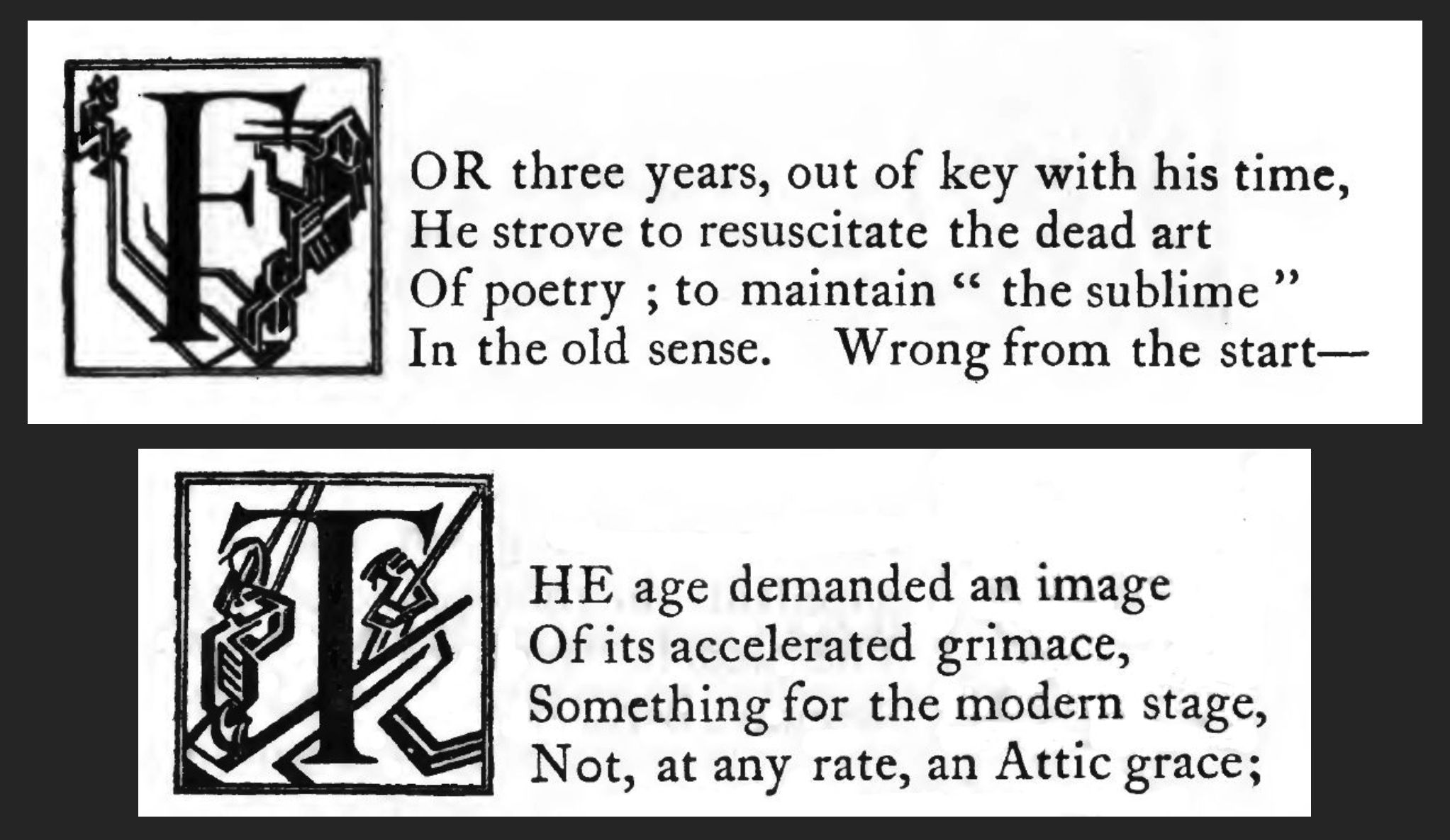
Padget, F. (2023). Shangri-La: a case of myth-taken identity. Epoch Magazine. Issue 14.

Pereira, F. M. E. (1921) O descobrimento do Tibet pelo P. Antonio de Andrade. Coimbra

Rock, J. F. (1925). The land of the Yellow Lama: National Geographic Society explorer visits the strange kingdom of Muli, beyond the Likiang snow range of Yünnan Province, China. National Geographic Magazine, 47(4), 447-492.

Roerich, N., (1930). Shambhala. Frederick A. Stokes.

Sarao, K. T. S. (2012). The decline of Buddhism in India: a fresh perspective. Munshirm Manoharlal Publishers.

Wessels, C. (1924). Early Jesuit Travellers in Central Asia 1603–1721. Martinus Nijhoff.

Woeser, T. (2020). Forbidden memory: Tibet during the cultural revolution. Potomac Books.

Wood, M. (2005). The search for Shangri-La. In In search of myths & heroes: exploring four epic legends of the world. (pp 9-77). University of California Press. Video version available.


Prime Numbers: Mysterious Building Blocks


A prime number is one that can only be divided by 1 and itself. Prime numbers are the building blocks for all the natural numbers, each of which can be expressed as a unique product of primes. Although their primacy can be proven by demonstrating that they are not divisible by any other number, where the prime numbers occur among the natural numbers cannot be predicted. Prime numbers are as mysterious as they are essential. The illustration shows the 25 primes (yellow) that occur in the first 100 numbers. 

Some Fundamentals

A “prime number” p is a natural number (a positive integer) greater than 1 that is divisible only by 1 and itself. A “composite number” is any natural number greater than 1 that is not a prime. In positive terms, a composite number n is divisible without remainder by two numbers between 1 and n: n=ab.  The two kinds of numbers can be illustrated graphically. Composite numbers of objects (blue) can be organized into repeating groups (factors), whereas prime numbers of objects (red) cannot:

This idea is also illustrated in a delightful animation of the “Factor Conga” by Stephen Von Worley.

The number 1 was sometimes considered prime, but nowadays 1 is viewed as a special number – “unit” or “unity” – because of two properties (Lamb, 2019). First is the “multiplicative identity” characteristic: any number multiplied by 1 remains the same number. Second is the “multiplicative inverse” characteristic. The multiplicative inverse of a number multiplied by the original number gives 1. The multiplicative inverse of any number greater than 1 is a fraction, e.g., the multiplicative inverse of 2 is 1/2. The multiplicative inverse of 1 is the integer 1. 


Factorization

The determination of the numbers that when multiplied together give a composite number is called “factorization.” The simplest algorithm involves “trial division:” one divides each of the primes into the number to see which leaves no remainder, and repeats this with the quotient: The prime factors of 1540 are 2, 5, 7 and 11: 

Pierre de Fermat (1601-1665) was a French mathematician and magistrate. He is probably most famous for his “last theorem” – that no three positive integers a, b, and c satisfy the equation an+bn=cn for any integer value of n greater than 2 – for which he claimed to have a “marvelous proof.” A proof of the theorem was finally published by Andrew Wiles in 1994.

However, Fermat also proposed a method for factorization based on the equation

a2 – b2 = (a + b)(a – b)

This method works best if the number n is the product of two nearby integers.

Select a as the next integer greater than sqrt(n).
Calculate b2 = a2 -n.  Increment a until sqrt(b2) is an integer.
Return values a +sqrt (b2) and a – sqrt (b2)

For the number 5959, the following are the steps

a                                  78        79        80
b2 = a2 -n                    125      282      441
sqrt (b2)                       11.2     16.8     21

giving 80+21 (101) and 80-21 (59) as factors of 5959.

Factorization leads to the “Fundamental Theorem of Arithmetic” (also called the “Prime Factorization Theorem”) generally attributed to Euclid, a Greek mathematician who worked around 300 BCE in Alexandria:

The sculpture of Euclid in the Oxford University Museum was made by Joseph Durham around 1860. Euclid was more famous for his geometry than for his contributions to number theory. On the scroll in his left hand is his proof of the “Pythagorean Theorem” that the square on the hypotenuse of a right-angled triangle is equal to the sum of the squares on the other two sides.  

Each number’s set of the exponents for the primes provides a unique signature for each prime and composite number. As examples:

11                    0, 0, 0, 0, 1
1540                2, 0, 1, 0, 1
5959                0, 0, 0, 0, 0, 0, 0, 0, 0, 0, 0, 0, 0, 0, 0, 0, 1, 0, 0, 0, 0, 0, 0, 0, 0, 1

(for the last example, 59 and 101 are the 17th and 26th primes).

Euclid also proved that the number of primes is infinite. The proof posits a number pn that is the largest of all primes. We can then form a number N by multiplying all the primes up to an including pn and adding 1.

N = p1 p2 p3 … pn + 1

Since every prime less than N divides once into N giving a quotient equal to the product of the other prime numbers and leaving a remainder of 1, N is prime. To postulate a number pn as the largest of all primes is impossible. Therefore, the number of primes is infinite.

The natural numbers can be viewed as buildings with the primes having only one storey and the composite numbers having multiple storeys:

As well as the prime factors one can also determine the greatest common divisor (GCD) of two numbers. Instead of calculating all the prime factors one can use Euclid’s algorithm to determine the GCD of two numbers a>b. One iterates the following commands

Divide b into a to give a quotient and remainder.
Replace a with b and b with the remainder.

until the remainder equals zero, in which case the current value of b is the GCD. The following illustration (modified from Wikipedia) shows the algorithm graphically for 49 and 21 (GCD of 7) and for 46 and 21 (GCD 1):

Two numbers are considered “relatively prime” or “coprime” if their GCD is 1, e.g. 46 and 21.

In 1742, the Prussian mathematician Christian Goldbach (1690-1764) conjectured that every even number greater than 2 can be represented as the sum of two prime numbers. This also meant that every odd number is the sum of two primes +1. Goldbach’s conjecture is true for all natural numbers that have been examined, but has not yet been proven.

The prime numbers therefore are the building blocks of arithmetic. Every number can be represented as the product of primes and every even number as the sum of two primes. Du Sautoy (2003, p 5) has called the primes the “very atoms of arithmetic,” and likened the list of primes to the periodic table of the elements.


Finding Primes

Various techniques have been proposed to identify which numbers are prime in a set of numbers. Erastosthenes, the chief librarian of the Library of Alexandria in the 3rd Century BCE, became famous for his remarkably accurate estimate of the circumference of the world (Nicastro, 2008). He also proposed an algorithm for identifying primes that is known as the “Sieve of Erastosthenes.” The algorithm iteratively rejects as composite those numbers that are multiples of the prime numbers less than the square root of the maximum number to be evaluated. Thus, to examine the numbers between 1 and 100, one marks the multiples of 2, 3, 5, and 7. When the numbers are arrayed 10 by 10, the multiples of 2 and 5 form vertical lines (yellow and blue, with an overlap as green), and the multiples of 3 and 7 form sloping lines (red and dark blue). The unrejected numbers (circled) are primes. 

As the range of numbers to be examined gets large such approaches to identifying primes become very time-consuming even for very fast computers. It would be wonderful if there were a simple equation to identify all the prime numbers. Unfortunately, there is no such formula (Mackinnon, 1987). Some formulae can identify some prime numbers.

Fermat proposed that numbers of the form

are prime. However, the formula only works for n between 0 and 4. Leonhard Euler (1707-1783) came up with an intriguing formula

n2 + n +41

but this only works for n between -1 and 39.

Marin Mersenne (1588-1648) proposed that numbers of the form

2p – 1

are prime when p is prime. However, this only works for some primes: 2, 3, 5, 7, 13, 17, 19, 31, 61, 89 …. Nevertheless, this formula serves to identify numbers as possible primes. The largest known prime number was found in this way.  

Recently a formula involving 26 variables has been created that will provide positive and negative numbers when different combinations of integer variables are used for the variables. The positive numbers are primes (Jones et al, 1976). The calculations are laborious and there appears to be no clear logic behind the formula:

Finding our whether a particular number is prime or composite is a time-consuming process. Basically, one need to determine the factors of the number. Various algorithms have been proposed to speed up the process. Some combine various approaches such as the sieve of Erastosthenes and Fermat’s method based on the difference in squares. However, the process remains slow for very large numbers even on the fastest of computers.

Modular Arithmetic

Important to any understanding of primes is an assessment of how clock numbers work. If a simple clock displays 1 to 12 hours on its face, amounts of time are considered to work in increments of 12. Therefore 6 hours later than 10 o’clock shows as 4 o’clock rather than 16, and a further 28 hours later shows as 8 o’clock rather than 32 (or 44 if counting from the initial position:

Carl Friedrich Gauss (1777-1855) first described this type of arithmetic in 1801. The idea is that numbers “wrap around” whenever a value called the “modulus” is reached. The notation 

ab (mod m)

means that a and b are “congruent modulo m” or

a= km + b

where k is a positive integer.

The expression is related to but not the same as the operator “mod” (expressed without brackets) or “%” which gives the remainder when one number is divided by another, e.g. 7 mod 3 = 1.  

One intriguing aspect of modular systems is that if a number added to by a number that is multiple of the modulus, the result is the original number. In a clock any number of complete rotations will not change the displayed time. 

Given these concepts, we can consider Fermat’s “Little Theorem,” so called to distinguish it from his “Last Theorem.” For any integer a where is p is a prime and a and p are relatively prime to each other (have a GCD of 1) then, in modern notation

apa (mod p)

This expression means that any number raised to a power of a prime yields itself when considered in a system that is modular at the value of the prime.  In general, we make p>a. If p<a, the procedure yields a mod p rather than a. We can try this theorem out on small numbers such as a = 3 and p = 5: ap = 243 which divided by 5 leaves a remainder of 3.

Fermat proposed the theorem in 1640 but offered no proof. The theorem was proven by Gottfried Leibniz (1646-1716) in 1683 (see details in Wilson, 2020, pp 97-100).

The theorem can also be expressed

ap-1 ≡ 1 (mod p)

In this format Fermat’s Little Theorem serves as the basis for the “Fermat Primality Test.” Any number n that does not fulfil the criterion

an-1 ≡ 1 (mod n)

where a is any integer greater than 1 and less than n-1, is not prime. If it does fulfil the criterion, it is probably prime (a Fermat pseudoprime) and the test should be repeated with a different a. To be absolutely sure one would have to test all values of a less than sqrt (n). The test efficiently determines whether a number is composite, but it can be computationally expensive when determining that it is indeed prime.  


Distribution of Primes

The prime numbers occur among the more common composite numbers with no regular pattern:

The shortest gap – between 2 and 3 – occurs only once. Primes separated by 2 – twin primes – occur 8 times in the first 100 numbers. In 1849 Alphonse de Polignac (1826-1863) conjectured that for any number n there are an infinite number of consecutive primes separated by n. When n is 2, this is the “twin prime conjecture” (Neale, 2017). Neither the twin prime conjecture nor the more generalized de Polignac conjecture has been proven.

The number of primes less than n – the “prime number counting function,” customarily denoted as π(n) – increases with increasing n but the rate of increase decreases as n increases. In 1792, at the age of 15, Gauss conjectured that the number was approximated by n/ln(n), where “ln” denotes the “natural logarithm” (using the base of e equal to 2.71828…). This underestimates π(nx), but the relative error decreases as x increases.

Although it was not published until after his death, Gauss later refined his conjecture, suggesting that π(n) is better approximated by the logarithmic integral of n:

This estimate is the basis for the “prime number theorem:” as n increases, π(n) asymptotically approaches Li(n). The following illustration shows the prime number counting function with the two different estimates for n between 1-100 and 1-1000. There are 25 primes below 100 and 168 below 100. The actual function is a staircase, with steps occurring at each prime. The estimates are smooth functions.  

The prime gap is the difference between two consecutive prime numbers

gn = pn+1 – pn

The minimum value of gn  is 2 for n>2. The average gap between primes increases as the natural logarithm of these primes, and therefore the ratio of the prime gap to the primes decreases (and is asymptotically zero). The ratio gn/ln(pn) is called the “merit” of a particular gap. There is no known maximal gap. The maximum recorded gap of 8350 occurred for an 87-digit prime and has a merit value of 41.9. The maximum gap gn would have to be less than the prime counting function 𝜋(𝑝n) (Lu & Deng, 2020)    


In 1763 Euler introduced what has come to be known as “Euler’s Totient Function.” This function, nowadays denoted as φ(n), counts the number of positive integers less than a given integer n that are relatively prime to n. When n is 12 φ(n) is 4 (the numbers 1, 5, 7, 11) and when n is 13 φ(n) is 12 (all numbers less than 13). The word “totient” comes from the Latin tot meaning “that many.” The illustration shows the function up to n of 1000. The upper boundary shows the value when n is a prime and φ(n) is n-1.

This function has some intriguing characteristics. Most importantly, for two integers a and b

φ(ab) = φ(a) φ(b)

Some sense of this characteristic can be obtained by considering a as 6 and b as 7: φ(6) is 2 (the numbers1 and 5) and φ(7) is 6 because 7 is prime. Therefore φ(42) is 12 (the numbers 1, 5, 11, 13, 17, 19, 23, 25, 29, 31, 37, 41). 

“Euler’s Theorem,” an extension of Fermat’s Little Theorem (and sometimes called the “Fermat-Euler Theorem”), states

aφ(n) 1 (mod n)

The proof of this generalization of Fermat’s theorem is detailed in Wilson (2020, pp 103-108)


Cryptography

For many years the study of primes was considered “pure” mathematics, in that the truths that it proved had no applications in the real world. The famous number theorist G. H. Hardy (1877-1947) claimed

I have never done anything ‘useful’. No discovery of mine has made, or is likely to make, directly or indirectly, for good or ill, the least difference to the amenity of the world. (Hardy, 1940, p 90)

Over the past half century, the idea of pure mathematics has changed. Prime numbers have become an essential part of real-world cryptography. All the information that is transmitted between buyer and seller when something is bought on the internet is kept safe from prying eyes by means of algorithms that use prime numbers. The most common algorithm was initially proposed by Ron Rivest, Adi Shamir and Leonard Adleman in 1977, and has come to be known as the “RSA cryptosystem.” The following illustration shows Rivest, Shamir and Adleman at theMassachusetts Institute of Technology:

The following are the basic procedures of the RSA algorithm (Rivest et al, 1977; Crandall & Pomerance, 2005, pp 389-391; Watkins, 2014, pp 369-374; Wilson, 2020, 110-111):

(i) generation of public keys:

Two different large prime numbers p and q are chosen. Nowadays these primes are approximately equal and each about 200 digits in length. A number N is calculated as the product of these two primes, and Euler’s totient (T) is calculated for N. This equals the product of p – 1 and q – 1. Finally, a number E (“encryption key”) is chosen that is greater than 2, less than N-1 and coprime to T. The last characteristic can be ensured by using Euler’s algorithm to show the T and E have 1 as their greatest common divisor (GCD). The number E is typically chosen as a prime number greater than either p or q.

N = pq
T = φ(pq) = (p − 1)(q – 1)
Choose E [3, N − 2] and GCD(E, T) = 1

The public keys are N and E; p and q (and T) are kept secret. 


(ii) encryption of the message

The message (or part of a message) is coded into a large number M using a simple substitution cipher. For example, each letter could be represented as a two-digit numbers from 01 to 26. M is then encrypted to give the number C (“ciphertext”) using public keys N and E according to the formula

C ≡ ME (mod N)

The number M has increased dramatically, and the clock (modulus N) has revolved many times so that the clock face shows a number C completely different from M. E must be coprime to T to make sure that C does not return as the same number as M.

(iii) decryption of the message

To decrypt the message, we must calculate a number D (“decryption key”) that is the modular multiplicative inverse of E

DE ≡ 1 (mod T) or D = E-1 mod T

Finding the multiplicative inverse is a simple trial and error process. Iteratively increment k and then calculate (k*E) mod T until it equals 1, at which time D is made equal to k. In an example using small numbers, E of 7 and T of 72 (the totient for 7 and 13)

k=1, 7mod72 is 7
k=2, 14mod72 is 14

k=30, 210mod72 is 66
k=31, 217mod72 is 1, therefore D is 31.

Having obtained D, we can decrypt the coded message to obtain the original message according to the formula

M ≡ CD (mod N)

The number has again increased but after many revolutions the clock face now shows the same number as it was before the original encryption. Because D is the modular multiplicative inverse of E, when the clock wraps around because of E and then because of D it is the same as it the clock face had just stayed the same.    


(iv) example

The following is an example using small numbers

Let p=3 and q=11; N=pq=33

T = (p-1)*(q-1) = 2*10 = 20

Let E = 7, check GCD(7,20)=1

Find D to ensure (D*E)mod20=1

Determine D to be 3 because 3*7mod20=1

Let M = 31

Encrypt message as C=MEmodN = 317mod33 =4

Decrypt message as CDmodN = 43mod33=31


(v) breaking the code.

In order to break the RSA code an outside observer would have to find D. This would require finding the two primes p and q that when multiplied together gave the public number. From p and q one would know T. Then one could derive D. Finding p and q would require factoring N, a computationally demanding task when N is very large. The RSA system remains safe provided that it takes longer to compute the factors of N than the length of time that the system uses any particular numbers p and q.


Zeta Function

In his studies of infinite series published in 1737, Euler proved a remarkable identity:

The left side of the equation shows the sum of the reciprocals of all natural numbers raised to the power s. The has become known as ζ(s) or the “zeta function”

ζ(s) = 1/1s + 1/2s + 1/3s + 1/4s.+ 1/ns

The right side of the equation is a product of multiple terms each involving one of the prime numbers:

ζ(s) = 1/(1-2-s) * 1/(1-3-s) * 1/(1-5-s) * 1/(1-7-s) ….* 1/(1-p-s)

When s is 2, the function is the sum of the reciprocals of all the natural numbers squared:

ζ(2) = 1/12 + 1/22 + 1/32 + 1/42.+ 1/n2

Euler demonstrated that ζ(2) = π2/6. This was intriguing since the zeta equation now linked the natural numbers to the irrational number π.  Euler also proved that ζ(4) is π4/90 and ζ(6) is π6/945. Values of the function for odd values of s have no clear formulation.  

To prove his product function, Euler used a sieving approach as illustrated below:

In 1859 Bernhard Riemann considered Euler’s zeta function using complex variables He made s = σ + it, where σ and t are real numbers and i is the square root of -1. Using values derived from this function he was able to adjust Euler’s prime number theorem – as n increases, π(n) asymptotically approaches Li(n) – so that it accurately represented the actual staircase function that is π(n).

The Riemann Zeta Function is as complex as its variable, and I am afraid I find it impossible to understand. Both Derbyshire (2003) and Du Sautoy (2003) have written books about the function. In his original paper Riemann also proposed a hypothesis about the nontrivial zero-values of the function that appear on a line where the real value of the variable equals ½. His hypothesis holds for all values of the function so far examined. However, the hypothesis is not yet proven. The Clay institute has offered a prize of 1 million dollars for the proof. I shall not be collecting this prize, but I shall enthusiastically applaud its winner.

The following video was made for Quanta Magazine by Alex Kontorivich about the Riemann Zeta Function and the Riemann Hypothesis.


Epilogue

We can conclude with a quotation from Du Sautoy (2003, p 6) about the primes:

Prime numbers present mathematicians with one of the strangest tensions in their subject. On the one hand a number is either prime or it isn’t. No flip of a coin will suddenly make a number divisible by some smaller number. Yet there is no denying that the list of primes looks like a randomly chosen sequence of numbers. Physicists have grown used to the idea that a quantum die decides the fate of the universe, randomly choosing at each throw where scientists will find matter. But it is something of an embarrassment to have to admit that these fundamental numbers on which mathematics is based appear to have been laid out by Nature flipping a coin, deciding at each toss the fate of each number. Randomness and chaos are anathema to the mathematician. Despite their randomness, prime numbers – more than any other part of our mathematical heritage – have a timeless, universal character. Prime numbers would be there regardless of whether we had evolved sufficiently to recognise them.

In Paolo Gordano’s 2010 novel The Solitude of the Primes, the character Mattia muses

Prime numbers are divisible only by one and by themselves. They stand in their place in the infinite series of natural numbers, squashed in between two others, like all other numbers, but a step further on than the rest. They are suspicious and solitary, which is why Mattia thought they were wonderful. Sometimes he thought that they had ended up in that sequence by mistake, that they’d been trapped like pearls on a necklace. At other times he suspected that they too would rather have been like all the others, just ordinary numbers, but for some reason they weren’t capable of it. (p 111)

And we cannot leave the topic without some praise for the mathematicians that discovered so much about them. The following are portraits of some of these marvelous thinkers. They all contributed extensively to our knowledge beyond their work with the primes. Fermat worked with Pascal on the mathematics of probability; Gauss was the first to measure the earth’s magnetic field; Euler proposed his “identity:”

e+ 1 =0

which united the logarithms, pi and imaginary numbers just like his product formula united the natural numbers, primes and pi; and Riemann worked on the non-Euclidean geometry that Einstein would use in his Theory of relativity. 

References

Crandall, R. E., & Pomerance, C. (2005). Prime numbers: a computational perspective (Second Edition). Springer.

Derbyshire, J. (2003). Prime obsession: Bernhard Riemann and the greatest unsolved problem in mathematics. Joseph Henry Press

Du Sautoy, M. (2003). The music of the primes: searching to solve the greatest mystery in mathematics. HarperCollins.

Giordano, P. (2010). The solitude of prime numbers. Penguin

Hardy, G. H. (1940). A mathematician’s apology. Cambridge University Press.

Jones, J. P., Sato, D., Wada, H., &Wiens, D., (1976). Diophantine representation of the set of prime numbers. The American Mathematical Monthly, 83, 449-464.

Lamb, E. (2019). Why isn’t 1 a prime number? And how long has it been a number? Scientific American Blog.

Lu, Y.-P. & Deng, S.-F. (2020). An upper bound for the prime gap. arXiv:2007.15282

Mackinnon, N. (1987). Prime number formulae. The Mathematical Gazette, 71(456), 113–114.

Neale, V. (2017). Closing the gap: the quest to understand prime numbers. Oxford University Press.

Nicastro, N. (2008). Circumference: Eratosthenes and the ancient quest to measure the globe. St. Martin’s Press.

Riemann, G. F. B. (1859). Über die Anzahl der Primzahlen unter einer gegebenen Grösse. Monatsber. Königl. Preuss. Akad. Wiss. Berlin, 671-680. English translation by D. R. Wilkins

Rivest, R.L., Shamir, A., & Adleman, L. (1977). A Method for Obtaining Digital Signatures and Public-Key Cryptosystems(Technical report). MIT Laboratory for Computer Science.

Watkins, J. J. (2014). Number theory: a historical approach. Princeton University Press.
Wilson, R. J. (2020). Number theory: a very short introduction. Oxford University Press.


Laozi: the Nature of the Dao

Laozi (老子, lǎozǐ, “the old master”) was a legendary character from the 6th Century BCE who put together a collection of philosophical and ethical sayings that has come to be known as the Dàodéjing (道德經 simplified:道德经; or Tao Te Ching in the Wade-Giles romanization, “The Book of the Way and of Virtue”) or Laozi after the name of the author. The illustration shows a depiction of Laozi from a scroll by Sheng Mao. Following the discovery of early versions of the text written on silk and bamboo slips dating to the 2nd Century BCE (Chan, 2016, 2025), several new translations and annotated editions have been published. This essay presents a close reading of the first chapter.   

The First Chapter

The following is the Chinese text of the first chapter (which can be followed at the websites of the Chinese Text Project or Wikibooks) and a recent English translation by Fischer (2023).

道可道,非常道。名可名,非常名。
無名天地之始;有名萬物之母。
故常無欲,以觀其妙;常有欲,
以觀其徼。此兩者,同出而異名,
同謂之玄。玄之又玄,衆妙之門

The way that can be (fully) conveyed is not the abiding Way; a name that can be (fully) descriptive is not an abiding name.

“Formlessness” is the name of the beginning of Heaven and Earth; “form” is the name of the mother of the myriad things.

Thus, if you abide in formlessness, you may thereby observe its wonders; and if you abide in form, you may thereby observe its manifestations.

These two appear together but have different names. This togetherness, we call it “mysterious” mystery and more mystery: the gateway to many wonders.

The following illustration shows on the left the first chapter in clerical script from a scroll by Sheng Mao (盛懋, fl. 14th Century) in the Palace Museum in Beijing, and on the right in regular script from a scroll by Zhao Mengfu (趙孟頫, 1254–1322). The latter includes a portrait of Laozi as a benevolent old gentleman.

The following is a recitation of the first chapter from the dao-de-jing website, and the text in pinyin romanization:

dào kě dào fēi cháng dào
míng kě míng fēi cháng míng
wú míng tiān dì zhī shǐ
yǒu míng wàn wù zhī mǔ
gù cháng wú yù yǐ guān qí miào
cháng yǒu yù yǐ guān qí jiào
cǐ liǎng zhě tóng chū ér yì míng
tóng wèi zhī xuán xuán zhī yòu xuán
zhòng miào zhī mén

The original book of sayings was likely handed down orally. The earliest extant versions were written in clerical script. However, it is possible that there might have been versions of the book written in the Small Seal script, such as imagined in the following illustration:


Or even versions written in the earlier Great Seal or Bronze script, which was used at the time that the book was supposedly created. The illustration on the right shows a Great Seal version of Chapter 1 as imagined by Wilson (2010):

This essay will concern itself with the first chapter (or verse) of Laozi’s book. Red Pine quotes De Qing (1546-1623), a Buddhist commentator, on this chapter:

Laozi’s philosophy is all here. The remaining 5000 words only expand on this first verse.


The Ineffable Dao

The first section of the chapter concerns the difficulty in expressing the nature of Dao:

The way that can be spoken of is not the eternal Way
The name that can be named is not the eternal Name.

Much of Daoist philosophy is related to the opposing concepts of Yīn (陰 simplified 阴 lunar, feminine, passive, cool) and Yáng (陽 simplified 阳 solar, masculine, active, warm). The prototypical examples of Yin and Yan are the shady north side of a hill and its sunny south side. Yin and Yang are the two opposite but interacting forces that underly the harmony of the universe. They can be represented by the tàijítú (太極圖, utmost extreme symbol), one version of which is shown on the right. The small contrasting circles within in each half show how the opposites are complementary rather than antagonistic.

The first two lines of the Daodejing provides two parallel statements on the Dao and on its name. These lines thus concern the actual Dao and its abstract name, both of which cannot be fully understood by finite beings. Actual and abstract can be considered as one of the dualities composing Yin and Yang.

The first line uses the character 道 dao in three ways: first as a noun describing a way or path, second as a verb in the sense of speaking (telling how to follow a path), and third to express the concept of an eternal Dao underlying all things. The second line acts in the same way for the character 名 (name). All languages can use the same word as noun and verb, e.g. “change” in English, but this is more common in Chinese.

In later versions of the Daodejing the character 恆 (constant) was replaced by 常 (with a similar meaning), probably because the former was the name of the fifth emperor of the Han dynasty, Lui Heng (203-157 BCE), and therefore a taboo word.

The Dao is eternal or everlasting. However,

While everlasting seems apt, describing the Dao as unchanging does not fit. This is because Laozi’s Dao serves as the substance of the cosmos and fundamental source and basis of the things of the world. It is eternally transforming and dynamic. (Chen et al., 2020, p 47)

The following is a description of the Dao by Zhuangzi (莊子, Master Zhuang, Chuang-tzu in the Wade-Giles romanization) a Daoist philosopher who lived in the 4th Century BCE (Palmer et al. 1996, pp 50-51):

The great Tao has both reality and expression,
but it does nothing and has no form.
It can be passed on, but not received.
It can be obtained, but not seen.
It is rooted in its own self,
existing before Heaven and Earth were born, indeed for eternity.
It gives divinity to the spirits and to the gods.
It brought to life Heaven and Earth.
It was before the primal air, yet it cannot be called lofty;
it was below all space and direction, yet it cannot be called deep.
It comes before either Heaven or Earth, yet it cannot be called old.

Alan Watts (1975, pp 41-42) commented on the difficulty in describing the Dao:

Thus the Tao is the course, the flow, the drift, or the process of nature, and I call it the Watercourse Way because both Lao-tzu and Chuang-tzu use the flow of water as its principal metaphor. But it is of the essence of their philosophy that the Tao cannot be defined in words and is not an idea or concept. As Chuang-tzu says, “It may be attained but not seen,” or, in other words, felt but not conceived, intuited but not categorized, divined but not explained. In a similar way, air and water cannot be cut or clutched, and their flow ceases when they are enclosed. There is no way of putting a stream in a bucket or the wind in a bag. Verbal description and definition may be compared to the latitudinal and longitudinal nets which we visualize upon the earth and the heavens to define and enclose the positions of mountains and lakes, planets and stars. But earth and heaven are not cut by these imaginary strings. As Wittgenstein [Tractatus Logico-Philosophicus, 1922] said, “Laws, like the law of causation, etc., treat of the network and not of what the network describes.”

Chapter 32 of the Daodejing ends with the statement (translated by Pepper and Wang, 2021):

Dao in this world is like a stream in the valley
Flowing into a river,
into the sea


Being and Nothingness

The second part of the first chapter presents a brief cosmogeny

These lines have been interpreted in two distinct ways. The first

reads wu 无 [non-presence, lacking, non-being] and you 有 [presence, having, being] as the subjects of statements, and name (名) as part of the predicate. The alternative reading takes wuming 无名 [without name, nameless] and youming 有名 [having name] as the subjects of the statements (Chen et al. 2020, pp 48-49).

Thus we could have

Nothingness is the name for the origin of heaven and earth
Being is the name for the mother of all things.

or

Nameless is the origin of heaven and earth
Named is the mother of all things.

Since Yin and Yang is basic to Laozi’s thinking, I have opted to use the first reading which stresses the dichotomy of being and non-being. Similar ideas are stated in Chapter 40 of the Daodejing:

天下萬物生於有,有生於無

All the things in the world are generated from you 有,
you 有 is generated from wu

There is a difference between 天地 (heaven and earth), which encompasses the whole cosmos, and 万物 (myriad things), which refers to the many different things within it. However, this distinction may not be necessary since some early sources used 万物 in both lines. (Huang, 2024, p 14)  

The dichotomy between you and wu (Hall & Ames, 1998) reflects a foundational issue in philosophy: the nature of Being. This goes back to some of the very earliest records of human thought. The creation hymn of the Hindu RgVeda (composed around 2000 BCE) states that at the beginning of time there was neither existence nor non-existence. The ancient Greek philosopher Parmenides (5th Century BCE) worried about “What is and what is not.” Shakespeare’s Hamlet considered “To be, or not to be, that is the question” and Jean-Paul Sartre compared L’être et le néant (Being and Nothingness).

The following is a comment by Zhuangzi (Palmer et al. 1996, p 15) on the origins of the universe:

There is the beginning; there is not as yet any beginning of the beginning; there is not as yet a beginning not to be a beginning of the beginning. There is what is, and there is what is not, and it is not easy to say whether what is not, is not; or whether what is, is.


The Mother of All Things

The fourth line of the first chapter proposes a feminine origin (母, mother) for all things. This idea is repeated in Chapter 6 which describes 玄牝 (xuán pìn, the mysterious female):

谷神不死,是謂玄牝。
玄牝之門,是謂天地根。
綿綿若存,用之不勤

The spirit of the valley does not die; it has been called the mysterious female
The gate of the mysterious female is called the root of heaven and earth.
It is continuous and uninterrupted; its functioning is inexhaustible.
(my translation)

Chapter 25 mentions the 天下母 (tiān xià mŭ, the mother of all under heaven):

有物混成,先天地生。
寂兮寥兮,独立不改,
周行而不殆,可以为天下母。
吾不知其名,字之曰道,强为之名曰

Which has been translated (Wu, 2016, p 57)

There was something undifferentiated and yet complete, born before Heaven and Earth,
Soundless and formless, independent and unchanging.
Revolving endlessly, it may be thought of as the Mother of all under Heaven.
I do not know its name; so I just call it Dao, and arbitrarily name it Great

Anderson (2021) has noted how the Daodejing fully recognizes the female nature of the Dao. Most of the world’s religions are androcentric: they ignore the divine feminine. At its beginning Daoism understoon that the world is based on interacting male ane female forces. And that creation comes from the female. 


From One to Many

The first chapter distinguishes between being and nothingness (yŏu 有 and wu 無 无). The 42nd chapter recounts the actual process of creation (translation by Wu, 2016):

道生一,一生二,
二生三,三生萬物。
萬物負陰而抱陽,
沖氣以為和。

Dao gives birth to One; One gives birth to Two;
Two gives birth to Three; Three gives birth to Ten Thousand things.
All things have Yin on their back and Yang in their embrace;
The Qi of the two converge and become harmony.

The idea of Yin on their back and Yang in their embrace refers to how we prefer to sit facing the sun with the shadow at our back.

The basic cosmogeny is that the primordial energy of the universe – (氣) – becomes differentiated into two opposing forces of yin and yang. These then interact to produce the myriad things of the world that exist in harmony (和).

The one-two-three progression probably just represents the evolution of the many things in the universe. However, Fischer (2023) also considers the possibility

that the “one, two, three” refer to physical energies (氣), Yin-Yang, and harmonized physical energies (和氣). That is: one, a semblance of a form emerges from formless-ness; two, the physical energy that constitutes that semblance is influenced by the Yin and Yang states that characterize all physical energies; three, once the semblance has morphed, chrysalis-like, into its final “harmonious” form, it has become a stable entity.


Mystery and Manifestation

The third section of the first chapter has led to several different translations.

Some editions (e.g. Huang, 2024) substitute 眇 (miǎo, tiny, minute) for 妙 and 噭 (jiao, pursue) for 徼. This leads to the idea of the development from minute origins toward the mature things of the present.

Another difficult is whether the character 欲 acts as a noun meaning “desire” or as an adverb casting the following parts of the sentences in the subjunctive as “may observe.” This would make無 and 有 the subjects of the sentences rather than modifiers of 欲. The Fischer translation quoted at the beginning of this essay follows this approach, as do the versions of Yu (2003), Chen et al. (2020) and Wu (2016).

Translators have more commonly considered that these two sentences compare what happens with or without desire (e.g., Addiss & Lombardo;1993; Leguin & Seaton, 1998; Lin, 2020; Liu, 2024; Loy, 1985; Red Pine, 2004; Wilson 2012). This approach fits with the Buddhist idea that one can find release from suffering by relinquishing desire. As pointed out by Watts (1975, p 96), however, the idea that virtue comes from an absence of desire is paradoxical:

Trying to get rid of desire is, surely, desiring not to desire.

If we follow this approach to the translation, we find that Laozi makes no moral judgement about desire: he just points out the differences between having it or not. Both are possible and both serve a purpose. Relinquishing desire can allow the mind a mystical vision of the origin of everything. Exercising desire allows us to understand the nature of the things of the world:

Free from desire, you can realize the mystery;
Following desire, you can see the manifestations.

However, if the chapter is to be consistent, it is probably best to keep to the duality of wu (无) and you 有:

Therefore in nothingness you may see the mystery;
In being you may see the manifestations.

Nevertheless, the different translations are not that distinct. A person can see the mystery by attuning his or her mind to nothingness. One way of doing this might be to relinquish desire.


Yin and Yang

The fourth section of the chapter tells us these two states are just different aspects of the universe, part of the union of interacting opposites that makes up the concept of Yin-Yang:


Whether these lines refer to (者) the concepts of being and nothingness or to the states of desire and non-desire depends on how the previous lines were translated. I have opted for the former.

These two are but different aspects of the same idea
This is the mystery of mysteries


The Gateway

The final section of the chapter proclaims the mystery of the Dao:

Laozi uses two words for mystery:

玄 (xuán) is dark, mysterious, unseen, withdrawn, deep. But 妙 (miào) is lighter, a wonderful mystery. (Pepper & Wang, 2021, p 17)

We can stress the “darkness,” as in Denecke (2010, p 223)

Where the dark is darker than darkness, that’s the Gateway of Subtleties.

Or simply stay with “mystery”

Mystery of mystery: the gateway to many wonders


Relations to Western Pantheism

The concept of the Dao has many similarities to Western pantheism, particularly to that proposed by Spinoza (Stamatov, 2019, 2025). Fu (1973, p 390) remarks

Both philosophers think that the ultimate way of freeing oneself from human bondage and attaining total emancipation is to have an ontological insight (Lao Tzu) into or intellectual intuition (Spinoza) of the as-it-is-ness of the world and man.

One significant difference is that Spinoza clearly names the principle underlying the universe as God.

Samuel Taylor Coleridge (1772-1834) was particularly intrigued by the writings of the Domingo Fernandez Navarrete (1610-1689), a Dominican friar who had spent many years in China and had described the principles of Daoism for Western readers (Murray, 2020). Coleridge and his close colleague William Wordsworth (1770-1850) were responsible for initiating the movement of Romanticism in English literature Wordsworth’s Lines Composed a Few Miles above Tintern Abbey, On Revisiting the Banks of the Wye during a Tour. July 13, 1798 describes a romantic pantheism that is very similar to the Dao of Laozi:

And I have felt
A presence that disturbs me with the joy
Of elevated thoughts; a sense sublime
Of something far more deeply interfused,
Whose dwelling is the light of setting suns,
And the round ocean and the living air,
And the blue sky, and in the mind of man:
A motion and a spirit, that impels
All thinking things, all objects of all thought,
And rolls through all things. 

Envoi

We can conclude by putting together the complete chapter:

The way that can be spoken of is not the eternal Way
The name that can be named is not the eternal Name.

Nothingness is the name for the origin of heaven and earth
Being is the name for the mother of all things.

Therefore through nothingness you can see the mystery;
Through being you can see the manifestations.

These two are but different aspects of the same idea
This is the mystery of mysteries

Mystery of mystery: the gateway to many wonders.

The chapter is our introduction to the Dao. The character 道 is composed of two radicals. In the upper right is a representation of the head 首(shŏu), and in the left and below is a radical denoting walking (chuò). The combination perhaps represents “to go ahead.” As such it depicts the principle that underlies the universe: the way things should and do turn out.

The Dao has several meanings:

In some places the character “dao 道” refers to a metaphysical entity understood as ultimate true existence. In other places, it seems to refer to a type of rule or principle, often reflected in natural laws or patterns. In yet other locations, dao refers to standards, norms or exemplary models for human life. (Chen et al,2020, p 2),

Fu (1973) describes six dimensions of the Dao:

(i) reality – a metaphysical symbol of things as they are
(ii) origin – the source of all there is
(iii) principle – that whereby all things become what they are
(iv) function – the laws governing the processes of change
(v) virtue – that which completes the being of each and every individual
(vi) technique – the way in which people are governed

The Dao in metaphysical terms should be considered in relation to time. As time passes, thing change. Our science indicates that such changes are not random but follow general rules. Most people also believe that these changes ultimately progress toward something: that the universe has some purpose and is in the process of becoming better. The Dao instantiates these two ideas. It is the overall principle leading the universe toward harmony. Human beings can live their lives best by attuning themselves to this movement.

The final illustration shows on the right 道written in an ecstatic cursive script by Al Chung-liang Huang for Alan Watt’s book on Tao: The Watercourse Way (1975). The fluidity of the calligraphy fits with the idea of water finding its way. On the left is shown the first chapter of the Daodejing as created by Lee Chi-Chang for the same book:


References

Addiss, S., & Lombardo, S. (1993). Tao te ching. Hackett.

Anderson, R. (2021). The Divine Feminine: Tao Te Ching. Inner Traditions.

Chan, A. K. L. (2018). The Daodejing and its tradition. In Kohn, L. (Ed.) Daoism Handbook (Volume 14 of Handbook of Orietnal Studies) (pp 1-29). Brill.

Chan, A. K. L. (2025). Laozi. The Stanford Encyclopedia of Philosophy.

Chen, G., D’Ambrosio, P., & Xiao, O. (2020). The annotated critical Laozi: with contemporary explication and traditional commentary. Brill.

Denecke, W. (2011). The race for precedence:  polemics and the vacuum of traditions in Laozi. In The dynamics of Masters literature: early Chinese thought from Confucius to Han Feizi. (pp 207-230). Harvard University Asia Center.

Fischer, P. (2023). The annotated Laozi: a new translation of the Daodejing. State University of New York at Albany.

Fu, C. W.-H. (1973). Lao Tzu’s conception of Tao. Inquiry, 16(1–4), 367–394.

Hall, D., Ames, R. (1998). You–wu. The Routledge Encyclopedia of Philosophy. Taylor & Francis. (Retrieved 15 Nov. 2025)

Huang, J. H., (2024). The Dao De Jing: Laozi’s book of life: a new translation from the ancient Chinese. Mariner.

Le Guin, U. K., & Seaton, J. P. (1998). Tao te ching: a book about the way and the power of the way. Shambhala.

Lin, P. J. (1977, open access 2020). A Translation of Lao-tzu’s Tao Te Ching and Wang Pi’s Commentary. (Volume 30 in University of Michigan Chinese Studies). University of Michigan.

Liu, K. (2024). Laozi’s Dao de jing: a new interpretation for a transformative time. Scribner.

Loy, D. (1985). Chapter One of the Tao Tê Ching: a ‘new’ interpretation. Religious Studies, 21(3), 369–379.

Murray, C. (2020). Coleridge’s Daoism? Joseph Needham, Dominican Sinology, and Romantic Pantheism. The Wordsworth Circle, 51(2), 205–220.

Palmer, M., Breuilly, E., Ming, C. W., & Ramsay, J. (1996). The book of Chuang Tzu. Arkana (reprinted by Penguin 2006)

Pepper, J.& Wang, X. H. (2021). Dao de jing in clear English including a step-by-step translation. Imagin8 Press.

Red Pine (1996, revised 2004), Lao-Tzu’s Taoteching with selected commentaries from the past 2000 years. Copper Canyon Press.

Stamatov, A. (2019). Spinoza and Laozi: God and Dao.

Stamatov, A. (2025). Dao in world philosophy: an experimental approach. In A. Stamatov (Ed.) Dialogues with classical Chinese philosophy (pp. 192–204). Routledge.

Watts, A. (1975) Tao: the watercourse way. Pantheon Books.

Wilson, W. S. (2012). Tao te ching: an all-new translation. Shambhala.

Wu, C. Q. (2016). Thus Spoke Laozi: A New Translation with Commentaries of Daodejing. University of Hawaii.

Yu, A. C. (2003). Reading the “Daodejing”: ethics and politics of the rhetoric. Chinese literature: essays, articles, reviews (CLEAR), 25, 165-187


A Way of Writing: The Art of Chinese Calligraphy

Chinese calligraphy (書法, simplified 书法, shūfǎ, literally ‘way of writing’) is the art of writing Chinese characters (漢字, simplified 汉字, hànzì) with a brush. Together with poetry and painting, calligraphy is considered one of the “Three Perfections” (三絕 sānjué) of Chinese art. This essay reviews the development of calligraphy and provides some examples of its beauty. The illustration shows the calligraphy of the characters of shūfǎ in regular and semi-cursive styles.

A Brief History

According to legend, Chinese writing began during the reign of the Yellow Emperor in the 3rd Millenium BCE. The emperor asked Cangjie (倉頡) one of his ministers to create a way to record knowledge. Cangjie was blessed with two pairs of eyes. This allowed him to see the basic shapes and patterns underlying the perceived world.

The first clear evidence for writing in China, however, comes from symbols found on the shoulder blades of oxen and the shells or tortoises. These date to around 1250 BCE. The symbols appear to have been used during divination, and the writing is therefore called Oracle Script (甲骨文,jiǎgǔwén, “shell and bone script”).

Beginning around 1000 BCE, characters were being cast onto or incised into various ritual bronze containers. This type of writing is called Bronze Script, (金文, jīnwén).

Over the years various styles of writing were used. Legend has it that the First Emperor Qin Shi Huang (259–210 BCE) established a standard writing style to be used across his newly unified empire: the Small Seal Script, 小篆 (xiǎozhuàn). Although the histories attribute this to the First Emperor, the script likely developed incrementally rather than by fiat. The script is characterized by thin lines that do not vary in width. The characters tend toward right-left symmetry, and the shapes are curved rather than rectilinear.

The invention of paper (in China in 105 BCE) and the use of writing brushes led to the development of the Clerical Script (隶書, simplified 隶书, lìshū) by around 100 BCE. The lines vary in thickness as befits the use of a brush. The characters show a tendency for the lines to sweep toward the right. The script is rectilinear rather than curved, and the width of the characters tends to be greater than their height. 

Over the following years clerks and scholars modified the clerical script to be lighter and more regular. The characters tended to occupy a square form. The individual strokes making up the different characters became standardized. This development occurred over several centuries beginning in the Second Century CE. The final version of Regular Script (楷書, simplified 楷书, kǎishū) became established during the Tang Dynasty (618–907 CE).

While the regular script was being perfected, the needs of writing speed and emotional expression led to the development of Cursive Script (草書, simplified 草书cǎoshū, literally “grass writing”). As well as denoting “grass” the character can also mean “careless, hasty, draft.” The characters are no longer created by discrete strokes, but formed with one or several continuous movements of the brush. The characters are curved and tend to have widths less than their height. The illustration on the right shows 草書 written in regular script and in cursive script. Regular script requires 20 separate strokes, but cursive uses only 3. Cursive script is variable from one writer to another.

A more legible version of cursive script soon developed: Semi-cursive Script (行書 simplified 行书, xíngshū, “running script”). This script is a compromise between the regular and cursive scripts. Characters are clearly demarcated from each other. Nevertheless, the individual strokes within the character become connected and flow together. There are conventions for depicting various sets of strokes. For example, parallel lines are represented as a z form rather than as = and dots are connected into a line. The style is analog rather than digital.

After the Chinese Communist Revolution, the new government of the People’s Republic of China simplified many of the commonly used highly complex characters. From 1949 to 1986, these changes led to the current Simplified Characters (简化字; jiǎnhuàzì, literally “simple transformed characters”). In writing this name, the traditional character 簡 has been simplified to 简. In the names of the earlier scripts, the traditional 書 was simplified to 书.

The following illustration of the different scripts shows the evolution of the characters 天 tiān sky/heaven, 馬 horse, 旅 lǚ travel/journey, and 正 zhĕng straight/correct. Of these, only the character for horse underwent modern simplification. The dates show the approximate times when the different scripts began.

More information about the evolution of Chinese characters is available in Chiang (1973), Qui (2000), Shi (2003) and Li (2010)

Thousand Character Classic (千字文 qiānzì wén)

The Thousand Character Classic is a long poem that uses a thousand different characters (Paar, 1963; Sturman, accessed 2025). The poem contains 250 lines, each four characters long, arranged in rhyming quatrains to facilitate memorization. Legend has it that in the 6th Century CE, the Emperor Wu commissioned the poem to teach children the rudiments of writing. Since the text was learned by any literate person, the order of its characters could be used to put documents in sequence in the same way that alphabetical order is used in alphabetic languages. Copybooks showing the thousand characters in different writing styles soon became popular. The following example shows the beginning of the poem in a modern version (“The sky was black and the earth was yellow; space and time vast and limitless”):

Zhang Xu (張旭, ca 675-750 CE)

Zhang Xu was a court scholar and calligrapher. Although adept in regular script, he became renowned for his works in a wild cursive style (狂草 kuángcǎo ‘crazy cursive’), often created under the influence of wine (Jagger, 2023). His friend the poet Du Fu considered him one of the Eight Immortals of the Wine-cup (Li Bai was another):

张 旭 三 杯 草 圣 传
脱 帽 露 顶 王 公 前
挥 毫 落 纸 如 云 烟。

Zhang Xu, the Sage of Cursive Script, after three cups of wine,
Would doff his cap from his head before princes and dukes,
And let his brushstrokes fall on the paper like misty clouds

The most famous work attributed to him is his Four Ancient Poems (古詩四帖) a scroll (29.5 x 195.2 cm) on multi-colored paper now in the Liaoning Provincial Museum, Shenyang (Ouyang, & Wang, 2008 pp 217-223). The first poem by Yu Xin (513–581) is about the beginning of spring and the New Year celebrations:

The Eastern Light with his nine-petal mushroom canopy
And the Northern Candle with her five-hued cloud-chariot
Descend and drift into the light of sunset
Appearing and disappearing among the clouds.
Spring water flows like rain falling on jade,
And bluebirds fly towards the Jinhua mountain
The Han Emperor examines the peach-tree seeds,
And the Qi Marquis inquires about the jujube blossoms.
We drink the wine of the Lantern Festival
And visit with the Cai family.

The Eastern Light and the Northern Candle are the names of Daoist deities (Luo, 2019, pp 320-321). The ecstatic energy of the Zhang Xu’s calligraphy befits the poem’s enthusiastic enjoyment of the beginning of spring.  

The following illustration shows the complete scroll divided into two parts, and an enlargement of the first poem. To compare the characters, note that the calligraphy moves from top to bottom and from right to left, whereas the text above is written from left to right.

Zhao Mengfu (趙孟頫, 1254–1322)

Zhao Mengfu was a calligrapher and painter at the time when the Mongols conquered China and established the Yuan Dynasty (1271-1368). Since he worked for the Mongol emperors, his politics were considered suspect by later historians. However, he is recognized as China’s most talented calligrapher (McCausland, 2011). He wrote in all styles, but was an absolute master of the regular script. Copybooks of his calligraphy are still widely used by students wishing to master kaishu.

The following illustration shows the beginning of the third scroll in an original set of seven for the Sutra on the Lotus of the True Dharma (Chinese: 妙法蓮華經 miàofǎ liánhuá jīng), a basic text in Mahayana or “Great Vehicle” (Chinese: 大乘 dàshèng) Buddhism. The scroll, written in small regular script, is now in the collection of the technology entrepreneur Jerry Yang (Wang Lianqi in Chang & Knight, 2012, pp 70-103). The scroll is 28 cm wide and 275 cm long.

The beginning of the text (4th line from the right) reads 爾時世尊告摩訶迦葉及諸大弟子善哉善哉: At that time the world-honored one [Buddha] spoke to Mahakasyapa [one of his disciples] and the other major disciples “Excellent, excellent …” This is the beginning of Chapter 5 in the Sutra.

Wang Lianqi (Chang & Knight, 2012, pp 98-99) remarks about the calligraphy:

This scroll by Zhao Mengfu has more than ten thousand characters written with seeming effortlessness, and from start to finish they are consistent in that they are steady yet agile at the same time. Unless one has exceptional skill, something like this would be utterly impossible. But what is especially exceptional here—apart from the refined beauty of its dots and strokes, the stability of its composition, the comfortable spacing, and the openness of its forms (all achieved while adhering strictly to the principles of standard script)—is that Zhao is able to impart freshness and vitality to the forms, so that strength emerges amid their graceful charms. As a result, viewers forget the concentration and care that went into their structure and brushwork and see only their naturalness and serenity.

Zhao Mengfu was also a brilliant painter. The following illustration shows his depiction of Elegant Rocks and Sparse Trees on a scroll 28 cm widenow in the Palace Museum in Beijing. The painting shows a scene in early spring. Two large rocks are painted in “flying white” (飛白féibái) style, with the upper edge of the right rock accentuated, provide the main structure of the painting. “Flying white” is a style of painting or calligraphy that uses a lightly loaded brush to leave lines with white streaks showing through. Between the rocks are two lightly traced leafless trees. At the outer edge of each rock are trees more darkly inscribed. The tree on the right is leafless but the one on the left has new buds on its sinuous branches. Young bamboo shoots grow in clumps on the ground and between the rocks. On the ground are sprouts of new grass. This is a marvelous portrayal of the transition between winter and spring.

The scroll includes colophons by the painter (right) and three colleagues:

Zhao Mengfu’s colophon reads:

The rocks are like “flying-white,” the trees like “seal script.”
Depicting the bamboo draws upon the “eight clerical” method.
If indeed there are people that can make these associations,
They will understand that calligraphy and painting have the same root.

The “eight” style of clerical script was right-left symmetrical with long sweeping strokes as in the character 八 for eight.

The painting and poem provide a fine example of the “Three Perfections” (三絕 sānjué): the combination of poetry painting and calligraphy.

Ni Zan (倪瓚 simplified 倪瓚, 1301–1374)

Ni Zan was another gifted painter and calligrapher who worked during the Yuan Dynasty. One of his most famous paintings, now in the Shanghai Museum has come to be known as The Six Gentleman (1345):

Xu (2022, p 32) describes the striking combination of emptiness and strength in the image:

[T]the composition has been pulled apart, introducing an almost unbridgeable gap between foreground trees and distant hills. Moreover, the gap between the edge of the paper and the sandbank isolates the foreground subject, and refuses to provide us, the viewers, easy access into his landscape. The stark spaciousness of the painting, the tension created by horizontal ground lines and vertical tree lines, enhances this feeling of aloofness.

The six trees are all different:

The six trees in this picture are the pine, cypress, camphor tree, Chinese scholar tree, phoebe and elm — all Confucian symbols of moral integrity (Xu, 2022, p 33).

To the left of the trees, Ni Zan wrote a brief note describing how the painting was created during a visit to his friend Lu Shanfu (Xu, 2022, p 32):

庐山甫每见辄求作画。至正五年四月八日,泊舟弓河之上,而山甫篝灯出此纸苦征画。时已惫甚,只得勉以应之。大痴老师见之必大笑也. 

Each time Lu Shanfu sees me, he urges me to paint for him. On the eighth day of the fourth lunar month of the fifth year of the Zhizheng era [May 10th, 1345] I had just docked my boat on the Bow River when he greeted me with a lamp and a piece of paper, insisting strenuously that I paint for him. I was feeling extremely weary from the journey but did my best to answer his request. When the old master Dachi [courtesy name of Huang Gongwang] sees this, he will have a good laugh over it.

Huang Gongwang himself added a poem to the upper right of the painting. This likened the foreground trees to six gentlemen:

远望云山隔秋水,
近有古木拥陂陀,
居然相对六君子,
正直特立无偏颇

In the distance cloudy mountains are separated by the autumn river.
Close by, old trees huddle along the sloping shore,
Calmly facing one another, the Six Gentlemen,
Who stand upright, outstanding, without being lopsided.

Shen Zhou (沈周, 1427–1509)

Shen Zhou was a painter, poet and calligrapher during the early Ming Dynasty. His painting Poet on a Mountaintop (杖藜遠眺, 39 by 60 cm), currently held by the Nelson-Atkins Museum of Art in Kansas City, is probably the most famous example of the three perfections. The painting shows the poet reaching the peak of a mountain and looking out over the mist in the valley below. He speaks a poem, the words of which are written on the sky.  

A transcription and translation of the poem follow

白雲如帶束山腰,
石磴飛空細路遙。
獨倚杖藜舒眺望,
欲因鳴澗答吹簫

White clouds sash-like wrap round the waists of mountains,
The rock terrace soars into space over a distant narrow path.
Leaning on a bramble staff, I gaze far and free;
I will reply to the sound of the mountain stream with my flute.

Xu Chu (許初, fl 16th Century CE)

Xu Chu created an album of the Autumn Meditations of the Tang poet Du Fu (712-770 CE) using seal script. The illustration shows the first two leaves of the album, now in the Palace Museum in Beijing. The first poem of the sequence (beginning on the right leaf and extending through much of the second) transcribes the first meditation:

The text of the poem with a translation by Mark Alexander follows:

Wu Gorge is the second of the Three Gorges on the Yangtze River. Chrysanthemums are short-day flowers that can bloom twice a year, once in the spring and a second time in autumn. Baidicheng (White Emperor City) is a hill-top fortress between Wu Gorge and the upstream Qutang Gorge. During the Tang Dynasty heavy cloth was prepared for winter clothes by being beaten on stone. 

Zhu Da (朱耷,1626-1705)

Zhu Da, also known by his pen name Bada Shanren (八大山人) came from an aristocratic family who served in the Ming Court. When the Manchus took over the capital and established the Qing Dynasty in 1644, Bada found refuge in a Chan Buddhist temple and became a monk. Over the years he rose to become an abbot. However, he returned to secular life in 1680, producing numerous works of calligraphy and painting in his later years (Chang et al., 2003).

The following is Falling Flower (落花 luòhuā) from an album of paintings created in 1692. The cursive calligraphy gives a sense of gentle falling and the signature in the center of the page appears like another blossom.   

In 1699 Bada Shanren transcribed a poem by Geng Wei (fl 8th Century) in memory of Wang Wei (701-761 CE) using a semi-cursive script that was both beautiful and restrained. The poem was dear to Bada, who shared Wang Wei’s Buddhist philosophy and love of nature.

The following provides a transcription of the calligraphy and translation of the poem:

儒墨兼宗道,雲泉結舊廬,孟城今寂寞,輞水自紆徐。
內學銷多累,西園易故居,深房春竹老,細雨夜鐘鍊。
塵邊留金地,遺文在石渠,不知登座客,誰得蔡邕書。

Blending Ruism, Moism, and the Holy Religion,
By the cloudy spring, he built his former hut;
But Meng Wall Cove is desolate now and still,
And Wheel Rim Creek just winds naturally away.
The inner teachings dissolved his many cares,
The western garden transformed his old abode;
In the deep chamber, spring bamboo grows old,
In the thin rain, the night bell seldom tolls.
His dusty tracks remain in the golden earth,
His writings are kept beside the Stone Canal;
Still I do not know which of his companions,
Has inherited the books of this Cai Yong!

“Ruism” is the philosophy of Confucius (5th and 6th Centuries BCE); “Moism” refers to the teachings of Mozi (3rd Century BCE) who promoted asceticism and self-restraint; and the “Holy Religion” refers to Buddhism. Meng Wall Cove is located near Wang Wei’s country estate and was described in the set of poems entitled Wangchuan Ji (Wheel River Poems). The Stone Canal is the name of one of the imperial libraries. Cai Yong was a famous scholar and politician from the 2nd Century CE. 

Bada Shanren’s calligraphy expresses the meaning and emotion of the text. The character 深, “deep” (fifth from top in the third column from left) extends its tail into the depths of sadness.

Deng Shiru (鄧石如, simplified: 邓石如 1743-1805)

Deng Shiru became adept in calligraphy in the style of seal script and clerical script. The following illustration below shows a pair of homiletic sayings in clerical script on hanging scrolls each 1.7 meters high:

The calligraphy is powerful and serious (Ho Chuan-hsing in Chang and Knight, 2012. The strokes are broad and the characters wider than they are high. The beginning and end of each stroke are cleanly demarcated: the brush is turned to “conceal the tip.” The sayings read:

心作良田百世耕之不盡

The heart is a good field – plow it for a hundred generations and it’s never depleted.

善為至寶一生用則有餘

Goodness is a perfect treasure – use it for a lifetime and some will still be left over

Epilogue

Chinese calligraphy has continued through the years as an artform that appeals to both the eye and the mind. The writing of Chinese characters with a brush became popular throughout East Asia as a way of combining art and meditation (Tanahashi, 2016). Modern artists still produce calligraphy. They use new forms but still maintain links to past masters.

Wang Jiqian (王己千, Westernized name C. C. Wang, 1907-2003) was both a major collector of Chinese art and calligraphy and an artist. The illustration shows his calligraphy of a Poem by Du Fu:

The calligraphy presents a line from a poem by Du Fu (712-770 CE):

不薄今人愛古人

Without belittling the moderns, I love the ancients

The full poem can be found in Owen (2016, Vol III p 114-115).

References

Chang, J., Bai, Q., & Allee, S. D. (2003). In pursuit of heavenly harmony: paintings and calligraphy by Bada Shanren from the estate of Wang Fangyu and Sum Wai. Freer Gallery of Art (Smithsonian Institution).

Chang, J., & Knight, M (Eds.) (2012). Out of character: decoding Chinese calligraphy Asian Art Museum of San Francisco.

Chiang, Y. (1973). Chinese calligraphy: an introduction to its aesthetic and technique (3rd ed.). Harvard University Press.

Fong, W. (1984). Images of the mind: selections from the Edward L. Elliott family and John B. Elliott collections of Chinese calligraphy and painting at the Art Museum, Princeton University. Princeton University Press.
Fong, W. (1992). Beyond representation: Chinese painting and calligraphy, 8th-14th century. Metropolitan Museum of Art.

Jagger. K. (2023). Zhang Xu – ‘Crazy Zhang.’ Ink & Brush.

Li Huiwen, Han Lifen, & Becker, G. (2018). Chinese calligraphy and culture: an easy-to-use guide for learners of all ages. MSL Academic Endeavors

Li, W. (2010). Chinese writing and calligraphy. University of Hawaii Press.

Luo, Y. (2019). Yu Xin and the sixth-century literary world. Doctoral Dissertation, Princeton University.

McCausland, S. (2011). Zhao Mengfu: calligraphy and painting for Khubilai’s China. Hong Kong University Press.
Murck, A., & Fong, W. (1991) Words and images: Chinese poetry, calligraphy, and painting. Metropolitan Museum of Art.

Ouyang, Z., & Wang, Y. (2008). Chinese calligraphy. Yale University Press.
Owen, S. (2016). The poetry of Du Fu. De Gruyter.

Paar, F. W., ed. (1963). Chʻien Tzu Wen the Thousand Character Classic: a Chinese Primer. Frederic Ungar.

Qiu Xigui (translated by G. I. Mattos & J. Norman, 2000). Chinese writing. Society for the Study of Early China.

Shi, B. (translated by S. C. Kohn, 2003). Between heaven and earth: a history of Chinese writing. Shambhala.

Sturman, N. (accessed 2025) The thousand character essay (Qian Zi Wen).

Tanahashi, K. (2016). Heart of the brush: the splendor of East Asian calligraphy. Shambala.

Xu, P. D. (2022). Copy, yet original: Re-examining ‘fang Ni Zan’ paintings in the fifteenth to seventeenth century China. PhD Thesis, Vrije Universiteit Brussel.


Wang Wei: the Wheel River Poems

Wang Wei (王维; traditional 王維; pinyin, Wáng Wéi; 699–761) was a Chinese musician, painter, and poet during the Tang Dynasty (618 to 907). He was a devout Buddhist and used the courtesy name Wang Weimojie in homage to the early Buddhist teacher and boddhisattva Vimalakirti (Chinese name 維摩詰 Wéimójí). Vimalakirti taught the practice of sunyata (Sanskrit, emptiness; Chinese 空性 Kōng xìng), a meditative state wherein the mind is emptied of the self and becomes one with the universe. After a tumultuous life, Wang Wei retired to his villa on the Wang River about 40 km southeast of the imperial capital Chang’an (present day Xi’an). There he composed the Wǎngchuān jí (辋川集 The Wheel River Collection): a set of twenty quatrains describing various locations near his villa. Each quatrain was accompanied by a reply from his protégé Pei Di (裴迪 pinyin, Péi Dí, 714-?).

A Poet of the High Tang

Wang Wei was born to an aristocratic family in Shanxi province in northeast China. He was a precocious child and quickly showed his talents for music and painting. By 721 he had passed his imperial exams and was appointed as Court Musician in Chang’an. Over the following years he continued with his music and painting, while serving in various official positions in the imperial court. In 755, the general An Lushan instigated a revolt against the emperor. Within a year the rebels advanced on Chang’an. The emperor and his court fled over the mountains to Sichuan in the West, but Wang Wei was captured and taken to the rebel capital of Luoyang some 350 km to the East. The imperial forces regrouped and defeated the rebels in 757, releasing Wang Wei. However, since Wang Wei had been forced to serve in the rebel government, he was indicted for treason. After finally being exonerated, Wang Wei retired to his villa on the Wang River, where he wrote the poems in the Wangchuan Ji (Wheel River Collection). Wang Wei died in 761. Followers of An Lushan continued fighting against the empire until 763.   

Although plagued by intense civil disorder, these times were remarkable for the glorious poetry that was written. Li Bai (701-762), Du Fu (712-770) and Wang Wei were the three greatest poets of a period that became known as the “High Tang” (Owen, 1981). Each of these poets had their own view of life: 

Wang Wei became known as the Poet-Buddha, Li Bai as the Poet-Immortal, and Du Fu as the Poet-Sage, respectively symbolizing Buddhist, Daoist, and Confucian approaches in their poems. Accordingly, Wang Wei was characterized as the contemplative, Li Bai as the visionary, and Du Fu as the social conscience of the age. (Cartelli, 2019).

However, Cartelli notes that these differences are far from categorical. The religious threads of Buddhism, Taoism and Confucianism are fully intertwined both in Chinese society (Ching, 1993; Hinton, 2020) and in the poetry of these three writers.

Wang Wei’s nature poetry simply describes his experience of the world with little if  any interpretation or metaphorical explanation:

Wang’s quatrains often ended in enigmatic understatement – a statement, a question, or an image that was so simple or seemed so incomplete that the reader was compelled to look beneath it for the importance. (Owen, 1981, p 38)

Owen (1981, p 45) describes Wang Wei’s state of mind as “unselfconsciousness” and relates it to the Buddhist idea of sunyata (emptiness). Only if the mind is emptied can one become aware of truth. And truth perhaps differs between East and West:

in contrast to the West, in the Chinese tradition truth usually lay not behind a mask of orphic complexity but rather behind a mask of guileless simplicity. To draw on this philosophical tradition was to alter entirely the way in which poetry was read: what was said was no longer necessarily all that was meant, and the surface mood might not be the real mood. Particularly in the Wang Stream Collection, we find poems that are visually complete but intellectually incomplete, which tease the reader to decipher some hidden truth. (Owen, 1981, p 39)

Yip (1972, p xi) remarks

In a mode of consciousness in which there is no disturbance of intellectual impositions, no hurry-scurry to establish causal relations, each object or moment is given the fullest chance to emerge in spotlighting distinctiveness very much the way everything appears keenly fresh in the orbit of a child’s vision.

Paintings

Although Wang Wei was a renowned painter, none of his paintings have survived to the present day. Nevertheless, later artists made many copies and interpretations of his work. One of his most famous paintings was a scroll depicting the various locations mentioned in the Wangchuan Ji. This essay will include images from three such copies: one by Guo Zhongshu (929-279) now in the National Palace Museum, Taipei, a copy of the Zhongshu scroll in The Freer Gallery in Washington, and a much later scroll by Wang Yuanqi, dated 1711, now in the Metropolitan Museum of Art in New York. An intriguing website provides images of a scroll together with translations of the Wangchun Ji poems.  

Wheel River Poems

The Wǎngchuān jí (辋川集) is a collection of poems containing 20 quatrains (絕可 juéjù, literal meaning “cut-off lines”)by Wang Wei and 20 replies by his young protégé Pei Di. Each line is composed of 5 characters in a format is known as 五絕 (Wǔjué). The poems describe various locations near Wang Wei’s villa on the Wang River. The name of the river (辋 Wǎng, a different character from that in the poet’s name) specifically refers to the rim (felloes or felly) of a wagon wheel, and Hinton (2006) translates the title “Wheel-Rim River.” The river was so named

because of its small eddies and whirlpools which resembled wheels, or because of the spot at the mouth of the river where the current flowed around an island like a wheel (Wagner, 1981, p 88).

Many authors have translated Wang Wei’s contributions to the collection (e.g., Yu, 1980; Barnstone et al., 1991; Hinton, 2020), but only a few include the replies of Pei Di (Yip, 1972, Powell, 2019; Rouzer & Nugent, 2020). The general evaluation has been that Pei Di’s poems were inferior to those Wang Wei. However, Pei Di was a talented young scholar, and a close reading of the poems shows that the pairing of the poems enhances their overall effect (Warner, 2005). This essay will consider five of the poems in the collection. For consistency and because of the sensitivity and precision of the translations, the English versions will all be from Hiding the Universe by Wai-lim Yip (1972). The poems will be presented with Wang Wei on the left and Pei Di on the right. The translations will then be followed by the Chinese text, with Wang Wei above and Pei Di below.

Deer Park

Empty mountain: no man is seen,                    Day in, day out, cold mountain in view.
But voices of men are heard.                            A wayfarer comes and goes alone;
Sun’s reflection reaches into the woods           Knows no things of the pine-forests
And shines upon the green moss.                    But tracks of buck and doe.

The following is a reading of this poem from a website associated with Zong-qi Cai’s book on How to Read Chinese Poetry in Context (2018).

The difficulty of translating this poem into English was the subject of Eliot Weinberger’s book Seventeen Ways of Looking at Wang Wei (1987). Chinese characters often have many meanings, and can be translated as nouns, verbs or adjectives, depending on the context. One difficulty with Wang Wei is his lack of a personal viewpoint. The ending of the first line is therefore better translated “no one is seen” rather than “I see no one.”

The presence of a deer park on Wang Wei’s estate was probably related to Buddhist teachings. Gautama gave his first sermon, wherein he delineated the four noble truths and the eightfold way, at a deer park in Sarnath in Northern India. The Chinese character 柴 chái now means “firewood,” although it likely once also meant a “fence,” such as that enclosing a park.  

The opening word of the poem 空,kōng means empty or emptiness. Wang Wei is clearly alluding to the Buddhist concept of sunyata (Yang, 2001; Stepien, 2014).

The characters 返景 translated as “returning or reflected sunlight” might simply mean the light from the setting sun.

The complementary poem by Pei Di makes Wang Wei’s feeling of emptiness extend over time as well as space. He also comments on the difference between the human wayfarer who knows nothing of the way of the forest, and the deer who are naturally attuned to its secrets.

The following illustration of the Deer Park is from the Zhongshu scroll in Tapei:

Lakeside Pavilion

The Chinese hibiscus (Hibiscus x rosa sinensis) is the most common variant of this showy flower. In China it often symbolizes success. The poem by Pei Di seems to occur after the party with the invited guests. The lake is now windswept, and the lonely cries of monkeys echo through the night.

The following illustration shows the lakeside pavilion in the Wang Yuanqi scroll:

Lake Yi

Flute music rides beyond water’s reach.        Vast emptiness: lake has no limits.
Sun at dusk: to see my lord off.                     Blue glimmer: sky’s hue merges.
On the lake, merely turning my head:           Moor the boat with a long whistle:
Mountain’s green—curling, white clouds.     From four sides clear winds come.

The Chinese character 青 qīng can describe colors ranging from light green to deep blue. Many languages do not discriminate between green and blue, and the term “grue” has been used for this range of colors (Bogushevsaya, 2015). One then takes the color from the context: in this pair of poems, one assumes that Wang Wei’s mountain is green and that Pei Di’s sky in blue. Modern Chinese has evolved the terms lán for blue and for green, but the older word is still used. In following illustration of Lake Yi from Wang Yuanqi’s scroll, the colors blue and green shade into each other. Pei Di mentions in his poem how the colors of the sky and the lake merge.   

Wang Wei’s poem is set in peaceful weather. By the time of Pei Di’s quatrain, a blustery wind has risen. The sound of the flute has changed to the more strident whistle.

Bamboo Grove

I sit alone among dark bamboos,                Have been to the Bamboo Grove,
Strum the lute and unloose my voice.         Daily to get close to the Way.
Grove so deep, no one knows.                    In and out, only mountain birds.
The moon comes to shine upon me.          Deep solitude: no men of the world.

The Chinese guqin is a plucked seven-stringed instrument favored by Chinese scholars. The illustration below shows an example (c 1700) from the Metropolitan Museum of Art. The upper board of wutong wood represents heaven, and the bottom board of zi wood earth. The 13 studs (hui) indicate positions for fingering. The strings are made of twisted silk.

The following is a reading of the Wang Wei poem from Librivox:

Yu (1980, p 191) points out that the xiào referred to in the second line was

a combination of Taoist breathing techniques and whistling which was said to express feelings and was associated with harmonizing with nature and achieving immortality; the word has also been translated as “humming,” “singing,” and “crooning,” The tradition of the Xiao began during the Jin dynasty and has always been linked with Taoism. Its most famous practitioner was Sun Deng, a friend of the poet Ruan Jiu whose Xiao was said to sound like a phoenix.

The ideas of solitude and emptiness in the Wang Wei quatrain are extended in Pei Di’s reply. He talks specifically about the Dao (道) commonly translated as “The Way” –  the underlying principle of the universe considered in Taoism. The character 無 wu, a negative term (“not” or “no”), is used in Taoism and Chan Buddhism to denote “nonbeing” or “absence” (Hinton, 2020, pp 49-55). Thus, the ending of Pei Di’s poem might be describing the state of mind wherein the world and its people have become nothing.

The following illustration shows the lodge in the bamboo grove as represented in the Freer gallery scroll:

Poetry, calligraphy and painting – the “three perfections” – are often combined in Chinese art (Sullivan 1974). The following illustration shows Wang Wei’s poem about the Bamboo Grove as written by different calligraphers. On the right is regular script from Yip’s Hiding the Universe: this presents the quatrains of both Wang Wei and Pei Di. The other examples show only Wang Wei’s contribution. From right to left: calligraphy from the Wangchuan Ji scroll of Guo Zhongshu; from the scroll of Wang Yuanqi; modern cursive calligraphy by the Japanese artist Nakamura Furetsu from around 1915.  

Pepper Orchard

Wang Wei’s quatrain alludes to some ancient Chinese songs used to invoke the appearance of the Gods. Several of these songs were incliuded in the Juejie (“Nine Songs”) which were anthologized in the collection called Chuci (“Songs of the South,” or “Songs of Chu”). The following is from the first of these songs (as translated by Hawkes and Liu, 1959, p 36):

Song to the Great Lord of the Eastern World

On a lucky day with an auspicious name.
Reverently we come to delight the Lord on High
We grasp the long sword’s haft of jade.
And our girdle pendants clash and chime
Jade weights fasten the god’s jewelled mat.
Now take the rich and fragrant flower offerings
The meats cooked in melilotus, served on orchid mats,
And libations of cinnamon wine and pepper sauces!
Flourish the drumsticks and beat all the drums!

Many different plants are used as gifts and food for the Gods. Cinnamomum cassia is Chinese cinnamon, the bark of which is used as a spice. Pollia japonica is a Chinese flowering plant that gives a strikingly beautiful (but inedible) iridescent purple fruit. Sichuan peppers are used to add spice to Chinese dishes. Melilotus or sweet clover is a herb with an aroma like vanilla. The following illustration shows Pollia fruit on the left and Sichuan peppers on the right.

Pei Di’s poem describes the pepper trees in the orchard without making any allusions to the invocation of the Gods. The thorns on the pepper tree are very prominent.

The following illustration shows a zun and a ding, ceremonial bronze vessels from the Shang dynasty (second millennium BCE). The zun is from the Metropolitan Museum in New York and the ding from the Shanghai Museum:

The following illustration shows (on the left) the Pepper Tree Orchard from the scroll in the Freer Gallery. The neighbouring orchard (on the right) contains Lacquer Trees (Toxicodendron vernicifluum), the sap of which is used in the production of lacquer. These trees are the subject of another pair of quatrains in the Wangchuan Ji.

Illusion and Reality

Ferguson (1927, pp 73-74) suggested that the Wangchuan estate described in the poems and depicted on the scroll was more imaginary than real:

The poem and the picture both represent Wang Ch’uan as a place of splendor and magnificence, but this was the product solely of poetical license … Wang Wei could only have had a very humble cottage in this secluded spot. If it had been otherwise he would have attracted the attention of the rapacious myrmidons of the court, and the place would have been confiscated … Wang Wei’s imagination … clothed a barren hillside with beautiful rare trees, with spacious courtyards, with a broad stream upon which boats plied and on whose bank stood a pretty fishing pavilion, with a deer park, with storks and birds—all of the delights of eye and ear were brought together in this one lovely spot by the fancy of a brilliant genius. Life had been hard and severe for him, but his spirit was untamed. It reveled in all of the sensuous delights which it could spiritualize, even though it had spurned them when they were thrust upon it.

However, Ferguson probably exaggerated the simplicity of Wang Wei’s country home. Wagner (1981) claimed that it was far more than a “humble cottage”

The villa had previously belonged to the Early T’ang poet Sung Chih-wen (ca. 663-712), but was apparently unoccupied for about thirty years between owners. When Wang Wei acquired the estate he had it repaired, and he may have personally supervised the design and reconstruction of its various houses, pavilions, gardens, and parks. Paintings and poems depict the estate as a large piece of property with elaborate residential buildings and landscape architecture: it was by no means a simple rustic hut hidden in the woods.

Nevertheless, the scenes that Wang Wei and Pei Di described in the poems owe as much to poetic imagination as to reality. In this regard, we must wonder how the poems relate to Buddhism. The Buddhist idea of the perceived world is that it is illusion (maya). What then is the imagined world? Does the imagination exaggerate our illusions, or does it provide insight into what might be the true reality beneath them? Wagner (1981, p 140) remarks:

Wang Wei aspires to transcendence of the particular, and of the visual physical world, at the same time that he is attached to the sensual delights which he so sensitively perceives in that world. Through visual imagery he achieves metaphoric representation of that realm which cannot be seen, a realm which transcends the material world, the perceiving senses, the definitions of language, and the discerning consciousness. Wang Wei’s vision, then, moves through the world of concrete natural objects to attain a glimpse of “distant emptiness.”

Epilogue

We can conclude this brief discussion of Wang Wei’s poetry with another poem wherein he describes a trip to the Zhongnan (“far south”) Mountain near his Wangchuan Villa (translation by Rouzer, 2020, Volume I, p. 79):

The Cleveland Museum of Art possesses a beautiful fan created in about 1256. On one side is calligraphy by Emperor Lizong (1205-1264) presenting the 5th and 6th lines of Wang Wei’s poem. On the other side is a painting by Ma Lin (~1180-1260) showing A Scholar Reclining and Watching Rising Clouds. The illustration at the beginning of this essay is a high-contrast rendition of the Ma Lin painting.  

Stephen Owen relates the description of the rising clouds to another Wang Wei poem (Floating on the Han River) which contains the lines

what this describes is a mountain in a mist in that peculiar way in which you can just barely see a color space in the mist, and you think there’s a mountain there, but in the Buddhist sense of the illusions of the world, you have this huge thing, this mountain and all of a sudden, its presence, its very existence, sort of half fades in and out. It’s between being there and not being there.

The lines describe the ideas of yǒu (有, being/possession/existence) and wú (無, simplified , nonbeing, nothingness). A central idea in Chan Buddhism is sunyata: the meditative practice of emptying oneself of being to become one with the universe. 

References

Barnstone, T., Barnstone, W., & Xu, H. (1991). Laughing lost in the mountains: poems of Wang Wei. University Press of New England.

Bogushevskaya, V. (2015). Grue in Chinese: on the original meaning and evolution of qing  In Bogushevskaya, V., & Colla, E., (Eds.). Thinking colours: perception, translation and representation. (pp 26-44): Cambridge Scholars,

Cai, Zong-qi (Ed.) (2018). How to Read Chinese Poetry in Context: Poetic Culture from Antiquity Through the Tang. Columbia University Press.
Cartelli, M. A. (2019). Making it new in Tang Dynasty poetry: Wang Wei, Li Bai, and Du Fu. In K. Seigneurie (Ed.) A Companion to World Literature (pp. 1–12). John Wiley & Sons.

Ching, J. (1993). Chinese religions. Macmillan Press.

Ferguson, J. C. (1927). Chinese Painting. University of Chicago.

Hawkes, D., & Liu, X. (1959). Ch’u tz’ǔ: the songs of the South, an ancient Chinese anthology. Clarendon Press.

Hinton, D. (2020). China root: Taoism, Ch’an, and original Zen. Shambhala.

Hinton, D. (2006). The selected poems of Wang Wei. New Directions Publishing Corp.

Owen, S. (1981). The great age of Chinese poetry: the High T’ang. Yale University Press.
Powell, M. M. (2019). Beneath the shadows: a complete annotated translation of the overlooked poet Pei Di. Honor’s Thesis. University of Florida.
Rouzer, P. F., Nugent, C (2020). The poetry and prose of Wang Wei. Volume 1 and Volume II. De Gruyter.

Stepien, R. (2014). The imagery of emptiness in the poetry of Wang Wei. Interdisciplinary Literary Studies, 16(2), 207–238.

Sullivan, M. (1974). The three perfections: Chinese painting, poetry, and calligraphy. Thames & Hudson.


Wagner, M. L. (1981). Wang Wei. Twayne Publishers. 
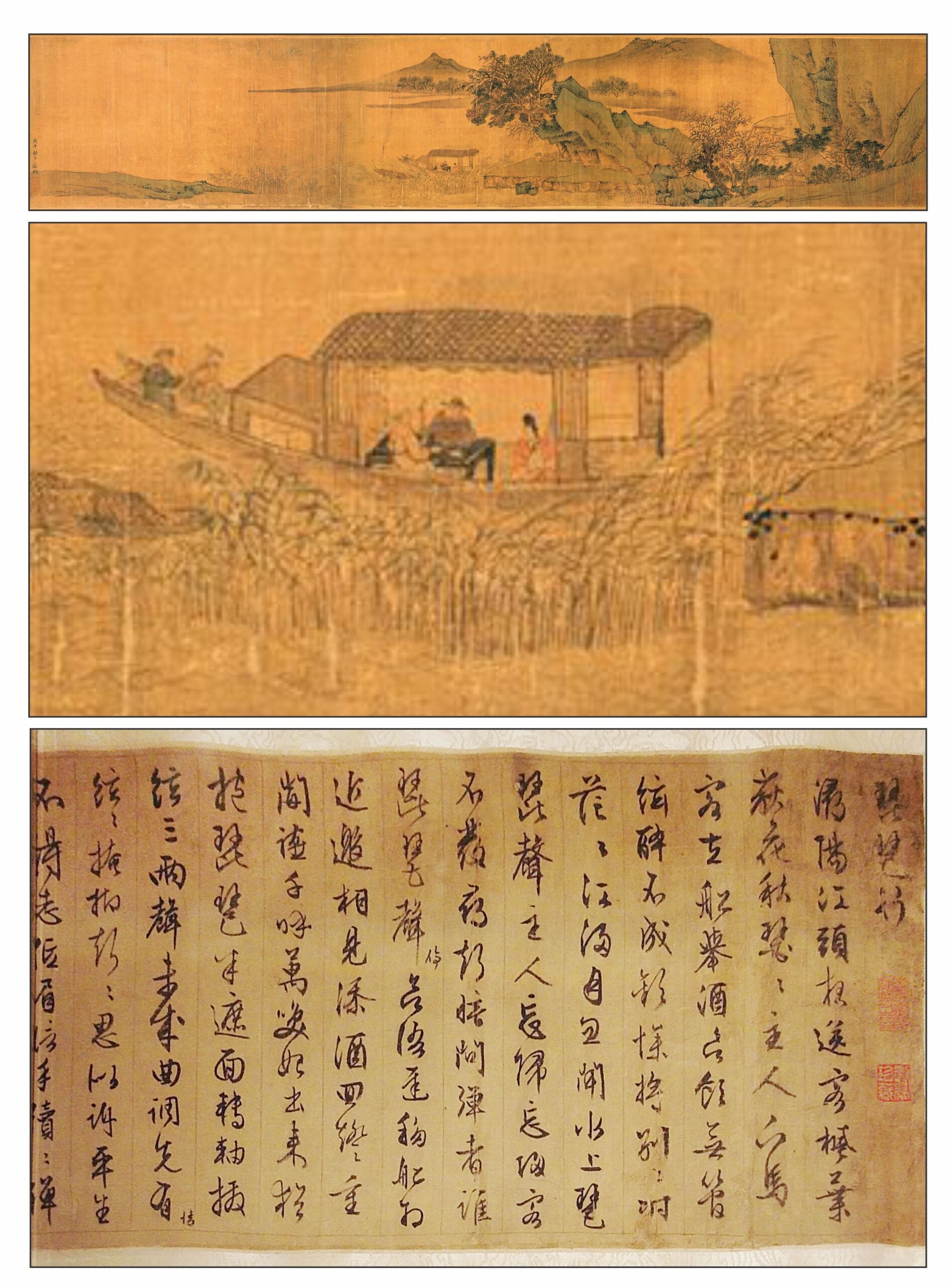
Warner, D. X.  (2005) The two voices of Wangchuan Ji: poetic exchange between Wang Wei and Pei Di, Early Medieval China, 2005 (2), 57-72.
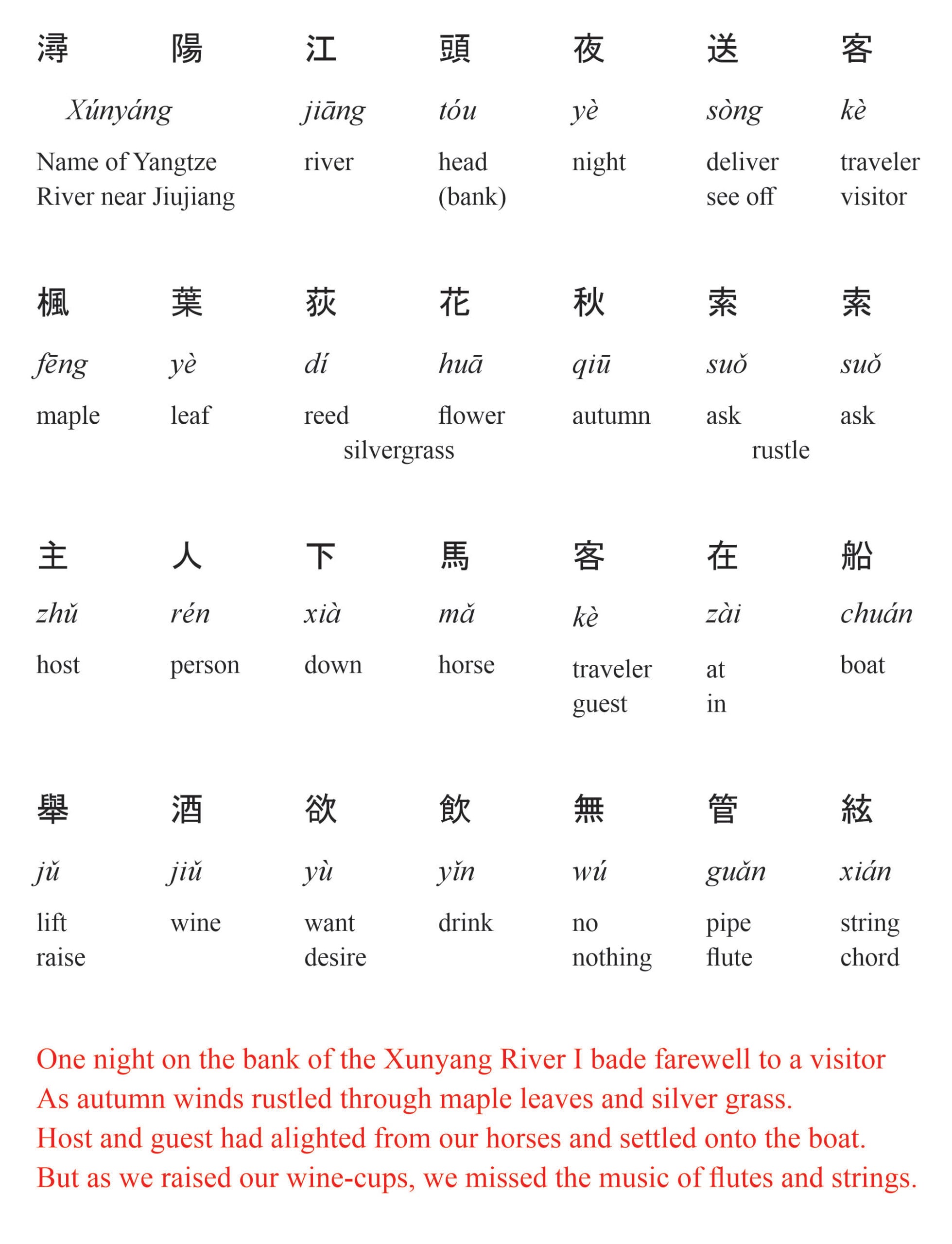
Weinberger, E., & Paz, O. (1987). Nineteen ways of looking at Wang Wei: how a Chinese poem is translated. Moyer Bell.

Yang, Jingqing (2001). The Chan interpretation of Wang Wei’s poetry: a critical examination. Doctoral Thesis, University of Sydney.

Yip, Wai-lim (1972). Hiding the universe: Poems of Wang Wei. Grossman (Mushinsha).

Yu, P. (1980). The poetry of Wang Wei: new translations and commentary. Indiana University Press.