Ezra Pound: Hugh Selwyn Mauberley

Ezra Pound (1885-1972) came to London in the summer of 1908. He cobbled together a living as a reviewer and editor for magazines such as The New Age and Poetry. He served as the midwife for modernism by arranging the publication of T. S. Eliot, James Joyce and Hilda Doolittle (H.D.). Sometimes charming, sometimes arrogant, Pound antagonized many of his colleagues in both England the America. His Homage to Sextus Propertius, a set of poems based on the work of the Latin poet, published in Poetry 1918, was panned. Pound left for Europe in the spring of 1921. His publication of Hugh Selwyn Mauberley (1920) served as his farewell to London. The illustration shows a photographic portrait by E. O. Hoppé taken in 1918 and published in 1920.

Hugh Selwyn Mauberley

The book was published in a limited edition of 200 copies by the Ovid Press, founded by the Jewish poet and printer John Rodker in 1919. Though only active for about three years, the press published T. S. Eliot, Wyndham Lewis and James Joyce. The book was elegantly printed with each poem preceded by abstract drop caps designed by Edward Wadsworth. The following illustration shows the beginnings of the first two poems:
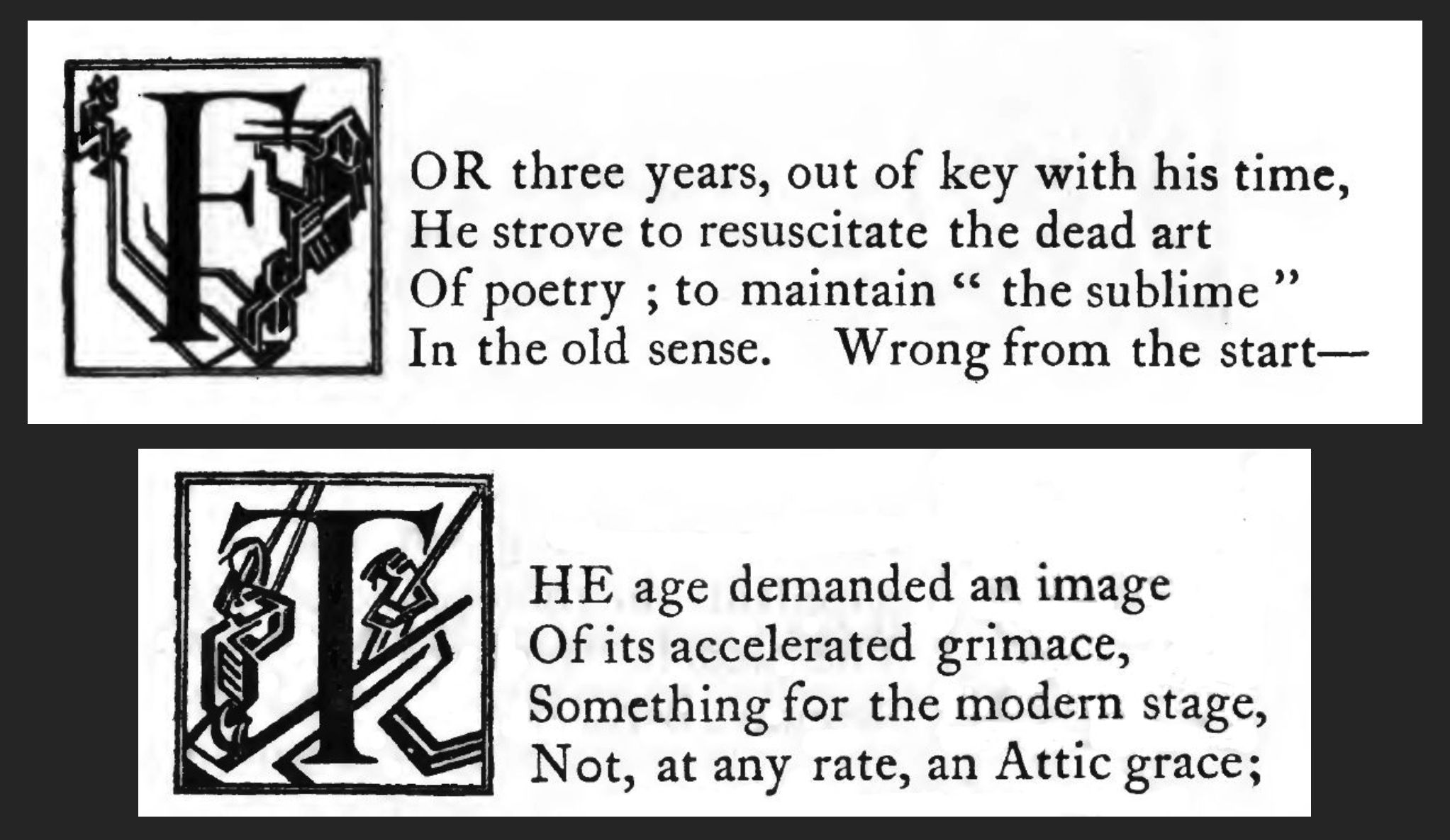
Hugh Selwyn Mauberley was reprinted in the 1923 edition of Personae and then again in 1958 together with Homage to Sextus Propertius in Diptych Rome-London. Hugh Selwyn Mauberley is divided in two, the first part containing 12 poems and the second 5, with an Envoi separating the two. The full text is available at Wikisource. This post, which will comment on some of the poems, is much indebted to the work of Espey (1955), Berryman (1983), and Ruthven (2020, pp 125-147). Pound was intelligent, fluent in several languages and widely read. He assumed his readers knew as much as he did, and failed to understand why they did not appreciate the significance of his work, which, though sometimes achingly beautiful, was often intractably obscure.


Ode pour l’élection de son sepulchre

The first poem in the book is Pound’s proposal for his own epitaph. Its title comes from a long poem by Pierre de Ronsard (1524-1585), wherein he asks not to be memorialized by a marble tomb but to be buried in the nature that he loved. A short excerpt together with a translation by Curtis Page (1903) that uses rhyme but loses much of the sense:
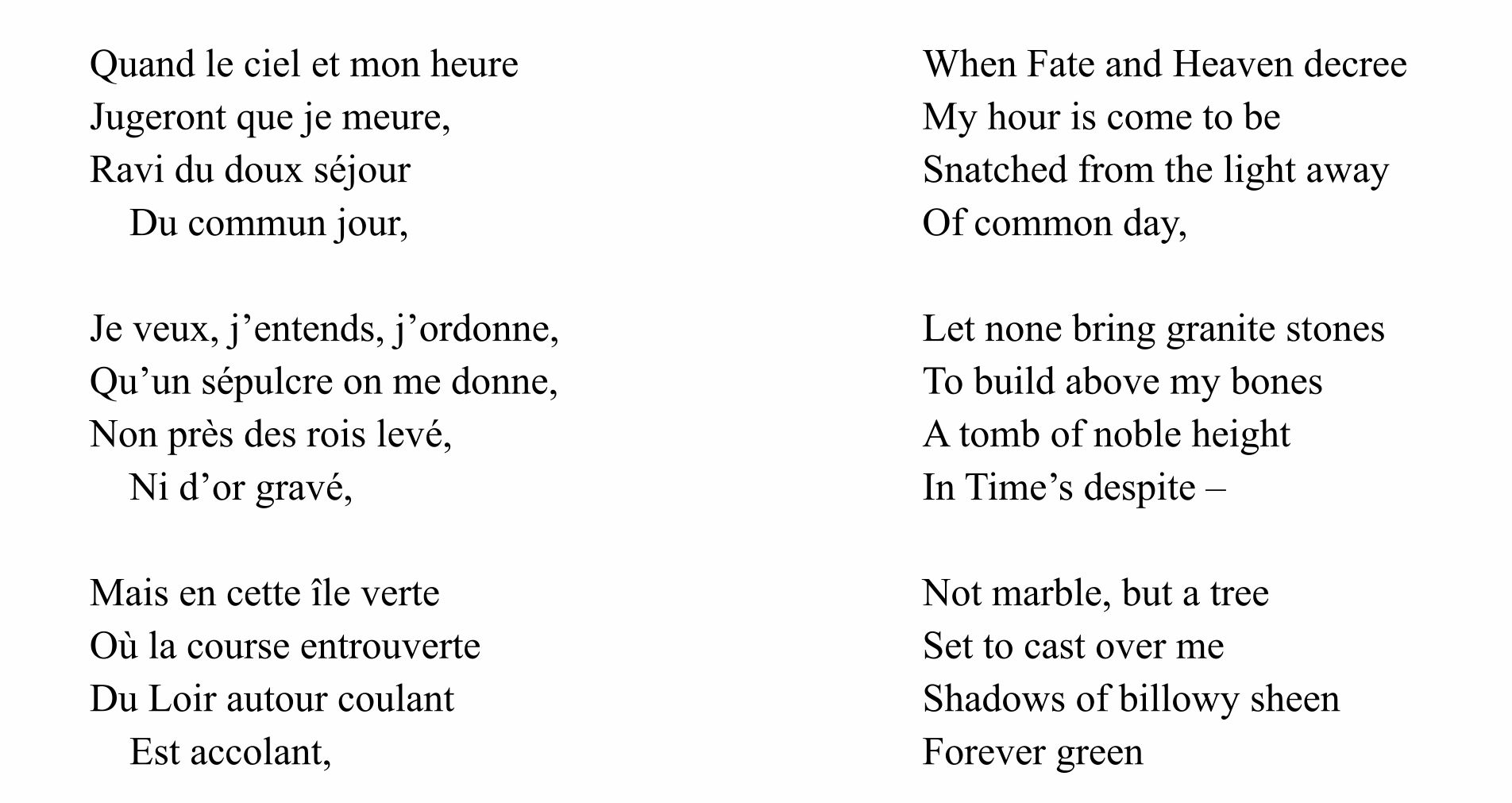
Pound’s poetry was nothing like Ronsard’s (and even less like that of Page). He tried to write poetry that conveyed the truth of his time. He failed. He therefore requests an epitaph that recognizes his defeat. From the last stanza we learn that this poem is dated to the poet’s 30th year. In a subsequent revision he changed this to the 31st. This would then be 1916, the date when Pound published Lustra.

For three years, out of key with his time,
He strove to resuscitate the dead art
Of poetry; to maintain “the sublime”
In the old sense. Wrong from the start –

No, hardly, but, seeing he had been born
In a half savage country, out of date;
Bent resolutely on wringing lilies from the acorn;
Capaneus; trout for factitious bait:

ἴδμεν γάρ τοι πάνθ᾽ ὅσ᾽ ἐνὶ Τροίῃ
Caught in the unstopped ear;
Giving the rocks small lee-way
The chopped seas held him, therefore, that year.

His true Penelope was Flaubert,
He fished by obstinate isles;
Observed the elegance of Circe’s hair
Rather than the mottoes on sun-dials.

Unaffected by “the march of events”,
He passed from men’s memory in l’an trentiesme
De son eage
; the case presents
No adjunct to the Muses’ diadem.

The following is Pound’s recitation of the poem from a recording made at Harvard University in 1939:

The notion in the first stanza that Pound had tried “to resuscitate the dead art of poetry” alludes to Dante’s Ma qui la morta poesì resurga, (Purgatorio I, 7, 1321). In the last stanza, Pound quotes from the Testament (1461) of François Villon, a comic poem that serves, like Ronsard’s Ode, as the poet’s will. Pound felt victimized by society, in much the same way as the medieval poet. In 1923, Pound wrote a short opera based on Villon’s poem.

The second stanza refers to Capaneus, one of the “Seven Against Thebes.” A giant with immense strength, he claimed that even Zeus could not defeat him. Nevertheless, he was killed by a divine thunderbolt as he stormed the walls of Thebes. Pound shared his defiance.

The Greek quotation that begins the third stanza (transliterated as ídmen gár toi pánth᾽ ós᾽ ení Troíē refers to Homer’s rendition of the song of the sirens in the Odyssey XII: 189: “For we know all the suffering that was endured on the plains of Troy.” The next stanza refers to characters in the Odyssey: Penelope and Circe. Pound had begun to consider himself as a modern Odysseus. In 1917 published the first three parts of what were to become his life work: The Cantos. His idea was to create a sequence of modern poems that covered everything we understood about life, much like the Dante’s Divine Comedy. He later abandoned these “ur Cantos,” and began the project again with an episode from the Odyssey that had originally formed part of the original third canto. He then published A Draft of XVI Cantos in 1925.

This first poem of Hugh Selwyn Mauberley is intriguing for its bilingual rhymes: Τροίῃ and leeway, Flaubert and hair, trentiesme and diadem.

Exactly who is speaking in Hugh Selwyn Mauberley is not easy to determine (Bush, 1990; Wong, 2000). Pound created Mauberley as a persona separate from himself. In the first poem of the book this writer provides a eulogy for the poet E.P., who we can only assume was the youthful and idealistic Ezra Pound, who “died” unappreciated in 1916. In the first part of the book Mauberley then goes on to consider the state of literary London after that death. Lacking the emotional energy of the young E.P., Mauberley speaks in a detached manner. Occasionally the mask slips.

The second poem in the sequence tries to explain Pound’s failure as a result of the public’s taste rather than the artist’s lack of talent:

The age demanded an image
Of its accelerated grimace,
Something for the modern stage,
Not, at any rate, an Attic grace;

Not, not certainly, the obscure reveries
Of the inward gaze;
Better mendacities
Than the classics in paraphrase!

The “age demanded” chiefly a mould in plaster,
Made with no loss of time,
A prose kinema, not, not assuredly, alabaster
Or the “sculpture” of rhyme.

The following is Pound’s recitation of this poem recorded in Washington in 1958:

By “the classics in paraphrase” Pound is referring to his versions of the poems of Propertius in Homage to Sextus Propertius (1919). Pound had attempted to convey the meaning of the poems rather than providing an exact translation. He had done the same with his translations from Chinese in Cathay (1915) but there were no pedantic Chinese scholars to criticize those poems.

In the third stanza, Pound distinguishes between statues made by means of plaster moulds from those sculpted from stone or alabaster. He likens prose to the cinema. For someone whose motto became Make it New (1934), he was decidedly antagonistic to new art forms. Ruthven (2020, p 130) quotes him as claiming “The Cinema is not art” in 1918.


There died a myriad

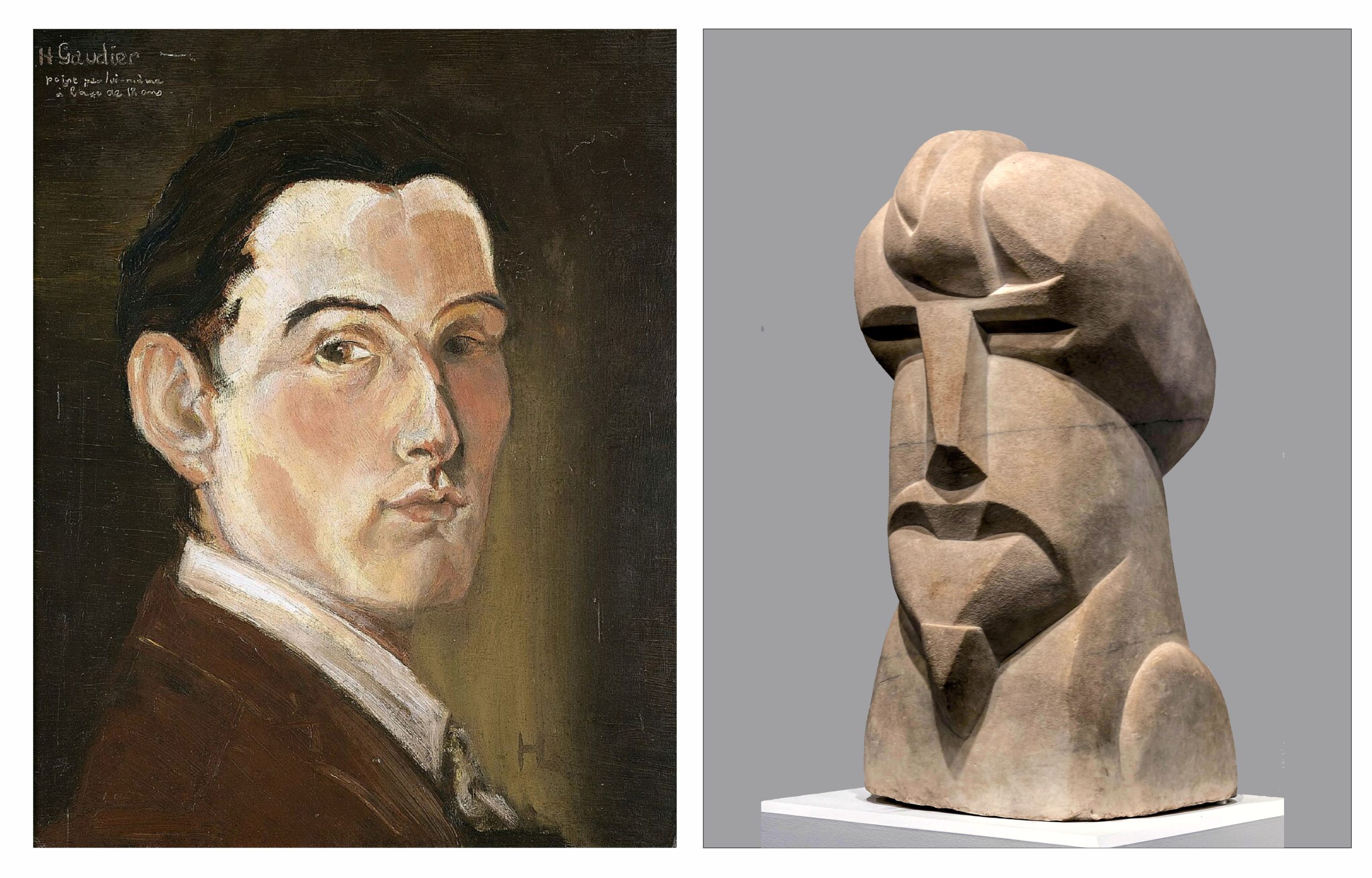
The most devastating event of Pound’s sojourn in London was World War I. Pound was acutely aware of the lives wasted by this terrible war. Pound’s friend Henri Gaudier-Brzeska, who had sculpted a striking Hieratic Head of Ezra Pound in 1914, was killed in action in June 1915. Pound published a book on the sculptor’s works and thoughts in 1916: Gaudier-Brzeska: A Memoir. The following illustration shows a 1909 self-portrait of Gaudier-Brzeska and his sculpted portrait of Pound:
The fourth and fifth poems in the initial section of Hugh Selwyn Mauberley provide an elegy for the young men who died in World War I. These remarkably moving poems are the most memorable of the whole book. So much so that one can forget how well written they are.

IV

These fought, in any case,
and some believing, pro domo, in any case ..

Some quick to arm,
some for adventure,
some from fear of weakness,
some from fear of censure,
some for love of slaughter, in imagination,
learning later …

some in fear, learning love of slaughter;
Died some pro patria, non dulce non et decor …

walked eye-deep in hell
believing in old men’s lies, then unbelieving
came home, home to a lie,
home to many deceits,
home to old lies and new infamy;

usury age-old and age-thick
and liars in public places.

Daring as never before, wastage as never before.
Young blood and high blood,
Fair cheeks, and fine bodies;

fortitude as never before

frankness as never before,
disillusions as never told in the old days,
hysterias, trench confessions,
laughter out of dead bellies.

V.

There died a myriad,
And of the best, among them,
For an old bitch gone in the teeth,
For a botched civilization.

Charm, smiling at the good mouth,
Quick eyes gone under earth’s lid,

For two gross of broken statues,
For a few thousand battered books.

The following is Pound’s recitation of these poems, recorded in Washington in 1958:

The initial part of poem IV bases both its rhythm and its sense on the Lament for Adonis (around 100 BCE) by Bion of Smyrna (Espey, 1955, p 44). Near the end of the lament, the Loves pay tribute to the dead Adonis:

This flung upon him arrows,
that a bow, this a feather, that a quiver.
One hath done off Adonis’ shoe,
others fetch water in a golden basin,
another washes the thighs of him,
and again another stands behind and fans him with his wings.

Pound quotes from Horace Ode III: 2: 13: dulce et decorum est pro patria mori (Sweet and fitting is it to die for fatherland). There was nothing sweet or fitting about death in the trenches of World War I. He also used the Latin phrase pro domo (for the home) as one of the reasons that the soldiers went to war. Latin made everything seem necessary.

Pound points to two main forces that led to the catastrophe of World War I: usury and lies. This is the first mention of “usury” in Pound’s poetry. He had become convinced by the economic writings of Clifford Hugh Douglas (1879-1952) that endeavors financed by interest-bearing loans cannot lead to anything new or good because banks will not risk take risks with their investments (see Kenner, 1971, pp 301-317). Far better for endeavors to be financed by the government by means of “social credit.” Pound later became fixated on the idea of usury as leading to the downfall of civilization, for example in his Canto XLV (1937)

Almost like an ancient prophet, Pound foresees the collapse of the British Empire using the powerful consonance of “bitch” and “botch.” However, the empire persisted between the wars, finally falling into pieces after World War II.

And what did these young men die for? Ruthven (2020, p 133) suggests that the last two lines of the fifth poem indicate

The bric-à-brac of an ancient and once vital tradition: but the civilization these men have died for is little more than a museum of shabby objets d’art.

The following is a different interpretation from Tearle (2019, p 65):

If ‘statues’ and ‘books’ are meant to be read as metonymic stand-ins for ‘art’ or ‘culture’ more generally, then our response to these lines is likely to be mixed. Does Pound think art is worth dying for, or not? Th e men who gave their lives in the First World War were not, aft er all, dying merely to defend the cheapened modern art which Pound’s poem laments, but all art of all ages. And ‘broken statues’ and ‘battered books’ hardly sound like modern art, but classical art that has been allowed to fall into ruin. In other words, Pound’s lines cast the soldiers as men defending something which the populace could not even be bothered to maintain, but which the artistic champion in him felt was worth dying for. Th e men who had sent Pound’s generation off to war had also been those who had allowed several thousand years of Western culture to fall into decline.

Envoi

After the memorial to those who died in the war, Pound presents several satirical portraits of people he had met during his time in London. Despite occasionally beautiful lines, they are for the most part not worth reading. But then, Pound inserts a poem entitled Envoi to mark the end of the first part of his book. An “envoi” (from envoyer, send) is a writer’s farewell message to the reader. It began in French medieval poetry and was famously used at the end of Chaucer’s Troilus and Criseyde (c 1385), The following is Chaucer’s Middle English and a modern translation. He hopes that God will allow him to write a comedy now that his tragedy is finished:

Pound bids his book farewell, believing it has nothing to say, but that it has born witness to the beautiful. The following is the text and a recitation by Pound from his 1939 recording at Harvard University:

Go, dumb-born book,
Tell her that sang me once that song of Lawes:
Hadst thou but song
As thou hast subjects known,
Then were there cause in thee that should condone
Even my faults that heavy upon me lie
And build her glories their longevity.

Tell her that sheds
Such treasure in the air,
Recking naught else but that her graces give
Life to the moment,
I would bid them live
As roses might, in magic amber laid,
Red overwrought with orange and all made
One substance and one colour
Braving time.

Tell her that goes
With song upon her lips
But sings not out the song, nor knows
The maker of it, some other mouth,
May be as fair as hers,
Might, in new ages, gain her worshippers,
When our two dusts with Waller’s shall be laid,
Siftings on siftings in oblivion,
Till change hath broken down
All things save Beauty alone.

Pound is describing his experience hearing the young soprano Raymonde Collignon singing Go Lovely Rose (Berryman, 1983, pp 141-143; Hesse, 1981). This is a musical setting by Henry Lawes (1596-1662) of a poem by Edmund Waller (1606-1687). The following is the poem

Go, lovely rose!
Tell her that wastes her time and me,
That now she knows,
When I resemble her to thee,
How sweet and fair she seems to be.

Tell her that’s young,
And shuns to have her graces spied,
That hadst thou sprung
In deserts, where no men abide,
Thou must have uncommended died.

Small is the worth
Of beauty from the light retired;
Bid her come forth,
Suffer herself to be desired,
And not blush so to be admired.

Then die! that she
The common fate of all things rare
May read in thee;
How small a part of time they share
That are so wondrous sweet and fair!

And this is a modern performance by Ellen Hargis accompanied by Paul O’Dette on lute

In the Envoi, the persona of Mauberley appears to conclude his comments on literary London by quoting a poem from the now-dead poet E.P.

This is one place where there is no doubt who is speaking. It is Pound himself, suddenly stepping from behind the wavering figure of Mauberley and all the veils of irony, to speak out personally, even confessionally, into a situation which he had seemed to contrive just so as not to speak in his own person at all. This wonderfully dramatic moment is signalized by the sudden appearance of a wholly unexpected metre and style, flowing, plangent, and cantabile, so wholly traditional in every respect that the voice of the poet seems to be the anonymous voice of the tradition of English song. (Davie, 1967, p 325)

Pound hopes that his book description of the singer’s grace might somehow excuse its writer’s faults and make the singing long remembered. Then he imagines he might fix the rose in amber so that it might never fade or die. And finally, he notes that though singer and poet will pass away, the beauty of the song will not.


Mauberley

Part II of the book is entitled Mauberley (1920). If the reader has had problems knowing what persona is present the poems of the Part I, he will almost certainly be completely lost in Part II. The poems in this section are perhaps best interpreted as the work of a poet who, after suffering critical rejection, has changed his style so that it no longer suffers from his youthful enthusiasms. However, this has caused the poems to become so cryptic as to almost unintelligible: outlines without color or shape. The following is the first poem:

Turned from the “eau-forte
Par Jaquemart”
To the strait head
Of Messalina:

“His true Penelope
Was Flaubert”,
And his tool
The engraver’s

Firmness,
Not the full smile,
His art, but an art
In profile;

Colourless
Pier Francesca,
Pisanello lacking the skill
To forge Achaia.

The following is a recitation by Pound from his 1939 recording at Harvard University:

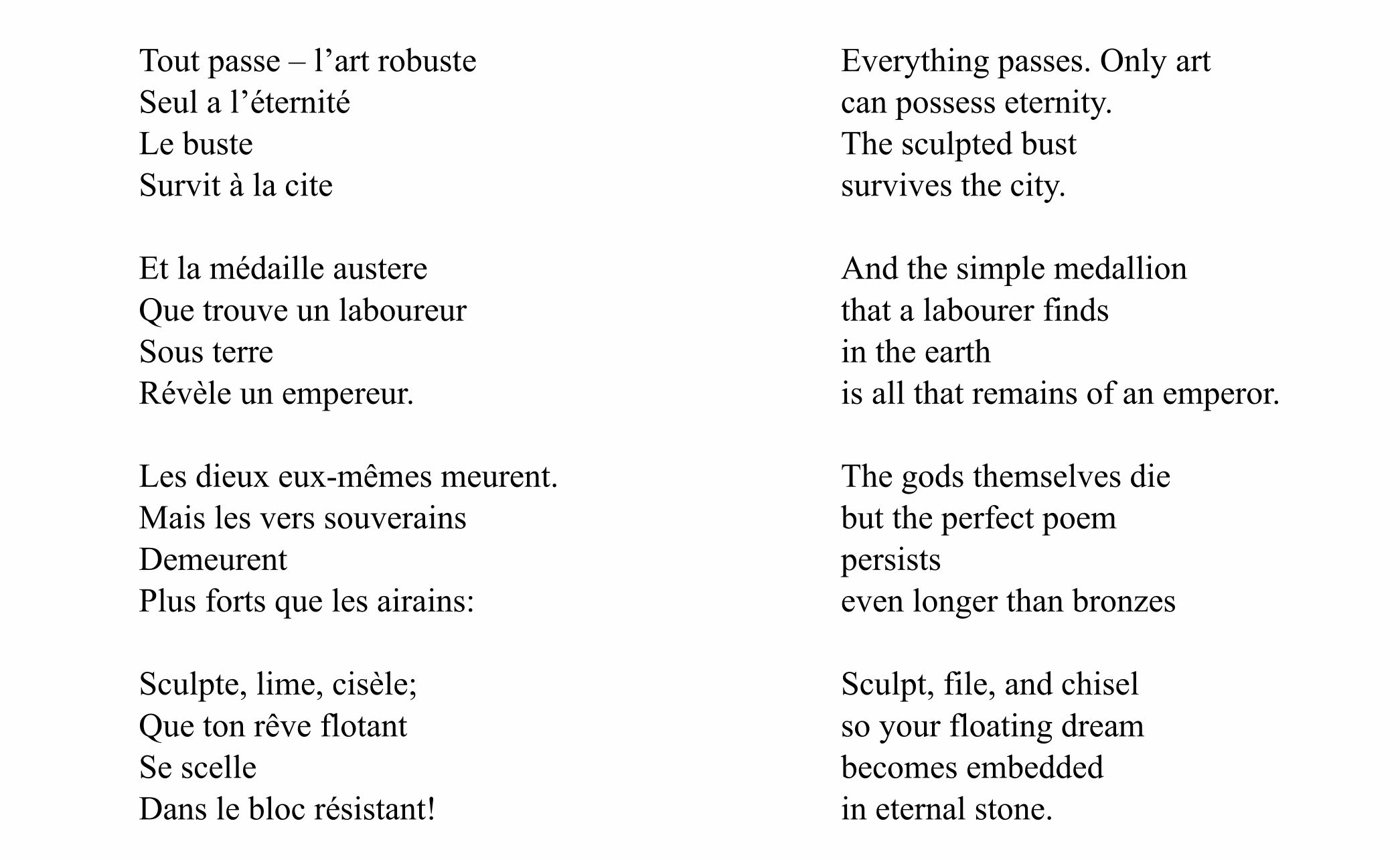
Scholars agree that the fist two lines refer to the etching by Jules Jacquemart (1837–1880) that serves as a frontispiece to the book Émaux et Camées (Enamels and Cameos) by Théophile Gautier (1811-1872). Gautier wrote in a precise and unsentimental manner, The title of Gautier’s book indicates the author’s preference for the skill of a craftsman creating objets d’art to the excesses of the Romantics and their grand themes. The brief lines in the first poem in this Mauberley section are similar to those in Gautier’s poem L’Art (Espey, 1955, pp 45-46), the last four quatrains (with my loose translations) of which are:
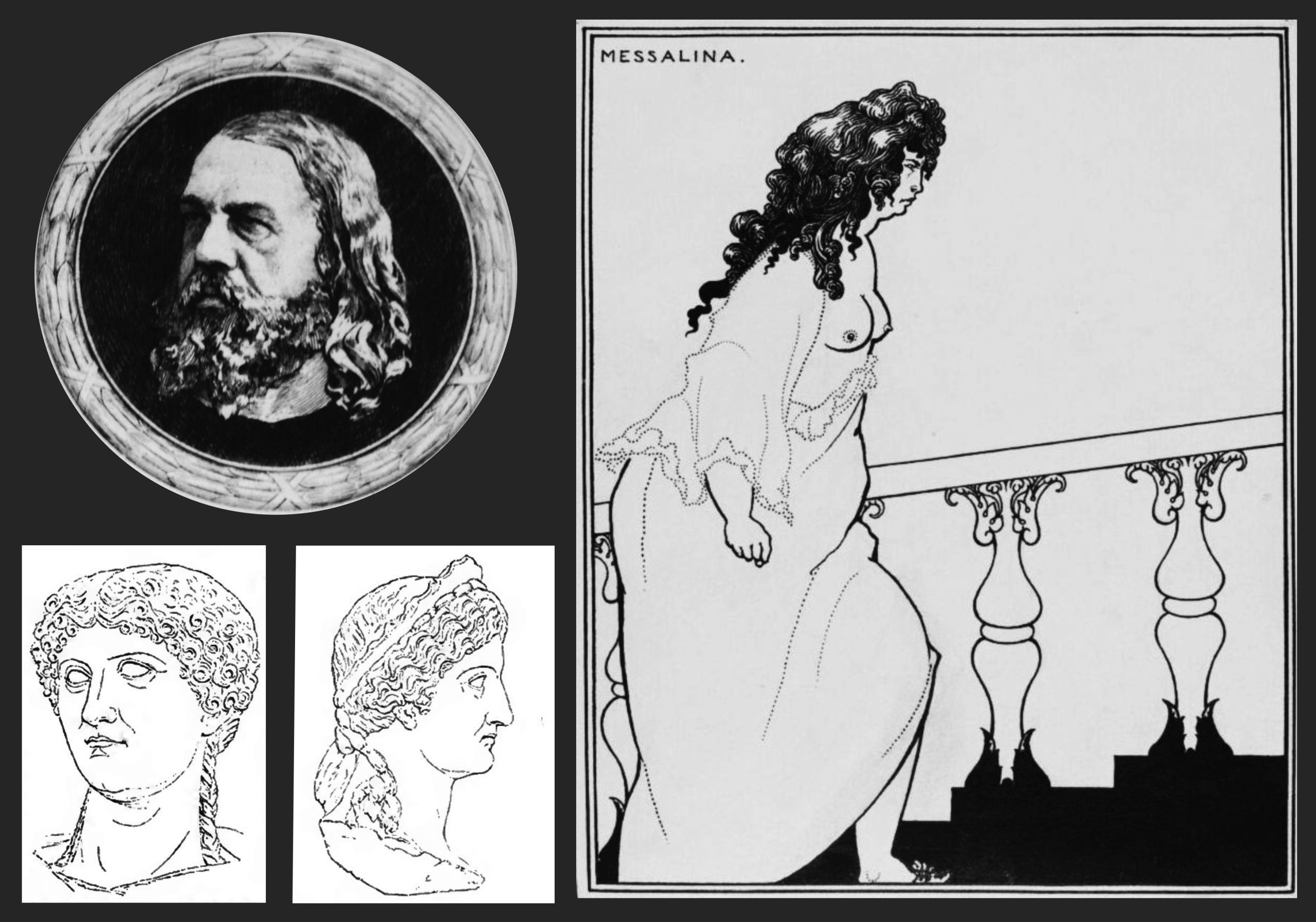
However, no one is certain what Pound meant by the “strait head of Messalina.” Pound appears to have had in mind some portrait of Messalina (17-48 CE), the third wife of the emperor Claudius. Much younger than her husband she was rumored to have satisfied her desires by working clandestinely in a Roman brothel. Berryman (1977) suggested that Pound might have been referring to etchings of a bust of Messalina in the Louvre or of a head in Munich as presented in Bernoulli’s Römische Ikonographie (pp 188, 193). Moody (2007, p 383) proposed Aubrey Beardsley’s stark black-and-white 1895 etching of Messalina Returning Home (from the brothel) (Wilson, 2020). The various candidate etchings are shown below. Neither interpretation makes much sense, other than that the Messalina etchings are outlines without shading. Perhaps Pound is indicating that the poet Mauberley, chastised for his youthful excesses, has now drained his work of any form. This fits with the final stanza wherein he likens his new art to Piero della Francesca without the color, or Pisanello without the talent that let him make medallions as fine as those from ancient Greece (Achaia).  
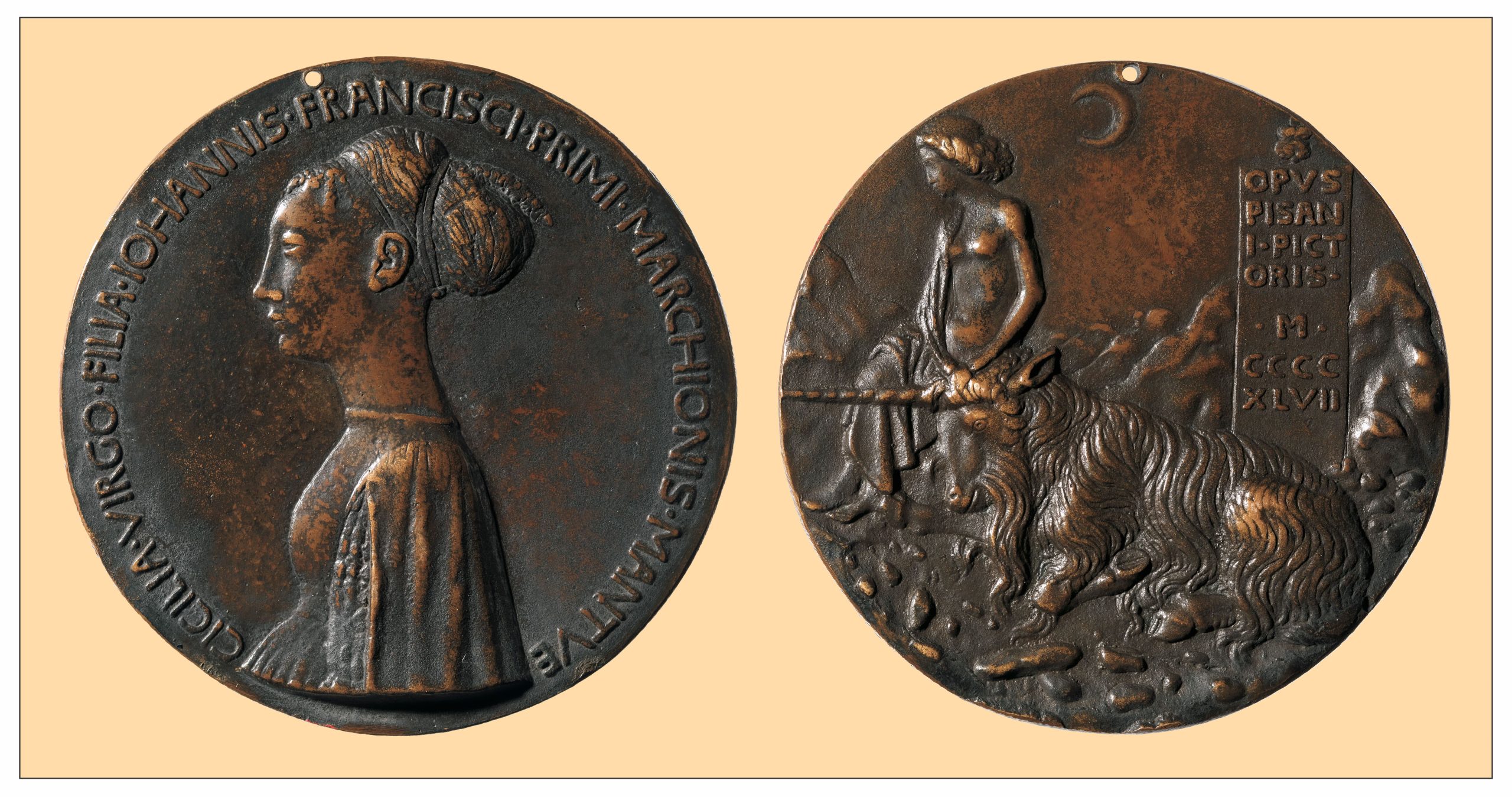
The following is a 1447 medallion of Pisanello showing s portrait of Cecilia Gonzaga, the daughter of Gianfrancesco Gonzaga, Marquess of Mantua, on one side, and a representation of a virgin taming a unicorn on the obverse:
Luini in porcelain

The poems in Part II, cryptic and allusive, cannot be understood without access to scholarly annotations. The final poem recalls the description of Raymonde Collignon singing Go Lovely Rose in the Envoi that separates the two parts of the book. This final poem describes the singer rather than the song. Mauberley imagines the singer as a small porcelain medallion, perhaps like one of Gautier’s cameos, or one of Pisanello’s bronzes:

Luini in porcelain!
The grand piano
Utters a profane
Protest with her clear soprano.

The sleek head emerges
From the gold-yellow frock
As Anadyomene in the opening
Pages of Reinach.

Honey-red, closing the face-oval,
A basket-work of braids which seem as if they were
Spun in King Minos’ hall
From metal, or intractable amber;

The face-oval beneath the glaze,
Bright in its suave bounding-line, as,
Beneath half-watt rays,
The eyes turn topaz.

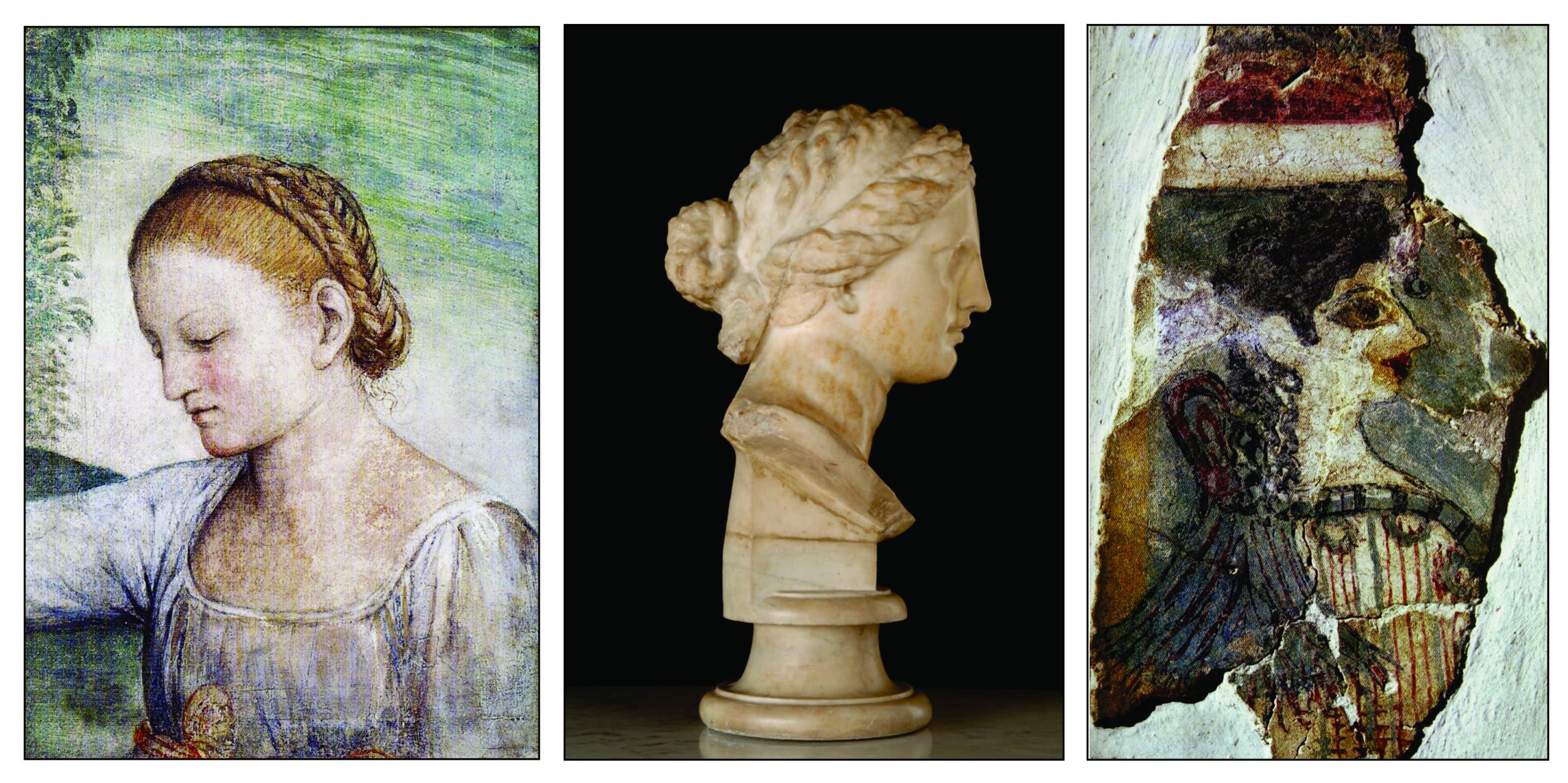
The poem likens the singer to a painting by Bernardino Luini (1480-1532) who worked with Leonardo da Vinci. Pound is likely referring to his painting Head of a Girl in the Wallace Collection (Berryman, 1977, p 299). This was part of a set of frescos in Villa La Pelucca near Milan (about1523) which were transferred to canvas in 1822.

Pound also compares the singer to Venus Anadyomene (rising from the sea), a name for Aphrodite (which may derive from aphros, sea foam”), the  goddess of love. In particular, to a sculpted head of Venus in the Leconfield Collection (Petworth House), illustrated as Plate 83 in the art encyclopedia entitled Apollo (1904) compiled by Solomon Reinach (Berryman, 1977, p 301).

His final image is that of a fresco fragment from Minoan Crete, commonly called La Parisienne, also described in Reinach.

The following illustration shows these three heads, all of which have survived long beyond the age of their creation. All have intricately braided hair, as we must presume did Raymonde Collignon:
As described in a letter to the editor of Padieuma, the half-watt lamp was a special type of light bulb that gave a “warmer” lighting than the usual incandescent bulb. It would have highlighted the singer’s “topaz” eyes. Topaz is frequently yellow, but occasionally blue or even red.

Once one has understood the allusions, the poem has a cryptic beauty. However, it still pales before the description of the singing as presented in Envoi.


Exile

In early 1921, shortly after the publication of Hugh Selwyn Mauberley, Pound left for Europe. The journal The New Age bid him an ambiguous farewell:

Mr. Ezra Pound has recently gone abroad, perhaps for one year, perhaps for two, perhaps for good. Following the old and, in my opinion, the bad example first set by a man of letters, Landor, Mr. Pound has shaken the dust of London from his feet with not too. emphatic a gesture of disgust, but, at least, without gratitude to this country. I can perfectly well understand, even if I find it difficult to approve. Mr. Pound has been an exhilarating influence for culture in England; he has left his mark upon more than one of the arts, upon literature, music, poetry and sculpture; and quite a number of men and movements owe their initiation to his self-sacrificing stimulus; among them being relatively popular successes as well as failures. With all this, however, Mr. Pound, like so many others who have striven for the advancement of intelligence and culture in England, has made more enemies than friends, and far more powerful enemies than friends. Much of the Press has been deliberately closed by cabal to him; his books have for some time been ignored or written down; and he himself has been compelled to live on much less than would support a navvy. His fate, as I have said, is not unusual: I could parallel it near home and with more than one instance. Taken by and large, England hates men of culture until they are dead.

After two years in Paris, during which time he edited T. S. Eliot’s The Waste Land (1922), Pound moved to Rapallo in Italy where he stayed in self-imposed exile. While in Rapallo, he resumed work on The Cantos, a sprawling poetic work that by his death had extended to some 117 poems, the last of which remain uncompleted.

A man of towering intellect and enviable talent, he fashioned for himself an ego that considered only himself. He wrote only in accord with his own judgment, and lost the feedback of his fellows. Becoming fascinated by the economics of C. H. Douglas, he began to attribute all the ills of the world to the Jews.

During World War II, he made propaganda broadcasts for the Italian government, denouncing the Allied Governments and the Jews (Casillo, 1988). After the war he was indicted for treason, but judged mentally unfit to stand trial. He spent 12 years in St Elizabeth’s Psychiatric Hospital in Washington, D.C. There was never any definite diagnosis for what was wrong with him (Torrey, 1984). After being released in 1958, he returned to Italy, where he lived until his death in 1972.

Despite the keenness of his mind and the tremendous breadth of his reading, he could not see clearly, could not communicate his ideas so that they could be easily understood, and could not abide by any criticism. He became exiled in himself. This process began with Hugh Selwyn Mauberley.


References

Bernoulli, J. J. (1886). Römische Ikonographie. Teil 2, Die Bildnisse der Römischen Kaiser, I. Das Julisch-Claudische Kaiserhaus. Verlag von W Speman.

Berryman, J. B. (1977). The art of the image: allusions in Pound’s “Medallion.” Paideuma, 6(3), 295–308.

Berryman, J. B. (1983). Circe’s craft: Ezra Pounds’s Hugh Selwyn Mauberley. UMI Research Press.

Bush, R. (1990). “It draws one to consider time wasted”: Hugh Selwyn Mauberley. American Literary History, 2(1), 56–78.

Casillo, R. (1988). The genealogy of demons: anti-Semitism, fascism, and the myths of Ezra Pound. Northwestern University Press.

Davie, D. (1967). Hugh Selwyn Mauberley. In Ford, B (Ed) The Pelican Guide to English Literature; Volume 7 The Modern Age. (pp 315-329).

Espey, J. J. (1955). Ezra Pound’s Mauberley: a study in composition. Faber and Faber.

Hesse, E. (1981). Raymonde Collignon, or (apropos Paideuma, 7-1&2, pp. 345-6): the duck that got away. Paideuma, 10(3), 583–584

Kenner, H. (1971). The Pound era. University of California Press.

Kotin, J. (2023). Hugh Kenner’s The Pound Era: FAQ. nonsite website.

Moody, A. D. (2007). Ezra Pound: poet: a portrait of the man and his work. Volume I The young genius. Oxford University Press.

Pound, E. (1920). Hugh Selwyn Mauberley. Ovid Press.

Pound, E. (1926). Personæ: the collected poems of Ezra Pound. James Laughlin.

Pound, E. (1958). Diptych Rome-London. Officina Bodoni (reprinted in 1994, New Directions).

Reinach, S. (1904). Apollo: histoire génerale des arts plastiques professée en 1902-1903 à l’École du Louvre. Librairie Hachette et Cie.  English translation

Ronsard, P. de (translated by Page, C. H., 1903). Songs & sonnets of Pierre de Ronsard, gentleman of Vendomois. Houghton Mifflin.

Ruthven, K. K. (2020). A Guide to Ezra Pound’s Personæ (1926). University of California Press.

Tearle, O. (2019). Battered books: Ezra Pound, Hugh Selwyn Mauberley. In The Great War, The Waste Land and the Modernist Long Poem. (pp. 59–76). Bloomsbury Publishing.

Torrey, E. F. (1984). The roots of treason: Ezra Pound and the secret of St. Elizabeths. Harcourt Brace Jovanovich.

Wong, K. A. (2000). Blurring of poet and persona in Pound’s “Hugh Selwyn Mauberley.” Paideuma, 29(3), 193–205.

Wilson, S. (2020). Aubrey Beardsley’s Messalina: going, or coming? Audrey Beardsley Society.


Pontius Pilate: The Trial of Jesus

During the reign (14-37 CE) of the Roman Emperor Tibberius, Pontius Pilates served as Prefect of Judaea from 26 to 37 CE. During this time, the High Priest of the Temple was Joseph ben Caiaphas, who had succeeded his father-in-law Annas in 18 CE and served until 36 CE. Pontius Pilate was primarily responsible for the Judaea and Samaria, but the regions of Galilee and Perea were ruled as Roman vassal states by the tetrarch Herod Antipas who reigned from the death of his father Herod the Great in 4 BCE until 39 CE. Pontius Pilate presided over the trial of Jesus of Nazareth, most likely during the celebration of Passover in 33 CE. The illustration shows Jesus before Pilate, a panel of the Maestà (1311 CE) by Duccio di Buoninsegna.

History

Although the details of the trial of Jesus as reported in the Christian Gospels may or may not be true, two early historians have provided evidence that Jesus did indeed exist and that he was condemned by Pilate to die by crucifixion.

Flavius Josephus (37-100CE), a Roman Jewish historian, mentioned the crucifixion of Jesus in Book 18 of The Antiquities of the Jews (written in Greek and published in 94 CE). We do not have a copy of the original publication and the earliest known manuscripts date to about the 10th Century CE, 900 years later. Most scholars agree that the section describing Jesus is authentic but that additions were made to it as the book was copied in the monasteries (Baras, 1987). Meier (1991, pp 59-62) proposes the following translation with the additions noted in italics.

At this time there appeared Jesus, a wise man, if indeed one should call him a man. For he was a doer of startling deeds, a teacher of people who receive the truth with pleasure. And he gained a following both among many Jews and among many of Greek origin. He was the Messiah. And when Pilate, because of an accusation made by the leading men among us, condemned him to the cross, those who had loved him previously did not cease to do so. For he appeared to them on the third day, living again, just as the divine prophets had spoken of these and countless other wondrous things about him. And up until this very day the tribe of Christians, named after him, has not died out.

Tacitus (56-120 CE), a Roman historian, mentions the crucifixion of Christ in Book 15 of The Annals (written in Latin and published about 115 CE), while discussing the Fire of Rome (64 CE) during the reign (54-68 CE) of Emperor Nero. No one knows the cause of the fire, but many suspected that it was caused by Nero, perhaps to make space for new buildings, perhaps to serve as backdrop for a theatrical performance. To remove suspicion from himself, Nero then accused the Christians in Rome of starting the fire.

But all human efforts, all the lavish gifts of the emperor, and the propitiations of the gods, did not banish the sinister belief that the conflagration was the result of an order. Consequently, to get rid of the report, Nero fastened the guilt and inflicted the most exquisite tortures on a class hated for their abominations, called Christians by the populace. Christus, from whom the name had its origin, suffered the extreme penalty during the reign of Tiberius at the hands of one of our procurators, Pontius Pilatus, and a most mischievous superstition, thus checked for the moment, again broke out not only in Judaea, the first source of the evil, but even in Rome, where all things hideous and shameful from every part of the world find their centre and become popular.

At the time that Tacitus was writing the Roman officials in charge of provinces were no longer called “prefects” or “governors” but had been renamed “procurators,” in keeping with the change in their main responsibilities from military to fiscal.


Context

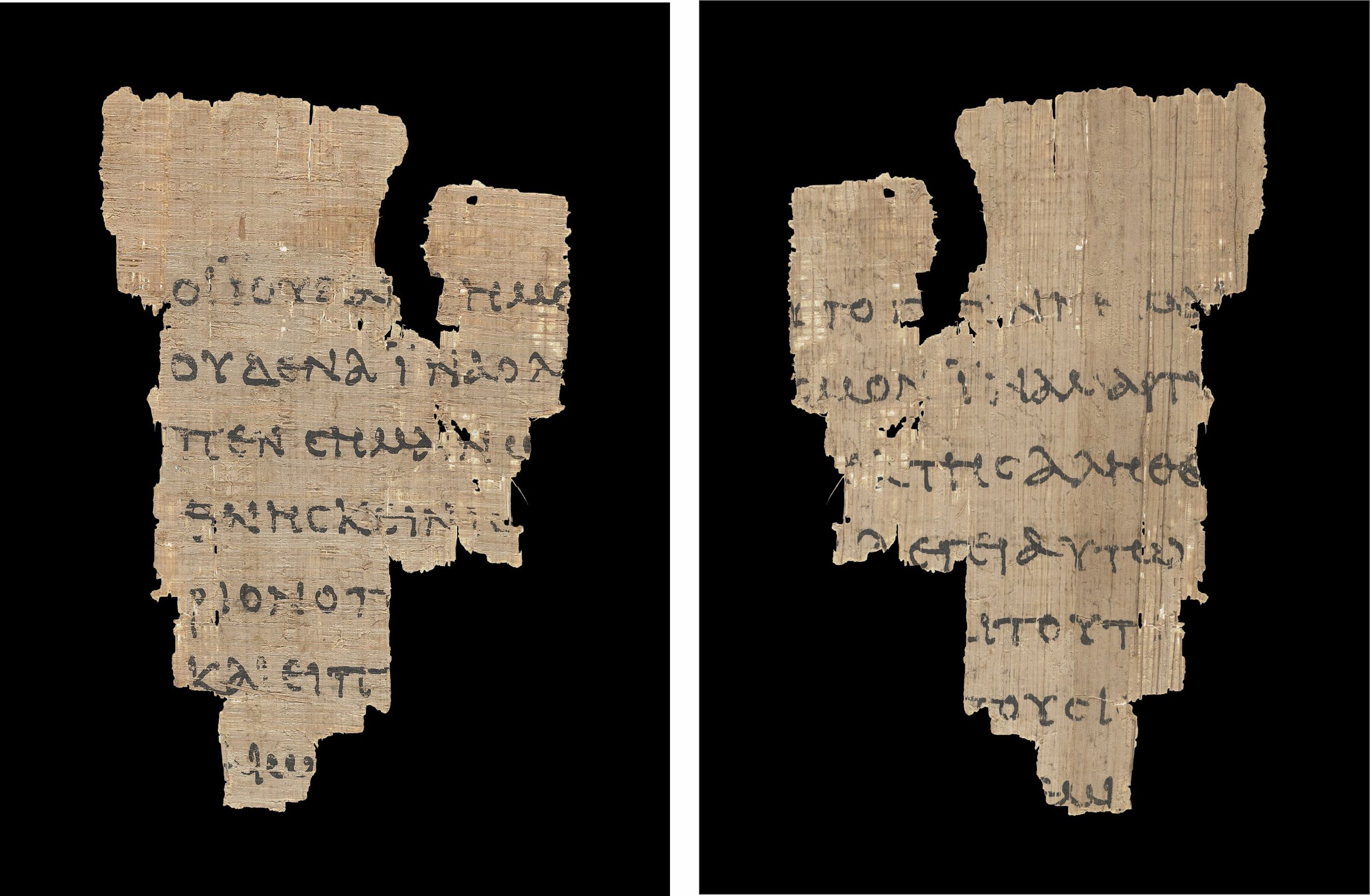
Despite the uncertainty about the reported details, the description of the trial in the gospels provides significant information about the beliefs of those that followed Jesus of Nazareth. This post will consider the narrative of the trial by focussing on the Gospel of John, written about 90 CE (Spong, 2013). The author was initially considered to be the disciple John, but most scholars now believe that the gospel was written by his followers. Although John was the last of the four canonical gospels to be written, the oldest known manuscript fragment of any gospel – the Ryland Papyrus 52 – is from a copy of John dated to the early 2nd Century CE. The papyrus is written on both sides indicating that it came from a codex rather than a scroll. The words on the papyrus concern the trial of Jesus. The first side (recto) shows part of John 18:31-33

Then said Pilate unto them, Take ye him, and judge him according to your law. The Jews therefore said unto him, It is not lawful for us to put any man to death:
That the saying of Jesus might be fulfilled, which he spake, signifying what death he should die.
Then Pilate entered into the judgment hall again, and called Jesus, and said unto him, Art thou the King of the Jews?

And the opposite side (verso) shows part of John 18:37–38

Pilate therefore said unto him, Art thou a king then? Jesus answered, Thou sayest that I am a king. To this end was I born, and for this cause came I into the world, that I should bear witness unto the truth. Every one that is of the truth heareth my voice.
Pilate saith unto him, What is truth? And when he had said this, he went out again unto the Jews, and saith unto them, I find in him no fault at all.

The beginning of the word ΑΛΗΘΕΙΑ (αλήθεια, alítheia, “truth” as in John 18: 37) can be seen at the end of the third line of the verso of the papyrus fragment (right):

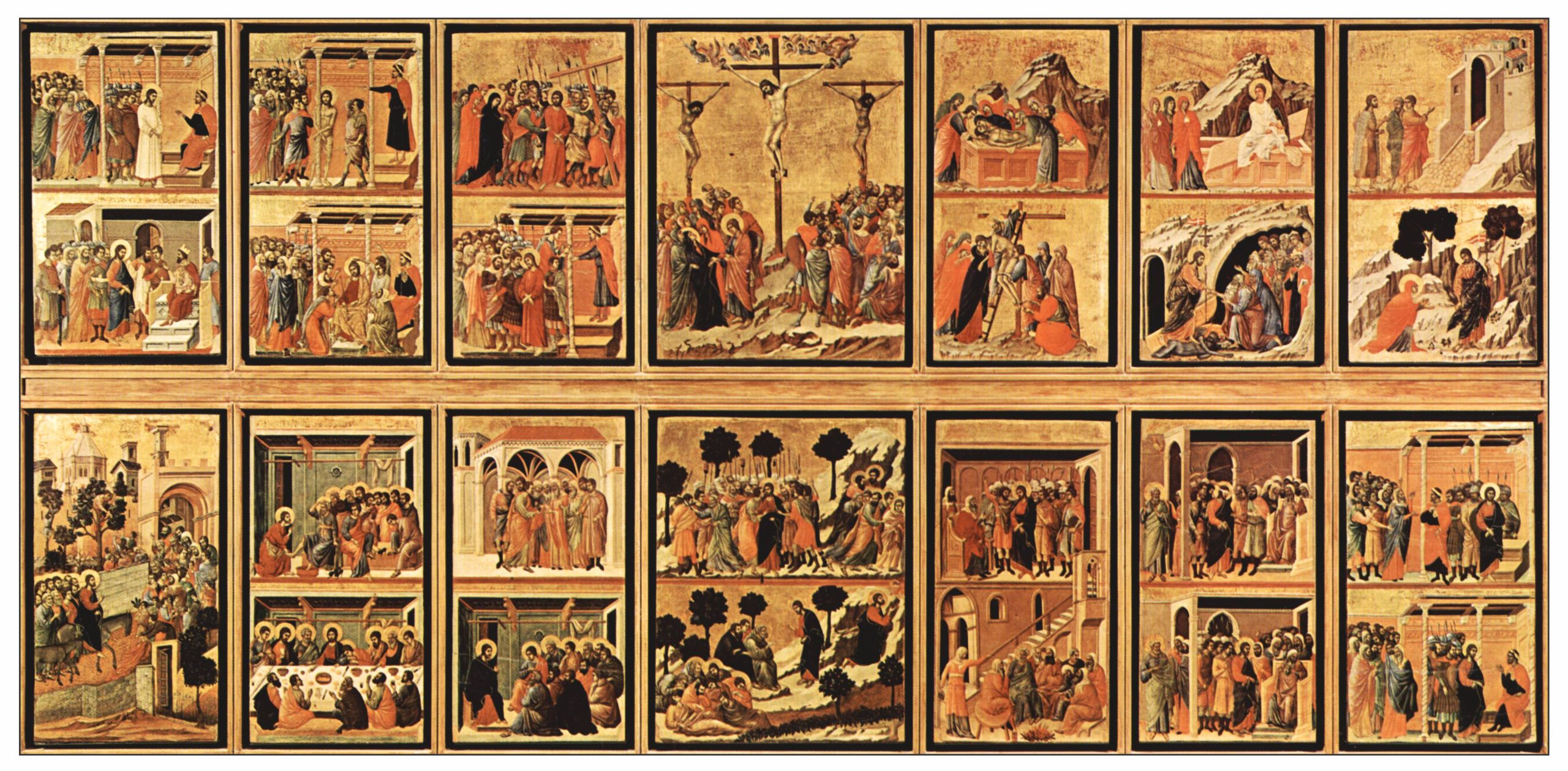
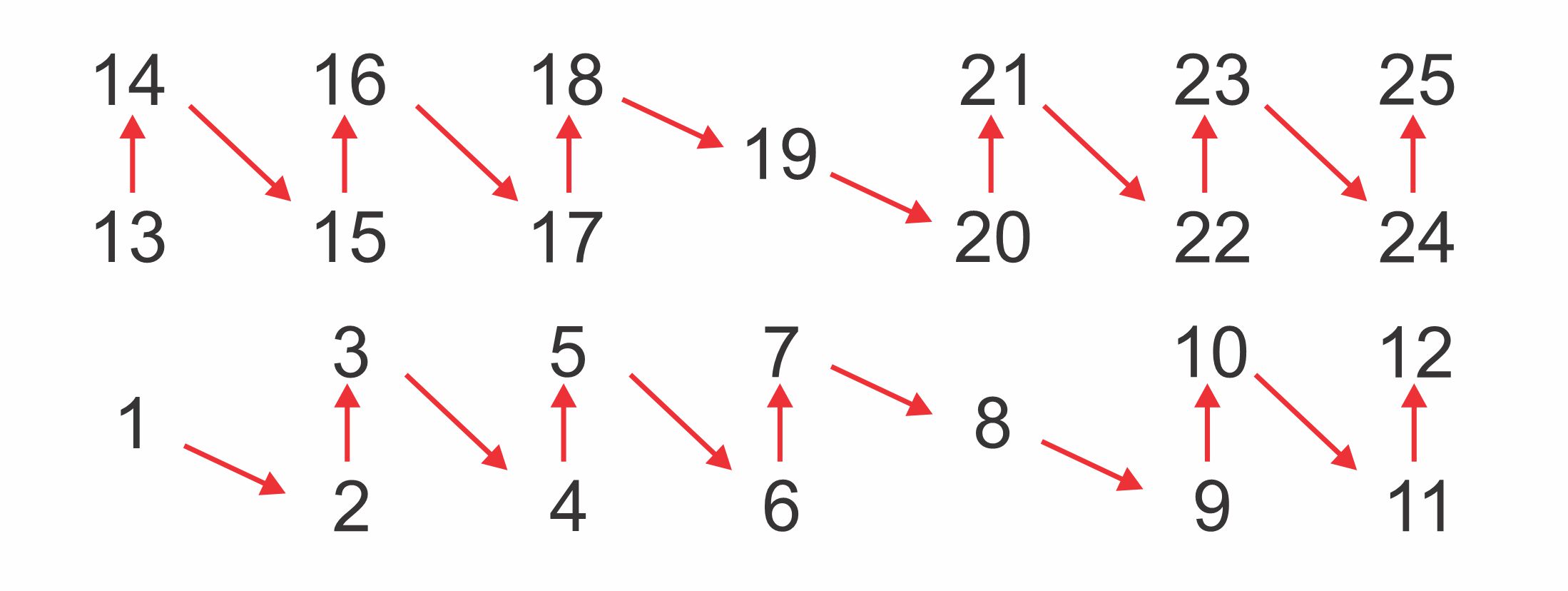
To illustrate the narrative of the trial, this post will use panels from The Passion of Christ, a series of 25 paintings by Duccio di Buoninsegna (1255–1319 on the reverse of the Maestà (1311, the enthroned Madonna with the child Jesus) in Siena Cathedral. The images were painted in egg tempera and gold leaf on wooden panels. The standard panel is 50 cm × 53.5 cm. Some panels are wider, and others have images that are twice the standard height. The narrative begins at the bottom left with the Christ’s Entry into Jerusalem and concludes at the top right with Christ’s Appearance on the Road to Emmaus. The lower half of The Passion portrays events that occur before those in the upper half, and the lower panel of each section occurs before the upper panel.

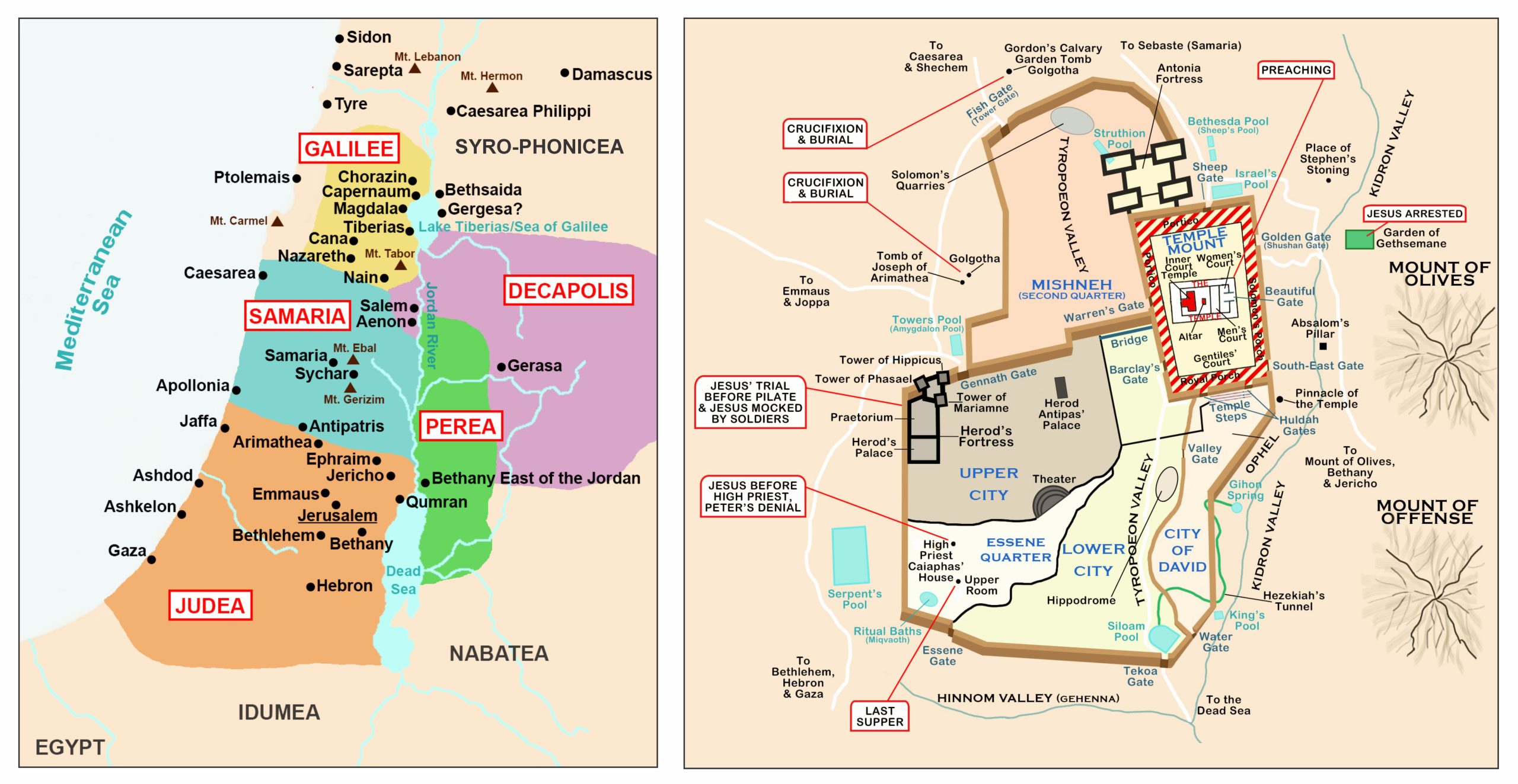
The following maps provide on the left an overview of the Roman Province of Judaea in the 1st Century CE. Pilate spent most of his time in Caesarea on the coast. During the annual celebration of the Passover, when many Jews came to Jerusalem, Pilate travelled there with a small cohort of soldiers to ensure order and prevent any outbreak of rebellion. The Jews believed they should only be ruled by God and fiercely opposed the Roman occupation of Judaea. Some Jews – the Zealots – favored armed resistance. While in Jerusalem, Pilate stayed at the palace of the late Herod the Great. On the right of the illustration is a plan of the city of Jerusalem, showing the presumed locations of the various events during the Passion of Jesus. Two different sites have been proposed for the crucifixion (and entombment). Both maps have been modified slightly from the Conforming to Jesus website.

The Arrest

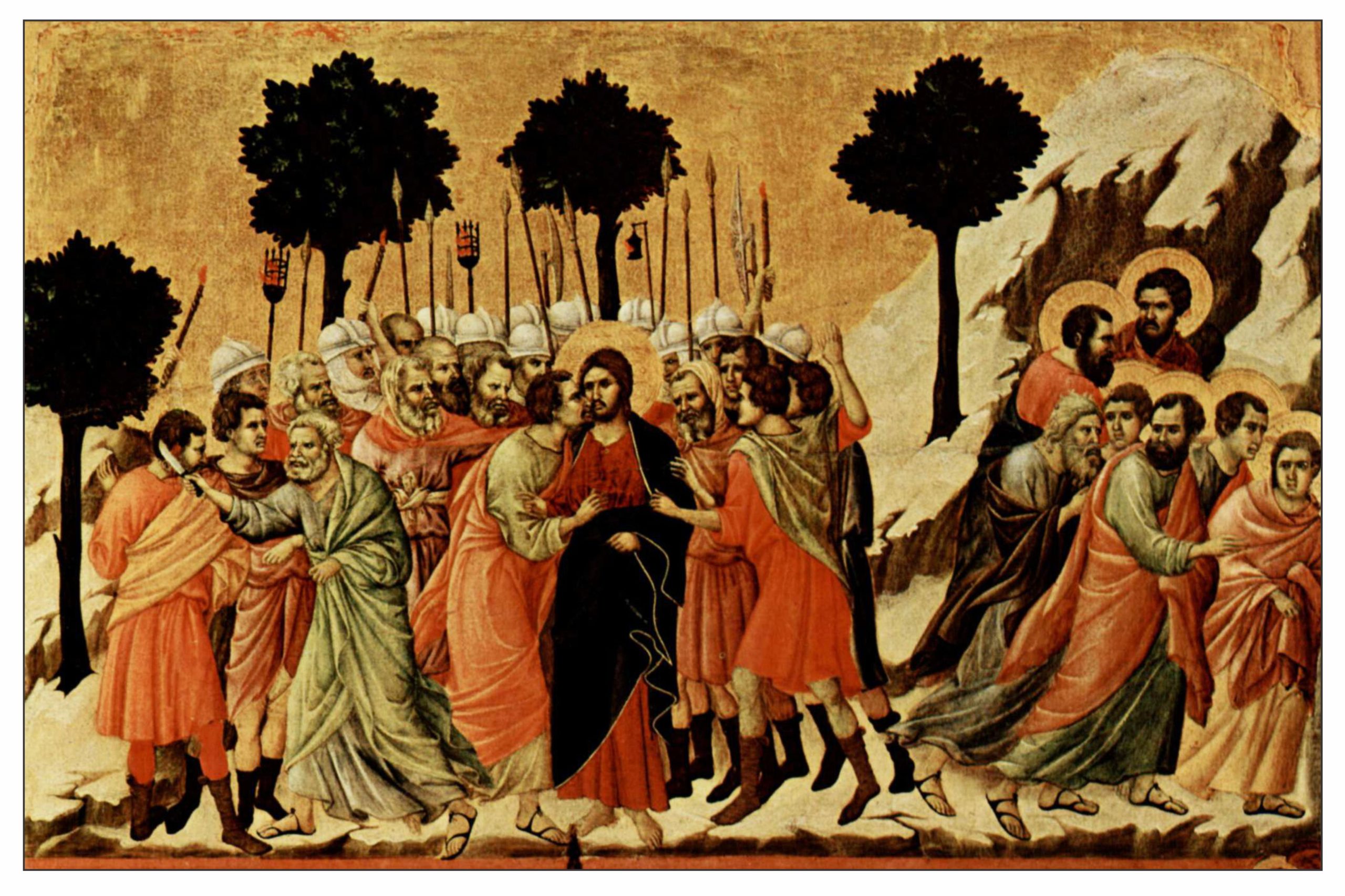
After the last supper, Jesus and his disciples retire to a garden on the slopes of Mount Olive. In Mark and Matthew the garden is named Gethsemane (“olive press”). While Jesus prays and his disciples sleep, a band of armed men led by Judas Iscariot, one of the disciples, come to arrest him.

Judas then, having received a band of men and officers from the chief priests and Pharisees, cometh thither with lanterns and torches and weapons. (John 18:3)

John does not mention the kiss whereby Judas identified Jesus, though this is described in the three synoptic gospels. Though the name “Iscariot” may indicate his birthplace in Qeriot, it may also derive from the Latin word sicarius, “assassin,” or from the Aramaic word sheqarya, “false” (Stanford, 2015, pp 23-27). In the latter cases, the name would have only been used after the death of Jesus. Spong (2013, pp 219-222) points out that the details about Judas, such as the thirty pieces of silver, and his suicide, derive from earlier traitor stories in the Hebrew scriptures. He suggests that Judas “is a mythological, literary creation, not a person of history.” However, some of the details in his history – Jesus identifying him as his betrayer at the last supper (John 13:26) and the kiss in Gethsemane (Matthew 26:48, Mark 14: 44) – seem too vivid not to be true.

There is some question as to exactly who comes to arrest Jesus. Clearly, the temple guards are involved, but John also reports (18:12) that a “captain” (χιλίαρχος, chiliarchos, tribune) and a small cohort of soldiers accompany the Temple guards. These terms were only used for Roman soldiers (see discussion in Winter, 1961, pp 44-50; and Cohn 1971, pp 71-93). One must presume that the high priests had discussed the arrest with Pilate and that he had agreed to send soldiers to ensure that nothing got out of hand. They had clearly decided to make the arrest at nighttime when Jesus was not accompanied by crowds.

Jesus asks the armed men whom they sought. When they state “Jesus of Nazarus” he replies “I am he”

Jesus therefore, knowing all things that should come upon him, went forth, and said unto them, Whom seek ye?
They answered him, Jesus of Nazareth. Jesus saith unto them, I am he. And Judas also, which betrayed him, stood with them.
As soon then as he had said unto them, I am he, they went backward, and fell to the ground. (John 18: 4-6)

John is playing on the divine name JHVH which derives from the verb “to be” and refers to God’s declaration in the burning bush “I am that I am” (Exodus 3:14). John wants to show that Jesus is proclaiming his divine status, and that the arresting party is momentarily taken aback. The question and answer are then repeated. John is trying too hard. I doubt this ever happened.

John then describes how Peter strikes off the ear of the high priest’s servant. Jesus admonishes Peter. Cool heads prevail. More extensive bloodshed does not occur.


Jesus before Caiaphas

Jesus is taken from Gethsemane to the home of Caiaphas the High Priest. John reports that he is initially taken to the house of Annas and then referred on to Caiaphas.

Peter follows the arresting party, and, while Jesus was being examined, Peter thrice denies any knowledge of him. The final chapter of John provides a parallel event wherein Peter thrice declares his love to the resurrected Jesus. Oh, that we all might have the opportunity to repudiate our betrayals.

John does not make much of the arraignment before Caiaphas. Several members of the Sanhedrin (the Jewish High Court) are present, but it is clearly not a formal meeting, since Passover had just begun (or was about to begin). The Sanhedrin has already considered the problem posed by Jesus. John 11 describes their deliberations after the raising of Lazarus from the dead:

Then gathered the chief priests and the Pharisees a council, and said, What do we? for this man doeth many miracles.
If we let him thus alone, all men will believe on him: and the Romans shall come and take away both our place and nation.
And one of them, named Caiaphas, being the high priest that same year, said unto them, Ye know nothing at all,
Nor consider that it is expedient for us, that one man should die for the people, and that the whole nation perish not. (John 11: 47-50)

The meeting at Caiaphas home after the arrest of Jesus simply confirms their earlier decision.

Now Caiaphas was he, which gave counsel to the Jews, that it was expedient that one man should die for the people. (John 18: 14).

John repeats this decision because he is smitten by its irony. According to the Christians, Jesus died that all people (not just the Jews) should be saved from the consequences of sin. Caiaphas is not aware of the full meaning of his words.

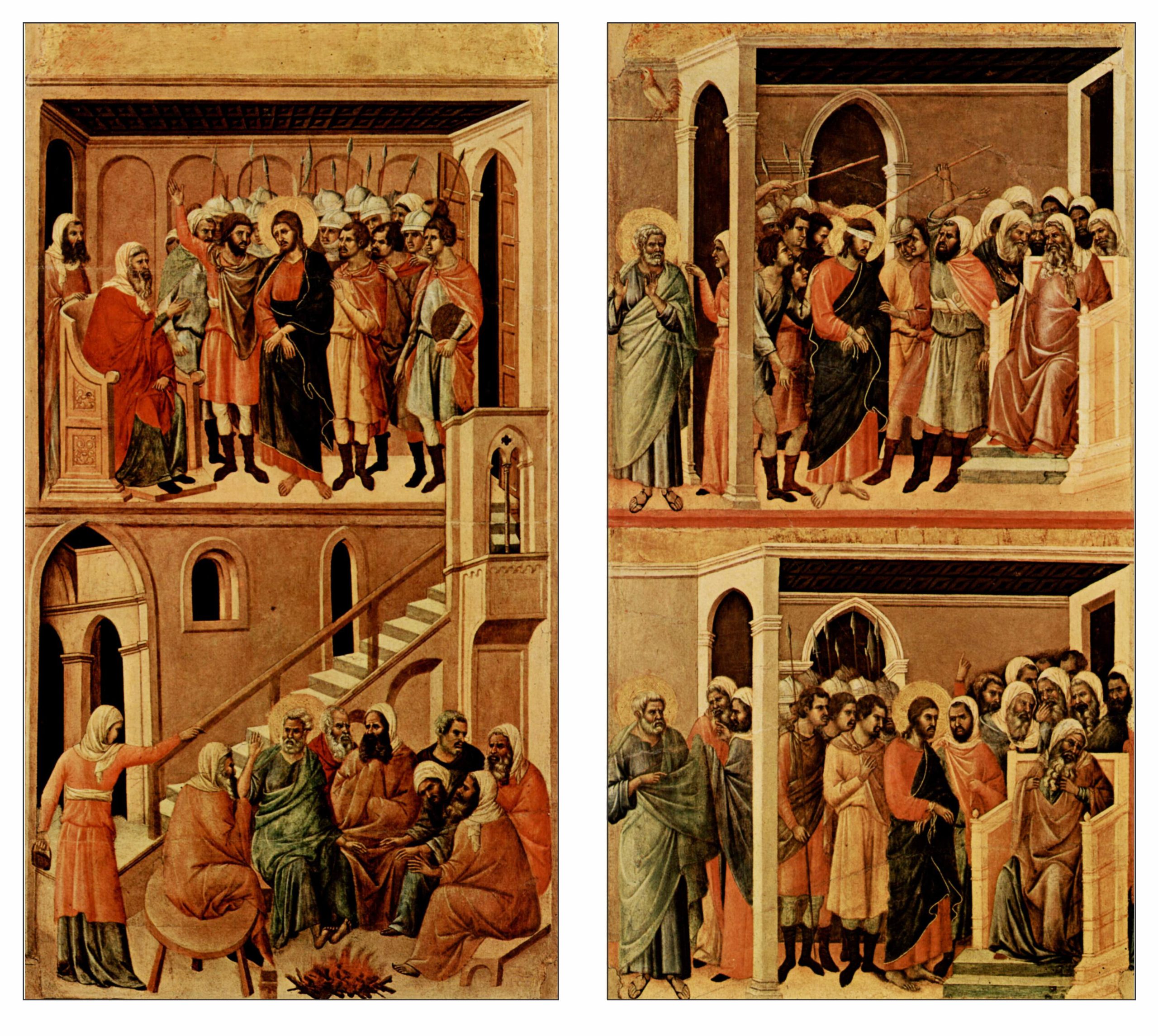
The other gospels are more explicit about the meeting with Caiaphas. Mark 14 describes how many false witnesses speak against Jesus, but that the priests are most concerned with Jesus’ blasphemous claim to be the Son of God. Such blasphemy is punishable by death according to Jewish law (Leviticus 24:16). Matthew reports how the high priest rends his garments on hearing Jesus’ blasphemy. The following illustration shows Duccio’s illustration of the arraignments before Annas and Caiaphas:

Duccio shows the arraignment before Annas (left), Caiaphas rending his garments (lower right), and the beating of the blindfolded Jesus (upper right). Duccio incorporates into these illustrations the disciple Peter (green-robed and haloed) as he makes his three denials of Jesus.

Although the High Priest and his supporters desire the death of Jesus, they may not have the legal authority to bring this about. It is generally thought that capital punishment (ius gladii, the law of the sword) in 1st Century Judaea was the preserve of the Roman occupiers. This may not be true (Kacian, 2014). Nevertheless, the priests may not wish to be held responsible for the death of Jesus since he is popular with the people. Far better to let the Romans take care of their problem. The difficulty is that the Roman authorities will not consider blasphemy against the Jewish God as a capital crime. So the priests who bring Jesus to Pilate accuse him of claiming to be the King of the Jews. John’s gospel portrays them as being unclear about this accusation but definite in their desire for his death

Pilate then went out unto them, and said, What accusation bring ye against this man?
They answered and said unto him, If he were not a malefactor, we would not have delivered him up unto thee.
Then said Pilate unto them, Take ye him, and judge him according to your law. The Jews therefore said unto him, It is not lawful for us to put any man to death (John 18:29-31).

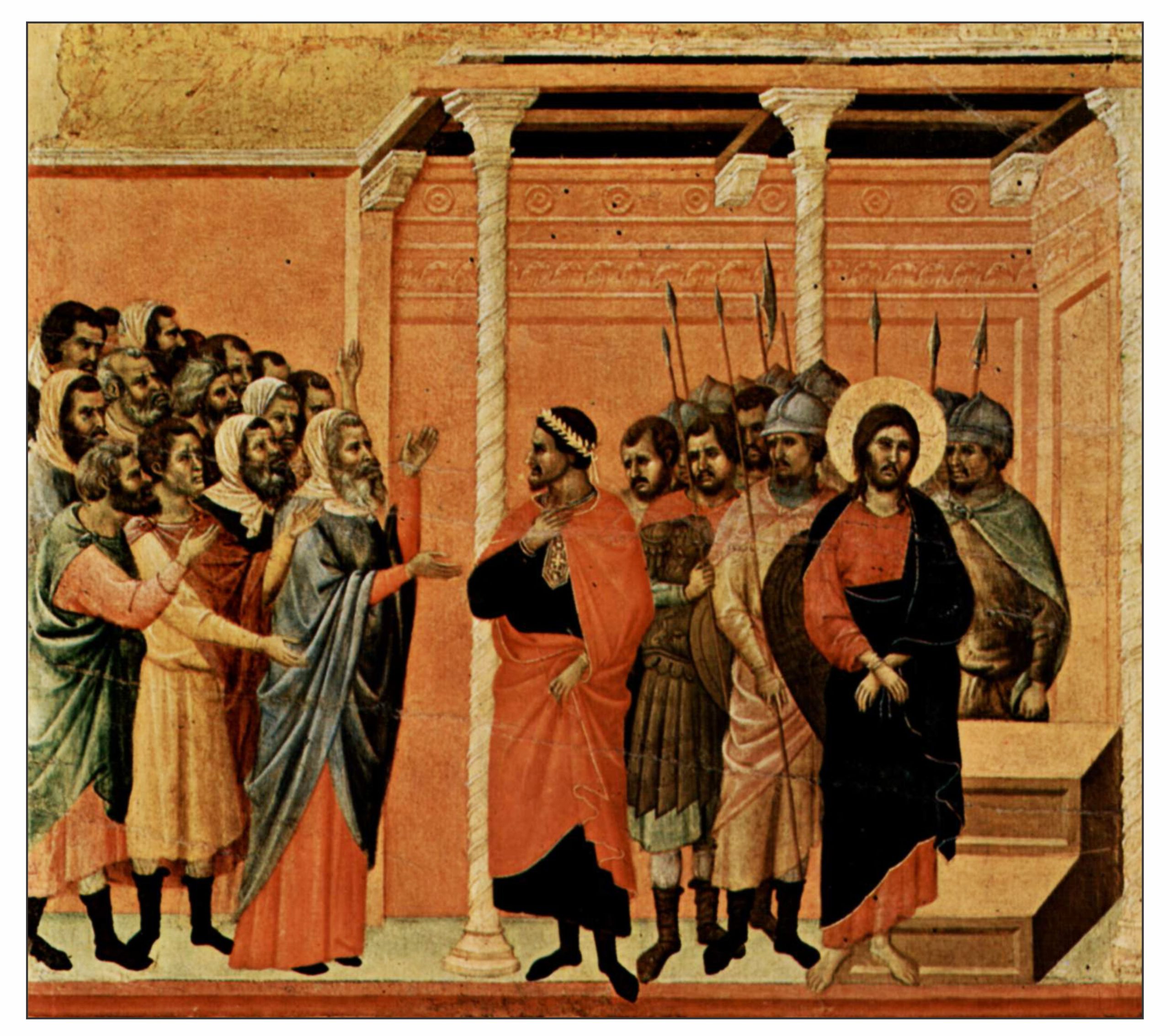
Duccio’s representation has a completely disordered perspective. There is no vanishing point. Jesus stands in front of the column he should be behind, and Pilate’s seat on the right tilts out of the picture as though he has no jurisdiction here.


Jesus before Pilate.

(i) the kingdom of heaven

Despite the confusing accusation coming from the priests, Pilate’s first question for Jesus is

Art thou the King of the Jews? (John 18: 33)

This is what he has distilled from the obfuscations of the priests. After clarifying the source of the question, Jesus answers

My kingdom is not of this world: if my kingdom were of this world, then would my servants fight, that I should not be delivered to the Jews: but now is my kingdom not from hence. (John 18: 36)

This is the essence of Jesus’ teaching: the “Kingdom of God” (or the “Kingdom of Heaven” as it was called in Matthew). He mentioned it in the beatitudes: “for theirs is the kingdom of heaven” (Matthew 5: 3, 10). And he tried to explain it in multiple parables (e.g. Matthew 13). Nevertheless, the meaning of this kingdom remains unknown (France, 2005) Some have considered it apocalyptically as what will occur after the final judgement. Others have thought about it evangelistically as the state of the world when everyone has converted to Christianity. But these future-oriented interpretations are false:

The kingdom of God cometh not with observation:
Neither shall they say, Lo here! or, lo there! for, behold, the kingdom of God is within you. (Luke 17 20-21)

The kingdom most likely represents the community of people who live harmoniously together according to the rule of loving one’s neighbor (e.g. Wenell, 2024). This is in effect the “church” in its spiritual rather than physical sense – the people not the building.

Jesus had previously distinguished between worldly and divine kingdoms when he had been asked whether it was lawful for a Jew to pay tribute to Caesar. He had answered

Shew me the tribute money. And they brought unto him a penny.
And he saith unto them, Whose is this image and superscription?
They say unto him, Caesar’s. Then saith he unto them, Render therefore unto Caesar the things which are Caesar’s; and unto God the things that are God’s. (Matthew 22:19-21)

This distinction between the two kingdoms had tremendous implications (Dusenberry, 2021). Before Jesus, religious authority and political power were intertwined. Jewish kings were subject to priests and prophets. Roman emperors were considered divine. After Jesus it became possible for a religious authority to exist independently of national boundaries, and for people to have separate allegiances to god and to king. The fact that states could evolve independently of religion allowed such things as democracy and liberty to develop. That religion existed independently of the state allowed the church to persist through the rise and fall of empires. Dusenberry (2021, p 163) quotes from a letter by the 5th Century Pope Gelasius to the Emperor Anastasius:

There are two ways, august emperor, in which the world (mundus hic) is chiefly ruled: the sacred authority of the priests (auctoritas sacra pontificum), and the royal power (regalis potestas).

At the end of his book. Dusenberry (2021, p 246) refers the French historian Fustel de Coulanges who describes the immense changes in society as the secular became separate from the sacred. The following is an extended quotation from Fustel de Coulanges’ book The Ancient City, initially published in 1864:

If, now, we recollect what has been said above on the omnipotence of the states among the ancients,  ̵̵̶ ̶ if we bear in mind how far the city, in the name of its sacred character and of religion, which was inherent in it, exercised an absolute empire,  ̶ we shall see that this new principle was the source whence individual liberty flowed.

The mind once freed, the greatest difficulty was overcome, and liberty was compatible with social order.

Sentiments and manners, as well as politics, were then changed. The idea which men had of the duties of the citizen were modified. The first duty no longer consisted in giving one’s time, one’s strength, one’s life to the state. Politics and war were no longer the whole of man; all the virtues were no longer comprised in patriotism, for the soul no longer had a country. Man felt that he had other obligations besides that of living and dying for the city. Christianity distinguished the private from the public virtues. By giving less honor to the latter, it elevated the former; it placed God, the family, the human individual above country, the neighbor above the city.

Law was also changed in its nature. Among all ancient nations law had been subject to, and had received all its rules from, religion. Among the Persians, the Hindus, the Jews, the Greeks, the Italians, and the Gauls, the law had been contained in the sacred books or in religious traditions, and thus every religion had made laws after its own image. Christianity is the first religion that did not claim to be the source of law. It occupied itself with the duties of men, not with their interests. Men saw it regulate neither the laws of property, nor the order of succession, nor obligations, nor legal proceedings. It placed itself outside the law, and outside all things purely terrestrial. Law was independent; it could draw its rules from nature, from the human conscience, from the powerful idea of the just that is in men’s minds. It could develop in complete liberty; could be reformed and improved without obstacle; could follow the progress of morals, and could conform itself to the interests and social needs of every generation.


(ii) witness to the truth

After Jesus’ comment on his kingdom, Pilate is not sure what Jesus means and asks again whether he is really a king. Jesus replies

Thou sayest that I am a king. To this end was I born, and for this cause came I into the world, that I should bear witness unto the truth. Every one that is of the truth heareth my voice. (John 18: 37)

This again is a key part of Jesus teachings.

I am the way, the truth, and the life: no man cometh unto the Father, but by me. (John 14:6)

There are perhaps two levels of truth (e.g. Sallis, 1995). One is related to the correspondence between one’s thoughts or statements and external reality. The second comes into play when we cannot know something, but decide to believe it is true. This is the truth of faith.

Pilate is again uncertain about what Jesus is claiming. But he is clearly not a threat to the Roman Empire:

Pilate saith unto him, What is truth? And when he had said this, he went out again unto the Jews, and saith unto them, I find in him no fault at all. (John 18: 37)

It is difficult to know whether Pilate’s comment about truth is cynical, or whether he is just confused by Jesus’ claim. Nevertheless, it earned for him the epithet “jesting Pilate” in Francis Bacon’s 1625 essay Of Truth:

What is truth? said jesting Pilate; and would not stay for an answer. Certainly there be that delight in giddiness; and count it a bondage to fix a belief; affecting free-will in thinking, as well as in acting.


(iii) Pilate attempts to release Jesus.

Pilate decides that the easiest way out of his predicament would be to release Jesus through the customary prisoner amnesty at Passover: the privilegium paschale (Curran 2025). He asks those assembled before the palace if they would like either Jesus or the rebel Barabbas to be released. These were the priests and guards that bought Jesus to Pilate. They clamor for Barabbas.

Pilate attempts to assuage the crowd by scourging Jesus. Then he has a crown of thorns placed on his head and he presents Jesus to the crowd to be mocked.

Pilate therefore went forth again, and saith unto them, Behold, I bring him forth to you, that ye may know that I find no fault in him.
Then came Jesus forth, wearing the crown of thorns, and the purple robe. And Pilate saith unto them, Behold the man!
When the chief priests therefore and officers saw him, they cried out, saying, Crucify him, crucify him. Pilate saith unto them, Take ye him, and crucify him: for I find no fault in him.
The Jews answered him, We have a law, and by our law he ought to die, because he made himself the Son of God. (John 19: 5-7).

However, the Jews could not crucify Jesus. Their laws may have required the death penalty, but crucifixion was a Roman punishment.

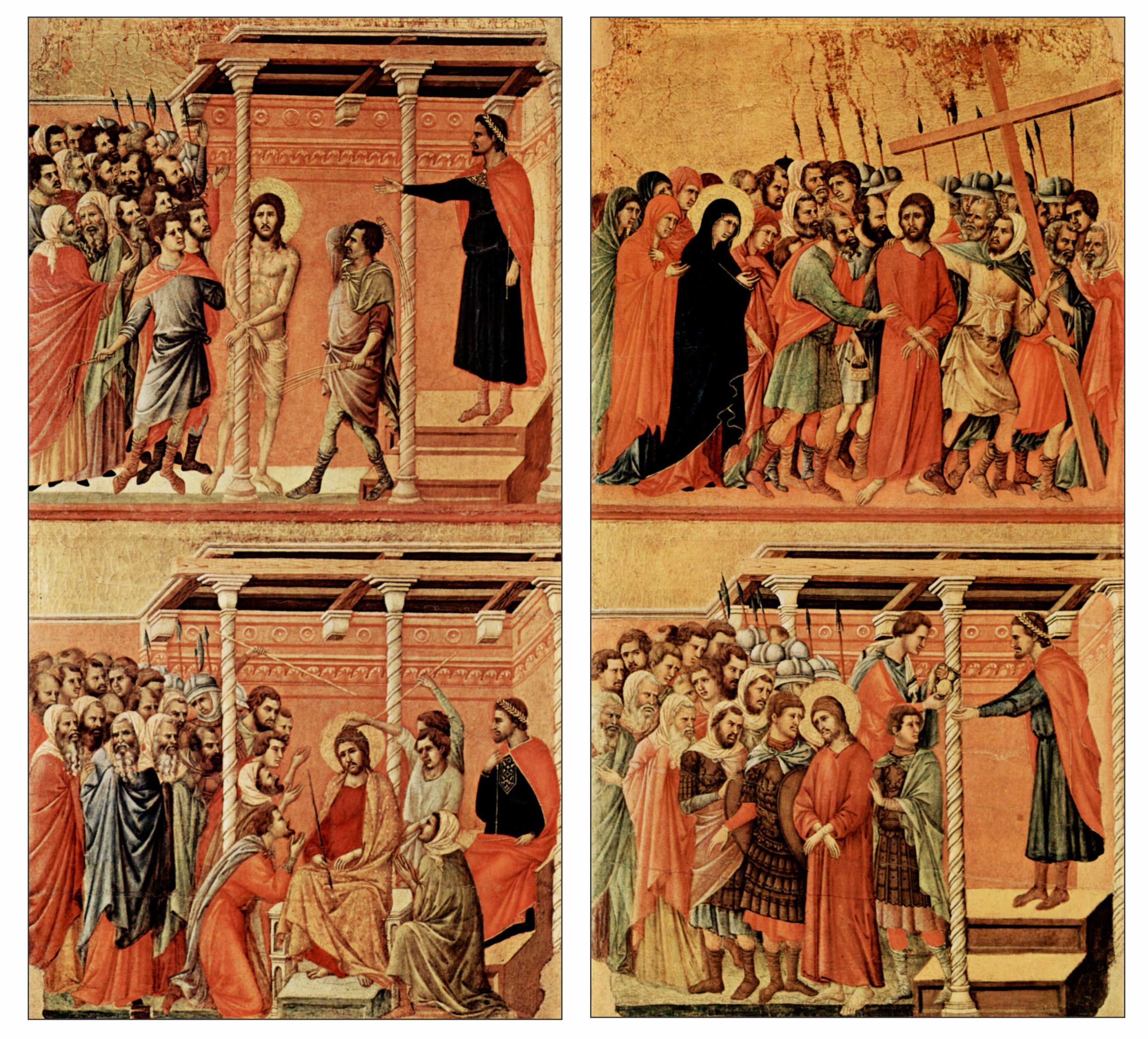
The scourging and mocking of Jesus are portrayed by Duccio on the left of the following illustration. On the right are representations of Pilate washing his hands and of Jesus on his way to the crucifixion:


(iv) Who art thou?

Pilate is surprised by the tenacity of the priests and their followers. He asks Jesus “Whence at thou?” He already knows that Jesus is from Nazareth. As Schiavone (2017, p 154) points out

The question has an explicitly metaphysical resonance. It is the request of someone who, not without apprehension, senses he is in the presence of the unknown. If Pilate really asked it—and the relationship between the coherence of the account and the conceptual and historical likelihood of the described facts prompts us to consider it possible—the prefect’s investigation was no longer centered on ascertaining whether a crime had been committed, but on the nature and mission of the person before him.

Jesus does not answer, Pilate reminds him that he has the power to crucify him. Christ replies

Thou couldest have no power at all against me, except it were given thee from above (John 18: 11).

Jesus is claiming that his death is ordained. It is God’s will, not Pilate’s decision. This removes any idea of assigning blame or responsibility for the death of Jesus. Dusenbury (2021, p 148) quotes the remarks by Augustine of Hippo (354-450 CE) on the gospel of John;

The man they took by force – and then tortured and killed – was one “to whom nothing could have been done unless he himself willed it” (quem nihil valuisser nisi quod ipse voluisset)

This illustrates the paradox of an all-powerful and all-knowing god. If everything is ordained, no one can be responsible for their actions.


(v) No friend of Caesar

The final argument proposed by the priests is that the kingdom proposed by Jesus is a direct threat to Caesar.

If thou let this man go, thou art not Caesar’s friend: whosoever maketh himself a king speaketh against Caesar. (John 19: 12)

The claim to be King of the Jews is treason against the emperor. Fearful that the Jews will complain to the emperor that he did not properly persecute an insurrectionist, Pilate cedes to their wishes. Wroe (1999, p 273) imagines his state of mind:

Tiberius had perhaps already received unfavorable reports of him. Would he tolerate more? Did Pilate have any stock of goodwill left? If he had, was he really going to hazard it, and with it the lives of hundreds of Jews and Romans and others, on the fate of one peculiar preacher? One man’s life could never be worth that. If he let his soldiers loose on people, he would be called a butcher. He might lose Judaea. The crowd was al-ready on the edge of tumult, and he was getting nowhere in his efforts to persuade them. Besides, he was not there in Judaea to pursue celestial fantasies or to sift the philosophy of those he sentenced. He was there to preserve law and order in the name of Rome.

Pilate then seats himself on the “Gabbatha” (pavement stone, the place of judgment), and condemns Jesus to be crucified. Agamben (2015, p 45) proposes that Pilate does not provide a formal sentence, and what is written in John is far from clear. However, there must have been a sentence since the Roman soldiers immediately carry out the crucifixion.

Pilate insists that Jesus be identified on the cross in Hebrew, Greek and Latin as “Jesus of Nazareth, King of the Jews.” The priests request that Pilate qualify this:

Then said the chief priests of the Jews to Pilate, Write not, The King of the Jews; but that he said, I am King of the Jews.
Pilate answered, What I have written I have written. (John 19: 21-22)

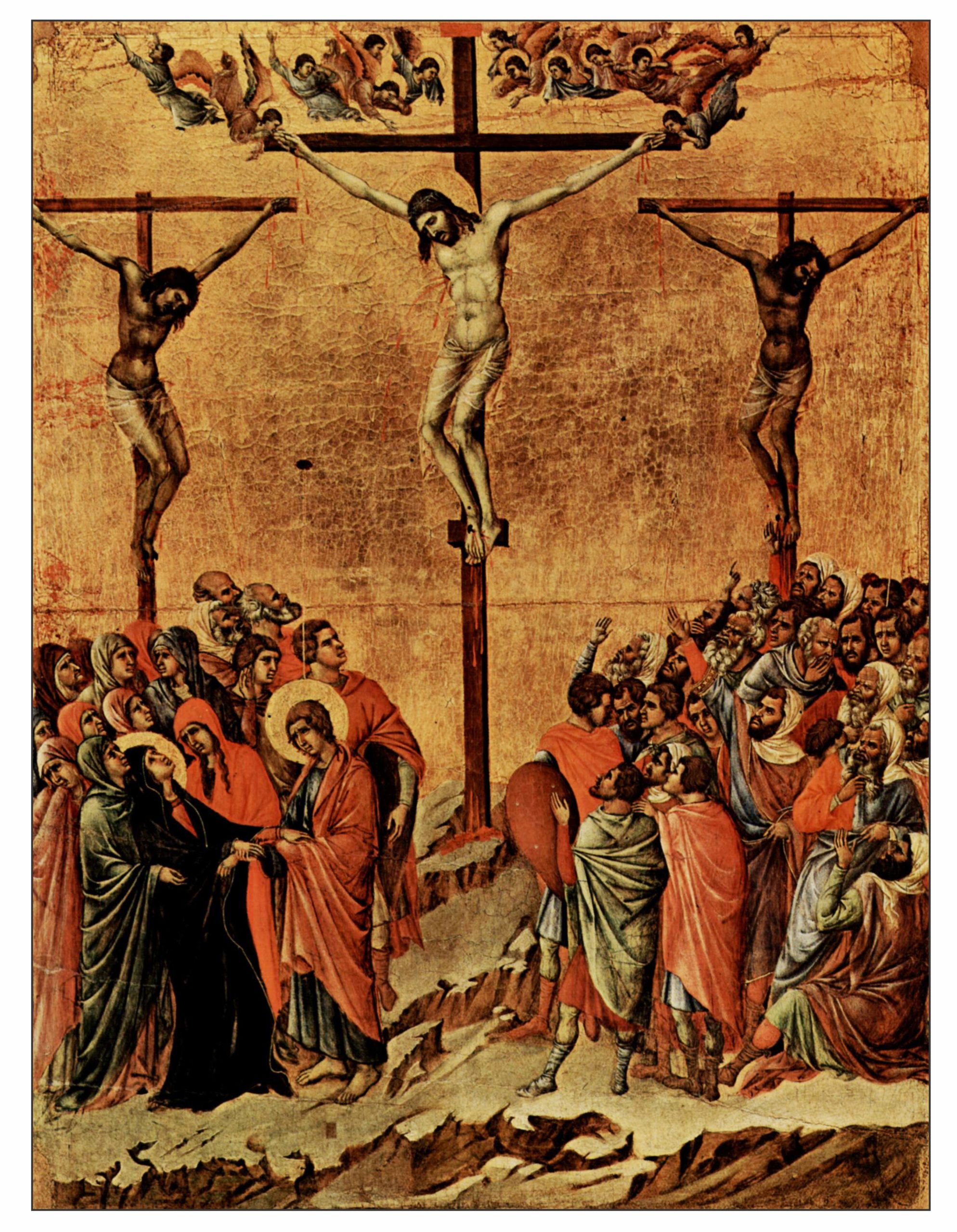
And so Christ was crucified. Together with two others, described as thieves, but probably insurrectionists, since thievery did not warrant crucifixion. In the presence of Mary his mother, Mary Magdalene, Mary of Cleopas and the disciple John:

(vi) innocence and blame

Although not mentioned in the gospel of John, Matthew describes how Pilate declares his innocence of the death of Jesus by washing his hands.

When Pilate saw that he could not prevail, but rather that a tumult was beginning, he took water and washed his hands before the multitude, saying, “I am innocent of the blood of this just person. See ye to it.” (Matthew 27: 24)

Most scholars consider this to be completely fictional. Although hand-washing was a means to declare innocence for the Jews (e.g. Deuteronomy 21:1–9), it was not a Roman custom. Nor was Pilate sensitive enough about Jewish ways to use it symbolically.

Matthew does not stop there. He then reports

Then answered all the people, and said, His blood be on us, and on our children. (Matthew 27:25)

This is the clearest example of what is present in all the gospels: a shifting of the blame for the death of Jesus from the Romans to the Jews. Crucifixion was a Roman punishment. Even if we accept as true his misgivings, Pilate condemns Jesus to death. Assembled in the courtyard of the palace is a group of temple guards and priests. They are in no way representative of the Jewish people. And in no way could they have cried out in a single voice.

At the time that the gospels were written, Rome had just destroyed the Second Temple and driven the Jews from their homeland. The Christians of that time did not wish to antagonize Rome. For the most part, the Jewish people had not been attracted to Christianity, which was becoming more and more a religion of the Gentiles. The early Christians were probably upset that their fellow Jews ignored them, and even overtly persecuted them. When Christianity became the religion of the Roman Empire, these words from the Gospels became the justification for a virulent antisemitism that culminated in the horrors of the Holocaust. The following are comments by Crossan (1995, p 152):

Those first Christians were relatively powerless Jews, and compared to them the Jewish authorities represented serious and threatening power. As long as Christians were the marginalized and disenfranchised ones, such passion fiction about Jewish responsibility and Roman innocence did nobody much harm. But, once the Roman Empire became Christian, that fiction turned lethal. In the light of later Christian anti-Judaism and eventually of genocidal anti-Semitism, it is no longer possible in retrospect to think of that passion fiction as relatively benign propaganda. However explicable its origins, defensible its invectives, and understandable its motives among Christians fighting for survival, its repetition has now become the longest lie, and, for our own integrity, we Christians must at last name it as such.

It was not really until the papal encyclical Nostre Aetate (1966, In Our Time) that the Christian Church guardedly admitted its role in the persecution of the Jews:

True, the Jewish authorities and those who followed their lead pressed for the death of Christ; still, what happened in His passion cannot be charged against all the Jews, without distinction, then alive, nor against the Jews of today. Although the Church is the new people of God, the Jews should not be presented as rejected or accursed by God, as if this followed from the Holy Scriptures. All should see to it, then, that in catechetical work or in the preaching of the word of God they do not teach anything that does not conform to the truth of the Gospel and the spirit of Christ.


(vii) what really happened

The gospels were written long after the death of Jesus. They report details about Jesus’ arraignment before Pilate that no one other than Jesus or Pilate would have been privy to. They provide a fascinating story, but one that is more likely fictional than real. Pontius Pilate is portrayed as a thoughtful and merciful prefect, unable in the end to save a charismatic and popular preacher from the wrath of the high priests whom he had offended. In reality, Pilate probably paid little attention to the claims of Jesus. He may not even have shared a common language with Jesus. They may have spoken Greek, but probably neither was completely fluent. Pilate was mainly concerned with the maintenance of order, and if the crucifixion of a peasant preacher could prevent a riot, so be it.

Two needs were addressed by the story of the trial of Jesus. First, the fledgling Christian religion did not wish to antagonize the Romans. So the blame for the death of Jesus was shifted from Rome to the Jews. Second, the Christians wished to portray the death of Jesus as fulfilling the Jewish prophecies for a Messiah. Crossan (1995) has called this the “historicization of prophecy.” He shows how this occurs in the gospels’ description of the abuse suffered by Jesus during his times before Caiaphas and before Pilate (pp 118-132). The process became even more apparent in the description of the crucifixion:

Then the soldiers, when they had crucified Jesus, took his garments, and made four parts, to every soldier a part; and also his coat: now the coat was without seam, woven from the top throughout.
They said therefore among themselves, Let us not rend it, but cast lots for it, whose it shall be: that the scripture might be fulfilled, which saith, They parted my raiment among them, and for my vesture they did cast lots. These things therefore the soldiers did. (John 19: 23-24)

The prophecy is from Psalms 22:18

They part my garments among them, and cast lots upon my vesture.

Although Christianity considers this psalm as prophetic, Jewish scholarship describes it as simply a song of lament either for the state or the singer. Crossan (1995) describes many other instances in the gospels wherein statements in the Jewish scriptures are related to events in the Passion of Jesus, whether or not they were originally meant as prophecies.

Winter (1961, p 148) summarizes his review of the trial of Jesus:

the Gospel records, when critically examined, furnish clear evidence of the fact that Jesus was executed on a charge of sedition at the order of the Emperor’s representative. At the same time the contention is made that Jesus was devoid of revolutionary ambitions. The evidence, fragmentary though it is, affords no solid basis for the view that he was engaged in any political activities of a subversive character. That he was executed as a rebel, together with others who were executed on the same charge, by no means proves that he did work for the overthrow of the existing political system. So far as the procurator was concerned, he would have seen sufficient reason for ordering the crucifixion if he had come to the conclusion that Jesus’ itinerant preaching tended to excite the masses to expect the end of the existing order.

What really happened? All we know about the trial is summed up in Josephus as quoted at the beginning of this post:

And when Pilate, because of an accusation made by the leading men among us, condemned him to the cross, those who had loved him previously did not cease to do so.


Aftermath

Pilate was recalled to Rome at the end of 36 CE (Bond, 1998, pp 92-23). He may have come into disfavor because of his harsh treatment of the Jews, but by the time he arrived in Rome Tiberius was dead. Nothing is known about Pontius Pilate after his time in Judaea, though many have imagined his latter life (e.g. Wroe, 1999; Carter, 2003).

A set of writings called The Pilate Cycle (Elliot& James, pp 165-226) composed of letters from Pilate to Tiberias and to Claudius, and narratives of the trial and crucifixion of Jesus may have originated in the 1st or 2nd Centuries CE, but whatever versions have survived were re-written centuries later and are clearly fictional. The following excerpts are from the Paradosis Pilati (Tradition of Pilate), the earliest known surviving manuscript of which dates to the 12th Century CE. It reports how Pilate was examined by Caesar on his return to Rome:

And when he had been brought to the city of the Romans and Caesar heard that Pilate was there, he sat down in the temple of the gods in the presence of the whole senate and the whole army and all the multitude of his forces. And he commanded Pilate to stand forward and said to him, ‘How could you dare to do such a thing, you most impious one, when you had seen such great signs concerning that man? By daring to do an evil deed you have destroyed the whole world.’ (p 209)

Pilate blames his actions on the Jews, and Caesar orders the destruction of their temple and the dispersement of their people. He also orders the execution of Pilate, who prays for forgiveness for himself and his wife Procla:

And when Pilate came to the place of execution, he prayed silently, ‘Lord, do not destroy me with the wicked Hebrews, for had it not been because of the nation of the lawless Jews, I would not have raised my hand against you, because they plotted a revolt against me. You know that I acted in ignorance. Therefore do not destroy me because of this sin, but pardon me, Lord, and your servant Procla, who stands with me in this hour of my death, whom you taught to prophesy that you must be nailed to the cross. Do not condemn her also because of my sin, but pardon us and number us among your righteous ones.’

And behold, when Pilate had finished his prayer, there sounded a voice from heaven, ‘All generations and families of the Gentiles shall call you blessed, because in your governorship everything was fulfilled which the prophets foretold about me. And you yourself shall appear as my witness at my second coming, when I shall judge the twelve tribes of Israel and those who have not confessed my name.’ And the prefect cut off Pilate’s head, and behold, an angel of the Lord received it. And when Procla his wife saw the angel coming and receiving his head, she was filled with joy, and immediately gave up the ghost and was buried with her husband. (pp 210-211)

The destruction of the temple ordered by Caesar did indeed occur. But this happened much later than Pilate’s return to Rome. The Jewish people revolted against Roman rule in the First Jewish-Roman War of 66-73 CE. The Romans retaliated ferociously and destroyed the Herodian temple in Jerusalem. Just as Jesus had prophesied:

And Jesus went out, and departed from the temple: and his disciples came to him for to shew him the buildings of the temple.
And Jesus said unto them, See ye not all these things? verily I say unto you, There shall not be left here one stone upon another, that shall not be thrown down. (Matthew 24: 1-2).

However, Matthew was written after the fall of the Temple. This is history converted to prophecy as opposed to prophecy historicized.


Retellings

Pilate continues to fascinate us. We imagine ourselves in his position. Would we have paid proper attention? Would we have recognized who Jesus was? Would we have been able to save him from his death? Or were we just there to set some divine plan in motion?

In The Master and Margarita (written in the 1930s) Mikhail Bulgakov tells how a Soviet novelist tries to write a novel about Pontius Pilate. He imagines a prefect with a severe migraine having to deal as best he can with an itinerant preacher who appears to understand him far better than he does himself. The following is a retelling of their conversation about truth:

“And what was it in any case that you said about the temple to the crowd in the bazaar?”
The responding voice seemed to stab at Pilate’s temple, was inexpressibly painful, and this voice was saying:
“I said, Hegemon, that the temple of the old faith would fall and a new temple of truth would be built. I said it that way so as to make it more understandable.”
“And why did you stir up the people in the bazaar, you vagrant, talking about the truth, of which you have no notion? What is truth?”
And here the procurator thought: ‘Oh, my gods! I’m asking him about something unnecessary at a trial . . . my reason no longer serves me . . .’ And again he pictured a cup of dark liquid. ‘Poison, bring me poison . .’
And again he heard the voice:
“The truth is, first of all, that your head aches, and aches so badly that you’re having faint-hearted thoughts of death. You’re not only unable to speak to me, but it is even hard for you to look at me. And l am now your unwilling torturer, which upsets me. You can’t even think about anything and only dream that your dog should come, apparently the one being you are attached to. But your suffering will soon be over, your headache will go away.”
(translated by Pevear& Volokhonsky, 2000)

Pilate’s headache is no more. Yet the trial and its effects have not gone away. The story told by the gospels led to the founding of a religion that is followed fervently or grudgingly by almost a third of the world’s people. However, the teachings of Jesus did not need to be validated by his death or resurrection. They were and are true in and of themselves. And he would not have blamed anyone for his death.


References

Agamben, G. (2013, translated by Kotsko, A., 2015). Pilate and Jesus. Stanford University Press.

Baras, Zvi (1987). The Testimonium Flavianum and the Martyrdom of James. In Feldman, L. H.; Hata, G. (Eds.). Josephus, Judaism and Christianity. (pp 338-348). Brill.

Bond, H. K. (1998). Pontius Pilate in history and interpretation. Cambridge University Press.

Bulgakov, M. (translated by Pevear, R., & Volokhonsky, L., 2000). The Master and Margarita. Penguin Books.

Carter, W. (2003). Pontius Pilate: portraits of a Roman governor. Liturgical Press

Cohn, H. H. (1971). The trial and death of Jesus. Harper & Row.

Crossan, J. D. (1995). Who killed Jesus? Exposing the roots of anti-semitism in the Gospel story of the death of Jesus. HarperSanFrancisco.

Curran, J. (2025). Pilate, Barabbas, and the privilegium paschale: law and leverage in Roman Judaea. Journal for the Study of the New Testament, 47(4), 501–525.

Dusenbury, D. L. (2021). The innocence of Pontius Pilate: how the Roman trial of Jesus shaped history. Hurst & Company.

Elliott, J. K., & James, M. R. (1993). The Apocryphal New Testament: a collection of apocryphal Christian literature in an English translation. Clarendon Press.

France, R. T. (2005). Kingdom of God. In Vanhoozer, K. J., Bartholomew, C. G., Treier, D. J., & Wright, N. T. Dictionary for theological interpretation of the Bible. (pp 420–422). Baker Academic.

Fustel de Coulanges, N, D, (1864, translated by Small, W., 1877, reprinted 1956). The Ancient city: a study on the religions, laws, and institutions of Greece and Rome. Doubleday.

Kacian, A. (2014). Potestas Gladii in Jesus’ Trial. Communications: Scientific Letters of the University of Žilina, 16(3), 20–24.

Meier, J. P. (1991). A marginal Jew: rethinking the historical Jesus. Doubleday.

Sallis, J. (1995). Double truth. State University of New York Press.

Schiavone, A. (2016, translated by J. Carden). Pontius Pilate: deciphering a memory. Liveright

Spong, J. S. (2013). The fourth gospel: tales of a Jewish mystic. HarperOne.

Stanford, P. (2015). Judas: the troubling history of the renegade apostle. Hodder & Stoughton.

Wenell, K. J. (2024). Locating the kingdom of God: performing sacred boundaries. T&T Clark

Winter, P. (1961, reprinted 2014). On the Trial of Jesus. De Gruyter.

Wroe, A. (1999). Pilate: the biography of an invented man. Jonathan Cape.


Le Corbusier: The Measurement of Man

Le Corbusier (1887-1965) was a Swiss-born architect, painter and urban planner. He is generally considered as one of the main forces in the development of modernist architecture. UNESCO has designated 17 of his building projects as “world heritage sites,” more than any other architect. In the 1940s Le Corbusier developed a system of measurements called the Modulor to assist in the fitting buildings to human beings. The first building to be constructed using the Modulor was the Unité d’Habitation, a striking and innovative residential building in Marseille, begun in 1947 and completed in 1952. In recent years, Le Corbusier has been criticized for his antisemitism and his fascist leanings. These critiques do not detract from the importance of his work but do explain how his buildings sometimes seem inhuman.  

Life

Le Corbusier was born as Charles-Édouard Jeanneret in La Chaux-de-Fonds, a Swiss city near the French border that is the center of the country’s watch-making industry (Weber, 2008). At the time of Le Corbusier’s childhood, the city was prosperous and full of Art Nouveau buildings. Le Corbusier studied art, but had no formal training in architecture.

In the early years of the 20th Century, he travelled extensively in Europe visiting the architectural treasures in Austria, Hungary, Bulgaria, Greece, Turkey, Italy, France, Germany and Belgium. He was particularly impressed by the Florence Charterhouse (Certosa):

Le Corbusier’s growing passion for urban planning stemmed from his experience there:

The beginning of these studies. for me, goes back to my visit to the Carthusian monastery of Ema near Florence, in 1907. In the musical landscape of Tuscany I saw a modern city crowning a hill. The noblest silhouette in the landscape, an uninterrupted crown of monks’ cells; each cell has a view on the plane, and opens on a lower level on an entirely closed garden. I thought I had never seen such a happy interpretation of a dwelling. The back of each cell opens by a door and a wicket on a circular street. The street is covered by an arcade: the cloister. Through this way the monastery services operate—prayer, visits, food. funerals. This “modern city” dates from the fifteenth century. Its radiant vision has always stayed with me. (Le Corbusier, 1930)

Another formative experience was the 14 months (1908-1910) that he spent in Paris as a draftsman in the offices of Auguste Perret (1874-1954), a pioneer in the architectural use of reinforced concrete. He also worked briefly in Berlin with Peter Behrens (1868-1940), an innovative industrial designer and architect.

During World War I, Le Corbusier taught in the art school in La Chaux-de-Fonds, and began to design houses for clients in the city, using some to the ideas he had developed in his travels. In 1915 he designed the Dom-Ino House. This was composed of concrete floor-slabs supported by a small number of concrete pillars and with connecting stairs on one side. The concept allowed complete freedom in designing the interior of each floor, and in creating the external walls and windows, since there was no need for load-bearing walls or supporting beams.   

The name combines the Latin domus (home) with the name of the pieces used in the game of dominoes. The design could be used by itself in a single house, repeated upwards to form skyscrapers, or duplicated laterally to make row houses.

In 1917 Le Corbusier moved to Paris and opened an architectural practice with his cousin Pierre Jeanneret. He also became intrigued by Cubism, and together with the painter Amédée Ozenfant founded an artistic movement devoted to pure forms and called “Purism.” (For some reason they considered Cubism too “romantic.”) They published their ideas in the magazine L’Esprit Nouveau (1920-1925). To celebrate the sense of the new, Charles-Édouard Jeanneret began to use the name Le Corbusier. This derived from the surname Lecorbesier (itself stemming from an old word for “shoemaker”) of one of his Belgian ancestors. Weber (2008, p 178) suggested that the new name also

endowed its bearer with the ability to have others “courber,” or bend to his will. Above all, “Le Corbusier” gave Charles-Édouard Jeanneret the toughness and resiliency he felt he needed.  

LeCorbusier became a French citizen in 1930. The following illustration shows some early photographs of Le Corbusier. The first is from 1912, the second is a 1927 portrait by Man Ray and the third is a 1937 photograph by Rogi André:


Towards a New Architecture

In the early 1920s Le Corbusier proposed some new principles for modern architecture. His general approach to design and architecture can be summarized in the epigram “A house is a machine for living in” (Le Corbusier, 1923, p 95).  An important manifesto, entitled Les 5 points d’une architecture nouvelle, went through several different formulations. The 5 principles as ultimately delineated in 1927 can be summarized:

  1. Pilotis (supporting columns): The ground floor of a building is replaced by a set of concrete supporting columns so that the actual building is raised above the ground
  2. Roof Gardens: The roof becomes the top floor of the building and can be used for various purposes: pools, exercise areas, gardens.
  3. Floorplan: The floors are supported by continuations of the pilotis. The absence of load-bearing walls then provides complete flexibility in the design of the floorplan.
  4. Horizontal Windows: Windows no longer need to be part of the building’s support and can be horizontal or vertical as the need arises.
  5. Façade: Since the building’s exterior does not contribute to its support, the architect can design a façade without restraint. Windows could extend over the whole external surface

In 1925, Le Corbusier made a proposal for the redevelopment of Paris called Le Plan Voisin after its sponsor Gabriel Voisin (1880-1973), a pioneering manufacturer of planes and automobiles (Le Corbusier, 1925; Frampton, 2024, Chapter 3). The plan was focused on a commercial central area with 18 cruciform skyscrapers surrounded by parkland. Le Corbusier conceived of these as 200 meters high (about 60 stories). This center was surrounded by self-contained residential blocks of about 10 stories. Each of these blocks would include its own shopping center. The following illustrations show some architectural drawings for the planned city:

Thankfully Le Corbusier’s plan for Paris was never realized. However, the concept of a commercial city-center composed of skyscrapers surrounded by dormitory regions for those who work in the central towers has become widespread. As pointed out by Jane Jacobs (1961) this leads to the death of the city downtown, which becomes dark and deserted after office hours. As she noted (p 446) “His vision of skyscrapers in the park degenerated in real life into skyscrapers in parking lots.” A major problem with Le Corbusier’s ideas is that they lack the social strength of intersecting city streets: the corners where the inhabitants congregate to shop, eat, drink, meet friends, and people-watch.    

Another idea that Le Corbusier pursued in these early years was that of tracés régulateurs (regulating lines). His paper describing this concept was initially published in L’Esprit Nouveau in 1921 and then reprinted in his book Vers une Architecture (1923). Le Corbusier was far from precise about defining a regulating line:

A regulating line is an assurance against capriciousness …. A satisfaction of a spiritual order which leads to the pursuit of ingenious and harmonious relations. It confers on the work the quality of rhythm. The regulating line brings in this tangible form of mathematics which gives the reassuring perception of order.  

In his examples he uses various geometric projections such as the 3-4-5 triangle, and the golden rectangle (with the longer side 1.618 times the shorter). The following illustration shows a hypothetical villa with the main geometric principle, a triangle formed by the sides and diagonal of a golden rectangle, highlighted in red. Various regulating lines parallel and perpendicular to the diagonal can determine the location of the doors and windows.

Le Corbusier apparently did not use the regulating lines in the initial design of his building, but. used them post hoc to explain the harmony of his creation (Herz-Fischler, 1984)

The Golden Ratio

One of the geometric principles used in Le Corbusier’s early designs was the golden ratio. The importance of this to his later work warrants a brief digression.

At the beginning of the 13th century CE in Pisa, Leonardo Fibonnaci described the mathematics underlying the breeding of rabbits as a sequence of numbers:

0, 1, 1, 2, 3, 5, 8, 13, 21, 34, 55…

Each number represents the sum of the two preceding numbers. In mathematical terms the sequence is defined by

Fn=Fn-1+Fn-2; F0=0; F1=1

Fibonacci had been exposed to the mathematics of the Arab world through his travels with his father, a merchant who traded with Algiers. The Fibonacci sequence was known in the Muslim world, and likely goes back to the ancient Indian mathematics used to analyze Sanskrit poetry (Singh, 1985). Fibonacci’s Liber Abaci (Book of Calculation) was one of the first books in Europe to use the Arabic numerals and the decimal system.

If we take the ratio between adjacent numbers in the series, we obtain a value that approaches the “golden ratio” of 1.6180. For example, 34/21 is 1.6190, and 55/34 is 1.6176. The golden ratio (also called the “golden section”) is commonly represented by the Greek letter phi ( ϕ ), from Phidias the Greek sculptor and architect who may have used the ratio in his design of the Parthenon (Cook, 1914, p. 420), although this is unlikely (Barr, 1929; Markowsky, 1992). Phi is defined as the ratio of the sum of two quantities to the larger quantity when this ratio is equal to that between the two quantities:

ϕ = a/b = (a+b)/a

The golden ratio has several intriguing mathematical characteristics. Most importantly, phi (1.6180) is equal to its reciprocal (0.6180) plus 1:

ϕ = 1/ϕ + 1

If we multiply both sides of this equation by ϕ, we can derive the quadratic equation

ϕ 2ϕ – 1 = 0

This gives roots         

(1 ± sqrt (5) ) / 2

One root is equivalent to ϕ and the other equivalent to -1/ϕ. From these ideas Binet derived a formula to calculate any Fibonacci number without having to compute all the preceding numbers. The Fibonacci number would be the closest integer to that calculated by:

  ϕ n  / sqrt (5)                             

Fibonacci numbers and the golden ratio play important roles in nature by determining, among other things, the locations of leaves on plant stems and the spiral arrangements of pine cones (Cook, 1914: Posamentier, & Lehmann, 2007).

Fibonacci numbers and the golden ratio are used in schemes for tiling surfaces (Grünbaum & Shephard, 1987). Many tiling systems, or tessellations, use regular pentagrams. The diagonal of a regular pentagram is equal to the length of the side multiplied by phi. Penrose tilings (1974) use regular pentagrams and other shapes determined by phi to produce patterns that are quasiperiodic – the parts do not translate from one region to another and cannot be exactly predicted. These tilings may explain how crystals grow and may be a metaphor for how neurons connect – following rules but giving patterns that are not fully explained by them (Penrose, 1989). The recently developed aperiodic one-stone tiling systems (Smith et al 2023) are also derived from pentagrams.  

A square added onto the longer side of a golden rectangle will give another golden rectangle and this process can be continued over and over. To produce the diagram on the following page, a tiny yellow golden rectangle has an orange square added to its longer side to form a new golden rectangle. A sand-colored square added to its longer side produces another golden rectangle. 

A logarithmic spiral or spira mirabilis (“miraculous spiral”) is fascinating because its shape remains the same as the radius increases. This spiral is typically computed using polar coordinates and depends on the value of e, the base of the natural logarithms. A special logarithmic spiral called the “golden spiral,” whose radius decreases by a factor of the golden ratio every quarter turn, can be inscribed within these rectangles. In the golden spiral, four irrational numbers are at play: the golden ratio ( ϕ ), the square root of five, the base of the natural logarithms ( e ), and the ubiquitous π.

Why discuss these concepts? In aesthetics we tend to find that a rectangle with sides that follow the golden ratio more pleasing than rectangles that are either longer or more like a square. The golden ratio and Fibonacci numbers have therefore been used extensively in the design of buildings and the layout of paintings (see Chapter 7 in Posamentier, & Lehmann, 2007). As we shall see, the golden ratio was particularly important in Le Corbusier’s later work.

However, we may find evidence for it more often than we should. It is easy to measure two things and find their relationship close to the golden ratio. Some things actually do not fit this famous ratio. The dimensions of paintings considered to be masterpieces cluster around a ratio of 1.34 rather than 1.618 (Olariu, 1999). The preferred sizes for photographs and book pages tend to show side-ratios that are less than phi.

Many claims have been made concerning the geometry of sacred places (Doczi, 1981; Skinner, 2006). Perhaps, the beautiful mathematics underlying their locations and their architecture may reflect the transcendent. Perhaps, not. Much of the work on sacred geometry mixes mathematics with wishful thinking. Although it seems almost blasphemous to say it, God may not have been as enamored of mathematics as his creatures.


The Modulor

Discovering the geometric principles of the human body has long been a goal of artists and architects. Probably the most famous representation of the human form is the drawing of Vitruvian man made by Leonardo da Vinci in 1487. The proportions are based on those reported by the Roman architect Vitruvius (1st century BCE). His books were re-discovered in the early 15th century and used by Leon Battista Alberti in his own treatise on architecture. The underlying idea of these measurements is

As man is the image of God and the proportions of his body are produced by divine will, so the proportions in architecture have to embrace and express the cosmic order (Wittkower, 1971, p 101)

Leonardo’s drawing shows a man inscribed within both a square and a circle. This follows from the description in Vitruvius:

… in the human body the central point is naturally the navel. For if a man be placed flat on his back, with his hands and feet extended, and a pair of compasses centred at his navel, the fingers and toes of his two hands and feet will touch the circumference of a circle described therefrom. And just as the human body yields a circular outline, so too a square figure may be found from it. For if we measure the distance from the soles of the feet to the top of the head, and then apply that measure to the outstretched arms, the breadth will be found to be the same as the height, as in the case of plane surfaces which are perfectly square. (Vitruvius, Book III, Chapter 1).

Some of these measurements are not as exact in reality as in representation. The arm-span of a normal human being is on average several centimeters longer than the height (Schott, 1992; Brown et al., 2000). We do not fit exactly into a square.  

In Leonardo’s drawing, certain measurements are clearly indicated by lines. For example, the cubit measurement from the elbow to the fingertip is marked off in the vertical to shows that a man’s height is equal to four cubits. The finger-tip to finger-tip distance with arms outstretched also equals four cubits. The width of the shoulders is one cubit. The length of the upper arm is half a cubit.

The drawing also shows evidence for the golden ratio ϕ (about 1.618) (Doczi, 1981, p. 93). For example, the height to the top of the head is ϕ times the height to the navel. Similarly, the cubit is ϕ times the distance from elbow to wrist. Most importantly, the side of the square in the drawing is ϕ times the radius of the circle.

The square and the circle are often taken to represent the earth and the heaven. Justifying the one to the other is a problem for both philosophy and geometry. An exact solution to the problem of squaring the circle – geometrically constructing a square with the same area as the circle using straight edge and compass – is impossible. The value of π is not just irrational (cannot be represented by a ratio of integers) but also transcendental (cannot be represented as the root of a polynomial). The square root of 2 is irrational but since it is the root of the equation x2-2=0, it is not transcendental. Both π and e the root of the natural logarithms are transcendental. Several approximate ways to rectify the circle exist (e.g. Dixon, 1991). Some approaches to squaring the circle use the value ϕ, which is easy to represent geometrically (see later). For example, (6/5)(1+ϕ) is equal to π with an accuracy of 4 decimal places.

Most of the proportions in the human body involved small whole numbers. Height was equivalent to 4 cubits, 6 feet or 10 hands (wrist to fingertip). This allowed the Renaissance architects to find inspiration in the rules of music (Wittkower, 1971, pp 101-154; Evans, 1995). The Pythagoreans had shown that combining notes with frequencies in the ratio of such small numbers resulted in musical harmony:  the octave of 2:1, the perfect fifth of 3:2, the perfect fourth of 4:3, and the major third of 5:4. Alberti proposed that visual harmony could be obtained by using similar ratios. Both architecture and music could then represent the harmony of the universe. Rooms could be designed with sides proportionate to the frequencies of consonant chords. Once the dimensions of the sides were selected the height would be tuned between the others. This could be done using the arithmetic mean (a+b)/2), the geometric mean  or the harmonious mean 2ab/(a+b). When a is one half b these means are the perfect fifth, augmented fourth, and perfect fourth, respectively.  Since the renaissance, Western musical scales have changed to use “equal temperament.” This is based on a constant ratio difference between adjacent notes in a scale rather than determining individual notes by simple Pythagorean ratios of the base note. And architecture no longer uses musical scales to create visual harmony (see Evans, 1995 for review).

Apart from such mystical uses as understanding the music and geometry of God, the proportions of the human body have definite practical applications. Artists use them to facilitate their representations of the human form. Clothiers use anthropometric measurements to design clothes and to determine the range of sizes. Architects use the proportions to determine standard measurements for designing buildings and furniture.

Le Corbusier became fascinated by the proportions of the human form. During the early 1940s, he developed a system called the “modulor.” This set of proportions is shown in the following diagram is derived from geometric procedures described by Elisa Maillard and illustrated in The Modulor (1950/54, pp 36-45). From the midpoint of the left side of a square the arc of a circle with radius equal to the distance from that point to the opposite corner of the square is drawn to intersect with the extended side of the square. This is the classical way to construct rectangles that show the golden ratio. From the intersection, a right-angled triangle is constructed with its right angle at the midpoint of the right side of the triangle. From the level of the upper apex of this triangle, a square each with sides equal to the initial square is drawn, and another square below that. The original square is then superimposed on the two new squares. The diagram is then “normalized” to fit a man with height about 6 feet (183 cm):

This geometric procedure has been faulted (Rozhkovskaya, 2020). However, I have worked out the steps quite precisely and they do indeed give the modular levels described by Le Corbusier (see also the extensive entry in French Wikipedia):

The diagram below (Le Corbusier, 1952; also in Frampton, 2024, p 175) shows the various measurements of the Modulor system, and a variety of panels (un jeu de panneaux) based on the measurements (discussed by Flora, 2023). These could serve as models for doors, windows, tables, shelves etc.

As well as the levels given in the preceding diagrams, we can also take difference measurements, particularly 43 (113-70), 27 (113-2*43) and 16 (2*43-70). The measurements in the Modulor system can then give standard measurements for architectural designs. For example, the height of a room should be 226 cm (7.4 feet). Other architectural and design measurements are then derived (Le Corbusier, 1954, Figure 26): 

Whether the proportions contained in the Modulor are a reasonable representation of the normal human form is a matter for debate. For example, most North American rooms tend to have a height of about 8 feet (244 cm) – significantly more than the Modular’s 226 cm. Most tables tend to be 30 inches (76 cm) high rather than the Modulor’s 70 cm. The Modulor arbitrarily portrays an idealized male: it does not consider the normal variability of the human form, and it fails to include the female (Tell, 2018).   


Unité d’Habitation, Marseille

Le Corbusier first used his Modulor system in the design of the in the Unité d’Habitation Marseille (also known as Cité Radieuse) (Sbriglio, 2004; Janson et al, 2007). This large apartment building was built to provide housing for people who had lost their homes during World War II. The building was begun in 1947 and completed in 1952. The whole structure is constructed of rough-cast reinforced concrete, the French name of which, béton brut (raw concrete), led to the unfortunate term “brutalist” architecture used to describe later buildings constructed in the same manner (Beanland, 2016)

The building is 135 meters long, 24 meters wide, and 56 meters high. The structure is raised off the ground on a set of large pylons (pilotis) shaped like inverted cones. There are 330 separate apartments. Most of these (with the exception of those on the southern end of the building) traverse the width of the building. Each of the apartments spans two levels and extends from one side of the building to the other. This means that entrance corridors (internal streets) need only occur on every third floor. The arrangement of the apartments is shown in the following illustrations:

The following illustration shows two photographs taken by Lucien Hervé during the construction of the building. Hervé and Le Corbusier became quite close and Hervé went on to photograph most of Le Corbusier’s later buildings (Beer, 2004; Sbriglio, 2011). His austere black-and-white prints clearly delineated the tactile surfaces and the underlying structure of the buildings. The photographs below highlight the rough finish of the pilotis and the concrete skeleton of the building:

Le Corbusier wished to build a community-dwelling that contained within itself everything needed for everyday life. He was inspired by the utopian idea of a “phalanstery” (a combination of phalanx, military unit, and monastery) proposed by Charles Fourier (1772-1837), and by the Florence Charterhouse that he had visited in his youth (Serenyi, 1967). His idea was to create “a building that is a town” (Janson et al, 2007, p 7). Two floors of the Unité d’Habitation are therefore devoted to commerce (stores, hotel, restaurant). The roof was designed for communal use with a meeting-room, paddling-pool, open-air gymnasium, and running-track and to provide stunning views of both the Mediterranean Sea and the inland mountains.

The illustration below shows one of the internal streets, and the two-story commercial street (with the storefront of the bookstore). Below that is a photograph of the rooftop showing the pool, the community meeting room (what was once a kindergarten), the elevator shaft and the inverted cone of one of the ventilation shafts.

Modular ratios determined everything from the overall dimensions of the building to the sizes of cupboards and rooms. Variations of the Le Corbusier logo of the man-with-arm-upraised were cast into the south wall of the building. The illustration below is derived from recent photograph by Cemal Emden. Below that are two photographs by Lucien Hervé taken during construction:

One striking aspect of the Unité d’Habitation is the way that Le Corbusier designed variations into the regularity. The surface of the building is made visually appealing by the interplay between the concrete brise-soleils (sun shades) and the colors of the walls between the balconies. The following photograph by Paul Koslowski (1997) shows the building as viewed from the southwest:

Fitting human beings into modules can make them feel either free or restricted. Variations can take away the rigidity, allowing a sense of community rather than imprisonment. Perhaps the Modulor works best if it entails both the setting of standards and their modulation.

Despite his enthusiasm for proportions, Le Corbusier realized that everything must still be subject to aesthetic criteria. The Modulor is a springboard not a strait-jacket. And sometimes it may not work:

…at the very moment when the golden figures and the diagrams point to a perfectly orthodox solution I may reply ‘That may be so, but it is not beautiful.’ (1950/54, p. 183)

In relation to variation, Le Corbusier states

I claim for art the right to diversity. I accept on behalf of art the duty of novelty, of the never-seen, the never-conceived. I demand of art the role of the challenger … of play and interplay, play being the very manifestation of the spirit. (p. 220, ellipsis in original)

Apartments were inserted into the building’s skeleton like bottles into a double-sided wine-rack. One apartment had its main floor above the internal street and the other had its main floor below. This entailed two different floor plans: 

The living room (4 and 11) is two stories high. The following photographs are from a recent sale:

The main living quarters (on the single-story section of the apartment) are more cramped:

This building is visually striking. However, it did not succeed in what it set out to do (Mumford, 1963; Serenyi, 1967; Janson et al., 2007). Although the living rooms are spacious, the rest of the apartment is very cramped. Originally designed for families, the apartments are more appropriate for single people or couples.  The total floor area of the most common apartment layout (illustrated in the previous diagrams) is 98 square meters (1055 square feet). There is little privacy or sound-proofing. The only access to natural light is in the living room and at one end of the small bedrooms. The “interior street” is cold and gloomy (see previous illustration)

The communal shopping street is largely unused: the population of the building is not sufficient to support multiple shops. Ther restaurant (Le Ventre de l’Architecte, “Belly of the Architect”), the hotel, and the bookstore are successful mainly because of the tourists who visit the building. The kindergarten is no longer. The following are comments from Serenyi (1967)

It seems to me that, ideally at least, each apartment of the Marseilles Block is designed for a single human being, living completely alone, while sharing the advantages of a larger collective order. Each apartment, then, must be understood as a bachelor’s quarter and the whole building as a bachelor’s hostel, with communal facilities available to the inhabitants at all times. Used by families of various sizes, the building is, at least to a large measure, a failure.

Mumford (1963, p 62) criticized the excessive application of the Modulor:

Like the old Greek innkeeper who chopped off his guests’ legs or stretched their frames to fit his beds, the architect of Unity House seeks with violence to accommodate human beings to the inflexible dimensions of his monumental edifice.

The design was duplicated by Le Corbusier in several other locations. The general idea of a city in a building has been followed in many other countries. These have had a varied reception. Many post-war communal housing developments have been considered as brutal as the concrete from which they were constructed. Exposed concrete does not weather as well in the cold, damp North as in the Mediterranean sun.


Later Works

During the last 20 years of his life Le Corbusier was able to realize many of his architectural dreams (Emden, 2017). He continued to use the Modulor as his basic principle of design and concrete as his main structural material. He major ambition was to build self-contained communities.  Many other architects imitated his techniques: for example, Oscar Niemeyer, who designed the planned city of Brasilia in Brazil, Mario Pani Darqui, who produced many of the buildings of modern Mexico City.  

The following illustrations show two of his most famous buildings. The Chapel of Notre-Dame du Haut in Ronchamp, France, was completed in 1955. The National Assembly Building in Chandigarh, India, was completed in 1962.

The following are portraits of Corbusier in the later years of his life. The upper photograph is from 1949; the lower left photograph by Franz Hubmann is from 1955; the lower right by Joop van Bilsen is from 1964.


The Measurement of Man

In 2015 a large exhibition on the work of Le Corbusier – Le Corbusier: mesures de l’homme – was held to commemorate the 50th anniversary of his death at the Centre Pompidou in Paris (Migayrou & Cinqualbre, 2015): That same year saw the publication of three books questioning his life and ideas, and accusing him of being an antisemite and a fascist (Chaslin, 2015; Perelman, 2015; Xavier de Jarcy, 2015). The authors of these critiques and several other prominent individuals wrote an open letter to the Minister of Culture and Communication, proposing that the French government no longer promote the work of Le Corbusier, but rather educate the public about his antisemitic and fascist leanings. This “Le Corbusier Scandal” persists to this day (Brott, 2017; Xavier de Jarcy & Perelman, 2018).    

Le Corbusier was antisemitic (see chapters by Cohen and Fainholz in Badouï, 2020). He did not like Jews and believed that they had contributed to the deterioration of French culture. He wished that they might be transferred to Palestine or to some other non-European country. He worked for the Vichy government though he was not directly involved in that government’s actions against French Jews. The fact that his opinions were very common during his time does not excuse them. However, he did not act on his prejudices.


Le Corbusier participated in the short-lived French fascist party called Le Faisceau, founded by Georges Valois (1878-1945) in 1925. The party derived its name from the Partito Nazionale Fascista (1921-1943), and used the fasces as its symbol. The illustration on the right shows the party logos for the Italian and French parties. Le Corbusier contributed articles about urban development to Le Faisceau’s journal Le Nouveau Siècle (Antliff, 1997; Brott 2016), Valois praised these ideas: “Le Corbusier’s grandiose designs express the profound thought of fascism.”  

The use of the Fasces – a bundle of wooden rods bound together, sometimes including an axe – derives from the Etruscans. It originally symbolized the power of a magistrate to punish offenders (using either the rods or the axe). Over the years, this meaning became conflated with the fable about how people should work together because individual rods could be broken but a bundle of rods could not. In this way the symbol came to combine justice with unity (Brennan, 2022). The general idea of fascism is that the individual citizen must sacrifice his or her desires and act together to fulfil the goals of the leader.

Le Faisceau was not clear about its political goals. Valois proposed a general revolt against bourgeois rule but never really instigated any revolution. The party and its journal ceased to exist in 1928. Valois later switched his allegiance to more left-wing political groups. He was active in La Résistance during the Nazi occupation of France, was arrested in 1944, and died of typhus in at the Bergen-Belsen concentration camp in 1945.     

Le Corbusier’s involvement with this early fascist party does not render him culpable of the terrible things later perpetrated by fascism of Italy and Germany. However, it does indicate his political naïveté, and highlights some real problems with his urban planning and his architecture.

The design of communal housing and the planning of cities is extremely difficult. The architect must provide for many people without sacrificing them as individuals. Many critics have considered Corbusier’s ideas about urban planning as lacking the human touch. They seem more appropriate to barracks rather than homes: the building is more important than its inhabitants.. If this is so, we are tending to a fascist style of architecture, where individuals function together as modules in a whole.   

The Marxist philosopher Ernst Bloch (1885-1977) commented on Le Corbusier’s designs for communal housing:

the real human beings in these houses and cities become normalized termites, or within a “dwelling machine” they become foreign cells, still too organic (1959, translated and reprinted, 1988).

The following is from Perelman (2015, p 70), whose book is titled Le Corbusier: Une Froid Vision du Monde (a cold view of the world)

En tant que totalité concrète structurée, l’oeuvre-système de Le Corbusier est indéfectiblement associée à une visualisation totalitaire de la vie, à une compulsion répétitive de l’idée de machine (humaine, architecturale, urbaine), à l’inquiétant projet d’un urbanisme de la rareté visuelle, au froid alignement de blocs d’édifices standardisés et unidimensionnels.

[As a structured concrete whole, Le Corbusier’s body of work is indelibly associated with a totalitarian view of life, compulsively repeating the idea of the machine (human, architectural, urban), planning cities devoid of visual variation, composed of coldly aligned blocks of standardized, one-dimensional buildings] (my translation)

Standards are important for architecture. They make it possible for architects to fit buildings to human beings. However, they run the danger of removing any individuality from the final structures. Zöllner (2014) has reviewed the history of how we have come up with standard human measurements from Vitruvius to the Modulor. He notes that at the same time as Le Corbusier was formulating the Modulor, Ernst Neufert (1900-1986) in Germany was promoting a completely different system based on the octameter (12.5 cm, one eighth of a meter):

Neufert’s octameter standards were used throughout Germany and occupied Europe to facilitate the tremendous building program of the Nazi war effort (Vossoughian, 2015). Neufert’s Architect’s Data, initially published in 1931, continues to be a sourcebook for architectural standards (2023). Neither the Modulor nor the Octameter accurately portrays the average human being let alone properly considers his or her variability,


Epilogue

Art depends on variations. The beautiful combines old and new, similar and different, harmony and dissonance. The architecture of Corbusier is often beautiful. Yet this beauty derives from his aesthetic sense and not from the application of the Modulor system.

Buildings must always fit the general size of the human being. Monuments of overwhelming size are common if fascist societies: they exist only to make us feel insignificant. The Basilica of the Valle de los Caidos in Spain is probably the clearest example. Huge and cold, without natural light, this monument to the dead of the Spanish Civil War provides no sense of reconciliation or redemption. Le Corbusier’s buildings do not overwhelm us in this way. However, they do force upon us the arbitrary measurements of the Modulor.

Architecture must use proportions that are pleasing to those that use the buildings. “Pleasing” is an aesthetic judgment, one that often depends on what we feel comfortable with. Le Corbusier used a modular approach to designing communal housing. The measurement of man is important but man should not be forced to fit arbitrary measures.

Current developments in architectures have moved away from the modular approach and now stress the individual human context rather than the universal standard (e.g. Alexander, 1979). Each part of the building should be adaptable to what a particular human user will do in that space.


References

Alexander, C. (1979). The timeless way of building. New York: Oxford University Press

Antliff, M. (1997). La Cite française: Georges Valois, Le Corbusier, and Fascist theories of urbanism. In Affron, M., & Antliff, M. Fascist visions: art and ideology in France and Italy. (pp 134-170). Princeton University Press.

Barr, M. (1929). Parameters of beauty. Architecture, 60, 325-328.

Baudouï, R. (2020). Le Corbusier: 1930-2020. Polémiques, mémoire et histoire. Tallandier.

Beanland, C. (2016). Concrete concept: brutalist buildings around the world. Frances Lincoln.

Beer, O. (2004). Lucien Hervé: building images. Getty Research Institute.

Bloch, E. (trans F. Mecklenburg 1988). Building in empty spaces. In Bloch, E. The utopian function of art and literature: selected essays. (pp 186-199) MIT Press.

Brennan, T. C. (2022). The Fasces: a history of Ancient Rome’s most dangerous political symbol. Oxford University Press.

Brott, S. (2016). The ghost in the city industrial complex: Le Corbusier and the fascist theory of Urbanisme. Journal of Architecture and Urbanism, 40(2), 131–142.

Brott, S. (2017). The Le Corbusier Scandal, or, was Le Corbusier a Fascist? Fascism, 6(2), 196–227. 

Brown, J. K., Whittemore, K. T., Knapp, T. R. (2000). Is arm span an accurate measure of height in young and middle-age adults? Clinical Nursing Research, 9, 84-94.

Chaslin, F. (2015). Un Corbusier. Seuil.

Cook, T. A. (1914) The curves of life: an account of spiral formations and their application to growth in nature, to science and to art; with special reference to the manuscripts of Leonardo da Vinci. Constable. Available at Archive.org

Dixon, R. (1991). Mathographics. New York: Dover Publications.

Doczi, G. (1981). The power of limits: Proportional harmonies in nature, art, and architecture. Boulder, Colo: Shambhala Publications.

Dunlap, R. A. (1997). The golden ratio and Fibonacci numbers. Singapore: World Scientific

Emden, C. (2017). Le Corbusier: the complete buildings. Prestel.

Evans, R. (1995). The projective cast: Architecture and its three geometries. Cambridge, Mass: MIT Press.

Florio, W. (2023.). Le Corbusier’s Modulor and ‘le jeu des panneaux’: a parametric approach. In ICGG 2022 – Proceedings of the 20th International Conference on Geometry and Graphics (pp. 465–476). Springer International Publishing.

Frampton, K. (2001, revised 2024). Le Corbusier. Thames & Hudson

Grünbaum, B., & Shephard, G. C. (1987). Tilings and patterns. New York: W.H. Freeman

Herz-Fischler, R. (1984). Le Corbusier’s “Regulating Lines” for the Villa at Garches (1927) and Other Early Works. Journal of the Society of Architectural Historians, 43(1), 53–59.

Jacobs, J. (1961). The death and life of great American cities. Vintage books.

Janson, A., Krohn, C., & Grunwald, A. (2007). Le Corbusier: Unité d’habitation, Marseille. Edition Axel Menges.

Le Corbusier. (1923, translated by J. Rodker, 1931, reprinted 1986). Towards a new architecture. Dover Publications.

Le Corbusier (1925). «Plan Voisin» de Paris 1925. In Boesiger, W., & Stonorov, O. (Eds.). (2015). Le Corbusier – oeuvre complète. volume 1, 1910-1929. (p 109-119). Birkhäuser

Le Corbusier (1927). Les 5 points d’une architecture nouvelle. In Boesiger, W., & Stonorov, O. (Eds.). (2015). Le Corbusier – oeuvre complète. volume 1, 1910-1929. (p 128). Birkhäuser.

Le Corbusier (1930, translated by E. S. Aujame, 1991). Precisions on the present state of architecture and city planning. MIT Press.

Le Corbusier (1950, translated by P. de Francia and A. Bostock, 1954). The modulor: a harmonious measure to the human scale, universally applicable to architecture and mechanics. Faber & Faber

Le Corbusier (1952). Le Modulor. In Boesiger, W. (Ed.). (2015). Le Corbusier – oeuvre complète. volume 5, 1946-1952. (pp178-184). Birkhäuser

Markowsky, G. (1992). Misconceptions about the Golden Ratio. College Mathematics Journal, 23(1), 2-19

Migayrou, F., & Cinqualbre, O. (2015). Le Corbusier: mesures de l’homme. Centre Pompidou.

Mumford, L. (1963). The Marseille ‘folly.’ In Mumford L. The highway and the city. (pp 53-66). Harcourt, Brace & World.

Neufert, E., (2023). Architects’ data (6th English edition.). Wiley-Blackwell.

Olariu, A. (1998).  Golden section and the art of painting. arXiv:physics/9908036v1 [physics.soc-ph]

Penrose, R. (1974), Role of aesthetics in pure and applied research. Bulletin of the Institute of Mathematics and its Applications, 10, 266-271

Penrose, R. (1989). The emperor’s new mind: Concerning computers, minds, and the laws of physics. Oxford University Press.

Perelman, M. (2015). Le Corbusier. Une vision froide de l’architecture, Paris, Michalon

Posamentier, A. S.; Lehmann, I. (2007). The fabulous Fibonacci numbers. Amherst, NY: Prometheus Books.

Rozhkovskaya, N. (2020). Mathematical commentary on Le Corbusier’s Modulor. Nexus Network Journal, 22(2), 411–428.

Sbriglio, J. (2004). Le Corbusier: l’Unité d’habitation de Marseille et les autres unités d’habitation à Rezé-les-Nantes, Berlin, Briey en Forêt et Firminy. Fondation le Corbusier.

Sbriglio, J. (2011). Le Corbusier and Lucien Hervé: A Dialogue Between Architect and Photographer. Los Angeles: J Paul Getty Museum. 

Schott, G.D. (1992). The extent of man from Vitruvius to Marfan. Lancet. 340: 1518-20.

Serenyi, P. (1967). Le Corbusier, Fourier, and the Monastery of Ema. The Art Bulletin, 49(4), 277–286.

Singh, P. (1985). The so-called Fibonacci numbers in ancient and medieval India. Historia Mathematica, 12, 229-244.

Skinner, S. (2006). Sacred geometry: deciphering the code. New York: Sterling. 

Tell, D. (2019). Measurement and modernity: height, gender, and Le Corbusier’s Modulor. Public Culture, 31(1), 21–43. 

Vitruvius (translated M. H. Morgan, 1914) Ten Books on Architecture. Cambridge, MA: Harvard University Press. Available at Project Gutenberg.

Vossoughian, N. (2015). From A4 paper to the Octametric brick: Ernst Neufert and the geo-politics of standardisation in Nazi Germany. Journal of Architecture, 20(4), 675–698.

Weber, N. F. (2008). Le Corbusier: a life. Alfred A. Knopf.

Wittkower, R. (1971). Architectural principles in the age of humanism. New York: W.W. Norton

Xavier de Jarcy, (2015). Le Corbusier. un fascisme français, Paris, Albin Michel.

Xavier de Jarcy, & Perelman M. (Eds). Le Corbusier, zones d’ombre, Paris: Éditions Non Standard, 2018

Zöllner, F. (2014). Anthropomorphism: from Vitruvius to Neufert, from measurement to the module of fascism.  In Cepl, J., & Wagner, K. (Eds.). Images of the body in architecture: anthropology and built space. (pp 47-75). Wasmuth.