Bai Juyi: Pearls Falling on Jade

Bai Juyi (白居易, pinyin Bǎi Jūyì, or Po Chü-i in Wade-Gilles transliteration, 772-846 CE) was a Chinese poet. In 815, after inappropriately advising the emperor, he was exiled from the capital Chang’an to JiuJiang on the Yangtze River. One night, at a farewell party on the river for a friend, he heard a musician playing the pipa. Entranced by her music, he found out that she had once been a sought-after courtesan in the capital. After her beauty had faded away, she had retired to the provinces, where she played her music and lamented her lost youth. Moved by her plight, Bai Juyi composed his Pipa Xing (琵琶行, “Ballad of the Pipa”). The illustration shows a drawing of the poet and the pipa player from a scroll by Guo Xu (1456–1532).

Life of the Poet

Bai Juyi was born in Northern China and came to the capital Chang’an to pass his examinations for the civil service in 800. There he became close friends with the novelist and poet Yuan Zhen (779-831) (Tan, 2025). He soon became a prolific and popular poet, with the courtesy name Lètiān (樂天, happiness of heaven: optimism) (Waley, 1949). Bai Juyi and his predecessors, Li Bai, Wang Wei and Du Fu, are considered the four great poets of the Tang Dynasty (Geng, 2021). He became renowned in Japan where he was known as Haku Rakuten from the Japanese transliteration of his courtesy name (白楽天). In 815, the prime minister Wu Yuanheng was brutally assassinated because he would not agree to the demands of some rebellious warlords. Bai Juyi wrote a memorial calling upon the emperor to seek out and punish the assassins. However, the politics were complicated. Bai Juyi was considered presumptuous – it was not for him, a tutor in the imperial household, to advise the emperor. He was exiled and demoted to a minor position (“master of the horse”, essentially an adjutant) in Jiujiang, then known as Jiangzhou (Waley, 1949, pp 101-104). While there, he heard the playing of a pipa near the river and wrote his famous poem The Ballad of the Pipa. Bai Juyi was allowed to return to Chang’an in 1819. He then served for periods of time as governor of Hangzhou and governor of Suzhou. Bai Juyi was a devoted Chan Buddhist and when he grew old, he retired to a Buddhist monastery near the Longmen caves famous for their colossal statues of Buddha (carved in 672 and 676). At the monastery he was able to compile a full collection of his poems before his death.

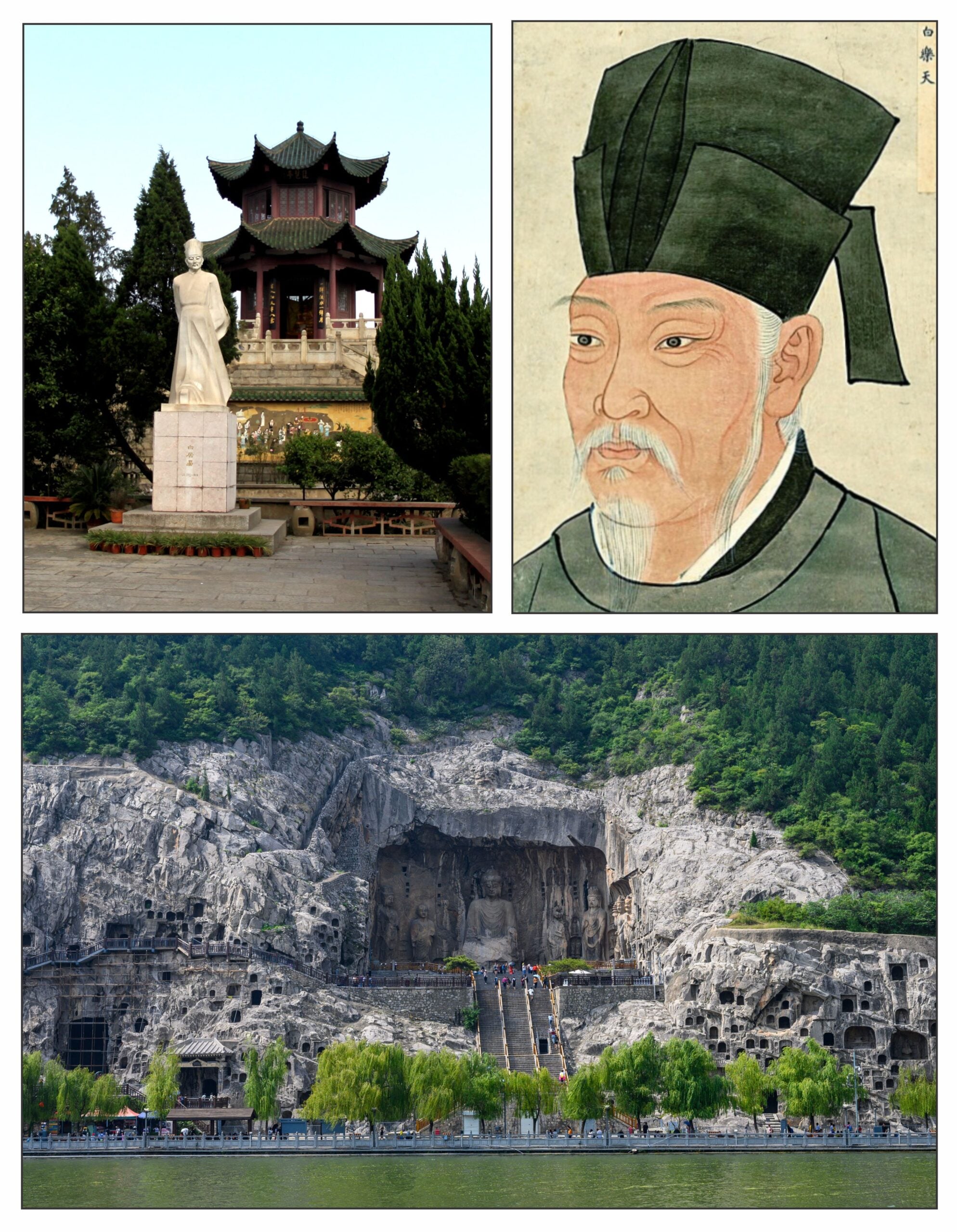
The following illustration shows in the upper left a statue of Bai Juyi at the Pipa Pavilion in Jiujiang, in the upper right a posthumous portrait of the poet by Chen Hongshou, a 17th Century painter, and at the bottom a view of the Longmen caves.
Translating the Ballad of the Pipa

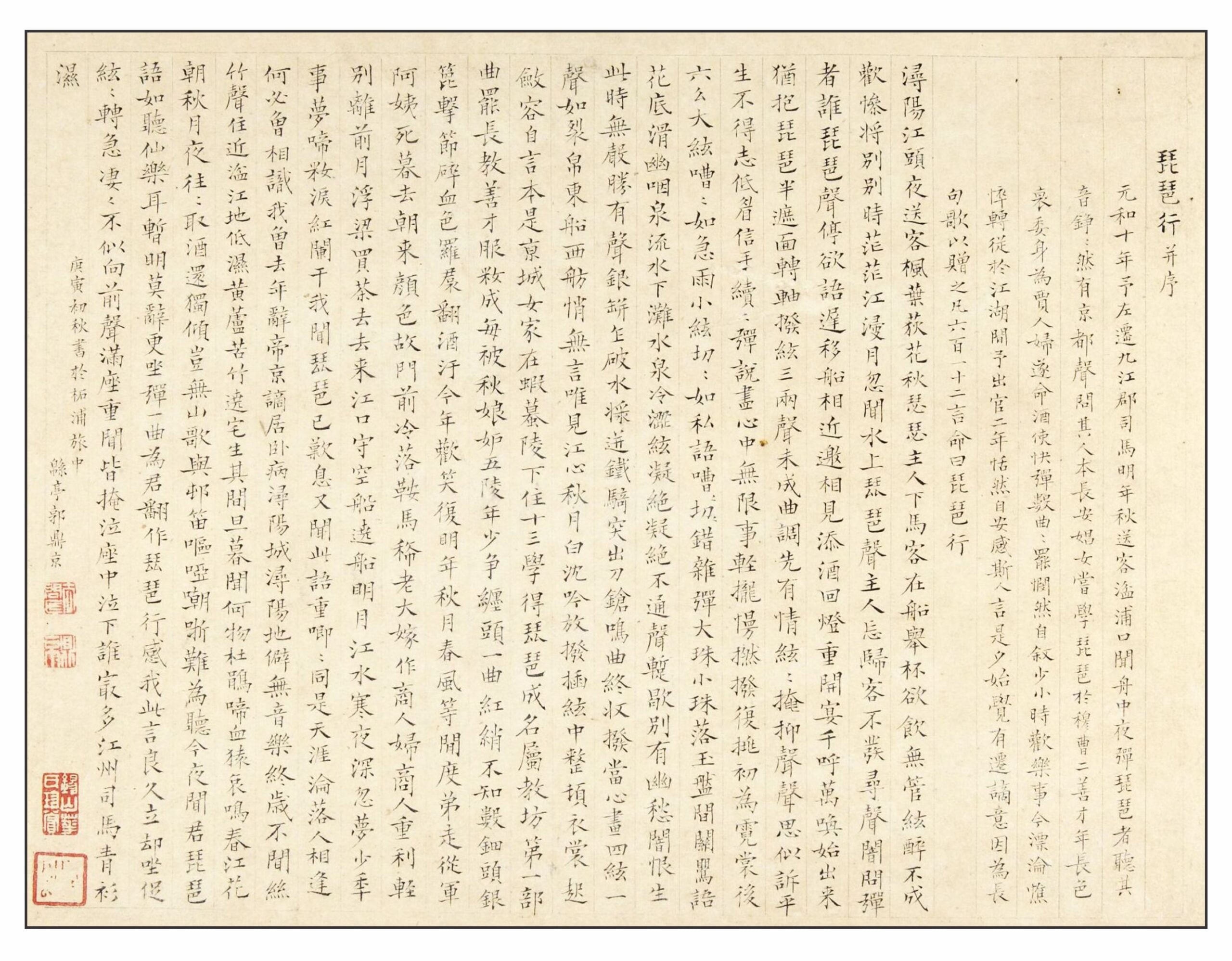
The poem is written in rhyming couplets with 88 lines each of 7 characters for a total 616 characters. It is preceded by a preface of 138 characters. The following is the poem in elegant regular-script calligraphy by Guo Dingjing (17th Century CE), now in the Princeton University Art Museum:
The Chinese text of the poem is readily available, as is an early English translation by Witter Bynner in his book The Jade Mountain (1929). Several other English translations have been published: Fuller, 2018, pp 283-289; Giles, 1888, pp 157-160; Harris, 2009, pp 21-26; Watson, 1984, pp 249–252; Xu et al, 1987, pp 292-296: Xu, 1994, pp 18-121; Yip, 2004, pp 288-297. Other translations are available on the internet: Phil Multic and Gan Siowck Lee.

The poem is difficult to translate since its sound patterns are as important as its meaning (Peng, 2023; Yu & Chang, 2024). This post will provide some sense of the Chinese sound patterns of Bai Juyi’s poem with recitations by Pu Cunxin and accompanying pipa by Wu Yuxia, taken from a production by China Global Television Network. After Giles’ s initial prose version, most English translations have use blank verse and made some attempt to imitate the sounds of the original. The translation of Xu Yuanzhong (1987, 1994) uses rhyming hexameter couplets. The translations in red accompanying the character-by-character transcriptions in this post are mine; they are heavily indebted to the other available translations.

The Setting

Bai Juyi provides his poem with a preface that sets the time and the place. During his banishment to JiuJiang, while saying farewell to a visitor one evening on the banks of the Yangtze, he hears the music of a pipa. He finds out that the player had once been a famous musician and courtesan at the court in Chang’an. However, as she had grown old, her beauty had faded, and she had retired unhappily to the provinces. Bai Juyi is struck by the similarity of his fate to hers, and mourns their mutual fall from grace:
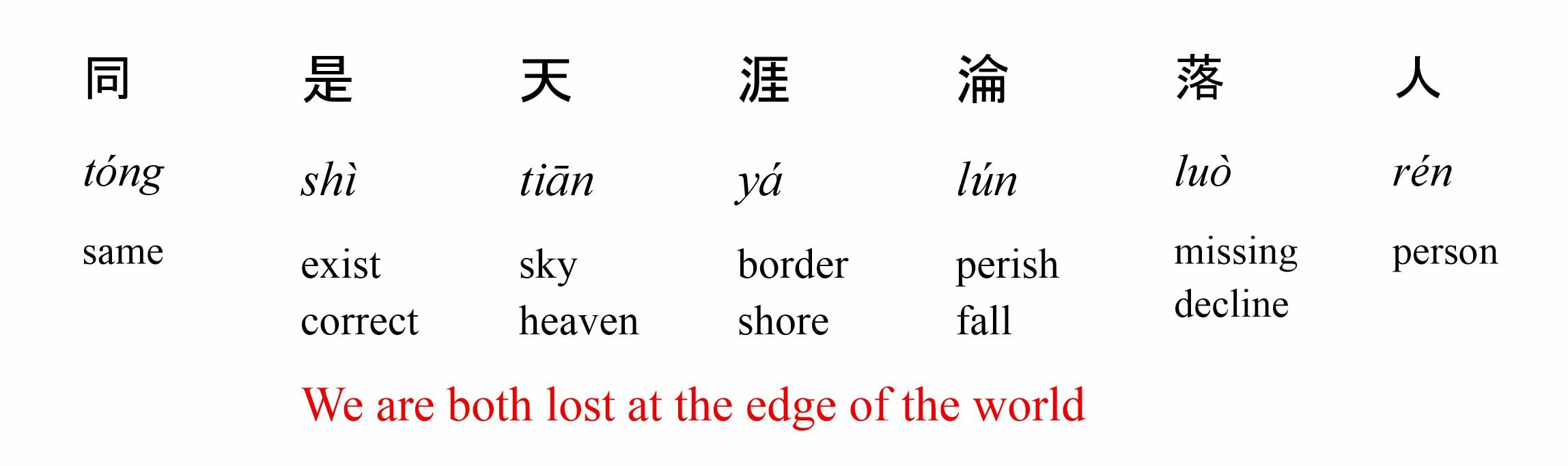
Moved by her story, he writes a long poem about the pipa player on the river far from Chang’an

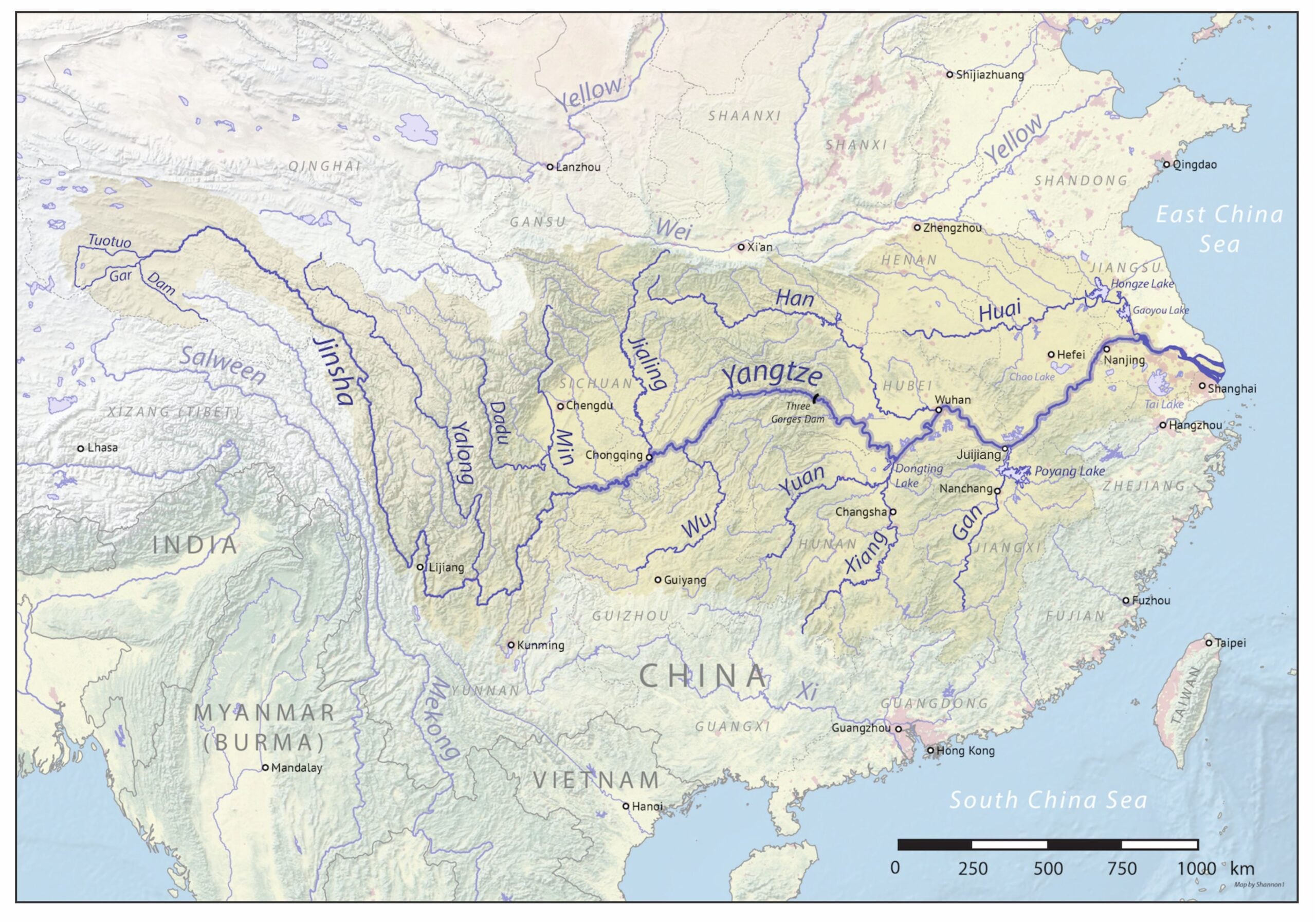
Jiujiang, which had once been known as Jiangzhou, is a city on the Yangtze River. The region of the river near Jiujiang was sometimes known as the Xunyang River. The Yangtze River, the third longest river in the world, is about 1.5 km wide at Jiujiang. Lake Pongyi, which was once called Pengli Lake, the largest freshwater lake in China, drains into the Yangtze at the eastern edge of the city:
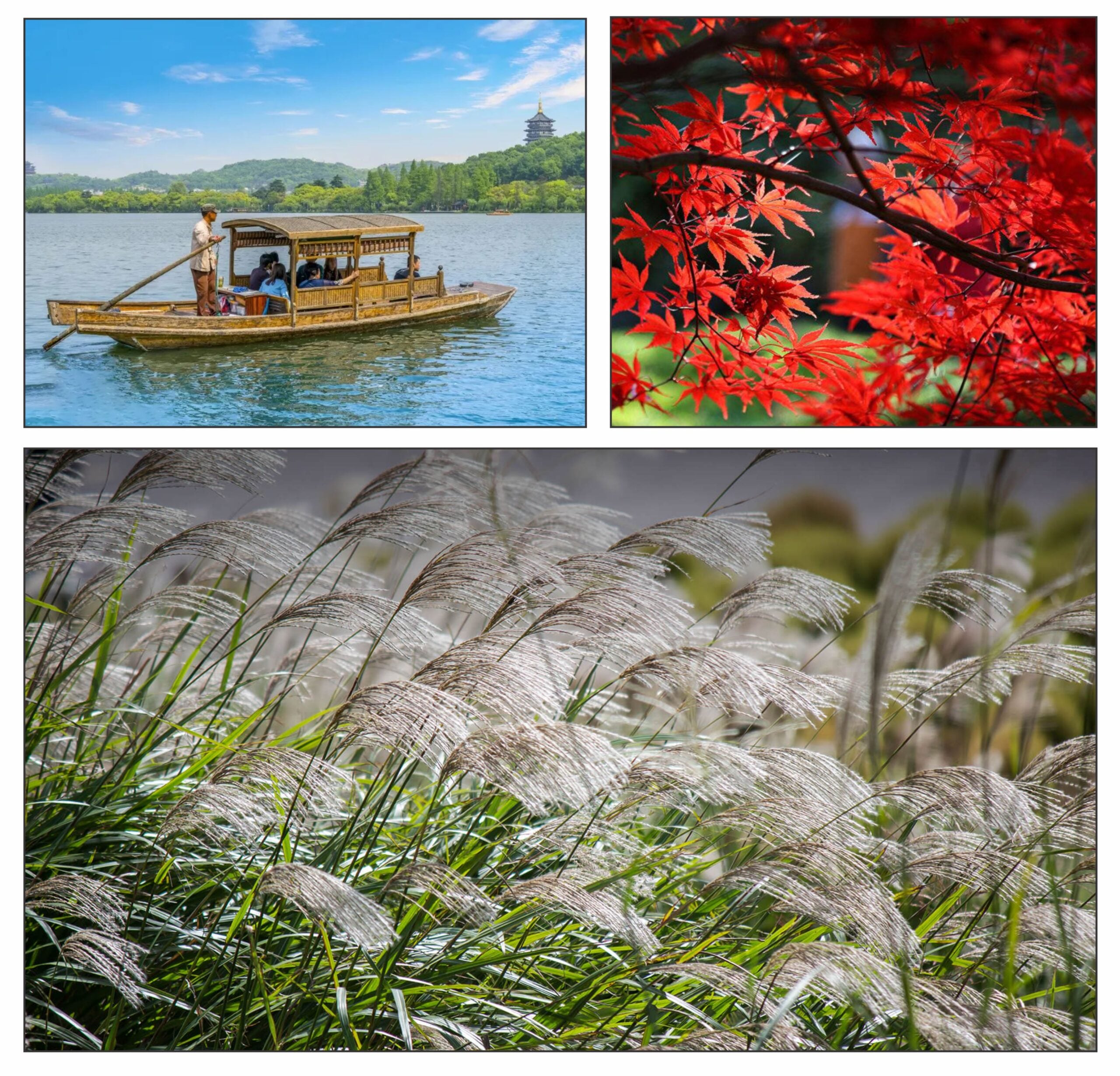
Bai Juyi is throwing a farewell party for his departing friend on a small pleasure boat on the river. As shown in the following illustration from Hangzhou in eastern China, these small rowboats still provide spaces for celebrations on the waters. In Jiujiang it is autumn: the maple leaves have turned scarlet, and the plumes of the silver grass have reached their peak. 
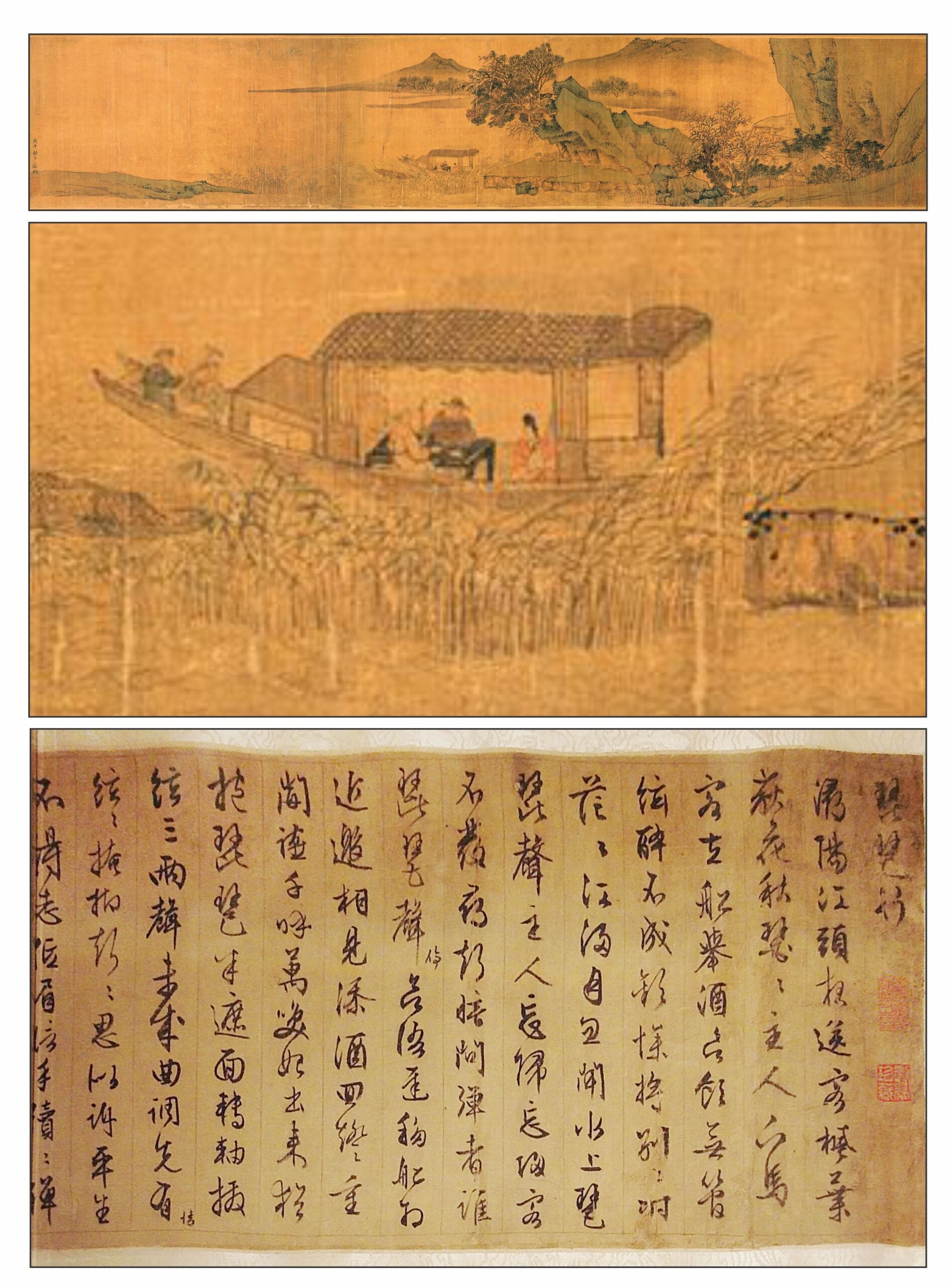
The following illustration shows a scroll with calligraphy of Pipa Xing by Wen Zhengming (1470-1559) at the National Palace Museum, Taipei. At the top is the painting at the beginning of the scroll. In the middle is an enlargement of the boat with the poet and his guest listening to the pipa player. At the bottom is the beginning of the calligraphy in semi-cursive (or running) script. The first line (on the left) has the title:
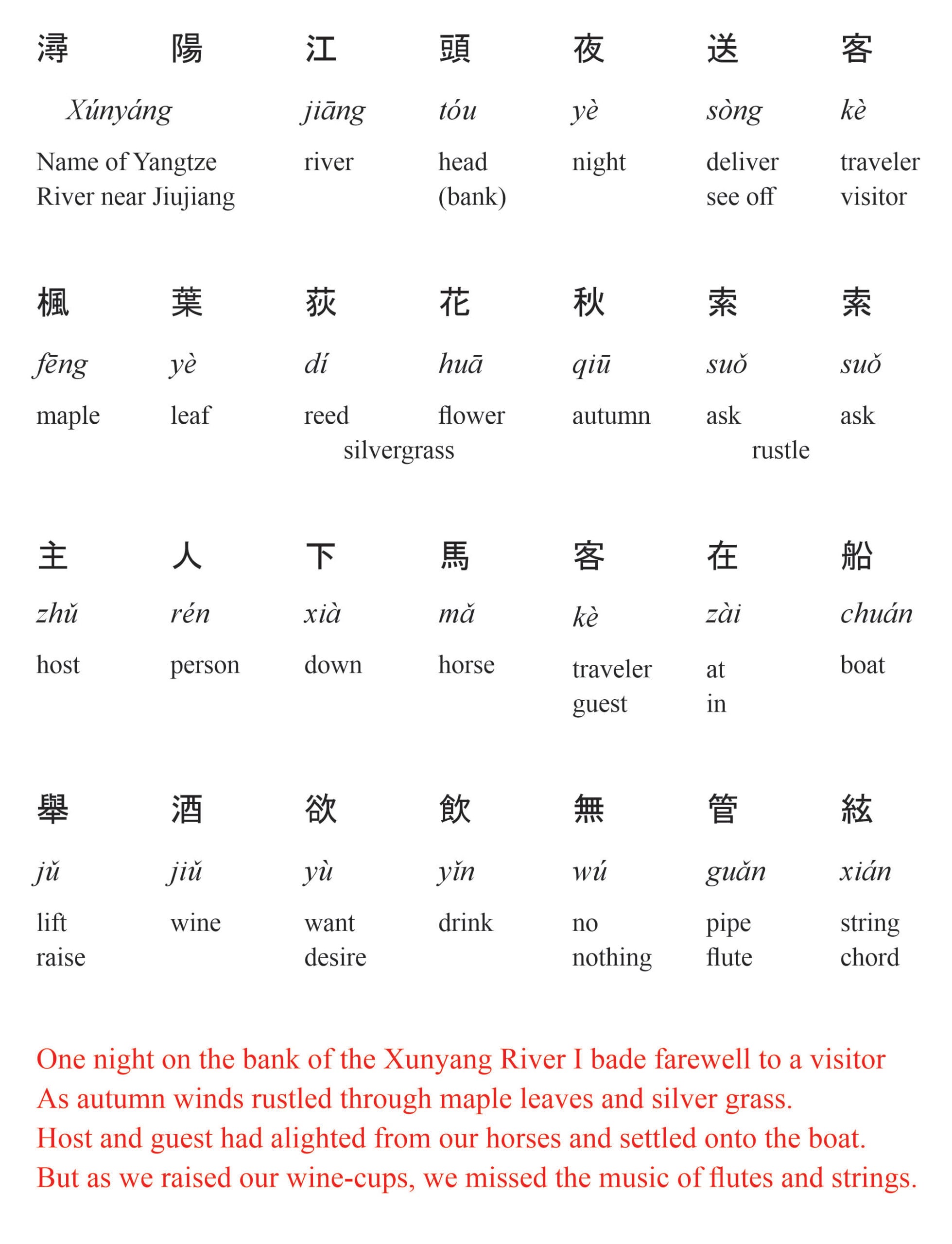
Beginning of the Ballad

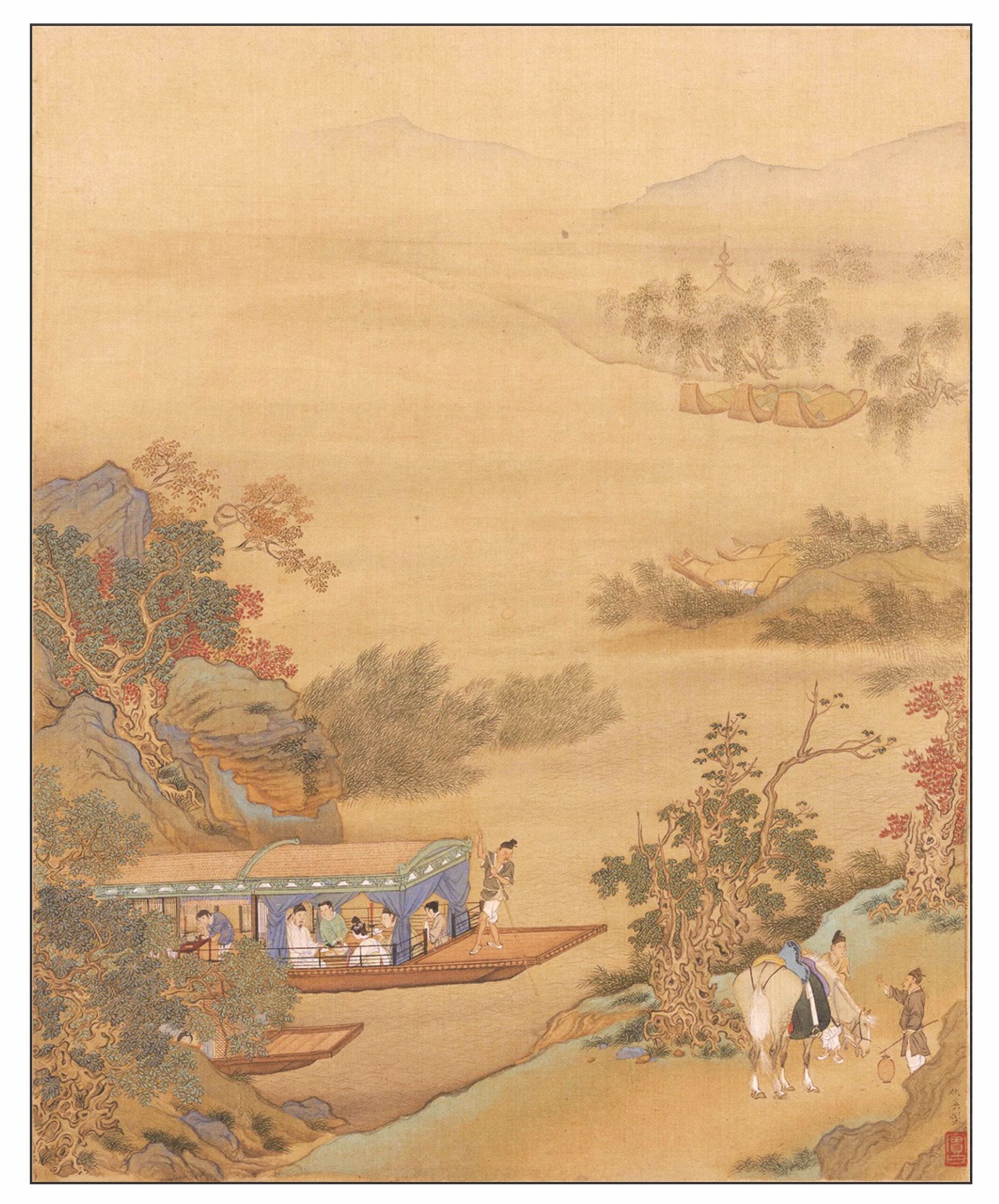
The initial lines of the ballad describe the autumn leaves and the silver grass. The farewell party begins but there is no music:
The opening scene of the poem was portrayed in a silk-painting (34 x 41 cm) in an album by Qiu Ying (1494-1552) now at the Palace Museum in Beijing:
 

The Pipa

As the party laments the absence of music, the sound of a pipa is heard across the water from another boat. The partygoers are completely entranced. They call out and ask the musician to play for them. She agrees but holds the pipa up to hide her face.

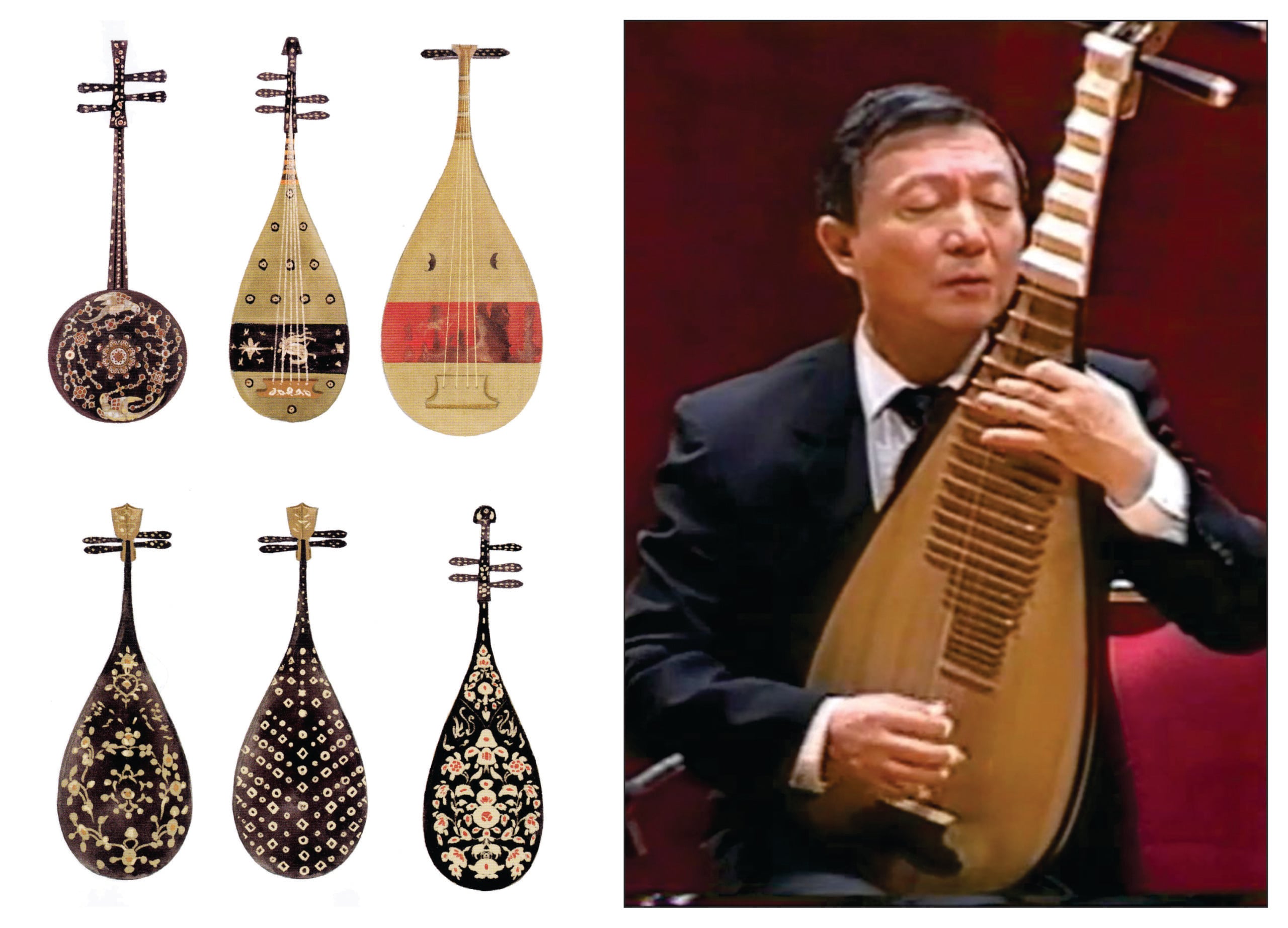
The pipa is a Chinese plucked string instrument very similar to the European lute (Wong, 2011). Both instruments have their origin in the Middle East. The pipa came to China via the Silk Roads during the Han Dynasty (206 BCE–220 CE). The instrument typically has 4 strings though some old pipas have 5. Though early pitas have as few as 4 frets, modern pitas can have up to 30. Though occasionally round, the body of the pipa is usually pear-shaped. Traditionally the pipa was played for small intimate groups, but in modern times electronic amplification has allowed pipa virtuosos to play for larger audiences. The following illustration shows some ancient pitas and a photograph of Liu Dehai (1937-2020), one the greatest pipa players of recent times.
The following is a performance of “Xunyang Moonlit Night” (阳月夜, Xúnyáng yuè yè) by Liu Dehai.

The Music

The poem then provides a bravura description of the music of the pipa:
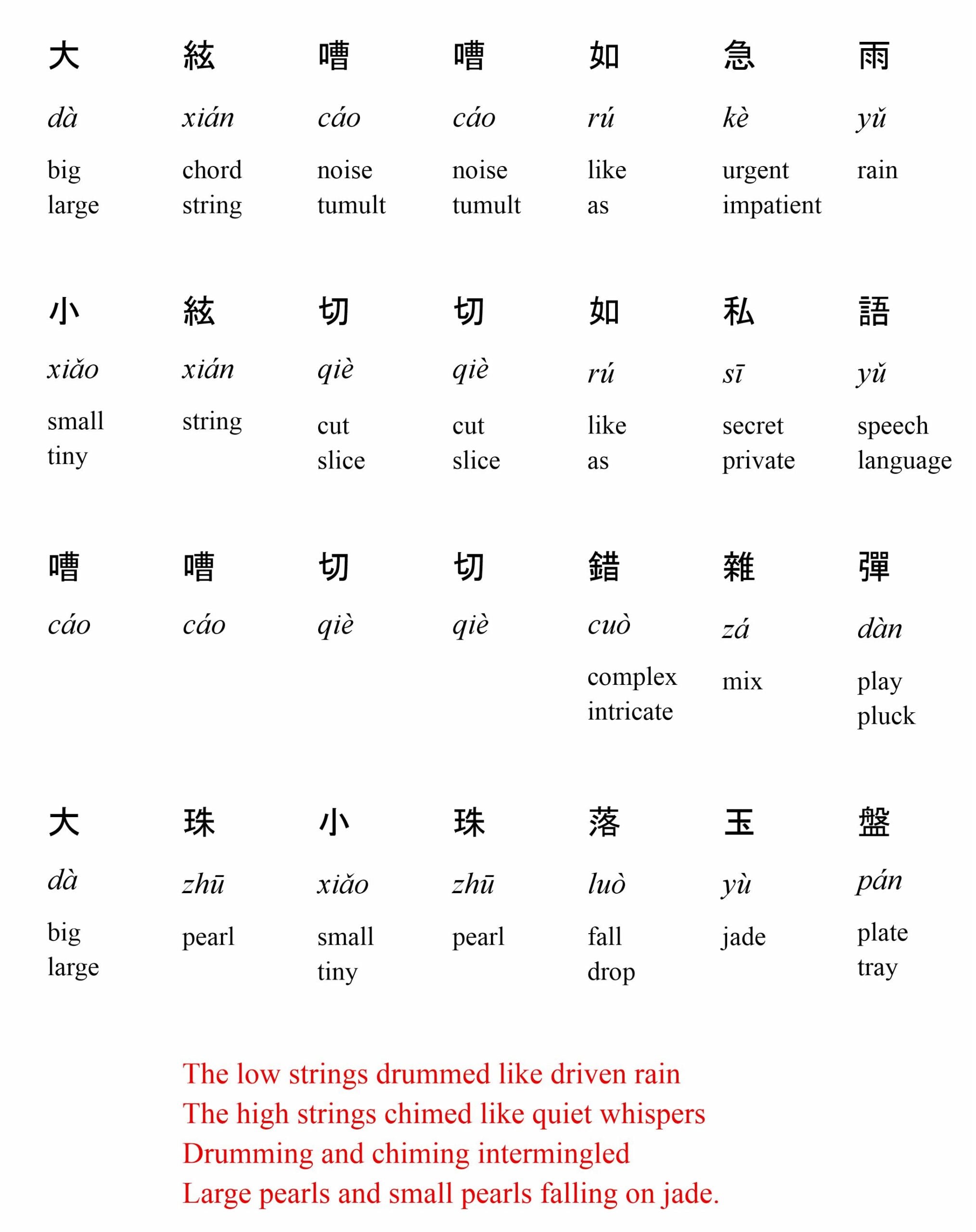
These are some of the most famous lines of poetry in China. They have been variously translated. The following version by Xu Yuan-Zhong (1984; 1987) uses the same rhyme scheme as the Chinese poem:

The thick strings loudly thrummed like the pattering rain
The fine strings softly tinkled in murmuring strain.
When mingling loud and soft notes were together played,
’Twas like large and small pearls dropping on plate of jade.

Witter Bynner (1929) uses blank verse in his translation:

The large strings hummed like rain,
The small strings whispered like a secret,
Hummed, whispered—and then were intermingled
Like a pouring of large and small pearls into a plate of jade.

And the following translation is by Isabel Wong (2011), a musician rather than a poet:

The lowest string hummed like pouring rain;
The higher strings whispered as lover’s pillow talk.
Humming and whispering intermingled
I,ikc the sound of big and small pearls gradually falling into a jade plate.

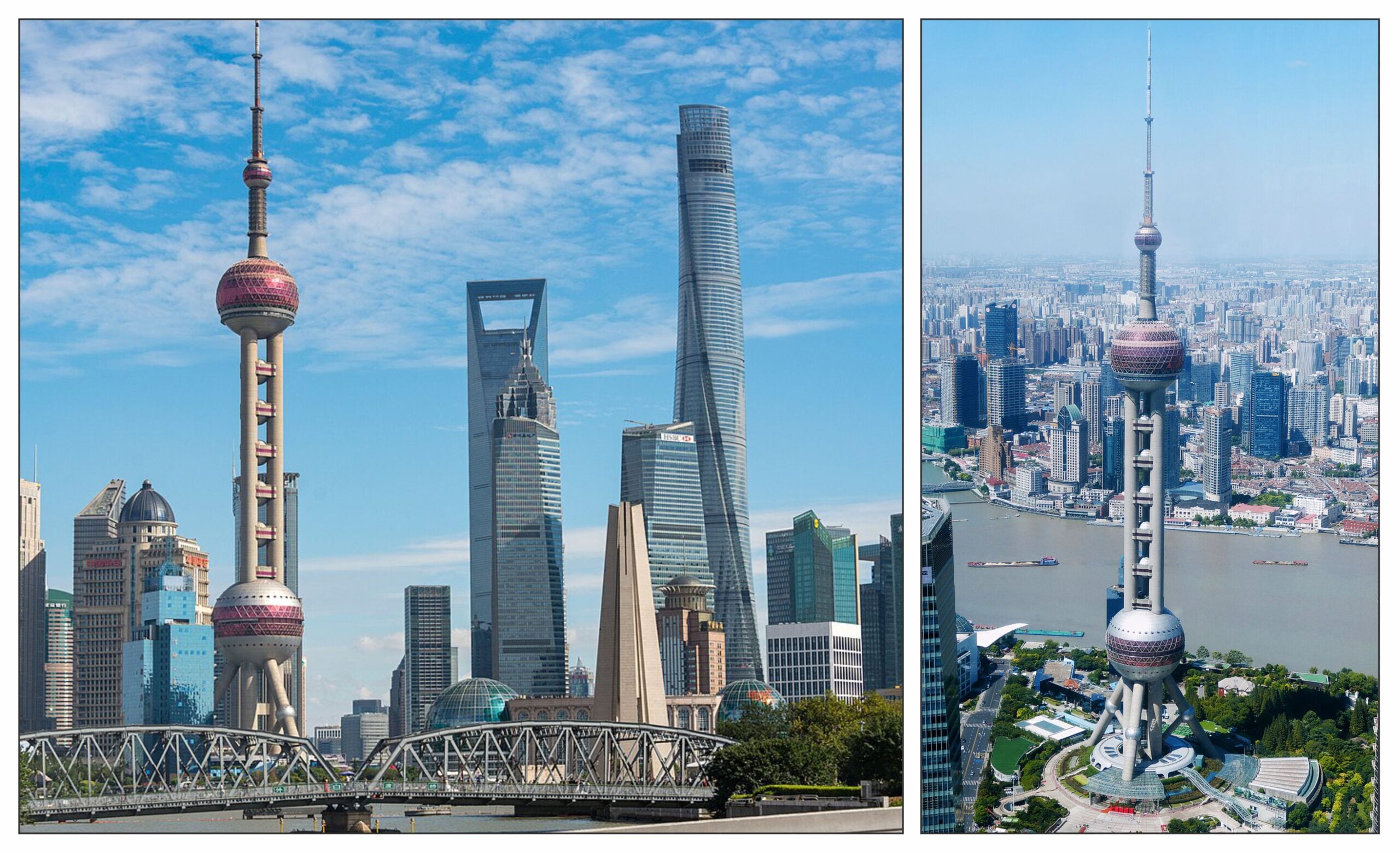
The architects of the Oriental Pearl Tower (1994) in Shanghai based their design on Bai Juyi’s image of pearls falling onto jade:
 

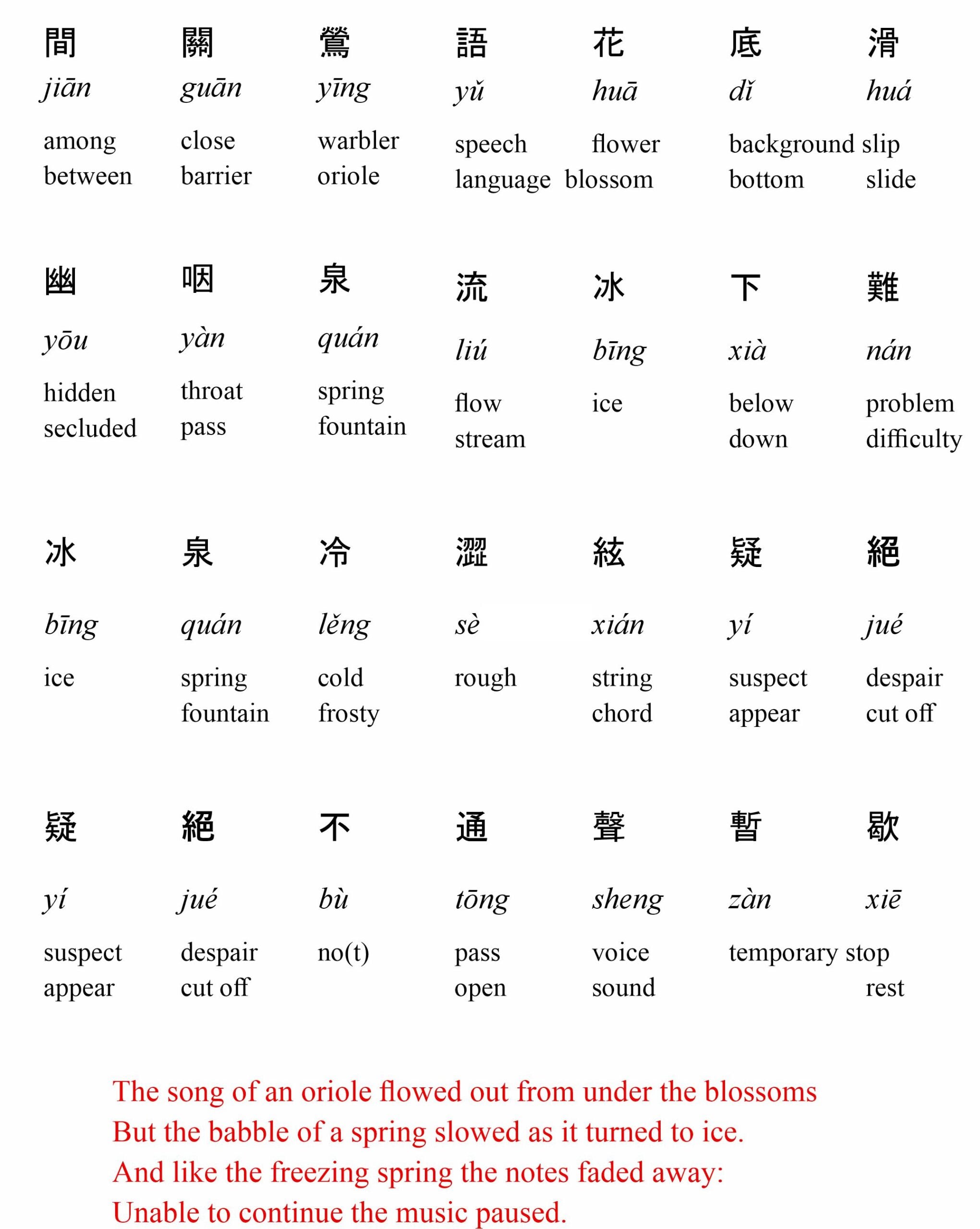
Following the music of the pearls, the pipa provides the quiet song of an oriole, and then like a freezing brook the music slows to a stop:
 

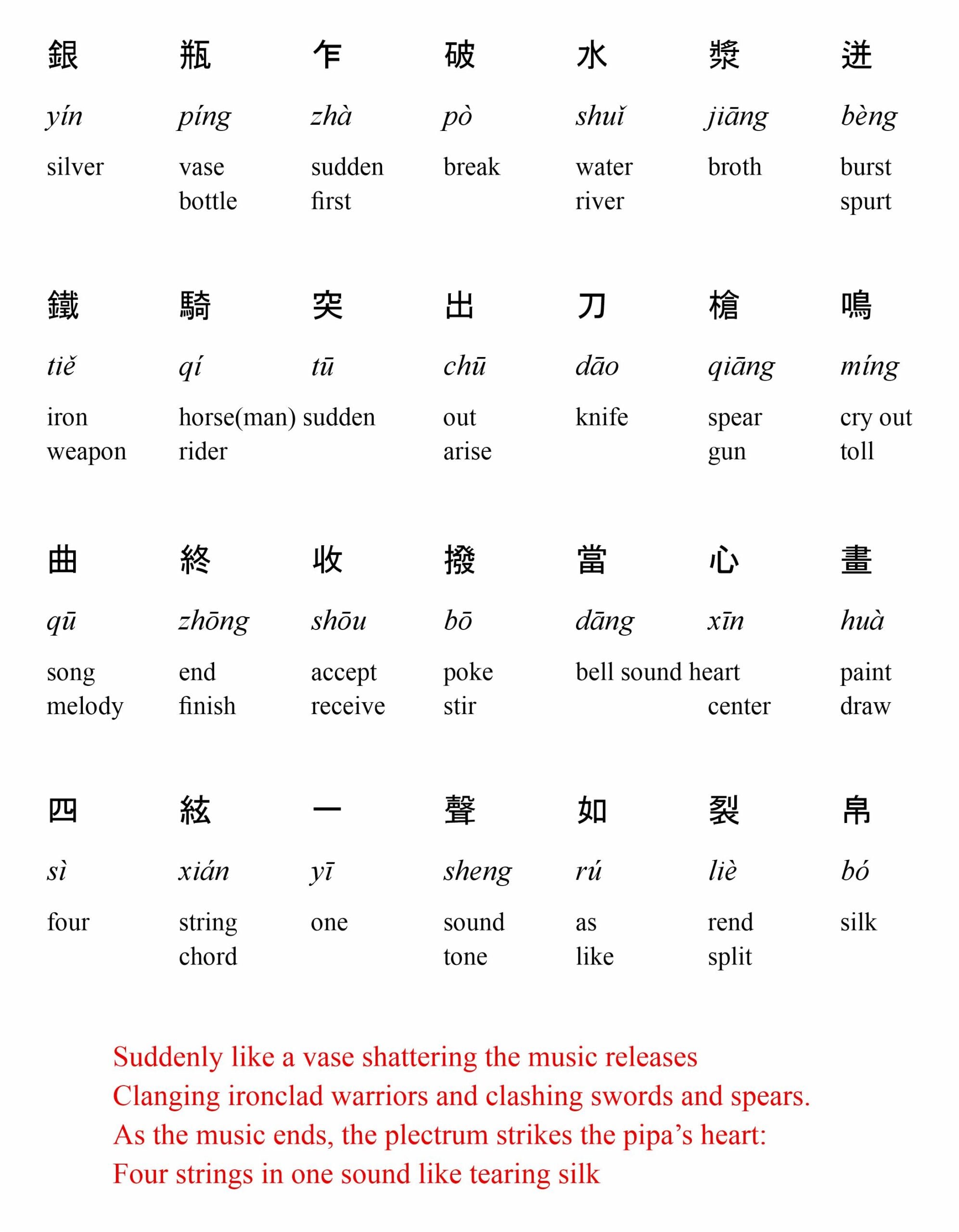
After a brief pause the pipa plays a wild crescendo that sounds like the charge of armored warriors, and then suddenly the player stops.
 

The Life of the Pipa Player

During the ensuing silence, the pipa player tells her story. She was once a highly acclaimed musician in Chang’an. Her beauty and her talent were the toast of the court.
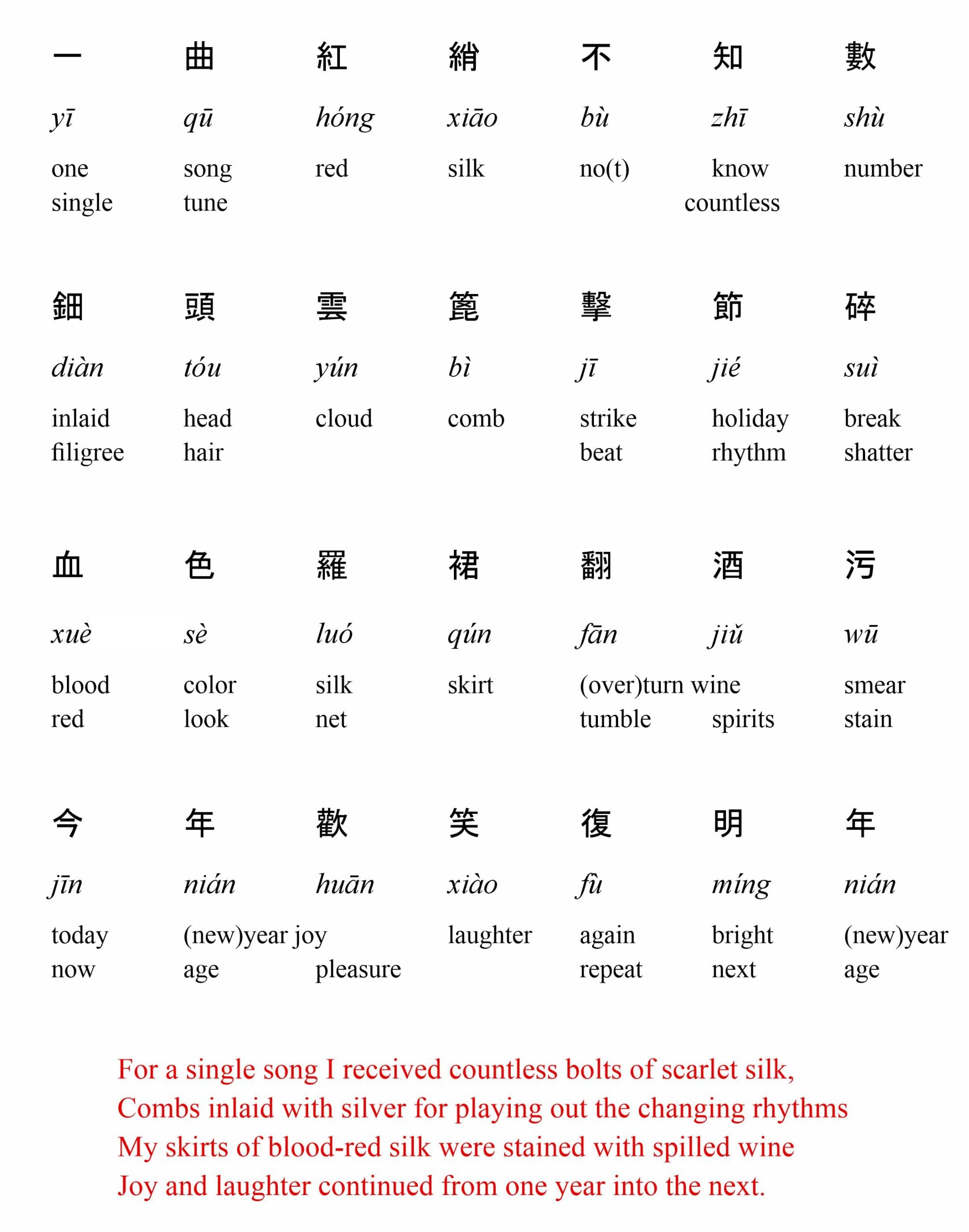
This description of the life of a successful musician and courtesan in Chang’an has been translated in many ways. One version is especially vivid. In 1917, Ezra Pound (1885-1972) published Three Cantos in Poetry Magazine, and again in the American edition of his book Lustra. This was the beginning of a set of Cantos that ultimately numbered 109. These initial three cantos – often called the Ur-Cantos – were extensively revised when Pound published A Draft of XVI Cantos in 1925. Much of the original Canto II is no longer evident in the new sequence. The general theme of Ur-Canto II was the “poetics of loss” (Carr, 2018). Pound describes the ruins of the ducal palace in Mantua, and mourns the loss of most of the music of the troubadours. And then he provides a brief description of the setting of Bai Juyi’s poem and the words of pipa player:  

     Yin-yo laps in the reeds, my guest departs,
The maple leaves blot up their shadows,
The sky is full of autumn,
We drink our parting in saki.
Out of the night comes troubling lute music,
And we cry out, asking the singer’s name,
And get this answer:
                                   “Many a one
Brought me rich presents; my hair was full of jade,
And my slashed skirts, drenched in expensive dyes,
Were dipped in crimson, sprinkled with rare wines.
I was well taught my arts at Ga-ma-rio,
And then one year I faded out and married.”
The lute-bowl hid her face.
                              We heard her weeping.

It was not until much later that Pound’s allusion to Bai Juyi was recognized (e.g. in Weinberger, 2007, p 128; discussed on the Pound Cantos Project website)

Pound had no knowledge of the Chinese language. In his book Cathay (1915), he “translated” a set of 15 Chinese poems based on the notes of Ernest Fenollosa who had studied Chinese poetry with the Japanese professors Mori and Ariga. Despite his lack of training in Chinese, Pound intuitively grasped the essence of the poems (see discussion by Yip, 1969). The brief excerpt from Ur-Canto II is typical of his translations. The meaning is clear though the words are not the same as in the original.

In Pound’s poem, Yin-yo is the Japanese transliteration of Chinese characters for the Xunyang River (Romaji, Jinyō-kō), and Gamaryo is the Japanese version of 蟆陵, which literally translated is “Toad Hill” (Fuller, 2017, p 286). This is the region in Chang’an city near the burial site of the Confucian scholar Dong Zhongshu (179–104 BCE). In Bai Juyi’s poem, the pipa player says that this is where she grew up (and learned how to play the pipa).   

To return to the poem: The pipa player’s high life did not last forever. Her brother went off to the army, her mother died, her looks faded, and she was no longer as sought after as before. She married a tea-merchant and came to live in Jiangzhou. Her husband is usually away on business. Alone on her boat she plays the pipa and remembers happier days.

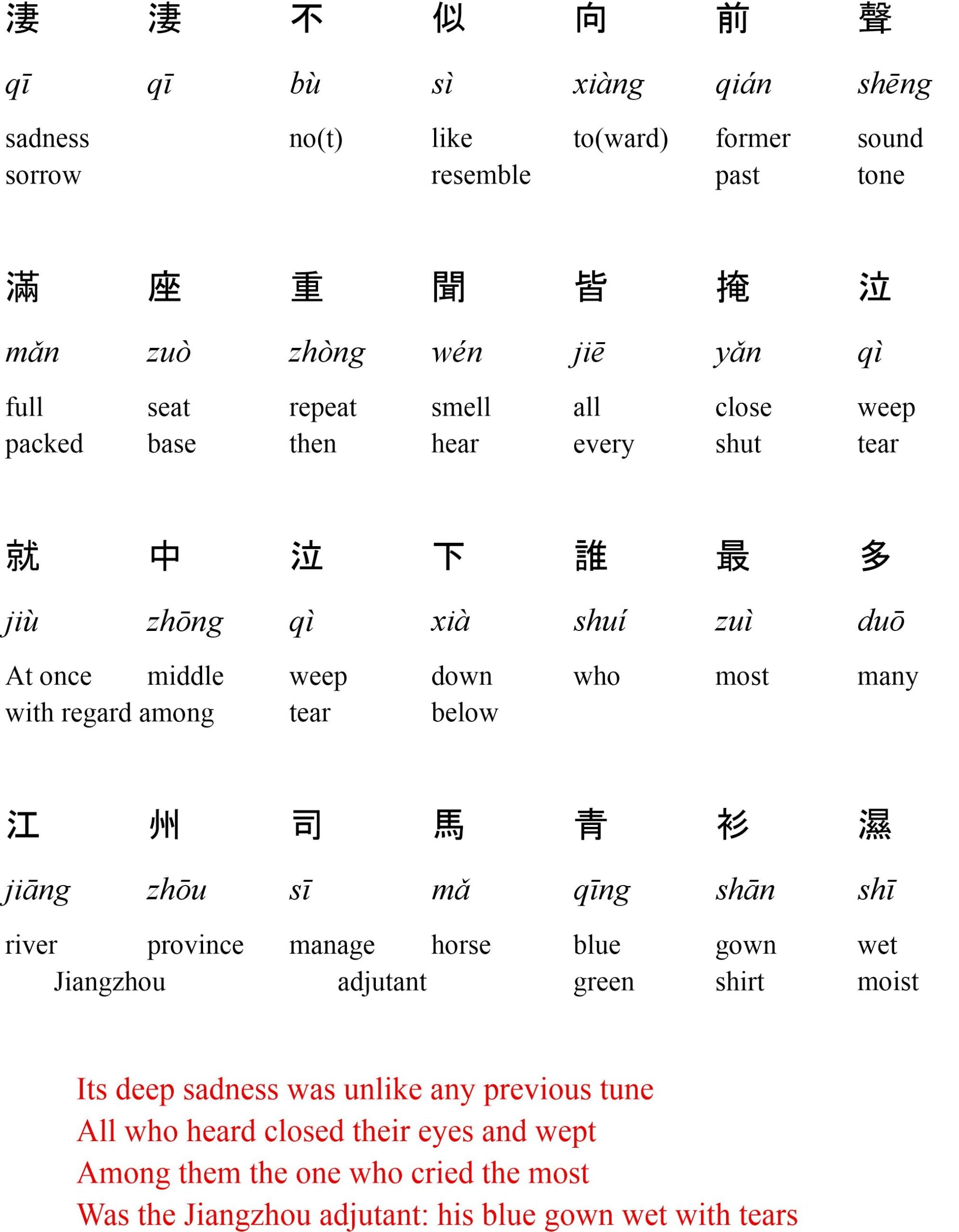
Listening to her story Bai Juyi feels an intense sympathy: he too has fallen from grace and now lives alone far away from the capital.  The musician plays a final intense song:
We do not know the music that Bai Juyi found so moving. The following is a piece entitled Night Thoughts composed and played by Wu Man (1963- ), who studied with Liu Dehai.

Wu Man’s composition derives from a famous poem by Li Bai, who spent much of his later life in exile from the capital. The following translation is by Xu Yuan-Zhong (1984, p 125).

靜夜思                    A Tranquil Night

床前明月光             Before my bed a pool of light
疑是地上霜             Is it hoarfrost upon the ground
舉頭望明月             Eyes raised I see the moon so bright
低頭思故鄉             Head bent in homesickness I’m drowned

The Life of the Poem

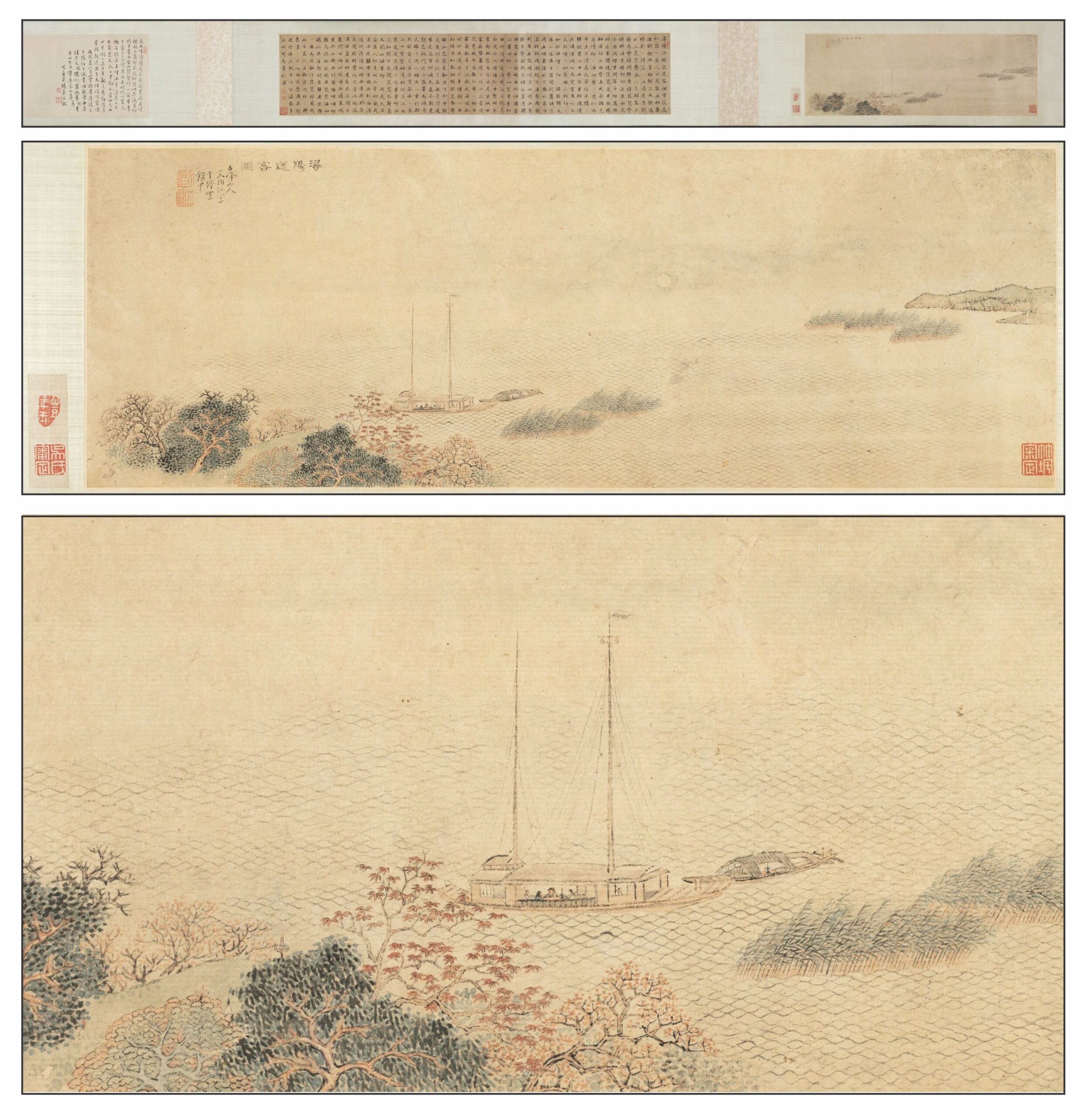
Bai Juyi’s poem was popular among calligraphers and artists. The following is a scroll by Wen Boren (1502-1575) now in the Cleveland Museum.
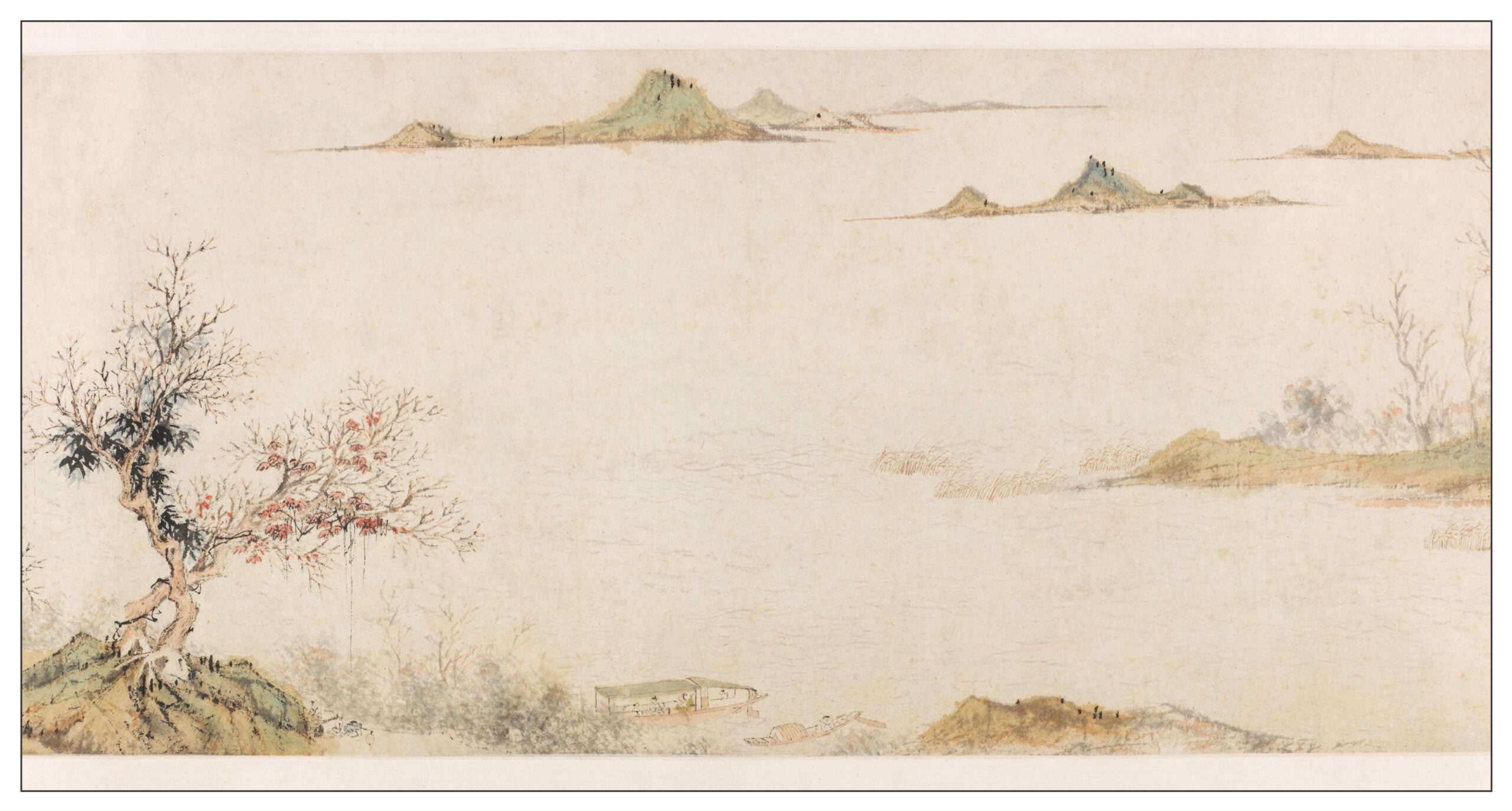
And the next illustration is a painting by Lu Zhi (1495-1576), from a calligraphy scroll now in the National Museum of Asian Art at the Smithsonian Institution. The boats near the lower shore are as lost as the poet and the pipa player:
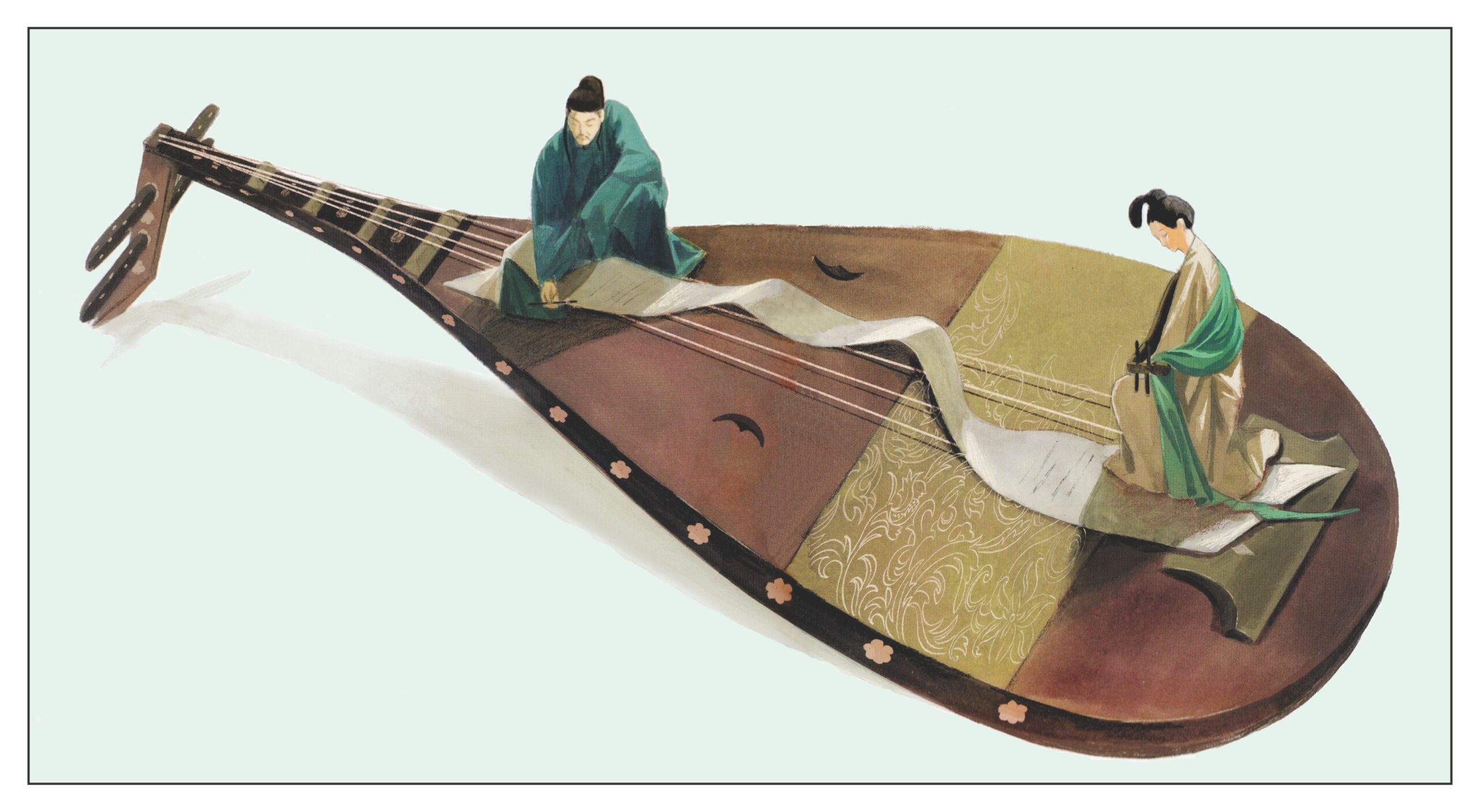
And the following is an illustration by Hua Zhangyi from a retelling of Bai Juyi’s poem (Liu Yang, & Hua Zhangyi, 2024) for children: the poet dedicates his poem to the pipa player.
 

References

Bynner, W. & Kiang Kang-Hu, (1929). The jade mountain: a Chinese anthology, being three hundred poems of the T’ang dynasty, 618-906. Alfred A. Knopf.

Carr, H. (2018). The Ur-Cantos. In R. Parker (Ed.) Readings in the Cantos. (pp 9-32). Clemson University Press.

Fuller, M. (2018). An Introduction to Chinese Poetry: From the Canon of Poetry to the Lyrics of the Song Dynasty. Harvard University Asia Center.

Geng, L. (2021). The four great Tang poets. In A Comprehensive Study of Tang Poetry II (pp. 1–42). Routledge.

Giles, H. A. (1884, revised 1923). Gems of Chinese Literature. Bernard Quaritch

Harris, P. (2009). Three hundred Tang poems. Alfred A. Knopf (Everyman’s Library)

Liu Yang, & Hua Zhangyi, (2024). 琵琶行 (Pipa Song). CITIC Press.

Peng, Y. (2023). A comparative study on two English translations of Song of a Pipa Player from the perspective of translation aesthetics. Frontiers in Humanities and Social Sciences, 3(4), 36-40.

Pound, E. (1915). Cathay. Elkin Mathews.

Pound, E. (1917a). Three Cantos II. Poetry, 10 (4), 180-188

Pound, E. (1917b). Lustra of Ezra Pound: with earlier poems. Alfred A. Knopf.

Tan, M. A. (2025). Bai Juyi and Yuan Zhen. In Z. Zhang & V. H. Mair (Eds.) Routledge Handbook of Traditional Chinese Literature (pp. 151–161). Routledge.

Waley, A. (1949, reprinted 2005). The Life and Times of Po Chu-i. Routledge.

Watson, B. (1984) The Columbia book of Chinese poetry: from early times to the thirteenth century. Columbia University Press.  

Weinberger, E. (Ed.). (2007). The New Directions Anthology of Classical Chinese Poetry. Carcanet.

Wong, I. (2011). The Music of China. In Capwell, C., Nettl, B., Bolman, P., Dueck, B., Rommen, T., Wong, I., & Turino, T. (Eds.). Excursions in World Music, 6th Edition. (pp 88-131). Taylor & Francis

Xu, Y., Loh, B., & Wu, J. (1987). 300 Tang poems: a new translation. The Commercial Press.

Xu Yuan Zhong (1994). Songs of the immortals: an anthology of classical Chinese poetry. Penguin Books in association with New World Press.

Yip, W. (1969). Ezra Pound’s Cathay. Princeton University Press.

Yip, W. (2004). Chinese Poetry: An Anthology of Major Modes and Genres. (2nd ed., Revised).  Duke University Press.

Yu, Y., & Chang, C. (2024). Text complexity and translation styles from the perspective of individuation: a case study of the English translations of Pipa Xing. Humanities & Social Sciences Communications, 11(1), Article 159.


Du Fu: Poet, Sage, Historian

Du Fu: Poet, Sage, Historian

Du Fu (712-770 CE) was a poet during a time of great political upheaval in China. He was born near Luoyang and spent much of his young adulthood in the Yanzhou region, finally settling down to a minor official position in Chang’an, the imperial capital. In 755 CE, An Lushan, a disgruntled general, led a rebellion against the Tang dynasty. The emperor was forced to flee Chang’an (modern Xian), and chaos reigned for the next eight years. For more than a year Du Fu was held captive in Chang’an by the rebels. After escaping, he made his way south, living for a time in a thatched cottage in Chengdu, and later at various places along the Yangtze River. His poetry is characterized by an intense love of nature, by elements of Chan Buddhism, and by a deep compassion for all those caught up in the turmoil of history. This is a longer post than usual. I have become fascinated by Du Fu.

Failing the Examinations

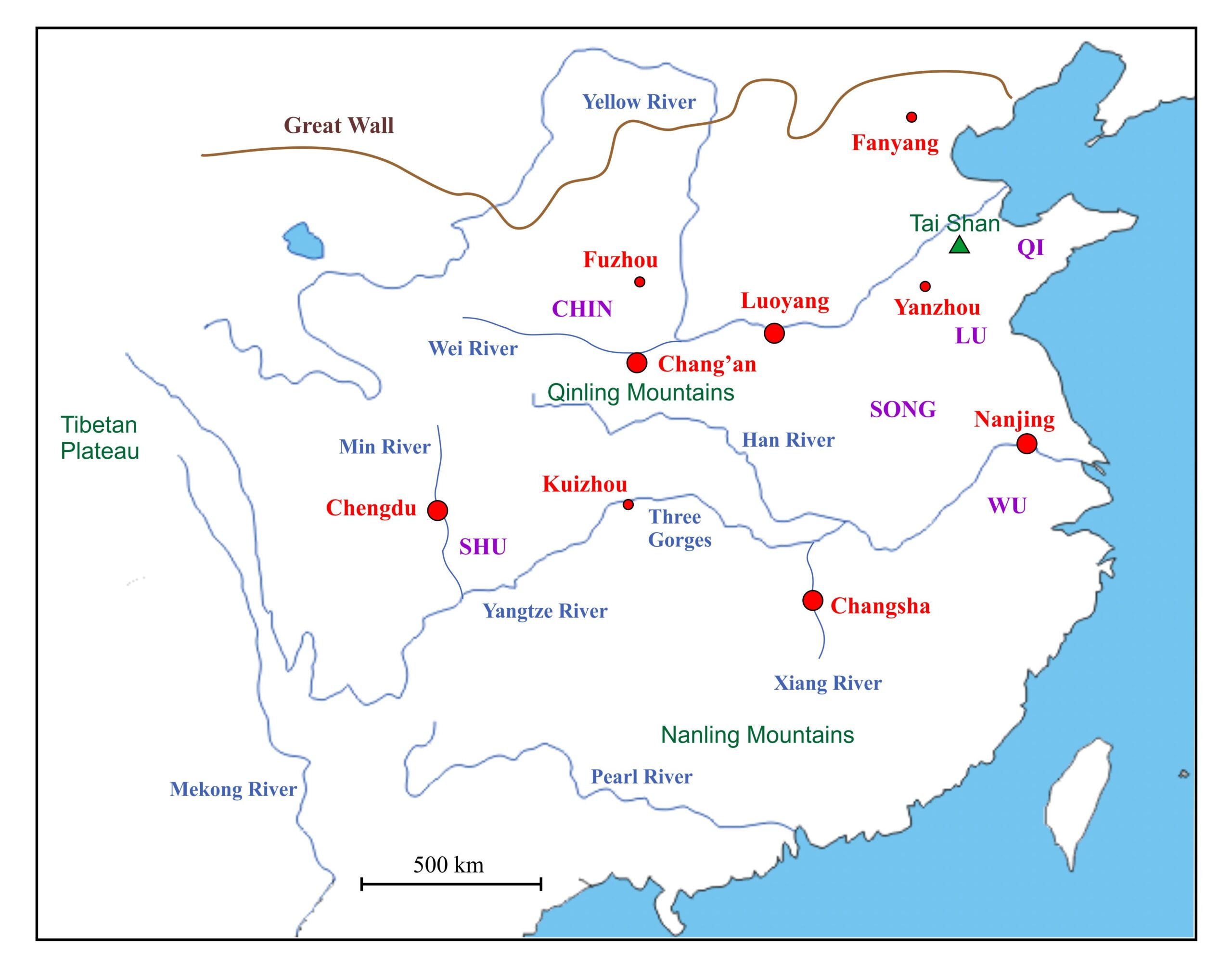
Du Fu (Tu Fu in the Wades Gilles transliteration system, the family name likely deriving from the name of a pear tree) was born in 712 CE near Luoyang, the eastern capital of the Tang Dynasty (Hung, 1952; Owen, 1981). The following map (adapted from Young, 2008, and Collet and Cheng, 2014) shows places of importance in his life:

Du Fu’s father was a minor official. His mother appears to have died during his childhood, and Du Fu was raised by his stepmother and an aunt. Du Fu studied hard, but in 735 CE he failed the jenshi (advanced scholar) examinations. No one knows why: politics and spite may have played their part. He spent the next few years with his father who was then stationed in Yanzhou,

Du Fu met Li Bai (700-762 CE) in 744 CE. Despite the difference in their ages, the two poets became fast friends. However, they were only able to meet occasionally, their lives being separated by politics and war.

Du Fu attempted the jenshi examinations again in 746, and was again rejected. Nevertheless, he was able to obtain a minor position in the imperial civil service in Chang’an. This allowed him to marry and raise a small family.

Taishan

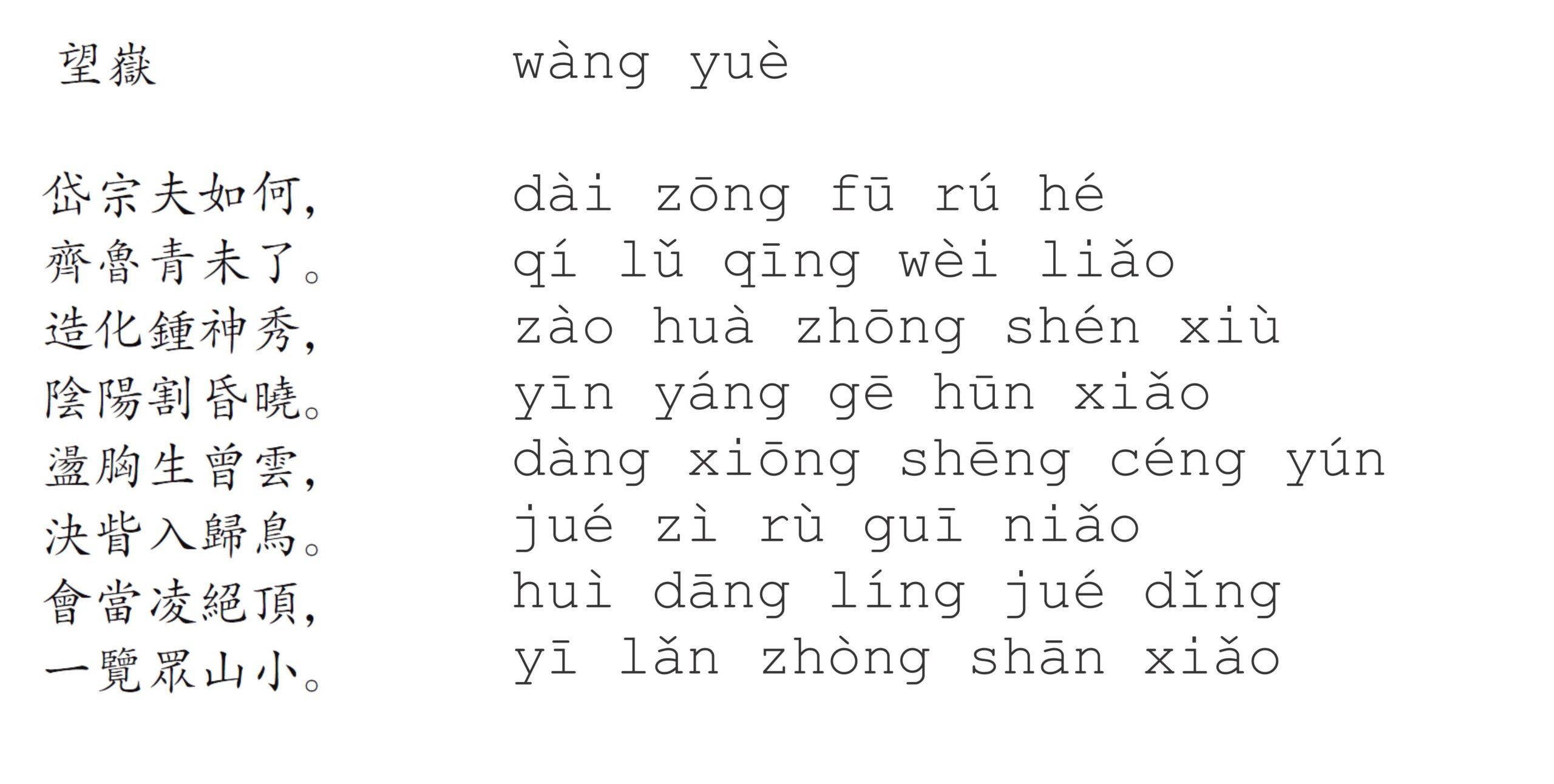
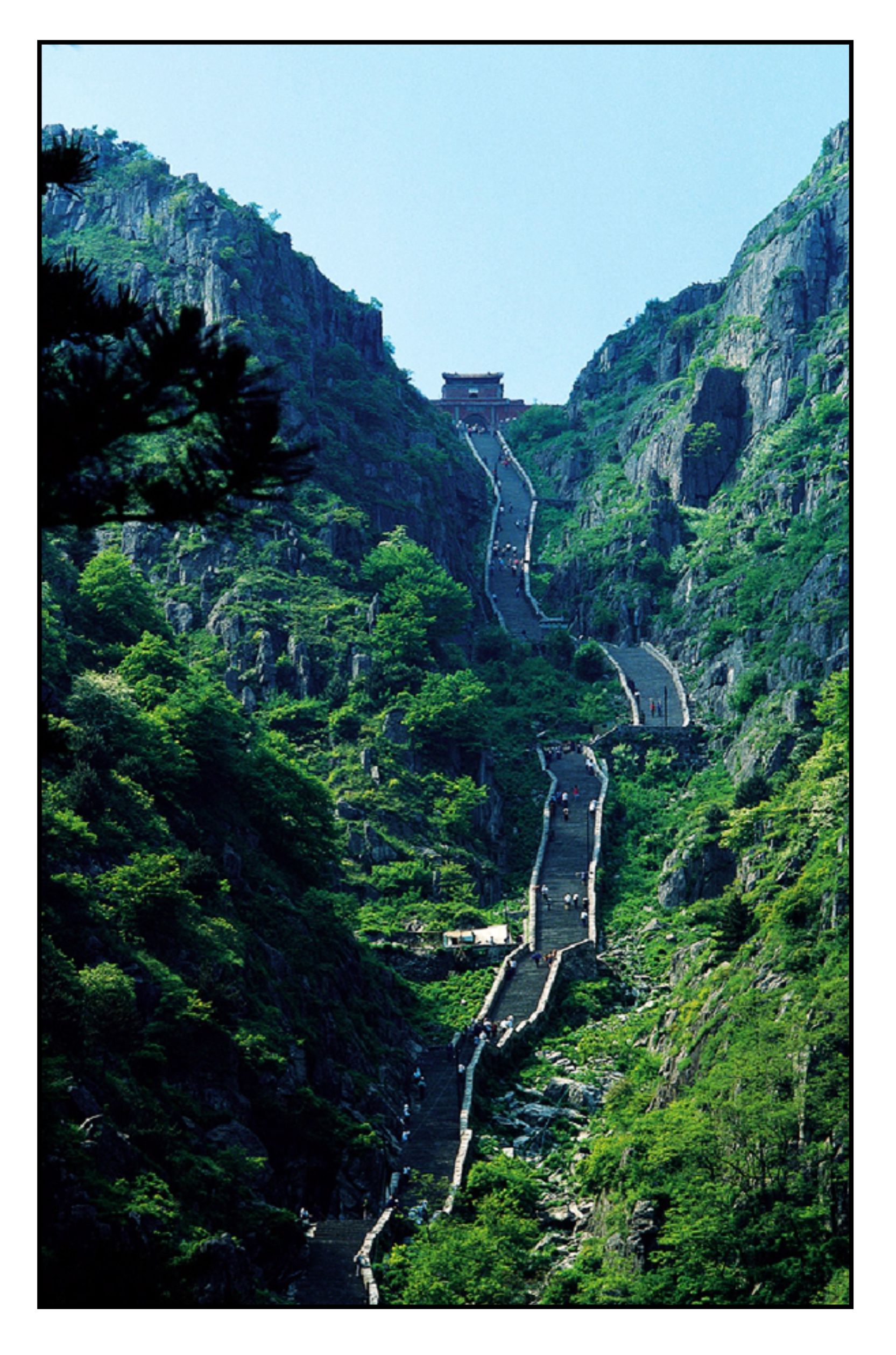
We can begin our examination of Du Fu’s poetry with one of the early poems written during his time in Yanzhou: Gazing on the Peak (737 CE). The peak is Taishan (exalted mountain), located in Northeastern China. Taishan is one of the Five Great Mountains (Wuyue) of ancient China. Today one can reach the summit by climbing up some 7000 steps (see illustration on the right), but in Du Fu’s time the climb would have been more difficult. The following is the poem in printed Chinese characters (Hànzì) and in Pinyin transliteration:   

The poem is in the lǜshī (regulated verse) form which requires eight lines (four couplets), with each line containing the same number of characters: 5- or 7-character lǜshī are the most common. Each line is separated into phrases, with a 5-character line composed of an initial 2-character phrase and a final 3-character phrase.  The last words of each couplet rhyme. Rhyme in Chinese is based on the vowel sound. Within the lines there were complex rules for the tonality of the sounds (Zong Qi Cai, 2008, Chapter 8; Wai-lim Yip, 1997, pp 171-221). These rules do not always carry over to the way the characters are pronounced in modern Chinese. The following is a reading of the poem in Mandarin (from Librivox).

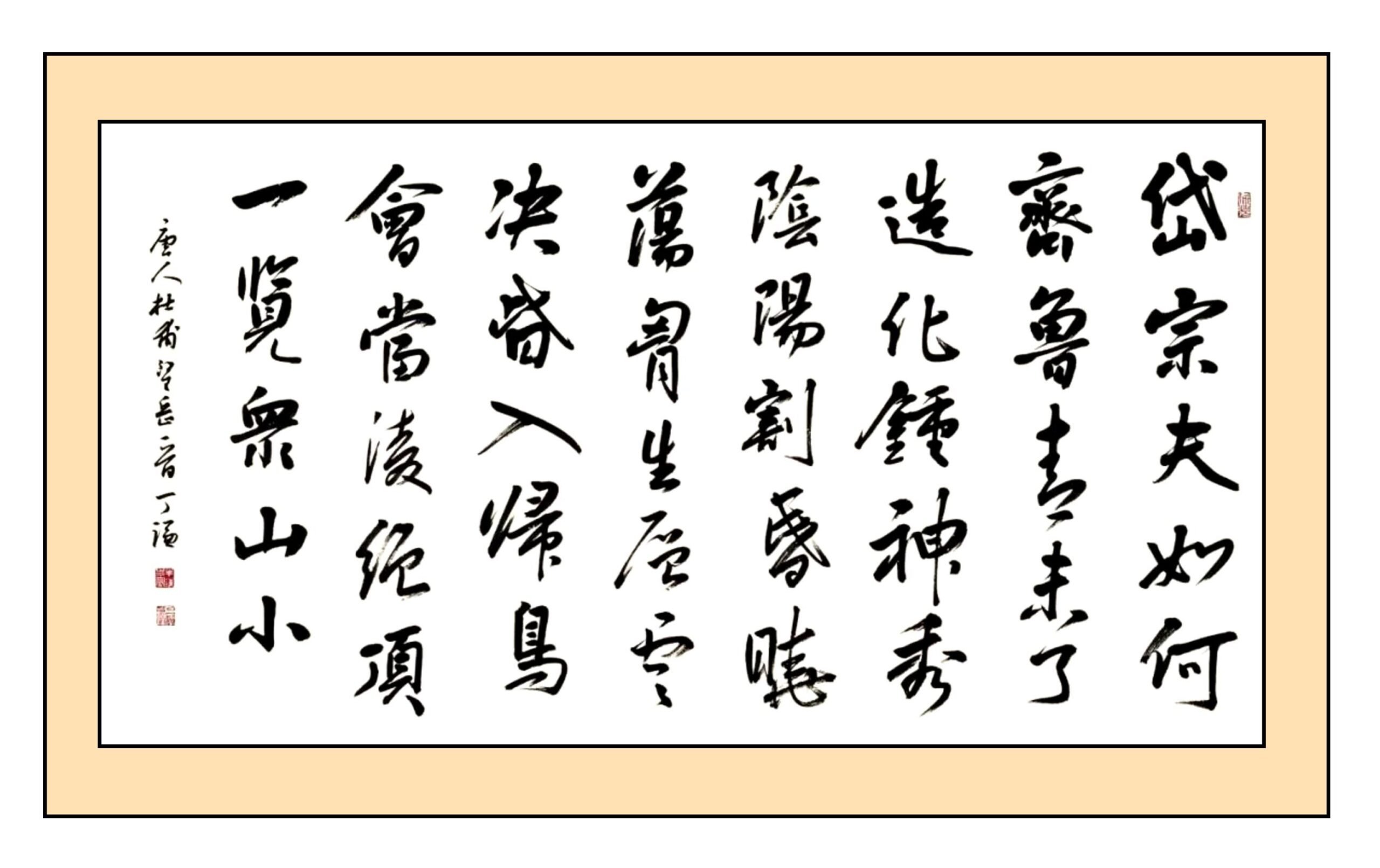
Chinese poetry is directed at both the ear and the eye, and fine calligraphy enhances the appreciations of a poem. Ding Qian has written out Du Fu’s Wàng yuè in beautiful cursive script (going from top down and from left to right):

The following is a character-by-character translation (adapted from Hinton, 2019, p 2):

gaze/behold     mountain

Daizong (ancient name for Taishan)      then      like      what
Qi      Lu (regions near Taishan)     green/blue     never     end
create     change     concentrate     divine     beauty
Yin     Yang (Taoist concepts of dark and light)     cleave     dusk     dawn
heave     chest     birth     layer     cloud
burst     eye     enter      return      bird
soon     when     reach     extreme     summit
one     glance     all     mountain     small.

And this is the English translation of Stephen Owen (2008, poem 1.2):

Gazing on the Peak

And what then is Daizong like? —
over Qi and Lu, green unending.
Creation compacted spirit splendors here,
Dark and Light, riving dusk and dawn.
Exhilarating the breast, it produces layers of cloud;
splitting eye-pupils, it has homing birds entering.
Someday may I climb up to its highest summit,
with one sweeping view see how small all other mountains are

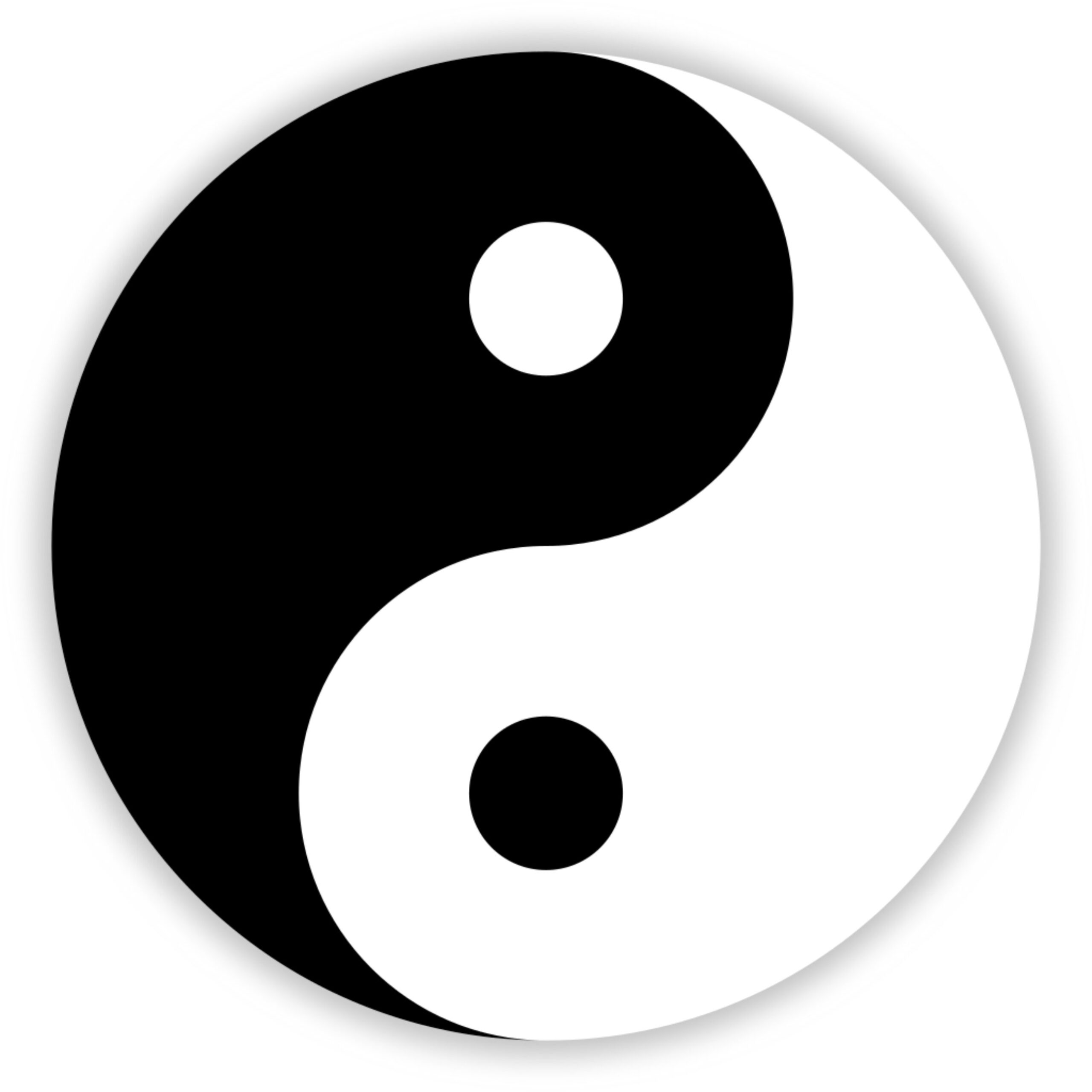
The interpretation of the poem requires some knowledge of its allusions. In the fourth line, Du Fu is referring to the taijitu symbol of Taoism (illustrated on the right) that contrasts the principles of yin (dark, female, moon) and yang (light, male, sun). Du Fu proposes that Taishan divides the world into two ways of looking. Some have suggested that the taijitu symbol originally represented the dark (north) side and the light (south) side of a mountain, and this idea fits easily with the poem.

All translators have had difficulty with the third couplet (reviewed by Hsieh, 1994). My feeling is that Du Fu is noticing layers of clouds at the mountain’s upper reaches – the chest if one considers the mountain like a human body – and birds swooping around the peaks – where the eye sockets of the body would be. However, it is also possible that Du Fu is breathing heavily from the climb and that his eyes are surprised by the birds. Perhaps both meanings are valid, with Du Fu and the mountain becoming one. Du Fu may have been experiencing the meditative state of Chan Buddhism, with a mind was “wide-open and interfused with this mountain landscape, no distinction between subjective and objective” (Hinton, 2019, p 6). One might also consider Du Fu’s mental state: at the time he wrote this poem he had just failed the jenshi exams. This might have caused some breast-beating and tears, as well as his final resolve to climb the mountain and see how small all his problems actually were.

The last couplet refers to Mencius’ description of the visit of Confucius to Taishan (Mengzi VIIA:24):

He ascended the Tai Mountain, and all beneath the heavens appeared to him small. So he who has contemplated the sea, finds it difficult to think anything of other waters, and he who has wandered in the gate of the sage, finds it difficult to think anything of the words of others.

Zhang’s Hermitage

During his time in Yanzhou Du Fu visited a hermit named Zhang near the Stonegate Mountain, one of the lesser peaks near Taishan. Zhang was likely a follower of the new Chan Buddhism, which promoted meditation as a means to empty the mind of suffering and allow the universal life force to permeate one’s being. Buddhism first came to China during the Han dynasty (206BCE – 220CE). Since many of the concepts of Buddhism were similar to those of Taoism, the new religion spread quickly (Hinton, 2020). A type of Buddhism that stressed the role of meditation began to develop in the 6th Century CE, and called itself chan, a Chinese transcription of the Sanskrit dhyana (meditation). In later years this would lead to the Zen Buddhism of Japan. There are many allusions to Buddhism and especially to Chan ideas in Du Fu’s poetry (Rouzer, 2020; Zhang, 2018)

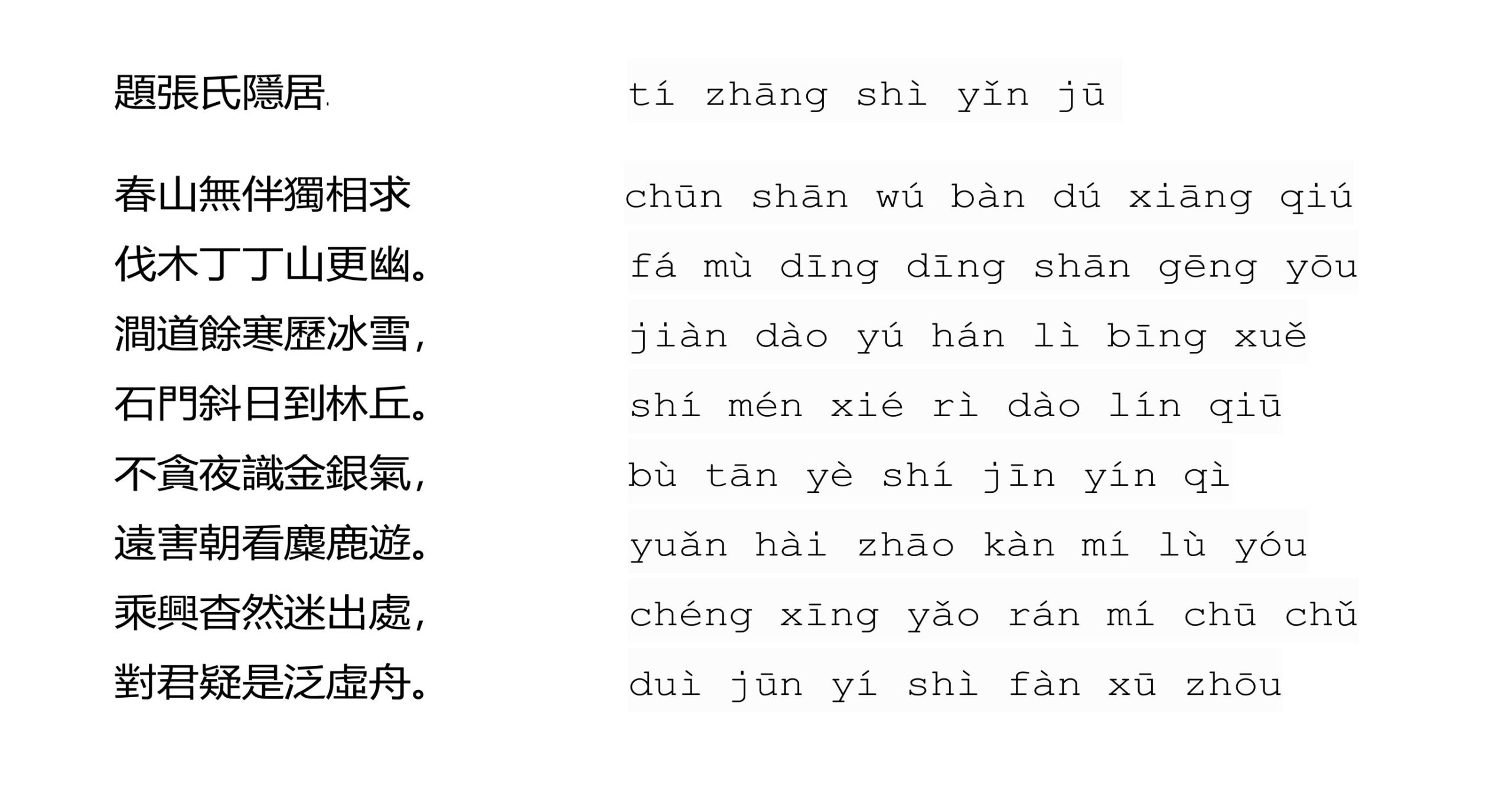
Du Fu reportedly wrote the following poem on one of the walls of Zhang’s hermitage. The poem is a seven-character lǜshī. The following is the poem in Chinese characters (Owen, 2008, poem 1.4) and in pinyin:

The following is a character-by-character translation (adapted from Hinton, 2019, p 22):

inscribe      Zhang     family      recluse      house     

spring      mountain     absence      friend      alone      you      search
chop      tree      crack     crack      mountain    again     mystery
creek     pathway     remnant       cold      pass       ice      snow
stone       gate      slant     sun      reach     forest     place
no       desire      night      know      gold      silver     breath/spirit
far     injure     morning     see      deer     deer       wander
ride     burgeon     dark     thus      confuse     leave      place
facing     you      suspect     this     drift      empty     boat.

And this is a translation by Kenneth Rexroth (1956):

Written on the Wall at Chang’s Hermitage

It is Spring in the mountains.
I come alone seeking you.
The sound of chopping wood echos
Between the silent peaks.
The streams are still icy.
There is snow on the trail.
At sunset I reach your grove
In the stony mountain pass.
You want nothing, although at night
You can see the aura of gold
And silver ore all around you.
You have learned to be gentle
As the mountain deer you have tamed.
The way back forgotten, hidden
Away, I become like you,
An empty boat, floating, adrift.

Notable in the poem is the idea of (third character) which can be translated as “absence, nothing, not” (Hinton, 2019, p 24) This is an essential concept of Chan Buddhism – the emptying of the mind so that it can become a receptacle for true awareness. The third and fourth characters of the first line might be simply translated as “alone (without a friend),” but one might also venture “with absence as a companion” or “with an empty mind.” This fits with the image of the empty boat at the end of the poem.

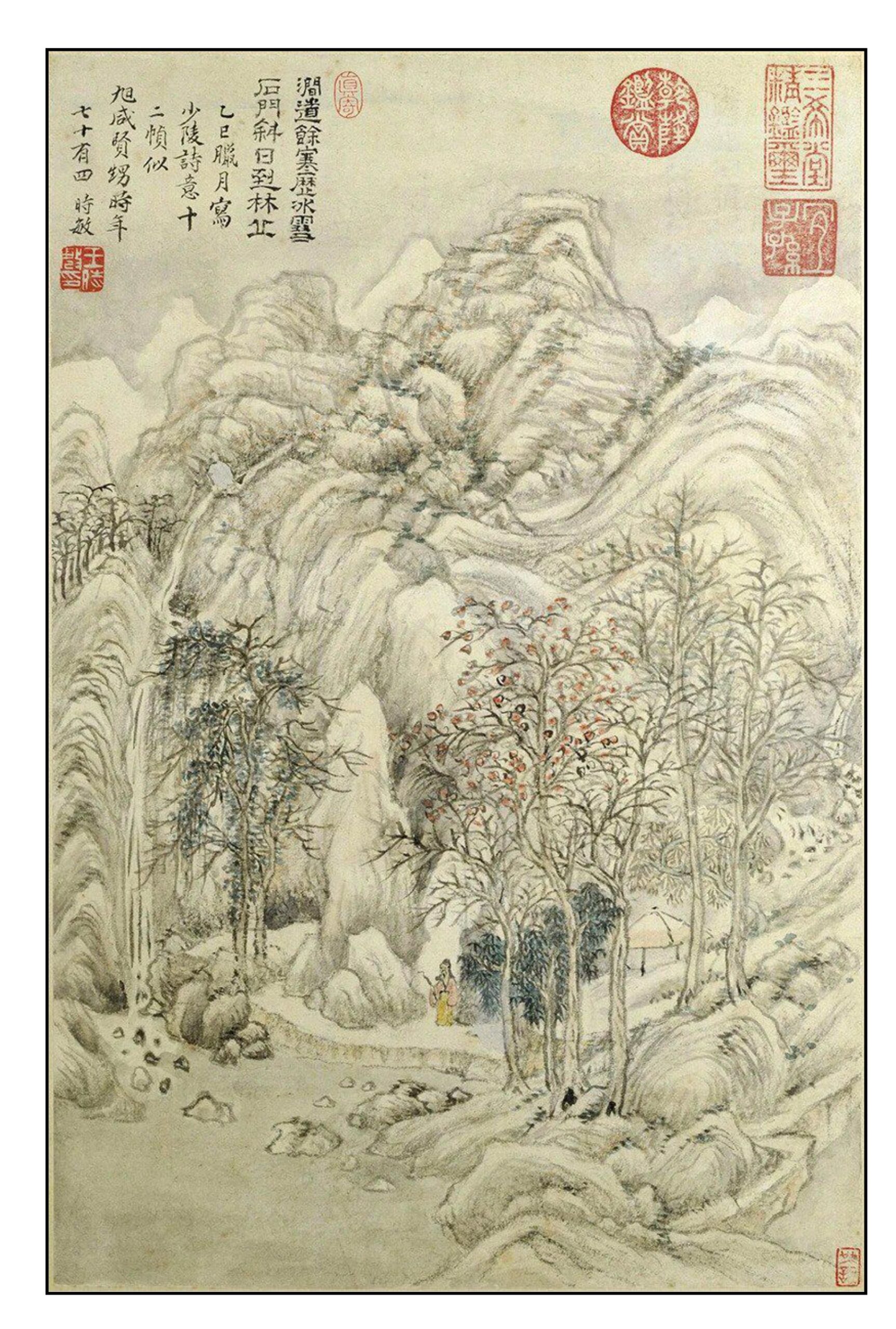
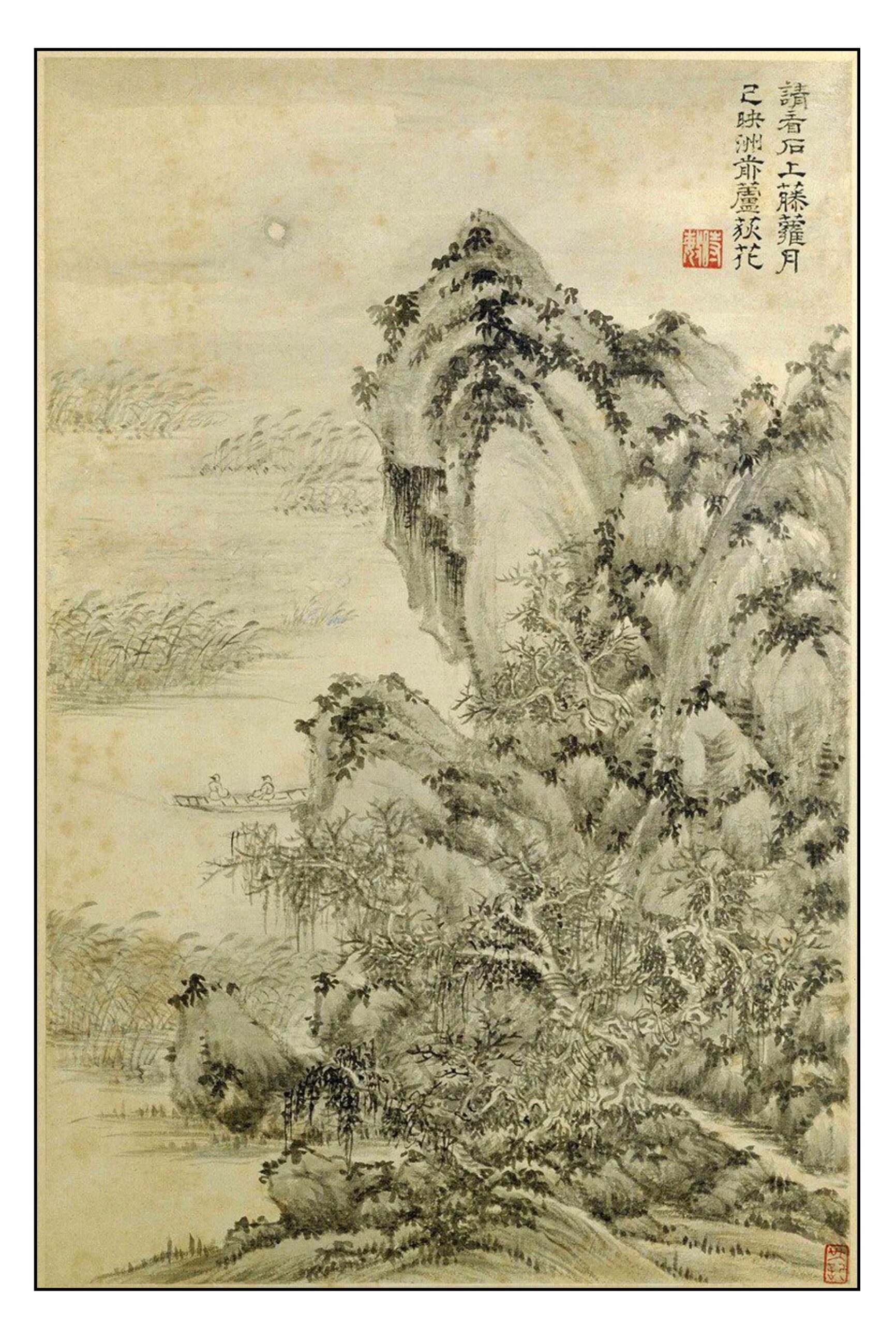
Zheng Qian, a drinking companion of Li Bai and Du Fu, suggested the idea of combining poetry, painting and calligraphy. The Emperor was impressed and called the combination sānjué (three perfections) (Sullivan, 1974). Li Bai and Du Fu likely tried their hand at painting and calligraphy but no versions of their sānjué efforts have survived. The Ming painter and calligrapher Wang Shimin (1592–1680 CE) illustrated the second couplet of Du Fu’s poem from Zhang’s hermitage in his album Du Fu’s Poetic Thoughts now at the Palace Museum in Beijing.

The An Lushan Rebellion

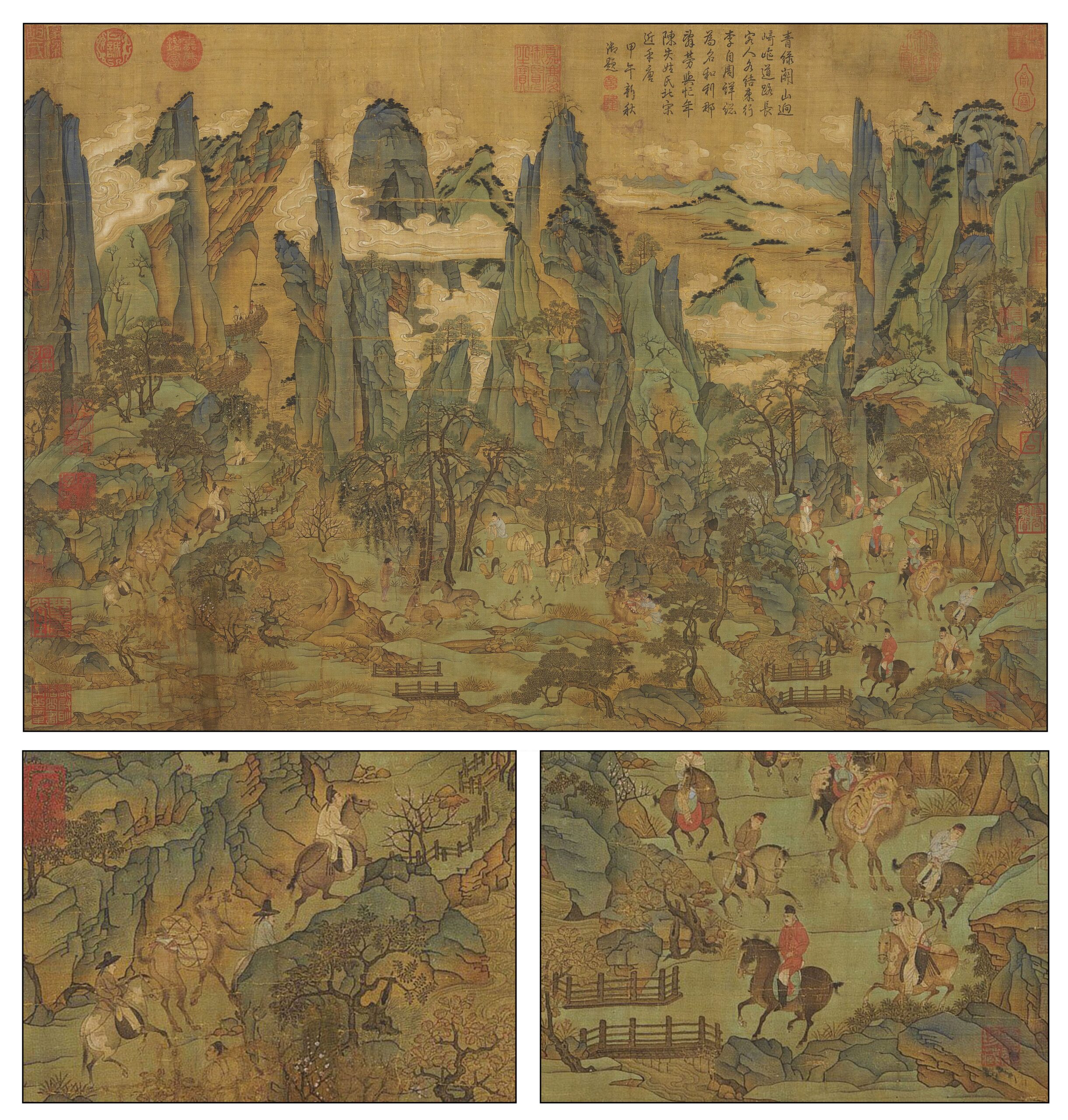
Toward the end 755 CE, An Lushan, a general on the northern frontier rebelled against the empire and captured the garrison town of Fanyang (or Jicheng) located in what is now part of Beijing. Within a month the rebels captured Luoyang. The emperor and much of his court fled Chang’an, travelling through the Qinling Mountains to find sanctuary in the province of Shu. The city of Chang’an fell to the rebels in the middle of 756 CE.

Below is shown a painting of Emperor Ming-Huang’s Flight to Shu. Though attributed to the Tang painter Li Zhaodao (675-758 CE), this was actually painted in his style several hundred years later during the Song Dynasty. Shu is the ancient name for what is now known as Sichuan province. This masterpiece of early Chinese painting is now in the National Palace Museum in Taipei. Two enlargements are included: the emperor with his red coat is shown at the lower right; at the lower left advance members of his entourage begin climbing the mountain paths.

The rebellion lasted for eight long years. The northern part of the country was devastated. Death from either war or famine was widespread. Censuses before and after the rebellion suggested a death toll of some 36 million people, making it one of the worst catastrophes in human history. However, most scholars now doubt these numbers and consider the death toll as closer to 13 million. Nevertheless, it was a murderous time.

Moonlit Night

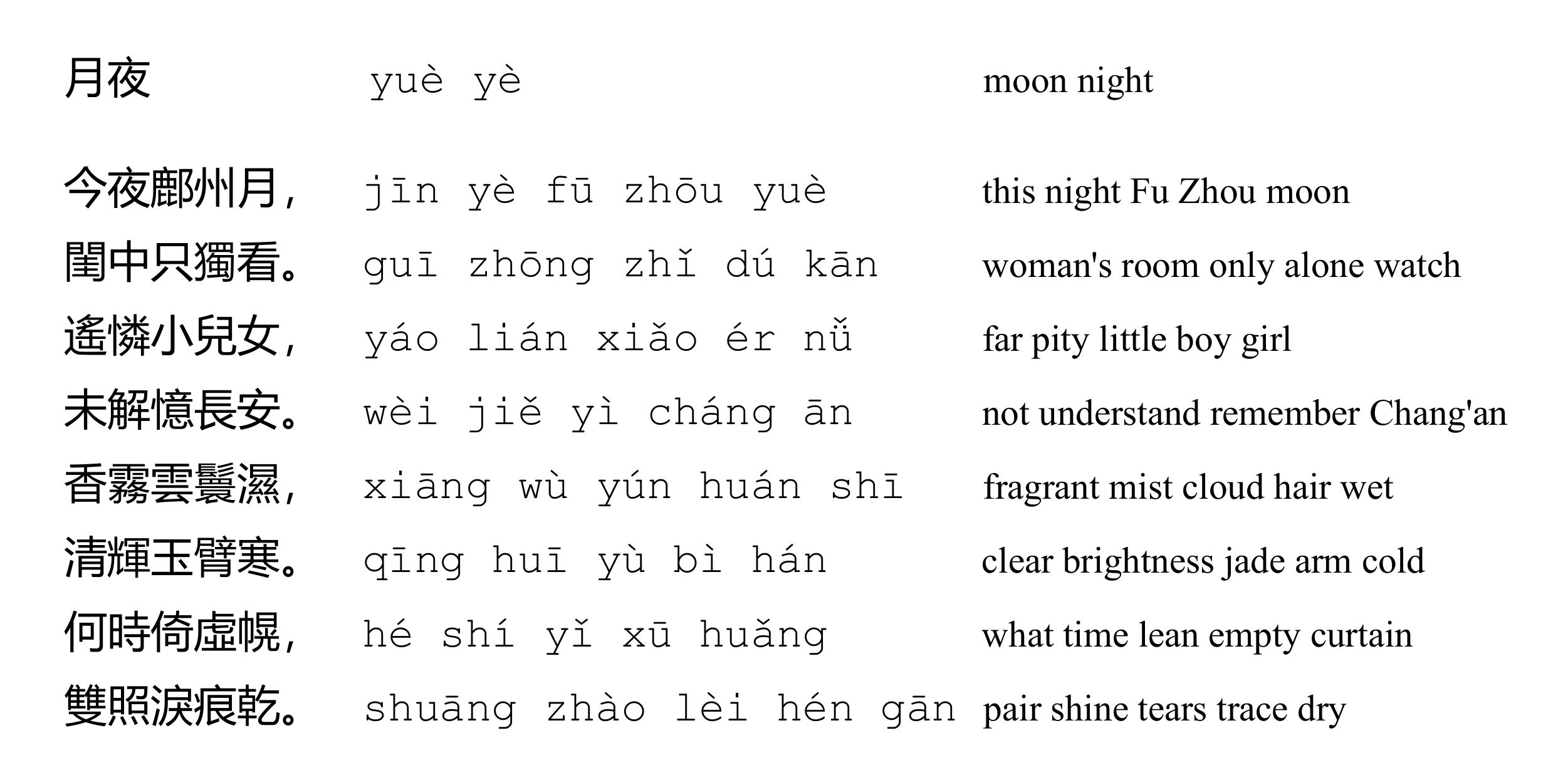
At the beginning of the rebellion, Du Fu managed to get his family to safety in the northern town of Fuzhou, but he was himself held captive in Chang’an. Fortunately, he was not considered important enough to be executed, and he finally managed to escape in 757 CE. The following shows a poem from 756 CE in characters (Owen, 2008, poem 4.18), pinyin transcription, and character-by-character translation (Alexander, 2008):

The following is a reading of the poem from Librivox:

Vikam Seth (1997) translated the poem keeping the Chinese rhyme scheme: the last character rhymes for all four couplets:

Moonlit Night

In Fuzhou, far away, my wife is watching
The moon alone tonight, and my thoughts fill
With sadness for my children, who can’t think
Of me here in Changan; they’re too young still.
Her cloud-soft hair is moist with fragrant mist.
In the clear light her white arms sense the chill.
When will we feel the moonlight dry our tears,
Leaning together on our window-sill?

Alec Roth wrote a suite of songs based on Vikam Seth’s translations of Du Fu. The following is his setting for Moonlit Night with tenor Mark Padmore:

David Young (2008) provides a free-verse translation:

Tonight
in this same moonlight
my wife is alone at her window
in Fuzhou
I can hardly bear
to think of my children
too young to understand
why I can’t come to them
her hair
must be damp from the mist
her arms
cold jade in the moonlight
when will we stand together
by those slack curtains
while the moonlight dries
the tear-streaks on our faces?

The poem may have been written or at least conceived during the celebration of the full moon in the autumn. Families customarily viewed the moon together and Du Fu imagines his wife viewing the moon alone. The mention of the wife’s chamber in the second line may refer to either her actual bedroom or metonymically to herself as the inmost room in Du Fu’s heart (Hawkes, 1967). David Young (2008) remarks that this may be “the first Chinese poem to address romantic sentiments to a wife,” instead of a colleague or a courtesan.  

David Hawkes (1967) notes the parallelism of the third couplet:

‘fragrant mist’ parallels ‘clear light,’ ‘cloud hair’ parallels ‘jade arms,’ and ‘wet’ parallels ‘cold’

Spring View

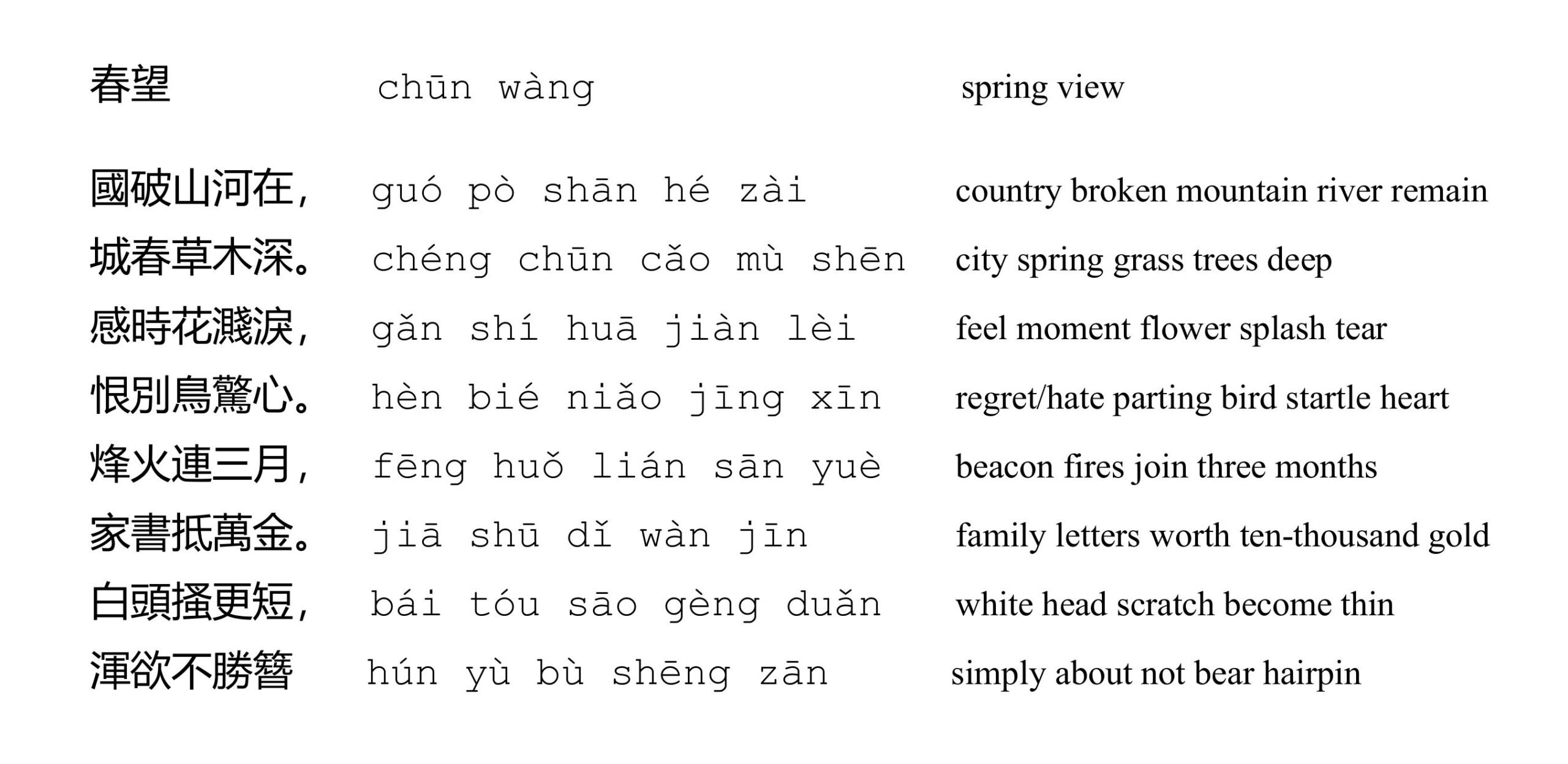
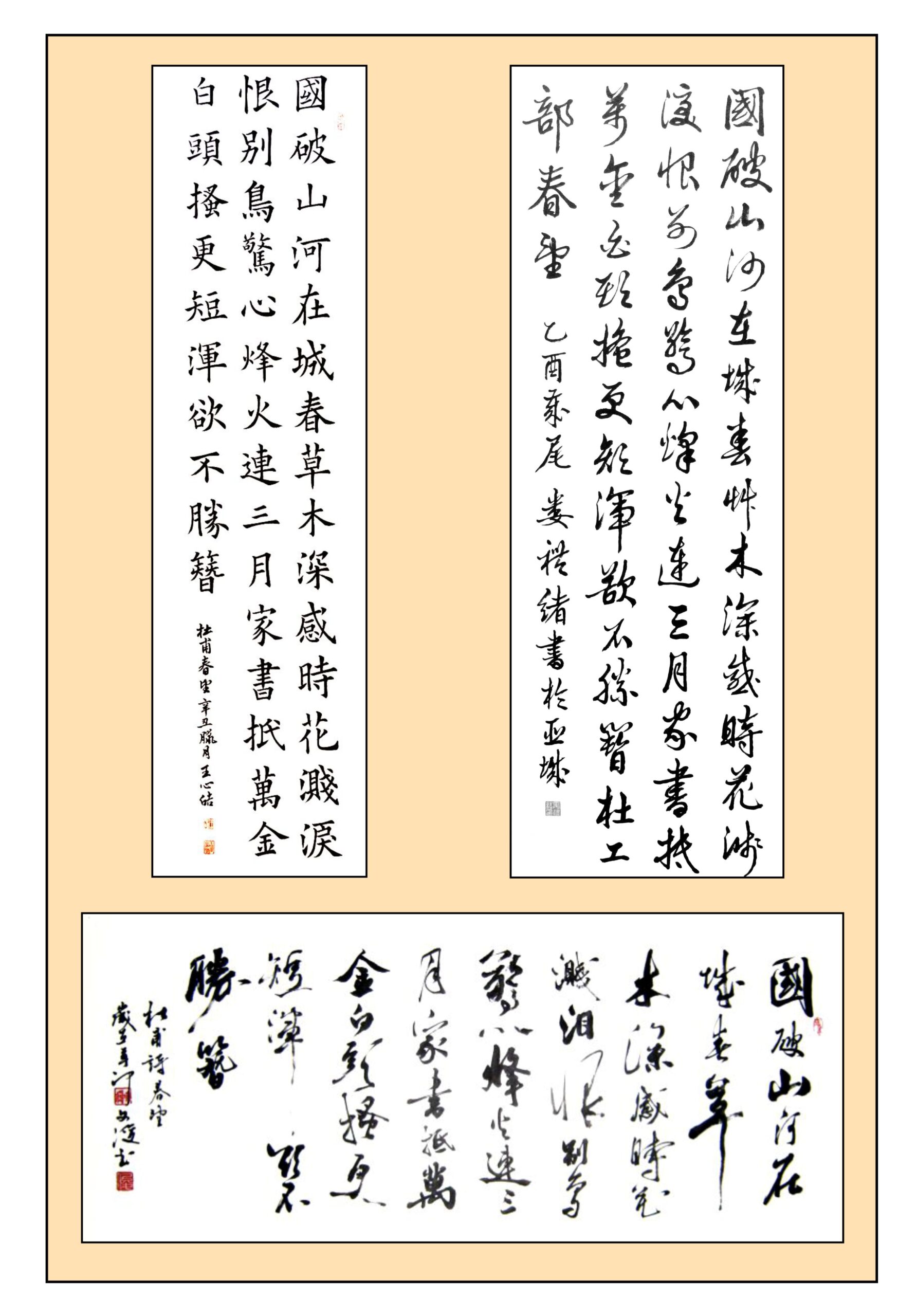
Spring View (or Spring Landscape), the most famous poem written by Du Fu in Chang’an during the rebellion, tells how nature persists despite the ravages of effects of war and time. Subjective emotions and objective reality become one. The character wàng (view, landscape) can mean both the act of perceiving or what is actually perceived. In addition, it can sometimes mean the present scene or what is to be expected in the future (much like the English word “prospect”). The illustration below shows the text in Chinese characters (Owen, 2008, poem 4.25), in pinyin and in a character-by-character translation (adapted from Hawkes, 1967, Alexander, 2008, and Zong-Qi Cai, 2008):

The following is a reading of the poem from the website associated with How to Read Chinese Poetry (ZongQi-Cai, 2008, poem 8.1):

The next illustration shows the poem as written by three calligraphers. All versions read from top down and from right to left. On the left is standard script by Anita Wang; on the right the calligraphy by Lii Shiuh Lou is gently cursive. At the bottom the calligraphy by an anonymous calligrapher is unrestrained: it accentuates the root of the growing grass (8th character) and the radicals that compose the character for regret/hate (16th character) fly apart.

The following are two translations, the first by David Hinton, which uses an English line of a constant length to approximate the Chinese 5-character line (2020a):

The country in ruins, rivers and mountains
continue. The city grows lush with spring.

Blossoms scatter tears for us, and all these
separations in a bird’s cry startle the heart.

Beacon-fires three months ablaze: by now
a mere letter’s worth ten thousand in gold,

and worry’s thinned my hair to such white
confusion I can’t even keep this hairpin in.

A second translation, with preservation of the rhyme scheme and phrasal structure, is by Keith Holyoak (2015)

       The state is in ruin;
yet mountains and rivers endure.
       In city gardens
weeds run riot this spring.

       These dark times
move flowers to sprinkle tears;
       the separations
send startled birds on the wing.

       For three months now
the beacon fires have burned;
       a letter from home
would mean more than anything.

       I’ve pulled out
so many of my white hairs
       too few are left
to hold my hatpin in!

The second couplet has been interpreted in different ways. Most translations (including the two just quoted) consider it as representing nature’s lament for the evil times. For example, Hawkes (1967) suggests that “nature is grieving in sympathy with the beholder at the ills which beset him.” However, Michael Yang (2016) proposes that “In times of adversity, nature may simply be downright uncaring and unfriendly, thereby adding to the woes of mankind.” He translates the couplet

Mourning the times, I weep at the sight of flowers;
Hating separation, I find the sound of birds startling.

The last two lines of the poem refer the hair-style of the Tang Dynasty: men wore their hair in a topknot, and their hats were “anchored to their heads with a large hatpin which passed through the topknot of hair” (Hawkes, 1967). Most interpreters have been struck by the difference between the solemn anguish of the poem’s first six lines, and the self-mockery of the final couplet (Hawkes, 1967, p 46; Chou, 1995, p 115). This juxtaposition of the tragic and the pitiable accentuates the poet’s bewilderment.

The Thatched Cottage

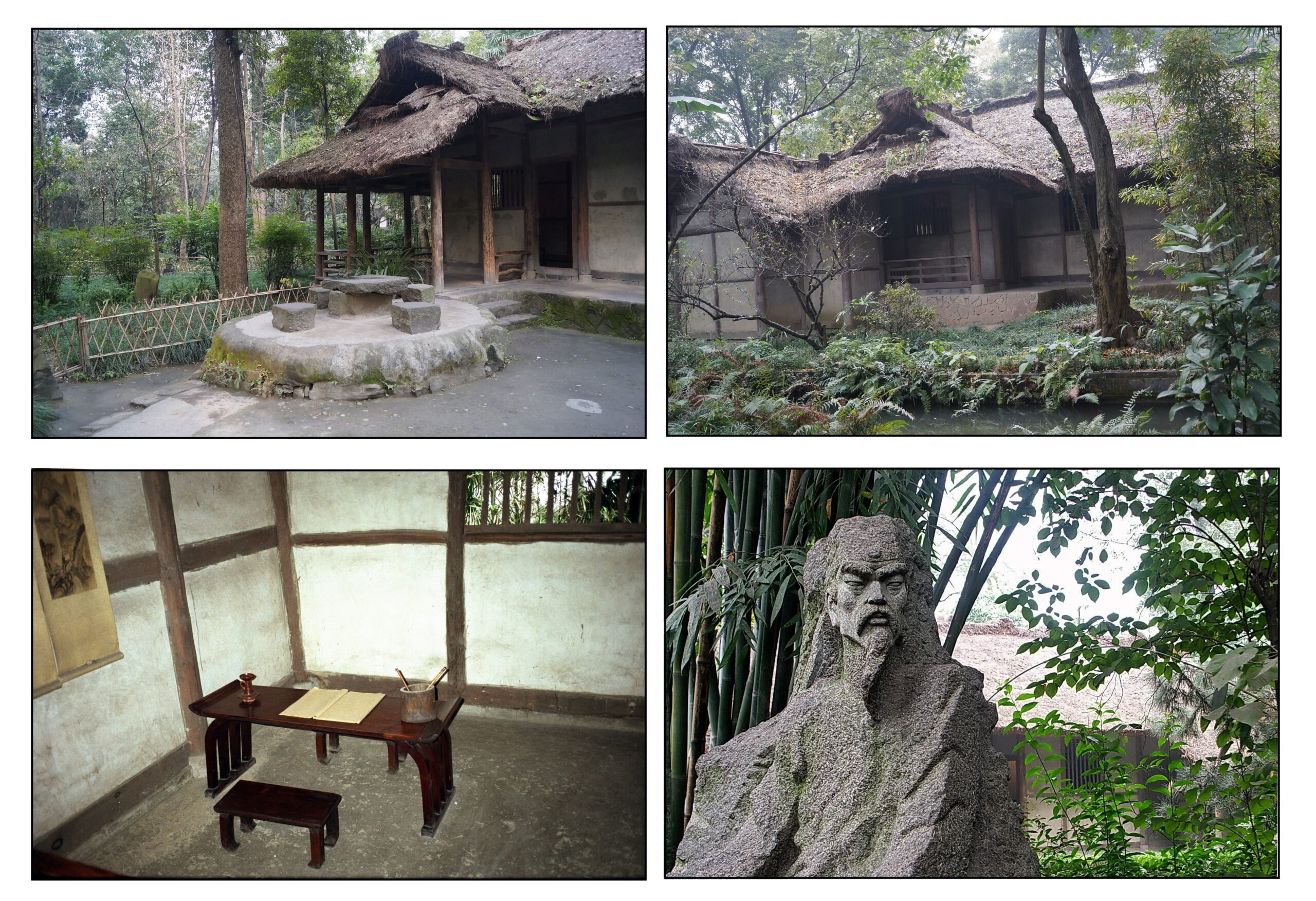
Disillusioned by the war and by the politics of vengeance that followed, Du Fu and his family retired to a thatched cottage in Chengdu, where he lived from 759-765. A replica of this cottage has been built there in a park celebrating both Du Fu and Chinese Poetry:  

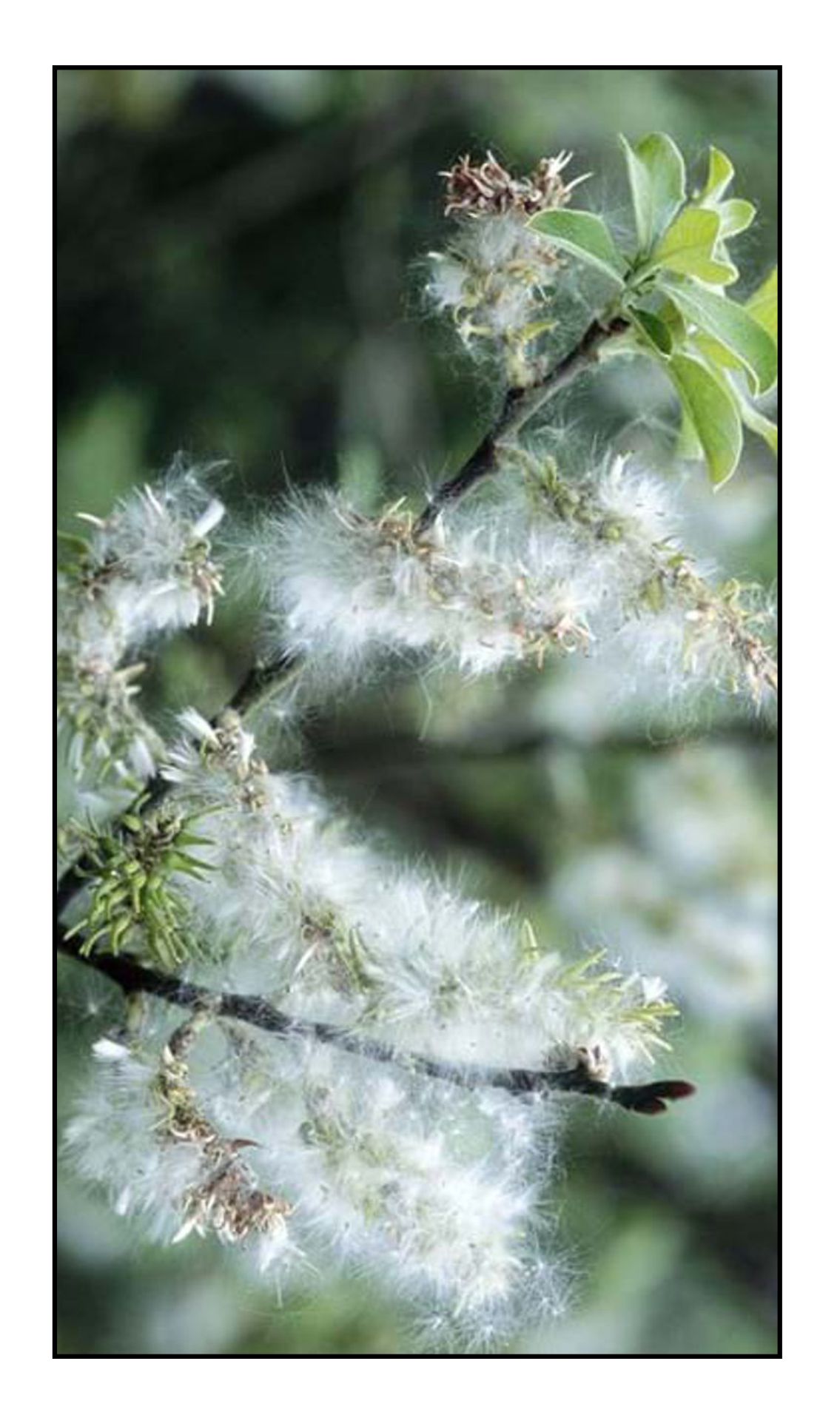
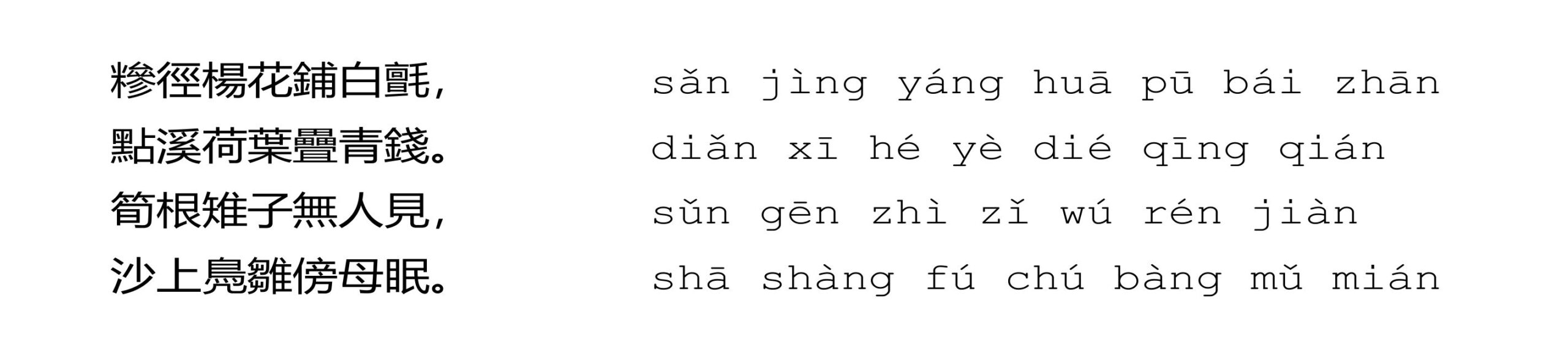
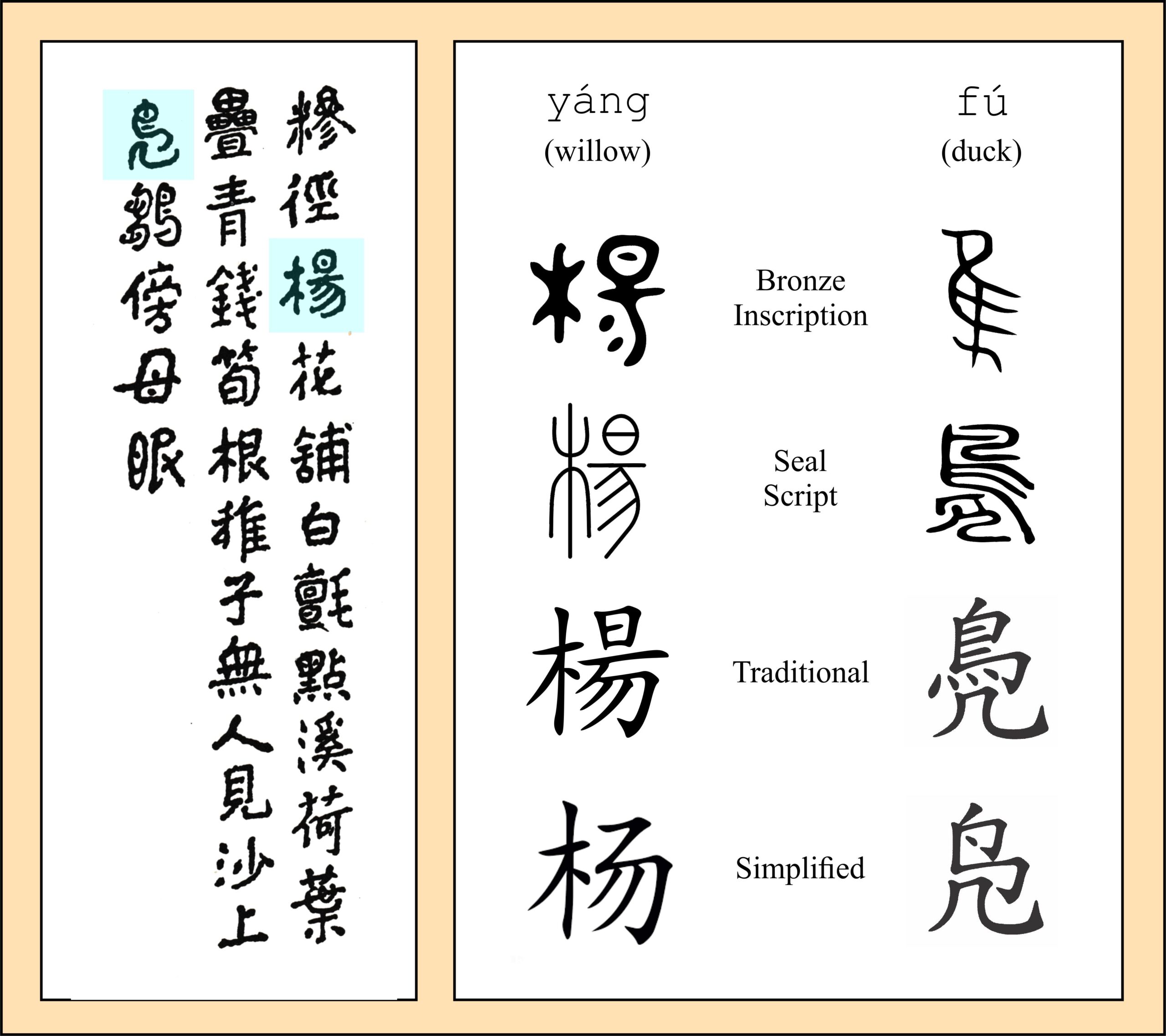
Many of the poems that Du Fu wrote in Chengdu celebrated the simple joys of nature. He often used isolated quatrains to find parallels between his emotions and the world around him. This brief form called juéjù (curtailed lines) was widely used by his colleagues Li Bai (701–762) and Wang Wei (699–759). The form consists of two couplets juxtaposed in meaning and rhyming across their last character (Wong, 1970; Zong-Qi Cai, 2008, Chapter 10). The following poem (Owen, 2008, poem 9.63) describing willow-catkins (illustrated on the right) and sleeping ducks gives a deep feeling of peace. These are the Chinese characters and pinyin transcription followed by the character-by-character translation (Alexander, 2008):  

grain    path    poplar/willow    blossom    pave    white    carpet
little    stream    lotus    leaves    pile    green    money
bamboo    shoot    root    sprout    no    person    see
sand    on    duckling    beside    mother    sleep

The following translation is by Burton Watson (2002):

Willow fluff along the path spreads a white carpet;
lotus leaves dot the stream, plating it with green coins.
By bamboo roots, tender shoots where no one sees them;
on the sand, baby ducks asleep beside their mother.

Shui Chien-Tung provided the following calligraphy for the poem (Cooper, 1973). He used aspects of the ancient scripts (circles, curves and dots) in some of the characters to give a sense of simplicity and timelessness. The illustration shows the calligraphy of the poem on the left and the evolution of the characters yáng (willow, poplar) and (duck) on the right. 

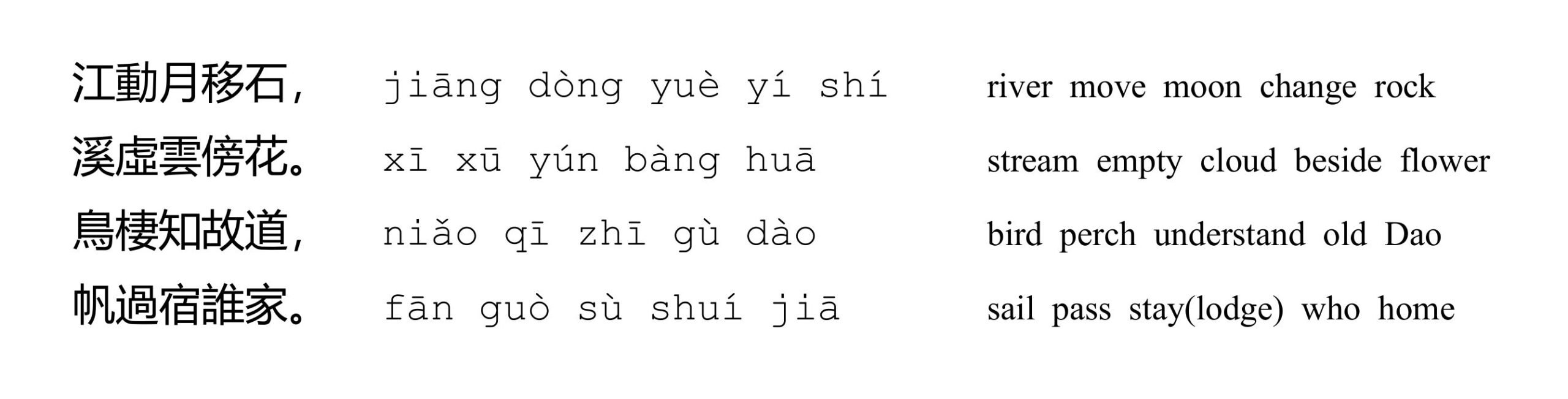
Another quatrain from Chengdu describes a night scene on the river. The following shows the poem in Chinese characters (Owen, 2008, poem 13.61), in pinyin, and in a character-by-character translation (mine):

This is the translation by J. P. Seaton (Seaton & Cryer, 1987):

The River moves, moon travels rock,
Streams unreal, clouds there among the flowers.
The bird perches, knows the ancient Tao
Sails go: They can’t know where.

As the river flows by, the moon’s reflection slowly travels across the rocks near the shore. The water reflects the clouds between the lilies. A bird on a branch understands the nature of the universe. A boat passes, going home we know not where.

The poem conveys a sense of the complexity of the world where reflections and reality intermingle, a desire to understand the meaning of our life, and a fear that time is passing and we do not know where it will take us. All this in twenty characters. Such concision is extremely difficult in English. An attempt:

River and rocks reflect the moon
and clouds amid the lilies
resting birds understand the way
sails pass seeking home somewhere.

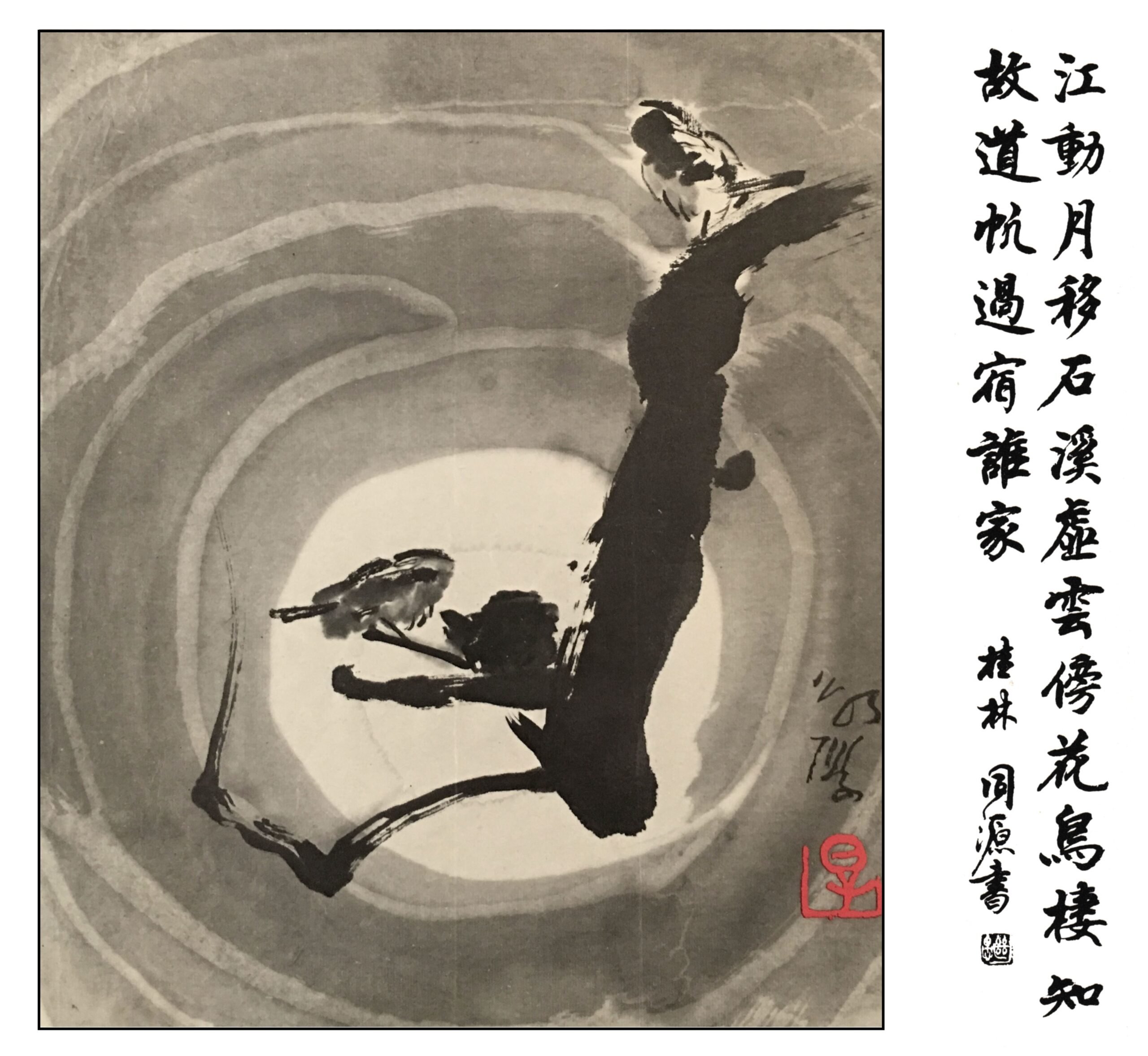
The following shows a painting by Huang Yon-hou to illustrate the poem. This was used as the frontispiece (and cover) of the book Bright Moon, Perching Bird (Seaton & Cryer, 1987). On the right is calligraphy of the poem by Mo Ji-yu.

Above the Gorges

In 765 CE Du Fu and his family left Chengdu and travelled eastward on the Yangtze River. The region of Luoyang had been recently recovered by imperial forces and Du Fu was perhaps trying to return home (Hung, 1952). He stayed for a while in Kuizhou (present day Baidicheng) at the beginning of the Three Gorges (Qutang, Wu and Xiing).

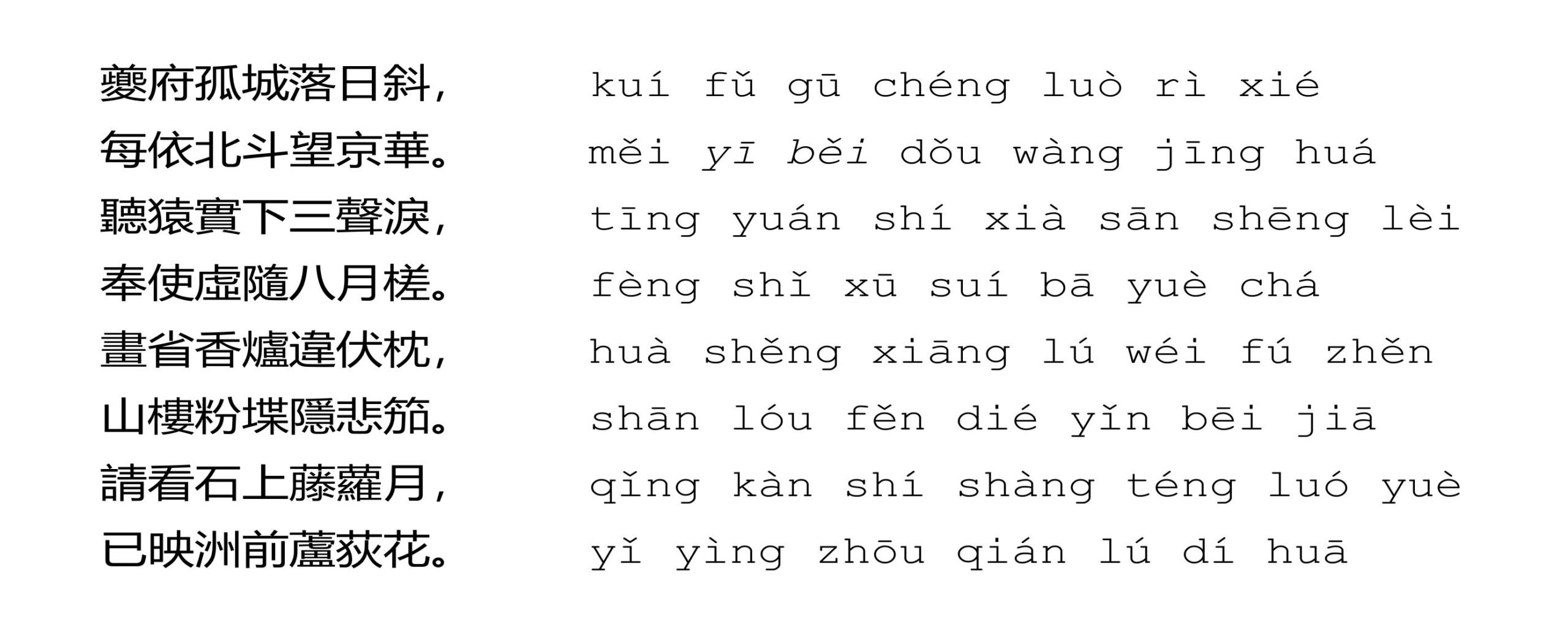
While there Du Fu wrote a series of meditations called Autumn Thoughts (or more literally Stirred by Autumn). This is the second of these poems in Chinese characters and in pinyin:

A character-by-character translation (Alexander, 2008) is:

Kui  prefecture  lonely  wall  set  sun  slant
Every  rely  north  dipper  gaze  capital  city
Hear  ape  real  fall  three  sound  tear
Sent  mission  vain  follow  eight  month  raft
Picture  ministry  incense  stove  apart  hidden  pillow
Mountain  tower  white  battlements  hide  sad  reed-whistle
Ask  look  stone  on  [Chinese wisteria]  moon
Already reflect islet before rushes reeds flowers

The following is Stephen Owen’s translation (Owen, 2008 poem 17.27):

On Kuizhou’s lonely walls setting sunlight slants,
then always I trust the North Dipper to lead my gaze to the capital.
Listening to gibbons I really shed tears at their third cry,
accepting my mission I pointlessly follow the eighth-month raft.
The censer in the ministry with portraits eludes the pillow where I lie,
ill towers’ white-plastered battlements hide the sad reed pipes.
Just look there at the moon, in wisteria on the rock,
it has already cast its light by sandbars on flowers of the reeds.

The poem is striking in the difference between the first three couplets and the last. At the beginning of the poem Du Fu is feeling regret that he is not in Chang’an which is located due north of Kuizhou (in the direction of the Big Dipper which points to the North Star). Owen notes that “There was an old rhyme that a traveler in the gorges would shed tears when the gibbons cried out three times.” The eighth month raft may refer to another old story about a vessel that came every eight months and took a man up to the Milky Way. Owen commented on the third couplet that “The “muralled ministry” is where were located the commemorative portraits of officers, civil and military, who had done exceptional service to the dynasty.” Incense was burned when petitions were presented. The final couplet disregards all the preceding nostalgia and simply appreciates the beauty of the moment.

The Ming painter Wang Shimin illustrated this final couplet in one of the leaves from his album Du Fu’s Poetic Thoughts.

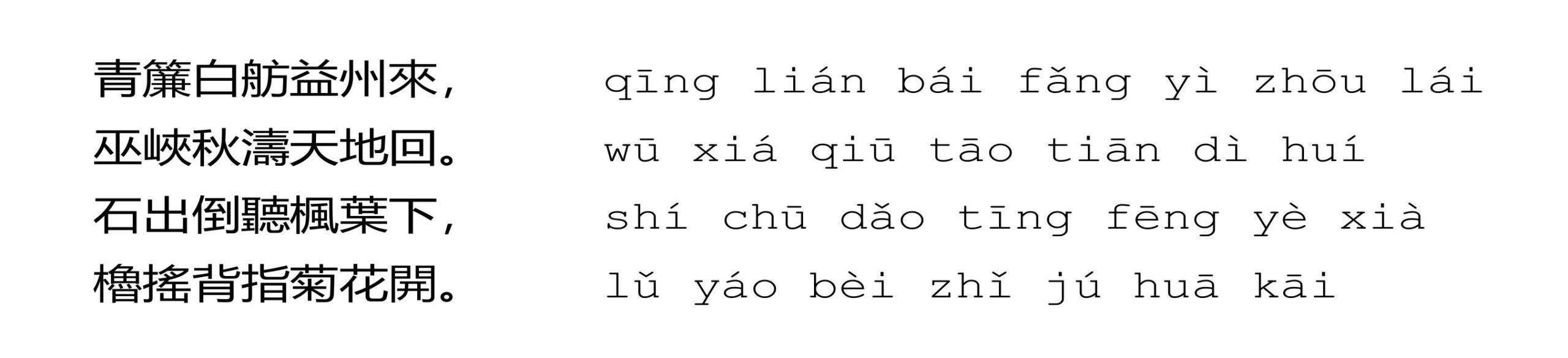
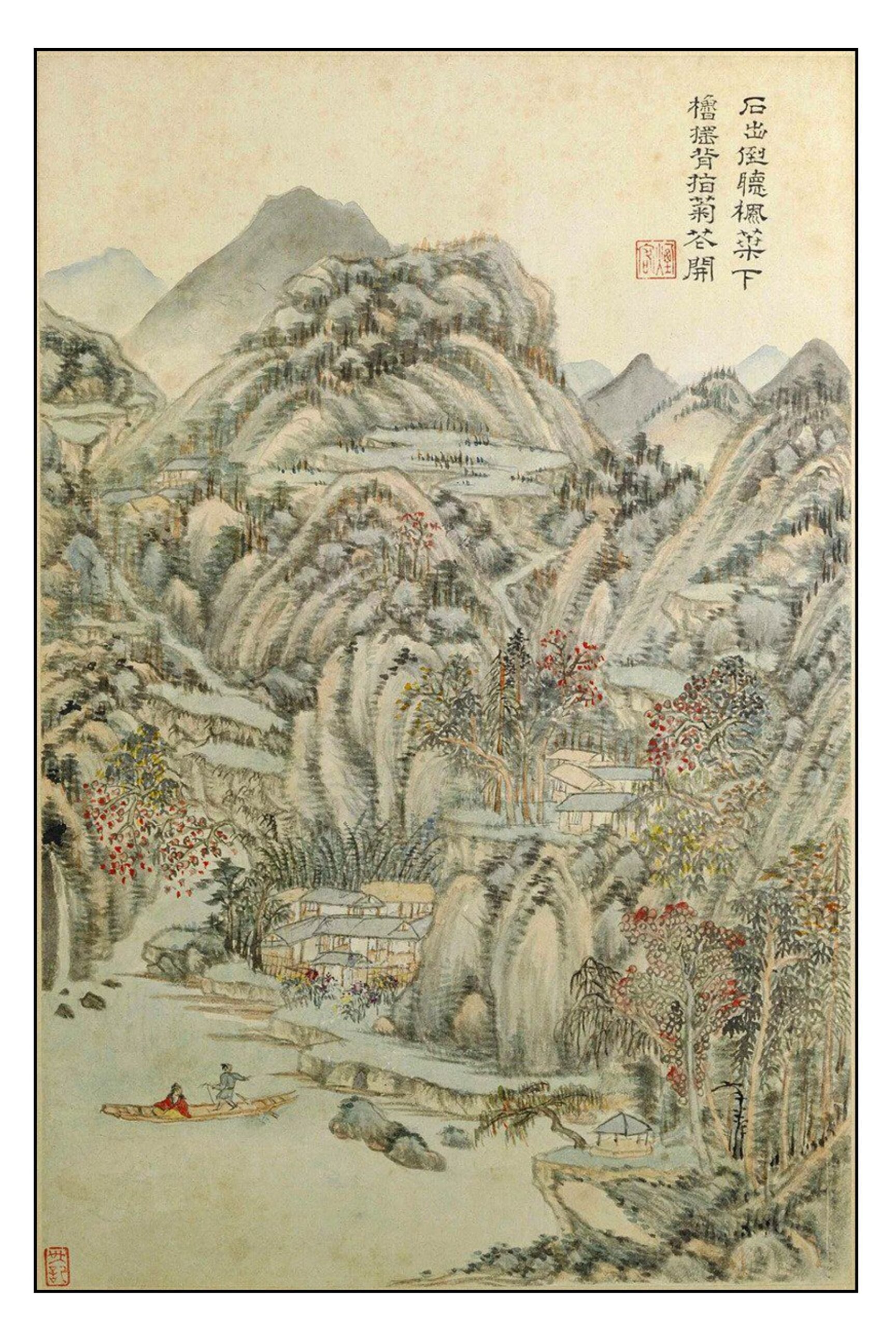
Later in Kuizhou, Du Fu entertained a librarian named Li who was returning north to take up an appointment in Chang’an. The following is the beginning of a poem (Owen, 2008, poem 19.34) describing Li’s departure in Chinese characters and in pinyin:

A character-by-character translation is:

blue/green    curtain    white    boat/raft    Yizhou    arrive
Wu    gorge    autumn    waves    heaven/sky    earth/ground    turn (around)
stone/rock    leave/exit    fall    listen    maple    leaf    down
scull/oar    swing    carry    point    chrysanthemum    flower     open/blume

The following is Stephen Owen’s translation:

When the white barge with green curtains came from Yizhou,
with autumn billows in the Wu Gorges, heaven and earth were turning.
Where rocks came out, from below you listened to the leaves of maples falling,
as the sweep moved back and forth you pointed behind to chrysanthemums in bloom.

The Ming painter Wang Shimin illustrated the second couplet in one of the leaves from his album Du Fu’s Poetic Thoughts. The painting shows the bright red leaves of the maples. In front of the riverside house one can see the multicolored chrysanthemums that Li is pointing to. Harmony exists between the wild and the cultivated.

On the River

After his sojourn in Kuizhou, Du Fu and his family continued their journey down the Yangtze River. However, the poet was ill and was unable to make it beyond Tanzhou (now Changsha) where he died in 770 CE. No one knows where he is buried. In the 1960’s radical students dug up a grave purported to be his to “eliminate the remaining poison of feudalism,” but found the grave empty.

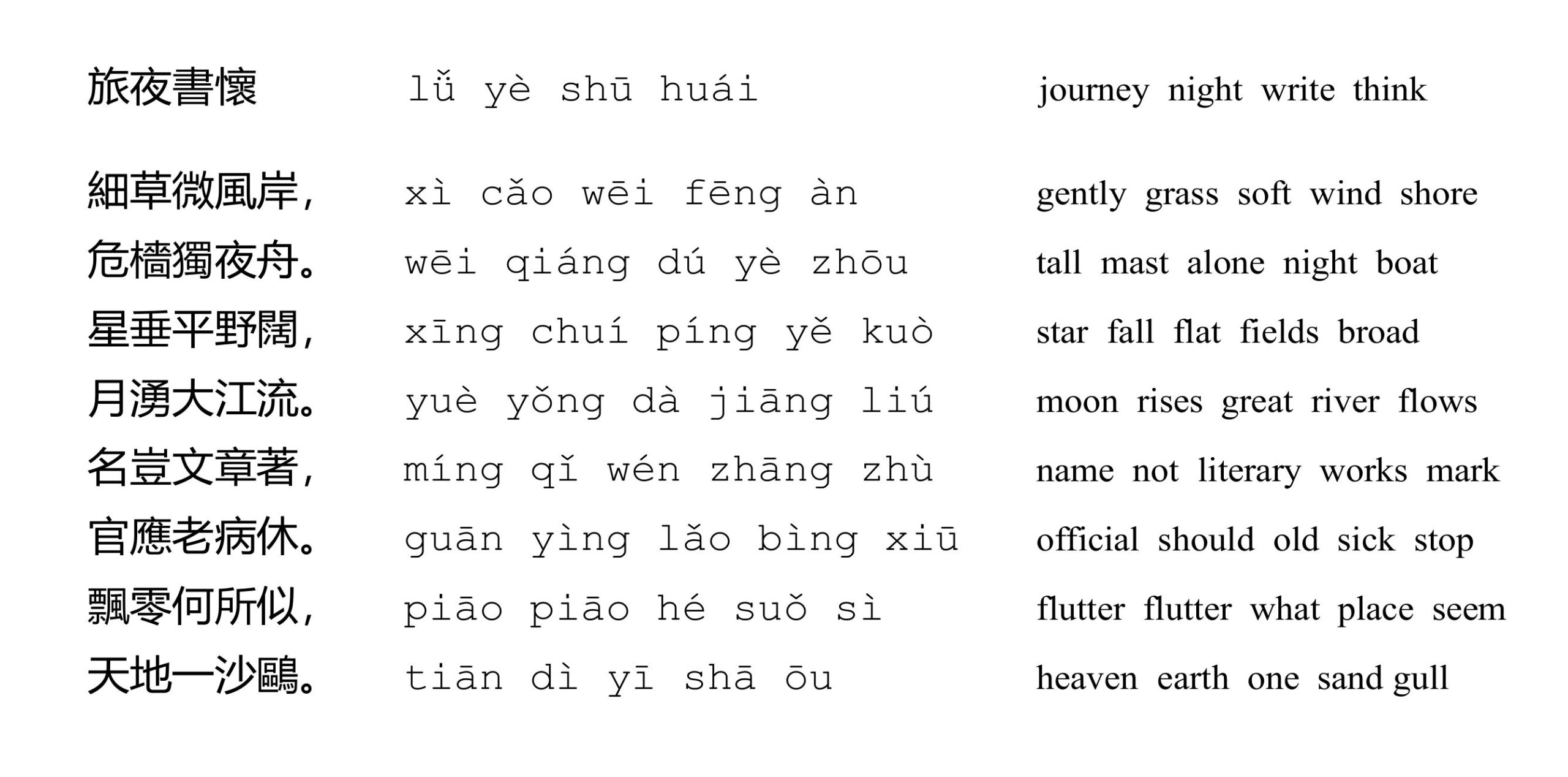
One of Du Fu’s last poems was Night Thoughts While Travelling. The following is the poem in Chinese characters (Owen, 2008, poem 14.63) and in pinyin (Alexander, 2008):

The following is a reading of the poem from Librivox:

Holyoak (2015) provides a rhymed translation:

      The fine grass
by the riverbank stirs in the breeze;
      the tall mast
in the night is a lonely sliver.

      Stars hang
all across the vast plain;
      the moon bobs
in the flow of the great river.

      My poetry
has not made a name for me;
      now age and sickness
have cost me the post I was given.

      Drifting, drifting,
what do I resemble?
      A lone gull
lost between earth and heaven.

Kenneth Rexroth (1956) translates the poem in free verse:

Night Thoughts While Travelling

A light breeze rustles the reeds
Along the river banks. The
Mast of my lonely boat soars
Into the night. Stars blossom
Over the vast desert of
Waters. Moonlight flows on the
Surging river. My poems have
Made me famous but I grow
Old, ill and tired, blown hither
And yon; I am like a gull
Lost between heaven and earth.

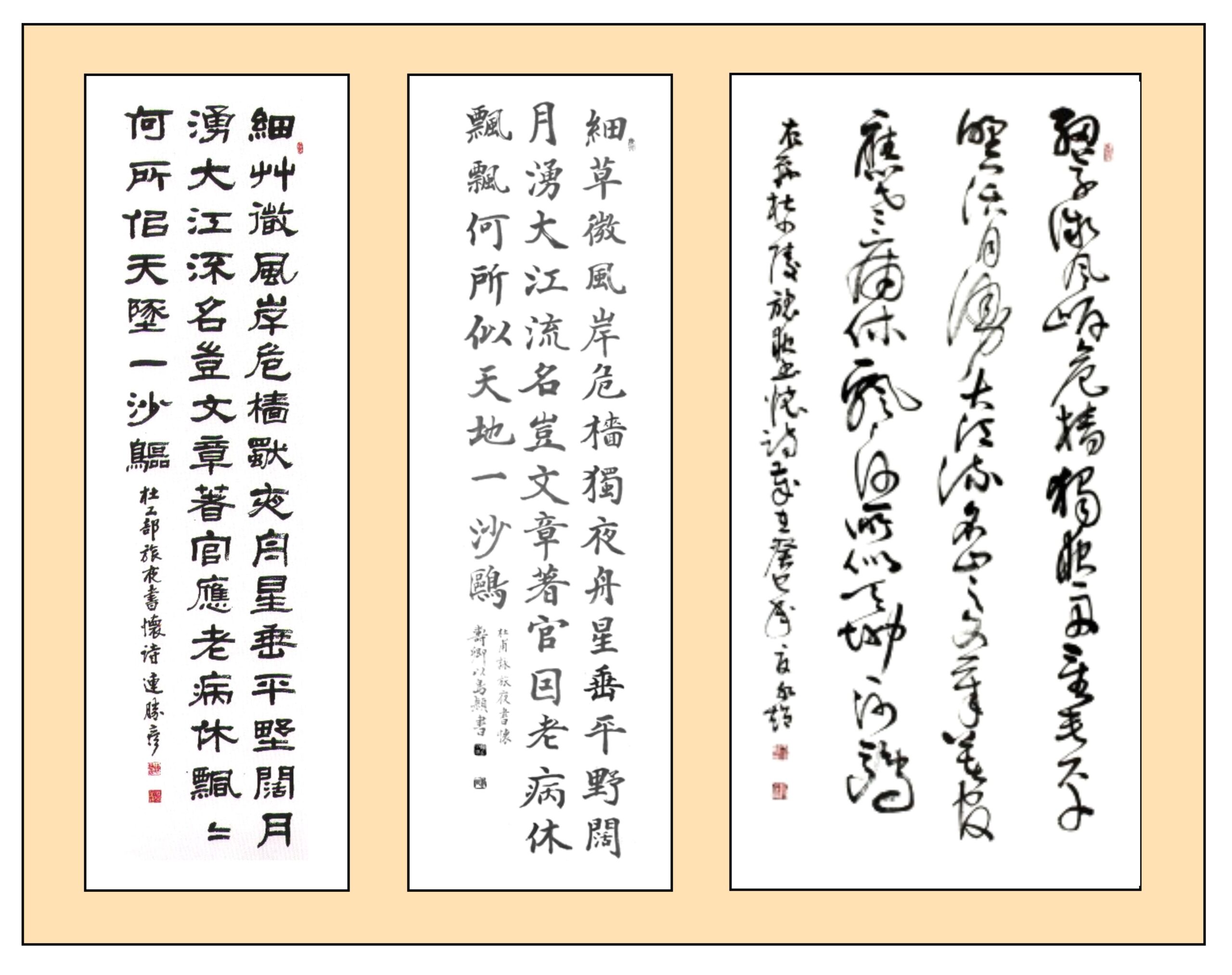
The following shows the poem in calligraphy with three styles. On the left the poem is written in clerical script, in the center in regular script and on the right is unrestrained cursive script. All examples were taken from Chinese sites selling calligraphy.

Changing Times

During the Tang Dynasty (618–907 CE) the role of literature, and poetry in particular, in society changed dramatically (Owen, 2011):

In the 650s, literature was centered almost entirely in the imperial court; by the end of the era literature had become the possession of an educated elite, who might serve in government, but whose cultural life was primarily outside the court.

During Du Fu’s lifetime, poetry became no longer a part of the ancient traditions; rather it began to be concerned with the present and with the personal. Lucas Bender (2021) describes the traditional role of poetry in a society following the precepts of Confucianism:

Most people … would be incapable on their own of adequately conceptualizing the world or perfectly responding to its contingency, and therefore needed to rely on the models left by sages and worthies. Many of these models were embodied in texts, including literary texts, which could thus offer an arena for ethical activity. Poetry, for example, was understood to offer models of cognition, feeling, and commitment that would ineluctably shape readers’ understanding of and responses to their own circumstances. One way of being a good person, therefore, involved reading good poetry and writing more of it, thereby propagating the normative models of the tradition in one’s own time and transmitting them to the future. (p 317)

Du Fu found himself bewildered by the state of the world. He sought to convey this confusion rather than explain it:

Du Fu doubts the possibility of indefinitely applicable moral categories. The conceptual tools by which we make moral judgments, he suggests, are always inherited from a past that can – and, in a world as various and changeable as ours has proven to be, often will – diverge from the exigencies of the present. As a result, not only are our values unlikely to be either universal or timeless; more important, if we pay careful attention to the details of our experience, they are unlikely to work unproblematically even here and now. (Bender, 2021, p 319)

The complexity of Du Fu’s poetry – the difficulty in understanding some of his juxtapositions – becomes a challenge. The past provides no help in the interpretation. We must figure out for themselves what relates the mountain, the clouds and the poet’s breathing in the first poem we considered. And in the last poem we must try to locate for ourselves the place of the gull between heaven and earth.


References

Alexander, M. (2008). A little book of Du Fu. Mark Alexander. (Much of the material in the book is available on Chinese Poems website).

Bender, L. R. (2021). Du Fu transforms: tradition and ethics amid societal collapse. Harvard University Asia Center.

Chan, J. W. (2018). Du Fu: the poet as historian. In Zong-Qi Cai. (Ed.) How to read Chinese poetry in context: poetic culture from antiquity through the Tang. (pp 236-247). Columbia University Press.

Chou, E. S. (1995). Reconsidering Tu Fu: literary greatness and cultural context. Cambridge University Press.

Collet, H., & Cheng, W. (2014). Tu Fu: Dieux et diables pleurant, poèmes. Moundarren.

Cooper, A. R. V. (1973). Li Po and Tu Fu. Penguin Books.

Egan, R. (2020). Ming-Qing paintings inscribed with Du Fu’s poetic lines. In Xiaofei Tian (Ed.). Reading Du Fu: nine views. (pp 129-142). Hong Kong University Press

Hawkes, D. (1967 revised and reprinted, 2016). A little primer of Tu Fu. New York Review of Books.

Hinton, D. (1989, expanded and revised 2020a). The selected poems of Tu Fu. New Directions.

Hinton, D. (2019). Awakened cosmos: the mind of classical Chinese poetry. Shambhala.

Hinton, D. (2020b). China root: Taoism, Ch’an, and original Zen. Shambhala 

Holyoak, K. (2015). Facing the moon: poems of Li Bai and Du Fu. Oyster River Press.

Hsieh, D. (1994). Du Fu’s “Gazing at the Mountain.” Chinese Literature, Essays, Articles, Reviews, 16, 1–18.

Hung, W. (1952, reprinted 2014). Tu Fu: China’s Greatest Poet. Harvard University Press

Owen, S. (1981). Tu Fu. In S. Owen, The Great Age of Chinese Poetry: The High T’ang. (pp 183-224). Yale University.  

Owen, S. (2010). The cultural Tang (650–1020). In Chang, K. S., & Owen, S. (Eds). The Cambridge History of Chinese Literature (Vol. 1, pp. 286–380). Cambridge University Press.

Owen, S., (edited by P. W. Kroll & D. X. Warner, 2016). The poetry of Du Fu. (6 volumes). De Gruyter. (Available to download in pdf format.)

Rexroth, K. (1956). One hundred poems from the Chinese. New Directions.

Rouzer, P. (2020). Refuges and refugees: how Du Fu writes Buddhism. In Xiaofei Tian (Ed.). Reading Du Fu: nine views. (pp. 75-92). Hong Kong University Press.

Seaton, J. P., & Cryer, J. (with calligraphy by Mo Ji-yu, and painting by Huang Yon-hou, 1987). Bright moon, perching bird: poems of Li Po and Tu Fu. Wesleyan University Press.

Seth, V. (1997). Three Chinese poets: translations of poems by Wang Wei, Li Bai and Du Fu. Phoenis.

Sullivan, M. (1974). The three perfections: Chinese painting, poetry, and calligraphy. Thames and Hudson.

Xiaofei Tian (Ed.). (2020). Reading Du Fu: nine views. Hong Kong University Press.

Zhang, Y. (2018). On 10 Chan-Buddhism images in the poetry of Du Fu. Studies in Chinese Religions, 4(3), 318–340.

Wai-lim Yip. (1997). Chinese Poetry, Duke University Press.

Watson, B. (2002). The selected poems of Du Fu. Columbia University Press.

Wong, S. S. (1970) The quatrains (Chüeh-Chü 絕句) of Tu Fu. Monumenta Serica, 29, 142-162

Yang, M. V. (2016). Man and nature: a study of Du Fu’s poetry. Monumenta Serica, 50, 315-336.

Young, D. (2008). Du Fu: a life in poetry. Alfred A. Knopf.

Zong-Qi Cai (2008). How to read Chinese poetry: a guided anthology. Columbia University Press. (audio files are available at website).