A Way of Writing: The Art of Chinese Calligraphy
Chinese calligraphy (書法, simplified 书法, shūfǎ, literally ‘way of writing’) is the art of writing Chinese characters (漢字, simplified 汉字, hànzì) with a brush. Together with poetry and painting, calligraphy is considered one of the “Three Perfections” (三絕 sānjué) of Chinese art. This essay reviews the development of calligraphy and provides some examples of its beauty. The illustration shows the calligraphy of the characters of shūfǎ in regular and semi-cursive styles.
A Brief History
According to legend, Chinese writing began during the reign of the Yellow Emperor in the 3rd Millenium BCE. The emperor asked Cangjie (倉頡) one of his ministers to create a way to record knowledge. Cangjie was blessed with two pairs of eyes. This allowed him to see the basic shapes and patterns underlying the perceived world.
The first clear evidence for writing in China, however, comes from symbols found on the shoulder blades of oxen and the shells or tortoises. These date to around 1250 BCE. The symbols appear to have been used during divination, and the writing is therefore called Oracle Script (甲骨文,jiǎgǔwén, “shell and bone script”).
Beginning around 1000 BCE, characters were being cast onto or incised into various ritual bronze containers. This type of writing is called Bronze Script, (金文, jīnwén).
Over the years various styles of writing were used. Legend has it that the First Emperor Qin Shi Huang (259–210 BCE) established a standard writing style to be used across his newly unified empire: the Small Seal Script, 小篆 (xiǎozhuàn). Although the histories attribute this to the First Emperor, the script likely developed incrementally rather than by fiat. The script is characterized by thin lines that do not vary in width. The characters tend toward right-left symmetry, and the shapes are curved rather than rectilinear.
The invention of paper (in China in 105 BCE) and the use of writing brushes led to the development of the Clerical Script (隶書, simplified 隶书, lìshū) by around 100 BCE. The lines vary in thickness as befits the use of a brush. The characters show a tendency for the lines to sweep toward the right. The script is rectilinear rather than curved, and the width of the characters tends to be greater than their height.
Over the following years clerks and scholars modified the clerical script to be lighter and more regular. The characters tended to occupy a square form. The individual strokes making up the different characters became standardized. This development occurred over several centuries beginning in the Second Century CE. The final version of Regular Script (楷書, simplified 楷书, kǎishū) became established during the Tang Dynasty (618–907 CE).
 While the regular script was being perfected, the needs of writing speed and emotional expression led to the development of Cursive Script (草書, simplified 草书cǎoshū, literally “grass writing”). As well as denoting “grass” the character 草 can also mean “careless, hasty, draft.” The characters are no longer created by discrete strokes, but formed with one or several continuous movements of the brush. The characters are curved and tend to have widths less than their height. The illustration on the right shows 草書 written in regular script and in cursive script. Regular script requires 20 separate strokes, but cursive uses only 3. Cursive script is variable from one writer to another.
A more legible version of cursive script soon developed: Semi-cursive Script (行書 simplified 行书, xíngshū, “running script”). This script is a compromise between the regular and cursive scripts. Characters are clearly demarcated from each other. Nevertheless, the individual strokes within the character become connected and flow together. There are conventions for depicting various sets of strokes. For example, parallel lines are represented as a z form rather than as = and dots are connected into a line. The style is analog rather than digital.
After the Chinese Communist Revolution, the new government of the People’s Republic of China simplified many of the commonly used highly complex characters. From 1949 to 1986, these changes led to the current Simplified Characters (简化字; jiǎnhuàzì, literally “simple transformed characters”). In writing this name, the traditional character 簡 has been simplified to 简. In the names of the earlier scripts, the traditional 書 was simplified to 书.
The following illustration of the different scripts shows the evolution of the characters 天 tiān sky/heaven, 馬 mā horse, 旅 lǚ travel/journey, and 正 zhĕng straight/correct. Of these, only the character for horse underwent modern simplification. The dates show the approximate times when the different scripts began.

More information about the evolution of Chinese characters is available in Chiang (1973), Qui (2000), Shi (2003) and Li (2010)
Thousand Character Classic (千字文 qiānzì wén)
The Thousand Character Classic is a long poem that uses a thousand different characters (Paar, 1963; Sturman, accessed 2025). The poem contains 250 lines, each four characters long, arranged in rhyming quatrains to facilitate memorization. Legend has it that in the 6th Century CE, the Emperor Wu commissioned the poem to teach children the rudiments of writing. Since the text was learned by any literate person, the order of its characters could be used to put documents in sequence in the same way that alphabetical order is used in alphabetic languages. Copybooks showing the thousand characters in different writing styles soon became popular. The following example shows the beginning of the poem in a modern version (“The sky was black and the earth was yellow; space and time vast and limitless”):

Zhang Xu (張旭, ca 675-750 CE)
Zhang Xu was a court scholar and calligrapher. Although adept in regular script, he became renowned for his works in a wild cursive style (狂草 kuángcǎo ‘crazy cursive’), often created under the influence of wine (Jagger, 2023). His friend the poet Du Fu considered him one of the Eight Immortals of the Wine-cup (Li Bai was another):
张 旭 三 杯 草 圣 传
脱 帽 露 顶 王 公 前
挥 毫 落 纸 如 云 烟。
Zhang Xu, the Sage of Cursive Script, after three cups of wine,
Would doff his cap from his head before princes and dukes,
And let his brushstrokes fall on the paper like misty clouds
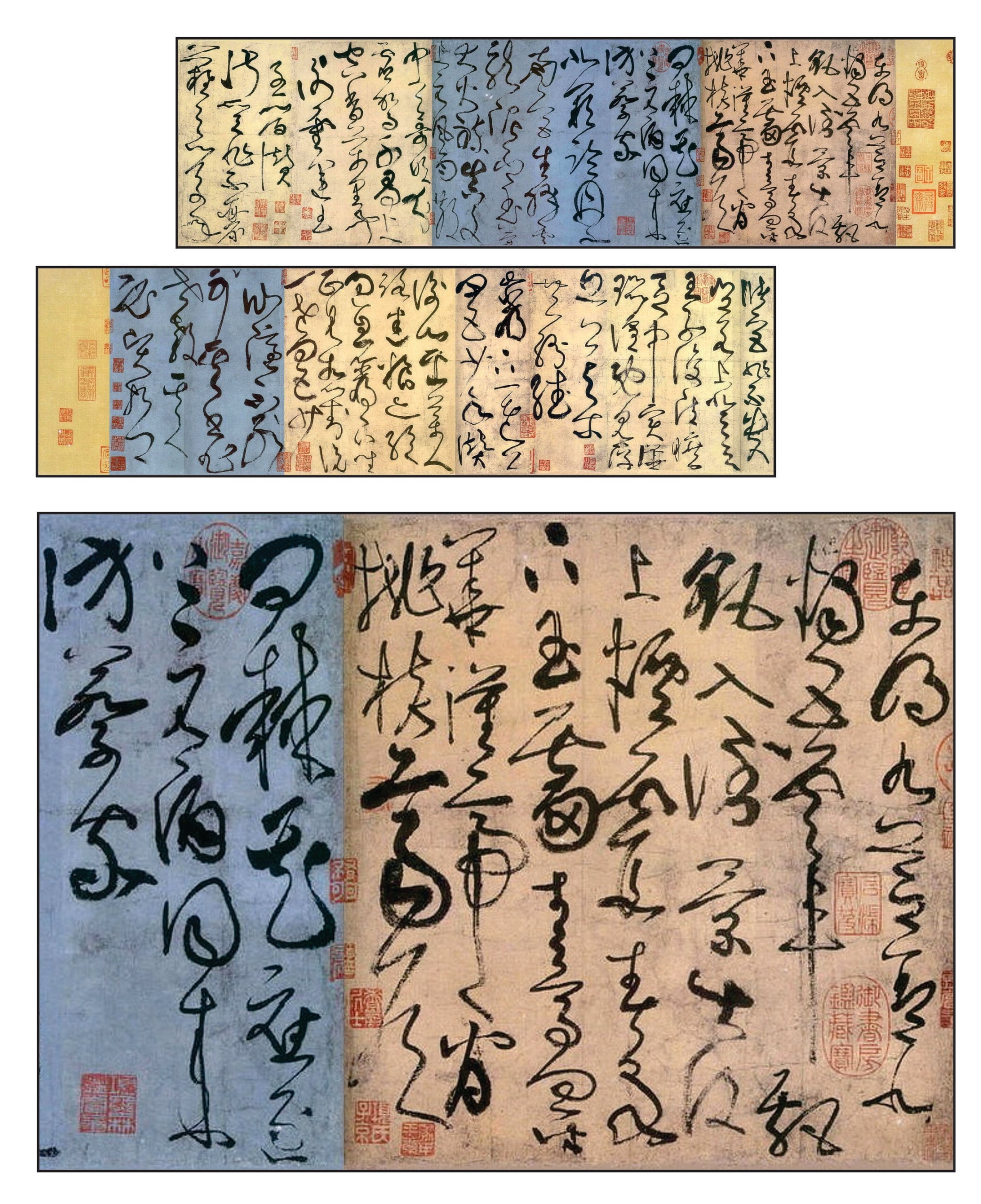
The most famous work attributed to him is his Four Ancient Poems (古詩四帖) a scroll (29.5 x 195.2 cm) on multi-colored paper now in the Liaoning Provincial Museum, Shenyang (Ouyang, & Wang, 2008 pp 217-223). The first poem by Yu Xin (513–581) is about the beginning of spring and the New Year celebrations:
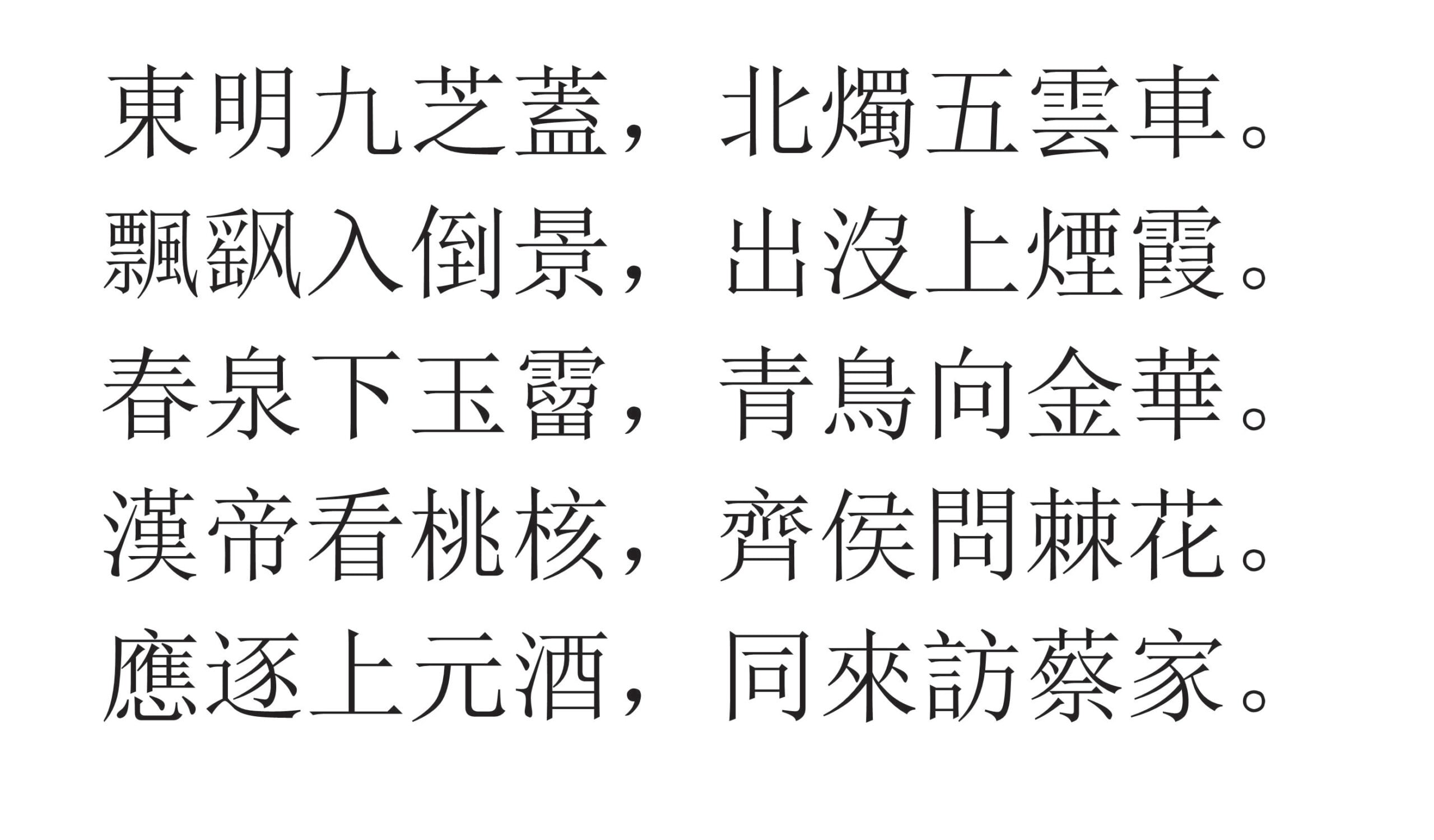
The Eastern Light with his nine-petal mushroom canopy
And the Northern Candle with her five-hued cloud-chariot
Descend and drift into the light of sunset
Appearing and disappearing among the clouds.
Spring water flows like rain falling on jade,
And bluebirds fly towards the Jinhua mountain
The Han Emperor examines the peach-tree seeds,
And the Qi Marquis inquires about the jujube blossoms.
We drink the wine of the Lantern Festival
And visit with the Cai family.
The Eastern Light and the Northern Candle are the names of Daoist deities (Luo, 2019, pp 320-321). The ecstatic energy of the Zhang Xu’s calligraphy befits the poem’s enthusiastic enjoyment of the beginning of spring.
The following illustration shows the complete scroll divided into two parts, and an enlargement of the first poem. To compare the characters, note that the calligraphy moves from top to bottom and from right to left, whereas the text above is written from left to right.
Zhao Mengfu (趙孟頫, 1254–1322)
Zhao Mengfu was a calligrapher and painter at the time when the Mongols conquered China and established the Yuan Dynasty (1271-1368). Since he worked for the Mongol emperors, his politics were considered suspect by later historians. However, he is recognized as China’s most talented calligrapher (McCausland, 2011). He wrote in all styles, but was an absolute master of the regular script. Copybooks of his calligraphy are still widely used by students wishing to master kaishu.
The following illustration shows the beginning of the third scroll in an original set of seven for the Sutra on the Lotus of the True Dharma (Chinese: 妙法蓮華經 miàofǎ liánhuá jīng), a basic text in Mahayana or “Great Vehicle” (Chinese: 大乘 dàshèng) Buddhism. The scroll, written in small regular script, is now in the collection of the technology entrepreneur Jerry Yang (Wang Lianqi in Chang & Knight, 2012, pp 70-103). The scroll is 28 cm wide and 275 cm long.
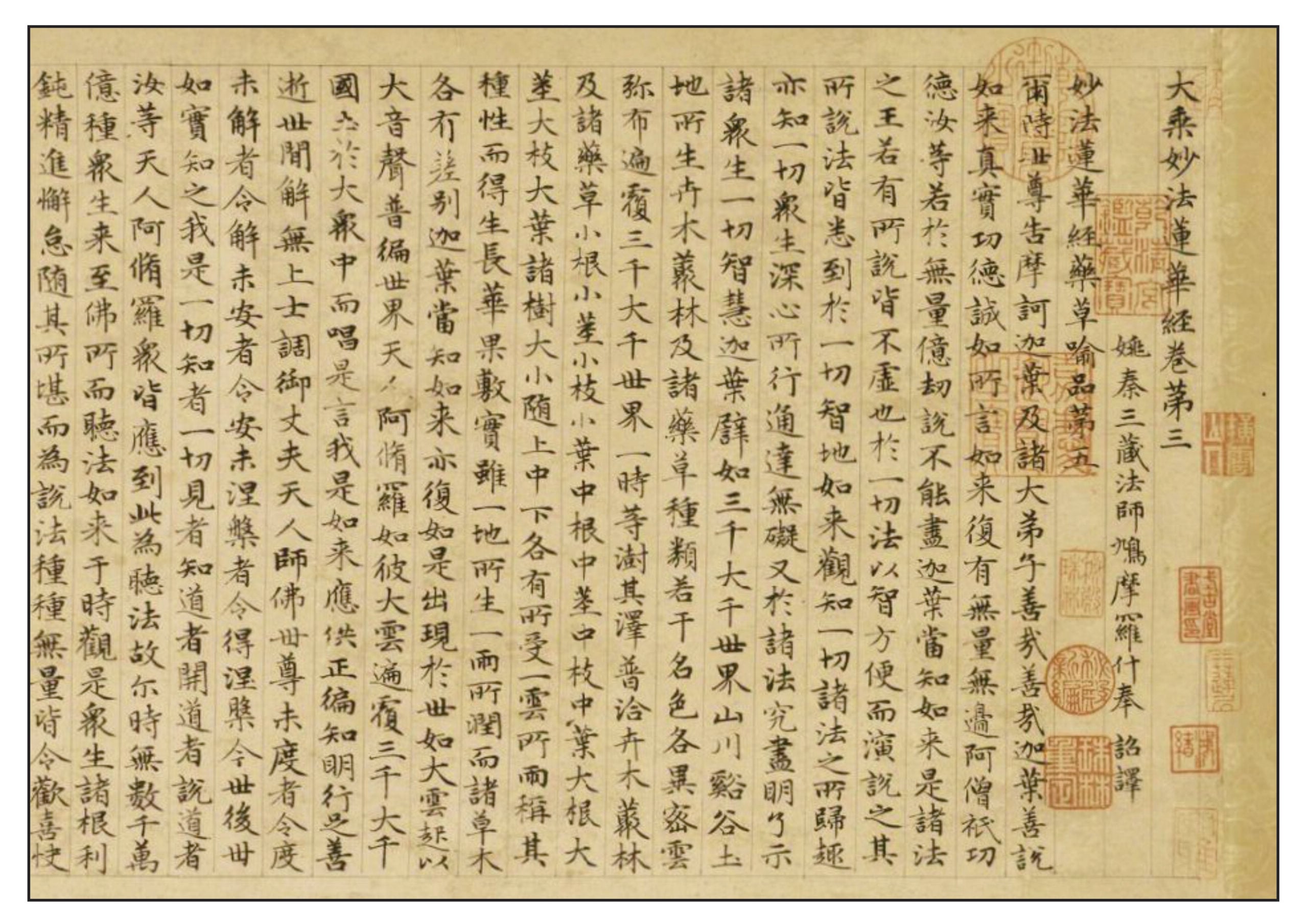
The beginning of the text (4th line from the right) reads 爾時世尊告摩訶迦葉及諸大弟子善哉善哉: At that time the world-honored one [Buddha] spoke to Mahakasyapa [one of his disciples] and the other major disciples “Excellent, excellent …” This is the beginning of Chapter 5 in the Sutra.
Wang Lianqi (Chang & Knight, 2012, pp 98-99) remarks about the calligraphy:
This scroll by Zhao Mengfu has more than ten thousand characters written with seeming effortlessness, and from start to finish they are consistent in that they are steady yet agile at the same time. Unless one has exceptional skill, something like this would be utterly impossible. But what is especially exceptional here—apart from the refined beauty of its dots and strokes, the stability of its composition, the comfortable spacing, and the openness of its forms (all achieved while adhering strictly to the principles of standard script)—is that Zhao is able to impart freshness and vitality to the forms, so that strength emerges amid their graceful charms. As a result, viewers forget the concentration and care that went into their structure and brushwork and see only their naturalness and serenity.
Zhao Mengfu was also a brilliant painter. The following illustration shows his depiction of Elegant Rocks and Sparse Trees on a scroll 28 cm widenow in the Palace Museum in Beijing. The painting shows a scene in early spring. Two large rocks are painted in “flying white” (飛白féibái) style, with the upper edge of the right rock accentuated, provide the main structure of the painting. “Flying white” is a style of painting or calligraphy that uses a lightly loaded brush to leave lines with white streaks showing through. Between the rocks are two lightly traced leafless trees. At the outer edge of each rock are trees more darkly inscribed. The tree on the right is leafless but the one on the left has new buds on its sinuous branches. Young bamboo shoots grow in clumps on the ground and between the rocks. On the ground are sprouts of new grass. This is a marvelous portrayal of the transition between winter and spring.
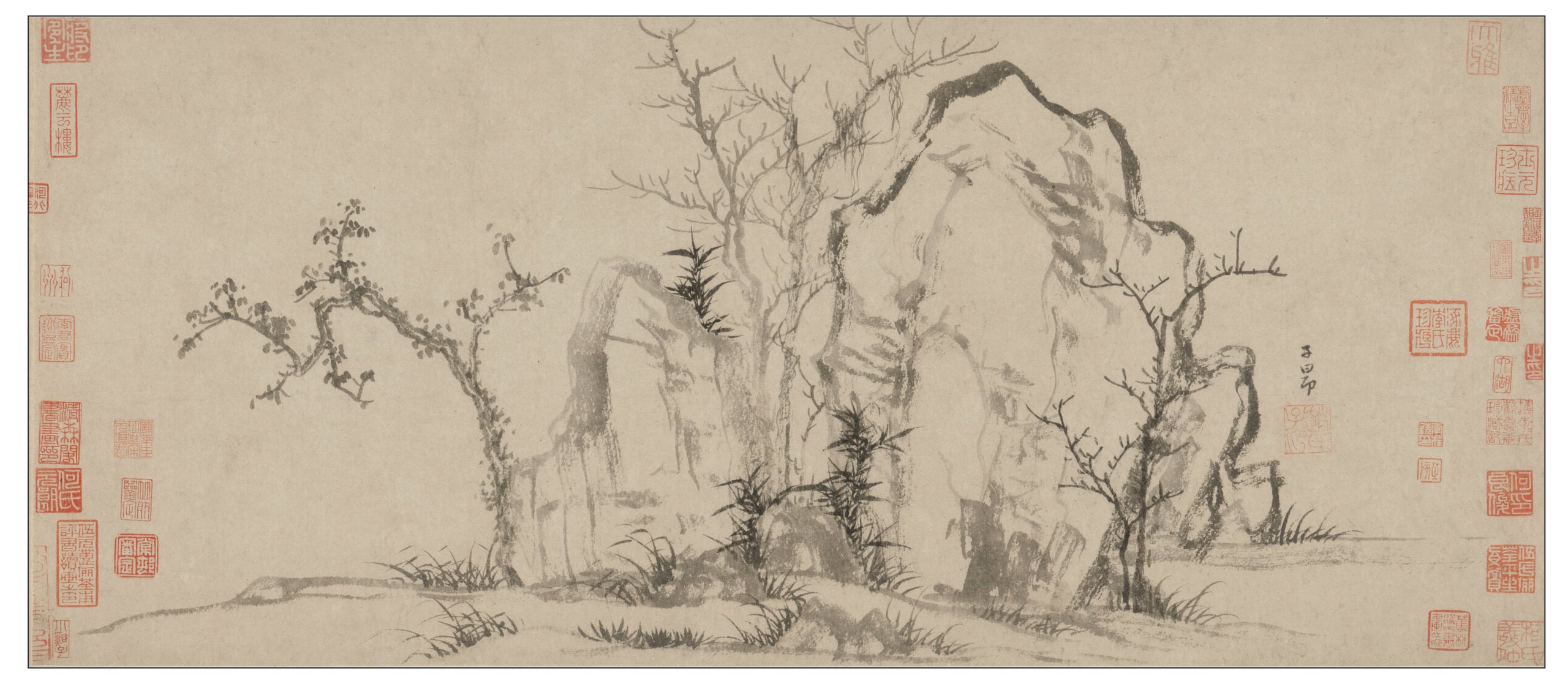
The scroll includes colophons by the painter (right) and three colleagues:
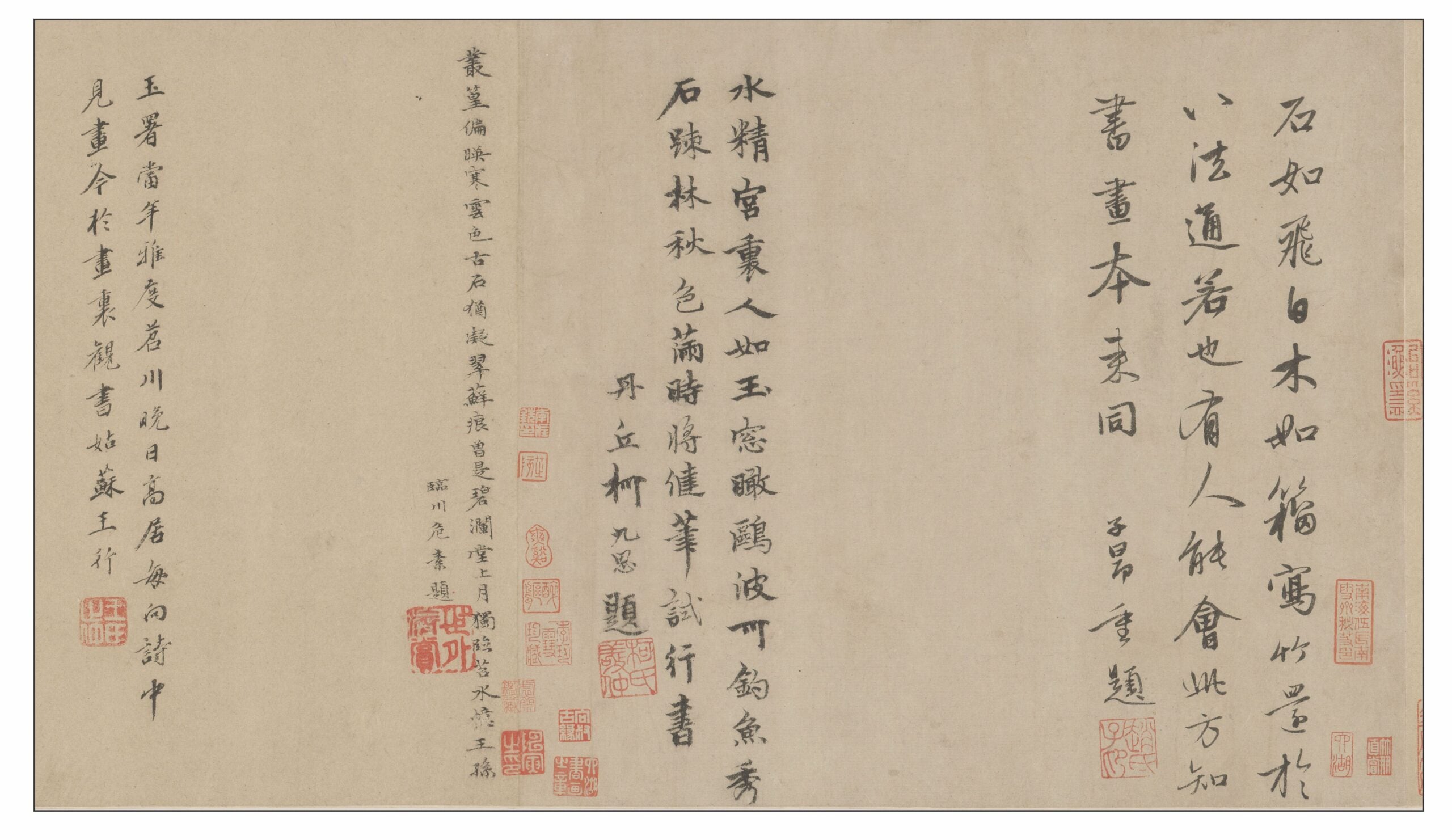
Zhao Mengfu’s colophon reads:

The rocks are like “flying-white,” the trees like “seal script.”
Depicting the bamboo draws upon the “eight clerical” method.
If indeed there are people that can make these associations,
They will understand that calligraphy and painting have the same root.
The “eight” style of clerical script was right-left symmetrical with long sweeping strokes as in the character 八 bā for eight.
The painting and poem provide a fine example of the “Three Perfections” (三絕 sānjué): the combination of poetry painting and calligraphy.
Ni Zan (倪瓚 simplified 倪瓚, 1301–1374)
Ni Zan was another gifted painter and calligrapher who worked during the Yuan Dynasty. One of his most famous paintings, now in the Shanghai Museum has come to be known as The Six Gentleman (1345):
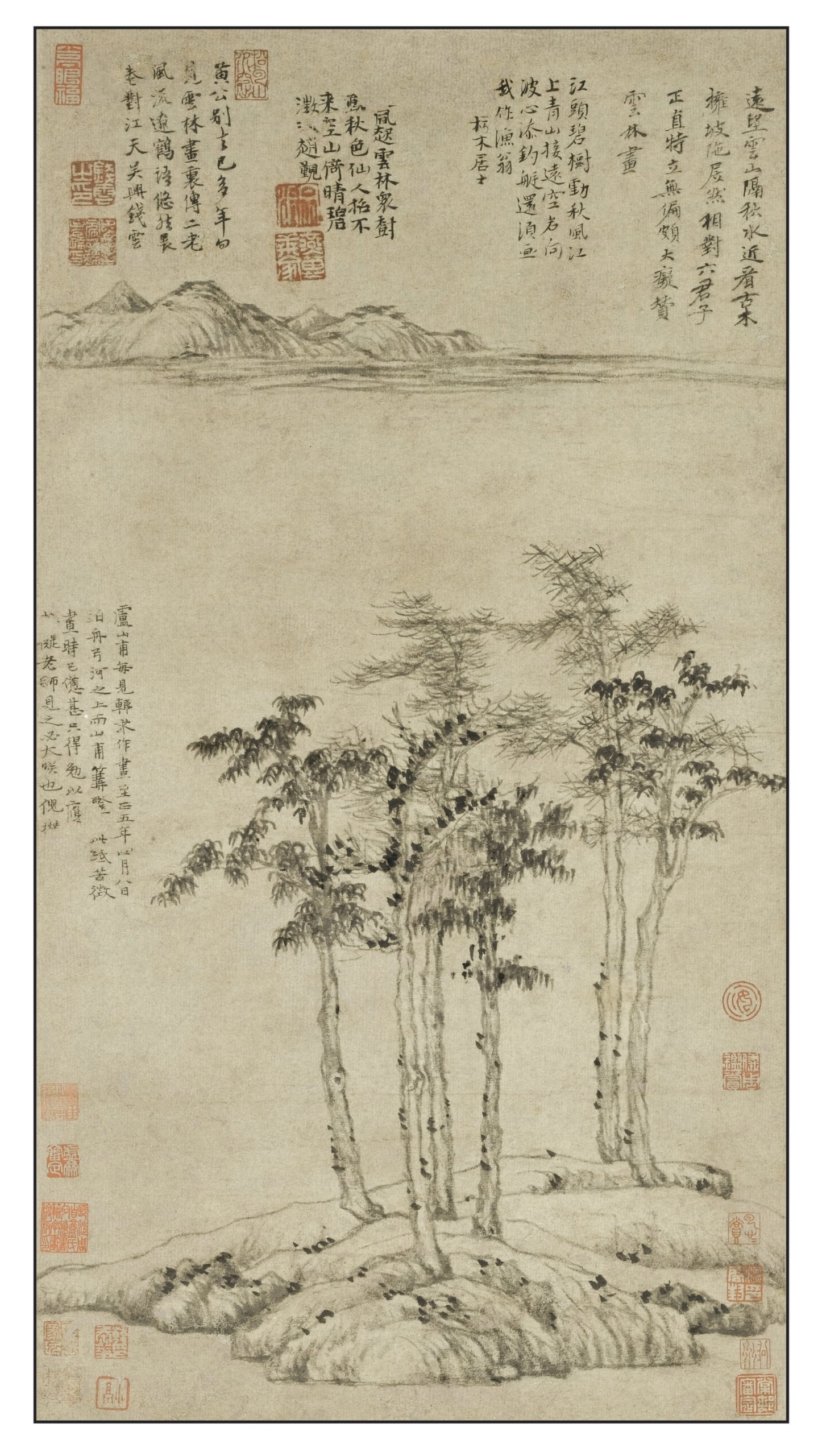
Xu (2022, p 32) describes the striking combination of emptiness and strength in the image:
[T]the composition has been pulled apart, introducing an almost unbridgeable gap between foreground trees and distant hills. Moreover, the gap between the edge of the paper and the sandbank isolates the foreground subject, and refuses to provide us, the viewers, easy access into his landscape. The stark spaciousness of the painting, the tension created by horizontal ground lines and vertical tree lines, enhances this feeling of aloofness.
The six trees are all different:
The six trees in this picture are the pine, cypress, camphor tree, Chinese scholar tree, phoebe and elm — all Confucian symbols of moral integrity (Xu, 2022, p 33).
To the left of the trees, Ni Zan wrote a brief note describing how the painting was created during a visit to his friend Lu Shanfu (Xu, 2022, p 32):
庐山甫每见辄求作画。至正五年四月八日,泊舟弓河之上,而山甫篝灯出此纸苦征画。时已惫甚,只得勉以应之。大痴老师见之必大笑也.
Each time Lu Shanfu sees me, he urges me to paint for him. On the eighth day of the fourth lunar month of the fifth year of the Zhizheng era [May 10th, 1345] I had just docked my boat on the Bow River when he greeted me with a lamp and a piece of paper, insisting strenuously that I paint for him. I was feeling extremely weary from the journey but did my best to answer his request. When the old master Dachi [courtesy name of Huang Gongwang] sees this, he will have a good laugh over it.
Huang Gongwang himself added a poem to the upper right of the painting. This likened the foreground trees to six gentlemen:
远望云山隔秋水,
近有古木拥陂陀,
居然相对六君子,
正直特立无偏颇
In the distance cloudy mountains are separated by the autumn river.
Close by, old trees huddle along the sloping shore,
Calmly facing one another, the Six Gentlemen,
Who stand upright, outstanding, without being lopsided.
Shen Zhou (沈周, 1427–1509)
Shen Zhou was a painter, poet and calligrapher during the early Ming Dynasty. His painting Poet on a Mountaintop (杖藜遠眺, 39 by 60 cm), currently held by the Nelson-Atkins Museum of Art in Kansas City, is probably the most famous example of the three perfections. The painting shows the poet reaching the peak of a mountain and looking out over the mist in the valley below. He speaks a poem, the words of which are written on the sky.
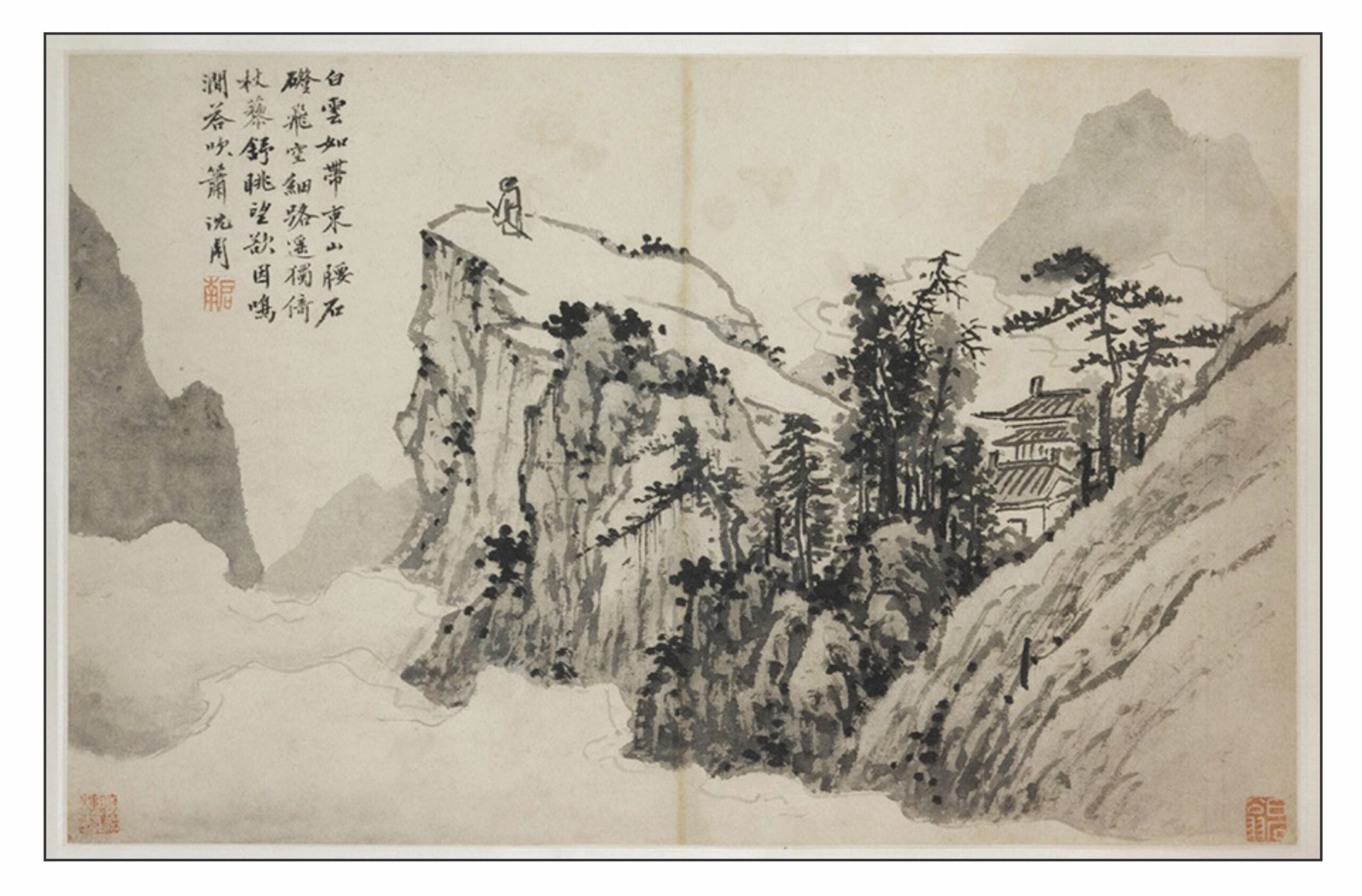
A transcription and translation of the poem follow
白雲如帶束山腰,
石磴飛空細路遙。
獨倚杖藜舒眺望,
欲因鳴澗答吹簫
White clouds sash-like wrap round the waists of mountains,
The rock terrace soars into space over a distant narrow path.
Leaning on a bramble staff, I gaze far and free;
I will reply to the sound of the mountain stream with my flute.
Xu Chu (許初, fl 16th Century CE)
Xu Chu created an album of the Autumn Meditations of the Tang poet Du Fu (712-770 CE) using seal script. The illustration shows the first two leaves of the album, now in the Palace Museum in Beijing. The first poem of the sequence (beginning on the right leaf and extending through much of the second) transcribes the first meditation:

The text of the poem with a translation by Mark Alexander follows:
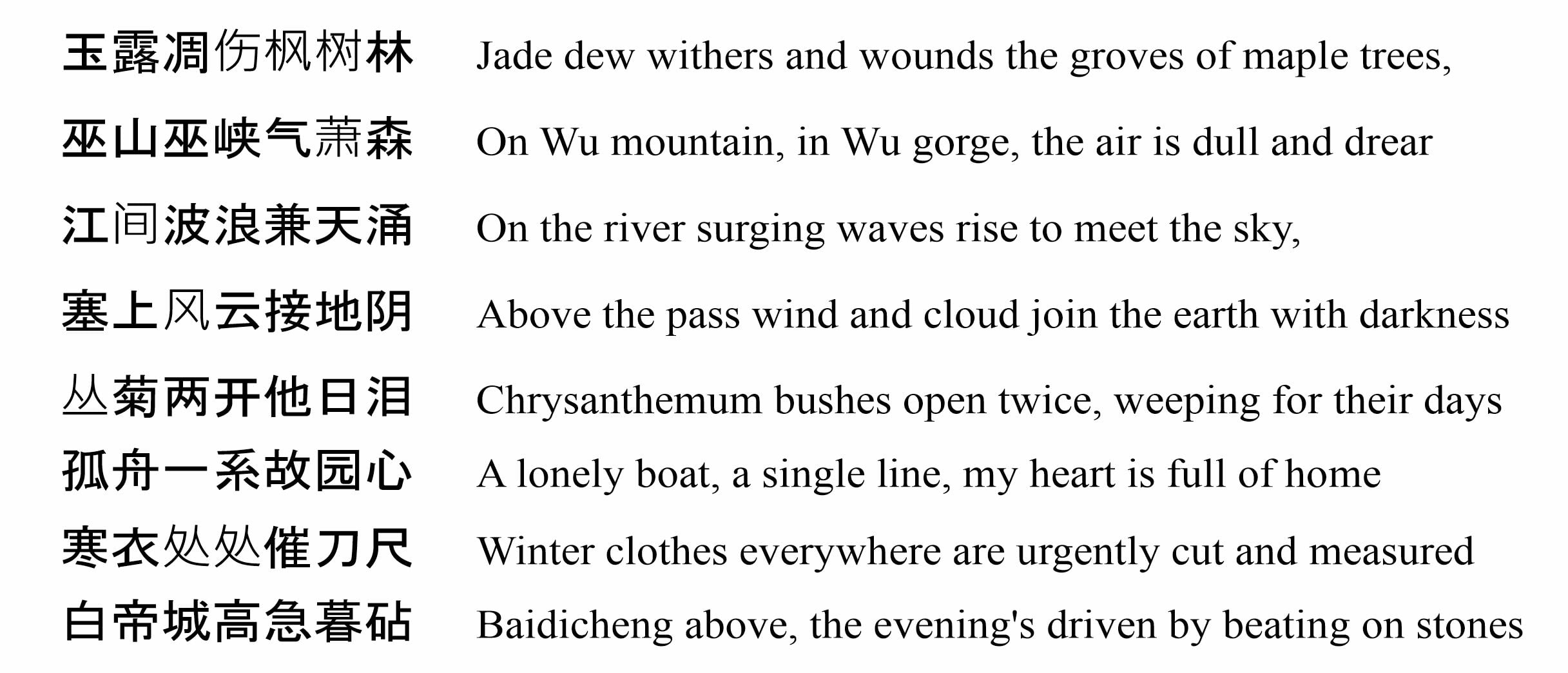
Wu Gorge is the second of the Three Gorges on the Yangtze River. Chrysanthemums are short-day flowers that can bloom twice a year, once in the spring and a second time in autumn. Baidicheng (White Emperor City) is a hill-top fortress between Wu Gorge and the upstream Qutang Gorge. During the Tang Dynasty heavy cloth was prepared for winter clothes by being beaten on stone.
Zhu Da (朱耷,1626-1705)
Zhu Da, also known by his pen name Bada Shanren (八大山人) came from an aristocratic family who served in the Ming Court. When the Manchus took over the capital and established the Qing Dynasty in 1644, Bada found refuge in a Chan Buddhist temple and became a monk. Over the years he rose to become an abbot. However, he returned to secular life in 1680, producing numerous works of calligraphy and painting in his later years (Chang et al., 2003).
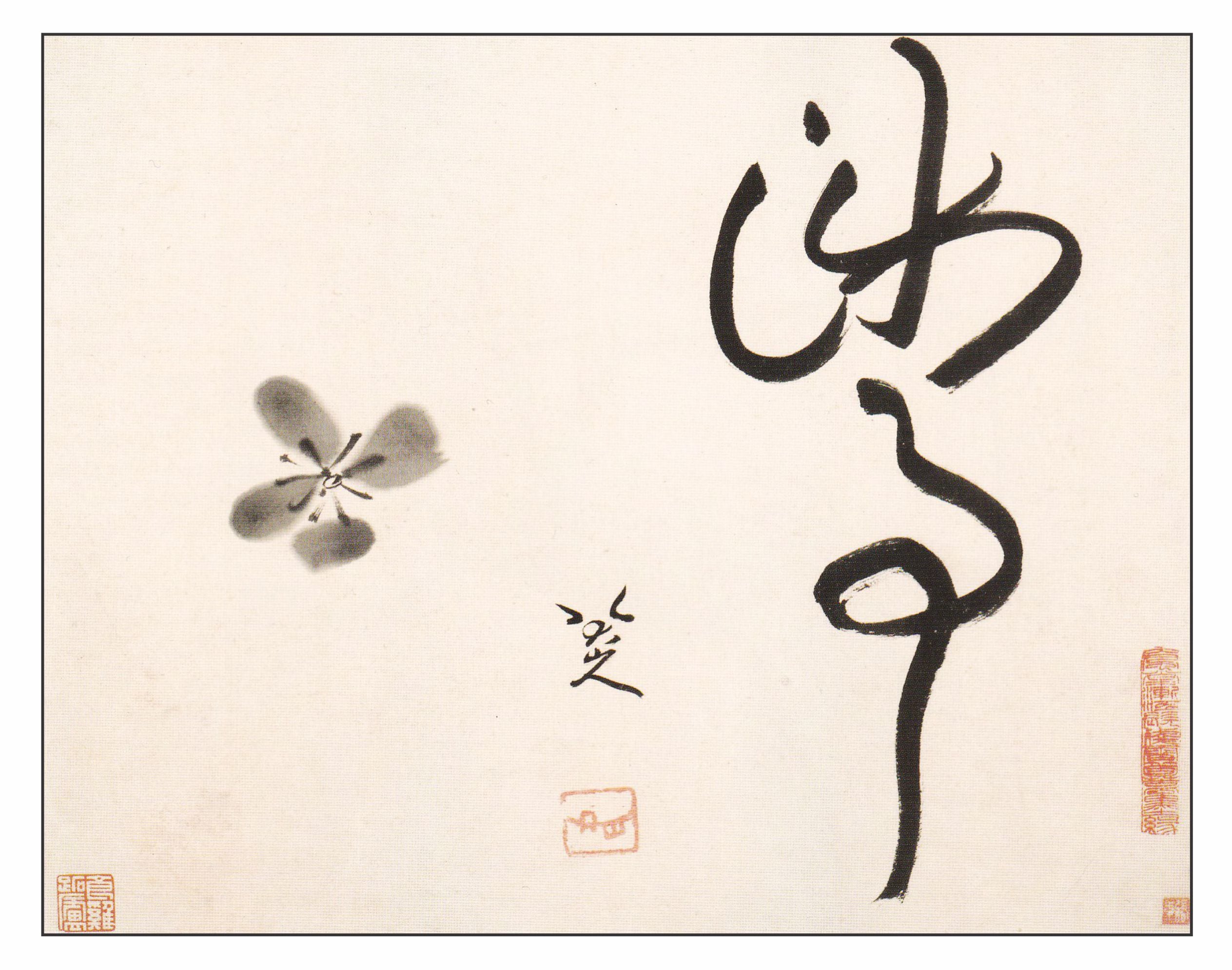
The following is Falling Flower (落花 luòhuā) from an album of paintings created in 1692. The cursive calligraphy gives a sense of gentle falling and the signature in the center of the page appears like another blossom.
In 1699 Bada Shanren transcribed a poem by Geng Wei (fl 8th Century) in memory of Wang Wei (701-761 CE) using a semi-cursive script that was both beautiful and restrained. The poem was dear to Bada, who shared Wang Wei’s Buddhist philosophy and love of nature.
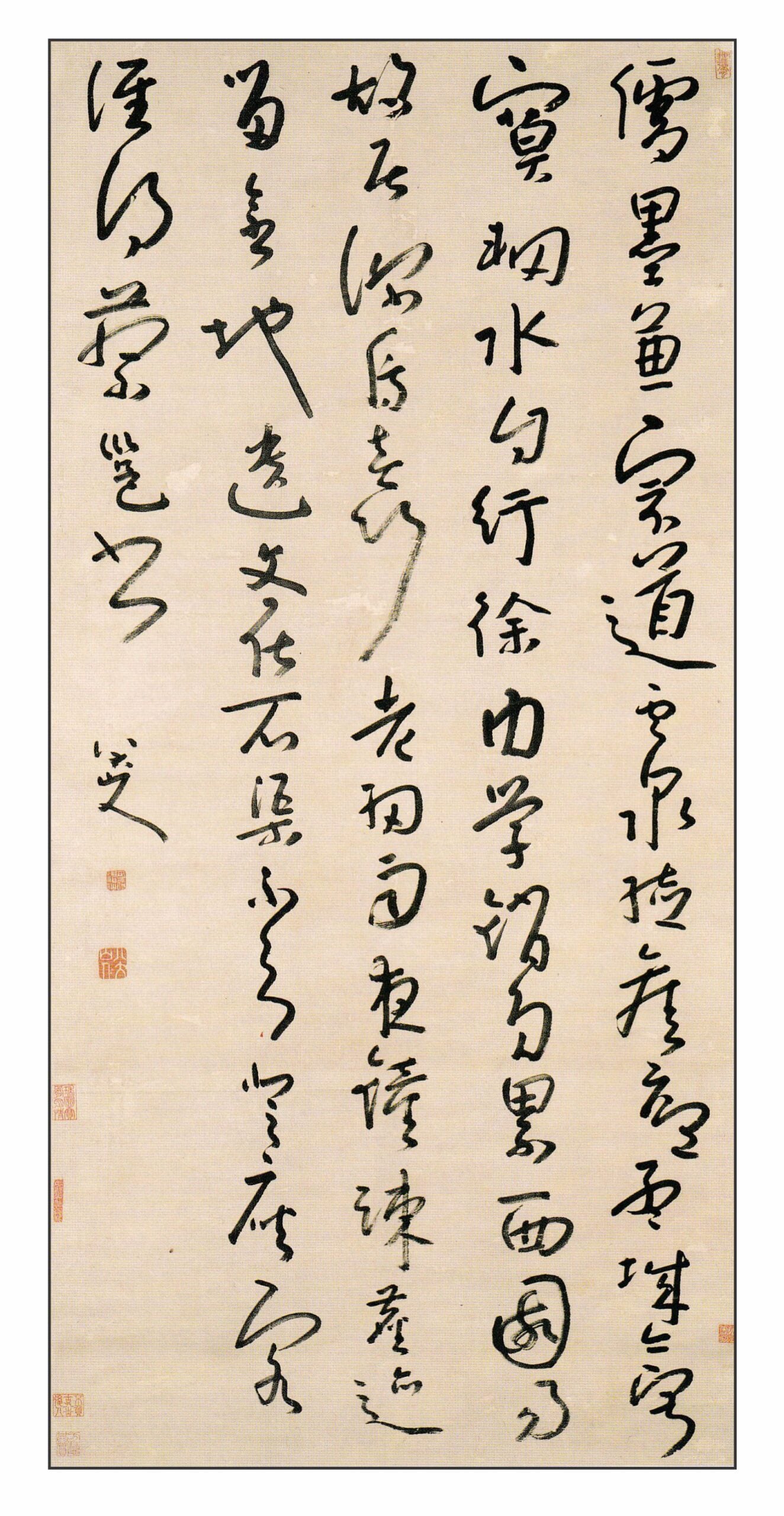
The following provides a transcription of the calligraphy and translation of the poem:
儒墨兼宗道,雲泉結舊廬,孟城今寂寞,輞水自紆徐。
內學銷多累,西園易故居,深房春竹老,細雨夜鐘鍊。
塵邊留金地,遺文在石渠,不知登座客,誰得蔡邕書。
Blending Ruism, Moism, and the Holy Religion,
By the cloudy spring, he built his former hut;
But Meng Wall Cove is desolate now and still,
And Wheel Rim Creek just winds naturally away.
The inner teachings dissolved his many cares,
The western garden transformed his old abode;
In the deep chamber, spring bamboo grows old,
In the thin rain, the night bell seldom tolls.
His dusty tracks remain in the golden earth,
His writings are kept beside the Stone Canal;
Still I do not know which of his companions,
Has inherited the books of this Cai Yong!
“Ruism” is the philosophy of Confucius (5th and 6th Centuries BCE); “Moism” refers to the teachings of Mozi (3rd Century BCE) who promoted asceticism and self-restraint; and the “Holy Religion” refers to Buddhism. Meng Wall Cove is located near Wang Wei’s country estate and was described in the set of poems entitled Wangchuan Ji (Wheel River Poems). The Stone Canal is the name of one of the imperial libraries. Cai Yong was a famous scholar and politician from the 2nd Century CE.
Bada Shanren’s calligraphy expresses the meaning and emotion of the text. The character 深, “deep” (fifth from top in the third column from left) extends its tail into the depths of sadness.
Deng Shiru (鄧石如, simplified: 邓石如 1743-1805)
Deng Shiru became adept in calligraphy in the style of seal script and clerical script. The following illustration below shows a pair of homiletic sayings in clerical script on hanging scrolls each 1.7 meters high:

The calligraphy is powerful and serious (Ho Chuan-hsing in Chang and Knight, 2012. The strokes are broad and the characters wider than they are high. The beginning and end of each stroke are cleanly demarcated: the brush is turned to “conceal the tip.” The sayings read:
心作良田百世耕之不盡
The heart is a good field – plow it for a hundred generations and it’s never depleted.
善為至寶一生用則有餘
Goodness is a perfect treasure – use it for a lifetime and some will still be left over
Epilogue
Chinese calligraphy has continued through the years as an artform that appeals to both the eye and the mind. The writing of Chinese characters with a brush became popular throughout East Asia as a way of combining art and meditation (Tanahashi, 2016). Modern artists still produce calligraphy. They use new forms but still maintain links to past masters.
Wang Jiqian (王己千, Westernized name C. C. Wang, 1907-2003) was both a major collector of Chinese art and calligraphy and an artist. The illustration shows his calligraphy of a Poem by Du Fu:
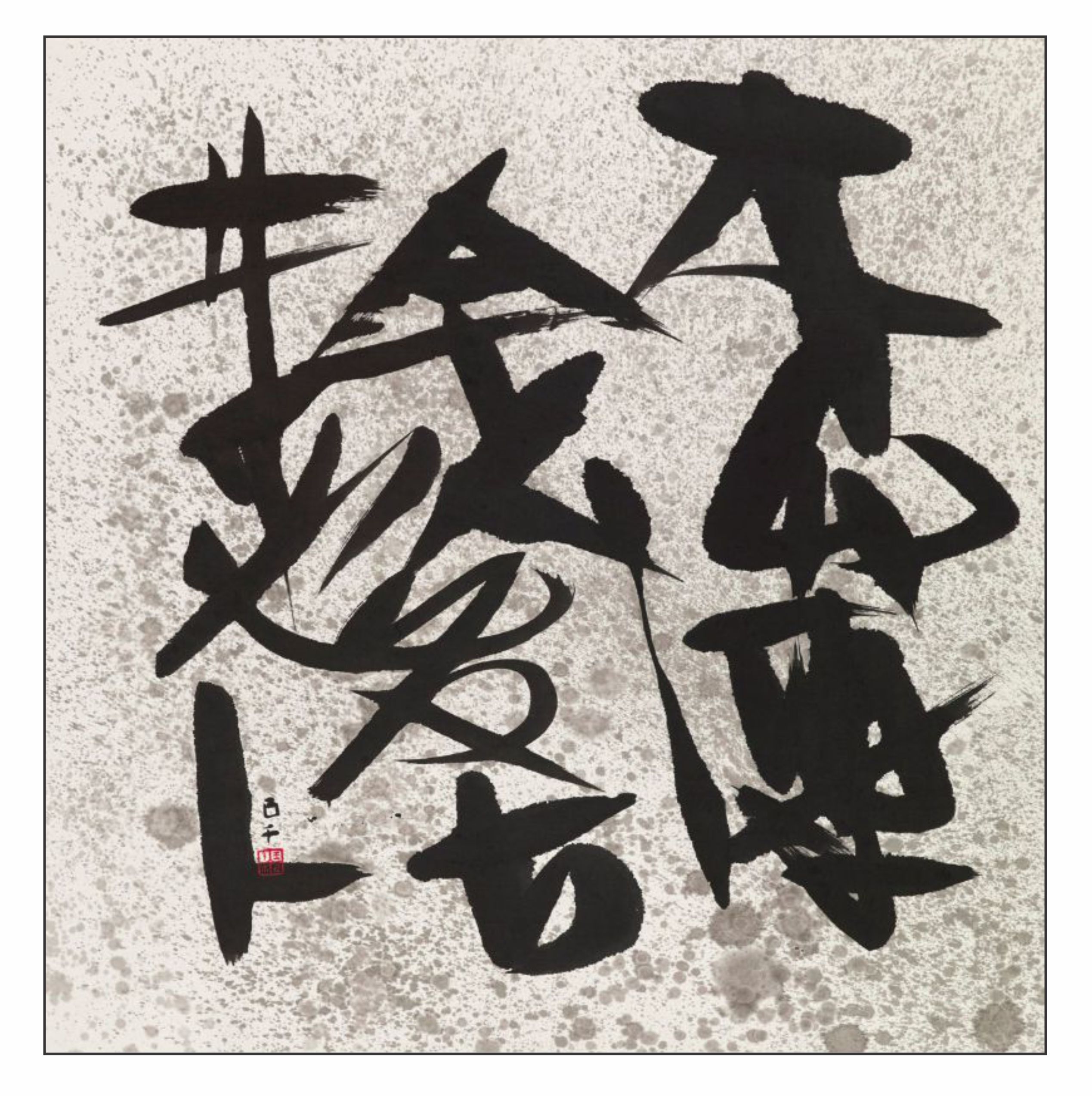
The calligraphy presents a line from a poem by Du Fu (712-770 CE):
不薄今人愛古人
Without belittling the moderns, I love the ancients
The full poem can be found in Owen (2016, Vol III p 114-115).
References
Chang, J., Bai, Q., & Allee, S. D. (2003). In pursuit of heavenly harmony: paintings and calligraphy by Bada Shanren from the estate of Wang Fangyu and Sum Wai. Freer Gallery of Art (Smithsonian Institution).
Chang, J., & Knight, M (Eds.) (2012). Out of character: decoding Chinese calligraphy Asian Art Museum of San Francisco.
Chiang, Y. (1973). Chinese calligraphy: an introduction to its aesthetic and technique (3rd ed.). Harvard University Press.
Fong, W. (1984). Images of the mind: selections from the Edward L. Elliott family and John B. Elliott collections of Chinese calligraphy and painting at the Art Museum, Princeton University. Princeton University Press.
Fong, W. (1992). Beyond representation: Chinese painting and calligraphy, 8th-14th century. Metropolitan Museum of Art.
Jagger. K. (2023). Zhang Xu – ‘Crazy Zhang.’ Ink & Brush.
Li Huiwen, Han Lifen, & Becker, G. (2018). Chinese calligraphy and culture: an easy-to-use guide for learners of all ages. MSL Academic Endeavors
Li, W. (2010). Chinese writing and calligraphy. University of Hawaii Press.
Luo, Y. (2019). Yu Xin and the sixth-century literary world. Doctoral Dissertation, Princeton University.
McCausland, S. (2011). Zhao Mengfu: calligraphy and painting for Khubilai’s China. Hong Kong University Press.
Murck, A., & Fong, W. (1991) Words and images: Chinese poetry, calligraphy, and painting. Metropolitan Museum of Art.
Ouyang, Z., & Wang, Y. (2008). Chinese calligraphy. Yale University Press.
Owen, S. (2016). The poetry of Du Fu. De Gruyter.
Paar, F. W., ed. (1963). Chʻien Tzu Wen the Thousand Character Classic: a Chinese Primer. Frederic Ungar.
Qiu Xigui (translated by G. I. Mattos & J. Norman, 2000). Chinese writing. Society for the Study of Early China.
Shi, B. (translated by S. C. Kohn, 2003). Between heaven and earth: a history of Chinese writing. Shambhala.
Sturman, N. (accessed 2025) The thousand character essay (Qian Zi Wen).
Tanahashi, K. (2016). Heart of the brush: the splendor of East Asian calligraphy. Shambala.
Xu, P. D. (2022). Copy, yet original: Re-examining ‘fang Ni Zan’ paintings in the fifteenth to seventeenth century China. PhD Thesis, Vrije Universiteit Brussel.