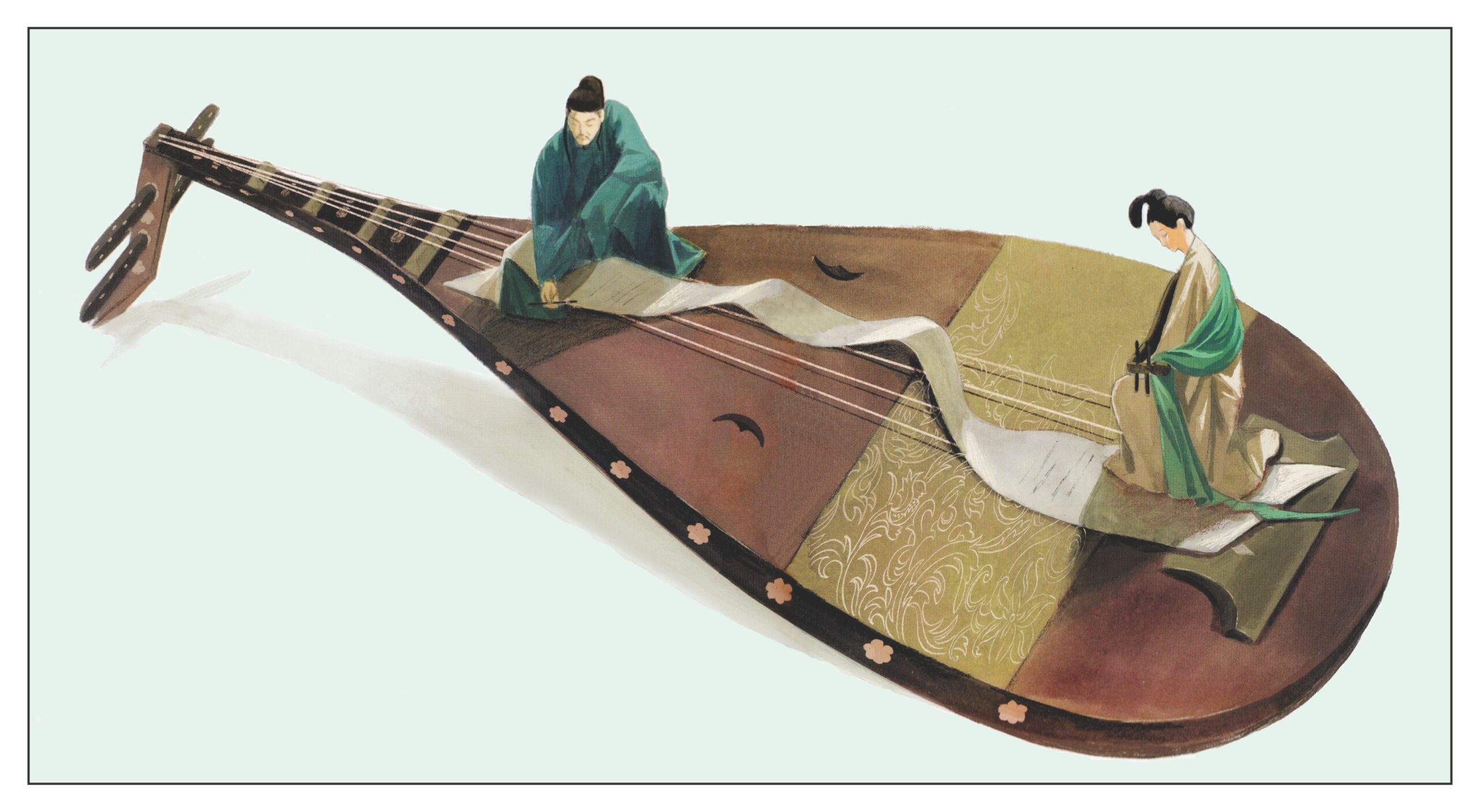
Bai Juyi (白居易, pinyin Bǎi Jūyì, or Po Chü-i in Wade-Gilles transliteration, 772-846 CE) was a Chinese poet. In 815, after inappropriately advising the emperor, he was exiled from the capital Chang’an to JiuJiang on the Yangtze River. One night, at a farewell party on the river for a friend, he heard a musician playing the pipa. Entranced by her music, he found out that she had once been a sought-after courtesan in the capital. After her beauty had faded away, she had retired to the provinces, where she played her music and lamented her lost youth. Moved by her plight, Bai Juyi composed his Pipa Xing (琵琶行, “Ballad of the Pipa”). The illustration shows a drawing of the poet and the pipa player from a scroll by Guo Xu (1456–1532).
Life of the Poet
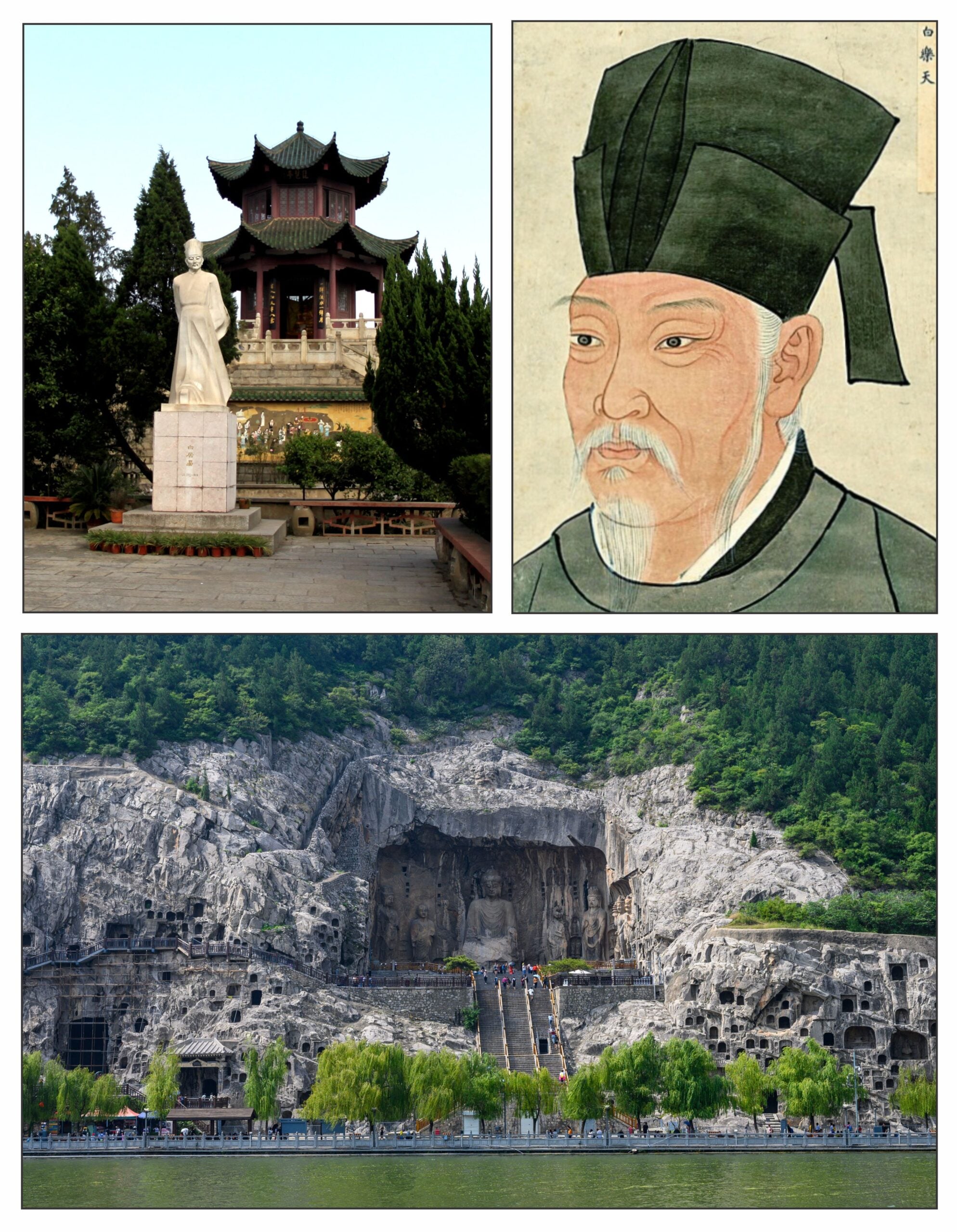
Bai Juyi was born in Northern China and came to the capital Chang’an to pass his examinations for the civil service in 800. There he became close friends with the novelist and poet Yuan Zhen (779-831) (Tan, 2025). He soon became a prolific and popular poet, with the courtesy name Lètiān (樂天, happiness of heaven: optimism) (Waley, 1949). Bai Juyi and his predecessors, Li Bai, Wang Wei and Du Fu, are considered the four great poets of the Tang Dynasty (Geng, 2021). He became renowned in Japan where he was known as Haku Rakuten from the Japanese transliteration of his courtesy name (白楽天). In 815, the prime minister Wu Yuanheng was brutally assassinated because he would not agree to the demands of some rebellious warlords. Bai Juyi wrote a memorial calling upon the emperor to seek out and punish the assassins. However, the politics were complicated. Bai Juyi was considered presumptuous – it was not for him, a tutor in the imperial household, to advise the emperor. He was exiled and demoted to a minor position (“master of the horse”, essentially an adjutant) in Jiujiang, then known as Jiangzhou (Waley, 1949, pp 101-104). While there, he heard the playing of a pipa near the river and wrote his famous poem The Ballad of the Pipa. Bai Juyi was allowed to return to Chang’an in 1819. He then served for periods of time as governor of Hangzhou and governor of Suzhou. Bai Juyi was a devoted Chan Buddhist and when he grew old, he retired to a Buddhist monastery near the Longmen caves famous for their colossal statues of Buddha (carved in 672 and 676). At the monastery he was able to compile a full collection of his poems before his death.
The following illustration shows in the upper left a statue of Bai Juyi at the Pipa Pavilion in Jiujiang, in the upper right a posthumous portrait of the poet by Chen Hongshou, a 17th Century painter, and at the bottom a view of the Longmen caves.
Translating the Ballad of the Pipa
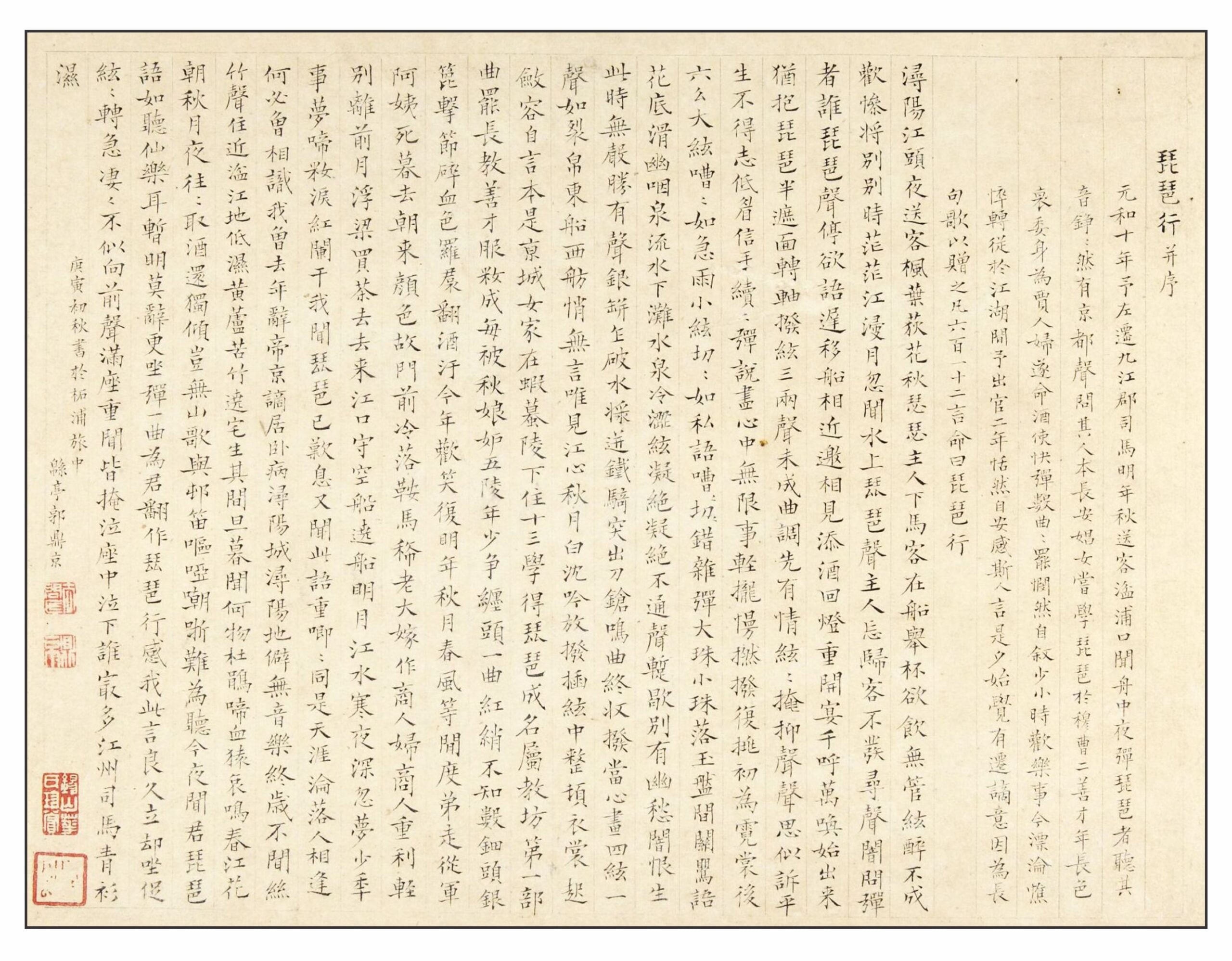
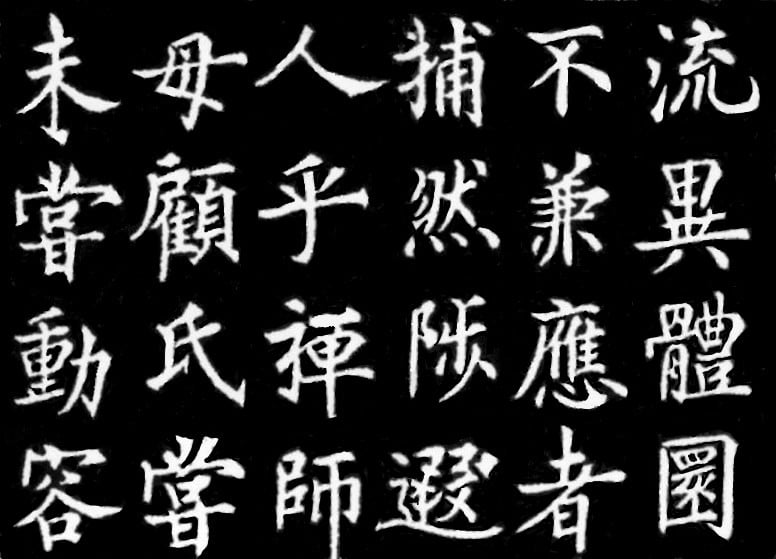
The poem is written in rhyming couplets with 88 lines each of 7 characters for a total 616 characters. It is preceded by a preface of 138 characters. The following is the poem in elegant regular-script calligraphy by Guo Dingjing (17th Century CE), now in the Princeton University Art Museum:
The Chinese text of the poem is readily available, as is an early English translation by Witter Bynner in his book The Jade Mountain (1929). Several other English translations have been published: Fuller, 2018, pp 283-289; Giles, 1888, pp 157-160; Harris, 2009, pp 21-26; Watson, 1984, pp 249–252; Xu et al, 1987, pp 292-296: Xu, 1994, pp 18-121; Yip, 2004, pp 288-297. Other translations are available on the internet: Phil Multic and Gan Siowck Lee.
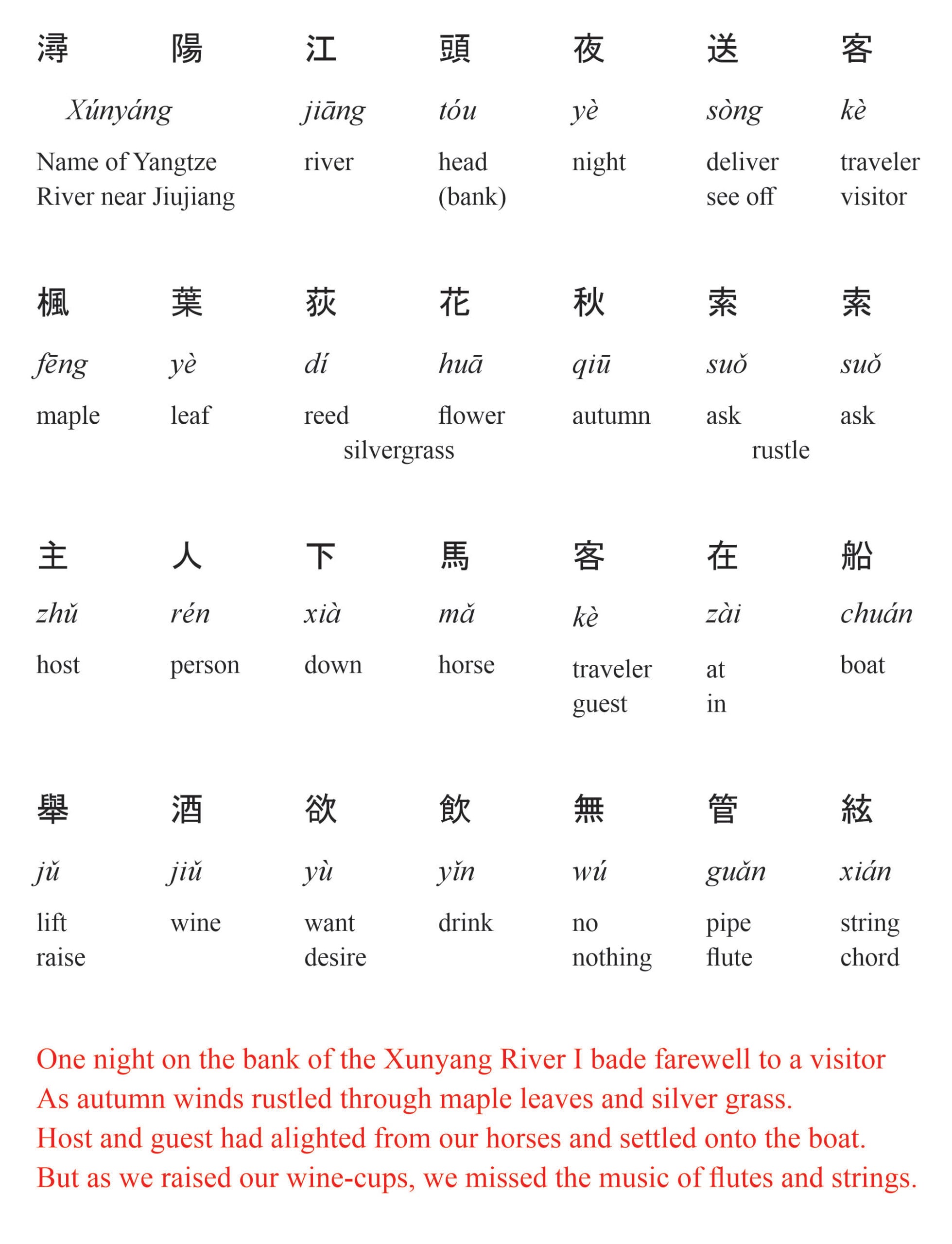
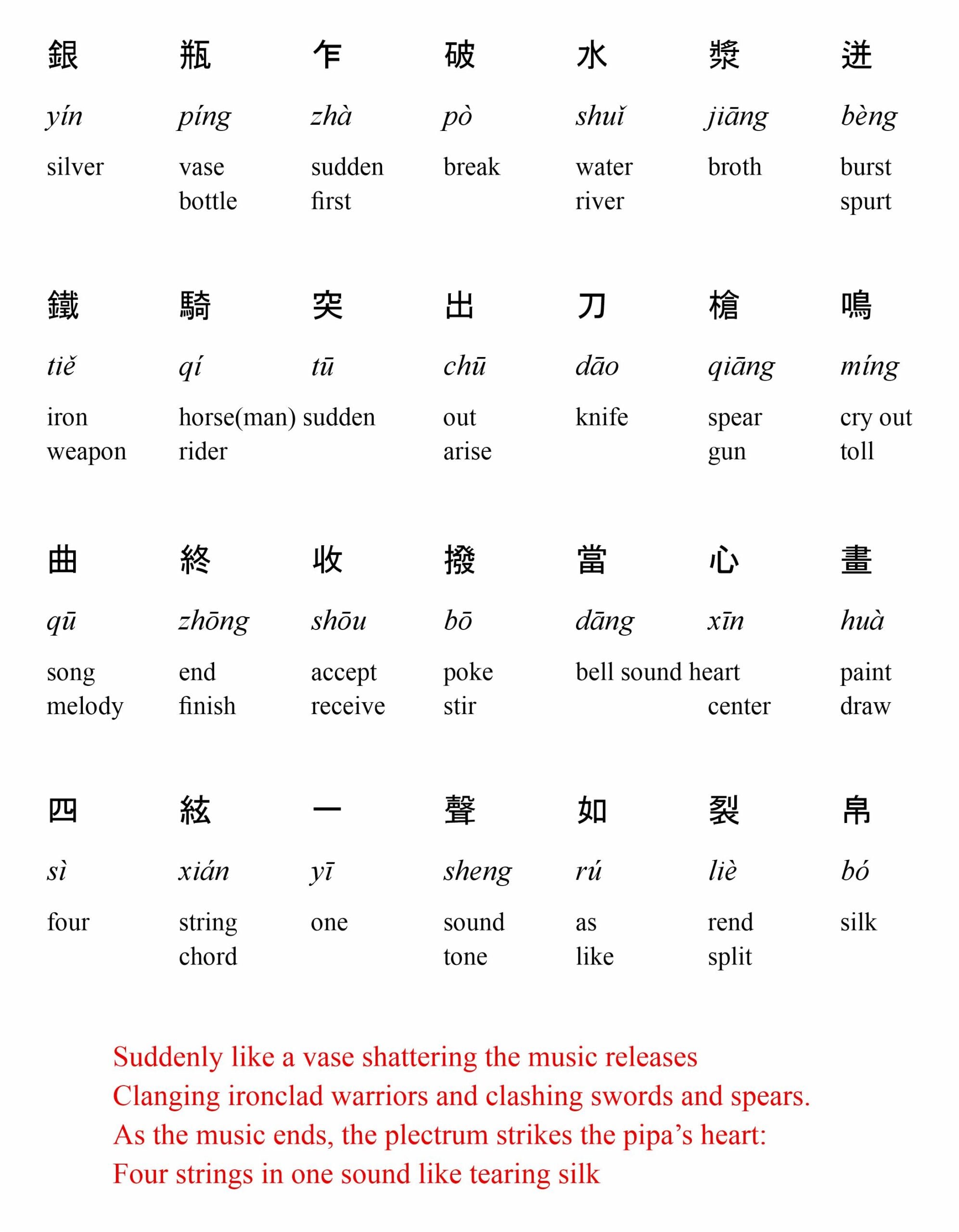
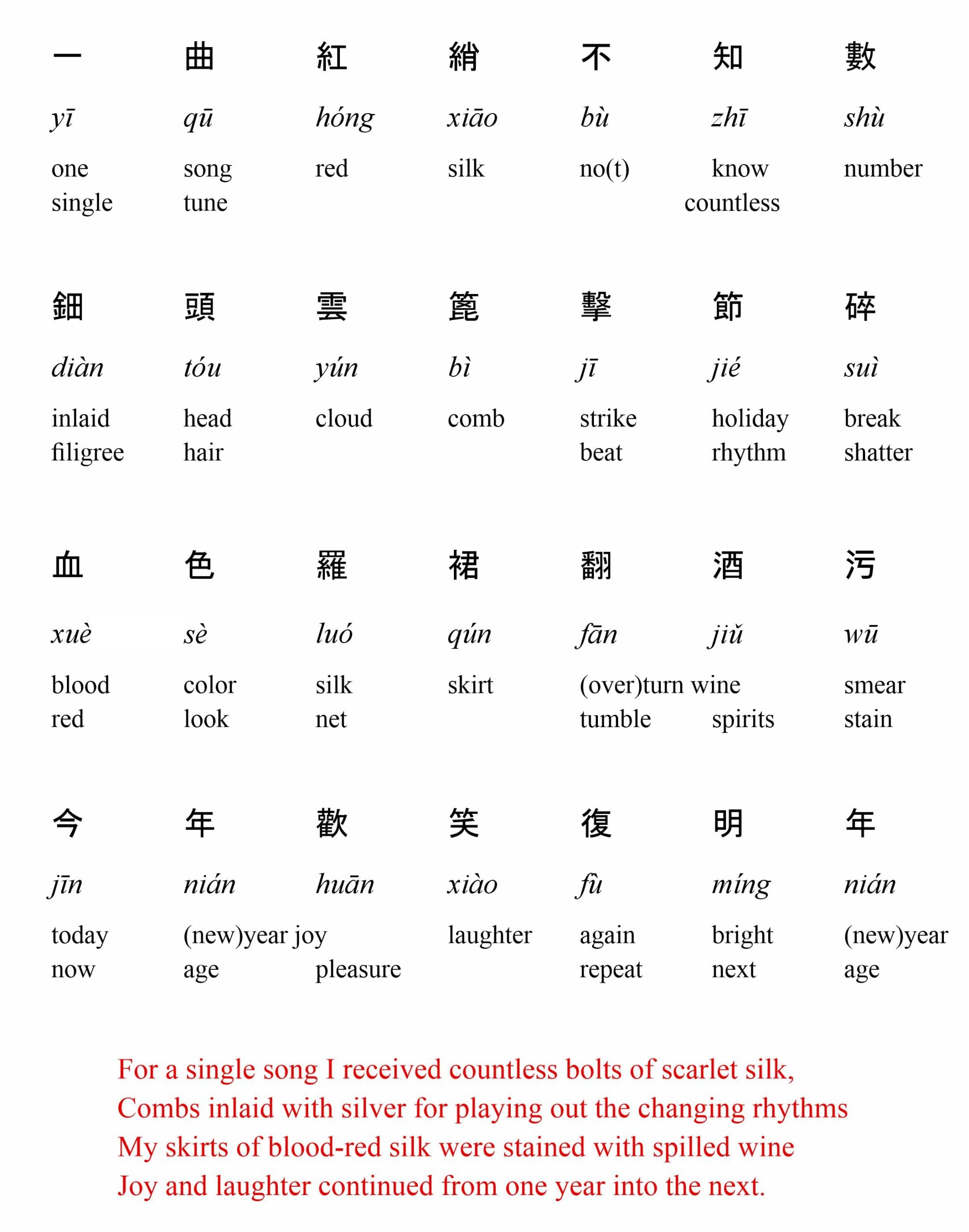
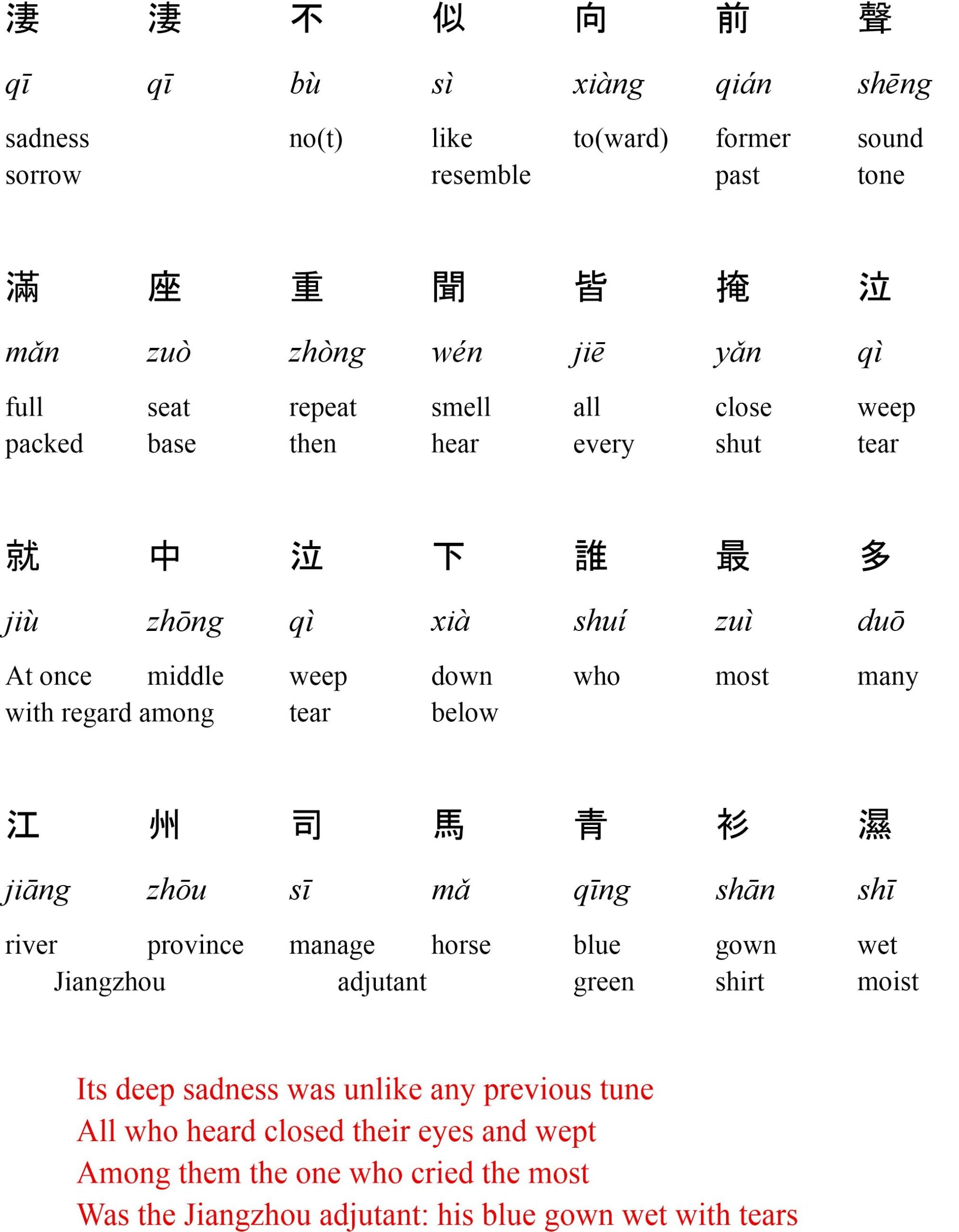
The poem is difficult to translate since its sound patterns are as important as its meaning (Peng, 2023; Yu & Chang, 2024). This post will provide some sense of the Chinese sound patterns of Bai Juyi’s poem with recitations by Pu Cunxin and accompanying pipa by Wu Yuxia, taken from a production by China Global Television Network. After Giles’ s initial prose version, most English translations have use blank verse and made some attempt to imitate the sounds of the original. The translation of Xu Yuanzhong (1987, 1994) uses rhyming hexameter couplets. The translations in red accompanying the character-by-character transcriptions in this post are mine; they are heavily indebted to the other available translations.
The Setting
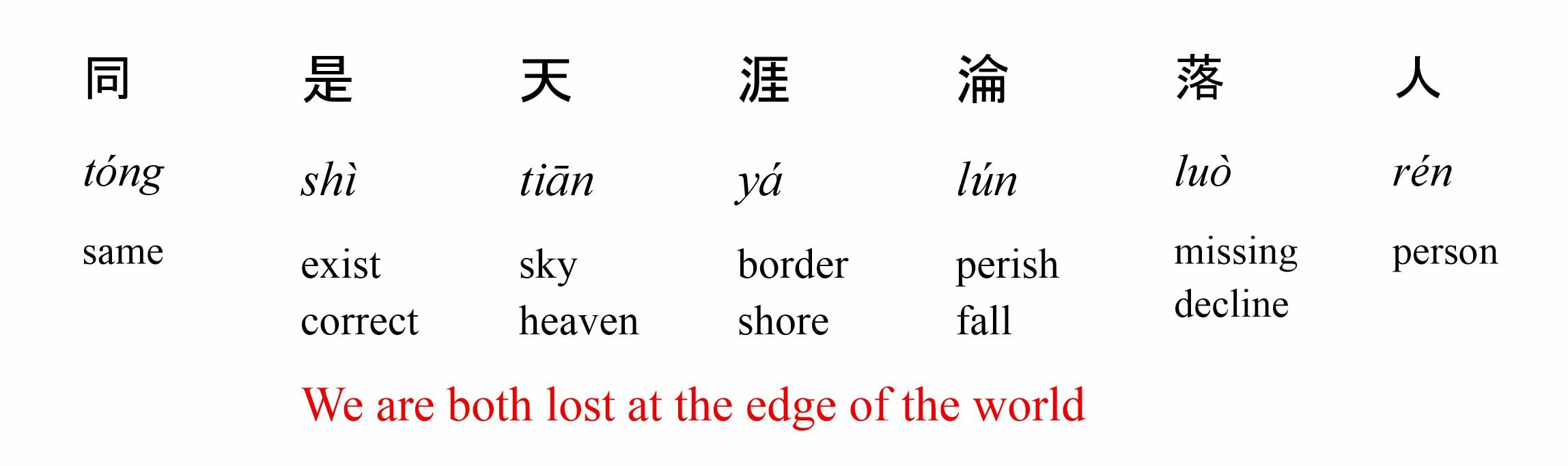
Bai Juyi provides his poem with a preface that sets the time and the place. During his banishment to JiuJiang, while saying farewell to a visitor one evening on the banks of the Yangtze, he hears the music of a pipa. He finds out that the player had once been a famous musician and courtesan at the court in Chang’an. However, as she had grown old, her beauty had faded, and she had retired unhappily to the provinces. Bai Juyi is struck by the similarity of his fate to hers, and mourns their mutual fall from grace:
Moved by her story, he writes a long poem about the pipa player on the river far from Chang’an
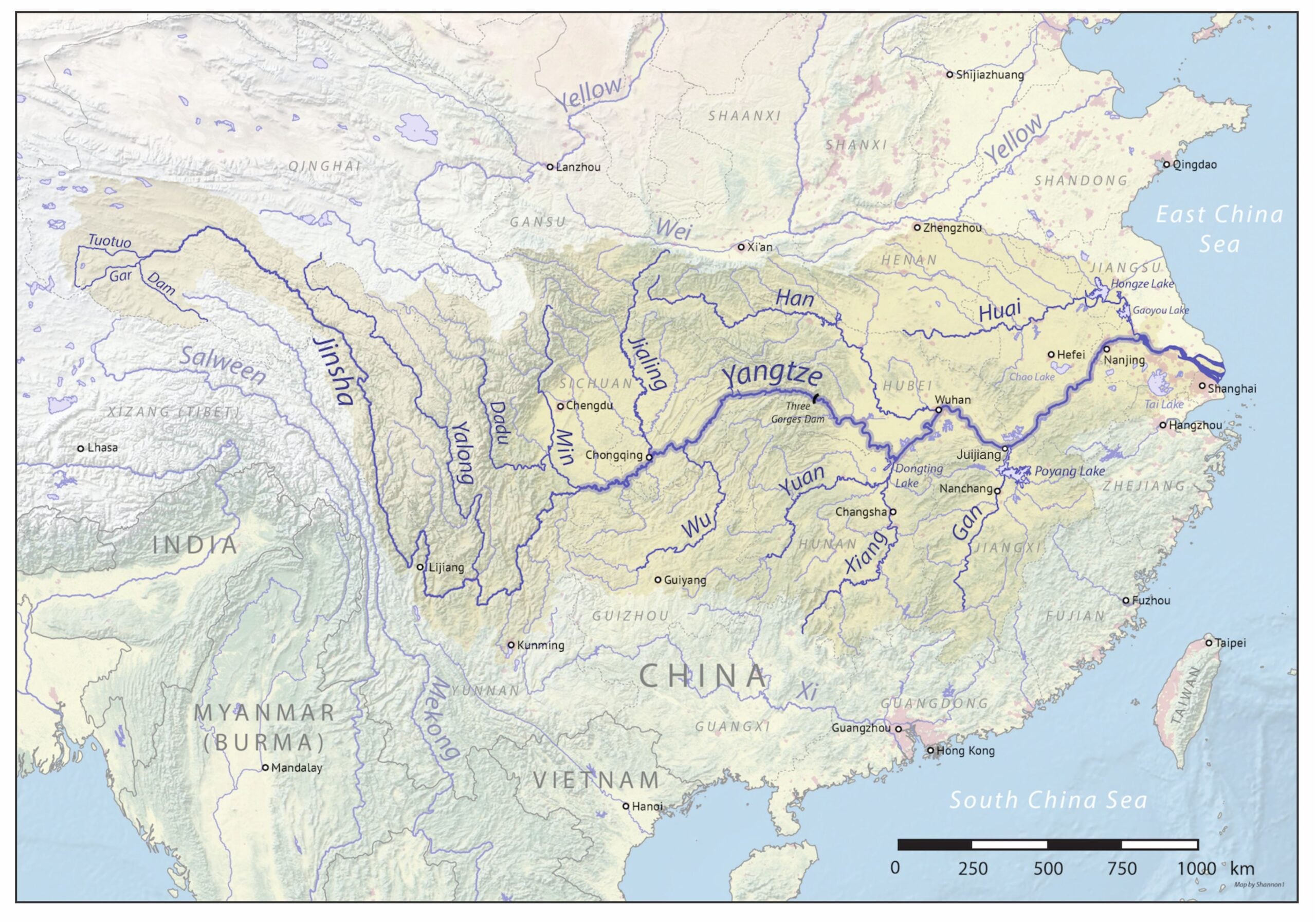
Jiujiang, which had once been known as Jiangzhou, is a city on the Yangtze River. The region of the river near Jiujiang was sometimes known as the Xunyang River. The Yangtze River, the third longest river in the world, is about 1.5 km wide at Jiujiang. Lake Pongyi, which was once called Pengli Lake, the largest freshwater lake in China, drains into the Yangtze at the eastern edge of the city:
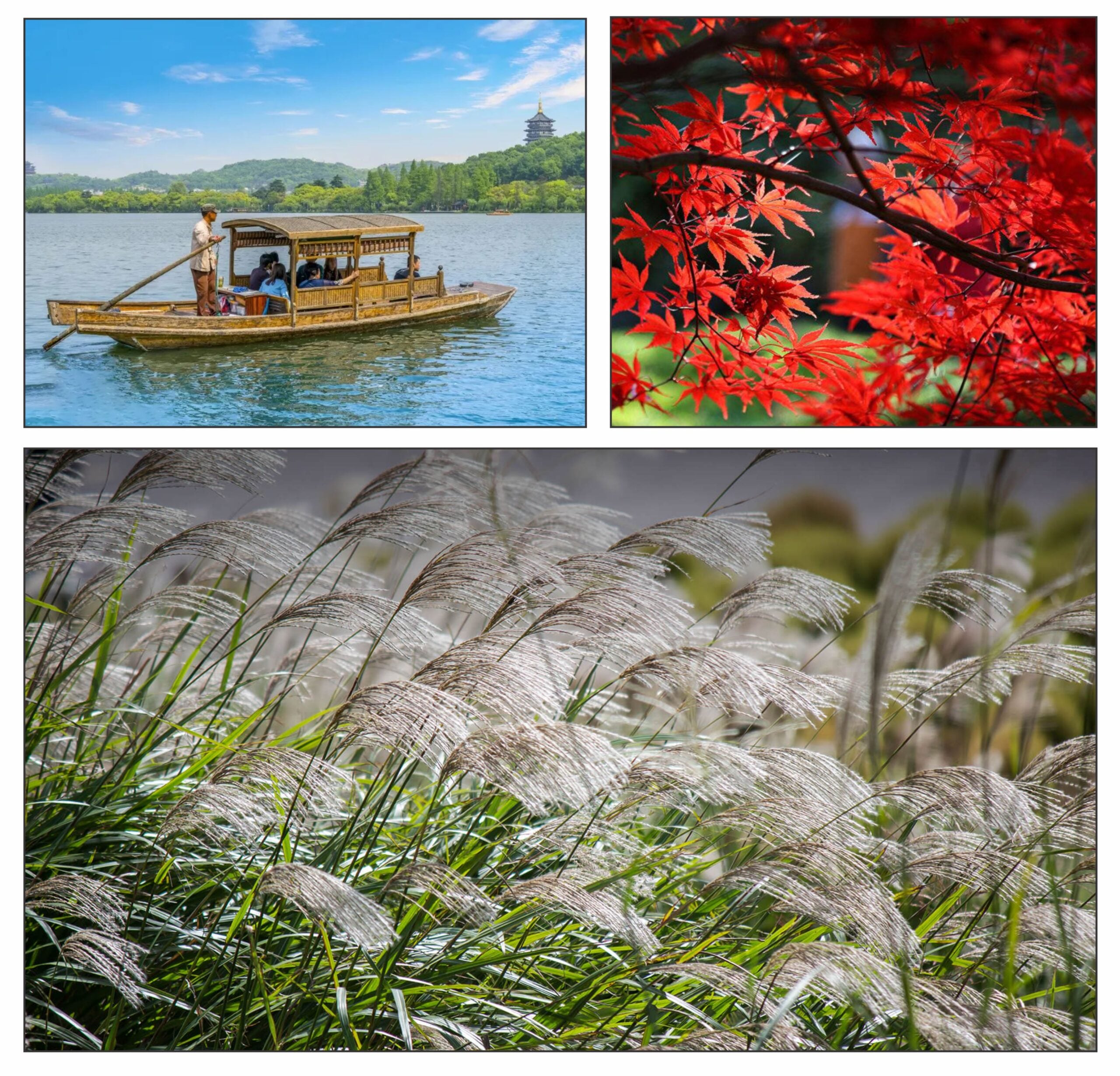
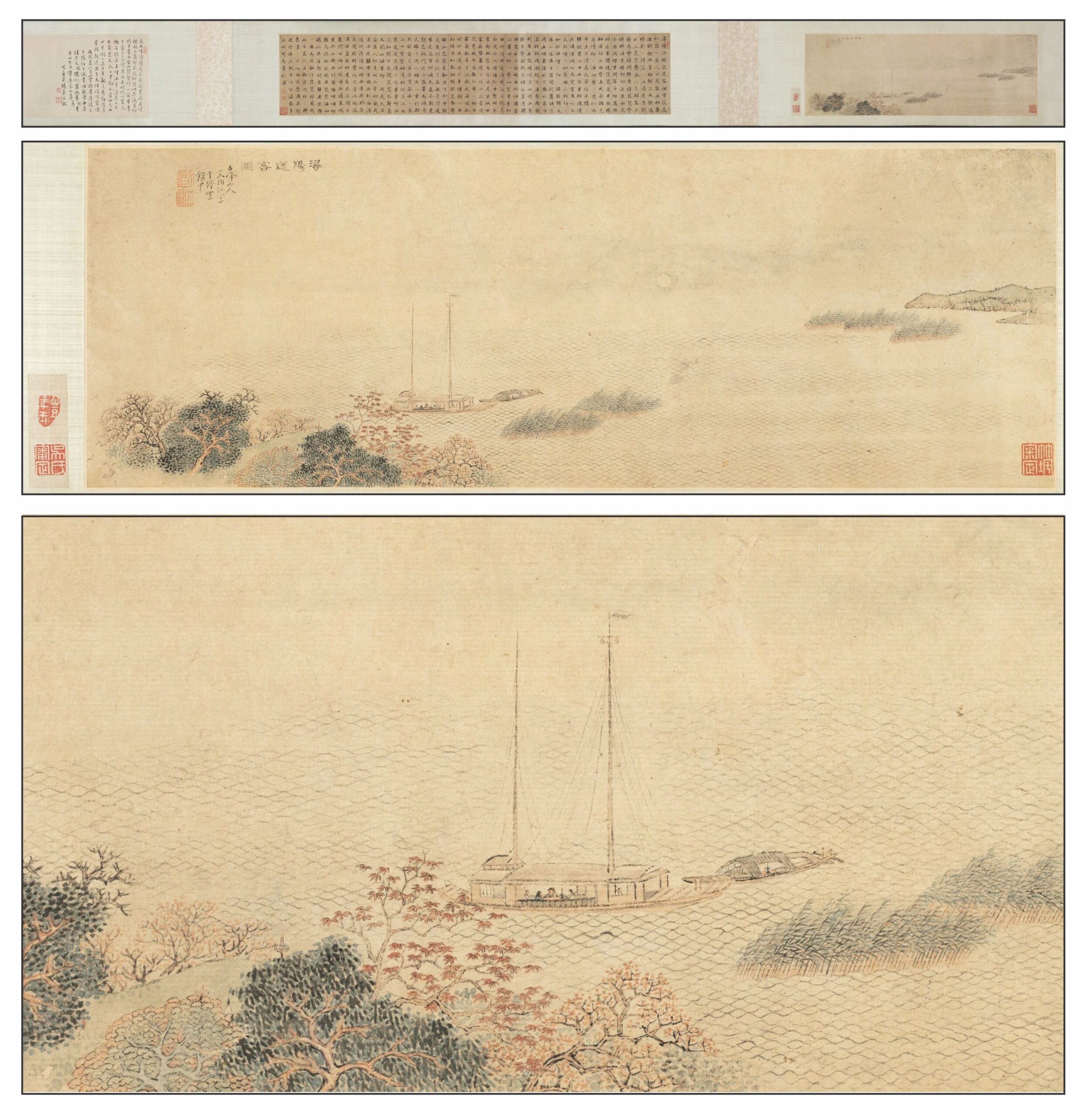
Bai Juyi is throwing a farewell party for his departing friend on a small pleasure boat on the river. As shown in the following illustration from Hangzhou in eastern China, these small rowboats still provide spaces for celebrations on the waters. In Jiujiang it is autumn: the maple leaves have turned scarlet, and the plumes of the silver grass have reached their peak.
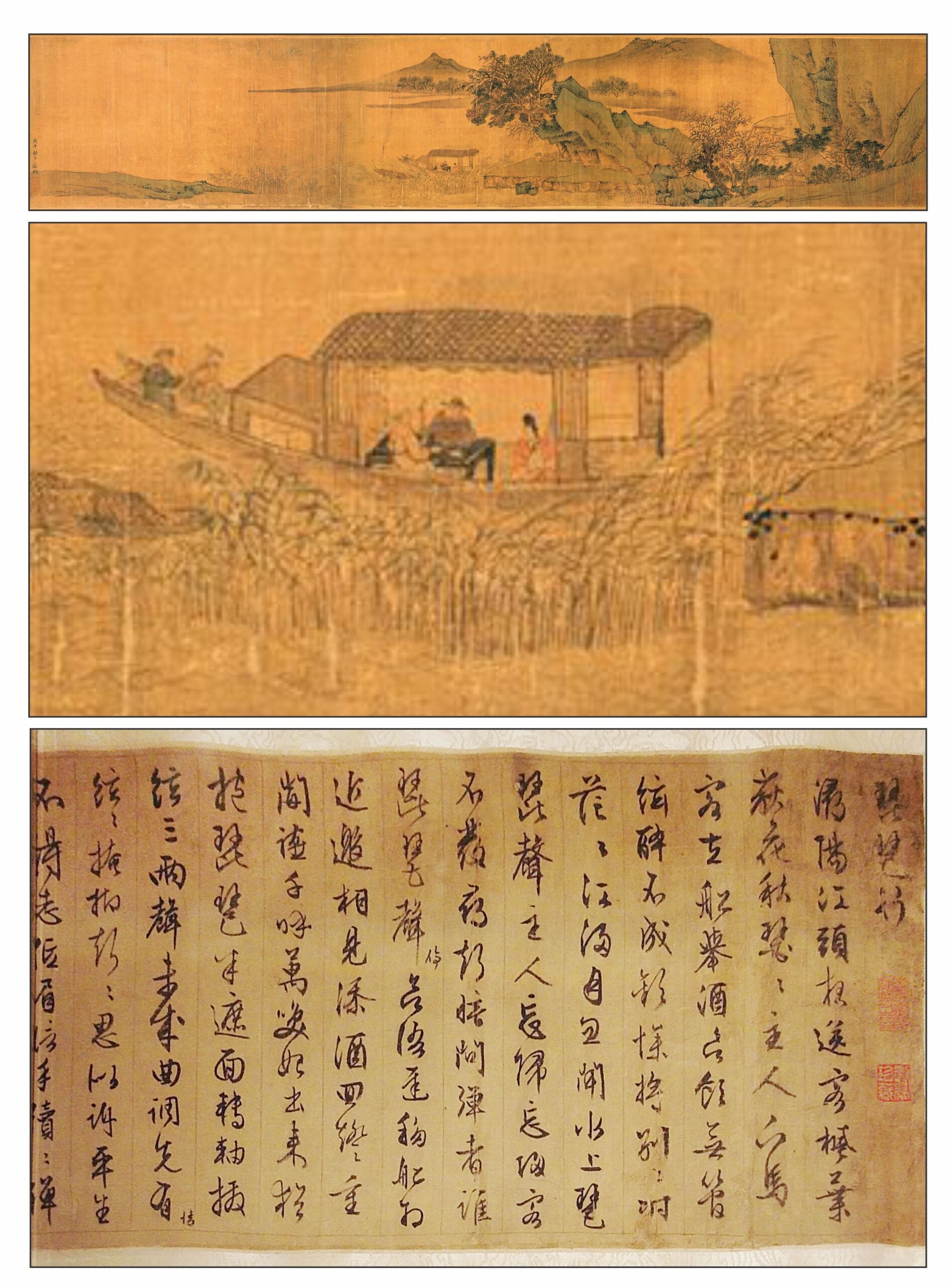
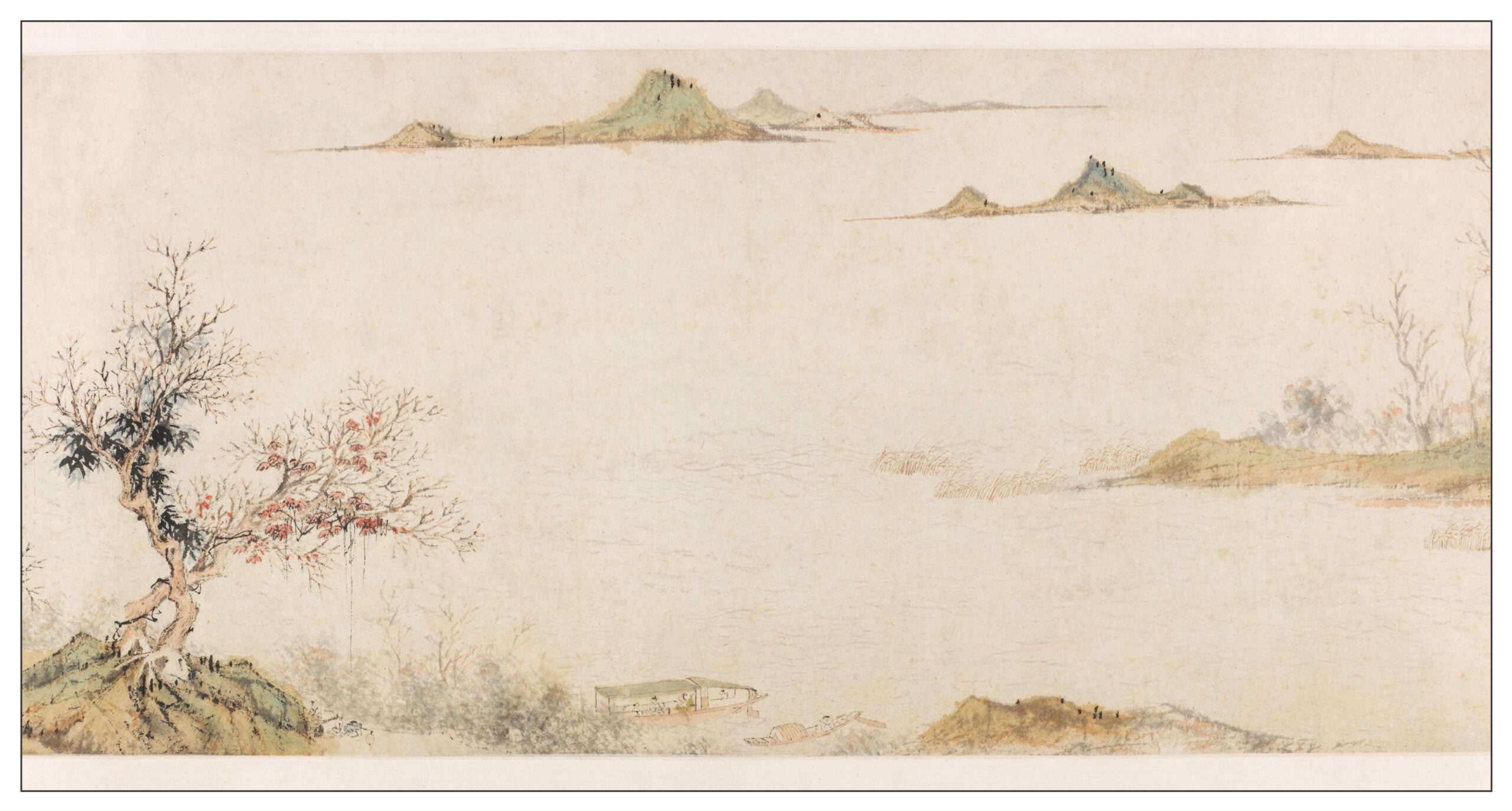
The following illustration shows a scroll with calligraphy of Pipa Xing by Wen Zhengming (1470-1559) at the National Palace Museum, Taipei. At the top is the painting at the beginning of the scroll. In the middle is an enlargement of the boat with the poet and his guest listening to the pipa player. At the bottom is the beginning of the calligraphy in semi-cursive (or running) script. The first line (on the left) has the title:
Beginning of the Ballad
The initial lines of the ballad describe the autumn leaves and the silver grass. The farewell party begins but there is no music:
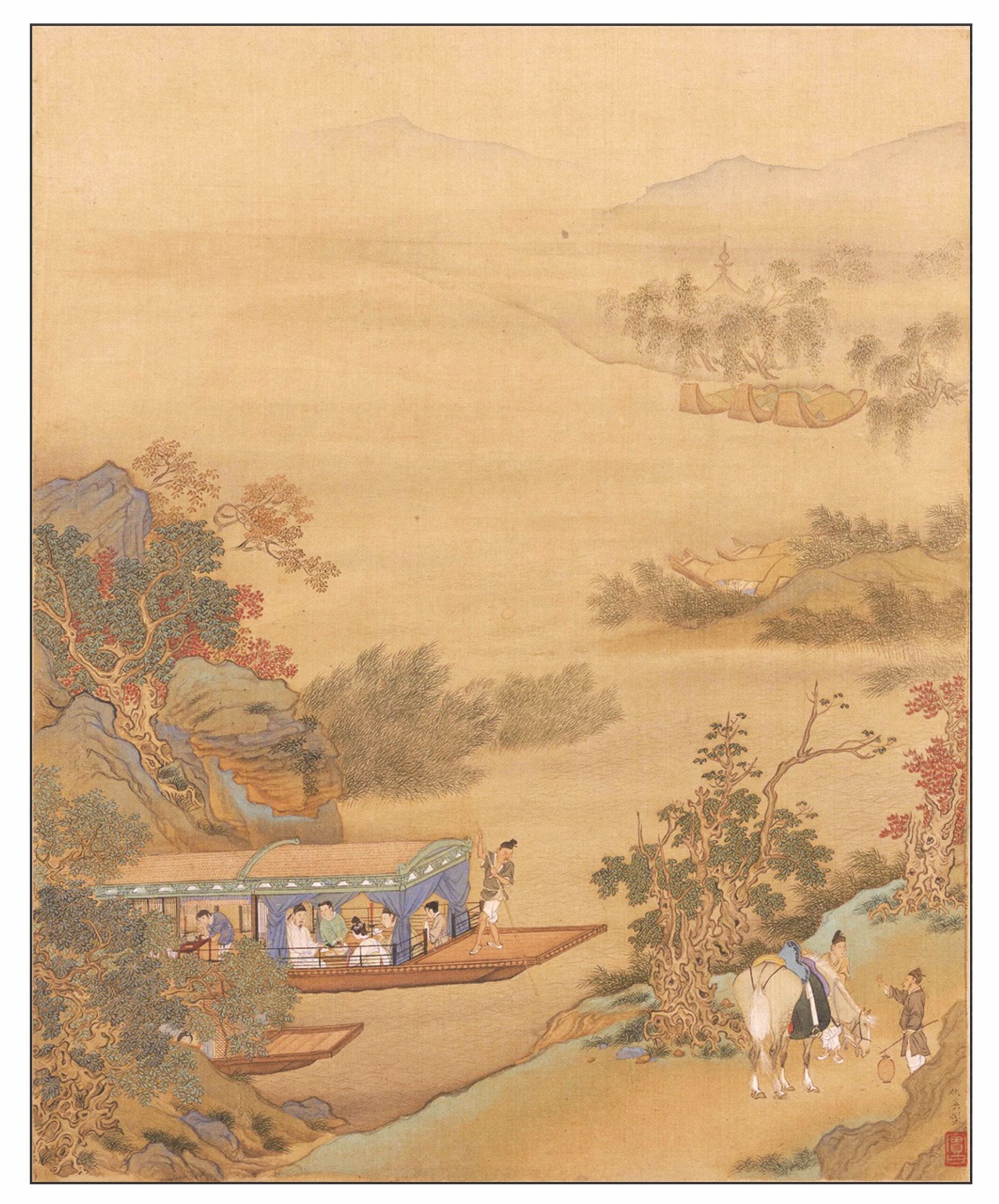
The opening scene of the poem was portrayed in a silk-painting (34 x 41 cm) in an album by Qiu Ying (1494-1552) now at the Palace Museum in Beijing:
The Pipa
As the party laments the absence of music, the sound of a pipa is heard across the water from another boat. The partygoers are completely entranced. They call out and ask the musician to play for them. She agrees but holds the pipa up to hide her face.
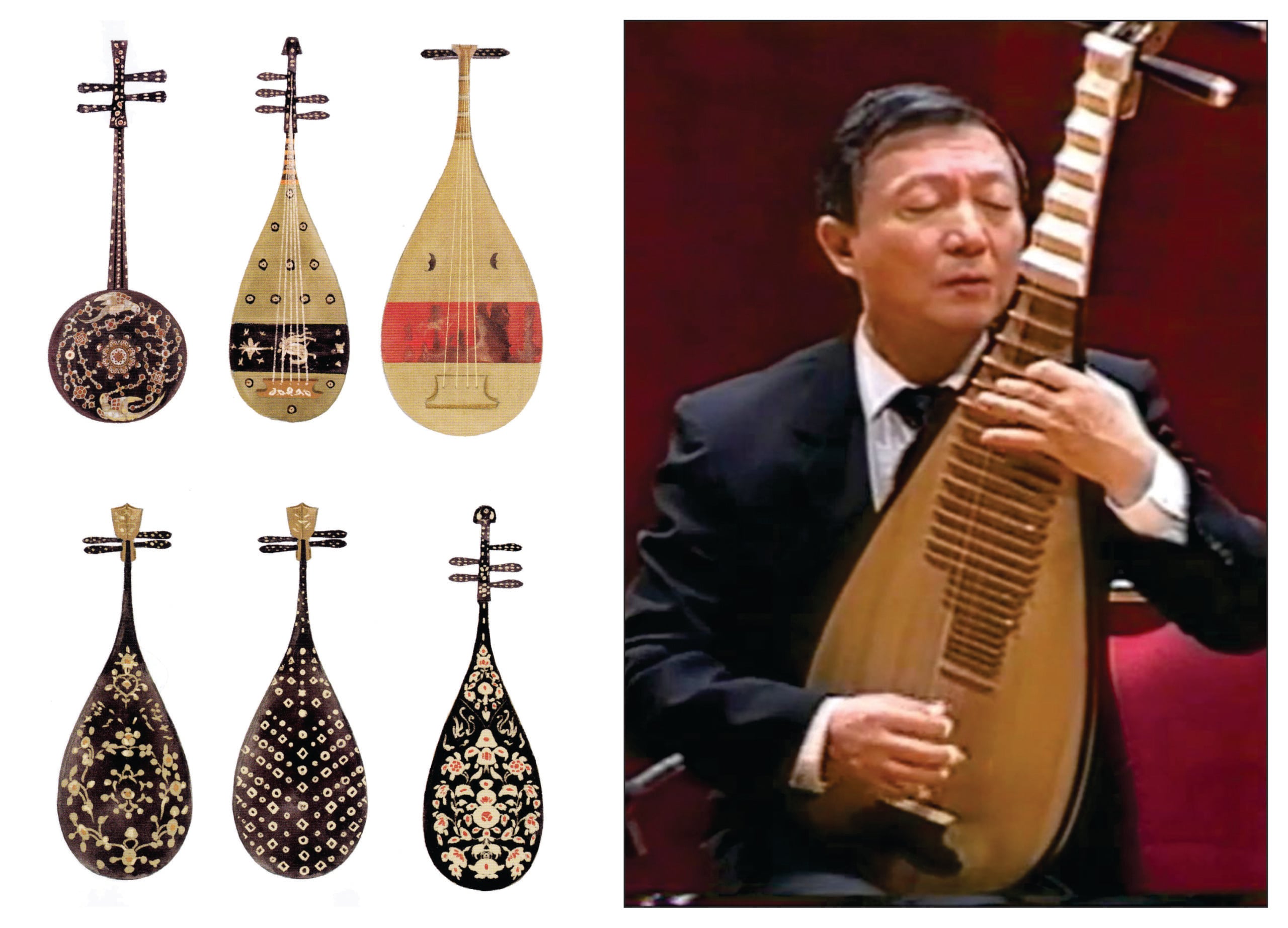
The pipa is a Chinese plucked string instrument very similar to the European lute (Wong, 2011). Both instruments have their origin in the Middle East. The pipa came to China via the Silk Roads during the Han Dynasty (206 BCE–220 CE). The instrument typically has 4 strings though some old pipas have 5. Though early pitas have as few as 4 frets, modern pitas can have up to 30. Though occasionally round, the body of the pipa is usually pear-shaped. Traditionally the pipa was played for small intimate groups, but in modern times electronic amplification has allowed pipa virtuosos to play for larger audiences. The following illustration shows some ancient pitas and a photograph of Liu Dehai (1937-2020), one the greatest pipa players of recent times.
The following is a performance of “Xunyang Moonlit Night” (浔阳月夜, Xúnyáng yuè yè) by Liu Dehai.
The Music
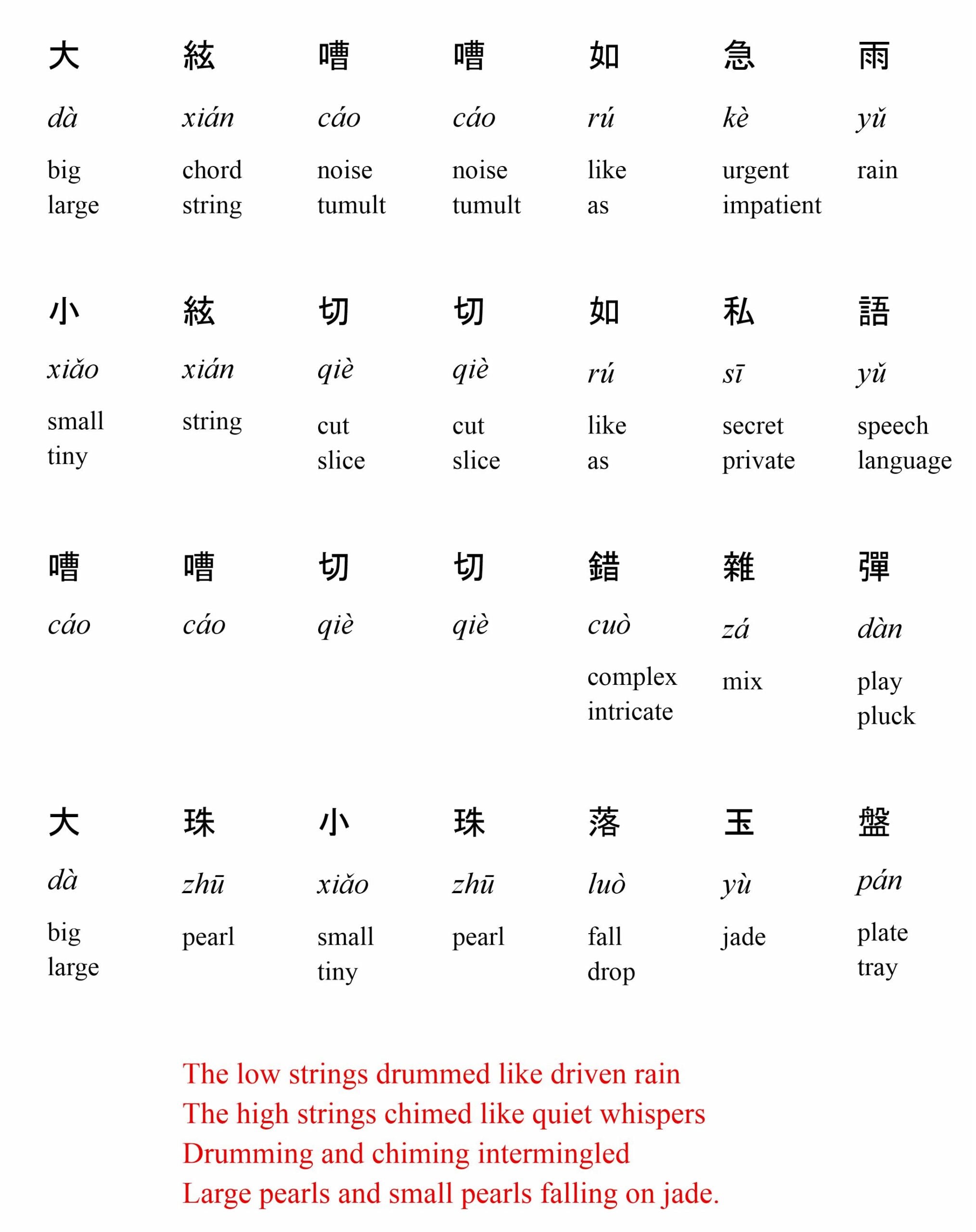
The poem then provides a bravura description of the music of the pipa:
These are some of the most famous lines of poetry in China. They have been variously translated. The following version by Xu Yuan-Zhong (1984; 1987) uses the same rhyme scheme as the Chinese poem:
The thick strings loudly thrummed like the pattering rain The fine strings softly tinkled in murmuring strain. When mingling loud and soft notes were together played, ’Twas like large and small pearls dropping on plate of jade.
Witter Bynner (1929) uses blank verse in his translation:
The large strings hummed like rain, The small strings whispered like a secret, Hummed, whispered—and then were intermingled Like a pouring of large and small pearls into a plate of jade.
And the following translation is by Isabel Wong (2011), a musician rather than a poet:
The lowest string hummed like pouring rain; The higher strings whispered as lover’s pillow talk. Humming and whispering intermingled I,ikc the sound of big and small pearls gradually falling into a jade plate.
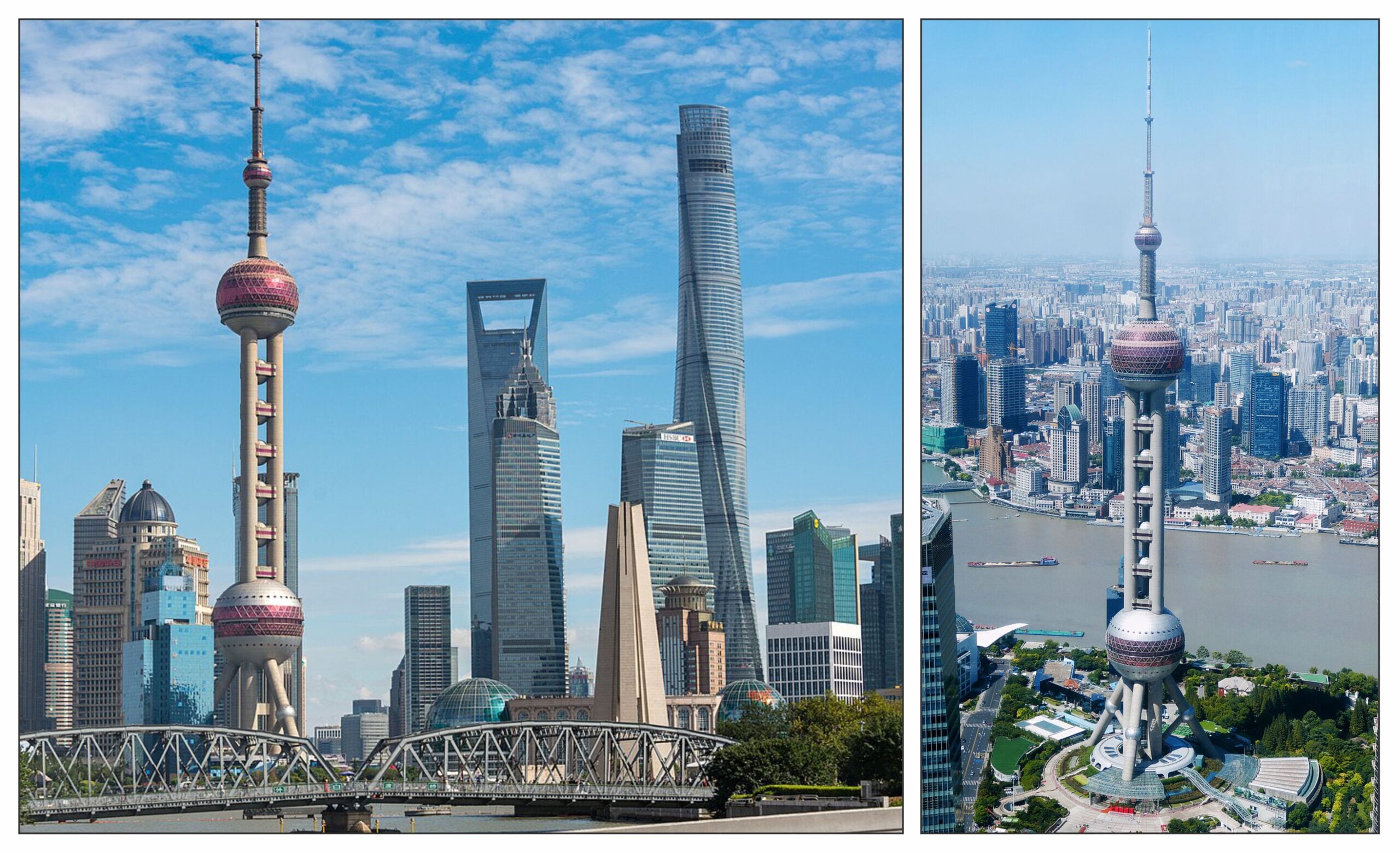
The architects of the Oriental Pearl Tower (1994) in Shanghai based their design on Bai Juyi’s image of pearls falling onto jade:
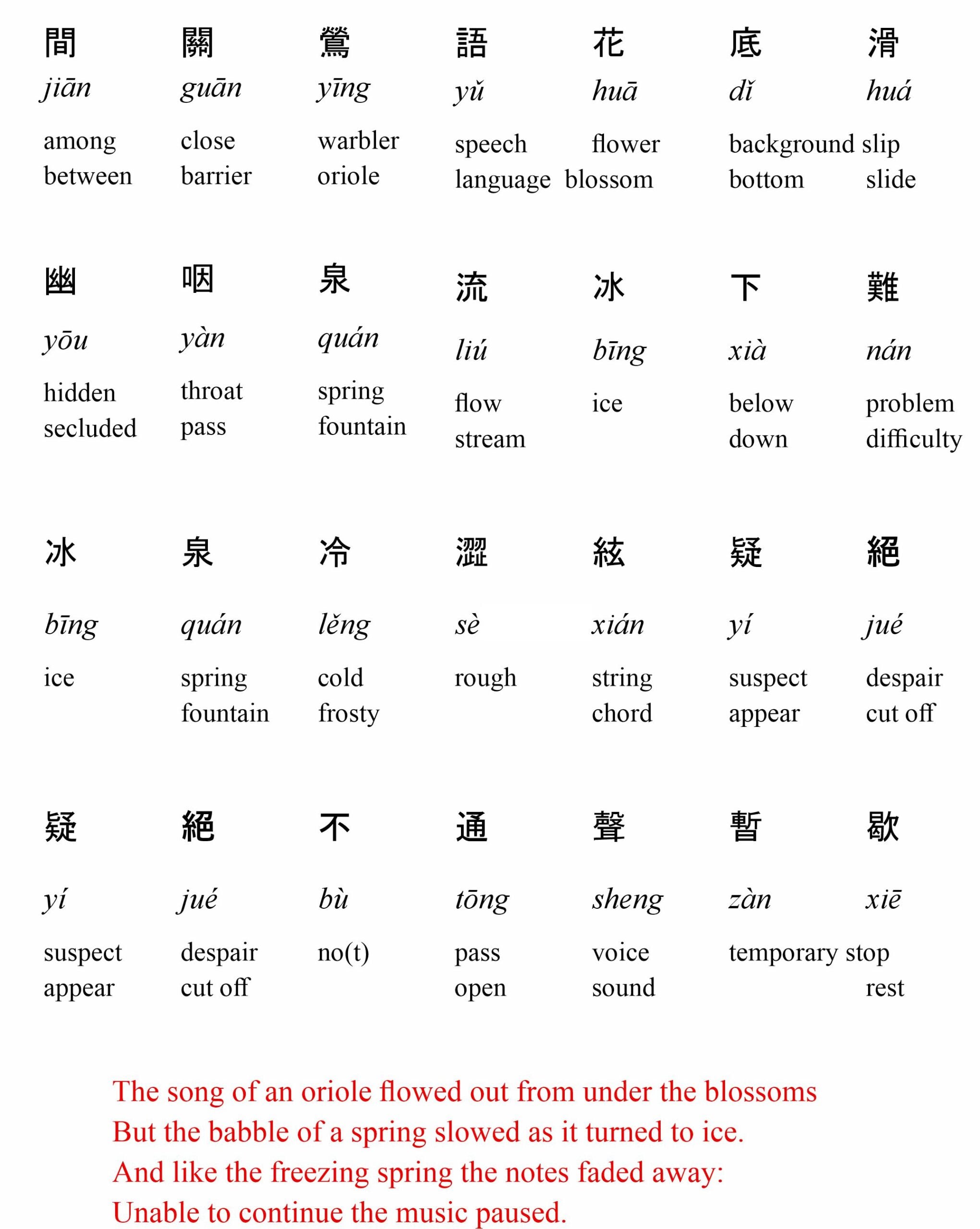
Following the music of the pearls, the pipa provides the quiet song of an oriole, and then like a freezing brook the music slows to a stop:
After a brief pause the pipa plays a wild crescendo that sounds like the charge of armored warriors, and then suddenly the player stops.
The Life of the Pipa Player
During the ensuing silence, the pipa player tells her story. She was once a highly acclaimed musician in Chang’an. Her beauty and her talent were the toast of the court.
This description of the life of a successful musician and courtesan in Chang’an has been translated in many ways. One version is especially vivid. In 1917, Ezra Pound (1885-1972) published Three Cantos in Poetry Magazine, and again in the American edition of his book Lustra. This was the beginning of a set of Cantos that ultimately numbered 109. These initial three cantos – often called the Ur-Cantos – were extensively revised when Pound published A Draft of XVI Cantos in 1925. Much of the original Canto II is no longer evident in the new sequence. The general theme of Ur-Canto II was the “poetics of loss” (Carr, 2018). Pound describes the ruins of the ducal palace in Mantua, and mourns the loss of most of the music of the troubadours. And then he provides a brief description of the setting of Bai Juyi’s poem and the words of pipa player:
Yin-yo laps in the reeds, my guest departs, The maple leaves blot up their shadows, The sky is full of autumn, We drink our parting in saki. Out of the night comes troubling lute music, And we cry out, asking the singer’s name, And get this answer: “Many a one Brought me rich presents; my hair was full of jade, And my slashed skirts, drenched in expensive dyes, Were dipped in crimson, sprinkled with rare wines. I was well taught my arts at Ga-ma-rio, And then one year I faded out and married.” The lute-bowl hid her face. We heard her weeping.
It was not until much later that Pound’s allusion to Bai Juyi was recognized (e.g. in Weinberger, 2007, p 128; discussed on the Pound Cantos Project website)
Pound had no knowledge of the Chinese language. In his book Cathay (1915), he “translated” a set of 15 Chinese poems based on the notes of Ernest Fenollosa who had studied Chinese poetry with the Japanese professors Mori and Ariga. Despite his lack of training in Chinese, Pound intuitively grasped the essence of the poems (see discussion by Yip, 1969). The brief excerpt from Ur-Canto II is typical of his translations. The meaning is clear though the words are not the same as in the original.
In Pound’s poem, Yin-yo is the Japanese transliteration of Chinese characters for the Xunyang River (Romaji, Jinyō-kō), and Gamaryo is the Japanese version of 蟆陵, which literally translated is “Toad Hill” (Fuller, 2017, p 286). This is the region in Chang’an city near the burial site of the Confucian scholar Dong Zhongshu (179–104 BCE). In Bai Juyi’s poem, the pipa player says that this is where she grew up (and learned how to play the pipa).
To return to the poem: The pipa player’s high life did not last forever. Her brother went off to the army, her mother died, her looks faded, and she was no longer as sought after as before. She married a tea-merchant and came to live in Jiangzhou. Her husband is usually away on business. Alone on her boat she plays the pipa and remembers happier days.
Listening to her story Bai Juyi feels an intense sympathy: he too has fallen from grace and now lives alone far away from the capital. The musician plays a final intense song:
We do not know the music that Bai Juyi found so moving. The following is a piece entitled Night Thoughts composed and played by Wu Man (1963- ), who studied with Liu Dehai.
Wu Man’s composition derives from a famous poem by Li Bai, who spent much of his later life in exile from the capital. The following translation is by Xu Yuan-Zhong (1984, p 125).
靜夜思A Tranquil Night
床前明月光 Before my bed a pool of light 疑是地上霜 Is it hoarfrost upon the ground 舉頭望明月 Eyes raised I see the moon so bright 低頭思故鄉 Head bent in homesickness I’m drowned
The Life of the Poem
Bai Juyi’s poem was popular among calligraphers and artists. The following is a scroll by Wen Boren (1502-1575) now in the Cleveland Museum.
And the next illustration is a painting by Lu Zhi (1495-1576), from a calligraphy scroll now in the National Museum of Asian Art at the Smithsonian Institution. The boats near the lower shore are as lost as the poet and the pipa player:
And the following is an illustration by Hua Zhangyi from a retelling of Bai Juyi’s poem (Liu Yang, & Hua Zhangyi, 2024) for children: the poet dedicates his poem to the pipa player.
Peng, Y. (2023). A comparative study on two English translations of Song of a Pipa Player from the perspective of translation aesthetics. Frontiers in Humanities and Social Sciences, 3(4), 36-40.
Tan, M. A. (2025). Bai Juyi and Yuan Zhen. In Z. Zhang & V. H. Mair (Eds.) Routledge Handbook of Traditional Chinese Literature (pp. 151–161). Routledge.
Waley, A. (1949, reprinted 2005). The Life and Times of Po Chu-i. Routledge.
Watson, B. (1984) The Columbia book of Chinese poetry: from early times to the thirteenth century. Columbia University Press.
Weinberger, E. (Ed.). (2007). The New Directions Anthology of Classical Chinese Poetry. Carcanet.
Wong, I. (2011). The Music of China. In Capwell, C., Nettl, B., Bolman, P., Dueck, B., Rommen, T., Wong, I., & Turino, T. (Eds.). Excursions in World Music, 6th Edition. (pp 88-131). Taylor & Francis
Xu, Y., Loh, B., & Wu, J. (1987). 300 Tang poems: a new translation. The Commercial Press.
Xu Yuan Zhong (1994). Songs of the immortals: an anthology of classical Chinese poetry. Penguin Books in association with New World Press.
Yip, W. (1969). Ezra Pound’s Cathay. Princeton University Press.
Yip, W. (2004). Chinese Poetry: An Anthology of Major Modes and Genres. (2nd ed., Revised). Duke University Press.
Yu, Y., & Chang, C. (2024). Text complexity and translation styles from the perspective of individuation: a case study of the English translations of Pipa Xing. Humanities & Social Sciences Communications, 11(1), Article 159.
Silk Roads: Paths for the Faithful
The Silk Roads were overland routes connecting China to the Mediterranean Sea, which allowed the trading of silk, paper, gold, jewels, horses, and other goods. These began during the 2nd Century BCE at the time of the Roman Empire in the West and the Han Dynasty in the East. The Silk Roads remained active until the 15th Century CE, when they were largely replaced by maritime trading routes. At present they are mainly used for archeological research and tourism. The illustration shows a modern camel caravan in the desert near Dunhuang. As well as trade goods, the Silk Roads facilitated the movement of religious ideas. Judaism, Zoroastrianism, Buddhism, Manichaeism, Christianity, and Islam followed the Silk Roads into China. Mithraism, Manichaeism and Islam spread into Europe.
Central Asia
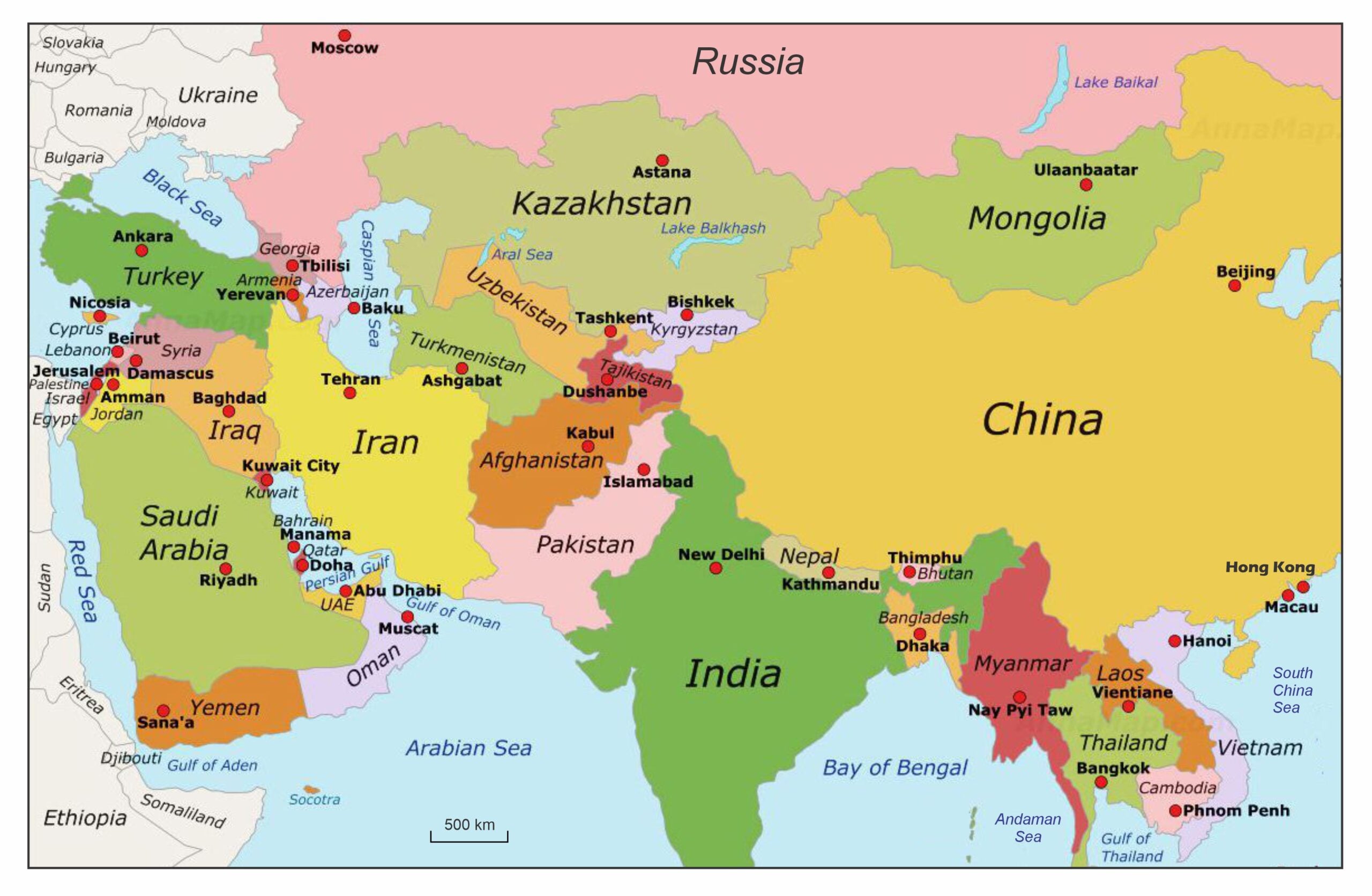
A map of the present political boundaries in central Asia will allow us to get our bearings:
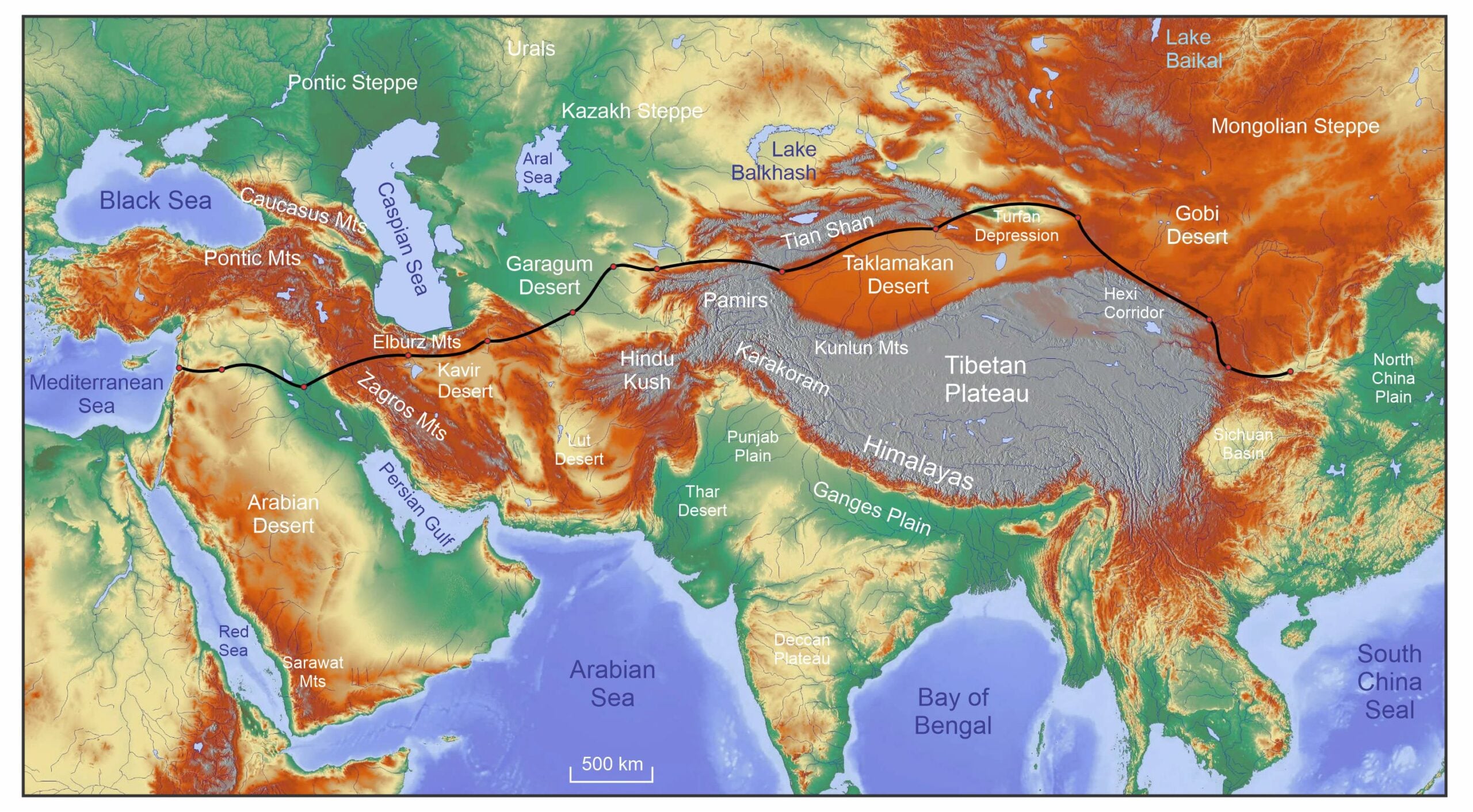
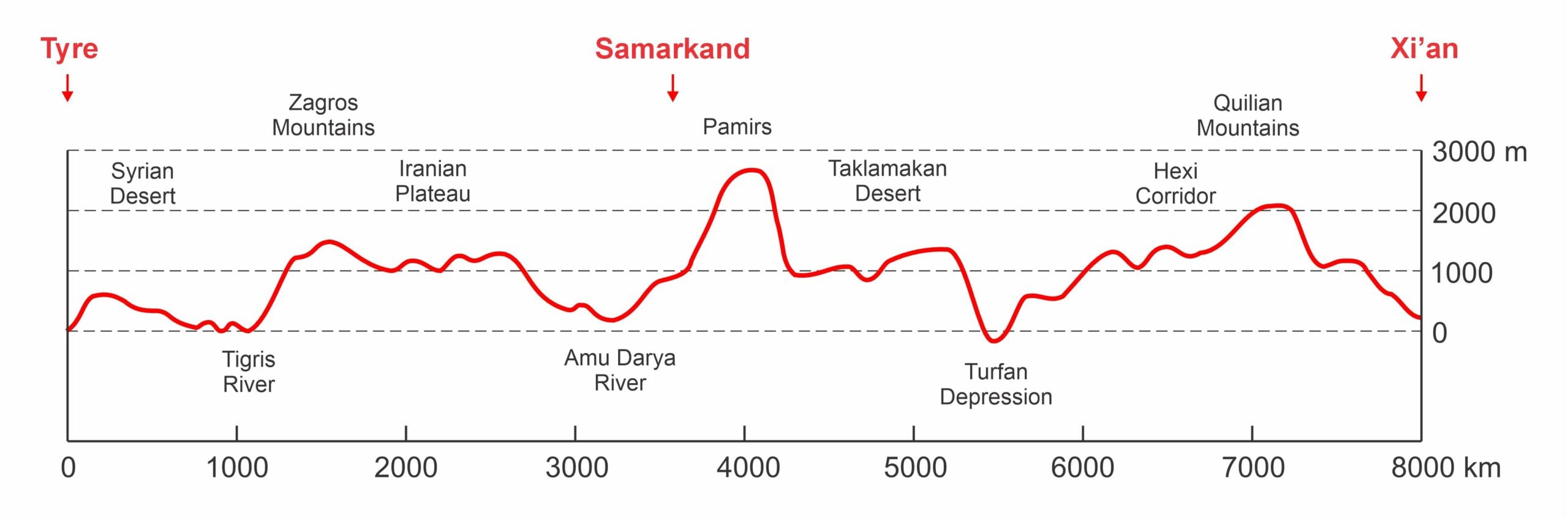
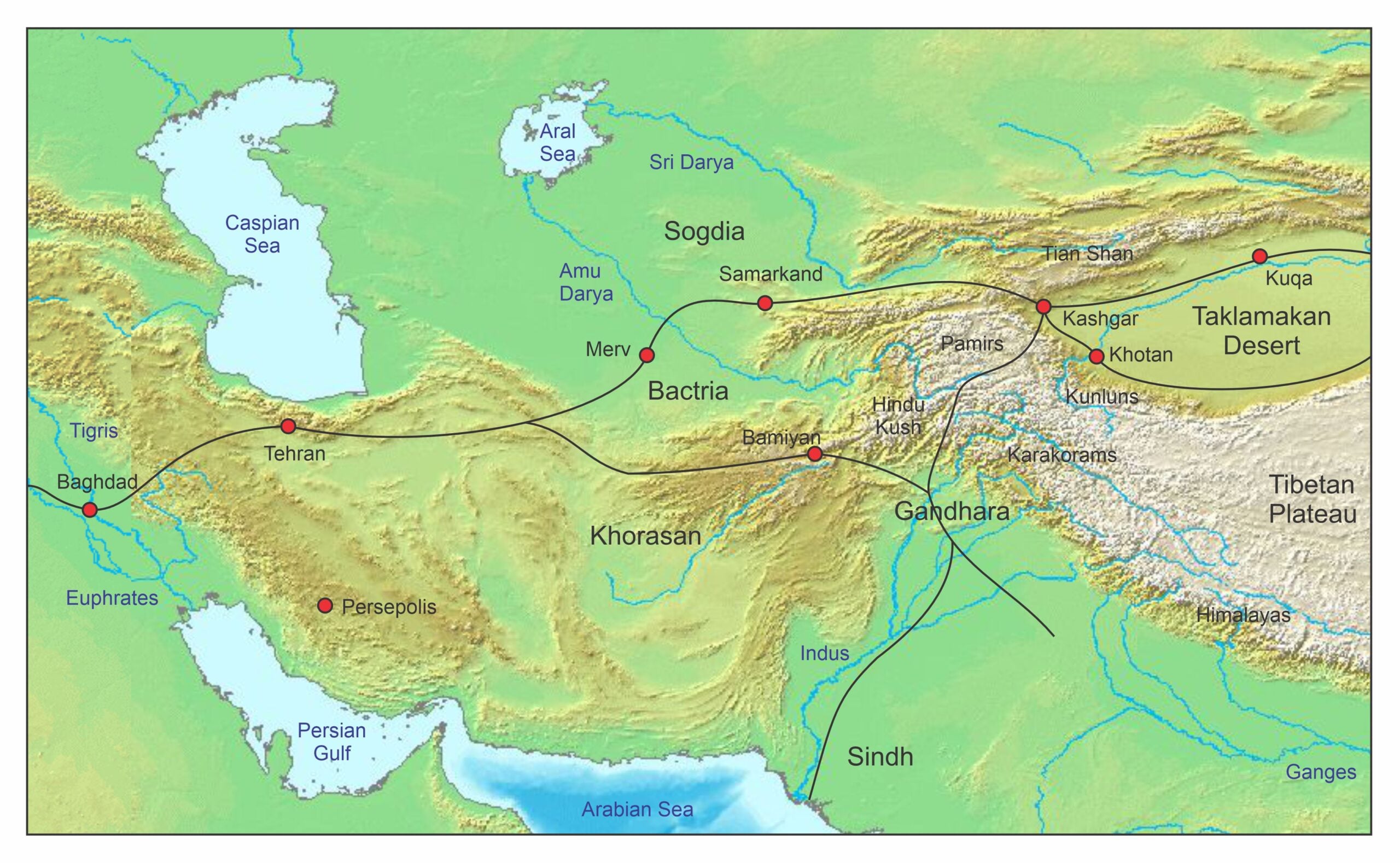
The following map shows the topography of the region and traces one of the many possible Silk Roads from Chang’an (Xi’an) in China to Tyre on the Mediterranean.
The following diagram, modified from Wood (2002), shows the changes in altitude (in meters above sea level) over the journey. It also notes the main mountains that are traversed, the deserts that are crossed and the main rivers on the way.
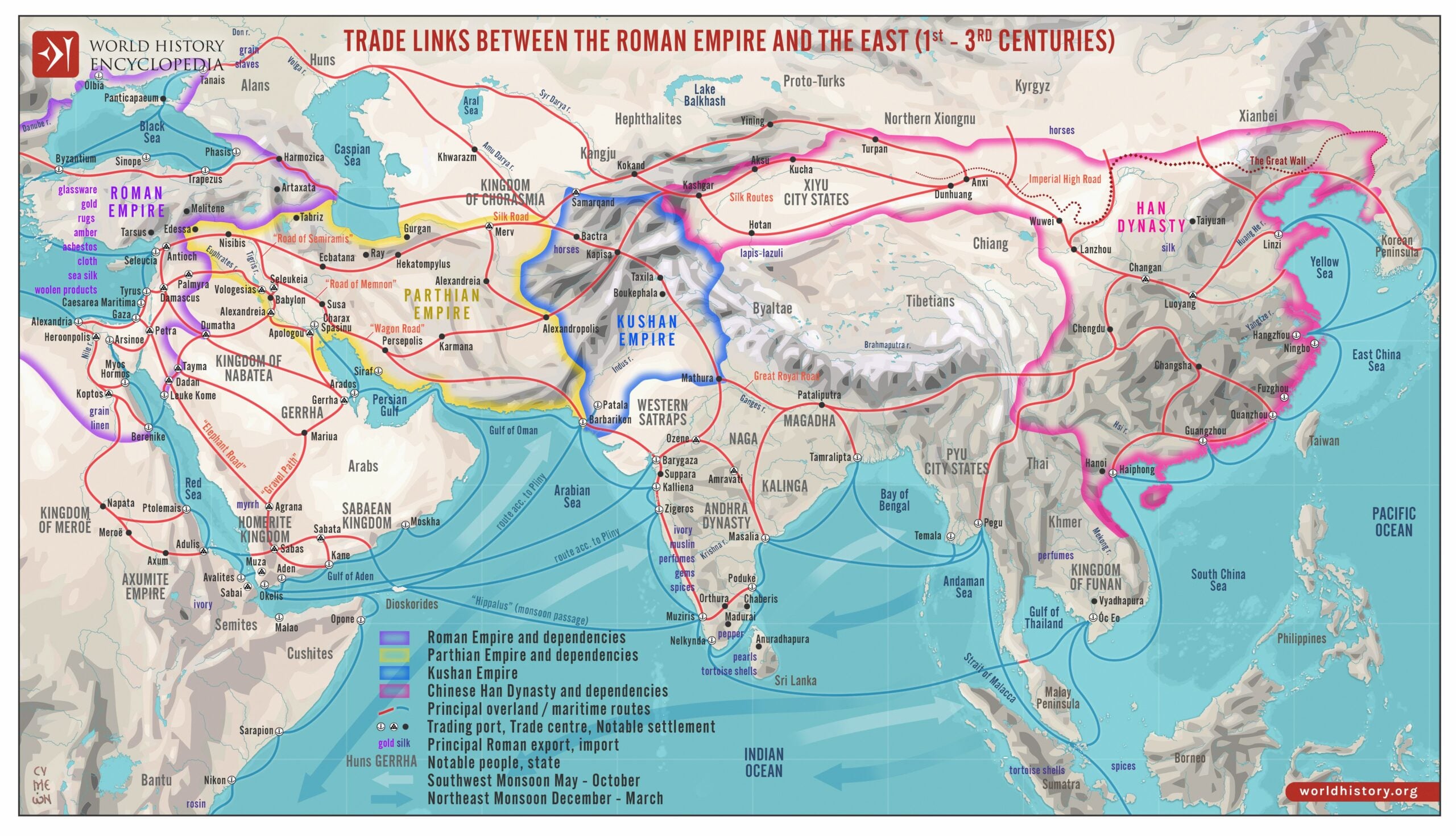
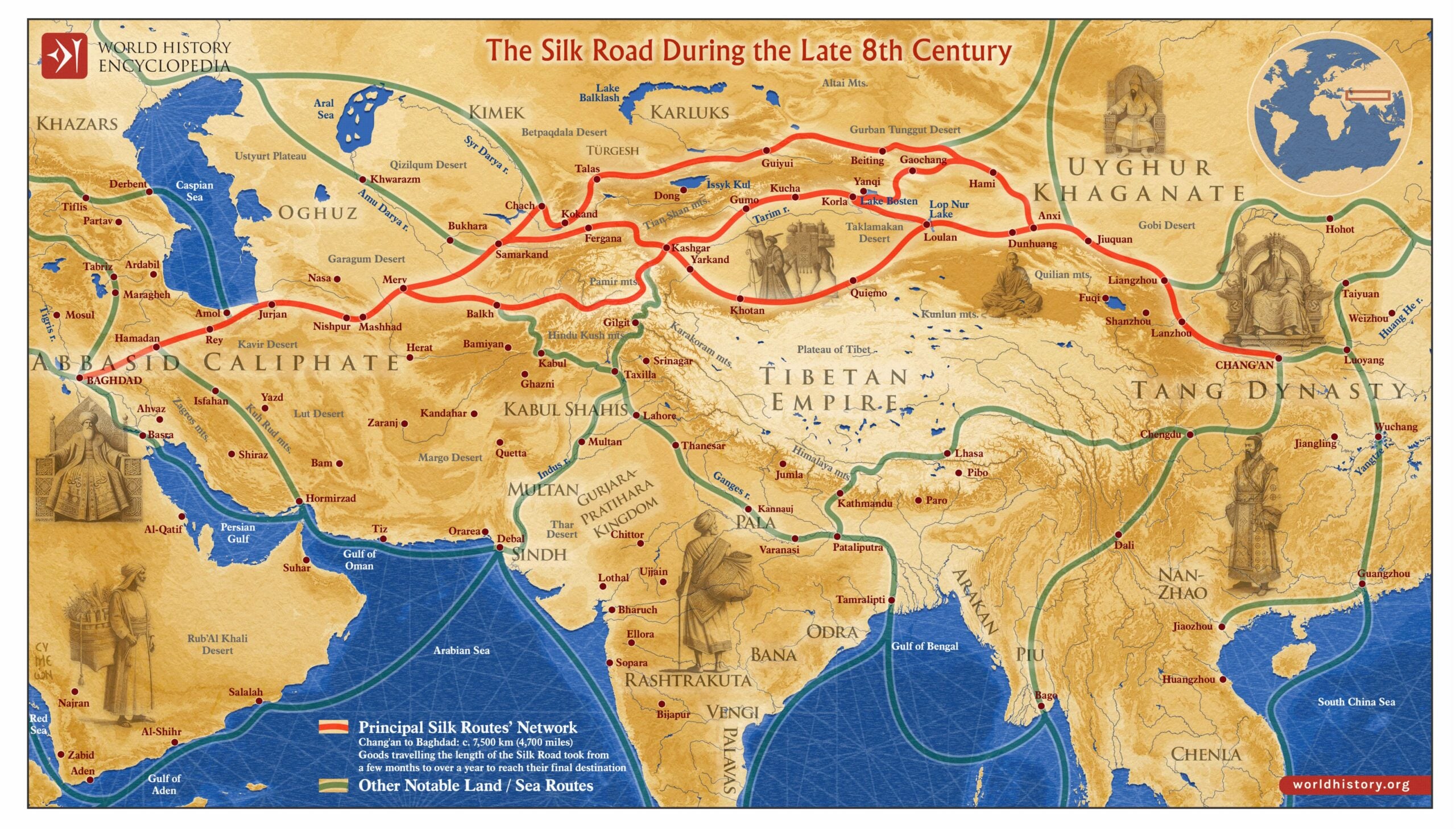
The Silk Roads spanned some 8000 km and were active for about 1700 years. They are described in multiple recent books (Frankopan, 2016; Hansen, 2017; Millward, 2013, Torr, 2018, Whitfield, 2024; Wood 2002). A striking TV series from Japan can be downloaded from archive.org. The following two maps by Simeon Netchev show the Silk Roads at two different points in time: the first map when trade began between the Roman Empire and the Han Dynasty in the 1st Century BCE, and the second map when the Silk Roads were at their height during the late 8th Century CE with the Tang Dynasty in China and the Abbasid Caliphate in the West. The first map also shows the maritime routes connecting China, India and Europe, and the monsoon winds that facilitate them. These sea connections are sometimes considered the “Golden Road” (Dalrymple, 2025, pp 4-5).
The Mongol Empires (1206-1368) supported trade along the Silk Roads. However, in the 14th Century CE the Mongol Empires fragmented, and the expansion of the Ottoman Empire (1299-1922) blocked overland connections between the Silk Roads and Europe. Trade between China and Europe continued using the maritime routes. Vasco da Gama made his first voyage from Portugal to India around the Cape of Good Hope in 1497. The overland Silk Roads soon became used only for local trade, and desert sands reclaimed many of the ancient trading posts (Beckwith, 2009, pp 232-262; Torr, 2018, pp 105-126).
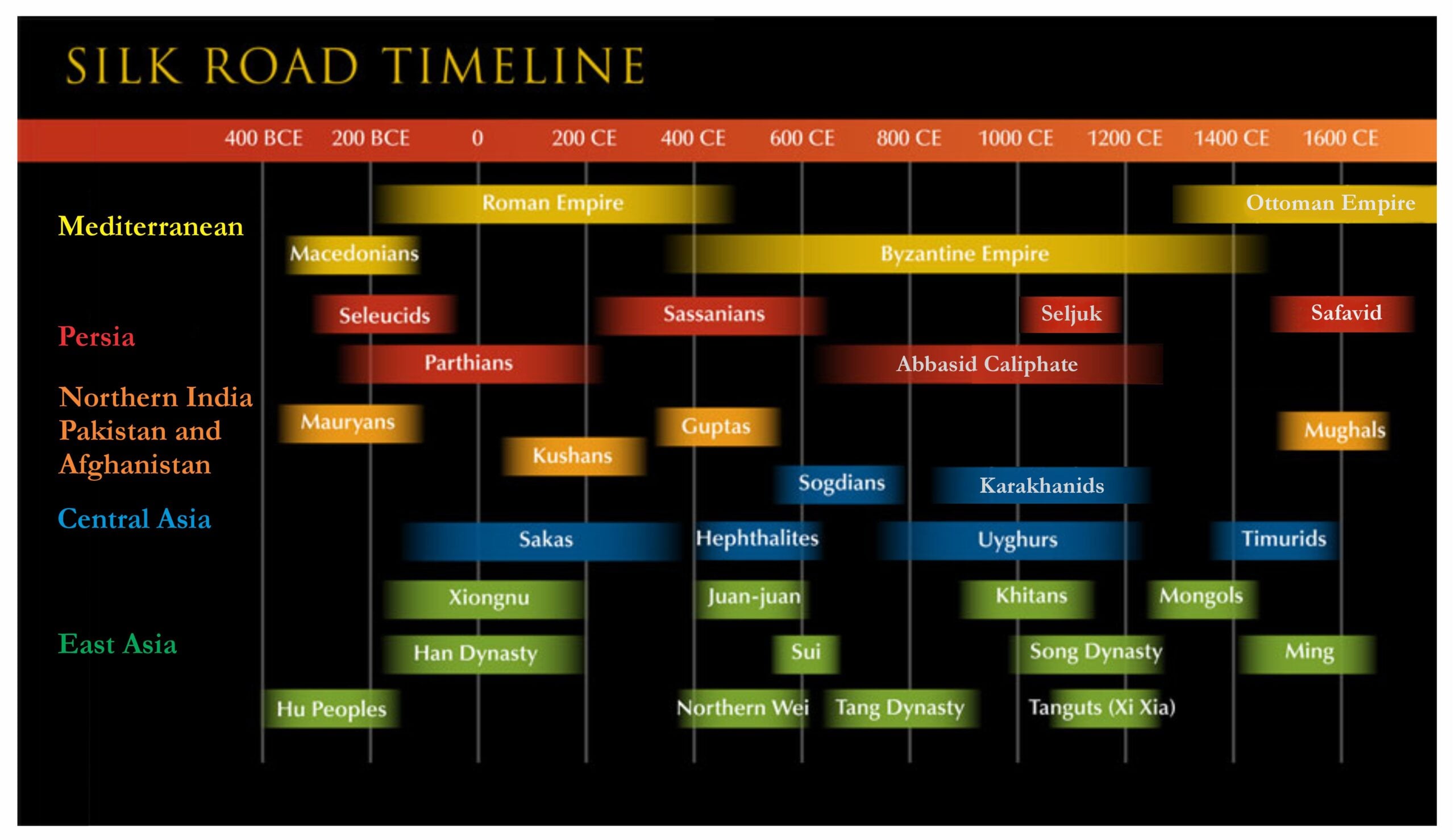
Many different empires established themselves for periods of time in central Asia (Beckwith, 2009). The following diagram, modified from Waugh (2009), shows some of the most important. Though having its capital in the east, the Mongol Empire (1206-1368 CE) extended all the way to Europe.
The Library at Dunhuang
Since it will play a role in much of what will be said about the movement of religions along the Silk Roads, we shall briefly mention the Mogao Caves at Dunhuang (墩, dūn, tumulus/mound + 煌,huáng, shining/brilliant). Dunhuang, located on an oasis containing Crescent Lake and is surrounded by sand dunes, was an important stop on the Silk Road from the time of its beginning in the 2nd Century BCE (Hansen, 2017, pp 288-335). Nearby is the Jade Gate – an opening in the Great Wall of China that allows entrance to the Hexi Corridor connecting the cities of Chang’an and Luoyang to the deserts of Xinjiang in Western China.
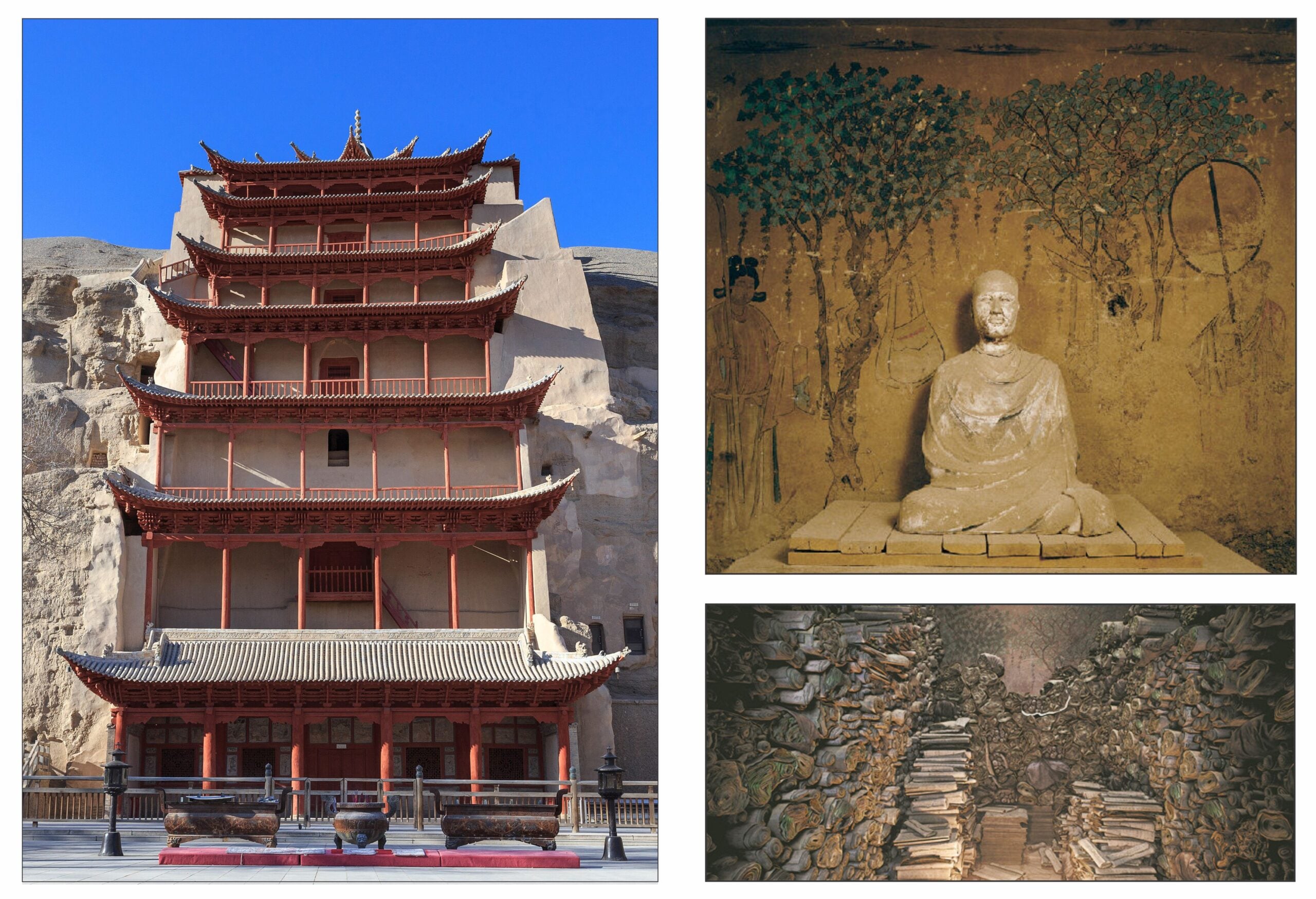
Buddhist monks first arrived in Dunhuang in the early centuries of the common era. In the 4th Century CE, they began carving caves into of the sandstone cliffs 25 km southeast of the city. These Mogao Caves – “Caves of a Thousand Buddhas” – are a system of about 500 separate temples decorated with wall paintings and sculptures and connected by intricate stairs and platforms. By the 9th Century, the monk Hong Bian had made the Three Realms Monastery near the caves into an important center of learning. When he died, his statue was placed in Cave 17. On the wall behind him were painted two banyan trees with a water bottle and a cloth bag hanging on the branches. Under one tree an acolyte holds a fan; under the other, a disciple holds the monk’s staff.
In 1002 CE the Karakhanids spread into the Taklamakan Desert and destroyed the Buddhist City of Khotan (Sinor, 1990). Though they had once followed both Buddhism and Christianity, the Karakhanids had converted to Islam in 934 CE and considered all other faiths as infidels. Fearful that Dunhuang might also be destroyed, the monks put all their treasured manuscripts and paintings in Cave 17 with the statue of Hong Bian, and sealed the cave off from the outside world (Rong, 1999).
In 1900, while sweeping sand from the temple floor of Cave 17, a Daoist monk, a custodian for the caves, realized that the rear wall was false and discovered that the sealed-off chamber contained piles of ancient manuscripts. In sum there were about 50,000 manuscripts and other objects in the cave, which became known as the “Library Cave.” In 1907 the newly discovered treasure trove was examined by the explorer Aurel Stein, who purchased many of the manuscripts for the British Museum (Morgan & Walters, 2012). Paul Pelliot visited in 1908 and bought a set of manuscripts for the Bibliothèque nationale de France.
The following illustration shows on the left the entrance to the Mogao Caves. Most of the building is from the 20th Century. On the upper right is the statue of Hong Bian in the Library Cave. On the lower right is an impression of what the cave must have looked like in 1900.
Most of the manuscripts found at Mogao concerned Buddhism and were written in Chinese. However, some of the manuscripts related to other religions such as Manichaeism, Christianity, Judaism and Daoism. Many ancient languages other than Chinese were also represented: Sanskrit, Tibetan, Sogdian, Hebrew, and Old Uyghur.
Judaism
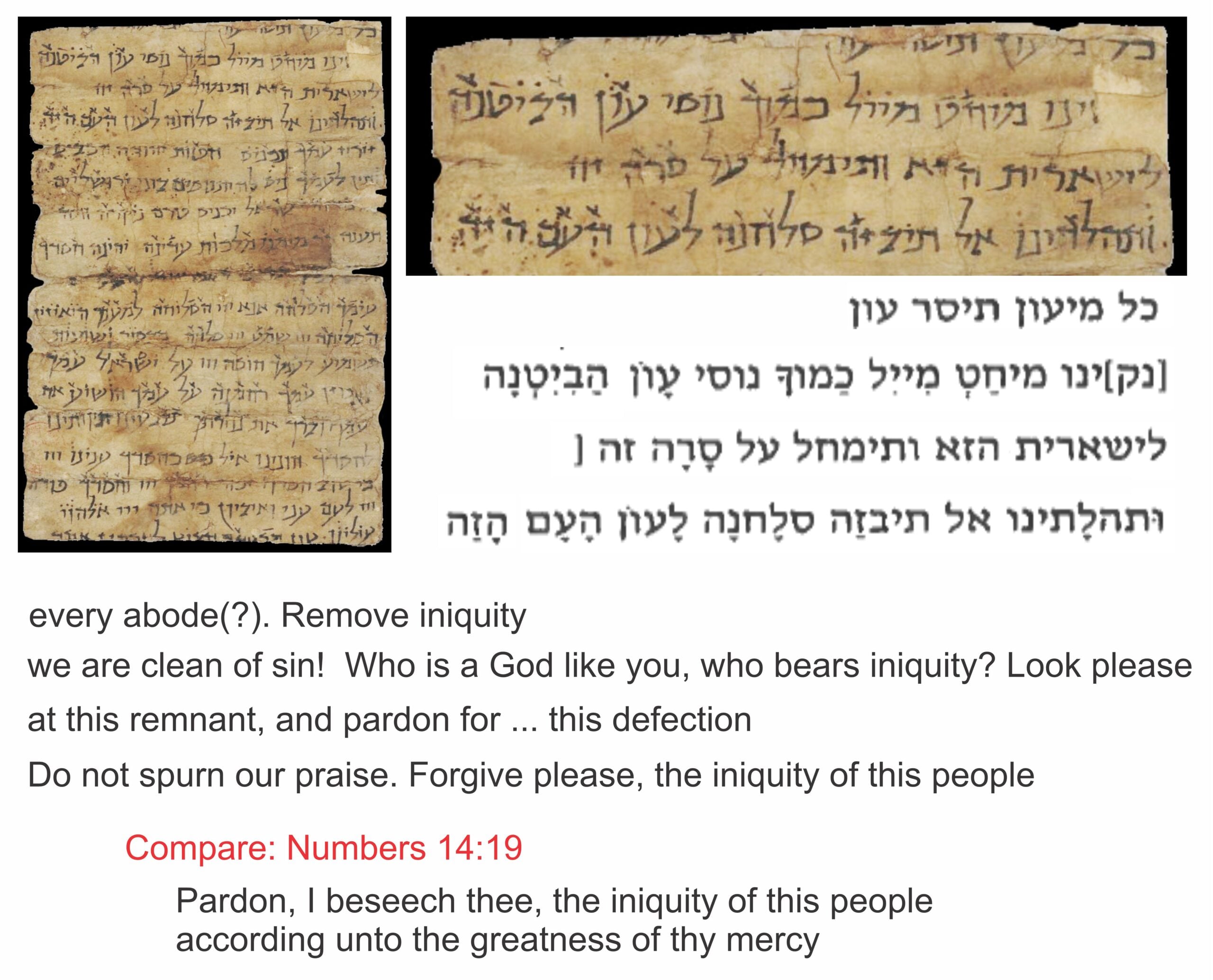
One of the manuscripts from the Library Cave is a Hebrew prayer for forgiveness (selihah). At one time it was folded up, perhaps so that it could be carried easily in a small container as an amulet to ward off evil. The text does not directly quote scripture but is very biblical in its wording. The following illustration shows the complete manuscript on the upper left. The photograph has been lightened to facilitate reading. On the upper right is an enlargement of the first 4 lines together with a transcription (Koller, 2024). The English translation of these 4 lines is below together with a quotation form the book of Numbers showing a similar style.
The manuscript is dated to around 800 CE. This and a few other Hebrew manuscripts from other stations on the Silk Road suggest that Jewish merchants were involved in the trade between China and the West. There may therefore have been Jews in China during the Tang dynasty or even earlier. A group of Jews in Kaifeng in central China petitioned the emperor to build a synagogue in 1163 CE (Berg, 2024). Their ancestors may have originally travelled to China over the Silk Roads. Their descendants still live today in China.
Zoroastrians
The religion of Zoroastrianism was established toward the end of the second Millenium BCE, and became the state religion of the main Persian Empires: the Achaemenid (559-331 BCE), Parthian (559 BCE – 331 BCE) and Sasanian (224–651 CE). Zoroastrian priests were generally called magi.
(i) Biblical Magi
The Gospel of Matthew relates how three magi (translated as “wise men”) came from the East to visit the newborn Jesus in Bethlehem.
Now when Jesus was born in Bethlehem of Judaea in the days of Herod the king, behold, there came wise men from the east to Jerusalem,
Saying, Where is he that is born King of the Jews? for we have seen his star in the east, and are come to worship him. (Matthew 2: 1-2)
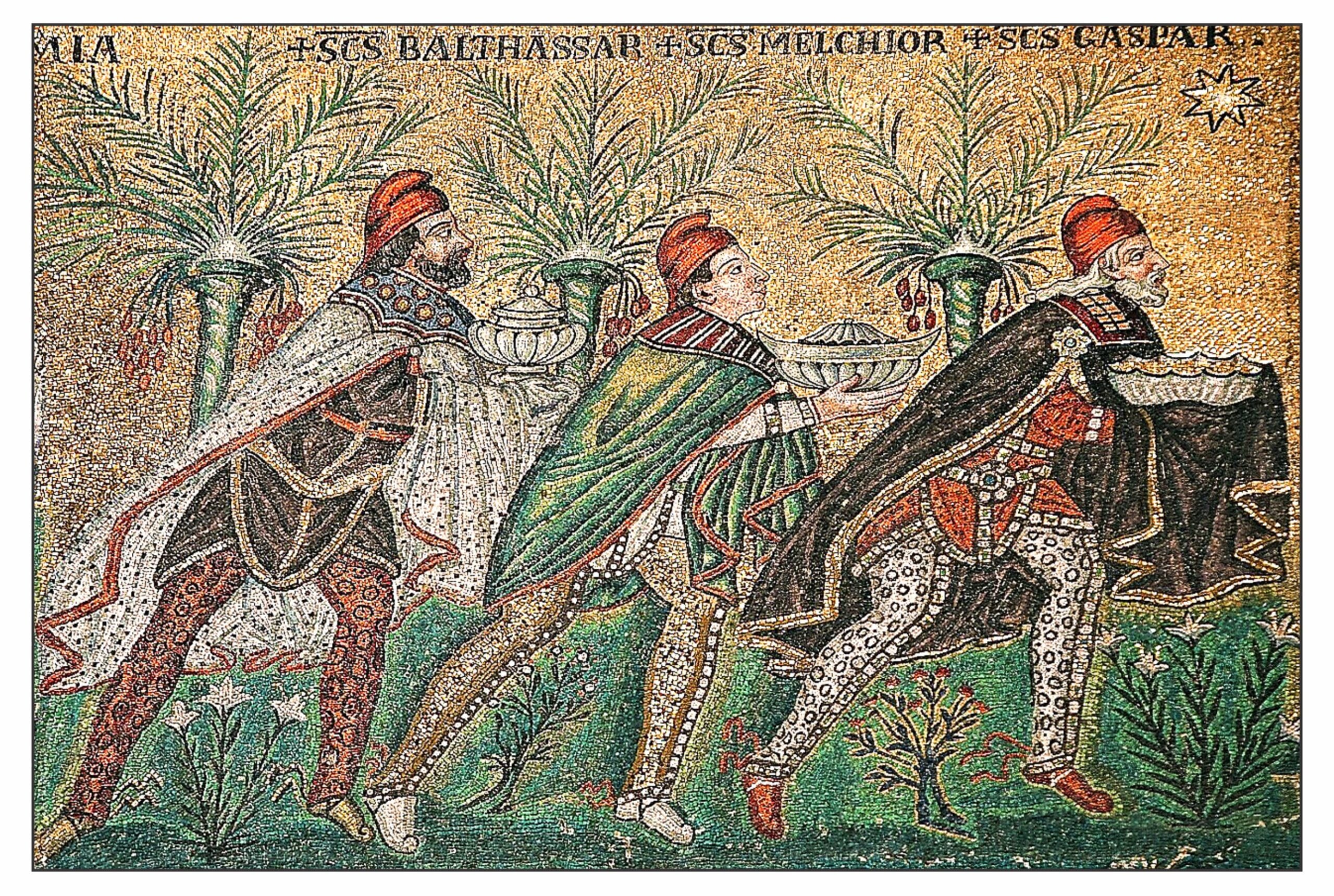
These wise men may have been Zoroastrian priests from Persia. If so, they would have travelled along the Silk Roads. The illustration below shows a mosaic representation of the magi from the Basilica of Sant’Apollinare Nuove in Ravenna (565 CE). The magi are shown in typical Persian clothing: flowing capes and Phrygian caps.
(ii) Mithraism
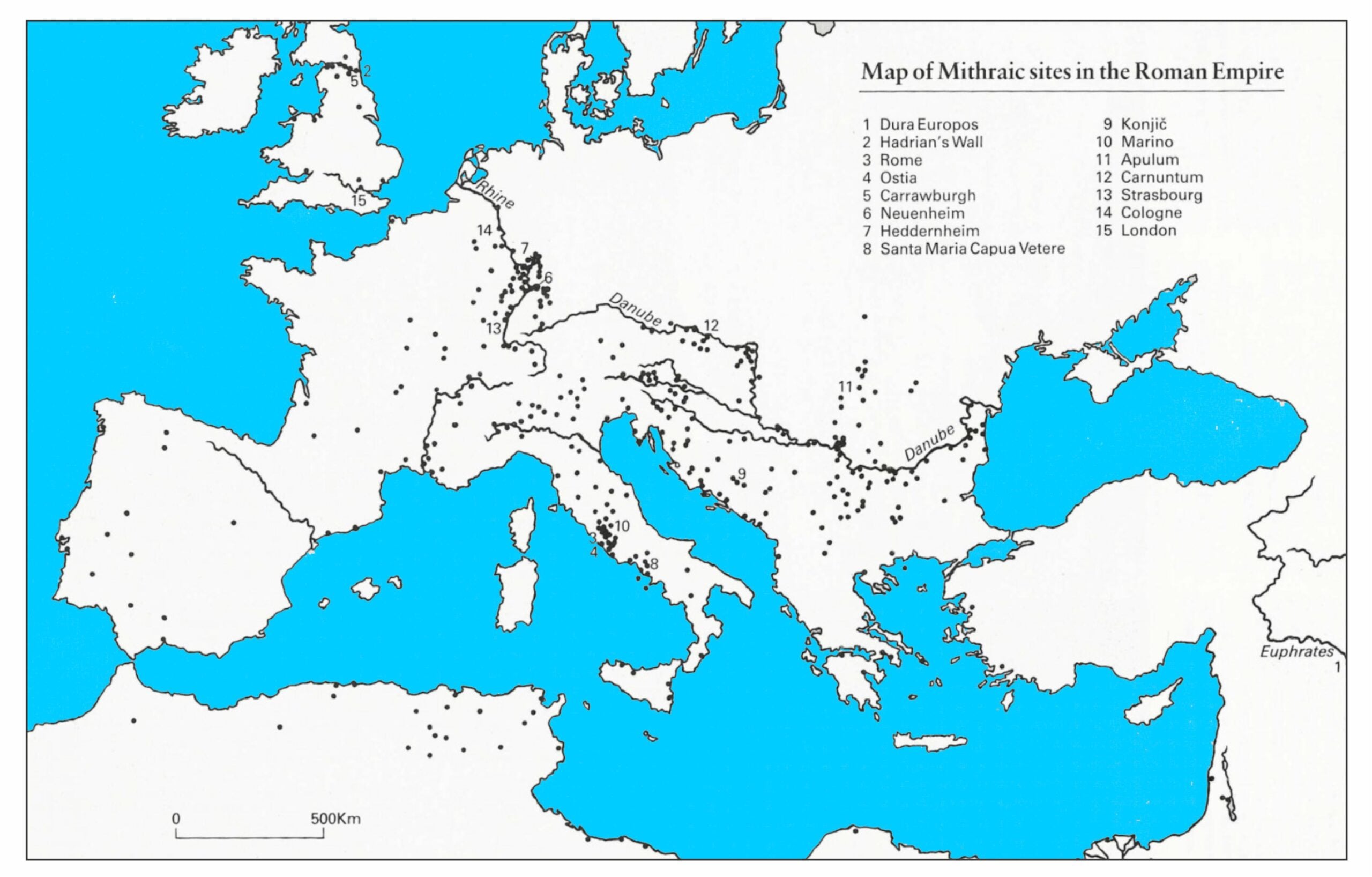
Mithraism was a Roman Mystery Cult focused on the God Mithras, one of the many Gods (yazata) worshipped in Zoroastrianism. The cult involved secret meetings in underground temples called Mithraea, archeological evidence for which has been found throughout the Roman Empire:
Mithraism was active from about 50 CE to about 300 CE. In the 4th Century CE Christianity was mandated as the sole state religion in the Roman Empire (Edict of Thessalonica, 380 CE). Thereafter Mithraism essentially vanished.
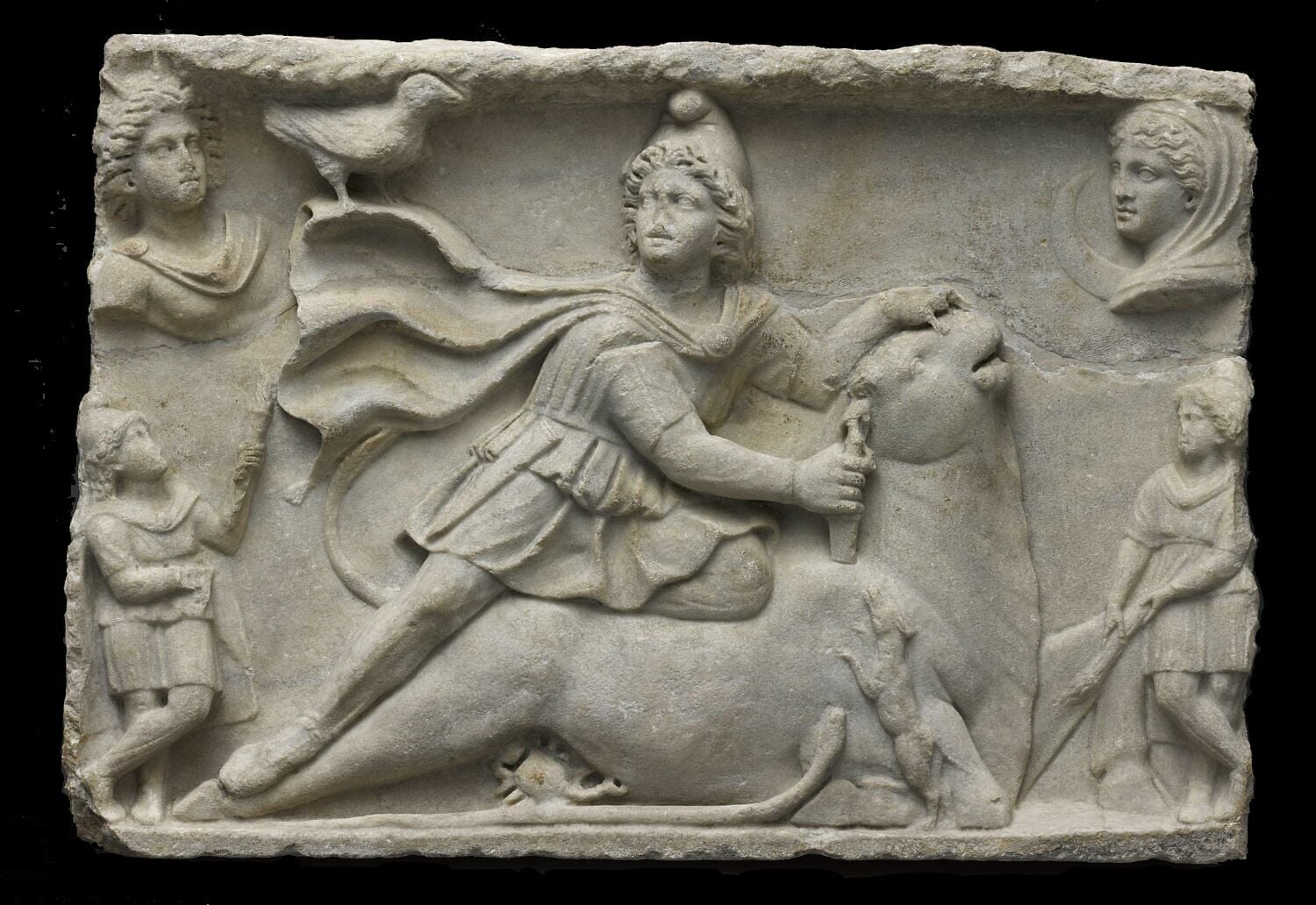
The Mithraeum was set up for a communal feast for the initiates, who were almost always men and mainly soldiers. One essential part of the temple was a fresco or sculpture of Mithras slaying a bull – the “tauroctony.” No one really understands what this sacrifice means. It might have something to do with redemption and salvation, much like the crucifix in a Christian church.
The iconography was stable across its many different locations. In the center, the God Mithras slays the bull. Above are representations of the sun and the moon, and below the bull is attacked by a crab, a snake and a dog. The following illustration shows a tauroctony from the 2nd Century CE unearthed from the Villa Borghese in Rome:
The cult was originally believed to have been imported into the Roman Empire by soldiers who had fought in the Parthian wars, a series of conflicts occurring from 54 BCE to 217 CE, and who had thereby been exposed to the Gods of Zoroastrianism. However, there are relatively few Mithraea in the Eastern reaches of the Empire. And there is no evidence that the worship of Mithra in Persia involved any of the apparent rituals that occurred in the Roman Mithraea. Some have therefore suggested that the cult was a Roman invention (e.g. Stoll, 2022). Indeed, some of the earliest Mithraea are concentrated near the city of Rome (Chalupa, 2016), Nevertheless, the cult was devoted to one of the Zoroastrian gods, and most of the early descriptions of the cult acknowledged its Persian origins (Boyce et al, 1991, pp 468-490).
One possibility is that Roman Mithraism allowed its cult members to embrace an “otherness” and make themselves distinct from their fellows:
the imagery of Mithras dressed in the Persian garment and soft shoes with Phrygian cap on top of his curly hair alluded to the Greek topoi of Persians who were Rome’s ‘exotic other’ and ‘fiercest foe’. Such an iconography enabled the Roman Mithraists to depict their god as a foreign deity and to identify themselves as those Roman elites who had the knowledge of worshiping the foreign god. The Oriental imagery of Mithras created a boundary for Mithraic brotherhood and distinguished the cultic community from other forms of religiosity and religious groups in the wider cultural and religious boundaries of Rome. Whatever its origin, the Roman mystery cult of Mithras strongly relied on Roman attitudes and romantic visions of Persia and the Parthians in particular. (Mahzjoo, 2024).
(iii)Sogdians
At the time when trading was at its height, the main middlemen on the Silk Roads were Sogdian merchants (Pin Lyu, 2024). Sogdia was the name for the area of land between the Amu Darya (or Oxus) and the Sri Darya Rivers. Its capital was Samarkand. The following map shows the location of Sogdia in Central Asia. The black lines show several of the Silk Roads:
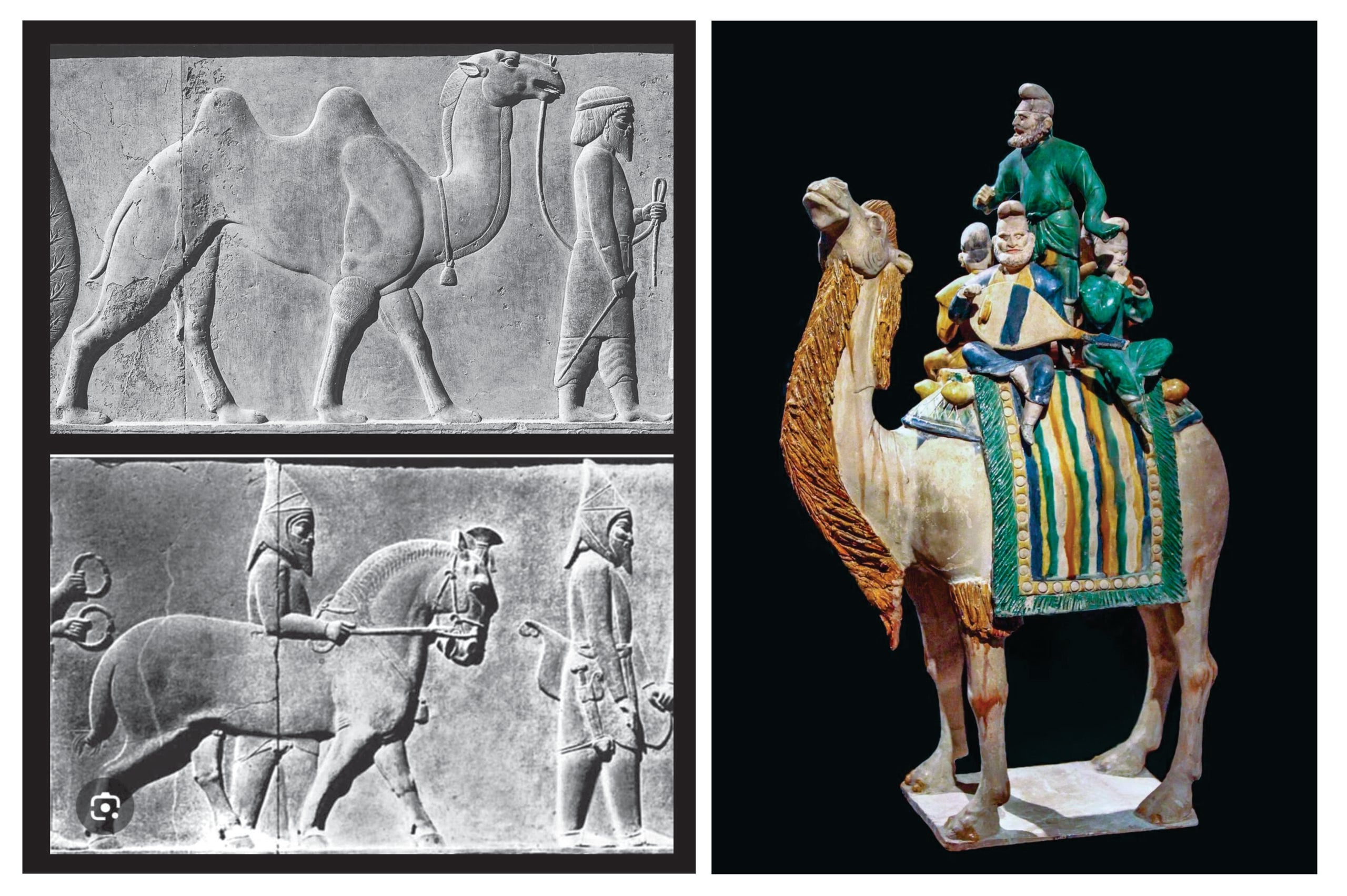
The Sogdians were descendants of the ancient Scythians. At the time of the Achaemenid Empire, when they were known as Saka, they paid tribute to the Persian Emperor in the form of camels and horses.
During the time of the Sasanian Empire, Sogdia was at the eastern limits of the empire and practiced Zoroastrianism (Grenet, 2015). When the empire was invaded by the Muslims, these frontier regions were able to maintain their religious practices for several centuries.
During the Abbasid Caliphate the Sogdians traded extensively with the Chinese and established large merchant colonies in cities of northern China.
The following illustration shows on the left two bas-relief representations of Saka bringing camels and horses to the Emperor at Persepolis (6th-5th Century BCE). On the right is a Tang dynasty porcelain statuette showing a group of Sogdian musicians on a camel. This was found in Xi’an and dates to 723 CE.
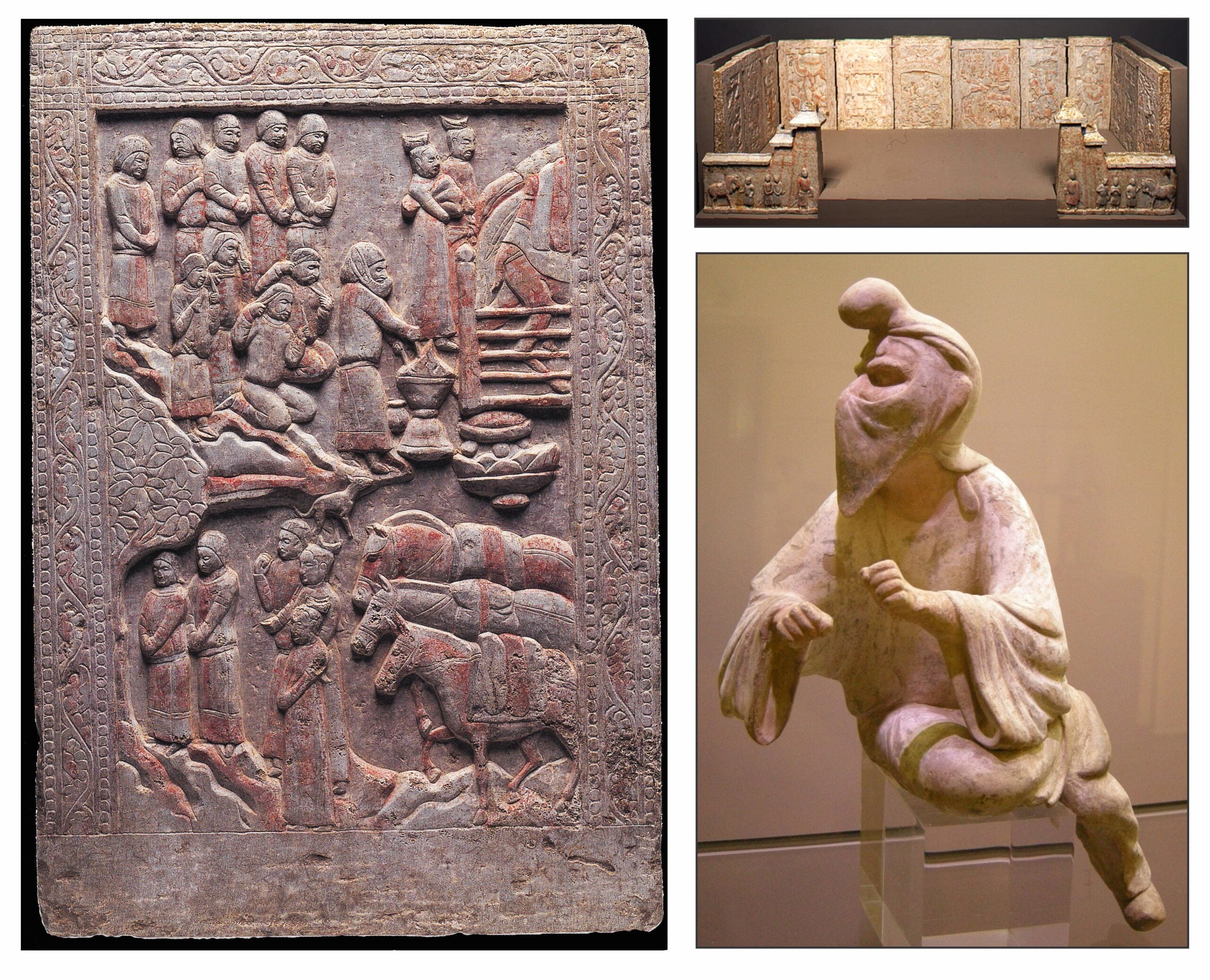
Zoroastrian funerary practices mandated that the corpse should not be allowed to pollute either the air or the land. Neither cremation nor burial was possible. Zoroastrians typically laid the corpse out on a stone bed and allowed vultures to strip the flesh from the bones. In China, Zoroastrians compromised by constructing closed tombs within which the deceased was laid out on a funerary couch and allowed to decay above ground. If the deceased was a rich merchant, this funerary bed could be quite ornate. The following illustration shows on the left a carving from a 6th Century Zoroastrian funerary couch in Northern China, now in the Miho Museum in Japan. The upper half of the carving shows a Zoroastrian priest caring for the sacred fire during the funeral service for the deceased. He is recognized by the face mask that prevents him from contaminating the fire with his mortal breath. The mourners are behind the priest. A camel is recognized to the right of the sacred fire, and several pack horses are seen below. The upper right of the illustration shows how the complete funerary couch was set up.
The lower right shows a small ceramic statuette of a Zoroastrian priest with a face mask. Although he is sometimes considered a camel driver, he is more likely a priest tending to the sacred fire. The face mask is just too typical. The statuette was found in northern China and dates to the 8th Century CE.
Buddhism
Gautama Buddha lived in the northeastern region of India in the 6th or 5th Century BCE. After his death his followers taught the new dharma throughout the Indian subcontinent. The Mauryan Empire (320 BCE–185 BCE) expanded to incorporate Greco-Persian lands in what is now Pakistan and Afghanistan. Ashoka (304–232 BCE), the third Mauryan Emperor, promoted Buddhist thought throughout his domain.
(i) Gandhara
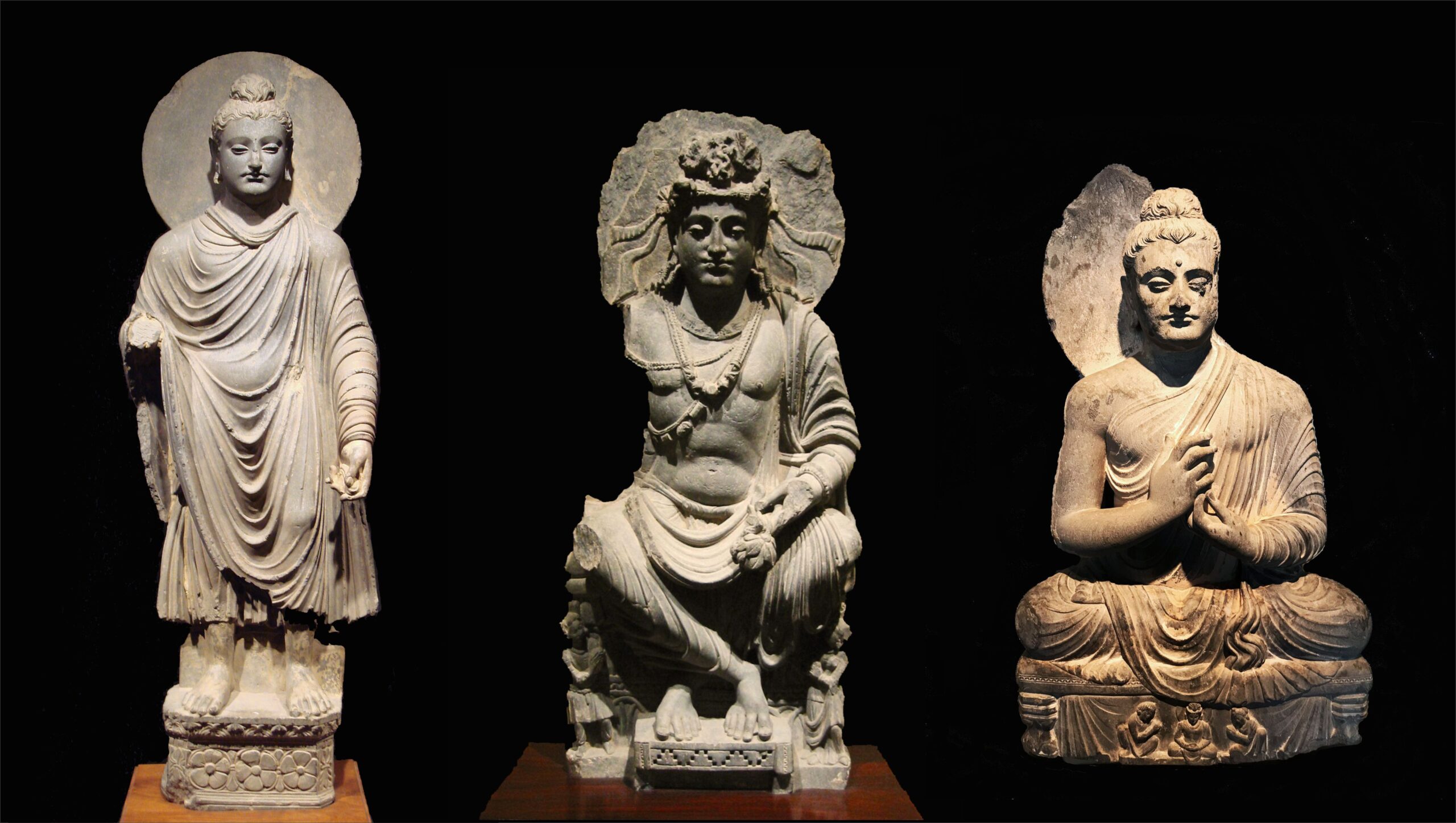
Few representations of the Buddha occur form the first centuries of the new religion. Since the teaching proclaimed that the everyday world was transient and misleading, artistic representations may have been considered unworthy. This changed when the faithful encountered artists of the Greco-Persian world in a region of northwest India called Gandhara. Realistic sculptures of the Buddha and his disciples proliferated. The following illustrations shows sculpture of the Buddha made in the Gandhara from the 1st, 2nd and 5th Centuries CE:
(ii) Colossal Buddhas
As their religion spread along the Silk Roads, Buddhist monks began to carve statues of the Buddha out of the sandstone cliffs along the route. Some of these assumed colossal sizes (Wong, 2019). The earliest large Buddhas, up to 15 m tall, were carved at the Yungang Grottoes near Datong in Northern China beginning in 465 CE. Colossal seated Buddhas, 33 and 23 m tall, were carved in the Mogao caves near Dunhuang in the 7th and 8th Centuries CE.
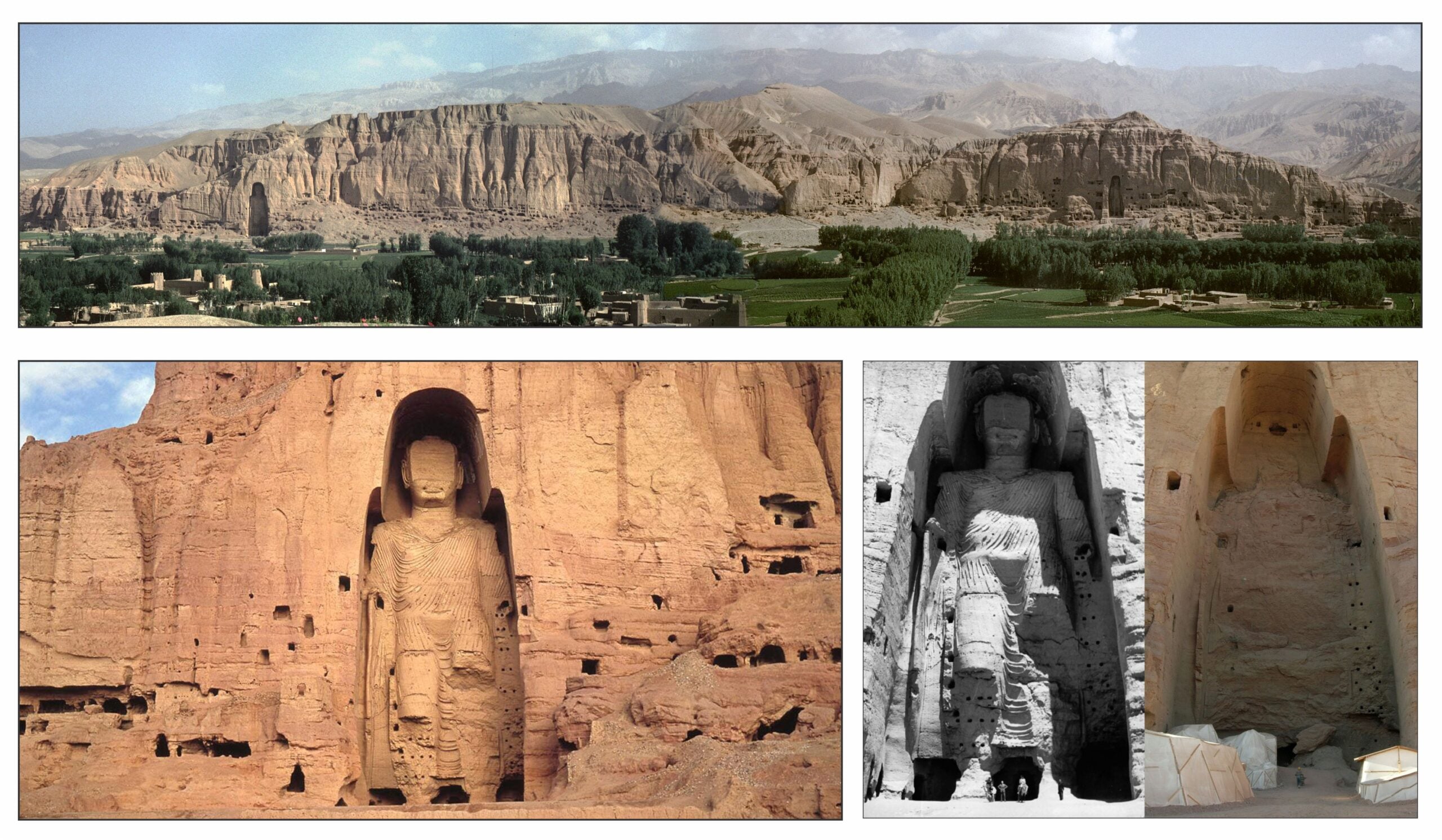
And around 600 CE, in Bamiyan, located in present-day Afghanistan, 130 km northwest of Kabul, two huge standing Buddhas were carved, one 38 m and the other 55 m tall. Since details such as the folds in the robe and the facial features could not be carved in the sandstone, these were added to the rough-hewn statues using stucco. The arms were constructed using stucco on wooden armatures. Over the years much of the stucco work eroded away leaving the large ungainly limestone forms.
The people in the area when the statues were carved were Hephthalites. These people followed several different religions (Zoroastrianism, Christianity, and Manichaeism) and tolerated the work of the Buddhist monks.
In 2001 the Taliban enforced a Muslim edict forbidding artistic representations of human beings. The two Bamiyan Buddhas were destroyed.
The following illustration shows at the top a panorama of the Buddhas in the Bamiyan Valley before their destruction. The lower left of the illustration shows a close-up of the larger of the two Buddhas. The lower right compares before and after its destruction.
(iii) Avalokistesvara
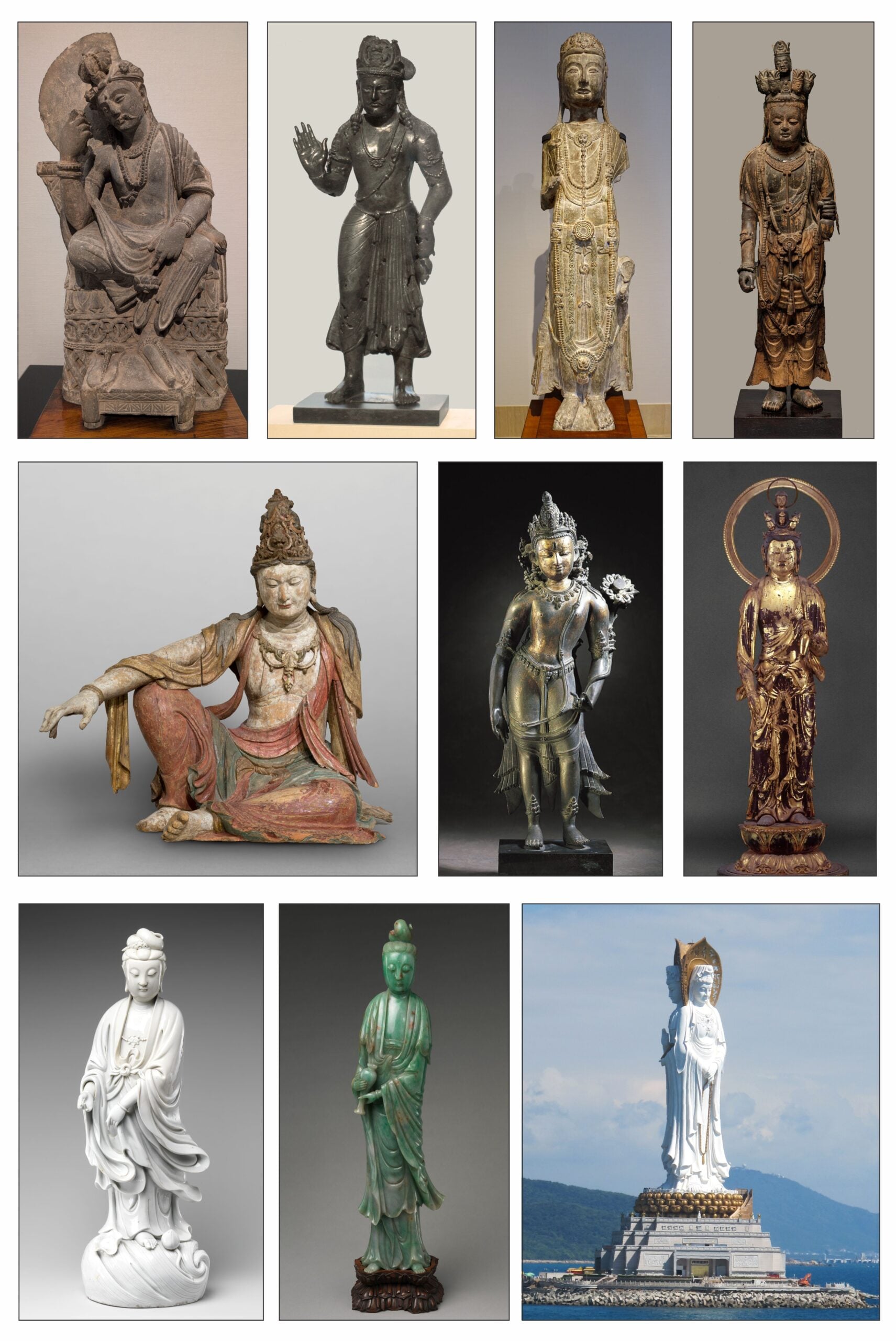
Avalokistesvara was the bodhisattva of compassion. His name in Sanskrit means “he who looks down,” i.e. he who considers the concerns of the faithful. As Avalokitesvara travelled along the Silk Roads to China he slowly changed gender from male to female (Stein, 1986; Suebsantiwongse, 2025; Yu, 2001). In China she became known as Guānshìyīn, (觀世音, look/observe+people/world +sound/voice: “the one who perceives the cries of the world”) or Guanyin. As the deity moved to Japan, she became known as Kannon, and veered back toward masculinity.
Avalokistsevara characteristically holds a lotus flower and sometimes prayer bead. Sometimes he or she has multiple heads which make her vision and hearing more acute. Occasionally the deity has multiple arms the better to aid those in need. As Guanyin, she often carries a vase of pure water to relieve suffering.
The following illustration shows the transformation of Avalokistesvara. In order from left to right and then form up to down:
Stone, Avalokistesvara, Gandhara, 3rd Century CE
Bronze, Avalokistesvara, Gandhara, 4th Century CE
Stone, Avalokistesvara, Northern China, 6th Century CE
Wood, Avalokistesvara with multiple heads, Northern China 11th Century CE
Wood, Avalokistesvara “seated at royal ease,” China, 11th Century CE
Bronze, Avalokistesvara, Nepal, 14th Century CE
Gilded Wood, Kannon, Japan 11th Century CE
Porcelain, Guanyin, China 17th Century CE
Jade, Guanyin, China, 19th Century CE
Titanium callosal statue (78 m) Nanshan Guanyin, Hainan Island, 21st Century CE
(iv) The Diamond Sutra
As Buddhism travelled along the Silk Roads to China, the sacred texts began to be translated from Sanskrit to Chinese. One of the most important translators was Kumarajiva (344–413 CE) who was born in Kuqa on the northern edge of the Taklamakan desert. His father was a Buddhist monk from Kashmir. Around 400 CE Kumarajiva travelled to Chang’an where he wrote most of his translations of the Buddhist literature.
The original Diamond Sutra was likely composed shortly after the time of Gautama Buddha’s life in the 5th Century BCE. However, it was not formally written down in Sanskrit until the 2nd or 3rd Century CE. The sutra narrates a dialogue between the Buddha and his elderly disciple Subhūti about the nature of reality and how to attain the wisdom that would release one from suffering. The world is transient and illusory; one must release oneself from any attachments; one must seek emptiness. The following is from Red Pine’s introduction to his translation of the sutra (2001):
following his Enlightenment, the Buddha had taught people to free themselves from suffering by realizing the impermanence and interdependence of everything upon which their suffering depended, including and especially themselves. The Buddha called this the realization of shunyata (emptiness), the view that because nothing exists independently of other things, it has no nature of its own, and every-thing is therefore empty, and this emptiness is the true nature of reality. Later, when the Buddha began teaching people to view emptiness itself as empty and to put the emptiness of emptiness to work in the liberation of all beings, few disciples grasped this new teaching, which he called the perfection of wisdom, the wisdom beyond wisdom.
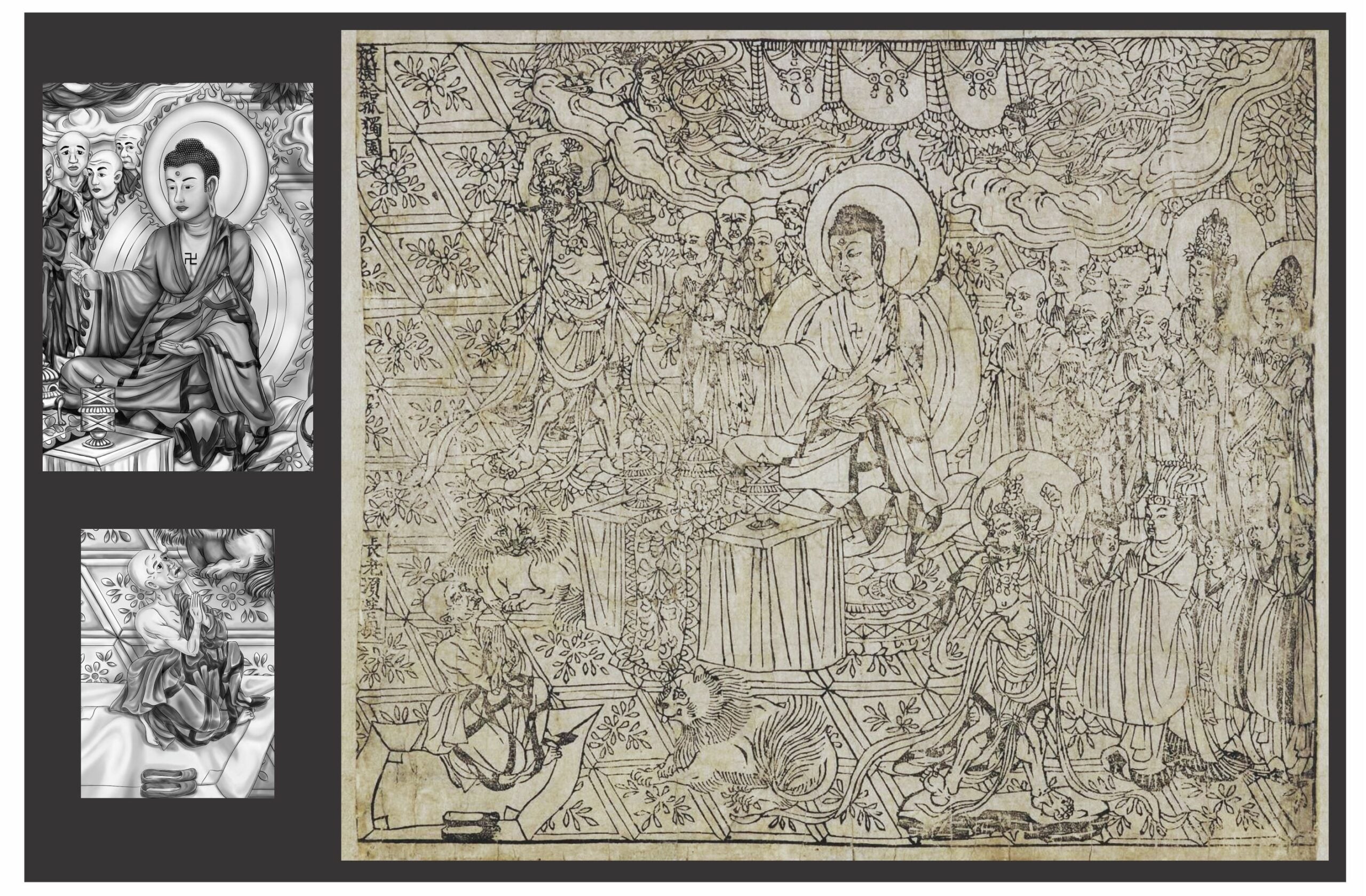
One of the most important discoveries in the Mogao Caves near Dunhuang was a woodblock-printed copy of Kumarajiva’s translation of the Diamond Sutra. The pages were printed by Wang Jie in 868 CE, probably in Sichuan, and then pasted together to form a scroll about 5 m long. The colophon gives the date and notes that the sutra was being made freely available to all who wished to read. This is the oldest printed book of which we have a copy.
The frontispiece of the scroll shows a woodblock drawing of the Buddha surrounded by bodhisattvas, and supernatural guardians. In the lower left is the disciple Subhūti. The following illustration shows this print together with details of the Buddha and his disciple redrawn by Zhao Ming An.
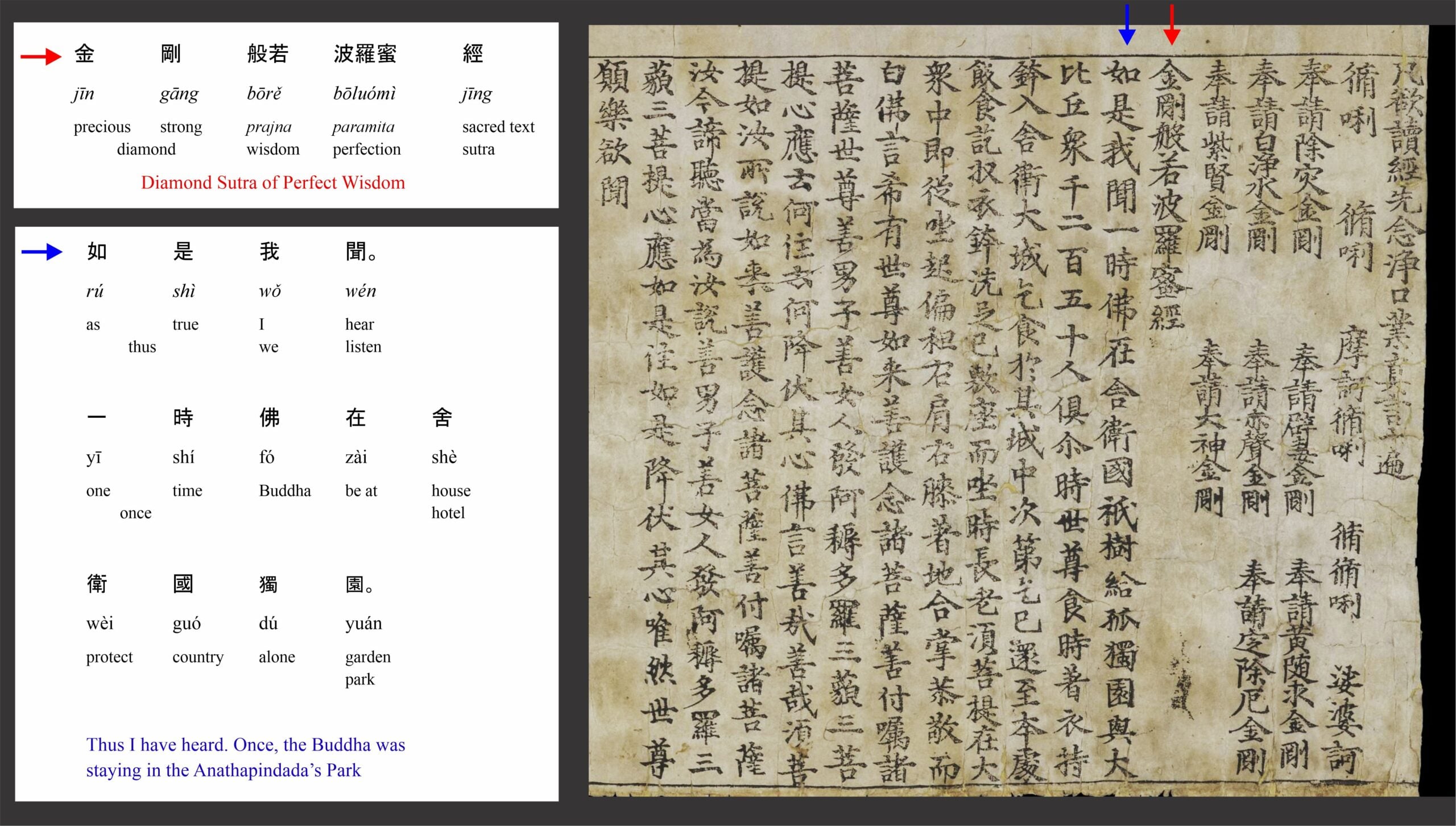
The following illustration shows the first page of text in the scroll along with a character-by-character translation of the title and the first few words of the sutra:
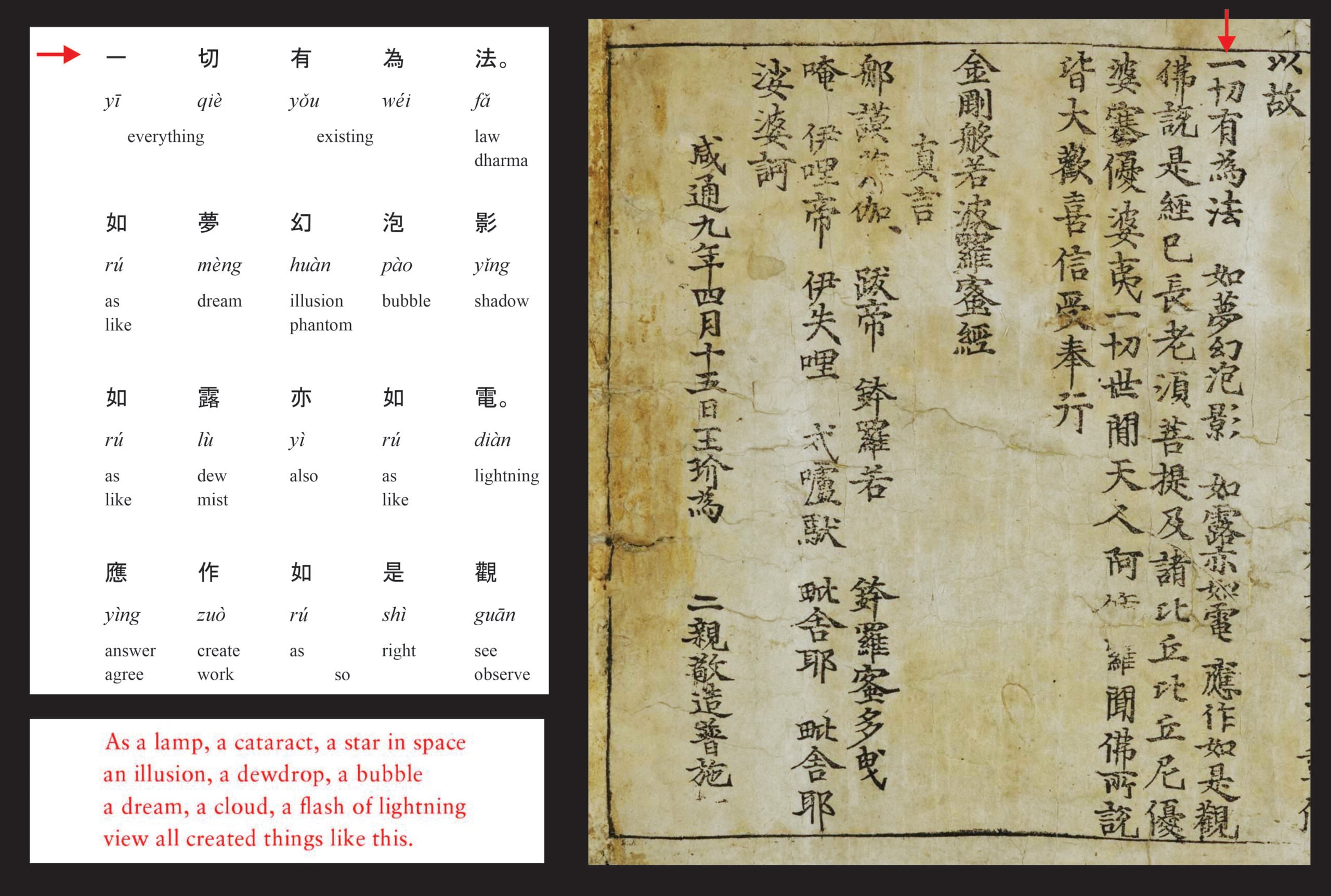
And the following illustration shows the last page of the scroll which includes the famous verse that the Buddha uses to describe the transience of the world. On the left, a character-by-character translation is followed by the English version of Red Pine, based on both the Sanskrit and the Chinese versions of the sutra (2001):
Christianity
During the first 4 centuries of Christianity, the nature of Jesus as both God and Man was extensively discussed. One position was that Jesus was of two distinct natures – dyophysite; another was that his two aspects were conjoined as one – miaphysite; and yet another was that his Jesus became fully divine – monophysite. Though these old distinctions are almost impossible to understand in modern times, in the 5th Century CE they were matters of life and death. The Church of the East (also known as the Assyrian Church) distinguished itself as miaphysite, and became separate from the dyophysite Byzantine and Roman Churches in 451CE. These latter churches condemned as heretical the monophysite teachings of Nestorius, a theologian in the 5th Century. The Church of the East is often known as the “Nestorian Church,” although its views on the nature of Jesus actually differed from those of Nestorius (Brock, 1996). Although the Church of the East remained separate from the Western Churches for many centuries, it has now established communal relations with the Roman Catholic Church.
(i) The Dunhuang Glora
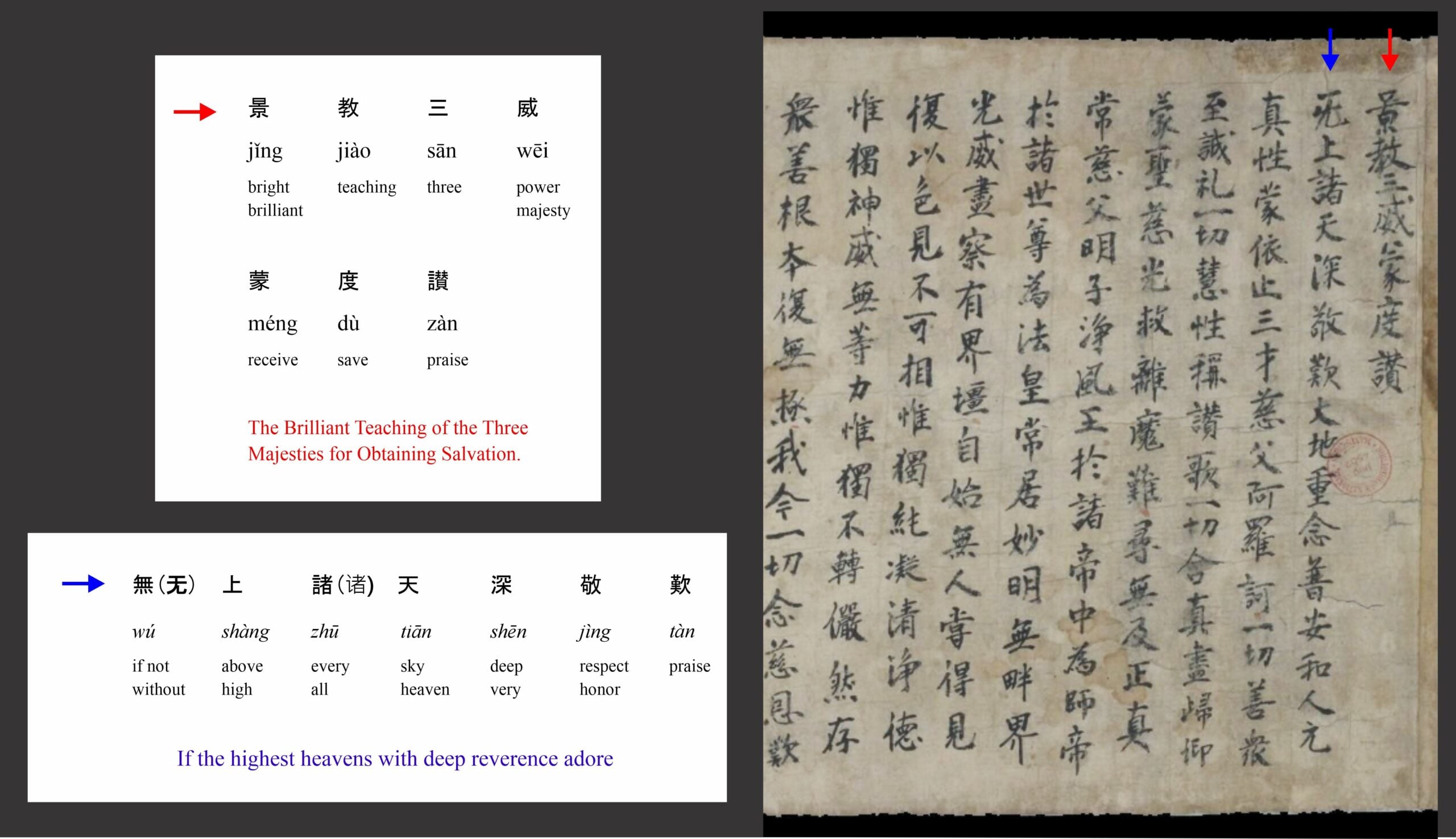
Among the manuscripts found in the Mogao caves was a Chinese Christian Hymn loosely based on the Gloria in Excelsis Deo (Glory to God in the highest), also known as the Greater Doxology (words of praise), especially the version used in the Church of the East. The manuscript was probably written about 800 CE and provides clear evidence that missionaries of the Church of the East had travelled on the Silk Roads to China and were actively proselytizing there centuries before the Jesuits first arrived in the 15th Century CE (Moule, 1930, Teng Li, 2024).
The hymn has 11 verses each containing 4 lines of length 7 syllables, in keeping with Chinese poetic practice. The following illustration shows the beginning of the hymn together with a character-by-character translation of the title and the first line.
The following is a translation of the first three verses of the hymn (Moule, 1930, p 53; Henson, 2017, p 329)
If the highest heavens with deep reverence adore, If the great earth earnestly ponders on general peace and harmony, If man’s first true nature receives confidence and rest, It is due to Alohê the merciful Father of the universe.
All the congregation of the good worship with complete sincerity; All enlightened natures praise and sing; All who have souls trust and look up to the utmost; Receiving holy merciful light to save from the devil.
Hard to find, impossible to reach, upright, true, eternal, Merciful Father, shining Son, holy Spirit, King, Among all rulers you are Master Ruler, Among all the world-honoured you are spiritual Monarch
“Alohê” is a Chinese transcription of the Syriac name for God.
(ii) The Jingjiao Stele
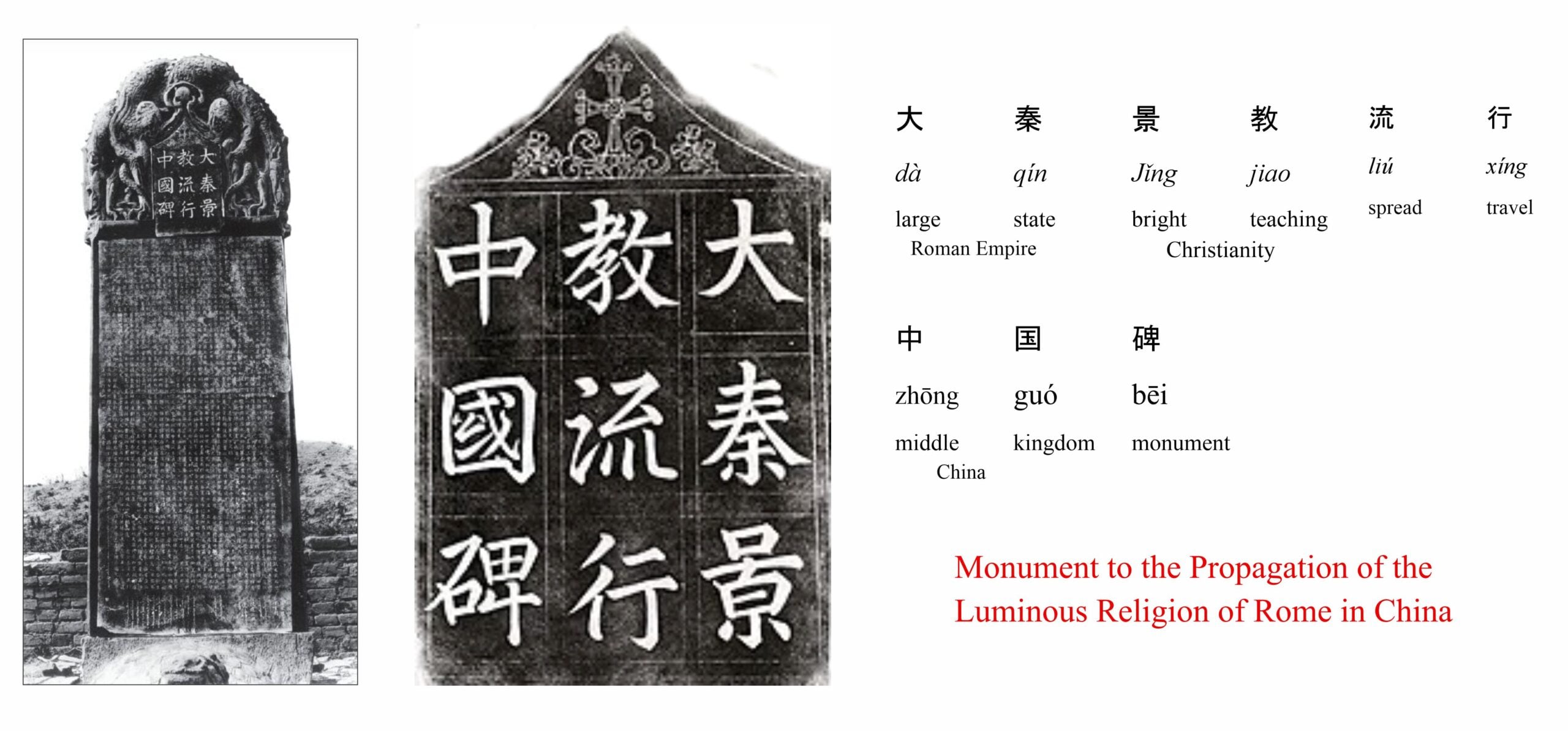
In 781 CE a monument dedicated to the Christian faith (景教,jingjiao, luminous religion) was erected in Chang’an (Keevak,2008; McGrath, 2021). The limestone stele is almost 3 m high. At the top is a cross and a nine-character title. The following illustration shows the stele in situ (before it was moved to a museum), an enlargement of the title, and a character-by-character translation.
The stele summarizes the beliefs of the Christian Church in an inscription of about 1900 characters. This mentions that the Christian church was first established in China in 635 CE through the efforts of the monk Alopen. At the bottom of the stele is a much shorter inscription in Syriac.
After the end of the Tang dynasty 907 CE, Christianity almost disappeared (Teng Li, 2024). The Jingjiao Stele was buried, either for protection by the monks or as an act of desecration by those who reviled the foreign religion. It was unearthed during the 17th Century.
Nevertheless, the Church of the East continued to send missionaries along the Silk Roads and several centuries later, Christian Churches were built throughout the Mongol Empire. The Mongol Empire (1206–1368) and the Yuan Dynasty in China (1271–1368) were tolerant of the different religions. The foreign religions of Buddhism, Christianity, and Manichaeism contributed as much to society as the homegrown Daoism and Confucianism.
Manichaeism
Mani (216-274 CE) was a Persian prophet who conceived the world as divided between the light and the dark. He taught that the human soul was imprisoned by birth into the material world, and that the suffering that this entailed would only cease at death, which released the soul from the body. If one died free from sin, one’s soul would return to the realm of light. The dualistic religion that he founded – Manichaeism – flourished in the centuries after his death, spreading all the way to Spain in the west and China in the East.
(i) Spread to Europe
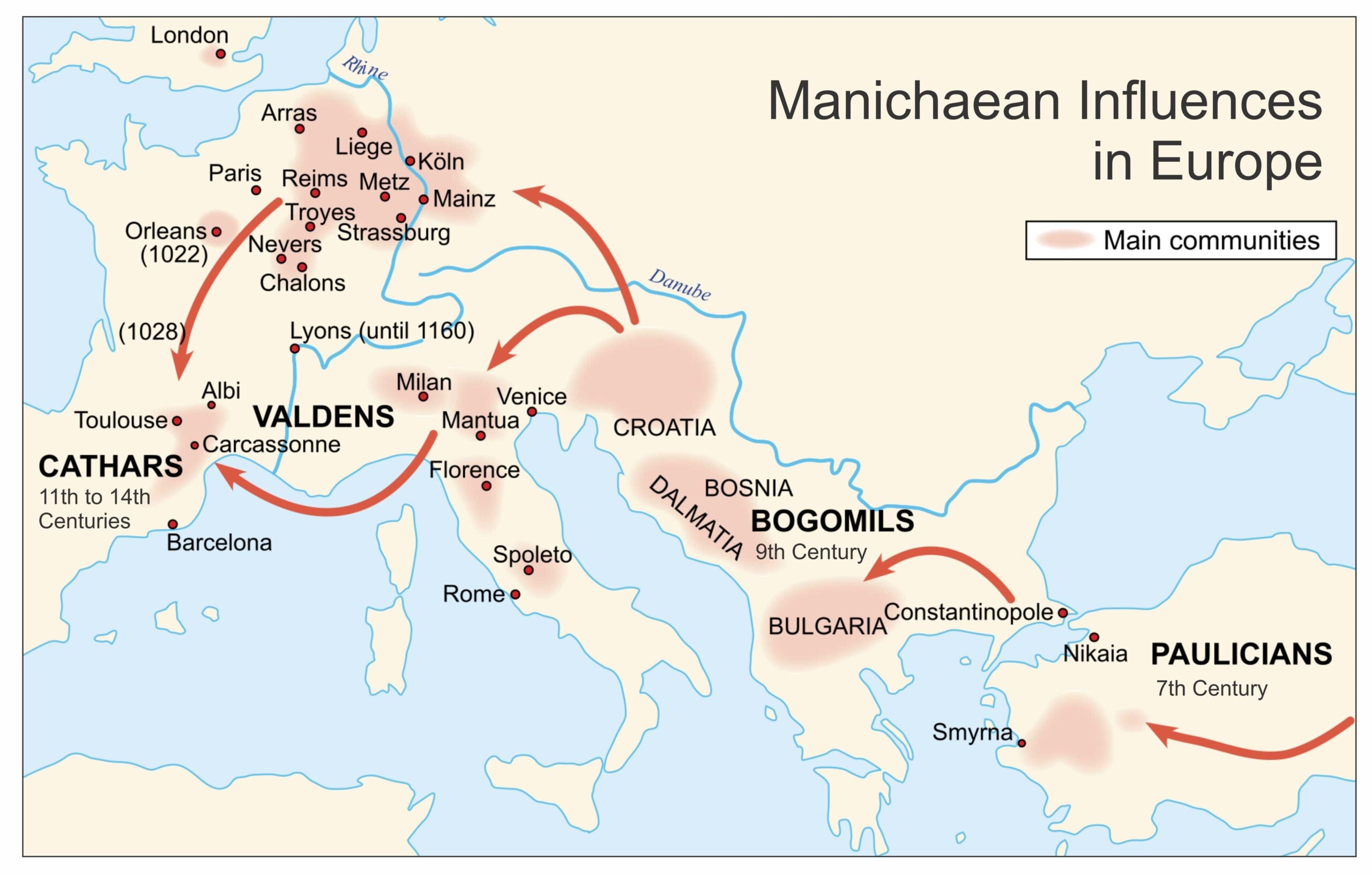
In Europe, Manichaeism declined after Christianity became the state religion of the Roman Empire. However, some isolated groups, such as the Bogomils in Bulgaria and the Cathars in Southeast France, continued to follow Mani’s teachings:
(ii) Spread to China
Manichaeism spread along the Silk Roads into China during the Tang Dynasty (618-907 CE). During the Uyghur Kahnate (744–840 CE) in what is now Northern China and Mongolia, Manichaeism was acknowledged as the state religion (Mackerras, 1990).
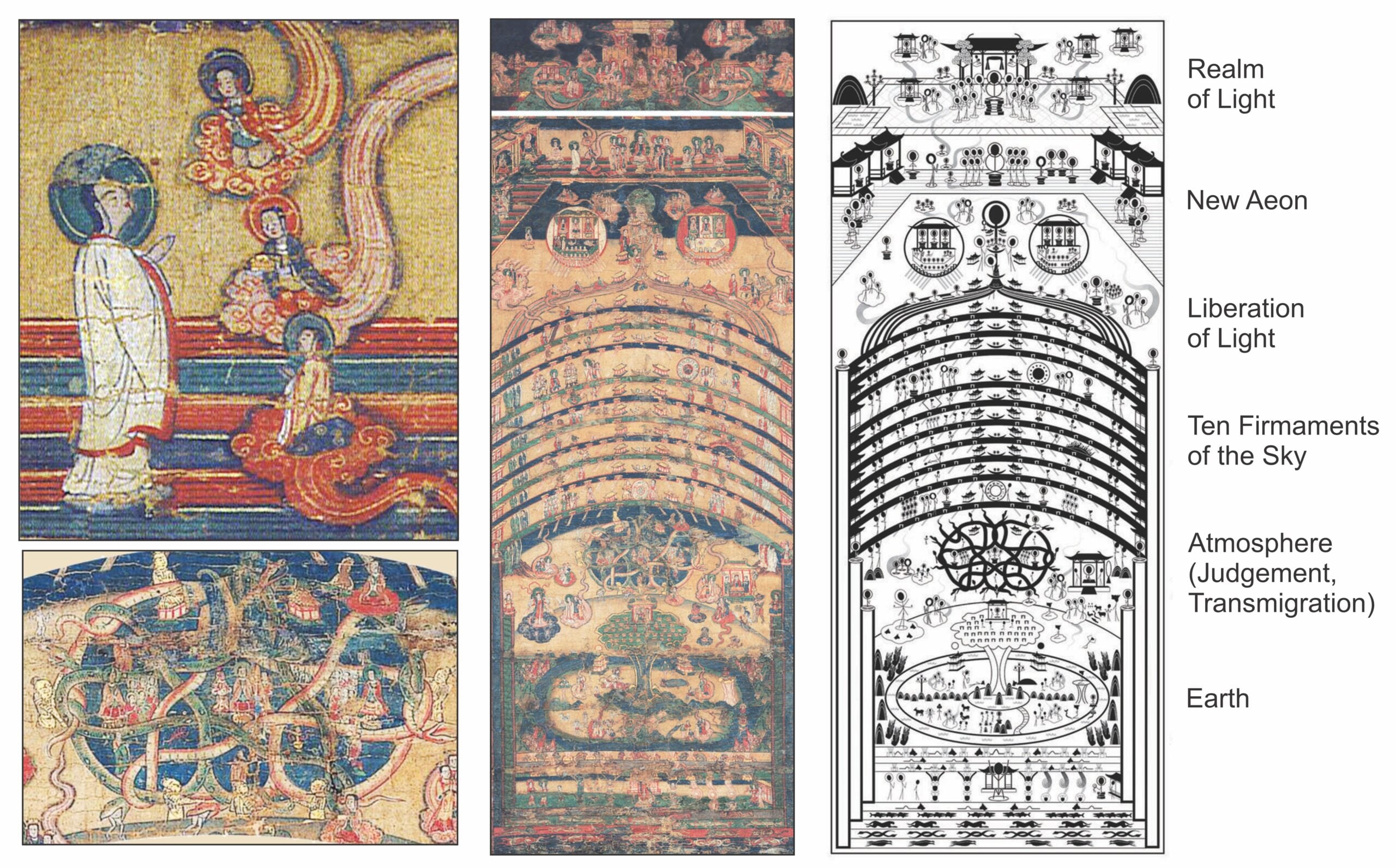
During the Yuan Dynasty (1271–1368 CE), a large silk painting (158 by 60 centimetres) was made to illustrate the Manichaean cosmology. This showed the realm of light at the top. In the center was a representation of the judgment that occurs at death: the decision whether the soul is released into the realm of light or sent back to the hell on earth. The following illustration shows the painting with some explanatory analysis (Gulaczi, 2015, pp 247-258), and enlargements showing a portrait of Mani (from the left side of the New Aeon level) and details of the tangled judgement process:
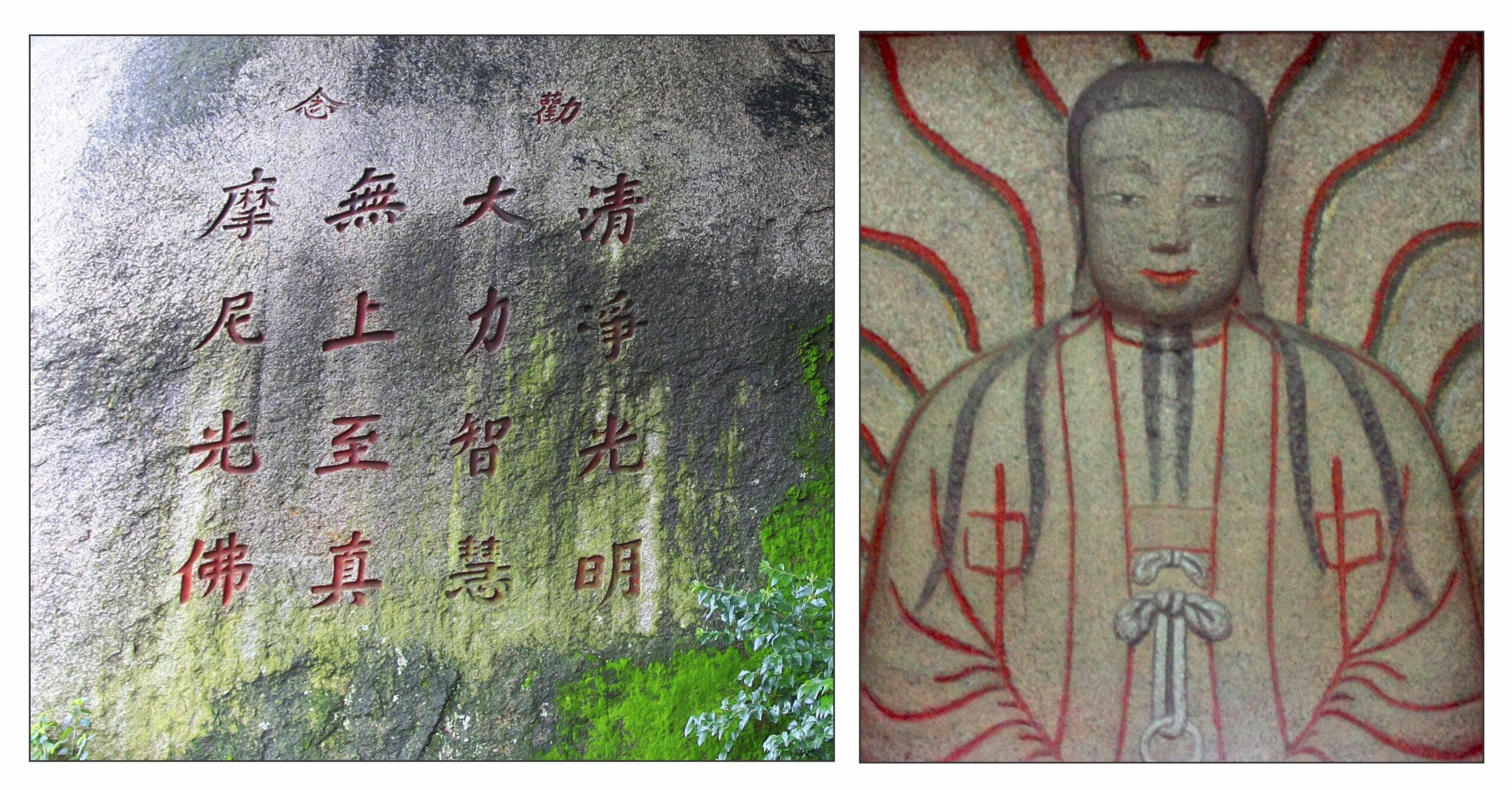
In Cao’an a small town on the west coast of China, a small temple built in 1339 CE was dedicated to Mani, the “Buddha of Light” (Lieu, 1998, pp 188-193). Over the years the temple became used for Buddhist practices. The following illustration shows the bas-relief portrait of Mani over the altar and the inscribed stone in the grounds of the temple.
The inscription reads
Purity (清净, qīngjìng), Light (光明, guāngmíng),
Power (大力, dàlì), Wisdom (智慧, zhìhuì)
Supreme (無上, wúshàng), Ultimate Truth (至真, zhìzhēn)
Mani (摩尼, móní), the Buddha of Light (光佛 guāngfú)
The first four are the attributes of the Manichaean Heavenly Father. Mani considered himself as a prophet in the line of Zoroaster, Buddha and Christ. As such he could be conceived as one of the manifestations of the divine – the Buddha of Light.
Islam
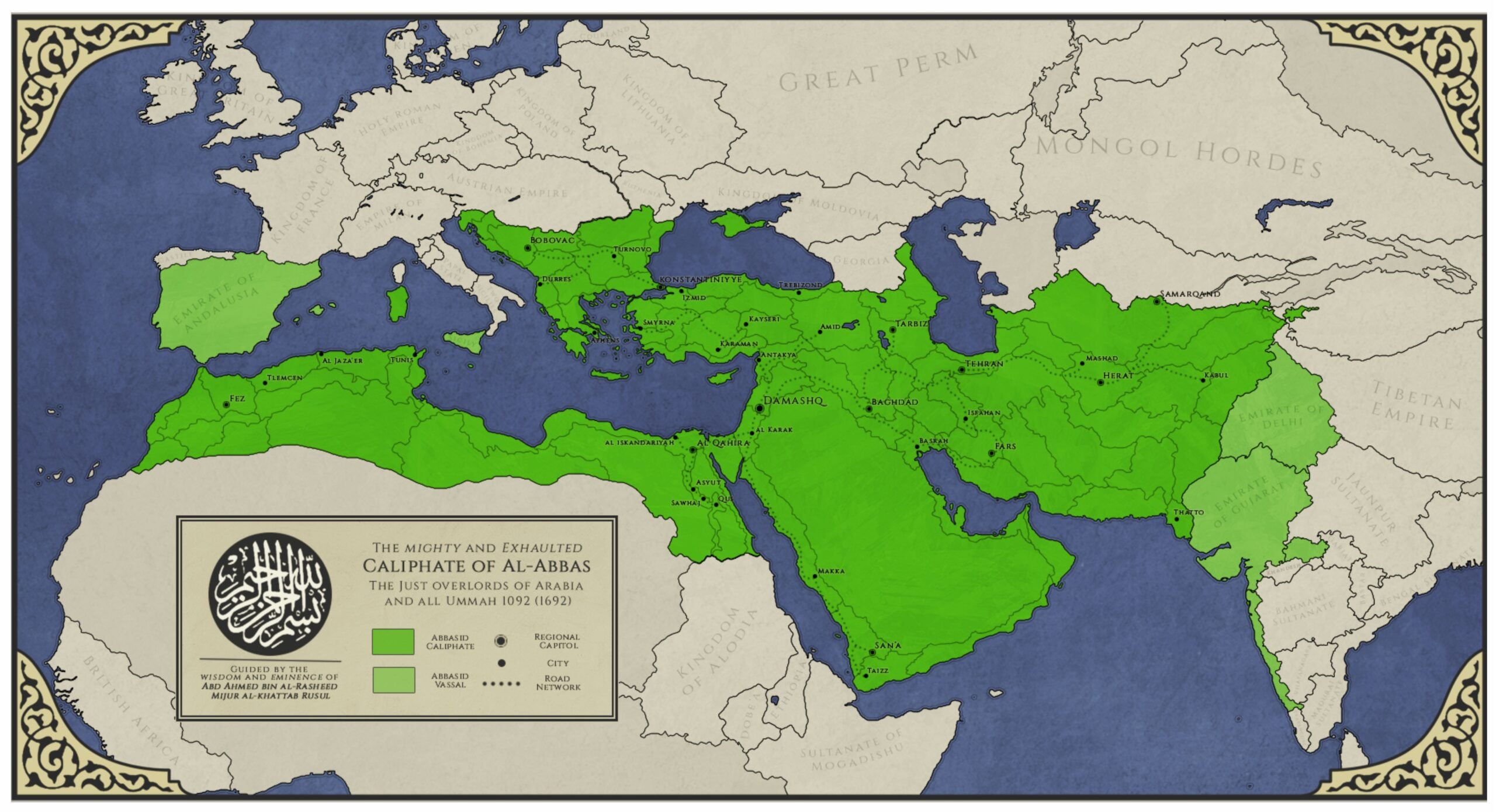
After its founding in Arabia in 622 CE, Islam quickly spread to adjacent regions. By the time of the Abbasid Caliphate (750–1258 CE), the community of the faithful (Ummah) extended all the way from Spain to the borders of China:
(i) Abbasid Caliphate
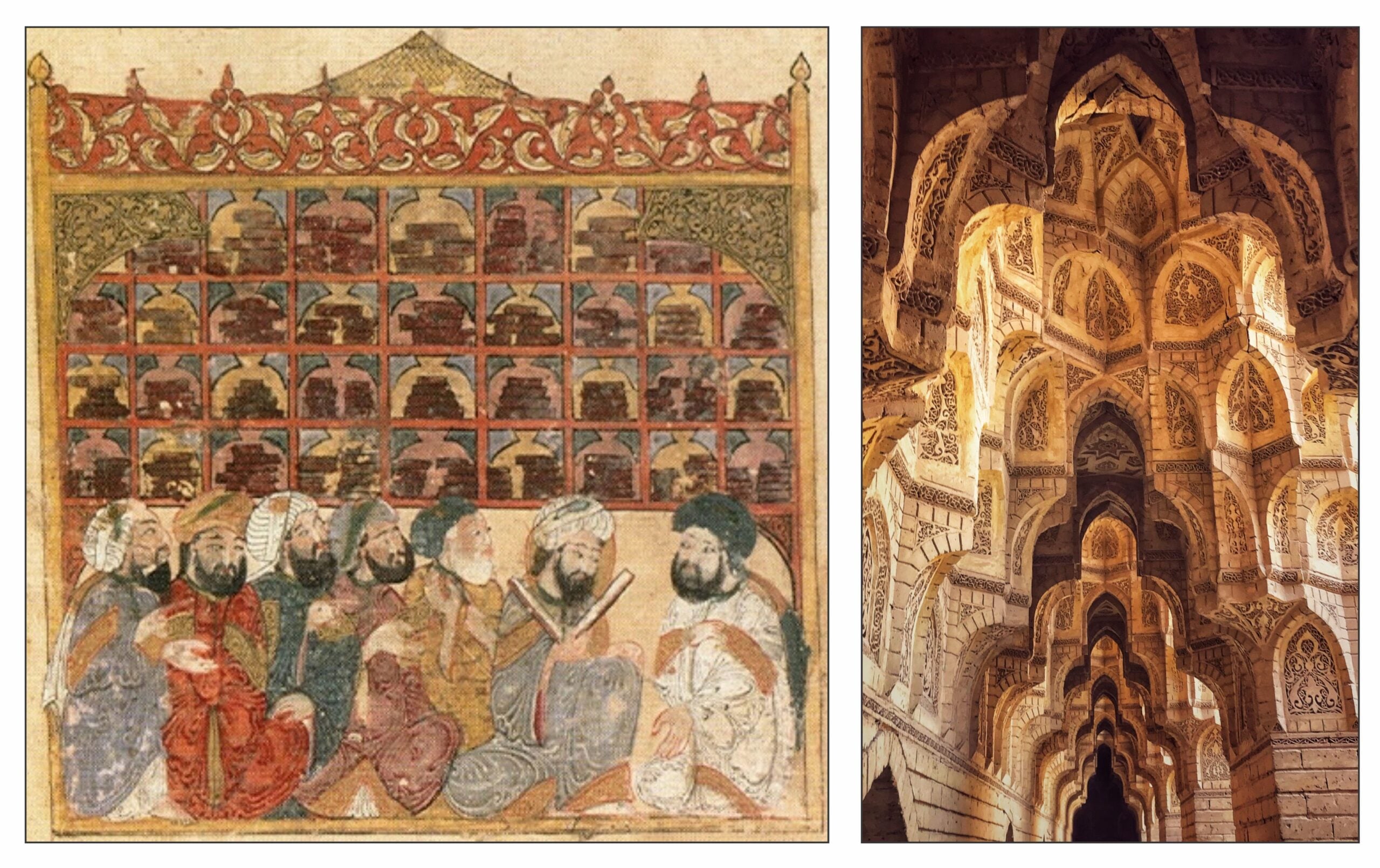
The Abbasid Caliphate with its capital in Baghdad oversaw a period of great prosperity and learning, that later became known as the Islamic Golden Age. At a time when Europe was going through the Dark Ages, Baghdad was a place where scholars studied and preserved the literature of the past and contributed to our knowledge such new ideas as algebra and trigonometry. Islamic physicians distinguished different diseases, and Islamic physicists mapped the heavens. Abassid architecture developed gorgeous arches and domes, stucco decoration with arabesque patterns, and walls covered with multicolored tiling.
The Abbasids made great use of the newly discovered paper (Schatzmiller, 2018). The technology of papermaking originated in China around the 1st Century CE and was brought to the Middle East through the Silk Roads. The first paper mill in Baghdad was built in 795 CE. Paper made it easy to provide inexpensive books for scholars to study. Knowledge became no longer limited to the elites.
The following illustration shows on the left a painting of a scholars in a library during the Abbasid Caliphate taken from a 13th Century manuscript. This may represent the House of Wisdom, also known as the Grand Library of Baghdad, which was founded in the 8th Century CE. On the right is a photograph of a honeycomb archway (muquarnas) from the Abbasid Palace in Baghdad built in the 12th Century CE.
(ii) The Great Mosque in Xi’an
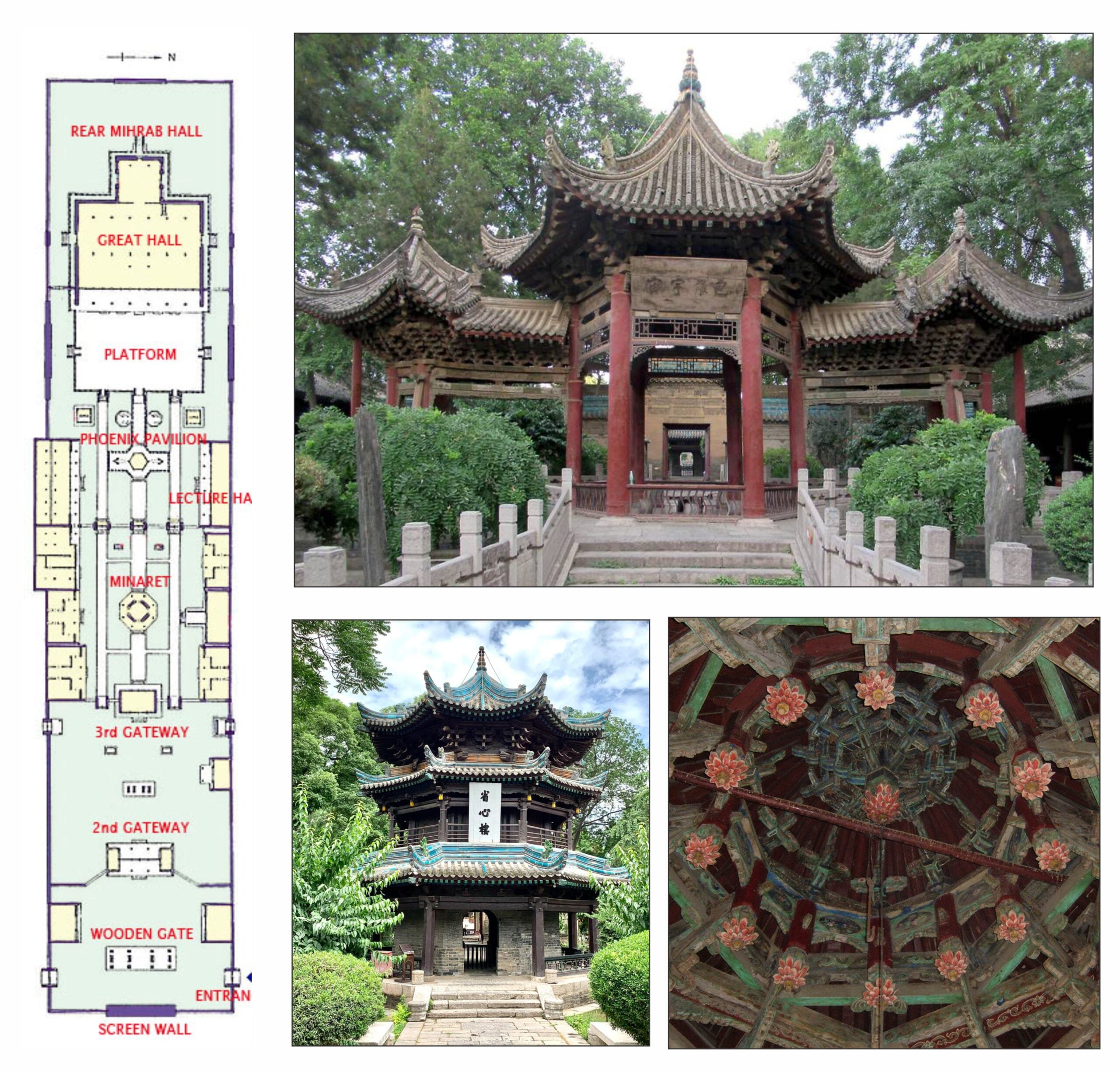
Islamic merchants came to China along the Silk Roads. By the 8th Century the Muslim population of Chang’an (Xi’an) was sufficient to warrant the building of a mosque in the form of a temple. The Great Mosque of Xi’an (西安大清真寺,Xī’ān Dà Qīngzhēnsì) was first constructed in 742 CE, and rebuilt in its present form in 1384. Islam was referred to as 清真教 (Qīngzhēnjiào: pure and true religion), and a mosque is generally referred to as 清真寺 (Qīngzhēnsì: pure and true temple).
The following illustration shows a plan of the mosque together with photographs of the Phoenix Pavillion (鳳亭, fèngtíng), the “Examining the heart tower” (省心楼,shěng xīn lóu) which probably served as a minaret, and the ceiling of the Phoenix Pavilion:
Epilogue
For many centuries the Silk Roads were a conduit for goods to travel between East and West. The East produced silk, paper, tea, and porcelain. The West gave gold, silver, glass, cotton, and leather. The regions along the Silk Roads provided horses, camels, rugs, lapis lazuli and jade.
As well the Silk Roads allowed different religions to travel to distant countries. Buddhism came to China. Islam spread to both the East and the West. Judaism, Zoroastrianism, Manichaeism, and Christianity also journeyed with the caravans. Travellers on the Silk Roads were missionaries as well as merchants (Foltz, 2010).
Some feeling for the people of the Silk Roads can be found in the poem The Golden Road to Samarkand by James Elroy Flecker (1814-1915), a British poet who briefly worked in the consular services in the Middle East before dying at a young age of tuberculosis. The conclusion to his play Hassan, published posthumously in 1922, is a conversation among the members of a caravan about to leave Baghdad for Samarkand:
We are the Pilgrims, master; we shall go Always a little further: it may be Beyond that last blue mountain barred with snow Across that angry or that glimmering sea.
White on a throne or guarded in a cave There lives a prophet who can understand Why men were born: but surely we are brave, Who take the Golden Road to Samarkand
…
Sweet to ride forth at evening from the wells, When shadows pass gigantic on the sand, And softly through the silence beat the bells Along the Golden Road to Samarkand.
We travel not for trafficking alone; By hotter winds our fiery hearts are fanned: For lust of knowing what should not be known, We take the Golden Road to Samarkand.
The following is a reading of these verses by Roger Helmer
And the musical introduction to the Japanese TV series on The Silk Roads by Kitaro:
References
Beckwith, C. I. (2009). Empires of the Silk Road: a history of central Eurasia from the Bronze Age to the present. Princeton University Press,
Berg, I. M. (2000). Among the Jewish descendants of Kaifeng. Judaism, 49(1), 103.
Boyce, M., Grenet, F, & Beck, R. (1991). A history of Zoroastrianism. Volume 3. Zoroastrianism under Macedonian and Roman rule. E. J. Brill.
Foltz, R. C. (2010). Religions of the Silk Road: premodern patterns of globalization. (2nd Ed). Palgrave Macmillan.
Frankopan, P. (2016). The Silk Roads: a new history of the world. Alfred A. Knopf.
Grenet, F. (2015). Zoroastrianism in central Asia. In Stausberg, M., Vevaina, Y. S.-D., & Tessmann, A. (Eds.) The Wiley-Blackwell companion to Zoroastrianism. (pp 129-146). Wiley.
Gulácsi, Z. (2015). Mani’s pictures: the didactic images of the Manichaeans from Sasanian Mesopotamia to Uygur Central Asia and Tang-Ming China. Brill.
Hansen, V. (2017). The Silk Road: a new history with documents. Oxford University Press.
Keevak, M. (2008). The story of a stele: China’s Nestorian Monument and its reception in the West, 1625-1916. Hong Kong University Press.
Koller, A. (2024). A Hebrew text from the Silk Road: a prayer for forgiveness and success from the Eighth Century. In Berger, S. Z. et al. (Eds). Wisdom has built her house.A tribute in honor of and in memory of Mrs. Leah Adler. (pp 181-187). Yeshiva University.
Lieu, S. N. C. (1998). Manichaeism in Central Asia and China. Brill.
Lijuan Li (2021). On the transmission of the Gloria in excelsis Deo: Daqin jingjiao sanwei mengdu zan 大秦景教三威蒙度讃 In Talay, Shabo. (Ed.). Überleben im Schatten: Geschichte und Kultur des syrischen Christentums. (pp 111-113). Harrassowitz Verlag.
Mackerras, C. (1990, online 2008). The Uighurs. In Sinor, D. (Ed.). The Cambridge history of early Inner Asia. (pp 317-342). Cambridge University Press.
Mazhjoo, N. (2020). Being Mithraist: Embracing ‘other’ in the Roman cultural milieu. In A. W. Irvin (Ed.), Community and Identity at the Edges of the Classical World (pp. 139–153). John Wiley & Sons, Inc.
Millward, J. A. (2013). The silk road: a very short introduction. Oxford University Press.
Morgan, J., & Walters, C. (2012). Journeys on the Silk Road: a desert explorer, Buddha’s secret library, and the unearthing of the world’s oldest printed book. Lyons Press.
Pin Lyu (2024). The Sogdians: the ‘Cultural Bees’ of Eurasia. In Henderson, J., L. Morgan, S., & Salonia, M. (Eds). Reimagining the Silk Roads: Interactions and Perceptions Across Eurasia. (pp 145-160). Taylor & Francis
Rong, X. (translated by Hansen, V., 1999). The nature of the Dunhuang library cave and the reasons for its sealing. Cahiers d’Extrême-Asie, 11(1), 247–275.
Red Pine. (2001). The Diamond Sutra: the perfection of wisdom. Counterpoint.
Schatzmiller, M. (2018). The adoption of paper in the Middle East, 700-1300 AD. Journal of the economic and social history of the Orient, 61 1-32.
Sinor, D. (1990, online 2008). The Karakhanids and early Islam. In Sinor, D. (Ed.). The Cambridge history of early Inner Asia. (pp 343-370). Cambridge University Press.
Stein, R. A. (1986). Avalokiteśvara/Kouan-yin, un exemple de transformation d’un dieu en déesse. Cahiers d’Extrême-Asie, 2(1), 17–80.
Stoll, O. (2022). The Cult of Mithras and the Roman Imperial Army. In Dillon, M. & Christopher, M. (Eds) Religion and classical warfare: the Roman Empire. (pp227-249) Pen and Sword.
Suebsantiwongse, S. (2025). A network of compassion: the transmission and development of the cult and iconography of Cakravarticintāmaṇi Avalokiteśvara across the Maritime Silk Routes. Religions, 16(2), 178.
Teng Li (2024). Christianity on the Silk Roads. In Henderson, J., L. Morgan, S., & Salonia, M. (Eds). Reimagining the Silk Roads: Interactions and Perceptions Across Eurasia. (pp 174-185). Taylor & Francis
Torr, G. (2018). The Silk Roads: a history of the great trading routes between East and West. Arcturus.
Whitfield, S. (Ed.). (2019). Silk Roads: peoples, cultures, landscapes. University of California Press.
Wong, D. C. (2019). Colossal Buddha Statues along the Silk Road. Acta Via Serica, 4(2), 1–27.
Wood, F. (2002). The Silk Road: two thousand years in the heart of Asia. University of California Press.
Yü, C-F. (2001). Kuan-yin: the Chinese transformation of Avalokitesvara. Columbia University Press.
Du Fu: Poet, Sage, Historian
Du Fu: Poet, Sage, Historian
Du Fu (712-770 CE) was a poet during a time of great political upheaval in China. He was born near Luoyang and spent much of his young adulthood in the Yanzhou region, finally settling down to a minor official position in Chang’an, the imperial capital. In 755 CE, An Lushan, a disgruntled general, led a rebellion against the Tang dynasty. The emperor was forced to flee Chang’an (modern Xian), and chaos reigned for the next eight years. For more than a year Du Fu was held captive in Chang’an by the rebels. After escaping, he made his way south, living for a time in a thatched cottage in Chengdu, and later at various places along the Yangtze River. His poetry is characterized by an intense love of nature, by elements of Chan Buddhism, and by a deep compassion for all those caught up in the turmoil of history. This is a longer post than usual. I have become fascinated by Du Fu.
Failing the Examinations
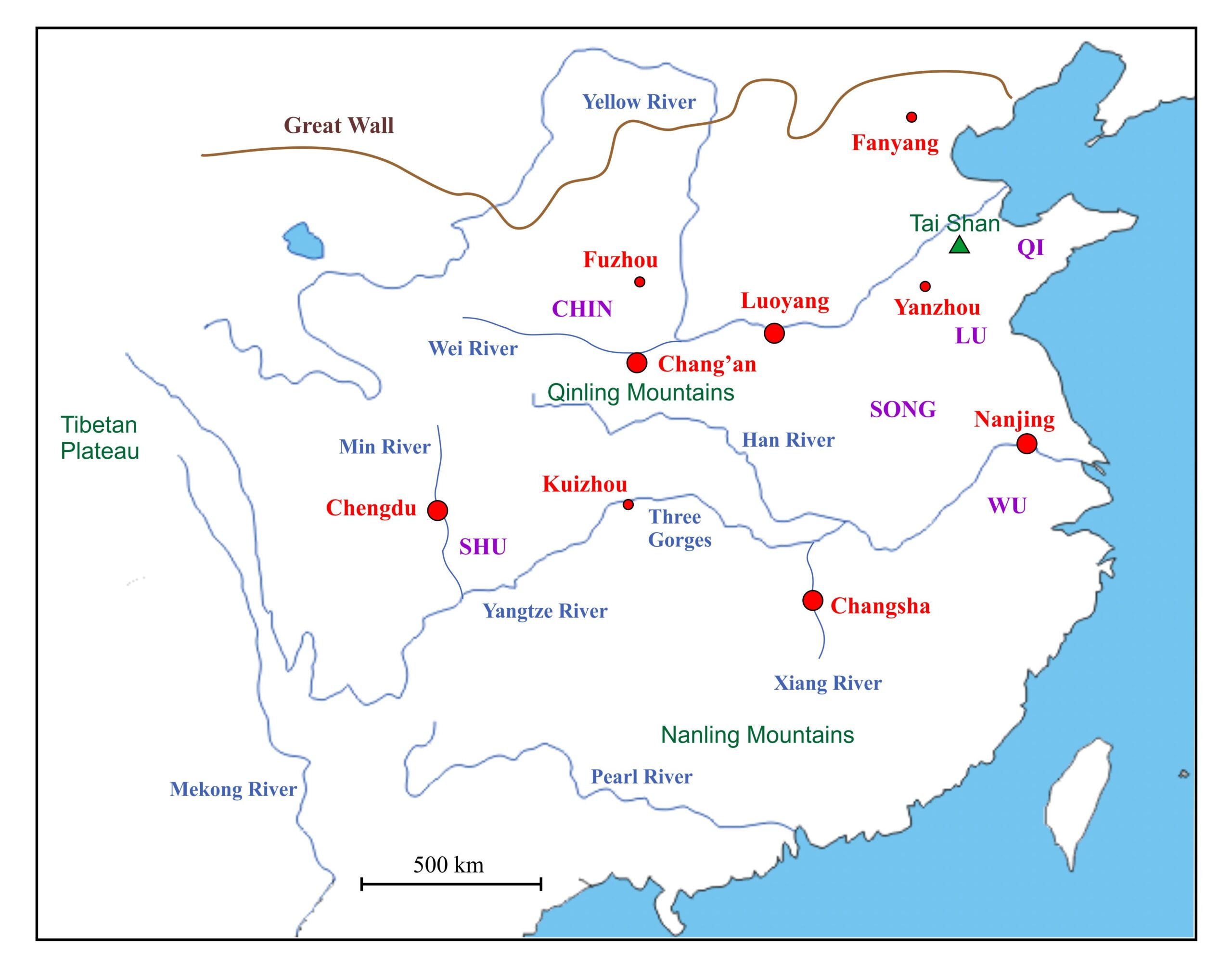
Du Fu (Tu Fu in the Wades Gilles transliteration system, the family name likely deriving from the name of a pear tree) was born in 712 CE near Luoyang, the eastern capital of the Tang Dynasty (Hung, 1952; Owen, 1981). The following map (adapted from Young, 2008, and Collet and Cheng, 2014) shows places of importance in his life:
Du Fu’s father was a minor official. His mother appears to have died during his childhood, and Du Fu was raised by his stepmother and an aunt. Du Fu studied hard, but in 735 CE he failed the jenshi (advanced scholar) examinations. No one knows why: politics and spite may have played their part. He spent the next few years with his father who was then stationed in Yanzhou,
Du Fu met Li Bai (700-762 CE) in 744 CE. Despite the difference in their ages, the two poets became fast friends. However, they were only able to meet occasionally, their lives being separated by politics and war.
Du Fu attempted the jenshi examinations again in 746, and was again rejected. Nevertheless, he was able to obtain a minor position in the imperial civil service in Chang’an. This allowed him to marry and raise a small family.
Taishan
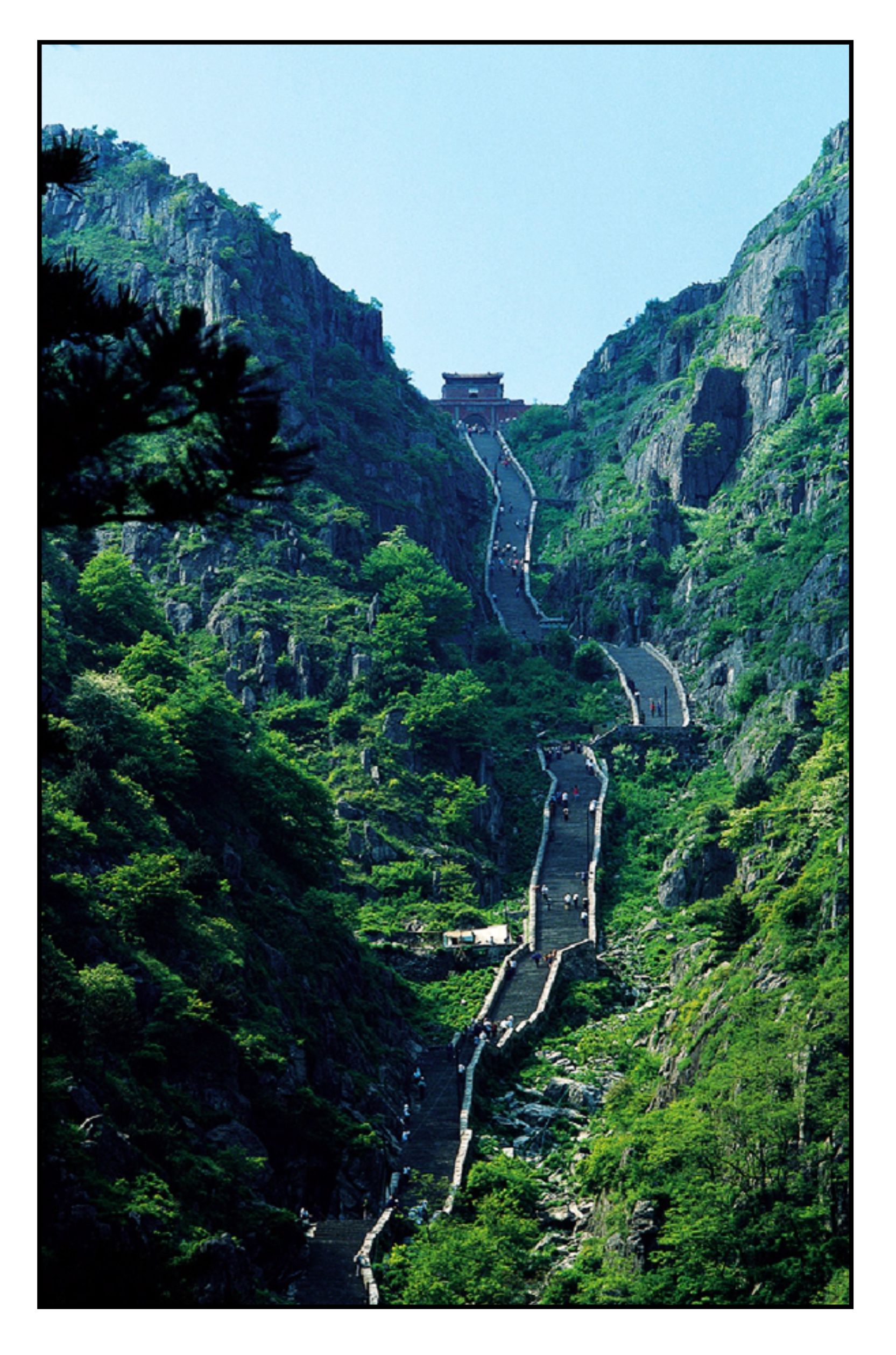
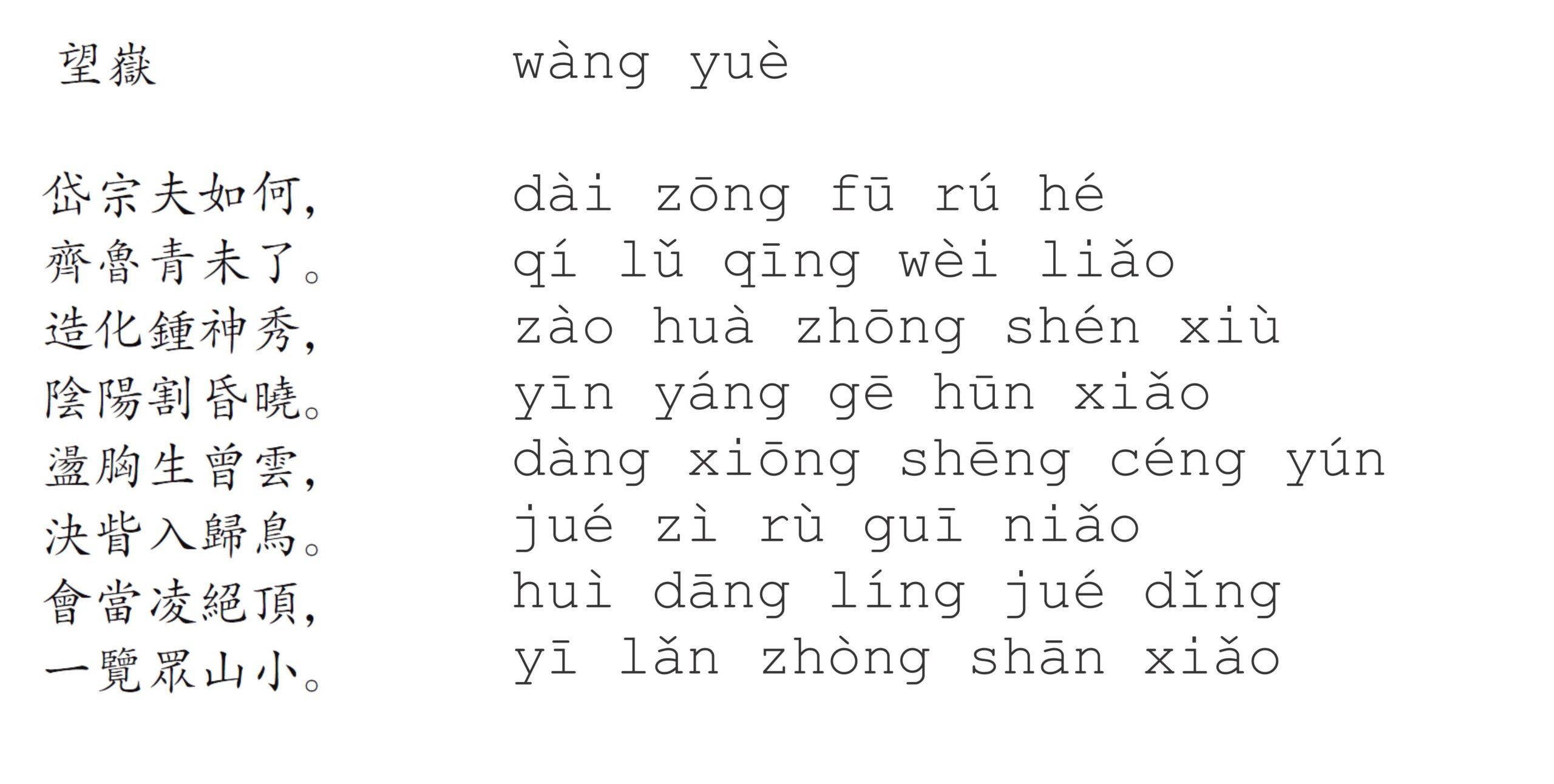
We can begin our examination of Du Fu’s poetry with one of the early poems written during his time in Yanzhou: Gazing on the Peak (737 CE). The peak is Taishan (exalted mountain), located in Northeastern China. Taishan is one of the Five Great Mountains (Wuyue) of ancient China. Today one can reach the summit by climbing up some 7000 steps (see illustration on the right), but in Du Fu’s time the climb would have been more difficult. The following is the poem in printed Chinese characters (Hànzì) and in Pinyin transliteration:
The poem is in the lǜshī (regulated verse) form which requires eight lines (four couplets), with each line containing the same number of characters: 5- or 7-character lǜshī are the most common. Each line is separated into phrases, with a 5-character line composed of an initial 2-character phrase and a final 3-character phrase. The last words of each couplet rhyme. Rhyme in Chinese is based on the vowel sound. Within the lines there were complex rules for the tonality of the sounds (Zong Qi Cai, 2008, Chapter 8; Wai-lim Yip, 1997, pp 171-221). These rules do not always carry over to the way the characters are pronounced in modern Chinese. The following is a reading of the poem in Mandarin (from Librivox).
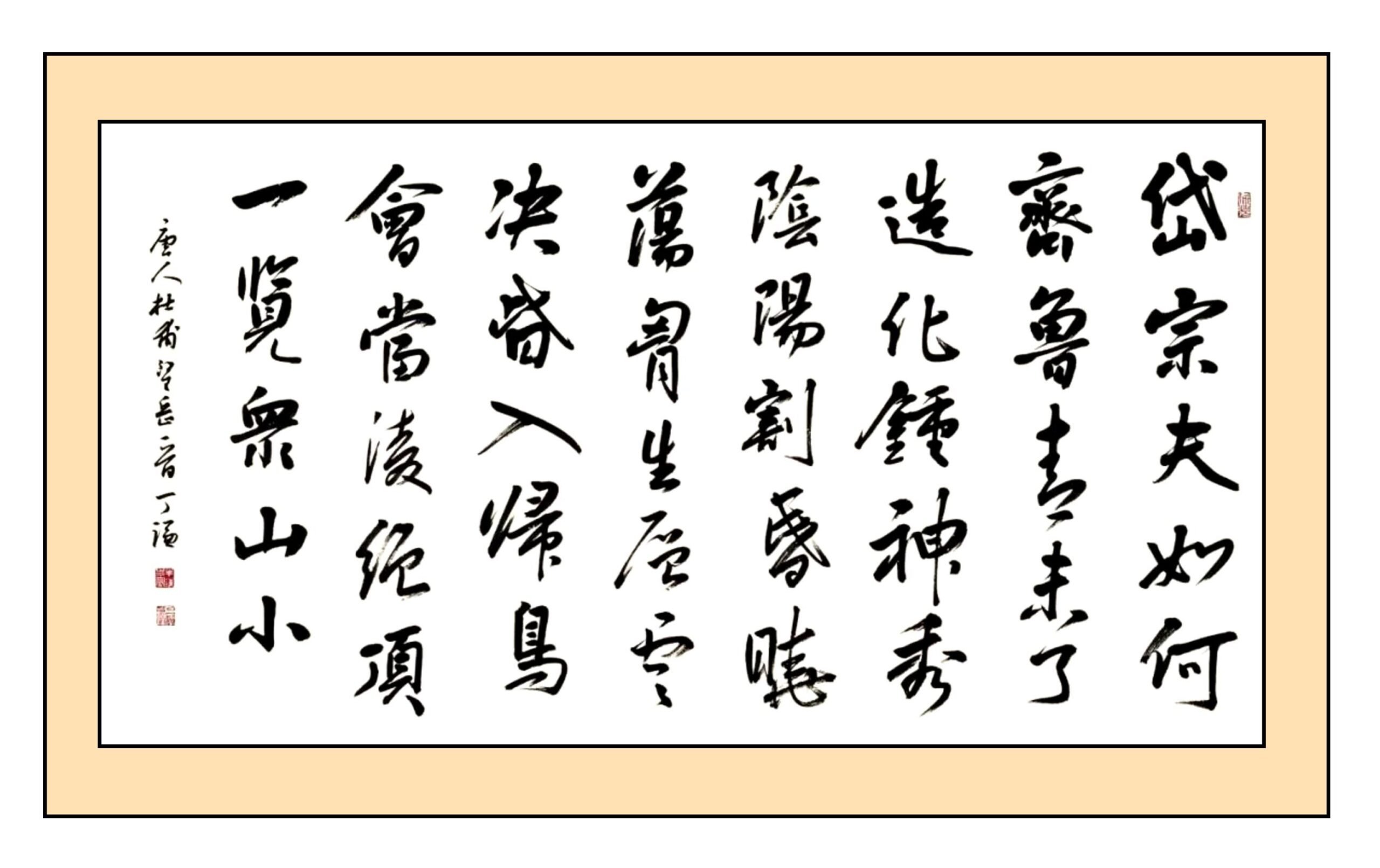
Chinese poetry is directed at both the ear and the eye, and fine calligraphy enhances the appreciations of a poem. Ding Qian has written out Du Fu’s Wàng yuè in beautiful cursive script (going from top down and from left to right):
The following is a character-by-character translation (adapted from Hinton, 2019, p 2):
gaze/behold mountain
Daizong (ancient name for Taishan) then like what Qi Lu (regions near Taishan) green/blue never end create change concentrate divine beauty Yin Yang (Taoist concepts of dark and light) cleave dusk dawn heave chest birth layer cloud burst eye enter return bird soon when reach extreme summit one glance all mountain small.
And this is the English translation of Stephen Owen (2008, poem 1.2):
Gazing on the Peak
And what then is Daizong like? — over Qi and Lu, green unending. Creation compacted spirit splendors here, Dark and Light, riving dusk and dawn. Exhilarating the breast, it produces layers of cloud; splitting eye-pupils, it has homing birds entering. Someday may I climb up to its highest summit, with one sweeping view see how small all other mountains are
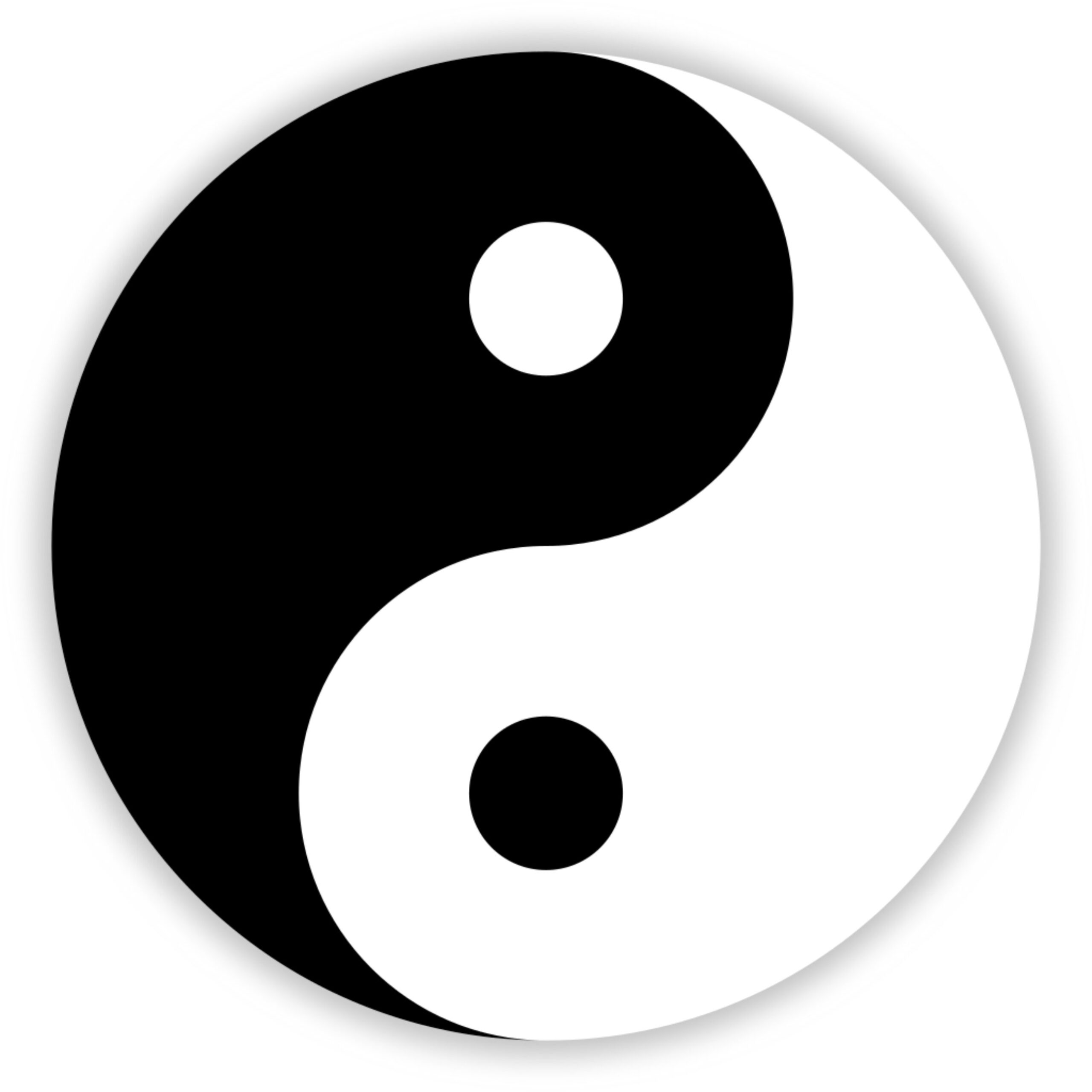
The interpretation of the poem requires some knowledge of its allusions. In the fourth line, Du Fu is referring to the taijitu symbol of Taoism (illustrated on the right) that contrasts the principles of yin (dark, female, moon) and yang (light, male, sun). Du Fu proposes that Taishan divides the world into two ways of looking. Some have suggested that the taijitu symbol originally represented the dark (north) side and the light (south) side of a mountain, and this idea fits easily with the poem.
All translators have had difficulty with the third couplet (reviewed by Hsieh, 1994). My feeling is that Du Fu is noticing layers of clouds at the mountain’s upper reaches – the chest if one considers the mountain like a human body – and birds swooping around the peaks – where the eye sockets of the body would be. However, it is also possible that Du Fu is breathing heavily from the climb and that his eyes are surprised by the birds. Perhaps both meanings are valid, with Du Fu and the mountain becoming one. Du Fu may have been experiencing the meditative state of Chan Buddhism, with a mind was “wide-open and interfused with this mountain landscape, no distinction between subjective and objective” (Hinton, 2019, p 6). One might also consider Du Fu’s mental state: at the time he wrote this poem he had just failed the jenshi exams. This might have caused some breast-beating and tears, as well as his final resolve to climb the mountain and see how small all his problems actually were.
The last couplet refers to Mencius’ description of the visit of Confucius to Taishan (Mengzi VIIA:24):
He ascended the Tai Mountain, and all beneath the heavens appeared to him small. So he who has contemplated the sea, finds it difficult to think anything of other waters, and he who has wandered in the gate of the sage, finds it difficult to think anything of the words of others.
Zhang’s Hermitage
During his time in Yanzhou Du Fu visited a hermit named Zhang near the Stonegate Mountain, one of the lesser peaks near Taishan. Zhang was likely a follower of the new Chan Buddhism, which promoted meditation as a means to empty the mind of suffering and allow the universal life force to permeate one’s being. Buddhism first came to China during the Han dynasty (206BCE – 220CE). Since many of the concepts of Buddhism were similar to those of Taoism, the new religion spread quickly (Hinton, 2020). A type of Buddhism that stressed the role of meditation began to develop in the 6th Century CE, and called itself chan, a Chinese transcription of the Sanskrit dhyana (meditation). In later years this would lead to the Zen Buddhism of Japan. There are many allusions to Buddhism and especially to Chan ideas in Du Fu’s poetry (Rouzer, 2020; Zhang, 2018)
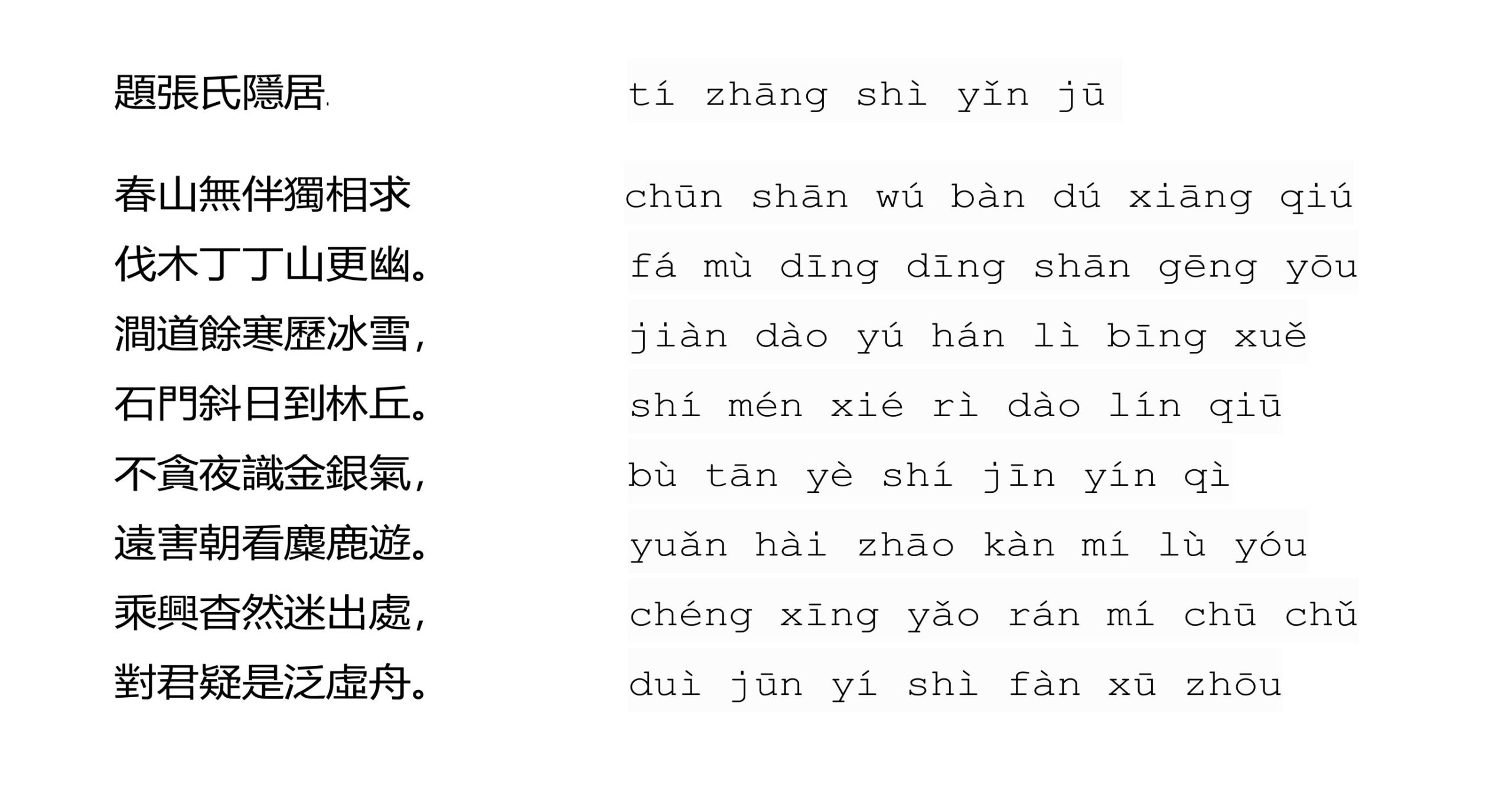
Du Fu reportedly wrote the following poem on one of the walls of Zhang’s hermitage. The poem is a seven-character lǜshī. The following is the poem in Chinese characters (Owen, 2008, poem 1.4) and in pinyin:
The following is a character-by-character translation (adapted from Hinton, 2019, p 22):
inscribe Zhang family recluse house
spring mountain absence friend alone you search chop tree crack crack mountain again mystery creek pathway remnant cold pass ice snow stone gate slant sun reach forest place no desire night know gold silver breath/spirit far injure morning see deer deer wander ride burgeon dark thus confuse leave place facing you suspect this drift empty boat.
And this is a translation by Kenneth Rexroth (1956):
Written on the Wall at Chang’s Hermitage
It is Spring in the mountains. I come alone seeking you. The sound of chopping wood echos Between the silent peaks. The streams are still icy. There is snow on the trail. At sunset I reach your grove In the stony mountain pass. You want nothing, although at night You can see the aura of gold And silver ore all around you. You have learned to be gentle As the mountain deer you have tamed. The way back forgotten, hidden Away, I become like you, An empty boat, floating, adrift.
Notable in the poem is the idea of wú (third character) which can be translated as “absence, nothing, not” (Hinton, 2019, p 24) This is an essential concept of Chan Buddhism – the emptying of the mind so that it can become a receptacle for true awareness. The third and fourth characters of the first line might be simply translated as “alone (without a friend),” but one might also venture “with absence as a companion” or “with an empty mind.” This fits with the image of the empty boat at the end of the poem.
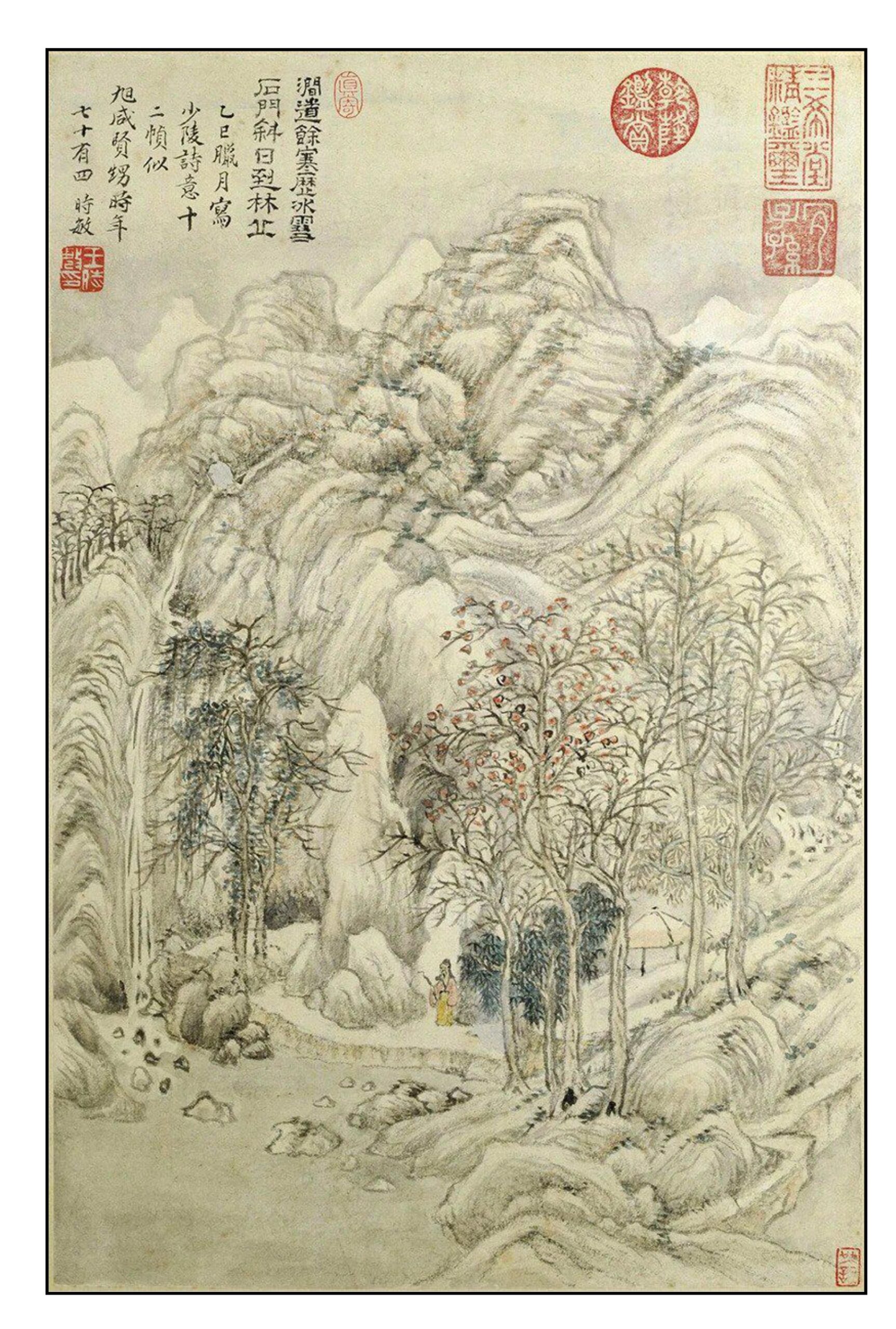
Zheng Qian, a drinking companion of Li Bai and Du Fu, suggested the idea of combining poetry, painting and calligraphy. The Emperor was impressed and called the combination sānjué (three perfections) (Sullivan, 1974). Li Bai and Du Fu likely tried their hand at painting and calligraphy but no versions of their sānjué efforts have survived. The Ming painter and calligrapher Wang Shimin (1592–1680 CE) illustrated the second couplet of Du Fu’s poem from Zhang’s hermitage in his album Du Fu’s Poetic Thoughts now at the Palace Museum in Beijing.
The An Lushan Rebellion
Toward the end 755 CE, An Lushan, a general on the northern frontier rebelled against the empire and captured the garrison town of Fanyang (or Jicheng) located in what is now part of Beijing. Within a month the rebels captured Luoyang. The emperor and much of his court fled Chang’an, travelling through the Qinling Mountains to find sanctuary in the province of Shu. The city of Chang’an fell to the rebels in the middle of 756 CE.
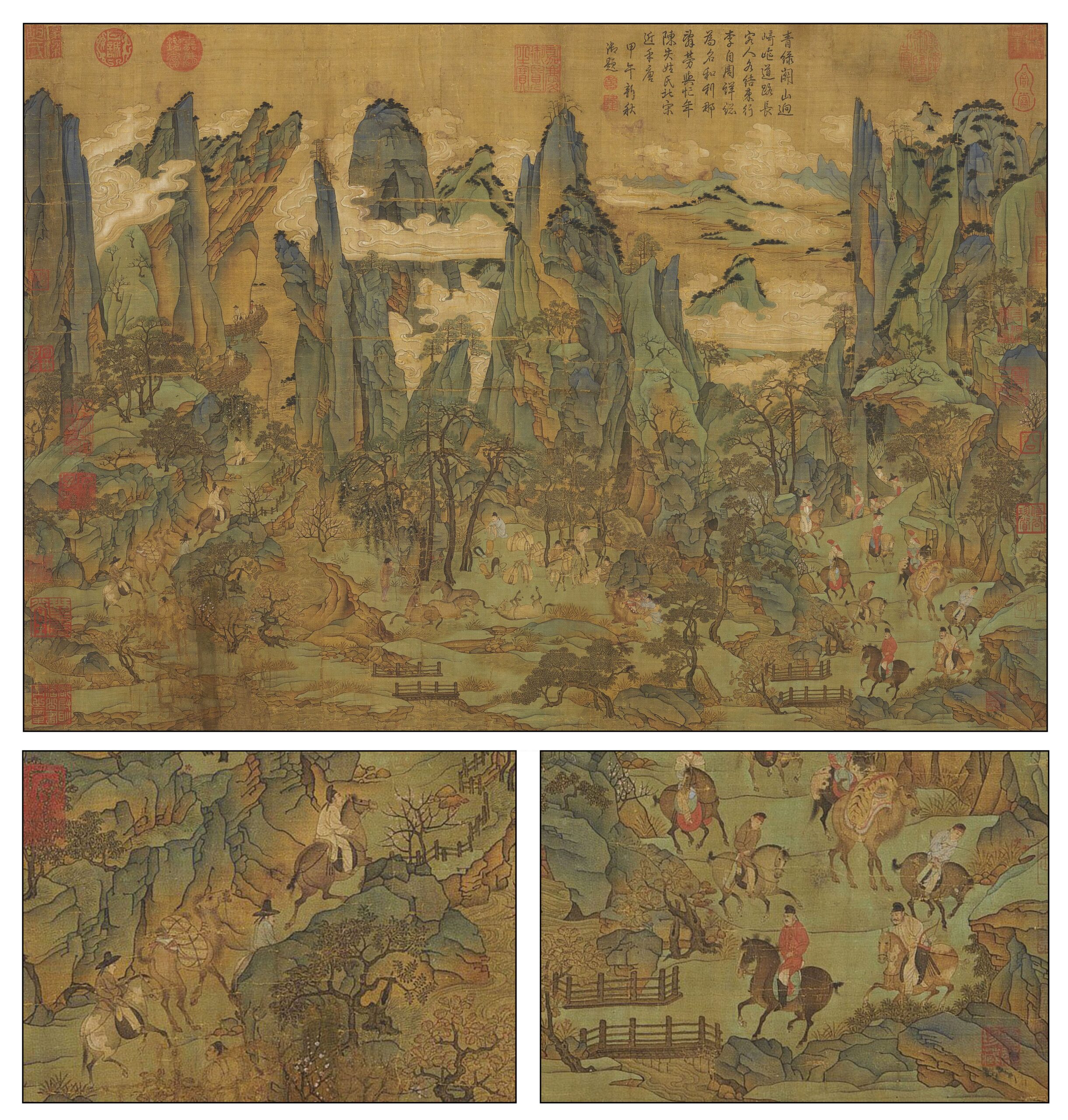
Below is shown a painting of Emperor Ming-Huang’s Flight to Shu. Though attributed to the Tang painter Li Zhaodao (675-758 CE), this was actually painted in his style several hundred years later during the Song Dynasty. Shu is the ancient name for what is now known as Sichuan province. This masterpiece of early Chinese painting is now in the National Palace Museum in Taipei. Two enlargements are included: the emperor with his red coat is shown at the lower right; at the lower left advance members of his entourage begin climbing the mountain paths.
The rebellion lasted for eight long years. The northern part of the country was devastated. Death from either war or famine was widespread. Censuses before and after the rebellion suggested a death toll of some 36 million people, making it one of the worst catastrophes in human history. However, most scholars now doubt these numbers and consider the death toll as closer to 13 million. Nevertheless, it was a murderous time.
Moonlit Night
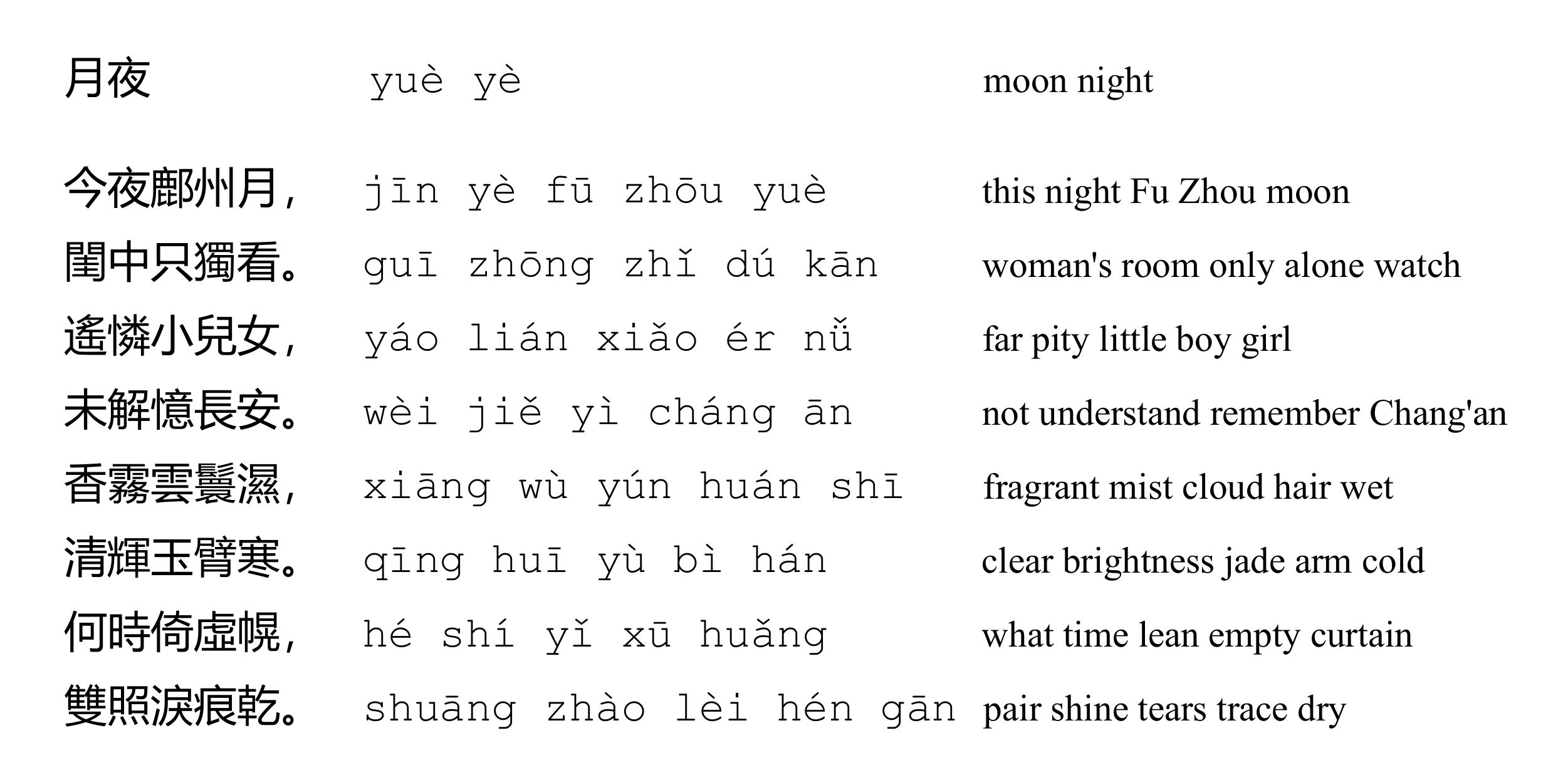
At the beginning of the rebellion, Du Fu managed to get his family to safety in the northern town of Fuzhou, but he was himself held captive in Chang’an. Fortunately, he was not considered important enough to be executed, and he finally managed to escape in 757 CE. The following shows a poem from 756 CE in characters (Owen, 2008, poem 4.18), pinyin transcription, and character-by-character translation (Alexander, 2008):
The following is a reading of the poem from Librivox:
Vikam Seth (1997) translated the poem keeping the Chinese rhyme scheme: the last character rhymes for all four couplets:
Moonlit Night
In Fuzhou, far away, my wife is watching The moon alone tonight, and my thoughts fill With sadness for my children, who can’t think Of me here in Changan; they’re too young still. Her cloud-soft hair is moist with fragrant mist. In the clear light her white arms sense the chill. When will we feel the moonlight dry our tears, Leaning together on our window-sill?
Alec Roth wrote a suite of songs based on Vikam Seth’s translations of Du Fu. The following is his setting for Moonlit Night with tenor Mark Padmore:
David Young (2008) provides a free-verse translation:
Tonight in this same moonlight my wife is alone at her window in Fuzhou I can hardly bear to think of my children too young to understand why I can’t come to them her hair must be damp from the mist her arms cold jade in the moonlight when will we stand together by those slack curtains while the moonlight dries the tear-streaks on our faces?
The poem may have been written or at least conceived during the celebration of the full moon in the autumn. Families customarily viewed the moon together and Du Fu imagines his wife viewing the moon alone. The mention of the wife’s chamber in the second line may refer to either her actual bedroom or metonymically to herself as the inmost room in Du Fu’s heart (Hawkes, 1967). David Young (2008) remarks that this may be “the first Chinese poem to address romantic sentiments to a wife,” instead of a colleague or a courtesan.
David Hawkes (1967) notes the parallelism of the third couplet:
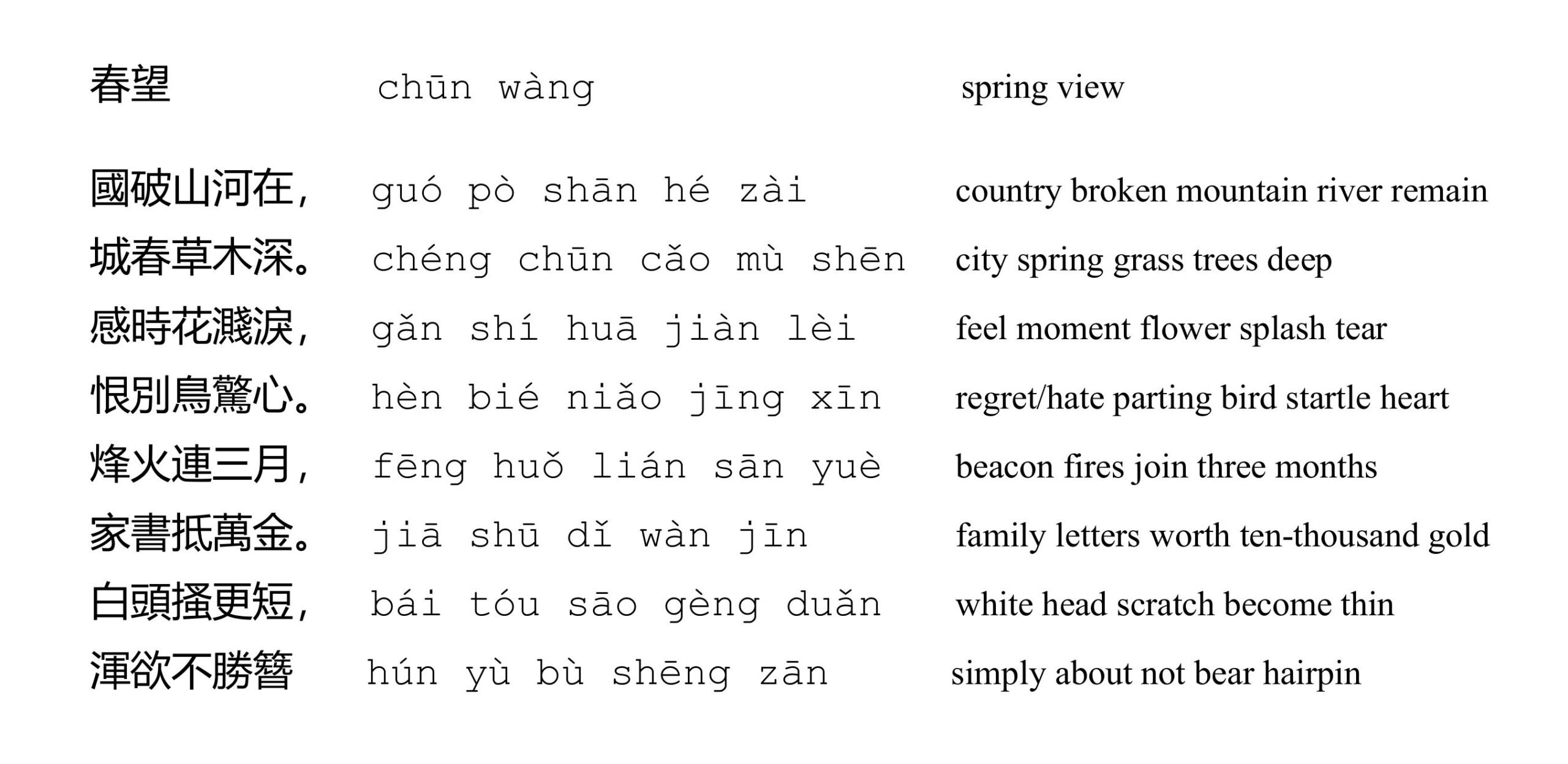
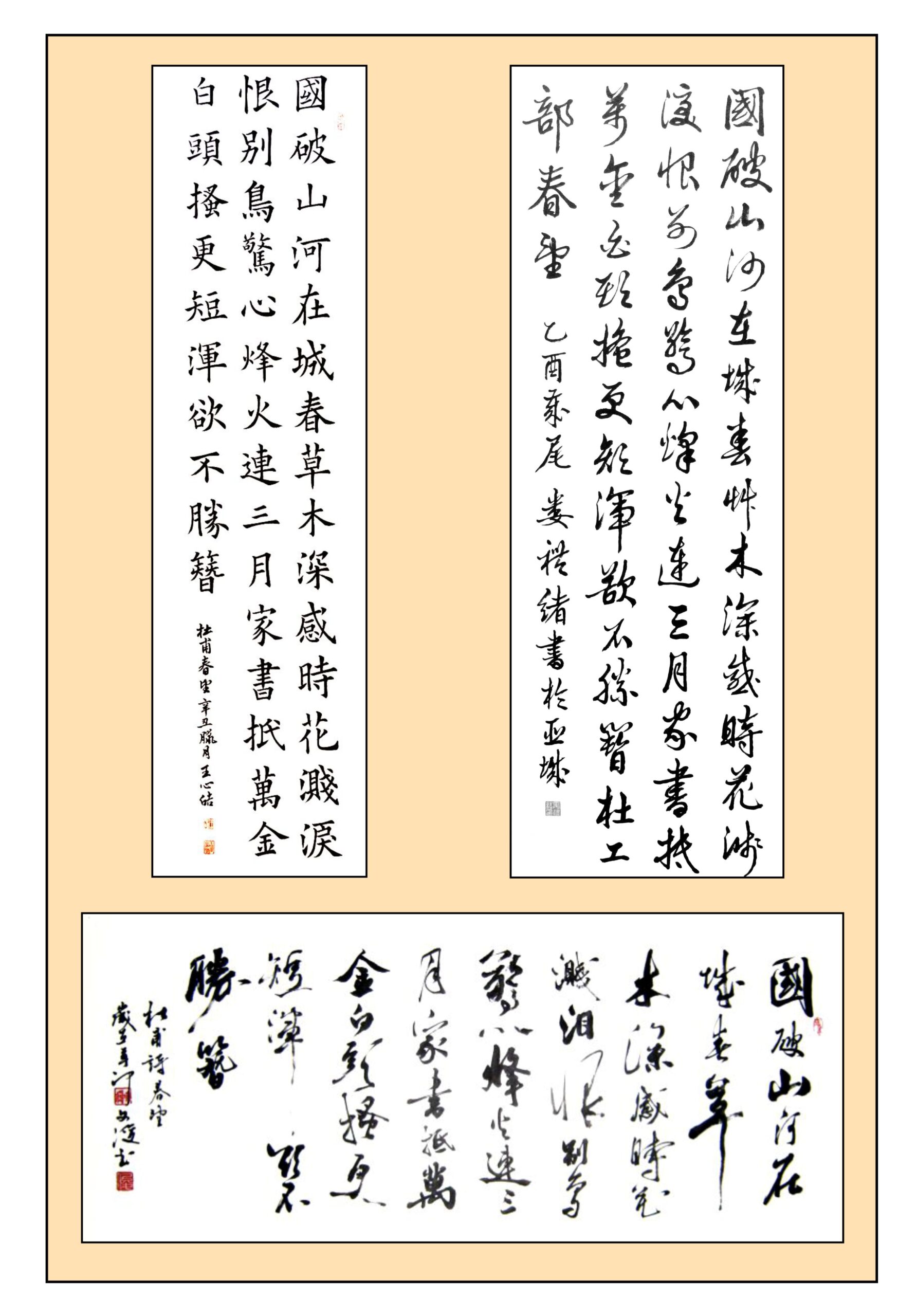
Spring View (or Spring Landscape), the most famous poem written by Du Fu in Chang’an during the rebellion, tells how nature persists despite the ravages of effects of war and time. Subjective emotions and objective reality become one. The character wàng (view, landscape) can mean both the act of perceiving or what is actually perceived. In addition, it can sometimes mean the present scene or what is to be expected in the future (much like the English word “prospect”). The illustration below shows the text in Chinese characters (Owen, 2008, poem 4.25), in pinyin and in a character-by-character translation (adapted from Hawkes, 1967, Alexander, 2008, and Zong-Qi Cai, 2008):
The following is a reading of the poem from the website associated with How to Read Chinese Poetry (ZongQi-Cai, 2008, poem 8.1):
The next illustration shows the poem as written by three calligraphers. All versions read from top down and from right to left. On the left is standard script by Anita Wang; on the right the calligraphy by Lii Shiuh Lou is gently cursive. At the bottom the calligraphy by an anonymous calligrapher is unrestrained: it accentuates the root of the growing grass (8th character) and the radicals that compose the character for regret/hate (16th character) fly apart.
The following are two translations, the first by David Hinton, which uses an English line of a constant length to approximate the Chinese 5-character line (2020a):
The country in ruins, rivers and mountains continue. The city grows lush with spring.
Blossoms scatter tears for us, and all these separations in a bird’s cry startle the heart.
Beacon-fires three months ablaze: by now a mere letter’s worth ten thousand in gold,
and worry’s thinned my hair to such white confusion I can’t even keep this hairpin in.
A second translation, with preservation of the rhyme scheme and phrasal structure, is by Keith Holyoak (2015)
The state is in ruin; yet mountains and rivers endure. In city gardens weeds run riot this spring.
These dark times move flowers to sprinkle tears; the separations send startled birds on the wing.
For three months now the beacon fires have burned; a letter from home would mean more than anything.
I’ve pulled out so many of my white hairs too few are left to hold my hatpin in!
The second couplet has been interpreted in different ways. Most translations (including the two just quoted) consider it as representing nature’s lament for the evil times. For example, Hawkes (1967) suggests that “nature is grieving in sympathy with the beholder at the ills which beset him.” However, Michael Yang (2016) proposes that “In times of adversity, nature may simply be downright uncaring and unfriendly, thereby adding to the woes of mankind.” He translates the couplet
Mourning the times, I weep at the sight of flowers; Hating separation, I find the sound of birds startling.
The last two lines of the poem refer the hair-style of the Tang Dynasty: men wore their hair in a topknot, and their hats were “anchored to their heads with a large hatpin which passed through the topknot of hair” (Hawkes, 1967). Most interpreters have been struck by the difference between the solemn anguish of the poem’s first six lines, and the self-mockery of the final couplet (Hawkes, 1967, p 46; Chou, 1995, p 115). This juxtaposition of the tragic and the pitiable accentuates the poet’s bewilderment.
The Thatched Cottage
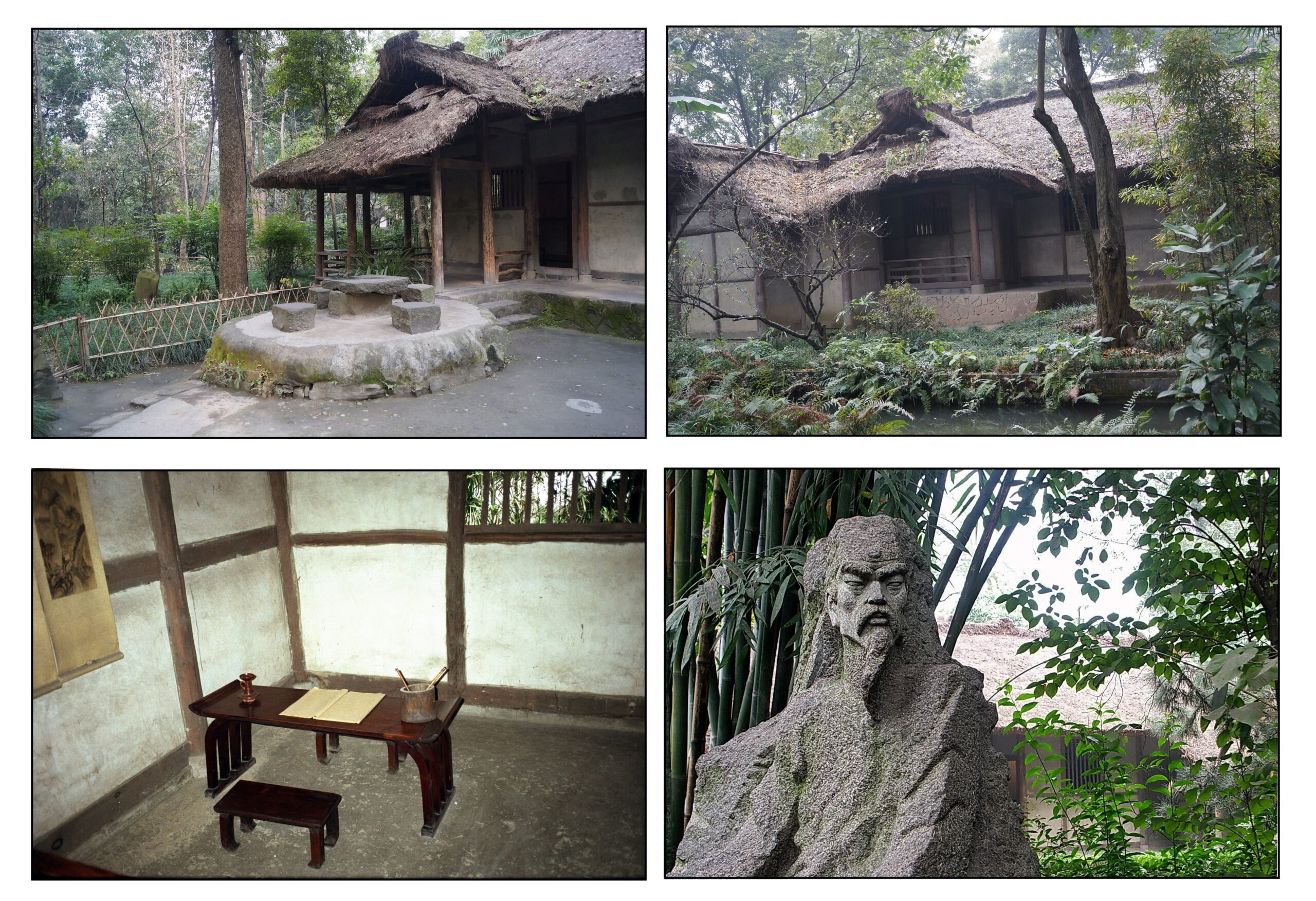
Disillusioned by the war and by the politics of vengeance that followed, Du Fu and his family retired to a thatched cottage in Chengdu, where he lived from 759-765. A replica of this cottage has been built there in a park celebrating both Du Fu and Chinese Poetry:
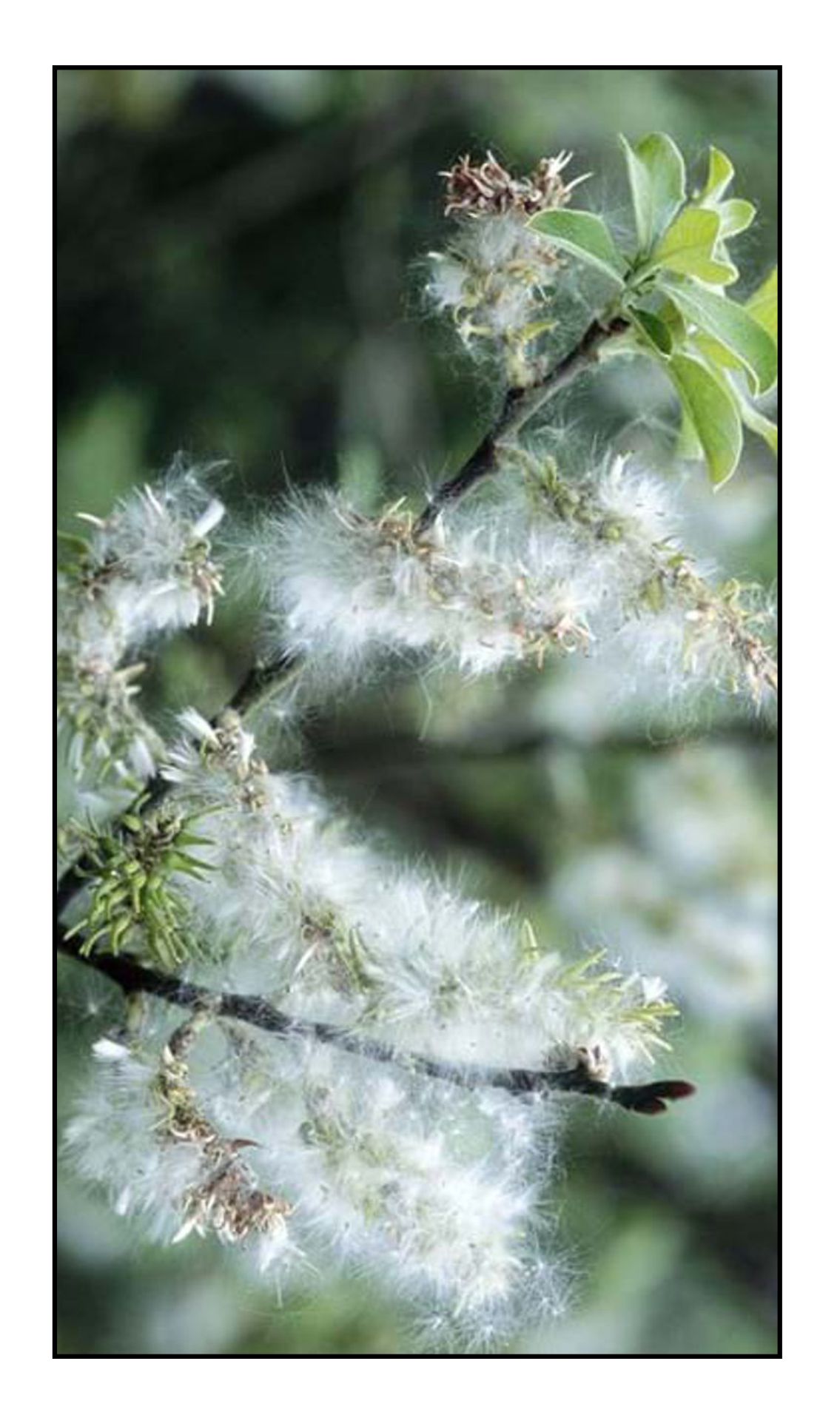
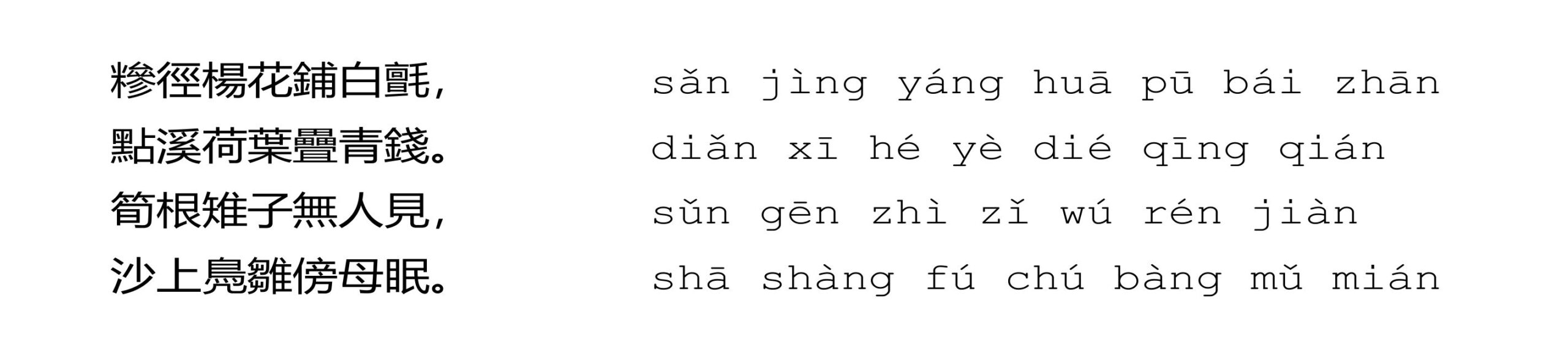
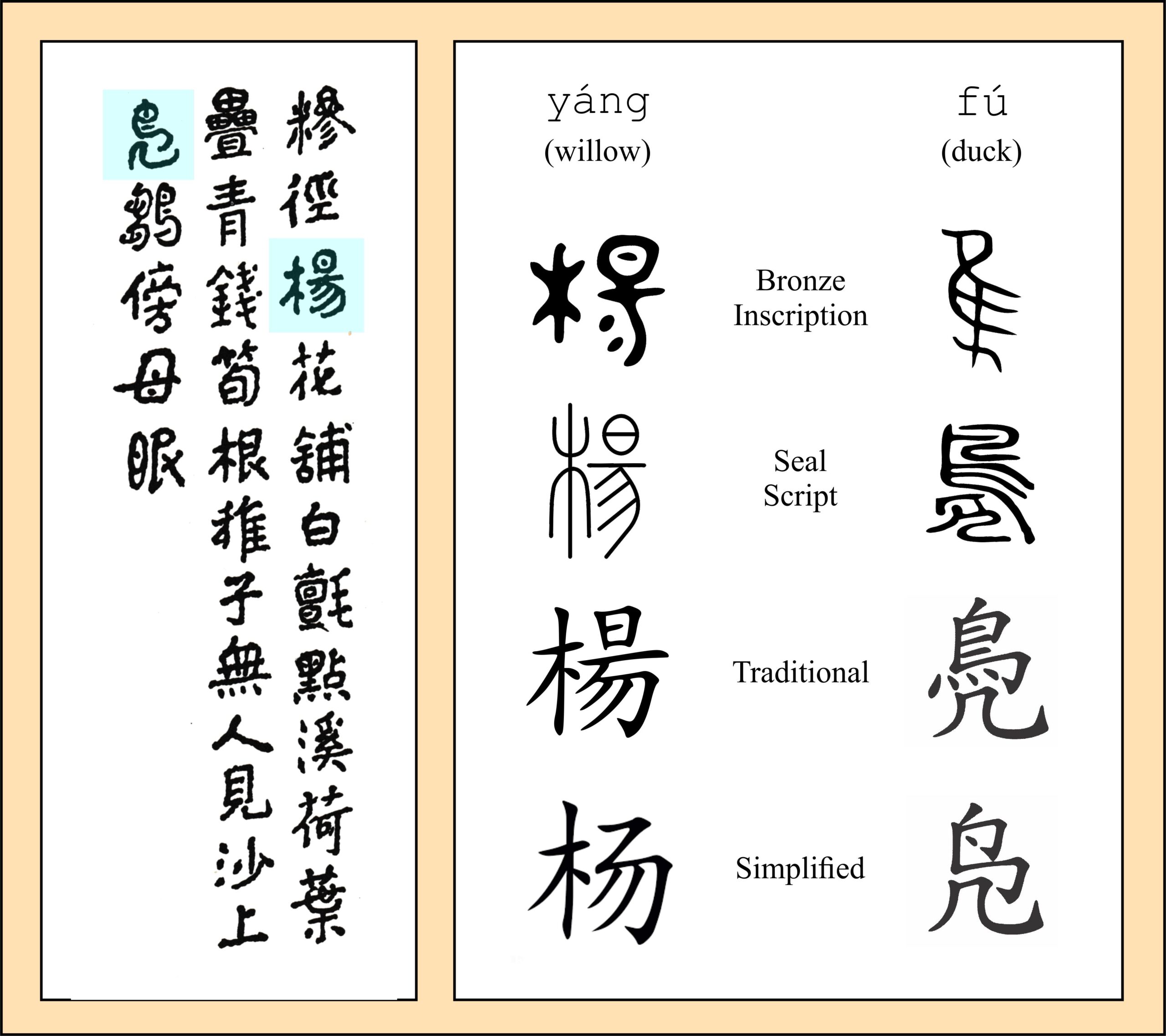
Many of the poems that Du Fu wrote in Chengdu celebrated the simple joys of nature. He often used isolated quatrains to find parallels between his emotions and the world around him. This brief form called juéjù (curtailed lines) was widely used by his colleagues Li Bai (701–762) and Wang Wei (699–759). The form consists of two couplets juxtaposed in meaning and rhyming across their last character (Wong, 1970; Zong-Qi Cai, 2008, Chapter 10). The following poem (Owen, 2008, poem 9.63) describing willow-catkins (illustrated on the right) and sleeping ducks gives a deep feeling of peace. These are the Chinese characters and pinyin transcription followed by the character-by-character translation (Alexander, 2008):
grain path poplar/willow blossom pave white carpet little stream lotus leaves pile green money bamboo shoot root sprout no person see sand on duckling beside mother sleep
The following translation is by Burton Watson (2002):
Willow fluff along the path spreads a white carpet; lotus leaves dot the stream, plating it with green coins. By bamboo roots, tender shoots where no one sees them; on the sand, baby ducks asleep beside their mother.
Shui Chien-Tung provided the following calligraphy for the poem (Cooper, 1973). He used aspects of the ancient scripts (circles, curves and dots) in some of the characters to give a sense of simplicity and timelessness. The illustration shows the calligraphy of the poem on the left and the evolution of the characters yáng (willow, poplar) and fú (duck) on the right.
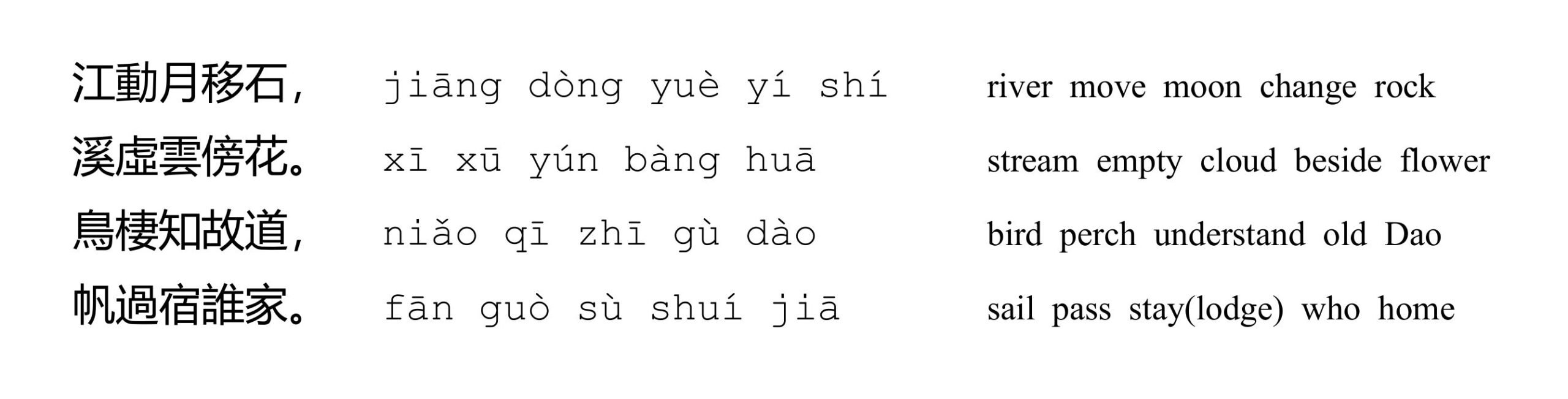
Another quatrain from Chengdu describes a night scene on the river. The following shows the poem in Chinese characters (Owen, 2008, poem 13.61), in pinyin, and in a character-by-character translation (mine):
This is the translation by J. P. Seaton (Seaton & Cryer, 1987):
The River moves, moon travels rock, Streams unreal, clouds there among the flowers. The bird perches, knows the ancient Tao Sails go: They can’t know where.
As the river flows by, the moon’s reflection slowly travels across the rocks near the shore. The water reflects the clouds between the lilies. A bird on a branch understands the nature of the universe. A boat passes, going home we know not where.
The poem conveys a sense of the complexity of the world where reflections and reality intermingle, a desire to understand the meaning of our life, and a fear that time is passing and we do not know where it will take us. All this in twenty characters. Such concision is extremely difficult in English. An attempt:
River and rocks reflect the moon and clouds amid the lilies resting birds understand the way sails pass seeking home somewhere.
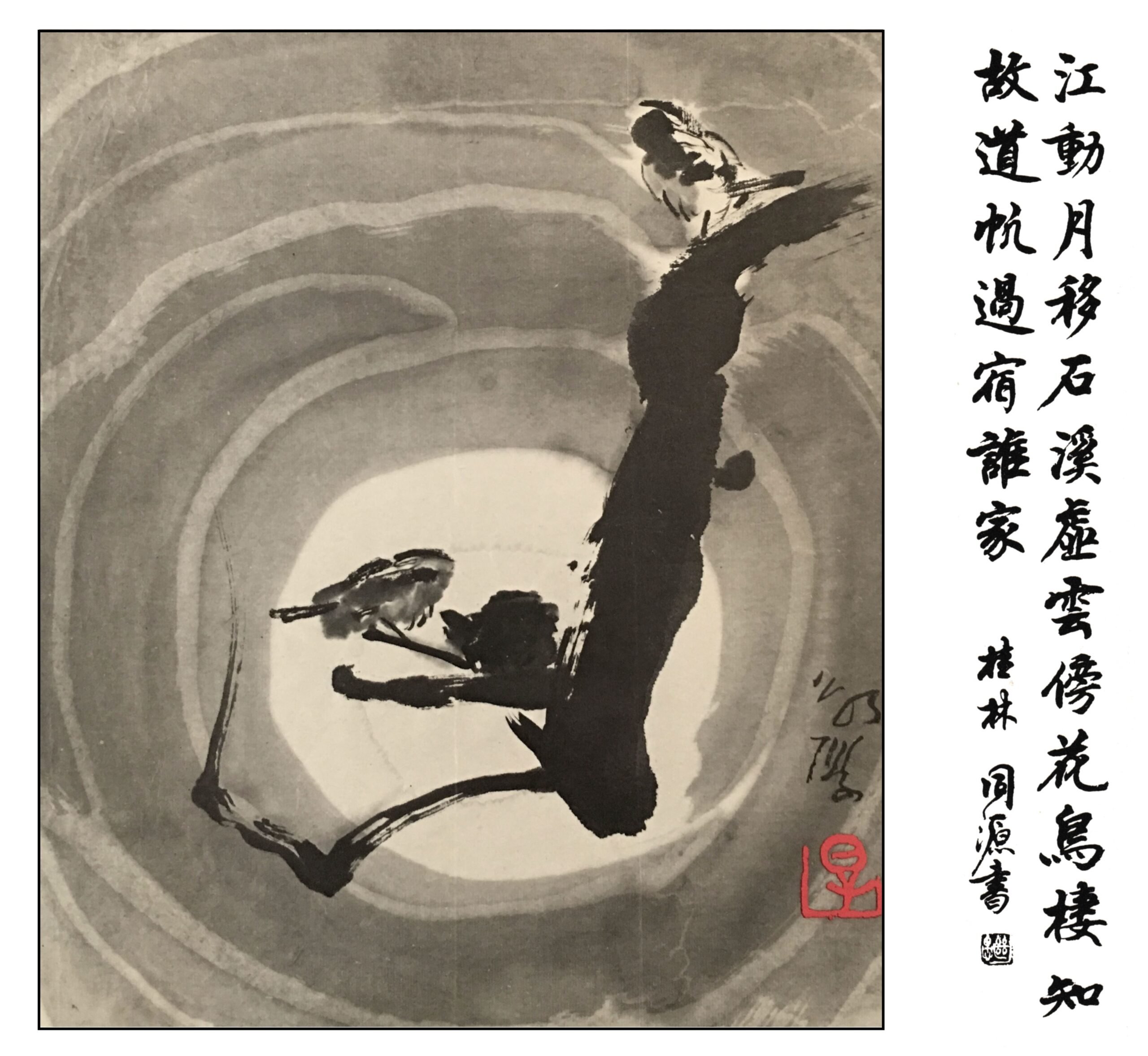
The following shows a painting by Huang Yon-hou to illustrate the poem. This was used as the frontispiece (and cover) of the book Bright Moon, Perching Bird (Seaton & Cryer, 1987). On the right is calligraphy of the poem by Mo Ji-yu.
Above the Gorges
In 765 CE Du Fu and his family left Chengdu and travelled eastward on the Yangtze River. The region of Luoyang had been recently recovered by imperial forces and Du Fu was perhaps trying to return home (Hung, 1952). He stayed for a while in Kuizhou (present day Baidicheng) at the beginning of the Three Gorges (Qutang, Wu and Xiing).
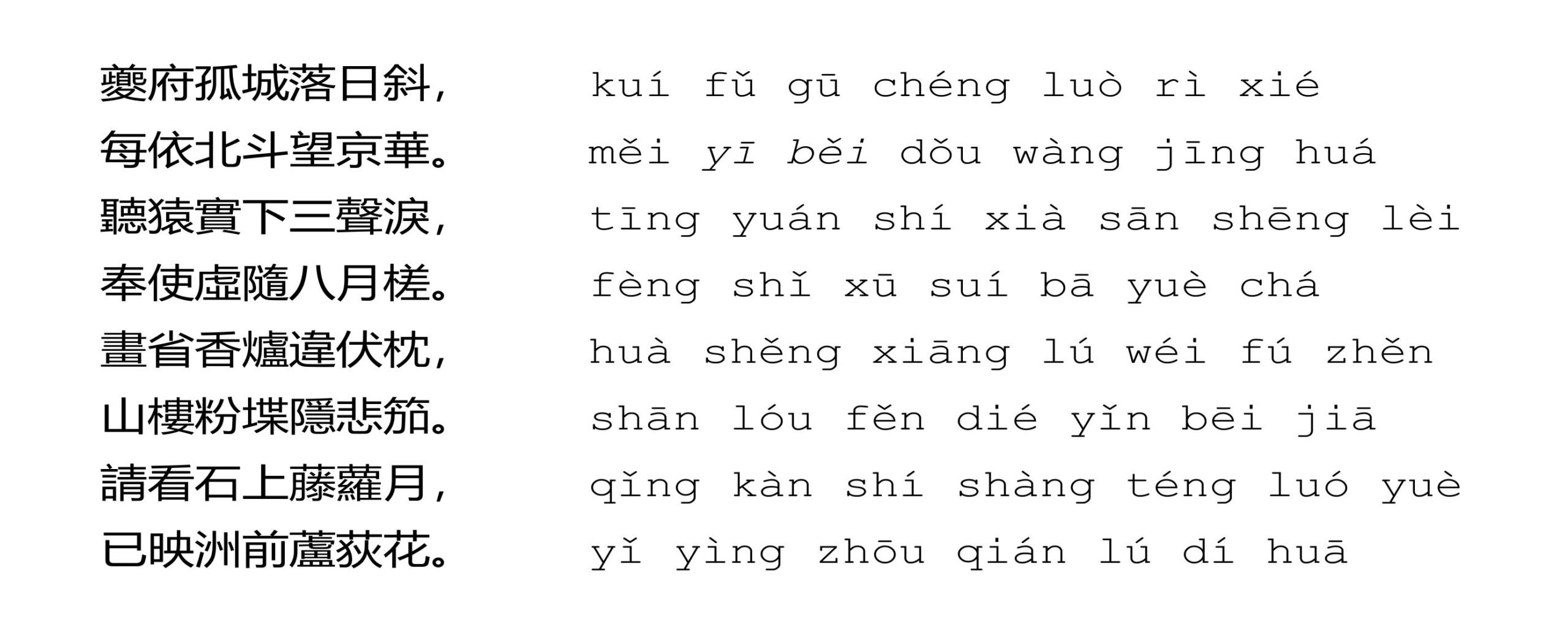
While there Du Fu wrote a series of meditations called Autumn Thoughts (or more literally Stirred by Autumn). This is the second of these poems in Chinese characters and in pinyin:
A character-by-character translation (Alexander, 2008) is:
Kui prefecture lonely wall set sun slant Every rely north dipper gaze capital city Hear ape real fall three sound tear Sent mission vain follow eight month raft Picture ministry incense stove apart hidden pillow Mountain tower white battlements hide sad reed-whistle Ask look stone on [Chinese wisteria] moon Already reflect islet before rushes reeds flowers
The following is Stephen Owen’s translation (Owen, 2008 poem 17.27):
On Kuizhou’s lonely walls setting sunlight slants, then always I trust the North Dipper to lead my gaze to the capital. Listening to gibbons I really shed tears at their third cry, accepting my mission I pointlessly follow the eighth-month raft. The censer in the ministry with portraits eludes the pillow where I lie, ill towers’ white-plastered battlements hide the sad reed pipes. Just look there at the moon, in wisteria on the rock, it has already cast its light by sandbars on flowers of the reeds.
The poem is striking in the difference between the first three couplets and the last. At the beginning of the poem Du Fu is feeling regret that he is not in Chang’an which is located due north of Kuizhou (in the direction of the Big Dipper which points to the North Star). Owen notes that “There was an old rhyme that a traveler in the gorges would shed tears when the gibbons cried out three times.” The eighth month raft may refer to another old story about a vessel that came every eight months and took a man up to the Milky Way. Owen commented on the third couplet that “The “muralled ministry” is where were located the commemorative portraits of officers, civil and military, who had done exceptional service to the dynasty.” Incense was burned when petitions were presented. The final couplet disregards all the preceding nostalgia and simply appreciates the beauty of the moment.
The Ming painter Wang Shimin illustrated this final couplet in one of the leaves from his album Du Fu’s Poetic Thoughts.
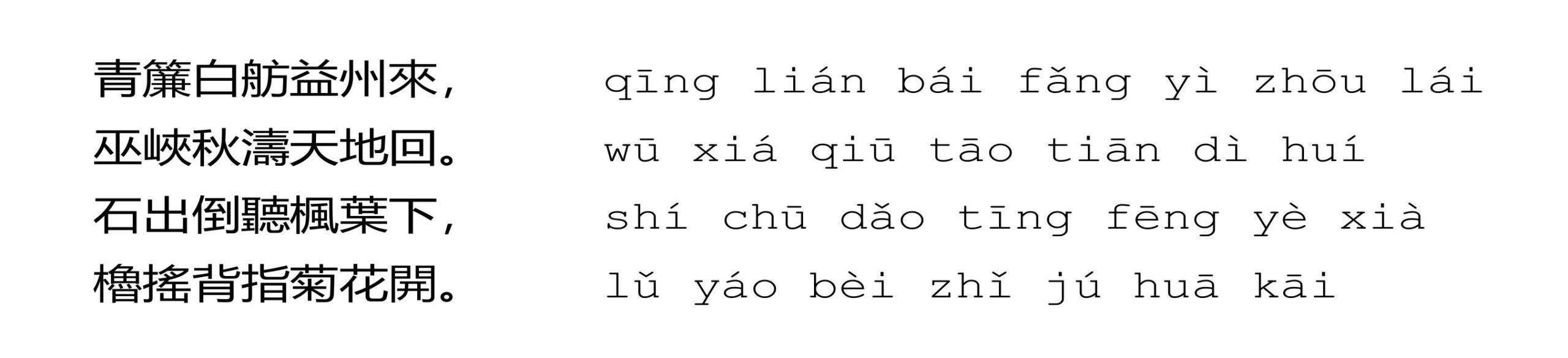
Later in Kuizhou, Du Fu entertained a librarian named Li who was returning north to take up an appointment in Chang’an. The following is the beginning of a poem (Owen, 2008, poem 19.34) describing Li’s departure in Chinese characters and in pinyin:
A character-by-character translation is:
blue/green curtain white boat/raft Yizhou arrive Wu gorge autumn waves heaven/sky earth/ground turn (around) stone/rock leave/exit fall listen maple leaf down scull/oar swing carry point chrysanthemum flower open/blume
The following is Stephen Owen’s translation:
When the white barge with green curtains came from Yizhou, with autumn billows in the Wu Gorges, heaven and earth were turning. Where rocks came out, from below you listened to the leaves of maples falling, as the sweep moved back and forth you pointed behind to chrysanthemums in bloom.
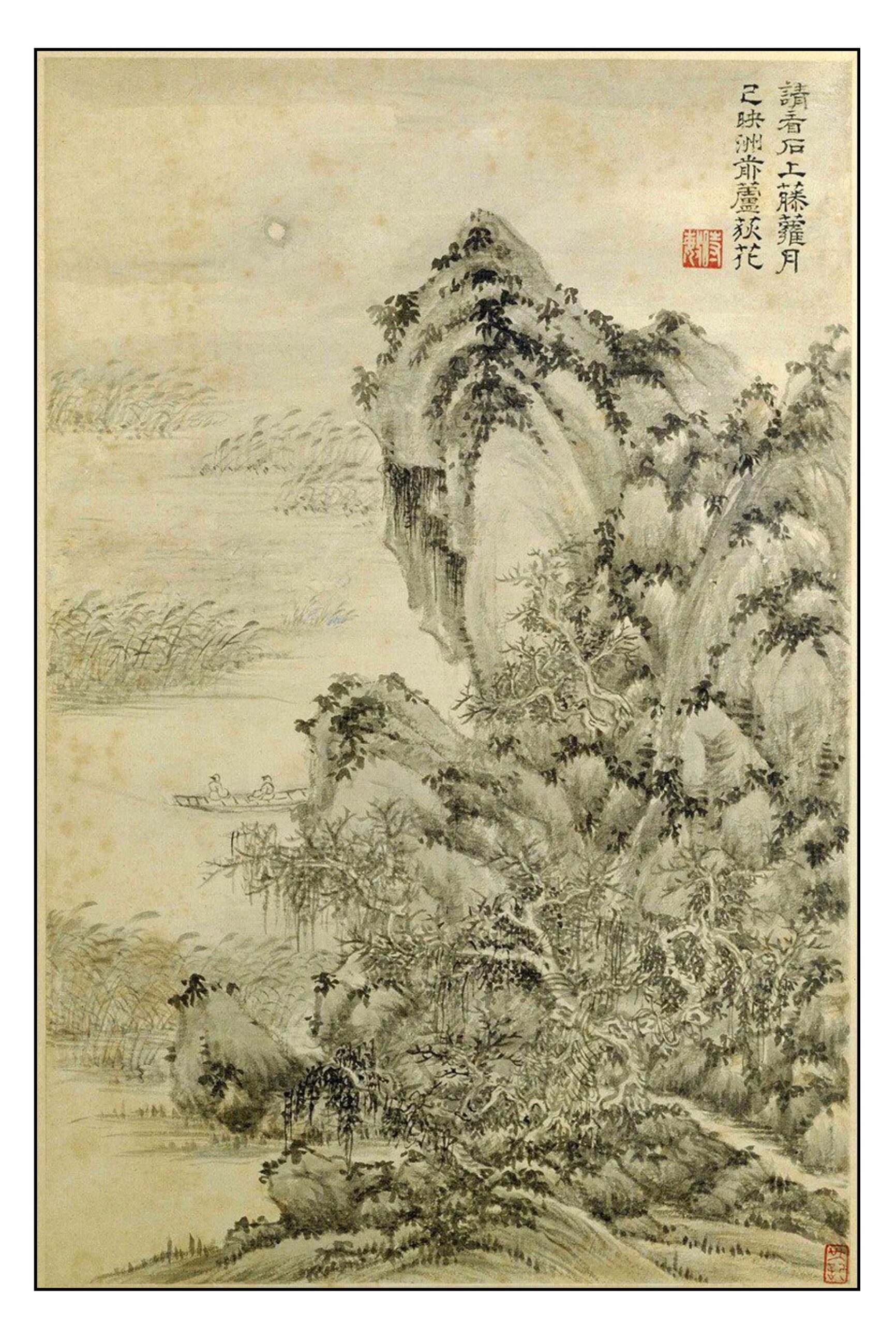
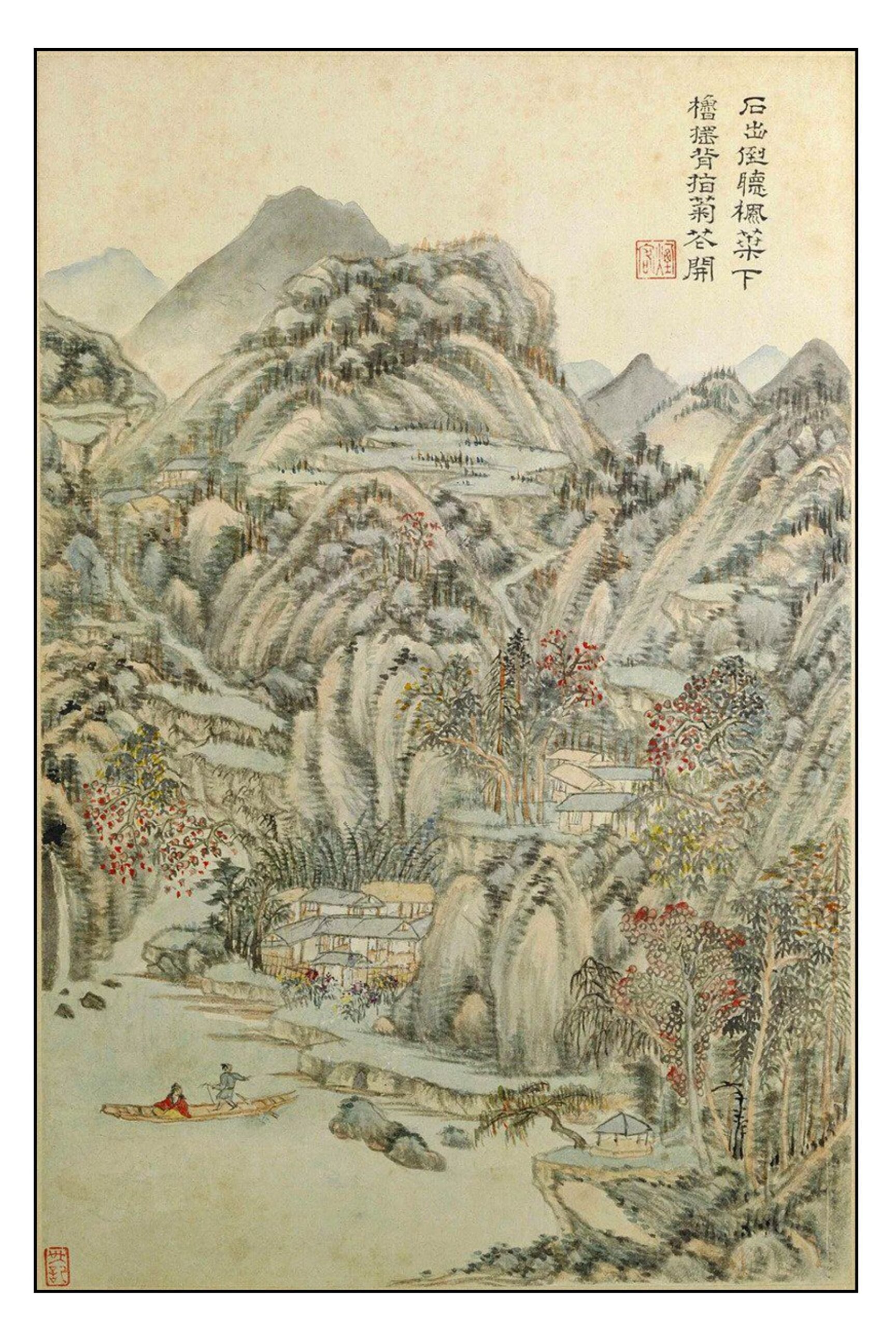
The Ming painter Wang Shimin illustrated the second couplet in one of the leaves from his album Du Fu’s Poetic Thoughts. The painting shows the bright red leaves of the maples. In front of the riverside house one can see the multicolored chrysanthemums that Li is pointing to. Harmony exists between the wild and the cultivated.
On the River
After his sojourn in Kuizhou, Du Fu and his family continued their journey down the Yangtze River. However, the poet was ill and was unable to make it beyond Tanzhou (now Changsha) where he died in 770 CE. No one knows where he is buried. In the 1960’s radical students dug up a grave purported to be his to “eliminate the remaining poison of feudalism,” but found the grave empty.
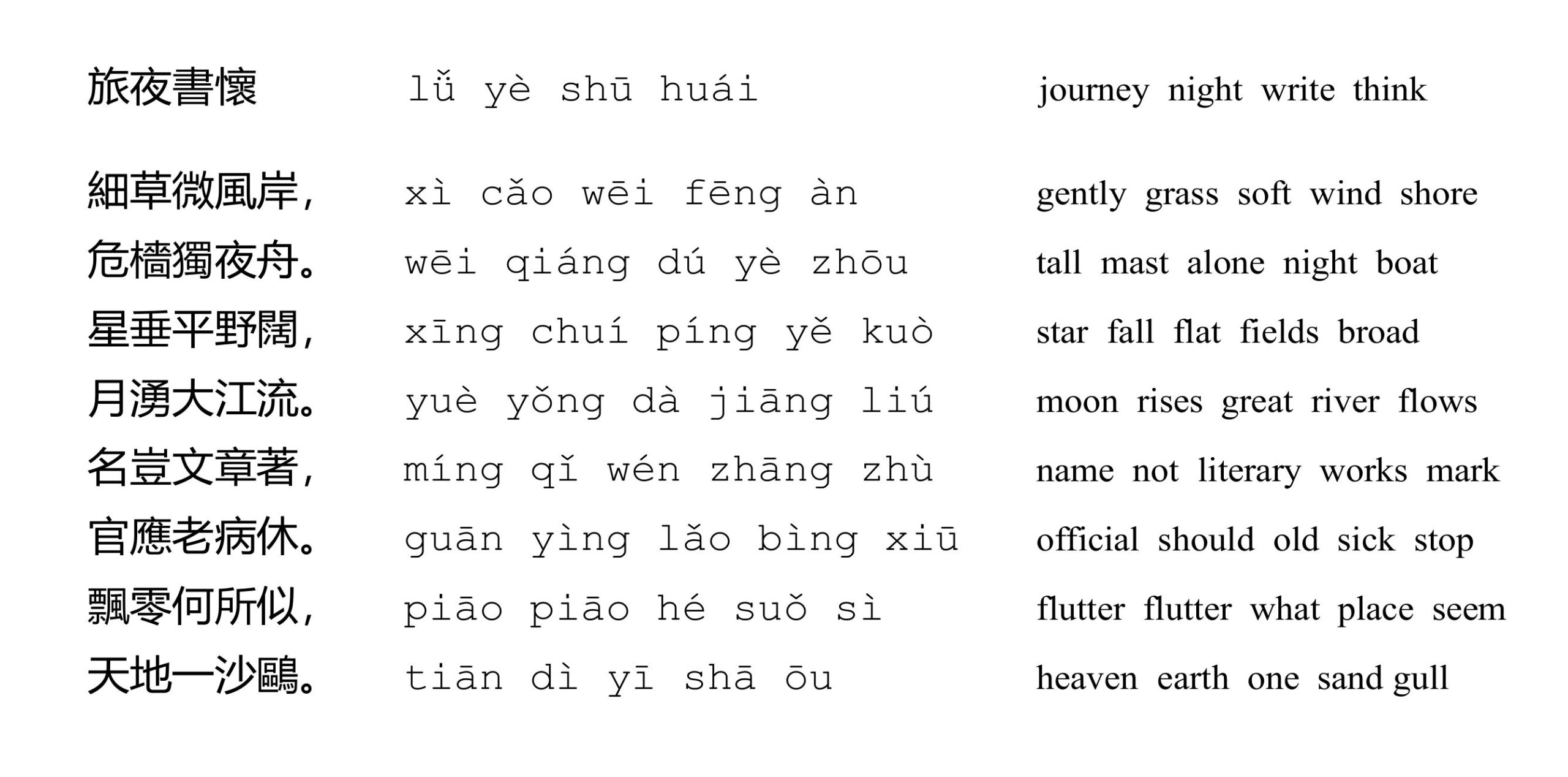
One of Du Fu’s last poems was Night Thoughts While Travelling. The following is the poem in Chinese characters (Owen, 2008, poem 14.63) and in pinyin (Alexander, 2008):
The following is a reading of the poem from Librivox:
Holyoak (2015) provides a rhymed translation:
The fine grass by the riverbank stirs in the breeze; the tall mast in the night is a lonely sliver.
Stars hang all across the vast plain; the moon bobs in the flow of the great river.
My poetry has not made a name for me; now age and sickness have cost me the post I was given.
Drifting, drifting, what do I resemble? A lone gull lost between earth and heaven.
Kenneth Rexroth (1956) translates the poem in free verse:
Night Thoughts While Travelling
A light breeze rustles the reeds Along the river banks. The Mast of my lonely boat soars Into the night. Stars blossom Over the vast desert of Waters. Moonlight flows on the Surging river. My poems have Made me famous but I grow Old, ill and tired, blown hither And yon; I am like a gull Lost between heaven and earth.
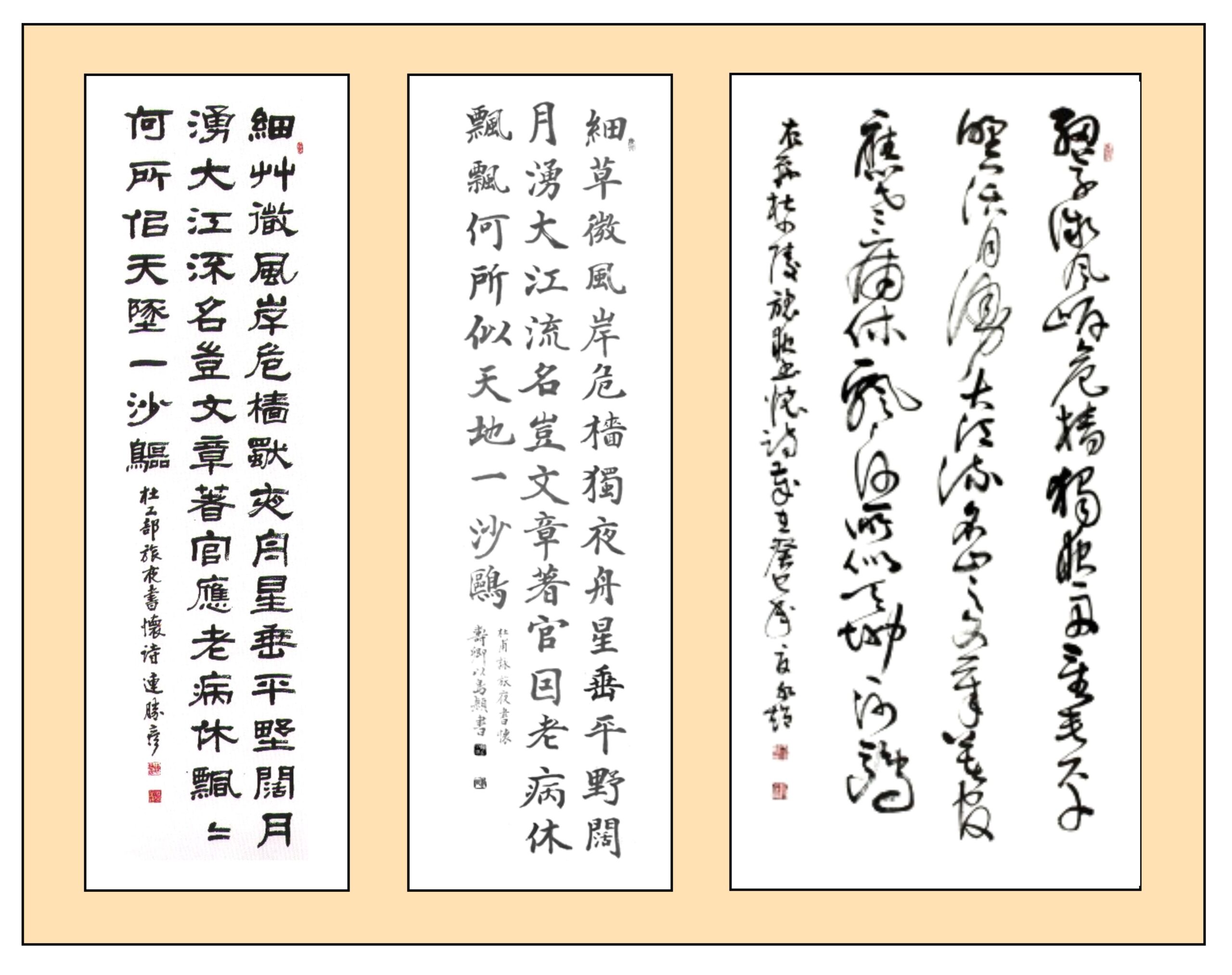
The following shows the poem in calligraphy with three styles. On the left the poem is written in clerical script, in the center in regular script and on the right is unrestrained cursive script. All examples were taken from Chinese sites selling calligraphy.
Changing Times
During the Tang Dynasty (618–907 CE) the role of literature, and poetry in particular, in society changed dramatically (Owen, 2011):
In the 650s, literature was centered almost entirely in the imperial court; by the end of the era literature had become the possession of an educated elite, who might serve in government, but whose cultural life was primarily outside the court.
During Du Fu’s lifetime, poetry became no longer a part of the ancient traditions; rather it began to be concerned with the present and with the personal. Lucas Bender (2021) describes the traditional role of poetry in a society following the precepts of Confucianism:
Most people … would be incapable on their own of adequately conceptualizing the world or perfectly responding to its contingency, and therefore needed to rely on the models left by sages and worthies. Many of these models were embodied in texts, including literary texts, which could thus offer an arena for ethical activity. Poetry, for example, was understood to offer models of cognition, feeling, and commitment that would ineluctably shape readers’ understanding of and responses to their own circumstances. One way of being a good person, therefore, involved reading good poetry and writing more of it, thereby propagating the normative models of the tradition in one’s own time and transmitting them to the future. (p 317)
Du Fu found himself bewildered by the state of the world. He sought to convey this confusion rather than explain it:
Du Fu doubts the possibility of indefinitely applicable moral categories. The conceptual tools by which we make moral judgments, he suggests, are always inherited from a past that can – and, in a world as various and changeable as ours has proven to be, often will – diverge from the exigencies of the present. As a result, not only are our values unlikely to be either universal or timeless; more important, if we pay careful attention to the details of our experience, they are unlikely to work unproblematically even here and now. (Bender, 2021, p 319)
The complexity of Du Fu’s poetry – the difficulty in understanding some of his juxtapositions – becomes a challenge. The past provides no help in the interpretation. We must figure out for themselves what relates the mountain, the clouds and the poet’s breathing in the first poem we considered. And in the last poem we must try to locate for ourselves the place of the gull between heaven and earth.
References
Alexander, M. (2008). A little book of Du Fu. Mark Alexander. (Much of the material in the book is available on Chinese Poems website).
Bender, L. R. (2021). Du Fu transforms: tradition and ethics amid societal collapse. Harvard University Asia Center.
Chan, J. W. (2018). Du Fu: the poet as historian. In Zong-Qi Cai. (Ed.) How to read Chinese poetry in context: poetic culture from antiquity through the Tang. (pp 236-247). Columbia University Press.
Chou, E. S. (1995). Reconsidering Tu Fu: literary greatness and cultural context. Cambridge University Press.
Collet, H., & Cheng, W. (2014). Tu Fu: Dieux et diables pleurant, poèmes. Moundarren.
Cooper, A. R. V. (1973). Li Po and Tu Fu. Penguin Books.
Egan, R. (2020). Ming-Qing paintings inscribed with Du Fu’s poetic lines. In Xiaofei Tian (Ed.). Reading Du Fu: nine views. (pp 129-142). Hong Kong University Press
Hawkes, D. (1967 revised and reprinted, 2016). A little primer of Tu Fu. New York Review of Books.
Hinton, D. (1989, expanded and revised 2020a). The selected poems of Tu Fu. New Directions.
Hinton, D. (2019). Awakened cosmos: the mind of classical Chinese poetry. Shambhala.
Hinton, D. (2020b). China root: Taoism, Ch’an, and original Zen. Shambhala
Holyoak, K. (2015). Facing the moon: poems of Li Bai and Du Fu. Oyster River Press.
Hsieh, D. (1994). Du Fu’s “Gazing at the Mountain.” Chinese Literature, Essays, Articles, Reviews, 16, 1–18.
Hung, W. (1952, reprinted 2014). Tu Fu: China’s Greatest Poet. Harvard University Press
Owen, S. (1981). Tu Fu. In S. Owen, The Great Age of Chinese Poetry: The High T’ang. (pp 183-224). Yale University.
Owen, S. (2010). The cultural Tang (650–1020). In Chang, K. S., & Owen, S. (Eds). The Cambridge History of Chinese Literature (Vol. 1, pp. 286–380). Cambridge University Press.
Owen, S., (edited by P. W. Kroll & D. X. Warner, 2016). The poetry of Du Fu. (6 volumes). De Gruyter. (Available to download in pdf format.)
Rexroth, K. (1956). One hundred poems from the Chinese. New Directions.
Rouzer, P. (2020). Refuges and refugees: how Du Fu writes Buddhism. In Xiaofei Tian (Ed.). Reading Du Fu: nine views. (pp. 75-92). Hong Kong University Press.
Seaton, J. P., & Cryer, J. (with calligraphy by Mo Ji-yu, and painting by Huang Yon-hou, 1987). Bright moon, perching bird: poems of Li Po and Tu Fu. Wesleyan University Press.
Seth, V. (1997). Three Chinese poets: translations of poems by Wang Wei, Li Bai and Du Fu. Phoenis.
Sullivan, M. (1974). The three perfections: Chinese painting, poetry, and calligraphy. Thames and Hudson.
Xiaofei Tian (Ed.). (2020). Reading Du Fu: nine views. Hong Kong University Press.
Zhang, Y. (2018). On 10 Chan-Buddhism images in the poetry of Du Fu. Studies in Chinese Religions, 4(3), 318–340.
Wai-lim Yip. (1997). Chinese Poetry, Duke University Press.
Watson, B. (2002). The selected poems of Du Fu. Columbia University Press.
Wong, S. S. (1970) The quatrains (Chüeh-Chü 絕句) of Tu Fu. Monumenta Serica, 29, 142-162
Yang, M. V. (2016). Man and nature: a study of Du Fu’s poetry. Monumenta Serica, 50, 315-336.
Young, D. (2008). Du Fu: a life in poetry. Alfred A. Knopf.
Zong-Qi Cai (2008). How to read Chinese poetry: a guided anthology. Columbia University Press. (audio files are available at website).
Language and Meaning
Language and meaning
I have just returned from a brief trip to Korea. I had learned the Hangul alphabet, but my vocabulary was limited to some rudimentary phrases. I could read but I could not understand. This led to some thoughts about language and meaning. My posting will take a roundabout course, beginning with a Korean scholar from the Silla dynasty. Be patient: I shall try to find some meaning before the day is done.
Choe Chi Won (857-925?)
At the age of 12, Choe Chi Won (Hangul 최치원; Chinese 崔致遠; literary name 孤雲, Go-un, “Lonely Cloud”) was sent from Korea to study in Xian (Chang’an), the capital of the Tang dynasty in China. There he learnt the practices of Confucianism and the arts of poetry and calligraphy. He passed the Imperial Examination at the young age of 22 years, and rose quickly through the ranks of the Chinese Civil Service.
However, the Tang dynasty (618-907) was slowly coming to its end. In 874, Huang Chao had initiated a rebellion against the Emperor. By 880 he had taken control of the capital and assumed the throne, calling himself the “Emperor of Qi.” Choe served as the secretary to the Tang general Gao Pien in his campaign against Huang Chao. By 884, the rebellion was finally defeated and the Tang emperor Xizong reinstated in Xian.
However, the Tang empire was in pieces. Feuding warlords commanded different regions, and in 907 the Tang dynasty came to an end. China’s political turmoil continued through the period of the “Five Dynasties and Ten Kingdoms,” until some stability was finally regained with the Song dynasty in 960.
In 885, Choe asked to return to Korea as an envoy to the Silla dynasty. However, his home country was also in a period of decadence and political upheaval. The 900-year old Silla dynasty was slowly coming apart. It would finally succumb to the Goryeo dynasty in 935.
The Silla Royal Family and the court refused to accept Choe’s advice about how to improve their government. Disillusioned, Choe left the court to become a provincial magistrate. Finally, he retired completely from public life, spending his last years in meditation at various Buddhist monasteries in the southern regions of Korea. For a brief while he lived in Busan, where he gave the name Haeundae (海雲臺Sea Cloud Platform) to Dongbaek Island. He had these characters inscribed on one of the rocks near the present lighthouse. The photo to the right shows Choe’s memorial statue on the island (now connected to the mainland in the Haeundae region of Busan. The exact date of Choe’s death is unknown. Legend has him wandering off into the forest never to be seen again.
(Biographical details for Choe Chi Won are available in Jones, 1903; Lee, 1997; Lin, 2011, and on David Mason website).
The Mountain Stelai
Before he died, however, Choe composed the inscriptions for four stelai commemorating the achievements of famous Korean Buddhist monks. As well as describing the lives of the monks, these inscriptions commented upon the philosophy of Buddhism and how it might be made compatible with Confucianism.
Each stele contained a flat stone slab upon which the inscriptions were carved. This was set upon a tortoise base and topped with a cloud-dragon capstone. Tortoises and dragons both symbolize immortality. The above figure shows the general structure of a stele (from Park 2002), and the photograph on the right shows the actual stele commemorating the monk Chin’gam Hyeso (774-850) at the Ssanggye monastery in Southern Korea (from the webpage of David Mason). This monk had studied in China and returned to Korea in 830 to establish a monastery and transmit to his disciples the principles of Seon Buddhism.
Seon Buddhism
Although Buddhism first came to Korea in the 4th century AD, it did not become prominent until the advent of Seon Buddhism in the 7th and 8th centuries. This line of Buddhism derived from China’s Chan Buddhism. Zen Buddhism in Japan had a similar source though it began much later (in the 12th century). Chan Buddhism emphasizes meditation as the primary means to enlightenment – “Chan” comes from 禪那 (pinyin: chánnà, meaning meditation), which itself derives from the Sanskrit dhyana. The key scripture describing the principles of Buddhist meditation is the Lankavatara Sutra (Red Pine, 2012; also available in a web translation), which was compiled in the 3rd or 4th century and translated into Chinese in the 5th century
Chan Buddhism traces itself back to the patriarch Bodhidharma (known as Daruma in Japan), who lived in China in the 5th and 6th centuries (Suzuki, 1956, Chapter 3; Red Pine, 1989). Bodhidharma may have journeyed to China from India, though the details of his life come more from myth than history. He is usually portrayed as a fierce, bearded sage, with brow furrowed from concentration, eyes staring after years of meditation (“wall-watching”), and earlobes extended with enlightenment.
As well as meditation, Chan Buddhism fostered asceticism, irrationality, chanting and marshal arts. Truth was conveyed from master to pupil; scriptures were irrelevant other than as used by the masters to suggest what could only be attained by meditation. The goal was to drain the consciousness of self and thus to share in the vast emptiness beyond being.
One teaching, attributed to Bodhidharma, but likely composed much later is
A special transmission outside of scriptures;
No dependence upon words and letters;
Direct pointing at the soul of man;
Seeing into one’s nature to attain Buddhahood.
(adapted from Suzuki, 1956, p. 61)
The last two lines are inscribed above the portrait of Daruma by the Japanese Zen Monk Hakuin Ekaku (1685-1768, illustration from Wikipedia).
Chan Buddhism differs from the other main line of Chinese Buddhism, Pure Land, which stresses recitation of the scriptures, and mindfulness directed specifically to the Amitabha Buddha (Ching, 1993, Chapter 8 Mysticism and Devotion. Buddhism becomes Chinese). Chan meditation halls are simple and unadorned; Pure Land temples have a baroque exuberance, with statues of Buddhas and Boddhisattvas everywhere. Chan seeks inside for emptiness, Pure Land looks outside for fulfillment.
Chin’gam Hyeso Stele
The monument to Chin’gam Hyeso was erected in 887. Choe Chi Won composed the inscription using regular script (kaishu) in the style of Ouyang Xun (557–641), a Chinese scholar and calligrapher. Some of this balanced and graceful script is illustrated above (derived from Park, 2002). Choe’s calligraphy was then engraved by Hwan Yong. The inscription begins with a brief introduction, continues with a summary of the life and achievements of Chin’gam Hyeso, and ends with some poetry celebrating his greatness. The following brief quotations and translations are from Jorgensen (2012).
The introduction begins
夫道不遠人, 人無異國.
The path is not distant from human beings, and human beings are not different due to country.
The first part of this sentence is a quotation from the beginning of Chapter 13 of the Confucian classic “Doctrine of the Mean” (中庸 Zhongyong, in the Book of Rites): “The Way is not something separate from man” (Muller translation; Ezra Pound translates the teaching as “The process is not far from man, is not alien from him” in The Unwobbling Pivot, 1951). Confucius is pointing out that truth is not beyond the grasp of the human mind. The second part of this introductory sentence is original to Choe. This scholar was educated in a foreign land, and was treated as an alien when he finally returned home. He therefore insists that all human beings should be treated equally, regardless of country, language or race. The statement can also be translated as “For man there is no foreign country.” These words also have a metaphorical meaning – that there is no limit to what the human mind can consider – that complements the initial quotation.
Choe goes on to consider how Buddhism might be reconciled to Confucianism. How can freedom from the world fit with allegiance to the state? Choe refers to the work of an early Chinese Pure Land Buddhist Huiyuan who wrote a treatise on why monks should not pay homage to kings. This does not challenge the government of kings since monks have no desire for worldly power. (The argument is analogous to “Render unto Caesar” from Matthew 22:21 – see Hurvitz, 1957). Thus, apparent contradictions can be dissolved through interpretation. Choe quotes from the Confucian classic “Book of Rites” (禮記, Liji, Chapter Jiyi, Verse 7)
言豈一端而已, 夫各 有所當.
How could a word have only one side? Each [side] has a valid point.
Choe then goes on to discuss how the meditation process of Buddhism is impossible to describe in words:
至若佛語心法, 玄之又玄, 名不可名, 說無可說.
雖云得月, 指或坐忘, 終類係風, 影難行捕.然陟遐自迩, 取譬何傷.
Regarding the Buddha’s spoken words on the mind-dharma, it is the arcane within the arcane; the name that cannot be named, the explanation that cannot be explained.
Although it is referred to as pointing at the moon or sitting in oblivion [of the surrounding world], in the end it is like [attempting] to bind the wind or like the difficulty of capturing a shadow. But as one progresses from what is far to what is near, what harm is there in using metaphors?
However, even metaphors cannot do justice to the mind-dharma. The experience cannot be put into words. Choe once again quotes Confucius:
天何言哉.
What words does Heaven speak?
The full context (Analects, Yang Huo, Verse 19) for this is
The Master said, “I would prefer not speaking.” Zi Gong said, “If you, Master, do not speak, what shall we, your disciples, have to record?” The Master said, “Does Heaven speak? The four seasons pursue their courses, and all things are continually being produced, but does Heaven say anything?”
This reference to Confucius provides Choe with his segue into the biography of the Seon master Chin’gam, the monk who was able to transmit to his disciples the experience of the mind-dharma without using words. The truth cannot be taught; it can only be experienced.
Final words
After the biographical details, Choe concludes with a set of poems in praise of Chin’gam. Among the lines are Choe’s attempt to describe the meditative experience:
猛探虎窟,
遠泛鯨波.
He fiercely searched for the tiger’s cave,
floating afar over huge waves.
He also portrays the way that the monk was able to release himself from the all the distinctions and suffering of the world:
無思無慮,
匪斲匪雕.
He lacked [discriminative] thinking and anxiety,
he was uncut and uncarved.
Just before these final poems, Choe apologizes. He was asked by the King to write the text of the monument and to promote the Buddhist principles, but he is ashamed for trying to describe what is ineffable.
況法離文字, 無地措言,
The Dharma can neither be written down nor expressed in words.
Meanings
I feel great empathy for Choe. Like him, I am deeply involved with words. Like him, I realize that experience cannot be fully expressed in language. Metaphor helps, but can often be misleading. Some things seem true by intuition – the heart has its reasons that reason cannot comprehend (Pascal).
Language does not always connect clearly to meaning. Poetry slips easily into different meanings – tell the truth but tell it slant (Dickinson). Irony allows a meaning completely opposite to the words. As Confucius said, any set of words has more than one interpretation. How one arrives at their correct meaning is sometimes a mystery.
Nevertheless, I trust what can be put into words. Language allows me to tell others about my experiences and to learn about theirs. It helps me to remember what has happened. It allows me to formulate ideas and hypotheses for testing and revision.
The ineffable troubles me. How can I tell that it is not illusory? If it cannot be scrutinized or tested, how can I know that it is true?
I realize, of course, that those who devote their lives to meditation consider the world that I experience as illusory. They would say that I can read but I cannot understand.
References
Ching, J. (1993). Chinese religions. London: Macmillan.
Huiyuan (334-416). On why Buddhist monks do not bow down before kings. In Tiwald, J., & Van, N. B. W. (2014). Readings in later Chinese philosophy: Han Dynasty to the 20th Century. (pp 75-80). Indianapolis: Hackett.
Hurvitz, L. (1957). ‘Render unto Caesar’ in early Chinese Buddhism. Sino-Indian Studies, 5(3/4), 80–114.
Jones, G. H. (1903). Ch’oe Ch’i-wun: His life and times. Transactions of the Korea Branch of the Royal Asiatic Society, 3, 1-17.
Lee, P. H. (1997). Sources of Korean tradition. Volume I From early times to the sixteenth century. New York: Columbia University Press. (Choe Chi Won is considered on pp. 126-129).