Bai Juyi: Pearls Falling on Jade
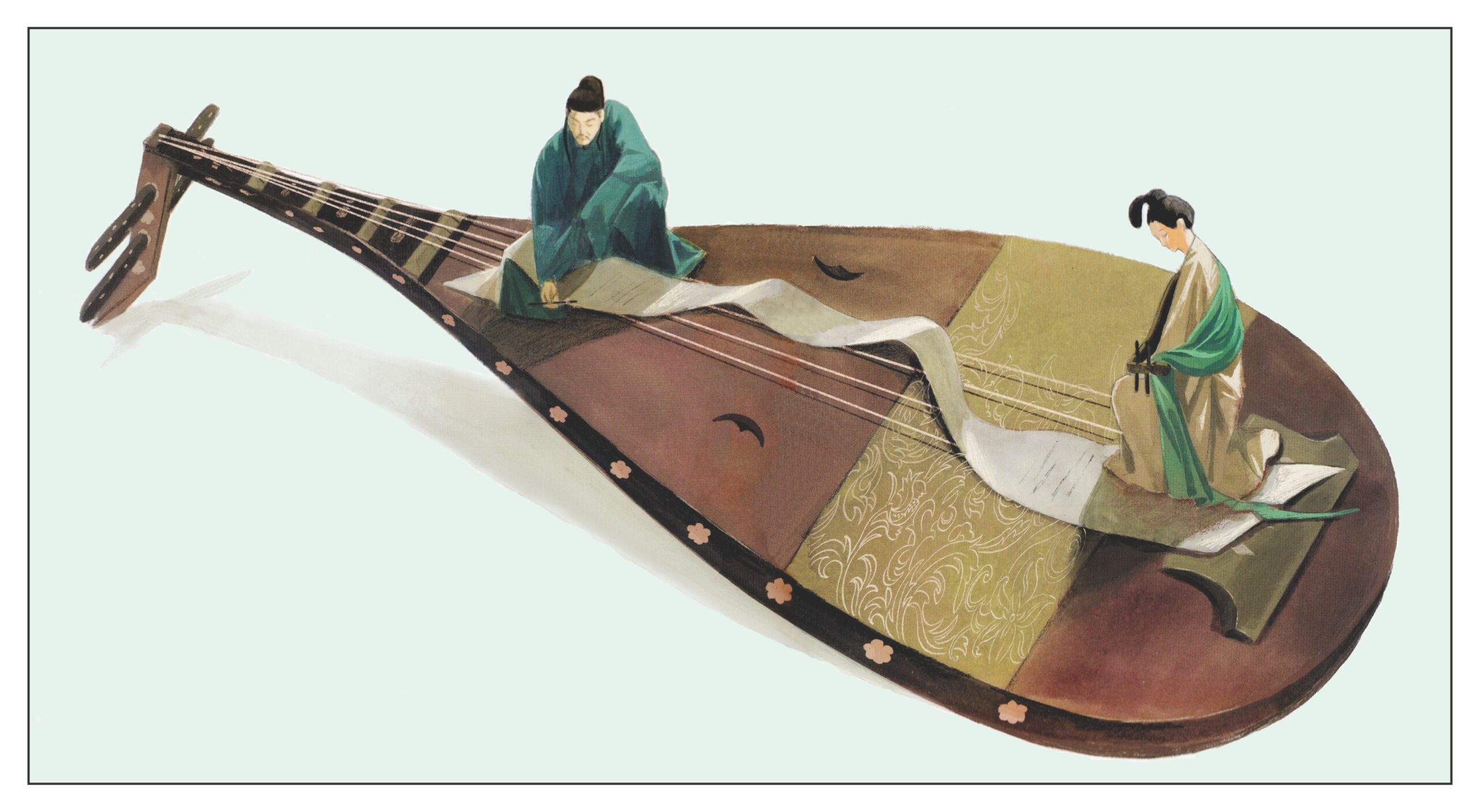
Bai Juyi (白居易, pinyin Bǎi Jūyì, or Po Chü-i in Wade-Gilles transliteration, 772-846 CE) was a Chinese poet. In 815, after inappropriately advising the emperor, he was exiled from the capital Chang’an to JiuJiang on the Yangtze River. One night, at a farewell party on the river for a friend, he heard a musician playing the pipa. Entranced by her music, he found out that she had once been a sought-after courtesan in the capital. After her beauty had faded away, she had retired to the provinces, where she played her music and lamented her lost youth. Moved by her plight, Bai Juyi composed his Pipa Xing (琵琶行, “Ballad of the Pipa”). The illustration shows a drawing of the poet and the pipa player from a scroll by Guo Xu (1456–1532).

Life of the Poet
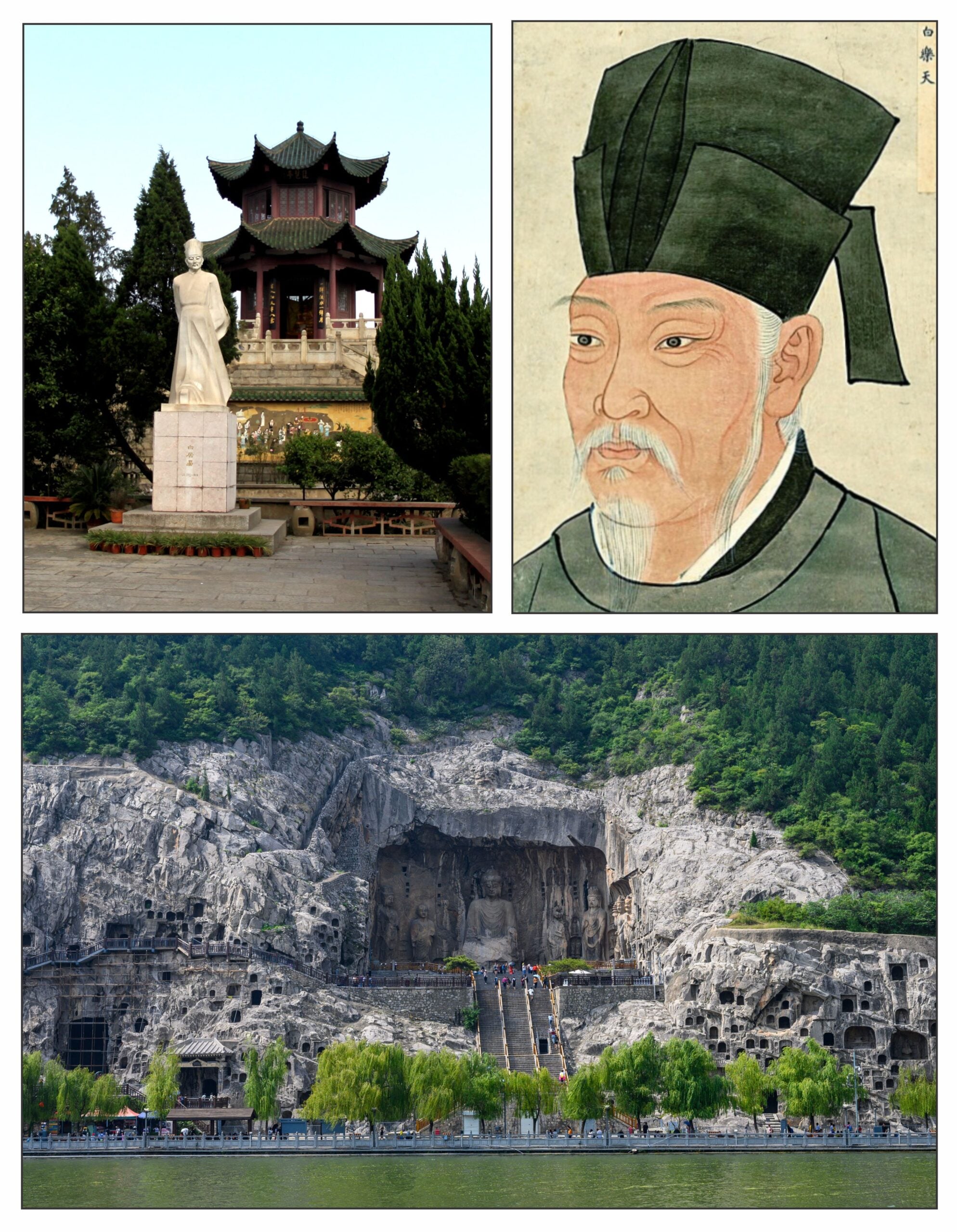
Bai Juyi was born in Northern China and came to the capital Chang’an to pass his examinations for the civil service in 800. There he became close friends with the novelist and poet Yuan Zhen (779-831) (Tan, 2025). He soon became a prolific and popular poet, with the courtesy name Lètiān (樂天, happiness of heaven: optimism) (Waley, 1949). Bai Juyi and his predecessors, Li Bai, Wang Wei and Du Fu, are considered the four great poets of the Tang Dynasty (Geng, 2021). He became renowned in Japan where he was known as Haku Rakuten from the Japanese transliteration of his courtesy name (白楽天). In 815, the prime minister Wu Yuanheng was brutally assassinated because he would not agree to the demands of some rebellious warlords. Bai Juyi wrote a memorial calling upon the emperor to seek out and punish the assassins. However, the politics were complicated. Bai Juyi was considered presumptuous – it was not for him, a tutor in the imperial household, to advise the emperor. He was exiled and demoted to a minor position (“master of the horse”, essentially an adjutant) in Jiujiang, then known as Jiangzhou (Waley, 1949, pp 101-104). While there, he heard the playing of a pipa near the river and wrote his famous poem The Ballad of the Pipa. Bai Juyi was allowed to return to Chang’an in 1819. He then served for periods of time as governor of Hangzhou and governor of Suzhou. Bai Juyi was a devoted Chan Buddhist and when he grew old, he retired to a Buddhist monastery near the Longmen caves famous for their colossal statues of Buddha (carved in 672 and 676). At the monastery he was able to compile a full collection of his poems before his death.
The following illustration shows in the upper left a statue of Bai Juyi at the Pipa Pavilion in Jiujiang, in the upper right a posthumous portrait of the poet by Chen Hongshou, a 17th Century painter, and at the bottom a view of the Longmen caves.
Translating the Ballad of the Pipa
The poem is written in rhyming couplets with 88 lines each of 7 characters for a total 616 characters. It is preceded by a preface of 138 characters. The following is the poem in elegant regular-script calligraphy by Guo Dingjing (17th Century CE), now in the Princeton University Art Museum:
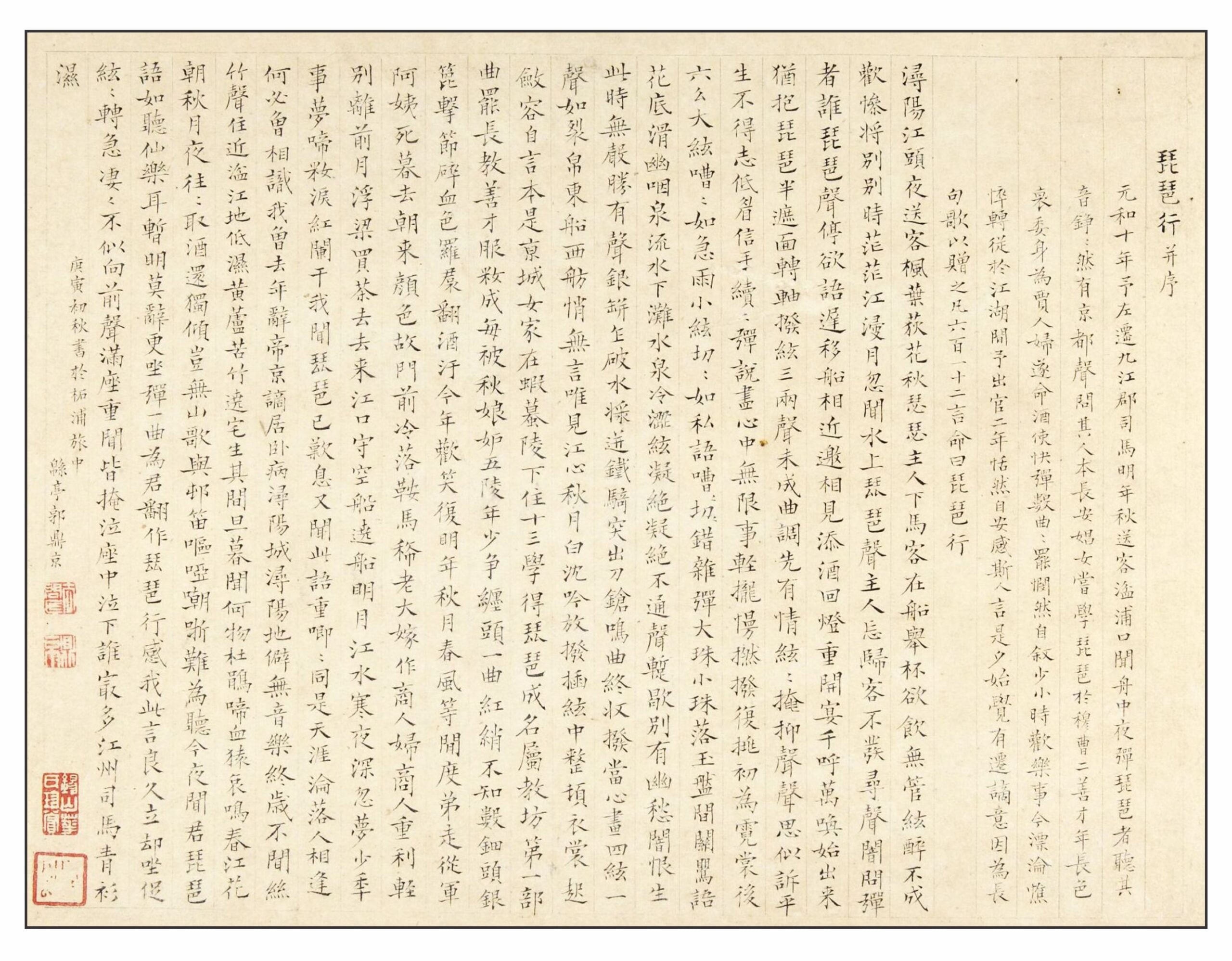
The Chinese text of the poem is readily available, as is an early English translation by Witter Bynner in his book The Jade Mountain (1929). Several other English translations have been published: Fuller, 2018, pp 283-289; Giles, 1888, pp 157-160; Harris, 2009, pp 21-26; Watson, 1984, pp 249–252; Xu et al, 1987, pp 292-296: Xu, 1994, pp 18-121; Yip, 2004, pp 288-297. Other translations are available on the internet: Phil Multic and Gan Siowck Lee.
The poem is difficult to translate since its sound patterns are as important as its meaning (Peng, 2023; Yu & Chang, 2024). This post will provide some sense of the Chinese sound patterns of Bai Juyi’s poem with recitations by Pu Cunxin and accompanying pipa by Wu Yuxia, taken from a production by China Global Television Network. After Giles’ s initial prose version, most English translations have use blank verse and made some attempt to imitate the sounds of the original. The translation of Xu Yuanzhong (1987, 1994) uses rhyming hexameter couplets. The translations in red accompanying the character-by-character transcriptions in this post are mine; they are heavily indebted to the other available translations.
The Setting
Bai Juyi provides his poem with a preface that sets the time and the place. During his banishment to JiuJiang, while saying farewell to a visitor one evening on the banks of the Yangtze, he hears the music of a pipa. He finds out that the player had once been a famous musician and courtesan at the court in Chang’an. However, as she had grown old, her beauty had faded, and she had retired unhappily to the provinces. Bai Juyi is struck by the similarity of his fate to hers, and mourns their mutual fall from grace:
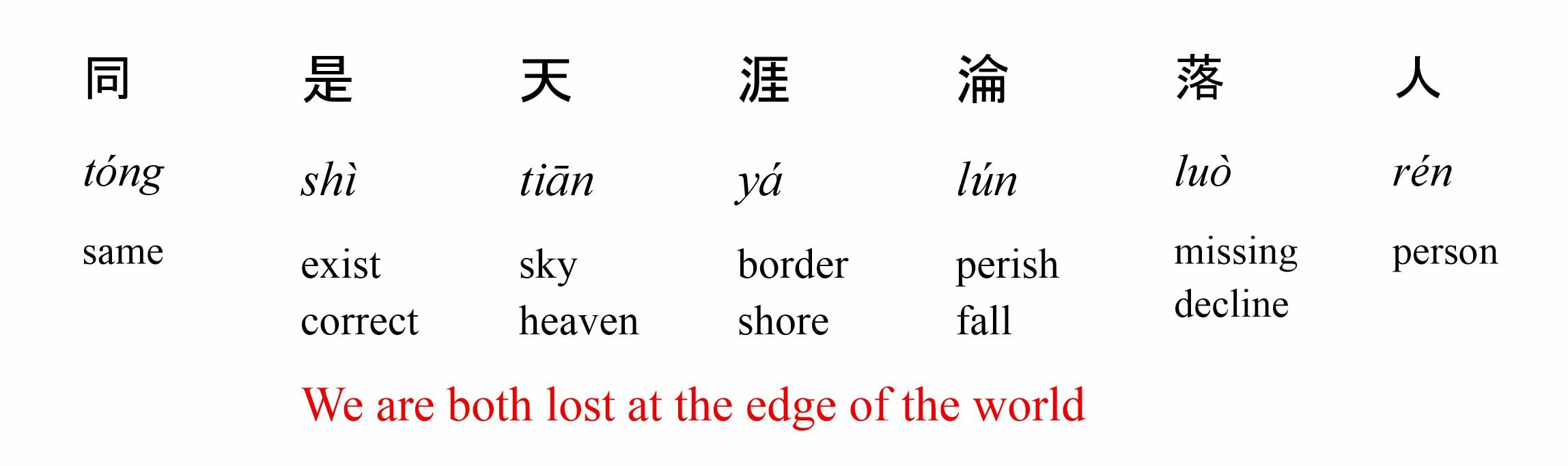
Moved by her story, he writes a long poem about the pipa player on the river far from Chang’an
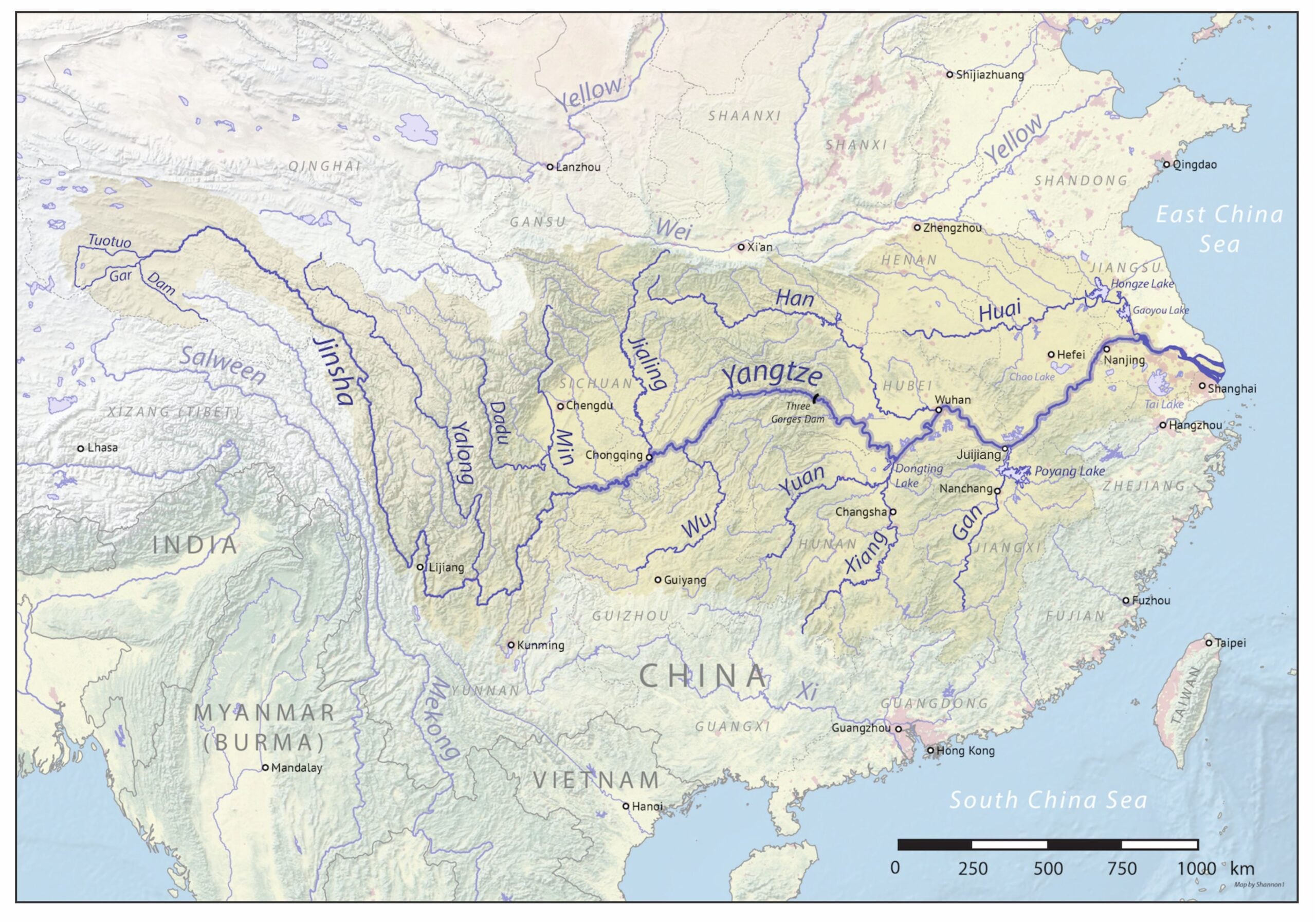
Jiujiang, which had once been known as Jiangzhou, is a city on the Yangtze River. The region of the river near Jiujiang was sometimes known as the Xunyang River. The Yangtze River, the third longest river in the world, is about 1.5 km wide at Jiujiang. Lake Pongyi, which was once called Pengli Lake, the largest freshwater lake in China, drains into the Yangtze at the eastern edge of the city:

Bai Juyi is throwing a farewell party for his departing friend on a small pleasure boat on the river. As shown in the following illustration from Hangzhou in eastern China, these small rowboats still provide spaces for celebrations on the waters. In Jiujiang it is autumn: the maple leaves have turned scarlet, and the plumes of the silver grass have reached their peak.

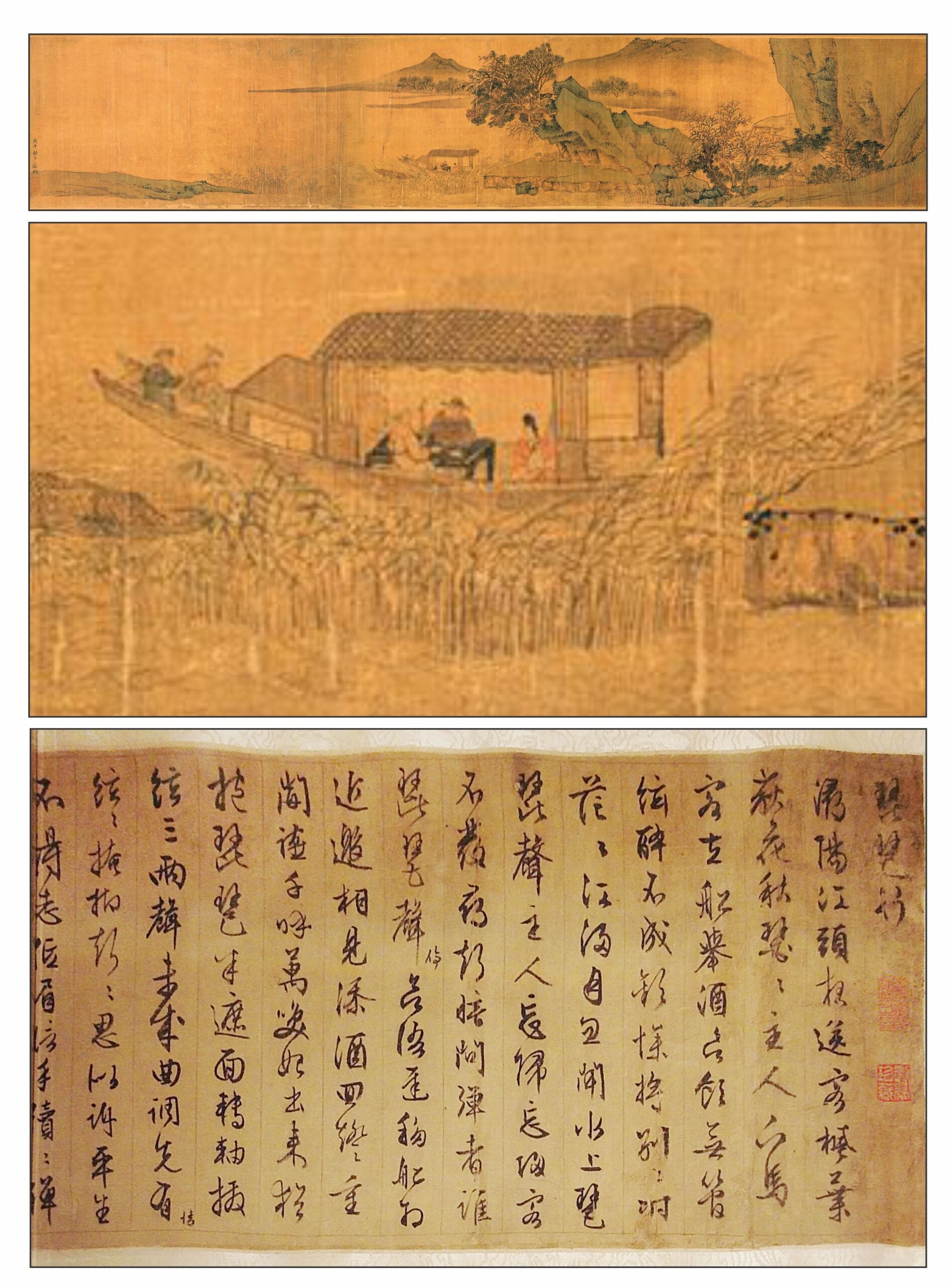
The following illustration shows a scroll with calligraphy of Pipa Xing by Wen Zhengming (1470-1559) at the National Palace Museum, Taipei. At the top is the painting at the beginning of the scroll. In the middle is an enlargement of the boat with the poet and his guest listening to the pipa player. At the bottom is the beginning of the calligraphy in semi-cursive (or running) script. The first line (on the left) has the title:

Beginning of the Ballad
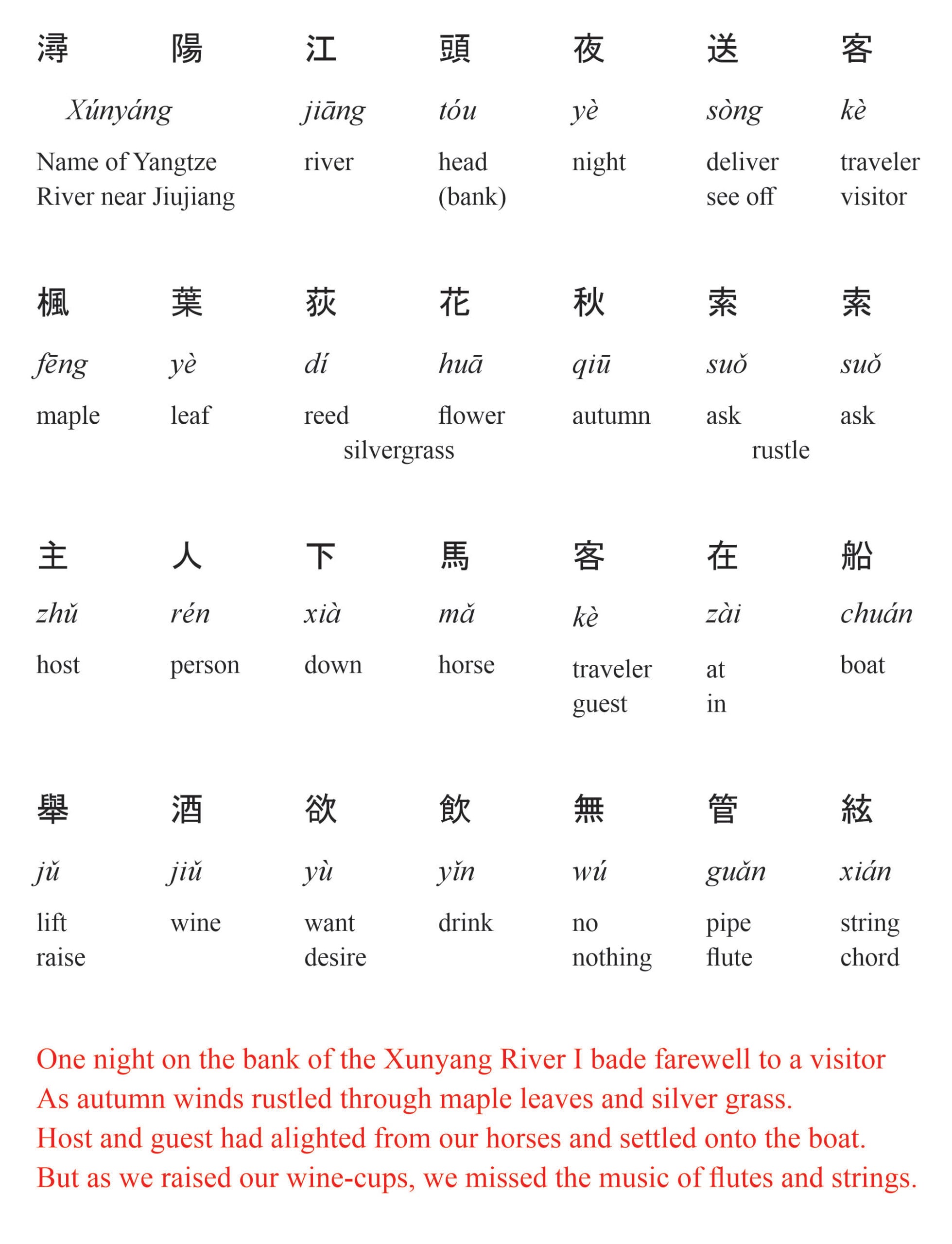
The initial lines of the ballad describe the autumn leaves and the silver grass. The farewell party begins but there is no music:
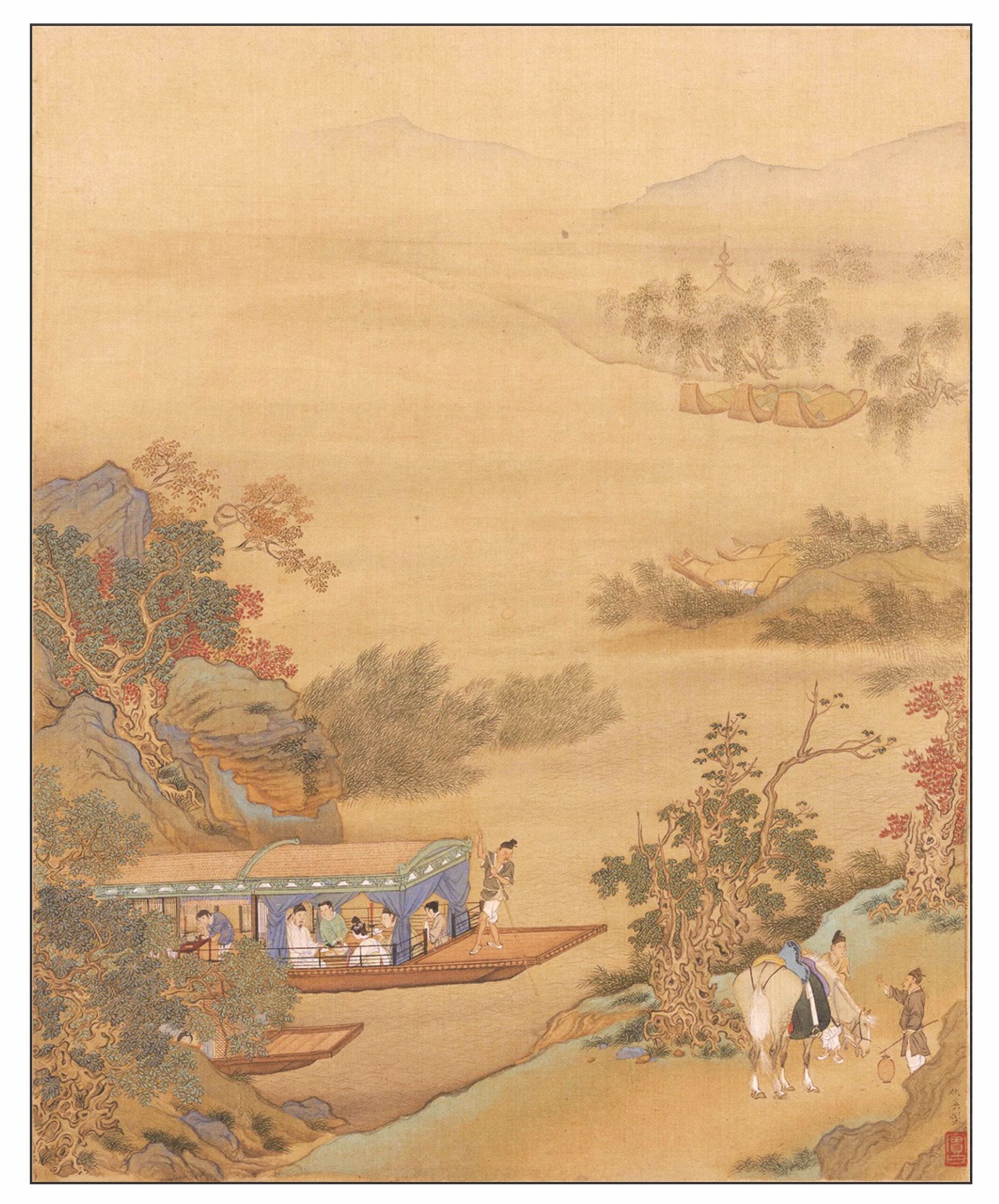
The opening scene of the poem was portrayed in a silk-painting (34 x 41 cm) in an album by Qiu Ying (1494-1552) now at the Palace Museum in Beijing:
The Pipa
As the party laments the absence of music, the sound of a pipa is heard across the water from another boat. The partygoers are completely entranced. They call out and ask the musician to play for them. She agrees but holds the pipa up to hide her face.
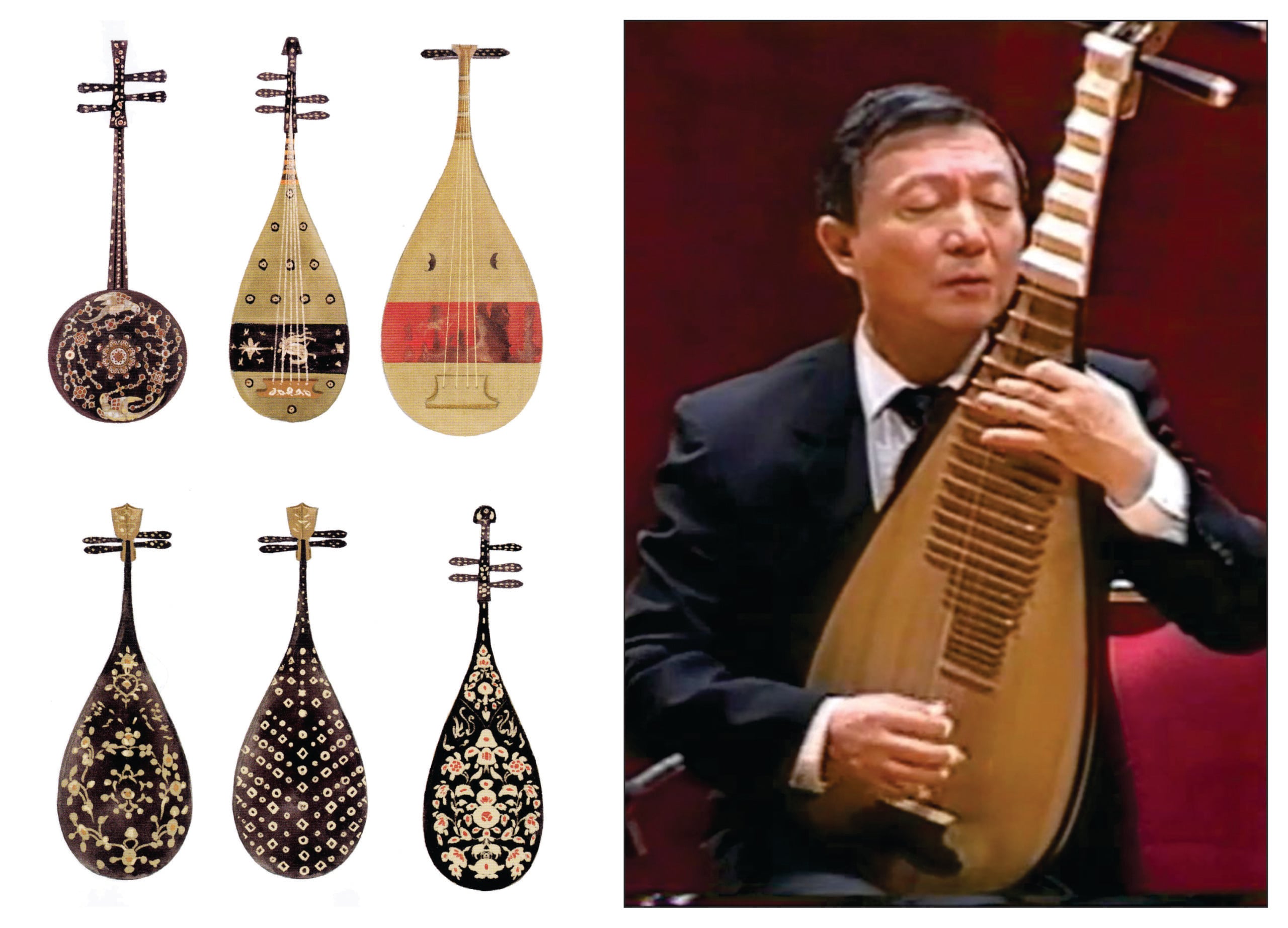
The pipa is a Chinese plucked string instrument very similar to the European lute (Wong, 2011). Both instruments have their origin in the Middle East. The pipa came to China via the Silk Roads during the Han Dynasty (206 BCE–220 CE). The instrument typically has 4 strings though some old pipas have 5. Though early pitas have as few as 4 frets, modern pitas can have up to 30. Though occasionally round, the body of the pipa is usually pear-shaped. Traditionally the pipa was played for small intimate groups, but in modern times electronic amplification has allowed pipa virtuosos to play for larger audiences. The following illustration shows some ancient pitas and a photograph of Liu Dehai (1937-2020), one the greatest pipa players of recent times.
The following is a performance of “Xunyang Moonlit Night” (浔阳月夜, Xúnyáng yuè yè) by Liu Dehai.
The Music
The poem then provides a bravura description of the music of the pipa:
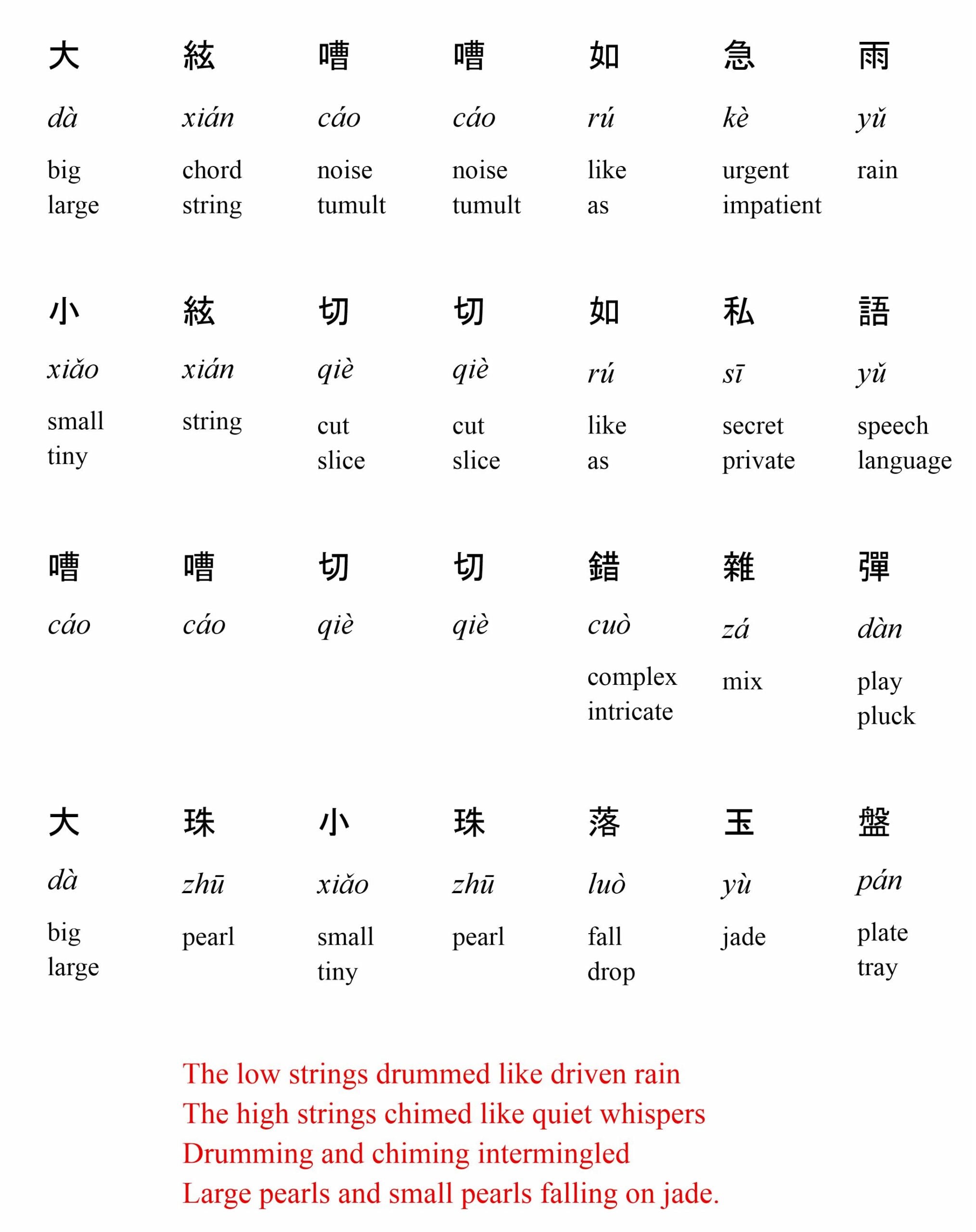
These are some of the most famous lines of poetry in China. They have been variously translated. The following version by Xu Yuan-Zhong (1984; 1987) uses the same rhyme scheme as the Chinese poem:
The thick strings loudly thrummed like the pattering rain
The fine strings softly tinkled in murmuring strain.
When mingling loud and soft notes were together played,
’Twas like large and small pearls dropping on plate of jade.
Witter Bynner (1929) uses blank verse in his translation:
The large strings hummed like rain,
The small strings whispered like a secret,
Hummed, whispered—and then were intermingled
Like a pouring of large and small pearls into a plate of jade.
And the following translation is by Isabel Wong (2011), a musician rather than a poet:
The lowest string hummed like pouring rain;
The higher strings whispered as lover’s pillow talk.
Humming and whispering intermingled
I,ikc the sound of big and small pearls gradually falling into a jade plate.
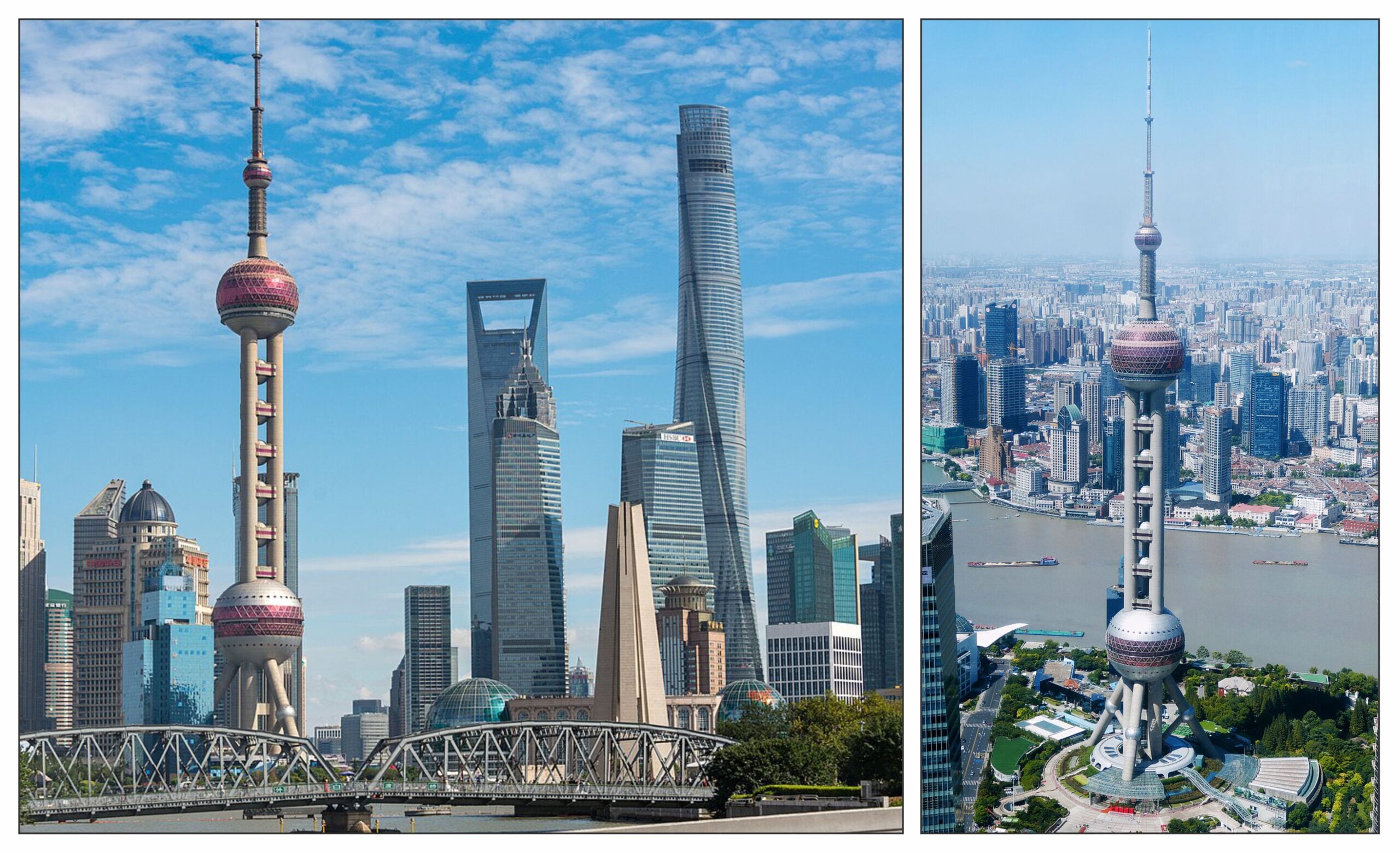
The architects of the Oriental Pearl Tower (1994) in Shanghai based their design on Bai Juyi’s image of pearls falling onto jade:
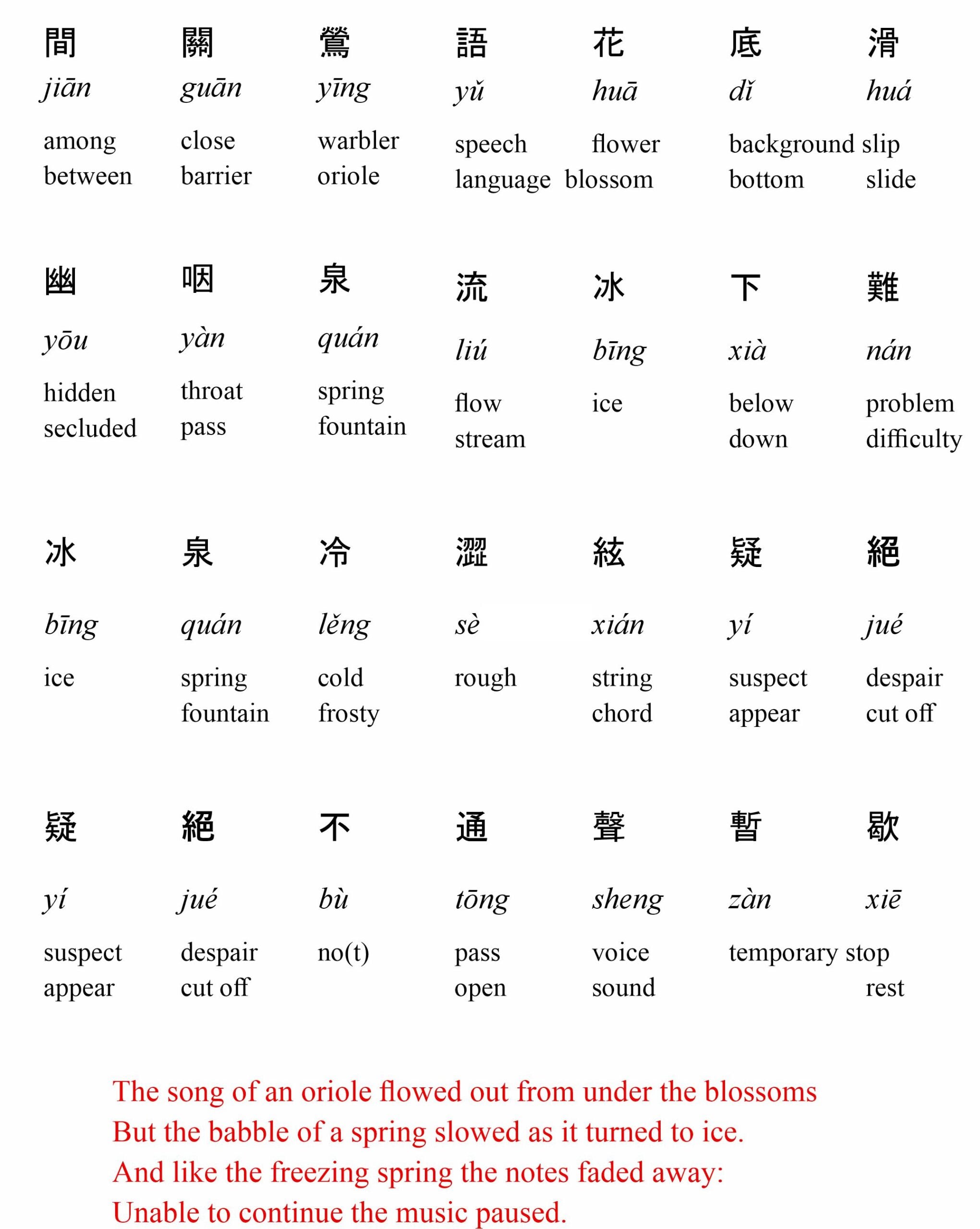
Following the music of the pearls, the pipa provides the quiet song of an oriole, and then like a freezing brook the music slows to a stop:
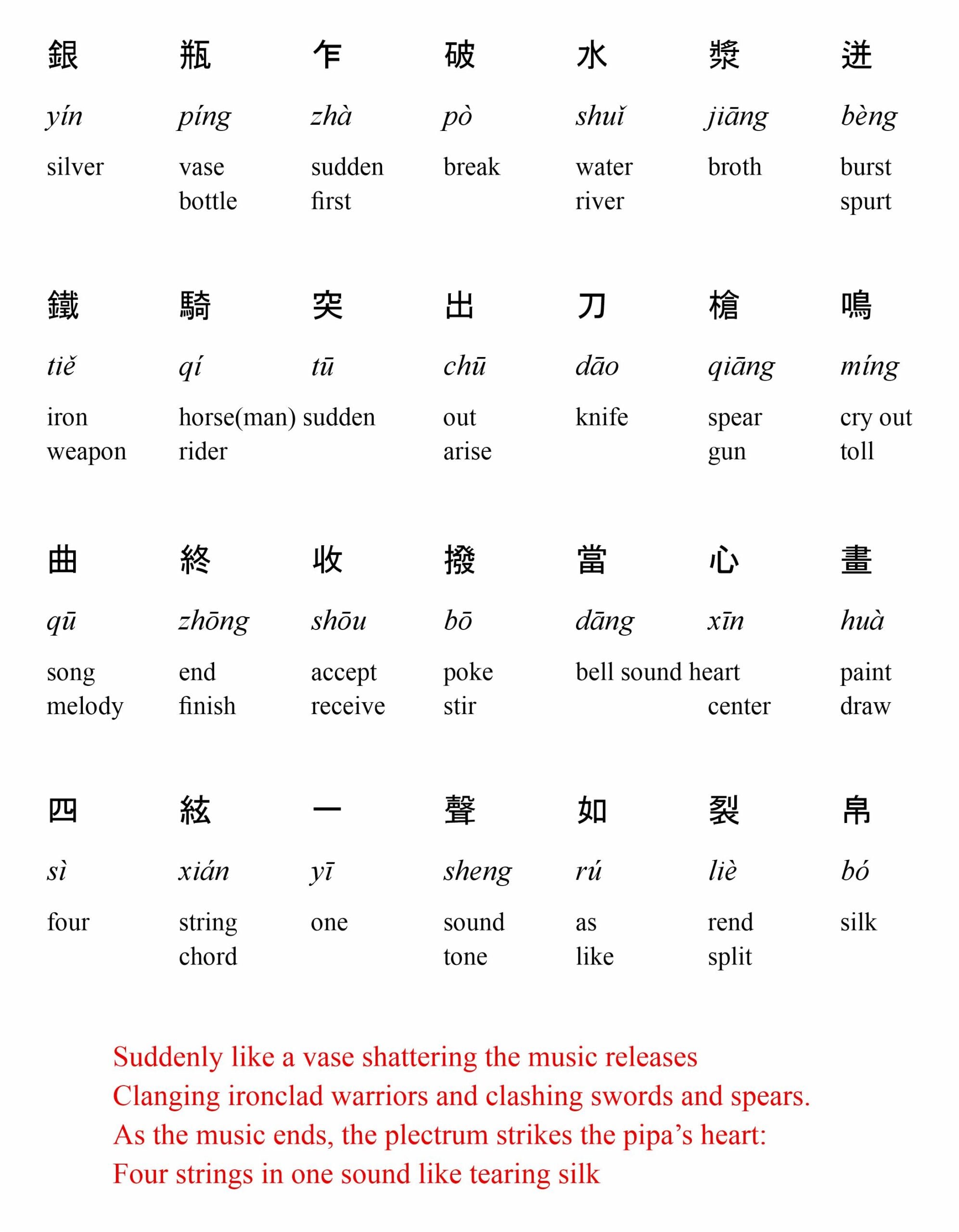
After a brief pause the pipa plays a wild crescendo that sounds like the charge of armored warriors, and then suddenly the player stops.
The Life of the Pipa Player
During the ensuing silence, the pipa player tells her story. She was once a highly acclaimed musician in Chang’an. Her beauty and her talent were the toast of the court.
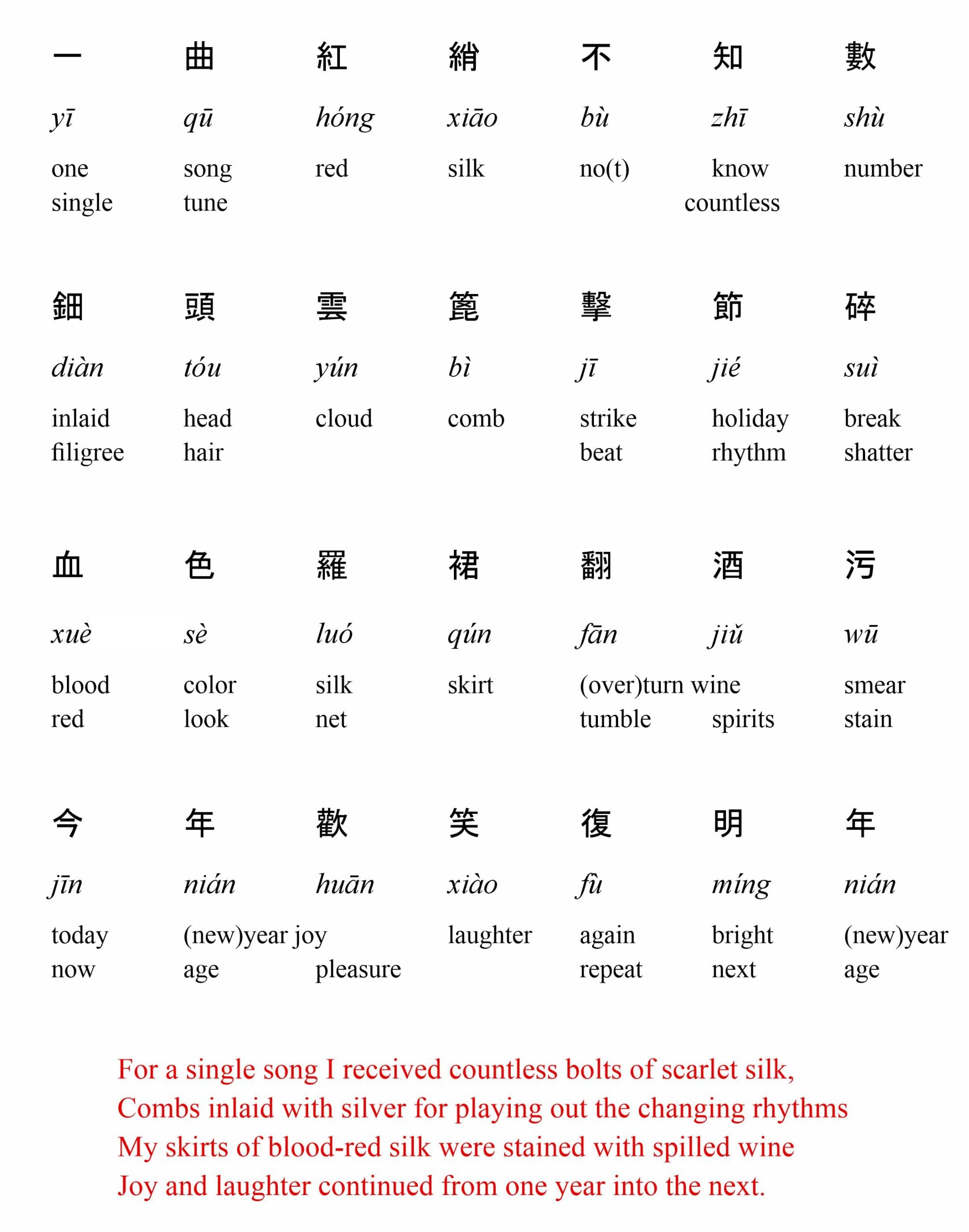
This description of the life of a successful musician and courtesan in Chang’an has been translated in many ways. One version is especially vivid. In 1917, Ezra Pound (1885-1972) published Three Cantos in Poetry Magazine, and again in the American edition of his book Lustra. This was the beginning of a set of Cantos that ultimately numbered 109. These initial three cantos – often called the Ur-Cantos – were extensively revised when Pound published A Draft of XVI Cantos in 1925. Much of the original Canto II is no longer evident in the new sequence. The general theme of Ur-Canto II was the “poetics of loss” (Carr, 2018). Pound describes the ruins of the ducal palace in Mantua, and mourns the loss of most of the music of the troubadours. And then he provides a brief description of the setting of Bai Juyi’s poem and the words of pipa player:
Yin-yo laps in the reeds, my guest departs,
The maple leaves blot up their shadows,
The sky is full of autumn,
We drink our parting in saki.
Out of the night comes troubling lute music,
And we cry out, asking the singer’s name,
And get this answer:
“Many a one
Brought me rich presents; my hair was full of jade,
And my slashed skirts, drenched in expensive dyes,
Were dipped in crimson, sprinkled with rare wines.
I was well taught my arts at Ga-ma-rio,
And then one year I faded out and married.”
The lute-bowl hid her face.
We heard her weeping.
It was not until much later that Pound’s allusion to Bai Juyi was recognized (e.g. in Weinberger, 2007, p 128; discussed on the Pound Cantos Project website)
Pound had no knowledge of the Chinese language. In his book Cathay (1915), he “translated” a set of 15 Chinese poems based on the notes of Ernest Fenollosa who had studied Chinese poetry with the Japanese professors Mori and Ariga. Despite his lack of training in Chinese, Pound intuitively grasped the essence of the poems (see discussion by Yip, 1969). The brief excerpt from Ur-Canto II is typical of his translations. The meaning is clear though the words are not the same as in the original.
In Pound’s poem, Yin-yo is the Japanese transliteration of Chinese characters for the Xunyang River (Romaji, Jinyō-kō), and Gamaryo is the Japanese version of 蟆陵, which literally translated is “Toad Hill” (Fuller, 2017, p 286). This is the region in Chang’an city near the burial site of the Confucian scholar Dong Zhongshu (179–104 BCE). In Bai Juyi’s poem, the pipa player says that this is where she grew up (and learned how to play the pipa).
To return to the poem: The pipa player’s high life did not last forever. Her brother went off to the army, her mother died, her looks faded, and she was no longer as sought after as before. She married a tea-merchant and came to live in Jiangzhou. Her husband is usually away on business. Alone on her boat she plays the pipa and remembers happier days.
Listening to her story Bai Juyi feels an intense sympathy: he too has fallen from grace and now lives alone far away from the capital. The musician plays a final intense song:
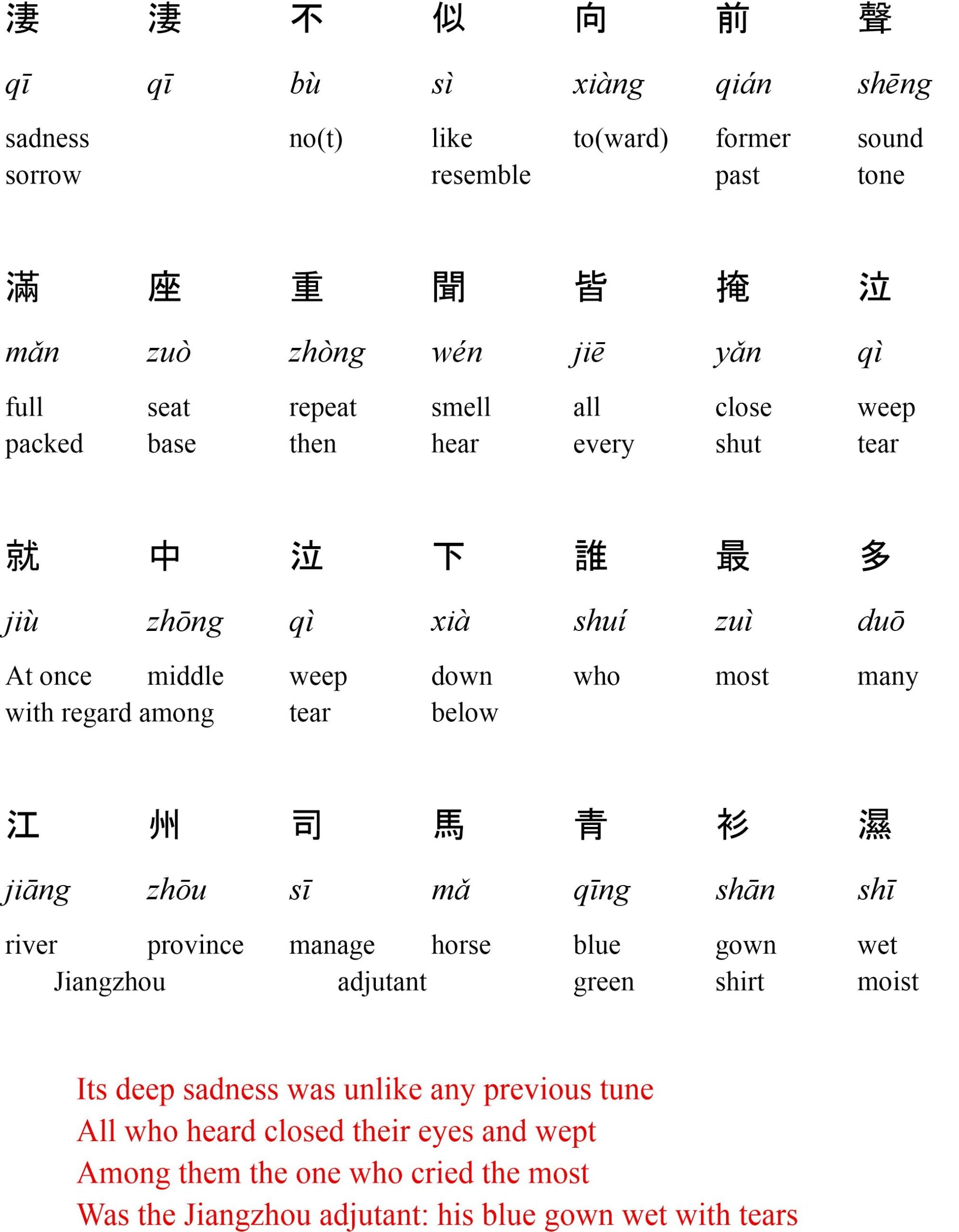
We do not know the music that Bai Juyi found so moving. The following is a piece entitled Night Thoughts composed and played by Wu Man (1963- ), who studied with Liu Dehai.
Wu Man’s composition derives from a famous poem by Li Bai, who spent much of his later life in exile from the capital. The following translation is by Xu Yuan-Zhong (1984, p 125).
靜夜思 A Tranquil Night
床前明月光 Before my bed a pool of light
疑是地上霜 Is it hoarfrost upon the ground
舉頭望明月 Eyes raised I see the moon so bright
低頭思故鄉 Head bent in homesickness I’m drowned
The Life of the Poem
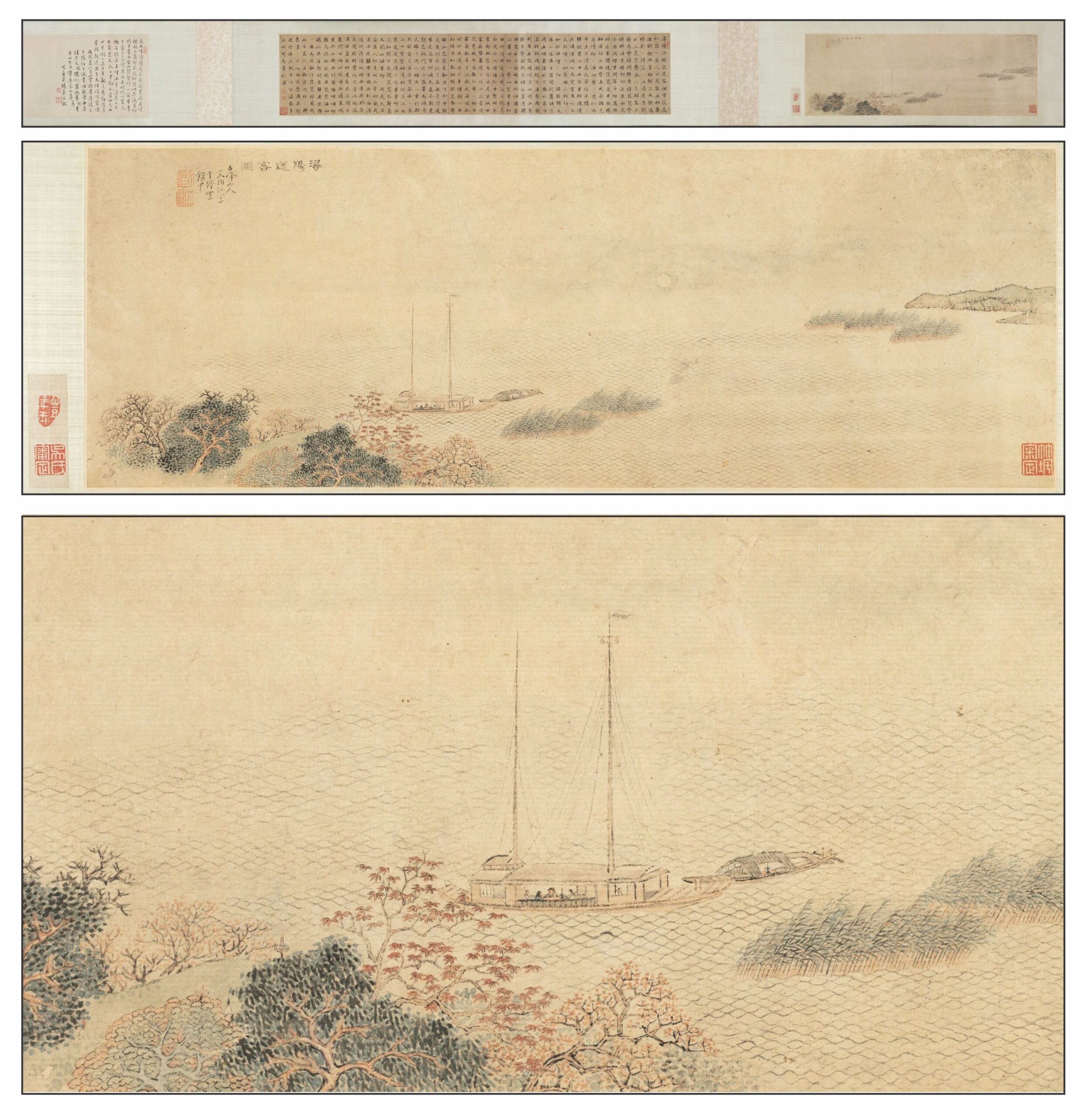
Bai Juyi’s poem was popular among calligraphers and artists. The following is a scroll by Wen Boren (1502-1575) now in the Cleveland Museum.
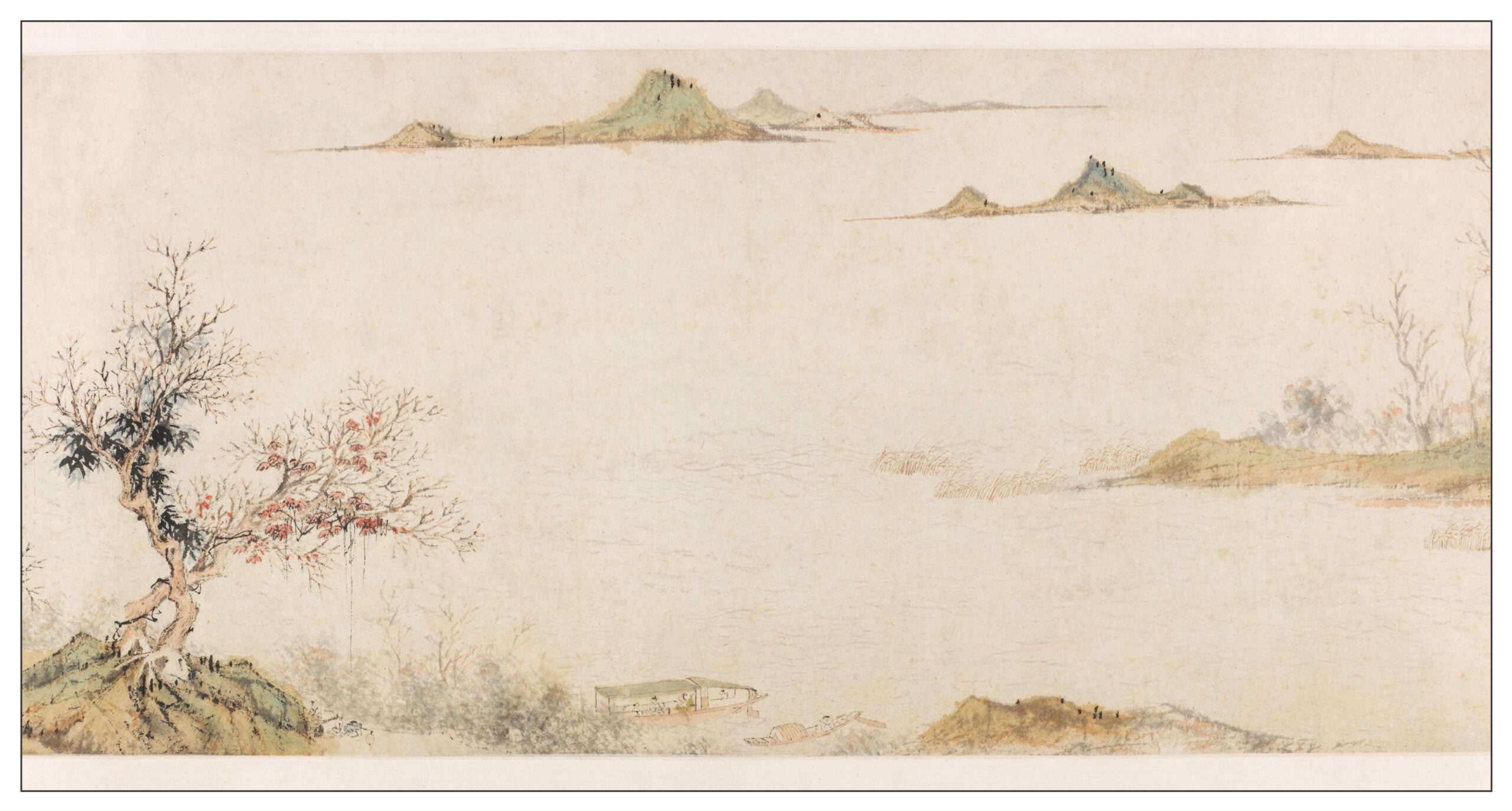
And the next illustration is a painting by Lu Zhi (1495-1576), from a calligraphy scroll now in the National Museum of Asian Art at the Smithsonian Institution. The boats near the lower shore are as lost as the poet and the pipa player:
And the following is an illustration by Hua Zhangyi from a retelling of Bai Juyi’s poem (Liu Yang, & Hua Zhangyi, 2024) for children: the poet dedicates his poem to the pipa player.
References
Bynner, W. & Kiang Kang-Hu, (1929). The jade mountain: a Chinese anthology, being three hundred poems of the T’ang dynasty, 618-906. Alfred A. Knopf.
Carr, H. (2018). The Ur-Cantos. In R. Parker (Ed.) Readings in the Cantos. (pp 9-32). Clemson University Press.
Fuller, M. (2018). An Introduction to Chinese Poetry: From the Canon of Poetry to the Lyrics of the Song Dynasty. Harvard University Asia Center.
Geng, L. (2021). The four great Tang poets. In A Comprehensive Study of Tang Poetry II (pp. 1–42). Routledge.
Giles, H. A. (1884, revised 1923). Gems of Chinese Literature. Bernard Quaritch
Harris, P. (2009). Three hundred Tang poems. Alfred A. Knopf (Everyman’s Library)
Liu Yang, & Hua Zhangyi, (2024). 琵琶行 (Pipa Song). CITIC Press.
Peng, Y. (2023). A comparative study on two English translations of Song of a Pipa Player from the perspective of translation aesthetics. Frontiers in Humanities and Social Sciences, 3(4), 36-40.
Pound, E. (1915). Cathay. Elkin Mathews.
Pound, E. (1917a). Three Cantos II. Poetry, 10 (4), 180-188
Pound, E. (1917b). Lustra of Ezra Pound: with earlier poems. Alfred A. Knopf.
Tan, M. A. (2025). Bai Juyi and Yuan Zhen. In Z. Zhang & V. H. Mair (Eds.) Routledge Handbook of Traditional Chinese Literature (pp. 151–161). Routledge.
Waley, A. (1949, reprinted 2005). The Life and Times of Po Chu-i. Routledge.
Watson, B. (1984) The Columbia book of Chinese poetry: from early times to the thirteenth century. Columbia University Press.
Weinberger, E. (Ed.). (2007). The New Directions Anthology of Classical Chinese Poetry. Carcanet.
Wong, I. (2011). The Music of China. In Capwell, C., Nettl, B., Bolman, P., Dueck, B., Rommen, T., Wong, I., & Turino, T. (Eds.). Excursions in World Music, 6th Edition. (pp 88-131). Taylor & Francis
Xu, Y., Loh, B., & Wu, J. (1987). 300 Tang poems: a new translation. The Commercial Press.
Xu Yuan Zhong (1994). Songs of the immortals: an anthology of classical Chinese poetry. Penguin Books in association with New World Press.
Yip, W. (1969). Ezra Pound’s Cathay. Princeton University Press.
Yip, W. (2004). Chinese Poetry: An Anthology of Major Modes and Genres. (2nd ed., Revised). Duke University Press.
Yu, Y., & Chang, C. (2024). Text complexity and translation styles from the perspective of individuation: a case study of the English translations of Pipa Xing. Humanities & Social Sciences Communications, 11(1), Article 159.