Wu Wei: Effortless Action

One of the central ideas in the Daodjing of Laozi is the idea of wu wei (無為, simplified 无为; wúwéi). This has been translated in many ways: “non-action,” “actionlessness,” “effortless action,” and “doing nothing.” The 37th chapter of the Daodjing considers wu wei an attribute of the eternal Dao. The 48th chapter promotes wu wei as a human virtue. The illustration shows wu wei in regular script (left) and in cursive (right).

Being True to Oneself

A foundational concept in Daoism is自然, zìrán. This word is composed of 自 (self, oneself, from, since) and 然 (right, correct, so, in this manner). Almost impossible to translate, the word has been variously rendered simply as “self-so” (Ziporyn, 2009) or more abstractly as “as-it-is-ness” (Fu, 1973, p 382). The meaning contains the idea of acting “naturally” or “spontaneously.” An underlying concept is “authenticity” – one’s action should be true to one’s nature.

Laozi uses the word in the ending to Chapter 25 of the Daodejing (with translation by Wu, 2016): 

人法地,地法天,天法道,道法自然

Man follows the ways of Earth;
Earth follows the ways of Heaven;
Heaven follows the ways of Dao;
Dao follows its own ways.

Several aspects of zìrán need consideration. First, the Dao acts through all things. As well as ordering the cosmos, the Dao acts through each individual object it contains. Human beings must ultimately follow their own zìrán.  Zhuang Zhou, commonly known as Zhuangzi (莊子), a Daoist philosopher from the 4th Century BCE, begins his writings with a description of all the different things in the universe from the mythological great Peng bird to the morning mushroom, and recommends that one must act “on the rectitude (正, zhèng) of Heaven and Earth” (Lynn, 2022, p 8). Guo Xiang (郭象, 265-312 CE) commented on this section of the Zhuangzi

“Heaven and earth” is just a blanket term used to indicate all beings. It is all individual beings that form the very substance of heaven and earth, and it is each being’s self-so [ziran] that aligns true to itself. “Self-so” [ziran] means what is so of itself [ziran], without being done by anyone or for any purpose. Thus, Peng’s ability to fly high and the sparrow’s ability to stay low, the great tree’s ability to last long and the mushroom’s ability to perish quickly, all these are done spontaneously, all are self-so [ziran] (Ziporyn, 2009, p 132.)

Second, the concept of zìrán does not mean that all things passively accept their lot in the universe. Misha Tadd (2019) argues that zìrán has as much to do with “authority” as with “authenticity.” We need to be true to our ideal selves: to seek what we should be rather than accept what we are.  

Third, the idea of acting “naturally” means acting in accord with the Dao. However, human beings do not need to return to the simple state of primitive societies to do so (Tadd, 2019, p 4). Although the idea of the “noble savage” was popular when the Daodejing was initially translated into Western languages, Laozi was not being nostalgic for a lost Eden; rather he was imagining a future utopia (Stamatov, 2023).   


Yet Nothing is Left Undone

How the Dao “follows its own ways” is described in the 37th chapter of the Daodejing. This is the final chapter in the section of the book that deals with the nature of the Dao

The commonly accepted version of the Daodejing is divided into two parts. The first 37 chapters are concerned with the Dao (way), and the next 44 with the nature of De (virtue). Some recently discovered early versions reverse the ordering of the two parts (Chan, 2025). However, for our purposes it is appropriate to follow the traditional order and to understand the nature of the Dao before we propose a way for human virtue.

The last chapter pf the first part states that the eternal Dao – the principle that governs the universe – exercises its power by means of wu wei. The following is the Chinese text of Chapter 37 together with a translation by Wu (2016) and calligraphy by Ken Wong:

道恆無為而無不為。
侯王若能守之,萬物將自化。
化而欲作,
吾將鎮之以無名之樸。
無名之樸,夫亦將不欲。
不欲以靜,天下將自定。

Dao in its eternity does nothing, yet nothing is not done.
If lords and kings can all abide by that, all things will change of themselves.
As they change, their desires start to grow;
I calm them down with the nameless pristine timber.
Calmed by the nameless pristine timber, they will have no more desire.
Desireless and calm, the world will correct its own course.
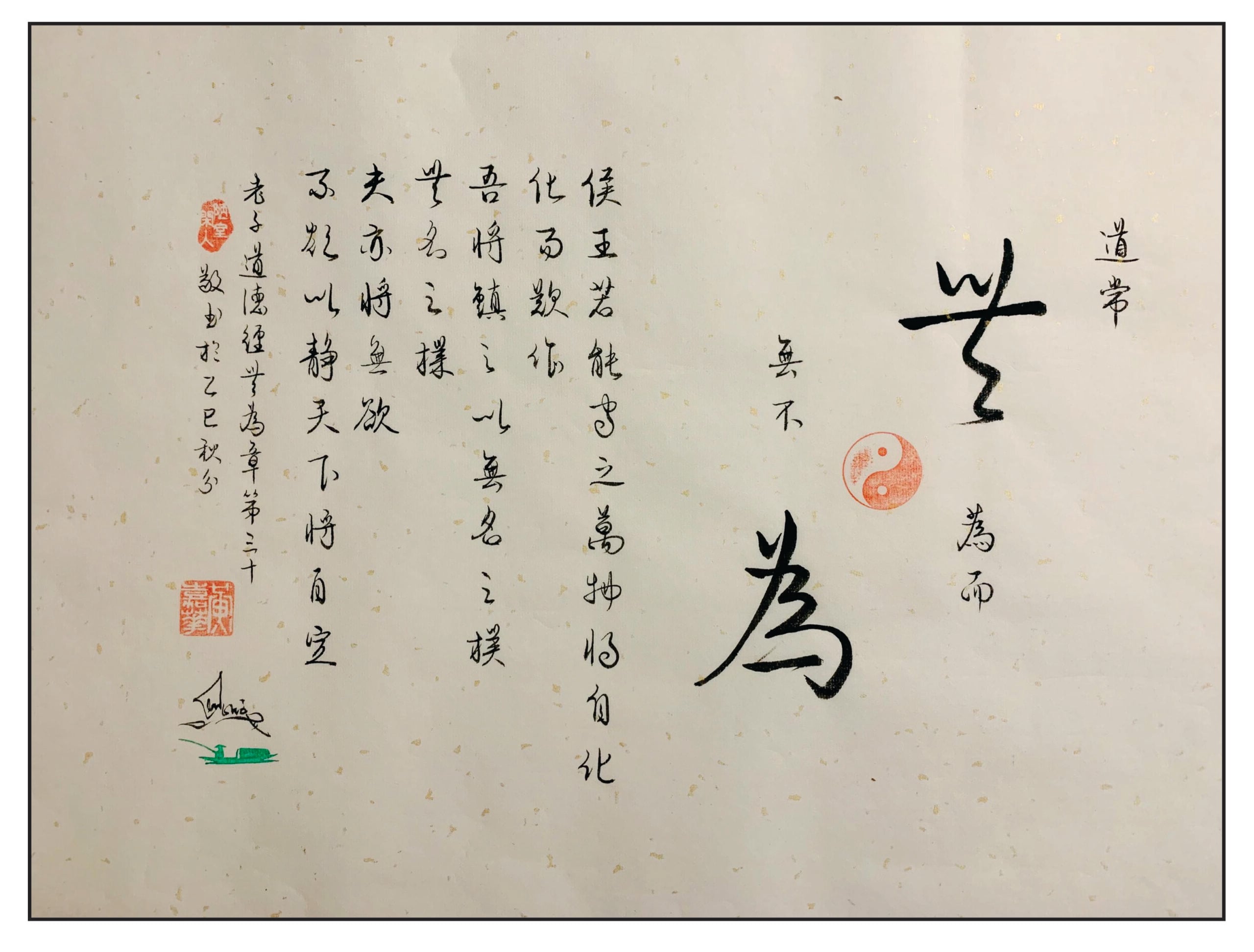
The phrase 無名之樸 is usually translated as “nameless simplicity” (e.g., Fischer, 2023). The character 樸 (), another version of which is 朴, generally means “simple.” However, it once meant “unworked wood” – hence the “nameless pristine timber” of Wu’s translation.  

The famous first line is shown below in a character-by-character translation:
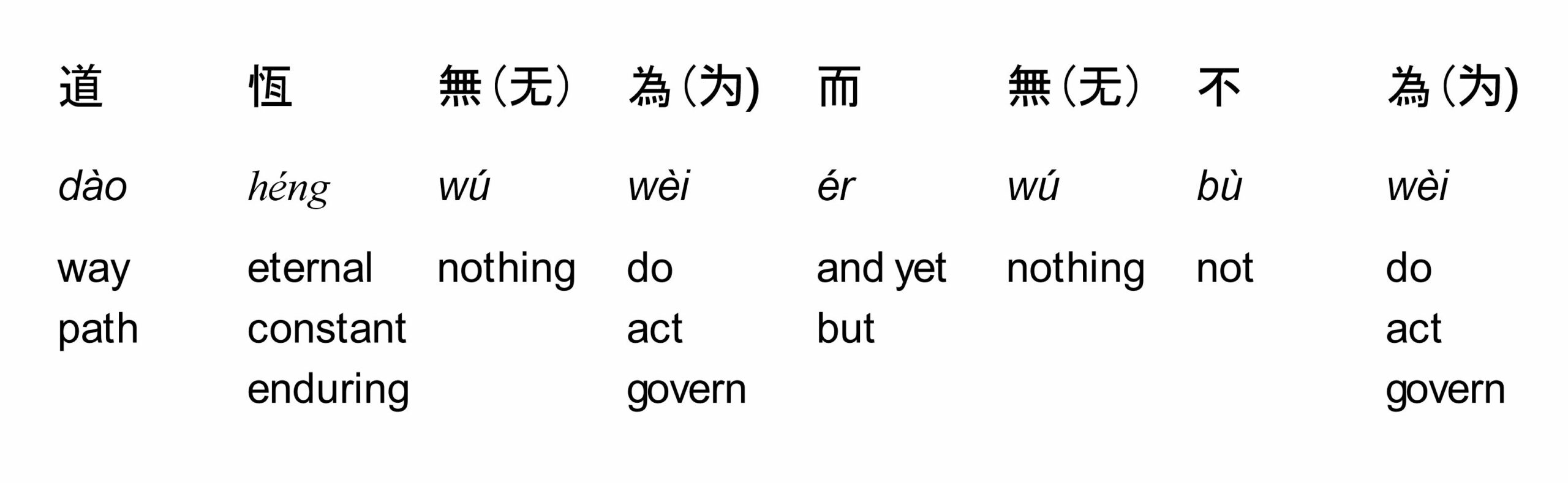
The translation of wu wei (無為) is problematic. A simple translation is “doing nothing” but that is not Laozi’s meaning. In Chapter 37 the Dao does nothing and yet somehow everything is done.  The following are suggested translations of wu wei: “non-action” (Moeller, 2016), “effortless action” (Slingerland, 2003), “unself-conscious action” (Lynn, 2022, p 3), “non-contrivance” (Fischer, 2023, p 27), and “no purposive action” (Hansard, 2003).

Loy (1985) proposed that wu wei represent “nondual action:” the activity of an individual that has no self (with intentions and goals) but is rather part of a universal self. This can eliminate the problem of free will in a deterministic universe:

whenever “I” act it is not “I” but the whole universe that “does” the action or rather is the action. If we accept that the universe is self-caused, then it acts freely whenever anything is done. Thus, from the nondualist perspective, complete determinism turns out to be equivalent to absolute freedom.

Slingerland (2003, p 7) comments

It is important to realize, however, that wu-wei properly refers not to what is actually happening (or not happening) in the realm of observable action but rather to the state of mind of the actor. That is, it refers not to what is or is not being done but to the phenomenological state of the doer. … It describes a state of personal harmony in which actions flow freely and instantly from one’s spontaneous inclinations—without the need for extended deliberation or inner struggle—and yet nonetheless accord perfectly with the dictates of the situation at hand, display an almost supernatural efficacy, and (in the Confucian context at least) harmonize with the demands of conventional morality.

Fischer (2023, p 27) describes the mental concomitant of wu wei:

It describes the state of acting genuinely, unselfconsciously, or, as we might say, “from the heart,” as opposed to doing something self-consciously, because others expect you to, or because you are coerced.


Decreasing Day by Day

In the 48th chapter of the Daodejing Laozi proposes wu wei as the ideal of human behavior. The following is the Chinese text together with a translation by Wu (2016):

為學日益,為道日損。
損之又損,以至於無為。
無為而無不為。
取天下常以無事,
及其有事,不足以取天下

To pursue learning you increase day by day; to pursue Dao you decrease day by day.
Decrease and yet again decrease, till you reach the state of Non-doing.
Do nothing and yet nothing is not done.
The world is often won without busying around;
When busying around occurs, the world cannot be won.

The third line repeats the first line of Chapter 37 as an injunction for human behavior. We must follow the same principle as the Dao. Although it is easy to say that the Dao can act according to its own self, how exactly human beings can do so is clear. The chapter states that the world can only be won without 事 (shì, business/work/responsibility).

The Zhuangzi provides several examples of acting in accord with wu wei, the most famous example being butcher Ding. The story is introduced with the comments:

The flow of my life is always channeled by its own boundaries, but the mind bent on knowledge never is. A flow channeled by its own boundaries is endangered when forced to follow something that is not, and trying to rescue it with the doings of the knowing mind only makes the danger worse. (Ziporyn, 2009, p 21).

King Hui of Liang was very impressed with the skill of his butcher Ding who was able to cut up an ox with remarkable speed and agility. When asked how he had become so adept, Ding replied:

What I love is the Course [Dao], something that advances beyond mere skill. When I first started cutting up oxen, all I looked at for three years was oxen, and yet still I was unable to see all there was to see in an ox. But now I encounter it with the spirit rather than scrutinizing it with the eyes. My understanding consciousness, beholden to its specific purposes, comes to a halt, and thus the promptings of the spirit begin to flow. I depend on Heaven’s unwrought perforations and strike the larger gaps, following along with the broader hollows. I go by how they already are, playing them as they lay. So my knife has never had to cut through the knotted nodes where the warp hits the weave, much less the gnarled joints of bone. A good cook changes his blade once a year: he slices. An ordinary cook changes his blade once a month: he hacks. I have been using this same blade for nineteen years, cutting up thousands of oxen, and yet it is still as sharp as the day it came off the whetstone. For the joints have spaces within them, and the very edge of the blade has no thickness at all. When what has no thickness enters into an empty space, it is vast and open, with more than enough room for the play of the blade. That is why my knife is still as sharp as if it had just come off the whetstone, even after nineteen years. (Ziporyn, 2009, p 22).

One might simply understand that through years of study and practice the cook had become so proficient at his that eveything was performed by learned reflex, without any need for consciousness. However, consicuousness still played a role: the cook continued:

Nonetheless, whenever I come to a clustered tangle, realizing that it is difficult to do anything about it, I instead restrain myself as if terrified, until my seeing comes to a complete halt. My activity slows, and the blade moves ever so slightly. Then all at once, I find the ox already dismembered at my feet like clumps of soil scattered on the ground. I retract the blade and stand there gazing at my work arrayed all around me, dawdling over it with satisfaction. Then I wipe off the blade and put it away. (Ziporyn, 2009, p 22)

After long thought and much practice we can become adept at anything. We behave automatically. However, consciousness still plays a role, slowing us down when problems arise, preventing mistakes that occur when one becomes more convinced of one’s skill than warranted.


The Art of Rulership

Laozi considers how leaders can best govern their people in Chapter 17 of the Daodjing. The following is the Chinese text and the translation of Wu (2009):

太上,不知有之;其次,亲而誉之;
其次,畏之;其次,侮之。
信不足焉,有不信焉。
悠兮其贵言。功成事遂,百姓皆谓:我自然。

The best ruler is one whose presence is unknown;
the second best is one who is beloved and praised;
the next best is one who is feared;
the next is one who is despised.

Where there is insufficient good faith,
there is loss of faith.

Relax and spare your words.
When the goal is achieved and the job is done,
everyone says, “We did it.”

Laozi favors the ruler who exercises wu wei, who allows his ministers to exercise their responsibilities, and who lets his people to be true to their own selves: 自然, ziran. Another translation of the final line is: The people all say: “We have done it by ourselves.” (Lin, 1977)

These ideas on government were extensively discussed in the Huainanzi, a collection of writings collected to assist the Prince of Huainan in the 2nd Century BCE (Ames,1981). The following is from one of the essays entitled The Art of Rulership:

Thus, the ruler in possession of the Way extinguishes thought and dispenses with guessing, and waiting in limpidity and vacuity, he uses words that do not boast and takes action that does not rob subordinates of responsibility. He makes demands of fulfilment according to claims made. He lets them get on with their duties without telling them how; he expects them to fulfil their duties without instructing them. He takes not knowing as his Way and being at a loss as to what to do as his treasure. Acting in this way, each of the various officials has his appointed tasks. (Ames, 1981, p 202)

The Concept of Flow

Mihaly Csíkszentmihályi (1934-2021), a Hungarian-American psychologist, became interested in why people can become so completely involved in difficult, time-consuming and sometimes dangerous activities, that they lose all sense of self and time. He described the experience as one of “flow” (Csíkszentmihályi, 1990). Nakamura and Csíkszentmihályi (in Csíkszentmihályi, 2014, p 240) describe the following subjective characteristics of being “in flow:”  

  1. Intense and focused concentration on what one is doing in the present moment
  2. Merging of action and awarenessLoss of reflective self-consciousness (i.e., loss of awareness of oneself as a social actor)
  3. A sense that one can control one’s actions; that is, a sense that one can in principle deal with the situation because one knows how to respond to whatever happens next
  4. Distortion of temporal experience (typically, a sense that time has passed faster than normal)
  5. Experience of the activity as intrinsically rewarding, such that often the end goal is just an excuse for the process.

Athletes during peak performance, musicians during virtuoso recitals, and scientists formulating a new theory all experience this state of flow. Other terms that have been used to describe it are “in the zone” or “being locked in.” The individual in the flow is fully conscious of what is going on, but there is little if any self-consciousness. The game is being played, the music is being made, the theory is being grasped.

This state can only come after one has become an expert. Only when the actions can occur automatically, can consciousness move to a higher level – directing the strategy of the game rather than making individual movements, conveying the meaning rather than playing the notes, finding the underlying pattern rather than simply recording what is happening.  

A person in a state of flow is very similar to a person acting according to the principle of wu wei (De Pryker, 2011). Both are acting effortlessly and without self-consciousness. In both action and awareness are fused. There are differences – flow empowers the individual self, whereas wu wei leads to a decrease in personal desires as one seeks greater union with the universal self. Nevertheless, the two states are far more similar than different.  

In recent years, the concepts of wu wei have been used to promote higher achievements in sports (Kee et al. 2021) and to find happiness in normal human behavior through “effortless living” (Gregory, 2018). A major difficulty is in deciding how to attain wu wei. One must become highly skilled and then become so completely involved in something that one loses oneself in the endeavor. One can try to be “mindful,” to live in the present, to eliminate personal desires, but such advice is imprecise.


The Flow of Calligraphy

Chapters 37 and 48 of the Daodejing – the chapters that are crucial to the concept of wu wei are shown below in the calligraphy of the 13th Century Zhao Mengfu in regular script, and of the 14th Century Sheng Mao in clerical script): 
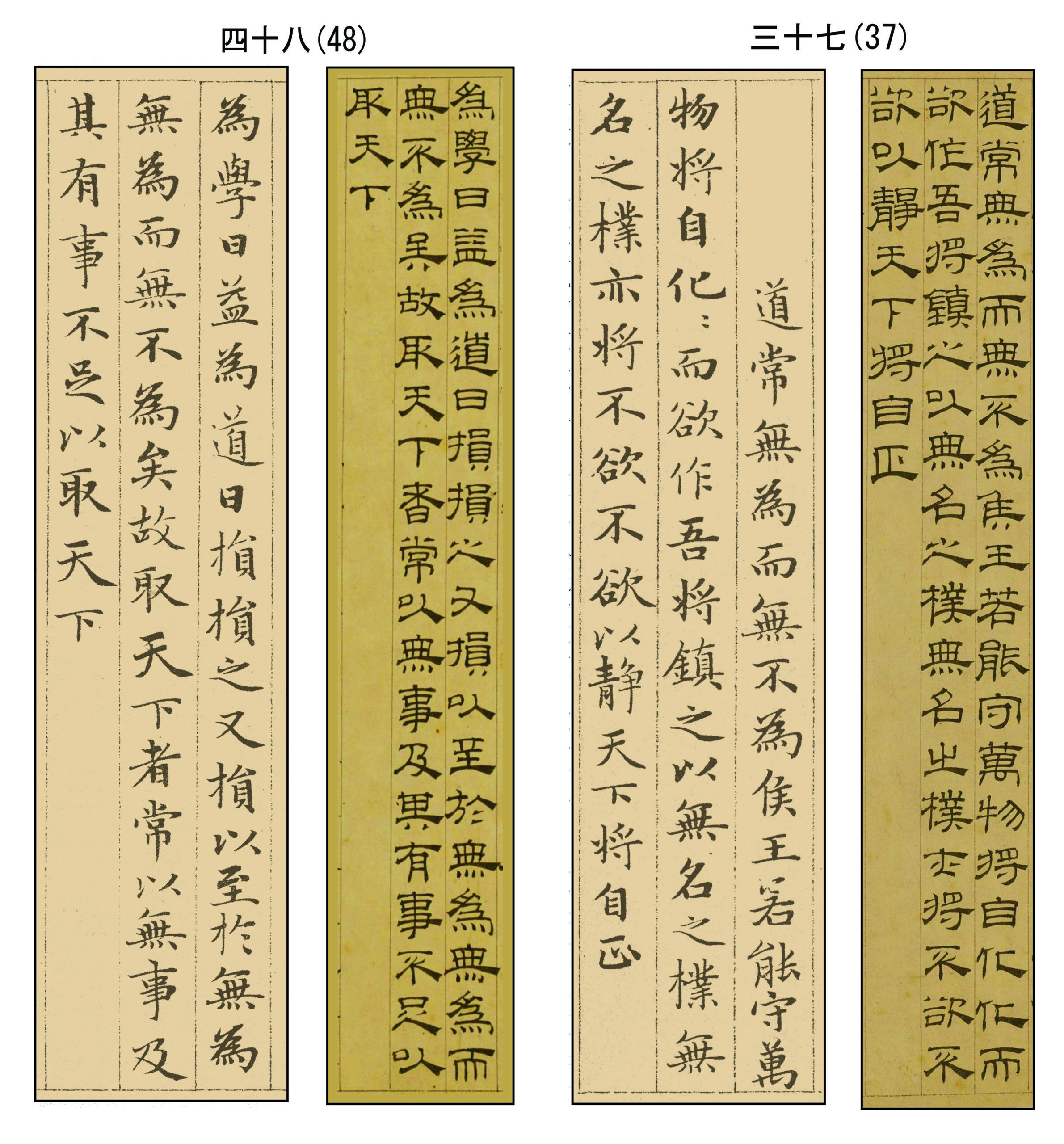
The esthetics of Chinese calligraphy depends on the flow from one character to another. The true calligrapher follows the principle of wu wei and writes effortlessly. Chiang Yee (1973, p 117) describes the essential characteristics of Chinese calligraphy:

The beauty of Chinese calligraphy is essentially the beauty of plastic movement, not of designed and motionless shape. A finished piece of it is not a symmetrical arrangement of conventional shapes, but something like the co-ordinated movements of a skilfully composed dance —impulse, momentum, momentary poise, and the interplay of active forces combining to form a balanced whole.  


Envoi

We can conclude with some comments of the poet and Trappist monk Thomas Merton in his introduction to his free translations from the Zhuangzi (2004, p 21):

The true character of wu wei is not mere inactivity but perfect action—because it is act without activity. In other words, it is action not carried out independently of Heaven and earth and in conflict with the dynamism of the whole, but in perfect harmony with the whole. It is not mere passivity, but it is action that seems both effortless and spontaneous because performed “rightly,” in perfect accordance with our nature and with our place in the scheme of things. It is completely free because there is in it no force and no violence. It is not “conditioned” or “limited” by our own individual needs and desires, or even by our own theories and ideas.

And an excerpt from his translation (p. 69):

If man, born in Tao,
Sinks into the deep shadow
Of non-action
To forget aggression and concern,
He lacks nothing
His life is secure.


References

Ames, R. T. (1981) Wu-wei in “The art of rulership” chapter of Huai Nan Tzu: its sources and philosophical orientation. Philosophy East and West, 31(2), 193-213

Chan, A. K. L. (2025). Laozi. The Stanford Encyclopedia of Philosophy.

Chiang, Y. (1973). Chinese calligraphy: an introduction to its aesthetic and technique (3rd ed.). Harvard University Press.

Csikszentmihalyi, M. (1990). Flow: the psychology of optimal experience. Harper & Row.

Csikszentmihalyi, M. (2014). Flow and the foundations of positive psychology. Springer Netherlands.

De Prycker, V. (2011). Unself-conscious control: broadening the notion of control through experiences of flow and wu-wei. Zygon, 46(1), 5–25.

Fischer, P. (2023). The annotated Laozi: a new translation of the Daodejing. State University of New York at Albany.

Fu, C. W.-H. (1973). Lao Tzu’s conception of Tao. Inquiry (Oslo), 16(1–4), 367–394.

Gregory, J. (2018). Effortless living: wu-wei and the spontaneous state of natural harmony. Inner Traditions.

Hansen (2003). Wuwei: taking no action. In Cua, A. S. (Ed.) Encyclopedia of Chinese philosophy. (pp 784-786). Routledge.

Kee, Y. H., Li, C., Zhang, C.-Q., & Wang, J. C. K. (2021). The wu-wei alternative: Effortless action and non-striving in the context of mindfulness practice and performance in sport. Asian Journal of Sport and Exercise Psychology, 1(2–3), 122–132.

Lin, P. J. (1977, open access 2020). A Translation of Lao-tzu’s Tao Te Ching and Wang Pi’s Commentary. (Volume 30 in University of Michigan Chinese Studies). University of Michigan.

Liu, X. (2015). Laozi’s philosophy: textual and conceptual analyses. In X. Liu (Ed.), Dao Companion to Daoist Philosophy (pp. 71–100). Springer Netherlands.

Loy, D. (1985). Wei-Wu-Wei: nondual action. Philosophy East & West, 35(1), 73–86.

Lynn, R. J. (2022). Zhuangzi: a new translation of the sayings of Master Zhuang as interpreted Columbia University Press.

Merton, T. (2004). The way of Chuang Tzu. Shambhala.

Moeller, H. G. (2015). Basic aspects of daoist philosophy. International Communication of Chinese Culture, 2 (2), 99–107.

Slingerland, E. G. (2003). Effortless action: Wu-wei as conceptual metaphor and spiritual ideal in early China. Oxford University Press.

Stamatov, A. (2023). The Laozi’s ideal state: nostalgia, utopia, state of nature. Religions, 14(10), 1243.

Tadd, M. (2019). Ziran: authenticity or authority? Religions, 10(3), 207.

Wu, C. Q. (2016). Thus spoke Laozi: a new translation with commentaries of Daodejing. University of Hawaii.

Ziporyn, B. (2009). Zhuangzi: the essential writings with selections from traditional commentaries. Hackett


A Way of Writing: The Art of Chinese Calligraphy

Chinese calligraphy (書法, simplified 书法, shūfǎ, literally ‘way of writing’) is the art of writing Chinese characters (漢字, simplified 汉字, hànzì) with a brush. Together with poetry and painting, calligraphy is considered one of the “Three Perfections” (三絕 sānjué) of Chinese art. This essay reviews the development of calligraphy and provides some examples of its beauty. The illustration shows the calligraphy of the characters of shūfǎ in regular and semi-cursive styles.

A Brief History

According to legend, Chinese writing began during the reign of the Yellow Emperor in the 3rd Millenium BCE. The emperor asked Cangjie (倉頡) one of his ministers to create a way to record knowledge. Cangjie was blessed with two pairs of eyes. This allowed him to see the basic shapes and patterns underlying the perceived world.

The first clear evidence for writing in China, however, comes from symbols found on the shoulder blades of oxen and the shells or tortoises. These date to around 1250 BCE. The symbols appear to have been used during divination, and the writing is therefore called Oracle Script (甲骨文,jiǎgǔwén, “shell and bone script”).

Beginning around 1000 BCE, characters were being cast onto or incised into various ritual bronze containers. This type of writing is called Bronze Script, (金文, jīnwén).

Over the years various styles of writing were used. Legend has it that the First Emperor Qin Shi Huang (259–210 BCE) established a standard writing style to be used across his newly unified empire: the Small Seal Script, 小篆 (xiǎozhuàn). Although the histories attribute this to the First Emperor, the script likely developed incrementally rather than by fiat. The script is characterized by thin lines that do not vary in width. The characters tend toward right-left symmetry, and the shapes are curved rather than rectilinear.

The invention of paper (in China in 105 BCE) and the use of writing brushes led to the development of the Clerical Script (隶書, simplified 隶书, lìshū) by around 100 BCE. The lines vary in thickness as befits the use of a brush. The characters show a tendency for the lines to sweep toward the right. The script is rectilinear rather than curved, and the width of the characters tends to be greater than their height. 

Over the following years clerks and scholars modified the clerical script to be lighter and more regular. The characters tended to occupy a square form. The individual strokes making up the different characters became standardized. This development occurred over several centuries beginning in the Second Century CE. The final version of Regular Script (楷書, simplified 楷书, kǎishū) became established during the Tang Dynasty (618–907 CE).

While the regular script was being perfected, the needs of writing speed and emotional expression led to the development of Cursive Script (草書, simplified 草书cǎoshū, literally “grass writing”). As well as denoting “grass” the character can also mean “careless, hasty, draft.” The characters are no longer created by discrete strokes, but formed with one or several continuous movements of the brush. The characters are curved and tend to have widths less than their height. The illustration on the right shows 草書 written in regular script and in cursive script. Regular script requires 20 separate strokes, but cursive uses only 3. Cursive script is variable from one writer to another.

A more legible version of cursive script soon developed: Semi-cursive Script (行書 simplified 行书, xíngshū, “running script”). This script is a compromise between the regular and cursive scripts. Characters are clearly demarcated from each other. Nevertheless, the individual strokes within the character become connected and flow together. There are conventions for depicting various sets of strokes. For example, parallel lines are represented as a z form rather than as = and dots are connected into a line. The style is analog rather than digital.

After the Chinese Communist Revolution, the new government of the People’s Republic of China simplified many of the commonly used highly complex characters. From 1949 to 1986, these changes led to the current Simplified Characters (简化字; jiǎnhuàzì, literally “simple transformed characters”). In writing this name, the traditional character 簡 has been simplified to 简. In the names of the earlier scripts, the traditional 書 was simplified to 书.

The following illustration of the different scripts shows the evolution of the characters 天 tiān sky/heaven, 馬 horse, 旅 lǚ travel/journey, and 正 zhĕng straight/correct. Of these, only the character for horse underwent modern simplification. The dates show the approximate times when the different scripts began.

More information about the evolution of Chinese characters is available in Chiang (1973), Qui (2000), Shi (2003) and Li (2010)

Thousand Character Classic (千字文 qiānzì wén)

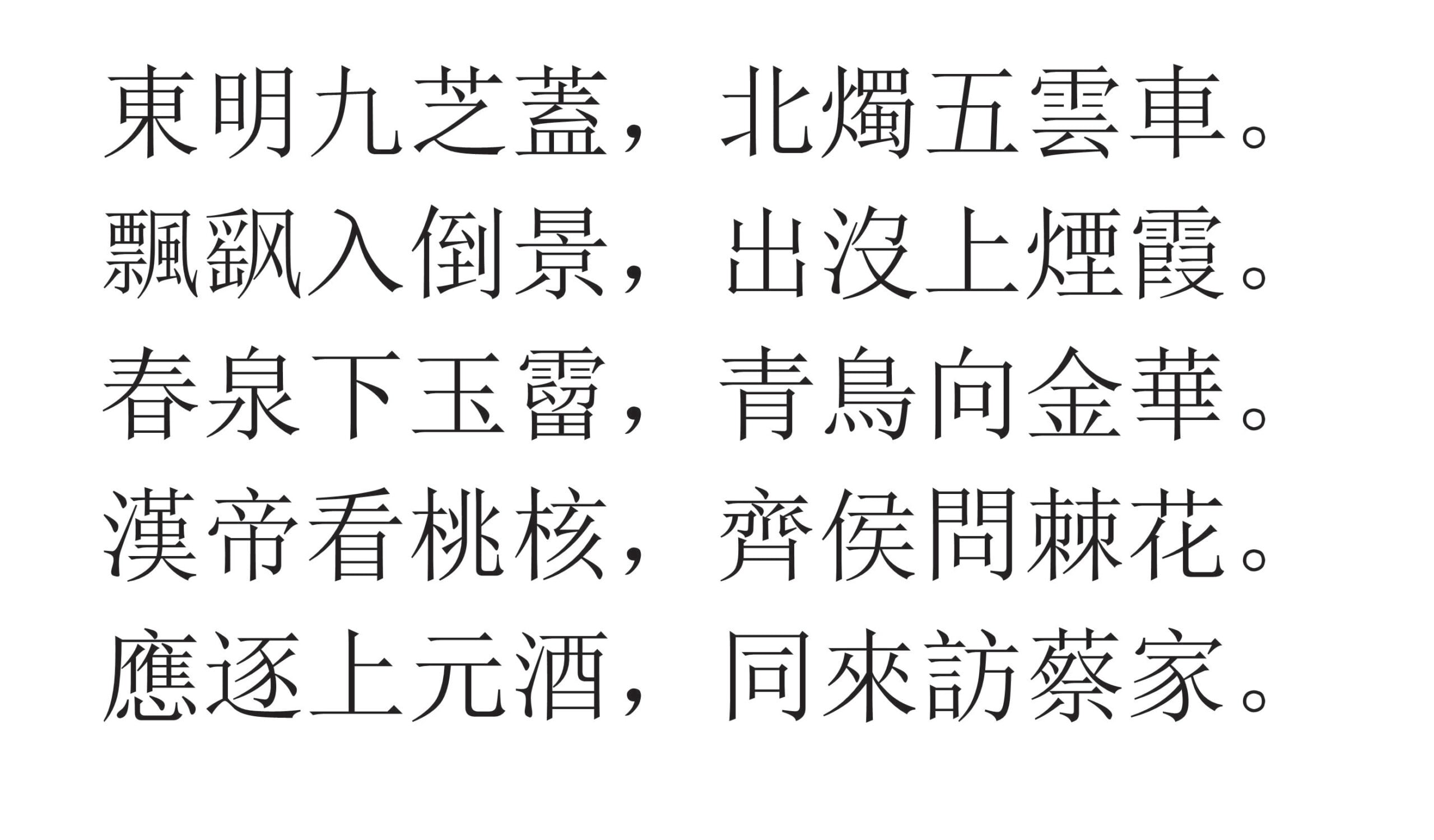
The Thousand Character Classic is a long poem that uses a thousand different characters (Paar, 1963; Sturman, accessed 2025). The poem contains 250 lines, each four characters long, arranged in rhyming quatrains to facilitate memorization. Legend has it that in the 6th Century CE, the Emperor Wu commissioned the poem to teach children the rudiments of writing. Since the text was learned by any literate person, the order of its characters could be used to put documents in sequence in the same way that alphabetical order is used in alphabetic languages. Copybooks showing the thousand characters in different writing styles soon became popular. The following example shows the beginning of the poem in a modern version (“The sky was black and the earth was yellow; space and time vast and limitless”):

Zhang Xu (張旭, ca 675-750 CE)

Zhang Xu was a court scholar and calligrapher. Although adept in regular script, he became renowned for his works in a wild cursive style (狂草 kuángcǎo ‘crazy cursive’), often created under the influence of wine (Jagger, 2023). His friend the poet Du Fu considered him one of the Eight Immortals of the Wine-cup (Li Bai was another):

张 旭 三 杯 草 圣 传
脱 帽 露 顶 王 公 前
挥 毫 落 纸 如 云 烟。

Zhang Xu, the Sage of Cursive Script, after three cups of wine,
Would doff his cap from his head before princes and dukes,
And let his brushstrokes fall on the paper like misty clouds

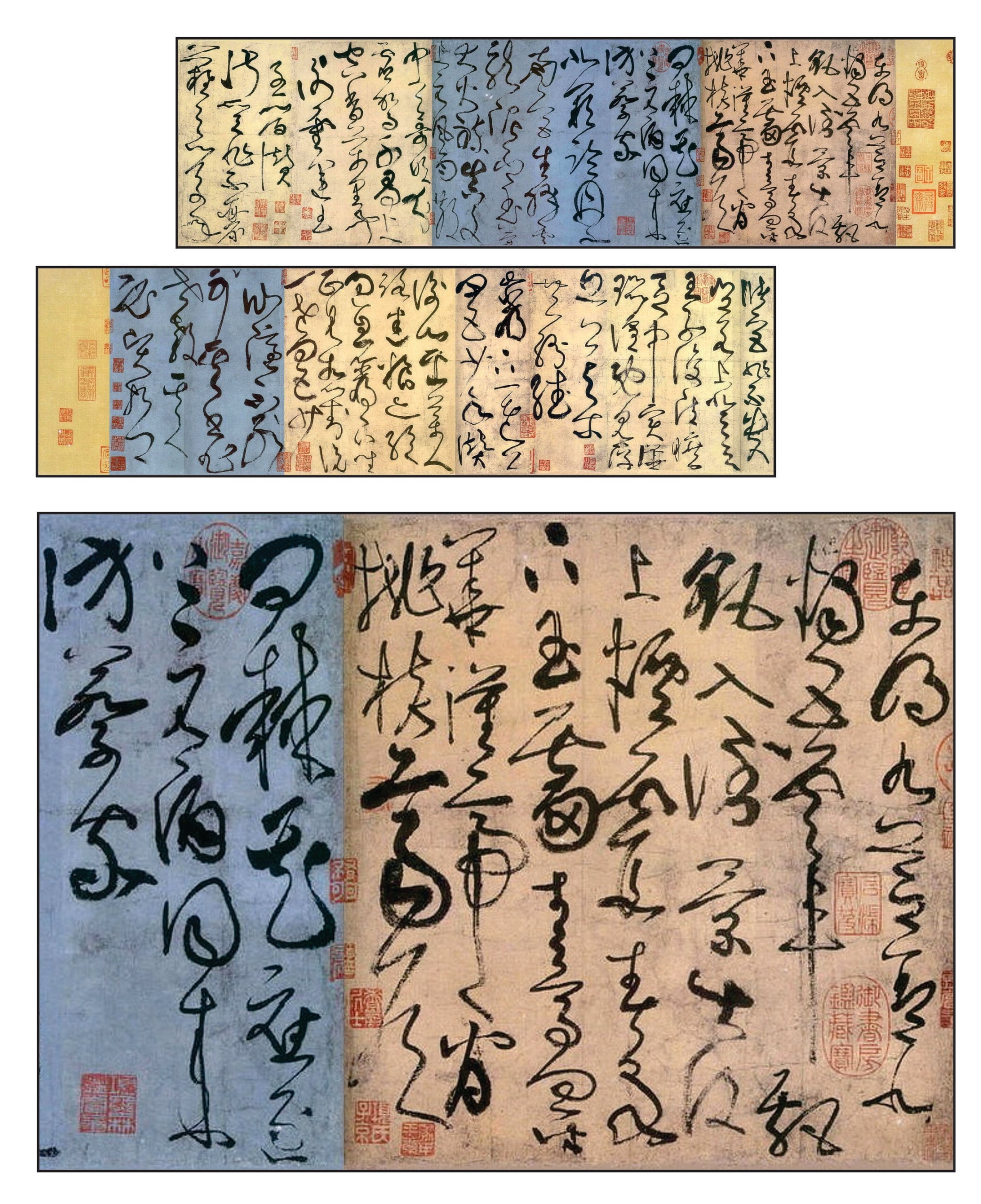
The most famous work attributed to him is his Four Ancient Poems (古詩四帖) a scroll (29.5 x 195.2 cm) on multi-colored paper now in the Liaoning Provincial Museum, Shenyang (Ouyang, & Wang, 2008 pp 217-223). The first poem by Yu Xin (513–581) is about the beginning of spring and the New Year celebrations:

The Eastern Light with his nine-petal mushroom canopy
And the Northern Candle with her five-hued cloud-chariot
Descend and drift into the light of sunset
Appearing and disappearing among the clouds.
Spring water flows like rain falling on jade,
And bluebirds fly towards the Jinhua mountain
The Han Emperor examines the peach-tree seeds,
And the Qi Marquis inquires about the jujube blossoms.
We drink the wine of the Lantern Festival
And visit with the Cai family.

The Eastern Light and the Northern Candle are the names of Daoist deities (Luo, 2019, pp 320-321). The ecstatic energy of the Zhang Xu’s calligraphy befits the poem’s enthusiastic enjoyment of the beginning of spring.  

The following illustration shows the complete scroll divided into two parts, and an enlargement of the first poem. To compare the characters, note that the calligraphy moves from top to bottom and from right to left, whereas the text above is written from left to right.

Zhao Mengfu (趙孟頫, 1254–1322)

Zhao Mengfu was a calligrapher and painter at the time when the Mongols conquered China and established the Yuan Dynasty (1271-1368). Since he worked for the Mongol emperors, his politics were considered suspect by later historians. However, he is recognized as China’s most talented calligrapher (McCausland, 2011). He wrote in all styles, but was an absolute master of the regular script. Copybooks of his calligraphy are still widely used by students wishing to master kaishu.

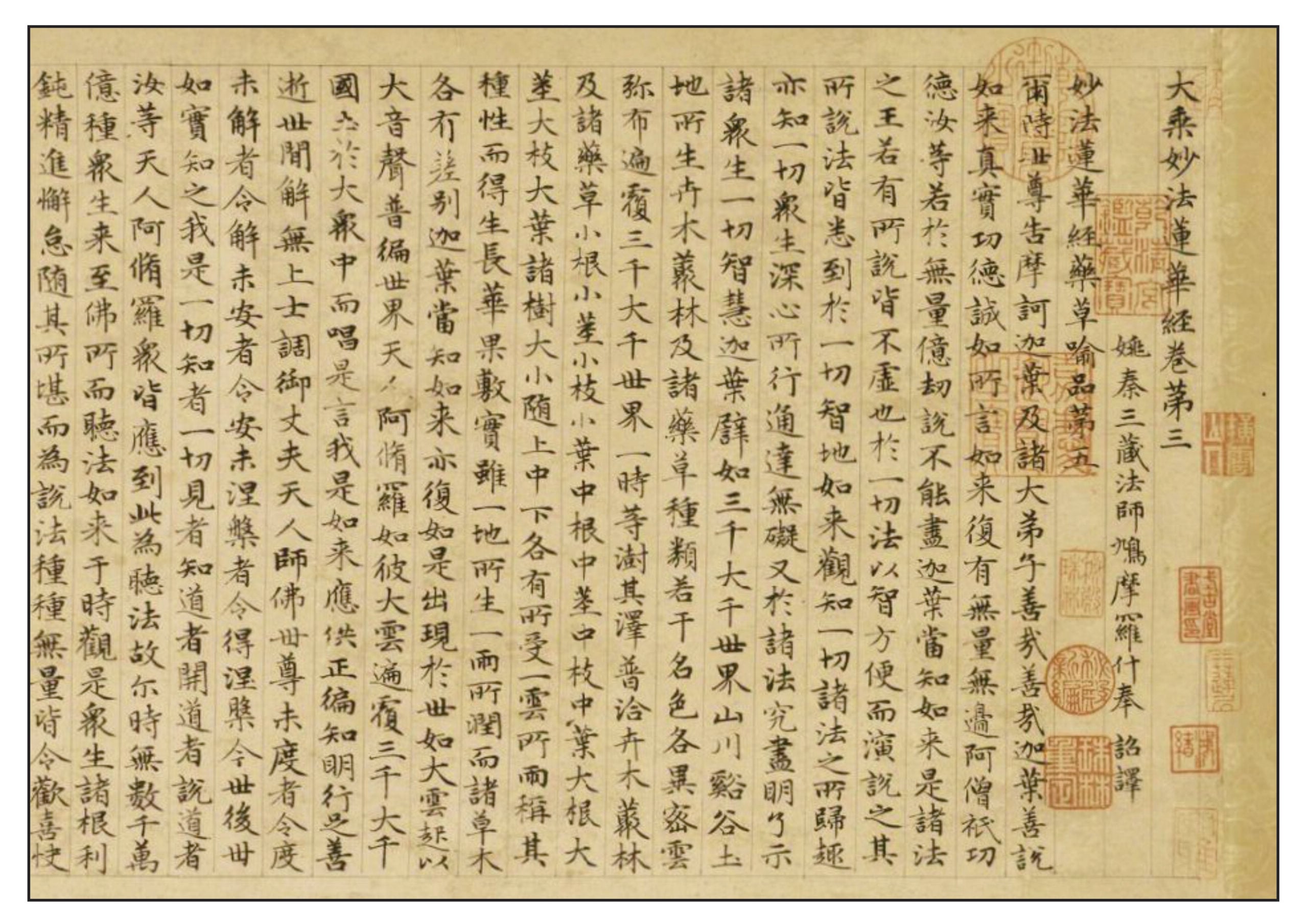
The following illustration shows the beginning of the third scroll in an original set of seven for the Sutra on the Lotus of the True Dharma (Chinese: 妙法蓮華經 miàofǎ liánhuá jīng), a basic text in Mahayana or “Great Vehicle” (Chinese: 大乘 dàshèng) Buddhism. The scroll, written in small regular script, is now in the collection of the technology entrepreneur Jerry Yang (Wang Lianqi in Chang & Knight, 2012, pp 70-103). The scroll is 28 cm wide and 275 cm long.

The beginning of the text (4th line from the right) reads 爾時世尊告摩訶迦葉及諸大弟子善哉善哉: At that time the world-honored one [Buddha] spoke to Mahakasyapa [one of his disciples] and the other major disciples “Excellent, excellent …” This is the beginning of Chapter 5 in the Sutra.

Wang Lianqi (Chang & Knight, 2012, pp 98-99) remarks about the calligraphy:

This scroll by Zhao Mengfu has more than ten thousand characters written with seeming effortlessness, and from start to finish they are consistent in that they are steady yet agile at the same time. Unless one has exceptional skill, something like this would be utterly impossible. But what is especially exceptional here—apart from the refined beauty of its dots and strokes, the stability of its composition, the comfortable spacing, and the openness of its forms (all achieved while adhering strictly to the principles of standard script)—is that Zhao is able to impart freshness and vitality to the forms, so that strength emerges amid their graceful charms. As a result, viewers forget the concentration and care that went into their structure and brushwork and see only their naturalness and serenity.

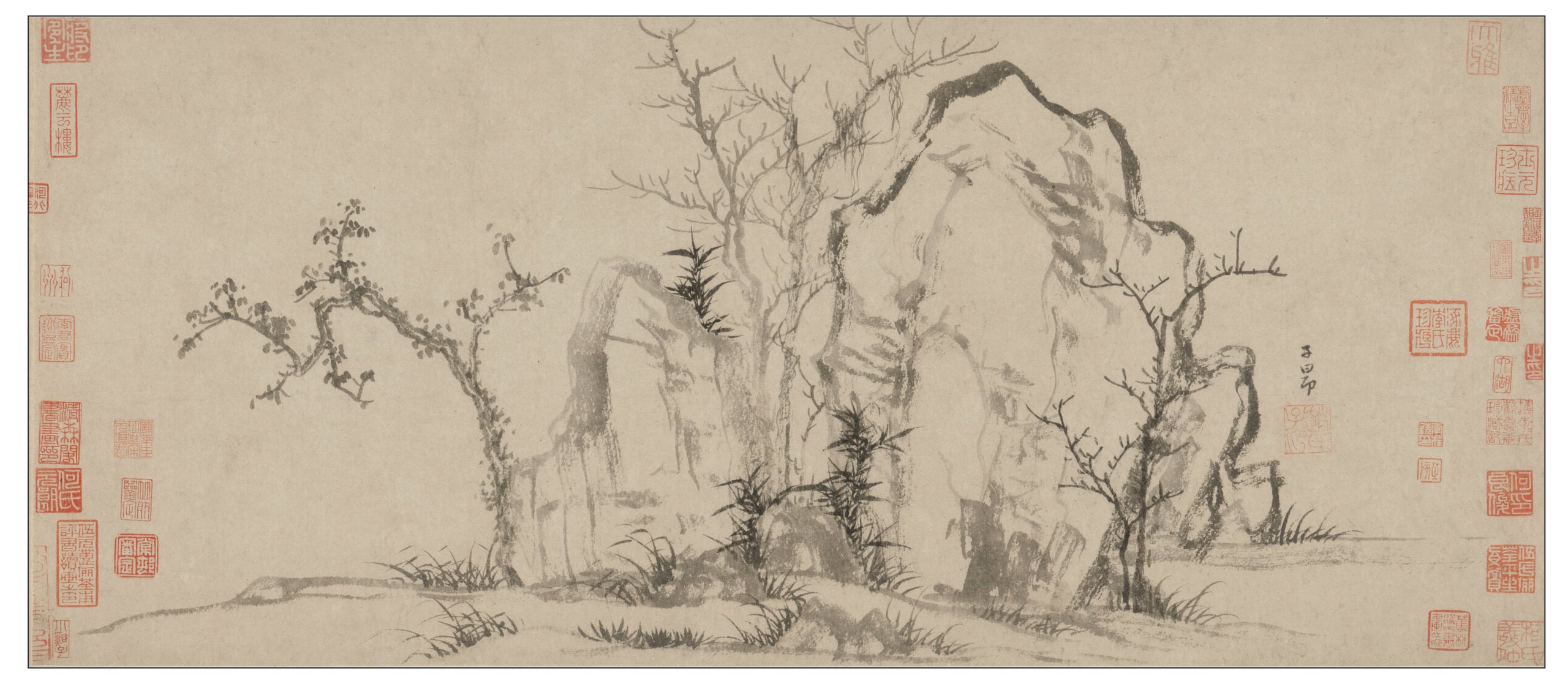
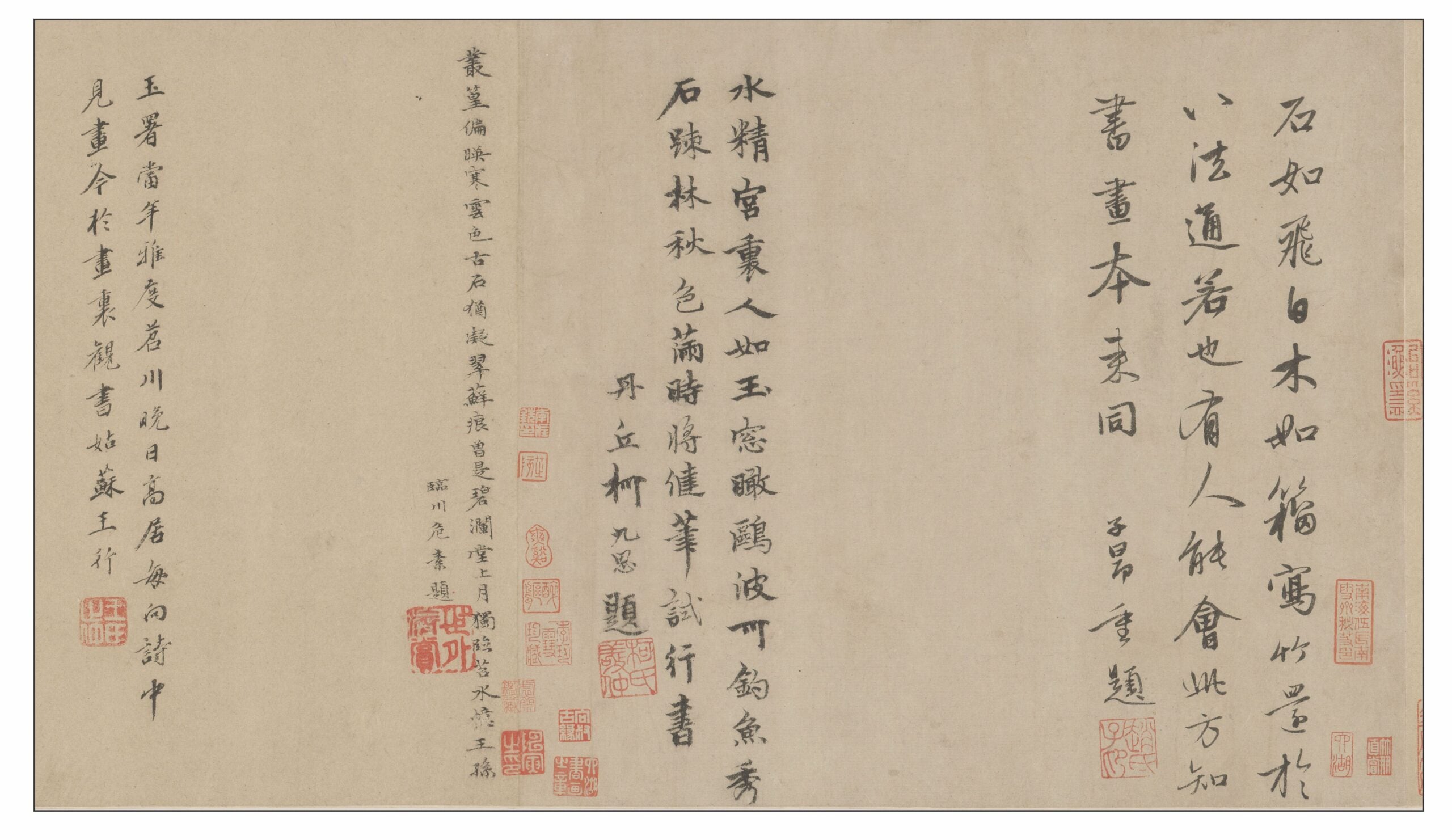
Zhao Mengfu was also a brilliant painter. The following illustration shows his depiction of Elegant Rocks and Sparse Trees on a scroll 28 cm widenow in the Palace Museum in Beijing. The painting shows a scene in early spring. Two large rocks are painted in “flying white” (飛白féibái) style, with the upper edge of the right rock accentuated, provide the main structure of the painting. “Flying white” is a style of painting or calligraphy that uses a lightly loaded brush to leave lines with white streaks showing through. Between the rocks are two lightly traced leafless trees. At the outer edge of each rock are trees more darkly inscribed. The tree on the right is leafless but the one on the left has new buds on its sinuous branches. Young bamboo shoots grow in clumps on the ground and between the rocks. On the ground are sprouts of new grass. This is a marvelous portrayal of the transition between winter and spring.

The scroll includes colophons by the painter (right) and three colleagues:

Zhao Mengfu’s colophon reads:

The rocks are like “flying-white,” the trees like “seal script.”
Depicting the bamboo draws upon the “eight clerical” method.
If indeed there are people that can make these associations,
They will understand that calligraphy and painting have the same root.

The “eight” style of clerical script was right-left symmetrical with long sweeping strokes as in the character 八 for eight.

The painting and poem provide a fine example of the “Three Perfections” (三絕 sānjué): the combination of poetry painting and calligraphy.

Ni Zan (倪瓚 simplified 倪瓚, 1301–1374)

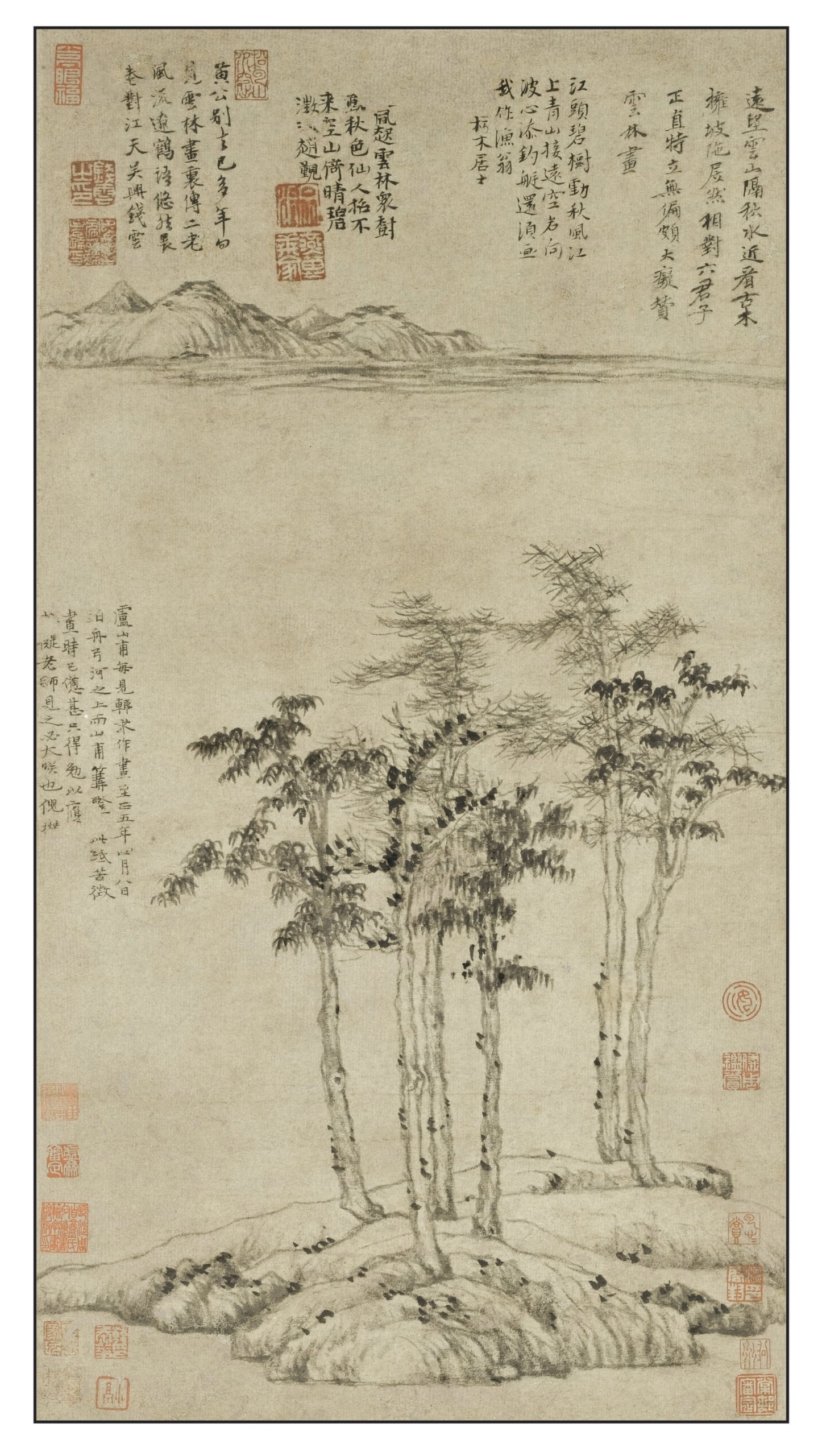
Ni Zan was another gifted painter and calligrapher who worked during the Yuan Dynasty. One of his most famous paintings, now in the Shanghai Museum has come to be known as The Six Gentleman (1345):

Xu (2022, p 32) describes the striking combination of emptiness and strength in the image:

[T]the composition has been pulled apart, introducing an almost unbridgeable gap between foreground trees and distant hills. Moreover, the gap between the edge of the paper and the sandbank isolates the foreground subject, and refuses to provide us, the viewers, easy access into his landscape. The stark spaciousness of the painting, the tension created by horizontal ground lines and vertical tree lines, enhances this feeling of aloofness.

The six trees are all different:

The six trees in this picture are the pine, cypress, camphor tree, Chinese scholar tree, phoebe and elm — all Confucian symbols of moral integrity (Xu, 2022, p 33).

To the left of the trees, Ni Zan wrote a brief note describing how the painting was created during a visit to his friend Lu Shanfu (Xu, 2022, p 32):

庐山甫每见辄求作画。至正五年四月八日,泊舟弓河之上,而山甫篝灯出此纸苦征画。时已惫甚,只得勉以应之。大痴老师见之必大笑也. 

Each time Lu Shanfu sees me, he urges me to paint for him. On the eighth day of the fourth lunar month of the fifth year of the Zhizheng era [May 10th, 1345] I had just docked my boat on the Bow River when he greeted me with a lamp and a piece of paper, insisting strenuously that I paint for him. I was feeling extremely weary from the journey but did my best to answer his request. When the old master Dachi [courtesy name of Huang Gongwang] sees this, he will have a good laugh over it.

Huang Gongwang himself added a poem to the upper right of the painting. This likened the foreground trees to six gentlemen:

远望云山隔秋水,
近有古木拥陂陀,
居然相对六君子,
正直特立无偏颇

In the distance cloudy mountains are separated by the autumn river.
Close by, old trees huddle along the sloping shore,
Calmly facing one another, the Six Gentlemen,
Who stand upright, outstanding, without being lopsided.

Shen Zhou (沈周, 1427–1509)

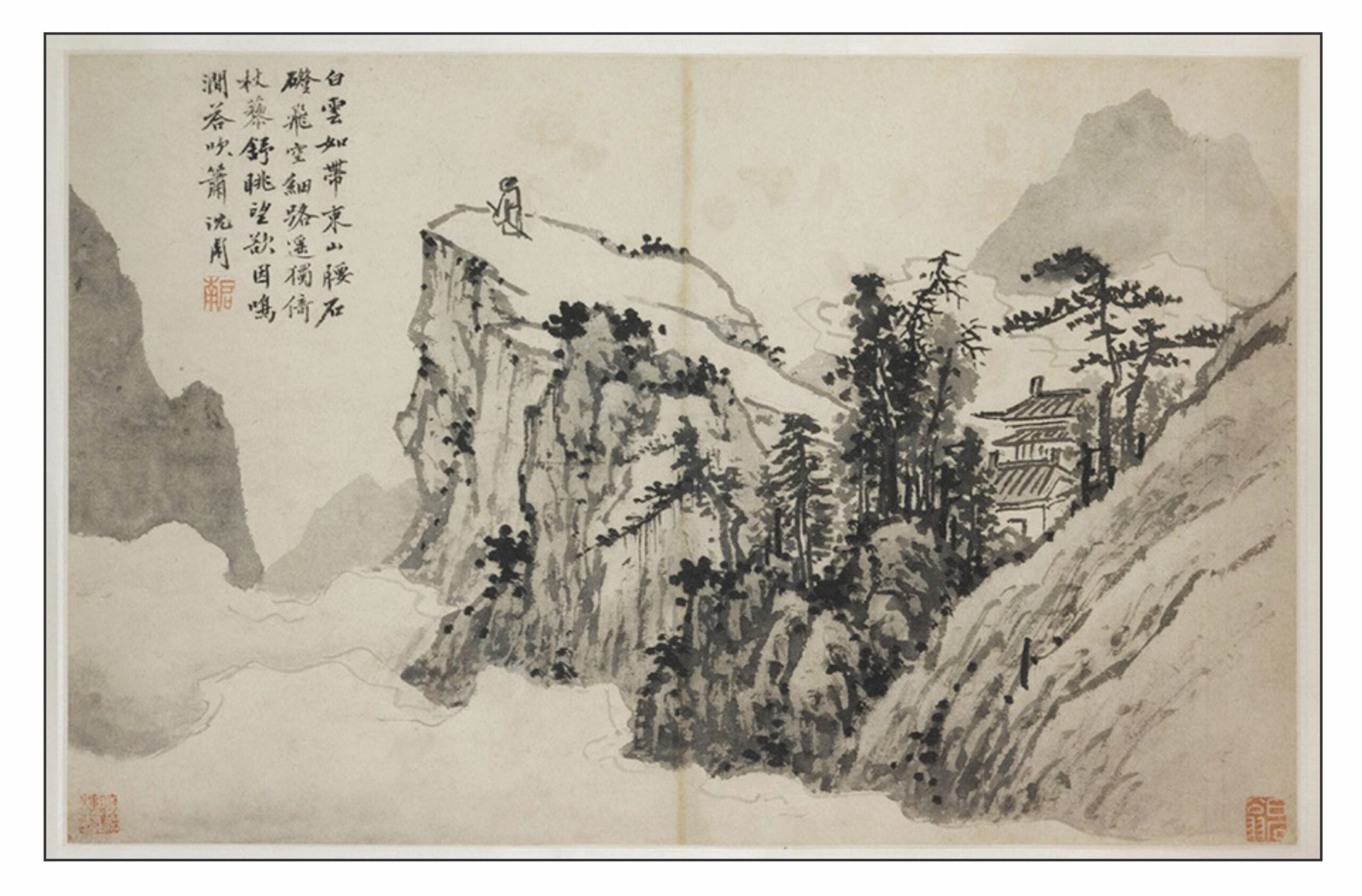
Shen Zhou was a painter, poet and calligrapher during the early Ming Dynasty. His painting Poet on a Mountaintop (杖藜遠眺, 39 by 60 cm), currently held by the Nelson-Atkins Museum of Art in Kansas City, is probably the most famous example of the three perfections. The painting shows the poet reaching the peak of a mountain and looking out over the mist in the valley below. He speaks a poem, the words of which are written on the sky.  

A transcription and translation of the poem follow

白雲如帶束山腰,
石磴飛空細路遙。
獨倚杖藜舒眺望,
欲因鳴澗答吹簫

White clouds sash-like wrap round the waists of mountains,
The rock terrace soars into space over a distant narrow path.
Leaning on a bramble staff, I gaze far and free;
I will reply to the sound of the mountain stream with my flute.

Xu Chu (許初, fl 16th Century CE)

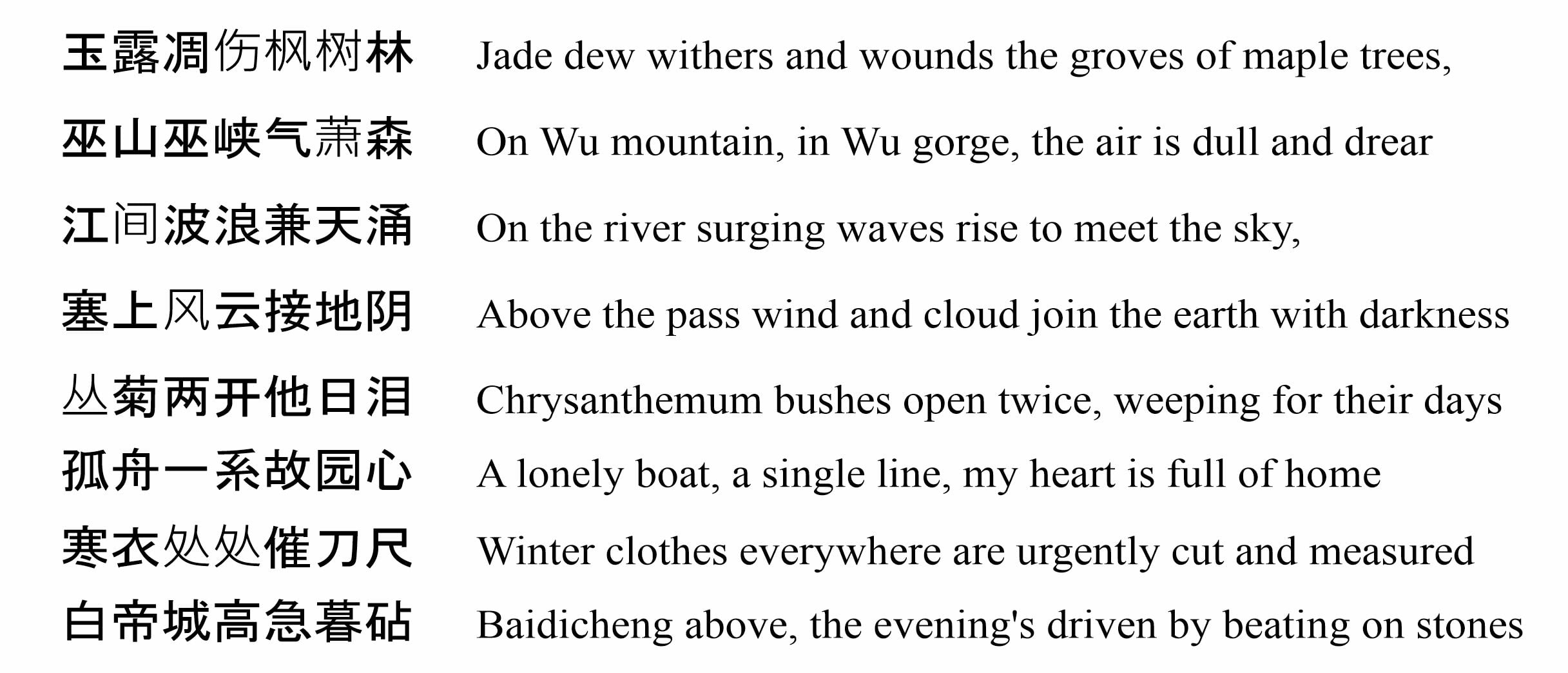
Xu Chu created an album of the Autumn Meditations of the Tang poet Du Fu (712-770 CE) using seal script. The illustration shows the first two leaves of the album, now in the Palace Museum in Beijing. The first poem of the sequence (beginning on the right leaf and extending through much of the second) transcribes the first meditation:

The text of the poem with a translation by Mark Alexander follows:

Wu Gorge is the second of the Three Gorges on the Yangtze River. Chrysanthemums are short-day flowers that can bloom twice a year, once in the spring and a second time in autumn. Baidicheng (White Emperor City) is a hill-top fortress between Wu Gorge and the upstream Qutang Gorge. During the Tang Dynasty heavy cloth was prepared for winter clothes by being beaten on stone. 

Zhu Da (朱耷,1626-1705)

Zhu Da, also known by his pen name Bada Shanren (八大山人) came from an aristocratic family who served in the Ming Court. When the Manchus took over the capital and established the Qing Dynasty in 1644, Bada found refuge in a Chan Buddhist temple and became a monk. Over the years he rose to become an abbot. However, he returned to secular life in 1680, producing numerous works of calligraphy and painting in his later years (Chang et al., 2003).

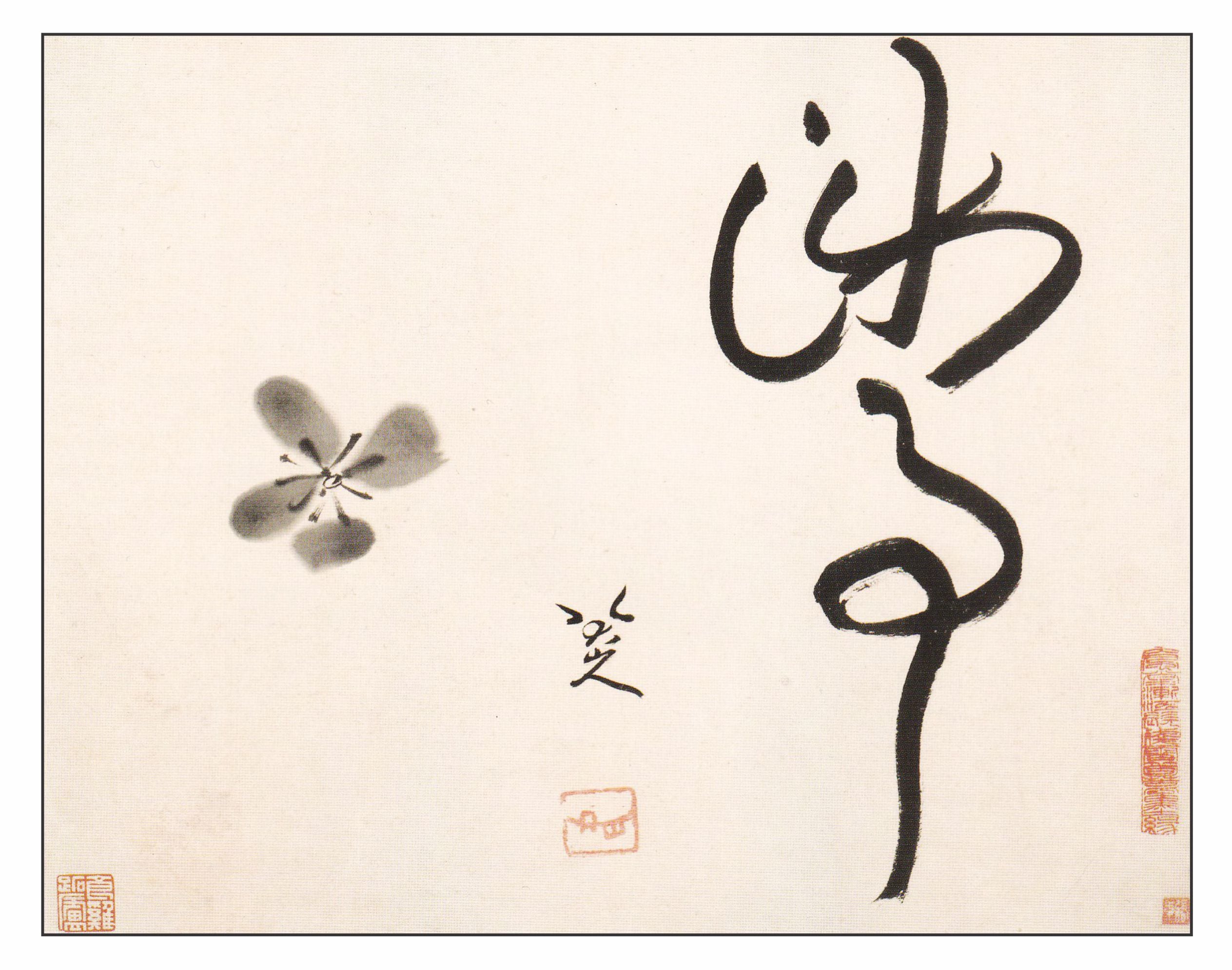
The following is Falling Flower (落花 luòhuā) from an album of paintings created in 1692. The cursive calligraphy gives a sense of gentle falling and the signature in the center of the page appears like another blossom.   

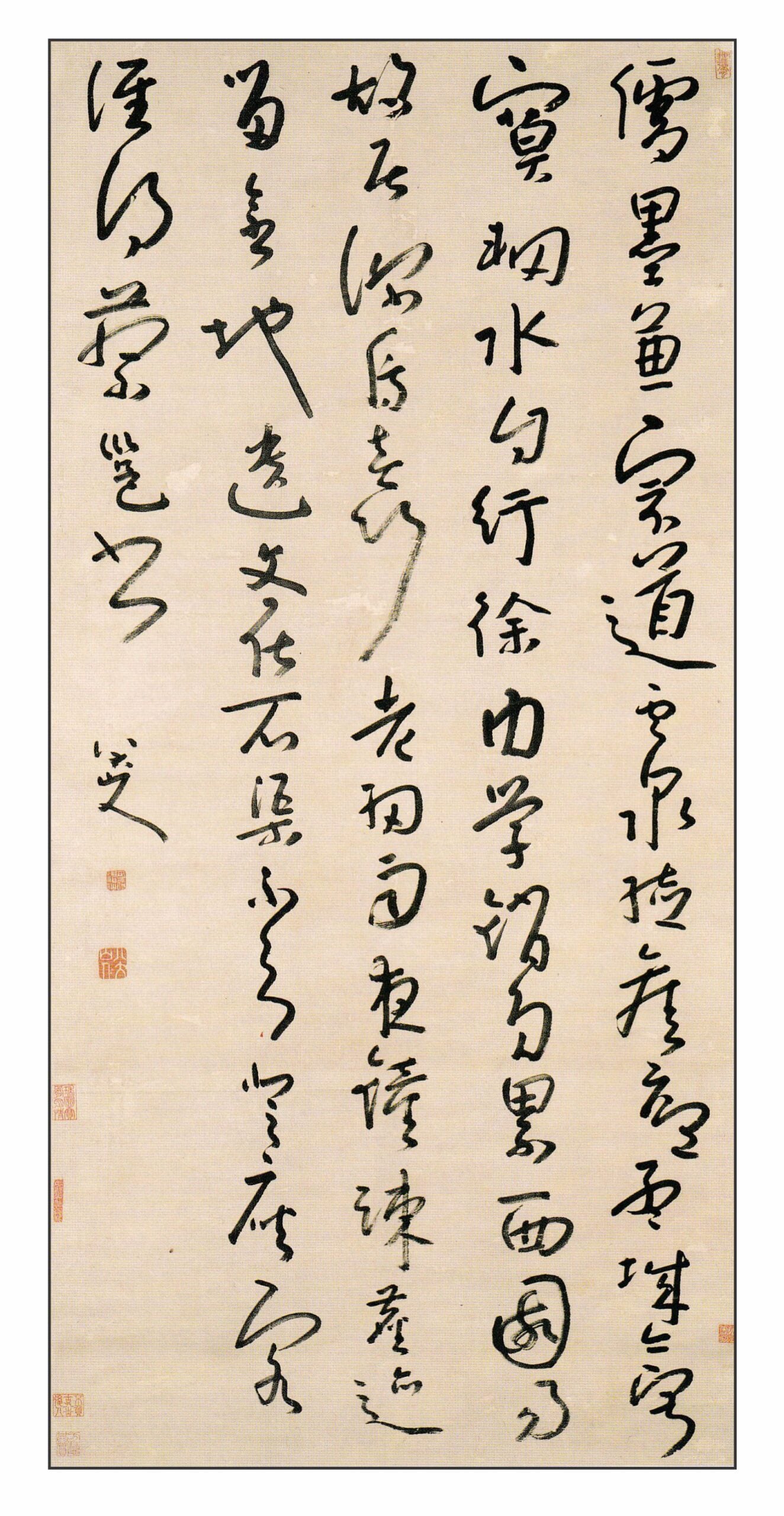
In 1699 Bada Shanren transcribed a poem by Geng Wei (fl 8th Century) in memory of Wang Wei (701-761 CE) using a semi-cursive script that was both beautiful and restrained. The poem was dear to Bada, who shared Wang Wei’s Buddhist philosophy and love of nature.

The following provides a transcription of the calligraphy and translation of the poem:

儒墨兼宗道,雲泉結舊廬,孟城今寂寞,輞水自紆徐。
內學銷多累,西園易故居,深房春竹老,細雨夜鐘鍊。
塵邊留金地,遺文在石渠,不知登座客,誰得蔡邕書。

Blending Ruism, Moism, and the Holy Religion,
By the cloudy spring, he built his former hut;
But Meng Wall Cove is desolate now and still,
And Wheel Rim Creek just winds naturally away.
The inner teachings dissolved his many cares,
The western garden transformed his old abode;
In the deep chamber, spring bamboo grows old,
In the thin rain, the night bell seldom tolls.
His dusty tracks remain in the golden earth,
His writings are kept beside the Stone Canal;
Still I do not know which of his companions,
Has inherited the books of this Cai Yong!

“Ruism” is the philosophy of Confucius (5th and 6th Centuries BCE); “Moism” refers to the teachings of Mozi (3rd Century BCE) who promoted asceticism and self-restraint; and the “Holy Religion” refers to Buddhism. Meng Wall Cove is located near Wang Wei’s country estate and was described in the set of poems entitled Wangchuan Ji (Wheel River Poems). The Stone Canal is the name of one of the imperial libraries. Cai Yong was a famous scholar and politician from the 2nd Century CE. 

Bada Shanren’s calligraphy expresses the meaning and emotion of the text. The character 深, “deep” (fifth from top in the third column from left) extends its tail into the depths of sadness.

Deng Shiru (鄧石如, simplified: 邓石如 1743-1805)

Deng Shiru became adept in calligraphy in the style of seal script and clerical script. The following illustration below shows a pair of homiletic sayings in clerical script on hanging scrolls each 1.7 meters high:

The calligraphy is powerful and serious (Ho Chuan-hsing in Chang and Knight, 2012. The strokes are broad and the characters wider than they are high. The beginning and end of each stroke are cleanly demarcated: the brush is turned to “conceal the tip.” The sayings read:

心作良田百世耕之不盡

The heart is a good field – plow it for a hundred generations and it’s never depleted.

善為至寶一生用則有餘

Goodness is a perfect treasure – use it for a lifetime and some will still be left over

Epilogue

Chinese calligraphy has continued through the years as an artform that appeals to both the eye and the mind. The writing of Chinese characters with a brush became popular throughout East Asia as a way of combining art and meditation (Tanahashi, 2016). Modern artists still produce calligraphy. They use new forms but still maintain links to past masters.

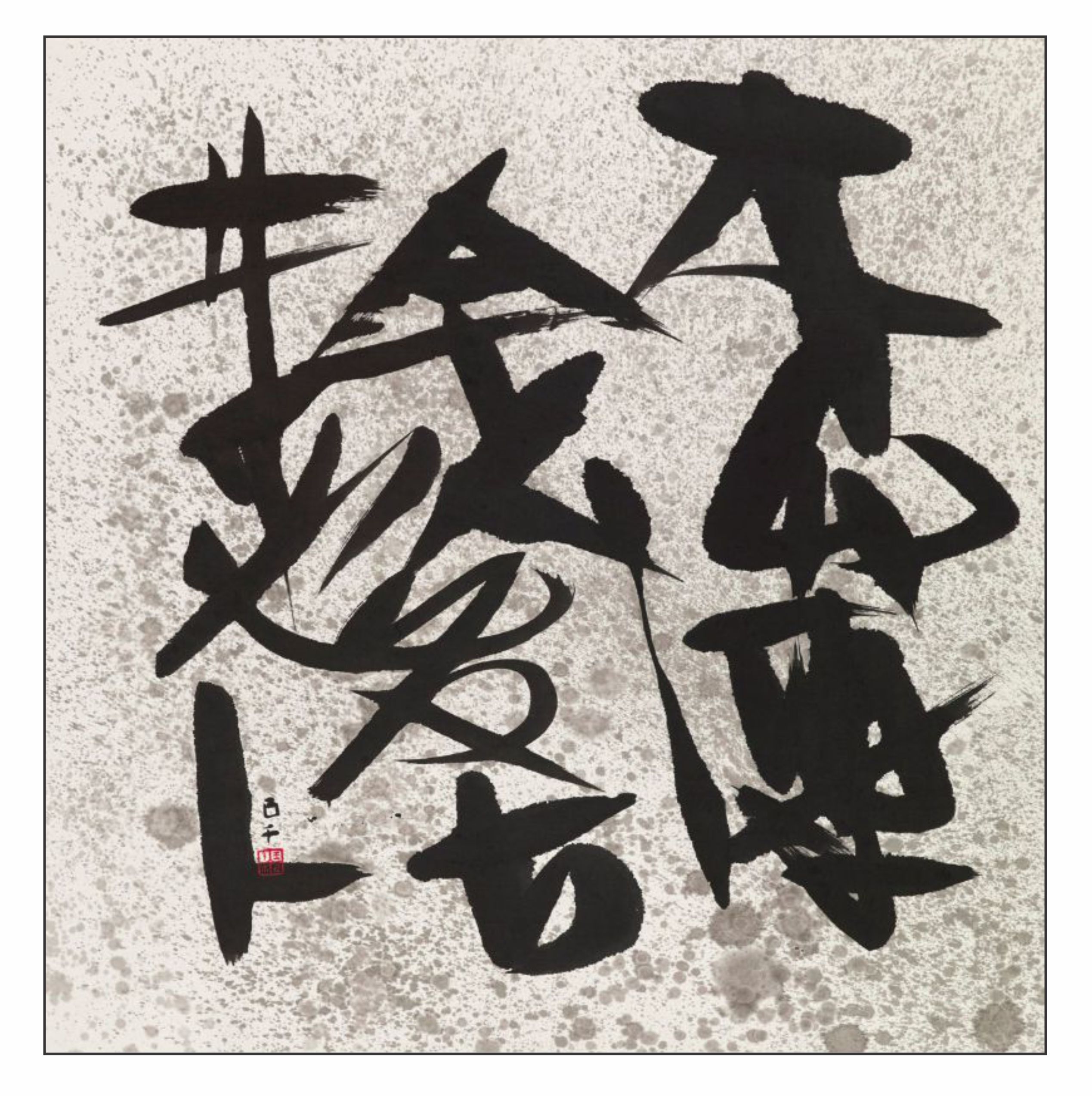
Wang Jiqian (王己千, Westernized name C. C. Wang, 1907-2003) was both a major collector of Chinese art and calligraphy and an artist. The illustration shows his calligraphy of a Poem by Du Fu:

The calligraphy presents a line from a poem by Du Fu (712-770 CE):

不薄今人愛古人

Without belittling the moderns, I love the ancients

The full poem can be found in Owen (2016, Vol III p 114-115).

References

Chang, J., Bai, Q., & Allee, S. D. (2003). In pursuit of heavenly harmony: paintings and calligraphy by Bada Shanren from the estate of Wang Fangyu and Sum Wai. Freer Gallery of Art (Smithsonian Institution).

Chang, J., & Knight, M (Eds.) (2012). Out of character: decoding Chinese calligraphy Asian Art Museum of San Francisco.

Chiang, Y. (1973). Chinese calligraphy: an introduction to its aesthetic and technique (3rd ed.). Harvard University Press.

Fong, W. (1984). Images of the mind: selections from the Edward L. Elliott family and John B. Elliott collections of Chinese calligraphy and painting at the Art Museum, Princeton University. Princeton University Press.

Fong, W. (1992). Beyond representation: Chinese painting and calligraphy, 8th-14th century. Metropolitan Museum of Art.

Jagger. K. (2023). Zhang Xu – ‘Crazy Zhang.’ Ink & Brush.

Li Huiwen, Han Lifen, & Becker, G. (2018). Chinese calligraphy and culture: an easy-to-use guide for learners of all ages. MSL Academic Endeavors

Li, W. (2010). Chinese writing and calligraphy. University of Hawaii Press.

Luo, Y. (2019). Yu Xin and the sixth-century literary world. Doctoral Dissertation, Princeton University.

McCausland, S. (2011). Zhao Mengfu: calligraphy and painting for Khubilai’s China. Hong Kong University Press.

Murck, A., & Fong, W. (1991) Words and images: Chinese poetry, calligraphy, and painting. Metropolitan Museum of Art.

Ouyang, Z., & Wang, Y. (2008). Chinese calligraphy. Yale University Press.

Owen, S. (2016). The poetry of Du Fu. De Gruyter.

Paar, F. W., ed. (1963). Chʻien Tzu Wen the Thousand Character Classic: a Chinese Primer. Frederic Ungar.

Qiu Xigui (translated by G. I. Mattos & J. Norman, 2000). Chinese writing. Society for the Study of Early China.

Shi, B. (translated by S. C. Kohn, 2003). Between heaven and earth: a history of Chinese writing. Shambhala.

Sturman, N. (accessed 2025) The thousand character essay (Qian Zi Wen).

Tanahashi, K. (2016). Heart of the brush: the splendor of East Asian calligraphy. Shambala.

Xu, P. D. (2022). Copy, yet original: Re-examining ‘fang Ni Zan’ paintings in the fifteenth to seventeenth century China. PhD Thesis, Vrije Universiteit Brussel.