Bai Juyi: Pearls Falling on Jade

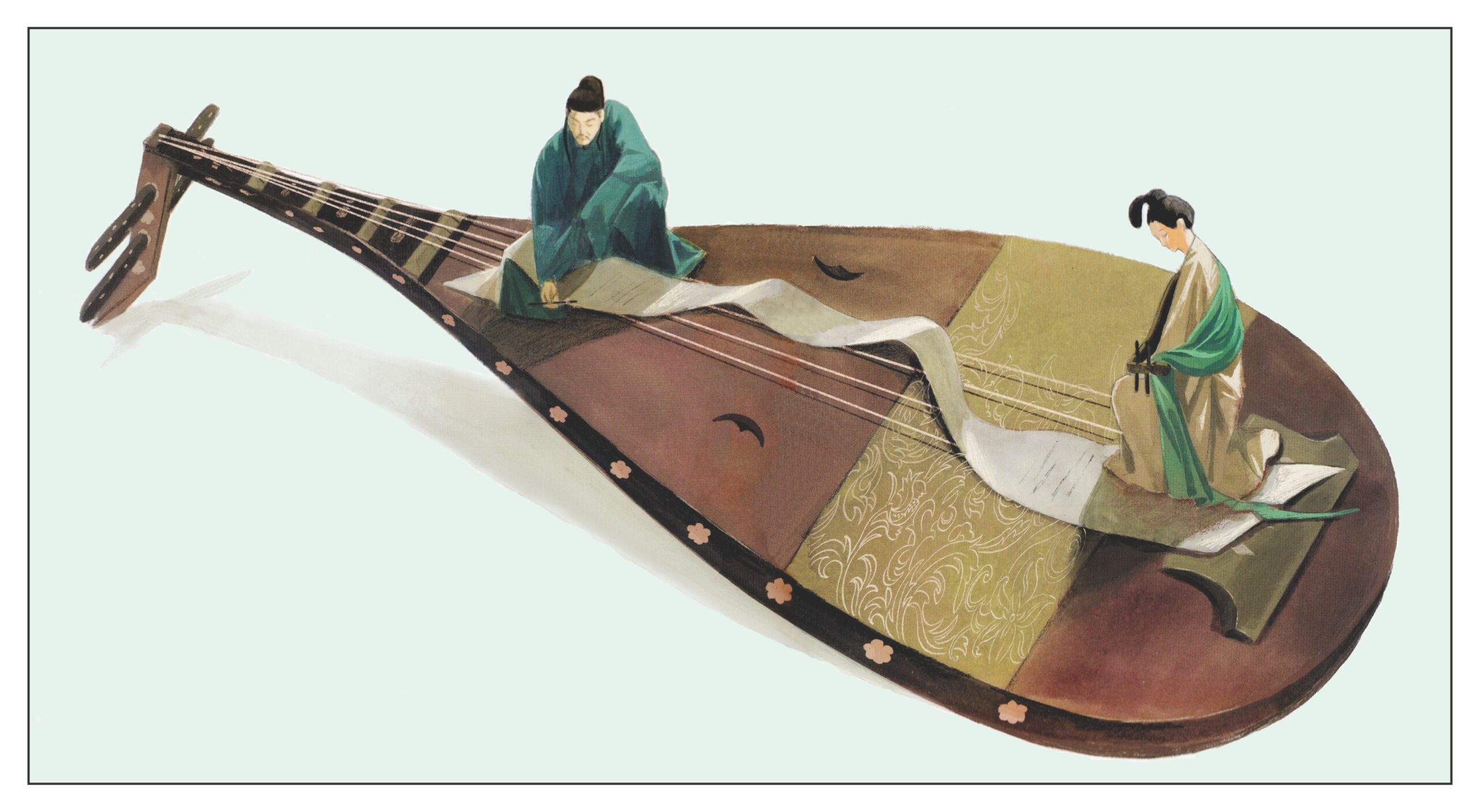
Bai Juyi (白居易, pinyin Bǎi Jūyì, or Po Chü-i in Wade-Gilles transliteration, 772-846 CE) was a Chinese poet. In 815, after inappropriately advising the emperor, he was exiled from the capital Chang’an to JiuJiang on the Yangtze River. One night, at a farewell party on the river for a friend, he heard a musician playing the pipa. Entranced by her music, he found out that she had once been a sought-after courtesan in the capital. After her beauty had faded away, she had retired to the provinces, where she played her music and lamented her lost youth. Moved by her plight, Bai Juyi composed his Pipa Xing (琵琶行, “Ballad of the Pipa”). The illustration shows a drawing of the poet and the pipa player from a scroll by Guo Xu (1456–1532).

Life of the Poet

Bai Juyi was born in Northern China and came to the capital Chang’an to pass his examinations for the civil service in 800. There he became close friends with the novelist and poet Yuan Zhen (779-831) (Tan, 2025). He soon became a prolific and popular poet, with the courtesy name Lètiān (樂天, happiness of heaven: optimism) (Waley, 1949). Bai Juyi and his predecessors, Li Bai, Wang Wei and Du Fu, are considered the four great poets of the Tang Dynasty (Geng, 2021). He became renowned in Japan where he was known as Haku Rakuten from the Japanese transliteration of his courtesy name (白楽天). In 815, the prime minister Wu Yuanheng was brutally assassinated because he would not agree to the demands of some rebellious warlords. Bai Juyi wrote a memorial calling upon the emperor to seek out and punish the assassins. However, the politics were complicated. Bai Juyi was considered presumptuous – it was not for him, a tutor in the imperial household, to advise the emperor. He was exiled and demoted to a minor position (“master of the horse”, essentially an adjutant) in Jiujiang, then known as Jiangzhou (Waley, 1949, pp 101-104). While there, he heard the playing of a pipa near the river and wrote his famous poem The Ballad of the Pipa. Bai Juyi was allowed to return to Chang’an in 1819. He then served for periods of time as governor of Hangzhou and governor of Suzhou. Bai Juyi was a devoted Chan Buddhist and when he grew old, he retired to a Buddhist monastery near the Longmen caves famous for their colossal statues of Buddha (carved in 672 and 676). At the monastery he was able to compile a full collection of his poems before his death.

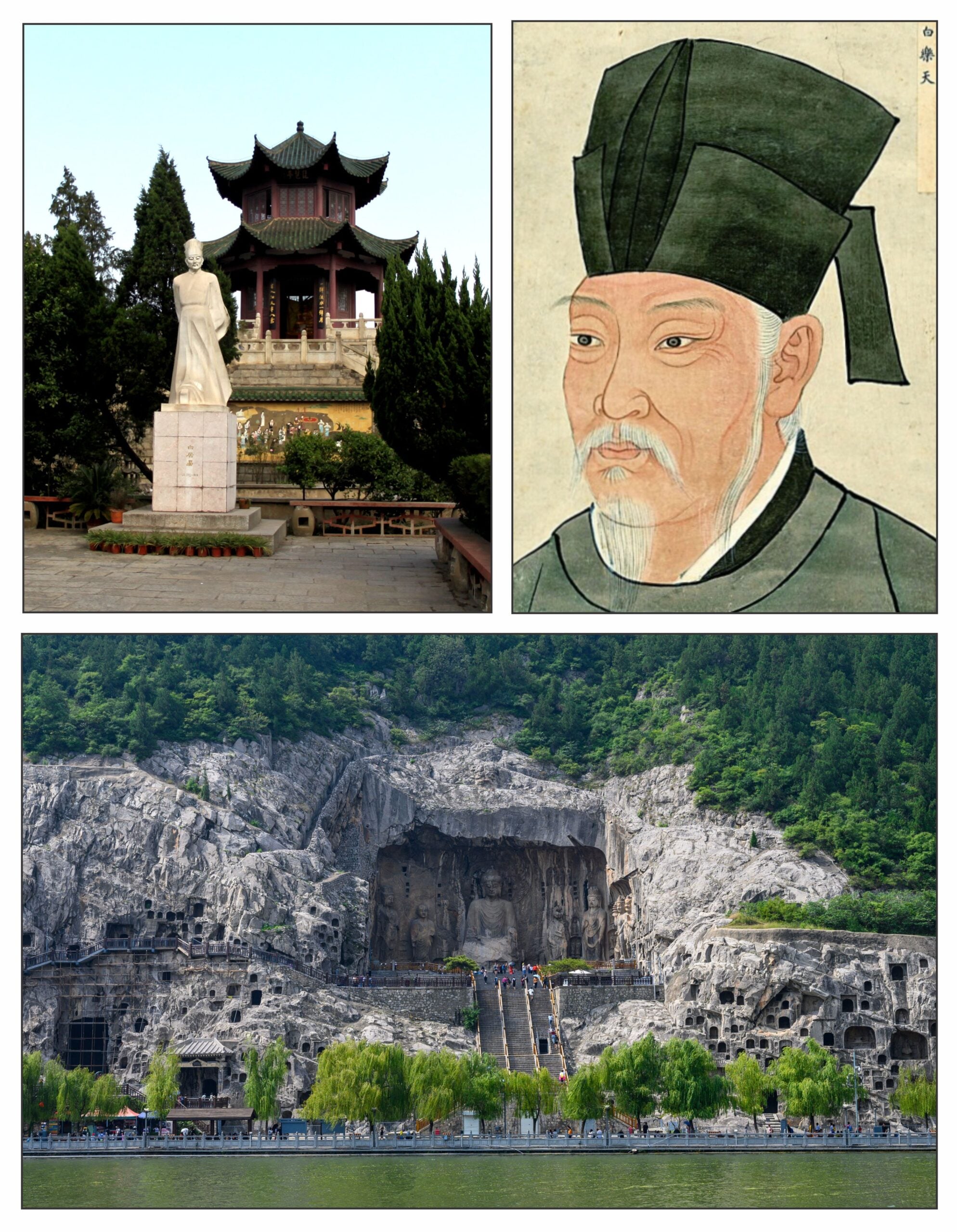
The following illustration shows in the upper left a statue of Bai Juyi at the Pipa Pavilion in Jiujiang, in the upper right a posthumous portrait of the poet by Chen Hongshou, a 17th Century painter, and at the bottom a view of the Longmen caves.

Translating the Ballad of the Pipa

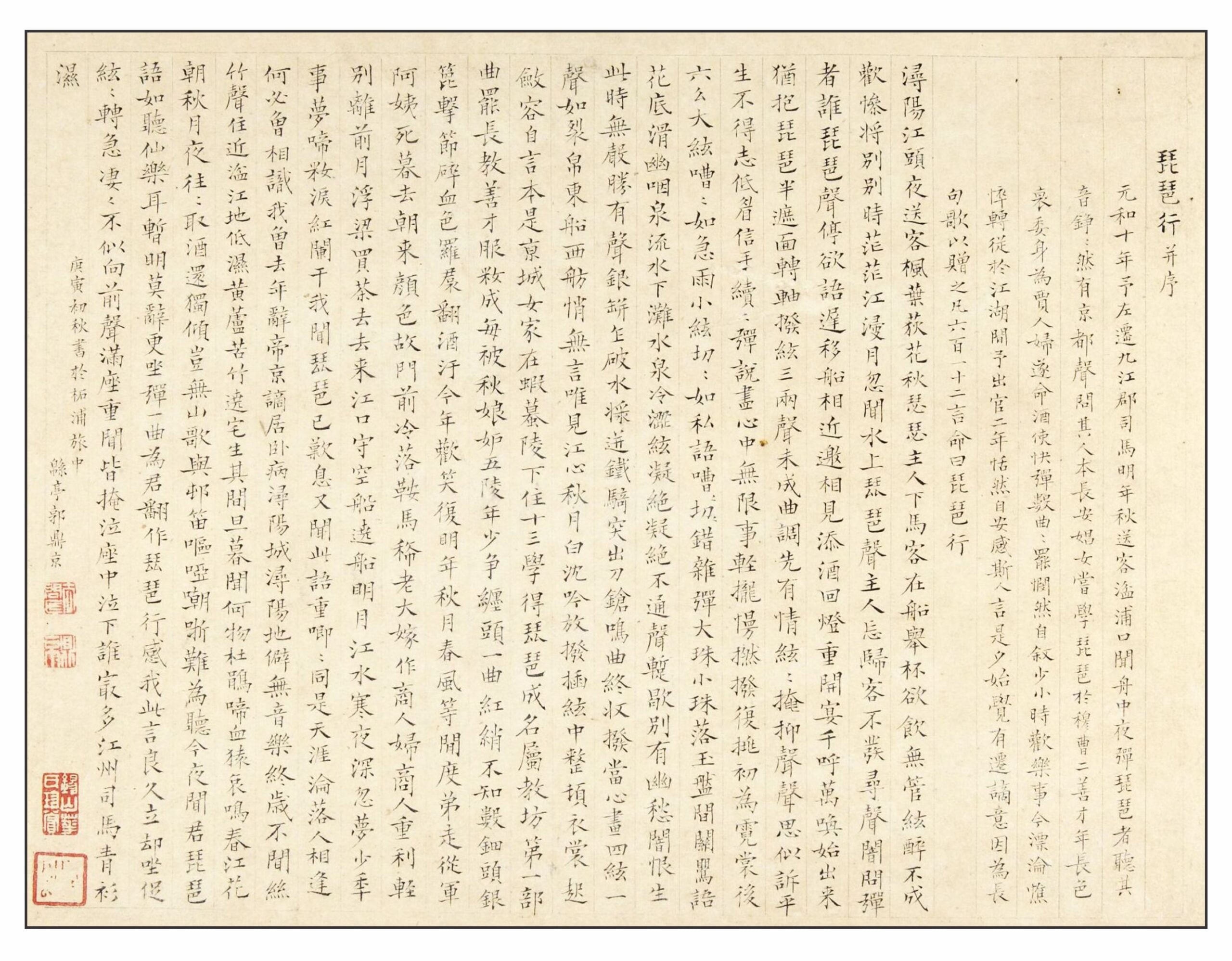
The poem is written in rhyming couplets with 88 lines each of 7 characters for a total 616 characters. It is preceded by a preface of 138 characters. The following is the poem in elegant regular-script calligraphy by Guo Dingjing (17th Century CE), now in the Princeton University Art Museum:

The Chinese text of the poem is readily available, as is an early English translation by Witter Bynner in his book The Jade Mountain (1929). Several other English translations have been published: Fuller, 2018, pp 283-289; Giles, 1888, pp 157-160; Harris, 2009, pp 21-26; Watson, 1984, pp 249–252; Xu et al, 1987, pp 292-296: Xu, 1994, pp 18-121; Yip, 2004, pp 288-297. Other translations are available on the internet: Phil Multic and Gan Siowck Lee.

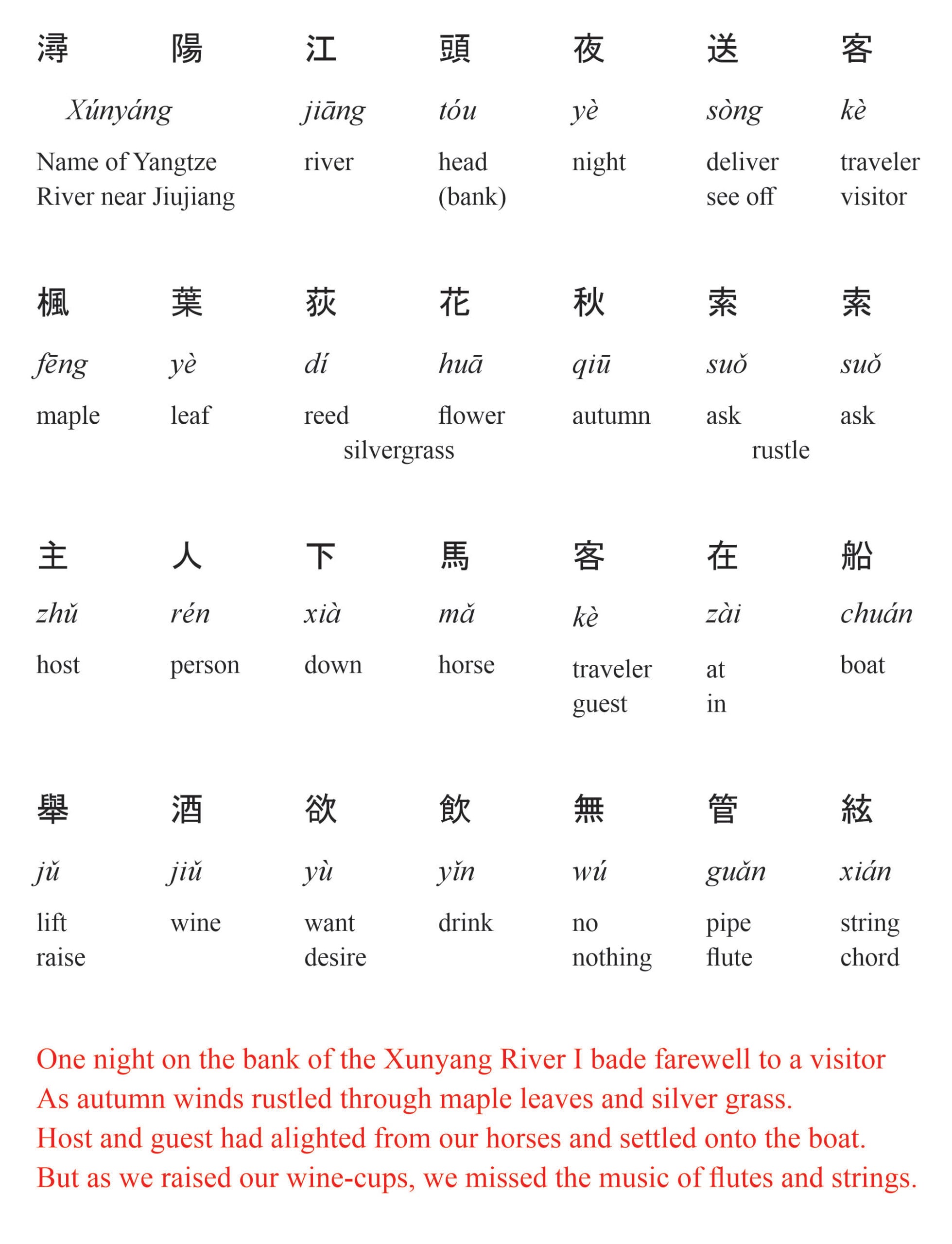
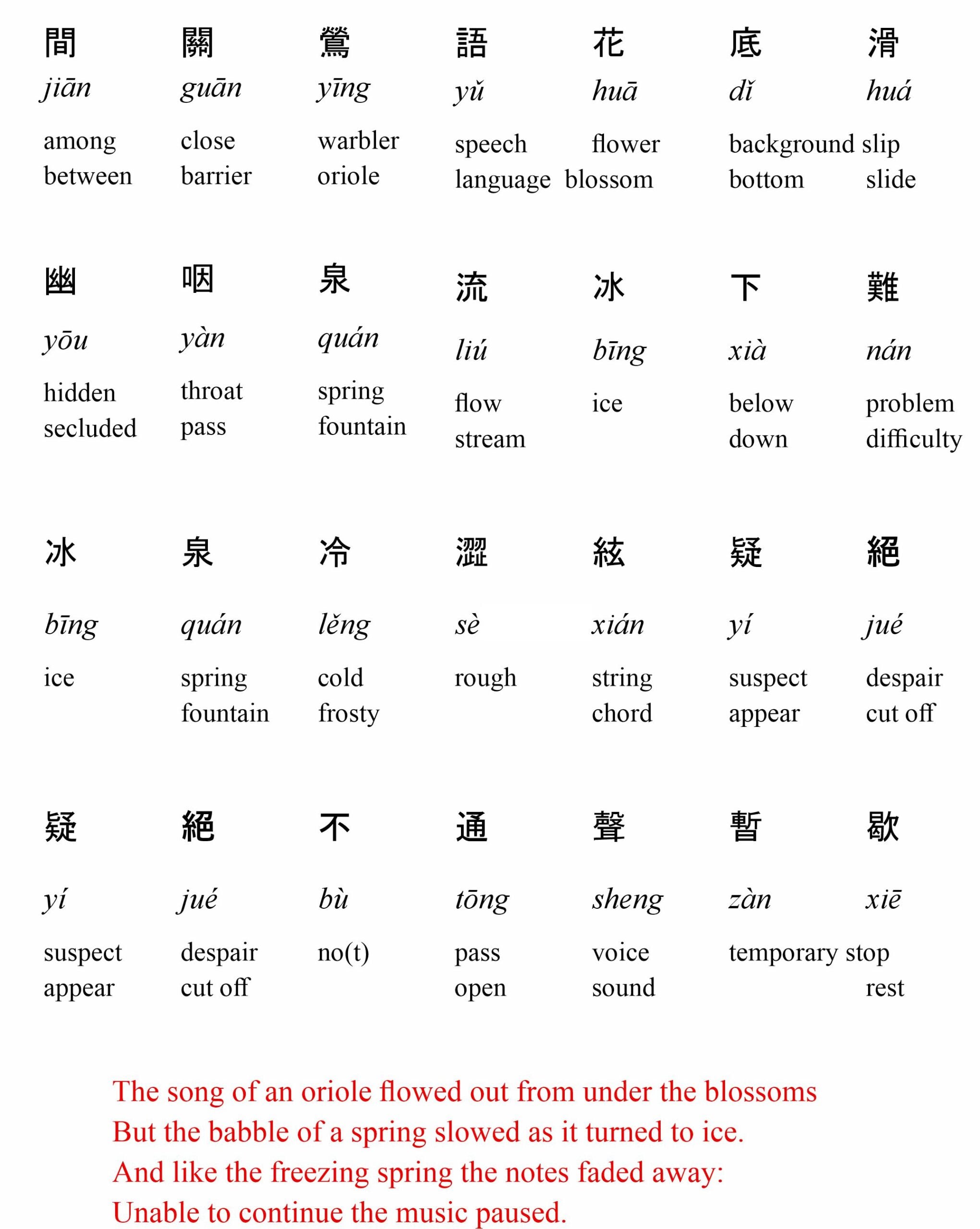
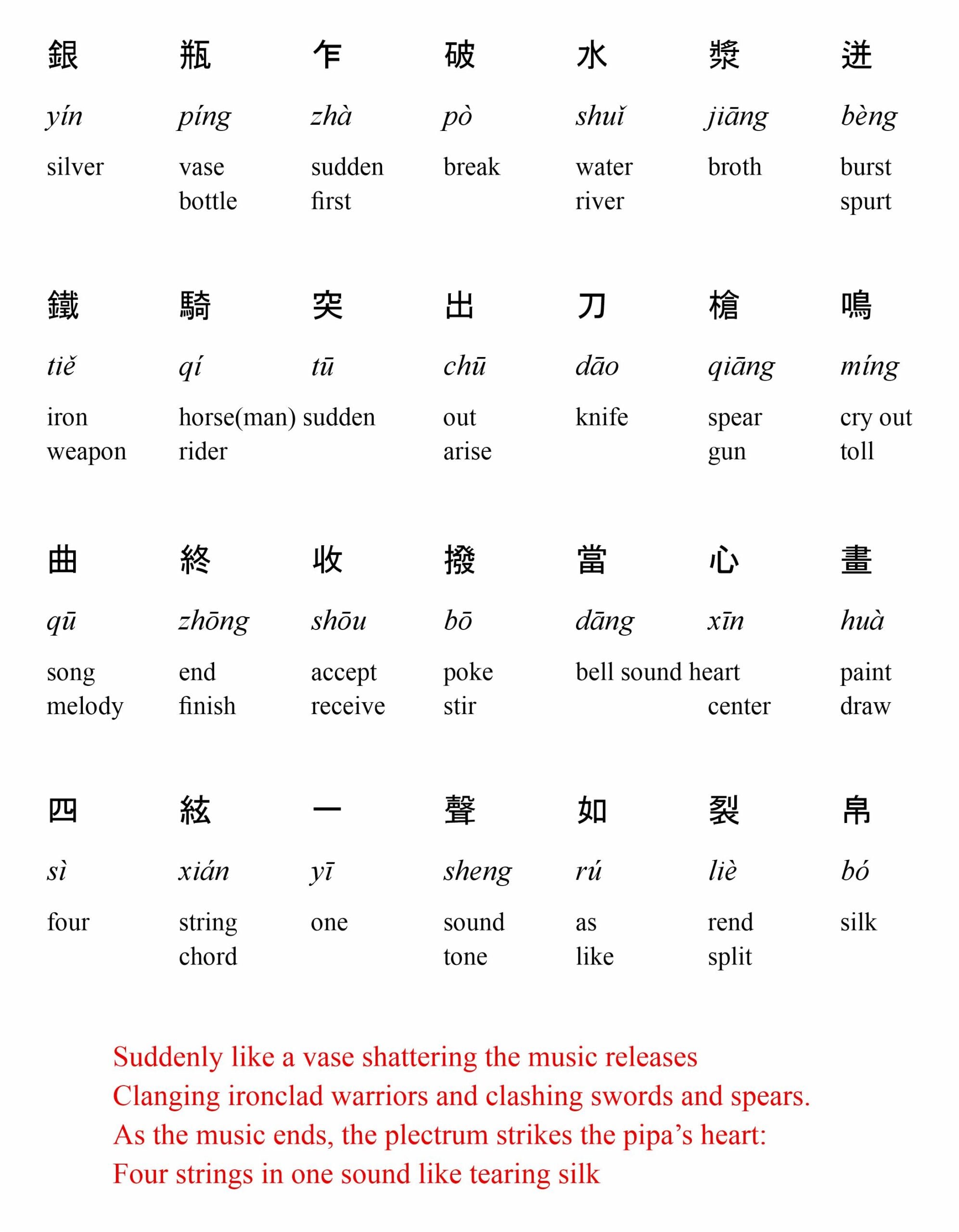
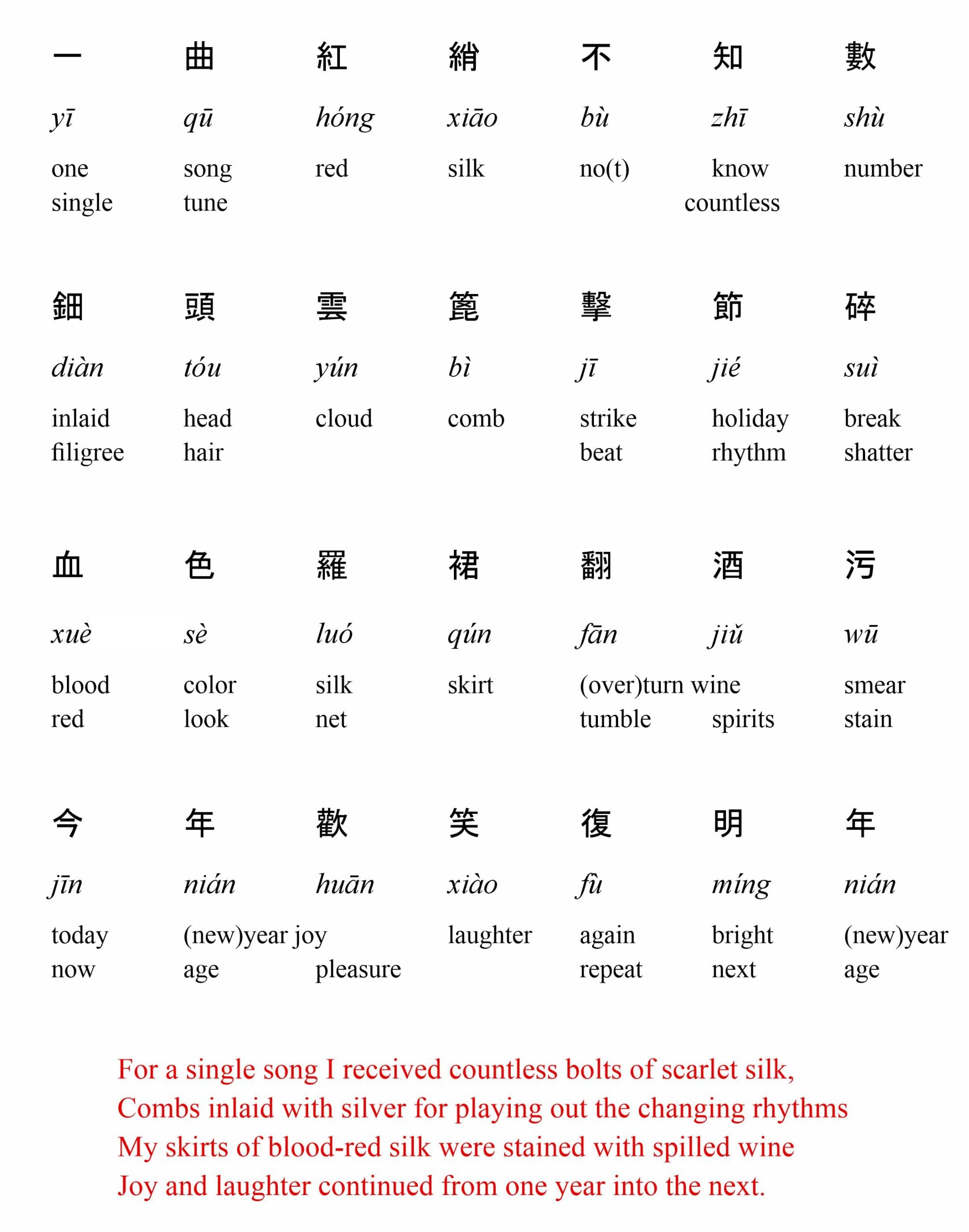
The poem is difficult to translate since its sound patterns are as important as its meaning (Peng, 2023; Yu & Chang, 2024). This post will provide some sense of the Chinese sound patterns of Bai Juyi’s poem with recitations by Pu Cunxin and accompanying pipa by Wu Yuxia, taken from a production by China Global Television Network. After Giles’ s initial prose version, most English translations have use blank verse and made some attempt to imitate the sounds of the original. The translation of Xu Yuanzhong (1987, 1994) uses rhyming hexameter couplets. The translations in red accompanying the character-by-character transcriptions in this post are mine; they are heavily indebted to the other available translations.

The Setting

Bai Juyi provides his poem with a preface that sets the time and the place. During his banishment to JiuJiang, while saying farewell to a visitor one evening on the banks of the Yangtze, he hears the music of a pipa. He finds out that the player had once been a famous musician and courtesan at the court in Chang’an. However, as she had grown old, her beauty had faded, and she had retired unhappily to the provinces. Bai Juyi is struck by the similarity of his fate to hers, and mourns their mutual fall from grace:

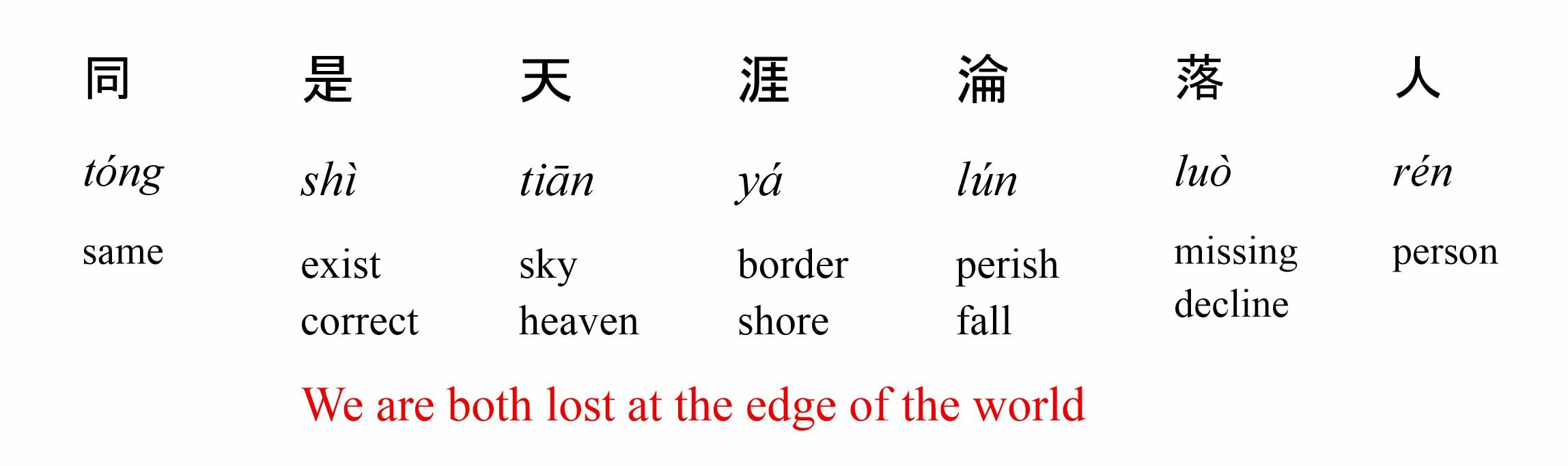
Moved by her story, he writes a long poem about the pipa player on the river far from Chang’an

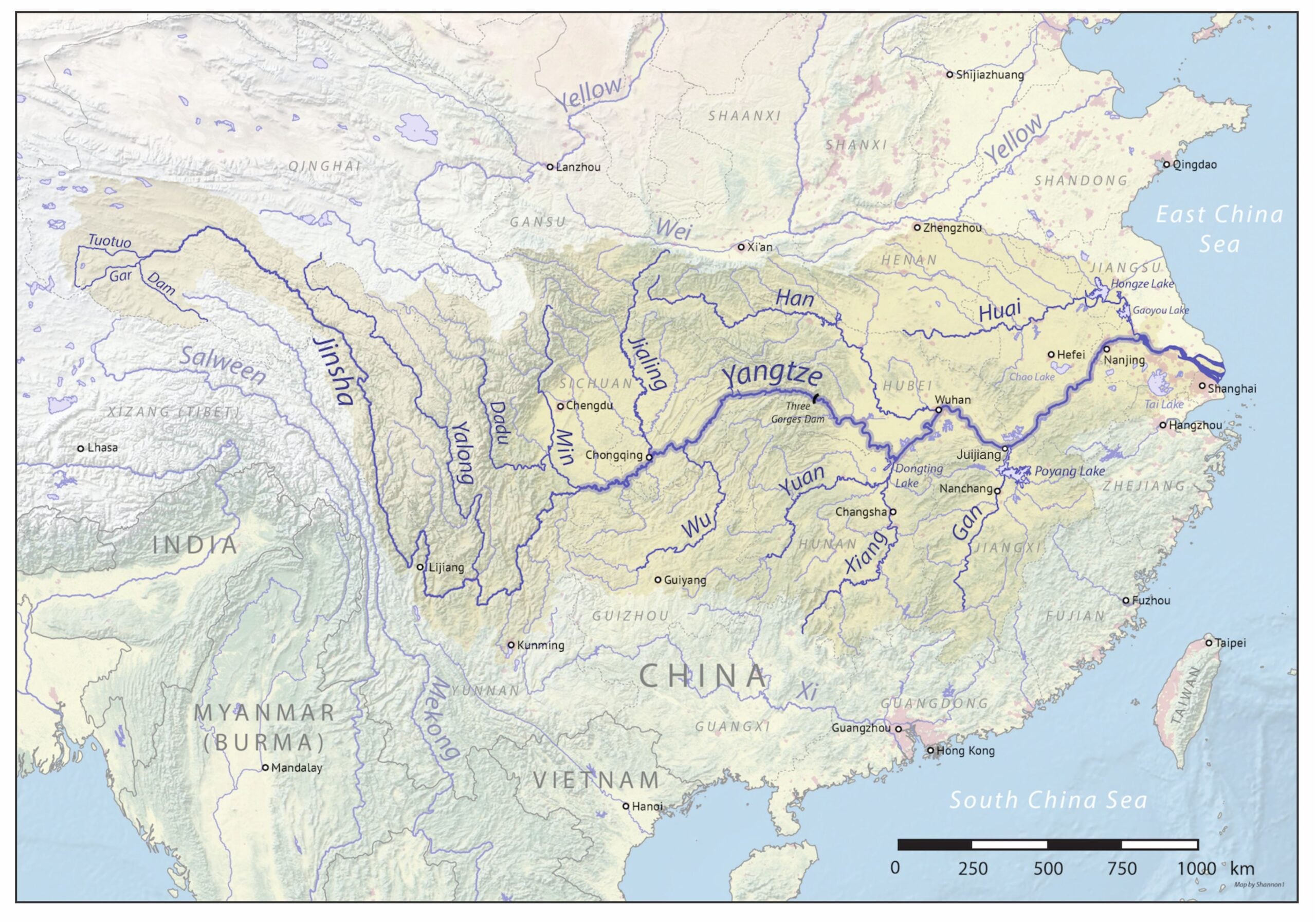
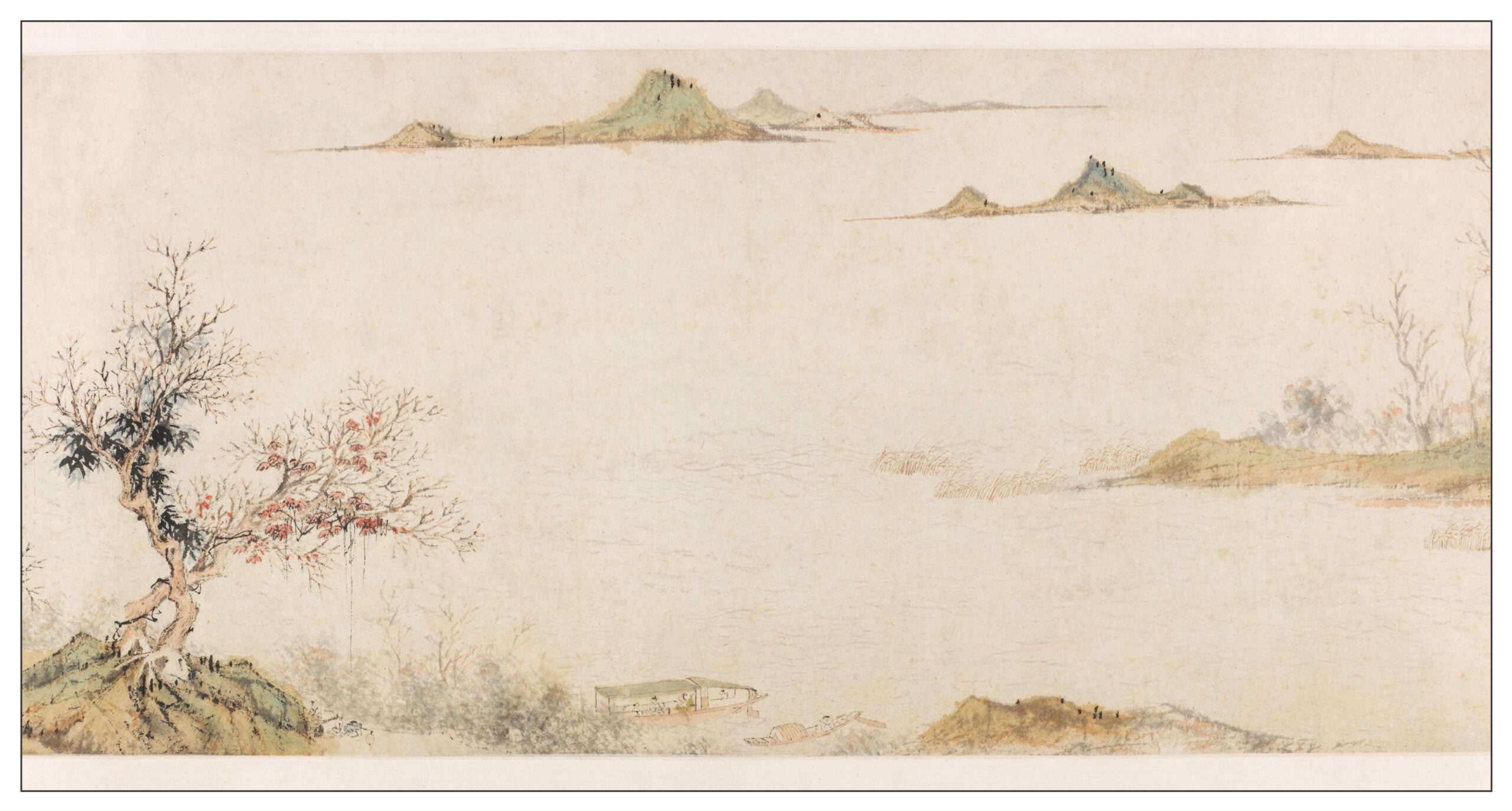
Jiujiang, which had once been known as Jiangzhou, is a city on the Yangtze River. The region of the river near Jiujiang was sometimes known as the Xunyang River. The Yangtze River, the third longest river in the world, is about 1.5 km wide at Jiujiang. Lake Pongyi, which was once called Pengli Lake, the largest freshwater lake in China, drains into the Yangtze at the eastern edge of the city:

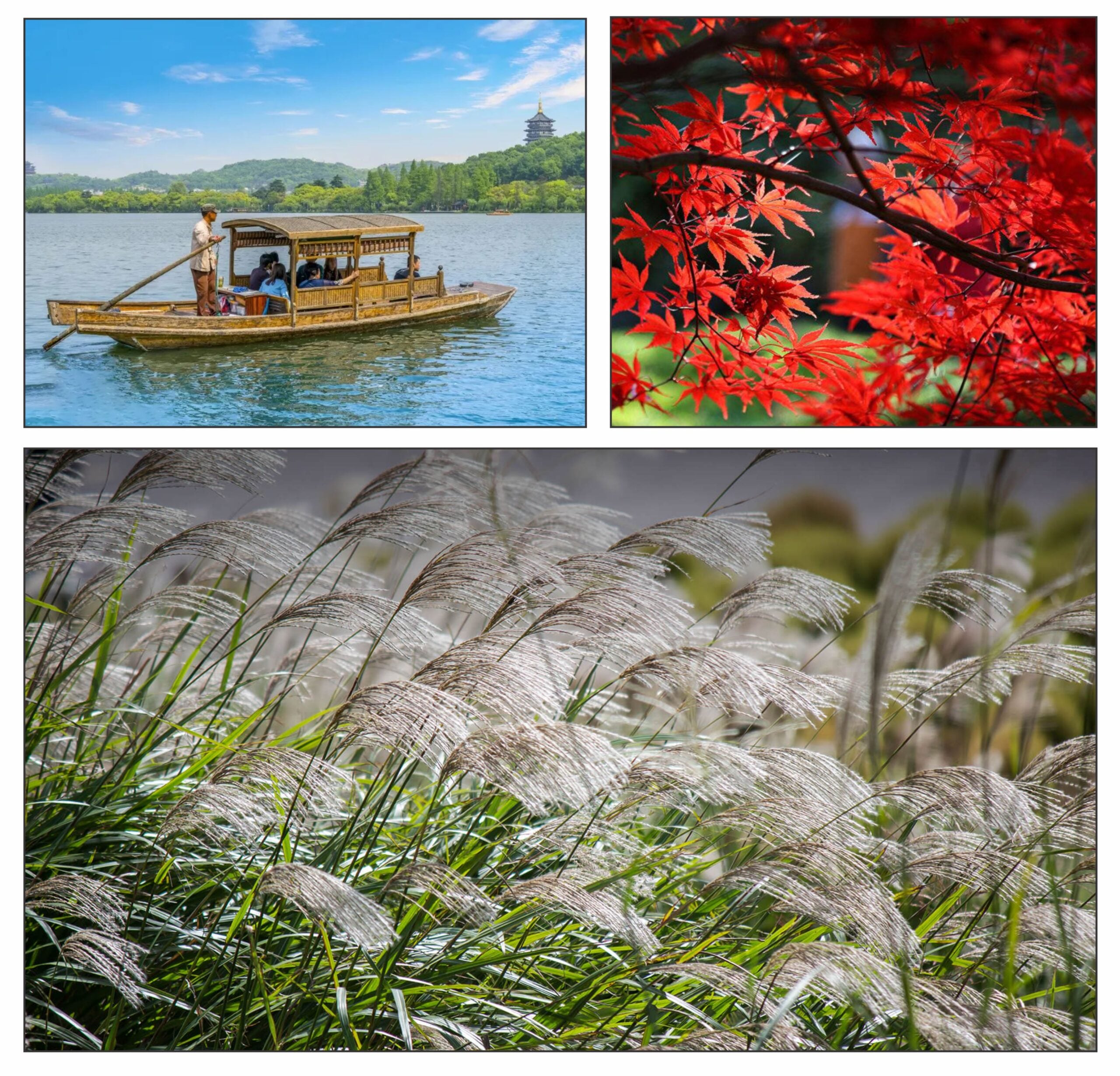
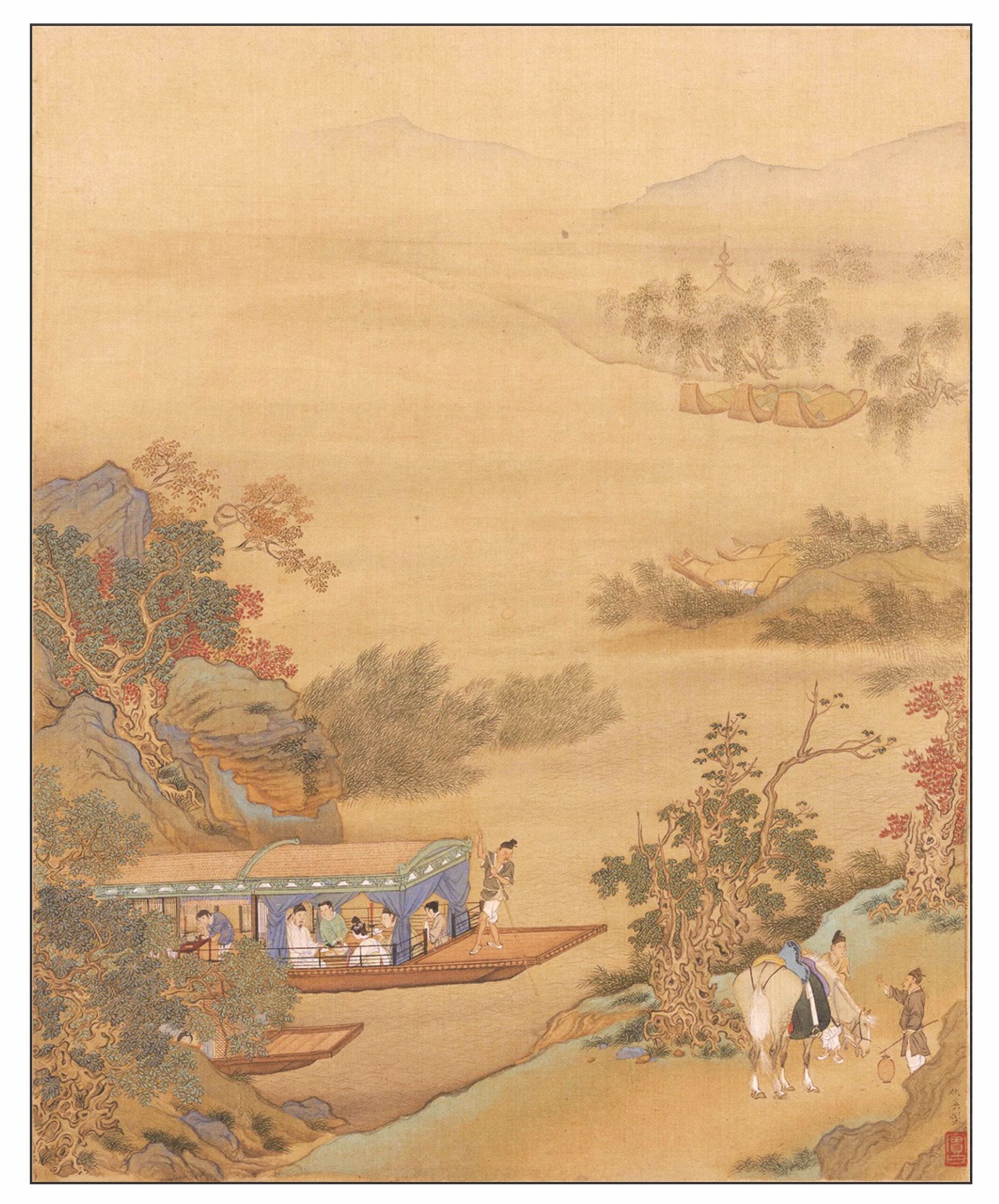
Bai Juyi is throwing a farewell party for his departing friend on a small pleasure boat on the river. As shown in the following illustration from Hangzhou in eastern China, these small rowboats still provide spaces for celebrations on the waters. In Jiujiang it is autumn: the maple leaves have turned scarlet, and the plumes of the silver grass have reached their peak. 

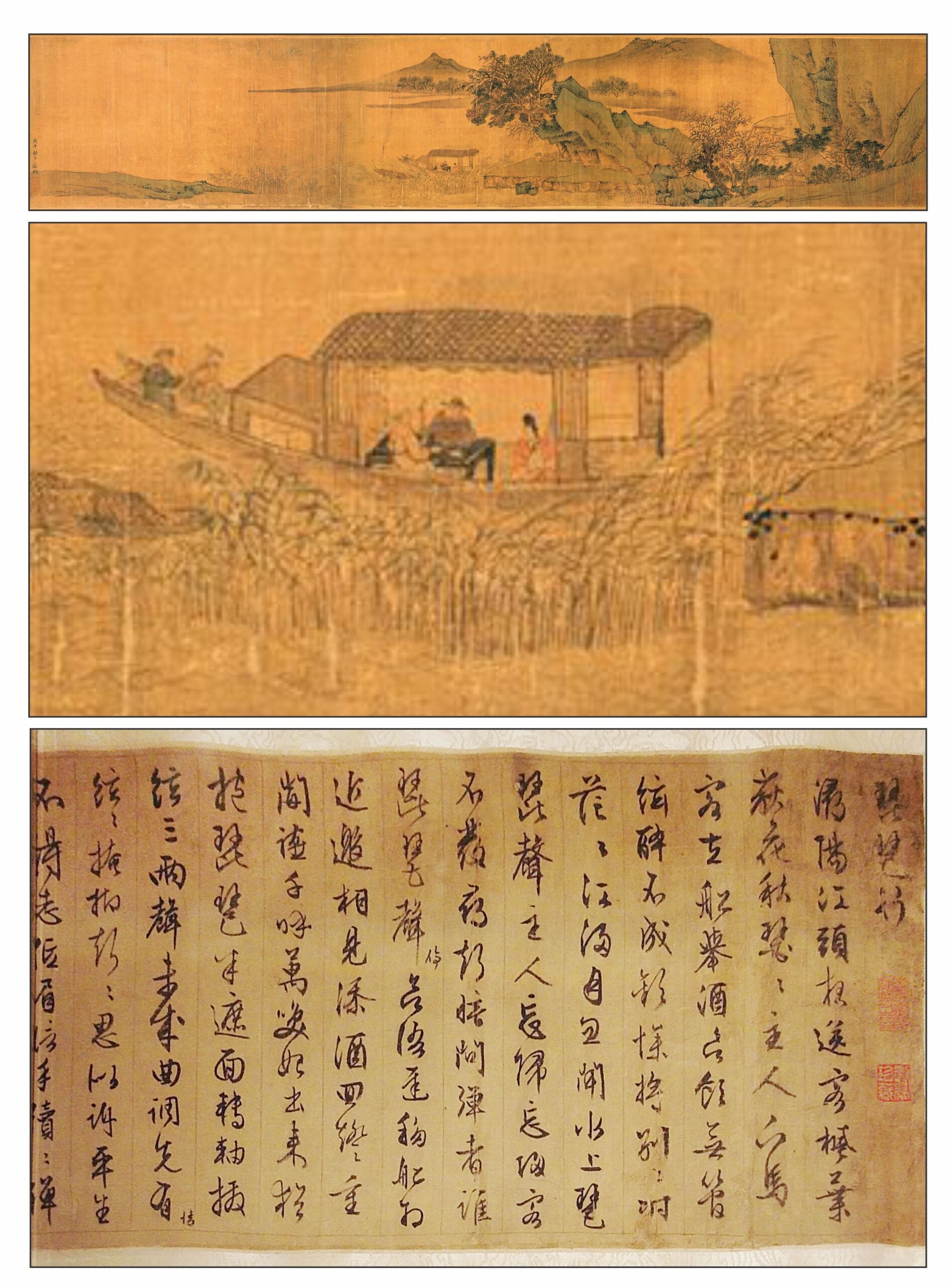
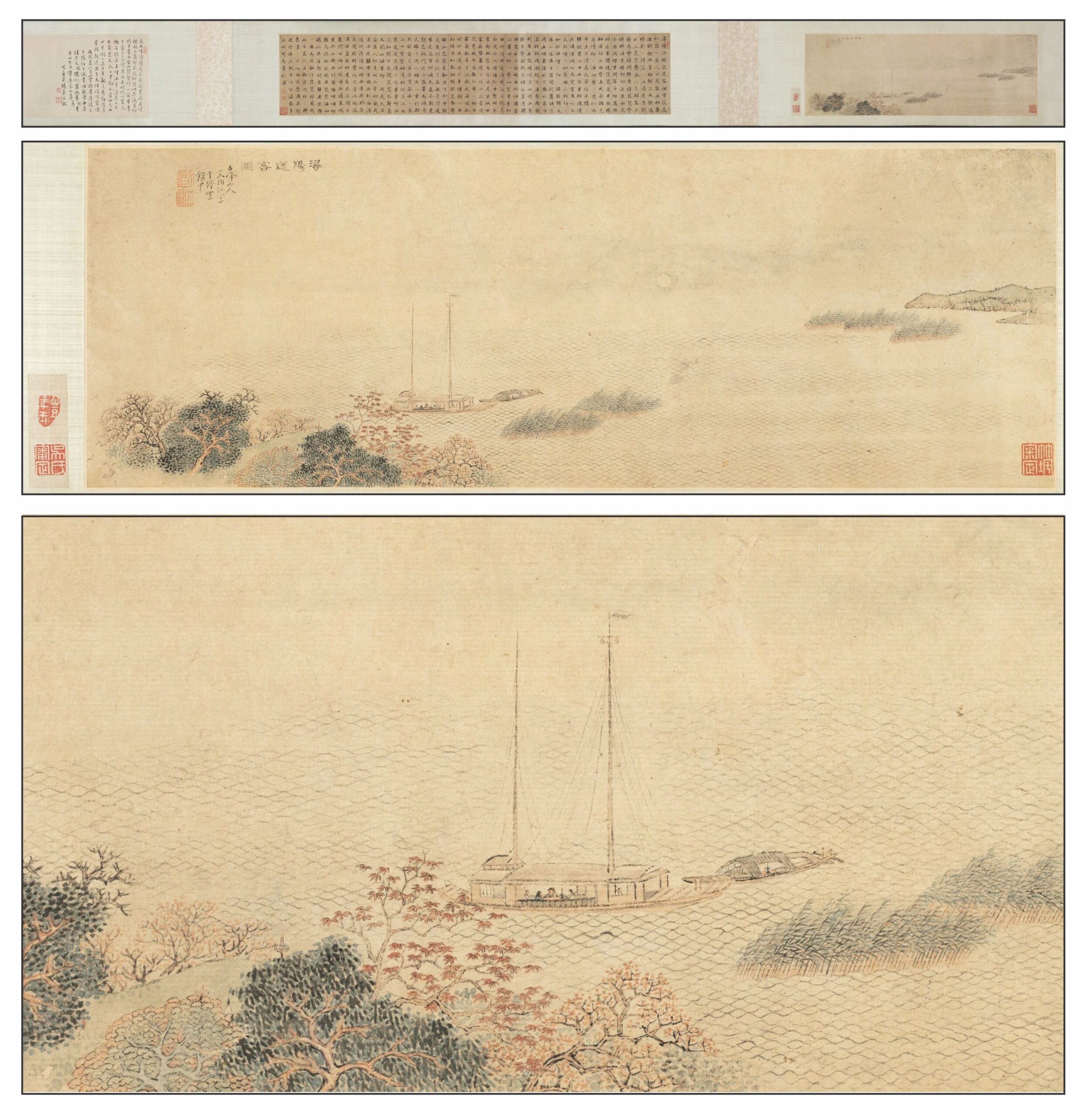
The following illustration shows a scroll with calligraphy of Pipa Xing by Wen Zhengming (1470-1559) at the National Palace Museum, Taipei. At the top is the painting at the beginning of the scroll. In the middle is an enlargement of the boat with the poet and his guest listening to the pipa player. At the bottom is the beginning of the calligraphy in semi-cursive (or running) script. The first line (on the left) has the title:

Beginning of the Ballad

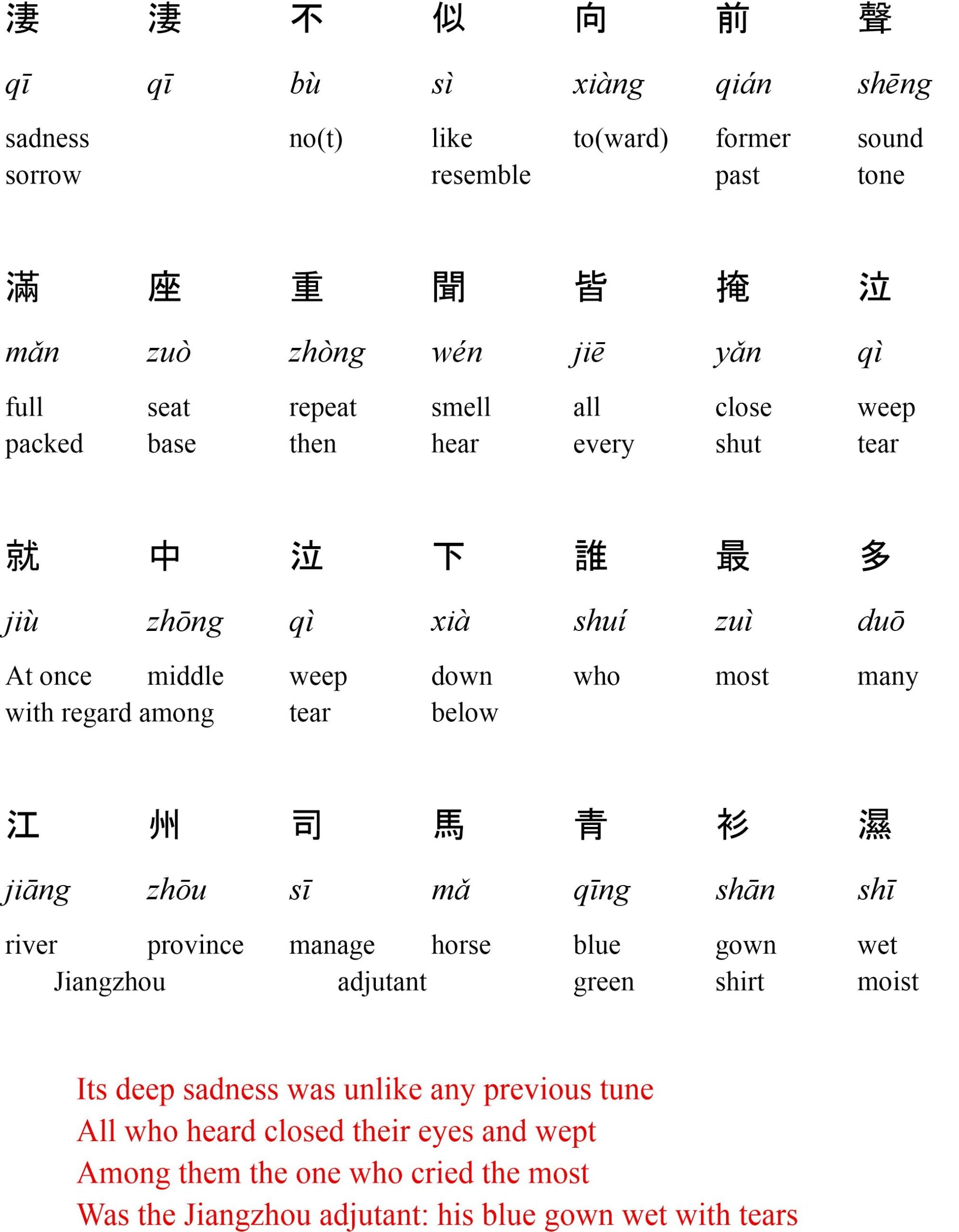
The initial lines of the ballad describe the autumn leaves and the silver grass. The farewell party begins but there is no music:

The opening scene of the poem was portrayed in a silk-painting (34 x 41 cm) in an album by Qiu Ying (1494-1552) now at the Palace Museum in Beijing:


The Pipa

As the party laments the absence of music, the sound of a pipa is heard across the water from another boat. The partygoers are completely entranced. They call out and ask the musician to play for them. She agrees but holds the pipa up to hide her face.

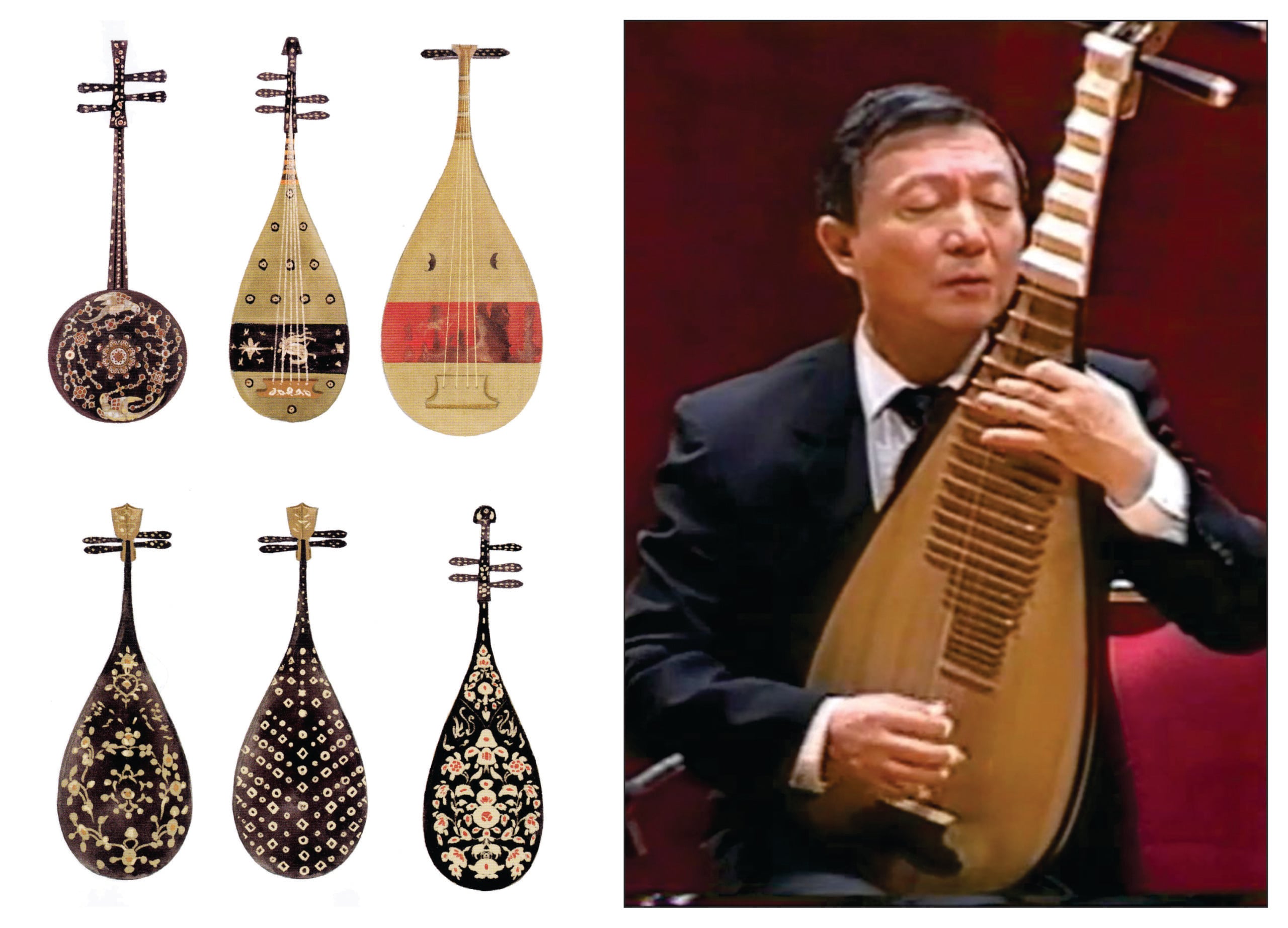
The pipa is a Chinese plucked string instrument very similar to the European lute (Wong, 2011). Both instruments have their origin in the Middle East. The pipa came to China via the Silk Roads during the Han Dynasty (206 BCE–220 CE). The instrument typically has 4 strings though some old pipas have 5. Though early pitas have as few as 4 frets, modern pitas can have up to 30. Though occasionally round, the body of the pipa is usually pear-shaped. Traditionally the pipa was played for small intimate groups, but in modern times electronic amplification has allowed pipa virtuosos to play for larger audiences. The following illustration shows some ancient pitas and a photograph of Liu Dehai (1937-2020), one the greatest pipa players of recent times.

The following is a performance of “Xunyang Moonlit Night” (阳月夜, Xúnyáng yuè yè) by Liu Dehai.

The Music

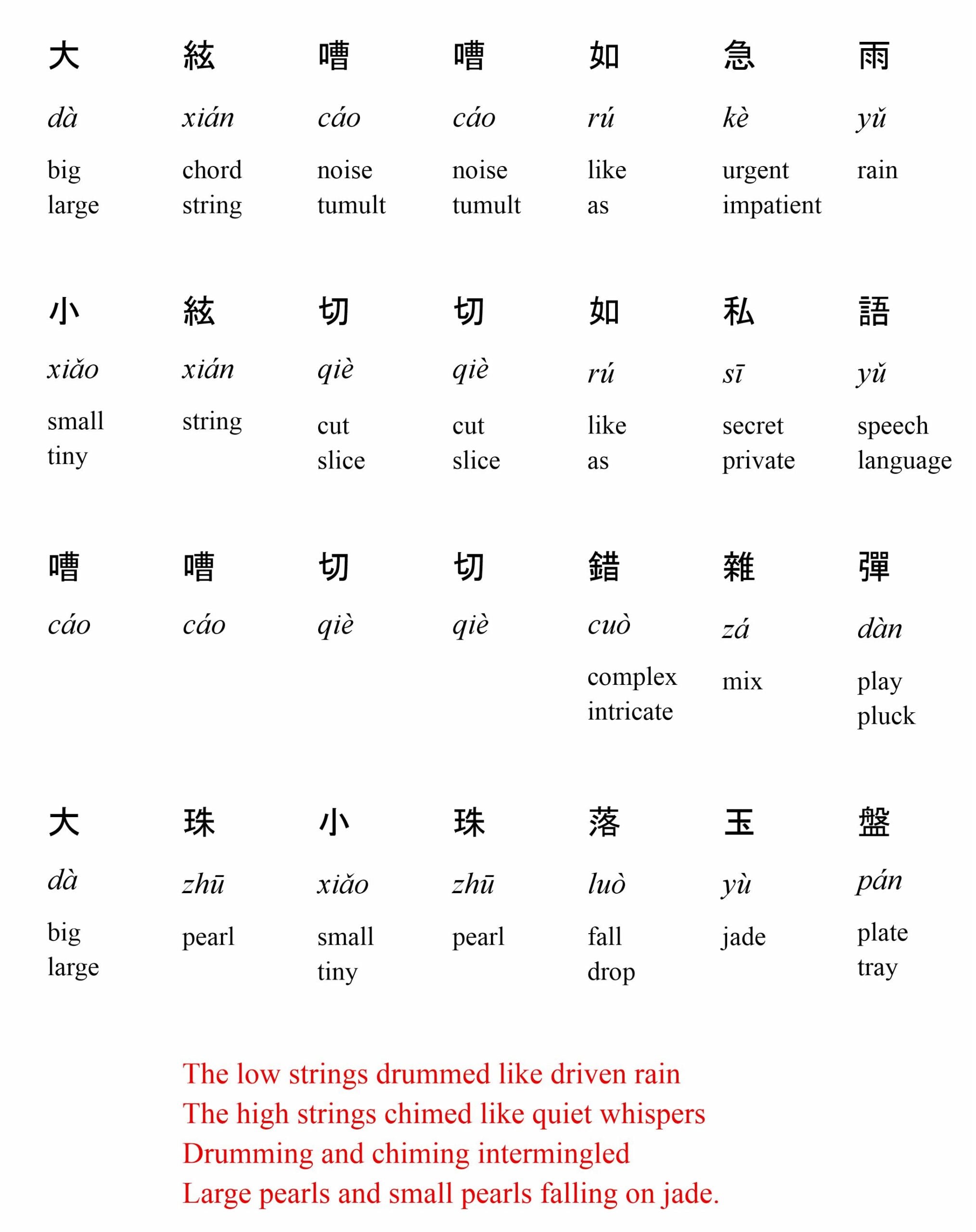
The poem then provides a bravura description of the music of the pipa:

These are some of the most famous lines of poetry in China. They have been variously translated. The following version by Xu Yuan-Zhong (1984; 1987) uses the same rhyme scheme as the Chinese poem:

The thick strings loudly thrummed like the pattering rain
The fine strings softly tinkled in murmuring strain.
When mingling loud and soft notes were together played,
’Twas like large and small pearls dropping on plate of jade.

Witter Bynner (1929) uses blank verse in his translation:

The large strings hummed like rain,
The small strings whispered like a secret,
Hummed, whispered—and then were intermingled
Like a pouring of large and small pearls into a plate of jade.

And the following translation is by Isabel Wong (2011), a musician rather than a poet:

The lowest string hummed like pouring rain;
The higher strings whispered as lover’s pillow talk.
Humming and whispering intermingled
I,ikc the sound of big and small pearls gradually falling into a jade plate.

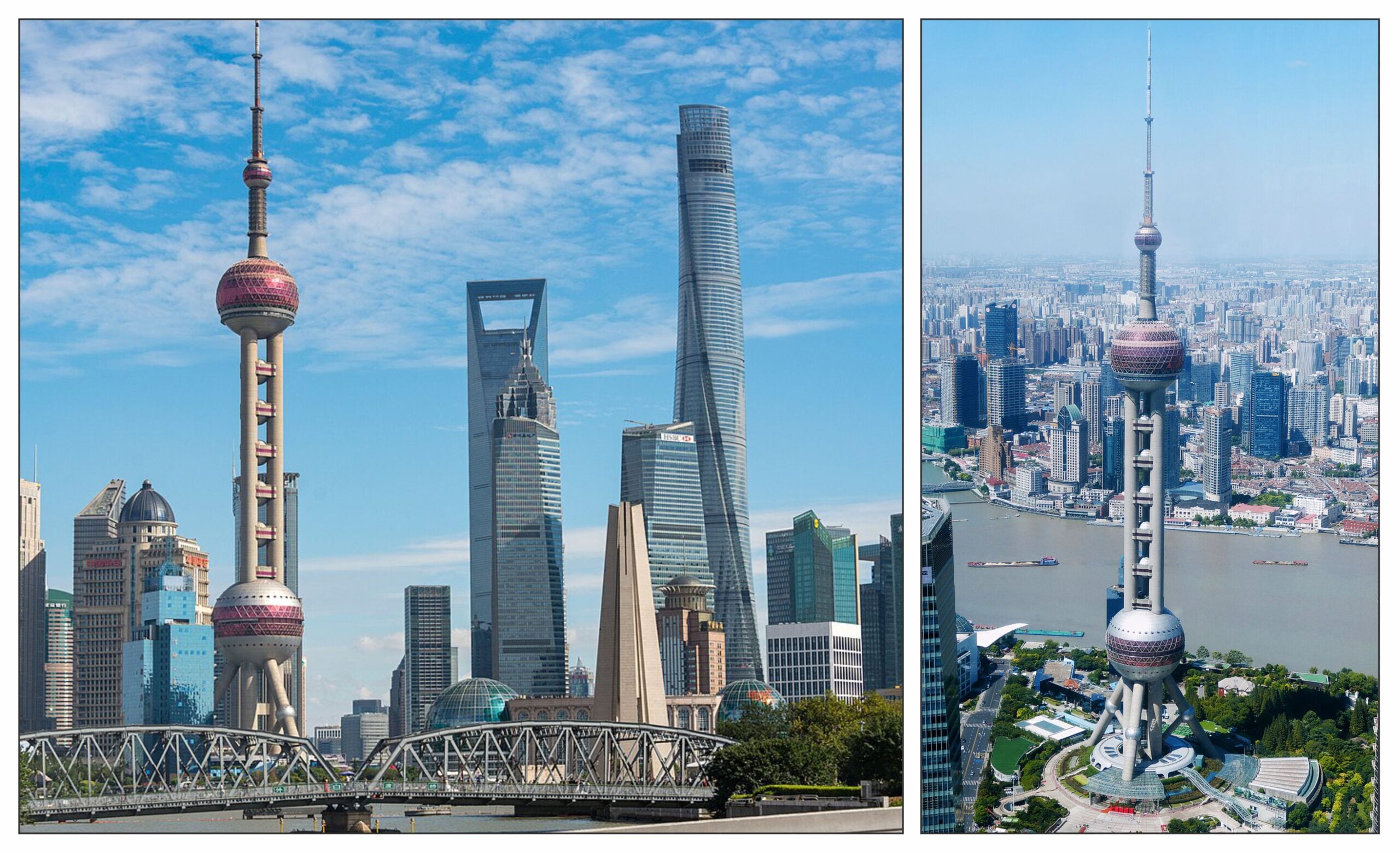
The architects of the Oriental Pearl Tower (1994) in Shanghai based their design on Bai Juyi’s image of pearls falling onto jade:


Following the music of the pearls, the pipa provides the quiet song of an oriole, and then like a freezing brook the music slows to a stop:


After a brief pause the pipa plays a wild crescendo that sounds like the charge of armored warriors, and then suddenly the player stops.


The Life of the Pipa Player

During the ensuing silence, the pipa player tells her story. She was once a highly acclaimed musician in Chang’an. Her beauty and her talent were the toast of the court.

This description of the life of a successful musician and courtesan in Chang’an has been translated in many ways. One version is especially vivid. In 1917, Ezra Pound (1885-1972) published Three Cantos in Poetry Magazine, and again in the American edition of his book Lustra. This was the beginning of a set of Cantos that ultimately numbered 109. These initial three cantos – often called the Ur-Cantos – were extensively revised when Pound published A Draft of XVI Cantos in 1925. Much of the original Canto II is no longer evident in the new sequence. The general theme of Ur-Canto II was the “poetics of loss” (Carr, 2018). Pound describes the ruins of the ducal palace in Mantua, and mourns the loss of most of the music of the troubadours. And then he provides a brief description of the setting of Bai Juyi’s poem and the words of pipa player:  

     Yin-yo laps in the reeds, my guest departs,
The maple leaves blot up their shadows,
The sky is full of autumn,
We drink our parting in saki.
Out of the night comes troubling lute music,
And we cry out, asking the singer’s name,
And get this answer:
                                   “Many a one
Brought me rich presents; my hair was full of jade,
And my slashed skirts, drenched in expensive dyes,
Were dipped in crimson, sprinkled with rare wines.
I was well taught my arts at Ga-ma-rio,
And then one year I faded out and married.”
The lute-bowl hid her face.
                              We heard her weeping.

It was not until much later that Pound’s allusion to Bai Juyi was recognized (e.g. in Weinberger, 2007, p 128; discussed on the Pound Cantos Project website)

Pound had no knowledge of the Chinese language. In his book Cathay (1915), he “translated” a set of 15 Chinese poems based on the notes of Ernest Fenollosa who had studied Chinese poetry with the Japanese professors Mori and Ariga. Despite his lack of training in Chinese, Pound intuitively grasped the essence of the poems (see discussion by Yip, 1969). The brief excerpt from Ur-Canto II is typical of his translations. The meaning is clear though the words are not the same as in the original.

In Pound’s poem, Yin-yo is the Japanese transliteration of Chinese characters for the Xunyang River (Romaji, Jinyō-kō), and Gamaryo is the Japanese version of 蟆陵, which literally translated is “Toad Hill” (Fuller, 2017, p 286). This is the region in Chang’an city near the burial site of the Confucian scholar Dong Zhongshu (179–104 BCE). In Bai Juyi’s poem, the pipa player says that this is where she grew up (and learned how to play the pipa).   

To return to the poem: The pipa player’s high life did not last forever. Her brother went off to the army, her mother died, her looks faded, and she was no longer as sought after as before. She married a tea-merchant and came to live in Jiangzhou. Her husband is usually away on business. Alone on her boat she plays the pipa and remembers happier days.

Listening to her story Bai Juyi feels an intense sympathy: he too has fallen from grace and now lives alone far away from the capital.  The musician plays a final intense song:

We do not know the music that Bai Juyi found so moving. The following is a piece entitled Night Thoughts composed and played by Wu Man (1963- ), who studied with Liu Dehai.

Wu Man’s composition derives from a famous poem by Li Bai, who spent much of his later life in exile from the capital. The following translation is by Xu Yuan-Zhong (1984, p 125).

靜夜思                    A Tranquil Night

床前明月光             Before my bed a pool of light
疑是地上霜             Is it hoarfrost upon the ground
舉頭望明月             Eyes raised I see the moon so bright
低頭思故鄉             Head bent in homesickness I’m drowned

The Life of the Poem

Bai Juyi’s poem was popular among calligraphers and artists. The following is a scroll by Wen Boren (1502-1575) now in the Cleveland Museum.

And the next illustration is a painting by Lu Zhi (1495-1576), from a calligraphy scroll now in the National Museum of Asian Art at the Smithsonian Institution. The boats near the lower shore are as lost as the poet and the pipa player:

And the following is an illustration by Hua Zhangyi from a retelling of Bai Juyi’s poem (Liu Yang, & Hua Zhangyi, 2024) for children: the poet dedicates his poem to the pipa player.


References

Bynner, W. & Kiang Kang-Hu, (1929). The jade mountain: a Chinese anthology, being three hundred poems of the T’ang dynasty, 618-906. Alfred A. Knopf.

Carr, H. (2018). The Ur-Cantos. In R. Parker (Ed.) Readings in the Cantos. (pp 9-32). Clemson University Press.

Fuller, M. (2018). An Introduction to Chinese Poetry: From the Canon of Poetry to the Lyrics of the Song Dynasty. Harvard University Asia Center.

Geng, L. (2021). The four great Tang poets. In A Comprehensive Study of Tang Poetry II (pp. 1–42). Routledge.

Giles, H. A. (1884, revised 1923). Gems of Chinese Literature. Bernard Quaritch

Harris, P. (2009). Three hundred Tang poems. Alfred A. Knopf (Everyman’s Library)

Liu Yang, & Hua Zhangyi, (2024). 琵琶行 (Pipa Song). CITIC Press.

Peng, Y. (2023). A comparative study on two English translations of Song of a Pipa Player from the perspective of translation aesthetics. Frontiers in Humanities and Social Sciences, 3(4), 36-40.

Pound, E. (1915). Cathay. Elkin Mathews.

Pound, E. (1917a). Three Cantos II. Poetry, 10 (4), 180-188

Pound, E. (1917b). Lustra of Ezra Pound: with earlier poems. Alfred A. Knopf.

Tan, M. A. (2025). Bai Juyi and Yuan Zhen. In Z. Zhang & V. H. Mair (Eds.) Routledge Handbook of Traditional Chinese Literature (pp. 151–161). Routledge.

Waley, A. (1949, reprinted 2005). The Life and Times of Po Chu-i. Routledge.

Watson, B. (1984) The Columbia book of Chinese poetry: from early times to the thirteenth century. Columbia University Press.  

Weinberger, E. (Ed.). (2007). The New Directions Anthology of Classical Chinese Poetry. Carcanet.

Wong, I. (2011). The Music of China. In Capwell, C., Nettl, B., Bolman, P., Dueck, B., Rommen, T., Wong, I., & Turino, T. (Eds.). Excursions in World Music, 6th Edition. (pp 88-131). Taylor & Francis

Xu, Y., Loh, B., & Wu, J. (1987). 300 Tang poems: a new translation. The Commercial Press.

Xu Yuan Zhong (1994). Songs of the immortals: an anthology of classical Chinese poetry. Penguin Books in association with New World Press.

Yip, W. (1969). Ezra Pound’s Cathay. Princeton University Press.

Yip, W. (2004). Chinese Poetry: An Anthology of Major Modes and Genres. (2nd ed., Revised).  Duke University Press.

Yu, Y., & Chang, C. (2024). Text complexity and translation styles from the perspective of individuation: a case study of the English translations of Pipa Xing. Humanities & Social Sciences Communications, 11(1), Article 159.


Wang Wei: the Wheel River Poems

Wang Wei (王维; traditional 王維; pinyin, Wáng Wéi; 699–761) was a Chinese musician, painter, and poet during the Tang Dynasty (618 to 907). He was a devout Buddhist and used the courtesy name Wang Weimojie in homage to the early Buddhist teacher and boddhisattva Vimalakirti (Chinese name 維摩詰 Wéimójí). Vimalakirti taught the practice of sunyata (Sanskrit, emptiness; Chinese 空性 Kōng xìng), a meditative state wherein the mind is emptied of the self and becomes one with the universe. After a tumultuous life, Wang Wei retired to his villa on the Wang River about 40 km southeast of the imperial capital Chang’an (present day Xi’an). There he composed the Wǎngchuān jí (辋川集 The Wheel River Collection): a set of twenty quatrains describing various locations near his villa. Each quatrain was accompanied by a reply from his protégé Pei Di (裴迪 pinyin, Péi Dí, 714-?).

A Poet of the High Tang

Wang Wei was born to an aristocratic family in Shanxi province in northeast China. He was a precocious child and quickly showed his talents for music and painting. By 721 he had passed his imperial exams and was appointed as Court Musician in Chang’an. Over the following years he continued with his music and painting, while serving in various official positions in the imperial court. In 755, the general An Lushan instigated a revolt against the emperor. Within a year the rebels advanced on Chang’an. The emperor and his court fled over the mountains to Sichuan in the West, but Wang Wei was captured and taken to the rebel capital of Luoyang some 350 km to the East. The imperial forces regrouped and defeated the rebels in 757, releasing Wang Wei. However, since Wang Wei had been forced to serve in the rebel government, he was indicted for treason. After finally being exonerated, Wang Wei retired to his villa on the Wang River, where he wrote the poems in the Wangchuan Ji (Wheel River Collection). Wang Wei died in 761. Followers of An Lushan continued fighting against the empire until 763.   

Although plagued by intense civil disorder, these times were remarkable for the glorious poetry that was written. Li Bai (701-762), Du Fu (712-770) and Wang Wei were the three greatest poets of a period that became known as the “High Tang” (Owen, 1981). Each of these poets had their own view of life: 

Wang Wei became known as the Poet-Buddha, Li Bai as the Poet-Immortal, and Du Fu as the Poet-Sage, respectively symbolizing Buddhist, Daoist, and Confucian approaches in their poems. Accordingly, Wang Wei was characterized as the contemplative, Li Bai as the visionary, and Du Fu as the social conscience of the age. (Cartelli, 2019).

However, Cartelli notes that these differences are far from categorical. The religious threads of Buddhism, Taoism and Confucianism are fully intertwined both in Chinese society (Ching, 1993; Hinton, 2020) and in the poetry of these three writers.

Wang Wei’s nature poetry simply describes his experience of the world with little if  any interpretation or metaphorical explanation:

Wang’s quatrains often ended in enigmatic understatement – a statement, a question, or an image that was so simple or seemed so incomplete that the reader was compelled to look beneath it for the importance. (Owen, 1981, p 38)

Owen (1981, p 45) describes Wang Wei’s state of mind as “unselfconsciousness” and relates it to the Buddhist idea of sunyata (emptiness). Only if the mind is emptied can one become aware of truth. And truth perhaps differs between East and West:

in contrast to the West, in the Chinese tradition truth usually lay not behind a mask of orphic complexity but rather behind a mask of guileless simplicity. To draw on this philosophical tradition was to alter entirely the way in which poetry was read: what was said was no longer necessarily all that was meant, and the surface mood might not be the real mood. Particularly in the Wang Stream Collection, we find poems that are visually complete but intellectually incomplete, which tease the reader to decipher some hidden truth. (Owen, 1981, p 39)

Yip (1972, p xi) remarks

In a mode of consciousness in which there is no disturbance of intellectual impositions, no hurry-scurry to establish causal relations, each object or moment is given the fullest chance to emerge in spotlighting distinctiveness very much the way everything appears keenly fresh in the orbit of a child’s vision.

Paintings

Although Wang Wei was a renowned painter, none of his paintings have survived to the present day. Nevertheless, later artists made many copies and interpretations of his work. One of his most famous paintings was a scroll depicting the various locations mentioned in the Wangchuan Ji. This essay will include images from three such copies: one by Guo Zhongshu (929-279) now in the National Palace Museum, Taipei, a copy of the Zhongshu scroll in The Freer Gallery in Washington, and a much later scroll by Wang Yuanqi, dated 1711, now in the Metropolitan Museum of Art in New York. An intriguing website provides images of a scroll together with translations of the Wangchun Ji poems.  

Wheel River Poems

The Wǎngchuān jí (辋川集) is a collection of poems containing 20 quatrains (絕可 juéjù, literal meaning “cut-off lines”)by Wang Wei and 20 replies by his young protégé Pei Di. Each line is composed of 5 characters in a format is known as 五絕 (Wǔjué). The poems describe various locations near Wang Wei’s villa on the Wang River. The name of the river (辋 Wǎng, a different character from that in the poet’s name) specifically refers to the rim (felloes or felly) of a wagon wheel, and Hinton (2006) translates the title “Wheel-Rim River.” The river was so named

because of its small eddies and whirlpools which resembled wheels, or because of the spot at the mouth of the river where the current flowed around an island like a wheel (Wagner, 1981, p 88).

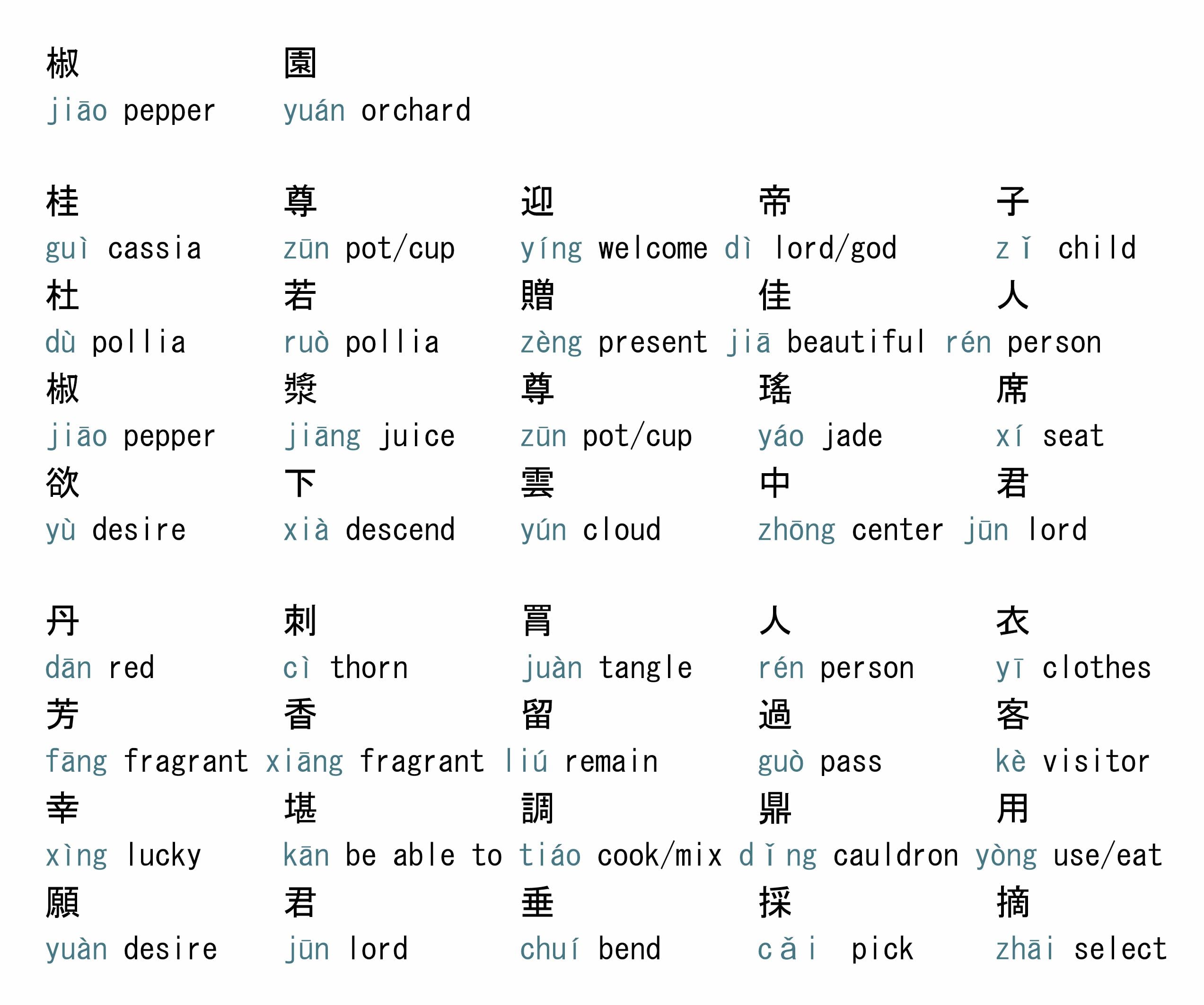
Many authors have translated Wang Wei’s contributions to the collection (e.g., Yu, 1980; Barnstone et al., 1991; Hinton, 2020), but only a few include the replies of Pei Di (Yip, 1972, Powell, 2019; Rouzer & Nugent, 2020). The general evaluation has been that Pei Di’s poems were inferior to those Wang Wei. However, Pei Di was a talented young scholar, and a close reading of the poems shows that the pairing of the poems enhances their overall effect (Warner, 2005). This essay will consider five of the poems in the collection. For consistency and because of the sensitivity and precision of the translations, the English versions will all be from Hiding the Universe by Wai-lim Yip (1972). The poems will be presented with Wang Wei on the left and Pei Di on the right. The translations will then be followed by the Chinese text, with Wang Wei above and Pei Di below.

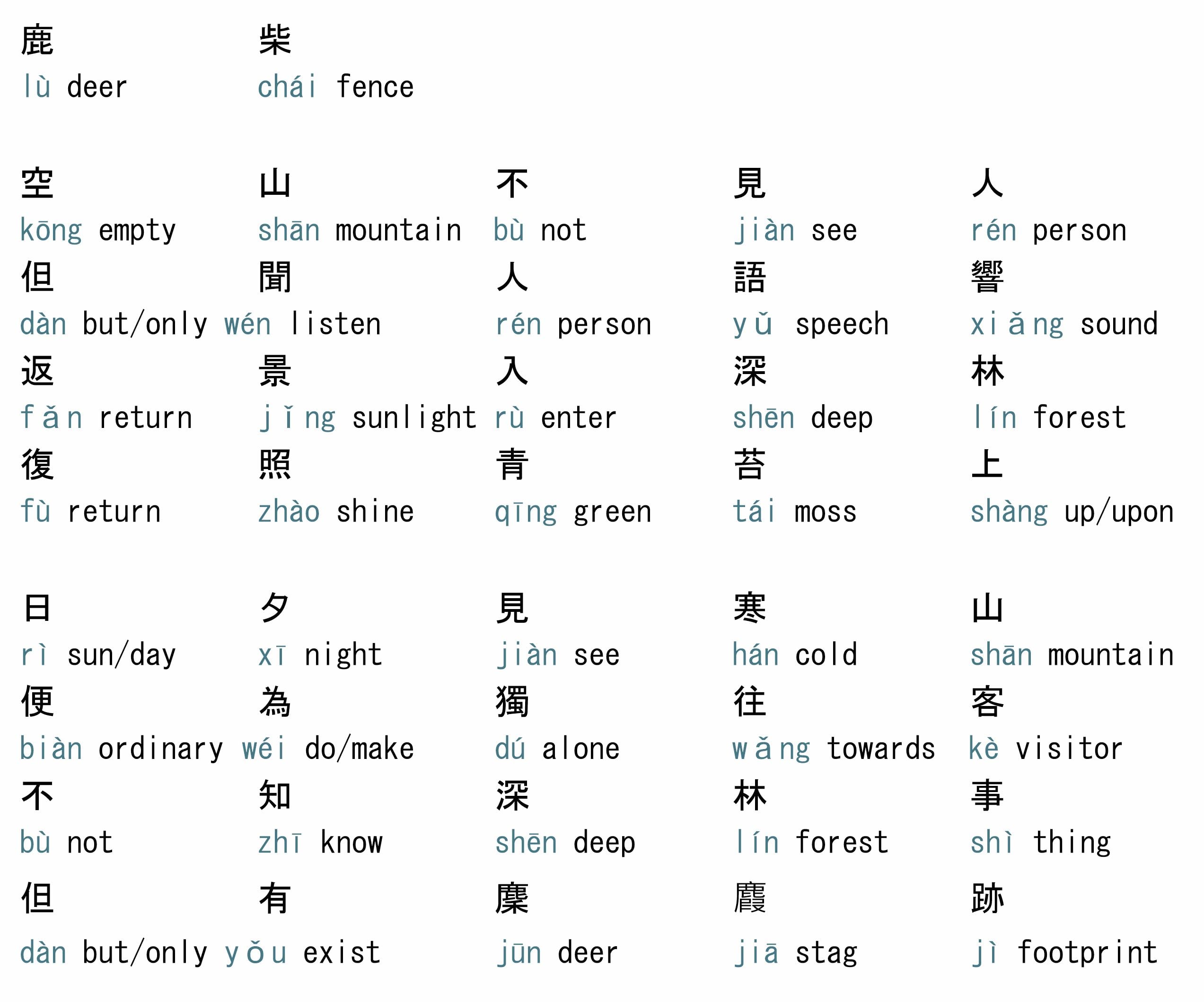
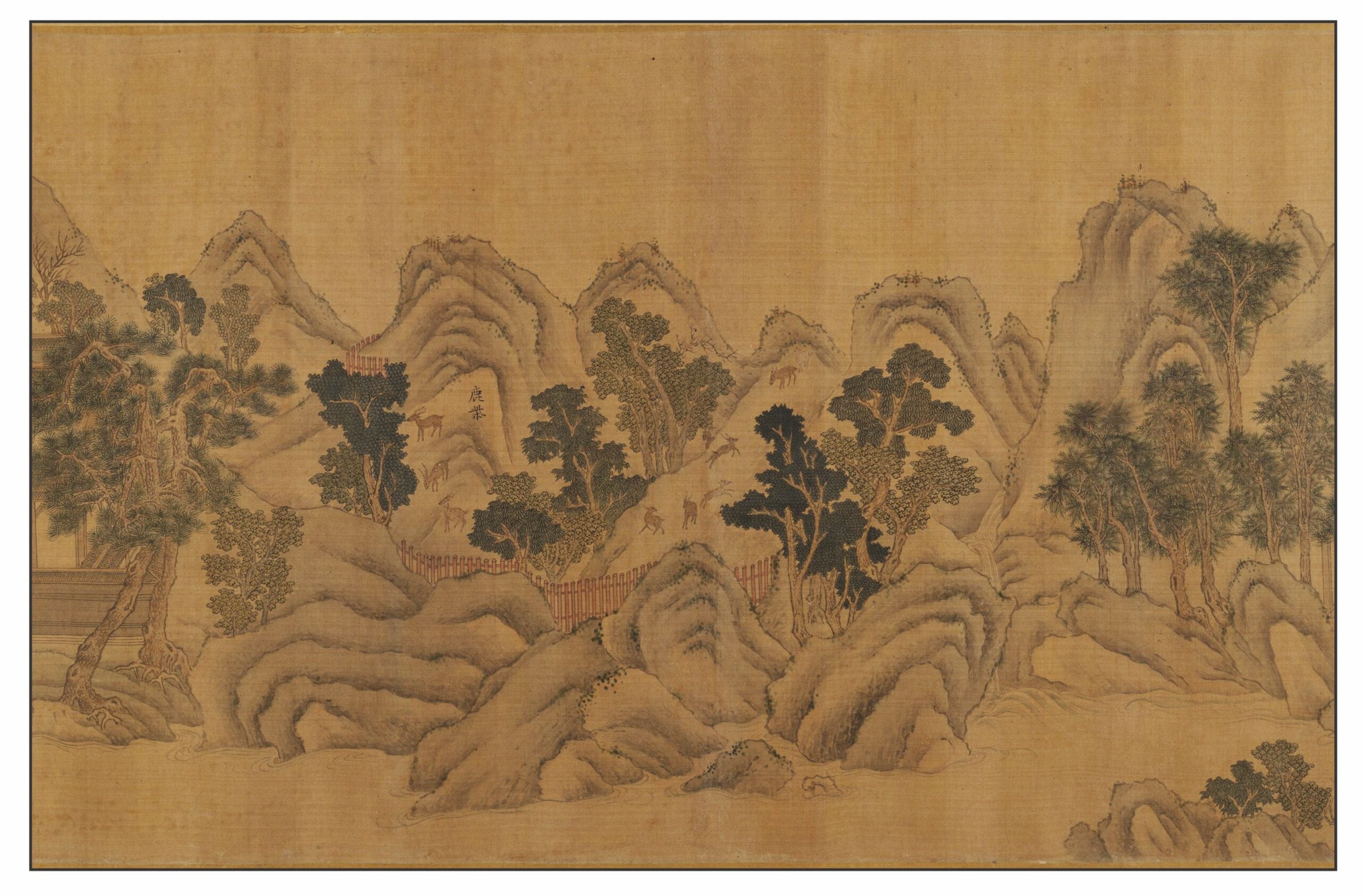
Deer Park

Empty mountain: no man is seen,                    Day in, day out, cold mountain in view.
But voices of men are heard.                            A wayfarer comes and goes alone;
Sun’s reflection reaches into the woods           Knows no things of the pine-forests
And shines upon the green moss.                    But tracks of buck and doe.

The following is a reading of this poem from a website associated with Zong-qi Cai’s book on How to Read Chinese Poetry in Context (2018).

The difficulty of translating this poem into English was the subject of Eliot Weinberger’s book Seventeen Ways of Looking at Wang Wei (1987). Chinese characters often have many meanings, and can be translated as nouns, verbs or adjectives, depending on the context. One difficulty with Wang Wei is his lack of a personal viewpoint. The ending of the first line is therefore better translated “no one is seen” rather than “I see no one.”

The presence of a deer park on Wang Wei’s estate was probably related to Buddhist teachings. Gautama gave his first sermon, wherein he delineated the four noble truths and the eightfold way, at a deer park in Sarnath in Northern India. The Chinese character 柴 chái now means “firewood,” although it likely once also meant a “fence,” such as that enclosing a park.  

The opening word of the poem 空,kōng means empty or emptiness. Wang Wei is clearly alluding to the Buddhist concept of sunyata (Yang, 2001; Stepien, 2014).

The characters 返景 translated as “returning or reflected sunlight” might simply mean the light from the setting sun.

The complementary poem by Pei Di makes Wang Wei’s feeling of emptiness extend over time as well as space. He also comments on the difference between the human wayfarer who knows nothing of the way of the forest, and the deer who are naturally attuned to its secrets.

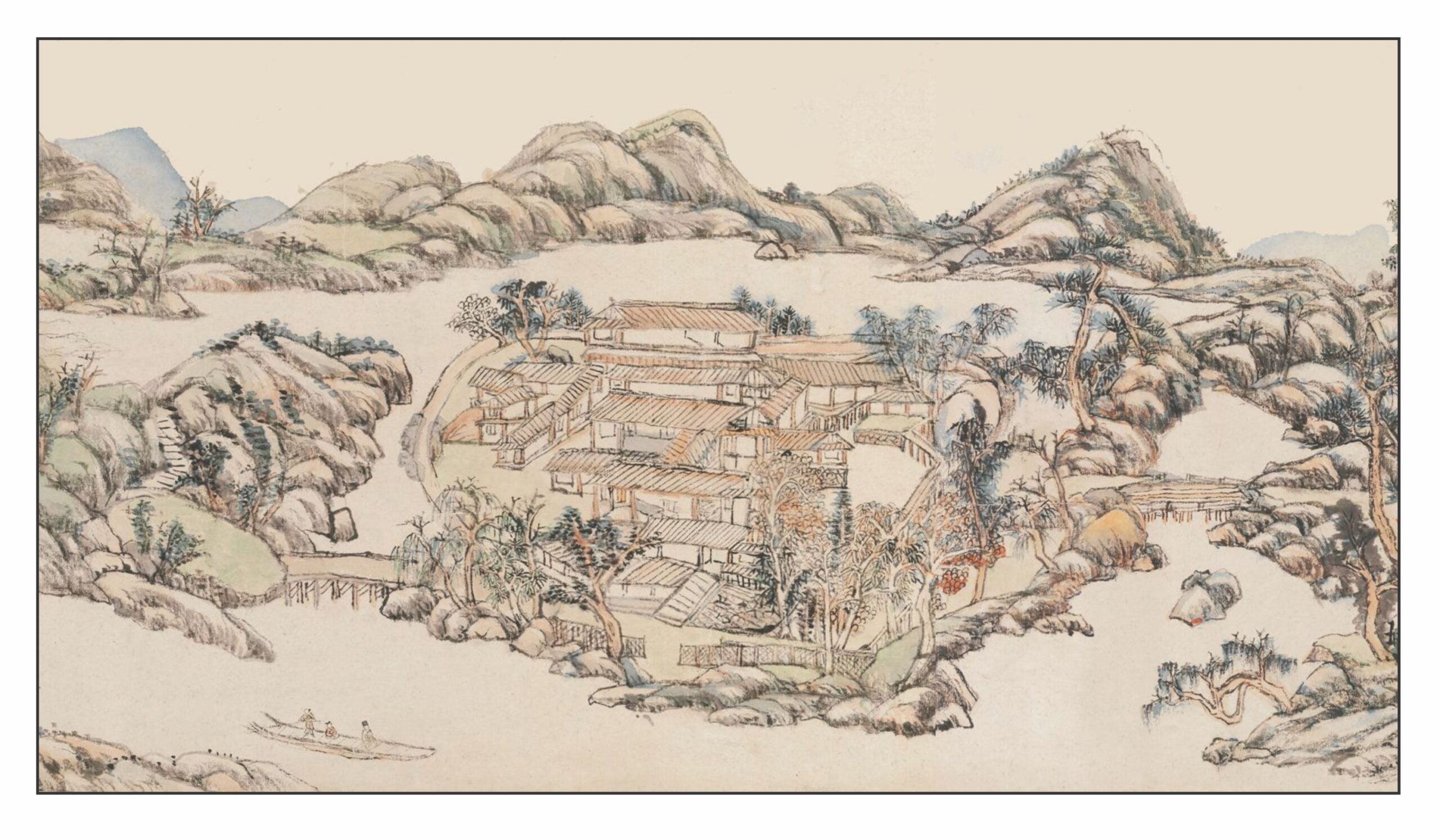
The following illustration of the Deer Park is from the Zhongshu scroll in Tapei:

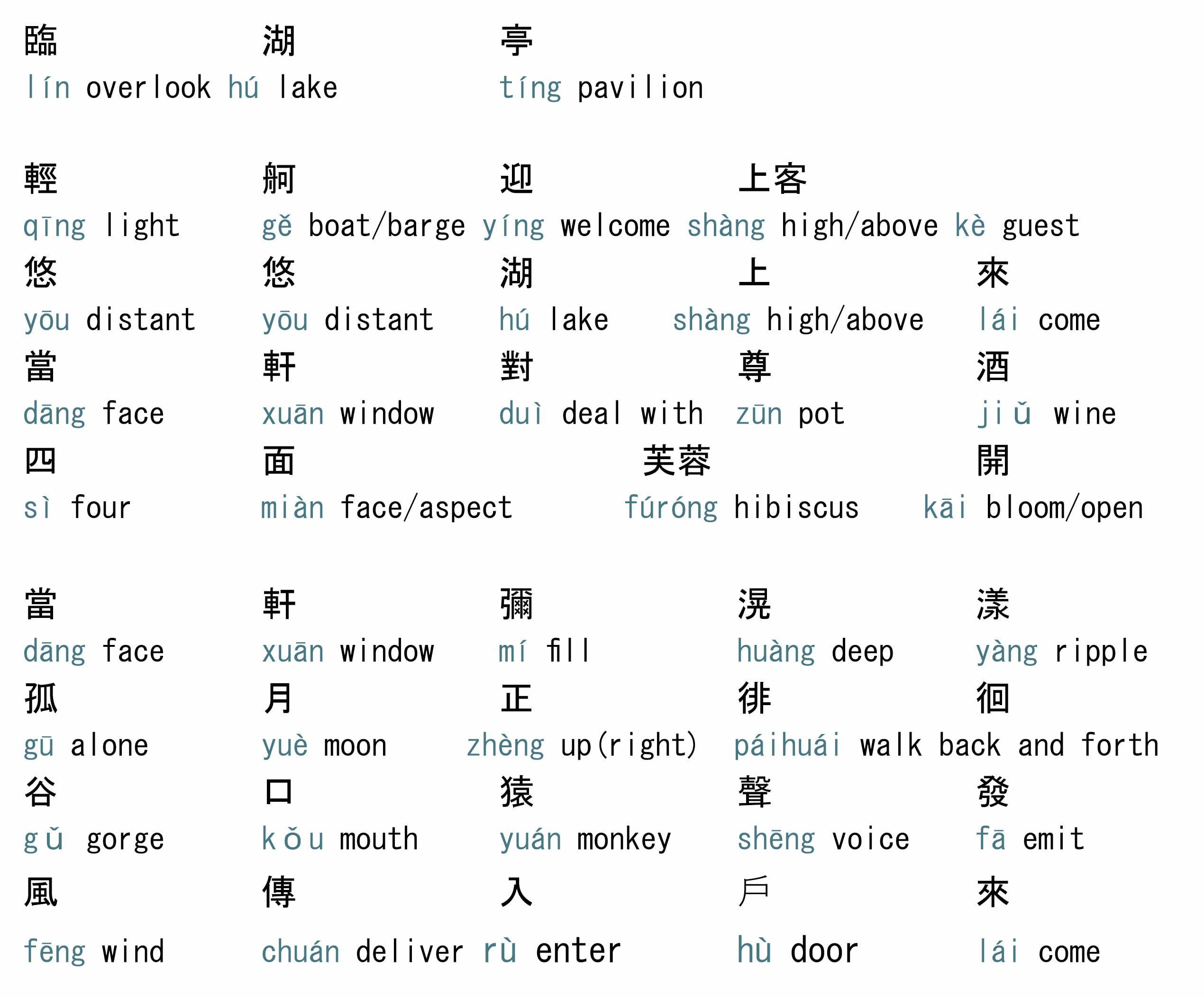
Lakeside Pavilion

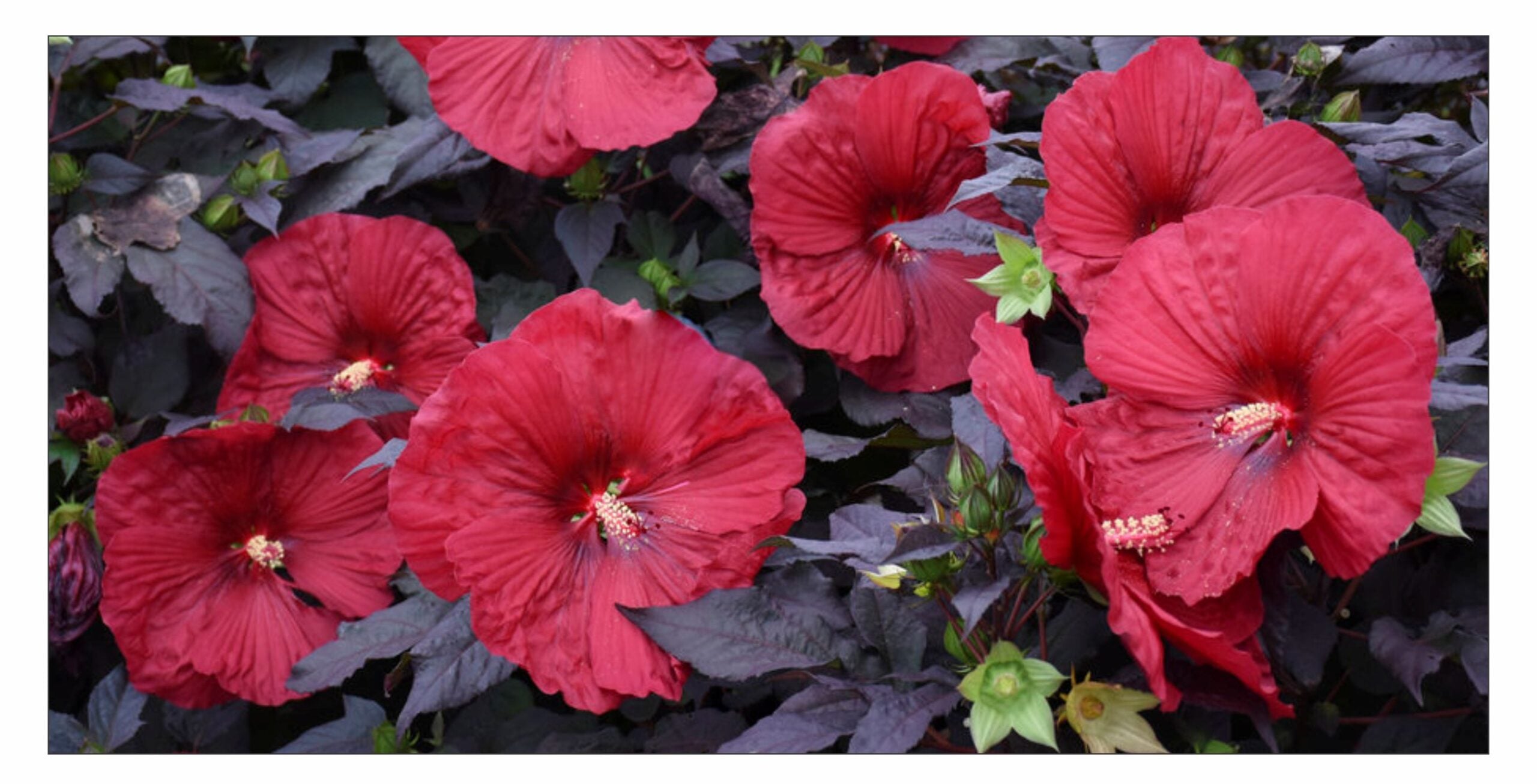
The Chinese hibiscus (Hibiscus x rosa sinensis) is the most common variant of this showy flower. In China it often symbolizes success. The poem by Pei Di seems to occur after the party with the invited guests. The lake is now windswept, and the lonely cries of monkeys echo through the night.

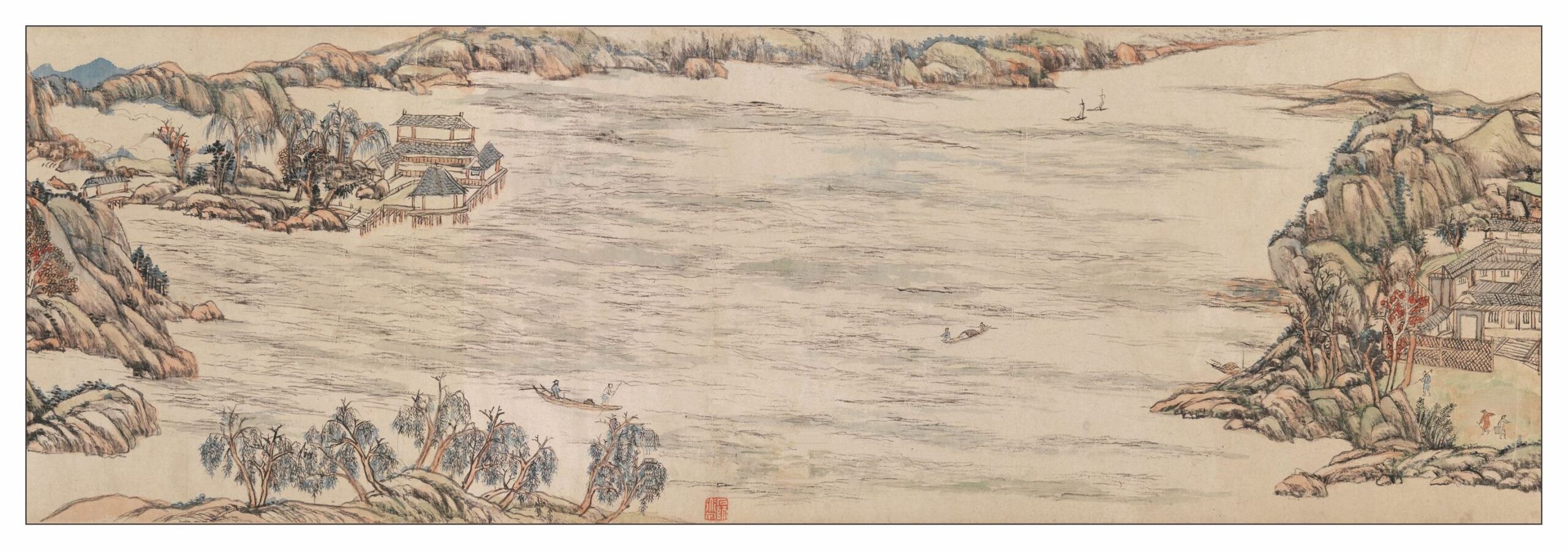
The following illustration shows the lakeside pavilion in the Wang Yuanqi scroll:

Lake Yi

Flute music rides beyond water’s reach.        Vast emptiness: lake has no limits.
Sun at dusk: to see my lord off.                     Blue glimmer: sky’s hue merges.
On the lake, merely turning my head:           Moor the boat with a long whistle:
Mountain’s green—curling, white clouds.     From four sides clear winds come.

The Chinese character 青 qīng can describe colors ranging from light green to deep blue. Many languages do not discriminate between green and blue, and the term “grue” has been used for this range of colors (Bogushevsaya, 2015). One then takes the color from the context: in this pair of poems, one assumes that Wang Wei’s mountain is green and that Pei Di’s sky in blue. Modern Chinese has evolved the terms lán for blue and for green, but the older word is still used. In following illustration of Lake Yi from Wang Yuanqi’s scroll, the colors blue and green shade into each other. Pei Di mentions in his poem how the colors of the sky and the lake merge.   

Wang Wei’s poem is set in peaceful weather. By the time of Pei Di’s quatrain, a blustery wind has risen. The sound of the flute has changed to the more strident whistle.

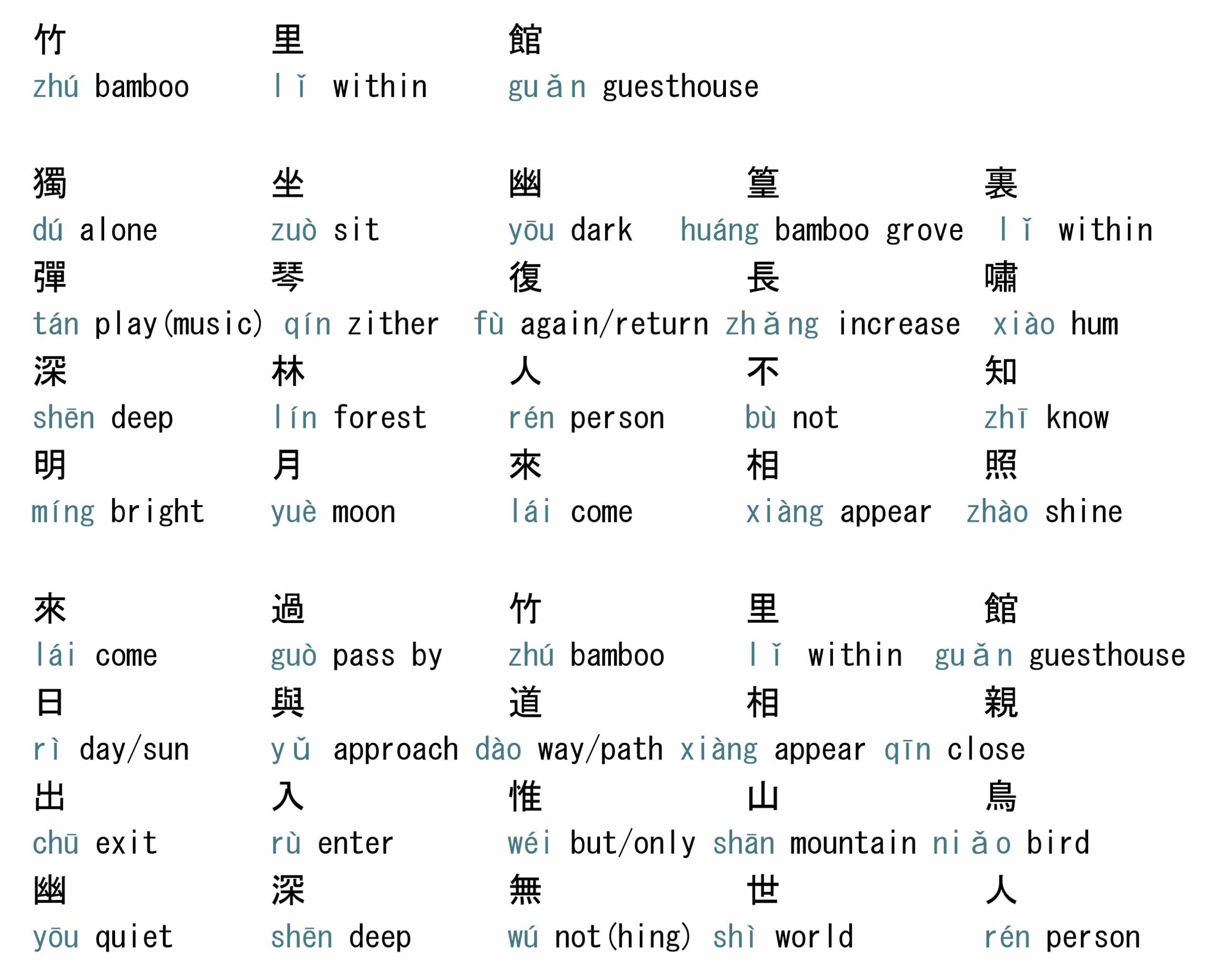
Bamboo Grove

I sit alone among dark bamboos,                Have been to the Bamboo Grove,
Strum the lute and unloose my voice.         Daily to get close to the Way.
Grove so deep, no one knows.                    In and out, only mountain birds.
The moon comes to shine upon me.          Deep solitude: no men of the world.

The Chinese guqin is a plucked seven-stringed instrument favored by Chinese scholars. The illustration below shows an example (c 1700) from the Metropolitan Museum of Art. The upper board of wutong wood represents heaven, and the bottom board of zi wood earth. The 13 studs (hui) indicate positions for fingering. The strings are made of twisted silk.

The following is a reading of the Wang Wei poem from Librivox:

Yu (1980, p 191) points out that the xiào referred to in the second line was

a combination of Taoist breathing techniques and whistling which was said to express feelings and was associated with harmonizing with nature and achieving immortality; the word has also been translated as “humming,” “singing,” and “crooning,” The tradition of the Xiao began during the Jin dynasty and has always been linked with Taoism. Its most famous practitioner was Sun Deng, a friend of the poet Ruan Jiu whose Xiao was said to sound like a phoenix.

The ideas of solitude and emptiness in the Wang Wei quatrain are extended in Pei Di’s reply. He talks specifically about the Dao (道) commonly translated as “The Way” –  the underlying principle of the universe considered in Taoism. The character 無 wu, a negative term (“not” or “no”), is used in Taoism and Chan Buddhism to denote “nonbeing” or “absence” (Hinton, 2020, pp 49-55). Thus, the ending of Pei Di’s poem might be describing the state of mind wherein the world and its people have become nothing.

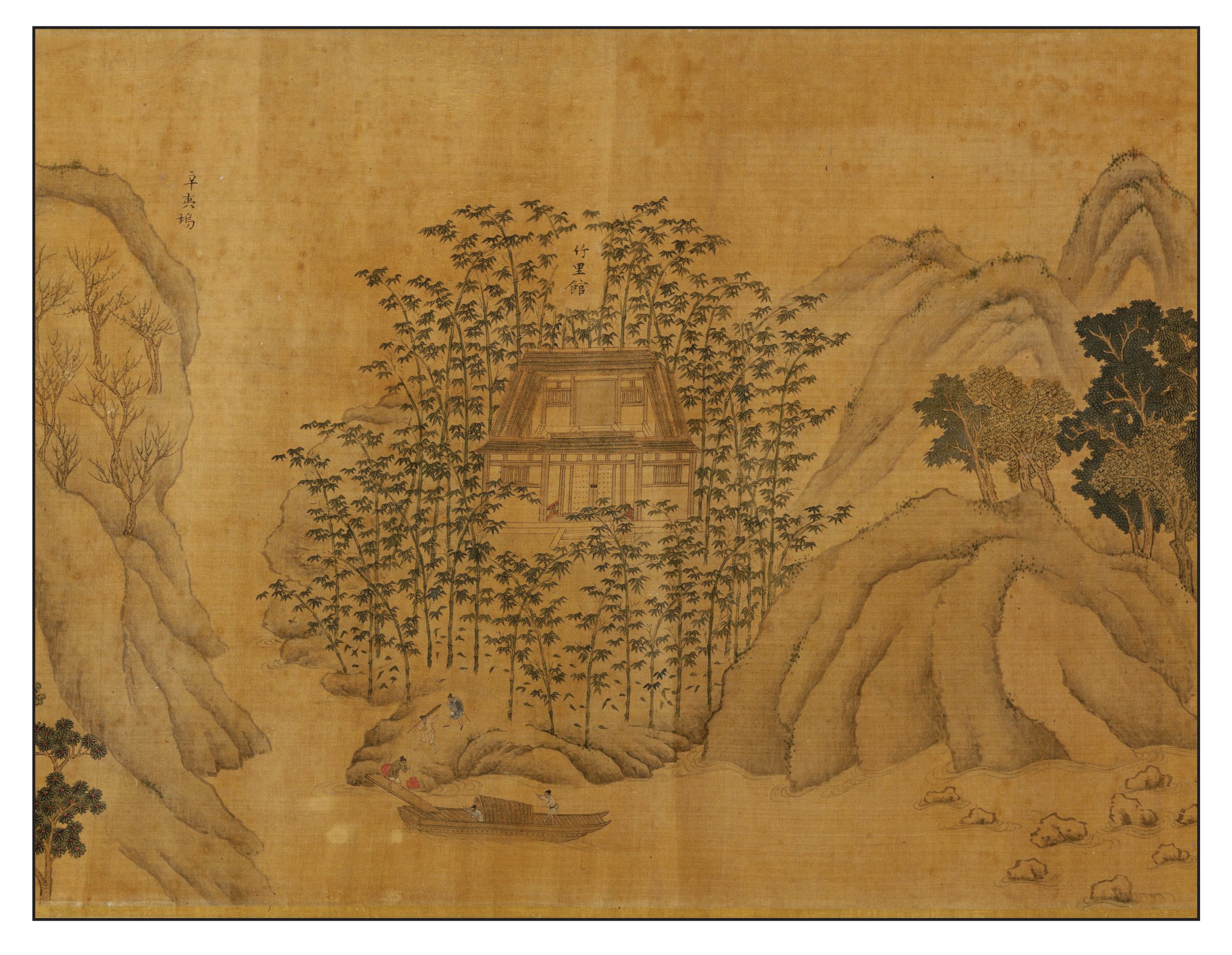
The following illustration shows the lodge in the bamboo grove as represented in the Freer gallery scroll:

Poetry, calligraphy and painting – the “three perfections” – are often combined in Chinese art (Sullivan 1974). The following illustration shows Wang Wei’s poem about the Bamboo Grove as written by different calligraphers. On the right is regular script from Yip’s Hiding the Universe: this presents the quatrains of both Wang Wei and Pei Di. The other examples show only Wang Wei’s contribution. From right to left: calligraphy from the Wangchuan Ji scroll of Guo Zhongshu; from the scroll of Wang Yuanqi; modern cursive calligraphy by the Japanese artist Nakamura Furetsu from around 1915.  

Pepper Orchard

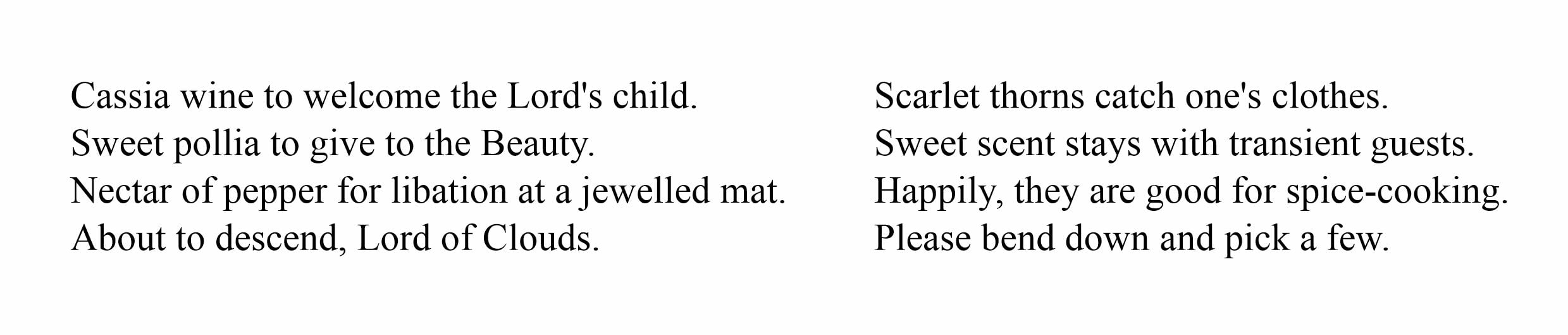
Wang Wei’s quatrain alludes to some ancient Chinese songs used to invoke the appearance of the Gods. Several of these songs were incliuded in the Juejie (“Nine Songs”) which were anthologized in the collection called Chuci (“Songs of the South,” or “Songs of Chu”). The following is from the first of these songs (as translated by Hawkes and Liu, 1959, p 36):

Song to the Great Lord of the Eastern World

On a lucky day with an auspicious name.
Reverently we come to delight the Lord on High
We grasp the long sword’s haft of jade.
And our girdle pendants clash and chime
Jade weights fasten the god’s jewelled mat.
Now take the rich and fragrant flower offerings
The meats cooked in melilotus, served on orchid mats,
And libations of cinnamon wine and pepper sauces!
Flourish the drumsticks and beat all the drums!

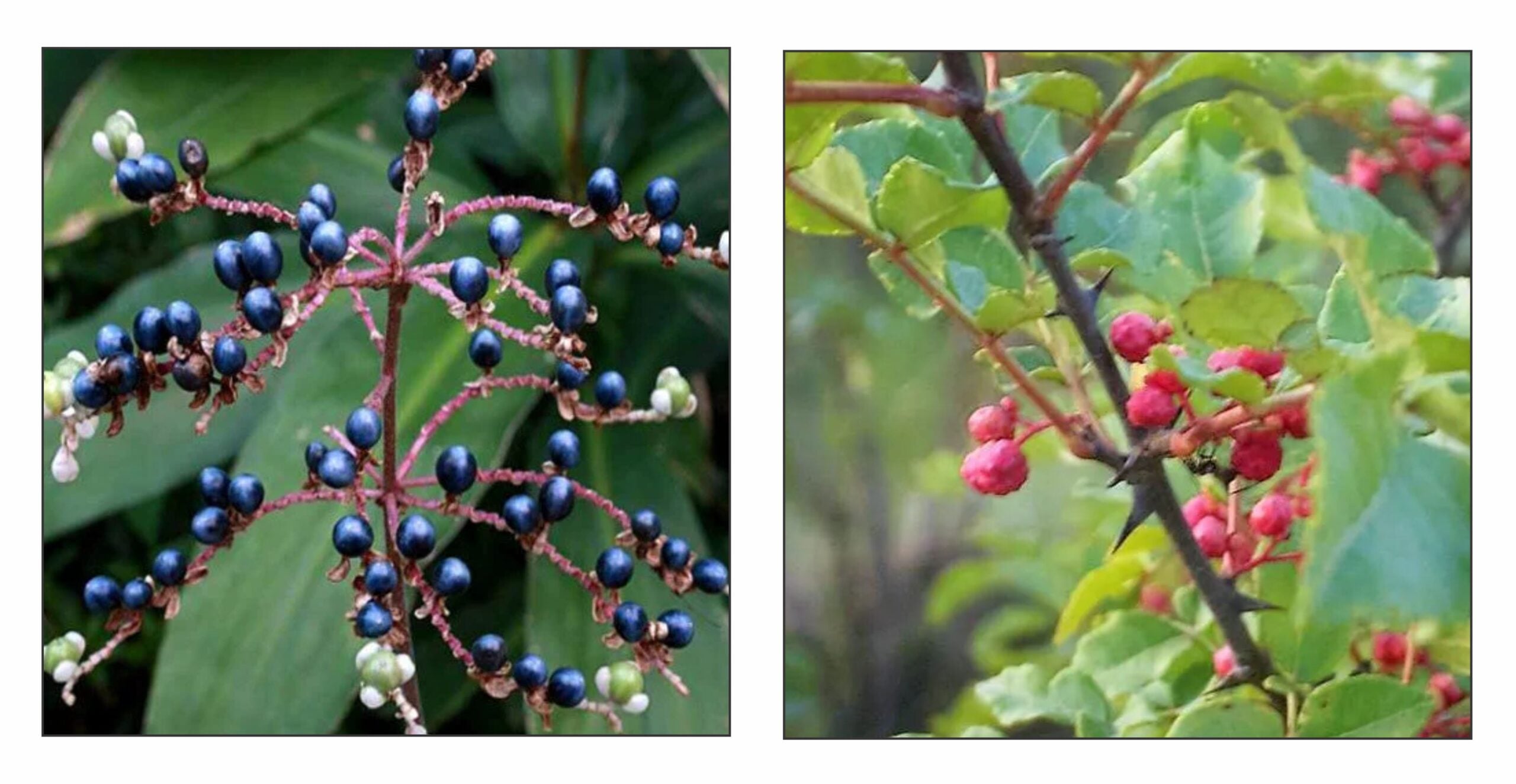
Many different plants are used as gifts and food for the Gods. Cinnamomum cassia is Chinese cinnamon, the bark of which is used as a spice. Pollia japonica is a Chinese flowering plant that gives a strikingly beautiful (but inedible) iridescent purple fruit. Sichuan peppers are used to add spice to Chinese dishes. Melilotus or sweet clover is a herb with an aroma like vanilla. The following illustration shows Pollia fruit on the left and Sichuan peppers on the right.

Pei Di’s poem describes the pepper trees in the orchard without making any allusions to the invocation of the Gods. The thorns on the pepper tree are very prominent.

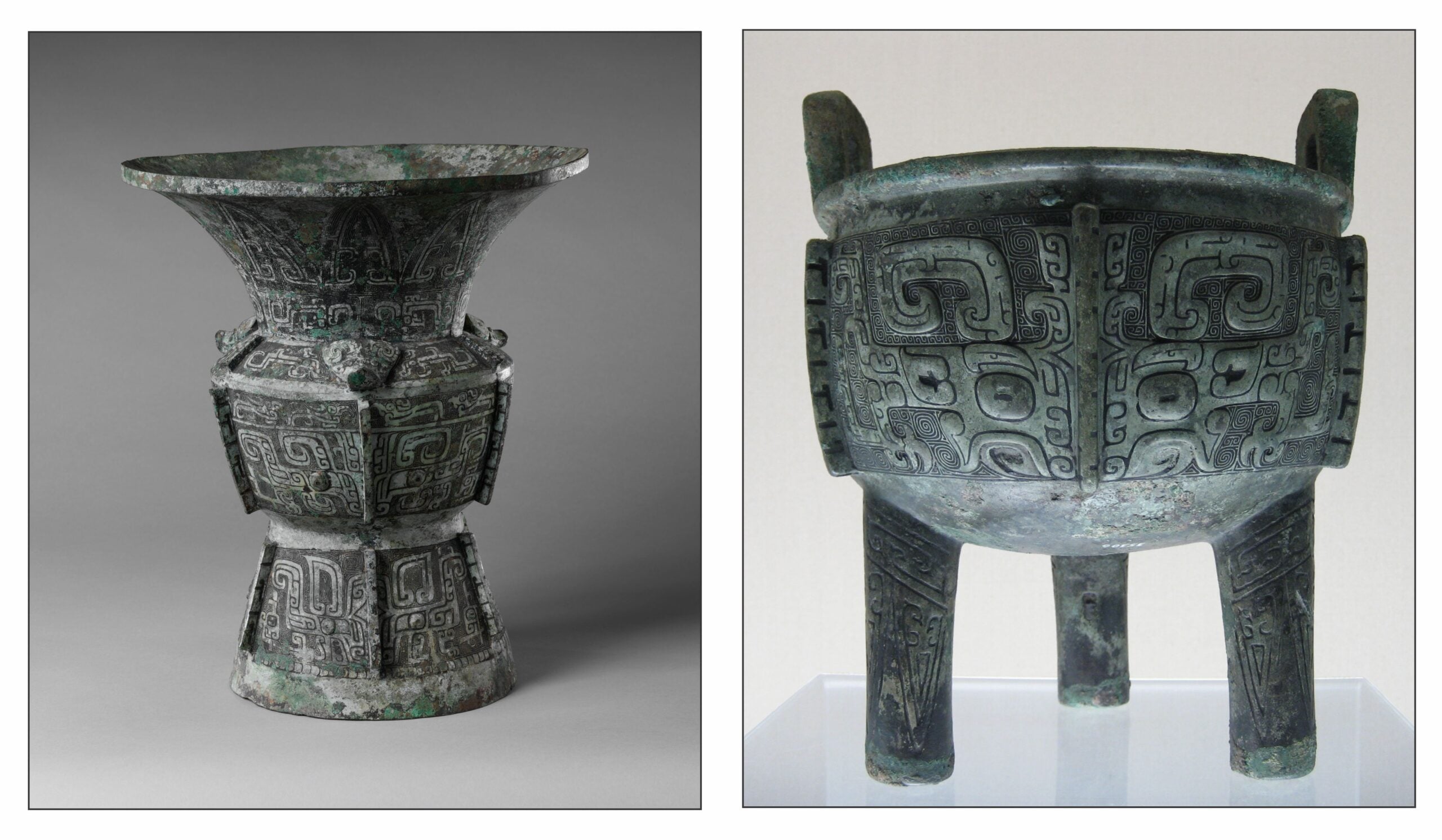
The following illustration shows a zun and a ding, ceremonial bronze vessels from the Shang dynasty (second millennium BCE). The zun is from the Metropolitan Museum in New York and the ding from the Shanghai Museum:

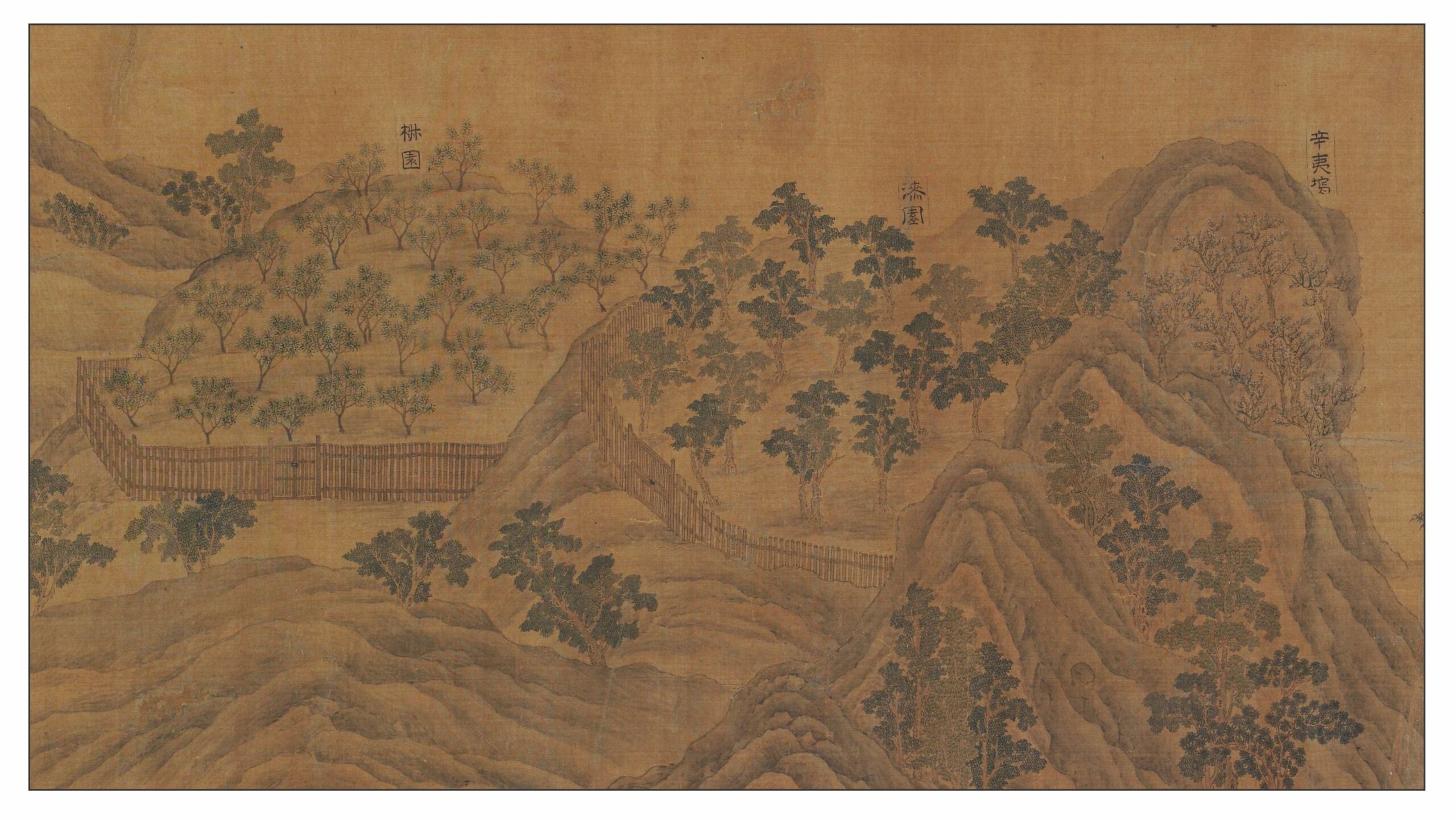
The following illustration shows (on the left) the Pepper Tree Orchard from the scroll in the Freer Gallery. The neighbouring orchard (on the right) contains Lacquer Trees (Toxicodendron vernicifluum), the sap of which is used in the production of lacquer. These trees are the subject of another pair of quatrains in the Wangchuan Ji.

Illusion and Reality

Ferguson (1927, pp 73-74) suggested that the Wangchuan estate described in the poems and depicted on the scroll was more imaginary than real:

The poem and the picture both represent Wang Ch’uan as a place of splendor and magnificence, but this was the product solely of poetical license … Wang Wei could only have had a very humble cottage in this secluded spot. If it had been otherwise he would have attracted the attention of the rapacious myrmidons of the court, and the place would have been confiscated … Wang Wei’s imagination … clothed a barren hillside with beautiful rare trees, with spacious courtyards, with a broad stream upon which boats plied and on whose bank stood a pretty fishing pavilion, with a deer park, with storks and birds—all of the delights of eye and ear were brought together in this one lovely spot by the fancy of a brilliant genius. Life had been hard and severe for him, but his spirit was untamed. It reveled in all of the sensuous delights which it could spiritualize, even though it had spurned them when they were thrust upon it.

However, Ferguson probably exaggerated the simplicity of Wang Wei’s country home. Wagner (1981) claimed that it was far more than a “humble cottage”

The villa had previously belonged to the Early T’ang poet Sung Chih-wen (ca. 663-712), but was apparently unoccupied for about thirty years between owners. When Wang Wei acquired the estate he had it repaired, and he may have personally supervised the design and reconstruction of its various houses, pavilions, gardens, and parks. Paintings and poems depict the estate as a large piece of property with elaborate residential buildings and landscape architecture: it was by no means a simple rustic hut hidden in the woods.

Nevertheless, the scenes that Wang Wei and Pei Di described in the poems owe as much to poetic imagination as to reality. In this regard, we must wonder how the poems relate to Buddhism. The Buddhist idea of the perceived world is that it is illusion (maya). What then is the imagined world? Does the imagination exaggerate our illusions, or does it provide insight into what might be the true reality beneath them? Wagner (1981, p 140) remarks:

Wang Wei aspires to transcendence of the particular, and of the visual physical world, at the same time that he is attached to the sensual delights which he so sensitively perceives in that world. Through visual imagery he achieves metaphoric representation of that realm which cannot be seen, a realm which transcends the material world, the perceiving senses, the definitions of language, and the discerning consciousness. Wang Wei’s vision, then, moves through the world of concrete natural objects to attain a glimpse of “distant emptiness.”

Epilogue

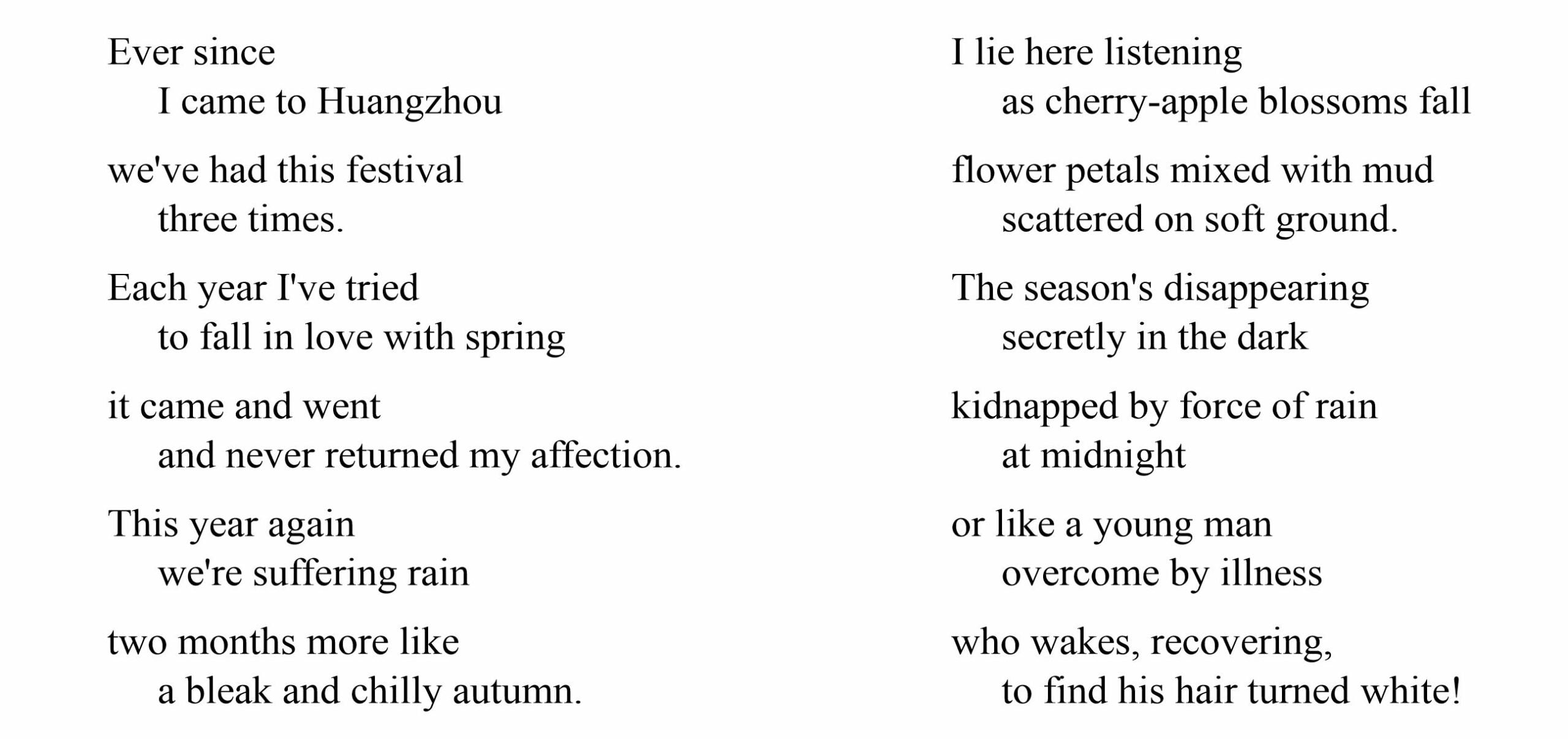
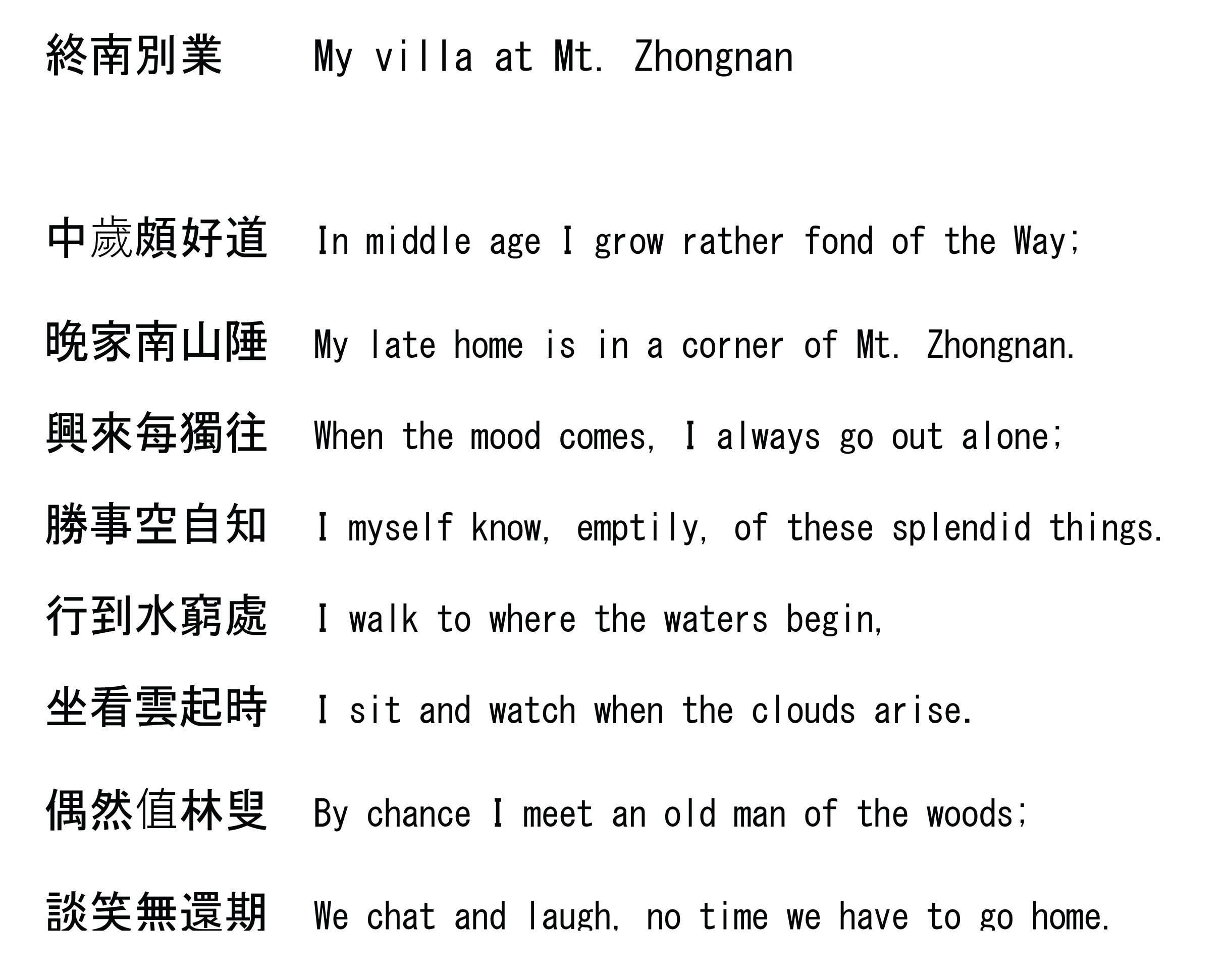
We can conclude this brief discussion of Wang Wei’s poetry with another poem wherein he describes a trip to the Zhongnan (“far south”) Mountain near his Wangchuan Villa (translation by Rouzer, 2020, Volume I, p. 79):

The Cleveland Museum of Art possesses a beautiful fan created in about 1256. On one side is calligraphy by Emperor Lizong (1205-1264) presenting the 5th and 6th lines of Wang Wei’s poem. On the other side is a painting by Ma Lin (~1180-1260) showing A Scholar Reclining and Watching Rising Clouds. The illustration at the beginning of this essay is a high-contrast rendition of the Ma Lin painting.  

Stephen Owen relates the description of the rising clouds to another Wang Wei poem (Floating on the Han River) which contains the lines

what this describes is a mountain in a mist in that peculiar way in which you can just barely see a color space in the mist, and you think there’s a mountain there, but in the Buddhist sense of the illusions of the world, you have this huge thing, this mountain and all of a sudden, its presence, its very existence, sort of half fades in and out. It’s between being there and not being there.

The lines describe the ideas of yǒu (有, being/possession/existence) and wú (無, simplified , nonbeing, nothingness). A central idea in Chan Buddhism is sunyata: the meditative practice of emptying oneself of being to become one with the universe. 

References

Barnstone, T., Barnstone, W., & Xu, H. (1991). Laughing lost in the mountains: poems of Wang Wei. University Press of New England.

Bogushevskaya, V. (2015). Grue in Chinese: on the original meaning and evolution of qing  In Bogushevskaya, V., & Colla, E., (Eds.). Thinking colours: perception, translation and representation. (pp 26-44): Cambridge Scholars,

Cai, Zong-qi (Ed.) (2018). How to Read Chinese Poetry in Context: Poetic Culture from Antiquity Through the Tang. Columbia University Press.

Cartelli, M. A. (2019). Making it new in Tang Dynasty poetry: Wang Wei, Li Bai, and Du Fu. In K. Seigneurie (Ed.) A Companion to World Literature (pp. 1–12). John Wiley & Sons.

Ching, J. (1993). Chinese religions. Macmillan Press.

Ferguson, J. C. (1927). Chinese Painting. University of Chicago.

Hawkes, D., & Liu, X. (1959). Ch’u tz’ǔ: the songs of the South, an ancient Chinese anthology. Clarendon Press.

Hinton, D. (2020). China root: Taoism, Ch’an, and original Zen. Shambhala.

Hinton, D. (2006). The selected poems of Wang Wei. New Directions Publishing Corp.

Owen, S. (1981). The great age of Chinese poetry: the High T’ang. Yale University Press.

Powell, M. M. (2019). Beneath the shadows: a complete annotated translation of the overlooked poet Pei Di. Honor’s Thesis. University of Florida.

Rouzer, P. F., Nugent, C (2020). The poetry and prose of Wang Wei. Volume 1 and Volume II. De Gruyter.

Stepien, R. (2014). The imagery of emptiness in the poetry of Wang Wei. Interdisciplinary Literary Studies, 16(2), 207–238.

Sullivan, M. (1974). The three perfections: Chinese painting, poetry, and calligraphy. Thames & Hudson.


Wagner, M. L. (1981). Wang Wei. Twayne Publishers. 

Warner, D. X.  (2005) The two voices of Wangchuan Ji: poetic exchange between Wang Wei and Pei Di, Early Medieval China, 2005 (2), 57-72.

Weinberger, E., & Paz, O. (1987). Nineteen ways of looking at Wang Wei: how a Chinese poem is translated. Moyer Bell.

Yang, Jingqing (2001). The Chan interpretation of Wang Wei’s poetry: a critical examination. Doctoral Thesis, University of Sydney.

Yip, Wai-lim (1972). Hiding the universe: Poems of Wang Wei. Grossman (Mushinsha).

Yu, P. (1980). The poetry of Wang Wei: new translations and commentary. Indiana University Press.


Language and Meaning

Language and meaning

I have just returned from a brief trip to Korea. I had learned the Hangul alphabet, but my vocabulary was limited to some rudimentary phrases. I could read but I could not understand. This led to some thoughts about language and meaning. My posting will take a roundabout course, beginning with a Korean scholar from the Silla dynasty. Be patient: I shall try to find some meaning before the day is done.

Choe Chi Won (857-925?)

At the age of 12, Choe Chi Won (Hangul 최치원; Chinese 崔致遠; literary name 孤雲, Go-un, “Lonely Cloud”) was sent from Korea to study in Xian (Chang’an), the capital of the Tang dynasty in China. There he learnt the practices of Confucianism and the arts of poetry and calligraphy. He passed the Imperial Examination at the young age of 22 years, and rose quickly through the ranks of the Chinese Civil Service.

However, the Tang dynasty (618-907) was slowly coming to its end. In 874, Huang Chao had initiated a rebellion against the Emperor. By 880 he had taken control of the capital and assumed the throne, calling himself the “Emperor of Qi.” Choe served as the secretary to the Tang general Gao Pien in his campaign against Huang Chao. By 884, the rebellion was finally defeated and the Tang emperor Xizong reinstated in Xian.

However, the Tang empire was in pieces. Feuding warlords commanded different regions, and in 907 the Tang dynasty came to an end. China’s political turmoil continued through the period of the “Five Dynasties and Ten Kingdoms,” until some stability was finally regained with the Song dynasty in 960.

In 885, Choe asked to return to Korea as an envoy to the Silla dynasty. However, his home country was also in a period of decadence and political upheaval. The 900-year old Silla dynasty was slowly coming apart. It would finally succumb to the Goryeo dynasty in 935.

ccwon dongbaek

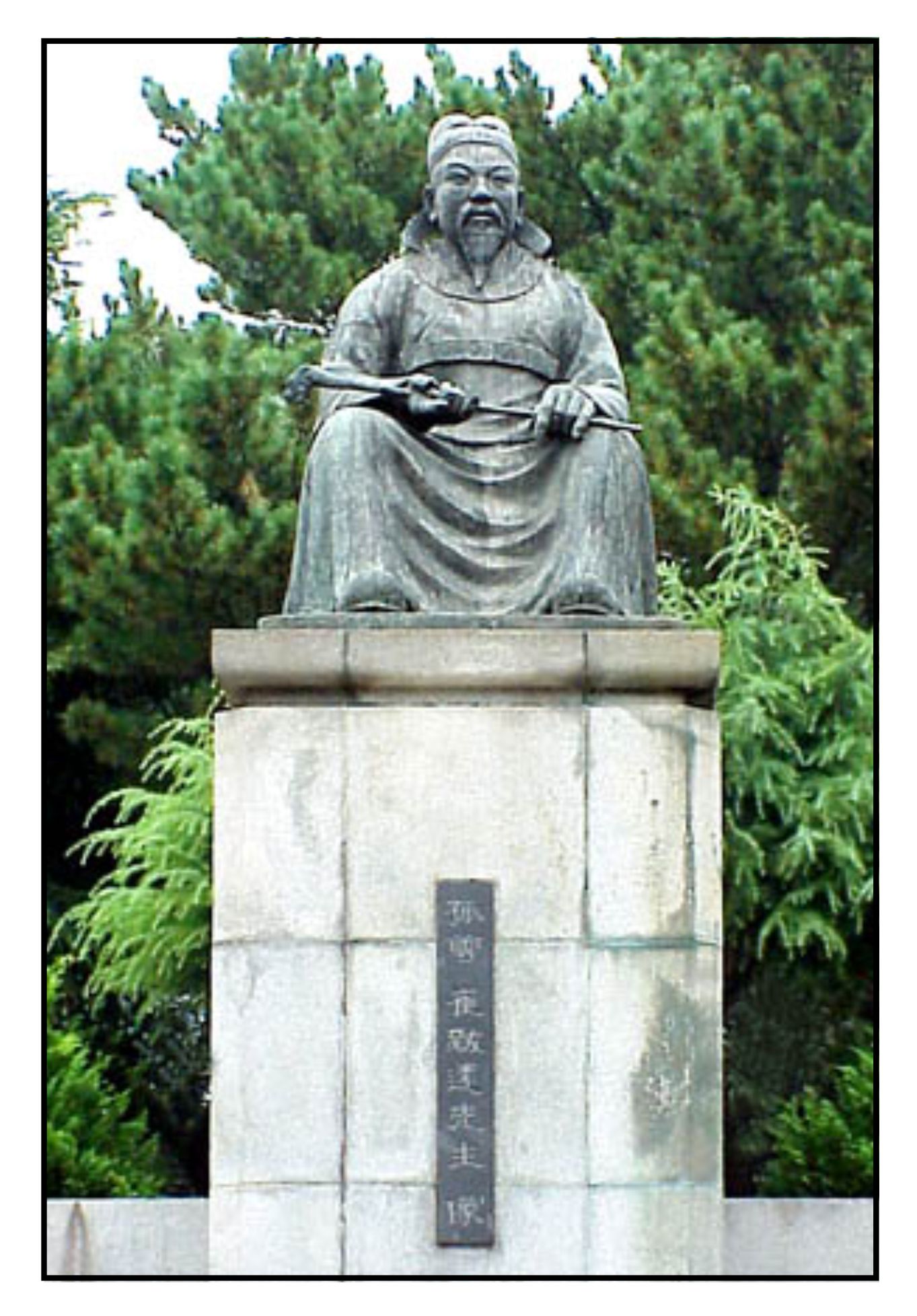
The Silla Royal Family and the court refused to accept Choe’s advice about how to improve their government. Disillusioned, Choe left the court to become a provincial magistrate. Finally, he retired completely from public life, spending his last years in meditation at various Buddhist monasteries in the southern regions of Korea. For a brief while he lived in Busan, where he gave the name Haeundae (海雲臺Sea Cloud Platform) to Dongbaek Island. He had these characters inscribed on one of the rocks near the present lighthouse. The photo to the right shows Choe’s memorial statue on the island (now connected to the mainland in the Haeundae region of Busan. The exact date of Choe’s death is unknown. Legend has him wandering off into the forest never to be seen again.

(Biographical details for Choe Chi Won are available in Jones, 1903; Lee, 1997; Lin, 2011, and on David Mason website).

The Mountain Stelai

Before he died, however, Choe composed the inscriptions for four stelai commemorating the achievements of famous Korean Buddhist monks. As well as describing the lives of the monks, these inscriptions commented upon the philosophy of Buddhism and how it might be made compatible with Confucianism.

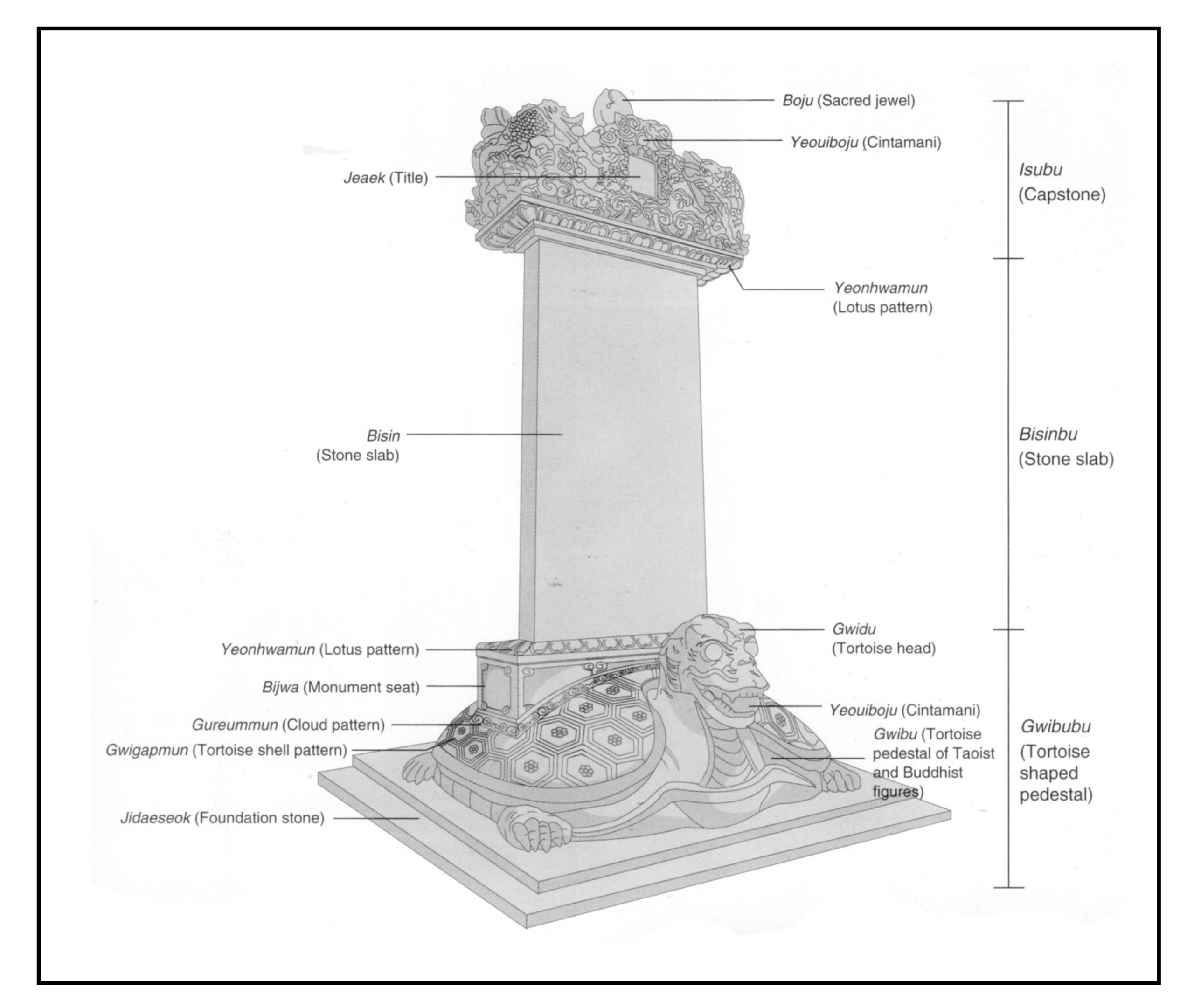
stele diagram

c gam stele


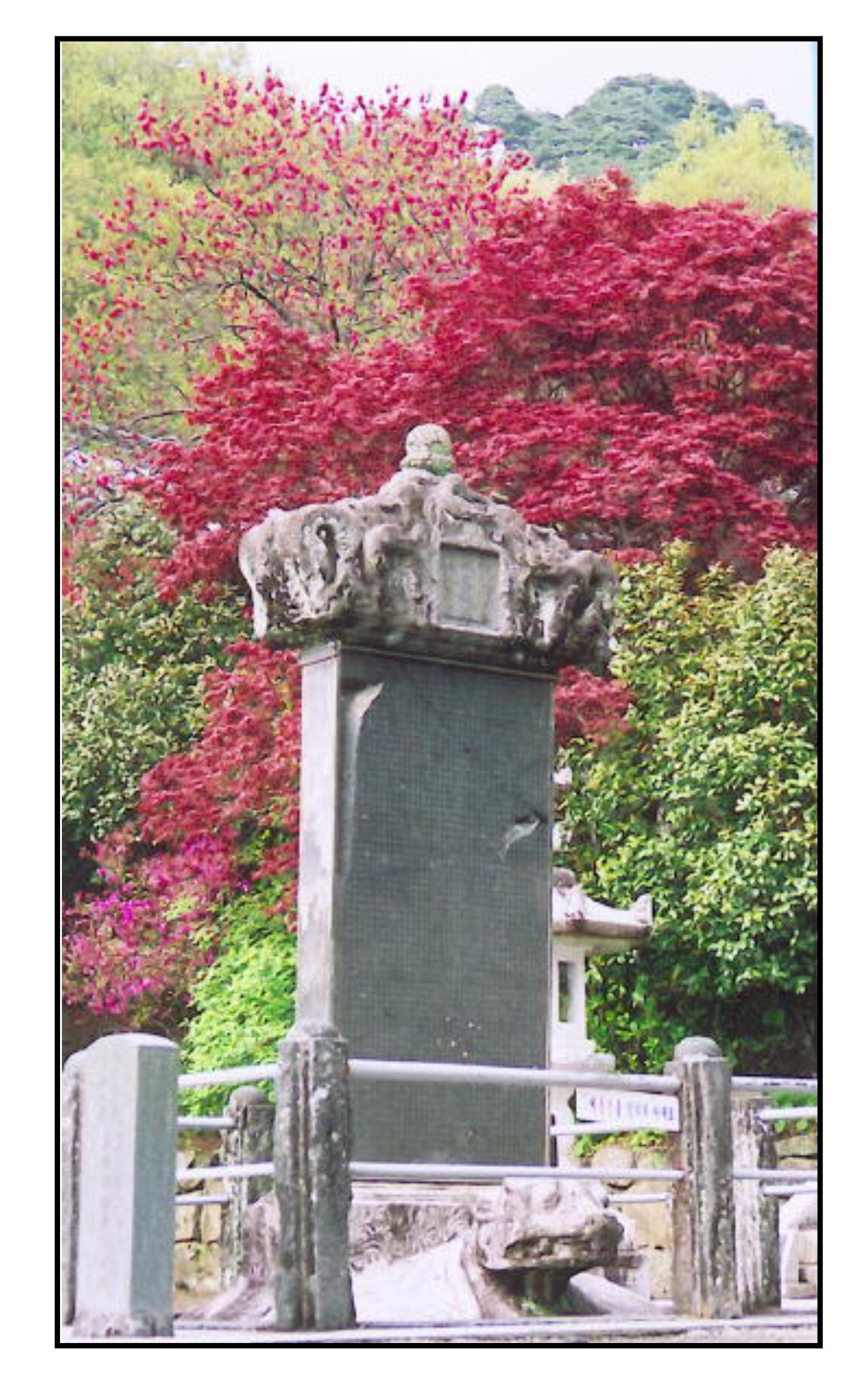
Each stele contained a flat stone slab upon which the inscriptions were carved. This was set upon a tortoise base and topped with a cloud-dragon capstone. Tortoises and dragons both symbolize immortality. The above figure shows the general structure of a stele (from Park 2002), and the photograph on the right shows the actual stele commemorating the monk Chin’gam Hyeso (774-850) at the Ssanggye monastery in Southern Korea (from the webpage of David Mason). This monk had studied in China and returned to Korea in 830 to establish a monastery and transmit to his disciples the principles of Seon Buddhism.


Seon Buddhism

Although Buddhism first came to Korea in the 4th century AD, it did not become prominent until the advent of Seon Buddhism in the 7th and 8th centuries. This line of Buddhism derived from China’s Chan Buddhism. Zen Buddhism in Japan had a similar source though it began much later (in the 12th century). Chan Buddhism emphasizes meditation as the primary means to enlightenment – “Chan” comes from 禪那 (pinyin: chánnà, meaning meditation), which itself derives from the Sanskrit dhyana. The key scripture describing the principles of Buddhist meditation is the Lankavatara Sutra (Red Pine, 2012; also available in a web translation), which was compiled in the 3rd or 4th century and translated into Chinese in the 5th century

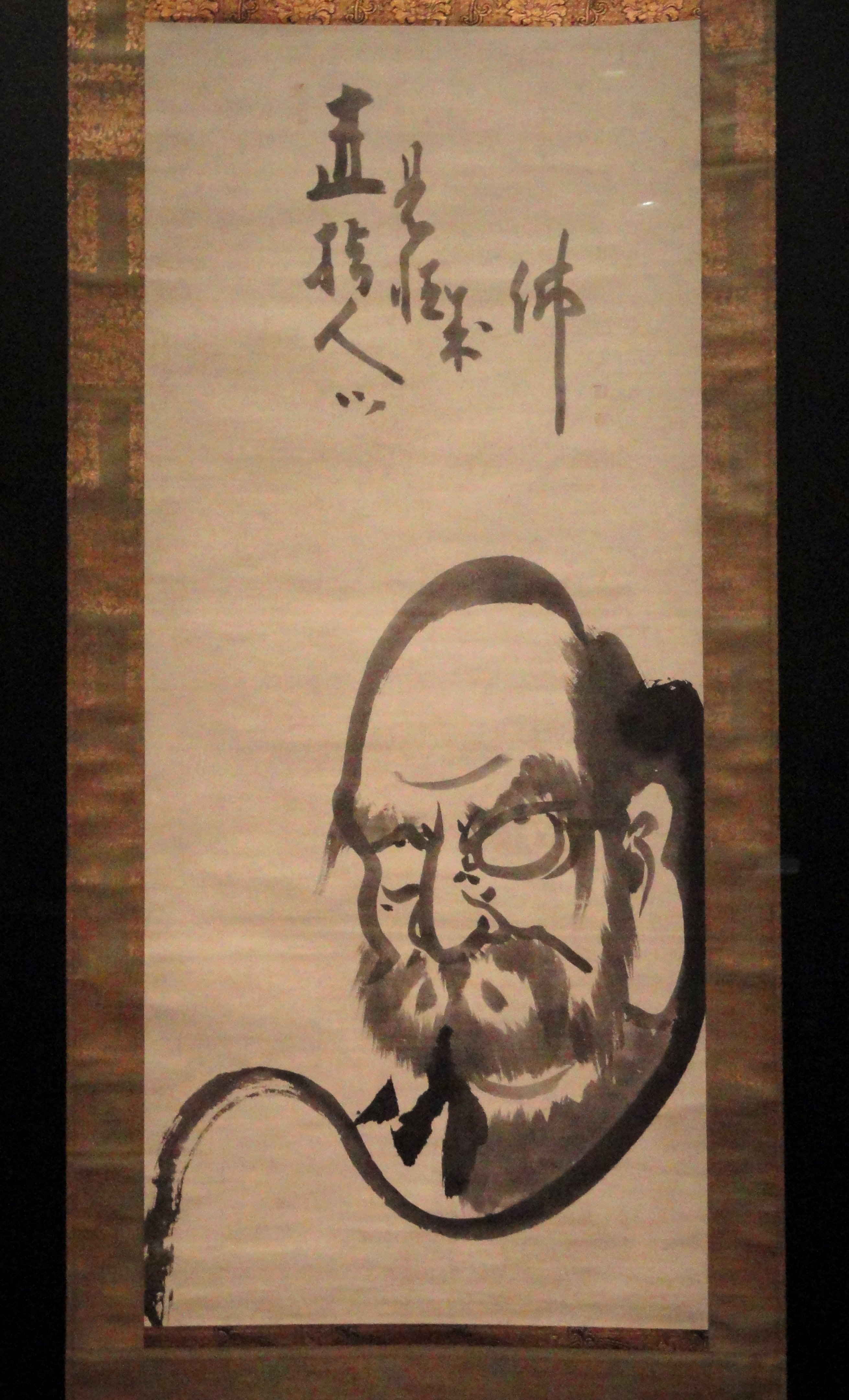
Chan Buddhism traces itself back to the patriarch Bodhidharma (known as Daruma in Japan), who lived in China in the 5th and 6th centuries (Suzuki, 1956, Chapter 3; Red Pine, 1989). Bodhidharma may have journeyed to China from India, though the details of his life come more from myth than history. He is usually portrayed as a fierce, bearded sage, with brow furrowed from concentration, eyes staring after years of meditation (“wall-watching”), and earlobes extended with enlightenment.

As well as meditation, Chan Buddhism fostered asceticism, irrationality, chanting and marshal arts. Truth was conveyed from master to pupil; scriptures were irrelevant other than as used by the masters to suggest what could only be attained by meditation. The goal was to drain the consciousness of self and thus to share in the vast emptiness beyond being.

One teaching, attributed to Bodhidharma, but likely composed much later is

A special transmission outside of scriptures;
No dependence upon words and letters;
Direct pointing at the soul of man;
Seeing into one’s nature to attain Buddhahood.
(adapted from Suzuki, 1956, p. 61)

Daruma,_Hakuin_Ekaku_-_Indianapolis_Museum_of_Art_-_DSC00771


The last two lines are inscribed above the portrait of Daruma by the Japanese Zen Monk Hakuin Ekaku (1685-1768, illustration from Wikipedia).

Chan Buddhism differs from the other main line of Chinese Buddhism, Pure Land, which stresses recitation of the scriptures, and mindfulness directed specifically to the Amitabha Buddha (Ching, 1993, Chapter 8 Mysticism and Devotion. Buddhism becomes Chinese). Chan meditation halls are simple and unadorned; Pure Land temples have a baroque exuberance, with statues of Buddhas and Boddhisattvas everywhere. Chan seeks inside for emptiness, Pure Land looks outside for fulfillment.


Chin’gam Hyeso Stele

ccwon calligraphy x

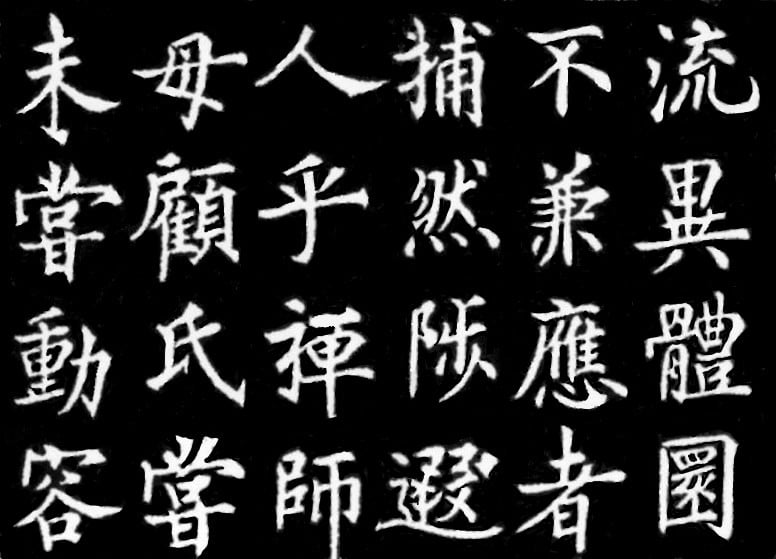
The monument to Chin’gam Hyeso was erected in 887. Choe Chi Won composed the inscription using regular script (kaishu) in the style of Ouyang Xun (557–641), a Chinese scholar and calligrapher. Some of this balanced and graceful script is illustrated above (derived from Park, 2002). Choe’s calligraphy was then engraved by Hwan Yong. The inscription begins with a brief introduction, continues with a summary of the life and achievements of Chin’gam Hyeso, and ends with some poetry celebrating his greatness. The following brief quotations and translations are from Jorgensen (2012).

The introduction begins

夫道不遠人, 人無異國.

The path is not distant from human beings, and human beings are not different due to country.

The first part of this sentence is a quotation from the beginning of Chapter 13 of the Confucian classic “Doctrine of the Mean” (中庸 Zhongyong, in the Book of Rites): “The Way is not something separate from man” (Muller translation; Ezra Pound translates the teaching as “The process is not far from man, is not alien from him” in The Unwobbling Pivot, 1951). Confucius is pointing out that truth is not beyond the grasp of the human mind. The second part of this introductory sentence is original to Choe. This scholar was educated in a foreign land, and was treated as an alien when he finally returned home. He therefore insists that all human beings should be treated equally, regardless of country, language or race. The statement can also be translated as “For man there is no foreign country.” These words also have a metaphorical meaning – that there is no limit to what the human mind can consider – that complements the initial quotation.

Choe goes on to consider how Buddhism might be reconciled to Confucianism. How can freedom from the world fit with allegiance to the state? Choe refers to the work of an early Chinese Pure Land Buddhist Huiyuan who wrote a treatise on why monks should not pay homage to kings. This does not challenge the government of kings since monks have no desire for worldly power. (The argument is analogous to “Render unto Caesar” from Matthew 22:21 – see Hurvitz, 1957). Thus, apparent contradictions can be dissolved through interpretation. Choe quotes from the Confucian classic “Book of Rites” (禮記, Liji, Chapter Jiyi, Verse 7)

言豈一端而已, 夫各 有所當.

How could a word have only one side? Each [side] has a valid point.

Choe then goes on to discuss how the meditation process of Buddhism is impossible to describe in words:

至若佛語心法, 玄之又玄, 名不可名, 說無可說.

雖云得月, 指或坐忘, 終類係風, 影難行捕.然陟遐自迩, 取譬何傷.

Regarding the Buddha’s spoken words on the mind-dharma, it is the arcane within the arcane; the name that cannot be named, the explanation that cannot be explained.

Although it is referred to as pointing at the moon or sitting in oblivion [of the surrounding world], in the end it is like [attempting] to bind the wind or like the difficulty of capturing a shadow. But as one progresses from what is far to what is near, what harm is there in using metaphors?

However, even metaphors cannot do justice to the mind-dharma. The experience cannot be put into words. Choe once again quotes Confucius:

天何言哉.

What words does Heaven speak?

The full context (Analects, Yang Huo, Verse 19) for this is

The Master said, “I would prefer not speaking.” Zi Gong said, “If you, Master, do not speak, what shall we, your disciples, have to record?” The Master said, “Does Heaven speak? The four seasons pursue their courses, and all things are continually being produced, but does Heaven say anything?”

This reference to Confucius provides Choe with his segue into the biography of the Seon master Chin’gam, the monk who was able to transmit to his disciples the experience of the mind-dharma without using words. The truth cannot be taught; it can only be experienced.

Final words

After the biographical details, Choe concludes with a set of poems in praise of Chin’gam. Among the lines are Choe’s attempt to describe the meditative experience:

猛探虎窟,
遠泛鯨波.

He fiercely searched for the tiger’s cave,
floating afar over huge waves.

He also portrays the way that the monk was able to release himself from the all the distinctions and suffering of the world:

無思無慮,
匪斲匪雕.

He lacked [discriminative] thinking and anxiety,
he was uncut and uncarved.

Just before these final poems, Choe apologizes. He was asked by the King to write the text of the monument and to promote the Buddhist principles, but he is ashamed for trying to describe what is ineffable.

況法離文字, 無地措言,

The Dharma can neither be written down nor expressed in words.

Meanings

I feel great empathy for Choe. Like him, I am deeply involved with words. Like him, I realize that experience cannot be fully expressed in language. Metaphor helps, but can often be misleading. Some things seem true by intuition – the heart has its reasons that reason cannot comprehend (Pascal).

Language does not always connect clearly to meaning. Poetry slips easily into different meanings – tell the truth but tell it slant (Dickinson). Irony allows a meaning completely opposite to the words. As Confucius said, any set of words has more than one interpretation. How one arrives at their correct meaning is sometimes a mystery.

Nevertheless, I trust what can be put into words. Language allows me to tell others about my experiences and to learn about theirs. It helps me to remember what has happened. It allows me to formulate ideas and hypotheses for testing and revision.

The ineffable troubles me. How can I tell that it is not illusory? If it cannot be scrutinized or tested, how can I know that it is true?

I realize, of course, that those who devote their lives to meditation consider the world that I experience as illusory. They would say that I can read but I cannot understand.

References

Ching, J. (1993). Chinese religions. London: Macmillan.

Huiyuan (334-416). On why Buddhist monks do not bow down before kings. In Tiwald, J., & Van, N. B. W. (2014). Readings in later Chinese philosophy: Han Dynasty to the 20th Century. (pp 75-80). Indianapolis: Hackett.

Hurvitz, L. (1957). ‘Render unto Caesar’ in early Chinese Buddhism. Sino-Indian Studies, 5(3/4), 80–114.
Jones, G. H. (1903). Ch’oe Ch’i-wun: His life and times. Transactions of the Korea Branch of the Royal Asiatic Society, 3, 1-17.
Jorgensen, J, (Ed.) (translated by Uhlman, P. R., 2012). Anthology of Stele Inscriptions of Eminent Korean Buddhist Monks. Collected Works of Korean Buddhism, Volume 12. Seoul: Jogye Order of Korean Buddhism. (Chin’gam Stele is presented and translated on pp 68-96).

Lee, P. H. (1997). Sources of Korean tradition. Volume I From early times to the sixteenth century. New York: Columbia University Press. (Choe Chi Won is considered on pp. 126-129).

Lin, Pei‐Yin (2011). Precepts and lineage in Chan tradition: crosscultural perspectives in ninth century East Asia. PhD Thesis. School of Oriental and African Studies, University of London (Choe Chi Won is discussed in Chapter 6, pp 229-246).

Park Ki-Seok (2002). Korean cultural heritage: Seen through pictures and names. Seoul: Sigong Tech Co. (2 volumes)

Pound, E., (1951). Confucius: The great digest & Unwobbling pivot. New York: New Directions.

Red Pine (1989). The Zen teachings of Bodhidharma. New York: North Point Press (Farrar, Strauss and Giroux)

Red Pine (2012). Lankavatara Sutra. A Zen text. Berkeley, CA: Counterpoint

Suzuki, D. T. (edited by Barrett, W., 1956). Zen Buddhism: Selected writings of D.T. Suzuki. Garden City, N.Y: Doubleday (Anchor Books).