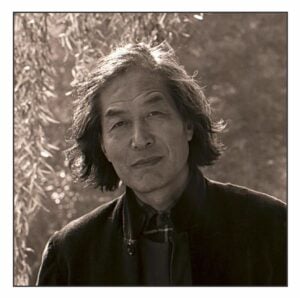


Chinese calligraphy began over 3000 years ago. Over the years several distinct styles of writing evolved: oracle, bronze, seal, clerical, regular, semi-cursive (running) and cursive (grass). The Cultural Revolution (1966-1976) overturned the respect shown to these traditional modes. However, calligraphy flourished in the format of the big-character posters (大字报, dàzì bào). In the years following the revolution, Chinese calligraphy became more abstract. One of the most important modern calligraphers is Wang Dongling (王冬龄). Among his many achievements is a new writing style that he calls “chaos script” 亂書 luànshū.
A Calligrapher’s Life
Wang Dongling was born in 1946 in Rudong about 175 km north of Shanghai. He studied fine arts in Nanjing, graduating in 1966 in time for the outbreak of the Cultural Revolution. He was able to survive through this upheaval by creating big-character posters, an experience which gave him a fearful sense of freedom. He was intrigued by the traditional calligraphy that was being trashed by the revolutionaries, and in 1968 began to study with Lin Zanshi (1898-1989) in Wujiang just east of Shanghai (Barrass, 2002, p 164). This grand old calligrapher, a master of the cursive script, was known for his “iron line.” Lin survived the purges by providing calligraphy for the propaganda of the party and the poetry of Mao Zedong. After the end of the Cultural Revolution, Wang enrolled in the Zhejiang Academy of Art (now the National Academy of Art) in Hangzhou, where he studied with Lu Weizhao (1899-1980) and Sha Menghai (1900-1992). After graduating from the academy, he spent some time as a visiting fellow at the University of Minnesota and at the University of California at Santa Cruz in the United Sates. He is presently a Professor of Calligraphy at the National Academy of Art in Hangzhou.
Influences
The following illustration shows calligraphy by two of his teachers: Lin Zanshi on the right and Sha Menghai on the left. Lin Zanshi wrote out the poem Going up the Hill by the Tang poet Du Mu (803–852) in 1975 using his iron line. The poem reads (Barrass, 2002, p 142)
A slanting stony path rises far up the chilly hill
To where men live amidst the fleecy clouds
I stop my carriage to admire the maple grove at dusk,
Where frozen leaves are redder than the flowers of early spring.
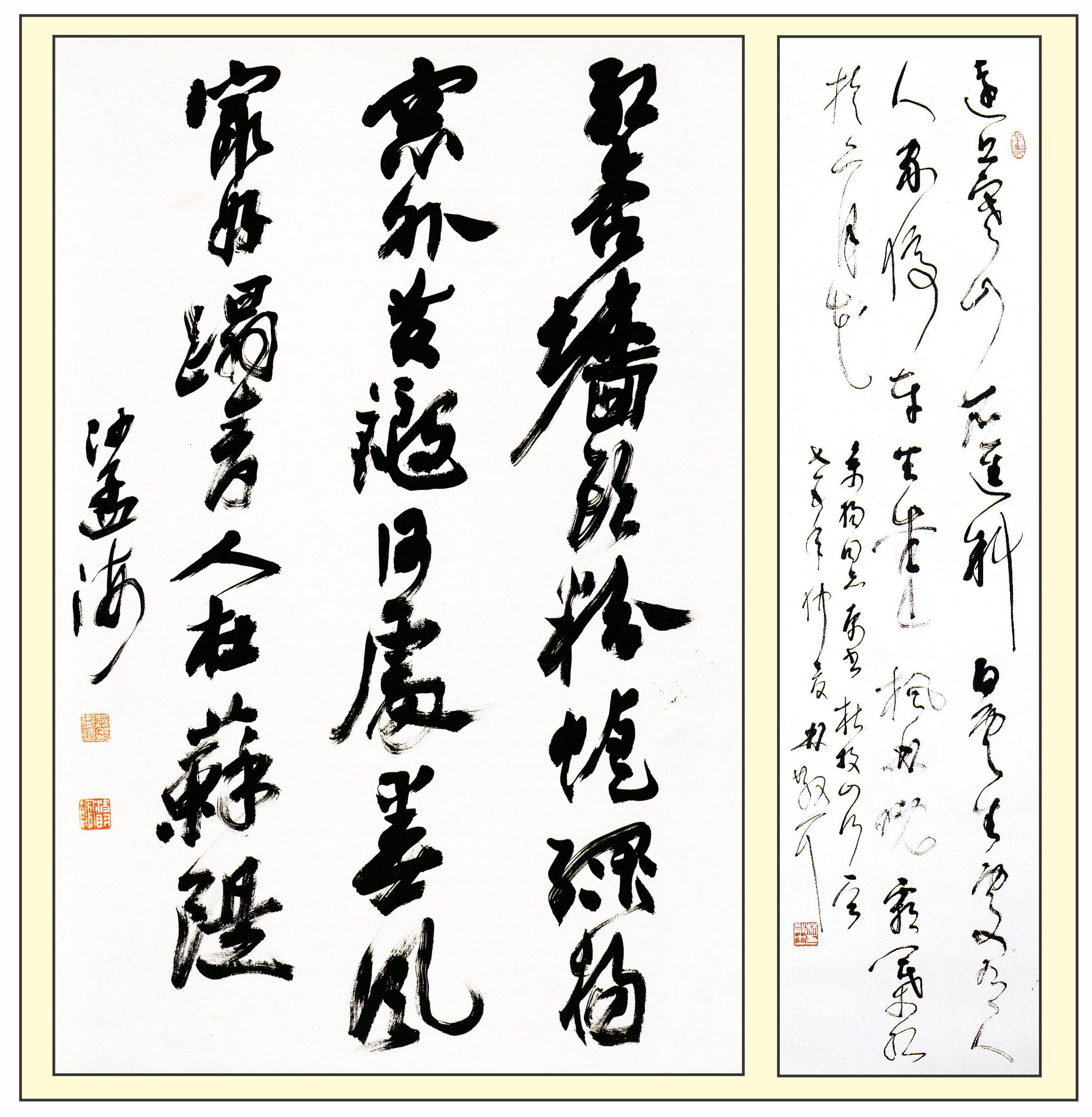
In the 1980s, Sha Menghai wrote a poem about the view from his office in the Academy of Art (Barrass, 2002, p 138)
Red apricot blossom and pink butterflies can be seen over the wall
While outside the window there are green willows and yellow orioles
To best enjoy the spring breezes, join those who walk along
Su Dongpo’s causeway across the West Lake.
East-West Interactions
Wang was also influenced by Western abstract art. He developed a highly fluid calligraphy and combined that with the freedom of Western abstraction. The following is a work called 史記 (shǐ jì, History and Memory, 68 cm square) from 1990 (Hertel, 2016):
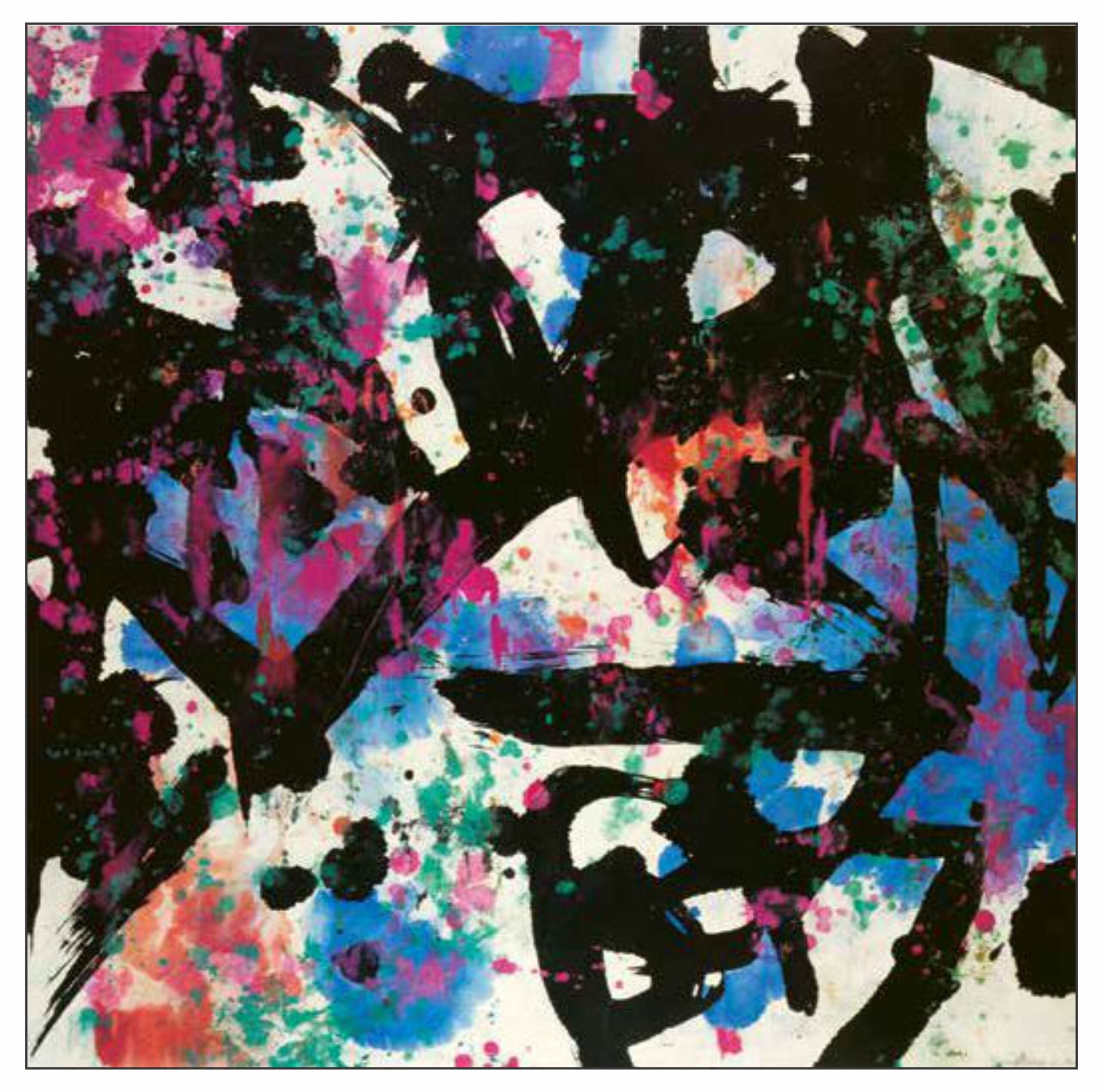
The black calligraphy provides a basic structure for the abstract ecstasy of the colors. Though very freely written, the calligraphy still has definite meaning.
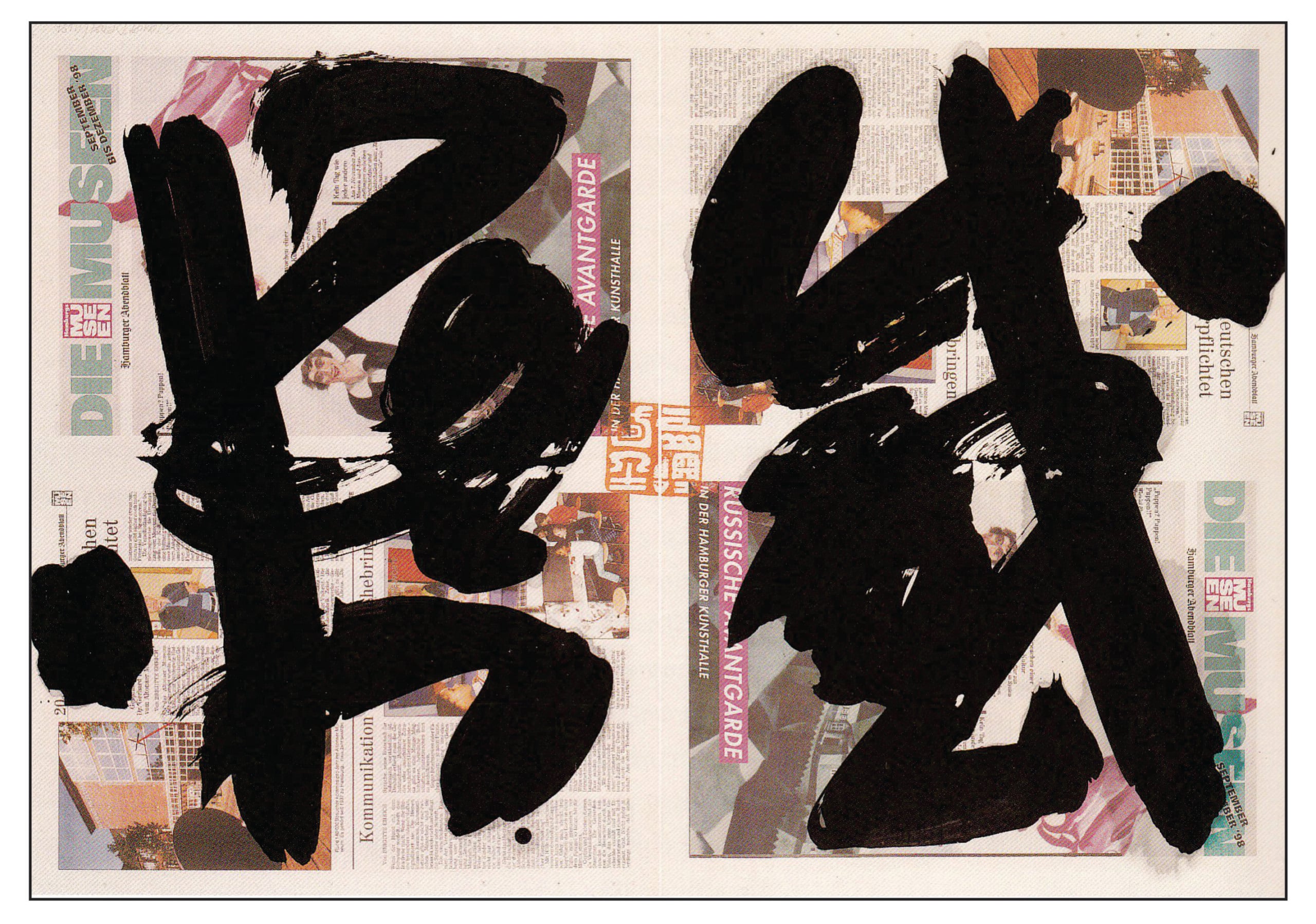
Wang also promoted direct contact between Chinese calligraphy and Western culture (Hertel, 2016). The following illustration shows Chinese calligraphy on a Western background (1999). Wang has written the character for passion/feeling (感 gǎn) on a two-page spread from a German arts magazine and then repeated the calligraphy on an identical spread.
He then placed the two sheets side by side, but with the left-hand one turned upside down. His intention was to illustrate how ‘feeling’ becomes ‘passion’ when, for example, on is ‘head-over-heels’ in love. (Barrass, 2002, p 168).
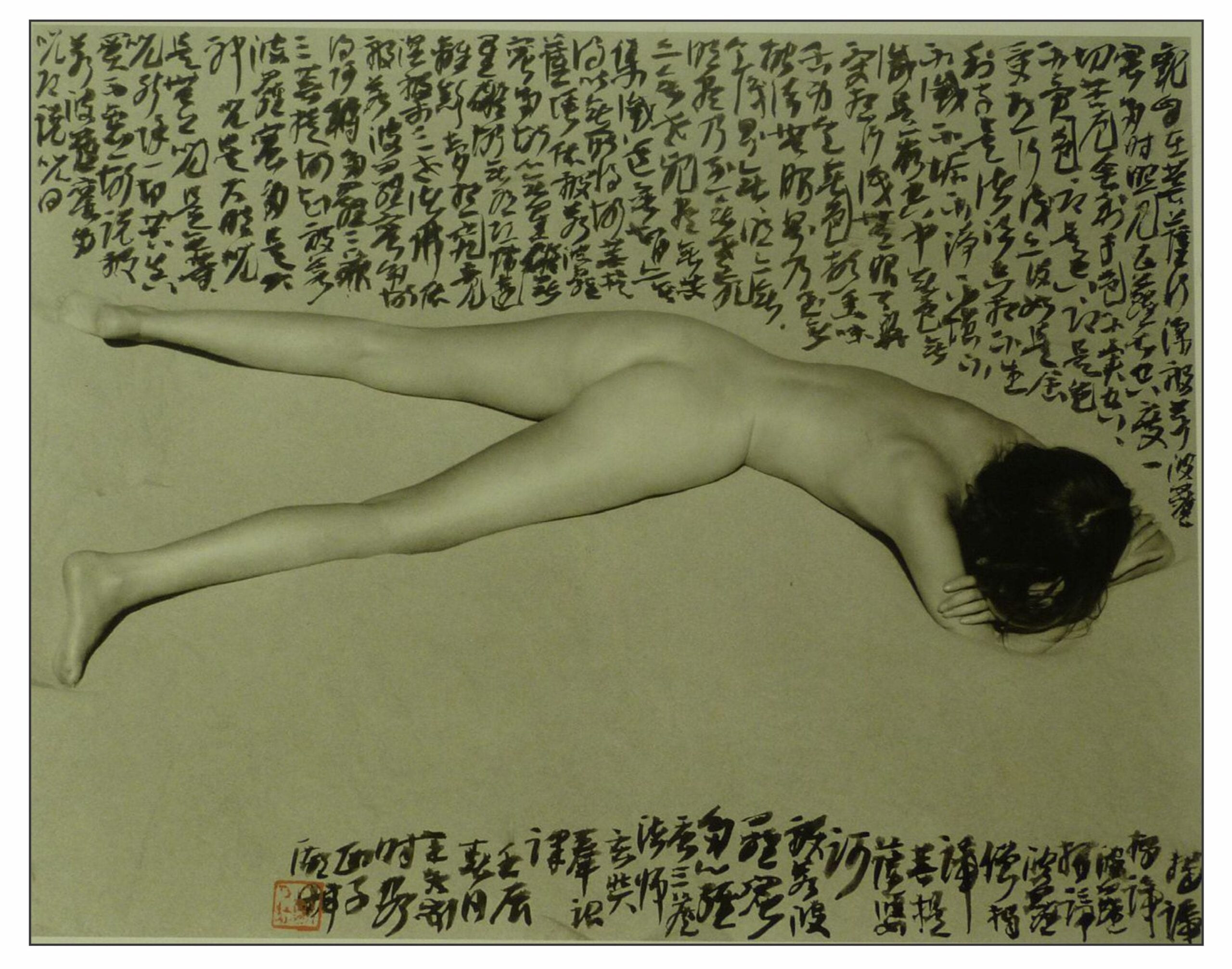
The following illustration shows another example of the interaction between East and West. In 2012, Wang wrote out the Heart Sutra on a magazine illustration (25 by 20 cm) of one of Edward Weston’s 1936 nude photographs of Charis Weston in the Oceano dunes (Iezzi, 2016). The juxtaposition is intriguing. The nude body was not a subject for Chinese artists. The main message of the Heart Sutra is that everything is “emptiness” (śūnyatā). Nothing that we perceive is real.
Large-Character Calligraphy
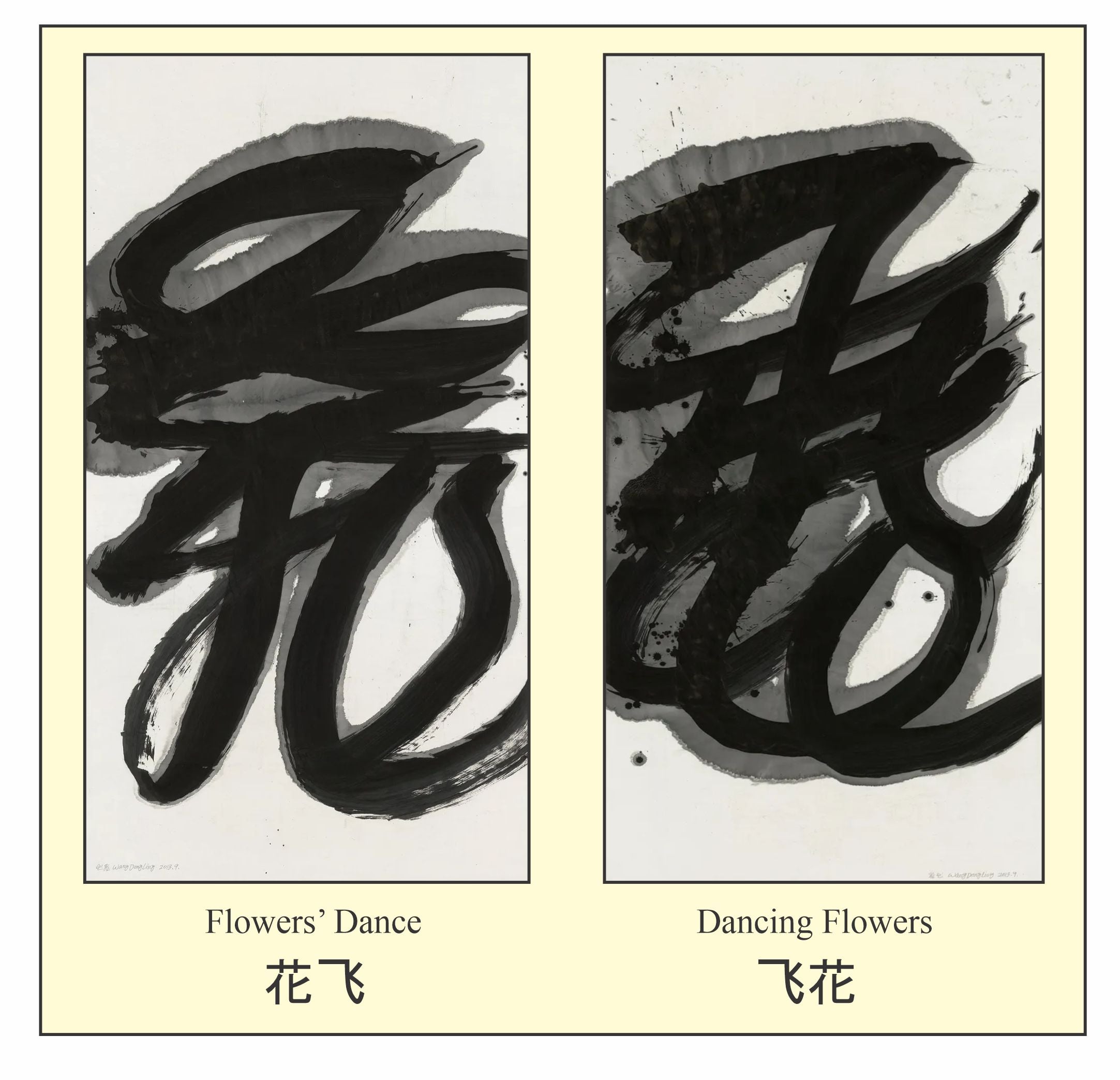
Wang was very adept at making large-character calligraphic works (大字书, dàzì shū). Unlike previous artists, he allowed the characters to overlap and to extend beyond the borders of the paper, and he let the ink to spread freely. The following illustration shows two large-character works (about 178 cm high) about flowers dancing from his 2013 exhibition.
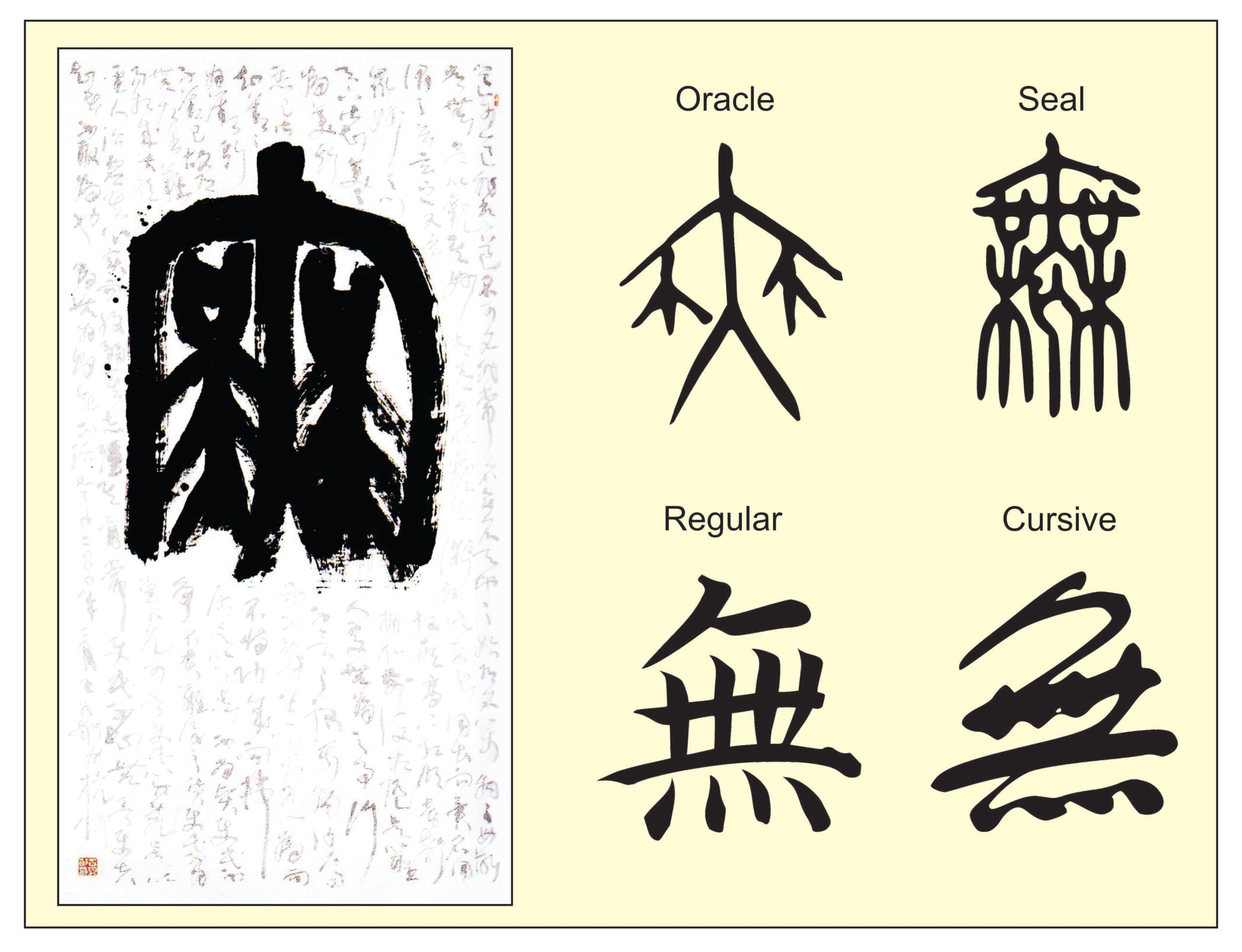
The following illustration shows on the left a large work (272 by 142 cm) entitled The Void, about the nature of the Dao created by Wang in 2000 (Barrass, 2002, p 170). The background contains calligraphy of the first two chapters of the Daodejing, written in a style similar to the “iron line” of his teacher Lin Zanshi. In the center is the character that represents absence or nothingness (無, simplified 无, wú) written in a script based on the oracle script. The right section of the illustration shows the evolution of the character from ancient times.
The following is the Chinese text of the beginning of the first chapter of the Daodejing (Wikibooks) with a recent English translation by Fischer (2023). The character 無 begins the second line:
道可道,非常道。名可名,非常名。
無名天地之始;有名萬物之母。
The way that can be (fully) conveyed is not the abiding Way; a name that can be (fully) descriptive is not an abiding name.
“Formlessness” is the name of the beginning of Heaven and Earth; “form” is the name of the mother of the myriad things.
Photographic Experiments
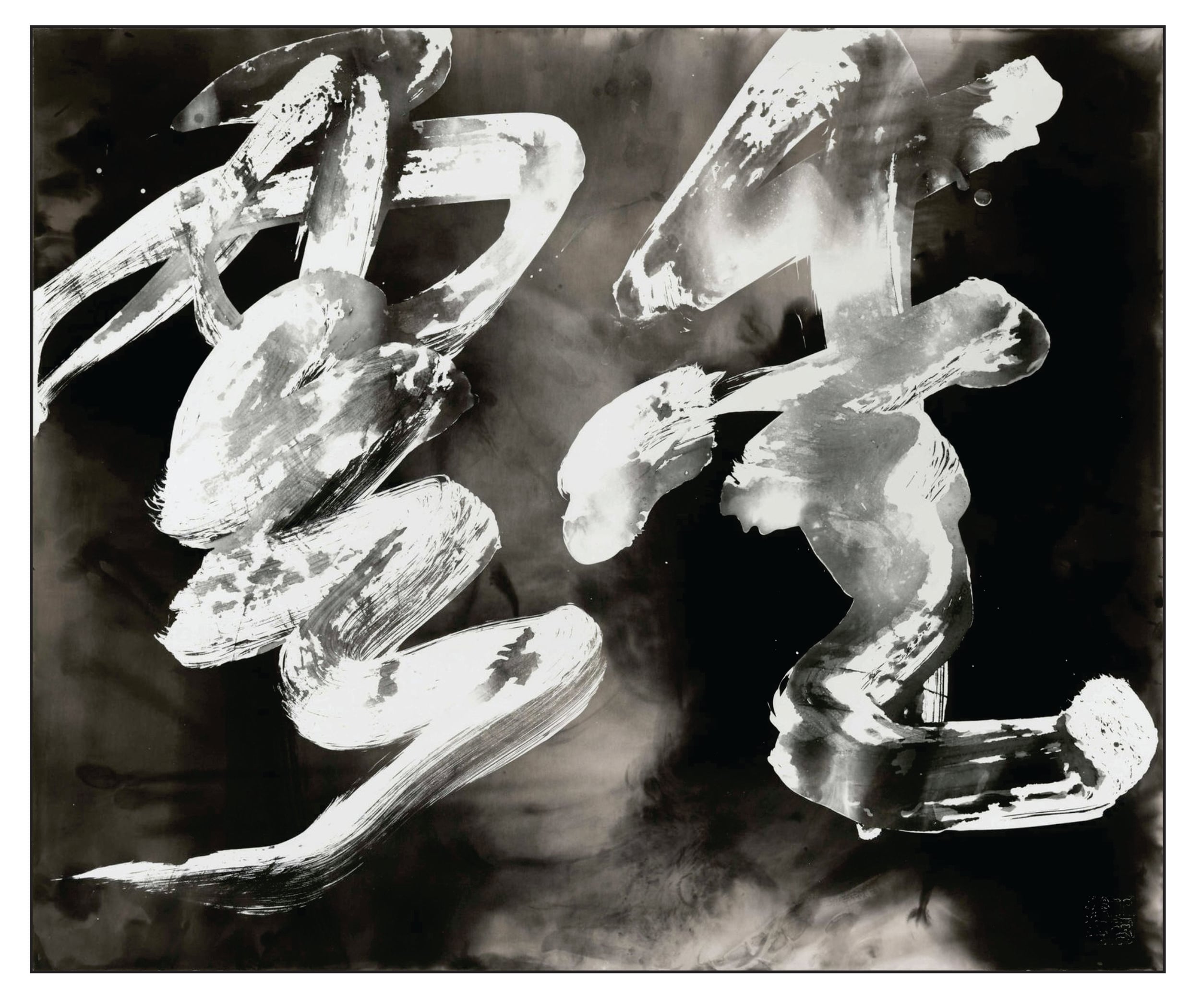
Using photosensitive paper and calligraphy written upon transparencies, Wang (2013) was able to create impressive white on black creations. The following is a gelatin silver print (51 x 61 cm) of Love Cloud (爱雲)
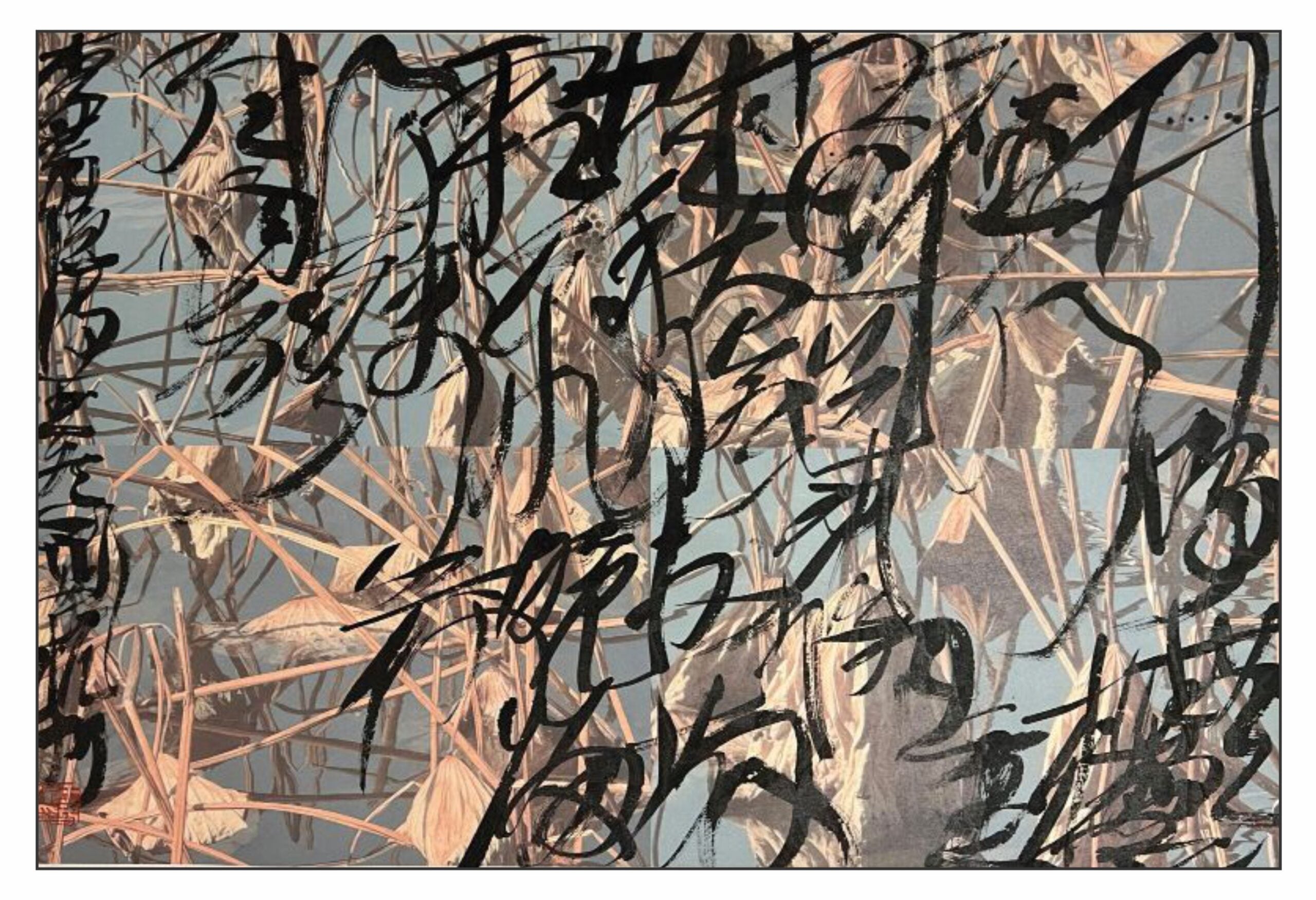
The following is calligraphy on a photographic print (51 by 69 cm) composed of four separate views of a lotus pond (Wang Dongling, 2023): Li Shangyin – Newly Washed After the Rains, the Bamboo Dock is Transformed (李商隱 – 竹塢無塵水檻清, Zhú wù wú chén shuǐ kǎn qīng)
Chaos Script
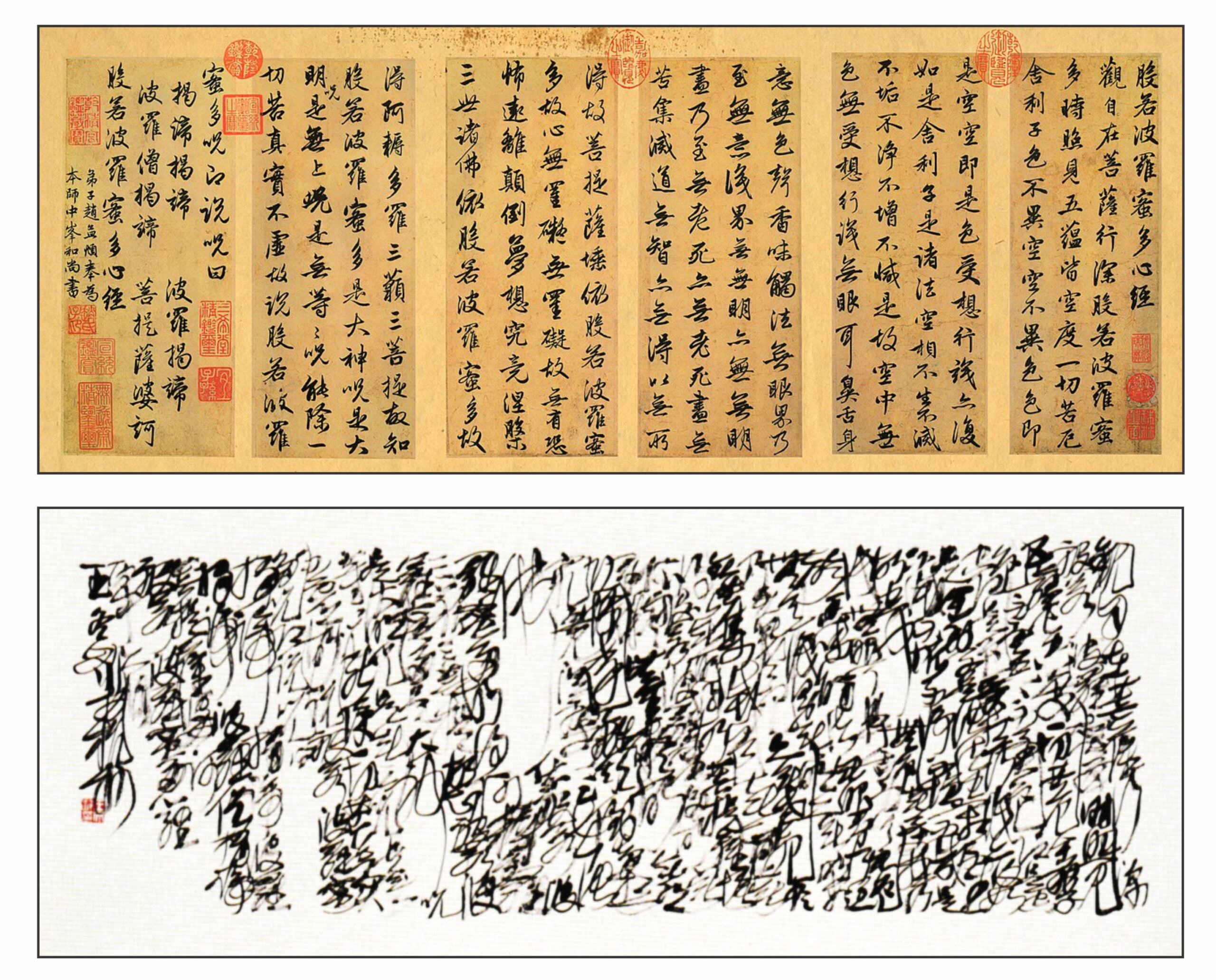
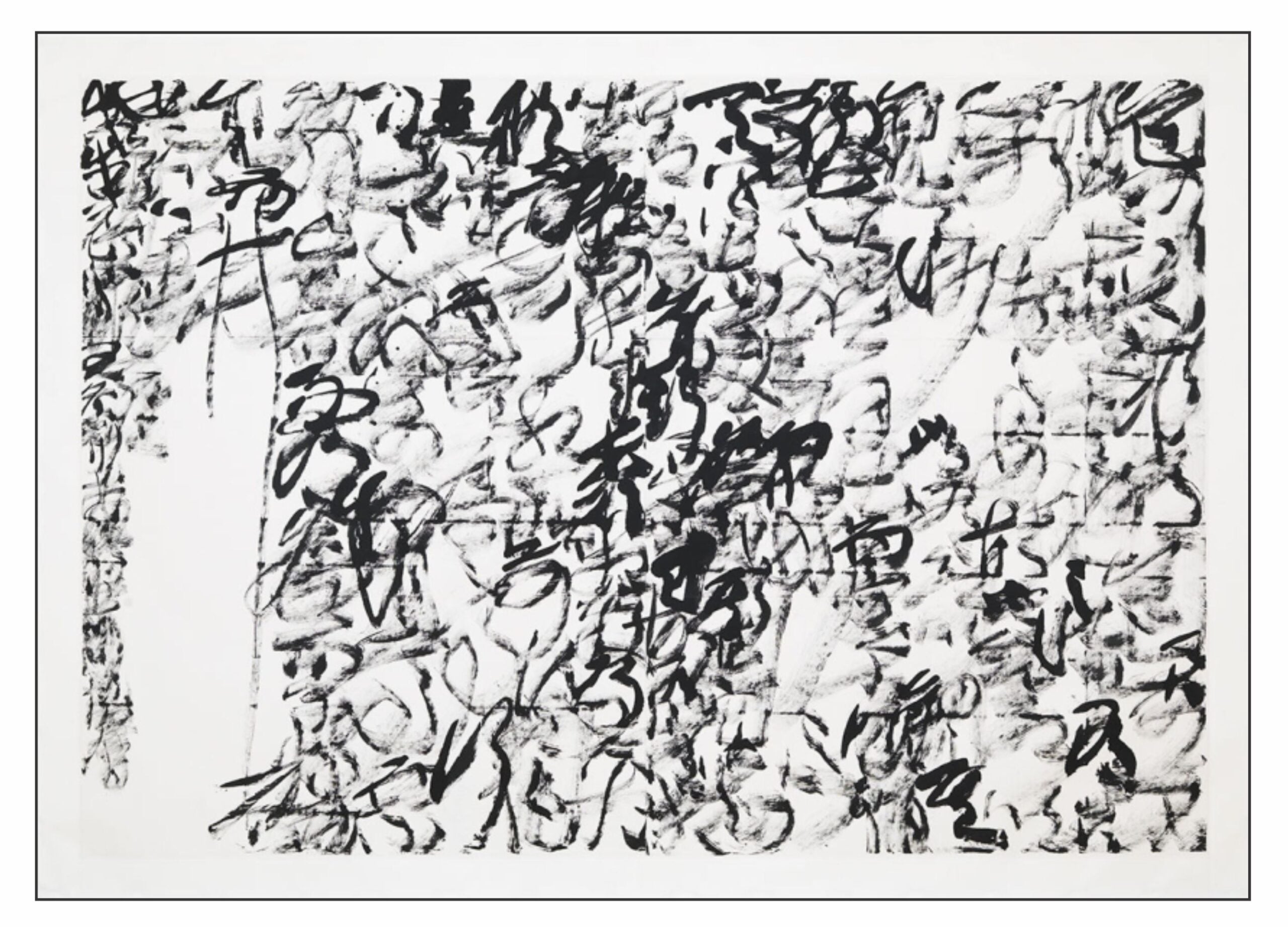
Over recent years Wang has developed a fluid cursive script called chaos script (亂書 luànshū) that breaks all the rules of traditional calligraphy (Festi & Hou, 2023). In cursive script the characters may run into each other vertically. In chaos script the characters overlap both vertically and horizontally, and can extend beyond the edges of the paper. The calligraphy is created with a long-handled brush writing on paper laid out on the ground. The resultant work shows a slow alternation of dark and light as the ink intermittently dries in the brush and must be replenished. The following illustrations show the Heart Sutra as written in regular script by Zhao Mengfu (1254–1322 CE) and in chaos script in 2016 by Wang Dongling (Ferrell et al, 2026, p 126).
The following are comments by Wang on chaos script (Wang Dongling, 2016):
Chaos Script came about gradually, over a long process of creative practice. In Chaos Script, the strokes of cursive script overlap and interweave, creating what appears to be unreadable abstract images. But the execution of Chaos Script in fact still adheres to the rules of traditional calligraphy. It is not haphazard—it appears chaotic but is actually not so. I settled on the name of Chaos Script after some deliberation. Luan evokes disorder and mess, but it also implies zhi (“control,” “govern”)—after chaos comes control. In poetry, there is a famous line [by Bai Juyi (772-846)]: “Riotous blossoms [luanhua] gradually enchant the travelers’ vision.” Chaos has a feeling of nature.
Cahos calligraphy is as much related to painting as to writing. In an essay in the catalogue of Wang’s 2016 exhibition, Britta Erickson remarks
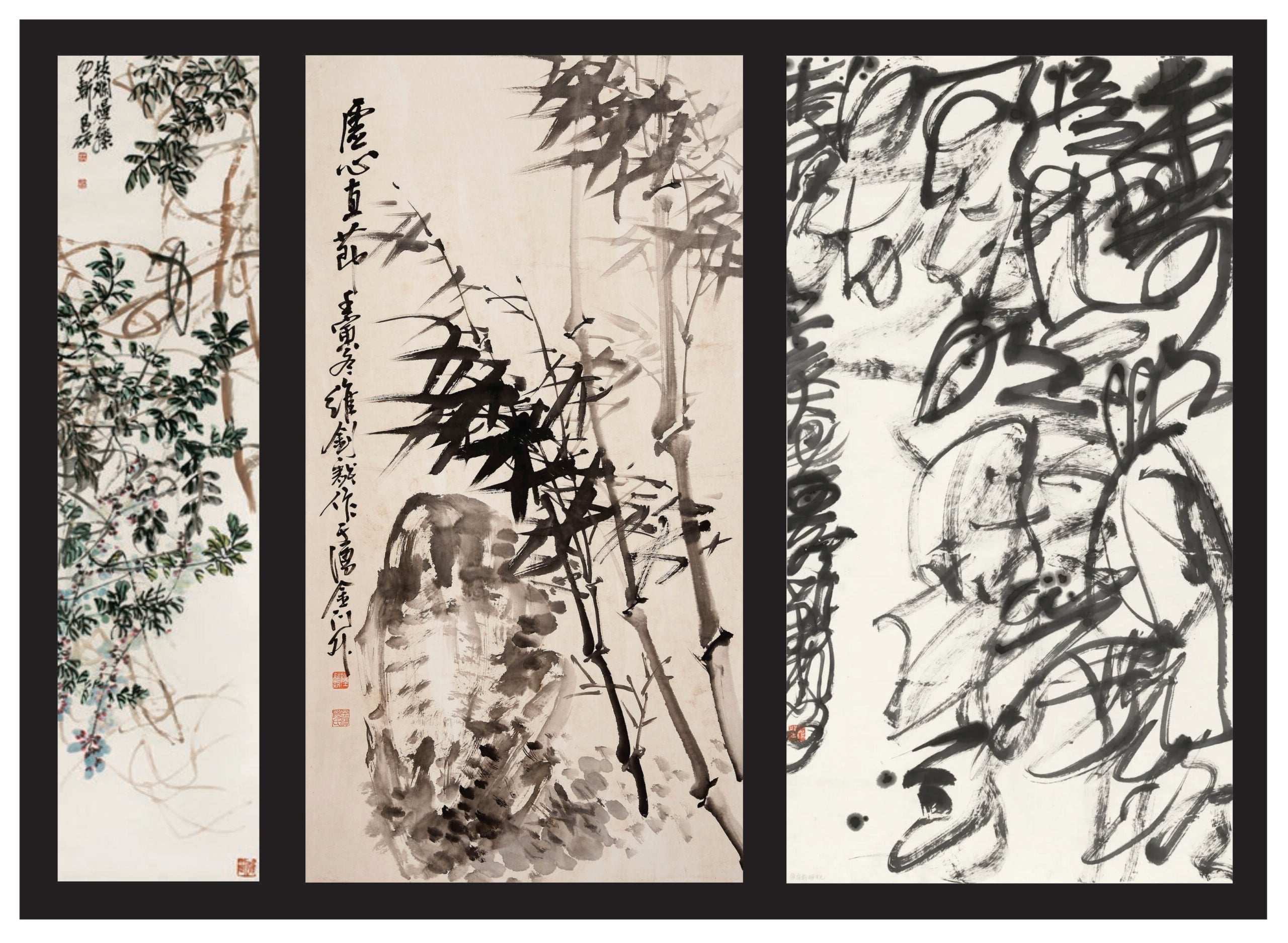
The closest comparison to Wang’s long cascades of intertwined lines that comes to mind are the vines painted by Wu Changshi 吴昌碩 (1844-1927), Professor Wang’s teacher’s teacher. One of the greatest calligraphers of the twentieth century, Wu Changshi employed calligraphic scripts in rendering natural forms. His loose, twisting renderings of vines brought together the artist’s understanding of nature, and of calligraphy, and he would allow the vines to be cropped by the paper’s edge, so that the viewer would then consider the wide spaces into which those vines stretched, beyond the frame of the painting. Wang Dongling’s Chaos Script similarly engages the mind to extrapolate beyond the paper’s edge to consider the breadth of the world into which his writing expands. The expanse can feel infinite.
The following illustration shows the transition from Wu Changshi on the left through Wang’s teacher Lu Weizhao (1899-1980) to Wang’s chaos script on the right.
Wu’s painting represents Wisteria. The inscription reads
The branches are messy and overflowing, [but] please do not chop off the vines!
The painting by Lu Weizhao depicts Bamboo and Rock (1962).
Wang’s example of chaos script is his 2019 calligraphy of the famous poem Quiet Night Thoughts by the Tang poet Li Bai (701-762):
床前明月光 Chuáng qián míngyuè guāng
疑是地上霜 Yí shì dìshang shuāng
舉頭望明月 Jǔtóu wàng míngyuè
低頭思故鄉 Dītóu sī gùxiāng
A pool of moonlight on my bed this late hour
like a banket of frost on the world.
I lift my eyes to a bright mountain moon.
Resigned, remembering my home, I bow.
(translation Sam Hamill, 2013, p 94).
Calligraphy as Performance
Chaos script lends itself easily to performance. It is an art based on action. The following are comments by Gao Shiming (2023):
Writing becomes simple ink, markings, and traces, and the physicality and emotional tenor of the writing becomes the centre of everything. Wang’s chaos script crystallises action. When that action stops, the state and meaning of that movement linger. This state of action is a dance that arises when the mood strikes. The impulse to write chaos stems from writing in an uninhibited state of disorientation and overwhelm. In the state of writing generated by the dialectic between chaos and order, a calligrapher loses himself yet finds contentment.
The following shows a video of Wang Dongling writing out the first two chapters of the Daodejing in chaos script at the Asia Society Museum in New York in 2018.
And the following illustrations shows the calligraphy in its final form:
References
Barrass, G. S. (2002). The Art of Calligraphy in Modern China. British Museum Press.
Ferrell, S., Kong, W., Hiro, R. I., Little, S., Moon, V., &Ng, L. W. (2026). Line, form, qi: calligraphic art from the Fondation INK collection. Los Angeles County Museum of Art.
Festi, G. & Weihuan Hou. (2024). Contemporary reinventions of Chinese calligraphy. A semiotic exploration. Ocula (Online), 25(3). https://doi.org/10.57576/ocula2024-6
Fischer, P. (2023). The annotated Laozi: a new translation of the Daodejing. State University of New York at Albany.
Gao Shiming (2023). Chaos script – the dialectic between order and chaos. China Academy of Art
Hamill, S. (2013) Crossing the Yellow River. Three hundred poems from the Chinese. Tiger bark Press.
Hertel, Shao-Lan. (2016). Lines in translation: cross-cultural encounters in modernist calligraphy, early 1980s-early 1990s. Yishu, 15(4), 6–28.
Iezzi, A. (2016). “Chinese modern calligraphy” as a reflection of Chinese contemporary culture: a comparison between modernism (Wang Dongling) and avant-garde (Xu Bing). Italian Association for Chinese Studies. Selected Papers 1, 75-116
Wang Dongling (2013). The origins of abstraction. Exhibition in Beijing.
Wang Dongling (2016). Writing Chaos. 亂書. Exhibition Catalogue published by Ink Studio, Beijing.
Wang Dongling (2024). The joy of being. 信可樂也 Exhibition Catalogue published by iPRECIATION, Singapore.
Leave a Reply