
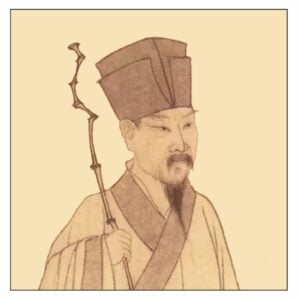


Su Shi (蘇軾; simplified 苏轼; Sū Shì, literary name 東坡 dōngpō “east slope,” 1037-1101) was a poet, calligrapher, painter and statesman during the Northern Song Dynasty (960-1127). After criticizing some of the new government policies in his poetry, he was indicted in 1079 for treason. After the Crow Terrace Poetry Trial (烏臺詩案), he was found guilty and condemned to death. The emperor commuted his sentence, and Su was exiled to Huangzhou in Hubei Province. There he converted an old army camp on the eastern slope of a mountain near the city into a farm. During his exile from 1080 to 1084, he adopted the name of his farm as his professional pseudonym, practised Buddhism and wrote poetry.
Poetry and Politics
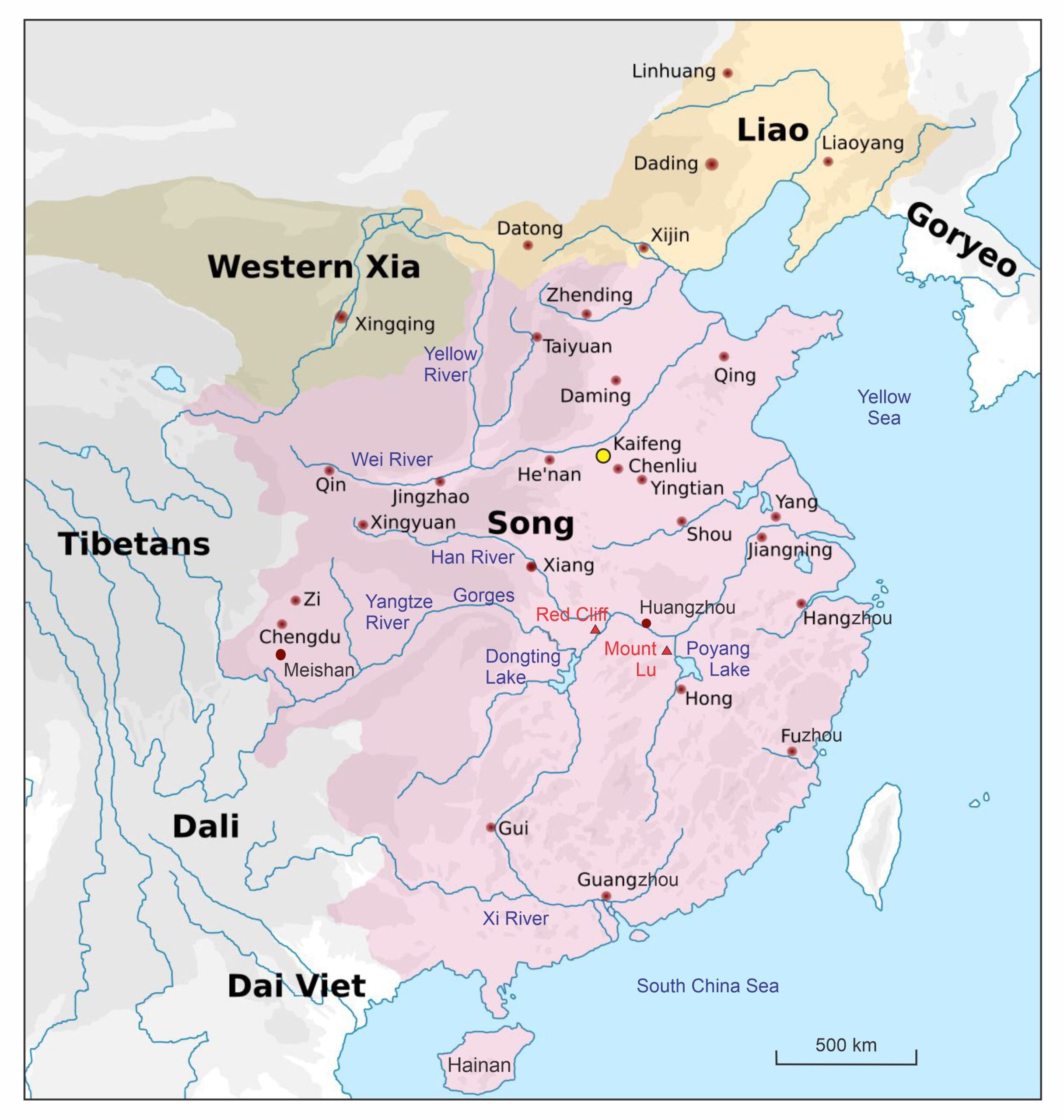
Su Shi was born in Meishan near Chengdu in the western regions of the Chinese Empire. He and his younger brother Su Zhe travelled to the imperial capital Kaifeng to take the civil service examinations in 1057. They both passed with distinction and came to the attention of the powerful statesman Ouyang Xiu (1007-1070), who promoted their careers. Su Shi spent time as an administrator in various regions of the empire. While in Hangzhou in the southern Yangtze delta, he was responsible for dredging the West Lake and constructing a promenade that is now known as the Su Causeway. Hangzhou would later become the capital of the Southern Song Dynasty (1127–1279), when the northern regions seceded to form the Jin Dynasty (1115–1234).
From 1069 to 1076, the chancellor (and poet) Wang Anshi (1021-1086) brought in a series of reforms called the New Policies (新法 xīnfǎ). These were intended to improve the life of small farmers who were being bought out by large landowners, to increase taxation so that the government could maintain a professional army for defence rather than forcibly drafting young men, and to stabilize the prices of goods like salt so that rich merchants could not monopolize the markets (Egan, 1994, pp 27-53). In a sense these government interventions were “proto-Keynesian” in nature (Zhao & Drechsler, 2018).
Although the intentions were good, the reforms were largely unsuccessful. For example, in the “Green Shoots” policy the government gave low-cost loans to small farmers to buy seeds in the spring. However, the bureaucrats administering the policy were terribly slow. The farmers had to travel to government centers for their loans and stay there for prolonged negotiations when they should have been at home planting. Wang Anshi refused to acknowledge the problems, and earned the sobriquet “his stubbornship” (Pease, 2021).
The following illustration shows the Song Dynasty at the time of these reforms.
The Crow Terrace Poetry Trial
Su Shi criticized the new reforms in both poetry and prose. By 1079 Wang Anshi had largely retired from public life, but his supporters were incensed by the criticisms. They arranged for the Imperial Office of the Censorate, nicknamed the Crow Terrace because of the crows who nested nearby, to indict Su Shi for treason. Article 122 of the Sung Criminal Code prohibited any “expression of critical comments directed against the emperor” (Hartman, 1990, p 18). Or in more poetic terms
指斥乘輿 Denouncing the Imperial Chariot
The records of the trial are intriguing since much of the prosecution depended upon the interpretation of poetry that was by its very nature both allusive and metaphorical (Hartman, 1990; Wang, 2011). Su Shi provided a deposition in which he explained his own poetry. The following is the fourth of his Mountain Village poems:
杖 藜 裹 饭 去 匆 匆
过 眼 青 钱 转 手 空。
赢 得 儿 童 语 音 好
一 年 强 半 在 城 中
With walking sticks and wraps of cooked rice, they depart in a rush
Turn around, with borrowed money spent, their hands soon empty.
Children learn the language and ways of the big city
For half a year they stay inside the city walls.
(text and translation from LAC website)
And the following is Su Shi’s interpretation
My meaning here is that as soon as the common people receive the green-sprout money, they at once squander it in the cities. It also means that the country people twice yearly must pay summer and autumn taxes and several other levies, to which is now added the green-sprout and corvée assistance monies, with the result that the children from the families who work on the great estates are often in the cities, where they become disorderly and learn nothing but a city accent. (Hartman, 1990, p 23).
The trial dragged on for four months. At the end Su was found guilty and condemned to death. However, Emperor Shenzong was counseled by the dowager Empress Cao and by Wang Anshi to commute the sentence. Su Shi was deprived of his salary and exiled to Huangzhou (黄州, presently part of Huanggang), a small town in Hubei on the Yangtze River. (Hubei is the region north of the Dongting Lake, whereas Hunan is the area to its south.)
Su Shi arranged to obtain some land on the East Slope (Dongpo) of a hill near Huangzhou. There he became a farmer to provide food for his family. He changed from a formal statesman to a hard-working layman:
To state the matter simply, in Huangzhou, Su Shi became Su Dongpo, “Su of East Slope.” This poetic personality, with its firm, philosophic, yet jovial poise of spirit, was created by Su Shi’s major writings in Huangzhou. Reaffirmed in the poetry of his later exile to Huizhou and Hainandao, the image of Su Shi finding joy even in the worst of adversity has become part of the Chinese cultural heritage. (Fuller, 2023, p 251),
Su Tungpo now was to become a farmer by necessity and a recluse by temperament and natural inclination. What society, culture, learning, reading of history, and external duties and responsibilities do to a man is to hide his real self. Strip him of all these trappings of time and convention, and you have the real man. A Su Tungpo back among the people is like a seal in water; somehow a seal dragging its fins and tail on land is only half a seal. Su is never more likeable than when he is an independent farmer trying to make his own living. The Chinese mind usually glamorises a poet wearing a “coolie hat”, putting his hands to the plough and standing against an idyllic hillside, provided he can also compose good verse and beat time to it by striking the buffalo’s horn, and provided further that he occasionally, or even frequently, gets drunk and climbs the city wall to prowl in the moonlight. (Lin, 1948, p 183)
East Slope
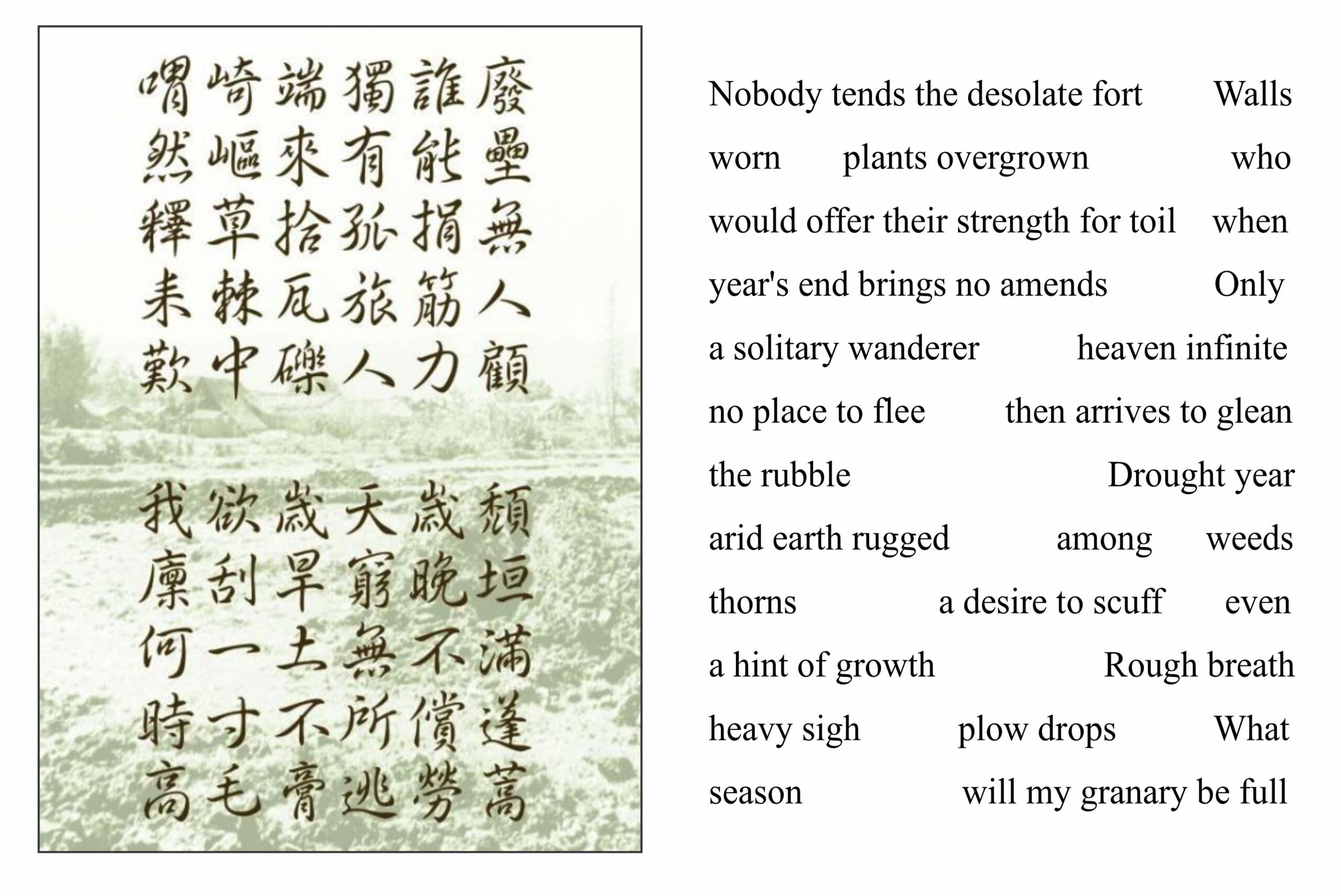
In 1081, Su wrote a set of eight poems about his life as a farmer. The following is the first of these with a translation by Jeffrey Yang (2008):
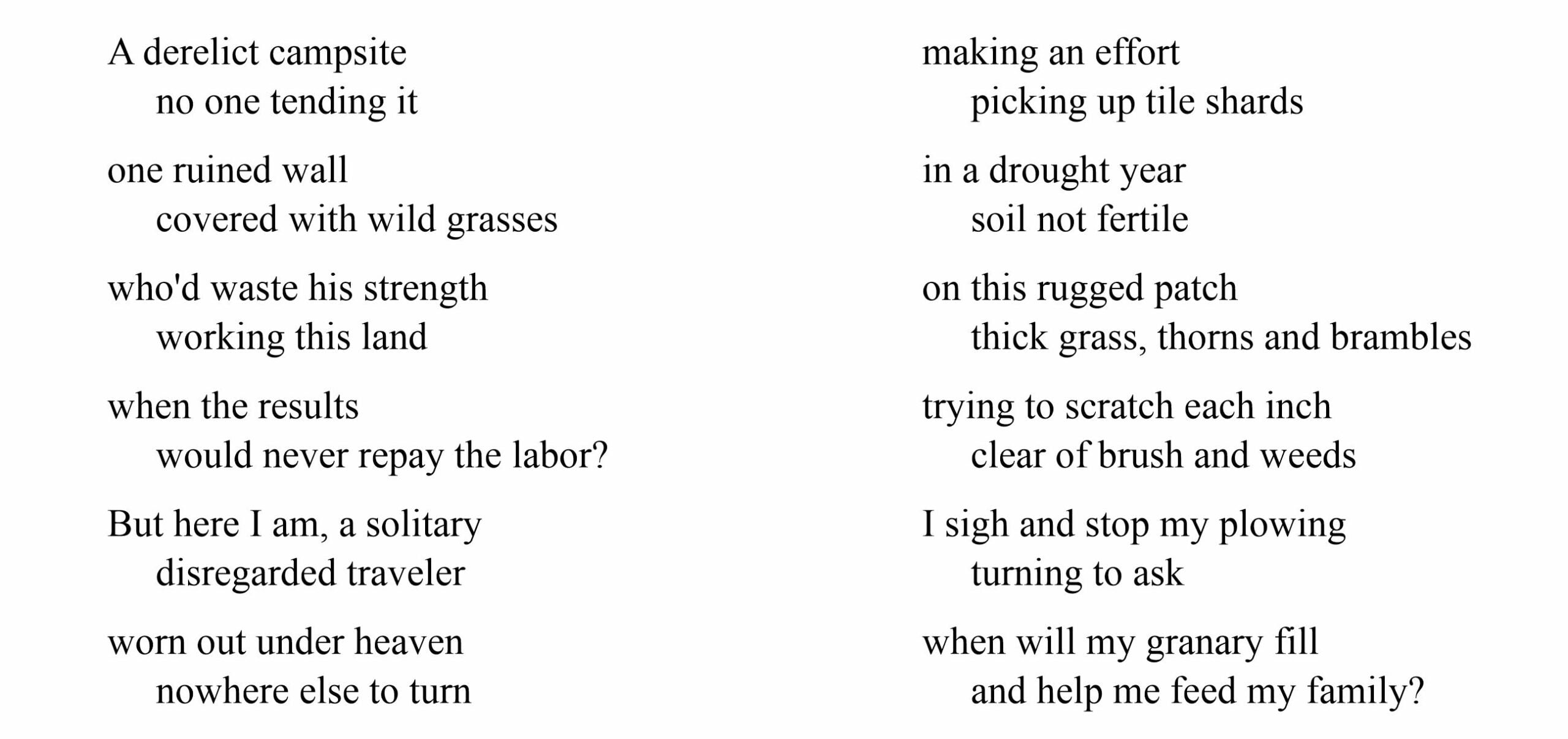
And the following is a translation by Lin and Young (2020)
The Cold Food Festival
The Hanshi Observance (寒食節) is a traditional festival celebrated in early April (Holzman, 1986). Legend has it that in the 7th Century BCE a nobleman Jie Zhitui refused to come out of the forest to pay allegiance to his lord. The angry lord burned down the forest to force Jie out, but wound up burning him to death. In remorse, the lord instituted an annual period without fires as a memorial to Jie.
In 1082, Su Shi wrote two poems about the festival, describing how desolate he felt. He wrote these out in his distinctive semi-cursive (running) script in a sample of calligraphy that has been preserved, and is now in the National Palace Museum, Taipei. The following illustration shows the scroll that contains the calligraphy. The top section shows the full scroll (about 200 cm long). Below that is an enlargement of the title section that was added much later with calligraphy by Emperor Gaozong of Qing (1711-1799). This reads 雪堂餘韻: Reminiscences of the Academy (likely one of the halls in the Forbidden City where the emperors studied). Then there is an enlargement of the poems with two colophons. The first colophon in small script is by the Emperor Gaozong of Qing. The second colophon in characters larger than Su’s is by Su’s student Huang Tingjian (黃庭堅, 1045-1105). The lowest section shows an enlargement of Su’s poem. Particularly striking characters are in lines 2 (年, nián, year), 5 (中, zhōng, middle), 11 (葦, wěi, reed), and 13 (紙 zhǐ, paper, banknote) from the right. Each of these has an exaggerated descending line suggestive of rain or tears. This piece of calligraphy is generally acknowledged as one of the greatest examples of running script.

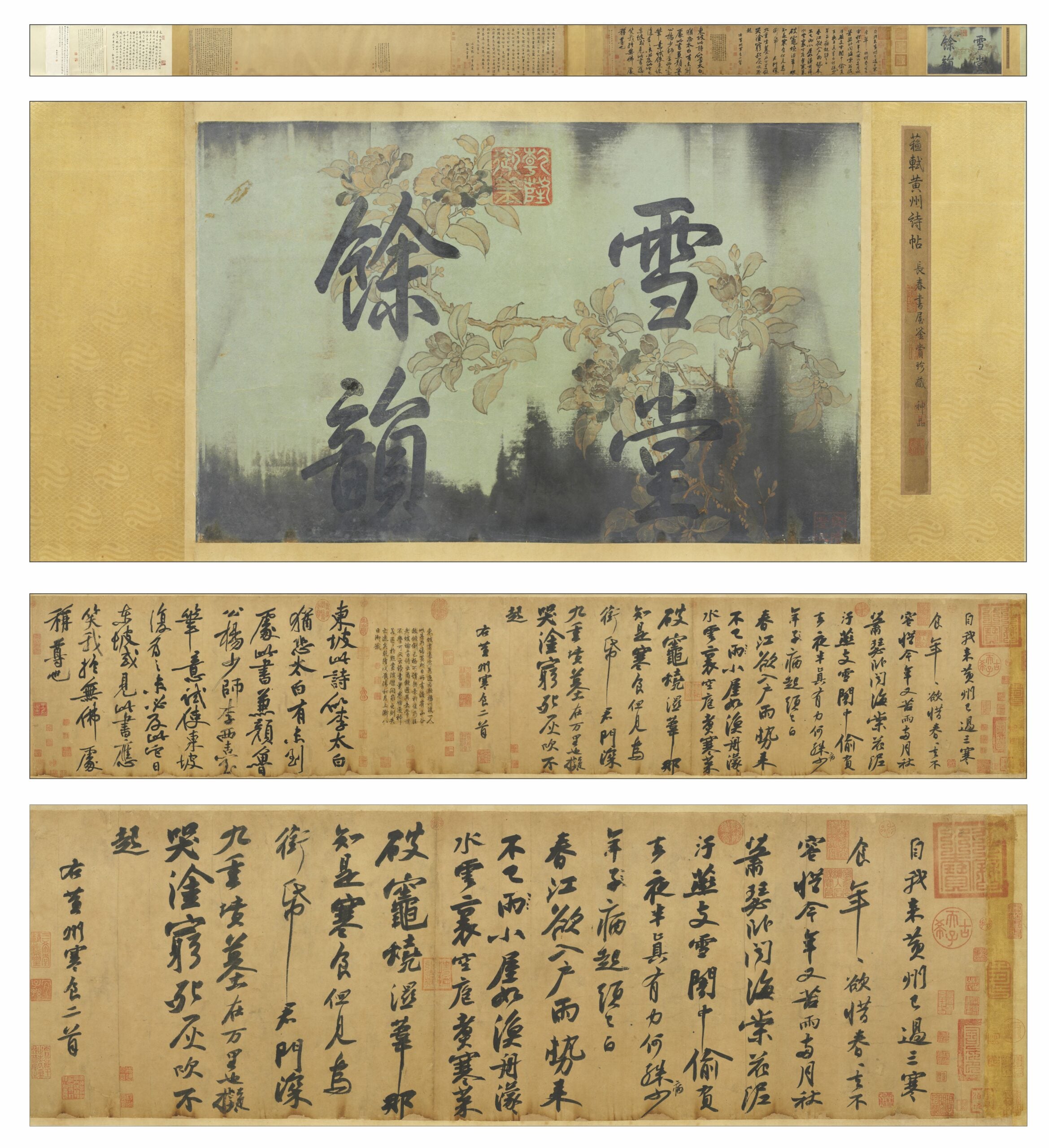
The following is the text of the first poem written from left to right
自我來黃州 已過三寒食
年年欲惜春 春去不容惜
今年又苦雨 兩月秋蕭瑟
臥聞海棠花 泥汙燕支雪
闇中偷負去 夜半真有力
何殊病少年 病起頭已白。
A free verse translation by Lin and Young (2020):
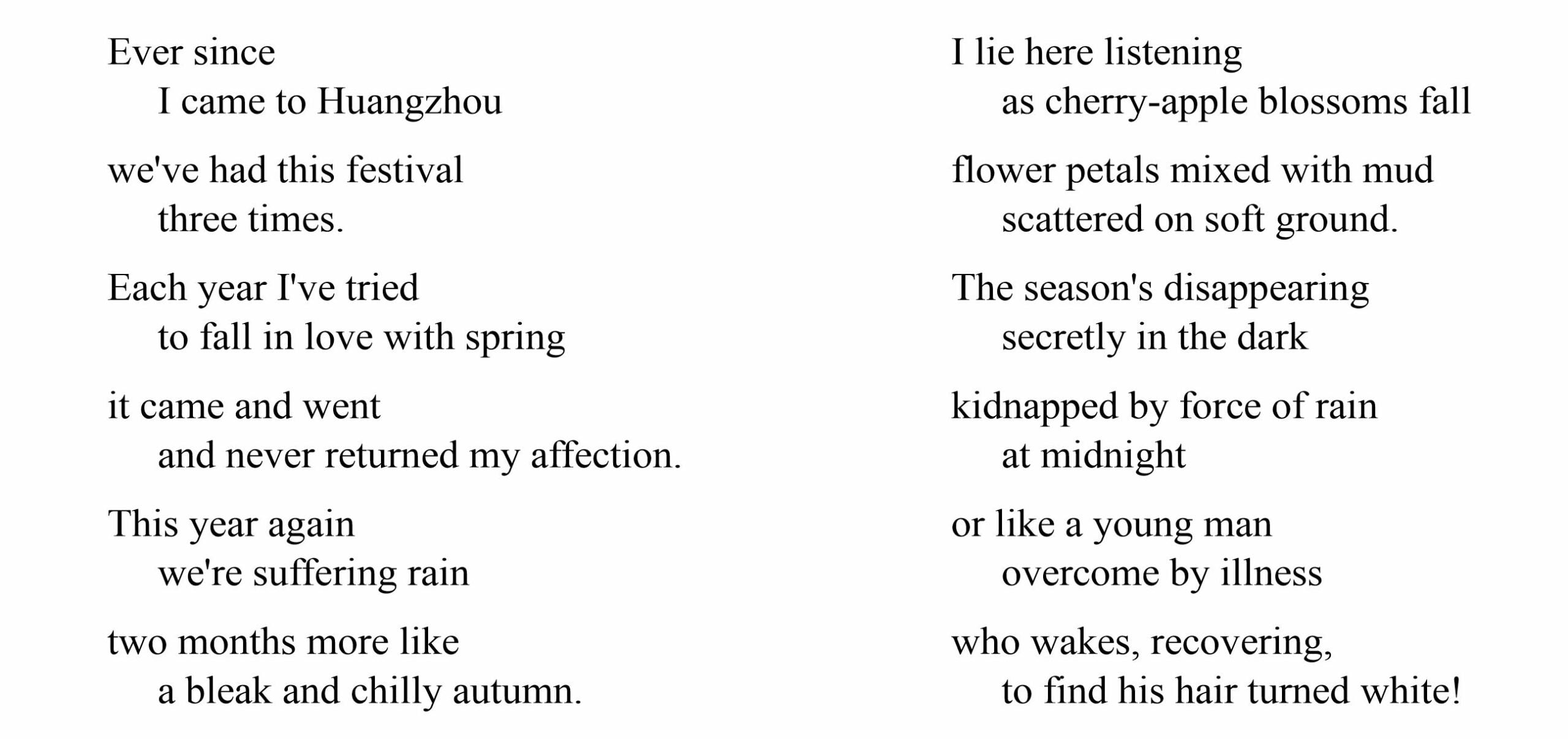
Red Cliff Rhapsodies
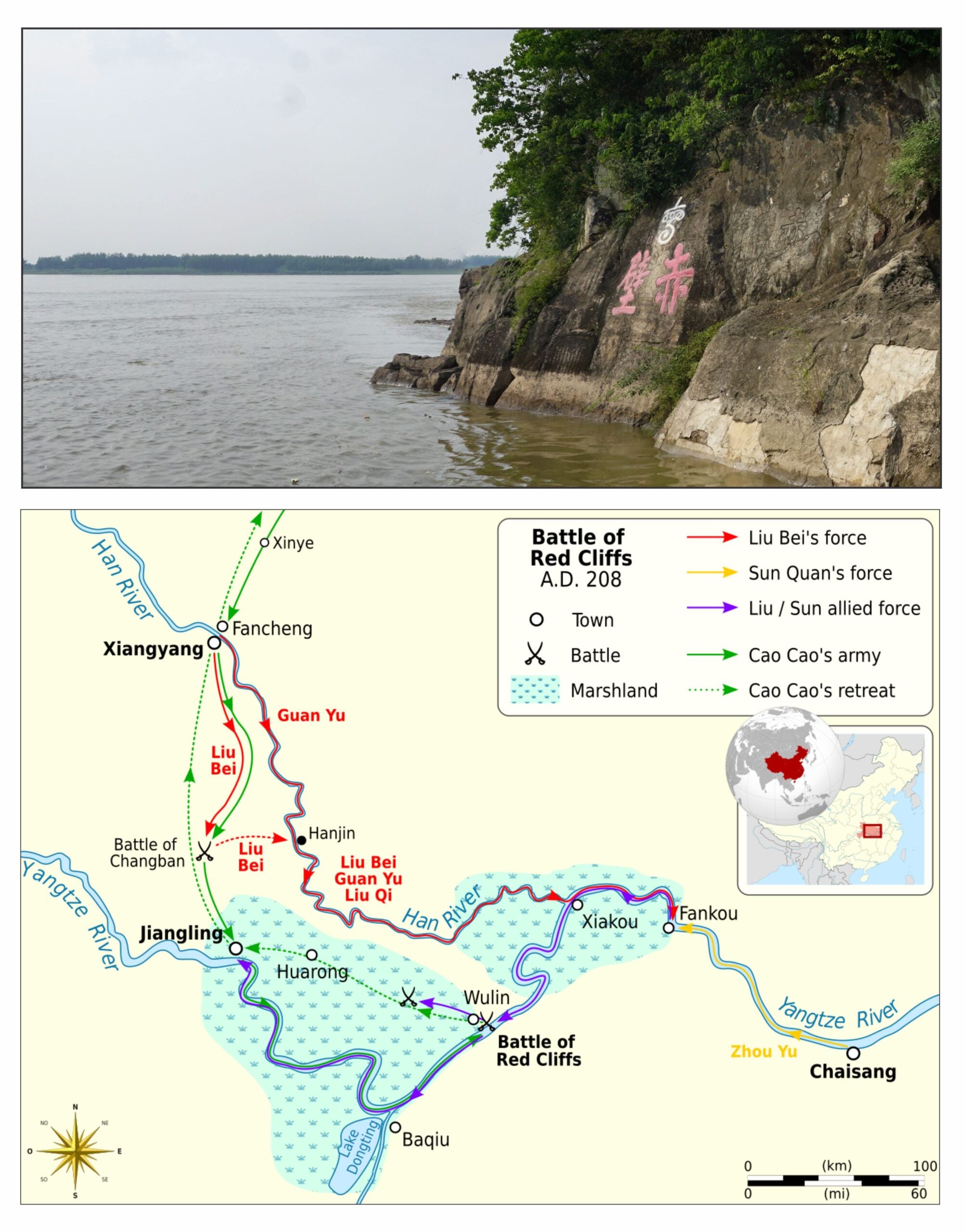
In the winter of 208-209 CE, the Battle of the Red Cliffs (赤壁) occurred on the Yangtze River to the west of Huangzhou. This naval battle, wherein the forces from the south of China led by Liu Bei and Zhou Yu defeated the numerically superior forces of Cao Cao, was one of the major events leading to the downfall of the Han Dynasty (202 BCE – 220 CE) and the beginning of the period of the Three Kingdoms (220-280 CE).
During his time in Huangzhou, Su Shi and his friends made several trips by boat to the site of the ancient battle. Modern scholarship places the location of the battle near Chibi, which was west of the location visited by Su Shi, now called the “literary” as opposed to the “historical” Red Cliffs. In 1082, Su described these trips in two prose poems (“odes” or “rhapsodies”). In the first , Su Shi and his friends drank wine, and remembered the song that Cao Cao composed on the eve of the battle:
The moon is bright, the stars are few,
and magpies come flying south,
three times round they circle the tree,
where is the branch on which to roost?
(translated by Stephen Owen, 1996, p 281)
The following illustration shows the Red Cliffs on the Yangtze River and a map of the battle in which Cao Cao was defeated. The red calligraphy on the cliffs is 赤壁(red cliffs) written from left to right.

One of Su’s companions played a melancholy tune on his flute and remembers
Once Cao Cao had smashed Jingzhou, he came down to Jiangling, going east with the current. The prows and sterns of his galleys stretched a thousand li, his flags and banners blotted the very sky; he poured wine and stood over the river, hefted his spear and composed a poem—he was indeed the boldest spirit that whole age! And yet where is he now? (translation of Tian, 2018, p 305)
This led him to a meditation on the transience of life:
We go riding a boat as small as a leaf and raise gourd flasks of wine to toast one another. We are but mayflies lodging between heaven and earth, single grains adrift, far out on the dark blue sea. We grieve that our lives last only a moment, and we covet the endlessness of the great river. We would throw an arm around those immortal beings in their flight and go off to roam with them; we would embrace the bright moonlight and have it done with forever. And since I knew that we could not suddenly have these things out of the blue, I gave the lingering echoes of that desire a place in my sad melody. (Tian, p 306)
Su replies to his companion
And do you, my friend, indeed understand the water and the moonlight? As Confucius said as he stood by the river, “It passes on just like this,” and yet it has never gone away. There is in all things a fullness and a waning to nothing, just as with that other thing, the moon; and yet it has never increased and never vanished altogether. If you think of it from the point of view of changing, then heaven and earth have never been able to stay as they are, even for the blink of an eye. But if you think of it from the point of view of not changing, then neither the self nor other things ever come to an end. So then what is there to covet? (Tian pp 306-307
The quotation from Confucius is from Analects IX 16 “The water flows on and on like this, never stopping day or night”
Su continues
且夫天地之間, 物各有主, 苟非吾之所有, 雖一毫而莫取. 惟江上之 清風, 與山間之明月, 耳得之而為聲, 目遇之而成色, 取之無禁, 用之不竭, 是造物者之無盡藏也, 而吾與子之所共適.
Between heaven and earth each thing has its own master. If something is not mine, then I cannot take it as mine, even if it is only a hair. There is only the cool breeze along with the bright moon among the mountains. The ears catch one of these, and it is sound; the eyes encounter the other, and it forms colors. Nothing prevents us from taking these as our own. We can do whatever we want with them, and they can never be used up. This is the inexhaustible treasure trove of the Fashioner-of-Things, and it serves the needs of both you and I alike. (Tian p 307)
This conclusion to the poem provides a moving reconciliation between transience and eternity. In the words of Zhang Longxi (2023, pp 221-222)
Through the dialogue of Master Su and the flute player and from the perspective that comprehends both mutability and constancy of all things, nature is invoked as a great healing power to cure human wounds and suffering, and relieve men from self-pity and depression.
Over two centuries later in 1301, the great Chinese calligrapher Zhao Mengfu wrote out Su Shi’s Two Odes on the Red Cliff and provided a portrait of Su Shi. This original scroll was later cut up to form album leaves each 27 by 11 cm. These are now in the National Palace Museum in Taipei. The following illustration shows at the top a digital recomposition of the original scroll of the first ode, and then an enlargement of the portrait and two album leaves near the end of the ode. The quotation beginning “Between heaven and earth… (且夫天 qiě fū tiān, and man heaven) begins in the right-most line of the enlarged album leaves three characters from the bottom.

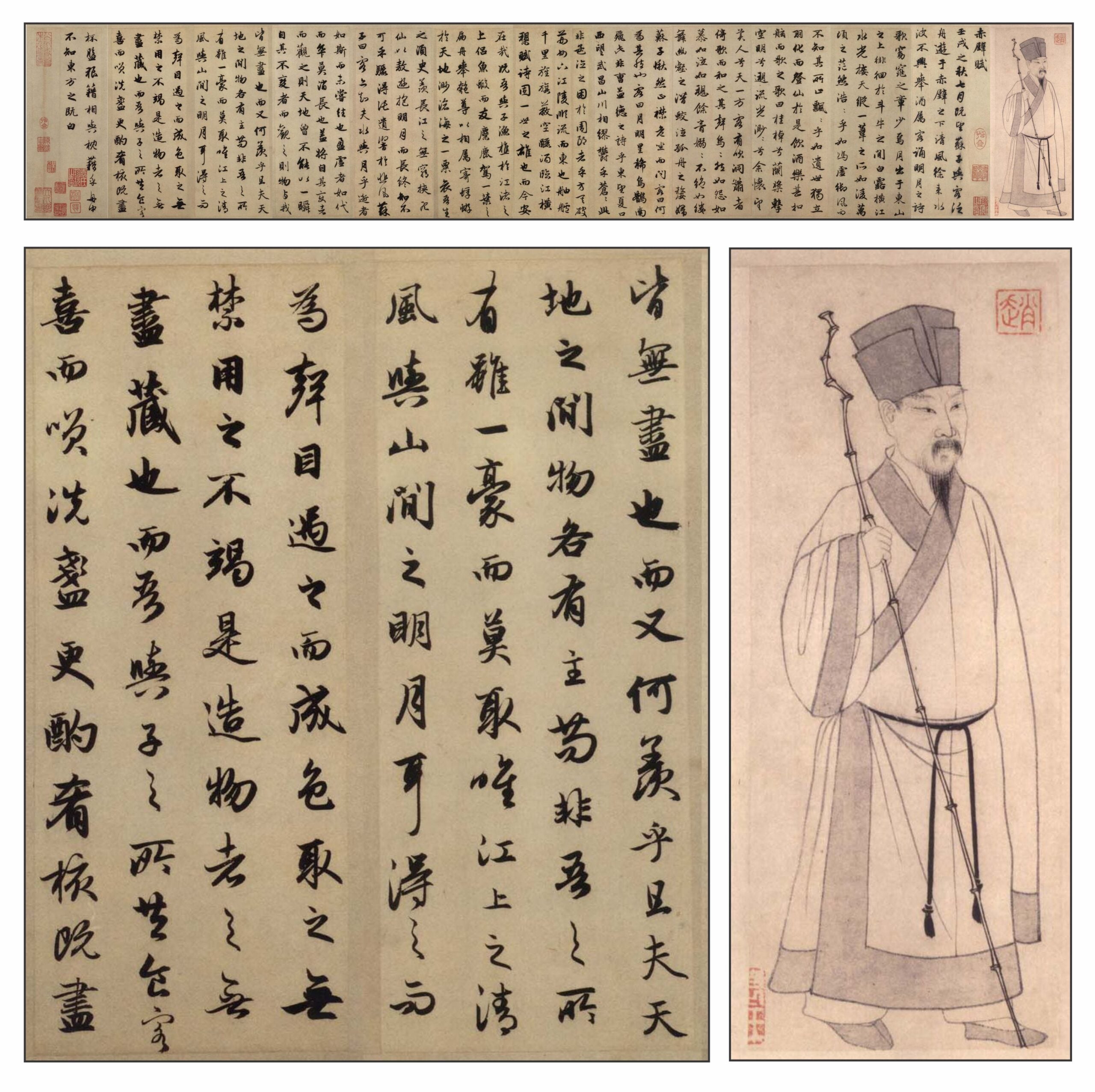
Su’s poem shows his ability to write fluently and clearly about issues of importance. Yang (2015, p 3) discusses this in terms of “spontaneity.”
A primary Chinese term for this notion is ziran 自然 (literally ‘self-so-ness’). Ziran in the premodern context could function as an adjective: ‘being natural’; or adverb: ‘naturally’; but not as a noun in the modern sense of ‘nature’, that is, our material environment. The semantic gist of ‘spontaneity’ is also found in terms such as tianran 天然 (‘heavenly made so-ness’), tianjun 天鈞 (‘Heaven, the Potter’), tiancai 天才 (‘heavenly endowed talent’), shensi 神思 (‘divinely inspired thinking’), wuxin 無心 (‘mindless’), wuyi 無意 (‘without intention’), wuwei 無為 (‘without agitation’), and so forth. Conspicuously, these are all compound words that suggest that a certain object is originated from itself (zi), created by a transcendental agent (tian or shen) or, in any case, simply formed without human interference (wu).
Su’s poetry expresses the truth directly without any apparent effort on the part of the poet. The underlying pattern of the Dao makes itself manifest through the words (Bol, 1992). Fuller (2023, pp 2-4 and pp 78-118) considers the poetry in terms of 理 lǐ or “inherent pattern.” Through Su’s words one can see the underlying order of things. He quotes Su Shi’s own description of his work:
My writing is like a spring of ten thousand gallons; it does not choose its path as it goes out. On level land it flows smoothly and quickly, and a thousand miles a day is not difficult. When it comes to turns and breaks over mountains and stones, it follows the object to describe the form, and it cannot be known. That which can be known is that it always travels where it ought to travel, and it always stops where it ought to stop. It is like this, and as for all else, I too cannot know. (Fuller, 2023, pp 3-4)
A Visit to Mount Lu
Politics changed and Su Shi’s formal exile in Huangzhou came to an end in 1084. By 1086 he had returned to the capital in Kaifeng. In 1084 he visited Mount Lu (廬山, Lúshān), a mountainous area containing multiple towering peaks just south of the Yangtze and west of Lake Poyang. It is a land of mountains, mist and mysticism. The origin of the region’s name is usually related to the legendary Kuangsu who lived in a small hut (lú) in the mountains before becoming a Daoist immortal (Hargett, 2004, p 10). After the 4th Century CE, Mount Lou became a prominent center for Buddhism, and numerous temples were built there (Grant, 1994). One of these temples in the northwest part of the mountain is the “West Forest Temple.” One of Su Shi’s most famous poems records his visit there: Inscription on the Wall of the West Forest Temple. The Buddhist sense of the poem is that one cannot understand the overarching truth of life when one is lost in its details The following is a word-by word translation
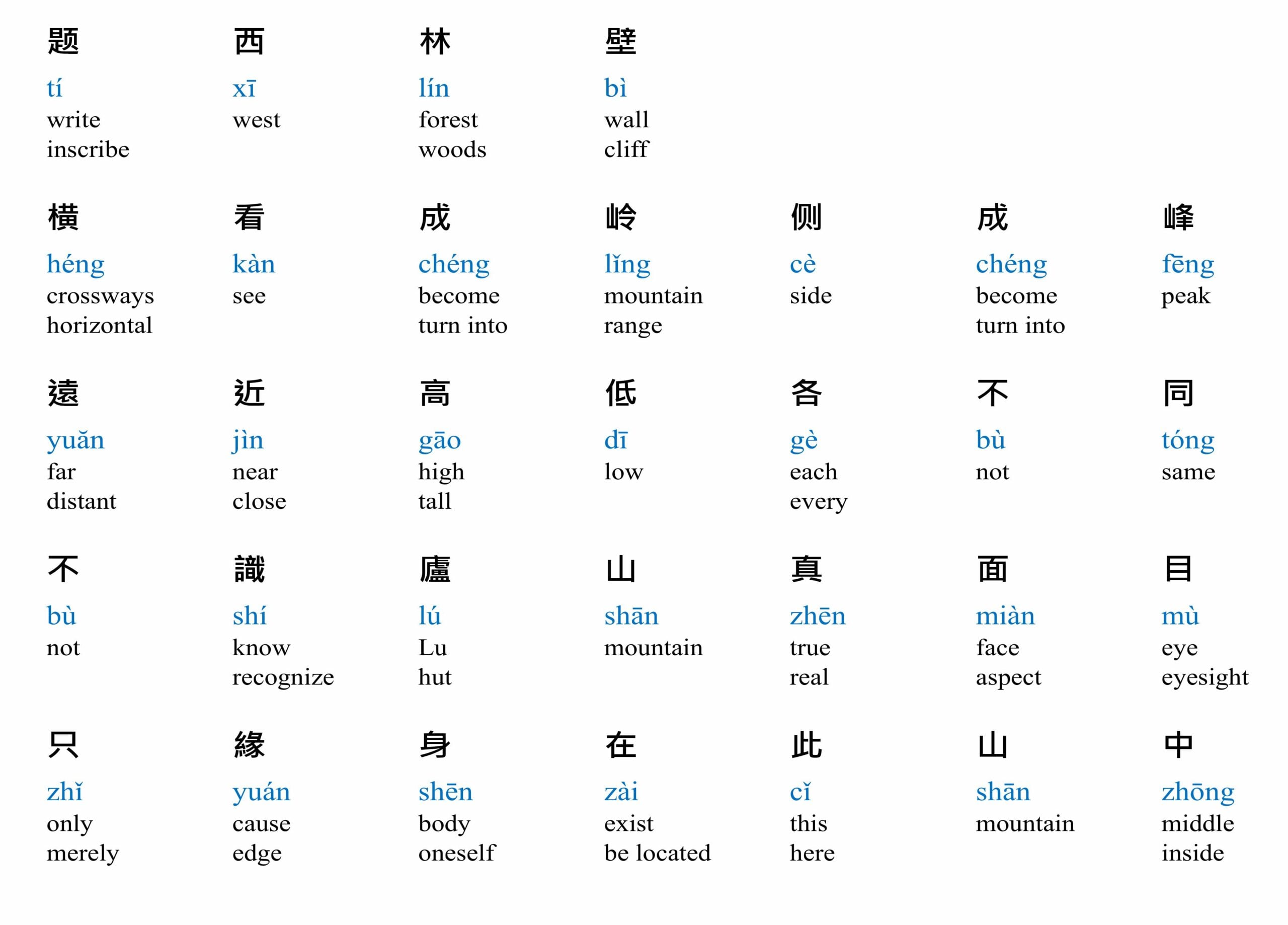
This is a translation by Burton Watson (1994, p. 108):
From the side, a whole range; from the end, a single peak;
far, near, high, low, no two parts alike.
Why can’t I tell the true shape of Lu-shan?
Because I myself am in the mountain.
And a rhyming version by Xu Yuanchong (2005, p 397).
It’s a range viewed in face and peaks viewed from the side
Assuming different shapes viewed from far and wide
Of Mountain Lu we cannot make out the true face
For we are lost in the heart of the very place.
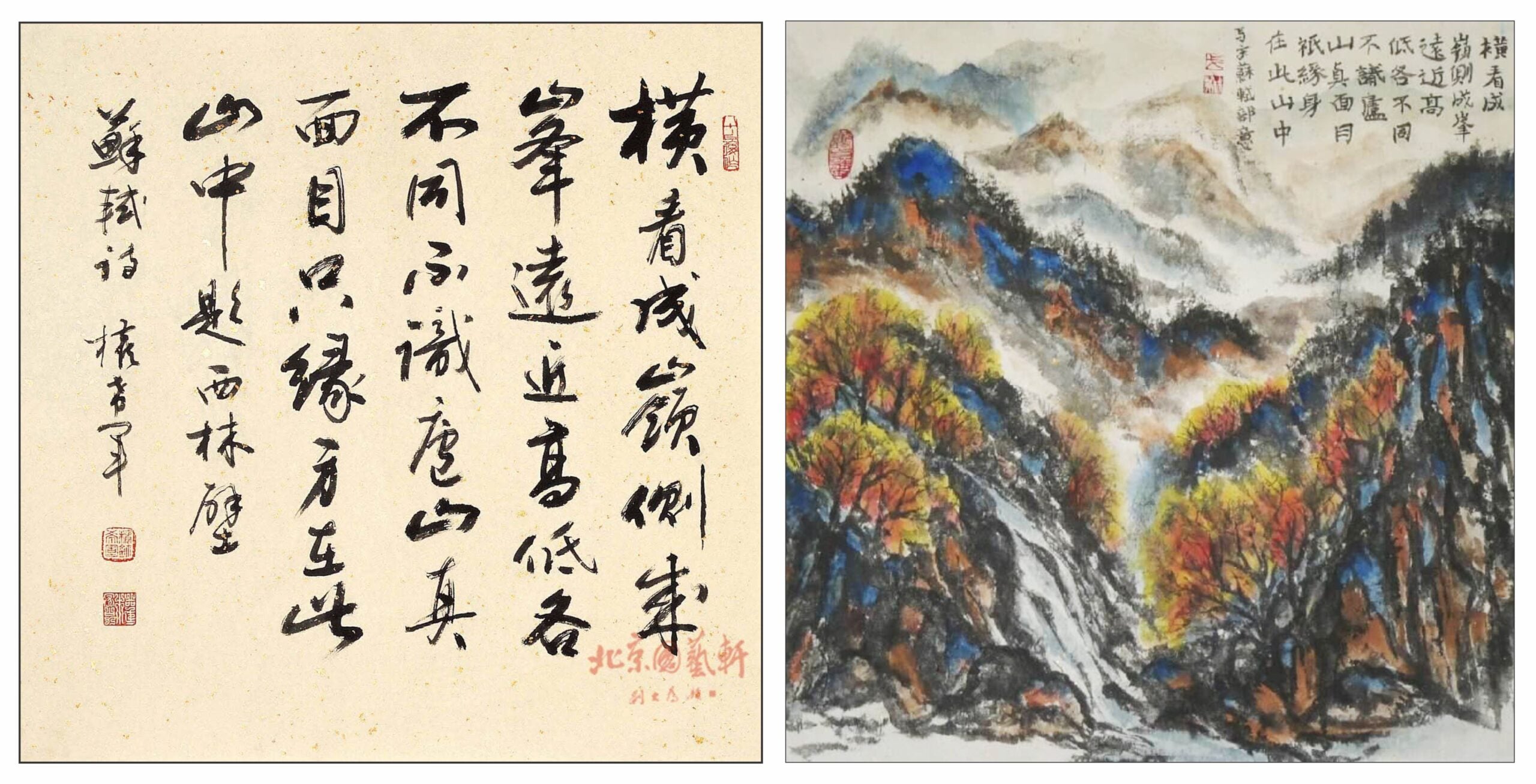
The following illustration shows on the left the poem as written out by a modern calligrapher Quan Xijun. On the right is a modern painting of Mount Lu in the autumn together with calligraphy of Su Shi’s poem:
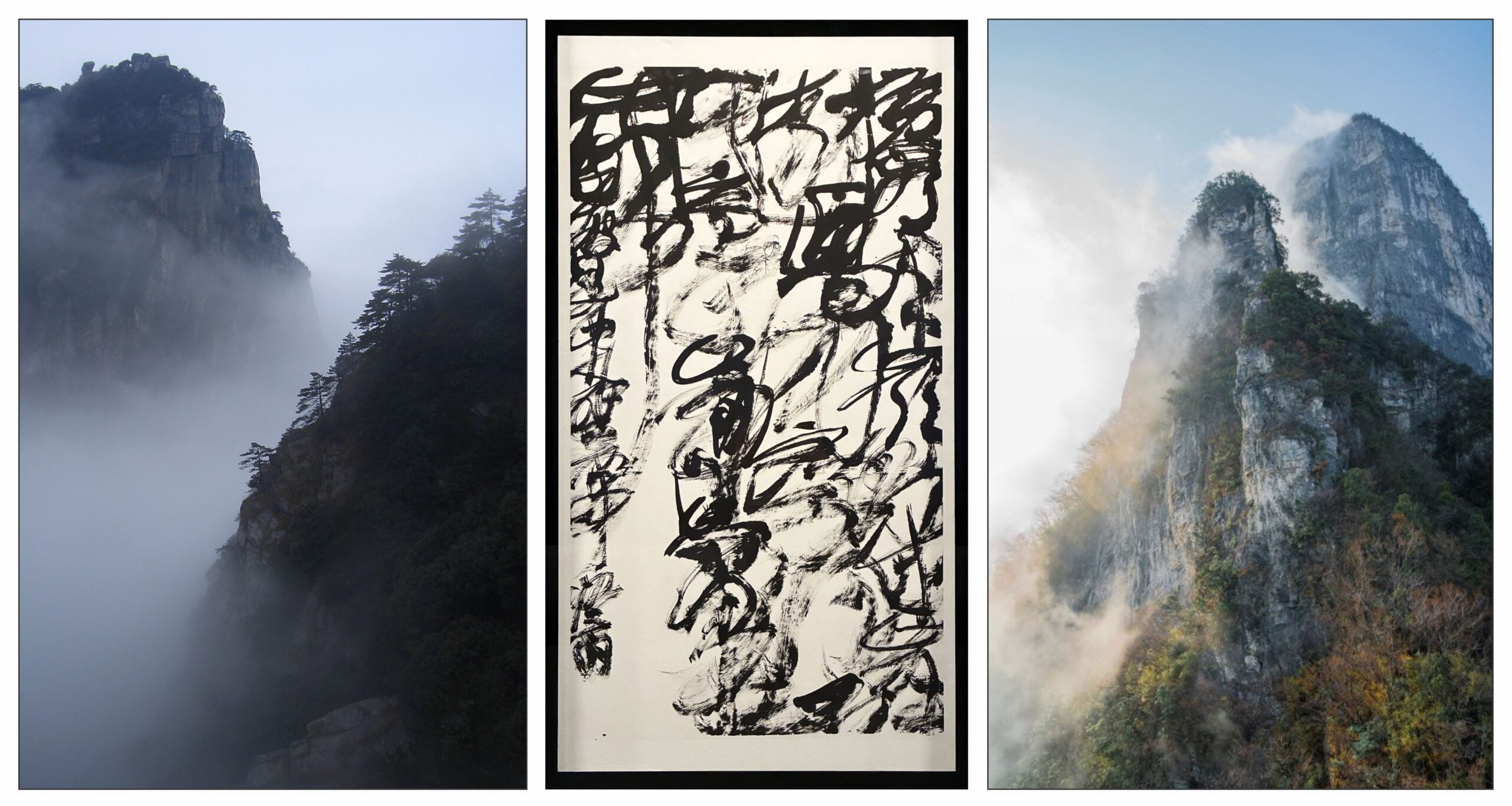
Below is a version of the poem in chaos calligraphy (2016) by Wang Dongling (1946- ) together with two photographs of the area. The calligraphy gives a true sense of the land of mists and the mountains:
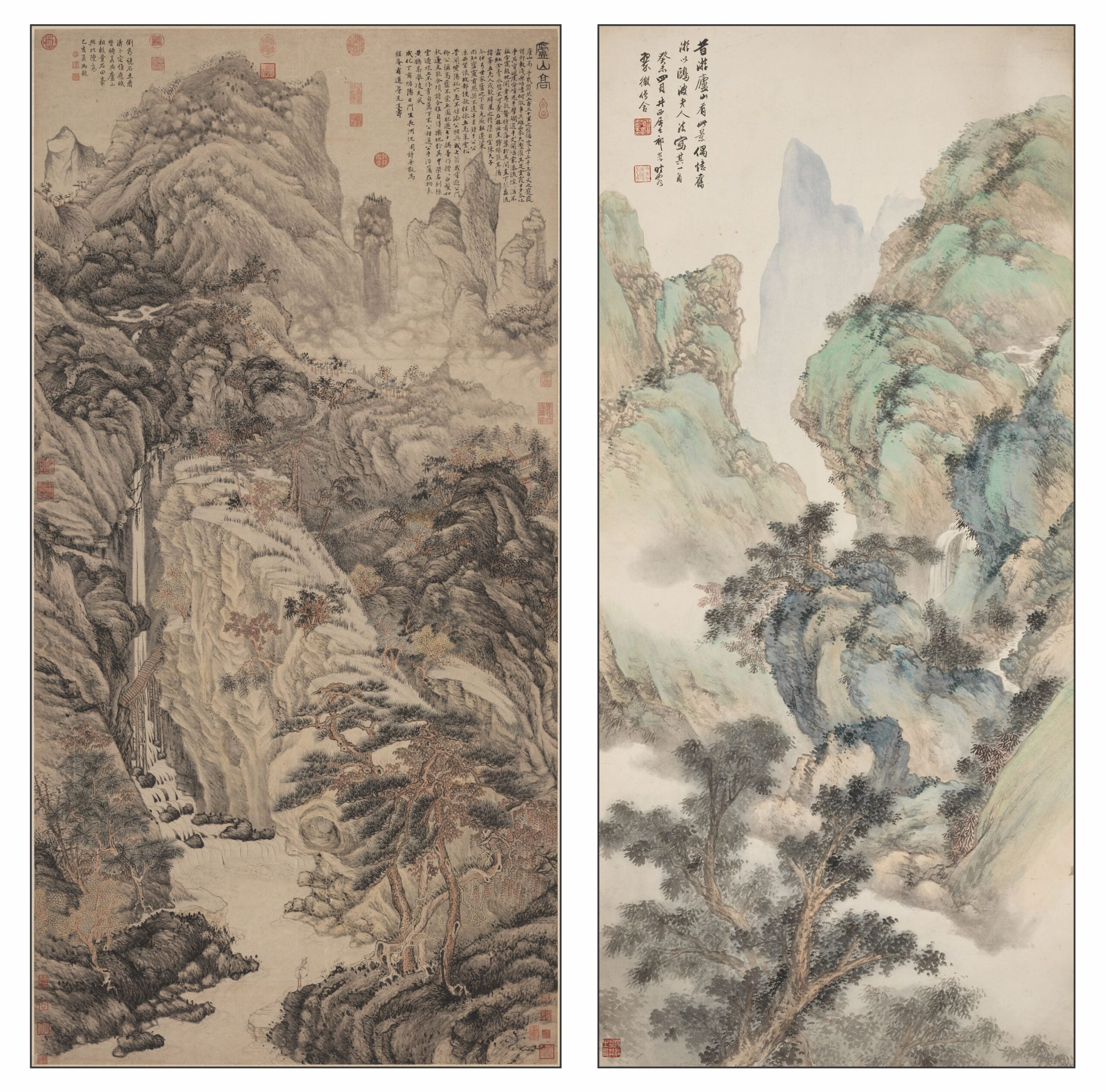
Mount Lu is the subject of many paintings. The following illustration shows on the left a painting made in 1467 by Shen Zhou (1427-1509) and on the right a modern painting by Qi Kun (1901-1944) created in 1943. These were exhibited at the National Palace Museum in Taipei in 2020.
Bamboo, Rock and Tree
Su Shi was a talented painter as well as calligrapher. In 2018 a scroll containing his painting of Bamboo, Rock and Tree, long held in a private collection, was auctioned for almost 60 million dollars (Sturman, 2022). The following illustration shows the complete scroll (26 cm by 185 cm) at the top. In the middle are the first two colophons, the rightmost by Liu Liangzuo (11th Century) and the next by the poet and calligrapher Mi Fu (1052–1107). And at the bottom is the painting with the more recent seals removed. The painting was likely created in the 1080s and the first two colophons added in the 1090s.
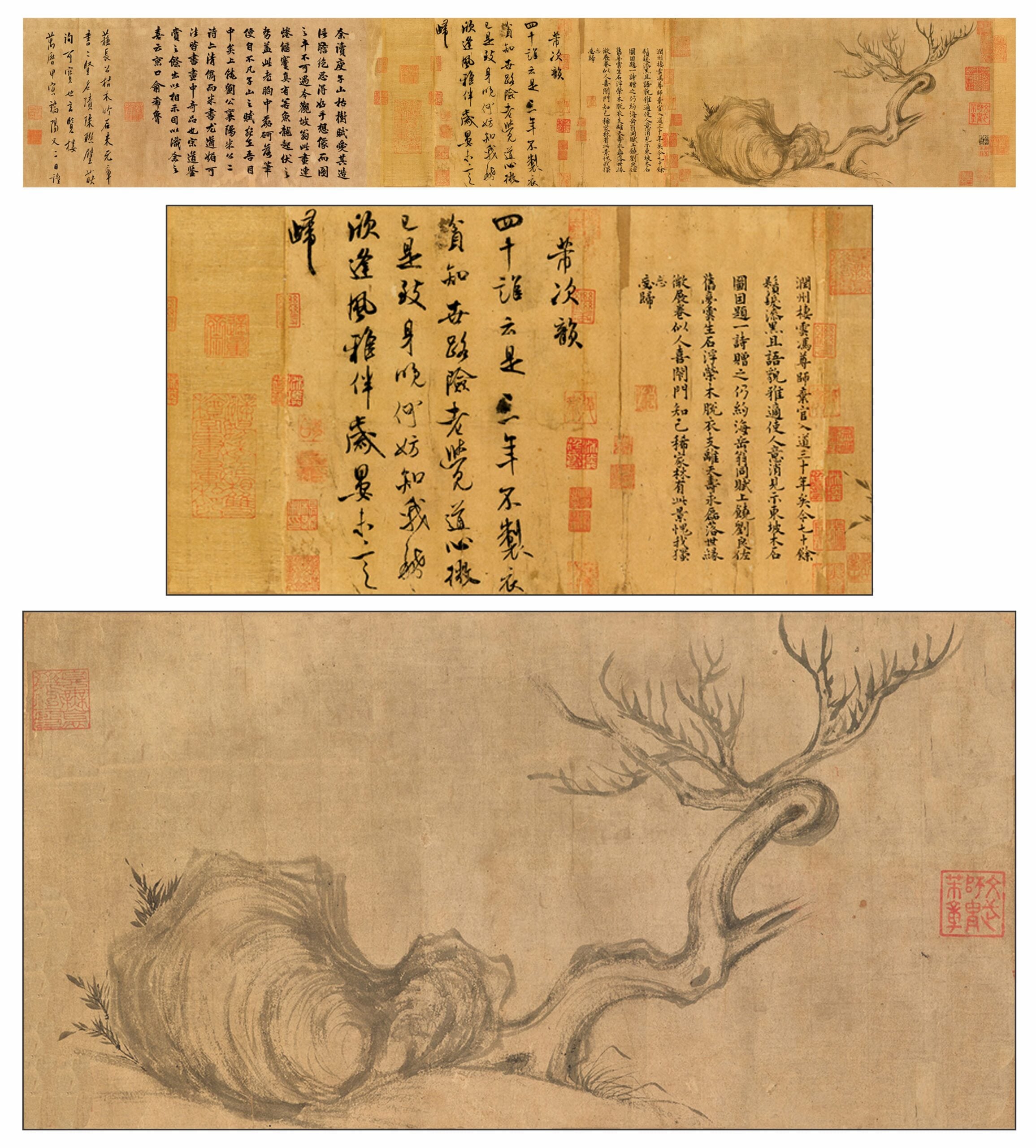
Liu Liangzuo describes how he was able to view the painting that was owned by Feng Qiyun. He then provides a poem (4th line from right)
舊夢雲生石,浮榮木脱衣。
支離天壽永,磊落世緣微
A rock born from clouds in an old dream;
A tree sheds its robes of empty glory.
Gnarled and knotted, heaven’s gift of years is timeless;
Rugged and upright, the fate of this world is fickle.
(translation Sturman, 2022)
Mi Fu provides a much more beautiful piece of calligraphy, though his words are less poetic. His colophon begins:
四十誰云是,三年不製衣。
贫知世路險,老覺道心微
Forty, who says it’s so?
Three years of no new clothing!
Poor, I know the worldly path is precarious;
Old, I awaken to the Dao-mind’s subtlety.
(translation Sturman, 2022)
Dongpo Pork
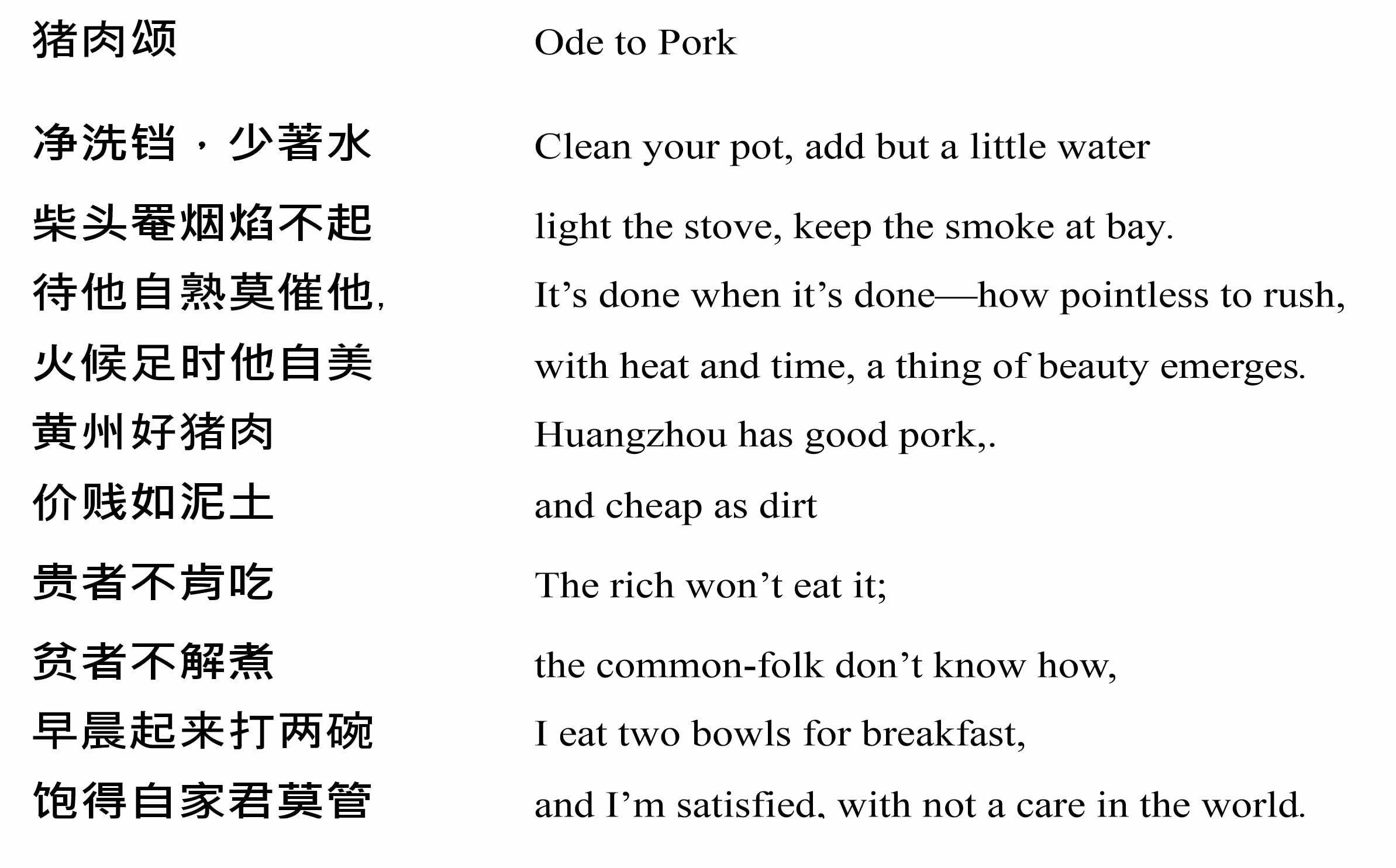
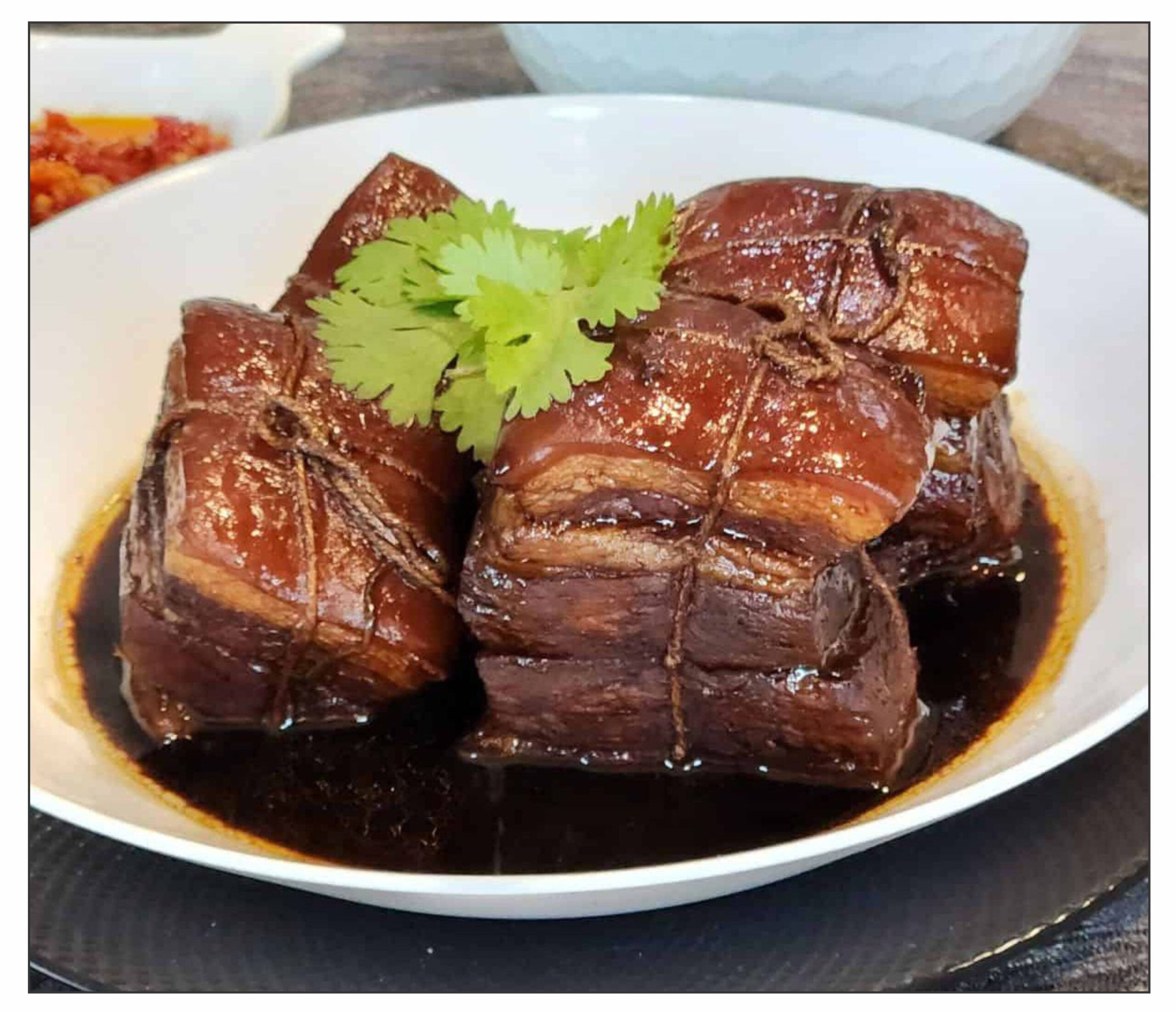
Legend has it that Su Shi created the original recipe for East Slope Pork (东坡肉, dōngpōròu): pork belly braised with ginger and scallions in soy sauce and rice wine. The recipe is contained in a poem that has been attributed to Su Shi:
Epilogue
Although Su Shi returned to political favor in 1086, this was not to last. He was banished again in 1090 to the south of China, ultimately to Hainan Island. He was pardoned in 1100, but died soon thereafter in 1101.
References
Bol, P. K. (1992). Su Shih’s Tao: unity with individuality. In This culture of ours: intellectual transitions in T’ang and Sung China. (pp 254-299). Stanford University Press
Egan, R. (1994). Word, image, and deed in the life of Su Shi. Council on East Asian Studies, Harvard University.
Fuller, M. A. (2023). The road to East Slope: the development of Su Shi’s poetic voice. Stanford University Press.
Grant, B. (1994). Mount Lu revisited: Buddhism in the life and writings of Su Shih. University of Hawaii Press.
Hargett, J. (2004). Su Shi and Mount Lu. Journeys, 5(1), 4–22.
Hartman, C. (1990). Poetry and politics in 1079: The Crow Terrace Poetry Case of Su Shih. Chinese Literature, Essays, Articles, Reviews, 12, 15–44.
Holzman, D. (1986). The cold food festival in early medieval China. Harvard Journal of Asiatic Studies, 46(1), 51–79
Lin, J. I., & Young, D. (2020). Listening all night to the rain: selected poems of Su Dongpo (Su Shi). Pinyon Publishing
Lin, Y. (1948). The gay genius: the life and times of Su Tungpo. Heinemann.
Owen, S. (1996). An Anthology of Chinese literature: beginnings to 1911. W.W. Norton.
Pease, J. (2021). His stubbornship: Prime Minister Wang Anshi (1021–1086), reformer and poet. Brill.
Sturman, P. C. (2022). Inscriptional practices of the Song Literati: revisiting Su Shi’s Old Tree, Rock, and Bamboo. Archives of Asian Art, 72(1), 75–95.
Tian, X. (2019). The halberd at Red Cliff: Jian’an and the Three Kingdoms. Harvard University Asia Center.
Watson, B. (1994). Selected poems of Su Tung-pʻo. Copper Canyon Press.
Wang, Yugen. (2011). The limits of poetry as means of social criticism: the 1079 literary inquisition against Su Shi revisited. Journal of Song-Yuan Studies. Volume 41, 29–65.
Xu Yuanchong (2005). 300 gems of classical Chinese poetry. Peking University Press
Yang, J. (2008). East Slope. Ugly Duckling Press.
Yang, Z. (2015). Dialectics of spontaneity: the aesthetics and ethics of Su Shi (1037-1101) in poetry. Brill.
Zhang Longxi. (2023). From Ouyang Xiu to Su Shi: the splendor of Northern Song Literature. In A History of Chinese Literature. (pp. 206–228). Routledge.
Zhao, X., & Drechsler, W. (2018). Wang Anshi’s economic reforms: proto-Keynesian economic policy in Song Dynasty China. Cambridge Journal of Economics, 42(5), 1239–1254.
Leave a Reply