Tag Archive for Calligraphy

image_pdfimage_print

Bai Juyi: Pearls Falling on Jade

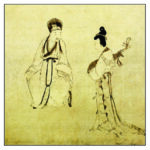
Bai Juyi (白居易, pinyin Bǎi Jūyì, or Po Chü-i in Wade-Gilles transliteration, 772-846 CE) was a Chinese poet. In 815, after inappropriately advising the emperor, he was exiled from the capital Chang’an to JiuJiang on the Yangtze River. One night, at a farewell party on the river for a friend, he heard a musician playing the pipa. Entranced by her music, he found out that she had once been a sought-after courtesan in the capital. After her beauty had faded away, she had retired to the provinces, where she played her music and lamented her lost youth. Moved by her plight, Bai Juyi composed his Pipa Xing (琵琶行, “Ballad of the Pipa”). The illustration shows a drawing of the poet and the pipa player from a scroll by Guo Xu (1456–1532).

Read more

Wang Wei: the Wheel River Poems

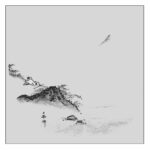
Wang Wei (王维; traditional 王維; pinyin, Wáng Wéi; 699–761) was a Chinese musician, painter, and poet during the Tang Dynasty (618 to 907). He was a devout Buddhist and used the courtesy name Wang Weimojie in homage to the early Buddhist teacher and boddhisattva Vimalakirti (Chinese name 維摩詰 Wéimójí). Vimalakirti taught the practice of sunyata (Sanskrit, emptiness; Chinese 空性 Kōng xìng), a meditative state wherein the mind is emptied of the self and becomes one with the universe. After a tumultuous life, Wang Wei retired to his villa on the Wang River about 40 km southeast of the imperial capital Chang’an (present day Xi’an). There he composed the Wǎngchuān jí (辋川集 The Wheel River Collection): a set of twenty quatrains describing various locations near his villa. Each quatrain was accompanied by a reply from his protégé Pei Di (裴迪 pinyin, Péi Dí, 714-?).

Read more

Language and Meaning

Language and meaning

I have just returned from a brief trip to Korea. I had learned the Hangul alphabet, but my vocabulary was limited to some rudimentary phrases. I could read but I could not understand. This led to some thoughts about language and meaning. My posting will take a roundabout course, beginning with a Korean scholar from the Silla dynasty. Be patient: I shall try to find some meaning before the day is done.

Choe Chi Won (857-925?)

At the age of 12, Choe Chi Won (Hangul 최치원; Chinese 崔致遠; literary name 孤雲, Go-un, “Lonely Cloud”) was sent from Korea to study in Xian (Chang’an), the capital of the Tang dynasty in China. There he learnt the practices of Confucianism and the arts of poetry and calligraphy. He passed the Imperial Examination at the young age of 22 years, and rose quickly through the ranks of the Chinese Civil Service.

However, the Tang dynasty (618-907) was slowly coming to its end. In 874, Huang Chao had initiated a rebellion against the Emperor. By 880 he had taken control of the capital and assumed the throne, calling himself the “Emperor of Qi.” Choe served as the secretary to the Tang general Gao Pien in his campaign against Huang Chao. By 884, the rebellion was finally defeated and the Tang emperor Xizong reinstated in Xian.

Read more