Archive for Music

image_pdfimage_print

Bright is the Ring of Words: English Art Song

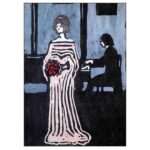
During the 19th Century, composers began to set poems to music. In these “art songs” or Lieder, the piano accompaniment accentuated the emotions and complemented the meaning of the poem. Although Beethoven’s An die ferne Geliebte (1816) was the first cycle of art songs, Schubert was the composer who definitively established the genre. He was followed by Schumann, Brahms, Wolf, and Mahler. In the British Isles, a golden age of art song occurred in the first 20 years of the 20th Century. Young composers, many trained in the German tradition, set to music both the lines they had learned in school and the poems of their contemporaries. The illustration is a wood cut from 1903 by Wassily Kandinsky.

Read more

Bai Juyi: Pearls Falling on Jade

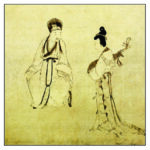
Bai Juyi (白居易, pinyin Bǎi Jūyì, or Po Chü-i in Wade-Gilles transliteration, 772-846 CE) was a Chinese poet. In 815, after inappropriately advising the emperor, he was exiled from the capital Chang’an to JiuJiang on the Yangtze River. One night, at a farewell party on the river for a friend, he heard a musician playing the pipa. Entranced by her music, he found out that she had once been a sought-after courtesan in the capital. After her beauty had faded away, she had retired to the provinces, where she played her music and lamented her lost youth. Moved by her plight, Bai Juyi composed his Pipa Xing (琵琶行, “Ballad of the Pipa”). The illustration shows a drawing of the poet and the pipa player from a scroll by Guo Xu (1456–1532).

Read more

The Letter of Lord Chandos: Hugo von Hofmannsthal

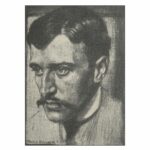
In 1901, Hugo von Hofmannsthal (1874-1929) wrote an essay on the inadequacy of language in the form of a letter (Ein Brief) from the fictional Philip Lord Chandos to the actual Francis Bacon (1561-1626), a famous English philosopher of science, essayist and statesman. The letter is a response to Bacon’s inquiry about the two years of unexpected silence that following Chandos’ early success as a poet. Chandos replies that he has “completely lost the ability to think or to speak of anything coherently.” He feels a deep sympathy with the world, but finds no words whereby to express this experience. He seeks but has not yet, found a language “in which inanimate things speak to me and wherein I may one day have to justify myself before an unknown judge.” The illustration shows a 1916 portrait of von Hofmannsthal by Karl Bauer.  

Read more

Sakura Hanami: Cherry Blossom Viewing

Sakura Hanami (桜 花見, cherry blossom viewing), an age-old tradition in Japan, derived from the Chinese practice of enjoying wine and poetry beneath plum blossoms. In Japan cherry trees were more common and by the Heian period (794–1185) Japanese emperors held sakura hanami parties for the court. The custom soon spread to the samurai, and later to the common people. In the early 18th Century, the shogun Tokugawa Yoshimune planted cherry trees in Asukayama park in the northern reaches of Tokyo, and opened up the park to its citizens. Nowadays thousands of people visit this and other parks to enjoy the blossoms, drink sake and feast on dumplings and cakes. In many places, temporary paper lanterns are hung to allow yozakura (夜桜, night sakura). Read more

Friedrich Hölderlin: Little Knowledge but Joy Enough

Johann Christian Friedrich Hölderlin (1770-1843) was one of Germany’s greatest lyric poets. He was exquisitely sensitive to the beauties of the natural world, and thoroughly enamoured to the glories of Ancient Greece. His verses are strikingly beautiful in their sound, and have been set to music by many composers. As a young man he was very productive, writing poems and the epistolary novel Hyperion (1799). He also made important new translations of Sophocles’ Oedipus and Antigone. However, in 1806 he lapsed into madness. From 1807 until his death, he lived alone in a room overlooking the Neckar River in Tübingen. He mumbled to himself in many languages, and occasionally wrote brief fragments of verse for visitors, signing them with various pseudonyms and fictitious dates.  This posting considers some of his poetry.The text of the poems can been enlarged by clicking on them to get a separate window. Read more

Mathis der Maler: the Isenheim Altarpiece

Very little is known about the life of Matthias Grünewald, a painter (German Maler) who worked in the early decades of the 16th Century in Germany. He is renowned for the pictures he created between 1512 and 1516 for the altarpiece of the Monastery of Saint Anthony in Isenheim in southern Alsace. The face of Saint Sebastian in one of these paintings (above) is considered to be a self-portrait. 

Read more

Paul Klee: Color and Music

The paintings of Paul Klee (1879-1940) gave us a new way to look at the world, allowing us to go beyond our immediate perceptions and see the underlying forms. 

Kunst gibt nicht das Sichtbare wieder, sondern macht sichtbar.
Art does not reproduce the visible; rather, it makes visible.
(Klee, Creative Confession, 1920/2013, part I).

Color and music were the two great principles underlying his art. The tonal relations between colors and the rhythms of their spatial presentation combine to give us understanding. Many composers have sought to express Klee’s paintings in their music, to complement his colors with their notes. This essay presents some of these compositions. On the right is a portrait of Paul Klee by Hugo Erfurth in 1922

Read more

Words and Music: Schubert and Goethe

Franz Peter Schubert (1797-1828) died young, but not before he was able to compose music that has become justly famous. As well as symphonies, piano works, sacred music, and chamber works, he composed over 600 songs or Lieder. This essay considers a few of his over 70 settings for poems by Johann Wolfgang von Goethe (1749-1832)

Read more

Du Fu: Poet, Sage, Historian

Du Fu: Poet, Sage, Historian

Du Fu (712-770 CE) was a poet during a time of great political upheaval in China. He was born near Luoyang and spent much of his young adulthood in the Yanzhou region, finally settling down to a minor official position in Chang’an, the imperial capital. In 755 CE, An Lushan, a disgruntled general, led a rebellion against the Tang dynasty. The emperor was forced to flee Chang’an (modern Xian), and chaos reigned for the next eight years. For more than a year Du Fu was held captive in Chang’an by the rebels. After escaping, he made his way south, living for a time in a thatched cottage in Chengdu, and later at various places along the Yangtze River. His poetry is characterized by an intense love of nature, by elements of Chan Buddhism, and by a deep compassion for all those caught up in the turmoil of history. This is a longer post than usual. I have become fascinated by Du Fu.

Read more

The Divine Feminine

All the major religions of the present world are androcentric in nature and misogynistic in practice. The following are some typical injunctions in the Christian scriptures:

Let your women keep silence in the churches: for it is not permitted unto them to speak; but they are commanded to be under obedience as also saith the law.
And if they will learn any thing, let them ask their husbands at home: for it is a shame for women to speak in the church. (I Corinthians 14: 34-35)

Let the woman learn in silence with all subjection.
But I suffer not a woman to teach, nor to usurp authority over the man, but to be in silence. (1 Timothy 2: 11-12)

These rulings are in spite of (or perhaps because of) women being more attentive to religious teachings, and participating more often in religious services than men (Pew Research Foundation, 2016). The two passages nevertheless serve a purpose – they provide clear evidence that the New Testament does not always represent the word of God.

The androcentricity of organized religion differs completely from prehistoric religious beliefs, wherein God was more likely female than male (Stone, 1978). Over recent centuries, however, female aspects of the godhead have become more and more recognized. This posting briefly considers some of the manifestations of the divine feminine, and mentions what might be involved in a feminist theology. 

Read more