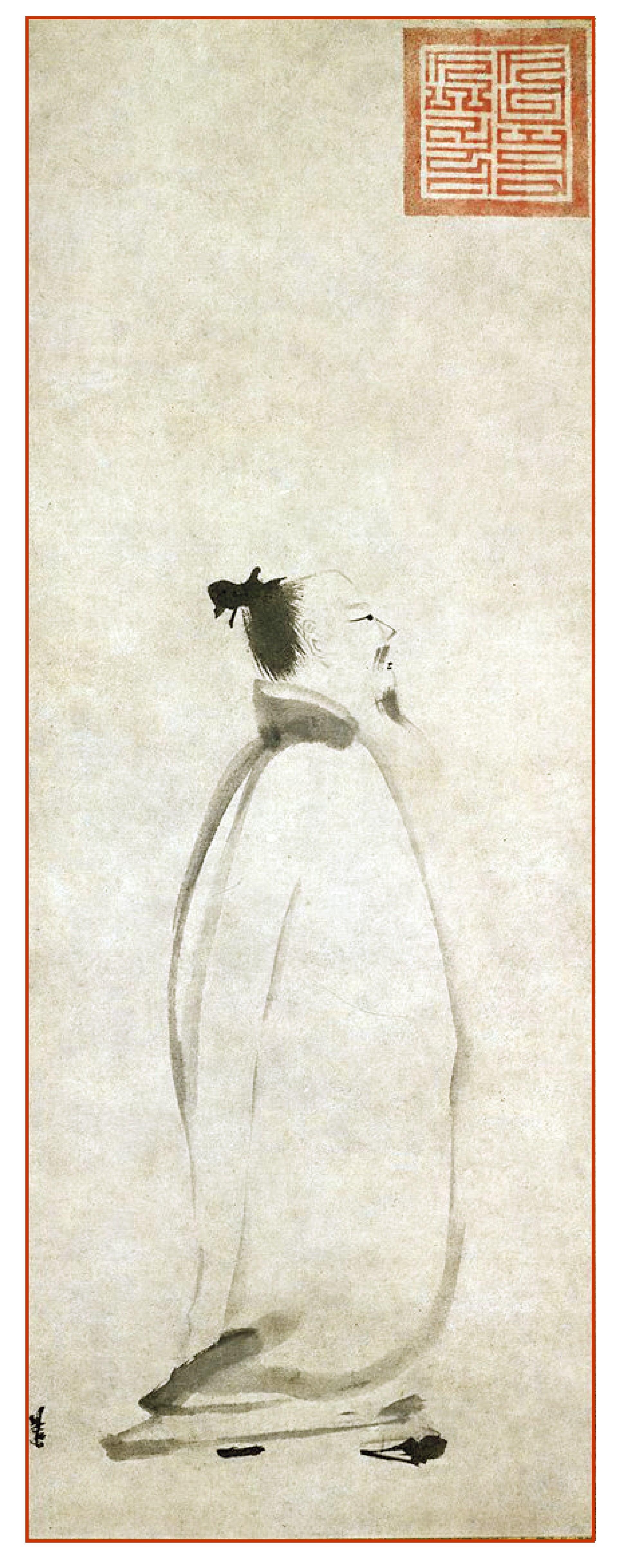
 Li Bai (701-762 CE), also known as Li Po, was one of the famous Tang dynasty poets who called themselves the Eight Immortals of the Wine Cup (an irreverent allusion to the Eight Immortals of Taoism). Li Bai wrote prolifically, and over 1000 of his poems survive. Much of his life is mythical, the stuff of novels rather than of history (Elegant, 1997). He was a devotee of Taoism, a fine swordsman, and a great lover of wine. In his youth he served the emperor. After becoming involved in one of the rebellions, however, he was exiled from the court. He then spent much of his later life wandering “beyond the gorges” in the hinterland of Imperial China. Legend has it that he died drunkenly trying to embrace the moon’s reflection in the Yangtze River, but his death was perhaps a suicide. The illustrated portrait (from the Tokyo National Museum) was painted by Liang Kai in the early 13th century. The seal in the upper right corner signals that the painting was owned by Anigo, an important official in the Imperial court of the Yuan dynasty.
Appreciating Chinese poetry requires seeing as well as hearing. The beauty of the calligraphy is as important to the poetry as the music of the words. The poems are therefore difficult to assess without some feeling for the characters in which they are written, since these allude to meanings beyond those directly expressed by the spoken words. This post therefore begins with a few notes on Chinese characters.
Read more