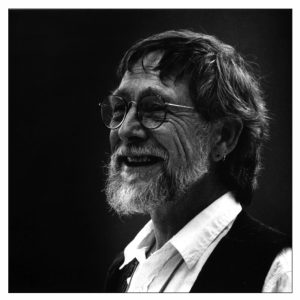


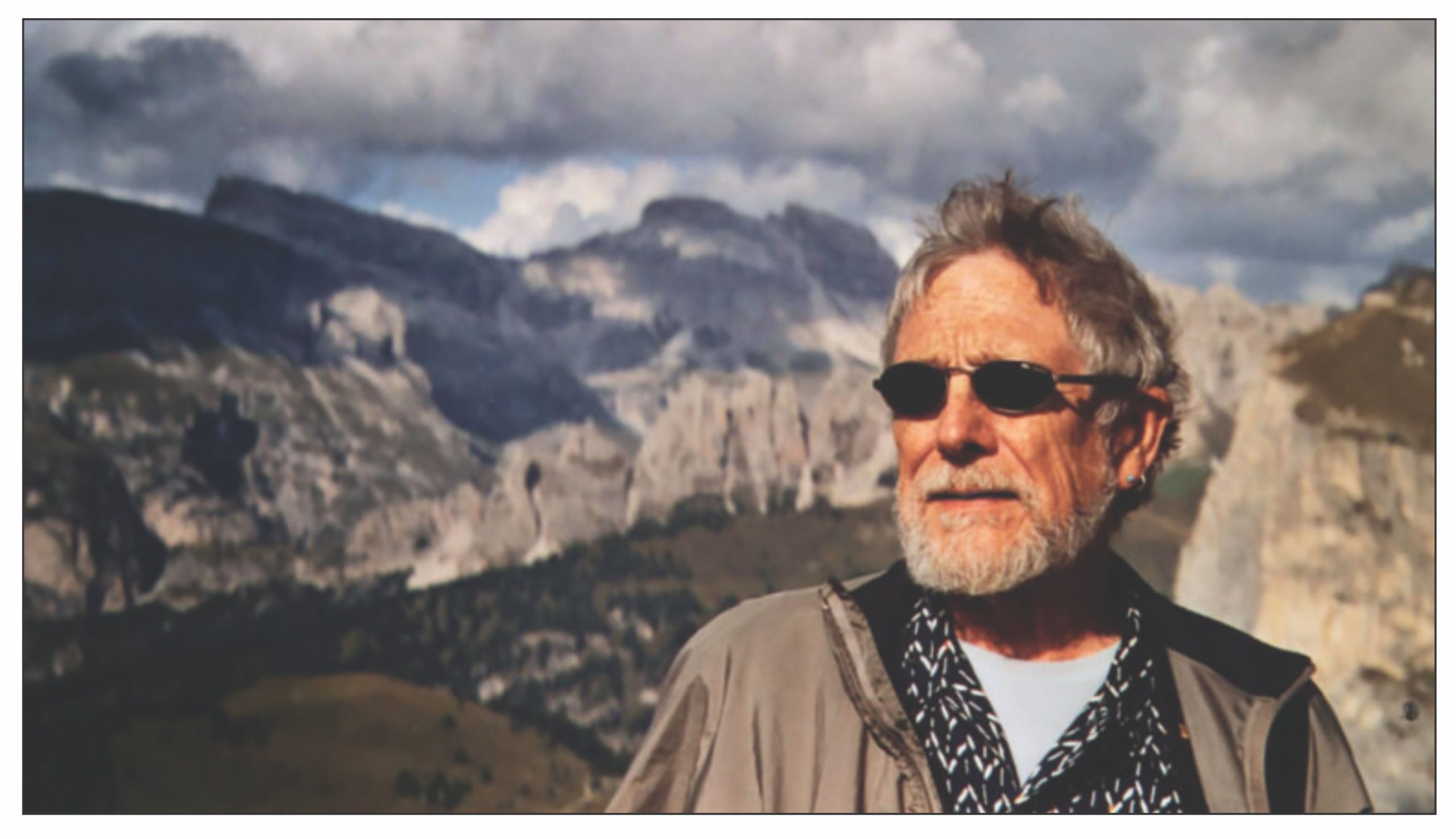
Gary Snyder (1930- ) worked on the collection of 39 poems entitled Mountains and Rivers without End from 1956 to 1996. The first poem in the final published sequence was written in 1995: Endless Streams and Mountains. This describes a hand scroll created in the first half of the 12th Century by an unknown Chinese painter, and now in the Cleveland Museum of Art. The painting provides a view of the world wherein human beings are an integral part of a vast spiritual landscape. The photograph of Snyder (from the book’s dust jacket) is by Dianna Smith (1995?)
A Life Diverse
Gary Snyder was born in San Franciso but grew up in Washington state. He studied at Reed College in Portland, working in summers and for a while after graduating as a logger, a fire lookout and a trail-builder. In 1953 he enrolled in the Department of East Asian Languages and Cultures at the University of California at Berkeley. There he began to study Chinese and Japanese, to learn about Eastern painting techniques, and to understand the ideas of Buddhism. During his time in the Bay Area, he interacted with Allen Ginsberg, Jack Kerouac, Lawrence Ferlinghetti, and other members of the Beat Generation of writers.
In 1955 he was awarded a scholarship to study Zen in Shokoku-ji in Kyoto, Japan. While in Kyoto he translated some poems of Hanshan (Cold Mountain), a 9th-Century Chinese Buddhist poet, and published his first book of poems Riprap. Over the next decade he went back and forth between Japan and California, and in the early 1960s he travelled through India.
In 1956 Snyder had begun to put together a long sequence of poems entitled Mountains and Rivers without End. This collection, containing poems about various parts of his life on the West Coast of America and in the Far East, was finally completed and published in 1996.
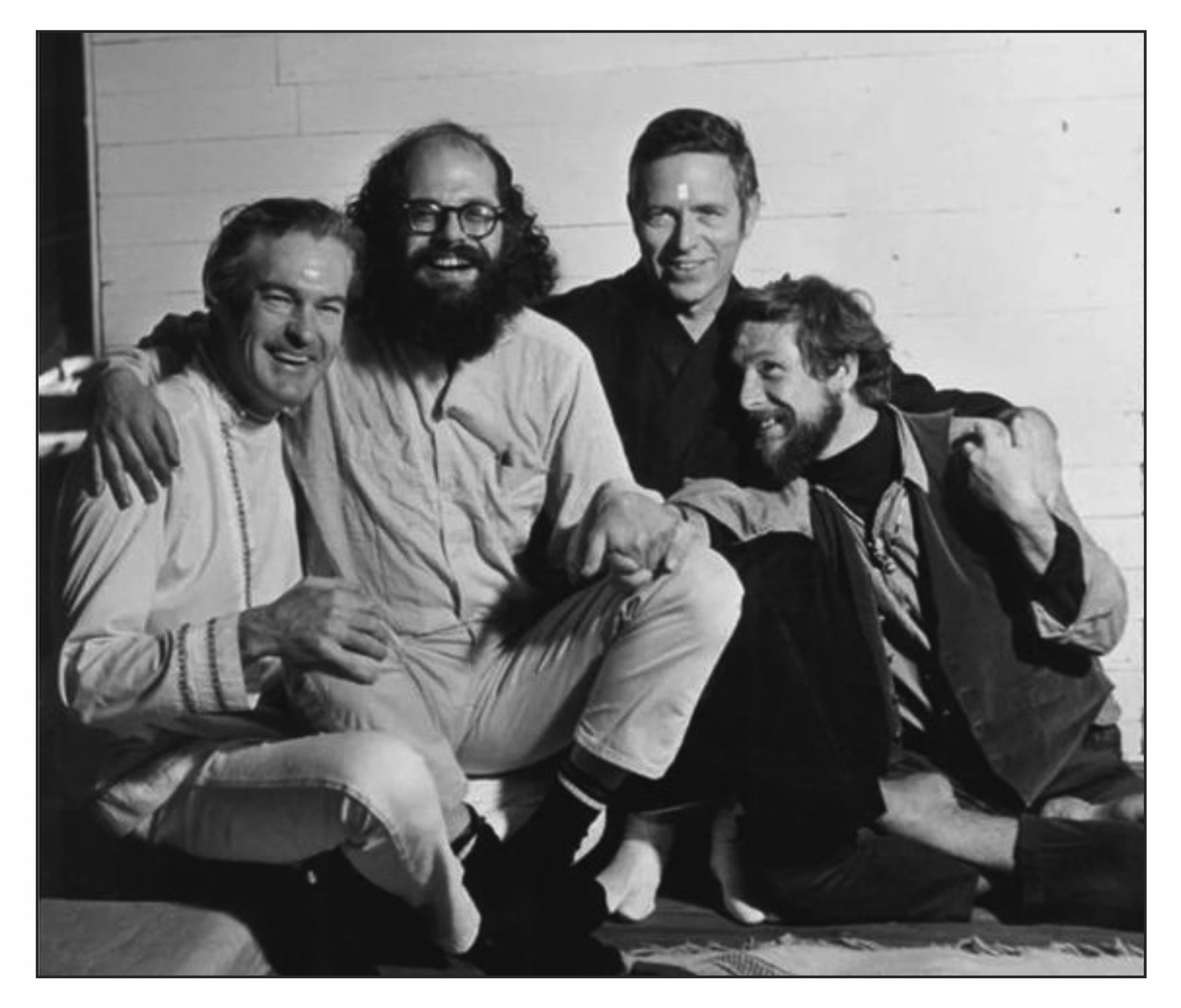
In the mid 60s Snyder was active in the counter-culture movement in California, which envisioned a new society without war. The following illustration shows the main participants at the Houseboat Summit held in 1967 in Sausalito: Timothy Leary, Allen Ginsberg, Alan Watts and Gary Snyder:
In the late 60s Snyder settled in the foothills of the Sierra Nevada in California, and set up home in a simple farmhouse that he named Kitkitdizze, an indigenous name for the Bearclover shrub (Chamaebatia foliolosa). He has promoted the idea of returning to the land to live in small self-sufficient communities apart from modern industrialized society.
Endless Streams and Rivers
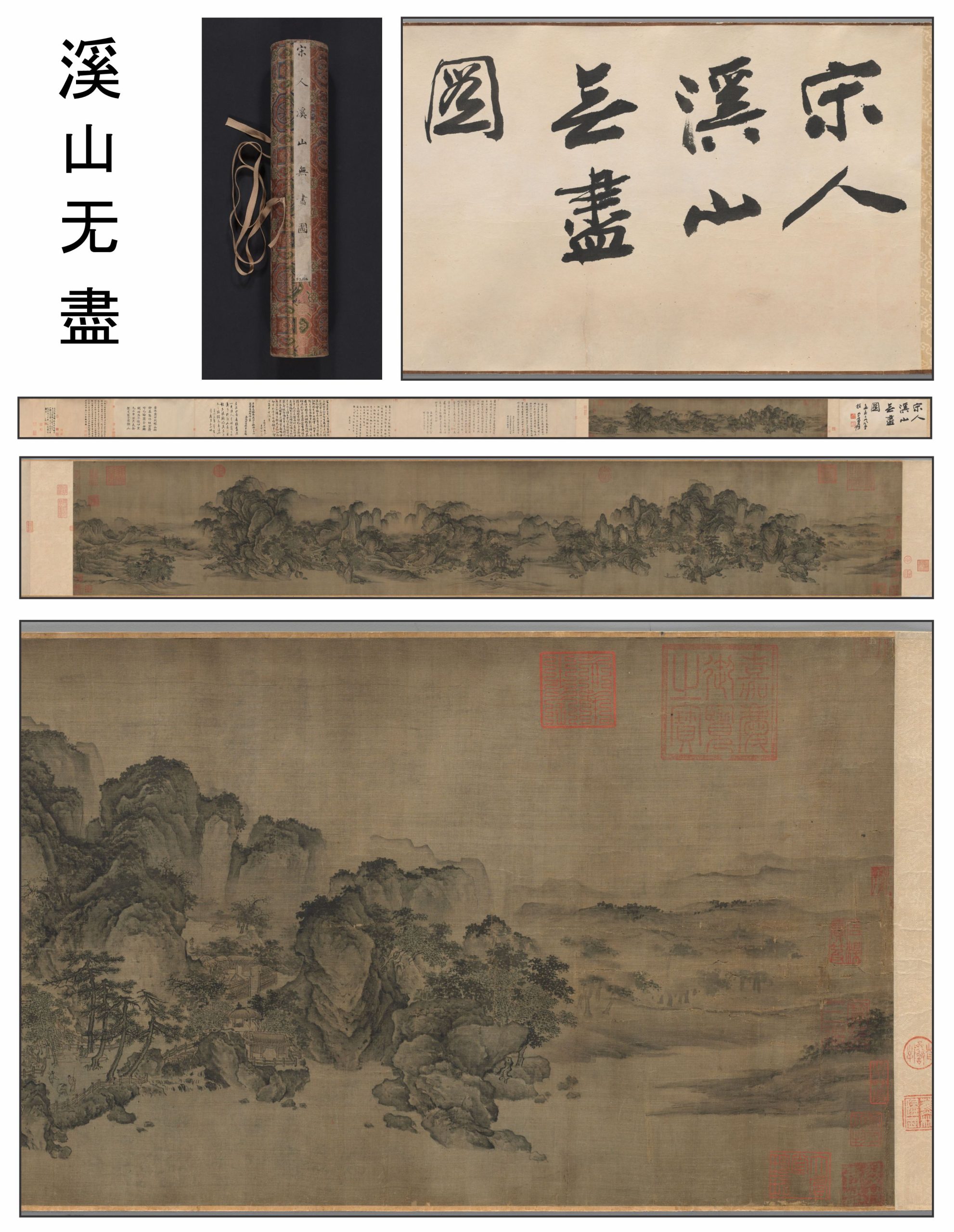
One of the last poems to be written for Mountains and Rivers without End and the first poem in the published sequence was an interpretation of hand scroll Endless Streams and Mountains (溪山無(无)盡(尽) Pinyin: xī shān wújìn; Wade Gilles: ch’i shan wu chin) which Snyder saw at the Cleveland Museum of Art (Lee & Fong, 1955; Bush, 1987; Chou, 2014, pp 34 -43). A word-by-word translation of the title is “stream(s) mountain(s) no(t) end.” The scroll’s picture (圖 tú) was painted in black ink (with occasional slight coloring) on silk by an anonymous artist (人 rén person) during the Song (宋) dynasty. Scholars date its creation to 1100-1150 CE. The scroll is 35 cm wide and extends for 1105 cm, with the painting taking up 215 cm. The rest of the scroll contains the titles, colophons written by several literati who had viewed the scroll, and the seals of many different owners.
The following illustration shows the title, scroll container and the initial title-sheet of the scroll at the top. The title sheet is what would be first seen as the scroll is unrolled from its container The complete scroll is presented in the in the second line, and the painting itself in the third. At the bottom is an enlarged representation of the first section of the painting
Shan Shui Paintings
The original idea for Snyder’s sequence of poems and its title derive from another hand scroll Mountains and Rivers without End in the Freer Gallery in Washington, DC. This painting, now attributed to Lu Yuan (17th Century), is over twice the length of Cleveland’s Endless Streams and Mountains. The following is a small section of the scroll:
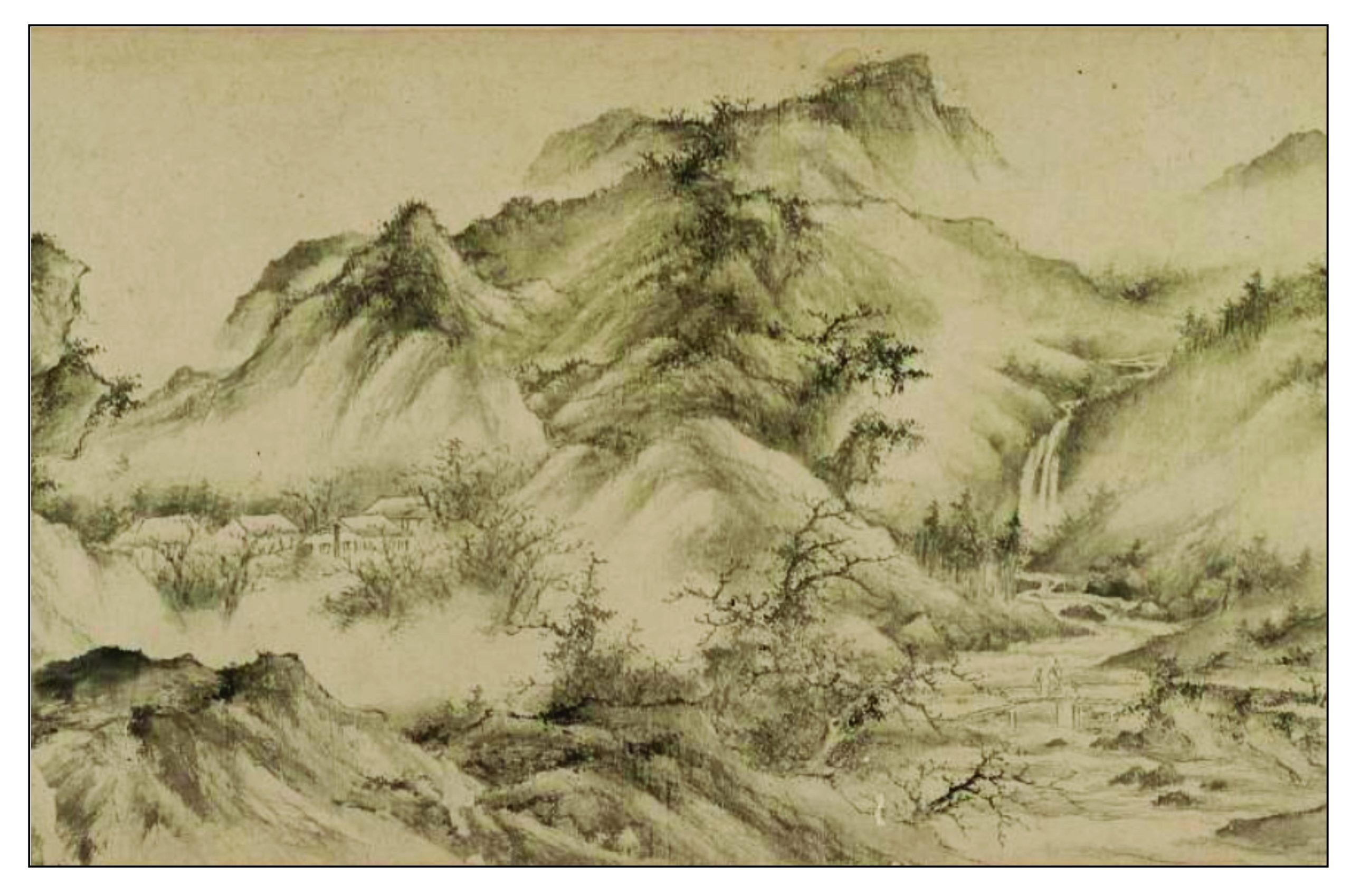
This type of painting is called shān shuĭ (山水, mountain water). The first examples were created during the Tang Dynasty (618-907) and the art form came into prominence during the Song (960–1279) and Yuan (1271–1368) dynasties. Shan shui paintings differ from western landscapes in many ways (Chou, 2014, pp 1-20; Duan, 2023). Western landscapes generally use a single point of view whereas shan shui paintings use a “flowing” perspective: the viewpoint changes as the scroll unrolls (and the viewer travels through the picture). Time is an essential part of the painting: it represents a journey rather than a single view at one moment of time.
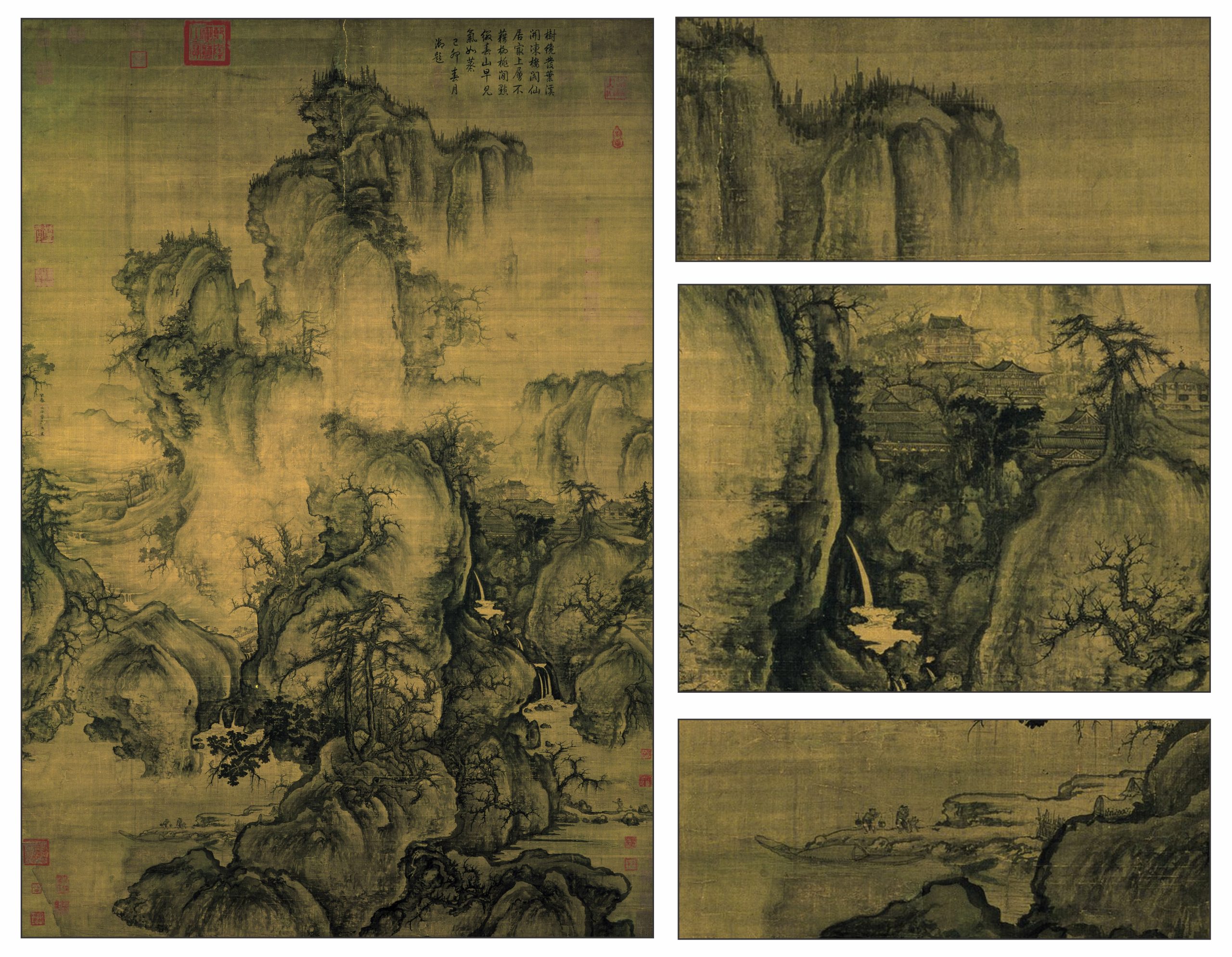
Guo Xi (1020-1090), one of the great shan shui painters, wrote a treatise on landscape painting: 林泉高致 (línquán gāo zhì, “lofty message of forest and streams”). He proposed that each part of the painting uses three different distances (三远, sān yuăn). In the near distance are the river and the shore, where one can see tiny human beings: in the preceding illustration a traveller and his page are crossing a bridge in the lower right. In the middle-distance streams make their way down to the river and temples or villages are nestled in the foothills: in the illustration a stream is on the right, and a village is on the left. In the far distance are the peaks of the mountains and the sky above.
Guo suggested that the goal of shan shui was the “integration of man with mountains and rivers” (Du Zhang, 2022). Guo describes the different levels whereby a viewer can interact with shan shui:
The first and lowest is a medium for appreciation, appealing to the senses. The second is a means to travel, setting one on a journey larger than the physicality of the painting. The last and highest is to bestow a spiritual space to live in, allowing one to contemplate and become fused with nature (Law, 2011, p 380)
The following illustration shows Guo Xi’s Early Spring (1072) now in the National Museum in Taipei. Details at each of the three distances are shown on the right.
#/media/File:Guo_Xi_-_Early_Spring_(large).jpg)
Shan shui paintings developed in accord with the religious ideas of Chan Buddhism and Daoism (Shaw, 1988; Jullien, 2009; Chai, 2021; Capasso, 2024). Much of the area of shan shui paintings is taken up by emptiness. On the one hand, this represents the mists that often float around the mountains. On the other hand, this also evokes the emptiness (sunyata) that underlies and unifies all things. Western paintings aim to represent reality – to help us to see; Chinese paintings seek to portray that which is beyond reality – to help us to understand. Western paintings follow science; Chinese paintings seek intuition.
Shan shui paintings allow the viewer to see harmony in the union of opposites:
In China, “mountains and water” are combined because they are the origin of the vibration of which the artist is the “resonant”, the blade of grass blowing in the wind. Landscape finds its roots in the heart, or rather the mind/heart, which is also an inseparable unit in Chinese landscape, the fusion of oppositions in a unique balancing act: it is the synthesis of the sky with the ground, humankind with nature, the masculine with the feminine, yin with yang. (Capasso. 2024).
The Making of Mountains and Rivers without End
Snyder dates the beginning of the book to a particular day when he took tea with the Japanese artist Saburo Hasegawa in San Francisco:
At some point Hasegawa heard that I had never tasted the ceremonial powdered green tea, and he delightedly invited me to his apartment. I still remember the day, April 8, 1956, because it was also the Buddha’s birthday. He frothed up the tea with a bamboo whisk, we chatted, and he talked at length about the great Japanese Zen monk painter Sesshu. As I left that day I resolved to start another long poem that would be called Mountains and Rivers Without End. (Snyder 2013, p 143)
One month later Snyder travelled to Japan to study Zen Buddhism. In 1958 his friend Jack Kerouac published a roman à clef about their early interactions with Buddhism: The Dharma Bums. The character Japhy Ryder (Snyder) reveals his plans to Ray Smith (Kerouac):
Know what I’m gonna do? I’ll do a new long poem called “Rivers and Mountains Without End” and just write it on and on on a scroll and unfold on and on with new surprises and always what went before forgotten, see, like a river, or like one of them real long Chinese silk paintings that show two little men hiking in an endless landscape of gnarled old trees and mountains so high they merge with the fog in the upper silk void. I’ll spend three thousand years writing it, it’ll be packed full of information on soil conservation, the Tennessee Valley Authority, astronomy, geology, Hsuan Tsung’s travels, Chinese painting theory, reforestation, Oceanic ecology and food chains. (p 187)
The final collection of poems was indeed packed full of information, thought not on all the topics that were initially suggested. Hsuan Tsung (602-224; pinyin: Xuanzang) was a Chinese scholar who travelled to India to study Buddhism and brought back copies of the sutras to China. He is part of the poem The Hump-Backed Flute Player in Mountains and Rivers without End..
Snyder wrote about a poem a year for the sequence. When it was finally completed in 1996, he was long settled in the foothills of the Sierra Nevada on the edge of the Great Basin, the large watershed in Eastern California, Oregon, Nevada and Utah that has no outlet to any ocean:
The form and the emptiness of the Great Basin showed me where to close it; and the boldness of my young people, who ate unlikely manna in the wilderness, how. This poem, which I have come to think of as a sort of sutra—an extended poetic, philosophic, and mythic narrative of the female Buddha Tara — is for them. (Snyder 2013, p 147)
The Poem Endless Streams and Mountains
The first poem in the book Mountains and Rivers without End describes the hand scroll in the Cleveland Museum of Art. Snyder’s idea was that his book shared many characteristics with shan shui paintings: the sense of a journey, the multiple different viewpoints, the union of opposites (East and West, male and female) and the integration of man with nature. Although the title of the book comes from the hand scroll in the Freer Gallery, Snyder realized that that scroll was too long to consider in his prefatory poem.
Sherman Lee (1982, p 352) points out that the structure and flow of the hand scroll Endless Streams and Mountains is like symphonic music:
Sequence and spacing can he used to create “movements,” as in music. Streams and Mountains without End, for example, begins with a gentle, quiet theme. then gradually shifts to a first climactic theme of mountain peaks and village. This alters to a strong and rolling but quieter passage, ending in a second climactic variation of the mountain theme, which recalls the recent past and hints at things to come. Here a new, staccato motif begins, of vertical mountains with an almost crystalline structure. This ends, and a rocky variation prepares us for the final great climactic mountain theme. This it the largest unit in the picture, and the emphatic ink tones produced by the overlapping planes of the craggy style accent it further Finally, the scroll ends with a variation on the quiet opening passage, incorporating mountain elements that have occurred throughout most of the picture. This coda, though not dramatically as powerful as the earlier passages. summarises the whole.
Snyder’s sequence of poems is likewise arranged in four parts or movements, each having several interacting themes.
The full text of Snyder’s poem is available to download. The following sections of the post present the poem in parts together with Sherman Lee’s description of the scroll (Lee & Fong, 1955, pp 6-7), Snyder’s recitation, illustrations from the hand scroll, and brief comments. I have omitted some of the poem’s descriptions of the scroll’s colophons. The illustrations show details from the scroll, mainly involving the small human figures in the foreground. A more complete viewing can be obtained at the Cleveland Museum of Art website. The occasional comments are indebted to Hunt (2004, pp 27-38 and 60-69) and Hass (2015). The audio recordings are from the CDs in the 2013 edition of the book. Another reading by Snyder (at the Freer Gallery in 2008) is available.
So let us open the scroll:
We are not confronted with a fragment or a series of fragments from nature, nor with a view seen at once. Rather we have a carefully chosen series of natural conformations covering a long period of observation and absorption. These tranquil recollections form an ideal landscape where, “When old this is a good place to go”, or, “While opening the scroll I seem to wash my dust filled eyes”, or, “Someday I wish I could also build a thatched but there,” in the language of the colophons.
… The first section is a soft and misty valley scene. (Lee & Fong, 1955, pp 6)
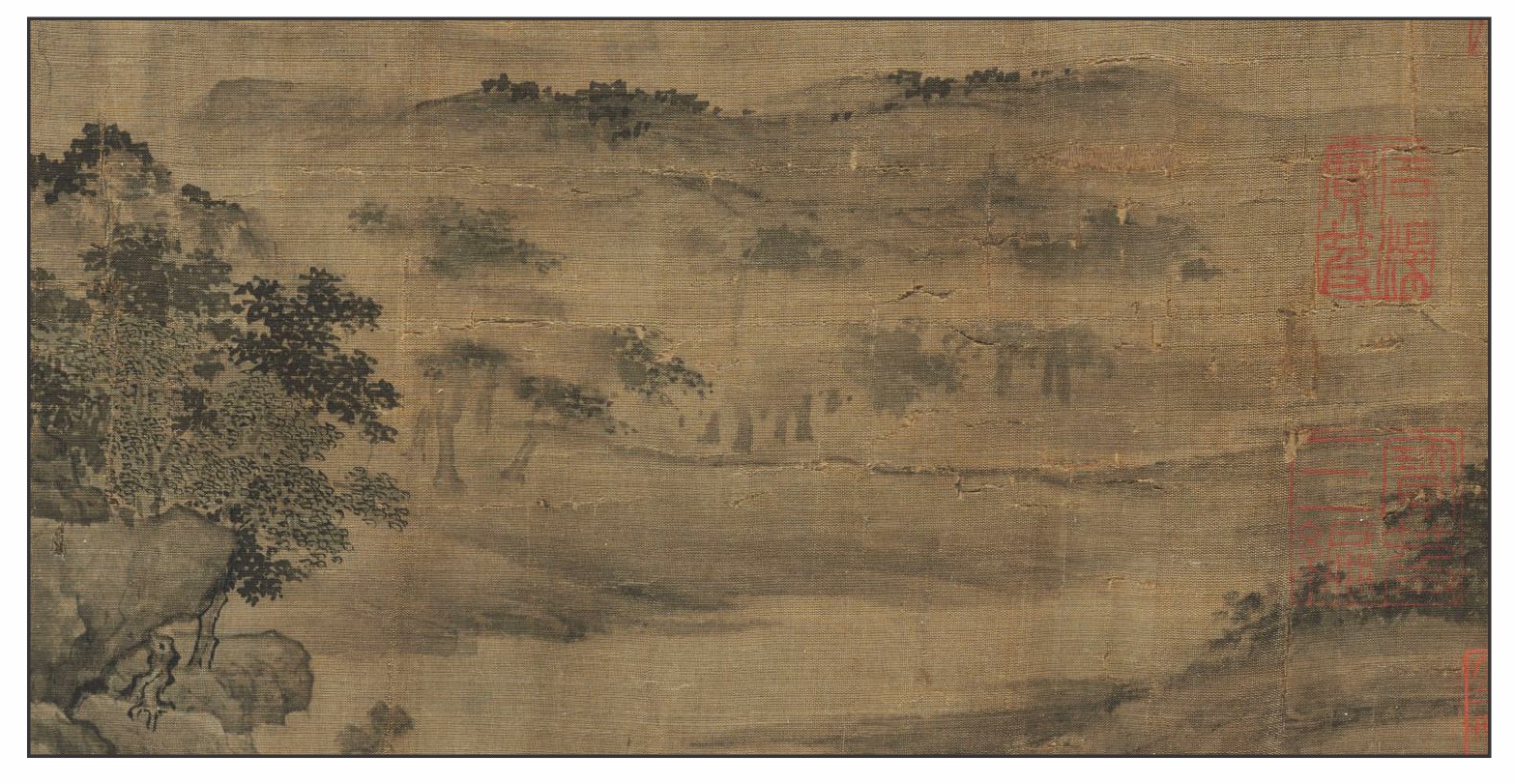
Clearing the mind and sliding in
to that created space,
a web of waters streaming over rocks,
air misty but not raining,
seeing this land from a boat on a lake
or a broad slow river,
coasting by.
Coming from the plain on the right we pass behind the middle distance mountains and enter the first village past a hut and fence on a path leading down to a sandy point with four pine trees where the “few leisurely men” of the village pass the time of day. (Lee & Fong, 1955, p 6)
The path comes down along a lowland stream
slips behind boulders and leafy hardwoods,
reappears in a pine grove,
no farms around, just tidy cottages and shelters,
gateways, rest stops, roofed but unwalled work space,
— a warm damp climate;
a trail of climbing stairsteps forks upstream.
Big ranges lurk behind these rugged little outcrops —
these spits of low ground rocky uplifts
layered pinnacles aslant,
flurries of brushy cliffs receding,
far back and high above, vague peaks.
A man hunched over, sitting on a log
another stands above him, lifts a staff,
a third, with a roll of mats or a lute, looks on;
a bit offshore two people in a boat.
Hass (2015, p165) remarks on the rhythm of Snyder’s poetry. He
…begins with a kind of iambic music “a trail of climbing …” and then just piles up the strong stresses “stairsteps forks upstream” One, two, three, four, five stressed syllables in a row”
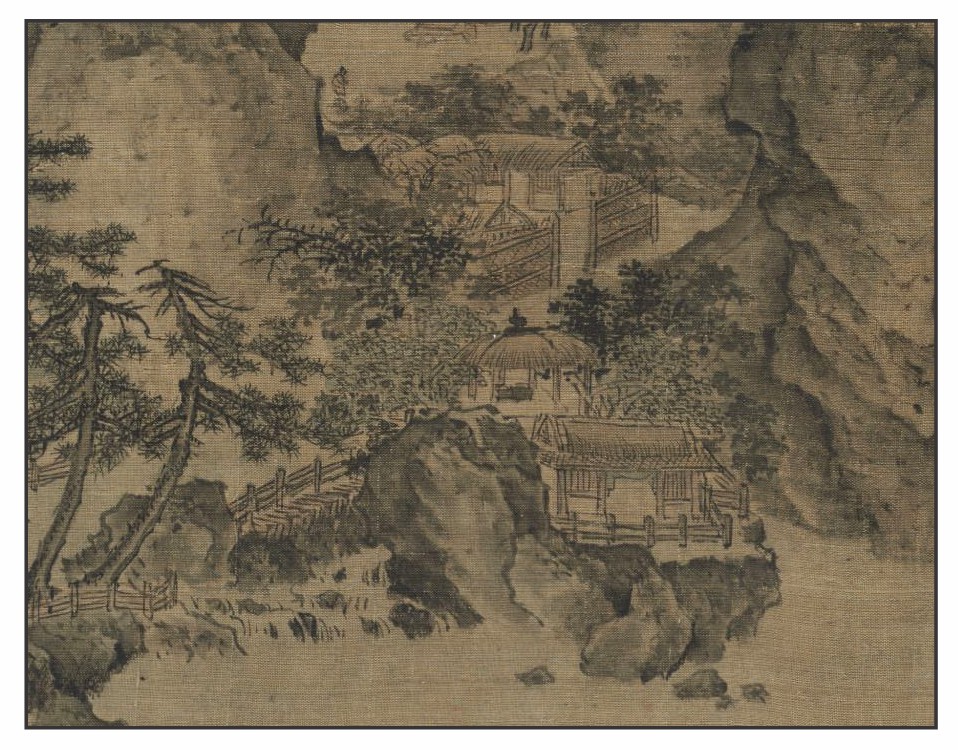
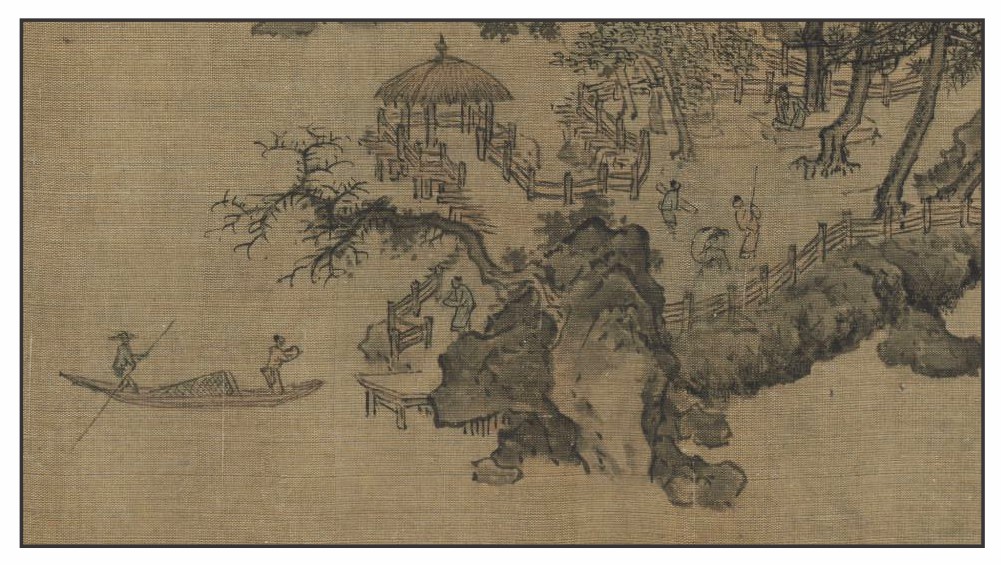
The way on leads back from this tranquil scene to a fork where one can go to the right into the enclosing mountain range or left on an elaborate covered bridge over the outlet for a dammed mountain stream. One then goes on past a waterfall, behind large rocks and trees to a mountain path on trussed logs into the distant mountains and around an estuary situated almost at the center of the picture. The wealthier traveler can avoid this long walk by taking the ferry boat seen approaching the village “park” we have already left behind. (Lee & Fong, 1955, p 6)
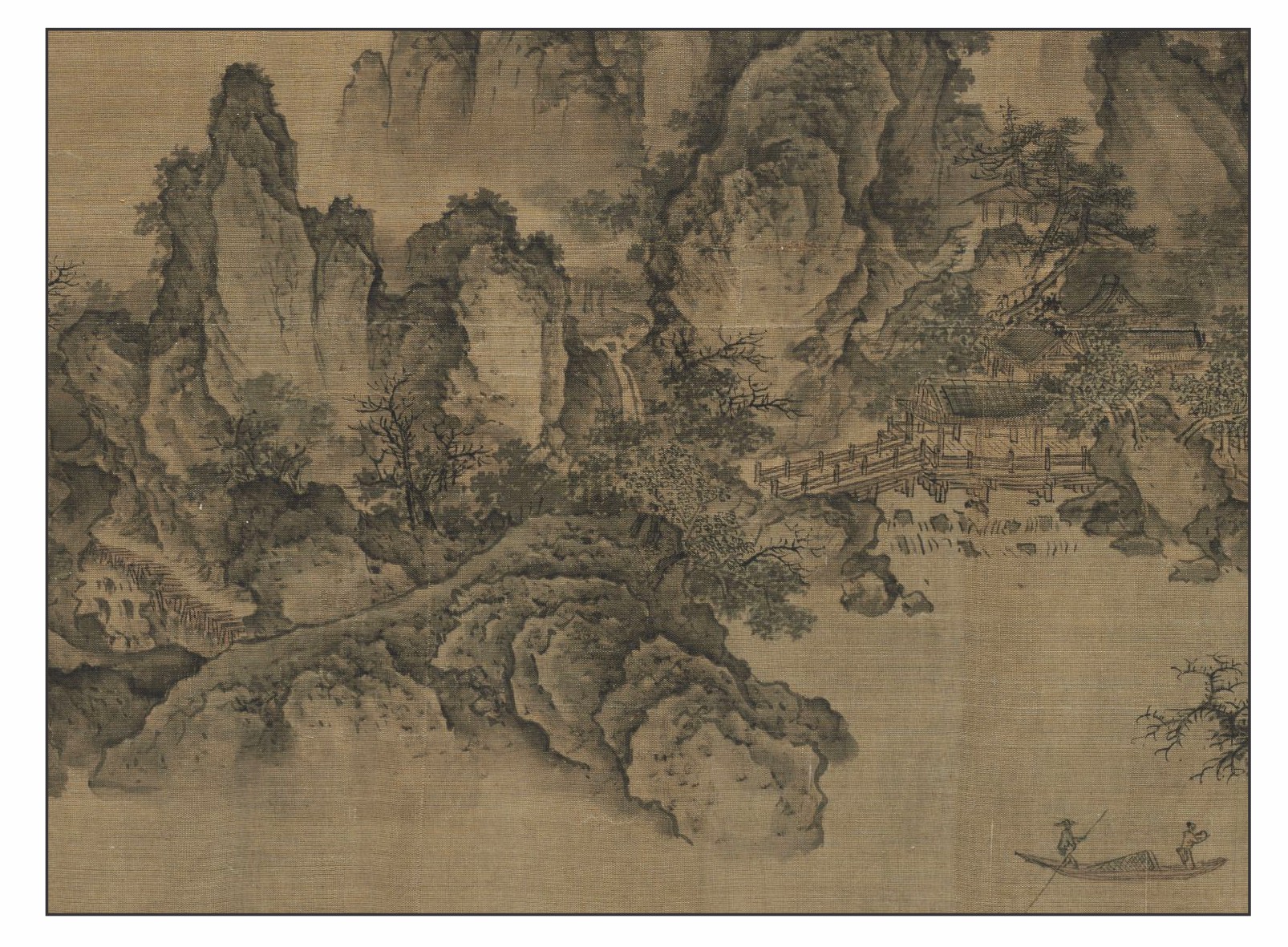
The trail goes far inland,
somewhere back around a bay,
lost in distant foothill slopes
& back again
at a village on the beach, and someone’s fishing.
Rider and walker cross a bridge
above a frothy braided torrent
that descends from a flurry of roofs like flowers
temples tucked between cliffs,
a side trail goes there;
a jumble of cliffs above,
ridge tops edged with bushes,
valley fog below a hazy canyon.
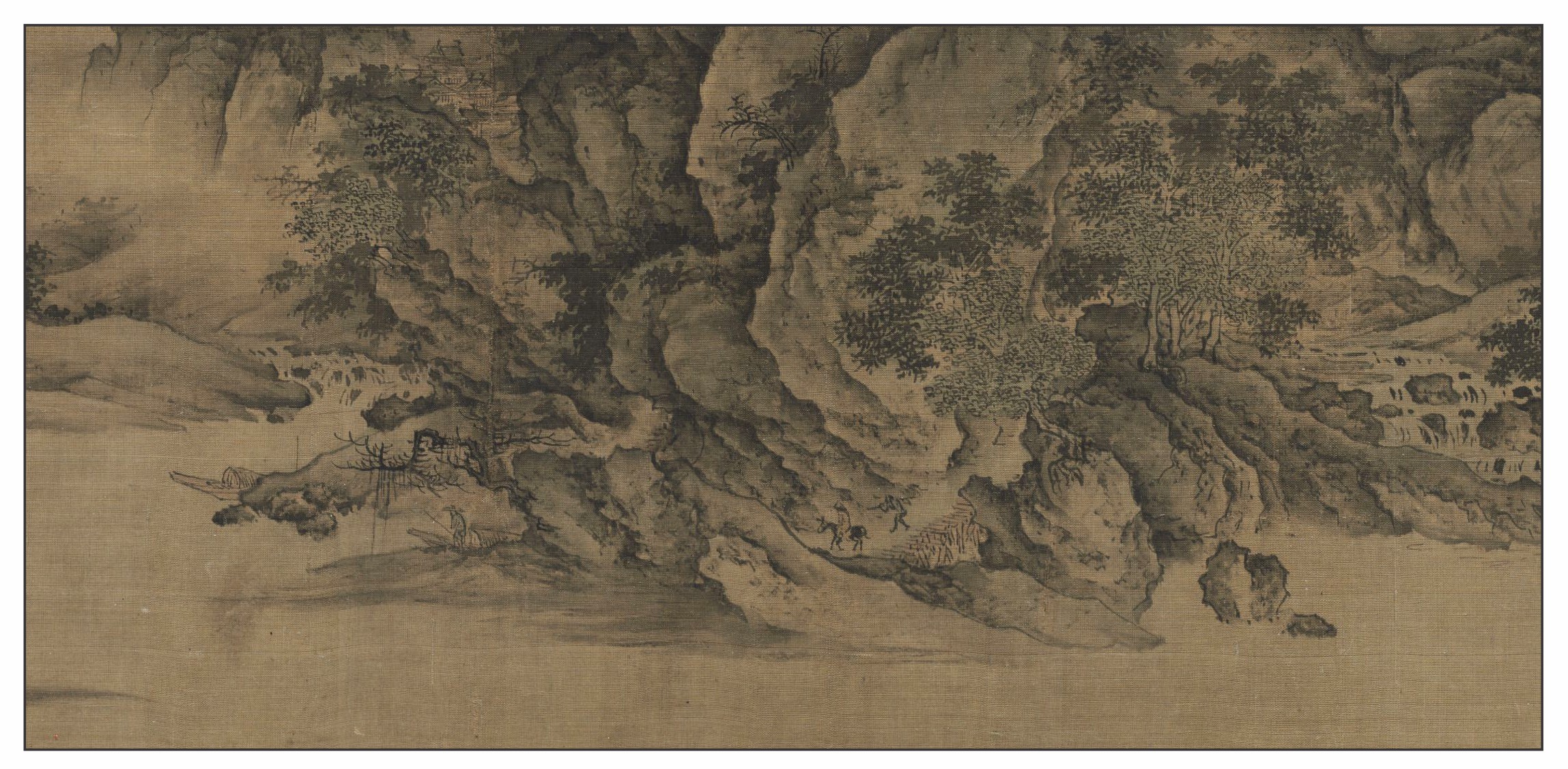
After circuiting the bay, one comes back to the second but smaller village through “the mountain gateway … often left unlocked.” Passing by the thatched huts and the log pile fence the traveler crosses a “dangerous bridge … over a rapid stream which roars like rattling jades” where one meets a rider and his servant. Just beyond this bridge a wine shop displays its banner and a few steps further, on a cul-de-sac to the right, “terraces of an old temple suddenly rise.” The main path winds up to the left past the dead trees, over the low pass and back into the mountain valley, thus going back to a more favorable spot for crossing the next roaring torrent. The path returns to our view at the base of the next great mountain and there again are a rider and servant, not retouched, and with all the original brevity of treatment and vigor of movement. They pass under the great overhanging rocks to arrive at a ferry where two boats, one tenanted, await them for passage to the low forested plain and the distant mountains beyond. (Lee & Fong, 1955, pp 6-7)
A man with a shoulder load leans into the grade
the trail goes up along cascading streambed
no bridge in sight—
comes back through chinquapin or
liquidabars;
another horse and a hiker.
Trail’s end at the edge of an inlet
below a heavy set of dark rock hills.
Two moored boats with basket roofing,
a boatman in the bow
looks lost in thought.
Hills beyond rivers, willows in a swamp,
a gentle valley reaching far inland.
The watching boat has floated off the page.
After he finishes viewing the painting, Snyder provides translations for some of the colophons. He states in his notes to the poem:
The East Asian landscape paintings invite commentary. In a way the painting is not fully realized until several centuries of poems have been added. (Snyder, 2013, p 147)
The following is the first colophon together with a transliteration and word by word translation of the first ten characters:
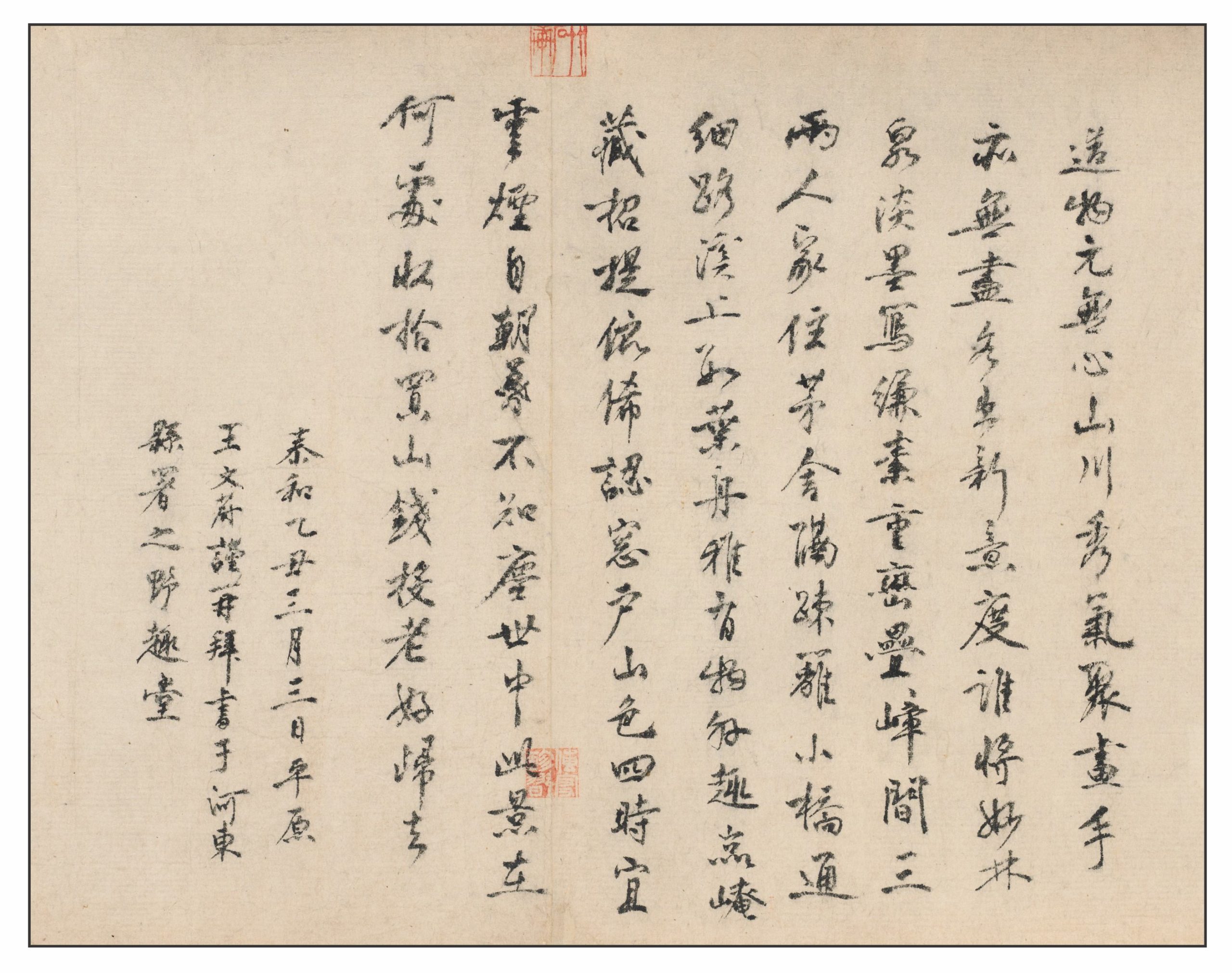
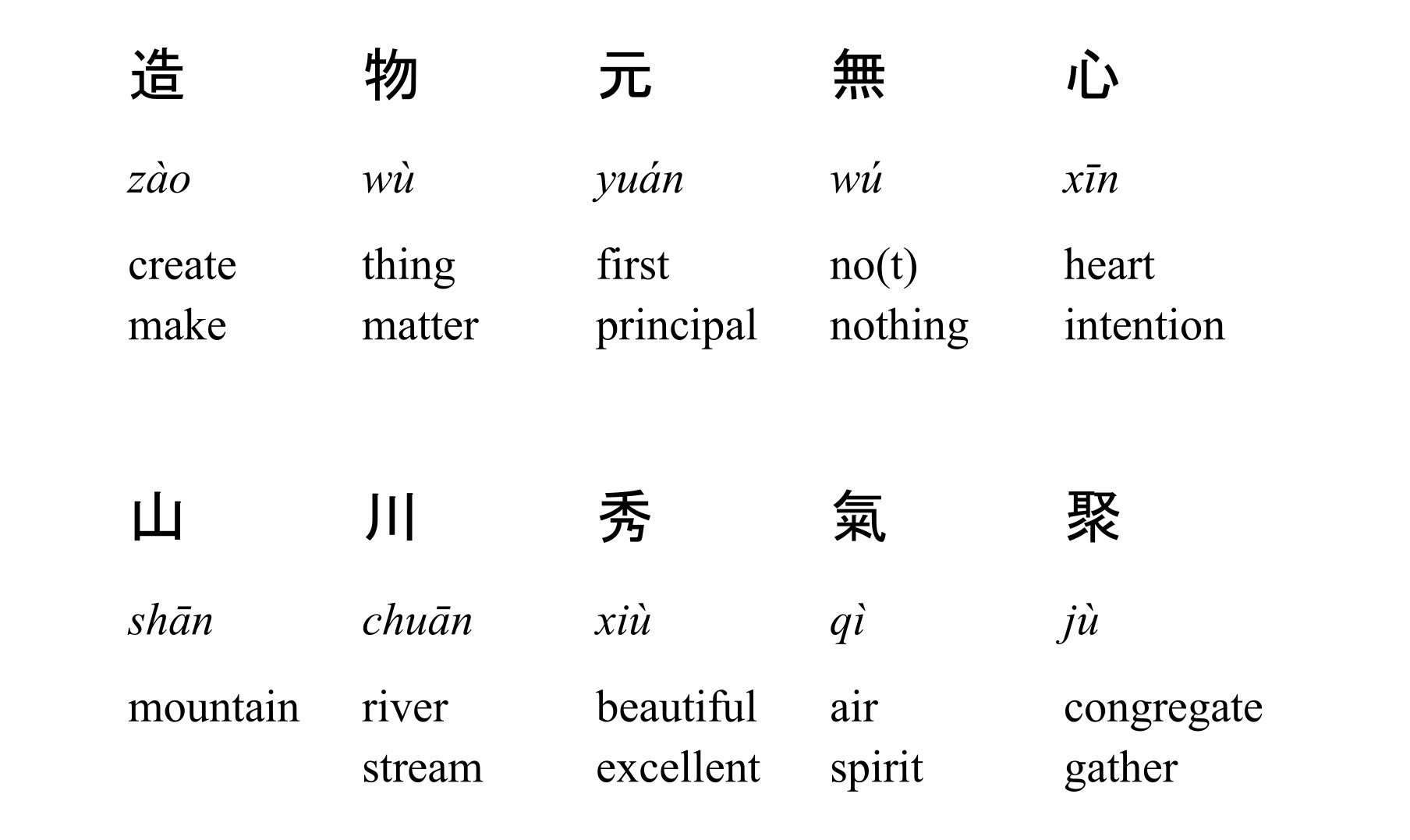
At the end of the painting the scroll continues on with seals and poems.
It tells a further tale:
“—Wang Wen-wei saw this at the mayor’s house in Ho-tung town, year
1205. Wrote at the end of it,
‘The Fashioner of Things
has no original intentions
Mountains and rivers
are spirit, condensed.’
‘. . . Who has come up with
these miraculous forests and springs?
Pale ink
on fine white silk.”
Snyder then translates parts of some of the other colophons. He does not consider the 7th colophon, dated 1336, by Liu Zai. This is an elegantly calligraphed poem about the life of contemplation that underlies shan shui paintings:
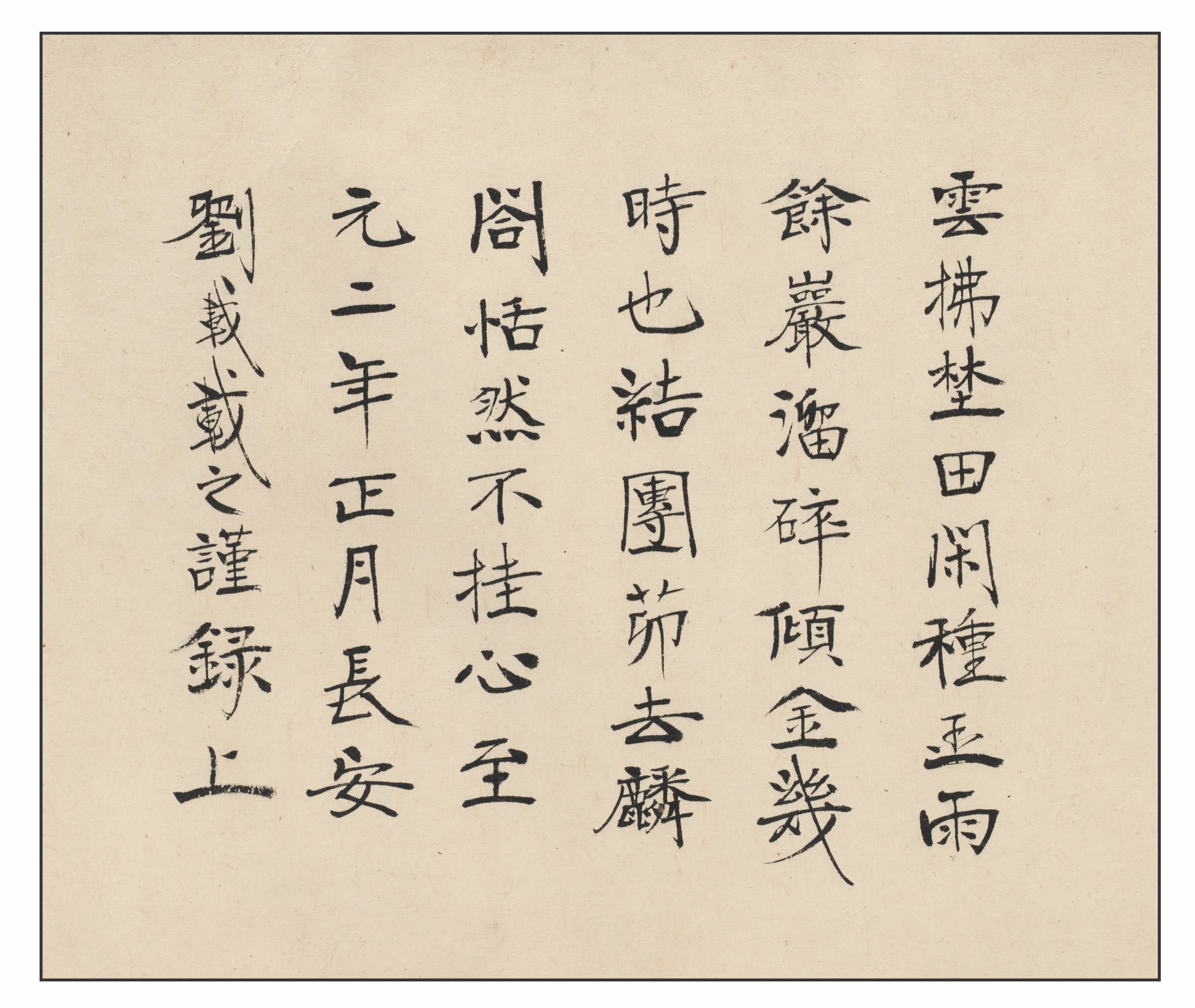
The following is the transliteration and translation of Chou (2014, p 42)
雲拂埜田閑種玉,雨餘巖溜碎傾金。
幾時也結團茆去,麟閤恬然不挂心。
Clouds sweep over the open fields where time passes leisurely in “jade” planting.
After the rain, [glistening] rivulets run over the cliff like scattered gold.
Someday I wish I could build a thatched hut there.
The ambition in the Unicorn Halls will not weigh on my heart.
Jade planting is a metaphor for contemplating things eternal. The Unicorn Hall was a commemorative hall built by one of the Yuan emperors to house portraits of meritorious officials. (Lee & Fong, 1955, p 56). It is a symbol of worldly achievement.
As his poem comes to an end, Snyder stands back, considers the scroll as a whole, and then contemplates its present location in the Cleveland Museum of Art.
Step back and gaze again at the land:
it rises and subsides —
ravines and cliffs like waves of blowing leaves —
stamp the foot, walk with it, clap! turn,
the creeks come in, ah!
strained through boulders,
mountains walking on the water,
water ripples every hill.
I walk out of the museum—low gray clouds over the lake—chill March breeze.
Old ghost ranges, sunken rivers, come again
stand by the wall and tell their tale,
walk the path, sit the rains,
grind the ink, wet the brush, unroll the
broad white space:
lead out and tip
the moist black line.
Walking on walking
under foot earth turns.
Streams and mountains never stay the same.
Hunt (2004) notes that the foot-stamping is an essential part of Japanese Noh plays: a means of grounding the spiritual (ghosts) in the real. Snyder brings his thoughts of Sung China back to the present world in Cleveland.
Mountains East and West
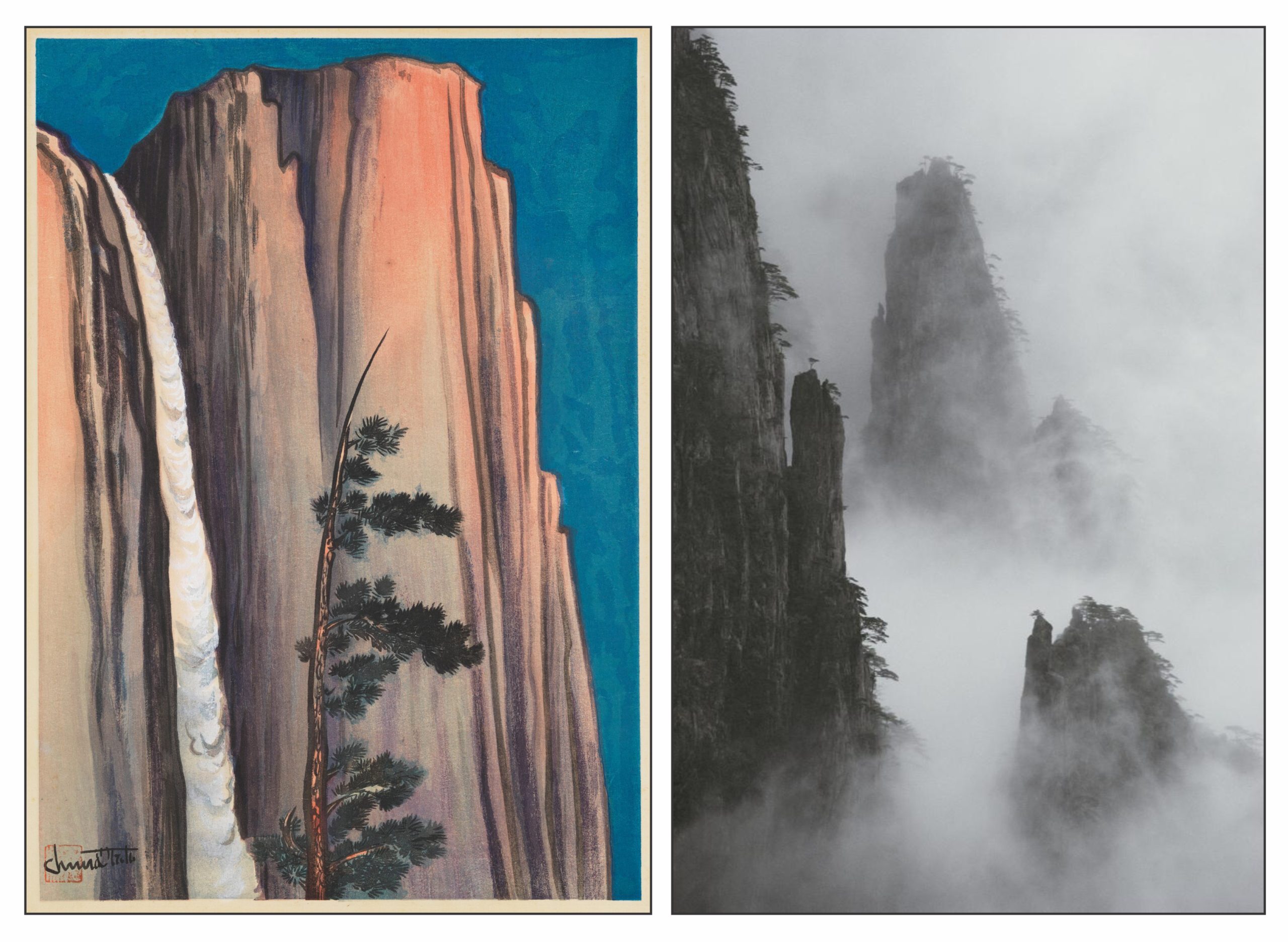
Snyder used Evening Glow of Yosemite Falls, a 1930 woodcut by Chiura Obata (1885-1975), for the dustjacket of the 1996 trade publication of Mountains and Rivers without End. Obata was a Japanese artist who had moved to California in 1903. Snyder had studied painting with him when he first came to the University of California, Berkeley, in 1953. Obata provides an Eastern appreciation of Western landscape. The following illustration shows his woodcut on the left. On the right is a 1980s photograph of the Huang-Shan Mountains in China by the French photographer Marc Riboud: a Western appreciation of Eastern landscape:
A Sense of the Whole
Mountains and Rivers without End is firmly based on Snyder’s belief that we should live in harmony with the natural world (Snyder, 1990; Wirth, 2017; Qiu, 2017). Gonnerman (2015, p 18) in the book entitled A Sense of the Whole remarks:
If Mountains and Rivers has an overriding purpose apart from the aesthetic pleasures it provides, it is to engender a conversion in the heart-mind of the reader. The desired shift in this case is from identification with outmoded nation-state systems to participation in local community life, from centralized hierarchy to decentralized collaboration, from the stresses of competition to the satisfactions of mutual regard and cooperation, from modern monocultural monotheism to promiscuous postmodern polytheism, from consumerism to conservation, from fragmentation to a sense of the whole.
Snyder’s sequence of poems encourages us to become one with the life forces that underlies the universe, the transcendent principle of the Dao and the transforming energy of the Qi. It promotes the Zen idea of sunyata: of losing oneself in the whole, of ultimate empathy.
The great Japanese Zen master Dōgen (1200-1253) wrote in his Sansui Kyo (Mountain Water Sutra)
Mountains and waters right now are the actualization of the ancient buddha way. Each, abiding in its phenomenal expression, realizes completeness. Because mountains and waters have been active since before the Empty Eon, they are alive at this moment. Because they have been the self since before form arose they are emancipation-realization.
Because mountains are high and broad, the way of riding the clouds is always reached in the mountains; the inconceivable power of soaring in the wind comes freely from the mountains
Water is neither strong nor weak, neither wet nor dry, neither moving nor still, neither cold nor hot, neither existent nor nonexistent, neither deluded nor enlightened. When water solidifies, it is harder than a diamond. Who can crack it? When water melts, it is gentler than milk. Who can destroy it? (Dōgen, 1985, pp 97-107)
Snyder has proposed how we might live in harmony with nature (Snyder, 1990). Some regions of the world are available for cultivation; other regions are common areas shared by many different people for many different purposes; other regions are best preserved as wilderness, places where we may find solitude. Shan shui paintings portray the wilderness of ancient China.
Snyder (1990, p 30) notes
Every region has its wilderness. There is the fire in the kitchen, and there is the place less traveled. In most settled regions there used to be some combination of prime agricultural land, orchard and vine land, rough pasturage, woodlot, forest, and desert or mountain “waste.” The de facto wilderness was the extreme backcountry part of all that. The parts less visited are “where the bears are.” The wilderness is within walking distance—it may be three days or it may be ten. It is at the far high rough end, or the deep forest and swamp end, of the territory where most of you all live and work. People will go there for mountain herbs, for the trapline, or for solitude. They live between the poles of home and their own wild places.
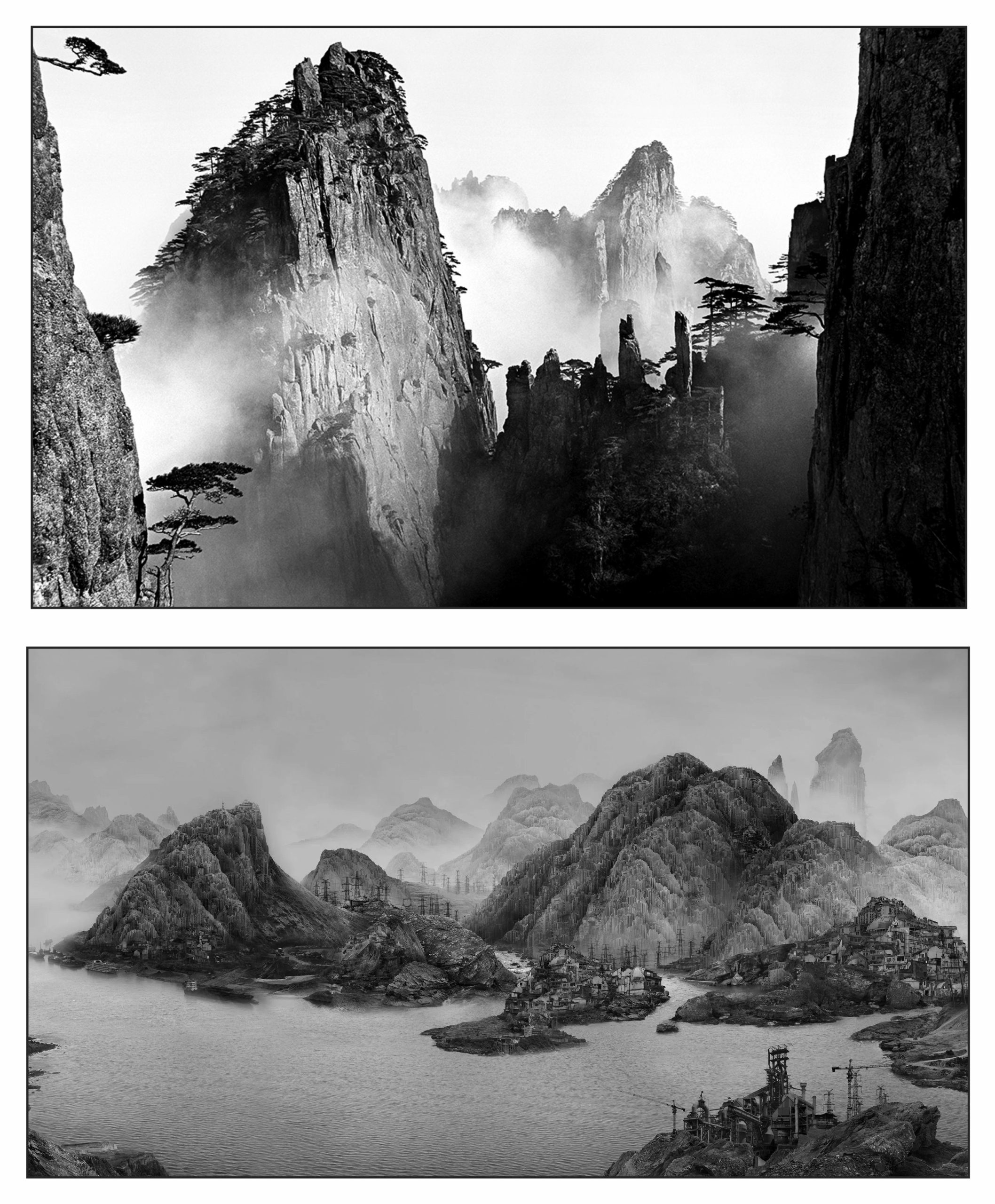
Unfortunately, modern civilization is rapidly encroaching on the wilderness. The following are two photographs by modern Chinese artists. The first by Wang Wusheng is an austere depiction of the Huang Shan mountains. The second by Yang Yongliang is a digital recreation of a shan shui landscape with civilization and construction taking over the mountains and the waters.
Envoi
We can say farewell to Snyder and his Mountains and Rivers without End with the final lines of the book’s sequence of poems. These recall the ending of the first poem:
Walking on walking
under foot earth turns.
Streams and mountains never stay the same
The space goes on.
But the wet black brush
tip drawn to a point,
lifts away
And a photograph of Snyder in his beloved mountains
References
Bush, S. (1987). Yet Again “Streams and Mountains without End.” Artibus Asiae, 48(3/4), 197–223.
Capasso, A. (2024). Becoming the mountain. In G. Bruni & T. Schirmer (Eds.) The poetics of silence: the mountain in art and literature (pp 26-49).
Chai, D. (2021). Guo Xi on painting the invisible gaze of the Dao. Journal of Chinese Literature and Culture, 8(2), 287–306.
Chou, J. (2014). Silent poetry. Chinese paintings from the Cleveland Museum of Art. Yale University Press.
Dōgen (translated by Tanahashi, K., 1985). Moon in a dewdrop. North Point Press.
Duan, X. (2023). A study of Chinese and Western landscape painting from the comparative perspective. Frontiers in Art Research, 5, Issue 13: 1-7
Du Zhang (2022). Chinese landscape painting from the perspective of “integration of man with mountains and rivers.” Proceedings of the 8th International Conference on Arts, Design and Contemporary Education. (pp. 59–64). Athena.
Gonnerman, M. (2015). A sense of the whole: reading Gary Snyder’s Mountains and rivers without end. Counterpoint Press.
Hass, R. (2015). Proceeding by clues: reading Mountains and Rivers without End. In Gonnerman, M. op cit. (pp 143-209)
Hunt, A. (2004). Genesis, structure, and meaning in Gary Snyder’s Mountains and rivers without end. University of Nevada Press.
Jullien, F. (translated by J M Todd, 2009) The great image has no form, or on the nonobject through painting, University of Chicago Press,
Kerouac, J. (1958). The Dharma bums New American Library.
Law, S. S. (2011): Being in traditional Chinese landscape painting, Journal of Intercultural Studies, 32(4), 369-382.
Lee, S. E., & Fong, W. (1955). Streams and mountains without end: a Northern Sung handscroll and its significance in the history of early Chinese painting. Artibus Asiae.
Lee, S. E. (1982). A history of Far Eastern art (4th ed.). H.N. Abrams.
Qiu, Y. (2017). “Off the Trail”: ecophilosophy and Gary Snyder’s idea of “the Wild.” ANQ, 30(2), 101–111.
Shaw, M. (1988). Buddhist and Taoist influences on Chinese landscape painting. Journal of the History of Ideas, 49(2), 183–206.
Snyder, G. (1990). The practice of the wild: essays. North Point Press.
Snyder, G. (1996). Mountains and rivers without end. Counterpoint. (republished in 2013 with CDs of Snyder reciting the poems).
Wirth, J. M. (2017). Mountains, rivers, and the great earth: reading Gary Snyder and Dōgen in an age of ecological crisis. State University of New York Press.
Leave a Reply