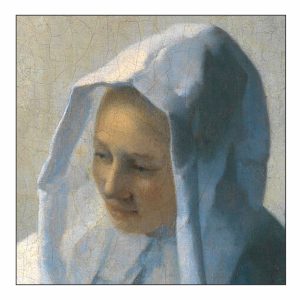


The painter Johannes Vermeer (1632-1675) lived his whole life in Delft, a city of canals in southeast Netherlands midway between The Hague and Rotterdam. He was baptized in the Dutch Reformed Church in 1632. When he married Catherina Boles in 1653, he converted to Catholicism. However, his main patrons – Pieter van Ruijven and his wife Maria de Knuijt – were members of the Remonstrant Church. No one is sure of Vermeer’s personal beliefs. Weber (2022) suggests that he might have been Catholic. Graham-Dixon (2025) argues that Vermeer was more likely drawn to the Remonstrants. One recurring subject in Vermeer’s paintings is a woman standing at a window. These solemn images convey great depths of feeling. The illustration shows a detail from Young Woman with a Water Pitcher (1662).
The Dutch Republic and Religious Tolerance
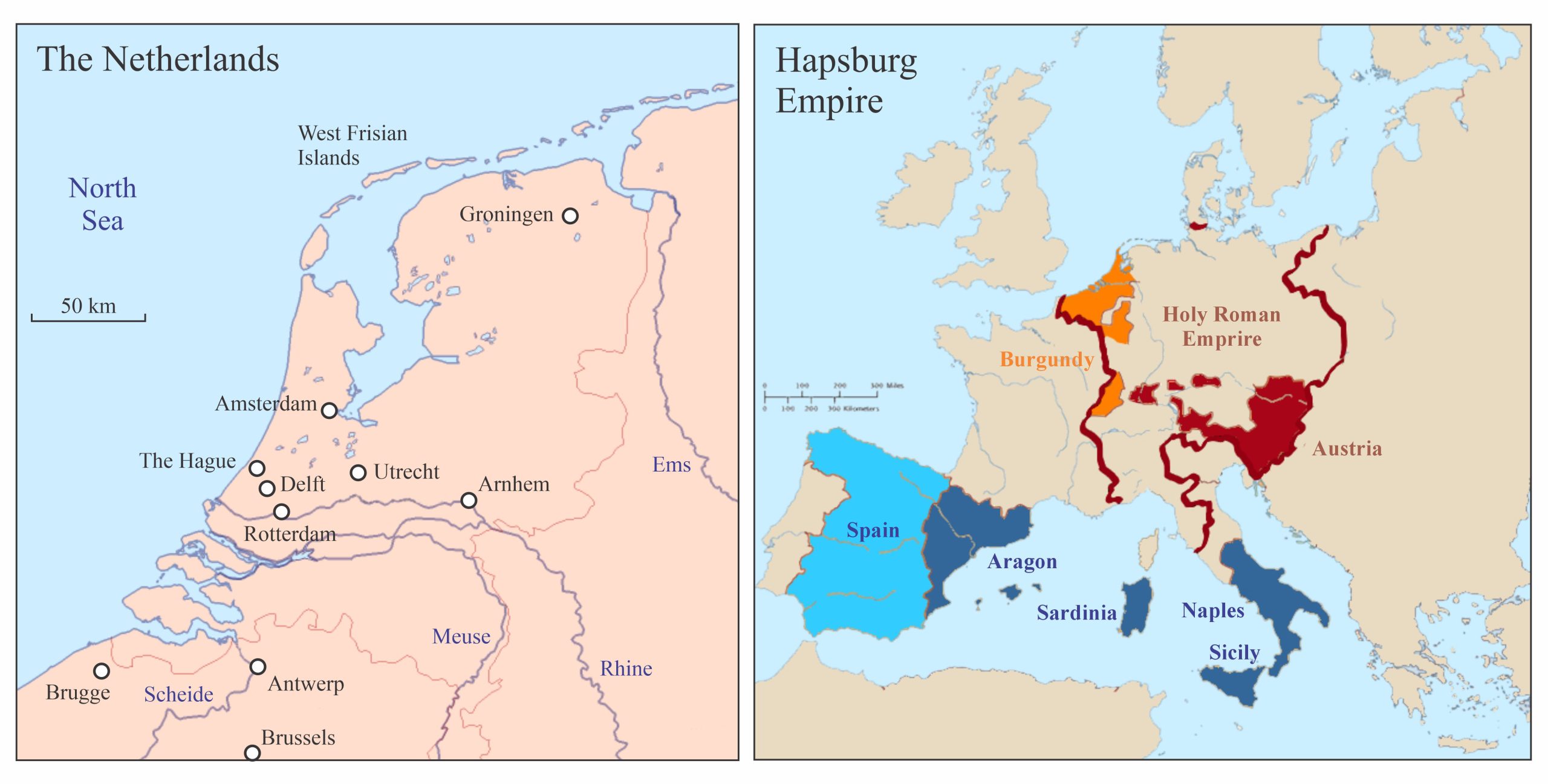
The modern history of the Netherlands began in the 16th Century (Blockmans 2022; van Deursen, 2022, Wielenga; 2015). By the mid 16th Century, the Hapsburg Empire under Charles V, Holy Roman Emperor, Archduke of Austria, and King (Charles I) of Spain, had managed by means of war and marriage to control much of Europe. Among its territories were the “lowlands” or Netherlands that had once been part of the Burgundian Empire. However, this would soon change as the Protestant Reformation swept across northern Europe. Although Lutherans and Baptists found converts in the Netherlands, the main denomination in the northern region was Calvinism, which founded the Dutch Reformed Church in 1571.
Charles abdicated in 1555 in favor of his son Phillip II of Spain. In 1567, Phillip, a fervent Catholic, sent an army under the Duke of Alva to suppress the heretics in the Netherlands. This triggered the Eighty Years’ War (also known as the Dutch War of Independence). The northern provinces of the Netherlands joined together to resist the Hapsburgs, signing the Union of Utrecht in 1579 and formally declaring the Dutch Republic under William of Orange In 1588. The war finally ended in 1848 with the Treaty of Münster, dividing the Netherlands into the mainly Protestant Dutch Republic in the north and the Catholic Spanish Netherlands in the south.
The following illustration shows maps of the Netherlands and of the Hapsburg Empire in the early 16th Century.
Although Calvinism was the main Protestant denomination in the Dutch Republic, various groups rebelled against some of its severe teachings. One of the dogmas was the principle of double predestination: God not only elects some people for eternal salvation, but also abandons the rest to eternal damnation. Jacobus Arminius (1560-1609) argued against predestination. Hed also proposed that Christians should worship God by following their conscience rather than the teachings priests and pastors. After the death of Arminius, a group of his followers issued Five Articles of Remonstrance (1610) describing their issues with the Calvinist beliefs of the Dutch Reformed Church. These led to the Remonstrant Church. A subset of these believers also founded the Collegiant movement in 1619.
The people of the Dutch Republic followed many different beliefs (Kooi, 2018). About a third remained Catholic; a sizable Jewish population had come as refugees from Spain and Portugal and from Germany, and there were many different Protestant communities. The principle of tolerance – allowing each person the freedom to belief as their own conscience proposed – was one the founding edicts of the Union of Utrecht.
One way that the Dutch Republic tolerated different beliefs was the schuilkerk or clandestine church. Although the Reformed Church was the dominant church for the country and its leaders, minority groups could also have religious meeting places However, these were only allowed in buildings that were not ostensibly churches and did not show a public façade.
Vermeer’s religious beliefs are not known. There was a small Jesuit center near the residence that he shared with his mother-in-law (Weber, 2022, p 14). And there was a Remonstrant schuilkerk behind the residence of his main patron Pieter van Ruijven (Graham-Dixon, 2025; Montias, 1989, pp 246-262).
Delft
Johannes Vermeer lived his entire life in the city of Delft. The following his painting View of Delft (1661) now in the Mauritshuis gallery in The Hague:
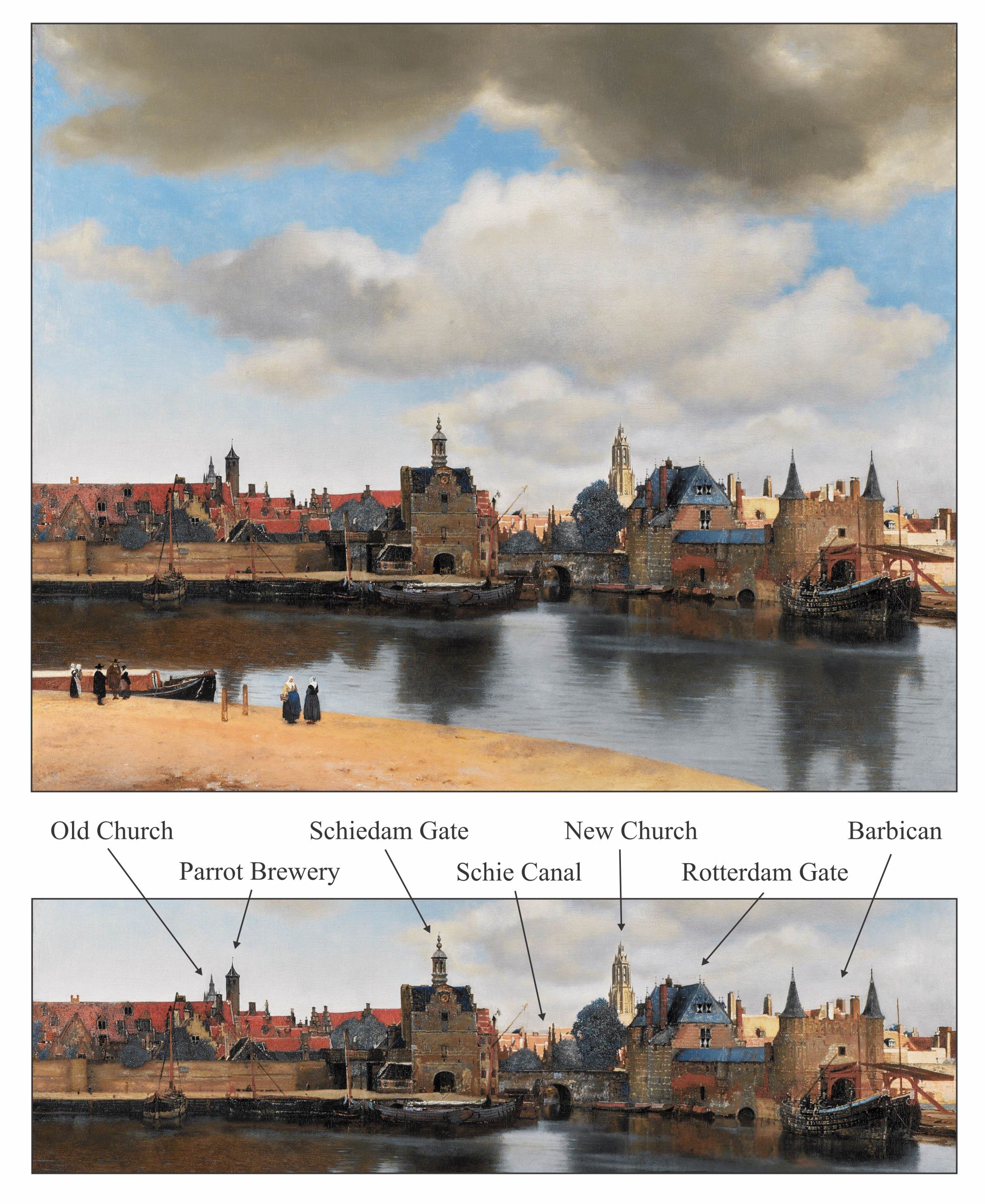
Marcel Proust was impressed by this painting and incorporated it into his novel The Captive, part of In Search of Lost Time. The following is the episode wherein the critic Bergotte goes to see Vermeer’s painting:
…an art critic having written somewhere that in Vermeer’s `View of Delft’ (lent by the Gallery at The Hague for an exhibition of Dutch painting), a picture which he adored and imagined that he knew by heart, a little patch of yellow wall (which he could not remember) was so well painted that it was, if one looked at it by itself, like some priceless specimen of Chinese art, of a beauty that was sufficient in itself, Bergotte ate a few potatoes, left the house, and went to the exhibition. At the first few steps he had to climb, he was overcome by an attack of dizziness. He walked past several pictures and was struck by the aridity and pointlessness of such an artificial kind of art, which was greatly inferior to the sunshine of a windswept Venetian palazzo, or of an ordinary house by the sea. At last he came to the Vermeer which he remembered as more striking, more different from anything else he knew, but in which, thanks to the critic’s article, he noticed for the first time some small figures in blue, that the sand was pink, and, finally, the precious substance of the tiny patch of yellow wall. His dizziness increased; he fixed his gaze, like a child upon a yellow butterfly that it wants to catch, on the precious little patch of wall. “That’s how I ought to have written,” he said. “My last books are too dry, I ought to have gone over them with a few layers of colour, made my language precious in itself, like this little patch of yellow wall.” Meanwhile he was not unconscious of the gravity of his condition. In a celestial pair of scales there appeared to him, weighing down one the pans, his own life, while the other contained the little patch of wall so beautifully painted in yellow. He felt that he had rashly sacrificed the former for the latter. “All the same,” he said to himself, “I shouldn’t like to be the headline news of this exhibition for the evening papers.”
He repeated to himself: “Little patch of yellow wall, with a sloping roof, little patch of yellow wall.” Meanwhile he sank down on to a circular settee; whereupon he suddenly ceased to think that his life was in jeopardy and, reverting to his natural optimism, told himself: “It’s nothing, merely a touch of indigestion from those potatoes, which were undercooked.” A fresh attack struck him down; he rolled from the settee to the floor, as visitors and attendants came hurrying to his assistance. He was dead. Dead for ever? Who can say? Certainly, experiments in spiritualism offer us no more proof than the dogmas of religion that the soul survives death. All that we can say is that everything is arranged in this life as though we entered it carrying a burden of obligations contracted in a former life; there is no reason inherent in the conditions of life on this earth that can make us consider ourselves obliged to do good, to be kind and thoughtful, even to be polite, nor for an atheist artist to consider himself obliged to begin over again a score of times a piece of work the admiration aroused by which will matter little to his worm-eaten body, like the patch of yellow wall painted with so much skill and refinement by an artist destined to be for ever unknown and barely identified under the name Vermeer. All these obligations, which have no sanction in our present life, seem to belong to a different world, a world based on kindness, scrupulousness, self-sacrifice, a world entirely different from this one and which we leave in order to be born on this earth, before perhaps returning there to live once again beneath sway of those unknown laws which we obeyed because we bore their precepts in our hearts, not knowing whose hand had traced them there—those laws to which every profound work of the intellect brings us nearer and which are invisible only—if then!—to fools. (Proust, 1927/1929, pp 249-251)
No one is sure which patch of yellow wall in the painting so fatally impressed the critic. Several regions have been proposed. My own preference is for the yellow wall just to the left of the left tower of the barbican.
The following is a 1649 map of the city together with a 3D computer reconstruction and a diagram showing the lines of sight for Vermeer’s painting:

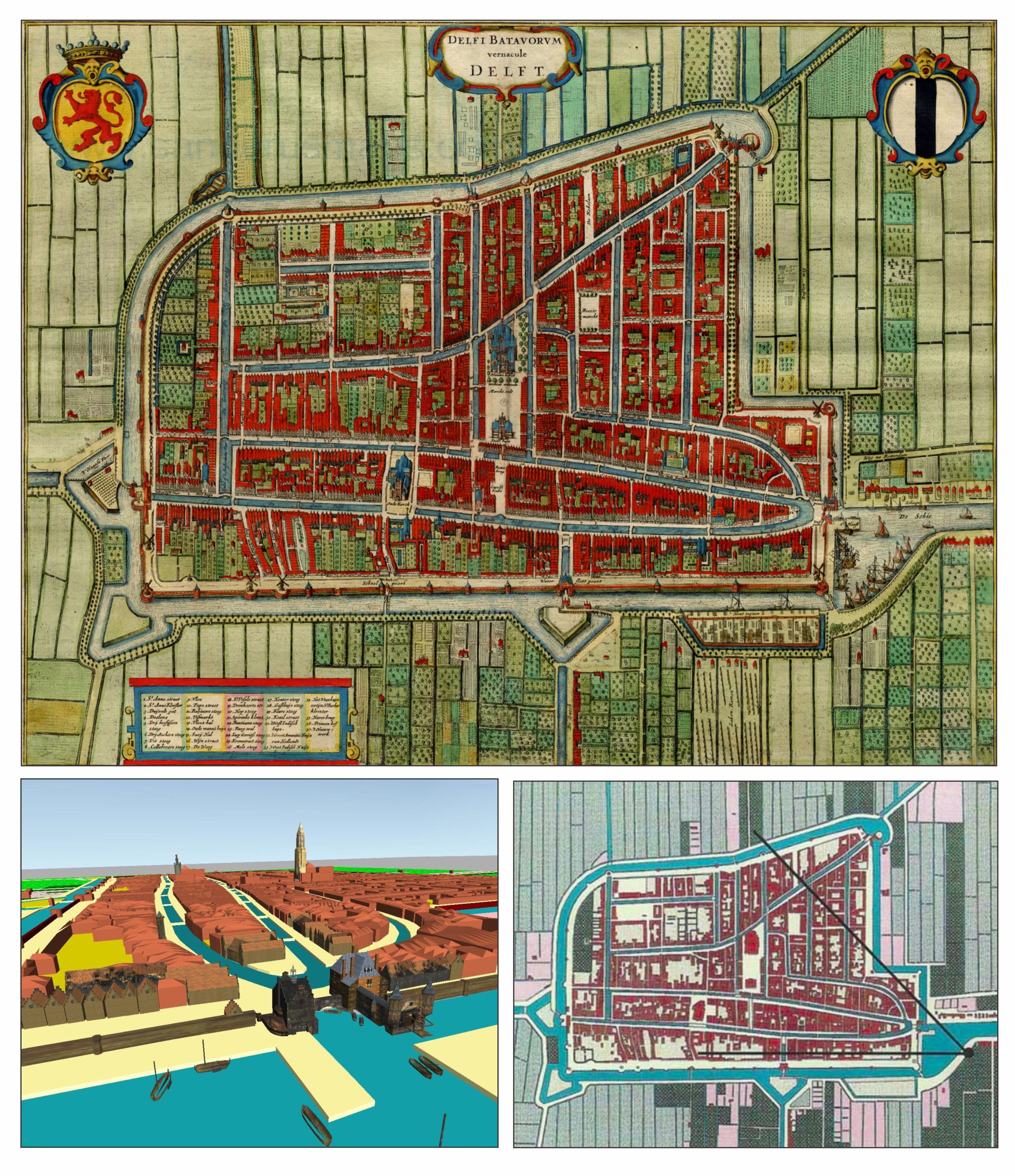
In the 17th Century Delft was home to a thriving community of painters (Liedtdke, 2001) who came together in the Guild of Saint Luke. Among them were the still-life painter Balthasar van der Ast (1593-1657), Carel Fabritius (1622-1654) who died in the Donderslag (Thunderclap), a catastrophic gunpowder explosion that laid waste much of the northern area of the city, and Egbert van der Poel (1621-1664) who famously painted the aftermath of the explosion. Gerard Houckgest (1600-1661) and Emmanuel de Witte (1616-1692) painted church interiors. Pieter de Hooch (1629-1684), Cornelis de Man (1621-1706) and Jan Steen (1626-1679) painted genre scenes.
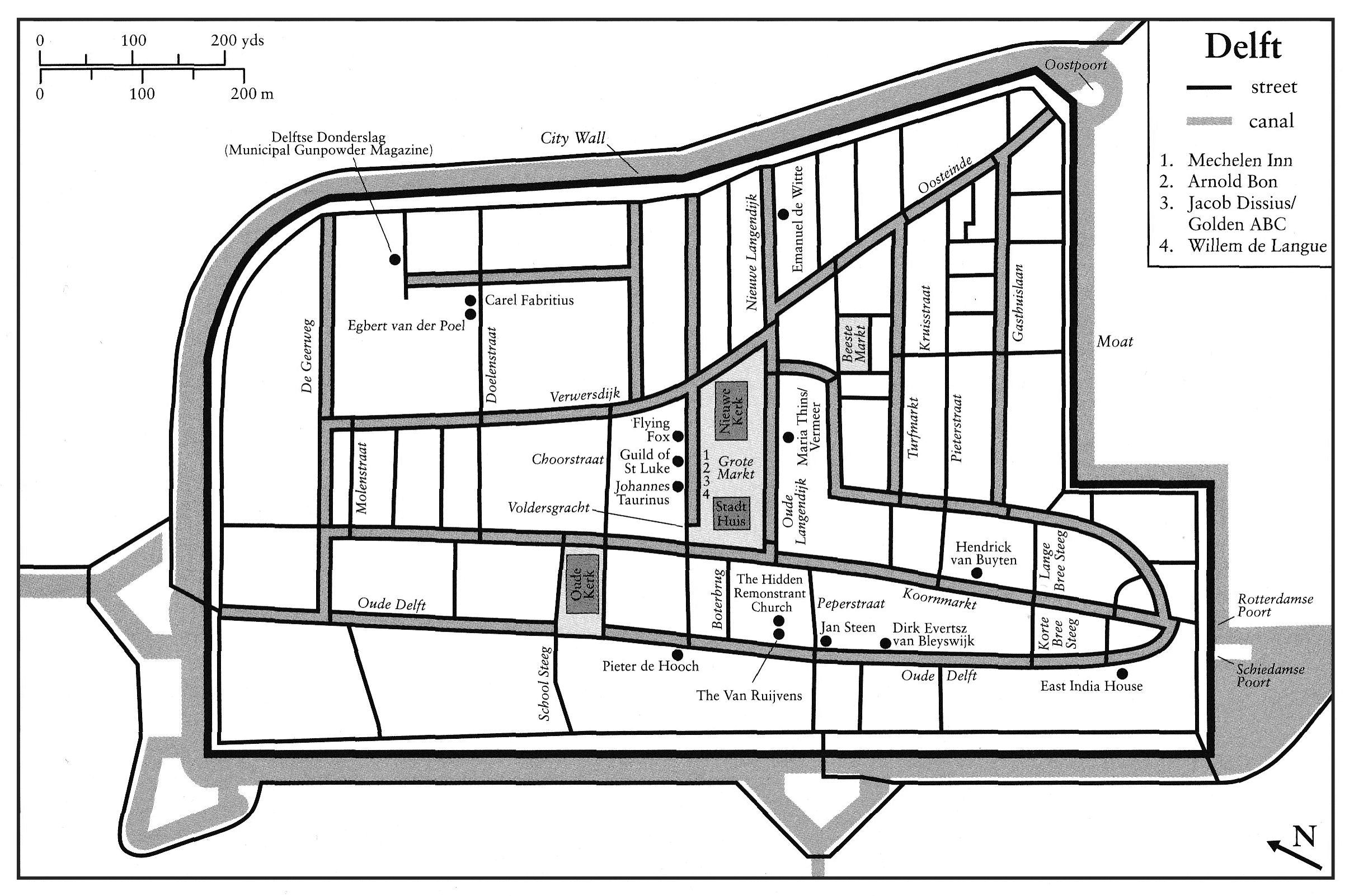
Vermeer’s father Reijnier Janszoon managed the Flying Fox Inn in the center of the city and acted as a dealer for the painters from the nearby guild. He later owned the Mechelen Inn. Little is known about Johannes Vermeer’s life. He was baptized in the Nieuwe Kirk and buried in the Oude Kirk. In 1853 he converted to Catholicism so that he could marriy Catherina Bolnes and the couple moved to the residence of his wife’s mother Margaret Thins. Near this house was a clandestine Jesuit church. In a large second-story room in this spacious house on the Oude Langendijk Vermeer set up his painting studio. The following illustration from Graham Dixon (2025, p xxiii)
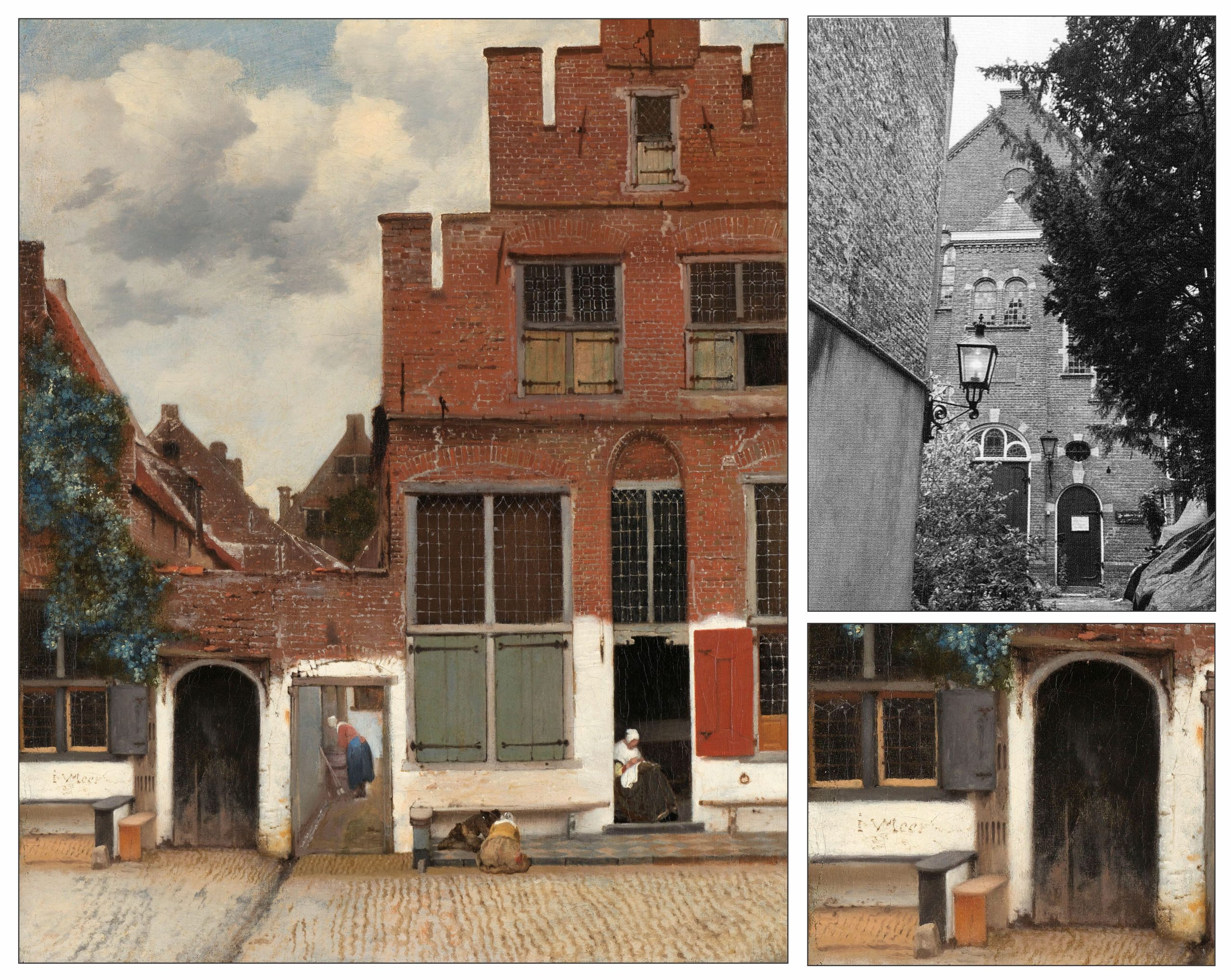
There has been much debate about the location of Vermeer’s painting The Little Street (1660). Graham Dixon (2025, pp 197-200) proposes that it represents on the left (where Vermeer placed his signature) the residence of his patrons Pieter van Ruijven and his wife Maria de Knuijt. Behind the residence, accessible through the black door was the clandestine Remonstrant Church, that is still standing today. The following illustration shows the painting on the left and a modern photograph of the church on the right.
Vermeer’s Painting Techniques
Vermeer did not appear to use preparatory drawings. He was above all things a colorist. The edges of the objects in his paintings are shown by changes in color: there are no outlines. He appeared to be familiar with the new ideas about perspective (Wadum, 1995), and his paintings have a clear central vanishing point, as seen in the following diagrams.
Several studies have proposed that Vermeer used a camera obscura or similar optical device to ensure the veracity of his paintings (Hockney, 2001; Steadman, 2001; Yeazell, 2026, pp 76-89). In a sense this would have meant that he created painted photographs. Various pieces of evidence have been adduced to support this theory. However, Liedtke (2009, p 7) pointed out that some of Vermeer’s canvases show a pinhole at the vanishing point. This suggests that he used strings to align his objects to the vanishing point. Furthermore, it is difficult to get the bright colors of a Vermeer painting in the dim light of a camera obscura. A reasonable idea is that Vermeer could have used a camera obscura as a check on the accuracy of his paintings, but that he still used conventional painting techniques.
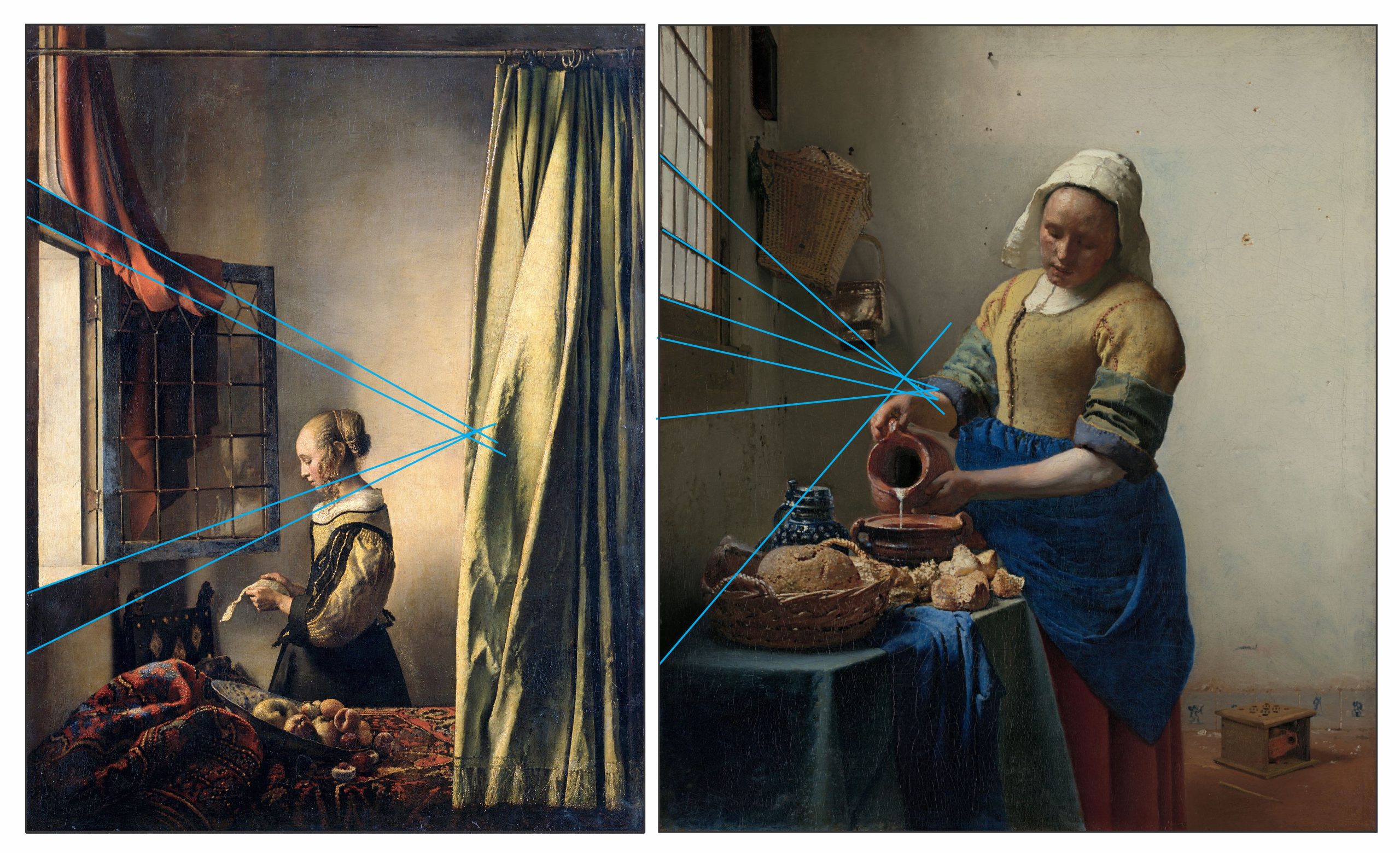
One argument against the camera obscura is the presence of perspective “errors” in the paintings. The reflection of the woman’s face in the window in Young Woman Reading a Letter at an Open Window (1657) should not be visible to the artist or viewer. Since the opening of the jug in The Milkmaid (1658) is below the vanishing point, the viewer should see the milk within the jug as it is being poured (see Janson, 2026 reporting on an observation by Keith Cardnell).
Woman Standing at a Window
Vermeer’s paintings have a depth and seriousness that belie any simple interpretation:
Unlike the Dutch genre painters of his time, with whom he has been routinely compared, he made pictures that are uniquely introverted and conspicuously lacking in any overt ambition to amuse or entertain. While his paintings radiate a deep sense of ethical conviction, they cannot be boiled down to a series of moral platitudes. The people we see in them are invariably thoughtful, though that is really an understatement: truer to say that they are rapt, caught up in a profoundly inward state of meditation, lost in thought. They are mostly women: shown reading or writing, playing music, pouring milk, making lace, or simply looking out at us. They are framed with such solemnity that we are left in no doubt about the importance, to them, of whatever it is that they are contemplating. (Graham-Dixon, 2025, pp 3-4).
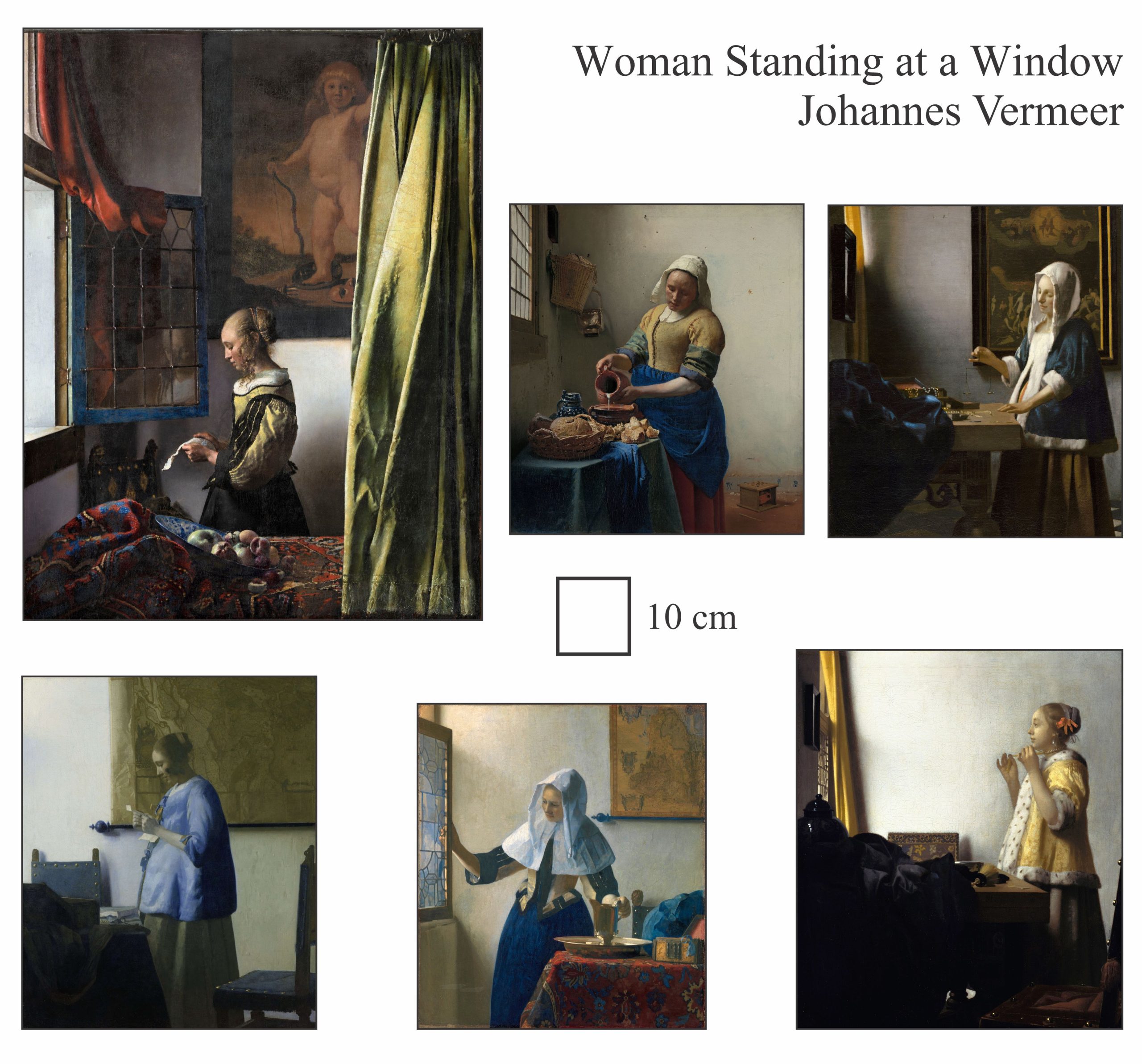
A recurrent subject of Vermeer is that of a single woman standing at a window. There are six of these paintings. The following illustration shows these paintings printed approximately to scale:
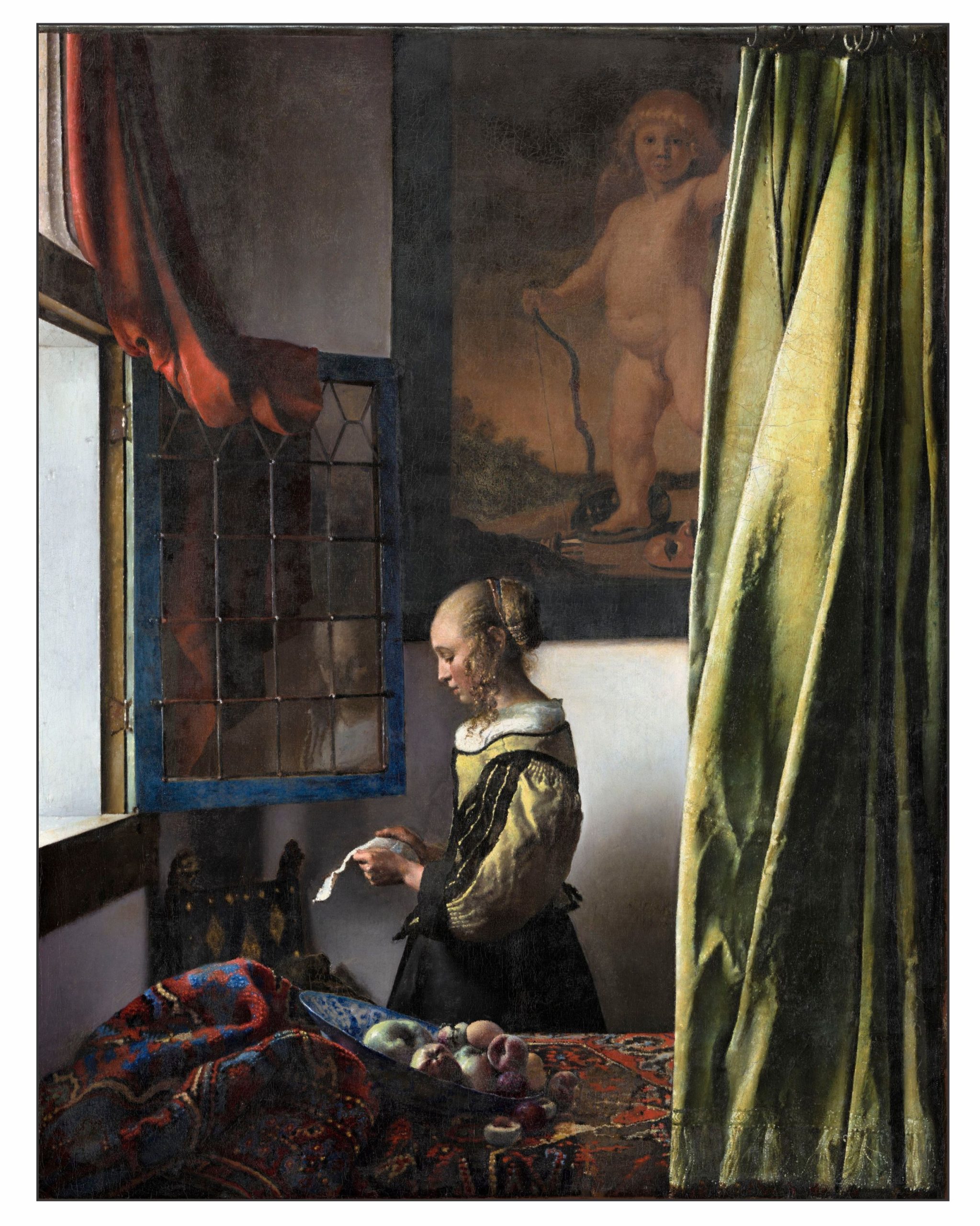
The first of these paintings is Young Woman Reading a Letter at an Open Window (1657). The viewer is not told what is in the letter. In the course of its history the upper portion of the painting had been painted over. In 2021 the Gemäldegallerie in Dresden restored the picture to its original form, revealing a painting-within-a-painting of a naked cupid. (The original image without the cupid is shown in the illustration of perspective earlier in this post.) The same painting is in the background of another of Vermeer’s paintings: A Young Woman Standing at a Virginal (1670). The cupid indicates that the paintings are concerned with romantic love. Graham Dixon (2025, pp 156-162) suggests that the 1657 painting is a love offering from Vermeer to his wife Catherine. The letter may be a profession of his love for her. The fruit on the table before the woman may represent the hope that their love bring forth fruit.

The bare wall in the painted-over version of the picture was taken to indicate the “modernity” of Vermeer. Only a modern painter would have considered a bare wall as worthy of representation (Yeazell, 2026, chapters 2 and 3). I must admit that I prefer the bare wall version. Like the bare wall in the later Woman with a Pearl Necklace (1664).
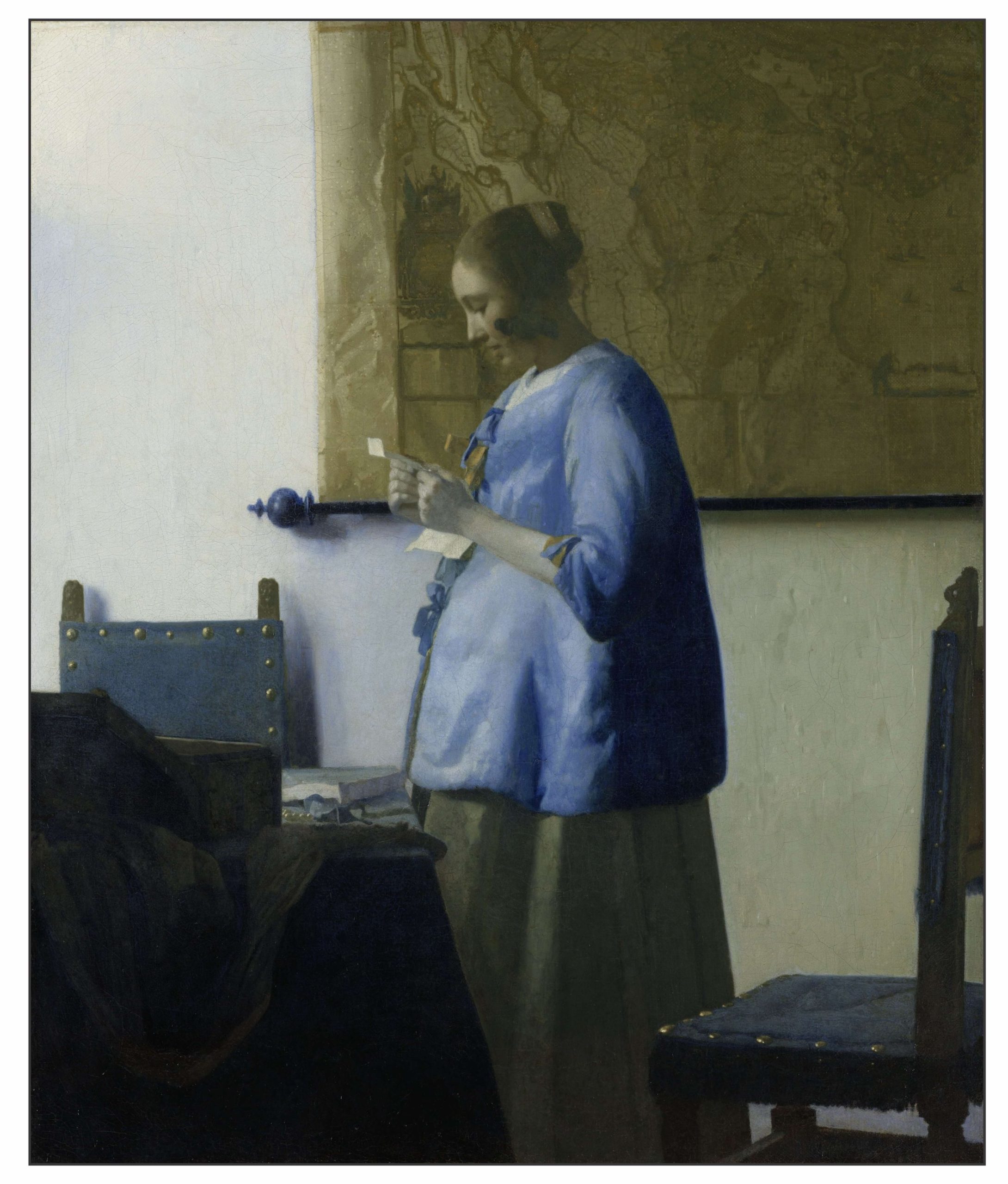
Graham-Dixon (2015, pp 239-243) pairs this painting with the later Woman in Blue Reading a Letter (1664) in the Rijksmuseum. The woman is the same, though in the later painting she is pregnant. Perhaps it is another love letter from Vermeer to his wife, who gave birth to Vermeer’s first son Johannes in 1663. The large map on the wall shows the provinces of Holland and West Friesland with the north to the right. This map was produced by Balthasar van Berckenrode in 1621 (Roeloffs & Weber, 2023, p 196). The large sea inlets south of Rotterdam are recognizable at the left. The same map is portrayed with greater clarity in Officer and Laughing Girl (1657). Since the window is not reproduced in this painting – it is only indicated by the light – perhaps the map serves to indicate the external world.

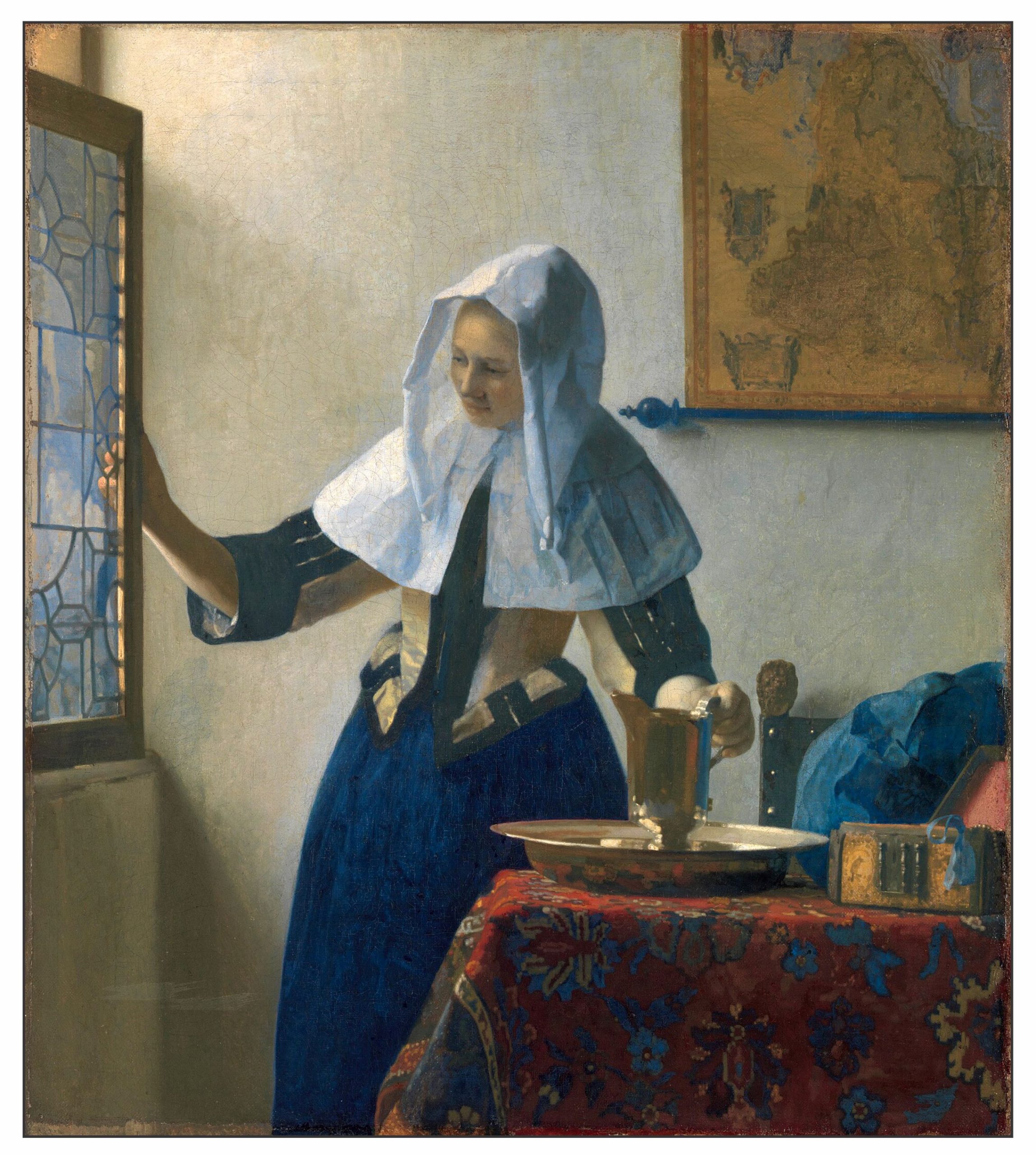
Young Woman with a Water Pitcher (1662) now in the Metropolitan Museum of Art in New York shows a woman about to pour water into a bowl. The woman wears a white headpiece which picks up the light coming in from the window. Graham-Dixon (2025) suggests that the painting is related to the story of Jesus and the woman of Samaria (John 4: 4-42), and promotes religious tolerance. Weber (2022, pp 132-133) proposes that the painting represents the immaculate conception of Mary. Bothe interpretations are speculative. The painting may just relate the inside (domestic) world to the outside (political) world as represented by the window and the map.
The map in this painting is by Hendrik Hondius (1631) and shows all seventeen provinces of the Netherlands, both the Dutch Republic and the Spanish Netherlands. The illustration shows versions of the two maps we have considered:
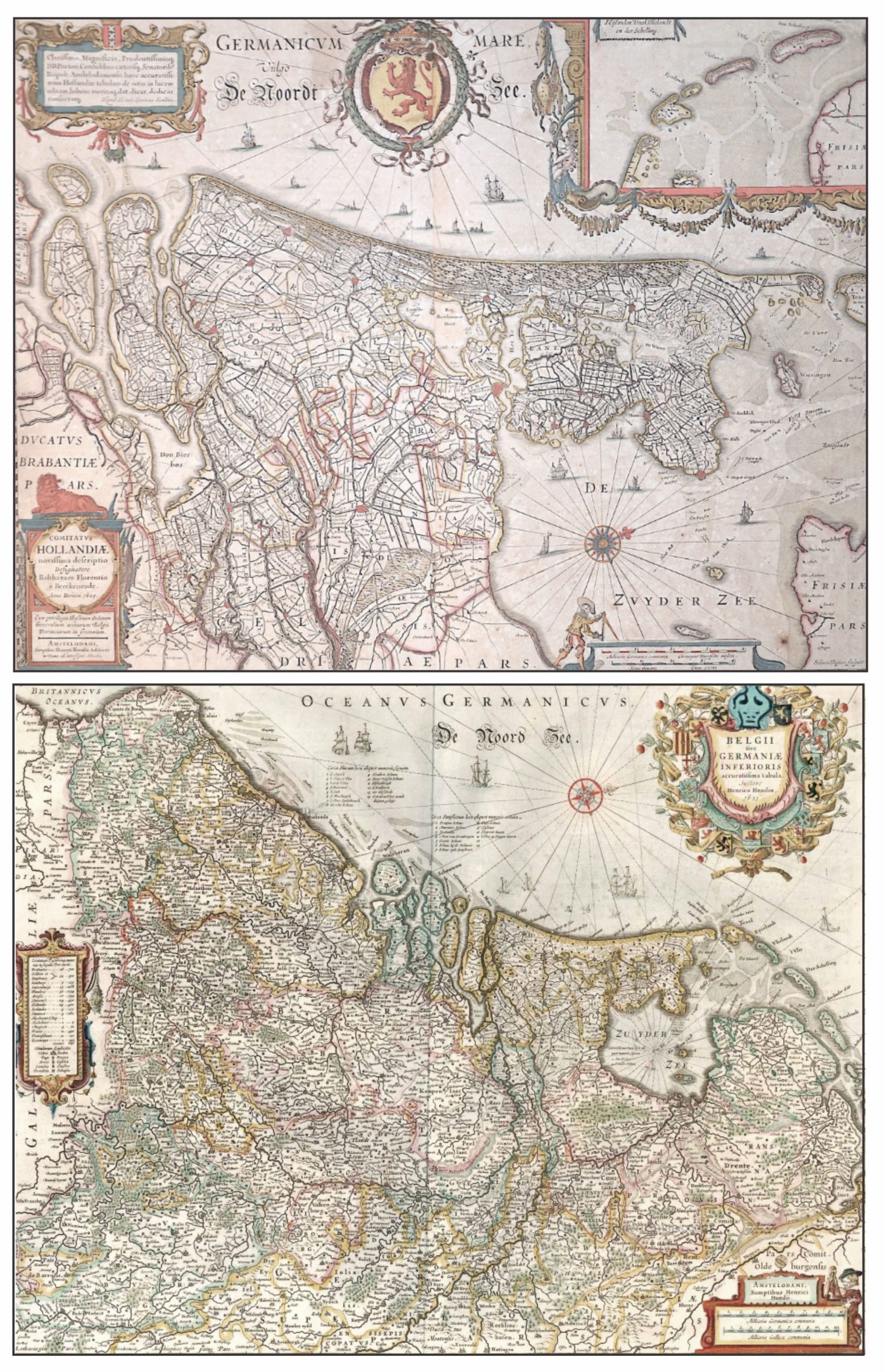
In Young Woman with a Water Pitcher, Vermeer initially had the map extend to the left side of woman’s head, but then shifted it to the right. The original position is still visible as a slight shadow on the bare wall. The new position isolates the head of the young woman for the viewer’s attention.
In Woman with a Pearl Necklace (1664) Vermeer removes the map completely and leaves us with a completely bare wall which glows as brightly as her pearls:
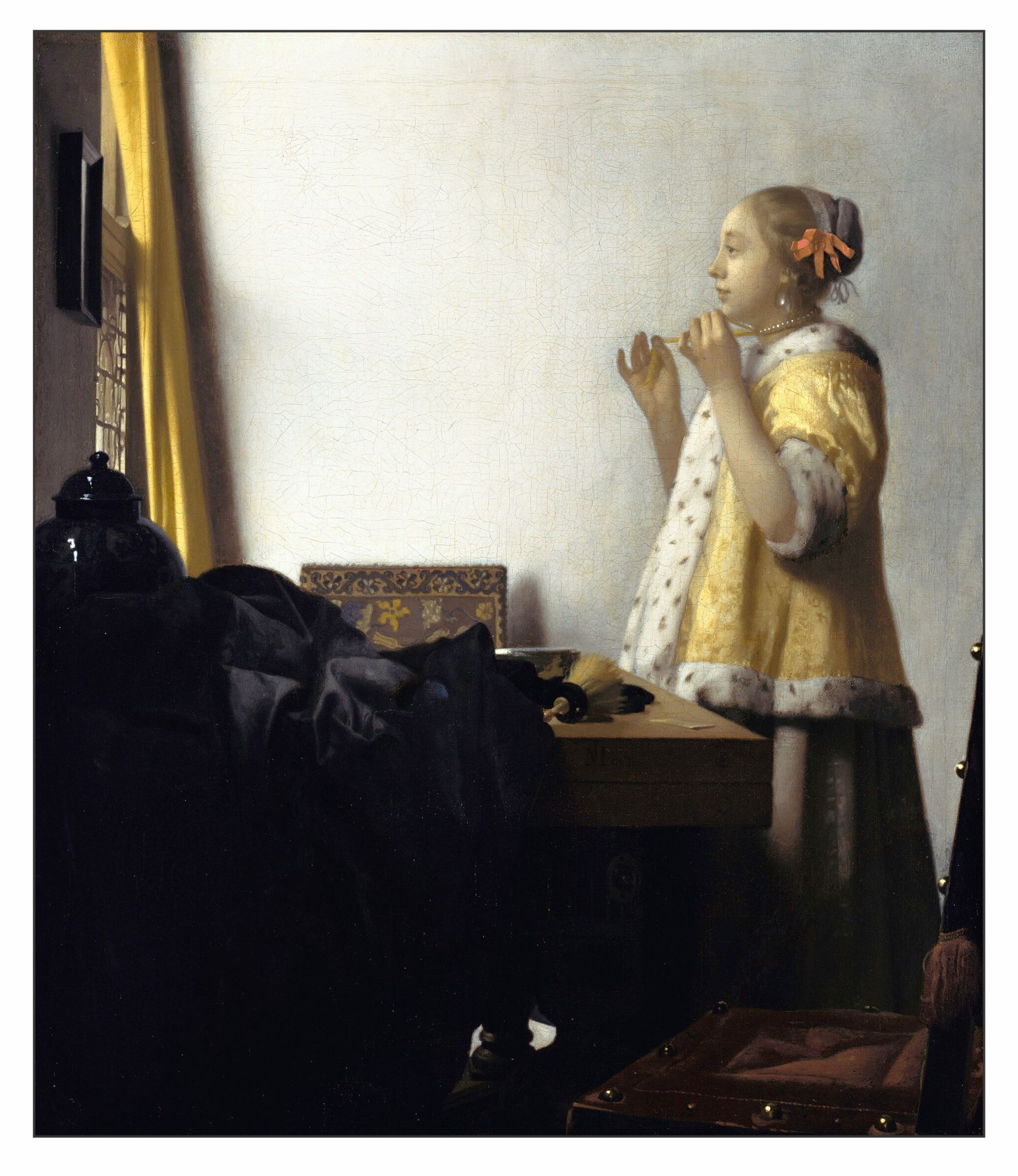
No one is sure what the painting represents. Ostensibly a young woman is enjoying how she looks in the small mirror mounted beside the window. Perhaps the woman is fixated on her looks and possessions, and fails to see the divine light pouring through the window (Weber, 2022, p 132). Perhaps, she is actually taking off her pearls, trading all her possessions for faith in Jesus: the one pearl of great price (Matthew 13: 45-46) (Graham-Dixon, 2025, pp 258-259).
A Pair of Icons
Vermeer’s main patrons were Pieter van Ruijven and his wife Maria de Knuijt (Montias, 1989, pp 246-262). After their deaths (in 1674 and 1681) their collection of Vermeer paintings passed on to their daughter Magdalena who was married to Jacob Dissius, the manager of the Golden ABC Printing Press. Magdalena died in 1682 and after Jacob’s death in 1695, twenty-one Vermeer paintings were sold at auction in Amsterdam in 1696. Among these paintings were The View of Delft, The Little Street and The Woman with a Pearl Necklace, which we have already considered.
Woman with a Balance, now in the National Gallery of Art in Washington, was the first painting to be auctioned. It was initially described as a “young lady weighing gold” but there is no gold in the balances. Most scholars give a date for the painting near 1663. However, Graham-Dixon (2025, p 184) suggests that it was painted in 1659 because it seems to be paired with The Milkmaid: the paintings are similar in size and share similar physical details such as the small nail in the wall near the window. Furthermore, the two paintings were paired by the auctioneer as lots 1 and 2.
The following are Graham-Dixon’s comments (2025, p 185) on the Woman with a Balance:
The woman weighing is richer than the woman pouring milk, to judge by her jewellery and her blue jacket trimmed with fur, so she has to work harder to get to heaven. The Day of Judgement is on her mind: on the wall behind her is a doom painting thronged with figures of the damned and the saved, beneath Christ the Judge pronouncing his final sentence. But she has no worries on that score. There is a beatific smile on her face…. She has looked herself in the eye in the mirror on the wall. She has renounced her jewellery, taken it off and placed it on the table, together with some coins. All will go to charity. Having resisted temptation, her soul remains spotless. According to the description in the auction catalogue, the woman should be weighing gold, but in fact her scales are empty. That is not to say that she is weighing nothing, just that what she is weighing happens to be invisible. She has put her conscience in the scales, and found it so light as to be weightless. She has done no evil, bears no burden of sin.
The painting has more commonly been interpreted (e.g. Blankert, 1978, p 44) as depicting a rich woman who spends her time assessing her worldly goods, not realizing that these will have no value on the Day of Judgement. However, the serenity of the woman’s expression and her pure white head-dress are more in keeping with the ideas of Graham-Dixon.
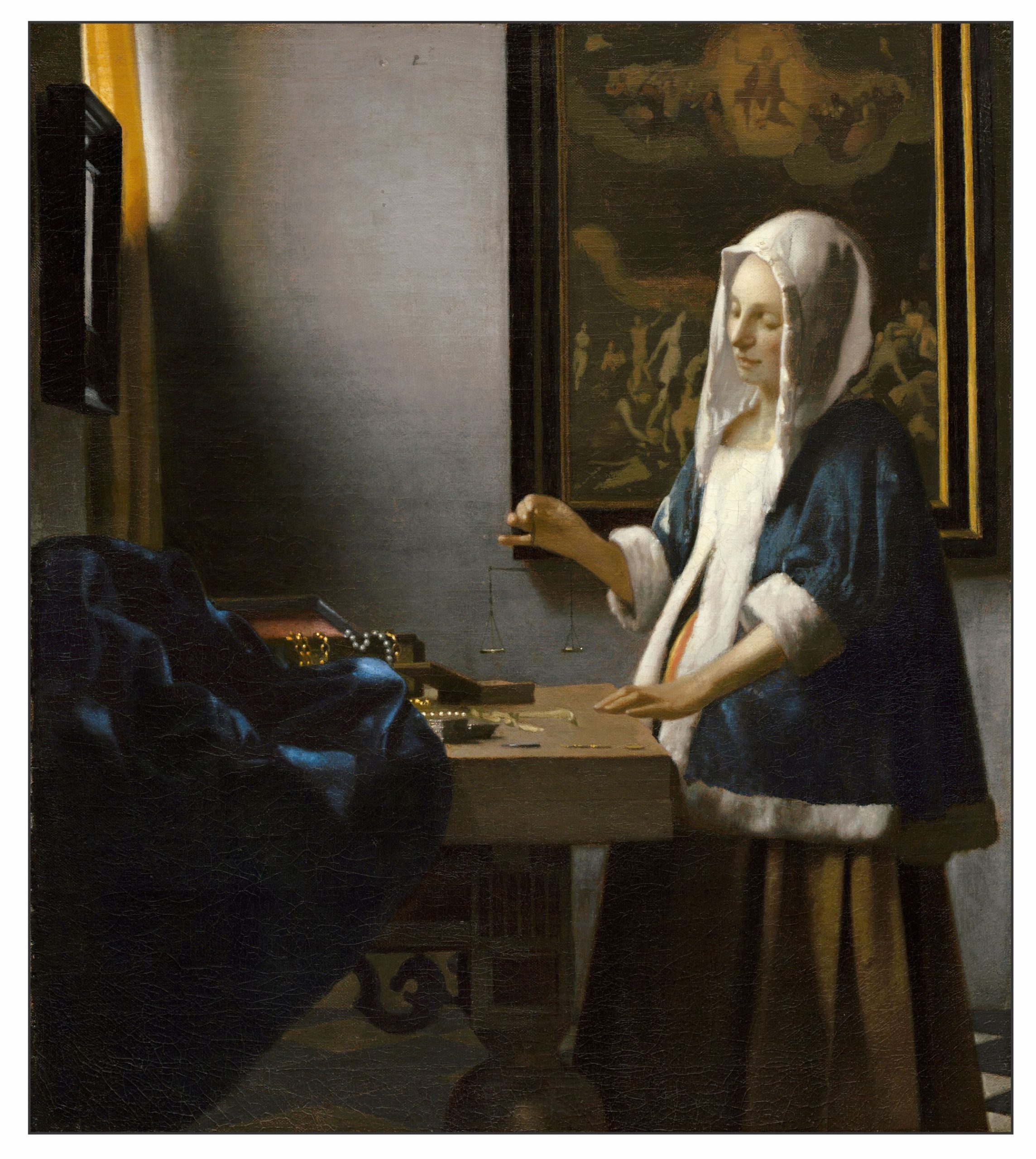
The painting was described at auction as being “in a box.” Graham-Dixon (2025, p 189) suggests that this probably means that the frame for the picture also included
shutters that could be opened or closed, like the wings of an altarpiece, or the folding doors of a portable devotional picture.
He also suggests that The Milkmaid was likely also displayed in a similar fashion in the van Ruijven household: like two religious icons that could be opened for viewing and contemplation.
The Milkmaid (1658), now in the Rijksmuseum in Amsterdam, was the second painting to be auctioned in 1696. The title is a misnomer: the subject is a kitchen maid rather than a milkmaid, who tends to and milks the cows on a farm. The maid is pouring milk from a pitcher into a bowl. A large loaf of bread is in the basket and several pieces of another loaf are on the table.
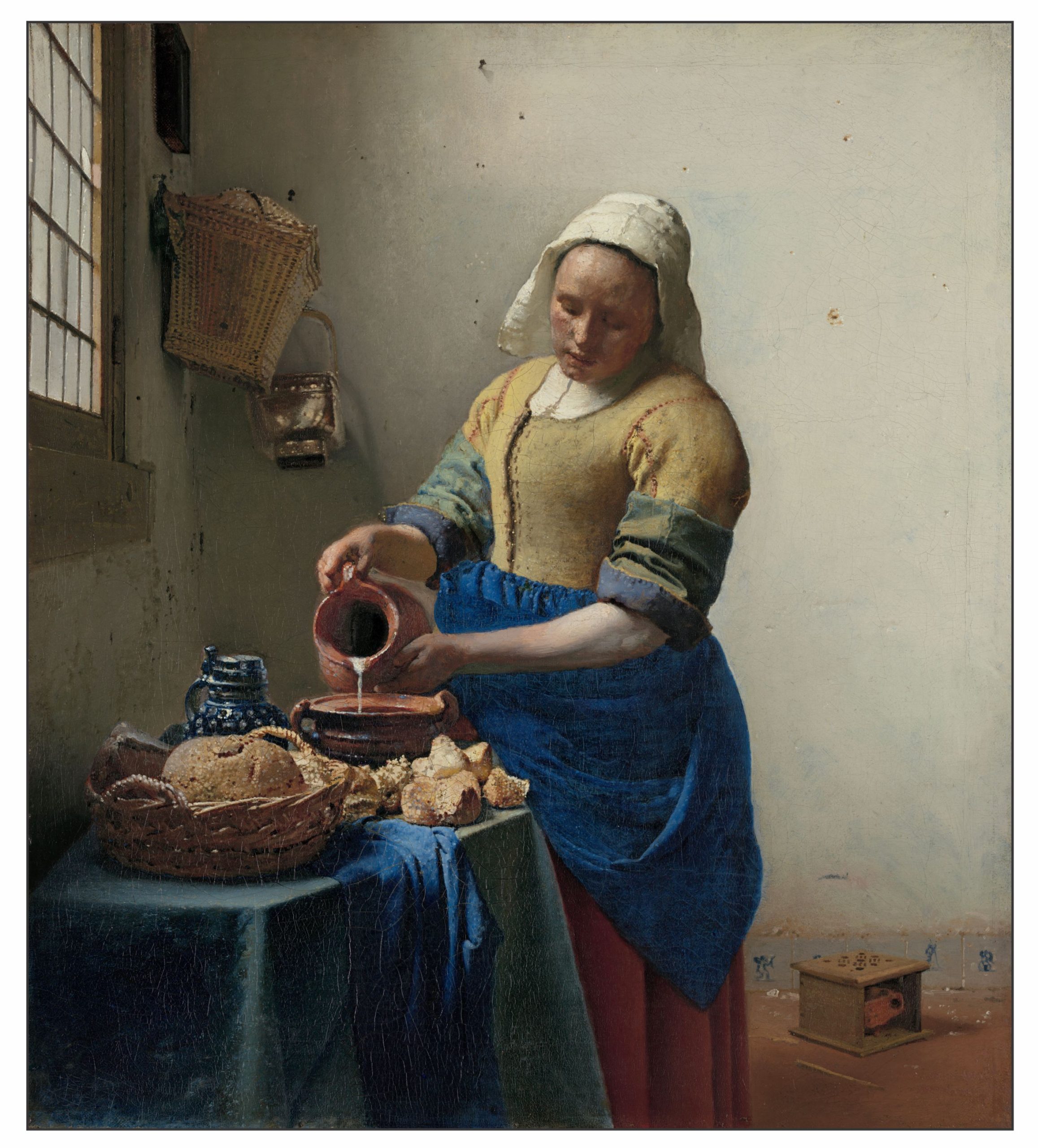
Graham-Dixon (2025, p 186) suggests that maid is preparing food for the poor:
She stands for good works, for charity, for feeding others in both the literal and the spiritual sense. In the poor houses of the town a simple preparation of bread crumbled into milk was traditionally served to the indigent, whose teeth were too weak for more solid food. This is the dish she is preparing. While the milk she pours from the jug is real enough, it also calls to mind ‘the milk of the word’ which all crave ‘as newborn babes’ (Peter I:2). Likewise the bread on the table is knobbly, substantial, dusted with flour, but it also shimmers and sparkles as if blessed by divine light. It is a reminder of the bread on the table at the Last Supper and the loaves miraculously multiplied by the sea of Galilee, ‘the true bread from heaven’, which is belief and everlasting life (John 6). These are the gifts The Milkmaid brings: real food and drink for those who hunger and thirst, but spiritual food and drink too.
Another interpretation is that she is making bread pudding: combining bread, eggs and milk that will later be cooked to make the pudding (Schwartz, 2017, p 20, quoting Harry Rand).
On the floor to the right of the maid is a stoof or footwarmer. This is a wooden box with holes on its top, into which is placed an earthenware or metallic bowel containing burning charcoal or coal embers. Footwarmers were typically used when sitting: the feet were placed on the box, and the legs and feet covered with a blanket or skirt so that the heat rose to warm the body. (These are no longer used because of the danger of carbon monoxide poisoning.) Since the heat particularly affected the nether parts, the object was often used to symbolize lust. Liedtke (2009, p 13) therefore suggests the maid is thinking amorous or lascivious thoughts during her humdrum work. However, the seriousness to the painting acts to belie any satirical or sexual interpretation. Graham-Dixon (2025, p 186) suggests that the maid has put romantic love aside. One of the uses of the footwarmer was to stay warm during long sermons in a cold church. Another interpretation is that the maid has just returned from church and is putting its teachings into practice.
Graham-Dixon (2025, p 184-185) proposes that both Woman with a Balance and The Milkmaid served as paired devotional objects in the Remonstrant home of Pieter van Ruijven and his wife Maria de Knuijt. He relates them to the Bible’s Mary and Martha, the subject of one of Vermeer’s early paintings Christ in the House of Mary and Martha (1655)
#/media/File:Johannes_(Jan)_Vermeer_-_Christ_in_the_House_of_Martha_and_Mary_-_Google_Art_Project.jpg)
The woman weighing is reflecting, assessing, meditating. The woman pouring milk is preparing a meal, working for others, measuring their needs. One woman is thinking, the other is doing. One is contemplative, the other is active. We have met these women before, in different clothes, in a different setting and a different place. We have met them in the Bible and we have met them in another painting by Vermeer. Are they not Martha and Mary, the Active Life and the Spiritual Life, in another guise?
The Biblical story is as follows
Now it came to pass, as they went, that he entered into a certain village: and a certain woman named Martha received him into her house.
And she had a sister called Mary, which also sat at Jesus’ feet, and heard his word.
But Martha was cumbered about much serving, and came to him, and said, Lord, dost thou not care that my sister hath left me to serve alone? bid her therefore that she help me.
And Jesus answered and said unto her, Martha, Martha, thou art careful and troubled about many things:
But one thing is needful: and Mary hath chosen that good part, which shall not be taken away from her. (Luke 10:38-42)
Graham-Dixon is correct about the difference between the two paintings. One is concerned with the activities of the day, whereas the other attends to eternity. However, the women are not sisters: one is a mistress and the other is a maid. Nevertheless, his suggestion that the pictures were objects of contemplation during prayer meetings rings true:
Woman with a Balance would seem an apt image to contemplate during a period of prayer and reflection, perhaps therefore at the start a meeting. The Milkmaid, which is about going out into the world and performing good deeds, would seem suited to the end, when people were about to leave. (Graham-Dixon, 2025, p 189).
Woman at a Window
Artists have represented many different women at many different windows (Sliwka, 2022; Weber in Roeloffs & Weber, 2023, pp 162-167). Their pictures reveal the differences between internal and external worlds, between the domestic and the politic, the imagined and the real.
The upper part of the following illustration shows various examples: Caspar David Friedrich’s Women at a Window (1822) which portrays a longing for freedom; Wilhelm Hammeshoi’s Interior with a Woman Standing (1913) with its sense of sad solitude; and Isabel Codrinton’s The Kitchen (1927) with its underlying menace. At the bottom left is Edward Hopper’s Morning Sun (1952) showing a lonely woman about to face whatever the day may bring.
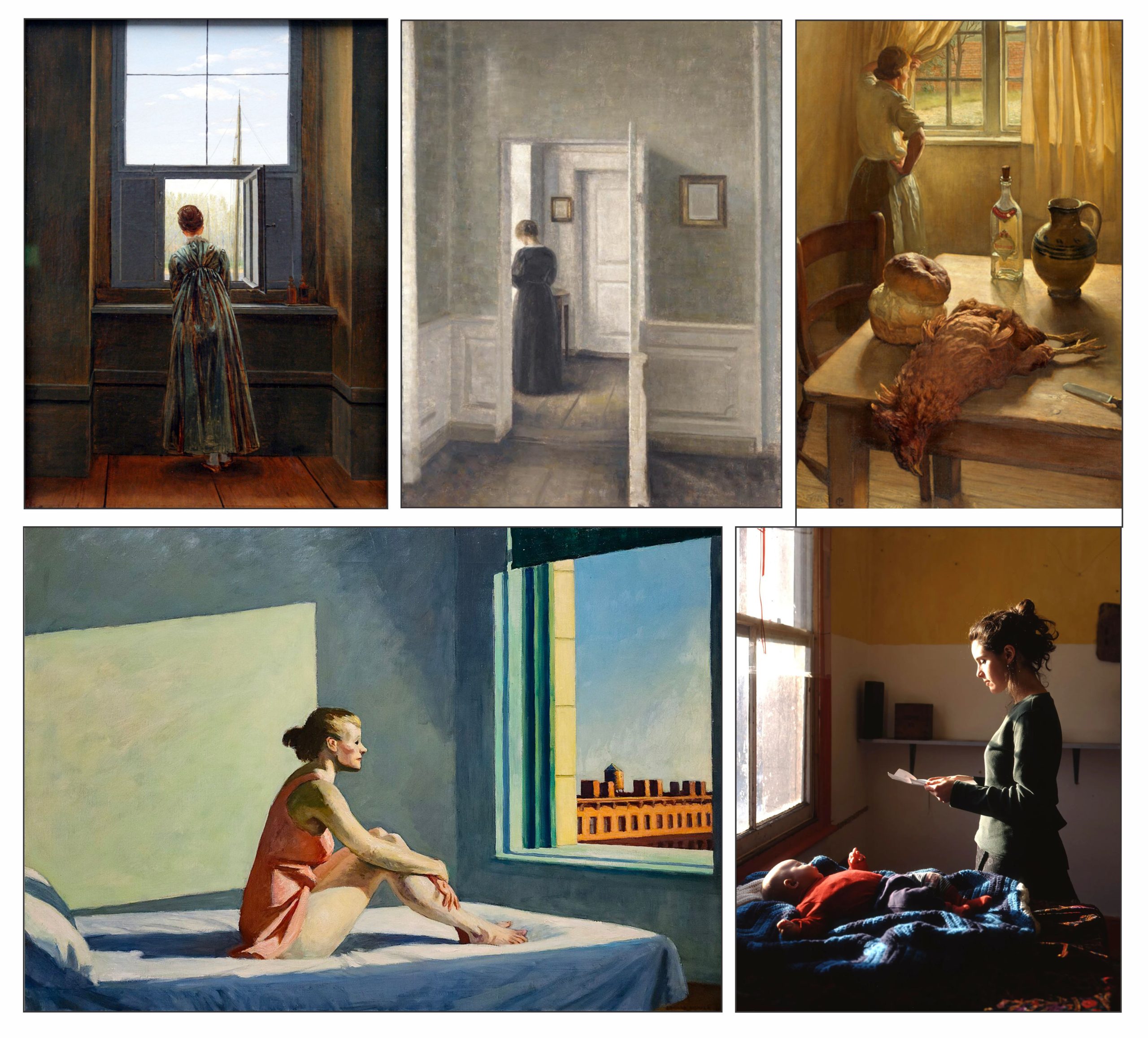
And on the bottom right is Tom Hunter’s photograph Woman Reading Possession Order (1997) which transforms Vermeer’s Young Woman Reading a Letter at an Open Window to a modern setting.
In Hunter’s composition, the sumptuous interior of Vermeer’s painting has been replaced by a squatter’s residence in Hackney, east London and the love letter substituted with an eviction notice, a copy of which accompanies the photograph, asserting the harsh reality behind this carefully staged composition. Interpreted alongside the Vermeer, we may understand the baby on the table in Hunter’s photograph as the result of the actions of Cupid upon the woman at the window and as a fruitful manifestation of the abundant produce in the Dutch painting. In contrast to the Vermeer, the window here is closed, suggesting a more fixed outcome or certain finality to the situation. The light passing through the window, however, illuminating the woman’s resigned face and the child’s head, suggests there may be hope beyond these dire circumstances. (Sliwka, 2022, p 44).
Envoi
Vermeer’s paintings of a woman standing at a window have a solemnity that warrants contemplation. We may not fully understand their meaning, but we are sure that they are immensely important. The following is Wislawa Szymborska’s 2009 poem from Szymborska (2015, p 413) about The Milkmaid:
As long as that woman from the Rijksmuseum
in painted silence and concentration
keeps pouring milk day after day
from the jug to the bowl
the World hasn’t earned
the world’s end.
References
Blankert, A. (1978). Vermeer of Delft: complete edition of the paintings Phaidon.
Blockmans, W. P. (2022). The formation of a political union, 1300-1588.In J. C. H. Blom, & E. Lamberts (Eds). History of the low countries. (pp 55-142). Berghahn Books.
Deursen, A. T. van. (2022). The Dutch Republic, 1588-1780. In J. C. H. Blom & E. Lamberts (Eds.) History of the Low Countries. (pp. 143–220). Berghahn Books.
Graham-Dixon, A. (2025). Vermeer: a life lost and found. Allen Lane.
Hockney, D. (2001). Secret knowledge: rediscovering the lost techniques of the old masters. Viking Studio.
Janson, J. (2026) Vermeer and the art of linear perspective. Essential Vermeer
Kooi, C. (2018). Religious Tolerance. In Helmers, H. J., & Janssen, G. H. (Eds) The Cambridge Companion to the Dutch Golden Age (pp. 208–224). Cambridge University Press.
Liedtke, W. A. (2001). Vermeer and the Delft School. Metropolitan Museum of Art.
Liedtke, W. A. (2009). The Milkmaid by Johannes Vermeer. Metropolitan Museum of Art.
Montias, J. M. (1989). Vermeer and his milieu: a web of social history. Princeton University Press.
Proust, M. (1923, translated by Scott-Moncrieff, C. K., 1929). The captive. Modern Library.
Roelofs, P., &Weber, G. J. M. (Eds). (2023). Vermeer. Thames & Hudson.
Schwartz, G. (2017). Vermeer in detail. Ludion.
Sliwka, J. (2022). Reframed: the woman in the window. Dulwich Picture Gallery.
Steadman, P. (2001). Vermeer’s camera: uncovering the truth behind the masterpieces. Oxford University Press.
Szymborska, W. (translated by Cavanagh, C. & Barańczak, S., 2015). Map: collected and last poems. Houghton Mifflin Harcourt.
Wadum, J. (1995). Vermeer in perspective. In A.K. Wheelock (Ed) Johannes Vermeer. (pp 66-79). National Gallery of Art
Weber, G. J. M. (2022). Johannes Vermeer: faith, light and reflection. Rijksmuseum.
Wielenga, F. (translated by Richards, L., 2015). A history of the Netherlands: from the sixteenth century to the present day. Bloomsbury Academic.
Yeazell, R. B. (2026). Vermeer’s afterlives. Princeton University Press.
Leave a Reply