Late Byzantine

image_pdfimage_print

The Byzantine Empire began with the founding of the city of Constantinople by the Emperor Constantine the Great in 330 CE. By the 12th century Constantinople was the largest and richest city in Europe. Byzantium maintained its glory until the sacking of of the city by the forces of the Fourth Crusade in 1204 CE. After this the Byzantine Empire existed only in fragments. The Ottoman conquest of the Constantinople in 1453 CE ended the empire, replacing Eastern Christianity with Islam.

The art and architecture of the Byzantine Empire is justly famous. Buildings such as the Hagia Sophia taught the world the use of space; the mosaics of Ravenna, Venice and Palermo gave the Christian religion its iconography. This is the Byzantium of Yeats’ poem Sailing to Byzantium (1927)

O sages standing in God’s holy fire
As in the gold mosaic of a wall,
Come from the holy fire, perne in a gyre
And be the singing-masters of my soul.

Read more

Apollo’s Gaze

image_pdfimage_print

charioteer of delphiThe Charioteer of Delphi is a life-size bronze statue erected in 474 BCE to commemorate a victory in the chariot races of the Pythian games. The statue’s left arm is missing; the reins held in his right hand are no longer connected to his steeds; the headband has lost its silver inlay. Yet the glass eyes and copper eyelashes are remarkably well preserved. The charioteer’s head and gaze are inclined to the side. This is one of the first direct interactions between a work of art and the viewer. He looks at you as much as you at him. The look is piercing.

The statue likely portrays the winning charioteer. However, it may also represent Apollo, the divine patron of the Pythian games. Apollo was the sun-god, having assumed this role from the Titan Helios of earlier mythology. Apollo was a god of many facets: the god whose chariot carried the sun across the sky, the god of music and the leader of the muses, the god of prophecy and poetry, the god of light and truth. Though generally beneficent, Apollo was sometimes dangerous. The horses of the sun’s chariot occasionally ran wild and caused widespread destruction. This has been attributed to Phaethon, the son of Helios, though these may both be manifestations of Apollo.

Read more

Versions of History

image_pdfimage_print

On August 22, 1938, the Nazi government revoked the permits allowing Polish Jews to live in Germany. Between September 27 and 29, 12,000 Jews were deprived of their possessions, transported to the Polish border, and left there without food or shelter. Polish officials allowed them across the border, even though many no longer possessed Polish papers. The Jews were housed in makeshift accommodation in the town of Zbaszyn. They were hungry and desperate.

Among the expelled Jews was the Grynszpan family from Hannover. Esther Grynszpan sent a postcard asking for help to her 17-year-old brother Herschel, who was staying illegally with relatives in Paris. Herschel received his sister’s postcard on November 3. On November 6 he tried to convince his uncle to send money to Poland to help his family. A violent argument developed, and Herschel stormed out into the night.

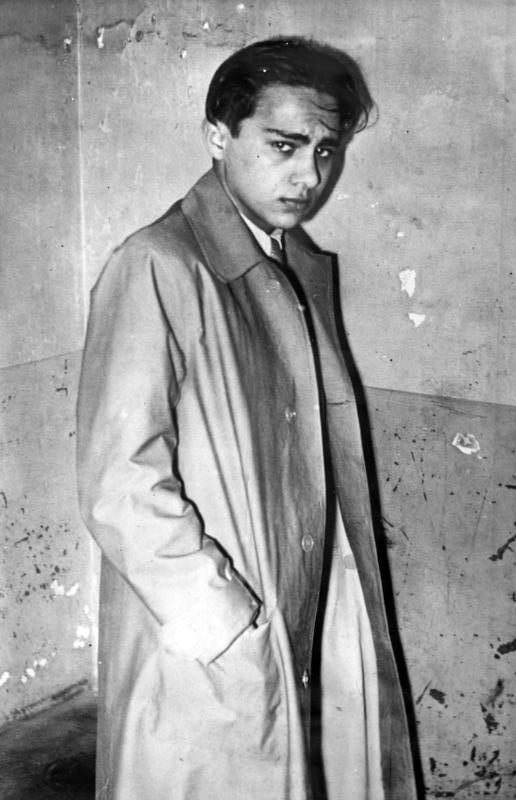
The next morning Herschel bought a revolver, and went to the German Embassy. He claimed to have important documents to submit to an embassy official, and was ushered into the office of Ernst vom Rath, a 29-year-old diplomat. A few minutes later, Herschel shot vom Rath in the stomach. Herschel was taken into custody by the French police. (The photograph shows him at the time of his arrest.) Vom Rath was taken to hospital where he died two days later on November 9.

Read more

Still Life

image_pdfimage_print

The genre of painting known as “still life” deals with our perception of the natural world. As such it has much in common with the empirical sciences.. However, whereas the scientist analyses the world, the artist tries to recreate it.

The still-life artist selects and arranges what will be depicted. If landscape is observation, then still life is experiment. The view of the world typically includes artificial as well as natural objects. More often than not, the arrangement of the objects provides a moral meaning, typically one related to transience or “vanity.” The still-life painting thus comments on both the nature of reality and the process of creation.

Read more